EP1661488A2 - Material für Bürstenborsten - Google Patents
Material für Bürstenborsten Download PDFInfo
- Publication number
- EP1661488A2 EP1661488A2 EP05023069A EP05023069A EP1661488A2 EP 1661488 A2 EP1661488 A2 EP 1661488A2 EP 05023069 A EP05023069 A EP 05023069A EP 05023069 A EP05023069 A EP 05023069A EP 1661488 A2 EP1661488 A2 EP 1661488A2
- Authority
- EP
- European Patent Office
- Prior art keywords
- ptt
- brush bristle
- brush
- bristle material
- monofilament
- Prior art date
- Legal status (The legal status is an assumption and is not a legal conclusion. Google has not performed a legal analysis and makes no representation as to the accuracy of the status listed.)
- Granted
Links
Images

Classifications
-
- A—HUMAN NECESSITIES
- A46—BRUSHWARE
- A46D—MANUFACTURE OF BRUSHES
- A46D1/00—Bristles; Selection of materials for bristles
- A46D1/02—Bristles details
- A46D1/0207—Bristles characterised by the choice of material, e.g. metal
-
- A—HUMAN NECESSITIES
- A46—BRUSHWARE
- A46D—MANUFACTURE OF BRUSHES
- A46D1/00—Bristles; Selection of materials for bristles
-
- A—HUMAN NECESSITIES
- A46—BRUSHWARE
- A46D—MANUFACTURE OF BRUSHES
- A46D1/00—Bristles; Selection of materials for bristles
- A46D1/02—Bristles details
- A46D1/0269—Monofilament bristles
-
- A—HUMAN NECESSITIES
- A46—BRUSHWARE
- A46D—MANUFACTURE OF BRUSHES
- A46D1/00—Bristles; Selection of materials for bristles
- A46D1/02—Bristles details
- A46D1/0276—Bristles having pointed ends
-
- Y—GENERAL TAGGING OF NEW TECHNOLOGICAL DEVELOPMENTS; GENERAL TAGGING OF CROSS-SECTIONAL TECHNOLOGIES SPANNING OVER SEVERAL SECTIONS OF THE IPC; TECHNICAL SUBJECTS COVERED BY FORMER USPC CROSS-REFERENCE ART COLLECTIONS [XRACs] AND DIGESTS
- Y10—TECHNICAL SUBJECTS COVERED BY FORMER USPC
- Y10T—TECHNICAL SUBJECTS COVERED BY FORMER US CLASSIFICATION
- Y10T428/00—Stock material or miscellaneous articles
- Y10T428/29—Coated or structually defined flake, particle, cell, strand, strand portion, rod, filament, macroscopic fiber or mass thereof
- Y10T428/2913—Rod, strand, filament or fiber
Definitions
- the present invention generally relates to a brush bristle material mainly made of polytrimethylene terephthalate (PTT) and offering excellent properties to trap and release cosmetics and medicaments, and a cosmetic brush or toothbrush using the same.
- PTT polytrimethylene terephthalate
- the present invention relates to a brush bristle material comprising a monofilament made of PTT and having a tapered surface at the tip of the brush hair where irregularities of 1 to 20 ⁇ m are formed at intervals of 5 to 50 ⁇ m, and a cosmetic brush or toothbrush using the same.
- Patent Literature 1 Synthetic fiber brushes with a tapered end are already known (Patent Literature 1 indicated below), and a number of improvement technologies have been presented to date. Examples include: a multi-step alkali processing performed after a bundle of polyethylene terephthalate (PET) fibers is dipped in a 20 weight-percent sodium hydroxide solution by around 10 mm, neutralized and then washed in order to create a sharp tip (Patent Literature 2); a tapered hair material made by spinning PTT and PET or PBT (polybutylene terephthalate) together, and then dipping the obtained monofilament hair material in a sodium hydroxide solution to have one end tapered and provide moisture absorption property, elasticity and flexibility (Patent Literature 3); and a brush bristle material made of a PET monofilament having a multi-lobed irregular cross-section, wherein one end of the hair is sharpened using a sodium hydroxide solution (Patent Literature 4).
- PET polyethylene
- brush bristle materials comprising PET or PBT monofilaments with one longitudinal end tapered via alkali processing offer flexible tips and are replacing animal hairs as brush materials.
- Patent Literature 1 Japanese Patent Laid-open No. Sho 49-047618
- Patent Literature 2 Japanese Patent Laid-open No. Sho 51-116298
- Patent Literature 3 Japanese Patent Laid-open No. 2004-141504
- Patent Literature 4 Japanese Patent Laid-open No. 2002-058538
- Patent Literature 5 Japanese Patent Laid-open No. 2003-225123
- brush bristle materials made of synthetic fibers and having flexibility and liquid trapping property equivalent to those of natural animal hairs are being sought.
- an object of the present invention is to provide a brush bristle material, especially a hair material for cosmetic brushes or toothbrushes, which is made of PIT and has a tapered surface with irregularities equivalent to those of natural animal hairs and thus effectively traps powder cosmetics and medicaments.
- the present invention was achieved by forming a tapered shape on one end of a monofilament made of synthetic fiber, and providing fine irregularities on the tapered surface to allow powder cosmetic material to be held in the concaved parts, in order to obtain a brush bristle material made of synthetic fiber that offers properties equivalent to those of natural brush bristle materials.
- the inventors selected PTT monofilament as the base material for this synthetic fiber.
- the PTT brush bristle material according to an embodiment of the present invention can be used on brush products that are normally made with natural animal hairs, and is particularly useful on cosmetic brushes and toothbrushes.
- the present invention is based on the following structures:
- the degree of the taper of the tip section may vary, and in an embodiment, the tip section may not be tapered substantially. Further, in an embodiment, the irregularities may be formed in a part of the tapered surface. Further, the size of irregularities, 1-20 ⁇ m, are intended to mean a majority size range in an embodiment or an average or median size range in another embodiment.
- the brush bristle material according to an embodiment of the present invention has a tapered section at its tip in the longitudinal direction by hydrolyzing the tip of a PTT monofilament by alkali with amine catalyst, and fine irregularities of 1 to 20 ⁇ m are formed on the tapered surface as a result of partial promotion of hydrolysis.
- the obtained brush bristle material has flexibility equivalent to that of natural animal hairs, offers excellent powder trapping and releasing properties, and is therefore most effectively used on cosmetic brushes and toothbrushes.
- the brush bristle material according to an embodiment of the present invention provides favorable trapping property particularly for powder cosmetics and other powders.
- this brush bristle material also provides excellent trapping property equivalent to that of natural hairs and conventional brush bristle materials made of PET and PBT.
- intervals of fine irregularities formed at the tapered section vary depending on the amounts of amine catalyst and emulsifier added. By adjusting the amounts of these additives, irregularities having appropriate intervals can be formed.
- the brush bristle material according to an embodiment of the present invention may comprise a monofilament made of PTT mixed with PET and/or PBT, with the PTT content adjusted to 20 percent by weight or more, or more preferably 50 percent by weight or more. Most preferably, the PTT content may be 100 percent by weight
- any element used in an embodiment can interchangeably be used in another embodiment unless such a replacement is not feasible or causes adverse effect.
- the present invention can equally be applied to products and methods.
- Fig. 1 is a conceptual diagram showing the tapered section with irregularities of a brush bristle material produced according to an embodiment of the present invention.
- Fig. 2 is a conceptual diagram showing the tip of a brush at which brush bristle materials produced according to an embodiment of the present invention are converged.
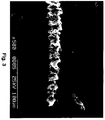
- Fig. 3 is a photograph (magnification: x500) showing the tapered section at the tip of the brush hair obtained in Example 1.
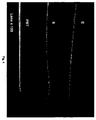
- Fig. 4 is a photograph (magnification: x90) showing a brush bristle material of an embodiment of the present invention, squirrel hair and PBT brush bristle material on which powder cosmetic is trapped.
- alkali processing has been know as a way to taper polyester monofilaments such as those made of PET, PBT, etc.
- PTT is slower to hydrolyze under alkali and is therefore considered not suitable for tapering. Hydrolysis of PTT progresses gradually as the alkali processing temperature rises. However, PTT dissolves under severe conditions, which makes it difficult to adjust the tapering conditions.
- Crimps with fine irregularities could not be formed easily at the tip of a PET or PBT monofilament, because conventional hair materials made of PET and PBT hydrolyze quickly and are hard and brittle and therefore easily break or sever at the concaved parts of the irregularities.
- the basic principle of the present invention in an embodiment is to alkali-process PTT, the base material, at high temperature using amine catalyst, thereby accelerating hydrolysis partially to form a tapered shape, while allowing irregularities of 1 to 20 ⁇ m to form on the tapered surface.
- the intervals of fine irregularities thus formed at the tapered section vary depending on the amounts of amine catalyst and emulsifier added. Through adjustments, irregularities can be provided over the entire surface at intervals of 5 to 20 ⁇ m.
- the present invention enables formation of irregularities of 1 to 20 ⁇ m at intervals of around 5 to 50 ⁇ m on the surface of a tapered section by utilizing the rubber-like elasticity of flexible PTT material, as shown in the electron micrograph given in Fig. 3 (magnification: x500).
- a brush made with the obtained brush bristle material can resolve the problem of scattering cosmetic powder.
- PTT is alkali-processed in the same manner as in the conventional technologies.
- the present invention uses an alkali processing solution comprising sodium hydroxide, hydrolysis accelerator catalyst, penetrant and olygomer solubilizer.
- a section of around 10 to 20 mm on one end or both ends in the longitudinal direction of a bundle of PTT monofilaments having a length of approx. 20 to 80 mm is dipped in this solution and processed for one to two hours at 110 to 130°C to obtain an intended brush bristle material having fine irregularities of 1 to 20 ⁇ m at intervals of 5 to 50 ⁇ m over the surface of the tapered section.
- PET When the shape recovery ratio from a 20% elongated state was compared among materials used to produce brush bristle materials according to an embodiment of the present invention, PET exhibited a shape recovery ratio of 29%, while PTT had a very high shape recovery ratio of 88%.
- the modulus of elasticity of PET was 97 cN/Dtex, while that of PTT was 23 cN/Dtex.
- PTT material offers excellent flexibility, and also due to the tapering process of PTT as mentioned above, the brush hair made of PTT does not irritate the skin unlike conventional brush hairs made of PET and PBT. Indeed, PTT is flexible, has excellent touch, and offers high shape recoverability and excellent coatability of cosmetics.
- the brush bristle material according to an embodiment of the present invention offers a better powder trapping property for medicaments and cosmetics than squirrel hair, which has been rated as offering the best powder trapping property among all brush bristle materials. This is attributable to the many irregularities formed on the material.
- the brush bristle material according to an embodiment of the present invention offers much better flexibility and touch compared with conventional PET and PBT.
- the powder-cosmetic trapping property of the brush bristle material according to an embodiment of the present invention is notably higher than the trapping property of squirrel hair, which has been rated as offering the best powder trapping property among all brush bristle materials, or the trapping property of fiber made of PBT belonging to the same polyester group.
- a PTT monofilament is alkali-processed by applying amine catalyst at high temperature
- hydrolysis is partially accelerated and irregularities of 1 to 20 ⁇ m are formed on the tapered surface of the monofilament.
- the intervals of the resulting fine irregularities vary depending on the amounts of amine catalyst and emulsifier added. Through adjustment, these irregularities can be provided over the entire surface of the monofilament's tapered section at intervals of 5 to 20 ⁇ m. These fine irregularities enhance the trapping property for cosmetic powders and medicaments comprising finer grains.
- crimped brush bristle materials had a crimp length of 5 to 30 times the thickness of the monofilament and a crimp height of 1.2 times or less the thickness of the monofilament. If larger crimps were formed, the shape recoverability of the brush bristle material after application and removal of external forces dropped, thereby affecting the brush function.
- the brush bristle material according to an embodiment of the present invention has a crimp length of 40 to 50 times the thickness of the monofilament and a crimp height of 3 to 6 times the thickness of the monofilament. Formation of fine irregularities despite such a large crimp size becomes possible because of the excellent shape recoverability achieved by the rubber-like elasticity of PTT that comprises the new brush bristle material. It has been revealed that adding crimps of the above shape would increase the void ratio between adjacent brush hairs and increase the amount of powder cosmetic material trapped between the hairs, thereby allowing the cosmetic material to be applied more effectively.
- the heated gear method or hot roll method can be used to easily form on a PTT monofilament comprising the brush bristle material a series of crimps having lengths and heights appropriate for the thickness of the monofilament.
- fine irregularities are formed on the entire tapered surface by alkali-processing PTT with amine catalyst at a high temperature of approx. 120°C. It is difficult to achieve such irregularities with PET or PBT.
- the amine catalyst for alkali hydrolysis used in the processing of brush bristle material may be ethyl benzalkonium chloride, lauryl dimethylbenzyl ammonium chloride, cetyl dimethylbenzyl ammonium chloride, dodecyl dibenzyldimethyl ammonium chloride, ethylamine, isopropylamine, triethylamine, ethanolamine, pyrrole or pyridin.
- the thickness of PTT monofilament may be 60 to 200 decitex, or more preferably 70 to 120 decitex.
- monofilaments of different finenesses can be obtained under different alkali processing conditions. In this case, monofilaments of different finenesses can be mixed during the production process of brush bristle materials.
- PTT fiber usable in the present invention general-purpose monofilaments of 70 to 200 decitex (PTT fiber manufactured by Solotex) can be used. Since cosmetic brushes require antiseptic property, it is appropriate to use monofilaments that have been processed by a heated aqueous solution of benzyl ammonium chloride compound and naphthoquinone compound.
- the benzyl ammonium chloride compound used in this process is ethyl benzalkonium chloride, lauryl dimethylbenzyl ammonium chloride, cetyl dimethylbenzyl ammonium chloride or dodecyl benzyl dimethylbenzyl ammonium chloride.
- naphthoquinone compound 1,4-naphthoquinone, 2-hydroxy-3-chloronaphthoquinone, 2,3-dichloro-1,4-naphthoquinone, 2-alkoxy-3-chloronaphthoquinone, naphtho[2,3D]thiazole-4,9-dione or 2-alkyl-2,3-thiazole-4,9-dione can be used.
- a carrier agent such as benzoic acid or parahydroxy methyl benzoate.
- a coupling agent such as ⁇ -glycidoxypropyl trimethoxysilane or ⁇ -mercaptopropyl trimethoxysilane.
- brush functions can be added such as improved moisture absorption effect, flexibility and strength.
- This treatment also adds antistatic property, compliance to the skin and smooth touch, thus enhancing the safety of the brush on the skin.
- One characteristic of the present invention in an embodiment is that no binder is used to affix the above components onto the PTT hair material, by using hot-water absorption method instead.
- Fig. 1 is an enlarged view of the tapered section at the tip of a brush bristle material with irregularities produced according to an embodiment of the present invention.
- Fig. 2 shows the tip of a cosmetic brush at which brush bristle materials as according to an embodiment of the present invention are converged.
- Fig. 3 is an electron micrograph of the tapered section at the tip of the brush hair obtained in Example 1.
- Fig. 4 is comparison photographs showing various brush bristle materials (brush bristle material of an embodiment of the present invention, squirrel hair and PBT brush bristle material) on which powder cosmetic is trapped.
- irregularities of 1 to 20 ⁇ m are formed at intervals of 5 to 50 ⁇ m at a tip (1) of the brush bristle material (10) according to an embodiment of the present invention, and the irregularities are larger in the section (3) closer to the tip than at the taper base (2).
- This structure allows cosmetic material to be trapped effectively when this brush bristle material is used for a cosmetic brush.
- Such a brush provides greater value as it allows more powder cosmetic to be attached compared to other brushes with hairs having irregularities distributed uniformly over the length of the hair.
- Brush hairs (10) according to an embodiment of the present invention, each of which has a tapered section (1) having the aforementioned irregularities (2, 3), are converged at the tip of a brush (11), as shown in Fig. 2, and used.
- Crimps with a length of 45 times the thickness of the fiber and a height of 4 times the thickness of the fiber were added to PTT 80 dtex monofilaments (semi-dull) via the heated gear method to produce a converting bundle of 40 mm in diameter and 50 mm in length (commonly known as "roller").
- a processing solution was prepared by mixing 10 percent by weight of sodium hydroxide, 0.2 percent by weight of DYK-1125 (quaternary ammonium, manufactured by Ipposha Oil Industries) as a hydrolysis accelerator catalyst, 10 percent by weight of Neorate NA-30 (alkyl phosphate, manufactured by Nicca Chemical) as a penetrant, 4 percent by weight of Marpon PS-K (polyhydric alcohol ester, manufactured by Matsumoto Yushi-Seiyaku) as an olygomer solubilizer, and water making up the rest.
- DYK-1125 quaternary ammonium, manufactured by Ipposha Oil Industries
- Neorate NA-30 alkyl phosphate, manufactured by Nicca Chemical
- Marpon PS-K polyhydric alcohol ester, manufactured by Matsumoto Yushi-Seiyaku
- the aforementioned converting bundle was dipped in this processing solution by 17 mm from the end, and processed for 100 minutes at 120°C, after which the converting bundle was washed, dewatered and dried to produce brush bristle materials having many irregularities of 1 to 20 ⁇ m on their tapered surface.
- a converting bundle of PTT 100 dtex fibers of 4 cm in diameter and 4 cm in length was alkali-processed for 60 minutes at 120°C using a processing solution that contained only 12 percent by weight of sodium hydroxide without adding ethyl benzalkonium chloride, to produce brush bristle materials.
- a cosmetic brush using the brush bristle material of the comparative example was brushed against powdery foundation three times. As a result, 0.001 g of powdery foundation attached to the brush. With a cosmetic brush using the hair material obtained in Example 1, however, the brush picked up 0.002 g of powdery foundation, or twice the amount picked up by the cosmetic brush using the brush bristle material of the comparative example.
- the cosmetic brush using the conventional brush material was dipped into a cosmetic lotion, the brush absorbed 0.206 g of the lotion.
- the cosmetic brush using the material according to an embodiment of the present invention absorbed 0.352 g, or 70% more than the amount absorbed by the conventional material brush.
- PTT 100 dtex fibers were put together into a converting bundle of 5 cm in diameter and 5 cm in length, and the obtained converting bundle was dipped for 3 cm in a processing solution comprising 16 percent by weight of sodium hydroxide and 0.6 percent by weight of lauryl dimethylbenzyl ammonium chloride, and processed for 70 minutes at 120°C, after which the converting bundle was washed, dried and crimped using a hot roll press. Irregularities of 1 to 25 ⁇ m were formed on the tapered section at intervals of 5 to 30 ⁇ m.
- a cosmetic brush using the hair material of the comparative example was brushed against powdery foundation three times. As a result, 0.001 g of powdery foundation attached to the brush. With a cosmetic brush using the hair material according to an embodiment of the present invention, however, the amount of powdery foundation picked up by the brush was 0.002 g. When the cosmetic brush using the conventional brush material was dipped into a cosmetic lotion, the brush absorbed 0.206 g of the lotion. On the other hand, with the cosmetic brush using the material according to an embodiment of the present invention, the amount of cosmetic lotion absorbed by the brush was 0.364 g.
- crimps with a crimp length of 40 times the thickness of the fiber and a crimp height of 3 times the thickness of the fiber were added to PTT 200 dtex monofilaments to produce a converging bundle of 4 cm in diameter and 3 cm in length.
- a processing solution was prepared by mixing 10 percent by weight of sodium hydroxide, 0.4 percent by weight of DYK-1125 (quaternary ammonium) as a hydrolysis accelerator catalyst, 8 percent by weight of Neorate NA-30 as a penetrant, 5 percent by weight of Marpon PS-K as an olygomer solubilizer, and water making up the rest.
- the aforementioned converging bundle was tied at the center, and the entire converging bundle was dipped in this processing solution and processed for 100 minutes at 130°C to provide a tapering processing whereby irregularities were formed on both ends of the converging bundle simultaneously. Thereafter, the converging bundle was neutralized, washed and dried to produce tapered brush bristle materials having irregularities on both ends.
- the obtained hairs were planted in V-shape on a toothbrush handle to produce a toothbrush.
- the obtained toothbrush was more flexible and elastic and provided fresher feel compared with a toothbrush made of conventional PBT hair materials.
- the tapered brush bristle materials having irregularities offered excellent toothpaste trapping property and enhanced the efficiency of brushing teeth.
- the toothbrush obtained in this example also offered superior cleaning effect and feel in the mouth.
Landscapes
- Brushes (AREA)
- Chemical Or Physical Treatment Of Fibers (AREA)
- Artificial Filaments (AREA)
Applications Claiming Priority (2)
| Application Number | Priority Date | Filing Date | Title |
|---|---|---|---|
| JP2004307223 | 2004-10-21 | ||
| JP2005284857A JP4798700B2 (ja) | 2004-10-21 | 2005-09-29 | ブラシ毛材 |
Publications (3)
| Publication Number | Publication Date |
|---|---|
| EP1661488A2 true EP1661488A2 (de) | 2006-05-31 |
| EP1661488A3 EP1661488A3 (de) | 2009-08-12 |
| EP1661488B1 EP1661488B1 (de) | 2014-01-01 |
Family
ID=35636653
Family Applications (1)
| Application Number | Title | Priority Date | Filing Date |
|---|---|---|---|
| EP05023069.7A Expired - Lifetime EP1661488B1 (de) | 2004-10-21 | 2005-10-21 | Material für Bürstenborsten |
Country Status (3)
| Country | Link |
|---|---|
| US (1) | US7752702B2 (de) |
| EP (1) | EP1661488B1 (de) |
| JP (1) | JP4798700B2 (de) |
Cited By (4)
| Publication number | Priority date | Publication date | Assignee | Title |
|---|---|---|---|---|
| EP1591010A3 (de) * | 2004-04-15 | 2010-02-24 | Kenji Nakamura | Kosmetische Werkzeug mit antibakteriellen Eigenschaften und dessen Herstellung |
| EP2257199A4 (de) * | 2008-02-02 | 2011-06-29 | Du Pont | Konisch zulaufende filamente aus materialien auf biologischer grundlage und herstellungsverfahren dafür |
| CN103643477A (zh) * | 2013-11-07 | 2014-03-19 | 聚力高分子材料科技沭阳有限公司 | 一种聚酯单丝磨尖的生产方法 |
| EP2408329B1 (de) * | 2009-03-20 | 2017-11-15 | The Gillette Company LLC | Bürstenkopf zur verwendung auf einem behälter zur abgabe einer zusammensetzung |
Families Citing this family (26)
| Publication number | Priority date | Publication date | Assignee | Title |
|---|---|---|---|---|
| WO2005004652A1 (ja) * | 2003-07-14 | 2005-01-20 | Fuji Chemical Industries, Ltd. | 人工毛髪 |
| JP4748667B2 (ja) * | 2005-12-21 | 2011-08-17 | 憲司 中村 | 混合毛材からなる化粧用ブラシ |
| KR100742196B1 (ko) * | 2006-11-16 | 2007-07-24 | 주식회사 베스트화성 | 짧은 테이퍼 길이를 가지는 침상모의 제조방법 및 이방법에 의하여 제조된 칫솔 |
| JP2009089849A (ja) * | 2007-10-05 | 2009-04-30 | Hashimoto Brush Seisakusho:Kk | 口腔内ケア用ブラシ |
| WO2009110439A1 (ja) | 2008-03-03 | 2009-09-11 | 中村 興司 | 化粧用抗菌性塗布具 |
| JP5181774B2 (ja) * | 2008-03-28 | 2013-04-10 | ぺんてる株式会社 | 筆穂 |
| CN102040828A (zh) * | 2009-10-26 | 2011-05-04 | 杜邦兴达(无锡)单丝有限公司 | 抗菌组合物、抗菌刷丝及它们的制备方法 |
| CN103442615A (zh) * | 2011-04-07 | 2013-12-11 | 中村宪司 | 化妆用单丝、使用该单丝的化妆用刷毛材、使用该毛材的化妆用刷 |
| US10172446B2 (en) | 2012-10-04 | 2019-01-08 | Kenji Nakamura | Bristle for antibacterial cosmetic brush, and antibacterial cosmetic brush obtained using said bristle and process for producing same |
| US20140373871A1 (en) * | 2013-06-20 | 2014-12-25 | Alice Chang | Face and body brush with thin and tapered bristles and with ingredients, and with massage surface |
| US9320335B2 (en) | 2013-12-30 | 2016-04-26 | L'oreal | Grooming devices and methods therefor |
| USD754443S1 (en) | 2014-06-11 | 2016-04-26 | Colgate-Palmolive Company | Oral care implement |
| CN105803563A (zh) * | 2014-12-31 | 2016-07-27 | 杜邦兴达(无锡)单丝有限公司 | 化妆刷用单丝 |
| JP2016209373A (ja) * | 2015-05-12 | 2016-12-15 | 三菱鉛筆株式会社 | 歯ブラシ及び歯ブラシの製造方法 |
| JP6779011B2 (ja) * | 2015-12-28 | 2020-11-04 | 花王株式会社 | ブラシ用ブリッスル |
| US10478021B2 (en) | 2016-01-10 | 2019-11-19 | Demetrios C Sotos | Utility wash cloth |
| US10959579B1 (en) | 2016-01-10 | 2021-03-30 | Demetrios C Sotos | Utility wash cloth |
| US10939748B2 (en) * | 2016-03-15 | 2021-03-09 | Anisa International, Inc. | Cosmetic brush fiber with quadrangular cross section |
| US11197539B2 (en) | 2016-03-15 | 2021-12-14 | Anisa International, Inc. | Cosmetic brush fiber with star-shaped cross section |
| US10736410B2 (en) * | 2016-03-15 | 2020-08-11 | Anisa International, Inc. | Cosmetic brush fiber having triangular cross section |
| CN105885028B (zh) * | 2016-06-17 | 2020-09-04 | 华东理工大学 | 聚醚醇酯类化合物及其用途 |
| JP2018020105A (ja) * | 2016-07-22 | 2018-02-08 | 三菱鉛筆株式会社 | 化粧具用ブラシ及び該化粧具用ブラシの製造方法 |
| JP7158275B2 (ja) * | 2018-12-26 | 2022-10-21 | 日華化学株式会社 | ポリエステル樹脂の加水分解物の製造方法 |
| US12588751B2 (en) * | 2021-02-03 | 2026-03-31 | Smith Intellectual Property, Llc | Vehicle washing system and method |
| JP7450147B2 (ja) * | 2021-06-30 | 2024-03-15 | 勝 大杉 | 歯ブラシ |
| KR102710684B1 (ko) * | 2022-07-04 | 2024-09-30 | 비비씨 주식회사 | 환원그래핀을 포함하는 폴리에스테르계 수지로 제조되는 브리슬 및 이의 제조방법 |
Citations (7)
| Publication number | Priority date | Publication date | Assignee | Title |
|---|---|---|---|---|
| JPS4947618A (de) | 1972-09-12 | 1974-05-08 | ||
| JPS51116209A (en) | 1975-04-07 | 1976-10-13 | Mitsubishi Rayon Co | Process for treating synthetic pulp or pulp paper |
| JP2002058538A (ja) | 2000-06-05 | 2002-02-26 | Toray Monofilament Co Ltd | ブラシ用毛材およびその用途 |
| JP2003225123A (ja) | 2002-02-06 | 2003-08-12 | Toray Monofilament Co Ltd | 歯ブラシ用毛材 |
| JP2004141504A (ja) | 2002-10-28 | 2004-05-20 | Toray Monofilament Co Ltd | ブラシ用毛材およびブラシ |
| JP2004307223A (ja) | 2003-04-02 | 2004-11-04 | Sumitomo Electric Ind Ltd | 容器、ガラス微粒子堆積体の製造装置及び製造方法 |
| JP2005284857A (ja) | 2004-03-30 | 2005-10-13 | Mitsubishi Electric Corp | 証明書管理システム及び証明書保持装置 |
Family Cites Families (14)
| Publication number | Priority date | Publication date | Assignee | Title |
|---|---|---|---|---|
| JPS6011152B2 (ja) | 1975-04-02 | 1985-03-23 | 東レ株式会社 | 尖鋭繊維の製造方法 |
| JPS61141307A (ja) * | 1984-12-12 | 1986-06-28 | 株式会社資生堂 | 化粧料保持力の高い合成毛及びその製造方法 |
| JPH03119177A (ja) * | 1989-09-28 | 1991-05-21 | Kuraray Co Ltd | 先細繊維束成型品の製造方法 |
| JP3858119B2 (ja) * | 1997-05-20 | 2006-12-13 | 東レ・モノフィラメント株式会社 | 歯ブラシ用毛材およびその製造方法 |
| GB9716394D0 (en) * | 1997-08-01 | 1997-10-08 | Unilever Plc | Toothbrush |
| AU2001244600A1 (en) * | 2000-03-30 | 2001-10-15 | Asahi Kasei Kabushiki Kaisha | Monofilament yarn and process for producing the same |
| JP3936143B2 (ja) * | 2001-02-06 | 2007-06-27 | 憲司 中村 | 抗菌防臭性の化粧用ブラシとその製造方法 |
| JP2003144227A (ja) * | 2001-08-29 | 2003-05-20 | Lion Corp | 歯ブラシ |
| JP2003245134A (ja) * | 2002-02-27 | 2003-09-02 | Lion Corp | 刷毛およびこれを用いた歯ブラシ |
| JP2004154163A (ja) * | 2002-11-01 | 2004-06-03 | Lion Corp | テーパー用毛 |
| JP2004208816A (ja) * | 2002-12-27 | 2004-07-29 | Lion Corp | 歯ブラシ |
| US20050236008A9 (en) * | 2003-03-28 | 2005-10-27 | Gueret Jean-Louis H | Cosmetic applicator |
| JP2005000310A (ja) * | 2003-06-10 | 2005-01-06 | Lion Corp | テーパー用毛およびこれを用いた歯ブラシ |
| KR20080084625A (ko) * | 2007-03-13 | 2008-09-19 | 주식회사 베스트화성 | 생산효율이 향상된 칫솔모의 테이퍼 가공방법 |
-
2005
- 2005-09-29 JP JP2005284857A patent/JP4798700B2/ja not_active Expired - Lifetime
- 2005-10-21 US US11/256,443 patent/US7752702B2/en active Active
- 2005-10-21 EP EP05023069.7A patent/EP1661488B1/de not_active Expired - Lifetime
Patent Citations (7)
| Publication number | Priority date | Publication date | Assignee | Title |
|---|---|---|---|---|
| JPS4947618A (de) | 1972-09-12 | 1974-05-08 | ||
| JPS51116209A (en) | 1975-04-07 | 1976-10-13 | Mitsubishi Rayon Co | Process for treating synthetic pulp or pulp paper |
| JP2002058538A (ja) | 2000-06-05 | 2002-02-26 | Toray Monofilament Co Ltd | ブラシ用毛材およびその用途 |
| JP2003225123A (ja) | 2002-02-06 | 2003-08-12 | Toray Monofilament Co Ltd | 歯ブラシ用毛材 |
| JP2004141504A (ja) | 2002-10-28 | 2004-05-20 | Toray Monofilament Co Ltd | ブラシ用毛材およびブラシ |
| JP2004307223A (ja) | 2003-04-02 | 2004-11-04 | Sumitomo Electric Ind Ltd | 容器、ガラス微粒子堆積体の製造装置及び製造方法 |
| JP2005284857A (ja) | 2004-03-30 | 2005-10-13 | Mitsubishi Electric Corp | 証明書管理システム及び証明書保持装置 |
Cited By (5)
| Publication number | Priority date | Publication date | Assignee | Title |
|---|---|---|---|---|
| EP1591010A3 (de) * | 2004-04-15 | 2010-02-24 | Kenji Nakamura | Kosmetische Werkzeug mit antibakteriellen Eigenschaften und dessen Herstellung |
| EP2257199A4 (de) * | 2008-02-02 | 2011-06-29 | Du Pont | Konisch zulaufende filamente aus materialien auf biologischer grundlage und herstellungsverfahren dafür |
| EP2408329B1 (de) * | 2009-03-20 | 2017-11-15 | The Gillette Company LLC | Bürstenkopf zur verwendung auf einem behälter zur abgabe einer zusammensetzung |
| CN103643477A (zh) * | 2013-11-07 | 2014-03-19 | 聚力高分子材料科技沭阳有限公司 | 一种聚酯单丝磨尖的生产方法 |
| CN103643477B (zh) * | 2013-11-07 | 2016-08-17 | 聚力高分子材料科技沭阳有限公司 | 一种聚酯单丝磨尖的生产方法 |
Also Published As
| Publication number | Publication date |
|---|---|
| JP4798700B2 (ja) | 2011-10-19 |
| JP2006141991A (ja) | 2006-06-08 |
| US20060088711A1 (en) | 2006-04-27 |
| EP1661488B1 (de) | 2014-01-01 |
| EP1661488A3 (de) | 2009-08-12 |
| US7752702B2 (en) | 2010-07-13 |
Similar Documents
| Publication | Publication Date | Title |
|---|---|---|
| EP1661488B1 (de) | Material für Bürstenborsten | |
| US20040070258A1 (en) | Toothbrush with highly tapered bristles having superior flexibility and method of manufacturing the same | |
| US6475553B2 (en) | Method of manufacturing a textured toothbrush bristle | |
| US5938673A (en) | Tongue cleaning device | |
| EP2904935B1 (de) | Borste für antibakterielle kosmetische bürste und unter verwendung der besagten borste hergestellte antibakterielle kosmetische bürste und verfahren zur herstellung davon | |
| JP2004041773A (ja) | 歯ブラシ用毛および歯ブラシの製造方法 | |
| EP0794714A1 (de) | Material und gerät zur reinigung von oberflächen von zähnen und zahnersatzmaterialien | |
| KR101193946B1 (ko) | 전동칫솔용 양면 미세모 제조방법 및 이를 이용한 전동칫솔 | |
| WO2012111106A1 (ja) | パウダー化粧料用ブラシ | |
| TW492851B (en) | Dental care instrument and method for the manufacture of cleaning elements for dental care instruments | |
| JPWO2019111868A1 (ja) | 化粧ブラシ用毛材、その毛材を用いた化粧ブラシ | |
| JP3858119B2 (ja) | 歯ブラシ用毛材およびその製造方法 | |
| JP2011125583A (ja) | 歯ブラシ用毛材および歯ブラシ | |
| JPH0667329B2 (ja) | ブラシ用モノフイラメント | |
| JP4860260B2 (ja) | 歯ブラシ用モノフィラメントの製造方法 | |
| JP2003144227A (ja) | 歯ブラシ | |
| JP2010220718A (ja) | ブラシ用毛材およびブラシ | |
| JP5386697B2 (ja) | パウダー化粧料用ブラシ | |
| JP2007167370A (ja) | テーパー用毛とその製造方法並びに歯ブラシ | |
| JP2011218088A (ja) | ブラシ用毛材およびブラシ | |
| JP6268575B2 (ja) | 抗菌性化粧用ブラシ毛材、その毛材を用いた抗菌性化粧用ブラシ及びその製造方法 | |
| JP2004298327A (ja) | 歯ブラシ用毛材および歯ブラシ | |
| JP2004166966A (ja) | ブラシ用毛材およびその用途 | |
| HK1050123B (en) | A toothbrush combined with high tapering hairs having superior elasticity and manufacturing method of it |
Legal Events
| Date | Code | Title | Description |
|---|---|---|---|
| PUAI | Public reference made under article 153(3) epc to a published international application that has entered the european phase |
Free format text: ORIGINAL CODE: 0009012 |
|
| AK | Designated contracting states |
Kind code of ref document: A2 Designated state(s): AT BE BG CH CY CZ DE DK EE ES FI FR GB GR HU IE IS IT LI LT LU LV MC NL PL PT RO SE SI SK TR |
|
| AX | Request for extension of the european patent |
Extension state: AL BA HR MK YU |
|
| PUAL | Search report despatched |
Free format text: ORIGINAL CODE: 0009013 |
|
| AK | Designated contracting states |
Kind code of ref document: A3 Designated state(s): AT BE BG CH CY CZ DE DK EE ES FI FR GB GR HU IE IS IT LI LT LU LV MC NL PL PT RO SE SI SK TR |
|
| AX | Request for extension of the european patent |
Extension state: AL BA HR MK YU |
|
| RIC1 | Information provided on ipc code assigned before grant |
Ipc: A47L 9/04 20060101ALI20090709BHEP Ipc: A45D 40/26 20060101ALI20090709BHEP Ipc: A46D 1/00 20060101AFI20060201BHEP |
|
| 17P | Request for examination filed |
Effective date: 20091204 |
|
| AKX | Designation fees paid |
Designated state(s): DE FR GB IT |
|
| RIC1 | Information provided on ipc code assigned before grant |
Ipc: A47L 9/04 20060101ALI20130613BHEP Ipc: A45D 40/26 20060101ALI20130613BHEP Ipc: A46D 1/00 20060101AFI20130613BHEP |
|
| GRAP | Despatch of communication of intention to grant a patent |
Free format text: ORIGINAL CODE: EPIDOSNIGR1 |
|
| INTG | Intention to grant announced |
Effective date: 20130801 |
|
| GRAS | Grant fee paid |
Free format text: ORIGINAL CODE: EPIDOSNIGR3 |
|
| GRAA | (expected) grant |
Free format text: ORIGINAL CODE: 0009210 |
|
| AK | Designated contracting states |
Kind code of ref document: B1 Designated state(s): DE FR GB IT |
|
| REG | Reference to a national code |
Ref country code: GB Ref legal event code: FG4D |
|
| REG | Reference to a national code |
Ref country code: DE Ref legal event code: R096 Ref document number: 602005042327 Country of ref document: DE Effective date: 20140213 |
|
| REG | Reference to a national code |
Ref country code: DE Ref legal event code: R097 Ref document number: 602005042327 Country of ref document: DE |
|
| PLBE | No opposition filed within time limit |
Free format text: ORIGINAL CODE: 0009261 |
|
| STAA | Information on the status of an ep patent application or granted ep patent |
Free format text: STATUS: NO OPPOSITION FILED WITHIN TIME LIMIT |
|
| 26N | No opposition filed |
Effective date: 20141002 |
|
| REG | Reference to a national code |
Ref country code: DE Ref legal event code: R097 Ref document number: 602005042327 Country of ref document: DE Effective date: 20141002 |
|
| PGFP | Annual fee paid to national office [announced via postgrant information from national office to epo] |
Ref country code: DE Payment date: 20141014 Year of fee payment: 10 Ref country code: GB Payment date: 20141015 Year of fee payment: 10 Ref country code: FR Payment date: 20141008 Year of fee payment: 10 |
|
| PGFP | Annual fee paid to national office [announced via postgrant information from national office to epo] |
Ref country code: IT Payment date: 20141020 Year of fee payment: 10 |
|
| REG | Reference to a national code |
Ref country code: DE Ref legal event code: R119 Ref document number: 602005042327 Country of ref document: DE |
|
| GBPC | Gb: european patent ceased through non-payment of renewal fee |
Effective date: 20151021 |
|
| PG25 | Lapsed in a contracting state [announced via postgrant information from national office to epo] |
Ref country code: DE Free format text: LAPSE BECAUSE OF NON-PAYMENT OF DUE FEES Effective date: 20160503 Ref country code: IT Free format text: LAPSE BECAUSE OF NON-PAYMENT OF DUE FEES Effective date: 20151021 Ref country code: GB Free format text: LAPSE BECAUSE OF NON-PAYMENT OF DUE FEES Effective date: 20151021 |
|
| REG | Reference to a national code |
Ref country code: FR Ref legal event code: ST Effective date: 20160630 |
|
| PG25 | Lapsed in a contracting state [announced via postgrant information from national office to epo] |
Ref country code: FR Free format text: LAPSE BECAUSE OF NON-PAYMENT OF DUE FEES Effective date: 20151102 |