EP1668850B1 - Transmission de messages dans un réseau - Google Patents
Transmission de messages dans un réseau Download PDFInfo
- Publication number
- EP1668850B1 EP1668850B1 EP04766401A EP04766401A EP1668850B1 EP 1668850 B1 EP1668850 B1 EP 1668850B1 EP 04766401 A EP04766401 A EP 04766401A EP 04766401 A EP04766401 A EP 04766401A EP 1668850 B1 EP1668850 B1 EP 1668850B1
- Authority
- EP
- European Patent Office
- Prior art keywords
- message
- processing device
- mail processing
- sender
- recipient
- Prior art date
- Legal status (The legal status is an assumption and is not a legal conclusion. Google has not performed a legal analysis and makes no representation as to the accuracy of the status listed.)
- Expired - Lifetime
Links
Images
Classifications
-
- H—ELECTRICITY
- H04—ELECTRIC COMMUNICATION TECHNIQUE
- H04L—TRANSMISSION OF DIGITAL INFORMATION, e.g. TELEGRAPHIC COMMUNICATION
- H04L51/00—User-to-user messaging in packet-switching networks, transmitted according to store-and-forward or real-time protocols, e.g. e-mail
- H04L51/21—Monitoring or handling of messages
- H04L51/212—Monitoring or handling of messages using filtering or selective blocking
-
- H—ELECTRICITY
- H04—ELECTRIC COMMUNICATION TECHNIQUE
- H04L—TRANSMISSION OF DIGITAL INFORMATION, e.g. TELEGRAPHIC COMMUNICATION
- H04L51/00—User-to-user messaging in packet-switching networks, transmitted according to store-and-forward or real-time protocols, e.g. e-mail
- H04L51/21—Monitoring or handling of messages
- H04L51/234—Monitoring or handling of messages for tracking messages
Definitions
- the invention relates to a method for message transmission in a network according to claim 1 of a transmitter or.
- Receiver mail processing device according to claim 5 or 8
- the sending of information by electronic means i.
- modern information technology is becoming increasingly important in today's age.
- the saving of postage costs or delivery costs which can be very high, especially when rush is required, the sending of messages by electronic means offers the advantage that a message is a recipient reached in the shortest possible time after sending.
- notification groups can typically be defined in e-mail programs, for example for interest groups or working groups.
- the notification groups then the persons are summarized, to which a message or e-mail should be sent or forwarded.
- the messaging groups After the messaging groups have been established, it is then possible to send a message to all the members of the notification group simply by having the message receive the notification group as an addressee.
- the further distribution to the individual members of the notification group is automatically taken over by the e-mail program or an associated mail server.
- individuals are not only associated with one notification group, but several in connection with various work tasks.
- a supervisor of a group and an employee of his group may be notified by a standardization body of changes and activities via a corresponding message distributor.
- the supervisor who has also defined all his employees in a notification group, forwards the message from the standardization committee to the employees via the group distributor he has defined. It is almost for the supervisor due to the fact that a plurality of notification group distributors exist unable to determine that one of his employees has already received the information through another means.
- the fact that the employee has received the message multiple times on the one hand unnecessarily increases the amount of data in the network and on the other hand reduces the productivity of the employee, as this must spend part of his working time to identify and reject messages received multiple times.
- it is also not sufficient to discard the message unopened, since it is usually not possible to determine from a subject line whether the sender has added a comment to the message or not.
- WO 01/20855 such as JP 11232188 Methods are known in which a multiple transmission of an identical contents repeatedly sent or forwarded message is suppressed to a same recipient, so that the recipient receives same content messages only once.
- US patent publication US 2003/0055903 A1 a method similar thereto is known in which a message that is duplicated by an e-mail system and is to be transmitted multiple times but is actually to be transmitted only once, is treated in such a way that duplicates of the message are not delivered to the recipient.
- a reduction of incoming identical messages is made possible by means of the objects of the cited documents, in particular when forwarding messages, the presented methods do not apply consistently.
- the object of the present invention is to specify a method and a suitable device for automatically largely preventing the multiple reception of messages and message elements, wherein it is to be ensured that message elements which have been changed by the transmitter are transmitted.
- An essential idea of the invention is that a method for message transmission in a network via data terminals connected thereto comprises the following steps: transmitting a message to be forwarded from a sender terminal to an associated first mail processor; an assignment of a unique identifier to the message indicating that it is a message to be forwarded, in the sender terminal or first mail handler; an evaluation of the identifier by the first mail processing device on the basis of data there on the message input at an addressee data terminal from the past; and a transmission of the message or portions thereof in response to the evaluation result to the addressee data terminal.
- the object is achieved by a method for message transmission in a network via data terminals connected thereto, comprising the following steps: sending a message to be relayed from a sender terminal to an associated first mail processor; an assignment of a unique identifier to the message indicating that it is a message to be forwarded in the sender terminal or first mail handler; forwarding the identifier to a second mail handler associated with an addressee data terminal for the message to be forwarded; an evaluation of the identifier by the second mail processing device on the basis of there data about the message input at an addressee data terminal from the past; and a transmission of the message or parts thereof in response to the evaluation result to the addressee data terminal.
- the traffic can be significantly reduced.
- the time required to process messages is reduced, resulting in savings in personnel costs.
- the memory requirements, in particular at the receiving end, are also considerably reduced, with additional costs for provisioning and maintenance of the network being able to be reduced by, for example, reducing the size of backup systems and possibly bandwidths due to the lower data traffic.
- the data about the message input is stored at the addressee data terminal in the addressee data terminal and / or in the first mail processing device or in the addressee data terminal and / or in the first and / or the second mail processing device become.
- the data storage via the message input in the addressee data terminal can thus take place taking into account relevant parameters, such as the network architecture, on one or more devices.
- An additional advantage of multiple storage is that u.U. on a further backup, be it on a tape drive or the like, can be dispensed with.
- the data is stored via the message input at the addressee data terminal in the mail processing device in which the evaluation of the identifier takes place.
- the first mail processing device is implemented in the transmitter data terminal and / or the second mail processing device in the addressee data terminal.
- This embodiment is characterized in that no additional hardware in the network must be provided for the inventive method.
- the evaluation of the identifier takes place on a mail server of the network. Also in this case, the purchase of new hardware for the network is not required.
- the identifier is composed of sub-identifiers which each have message elements, for example a main text and / or an attachment or several attachments are assigned, wherein each part identifier is evaluated in the respective post-processing device based on the data available there about the message input at the addressee data terminal from the past, and wherein triggered in response to the evaluation result or blocked transmission of the respective message element is triggered.
- This embodiment is characterized in that the method is particularly easy to carry out due to the assignment of sub-identifiers to message elements. Since messages very often consist of individual message elements, for example a main text and one or more attachments, it is possible to select in a simple manner which message element should be transmitted and which should not be transmitted.
- the transmitter and / or the receiver information about a blocked transmission is forwarded when the transmission is disabled due to the evaluation result.
- These notifications make it very easy to optimize message distributors.
- the identifier or the respective part identifier identifies the date and time of the original creation of the message, if these deviate from the transmission time, and / or an e-mail address of an original sender, provided that this is the e-mail address. Address of the sender differs, and / or the content of the message or the respective message element.
- the device aspect of the object is achieved by a data terminal having a mail processing device, which is designed such that an identifier of a message is evaluated on the basis of available data via a message input at an addressee data terminal from the past in an evaluation unit, and due the evaluation result, a transmission of the message or parts thereof is triggered or locked to an addressee data terminal.
- the mail processing device is part of a mail server that is integrated in the data terminal.
- This multi-functionality of the data terminal ensures that the processing of messages is connected with the lowest possible data traffic.
- the data terminal is equipped with a memory unit for storing the data via the message input at another data terminal.
- the evaluation unit can quickly decide whether a transmission of the message or parts of the message should be triggered or not, since no information is needed that is not already present on the terminal.
- the device aspect of the object of the present invention is further achieved by a data transmission network which includes a mail processing device which is designed such that an identifier of a message is evaluated on the basis of available data via a message input at an addressee data terminal from the past in an evaluation unit and, based on the evaluation result, a transmission of the message or parts thereof to the data terminal device is triggered or blocked.
- a data transmission network which includes a mail processing device which is designed such that an identifier of a message is evaluated on the basis of available data via a message input at an addressee data terminal from the past in an evaluation unit and, based on the evaluation result, a transmission of the message or parts thereof to the data terminal device is triggered or blocked.
- the mail processing facility is part of a mail server.
- the data on the message input at the addressee data terminal are preferably stored in the mail handler.
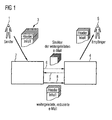
- Fig. 1 the components involved in the message transmission process are shown schematically. These are: a transmitter 1, a mail processing device 2 assigned to the transmitter 1, a message 3 consisting of message elements, namely a main text and attachments, a mail processing device 4 assigned to the recipient and a receiver 5 provided for the message.
- the message 3 is associated with the following data: an identifier that it is a forwarded message; Date and time of sending and an e-mail address of the sender.
- each message element is assigned special additional information. These are: the date and time of the original creation, if they differ from the time of sending; an e-mail address of the originator, if different from the e-mail address of the sender 1, and the content of the message element.
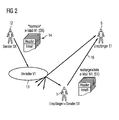
- the sender 1 has received a message 14 not forwarded or marked as not forwarded via a distributor 13 from a subscriber designated as transmitter 12.
- the message 14 consists of a text and attachments, it being noted at this point that both the text and the Attachments do not necessarily have to be present. In extreme cases, a message may even be empty.
- the message 14 has the following structure: an identification that it is a normal message; the date and time of transmission by the transmitter 12, the e-mail address of the transmitter 12; a message element NE 1.1, which represents the main text; the content of NE 1.1; a message element NE 1.2, which represents the attachment; and the content of NE 1.2.
- Fields intended for the date and time of the original creation and the e-mail address of the original sender are empty. It should be noted at this point that the latter fields do not necessarily have to be part of the message, they can also be generated later or added to the message.
- a receiver 5 has received the same message 14 via the distributor 13. Also, a direct receipt of the message 14 from the transmitter 12 without the distributor 13 as a stopover would be conceivable.
- the transmitter 1 wants to forward the message 14 via another distributor (not shown) or directly to the receiver 15 (indicated by arrow 16), ie the receiver is located in a further distributor or can also be addressed directly.
- the message is sent to the mail processing device 2 (cf. Fig. 1 ).
- sending the message 14 is decided by means of a Whyober vomprozedur or a default in the e-mail program, which provides for the delivery, the e-mail only to people who have not received the message 14, with the contents of the news items through the transmitter 11 remain unchanged.
- a check message is sent to the mail processing device 4, which is assigned to the recipient, with the following content: an identifier that it is a forwarded one Message is; the date and time of sending by the sender 11, the e-mail address of the sender 11; the message element NE 1.1, which represents the main text, being provided with an identifier by the mail processing device 2 associated with the sender, containing the date and time of transmission by the sender 12 and the e-mail address of the sender 12; and from the message element NE 1.2, which represents the attachment which is provided by the mail processing device 2 associated with the sender with an identifier which contains the date and time of transmission by the sender 12 and the sender's e-mail address 12. Contents of the news items are not sent.
- Each mail processing device ie both the mail processing device 2 assigned to the sender and the mail processing device 4 assigned to the recipient, stores information about received e-mails in the test message structure just mentioned for its connected subscribers.
- the period of time over which this information is stored is freely configurable.
- the mail processing device 4 associated with the recipient which contains the test message (indicated by the arrow 6 in FIG Fig. 1 ), evaluates whether it is a forwarded message. If this is the case, the mail processing device 4 assigned to the recipient checks whether previously five message elements of the same content have already been transmitted for the recipient. If this also applies, then the mail processing device 4 assigned to the recipient transmits to the mail processing device 2 assigned to the sender a message stating that a delivery is not required. If the message has not yet arrived at the receiver 5 in the past or elements from the message have not yet been received in the past at the receiver 5, the identifiers for the mail processing device to be transmitted are assigned to the recipient 4 transmitted as newly recognized message elements of the sender associated mail processing device 2.
- the latter message has the following content: a request to send the forwarded message, a request not to send the content of the message element NE 1.1 corresponding to the main text, since it has already been identified as the receiver 5, and a request to the message element which corresponds to the appendix, since this was not identified as the recipient 5 present.
- the requested contents of the news items are sent to the mail handler 4 associated with the recipient. (This is indicated by the arrow 8 in FIG Fig. 1 ).
- the message delivered to the receiver 5 has the following structure: an identifier that it is a forwarded message; the date and time of transmission by the transmitter 1; the e-mail address of the sender 1; the message element NE 1.1, which represents the main text, with an identifier containing the date and time of transmission by the transmitter 12 and the e-mail address of the transmitter 12; and the message element NE 1.2, which represents the attachment with an identifier containing the date and time of transmission by the sender 12 as well as the e-mail address of the sender 12 and the content of the attachment.
- the sending and receiving of messages takes place with the aid of data terminals operated by the transmitter 1 and the receiver 5. These are in Fig. 1 and Fig. 2 not shown in detail.
- the mail processing device 2 assigned to the transmitter 1 is integrated in the data terminal of the transmitter, while the mail processing device 4 assigned to the receiver 5 is integrated in the data terminal of the receiver.
- the two data terminals are connected to one another via a corresponding network.
Landscapes
- Engineering & Computer Science (AREA)
- Computer Networks & Wireless Communication (AREA)
- Signal Processing (AREA)
- Information Transfer Between Computers (AREA)
- Data Exchanges In Wide-Area Networks (AREA)
Abstract
Claims (10)
- Procédé servant à transmettre des messages par l'intermédiaire d'un réseau entre des terminaux de données reliés audit réseau, lequel procédé comporte les étapes suivantes consistant à :- envoyer un message (14) depuis un terminal de données émetteur vers un dispositif de post-traitement émetteur (2) associé, sachant que le message contient une information précisant s'il s'agit ou non d'un message transféré,- dans le cas d'un message non transféré, envoyer le message (14) depuis le dispositif de post-traitement émetteur (2) à un dispositif de post-traitement récepteur (4) qui est associé à un terminal de données de destinataires pour le message,- dans le cas d'un message transféré, générer un message de contrôle dans le dispositif de post-traitement émetteur (2), sachant que le message de contrôle comporte des identificateurs concernant le message (14), et envoyer ledit message de contrôle depuis le dispositif de post-traitement émetteur (2) à un dispositif de post-traitement récepteur (4), qui est associé à un terminal de données de destinataires pour le message transféré,- stocker des identificateurs extraits des messages (14) reçus dans un dispositif de post-traitement récepteur (4),- évaluer un message de contrôle reçu dans un dispositif de post-traitement récepteur (4) sur la base d'une comparaison entre des identificateurs stockés à cet emplacement de messages destinés antérieurement au terminal de données de destinataires, et- notifier le dispositif de post-traitement émetteur (2) par le dispositif de post-traitement récepteur (4) en fonction du résultat de l'évaluation indiquant si le dispositif de post-traitement émetteur (2) doit envoyer ou non le message associé au message de contrôle ou les parties de message de ce message.
- Procédé selon la revendication 1,
caractérisé en ce que le dispositif de post-traitement émetteur (2) est implémenté dans le terminal de données émetteur et/ou le dispositif de post-traitement récepteur (4) est implémenté dans le terminal de données de destinataires. - Procédé selon l'une quelconque des revendications précédentes, caractérisé en ce que l'identificateur d'un message (14) se compose d'identificateurs partiels, qui respectivement sont associés à des éléments de messages du message (14), par exemple à un texte principal et/ou à une annexe ou à plusieurs annexes, sachant que dans le dispositif de post-traitement récepteur (4) respectif sur la base des identificateurs de messages déjà reçus et stockés à cet emplacement, chaque identificateur partiel du message de contrôle est comparé à l'identificateur partiel correspondant d'un message (14) déjà reçu pour le destinataire du message de contrôle, et sachant qu'une transmission de l'élément respectif du message (14) associé au message de contrôle, déclenchée ou bloquée en fonction du résultat de la comparaison, est déclenchée.
- Procédé selon l'une quelconque des revendications précédentes, caractérisé en ce que l'identificateur ou l'identificateur partiel respectif marque la date et l'heure auxquelles le message a été initialement établi, dans la mesure où ces dernières diffèrent du moment de l'envoi, et/ou marque une adresse e-mail d'un expéditeur initial, dans la mesure où celle-ci diffère de l'adresse e-mail de l'expéditeur (1), et/ou marque le contenu du message (14) ou de l'élément du message respectif.
- Dispositif de post-traitement émetteur (2) servant à émettre des messages par l'intermédiaire d'un réseau, qui est réalisé de telle sorte- qu'il reçoit un message (14) d'un terminal de données émetteur puis examine si ledit message est ou non un message transféré,- qu'il envoie dans le cas d'un message non transféré, ledit message (14) à un dispositif de post-traitement récepteur (4) associé au destinataire du message,- qu'il génère dans le cas d'un message transféré, un message de contrôle, sachant que le message de contrôle comporte des identificateurs concernant le message (14),- qu'il envoie le message de contrôle généré à un dispositif de post-traitement récepteur (4) associé au destinataire du message,- qu'il envoie ou non sur notification par ledit dispositif de post-traitement récepteur (4) le message ou des parties de message du message.
- Dispositif de post-traitement émetteur (2) selon la revendication 5, caractérisé en ce que le dispositif de post-traitement émetteur (2) est implémenté dans le réseau en tant que partie d'un serveur de messagerie.
- Dispositif de post-traitement émetteur (2) selon la revendication 5, caractérisé en ce que le dispositif de post-traitement émetteur (2) est implémenté dans le terminal de données émetteur.
- Dispositif de post-traitement récepteur (4) servant à recevoir des messages envoyés par l'intermédiaire d'un réseau et réalisé de telle sorte- qu'il stocke à réception d'un message (14) par un dispositif de post-traitement émetteur (2) des identificateurs contenus dans le message (14),- qu'il exécute à réception d'un message de contrôle par un dispositif de post-traitement émetteur (2) une comparaison des identificateurs contenus dans le message de contrôle avec des identificateurs concernant des messages stockés destinés antérieurement aux mêmes destinataires,- qu'il notifie le dispositif de post-traitement émetteur en fonction de ladite comparaison si le dispositif de post-traitement émetteur doit envoyer ou non le message associé au message de contrôle ou les parties de message de ce message.
- Dispositif de post-traitement récepteur (4) selon la revendication 8,
caractérisé en ce que le dispositif de post-traitement récepteur (4) est implémenté dans le réseau en tant que partie d'un serveur de messagerie. - Dispositif de post-traitement récepteur (4) selon la revendication 8,
caractérisé en ce que le dispositif de post-traitement récepteur (4) est implémenté dans le terminal de données de destinataires.
Applications Claiming Priority (2)
| Application Number | Priority Date | Filing Date | Title |
|---|---|---|---|
| DE10345542 | 2003-09-30 | ||
| PCT/EP2004/051695 WO2005034450A1 (fr) | 2003-09-30 | 2004-08-03 | Procede de transmission d'informations dans un reseau |
Publications (2)
| Publication Number | Publication Date |
|---|---|
| EP1668850A1 EP1668850A1 (fr) | 2006-06-14 |
| EP1668850B1 true EP1668850B1 (fr) | 2012-02-08 |
Family
ID=34399124
Family Applications (1)
| Application Number | Title | Priority Date | Filing Date |
|---|---|---|---|
| EP04766401A Expired - Lifetime EP1668850B1 (fr) | 2003-09-30 | 2004-08-03 | Transmission de messages dans un réseau |
Country Status (4)
| Country | Link |
|---|---|
| US (1) | US7747689B2 (fr) |
| EP (1) | EP1668850B1 (fr) |
| CN (1) | CN1860749B (fr) |
| WO (1) | WO2005034450A1 (fr) |
Families Citing this family (3)
| Publication number | Priority date | Publication date | Assignee | Title |
|---|---|---|---|---|
| US20060212523A1 (en) * | 2005-03-21 | 2006-09-21 | International Business Machines Corporation | Policy based control of multiple message forwards |
| JP5035049B2 (ja) * | 2008-03-17 | 2012-09-26 | 富士通株式会社 | 電子メール中継システム及び電子メール中継システムの制御方法 |
| FI20085582L (fi) * | 2008-06-13 | 2009-12-14 | Geniem Oy | Viestijärjestelmä, viestipalvelin, menetelmä ja tietokoneohjelmatuote |
Family Cites Families (14)
| Publication number | Priority date | Publication date | Assignee | Title |
|---|---|---|---|---|
| US4601586A (en) * | 1984-02-10 | 1986-07-22 | Prime Computer, Inc. | Solicited message packet transfer system |
| US5828836A (en) * | 1993-10-08 | 1998-10-27 | International Business Machines Corporation | Networked information communication system |
| US5790793A (en) * | 1995-04-04 | 1998-08-04 | Higley; Thomas | Method and system to create, transmit, receive and process information, including an address to further information |
| US5765033A (en) * | 1997-02-06 | 1998-06-09 | Genesys Telecommunications Laboratories, Inc. | System for routing electronic mails |
| US6108688A (en) * | 1996-06-12 | 2000-08-22 | Sun Microsystems, Inc. | System for reminding a sender of an email if recipient of the email does not respond by a selected time set by the sender |
| US6108689A (en) * | 1996-10-11 | 2000-08-22 | International Business Machines Corporation | Method and system for processing messages in a distributed computing environment |
| JPH11232188A (ja) * | 1998-02-12 | 1999-08-27 | Fujitsu Ltd | メッセージ受信装置 |
| US6018762A (en) * | 1998-03-31 | 2000-01-25 | Lucent Technologies Inc. | Rules-based synchronization of mailboxes in a data network |
| US6112229A (en) * | 1998-05-01 | 2000-08-29 | Motorola, Inc. | Secure terminal and method of communicating messages among processing systems internal thereto |
| US6434601B1 (en) * | 1999-03-31 | 2002-08-13 | Micron Technology, Inc. | Pre test electronic mail process |
| WO2001020855A1 (fr) | 1999-09-16 | 2001-03-22 | Fujitsu Limited | Systeme de courrier electronique, et support d'enregistrement pour courrier electronique lisible par ordinateur |
| JP2003036233A (ja) * | 2001-07-25 | 2003-02-07 | Murata Mach Ltd | 電子メール作成装置および電子メール通信システム |
| US7080123B2 (en) * | 2001-09-20 | 2006-07-18 | Sun Microsystems, Inc. | System and method for preventing unnecessary message duplication in electronic mail |
| US6988129B2 (en) * | 2001-11-26 | 2006-01-17 | Pitney Bowes Inc. | Method for providing address change notification in an electronic message forwarding system |
-
2004
- 2004-08-03 EP EP04766401A patent/EP1668850B1/fr not_active Expired - Lifetime
- 2004-08-03 WO PCT/EP2004/051695 patent/WO2005034450A1/fr not_active Ceased
- 2004-08-03 US US10/574,172 patent/US7747689B2/en not_active Expired - Fee Related
- 2004-08-03 CN CN2004800284135A patent/CN1860749B/zh not_active Expired - Fee Related
Also Published As
| Publication number | Publication date |
|---|---|
| CN1860749A (zh) | 2006-11-08 |
| EP1668850A1 (fr) | 2006-06-14 |
| WO2005034450A1 (fr) | 2005-04-14 |
| US7747689B2 (en) | 2010-06-29 |
| US20070041359A1 (en) | 2007-02-22 |
| CN1860749B (zh) | 2011-11-16 |
Similar Documents
| Publication | Publication Date | Title |
|---|---|---|
| DE19681387B4 (de) | Regelbasiertes elektronisches Mitteilungsverwaltungssystem | |
| DE69216130T2 (de) | Verfahren und Vorrichtung zur verbesserten Verteilung von elektronischen Mitteilungen | |
| DE19922300A1 (de) | Vorrichtung zur automatischen Bearbeitung von eingehener elektronischer Post (=Email) | |
| DE112010005499T5 (de) | Steuern der Nachrichtenübermittlung beim Publish/Subscribe-Nachrichtenaustausch | |
| DE60211804T2 (de) | Verfahren und System zur Übertragung von Nachrichten in einem Telekommunikationsystem | |
| WO2005004012A1 (fr) | Dispositif et procede pour le traitement cote utilisateur de messages electroniques contenant des annexes sous forme de fichiers | |
| EP1246100A2 (fr) | Méthode, appareil et serveur du courrier électronique pour reconnaítre des courriers électroniques indésirés | |
| DE60221965T2 (de) | Verfahren, System und Server zum Senden und Empfangen von E-mails mit verschiedenen Adressen | |
| EP1658705B1 (fr) | Mise a disposition d'une information de presence affectee a un utilisateur d'un service de communication | |
| EP1759502A1 (fr) | Procede et dispositif pour surveiller la communication de messages electroniques | |
| EP1826965B1 (fr) | Serveur de messages et procédé pour la notification d'un utilisateur concernant la réception d'un message électronique | |
| WO2005034450A1 (fr) | Procede de transmission d'informations dans un reseau | |
| EP1563652A1 (fr) | Notification d'acces destinee a l'expediteur d'un message electronique | |
| DE60102856T2 (de) | Verfahren zum Widerrufen elektronischer Post | |
| EP1658704B1 (fr) | Actualisation d'une information de presence affectee a un utilisateur d'un service de communication | |
| DE19816700C1 (de) | Kommunikationssystem sowie Verfahren zur Übertragung von Daten | |
| DE102020103559A1 (de) | Kommunikationsverfahren | |
| EP2195981B1 (fr) | Procédé de transmission de messages au moyen d'un service de messages multimédia | |
| WO2003096652A2 (fr) | Procede d'adressage | |
| DE102008046713B4 (de) | Verfahren zur Gruppen-Kommunikation zwischen Teilnehmern verschiedener Nachrichtendienste, Kommunikations-Endgerät und Computerprogrammprodukt | |
| DE102010049624A1 (de) | Verfahren zur effizienten Gestaltung des E-Mail-Verkehrs | |
| WO2005034451A1 (fr) | Diffusion d'informations avec parties de ces informations specifiques pour le destinataire, a au moins deux destinataires | |
| EP2018774A1 (fr) | Procédé pour la transmission et le traitement liés de messages dans un réseau de télécommunication | |
| DE102014003520A1 (de) | Verfahren und System zur Bearbeitung einer elektronischen Nachricht | |
| WO2001024069A2 (fr) | Procede permettant d'echanger des donnees dans un reseau informatique |
Legal Events
| Date | Code | Title | Description |
|---|---|---|---|
| PUAI | Public reference made under article 153(3) epc to a published international application that has entered the european phase |
Free format text: ORIGINAL CODE: 0009012 |
|
| 17P | Request for examination filed |
Effective date: 20060302 |
|
| AK | Designated contracting states |
Kind code of ref document: A1 Designated state(s): DE FR GB IT SE |
|
| 17Q | First examination report despatched |
Effective date: 20060802 |
|
| DAX | Request for extension of the european patent (deleted) | ||
| RBV | Designated contracting states (corrected) |
Designated state(s): DE FR GB IT SE |
|
| RAP1 | Party data changed (applicant data changed or rights of an application transferred) |
Owner name: SIEMENS ENTERPRISE COMMUNICATIONS GMBH & CO. KG |
|
| GRAP | Despatch of communication of intention to grant a patent |
Free format text: ORIGINAL CODE: EPIDOSNIGR1 |
|
| RTI1 | Title (correction) |
Free format text: TRANSMITTING MESSAGES IN A NETWORK |
|
| RTI1 | Title (correction) |
Free format text: TRANSMITTING MESSAGES IN A NETWORK |
|
| GRAS | Grant fee paid |
Free format text: ORIGINAL CODE: EPIDOSNIGR3 |
|
| GRAA | (expected) grant |
Free format text: ORIGINAL CODE: 0009210 |
|
| AK | Designated contracting states |
Kind code of ref document: B1 Designated state(s): DE FR GB IT SE |
|
| REG | Reference to a national code |
Ref country code: GB Ref legal event code: FG4D Free format text: NOT ENGLISH |
|
| REG | Reference to a national code |
Ref country code: DE Ref legal event code: R096 Ref document number: 502004013289 Country of ref document: DE Effective date: 20120405 |
|
| REG | Reference to a national code |
Ref country code: SE Ref legal event code: TRGR |
|
| PLBE | No opposition filed within time limit |
Free format text: ORIGINAL CODE: 0009261 |
|
| STAA | Information on the status of an ep patent application or granted ep patent |
Free format text: STATUS: NO OPPOSITION FILED WITHIN TIME LIMIT |
|
| 26N | No opposition filed |
Effective date: 20121109 |
|
| REG | Reference to a national code |
Ref country code: DE Ref legal event code: R084 Ref document number: 502004013289 Country of ref document: DE |
|
| REG | Reference to a national code |
Ref country code: DE Ref legal event code: R097 Ref document number: 502004013289 Country of ref document: DE Effective date: 20121109 |
|
| REG | Reference to a national code |
Ref country code: DE Ref legal event code: R084 Ref document number: 502004013289 Country of ref document: DE Effective date: 20130226 |
|
| REG | Reference to a national code |
Ref country code: GB Ref legal event code: 746 Effective date: 20130418 |
|
| REG | Reference to a national code |
Ref country code: DE Ref legal event code: R082 Ref document number: 502004013289 Country of ref document: DE Representative=s name: FRITZSCHE PATENT, DE |
|
| REG | Reference to a national code |
Ref country code: DE Ref legal event code: R081 Ref document number: 502004013289 Country of ref document: DE Owner name: UNIFY GMBH & CO. KG, DE Free format text: FORMER OWNER: SIEMENS ENTERPRISE COMMUNICATIONS GMBH & CO. KG, 81379 MUENCHEN, DE Effective date: 20131112 Ref country code: DE Ref legal event code: R081 Ref document number: 502004013289 Country of ref document: DE Owner name: UNIFY GMBH & CO. KG, DE Free format text: FORMER OWNER: SIEMENS AKTIENGESELLSCHAFT, 80333 MUENCHEN, DE Effective date: 20120210 Ref country code: DE Ref legal event code: R082 Ref document number: 502004013289 Country of ref document: DE Representative=s name: FRITZSCHE PATENT, DE Effective date: 20131112 Ref country code: DE Ref legal event code: R082 Ref document number: 502004013289 Country of ref document: DE Representative=s name: FRITZSCHE PATENTANWAELTE, DE Effective date: 20131112 |
|
| REG | Reference to a national code |
Ref country code: FR Ref legal event code: CD Owner name: UNIFY GMBH & CO. KG, DE Effective date: 20150209 |
|
| REG | Reference to a national code |
Ref country code: FR Ref legal event code: PLFP Year of fee payment: 12 |
|
| PGFP | Annual fee paid to national office [announced via postgrant information from national office to epo] |
Ref country code: DE Payment date: 20150820 Year of fee payment: 12 Ref country code: GB Payment date: 20150824 Year of fee payment: 12 |
|
| PGFP | Annual fee paid to national office [announced via postgrant information from national office to epo] |
Ref country code: SE Payment date: 20150824 Year of fee payment: 12 Ref country code: FR Payment date: 20150824 Year of fee payment: 12 |
|
| PGFP | Annual fee paid to national office [announced via postgrant information from national office to epo] |
Ref country code: IT Payment date: 20150827 Year of fee payment: 12 |
|
| REG | Reference to a national code |
Ref country code: DE Ref legal event code: R082 Ref document number: 502004013289 Country of ref document: DE Representative=s name: FRITZSCHE PATENTANWAELTE, DE Ref country code: DE Ref legal event code: R081 Ref document number: 502004013289 Country of ref document: DE Owner name: UNIFY GMBH & CO. KG, DE Free format text: FORMER OWNER: UNIFY GMBH & CO. KG, 81379 MUENCHEN, DE |
|
| REG | Reference to a national code |
Ref country code: DE Ref legal event code: R119 Ref document number: 502004013289 Country of ref document: DE |
|
| REG | Reference to a national code |
Ref country code: SE Ref legal event code: EUG |
|
| GBPC | Gb: european patent ceased through non-payment of renewal fee |
Effective date: 20160803 |
|
| PG25 | Lapsed in a contracting state [announced via postgrant information from national office to epo] |
Ref country code: SE Free format text: LAPSE BECAUSE OF NON-PAYMENT OF DUE FEES Effective date: 20160804 |
|
| REG | Reference to a national code |
Ref country code: FR Ref legal event code: ST Effective date: 20170428 |
|
| PG25 | Lapsed in a contracting state [announced via postgrant information from national office to epo] |
Ref country code: FR Free format text: LAPSE BECAUSE OF NON-PAYMENT OF DUE FEES Effective date: 20160831 Ref country code: GB Free format text: LAPSE BECAUSE OF NON-PAYMENT OF DUE FEES Effective date: 20160803 Ref country code: DE Free format text: LAPSE BECAUSE OF NON-PAYMENT OF DUE FEES Effective date: 20170301 |
|
| PG25 | Lapsed in a contracting state [announced via postgrant information from national office to epo] |
Ref country code: IT Free format text: LAPSE BECAUSE OF NON-PAYMENT OF DUE FEES Effective date: 20160803 |