EP1669887A1 - Archivage de donnees - Google Patents
Archivage de donnees Download PDFInfo
- Publication number
- EP1669887A1 EP1669887A1 EP04029462A EP04029462A EP1669887A1 EP 1669887 A1 EP1669887 A1 EP 1669887A1 EP 04029462 A EP04029462 A EP 04029462A EP 04029462 A EP04029462 A EP 04029462A EP 1669887 A1 EP1669887 A1 EP 1669887A1
- Authority
- EP
- European Patent Office
- Prior art keywords
- database
- record
- data
- records
- writing
- Prior art date
- Legal status (The legal status is an assumption and is not a legal conclusion. Google has not performed a legal analysis and makes no representation as to the accuracy of the status listed.)
- Withdrawn
Links
Images


Classifications
-
- G—PHYSICS
- G06—COMPUTING OR CALCULATING; COUNTING
- G06F—ELECTRIC DIGITAL DATA PROCESSING
- G06F16/00—Information retrieval; Database structures therefor; File system structures therefor
- G06F16/20—Information retrieval; Database structures therefor; File system structures therefor of structured data, e.g. relational data
- G06F16/21—Design, administration or maintenance of databases
- G06F16/219—Managing data history or versioning
Definitions
- Databases are used for the systematic and orderly storage of data. It is generally the goal to be able to use a single database for content-related data that is dimensioned so that it can hold the entire expected amount of data.
- the bigger a database is, the more Database accesses by application programs that want to access the existing data in the database are more complex and time-consuming.
- updating the database by writing new data is correspondingly time-consuming, and it requires complex measures to ensure that the database is available to the application programs for read operations without any problems during write operations.
- the object of the invention is to be able to store information without limitation of its depth of detail while simultaneously maintaining high availability for application programs.
- the solution according to the invention effects a "cleansing" of a first database by rewriting data records stored in it into another, second database, but not depending on a certain filling level of the first database, but depending on whether the content of the relevant data record has one or more predetermined ones Conditions fulfilled.
- the amount of data stored in the first database can be kept comparatively low.
- records are always first written to the first database before being swapped out to the second database at a later time, fast writes and fast reads in the first database are possible.
- This inventive concept makes it possible to use the first database as a kind of "variable” database and the second database as a “static” database to use.
- new (fresh) data is often constantly accumulating, which is to be stored on a database.
- the first database can be used according to the invention for the first time recording of such new data. It then forms a "current" database, the content of which constantly changes during a given period of time, for example a working day.
- two effects can now be achieved: On the one hand, it can be achieved that the data volume contained in the first database is substantially smaller than the data volume in the second database.
- the second database will also be referred to as a historical database. However, this is not to be understood as meaning that in the second database only those data are stored which are old from the perspective of an application program.
- the timeliness of the data from the perspective of the application programs can be high in both databases. For a complete evaluation, it may well be that an application program must be able to access data from both databases. However, for reasons of business security, it may be useful to keep in the first database at least "survival" data that is necessary for the business of the bank or the same organization. For example, these vital data may include information about customer balances and recent transactions.
- the term "historical" then refers only to the fact that the second database in the history of the storage locations of the various data comes after the first database.
- the second database can be built as a static database, it can easily be sized to accommodate very large amounts of data. Since the second database is then available as a reservoir for a large mass of data, a high level of detail of the information to be stored can be realized with the solution according to the invention. For example, data records that represent the status of the business case at the various phases can be created and stored for the various intermediate phases of an investment - or in general a business case.
- the first database can be much smaller than the second database.
- the size of the first database may be less than 10%, in particular less than 5%, of the size of the second database.
- data records in the first database are preferably deleted in close temporal relation to their writing into the second database.
- the reading (for the purpose of transfer to the second database) and deleting a record in the first database can be done in particular in a joint operation.
- multiple records stored in the first database simultaneously or sequentially may be logically related, for example because they relate to a common underlying business case.
- a logical link may be expressed by a common data element contained in each of the related records and uniquely identifying the facts to which the records relate, such as the underlying business case.
- a plurality of further data records which are logically linked to this one data record can also be written into the second database.
- each of the further data records in the first database is preferably deleted in close temporal relation to the writing of the respective data record into the second database.
- At least a portion of the records stored in the first database contains, in a preferred embodiment, a status field in which a status is entered.
- This status preferably does not refer to the record itself, but to the fact represented by the record.
- the status may refer to the state in which a single transaction or business case, possibly including several such individual transactions, is located.
- the checking step may include checking such a status field of the data records for a predetermined status.
- At least a portion of the records stored in the first database may include a time indication.
- the checking step may then include checking whether the time specified in a data record meets a predetermined condition.
- At least a portion of the records to be written to the first database may include a timestamp field with a timestamp.
- This timestamp can be conveniently used to distinguish records that represent one and the same information object but describe different versions of that information object.
- Situations can be imagined in which a data-technically imaged information object passes through different phases or states during its existence. For example, if a business order is considered as such an information object, then various stages in the life of the business order can easily be identified. For example, a phase can be defined in which the business order is issued but not yet accepted. Then a phase can be defined in which the business order is accepted, but has not yet begun its processing. Furthermore, a phase can be defined in which the business order is completed. Of course, other phases or other phases can be defined.
- versions of the same information object can now be represented by data technology by generating a data record with always the same data record identifier for each version, but a different time stamp is entered in the time stamp field of the data records of this information object. Further information about the respective version can then be entered in one or more additional data record fields, one of which may be the already mentioned status field. For example, in this status field you can enter in which phase or status a business order - or in general the relevant information object - is located.
- the advantage of this versioning of records by time stamps is that non-complex changes to existing data records must be made in order to be able to map changes to the underlying information object.
- the timestamp advantageously contains a date and a time.
- a preferred embodiment provides that, depending on whether the one of these data sets fulfills the at least one predetermined condition whose time stamp identifies the most recent version of the information object, each of these data records is written into the second database. In other words, in this embodiment, all older versions of a record or information object are also automatically written into the second database when the most recent version satisfies the predetermined condition (s).
- the first database may contain records that represent different but logically linked information objects.
- one record may generally represent a trade case and one or more other records may each represent a single transaction made in the context of the deal.
- the transaction records will contain a data item that is also included in the business case record and clearly identifies the business case. In this way, the business case record and the transaction records are logically linked together.
- the remaining data records are also rewritten from the first database to the second database by one of the logically linked data records.
- overwriting a group of such hierarchically linked data sets from the first to the second database may be made dependent on a record representing an information object of a highest hierarchical level satisfying at least one predetermined condition.
- the invention further relates to a computer program product, which causes the execution of the method of the type described above, when it is processed by a computer.
- the computer program product may be stored on a computer readable magnetic or optical information carrier (such as a CD-ROM or a minidisk).
- Fig. 1 illustrates various information objects 10, 12, 14 of a hierarchical information model, according to which in one embodiment of the invention facts are represented by data technology. To represent a fact, the information objects are put together like lego blocks to form an overall picture. According to the information model, one or more information objects 12 can be assigned to an information object 10, and in turn each information object 12 can have one or more information objects 14 be assigned. The information object 10 is thus highest in the hierarchy, while the information objects 12 are in the middle of the hierarchy and the information objects 14 are hierarchically down.
- the information object 10 can be used to describe the total service agreed with a customer (business case; BD), the information object 12 serves to describe a single service provided by the bank as part of the overall service (transaction; BTX), and the information object 14 as a representative of a serve the transaction object (TXP) processed (eg moved, created, despatched) by the Bank as part of the provision of the individual service concerned.
- Typical individual services are, for example, a single payment transfer, a stock purchase on the stock exchange, an interest settlement, a change of address or the creation (printing and shipping) of a settlement via a stock exchange purchase.
- a transaction object may, for example, be a value package that defines an amount of a financial instrument (share, money, debt) that is moved in the context of a transaction. Another transaction object may describe the price or value of a value packet.
- transaction objects may represent tax valuations, stock market settlements, contract or customer data, and other structured information related to a service provided to the bank's client business.
- each information object 10 can have a plurality of information objects 12 and each information object 12 can have a plurality of information objects 14 assigned to it.
- each information object 14 is always associated with only one single information object 12 and each information object 12 is always assigned to only one information object 10.
- the information objects 10, 12, 14 are described by data records, each data record representing an information object, more precisely a version of an information object.
- an identification number can be assigned for each customer order that results in a business case, and this identification number can be assigned to each one information object the business case record.
- FIG. 2 shows an example of a record format that can be used for the data sets representing the information objects 10, 12, 14.
- the data sets have a plurality of data elements, of which only a part is shown in FIG.
- each data record as a data element has a data record identifier DS_K contained in a data field 16, which may contain an indication of what type of information object is represented by the relevant data record, ie an information object 10 or an information object 12 or an information object 14.
- each data record contains as an additional data element an identification number GF_ID entered in a data field 18, which uniquely identifies the business case to which the relevant data record and thus the information object is assigned.
- the identification number GF_ID does not identify the record but allows logically related records to be recognized because all records associated with the same deal contain this identification number GF_ID.
- each record contains a timestamp field 20 in which a time stamp TS is entered.
- the time stamp TS represents a date and a time.
- the identifier DS_K and the time stamp TS together uniquely identify the relevant data record.
- the time stamp TS allows identification of which version the record DS_K is. Records created at different times receive different timestamps. In this way, it is possible to reconstruct a historical development of the underlying information object from the time stamps of several data records with the same identifier DS_K.
- each record also contains a status field 22, in which a status ST is entered.
- the status ST indicates a state of the information object represented by the respective record.
- a status is relevant to a customer if the factual or legal situation or the actual options for action of the customer change as a result of attaining the corresponding status. For example, a customer can not trade a trade once it has been executed (status: executed) withdraw more, but only cancel.
- the status model that defines the possible states should preferably be chosen so that the status always reflects a secure information.
- a status set in relation to an information object should therefore mean that all of the process steps required before reaching this status are completely completed. However, the status does not indicate whether further process steps have already taken place that have to be performed according to the status achieved.
- the available states may be at least partially different for the various information objects 10, 12, 14.
- information objects 10 such states as “instructed,” “accepted,” “rejected,” “deleted,” “withdrawn,” “unsuccessful,” “terminated as instructed,” and “terminated,” however, may not as instructed "to be defined.
- transaction information objects 12 for example, in addition to the above statuses, such statuses as “initiated”, “executed”, “completed”, “prepared for booking” and “booked” can also be defined. Some of the statuses listed above can also be used for information objects 14.
- each data record will contain further data fields 24, 26,..., In which the information objects (attributes) which describe the relevant information object can be stored.
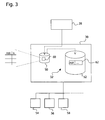
- the architecture comprises a component 28 which generates data records with the format shown in FIG. 2 and delivers them to a downstream component 30 in which the data records supplied are stored in a database system 32.
- Component 28 includes software that controls the settlement of sales orders to a bank. This software is set up to map the incoming sales orders to records according to the data model shown in FIG.
- component 28 assigns and manages the business case identification numbers. Whenever new information objects are to be created for a business case, for example because another transaction is to be executed in the context of a business case, the component 28 generates a corresponding number of data records and delivers them to the component 30.
- the component 28 generates new data records whenever Changes to an information object already represented by one or more existing data records occur as long as the nature of these changes requires a reflection in the content of the database system 32.
- An example of such changes are changes to the status of the information objects discussed above. But not only status changes should be reflected in the content of the database system 32. Also for other changes, especially those that are customer-relevant, there will be a need to reflect them in the content of the database system 32. This includes, for example, name and address changes of customers, changes in accounts and the like. In such a case, the status of the relevant information object or information objects may remain unchanged, but the change in the content of the database system 32 must be taken into account.
- component 28 If an information object already has a data record stored in database system 32, component 28, if a relevant change has occurred in connection with this information object, generates another data record with the same identifier DS_K as the already existing data record but with a different time stamp TS.
- the further data record therefore represents a younger version of the information object, while the previously existing data record represents an older version. In this way, changes to existing records in the database system 32 are avoided.
- a large number of versions can arise, whereby the time stamp can be used to easily determine which version is the current one or the last valid one.
- FIG. 4 shows an example of a data tree for a sales order after changes to individual information objects of the sales order have already occurred.
- This exemplary data tree has at its head a record 34 as a first version of a business case information object that generally describes the sales order. It also contains a record 34 'which describes another, later version of the business case information object. It can, how As mentioned above, the status field of the record 34 'contains a different status than that of the record 34, but need not. However, at least the timestamps of the data sets 34, 34 'differ.
- the data tree of Figure 4 has a record 36 representing a first transaction of which there is only a single version, and records 38, 38 'and 38 "each representing a different version of a second transaction Both transactions are assigned to the same business case, ie the data records 36, 38, 38 ', 38 "are logically linked to the data records 34, 34', namely, for example, via a common business case identification number.
- the 4 also includes three records 40, 40 ', 40 "representing three different versions of a first transaction object of the first transaction, a record 42 representing a single version of a second transaction object of the first transaction and two records 44, 44 'representing two different versions of a third transaction object of the first transaction, and the data tree comprises two records 46, 46' representing two different versions of a first transaction object of the second transaction and a record 48
- the data records of the lowest hierarchical level are logically linked to exactly one record of the middle hierarchy level, that is to say with exactly one transaction.To identify this logical assignment, the individual transaction can be identified a unique transaction identification number is assigned by the component 28 - as well as the business cases are assigned a unique business case identification number.
- This transaction identification number is entered in each record representing a version of the transaction in question as well as in each record representing a version of a transaction object associated with the transaction in question.
- one of the further fields 24, 26,... could be used to enter the transaction identification number.
- the database system 32 comprises two databases 50, 52, one of which, the database 50, serves as the current database for storing current information, while the other database 52 serves as a historical database into which the data records from the database 50 depend be outsourced by certain conditions. All of the components 30 supplied records are first written to the database 50 before being swapped into the database 52 at a later time.
- the database 50 is considerably smaller than the database 52; for example, the data volume stored in it accounts for only about 3% of the total data volume of the database system 32, while the remaining approximately 97% is included in the database 52.
- two or more such current databases may be provided to which database 52 is associated in common. That is, the database 52 receives records from each of the multiple current databases.
- the offloading of the data sets from the database 50 into the database 52 is effected by appropriate software of the component 30.
- This software checks records stored in the database 50 to see if they meet one or more predetermined conditions. If a record meets this condition (s), at least it will be swapped out into the database 52.
- one or more further data records from the database 50 are optionally stored in the database 52 depending on such a removal of a data record.
- the software of the component 30 may be configured to check whether older versions are present in the database 50 for a record that is to be swapped out. If so, the software causes all older versions of the record in question, i. of the information object represented thereby.
- all those records that hierarchically represent underlying information objects are also paged out.
- this principle can be applied if the most recent version of the topmost information object in the hierarchy of the information objects of a business case satisfies the paging condition (s).
- the entire data tree of this business case is then paged out, including any older versions of the top information object (at the business case level) and all versions of the information objects at the transaction level and at the transaction object level.
- the software of the component 30 alone checks such data records for the predetermined aging condition (s) which represent information objects of the uppermost hierarchical level.
- data sets which represent information objects of a hierarchy level other than the topmost hierarchy level are only outsourced if an associated data record of the highest hierarchical level fulfills the swapping condition (s).
- the status field 22 of the record to be checked contains a predetermined status.
- it can be provided as a condition that the status field of the most recent version of the hierarchically highest information object indicates such a predetermined status.
- the predetermined status may be one indicating that a customer order has been terminated and no further transactions are to be made by the bank as part of that customer order.
- the records that model the various information objects of a sales order or business case are held in the database 50 until the sales order is completed. Thereafter, all of these records are swapped out into the database 52.
- a checked data record must fulfill a predetermined time condition before it is rewritten from the current database 50 into the historical database 52.
- One possible time condition relates to the length of time that the relevant data record already exists in the current database 50. For records containing the timestamp mentioned above, this period of time is easily ascertainable if it is assumed that the timestamp essentially reflects the time at which the record in question was written to the database 50. It may then be defined a predetermined period of time, which must have existed a validated record since its writing in the database 50 at least in this, before it may be swapped out in the database 52. This period of time can be chosen arbitrarily depending on the application, for example in the daily, weekly or monthly range.
- time condition Another possibility of a time condition is to define a particular point in time as a check criterion, which is compared with a time indication contained in the data records stored in the database 50.
- the timestamp mentioned above is an example of such a timestamp.
- 50 databases are stored in the database, which do not contain a time stamp for version identification, but are nevertheless provided with a time field whose content represents a time indication.
- An example of this is the execution date of a transaction or the posting date of a balance item.
- data records in the database 50 which contain other information objects
- data sets it is readily conceivable that they contain one or more times that represent a later date than the time of generation of the relevant data record.
- a record representing a sales position resulting from a securities transaction may include a value date indicating the day on which the relevant sales item should actually be posted to the customer's account. This value date day is often later than the time at which the data record representing the revenue position is generated.
- the time used as a check criterion is expediently determined as a function of the time at which the checking of the data records in the database 50 takes place.
- the time to be used as the check criterion may be set to be a predetermined period of time, for example seven days, before the day on which the records are checked. The test then compares whether or not the time information contained in a checked data record indicates a time that lies before the time used as the test criterion or not.
- this time lies before the time used as the check criterion, that is to say, for example, if a time specified in a data record denotes a day which is more than seven days before the day on which the check takes place, then the predetermined time condition with respect to this data set is deemed fulfilled , If no further conditions are to be met by the data set, then it can be outsourced to the database 52 in principle. If several times are contained in a data record, it may be necessary for more than one of these times, if desired all, to fulfill the predetermined time condition.
- Data sets that represent information objects of the types shown in FIG. 1 preferably also have to fulfill at least one further, time-independent condition in addition to a time condition, in particular the status condition discussed above.
- Older versions of an information object 10, 12, 14 can thus be longer in the database, possibly considerably longer than a predetermined minimum time span, if they do not fulfill the status condition.
- the older versions of the information object can also be jointly stored in the database 52 together with it.
- the scope of the database 50 can be kept comparatively small, so that at any time fast write access to the database 50 for writing new data sets and read access by in Fig. 3 schematically indicated application programs 54 , 56, 58, ... are possible.
- the application programs 54, 56, 58, ... can also access the historical data in the database 52.
- a table 60 indicated in FIG. 3 is set up in the database 50 in which information about invalid data records of the database 52 is stored. For example, assume that a record of database 52 labeled 62 is invalid.
- the data record identifier of the data record 62 (here "xyz") is entered into the table 60 and an entry indicating the invalidity of the data record is entered in association with the data record identifier, here for example "u.”
- the table 60 can be used, for example, for a another appropriate time, if enough time is available, to eliminate the invalid records in the database 52.
- the data records representing the various information objects 10, 12, 14 or their versions can be stored in the databases 50, 52 in different tables, such that a first table or a set of first tables is used to store data records, each representing an information object 10, a second table or a set of second tables for storing records, each representing an information object 12, and further comprising a third table or a set of third tables in which those records are stored each representing an information object 14.
- each record stored in the database 50 is checked for itself as to whether it has at least one time condition fulfilled for the outsourcing.
- at least part of the data records can additionally be checked for at least one further outsourcing condition.
- the selected and noted in the paging list records are checked for one or more other predetermined conditions that must be met by the selected records before they are outsourced to the database 52.
- the rules to be examined during the review may include context rules that relate to the context of the records in relation to each other.
- a check-on rule may be that a particular information object (entity) may only be paged out if a logically associated other information object is also stored along with it. If it is determined during the check that only one information object has been selected, but not the other at the same time, then the one information object (or the data set representing it) does not fulfill all conditions for the removal and must therefore remain in the current database 50.
- the procedure in this embodiment is thus as follows: First, a first set of rules containing one or more paging rules is applied to select a portion from the records contained in the current database 50 and make corresponding entries in a paging list. In a subsequent step, the selected data sets are subjected to a check on the basis of a second set of rules, which in turn contains one or more paging rules. If it is determined that individual records that are listed in the paging list can not be paged out, their corresponding entries in the paging list will be deleted.
- the data records remaining in the paging list after completion of the check are then overwritten in the database 52 and deleted in the database 50.
- the data transfer from the current database 50 into the historical database 52 may take place at a different time than the selection and verification of the data records.
- a time may be set for overwriting the records remaining in the paging list after verification which is a predetermined period of time after the time when the test routine for selecting the data sets is started.
- the data transfer from the database 50 into the database 52 during times in which otherwise only weak traffic is expected, for example, at night or at weekends.
- the paging list is deleted and is thus available again for a new selection of data records.
Landscapes
- Engineering & Computer Science (AREA)
- Databases & Information Systems (AREA)
- Theoretical Computer Science (AREA)
- Data Mining & Analysis (AREA)
- Physics & Mathematics (AREA)
- General Engineering & Computer Science (AREA)
- General Physics & Mathematics (AREA)
- Information Retrieval, Db Structures And Fs Structures Therefor (AREA)
Priority Applications (4)
| Application Number | Priority Date | Filing Date | Title |
|---|---|---|---|
| EP04029462A EP1669887A1 (fr) | 2004-12-13 | 2004-12-13 | Archivage de donnees |
| US11/262,912 US20060129594A1 (en) | 2004-12-13 | 2005-11-01 | Computer-implemented method for management of electronic data |
| CNA2005800425405A CN101076801A (zh) | 2004-12-13 | 2005-11-29 | 数据的存档 |
| PCT/EP2005/012727 WO2006063678A1 (fr) | 2004-12-13 | 2005-11-29 | Archivage de donnees |
Applications Claiming Priority (1)
| Application Number | Priority Date | Filing Date | Title |
|---|---|---|---|
| EP04029462A EP1669887A1 (fr) | 2004-12-13 | 2004-12-13 | Archivage de donnees |
Publications (1)
| Publication Number | Publication Date |
|---|---|
| EP1669887A1 true EP1669887A1 (fr) | 2006-06-14 |
Family
ID=34927743
Family Applications (1)
| Application Number | Title | Priority Date | Filing Date |
|---|---|---|---|
| EP04029462A Withdrawn EP1669887A1 (fr) | 2004-12-13 | 2004-12-13 | Archivage de donnees |
Country Status (4)
| Country | Link |
|---|---|
| US (1) | US20060129594A1 (fr) |
| EP (1) | EP1669887A1 (fr) |
| CN (1) | CN101076801A (fr) |
| WO (1) | WO2006063678A1 (fr) |
Families Citing this family (6)
| Publication number | Priority date | Publication date | Assignee | Title |
|---|---|---|---|---|
| US8266126B2 (en) * | 2010-03-24 | 2012-09-11 | Matrixx Software, Inc. | System with multiple conditional commit databases |
| GB2520361A (en) * | 2013-11-19 | 2015-05-20 | Ibm | Method and system for a safe archiving of data |
| CN106339209A (zh) * | 2015-07-17 | 2017-01-18 | 阿里巴巴集团控股有限公司 | 一种数据处理方法和设备 |
| GB2569805B (en) * | 2017-12-22 | 2023-03-08 | Asymptote Ltd | Method and system relating to cooling conditions for a biological sample |
| JP2021189569A (ja) * | 2020-05-26 | 2021-12-13 | 富士通株式会社 | データ更新プログラム、データ更新装置及びデータ更新方法 |
| US11657033B2 (en) | 2020-10-16 | 2023-05-23 | Capital One Services, Llc | Systems and methods for maintaining data quality in a data store receiving both low and high quality data |
Citations (2)
| Publication number | Priority date | Publication date | Assignee | Title |
|---|---|---|---|---|
| WO1992013310A1 (fr) * | 1991-01-23 | 1992-08-06 | Tandem Telecommunications Systems, Inc. | Procede de selection et de representation de donnees |
| US6182121B1 (en) * | 1995-02-03 | 2001-01-30 | Enfish, Inc. | Method and apparatus for a physical storage architecture having an improved information storage and retrieval system for a shared file environment |
Family Cites Families (3)
| Publication number | Priority date | Publication date | Assignee | Title |
|---|---|---|---|---|
| DE69434311D1 (de) * | 1993-02-01 | 2005-04-28 | Sun Microsystems Inc | Archivierungsdateiensystem für datenanbieter in einer verteilten netzwerkumgebung |
| GB9818819D0 (en) * | 1998-08-29 | 1998-10-21 | Int Computers Ltd | Time-versioned data storage mechanism |
| US7496607B2 (en) * | 2003-08-29 | 2009-02-24 | Yahoo! Inc. | Method and system for maintaining synchronization between a local data cache and a data store |
-
2004
- 2004-12-13 EP EP04029462A patent/EP1669887A1/fr not_active Withdrawn
-
2005
- 2005-11-01 US US11/262,912 patent/US20060129594A1/en not_active Abandoned
- 2005-11-29 WO PCT/EP2005/012727 patent/WO2006063678A1/fr not_active Ceased
- 2005-11-29 CN CNA2005800425405A patent/CN101076801A/zh active Pending
Patent Citations (2)
| Publication number | Priority date | Publication date | Assignee | Title |
|---|---|---|---|---|
| WO1992013310A1 (fr) * | 1991-01-23 | 1992-08-06 | Tandem Telecommunications Systems, Inc. | Procede de selection et de representation de donnees |
| US6182121B1 (en) * | 1995-02-03 | 2001-01-30 | Enfish, Inc. | Method and apparatus for a physical storage architecture having an improved information storage and retrieval system for a shared file environment |
Non-Patent Citations (4)
| Title |
|---|
| HAERDER T ET AL: "Datenbanksysteme Konzepte und Techniken der Implementierung", 31 March 1999, DATENBANKSYSTEME: KONZEPTE UND TECHNIKEN DER IMPLEMENTIERUNG PAGE(S) 97-105, XP002219227 * |
| LEE J ET AL: "OPTIMIZING FAB PERFORMANCE WITH MES-DATABASE ACTIVE ARCHIVING", SOLID STATE TECHNOLOGY, COWAN PUBL.CORP. WASHINGTON, US, vol. 46, no. 4, April 2003 (2003-04-01), pages 55 - 56,58, XP001170216, ISSN: 0038-111X * |
| SCHAARSCHMIDT R ET AL: "DATENBANKBASIERTES ARCHIVIEREN IM SAP SYSTEM R/3", WIRTSCHAFTSINFORMATIK, VIEWEG VERLAGSGESELLSCHAFT, BRAUNSCHWEIG, DE, vol. 39, no. 5, 1997, pages 469 - 477, XP009017526, ISSN: 0937-6429 * |
| STEFANI H: "Datenarchivierung mit SAP", May 2002, SAP-INFO, SAP AG, CORPORATE COMMUNICATIONS, WALLDORF, DE, PAGE(S) 1-3,35-40, 57, 63-75,84,85,211,212, GERMANY, ISSN: 1430-5526, XP002266517 * |
Also Published As
| Publication number | Publication date |
|---|---|
| US20060129594A1 (en) | 2006-06-15 |
| CN101076801A (zh) | 2007-11-21 |
| WO2006063678A1 (fr) | 2006-06-22 |
Similar Documents
| Publication | Publication Date | Title |
|---|---|---|
| DE3650522T2 (de) | Computersystem für mehrere Arten voneinander unabhängiger Verwaltungsaufgaben und Verfahren für den Betrieb eines universellen Computerverwaltungssystems | |
| DE10017710A1 (de) | Verfahren zum Erfassen und Verarbeiten von Daten von Geschäftsvorfällen | |
| EP1403793A1 (fr) | Procédé pour la consignation intégrée et automatique des documents dans l'enregistrement des transactions commerciales | |
| EP1798672A1 (fr) | Système mis en oeuvre sur ordinateur destiné à la création, l'élaboration et la gestion de données structurées | |
| DE112020003689T5 (de) | Reparaturunterstützungssystem und reparaturunterstützungsverfahren | |
| EP1669887A1 (fr) | Archivage de donnees | |
| WO2007022874A1 (fr) | Systeme, procede et programme informatique pour traiter des donnees sur la base d'un circuit de production | |
| EP1669888A1 (fr) | Donnees a versions par estampilles | |
| EP1628247A1 (fr) | Base de données à usage de comptabilité | |
| DE69911208T2 (de) | System zur simulation eines geschäftsprozesses | |
| EP1239375B1 (fr) | Procédé de conversion de documents | |
| WO2006117043A1 (fr) | Procede de traitement de donnees destine au calcul optimal en temps de grands ensembles de donnees d'evenement | |
| EP1798673A1 (fr) | Système mis en oeuvre sur ordinateur destiné à la création, l'élaboration et la gestion de données structurées | |
| JP2002351962A (ja) | 安定化賃貸料回収法 | |
| EP1403794A1 (fr) | Procédé et système de mémorisation automatique de données relatives à la gestion d'entreprise | |
| EP1610251A1 (fr) | Méthode et système pour le traitement par ordinateur de fichiers de données | |
| WO2020061607A1 (fr) | Procédé mis en oeuvre par ordinateur pour la transaction d'unités numériques | |
| EP1628246A1 (fr) | Base de données à usage de comptabilité | |
| EP1721289A1 (fr) | Dispositif de traitement de donnees, structure de donnees et procede de distribution d'informations financieres pour une base de donnees d'informations financieres | |
| Nguyen | The productivity paradox of corporate taxation: A nonlinear tale of growth and constraints | |
| WO1998057293A1 (fr) | Procede pour archiver et activer des documents | |
| CH710779B1 (de) | Vorrichtung und Verfahren zur automatisierten Generierung eines Buchungssatzes für eine Transaktion eines Benutzers in einer elektronischen Buchführung. | |
| EP1324235A1 (fr) | Détermination d'une fonction caractéristique d'une matrice d'après un schéma prédéterminé | |
| DE10007791A1 (de) | Verfahren zur Modellierung und Steuerung realer Abläufe in einer Datenverarbeitungsanlage und eine Datenverarbeitungsanlage zur Durchführung des Verfahrens | |
| EP1229466A1 (fr) | Procédé, programme d'ordinateur et système pour l'analyse ABC |
Legal Events
| Date | Code | Title | Description |
|---|---|---|---|
| PUAI | Public reference made under article 153(3) epc to a published international application that has entered the european phase |
Free format text: ORIGINAL CODE: 0009012 |
|
| AK | Designated contracting states |
Kind code of ref document: A1 Designated state(s): AT BE BG CH CY CZ DE DK EE ES FI FR GB GR HU IE IS IT LI LT LU MC NL PL PT RO SE SI SK TR |
|
| AX | Request for extension of the european patent |
Extension state: AL BA HR LV MK YU |
|
| 17P | Request for examination filed |
Effective date: 20060718 |
|
| 17Q | First examination report despatched |
Effective date: 20060905 |
|
| AKX | Designation fees paid |
Designated state(s): AT BE BG CH CY CZ DE DK EE ES FI FR GB GR HU IE IS IT LI LT LU MC NL PL PT RO SE SI SK TR |
|
| STAA | Information on the status of an ep patent application or granted ep patent |
Free format text: STATUS: THE APPLICATION IS DEEMED TO BE WITHDRAWN |
|
| 18D | Application deemed to be withdrawn |
Effective date: 20080724 |