EP1669982A2 - Apparate und Verfahren zur Transformation, adaptiven Kodierung, inversen Transformation und adaptiven Dekodierung eines Audiosignals - Google Patents
Apparate und Verfahren zur Transformation, adaptiven Kodierung, inversen Transformation und adaptiven Dekodierung eines Audiosignals Download PDFInfo
- Publication number
- EP1669982A2 EP1669982A2 EP05257500A EP05257500A EP1669982A2 EP 1669982 A2 EP1669982 A2 EP 1669982A2 EP 05257500 A EP05257500 A EP 05257500A EP 05257500 A EP05257500 A EP 05257500A EP 1669982 A2 EP1669982 A2 EP 1669982A2
- Authority
- EP
- European Patent Office
- Prior art keywords
- audio signal
- frame
- transforming
- frequency domain
- transformed
- Prior art date
- Legal status (The legal status is an assumption and is not a legal conclusion. Google has not performed a legal analysis and makes no representation as to the accuracy of the status listed.)
- Withdrawn
Links
Images





Classifications
-
- G—PHYSICS
- G10—MUSICAL INSTRUMENTS; ACOUSTICS
- G10L—SPEECH ANALYSIS TECHNIQUES OR SPEECH SYNTHESIS; SPEECH RECOGNITION; SPEECH OR VOICE PROCESSING TECHNIQUES; SPEECH OR AUDIO CODING OR DECODING
- G10L19/00—Speech or audio signals analysis-synthesis techniques for redundancy reduction, e.g. in vocoders; Coding or decoding of speech or audio signals, using source filter models or psychoacoustic analysis
- G10L19/02—Speech or audio signals analysis-synthesis techniques for redundancy reduction, e.g. in vocoders; Coding or decoding of speech or audio signals, using source filter models or psychoacoustic analysis using spectral analysis, e.g. transform vocoders or subband vocoders
- G10L19/022—Blocking, i.e. grouping of samples in time; Choice of analysis windows; Overlap factoring
Definitions
- the present invention relates to encoding and decoding of an audio signal, and more particularly, to an apparatus and method for transforming an audio signal by selecting a frame of frames of various lengths according to a change in an audio signal, and transforming, encoding, and decoding the audio signal in units of the selected frame using a window coefficient other than 0; an apparatus and method for encoding an audio signal adaptively to a change in the audio signal; an apparatus and method for inversely transforming an audio signal, and an apparatus and method for decoding an audio signal adaptively to a change in the audio signal.
- an audio signal is encoded by transforming it into units of a predetermined frame, and generating a bit stream by changing a bit rate of the transformed audio signal by the quantizing the transformed audio signal.
- the length of a frame of an audio signal must be determined by the degree that the audio signal changes. Specifically, the frame length of an audio signal that changes fast in a time domain must be determined to be smaller so that the audio signal can be processed into a frequency domain over a broad band of frequency, thereby generating a more precise bit stream. In contrast, the frame length of an audio signal that changes slowly in the time domain must be determined to be larger so that the audio signal can be processed into the frequency domain over a narrow band of frequency, thereby reducing consumption of frequency resources.
- the types of frames are limited, for example, frames are categorized into a long frame and a short frame. Therefore, an audio signal that rapidly changes to a large extent is encoded using oversampled transform, thereby causing distortion of the encoded audio signal.
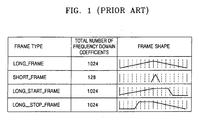
- FIG. 1 is a table illustrating conventional frame types and related window coefficients.
- a long frame and a short frame there are a long frame and a short frame, and a long start frame and a long stop frame that are obtained by transforming the long and short frames, respectively.
- FIG. 2 is a graph illustrating transforming of an audio signal, which has a window coefficient of 0, into a frequency domain using the windowing operation.
- an audio signal is transformed into a frequency domain using a Modified Discrete Cosine Transform (MDCT).
- MDCT Modified Discrete Cosine Transform
- a z signal is obtained by multiplying input data on a time axis by a window coefficient illustrated in FIG. 2.
- An aspect of the present invention provides a method of transforming an audio signal using a window coefficient other than 0, as set out in claim 1.
- the invention also relates to methods of transforming an audio signal as set out in claims 3 and 8.
- An aspect of the present invention also provides a method of transforming an audio signal into units of a frame selected according to a change in the audio signal.
- An aspect of the present invention also provides a method of encoding an audio signal into units of a frames selected according to a change in the audio signal.
- An aspect of the present invention also provides an apparatus for transforming an audio signal using a window coefficient of 0, as set out in claim 9.
- An aspect of the present invention also provides an apparatus for transforming an audio signal into units of a frame selected according to a change in the audio signal.
- An aspect of the present invention also provides an apparatus for encoding an audio signal into units of a frame selected according to a change in the audio signal.
- An aspect of the present invention also provides a method of inversely transforming an audio signal that is encoded using a window coefficient of 0, as set out in claim 16.
- An aspect of the present invention also provides a method of inversely transforming audio signal encoded into units of a frame selected according to a change in the audio signal.
- An aspect of the present invention also provides a method of decoding an audio signal encoded into units of a frame selected according to a change in the audio signal.
- An aspect of the present invention also provides an apparatus for inversely transforming an audio signal encoded using a window coefficient of 0.
- An aspect of the present invention also provides an apparatus for inversely transforming an audio signal that is encoded into units of a frame selected according to a change in the audio signal.
- An aspect of the present invention also provides an apparatus for decoding an audio signal encoded into units of a frame selected according to a change in the audio signal.
- a method of transforming an audio signal including: determining a transform unit into which the audio signal is to be transformed into an audio signal in a frequency domain; and transforming the audio signal in a time domain into an audio signal in the frequency domain according to the determined transform units, using a window coefficient other than 0.
- a method of transforming an audio signal including: filtering the audio signal into predetermined sample units; determining an adaptive transform unit into which the audio signal is to be transformed into an audio signal in a frequency domain, when the size of the audio signal becomes greater than a predetermined threshold; and transforming the audio signal into an audio signal in the frequency domain according to the determined adaptive transform units.
- a method of adaptively transforming an audio signal including: filtering the audio signal into predetermined sample units; determining an adaptive transform unit into which the audio signal is to be transformed into a frequency domain when the size of the audio signal is greater than a predetermined threshold; transforming the audio signal into an audio signal in the frequency domain according to the determined adaptive transform units; quantizing the audio signal transformed into the frequency domain; and encoding the quantized audio signal.
- an apparatus for transforming an audio signal including: a transform unit determiner determining a transform unit into which the audio signal is to be transformed into an audio signal in a frequency domain; and a frequency-domain transformer transforming the audio signal in a time domain into the audio signal in the frequency domain according to the determined transform units, using a window coefficient other than 0.
- an apparatus for transforming an audio signal including: a filtering unit filtering the audio signal into predetermined sample units; an adaptive transform unit determiner determining an adaptive transform unit into which the audio signal is to be transformed into an audio signal in a frequency domain when a size of the audio signal is greater than a predetermined threshold; and a frequency-domain transformer transforming the audio signal into an audio signal in the frequency domain according to the determined adaptive transform units.
- an apparatus for adaptively transforming an audio signal including: a filtering unit filtering the audio signal into predetermined sample units; an adaptive transform unit determiner determining an adaptive transform unit into which the audio signal is to be transformed into the frequency domain when the size of the audio signal is greater than a predetermined threshold; a frequency-domain transformer transforming the audio signal into an audio signal in the frequency domain according to the determined adaptive transform units; a quantization unit quantizing the audio signal transformed into the frequency domain; a bit rate controller controlling the bit rate of the audio signal to be quantized; and an encoding unit encoding the quantized audio signal.
- a method of inversely transforming an audio signal including: inversely transforming an audio data which is a bit stream of the audio signal transformed into a frequency domain using a window coefficient other than 0.
- a method of inversely transforming an audio signal including: detecting information regarding an adaptive transform unit of the audio signal transformed into a frequency domain, from audio data; and inversely transforming the audio data according to the adaptive transform units of the detected information.
- a method of decoding an audio signal including: decoding encoded audio data; inversely quantizing the decoded audio data; detecting information regarding an adaptive transform unit of the audio signal transformed into a frequency domain, from the inversely quantized audio data; and inversely transforming the audio data according to the adaptive transform units of the detected information.
- an apparatus for inversely transforming an audio signal including: a time-domain inverse transformer inversely transforming audio data which is a bit stream of the audio signal transformed into a frequency domain using a window coefficient other than 0.
- an apparatus for inversely transforming an audio signal including: a transform unit information detector detecting information regarding an adaptive transform unit of the audio signal transformed into a frequency domain, from audio data; and a time-domain inverse transformer inversely transforming the audio data according to the adaptive transform units of the detected information.
- a apparatus for adaptively decoding an audio signal including: a decoding unit decoding encoded audio data; an inverse quantization unit inversely quantizing the decoded audio data; a transform unit information detector detecting information regarding an adaptive transform unit of the audio signal transformed into a frequency domain, from the inversely quantized audio data; and a time-domain inverse transformer inversely transforming the audio data according to the adaptive transform units of the detected information.
- FIG. 3 is a flowchart of a method of transforming an audio signal into a frequency domain according to an embodiment of the present invention. Referring to FIG. 3, a frame into which the audio signal is to be transformed into a frequency domain is determined (operation 10).
- FIG. 4 is a table illustrating various types of frames available when au audio signal is transformed, according to an embodiment of the present invention.
- a unit into which the audio signal is transformed is determined to be a frame, one of frames of various lengths is selected according to a change in the audio signal.
- the audio signal is transformed into the frequency domain according to the determined transform units, using a window coefficient other than 0 (operation 12).
- FIG. 5 is a detailed flowchart of operation 12 illustrated in FIG. 3.
- a windowing operation is performed on the audio signal according to the determined transform units, using a window coefficient other than 0 (operation 30).
- the determined transform units are just frame units.
- the windowing operation is a technique used to minimize discontinuity of information between frames and distortion of information caused when an audio signal is divided into frame units.
- the windowing operation uses a window coefficient determined such that the original audio signal can be restored by inversely transforming a transformed audio signal using a Modified Discrete Cosine Transform (MDCT).
- MDCT Modified Discrete Cosine Transform
- a sine window coefficient or a Kaiser-Bessel window coefficient used in an audio codec MPEG-4 AAC / BSAC / TwinVQ was used as a window coefficient.
- a window coefficient used in the present embodiment is a value other than 0.
- the windowing operation may be performed on an audio signal into units of a frame which is selected from the frames illustrated in FIG. 4, using a window coefficient of 0. Since a window coefficient of 0 is not used, it is possible to prevent a reduction in an effect of transforming an audio signal.
- the windowed audio signal is performed is transformed into an audio signal in a frequency domain (operation 32).
- Discrete Cosine Transform (DCT) or the MDCT may be used to transform the windowed audio signal.
- FIG. 6 is a flowchart of a method of transforming an audio signal into a frequency domain according to another embodiment of the present invention.
- the audio signal is filtered into predetermined sample units (operation 50).
- operation 50 filtering is performed on required portions of the audio signal according to a frequency band.
- the predetermined sample units indicate units of length into which a sampled audio signal can be divided.
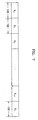
- FIG. 7 is a view of an audio signal filtered into predetermined frames, explaining operation 50 illustrated in FIG. 6.
- the audio signal is divided and filtered into sample units of 128.
- X 1 through X n denote the index marks of the 128-bit sample units into which the audio signal is filtered, respectively.
- an adaptive transform unit into which the audio signal is to be transformed into a frequency domain is determined (operation 52).
- the predetermined threshold is a reference value used in determining whether the audio signal rapidly changes to a large extent.
- the adaptive transform unit is a unit into which the audio signal can be transformed into a frequency domain while minimizing distortion of the audio signal, determined when the audio signal rapidly changes to a large extent.
- the length of the adaptive transform unit may be variously determined as illustrated in FIG. 4.
- the adaptive transform unit may be selected from a super long frame F 1 , a long frame F 2 , a short frame F 3 , and a super short frame F 4 . In FIG.
- T 1 , T 2 , T 3 , T 4 , and T 5 denote frames obtained by transforming these frames F 1 through F 4 .
- the present invention is not, however, limited to these frames, that is, frames of various lengths can be used in transforming an audio signal.
- FIG. 8 is a detailed flowchart of operation 52 illustrated in FIG. 6.
- a rapid change coefficient corresponding to the degree of a change in the filtered audio signal is computed (operation 70).
- the rapid change coefficient is used in determining whether the filtered audio signal rapidly changes to a large extent. For instance, a rapid change coefficient of each of sample units X 1 through X n , illustrated in FIG. 7, into which the audio signal is filtered is computed. Specifically, representative values y 1 through y n of the sample units X 1 through X n are determined. Each of the representative values y 1 through y n is the largest value of each of the sample units X 1 through X n .
- a k y k / M k .
- a k denotes a rapid change coefficient of the sample unit X k
- y k denotes a representative value of the sample unit X k
- M k denotes an average value of representative values Y 1 through Y k -1 of the sample units X 0 through X k-1 .
- Equation (3) when a rapid change coefficient is large, the audio signal is considered as rapidly changing to a large extent at a frame of the audio signal where the rapid change coefficient is obtained.
- a rapid change length of the audio signal that begins to rapidly change to a large extent is measured (operation 72).
- the predetermined threshold is a reference value used in determining whether the audio signal rapidly changes to a large extent.
- the rapid change length corresponds to the difference between the positions of the beginning frame of the audio signal and the frame of the audio signal that begins to rapidly change to a large extent in the time domain. That the rapid change coefficient is greater than the predetermined threshold indicates that the audio signal rapidly changes to a large extent at a point where the rapid change coefficient is obtained.
- the type of a frame into which the audio signal is to be transformed is determined by comparing the rapid change length with the sums of the lengths of various types of frames (operation 74).
- FIG. 9 is a detailed flowchart of operation 74 illustrated in FIG. 8. Referring to FIG. 9, it is determined whether the length of the frames of the audio signal that begins to rapidly change to a large extent is equal to or greater than the sum of the lengths of a super long frame and a super short frame (operation 80). For instance, referring to FIG. 4, it is determined whether the length B k is equal to or greater than the sum of the lengths of the super long frame F 1 and the super short frame F 4 .
- the length B k is equal to or greater than the sum of the lengths of the super long frame F 1 and the super short frame F 4 . If the length B k is equal to or greater than the sum of the lengths of the super long frame F 1 and the super short frame F 4 , it is determined whether a previous frame into the audio signal was transformed are the super short frame (operation 82). For instance, when the length B k is equal to or greater than the sum of the lengths of the super long frame F 1 and the super short frame F 4 , the total length of the sample units X 1 through X k is very likely to be greater than at least the length of the super long frame F 1 . Accordingly, if the rapid change length is equal to or greater than the sum of the lengths of the super long frame and the super short frame, the super long frame or the super short frame is selected as a frame into which the audio signal is to be transformed.
- the super long frame is selected as a frame into which the audio signal will be transformed into the frequency domain (operation 84). For instance, when the previous frame is not the super short frame F 4 of FIG. 4, it means that a rapid change does not occur in the previous frame. In this case, even if the super long frame F 1 is selected, the audio signal would not distort when the audio signal is encoded. Accordingly, if the previous frame is not the super short frame F 4 , the super long frame F 1 is selected as a frame into which the audio signal is to be transformed.
- the long frame is selected (operation 86). For instance, when the previous frame is the super short frame F 4 , it is understood that a sudden change occurred in at least the previous frame. In this case, it is better to select the long frame F 2 than the super long frame F 1 in order to minimize distortion of the audio signal when the audio signal is encoded.
- the rapid change length is less than the sum of the lengths of the super long frame and the super short frame
- it is determined whether the length of the frames of the audio signal that begins to rapidly change to a large extent is equal to or greater than the sum of the lengths of the super long frame and the super short frame (operation 88). For instance, when the length B k is less than the sum of the lengths of the super long frame F 1 and the super short frame F 4 , the total length of the sample units X 1 through X k is very likely to be less than the length of the super long frame F 1 . In this case, it is determined whether the length B k is equal to or greater than the sum of the lengths of the long frame F 2 and the super short frame F 4 .
- the method of FIG. 6 proceeds to operation 86, and the long frame is selected. For instance, when the length B k is equal to or greater than the sum of the lengths of the long frame F 2 and the super short frame F 4 , the total length of the sample units X 1 through X k is greater than at least the length of the short frame F 3 , and the long frame F 2 is selected.
- the rapid change length is less than the sum of the lengths of the long frame and the super short frame
- the length of the frames of the audio signal that begins to rapidly change to a large extent is equal to or greater than the sum of the lengths of the short frame and the super short frame.
- the short frame is selected (operation 92). For instance, when the length B k is equal to or greater than the sum of the lengths of the short frame F 3 the super short frame F 4 , the total length of the sample units X 1 through X k is greater than at least the length of the super short frame F 4 . Therefore, the short frame F 3 is selected.
- the super short frame is selected (operation 94). For instance, when the length B k is less than the sum of the lengths of the short frame F 3 and the super short frame F 4 , the total length of the sample units X 1 through X k is very likely to be less than the length of the short frame F 3 . Thus, when the rapid change length is less than the sum of the lengths of the short frame and the super short frame, the super short frame F 4 is selected.
- Operation 74 illustrated in FIG. 9 is a non-limiting example. Therefore, a frame into which an audio signal is to be transformed into a frequency domain can be determined using various methods. For instance, in operation 80 of FIG. 9, the length of the frames of the audio signal that begins to remarkably change to a large extent may be compared with the sum of the lengths of the super long frame and the short frame or the sum of the lengths of the super long frame, the super short frame, and the short frame, not with the sum of the lengths of the super long frame and the super short frame.
- the audio signal is transformed into the frequency domain into units of the determined frame (operation 54).
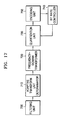
- FIG. 10 is a detailed flowchart of operation 54 illustrated in FIG. 6.
- the windowing operation is performed on the audio signal using a window coefficient other than 0 (operation 100).
- a window coefficient of 0 is not used in the windowing operation unlike in the conventional art.
- a frame is selected as an adaptive frame unit from various types of frames, and the windowing operation is performed on the audio signal in units of the selected frame using a window coefficient other than 0. Accordingly, according to the present embodiment, an audio signal is transformed using a critically sampled transform, not an over sampled transform used in the prior art, thereby minimizing distortion of the audio signal when the audio signal is encoded.
- the windowed audio signal is transformed into a frequency domain (operation 102).
- the DCT or the MDCT may be used to transform the audio signal into the frequency domain.
- the audio signal is filtered into predetermined sample units (operation 110).
- filtering is performed on required portions of the audio signal according to a frequency band.
- a method of filtering the audio signal has already been described as above.
- an adaptive transform unit into which the audio signal is to be transformed into the frequency domain is determined (operation 112).
- operation 112 A detailed description of operation 112 has already been described as above.
- the audio signal is transformed into the frequency domain into units of the determined adaptive transform unit (operation 114).
- a method of transforming the audio signal into the determined frame using a window coefficient other than 0 has already been described as above.
- the audio signal transformed into the frequency domain is quantized (operation 116). Specifically, in operation 114, the audio signal transformed into a frequency substance in the frequency domain is quantized at a bit rate according to bit allocation information.
- the quantized audio signal is encoded (operation 118).
- operation 118 a stream of encoded bits is obtained by encoding the quantized audio signal.
- Lossy compression or lossless compression may be used to encode the quantized audio signal.
- the quantized audio signal is encoded by computing an appropriate probability distribution of the quantized audio signal and encoding the probability distribution using Huffman coding or arithmetic coding.
- the apparatus includes a transform unit determiner 200 and a frequency-domain transformer 220.
- the transform unit determiner 200 determines a unit into which the audio signal is to be transformed, and provides the determined unit to the frequency-domain transformer 220. If the determined unit is a frame, the transform unit determiner 200 is capable of selecting a frame from frames of different lengths according to a change in the audio signal. If the frames are the super long frame F 1 , the long frame F 2 , the short frame F 3 , and the super short frame F 4 illustrated in FIG. 4, the transform unit determiner 200 selects one of the super long frame F 1 , the long frame F 2 , the short frame F 3 , and the super short frame F 4 according to a rapid change in the audio signal.
- the frequency-domain transformer 220 transforms the audio signal in a time domain into the frequency domain into units of the frame selected by the transform unit determiner 200, using a window coefficient other than 0.
- FIG. 13 is a detailed block diagram of the frequency-domain transformer 220 illustrated in FIG. 12.
- the frequency-domain transformer 220 includes a windowing unit 330 and a signal transformer 320.
- the windowing unit 300 performs a windowing operation on the audio signal into units of the determined frame using a window coefficient other than 0, and outputs the result of operation to the signal transformer 320.
- the window coefficient used by the windowing unit 300 is determined such that the original audio signal is restored through the MDCT that is an inverse transform.
- the sine window coefficient or the Kaiser-Bessel window coefficient used in an audio codec MPEG-4 AAC / BSAC / TwinVQ was used as a window coefficient, but the windowing unit 300 does not use a window coefficient of 0.
- the windowing unit 300 performs the windowing operation using a window coefficient other than 0, thereby preventing a reduction in an effect of transforming the audio signal.
- the signal transformer 320 transforms the audio signal windowed by the windowing unit 300 into the frequency domain, using the DCT of the MDCT.
- FIG. 14 is a block diagram of an apparatus for transforming an audio signal according to another embodiment of the present invention.
- the apparatus includes a filtering unit 400, an adaptive transform unit determiner 420, and a frequency-domain transformer 440.
- the filtering unit 400 filters the audio signal into predetermined sample units and outputs the result of filtering to the adaptive transform unit determiner 420.
- the filtering unit 400 filters only required portions of the audio signal according to a frequency band.
- the predetermined sample units are units into which the sampled audio signal is divided. For instance, the filtering unit 400 divides and filters the audio signal into the predetermined sample units such as those illustrated in FIG. 7.
- the adaptive transform unit determiner 420 determines an adaptive transform unit into which the audio signal is to be transformed into the frequency domain when the size of the audio signal becomes greater than a predetermined threshold, and provides the determined adaptive transform unit to the frequency-domain transformer 440.
- the predetermined threshold is a reference value used in determining whether the audio signal rapidly changes to a large extent.
- the adaptive transform units are units into which the audio signal can be transformed into a frequency domain while minimizing distortion of the audio signal, determined when the audio signal rapidly changes to a large extent.
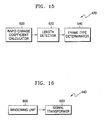
- FIG. 15 is a block diagram of the adaptive transform unit determiner 420.
- the adaptive transform unit determiner 420 includes a rapid change coefficient calculator 500, a length detector 520, and a frame type determiner 540.
- the rapid change coefficient calculator 500 computes a rapid change coefficient corresponding to the degree of a change in the audio signal filtered by the filtering unit 400, and provides the rapid change coefficient to the length detector 520.
- the rapid change coefficient is a reference value used in determining whether the filtered audio signal rapidly changes to a large extent. That the rapid change coefficient is a large value indicates that the audio signal rapidly changes to a large extent at a position where the rapid change coefficient is obtained.
- the rapid change coefficient calculator 500 computes the rapid change coefficient using Equation (3).
- the length detector 520 detects the length of frames of the audio signal that rapidly changes to a large extent when the rapid change coefficient is greater than a predetermined threshold, and outputs the result of detection to the frame type determiner 540.
- the predetermined threshold is a reference value used in determining whether the audio signal rapidly changes to a large extent.
- the rapid change length corresponds to the difference between the positions of the beginning frame of the audio signal and the frame of the audio signal that begins to rapidly change to a large extent in the time domain.
- the audio signal is considered as rapidly changing to a large extent at a position where the rapid change coefficient is obtained.
- the length detector 520 detects the rapid change length, using Equation (4).
- the frame type determiner 540 compares the rapid change length with the sums of the lengths of various types of frames, determines the type of a frame into which the audio signal is to be transformed, and outputs the result of determination to the frequency-domain transformer 440.
- the frame type determiner 540 compares the rapid change length with the sums of the lengths of the frames, and selects one of these frames as an optimum frame into which the audio signal is to be transformed, based on the result of comparison.
- the frequency-domain transformer 440 transforms the audio signal into the frequency domain into the adaptive transform units determined by the adaptive transform unit determiner 420.
- FIG. 16 is a detailed block diagram of the frequency-domain transformer 440 illustrated in FIG. 14.
- the frequency-domain transformer 440 includes a windowing unit 600 and a signal transformer 620.
- the windowing unit 600 performs the windowing operation on the audio signal into the determined adaptive transform units, using a window coefficient other than 0, and outputs the result of operation to the signal transformer 620.
- the window coefficient used by the windowing unit 600 is determined such that the original audio signal is restored through the MDCT that is an inverse transform.
- the sine window or the Kaiser the sine window coefficient or the Kaiser-Bessel window coefficient used in an audio codec MPEG-4 AAC / BSAC / TwinVQ was used as a window coefficient, but the windowing unit 600 does not use a coefficient of 0. That is, the windowing unit 600 performs the windowing operation on the audio signal into units of a frame corresponding to the adaptive transform units, using a window coefficient other than 0.
- the signal transformer 620 transforms the audio signal windowed by the windowing unit 600 into the frequency domain using the DCT or the MDCT.
- the apparatus includes a filtering unit 700, an adaptive transform unit determiner 710, a frequency-domain transformer 720, a quantization unit 730, a bit rate controller 740, and an encoding unit 750.
- the filtering unit 700 filters the audio signal into predetermined sample units and outputs the result of filtering to the adaptive transform unit determiner 710.
- the filtering unit 700 filters only required portions of the audio signal according to a frequency band.
- the operation of the filtering unit 700 is equal to that of the filtering unit 400 and thus will not be described here.
- the adaptive transform unit determiner 710 determines adaptive transform units into which the audio signal is to be transformed into a frequency domain when the size of the audio signal is greater than a predetermined threshold, and outputs the result of determination to the frequency-domain transformer 720.
- the adaptive transform units are units into which the audio signal can be transformed while reducing distortion of the audio signal, determined when the audio signal rapidly changes to a large extent.
- the operation of the adaptive transform unit determiner 710 is equal to that of the adaptive transform unit determiner 420 and thus will not be described here.
- the frequency-domain transformer 720 transforms the audio signal into the frequency domain into the adaptive transform units determined by the adaptive transform unit determiner 710, and outputs the transformed audio signal to the quantization unit 730.
- the frequency-domain transformer 720 transforms the audio signal into the frequency domain into the determined adaptive transform units, using a window coefficient other than 0.
- the operation of the frequency-domain transformer 720 is equal to that of the frequency-domain transformer 440 and thus will not be described here.
- the quantization unit 730 quantizes the transformed audio signal output from the frequency-domain transformer 720 at an encoding bit rate allocated by the bit rate controller 740, and outputs the result of quantization to the encoding unit 750.
- the bit rate controller 740 receives information regarding the bit rate of a bit stream from the encoding unit 750, computes a bit allocation parameter corresponding to the bit rate of the bit stream, and provides the bit allocation parameter to the quantization unit 730.
- the bit rate controller 740 can minutely adjust the bit rate of a bit stream output from the encoding unit 750 to a desired bit rate.
- the encoding unit 750 receives the quantized audio signal from the quantization unit 730 and encodes it into a bit stream.
- the encoding unit 750 includes a lossless compression unit and a lossy compression unit.
- the encoding unit 750 can obtain an appropriate probability distribution of the quantized audio signal and encode the probability distribution using lossless compression such as Huffman coding or arithmetic coding.
- an audio signal which is encoded into a bit stream into a frequency domain using a window coefficient other than 0 is inversely transformed into a time domain.
- Use of the window coefficient other than 0 prevents a reduction in an effect of inversely transforming the audio signal.
- FIG. 18 information regarding an adaptive transform units into which the audio signal was transformed into a frequency domain is obtained from audio data (operation 800).
- the adaptive transform units are determined according to a change in the size of the audio signal that rapidly changes to a large extent when the audio signal in a time domain is transformed into a frequency domain.
- the information regarding the adaptive transform units is included in header information when the audio signal is encoded, and obtained from the header information when the audio signal transformed into the frequency domain is inversely transformed in the time domain.
- the audio data is inversely transformed into the adaptive transform units according to the information regarding the adaptive transform units (operation 802).
- the inverse transform an audio signal transformed into a frequency domain is inversely transformed in a time domain.
- the audio data encoded into the frequency domain using a window coefficient other than 0 is inversely transformed into an audio signal in the time domain into the adaptive transform units.
- encoded audio data is decoded (operation 900). Specifically, an input bit stream is processed in the opposite manner in which the audio data was encoded. If the bit stream is lossy encoded, the bit stream must be losslessly decoded through arithmetic coding or Huffman coding.
- the decoded audio data is inversely quantized (operation 902). Through inverse quantization, the decoded audio data is restored to an audio signal with the original size, which has yet to be quantized.
- information regarding the adaptive transform units into which the audio signal was transformed into the frequency domain is obtained from the inversely quantized audio data (operation 904).
- the adaptive transform units are determined according to a change in the size of the audio signal that rapidly changes to a large extent when the audio signal in a time domain is transformed into a frequency domain.
- the information regarding the adaptive transform units is included in header information when the audio signal is encoded, and obtained from the header information when the audio signal in the frequency domain is inversely transformed into the time domain.
- the audio data is inversely transformed into the adaptive transform units according to the information regarding the determined adaptive transform units (operation 906). Specifically, the inversely quantized audio signal is inversely transformed into the time domain. In particular, the audio data encoded into the frequency domain using a window coefficient other than 0 is inversely transformed into an audio signal in a time domain into the adaptive transform units.
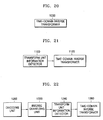
- FIG. 20 is a block diagram of a time-domain inverse transformer 1000 that is an apparatus for inversely transforming an audio signal according to an embodiment of the present invention.
- the time-domain inverse transformer 1000 inversely transforms audio data of a bit stream obtained by transforming an audio signal into a frequency domain using a window coefficient other than 0.
- the time-domain inverse transformer 1000 inversely transforms the frequency-domain audio data, which is encoded using the window coefficient other than 0, into a time-domain audio signal.
- FIG. 21 is a block diagram of an apparatus for inversely transforming an audio signal according to another embodiment of the present invention.
- the apparatus includes a transform unit information detector 1100 and a time-domain inverse transformer 1120.
- the transform unit information detector 1100 detects information regarding adaptive transform units, into which the audio signal was transformed into a frequency domain, from audio data, and outputs the detected information to the time-domain inverse transformer 1120.
- the adaptive transform units are determined according to a change in the size of the audio signal that rapidly changes to a large extent when transforming the audio signal in a time domain into a frequency domain.
- the information regarding the adaptive transform units is included in header information when the audio signal is encoded, and obtained from the header information when the audio signal transformed into the frequency domain is inversely transformed in the time domain.
- the time-domain inverse transformer 1120 inversely transforms the audio data into the adaptive transform units according to the information regarding the adaptive transform units.
- the time-domain inverse transformer 1120 transforms the frequency-domain audio signal into a time-domain audio signal into the adaptive transform units.
- the time-domain inverse transformer 1120 inversely transforms the audio data, which is a bit stream obtained by transformed an audio signal into the frequency domain using a window coefficient other than 0, into the adaptive transform units.
- the apparatus includes a decoding unit 1200, an inverse quantization unit 1220, a transform unit information detector 1240, and a time-domain inverse transformer 1260.
- the decoding unit 1200 decodes encoded audio data and outputs the decoded audio data to the inverse quantization unit 1220. That is, the decoding unit 1200 processes an input bit stream in the opposite manner in which an audio signal is encoded by the encoding unit 750. In particular, the decoding unit 1200 decodes a bit stream, which is losslessy encoded, using lossless decoding such as arithmetic decoding or Huffman decoding.
- the inverse quantization unit 1220 inversely quantizes the audio data decoded by the decoding unit 1200, and outputs the inversely quantized audio data to the transform unit information detector 1240. That is, the inverse quantizer 1220 restores the decode audio signal to an audio signal with the original size, which has yet to be quantized.
- the transform unit information detector 1240 detects information regarding adaptive transform units, into which the audio signal was transformed into the frequency domain from, the audio data, and outputs the information regarding the adaptive transform units to the time-domain inverse transformer 1260.
- the transform unit information detector 1240 detects the information regarding the adaptive transform units from the header information.
- the time-domain inverse transformer 1260 inversely transforms the audio data into the adaptive transform units according to the information regarding the adaptive transform units. In other words, the time-domain inverse transformer 1260 transforms the frequency-domain audio signal into the time-domain audio signal into the adaptive transform units. In particular, the time-domain inverse transformer 1260 inversely transforms the audio data, which is a bit stream obtained by transforming the audio signal into the frequency domain using a window coefficient other than 0, into the adaptive transform units.
- an audio signal is transformed into units of an adaptive frame, which is determined according to a sharp change in the audio signal, into a frequency domain. Accordingly, it is possible to minimize distortion of the audio signal when encoding the audio signal even at a high bit rate while increasing efficiency of compression.
Landscapes
- Engineering & Computer Science (AREA)
- Physics & Mathematics (AREA)
- Spectroscopy & Molecular Physics (AREA)
- Computational Linguistics (AREA)
- Signal Processing (AREA)
- Health & Medical Sciences (AREA)
- Audiology, Speech & Language Pathology (AREA)
- Human Computer Interaction (AREA)
- Acoustics & Sound (AREA)
- Multimedia (AREA)
- Compression, Expansion, Code Conversion, And Decoders (AREA)
Applications Claiming Priority (1)
| Application Number | Priority Date | Filing Date | Title |
|---|---|---|---|
| KR1020040102303A KR100668319B1 (ko) | 2004-12-07 | 2004-12-07 | 오디오 신호의 변환방법 및 장치와 오디오 신호에적응적인 부호화방법 및 장치, 오디오 신호의 역변환 방법및 장치와 오디오 신호에 적응적인 복호화 방법 및 장치 |
Publications (2)
| Publication Number | Publication Date |
|---|---|
| EP1669982A2 true EP1669982A2 (de) | 2006-06-14 |
| EP1669982A3 EP1669982A3 (de) | 2008-08-27 |
Family
ID=35589631
Family Applications (1)
| Application Number | Title | Priority Date | Filing Date |
|---|---|---|---|
| EP05257500A Withdrawn EP1669982A3 (de) | 2004-12-07 | 2005-12-06 | Apparate und Verfahren zur Transformation, adaptiven Kodierung, inversen Transformation und adaptiven Dekodierung eines Audiosignals |
Country Status (5)
| Country | Link |
|---|---|
| US (1) | US8086446B2 (de) |
| EP (1) | EP1669982A3 (de) |
| JP (1) | JP5583881B2 (de) |
| KR (1) | KR100668319B1 (de) |
| CN (1) | CN1787383B (de) |
Families Citing this family (12)
| Publication number | Priority date | Publication date | Assignee | Title |
|---|---|---|---|---|
| KR101435893B1 (ko) * | 2006-09-22 | 2014-09-02 | 삼성전자주식회사 | 대역폭 확장 기법 및 스테레오 부호화 기법을 이용한오디오 신호의 부호화/복호화 방법 및 장치 |
| KR20080053739A (ko) * | 2006-12-11 | 2008-06-16 | 삼성전자주식회사 | 적응적으로 윈도우 크기를 적용하는 부호화 장치 및 방법 |
| CN101308655B (zh) | 2007-05-16 | 2011-07-06 | 展讯通信(上海)有限公司 | 一种音频编解码方法与装置 |
| KR101235830B1 (ko) * | 2007-12-06 | 2013-02-21 | 한국전자통신연구원 | 음성코덱의 품질향상장치 및 그 방법 |
| EP3002750B1 (de) * | 2008-07-11 | 2017-11-08 | Fraunhofer-Gesellschaft zur Förderung der angewandten Forschung e.V. | Audiocodierer und -decodierer zur codierung und decodierung von audioabtastwerten |
| WO2010058931A2 (en) * | 2008-11-14 | 2010-05-27 | Lg Electronics Inc. | A method and an apparatus for processing a signal |
| US20110087494A1 (en) * | 2009-10-09 | 2011-04-14 | Samsung Electronics Co., Ltd. | Apparatus and method of encoding audio signal by switching frequency domain transformation scheme and time domain transformation scheme |
| CN105976824B (zh) * | 2012-12-06 | 2021-06-08 | 华为技术有限公司 | 信号解码的方法和设备 |
| WO2014128197A1 (en) | 2013-02-20 | 2014-08-28 | Fraunhofer-Gesellschaft zur Förderung der angewandten Forschung e.V. | Apparatus and method for encoding or decoding an audio signal using a transient-location dependent overlap |
| EP2830058A1 (de) | 2013-07-22 | 2015-01-28 | Fraunhofer-Gesellschaft zur Förderung der angewandten Forschung e.V. | Frequenzbereichsaudiocodierung mit Unterstützung von Transformationslängenschaltung |
| US10332527B2 (en) * | 2013-09-05 | 2019-06-25 | Samsung Electronics Co., Ltd. | Method and apparatus for encoding and decoding audio signal |
| US10984808B2 (en) * | 2019-07-09 | 2021-04-20 | Blackberry Limited | Method for multi-stage compression in sub-band processing |
Family Cites Families (22)
| Publication number | Priority date | Publication date | Assignee | Title |
|---|---|---|---|---|
| CA1203906A (en) | 1982-10-21 | 1986-04-29 | Tetsu Taguchi | Variable frame length vocoder |
| DE3902948A1 (de) * | 1989-02-01 | 1990-08-09 | Telefunken Fernseh & Rundfunk | Verfahren zur uebertragung eines signals |
| DE69028176T2 (de) * | 1989-11-14 | 1997-01-23 | Nippon Electric Co | Adaptive Transformationskodierung durch optimale Blocklängenselektion in Abhängigkeit von Unterschieden zwischen aufeinanderfolgenden Blöcken |
| CN1062963C (zh) * | 1990-04-12 | 2001-03-07 | 多尔拜实验特许公司 | 用于产生高质量声音信号的解码器和编码器 |
| US5285498A (en) * | 1992-03-02 | 1994-02-08 | At&T Bell Laboratories | Method and apparatus for coding audio signals based on perceptual model |
| JP3531177B2 (ja) * | 1993-03-11 | 2004-05-24 | ソニー株式会社 | 圧縮データ記録装置及び方法、圧縮データ再生方法 |
| US5960390A (en) * | 1995-10-05 | 1999-09-28 | Sony Corporation | Coding method for using multi channel audio signals |
| US5848391A (en) * | 1996-07-11 | 1998-12-08 | Fraunhofer-Gesellschaft Zur Forderung Der Angewandten Forschung E.V. | Method subband of coding and decoding audio signals using variable length windows |
| KR100234264B1 (ko) * | 1997-04-15 | 1999-12-15 | 윤종용 | 타겟윈도우 이동을 통한 블록 매칭방법 |
| DE19736669C1 (de) * | 1997-08-22 | 1998-10-22 | Fraunhofer Ges Forschung | Verfahren und Vorrichtung zum Erfassen eines Anschlags in einem zeitdiskreten Audiosignal sowie Vorrichtung und Verfahren zum Codieren eines Audiosignals |
| US6226608B1 (en) * | 1999-01-28 | 2001-05-01 | Dolby Laboratories Licensing Corporation | Data framing for adaptive-block-length coding system |
| DE19921122C1 (de) * | 1999-05-07 | 2001-01-25 | Fraunhofer Ges Forschung | Verfahren und Vorrichtung zum Verschleiern eines Fehlers in einem codierten Audiosignal und Verfahren und Vorrichtung zum Decodieren eines codierten Audiosignals |
| US7127390B1 (en) * | 2000-02-08 | 2006-10-24 | Mindspeed Technologies, Inc. | Rate determination coding |
| JP4021124B2 (ja) * | 2000-05-30 | 2007-12-12 | 株式会社リコー | デジタル音響信号符号化装置、方法及び記録媒体 |
| JP2002076904A (ja) | 2000-09-04 | 2002-03-15 | Victor Co Of Japan Ltd | 符号化されたオーディオ信号の復号化方法、及び符号化されたオーディオ信号の復号化装置 |
| US7460993B2 (en) * | 2001-12-14 | 2008-12-02 | Microsoft Corporation | Adaptive window-size selection in transform coding |
| KR100477649B1 (ko) | 2002-06-05 | 2005-03-23 | 삼성전자주식회사 | 다양한 프레임 사이즈를 지원하는 정수 코딩 방법 및 그를적용한 코덱 장치 |
| EP1394772A1 (de) * | 2002-08-28 | 2004-03-03 | Deutsche Thomson-Brandt Gmbh | Signalierung von Fensterschaltungen in einem MPEG Layer 3 Audio Datenstrom |
| TW594674B (en) * | 2003-03-14 | 2004-06-21 | Mediatek Inc | Encoder and a encoding method capable of detecting audio signal transient |
| US7283968B2 (en) * | 2003-09-29 | 2007-10-16 | Sony Corporation | Method for grouping short windows in audio encoding |
| US7325023B2 (en) * | 2003-09-29 | 2008-01-29 | Sony Corporation | Method of making a window type decision based on MDCT data in audio encoding |
| KR100651731B1 (ko) * | 2003-12-26 | 2006-12-01 | 한국전자통신연구원 | 가변 프레임 음성 부호화/복호화 장치 및 그 방법 |
-
2004
- 2004-12-07 KR KR1020040102303A patent/KR100668319B1/ko not_active Expired - Fee Related
-
2005
- 2005-12-06 EP EP05257500A patent/EP1669982A3/de not_active Withdrawn
- 2005-12-07 US US11/295,648 patent/US8086446B2/en not_active Expired - Fee Related
- 2005-12-07 CN CN200510127926.8A patent/CN1787383B/zh not_active Expired - Fee Related
- 2005-12-07 JP JP2005352938A patent/JP5583881B2/ja not_active Expired - Fee Related
Also Published As
| Publication number | Publication date |
|---|---|
| US8086446B2 (en) | 2011-12-27 |
| CN1787383B (zh) | 2012-02-29 |
| KR20060063198A (ko) | 2006-06-12 |
| JP2006163414A (ja) | 2006-06-22 |
| EP1669982A3 (de) | 2008-08-27 |
| KR100668319B1 (ko) | 2007-01-12 |
| JP5583881B2 (ja) | 2014-09-03 |
| US20060122825A1 (en) | 2006-06-08 |
| CN1787383A (zh) | 2006-06-14 |
Similar Documents
| Publication | Publication Date | Title |
|---|---|---|
| RU2719008C1 (ru) | Аудиокодер для кодирования аудиосигнала, способ для кодирования аудиосигнала и компьютерная программа, учитывающие детектируемую спектральную область пиков в верхнем частотном диапазоне | |
| JP6117269B2 (ja) | 過渡状態検出器およびオーディオ信号の符号化を支援する方法 | |
| EP2346029B1 (de) | Vorrichtung und Verfahren zur Audiokodierung und korrespondierendes Computerprogramm | |
| EP4375998B1 (de) | Audiodecoder | |
| EP2122615B1 (de) | Vorrichtung und verfahren zum codieren eines informationssignals | |
| US20120232913A1 (en) | Methods and systems for bit allocation and partitioning in gain-shape vector quantization for audio coding | |
| US20070106502A1 (en) | Adaptive time/frequency-based audio encoding and decoding apparatuses and methods | |
| US6965859B2 (en) | Method and apparatus for audio compression | |
| US20070118368A1 (en) | Audio encoding apparatus and audio encoding method | |
| EP1669982A2 (de) | Apparate und Verfahren zur Transformation, adaptiven Kodierung, inversen Transformation und adaptiven Dekodierung eines Audiosignals | |
| US20080255860A1 (en) | Audio decoding apparatus and decoding method | |
| CN111587456B (zh) | 时域噪声整形 |
Legal Events
| Date | Code | Title | Description |
|---|---|---|---|
| PUAI | Public reference made under article 153(3) epc to a published international application that has entered the european phase |
Free format text: ORIGINAL CODE: 0009012 |
|
| AK | Designated contracting states |
Kind code of ref document: A2 Designated state(s): AT BE BG CH CY CZ DE DK EE ES FI FR GB GR HU IE IS IT LI LT LU LV MC NL PL PT RO SE SI SK TR |
|
| AX | Request for extension of the european patent |
Extension state: AL BA HR MK YU |
|
| PUAL | Search report despatched |
Free format text: ORIGINAL CODE: 0009013 |
|
| AK | Designated contracting states |
Kind code of ref document: A3 Designated state(s): AT BE BG CH CY CZ DE DK EE ES FI FR GB GR HU IE IS IT LI LT LU LV MC NL PL PT RO SE SI SK TR |
|
| AX | Request for extension of the european patent |
Extension state: AL BA HR MK YU |
|
| AKX | Designation fees paid | ||
| REG | Reference to a national code |
Ref country code: DE Ref legal event code: 8566 |
|
| STAA | Information on the status of an ep patent application or granted ep patent |
Free format text: STATUS: THE APPLICATION IS DEEMED TO BE WITHDRAWN |
|
| 18D | Application deemed to be withdrawn |
Effective date: 20090301 |