EP1674632A2 - Plaque de plâtre - Google Patents
Plaque de plâtre Download PDFInfo
- Publication number
- EP1674632A2 EP1674632A2 EP05026735A EP05026735A EP1674632A2 EP 1674632 A2 EP1674632 A2 EP 1674632A2 EP 05026735 A EP05026735 A EP 05026735A EP 05026735 A EP05026735 A EP 05026735A EP 1674632 A2 EP1674632 A2 EP 1674632A2
- Authority
- EP
- European Patent Office
- Prior art keywords
- plasterboard
- filling
- gypsum
- groove
- core
- Prior art date
- Legal status (The legal status is an assumption and is not a legal conclusion. Google has not performed a legal analysis and makes no representation as to the accuracy of the status listed.)
- Granted
Links
Images


Classifications
-
- E—FIXED CONSTRUCTIONS
- E04—BUILDING
- E04C—STRUCTURAL ELEMENTS; BUILDING MATERIALS
- E04C2/00—Building elements of relatively thin form for the construction of parts of buildings, e.g. sheet materials, slabs, or panels
- E04C2/02—Building elements of relatively thin form for the construction of parts of buildings, e.g. sheet materials, slabs, or panels characterised by specified materials
- E04C2/04—Building elements of relatively thin form for the construction of parts of buildings, e.g. sheet materials, slabs, or panels characterised by specified materials of concrete or other stone-like material; of asbestos cement; of cement and other mineral fibres
- E04C2/043—Building elements of relatively thin form for the construction of parts of buildings, e.g. sheet materials, slabs, or panels characterised by specified materials of concrete or other stone-like material; of asbestos cement; of cement and other mineral fibres of plaster
-
- B—PERFORMING OPERATIONS; TRANSPORTING
- B28—WORKING CEMENT, CLAY, OR STONE
- B28B—SHAPING CLAY OR OTHER CERAMIC COMPOSITIONS; SHAPING SLAG; SHAPING MIXTURES CONTAINING CEMENTITIOUS MATERIAL, e.g. PLASTER
- B28B11/00—Apparatus or processes for treating or working the shaped or preshaped articles
- B28B11/08—Apparatus or processes for treating or working the shaped or preshaped articles for reshaping the surface, e.g. smoothing, roughening, corrugating, making screw-threads
- B28B11/0863—Apparatus or processes for treating or working the shaped or preshaped articles for reshaping the surface, e.g. smoothing, roughening, corrugating, making screw-threads for profiling, e.g. making grooves
Definitions
- the invention relates to a gypsum board in particular plasterboard or gypsum fiber board comprising a core of porous gypsum-containing material, a gypsum composite or gypsum and cover layers of cardboard or glass fiber fabric at least on both flat sides of the plasterboard, of which a first defines a visible side and the second side a back for forming a stable and inherently rigid composite, wherein the gypsum board has two flattened longitudinal edges running parallel to one another to form a filling section, and at least two end edges extending transversely to the longitudinal edges, at least one end edge of which is also flattened and forms a filling section; and a method for producing a gypsum board.
- Plasterboard panels are often used today for interior fittings, be it as wall or ceiling panels. There is a desire to make the transition between two abutting plasterboard optically inconspicuous. In this context, it is already known to provide Verspachtelungsabête on the gypsum board in the region of their lateral edges on the visible side, in which the gypsum board following a given contour flattening to the side facing the longitudinal or end edges. If two plasterboard panels provided with such flats are placed against each other, a slight depression forms, which can subsequently be filled with filler. By filling a smooth transition between two adjacent plasterboard can be created without a shock or a joint occurs.
- Gypsum boards are, however, produced in a continuous process, ie molded as a strand. Therefore, only two opposite, parallel longitudinal edges within this continuous molding process be flattened. On the other hand, the transverse edges extending transversely thereto can not readily be formed in this continuous molding process.
- the object of the present invention is therefore to design a flattening at the end edges in such a way that the setting of a reliable screw connection becomes possible.
- the backfilling comprises two components, namely a filling material and a bond, which are arranged separately, but if necessary are arranged in mixing areas merging between core remnant section and cover layer.
- a filling material and a bond are arranged separately, but if necessary are arranged in mixing areas merging between core remnant section and cover layer.
- the adhesive for bonding is preferably thermally activated in contrast to the filler.
- the adhesive used is preferably dispersion adhesive.
- the filling material is provided or arranged facing away from the end edges or longitudinal edges.
- the bonding is initially provided in the end edges or longitudinal edges facing areas of the backfilling, such that the core remnant portion and cover layer are permanently fixed to each other at the edge of the adhesive bond. This results in a "locking effect" by the bond in the front groove area.
- the filling material fills the filling area so that no or only minimal voids are created between the bond and the filling material.
- the low-shrinkage, volume-stable, highly filled organic and / or mineral-bonded filler material has a setting time of> 10 min.
- the bond comprises a fast-acting adhesive component.
- the adhesive component is in the range of 5 to 60 seconds, preferably in the range of 15 to 25 seconds. effective.
- a second core residual section remains, which has a thickness that is significantly smaller than the thickness of the first core residual section.
- This second core remnant section is formed automatically when the groove can not be placed arbitrarily close to the covering layer of the visible side.
- a core remnant portion can add stability to the paperboard cover layer.
- this second core remnant section can have, for example, a thickness of approximately 1 mm.
- a combination of bonding on the one hand which causes a holding effect, and a backfilling with gypsum on the other.
- This combination causes a largely shrinkage of backfilling.
- the bonding is preferably carried out by thermal activation on both sides, ie a thermal activation of the first, upper groove flank and the second, lower groove flank.
- the groove can have a substantially rectangular cross-sectional shape or, which is also claimed independently in accordance with the invention, a shape which tapers in the depth.
- the size of the groove is preferably about 40 x 2.3 mm 2 to 40 x 2.5 mm 2 .
- a contour can be selected which corresponds to the contour of the flattening to be achieved, so that only very little or no filling material is required for backfilling the groove, but a conventional one for fixing in this variant Adhesive may be sufficient.
- the cover layer is raised together with an associated second core remnant section and held in this position for a predetermined time. It has been found that an advantageous period of time for holding the cover layer together with the associated second core remnant section is between 2 and 10 seconds.
- a piercing into the region of the now expanded groove takes place in order to reduce the restoring force of the cover layer together with an optionally present second core remnant section.
- the piercing can be done by a tool with a sharp point in the fracture area of the plasterboard.
- a cut is made along the innermost end of the groove.
- a depth of between 0.5 and 3 millimeters is advantageous.
- the Nachstechen which is also referred to as regrooving, facilitates cleaning, gluing and filling with plaster, especially in the area facing away from the front edges area.
- the combination of raising the cover layer of the groove, holding the cover layer in this position for a predetermined time and a piercing in the region of the enlarged groove is particularly advantageous and is also referred to as relaxation cut, as this effectively reduces the tension between the cover layer and the first core remnant section can be. On the one hand, this facilitates backfilling, but it also reduces additional restoring forces when closing the groove later.
- the backfilling of the groove and the compression of the remaining front ends with a pressing tool in an inline process ie within the production process of the plasterboard, and the curing of the filler takes place after ejection of the gypsum board from the inline process without further pressing tools or from the outside attacking shape retaining means.
- the backfilling of the groove and the compression of the remaining front ends with a pressing tool also be carried out in a separate process, for example by using interposed plasterboard.
- postforming rollers are preferably used which press the ends together for about 15 seconds.
- the groove is mounted on a level closer to the visible side than to the rear, such that towards the back the cover layer and a (first) core remnant portion and to the visible side only the cover layer or the cover layer with a second core remnant portion, the one to the thickness of the first core portion has substantially smaller thickness remains.
- the cover layer of the visible side or the cover layer with a second core remnant portion on the visible side can then be much simpler to form the desired flattening with a pressing tool on the first core remnant portion, so that the desired contour can be formed.
- the groove is preferably introduced by material removal, in particular by milling and / or sawing, being intended primarily to a substantially rectangular shape of the groove.
- material removal in particular by milling and / or sawing, being intended primarily to a substantially rectangular shape of the groove.
- tapered groove cross-sectional shapes in particular a shape of the groove adapted to the desired flattening.
- a cleaning step is provided after introducing the groove to remove unbound particles, in particular residual dust.
- This cleaning step may include, for example, purging and / or rinsing. But it is also alternatively or additionally a purely mechanical cleaning, in particular cleaning by brush conceivable.
- the groove to be filled is treated with primer before introducing the filling material.
- the primer improves the strength of the fixation of the front ends together. In an alternative embodiment, however, a sufficient strength can be achieved even without additional primer.
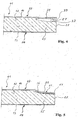
- FIG. 1 an embodiment of a partially machined plasterboard blank is shown in a partial sectional view.
- the partially machined gypsum plasterboard blank according to FIG. 1 comprises two parallel covering layers 13, 14 of cardboard, which enclose an interposed core 12 made of porous gypsum-containing material, a gypsum composite or gypsum.
- One of the two flat sides of the partially processed plasterboard blank defines a visible side 23 and the opposite flat side a rear side 24.
- a gypsum composite or gypsum to be improved.
- From a frontal surface 28 of a groove 27 is incorporated in the plasterboard blank in a direction parallel to the visible side 23, for example, milled or sawed.
- the groove 27 has in the concrete embodiment present here a substantially rectangular cross-sectional shape with a first groove flank 32 and a second groove flank 33, each extending parallel to the cover layer 13, 14.
- the groove 27 is bounded at its innermost end by an orthogonal to the first groove flank 32 and the second groove flank 33 extending base surface 34.
- the groove 27 reduces the thickness of the core 12 such that between the groove 27 and the cover layer 13 facing the back side 24, a first core remainder portion 25 with a reduced thickness on the opposite side to the cover layer 14 of the visible side 23 has a second core remainder portion 31 with one again substantially lower strength remains.
- FIG. 2 illustrates a partial cross-sectional view of a gypsum board 11 formed from the gypsum board blank according to FIG. 1.
- the gypsum board 11 of Fig. 2 differs from the gypsum board blank of Fig. 1 in that the second core remainder portion 31 overlies the overlying portion of the cover layer 14 to form a feathering portion 21 with a press tool (not shown) for flattening the first core remainder portion 25 is pressed.
- the remaining volume of the groove 27 is filled by means of a backfilling 26, wherein the backfilling consists of low-shrinkage highly filled organic and / or mineral bound filler such that after hardening substantially void-free and a screw fixation enduring filling is formed.
- the filling 26 comprises a filling material 30 in the area facing away from the end edges.
- An adhesive bond 29 is introduced in the region facing the end edges. Filling material 30 and bonding 29 fill the respective region of the backfill 26 in a form-fitting or at least almost positive fit and adjoin one another directly, so that intermediate cavities are avoided.
- the bond 29 permanently fixes the frontal regions of the first groove flank 32 to the end regions of the second groove flank 33.
- a filling material which comprises calcium hydrate and / or calcium sulfate and / or calcium carbonate and / or gypsum or consists of these materials.
- the organically bound filling materials may comprise plastic-bonded filling materials, in particular dispersion-bound filling materials.
- expedient embodiment can be used as filler material specified by the applicant under the brand Readygips® substance, said substance comprises calcium sulfate filler, perlite, aqueous dispersion of styrene-Acrylklaher copolymer, cellulose ethers, polyacrylate.
- a filling material with less than 10% shrinkage, preferably less than 3% shrinkage, is used for the backfilling.
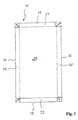
- Fig. 3 the gypsum board according to Fig. 2 is shown in a plan view for illustrative purposes again in a complete view.
- the plasterboard 11 has two mutually parallel longitudinal edges 15, 16 and orthogonal thereto two mutually parallel end edges 17, 18.
- Verspachtelungsabête 19, 20 and 21, 22 are formed, which form an already explained with reference to FIG. 2 flattening, i. the Verspachtelungsabête 19, 20 and 21, 22 cause a taper of the plasterboard 11 to its longitudinal edges 15, 16 and end edges 17, 18 out to two adjoining gypsum board can seamlessly connect via a Verspachtelung can.
- the Verspachtelungsabête 19, 20 are formed in-line method with molding of the core 12 of the plasterboard 11, so that the method explained with reference to FIG. 1 and FIG. 2 need only be performed on the end edges 17, 18.
- Verspachtelungsabitese may also be formed only along the end edges. Also along the back 24 of the plasterboard Verspachtelungsabête may be formed, which are the Verspachtelungsabêten 19, 20 and 21, 22 modeled.
- a modified embodiment of a partially processed gypsum plasterboard blank is illustrated in a partial cross-sectional view.
- the illustrated in Fig. 4 plasterboard blank differs from that of the plasterboard blanks shown in Fig. 1 in that the groove 27 here has no substantially rectangular basic shape, but that the groove tapers in its depth concretely so that the first groove flank 32 has a substantially to the contour of the reachable Verspachtelungsabêtes 21 contour approximated, wherein a base surface 34 is dimensioned very narrow or entirely - as here - can be omitted and the second groove flank 33 may still be designed to extend straight.
- the plasterboard 11 produced from a plasterboard blank according to FIG. 4 is illustrated with reference to FIG. 5.
- the backfill 26 here has only a very small extent perpendicular to the visible side 23 or rear side 24.
- Fig. 6 shows schematically a plant for producing a gypsum board according to the invention in an in-line process.
- the system is charged in section 35.
- section 36 the grooves 27 are sawed.
- the covering layer 14 is lifted together with an associated second core remnant section 31 in section 37.
- section 38 a piercing into the region of the now widened groove 14 takes place
- Section 39 plaster dust is removed.
- Section 40 is used to fill the groove 27 with a backfill 26, a filler 30 and a bond 29 using dispersion size.
- the dispersion glue is applied on both sides, that is to say on the frontal regions of the first groove flank 32 and on the frontal regions of the second groove flank 33.
- Section 41 For bonding, a thermal activation of the frontal regions of the first groove flank 32 and of the frontal regions of the second groove flank 33 takes place.
- section 41 the compression of the remaining front ends takes place with a pressing tool via postforming rollers. The process in section 41 takes about 15 seconds.
- Section 42 the end product is present with a frontal flattening and can be stored for curing of the filling material 30.
Landscapes
- Engineering & Computer Science (AREA)
- Architecture (AREA)
- Structural Engineering (AREA)
- Civil Engineering (AREA)
- Chemical & Material Sciences (AREA)
- Ceramic Engineering (AREA)
- Mechanical Engineering (AREA)
- Finishing Walls (AREA)
- Laminated Bodies (AREA)
Priority Applications (1)
| Application Number | Priority Date | Filing Date | Title |
|---|---|---|---|
| PL05026735T PL1674632T3 (pl) | 2004-12-23 | 2005-12-07 | Gipsowa płyta budowlana |
Applications Claiming Priority (2)
| Application Number | Priority Date | Filing Date | Title |
|---|---|---|---|
| DE102004063430 | 2004-12-23 | ||
| DE102005050312A DE102005050312A1 (de) | 2004-12-23 | 2005-10-20 | Gipsbauplatte |
Publications (3)
| Publication Number | Publication Date |
|---|---|
| EP1674632A2 true EP1674632A2 (fr) | 2006-06-28 |
| EP1674632A3 EP1674632A3 (fr) | 2010-12-15 |
| EP1674632B1 EP1674632B1 (fr) | 2015-02-18 |
Family
ID=36084259
Family Applications (1)
| Application Number | Title | Priority Date | Filing Date |
|---|---|---|---|
| EP05026735.0A Expired - Lifetime EP1674632B1 (fr) | 2004-12-23 | 2005-12-07 | Plaque de plâtre |
Country Status (3)
| Country | Link |
|---|---|
| EP (1) | EP1674632B1 (fr) |
| DE (1) | DE102005050312A1 (fr) |
| PL (1) | PL1674632T3 (fr) |
Cited By (2)
| Publication number | Priority date | Publication date | Assignee | Title |
|---|---|---|---|---|
| WO2013089570A1 (fr) * | 2011-12-12 | 2013-06-20 | Aron Consulting Llc | Procédé et dispositif destinés à chanfreiner des panneaux comprenant une âme encastrée dans une garniture |
| WO2021050246A1 (fr) * | 2019-09-11 | 2021-03-18 | Usg Interiors, Llc | Construction en entaille effilée |
Citations (2)
| Publication number | Priority date | Publication date | Assignee | Title |
|---|---|---|---|---|
| EP0006098A1 (fr) | 1978-05-17 | 1980-01-09 | N.V. GYPROC BENELUX, naamloze vennootschap | Procédé pour la fabrication de plaques de construction à base de plâtre et de carton, à on moins un côté transversal chaufreiné |
| US4584224A (en) | 1985-03-18 | 1986-04-22 | National Gypsum Company | Tapered edge board |
-
2005
- 2005-10-20 DE DE102005050312A patent/DE102005050312A1/de not_active Ceased
- 2005-12-07 EP EP05026735.0A patent/EP1674632B1/fr not_active Expired - Lifetime
- 2005-12-07 PL PL05026735T patent/PL1674632T3/pl unknown
Patent Citations (2)
| Publication number | Priority date | Publication date | Assignee | Title |
|---|---|---|---|---|
| EP0006098A1 (fr) | 1978-05-17 | 1980-01-09 | N.V. GYPROC BENELUX, naamloze vennootschap | Procédé pour la fabrication de plaques de construction à base de plâtre et de carton, à on moins un côté transversal chaufreiné |
| US4584224A (en) | 1985-03-18 | 1986-04-22 | National Gypsum Company | Tapered edge board |
Cited By (3)
| Publication number | Priority date | Publication date | Assignee | Title |
|---|---|---|---|---|
| WO2013089570A1 (fr) * | 2011-12-12 | 2013-06-20 | Aron Consulting Llc | Procédé et dispositif destinés à chanfreiner des panneaux comprenant une âme encastrée dans une garniture |
| WO2021050246A1 (fr) * | 2019-09-11 | 2021-03-18 | Usg Interiors, Llc | Construction en entaille effilée |
| JP2022547260A (ja) * | 2019-09-11 | 2022-11-11 | ユーエスジー・インテリアズ・エルエルシー | テーパ付きカーフ構造 |
Also Published As
| Publication number | Publication date |
|---|---|
| EP1674632A3 (fr) | 2010-12-15 |
| EP1674632B1 (fr) | 2015-02-18 |
| DE102005050312A1 (de) | 2006-07-20 |
| PL1674632T3 (pl) | 2015-08-31 |
Similar Documents
| Publication | Publication Date | Title |
|---|---|---|
| WO2004015221A1 (fr) | Ensemble de composants a elements de connexion | |
| EP1563970B1 (fr) | Procédé de fabrication de panneaux en bois ou matériaux de substitution du bois et panneau ainsi obtenu | |
| DE102012102637A1 (de) | Verfahren zum Herstellen eines Fußboden- oder Wandelements | |
| DE102004023157A1 (de) | Verfahren und Vorrichtung zur Herstellung von flächigen Elementen, Verwendung einer pastösen Masse zur Bildung eines seitlichen Verbindungsmittels sowie flächiges Element | |
| DE10302869B3 (de) | Verfahren zum Herstellen eines Möbelkorpus | |
| WO2019219532A1 (fr) | Forme imprimée 3d et procédé pour la fabrication d'une forme imprimée 3d | |
| EP2381815A1 (fr) | Dispositif de fixation pour le montage d'une étagère murale | |
| DE3505465A1 (de) | Verfahren zur herstellung eines mauerwerksteines | |
| EP3446843B1 (fr) | Profilé en bois de forme libre et sa fabrication | |
| EP1674632B1 (fr) | Plaque de plâtre | |
| DE60200851T2 (de) | Verfahren zur Herstellung von verstärkten Holzbalken und so erhaltener Holzbalken | |
| DE3801603A1 (de) | Verfahren zum herstellen von aus einer natursteinschicht und einer verstaerkungsschicht bestehenden verbundkoerpern | |
| WO2013087393A1 (fr) | Corps de guidage de lumière, corps composite muni d'un corps de guidage de lumière et procédé de réalisation d'un corps composite | |
| EP0648902A1 (fr) | Elément de construction et procédé de sa fabrication | |
| DE20015725U1 (de) | Holzpartikelplatte, insbesondere Schalungsplatte | |
| DE202005016482U1 (de) | Gipsbauplatte | |
| DE102005023065A1 (de) | Leichtbauplatte | |
| DE3743511C2 (fr) | ||
| DE3924835C1 (en) | Forming curve in fibre-board - involves cutting deep grooves on inside of curve, bending and then gluing ends of ribs together | |
| EP0334892B1 (fr) | Procede pour fabriquer des panneaux d'epaisseur differente en bois ou en materiaux de substitution du bois | |
| DE3241685C2 (fr) | ||
| AT525449B1 (de) | Wand und Verfahren zum Herstellen einer Wand für einen Möbelkorpus | |
| EP1785272B1 (fr) | Panneau léger et méthode pour sa fabrication | |
| AT409581B (de) | Schmuckelement aus einem kunststoffteil sowie verfahren zu seiner herstellung | |
| AT525069B1 (de) | Individualisierung von Selbstbaumöbeln |
Legal Events
| Date | Code | Title | Description |
|---|---|---|---|
| PUAI | Public reference made under article 153(3) epc to a published international application that has entered the european phase |
Free format text: ORIGINAL CODE: 0009012 |
|
| AK | Designated contracting states |
Kind code of ref document: A2 Designated state(s): AT BE BG CH CY CZ DE DK EE ES FI FR GB GR HU IE IS IT LI LT LU LV MC NL PL PT RO SE SI SK TR |
|
| AX | Request for extension of the european patent |
Extension state: AL BA HR MK YU |
|
| PUAL | Search report despatched |
Free format text: ORIGINAL CODE: 0009013 |
|
| AK | Designated contracting states |
Kind code of ref document: A3 Designated state(s): AT BE BG CH CY CZ DE DK EE ES FI FR GB GR HU IE IS IT LI LT LU LV MC NL PL PT RO SE SI SK TR |
|
| AX | Request for extension of the european patent |
Extension state: AL BA HR MK YU |
|
| 17P | Request for examination filed |
Effective date: 20110310 |
|
| AKX | Designation fees paid |
Designated state(s): AT BE BG CH CY CZ DE DK EE ES FI FR GB GR HU IE IS IT LI LT LU LV MC NL PL PT RO SE SI SK TR |
|
| 17Q | First examination report despatched |
Effective date: 20130611 |
|
| GRAP | Despatch of communication of intention to grant a patent |
Free format text: ORIGINAL CODE: EPIDOSNIGR1 |
|
| INTG | Intention to grant announced |
Effective date: 20140411 |
|
| GRAS | Grant fee paid |
Free format text: ORIGINAL CODE: EPIDOSNIGR3 |
|
| GRAP | Despatch of communication of intention to grant a patent |
Free format text: ORIGINAL CODE: EPIDOSNIGR1 |
|
| INTG | Intention to grant announced |
Effective date: 20140814 |
|
| GRAA | (expected) grant |
Free format text: ORIGINAL CODE: 0009210 |
|
| AK | Designated contracting states |
Kind code of ref document: B1 Designated state(s): AT BE BG CH CY CZ DE DK EE ES FI FR GB GR HU IE IS IT LI LT LU LV MC NL PL PT RO SE SI SK TR |
|
| REG | Reference to a national code |
Ref country code: GB Ref legal event code: FG4D Free format text: NOT ENGLISH |
|
| REG | Reference to a national code |
Ref country code: CH Ref legal event code: EP |
|
| REG | Reference to a national code |
Ref country code: AT Ref legal event code: REF Ref document number: 710744 Country of ref document: AT Kind code of ref document: T Effective date: 20150315 |
|
| REG | Reference to a national code |
Ref country code: IE Ref legal event code: FG4D Free format text: LANGUAGE OF EP DOCUMENT: GERMAN |
|
| REG | Reference to a national code |
Ref country code: DE Ref legal event code: R096 Ref document number: 502005014682 Country of ref document: DE Effective date: 20150402 |
|
| REG | Reference to a national code |
Ref country code: NL Ref legal event code: VDEP Effective date: 20150218 |
|
| REG | Reference to a national code |
Ref country code: LT Ref legal event code: MG4D |
|
| PG25 | Lapsed in a contracting state [announced via postgrant information from national office to epo] |
Ref country code: FI Free format text: LAPSE BECAUSE OF FAILURE TO SUBMIT A TRANSLATION OF THE DESCRIPTION OR TO PAY THE FEE WITHIN THE PRESCRIBED TIME-LIMIT Effective date: 20150218 Ref country code: LT Free format text: LAPSE BECAUSE OF FAILURE TO SUBMIT A TRANSLATION OF THE DESCRIPTION OR TO PAY THE FEE WITHIN THE PRESCRIBED TIME-LIMIT Effective date: 20150218 Ref country code: SE Free format text: LAPSE BECAUSE OF FAILURE TO SUBMIT A TRANSLATION OF THE DESCRIPTION OR TO PAY THE FEE WITHIN THE PRESCRIBED TIME-LIMIT Effective date: 20150218 Ref country code: ES Free format text: LAPSE BECAUSE OF FAILURE TO SUBMIT A TRANSLATION OF THE DESCRIPTION OR TO PAY THE FEE WITHIN THE PRESCRIBED TIME-LIMIT Effective date: 20150218 |
|
| PG25 | Lapsed in a contracting state [announced via postgrant information from national office to epo] |
Ref country code: IS Free format text: LAPSE BECAUSE OF FAILURE TO SUBMIT A TRANSLATION OF THE DESCRIPTION OR TO PAY THE FEE WITHIN THE PRESCRIBED TIME-LIMIT Effective date: 20150618 Ref country code: LV Free format text: LAPSE BECAUSE OF FAILURE TO SUBMIT A TRANSLATION OF THE DESCRIPTION OR TO PAY THE FEE WITHIN THE PRESCRIBED TIME-LIMIT Effective date: 20150218 Ref country code: NL Free format text: LAPSE BECAUSE OF FAILURE TO SUBMIT A TRANSLATION OF THE DESCRIPTION OR TO PAY THE FEE WITHIN THE PRESCRIBED TIME-LIMIT Effective date: 20150218 Ref country code: GR Free format text: LAPSE BECAUSE OF FAILURE TO SUBMIT A TRANSLATION OF THE DESCRIPTION OR TO PAY THE FEE WITHIN THE PRESCRIBED TIME-LIMIT Effective date: 20150519 |
|
| REG | Reference to a national code |
Ref country code: PL Ref legal event code: T3 |
|
| PG25 | Lapsed in a contracting state [announced via postgrant information from national office to epo] |
Ref country code: EE Free format text: LAPSE BECAUSE OF FAILURE TO SUBMIT A TRANSLATION OF THE DESCRIPTION OR TO PAY THE FEE WITHIN THE PRESCRIBED TIME-LIMIT Effective date: 20150218 Ref country code: DK Free format text: LAPSE BECAUSE OF FAILURE TO SUBMIT A TRANSLATION OF THE DESCRIPTION OR TO PAY THE FEE WITHIN THE PRESCRIBED TIME-LIMIT Effective date: 20150218 Ref country code: RO Free format text: LAPSE BECAUSE OF FAILURE TO SUBMIT A TRANSLATION OF THE DESCRIPTION OR TO PAY THE FEE WITHIN THE PRESCRIBED TIME-LIMIT Effective date: 20150218 Ref country code: CZ Free format text: LAPSE BECAUSE OF FAILURE TO SUBMIT A TRANSLATION OF THE DESCRIPTION OR TO PAY THE FEE WITHIN THE PRESCRIBED TIME-LIMIT Effective date: 20150218 Ref country code: SK Free format text: LAPSE BECAUSE OF FAILURE TO SUBMIT A TRANSLATION OF THE DESCRIPTION OR TO PAY THE FEE WITHIN THE PRESCRIBED TIME-LIMIT Effective date: 20150218 |
|
| REG | Reference to a national code |
Ref country code: DE Ref legal event code: R097 Ref document number: 502005014682 Country of ref document: DE |
|
| PLBE | No opposition filed within time limit |
Free format text: ORIGINAL CODE: 0009261 |
|
| STAA | Information on the status of an ep patent application or granted ep patent |
Free format text: STATUS: NO OPPOSITION FILED WITHIN TIME LIMIT |
|
| REG | Reference to a national code |
Ref country code: FR Ref legal event code: PLFP Year of fee payment: 11 |
|
| PG25 | Lapsed in a contracting state [announced via postgrant information from national office to epo] |
Ref country code: IT Free format text: LAPSE BECAUSE OF FAILURE TO SUBMIT A TRANSLATION OF THE DESCRIPTION OR TO PAY THE FEE WITHIN THE PRESCRIBED TIME-LIMIT Effective date: 20150218 |
|
| 26N | No opposition filed |
Effective date: 20151119 |
|
| PG25 | Lapsed in a contracting state [announced via postgrant information from national office to epo] |
Ref country code: SI Free format text: LAPSE BECAUSE OF FAILURE TO SUBMIT A TRANSLATION OF THE DESCRIPTION OR TO PAY THE FEE WITHIN THE PRESCRIBED TIME-LIMIT Effective date: 20150218 |
|
| PG25 | Lapsed in a contracting state [announced via postgrant information from national office to epo] |
Ref country code: BE Free format text: LAPSE BECAUSE OF NON-PAYMENT OF DUE FEES Effective date: 20151231 |
|
| PG25 | Lapsed in a contracting state [announced via postgrant information from national office to epo] |
Ref country code: LU Free format text: LAPSE BECAUSE OF FAILURE TO SUBMIT A TRANSLATION OF THE DESCRIPTION OR TO PAY THE FEE WITHIN THE PRESCRIBED TIME-LIMIT Effective date: 20151207 Ref country code: MC Free format text: LAPSE BECAUSE OF FAILURE TO SUBMIT A TRANSLATION OF THE DESCRIPTION OR TO PAY THE FEE WITHIN THE PRESCRIBED TIME-LIMIT Effective date: 20150218 |
|
| REG | Reference to a national code |
Ref country code: CH Ref legal event code: PL |
|
| REG | Reference to a national code |
Ref country code: IE Ref legal event code: MM4A |
|
| PG25 | Lapsed in a contracting state [announced via postgrant information from national office to epo] |
Ref country code: LI Free format text: LAPSE BECAUSE OF NON-PAYMENT OF DUE FEES Effective date: 20151231 Ref country code: CH Free format text: LAPSE BECAUSE OF NON-PAYMENT OF DUE FEES Effective date: 20151231 Ref country code: IE Free format text: LAPSE BECAUSE OF NON-PAYMENT OF DUE FEES Effective date: 20151207 |
|
| REG | Reference to a national code |
Ref country code: FR Ref legal event code: PLFP Year of fee payment: 12 |
|
| REG | Reference to a national code |
Ref country code: AT Ref legal event code: MM01 Ref document number: 710744 Country of ref document: AT Kind code of ref document: T Effective date: 20151207 |
|
| PG25 | Lapsed in a contracting state [announced via postgrant information from national office to epo] |
Ref country code: PL Free format text: LAPSE BECAUSE OF NON-PAYMENT OF DUE FEES Effective date: 20151207 |
|
| PG25 | Lapsed in a contracting state [announced via postgrant information from national office to epo] |
Ref country code: AT Free format text: LAPSE BECAUSE OF NON-PAYMENT OF DUE FEES Effective date: 20151207 Ref country code: HU Free format text: LAPSE BECAUSE OF FAILURE TO SUBMIT A TRANSLATION OF THE DESCRIPTION OR TO PAY THE FEE WITHIN THE PRESCRIBED TIME-LIMIT; INVALID AB INITIO Effective date: 20051207 Ref country code: BG Free format text: LAPSE BECAUSE OF FAILURE TO SUBMIT A TRANSLATION OF THE DESCRIPTION OR TO PAY THE FEE WITHIN THE PRESCRIBED TIME-LIMIT Effective date: 20150218 |
|
| PG25 | Lapsed in a contracting state [announced via postgrant information from national office to epo] |
Ref country code: CY Free format text: LAPSE BECAUSE OF FAILURE TO SUBMIT A TRANSLATION OF THE DESCRIPTION OR TO PAY THE FEE WITHIN THE PRESCRIBED TIME-LIMIT Effective date: 20150218 |
|
| REG | Reference to a national code |
Ref country code: FR Ref legal event code: PLFP Year of fee payment: 13 |
|
| PG25 | Lapsed in a contracting state [announced via postgrant information from national office to epo] |
Ref country code: PT Free format text: LAPSE BECAUSE OF FAILURE TO SUBMIT A TRANSLATION OF THE DESCRIPTION OR TO PAY THE FEE WITHIN THE PRESCRIBED TIME-LIMIT Effective date: 20150218 |
|
| P01 | Opt-out of the competence of the unified patent court (upc) registered |
Effective date: 20230822 |
|
| PGFP | Annual fee paid to national office [announced via postgrant information from national office to epo] |
Ref country code: GB Payment date: 20231227 Year of fee payment: 19 |
|
| PGFP | Annual fee paid to national office [announced via postgrant information from national office to epo] |
Ref country code: TR Payment date: 20231127 Year of fee payment: 19 Ref country code: FR Payment date: 20231227 Year of fee payment: 19 |
|
| PGFP | Annual fee paid to national office [announced via postgrant information from national office to epo] |
Ref country code: DE Payment date: 20231229 Year of fee payment: 19 |
|
| REG | Reference to a national code |
Ref country code: DE Ref legal event code: R119 Ref document number: 502005014682 Country of ref document: DE |
|
| GBPC | Gb: european patent ceased through non-payment of renewal fee |
Effective date: 20241207 |
|
| PG25 | Lapsed in a contracting state [announced via postgrant information from national office to epo] |
Ref country code: DE Free format text: LAPSE BECAUSE OF NON-PAYMENT OF DUE FEES Effective date: 20250701 |
|
| PG25 | Lapsed in a contracting state [announced via postgrant information from national office to epo] |
Ref country code: GB Free format text: LAPSE BECAUSE OF NON-PAYMENT OF DUE FEES Effective date: 20241207 |
|
| PG25 | Lapsed in a contracting state [announced via postgrant information from national office to epo] |
Ref country code: FR Free format text: LAPSE BECAUSE OF NON-PAYMENT OF DUE FEES Effective date: 20241231 |