EP1675199A1 - Positives Elektrodenmaterial für eine Batterie - Google Patents
Positives Elektrodenmaterial für eine Batterie Download PDFInfo
- Publication number
- EP1675199A1 EP1675199A1 EP05027953A EP05027953A EP1675199A1 EP 1675199 A1 EP1675199 A1 EP 1675199A1 EP 05027953 A EP05027953 A EP 05027953A EP 05027953 A EP05027953 A EP 05027953A EP 1675199 A1 EP1675199 A1 EP 1675199A1
- Authority
- EP
- European Patent Office
- Prior art keywords
- oxide
- positive electrode
- silver
- agnio
- excess
- Prior art date
- Legal status (The legal status is an assumption and is not a legal conclusion. Google has not performed a legal analysis and makes no representation as to the accuracy of the status listed.)
- Granted
Links
Images

Classifications
-
- H—ELECTRICITY
- H01—ELECTRIC ELEMENTS
- H01M—PROCESSES OR MEANS, e.g. BATTERIES, FOR THE DIRECT CONVERSION OF CHEMICAL ENERGY INTO ELECTRICAL ENERGY
- H01M4/00—Electrodes
- H01M4/02—Electrodes composed of, or comprising, active material
- H01M4/36—Selection of substances as active materials, active masses, active liquids
- H01M4/48—Selection of substances as active materials, active masses, active liquids of inorganic oxides or hydroxides
-
- H—ELECTRICITY
- H01—ELECTRIC ELEMENTS
- H01M—PROCESSES OR MEANS, e.g. BATTERIES, FOR THE DIRECT CONVERSION OF CHEMICAL ENERGY INTO ELECTRICAL ENERGY
- H01M4/00—Electrodes
- H01M4/02—Electrodes composed of, or comprising, active material
- H01M4/06—Electrodes for primary cells
-
- H—ELECTRICITY
- H01—ELECTRIC ELEMENTS
- H01M—PROCESSES OR MEANS, e.g. BATTERIES, FOR THE DIRECT CONVERSION OF CHEMICAL ENERGY INTO ELECTRICAL ENERGY
- H01M4/00—Electrodes
- H01M4/02—Electrodes composed of, or comprising, active material
- H01M4/36—Selection of substances as active materials, active masses, active liquids
- H01M4/48—Selection of substances as active materials, active masses, active liquids of inorganic oxides or hydroxides
- H01M4/52—Selection of substances as active materials, active masses, active liquids of inorganic oxides or hydroxides of nickel, cobalt or iron
-
- H—ELECTRICITY
- H01—ELECTRIC ELEMENTS
- H01M—PROCESSES OR MEANS, e.g. BATTERIES, FOR THE DIRECT CONVERSION OF CHEMICAL ENERGY INTO ELECTRICAL ENERGY
- H01M6/00—Primary cells; Manufacture thereof
- H01M6/04—Cells with aqueous electrolyte
-
- Y—GENERAL TAGGING OF NEW TECHNOLOGICAL DEVELOPMENTS; GENERAL TAGGING OF CROSS-SECTIONAL TECHNOLOGIES SPANNING OVER SEVERAL SECTIONS OF THE IPC; TECHNICAL SUBJECTS COVERED BY FORMER USPC CROSS-REFERENCE ART COLLECTIONS [XRACs] AND DIGESTS
- Y02—TECHNOLOGIES OR APPLICATIONS FOR MITIGATION OR ADAPTATION AGAINST CLIMATE CHANGE
- Y02E—REDUCTION OF GREENHOUSE GAS [GHG] EMISSIONS, RELATED TO ENERGY GENERATION, TRANSMISSION OR DISTRIBUTION
- Y02E60/00—Enabling technologies; Technologies with a potential or indirect contribution to GHG emissions mitigation
- Y02E60/10—Energy storage using batteries
Definitions
- the present invention relates to a material for the positive electrode of a battery.
- Small silver oxide alkaline batteries are in general use.
- silver oxide is used as the positive electrode material, zinc dust as the negative electrode material, and for the electrolyte, an alkaline solution, such as an aqueous solution of KOH or NaOH.
- silver oxide has a high discharge capacity, but because silver oxide itself has a resistance that is close to that of an insulator, it is usually blended with a conductive material such as graphite to impart conductivity to the positive electrode material.
- Reference Nos. 1 to 3 disclose the use of the silver-nickel compound oxide AgNiO 2 as a battery positive electrode material.
- Reference No. 1(JP S57-849A), for example, describes obtaining a flat discharge voltage curve from a battery having a positive electrode formed of AgNiO 2 synthesized by the equimolar (molar ratio 1/1) reaction of silver nitrate and nickel nitrate, and
- Reference No. 2 (JP H10-188975A) describes a manufacturing method for optimizing a AgNiO 2 synthesizing reaction, and a battery with stable discharge characteristics obtained when the AgNiO 2 was used as the positive electrode material.
- Reference No. 3 (US 2002/0127469 A1) describes a button battery with an electrode container containing AgNiO 2 mixed with silver oxide or manganese dioxide.
- the object of the present invention is to provide a battery positive electrode material comprised of a conductive composite oxide of silver and nickel having a higher molding density and higher discharge capacity than AgNiO 2 .
- This excess silver composite oxide has a crystal structure that is substantially the same as that of AgNiO 2 while at the same time having a higher discharge capacity than AgNiO 2 as well as good conductivity, and forms a powder with a high molding density.
- the above object is attained by providing a battery positive electrode material comprising a conductive chemical compound represented by the general formula Ag x Ni y O 2 , wherein X/Y is greater than 1, preferably greater than 1.1, and does not exceed 1.9).
- a battery positive electrode material comprising a conductive chemical compound represented by the general formula Ag x Ni y M z O 2 , wherein M represents at least one of Cu and Bi, X/(Y + Z) is greater than 1 and does not exceed 1.9, and Z does not exceed 0.4.
- the present inventors discovered a chemical compound that, even with a higher silver content than AgNiO 2 , has a crystal structure similar to that of AgNiO 2 , discharge characteristics and conductivity equivalent or superior to those of AgNiO 2 , and forms a powder having high molding density.
- the molar ratio of Ag/Ni in this compound is larger than 1, and thus is larger than in the case of AgNiO 2 , it has a crystal structure equivalent to that of AgNiO 2 , and can therefore be represented by the general formula Ag x Ni y O 2 (X/Y>1).
- X/Y is 1.1 or above or, depending on the case, 1.2 or above, and does not exceed 1.9.
- the compound can be called an excess Ag-Ni delafossite type oxide, which hereinbelow is shortened to "excess Ag-Ni oxide.”
- AgNiO 2 can be regarded as being a delafossite oxide represented by ABO 2 , with A as a univalent metal and B as a trivalent metal.
- a delafossite oxide has a crystal structure comprising alternating packed beds of A-O-B-O-, and although it is an oxide, it is conductive.
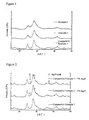
- Figure 1 shows the X-ray diffraction patterns of the excess Ag-Ni oxides of the below-described inventive Examples 3 and 4, compared to that of the AgNiO 2 of Comparative Example 3.
- Figure 2 shows the X-ray diffraction patterns of powders comprising AgNiO 2 mixed with 2% by weight, and 3% by weight, of Ag 2 O, compared to that of the AgNiO 2 of Comparative Example 3.
- the Ag 2 O peaks are clearly defined. From these results, it can be stated that there is almost no free Ag 2 O in the excess Ag-Ni oxides of Examples 3 and 4 of Figure 1, or even that there is no free Ag 2 O at all.
- the graph of Figure 3 shows the correlation (the symbol ⁇ ) between silver content and discharge capacity in the case of the excess Ag-Ni oxides of the invention.
- the symbol ⁇ in Figure 3 denotes values of Ag 2 O alone. It was expected that the discharge capacity would increase in a straight line as, starting with the AgNiO 2 of Comparative Example 3, the silver content was gradually increased until the silver content of Ag 2 O was finally reached. However, this was not the case. Instead, as shown by the solid line in Figure 3, the increase was steeper.
- the excess Ag-Ni oxide according to the invention has good conductivity (reduced resistivity). With respect also to moldability, under identical conditions, the excess Ag-Ni oxide of the invention exhibited higher molding density than AgNiO 2 .
- the excess Ag-Ni oxide of the invention can be used on its own as a positive electrode material. Moreover, by substituting the excess Ag-Ni oxide for part of the silver oxide used as the positive electrode material in a silver oxide battery, it is possible to obtain a high-performance positive electrode material having good conductivity and moldability, even without blending graphite or the like with the material. Improvements in the conductivity, moldability and pellet strength of silver oxide can be achieved by blending in amounts of the excess Ag-Ni oxide starting from a few weight percent. Therefore, the amount of such addition is set at 2 wt% or more, preferably 3 wt% or more, and more preferably 5 wt% or more.
- Part of the Ni in the excess Ag-Ni oxide can be replaced by element M (Cu and/or Bi).
- element M Cu and/or Bi
- a compound represented by a general formula Ag x Ni y M z O 2 (wherein M is at least one of Cu and Bi, X/(Y + Z) is greater than 1 and does not exceed 1.9, and Z does not exceed 0.4) exhibits the same conductivity, moldability and discharge characteristics as the above excess Ag-Ni oxide.
- Such a compound in which part of the Ni is replaced by the element M (Cu and/or Bi) is called an excess Ag-Ni-M oxide.
- An excess Ag-Ni-M oxide has the advantage that, compared to an excess Ag-Ni oxide, it can be produced at a lower cost achieved by substituting cheap Cu or Bi for expensive Ni. Moreover, by blending 3 wt% or more excess Ag-Ni-M oxide with the silver oxide used as the positive electrode material in a silver oxide battery, it is possible to obtain a high-performance positive electrode material having good conductivity and moldability, without having to blend graphite or the like with the material.
- the positive electrode material of the invention can be produced by a method comprising reacting an inorganic acid salt of Ag and an inorganic acid salt of Ni, or an inorganic acid salt of Ni and an inorganic acid salt of M, in an oxidizing alkaline aqueous solution. This is done using the following procedure.
- NaOH or KOH can be employed as the alkali hydroxide used in the neutralization reaction.
- nitrate, sulfate, hydrochloride, and phosphate and the like of each metal can be used as the inorganic acid salts of Ag, Ni and M, it is preferable to use the nitrate or sulfate of the metals.
- the nitrate of each metal may be used.
- AgNO 3 for example, Ni(NO 3 ) 2 having a desired number of moles can be used, or the required amount of Cu(NO 3 ) 2 or Bi(NO 3 ) 3 .
- a higher alkalinity is better for the neutralization treatment.
- Ag + Ni + (M) for example, the reaction proceeds more readily in the presence of around five times the alkalinity, in terms of molar ratio.
- Neutralization and oxidation treatments can both be conducted at a reaction temperature of from room temperature to 100°C, and preferably are conducted at 30 to 50°C. It is necessary to stir at an intensity at which the neutralization and oxidation reactions proceed uniformly. Even after the treatments end, the stirring should be maintained at the required temperature for ripening.
- the Ag/Ni ratio in the end compound, and by extension the atomic ratio of the Ag/Ni in the particles, can be adjusted to a value within the range 1 to 1.9 by adjusting the molar ratio of the silver nitrate and nickel furnished for the reaction.
- the atomic ratio of the Ag/(Ni + M) in the end compound, and by extension the atomic ratio of the Ag/(Ni + M) in the particles can be adjusted to a value within the range 1 to 1.9 by adjusting molar ratio of the Ag/(Ni + M) in the salt concerned.
- the oxidation treatment comprises using an oxidizing agent to increase metal ion valences.
- the oxidizing agent can be added at the start of the neutralization reaction or during the neutralization, or added to the precipitate suspension. Thus, the neutralization and oxidation treatments can be done separately or at the same time. It is preferable for the addition of the oxidizing agent to be divided into a plurality of stages before, during and after the neutralization reaction.
- the oxidation treatment should be done with stirring, and at not more than 100°C, since too high a temperature will promote decomposition of the oxidizing agent.
- Substances that can be used as the oxidizing agent include, for example, KMnO 4 , NaOCl, H 2 O 2 , K 2 S 2 O 8 , Na 2 S 2 O 8 , and ozone, but K 2 S 2 O 8 , Na 2 S 2 O 8 or ozone are preferable, since impurities in the excess Ag-Ni oxide powder can be reduced by the use of an oxidizing agent thus constituted. It is necessary to use an amount of oxidizing agent that is enough to change the valences. This can be achieved by adding an amount of oxidizing agent that is at least equivalent to the valences concerned, and preferably is around twice the amount.
- Particle diameter was measured using a Helos laser diffraction analyzer manufactured by Sympatec GmbH, which employs a dry system in which the particles are dispersed by a high-pressure gas and laser diffraction used to analyze the particle diameter. In contrast to wet methods which have a major effect on samples and solvent affinity, this dry method enables particle diameter to be measured without any such effects, resulting in the case of this material in measured values having good reproducibility.
- the dispersion pressure can be set as desired; in this example, a dispersion pressure of 4.00 bar was used.
- X-ray diffraction An X-ray diffractometer manufactured by Rigaku Corporation was used. A CuK ⁇ X-ray source was used, and measurements were carried out at an X-ray voltage of 50 kV and current of 100 mA.
- Discharge capacity of the sample powder was measured using a three-electrode cell. The measurement was conducted using a joined sample prepared by the following. About 100mg of mixture of 95% sample powder and 5% PTFE was formed into a cylinder having a floor area of 1.77 cm 2 , then the formed cylinder was bonded by pressure onto a stainless-steel mesh collector to form a joined sample. Metal zinc plates were used for the reference and negative electrodes; 50 mL of a 40% solution of KOH was used as the electrolyte. The discharge capacity was measured at the point at which the voltage reached 1.2 volts.
- Resistivity Samples of each of the powders were subjected to a pressure of 3 t/cm 2 ( t means metric ton) to form cylindrical pellets having a sectional area of 1 cm 2 , and copper electrode plates having an area larger than that of the pellet sectional area were affixed to the top and bottom of each pellet.
- the pellet thus sandwiched between the electrode plates was placed flat on a stainless-steel stand, and a stainless-steel weight with a load of 130 kgf was placed thereon.
- a lead line from each electrode was connected to an impedance measuring instrument and the electric resistance (pellet resistance) between the electrodes was measured.
- the resistance value of the instrument with no pellet in place was obtained beforehand and used to correct the measured values of the pellets.
- Molding density A metal die through which a vertical hole was formed having a sectional area of 1 cm 2 was prepared, and a pedestal having the same diameter as that of the hole was inserted into the hole, and 1 g of the sample powder was inserted on the pedestal. Then, a punch having the same diameter as that of the hole was inserted and placed under a load of 3 t to compress the powder for 3 minutes. The molding density was obtained from the thickness and weight of the molding thus formed.
- Pellet strength After a pressure of 3 t/cm 2 was used to form a sample powder into a cylindrical pellet having a sectional area of 1 cm 2 , a load was imposed on the top of each pellet and increased, and the load under which the pellet was destroyed was used as an index of the pellet strength. Evaluations are greatly affected by measurement conditions and methods, so evaluations were made as values relative to a pellet strength (destruction load) of 100 when silver oxide pellets were used.
- the Ag content, discharge capacity, molding density and resistivity of powder type silver oxide (Ag 2 O manufactured by Dowa Mining Co., Ltd. having an average particle diameter of 15 ⁇ m) used for commercial positive electrodes were measured. The results are shown in Table 1. This silver oxide had a purity of at least 99.9%, as calculated from the Ag content. The discharge capacity was 220 mAh/g, close to the theoretical capacity of silver oxide.
- Figure 2 shows X-ray diffraction charts of powders consisting of the AgNiO 2 powder of Comparative Example 3 mixed with 1% by weight, and 3% by weight, of Ag 2 O.
- the o symbol in Figure 2 denotes a Ag 2 O peak. Even though the amount of Ag 2 O in the mixture is very small, an Ag 2 O peak did appear. Based on the X-ray diffraction chart thereof, this clearly shows that the excess Ag-Ni oxide of Example 1 contains almost no free Ag 2 O, or contains none at all.
- Example 1 The same procedure as that of Example 1 was repeated, except that an aqueous solution of silver nitrate equivalent to 1.10 mols of silver and an aqueous solution of nickel nitrate equivalent to 0.90 mol of nickel were used.
- X-ray diffraction was used to identify the black powder thus obtained, a peak similar to that of AgNiO 2 was observed. No silver oxide peak was observed.
- Table 1 The results of the evaluation test of the powder are shown in Table 1.
- Example 1 The same procedure as that of Example 1 was repeated, except that an aqueous solution of silver nitrate equivalent to 1.20 mols of silver and an aqueous solution of nickel nitrate equivalent to 0.80 mol of nickel were used.
- a peak similar to that of AgNiO 2 was observed. No silver oxide peak was observed.
- the X-ray diffraction chart of the powder is shown in Figure 1.
- the results of the evaluation test of the powder are shown in Table 1.
- Example 1 The same procedure as that of Example 1 was repeated, except that an aqueous solution of silver nitrate equivalent to 1.30 mols of silver and an aqueous solution of nickel nitrate equivalent to 0.70 mol of nickel were used.
- X-ray diffraction was used to identify the black powder thus obtained, a peak similar to that of AgNiO 2 was observed. No silver oxide peak was observed.
- Table 1 The results of the evaluation test of the powder are shown in Table 1.
- Example 1 The same procedure as that of Example 1 was repeated, except that an aqueous solution of silver nitrate equivalent to 1.40 mols of silver and an aqueous solution of nickel nitrate equivalent to 0.60 mol of nickel were used.
- X-ray diffraction was used to identify the black powder thus obtained, a peak similar to that of AgNiO 2 was observed, and an Ag 2 O (111) plane peak was also observed.
- the results of the evaluation test of the powder are shown in Table 1.
- Example 3 (Ag 1.2 Ni 0.8 O 2 ) and the granular silver oxide used in Comparative Example 2 were mixed together in various proportions, and the pellet strength, resistivity and discharge capacity of the mixtures measured. The results are shown in Table 2. TABLE 2 Amount mixed to silver oxide Pellet strength Resistivity Discharge capacity (Relative value) ( ⁇ ⁇ m) (mAh/g) 0% Only silver oxide 100 >100000 220 5% 116 10000 221 10% 145 500 219 20% 194 180 219 30% 213 60 216 100% Simple Ag-Ni oxide 1339 1 217
Landscapes
- Chemical & Material Sciences (AREA)
- Chemical Kinetics & Catalysis (AREA)
- Electrochemistry (AREA)
- General Chemical & Material Sciences (AREA)
- Inorganic Chemistry (AREA)
- Engineering & Computer Science (AREA)
- Manufacturing & Machinery (AREA)
- Battery Electrode And Active Subsutance (AREA)
- Inorganic Compounds Of Heavy Metals (AREA)
Applications Claiming Priority (1)
| Application Number | Priority Date | Filing Date | Title |
|---|---|---|---|
| JP2004375474A JP4904456B2 (ja) | 2004-12-27 | 2004-12-27 | 電池正極用材料 |
Publications (2)
| Publication Number | Publication Date |
|---|---|
| EP1675199A1 true EP1675199A1 (de) | 2006-06-28 |
| EP1675199B1 EP1675199B1 (de) | 2012-12-05 |
Family
ID=36013352
Family Applications (1)
| Application Number | Title | Priority Date | Filing Date |
|---|---|---|---|
| EP05027953A Expired - Lifetime EP1675199B1 (de) | 2004-12-27 | 2005-12-20 | Positives Elektrodenmaterial für eine Batterie |
Country Status (5)
| Country | Link |
|---|---|
| US (1) | US7585588B2 (de) |
| EP (1) | EP1675199B1 (de) |
| JP (1) | JP4904456B2 (de) |
| CN (1) | CN1797821B (de) |
| AU (1) | AU2005247037B2 (de) |
Families Citing this family (10)
| Publication number | Priority date | Publication date | Assignee | Title |
|---|---|---|---|---|
| JP4904457B2 (ja) | 2005-03-31 | 2012-03-28 | Dowaエレクトロニクス株式会社 | アルカリ電池正極用材料及びその製造法並びにアルカリ電池正極材 |
| JP5116139B2 (ja) * | 2007-02-13 | 2013-01-09 | 日立マクセルエナジー株式会社 | 扁平形酸化銀電池 |
| JP5116140B2 (ja) * | 2007-03-19 | 2013-01-09 | 日立マクセルエナジー株式会社 | 扁平形酸化銀電池 |
| US7648799B2 (en) * | 2007-03-30 | 2010-01-19 | Eveready Battery Co., Inc. | Multi-layer positive electrode structures having a silver-containing layer for miniature cells |
| JP5053943B2 (ja) * | 2008-07-07 | 2012-10-24 | Dowaエレクトロニクス株式会社 | アルカリ電池用正極活物質およびその製造方法 |
| JP4985568B2 (ja) * | 2008-07-07 | 2012-07-25 | ソニー株式会社 | アルカリ電池 |
| JP6715351B2 (ja) * | 2016-12-27 | 2020-07-01 | 国立大学法人秋田大学 | 排気ガス浄化触媒用デラフォサイト型酸化物及びこれを用いた排気ガス浄化触媒 |
| JP6944994B2 (ja) * | 2017-03-22 | 2021-10-06 | マクセルホールディングス株式会社 | アルカリ二次電池 |
| CN108439492B (zh) * | 2018-04-16 | 2021-03-02 | 宁波晶鑫电子材料有限公司 | 一种银掺杂纳米氧化镍粉体的制备方法 |
| JP7507571B2 (ja) * | 2020-02-28 | 2024-06-28 | Dowaエレクトロニクス株式会社 | 銀ニッケル酸化物の製造方法および銀ニッケル酸化物 |
Citations (6)
| Publication number | Priority date | Publication date | Assignee | Title |
|---|---|---|---|---|
| JPS57849A (en) | 1980-06-04 | 1982-01-05 | Sony Ebaredei Kk | Alkaline battery |
| JPS60105170A (ja) * | 1983-11-10 | 1985-06-10 | Sony Ebaredei Kk | 電導性酸化銀及び酸化銀電池 |
| JPH08162100A (ja) * | 1994-11-30 | 1996-06-21 | Sony Corp | 偏平形アルカリ電池 |
| JPH10188975A (ja) | 1996-10-31 | 1998-07-21 | Dowa Mining Co Ltd | 酸化銀電池用陽極材料とその製造方法 |
| US20020127469A1 (en) | 2000-09-08 | 2002-09-12 | Katsumi Mori | Alkaline battery |
| US20030082450A1 (en) * | 2000-09-11 | 2003-05-01 | Koji Tanoue | Positive electrode active material for alkaline cell |
Family Cites Families (5)
| Publication number | Priority date | Publication date | Assignee | Title |
|---|---|---|---|---|
| JPH08264193A (ja) * | 1995-03-27 | 1996-10-11 | Matsushita Electric Ind Co Ltd | アルカリマンガン電池 |
| JP4158326B2 (ja) * | 2000-09-08 | 2008-10-01 | ソニー株式会社 | アルカリ電池 |
| JP2002117859A (ja) * | 2000-10-10 | 2002-04-19 | Sony Corp | アルカリ電池 |
| JP4431736B2 (ja) * | 2002-02-15 | 2010-03-17 | Dowaエレクトロニクス株式会社 | 電池用正極活物質 |
| JP4328890B2 (ja) * | 2002-03-12 | 2009-09-09 | Dowaエレクトロニクス株式会社 | アルカリ電池の正極用ペレット |
-
2004
- 2004-12-27 JP JP2004375474A patent/JP4904456B2/ja not_active Expired - Lifetime
-
2005
- 2005-12-13 CN CN200510129642.2A patent/CN1797821B/zh not_active Expired - Lifetime
- 2005-12-20 EP EP05027953A patent/EP1675199B1/de not_active Expired - Lifetime
- 2005-12-22 AU AU2005247037A patent/AU2005247037B2/en not_active Ceased
- 2005-12-23 US US11/315,207 patent/US7585588B2/en active Active
Patent Citations (7)
| Publication number | Priority date | Publication date | Assignee | Title |
|---|---|---|---|---|
| JPS57849A (en) | 1980-06-04 | 1982-01-05 | Sony Ebaredei Kk | Alkaline battery |
| US4370395A (en) * | 1980-06-04 | 1983-01-25 | Union Carbide Corporation | Alkaline cell |
| JPS60105170A (ja) * | 1983-11-10 | 1985-06-10 | Sony Ebaredei Kk | 電導性酸化銀及び酸化銀電池 |
| JPH08162100A (ja) * | 1994-11-30 | 1996-06-21 | Sony Corp | 偏平形アルカリ電池 |
| JPH10188975A (ja) | 1996-10-31 | 1998-07-21 | Dowa Mining Co Ltd | 酸化銀電池用陽極材料とその製造方法 |
| US20020127469A1 (en) | 2000-09-08 | 2002-09-12 | Katsumi Mori | Alkaline battery |
| US20030082450A1 (en) * | 2000-09-11 | 2003-05-01 | Koji Tanoue | Positive electrode active material for alkaline cell |
Non-Patent Citations (2)
| Title |
|---|
| PATENT ABSTRACTS OF JAPAN vol. 009, no. 255 (E - 349) 12 October 1985 (1985-10-12) * |
| PATENT ABSTRACTS OF JAPAN vol. 1996, no. 10 31 October 1996 (1996-10-31) * |
Also Published As
| Publication number | Publication date |
|---|---|
| US7585588B2 (en) | 2009-09-08 |
| EP1675199B1 (de) | 2012-12-05 |
| JP4904456B2 (ja) | 2012-03-28 |
| AU2005247037A1 (en) | 2006-07-13 |
| JP2006185649A (ja) | 2006-07-13 |
| CN1797821A (zh) | 2006-07-05 |
| CN1797821B (zh) | 2011-09-07 |
| US20060141360A1 (en) | 2006-06-29 |
| AU2005247037B2 (en) | 2011-01-27 |
Similar Documents
| Publication | Publication Date | Title |
|---|---|---|
| US6524750B1 (en) | Doped titanium oxide additives | |
| JP3489685B2 (ja) | マンガン酸リチウム及びその製造方法ならびにそれを用いてなるリチウム電池 | |
| CN100385717C (zh) | 含有λ-二氧化锰的碱性电池 | |
| AU772305B2 (en) | Positive electrode active material for alkaline cell | |
| EP1675199B1 (de) | Positives Elektrodenmaterial für eine Batterie | |
| EP1707537B1 (de) | Positives Elektrodenmaterial für eine Batterie | |
| JP2003502825A (ja) | 電気化学電池用の性能強化添加剤 | |
| JP2638624B2 (ja) | マンガン電池用正極合剤の製造方法 | |
| JP5053943B2 (ja) | アルカリ電池用正極活物質およびその製造方法 | |
| JP4328889B2 (ja) | 電池用正極活物質 | |
| JP5028668B2 (ja) | アルカリ電池用正極活物質およびアルカリ電池 | |
| JP5028667B2 (ja) | アルカリ電池用正極活物質およびアルカリ電池 | |
| KR100904349B1 (ko) | 알칼리 전지 | |
| JP4328890B2 (ja) | アルカリ電池の正極用ペレット | |
| JPH0576745B2 (de) | ||
| HK1092283A (en) | Battery positive electrode material | |
| JPH02145429A (ja) | 乾電池用マンガン酸化物及びその製造方法 | |
| JPS6211461B2 (de) | ||
| JPH02145428A (ja) | 乾電池用マンガン酸化物の製造方法 | |
| JP2008251402A (ja) | 電池用正極活物質、該電池用正極活物質を用いた電池、及び該電池用正極活物質の製造方法 | |
| HK1092591A (en) | Battery positive electrode material |
Legal Events
| Date | Code | Title | Description |
|---|---|---|---|
| PUAI | Public reference made under article 153(3) epc to a published international application that has entered the european phase |
Free format text: ORIGINAL CODE: 0009012 |
|
| AK | Designated contracting states |
Kind code of ref document: A1 Designated state(s): AT BE BG CH CY CZ DE DK EE ES FI FR GB GR HU IE IS IT LI LT LU LV MC NL PL PT RO SE SI SK TR |
|
| AX | Request for extension of the european patent |
Extension state: AL BA HR MK YU |
|
| 17P | Request for examination filed |
Effective date: 20061220 |
|
| 17Q | First examination report despatched |
Effective date: 20070208 |
|
| AKX | Designation fees paid |
Designated state(s): CH DE GB LI |
|
| RAP1 | Party data changed (applicant data changed or rights of an application transferred) |
Owner name: DOWA HOLDINGS CO., LTD. |
|
| RAP1 | Party data changed (applicant data changed or rights of an application transferred) |
Owner name: DOWA ELECTRONICS MATERIALS CO., LTD. |
|
| REG | Reference to a national code |
Ref country code: DE Ref legal event code: R079 Ref document number: 602005037257 Country of ref document: DE Free format text: PREVIOUS MAIN CLASS: H01M0004320000 Ipc: H01M0004480000 |
|
| RIC1 | Information provided on ipc code assigned before grant |
Ipc: H01M 6/04 20060101ALI20120228BHEP Ipc: H01M 4/34 20060101ALI20120228BHEP Ipc: H01M 4/48 20100101AFI20120228BHEP Ipc: H01M 4/54 20060101ALI20120228BHEP Ipc: H01M 4/52 20100101ALI20120228BHEP Ipc: H01M 4/06 20060101ALI20120228BHEP Ipc: H01M 4/32 20060101ALI20120228BHEP |
|
| GRAP | Despatch of communication of intention to grant a patent |
Free format text: ORIGINAL CODE: EPIDOSNIGR1 |
|
| GRAS | Grant fee paid |
Free format text: ORIGINAL CODE: EPIDOSNIGR3 |
|
| GRAA | (expected) grant |
Free format text: ORIGINAL CODE: 0009210 |
|
| AK | Designated contracting states |
Kind code of ref document: B1 Designated state(s): CH DE GB LI |
|
| REG | Reference to a national code |
Ref country code: GB Ref legal event code: FG4D |
|
| REG | Reference to a national code |
Ref country code: CH Ref legal event code: NV Representative=s name: RIEDERER HASLER AND PARTNER PATENTANWAELTE AG, LI Ref country code: CH Ref legal event code: EP |
|
| REG | Reference to a national code |
Ref country code: DE Ref legal event code: R096 Ref document number: 602005037257 Country of ref document: DE Effective date: 20130131 |
|
| PLBE | No opposition filed within time limit |
Free format text: ORIGINAL CODE: 0009261 |
|
| STAA | Information on the status of an ep patent application or granted ep patent |
Free format text: STATUS: NO OPPOSITION FILED WITHIN TIME LIMIT |
|
| 26N | No opposition filed |
Effective date: 20130906 |
|
| REG | Reference to a national code |
Ref country code: DE Ref legal event code: R097 Ref document number: 602005037257 Country of ref document: DE Effective date: 20130906 |
|
| PGFP | Annual fee paid to national office [announced via postgrant information from national office to epo] |
Ref country code: DE Payment date: 20241029 Year of fee payment: 20 |
|
| PGFP | Annual fee paid to national office [announced via postgrant information from national office to epo] |
Ref country code: GB Payment date: 20241104 Year of fee payment: 20 |
|
| PGFP | Annual fee paid to national office [announced via postgrant information from national office to epo] |
Ref country code: CH Payment date: 20250101 Year of fee payment: 20 |
|
| REG | Reference to a national code |
Ref country code: CH Ref legal event code: H14 Free format text: ST27 STATUS EVENT CODE: U-0-0-H10-H14 (AS PROVIDED BY THE NATIONAL OFFICE) Effective date: 20251220 Ref country code: DE Ref legal event code: R071 Ref document number: 602005037257 Country of ref document: DE |
|
| REG | Reference to a national code |
Ref country code: GB Ref legal event code: PE20 Expiry date: 20251219 |