EP1677435A2 - MIMO-Kommunikationssystem und Verfahren zur adaptiven Zuweisung mehrerer Benutzer - Google Patents
MIMO-Kommunikationssystem und Verfahren zur adaptiven Zuweisung mehrerer Benutzer Download PDFInfo
- Publication number
- EP1677435A2 EP1677435A2 EP05026975A EP05026975A EP1677435A2 EP 1677435 A2 EP1677435 A2 EP 1677435A2 EP 05026975 A EP05026975 A EP 05026975A EP 05026975 A EP05026975 A EP 05026975A EP 1677435 A2 EP1677435 A2 EP 1677435A2
- Authority
- EP
- European Patent Office
- Prior art keywords
- user
- transmitting
- scheduling
- antennas
- antenna
- Prior art date
- Legal status (The legal status is an assumption and is not a legal conclusion. Google has not performed a legal analysis and makes no representation as to the accuracy of the status listed.)
- Withdrawn
Links
Images




Classifications
-
- H—ELECTRICITY
- H04—ELECTRIC COMMUNICATION TECHNIQUE
- H04B—TRANSMISSION
- H04B7/00—Radio transmission systems, i.e. using radiation field
- H04B7/02—Diversity systems; Multi-antenna system, i.e. transmission or reception using multiple antennas
- H04B7/04—Diversity systems; Multi-antenna system, i.e. transmission or reception using multiple antennas using two or more spaced independent antennas
- H04B7/0413—MIMO systems
- H04B7/0417—Feedback systems
-
- H—ELECTRICITY
- H04—ELECTRIC COMMUNICATION TECHNIQUE
- H04B—TRANSMISSION
- H04B7/00—Radio transmission systems, i.e. using radiation field
- H04B7/02—Diversity systems; Multi-antenna system, i.e. transmission or reception using multiple antennas
- H04B7/04—Diversity systems; Multi-antenna system, i.e. transmission or reception using multiple antennas using two or more spaced independent antennas
- H04B7/0413—MIMO systems
- H04B7/0452—Multi-user MIMO systems
-
- H—ELECTRICITY
- H04—ELECTRIC COMMUNICATION TECHNIQUE
- H04B—TRANSMISSION
- H04B7/00—Radio transmission systems, i.e. using radiation field
- H04B7/02—Diversity systems; Multi-antenna system, i.e. transmission or reception using multiple antennas
- H04B7/04—Diversity systems; Multi-antenna system, i.e. transmission or reception using multiple antennas using two or more spaced independent antennas
- H04B7/06—Diversity systems; Multi-antenna system, i.e. transmission or reception using multiple antennas using two or more spaced independent antennas at the transmitting station
- H04B7/0613—Diversity systems; Multi-antenna system, i.e. transmission or reception using multiple antennas using two or more spaced independent antennas at the transmitting station using simultaneous transmission
- H04B7/0615—Diversity systems; Multi-antenna system, i.e. transmission or reception using multiple antennas using two or more spaced independent antennas at the transmitting station using simultaneous transmission of weighted versions of same signal
- H04B7/0619—Diversity systems; Multi-antenna system, i.e. transmission or reception using multiple antennas using two or more spaced independent antennas at the transmitting station using simultaneous transmission of weighted versions of same signal using feedback from receiving side
- H04B7/0621—Feedback content
- H04B7/0634—Antenna weights or vector/matrix coefficients
-
- H—ELECTRICITY
- H04—ELECTRIC COMMUNICATION TECHNIQUE
- H04B—TRANSMISSION
- H04B7/00—Radio transmission systems, i.e. using radiation field
- H04B7/02—Diversity systems; Multi-antenna system, i.e. transmission or reception using multiple antennas
- H04B7/04—Diversity systems; Multi-antenna system, i.e. transmission or reception using multiple antennas using two or more spaced independent antennas
- H04B7/06—Diversity systems; Multi-antenna system, i.e. transmission or reception using multiple antennas using two or more spaced independent antennas at the transmitting station
- H04B7/0686—Hybrid systems, i.e. switching and simultaneous transmission
- H04B7/0691—Hybrid systems, i.e. switching and simultaneous transmission using subgroups of transmit antennas
Definitions
- the present invention relates to a multiple input-multiple output (MIMO) system and a method of user scheduling, especially to an adaptive MIMO system and an adaptive user scheduling method.
- MIMO multiple input-multiple output
- the future wireless communication system is required to support the extremely high speed data traffics, such as the videoconference, the video-on-demand and the interactive video game, etc..
- the ITU-R M1645 As required in the ITU-R M1645, it should support up to 100Mbps for high mobility traffics and up to 1Gbps for low mobility or fixed wireless traffics.
- the data rate of one wireless channel equals to the product of its spectrum width and the spectrum efficiency of the adopted technology. In order to improve the data rate, the spectrum width of the channel and the spectrum efficiency of the adopted technology should be improved. However, since the frequency resource is limited, the communication speed cannot be raised by infinitely increasing the spectrum width. Improving the spectrum efficiency of the adopted technology is one optimal solution for resolving the problem. Recent reseach has discovered that the MIMO technology can be used to improve the spectrum efficiency.
- the so-called MIMO technology means that mutilple antennas are mounted at both the transmitting terminal and the receiving terminal in a communication system.
- the MIMO technology also includes that multiple antennas are mounted at either side, i.e., the single input-multiple output (SIMO) and the multiple input-single output (MISO). Different antennas are physically separated, and are generally regarded as introducing an additional signal domain-a space domain, into the communication system.
- SIMO single input-multiple output
- MISO multiple input-single output
- the first method is called the space-time coding (STC). It converts one original data stream into n T code streams by an encoder group and transmits them from different antennas (e.g., n T antennas) respectively. Wherein, each code stream is a different version of the original data stream and has the correlation with itself in time domain, and the correlation also exists between code streams. Thus, a better BER performance will be obtained by using these correlations at the receiving terminal having n R antennas, or, the spectrum efficiency will be improved by increasing the number of bits on each signal symbol when the BER performance is kept constantly.
- the gain that is obtained in the space domain by the space-time coding is called the diversity gain and the diversity gain provided by the MIMO system is n T ⁇ n R .
- the second signal processing method is called the layered space-time signal processing (LAST). It divides an original data stream into n T independent code streams and transmits each code steam from a different antenna, respectively. Each code stream is a part of the original data stream and there are no any correlation exists between these code steams.
- LAST layered space-time signal processing
- each code stream transmitted from different antennas is decomposed by multimensional signal processing methods, such as, the maximum likelihood (ML), the minimum mean square error (MMSE), or the zero-forcing (ZF).
- ML maximum likelihood
- MMSE minimum mean square error
- ZF zero-forcing
- n T indenpent channels are established between the receiving terminals and the transmitting terminals and the frequency efficiency is inceased by about n T times.
- a gain that is obtained at the space domain by the layered space-time signal processing is called the multiplexing gain.
- a MIMO system can provide a maximum multiplexing gain which equals to the minimum one of the numerals, n
- the modem communication systems are constructed almost based on a cellular structure, and the basic communication model thereof is that one base station in the cellular serves a plurality of users simultaneously, which leads to a problem of the multiple access.
- Traditional accessing methods include FDMA, TDMA and CDMA, which are all based on the circuit switch principle, i.e., each user is assigned with a fixed frequency width (for FDMA), a fixed time slot (for TDMA) or a fixed spread code (for CDMA).
- the base station assigns eight time slots of a frame to eight users in the manner of the fixed time slot assignment on a 200K channel.
- the method can ensure the time delay characteristic of communication traffics and fits the traffics sensitive to the time delay, such as the voice communication.
- the disadvantage of the method is that the resources assignment is set regardless of the conditions of the wireless channels. However, conditions of wireless channels change greatly, the system will lose its performance if users are assigned with the channels which are just in a deep fading.
- the future communication system will mostly focus on data traffics and be not strict with the time delay. Then, the packet switch is acceptable for the multiple access.
- the base station When conducting the packet switch, the base station is required to assign channels to different users in real time, which is called the user scheduling.
- Two basic user-scheduling methods are being used currently in the wireless communication system. One is the Round Robin scheduling, wherein, channels are assigned to all users in a manner of the round robin. Same as the circuit switch, the method can ensure the time delay characteristic and the justice for users but cannot improve the performance of the system.
- the other is the Maximum C/I scheduling. It can assign channels to users having the maximum C/I according to current channel-fading conditions, thereby, the system performance gets improved greatly. The gain that is obtained by the Maximum C/I scheduling is called the multiuser diversity.
- the spatial division multiple access can be performed by using methods of transmitting signal proccessings, such as the dirty paper coding (DPC) and the transmit beamforming (TBF), at base stations.
- DPC dirty paper coding
- TBF transmit beamforming
- Another method for performing the spatial division multiple accesses is by using the receiving signal processing.
- the useful information is processed by using the method of the space coding or layered space-time signal processing at transmitting terminals and demodulated by interference elimination or signal detection at user terminals. Since the space-time coding and layered signal processing do not require the fading coefficiency of the downward channels and are therefore suitable for performing the spatial division multiple access of the downward channels.
- the performance of multiuser scheduling systems is poorer than that of the single antenna system. Therefore, in the multiuser scheduling system, it is apt to adopt the layered space-time signal processing based multiple input-multiple output system for each user permited to access, i.e., the transmitting terminals find out a users group according to the limited channel feedback information and assign antennas to all users of the user group so as to transmit an independent code stream of each user from each antenna assigned to the user.
- the number of receiving antennas n R is larger than that of transmitting antennas n T at the transmitting terminals, each user can establish an independent interference-free channel for each transmitting antenna.
- U. S. Pat. No. 6, 662, 024 discloses a user scheduling arithmetic of the multiuser multiple input-multiple output sytem at the precondition of n R ⁇ n T . But when the number of receiving antennas is smaller than that of transmitting antennas, an independent interference-free channel cannot be established for each transmitting antenna according to the method disclosed in the patent and the method disclosed in US 6, 662, 024 thus cannot be used.
- One object of the present invention is to provide an adaptive MIMO communication system, which can provide the maximum channel capacity for the system by using an adaptive user scheduling.
- Another object of the present invention is to provide an adaptive user scheduling method for the MIMO communication system, which can provide the optimal user scheduling according to the current channel conditions.
- An MIMO communication system capable of adaptive user scheduling comprises: a transmitting terminal, configured to transmit data frames containing at least channel estimation signal and user data; and at least one receiveing terminal, configured to receive the data frames transmitted by the transmitting terminal, and produce corresponding feedback information as well as recover the user data.
- the the feedback information comprises an optimal transmitting antenna set dedicated to the receiving terminal, the achievable channel capacity by each antenna within the antenna set, and the degradation factors caused by each of other unselected antennas to each of the selected antennas.
- the transmitting terminal produces scheduling information based on the feedback information. After that, the scheduling information will be used to adaptively schedule the users.
- the scheduling information comprises the scheduled users, number of data streams supported by each scheduled user, and the corresponding transmitting antenna for each of the data streams.
- An adaptive user scheduling method for a MIMOcommunication system of the present invention comprises following steps:
- the channel fading conditions can be obtained via channel estimation signal received by the receiving terminal.
- the channel fading conditions can also be obtained via data frames received by the receiving antennas while the receiving terminal receives the data frames.
- step b) further comprises steps of:
- the MIMO coommuncation system and the scheduling method of the present invention have advantages shown below:
- each receiving terminal Since information fed back from each receiving terminal is: an optimal transmitting antenna set dedicated to the receiving terminal, the achievable channel capacity by each antenna within the antenna set, and the degradation factors caused by each of other unselected antennas to each of the selected antennas.
- the complexity of arithmetic for selecting transmitting antennas can be simplified without the awareness of the number of the scheduled users, and the absolute channel capacities is not affected by the number of the final scheduled users;
- the number of the scheduled users at the transmitting terminal dependends on the current conditions of the channels without a predetermination.
- the MIMO communication system can perform an adaptive user scheduling so that the intelligentization of the system control and the stability of the communication are achieved and the system capacity is always kept maximumly.
- Fig. 1 illustrates a MIMO communication system of the present invention, comprising: a transmitting terminal 10 (a base station) and a plurality of receiving terminals 20 (users).
- Fig. 2 is a flow chart showing an adaptive user scheduling for the communication system illustrated in Fig. 1.
- Fig. 3 is a sketch drawing illustrating a frame structure adopted in MIMO communication system of the present invention.
- the transmitting terminal 10 has a MIMO signal processor 110, a MIMO scheduler 120, a duplexer group 130 and n T transmitting antennas.
- Each receiving terminal 20 has a receiving signal processor 210, a feedback information processor 220, a duplexer group 230 and n R receiving antennas.
- the number of receiving antennas at each receiving terminal 20 can be different.
- the frame structure maybe simply explained as including a time slot for channel estimation, a time slot for channel information feedback and a time slot for data transmssion. Other time slots can be set as desired by the system.
- the transmitting terminal 10 transmits the channel estimation signal to the receiving terminal 20 from n T transmitting antennas through the duplexer group 130 before it transmits data signal.
- the channel estimation signal transmitted by the transmitting terminal 10 is an n T dimensions complex numbers vector x ⁇ C n T and the signal received by each receiving terminal 20 is an n R dimensions complex numbers vector y k ⁇ C n R , and an n R ⁇ n T dimensions channel-fading matrix exists between the transmitting terminal 10 and the receiving terminal 20, as expressed in equation [1]:
- h i , j k denotes the characteristic of the channel transmission between the i th transmitting antenna at the transmitting terminal 10 and the j th receiving antenna at the receiving terminal
- k denotes the characteristic of the
- Each receiving terminal 20 knows the actual channel-fading matrix H k and processes it via the receiving signal processor 210 so as to obtain the following information:
- the receiving signal processor 210 delivers the above processed information as the feedback information to the feedback information processor 220.
- the feedback information includes the optimal transmitting antenna set AnI k dedicated to the receiving terminal, the achievable channel capacity by each antenna within the antenna set AnI k , and the degradation factors Df k,i caused by each of other unselected antennas of the n T transmitting antennas to each of the selected antennas of the selected antenna set AnI k .
- the feedback information processor 220 processes the received user information and converts it into feedback signals (RF signals) suitable for the MIMO communication system.
- the feedback signals are transmitted from the antennas at the receiving terminal 20 and fed back to the transmitting terminal 10 through feedback channels.
- the transmitting terminal 10 receives the feedback signals and delivers them to the MIMO scheduler 120.
- the MIMO scheduler 120 produces scheduling information according to the feedback signals and controls operations of the MIMO signal processor 110 using the produced scheduling information to make the MIMO communication system in the scheduling state of the optimal system capacity. That is, the optimal user scheduling is performed using the scheduling information.
- the scheduling information includes at least the scheduled users, number of data streams supported by each scheduled user, and the corresponding transmitting antenna for each of the data streams.
- the MIMO signal processor 110 processes data of the scheduled users and transmits the processed data from the selected transmitting antennas to the corresponding scheduled users.
- the MIMO communication system has advantages as follows:
- the MIMO communication system can perform an adaptive user scheduling, so that the intelligentization of system control and the stability of the communication are improved and the system capacity is always kept maximumly.
- the above method for obtaining the channel fading conditions is performed by using the channel estimation signal (i.e., the pilot signal). Accroding to the method, the channel estimation signal is inserted into the data frame, and the receiving terminal 20 obtains the channel-fading conditions between the transmitting terminal 10 and the receiving terminal 20, and the receiving signal processor 210 processes the channel fading conditions to obtain the user feedback information.
- the channel estimation signal i.e., the pilot signal.
- the channel-fading conditions can also be obtained by using the Blind Channel Estimation, i.e., the time slot for channel estimation is not set in the data frame.
- the receiving terminal 20 obtains the channel-fading conditions via the Blind Channel Estimation after receiving data transmitted from the transmitting terminal 10, and the receiving signal processor 210 processes the channel-fading conditions to obtain the feedback information, thereby avoiding the waste of the frequency resource caused by the insertion of the pilot signal for purpose of channel estimation.
- Fig. 4 illustrates a transmitting terminal 10 in the MIMO communication system of the present invention.
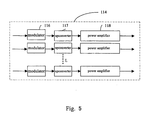
- Fig. 5 illustrates a transmitting RF chain group of the transmitting terminal 10.
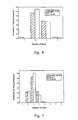
- Figs. 6 and 7 illustrate the probability that users are scheduled in the MIMO communication system of the present invention.
- Fig. 8 illustrates a duplexer group 130 for the transmitting terminal 10 of the present invention.
- Fig. 9 shows a receiving terminal 20 in the MIMO communication system of the present invention.
- Figs. 4 and 9 illustrate that the communication of the MIMO system is conducted in a manner of the layered space-time signal processing.
- Other technologies in signal processing method and apparutus, such as the space-time coding can also be adopted to process signals.
- the transmitting terminal 10 includes a MIMO signal processor 110, a MIMO scheduler 120, a duplexer group 130 and n T transmitting antennas.
- the MIMO scheduler 120 includes a receiving RF chain group 123, a MIMO receiving signal processor 122 and a scheduler 121, wherein, the receiving RF chain group 123 has receiving RF chains corresponding to the number of the transmitting antennas, which convert the received feedback signals into the corresponding code streams.
- the MIMO receiving signal processor 122 performs the layered space-time signal processing for the converted code streams to obtain the corresponding scheduling information.
- the scheduling information includes: the users to be scheduled, the data streams supported by each scheduled user, and the tranmitting antennas for tranmitting data of the scheduled users.
- the scheduler 121 controls the signal processing of the MIMO signal processor 110 by using the scheduling information.
- the MIMO signal processor 110 includes a user selector 111, a plurality of de-multiplexer 112 arranged in parallel, a MIMO transmitting signal processor 113, a transmitting RF chain group 114 and a transmitting antenna selector 115.
- the user selector 111 selects the nS users to be scheduled under the control of the scheduling information and outputs the corresponding user data.
- nS is less than or equal to the number of the transmitting antennas at the transmitting terminal 10.
- nS de-multiplexers 112 are selected to perform the distributing processing on the user data of nS users to be scheduled, i.e., the user data of the nS users to be scheduled are divided into L code streams and outputted, wherein the maximum value of L equals to n T , the number of transmitting antennas.
- L code streams outputted from the de-multiplexers 112 are processed by the MIMO transmitting signal processor 113 as L different layers with the manner of the layered space-time signal processing.
- the transmitting RF chain group 114 converts L code streams processed by the layered space-time signal processing into the corresponding L RF signals.
- the transmitting antenna selector 115 selects L scheduled transmitting antennas to transmit L RF signals outputted from the transmitting RF chain group 114 to L scheduled transmitting antennas through the duplexer group 130.
- L scheduled transmitting antennas tranmit the RF signals to the scheduled users.
- Fig. 5 further illustrates the concrete structure of the transmitting RF chain group 114, which includes L transmitting RF chains arranged in parallel.
- Each transmitting RF chain has a modulator 116, an upconverter 117, and a power amplifer 118 in series, and the power amplifier 118 can be a high power linear amplifier, wherein, L transmitting RF chains convert L code streams from the MIMO transmitting signal processor 113 into the corresponding RF signals, respectively.
- the value of said L is set according to the design of the system, which will be described later.
- the maximum probability is to schedule 2 users, the next is 3, the least is 1 or 4, and other probabilities are nearly zero. Therefore, the value of L can be set as 3 or further as 4 to decrease the scheduling loss of the system.
- the maximum probability is to schedule 3 users, the next is 2 or 4, the least is 5, and other probabilities are nearly zero. Therefore, the value of L can be set as 4 or further as 5 to decrease the scheduling loss of the system.
- the value of L can be modified according to the design of the system, and thus it is no need to set L as always n T , the number of the transmitting antennas. That is, the value of L is determined at the time of designing the system according to the scheduling conditions of the system, so that the number of the transmitting RF chain group is not always set as n T , which can cut down the cost of manufacuring the system.
- Fig. 8 illustrates a duplexer group at the transmitting terminal of the present invention, wherein, the duplexer group 130 has n T duplexers arranged in parallel and each duplexer connects with a corresponding transmitting antenna, the transmitting antenna selector 115 and the receiving RF chain group 123 as well.
- the Receiving Terminal 20 The Receiving Terminal 20
- the receiving terminal 20 has a receiving signal processor 210, a feedback information processor 220, a duplexer group 230 and n R receiving antennas.
- the receiving signal processor 210 includes a receiving RF chain group 211 and a MIMO receiving signal processor 212.
- the feedback information processor 220 includes a MIMO transmitting signal processor 221 and a transmitting RF chain group 222.
- the receiving RF chain group 211 has receiving RF chains arranged in parallel (not shown), and the number of receiving RF chains equals to that of the receiving antennas, n R .
- the receiving RF chains are used for resuming the received RF signals as the corresponding code streams and transmitting them to the MIMO receiving signal processor 212.
- the MIMO receiving signal processor 212 recovers the code streams as the original user data and outputs them.
- Fig. 10 illustrates that the scheduler 121 adaptively selects the users to be scheduled according to the feedback information. The following steps explain the scheduling process:
- the method of the present invention can also be applied to the occasion that the number of the receiving antennas is larger than that of the transmitting antennas.
- the calculation of the channel capacity and the disturbing factor is simplified but is consistent with the system.
- Fig. 11 illustrates the scheduling for the MIMO communication system of the present invention.
- the left part of Fig. 11 shows the simplified structure of the MIMO communication system, and the right part illustrates fading coefficients between the receiving antennas and the corresponding transmitting antennas.
- the scheduling system includes 1 transmitting terminal 10 and 2 users (the receiving terminals) A and B, wherein, the transmitting terminal 10 has three transmitting antennas 14A, 14B and 14C mounted on, and users A and B have receiving antennas 12A and 12B, respectively.
- the feedback information of user A will be:
- the feedback information of user B will be:
- the transmitting terminal 10 schedules users according to the above feedback information:
- the feedback information of user B is:
- the transmitting terminal 10 schedules users according to the above feedback information:
- the scheduling method of the present invention can schedule user B having the maximum channel gain, eg. 9, whereas the scheduling method of reference 2 can only obtain the channel capacity with 7. Therefore, the scheduling method of the present invention can provide the maximum channel capacity.
- Fig. 12 illustrates the scheduling for the MIMO communication system of the present invention.
- the left part of Fig. 12 illustrates the simplified structure of the MIMO communication system, while the right part shows fading coefficients between the receiving antennas and the corresponding transmitting antennas.
- same components are illustrated with same reference signs used in Fig.11.
- the scheduling system includes one transmitting terminal 10 and two users A and B, wherein, the transmitting terminal 10 has three transmitting antennas 14A, 14B and 14C mounted on, and users A and B have receiving antennas 12A and 12B, respectively.
- the feedback information of user A will be:
- the feedback information of user B will be:
- the transmitting terminal 10 schedules users according to the above feedback information:
- the feedback information of user B is:
- the transmitting terminal 10 schedules users according to the above feedback information:
- the present invention realizes this function by an adaptive method, whereas reference 2 obtains the result under the condition that it must be known that two users are scheduled in advance. Under other conditions that scheduling two users may not be the best result, and the scheduling method of the present invention can find out the optimal group adaptively while the scheduling method of reference 2 cannot conduct such function.
- the scheduling method of the present invention is better than that of reference 2 and can provide the maximum channel capacity adaptively.
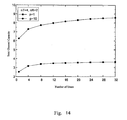
- the channel is supposed as the normalized Complex Gaussian distribution.
- the channel capacity (the statistical mean value) increases as the users increase because the multiuser gain of the system increases with the increase of the number of users. Meanwhile, the channel capacity of the system increases as the total transmitting power of the transmitting terminal 10 P increases. It can be seen from the comparison of the three scheduling methods that the adaptive scheduling method of the present invention can obtain the maximum channel capacity of the system, even the numbers of transmitting antennas and receiving antennas as well as the transmitting power have been changed properly, the scheduling method of the present invention among three scheduling methods can also obtain the maximum channel capacity of the system.
- the channel capacity the statistical mean value
- the above description focuses on the centralized multi-antenna system, a system that the transmitting antennas are mounted on the transmitting terminal 10 placed in the centre of a cellular. Further, the adaptive scheduling method of the present invention can also be applied to the distributed antenna system.
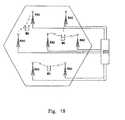
- Fig. 15 illustrates an adaptive distributed MIMO communication system of the present invention or an adaptive scheduling distributed multi-antenna system.
- Transmitting antennas are mounted on radio access units (RAU) similar to the base station, which are uniformly distributed in the whole cellular system.
- RAU radio access units
- locations that the RAUs are distributed in the whole cellular system can also be set in accordance with actual conditions so as to obtain the best performance of the system.
- the distributed multi-antenna system includes a plurality of radio access units (RAU), a base transceiver station (BTS), a plurality of users (MS) and connection links.
- Each radio access unit has at least one transmitting antenna mounted on for transceiving RF signals, and both the radio access units and the transmitting antennas are equivalent to the duplexer group 130 and transmitting antennas thereon, respectively.
- the radio access unit RAU includes at least one duplexer, and the number of the duplexers corresponds to the number of transmtting antennas connected thereto.
- the base transceiver station BTS is equivalent to the MIMO signal processor 110 and the MIMO scheduler 120 in Fig. 4.
- connection links connect the plurality of radio access units RAU with the base transceiver station BTS to transfer signals therebetween.
- the connection links can be wire links, such as the high-speed optical fibers.
- the radio access unit is required with a conversion function of photo/electric or electric/photo. Users represent the receiving terminals 20 as shown in Fig. 6.
- the operation of the distributed multi-anntenna system is similar to that of the centralized multi-antenna system mentioned above, and can decrease the system transmitting power and increase the data rate of the system relative to the centralized muti-antenna system.
- the MIMO communication system and its communication method have following advantages:
- the MIMO communication system of the present invention can perform an adaptive user scheduling so that the intelligentization of the system control and the stability of the communication are improved and the system capacity is always kept maximumly.
Landscapes
- Engineering & Computer Science (AREA)
- Computer Networks & Wireless Communication (AREA)
- Signal Processing (AREA)
- Physics & Mathematics (AREA)
- Mathematical Physics (AREA)
- Mobile Radio Communication Systems (AREA)
- Radio Transmission System (AREA)
Applications Claiming Priority (1)
| Application Number | Priority Date | Filing Date | Title |
|---|---|---|---|
| CN200410104194.6A CN1797987B (zh) | 2004-12-30 | 2004-12-30 | 自适应调度的mimo通信系统及其自适应用户调度方法 |
Publications (2)
| Publication Number | Publication Date |
|---|---|
| EP1677435A2 true EP1677435A2 (de) | 2006-07-05 |
| EP1677435A3 EP1677435A3 (de) | 2013-06-19 |
Family
ID=36120890
Family Applications (1)
| Application Number | Title | Priority Date | Filing Date |
|---|---|---|---|
| EP05026975.2A Withdrawn EP1677435A3 (de) | 2004-12-30 | 2005-12-09 | MIMO-Kommunikationssystem und Verfahren zur adaptiven Zuweisung mehrerer Benutzer |
Country Status (4)
| Country | Link |
|---|---|
| US (1) | US7688789B2 (de) |
| EP (1) | EP1677435A3 (de) |
| JP (1) | JP4813177B2 (de) |
| CN (1) | CN1797987B (de) |
Cited By (5)
| Publication number | Priority date | Publication date | Assignee | Title |
|---|---|---|---|---|
| EP1727298A2 (de) | 2005-05-24 | 2006-11-29 | NTT DoCoMo Inc. | MIMO-Kommunikationssystem, das auf Zufallsstrahlformung basiert ist und Ablaufverfahren |
| WO2009094744A1 (en) * | 2008-02-01 | 2009-08-06 | Nortel Networks Limited | System and method for spatial multiplexing-based multiple antenna broadcast/multicast transmission |
| CN102573095A (zh) * | 2012-02-10 | 2012-07-11 | 大唐移动通信设备有限公司 | 一种用户调度方法及装置 |
| US8305949B2 (en) | 2006-09-11 | 2012-11-06 | Apple Inc. | System and method for spatial multiplexing-based OFDM broadcast/multicast transmission |
| EP2182663A4 (de) * | 2007-08-20 | 2014-06-25 | Alcatel Lucent | Interaktive kollaborative mehrfach-basisstations-mimo mit geringen informationen und entsprechendes scheduling-verfahren und vorrichtungen |
Families Citing this family (82)
| Publication number | Priority date | Publication date | Assignee | Title |
|---|---|---|---|---|
| KR100557158B1 (ko) * | 2003-11-12 | 2006-03-03 | 삼성전자주식회사 | 직교 주파수 분할 다중 방식을 사용하는 이동통신시스템에서 부반송파 할당을 위한 장치 및 방법 |
| FR2863122B1 (fr) * | 2003-11-28 | 2006-04-28 | Thales Sa | Procede et dispositif permettant d'accroitre la capacite des systemes de transmissions non etales |
| US10985811B2 (en) | 2004-04-02 | 2021-04-20 | Rearden, Llc | System and method for distributed antenna wireless communications |
| US10200094B2 (en) * | 2004-04-02 | 2019-02-05 | Rearden, Llc | Interference management, handoff, power control and link adaptation in distributed-input distributed-output (DIDO) communication systems |
| US10277290B2 (en) | 2004-04-02 | 2019-04-30 | Rearden, Llc | Systems and methods to exploit areas of coherence in wireless systems |
| US8542763B2 (en) * | 2004-04-02 | 2013-09-24 | Rearden, Llc | Systems and methods to coordinate transmissions in distributed wireless systems via user clustering |
| US11394436B2 (en) | 2004-04-02 | 2022-07-19 | Rearden, Llc | System and method for distributed antenna wireless communications |
| US8654815B1 (en) | 2004-04-02 | 2014-02-18 | Rearden, Llc | System and method for distributed antenna wireless communications |
| US11451275B2 (en) | 2004-04-02 | 2022-09-20 | Rearden, Llc | System and method for distributed antenna wireless communications |
| US9819403B2 (en) | 2004-04-02 | 2017-11-14 | Rearden, Llc | System and method for managing handoff of a client between different distributed-input-distributed-output (DIDO) networks based on detected velocity of the client |
| US9826537B2 (en) * | 2004-04-02 | 2017-11-21 | Rearden, Llc | System and method for managing inter-cluster handoff of clients which traverse multiple DIDO clusters |
| US11309943B2 (en) | 2004-04-02 | 2022-04-19 | Rearden, Llc | System and methods for planned evolution and obsolescence of multiuser spectrum |
| US10187133B2 (en) | 2004-04-02 | 2019-01-22 | Rearden, Llc | System and method for power control and antenna grouping in a distributed-input-distributed-output (DIDO) network |
| US9312929B2 (en) | 2004-04-02 | 2016-04-12 | Rearden, Llc | System and methods to compensate for Doppler effects in multi-user (MU) multiple antenna systems (MAS) |
| US10886979B2 (en) | 2004-04-02 | 2021-01-05 | Rearden, Llc | System and method for link adaptation in DIDO multicarrier systems |
| US10425134B2 (en) | 2004-04-02 | 2019-09-24 | Rearden, Llc | System and methods for planned evolution and obsolescence of multiuser spectrum |
| US10749582B2 (en) | 2004-04-02 | 2020-08-18 | Rearden, Llc | Systems and methods to coordinate transmissions in distributed wireless systems via user clustering |
| US9685997B2 (en) | 2007-08-20 | 2017-06-20 | Rearden, Llc | Systems and methods to enhance spatial diversity in distributed-input distributed-output wireless systems |
| US8724740B2 (en) * | 2005-03-11 | 2014-05-13 | Qualcomm Incorporated | Systems and methods for reducing uplink resources to provide channel performance feedback for adjustment of downlink MIMO channel data rates |
| US8634432B2 (en) * | 2005-05-06 | 2014-01-21 | Samsung Electronics Co., Ltd. | System and method for subcarrier allocation in a multicarrier wireless network |
| CN101336524B (zh) * | 2006-02-02 | 2013-07-24 | 富士通株式会社 | 无线传送方法、无线发送机以及无线接收机 |
| WO2007121568A1 (en) * | 2006-04-21 | 2007-11-01 | Nortel Networks Limited | Method and system for closed loop multiple input/output antenna environments in wireless communication |
| US8331342B2 (en) * | 2006-04-28 | 2012-12-11 | Samsung Electronics Co., Ltd. | Apparatus and method for switching between single user and multi-user MIMO operation in a wireless network |
| KR101274871B1 (ko) * | 2006-06-14 | 2013-06-17 | 삼성전자주식회사 | 폐 루프 방식의 다중 안테나 시스템에서의 데이터송/수신장치 및 방법 |
| US8483145B2 (en) * | 2006-06-16 | 2013-07-09 | Telefonaktiebolaget Lm Ericsson (Publ) | Method for channel quality measures in a multiple antenna system |
| EP2055014B1 (de) * | 2006-08-25 | 2013-03-06 | Ikanos Technology Ltd. | Systeme und verfahren für mimo-vorkodierung in einem xdsl-system |
| JP4734210B2 (ja) * | 2006-10-04 | 2011-07-27 | 富士通株式会社 | 無線通信方法 |
| CN101193094B (zh) * | 2006-11-20 | 2011-10-19 | 电信科学技术研究院 | 一种发送广播/组播业务的方法及系统 |
| US20080207258A1 (en) * | 2007-02-26 | 2008-08-28 | Broadcom Corporation, A California Corporation | Multimode transmitter with digital up conversion and methods for use therewith |
| US8054837B2 (en) * | 2007-04-30 | 2011-11-08 | Yim Tu Investments Ltd., Llc | Multiuser scheduling for MIMO broadcast channels with finite rate feedback |
| KR100895576B1 (ko) * | 2007-05-11 | 2009-04-29 | 주식회사 팬택 | 다중입력 다중출력 무선 랜 환경에서 안테나를 선택하여데이터를 전송하는 방법 |
| US7649831B2 (en) * | 2007-05-30 | 2010-01-19 | Samsung Electronics Co., Ltd. | Multi-user MIMO feedback and transmission in a wireless communication system |
| US7983710B2 (en) * | 2007-05-31 | 2011-07-19 | Alcatel-Lucent Usa Inc. | Method of coordinated wireless downlink transmission |
| US8086272B2 (en) * | 2007-08-06 | 2011-12-27 | Mitsubishi Electric Research Laboratories, Inc. | Wireless networks incorporating antenna selection based on received sounding reference signals |
| US8989155B2 (en) | 2007-08-20 | 2015-03-24 | Rearden, Llc | Systems and methods for wireless backhaul in distributed-input distributed-output wireless systems |
| JP5387575B2 (ja) * | 2007-08-31 | 2014-01-15 | 富士通株式会社 | 無線通信システム及び無線通信方法 |
| US8190165B2 (en) * | 2007-09-21 | 2012-05-29 | Future Wei Technologies, Inc. | System and method for utility-based scheduling for space division multiple access (SDMA) on an uplink of a wireless communications network |
| WO2009111832A1 (en) * | 2008-03-12 | 2009-09-17 | University Of Wollongong | A new type of gapless semiconductor material |
| EP2699052B1 (de) * | 2008-04-07 | 2018-12-05 | Telefonaktiebolaget LM Ericsson (publ) | Verfahren für und Funkübertragungssystem und Funkzugangsgerät für zellulare drahtlose Funkübertragung |
| EP2131507B1 (de) * | 2008-06-06 | 2010-12-01 | NTT DoCoMo, Inc. | Benutzerauswahlvorrichtung für ein mobiles Kommunikationssystem |
| EP2134003B1 (de) * | 2008-06-06 | 2011-12-28 | NTT DoCoMo, Inc. | Benutzerauswahlvorrichtung und -verfahren für ein mobiles Kommunikationssystem |
| KR101001015B1 (ko) * | 2008-09-25 | 2010-12-14 | 한국전자통신연구원 | 다운링크 송신 모드를 적응적으로 결정하는 다중 안테나 무선 통신 시스템 |
| KR101289944B1 (ko) | 2008-12-12 | 2013-07-26 | 엘지전자 주식회사 | 초고처리율 무선랜 시스템에서 채널 추정 방법 및 이를 위한 장치 |
| US8682326B2 (en) * | 2008-12-23 | 2014-03-25 | Telefonaktiebolaget Lm Ericsson (Publ) | Base station and method for vertical tilt antenna beam sweeping |
| AU2010210766A1 (en) | 2009-02-03 | 2011-09-15 | Corning Cable Systems Llc | Optical fiber-based distributed antenna systems, components, and related methods for monitoring and configuring thereof |
| US9673904B2 (en) | 2009-02-03 | 2017-06-06 | Corning Optical Communications LLC | Optical fiber-based distributed antenna systems, components, and related methods for calibration thereof |
| US8423068B2 (en) * | 2009-02-12 | 2013-04-16 | Clearwire Ip Holdings Llc | Quality of service based multi-antenna mode switching |
| US9125090B2 (en) * | 2009-02-27 | 2015-09-01 | At&T Mobility Ii Llc | Staggered channelization code allocation for multi-carrier networks |
| KR101589607B1 (ko) * | 2009-03-02 | 2016-01-29 | 삼성전자주식회사 | 펨토 기지국과 통신 단말기를 갖는 통신 시스템 및 그의 통신 방법 |
| JP5391816B2 (ja) | 2009-05-08 | 2014-01-15 | ソニー株式会社 | 通信装置及び通信方法、コンピューター・プログラム、並びに通信システム |
| WO2010139353A1 (en) * | 2009-06-01 | 2010-12-09 | Telefonaktiebolaget L M Ericsson (Publ) | A node in a wireless communication system with different antenna diversity methods for uplink and downlink |
| US8743839B2 (en) * | 2009-07-01 | 2014-06-03 | Telefonaktiebolaget L M Ericsson (Publ) | Scheduling different types of receivers in a radio base station |
| JP4896196B2 (ja) * | 2009-10-01 | 2012-03-14 | 株式会社エヌ・ティ・ティ・ドコモ | 協調送信方法、協調送信システム、集約局及び無線基地局 |
| US8280259B2 (en) | 2009-11-13 | 2012-10-02 | Corning Cable Systems Llc | Radio-over-fiber (RoF) system for protocol-independent wired and/or wireless communication |
| US8976770B2 (en) * | 2010-07-27 | 2015-03-10 | Lg Electronics Inc. | Method and device whereby base station allocates nodes to terminal in a semi-static fashion in multi-node system |
| US9252874B2 (en) | 2010-10-13 | 2016-02-02 | Ccs Technology, Inc | Power management for remote antenna units in distributed antenna systems |
| WO2012148940A1 (en) | 2011-04-29 | 2012-11-01 | Corning Cable Systems Llc | Systems, methods, and devices for increasing radio frequency (rf) power in distributed antenna systems |
| CN103548290B (zh) * | 2011-04-29 | 2016-08-31 | 康宁光缆系统有限责任公司 | 判定分布式天线系统中的通信传播延迟及相关组件、系统与方法 |
| CN102882662B (zh) * | 2011-07-15 | 2014-12-10 | 华为技术有限公司 | 链路自适应反馈方法和设备 |
| US9031033B2 (en) * | 2011-09-27 | 2015-05-12 | Apple Inc. | Wireless radio access network control channel capacity management |
| EP2842245A1 (de) | 2012-04-25 | 2015-03-04 | Corning Optical Communications LLC | Verteilte antennensystemarchitekturen |
| US9455784B2 (en) | 2012-10-31 | 2016-09-27 | Corning Optical Communications Wireless Ltd | Deployable wireless infrastructures and methods of deploying wireless infrastructures |
| US11190947B2 (en) | 2014-04-16 | 2021-11-30 | Rearden, Llc | Systems and methods for concurrent spectrum usage within actively used spectrum |
| US11189917B2 (en) | 2014-04-16 | 2021-11-30 | Rearden, Llc | Systems and methods for distributing radioheads |
| US10194346B2 (en) | 2012-11-26 | 2019-01-29 | Rearden, Llc | Systems and methods for exploiting inter-cell multiplexing gain in wireless cellular systems via distributed input distributed output technology |
| US11050468B2 (en) | 2014-04-16 | 2021-06-29 | Rearden, Llc | Systems and methods for mitigating interference within actively used spectrum |
| CN103095351B (zh) * | 2013-01-17 | 2015-05-27 | 西安电子科技大学 | 基于单载波全双工的多输入多输出系统 |
| US9923657B2 (en) | 2013-03-12 | 2018-03-20 | Rearden, Llc | Systems and methods for exploiting inter-cell multiplexing gain in wireless cellular systems via distributed input distributed output technology |
| US10164698B2 (en) | 2013-03-12 | 2018-12-25 | Rearden, Llc | Systems and methods for exploiting inter-cell multiplexing gain in wireless cellular systems via distributed input distributed output technology |
| US10488535B2 (en) | 2013-03-12 | 2019-11-26 | Rearden, Llc | Apparatus and method for capturing still images and video using diffraction coded imaging techniques |
| US9973246B2 (en) | 2013-03-12 | 2018-05-15 | Rearden, Llc | Systems and methods for exploiting inter-cell multiplexing gain in wireless cellular systems via distributed input distributed output technology |
| US10547358B2 (en) | 2013-03-15 | 2020-01-28 | Rearden, Llc | Systems and methods for radio frequency calibration exploiting channel reciprocity in distributed input distributed output wireless communications |
| CN104509051B (zh) * | 2013-06-27 | 2017-11-17 | 华为技术有限公司 | 信道估计方法及接收机 |
| JP6342618B2 (ja) * | 2013-06-28 | 2018-06-13 | 株式会社Nttドコモ | 無線基地局、ユーザ端末及び無線通信方法 |
| CN103475107A (zh) * | 2013-08-30 | 2013-12-25 | 成都远晟科技有限公司 | 无线充电方法和无线充电发射天线 |
| FR3011704A1 (fr) * | 2013-10-07 | 2015-04-10 | Orange | Procede de mise en œuvre d'une session de communication entre une pluralite de terminaux |
| US11290162B2 (en) | 2014-04-16 | 2022-03-29 | Rearden, Llc | Systems and methods for mitigating interference within actively used spectrum |
| CN104080188B (zh) * | 2014-06-27 | 2017-07-14 | 中国科学院计算技术研究所 | 多用户多输入输出无线局域网用户调度方法及系统 |
| US9681313B2 (en) | 2015-04-15 | 2017-06-13 | Corning Optical Communications Wireless Ltd | Optimizing remote antenna unit performance using an alternative data channel |
| US9948349B2 (en) | 2015-07-17 | 2018-04-17 | Corning Optical Communications Wireless Ltd | IOT automation and data collection system |
| CN105933104A (zh) * | 2016-07-04 | 2016-09-07 | 重庆邮电大学 | 基于Walsh码的多用户差分混沌通信系统 |
| CN111049561A (zh) * | 2019-11-01 | 2020-04-21 | 濠暻科技(深圳)有限公司 | 一种lte系统的宽带电调天线自适应调度方法 |
Family Cites Families (8)
| Publication number | Priority date | Publication date | Assignee | Title |
|---|---|---|---|---|
| US6662024B2 (en) * | 2001-05-16 | 2003-12-09 | Qualcomm Incorporated | Method and apparatus for allocating downlink resources in a multiple-input multiple-output (MIMO) communication system |
| US7072413B2 (en) * | 2001-05-17 | 2006-07-04 | Qualcomm, Incorporated | Method and apparatus for processing data for transmission in a multi-channel communication system using selective channel inversion |
| US7020110B2 (en) * | 2002-01-08 | 2006-03-28 | Qualcomm Incorporated | Resource allocation for MIMO-OFDM communication systems |
| US7412212B2 (en) * | 2002-10-07 | 2008-08-12 | Nokia Corporation | Communication system |
| US8208364B2 (en) * | 2002-10-25 | 2012-06-26 | Qualcomm Incorporated | MIMO system with multiple spatial multiplexing modes |
| KR20120024992A (ko) * | 2003-04-23 | 2012-03-14 | 콸콤 인코포레이티드 | 무선 통신 시스템에서 수행성능을 향상시키는 방법들 및 장치 |
| JP2007518346A (ja) * | 2004-01-20 | 2007-07-05 | エルジー エレクトロニクス インコーポレイティド | Mimoシステムにおける信号送受信方法 |
| US7469491B2 (en) * | 2004-01-27 | 2008-12-30 | Crestcom, Inc. | Transmitter predistortion circuit and method therefor |
-
2004
- 2004-12-30 CN CN200410104194.6A patent/CN1797987B/zh not_active Expired - Fee Related
-
2005
- 2005-12-09 EP EP05026975.2A patent/EP1677435A3/de not_active Withdrawn
- 2005-12-28 JP JP2005378884A patent/JP4813177B2/ja not_active Expired - Fee Related
- 2005-12-30 US US11/322,615 patent/US7688789B2/en not_active Expired - Fee Related
Cited By (9)
| Publication number | Priority date | Publication date | Assignee | Title |
|---|---|---|---|---|
| EP1727298A2 (de) | 2005-05-24 | 2006-11-29 | NTT DoCoMo Inc. | MIMO-Kommunikationssystem, das auf Zufallsstrahlformung basiert ist und Ablaufverfahren |
| EP1727298A3 (de) * | 2005-05-24 | 2012-06-13 | NTT DoCoMo, Inc. | MIMO-Kommunikationssystem, das auf Zufallsstrahlformung basiert ist und Ablaufverfahren |
| US8305949B2 (en) | 2006-09-11 | 2012-11-06 | Apple Inc. | System and method for spatial multiplexing-based OFDM broadcast/multicast transmission |
| EP2182663A4 (de) * | 2007-08-20 | 2014-06-25 | Alcatel Lucent | Interaktive kollaborative mehrfach-basisstations-mimo mit geringen informationen und entsprechendes scheduling-verfahren und vorrichtungen |
| US8867477B2 (en) | 2007-08-20 | 2014-10-21 | Alcatel Lucent | Cooperative MIMO among base stations with low information interaction, a method and apparatus for scheduling the same |
| WO2009094744A1 (en) * | 2008-02-01 | 2009-08-06 | Nortel Networks Limited | System and method for spatial multiplexing-based multiple antenna broadcast/multicast transmission |
| US8929325B2 (en) | 2008-02-01 | 2015-01-06 | Apple Inc. | System and method for spatial multiplexing-based multiple antenna broadcast/multicast transmission |
| CN102573095A (zh) * | 2012-02-10 | 2012-07-11 | 大唐移动通信设备有限公司 | 一种用户调度方法及装置 |
| CN102573095B (zh) * | 2012-02-10 | 2014-08-06 | 大唐移动通信设备有限公司 | 一种用户调度方法及装置 |
Also Published As
| Publication number | Publication date |
|---|---|
| JP2006191620A (ja) | 2006-07-20 |
| US20060146755A1 (en) | 2006-07-06 |
| CN1797987A (zh) | 2006-07-05 |
| EP1677435A3 (de) | 2013-06-19 |
| CN1797987B (zh) | 2011-02-16 |
| US7688789B2 (en) | 2010-03-30 |
| JP4813177B2 (ja) | 2011-11-09 |
Similar Documents
| Publication | Publication Date | Title |
|---|---|---|
| US7688789B2 (en) | MIMO communication system and method capable of adaptive user scheduling | |
| KR100575993B1 (ko) | 다중 송수신 안테나를 사용하는 이동통신 시스템에서 다중사용자를 위한 스케쥴링 방법 및 장치 | |
| EP2119038B1 (de) | Verfahren und systeme für kombinierte vorcodierung und zyklische verzörgerungsdiversität | |
| US8306089B2 (en) | Precoding technique for multiuser MIMO based on eigenmode selection and MMSE | |
| US9923617B2 (en) | Communication channel optimization systems and methods in multi-user communication systems | |
| KR100876797B1 (ko) | 다중 안테나 시스템에서의 빔포밍 장치 및 방법 | |
| EP1386421B1 (de) | Funkkommunikationssystem | |
| EP1727298A2 (de) | MIMO-Kommunikationssystem, das auf Zufallsstrahlformung basiert ist und Ablaufverfahren | |
| KR100754660B1 (ko) | 통신 시스템에서 적응 변조/부호 부 채널 할당 시스템 및 방법 | |
| US8774302B2 (en) | Wireless communication system and wireless communication method | |
| KR20090100877A (ko) | 다중 입출력 무선통신 시스템에서 상향링크 빔 성형 및 공간분할 다중 접속 장치 및 방법 | |
| US8208439B2 (en) | Optimal user pairing for multiuser MIMO | |
| KR101580155B1 (ko) | 다중 셀 다중 안테나 시스템에서 간섭을 고려한 빔포밍 방법 및 장치 | |
| KR20100053417A (ko) | 다중입력다중출력 시스템에서 신호 전송 방법 및 신호 수신 방법 | |
| KR20090102459A (ko) | 분산 안테나 시스템에서 신호 처리 장치 및 방법 | |
| US20150341090A1 (en) | Apparatus and method for processing transmission/reception signals for interference alignment in mu-mimo interfering broadcast channel | |
| US8385310B2 (en) | Optimal user pairing for downlink multiuser MIMO | |
| EP1708386B1 (de) | Verfahren zur zufälligen Strahlformung für ein MIMO-System | |
| US20220321176A1 (en) | Approaches for beam measurements | |
| US20130279613A1 (en) | Feedback method for virtual mimo transmission in wireless ad-hoc communication system | |
| KR101422026B1 (ko) | 다중 입출력 시스템에서, 신호를 송수신하는 방법 | |
| Tang et al. | Downlink path-based precoding in FDD massive MIMO systems without CSI feedback | |
| Ackermann et al. | Firefly ultra dense networks with mmWave fronthaul links | |
| EP2939350B1 (de) | Verfahren und vorrichtung für mehrnutzer-mimo-vorcodierung | |
| US20190305832A1 (en) | Wireless telecommunications system and transmission protocol for use with same |
Legal Events
| Date | Code | Title | Description |
|---|---|---|---|
| PUAI | Public reference made under article 153(3) epc to a published international application that has entered the european phase |
Free format text: ORIGINAL CODE: 0009012 |
|
| AK | Designated contracting states |
Kind code of ref document: A2 Designated state(s): AT BE BG CH CY CZ DE DK EE ES FI FR GB GR HU IE IS IT LI LT LU LV MC NL PL PT RO SE SI SK TR |
|
| AX | Request for extension of the european patent |
Extension state: AL BA HR MK YU |
|
| PUAL | Search report despatched |
Free format text: ORIGINAL CODE: 0009013 |
|
| AK | Designated contracting states |
Kind code of ref document: A3 Designated state(s): AT BE BG CH CY CZ DE DK EE ES FI FR GB GR HU IE IS IT LI LT LU LV MC NL PL PT RO SE SI SK TR |
|
| AX | Request for extension of the european patent |
Extension state: AL BA HR MK YU |
|
| RIC1 | Information provided on ipc code assigned before grant |
Ipc: H04B 7/04 20060101AFI20130510BHEP Ipc: H04B 7/06 20060101ALI20130510BHEP |
|
| AKY | No designation fees paid | ||
| REG | Reference to a national code |
Ref country code: DE Ref legal event code: R108 |
|
| REG | Reference to a national code |
Ref country code: DE Ref legal event code: R108 Effective date: 20140226 |
|
| STAA | Information on the status of an ep patent application or granted ep patent |
Free format text: STATUS: THE APPLICATION IS DEEMED TO BE WITHDRAWN |
|
| 18D | Application deemed to be withdrawn |
Effective date: 20131220 |