EP1727298A2 - MIMO-Kommunikationssystem, das auf Zufallsstrahlformung basiert ist und Ablaufverfahren - Google Patents
MIMO-Kommunikationssystem, das auf Zufallsstrahlformung basiert ist und Ablaufverfahren Download PDFInfo
- Publication number
- EP1727298A2 EP1727298A2 EP06010427A EP06010427A EP1727298A2 EP 1727298 A2 EP1727298 A2 EP 1727298A2 EP 06010427 A EP06010427 A EP 06010427A EP 06010427 A EP06010427 A EP 06010427A EP 1727298 A2 EP1727298 A2 EP 1727298A2
- Authority
- EP
- European Patent Office
- Prior art keywords
- user
- transmit beam
- scheduling
- group
- transmit
- Prior art date
- Legal status (The legal status is an assumption and is not a legal conclusion. Google has not performed a legal analysis and makes no representation as to the accuracy of the status listed.)
- Withdrawn
Links
Images






Classifications
-
- H—ELECTRICITY
- H04—ELECTRIC COMMUNICATION TECHNIQUE
- H04B—TRANSMISSION
- H04B7/00—Radio transmission systems, i.e. using radiation field
- H04B7/02—Diversity systems; Multi-antenna system, i.e. transmission or reception using multiple antennas
- H04B7/04—Diversity systems; Multi-antenna system, i.e. transmission or reception using multiple antennas using two or more spaced independent antennas
- H04B7/06—Diversity systems; Multi-antenna system, i.e. transmission or reception using multiple antennas using two or more spaced independent antennas at the transmitting station
- H04B7/0613—Diversity systems; Multi-antenna system, i.e. transmission or reception using multiple antennas using two or more spaced independent antennas at the transmitting station using simultaneous transmission
- H04B7/0615—Diversity systems; Multi-antenna system, i.e. transmission or reception using multiple antennas using two or more spaced independent antennas at the transmitting station using simultaneous transmission of weighted versions of same signal
- H04B7/0619—Diversity systems; Multi-antenna system, i.e. transmission or reception using multiple antennas using two or more spaced independent antennas at the transmitting station using simultaneous transmission of weighted versions of same signal using feedback from receiving side
- H04B7/0621—Feedback content
- H04B7/0632—Channel quality parameters, e.g. channel quality indicator [CQI]
-
- H—ELECTRICITY
- H04—ELECTRIC COMMUNICATION TECHNIQUE
- H04B—TRANSMISSION
- H04B7/00—Radio transmission systems, i.e. using radiation field
- H04B7/02—Diversity systems; Multi-antenna system, i.e. transmission or reception using multiple antennas
- H04B7/04—Diversity systems; Multi-antenna system, i.e. transmission or reception using multiple antennas using two or more spaced independent antennas
- H04B7/06—Diversity systems; Multi-antenna system, i.e. transmission or reception using multiple antennas using two or more spaced independent antennas at the transmitting station
- H04B7/0613—Diversity systems; Multi-antenna system, i.e. transmission or reception using multiple antennas using two or more spaced independent antennas at the transmitting station using simultaneous transmission
- H04B7/0615—Diversity systems; Multi-antenna system, i.e. transmission or reception using multiple antennas using two or more spaced independent antennas at the transmitting station using simultaneous transmission of weighted versions of same signal
- H04B7/0619—Diversity systems; Multi-antenna system, i.e. transmission or reception using multiple antennas using two or more spaced independent antennas at the transmitting station using simultaneous transmission of weighted versions of same signal using feedback from receiving side
- H04B7/0621—Feedback content
- H04B7/0626—Channel coefficients, e.g. channel state information [CSI]
-
- H—ELECTRICITY
- H04—ELECTRIC COMMUNICATION TECHNIQUE
- H04B—TRANSMISSION
- H04B7/00—Radio transmission systems, i.e. using radiation field
- H04B7/02—Diversity systems; Multi-antenna system, i.e. transmission or reception using multiple antennas
- H04B7/04—Diversity systems; Multi-antenna system, i.e. transmission or reception using multiple antennas using two or more spaced independent antennas
- H04B7/06—Diversity systems; Multi-antenna system, i.e. transmission or reception using multiple antennas using two or more spaced independent antennas at the transmitting station
- H04B7/0613—Diversity systems; Multi-antenna system, i.e. transmission or reception using multiple antennas using two or more spaced independent antennas at the transmitting station using simultaneous transmission
- H04B7/0615—Diversity systems; Multi-antenna system, i.e. transmission or reception using multiple antennas using two or more spaced independent antennas at the transmitting station using simultaneous transmission of weighted versions of same signal
- H04B7/0619—Diversity systems; Multi-antenna system, i.e. transmission or reception using multiple antennas using two or more spaced independent antennas at the transmitting station using simultaneous transmission of weighted versions of same signal using feedback from receiving side
- H04B7/0621—Feedback content
- H04B7/0634—Antenna weights or vector/matrix coefficients
-
- H—ELECTRICITY
- H04—ELECTRIC COMMUNICATION TECHNIQUE
- H04B—TRANSMISSION
- H04B7/00—Radio transmission systems, i.e. using radiation field
- H04B7/02—Diversity systems; Multi-antenna system, i.e. transmission or reception using multiple antennas
- H04B7/04—Diversity systems; Multi-antenna system, i.e. transmission or reception using multiple antennas using two or more spaced independent antennas
- H04B7/06—Diversity systems; Multi-antenna system, i.e. transmission or reception using multiple antennas using two or more spaced independent antennas at the transmitting station
- H04B7/0686—Hybrid systems, i.e. switching and simultaneous transmission
- H04B7/0695—Hybrid systems, i.e. switching and simultaneous transmission using beam selection
- H04B7/06952—Selecting one or more beams from a plurality of beams, e.g. beam training, management or sweeping
-
- H—ELECTRICITY
- H04—ELECTRIC COMMUNICATION TECHNIQUE
- H04W—WIRELESS COMMUNICATION NETWORKS
- H04W72/00—Local resource management
- H04W72/50—Allocation or scheduling criteria for wireless resources
- H04W72/54—Allocation or scheduling criteria for wireless resources based on quality criteria
- H04W72/542—Allocation or scheduling criteria for wireless resources based on quality criteria using measured or perceived quality
Definitions
- the present invention relates to the user scheduling technology of the multiple input multiple output (MIMO) system, especially the MIMO communication system based on random beamforming and its user scheduling method.
- MIMO multiple input multiple output
- the future wireless communication system is required to support the extremely high speed data traffics, such as the videoconference, the video-on-demand and the interactive video game, etc.. It should support up to 100Mbps for high mobility traffics and up to 1Gbps for low mobility or fixed wireless traffics.
- the data rate of one wireless channel equals to the product of its spectrum width and the spectrum efficiency of the adopted technology.
- the spectrum width of the channel or the spectrum efficiency of the adopted technology should be improved.
- the communication speed cannot be raised by infinitely increasing the spectrum width. Improving the spectrum efficiency of the adopted technology is an optimal solution.
- the so-called MIMO technology means that mutilple antennas are mounted at both the transmitter and the receiver in a communication system.
- the MIMO technology also includes that multiple antennas are mounted at either side, i.e., the single input-multiple output (SIMO) and the multiple input-single output (MISO). Different antennas are physically separated, and are generally regarded as introducing an additional signal domain-a space domain, into the communication system.
- SIMO single input-multiple output
- MISO multiple input-single output
- the spatial resource can provide much performance gain, it is difficult to be utilized because of the uncertainty for changing with the object physical condition. A better control technology is essential to better utilize the spatial resource.
- MaxC/I scheduling Channel-Aware User Scheduling
- MaxC/I scheduling Channel-Aware User Scheduling
- the performance of the system can be improved greatly and the performance gain through MaxC/I scheduling is called multiuser diversity.
- channel user scheduling allocates common channels according to the channel condition, it depends more on the channel condition.
- the system performance will be greatly reduced in some specific channel conditions.
- Figure 1(a) and 1(b) shows the system architecture diagram with one transmitting antenna at the base station (transmitter) and two users (receiver).
- channel user scheduling allocates common channels according to the channel condition.
- curve 1 shows the channel gain curve of user 1 changing with time
- curve 2 shows the channel gain curve of user 2 changing with time
- the dashed line shows the average channel gain curve of the system changing with time.
- Figure 2(a) shows the system allocates common channels according to the channel gain of user 1 and user 2 at different time; the common channels are allocated to user 1 in interval 0- t 1 and to user 2 in interval 0- t 2 , etc., which are represented respectively by "1" and "2" on time axis.
- the channel gain of the system is the upper envelopes of curves 1 and 2
- the dashed line stands for the average channel gain curve of the system.
- the channel of the user is a vector h k ⁇ C n T ⁇ 1
- the data signal will be multiplied with a n T dimension random complex vector w ⁇ C n T ⁇ 1 , and the said data signal will be transmitted from all the n T antennas.
- Each user feeds back the detected equivalent channel gain to the base station, which allocates the channel to the user with the maximum equivalent channel gain.
- the user with the maximum equivalent channel gain is right inside the transmit beam generated by the transmit vector h k .
- Changing the random complex vector W can change the statistics characteristics (such as correlation and time-varied characteristics) of the equivalent channel gain to meet the request of user scheduling.
- only one user can be scheduled at one time, for example, user 1 is scheduled at t 1 and user 2 is scheduled at t 2 . In this way, a lot of space resource is wasted and the throughput of the system is reduced in high SNR region.
- the said method has the following shortcomings:
- the aim of the present invention is to provide a MIMO communication system based on random beamforming.
- Another aim of the present invention is to provide a user scheduling method based on the above system.
- the MIMO communication system based on random beamforming includes: a transmitter that is used to transmit the data frame including at least the channel estimation signal and the user data and at least one receiver that is used to receive the data frame from the transmitter and to produce the corresponding feedback information and recover the user data, wherein the transmitter produces the scheduling information according to the said feedback information and utilizes the said scheduling information to implement adaptive user scheduling, and the said scheduling information includes the scheduled users, data streams that should be supported by each scheduled user and the transmit beam adopted by each data stream.
- the said feedback information includes the group of the best transmit beams for each receiver and the signal-to-interference ratio corresponding to each transmit beam in the said group of the best transmit beams.
- the said feedback information further includes the group of transmit beams that are with lowest interference to each receiver.
- the said feedback information includes the group of the best transmit beams for each receiver, the equivalent channel gain of each transmit beam in this group, the group of transmit beams that are with lowest interference to each receiver and the degradation factors caused by each of them to the group of best transmit beams.
- a user scheduling method of the MIMO communication system based on random beamforming includes the following steps: (a) the receiver produces the feedback information according to the channel fading condition between the transmitting antenna and the receiving antenna and feeds back the said feedback information to the transmitter; (b) the transmitter receives the said feedback information, produces the scheduling information according to the said feedback information and schedules the user according to the said scheduling information.
- the said scheduling information includes the scheduled user, data streams that should be supported by each scheduled user and the transmit beam adopted by each data stream.
- step (b) can include the following steps:
- step (b) can also include the following steps:
- step (b) can include the following steps:
- the present MIMO communication system based on random beamforming and its user scheduling method can schedule the users with fixed number or adaptively according to the instant channel condition as well as different feedback information so that the intelligence of the system control and communication stability can be improved to approach the maximum system capacity. It further includes the following advantages especially for adaptive scheduling.
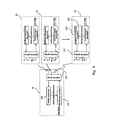
- Figure 4 is a block diagram showing a MIMO communication system based on random beamforming of the present invention, wherein, the said MIMO communication system further includes a transmitter 10 (base station) and a plurality of receiver 20 (user).
- Figure 5 is a flow diagram of user scheduling of the MIMO communication system of Figure 4.
- Figure 6 is a diagram showing the frame architecure adopted in the MIMO communication system based on random beamforming.
- the transmitter 10 has a MIMO data processor 110, a MIMO scheduler 120, a duplexer group 130 and n T transmitting antennas. Every receiver 20 has a received signal processor 210, a feedback information processor 220, a duplexer group 230 and n R receiving antennas, wherein every receiver 20 can have different number of receiving antennas.
- the said frame architecture includes: a channel estimation slot, a channel feedback slot and a data transmission slot. Other slots can be set according to the system requirement. It is simplified here for the prupose of illustration.
- Figure 6 shows before the transmitter 10 transmits the user data signal, it will transmit the channel estimation signal to the receiver 20 in the form of transmit beams from n T transmitting antennas by the duplexer 130.
- the transmission signal of the transmitter 10 is a n T dimension complex vector x ⁇ C n T
- the signal received by each receiver is a n R dimension complex vector y k ⁇ C n R and there is a n R ⁇ n T dimension channel fading matrix between the transmitter 10 and the receiver 20:
- h i , j k represents the channel transmission characteristic between the i th transmitting antenna of the transmitter 10 and the j th receiving antenna of the receiver 20 ( k represents the k th user).
- ⁇ k ⁇ C n T is a n R dimension complex vector standing for the white noise of the receiver 20.
- every receiver 20 knows the exact channel fading condition, which takes into account the actual channel fading condition and the random complex vetor of the transmitter.
- Each receiver 20 can process the channel fading condition through the received signal processor 210 to obtain the user feedback information, which is transferred to the information processor 220.
- the feedback information processor 220 processes the received user information and transforms it into the feedback signal (RF signal) for MIMO communication system.
- the said feedback signal is fed back to the transmitter 10 through the feedback channel and the antenna of the receiver 20.
- the antenna of transmitter 10 After receiving the said feedback signal, the antenna of transmitter 10 transmits it to the MIMO scheduler 120.
- the MIMO scheduler 120 produces scheduling information according to the said signal and controls the operation of the MIMO data processor 110 according to the scheduling information. In this way, the MIMO communication system gets to the scheduling condition of the maximum capacity, i.e. the optimal user scheduling is achieved according to the scheduling information.
- the above method to obtain the channel fading condition uses the channel estimation signal (i.e. the pilot signal), which inserts the channel estimation signal in the data frame.
- the receiver 20 obtains the channel fading condition between the transmitter 10 and the receiver 20 according to the said channel estimation signal and the received signal processor 210 further processes the channel fading condition to obtain the user feedback information.
- channel blind estimation method can be used in the present invention to obtain the channel fading condition, i.e. channel estimation slot need not be set in the data frame and when the receiver 20 receives the data from the transmitter 10, the channel blind estimation will be used to obtain the channel fading condition and the channel fading condition will be processed by the received signal processor 210 to obtain the user feedback information. Then the insert of the channel estimation signal is avoided so as to prevent the waste of the frequency resource.
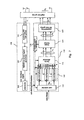
- Figure 7 is a diagram further showing the architecture of the transmitter 10 of the MIMO communication system of the present invention.
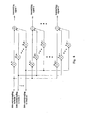
- Figure 8 is an architecture diagram of the beamformer 114 of Figure 7.
- Figure 9 is an architecture diagram of the transmitting RF link group of the transmitter 10.
- Figure 10 is a diagram showing the duplexer group 130 of the transmitter 10 of the present invention.
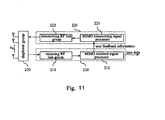
- Figure 11 is a diagram further showing the architecture of the receiver 20 of the MIMO communication system of the present invention.
- Layered time-space signal processing method is used in Figure 7 and Figure 11 to describe MIMO communication. Signal processing methods and apparatus disclosed by other priors can also be adopted to process the signals, such as the space-time coding.
- Figure 7 shows the transmitter 10 has a MIMO data processor 110, a MIMO scheduler 120, a duplexer group 130 and n T transmitting antennas.
- the said MIMO scheduler 120 includes a receiving RF link group 123, a MIMO received signal processor 122 and a scheduler 121.
- receiving RF link group 123 has the same amount of receiving RF links as that of the transmiting antennas, which are used to transform the received feedback signal into the corresponding symbol stream.
- the MIMO received signal processor 122 produces the corresponding feedback information of the user by space-time processing the said symbol stream.
- the said scheduling information includes the scheduled user, data streams that should be supported by each scheduled user and the transmit beam adopted by each data stream.
- the scheduler 121 utilizes the said scheduling information to control the signal processing of the MIMO data processor 110.
- the said MIMO data processor 110 includes a user selector 111, a plurality of parallel de-multiplexers 112, a beam allocator 113, a beamformer 114, a transmiting RF link group 115 and a random matrix generator 116.
- the user selector 111 is used to select the users to be scheduled and to output the corresponding user data.
- the number here is represented as nS and nS is less than or equal to the number of the antennas n T of the transmitter 10.
- nS de-multiplexers 112 are chosen to de-multiplexer the user data of the scheduled nS users, i.e. to divide the user data of the scheduled nS users into L (nS ⁇ L ⁇ n T ) symbol streams according to the "symbol streams to transmit data for each scheduled user" in the scheduling information.
- L is the sum of the symbol streams allocated to all the scheduled users.
- each symbol stream of every user data is corresponding to one antenna at the receiver.
- the beam allocator 113 is used to process the L symbol streams from the de-multiplexer 112 as L layers.
- the association between the L symbol streams and the transmit beams is established according to the "the transmit beam corresponding to each symbol stream" and then the symbol streams are outputted.
- Figure 7 shows there are n T outputs but actually only L symbol streams are the user data while other ( n T ⁇ L) symbol streams don't occupy any user data.
- the random matrix generator 116 is used to generate the random n T ⁇ n T dimension matrix (represented as W i,j , wherein i and j are positive integers of 1 -n T ) and to input the said n T ⁇ n T dimension matrix to the beamformer 114.
- the said random n T ⁇ n T dimension matrix can be the experience matrix or the channel matrix according to the channel information.
- the said random matrix generator 116 can receive the scheduling information from the scheduler 121 and generate the corresponding random matrix according to the channel information in the said scheduling information, or, can generate the experience matrix independent of the scheduler.
- the beamformer 114 is used to implement weighted operation on the n T symbol streams (including the L symbol streams with the user data and the ( n T - L) symbol streams without any user data) from the beam allocator 113 according to the random n T ⁇ n T dimension matrix generated by the random matrix generator 116 and to generate n T transmission signals.
- the transmitting RF link group 115 is used to receive the n T transmission signals from the beamformer 114 and to transform the said n T signals into the corresponding RF signals to be transmitted by the n T transmitting antennas at the duplexer group 130.
- Figure 8 is an architecture diagram of the beamformer 114.
- the beamformer 114 is composed by n T ⁇ n T multiplier and n T adders.
- the said beamformer 114 can generate n T transmission siganals corresponding to the n T symbol streams and each transmission signal is generated in approximately the same way.
- the i th transmission signal will be chosen as an example to illustrate.
- every element (coefficient) in the i th line (W 1,i to W nTi ) of the n T ⁇ n T dimension matrix from the random matrix generator 116 is multiplied with each symbol stream. Then the results of the multiply operation are added and the i th transmission signal is formed.
- FIG. 9 further describes the detailed architecture of the transmitting RF link group 115, which includes n T parellel transmitting RF link groups.
- Each transmitting RF link group includes a modulator 117, an up converter 118 and a power amplifier 119, which are connected in serial, and the power amplifer 119 can be a large power linear amplifier.
- the said n T transmitting RF link groups are used to transform the n T signals from the beamformer 114 respectively into the corresponding RF signals.
- FIG. 10 is a diagram showing the duplexer group 130 of the transmitter 10 of the present invention.
- the said duplexer group 130 includes n T , parallel duplexers. Every duplexer is connected with a corresponding transmitting antenna, the transmitting RF link group 115 and the receiving RF link group 123.
- the said receiver 20 has a received signal processor 210, a feedback information processor 220, a duplexer group 230 and n R receiving antennas.
- the said received signal processor 210 includes a receiving RF link group 211 and a MIMO received signal processor 212.
- the said feedback information processor 220 includes a MIMO transmitting signal processor 221 and a transmitting RF link group 222.
- the said receiving RF link group 211 has n R (the same amount as the receiving antennas) parallel receiving RF links (not shown in the figure) to recover the received RF signals into the corresponding symbol streams, which are to be transmitted to the MIMO received signal processor 212.
- the said MIMO received signal processor 212 recovers the symbol streams into the original user data and outputs the data.
- the transmitting of the data frame shows the channel estimation signal in the channel estimation slot of the data frame is transmitted in the same way. However, there are no selecting processes such as the user selecting under the scheduling information.
- the channel estimation signal is divided into n T symbol streams, which are corresponding to the n T beams and then the n T transmit beams are formed through the beamformer and transmitted by the antennas.
- the time to generate a data frame is at the microsecond level and to generate a random matrix is at the millisecond level. Since the change of the elements in the random matrix are comparatively much slower than the change of the data frame, the information fed back from the channel estimation slot can be used to reflect the instant channel condition.
- every receiver 20 with a plurality of antennas may be considered as the same amount of receivers 20 with only one antenna.
- every receiver 20 is with one antenna, but can be extended to the condition when each receiver 20 has a plurality of antennas.
- Every receiver 20 can process the received signal by the received signal processor 210 according to the channel fading condition, obtain the user feedback information and transmit the information to the feedback information processor 220.
- the said user feedback information includes: the group of the best transmit beams n k of each receiver 20 and the signal-to-interference ratio GNI k corresponding to each transmit beam in the group of the best transmit beams.
- the number of the best transmit beams in the group depends on the condition of the actual channel.
- I k H k ⁇ w n k 2 1 + H k ⁇ ⁇ w n 2
- w n represents the random complex vector at the transmitter and H k represnents the channel fading matrix between the transmitter 10 and the receiver 20.
- the feedback information processor 220 processes the received user feedback information and transforms it into the feedback signal for MIMO communication system.
- the said feedback information is fed back to the transmitter 10 by the antenna of the receiver 20.
- the scheduling process mainly includes:
- every receiver 20 has a plurality of antennas and every antenna is supposed to be a receiver (user), the scheduling of one receiver with a plurality of antennas is the same as that of one receiver with one antenna.
- each receiver 20 can process the received signal through the received signal processor 210 according to the channel fading condition, to obtain the user feedback information, which is transferred to the information processor 220.
- the said user feedback information includes: the group of the best transmission beams n k of each receiver 20, the signal-to-interference ratio GNI k corresponding to each transmit beam in the said group and the group Q k of the transmit beams which interfere the receiver minimumly.
- S represents all the probable sets of the (M-1) beams that interfere the receiver minimumly from the n T beams.
- the feedback information processor 220 processes the received user information and transforms it into the feedback signal (RF signal) for MIMO communication system.
- the said feedback signal is fed back to the transmitter 10 through the feedback channel of the receiver 20.
- the scheduling process mainly includes:
- the third scheduling method is the third scheduling method.
- each receiver 20 can process the received signal through the received signal processor 210 to obtain the user feedback information, which is transferred to the information processor 220.
- the said user feedback information includes: the group of the best transmit beams n k of each receiver 20, the equivalent channel gain GN k of each beam in the said group, the Q k group of transmit beams that are with lowest interference to each receiver and the degradation factors D k,i caused by each transmit beam of the said group Q k to the best transmit beam of the said user.
- D k , i G N k h k ⁇ w i 2 , i ⁇ Q k
- the feedback information processor 220 processes the received user information and transforms it into the feedback signal (RF signal) for MIMO communication system.
- the said feedback signal is fed back to the transmitter 10 through the feedback channel of the receiver 20.
- the scheduling process mainly includes:
- the said third scheduling method can schedule the user adaptively and make full use of the channel to provide the maximum channel capacity.
- Figure 12 shows the performance comparison of different scheduling methods under actual channel condition with LoS.
- the x-coordinate stands for transmitting power and the y-coordinate stands for the overall channel capacity.
- the number n T of the transmit beams at the transmitter 10 is 8
- the number k of the users is 32
- the number of the receiving antennas of each user is 1
- the channel is at the Ricean distribution
- Ricean factor k r is 4.
- Figure 12 shows the channel capacity of the system (statistic average value under the corresponding condition) increases with the increase of the transmitting power, since the multi-user gain of the system increases correspondingly.
- the comparison between the three scheduling methods shows the third method (adaptive method) of the present invention can realize the maximum channel capacity of the system all the time.
- the first and the second scheduling methods of the present invention are better than those in reference 1 and 2 in the overall channel capacity of the system.
- the said MIMO communication system has the following characteristics (especially for the third scheduling method):
- the said MIMO communication system based on random beamforming can realize adaptive user scheduling so that the intelligence of the system control and communication stability can be improved to approach the maximum system capacity.
Landscapes
- Engineering & Computer Science (AREA)
- Computer Networks & Wireless Communication (AREA)
- Signal Processing (AREA)
- Physics & Mathematics (AREA)
- Mathematical Physics (AREA)
- Radio Transmission System (AREA)
- Mobile Radio Communication Systems (AREA)
Applications Claiming Priority (1)
| Application Number | Priority Date | Filing Date | Title |
|---|---|---|---|
| CN2005100718179A CN1870461B (zh) | 2005-05-24 | 2005-05-24 | 基于随机发射波束成形的mimo系统及其用户调度方法 |
Publications (2)
| Publication Number | Publication Date |
|---|---|
| EP1727298A2 true EP1727298A2 (de) | 2006-11-29 |
| EP1727298A3 EP1727298A3 (de) | 2012-06-13 |
Family
ID=36793881
Family Applications (1)
| Application Number | Title | Priority Date | Filing Date |
|---|---|---|---|
| EP06010427A Withdrawn EP1727298A3 (de) | 2005-05-24 | 2006-05-19 | MIMO-Kommunikationssystem, das auf Zufallsstrahlformung basiert ist und Ablaufverfahren |
Country Status (4)
| Country | Link |
|---|---|
| US (1) | US7813313B2 (de) |
| EP (1) | EP1727298A3 (de) |
| JP (1) | JP4741978B2 (de) |
| CN (1) | CN1870461B (de) |
Cited By (3)
| Publication number | Priority date | Publication date | Assignee | Title |
|---|---|---|---|---|
| WO2008006932A1 (en) * | 2006-07-11 | 2008-01-17 | Nokia Corporation | Method, radio system, base station and user terminal |
| CN101860386A (zh) * | 2009-04-13 | 2010-10-13 | 中兴通讯股份有限公司 | 多用户随机波束形成方法和系统 |
| CN115243378A (zh) * | 2022-07-20 | 2022-10-25 | 中国联合网络通信集团有限公司 | 一种资源分配方法、装置、电子设备及存储介质 |
Families Citing this family (40)
| Publication number | Priority date | Publication date | Assignee | Title |
|---|---|---|---|---|
| CN1964217B (zh) * | 2005-11-08 | 2011-11-23 | 株式会社Ntt都科摩 | 多载波mimo系统及其通信方法 |
| WO2007111266A1 (ja) * | 2006-03-24 | 2007-10-04 | Matsushita Electric Industrial Co., Ltd. | 無線通信端末装置及び無線通信基地局装置 |
| CN101090286A (zh) * | 2006-06-12 | 2007-12-19 | 清华大学 | 无线系统、基站装置及终端装置 |
| US20080020772A1 (en) * | 2006-07-21 | 2008-01-24 | Adaptix, Inc. | Systems and methods for reduced overhead in wireless communication networks having SDMA modulation |
| KR100975705B1 (ko) * | 2006-09-27 | 2010-08-12 | 삼성전자주식회사 | 이동 통신 시스템에서 신호 송수신 시스템 및 방법 |
| JP4806449B2 (ja) * | 2006-10-24 | 2011-11-02 | パナソニック株式会社 | 無線通信装置及び無線通信方法 |
| US7949063B2 (en) * | 2007-02-27 | 2011-05-24 | Telefonaktiebolaget Lm Ericsson (Publ) | Method and apparatus for impairment correlation estimation in MIMO systems |
| JP4787218B2 (ja) * | 2007-08-08 | 2011-10-05 | シャープ株式会社 | 通信装置 |
| US7907677B2 (en) * | 2007-08-10 | 2011-03-15 | Intel Corporation | Open loop MU-MIMO |
| WO2009026770A1 (en) * | 2007-08-31 | 2009-03-05 | Fujitsu Limited | Feedback apparatus, feedback method, scheduling apparatus, and scheduling method |
| CN101159466B (zh) * | 2007-11-20 | 2011-07-20 | 华中科技大学 | 一种自适应随机波束成形传输方法 |
| CN101207590B (zh) * | 2007-12-07 | 2011-05-11 | 华中科技大学 | 一种多输入多输出(mimo)传输方法及系统 |
| US7936839B2 (en) * | 2007-12-13 | 2011-05-03 | Telefonaktiebolaget Lm Ericsson (Publ) | MIMO/transmit diversity channel estimation |
| US8213526B2 (en) * | 2007-12-13 | 2012-07-03 | Telefonaktiebolaget Lm Ericsson (Publ) | MIMO/transmit diversity channel estimation |
| US8855094B2 (en) | 2008-02-13 | 2014-10-07 | Qualcomm Incorporated | Methods and apparatus for reducing interference in wireless communication systems |
| US8359041B2 (en) * | 2008-02-15 | 2013-01-22 | Futurewei Technologies, Inc. | System and method for adaptively controlling feedback information |
| KR100962120B1 (ko) | 2008-02-29 | 2010-06-10 | 한국과학기술원 | 다중입출력 무선통신 시스템에서의 랜덤 빔 형성 방법 및장치 |
| KR101430265B1 (ko) * | 2008-03-13 | 2014-08-14 | 엘지전자 주식회사 | 다중 안테나 시스템에서 사용자 스케줄링 방법 |
| EP2134003B1 (de) * | 2008-06-06 | 2011-12-28 | NTT DoCoMo, Inc. | Benutzerauswahlvorrichtung und -verfahren für ein mobiles Kommunikationssystem |
| EP2131507B1 (de) * | 2008-06-06 | 2010-12-01 | NTT DoCoMo, Inc. | Benutzerauswahlvorrichtung für ein mobiles Kommunikationssystem |
| US9521554B2 (en) | 2008-08-15 | 2016-12-13 | Qualcomm Incorporated | Adaptive clustering framework in frequency-time for network MIMO systems |
| US10028332B2 (en) * | 2008-08-15 | 2018-07-17 | Qualcomm, Incorporated | Hierarchical clustering framework for inter-cell MIMO systems |
| KR101502805B1 (ko) * | 2008-10-31 | 2015-04-01 | 알까뗄 루슨트 | Mimo―기반 다중 기지국 협력 통신 방법 및 장치 |
| US8335170B2 (en) * | 2008-11-25 | 2012-12-18 | Intel Corporation | Directional transmission techniques |
| CN101931441A (zh) * | 2009-06-26 | 2010-12-29 | 华为技术有限公司 | 多用户多输入多输出的用户选择方法和装置 |
| US9288690B2 (en) | 2010-05-26 | 2016-03-15 | Qualcomm Incorporated | Apparatus for clustering cells using neighbor relations |
| US8639256B2 (en) | 2010-05-26 | 2014-01-28 | Qualcomm Incorporated | Adaptive cell clustering in a multi-cluster environment |
| US9735940B1 (en) | 2012-04-12 | 2017-08-15 | Tarana Wireless, Inc. | System architecture for optimizing the capacity of adaptive array systems |
| US9252908B1 (en) | 2012-04-12 | 2016-02-02 | Tarana Wireless, Inc. | Non-line of sight wireless communication system and method |
| US9883906B2 (en) | 2012-04-22 | 2018-02-06 | Newuro, B.V. | Bladder tissue modification for overactive bladder disorders |
| US10610294B2 (en) | 2012-04-22 | 2020-04-07 | Newuro, B.V. | Devices and methods for transurethral bladder partitioning |
| KR20130124004A (ko) * | 2012-05-04 | 2013-11-13 | 삼성전자주식회사 | 밀리미터 전파 통신 시스템에서 전송기법에 따른 자원할당 방법 및 장치 |
| US10499456B1 (en) | 2013-03-15 | 2019-12-03 | Tarana Wireless, Inc. | Distributed capacity base station architecture for broadband access with enhanced in-band GPS co-existence |
| EP2995111A4 (de) | 2013-03-29 | 2017-02-22 | Intel IP Corporation | Hybride strahlformung zur datenübertragung |
| US10348394B1 (en) | 2014-03-14 | 2019-07-09 | Tarana Wireless, Inc. | System architecture and method for enhancing wireless networks with mini-satellites and pseudollites and adaptive antenna processing |
| CN107065555A (zh) * | 2017-04-27 | 2017-08-18 | 成都理工大学 | 模糊随机大系统的稳定性分析方法 |
| KR102136865B1 (ko) * | 2018-03-09 | 2020-07-22 | 국방과학연구소 | 무선 보안 전송 방법 |
| US10439845B1 (en) * | 2018-04-16 | 2019-10-08 | Huawei Technologies Co., Ltd. | Sectored random beams for compressive channel estimation in massive MIMO |
| JP7206734B2 (ja) * | 2018-09-20 | 2023-01-18 | 富士通株式会社 | 基地局装置、選択方法及び無線システム |
| CN120512674A (zh) * | 2024-02-18 | 2025-08-19 | 华为技术有限公司 | 一种密钥生成方法和装置 |
Citations (3)
| Publication number | Priority date | Publication date | Assignee | Title |
|---|---|---|---|---|
| WO2001078254A1 (en) | 2000-04-07 | 2001-10-18 | Nokia Corporation | Multi-antenna transmission method and system |
| WO2004066104A2 (en) | 2003-01-23 | 2004-08-05 | Flarion Technologies, Inc. | Methods of providing transmit traversity in wireless |
| EP1677435A2 (de) | 2004-12-30 | 2006-07-05 | NTT DoCoMo Inc. | MIMO-Kommunikationssystem und Verfahren zur adaptiven Zuweisung mehrerer Benutzer |
Family Cites Families (10)
| Publication number | Priority date | Publication date | Assignee | Title |
|---|---|---|---|---|
| MXPA03005307A (es) * | 2000-12-15 | 2004-12-02 | Adaptix Inc | Comunicaciones de multiportadores con asignacion de subportadora con base en grupos. |
| US7499499B2 (en) * | 2001-06-04 | 2009-03-03 | Alcatel-Lucent Usa Inc. | Method for multiple antenna transmission |
| JP2003152610A (ja) * | 2001-11-19 | 2003-05-23 | Hitachi Ltd | 無線通信装置 |
| US7020110B2 (en) * | 2002-01-08 | 2006-03-28 | Qualcomm Incorporated | Resource allocation for MIMO-OFDM communication systems |
| JP3933597B2 (ja) * | 2003-03-27 | 2007-06-20 | 三洋電機株式会社 | 送信方法およびそれを利用した無線装置 |
| KR20120024992A (ko) * | 2003-04-23 | 2012-03-14 | 콸콤 인코포레이티드 | 무선 통신 시스템에서 수행성능을 향상시키는 방법들 및 장치 |
| US9049722B2 (en) * | 2004-04-23 | 2015-06-02 | Qualcomm Incorporated | Methods and apparatus of enhancing performance in wireless communication systems |
| EP1508992A3 (de) * | 2003-08-18 | 2008-05-21 | Samsung Electronics Co., Ltd. | Vorrichtung und Verfahren zur Betriebsmittelplanung in einem MIMO-Kommunikationssystem für Mehrbenutzer |
| KR100626214B1 (ko) * | 2004-02-12 | 2006-09-20 | 재단법인서울대학교산학협력재단 | 다중 안테나 및 랜덤 다중 빔을 이용한 다중 사용자 무선송수신 방법 및 장치 |
| CN100358257C (zh) * | 2004-07-13 | 2007-12-26 | 中国科学技术大学 | 利用随机波束成型的多天线发射接收系统及方法 |
-
2005
- 2005-05-24 CN CN2005100718179A patent/CN1870461B/zh not_active Expired - Fee Related
-
2006
- 2006-05-19 EP EP06010427A patent/EP1727298A3/de not_active Withdrawn
- 2006-05-23 JP JP2006143202A patent/JP4741978B2/ja not_active Expired - Fee Related
- 2006-05-23 US US11/439,763 patent/US7813313B2/en not_active Expired - Fee Related
Patent Citations (3)
| Publication number | Priority date | Publication date | Assignee | Title |
|---|---|---|---|---|
| WO2001078254A1 (en) | 2000-04-07 | 2001-10-18 | Nokia Corporation | Multi-antenna transmission method and system |
| WO2004066104A2 (en) | 2003-01-23 | 2004-08-05 | Flarion Technologies, Inc. | Methods of providing transmit traversity in wireless |
| EP1677435A2 (de) | 2004-12-30 | 2006-07-05 | NTT DoCoMo Inc. | MIMO-Kommunikationssystem und Verfahren zur adaptiven Zuweisung mehrerer Benutzer |
Non-Patent Citations (1)
| Title |
|---|
| J. CHUNG; C. S. HWANG; K. KIM; Y. K. KIM: "A random beamforming technique in MIMO systems exploiting multiuser diversity", IEEE JSAC, vol. 21, no. 5, June 2003 (2003-06-01), XP011065625 |
Cited By (5)
| Publication number | Priority date | Publication date | Assignee | Title |
|---|---|---|---|---|
| WO2008006932A1 (en) * | 2006-07-11 | 2008-01-17 | Nokia Corporation | Method, radio system, base station and user terminal |
| CN101860386A (zh) * | 2009-04-13 | 2010-10-13 | 中兴通讯股份有限公司 | 多用户随机波束形成方法和系统 |
| CN101860386B (zh) * | 2009-04-13 | 2014-01-01 | 中兴通讯股份有限公司 | 多用户随机波束形成方法和系统 |
| CN115243378A (zh) * | 2022-07-20 | 2022-10-25 | 中国联合网络通信集团有限公司 | 一种资源分配方法、装置、电子设备及存储介质 |
| CN115243378B (zh) * | 2022-07-20 | 2024-06-07 | 中国联合网络通信集团有限公司 | 一种资源分配方法、装置、电子设备及存储介质 |
Also Published As
| Publication number | Publication date |
|---|---|
| EP1727298A3 (de) | 2012-06-13 |
| US20060268769A1 (en) | 2006-11-30 |
| US7813313B2 (en) | 2010-10-12 |
| CN1870461B (zh) | 2011-06-01 |
| JP2006333482A (ja) | 2006-12-07 |
| JP4741978B2 (ja) | 2011-08-10 |
| CN1870461A (zh) | 2006-11-29 |
Similar Documents
| Publication | Publication Date | Title |
|---|---|---|
| US7813313B2 (en) | MIMO communication system based on random beamforming and its user scheduling method | |
| Chung et al. | A random beamforming technique in MIMO systems exploiting multiuser diversity | |
| US7778342B2 (en) | Method and apparatus in a MIMO based communication system | |
| US7463601B2 (en) | Method and apparatus for scheduling multiple users in a mobile communication system using multiple transmit/receive antennas | |
| Marzetta | How much training is required for multiuser MIMO? | |
| US9172444B2 (en) | Methods for opportunistic multi-user beamforming in collaborative MIMO-SDMA | |
| US8290539B2 (en) | Beam selection in open loop MU-MIMO | |
| US7889758B2 (en) | Method for allocating subchannel in wireless network | |
| EP2798749B1 (de) | Kanalstatusinformations-feedbackvorrichtung und verfahren in einem im fdd-modus betriebenen drahtlosen kommunikationssystem | |
| EP1536584B1 (de) | Verfahren, vorrichtung und system zur radiokommunikation | |
| KR101478843B1 (ko) | 협력적 다중 셀 무선통신 시스템에서 데이터를 송신하는 방법 | |
| US7826416B2 (en) | Method and system for a simplified user group selection scheme with finite-rate channel state information feedback for FDD multiuser MIMO downlink transmission | |
| US7437182B2 (en) | Wireless communication method and apparatus using multiple antennas and multiple random beams | |
| Shi et al. | MMSE transmit optimization for multi-user multi-antenna systems | |
| EP1677435A2 (de) | MIMO-Kommunikationssystem und Verfahren zur adaptiven Zuweisung mehrerer Benutzer | |
| US20070042720A1 (en) | MIMO communication system and user scheduling method | |
| WO2006006826A1 (en) | Apparatus and method for beamforming in a multi-antenna system | |
| Dawod et al. | Improved transmit null steering for MIMO-OFDM downlinks with distributed base station antenna arrays | |
| US8014360B2 (en) | Apparatus and method for performing sequential scheduling in multiple-input multiple-output system | |
| KR20060104200A (ko) | 다중입출력시스템을 위한 랜덤 빔포밍 방법 | |
| US20130016680A1 (en) | Systems and Methods for Multi-User MIMO | |
| CN1964217B (zh) | 多载波mimo系统及其通信方法 | |
| Park et al. | MIMO beamforming for QoS enhancement via analog, digital and hybrid relaying | |
| Tang et al. | Downlink path-based precoding in FDD massive MIMO systems without CSI feedback | |
| Khalil et al. | Enhancing User Capacity for NOMA Cell-Free Massive MIMO with Carrier Aggregation |
Legal Events
| Date | Code | Title | Description |
|---|---|---|---|
| PUAI | Public reference made under article 153(3) epc to a published international application that has entered the european phase |
Free format text: ORIGINAL CODE: 0009012 |
|
| AK | Designated contracting states |
Kind code of ref document: A2 Designated state(s): AT BE BG CH CY CZ DE DK EE ES FI FR GB GR HU IE IS IT LI LT LU LV MC NL PL PT RO SE SI SK TR |
|
| AX | Request for extension of the european patent |
Extension state: AL BA HR MK YU |
|
| PUAL | Search report despatched |
Free format text: ORIGINAL CODE: 0009013 |
|
| AK | Designated contracting states |
Kind code of ref document: A3 Designated state(s): AT BE BG CH CY CZ DE DK EE ES FI FR GB GR HU IE IS IT LI LT LU LV MC NL PL PT RO SE SI SK TR |
|
| AX | Request for extension of the european patent |
Extension state: AL BA HR MK YU |
|
| RIC1 | Information provided on ipc code assigned before grant |
Ipc: H04B 7/06 20060101AFI20120509BHEP |
|
| 17P | Request for examination filed |
Effective date: 20121212 |
|
| AKX | Designation fees paid |
Designated state(s): AT BE BG CH CY CZ DE DK EE ES FI FR GB GR HU IE IS IT LI LT LU LV MC NL PL PT RO SE SI SK TR |
|
| 17Q | First examination report despatched |
Effective date: 20130306 |
|
| GRAP | Despatch of communication of intention to grant a patent |
Free format text: ORIGINAL CODE: EPIDOSNIGR1 |
|
| RIC1 | Information provided on ipc code assigned before grant |
Ipc: H04W 72/12 20090101AFI20140205BHEP Ipc: H04B 7/06 20060101ALI20140205BHEP |
|
| INTG | Intention to grant announced |
Effective date: 20140312 |
|
| STAA | Information on the status of an ep patent application or granted ep patent |
Free format text: STATUS: THE APPLICATION IS DEEMED TO BE WITHDRAWN |
|
| 18D | Application deemed to be withdrawn |
Effective date: 20140723 |