EP1679142A2 - Procédé de fabrication de disques de frein et disc de frein - Google Patents
Procédé de fabrication de disques de frein et disc de frein Download PDFInfo
- Publication number
- EP1679142A2 EP1679142A2 EP06425007A EP06425007A EP1679142A2 EP 1679142 A2 EP1679142 A2 EP 1679142A2 EP 06425007 A EP06425007 A EP 06425007A EP 06425007 A EP06425007 A EP 06425007A EP 1679142 A2 EP1679142 A2 EP 1679142A2
- Authority
- EP
- European Patent Office
- Prior art keywords
- disc
- casting
- fact
- brake disc
- mould
- Prior art date
- Legal status (The legal status is an assumption and is not a legal conclusion. Google has not performed a legal analysis and makes no representation as to the accuracy of the status listed.)
- Withdrawn
Links
Images

Classifications
-
- B—PERFORMING OPERATIONS; TRANSPORTING
- B22—CASTING; POWDER METALLURGY
- B22D—CASTING OF METALS; CASTING OF OTHER SUBSTANCES BY THE SAME PROCESSES OR DEVICES
- B22D13/00—Centrifugal casting; Casting by using centrifugal force
- B22D13/10—Accessories for centrifugal casting apparatus, e.g. moulds, linings therefor, means for feeding molten metal, cleansing moulds, removing castings
- B22D13/101—Moulds
- B22D13/105—Cooling for moulds or cores
-
- B—PERFORMING OPERATIONS; TRANSPORTING
- B22—CASTING; POWDER METALLURGY
- B22D—CASTING OF METALS; CASTING OF OTHER SUBSTANCES BY THE SAME PROCESSES OR DEVICES
- B22D13/00—Centrifugal casting; Casting by using centrifugal force
- B22D13/10—Accessories for centrifugal casting apparatus, e.g. moulds, linings therefor, means for feeding molten metal, cleansing moulds, removing castings
- B22D13/101—Moulds
- B22D13/102—Linings for moulds
-
- B—PERFORMING OPERATIONS; TRANSPORTING
- B22—CASTING; POWDER METALLURGY
- B22D—CASTING OF METALS; CASTING OF OTHER SUBSTANCES BY THE SAME PROCESSES OR DEVICES
- B22D31/00—Cutting-off surplus material, e.g. gates; Cleaning and working on castings
- B22D31/002—Cleaning, working on castings
Definitions
- the present invention refers to a brake disc production system and the products thereby obtained, recommended in particular for the realisation of brake discs for motorbikes.
- a brake is a device capable of countering the movement of a rotary or translational body where the operation is based on the friction that is generated between the two surfaces pressed against each other.
- brake discs for motorbikes that are realised in cast iron are obtained by casting, i.e. by filling previously prepared sand moulds with liquid metal.
- the fusion of the cast iron can be brought about using different foundry systems: electric oxycombustion furnaces or with a cupola furnace (a particular shaft furnace designed for cast iron founding), by means of which pig iron is melted.
- the liquid cast iron is brought up to temperature, removed from the furnace, then poured into the sand moulds and left to cool to a temperature of circa 300 °C.
- the subsequent working phase consists in the spruing, in which the castings are separated from the feeding system metal, which is then remelted. More precisely, the channels and sprues are the parts which are discarded following casting and are not part of the disc.
- the castings then undergo a shot blasting phase, during which operation, carried out in a special shot blasting machine, steel balls are blasted against the disc in order to remove the siliceous sand residues.
- the discs are dispatched for a series of processes which allow the finished disc to be obtained.
- operations are envisaged in which the casting is turned, polished, lightened etc...
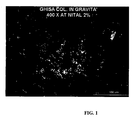
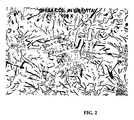
- the graphite in the castings obtained through gravity casting features greater dimensions in proximity to the external diameter in the disc's casting joint zone, where superior mechanical characteristics are necessary.
- a first drawback derives from the fact that the discs mentioned earlier feature a master pattern, as shown in figure 1, which is not uniform or homogenous and has structural differences between the zone at which the casting starts and the last zone filled, which results in non-homogeneous mechanical characteristics.
- a second drawback derives from the fact that in the structure of the discs obtained by gravity casting, the presence of ferrite may be found, this being a structural component with inferior mechanical characteristics which render the disc less resistant to load stresses.
- the aim of the present invention is essentially to overcome the drawbacks of the commonly known technique resolving the aforesaid difficulties by means of a brake disc production system and the products thereby obtained, able to realise a material structure with better stress resistance characteristics.
- a second aim of the present invention is to realise a brake disc production system and the products thereby obtained, able to feature uniform hardness in a circumferential manner and better material compactness.
- a third aim of the present invention is to have a brake disc production system and the products thereby obtained, which is able to obtain special high-resistance iron castings with extremely high heat transfer coefficients and a higher workability index.
- a still further aim of the present invention is to realise a production system which eliminates discards due to porosities, inclusions or gas bubbles.
- a still further aim of the present invention is to realise a production system which enables brake discs to be obtained from different materials (for example, steel) without modifying the patterns or the feeding system.
- a still further aim of the present invention is to have a brake disc production system which permits operation with low temperature casting, resulting in energy saving.
- a further but not final aim of the present invention is to realise a brake disc production system which is simple to manufacture and works well.
- the brake disc production system in question is essentially composed of a plurality of phases including, at first, the re-melting of the cast iron produced in the blast furnaces, which is brought to a liquid form in electric oxycombustion furnaces or cupola furnaces.
- the production system according to the present invention envisages that a metal mould, called the chill mould, is made to rotate rapidly (depending on the diameter of the casting to be obtained) and is lined with a particular siliceous type of refractory material, of a commonly known kind, to prevent the metal subsequently adhering to the mould.
- the system envisages that the liquid iron is removed from the furnace and poured into the rotating chill mould through a special opening called tap. After the introduction of the liquid iron, a chill mould cooling cycle is initiated by means of nozzles which spray water at the chill mould's external surfaces.
- the water flow can be modulated in order to obtained faster or slower cooling.
- the cooling cycle terminates when the iron casting has reached a temperature of circa 500°C, which is followed by a phase in which the casting obtained is extracted, the said casting featuring an internally hollow cylindrical configuration.
- the casting obtained is essentially a tube.
- the tube then undergoes a shot blasting phase, in which all the silica residues are cleaned off.
- each tube obtained is then checked and dispatched for a subsequent sequence of processes in which each tube is cut into "slices" thereby obtaining the single pieces, i.e. the single discs, which will then undergo mechanical working such as milling, turning and the formation of the lightening holes featured to enhance brake pad performance and eliminate the risk of the formation of a thin layer of water in the event of rain, all of which is realised according to commonly known techniques.
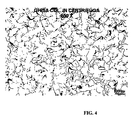
- the brake disc obtained with the production system in question that is to say, by means of spun casting, features a master pattern with an essentially homogenous conformation in which the graphite features a shorter, thinner configuration in the disc's external diameter, while in the disc's internal diameter the graphite is longer, this condition resulting in improved heat transfer, less disc wear and therefore superior performances.
- the brake disc features a master pattern for the centrifugal casting with uniform and homogenous characteristics, without the structural differences, as shown in figure 3.
- the master pattern is more compact and completely devoid of porosities, inclusions, gas bubbles and ferrite.
- the disc in question features a uniform hardness in a circumferential manner, and a uniformly compact material. Furthermore, the cast iron of which the disc is comprised is highly resistant with a high heat transfer coefficient and a higher workability index.
- the cooling phase begins, which requires less time than cooling in the gravity casting mould, resulting in a reduction in the time the chill mould is occupied by the tube before it is extracted with respect to cooling in moulds. Furthermore, the chill mould is reused countless times.
- the present invention thereby achieves the aims set.
- the brake disc production system in question is able to obtain a type A graphite which features better mechanical characteristics.
- the graphite found in the discs produced according to the system in the invention features a shorter, thinner configuration, as shown in figure 4, in particular, in the disc's external diameter, where superior mechanical characteristics are necessary, thereby dramatically reducing the possibility of the formation of fire cracks in proximity to the lightening holes since the graphite, which is an interruption in the master pattern, interferes less with the said master pattern, while in the disc's internal diameter the graphite is longer, this condition resulting in improved heat transfer, less disc wear and superior performances.
- the graphite obtained with the system in question proves extremely homogenous around the disc's circumference.
- the production system according to the present invention enables a master pattern to be obtained for the spun casting with uniform and homogenous characteristics and without the structural differences caused by the perlite with varying degrees of cell openness located between the zone at which the casting starts and the last zone filled, as occurred with the commonly known technique.
- the spun casting allows the presence of ferrite to be completely eliminated, this being a component which reduces the mechanical characteristics in general and in particular those related to traction.
- the master pattern for the spun casting enables all waste, gas bubbles and microinclusions to be eliminated since they are concentrated in the disc's internal diameter and will therefore be removed during the subsequent turning phase.
- the master pattern is more compact, completely devoid of porosities, thus enabling an improvement of the mechanical characteristics which renders the disc more durable and more resistant to wear and, in certain sectors like, for example, in racing, it permits a reduction in the disc's dimensions and masses, consequentially making the vehicle lighter.
- the production system according to the present invention has highlighted how controlled cooling and the casting type allow castings to be obtained with very different chemical analyses since the various characteristics can be optimised as desired.
- discs of this type feature an extremely high heat transfer coefficient, better mechanical characteristics with the same degree of hardness and a higher workability index than discs produced using the commonly known gravity casting technique.
- the high castability of the spun castings permits the production of a range of cast irons with particular characteristics (resistance to heat, wear and corrosion) which are difficult to obtain with traditional, gravity castings.
- austenitic cast irons which are highly resistant to heat
- nodular cast irons which feature superior mechanical characteristics
- aluminium-alloyed cast irons endowed with a low specific weight in particular, with the system in question it is possible to obtain, without any problems or needing to modify the casting equipment: austenitic cast irons, which are highly resistant to heat; nodular cast irons, which feature superior mechanical characteristics, and aluminium-alloyed cast irons endowed with a low specific weight.
- the production system proves extremely versatile and is able to offer a production with remedial mechanical characteristics since the hardness and mechanical characteristics are uniform in a circumferential manner. This condition allows greater hardness where it is required, unlike in the casting using the commonly known technique, where differences in hardness of up to 15% are noticeable in the same band and in particular in proximity to the casting joint zone.
- a further advantage of the present system derives from the fact that there is a reduction in the planarity defect of the casting, i.e. there are no more warped "saucer-shaped" discs.
- the production system eliminates all the taps and casting joints that constitute circa 15-30% of the discards in gravity founding and reduces the excess metal from working left on the casting, with a clear reduction in discards.
- the system utilises a reduction in the casting temperature which consequently enables energy saving.
- a further but not final advantage of the present invention is that it proves easy to use, simple to manufacture and works well.
Landscapes
- Engineering & Computer Science (AREA)
- Mechanical Engineering (AREA)
- Braking Arrangements (AREA)
Applications Claiming Priority (1)
| Application Number | Priority Date | Filing Date | Title |
|---|---|---|---|
| ITMN20050001 ITMN20050001A1 (it) | 2005-01-11 | 2005-01-11 | Sistema di produzione di dischi per freni e relativo prodotto ottenuto |
Publications (2)
| Publication Number | Publication Date |
|---|---|
| EP1679142A2 true EP1679142A2 (fr) | 2006-07-12 |
| EP1679142A3 EP1679142A3 (fr) | 2006-07-19 |
Family
ID=36228748
Family Applications (1)
| Application Number | Title | Priority Date | Filing Date |
|---|---|---|---|
| EP06425007A Withdrawn EP1679142A3 (fr) | 2005-01-11 | 2006-01-10 | Procédé de fabrication de disques de frein et disc de frein |
Country Status (2)
| Country | Link |
|---|---|
| EP (1) | EP1679142A3 (fr) |
| IT (1) | ITMN20050001A1 (fr) |
Cited By (3)
| Publication number | Priority date | Publication date | Assignee | Title |
|---|---|---|---|---|
| CN103691880A (zh) * | 2013-11-26 | 2014-04-02 | 湖州中联机械制造有限公司 | 一种风电铸钢件行星架的铸造方法 |
| IT201900017240A1 (it) * | 2019-09-25 | 2021-03-25 | Giampietro Abeni | Disco per freno a disco per motocicli |
| WO2022200828A1 (fr) * | 2021-03-24 | 2022-09-29 | Giampietro Abeni | Disque pour un frein à disque pour motocyclettes |
Family Cites Families (1)
| Publication number | Priority date | Publication date | Assignee | Title |
|---|---|---|---|---|
| JPS6340658A (ja) * | 1986-08-01 | 1988-02-22 | Yamaha Motor Co Ltd | ブレ−キデイスクの製造方法 |
-
2005
- 2005-01-11 IT ITMN20050001 patent/ITMN20050001A1/it unknown
-
2006
- 2006-01-10 EP EP06425007A patent/EP1679142A3/fr not_active Withdrawn
Cited By (4)
| Publication number | Priority date | Publication date | Assignee | Title |
|---|---|---|---|---|
| CN103691880A (zh) * | 2013-11-26 | 2014-04-02 | 湖州中联机械制造有限公司 | 一种风电铸钢件行星架的铸造方法 |
| CN103691880B (zh) * | 2013-11-26 | 2015-11-18 | 湖州中联机械制造有限公司 | 一种风电铸钢件行星架的铸造方法 |
| IT201900017240A1 (it) * | 2019-09-25 | 2021-03-25 | Giampietro Abeni | Disco per freno a disco per motocicli |
| WO2022200828A1 (fr) * | 2021-03-24 | 2022-09-29 | Giampietro Abeni | Disque pour un frein à disque pour motocyclettes |
Also Published As
| Publication number | Publication date |
|---|---|
| ITMN20050001A1 (it) | 2006-07-12 |
| EP1679142A3 (fr) | 2006-07-19 |
Similar Documents
| Publication | Publication Date | Title |
|---|---|---|
| US3302919A (en) | Apparatus for casting metal wheels | |
| CN112387958B (zh) | 一种超级双相不锈钢单级双吸离心泵泵壳的制造方法 | |
| CN105562644A (zh) | 一种制造高氮奥氏体不锈钢船舰用螺旋桨铸件的方法 | |
| Wei et al. | Centrifugal casting | |
| CN1068808C (zh) | 双金属磨轮的制造方法 | |
| EP1679142A2 (fr) | Procédé de fabrication de disques de frein et disc de frein | |
| CN103691887A (zh) | 一种铸态使用的高锰钢衬板的铸造工艺 | |
| US20080041499A1 (en) | Solidification microstructure of aggregate molded shaped castings | |
| JP3080582B2 (ja) | 金属鋳造方法 | |
| JPH0741370B2 (ja) | 黒鉛鋳型 | |
| US5213149A (en) | Mold and method for making variable thickness cast articles | |
| CN111468703B (zh) | 一种双液复合锤头铸造方法 | |
| CN106493300A (zh) | 一种采用熔模铸造方式进行铸件生产的方法 | |
| CN103286265A (zh) | 耐低温硬密封止回阀铸件的铸造方法 | |
| MXPA04002424A (es) | Metodo para la fabricacion de piezas fundidas, arena de moldeo y su uso para la implementacion del metodo. | |
| CN106623862A (zh) | 一种双液复合铁基双金属铸造方法 | |
| EP2341154B1 (fr) | Procédé de production de fonte nodulaire | |
| CN111893374B (zh) | 一种含石墨的贝氏体半钢精轧辊环 | |
| CN103357819A (zh) | 一种斗齿的熔模铸造方法 | |
| JP5148837B2 (ja) | 球状黒鉛鋳鉄品の製造方法 | |
| Alting et al. | Liquid Materials: Casting Processes | |
| CN104226898A (zh) | 一种斗齿的熔模铸造方法 | |
| Shruthi et al. | Productivity Improvement of Castings, Switching to Shell Mould Process from Green Sand Mould Process | |
| CN104259390B (zh) | 一种汽车发动机盖的铸造方法 | |
| Mandal | Near net shape casting through investment, die and centrifugal casting |
Legal Events
| Date | Code | Title | Description |
|---|---|---|---|
| PUAI | Public reference made under article 153(3) epc to a published international application that has entered the european phase |
Free format text: ORIGINAL CODE: 0009012 |
|
| PUAL | Search report despatched |
Free format text: ORIGINAL CODE: 0009013 |
|
| AK | Designated contracting states |
Kind code of ref document: A2 Designated state(s): AT BE BG CH CY CZ DE DK EE ES FI FR GB GR HU IE IS IT LI LT LU LV MC NL PL PT RO SE SI SK TR |
|
| AX | Request for extension of the european patent |
Extension state: AL BA HR MK YU |
|
| AK | Designated contracting states |
Kind code of ref document: A3 Designated state(s): AT BE BG CH CY CZ DE DK EE ES FI FR GB GR HU IE IS IT LI LT LU LV MC NL PL PT RO SE SI SK TR |
|
| AX | Request for extension of the european patent |
Extension state: AL BA HR MK YU |
|
| 17P | Request for examination filed |
Effective date: 20061011 |
|
| AKX | Designation fees paid |
Designated state(s): DE FR |
|
| 17Q | First examination report despatched |
Effective date: 20070321 |
|
| STAA | Information on the status of an ep patent application or granted ep patent |
Free format text: STATUS: THE APPLICATION IS DEEMED TO BE WITHDRAWN |
|
| 18D | Application deemed to be withdrawn |
Effective date: 20081028 |