EP1679180A2 - Procédé pour la connection de deux jambages - Google Patents
Procédé pour la connection de deux jambages Download PDFInfo
- Publication number
- EP1679180A2 EP1679180A2 EP05078042A EP05078042A EP1679180A2 EP 1679180 A2 EP1679180 A2 EP 1679180A2 EP 05078042 A EP05078042 A EP 05078042A EP 05078042 A EP05078042 A EP 05078042A EP 1679180 A2 EP1679180 A2 EP 1679180A2
- Authority
- EP
- European Patent Office
- Prior art keywords
- jambs
- contact surface
- mentioned
- jamb
- wall
- Prior art date
- Legal status (The legal status is an assumption and is not a legal conclusion. Google has not performed a legal analysis and makes no representation as to the accuracy of the status listed.)
- Withdrawn
Links
Images


Classifications
-
- B—PERFORMING OPERATIONS; TRANSPORTING
- B29—WORKING OF PLASTICS; WORKING OF SUBSTANCES IN A PLASTIC STATE IN GENERAL
- B29C—SHAPING OR JOINING OF PLASTICS; SHAPING OF MATERIAL IN A PLASTIC STATE, NOT OTHERWISE PROVIDED FOR; AFTER-TREATMENT OF THE SHAPED PRODUCTS, e.g. REPAIRING
- B29C66/00—General aspects of processes or apparatus for joining preformed parts
- B29C66/01—General aspects dealing with the joint area or with the area to be joined
- B29C66/32—Measures for keeping the burr form under control; Avoiding burr formation; Shaping the burr
- B29C66/324—Avoiding burr formation
-
- B—PERFORMING OPERATIONS; TRANSPORTING
- B29—WORKING OF PLASTICS; WORKING OF SUBSTANCES IN A PLASTIC STATE IN GENERAL
- B29C—SHAPING OR JOINING OF PLASTICS; SHAPING OF MATERIAL IN A PLASTIC STATE, NOT OTHERWISE PROVIDED FOR; AFTER-TREATMENT OF THE SHAPED PRODUCTS, e.g. REPAIRING
- B29C65/00—Joining or sealing of preformed parts, e.g. welding of plastics materials; Apparatus therefor
- B29C65/02—Joining or sealing of preformed parts, e.g. welding of plastics materials; Apparatus therefor by heating, with or without pressure
- B29C65/18—Joining or sealing of preformed parts, e.g. welding of plastics materials; Apparatus therefor by heating, with or without pressure using heated tools
- B29C65/20—Joining or sealing of preformed parts, e.g. welding of plastics materials; Apparatus therefor by heating, with or without pressure using heated tools with direct contact, e.g. using "mirror"
-
- B—PERFORMING OPERATIONS; TRANSPORTING
- B29—WORKING OF PLASTICS; WORKING OF SUBSTANCES IN A PLASTIC STATE IN GENERAL
- B29C—SHAPING OR JOINING OF PLASTICS; SHAPING OF MATERIAL IN A PLASTIC STATE, NOT OTHERWISE PROVIDED FOR; AFTER-TREATMENT OF THE SHAPED PRODUCTS, e.g. REPAIRING
- B29C66/00—General aspects of processes or apparatus for joining preformed parts
- B29C66/01—General aspects dealing with the joint area or with the area to be joined
- B29C66/02—Preparation of the material, in the area to be joined, prior to joining or welding
- B29C66/022—Mechanical pre-treatments, e.g. reshaping
- B29C66/0224—Mechanical pre-treatments, e.g. reshaping with removal of material
-
- B—PERFORMING OPERATIONS; TRANSPORTING
- B29—WORKING OF PLASTICS; WORKING OF SUBSTANCES IN A PLASTIC STATE IN GENERAL
- B29C—SHAPING OR JOINING OF PLASTICS; SHAPING OF MATERIAL IN A PLASTIC STATE, NOT OTHERWISE PROVIDED FOR; AFTER-TREATMENT OF THE SHAPED PRODUCTS, e.g. REPAIRING
- B29C66/00—General aspects of processes or apparatus for joining preformed parts
- B29C66/01—General aspects dealing with the joint area or with the area to be joined
- B29C66/03—After-treatments in the joint area
- B29C66/032—Mechanical after-treatments
-
- B—PERFORMING OPERATIONS; TRANSPORTING
- B29—WORKING OF PLASTICS; WORKING OF SUBSTANCES IN A PLASTIC STATE IN GENERAL
- B29C—SHAPING OR JOINING OF PLASTICS; SHAPING OF MATERIAL IN A PLASTIC STATE, NOT OTHERWISE PROVIDED FOR; AFTER-TREATMENT OF THE SHAPED PRODUCTS, e.g. REPAIRING
- B29C66/00—General aspects of processes or apparatus for joining preformed parts
- B29C66/01—General aspects dealing with the joint area or with the area to be joined
- B29C66/05—Particular design of joint configurations
- B29C66/10—Particular design of joint configurations particular design of the joint cross-sections
- B29C66/11—Joint cross-sections comprising a single joint-segment, i.e. one of the parts to be joined comprising a single joint-segment in the joint cross-section
- B29C66/112—Single lapped joints
-
- B—PERFORMING OPERATIONS; TRANSPORTING
- B29—WORKING OF PLASTICS; WORKING OF SUBSTANCES IN A PLASTIC STATE IN GENERAL
- B29C—SHAPING OR JOINING OF PLASTICS; SHAPING OF MATERIAL IN A PLASTIC STATE, NOT OTHERWISE PROVIDED FOR; AFTER-TREATMENT OF THE SHAPED PRODUCTS, e.g. REPAIRING
- B29C66/00—General aspects of processes or apparatus for joining preformed parts
- B29C66/01—General aspects dealing with the joint area or with the area to be joined
- B29C66/05—Particular design of joint configurations
- B29C66/10—Particular design of joint configurations particular design of the joint cross-sections
- B29C66/11—Joint cross-sections comprising a single joint-segment, i.e. one of the parts to be joined comprising a single joint-segment in the joint cross-section
- B29C66/114—Single butt joints
-
- B—PERFORMING OPERATIONS; TRANSPORTING
- B29—WORKING OF PLASTICS; WORKING OF SUBSTANCES IN A PLASTIC STATE IN GENERAL
- B29C—SHAPING OR JOINING OF PLASTICS; SHAPING OF MATERIAL IN A PLASTIC STATE, NOT OTHERWISE PROVIDED FOR; AFTER-TREATMENT OF THE SHAPED PRODUCTS, e.g. REPAIRING
- B29C66/00—General aspects of processes or apparatus for joining preformed parts
- B29C66/01—General aspects dealing with the joint area or with the area to be joined
- B29C66/05—Particular design of joint configurations
- B29C66/10—Particular design of joint configurations particular design of the joint cross-sections
- B29C66/11—Joint cross-sections comprising a single joint-segment, i.e. one of the parts to be joined comprising a single joint-segment in the joint cross-section
- B29C66/116—Single bevelled joints, i.e. one of the parts to be joined being bevelled in the joint area
- B29C66/1162—Single bevel to bevel joints, e.g. mitre joints
-
- B—PERFORMING OPERATIONS; TRANSPORTING
- B29—WORKING OF PLASTICS; WORKING OF SUBSTANCES IN A PLASTIC STATE IN GENERAL
- B29C—SHAPING OR JOINING OF PLASTICS; SHAPING OF MATERIAL IN A PLASTIC STATE, NOT OTHERWISE PROVIDED FOR; AFTER-TREATMENT OF THE SHAPED PRODUCTS, e.g. REPAIRING
- B29C66/00—General aspects of processes or apparatus for joining preformed parts
- B29C66/50—General aspects of joining tubular articles; General aspects of joining long products, i.e. bars or profiled elements; General aspects of joining single elements to tubular articles, hollow articles or bars; General aspects of joining several hollow-preforms to form hollow or tubular articles
- B29C66/51—Joining tubular articles, profiled elements or bars; Joining single elements to tubular articles, hollow articles or bars; Joining several hollow-preforms to form hollow or tubular articles
- B29C66/52—Joining tubular articles, bars or profiled elements
- B29C66/524—Joining profiled elements
- B29C66/5243—Joining profiled elements for forming corner connections, e.g. for making window frames or V-shaped pieces
- B29C66/52431—Joining profiled elements for forming corner connections, e.g. for making window frames or V-shaped pieces with a right angle, e.g. for making L-shaped pieces
-
- B—PERFORMING OPERATIONS; TRANSPORTING
- B29—WORKING OF PLASTICS; WORKING OF SUBSTANCES IN A PLASTIC STATE IN GENERAL
- B29C—SHAPING OR JOINING OF PLASTICS; SHAPING OF MATERIAL IN A PLASTIC STATE, NOT OTHERWISE PROVIDED FOR; AFTER-TREATMENT OF THE SHAPED PRODUCTS, e.g. REPAIRING
- B29C66/00—General aspects of processes or apparatus for joining preformed parts
- B29C66/50—General aspects of joining tubular articles; General aspects of joining long products, i.e. bars or profiled elements; General aspects of joining single elements to tubular articles, hollow articles or bars; General aspects of joining several hollow-preforms to form hollow or tubular articles
- B29C66/51—Joining tubular articles, profiled elements or bars; Joining single elements to tubular articles, hollow articles or bars; Joining several hollow-preforms to form hollow or tubular articles
- B29C66/52—Joining tubular articles, bars or profiled elements
- B29C66/524—Joining profiled elements
- B29C66/5244—Joining profiled elements for forming fork-shaped connections, e.g. for making window frames or Y-shaped pieces
- B29C66/52441—Joining profiled elements for forming fork-shaped connections, e.g. for making window frames or Y-shaped pieces with two right angles, e.g. for making T-shaped pieces
-
- B—PERFORMING OPERATIONS; TRANSPORTING
- B29—WORKING OF PLASTICS; WORKING OF SUBSTANCES IN A PLASTIC STATE IN GENERAL
- B29C—SHAPING OR JOINING OF PLASTICS; SHAPING OF MATERIAL IN A PLASTIC STATE, NOT OTHERWISE PROVIDED FOR; AFTER-TREATMENT OF THE SHAPED PRODUCTS, e.g. REPAIRING
- B29C66/00—General aspects of processes or apparatus for joining preformed parts
- B29C66/50—General aspects of joining tubular articles; General aspects of joining long products, i.e. bars or profiled elements; General aspects of joining single elements to tubular articles, hollow articles or bars; General aspects of joining several hollow-preforms to form hollow or tubular articles
- B29C66/63—Internally supporting the article during joining
- B29C66/636—Internally supporting the article during joining using a support which remains in the joined object
-
- B—PERFORMING OPERATIONS; TRANSPORTING
- B29—WORKING OF PLASTICS; WORKING OF SUBSTANCES IN A PLASTIC STATE IN GENERAL
- B29C—SHAPING OR JOINING OF PLASTICS; SHAPING OF MATERIAL IN A PLASTIC STATE, NOT OTHERWISE PROVIDED FOR; AFTER-TREATMENT OF THE SHAPED PRODUCTS, e.g. REPAIRING
- B29C66/00—General aspects of processes or apparatus for joining preformed parts
- B29C66/70—General aspects of processes or apparatus for joining preformed parts characterised by the composition, physical properties or the structure of the material of the parts to be joined; Joining with non-plastics material
- B29C66/72—General aspects of processes or apparatus for joining preformed parts characterised by the composition, physical properties or the structure of the material of the parts to be joined; Joining with non-plastics material characterised by the structure of the material of the parts to be joined
- B29C66/725—General aspects of processes or apparatus for joining preformed parts characterised by the composition, physical properties or the structure of the material of the parts to be joined; Joining with non-plastics material characterised by the structure of the material of the parts to be joined being hollow-walled or honeycombs
- B29C66/7252—General aspects of processes or apparatus for joining preformed parts characterised by the composition, physical properties or the structure of the material of the parts to be joined; Joining with non-plastics material characterised by the structure of the material of the parts to be joined being hollow-walled or honeycombs hollow-walled
- B29C66/72523—General aspects of processes or apparatus for joining preformed parts characterised by the composition, physical properties or the structure of the material of the parts to be joined; Joining with non-plastics material characterised by the structure of the material of the parts to be joined being hollow-walled or honeycombs hollow-walled multi-channelled or multi-tubular
-
- B—PERFORMING OPERATIONS; TRANSPORTING
- B29—WORKING OF PLASTICS; WORKING OF SUBSTANCES IN A PLASTIC STATE IN GENERAL
- B29C—SHAPING OR JOINING OF PLASTICS; SHAPING OF MATERIAL IN A PLASTIC STATE, NOT OTHERWISE PROVIDED FOR; AFTER-TREATMENT OF THE SHAPED PRODUCTS, e.g. REPAIRING
- B29C66/00—General aspects of processes or apparatus for joining preformed parts
- B29C66/70—General aspects of processes or apparatus for joining preformed parts characterised by the composition, physical properties or the structure of the material of the parts to be joined; Joining with non-plastics material
- B29C66/73—General aspects of processes or apparatus for joining preformed parts characterised by the composition, physical properties or the structure of the material of the parts to be joined; Joining with non-plastics material characterised by the intensive physical properties of the material of the parts to be joined, by the optical properties of the material of the parts to be joined, by the extensive physical properties of the parts to be joined, by the state of the material of the parts to be joined or by the material of the parts to be joined being a thermoplastic or a thermoset
- B29C66/739—General aspects of processes or apparatus for joining preformed parts characterised by the composition, physical properties or the structure of the material of the parts to be joined; Joining with non-plastics material characterised by the intensive physical properties of the material of the parts to be joined, by the optical properties of the material of the parts to be joined, by the extensive physical properties of the parts to be joined, by the state of the material of the parts to be joined or by the material of the parts to be joined being a thermoplastic or a thermoset characterised by the material of the parts to be joined being a thermoplastic or a thermoset
- B29C66/7392—General aspects of processes or apparatus for joining preformed parts characterised by the composition, physical properties or the structure of the material of the parts to be joined; Joining with non-plastics material characterised by the intensive physical properties of the material of the parts to be joined, by the optical properties of the material of the parts to be joined, by the extensive physical properties of the parts to be joined, by the state of the material of the parts to be joined or by the material of the parts to be joined being a thermoplastic or a thermoset characterised by the material of the parts to be joined being a thermoplastic or a thermoset characterised by the material of at least one of the parts being a thermoplastic
- B29C66/73921—General aspects of processes or apparatus for joining preformed parts characterised by the composition, physical properties or the structure of the material of the parts to be joined; Joining with non-plastics material characterised by the intensive physical properties of the material of the parts to be joined, by the optical properties of the material of the parts to be joined, by the extensive physical properties of the parts to be joined, by the state of the material of the parts to be joined or by the material of the parts to be joined being a thermoplastic or a thermoset characterised by the material of the parts to be joined being a thermoplastic or a thermoset characterised by the material of at least one of the parts being a thermoplastic characterised by the materials of both parts being thermoplastics
-
- B—PERFORMING OPERATIONS; TRANSPORTING
- B29—WORKING OF PLASTICS; WORKING OF SUBSTANCES IN A PLASTIC STATE IN GENERAL
- B29L—INDEXING SCHEME ASSOCIATED WITH SUBCLASS B29C, RELATING TO PARTICULAR ARTICLES
- B29L2031/00—Other particular articles
- B29L2031/001—Profiled members, e.g. beams, sections
- B29L2031/003—Profiled members, e.g. beams, sections having a profiled transverse cross-section
- B29L2031/005—Profiled members, e.g. beams, sections having a profiled transverse cross-section for making window frames
Definitions
- the present invention concerns a method for connecting two plastic jambs, in particular window jambs or the like.
- a disadvantage of this method is that when one or several of the side walls of the jambs have been finished with a coating of lacquer or the like, this coating of lacquer will be scorched while the contact surfaces are being heated, as a result of which, when both jambs are connected, the coating of lacquer around the weld will be scorched, whereby the original, usually white colour of the jambs becomes visible.
- a disadvantage of the present method is that a small groove is created at the weld as the scorched lacquer is cut away, which is unaesthetic. In short, the present method does not allow for a perfect finish of the connection of the two plastic jambs.
- Another disadvantage of the known method is that cutting away and manually touching up the weld is relatively time-consuming and expensive.
- the present invention aims to remedy one or several of the preceding and other disadvantages.
- the invention concerns a method for connecting two plastic jambs for a window or the like which mainly consists in heating a contact surface of at least one of both jambs and pressing it against a corresponding contact surface of the other jamb so as to weld them together whereby, before both jambs are welded, a part of the contact surface of at least one of both jambs is removed along at least one of the outer walls of this jamb over a certain distance so as to form an edge which corresponds to a joint to be realised, and whereby at least one of the jambs, before both jambs are connected, is provided with a coating of lacquer on its above-mentioned outer wall.
- An advantage of the present invention is that the above-mentioned coating of lacquer must not be heated anywhere, such that scorching of the lacquer can be avoided.
- the width of the removed part is only a fraction of the thickness of the above-mentioned outer wall.
- An advantage of the preferred method is that the stability of the formed angle joint is sufficiently large to be applied in window or door frames.
- an angle joint which can be obtained according to the preferred method can be made watertight and windproof without any additional measures being required, such as for example applying a silicone.
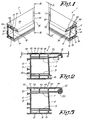
- Figure 1 schematically represents a method according to the invention for connecting two plastic jambs 1 and 2.
- Both jambs 1, 2 are built in an analogous manner and in this case have a central chamber 3 which is confined by four side walls 4, 5, 6 and 7.
- ribs 8 which are mutually connected at their free far end by an outer wall 9 of the jamb 1, 2.
- ribs 10 which are connected at their free far ends by an outer wall 11 of the jamb 1, 2.
- the latter outer wall 11 is lengthened and it is finished with a curvature 12 at its lengthened far end.
- This lengthened part of the outer wall 11 is hereby designed as a stop in a finished window or door frame.
- a finishing layer 13 such as for example a coating of lacquer.
- This coating of lacquer can have many different natures; it may be for example an epoxy polyurethane lacquer. It should be noted that the coating of lacquer 13 is represented somewhat thicker in figures 2, 4 and 5, for clarity's sake.
- both jambs are mitred at their far ends to be connected by means of cutting, whereby these far ends form the mutual contact surfaces 14, 15 respectively for connecting both jambs 1, 2.
- a part of the contact surface 14 is removed over a certain distance A so as to form an edge 16.
- a part of the contact surface 15 of the other jamb 2 is removed over a distance A in an analogous manner so as to form an edge 17.
- the above-mentioned distance A is preferably in the order of magnitude of 3 mm, but it can strongly vary as a function of the materials used, the aimed strength of the connection and the like.
- the width B of the part of the contact surfaces 14 and 15 which is removed represents a fraction of the thickness D of the outer wall 11 concerned.
- the remaining parts of the contact surfaces 14, 15 are heated to the melting temperature, after which the contact surfaces 14, 15 are pressed together.
- the heated contact surfaces 14, 15 melt together, whereby an appropriate pressure must be exerted to make both contact surfaces 14 and 15 melt together over a distance, which distance is preferably equal to or practically equal to the above-mentioned distance A.
- This removal of a part of the sealing 20 prevents the sealing 20, which is usually made of rubber, from curing while the jambs 1 and 2 are welded together, such that the sealing 20 can maintain its optimal elasticity.
- Figure 6 represents a variant whereby an insert angle 21 is applied which makes it possible to reinforce the connection between both jambs 1 and 2.
- this insert angle 21 consists of two legs 22, 23 which are made of plastic and which are mitred, either cut or sawn.
- the above-mentioned legs 22, 23 can also be formed by means of injection-moulding.
- the method for connecting the two jambs 1 and 2 with the use of the insert angle 21 consists in fixing, before both jambs 1 and 2 are connected, one of the above-mentioned legs 22, 23 in each of said jambs 1-2 by means of welding, gluing or the like, such that the mitred sides of these legs 22 and 23 are situated in one and the same plane or practically the same plane as the above-mentioned contact surfaces 14, 15 of the jambs 1 and 2.
- both jambs 1 and 2 are welded together, whereby the mitred sides of both legs 22 and 23 are welded together as well so as to form the above-mentioned insert angle 21.
- legs 22 and 23 must not necessarily be provided in a central chamber 3 of the jambs 1 and 2, but are preferably provided in chambers 19 which are situated at the removed part of the jambs 1 and 2.
- the edge 8 of the second jamb 2 coincides with the contact surface 15 of this jamb 2.
- figure 7 represents a variant whereby both jambs 1-2 are connected in the shape of a T-connection 24.
- the first jamb 1 is fixed with one of its far ends to a side wall 4 of the second jamb 2, to which end the contact surface 14 of the first jamb 1 is partly removed along at least one outer wall 11 of this jamb 1.
- the contact surface 15 of the second jamb 2 is in this case formed of a part of the above-mentioned side wall 4, out of which no part has to be removed, but which part, in case the side wall 4 is adjacent to one or two side walls 9, 11 which are provided with a coating of lacquer 13, only has to be partly heated, in particular over a surface which preferably corresponds to the remaining contact surface 14 of the first jamb 1.
- edges 16-17 of at least one of two jambs 1-2 to be connected can be partly heated briefly, whereby when both jambs 1-2 are welded together, the edges 16-17 of both jambs partly melt together.
- the present invention is by no means limited to the above-described method represented in the figures; on the contrary, such a method according to the invention for connecting two plastic jambs can be made according to different variants while still remaining within the scope of the invention.
Landscapes
- Engineering & Computer Science (AREA)
- Mechanical Engineering (AREA)
- Lining Or Joining Of Plastics Or The Like (AREA)
- Wing Frames And Configurations (AREA)
- Joining Of Corner Units Of Frames Or Wings (AREA)
Applications Claiming Priority (1)
| Application Number | Priority Date | Filing Date | Title |
|---|---|---|---|
| BE200500012A BE1016401A3 (nl) | 2005-01-11 | 2005-01-11 | Werkwijze voor het verbinden van twee kunststofprofielen. |
Publications (2)
| Publication Number | Publication Date |
|---|---|
| EP1679180A2 true EP1679180A2 (fr) | 2006-07-12 |
| EP1679180A3 EP1679180A3 (fr) | 2007-03-28 |
Family
ID=34974771
Family Applications (1)
| Application Number | Title | Priority Date | Filing Date |
|---|---|---|---|
| EP20050078042 Withdrawn EP1679180A3 (fr) | 2005-01-11 | 2005-12-29 | Procédé pour la connection de deux jambages |
Country Status (2)
| Country | Link |
|---|---|
| EP (1) | EP1679180A3 (fr) |
| BE (1) | BE1016401A3 (fr) |
Cited By (4)
| Publication number | Priority date | Publication date | Assignee | Title |
|---|---|---|---|---|
| ITMO20120057A1 (it) * | 2012-03-07 | 2013-09-08 | Graf Synergy Srl | "metodo e dispositivo per la saldatura di profilati in materiale plastico, in particolare pvc" |
| ITMO20120200A1 (it) * | 2012-08-20 | 2014-02-21 | Graf Synergy Srl | Metodo per la saldatura di profilati in materiale plastico, in particolare pvc |
| EP3275633A1 (fr) * | 2016-07-29 | 2018-01-31 | Urban GmbH & Co. Maschinenbau KG | Procédé de soudage de barres profilées |
| PL422594A1 (pl) * | 2017-08-21 | 2019-02-25 | Fimtec-Polska Spółka Z Ograniczoną Odpowiedzialnością Spółka Komandytowa | Sposób wytwarzania okien z tworzywa sztucznego |
Family Cites Families (8)
| Publication number | Priority date | Publication date | Assignee | Title |
|---|---|---|---|---|
| DE2923453A1 (de) * | 1979-06-09 | 1980-12-11 | Besler Armin | Verfahren zum verschweissen stossender kunststoff-hohlprofile |
| DE2923935A1 (de) * | 1979-06-13 | 1980-12-18 | Besler Armin | Verfahren zum verschweissen stossender kunststoff-hohlprofile |
| DE3039733A1 (de) * | 1980-10-21 | 1982-05-19 | Gebrüder Kömmerling Kunststoffwerke GmbH, 6780 Pirmasens | Verfahren zum stumpfverschweissen von thermoplastischen kunststoff-hohlprofilstaeben und vorrichtung zu dessen durchfuehrung |
| JP2540218B2 (ja) * | 1989-12-05 | 1996-10-02 | フクビ化学工業株式会社 | 合成樹脂製窓枠およびその製造方法 |
| US5603585A (en) * | 1994-05-17 | 1997-02-18 | Andersen Corporation | Joint structure and method of manufacture |
| GB9724909D0 (en) * | 1997-11-25 | 1998-01-28 | Rehau Ltd | Welding method |
| AT410066B (de) * | 2000-05-09 | 2003-01-27 | Lisec Peter | Verfahren zum verbinden von hohlprofilleisten durch schweissen |
| GB2376656A (en) * | 2001-06-21 | 2002-12-24 | Gti Kombimatec Machines Ltd | Removing notches from the weld face areas of components, to locally reduce waste sprue produced during thermal bonding, apparatus, method & preparation |
-
2005
- 2005-01-11 BE BE200500012A patent/BE1016401A3/nl not_active IP Right Cessation
- 2005-12-29 EP EP20050078042 patent/EP1679180A3/fr not_active Withdrawn
Cited By (5)
| Publication number | Priority date | Publication date | Assignee | Title |
|---|---|---|---|---|
| ITMO20120057A1 (it) * | 2012-03-07 | 2013-09-08 | Graf Synergy Srl | "metodo e dispositivo per la saldatura di profilati in materiale plastico, in particolare pvc" |
| ITMO20120200A1 (it) * | 2012-08-20 | 2014-02-21 | Graf Synergy Srl | Metodo per la saldatura di profilati in materiale plastico, in particolare pvc |
| EP3275633A1 (fr) * | 2016-07-29 | 2018-01-31 | Urban GmbH & Co. Maschinenbau KG | Procédé de soudage de barres profilées |
| EP4520510A1 (fr) * | 2016-07-29 | 2025-03-12 | Urban GmbH & Co. Maschinenbau KG | Procede de soudage de barres profilees |
| PL422594A1 (pl) * | 2017-08-21 | 2019-02-25 | Fimtec-Polska Spółka Z Ograniczoną Odpowiedzialnością Spółka Komandytowa | Sposób wytwarzania okien z tworzywa sztucznego |
Also Published As
| Publication number | Publication date |
|---|---|
| BE1016401A3 (nl) | 2006-10-03 |
| EP1679180A3 (fr) | 2007-03-28 |
Similar Documents
| Publication | Publication Date | Title |
|---|---|---|
| US4492063A (en) | Extruded plastics material hollow profiled strip for window frames, window frames produced from this type of profiled strips and method for the production of a window frame of this type | |
| CA2202046C (fr) | Structure d'assemblage et son procede de production | |
| US4481701A (en) | Cored plastics profiles and manufacture of frames for windows and the like therefrom | |
| US5157885A (en) | Door leaf or casing frame and process for its manufacture | |
| MXPA04006825A (es) | Cuna de esquina para conectar perfiles juntos y ensambles del armazon. | |
| KR100437917B1 (ko) | 만곡 중공 형재 세장편 제조 방법 | |
| US20020091218A1 (en) | Thermoplastic door skins and method of manufacture thereof | |
| EP1679180A2 (fr) | Procédé pour la connection de deux jambages | |
| US20080060314A1 (en) | Corner joint for pultruded window frame | |
| US20060272275A1 (en) | Method for the production of a furniture body | |
| EP2085558B1 (fr) | Procédé de fabrication d'un boîtier, d'une fenêtre ou d'une porte en plastique | |
| GB2127742A (en) | Method of shaping a laminated product | |
| US6467219B1 (en) | Shutter rail to stile joint | |
| JPH11325010A5 (fr) | ||
| GB2026125A (en) | Joint forming | |
| EP0907000A1 (fr) | Assemblage de structure de plaque de porte en partie creuse et munie de vitre | |
| WO2011116436A2 (fr) | Procédé d'assemblage de deux éléments et élément approprié pour être utilisé dans ledit procédé | |
| KR101896749B1 (ko) | 복합 소재 창호 제조방법 | |
| EP0235442B1 (fr) | Ensemble de cadre utilisable en construction et son procédé d'assemblage | |
| KR102712956B1 (ko) | 내구성이 개선된 가구용 도어패널의 제조방법 | |
| CN111219123A (zh) | 复合材料窗的制造方法 | |
| AU532869B2 (en) | Cored plastics profiles and manufacture of frames for windowsand tje like therefrom | |
| GB2101658A (en) | Laminated door | |
| US20140311688A1 (en) | Clad slat | |
| JPH08100570A (ja) | 飾り縁材及び飾り縁材製造法 |
Legal Events
| Date | Code | Title | Description |
|---|---|---|---|
| PUAI | Public reference made under article 153(3) epc to a published international application that has entered the european phase |
Free format text: ORIGINAL CODE: 0009012 |
|
| AK | Designated contracting states |
Kind code of ref document: A2 Designated state(s): AT BE BG CH CY CZ DE DK EE ES FI FR GB GR HU IE IS IT LI LT LU LV MC NL PL PT RO SE SI SK TR |
|
| AX | Request for extension of the european patent |
Extension state: AL BA HR MK YU |
|
| PUAL | Search report despatched |
Free format text: ORIGINAL CODE: 0009013 |
|
| AK | Designated contracting states |
Kind code of ref document: A3 Designated state(s): AT BE BG CH CY CZ DE DK EE ES FI FR GB GR HU IE IS IT LI LT LU LV MC NL PL PT RO SE SI SK TR |
|
| AX | Request for extension of the european patent |
Extension state: AL BA HR MK YU |
|
| 17P | Request for examination filed |
Effective date: 20070731 |
|
| AKX | Designation fees paid |
Designated state(s): AT BE BG CH CY CZ DE DK EE ES FI FR GB GR HU IE IS IT LI LT LU LV MC NL PL PT RO SE SI SK TR |
|
| 17Q | First examination report despatched |
Effective date: 20081014 |
|
| STAA | Information on the status of an ep patent application or granted ep patent |
Free format text: STATUS: THE APPLICATION IS DEEMED TO BE WITHDRAWN |
|
| 18D | Application deemed to be withdrawn |
Effective date: 20090225 |