EP1679395B1 - Procede de tricotage d'un tissu tricote tubulaire a partie saillante - Google Patents
Procede de tricotage d'un tissu tricote tubulaire a partie saillante Download PDFInfo
- Publication number
- EP1679395B1 EP1679395B1 EP04792135.8A EP04792135A EP1679395B1 EP 1679395 B1 EP1679395 B1 EP 1679395B1 EP 04792135 A EP04792135 A EP 04792135A EP 1679395 B1 EP1679395 B1 EP 1679395B1
- Authority
- EP
- European Patent Office
- Prior art keywords
- knitting
- knitted fabric
- tubular
- projection part
- projections
- Prior art date
- Legal status (The legal status is an assumption and is not a legal conclusion. Google has not performed a legal analysis and makes no representation as to the accuracy of the status listed.)
- Expired - Lifetime
Links
- 238000009940 knitting Methods 0.000 title claims description 105
- 239000004744 fabric Substances 0.000 title claims description 72
- 238000000034 method Methods 0.000 title claims description 37
- 230000000694 effects Effects 0.000 description 10
- 210000003127 knee Anatomy 0.000 description 5
- 238000009958 sewing Methods 0.000 description 4
- 239000004677 Nylon Substances 0.000 description 1
- 230000015572 biosynthetic process Effects 0.000 description 1
- 229920001778 nylon Polymers 0.000 description 1
- 230000002747 voluntary effect Effects 0.000 description 1
Images

Classifications
-
- D—TEXTILES; PAPER
- D04—BRAIDING; LACE-MAKING; KNITTING; TRIMMINGS; NON-WOVEN FABRICS
- D04B—KNITTING
- D04B1/00—Weft knitting processes for the production of fabrics or articles not dependent on the use of particular machines; Fabrics or articles defined by such processes
- D04B1/22—Weft knitting processes for the production of fabrics or articles not dependent on the use of particular machines; Fabrics or articles defined by such processes specially adapted for knitting goods of particular configuration
- D04B1/24—Weft knitting processes for the production of fabrics or articles not dependent on the use of particular machines; Fabrics or articles defined by such processes specially adapted for knitting goods of particular configuration wearing apparel
-
- D—TEXTILES; PAPER
- D04—BRAIDING; LACE-MAKING; KNITTING; TRIMMINGS; NON-WOVEN FABRICS
- D04B—KNITTING
- D04B1/00—Weft knitting processes for the production of fabrics or articles not dependent on the use of particular machines; Fabrics or articles defined by such processes
- D04B1/22—Weft knitting processes for the production of fabrics or articles not dependent on the use of particular machines; Fabrics or articles defined by such processes specially adapted for knitting goods of particular configuration
- D04B1/24—Weft knitting processes for the production of fabrics or articles not dependent on the use of particular machines; Fabrics or articles defined by such processes specially adapted for knitting goods of particular configuration wearing apparel
- D04B1/26—Weft knitting processes for the production of fabrics or articles not dependent on the use of particular machines; Fabrics or articles defined by such processes specially adapted for knitting goods of particular configuration wearing apparel stockings
-
- D—TEXTILES; PAPER
- D04—BRAIDING; LACE-MAKING; KNITTING; TRIMMINGS; NON-WOVEN FABRICS
- D04B—KNITTING
- D04B1/00—Weft knitting processes for the production of fabrics or articles not dependent on the use of particular machines; Fabrics or articles defined by such processes
- D04B1/10—Patterned fabrics or articles
- D04B1/102—Patterned fabrics or articles with stitch pattern
- D04B1/108—Gussets, e.g. pouches or heel or toe portions
-
- D—TEXTILES; PAPER
- D04—BRAIDING; LACE-MAKING; KNITTING; TRIMMINGS; NON-WOVEN FABRICS
- D04B—KNITTING
- D04B1/00—Weft knitting processes for the production of fabrics or articles not dependent on the use of particular machines; Fabrics or articles defined by such processes
- D04B1/14—Other fabrics or articles characterised primarily by the use of particular thread materials
- D04B1/18—Other fabrics or articles characterised primarily by the use of particular thread materials elastic threads
-
- D—TEXTILES; PAPER
- D10—INDEXING SCHEME ASSOCIATED WITH SUBLASSES OF SECTION D, RELATING TO TEXTILES
- D10B—INDEXING SCHEME ASSOCIATED WITH SUBLASSES OF SECTION D, RELATING TO TEXTILES
- D10B2403/00—Details of fabric structure established in the fabric forming process
- D10B2403/01—Surface features
- D10B2403/011—Dissimilar front and back faces
- D10B2403/0113—One surface including hollow piping or integrated straps, e.g. for inserts or mountings
-
- D—TEXTILES; PAPER
- D10—INDEXING SCHEME ASSOCIATED WITH SUBLASSES OF SECTION D, RELATING TO TEXTILES
- D10B—INDEXING SCHEME ASSOCIATED WITH SUBLASSES OF SECTION D, RELATING TO TEXTILES
- D10B2403/00—Details of fabric structure established in the fabric forming process
- D10B2403/01—Surface features
- D10B2403/012—Alike front and back faces
- D10B2403/0123—Both surfaces including hollow piping or integrated straps, e.g. for inserts or mountings
-
- D—TEXTILES; PAPER
- D10—INDEXING SCHEME ASSOCIATED WITH SUBLASSES OF SECTION D, RELATING TO TEXTILES
- D10B—INDEXING SCHEME ASSOCIATED WITH SUBLASSES OF SECTION D, RELATING TO TEXTILES
- D10B2403/00—Details of fabric structure established in the fabric forming process
- D10B2403/02—Cross-sectional features
- D10B2403/023—Fabric with at least two, predominantly unlinked, knitted or woven plies interlaced with each other at spaced locations or linked to a common internal co-extensive yarn system
- D10B2403/0231—Fabric with at least two, predominantly unlinked, knitted or woven plies interlaced with each other at spaced locations or linked to a common internal co-extensive yarn system including contracting yarn, e.g. blister fabrics
-
- D—TEXTILES; PAPER
- D10—INDEXING SCHEME ASSOCIATED WITH SUBLASSES OF SECTION D, RELATING TO TEXTILES
- D10B—INDEXING SCHEME ASSOCIATED WITH SUBLASSES OF SECTION D, RELATING TO TEXTILES
- D10B2509/00—Medical; Hygiene
- D10B2509/02—Bandages, dressings or absorbent pads
- D10B2509/028—Elastic support stockings or elastic bandages
Definitions
- the present invention relates to a knitting method of a tubular knitted fabric with projections, such as a sock, a supporter, and the like, using a flat knitting machine, and to a tubular knitted fabric knitted by the same knitting method.
- Elastic underwear having stretch and having a capability of providing a massage effect on a human body is known ( JP 2003-13341 ).
- a plain knitted fabric part is knitted as a base knitted fabric part and an elastic yarn is weaved in it by the inlay,.
- a so-called float knitted fabric part is mixed wherein wales are produced by putting knitting needles in an operative mode to successively form loops in the wales and wales of various sizes are produced by putting the knitting needles in an inoperative mode for a predetermined course, not to form loops of the wales for the predetermined course.
- any of the knitted fabrics mentioned above includes the plain knitted fabric part as the base knitted fabric part, even when the elastic yarn is weaved in the plain knitted fabric part by the inlay, it is hard for such a knitted fabric to provide a high supporting performance.
- the projection forming part is knitted with the knitting needles selectively put in the operative mode or in the inoperative mode during the formation of a course circularly knitted.
- the knitting of the projection forming part is integrally included in the process of knitting a tubular knitted fabric, so that the knitting process of the tubular knitted fabric and the knitting process of the projection forming part are not separated from each other.
- this knitting is sometimes subjected to various restrictions when the projection forming part is formed at an arbitrary location on the knitted fabric and in an arbitrary shape.
- the knitting method wherein the projection part is separately formed and then is attached in the knitted fabric by sewing or patching at a later stage requires complicated works at the later stage and thus high production costs.
- the present invention has been made. It is an object of the present invention to provide a knitting method of a tubular knitted fabric with a projection part which has stretch and a supporting performance and can be formed at an arbitrary location and in an arbitrary shape, and a tubular knitted fabric knitted by the same method.
- the present invention provides a knitting method of a tubular knitted fabric with a projection part having stretch and a supporting performance by using a flat knitting machine having at least a pair of front and back needle beds extending in a traverse direction and disposed opposite to each other in a cross direction, at least either of which is capable of being racked in the traverse direction so that loops can be transferred between the front and back needle beds, the method comprising:
- the tubular body and the projection part are knitted using an elastic yarn.
- the knitting method of a tubular knitted fabric of the present invention can knit a knitted fabric which requires stretch and a supporting performance, such as e.g. a supporter, in the form of a seamless tubular body by using a flat knitting machine. Further, it can allow the projection part to be formed at an arbitrary location on a knitted fabric surface of the tubular body. Hence, when one puts on such a tubular knitted fabric, the tubular knitted fabric having the projection part can provide an improved massage effect, anti-slip effect, and impact absorbing effect for one's body. Also, since the knitted fabric is knitted in the form of a seamless tubular body, the need for a sewing process can be eliminated.
- the projection part is knitted in parallel with the tubular body, the need for the process that the projection part to provide the effects mentioned above is previously formed as a separate part and the projection part is attached to the knitted fabric by sewing or patching can be eliminated to provide laborsaving.
- the tubular body is designed as the rib knitting structure and also an elastic yarn is inserted in that tubular body by the inlay, the tubular body can obtain required stretch and supporting performances.
- the knitting can be carried out with efficiency as a whole.
- the knitting of the tubular base knitted fabric and the knitting of the projection part are carried out by the independent processes, respectively, the knitting of the projection part can be carried out with a high design freedom.
- the tubular body having the projection part can be produced with further improved stretch and supporting performances.
- the projection part can be formed with efficiency by the flechage knitting and can be formed in an arbitrary shape and at an arbitrary location on the tubular knitted fabric.
- the knitted fabric such as a heel supporter and a knee supporter
- the tubular body comes to have courses different in number of stitches.
- the projections can be arranged in even such a location.
- the knitting can also be carried out using a four-bed knitting machine comprising an upper front needle bed, a lower front needle bed, an upper back needle bed, and a lower back needle bed.
- a yarn feeder Y1 is used to feed to needles an elastic yarn for the inlay knitting
- yarn feeders Y2 and Y3 are used to feed to needles a stretch wooly nylon for the knitting of the rib jacquard structure.
- an elastic yarn feeding device is additionally provided in the flat knitting machine so that the elastic yarn for the inlay knitting can be fed in the tensed state.
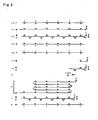
- Step 1 shows the state in which loops of the front knitted fabric 3 and loops of the back knitted fabric 5 are held on the front and back needle beds, respectively, when a tubular knitted fabric is knitted using a two-bed flat knitting machine in such a manner that the two-color rib jacquard structure is knitted on an every four needle basis.
- Loops b, f, j, n, r, v held on the front needle bed are transferred to knitting needles B, F, J, N, R, V of the back needle bed (Step 2).
- the elastic yarn of the yarn feeder Y1 is fed by the inlay. Sequentially, the rib knitting is performed on an every four needle basis using the yarn feeder Y2 (Step 3).
- Loops are formed with knitting needles B, F, J, N, R, V of the back needle bed, using the yarn feeder Y3 (Step 4). Then, those loops are transferred back to the knitting needles b, f, j, n, r, v of the front needle bed (Step 5).
- the base knitted fabric of the two-color rib jacquard structure is knitted by repeating the above-said steps 2 to 5 a prescribed number of times.
- the elastic yarn of the yarn feeder Y1 is fed by the inlay, followed by the rib knitting on an every two or more needle basis using the yarn feeder Y2 (Step 7).
- Loops are formed with the knitting needles B, F, J, N, R, of the back needle bed, using the yarn feeder Y3. Thereafter, a flechage knitting is performed a prescribed number of times, using the needles F, J, N, R (Step 8). It is needless to say that as the number of times the flechage knitting is performed increases, the rows of projections increase in height, and as the knitting width within which the flechage knitting is performed increases, the rows of projections increase in width.
- the yarn feeders Y1, Y2, and Y3 are kicked back to the inside of the knitted fabric (Step 9). Thereafter, the elastic yarn of the yarn feeder Y1 is fed by the inlay, followed by the rib knitting on an every two or more needle basis using the knitting needles t,V (Step 10).
- a loop is formed with the knitting needle V of the back needle bed, using the yarn feeder Y3 (Step 11). Then, the loops B, F, J, N, R, V held on the back needle bed are transferred back to the knitting needles b, f, j, n, r, v of the front needle bed (Step 12).
- the loops b, f, j, n, r, v held on the front needle bed are transferred to knitting needles B, F, J, N, R, V of the back needle bed (Step 13).
- the elastic yarn of the yarn feeder Y1 is fed by the inlay, followed by the rib knitting on an every two or more basis using the yarn feeder Y2 (Step 14).
- Loops are formed with the knitting needles B, F, J, N, R, V of the back needle bed, using the yarn feeder Y3 (Step 15). Then, those loops are transferred back to the knitting needles b, f, j, n, r, v of the front needle bed (Step 16).
- a row of projections 7a is formed on the inside of the front knitted fabric 3 of the tubular knitted fabric by the knitting process from Step 6 to Step 16 described above.
- rows of projections 7b to 7n are formed sequentially and thereby the projection part 7 comprising a group of rows of projections is formed.
- a knitting process from Step 2 to Step 5 may be inserted in the knitting process described above.
- Step 2 to Step 5 After completion of the knitting of the projection part 7, the knitting process from Step 2 to Step 5 is repeated again to knit the base knitted fabric of the two-color rib jacquard structure.
- the supporter 1 is knitted in the manner described above.
- the projection part is formed to have repeated rows of projections of equal in width and height.
- the projection part may be formed by voluntary combination of the rows of projections of widths varied and those of heights varied by changing the number of times the flechage knitting is carried out.
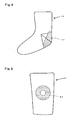
- FIG. 4 shows an impact-absorbing heel supporter 11.
- a heel part of the base knitted fabric is formed in a shape corresponding to the heel by the flechage knitting.
- a projection part 17 comprising various rows of projections of different lengths is arranged in the tubular knitted fabric to extend over the front and back knitted fabrics of the heel part.
- the knitting process from Step 6 to Step 16 may proceed in any selective area on the tubular knitted fabric.
- the projection part can be formed in a doughnut shape in an area of the supporter contacting with the joint of elbow or heel.
- the projection part may be arranged in, for example, a staggered pattern or a checkered pattern, in addition to in the doughnut shape.
- FIG. 5 shows a knee supporter 21 having a doughnut-shaped projection part and a base knitted fabric part formed in a center of the doughnut-shaped projection part.
- the rows of projections varied in height in a widthwise direction thereof can be formed when the knitting width is gradually reduced every time that the flechage knitting is carried out.
- an area where projections are formed and an area where no projections are formed may be mixed in a row of projections by the needles used for forming loops and the needles used for forming no loops being arranged correspondingly.
- the projection part in a doughnut shape, a staggered pattern, or a checkered pattern can also be obtained in this manner.
- the rows of projections are formed on the inside surface of the front knitted fabric using the knitting needles F, J, N, R of the back needle bed.
- the yarn is fed to the knitting needles f, j, n, r of the front needle bed in Step 8, to form the rows of projections with those knitting needles.
- the projection part may be formed on both the inside surface and the outside surface of the front knitted fabric.
- the rows of projections may be formed in the projection parts, respectively, using the knitting needles on the respective needle beds on the respective sides on which the respective projection parts are wanted to be formed.
- the projection part on the inside surface and the projection part on the outside surface are formed at corresponding locations, that may be accomplished by the process that a row of projections on one side is knitted, then, at least one course of the base knitted fabric is knitted, and then a row of projections on the other side is knitted, these knitting process being repeatedly carried out, to form the projection parts.
- a row of projections is formed on the inside surface using, for example, the needles F, N and a row of projections is formed on the outside surface using, for example, the needles j, r
- the respective rows of projections are held using the knitting needles holding loops of the base knitted fabric.
- the rows of projections on the inside surface and the rows of projections on the outside surface can be formed simultaneously by the manner mentioned above.
- the tubular knitted fabric having the projection part of the present invention having stretch and a supporting performance, is widely applicable to various supporters, including, for example, a massage-use supporter, a medical-use supporter, and a sport-use supporter.
Landscapes
- Engineering & Computer Science (AREA)
- Textile Engineering (AREA)
- Knitting Of Fabric (AREA)
- Professional, Industrial, Or Sporting Protective Garments (AREA)
Claims (2)
- Procédé pour tricoter un tricot tubulaire ayant une partie saillante (7) ayant une extensibilité et une capacité de soutien en utilisant une machine à tricoter à plat comportant au moins une paire de fontures avant et arrière s'étendant dans une direction transversale et disposées face à face dans une direction croisée, au moins l'une d'entre elles pouvant être déplacée dans la direction transversale afin que des boucles puissent être transférées entre les fontures avant et arrière, le procédé comprenant :une étape 1 consistant à tricoter un tricot de forme tubulaire joint aux deux extrémités d'une largeur de tricotage par un tricotage à côtes, tout en insérant un fil élastique dans le corps tubulaire par une incrustation, etune étape 2 consistant à tricoter seulement une partie de la partie saillante (7) à former sur au moins l'un ou l'autre d'un côté avant et d'un côté arrière du tricot tubulaire par un tricotage à fléchage,l'étape 1 et l'étape 2 étant effectuées de façon répétée.
- Procédé de tricotage du tricot tubulaire selon la revendication 1, dans lequel le corps tubulaire et la partie saillante (7) sont tricotées en utilisant un fil élastique.
Applications Claiming Priority (2)
| Application Number | Priority Date | Filing Date | Title |
|---|---|---|---|
| JP2003353019A JP4353765B2 (ja) | 2003-10-10 | 2003-10-10 | 突起部を有する筒状編地の編成方法および突起部を有する筒状編地。 |
| PCT/JP2004/014838 WO2005035848A1 (fr) | 2003-10-10 | 2004-10-07 | Procede de tricotage d'un tissu tricote tubulaire a partie saillante et tissu tricote tubulaire a partie saillante obtenu |
Publications (3)
| Publication Number | Publication Date |
|---|---|
| EP1679395A1 EP1679395A1 (fr) | 2006-07-12 |
| EP1679395A4 EP1679395A4 (fr) | 2007-02-28 |
| EP1679395B1 true EP1679395B1 (fr) | 2013-05-15 |
Family
ID=34431145
Family Applications (1)
| Application Number | Title | Priority Date | Filing Date |
|---|---|---|---|
| EP04792135.8A Expired - Lifetime EP1679395B1 (fr) | 2003-10-10 | 2004-10-07 | Procede de tricotage d'un tissu tricote tubulaire a partie saillante |
Country Status (6)
| Country | Link |
|---|---|
| US (1) | US7263860B2 (fr) |
| EP (1) | EP1679395B1 (fr) |
| JP (1) | JP4353765B2 (fr) |
| KR (1) | KR101025164B1 (fr) |
| CN (1) | CN100476051C (fr) |
| WO (1) | WO2005035848A1 (fr) |
Cited By (1)
| Publication number | Priority date | Publication date | Assignee | Title |
|---|---|---|---|---|
| EP4077783B1 (fr) * | 2019-12-16 | 2024-07-03 | Pure Medical, Inc. | Vêtements de compression fabriqués à partir d'un tricot matelassé |
Families Citing this family (16)
| Publication number | Priority date | Publication date | Assignee | Title |
|---|---|---|---|---|
| EP2157220B1 (fr) * | 2007-05-01 | 2015-04-15 | Shima Seiki Mfg., Ltd | Procédé de tricotage pour un tissu tricoté tubulaire et tissu tricoté tubulaire |
| JP5596014B2 (ja) * | 2009-02-25 | 2014-09-24 | 株式会社島精機製作所 | 筒状編地およびその編成方法 |
| JP5618742B2 (ja) * | 2010-10-04 | 2014-11-05 | 株式会社島精機製作所 | 立体編地の編成方法、および立体編地 |
| JP5800536B2 (ja) * | 2011-03-09 | 2015-10-28 | 株式会社島精機製作所 | 編地の編成方法、および編地 |
| DE102012004150A1 (de) * | 2012-02-28 | 2013-08-29 | Bauerfeind Ag | Maschenware mit unterschiedlichen Zonen im Kraft-Dehnungsverhalten |
| KR101648753B1 (ko) * | 2012-09-25 | 2016-08-17 | 가부시키가이샤 시마세이키 세이사쿠쇼 | 풋웨어 및 풋웨어의 편성방법 |
| JP5955197B2 (ja) * | 2012-10-31 | 2016-07-20 | 株式会社島精機製作所 | 編地の編成方法 |
| JP6084041B2 (ja) * | 2013-01-10 | 2017-02-22 | 株式会社島精機製作所 | 編物基材の形成方法、編物基材、および繊維強化プラスチック |
| TWI596249B (zh) * | 2013-04-04 | 2017-08-21 | 島精機製作所股份有限公司 | 鞋襪類之編織方法 |
| KR101824534B1 (ko) * | 2013-04-15 | 2018-02-01 | 가부시키가이샤 시마세이키 세이사쿠쇼 | 슈즈 어퍼의 제조방법 및 슈즈 어퍼 |
| CN103320959A (zh) * | 2013-06-08 | 2013-09-25 | 宁波三同编织有限公司 | 泡泡面料 |
| JP6292914B2 (ja) * | 2014-02-12 | 2018-03-14 | 株式会社島精機製作所 | 筒状編地の編成方法 |
| FR3033577B1 (fr) * | 2015-03-09 | 2017-04-07 | Simp Soc Ind De Materiel Paramedical | Methode de fabrication d'un tricot a mailles cueillies, tricot a mailles cueillies et article incluant un tel tricot |
| EP3699342B1 (fr) * | 2019-02-22 | 2021-11-17 | medi GmbH & Co. KG | Procédé de fabrication d'une pièce tricotée ainsi que pièce tricotée |
| JP7233330B2 (ja) * | 2019-07-22 | 2023-03-06 | 株式会社島精機製作所 | 袋状編地の編成方法、及び袋状編地 |
| JP7515289B2 (ja) * | 2020-04-20 | 2024-07-12 | 株式会社島精機製作所 | 手袋および手袋の編成方法 |
Family Cites Families (15)
| Publication number | Priority date | Publication date | Assignee | Title |
|---|---|---|---|---|
| US1201554A (en) * | 1913-05-07 | 1916-10-17 | Dixie Cotton Felt Mattress Company | Pillow. |
| US3061334A (en) * | 1959-12-11 | 1962-10-30 | Int Harvester Co | Coupler mechanism |
| JPH01201554A (ja) | 1988-02-04 | 1989-08-14 | Aimu:Kk | 柄編地の裏面にパイルループを編み込んだ添え糸編み方法とこれを使用したサポータ |
| GB2233989B (en) * | 1989-07-11 | 1993-12-01 | Courtaulds Plc | Structured knitted fabrics |
| JPH0361334U (fr) * | 1989-10-17 | 1991-06-17 | ||
| JP3009854B2 (ja) | 1996-11-11 | 2000-02-14 | ニットグローブ株式会社 | 筒状立体編み地及びその編成方法 |
| DE19743074A1 (de) * | 1997-09-30 | 1999-04-01 | Stoll & Co H | Gestrick mit mehreren, im fortlaufenden Strickprozeß ineinander übergehenden räumlichen Strukturen |
| JP3523501B2 (ja) * | 1998-09-25 | 2004-04-26 | 株式会社島精機製作所 | インレイ編地編成方法およびインレイ編地 |
| JP3061334U (ja) * | 1999-02-09 | 1999-09-17 | 株式会社ナイガイ | ソックス |
| TW538161B (en) * | 2000-01-31 | 2003-06-21 | Shima Seiki Mfg | Knit wear knitting method |
| DE60044618D1 (de) * | 2000-06-05 | 2010-08-12 | Shima Seiki Mfg | Verfahren zum verbinden von strickwaren |
| JP3777409B2 (ja) * | 2000-11-08 | 2006-05-24 | 株式会社高田メリヤス | 編物 |
| EP1241286B1 (fr) * | 2001-03-05 | 2003-05-02 | Karin Co., Ltd | Sous-vêtement |
| JP2003013341A (ja) | 2001-06-29 | 2003-01-15 | Toko Kk | 弾性編み生地およびこれを用いた弾性下着 |
| JP2003221766A (ja) | 2002-01-22 | 2003-08-08 | Gunze Ltd | 立体編み生地及びインナーウェアー |
-
2003
- 2003-10-10 JP JP2003353019A patent/JP4353765B2/ja not_active Expired - Fee Related
-
2004
- 2004-10-07 EP EP04792135.8A patent/EP1679395B1/fr not_active Expired - Lifetime
- 2004-10-07 KR KR1020067007997A patent/KR101025164B1/ko not_active Expired - Fee Related
- 2004-10-07 WO PCT/JP2004/014838 patent/WO2005035848A1/fr not_active Ceased
- 2004-10-07 US US10/574,969 patent/US7263860B2/en not_active Expired - Fee Related
- 2004-10-07 CN CNB2004800297027A patent/CN100476051C/zh not_active Expired - Fee Related
Cited By (1)
| Publication number | Priority date | Publication date | Assignee | Title |
|---|---|---|---|---|
| EP4077783B1 (fr) * | 2019-12-16 | 2024-07-03 | Pure Medical, Inc. | Vêtements de compression fabriqués à partir d'un tricot matelassé |
Also Published As
| Publication number | Publication date |
|---|---|
| KR101025164B1 (ko) | 2011-03-31 |
| JP4353765B2 (ja) | 2009-10-28 |
| WO2005035848A1 (fr) | 2005-04-21 |
| EP1679395A4 (fr) | 2007-02-28 |
| CN100476051C (zh) | 2009-04-08 |
| CN1867713A (zh) | 2006-11-22 |
| KR20060108626A (ko) | 2006-10-18 |
| JP2005113354A (ja) | 2005-04-28 |
| US20070051137A1 (en) | 2007-03-08 |
| EP1679395A1 (fr) | 2006-07-12 |
| US7263860B2 (en) | 2007-09-04 |
Similar Documents
| Publication | Publication Date | Title |
|---|---|---|
| EP1679395B1 (fr) | Procede de tricotage d'un tissu tricote tubulaire a partie saillante | |
| US9551096B2 (en) | Method for knitting footwear | |
| US6889530B2 (en) | Method of forming gusset and knitwear comprising gusset formed | |
| EP2436810A2 (fr) | Procédé de tricotage pour étoffe tricotée à forme tridimensionnelle et étoffe tricotée à forme tridimensionnelle | |
| EP1887116B1 (fr) | Procede de tricotage d'une etoffe a tricoter et produit tricote | |
| US6655175B1 (en) | Method for joining knitted fabrics and joined knitted fabrics | |
| US7225646B2 (en) | Method of knitting knitwear with raglan sleeves and knitwear with raglan sleeves | |
| EP1070776A3 (fr) | Métier à tricoter et procédé pour la fabrication d'articles à haute densité | |
| US7481078B2 (en) | Knitwear knitted by flat knitting machine and method for knitting the same | |
| US20080229787A1 (en) | Knitting Method of Knit Pants, Knit Pants, and Knitting Program or Letting Flat Knitting Machine Knit the Knit Pant | |
| EP1605083B1 (fr) | Procédé de fabrication de vêtement tricoté | |
| EP2208814A1 (fr) | Procédé de liaison d'extrémités pour tissu à double cylindre | |
| JP3395976B1 (ja) | 靴 下 | |
| US4589266A (en) | Circular terry knitting machine and method | |
| EP0921222B1 (fr) | Procédé pour obtenir des augmentations dans un tricot à côtes et tricot à côtes comportant des augmentations obtenues ainsi | |
| JPH11124757A (ja) | 吊りバンド付筒状体およびその編成方法 | |
| JP2002348701A (ja) | パンティストッキング | |
| KR20250120197A (ko) | 편성포의 편성방법 및 편성포 | |
| JPH1060756A (ja) | 編成柄を有する筒状編地及びその編成方法 | |
| JP2017214671A (ja) | 編み製品および編み製品の製造方法 | |
| JP2005325469A (ja) | 筒状編地の編成方法及び筒状編地 | |
| KR101446878B1 (ko) | 임산부 보호복 및 그 편직 방법 | |
| JP2001049553A (ja) | 衣類用縁地 | |
| JP2001172849A (ja) | 袋組織部分を有する編地及びその編成方法 |
Legal Events
| Date | Code | Title | Description |
|---|---|---|---|
| PUAI | Public reference made under article 153(3) epc to a published international application that has entered the european phase |
Free format text: ORIGINAL CODE: 0009012 |
|
| 17P | Request for examination filed |
Effective date: 20060510 |
|
| AK | Designated contracting states |
Kind code of ref document: A1 Designated state(s): DE ES FR GB IT |
|
| DAX | Request for extension of the european patent (deleted) | ||
| RBV | Designated contracting states (corrected) |
Designated state(s): DE ES FR GB IT |
|
| A4 | Supplementary search report drawn up and despatched |
Effective date: 20070130 |
|
| 17Q | First examination report despatched |
Effective date: 20100728 |
|
| GRAP | Despatch of communication of intention to grant a patent |
Free format text: ORIGINAL CODE: EPIDOSNIGR1 |
|
| GRAS | Grant fee paid |
Free format text: ORIGINAL CODE: EPIDOSNIGR3 |
|
| GRAA | (expected) grant |
Free format text: ORIGINAL CODE: 0009210 |
|
| AK | Designated contracting states |
Kind code of ref document: B1 Designated state(s): DE ES FR GB IT |
|
| REG | Reference to a national code |
Ref country code: GB Ref legal event code: FG4D |
|
| REG | Reference to a national code |
Ref country code: DE Ref legal event code: R096 Ref document number: 602004042131 Country of ref document: DE Effective date: 20130711 |
|
| PG25 | Lapsed in a contracting state [announced via postgrant information from national office to epo] |
Ref country code: ES Free format text: LAPSE BECAUSE OF FAILURE TO SUBMIT A TRANSLATION OF THE DESCRIPTION OR TO PAY THE FEE WITHIN THE PRESCRIBED TIME-LIMIT Effective date: 20130826 |
|
| PLBE | No opposition filed within time limit |
Free format text: ORIGINAL CODE: 0009261 |
|
| STAA | Information on the status of an ep patent application or granted ep patent |
Free format text: STATUS: NO OPPOSITION FILED WITHIN TIME LIMIT |
|
| 26N | No opposition filed |
Effective date: 20140218 |
|
| REG | Reference to a national code |
Ref country code: DE Ref legal event code: R097 Ref document number: 602004042131 Country of ref document: DE Effective date: 20140218 |
|
| GBPC | Gb: european patent ceased through non-payment of renewal fee |
Effective date: 20131007 |
|
| PG25 | Lapsed in a contracting state [announced via postgrant information from national office to epo] |
Ref country code: GB Free format text: LAPSE BECAUSE OF NON-PAYMENT OF DUE FEES Effective date: 20131007 |
|
| REG | Reference to a national code |
Ref country code: FR Ref legal event code: ST Effective date: 20140630 |
|
| PG25 | Lapsed in a contracting state [announced via postgrant information from national office to epo] |
Ref country code: FR Free format text: LAPSE BECAUSE OF NON-PAYMENT OF DUE FEES Effective date: 20131031 |
|
| PGFP | Annual fee paid to national office [announced via postgrant information from national office to epo] |
Ref country code: DE Payment date: 20190924 Year of fee payment: 16 |
|
| PGFP | Annual fee paid to national office [announced via postgrant information from national office to epo] |
Ref country code: IT Payment date: 20191009 Year of fee payment: 16 |
|
| REG | Reference to a national code |
Ref country code: DE Ref legal event code: R119 Ref document number: 602004042131 Country of ref document: DE |
|
| PG25 | Lapsed in a contracting state [announced via postgrant information from national office to epo] |
Ref country code: DE Free format text: LAPSE BECAUSE OF NON-PAYMENT OF DUE FEES Effective date: 20210501 |
|
| PG25 | Lapsed in a contracting state [announced via postgrant information from national office to epo] |
Ref country code: IT Free format text: LAPSE BECAUSE OF NON-PAYMENT OF DUE FEES Effective date: 20201007 |