EP1689723B1 - Norme de reference pour la caracterisation de la rosuvastatine - Google Patents
Norme de reference pour la caracterisation de la rosuvastatine Download PDFInfo
- Publication number
- EP1689723B1 EP1689723B1 EP04812772A EP04812772A EP1689723B1 EP 1689723 B1 EP1689723 B1 EP 1689723B1 EP 04812772 A EP04812772 A EP 04812772A EP 04812772 A EP04812772 A EP 04812772A EP 1689723 B1 EP1689723 B1 EP 1689723B1
- Authority
- EP
- European Patent Office
- Prior art keywords
- rosuvastatin
- degradation product
- lactone
- calcium
- acetonitrile
- Prior art date
- Legal status (The legal status is an assumption and is not a legal conclusion. Google has not performed a legal analysis and makes no representation as to the accuracy of the status listed.)
- Revoked
Links
- 0 CC(C)C(CC[C@@](*)([C@](C[C@](CC(O)=O)O)O)c1c2)=NC(N(C)S(I)(=O)=O)=NCc1ccc2F Chemical compound CC(C)C(CC[C@@](*)([C@](C[C@](CC(O)=O)O)O)c1c2)=NC(N(C)S(I)(=O)=O)=NCc1ccc2F 0.000 description 3
Images


Classifications
-
- C—CHEMISTRY; METALLURGY
- C07—ORGANIC CHEMISTRY
- C07D—HETEROCYCLIC COMPOUNDS
- C07D239/00—Heterocyclic compounds containing 1,3-diazine or hydrogenated 1,3-diazine rings
- C07D239/70—Heterocyclic compounds containing 1,3-diazine or hydrogenated 1,3-diazine rings condensed with carbocyclic rings or ring systems
-
- A—HUMAN NECESSITIES
- A61—MEDICAL OR VETERINARY SCIENCE; HYGIENE
- A61K—PREPARATIONS FOR MEDICAL, DENTAL OR TOILETRY PURPOSES
- A61K31/00—Medicinal preparations containing organic active ingredients
- A61K31/33—Heterocyclic compounds
- A61K31/395—Heterocyclic compounds having nitrogen as a ring hetero atom, e.g. guanethidine or rifamycins
- A61K31/495—Heterocyclic compounds having nitrogen as a ring hetero atom, e.g. guanethidine or rifamycins having six-membered rings with two or more nitrogen atoms as the only ring heteroatoms, e.g. piperazine or tetrazines
- A61K31/505—Pyrimidines; Hydrogenated pyrimidines, e.g. trimethoprim
- A61K31/519—Pyrimidines; Hydrogenated pyrimidines, e.g. trimethoprim ortho- or peri-condensed with heterocyclic rings
-
- A—HUMAN NECESSITIES
- A61—MEDICAL OR VETERINARY SCIENCE; HYGIENE
- A61P—SPECIFIC THERAPEUTIC ACTIVITY OF CHEMICAL COMPOUNDS OR MEDICINAL PREPARATIONS
- A61P3/00—Drugs for disorders of the metabolism
- A61P3/06—Antihyperlipidemics
-
- C—CHEMISTRY; METALLURGY
- C07—ORGANIC CHEMISTRY
- C07D—HETEROCYCLIC COMPOUNDS
- C07D239/00—Heterocyclic compounds containing 1,3-diazine or hydrogenated 1,3-diazine rings
- C07D239/70—Heterocyclic compounds containing 1,3-diazine or hydrogenated 1,3-diazine rings condensed with carbocyclic rings or ring systems
- C07D239/72—Quinazolines; Hydrogenated quinazolines
- C07D239/78—Quinazolines; Hydrogenated quinazolines with hetero atoms directly attached in position 2
Definitions
- the present invention relates to rosuvastatin degradation products and their use as a reference standard for analysis of rosuvastatin.
- Statins are currently the most therapeutically effective drugs available for reducing low-density lipoprotein (LDL) particle concentration in the blood stream of patients at risk for cardiovascular disease.
- LDL low-density lipoprotein
- statins are used in the treatment of hypercholesterolemia, hyperlipoproteinemia, and atherosclerosis.
- a high level of LDL in the bloodstream has been linked to the formation of coronary lesions that obstruct the flow of blood and can rupture and promote thrombosis.
- Goodman and Gilman The Pharmacological Basis of Therapeutics, page 879 (9th Ed. 1996 ).
- HMG-CoA reductase catalyzes the conversion of HMG to mevalonate, which is the rate-determining step in the biosynthesis of cholesterol. Decreased production of cholesterol causes an increase in the number of LDL receptors and corresponding reduction in the concentration of LDL particles in the bloodstream. Reduction in the LDL level in the bloodstream reduces the risk of coronary artery disease. J.A.M.A. 1984, 251, 351-74 .
- statins include lovastatin, simvastatin, pravastatin, fluvastatin, cerivastatin and atorvastatin.
- Lovastatin (disclosed in U.S. Pat. No. 4,231,938 ) and simvastatin (disclosed in U.S. Pat. No. 4,444,784 ) are administered in the lactone form. After absorption, the lactone ring is opened in the liver by chemical or enzymatic hydrolysis, and the active hydroxy acid is generated.
- Pravastatin (disclosed in U.S. Pat. No. 4,346,227 ) is administered as the sodium salt.
- Fluvastatin (disclosed in U.S. Pat. No.
- cerivastatin (disclosed in U.S. Pat. Nos. 5,006,530 and 5,177,080 ), also administered as the sodium salt, are entirely synthetic compounds that are in part structurally distinct from the fungal derivatives of this class that contain a hexahydronaphthalene ring. Atorvastatin and two new "superstatins,” rosuvastatin and pitavastatin, are administered as calcium salts.
- Rosuvastatin calcium (monocalcium bis (+) 7-[4-(4-fluorophenyl)-6-isopropyl-2-(N-methyl-N-methylsulfonylaminopyrimidin)-5-yl]-(3R,5S)-dihydroxy-(E)-6-heptenoate) is an HMG-CoA reductase inhibitor, developed by Shionogi for the once daily oral treatment of hyperlipidaemia ( Ann Rep, Shionogi, 1996; Direct communications, Shionogi, 8 Feb 1999 & 25 Feb 2000 ). Rosuvastatin calcium is a superstatin, which can lower LDL-cholesterol and triglycerides more effectively than first generation drugs. Rosuvastatin calcium has the following chemical formula:
- Rosuvastatin calcium is marketed under the name CRESTOR for treatment of a mammal such as a human. According to the maker of CRESTOR, it is administered in a daily dose of from about 5mg to about 40 mg. For patients requiring less aggressive LDL-C reductions or who have pre-disposing factors for myopathy, the 5mg dose is recommended, while 10 mg dose is recommended for the average patient, 20 mg dose for patients with marked hyper-cholesterolemia and aggressive lipid targets (>190 mg/dL), and the 40 mg dose for patients who have not been responsive to lower doses.
- U.S. Pat. No. 5,260,440 discloses and claims rosuvastatin, its calcium salt (2:1), and its lactone form.
- the process of the '440 patent prepares rosuvastatin by reacting 4-(4-fluorophenyl)-6-isopropyl-2-(N-methyl-N-methylsulfonylamino)-5-pyrimidinecarbaldehyde with methyl (3R)-3-(tert-butyldimethylsilyloxy)-5-oxo-6-triphenylphosphoranylidene hexanate in acetonitrile under reflux.
- the silyl group is then cleaved with hydrogen fluoride, followed by reduction with NaBH 4 and diethylmethoxyborane in THF to obtain a methyl ester of rosuvastatin.
- the ester is then hydrolyzed with sodium hydroxide in ethanol at room temperature, followed by removal of ethanol and addition of ether, to obtain the sodium salt of rosuvastatin.
- the sodium salt is then converted to the calcium salt.
- the sodium salt is dissolved in water and maintained under a nitrogen atmosphere.
- Calcium chloride is then added to the solution, resulting in precipitation of rosuvastatin calcium (2:1).
- the process for preparation of the intermediates disclosed in the '440 patent is incorporated herein by reference.
- U.S. Pat. No. 6,316,460 discloses a pharmaceutical composition of rosuvastatin.
- the pharmaceutical compositions contain rosuvastatin or its salt and a multivalent tribasic phosphate salt.
- the product mixture of a reaction rarely is a single compound pure enough to comply with pharmaceutical standards. Side products and byproducts of the reaction and adjunct reagents used in the reaction will, in most cases, be present.
- the rosuvastatin must be analyzed for purity, typically by HPLC or GC analysis, to determine if it is suitable for continued processing or ultimately for use in a pharmaceutical product.
- the rosuvastatin does not need to be absolutely pure. Absolute purity is a theoretical ideal that is unattainable. Rather, there are purity standards intended to ensure that an API is not made less safe for clinical use because of the presence of impurities. In the United States, the Food and Drug Administration guidelines recommend that applicants limit some impurities to below 0.1%.
- impurities side products, byproducts and adjunct reagents
- side products, byproducts and adjunct reagents are identified spectroscopically and by other physical methods and then the impurities are associated with a peak position in a chromatogram (or a spot on a TLC plate).
- impurities are associated with a peak position in a chromatogram (or a spot on a TLC plate).
- the impurity can be identified by its position in the chromatogram, which is conventionally measured in minutes between injection of the sample on the column and elution of the particular component through the detector, known as the "retention time.” This time period varies daily based upon the condition of the instrumentation and many other factors. To mitigate the effect that such variations have upon accurate identification of an impurity, practitioners use "relative retention time" ("RRT”) to identify impurities. (Strobel p. 922). The RRT of an impurity is its retention time divided by the retention time of some reference marker.
- rosuvastatin itself could be used as the reference marker, but as a practical matter it is present in such overwhelming proportion in the mixture that it tends to saturate the column, leading to irreproducible retention times, i.e., the maximum of the peak corresponding to rosuvastatin tends to wander (Strobel Fig. 24.8(b) p. 879, contains an illustration of the sort of asymmetric peak that is observed when a column is overloaded).
- a compound in a relatively pure state can be used as a "reference standard" (a "reference marker” is similar to a reference standard but it is used for qualitative analysis) to quantify the amount of the compound in an unknown mixture.
- a solution of a known concentration of the compound is analyzed by the same technique as the unknown mixture. (Strobel p. 924, Snyder p. 549) ( Snyder, L.R.; Kirkland, J.J. Introduction to Modern Liquid Chromatography, 2nd ed. (John Wiley & Sons: New York 1979 )).
- the amount of the compound in the mixture can be determined by comparing the magnitude of the detector response. See also USP 6,333,198 , incorporated herein by reference.
- the reference standard compound also can be used to quantify the amount of another compound in the mixture if the "response factor," which compensates for differences in the sensitivity of the detector to the two compounds, has been predetermined. (Strobel p. 894).
- the reference standard compound may be added directly to the mixture, in which case it is called an "internal standard.” (Strobel p. 925, Snyder p. 552).
- the reference standard compound can even be used as an internal standard when the unknown mixture contains some of the reference standard compound by using a technique called "standard addition," wherein at least two samples are prepared by adding known and differing amounts of the internal standard. (Strobel pp. 391-393, Snyder pp.571, 572).
- the proportion of detector response due to the reference standard compound that is originally in the mixture can be determined by extrapolation of a plot of detector response versus the amount of the reference standard compound that was added to each of the samples to zero. (e.g. Strobel, Fig. 11.4p.392).
- the present invention provides a rosuvastatin degradation product that can be used as a reference standard for analysis of rosuvastatin.
- the present invention provides a rosuvastatin degradation product having the following structure:
- the present invention provides a rosuvastatin degradation product having the following structure:
- the present invention provides a rosuvastatin degradation product having the following structure: wherein M is an alkali or alkaline earth metal.
- the present invention provides a rosuvastatin degradation product having the following structure: wherein M is an alkali or alkaline earth metal.
- M is calcium.
- the calcium salt may be converted to lactone form by combining acetonitrile, hydrochloric acid and the calcium salt to obtain the lactone; or to free acid comprising dissolving the calcium salt in a mixture of acetonitrile and water, and contacting the calcium salt with a silica column.
- the present invention provides a lactone form of a rosuvastatin degradation product having the following structure:
- the present invention provides a lactone form of a rosuvastatin degradation product having the following structure:
- the present invention provides a process for converting the lactone to a calcium salt comprising hydrolyzing the lactone under aqueous basic conditions, and reacting the hydrolyzed lactone with a source of calcium.
- the present invention provides a process for converting the lactone to free acid form comprising hydrolyzing the lactone under aqueous basic conditions to obtain a metal salt and contacting the metal salt with a silica column.
- the degradation product is about 95% free % area by HPLC of its corresponding stereoisomer at position 6.
- the rosuvastatin degradation product may be isolated or purified.
- the present invention provides a method for analyzing a sample of rosuvastatin comprising the steps of:
- the present invention provides a process for preparing the degradation product comprising the step of irradiating with visible light rosuvastatin acid, rosuvastatin alkali or alkaline earth metal salt or rosuvastatin lactone.
- the present invention provides a method for determining the retention time of a chromatography column for rosuvastatin, comprising the steps of carrying out chromatography with the following compound as a standard, wherein R 1 and R 2 are independently hydrogen or a hydrolyzable protecting group; R 3 is hydrogen, a C 1 to C 4 alkyl group, or an alkali or alkaline earth metal; or wherein C 1 and C 5 form a lactone.
- the term "reference standard” refers to a compound that may be used both for quantitative and qualitative analysis of an active pharmaceutical ingredient.
- the retention time of the compound in HPLC allows for setting a relative retention time, thus making qualitative analysis possible.
- the concentration of the compound in solution before injection into an HPLC, column allows for comparison of the areas under the peaks in an HPLC chromatogram, thus making quantitative analysis possible.
- a “reference marker” is used in qualitative analysis to identify components of a mixture based upon their position, e.g. in a chromatogram or on a Thin Layer Chromatography (TLC) plate (Strobel pp. 921, 922, 953). For this purpose, the compound does not necessarily have to be added to the mixture if it is present in the mixture.
- a “reference marker” is used only for qualitative analysis, while a reference standard may be used for quantitative or qualitative analysis, or both. Hence, a reference marker is a subset of a reference standard, and is included within the definition of a reference standard.
- the detector response can be, for example, the peak heights or integrated peak areas of a chromatogram obtained, e.g. by UV or refractive index detection, from the eluent of an HPLC system or, e.g. flame ionization detection or thermal conductivity detection, from the eluent of a gas chromatograph, or other detector response, e.g. the UV absorbence, of spots on a fluorescent TLC plate.
- the position of the reference standard may be used to calculate the relative retention time for rosuvastatin and other impurities.
- rosuvastatin calcium in addition to rosuvastatin calcium, other forms of rosuvastatin may be irradiated, including the lactone, free acid and salts such as sodium salt.
- the irradiation may be performed in solution or in solid state.
- the irradiation may be performed at preferably from about room temperature up to about reflux temperature.
- the organic solvent used for dissolution may be either polar protonic (C 1 to C 4 alcohol such as methanol or ethanol) or aprotonic (acetonitrile, tetrahydrofuran) in a mixture with water. Visible light irradiation of about 750w at about 35°C of aqueous acetonitrile solution of rosuvastatin calcium for about 7 hours gives a mixture of compounds (II and III) in the ratio 1:1.
- the temperature is preferably from about 20EC to about 100EC.
- One of skill in the art may yet choose a narrow spectrum within these spectrums or a mixture of various spectrums. Based on the structural guidance provided herein of the various degradation products, one of skill in the art may prepare a synthetic route to obtain the degradation products.
- the corresponding lactone is obtained, either by irradiating the lactone form of rosuvastatin or by preparing the lactone from Compounds II and III to obtain the corresponding Compounds IV and V which can be used as a reference standard.
- Compound V has the following 1 H NMR (300MHz, CDCl 3 ) ⁇ (ppm): 1.24, 1.29, 1.52, 1.70, 2.58, 3.02, 3.21, 3.27, 3.41, 3.55, 3.60, 4.26, 4.78, 7.05, 7.12, 8.34; FAB+m/z (MH + ): 464.
- the preparation of the corresponding lactone compounds IV and V from compound II and III includes dissolving compound II and III in a suitable solvent and forming a lactone ring for example with aqueous hydrochloric acid. Other acids may be used to form a lactone.
- a suitable solvent for preparation of the lactone from Compound II or III is dichloromethane, chloroform, acetonitrile or tetrahydrofuran. Preferably, the suitable solvent is acetonitrile. To recover the product, the solvent may be removed by any conventional process, such as evaporation. Obtained compounds IV and V can be separated by methods such as column chromatography and crystallization.
- the preparation of the corresponding lactone compounds IV and V from rosuvastatin lactone may also be performed by visible light irradiation in the same solvents.
- the irradiation characteristics are as described above.
- the lactone compounds IV and V may be hydrolyzed with an equivalent amount of an aqueous base such as sodium or calcium hydroxide to obtain the corresponding salts in the presence of a solvent.
- the solvent is acetonitrile.
- the lactones are hydrolyzed with an aqueous solution of sodium hydroxide in acetonitrile, followed by removal of acetonitrile and addition of a source of calcium such as calcium chloride.
- the lactone forms IV and V can be hydrolyzed with a base to obtain salts and thereafter converted to acid forms VI and VII, respectively, which can be used as a reference standard.
- the conversion of the lactones to salts may be carried out by using a basic aqueous solution.
- the lactone is dissolved in a mixture of acetonitrile and an aqueous NaOH solution. The acetonitrile is then removed and a source of calcium such as calcium chloride is added to precipitate the calcium salt.
- the various forms of the degradation product may be purified so that only one stereoisomer is present.
- the R stereoisomer at position 6 is preferably at least about 95% free of the S stereoisomer by % area by HPLC.
- the S stereoisomer at position 6 is preferably at least about 95% free of the R stereoisomer by % area by HPLC. Purification may be performed by column chromatography, TLC, HPLC, or other known purification methods.
- chromatography aluminum oxide or, preferably, silica gel may be used for packing.
- eluent different organic solvents or mixtures thereof may be used. Ethyl acetate is preferred.
- Example 1 Preparation of rosuvastatin degradation products by irradiation of rosuvastatin (Ca salt).
- Lactone IV (0.8g) was dissolved in acetonitrile, and 1N aqueous sodium hydroxide (4ml) was added. The mixture was stirred at room temperature overnight. After evaporation of acetonitrile and water, and drying under vacuum, the obtained product was purified by coluumn chromatography on silica gel (eluent dichloromethane-methanol 65ml: 10ml), giving pure Compound VI (0.4g).
- Mobile phase composition and flow rate may be varied in order to achieve the required system suitability.
- rosuvastatin calcium sample is weighed in a 20ml amber volumetric flask. The sample is dissolved with 10ml acetonitrile and diluted to volume with water.
- the freshly prepared sample solutions are injected into the chromatograph, and the chromatogram of the sample is continued up to the end of the gradient.
- the areas for each peak in each solution is determined using a suitable integrator.
Landscapes
- Chemical & Material Sciences (AREA)
- Organic Chemistry (AREA)
- Health & Medical Sciences (AREA)
- General Health & Medical Sciences (AREA)
- Public Health (AREA)
- Veterinary Medicine (AREA)
- Animal Behavior & Ethology (AREA)
- Life Sciences & Earth Sciences (AREA)
- Pharmacology & Pharmacy (AREA)
- Medicinal Chemistry (AREA)
- General Chemical & Material Sciences (AREA)
- Nuclear Medicine, Radiotherapy & Molecular Imaging (AREA)
- Chemical Kinetics & Catalysis (AREA)
- Obesity (AREA)
- Hematology (AREA)
- Engineering & Computer Science (AREA)
- Bioinformatics & Cheminformatics (AREA)
- Diabetes (AREA)
- Epidemiology (AREA)
- Pharmaceuticals Containing Other Organic And Inorganic Compounds (AREA)
- Steroid Compounds (AREA)
- Investigating Or Analysing Biological Materials (AREA)
Claims (34)
- Produit de dégradation de rosuvastatine présentant la structure suivante:

- Produit de dégradation de rosuvastatine présentant la structure suivante:

- Produit de dégradation de rosuvastatine présentant la structure suivante:

- Produit de dégradation de rosuvastatine présentant la structure suivante:

- Produit de dégradation de la rosuvastatine selon la revendication 3 ou 4, dans lequel M est le calcium.
- Procédé de conversion du sel de calcium selon la revendication 5 en forme de lactone, comprenant la combinaison d'acétonitrile, d'acide chlorhydrique et de sel de calcium pour obtenir la lactone.
- Procédé de conversion du sel de calcium selon la revendication 5 en acide libre, comprenant la dissolution du sel de calcium en un mélange d'acétonitrile et d'eau afin d'obtenir une solution, et mise en contact de la solution avec une colonne de silice.
- Procédé selon la revendication 7, comprenant en outre l'isolement de l'acide libre de la colonne de silice.
- Forme de lactone d'un produit de dégradation de rosuvastatine présentant la structure suivante:

- Forme de lactone d'un produit de dégradation de rosuvastatine présentant la structure suivante:

- Procédé de conversion de la lactone selon la revendication 9 ou 10 en un sel de calcium, comprenant l'hydrolyse de la lactone dans des conditions basiques aqueuses, et mise en réaction de la lactone hydrolysée avec une source de calcium.
- Procédé selon la revendication 11, dans lequel une solution aqueuse basique est combinée à une solution de la lactone en acétonitrile, suivi par l'extraction de l'acétonitrile et l'addition d'une source de calcium et la récupération du sel de calcium.
- Procédé selon la revendication 12, dans lequel le procédé comprend la dissolution de la lactone en un mélange d'acétonitrile et hydroxyde de sodium aqueux, l'évaporation de l'acétonitrile, l'addition de chlorure de calcium dans l'eau résiduelle afin de précipiter le sel de calcium.
- Procédé de conversion de la lactone selon la revendication 9 ou 10 en forme d'acide libre, comprenant l'hydrolyse de la lactone dans des conditions basiques aqueuses afin d'obtenir un sel et mise en contact du sel avec une colonne de silice afin d'obtenir l'acide libre.
- Produit de dégradation de la rosuvastatine selon la revendication 1, 2, 3, 4, 9 ou 10, dans lequel le produit de dégradation est environ libre à 95%, pourcentage de surface par HPLC, de son stéréo-isomère à la position 6.
- Produit de dégradation de la rosuvastatine selon la revendication 1, 2, 3, 4, 9 ou 10, dans lequel le produit de dégradation de la rosuvastatine est isolé ou purifié.
- Méthode d'analyse d'un échantillon de rosuvastatine, comprenant les étapes suivantes:(a) réalisation de chromatographie sur l'échantillon afin d'obtenir des données; et(b) comparaison des données avec les données de chromatographie du produit de dégradation selon la revendication 1, 2, 3, 4, 9 ou 10.
- Méthode selon la revendication 17, dans laquelle la méthode comprend les étapes suivantes:(a) préparation d'une solution de rosuvastatine contenant le produit de dégradation;(b) exposition de la solution à une chromatographie de liquide à haute pression afin d'obtenir un chromatogramme; et(c) comparaison d'un pic obtenu dans le chromatogramme à un pic résultant du produit de dégradation.
- Méthode selon la revendication 17, dans laquelle la méthode comprend les étapes suivantes:(a) préparation d'une solution de rosuvastatine contenant le produit de dégradation;(b) exposition de la solution à une chromatographie en couche fine afin d'obtenir un chromatogramme; et(c) comparaison d'une bande ou d'un spot obtenu(e) dans le chromatogramme à un pic ou une bande résultant du produit de dégradation.
- Procédé de préparation du produit de dégradation selon la revendication 1, 2, 3, 4, 9 ou 10, comprenant l'étape d'irradiation de l'acide de rosuvastatine, de sel de métal alcalin ou alcalinoterreux de rosuvastatine ou de lactone de rosuvastatine avec de la lumière visible.
- Procédé de préparation du composé:


- Procédé selon la revendication 21, dans lequel le solvant organique est l'acétonitrile.
- Procédé selon la revendication 21, dans lequel l'irradiation par la lumière visible est d'environ 750 W à environ 35°C.
- Procédé de préparation d'une forme de lactone du composé:


- Procédé selon la revendication 24, dans lequel l'irradiation par la lumière visible est effectué d'environ 20°C à environ 100°C.
- Procédé selon la revendication 24, dans lequel le solvant est l'acétonitrile.
- Méthode de déterminer du temps de rétention d'une colonne de chromatographie pour rosuvastatine, comprenant les étapes de réaliser la chromatographie avec le composé suivant comme composé standard:
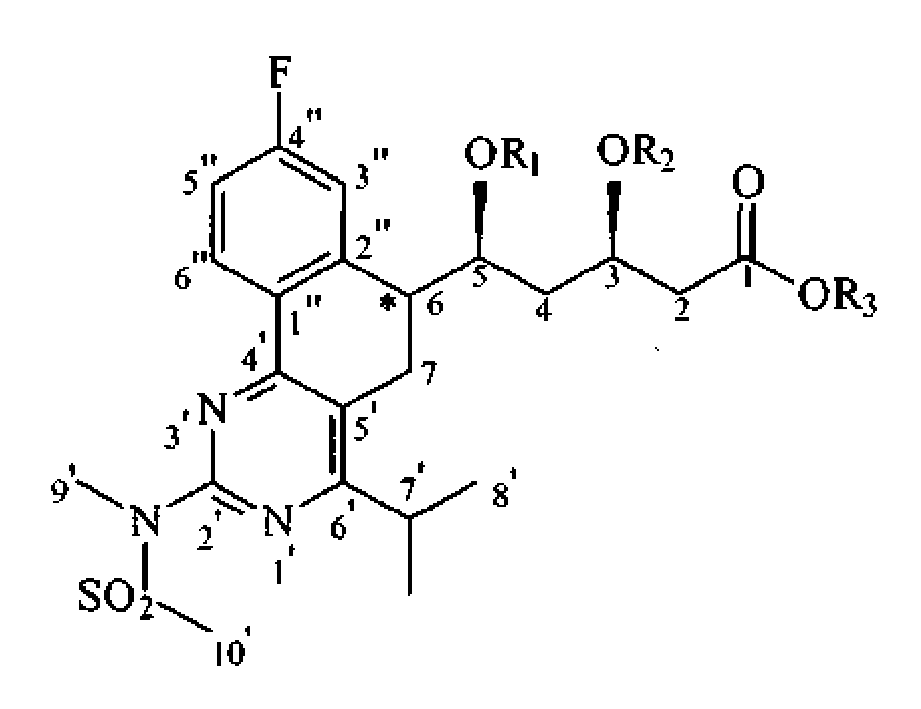
- Procédé selon la revendication 27, dans lequel le standard de référence est un marqueur de référence.
- Procédé selon la revendication 27, dans lequel le standard est le produit de dégradation selon la revendication 1, 2, 3, 4, 9, ou 10.
- Procédé de préparation du produit de dégradation de la rosuvastatine selon la revendication 1 ou 2, comprenant les étapes suivantes :(a) irradiation de calcium de rosuvastatine dans un mélange d'un solvant organique et d'eau avec de la lumière visible afin d'obtenir le produit de dégradation de rosuvastatine présentant la structure suivante:

 (b) récupération du produit obtenu à l'étape (a);(c) dissolution du composé obtenu à l'étape (b) dans un solvant approprié et combinaison de la solution avec de l'acide chlorhydrique aqueux;(d) récupération du produit de l'étape (c);(e) hydrolyse du produit récupéré à l'étape (d) dans des conditions basiques aqueuses et mise en réaction du produit hydrolysé avec une source de calcium afin de précipiter un solide;(f) récupération du solide précipité à l'étape (e); et(g) dissolution du produit récupéré à l'étape (f) dans un mélange d'acétonitrile et d'eau, et mise en contact de la solution avec une colonne de silice afin d'obtenir un acide libre.
 - Procédé de préparation du produit de dégradation de la rosuvastatine selon la revendication 1 ou 2, comprenant les étapes suivantes:(a) irradiation de lactone de rosuvastatine dans un mélange d'un solvant organique et d'eau avec de la lumière visible afin d'obtenir le produit de dégradation de rosuvastatine présentant la structure suivante:

 (b) récupération du produit obtenu à l'étape (a);(c) hydrolyse du produit récupéré à l'étape (b) dans des conditions basiques aqueuses et mise en réaction du produit hydrolysé avec une source de calcium afin de précipiter un solide ;(d) récupération du solide précipité à l'étape (c); et(e) dissolution du produit récupéré à l'étape (d) dans un mélange d'acétonitrile et d'eau, et mise en contact de la solution avec une colonne de silice afin d'obtenir un acide libre.
 - Produit de dégradation de rosuvastatine présentant la structure suivante:

- Produit de dégradation de rosuvastatine selon la revendication 32, dans lequel R1 et R2 sont indépendamment l'un de l'autre l'hydrogène.
- Produit de dégradation de la rosuvastatine selon la revendication 32 ou la revendication 33, dans lequel R3 est le méthyle.
Applications Claiming Priority (2)
| Application Number | Priority Date | Filing Date | Title |
|---|---|---|---|
| US52644903P | 2003-12-02 | 2003-12-02 | |
| PCT/US2004/040329 WO2005056534A1 (fr) | 2003-12-02 | 2004-12-02 | Norme de reference pour la caracterisation de la rosuvastatine |
Publications (2)
| Publication Number | Publication Date |
|---|---|
| EP1689723A1 EP1689723A1 (fr) | 2006-08-16 |
| EP1689723B1 true EP1689723B1 (fr) | 2011-04-27 |
Family
ID=34676616
Family Applications (1)
| Application Number | Title | Priority Date | Filing Date |
|---|---|---|---|
| EP04812772A Revoked EP1689723B1 (fr) | 2003-12-02 | 2004-12-02 | Norme de reference pour la caracterisation de la rosuvastatine |
Country Status (13)
| Country | Link |
|---|---|
| US (6) | US7244844B2 (fr) |
| EP (1) | EP1689723B1 (fr) |
| JP (1) | JP4733047B2 (fr) |
| KR (1) | KR100887264B1 (fr) |
| CN (1) | CN1894221B (fr) |
| AT (1) | ATE507209T1 (fr) |
| CA (1) | CA2546894C (fr) |
| DE (1) | DE602004032465D1 (fr) |
| ES (1) | ES2364143T3 (fr) |
| IL (1) | IL175511A (fr) |
| PT (1) | PT1689723E (fr) |
| TW (1) | TWI351958B (fr) |
| WO (1) | WO2005056534A1 (fr) |
Families Citing this family (15)
| Publication number | Priority date | Publication date | Assignee | Title |
|---|---|---|---|---|
| GB0218781D0 (en) | 2002-08-13 | 2002-09-18 | Astrazeneca Ab | Chemical process |
| GB0312896D0 (en) | 2003-06-05 | 2003-07-09 | Astrazeneca Ab | Chemical process |
| GB0324791D0 (en) | 2003-10-24 | 2003-11-26 | Astrazeneca Ab | Chemical process |
| US7244844B2 (en) * | 2003-12-02 | 2007-07-17 | Teva Pharmaceutical Industries Ltd. | Reference standard for characterization of rosuvastatin |
| US7851624B2 (en) | 2003-12-24 | 2010-12-14 | Teva Pharamaceutical Industries Ltd. | Triol form of rosuvastatin and synthesis of rosuvastatin |
| KR101020024B1 (ko) | 2005-02-22 | 2011-03-09 | 테바 파마슈티컬 인더스트리즈 리미티드 | 로수바스타틴 알킬에테르를 함유하지 않는 로수바스타틴 및이의 염 및 이의 제조 방법 |
| EP1968593B1 (fr) * | 2005-12-20 | 2017-08-23 | LEK Pharmaceuticals d.d. | Composition pharmaceutique comprenant de l'acide (e)-7-[4-(4-fluorophenyl)-6-isopropyl-2-[methyl(methylsulfonyl)amino]pyrimidin-5-yl-(3r,5s)-3,5-dihydroxyhept-6-enoique |
| JP5330225B2 (ja) * | 2007-03-13 | 2013-10-30 | テバ ファーマシューティカル インダストリーズ リミティド | トリオール型ロスバスタチン |
| EP2189456A1 (fr) * | 2008-11-14 | 2010-05-26 | LEK Pharmaceuticals d.d. | Nouveaux composés préparés à partir d'oméprazole |
| TWI461410B (zh) | 2008-12-30 | 2014-11-21 | Arqule Inc | 經取代之5,6-二氫-6-苯基苯並〔f〕異喹啉-2-胺化合物類 |
| CN103454352B (zh) * | 2013-07-30 | 2015-07-15 | 广东先强药业有限公司 | 一种hplc法测定瑞舒伐他汀钙的含量及其有关物质的方法 |
| CN103776939A (zh) * | 2014-02-11 | 2014-05-07 | 润泽制药(苏州)有限公司 | 瑞舒伐他汀钙制剂有关物质的制备检测方法 |
| CN108398501A (zh) * | 2018-03-02 | 2018-08-14 | 海南通用三洋药业有限公司 | 一种检测瑞舒伐他汀钙有关物质的方法 |
| CN109020902B (zh) * | 2018-07-23 | 2020-06-02 | 唯智医药科技(北京)有限公司 | 一种瑞舒伐他汀钙杂质及其制备方法与用途 |
| CN114280181B (zh) * | 2021-12-23 | 2024-06-18 | 浙江海翔川南药业有限公司 | 一种瑞舒伐他汀中间体及其有关物质的检测方法 |
Family Cites Families (35)
| Publication number | Priority date | Publication date | Assignee | Title |
|---|---|---|---|---|
| US37314A (en) * | 1863-01-06 | Improved composition for lemonade | ||
| US633198A (en) * | 1899-02-08 | 1899-09-19 | Wilhelm Magnus Hoekerstedt | Automatic-lighting torch. |
| US4231938A (en) | 1979-06-15 | 1980-11-04 | Merck & Co., Inc. | Hypocholesteremic fermentation products and process of preparation |
| US4444784A (en) | 1980-08-05 | 1984-04-24 | Merck & Co., Inc. | Antihypercholesterolemic compounds |
| MX7065E (es) | 1980-06-06 | 1987-04-10 | Sankyo Co | Un procedimiento microbiologico para preparar derivados de ml-236b |
| US4739073A (en) | 1983-11-04 | 1988-04-19 | Sandoz Pharmaceuticals Corp. | Intermediates in the synthesis of indole analogs of mevalonolactone and derivatives thereof |
| NO177005C (no) | 1988-01-20 | 1995-07-05 | Bayer Ag | Analogifremgangsmåte for fremstilling av substituerte pyridiner, samt mellomprodukter til bruk ved fremstillingen |
| US5177080A (en) | 1990-12-14 | 1993-01-05 | Bayer Aktiengesellschaft | Substituted pyridyl-dihydroxy-heptenoic acid and its salts |
| WO1992022560A1 (fr) | 1991-06-19 | 1992-12-23 | Shionogi Seiyaku Kabushiki Kaisha | Intermediaire optiquement actif et production de celui-ci |
| JP2648897B2 (ja) | 1991-07-01 | 1997-09-03 | 塩野義製薬株式会社 | ピリミジン誘導体 |
| GB9626746D0 (en) | 1996-12-23 | 1997-02-12 | Knoll Ag | Process |
| GB9812413D0 (en) | 1998-06-10 | 1998-08-05 | Glaxo Group Ltd | Compound and its use |
| SI20070A (sl) | 1998-09-18 | 2000-04-30 | LEK, tovarna farmacevtskih in kemi�nih izdelkov, d.d. | Nove soli inhibitorjev HMG-CoA reduktaze |
| GB9903472D0 (en) | 1999-02-17 | 1999-04-07 | Zeneca Ltd | Chemical process |
| GB0001621D0 (en) | 2000-01-26 | 2000-03-15 | Astrazeneca Ab | Pharmaceutical compositions |
| GB0003305D0 (en) | 2000-02-15 | 2000-04-05 | Zeneca Ltd | Pyrimidine derivatives |
| US6777552B2 (en) | 2001-08-16 | 2004-08-17 | Teva Pharmaceutical Industries, Ltd. | Processes for preparing calcium salt forms of statins |
| GB0028429D0 (en) | 2000-11-22 | 2001-01-10 | Astrazeneca Ab | Therapy |
| HRPK20040255B3 (en) | 2001-08-16 | 2006-02-28 | Teva Pharmaceutical Industries Ltd. | Processes for preparing calcium salt forms of statins |
| SE0103509D0 (sv) | 2001-10-19 | 2001-10-19 | Astrazeneca Ab | Rosuvastatin in pre demented states |
| KR100511533B1 (ko) | 2002-04-09 | 2005-08-31 | 임광민 | 키랄 중간체, 그의 제조방법 및 그를 이용한 HMG-CoA환원저해제의 제조방법 |
| EP1585736A2 (fr) | 2002-05-21 | 2005-10-19 | Ranbaxy Laboratories, Ltd. | Procede de preparation de rosuvastatine |
| GB0218781D0 (en) | 2002-08-13 | 2002-09-18 | Astrazeneca Ab | Chemical process |
| ATE501126T1 (de) | 2002-12-10 | 2011-03-15 | Ranbaxy Lab Ltd | Verfahren zur herstellung von rosuvastatin |
| WO2005021511A1 (fr) | 2003-08-27 | 2005-03-10 | Hetero Drugs Limited | Procede nouveau pour la rosuvastatine calcique amorphe |
| EP1678148A1 (fr) | 2003-10-22 | 2006-07-12 | Ranbaxy Laboratories Limited | Procede de preparation de rosuvastatine calcique amorphe |
| EP1601658A1 (fr) | 2003-11-24 | 2005-12-07 | Teva Pharmaceutical Industries Limited | Sels d'ammonium cristallins de la rosuvastatine |
| US7244844B2 (en) * | 2003-12-02 | 2007-07-17 | Teva Pharmaceutical Industries Ltd. | Reference standard for characterization of rosuvastatin |
| WO2006035277A2 (fr) | 2004-09-27 | 2006-04-06 | Ranbaxy Laboratories Limited | Nouvelles methodes de preparation de calcium de rosuvastatine amorphe et nouvelle forme polymorphe de sodium de rosuvastatine |
| WO2006079611A1 (fr) | 2005-01-31 | 2006-08-03 | Ciba Specialty Chemicals Holding Inc. | Formes cristallines de sel de rosuvastatine calcique |
| WO2006100689A1 (fr) | 2005-03-22 | 2006-09-28 | Unichem Laboratories Limited | Procede de preparation de la rosuvastatine |
| WO2006106526A1 (fr) | 2005-04-04 | 2006-10-12 | Unichem Laboratories Limited | Procede de preparation de sel de calcium de la rosuvastatine |
| WO2006136408A2 (fr) | 2005-06-24 | 2006-12-28 | Lek Pharmaceuticals D.D. | Procédé de préparation de rosuvastatine calcique pure amorphe |
| US9150518B2 (en) | 2005-06-24 | 2015-10-06 | Lek Pharmaceuticals, D.D. | Process for preparing amorphous rosuvastatin calcium of impurities |
| GB0514078D0 (en) | 2005-07-08 | 2005-08-17 | Astrazeneca Uk Ltd | Chemical process |
-
2004
- 2004-12-02 US US11/001,912 patent/US7244844B2/en not_active Expired - Lifetime
- 2004-12-02 PT PT04812772T patent/PT1689723E/pt unknown
- 2004-12-02 EP EP04812772A patent/EP1689723B1/fr not_active Revoked
- 2004-12-02 WO PCT/US2004/040329 patent/WO2005056534A1/fr not_active Ceased
- 2004-12-02 AT AT04812772T patent/ATE507209T1/de not_active IP Right Cessation
- 2004-12-02 JP JP2006541502A patent/JP4733047B2/ja not_active Expired - Fee Related
- 2004-12-02 ES ES04812772T patent/ES2364143T3/es not_active Expired - Lifetime
- 2004-12-02 CN CN2004800359220A patent/CN1894221B/zh not_active Expired - Fee Related
- 2004-12-02 TW TW093137210A patent/TWI351958B/zh not_active IP Right Cessation
- 2004-12-02 DE DE602004032465T patent/DE602004032465D1/de not_active Expired - Lifetime
- 2004-12-02 KR KR1020067013302A patent/KR100887264B1/ko not_active Expired - Fee Related
- 2004-12-02 CA CA002546894A patent/CA2546894C/fr not_active Expired - Fee Related
-
2006
- 2006-05-09 IL IL175511A patent/IL175511A/en active IP Right Grant
-
2007
- 2007-06-25 US US11/823,045 patent/US7692010B2/en not_active Expired - Fee Related
- 2007-06-25 US US11/823,019 patent/US7692009B2/en not_active Expired - Fee Related
- 2007-06-25 US US11/821,968 patent/US7692008B2/en not_active Expired - Fee Related
- 2007-06-25 US US11/823,013 patent/US7741482B2/en not_active Expired - Fee Related
-
2009
- 2009-01-27 US US12/322,042 patent/US8487097B2/en not_active Expired - Fee Related
Also Published As
| Publication number | Publication date |
|---|---|
| US20070249831A1 (en) | 2007-10-25 |
| JP4733047B2 (ja) | 2011-07-27 |
| TW200522959A (en) | 2005-07-16 |
| CN1894221A (zh) | 2007-01-10 |
| CA2546894A1 (fr) | 2005-06-23 |
| US7692010B2 (en) | 2010-04-06 |
| US7692009B2 (en) | 2010-04-06 |
| US20070255059A1 (en) | 2007-11-01 |
| CN1894221B (zh) | 2012-08-08 |
| IL175511A (en) | 2011-11-30 |
| US20070249830A1 (en) | 2007-10-25 |
| US8487097B2 (en) | 2013-07-16 |
| ES2364143T3 (es) | 2011-08-25 |
| US7692008B2 (en) | 2010-04-06 |
| JP2007512354A (ja) | 2007-05-17 |
| CA2546894C (fr) | 2009-09-08 |
| ATE507209T1 (de) | 2011-05-15 |
| US7741482B2 (en) | 2010-06-22 |
| KR20060098396A (ko) | 2006-09-18 |
| KR100887264B1 (ko) | 2009-03-06 |
| WO2005056534A1 (fr) | 2005-06-23 |
| PT1689723E (pt) | 2011-07-06 |
| DE602004032465D1 (de) | 2011-06-09 |
| TWI351958B (en) | 2011-11-11 |
| US20090188305A1 (en) | 2009-07-30 |
| US20050187234A1 (en) | 2005-08-25 |
| US7244844B2 (en) | 2007-07-17 |
| US20070244321A1 (en) | 2007-10-18 |
| EP1689723A1 (fr) | 2006-08-16 |
| IL175511A0 (en) | 2006-09-05 |
Similar Documents
| Publication | Publication Date | Title |
|---|---|---|
| US7692010B2 (en) | Reference standard for characterization of rosuvastatin | |
| JPH02250870A (ja) | コレステロール生合成抑制性化合物 | |
| WO2006091770A2 (fr) | Rosuvastatine, sels de rosuvastatine exempts de son alkylether, procede d'elaboration correspondant | |
| US7884226B2 (en) | Purification of rosuvatatin intermediate by thin film evaporation and chemical method | |
| US7674923B2 (en) | Process for preparing forms of atorvastatin calcium substantially free of impurities | |
| CA2680604C (fr) | Forme triol de rosuvastatine | |
| US20110112165A1 (en) | Atorvastatin-aliskiren | |
| Schneider et al. | Determination of the new monoamine oxidase inhibitor brofaromine and its major metabolite in biological material by gas chromatography with electron-capture detection | |
| CN101631777A (zh) | 罗苏伐他汀的三醇形式 |
Legal Events
| Date | Code | Title | Description |
|---|---|---|---|
| PUAI | Public reference made under article 153(3) epc to a published international application that has entered the european phase |
Free format text: ORIGINAL CODE: 0009012 |
|
| 17P | Request for examination filed |
Effective date: 20050801 |
|
| AK | Designated contracting states |
Kind code of ref document: A1 Designated state(s): AT BE BG CH CY CZ DE DK EE ES FI FR GB GR HU IE IS IT LI LT LU MC NL PL PT RO SE SI SK TR |
|
| 17Q | First examination report despatched |
Effective date: 20070130 |
|
| DAX | Request for extension of the european patent (deleted) | ||
| GRAP | Despatch of communication of intention to grant a patent |
Free format text: ORIGINAL CODE: EPIDOSNIGR1 |
|
| GRAS | Grant fee paid |
Free format text: ORIGINAL CODE: EPIDOSNIGR3 |
|
| GRAA | (expected) grant |
Free format text: ORIGINAL CODE: 0009210 |
|
| AK | Designated contracting states |
Kind code of ref document: B1 Designated state(s): AT BE BG CH CY CZ DE DK EE ES FI FR GB GR HU IE IS IT LI LT LU MC NL PL PT RO SE SI SK TR |
|
| REG | Reference to a national code |
Ref country code: GB Ref legal event code: FG4D |
|
| REG | Reference to a national code |
Ref country code: CH Ref legal event code: EP |
|
| REG | Reference to a national code |
Ref country code: IE Ref legal event code: FG4D |
|
| REF | Corresponds to: |
Ref document number: 602004032465 Country of ref document: DE Date of ref document: 20110609 Kind code of ref document: P |
|
| REG | Reference to a national code |
Ref country code: DE Ref legal event code: R096 Ref document number: 602004032465 Country of ref document: DE Effective date: 20110609 |
|
| REG | Reference to a national code |
Ref country code: CH Ref legal event code: NV Representative=s name: ISLER & PEDRAZZINI AG |
|
| REG | Reference to a national code |
Ref country code: RO Ref legal event code: EPE |
|
| REG | Reference to a national code |
Ref country code: PT Ref legal event code: SC4A Free format text: AVAILABILITY OF NATIONAL TRANSLATION Effective date: 20110629 |
|
| REG | Reference to a national code |
Ref country code: NL Ref legal event code: T3 |
|
| REG | Reference to a national code |
Ref country code: SE Ref legal event code: TRGR |
|
| REG | Reference to a national code |
Ref country code: ES Ref legal event code: FG2A Ref document number: 2364143 Country of ref document: ES Kind code of ref document: T3 Effective date: 20110825 |
|
| LTIE | Lt: invalidation of european patent or patent extension |
Effective date: 20110427 |
|
| PG25 | Lapsed in a contracting state [announced via postgrant information from national office to epo] |
Ref country code: LT Free format text: LAPSE BECAUSE OF FAILURE TO SUBMIT A TRANSLATION OF THE DESCRIPTION OR TO PAY THE FEE WITHIN THE PRESCRIBED TIME-LIMIT Effective date: 20110427 |
|
| PG25 | Lapsed in a contracting state [announced via postgrant information from national office to epo] |
Ref country code: FI Free format text: LAPSE BECAUSE OF FAILURE TO SUBMIT A TRANSLATION OF THE DESCRIPTION OR TO PAY THE FEE WITHIN THE PRESCRIBED TIME-LIMIT Effective date: 20110427 Ref country code: IS Free format text: LAPSE BECAUSE OF FAILURE TO SUBMIT A TRANSLATION OF THE DESCRIPTION OR TO PAY THE FEE WITHIN THE PRESCRIBED TIME-LIMIT Effective date: 20110827 Ref country code: AT Free format text: LAPSE BECAUSE OF FAILURE TO SUBMIT A TRANSLATION OF THE DESCRIPTION OR TO PAY THE FEE WITHIN THE PRESCRIBED TIME-LIMIT Effective date: 20110427 Ref country code: GR Free format text: LAPSE BECAUSE OF FAILURE TO SUBMIT A TRANSLATION OF THE DESCRIPTION OR TO PAY THE FEE WITHIN THE PRESCRIBED TIME-LIMIT Effective date: 20110728 Ref country code: SI Free format text: LAPSE BECAUSE OF FAILURE TO SUBMIT A TRANSLATION OF THE DESCRIPTION OR TO PAY THE FEE WITHIN THE PRESCRIBED TIME-LIMIT Effective date: 20110427 Ref country code: CY Free format text: LAPSE BECAUSE OF FAILURE TO SUBMIT A TRANSLATION OF THE DESCRIPTION OR TO PAY THE FEE WITHIN THE PRESCRIBED TIME-LIMIT Effective date: 20110427 |
|
| REG | Reference to a national code |
Ref country code: HU Ref legal event code: AG4A Ref document number: E011681 Country of ref document: HU |
|
| PLBI | Opposition filed |
Free format text: ORIGINAL CODE: 0009260 |
|
| PG25 | Lapsed in a contracting state [announced via postgrant information from national office to epo] |
Ref country code: EE Free format text: LAPSE BECAUSE OF FAILURE TO SUBMIT A TRANSLATION OF THE DESCRIPTION OR TO PAY THE FEE WITHIN THE PRESCRIBED TIME-LIMIT Effective date: 20110427 |
|
| 26 | Opposition filed |
Opponent name: STRAWMAN LIMITED Effective date: 20120123 |
|
| PG25 | Lapsed in a contracting state [announced via postgrant information from national office to epo] |
Ref country code: SK Free format text: LAPSE BECAUSE OF FAILURE TO SUBMIT A TRANSLATION OF THE DESCRIPTION OR TO PAY THE FEE WITHIN THE PRESCRIBED TIME-LIMIT Effective date: 20110427 Ref country code: PL Free format text: LAPSE BECAUSE OF FAILURE TO SUBMIT A TRANSLATION OF THE DESCRIPTION OR TO PAY THE FEE WITHIN THE PRESCRIBED TIME-LIMIT Effective date: 20110427 |
|
| PLAX | Notice of opposition and request to file observation + time limit sent |
Free format text: ORIGINAL CODE: EPIDOSNOBS2 |
|
| REG | Reference to a national code |
Ref country code: DE Ref legal event code: R026 Ref document number: 602004032465 Country of ref document: DE Effective date: 20120123 |
|
| PLAF | Information modified related to communication of a notice of opposition and request to file observations + time limit |
Free format text: ORIGINAL CODE: EPIDOSCOBS2 |
|
| PG25 | Lapsed in a contracting state [announced via postgrant information from national office to epo] |
Ref country code: MC Free format text: LAPSE BECAUSE OF NON-PAYMENT OF DUE FEES Effective date: 20111231 |
|
| PLBB | Reply of patent proprietor to notice(s) of opposition received |
Free format text: ORIGINAL CODE: EPIDOSNOBS3 |
|
| PG25 | Lapsed in a contracting state [announced via postgrant information from national office to epo] |
Ref country code: LU Free format text: LAPSE BECAUSE OF NON-PAYMENT OF DUE FEES Effective date: 20111202 |
|
| PG25 | Lapsed in a contracting state [announced via postgrant information from national office to epo] |
Ref country code: BG Free format text: LAPSE BECAUSE OF FAILURE TO SUBMIT A TRANSLATION OF THE DESCRIPTION OR TO PAY THE FEE WITHIN THE PRESCRIBED TIME-LIMIT Effective date: 20110727 |
|
| PLAB | Opposition data, opponent's data or that of the opponent's representative modified |
Free format text: ORIGINAL CODE: 0009299OPPO |
|
| R26 | Opposition filed (corrected) |
Opponent name: STRAWMAN LIMITED Effective date: 20120123 |
|
| PG25 | Lapsed in a contracting state [announced via postgrant information from national office to epo] |
Ref country code: TR Free format text: LAPSE BECAUSE OF FAILURE TO SUBMIT A TRANSLATION OF THE DESCRIPTION OR TO PAY THE FEE WITHIN THE PRESCRIBED TIME-LIMIT Effective date: 20110427 |
|
| APAH | Appeal reference modified |
Free format text: ORIGINAL CODE: EPIDOSCREFNO |
|
| APBM | Appeal reference recorded |
Free format text: ORIGINAL CODE: EPIDOSNREFNO |
|
| APBP | Date of receipt of notice of appeal recorded |
Free format text: ORIGINAL CODE: EPIDOSNNOA2O |
|
| APBQ | Date of receipt of statement of grounds of appeal recorded |
Free format text: ORIGINAL CODE: EPIDOSNNOA3O |
|
| REG | Reference to a national code |
Ref country code: FR Ref legal event code: PLFP Year of fee payment: 12 |
|
| APBU | Appeal procedure closed |
Free format text: ORIGINAL CODE: EPIDOSNNOA9O |
|
| REG | Reference to a national code |
Ref country code: DE Ref legal event code: R064 Ref document number: 602004032465 Country of ref document: DE Ref country code: DE Ref legal event code: R103 Ref document number: 602004032465 Country of ref document: DE |
|
| REG | Reference to a national code |
Ref country code: FR Ref legal event code: PLFP Year of fee payment: 13 |
|
| PGFP | Annual fee paid to national office [announced via postgrant information from national office to epo] |
Ref country code: HU Payment date: 20161221 Year of fee payment: 13 Ref country code: GB Payment date: 20161222 Year of fee payment: 13 Ref country code: CZ Payment date: 20161201 Year of fee payment: 13 Ref country code: IE Payment date: 20161227 Year of fee payment: 13 Ref country code: DE Payment date: 20161213 Year of fee payment: 13 Ref country code: NL Payment date: 20161221 Year of fee payment: 13 Ref country code: CH Payment date: 20161221 Year of fee payment: 13 |
|
| PGFP | Annual fee paid to national office [announced via postgrant information from national office to epo] |
Ref country code: FR Payment date: 20161222 Year of fee payment: 13 Ref country code: SE Payment date: 20161221 Year of fee payment: 13 Ref country code: BE Payment date: 20161221 Year of fee payment: 13 Ref country code: PT Payment date: 20161202 Year of fee payment: 13 Ref country code: ES Payment date: 20161213 Year of fee payment: 13 Ref country code: RO Payment date: 20161124 Year of fee payment: 13 |
|
| RDAF | Communication despatched that patent is revoked |
Free format text: ORIGINAL CODE: EPIDOSNREV1 |
|
| STAA | Information on the status of an ep patent application or granted ep patent |
Free format text: STATUS: PATENT REVOKED |
|
| RDAG | Patent revoked |
Free format text: ORIGINAL CODE: 0009271 |
|
| REG | Reference to a national code |
Ref country code: CH Ref legal event code: PLX |
|
| 27W | Patent revoked |
Effective date: 20161123 |
|
| GBPR | Gb: patent revoked under art. 102 of the ep convention designating the uk as contracting state |
Effective date: 20161123 |
|
| PGFP | Annual fee paid to national office [announced via postgrant information from national office to epo] |
Ref country code: IT Payment date: 20161223 Year of fee payment: 13 |
|
| PG25 | Lapsed in a contracting state [announced via postgrant information from national office to epo] |
Ref country code: LI Free format text: LAPSE BECAUSE OF THE APPLICANT RENOUNCES Effective date: 20110427 Ref country code: CH Free format text: LAPSE BECAUSE OF THE APPLICANT RENOUNCES Effective date: 20110427 |
|
| REG | Reference to a national code |
Ref country code: SE Ref legal event code: ECNC |