EP1692196B1 - Brennstoffölzusammensetzungen mit verbesserten kaltfliesseigenschaften - Google Patents
Brennstoffölzusammensetzungen mit verbesserten kaltfliesseigenschaften Download PDFInfo
- Publication number
- EP1692196B1 EP1692196B1 EP04803502A EP04803502A EP1692196B1 EP 1692196 B1 EP1692196 B1 EP 1692196B1 EP 04803502 A EP04803502 A EP 04803502A EP 04803502 A EP04803502 A EP 04803502A EP 1692196 B1 EP1692196 B1 EP 1692196B1
- Authority
- EP
- European Patent Office
- Prior art keywords
- polymer
- fuel
- fuel oil
- use according
- weight
- Prior art date
- Legal status (The legal status is an assumption and is not a legal conclusion. Google has not performed a legal analysis and makes no representation as to the accuracy of the status listed.)
- Revoked
Links
- 0 *C([N+]([O-])=O)=C(*)O Chemical compound *C([N+]([O-])=O)=C(*)O 0.000 description 1
Classifications
-
- C—CHEMISTRY; METALLURGY
- C10—PETROLEUM, GAS OR COKE INDUSTRIES; TECHNICAL GASES CONTAINING CARBON MONOXIDE; FUELS; LUBRICANTS; PEAT
- C10L—FUELS NOT OTHERWISE PROVIDED FOR; NATURAL GAS; SYNTHETIC NATURAL GAS OBTAINED BY PROCESSES NOT COVERED BY SUBCLASSES C10G OR C10K; LIQUIFIED PETROLEUM GAS; USE OF ADDITIVES TO FUELS OR FIRES; FIRE-LIGHTERS
- C10L10/00—Use of additives to fuels or fires for particular purposes
- C10L10/14—Use of additives to fuels or fires for particular purposes for improving low temperature properties
- C10L10/16—Pour-point depressants
-
- C—CHEMISTRY; METALLURGY
- C08—ORGANIC MACROMOLECULAR COMPOUNDS; THEIR PREPARATION OR CHEMICAL WORKING-UP; COMPOSITIONS BASED THEREON
- C08F—MACROMOLECULAR COMPOUNDS OBTAINED BY REACTIONS ONLY INVOLVING CARBON-TO-CARBON UNSATURATED BONDS
- C08F210/00—Copolymers of unsaturated aliphatic hydrocarbons having only one carbon-to-carbon double bond
-
- C—CHEMISTRY; METALLURGY
- C08—ORGANIC MACROMOLECULAR COMPOUNDS; THEIR PREPARATION OR CHEMICAL WORKING-UP; COMPOSITIONS BASED THEREON
- C08F—MACROMOLECULAR COMPOUNDS OBTAINED BY REACTIONS ONLY INVOLVING CARBON-TO-CARBON UNSATURATED BONDS
- C08F210/00—Copolymers of unsaturated aliphatic hydrocarbons having only one carbon-to-carbon double bond
- C08F210/02—Ethene
-
- C—CHEMISTRY; METALLURGY
- C10—PETROLEUM, GAS OR COKE INDUSTRIES; TECHNICAL GASES CONTAINING CARBON MONOXIDE; FUELS; LUBRICANTS; PEAT
- C10L—FUELS NOT OTHERWISE PROVIDED FOR; NATURAL GAS; SYNTHETIC NATURAL GAS OBTAINED BY PROCESSES NOT COVERED BY SUBCLASSES C10G OR C10K; LIQUIFIED PETROLEUM GAS; USE OF ADDITIVES TO FUELS OR FIRES; FIRE-LIGHTERS
- C10L1/00—Liquid carbonaceous fuels
- C10L1/10—Liquid carbonaceous fuels containing additives
- C10L1/14—Organic compounds
- C10L1/18—Organic compounds containing oxygen
- C10L1/192—Macromolecular compounds
- C10L1/195—Macromolecular compounds obtained by reactions involving only carbon-to-carbon unsaturated bonds
- C10L1/197—Macromolecular compounds obtained by reactions involving only carbon-to-carbon unsaturated bonds derived from monomers containing a carbon-to-carbon unsaturated bond and an acyloxy group of a saturated carboxylic or carbonic acid
- C10L1/1973—Macromolecular compounds obtained by reactions involving only carbon-to-carbon unsaturated bonds derived from monomers containing a carbon-to-carbon unsaturated bond and an acyloxy group of a saturated carboxylic or carbonic acid mono-carboxylic
-
- C—CHEMISTRY; METALLURGY
- C10—PETROLEUM, GAS OR COKE INDUSTRIES; TECHNICAL GASES CONTAINING CARBON MONOXIDE; FUELS; LUBRICANTS; PEAT
- C10L—FUELS NOT OTHERWISE PROVIDED FOR; NATURAL GAS; SYNTHETIC NATURAL GAS OBTAINED BY PROCESSES NOT COVERED BY SUBCLASSES C10G OR C10K; LIQUIFIED PETROLEUM GAS; USE OF ADDITIVES TO FUELS OR FIRES; FIRE-LIGHTERS
- C10L10/00—Use of additives to fuels or fires for particular purposes
- C10L10/14—Use of additives to fuels or fires for particular purposes for improving low temperature properties
-
- C—CHEMISTRY; METALLURGY
- C10—PETROLEUM, GAS OR COKE INDUSTRIES; TECHNICAL GASES CONTAINING CARBON MONOXIDE; FUELS; LUBRICANTS; PEAT
- C10M—LUBRICATING COMPOSITIONS; USE OF CHEMICAL SUBSTANCES EITHER ALONE OR AS LUBRICATING INGREDIENTS IN A LUBRICATING COMPOSITION
- C10M1/00—Liquid compositions essentially based on mineral lubricating oils or fatty oils; Their use as lubricants
-
- C—CHEMISTRY; METALLURGY
- C10—PETROLEUM, GAS OR COKE INDUSTRIES; TECHNICAL GASES CONTAINING CARBON MONOXIDE; FUELS; LUBRICANTS; PEAT
- C10M—LUBRICATING COMPOSITIONS; USE OF CHEMICAL SUBSTANCES EITHER ALONE OR AS LUBRICATING INGREDIENTS IN A LUBRICATING COMPOSITION
- C10M145/00—Lubricating compositions characterised by the additive being a macromolecular compound containing oxygen
- C10M145/02—Macromolecular compounds obtained by reactions only involving carbon-to-carbon unsaturated bonds
- C10M145/10—Macromolecular compounds obtained by reactions only involving carbon-to-carbon unsaturated bonds containing monomers having an unsaturated radical bound to a carboxyl radical, e.g. acrylate
- C10M145/12—Macromolecular compounds obtained by reactions only involving carbon-to-carbon unsaturated bonds containing monomers having an unsaturated radical bound to a carboxyl radical, e.g. acrylate monocarboxylic
- C10M145/14—Acrylate; Methacrylate
-
- C—CHEMISTRY; METALLURGY
- C08—ORGANIC MACROMOLECULAR COMPOUNDS; THEIR PREPARATION OR CHEMICAL WORKING-UP; COMPOSITIONS BASED THEREON
- C08F—MACROMOLECULAR COMPOUNDS OBTAINED BY REACTIONS ONLY INVOLVING CARBON-TO-CARBON UNSATURATED BONDS
- C08F2500/00—Characteristics or properties of obtained polyolefins; Use thereof
- C08F2500/03—Narrow molecular weight distribution, i.e. Mw/Mn < 3
-
- C—CHEMISTRY; METALLURGY
- C08—ORGANIC MACROMOLECULAR COMPOUNDS; THEIR PREPARATION OR CHEMICAL WORKING-UP; COMPOSITIONS BASED THEREON
- C08F—MACROMOLECULAR COMPOUNDS OBTAINED BY REACTIONS ONLY INVOLVING CARBON-TO-CARBON UNSATURATED BONDS
- C08F2800/00—Copolymer characterised by the proportions of the comonomers expressed
- C08F2800/10—Copolymer characterised by the proportions of the comonomers expressed as molar percentages
-
- C—CHEMISTRY; METALLURGY
- C10—PETROLEUM, GAS OR COKE INDUSTRIES; TECHNICAL GASES CONTAINING CARBON MONOXIDE; FUELS; LUBRICANTS; PEAT
- C10L—FUELS NOT OTHERWISE PROVIDED FOR; NATURAL GAS; SYNTHETIC NATURAL GAS OBTAINED BY PROCESSES NOT COVERED BY SUBCLASSES C10G OR C10K; LIQUIFIED PETROLEUM GAS; USE OF ADDITIVES TO FUELS OR FIRES; FIRE-LIGHTERS
- C10L2250/00—Structural features of fuel components or fuel compositions, either in solid, liquid or gaseous state
- C10L2250/04—Additive or component is a polymer
-
- C—CHEMISTRY; METALLURGY
- C10—PETROLEUM, GAS OR COKE INDUSTRIES; TECHNICAL GASES CONTAINING CARBON MONOXIDE; FUELS; LUBRICANTS; PEAT
- C10L—FUELS NOT OTHERWISE PROVIDED FOR; NATURAL GAS; SYNTHETIC NATURAL GAS OBTAINED BY PROCESSES NOT COVERED BY SUBCLASSES C10G OR C10K; LIQUIFIED PETROLEUM GAS; USE OF ADDITIVES TO FUELS OR FIRES; FIRE-LIGHTERS
- C10L2270/00—Specifically adapted fuels
- C10L2270/02—Specifically adapted fuels for internal combustion engines
- C10L2270/026—Specifically adapted fuels for internal combustion engines for diesel engines, e.g. automobiles, stationary, marine
-
- C—CHEMISTRY; METALLURGY
- C10—PETROLEUM, GAS OR COKE INDUSTRIES; TECHNICAL GASES CONTAINING CARBON MONOXIDE; FUELS; LUBRICANTS; PEAT
- C10M—LUBRICATING COMPOSITIONS; USE OF CHEMICAL SUBSTANCES EITHER ALONE OR AS LUBRICATING INGREDIENTS IN A LUBRICATING COMPOSITION
- C10M2209/00—Organic macromolecular compounds containing oxygen as ingredients in lubricant compositions
- C10M2209/02—Macromolecular compounds obtained by reactions only involving carbon-to-carbon unsaturated bonds
- C10M2209/08—Macromolecular compounds obtained by reactions only involving carbon-to-carbon unsaturated bonds containing monomers having an unsaturated radical bound to a carboxyl radical, e.g. acrylate type
- C10M2209/084—Acrylate; Methacrylate
-
- C—CHEMISTRY; METALLURGY
- C10—PETROLEUM, GAS OR COKE INDUSTRIES; TECHNICAL GASES CONTAINING CARBON MONOXIDE; FUELS; LUBRICANTS; PEAT
- C10N—INDEXING SCHEME ASSOCIATED WITH SUBCLASS C10M RELATING TO LUBRICATING COMPOSITIONS
- C10N2030/00—Specified physical or chemical properties which is improved by the additive characterising the lubricating composition, e.g. multifunctional additives
- C10N2030/08—Resistance to extreme temperature
Definitions
- the invention relates to the use of polymers which contain an ⁇ -olefin, a vinyl ester and an ester of an ⁇ , ⁇ -unsaturated carboxylic acid in copolymerized form, as an additive for fuel oils and lubricants and in particular as cold flow improvers in fuel oils; the fuel oils and lubricants additized with these polymers; and additive packages containing such copolymers.
- Paraffinic wax-containing mineral oils such as middle distillates, diesel and fuel oils
- Paraffinic wax-containing mineral oils show a significant deterioration in the flow properties when the temperature is lowered.
- the reason for this lies in the crystallization of longer-chain paraffins occurring from the temperature of the cloud point, which form large, platelet-shaped wax crystals.
- These wax crystals have a sponge-like structure and lead to the inclusion of other fuel constituents in the crystal composite. The appearance of these crystals quickly leads to the bonding of fuel filters both in tanks and in motor vehicles. At temperatures below the pour point (PP), finally, no more flow of fuel takes place.
- Cold flow improvers are added in amounts of about 50 to 500 ppm, depending on the nature of the base fuel and the additive.
- Various CFI products are known from the prior art (cf., for example, US Pat US-A-3,038,479 . 3,627,838 and 3,961,961 .
- Common CFI's are usually polymeric Compounds, in particular ethylene-vinyl acetate (EVA) copolymers, such as those sold under the trade name Keroflux by BASF AG products.
- EVA ethylene-vinyl acetate
- the EP 0922716 describes a process for preparing terpolymers which, in addition to ethylene, contain in copolymerized form at least two further ethylenically unsaturated compounds, such as vinyl esters, acrylic or methacrylic acid esters, alkyl vinyl ethers or higher olefins. These should be suitable as pour point improvers of mineral oil distillates.
- the DE 1902925 describes terpolymers which contain in copolymerized form ethylene, vinyl esters of short-chain carboxylic acids, such as vinyl acetate, and long-chain unsaturated monoesters, such as vinyl esters of long-chain carboxylic acids or acrylic esters, which are derived from long-chain alcohols. These are intended to lower the pour point of middle distillates and improve their filterability.
- a first aspect of the invention accordingly relates to the use of a polymer which comprises an ⁇ -olefin, a vinyl ester and a C 1 -C 20 -hydrocarbyl ester of an ⁇ , ⁇ -unsaturated carboxylic acid in copolymerized form as an additive for fuel oils and lubricants.
- those polymers are used which contain the vinyl ester and the ester of the ⁇ , ⁇ -unsaturated carboxylic acid copolymerized in random distribution.
- the polymer is a terpolymer composed essentially of the three aforementioned monomers.
- R 1 is H or C 1 -C 40 -, such as C 1 -C 20 -, especially C 1 -C 10 -, preferably C 1 -C 4 -hydrocarbyl
- R 2 , R 3 and R 4 are independently H or C 1 -C 4 alkyl
- R 5 is C 1 -C 20 hydrocarbyl
- R 6 , R 7 and R 8 are independently H or C 1 -C 4 alkyl
- R 9 is C 1 -C 20 hydrocarbyl.
- R 1 is H, methyl or ethyl and especially H; ie the monomer M1 is preferably ethylene, propene or 1-butene and in particular ethylene.
- the radicals R 2 , R 3 and R 4 are preferably H or methyl. Particularly preferably, two of the radicals R 2 , R 3 and R 4 are H and the other radical is H or methyl. In particular, all three radicals R 2 , R 3 and R 4 are H.
- R 5 is preferably C 1 -C 12 -hydrocarbyl, more preferably C 1 -C 10 -hydrocarbyl, more preferably C 1 -C 9 -hydrocarbyl and even more preferably C 4 -C 8 -hydrocarbyl.
- Hydrocarbyl is preferably alkyl.
- R 5 is n-butyl, 2-ethylhexyl or lauryl, with n-butyl and 2-ethylhexyl and especially 2-ethylhexyl being even more preferred.
- the monomer M2 is selected from n-butyl acrylate, 2-ethylhexyl acrylate and acrylic acid lauryl ester, and more preferably from n-butyl acrylate and 2-ethylhexyl acrylate. In particular, it is 2-ethylhexyl acrylate.
- R 6 , R 7 and R 8 independently of one another are preferably H or methyl and particularly preferably H.
- R 9 is preferably C 1 -C 10 -hydrocarbyl. Hydrocarbyl is preferably alkyl. More preferably R 9 is ethyl or methyl and especially methyl.
- the monomer M3 is vinyl acetate.
- the polymers used according to the invention are preferably obtainable by, preferably free-radical, polymerization, in particular high-pressure polymerization, of the monomers M1, M2 and M3.
- Preferably used polymers are selected from ethylene / acrylic acid n-butyl ester / vinyl acetate polymers, ethylene / acrylic acid 2-ethylhexyl ester / vinyl acetate polymers and ethylene / acrylic acid lauryl ester / vinyl acetate polymers, the two polymers mentioned first being particularly preferred.
- one uses ethylene / acrylic acid 2-ethylhexyl ester / vinyl acetate polymers.
- the polymers are used as cold flow improvers.
- the above-described polymers are used alone or in combination with other such polymers in amounts sufficient to exhibit an effect as cold flow improvers in the additized fuel or lubricant.
- Another object of the invention relates to fuel oil compositions containing a greater weight fraction of boiling in the range of about 120-500 ° C middle distillate fuel and a smaller weight fraction of at least one polymer used according to the invention (cold flow improver) according to the above definition.
- Such fuel oil compositions may further comprise as fuel component biodiesel (from animal and / or vegetable production) in proportions of 0-100 wt .-%, preferably from 0 to 30 wt .-%.
- Preferred fuel oil compositions are selected from diesel fuels, kerosene and fuel oil, which diesel fuel may be obtainable by refining, coal gasification or gas liquefaction, which may be a mixture of such products and optionally mixed with regenerative fuels.
- diesel fuel may be obtainable by refining, coal gasification or gas liquefaction, which may be a mixture of such products and optionally mixed with regenerative fuels.
- Such fuel oil compositions are preferred in which the sulfur content of the mixture is preferably at most 500 ppm.
- Another object of the invention relates to lubricant compositions comprising a larger weight fraction of a conventional lubricant and a smaller weight fraction of at least one polymer as defined above.
- the polymers used according to the invention can be used in combination with other conventional cold flow improvers and / or further lubricating and fuel oil additives.
- a final object of the invention also relates to additive packages comprising at least one polymer used according to the invention as defined above in combination with at least one further conventional lubricant and fuel oil additive.
- the polymers used according to the invention are preferably composed essentially of the above-defined monomers M1, M2 and M3. Depending on the manufacturing process, small amounts of a compound used as regulator (chain terminator) may possibly be present.
- C 1 -C 40 -hydrocarbyl is in particular C 1 -C 40 -alkyl, such as methyl, ethyl, n-propyl, isopropyl, n-butyl, sec-butyl, isobutyl, tert-butyl, pentyl, hexyl, heptyl, octyl , 2-ethylhexyl, nonyl, decyl, undecyl, dodecyl, tridecyl, tetradecyl, pentadecyl, hexadecyl, heptadecyl, octadecyl, nonadecyl, eicosyl, hencosyl, docosyl, tricosyl, tetracosyl, pentacosyl, hexacosyl, heptacosyl, octacosyl, nonacosyl, squaly
- C 1 -C 20 -hydrocarbyl radicals is in particular C 1 -C 9 -alkyl, such as methyl, ethyl, n-propyl, isopropyl, n-butyl, sec-butyl, isobutyl, tert-butyl, pentyl, neopentyl, hexyl, heptyl , Octyl, neooctyl, 2-ethylhexyl, nonyl and neononyl.
- C 1 -C 10 -hydrocarbyl is in particular still decyl and neodecyl.
- C 4 -C 8 -hydrocarbyl is in particular C 4 -C 8 -alkyl, such as n-butyl, sec-butyl, isobutyl, tert-butyl, pentyl, hexyl, heptyl, octyl and 2-ethylhexyl.
- Suitable monomers M1 are: mono-alkenes having a non-terminal or preferably terminal double bond, in particular ethylene, propylene, 1-butene, 1-pentene, 1-hexene, 1-heptene, 1-octene, 1-nonene and 1-decene and the higher monounsaturated homologues of up to 40 carbon atoms.
- Examples of preferred ⁇ , ⁇ -unsaturated carboxylic acid esters M2 are: acrylic esters of C 1 -C 20 -alkanols, such as methyl acrylate, ethyl acrylate, propyl acrylate, isopropyl acrylate, n-butyl acrylate, isobutyl acrylate, tert-butyl acrylate, acrylic acid n-pentyl ester, neopentyl acrylate, hexyl acrylate, heptyl acrylate, octyl acrylate, octyl acrylate, 2-ethylhexyl acrylate, acrylonyl acrylate, acrylonyl neonate, acrylic acid decyl ester, acryloyl acrylate, acryloyl acrylate, acryloyl palmitate ester and a stearyl acrylate; also the corresponding methacrylic, crot
- Examples of suitable monomers M3 are:
- C 1 -C 20 -carboxylic acid vinyl esters in particular the vinyl esters of acetic acid, propionic acid, butyric acid, valeric acid, isovaleric acid, pivalic acid, caproic acid, enanthic acid, caprylic acid, pelargonic acid, neononanoic acid, neodecanoic acid, capric acid, lauric acid, myristic acid, palmitic acid, stearic acid and arachic acid; also the corresponding propenyl esters.
- the vinyl esters are preferred.
- the polymers of the invention also have a number average molecular weight M n in the range of about 1000 to 20,000, more preferably from 1000 to 10,000, in particular from 1500 to 6000 and especially from 1500 to 5000 on.
- the polymers may also have a weight-average molecular weight M w of from 1000 to 30 000, in particular 2000 to 20 000 and / or an M w / M n ratio of from 1.5 to 5.0, preferably from 1.8 to 4.0 and in particular of 1.9 to 3.5.
- Particularly preferred polymers are composed of the monomers ethylene, vinyl acetate and an acrylic acid ester monomer selected from n-butyl acrylate, 2-ethylhexyl acrylate and acryloyl acrylate, and preferably n-butyl acrylate and 2-ethylhexyl acrylate.
- the acrylic acid ester monomer is 2-ethylhexyl acrylate.
- the polymers according to the invention are prepared by processes known per se, preferably according to the prior art (cf., for example, Ullmann's Encyclopedia of Industrial Chemistry, 5th edition, keyword: Waxes, Vol. A 28, p. Basel, Cambridge, New York, Tokyo, 1996; US 3,627,838 ; DE-A 2515805 ; DE-A 3141507 ; EP-A 0007590 ) known methods for direct radical high-pressure copolymerization of unsaturated compounds.
- the polymers are preferably prepared in stirred high-pressure autoclaves or in high-pressure tubular reactors or combinations of the two. For them, the ratio of length / diameter in the range from 5: 1 to 30: 1, preferably 10: 1 to 20: 1, predominantly.
- Suitable pressure conditions for the polymerization are 1000 to 3000 bar, preferably 1500 to 2000 bar.
- the reaction temperatures are e.g. in the range of 160 to 320 ° C, preferably in the range of 200 to 280 ° C.
- a regulator for adjusting the molecular weight of the copolymers used for example, an aliphatic aldehyde or an aliphatic ketone of the general formula I. or mixtures thereof.
- R a and R b may also be covalently linked together to form a 4- to 13-membered ring.
- R a and R b may together form the following alkylene groups: - (CH 2 ) 4 -, - (CH 2 ) 5 -, - (CH 2 ) 6 , - (CH 2 ) 7 -, -CH (CH 3 ) -CH 2 -CH 2 -CH (CH 3 ) - or -CH (CH 3 ) -CH 2 -CH 2 -CH 2 -CH (CH 3 ) -.
- Suitable regulators are unbranched aliphatic hydrocarbons, for example propane or branched aliphatic hydrocarbons having tertiary H atoms, for example isobutane, isopentane, isooctane or isododecane (2,2,4,6,6-pentamethylheptane).
- unbranched aliphatic hydrocarbons for example propane or branched aliphatic hydrocarbons having tertiary H atoms, for example isobutane, isopentane, isooctane or isododecane (2,2,4,6,6-pentamethylheptane).
- higher olefins such as propylene, can be used.
- the amount of regulator used corresponds to the amounts customary for the high-pressure polymerization process.
- di-tert-butyl peroxide, tert-butyl peroxypivalate, tert-butyl peroxyisononanoate or dibenzoyl peroxide or mixtures thereof are particularly suitable.
- an azo compound is Azobisisobutyronitrile ("AIBN") exemplified.
- AIBN Azobisisobutyronitrile
- the free-radical initiators are metered in amounts customary for polymerizations.
- the polymers of the invention are prepared by reacting a mixture of monomers M1, M2 and M3 in the presence of the regulator at a temperature in the range of about 20 to 50 ° C, e.g. of 30 ° C, preferably continuously passed through a stirred autoclave, which at a pressure in the range of about 1500 to 2000 bar, such. of about 1700 bar, is maintained.
- a suitable solvent e.g. Isododecane
- the temperature in the reactor at the desired reaction temperature such as. at 200 to 250 ° C, held.
- the resulting after the relaxation of the reaction mixture polymer is then isolated in a conventional manner.
- fuel oil compositions is meant according to the invention preferably fuels.
- Suitable fuels are gasolines and middle distillates, such as diesel fuels, heating oil or kerosene, with diesel fuel and heating oil being particularly preferred.
- the fuel oils are, for example, low-sulfur or high-sulfur petroleum refines or stone or lignite distillates, which usually have a boiling range of 150 to 400 ° C.
- the heating oils are preferably low-sulfur heating oils, for example those having a sulfur content of at most 0.1% by weight, preferably of at most 0.05% by weight, for example. at most 0.005% by weight or e.g. at most 0.001% by weight.
- heating oil is especially called heating oil for domestic oil firing systems or fuel oil EL.
- the quality requirements for such heating oils are specified, for example, in DIN 51-603-1 (cf., also Ullmann's Encyclopedia of Industrial Chemistry, 5th edition, Vol. A12, pp. 617 et seq., To which reference is expressly made).
- the diesel fuels are, for example, petroleum raffinates, which usually have a boiling range of 100 to 400 ° C. These are mostly distillates with a 95% point up to 360 ° C or beyond. However, these may also be so-called “ultra low sulfur diesel” or "city diesel", characterized by a 95% point of, for example, a maximum of 345 ° C and a maximum sulfur content of 0.005 wt .-% or by a 95% point of, for example 285 ° C and a maximum sulfur content of 0.001 wt .-%.
- those obtainable by coal gasification or gas liquefaction (“gas to liquid” (GTL) fuels) are suitable.
- GTL gas to liquid
- regenerative fuels such as biodiesel or bioethanol, their mixtures or mixtures of regenerative fuels with the aforementioned diesel fuels.
- the additive according to the invention is particularly preferred for the addition of low-sulfur diesel fuels, that is to say having a sulfur content of less than 0.05% by weight, preferably less than 0.02% by weight, in particular less than 0.005% by weight. % and especially less than 0.001% by weight of sulfur or for the addition of heating oil with a low sulfur content, for example with a sulfur content of at most 0.1% by weight, preferably of at most 0.05% by weight, eg at most 0.005% by weight or e.g. not more than 0.001% by weight.
- the additive of the present invention is preferably used in a proportion based on the total amount of the fuel oil composition, which in itself has a substantially sufficient influence on the cold flow properties of the fuel oil compositions.
- the additive in an amount of 0.001 to 1 wt .-%, particularly preferably from 0.01 to 0.15 wt .-%, in particular from 0.01 to 0.1 wt .-%, based on the total amount of Fuel oil composition used.
- the polymers according to the invention can be added to the fuel oil compositions individually or as a mixture of such polymers and optionally in combination with other additives known per se.
- Suitable additives which may be included in fuel oils of the present invention besides the polymer of the present invention, especially for diesel fuels and fuel oils include detergents, corrosion inhibitors, dehazers, demulsifiers, antifoams, antioxidants, metal deactivators, multifunctional stabilizers, cetane improvers, combustion improvers, dyes, Markers, solubilizers, antistatic agents, lubricity improvers, and other the cold properties of the fuel improving additives such as nucleators, other conventional flow improvers (“MDFI"), paraffin dispersants (“WASA”) and the combination of the latter two additives (“WAFI”) (see also Ullmann's Encyclopedia of Industrial Chemistry, 5th Edition, Vol. A16, p. 719 ff; or the patents cited at the outset for flow improvers).
- detergents corrosion inhibitors, dehazers, demulsifiers, antifoams, antioxidants, metal deactivators, multifunctional stabilizers, cetane improvers, combustion improvers,
- Suitable olefins are, for example, those having 3 to 10 carbon atoms and having 1 to 3, preferably 1 or 2, in particular having one, carbon-carbon double bond. In the latter case, the carbon-carbon double bond can be arranged both terminally ( ⁇ -olefins) and internally.
- ⁇ -olefins more preferably ⁇ -olefins having 3 to 6 carbon atoms, such as propene, 1-butene, 1-pentene and 1-hexene.
- Suitable (meth) acrylic esters are, for example, esters of (meth) acrylic acid with C 1 -C 10 -alkanols, in particular with methanol, ethanol, propanol, isopropanol, n-butanol, sec-butanol, isobutanol, tert-butanol, pentanol, hexanol, Heptanol, octanol, 2-ethylhexanol, nonanol and decanol.
- Suitable alkenylcarboxylic esters are, for example, the vinyl and propenyl esters of carboxylic acids having 2 to 20 carbon atoms, the hydrocarbon radical of which may be linear or branched. Preferred among these are the vinyl esters.
- carboxylic acids having a branched hydrocarbon radical preference is given to those whose branching is in the ⁇ -position relative to the carboxyl group, the ⁇ -carbon atom particularly preferably being tertiary, ie the carboxylic acid being a so-called neocarboxylic acid.
- the hydrocarbon radical of the carboxylic acid is linear.
- alkenylcarboxylic esters examples include vinyl acetate, vinyl propionate, vinyl butyrate, vinyl 2-ethylhexanoate, vinyl neopentanoate, vinyl hexanoate, vinyl neononanoate, vinyl neodecanoate and the corresponding propenyl esters, with vinyl esters being preferred.
- a particularly preferred alkenyl carboxylic acid ester is vinyl acetate.
- the ethylenically unsaturated monomer is selected from alkenylcarboxylic esters.
- copolymers which contain two or more mutually different alkenylcarboxylic acid esters in copolymerized form, these differing in the alkenyl function and / or in the carboxylic acid group. Also suitable are copolymers which, in addition to the alkenylcarboxylic ester (s), contain at least one olefin and / or at least one (meth) acrylic acid ester in copolymerized form.
- the ethylenically unsaturated monomer is copolymerized in the copolymer in an amount of preferably from 1 to 50 mol%, more preferably from 10 to 50 mol%, and especially from 5 to 20 mol%, based on the total copolymer.
- the copolymer (a) preferably has a number average molecular weight M n of from 1000 to 20 000, more preferably from 1000 to 10000 and in particular from 1000 to 6000.
- Comb polymers (b) are for example those described in " Comb-like polymers. Structure and Properties ", NA Platé and VP Shibaev, J. Poly. Sci. Macromolecular Revs., 8, pp. 117-253 (1974 ) are described.
- comb polymers of the formula II are suitable wherein D is R 17 , COOR 17 , OCOR 17 , R 18 , OCOR 17 or OR 17 , E is H, CH 3 , D or R 18 , G stands for H or D, - J is H, R 18 , R 18 COOR 17 , aryl or heterocyclyl, K is H, COOR 18 , OCOR 18 , OR 18 or COOH, L is H, R 18 COOR 18 , OCOR 18 , COOH or aryl, in which R 17 is a hydrocarbon radical having at least 10 carbon atoms, preferably having 10 to 30 carbon atoms, R 18 is a hydrocarbon radical having at least one carbon atom, preferably having 1 to 30 carbon atoms, m for a mole fraction in the range of 1.0 to 0.4 and n represents a mole fraction in the range of 0 to 0.6.
- Preferred comb polymers are obtainable, for example, by the copolymerization of maleic anhydride or fumaric acid with another ethylenically unsaturated monomer, for example with an ⁇ -olefin or an unsaturated ester, such as vinyl acetate, followed by esterification of the anhydride or acid function with an alcohol having at least 10 carbon atoms.
- Other preferred comb polymers are copolymers of ⁇ -olefins and esterified comonomers, for example, esterified copolymers of styrene and maleic anhydride or esterified copolymers of styrene and fumaric acid.
- mixtures of comb polymers are suitable.
- Comb polymers may also be polyfumarates or polymaleinates.
- homopolymers and copolymers of vinyl ethers are suitable comb polymers.
- Suitable polyoxyalkylenes (c) are, for example, polyoxyalkylene esters, ethers, esters / ethers and mixtures thereof.
- the polyoxyalkylene compounds preferably contain at least one, particularly preferably at least two, linear alkyl groups having from 10 to 30 carbon atoms and a polyoxyalkylene group having a molecular weight of up to 5,000.
- the alkyl group of the polyoxyalkylene radical preferably contains from 1 to 4 carbon atoms.
- Such polyoxyalkylene compounds are for example in the EP-A-0 061 895 as well as in the US 4,491,455 which is incorporated herein by reference in its entirety.
- Preferred polyoxyalkylene esters, ethers and esters / ethers have the general formula III R 19 [-O- (CH 2 ) y ] x OR 20 (III) wherein R 19 and R 20 are each independently R 21 , R 21 is -CO-, R 21 is -O-CO (CH 2 ) z - or R 21 is -O-CO (CH 2 ) z -CO-, wherein R 21 is linear C 1 -C 30 -alkyl, y is a number from 1 to 4, x is a number from 2 to 200, and z is a number from 1 to 4.
- Preferred polyoxyalkylene compounds of the formula III in which both R 19 and R 20 are R 21 are polyethylene glycols and polypropylene glycols having a number average molecular weight of 100 to 5,000.
- Preferred polyoxyalkylenes of the formula III in which one of the radicals R 19 is R 21 and the other is R 21 -CO- are polyoxyalkylene esters of fatty acids having 10 to 30 carbon atoms, such as stearic acid or behenic acid.
- Preferred polyoxyalkylene compounds in which both R 19 and R 20 are R 21 -CO- are diesters of fatty acids having 10 to 30 carbon atoms, preferably stearic or behenic acid.
- the polar nitrogen compounds (d), which are suitably oil-soluble, may be both ionic and nonionic and preferably have at least one, more preferably at least 2, substituents of the formula> NR 22 , wherein R 22 is a C 8 -C 40 hydrocarbon radical ,
- the nitrogen substituents may also be quaternized, that is in cationic form.
- An example of such nitrogen compounds are ammonium salts and / or amides obtainable by reacting at least one amine substituted with at least one hydrocarbyl radical with a carboxylic acid having 1 to 4 carboxyl groups or with a suitable derivative thereof.
- the amines preferably contain at least one linear C 8 -C 40 -alkyl radical.
- Suitable primary amines are octylamine, nonylamine, decylamine, undecylamine, dodecylamine, tetradecylamine and the higher linear homologues.
- Suitable secondary amines are, for example, dioctadecylamine and methylbehenylamine.
- amine mixtures in particular industrially available amine mixtures, such as fatty amines or hydrogenated tallamines, as described, for example, in Ullmann's Encyclopedia of Industrial Chemistry, 6th edition, 2000 electronic release, chapter "Amines, aliphatic".
- Suitable acids for the reaction are, for example, cyclohexane-1,2-dicarboxylic acid, cyclohexene-1,2-dicarboxylic acid, cyclopentane-1,2-dicarboxylic acid, naphthalenedicarboxylic acid, phthalic acid, isophthalic acid, terephthalic acid and succinic acids substituted by long-chain hydrocarbon radicals.
- polar nitrogen compounds are ring systems bearing at least two substituents of the formula -A-NR 23 R 24 wherein A is a linear or branched aliphatic hydrocarbon group optionally substituted by one or more groups selected from O, S , NR 35 and CO, is interrupted, and R 23 and R 24 are a C 9 -C 40 -Kohfenwasserstoffrest, optionally substituted by one or more Groups which are selected from O, S, NR 35 and CO, interrupted and / or substituted by one or more substituents which are selected from OH, SH and NR 35 R 36 , where R 35 is C 1 -C 40 - Alkyl, optionally interrupted by one or more moieties selected from CO, NR 35 , O and S, and / or by one or more radicals selected from NR 37 R 38 , OR 37 , SR 37 , COR 37 , COOR 37 , CONR 37 R 38 , aryl or heterocyclyl, wherein R 37 and R 38 are each independently
- A is a methylene or polymethylene group having 2 to 20 methylene units.
- suitable radicals R 23 and R 24 are 2-hydroxyethyl, 3-hydroxypropyl, 4-hydroxybutyl, 2-ketopropyl, ethoxyethyl and propoxypropyl.
- the cyclic system can be either homocyclic, heterocyclic, condensed polycyclic or non-condensed polycyclic systems.
- the ring system is carbo- or heteroaromatic, in particular carboaromatic.
- polycyclic ring systems examples include condensed benzoic structures, such as naphthalene, anthracene, phenanthrene and pyrene, condensed non-benzoidic structures, such as azulene, indene, hydrindene and fluorene, uncondensed polycycles, such as diphenyl, heterocycles, such as quinoline, indole, dihydroindole, benzofuran, Coumarin, isocoumarin, benzthiophene, carbazole, diphenylene oxide and diphenylene sulfide, non-aromatic or partially saturated ring systems such as decalin, and three-dimensional structures such as ⁇ -pinene, camphene, bornylene, norborane, norbornene, bicyclooctane and bicyclooctene.
- condensed benzoic structures such as naphthalene, anthracene, phenanthrene and pyrene
- Suitable polar nitrogen compounds are condensates of long-chain primary or secondary amines with carboxyl group-containing polymers.
- Suitable polar nitrogen compounds are also in the DE-A-198 48 621 of the DE-A-196 22 052 or the EP-B-398 101 described, to which reference is hereby made.
- Suitable sulfocarboxylic acids / sulfonic acids or their derivatives are, for example, those of the general formula IV wherein Y is SO 3 - (NR 25 3 R 26 ) + , SO 3 - (NHR 25 2 R 26 ) + , SO 3 - (NH 2 R 25 R 26 ), SO 3 - (NH 3 R 26 ) or SO 2 NR 25 R 26 stands, X for Y, CONR 25 R 27 , CO 2 - (NR 25 3 R 27 ) + , CO 2 - (NHR 25 2 R 27 ) + , R 28 -COOR 27 , NR 25 COR 27 , R 28 OR 27 , R 28 OCOR 27 , R 28 R 27 , N (COR 25 ) R 27 or Z - (NR 25 3 R 27 ) + , in which R 25 is a hydrocarbon radical, R 26 and R 27 are alkyl, alkoxyalkyl or polyalkoxyalkyl having at least 10 carbon atom
- Suitable poly (meth) acrylic acid esters (f) are both homo- and copolymers of acrylic and methacrylic acid esters. Preference is given to acrylic acid ester homopolymers derived from C 1 -C 40 -alcohols. Also preferred are copolymers of at least two different (meth) acrylic acid esters, which differ with respect to the fused alcohol. Optionally, the copolymer contains a further, different of which olefinically unsaturated monomer copolymerized. The weight average molecular weight of the polymer is preferably from 50000 to 500000.
- a particularly preferred polymer is a copolymer of methacrylic acid and methacrylic esters of saturated C 14 - and C 15 alcohols, wherein the acid groups are neutralized with hydrogenated tallow amine.
- Suitable poly (meth) acrylic esters are, for example, in WO 00/44857 which is incorporated herein by reference in its entirety.
- the subject of the present application is an additive concentrate containing at least one inventive polymer as defined above and at least one Diluent and optionally at least one further additive, in particular selected from the above co-additives.
- Suitable diluents are, for example, fractions obtained in petroleum processing, such as kerosene, naphtha or bright stock. Also suitable are aromatic and aliphatic hydrocarbons and alkoxyalkanols. Dilutants preferred for middle distillates, especially for diesel fuels and fuel oils, are naphtha, kerosene, diesel fuels, aromatic hydrocarbons, such as Solvent Naphtha heavy, Solvesso® or Shellsol®, and mixtures of these solvents and diluents.
- the polymer according to the invention is preferably present in the concentrates in an amount of from 0.1 to 80% by weight, more preferably from 1 to 70% by weight and in particular from 20 to 60% by weight, based on the total weight of the concentrate, in front.
- a total of 23 different polymers according to the invention were prepared by high-pressure polymerization of ethylene, 2-ethylhexyl acrylate (AEH) and vinyl acetate (VAC).
- Table 1 summarizes the properties of the polymers used in the following test examples.
- the lower mixing temperature in the middle distillate was investigated, whereby 50% solutions of the polymers used according to the invention in solvent naphtha were used with difficulty.
- the lower mixing temperature is particularly relevant for refineries which mix additives unheated into fuel oils or mix additives into unheated fuel oils. If the lower mixing temperature of the additive is high, filter problems may occur after unheated mixing.
- the polymers used according to the invention in the 50% solution have a significantly lower lower mixing temperature than the solution of the conventional additives.
- the PP of the additives was determined according to ISO 3016 using 50% solutions of the polymers in solvent naphtha.
- the pour point of the additives plays an important role in handling when mixed into the fuel oil. As deep a PP as possible allows easy handling of the additives during mixing even at low temperatures and saves heating costs for additive tanks.
- Table 3 additive PP [° C] Polymer No. 2 6 Polymer No. 4 12 Polymer No. 7 -36 Polymer No. 9 -6 Polymer No. 16 -6 Polymer No.17 18 Polymer No. 19 -18 Polymer No. 20 6 Comparative product A 21
- the inventive additives in the 50% solution have a significantly lower pour point than the solution of the conventional additive.
- the additives used in the invention in the 50% solution have a significantly lower viscosity than the solution of the conventional additive.
- the polymers used in the present invention allow for better and more convenient handling since they are mixable at lower temperatures and also have lower viscosity and lower pour point than conventional additives so as to prevent them from being mixed into the fuel oils no or less need to be warmed up.
Landscapes
- Chemical & Material Sciences (AREA)
- Organic Chemistry (AREA)
- Oil, Petroleum & Natural Gas (AREA)
- Chemical Kinetics & Catalysis (AREA)
- Engineering & Computer Science (AREA)
- Health & Medical Sciences (AREA)
- General Chemical & Material Sciences (AREA)
- Combustion & Propulsion (AREA)
- Medicinal Chemistry (AREA)
- Polymers & Plastics (AREA)
- Emergency Medicine (AREA)
- Liquid Carbonaceous Fuels (AREA)
- Lubricants (AREA)
- Solid Fuels And Fuel-Associated Substances (AREA)
- Addition Polymer Or Copolymer, Post-Treatments, Or Chemical Modifications (AREA)
Description
- Die Erfindung betrifft die Verwendung von Polymeren, die ein α-Olefin, einen Vinylester und einen Ester einer α,β-ungesättigten Carbonsäure einpolymerisiert enthalten, als Additiv für Brennstofföle und Schmierstoffe und insbesondere als Kaltfließverbesserer in Brennstoffölen; die mit diesen Polymeren additivierten Brennstofföle und Schmierstoffe; sowie Additivpakete, enthaltend derartige Copolymere.
- Paraffinische Wachse enthaltende Mineralöle, wie Mitteldestillate, Diesel und Heizöle, zeigen bei Temperaturerniedrigung eine deutliche Verschlechterung der Fließeigenschaften. Die Ursache hierfür liegt in der ab der Temperatur des Cloud Points auftretenden Kristallisation längerkettiger Paraffine, die große, plättchenförmige Wachskristalle bilden. Diese Wachskristalle besitzen eine schwammartige Struktur und führen zu einem Einschluss anderer Kraftstoffbestandteile in den Kristallverbund. Das Auftreten dieser Kristalle führt schnell zur Verklebung von Kraftstofffiltern sowohl in Tanks als auch in Kraftfahrzeugen. Bei Temperaturen unterhalb des Pour Points (PP) findet schließlich kein Fluss des Kraftstoffs mehr statt.
- Zur Behebung dieser Probleme werden schon seit langer Zeit Kraftstoffadditive in kleinen Konzentrationen zugesetzt, die häufig aus Kombinationen von Nukleatoren zur frühen Bildung von Kleinstkristalliten der Paraffine mit den eigentlichen Kaltfließverbesserern (auch als CFI oder MDFI bezeichnet) bestehen. Diese wiederum zeigen ähnliche Kristallisationseigenschaften wie die Paraffine des Kraftstoffs, verhindern jedoch deren Wachstum, so dass ein Passieren des Filters bei im Vergleich zum unadditivierten Kraftstoff deutlich niedrigeren Temperaturen möglich ist. Als Maß dafür wird der sogenannte Cold Filter Plugging Point (CFPP) bestimmt. Als weiteres Additiv können sogenannte Wax Anti Settling Additive (WASA) eingesetzt werden, die das Absinken der Kleinstkristallite im Kraftstoff verhindern.
- Kaltfließverbesserer werden je nach Beschaffenheit des Grundkraftstoffs und des Additivs in Mengen von etwa 50 bis 500 ppm zudosiert. Es sind aus dem Stand der Technik verschiedene CFI-Produkte bekannt (vgl. z.B.
US-A-3,038,479 ,3,627,838 und3,961,961 ,EP-A-0,261,957 oderDE-A-31 41 507 und25 15 805 ). Gängige CFI sind gewöhnlich polymere Verbindungen, insbesondere Ethylen-Vinylacetat(EVA)-Copolymere, wie z.B. die unter dem Handelsnamen Keroflux von der BASF AG vertriebenen Produkte. - Auch Kombinationen von herkömmlichen CFI mit Schmierfähigkeitsverbesserern (Estern von Mono- oder Polycarbonsäuren mit Mono- oder Polyalkoholen) werden als verbesserte CFI-Kombinationen beschrieben (
EP-A-0 721 492 ). - Die
EP 0922716 beschreibt ein Verfahren zur Herstellung von Terpolymeren, die neben Ethylen wenigstens zwei weitere ethylenisch ungesättigte Verbindungen, wie Vinylester, Acryl- bzw. Methacrylsäureester, Alkylvinylether oder höhere Olefine, einpolymerisiert enthalten. Diese sollen als Fließpunktverbesserer von Mineralöldestillaten geeignet sein. - Die
DE 1902925 beschreibt Terpolymere, die Ethylen, Vinylester kurzkettiger Carbonsäuren, wie Vinylacetat, und langkettige ungesättigte Monoester, wie Vinylester langkettiger Carbonsäuren oder Acrylester, die sich von langkettigen Alkoholen ableiten, einpolymerisiert enthalten. Diese sollen den Stockpunkt von Mitteldestillaten senken und deren Filtrierbarkeit verbessern. - Die
US 4,156,434 beschreibt Terpolymere, die neben Ethylen und Vinylacetat einen Acrylester, der sich von C12-C24-Alkoholen ableitet, einpolymerisiert enthalten. Diese sollen den Stockpunkt von Gasölen erniedrigen. Eine die Filtrierbarkeit verbessernde Wirkung wird nicht beschrieben. - Es besteht ein fortwährender Bedarf an weiteren Additiven mit CFI-Eigenschaften, insbesondere solchen, welche kostengünstiger einzusetzen sind, beispielsweise deshalb, weil sie in geringerer Dosierung als handelsübliche CFI's die Kaltfließeigenschaften von Brennstoffölen oder Schmierstoffen und insbesondere die Filtrierbarkeit von Brennstoffölen verbessern.
- Aufgabe der vorliegenden Erfindung war es dementsprechend, neue derartige Additive bereitzustellen.
- Überraschenderweise konnte diese Aufgabe gelöst werden durch die unerwartete Beobachtung, dass Polymere, die ein α-Olefin, einen Vinylester und einen C1-C20-Hydrocarbylester einer α,β-ungesättigten Carbonsäure einpolymerisiert enthalten, als CFI-Additive brauchbar sind und außerdem eine bessere Performance als herkömmliche EVA-CFI's besitzen.
- Ein erster Gegenstand der Erfindung betrifft dementsprechend die Verwendung eines Polymers, das ein α-Olefin, einen Vinylester und einen C1-C20-Hydrocarbylester einer α,β-ungesättigten Carbonsäure einpolymerisiert enthält, als Additiv für Brennstofföle und Schmierstoffe. Insbesondere werden solche Polymere eingesetzt, welche den Vinylester und den Ester der α,β-ungesättigten Carbonsäure in statistischer Verteilung einpolymerisiert enthalten. Vorzugsweise handelt es sich bei dem Polymer um ein Terpolymer, das im Wesentlichen aus den drei vorgenannten Monomeren aufgebaut ist.
- Bevorzugt verwendet man Polymere, die aus Monomeren umfassend die Monomere M1, M2 und M3 aufgebaut sind, wobei M1, M2 und M3 die folgenden allgemeinen Formeln besitzen

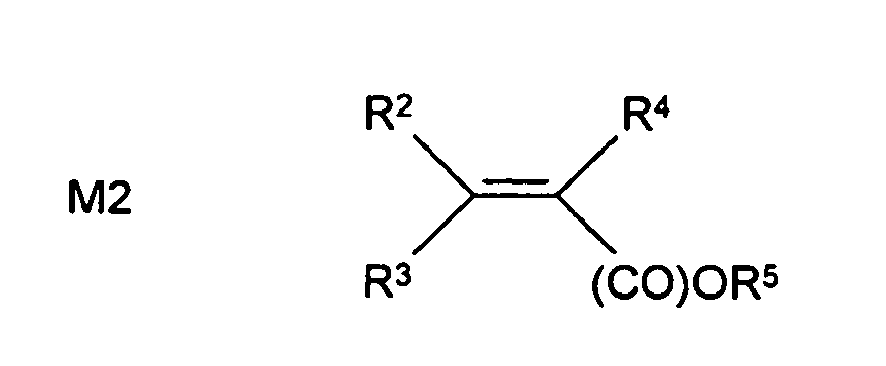

R1 für H oder C1-C40-, wie z.B. C1-C20-, insbesondere C1-C10-, vorzugsweise C1-C4-Hydrocarbyl steht;
R2, R3 und R4 unabhängig voneinander für H oder C1-C4-Alkyl stehen;
R5 für C1-C20-Hydrocarbyl steht;
R6, R7 und R8 unabhängig voneinander für H oder C1-C4-Alkyl stehen; und
R9 für C1-C20-Hydrocarbyl steht. - In den erfindungsgemäß eingesetzten Polymeren können die Monomeren M1, M2 und M3 in folgenden molaren Anteilen (Mx/(M1+M2+M3) im Polymer enthalten sein:
- M1: 0,60 bis 0,98, vorzugsweise 0,7 bis 0,95, insbesondere 0,8 bis 0,9;
- M2: 0,01 bis 0,20, vorzugsweise 0,015 bis 0,17, insbesondere 0,02 bis 0,16;
- M3: 0,01 bis 0,20, vorzugsweise 0,02 bis 0,15, insbesondere 0,03 bis 0,1, speziell 0,03 bis 0,09.
- Vorzugsweise steht R1 für H, Methyl oder Ethyl und insbesondere für H; d.h. das Monomer M1 steht vorzugsweise für Ethylen, Propen oder 1-Buten und insbesondere für Ethylen.
- Im Monomer M2 stehen die Reste R2, R3 und R4 vorzugsweise für H oder Methyl. Besonders bevorzugt stehen zwei der Reste R2, R3 und R4 für H und der andere Rest steht für H oder Methyl. Insbesondere stehen alle drei Reste R2, R3 und R4 für H.
- R5 steht vorzugsweise für C1-C12-Hydrocarbyl, besonders bevorzugt für C1-C10-Hydrocarbyl, stärker bevorzugt für C1-C9-Hydrocarbyl und noch stärker bevorzugt für C4-C8-Hydrocarbyl. Hydrocarbyl steht dabei bevorzugt für Alkyl. Insbesondere steht R5 für n-Butyl, 2-Ethylhexyl oder Lauryl, wobei n-Butyl und 2-Ethylhexyl und speziell 2-Ethylhexyl noch stärker bevorzugt sind.
- Bevorzugt ist das Monomer M2 unter Acrylsäure-n-butylester, Acrylsäure-2-ethylhexylester und Acrylsäurelaurylester und besonders bevorzugt unter Acrylsäure-n-butylester und Acrylsäure-2-ethylhexylester ausgewählt. Insbesondere handelt es sich um Acrylsäure-2-ethylhexylester.
- Im Monomer M3 stehen R6, R7 und R8 unabhängig voneinander vorzugsweise für H oder Methyl und besonders bevorzugt für H.
- R9 steht vorzugsweise für C1-C10-Hydrocarbyl. Hydrocarbyl steht dabei bevorzugt für Alkyl. Besonders bevorzugt steht R9 für Ethyl oder Methyl und insbesondere für Methyl.
- Besonders bevorzugt handelt es sich bei dem Monomer M3 um Vinylacetat.
- Bevorzugt sind die erfindungsgemäß eingesetzten Polymere erhältlich durch, vorzugsweise radikalische, Polymerisation, insbesondere Hochdruckpolymerisation, der Monomere M1, M2 und M3.
- Bevorzugt verwendete Polymere sind ausgewählt unter Ethylen / Acrylsäure-n-butylester / Vinylacetat-Polymeren, Ethylen / Acrylsäure-2-ethylhexylester / Vinylacetat-Polymeren und Ethylen / Acrylsäurelaurylester / Vinylacetat-Polymeren, wobei die beiden zuerst genannten Polymere besonders bevorzugt sind. Insbesondere verwendet man Ethylen / Acrylsäure-2-ethylhexylester / Vinylacetat-Polymere.
- Vorzugsweise werden die Polymere als Kaltfließverbesserer verwendet.
- Die oben beschriebenen Polymere werden alleine oder in Kombination mit anderen derartigen Polymeren in Mengen eingesetzt, die ausreichen, um eine Wirkung als Kaltfließverbesserer im additivierten Brennstoff oder Schmierstoff zu zeigen.
- Ein weiterer Gegenstand der Erfindung betrifft Brennstoffölzusammensetzungen, enthaltend einen größeren Gewichtsanteil eines im Bereich von etwa 120-500 °C siedenden Mitteldestillatbrennstoffs und einen kleineren Gewichtsanteil wenigstens eines erfindungsgemäß verwendeten Polymers (Kaltfließverbesserers) gemäß obigerer Definition.
- Derartige Brennstoffölzusammensetzungen können weiterhin als Brennstoffkomponente Biodiesel (aus tierischer und/oder pflanzlicher Produktion) in Anteilen von 0-100 Gew.-%, vorzugsweise von 0 bis 30 Gew.-% umfassen.
- Bevorzugte Brennstoffölzusammensetzungen sind ausgewählt unter Dieselkraftstoffen, Kerosin und Heizöl, wobei der Dieselkraftstoff durch Raffination, Kohlevergasung oder Gasverflüssigung erhältlich sein kann, ein Gemisch solcher Produkte darstellen und gegebenenfalls mit regenerativen Kraftstoffen vermischt sein kann. Solche Brennstoffölzusammensetzungen sind bevorzugt, in welchen der Schwefelgehalt der Mischung vorzugsweise höchstens 500 ppm beträgt.
- Ein weiterer Gegenstand der Erfindung betrifft Schmierstoffzusammensetzungen, enthaltend einen größeren Gewichtsanteil eines herkömmlichen Schmierstoffs und einen kleineren Gewichtsanteil wenigstens eines Polymers gemäß obiger Definition.
- Im Rahmen der vorliegenden Erfindung können die erfindungsgemäß verwendeten Polymere in Kombination mit weiteren herkömmlichen Kaltfließverbesserern und /oder weiteren Schmier- und Brennstofföladditiven verwendet werden.
- Ein letzter Gegenstand der Erfindung betrifft außerdem Additivpakete, umfassend wenigstens ein erfindungsgemäß verwendetes Polymer gemäß obiger Definition in Kombination mit wenigstens einem weiteren konventionellen Schmier- und Brennstofföladditiv.
- Die erfindungsgemäß verwendeten Polymere sind vorzugsweise im wesentlichen aus den oben definierten Monomeren M1, M2 und M3 aufgebaut. Herstellungsbedingt können gegebenenfalls geringe Anteile einer als Regler (Ketten-Terminator) eingesetzten Verbindung enthalten sein.
- Werden keine anderen Angaben gemacht, so gelten folgende allgemeine Definitionen:
- C1-C40-Hydrocarbyl steht insbesondere für C1-C40-Alkyl, wie Methyl, Ethyl, n-Propyl, Isopropyl, n-Butyl, sec-Butyl, Isobutyl, tert-Butyl, Pentyl, Hexyl, Heptyl, Octyl, 2-Ethylhexyl, Nonyl, Decyl, Undecyl, Dodecyl, Tridecyl, Tetradecyl, Pentadecyl, Hexadecyl, Heptadecyl, Octadecyl, Nonadecyl, Eicosyl, Hencosyl, Docosyl, Tricosyl, Tetracosyl, Pentacosyl, Hexacosyl, Heptacosyl, Octacosyl, Nonacosyl, Squalyl und die höheren Homologen sowie die dazugehörigen Stellungsisomere. Analoges gilt für C1-C20-Hydrocarbylreste. C1-C9-Hydrocarbyl steht insbesondere für C1-C9-Alkyl, wie Methyl, Ethyl, n-Propyl, Isopropyl, n-Butyl, sec-Butyl, Isobutyl, tert-Butyl, Pentyl, Neopentyl, Hexyl, Heptyl, Octyl, Neooctyl, 2-Ethylhexyl, Nonyl und Neononyl. C1-C10-Hydrocarbyl steht darüber hinaus insbesondere noch für Decyl und Neodecyl. C4-C8-Hydrocarbyl steht insbesondere für C4-C8-Alkyl, wie n-Butyl, sec-Butyl, Isobutyl, tert-Butyl, Pentyl, Hexyl, Heptyl, Octyl und 2-Ethylhexyl.
- Als Beispiele für geeignete Monomere M1 sind zu nennen: Mono-Alkene mit nicht-terminaler oder vorzugsweise terminaler Doppelbindung, insbesondere Ethylen, Propylen, 1-Buten, 1-Penten, 1-Hexen, 1-Hepten, 1-Octen, 1-Nonen und 1-Decen sowie die höheren einfach ungesättigten Homologen mit bis zu 40 Kohlenstoffatomen.
- Als Beispiele für bevorzugte α,β-ungesättigte Carbonsäureester M2 sind zu nennen: Acrylsäureester von C1-C20-Alkanolen, wie Acrylsäuremethylester, Acrylsäureethylester, Acrylsäurepropylester, Acrylsäureisopropylester, Acrylsäure-n-butylester, Acrylsäureisobutylester, Acrylsäure-tert-butylester, Acrylsäure-n-pentylester, Acrylsäureneopentylester, Acrylsäurehexylester, Acrylsäureheptylester, Acrylsäureoctylester, Acrylsäureneooctylester, Acrylsäure-2-ethylhexylester, Acrylsäurenonylester, Acrylsäureneononylester, Acrylsäuredecylester, Acrylsäureneodecylester, Acrylsäurelaurylester, Acrylsäurepalmitylester und Acrylsäurestearylester; außerdem die entsprechenden Methacrylsäure-, Crotonsäure- und Isocrotonsäureester, wobei die Acrylate (Acrylsäureester) bevorzugt sind.
- Als Beispiele für geeignete Monomere M3 sind zu nennen:
- C1-C20-Carbonsäurevinylester, insbesondere die Vinylester von Essigsäure, Propionsäure, Buttersäure, Valeriansäure, Isovaleriansäure, Pivalinsäure, Capronsäure, Önanthsäure, Caprylsäure, Pelargonsäure, Neononansäure, Neodecansäure, Caprinsäure, Laurinsäure, Myristinsäure, Palmitinsäure, Stearinsäure und Arachinsäure; außerdem die entsprechenden Propenylester. Die Vinylester sind jedoch bevorzugt.
- Die erfindungsgemäßen Polymere weisen außerdem ein zahlenmittleres Molekulargewicht Mn im Bereich von etwa 1000 bis 20000, besonders bevorzugt von 1000 bis 10000, insbesondere von 1500 bis 6000 und speziell von 1500 bis 5000 auf.
- Die Polymere können auch ein gewichtsmittleres Molekulargewicht Mw von 1000 bis 30000, insbesondere 2000 bis 20000 und/oder ein Mw/Mn-Verhältnis von 1,5 bis 5,0, vorzugsweise von 1,8 bis 4,0 und insbesondere von 1,9 bis 3,5 aufweisen.
- Besonders bevorzugte Polymere sind aufgebaut aus den Monomeren Ethylen, Vinylacetat und einem Acrylsäureester-Monomeren, der ausgewählt ist unter Acrylsäure-n-butylester, Acrylsäure-2-ethylhexylester und Acrylsäurelaurylester und vorzugsweise unter Acrylsäure-n-butylester und Acrylsäure-2-ethylhexylester. Insbesondere handelt es sich bei dem Acrylsäureester-Monomeren um Acrylsäure-2-ethylhexylester.
- Bezogen auf ein Polymer aus Ethylen, Acrylsäure-2-ethylhexylester (AEH) und Vinylacetat (VAC) beträgt der Gewichtsanteil der Monomere:
- AEH: 4 - 80 Gew.%, vorzugsweise 5 bis 62 Gew.%, insbesondere etwa 7 bis 45 Gew.-% VAC: 1-42 Gew.%, vorzugsweise 1 bis 30 Gew.-%, insbesondere etwa 1 bis 25 Gew.-%, speziell 1 bis 20 Gew.-%
- Die Viskosität derartiger Polymere (bestimmt nach Ubbelohde DIN 51562) liegt bei etwa 5 bis 25000 mm2/s, vorzugsweise etwa 10 bis 1000 mm2/s, insbesondere etwa 50 bis 700 mm2/s jeweils bei einer Temperatur von etwa 120 °C.
- Die erfindungsgemäßen Polymere werden nach an sich bekannten Verfahren hergestellt, vorzugsweise nach den aus dem Stand der Technik (vgl. z.B. Ullmann's Encyclopedia of Industrial Chemistry 5. Auflage, Stichwort: Waxes, Bd. A 28, S. 146 ff., VCH Weinheim, Basel, Cambridge, New York, Tokio, 1996; außerdem
US 3,627,838 ;DE-A 2515805 ;DE-A 3141507 ;EP-A 0007590 ) bekannten Verfahren zur direkten radikalischen Hochdruck-Copolymerisation ungesättigter Verbindungen. - Die Herstellung der Polymere erfolgt bevorzugt in gerührten Hochdruckautoklaven oder in Hochdruckrohrreaktoren oder Kombinationen aus beiden. Bei ihnen verhält sich überwiegend das Verhältnis Länge/Durchmesser in Bereichen von 5:1 bis 30:1, bevorzugt 10:1 bis 20:1.
- Geeignete Druckbedingungen für die Polymerisation sind 1000 bis 3000 bar, bevorzugt 1500 bis 2000 bar. Die Reaktionstemperaturen liegen z.B. im Bereich von 160 bis 320 °C, bevorzugt im Bereich von 200 bis 280 °C.
- Als Regler zur Einstellung des Molekulargewichts der Copolymere verwendet man beispielsweise einen aliphatischen Aldehyd oder ein aliphatisches Keton der allgemeinen Formel I

- Dabei sind die Reste Ra und Rb gleich oder verschieden und ausgewählt unter
- Wasserstoff;
- C1-C6-Alkyl, wie Methyl, Ethyl, n-Propyl, iso-Propyl, n-Butyl, iso-Butyl, sec.-Butyl, tert.-Butyl, n-Pentyl, iso-Pentyl, sec-Pentyl, neo-Pentyl, 1,2-Dimethylpropyl, iso-Amyl, n-Hexyl, iso-Hexyl, sec-Hexyl; besonders bevorzugt C1-C4-Alkyl, wie Methyl, Ethyl, n-Propyl, iso-Propyl, n-Butyl, iso-Butyl, sec-Butyl und tert.-Butyl;
- C3-C12-Cycloalkyl, wie Cyclopropyl, Cyclobutyl, Cyclopentyl, Cyclohexyl, Cycloheptyl, Cyclooctyl, Cyclononyl, Cyclodecyl, Cycloundecyl und Cyclododecyl; bevorzugt sind Cyclopentyl, Cyclohexyl und Cycloheptyl.
- Die Reste Ra und Rb können auch miteinander unter Bildung eines 4- bis 13-gliedrigen Rings kovalent verbunden sein. So können Ra und Rb beispielsweise gemeinsam folgende Alkylengruppen bilden: -(CH2)4-, -(CH2)5-, -(CH2)6, -(CH2)7-, -CH(CH3)-CH2-CH2-CH(CH3)- oder-CH(CH3)-CH2-CH2-CH2-CH(CH3)-.
- Die Verwendung von Propionaldehyd oder Ethylmethylketon als Regler ist ganz besonders bevorzugt.
- Weitere gut geeignete Regler sind unverzweigte aliphatische Kohlenwasserstoffe, wie beispielsweise Propan oder verzweigte aliphatische Kohlenwasserstoffe mit tertiären H-Atomen, wie beispielsweise Isobutan, Isopentan, Isooctan oder Isododekan (2,2,4,6,6-Pentamethylheptan). Als weitere zusätzliche Regler können höhere Olefine, wie beispielsweise Propylen, eingesetzt werden.
- Auch Mischungen der obigen Regler mit Wasserstoff oder Wasserstoff alleine sind ebenfalls bevorzugt.
- Die Menge an verwendetem Regler entspricht den für das Hochdruckpolymerisationsverfahren üblichen Mengen.
- Als Starter für die radikalische Polymerisation können die üblichen Radikalstarter, wie beispielsweise organische Peroxide, Sauerstoff oder Azoverbindungen, eingesetzt werden. Auch Mischungen mehrerer Radikalstarter sind geeignet. Als Radikalstarter können z.B. ein oder mehrere Peroxide, ausgewählt unter folgenden kommerziell erhältlichen Substanzen eingesetzt werden:
- Didecanoylperoxid, 2,5-Dimethyl-2,5-di(2-ethylhexanoylperoxy)hexan, tert-Amylperoxy-2-ethylhexanoat, Dibenzoylperoxid, tert-Butylperoxy-2-ethylhexanoat, tert-Butylperoxydiethylacetat, tert-Butylperoxydiethylisobutyrat, 1,4-Di(tert-butylperoxycarbo)-cyclohexan als Isomerengemisch, tert-Butylperisononanoat, 1,1-Di-(tert-butylperoxy)-3,3,5-trimethylcyclohexan, 1,1-Di-(tert-butylperoxy)-cyclohexan, Methyl-isobutylketonperoxid, tert-Butylperoxyisopropylcarbonat, 2,2-Di-tert-butylperoxy)butan oder tert-Butylperoxacetat;
- tert-Butylperoxybenzoat, Di-tert-amylperoxid, Dicumylperoxid, die isomeren Di-(tert-butylperoxyisopropyl)benzole, 2,5-Dimethyl-2,5-di-tert-butylperoxyhexan, tert-Butylcumylperoxid, 2,5-Dimethyl-2,5-di(tert-butylperoxy)-hex-3-in, Di-tert-butylperoxid, 1,3-Diisopropylmonohydroperoxid, Cumolhydroperoxid oder tert-Butylhydroperoxid;
oder - dimere oder trimere Ketonperoxide, so wie sie z.B. aus der
EP-A-0 813 550 bekannt sind - Als Peroxide sind Di-tert-butylperoxid, tert-Butylperoxypivalat, tert-Butylperoxyisononanoat oder Dibenzoylperoxid oder Gemische derselben besonders geeignet. Als Azoverbindung sei Azobisisobutyronitril ("AIBN") beispielhaft genannt. Die Radikalstarter werden in für Polymerisationen üblichen Mengen dosiert.
- In einer bevorzugten Fahrweise werden die erfindungsgemäßen Polymere so hergestellt, dass man eine Mischung der Monomeren M1, M2 und M3 in Gegenwart des Reglers bei einer Temperatur im Bereich von etwa 20 bis 50°C, wie z.B. von 30°C, vorzugsweise kontinuierlich durch einen Rührautoklaven leitet, welcher auf einem Druck im Bereich von etwa 1500 bis 2000 bar, wie z.B. von etwa 1700 bar, gehalten wird. Durch die vorzugsweise kontinuierliche Zugabe von Initiator, der in der Regel in einem geeigneten Lösemittel, wie z.B. Isododecan, gelöst ist, wird die Temperatur im Reaktor auf der gewünschten Reaktionstemperatur, wie z.B. bei 200 bis 250°C, gehalten. Das nach der Entspannung des Reaktionsgemisches anfallende Polymerisat wird dann in herkömmlicher Weise isoliert.
- Abwandlungen dieser Fahrweise sind natürlich möglich und können vom Fachmann ohne unzumutbaren Aufwand vorgenommen werden. So können beispielsweise die Comonomere und der Regler getrennt dem Reaktionsgemisch zudosiert werden, die Reaktionstemperatur kann während des Verfahrens variiert werden, um nur einige Beispiele zu nennen.
- Unter Brennstoffölzusammensetzungen versteht man erfindungsgemäß vorzugsweise Kraftstoffe. Geeignete Kraftstoffe sind Ottokraftstoffe und Mitteldestillate, wie Dieselkraftstoffe, Heizöl oder Kerosin, wobei Dieselkraftstoff und Heizöl besonders bevorzugt sind.
- Bei den Heizölen handelt es sich beispielsweise um schwefelarme oder schwefelreiche Erdölraffinate oder um Stein- oder Braunkohledestillate, die üblicherweise einen Siedebereich von 150 bis 400 °C aufweisen. Vorzugsweise handelt es sich bei den Heizölen um schwefelarme Heizöle, beispielsweise um solche mit einem Schwefelgehalt von höchstens 0,1 Gew.-%, bevorzugt von höchstens 0,05 Gew.-%, z.B. höchstens 0,005 Gew.-% oder z.B. höchstens 0,001 Gew.-%. Als Beispiele für Heizöl sei insbesondere Heizöl für häusliche Ölfeuerungsanlagen oder Heizöl EL genannt. Die Qualitätsanforderungen für solche Heizöle sind beispielsweise in DIN 51-603-1 festgelegt (vgl. auch Ullmann's Encyclopedia of Industrial Chemistry, 5. Auflage, Bd. A12, S. 617 ff., worauf hiermit ausdrücklich Bezug genommen wird).
- Bei den Dieselkraftstoffen handelt es sich beispielsweise um Erdölraffinate, die üblicherweise einen Siedebereich von 100 bis 400 °C haben. Dies sind meist Destillate mit einem 95%-Punkt bis zu 360 °C oder auch darüber hinaus. Dies können aber auch sogenannte "Ultra low sulfur diesel" oder "City diesel" sein, gekennzeichnet durch einen 95%-Punkt von beispielsweise maximal 345 °C und einem Schwefelgehalt von maximal 0,005 Gew.-% oder durch einen 95%-Punkt von beispielsweise 285 °C und einem Schwefelgehalt von maximal 0,001 Gew.-%. Neben den durch Raffination erhältlichen Dieselkraftstoffen sind solche, die durch Kohlevergasung oder Gasverflüssigung ("gas to liquid" (GTL) Kraftstoffe) erhältlich sind, geeignet. Geeignet sind auch regenerative Kraftstoffe, wie Biodiesel oder Bioethanol, ihre Gemische oder Mischungen der regenerativen Kraftstoffe mit den vorstehend genannten Dieselkraftstoffe.
- Besonders bevorzugt wird das erfindungsgemäße Additiv zur Additivierung von Dieselkraftstoffen mit niedrigem Schwefelgehalt, das heißt mit einem Schwefelgehalt von weniger als 0,05 Gew.-%, vorzugsweise von weniger als 0,02 Gew.-%, insbesondere von weniger als 0,005 Gew.-% und speziell von weniger als 0,001 Gew.-% Schwefel oder zur Additivierung von Heizöl mit einem niedrigen Schwefelgehalt, beispielsweise mit einem Schwefelgehalt von höchstens 0,1 Gew.-%, bevorzugt von höchstens 0.05 Gew.-%, z.B. höchstens 0,005 Gew.-% oder z.B. höchstens 0,001 Gew.-%, verwendet.
- Das erfindungsgemäße Additiv wird vorzugsweise in einem Mengenanteil, bezogen auf die Gesamtmenge der Brennstoffölzusammensetzung, eingesetzt, der für sich gesehen einen im wesentlichen ausreichenden Einfluss auf die Kaltfließeigenschaften der Brennstoffölzusammensetzungen besitzt. Bevorzugt wird das Additiv in einer Menge von 0,001 bis 1 Gew.-%, besonders bevorzugt von 0,01 bis 0,15 Gew.-%, insbesondere von 0,01 bis 0,1 Gew.-%, bezogen auf die Gesamtmenge der Brennstoffölzusammensetzung, eingesetzt.
- Die erfindungsgemäßen Polymere können einzeln oder als Gemisch solcher Polymere und gegebenenfalls in Kombination mit weiteren an sich bekannten Zusatzstoffen den Brennstoffölzusammensetzungen zugegeben werden.
- Geeignete Zusatzstoffe, die in erfindungsgemäßen Brennstoffölen neben den erfindungsgemäßen Polymer enthalten sein können, insbesondere für Dieselkraftstoffe und Heizöle, umfassen Detergentien, Korrosionsinhibitoren, Dehazer, Demulgatoren, Schaumverhinderer ("Antifoam"), Antioxidantien, Metalldesaktivatoren, multifunktionelle Stabilisatoren, Cetanzahlverbesserer, Verbrennungsverbesserer, Farbstoffe, Marker, Lösungsvermittler, Antistatika, Schmierfähigkeitsverbesserer, sowie weitere die Kälteeigenschaften des Brennstoffs verbessernde Additive, wie Nukleatoren, weitere herkömmliche Fließverbesserer ("MDFI"), Paraffindispergatoren ("WASA") und die Kombination der beiden zuletzt genannten Additive ("WAFI") (vgl. auch Ullmann's Encyclopedia of Industrial Chemistry, 5. Auflage, Bd.A16, S.719 ff; oder die eingangs zitierten Patentschriften zur Fließverbesserern).
- Als weitere konventionelle Kaltfließverbesserer sind insbesondere zu nennen:
- (a) Copolymere von Ethylen mit wenigstens einem weiteren ethylenisch ungesättigten Monomer, die von den erfindungsgemäß verwendeten Polymeren verschieden sind;
- (b) Kammpolymere;
- (c) Polyoxyalkylene;
- (d) polare Stickstoffverbindungen;
- (e) Sulfocarbonsäuren oder Sulfonsäuren oder deren Derivate; und
- (f) Poly(meth)acrylsäureester.
Bei den Copolymeren von Ethylen mit wenigstens einem weiteren ethylenisch ungesättigten Monomer (a) ist das Monomer vorzugsweise ausgewählt unter Alkenylcarbonsäureestern, (Meth)Acrylsäureestem und Olefinen. - Geeignete Olefine sind beispielsweise solche mit 3 bis 10 Kohlenstoffatomen sowie mit 1 bis 3, vorzugsweise mit 1 oder 2, insbesondere mit einer, Kohlenstoff-Kohlenstoff-Doppelbindung. Im zuletzt genannten Fall kann die Kohlenstoff-Kohlenstoff-Doppelbindung sowohl terminal (α-Olefine) als auch intern angeordnet sein kann. Bevorzugt sind jedoch α-Olefine, besonders bevorzugt α-Olefine mit 3 bis 6 Kohlenstoffatomen, wie Propen, 1-Buten, 1-Penten und 1-Hexen.
- Geeignete (Meth)Acrylsäureester sind beispielsweise Ester der (Meth)Acrylsäure mit C1-C10-Alkanolen, insbesondere mit Methanol, Ethanol, Propanol, Isopropanol, n-Butanol, sec-Butanol, Isobutanol, tert-Butanol, Pentanol, Hexanol, Heptanol, Octanol, 2-Ethylhexanol, Nonanol und Decanol.
- Geeignete Alkenylcarbonsäureester sind beispielsweise die Vinyl- und Propenylester von Carbonsäuren mit 2 bis 20 Kohlenstoffatomen, deren Kohlenwasserstoffrest linear oder verzweigt sein kann. Bevorzugt sind hierunter die Vinylester. Unter den Carbonsäuren mit verzweigtem Kohlenwasserstoffrest sind solche bevorzugt, deren Verzweigung sich in der a-Position zur Carboxylgruppe befindet, wobei das a-Kohlenstoffatom besonders bevorzugt tertiär ist, d. h. die Carbonsäure eine sogenannte Neocarbonsäure ist. Vorzugsweise ist der Kohlenwasserstoffrest der Carbonsäure jedoch linear.
- Beispiele für geeignete Alkenylcarbonsäureester sind Vinylacetat, Vinylpropionat, Vinylbutyrat, Vinyl-2-ethylhexanoat, Neopentansäurevinylester, Hexansäurevinylester, Neononansäurevinylester, Neodecansäurevinylester und die entsprechenden Propenylester, wobei die Vinylester bevorzugt sind. Ein besonders bevorzugter Alkenylcarbonsäureester ist Vinylacetat.
- Besonders bevorzugt ist das ethylenisch ungesättigte Monomer ausgewählt unter Alkenylcarbonsäureestern.
- Geeignet sind auch Copolymere, die zwei oder mehrere voneinander verschiedene Alkenylcarbonsäureester einpolymerisiert enthalten, wobei diese sich in der Alkenylfunktion und/oder in der Carbonsäuregruppe unterscheiden. Ebenfalls geeignet sind Copolymere, die neben dem/den Alkenylcarbonsäureester(n) wenigstens ein Olefin und/oder wenigstens ein (Meth)Acrylsäureester einpolymerisiert enthalten.
- Das ethylenisch ungesättigte Monomer ist im Copolymer in einer Menge von vorzugsweise 1 bis 50 Mol.%, besonders bevorzugt von 10 bis 50 Moi.-% und insbesondere von 5 bis 20 Mol.-%, bezogen auf das Gesamtcopolymer, einpolymerisiert.
- Das Copolymer (a) weist vorzugsweise ein zahlenmittleres Molekulargewicht Mn von 1000 bis 20000, besonders bevorzugt von 1000 bis 10000 und insbesondere von 1000 bis 6000, auf.
- Kammpolymere (b) sind beispielsweise solche, die in "Comb-Like Polymers. Structure and Properties", N. A. Platé und V. P. Shibaev, J. Poly. Sci. Macromolecular Revs. 8, Seiten 117 bis 253 (1974) beschrieben sind. Von den dort beschriebenen sind beispielsweise Kammpolymere der Formel II geeignet

D für R17, COOR17, OCOR17, R18, OCOR17 oder OR17 steht,
E für H, CH3, D oder R18 steht,
G für H oder D steht, -
J für H, R18, R18COOR17, Aryl oder Heterocyclyl steht,
K für H, COOR18, OCOR18, OR18 oder COOH steht,
L für H, R18 COOR18, OCOR18, COOH oder Aryl steht,
wobei
R17 für einen Kohlenwasserstoffrest mit wenigstens 10 Kohlenstoffatomen, vorzugsweise mit 10 bis 30 Kohlenstoffatomen, steht,
R18 für einen Kohlenwasserstoffrest mit wenigstens einem Kohlenstoffatom, vorzugsweise mit 1 bis 30 Kohlenstoffatomen, steht,
m für einen Molenbruch im Bereich von 1,0 bis 0,4 steht und
n für einen Molenbruch im Bereich von 0 bis 0,6 steht. - Bevorzugte Kammpolymere sind beispielsweise durch die Copolymerisation von Maleinsäureanhydrid oder Fumarsäure mit einem anderen ethylenisch ungesättigten Monomer, beispielsweise mit einem α-Olefin oder einem ungesättigten Ester, wie Vinylacetat, und anschließende Veresterung der Anhydrid- bzw. Säurefunktion mit einem Alkohol mit wenigstens 10 Kohlenstoffatomen erhältlich. Weitere bevorzugte Kammpolymere sind Copolymere von α-Olefinen und veresterten Comonomeren, beispielsweise veresterte Copolymere von Styrol und Maleinsäureanhydrid oder veresterte Copolymere von Styrol und Fumarsäure. Auch Gemische von Kammpolymeren sind geeignet. Kammpolymere können auch Polyfumarate oder Polymaleinate sein. Außerdem sind Homo- und Copolymere von Vinylethern geeignete Kammpolymere.
- Geeignete Polyoxyalkylene (c) sind beispielsweise Polyoxyalkylenester, -ether, -ester/ether und Gemische davon. Bevorzugt enthalten die Polyoxyalkylenverbindungen wenigstens eine, besonders bevorzugt wenigstens zwei lineare Alkylgruppen mit 10 bis 30 Kohlenstoffatomen und eine Polyoxyalkylengruppe mit einem Molekulargewicht von bis zu 5000. Die Alkylgruppe des Polyoxyalkylenrestes enthält dabei vorzugsweise 1 bis 4 Kohlenstoffatome. Derartige Polyoxyalkylenverbindungen sind beispielsweise in der
EP-A-0 061 895 sowie in derUS 4,491,455 beschrieben, worauf hiermit im vollem Umfang Bezug genommen wird. Bevorzugte Polyoxyalkylenester, -ether und ester/ether besitzen die allgemeine Formel III
R19[-O-(CH2)y]xO-R20 (III)
worin
R19 und R20 jeweils unabhängig voneinander für R21, R21-CO-, R21-O-CO(CH2)z- oder R21-O-CO(CH2)z-CO- stehen, wobei R21 für lineares C1-C30-Alkyl steht,
y für eine Zahl von 1 bis 4 steht,
x für eine Zahl von 2 bis 200 steht, und
z für eine Zahl von 1 bis 4 steht. - Bevorzugte Polyoxyalkylenverbindungen der Formel III, in denen sowohl R19 als auch R20 für R21 stehen, sind Polyethylenglykole und Polypropylenglykole mit einem zahlenmittleren Molekulargewicht von 100 bis 5000. Bevorzugte Polyoxyalkylene der Formel III, in denen einer der Reste R19 für R21 und der andere für R21-CO- steht, sind Polyoxyalkylenester von Fettsäuren mit 10 bis 30 Kohlenstoffatomen, wie Stearinsäure oder Behensäure. Bevorzugte Polyoxyalkylenverbindungen, in denen sowohl R19 als auch R20 für einen Rest R21-CO- stehen, sind Diester von Fettsäuren mit 10 bis 30 Kohlenstoffatomen, bevorzugt von Stearin- oder Behensäure.
- Die polaren Stickstoffverbindungen (d), die geeigneterweise öllöslich sind, können sowohl ionisch als auch nicht ionisch sein und besitzen vorzugsweise wenigstens einen, besonders bevorzugt wenigstens 2 Substituenten der Formel >NR22, worin R22 für einen C8-C40-Kohlenwasserstoffrest steht. Die Stickstoffsubstituenten können auch quaternisiert, das heißt in kationischer Form, vorliegen. Ein Beispiel für solche Stickstoffverbindungen sind Ammoniumsalze und/oder Amide, die durch die Umsetzung wenigstens eines mit wenigstens einem Kohlenwasserstoffrest substituierten Amins mit einer Carbonsäure mit 1 bis 4 Carboxylgruppen bzw. mit einem geeignetem Derivat davon erhältlich sind. Vorzugsweise enthalten die Amine wenigstens einen linearen C8-C40-Alkylrest. Geeignete primäre Amine sind beispielsweise Octylamin, Nonylamin, Decylamin, Undecylamin, Dodecylamin, Tetradecylamin und die höheren linearen Homologen. Geeignete sekundäre Amine sind beispielsweise Dioctadecylamin und Methylbehenylamin. Geeignet sind auch Amingemische, insbesondere großtechnisch zugänglicher Amingemische, wie Fettamine oder hydrierte Tallamine, wie sie beispielsweise in Ullmanns Encyclopedia of Industrial Chemistry, 6th edition, 2000 electronic release, Kapitel "Amines, aliphatic" beschrieben werden. Für die Umsetzung geeignete Säuren sind beispielsweise Cyclohexan-1,2-Dicarbonsäure, Cyclohexen-1,2-Dicarbonsäure, Cyclopentan-1,2-Dicarbonsäure, Naphthalindicarbonsäure, Phthalsäure, Isophthalsäure, Terephthalsäure und mit langkettigen Kohlenwasserstoffresten substituierte Bernsteinsäuren.
- Ein weiteres Beispiel für polare Stickstoffverbindungen sind Ringsysteme, die wenigstens zwei Substituenten der Formel -A-NR23R24 tragen, worin A für eine lineare oder verzweigte aliphatische Kohlenwasserstoffgruppe steht, die gegebenenfalls durch eine oder mehrere Gruppen, die ausgewählt sind unter O, S, NR35 und CO, unterbrochen ist, und R23 und R24 für einen C9-C40-Kohfenwasserstoffrest stehen, der gegebenenfalls durch eine oder mehrere Gruppen, die ausgewählt sind unter O, S, NR35 und CO, unterbrochen und/oder durch einen oder mehrere Substituenten, die ausgewählt sind unter OH, SH und NR35R36 substituiert ist, wobei R35 für C1-C40-Alkyl, das gegebenenfalls durch eine oder mehrere Gruppierungen, die ausgewählt sind unter CO, NR35, O und S, unterbrochen, und/oder durch einen oder mehrere Reste, die ausgewählt sind unter NR37R38, OR37, SR37, COR37, COOR37, CONR37R38, Aryl oder Heterocyclyl substituiert ist, wobei R37 und R38 jeweils unabhängig voneinander ausgewählt sind unter H oder C1-C4-Alkyl; und R36 für H oder R35 steht.
- Vorzugsweise ist A eine Methylen- oder Polymethylengruppe mit 2 bis 20 Methyleneinheiten. Beispiele für geeignete Reste R23 und R24 sind 2-Hydroxyethyl, 3-Hydroxypropyl, 4-Hydroxybutyl, 2-Ketopropyl, Ethoxyethyl und Propoxypropyl. Bei dem cyclischen System kann es sich sowohl um homocyclische, heterocyclische, kondensierte polycyclische oder nicht kondensierte polycyclische Systeme handeln. Vorzugsweise ist das Ringsystem carbo- oder heteroaromatisch, insbesondere carboaromatisch. Beispiele für derartige polycyclische Ringsysteme sind kondensierte benzoide Strukturen, wie Naphthalin, Anthracen, Phenanthren und Pyren, kondensierte nichtbenzoide Strukturen, wie Azulen, Inden, Hydrinden und Fluoren, nicht kondensierte Polycyclen, wie Diphenyl, Heterocyclen, wie Chinolin, Indol, Dihydroindol, Benzofuran, Cumarin, Isocumarin, Benzthiophen, Carbazol, Diphenylenoxid und Diphenylensulfid, nicht aromatische oder teilweise gesättigte Ringsysteme, wie Decalin, und dreidimensionale Strukturen, wie α-Pinen, Camphen, Bornylen, Norbonan, Norbonen, Bicyclooctan und Bicycloocten.
- Ein weiteres Beispiel für geeignete polare Stickstoffverbindungen sind Kondensate von langkettigen primären oder sekundären Aminen mit Carboxylgruppen-haltigen Polymeren.
- Die hier genannten polaren Stickstoffverbindungen sind in der
WO 00/44857 - Geeignete polare Stickstoffverbindungen sind z.B. auch in der
DE-A-198 48 621 derDE-A-196 22 052 oder derEP-B-398 101 - Geeignete Sulfocarbonsäuren/Sulfonsäuren bzw. deren Derivate (e) sind beispielsweise solche der allgemeinen Formel IV

Y für SO3 -(NR25 3R26)+, SO3 -(NHR25 2R26)+, SO3 -(NH2R25R26), SO3 -(NH3R26) oder SO2NR25R26 steht,
X für Y, CONR25R27, CO2 -(NR25 3R27)+, CO2 -(NHR25 2R27)+, R28-COOR27, NR25COR27, R28OR27, R28OCOR27, R28R27, N(COR25)R27 oder Z-(NR25 3R27)+ steht,
wobei
R25 für einen Kohlenwasserstoffrest steht,
R26 und R27 für Alkyl, Alkoxyalkyl oder Polyalkoxyalkyl mit wenigstens 10 Kohlenstoffatomen in der Hauptkette stehen,
R28 für C2-C5-Alkylen steht,
Z- für ein Anionenäquivalent steht und
A und B für Alkyl, Alkenyl oder zwei substituierte Kohlenwasserstoffreste stehen oder gemeinsam mit den Kohlenstoffatomen, an die sie gebunden sind, ein aromatisches oder cycloaliphatisches Ringsystem bilden. - Derartige Sulfocarbonsäuren bzw. Sulfonsäuren und ihre Derivate sind in der
EP-A-0 261 957 beschrieben, worauf hiermit im vollem Umfang Bezug genommen wird. - Geeignete Poly(meth)acrylsäureester (f) sind sowohl Homo- als auch Copolymere von Acryl-und Methacrylsäureestern. Bevorzugt sind Acrylsäureester-Homopolymere, die sich von C1-C40-Alkoholen ableiten. Bevorzugt sind auch Copolymere von wenigstens zwei voneinander verschiedenen (Meth)Acrylsäureestern, die sich bezüglich des einkondensierten Alkohols unterscheiden. Gegebenenfalls enthält das Copolymer noch ein weiteres, davon verschiedenes olefinisch ungesättigtes Monomer einpolymerisiert. Das gewichtsmittlere Molekulargewicht des Polymers beträgt vorzugsweise 50000 bis 500000. Ein besonders bevorzugtes Polymer ist ein Copolymer von Methacrylsäure und Methacrylsäureestern von gesättigten C14- und C15-Alkoholen, wobei die Säuregruppen mit hydriertem Tallamin neutralisiert sind. Geeignete Poly(meth)acrylsäureester sind beispielsweise in der
WO 00/44857 - Schließlich ist Gegenstand der vorliegenden Anmeldung ein Additivkonzentrat, enthaltend wenigstens ein wie vorstehend definiertes erfindungsgemäßes Polymer und wenigstens ein Verdünnungsmittel sowie gegebenenfalls mindestens einen weiteren Zusatzstoff, insbesondere ausgewählt unter obigen Co-Additiven.
- Geeignete Verdünnungsmittel sind beispielsweise bei der Erdölverarbeitung anfallende Fraktionen, wie Kerosin, Naphtha oder Brightstock. Geeignet sind darüber hinaus aromatische und aliphatische Kohlenwasserstoffe und Alkoxyalkanole. Bei Mitteldestillaten, insbesondere bei Dieselkraftstoffen und Heizölen bevorzugt verwendete Verdünnungsmittel sind Naphtha, Kerosin, Dieselkraftstoffe, aromatische Kohlenwasserstoffe, wie Solvent Naphtha schwer, Solvesso® oder Shellsol® sowie Gemische dieser Lösungs- und Verdünnungsmittel.
- Das erfindungsgemäße Polymer liegt in den Konzentraten vorzugsweise in einer Menge von 0,1 bis 80 Gew.-%, besonders bevorzugt von 1 bis 70 Gew.-% und insbesondere von 20 bis 60 Gew.-%, bezogen auf das Gesamtgewicht des Konzentrats, vor.
- Die Erfindung wird nun anhand der folgenden nicht einschränkenden Beispiele näher erläutert.
- Es wurden insgesamt 23 verschiedene erfindungsgemäße Polymere durch Hochdruckpolymerisation von Ethylen, Acrylsäure-2-ethylhexylester (AEH) und Vinylacetat (VAC) hergestellt.
- In Tabelle 1 sind die Eigenschaften der in den nachfolgenden Testbeispielen eingesetzten Polymerisate zusammengestellt.
- Der Gehalt an Ethylen, AEH und VAC in den erhaltenen Polymeren wurde NMRspektroskopisch bestimmt. Die Viskositäten wurden nach Ubbelohde DIN 51562 bestimmt.
Tabelle 1 Polymer Nr. E [Mol-%] VAC [Mol-%] AEH [Mol-%] Viskosität [mm2/s] Mn Mw Mw/Mn 1 88,0 4,2 7,8 60 2088 4189 2,01 2 88,0 4,4 7,6 150 2959 6666 2,25 3 88,1 4,4 7,5 605 4635 12811 2,76 4 86,6 3,9 9,5 60 2124 4285 2,02 5 86,4 4,3 9,3 150 3022 6754 2,23 6 86,4 4,1 9,5 595 4797 13238 2,76 7 83,8 4,1 12,1 60 2064 4280 2,07 8 83,2 4,4 12,4 150 2994 7203 2,41 9 83,1 4,4 12,5 600 4744 14503 3,06 10 80,2 4,5 15,3 150 3038 7279 2,40 11 80,4 4,1 15,5 600 4681 15697 3,35 12 89,6 8,0 2,4 60 1977 3910 1,98 13 89,8 7,9 2,3 150 2831 6212 2,19 14 89,2 8,2 2,6 605 3862 11098 2,87 15 89,8 8,4 4,8 60 1928 3902 2,02 16 86,5 8,4 5,1 150 2926 6337 2,17 17 86,3 8,5 5,2 620 4613 12019 2,61 18 84,2 8,1 7,7 60 2003 4025 2,01 19 83,1 8,7 8,2 150 2855 6382 2,24 20 84,3 8,0 7,7 615 4858 13061 2,69 21 81,1 7,9 11,0 60 2100 4276 2,04 22 80,8 8,0 11,2 150 2878 6634 2,31 23 81,1 7,6 11,3 630 4774 14263 2,99 E: Ethylen
AEH: Acrylsäure-2-ethylhexylester
VAC: Vinylacetat - Mit den oben hergestellten Polymeren 1 bis 23 wurden die nachfolgenden Versuche durchgeführt. Zu Vergleichszwecken wurden folgende herkömmliche MDFI mitgetestet
- Vergleichsprodukt A:
- Ethylen-Vinylacetat-basierte Polymermischung; 60 % Polymergehalt (Keroflux 6100, BASF AG)
- Vergleichsprodukt B:
- Ethylen-Vinylacetat-basierte Polymermischung; 50 % Polymergehalt (Keroflux 6103, BASF AG)
- Vergleichsprodukt C:
- Ethylen-Terpolymer; 75 % Polymergehalt
- Vergleichsprodukt D:
- Ethylen-Vinylacetat-basierte Polymermischung; 60 % Polymergehalt
- Es wurden herkömmliche Mitteldesfillat-Brennstoffe mit obigen erfindungsgemäßen bzw. her kömmlichen Kaltfließverbesserern in unterschiedlichen Dosierraten additiviert und die untere Einmischtemperatur, der CP-Wert (Cloud Point; Trübungspunkt), der PP-Wert (Pour Point; Stockpunkt) und die Viskosität der Additive sowie der CFPP-Wert (Cold Filter Plugging Point) der additivierten Brennstoffe bestimmt. Die untere Einmischtemperatur wurde nach QSAA FKL 103; Abschnitt 5.4.2 (ARAL-Forschung), der CP-Wert nach ASTM D 2500, der PP-Wert der Additive nach ISO 3016, die Viskosität der Additive nach DIN 51512 und der CFPP-Wert nach DIN EN 116 bestimmt
- Untersucht wurde die untere Einmischtemperatur im Mitteldestillat, wobei 50%ige Lösungen der erfindungsgemäß verwendeten Polymere in Solvent Naphtha schwer eingesetzt wurden. Die untere Einmischtemperatur ist insbesondere für solche Raffinerien von Belang, die Additive unbeheizt in Brennstofföle einmischen oder Additive in unbeheizte Brennstofföle einmischen. Ist die untere Einmischtemperatur des Additivs hoch, so kann es nach dem unbeheizten Einmischen zu Filterproblemen kommen.
- Eingesetztes Mitteldestillat: Dieselkraftstoff, CP = -5 °C, CFPP = -9°C, 25 % n-Paraffine, 90-20 = 70 °C. Dosierung der Additive: 500 ppm
Tabelle 2 Additiv Untere Einmischtemperatur [°C] kein Additiv <10 Polymer Nr.1 10 Polymer Nr. 4 10 Polymer Nr. 7 10 Polymer Nr. 8 10 Polymer Nr. 12 10 Polymer Nr. 13 10 Polymer Nr. 15 10 Polymer Nr. 16 10 Vergleichsprodukt A 20 Vergleichsprodukt C 15 Vergleichsprodukt D 35 - Wie die obigen Ergebnisse zeigen, besitzen die erfindungsgemäß verwendeten Polymere in der 50%igen Lösung eine deutlich niedrigere untere Einmischtemperatur als die Lösung der herkömmlichen Additive.
- Der PP der Additive wurde gemäß ISO 3016 bestimmt, wobei 50%ige Lösungen der Polymere in Solvent Naphtha schwer eingesetzt wurden. Der Stockpunkt der Additive spielt für die Handhabung beim Einmischen in das Brennstofföl eine wichtige Rolle. Ein möglichst tiefer PP ermöglicht die bequeme Handhabung der Additive beim Einmischen auch bei tiefen Temperaturen und erspart Heizkosten für Additiv-Tanks.
Tabelle 3 Additiv PP [°C] Polymer Nr. 2 6 Polymer Nr. 4 12 Polymer Nr. 7 -36 Polymer Nr. 9 -6 Polymer Nr. 16 -6 Polymer Nr.17 18 Polymer Nr. 19 -18 Polymer Nr. 20 6 Vergleichsprodukt A 21 - Wie die obigen Ergebnisse zeigen, besitzen die erfindungsgemäßen Additive in der 50%igen Lösung einen deutlich niedrigeren Stockpunkt als die Lösung des herkömmlichen Additivs.
- Die Viskosität wurde bei 50 °C gemäß DIN 51512 bestimmt, wobei 50%ige Lösungen der erfindungsgemäß verwendeten Polymere in Solvent Naphtha eingesetzt wurden. Auch die Viskosität der Additive ist für ihre Handhabung beim Einmischen bei tiefen Temperaturen von Bedeutung.
Tabelle 4 Additiv η [mm2/s] Polymer Nr. 2 40 Polymer Nr. 7 18 Polymer Nr.12 27 Polymer Nr. 13 52 Polymer Nr. 16 40 Polymer Nr. 19 35 Vergleichsprodukt A 55 - Wie die obigen Ergebnisse zeigen, besitzen die erfindungsgemäß verwendeten Additive in der 50%igen Lösung eine deutlich niedrigere Viskosität als die Lösung des herkömmlichen Additivs.
- Eingesetztes Mitteldestillat: LGO, Niederlande, CP =1,7 °C, CFPP = -1 °C, 25 % n-Paraffine, 90-20 = 70 °C.
Dosierung der Additive: 1500 ppmTabelle 5 Additiv CFPP [°C] Polymer Nr. 2 -15 Polymer Nr. 3 -15 Polymer Nr. 6 -15 Polymer Nr. 13 -14 Polymer Nr. 16 -13 Polymer Nr. 17 -16 Vergleichsprodukt A -7 Vergleichsprodukt B -10 Vergleichsprodukt C -6 Vergleichsprodukt D -10 - Eingesetztes Mitteldestillat: Diesel, Belgien, CP = -17 °C, CFPP = -19 °C, 19 % n-Paraffine, 90-20 = 89 °C.
Dosierung der Additive: 300 ppmTabelle 6 Additiv CFPP [°C] Polymer Nr. 5 -25 Polymer Nr. 16 -25 Vergleichsprodukt A -23 Vergleichsprodukt B -23 Vergleichsprodukt C -24 Vergleichsprodukt D -23 - Eingesetztes Mitteldestillat:: Dieselkraftstoff, Japan, CP = -3,6 °C, CFPP = -5 °C, 21 % n-Paraffine, 90-20 = 90 °C.
Dosierung der Additive: 1500 ppmTabelle 7 Additiv CFPP [°C] Polymer Nr. 6 -14 Polymer Nr.16 -16 Vergleichsprodukt A -8 Vergleichsprodukt B -6 Vergleichsprodukt C -11 Vergleichsprodukt D -14 - Eingesetztes Mitteldestillat:: Dieselkraftstoff, Deutschland, CP = -3,3 °C, CFPP = -5 °C, 18 % n-Paraffine, 90-20 =101 °C.
Dosierung der Additive: 150 ppmTabelle 8 Additiv CFPP [°C] Polymer Nr. 3 -20 Polymer Nr. 12 -20 Polymer Nr. 13 -20 Polymer Nr. 14 -21 Polymer Nr. 17 -20 Vergleichsprodukt A -16 Vergleichsprodukt B -18 Vergleichsprodukt C -18 Vergleichsprodukt D -18 - Eingesetztes Mitteldestillat: LHO, Belgien, CP = 0 °C, CFPP = -1 °C, 18 % n-Paraffine, 90-20 = 125 °C.
Dosierung der Additive: 350 ppmTabelle 9 Additiv CFPP [°C] Polymer Nr. 2 -19 Polymer Nr. 3 -19 Polymer Nr. 6 -19 Polymer Nr. 16 -16 Polymer Nr.17 -17 Polymer Nr. 20 -18 Vergleichsprodukt A -13 Vergleichsprodukt B -13 Vergleichsprodukt C -15 Vergleichsprodukt D -13 - Eingesetztes Mitteldestillat: Diesel, Niederlande, CP = -5 °C, CFPP = -9 °C.
Dosierung der Additive: 400 ppmTabelle 10 Additiv CFPP [°C] Polymer Nr.16 -21 Polymer Nr. 20 -21 Vergleichsprodukt A -18 Vergleichsprodukt B -18 Vergleichsprodukt C -19 Vergleichsprodukt D -19 - Eingesetztes Mitteldestillat: Diesel, Polen, CP = -12 °C, CFPP = -13 °C,12 % n-Paraffine, 90-20 = 73 °C.
Dosierung der Additive: 600 ppmTabelle 11 Additiv CFPP [°C] Polymer Nr. 2 -23 Polymer Nr. 15 -22 Polymer Nr. 16 -24 Vergleichsprodukt A -18 Vergleichsprodukt B -17 Vergleichsprodukt C -21 Vergleichsprodukt D -20 - Die in den Tabellen 5 bis 11 zusammengefassten Testergebnisse belegen eine überraschend gute Performance der erfindungsgemäß verwendeten Polymere als Cold Flow Improver in Mitteldestillatbrennstoffzusammensetzungen. Mit den erfindungsgemäßen Additiven ist es nun einerseits möglich, vergleichbare CFPP-Werte wie mit herkömmlichen MDFI's, jedoch bei geringerer Dosierrate einzustellen, bzw. bei gleicher Dosierung verbesserte CFPP-Werte zu erzielen.
- Wie die Testbeispiele 1 bis 3 zeigen, ermöglichen die erfindungsgemäß verwendeten Polymere außerdem eine bessere und bequemere Handhabung, da sie bei niedrigeren Temperaturen einmischbar sind und außerdem eine geringere Viskosität und einen niedrigeren Stockpunkt aufweisen als herkömmliche Additive, so dass sie vor dem Einmischen in die Brennstofföle nicht oder weniger aufgewärmt werden müssen.
Claims (19)
- Verwendung eines Polymers, das ein α-Olefin, einen Vinylester und einen C1-C20-Hydrocarbylester einer α,β-ungesättigten Carbonsäure ein polymerisiert enthält, als Additiv für Brennstofföle und Schmierstoffe.
- Verwendung nach Anspruch 1, wobei das Polymer den Vinylester und den Ester einer α,β-ungesättigten Carbonsäure in statistischer Verteilung einpolymerisiert enthält.
- Verwendung nach einem der vorhergehenden Ansprüche, wobei das Polymer aus Monomeren umfassend M1, M2 und M3 aufgebaut ist und wobei M1, M2 und M3 die folgenden allgemeinen Formeln besitzen:


R1 für H oder C1-C40-Hydrocarbyl steht;
R2, R3 und R4 unabhängig voneinander für H oder C1-C4-Alkyl stehen;
R5 für C1-C20-Hydrocarbyl steht;
R6, R7 und R8 unabhängig voneinander für H oder C1-C4-Alkyl stehen; und
R9 für C1-C20-Hydrocarbyl steht. - Verwendung nach Anspruch 3, wobei die Monomeren M1, M2 und M3 in folgenden molaren Anteilen im Polymer enthalten sind:M1: 0,60 bis 0,98M2: 0,01 bis 0,20M3: 0,01 bis 0,20.
- Verwendung nach einem der Ansprüche 3 oder 4, wobei Monomer M1 für Ethylen steht.
- Verwendung nach einem der Ansprüche 3 bis 5, wobei R2, R3 und R4 für H stehen oder zwei der Reste R2, R3 und R4 für H stehen und der andere Rest für Methyl steht.
- Verwendung nach einem der Ansprüche 3 bis 6, wobei R5 für C1-C9-Hydrocarbyl steht.
- Verwendung nach Anspruch 7, wobei R5 für n-Butyl oder 2-Ethylhexyl steht.
- Verwendung nach einem der Ansprüche 6 bis 8, wobei M2 für Acrylsäure-n-butylester oder für Acrylsäure-2-ethylhexylester steht.
- Verwendung nach einem der Ansprüche 3 bis 9, wobei die M3 für Vinylacetat steht.
- Verwendung nach einem der vorherigen Ansprüche, wobei das Polymer als Kaltfließverbesserer eingesetzt wird.
- Brennstoffölzusammensetzung, enthaltend einen größeren Gewichtsanteil eines im Bereich von 120-500 °C siedenden Mittefdestillatbrennstoffs und einen kleineren Gewichtsanteil wenigstens eines Polymers gemäß der Definition in einem der Ansprüche 1 bis 11.
- Brennstoffölzusammensetzung nach Anspruch 12, wobei die Brennstoffkomponente Biodiesel (aus tierischer oder pflanzlicher Produktion) in Anteilen von 0-100 Gew.-% umfasst.
- Brennstoffölzusammensetzung nach Anspruch 12, ausgewählt unter Dieselkraftstoffen, Kerosin und Heizöl.
- Brennstoffölzusammensetzung nach Anspruch 14, wobei der Dieselkraftstoff durch Raffination, Kohlevergasung oder Gasverflüssigung erhältlich ist, ein Gemisch solcher Produkte darstellt und gegebenenfalls mit regenerativen Kraftstoffen vermischt ist.
- Brennstoffölzusammensetzung nach einem der Ansprüche 12 bis 15, wobei der Schwefelgehalt der Mischung höchstens 500 ppm beträgt.
- Schmierstoffzusammensetzung, enthaltend einen größeren Gewichtsanteil eines herkömmlichen Schmierstoffs und einen kleineren Gewichtsanteil wenigstens eines Polymers gemäß der Definition in einem der Ansprüche 1 bis 10.
- Verwendung oder Zusammensetzung nach einem der vorherigen Ansprüche, wobei das Polymer in Kombination mit weiteren herkömmlichen Kaltfließverbesserern und/oder weiteren Schmier- und Brennstofföladditiven verwendet wird.
- Additivpaket, umfassend wenigstens ein Polymer gemäß der Definition in einem der Ansprüche 1 bis 10 in Kombination mit wenigstens einem weiteren konventionellen Schmier- oder Brennstofföladditiv.
Priority Applications (1)
| Application Number | Priority Date | Filing Date | Title |
|---|---|---|---|
| PL04803502T PL1692196T3 (pl) | 2003-12-04 | 2004-12-03 | Kompozycje olejów paliwowych o polepszonej płynności na zimno |
Applications Claiming Priority (2)
| Application Number | Priority Date | Filing Date | Title |
|---|---|---|---|
| DE10356595A DE10356595A1 (de) | 2003-12-04 | 2003-12-04 | Brennstoffölzusammensetzungen mit verbesserten Kaltfließeigenschaften |
| PCT/EP2004/013781 WO2005054314A2 (de) | 2003-12-04 | 2004-12-03 | Brennstoffölzusammensetzungen mit verbesserten kaltfliesseigenschaften |
Publications (2)
| Publication Number | Publication Date |
|---|---|
| EP1692196A2 EP1692196A2 (de) | 2006-08-23 |
| EP1692196B1 true EP1692196B1 (de) | 2008-08-13 |
Family
ID=34625532
Family Applications (1)
| Application Number | Title | Priority Date | Filing Date |
|---|---|---|---|
| EP04803502A Revoked EP1692196B1 (de) | 2003-12-04 | 2004-12-03 | Brennstoffölzusammensetzungen mit verbesserten kaltfliesseigenschaften |
Country Status (12)
| Country | Link |
|---|---|
| US (5) | US20090282732A1 (de) |
| EP (1) | EP1692196B1 (de) |
| JP (1) | JP2007513231A (de) |
| KR (1) | KR101207057B1 (de) |
| CN (1) | CN100516095C (de) |
| AT (1) | ATE404595T1 (de) |
| CA (1) | CA2548008C (de) |
| DE (2) | DE10356595A1 (de) |
| ES (1) | ES2311870T3 (de) |
| PL (1) | PL1692196T3 (de) |
| PT (1) | PT1692196E (de) |
| WO (1) | WO2005054314A2 (de) |
Cited By (1)
| Publication number | Priority date | Publication date | Assignee | Title |
|---|---|---|---|---|
| US10611972B2 (en) | 2015-04-10 | 2020-04-07 | Total Marketing Services | Dispersing additive for asphaltenes and its uses |
Families Citing this family (87)
| Publication number | Priority date | Publication date | Assignee | Title |
|---|---|---|---|---|
| WO2006105306A2 (en) | 2005-03-29 | 2006-10-05 | Arizona Chemical Company | Compostions containing fatty acids and/or derivatives thereof and a low temperature stabilizer |
| DE102006016588A1 (de) * | 2006-04-06 | 2007-10-18 | Rohmax Additives Gmbh | Kraftstoffzusammensetzungen umfassend nachwachsende Rohstoffe |
| EP1923454A1 (de) | 2006-11-17 | 2008-05-21 | Basf Se | Kaltfliessverbesserer |
| WO2008113757A1 (de) * | 2007-03-22 | 2008-09-25 | Basf Se | Mischung aus kaltfliessverbesserern und aminen |
| FR2925909B1 (fr) * | 2007-12-26 | 2010-09-17 | Total France | Additifs bifonctionnels pour hydrocarbures liquides obtenus par greffage a partir de copolymeres d'ethylene et/ou de propylene et d'esters vinyliques |
| FR2925916B1 (fr) * | 2007-12-28 | 2010-11-12 | Total France | Terpolymere ethylene/acetate de vinyle/esters insatures comme additif ameliorant la tenue a froid des hydrocarbures liquides comme les distillats moyens et les carburants ou combustibles |
| DE102010001408A1 (de) | 2009-02-06 | 2010-08-12 | Basf Se | Verwendung von Ketonen als Kraftstoffzusatz zur Verringerung des Kraftstoffverbrauches von Dieselmotoren |
| FR2947558B1 (fr) * | 2009-07-03 | 2011-08-19 | Total Raffinage Marketing | Terpolymere et ethylene/acetate de vinyle/esters insatures comme additif ameliorant la tenue a froid des hydrocarbures liquides comme les distillats moyens et les carburants ou combustibles |
| DE102010039039A1 (de) | 2009-08-24 | 2011-03-03 | Basf Se | Verwendung von organischen Verbindungen als Kraftstoffzusatz zur Verringerung des Kraftstoffverbrauchs von Dieselmotoren |
| MX2009010135A (es) | 2009-09-22 | 2011-03-22 | Inst Mexicano Del Petroleo Star | Formulacion de polimeros aleatorios para mejorar flujo de crudos del petroleo. |
| EP2305753B1 (de) | 2009-09-25 | 2012-02-29 | Evonik RohMax Additives GmbH | Zusammensetzung zur Verbesserung der Kaltflusseigenschaften von Brennstoffölen |
| US8790426B2 (en) | 2010-04-27 | 2014-07-29 | Basf Se | Quaternized terpolymer |
| CN102858811B (zh) | 2010-04-27 | 2015-01-28 | 巴斯夫欧洲公司 | 季铵化三元共聚物 |
| PL2585498T3 (pl) | 2010-06-25 | 2018-10-31 | Basf Se | Kwaternizowany kopolimer |
| US8911516B2 (en) | 2010-06-25 | 2014-12-16 | Basf Se | Quaternized copolymer |
| WO2012004240A2 (de) * | 2010-07-06 | 2012-01-12 | Basf Se | COPOLYMERISAT MIT HOHER CHEMISCHER EINHEITLICHKEIT UND SEINE VERWENDUNG ZUR VERBESSERUNG DER KALTFLIEßEIGENSCHAFTEN VON BRENNSTOFFÖLEN |
| EP2591016B1 (de) | 2010-07-06 | 2015-01-21 | Basf Se | Säurefreie quaternisierte stickstoffverbindungen und deren verwendung als additive in kraft- und schmierstoffen |
| FR2969620B1 (fr) | 2010-12-23 | 2013-01-11 | Total Raffinage Marketing | Resines alkylphenol-aldehyde modifiees, leur utilisation comme additifs ameliorant les proprietes a froid de carburants et combustibles hydrocarbones liquides |
| EP2514774B2 (de) † | 2011-04-21 | 2019-08-14 | Infineum International Limited | Verbesserungen an Polymeren |
| US20130133243A1 (en) | 2011-06-28 | 2013-05-30 | Basf Se | Quaternized nitrogen compounds and use thereof as additives in fuels and lubricants |
| EP2540808A1 (de) | 2011-06-28 | 2013-01-02 | Basf Se | Quaternisierte Stickstoffverbindungen und deren Verwendung als Additive in Kraft- und Schmierstoffen |
| EP2589647A1 (de) | 2011-11-04 | 2013-05-08 | Basf Se | Quaternisierte Polyetheramine und deren Verwendung als Additive in Kraft- und Schmierstoffen |
| EP2604674A1 (de) | 2011-12-12 | 2013-06-19 | Basf Se | Verwendung quaternisierter Alkylamine als Additive in Kraft- und Schmierstoffen |
| US9062266B2 (en) | 2012-02-10 | 2015-06-23 | Basf Se | Imidazolium salts as additives for fuels |
| TR201901211T4 (tr) | 2012-02-10 | 2019-02-21 | Basf Se | Yakitlar ve yakacak maddeler i̇çi̇n katki olarak i̇mi̇dazolyum tuzlari |
| US9458401B2 (en) | 2012-03-07 | 2016-10-04 | Basf Se | Use of substituted ureas or urethanes for improvement of the use properties of mineral and synthetic nonaqueous industrial fluids |
| CN104160000A (zh) | 2012-03-07 | 2014-11-19 | 巴斯夫欧洲公司 | 取代的脲或氨基甲酸酯用于进一步改善矿物油和原油的低温流动性能的用途 |
| EP2823023A1 (de) | 2012-03-07 | 2015-01-14 | Basf Se | Verwendung von substituierten harnstoffen oder urethanen zur verbesserung der gebrauchseigenschaften von mineralischen und synthetischen nicht-wässrigen industrieflüssigkeiten, insbesondere kraftstoffen oder schmierstoffen |
| EP2664663A1 (de) | 2012-05-15 | 2013-11-20 | SSL Energizer Technologies AG | Verfahren zur Herstellung eines Treibstoffadditivs |
| FR2991992B1 (fr) | 2012-06-19 | 2015-07-03 | Total Raffinage Marketing | Compositions d'additifs et leur utilisation pour ameliorer les proprietes a froid de carburants et combustibles |
| AU2013336727A1 (en) | 2012-10-23 | 2015-05-14 | Basf Se | Quaternized ammonium salts of hydrocarbyl epoxides and use thereof as additives in fuels and lubricants |
| US9708196B2 (en) | 2013-02-22 | 2017-07-18 | Anschutz Exploration Corporation | Method and system for removing hydrogen sulfide from sour oil and sour water |
| CA2843041C (en) | 2013-02-22 | 2017-06-13 | Anschutz Exploration Corporation | Method and system for removing hydrogen sulfide from sour oil and sour water |
| US9364773B2 (en) | 2013-02-22 | 2016-06-14 | Anschutz Exploration Corporation | Method and system for removing hydrogen sulfide from sour oil and sour water |
| US11440815B2 (en) | 2013-02-22 | 2022-09-13 | Anschutz Exploration Corporation | Method and system for removing hydrogen sulfide from sour oil and sour water |
| FR3005061B1 (fr) | 2013-04-25 | 2016-05-06 | Total Raffinage Marketing | Additif pour ameliorer la stabilite a l'oxydation et/ou au stockage de carburants ou combustibles hydrocarbones liquides |
| EP3205705B1 (de) | 2013-06-07 | 2020-08-12 | Basf Se | Mit alkylenoxid und hydrocarbyl-substituierter polycarbonsäure quaternisierte stickstoffverbindungen und ihre verwendung als additiv in kraft- und schmierstoffen |
| EP2811007A1 (de) | 2013-06-07 | 2014-12-10 | Basf Se | Verwendung mit Alkylenoxid und Hydrocarbyl-substituierter Polycarbonsäure quaternisierter Alkylamine als Additive in Kraft- und Schmierstoffen |
| EP3483234B1 (de) | 2013-09-20 | 2021-06-02 | Basf Se | Verwendung spezieller derivate quaternisierter stickstoffverbindungen als additive in kraftstoffen |
| PL3099768T3 (pl) | 2014-01-29 | 2020-02-28 | Basf Se | Inhibitory korozji dla paliw silnikowych |
| WO2015113681A1 (de) | 2014-01-29 | 2015-08-06 | Basf Se | Polycarbonsäure-basierte additive für kraft und schmierstoffe |
| AR100387A1 (es) | 2014-02-18 | 2016-10-05 | Basf Se | Copolímeros que comprenden etileno, ésteres de vinilo y ésteres de ácido (met)acrílico, sus formulaciones y usos como depresor del punto de fluidez, inhibidor de cera y potenciador de flujo para petróleos crudos |
| CN106574197A (zh) | 2014-05-30 | 2017-04-19 | 路博润公司 | 含支链胺的季铵盐 |
| US20170107438A1 (en) | 2014-05-30 | 2017-04-20 | The Lubrizol Corporation | High molecular weight imide containing quaternary ammonium salts |
| BR112016028032A2 (pt) | 2014-05-30 | 2017-08-22 | Lubrizol Corp | Sais de amônio quaternário acoplados |
| WO2015184280A1 (en) | 2014-05-30 | 2015-12-03 | The Lubrizol Corporation | Imidazole containing quaternary ammonium salts |
| DK3511396T3 (da) | 2014-05-30 | 2020-08-31 | Lubrizol Corp | Lavmolekylært imid indeholdende kvaternære ammoniumsalte |
| US20170121628A1 (en) | 2014-05-30 | 2017-05-04 | The Lubrizol Corporation | Low molecular weight amide/ester containing quaternary ammonium salts |
| US20170096610A1 (en) | 2014-05-30 | 2017-04-06 | The Lubrizol Corporation | High molecular weight amide/ester containing quaternary ammonium salts |
| EP3536766B1 (de) | 2014-05-30 | 2020-12-09 | The Lubrizol Corporation | Epoxidquaternierte quaternäre ammoniumsalze |
| JP2016017170A (ja) * | 2014-07-11 | 2016-02-01 | 東亞合成株式会社 | 潤滑油用添加剤及び潤滑油組成物 |
| WO2016083090A1 (de) | 2014-11-25 | 2016-06-02 | Basf Se | Korrosionsinhibitoren für kraft- und schmierstoffe |
| RU2018105763A (ru) | 2015-07-16 | 2019-08-16 | Басф Се | Сополимеры в качестве добавок для топлив и смазочных веществ |
| WO2017016909A1 (de) | 2015-07-24 | 2017-02-02 | Basf Se | Korrosionsinhibitoren für kraft- und schmierstoffe |
| EP3144059A1 (de) | 2015-09-16 | 2017-03-22 | Total Marketing Services | Verfahren zur herstellung von mikrokapseln durch doppelemulsion |
| SG10202005167TA (en) | 2015-12-02 | 2020-07-29 | Lubrizol Corp | Ultra-low molecular weight amide/ester containing quaternary ammonium salts having short hydrocarbon tails |
| BR112018011140A2 (pt) | 2015-12-02 | 2018-11-21 | The Lubrizol Corporation | sais de amônio quaternário que contêm imida com peso molecular ultrabaixo que têm caudas de hidrocarboneto curtas |
| US10844308B2 (en) | 2016-07-05 | 2020-11-24 | Basf Se | Corrosion inhibitors for fuels and lubricants |
| ES2896694T3 (es) | 2016-07-05 | 2022-02-25 | Basf Se | Uso de inhibidores de la corrosión para combustibles y lubricantes |
| WO2018007486A1 (de) | 2016-07-07 | 2018-01-11 | Basf Se | Polymere als additive für kraft und schmierstoffe |
| CN109312242A (zh) | 2016-07-07 | 2019-02-05 | 巴斯夫欧洲公司 | 作为用于燃料和润滑剂的添加剂的共聚物 |
| WO2018007445A1 (de) | 2016-07-07 | 2018-01-11 | Basf Se | Korrosionsinhibitoren für kraft- und schmierstoffe |
| WO2018057675A1 (en) | 2016-09-21 | 2018-03-29 | The Lubrizol Corporation | Polyacrylate antifoam components with improved thermal stability |
| CN110088253B (zh) | 2016-12-15 | 2022-03-18 | 巴斯夫欧洲公司 | 作为燃料添加剂的聚合物 |
| WO2018114348A1 (de) | 2016-12-19 | 2018-06-28 | Basf Se | Additive zur verbesserung der thermischen stabilität von kraftstoffen |
| WO2018188986A1 (de) | 2017-04-13 | 2018-10-18 | Basf Se | Polymere als additive für kraft und schmierstoffe |
| AU2018335769B2 (en) | 2017-09-21 | 2023-11-02 | The Lubrizol Corporation | Polyacrylate antifoam components for use in fuels |
| SG11202009252UA (en) | 2018-03-21 | 2020-10-29 | Lubrizol Corp | Polyacrylamide antifoam components for use in diesel fuels |
| CN114051527A (zh) | 2019-06-26 | 2022-02-15 | 巴斯夫欧洲公司 | 新的汽油燃料添加剂包 |
| US12012565B2 (en) | 2019-12-19 | 2024-06-18 | The Lubrizol Corporation | Wax anti-settling additive composition for use in diesel fuels |
| FR3105251B1 (fr) | 2019-12-20 | 2022-11-04 | Total Marketing Services | Procédé d’extraction d’une huile brute avec injection de résine |
| EP3913035A1 (de) | 2020-05-20 | 2021-11-24 | Basf Se | Neue zusammensetzungen zur verminderung der kristallisation von paraffinkristallen in kraftstoffen |
| ES2964845T3 (es) | 2020-07-14 | 2024-04-09 | Basf Se | Inhibidores de corrosión para combustibles y lubricantes |
| US11542454B2 (en) | 2020-07-31 | 2023-01-03 | Iowa State University Research Foundation, Inc. | Base oil or lubricant additive |
| FR3118056B1 (fr) | 2020-12-22 | 2024-01-05 | Total Marketing Services | Composition d’additifs comprenant un copolymere et une resine |
| EP4166633A1 (de) | 2021-10-15 | 2023-04-19 | Innospec Fuel Specialties LLC | Verbesserungen bei brennstoffen |
| EP4413101B1 (de) | 2021-10-04 | 2025-08-13 | Innospec Fuel Specialties LLC | Verbesserungen bei brennstoffen |
| WO2023089354A1 (de) | 2021-11-16 | 2023-05-25 | Hediger Richard | Verfahren zur herstellung eines kraftstoffzusatzes |
| CA3257753A1 (en) | 2022-06-01 | 2023-12-07 | Innospec Fuel Specialties Llc | FUEL IMPROVEMENTS |
| WO2024030591A1 (en) | 2022-08-05 | 2024-02-08 | The Lubrizol Corporation | Processes for producing reaction products including quaternary ammonium salts |
| WO2024037904A1 (de) | 2022-08-16 | 2024-02-22 | Basf Se | Zusammensetzung zur verminderung der kristallisation von paraffinkristallen in kraftstoffen |
| CN115677892B (zh) * | 2022-09-29 | 2023-08-29 | 云南正邦科技有限公司 | 一种乙烯-乙酸乙烯酯-丙烯酸类三元共聚物及制备方法和应用 |
| WO2024115211A1 (en) | 2022-11-30 | 2024-06-06 | Basf Se | Homo- and copolymers of vinyl ethers for reducing crystallization of paraffin crystals in fuels |
| EP4382588A1 (de) | 2022-12-06 | 2024-06-12 | Basf Se | Additive zur verbesserung der thermischen stabilität von kraftstoffen |
| CN120641540A (zh) | 2023-02-03 | 2025-09-12 | 路博润公司 | 用于制备包含季铵盐的反应产物的方法 |
| WO2025101328A1 (en) * | 2023-11-10 | 2025-05-15 | Dow Global Technologies Llc | Ethylene copoylmers for hydrocarbon applications |
| EP4682227A1 (de) | 2024-07-18 | 2026-01-21 | Basf Se | Neuartige dieselkraftstoffzusatzpackungen |
Family Cites Families (60)
| Publication number | Priority date | Publication date | Assignee | Title |
|---|---|---|---|---|
| DE254956C (de) | 1900-01-01 | |||
| US3038479A (en) * | 1957-12-16 | 1962-06-12 | Colli Eduard | Hairpins |
| US3627838A (en) * | 1964-12-11 | 1971-12-14 | Exxon Research Engineering Co | Process for manufacturing potent pour depressants |
| US3304261A (en) * | 1966-01-24 | 1967-02-14 | Exxon Research Engineering Co | Mineral lubricating oil compositions containing terpolymer viscosity index improvers |
| US3467597A (en) * | 1966-11-22 | 1969-09-16 | Exxon Research Engineering Co | Grafted terpolymers,their process of production,and use as additives for lubricants and fuels |
| US3642459A (en) | 1968-04-01 | 1972-02-15 | Exxon Research Engineering Co | Copolymers of ethylene with unsaturated esters and oil compositions containing said copolymers |
| DE1914756C3 (de) * | 1968-04-01 | 1985-05-15 | Exxon Research and Engineering Co., Linden, N.J. | Verwendung von Ethylen-Vinylacetat- Mischpolymerisaten für Erdöl-Destillate |
| DE2102469C2 (de) | 1971-01-20 | 1989-06-29 | Basf Ag, 6700 Ludwigshafen | Verwendung von Äthylencopolymerisaten als Zusatz zu Erdöl und Erdölfraktionen |
| CA1000501A (en) * | 1972-06-21 | 1976-11-30 | Levi C. Parker | Low pour point fuel compositions |
| US3961961A (en) * | 1972-11-20 | 1976-06-08 | Minnesota Mining And Manufacturing Company | Positive or negative developable photosensitive composition |
| CA1043048A (en) | 1974-04-17 | 1978-11-21 | Exxon Research And Engineering Company | Copolymers of ethylene and ethylenically unsaturated monomers, process for their preparation and distillate oil containing said copolymers |
| US4155719A (en) * | 1977-11-23 | 1979-05-22 | Texaco Inc. | Low pour residual fuel compositions |
| US4211534A (en) * | 1978-05-25 | 1980-07-08 | Exxon Research & Engineering Co. | Combination of ethylene polymer, polymer having alkyl side chains, and nitrogen containing compound to improve cold flow properties of distillate fuel oils |
| DE2960183D1 (en) | 1978-07-26 | 1981-04-02 | Basf Ag | Middle distillates of petroleum, suitable as diesel fuel or as light heating oil, and with improved filtration properties |
| JPS5661488A (en) * | 1979-10-25 | 1981-05-26 | Nippon Synthetic Chem Ind Co Ltd:The | Hydrocarbon oil composition |
| US4464182A (en) | 1981-03-31 | 1984-08-07 | Exxon Research & Engineering Co. | Glycol ester flow improver additive for distillate fuels |
| JPS5823885A (ja) | 1981-08-03 | 1983-02-12 | Sumitomo Chem Co Ltd | 燃料油の低温流動性改良法 |
| JPS5840391A (ja) * | 1981-09-03 | 1983-03-09 | Sumitomo Chem Co Ltd | 燃料油の低温流動性改良方法 |
| DE3141507A1 (de) | 1981-10-20 | 1983-04-28 | Basf Ag, 6700 Ludwigshafen | Verfahren zur herstellung von ethylenpolymerisaten in einem zweizonen-rohrreaktor bei druecken oberhalb 500 bar |
| JPS58138791A (ja) * | 1982-02-10 | 1983-08-17 | Nippon Oil & Fats Co Ltd | 燃料油用流動性向上剤 |
| JPS59108093A (ja) * | 1982-12-10 | 1984-06-22 | Nippon Synthetic Chem Ind Co Ltd:The | 燃料組成物 |
| JPS6270488A (ja) | 1985-09-24 | 1987-03-31 | Mitsubishi Petrochem Co Ltd | 燃料油添加剤および流動性の改善された燃料油 |
| DE3613247C2 (de) * | 1986-04-19 | 1995-04-27 | Roehm Gmbh | Konzentrierte Emulsionen aus Ethylen-Vinylacetat-Copolymeren, Verfahren zu deren Herstellung und deren Verwendung als Stockpunktverbesserer |
| IN184481B (de) | 1986-09-24 | 2000-08-26 | Exxon Chemical Patents Inc | |
| DD254956A1 (de) | 1986-12-17 | 1988-03-16 | Leuna Werke Veb | Verfahren zur verbesserung des kaelteverhaltens von erdoelmitteldestillaten |
| FR2613371B1 (fr) * | 1987-04-01 | 1989-07-07 | Inst Francais Du Petrole | Copolymeres azotes, leur preparation et leur utilisation comme additifs pour ameliorer les proprietes d'ecoulement des distillats moyens d'hydrocarbures |
| DE3916366A1 (de) | 1989-05-19 | 1990-11-22 | Basf Ag | Neue umsetzungsprodukte von aminoalkylenpolycarbonsaeuren mit sekundaeren aminen und erdoelmitteldestillatzusammensetzungen, die diese enthalten |
| GB9213904D0 (en) | 1992-06-30 | 1992-08-12 | Exxon Chemical Patents Inc | Oil additives and compositions |
| GB9213870D0 (en) | 1992-06-30 | 1992-08-12 | Exxon Chemical Patents Inc | Oil additives and compositions |
| GB9315205D0 (en) | 1993-07-22 | 1993-09-08 | Exxon Chemical Patents Inc | Additives and fuel compositions |
| GB9417670D0 (en) | 1994-09-02 | 1994-10-19 | Exxon Chemical Patents Inc | Oil additives, compositions and polymers for use therein |
| GB9424565D0 (en) | 1994-12-06 | 1995-01-25 | Exxon Chemical Patents Inc | Fuel oil compositions |
| AR001122A1 (es) | 1995-03-06 | 1997-09-24 | Akzo Nobel Nv | Procedimiento de polímerizacion que utiliza una composición de peróxidos (co)polímero funcionalizadoobtenido por el proceso y uso de una composición de peróxidos |
| GB9508644D0 (en) | 1995-04-28 | 1995-06-14 | Exxon Chemical Patents Inc | Fuel compositions |
| US5882364A (en) * | 1995-07-14 | 1999-03-16 | Exxon Chemical Patents Inc. | Additives and fuel oil compositions |
| JP3524237B2 (ja) | 1995-09-27 | 2004-05-10 | ソニー株式会社 | 電気自動車のバッテリ構造 |
| DE19622052A1 (de) | 1996-05-31 | 1997-12-04 | Basf Ag | Paraffindispergatoren für Erdölmitteldestillate |
| GB9725582D0 (en) * | 1997-12-03 | 1998-02-04 | Exxon Chemical Patents Inc | Fuel oil additives and compositions |
| DE19754555A1 (de) | 1997-12-09 | 1999-06-24 | Clariant Gmbh | Verfahren zur Herstellung von Ethylen-Mischpolymerisaten und deren Verwendung als Zusatz zu Mineralöl und Mineralöldestillaten |
| DE19757830C2 (de) * | 1997-12-24 | 2003-06-18 | Clariant Gmbh | Brennstofföle mit verbesserter Schmierwirkung |
| DE19848621A1 (de) * | 1998-10-21 | 2000-04-27 | Basf Ag | Paraffindispergatoren mit Lubricity-Wirkung für Erdölmitteldestillate |
| GB9827366D0 (en) | 1998-12-11 | 1999-02-03 | Exxon Chemical Patents Inc | Macromolecular materials |
| DE10012946B4 (de) * | 2000-03-16 | 2006-02-02 | Clariant Gmbh | Verwendung von öllöslichen Amphiphilen als Lösemittel für hydroxyfunktionelle Copolymere |
| JP4196521B2 (ja) | 2000-05-19 | 2008-12-17 | 新神戸電機株式会社 | 電気自動車用バッテリ構造及び電池モジュール |
| EP1391498B1 (de) | 2001-05-08 | 2016-09-07 | Sanyo Chemical Industries, Ltd. | Fliessfähigkeitsverbesserer und brennölzusammensetzung |
| DE60233895D1 (de) | 2001-11-01 | 2009-11-12 | Honda Motor Co Ltd | Batteriebetriebene stromquellenvorrichtung |
| CN1137972C (zh) | 2001-11-17 | 2004-02-11 | 中国石油化工集团公司 | 一种柴油低温流动添加剂 |
| KR100930474B1 (ko) | 2005-12-08 | 2009-12-09 | 주식회사 엘지화학 | 전지모듈 제조용 조립식 스페이서 |
| WO2007075019A1 (en) | 2005-12-27 | 2007-07-05 | Lg Chem, Ltd. | Frame member and battery pack employed with the same |
| KR100853620B1 (ko) | 2006-01-16 | 2008-08-25 | 주식회사 엘지화학 | 전지모듈 제조용 스페이서 |
| KR101256063B1 (ko) | 2006-06-08 | 2013-04-18 | 삼성에스디아이 주식회사 | 전지 모듈 |
| JP5057720B2 (ja) | 2006-08-10 | 2012-10-24 | 三洋電機株式会社 | パック電池 |
| JP5004534B2 (ja) | 2006-08-21 | 2012-08-22 | 三洋電機株式会社 | パック電池 |
| KR100862436B1 (ko) | 2006-11-29 | 2008-10-08 | 현대자동차주식회사 | 배터리 모듈 냉각용 지지장치 |
| US8252441B2 (en) | 2007-08-31 | 2012-08-28 | Micro Power Electronics, Inc. | Spacers for fixing battery cells within a battery package casing and associated systems and methods |
| US20100209759A1 (en) | 2007-09-21 | 2010-08-19 | Marcin Rejman | Battery pack |
| JP4960839B2 (ja) | 2007-11-12 | 2012-06-27 | 本田技研工業株式会社 | 車両用バッテリ冷却装置 |
| US8455133B2 (en) | 2008-01-29 | 2013-06-04 | Cobasys, Llc | Battery pack |
| FR2947558B1 (fr) * | 2009-07-03 | 2011-08-19 | Total Raffinage Marketing | Terpolymere et ethylene/acetate de vinyle/esters insatures comme additif ameliorant la tenue a froid des hydrocarbures liquides comme les distillats moyens et les carburants ou combustibles |
| KR101097258B1 (ko) | 2009-12-04 | 2011-12-21 | 삼성에스디아이 주식회사 | 배터리 팩 |
-
2003
- 2003-12-04 DE DE10356595A patent/DE10356595A1/de not_active Withdrawn
-
2004
- 2004-12-03 ES ES04803502T patent/ES2311870T3/es not_active Expired - Lifetime
- 2004-12-03 PT PT04803502T patent/PT1692196E/pt unknown
- 2004-12-03 PL PL04803502T patent/PL1692196T3/pl unknown
- 2004-12-03 EP EP04803502A patent/EP1692196B1/de not_active Revoked
- 2004-12-03 CN CNB2004800360815A patent/CN100516095C/zh not_active Expired - Fee Related
- 2004-12-03 DE DE502004007860T patent/DE502004007860D1/de not_active Expired - Lifetime
- 2004-12-03 AT AT04803502T patent/ATE404595T1/de active
- 2004-12-03 CA CA2548008A patent/CA2548008C/en not_active Expired - Lifetime
- 2004-12-03 WO PCT/EP2004/013781 patent/WO2005054314A2/de not_active Ceased
- 2004-12-03 KR KR1020067013457A patent/KR101207057B1/ko not_active Expired - Fee Related
- 2004-12-03 JP JP2006541910A patent/JP2007513231A/ja active Pending
-
2009
- 2009-06-26 US US12/493,104 patent/US20090282732A1/en not_active Abandoned
-
2011
- 2011-01-21 US US13/011,614 patent/US8642521B2/en not_active Expired - Fee Related
-
2013
- 2013-12-20 US US14/136,401 patent/US9605227B2/en active Active
-
2017
- 2017-02-06 US US15/425,427 patent/US10047314B2/en not_active Expired - Lifetime
-
2018
- 2018-07-26 US US16/046,034 patent/US10526558B2/en not_active Expired - Lifetime
Cited By (1)
| Publication number | Priority date | Publication date | Assignee | Title |
|---|---|---|---|---|
| US10611972B2 (en) | 2015-04-10 | 2020-04-07 | Total Marketing Services | Dispersing additive for asphaltenes and its uses |
Also Published As
| Publication number | Publication date |
|---|---|
| US20140107005A1 (en) | 2014-04-17 |
| US8642521B2 (en) | 2014-02-04 |
| US9605227B2 (en) | 2017-03-28 |
| ATE404595T1 (de) | 2008-08-15 |
| PT1692196E (pt) | 2008-11-03 |
| CA2548008C (en) | 2013-05-21 |
| CN1890274A (zh) | 2007-01-03 |
| US10047314B2 (en) | 2018-08-14 |
| CA2548008A1 (en) | 2005-06-16 |
| WO2005054314A3 (de) | 2005-09-01 |
| DE502004007860D1 (de) | 2008-09-25 |
| EP1692196A2 (de) | 2006-08-23 |
| JP2007513231A (ja) | 2007-05-24 |
| KR101207057B1 (ko) | 2012-11-30 |
| US10526558B2 (en) | 2020-01-07 |
| KR20070003814A (ko) | 2007-01-05 |
| WO2005054314A2 (de) | 2005-06-16 |
| US20180334631A1 (en) | 2018-11-22 |
| PL1692196T3 (pl) | 2009-01-30 |
| US20170145335A1 (en) | 2017-05-25 |
| ES2311870T3 (es) | 2009-02-16 |
| US20110118159A1 (en) | 2011-05-19 |
| DE10356595A1 (de) | 2005-06-30 |
| CN100516095C (zh) | 2009-07-22 |
| US20090282732A1 (en) | 2009-11-19 |
Similar Documents
| Publication | Publication Date | Title |
|---|---|---|
| EP1692196A2 (de) | Brennstoffölzusammensetzungen mit verbesserten kaltfliesseigenschaften | |
| EP2092045B1 (de) | Kaltfliessverbesserer | |
| EP3464399B1 (de) | Copolymerisat und seine verwendung zur verminderung der kristallisation von paraffinkristallen in kraftstoffen | |
| US20070094920A1 (en) | Fuel oil compositions with improved cold flow properties | |
| DE10324101A1 (de) | Brennstoffzusammensetzungen mit verbesserten Kaltfließeigenschaften | |
| EP1746147B1 (de) | Copolymere auf Basis von Olefinen und Estern von ethylenisch ungesättigten Carbonsäuren zur Erniedrigung des CP-Werts von Brennstoffölen und Schmierstoffen | |
| EP1874899A1 (de) | Turbinenkraftstoffzusammensetzungen mit verbesserten kälteeigenschaften | |
| EP1627029A1 (de) | Brennstoffzusammensetzungen, enthaltend terpolymere mit verbesserten kaltfliesseigenschaften | |
| DE10324102A1 (de) | Brennstoffzusammensetzungen mit verbesserten Kaltfließeingenschaften | |
| DE10309571A1 (de) | Brennstoffzusammensetzungen mit verbesserten Kaltfließeigenschaften | |
| EP1705196A1 (de) | Terpolymere auf Basis von Olefinen, ungesättigten Carbonsäureestern und Vinylaromaten als Additive für Brennstofföle und Schmierstoffe | |
| EP1715027A1 (de) | Turbinenkraftstoffzusammensetzungen mit verbesserten Kälteeigenschaften | |
| DE102005012097A1 (de) | Terpolymere auf Basis von Olefinen, ungesättigten Carbonsäureestern und Vinylaromaten als Additive für Brennstofföle und Schmierstoffe | |
| WO2006097289A1 (de) | Terpolymere auf basis von-olefinen, ungesättigten carbonsäureestern und vinylaromaten als additive für brennstofföle und schmierstoffe | |
| EP1770150A1 (de) | Turbinenkraftstoffzusammensetzungen mit verbesserten Kälteeigenschaften | |
| DE10254640A1 (de) | Verwendung von Homopolymeren ethylenisch ungesättigter Ester zur Vebesserung der Wirkung von Kaltfließverbesserern | |
| EP1746146A1 (de) | Copolymere auf Basis von Olefinen und Estern von ethylenisch ungesättigten Carbonsäuren zur Erniedrigung des CP-Werts von Brennstoffölen und Schmierstoffen |
Legal Events
| Date | Code | Title | Description |
|---|---|---|---|
| PUAI | Public reference made under article 153(3) epc to a published international application that has entered the european phase |
Free format text: ORIGINAL CODE: 0009012 |
|
| 17P | Request for examination filed |
Effective date: 20060704 |
|
| AK | Designated contracting states |
Kind code of ref document: A2 Designated state(s): AT BE BG CH CY CZ DE DK EE ES FI FR GB GR HU IE IS IT LI LT LU MC NL PL PT RO SE SI SK TR |
|
| 17Q | First examination report despatched |
Effective date: 20060824 |
|
| DAX | Request for extension of the european patent (deleted) | ||
| GRAP | Despatch of communication of intention to grant a patent |
Free format text: ORIGINAL CODE: EPIDOSNIGR1 |
|
| RAP1 | Party data changed (applicant data changed or rights of an application transferred) |
Owner name: BASF SE |
|
| GRAS | Grant fee paid |
Free format text: ORIGINAL CODE: EPIDOSNIGR3 |
|
| GRAA | (expected) grant |
Free format text: ORIGINAL CODE: 0009210 |
|
| AK | Designated contracting states |
Kind code of ref document: B1 Designated state(s): AT BE BG CH CY CZ DE DK EE ES FI FR GB GR HU IE IS IT LI LT LU MC NL PL PT RO SE SI SK TR |
|
| REG | Reference to a national code |
Ref country code: GB Ref legal event code: FG4D Free format text: NOT ENGLISH |
|
| REG | Reference to a national code |
Ref country code: CH Ref legal event code: EP |
|
| REG | Reference to a national code |
Ref country code: IE Ref legal event code: FG4D Free format text: LANGUAGE OF EP DOCUMENT: GERMAN |
|
| REF | Corresponds to: |
Ref document number: 502004007860 Country of ref document: DE Date of ref document: 20080925 Kind code of ref document: P |
|
| REG | Reference to a national code |
Ref country code: PT Ref legal event code: SC4A Free format text: AVAILABILITY OF NATIONAL TRANSLATION Effective date: 20081023 |
|
| REG | Reference to a national code |
Ref country code: RO Ref legal event code: EPE |
|
| REG | Reference to a national code |
Ref country code: SE Ref legal event code: TRGR |
|
| REG | Reference to a national code |
Ref country code: GR Ref legal event code: EP Ref document number: 20080403116 Country of ref document: GR |
|
| PG25 | Lapsed in a contracting state [announced via postgrant information from national office to epo] |
Ref country code: LT Free format text: LAPSE BECAUSE OF FAILURE TO SUBMIT A TRANSLATION OF THE DESCRIPTION OR TO PAY THE FEE WITHIN THE PRESCRIBED TIME-LIMIT Effective date: 20080813 Ref country code: IS Free format text: LAPSE BECAUSE OF FAILURE TO SUBMIT A TRANSLATION OF THE DESCRIPTION OR TO PAY THE FEE WITHIN THE PRESCRIBED TIME-LIMIT Effective date: 20081213 |
|
| REG | Reference to a national code |
Ref country code: PL Ref legal event code: T3 |
|
| REG | Reference to a national code |
Ref country code: ES Ref legal event code: FG2A Ref document number: 2311870 Country of ref document: ES Kind code of ref document: T3 |
|
| PG25 | Lapsed in a contracting state [announced via postgrant information from national office to epo] |
Ref country code: SI Free format text: LAPSE BECAUSE OF FAILURE TO SUBMIT A TRANSLATION OF THE DESCRIPTION OR TO PAY THE FEE WITHIN THE PRESCRIBED TIME-LIMIT Effective date: 20080813 |
|
| REG | Reference to a national code |
Ref country code: HU Ref legal event code: AG4A Ref document number: E004328 Country of ref document: HU |
|
| REG | Reference to a national code |
Ref country code: IE Ref legal event code: FD4D |
|
| PG25 | Lapsed in a contracting state [announced via postgrant information from national office to epo] |
Ref country code: IE Free format text: LAPSE BECAUSE OF FAILURE TO SUBMIT A TRANSLATION OF THE DESCRIPTION OR TO PAY THE FEE WITHIN THE PRESCRIBED TIME-LIMIT Effective date: 20080813 Ref country code: DK Free format text: LAPSE BECAUSE OF FAILURE TO SUBMIT A TRANSLATION OF THE DESCRIPTION OR TO PAY THE FEE WITHIN THE PRESCRIBED TIME-LIMIT Effective date: 20080813 Ref country code: BG Free format text: LAPSE BECAUSE OF FAILURE TO SUBMIT A TRANSLATION OF THE DESCRIPTION OR TO PAY THE FEE WITHIN THE PRESCRIBED TIME-LIMIT Effective date: 20081113 |
|
| PLBI | Opposition filed |
Free format text: ORIGINAL CODE: 0009260 |
|
| PG25 | Lapsed in a contracting state [announced via postgrant information from national office to epo] |
Ref country code: CZ Free format text: LAPSE BECAUSE OF FAILURE TO SUBMIT A TRANSLATION OF THE DESCRIPTION OR TO PAY THE FEE WITHIN THE PRESCRIBED TIME-LIMIT Effective date: 20080813 Ref country code: SK Free format text: LAPSE BECAUSE OF FAILURE TO SUBMIT A TRANSLATION OF THE DESCRIPTION OR TO PAY THE FEE WITHIN THE PRESCRIBED TIME-LIMIT Effective date: 20080813 |
|
| 26 | Opposition filed |
Opponent name: ARKEMA FRANCE Effective date: 20090513 Opponent name: TOTAL RAFFINAGE MARKETING Effective date: 20090512 Opponent name: CLARIANT PRODUKTE (DEUTSCHLAND) GMBH Effective date: 20090507 |
|
| PLAF | Information modified related to communication of a notice of opposition and request to file observations + time limit |
Free format text: ORIGINAL CODE: EPIDOSCOBS2 |
|
| PLAX | Notice of opposition and request to file observation + time limit sent |
Free format text: ORIGINAL CODE: EPIDOSNOBS2 |
|
| PG25 | Lapsed in a contracting state [announced via postgrant information from national office to epo] |
Ref country code: MC Free format text: LAPSE BECAUSE OF NON-PAYMENT OF DUE FEES Effective date: 20081231 Ref country code: EE Free format text: LAPSE BECAUSE OF FAILURE TO SUBMIT A TRANSLATION OF THE DESCRIPTION OR TO PAY THE FEE WITHIN THE PRESCRIBED TIME-LIMIT Effective date: 20080813 |
|
| NLR1 | Nl: opposition has been filed with the epo |
Opponent name: TOTAL RAFFINAGE MARKETING Opponent name: CLARIANT PRODUKTE (DEUTSCHLAND) GMBH Opponent name: ARKEMA FRANCE |
|
| PLAF | Information modified related to communication of a notice of opposition and request to file observations + time limit |
Free format text: ORIGINAL CODE: EPIDOSCOBS2 |
|
| PLAF | Information modified related to communication of a notice of opposition and request to file observations + time limit |
Free format text: ORIGINAL CODE: EPIDOSCOBS2 |
|
| PLAF | Information modified related to communication of a notice of opposition and request to file observations + time limit |
Free format text: ORIGINAL CODE: EPIDOSCOBS2 |
|
| PLBB | Reply of patent proprietor to notice(s) of opposition received |
Free format text: ORIGINAL CODE: EPIDOSNOBS3 |
|
| PG25 | Lapsed in a contracting state [announced via postgrant information from national office to epo] |
Ref country code: LU Free format text: LAPSE BECAUSE OF NON-PAYMENT OF DUE FEES Effective date: 20081203 Ref country code: CY Free format text: LAPSE BECAUSE OF FAILURE TO SUBMIT A TRANSLATION OF THE DESCRIPTION OR TO PAY THE FEE WITHIN THE PRESCRIBED TIME-LIMIT Effective date: 20080813 |
|
| PG25 | Lapsed in a contracting state [announced via postgrant information from national office to epo] |
Ref country code: TR Free format text: LAPSE BECAUSE OF FAILURE TO SUBMIT A TRANSLATION OF THE DESCRIPTION OR TO PAY THE FEE WITHIN THE PRESCRIBED TIME-LIMIT Effective date: 20080813 |
|
| PLAY | Examination report in opposition despatched + time limit |
Free format text: ORIGINAL CODE: EPIDOSNORE2 |
|
| PLAH | Information related to despatch of examination report in opposition + time limit modified |
Free format text: ORIGINAL CODE: EPIDOSCORE2 |
|
| PLBC | Reply to examination report in opposition received |
Free format text: ORIGINAL CODE: EPIDOSNORE3 |
|
| PLAY | Examination report in opposition despatched + time limit |
Free format text: ORIGINAL CODE: EPIDOSNORE2 |
|
| PLAH | Information related to despatch of examination report in opposition + time limit modified |
Free format text: ORIGINAL CODE: EPIDOSCORE2 |
|
| PLAH | Information related to despatch of examination report in opposition + time limit modified |
Free format text: ORIGINAL CODE: EPIDOSCORE2 |
|
| PLAH | Information related to despatch of examination report in opposition + time limit modified |
Free format text: ORIGINAL CODE: EPIDOSCORE2 |
|
| PLAH | Information related to despatch of examination report in opposition + time limit modified |
Free format text: ORIGINAL CODE: EPIDOSCORE2 |
|
| PLBC | Reply to examination report in opposition received |
Free format text: ORIGINAL CODE: EPIDOSNORE3 |
|
| PLAP | Information related to despatch of examination report in opposition + time limit deleted |
Free format text: ORIGINAL CODE: EPIDOSDORE2 |
|
| PLAT | Information related to reply to examination report in opposition deleted |
Free format text: ORIGINAL CODE: EPIDOSDORE3 |
|
| PLAY | Examination report in opposition despatched + time limit |
Free format text: ORIGINAL CODE: EPIDOSNORE2 |
|
| PLBC | Reply to examination report in opposition received |
Free format text: ORIGINAL CODE: EPIDOSNORE3 |
|
| PLAB | Opposition data, opponent's data or that of the opponent's representative modified |
Free format text: ORIGINAL CODE: 0009299OPPO |
|
| R26 | Opposition filed (corrected) |
Opponent name: ARKEMA FRANCE Effective date: 20090513 Opponent name: CLARIANT PRODUKTE (DEUTSCHLAND) GMBH Effective date: 20090507 Opponent name: TOTAL RAFFINAGE MARKETING Effective date: 20090512 |
|
| RDAF | Communication despatched that patent is revoked |
Free format text: ORIGINAL CODE: EPIDOSNREV1 |
|
| APBM | Appeal reference recorded |
Free format text: ORIGINAL CODE: EPIDOSNREFNO |
|
| APBP | Date of receipt of notice of appeal recorded |
Free format text: ORIGINAL CODE: EPIDOSNNOA2O |
|
| APAH | Appeal reference modified |
Free format text: ORIGINAL CODE: EPIDOSCREFNO |
|
| PLAB | Opposition data, opponent's data or that of the opponent's representative modified |
Free format text: ORIGINAL CODE: 0009299OPPO |
|
| R26 | Opposition filed (corrected) |
Opponent name: TOTAL MARKETING SERVICES Effective date: 20090512 |
|
| APBQ | Date of receipt of statement of grounds of appeal recorded |
Free format text: ORIGINAL CODE: EPIDOSNNOA3O |
|
| REG | Reference to a national code |
Ref country code: FR Ref legal event code: PLFP Year of fee payment: 12 |
|
| REG | Reference to a national code |
Ref country code: FR Ref legal event code: PLFP Year of fee payment: 13 |
|
| REG | Reference to a national code |
Ref country code: DE Ref legal event code: R064 Ref document number: 502004007860 Country of ref document: DE Ref country code: DE Ref legal event code: R103 Ref document number: 502004007860 Country of ref document: DE |
|
| APBU | Appeal procedure closed |
Free format text: ORIGINAL CODE: EPIDOSNNOA9O |
|
| PGFP | Annual fee paid to national office [announced via postgrant information from national office to epo] |
Ref country code: GB Payment date: 20161228 Year of fee payment: 13 Ref country code: CH Payment date: 20161223 Year of fee payment: 13 Ref country code: FI Payment date: 20161220 Year of fee payment: 13 Ref country code: HU Payment date: 20161202 Year of fee payment: 13 Ref country code: NL Payment date: 20161223 Year of fee payment: 13 |
|
| PGFP | Annual fee paid to national office [announced via postgrant information from national office to epo] |
Ref country code: PL Payment date: 20161201 Year of fee payment: 13 Ref country code: RO Payment date: 20161128 Year of fee payment: 13 Ref country code: BE Payment date: 20161222 Year of fee payment: 13 Ref country code: PT Payment date: 20161118 Year of fee payment: 13 Ref country code: SE Payment date: 20161223 Year of fee payment: 13 Ref country code: AT Payment date: 20161228 Year of fee payment: 13 Ref country code: FR Payment date: 20161222 Year of fee payment: 13 Ref country code: GR Payment date: 20161222 Year of fee payment: 13 |
|
| PGFP | Annual fee paid to national office [announced via postgrant information from national office to epo] |
Ref country code: DE Payment date: 20170228 Year of fee payment: 13 |
|
| RDAG | Patent revoked |
Free format text: ORIGINAL CODE: 0009271 |
|
| STAA | Information on the status of an ep patent application or granted ep patent |
Free format text: STATUS: PATENT REVOKED |
|
| REG | Reference to a national code |
Ref country code: CH Ref legal event code: PLX |
|
| 27W | Patent revoked |
Effective date: 20170125 |
|
| GBPR | Gb: patent revoked under art. 102 of the ep convention designating the uk as contracting state |
Effective date: 20170125 |
|
| PGFP | Annual fee paid to national office [announced via postgrant information from national office to epo] |
Ref country code: IT Payment date: 20161223 Year of fee payment: 13 Ref country code: ES Payment date: 20170127 Year of fee payment: 13 |
|
| PG25 | Lapsed in a contracting state [announced via postgrant information from national office to epo] |
Ref country code: LI Free format text: LAPSE BECAUSE OF THE APPLICANT RENOUNCES Effective date: 20080813 Ref country code: CH Free format text: LAPSE BECAUSE OF THE APPLICANT RENOUNCES Effective date: 20080813 |
|
| REG | Reference to a national code |
Ref country code: GR Ref legal event code: NF Ref document number: 20080403116 Country of ref document: GR Effective date: 20170804 |
|
| REG | Reference to a national code |
Ref country code: AT Ref legal event code: MA03 Ref document number: 404595 Country of ref document: AT Kind code of ref document: T Effective date: 20170125 |
|
| REG | Reference to a national code |
Ref country code: SE Ref legal event code: ECNC |