EP1692829B1 - Programmateur de qualite de service pour un reseau sans fil - Google Patents
Programmateur de qualite de service pour un reseau sans fil Download PDFInfo
- Publication number
- EP1692829B1 EP1692829B1 EP04812250.1A EP04812250A EP1692829B1 EP 1692829 B1 EP1692829 B1 EP 1692829B1 EP 04812250 A EP04812250 A EP 04812250A EP 1692829 B1 EP1692829 B1 EP 1692829B1
- Authority
- EP
- European Patent Office
- Prior art keywords
- data
- capacity
- flow
- admission
- transmission requests
- Prior art date
- Legal status (The legal status is an assumption and is not a legal conclusion. Google has not performed a legal analysis and makes no representation as to the accuracy of the status listed.)
- Expired - Lifetime
Links
- 230000005540 biological transmission Effects 0.000 claims description 62
- 238000000034 method Methods 0.000 claims description 50
- 238000004891 communication Methods 0.000 claims description 40
- 230000004044 response Effects 0.000 claims description 9
- 230000006870 function Effects 0.000 description 11
- 230000008569 process Effects 0.000 description 10
- 238000013461 design Methods 0.000 description 6
- 238000012545 processing Methods 0.000 description 5
- 230000011664 signaling Effects 0.000 description 5
- 238000012856 packing Methods 0.000 description 4
- 238000012913 prioritisation Methods 0.000 description 4
- 230000008901 benefit Effects 0.000 description 3
- 239000000872 buffer Substances 0.000 description 3
- 238000012423 maintenance Methods 0.000 description 3
- 238000007726 management method Methods 0.000 description 3
- 108091006583 SLC14A2 Proteins 0.000 description 2
- 230000015556 catabolic process Effects 0.000 description 2
- 230000001413 cellular effect Effects 0.000 description 2
- 238000012512 characterization method Methods 0.000 description 2
- 238000006243 chemical reaction Methods 0.000 description 2
- 238000006731 degradation reaction Methods 0.000 description 2
- 238000005259 measurement Methods 0.000 description 2
- 238000012986 modification Methods 0.000 description 2
- 230000004048 modification Effects 0.000 description 2
- 239000002245 particle Substances 0.000 description 2
- 238000001228 spectrum Methods 0.000 description 2
- 238000012546 transfer Methods 0.000 description 2
- 230000003321 amplification Effects 0.000 description 1
- 230000003466 anti-cipated effect Effects 0.000 description 1
- 238000013459 approach Methods 0.000 description 1
- 230000008859 change Effects 0.000 description 1
- 230000002596 correlated effect Effects 0.000 description 1
- 230000000875 corresponding effect Effects 0.000 description 1
- 238000010586 diagram Methods 0.000 description 1
- 230000004069 differentiation Effects 0.000 description 1
- 238000005516 engineering process Methods 0.000 description 1
- 239000000284 extract Substances 0.000 description 1
- 238000005562 fading Methods 0.000 description 1
- 238000001914 filtration Methods 0.000 description 1
- 230000000977 initiatory effect Effects 0.000 description 1
- 239000011159 matrix material Substances 0.000 description 1
- 238000003199 nucleic acid amplification method Methods 0.000 description 1
- 230000003287 optical effect Effects 0.000 description 1
- 230000008520 organization Effects 0.000 description 1
- 230000010363 phase shift Effects 0.000 description 1
- 238000013442 quality metrics Methods 0.000 description 1
Images



Classifications
-
- H—ELECTRICITY
- H04—ELECTRIC COMMUNICATION TECHNIQUE
- H04W—WIRELESS COMMUNICATION NETWORKS
- H04W28/00—Network traffic management; Network resource management
- H04W28/02—Traffic management, e.g. flow control or congestion control
- H04W28/10—Flow control between communication endpoints
-
- H—ELECTRICITY
- H04—ELECTRIC COMMUNICATION TECHNIQUE
- H04L—TRANSMISSION OF DIGITAL INFORMATION, e.g. TELEGRAPHIC COMMUNICATION
- H04L47/00—Traffic control in data switching networks
- H04L47/70—Admission control; Resource allocation
- H04L47/72—Admission control; Resource allocation using reservation actions during connection setup
-
- H—ELECTRICITY
- H04—ELECTRIC COMMUNICATION TECHNIQUE
- H04L—TRANSMISSION OF DIGITAL INFORMATION, e.g. TELEGRAPHIC COMMUNICATION
- H04L47/00—Traffic control in data switching networks
- H04L47/10—Flow control; Congestion control
- H04L47/20—Traffic policing
-
- H—ELECTRICITY
- H04—ELECTRIC COMMUNICATION TECHNIQUE
- H04L—TRANSMISSION OF DIGITAL INFORMATION, e.g. TELEGRAPHIC COMMUNICATION
- H04L47/00—Traffic control in data switching networks
- H04L47/10—Flow control; Congestion control
- H04L47/24—Traffic characterised by specific attributes, e.g. priority or QoS
- H04L47/245—Traffic characterised by specific attributes, e.g. priority or QoS using preemption
-
- H—ELECTRICITY
- H04—ELECTRIC COMMUNICATION TECHNIQUE
- H04L—TRANSMISSION OF DIGITAL INFORMATION, e.g. TELEGRAPHIC COMMUNICATION
- H04L47/00—Traffic control in data switching networks
- H04L47/10—Flow control; Congestion control
- H04L47/24—Traffic characterised by specific attributes, e.g. priority or QoS
- H04L47/2475—Traffic characterised by specific attributes, e.g. priority or QoS for supporting traffic characterised by the type of applications
-
- H—ELECTRICITY
- H04—ELECTRIC COMMUNICATION TECHNIQUE
- H04L—TRANSMISSION OF DIGITAL INFORMATION, e.g. TELEGRAPHIC COMMUNICATION
- H04L47/00—Traffic control in data switching networks
- H04L47/10—Flow control; Congestion control
- H04L47/30—Flow control; Congestion control in combination with information about buffer occupancy at either end or at transit nodes
-
- H—ELECTRICITY
- H04—ELECTRIC COMMUNICATION TECHNIQUE
- H04L—TRANSMISSION OF DIGITAL INFORMATION, e.g. TELEGRAPHIC COMMUNICATION
- H04L47/00—Traffic control in data switching networks
- H04L47/50—Queue scheduling
-
- H—ELECTRICITY
- H04—ELECTRIC COMMUNICATION TECHNIQUE
- H04L—TRANSMISSION OF DIGITAL INFORMATION, e.g. TELEGRAPHIC COMMUNICATION
- H04L47/00—Traffic control in data switching networks
- H04L47/50—Queue scheduling
- H04L47/56—Queue scheduling implementing delay-aware scheduling
- H04L47/564—Attaching a deadline to packets, e.g. earliest due date first
-
- H—ELECTRICITY
- H04—ELECTRIC COMMUNICATION TECHNIQUE
- H04L—TRANSMISSION OF DIGITAL INFORMATION, e.g. TELEGRAPHIC COMMUNICATION
- H04L47/00—Traffic control in data switching networks
- H04L47/50—Queue scheduling
- H04L47/56—Queue scheduling implementing delay-aware scheduling
- H04L47/568—Calendar queues or timing rings
-
- H—ELECTRICITY
- H04—ELECTRIC COMMUNICATION TECHNIQUE
- H04L—TRANSMISSION OF DIGITAL INFORMATION, e.g. TELEGRAPHIC COMMUNICATION
- H04L47/00—Traffic control in data switching networks
- H04L47/50—Queue scheduling
- H04L47/60—Queue scheduling implementing hierarchical scheduling
-
- H—ELECTRICITY
- H04—ELECTRIC COMMUNICATION TECHNIQUE
- H04L—TRANSMISSION OF DIGITAL INFORMATION, e.g. TELEGRAPHIC COMMUNICATION
- H04L47/00—Traffic control in data switching networks
- H04L47/70—Admission control; Resource allocation
-
- H—ELECTRICITY
- H04—ELECTRIC COMMUNICATION TECHNIQUE
- H04L—TRANSMISSION OF DIGITAL INFORMATION, e.g. TELEGRAPHIC COMMUNICATION
- H04L47/00—Traffic control in data switching networks
- H04L47/70—Admission control; Resource allocation
- H04L47/76—Admission control; Resource allocation using dynamic resource allocation, e.g. in-call renegotiation requested by the user or requested by the network in response to changing network conditions
- H04L47/765—Admission control; Resource allocation using dynamic resource allocation, e.g. in-call renegotiation requested by the user or requested by the network in response to changing network conditions triggered by the end-points
-
- H—ELECTRICITY
- H04—ELECTRIC COMMUNICATION TECHNIQUE
- H04L—TRANSMISSION OF DIGITAL INFORMATION, e.g. TELEGRAPHIC COMMUNICATION
- H04L47/00—Traffic control in data switching networks
- H04L47/70—Admission control; Resource allocation
- H04L47/80—Actions related to the user profile or the type of traffic
- H04L47/803—Application aware
-
- H—ELECTRICITY
- H04—ELECTRIC COMMUNICATION TECHNIQUE
- H04L—TRANSMISSION OF DIGITAL INFORMATION, e.g. TELEGRAPHIC COMMUNICATION
- H04L47/00—Traffic control in data switching networks
- H04L47/70—Admission control; Resource allocation
- H04L47/80—Actions related to the user profile or the type of traffic
- H04L47/805—QOS or priority aware
-
- H—ELECTRICITY
- H04—ELECTRIC COMMUNICATION TECHNIQUE
- H04L—TRANSMISSION OF DIGITAL INFORMATION, e.g. TELEGRAPHIC COMMUNICATION
- H04L47/00—Traffic control in data switching networks
- H04L47/70—Admission control; Resource allocation
- H04L47/80—Actions related to the user profile or the type of traffic
- H04L47/808—User-type aware
-
- H—ELECTRICITY
- H04—ELECTRIC COMMUNICATION TECHNIQUE
- H04L—TRANSMISSION OF DIGITAL INFORMATION, e.g. TELEGRAPHIC COMMUNICATION
- H04L47/00—Traffic control in data switching networks
- H04L47/70—Admission control; Resource allocation
- H04L47/82—Miscellaneous aspects
- H04L47/824—Applicable to portable or mobile terminals
-
- H—ELECTRICITY
- H04—ELECTRIC COMMUNICATION TECHNIQUE
- H04L—TRANSMISSION OF DIGITAL INFORMATION, e.g. TELEGRAPHIC COMMUNICATION
- H04L47/00—Traffic control in data switching networks
- H04L47/70—Admission control; Resource allocation
- H04L47/82—Miscellaneous aspects
- H04L47/826—Involving periods of time
-
- H—ELECTRICITY
- H04—ELECTRIC COMMUNICATION TECHNIQUE
- H04W—WIRELESS COMMUNICATION NETWORKS
- H04W28/00—Network traffic management; Network resource management
- H04W28/02—Traffic management, e.g. flow control or congestion control
-
- H—ELECTRICITY
- H04—ELECTRIC COMMUNICATION TECHNIQUE
- H04W—WIRELESS COMMUNICATION NETWORKS
- H04W72/00—Local resource management
- H04W72/04—Wireless resource allocation
- H04W72/044—Wireless resource allocation based on the type of the allocated resource
- H04W72/0446—Resources in time domain, e.g. slots or frames
-
- H—ELECTRICITY
- H04—ELECTRIC COMMUNICATION TECHNIQUE
- H04W—WIRELESS COMMUNICATION NETWORKS
- H04W72/00—Local resource management
- H04W72/12—Wireless traffic scheduling
-
- H—ELECTRICITY
- H04—ELECTRIC COMMUNICATION TECHNIQUE
- H04W—WIRELESS COMMUNICATION NETWORKS
- H04W72/00—Local resource management
- H04W72/50—Allocation or scheduling criteria for wireless resources
- H04W72/54—Allocation or scheduling criteria for wireless resources based on quality criteria
-
- H—ELECTRICITY
- H04—ELECTRIC COMMUNICATION TECHNIQUE
- H04W—WIRELESS COMMUNICATION NETWORKS
- H04W72/00—Local resource management
- H04W72/50—Allocation or scheduling criteria for wireless resources
- H04W72/54—Allocation or scheduling criteria for wireless resources based on quality criteria
- H04W72/543—Allocation or scheduling criteria for wireless resources based on quality criteria based on requested quality, e.g. QoS
-
- H—ELECTRICITY
- H04—ELECTRIC COMMUNICATION TECHNIQUE
- H04W—WIRELESS COMMUNICATION NETWORKS
- H04W8/00—Network data management
- H04W8/02—Processing of mobility data, e.g. registration information at HLR [Home Location Register] or VLR [Visitor Location Register]; Transfer of mobility data, e.g. between HLR, VLR or external networks
- H04W8/04—Registration at HLR or HSS [Home Subscriber Server]
-
- H—ELECTRICITY
- H04—ELECTRIC COMMUNICATION TECHNIQUE
- H04W—WIRELESS COMMUNICATION NETWORKS
- H04W28/00—Network traffic management; Network resource management
- H04W28/16—Central resource management; Negotiation of resources or communication parameters, e.g. negotiating bandwidth or QoS [Quality of Service]
- H04W28/18—Negotiating wireless communication parameters
-
- H—ELECTRICITY
- H04—ELECTRIC COMMUNICATION TECHNIQUE
- H04W—WIRELESS COMMUNICATION NETWORKS
- H04W8/00—Network data management
- H04W8/18—Processing of user or subscriber data, e.g. subscribed services, user preferences or user profiles; Transfer of user or subscriber data
Definitions
- the present invention relates generally to communications, and more specifically to quality of service scheduling for a wireless network.
- Wireless communication systems are widely deployed to provide various types of communication such as voice and data.
- a typical wireless data system, or network provides multiple users access to one or more shared resources.
- a system may use a variety of multiple access techniques such as Frequency Division Multiplexing (FDM), Time Division Multiplexing (TDM), Code Division Multiplexing (CDM), and others.
- FDM Frequency Division Multiplexing
- TDM Time Division Multiplexing
- CDM Code Division Multiplexing
- Example wireless networks include cellular-based data systems.
- 3GPP 3rd Generation Partnership Project
- 3G TS 25.211, 3G TS 25.212, 3G TS 25.213, and 3G TS 25.214 (the W-CDMA standard)
- 3GPP2 3rd Generation Partnership Project 2
- TR-45.5 Physical Layer Standard for cdma2000 Spread Spectrum Systems the IS-2000 standard
- HDR high data rate
- WLANs such as the IEEE 802.11 standards (i.e. 802.11 (a), (b), or (g)). Improvements over these networks may be achieved in deploying a Multiple Input Multiple Output (MIMO) WLAN comprising Orthogonal Frequency Division Multiplexing (OFDM) modulation techniques.
- MIMO Multiple Input Multiple Output
- OFDM Orthogonal Frequency Division Multiplexing
- QoS Quality of Service
- Current systems may offer best-effort scheduling of requests, but in practice ad hoc access to a shared resource may be the norm (i.e. Carrier Sense Multiple Access (CSMA)). Without resource management, the capacity of a system may be reduced, and the system may net operate efficiently. Furthermore, if all traffic is treated identically (including ad hoc access or best-effort), some applications may be limited or may not function at all (i.e. bursty, relatively low latency video streams). There is therefore a need in the art for QoS scheduling in a wireless network.
- CSMA Carrier Sense Multiple Access
- European Patent Publication No. EP 0 804 006 discloses a medium access control scheme for a wireless access to an ATM network.
- PCT Publication No. WO02/058412 discloses a radio frequency communication system wherein wireless terminals communicate with base sites over a radio frequency channel.
- US Patent Publication No. US2002/0052205, Belostotsky et al discloses a quality of service maintenance system for use with a broadband wireless or cable access system.
- US Patent No. 6400,699, Manish et al discloses a method for scheduling wireless transmission of data blocks between at least one antenna of a base transceiver station and multiple subscriber units.
- a communication device operable with a plurality of remote devices, and operable with an admission profile comprising a plurality of time periods and a capacity reservation for zero or more remote devices in each of the plurality of time periods, comprises a scheduler for, during each of the plurality of time periods, for each of a plurality of data transmission indicators, determining if a remote device corresponding to the data transmission indicator has a capacity reservation in the admission profile and for allocating capacity in accordance with the data transmission indicator.
- data indicators correspond to one or more service levels.
- allocation is made for one service level prior to another service level. Remaining capacity may be allocated in priority of increasing size of data transmission requirement.
- an admission profile is updated to accept a new flow, characterized by flow parameters, in accordance with available system capacity.
- FIG. 1 depicts an example communication system 100.
- System 100 includes a Wireless Local Area Network (WLAN) 190 comprising Access Point (AP) 110 and User Terminals (UTs) 130A - 130N.
- Access point 120 includes scheduler 120 and admissions control unit 125 (among other components, details not shown). Admissions control unit 125 performs admissions control and scheduler 120 schedules data traffic.
- Admissions control unit 125 performs admissions control and scheduler 120 schedules data traffic.
- Access point 120 is connected to an external network 140, i.e. the Internet, corporate intranet, etc., or other data connection.
- network 140 conforms to the Internet Protocol (IP), and thus traffic communication on the network comprises IP packets.
- IP Internet Protocol
- applications 150 are shown connected to external network 140.
- an application 150 will reside on a server, or any other device, including another user terminal, that may attempt to establish a data connection with one or more user terminals 130 from time to time.
- a connection also referred to herein as a data flow, or, more simply, a flow
- AP 110 Such a connection, also referred to herein as a data flow, or, more simply, a flow, may be established through AP 110, and the flow may be transported to the respective UT, and application embedded within it, via an air interface 180.
- applications running on a user terminal i.e. applications 160A - 160N on UT 130A, may attempt to establish a connection with a device and/or application in another user terminal or connected to the network 140. Again, such a connection may be established through AP 110.
- one or more UTs may contain a scheduler and/or admissions control unit.
- One or more UTs may establish, through signaling, that a designated UT will perform scheduling and/or admissions control.
- the designated UT is a de facto access point.
- the designated UT may change over time.
- One or more UTs may have a connection to an external network 140. Alternately, there may be no connection to an outside network from WLAN 190. Also contemplated are managed peer-to-peer connections.
- an access point may manage admissions control and/or scheduling for a connection between two other user terminals.
- the data transmission occurs directly between the peers, and only the control signaling such as requests and grants is transmitted to and received from the managing access point (or designated UT).
- Myriad configurations including these options and others will readily adapted by those of skill in the art in light of the teachings herein.
- An example embodiment comprising an access point and one or more user terminals, connected in a star topology, is often used an example herein. It is a useful example to describe the various aspects of the present invention, but the present invention is not limited as such.
- WLAN 190 may handle various types of traffic, including real-time services such as voice, video on demand, multicast video, gaming applications, and standard TCP/IP web browsing, for example.
- the characteristics of flows of data applications may differ. For example, various flows may have differing latency and/or error tolerance requirements.
- Voice data is generally considered to require low latency, to avoid delay that would be perceptible to the listener.
- various voice encoding schemes are known in the art which allow "lossy" transmission of voice data, i.e., the speech quality is not greatly affected by a consistent low level frame error rate.
- a file download for example, may not be as sensitive to latency. However, it may be imperative that the file be received with no error.
- scheduler 120 provides Quality of Service (QoS) management.
- QoS Quality of Service
- traffic is segmented into two groups: QoS sensitive traffic and Best-Effort Traffic (BET).
- Traffic with stringent delay and/or bandwidth constraints is placed in the QoS sensitive group.
- the remainder is placed in the best-effort group.
- Scheduler 120 manages the QoS sensitive traffic using a bandwidth reservation scheme, detailed further below.
- Admissions control unit 125 employs admissions control to accept or reject a proposed flow based on the characteristics of the flow and the amount of resources available. Best-effort traffic is managed using a simple round-robin queuing scheme.
- air interface 180 is a Multiple Input Multiple Output (MIMO) WLAN using Orthogonal Frequency Division Multiplexing (OFDM).
- MIMO Multiple Input Multiple Output
- OFDM Orthogonal Frequency Division Multiplexing
- various other air interface schemes may be used, including FDM, CDM, TDM.
- Other techniques such as spatial diversity, may be used to allow multiple users to access one or more common interfaces.
- Various standards and designs for air interfaces have defined one or more channel types for transmission and reception on a shared communication resource. Typically, one or more control channels and one or more data channels are prescribed. Often a broadcast channel is defined for signaling to more than one destination simultaneously (e.g., a message on the forward link). Often a random access channel is deployed for devices to gain access to the network (e.g., UTs initiating communication on the reverse link).
- Any configuration of data and/or control channels may be deployed within the scope of the present invention.
- users i.e. applications 150 connected via network 140, or user terminals 130
- the scheduler allocates the resource using one or more of the techniques detailed below.
- One or more users are then granted access to the shared resource.
- FIG. 2 is a block diagram of an example communication device, such as a user terminal 130 or access point 110.
- the blocks depicted in this example embodiment will generally be a subset of the components included in either a user terminal 130 or access point 110.
- Those of skill in the art will readily adapt the embodiment shown in FIG. 2 for use in any number of access point or user terminal configurations.
- Note that the use of the terms forward and reverse links are used for discussion purposes only. When an access point 110 functions analogously to a base station and user terminals interact in a typical star topology, the terms forward and reverse link are apt.
- the scope of the present invention encompasses ad hoc networks (wherein one of any of a number of user terminals 130 sets up as a de facto access point 110), managed peer-to-peer connections, and the like.
- ad hoc networks wherein one of any of a number of user terminals 130 sets up as a de facto access point 110
- managed peer-to-peer connections and the like.
- Signals are received at antenna 210 and delivered to receiver 220.
- Antenna 210 may comprise one or more antennas.
- Receiver 220 performs processing according to the WLAN 190 system, which may correspond with one or more wireless system standards, such as the standards listed above.
- Receiver 220 performs various processing such as Radio Frequency (RF) to baseband conversion, amplification, analog to digital conversion, filtering, and the like.
- RF Radio Frequency
- Receiver 220 may be used to measure channel quality of the forward or reverse link, although a separate channel quality estimator 235 is shown for clarity of discussion.
- a channel quality estimator 235 may be used to determine the quality of the channel, and therefore to estimate the supportable data rate.
- a communication device When a communication device knows the amount of data it has to send, or required duration of transmission, and the supportable data rate, it can determine the amount of resources its needs and make a request accordingly. In the example embodiment, a communication device determines the number of OFDM symbols required to transmit. Those of skill in the art will recognize that there are many alternatives that may be deployed in order to determine the amount of shared resources required to transmit a known amount of data over a varying channel. As one alternative, a request for transmission may include the amount of data and a channel quality indicator. The scheduler could, in turn, make a determination of the amount of OFDM symbols to grant based on these factors.
- Signals from receiver 220 are demodulated in demodulator 225 according to one or more communication designs or standards.
- a demodulator capable of demodulating MIMO OFDM signals is deployed.
- alternate standards may be supported, and embodiments may support multiple communication formats.
- Demodulator 230 may perform RAKE receiving, equalization, combining, deinterleaving, decoding, and various other functions as required by the format of the received signals.
- Various demodulation techniques are known in the art.
- demodulator 225 may demodulate according to the reverse link.
- demodulator 225 may demodulate according to the forward link.
- Both the data and control channels described herein are examples of channels that can be received and demodulated in receiver 220 and demodulator 225. Demodulation of the forward data channel may occur in accordance with signaling on the control channel, as described above.
- Message decoder 230 receives demodulated data and extracts signals or messages directed to the user terminal 130 or access point 110 on the forward or reverse links, respectively.
- Message decoder 230 decodes various messages used in setting up, maintaining and tearing down a data session on a system. Messages may include requests for transmission, transmission grants, or any number of control channel messages. Various other message types are known in the art and may be specified in the various communication standards or designs being supported.
- the messages are delivered to processor 250 for use in subsequent processing. Some or all of the functions of message decoder 230 may be carried out in processor 250, although a discrete block is shown for clarity of discussion. Alternatively, demodulator 225 may decode certain information and send it directly to processor 250 (a single bit message such as an ACK/NAK or a power control up/down command are examples).
- Channel quality estimator 235 is connected to receiver 220, and used for making various power level estimates for use in procedures described herein, as well as for use in various other processing used in communication, such as demodulation.
- Channel quality estimator 235 is shown as a discrete block for clarity of discussion only. It is common for such a block to be incorporated within another block, such as receiver 220 or demodulator 225.
- Various types of signal strength estimates can be made, depending on which signal or which system type is being estimated.
- the channel estimate may be an MxN matrix.
- any type of channel quality metric estimation block may be deployed in place of channel quality estimator 235 within the scope of the present invention.
- Signals are transmitted via antenna 210, which may include a plurality of antennas.
- Transmitted signals are formatted in transmitter 270 according to one or more wireless system standards or designs, such as those listed above. Examples of components that may be included in transmitter 270 are amplifiers, filters, digital-to-analog (D/A) converters, radio frequency (RF) converters, and the like.
- Data for transmission is provided to transmitter 270 by modulator 265.
- Data and control channels may be formatted for transmission in accordance with a variety of formats.
- Data for transmission on the forward link data channel may be formatted in modulator 265 according to a rate and modulation format indicated by a scheduling algorithm in accordance with a C/I or other channel quality measurement. Examples of components that may be incorporated in modulator 265 include encoders, interleavers, spreaders, and modulators of various types.
- Message generator 260 may be used to prepare messages of various types, as described herein. For example, request messages may be generated to request access to the air interface for transmission. Grant messages may be generated for transmission in response to request messages, the grant message containing an allocation of the shared resource available to the requesting user terminal, for example. Various types of control messages may be generated in either an access point 110 or user terminal 130.
- Data received and demodulated in demodulator 225 may be delivered to processor 250 for use in data communications, as well as to various other components. Similarly, data for transmission may be directed to modulator 265 and transmitter 270 from processor 250. For example, various data applications may be present on processor 250, or on another processor included in the communication device 110 or 130 (not shown).
- An access point 110 may be connected, via network interface 280, to one or more external networks, such as the Internet, or network 140.
- a user terminal 130 or access point 110 may include a link to an external device, such as a laptop computer (not shown).
- a scheduler such as scheduler 120, described above, may reside in processor 250.
- An admissions control unit 125 may reside in processor 250. Various embodiments of these are detailed further below.
- Processor 250 may be a general-purpose microprocessor, a digital signal processor (DSP), or a special-purpose processor. Processor 250 may perform some or all of the functions of receiver 220, demodulator 225, message decoder 230, channel quality estimator 235, message generator 260, modulator 265, transmitter 270, or network interface 280, as well as any other processing required by the communication device. Processor 250 may be connected with special-purpose hardware to assist in these tasks (details not shown). Data or voice applications may be external, such as an externally connected laptop computer or connection to a network, may run on an additional processor within communication device 110 or 130 (not shown), or may run on processor 250 itself.
- DSP digital signal processor
- Processor 250 is connected with memory 255, which may be used for storing data as well as instructions for performing the various procedures and methods described herein.
- memory 255 may be comprised of one or more memory components of various types, that may be embedded in whole or in part within processor 250.
- a memory 255 may be used for deploying one or more queues, as described herein.
- Memory 255 is suitable for storing one or more admission profiles, detailed further below.
- a single Media Access Control (MAC) frame is deployed that may support multiple UT flows as well as multiple flows per UT.
- a superframe is defined that comprises a plurality of MAC frames. In this example, the number of MAC frames in a superframe is 16.
- a Control Channel is transmitted at the beginning of each MAC frame containing scheduling information for all active flows on both the forward and reverse link segments of the current MAC frame.
- Forward link scheduling is facilitated using link data rate information feedback from UTs.
- Reverse link scheduling is facilitated using queue status information and implicit link data rate information provided by UTs (e.g., the amount of capacity requested is correlated with both data demand and link quality).
- a dormant UT may use a Random Access Channel (RCH) to request system resources.
- An access point may also poll user terminals, as an option. Note that, in the case of a managed peer-to-peer connections, all transmissions are between peer UTs and, from the perspective of the scheduler, may be treated as part of reverse link scheduling.
- a target delay of one MAC frame (approximately 2 ms) is used as an objective.
- forward link data for multiple UTs are stored in queues in the access point.
- the queues may or may not be identified by data class type. Alternately, respective queues may be maintained in applications connected through network 140.
- reverse link data is stored in queues in respective user terminals. Note that use of the terms reverse link and forward link do not preclude the use of peer-to-peer connections (where data flows between peers, and not to or from the access point, or managing UT), or any of the other alternatives disclosed herein.
- Requests for access to the shared communication resource may identify the type of data for which the request is made, or may be simply a single request that may accommodate multiple classes. In the example embodiment, a request is made for a number of OFDM symbols.
- a request may be made for any portion of the shared resource (i.e. time slots, channels, power, etc.) Requests may reflect that the requesting body has adjusted the request size based on amount of data and supportable bit rate, due to changing channel conditions.
- An advantage of this type of request is that the scheduler need not have access to measurements of the channel between peers in managed peer-to-peer situations, nor the need to explicitly determine the quality of the reverse link channel (i.e., in situations in which the forward link and reverse link are not necessarily symmetrical).
- a request may not specify the amount of the resource desired, but rather the amount of data and some channel quality indicator. Any type of request, or combination of request types, may be accommodated by the scheduler.
- the various user terminals are fixed, although the scope of the present invention is not limited as such. Handoff between multiple access points by a mobile UT is not discussed for clarity of discussion. Whether mobile or not, the wireless channel between any UT and the AP may vary with time due to various causes of interference. Thus, the capacity of the forward and/or reverse link for any UT may fluctuate.
- UT flows are placed into one of two categories, namely best-effort and QoS sensitive.
- Best-effort service is provided for latency insensitive flows.
- Bandwidth reservation coupled with admissions control, is used for QoS sensitive flows.
- Independent control of latency is also facilitated by scheduler 120.
- QoS sensitive flows are allocated a nominal fixed fraction of the resources, either on a per MAC frame basis or in a distributed manner over a superframe (i.e. 16 MAC frames).
- the nominal allocation is a function of the source's traffic profile that is statistically characterized by a set of parameters that may include the average rate, maximum rate, burstiness, maximum latency, etc.
- the admissions control unit 125 uses these and other parameters to determine the nominal rate and schedule required to satisfy the QoS requirements of a flow.
- the scheduling task is complicated by the fact that the source's instantaneous data rate and the bit rate supported by the channel can both vary.
- Many data applications have bursty traffic profiles.
- MPEG Motion Picture Experts Group - International Standards Organization/International Electrotechnical Commission
- the signal to noise ratio (SNR) of the wireless channel may vary widely due to shadowing and interference (whether or not the UT is mobile or fixed), and thus the supportable data rate of the link also varies widely.
- QoS guarantees may be met and good system efficiency achieved by using an appropriate admissions policy coupled with statistical multiplexing.
- a flow may be allocated additional resources, provided they are available.
- statistical multiplexing gains may be substantial, and good system efficiency results.
- Unused resources in a MAC frame are made available to other flows.
- QoS sensitive flows whose instantaneous requirements exceed their nominal allocations are served first.
- Unused resources are distributed in a manner that maximizes the number of flows meeting their QoS requirements. If, after serving the QoS sensitive flows, there are remaining resources, the best effort flows are served next. Unused resources may be distributed among best effort flows in a round-robin manner.
- a fairness policy may optionally be deployed.
- FIG. 3 illustrates scheduling for data of three classes for a plurality of user terminals/applications.
- traffic is classified intro three groups by the scheduler. Prioritization within each group is handled differently.
- each UT manages separate queues for each traffic class. UTs may have multiple flows in each traffic class.
- queues are managed as byte-oriented buffers. Bytes in a queue are served using a first-in first-out (FIFO) discipline by the scheduler. Any type of queue and access order may be deployed in alternate embodiments.
- FIFO first-in first-out
- the first class of traffic Radio Link Control (RLC) traffic is associated with the management of a UT's radio link connection and is generally quite time sensitive.
- RLC traffic has the highest priority of all traffic classes.
- the scheduler first allocates resources to UTs with pending RLC traffic.
- RLC traffic typically constitutes a small fraction of the total resources.
- QoS sensitive flows require more stringent delivery parameters, to meet needs such as maximum latency and/or capacity for carrying bursty data.
- QoS sensitive flows may be allocated a nominal fraction of the total resource through the admissions control unit.
- QoS traffic has priority over Best Effort Traffic (BET), the third class of traffic. Flows requesting substantially more resources than their nominal allocation are more likely to receive degraded service.
- QoS traffic may constitute a substantial fraction of the total resources, depending on how the system is administered.
- the third class, BET has the lowest priority.
- a variety of techniques for handling BET are detailed below.
- a plurality of queues are maintained for a plurality of user terminals UT A - UT N.
- these queues may be maintained in an access point 110, for forward link transmission. In such a case, the access point would know exactly which queues contain which class of data.
- Analogous queues may be maintained in each of the respective user terminals 130A - 130N.
- User terminals may or may not indicate to an access point in a request for transmission which class or classes of data are included in the transmission request.
- Various example embodiments including both situations, and a combination of both, are detailed below. In general, one of skill in the art will be able to deploy a scheduler for scheduling either the forward or reverse links, or both, in light of the teaching herein.
- RLC scheduling function 320 schedules the queued RLC data from each of the respective RLC queues.
- QoS scheduling function 330 schedules the respective QoS queues.
- BET scheduling function 340 schedules the BET queues, which are the lowest priority.
- the resultant transmissions are shown for UT A - UT N at the bottom of the figure. Note that, as an illustrative exception, a portion of the QoS queue 310B is scheduled in the BET portion for that UT, as opposed to the QoS portion. This illustrates an example of a request exceeding the nominal QoS allocation. In this case, the BET allocation was sufficient to meet any remaining QoS traffic needs, and no QoS degradation will be experienced.
- FIG. 3 serves as but one example of scheduling and data classes. Various embodiments are detailed further below.
- An example system employs an admissions control unit to control the acceptance or denial of service for QoS sensitive traffic.
- the scheduler may keep track of the admitted flows and attempt to maintain their negotiated rates of service.
- a maximum number of slots (i.e. OFDM symbols), F R , may be reserved for QoS sensitive traffic. (F R may also be set to the total number of available slots.) The remainder, if any, F B , is reserved for best effort traffic.
- F R may be used by the admissions control unit to determine whether or not to commit resources to a flow requesting a specified QoS.
- the admissions control unit may employ various per-flow variables to determine whether or not to admit a flow. Following are some examples, and others will be clear to those of ordinary skill in the art.
- a bandwidth reservation request a r (i) may be specified for flow i, which is a data rate requirement in bits/second and may be computed based on the QoS parameters associated with the flow.
- a leaky bucket model may be assumed when describing the source, i.e. an average sustainable rate, peak rate, and burstiness.
- a maximum latency of the source d max (i) may also be specified to derive an efficient method of scheduling the flow.
- a mean achievable data rate, r (i), observed on the link may be identified (with separate variables maintained for the forward and reverse links).
- r (i) is the average value of the achievable rate associated with the physical layer for each terminal and may be determined during registration/calibration. This value may fluctuate with time based on the link conditions (i.e. fading, path loss, interference, etc.).
- flows in the QoS group are assigned a nominal slot allocation by the admission control unit based on these parameters.
- the nominal allocation guarantees that a fixed number of slots will be allocated in a given time interval (i.e. an integer multiple of frames).
- the nominal allocation may result in a fixed number of slots per MAC frame, or a fixed number of slots per superframe (i.e. 16 MAC frames).
- ⁇ x ⁇ implies x rounded up, and ⁇ max is an upper bound imposed on the maximum allocation permitted for a single flow.
- ⁇ max is an upper bound imposed on the maximum allocation permitted for a single flow.
- a service outage occurs whenever the total requirement exceeds the total allocation.
- the admissions control algorithm denies service to any flow that causes the probability of D > F R to exceed an outage threshold (e.g. 0.1%). Note that an outage does not necessarily translate into an outage for all flows. The outage probability associated with a specific flow depends upon the other instantaneous flow requirements.
- each UT with a QoS flow is assigned a duty factor and MAC frame phase parameter.
- the duty factor indicates the periodicity associated with the scheduling interval for the flow (e.g. 1 slot every 10 MAC frames).
- the phase parameter indicates the MAC frame indices for which transmission for the flow occurs (e.g. 0 to 15).
- the flow with the highest duty factor may dictate the schedule for all QoS flows associated with the UT.
- R[i] be the aggregate slot allocation vector for MAC frames 0,1, ... 15.
- the admissions control unit may then determine a phase shift, k A , of A [ i ] designed to reserve availability for subsequent allocations.
- the capacity of a frame may allocated to both QoS and BET traffic.
- the allocation may be fixed per frame, or may be adjustable to increase packing efficiency. For each allocation, there may be a tradeoff between packing efficiency and the ability to accept additional flows.
- Those of skill in the art will adapt various embodiments to make allocation decisions based on various factors, including, for example, statistical properties of expected number of QoS flows at a given time, and the expected parameters of flows (i.e. phase and duty factor, etc.).
- the first schedule may be preferable from a system efficiency perspective.
- the second schedule may be better from a QoS perspective since it may provide additional link margin to handle a decrease in link data rate.
- An admission control unit may be deployed with the ability to balance the desired level of efficiency and/or QoS maintenance in establishing flow schedules.
- FIG. 5 is a flowchart of an example admissions control unit 500.
- an application makes an admission request for a new QoS flow.
- the request contains parameters for expected characteristics of the flow. Examples of such characteristics are described above.
- the admissions control unit makes admission decisions on expected parameters (i.e. averages).
- the scheduler will be allocating capacity based on real-time data transmission requests, which are a function of the actual amount of data and the present state of the time-varying communications channel.
- the admissions control unit evaluates the availability of capacity for the requested new flow, based on the existing admission profile, which is indicative of the expected data requirements for the flows already admitted. An example manner of determining how to incorporate a requested flow in light of an existing profile is described above with respect to FIG. 4 .
- decision block 530 if there is sufficient capacity to accommodate the throughput requirements, as well as any QoS requirements (such as duty factor and latency requirements), proceed to block 540.
- decision block 530 If there is not sufficient capacity, in decision block 530, proceed to block 570. In block 570, send a message rejecting the new flow to the requesting application. Then the process may stop.
- capacity is allocated in terms of OFDM symbols.
- a MAC superframe consisting of 16 MAC frames, is deployed.
- the admission profile includes a commitment, or contract, for a number of OFDM symbols in each MAC frame allocated to each admitted flow.
- other units of capacity may be allocated, such as time slots in a TDM system, power and/or codes in a CDM system, etc.
- An admission profile may be at varying levels of time granularity, and may be of varying period length.
- a commitment for a flow need not be fixed to specific frames.
- a flow may be allocated a certain number of symbols within a range of frames as part of its admission profile commitment.
- the scheduler may have flexibility over which frames to allocate to the flow, so long as its contractual minimum is met within the specified range.
- the scheduler may simply be able to access the admission profile in memory shared with the admissions control unit.
- the admission profile may be signaled or sent in a message to the scheduler. The entire admission profile need not be transmitted, as addition of new flows may be combined with previously admitted flows to form the current admission profile. Then the process may stop. Note that process may be repeated as often as desired to allow applications to reserve bandwidth with the scheduler.
- flows may also be removed from the admissions profile, as will readily apparent to those of skill in the art. The details are not shown in FIG. 5 .
- An application may send a message indicating a flow is no longer necessary.
- a new request may be sent modifying a flow.
- a scheduler may direct the admissions control unit to remove a flow if the application is not adhering to its contracted parameters. In such a case, the flow may be cut off completely, or relegated to a best effort status.
- an application may be forced to terminate the process associated with the flow, if the QoS minimums are not being met. That application may re-request admission for a flow, with adjusted parameters, to establish a QoS maintained service with the scheduler (i.e. service renegotiation).
- a request for transmission (i.e. access) is made for a flow.
- the request need not identify the type of traffic for transmission, it may be simply an indication of the amount.
- the requesting application may order the data in its queue in accordance with priority (i.e. QoS before BET).
- priority i.e. QoS before BET.
- the scheduler is co-located with one or more queues, such as in an access point with queues for forward link traffic, or in a UT acting as an access point or managing one or more peer-to-peer connections, as described above
- a request for transmission may not be necessary, as data in the various co-located queues is indicative of the need for transmission.
- the type of data in the queue may not be known, in which case the sending application should order the data sent to the queue in accordance with priority.
- QoS scheduling may be accommodated using the contracted commitments indicated in the admissions profile.
- Additional functionality and control may be available when additional information about the queued data is available.
- the scheduler when the scheduler is co-located with one or more queues associated with various flows, and the queues are separated or otherwise provide an indication of data class (i.e. QoS or BET), the scheduler knows how much data, and of what type, is awaiting transmission.
- the scheduler may prioritize data of different types in this scenario.
- An example embodiment may be an access point that maintains queues for forward link flows. Note that the applications producing these flows may need to indicate the class of data if more than one class of data is directed from a source to a UT.
- reverse link scheduling may be basic, as just described, while forward link scheduling may account for various data classes (described further below).
- a request for transmission may indicate the class of data. If more than one class awaits transmission (i.e., from a UT), a request may indicate how much of each type awaits transmission. In this case, the scheduler may account for class of data as it does with co-located queues.
- a scheduler may simply take advantage of specific knowledge when it is available, and proceed without such information when it is not available.
- a scheduler may utilize the admission profile, as contracted between the various applications/flows and the admissions control unit, as described above, to realize QoS scheduling benefits, as described herein.
- FIG. 6 A flowchart of a generalized embodiment of a scheduler method 600 is depicted in FIG. 6 .
- Method 600 may be used for the basic scenario described above, scenarios in which more advanced knowledge of data classes is available, or any combination thereof.
- FIG. 7 further details an option of block 640, suitable for use when class type is not known.
- FIG. 8 further details an option of block 64, suitable when class type is known.
- FIG. 8 also illustrates other aspects of the present invention.
- Method 600 starts in block 610, where an updated admissions profile from the admissions control unit is received.
- the admissions profile may simply be stored in a shared memory, such that the admissions control unit and the scheduler have access to it.
- updates to the admission profile are transmitted, and the updates are incorporated into the current state of the admissions profile available to the scheduler. Note that commitments for QoS flow capacity may be added or removed over time.
- the scheduler receives a plurality of transmission requests from a plurality of user terminals and/or applications (i.e. received via network 140).
- allocate capacity up to the contracted amount For each requesting UT/application with a contract in the admissions profile, allocate capacity up to the contracted amount.
- each UT/application may have a contracted number of OFDM symbols reserved for transmission in the current frame (an example of which is described above with respect to FIG. 4 ). Note that an allocation associated with this block 630 may not satisfy the entire requested amount of data. This is due to the fact that variable-rate data sources often generate more data than the average amount that may have been used for contracting.
- degradation of the wireless channel may require additional capacity (i.e. OFDM symbols, time slots, power, etc.) to transmit a desired amount of data.
- remaining capacity may be allocated using any number of best effort type strategies. For example, capacity may be allocated in round-robin fashion among the remaining requests.
- those UTs/applications with contracted QoS allocations in a frame may be given priority for remaining BET allocation, under the theory that some or all of the remainder of their request, not allocated in block 630, may be QoS data that exceeded the contracted allocation.
- Other fairness criteria may be employed for allocating the remainder. Additional levels of prioritization may be deployed, such that some UTs/applications are given priority in BET allocation over others. Any combination of these techniques may be deployed. Additional options are detailed below.
- RLC traffic may be the highest priority traffic, but may also require a relatively small amount of the overall capacity.
- one method for accommodating this third, high-priority class of data is to allocate a small amount of capacity to each requesting UT for which RLC data may be a portion of the request. The remainder may then be allocated according to QoS or BET scheduling, as described herein.
- RLC traffic is identified in the request, or otherwise known (i.e. it is contained in a co-located queue), allocation can be made in a straightforward manner.
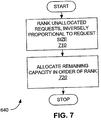
- FIG. 7 depicts an alternate embodiment of block 640 for allocating remaining capacity subsequent to QoS scheduling.
- the embodiment of block 640 depicted in FIG. 7 may be deployed to attempt to maximize the number of UTs/applications that have their request for transmission granted.
- the requests that were unallocated, or only partially allocated, in block 630, described above are ranked, with the highest rank inversely proportional to the request size (or remaining portion thereof).
- the remaining capacity is allocated to requests in order of highest rank. If the final allocation can not be made fully due to lack of capacity, that request will be partially allocated. Thus, the maximum number of requests that can be accommodated are satisfied with this method.
- This embodiment may be used in conjunction with various techniques described above.
- an active flag is maintained for each QoS flow managed by the scheduler. In any given frame, the active flag is set for all admitted QoS flows that have a nominal allocation of slots within that frame (as in the example of FIG. 4 ). All QoS flows with their active flag set are serviced first in a current MAC frame. Other QoS flows may or may not receive service in the current MAC frame, depending upon whether there are any unused F R resources.
- F R may be a limit on the amount of capacity reserved for QoS services, as described above, and F B may be reserved for best effort traffic. It will be clear that F R may be set to the entire capacity, if desired.
- the scheduler may give priority to remaining QoS traffic. It may also be desirable for the scheduler to "work ahead", when a portion of F R is not fully allocated, in order to reduce future loading. Using this option to preempt current BET requests may be appropriate when a limited portion of the capacity, F R , is allocated to QoS service. However, working ahead (detailed below) may be performed whenever unallocated capacity remains.
- active QoS sensitive flows are segmented into two groups:
- Flows in D + do not experience outage since their flow requirement is less than or equal to their allocation.
- flows in D + that have positive flow margin contribute to a pool of unused slots, M, that can be made available to other QoS flows in a prioritized manner.
- Flows in D - may or may not receive their requirement, depending on whether unused resources are available.
- D - is not empty, then any unused slots may be made available to flows in this group first.
- the objective is to maximize the number of flows meeting their QoS requirements. This is accomplished by rank ordering the flows in D - based on their flow margins, m i . That is, the flow with the smallest
- the scheduler allocates the minimum number of slots from the excess margin pool to allow the highest rank flow in D - to achieve its requirement, ⁇ (i). This procedure is iterated until the excess margin pool is exhausted or all active QoS flows are served. If the last QoS flow considered is not fully satisfied, it may be given a partial allocation. Flows that are not fully satisfied may experience degraded service. This example may result in a flow not receiving its allocation. In such a case, a buffer overflow may occur and packets may be lost. To prevent this, buffer overflow from QoS queue for a given flow may be placed in the front of that user's best-effort queue.
- the remainder of F R may be made available to the group of QoS flows that have data in their QoS queues but do not have the active flag set for the current frame.
- This "work ahead" scheduling capability is typically performed when the scheduler has access to data to be transmitted in the future, i.e. data intended to be transmitted in the next frame or frames.
- the access point both houses the scheduler and maintains queues for forward link data. Thus, the scheduler may work ahead, if desired, when appropriate.
- the scheduler may not know about future data in the user terminal, and, as such, only performs work ahead on the forward link. For such a reverse link, the scheduler does not distinguish between QoS and BET data beyond that which has been scheduled in the MAC frame (according to the admission profile). That is, once the QoS traffic for a given flow has been given its requirement on the reverse link segment, the remainder of that UT's data is considered by the scheduler to be BET traffic.
- Those of skill in the art will recognize how to adapt this principle to either the forward link or reverse link, and for any location of the scheduler.
- this scheduler may be at a designated UT which provides scheduling for managed peer-to-peer connections using the procedures described above.
- data may be arranged in any way desired in the UT queue (e.g. work-ahead QoS data may be placed in front of the UT's BET queue).
- the UT may perform work ahead, if desired, even when the scheduler does not.
- the allocation of unused slots to the inactive forward link QoS flows may be done as follows. Inactive forward link QoS flows are prioritized in order of their phase parameter. That is, inactive forward link flows that become active in the next MAC frame receive the highest priority. Flows within this phase group are prioritized in a way that maximizes the number of flows satisfied (as described above). Thus, inactive flows with the least amount of data in their queue are served first. The scheduler continues to provide work ahead to those inactive QoS flows until all the slots in F R are occupied, or all QoS queues are emptied.
- FIG. 8 depicts an alternate embodiment of block 640 for allocating remaining capacity subsequent to QoS scheduling when some information about the data requested for transmission (or co-located in a queue) is known. This embodiment is compatible with the example of positive and negative flow margins, just described, and work ahead may optionally be deployed as well.
- the process begins in decision block 810. If there is no remaining capacity to be allocated, the process stops. If there is remaining capacity, proceed to block 820. In block 820, the QoS requests are ranked. Various rankings may be contemplated. In the example embodiment, in order to serve the most requests, the requests are ranked inversely according to size.
- the next highest ranked request is selected (the highest rank for the first iteration).
- remaining capacity is allocated to the selected request. If the remainder of the request is greater than the remaining capacity, the remainder of the capacity will be allocated.
- decision block 850 if the remaining capacity has been exhausted, the process may stop. If capacity remains, proceed to decision block 860.
- decision block 860 if there are additional QoS requests remaining unallocated, return to block 830, select the next highest ranked request, and repeat the process just described. If all the QoS requests have been processed, proceed to block 870.
- Block 870 is depicted with a dashed outline to indicate that work ahead is optional. If desired, the scheduler may work ahead to future QoS frames. An example method for performing such work ahead is described above.
- any remaining capacity is allocated to best effort traffic.
- Any best effort method may be deployed.
- best effort traffic is served using a round-robin scheduling method.
- Such an approach does not provide for QoS differentiation across different user terminals, or across multiple flows associated with a given user.
- a user terminal is free to prioritize the packets in its queue to accommodate whatever QoS scheme it desires. If additional levels of inter-user prioritization are desired, signaling may be deployed to allow the scheduler to assist in such prioritization, as will be apparent to one of skill in the art.
- DSP digital signal processor
- ASIC application specific integrated circuit
- FPGA field programmable gate array
- a general purpose processor may be a microprocessor, but in the alternative, the processor may be any conventional processor, controller, microcontroller, or state machine.
- a processor may also be implemented as a combination of computing devices, e.g., a combination of a DSP and a microprocessor, a plurality of microprocessors, one or more microprocessors in conjunction with a DSP core, or any other such configuration.
- a software module may reside in RAM memory, flash memory, ROM memory, EPROM memory, EEPROM memory, registers, hard disk, a removable disk, a CD-ROM, or any other form of storage medium known in the art.
- An exemplary storage medium is coupled to the processor such the processor can read information from, and write information to, the storage medium.
- the storage medium may be integral to the processor.
- the processor and the storage medium may reside in an ASIC.
- the ASIC may reside in a user terminal.
- the processor and the storage medium may reside as discrete components in a user terminal.
Landscapes
- Engineering & Computer Science (AREA)
- Computer Networks & Wireless Communication (AREA)
- Signal Processing (AREA)
- Quality & Reliability (AREA)
- Databases & Information Systems (AREA)
- Mobile Radio Communication Systems (AREA)
- Small-Scale Networks (AREA)
- Selective Calling Equipment (AREA)
- Data Exchanges In Wide-Area Networks (AREA)
Claims (21)
- Un dispositif de communication pouvant fonctionner avec une pluralité de dispositifs à distance, le dispositif de communication comprenant :un ordonnanceur pour, pendant chacune parmi la pluralité de périodes de temps, pour chacune parmi une pluralité de demande de transmission de données,déterminer si un dispositif à distance qui correspond à la demande de transmission de données présente un engagement de capacité dans un profil d'admission, dans lequel le profil d'admission est indicatif des besoins de données attendus pour des flux de données déjà admis, dans lequel les besoins de données attendus comprennent une valeur moyenne, et dans lequel le profil d'admission comprend la pluralité de périodes de temps ainsi qu'un engagement de capacité pour un nombre de dispositifs à distance égal à zéro ou plus, pendant chacune de la pluralité de périodes de temps, et pour affecter la capacité en correspondance à la demande de transmission de données lorsqu'un engagement de capacité est trouvé, dans lequel la capacité est affectée pour des dispositifs à distance présentant des engagements de capacité dans le profil d'admission dans les limites de leurs engagements de capacité avant l'affectation de la capacité restante à d'éventuelles demandes de transmission de données qui ne sont pas satisfaites ;caractérisé en ce que l'ordonnanceur affecte en outre la capacité restante, si il y en a, en réponse à d'éventuelles demandes de transmission de données non satisfaites en ordre croissant du volume de données de la partie non affectée de la demande de transmission de données.
- Le dispositif de communication selon la revendication 1, comprenant en outre un récepteur pour recevoir un message de demande comprenant une demande de transmission de données.
- Le dispositif de communication selon la revendication 1, comprenant en outre une ou plusieurs files d'attente de données, une demande de transmission de données étant générée en cas de la présence de données dans une file d'attente.
- Le dispositif de communication selon la revendication 1, comprenant en outre un émetteur pour transmettre un ou plusieurs messages d'autorisation indiquant la capacité affectée.
- Le dispositif de communication selon la revendication 1, comprenant en outre une unité de contrôle d'admission destinée à :recevoir une demande d'admission comprenant des paramètres de flux correspondant à un flux de données à partir d'un dispositif à distance ;permettre l'admission sous condition que les paramètres de flux, si on les combinerait avec le profil d'admission, ne dépasseraient pas la capacité du système ; etmodifier le profil d'admission afin d'incorporer le flux suite à son admission.
- Le dispositif de communication selon la revendication 1, dans lequel chaque dispositif à distance peut correspondre à une pluralité de demandes de transmission de données, chaque demande étant associée à un niveau de service.
- Le dispositif de communication selon la revendication 6, dans lequel l'ordonnanceur :affecte la capacité en réponse à une ou plusieurs demandes de transmission associée(s) à un ou plusieurs parmi un premier groupe de niveaux de service en correspondance au profil d'admission, etaffecte ensuite la capacité restante, si il y en a, en réponse à une ou plusieurs demandes de transmission associée(s) à un ou plusieurs niveaux parmi un deuxième groupe de niveaux de service.
- Le dispositif de communication selon la revendication 7, dans lequel le premier groupe comprend un ou plusieurs niveaux de services pour lequel la qualité de service est garantie.
- Le dispositif de communication selon la revendication 7, dans lequel le deuxième groupe comprend un ou plusieurs niveaux de services avec une qualité de service dite au mieux.
- Le dispositif de communication selon la revendication 6, dans lequel l'ordonnanceur :affecte la capacité restante, si il y en a, en réponse à des demandes de transmission non satisfaites associées à un premier niveau de service ; etaffecte ensuite la capacité restante, si il y en a, en réponse à des demandes de transmission associée à un deuxième niveau de service.
- Le dispositif de communication selon la revendication 10, dans lequel l'ordonnanceur affecte en outre la capacité restante, si il y en a, en réponse à des demandes de transmission pour les données pendant une ou plusieurs périodes de temps dans le futur associée(s) au premier niveau de service avant l'affectation en réponse à des demandes associées au deuxième niveau de service.
- Un procédé d'ordonnancement, comprenant les étapes consistant à :recevoir au niveau d'un dispositif ayant un ordonnanceur, une ou plusieurs demandes de transmission à partir de l'un ou plusieurs dispositifs à distance ; etaccorder une ou plusieurs demandes de transmission en correspondance à un profil d'admission, dans lequel le profil d'admission est indicatif des besoins de données attendus pour des flux de données déjà admis, dans lequel les besoins de données attendus comprennent une valeur moyenne, dans lequel le profil d'admission comprend un engagement de capacité pour l'un ou plusieurs dispositifs à distance, et dans lequel la capacité est affectée pour des dispositifs à distance présentant des engagements de capacité dans le profil d'admission dans les limites de leurs engagements de capacité avant l'affectation de la capacité restante à d'éventuelles demandes de transmission de données qui ne sont pas satisfaites ;caractérisé par l'affectation de la capacité restante à des demandes de transmission de données non satisfaites en ordre croissant du volume de données d'une partie non affectée des demandes de transmission de données non satisfaites.
- Le procédé selon la revendication 12, comprenant en outre les étapes consistant à :recevoir une demande d'admission comprenant des paramètres de flux correspondant à un flux de données à partir d'un dispositif à distance ;permettre l'admission à condition que les paramètres de flux, si on les combineraient avec le profil d'admission, ne dépasserait pas la capacité du système ; etmodifier le profil d'admission afin d'incorporer le flux suite à son admission.
- Le procédé selon la revendication 12, dans lequel une ou plusieurs des demandes de transmission de données sont reçues à partir de un ou de plusieurs dispositifs à distance.
- Le procédé selon la revendication 12, dans lequel une ou plusieurs des demandes de transmission de données sont générées en réponse à la présence de données dans une file d'attente.
- Le procédé selon la revendication 12, dans lequel chacune parmi la pluralité de demande de transmission de données correspond à un ou à une pluralité de niveaux de service.
- Le procédé selon la revendication 16, dans lequel la capacité est affectée tout d'abord pour les demandes de transmission de données qui correspondent à un premier niveau de service, et la capacité restante, s'il y en a, est affectée à des demandes de transmission qui correspondent à un ou plusieurs deuxième niveaux de service.
- Le procédé selon la revendication 12, comprenant en outre :la transmission d'un ou plusieurs messages d'autorisation en correspondance à l'affectation de capacité.
- Le dispositif de communication selon la revendication 1, dans lequel le profil d'admission est créé en fonction d'un coefficient d'utilisation ainsi qu'une phase de trame pour un ou plusieurs flux de données.
- Le dispositif de communication selon la revendication 1, comprenant en outre :des moyens pour recevoir une demande d'admission comprenant des paramètres de flux correspondant à un flux de données à partir d'un dispositif à distance ;des moyens pour permettre l'admission à condition que les paramètres de flux, lors de leur combinaison avec le profil d'admission, ne dépasserait pas la capacité du système ; etdes moyens pour modifier le profil d'admission afin d'incorporer le flux suite à son admission.
- Un support lisible par ordinateur pour amener un processeur à mettre en oeuvre le procédé selon l'une quelconque des revendications 12 à 18.
Applications Claiming Priority (2)
| Application Number | Priority Date | Filing Date | Title |
|---|---|---|---|
| US10/723,346 US8406235B2 (en) | 2003-11-26 | 2003-11-26 | Quality of service scheduler for a wireless network |
| PCT/US2004/039690 WO2005055533A1 (fr) | 2003-11-26 | 2004-11-24 | Programmateur de qualite de service pour un reseau sans fil |
Publications (2)
| Publication Number | Publication Date |
|---|---|
| EP1692829A1 EP1692829A1 (fr) | 2006-08-23 |
| EP1692829B1 true EP1692829B1 (fr) | 2016-05-25 |
Family
ID=34592242
Family Applications (1)
| Application Number | Title | Priority Date | Filing Date |
|---|---|---|---|
| EP04812250.1A Expired - Lifetime EP1692829B1 (fr) | 2003-11-26 | 2004-11-24 | Programmateur de qualite de service pour un reseau sans fil |
Country Status (12)
| Country | Link |
|---|---|
| US (1) | US8406235B2 (fr) |
| EP (1) | EP1692829B1 (fr) |
| JP (3) | JP4494416B2 (fr) |
| KR (2) | KR100905489B1 (fr) |
| CN (1) | CN1906900B (fr) |
| AU (1) | AU2004310994B2 (fr) |
| BR (1) | BRPI0416940A (fr) |
| CA (1) | CA2547000C (fr) |
| IL (1) | IL175823A0 (fr) |
| RU (1) | RU2378800C2 (fr) |
| TW (1) | TWI385978B (fr) |
| WO (1) | WO2005055533A1 (fr) |
Families Citing this family (128)
| Publication number | Priority date | Publication date | Assignee | Title |
|---|---|---|---|---|
| JP4000906B2 (ja) * | 2002-05-22 | 2007-10-31 | 日本電気株式会社 | パケット転送経路の最適化方法及びパケット転送装置並びにプログラム |
| US9544860B2 (en) | 2003-02-24 | 2017-01-10 | Qualcomm Incorporated | Pilot signals for use in multi-sector cells |
| US7218948B2 (en) | 2003-02-24 | 2007-05-15 | Qualcomm Incorporated | Method of transmitting pilot tones in a multi-sector cell, including null pilot tones, for generating channel quality indicators |
| US9661519B2 (en) | 2003-02-24 | 2017-05-23 | Qualcomm Incorporated | Efficient reporting of information in a wireless communication system |
| US8811348B2 (en) | 2003-02-24 | 2014-08-19 | Qualcomm Incorporated | Methods and apparatus for generating, communicating, and/or using information relating to self-noise |
| US7065144B2 (en) * | 2003-08-27 | 2006-06-20 | Qualcomm Incorporated | Frequency-independent spatial processing for wideband MISO and MIMO systems |
| US8233462B2 (en) | 2003-10-15 | 2012-07-31 | Qualcomm Incorporated | High speed media access control and direct link protocol |
| US8284752B2 (en) | 2003-10-15 | 2012-10-09 | Qualcomm Incorporated | Method, apparatus, and system for medium access control |
| US8462817B2 (en) * | 2003-10-15 | 2013-06-11 | Qualcomm Incorporated | Method, apparatus, and system for multiplexing protocol data units |
| US8472473B2 (en) * | 2003-10-15 | 2013-06-25 | Qualcomm Incorporated | Wireless LAN protocol stack |
| US8842657B2 (en) | 2003-10-15 | 2014-09-23 | Qualcomm Incorporated | High speed media access control with legacy system interoperability |
| US8483105B2 (en) * | 2003-10-15 | 2013-07-09 | Qualcomm Incorporated | High speed media access control |
| US9226308B2 (en) | 2003-10-15 | 2015-12-29 | Qualcomm Incorporated | Method, apparatus, and system for medium access control |
| US8406235B2 (en) | 2003-11-26 | 2013-03-26 | Qualcomm Incorporated | Quality of service scheduler for a wireless network |
| KR100600673B1 (ko) * | 2003-12-18 | 2006-07-18 | 한국전자통신연구원 | 이동 통신 시스템에서의 채널 품질 정보 요청 및 보고방법, 그리고 그 장치 |
| US8903440B2 (en) * | 2004-01-29 | 2014-12-02 | Qualcomm Incorporated | Distributed hierarchical scheduling in an ad hoc network |
| US7818018B2 (en) * | 2004-01-29 | 2010-10-19 | Qualcomm Incorporated | Distributed hierarchical scheduling in an AD hoc network |
| US8315271B2 (en) * | 2004-03-26 | 2012-11-20 | Qualcomm Incorporated | Method and apparatus for an ad-hoc wireless communications system |
| US8165009B2 (en) * | 2004-03-31 | 2012-04-24 | Rockstar Bidco, LP | Adaptive scheduling of voice traffic in a multi-carrier communication environment |
| JP4047836B2 (ja) * | 2004-04-02 | 2008-02-13 | 株式会社東芝 | 通信装置、通信システム、通信方法、および通信制御プログラム |
| US7564814B2 (en) * | 2004-05-07 | 2009-07-21 | Qualcomm, Incorporated | Transmission mode and rate selection for a wireless communication system |
| US8401018B2 (en) * | 2004-06-02 | 2013-03-19 | Qualcomm Incorporated | Method and apparatus for scheduling in a wireless network |
| US7882412B2 (en) * | 2004-10-05 | 2011-02-01 | Sanjiv Nanda | Enhanced block acknowledgement |
| WO2006044718A2 (fr) * | 2004-10-14 | 2006-04-27 | Flarion Technologies, Inc. | Procedes et appareil pour determiner, communiquer et utiliser des informations pouvant servir a des fins de suppression d'interferences |
| US8503938B2 (en) | 2004-10-14 | 2013-08-06 | Qualcomm Incorporated | Methods and apparatus for determining, communicating and using information including loading factors which can be used for interference control purposes |
| US20060092963A1 (en) * | 2004-10-28 | 2006-05-04 | Ajay Bakre | Architecture and method for efficient application of QoS in a WLAN |
| US7362776B2 (en) * | 2004-11-01 | 2008-04-22 | Cisco Technology, Inc. | Method for multicast load balancing in wireless LANs |
| FR2878106A1 (fr) * | 2004-11-15 | 2006-05-19 | France Telecom | Procede et dispositif d'ordonnancement de paquets pour leur routage dans un reseau avec determination implicite des paquets a traiter en priorite |
| FI20041465A0 (fi) * | 2004-11-15 | 2004-11-15 | Nokia Corp | Viestintäresurssien jakaminen |
| US9065595B2 (en) * | 2005-04-07 | 2015-06-23 | Opanga Networks, Inc. | System and method for peak flow detection in a communication network |
| WO2006109151A2 (fr) * | 2005-04-13 | 2006-10-19 | Nokia Corporation | Techniques de gestion de ressources hertziennes dans des reseaux sans fil destines a la transmission de paquets de donnees |
| US20070297386A1 (en) * | 2005-07-28 | 2007-12-27 | Interdigital Technology Corporation | Method and system for scheduling uplink transmissions in a single carrier frequency division multiple access system |
| US7907911B2 (en) * | 2005-08-16 | 2011-03-15 | Alcatel-Lucent Usa Inc. | Scheduling multi-user transmission in the downlink of a multi-antenna wireless communication system |
| US8600336B2 (en) | 2005-09-12 | 2013-12-03 | Qualcomm Incorporated | Scheduling with reverse direction grant in wireless communication systems |
| EP1938519A1 (fr) * | 2005-09-16 | 2008-07-02 | IPWireless, Inc. | Ordonnancement des donnees dans une liaison de telecommunication partagee d'un systeme de telecommunication cellulaire |
| US20070070905A1 (en) * | 2005-09-26 | 2007-03-29 | Neal Oliver | Adaptive bin-packing for wireless communications |
| US9191840B2 (en) | 2005-10-14 | 2015-11-17 | Qualcomm Incorporated | Methods and apparatus for determining, communicating and using information which can be used for interference control |
| US8989084B2 (en) | 2005-10-14 | 2015-03-24 | Qualcomm Incorporated | Methods and apparatus for broadcasting loading information corresponding to neighboring base stations |
| KR100830368B1 (ko) * | 2005-12-02 | 2008-05-19 | 삼성전자주식회사 | 스마트 안테나 시스템에서 스케줄링 장치 및 방법 |
| US9451491B2 (en) | 2005-12-22 | 2016-09-20 | Qualcomm Incorporated | Methods and apparatus relating to generating and transmitting initial and additional control information report sets in a wireless system |
| US9137072B2 (en) | 2005-12-22 | 2015-09-15 | Qualcomm Incorporated | Methods and apparatus for communicating control information |
| US9473265B2 (en) | 2005-12-22 | 2016-10-18 | Qualcomm Incorporated | Methods and apparatus for communicating information utilizing a plurality of dictionaries |
| US9148795B2 (en) | 2005-12-22 | 2015-09-29 | Qualcomm Incorporated | Methods and apparatus for flexible reporting of control information |
| US8514771B2 (en) | 2005-12-22 | 2013-08-20 | Qualcomm Incorporated | Methods and apparatus for communicating and/or using transmission power information |
| US9125093B2 (en) | 2005-12-22 | 2015-09-01 | Qualcomm Incorporated | Methods and apparatus related to custom control channel reporting formats |
| US9572179B2 (en) | 2005-12-22 | 2017-02-14 | Qualcomm Incorporated | Methods and apparatus for communicating transmission backlog information |
| US20070253449A1 (en) | 2005-12-22 | 2007-11-01 | Arnab Das | Methods and apparatus related to determining, communicating, and/or using delay information |
| US9119220B2 (en) | 2005-12-22 | 2015-08-25 | Qualcomm Incorporated | Methods and apparatus for communicating backlog related information |
| US9338767B2 (en) | 2005-12-22 | 2016-05-10 | Qualcomm Incorporated | Methods and apparatus of implementing and/or using a dedicated control channel |
| US20070149132A1 (en) | 2005-12-22 | 2007-06-28 | Junyl Li | Methods and apparatus related to selecting control channel reporting formats |
| US9125092B2 (en) | 2005-12-22 | 2015-09-01 | Qualcomm Incorporated | Methods and apparatus for reporting and/or using control information |
| US8437251B2 (en) | 2005-12-22 | 2013-05-07 | Qualcomm Incorporated | Methods and apparatus for communicating transmission backlog information |
| US8032369B2 (en) * | 2006-01-20 | 2011-10-04 | Qualcomm Incorporated | Arbitrary average data rates for variable rate coders |
| US8090573B2 (en) * | 2006-01-20 | 2012-01-03 | Qualcomm Incorporated | Selection of encoding modes and/or encoding rates for speech compression with open loop re-decision |
| US8346544B2 (en) * | 2006-01-20 | 2013-01-01 | Qualcomm Incorporated | Selection of encoding modes and/or encoding rates for speech compression with closed loop re-decision |
| US8149771B2 (en) * | 2006-01-31 | 2012-04-03 | Roundbox, Inc. | Reliable event broadcaster with multiplexing and bandwidth control functions |
| US8311048B2 (en) | 2008-05-09 | 2012-11-13 | Roundbox, Inc. | Datacasting system with intermittent listener capability |
| US8914015B2 (en) * | 2006-03-20 | 2014-12-16 | Qualcomm Incorporated | Grouping of users for MIMO transmission in a wireless communication system |
| US20070243882A1 (en) | 2006-04-12 | 2007-10-18 | Qualcomm Incorporated | Method and apparatus for locating a wireless local area network associated with a wireless wide area network |
| US7933344B2 (en) * | 2006-04-25 | 2011-04-26 | Mircosoft Corporation | OFDMA based on cognitive radio |
| US8087026B2 (en) * | 2006-04-27 | 2011-12-27 | International Business Machines Corporation | Fair share scheduling based on an individual user's resource usage and the tracking of that usage |
| US8189621B2 (en) | 2006-05-12 | 2012-05-29 | Microsoft Corporation | Stack signaling to application with lack of requested bandwidth |
| US7796633B2 (en) * | 2006-05-12 | 2010-09-14 | Motorola, Inc. | Range equalization transceiver system and method of using same |
| FR2906666A1 (fr) * | 2006-10-03 | 2008-04-04 | Canon Kk | Procede de reservation de ressource dans un reseau local comprenant une pluralite de sous-reseaux, produit programme d'ordinateur, moyen de stockage et dispositif correspondants. |
| US7796536B2 (en) * | 2006-10-17 | 2010-09-14 | Honeywell International Inc. | Dynamic auto-reconfigurable time division multiple access |
| US7929466B2 (en) * | 2006-10-20 | 2011-04-19 | The Boeing Company | Prioritized channel assignment for wireless links |
| WO2008064419A1 (fr) * | 2006-11-28 | 2008-06-05 | National Ict Australia Limited | Découverte de liaisons internodales multiples dans des réseaux radio à plusieurs bonds |
| KR100792599B1 (ko) | 2006-12-08 | 2008-01-09 | 한국전자통신연구원 | Ip 패킷망에서 상향 트래픽의 동적 제어를 위한 플로우프로파일 정보 제어 시스템 및 방법 |
| US8144793B2 (en) | 2006-12-12 | 2012-03-27 | Microsoft Corporation | Cognitive multi-user OFDMA |
| KR100848889B1 (ko) * | 2006-12-20 | 2008-07-29 | 에스케이 텔레콤주식회사 | EV-DO 망에서 Layer 3 메시지를 이용한 특정서비스 패킷 인식 장치 및 그 방법 |
| US8743774B2 (en) * | 2007-01-30 | 2014-06-03 | Qualcomm Incorporated | Resource requests for a wireless communication system |
| US8892108B2 (en) * | 2007-01-30 | 2014-11-18 | Qualcomm Incorporated | Control channel constraints in wireless communications |
| EP2115945B1 (fr) | 2007-02-06 | 2012-11-14 | Entropic Communications Inc. | Structure de messagerie d'entités de gestion de couche deux dans un réseau |
| EP2456143A1 (fr) * | 2007-02-14 | 2012-05-23 | Entropic Communications Inc. | Qualité de service paramétrée dans un réseau |
| US8599884B2 (en) * | 2007-03-15 | 2013-12-03 | Nokia Corporation | System and method for implementing optimized multiplexing and power saving in a broadcast network |
| US7929623B2 (en) * | 2007-03-30 | 2011-04-19 | Microsoft Corporation | FEC in cognitive multi-user OFDMA |
| US7970085B2 (en) | 2007-05-08 | 2011-06-28 | Microsoft Corporation | OFDM transmission and reception for non-OFDMA signals |
| US8442015B2 (en) * | 2007-07-20 | 2013-05-14 | Broadcom Corporation | Method and system for an atomizing function of a mobile device |
| US8432786B2 (en) * | 2007-07-10 | 2013-04-30 | Qualcomm Incorporated | Control channel design to support one-to-one, many-to-one, and one-to-many peer-to-peer communications |
| GB2452022B (en) * | 2007-07-24 | 2012-03-28 | Nec Corp | DRX configuration |
| US9276776B2 (en) * | 2007-09-28 | 2016-03-01 | Genband Us Llc | Methods and apparatus for bandwidth management within a media over internet protocol network based on a session description |
| US8867378B2 (en) * | 2007-10-05 | 2014-10-21 | Qualcomm Incorporated | Triggering multi-carrier requests |
| US8339949B2 (en) * | 2007-10-24 | 2012-12-25 | Cortina Systems Inc. | Priority-aware hierarchical communication traffic scheduling |
| US8432797B2 (en) * | 2007-10-24 | 2013-04-30 | Motorola Solutions, Inc. | Method and system for distributed admission control in mobile ad hoc networks (MANETs) |
| US9258743B2 (en) * | 2007-11-01 | 2016-02-09 | Qualcomm Incorporated | Resource scaling in wireless communication systems |
| EP2058976A1 (fr) * | 2007-11-06 | 2009-05-13 | Nokia Siemens Networks Oy | Procédé pour la gestion de ressources dans un système de communication sans fil hétérogène et un système de communication sans fil hétérogène |
| ES2348758T3 (es) | 2007-12-13 | 2010-12-13 | Innovative Sonic Limited | Procedimiento de asignacion de recursos de radio y dispositivo de comunicaciones asociado. |
| US8374130B2 (en) | 2008-01-25 | 2013-02-12 | Microsoft Corporation | Orthogonal frequency division multiple access with carrier sense |
| US8553554B2 (en) * | 2008-05-16 | 2013-10-08 | Alcatel Lucent | Method and apparatus for providing congestion control in radio access networks |
| US20090296613A1 (en) * | 2008-06-03 | 2009-12-03 | Colin Kahn | Method and apparatus for providing quality-of-service in radio access networks |
| US8027255B2 (en) * | 2008-09-30 | 2011-09-27 | Alcatel Lucent | Method and apparatus for prioritizing packets for use in managing packets in radio access networks |
| US8503432B2 (en) * | 2008-09-30 | 2013-08-06 | Alcatel Lucent | Method and apparatus for signaling proprietary information between network elements of a core network in a wireless communication network |
| CN101729162B (zh) * | 2008-10-31 | 2014-05-07 | 日电(中国)有限公司 | 用于通信网络中的无线电测量的方法、系统和通信节点 |
| US8855087B2 (en) * | 2008-12-18 | 2014-10-07 | Microsoft Corporation | Wireless access point supporting control by multiple applications |
| US8627396B2 (en) | 2009-06-12 | 2014-01-07 | Cygnus Broadband, Inc. | Systems and methods for prioritization of data for intelligent discard in a communication network |
| US8531961B2 (en) * | 2009-06-12 | 2013-09-10 | Cygnus Broadband, Inc. | Systems and methods for prioritization of data for intelligent discard in a communication network |
| US8068440B2 (en) | 2009-06-12 | 2011-11-29 | Cygnus Broadband, Inc. | Systems and methods for intelligent discard in a communication network |
| EP2468019A4 (fr) * | 2009-08-20 | 2013-10-23 | Opanga Networks Inc | Diffusion de contenu au moyen d'une capacité de réseau excédentaire |
| KR20120099412A (ko) * | 2009-10-01 | 2012-09-10 | 엔트로픽 커뮤니케이션즈, 인크. | 서비스 품질을 이용해 관리되는 네트워크를 위한 시스템 및 방법 |
| KR20110071774A (ko) * | 2009-12-21 | 2011-06-29 | 한국전자통신연구원 | 스마트 경계 라우터 및 이를 이용한 플로우 정보 전송 방법 |
| US8300567B2 (en) * | 2009-12-21 | 2012-10-30 | Intel Corporation | Method and apparatus for downlink multiple-user multiple output scheduling |
| CN101877749B (zh) * | 2010-06-30 | 2014-03-19 | 中兴通讯股份有限公司 | 一种语音业务调度优先级的调整方法及装置 |
| JP5545572B2 (ja) * | 2010-12-29 | 2014-07-09 | モトローラ モビリティ エルエルシー | 無線通信システムにおけるアップリンク周波数選択性スケジューリングを実行するための方法 |
| US9608930B1 (en) * | 2011-08-30 | 2017-03-28 | Amazon Technologies, Inc. | Allocating identifiers with minimal fragmentation |
| CN103718601A (zh) * | 2011-12-22 | 2014-04-09 | 华为技术有限公司 | 管理服务质量的方法和装置 |
| US9526091B2 (en) * | 2012-03-16 | 2016-12-20 | Intel Corporation | Method and apparatus for coordination of self-optimization functions in a wireless network |
| ES2442974B1 (es) * | 2012-05-10 | 2015-03-06 | Vodafone Espana Sau | Dispositivo de control de planificacion, analizador de dispositivo de equipo de usuario y metodo de priorizacion de calidad de servicio que hace uso de los mismos |
| EP2903344A4 (fr) * | 2012-09-25 | 2016-10-19 | Nec Corp | Dispositif serveur apte à analyser un comportement de communication, procédé de commande pour terminal mobile et programme informatique |
| US9161263B2 (en) * | 2013-03-07 | 2015-10-13 | Verizon Patent And Licensing Inc. | End-to-end quality of service optimization based on network performance indicators |
| ES2929072T3 (es) | 2013-03-13 | 2022-11-24 | Celeno Communications Israel Ltd | Programación consciente del tiempo de antena para red inalámbrica de área local |
| CN105191178B (zh) * | 2013-05-01 | 2019-06-28 | 三星电子株式会社 | 用于设备到设备通信系统的方法和装置 |
| WO2014202128A1 (fr) * | 2013-06-19 | 2014-12-24 | Huawei Technologies Co., Ltd. | Arbitre de permutation circulaire à n ports et p sélections destiné à programmer des requêtes |
| CN105359571A (zh) * | 2013-08-12 | 2016-02-24 | 英特尔公司 | 管理多个无线电接入网中的通信 |
| CN103873387A (zh) * | 2014-03-11 | 2014-06-18 | 重庆邮电大学 | 一种面向工业以太网的确定性通信调度方法 |
| US9419770B2 (en) * | 2014-03-31 | 2016-08-16 | Huawei Technologies Co., Ltd. | Method and apparatus for asynchronous OFDMA/SC-FDMA |
| US10531432B2 (en) | 2015-03-25 | 2020-01-07 | Huawei Technologies Co., Ltd. | System and method for resource allocation for sparse code multiple access transmissions |
| US10701685B2 (en) | 2014-03-31 | 2020-06-30 | Huawei Technologies Co., Ltd. | Method and apparatus for asynchronous OFDMA/SC-FDMA |
| US11013017B2 (en) | 2015-05-07 | 2021-05-18 | Telefonaktiebolaget Lm Ericsson (Publ) | Methods and network nodes for allocating resources for multiple radio links |
| CN107980240B (zh) | 2015-08-14 | 2021-06-11 | 瑞典爱立信有限公司 | 信道接入配置 |
| RU2601604C1 (ru) * | 2015-09-02 | 2016-11-10 | Федеральное государственное казенное военное образовательное учреждение высшего образования "Академия Федеральной службы охраны Российской Федерации" (Академия ФСО России) | Способ сглаживания приоритетного трафика данных и устройство для его осуществления |
| CN107104907B (zh) * | 2016-02-19 | 2020-06-12 | 富士通株式会社 | 网络服务的传输控制方法、装置和控制器 |
| JP2017152917A (ja) * | 2016-02-24 | 2017-08-31 | 富士通株式会社 | 基地局 |
| CN105978719B (zh) * | 2016-05-10 | 2019-07-16 | 广东睿江云计算股份有限公司 | 一种云主机服务质量的控制方法及装置 |
| US20200100143A1 (en) * | 2018-09-20 | 2020-03-26 | Cisco Technology, Inc. | Traffic shaping methods and apparatus for providing wireless contention reduction and airtime fairness for multimedia traffic flows in a wireless network |
| CN109450818B (zh) * | 2018-12-25 | 2022-07-29 | 中国移动通信集团江苏有限公司 | 物联网信息下发的方法、装置、设备和介质 |
| WO2021177174A1 (fr) * | 2020-03-04 | 2021-09-10 | 株式会社Nttドコモ | Dispositif de gestion et système de réseau |
| EP4161030A1 (fr) * | 2021-09-30 | 2023-04-05 | Nokia Solutions and Networks Oy | Allocation de bande passante |
| WO2023123104A1 (fr) * | 2021-12-29 | 2023-07-06 | 新华三技术有限公司 | Procédé de transmission de message et dispositif réseau |
Family Cites Families (32)
| Publication number | Priority date | Publication date | Assignee | Title |
|---|---|---|---|---|
| JPH0258412A (ja) * | 1988-08-23 | 1990-02-27 | Murata Mfg Co Ltd | 圧電素子の製造方法及びその製造方法に使用される中間成形品 |
| US5581703A (en) | 1993-06-29 | 1996-12-03 | International Business Machines Corporation | Method and apparatus for reserving system resources to assure quality of service |
| ZA946674B (en) * | 1993-09-08 | 1995-05-02 | Qualcomm Inc | Method and apparatus for determining the transmission data rate in a multi-user communication system |
| US5742592A (en) * | 1995-09-01 | 1998-04-21 | Motorola, Inc. | Method for communicating data in a wireless communication system |
| TW317058B (en) | 1996-04-23 | 1997-10-01 | Ibm | Data communication system for a wireless access to an atm network |
| US6081505A (en) * | 1997-03-20 | 2000-06-27 | Nokia Telecommunications, Oy | Cell scheduling system and method for networks nodes |
| US6424624B1 (en) * | 1997-10-16 | 2002-07-23 | Cisco Technology, Inc. | Method and system for implementing congestion detection and flow control in high speed digital network |
| US6016311A (en) * | 1997-11-19 | 2000-01-18 | Ensemble Communications, Inc. | Adaptive time division duplexing method and apparatus for dynamic bandwidth allocation within a wireless communication system |
| US6192026B1 (en) * | 1998-02-06 | 2001-02-20 | Cisco Systems, Inc. | Medium access control protocol for OFDM wireless networks |
| US6577613B1 (en) * | 1999-03-02 | 2003-06-10 | Verizon Corporate Services Group Inc. | Method and apparatus for asynchronous reservation-oriented multiple access for wireless networks |
| US6650630B1 (en) * | 1999-06-25 | 2003-11-18 | Telefonaktiebolaget Lm Ericsson (Publ) | Resource management and traffic control in time-division-duplex communication systems |
| EP2109265B1 (fr) * | 1999-07-15 | 2015-09-30 | Telefonaktiebolaget L M Ericsson (publ) | Planification et contrôle d'admission de trafic de données en paquet |
| US6683853B1 (en) * | 1999-12-01 | 2004-01-27 | Telefonaktiebolaget Lm Ericsson (Publ) | Dynamic upgrade of quality of service in a packet switched network |
| US6975613B1 (en) | 1999-12-06 | 2005-12-13 | Telefonaktiebolaget L M Ericsson (Publ) | System and method for scheduling communication sessions in an ad-hoc network |
| US6856786B2 (en) * | 2000-01-26 | 2005-02-15 | Vyyo Ltd. | Quality of service scheduling scheme for a broadband wireless access system |
| GB2366631B (en) | 2000-03-04 | 2004-10-20 | Ericsson Telefon Ab L M | Communication node, communication network and method of recovering from a temporary failure of a node |
| US6400699B1 (en) * | 2000-09-12 | 2002-06-04 | Iospan Wireless, Inc. | Transmission scheduler for a multiple antenna wireless cellular network |
| US7068639B1 (en) * | 2000-09-19 | 2006-06-27 | Aperto Networks, Inc. | Synchronized plural channels for time division duplexing |
| US6567387B1 (en) * | 2000-11-07 | 2003-05-20 | Intel Corporation | System and method for data transmission from multiple wireless base transceiver stations to a subscriber unit |
| US6721302B1 (en) * | 2000-11-17 | 2004-04-13 | Nokia Corporation | Apparatus, and associated method, for communicating packet data in a SDMA (Space-Division, Multiple-Access) communication scheme |
| US7190684B2 (en) * | 2000-11-22 | 2007-03-13 | Lucent Technologies Inc. | Method and system for UMTS packet transmission scheduling on shared downlink channels |
| US6947748B2 (en) * | 2000-12-15 | 2005-09-20 | Adaptix, Inc. | OFDMA with adaptive subcarrier-cluster configuration and selective loading |
| US7085279B1 (en) * | 2000-12-29 | 2006-08-01 | Cisco Technology, Inc. | Method and apparatus for carrying telephony network traffic over an ATM network |
| US6987738B2 (en) * | 2001-01-12 | 2006-01-17 | Motorola, Inc. | Method for packet scheduling and radio resource allocation in a wireless communication system |
| US6680930B2 (en) | 2001-01-16 | 2004-01-20 | Motorola, Inc. | Method and apparatus for determining and reserving bandwidth for transmitting delay-sensitive streaming data over a radio frequency channel |
| EP1227601A1 (fr) * | 2001-01-25 | 2002-07-31 | TELEFONAKTIEBOLAGET L M ERICSSON (publ) | Ordonnancement d'une voie descendante utilisant des codes arborescents en parallèle |
| US6834044B2 (en) * | 2001-02-15 | 2004-12-21 | Telefonaktiebolaget L M Ericsson (Publ) | Multi-path data streaming in a wireless packet data network |
| US7206350B2 (en) * | 2001-06-11 | 2007-04-17 | Unique Broadband Systems, Inc. | OFDM multiple sub-channel communication system |
| KR100547852B1 (ko) * | 2002-01-09 | 2006-02-01 | 삼성전자주식회사 | 이동통신 시스템에서 호 수락 방법 |
| JP2003273880A (ja) | 2002-03-14 | 2003-09-26 | Nippon Telegr & Teleph Corp <Ntt> | タイムスケジューリング方法および基地局 |
| US7382749B2 (en) * | 2002-11-26 | 2008-06-03 | Sony Corporation | Systems, methods, and apparatus with a common wireless communications protocol |
| US8406235B2 (en) | 2003-11-26 | 2013-03-26 | Qualcomm Incorporated | Quality of service scheduler for a wireless network |
-
2003
- 2003-11-26 US US10/723,346 patent/US8406235B2/en active Active
-
2004
- 2004-11-24 JP JP2006541450A patent/JP4494416B2/ja not_active Expired - Fee Related
- 2004-11-24 CN CN2004800407120A patent/CN1906900B/zh not_active Expired - Fee Related
- 2004-11-24 BR BRPI0416940-9A patent/BRPI0416940A/pt not_active Application Discontinuation
- 2004-11-24 KR KR1020087006331A patent/KR100905489B1/ko not_active Expired - Fee Related
- 2004-11-24 EP EP04812250.1A patent/EP1692829B1/fr not_active Expired - Lifetime
- 2004-11-24 RU RU2006122543/09A patent/RU2378800C2/ru not_active IP Right Cessation
- 2004-11-24 AU AU2004310994A patent/AU2004310994B2/en not_active Ceased
- 2004-11-24 KR KR1020067012624A patent/KR100900601B1/ko not_active Expired - Fee Related
- 2004-11-24 WO PCT/US2004/039690 patent/WO2005055533A1/fr not_active Ceased
- 2004-11-24 CA CA2547000A patent/CA2547000C/fr not_active Expired - Fee Related
- 2004-11-26 TW TW093136544A patent/TWI385978B/zh not_active IP Right Cessation
-
2006
- 2006-05-22 IL IL175823A patent/IL175823A0/en unknown
-
2009
- 2009-12-18 JP JP2009287951A patent/JP5113144B2/ja not_active Expired - Fee Related
- 2009-12-18 JP JP2009287950A patent/JP5144633B2/ja not_active Expired - Fee Related
Also Published As
| Publication number | Publication date |
|---|---|
| IL175823A0 (en) | 2006-10-05 |
| JP2007512783A (ja) | 2007-05-17 |
| US20050111462A1 (en) | 2005-05-26 |
| JP2010119111A (ja) | 2010-05-27 |
| EP1692829A1 (fr) | 2006-08-23 |
| CA2547000C (fr) | 2014-01-28 |
| KR20060105790A (ko) | 2006-10-11 |
| KR100900601B1 (ko) | 2009-06-02 |
| RU2378800C2 (ru) | 2010-01-10 |
| AU2004310994A1 (en) | 2005-06-16 |
| JP2010114918A (ja) | 2010-05-20 |
| TWI385978B (zh) | 2013-02-11 |
| CN1906900A (zh) | 2007-01-31 |
| JP4494416B2 (ja) | 2010-06-30 |
| JP5113144B2 (ja) | 2013-01-09 |
| AU2004310994B2 (en) | 2008-12-11 |
| JP5144633B2 (ja) | 2013-02-13 |
| CA2547000A1 (fr) | 2005-06-16 |
| KR100905489B1 (ko) | 2009-07-01 |
| KR20080037711A (ko) | 2008-04-30 |
| BRPI0416940A (pt) | 2007-02-13 |
| TW200539627A (en) | 2005-12-01 |
| CN1906900B (zh) | 2012-05-16 |
| RU2006122543A (ru) | 2008-01-10 |
| US8406235B2 (en) | 2013-03-26 |
| WO2005055533A1 (fr) | 2005-06-16 |
Similar Documents
| Publication | Publication Date | Title |
|---|---|---|
| EP1692829B1 (fr) | Programmateur de qualite de service pour un reseau sans fil | |
| EP2858450B1 (fr) | Procédés et appareil pour fournir efficacement des informations de programmation | |
| CN101044721B (zh) | 移动通信网络中管理无线资源的方法和系统及其相关网络 | |
| US8233448B2 (en) | Apparatus and method for scheduler implementation for best effort (BE) prioritization and anti-starvation | |
| JP4335619B2 (ja) | パケット優先制御装置及びその方法 | |
| EP1595419A2 (fr) | Methode et appareil pour controler un debit binaire de liaison inverse dans un systeme de communication | |
| KR100798854B1 (ko) | 광대역 이동 액세스 시스템에서 실시간 및 비실시간 통합서비스를 지원하기 위한 적응적 지연 임계값 기반 패킷스케줄링 방법 | |
| EP1623594B1 (fr) | Procédé de transmission de données, système, station de base, station abonné, unité de traitement de données, support de distribution de programme informatique et bande de base module | |
| JP2005536129A (ja) | 共用通信チャネルのスケジューラ | |
| US8028287B2 (en) | Method and scheduler for performing a scheduling algorithm with minimum resource parameter | |
| Stuckmann et al. | Advanced scheduling and admission control techniques for cellular packet radio networks | |
| MXPA06006016A (en) | Quality of service scheduler for a wireless network | |
| HK1097971A (en) | Quality of service scheduler for a wireless network |
Legal Events
| Date | Code | Title | Description |
|---|---|---|---|
| PUAI | Public reference made under article 153(3) epc to a published international application that has entered the european phase |
Free format text: ORIGINAL CODE: 0009012 |
|
| 17P | Request for examination filed |
Effective date: 20060523 |
|
| AK | Designated contracting states |
Kind code of ref document: A1 Designated state(s): AT BE BG CH CY CZ DE DK EE ES FI FR GB GR HU IE IS IT LI LU MC NL PL PT RO SE SI SK TR |
|
| DAX | Request for extension of the european patent (deleted) | ||
| 17Q | First examination report despatched |
Effective date: 20070730 |
|
| REG | Reference to a national code |
Ref country code: DE Ref legal event code: R079 Ref document number: 602004049375 Country of ref document: DE Free format text: PREVIOUS MAIN CLASS: H04L0012560000 Ipc: H04L0012540000 |
|
| GRAP | Despatch of communication of intention to grant a patent |
Free format text: ORIGINAL CODE: EPIDOSNIGR1 |
|
| RIC1 | Information provided on ipc code assigned before grant |
Ipc: H04L 12/875 20130101ALI20151204BHEP Ipc: H04L 12/813 20130101ALI20151204BHEP Ipc: H04L 12/911 20130101ALI20151204BHEP Ipc: H04W 28/18 20090101ALI20151204BHEP Ipc: H04L 12/869 20130101ALI20151204BHEP Ipc: H04L 12/801 20130101ALI20151204BHEP Ipc: H04L 12/54 20060101AFI20151204BHEP Ipc: H04L 12/927 20130101ALI20151204BHEP Ipc: H04W 72/12 20090101ALI20151204BHEP Ipc: H04L 12/919 20130101ALI20151204BHEP Ipc: H04L 12/835 20130101ALI20151204BHEP Ipc: H04L 12/851 20130101ALI20151204BHEP Ipc: H04W 8/18 20090101ALI20151204BHEP Ipc: H04L 12/859 20130101ALI20151204BHEP |
|
| INTG | Intention to grant announced |
Effective date: 20160111 |
|
| GRAS | Grant fee paid |
Free format text: ORIGINAL CODE: EPIDOSNIGR3 |
|
| GRAA | (expected) grant |
Free format text: ORIGINAL CODE: 0009210 |
|
| AK | Designated contracting states |
Kind code of ref document: B1 Designated state(s): AT BE BG CH CY CZ DE DK EE ES FI FR GB GR HU IE IS IT LI LU MC NL PL PT RO SE SI SK TR |
|
| REG | Reference to a national code |
Ref country code: GB Ref legal event code: FG4D |
|
| REG | Reference to a national code |
Ref country code: CH Ref legal event code: EP |
|
| REG | Reference to a national code |
Ref country code: IE Ref legal event code: FG4D Ref country code: AT Ref legal event code: REF Ref document number: 803110 Country of ref document: AT Kind code of ref document: T Effective date: 20160615 |
|
| REG | Reference to a national code |
Ref country code: DE Ref legal event code: R096 Ref document number: 602004049375 Country of ref document: DE |
|
| REG | Reference to a national code |
Ref country code: NL Ref legal event code: MP Effective date: 20160525 |
|
| PG25 | Lapsed in a contracting state [announced via postgrant information from national office to epo] |
Ref country code: FI Free format text: LAPSE BECAUSE OF FAILURE TO SUBMIT A TRANSLATION OF THE DESCRIPTION OR TO PAY THE FEE WITHIN THE PRESCRIBED TIME-LIMIT Effective date: 20160525 Ref country code: NL Free format text: LAPSE BECAUSE OF FAILURE TO SUBMIT A TRANSLATION OF THE DESCRIPTION OR TO PAY THE FEE WITHIN THE PRESCRIBED TIME-LIMIT Effective date: 20160525 |
|
| REG | Reference to a national code |
Ref country code: AT Ref legal event code: MK05 Ref document number: 803110 Country of ref document: AT Kind code of ref document: T Effective date: 20160525 |
|
| PG25 | Lapsed in a contracting state [announced via postgrant information from national office to epo] |
Ref country code: SE Free format text: LAPSE BECAUSE OF FAILURE TO SUBMIT A TRANSLATION OF THE DESCRIPTION OR TO PAY THE FEE WITHIN THE PRESCRIBED TIME-LIMIT Effective date: 20160525 Ref country code: GR Free format text: LAPSE BECAUSE OF FAILURE TO SUBMIT A TRANSLATION OF THE DESCRIPTION OR TO PAY THE FEE WITHIN THE PRESCRIBED TIME-LIMIT Effective date: 20160826 Ref country code: ES Free format text: LAPSE BECAUSE OF FAILURE TO SUBMIT A TRANSLATION OF THE DESCRIPTION OR TO PAY THE FEE WITHIN THE PRESCRIBED TIME-LIMIT Effective date: 20160525 Ref country code: PT Free format text: LAPSE BECAUSE OF FAILURE TO SUBMIT A TRANSLATION OF THE DESCRIPTION OR TO PAY THE FEE WITHIN THE PRESCRIBED TIME-LIMIT Effective date: 20160926 |
|
| PG25 | Lapsed in a contracting state [announced via postgrant information from national office to epo] |
Ref country code: IT Free format text: LAPSE BECAUSE OF FAILURE TO SUBMIT A TRANSLATION OF THE DESCRIPTION OR TO PAY THE FEE WITHIN THE PRESCRIBED TIME-LIMIT Effective date: 20160525 |
|
| PG25 | Lapsed in a contracting state [announced via postgrant information from national office to epo] |
Ref country code: RO Free format text: LAPSE BECAUSE OF FAILURE TO SUBMIT A TRANSLATION OF THE DESCRIPTION OR TO PAY THE FEE WITHIN THE PRESCRIBED TIME-LIMIT Effective date: 20160525 Ref country code: SK Free format text: LAPSE BECAUSE OF FAILURE TO SUBMIT A TRANSLATION OF THE DESCRIPTION OR TO PAY THE FEE WITHIN THE PRESCRIBED TIME-LIMIT Effective date: 20160525 Ref country code: EE Free format text: LAPSE BECAUSE OF FAILURE TO SUBMIT A TRANSLATION OF THE DESCRIPTION OR TO PAY THE FEE WITHIN THE PRESCRIBED TIME-LIMIT Effective date: 20160525 Ref country code: DK Free format text: LAPSE BECAUSE OF FAILURE TO SUBMIT A TRANSLATION OF THE DESCRIPTION OR TO PAY THE FEE WITHIN THE PRESCRIBED TIME-LIMIT Effective date: 20160525 Ref country code: CZ Free format text: LAPSE BECAUSE OF FAILURE TO SUBMIT A TRANSLATION OF THE DESCRIPTION OR TO PAY THE FEE WITHIN THE PRESCRIBED TIME-LIMIT Effective date: 20160525 |
|
| PG25 | Lapsed in a contracting state [announced via postgrant information from national office to epo] |
Ref country code: AT Free format text: LAPSE BECAUSE OF FAILURE TO SUBMIT A TRANSLATION OF THE DESCRIPTION OR TO PAY THE FEE WITHIN THE PRESCRIBED TIME-LIMIT Effective date: 20160525 Ref country code: PL Free format text: LAPSE BECAUSE OF FAILURE TO SUBMIT A TRANSLATION OF THE DESCRIPTION OR TO PAY THE FEE WITHIN THE PRESCRIBED TIME-LIMIT Effective date: 20160525 Ref country code: BE Free format text: LAPSE BECAUSE OF FAILURE TO SUBMIT A TRANSLATION OF THE DESCRIPTION OR TO PAY THE FEE WITHIN THE PRESCRIBED TIME-LIMIT Effective date: 20160525 |
|
| REG | Reference to a national code |
Ref country code: DE Ref legal event code: R097 Ref document number: 602004049375 Country of ref document: DE |
|
| PLBE | No opposition filed within time limit |
Free format text: ORIGINAL CODE: 0009261 |
|
| STAA | Information on the status of an ep patent application or granted ep patent |
Free format text: STATUS: NO OPPOSITION FILED WITHIN TIME LIMIT |
|
| 26N | No opposition filed |
Effective date: 20170228 |
|
| PG25 | Lapsed in a contracting state [announced via postgrant information from national office to epo] |
Ref country code: SI Free format text: LAPSE BECAUSE OF FAILURE TO SUBMIT A TRANSLATION OF THE DESCRIPTION OR TO PAY THE FEE WITHIN THE PRESCRIBED TIME-LIMIT Effective date: 20160525 |
|
| REG | Reference to a national code |
Ref country code: DE Ref legal event code: R119 Ref document number: 602004049375 Country of ref document: DE |
|
| REG | Reference to a national code |
Ref country code: CH Ref legal event code: PL |
|
| GBPC | Gb: european patent ceased through non-payment of renewal fee |
Effective date: 20161124 |
|
| PG25 | Lapsed in a contracting state [announced via postgrant information from national office to epo] |
Ref country code: CH Free format text: LAPSE BECAUSE OF NON-PAYMENT OF DUE FEES Effective date: 20161130 Ref country code: LI Free format text: LAPSE BECAUSE OF NON-PAYMENT OF DUE FEES Effective date: 20161130 |
|
| REG | Reference to a national code |
Ref country code: IE Ref legal event code: MM4A |
|
| REG | Reference to a national code |
Ref country code: FR Ref legal event code: ST Effective date: 20170731 |
|
| PG25 | Lapsed in a contracting state [announced via postgrant information from national office to epo] |
Ref country code: LU Free format text: LAPSE BECAUSE OF NON-PAYMENT OF DUE FEES Effective date: 20161130 |
|
| PG25 | Lapsed in a contracting state [announced via postgrant information from national office to epo] |
Ref country code: FR Free format text: LAPSE BECAUSE OF NON-PAYMENT OF DUE FEES Effective date: 20161130 |
|
| PG25 | Lapsed in a contracting state [announced via postgrant information from national office to epo] |
Ref country code: GB Free format text: LAPSE BECAUSE OF NON-PAYMENT OF DUE FEES Effective date: 20161124 Ref country code: DE Free format text: LAPSE BECAUSE OF NON-PAYMENT OF DUE FEES Effective date: 20170601 Ref country code: IE Free format text: LAPSE BECAUSE OF NON-PAYMENT OF DUE FEES Effective date: 20161124 |
|
| PG25 | Lapsed in a contracting state [announced via postgrant information from national office to epo] |
Ref country code: CY Free format text: LAPSE BECAUSE OF FAILURE TO SUBMIT A TRANSLATION OF THE DESCRIPTION OR TO PAY THE FEE WITHIN THE PRESCRIBED TIME-LIMIT Effective date: 20160525 Ref country code: HU Free format text: LAPSE BECAUSE OF FAILURE TO SUBMIT A TRANSLATION OF THE DESCRIPTION OR TO PAY THE FEE WITHIN THE PRESCRIBED TIME-LIMIT; INVALID AB INITIO Effective date: 20041124 |
|
| PG25 | Lapsed in a contracting state [announced via postgrant information from national office to epo] |
Ref country code: TR Free format text: LAPSE BECAUSE OF FAILURE TO SUBMIT A TRANSLATION OF THE DESCRIPTION OR TO PAY THE FEE WITHIN THE PRESCRIBED TIME-LIMIT Effective date: 20160525 Ref country code: MC Free format text: LAPSE BECAUSE OF FAILURE TO SUBMIT A TRANSLATION OF THE DESCRIPTION OR TO PAY THE FEE WITHIN THE PRESCRIBED TIME-LIMIT Effective date: 20160525 Ref country code: IS Free format text: LAPSE BECAUSE OF FAILURE TO SUBMIT A TRANSLATION OF THE DESCRIPTION OR TO PAY THE FEE WITHIN THE PRESCRIBED TIME-LIMIT Effective date: 20160525 |
|
| PG25 | Lapsed in a contracting state [announced via postgrant information from national office to epo] |
Ref country code: BG Free format text: LAPSE BECAUSE OF FAILURE TO SUBMIT A TRANSLATION OF THE DESCRIPTION OR TO PAY THE FEE WITHIN THE PRESCRIBED TIME-LIMIT Effective date: 20160525 |