EP1696393A2 - Vorrichtung zur Gesichtserkennung und Vorrichtung zur Eingangs- und Ausgangsverwaltung - Google Patents
Vorrichtung zur Gesichtserkennung und Vorrichtung zur Eingangs- und Ausgangsverwaltung Download PDFInfo
- Publication number
- EP1696393A2 EP1696393A2 EP06004028A EP06004028A EP1696393A2 EP 1696393 A2 EP1696393 A2 EP 1696393A2 EP 06004028 A EP06004028 A EP 06004028A EP 06004028 A EP06004028 A EP 06004028A EP 1696393 A2 EP1696393 A2 EP 1696393A2
- Authority
- EP
- European Patent Office
- Prior art keywords
- face
- person
- module
- display module
- identification
- Prior art date
- Legal status (The legal status is an assumption and is not a legal conclusion. Google has not performed a legal analysis and makes no representation as to the accuracy of the status listed.)
- Withdrawn
Links
Images



Classifications
-
- G—PHYSICS
- G07—CHECKING-DEVICES
- G07C—TIME OR ATTENDANCE REGISTERS; REGISTERING OR INDICATING THE WORKING OF MACHINES; GENERATING RANDOM NUMBERS; VOTING OR LOTTERY APPARATUS; ARRANGEMENTS, SYSTEMS OR APPARATUS FOR CHECKING NOT PROVIDED FOR ELSEWHERE
- G07C9/00—Individual registration on entry or exit
- G07C9/30—Individual registration on entry or exit not involving the use of a pass
- G07C9/32—Individual registration on entry or exit not involving the use of a pass in combination with an identity check
- G07C9/37—Individual registration on entry or exit not involving the use of a pass in combination with an identity check using biometric data, e.g. fingerprints, iris scans or voice recognition
-
- G—PHYSICS
- G06—COMPUTING OR CALCULATING; COUNTING
- G06V—IMAGE OR VIDEO RECOGNITION OR UNDERSTANDING
- G06V40/00—Recognition of biometric, human-related or animal-related patterns in image or video data
- G06V40/10—Human or animal bodies, e.g. vehicle occupants or pedestrians; Body parts, e.g. hands
- G06V40/16—Human faces, e.g. facial parts, sketches or expressions
- G06V40/172—Classification, e.g. identification
-
- G—PHYSICS
- G06—COMPUTING OR CALCULATING; COUNTING
- G06V—IMAGE OR VIDEO RECOGNITION OR UNDERSTANDING
- G06V40/00—Recognition of biometric, human-related or animal-related patterns in image or video data
- G06V40/60—Static or dynamic means for assisting the user to position a body part for biometric acquisition
- G06V40/67—Static or dynamic means for assisting the user to position a body part for biometric acquisition by interactive indications to the user
Definitions
- the present invention relates to a face authenticating apparatus for correlating dictionary information having characteristic information on a pedestrian's face image registered in advance, and then, determining whether or not the pedestrian is a person who has been registered in advance; and an entrance and exit management apparatus for managing entrance and exit with respect to a room, a facility or the like which requires security by using the face authenticating apparatus.
- the entrance and exit management apparatus using the face authenticating apparatus has a camera for picking up a person targeted for authentication as an image.
- a person stops in front of the camera and turns his or her face to the camera's lens a face image of the person is picked up via the camera.
- the entrance and exit management apparatus correlates characteristic information on a face specific to the person obtained from the face information picked up as an image with dictionary information which has been registered in advance, and then, determines whether or not the person is a person which has been registered in advance. Further, in the case where the person is a person which has been registered in advance as a result of this determination, the entrance and exit management apparatus opens a door of an entrance and exit target area (such as a room or a facility) (refer to Jpn. Pat. Appln. KOKAI Publication No. 2001-266152, for example).
- the entrance and exit management apparatus picks up a face image of a person targeted for authentication in a state in which the person stops in front of the camera. Therefore, there is a problem that it is inconvenient for such a person targeted for authentication to do this. Namely, it is necessary for the person targeted for authentication to wait until an authenticating process terminates while he or she stops in front of the camera. That is, in an entrance and exit management apparatus of this type, a face image of a person who is walking cannot be picked up as an image in the case where an authenticating target is a pedestrian (a moving person). Thus, this apparatus is unsuitable as an entrance and exit management apparatus in a room or facility which a comparatively large number of people frequently come in and go out.
- a contrivance is made for reliably picking up a face image of a pedestrian in comparison with a case of picking up a person who stops in front of equipment.
- a frontal face image hereinafter, referred to as a frontal image
- Jpn. Pat. Appln. KOKAI Publication No. 2000-331207 the pedestrian's face is picked up as an image downwardly while attention is paid to the fact that a person is likely to face down when he or she is walking.
- a camera angle is adjusted slightly upwardly from a position which is lower than the left and right side of the face in corridor so as to easily pick up a frontal face of the pedestrian who is walking with his or her face down.
- the invention is featured in that a camera is allocated at a position at which a pedestrian's face can be picked up as an image at a moment at which a door is opened while attention is paid to the fact that, when the pedestrian passes through the door, he or she is likely to face straight front.
- an image of a moment at which the door is opened is picked up as an image, and thus, a frontal image can be picked up just momentarily. For this reason, a very small number of images can be picked up.
- the frontal image includes a number of important characteristics in identifying persons. Thus, in the case where the small number of almost frontal face images can be picked up, the precision of authentication is lowered.
- the image pickup methods disclosed in the two publications are image pickup methods in which a pedestrian is not caused to be recognizant of a camera.
- the pedestrian is not caused to be recognizant of the camera, so that there is a low possibility that the pedestrian oneself faces the camera.
- a frontally oriented face cannot be well picked up as an image, and authentication is likely to fail.
- a face authenticating apparatus for, until a moving person reaches a specific position, authenticating a face of the person, the apparatus comprising: a camera which picks up an image including at least a face of the moving person; a face detector section which detects a face region of the person from the image picked up by the camera; a face authenticating section which correlates an image on the face region detected by the face detector section with dictionary information which has been registered in advance, thereby determining whether or not the person is a person which has been registered in advance; and a face authentication display section provided in the vicinity of the specific position, the display section displaying a current state of face authentication with respect to the moving person, wherein the camera is provided at a position at which the face of the person moving to the specific position is picked up as an image from a substantially frontal face while viewing the face authentication display section.
- a face authenticating apparatus for, until a moving person reaches a specific position, authenticating a face of the person, the apparatus comprising: a camera which picks up an image including at least a face of the moving person; a face detector section which detects a face region of the person from the image picked up by the camera; a face authenticating section which correlates an image on the face region detected by the face detector section with dictionary information which has been registered in advance, thereby determining whether or not the person is a person which has been registered in advance; a face authentication display section provided in the vicinity of the specific position, the display section displaying a current state of face authentication with respect to the moving person; and a face distance measuring section which calculates a distance of the moving person from the specific position, wherein the camera is provided at a position at which the face of the person moving to the specific position is picked up as an image from a substantially frontal face while the person is viewing the face authentication display section, and the face authentication display section changes
- an entrance and exit management apparatus is an apparatus for, until a moving person reaches an entrance and exit gate provided in an entrance and exit target area, authenticating a face of the person, and controlling the entrance and exit gate to be opened or closed based on a result of the authentication
- the management apparatus comprising: a camera which picks up an image including at least a face of the moving person; a face detector section which detects a face region of the person from the image picked up by the camera; a face authenticating section which correlates an image on the face region detected by the face detector section with dictionary information which has been registered in advance, thereby determining whether or not the person is a person which has been registered in advance; a face authentication display section provided in the vicinity of the specific position, the display section displaying a current state of face authentication with respect to the moving person; and gate control means for controlling the entrance and exit gate to be opened or closed based on a result of the determination in the face authenticating section, wherein the camera is arranged at a position at which
- an entrance and exit management apparatus picks up as an image by cameras 11 and 12 a face of a pedestrian M who faces a door 3 (entrance and exit gate) provided in an entrance and exit target area (such as a room or a facility) 2 while moving a walking area 1 in a direction indicated by the arrow "a", and then, determines whether the door 3 can be opened or not based on the captured face image.
- a face identification apparatus picks up as an image by cameras 11 and 12 a face of a pedestrian M who faces a door 3 (entrance and exit gate) provided in an entrance and exit target area (such as a room or a facility) 2 while moving a walking area 1 in a direction indicated by the arrow "a"
- the entrance and exit management apparatus captures an image including at least a face of the pedestrian M by the cameras 11 and 12 while the pedestrian M is passing from point C to point A of the walking area 1, and determines whether or not the door 3 can be opened based on the picked-up face image while the pedestrian M reaches from the point A to the door 3.
- the entrance and exist management apparatus extracts characteristic information on a face of the person from the face image picked up by the cameras 11 and 12, and correlates the extracted characteristic information with dictionary information which has been registered in advance, thereby determining whether or not the pedestrian M is a person who has been registered in advance. Then, in the case where the determination result is affirmative, the entrance and exit management apparatus opens the door 3 of the entrance and exit target area 2.
- FIG. 2 illustrates an example of an entrance and exit management apparatus using the door 3 as a gateway unit 5.
- the entrance and exit management apparatus shown in FIG. 2 has the same structure as that shown in FIG. 1 expect that the door 3 is used as the gateway unit 5. Now, the entrance and exit management apparatus shown in FIG. 1 will be typically described here.
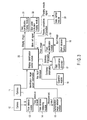
- FIG. 3 is a block diagram depicting a configuration of the above-described entrance and exit management apparatus.
- the entrance and exit management apparatus has first and second video cameras 11 and 12 (hereinafter, simply referred to as cameras 11 and 12), a face detector module 13, a face distance measuring module 14, an identification target selector module 15, an operating module 16, a face authenticating dictionary 17, a short distance camera 18, a face authenticating module 19, a gate control module 20, a face identification display module 21, a viewing line induction display module 22, and a display identification control module 23.
- the cameras 11 and 12 each capture an image which includes at least the face of a pedestrian M.
- the face detector module 13 detects a face region of the pedestrian M from each of the images picked up by the cameras 11 and 12.
- the face distance measuring module 14 calculates a distance between the pedestrian M and each of the cameras 11 and 12.
- the identification target selector module 15 selects an optimal face region targeted for identification.
- the operating module 16 makes an input operation such as a dictionary registering operation by the pedestrian oneself.
- the face authenticating dictionary 17 registers (stores) plural items of dictionary information in advance as characteristic information on a face specific to each person based on a face image of a person who is permitted to enter or exit from the entrance and exit target area 2.
- the short distance camera 18 picks up an image which includes at least a face of the pedestrian M in a short distance.
- the face authenticating module 19 correlates characteristic information on an image of a face region picked up by the cameras 11 and 12 and selected by the identification target selector module 15 or characteristic information on a face image picked up by the short distance camera 18 with dictionary information which has been registered in advance in the face authenticating dictionary 17, thereby determining whether or not the pedestrian M is a person who has been registered in advance.
- the gate control module 20 controls opening of the door 3 (or gateway unit 5) based on a result of determination of the face authenticating module 19.
- the face identification display module 21 displays a current status of face identification with respect to the pedestrian M.
- the view point induction display module 22 displays an arrow for prompting the pedestrian M to view the face identification display module 21, and invokes the pedestrian to pay attention.
- the display identification control module 23 controls a whole operation of the above-described entrance and exit management apparatus.
- the face identification display module 21 for example, as shown in FIG. 1 (FIG. 2), is installed in proximity to the door 3 (or gateway unit 5).
- the display module has a plurality of illumination lamps (for example, fluorescent lamps) 32, 33, 34, and 35 arranged at a liquid crystal display 31 and at the peripheral edge of the display.
- the illumination lamps 32, 33, 34, and 35 each are turned off in general, and is turned on only in the case where the pedestrian M carries out dictionary registration immediately in front of the face identification display module 21.
- the installation height of the face identification display module 21 is set to an extent equivalent to an average value of a height of the pedestrian M.
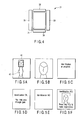
- the face identification display module 21 displays a current state of face identification with respect to the pedestrian M. Specifically, in the case where the pedestrian M is distant from the door 3, and his or her face cannot be detected, or alternatively, in the case where the detection just starts, a whole image 41 picked up via the camera 11 installed at the height of the face of the pedestrian M in FIG. 1 is displayed as shown in FIG. 5A.
- a frame 42 located on a screen shown in FIG. 5A indicates a region of a face detected by the face detector module 13.
- the face identification display module 21 displays the detected face image in an enlarged manner, as shown in FIG. 5B.
- the face authenticating module 19 picks up an image via the camera 11, refers to the face authenticating dictionary 17 based on the face image detected by the face detector module 13, and starts determination as to whether or not the pedestrian is a person who has been registered in advance.
- the face identification display module 21 displays a message indicating that "identification is in progress", as shown in FIG. 5C. In this manner, the pedestrian can judge that his or her face image has been successfully picked up.
- the face authenticating module 19 determines that the pedestrian is a person who has been registered in advance
- the face identification display module 21 displays a message indicating that entrance has been permitted for the pedestrian M, as shown in FIG. 5D.
- the face identification display module 21 displays a message indicating that entrance has been rejected for the pedestrian M, as shown in FIG. 5E.
- the display shown in FIG. 5E will be described in detail in a description of the display identification control module 23 given later.
- the viewing line induction display module 22 is provided as a message display for prompting the pedestrian M to view the face identification display module 21, and, for example, is formed of an arrow pattern using a plurality of light emitting elements such as LEDs.
- This arrow pattern a tip end of which is oriented to a direction of the face identification display module 21, is allocated in front of the pedestrian M.
- the arrow pattern is provided at the door 3, and in the case of FIG. 2, the arrow pattern is provided from the walking area 1 toward a wall face on which the face identification display module 21 is installed.
- the viewing line induction display module 22 is operated to blink, and is induced for the pedestrian M to view the face identification display module 21.
- a blinking operation of the view point induction display module 22 is stopped and turned off. The reason is as follows.
- the view point induction display module 22 is required to prompt the pedestrian to orient his or her face to the face identification display module 21.
- the pedestrian watches the blinking if the view point induction display module 22 blinks, and there is a possibility that a frontal face image cannot be obtained.
- an illumination display module 36 formed in a rectangular frame shape, the display module being allocated at the periphery of the liquid crystal display module 31.
- this illumination display module 36 may be formed while a number of LEDs are arranged as in the above-described arrow pattern, a display may be provided such that a comparatively colorful pattern moves.
- the illumination display module 36 is also operated in the case where the pedestrian M is spaced from the door 3 by a predetermined distance as in the above-described arrow pattern, more specifically, in the case where the pedestrian M exists between the position B and the position C shown in FIG. 1. This operation is stopped in the case where the pedestrian M further approaches the door 3, more specifically, in the case where the pedestrian M exists between the position B and the position A shown in FIG. 1.
- the illumination display module 36 (or view point induction display module 22) may be operated in a standby state in which no pedestrian exists in the walking area 1 of the entrance and exit management apparatus.
- a mobile image capable of catching the pedestrian's attention or the like may be displayed as a standby screen via the liquid crystal display module 31 as well as the illumination display module 36 (or view point induction display module 22).
- the operating module 16 is, for example, installed at a downward site of the face identification display module 21, as shown in FIG. 1.
- the operating module 16 is used when the pedestrian M makes an authenticating operation while stopping in front of the face identification display module 21 or when the pedestrian enters an ID number, a password or the like by a dictionary registering operation, and includes a keyboard or a pointing device (mouse).
- the operating module 16 also includes a wireless communication medium possessed by a pedestrian, for example, a reader/writer for making wireless communication with a wireless ID card or a portable cellular phone.
- the short distance camera 18 is installed between the face identification display module 21 and the operating module 16 as shown in FIG. 1, for example, and picks up a face image of a person (pedestrian M) who exists in front of the face identification display module 21.
- the short distance camera 18 is used in the case where the pedestrian M makes operation while stopping in front of the face identification display module 21.
- An example of the pedestrian M making operation while stopping in front of the face identification display module 21 includes a case in which the pedestrian M fails in face identification for the pedestrian to approach the door 3, and then, restarts face identification in detail while stopping in front of the face identification display module 21.
- this example can include a case in which a pedestrian M having an ID number or a password for entering and exiting from the entrance and exit target area 2, the pedestrian M failing to register his or her own face image with respect to the entrance and exit management apparatus, registers characteristic information on a face image picked up by the short distance camera 18 in the entrance and exit management apparatus (face identification dictionary 17).
- the cameras 11 and 12 are installed so as to have a common field of view, and capture a face image of the pedestrian M who moves the walking area 1 toward the door 3.
- the camera 11 installed at the height of the face of the pedestrian M picks up a frontal face image in the case where the pedestrian M views the face identification display module 21.
- the camera 12 installed at a position lower than the face of the pedestrian M picks up a frontal face image in the case where the pedestrian M walks with his or her face down without viewing the face identification display module 21.
- the two cameras 11 and 12 are used for the purpose of measuring a relative position of the pedestrian M from a camera by stereo vision.
- the cameras 11 and 12 are, for example, arranged in parallel in a vertical direction between the position A and the door 3 (face identification display module 21) at a position slightly displaced from the walking area 1, as shown in FIG. 1.
- the installation height of the upper camera 11 is set at the substantially equal height to the face identification display module 21.
- these cameras are set to be slightly lower than the face identification display module 21 such that the face identification display module 21 is not hidden by the camera 11.
- the camera 11 (12) is positioned, as shown in FIG. 7, in a location in which the camera overlaps on the face identification display module 21 viewed from the pedestrian M in the image pickup target area 4. That is, the camera 11 (12) and the face identification display module 21 are positioned in location in which the camera 11 (12) and face identification display module 21 are arranged in a substantially straight line.
- the installation height of the lower camera 21 is at a position which is lightly lower than the upper camera 11. That is, the camera 12 is installed so as to look up the pedestrian M from a slightly lower position.
- the installation position of the camera 11 is set at a position such that, when the pedestrian M moving the walking area 1 orients his or her line of sight to the face identification display module 21, a frontal image of the pedestrian M can be picked up.
- the camera 11 may not be always installed between the pedestrian M and the face identification display module 21, and for example, the pedestrian M may be captured as an image while the short distance camera 18 installed adjacent to the face identification display module 21 is caused to have a telescopic function.
- a reflection mirror such as a half mirror is installed between the pedestrian M and the face identification display module 21 so as to install the camera 11 on its optical path.
- the face detector module 13 detects a region in which a respective face exists with respect to each of the images picked up by the cameras 11 and 12.
- a technique described in document Mitsubishi, Kaneko, Hori, "A proposal for spatial differential probability template suitable to correlation of images including very small difference", Transaction of ninth image sensing symposium, SSII03, 2003. This technique is to produce a detection dictionary pattern from a face learning pattern in advance, and then, making a search for a pattern having likelihood which is as high as a dictionary pattern from among an input image.
- FIGS. 8A and 8B each show a specific example of detecting a face region.
- FIG. 8A shows an image picked up by the upper camera 11; and
- FIG. 8B shows an image picked up by the lower camera 12, wherein the face regions detected by the face detector module 13 are displayed by frames 61, 62, 63, and 64.
- the face distance measuring module 14 obtains a viewing difference by correlating the face regions detected from the images picked up by the cameras 11 and 12, and calculate a distance from the cameras 11 and 12 up to the face of the pedestrian M.
- a correlation in face region is obtained by, for example, a well known template pattern matching technique.
- the upper camera 11 and the lower camera 12 are arranged in a substantially vertical direction.
- the corresponding face region can be found by searching for the image picked up by the camera 12 with respect to the face region detected by the image picked up by the camera 11.
- the image from the camera 12 is searched in a vertical direction, and a face region, where the likelihood becomes maximal, is detected as corresponding to the template.
- FIG. 9 shows a relationship of associating a result of face region detection.
- a region close to a frontal face is selected from among a pair of face regions associated with each other at the same time. Specifically, a higher likelihood with a detection dictionary pattern computed by the face detector module 13 is selected. The selected face region is used for carrying out identification by the face authenticating module 19.
- the upper portion of FIG. 9 shows an image picked up by the camera 11, and the lower portion of FIG. 9 shows an image picked up by the camera 12.
- a positional relationship between the camera 11 or 12 and the face of the pedestrian M can be computed from a relationship of associating the face regions with each other and a positional relationship between the cameras 11 and 12. This computation is carried out in accordance with a method disclosed in document ("Three-dimensional vision", Kyoritsu Printing Co., Ltd., Tsuyoshi JYO et al, Chapter 7) or the like. Specifically, a direction of a face relevant to the camera 11 is calculated from a position of a face on an image of the camera 11, and a distance from the camera 11 is calculated from the difference between the two face positions captured from cameras 11 and 12. Therefore, a three-dimensional position of the face of the pedestrian M around the position of the camera 1 can be calculated.
- the face distance measuring module 14 outputs a set of face regions whose correlation is obtained, and a three-dimensional position of the face of the pedestrian M around the position of the door 3.
- the position of the face of the pedestrian M from the door 3 is obtained based on a positional relationship of the face of the pedestrian M from the camera 11 after a positional relationship between the camera 11 and the door 3 has been obtained in advance.
- the identification target selector module 15 acquires a face region (face image) and three-dimensional positional face information which are outputs from the face distance measuring module 14, and determines a face region targeted for face identification. In the case where a face region is a person who exists in the image pickup area 4, the face region is targeted for identification. In the case where a plurality of persons exist in the image pickup region 4, a face region of a person who is closer to the door 3 is preferentially targeted for identification.
- an identification face number is incremented.
- the identification face number used here indicates a sequential number of a person targeted for identification.
- the initial value is "0", and is incremented in the case where a new person is targeted for identification.
- the display identification control module 23 which carries out processing operation upon the receipt of an output from the identification target selector module 15 recognizes that a person targeted for identification has been changed due to a change of the identification face number.
- the face authenticating module 19 determines whether or not an image in a face region from the identification target selector module 15 (or face image picked up by the short distance camera 18) has been registered in advance. Specifically, as described in, for example, Jpn. Pat. Appln. KOKAI Publication No. 2001-266152, a face image of a registrant (pedestrian) is prepared in advance, and specific characteristic information extracted from such a face image is stored (registered) as dictionary information in the face recognition dictionary 17. Then, the image (characteristic information) in the face region selected by the identification target selector module 15 is correlated with dictionary information registered in advance in the face recognition dictionary 17, and the likelihood between them is obtained.
- the pedestrian M is a person who has been registered in advance. In the case where the obtained likelihood is not equal to or greater than the threshold value, it is determined that the pedestrian M is not a person which has been registered in advance.
- the gate control module 20 opens the door 3 when a passing enable signal from the display identification control module 23 is turned on in the case where a control target is the door 3, as shown in FIG. 1.
- the gate control module 20 operates in accordance with a flowchart shown in FIG. 10 in the case where a control target is the gateway unit 5, as shown in FIG. 2.
- step 1 when the passing enable signal from the display identification control module 23 is turned ON (step 1: YES), after a person has been passed through the gateway unit 5 (step 2: YES), the gate control module 20 transmits passing completion information to the display identification control module 23 (step 3).
- step 1 NO and step 2: YES
- the gate display module 20 sounds warning, closes a flapper provided at the gateway unit 5 (step 3), and inhibits passing of the person.
- the display identification control module 23 controls a whole operation of the entrance and exit management apparatus. A flow of the processing operation is shown in flowcharts of FIGS. 11 and 12. Now, a processing operation by the display identification control module 23 will be described with reference to the flowcharts of FIGS. 11 and 12.
- control module 23 acquires a selection result of the identification target selector module 15 (FIG. 11 and step 1), and checks whether or not a person targeted for identification exists in the image pickup area 4 (step 2). In the case where, as a result of the check in step 2, it is determined that nobody exists in the image pickup area 4 (step 2: NO), the control module 23 displays an image picked up by the camera 11, i.e., an image indicating that nobody exists via the face identification module 21 (step 3).
- control module 23 checks whether or not any key operation has been made by the operating module 16 (step 4). In the case where, as a result of the check in step 4, the control module 23 determines that no key operation is made (step 4; NO), the current processing reverts to step 1.
- the control module 23 may blink the LED of the view point induction display module 22, or alternatively, may operate the illumination display module 36 described in FIG. 6. In this manner, in the case where there is a pedestrian M who moves to the door 3 or gateway unit 5, there is a high possibility that the pedestrian M enters the walking area 1 in a state in which he or she orients a direction of the face identification display module 21. In addition, there is a high possibility that a frontal image of the pedestrian M can be picked up immediately after the pedestrian M has entered the walking area 1.
- step 2 it is determined that a person targeted for identification (pedestrian M) exists in the image pickup area 4 (step 2: YES), the control module 23 checks whether or not the pedestrian M exists between the position C and the position B of the walking area 1 (step 5).
- step S5 In the case where, as a result of the check in step S5, a person targeted for identification, namely, a pedestrian M exists between the position C and the position B (step 5: YES), the control module 23 displays a whole image as shown in FIG. 5A via the face identification display module 21. At this time, the control module 23 also displays a frame 42 indicating a detected face region on the same screen at the same time (step 6).
- control module 23 operates the LED of the view point induction display module 22 to blink (step 7) and/or operates the illumination display module 36, and prompts the pedestrian M to pay attention to orient to the direction of the face identification display module 21. Namely, in accordance with the processing operations in step 6 and step 7, the pedestrian M orients his or her line of sight to the face identification display module 21 without walking with his or her face down.
- step 5 it is determined that a pedestrian M does not exist between the position C and the position B (step 5: NO), the control module 23 checks whether or not the pedestrian M exists between the position B and the position A of the walking area 1 (step 8).
- control module 23 displays an image obtained by enlarging a face of the pedestrian M via the face identification display module 21, as shown in FIG. 5B (step 9).
- the control module 23 turns off the LED of the view point induction display module 22 (step 10) so that the line of sight of the pedestrian M is not oriented to the view point induction display module 22.
- the view point induction display module 22 is turned off so as not to pay attention to the view point induction display module 22 allocated at the periphery of the face identification display module 21, i.e., so as not to change a face angle of the pedestrian M facing the camera 11.
- the operation of the illumination display module 36 may not always be stopped. Namely, in a state in which the pedestrian M pays attention to the illumination display module 36, there is a high possibility that the face of the pedestrian M is oriented to the direction of the face identification display module 21 (i.e., camera 11). Thus, there is a low possibility that the face angle of the pedestrian M changes.
- step 8 it is determined that the pedestrian M does not exist between the position B and the position A (step 8: NO)
- the control module 23 checks whether or not the pedestrian M exists between the position A of the walking area 1 and the door 3 (step 11).
- step 11 it is determined that the pedestrian M does not exist between the position A of the walking area 1 and the door 3 (step 11: NO), the control module 23 displays via the face identification display module 21 an image picked up via the camera 11 (step 12).
- the control module 23 checks whether or not the number of detected face images of the pedestrian M (targeted for identification) is equal to or greater than a predetermined number (step 13).
- the predetermined number of images used here denotes a required minimum number of images for face identification of the pedestrian M, and can be arbitrarily set according to a length of the walking area 1, i.e., an image pickup time of the pedestrian M.
- control module 23 displays for a predetermined period of time, a message "identification NG" which indicates that identification has failed, as shown in FIG. 5E, via the face identification display module 21 (step 14).
- step 13 in the case where, as a result of the check in step 13, it is determined that a predetermined number or more of face images targeted for identification have been successfully acquired (step 13: YES), the control module 23 sends to the face authenticating module 19 an image (face image) of a face region selected by the identification target selector module 15, and starts a face authenticating processing operation (FIG. 12 and step 15). At this time, the control module 23 displays a message screen indicating that "identification is in progress" as shown in FIG. 5C via the face identification display module 21, and waits until the face authenticating processing operation in the face authenticating module 19 has terminated (step 17).
- step 18 the control module 23 checks whether or not identification has succeeded (step 18). In the case where it is determined that identification has succeeded (step 18: YES), a message "Identification OK, you may pass through gate” as shown in FIG. 5D is displayed via the face identification display module 21 (step 19). At the same time, the control module 23 turns ON for a predetermined period of time a passing enable signal to be transmitted to the gate control module 20 (step 20). In this way, the pedestrian M can pass through the door 3 or gateway unit 5.
- control module 23 displays for a predetermined period of time a message "identification NG" as shown in FIG. 5E via the face authenticating display module 21 (step S21).
- control module 23 displays the detected face image, as shown in FIG. 5F, via the face identification display module 21.
- the control module 23 displays for a predetermined period of time a message which prompts the pedestrian M to input a key such as "Identification NG. Press any key when you want to make registration” (step 22). If no key input is made within a predetermined period of time (step 23: NO), the current processing reverts to step 1.
- control module 23 displays a message screen for prompting the pedestrian M to enter an ID number and a password, and waits for an operation input by the pedestrian M (step 24).
- step 24 the control module 23 checks whether or not the inputted ID number and password are correct (step 25). In the case where it is determined that the inputted ID and password are correct (step 25: YES), a processing operation for registering dictionary information described later (or updating processing operation) is carried out (step 26).
- ID may be read from the wireless card.
- control module 23 may permit only passing of the pedestrian M without accepting the dictionary information registering processing operation (or updating processing operation) after checking the ID number and password. For example, in the case where a comparatively large number of users utilize the area 2 and there is no time for accepting registering and updating processing operations, such a processing operation is effective, and a processing mode may be changed as required.
- control module 23 turns on for a predetermined period of time a passing enable signal with respect to the gate control module 20 (step 27), and permits the passing of the pedestrian M.
- step 4 in the case where any key is pressed and in the case where the current processing reverts to step 26, the control module 23 carries out a processing operation for registering dictionary information with respect to the pedestrian M (step 28).
- step 28 the control module 23 first accepts inputs of an ID number and a password (step 31). However, in the case where the current processing reverts to step 26 described above, this processing operation in step 31 is skipped. Next, the control module 23 checks whether or not the input ID number and password are correct (step 32), and terminates the registering processing operation if they are not correct.
- the control module 23 picks up a face of the pedestrian M as an image by the short distance camera 18 in accordance with an image pickup condition for the face correlating device or the like, and acquires a face image (step 33).
- this face image may be utilized.
- control module 23 extracts specific characteristic information from the obtained face image, and stores (registers or updates) the extracted characteristic information as dictionary information in the face recognition dictionary 17 (step 34).
- the above-described image pickup condition may include that strong light irradiates from one side at the periphery of the face identification apparatus.
- an illumination light provided at the face identification display module 21 is brightened only on one side, a similar state is reproduced in a simulative manner.
- the cameras 11 and 12 and the face identification display module 21 are allocated so as to be arranged on a straight line viewed from the pedestrian M, and is designed to capture a face image.
- the pedestrian M watches the face identification display module 21, whereby a face image can be stably picked up from the frontal face of the pedestrian M. Consequently, identification performance is remarkably improved.
- the pedestrian M in the case where the pedestrian M is comparatively distant from the door 3, a whole image is displayed, and a face region of the pedestrian M at this time is displayed on the face identification display module 21 while the face region is enclosed in a frame 42.
- the face image is displayed in an enlarged manner.
- the pedestrian M can easily check whether or not he or she is targeted for identification. In this manner, the pedestrian M is recognizant of facing the camera 11.
- the face identification display module 21 for displaying a face image of the pedestrian M is placed in the vicinity of the door 3 and the view point induction display module 22 is placed in front of the pedestrian M (i.e., at the door 3) or the illumination display module 36 is operated with a proper timing so as to prompt the pedestrian M to effectively view the face identification display module 21.
- the pedestrian M easily perceives the face identification display module 21 so as to view the face identification display module 21 with stopping facing down.
- a frontal face image of the pedestrian M is easily picked up by the camera 11 and a time for picking up the face of the pedestrian M as an image can be comparatively extended, so that a required number of frontal images effective for identification can be acquired.
- the frontal view point induction display module 22 is turned OFF. Consequently, the pedestrian M pays attention to only the face identification display module 21 for displaying a face, thereby making it possible to stably capture a frontal face image of the pedestrian M. Therefore, identification performance is remarkably improved.
- two cameras 11 and 12 are intensively allocated at the upper and lower portions without being spaced from each other so as to calculate a distance from a viewing difference between the two cameras 11 and 12 to the pedestrian M and to make an identification process and a display control according to the calculated distance.
- a face image closer to a frontal face of the pedestrian M with his or her face down is picked up by using the lower camera 12.
- the control module 23 can recognize a distance from each of the cameras 11 and 12 to the pedestrian M, and make control according to a distance from the door 3 to the pedestrian M. Namely, according to the embodiment, a user interface is improved.
- face identification is carried out by using the face image obtained until the pedestrian M has approached the cameras 11 and 12.
- the operating module 16 installed in the vicinity of the door 3 is operated by using the obtained image, thereby making it possible to register or update dictionary information. In this manner, a face image obtained at the time of walking can be efficiently utilized for registration even in the case where identification has failed.
Landscapes
- Engineering & Computer Science (AREA)
- Human Computer Interaction (AREA)
- Physics & Mathematics (AREA)
- General Physics & Mathematics (AREA)
- Multimedia (AREA)
- Theoretical Computer Science (AREA)
- Health & Medical Sciences (AREA)
- Oral & Maxillofacial Surgery (AREA)
- General Health & Medical Sciences (AREA)
- Collating Specific Patterns (AREA)
- Time Recorders, Dirve Recorders, Access Control (AREA)
- Closed-Circuit Television Systems (AREA)
- Studio Devices (AREA)
- Lock And Its Accessories (AREA)
- Image Input (AREA)
- Image Analysis (AREA)
Applications Claiming Priority (1)
| Application Number | Priority Date | Filing Date | Title |
|---|---|---|---|
| JP2005053385A JP2006236244A (ja) | 2005-02-28 | 2005-02-28 | 顔認証装置および入退場管理装置 |
Publications (2)
| Publication Number | Publication Date |
|---|---|
| EP1696393A2 true EP1696393A2 (de) | 2006-08-30 |
| EP1696393A3 EP1696393A3 (de) | 2007-01-03 |
Family
ID=36582261
Family Applications (1)
| Application Number | Title | Priority Date | Filing Date |
|---|---|---|---|
| EP06004028A Withdrawn EP1696393A3 (de) | 2005-02-28 | 2006-02-28 | Vorrichtung zur Gesichtserkennung und Vorrichtung zur Eingangs- und Ausgangsverwaltung |
Country Status (5)
| Country | Link |
|---|---|
| US (2) | US20060204050A1 (de) |
| EP (1) | EP1696393A3 (de) |
| JP (1) | JP2006236244A (de) |
| AU (1) | AU2006200828B2 (de) |
| CA (1) | CA2537738A1 (de) |
Cited By (17)
| Publication number | Priority date | Publication date | Assignee | Title |
|---|---|---|---|---|
| EP1806702A3 (de) * | 2005-11-30 | 2007-09-05 | Kabushiki Kaisha Toshiba | Gesichtsauthentifizierungssytem und Torverwaltungssystem |
| WO2008101142A1 (en) * | 2007-02-16 | 2008-08-21 | Honeywell International Inc. | Biometric based repeat visitor recognition system and method |
| EP2045760A3 (de) * | 2007-10-04 | 2009-08-26 | Kabushiki Kaisha Toshiba | Gesichtsauthentifizierungsvorrichtung, Gesichtsauthentifizierungsverfahren und Gesichtsauthentifizierungssystem |
| EP2045759A3 (de) * | 2007-10-02 | 2009-09-02 | Kabushiki Kaisha Toshiba | Personenauthentifizierungsvorrichtung und Personenauthentifizierungsverfahren |
| EP2202698A1 (de) * | 2008-12-24 | 2010-06-30 | Kabushi Kaisha Toshiba | System zur Personenüberwachung mittels Kameras |
| WO2012163927A1 (fr) | 2011-06-01 | 2012-12-06 | Morpho | Systeme et methode pour l'identification d'individus a la volee |
| CN103078377A (zh) * | 2013-01-16 | 2013-05-01 | 张正昌 | 智能矿灯充电柜制作方法及其制品 |
| CN103218868A (zh) * | 2013-05-08 | 2013-07-24 | 姬志刚 | 可用自救器腰带无线开启小柜门的矿灯充电架柜门系统 |
| WO2017172500A1 (en) * | 2016-03-29 | 2017-10-05 | Microsoft Technology Licensing, Llc | Recognizing a face and providing feedback on the face-recognition process |
| CN108492417A (zh) * | 2017-04-18 | 2018-09-04 | 北京中科奥森科技有限公司 | 快速人证核验方法及人证核验系统 |
| FR3074312A1 (fr) * | 2017-11-24 | 2019-05-31 | Photo-Me International Plc | Dispositif de controle d'acces d'un individu par reconnaissance 2d ou 3d du visage d'un individu a partir de son acquisition prealable 3d |
| EP3557525A4 (de) * | 2016-12-16 | 2019-11-20 | Panasonic Intellectual Property Management Co., Ltd. | Gesichtsbildverarbeitungsverfahren und gesichtsbildverarbeitungsvorrichtung |
| CN111223216A (zh) * | 2020-01-13 | 2020-06-02 | 郑州纷呈科技有限公司 | 非接触式门禁刷卡方法 |
| CN111968152A (zh) * | 2020-07-15 | 2020-11-20 | 桂林远望智能通信科技有限公司 | 一种动态身份识别方法及装置 |
| GB2581746B (en) * | 2017-10-22 | 2022-11-02 | Martin Todd | A sporting event entry system and method |
| EP4123110A4 (de) * | 2020-03-18 | 2023-04-26 | Nec Corporation | Gate-vorrichtung, authentifizierungssystem, gate-vorrichtung-steuerungsverfahren und speichermedium |
| AU2020435745B2 (en) * | 2020-03-18 | 2024-05-16 | Nec Corporation | Gate device, authentication system, gate device control method, and storage medium |
Families Citing this family (86)
| Publication number | Priority date | Publication date | Assignee | Title |
|---|---|---|---|---|
| EP1647918A1 (de) * | 2004-10-13 | 2006-04-19 | SkiData AG | Zugangskontrollsystem |
| EP1900260A4 (de) * | 2005-06-02 | 2014-06-25 | Hyo-Goo Kim | Erfassungssystem zur erkennung der richtung eines sich bewegenden körpers |
| US20090222671A1 (en) | 2005-10-25 | 2009-09-03 | Burbank Jeffrey H | Safety features for medical devices requiring assistance and supervision |
| JP4899551B2 (ja) * | 2006-03-15 | 2012-03-21 | オムロン株式会社 | 認証装置、認証方法、認証プログラムおよびコンピュータ読み取り可能な記録媒体 |
| JP4836633B2 (ja) * | 2006-03-31 | 2011-12-14 | 株式会社東芝 | 顔認証装置、顔認証方法および入退場管理装置 |
| US8306280B2 (en) | 2006-04-11 | 2012-11-06 | Nikon Corporation | Electronic camera and image processing apparatus |
| US7916129B2 (en) * | 2006-08-29 | 2011-03-29 | Industrial Technology Research Institute | Interactive display system |
| EP2076871A4 (de) * | 2006-09-22 | 2015-09-16 | Eyelock Inc | Kompaktes biometrisches erfassungssystem und entsprechendes verfahren |
| US20080117297A1 (en) * | 2006-11-21 | 2008-05-22 | Torres David J | Covert camera apparatus for a doorframe and method |
| JP4594945B2 (ja) | 2007-02-13 | 2010-12-08 | 株式会社東芝 | 人物検索装置および人物検索方法 |
| JP4708491B2 (ja) * | 2007-03-29 | 2011-06-22 | 富士通株式会社 | 撮影制御装置、そのプログラム及び方法、撮影装置 |
| US8615112B2 (en) * | 2007-03-30 | 2013-12-24 | Casio Computer Co., Ltd. | Image pickup apparatus equipped with face-recognition function |
| JP4986720B2 (ja) | 2007-06-07 | 2012-07-25 | 株式会社ユニバーサルエンターテインメント | 個人識別データ登録装置 |
| JP4922097B2 (ja) * | 2007-08-14 | 2012-04-25 | 株式会社東芝 | カメラシステム |
| US20090169062A1 (en) * | 2008-01-02 | 2009-07-02 | Yahoo! Inc. | Personals ad profile secret photo verification process |
| JP5293950B2 (ja) * | 2008-03-04 | 2013-09-18 | 株式会社リコー | 個人認証装置及び電子機器 |
| JP2009265769A (ja) * | 2008-04-22 | 2009-11-12 | Toshiba Corp | 生体認証装置および通行制御システム |
| CN101616500B (zh) * | 2008-06-23 | 2012-08-22 | 深圳富泰宏精密工业有限公司 | 移动设备及其密码设置方法 |
| CN101639891B (zh) * | 2008-07-28 | 2012-05-02 | 汉王科技股份有限公司 | 一种双摄像头人脸识别装置和方法 |
| BRPI0917133B1 (pt) * | 2008-08-22 | 2021-03-02 | Sony Corporation | dispositivo de exibição de imagem, método de controle, e, meio de armazenamento legível por computador |
| US8593503B2 (en) * | 2008-09-25 | 2013-11-26 | Alcatel Lucent | Videoconferencing terminal and method of operation thereof to maintain eye contact |
| JP5326527B2 (ja) * | 2008-11-28 | 2013-10-30 | 富士通株式会社 | 認証装置及び認証方法 |
| JP2011019192A (ja) * | 2009-07-10 | 2011-01-27 | Toshiba Corp | 画像表示装置 |
| US8520051B2 (en) * | 2009-12-17 | 2013-08-27 | Alcatel Lucent | Videoconferencing terminal with a persistence of vision display and a method of operation thereof to maintain eye contact |
| JP5659510B2 (ja) | 2010-03-10 | 2015-01-28 | ソニー株式会社 | 画像処理装置、画像処理方法及びプログラム |
| CA2741510A1 (en) * | 2010-05-26 | 2011-11-26 | James H. Lacey | Door mountable camera surveillance device and method |
| DE102010055795A1 (de) * | 2010-12-23 | 2012-06-28 | Continental Automotive Gmbh | Verfahren zur Ausgabe von Informationen |
| US8724887B2 (en) * | 2011-02-03 | 2014-05-13 | Microsoft Corporation | Environmental modifications to mitigate environmental factors |
| TW201243140A (en) * | 2011-04-20 | 2012-11-01 | Hon Hai Prec Ind Co Ltd | Controlling system and method for door |
| KR101241625B1 (ko) * | 2012-02-28 | 2013-03-11 | 인텔 코오퍼레이션 | 얼굴 인식 환경 통지 방법, 장치, 및 이 방법을 실행하기 위한 컴퓨터 판독 가능한 기록 매체 |
| WO2013128326A1 (en) * | 2012-02-29 | 2013-09-06 | Koninklijke Philips N.V. | Apparatus, method and system for monitoring presence of persons in an area |
| US8902281B2 (en) | 2012-06-29 | 2014-12-02 | Alcatel Lucent | System and method for image stabilization in videoconferencing |
| JP2014029623A (ja) * | 2012-07-31 | 2014-02-13 | Canon Inc | 情報処理装置及び情報処理方法 |
| CN102915582A (zh) * | 2012-09-24 | 2013-02-06 | 南京信息工程大学 | 一种基于人脸识别的住宅访客系统 |
| KR102206044B1 (ko) * | 2012-12-10 | 2021-01-21 | 삼성전자주식회사 | 뱅글 타입의 모바일 디바이스와 그 제어 방법 및 ui 표시 방법 |
| EP3617843B1 (de) | 2012-12-10 | 2025-03-19 | Samsung Electronics Co., Ltd. | Mobile vorrichtung, steuerverfahren dafür und benutzeroberflächenanzeigeverfahren |
| US9245276B2 (en) * | 2012-12-12 | 2016-01-26 | Verint Systems Ltd. | Time-in-store estimation using facial recognition |
| US20140211017A1 (en) * | 2013-01-31 | 2014-07-31 | Wal-Mart Stores, Inc. | Linking an electronic receipt to a consumer in a retail store |
| US9472067B1 (en) * | 2013-07-23 | 2016-10-18 | Rsi Video Technologies, Inc. | Security devices and related features |
| US10377374B1 (en) * | 2013-11-06 | 2019-08-13 | Waymo Llc | Detection of pedestrian using radio devices |
| CN103985176A (zh) * | 2014-05-23 | 2014-08-13 | 四川华立德科技有限公司 | 无线可视电子门锁 |
| US10099644B2 (en) * | 2014-05-27 | 2018-10-16 | University Of Southern California | Virtual head mounted video camera system |
| JP6247245B2 (ja) * | 2015-03-27 | 2017-12-13 | 東芝テック株式会社 | 販売データ処理装置およびプログラム |
| KR102377182B1 (ko) * | 2015-09-01 | 2022-03-22 | 엘지전자 주식회사 | 이동 단말기 및 그 제어방법 |
| US10014967B2 (en) * | 2015-11-23 | 2018-07-03 | Huami Inc. | System and method for authenticating a broadcast device using facial recognition |
| WO2017146161A1 (ja) * | 2016-02-26 | 2017-08-31 | 日本電気株式会社 | 顔照合システム、顔照合装置、顔照合方法、及び記録媒体 |
| CN108701225B (zh) * | 2016-02-26 | 2023-04-04 | 日本电气株式会社 | 面部辨识系统、面部辨识方法和存储介质 |
| US10679677B2 (en) * | 2016-03-31 | 2020-06-09 | Sony Corporation | Information processing device and information processing method |
| CN106097530A (zh) * | 2016-08-10 | 2016-11-09 | 朱哲宇 | 一种电子锁系统 |
| JP6409082B2 (ja) * | 2017-02-10 | 2018-10-17 | 株式会社テイパーズ | ノンストップ顔認証システム |
| JP6988160B2 (ja) * | 2017-05-17 | 2022-01-05 | 富士フイルムビジネスイノベーション株式会社 | 情報処理装置及び情報処理プログラム |
| JP6544404B2 (ja) * | 2017-09-19 | 2019-07-17 | 日本電気株式会社 | 照合システム |
| JP6409929B1 (ja) * | 2017-09-19 | 2018-10-24 | 日本電気株式会社 | 照合システム |
| EP4524915A3 (de) * | 2017-10-25 | 2025-05-07 | Johnson Controls Tyco IP Holdings LLP | Reibungsloses zugangssteuerungssystem mit satellitenkameras zur gesichtserkennung |
| JP6915673B2 (ja) * | 2018-01-31 | 2021-08-04 | 日本電気株式会社 | 情報処理システム |
| JP2019132019A (ja) * | 2018-01-31 | 2019-08-08 | 日本電気株式会社 | 情報処理装置 |
| JP6601513B2 (ja) | 2018-01-31 | 2019-11-06 | 日本電気株式会社 | 情報処理装置 |
| JP7179496B2 (ja) * | 2018-06-04 | 2022-11-29 | 東芝ホームテクノ株式会社 | 加熱調理器 |
| KR102086913B1 (ko) * | 2018-07-16 | 2020-04-23 | 주식회사 에스원 | 인증용 사진 촬영 장치 및 방법 |
| WO2020075307A1 (ja) | 2018-10-12 | 2020-04-16 | 日本電気株式会社 | ゲート装置、ゲート装置の制御方法及び記録媒体 |
| JP7032350B2 (ja) | 2019-04-15 | 2022-03-08 | パナソニックi-PROセンシングソリューションズ株式会社 | 人物監視システムおよび人物監視方法 |
| CN110390745B (zh) * | 2019-06-03 | 2022-04-08 | 浙江大华技术股份有限公司 | 闸机控制方法、系统、可读存储介质和设备 |
| JP2023120264A (ja) * | 2019-06-11 | 2023-08-29 | 日本電気株式会社 | 照合システム |
| US11303877B2 (en) * | 2019-08-13 | 2022-04-12 | Avigilon Corporation | Method and system for enhancing use of two-dimensional video analytics by using depth data |
| JP6684009B1 (ja) * | 2019-10-03 | 2020-04-22 | 株式会社クリューシステムズ | プログラム、映像処理装置及び認証方法 |
| JP7279774B2 (ja) * | 2019-10-10 | 2023-05-23 | 日本電気株式会社 | 情報処理装置 |
| JP7006668B2 (ja) * | 2019-10-10 | 2022-01-24 | 日本電気株式会社 | 情報処理装置 |
| US11176357B2 (en) * | 2019-10-30 | 2021-11-16 | Tascent, Inc. | Fast face image capture system |
| JP2021193268A (ja) * | 2019-12-10 | 2021-12-23 | 日本電気株式会社 | 情報処理システム |
| DE102019135107A1 (de) * | 2019-12-19 | 2021-06-24 | Bundesdruckerei Gmbh | Vorrichtung und verfahren zum bestimmen eines biometrischen merkmals eines gesichts einer person |
| JP7424469B2 (ja) * | 2020-03-17 | 2024-01-30 | 日本電気株式会社 | ゲートシステム、ゲート装置、その画像処理方法、およびプログラム、ならびに、ゲート装置の配置方法 |
| JP7481914B2 (ja) * | 2020-06-15 | 2024-05-13 | 株式会社東芝 | 通行制御装置および通行制御システム |
| WO2022110244A1 (zh) * | 2020-11-30 | 2022-06-02 | 南京溧水高新创业投资管理有限公司 | 一种园区智能通行门禁系统 |
| CN112949505A (zh) * | 2021-03-05 | 2021-06-11 | 浙江工商大学 | 基于mcu的离线式人脸识别智能门锁以及控制方法 |
| JP7122543B1 (ja) * | 2021-04-15 | 2022-08-22 | パナソニックIpマネジメント株式会社 | 情報処理装置、情報処理システム、及び、推定方法 |
| KR20220152019A (ko) * | 2021-05-07 | 2022-11-15 | 에스케이하이닉스 주식회사 | 이미지 센싱 장치 및 그 동작 방법 |
| JP2023157133A (ja) * | 2022-04-14 | 2023-10-26 | 株式会社Lixil | 建具 |
| JP7845013B2 (ja) * | 2022-04-15 | 2026-04-14 | Toppanホールディングス株式会社 | 認証装置、認証方法および認証プログラム |
| CN115137244B (zh) * | 2022-06-08 | 2023-08-29 | 重庆电子工程职业学院 | 一种沐浴辅助系统及方法 |
| WO2023242948A1 (ja) * | 2022-06-14 | 2023-12-21 | 日本電気株式会社 | 認証装置、認証システム、認証方法、及び非一時的なコンピュータ可読媒体 |
| CN114973467B (zh) * | 2022-07-07 | 2022-10-18 | 深圳市经纬纵横科技有限公司 | 一种基于通讯平台的家庭智能门锁控制系统 |
| JP7767259B2 (ja) * | 2022-10-31 | 2025-11-11 | 株式会社東芝 | 通行管理プログラム、通行管理方法、および通行管理装置 |
| CN117079377B (zh) * | 2023-06-07 | 2024-10-29 | 南通新旋利机械科技有限公司 | 一种提高自动门感应识别率的方法及系统 |
| WO2025134312A1 (ja) * | 2023-12-21 | 2025-06-26 | 富士通フロンテック株式会社 | 生体認証装置、生体認証方法、及び生体認証プログラム |
| WO2025177739A1 (ja) * | 2024-02-19 | 2025-08-28 | 日本電気株式会社 | 情報処理装置、情報処理方法、プログラム、及び情報処理システム |
| WO2025197311A1 (ja) * | 2024-03-22 | 2025-09-25 | 日本電気株式会社 | 処理装置、処理方法、及び記録媒体 |
Citations (3)
| Publication number | Priority date | Publication date | Assignee | Title |
|---|---|---|---|---|
| JP2000331207A (ja) | 1999-05-21 | 2000-11-30 | Omron Corp | ゲート装置 |
| JP2001266152A (ja) | 2000-03-17 | 2001-09-28 | Toshiba Corp | 顔画像認識装置および顔画像認識方法 |
| JP2002140699A (ja) | 2000-11-06 | 2002-05-17 | Omron Corp | 生体照合装置、生体照合システムおよびその方法 |
Family Cites Families (20)
| Publication number | Priority date | Publication date | Assignee | Title |
|---|---|---|---|---|
| US5386103A (en) * | 1993-07-06 | 1995-01-31 | Neurnetics Ltd. | Identification and verification system |
| US6118888A (en) * | 1997-02-28 | 2000-09-12 | Kabushiki Kaisha Toshiba | Multi-modal interface apparatus and method |
| US6783459B2 (en) * | 1997-08-22 | 2004-08-31 | Blake Cumbers | Passive biometric customer identification and tracking system |
| JPH11191856A (ja) * | 1997-12-25 | 1999-07-13 | Canon Inc | 撮像装置および撮像方法 |
| US5956122A (en) * | 1998-06-26 | 1999-09-21 | Litton Systems, Inc | Iris recognition apparatus and method |
| JP2000339466A (ja) * | 1999-05-31 | 2000-12-08 | Omron Corp | データ保存装置及び顔画像保存装置 |
| JP4521086B2 (ja) * | 2000-03-13 | 2010-08-11 | 株式会社東芝 | 顔画像認識装置及び顔画像認識方法 |
| JP2001331799A (ja) * | 2000-03-16 | 2001-11-30 | Toshiba Corp | 画像処理装置および画像処理方法 |
| TWI282941B (en) * | 2001-03-15 | 2007-06-21 | Toshiba Corp | Entrance management apparatus and entrance management method by using face features identification |
| JP2003067744A (ja) * | 2001-08-24 | 2003-03-07 | Toshiba Corp | 個人認証装置および個人認証方法 |
| TWI278782B (en) * | 2001-08-24 | 2007-04-11 | Toshiba Corp | Personal recognition apparatus |
| CA2359269A1 (en) * | 2001-10-17 | 2003-04-17 | Biodentity Systems Corporation | Face imaging system for recordal and automated identity confirmation |
| US6771303B2 (en) * | 2002-04-23 | 2004-08-03 | Microsoft Corporation | Video-teleconferencing system with eye-gaze correction |
| JP4314016B2 (ja) * | 2002-11-01 | 2009-08-12 | 株式会社東芝 | 人物認識装置および通行制御装置 |
| GB2395779A (en) * | 2002-11-29 | 2004-06-02 | Sony Uk Ltd | Face detection |
| JP4131180B2 (ja) * | 2003-03-12 | 2008-08-13 | オムロン株式会社 | 顔認証装置 |
| JP2004356730A (ja) * | 2003-05-27 | 2004-12-16 | Toshiba Corp | 画像撮影装置および画像認識装置 |
| JP4476744B2 (ja) * | 2003-09-02 | 2010-06-09 | 富士フイルム株式会社 | 撮像システム、及びプログラム |
| US7413512B2 (en) * | 2003-09-15 | 2008-08-19 | Igt | Display panel for a gaming apparatus |
| US7224777B1 (en) * | 2003-12-03 | 2007-05-29 | Union Beach, L.P. | Time-controlled messaging system |
-
2005
- 2005-02-28 JP JP2005053385A patent/JP2006236244A/ja active Pending
-
2006
- 2006-02-27 AU AU2006200828A patent/AU2006200828B2/en not_active Ceased
- 2006-02-27 CA CA002537738A patent/CA2537738A1/en not_active Abandoned
- 2006-02-28 EP EP06004028A patent/EP1696393A3/de not_active Withdrawn
- 2006-02-28 US US11/363,160 patent/US20060204050A1/en not_active Abandoned
- 2006-05-31 US US11/443,290 patent/US20060262187A1/en not_active Abandoned
Patent Citations (3)
| Publication number | Priority date | Publication date | Assignee | Title |
|---|---|---|---|---|
| JP2000331207A (ja) | 1999-05-21 | 2000-11-30 | Omron Corp | ゲート装置 |
| JP2001266152A (ja) | 2000-03-17 | 2001-09-28 | Toshiba Corp | 顔画像認識装置および顔画像認識方法 |
| JP2002140699A (ja) | 2000-11-06 | 2002-05-17 | Omron Corp | 生体照合装置、生体照合システムおよびその方法 |
Non-Patent Citations (2)
| Title |
|---|
| MITA; KANEKO; HORI: "A proposal for spatial differential probability template suitable to correlation of images including very small difference", TRANSACTION OF NINTH IMAGE SENSING SYMPOSIUM, SSII03, 2003 |
| TSUYOSHI JYO: "THREE-DIMENSIONAL VISION", KYORITSU PRINTING CO., LTD. |
Cited By (31)
| Publication number | Priority date | Publication date | Assignee | Title |
|---|---|---|---|---|
| EP1806702A3 (de) * | 2005-11-30 | 2007-09-05 | Kabushiki Kaisha Toshiba | Gesichtsauthentifizierungssytem und Torverwaltungssystem |
| US8694792B2 (en) | 2007-02-16 | 2014-04-08 | Honeywell International Inc. | Biometric based repeat visitor recognition system and method |
| GB2458858A (en) * | 2007-02-16 | 2009-10-07 | Honeywell Int Inc | Biometric based repeat visitor recognition system and method |
| WO2008101142A1 (en) * | 2007-02-16 | 2008-08-21 | Honeywell International Inc. | Biometric based repeat visitor recognition system and method |
| EP2045759A3 (de) * | 2007-10-02 | 2009-09-02 | Kabushiki Kaisha Toshiba | Personenauthentifizierungsvorrichtung und Personenauthentifizierungsverfahren |
| EP2045760A3 (de) * | 2007-10-04 | 2009-08-26 | Kabushiki Kaisha Toshiba | Gesichtsauthentifizierungsvorrichtung, Gesichtsauthentifizierungsverfahren und Gesichtsauthentifizierungssystem |
| EP2202698A1 (de) * | 2008-12-24 | 2010-06-30 | Kabushi Kaisha Toshiba | System zur Personenüberwachung mittels Kameras |
| CN101763671B (zh) * | 2008-12-24 | 2013-03-20 | 株式会社东芝 | 通过使用摄像机来监控人的系统 |
| US8339455B2 (en) | 2008-12-24 | 2012-12-25 | Kabushiki Kaisha Toshiba | System for monitoring persons by using cameras |
| WO2012163927A1 (fr) | 2011-06-01 | 2012-12-06 | Morpho | Systeme et methode pour l'identification d'individus a la volee |
| FR2976106A1 (fr) * | 2011-06-01 | 2012-12-07 | Morpho | Systeme et methode pour le controle de l'acces d'un individu a une zone a acces controle |
| CN103078377A (zh) * | 2013-01-16 | 2013-05-01 | 张正昌 | 智能矿灯充电柜制作方法及其制品 |
| CN103218868A (zh) * | 2013-05-08 | 2013-07-24 | 姬志刚 | 可用自救器腰带无线开启小柜门的矿灯充电架柜门系统 |
| US10339367B2 (en) | 2016-03-29 | 2019-07-02 | Microsoft Technology Licensing, Llc | Recognizing a face and providing feedback on the face-recognition process |
| WO2017172500A1 (en) * | 2016-03-29 | 2017-10-05 | Microsoft Technology Licensing, Llc | Recognizing a face and providing feedback on the face-recognition process |
| CN108885692A (zh) * | 2016-03-29 | 2018-11-23 | 微软技术许可有限责任公司 | 在面部识别过程中识别面部并且提供反馈 |
| US11170086B2 (en) | 2016-12-16 | 2021-11-09 | Panasonic Intellectual Property Management Co., Ltd. | Face image processing method and face image processing device that narrow a search range of face images utilizing a registration database |
| EP3557525A4 (de) * | 2016-12-16 | 2019-11-20 | Panasonic Intellectual Property Management Co., Ltd. | Gesichtsbildverarbeitungsverfahren und gesichtsbildverarbeitungsvorrichtung |
| CN108492417A (zh) * | 2017-04-18 | 2018-09-04 | 北京中科奥森科技有限公司 | 快速人证核验方法及人证核验系统 |
| CN108492417B (zh) * | 2017-04-18 | 2020-11-06 | 北京中科奥森科技有限公司 | 快速人证核验方法及人证核验系统 |
| GB2581746B (en) * | 2017-10-22 | 2022-11-02 | Martin Todd | A sporting event entry system and method |
| WO2019101900A1 (fr) * | 2017-11-24 | 2019-05-31 | Photo-Me International Plc | Dispositif de controle d'acces d'un individu par reconnaissance 2d ou 3d du visage d'un individu a partir de son acquisition prealable 3d |
| FR3074312A1 (fr) * | 2017-11-24 | 2019-05-31 | Photo-Me International Plc | Dispositif de controle d'acces d'un individu par reconnaissance 2d ou 3d du visage d'un individu a partir de son acquisition prealable 3d |
| CN111223216A (zh) * | 2020-01-13 | 2020-06-02 | 郑州纷呈科技有限公司 | 非接触式门禁刷卡方法 |
| EP4123110A4 (de) * | 2020-03-18 | 2023-04-26 | Nec Corporation | Gate-vorrichtung, authentifizierungssystem, gate-vorrichtung-steuerungsverfahren und speichermedium |
| AU2020437047B2 (en) * | 2020-03-18 | 2024-05-16 | Nec Corporation | Gate device, authentication system, gate device control method, and storage medium |
| AU2020435745B2 (en) * | 2020-03-18 | 2024-05-16 | Nec Corporation | Gate device, authentication system, gate device control method, and storage medium |
| US12067822B2 (en) | 2020-03-18 | 2024-08-20 | Nec Corporation | Gate device, authentication system, gate device control method, and storage medium |
| US12400501B2 (en) | 2020-03-18 | 2025-08-26 | Nec Corporation | Gate device, authentication system, gate device control method, and storage medium |
| US12400502B2 (en) | 2020-03-18 | 2025-08-26 | Nec Corporation | Gate device, authentication system, gate device control method, and storage medium |
| CN111968152A (zh) * | 2020-07-15 | 2020-11-20 | 桂林远望智能通信科技有限公司 | 一种动态身份识别方法及装置 |
Also Published As
| Publication number | Publication date |
|---|---|
| US20060262187A1 (en) | 2006-11-23 |
| AU2006200828B2 (en) | 2008-11-06 |
| EP1696393A3 (de) | 2007-01-03 |
| US20060204050A1 (en) | 2006-09-14 |
| CA2537738A1 (en) | 2006-08-28 |
| JP2006236244A (ja) | 2006-09-07 |
| AU2006200828A1 (en) | 2006-09-14 |
Similar Documents
| Publication | Publication Date | Title |
|---|---|---|
| EP1696393A2 (de) | Vorrichtung zur Gesichtserkennung und Vorrichtung zur Eingangs- und Ausgangsverwaltung | |
| KR100831122B1 (ko) | 얼굴 인증 장치, 얼굴 인증 방법, 및 출입 관리 장치 | |
| JP4836633B2 (ja) | 顔認証装置、顔認証方法および入退場管理装置 | |
| JP2003141541A (ja) | 人物認識装置および通行制御装置 | |
| US12230065B2 (en) | Gate apparatus, gate system, and gate control method | |
| EP1041522A2 (de) | Selbstbedienungsendgerät | |
| JP5789170B2 (ja) | 駐車場管理システム | |
| KR101895374B1 (ko) | 주차면 관리시스템 | |
| JP2002183734A (ja) | 顔認証装置および顔認証方法 | |
| JP2020187479A (ja) | 顔認識システム、顔認識方法及び顔認識プログラム | |
| KR101634943B1 (ko) | 탑승자 생체인식 및 이동통신단말기의 인증을 이용한 장애인전용 주차 관리시스템 | |
| CN211979734U (zh) | 一种智慧安检闸机系统 | |
| JP6945391B2 (ja) | 生体認証装置 | |
| JP5957130B2 (ja) | 駐車場管理システム | |
| KR101596363B1 (ko) | 얼굴 인식에 의한 출입관리장치 및 방법 | |
| JP2008071172A (ja) | 顔認証装置、顔認証方法および入退場管理装置 | |
| KR102309287B1 (ko) | 출입관리시스템과 이것을 이용한 출입관리방법 | |
| JP2006236260A (ja) | 顔認証装置、顔認証方法および入退場管理装置 | |
| KR20150028430A (ko) | 홍채의 포커싱이 자동 조절되는 홍채 인식 시스템 및 그 방법 | |
| US20220351559A1 (en) | Gate apparatus, control method, and program | |
| CN101183429A (zh) | 脸部辨识系统及其操作方法和包括该系统的安全系统 | |
| JP4617286B2 (ja) | 不正通過者検出装置及びこれを利用した不正通過者録画システム | |
| EP2381427A1 (de) | Verfahren und Vorrichtung zur automatischen Erneuerung eines Identitätsdokuments | |
| JP2004151978A (ja) | 人物認識装置、人物認識方法および通行制御装置 | |
| JP2006099615A (ja) | 顔認証装置および入退場管理装置 |
Legal Events
| Date | Code | Title | Description |
|---|---|---|---|
| PUAI | Public reference made under article 153(3) epc to a published international application that has entered the european phase |
Free format text: ORIGINAL CODE: 0009012 |
|
| 17P | Request for examination filed |
Effective date: 20060228 |
|
| AK | Designated contracting states |
Kind code of ref document: A2 Designated state(s): AT BE BG CH CY CZ DE DK EE ES FI FR GB GR HU IE IS IT LI LT LU LV MC NL PL PT RO SE SI SK TR |
|
| AX | Request for extension of the european patent |
Extension state: AL BA HR MK YU |
|
| PUAL | Search report despatched |
Free format text: ORIGINAL CODE: 0009013 |
|
| AK | Designated contracting states |
Kind code of ref document: A3 Designated state(s): AT BE BG CH CY CZ DE DK EE ES FI FR GB GR HU IE IS IT LI LT LU LV MC NL PL PT RO SE SI SK TR |
|
| AX | Request for extension of the european patent |
Extension state: AL BA HR MK YU |
|
| AKX | Designation fees paid |
Designated state(s): DE FR GB |
|
| 17Q | First examination report despatched |
Effective date: 20071009 |
|
| STAA | Information on the status of an ep patent application or granted ep patent |
Free format text: STATUS: THE APPLICATION IS DEEMED TO BE WITHDRAWN |
|
| 18D | Application deemed to be withdrawn |
Effective date: 20090901 |