EP1696396A2 - Bildaufnahmevorrichtung und Bildweitergabeverfahren - Google Patents
Bildaufnahmevorrichtung und Bildweitergabeverfahren Download PDFInfo
- Publication number
- EP1696396A2 EP1696396A2 EP20060250323 EP06250323A EP1696396A2 EP 1696396 A2 EP1696396 A2 EP 1696396A2 EP 20060250323 EP20060250323 EP 20060250323 EP 06250323 A EP06250323 A EP 06250323A EP 1696396 A2 EP1696396 A2 EP 1696396A2
- Authority
- EP
- European Patent Office
- Prior art keywords
- image
- unmoving
- moving
- data
- network
- Prior art date
- Legal status (The legal status is an assumption and is not a legal conclusion. Google has not performed a legal analysis and makes no representation as to the accuracy of the status listed.)
- Ceased
Links
Images




Classifications
-
- G—PHYSICS
- G08—SIGNALLING
- G08B—SIGNALLING SYSTEMS, e.g. PERSONAL CALLING SYSTEMS; ORDER TELEGRAPHS; ALARM SYSTEMS
- G08B13/00—Burglar, theft or intruder alarms
- G08B13/18—Actuation by interference with heat, light, or radiation of shorter wavelength; Actuation by intruding sources of heat, light, or radiation of shorter wavelength
- G08B13/189—Actuation by interference with heat, light, or radiation of shorter wavelength; Actuation by intruding sources of heat, light, or radiation of shorter wavelength using passive radiation detection systems
- G08B13/194—Actuation by interference with heat, light, or radiation of shorter wavelength; Actuation by intruding sources of heat, light, or radiation of shorter wavelength using passive radiation detection systems using image scanning and comparing systems
- G08B13/196—Actuation by interference with heat, light, or radiation of shorter wavelength; Actuation by intruding sources of heat, light, or radiation of shorter wavelength using passive radiation detection systems using image scanning and comparing systems using television cameras
- G08B13/19602—Image analysis to detect motion of the intruder, e.g. by frame subtraction
-
- G—PHYSICS
- G08—SIGNALLING
- G08B—SIGNALLING SYSTEMS, e.g. PERSONAL CALLING SYSTEMS; ORDER TELEGRAPHS; ALARM SYSTEMS
- G08B13/00—Burglar, theft or intruder alarms
- G08B13/18—Actuation by interference with heat, light, or radiation of shorter wavelength; Actuation by intruding sources of heat, light, or radiation of shorter wavelength
- G08B13/189—Actuation by interference with heat, light, or radiation of shorter wavelength; Actuation by intruding sources of heat, light, or radiation of shorter wavelength using passive radiation detection systems
- G08B13/194—Actuation by interference with heat, light, or radiation of shorter wavelength; Actuation by intruding sources of heat, light, or radiation of shorter wavelength using passive radiation detection systems using image scanning and comparing systems
- G08B13/196—Actuation by interference with heat, light, or radiation of shorter wavelength; Actuation by intruding sources of heat, light, or radiation of shorter wavelength using passive radiation detection systems using image scanning and comparing systems using television cameras
- G08B13/19602—Image analysis to detect motion of the intruder, e.g. by frame subtraction
- G08B13/19606—Discriminating between target movement or movement in an area of interest and other non-signicative movements, e.g. target movements induced by camera shake or movements of pets, falling leaves, rotating fan
-
- G—PHYSICS
- G08—SIGNALLING
- G08B—SIGNALLING SYSTEMS, e.g. PERSONAL CALLING SYSTEMS; ORDER TELEGRAPHS; ALARM SYSTEMS
- G08B13/00—Burglar, theft or intruder alarms
- G08B13/18—Actuation by interference with heat, light, or radiation of shorter wavelength; Actuation by intruding sources of heat, light, or radiation of shorter wavelength
- G08B13/189—Actuation by interference with heat, light, or radiation of shorter wavelength; Actuation by intruding sources of heat, light, or radiation of shorter wavelength using passive radiation detection systems
- G08B13/194—Actuation by interference with heat, light, or radiation of shorter wavelength; Actuation by intruding sources of heat, light, or radiation of shorter wavelength using passive radiation detection systems using image scanning and comparing systems
- G08B13/196—Actuation by interference with heat, light, or radiation of shorter wavelength; Actuation by intruding sources of heat, light, or radiation of shorter wavelength using passive radiation detection systems using image scanning and comparing systems using television cameras
- G08B13/19654—Details concerning communication with a camera
- G08B13/19656—Network used to communicate with a camera, e.g. WAN, LAN, Internet
-
- G—PHYSICS
- G08—SIGNALLING
- G08B—SIGNALLING SYSTEMS, e.g. PERSONAL CALLING SYSTEMS; ORDER TELEGRAPHS; ALARM SYSTEMS
- G08B13/00—Burglar, theft or intruder alarms
- G08B13/18—Actuation by interference with heat, light, or radiation of shorter wavelength; Actuation by intruding sources of heat, light, or radiation of shorter wavelength
- G08B13/189—Actuation by interference with heat, light, or radiation of shorter wavelength; Actuation by intruding sources of heat, light, or radiation of shorter wavelength using passive radiation detection systems
- G08B13/194—Actuation by interference with heat, light, or radiation of shorter wavelength; Actuation by intruding sources of heat, light, or radiation of shorter wavelength using passive radiation detection systems using image scanning and comparing systems
- G08B13/196—Actuation by interference with heat, light, or radiation of shorter wavelength; Actuation by intruding sources of heat, light, or radiation of shorter wavelength using passive radiation detection systems using image scanning and comparing systems using television cameras
- G08B13/19665—Details related to the storage of video surveillance data
- G08B13/19667—Details realated to data compression, encryption or encoding, e.g. resolution modes for reducing data volume to lower transmission bandwidth or memory requirements
-
- G—PHYSICS
- G08—SIGNALLING
- G08B—SIGNALLING SYSTEMS, e.g. PERSONAL CALLING SYSTEMS; ORDER TELEGRAPHS; ALARM SYSTEMS
- G08B13/00—Burglar, theft or intruder alarms
- G08B13/18—Actuation by interference with heat, light, or radiation of shorter wavelength; Actuation by intruding sources of heat, light, or radiation of shorter wavelength
- G08B13/189—Actuation by interference with heat, light, or radiation of shorter wavelength; Actuation by intruding sources of heat, light, or radiation of shorter wavelength using passive radiation detection systems
- G08B13/194—Actuation by interference with heat, light, or radiation of shorter wavelength; Actuation by intruding sources of heat, light, or radiation of shorter wavelength using passive radiation detection systems using image scanning and comparing systems
- G08B13/196—Actuation by interference with heat, light, or radiation of shorter wavelength; Actuation by intruding sources of heat, light, or radiation of shorter wavelength using passive radiation detection systems using image scanning and comparing systems using television cameras
- G08B13/19665—Details related to the storage of video surveillance data
- G08B13/19671—Addition of non-video data, i.e. metadata, to video stream
Definitions
- the present invention relates to an image pickup apparatus capable of distributing picked up images through a network and to an image distributing method used in the apparatus.
- IP camera Internet protocol camera, also called a network camera
- the IP camera has a characteristic of broadcasting video images to a plurality of client monitoring terminals, such as PCs (personal computers) so that the images can be monitored.
- client monitoring terminals such as PCs (personal computers)
- the IP camera has an advantage of enabling the client monitoring terminals to control the IP camera, for example, control pan/tilt or zoom or select a preset position.
- a moving-object sensor to detect an abnormal motion in a monitoring area is provided in each monitoring camera, and only signals output from monitoring cameras selected in accordance with a detection output of the moving-object sensor are transmitted to a signal recording/playback unit (e.g., see Patent Document 1: Japanese Unexamined Patent Application Publication No. 07-212748 (paragraphs [0027] to [0040] and Fig. 6)). Accordingly, only signals output from monitoring cameras that are selected in accordance with a detection output of the moving-object sensor can be transmitted to a monitor. With this configuration, an observer need not monitor the monitor in real time, so that a monitoring operation can be efficiently performed.
- an unidentified object such as an explosive
- images captured before/after the object is left that is, images of a person who carried the unidentified object need to be accumulated.
- a large-capacity storage unit such as a hard disk drive (HDD) needs to be provided on the network side.
- HDD hard disk drive
- the present invention aims to provide an image pickup apparatus and method capable of reliably recording necessary images based on images picked up in a monitoring area while reducing a storage capacity.
- an image pickup apparatus capable of distributing a picked up image through a network.
- the image pickup apparatus includes: an image pickup unit configured to pick up an image of a predetermined monitoring area and output an image signal thereof; a plurality of encoding units configured to simultaneously convert the image signal into video data of different encoding methods; a moving-object detecting unit configured to detect a moving object entered the monitoring area based on the image signal; an unmoving-object detecting unit configured to detect an unmoving object in the monitoring area based on the image signal; and a transmission control unit configured to control distribution of the video data to the network based on a detection result generated by the moving-object detecting unit and the unmoving-object detecting unit.
- the image pickup unit picks up an image of a predetermined monitoring area and outputs an image signal thereof.
- the plurality of encoding units simultaneously converts the image signal into video data of different encoding methods.
- the moving-object detecting unit detects a moving object entered the monitoring area based on the image signal.
- the unmoving-object detecting unit detects an unmoving object in the monitoring area based on the image signal.
- the transmission control unit controls distribution of the encoded video data to the network based on a detection result generated by the moving-object detecting unit and the unmoving-object detecting unit.
- an image distributing method for distributing a picked up image through a network.
- the image distributing method includes the steps of: simultaneously converting an image signal that is obtained by picking up an image of a predetermined monitoring area into video data of different encoding methods; detecting a moving object entered the monitoring area based on the image signal; detecting an unmoving object in the monitoring area based on the image signal; and controlling distribution of the video data to the network based on a detection result of the moving object and the unmoving object.
- an image signal obtained by picking up an image of a predetermined monitoring area is simultaneously converted to video data of different encoding methods, a moving object entered the monitoring area is detected based on the image signal, and an unmoving object in the monitoring area is also detected. Based on a detection result of the moving object and the unmoving object, distribution of the encoded video data to the network is controlled.
- encoded image data of a plurality of encoding methods can be dealt with by one image pickup apparatus. Therefore, in a case where a picked up image is broadcasted to many user terminals, the respective users connected to the image pickup apparatus can select a specific codec in accordance with their network environment. Also, moving-object detection and unmoving-object detection are performed at the same time and distribution of encoded image data is controlled based on the detection result. Therefore, the user terminals can receive and accumulate only data about necessary images, so that the storage capacity can be significantly reduced.
- Embodiments of the present invention provide an image pickup apparatus and an image distributing method capable of obtaining an image of an encoding method suitable for an environment, such as a communication speed of a network and a storage capacity.
- IP camera which is an example of an image pickup apparatus according to an embodiment of the present invention, is described with reference to the drawings.
- Fig. 1 is a block diagram showing the configuration of the IP camera according to the embodiment.
- a camera module 1 includes main components of the IP camera, that is, a lens, an image pickup device such as a CCD (charge coupled device), and a video signal processing circuit.
- the image pickup device of the camera module 1 outputs analog composite video signals generated by shooting a predetermined monitoring area to a video monitor terminal 2 and to a video decoder (NTSC (National Television Standards Committee) decoder) 3.
- the analog composite video signals are processed by a predetermined video processing in the video decoder 3 and are output as digital video signals compatible with BT-656 to a DSP (digital signal processor) 4.
- the DPS 4 mainly has the following two functions. One of them is a function of converting a digital video signal to video data of a plurality of encoding methods.
- the video data encoded by the DSP 4 is transmitted to or received by a host CPU (central processing unit) 5 through a local bus 6.
- the other is a function of simultaneously performing moving-object detection and unmoving-object detection. With this function, the DSP 4 can simultaneously transmit detection results about moving- and unmoving-objects existing in the monitoring area of the IP camera to the host CPU 5.
- the IP camera also includes an audio terminal 7 to receive voice from an incorporated microphone and an external audio terminal 8 to which an external microphone is connected. These two terminals 7 and 8 can be connected to an audio input circuit 10 via a switch 9.
- the audio input circuit 10 amplifies an analog audio signal, converts the analog audio signal to a digital signal, and supplies the digital signal to the DSP 4.
- the DSP 4 connects to an SDRAM (synchronous dynamic random access memory) 11 and a D/A converter 12.
- SDRAM synchronous dynamic random access memory
- the D/A converter 12 connects to a monitor terminal 13 for audio data. Audio signals corresponding to picked up images are output from the monitor terminal 13.
- the host CPU 5 connects to the camera module 1, an SDRAM 14, and a motor driving circuit 15.
- the SDRAM 14 accumulates encoded video data according to need.
- the host CPU 5 generates stream data or a data file by using the video data accumulated in the SDRAM 14 and based on a detection result about a moving/unmoving object obtained by the DSP 4 and outputs the stream data or the data file to a network through a communication control unit 17. Also, the host CPU 5 is capable of outputting data of a specified encoding method to the network in accordance with a control signal received through the network.
- the host CPU 5 can allow the motor driving circuit 15 to drive a pan motor M1 and a tilt motor M2. That is, the host CPU 5 can control the camera module 1 in accordance with a detection result about a moving/unmoving object existing in a monitoring area or adjust the zoom magnification of the lens mechanism thereof.
- the host CPU 5 connects to a local memory 16 including a ROM (read only memory) and a RAM (random access memory) and to the communication control unit 17 through the local bus 6.
- the local memory 16 functions as an AV buffer to store encoded video data and audio data and as a program memory to store a program such as an event manager.
- the communication control unit 17 is provided with a connection terminal 18, such as RJ 45, for Ethernet. With this configuration, the stream data and the data file generated by the host CPU 5 can be distributed to client monitoring terminals through a network.
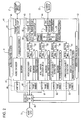
- Fig. 2 is a block diagram showing the configuration of the data processing unit in the IP camera shown in Fig. 1.
- the DSP 4 includes an audio control block 41 to control audio data and a video control block 42 to control video data.
- the audio control block 41 has a function of controlling an audio encoding task
- the video control block 42 has a function of controlling the following tasks: video input, video preprocessing, video encoding, still-image encoding, moving-object detection, unmoving-object detection, video output, host interface (I/F), video output, and so on.
- the DSP 4 includes a first video port 43 to output video data, a second video port 44 to receive input of video data, an audio port (McBSP port) 45 to receive input of audio data, and a host I/F port 46 functioning as a serial I/F for the host CPU 5.
- These ports transmit/receive data to/from an audio line input block 21, a camera block 22 including the camera module 1 and so on, and the host CPU 5, respectively.
- audio data input from the audio port 45 through a frame buffer 49 is compressed and encoded by an audio encoder 47 and is supplied to a buffer 48.
- a video inputting task digital video data from the camera block 22 is accumulated in a frame buffer 51 through the second video port 44.
- an input converting unit 50 performs format conversion to a VGA (video graphics array), IP (interlace-progressive) conversion, and square lattice processing on the video data read from the frame buffer 51.
- the video data is then output to four buffers 52 to 55.
- the video data read from the buffer 52 is scaled, is compressed and encoded in an MPEG (Moving Picture Experts Group) 4 method by a video encoder 56, and is output to a buffer 60.
- the video data read from the buffer 53 is scaled, is compressed and encoded in a JPEG (Joint Photographic Experts Group) method by a still-image encoder 57, and is output to a buffer 61.
- the still-image encoder 57 can sequentially generate still images of the JPEG method in order to generate moving image data of 30 fps, for example, not using an interframe prediction coding.
- a moving-object detecting task the video data read from the buffer 54 is scaled, a moving object is detected by a moving-object detector 58, and a detection result is output to a buffer 62.
- an unmoving-object detecting task the video data read from the buffer 55 is scaled, an unmoving object is detected by an unmoving-object detector 59, and a detection result is output to a buffer 63.
- the detection results input to the buffers 62 and 63 include, as will be described below, moving-object detection data and unmoving-object detection data describing the coordinate data; size; detection time; and stay period of the detected moving/unmoving objects, and frame information obtained at the detection.
- Frame numbers are assigned to the respective image data and detection result data input to the buffers 60 to 63, so that the data can be synchronized with each other. These data are read in a host I/F task and are output to the host CPU 5 through the host I/F port 46.
- the video control block 42 is provided with an internal monitor selector 64 to directly pick up video signals from the IP camera.
- an internal monitor selector 64 to directly pick up video signals from the IP camera.
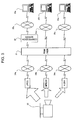
- Fig. 3 is a block diagram showing the monitoring camera system using images of a plurality of encoding methods.
- This monitoring camera system includes at least one IP camera 30 having the above-described network function, a network digital recorder (hereinafter referred to as "RSM/NSR" (real shot manager/network severance recorder)) 31 to accumulate video data and audio data obtained by the IP camera 30, a compression server 32 to compress image data before distributing JPEG data, client monitoring terminals 33a to 33c used by clients to monitor the data accumulated in the RSM/NSR 31, data networks 34a to 34c to connect the IP camera 30 to the RSM/NSR 31, and data networks 35a to 35c to connect the RSM/NSR 31 to the client monitoring terminals 33a to 33c.
- RSM/NSR network digital recorder
- the RSM/NSR 31 is configured by combining an NSR serving as a network digital recorder and an RSM serving as software to transfer video data from a plurality of IP cameras 30 to the NSR and accumulate the video data therein.
- Video data output to the connection terminal 18, such as RJ45, of the IP camera shown in Fig. 1 is transmitted to the RSM/NSR 31 through various data networks, such as Ethernet or an ISDN (integrated services digital network) line.
- the RSM/NSR 31 can receive video data that is converted to JPEG data of a low compression rate if the data network 34a connecting the RSM/NSR 31 to the IP camera 30 is a broadband network of 10 Mbps, for example.
- the data network 34b is ISDN
- the RSM/NSR 31 can receive data that is encoded with an MPEG4 format of a high compression rate in accordance with the communication band.
- the data network 34c is an analog telephone line for dial-up connection, the communication speed is about 28.8 to 56 Kbps. In this case, the RSM/NSR 31 can receive encoded data of an H.264 format having a higher compression rate.
- an image file that is compressed at a predetermined compression rate can be distributed from the compression server 32 to the data network 35a.
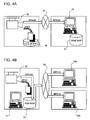
- Figs. 4A and 4B are data flow diagrams illustrating a flow of image data in two types of monitoring camera systems.
- Fig. 4A shows a first monitoring camera system.
- a local memory 36 is placed near the IP camera 30 that is set in a monitoring area (local area).
- the client monitoring terminal 33 and the RSM/NSR 31 serving as a large-capacity hard disk are set as a network digital recorder.
- image data obtained by the IP camera 30 is recorded as JPEG data in the local memory 36, whereas MPEG4 data of the same video image is transmitted to the RSM/NSR 31 on the client monitoring terminal 33 side through the network 34, so that the video image of the monitoring area is displayed on a monitor.
- Fig. 4B shows a second monitoring camera system.
- a monitoring PC 37 and the RSM/NSR 31 are set as a network digital recorder near the monitoring area.
- the JPEG data and MPEG4 data output from the IP camera 30 are once stored in the RSM/NSR 31.
- image data in the form of MPEG4 data is transmitted to the plurality of client monitoring terminals 33a and 33b through the network 35.
- the IP camera 30 transmits image data of a plurality of encoding methods. Accordingly, JPEG data is used to store the image data and MPEG4 data is used for monitoring. Therefore, in the monitoring camera system using the IP camera 30, limited network resources can be optimally used.
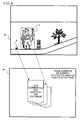
- Fig. 5 shows the relationship between a monitored image and moving-object detection data.
- moving-object detection data 67 includes frame information including a frame number [N] and the number n of detected moving objects in the frame; and moving-object information about the detected moving objects.
- the moving-object information information about the person Y and information about the train R are recorded in different files.
- Each information includes coordinate data, size of the object, speed of the object, detection time, and detection condition.
- a frame count for frame synchronization is embedded as time information corresponding to the detection time in each file.
- Fig. 6 shows the relationship between a monitored image and unmoving-object detection data.
- an explosive B and a person H are shown as unmoving objects.
- the explosive B and the person H that do not move for a preset time period are recognized as unmoving objects in an area except background data constituting the monitored image in a specific frame.
- the explosive B and the person H need to be identified as different unmoving objects, as in the above-described moving-object detection. Therefore, unmoving-object detection data 69 is generated.
- the unmoving-object detection data 69 includes frame information including a frame number [N] and the number n of detected unmoving objects in the frame; and unmoving-object information about the detected unmoving objects.
- the unmoving-object information information about the explosive B and information about the person H are recorded in different files.
- Each information includes coordinate data, size of the object, detection time, and stay period. If the stay period is longer than a predetermined reference value, an alarm occurs.
- a frame count for frame synchronization is embedded as time information corresponding to the detection time and the stay period in each file.
- Fig. 7 is a timing diagram showing the procedure of still-image processing and moving-object detection in the DSP.
- the vertical direction indicates a time axis and the horizontal direction indicates each task.
- the numbers 1 to 6 inside the square frames shown at the top of Fig. 7 indicate the priority of tasks performed in the DSP 4 (task priority).
- starting still-image encoding and starting moving-object detection are requested to a task process of video control (Vcnt1) 72 by a task process of host I/F 71 in accordance with a request from the host CPU 5.
- a task process of video control (Vcnt1) 72 an algorithm of JPEG is generated and parameters are initialized.
- a frame obtaining request is transmitted to a task process of video input (vin) 76.
- the task process of video input (vin) 76 receives the frame obtaining request, obtains video data of one frame that was captured by the video decoder 3, and transmits a new frame notification to the task process of video control (Vcnt1) 72.
- the capturing of video data is repeated every Hsync.
- the task process of video control (Vcnt1) 72 receives the new frame notification and requests preprocessing on a specified buffer (sinc0) to the task process of preprocessing (Pproc) 73.
- the task process of preprocessing (Pproc) 73 is executed in response to the preprocessing request.
- a preprocessing completion notification is transmitted.
- the task process of video control (Vcnt1) 72 receives the preprocessing completion notification and transmits a still-image processing request of the specified frame (sinc0) to the task process of still-image encoding (sienc) 74 at timing T8.
- the task process of moving-object detection (dmvobjct) 75 which has been in a waiting state, starts. This process ends at timing T13. Then, a moving-object detection end notification is transmitted to the task process of video control (Vcntl) 72, and a detection result is transmitted to the host CPU 5 by the task process of host I/F 71 by interrupt (timing T14 and timing T15). After that, capturing video data of the next frame starts at timing T16. After the video data is captured, a new frame notification is transmitted to the task process of video control (Vcnt1) 72, and then still-image encoding and moving-object detection are performed on the new frame.
- the task process of video control (Vcnt1) 72 If the moving-object detection (dmvobjct) 75 of lower priority is not yet completed when the new frame is captured (timing T16), the buffer (sinc0) is not opened. Therefore, the task process of video control (Vcnt1) 72 generates a new buffer (sinc1) when requesting preprocessing. The task process of video control (Vcnt1) 72 preferentially executes a high-priority process (e.g., still-image encoding). During this process, moving-object detection using the buffer (sinc0) is executed and the buffer (sinc0) is opened when the process completes.
- a high-priority process e.g., still-image encoding
- moving-object detection of one frame may be executed over a plurality of Hsync periods.
- a frame number is assigned to each moving-object detection result, and thus the host CPU 5 can easily bring respective frames into synchronization with each other.
- Fig. 8 is a data flow diagram showing a signal transmitting procedure in the IP camera according to the embodiment.
- the host CPU 5 three types of data can be transmitted.
- First data is video and audio data. These data include JPEG/MPEG video images that are compressed by the video encoder 56 and the still-image encoder 57 of the DSP 4 by predetermined selected encoding methods. These data are stored in an AV buffer 81, output therefrom as bit stream data 82, and distributed to the data network.
- Second data is an alarm about a result of moving-object detection or unmoving-object detection.
- the moving-object detection data 67 or the unmoving-object detection data 69 is transmitted to an event manager 80 that controls the entire task on the host CPU 5.
- an event manager 80 that controls the entire task on the host CPU 5.
- the necessary information includes monitored images captured before/after a moving object or an unmoving object is detected.
- first and second data are stored in the SDRAM 14, packetized by a packet generating unit 83, and output to the network.
- third data is metadata 85 describing information about various data to be transferred from the host CPU 5 to each client monitoring terminal.
- the metadata 85 is generated by the event manager 80, packetized as moving-object detection information or unmoving-object detection information, and then transmitted through the network.
- the information may include an arbitrary item of the content of the above-described moving-object detection data 67 or unmoving-object detection data 69.
- Frame numbers are assigned to all of the data transmitted from the DSP 4 to the host CPU 5. Therefore, the AV buffer 81 and the event manager 80 can easily bring encoded image data/moving-object detection information/unmoving-object detection information into synchronization with each other. Also, the monitoring system can be made intelligent by further using a corresponding recorder of AV data.
- Fig. 9 is a data flow diagram showing an example an image transmitting procedure in the IP camera according to the embodiment.
- the horizontal axis is a time axis.
- moving-object detection is performed in ) a period from time T21 to T22 and in a period from time T23 to T24.
- a person who left an unidentified object such as an explosive
- the unidentified object is an unmoving object to be detected.
- an unmoving-object counting period starts before the first moving-object detection period ends (at time T22) and that an unmoving object is detected at time T26.
- the host CPU 5 constantly writes image data of a plurality of encoding methods, such as JPEG and MPEG4, in the AV buffer 81 (Fig. 8). Therefore, based on a result of moving-object detection, images captured during the moving-object detection period (actually includes a predetermined period before/after the detection period) are extracted from the AV buffer 81 and are filed as bit stream data. Also, based on a result of unmoving-object detection, images captured during a predetermined period (time T25 to T27) before/after the detection timing (time T26) are extracted from the AV buffer 81 and are filed as bit stream data of MPEG4 (or Motion-JPEG) or as still-image data of JPEG or the like.
- MPEG4 or Motion-JPEG
- the filed data is transmitted through the network by an FTP or the like, and a client monitoring terminal having a recorder function can store the data therein.
- the image data captured during the moving-object detection period can be distributed in a stream by a low-bit-rate encoding method (in this case, MPEG4), and the image data captured before/after the unmoving object is detected can be transmitted as still-image data (JPEG) by an FTP.
- MPEG4 low-bit-rate encoding method
- JPEG still-image data
- image data including a moving object can be stored.
- the data is stored independently of an unmoving object.
- an unmoving object cannot always be reliably shot or the position thereof cannot always be specified.
- all images must be stored in order to store images including a moving object (e.g., a person who put an explosive and went away).
- images including an unmoving object and images including a moving object can be realizably stored, so that the storage capacity can be reduced.
- images including a moving object images other than the image captured just before an unmoving object is detected can be deleted. In that case, a necessary storage capacity can be further reduced.
- the IP camera can select and transmit only the image captured just before an unmoving object is detected. In this way, since minimum image data is transmitted, a network traffic jam can be alleviated.
- unmoving-object detection is performed therein so that an explosive (unmoving object) left by someone can be detected.
- video data of the unidentified person (moving object) who places the explosive can be recorded by moving-object detection. Therefore, data can be flown through a network only during a period when a moving object exists in a monitoring area of the IP camera. Also, only video images showing a necessary moving object or unmoving object can be selected and stored. Accordingly, compared to the known monitoring camera system having a moving-object detecting function, the storage capacity can be significantly reduced while reliably storing necessary video images, and as a result, a monitoring operation can be efficiently performed.
- image data of a plurality of different encoding methods are generated and transmitted.
- the same effect can be obtained if a plurality of image data having the same encoding method and different bit rates are generated.
- the present invention contains subject matter related to Japanese Patent Application JP 2005-050368 filed in the Japanese Patent Office on February 25, 2005, the entire contents of which are incorporated herein by reference.
Landscapes
- Engineering & Computer Science (AREA)
- Physics & Mathematics (AREA)
- General Physics & Mathematics (AREA)
- Multimedia (AREA)
- Computer Vision & Pattern Recognition (AREA)
- Library & Information Science (AREA)
- Closed-Circuit Television Systems (AREA)
- Two-Way Televisions, Distribution Of Moving Picture Or The Like (AREA)
Applications Claiming Priority (1)
| Application Number | Priority Date | Filing Date | Title |
|---|---|---|---|
| JP2005050368A JP4449782B2 (ja) | 2005-02-25 | 2005-02-25 | 撮像装置および画像配信方法 |
Publications (2)
| Publication Number | Publication Date |
|---|---|
| EP1696396A2 true EP1696396A2 (de) | 2006-08-30 |
| EP1696396A3 EP1696396A3 (de) | 2006-10-04 |
Family
ID=36498942
Family Applications (1)
| Application Number | Title | Priority Date | Filing Date |
|---|---|---|---|
| EP20060250323 Ceased EP1696396A3 (de) | 2005-02-25 | 2006-01-20 | Bildaufnahmevorrichtung und Bildweitergabeverfahren |
Country Status (5)
| Country | Link |
|---|---|
| US (1) | US8160129B2 (de) |
| EP (1) | EP1696396A3 (de) |
| JP (1) | JP4449782B2 (de) |
| CN (1) | CN100473154C (de) |
| TW (1) | TWI355203B (de) |
Cited By (3)
| Publication number | Priority date | Publication date | Assignee | Title |
|---|---|---|---|---|
| EP2196966A2 (de) * | 2008-12-11 | 2010-06-16 | Canon Kabushiki Kaisha | Informationsverarbeitungsvorrichtung und Informationsverarbeitungsverfahren |
| EP2398236A4 (de) * | 2009-02-10 | 2012-09-05 | Panasonic Corp | Überwachungskamerasystem, videoaufzeichnungsgerät und videoaufzeichnungsverfahren |
| US9697746B2 (en) | 2009-09-30 | 2017-07-04 | National Ict Australia Limited | Object tracking for artificial vision |
Families Citing this family (18)
| Publication number | Priority date | Publication date | Assignee | Title |
|---|---|---|---|---|
| JP4744466B2 (ja) * | 2007-03-20 | 2011-08-10 | 富士通株式会社 | 画像処理装置、画像処理システム及び画像処理プログラム |
| JP5188244B2 (ja) * | 2008-04-02 | 2013-04-24 | キヤノン株式会社 | 監視装置及び監視方法 |
| JP2010009134A (ja) * | 2008-06-24 | 2010-01-14 | Sony Corp | 画像処理システム及び画像処理方法、並びに、プログラム |
| CN101448145A (zh) * | 2008-12-26 | 2009-06-03 | 北京中星微电子有限公司 | Ip摄像机和视频监控系统及ip摄像机的信号处理方法 |
| JP4748250B2 (ja) | 2009-02-27 | 2011-08-17 | ソニー株式会社 | 画像処理装置、画像処理システム、カメラ装置、画像処理方法、およびプログラム |
| JP5397014B2 (ja) * | 2009-05-21 | 2014-01-22 | ソニー株式会社 | 監視システム、撮像装置、解析装置及び監視方法 |
| JP5989969B2 (ja) * | 2011-04-15 | 2016-09-07 | キヤノン株式会社 | 符号化装置、及び、符号化装置の制御方法 |
| CN102215144B (zh) * | 2011-05-17 | 2016-06-29 | 中兴通讯股份有限公司 | 丢包率的测量方法和系统 |
| WO2012169232A1 (ja) * | 2011-06-08 | 2012-12-13 | オムロン株式会社 | 分散画像処理システム |
| JP5911227B2 (ja) * | 2011-07-12 | 2016-04-27 | キヤノン株式会社 | 判定装置、判定方法及びプログラム |
| US20130300750A1 (en) * | 2012-05-10 | 2013-11-14 | Nokia Corporation | Method, apparatus and computer program product for generating animated images |
| US8818119B2 (en) * | 2012-09-26 | 2014-08-26 | Agilent Technologies, Inc. | Dynamic creation of trend graph |
| JP6327816B2 (ja) * | 2013-09-13 | 2018-05-23 | キヤノン株式会社 | 送信装置、受信装置、送受信システム、送信装置の制御方法、受信装置の制御方法、送受信システムの制御方法、及びプログラム |
| TWI543603B (zh) * | 2013-12-09 | 2016-07-21 | 松翰科技股份有限公司 | 網路攝影機、通訊方法以及通訊系統 |
| JP5906556B1 (ja) * | 2014-10-17 | 2016-04-20 | パナソニックIpマネジメント株式会社 | モニタリング装置、モニタリングシステムおよびモニタリング方法 |
| US9843570B2 (en) | 2014-11-05 | 2017-12-12 | Datawatch Systems, Inc. | System and method for providing security monitoring |
| US12425723B2 (en) * | 2019-06-04 | 2025-09-23 | Hanwha Vision Co., Ltd. | Network surveillance camera system and method for operating same |
| US20250245989A1 (en) * | 2024-01-30 | 2025-07-31 | Alarm.Com Incorporated | Camera |
Citations (2)
| Publication number | Priority date | Publication date | Assignee | Title |
|---|---|---|---|---|
| JPH07212748A (ja) | 1994-01-25 | 1995-08-11 | Sony Corp | 監視カメラシステム |
| JP2005050368A (ja) | 1991-07-08 | 2005-02-24 | Seiko Epson Corp | マルチプロセッサ・システム |
Family Cites Families (19)
| Publication number | Priority date | Publication date | Assignee | Title |
|---|---|---|---|---|
| US4013134A (en) * | 1974-05-20 | 1977-03-22 | The Richmond Manufacturing Company | Portable earth boring machine with steering head |
| US4630967A (en) * | 1984-10-27 | 1986-12-23 | Gerd Soltau | Arrangement for underground advance driving of pipe trains composed of individual pipe lengths |
| US5203418A (en) * | 1991-01-28 | 1993-04-20 | Lag Steering Systems | Apparatus for guiding and steering earth boring casing |
| US5429198A (en) * | 1992-03-27 | 1995-07-04 | The Robbins Company | Down reaming apparatus having hydraulically controlled stabilizer |
| JPH06105312A (ja) | 1992-09-22 | 1994-04-15 | Hitachi Ltd | 静止物監視方法および装置 |
| JPH06266841A (ja) | 1993-03-12 | 1994-09-22 | Matsushita Electric Ind Co Ltd | 物体認識装置 |
| US6816184B1 (en) | 1998-04-30 | 2004-11-09 | Texas Instruments Incorporated | Method and apparatus for mapping a location from a video image to a map |
| JP2000059758A (ja) | 1998-08-05 | 2000-02-25 | Matsushita Electric Ind Co Ltd | 監視カメラ装置、監視装置、及びこれらを用いた遠隔監視システム |
| US7023913B1 (en) * | 2000-06-14 | 2006-04-04 | Monroe David A | Digital security multimedia sensor |
| ATE417464T1 (de) | 1999-10-29 | 2008-12-15 | Nokia Corp | Videoüberwachungssystem- und methode |
| JP2002034030A (ja) | 2000-07-13 | 2002-01-31 | Hitachi Ltd | 監視カメラシステム |
| JP2002077809A (ja) | 2000-09-05 | 2002-03-15 | Toshiba Corp | 映像記録システム |
| US20050146605A1 (en) | 2000-10-24 | 2005-07-07 | Lipton Alan J. | Video surveillance system employing video primitives |
| JP3502853B2 (ja) | 2001-03-21 | 2004-03-02 | 株式会社アステム | 能動的監視カメラ |
| WO2003010727A1 (en) * | 2001-07-25 | 2003-02-06 | Vislog Technology Pte Ltd. | Method and apparatus for processing image data |
| US7650058B1 (en) | 2001-11-08 | 2010-01-19 | Cernium Corporation | Object selective video recording |
| JP2003284044A (ja) | 2002-03-20 | 2003-10-03 | Hitachi Kokusai Electric Inc | 遠隔制御画像監視システム |
| CA2525690C (en) | 2002-07-05 | 2014-12-02 | Aspectus Ltd. | A method and system for effectively performing event detection in a large number of concurrent image sequences |
| US20040150519A1 (en) * | 2003-01-31 | 2004-08-05 | Iftikhar Husain | System and method for monitoring having an embedded device |
-
2005
- 2005-02-25 JP JP2005050368A patent/JP4449782B2/ja not_active Expired - Fee Related
-
2006
- 2006-01-17 US US11/332,208 patent/US8160129B2/en not_active Expired - Fee Related
- 2006-01-17 TW TW95101742A patent/TWI355203B/zh not_active IP Right Cessation
- 2006-01-20 EP EP20060250323 patent/EP1696396A3/de not_active Ceased
- 2006-02-24 CN CNB2006100514477A patent/CN100473154C/zh not_active Expired - Fee Related
Patent Citations (2)
| Publication number | Priority date | Publication date | Assignee | Title |
|---|---|---|---|---|
| JP2005050368A (ja) | 1991-07-08 | 2005-02-24 | Seiko Epson Corp | マルチプロセッサ・システム |
| JPH07212748A (ja) | 1994-01-25 | 1995-08-11 | Sony Corp | 監視カメラシステム |
Cited By (5)
| Publication number | Priority date | Publication date | Assignee | Title |
|---|---|---|---|---|
| EP2196966A2 (de) * | 2008-12-11 | 2010-06-16 | Canon Kabushiki Kaisha | Informationsverarbeitungsvorrichtung und Informationsverarbeitungsverfahren |
| US8406473B2 (en) | 2008-12-11 | 2013-03-26 | Canon Kabushiki Kaisha | Information processing apparatus and information processing method |
| EP2398236A4 (de) * | 2009-02-10 | 2012-09-05 | Panasonic Corp | Überwachungskamerasystem, videoaufzeichnungsgerät und videoaufzeichnungsverfahren |
| US9697746B2 (en) | 2009-09-30 | 2017-07-04 | National Ict Australia Limited | Object tracking for artificial vision |
| US10062303B2 (en) | 2009-09-30 | 2018-08-28 | National Ict Australia Limited | Object tracking for artificial vision |
Also Published As
| Publication number | Publication date |
|---|---|
| TW200633532A (en) | 2006-09-16 |
| US20060193534A1 (en) | 2006-08-31 |
| CN100473154C (zh) | 2009-03-25 |
| JP2006238102A (ja) | 2006-09-07 |
| TWI355203B (en) | 2011-12-21 |
| JP4449782B2 (ja) | 2010-04-14 |
| EP1696396A3 (de) | 2006-10-04 |
| US8160129B2 (en) | 2012-04-17 |
| CN1825953A (zh) | 2006-08-30 |
Similar Documents
| Publication | Publication Date | Title |
|---|---|---|
| US8160129B2 (en) | Image pickup apparatus and image distributing method | |
| US8780199B2 (en) | Networked security camera with local storage and continuous recording loop | |
| US8089514B2 (en) | Moving image communication device, moving image communication system and semiconductor integrated circuit used for communication of moving image | |
| US6646677B2 (en) | Image sensing control method and apparatus, image transmission control method, apparatus, and system, and storage means storing program that implements the method | |
| US8384830B2 (en) | Pre-alarm video buffer | |
| US6707947B1 (en) | Frame switcher and method of switching, digital camera, and monitoring system | |
| JP2003524909A (ja) | マルチメディアネットワーク・インタフェースを達成する方法及び装置 | |
| US10785511B1 (en) | Catch-up pacing for video streaming | |
| JP3715332B2 (ja) | 通信システム、受信装置及び方法 | |
| JP2007208458A (ja) | 通信システム、通信端末および通信方法 | |
| EP2963929A1 (de) | Verfahren zur Konfiguration eines Videostromausgangs aus einer digitalen Videokamera | |
| EP2538670B1 (de) | Datenverarbeitungseinheit | |
| JP2002262272A (ja) | ディジタル監視カメラシステムおよび制御装置 | |
| KR20150011051A (ko) | 영상 감시 시스템에서 모니터링 채널 결정 방법 및 장치 | |
| JP3799070B2 (ja) | 送信装置及び方法 | |
| JP2009118151A (ja) | 通信システム、送信装置、中継装置、受信装置及び送信プログラム | |
| JP2001145103A (ja) | 送信装置及び通信システム | |
| JP2012090172A (ja) | 監視カメラ、監視カメラの制御方法及びネットワークカメラシステム | |
| KR101291559B1 (ko) | 실시간 다중 영상압축 장치 및 방법 | |
| JP2003219397A (ja) | 映像配信サーバ及び映像配信システム | |
| KR20140072668A (ko) | 네트워크 카메라 서버 및 그의 비디오 스트림 처리 방법 | |
| JP4612826B2 (ja) | ストレージ装置、ストレージ方法、コンピュータ読み取り可能な記憶媒体、及びプログラム | |
| JP2008131264A (ja) | 監視カメラ、画像記録表示装置及び監視カメラシステム | |
| JP2006262205A (ja) | エンコーダ及びコーデック方法並びにネットワーク伝送システム | |
| JP2007274593A (ja) | 映像受信装置及び映像配信システム並びに映像受信方法 |
Legal Events
| Date | Code | Title | Description |
|---|---|---|---|
| PUAI | Public reference made under article 153(3) epc to a published international application that has entered the european phase |
Free format text: ORIGINAL CODE: 0009012 |
|
| AK | Designated contracting states |
Kind code of ref document: A2 Designated state(s): AT BE BG CH CY CZ DE DK EE ES FI FR GB GR HU IE IS IT LI LT LU LV MC NL PL PT RO SE SI SK TR |
|
| AX | Request for extension of the european patent |
Extension state: AL BA HR MK YU |
|
| PUAL | Search report despatched |
Free format text: ORIGINAL CODE: 0009013 |
|
| AK | Designated contracting states |
Kind code of ref document: A3 Designated state(s): AT BE BG CH CY CZ DE DK EE ES FI FR GB GR HU IE IS IT LI LT LU LV MC NL PL PT RO SE SI SK TR |
|
| AX | Request for extension of the european patent |
Extension state: AL BA HR MK YU |
|
| 17P | Request for examination filed |
Effective date: 20070319 |
|
| 17Q | First examination report despatched |
Effective date: 20070413 |
|
| AKX | Designation fees paid |
Designated state(s): DE FR GB |
|
| STAA | Information on the status of an ep patent application or granted ep patent |
Free format text: STATUS: THE APPLICATION HAS BEEN REFUSED |
|
| 18R | Application refused |
Effective date: 20080923 |