EP1701005A1 - Méthode et dispositif pour le calcul des procédés énergétiques et techniques - Google Patents
Méthode et dispositif pour le calcul des procédés énergétiques et techniques Download PDFInfo
- Publication number
- EP1701005A1 EP1701005A1 EP05003691A EP05003691A EP1701005A1 EP 1701005 A1 EP1701005 A1 EP 1701005A1 EP 05003691 A EP05003691 A EP 05003691A EP 05003691 A EP05003691 A EP 05003691A EP 1701005 A1 EP1701005 A1 EP 1701005A1
- Authority
- EP
- European Patent Office
- Prior art keywords
- optimization
- calculation
- variables
- optimization calculation
- condition
- Prior art date
- Legal status (The legal status is an assumption and is not a legal conclusion. Google has not performed a legal analysis and makes no representation as to the accuracy of the status listed.)
- Withdrawn
Links
- 238000004364 calculation method Methods 0.000 title claims abstract description 42
- 238000000034 method Methods 0.000 title claims abstract description 24
- 238000005457 optimization Methods 0.000 claims abstract description 64
- 238000005094 computer simulation Methods 0.000 claims abstract description 7
- 238000010327 methods by industry Methods 0.000 claims description 6
- 238000004088 simulation Methods 0.000 claims description 4
- 238000004422 calculation algorithm Methods 0.000 description 12
- 239000007921 spray Substances 0.000 description 6
- 238000006243 chemical reaction Methods 0.000 description 2
- 239000000498 cooling water Substances 0.000 description 2
- 239000011159 matrix material Substances 0.000 description 2
- 238000013024 troubleshooting Methods 0.000 description 2
- 230000001419 dependent effect Effects 0.000 description 1
- 230000002349 favourable effect Effects 0.000 description 1
- 239000013505 freshwater Substances 0.000 description 1
- 238000011835 investigation Methods 0.000 description 1
- 238000005184 irreversible process Methods 0.000 description 1
- 238000013178 mathematical model Methods 0.000 description 1
- 238000009877 rendering Methods 0.000 description 1
- 238000005496 tempering Methods 0.000 description 1
- 230000009466 transformation Effects 0.000 description 1
- XLYOFNOQVPJJNP-UHFFFAOYSA-N water Substances O XLYOFNOQVPJJNP-UHFFFAOYSA-N 0.000 description 1
Images
Classifications
-
- F—MECHANICAL ENGINEERING; LIGHTING; HEATING; WEAPONS; BLASTING
- F01—MACHINES OR ENGINES IN GENERAL; ENGINE PLANTS IN GENERAL; STEAM ENGINES
- F01K—STEAM ENGINE PLANTS; STEAM ACCUMULATORS; ENGINE PLANTS NOT OTHERWISE PROVIDED FOR; ENGINES USING SPECIAL WORKING FLUIDS OR CYCLES
- F01K13/00—General layout or general methods of operation of complete plants
- F01K13/02—Controlling, e.g. stopping or starting
Definitions
- the invention relates to a method for calculating energy and process engineering processes, in particular the heat cycle of power plants, by means of a computer based on at least one balance equation of the first law of thermodynamic law computational model and an apparatus for performing this method.
- the implementation of this algorithm is relatively cumbersome and therefore time consuming.
- the solution thus obtained must continue to be checked for plausibility.
- the solution is checked for logical errors. This includes, for example, checking whether the temperature at the outlet of a heat exchanger is higher than at its inlet. Other logical checks include the occurrence of negative solutions to variables for which such solutions are excluded. If implausibilities are discovered in this phase, the entire simulation model must be revised and then recalculated. The fault identification is done manually and usually requires extensive investigations.
- the invention has for its object to overcome the above-mentioned disadvantages and in particular a method and to provide a device for the calculation of energy and process engineering processes, allowing faster calculation and faster and easier troubleshooting.
- This object is achieved according to the invention with an aforementioned method for calculating energy and process engineering processes, which is characterized in that the calculation is carried out in the form of an optimization calculation into which at least one technical boundary condition formulated as an inequality enters as a secondary condition.
- an optimization algorithm determines the minimum or maximum of an objective function in a specific permissible range described by constraints in the form of equations or inequalities.
- NLP non-linear programming
- the temperature of the supplied live steam to a maximum temperature by taking into account the inequality T live steam ⁇ T Max be limited as a constraint.
- both the expression (5) and the expression (6) represent boundary conditions in the form of inequalities and the representation with upper and lower limits according to expression (6) merely a simplified representation of correspondingly formulated inequalities according to expression (5). is.
- the invention is based on the recognition that by means of the calculation of the physical model carried out according to the invention in the form of an optimization calculation, an inherent calculation of all technical boundary conditions is possible. Thus, a calculation of the corresponding energy or process engineering process in a continuous calculation cycle is possible. Iterative runs of different calculation phases with adjustments of the boundary conditions between them, as in the simulation model based calculation of the prior art are no longer necessary. Since an overall optimization of the system continues to be carried out, it is possible to remedy possible errors in the case of specified boundary conditions for certain variables more quickly. A possibly inappropriate setpoint for a variable is in fact easily apparent from the optimization result, since the variable value calculated by the optimization algorithm generally differs significantly from the inappropriate setpoint.
- the optimization algorithm strives to optimize a set of many variables, in the optimization result, the corresponding single variable will not be very close to the inappropriate setpoint, as this will generally result in much less favorable results for many other variables, thereby rendering the optimization result as a whole excessive would be worsened.
- At least one logical condition enters into the optimization calculation as a secondary condition.
- this at least one logical condition enters into the optimization calculation in the form of an inequality.
- a logical condition may e.g. Relate temperatures at two different locations of a device in the form of an inequality. For example, it may be specified that the temperature at a heat exchanger inlet must be higher than the temperature at the heat exchanger outlet. Since such logical conditions are taken into account directly by the calculation method in the embodiment according to the invention, a subsequent plausibility check in this regard is no longer necessary.
- a quadratic simulation task given by the computational model is reformulated into an optimization task.
- the existing in the form of equations in the computational model boundary conditions transferred to the objective function of the optimization calculation.
- the remaining balance equations from the computational model are now considered as constraints in the optimization calculation.
- the optimization calculation is advantageously based on a quadratic target function for calculating the smallest quadratic distances of the optimization variables of predefinable target values.
- the objective function to be minimized in the optimization task then consists of the sum of the quadratic distances of the optimization variables or conversion functions dependent thereon from the respectively assigned nominal values.
- optimization algorithms work more efficiently with linear objective functions than with quadratic objective functions; in particular, quadratic objective functions in some algorithms generate a considerable number of entries in the Hesse matrix, which can lead to too many degrees of freedom for updating the Hesse matrix. To use such algorithms, it is therefore appropriate if the Optimization calculation is based on a linear objective function.
- thermodynamic law it is expedient if at least one logical condition is derived from the second thermodynamic law. That is, certain inequalities between temperatures at different locations of a system resulting from the entropy set can already be included in the optimization calculation as a secondary condition. A subsequent plausibility check of the solution found by the calculation algorithm with respect to approximately mandatory entropy increases in irreversible processes is thus superfluous.
- the invention further relates to a device for carrying out the method according to the invention.
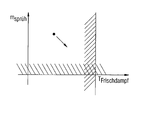
- FIG. 1 shows an illustration of the solution space of two optimization variables bounded by technical boundary conditions in the form of inequalities.
- the embodiment of the invention described below is used to calculate the heat cycle of a cogeneration plant.
- the heat cycle is first described by means of balance equations c (x) of the thermodynamic law (mass, energy and momentum balance) as a function of optimization variables x i .
- command values are y s, i this optimization variables x i and of the optimization of variable i of an internal transformation vector b (x i) arising variable x defined using.
- Such an internal conversion vector b (x i ) can, for example, the relationship represent between the entropy specified as the desired value and the temperature that predetermines as the optimization variable.
- boundary conditions h (x) are defined in the form of inequalities for the optimization variables x i .
- the fresh water rate sprayed into a temperature control unit for live steam can be set to a value of at least zero.
- a further boundary condition can limit the temperature of the live steam (T live steam ) to a maximum value T max (T live steam ⁇ T max ).
- T live steam the live steam
- T max the maximum value of water spray reduces the live steam temperature. This functional dependence is contained in the balance equations c (x).
- certain optimization variables may also be limited by lower limits x L and upper limits x U.
- this optimization problem is solved with a suitable optimization algorithm.
- the values obtained for the optimization variables are optimized in such a way that the sum of their quadratic distances from the predefined setpoints assumes a minimum value. If a setpoint for an optimization variable x i, which is inappropriate for the system, has been specified, then this discrepant setpoint can be recognized immediately on the solution, since the for this variable, as a result of the optimization calculation resulting value has a considerable compared with the results of the other variables distance from its associated setpoint. For such a case, the setpoint for the corresponding variable is then corrected and the entire optimization calculation is repeated.
- p and u are auxiliary variables.
- the objective function ⁇ i ( p i + u i ) is hereby linear.
Landscapes
- Engineering & Computer Science (AREA)
- Chemical & Material Sciences (AREA)
- Combustion & Propulsion (AREA)
- Mechanical Engineering (AREA)
- General Engineering & Computer Science (AREA)
- Feedback Control In General (AREA)
- Management, Administration, Business Operations System, And Electronic Commerce (AREA)
Priority Applications (4)
| Application Number | Priority Date | Filing Date | Title |
|---|---|---|---|
| EP05003691A EP1701005A1 (fr) | 2005-02-21 | 2005-02-21 | Méthode et dispositif pour le calcul des procédés énergétiques et techniques |
| EP06708366A EP1851417A2 (fr) | 2005-02-21 | 2006-02-17 | Procede et dispositif pour evaluer des processus de technique energetique et d'ingenierie |
| CN2006800055949A CN101124386B (zh) | 2005-02-21 | 2006-02-17 | 用于计算能量过程和工艺流程过程的方法和装置 |
| PCT/EP2006/060078 WO2006087382A2 (fr) | 2005-02-21 | 2006-02-17 | Procede et dispositif pour evaluer des processus de technique energetique et d'ingenierie |
Applications Claiming Priority (1)
| Application Number | Priority Date | Filing Date | Title |
|---|---|---|---|
| EP05003691A EP1701005A1 (fr) | 2005-02-21 | 2005-02-21 | Méthode et dispositif pour le calcul des procédés énergétiques et techniques |
Publications (1)
| Publication Number | Publication Date |
|---|---|
| EP1701005A1 true EP1701005A1 (fr) | 2006-09-13 |
Family
ID=34933859
Family Applications (2)
| Application Number | Title | Priority Date | Filing Date |
|---|---|---|---|
| EP05003691A Withdrawn EP1701005A1 (fr) | 2005-02-21 | 2005-02-21 | Méthode et dispositif pour le calcul des procédés énergétiques et techniques |
| EP06708366A Withdrawn EP1851417A2 (fr) | 2005-02-21 | 2006-02-17 | Procede et dispositif pour evaluer des processus de technique energetique et d'ingenierie |
Family Applications After (1)
| Application Number | Title | Priority Date | Filing Date |
|---|---|---|---|
| EP06708366A Withdrawn EP1851417A2 (fr) | 2005-02-21 | 2006-02-17 | Procede et dispositif pour evaluer des processus de technique energetique et d'ingenierie |
Country Status (3)
| Country | Link |
|---|---|
| EP (2) | EP1701005A1 (fr) |
| CN (1) | CN101124386B (fr) |
| WO (1) | WO2006087382A2 (fr) |
Families Citing this family (1)
| Publication number | Priority date | Publication date | Assignee | Title |
|---|---|---|---|---|
| CN110717273B (zh) * | 2019-10-11 | 2023-03-17 | 内蒙古第一机械集团股份有限公司 | 一种工艺过程仿真边界条件构建方法 |
Citations (3)
| Publication number | Priority date | Publication date | Assignee | Title |
|---|---|---|---|---|
| US4577270A (en) * | 1980-07-04 | 1986-03-18 | Hitachi, Ltd. | Plant control method |
| EP0731397A1 (fr) * | 1994-09-26 | 1996-09-11 | Kabushiki Kaisha Toshiba | Methode et systeme d'optimisation du service d'une installation |
| JP2004060462A (ja) * | 2002-07-25 | 2004-02-26 | Honda Motor Co Ltd | ランキンサイクル装置 |
-
2005
- 2005-02-21 EP EP05003691A patent/EP1701005A1/fr not_active Withdrawn
-
2006
- 2006-02-17 EP EP06708366A patent/EP1851417A2/fr not_active Withdrawn
- 2006-02-17 CN CN2006800055949A patent/CN101124386B/zh not_active Expired - Fee Related
- 2006-02-17 WO PCT/EP2006/060078 patent/WO2006087382A2/fr not_active Ceased
Patent Citations (3)
| Publication number | Priority date | Publication date | Assignee | Title |
|---|---|---|---|---|
| US4577270A (en) * | 1980-07-04 | 1986-03-18 | Hitachi, Ltd. | Plant control method |
| EP0731397A1 (fr) * | 1994-09-26 | 1996-09-11 | Kabushiki Kaisha Toshiba | Methode et systeme d'optimisation du service d'une installation |
| JP2004060462A (ja) * | 2002-07-25 | 2004-02-26 | Honda Motor Co Ltd | ランキンサイクル装置 |
Non-Patent Citations (2)
| Title |
|---|
| GICQUEL R: "METHODE D'OPTIMISATION SYSTEMIQUE BASEE SUR L'INTEGRATION THERMIQUEPAR EXTENSION DE LA METHODE DU PINCEMENT APPLICATION A LA COGENERATION AVEC PRODUCTION DE VAPEUR", REVUE GENERALE DE THERMIQUE, ELSEVIER EDITIONS SCIENTIFIQUES ET MEDICALES,PARIS, FR, vol. 34, no. 406, 1 October 1995 (1995-10-01), pages 579S - 607S, XP000543739, ISSN: 0035-3159 * |
| MOSLEHI K: "OPTIMIZATION OF MULTIPLANT COGENERATION SYSTEM OPERATION INCLUDING ELECTRIC AND STEAM NETWORKS", IEEE TRANSACTIONS ON POWER SYSTEMS, IEEE INC. NEW YORK, US, vol. 6, no. 2, 1 May 1991 (1991-05-01), pages 484 - 490, XP000220544, ISSN: 0885-8950 * |
Also Published As
| Publication number | Publication date |
|---|---|
| WO2006087382A3 (fr) | 2006-11-16 |
| CN101124386B (zh) | 2011-11-16 |
| EP1851417A2 (fr) | 2007-11-07 |
| WO2006087382A2 (fr) | 2006-08-24 |
| CN101124386A (zh) | 2008-02-13 |
Similar Documents
| Publication | Publication Date | Title |
|---|---|---|
| DE69315423T2 (de) | Neuro-Pid Regler | |
| EP2296062B1 (fr) | Procédé d'apprentissage assisté par ordinateur d'une commande et/ou d'un réglage d'un système technique | |
| DE3786977T2 (de) | Systeme und Verfahren zur Prozessregelung. | |
| EP2999998B1 (fr) | Méthode de détermination d'un modèle d'une grandeur de sortie d'un système technique | |
| EP3511126A1 (fr) | Procédé de planification assistée par ordinateur d'un flux de travail exécutable à l'aide d'un robot | |
| EP2411735B1 (fr) | Procédé et dispositif de réglage de la température de la vapeur pour une centrale à vapeur | |
| EP2880499B1 (fr) | Procédé de commande et/ou de régulation assistée par ordinateur d'un système technique | |
| EP0885348B1 (fr) | Procede et dispositif de regulation rapide de la puissance d'une centrale | |
| DE102018116637A1 (de) | Leistungsversorgungseinrichtung und Betriebsverfahren hierfür | |
| EP2943841B1 (fr) | Procédé de commande et/ou de régulation, assistée par ordinateur, d'un système technique | |
| EP3308442B1 (fr) | Procédé de paramétrage assisté par ordinateur d'un changeur de fréquence dans un réseau électrique | |
| EP3542229B1 (fr) | Dispositif et procédé de détermination des paramètres d'un dispositif de réglage | |
| EP1851417A2 (fr) | Procede et dispositif pour evaluer des processus de technique energetique et d'ingenierie | |
| DE102020213888A1 (de) | Computerimplementiertes Verfahren zum Bestimmen von Kritikalitätswerten eines technischen Systems | |
| DE102020201215A1 (de) | Verfahren zum Betreiben einer industriellen Anlage | |
| DE102015221819A1 (de) | Verfahren und Vorrichtung zum Adaptieren eines datenbasierten Funktionsmodells zur Berechnung in einer Modellberechnungseinheit | |
| EP2394031B1 (fr) | Procédé de commande d'installation dans une centrale électrique | |
| DE202019100641U1 (de) | Trainingsgerät für KI-Module | |
| EP4485095B1 (fr) | Procédé de test d'un appareil de commande électronique avec un simulateur | |
| DE102019107040A1 (de) | Verfahren zur Einrichtung einer Steuerung | |
| EP1483633B1 (fr) | Procede de simulation d'un systeme technique et simulateur associe | |
| DE102005010027B4 (de) | Verfahren zum rechnergestützten Betrieb eines technischen Systems | |
| DE102009009328B4 (de) | Verfahren zur Reduzierung von Strukturschwingungen und Regelungseinrichtung hierzu | |
| DE102019210734A1 (de) | Betriebsverfahren einer elektrischen Heizeinrichtung | |
| DE102024108402A1 (de) | Steuervorrichtung, steuerverfahren und steuersystem |
Legal Events
| Date | Code | Title | Description |
|---|---|---|---|
| PUAI | Public reference made under article 153(3) epc to a published international application that has entered the european phase |
Free format text: ORIGINAL CODE: 0009012 |
|
| AK | Designated contracting states |
Kind code of ref document: A1 Designated state(s): AT BE BG CH CY CZ DE DK EE ES FI FR GB GR HU IE IS IT LI LT LU MC NL PL PT RO SE SI SK TR |
|
| AX | Request for extension of the european patent |
Extension state: AL BA HR LV MK YU |
|
| AKX | Designation fees paid | ||
| STAA | Information on the status of an ep patent application or granted ep patent |
Free format text: STATUS: THE APPLICATION IS DEEMED TO BE WITHDRAWN |
|
| 18D | Application deemed to be withdrawn |
Effective date: 20070314 |
|
| REG | Reference to a national code |
Ref country code: DE Ref legal event code: 8566 |