EP1701108A2 - Regelklappenvorrichtung - Google Patents
Regelklappenvorrichtung Download PDFInfo
- Publication number
- EP1701108A2 EP1701108A2 EP06000982A EP06000982A EP1701108A2 EP 1701108 A2 EP1701108 A2 EP 1701108A2 EP 06000982 A EP06000982 A EP 06000982A EP 06000982 A EP06000982 A EP 06000982A EP 1701108 A2 EP1701108 A2 EP 1701108A2
- Authority
- EP
- European Patent Office
- Prior art keywords
- flap
- closing
- opening
- control
- connecting lever
- Prior art date
- Legal status (The legal status is an assumption and is not a legal conclusion. Google has not performed a legal analysis and makes no representation as to the accuracy of the status listed.)
- Granted
Links
Images



Classifications
-
- F—MECHANICAL ENGINEERING; LIGHTING; HEATING; WEAPONS; BLASTING
- F24—HEATING; RANGES; VENTILATING
- F24F—AIR-CONDITIONING; AIR-HUMIDIFICATION; VENTILATION; USE OF AIR CURRENTS FOR SCREENING
- F24F13/00—Details common to, or for air-conditioning, air-humidification, ventilation or use of air currents for screening
- F24F13/08—Air-flow control members, e.g. louvres, grilles, flaps or guide plates
- F24F13/10—Air-flow control members, e.g. louvres, grilles, flaps or guide plates movable, e.g. dampers
- F24F13/14—Air-flow control members, e.g. louvres, grilles, flaps or guide plates movable, e.g. dampers built up of tilting members, e.g. louvre
- F24F13/1426—Air-flow control members, e.g. louvres, grilles, flaps or guide plates movable, e.g. dampers built up of tilting members, e.g. louvre characterised by actuating means
-
- F—MECHANICAL ENGINEERING; LIGHTING; HEATING; WEAPONS; BLASTING
- F24—HEATING; RANGES; VENTILATING
- F24F—AIR-CONDITIONING; AIR-HUMIDIFICATION; VENTILATION; USE OF AIR CURRENTS FOR SCREENING
- F24F11/00—Control or safety arrangements
- F24F11/30—Control or safety arrangements for purposes related to the operation of the system, e.g. for safety or monitoring
- F24F11/32—Responding to malfunctions or emergencies
- F24F11/33—Responding to malfunctions or emergencies to fire, excessive heat or smoke
- F24F11/34—Responding to malfunctions or emergencies to fire, excessive heat or smoke by opening air passages
-
- A—HUMAN NECESSITIES
- A62—LIFE-SAVING; FIRE-FIGHTING
- A62C—FIRE-FIGHTING
- A62C2/00—Fire prevention or containment
- A62C2/06—Physical fire-barriers
- A62C2/12—Hinged dampers
- A62C2/14—Hinged dampers with two or more blades
-
- A—HUMAN NECESSITIES
- A62—LIFE-SAVING; FIRE-FIGHTING
- A62C—FIRE-FIGHTING
- A62C2/00—Fire prevention or containment
- A62C2/06—Physical fire-barriers
- A62C2/24—Operating or controlling mechanisms
- A62C2/241—Operating or controlling mechanisms having mechanical actuators and heat sensitive parts
-
- F—MECHANICAL ENGINEERING; LIGHTING; HEATING; WEAPONS; BLASTING
- F16—ENGINEERING ELEMENTS AND UNITS; GENERAL MEASURES FOR PRODUCING AND MAINTAINING EFFECTIVE FUNCTIONING OF MACHINES OR INSTALLATIONS; THERMAL INSULATION IN GENERAL
- F16K—VALVES; TAPS; COCKS; ACTUATING-FLOATS; DEVICES FOR VENTING OR AERATING
- F16K1/00—Lift valves or globe valves, i.e. cut-off apparatus with closure members having at least a component of their opening and closing motion perpendicular to the closing faces
- F16K1/16—Lift valves or globe valves, i.e. cut-off apparatus with closure members having at least a component of their opening and closing motion perpendicular to the closing faces with pivoted closure-members
- F16K1/18—Lift valves or globe valves, i.e. cut-off apparatus with closure members having at least a component of their opening and closing motion perpendicular to the closing faces with pivoted closure-members with pivoted discs or flaps
- F16K1/22—Lift valves or globe valves, i.e. cut-off apparatus with closure members having at least a component of their opening and closing motion perpendicular to the closing faces with pivoted closure-members with pivoted discs or flaps with axis of rotation crossing the valve member, e.g. butterfly valves
- F16K1/221—Lift valves or globe valves, i.e. cut-off apparatus with closure members having at least a component of their opening and closing motion perpendicular to the closing faces with pivoted closure-members with pivoted discs or flaps with axis of rotation crossing the valve member, e.g. butterfly valves specially adapted operating means therefor
-
- F—MECHANICAL ENGINEERING; LIGHTING; HEATING; WEAPONS; BLASTING
- F24—HEATING; RANGES; VENTILATING
- F24F—AIR-CONDITIONING; AIR-HUMIDIFICATION; VENTILATION; USE OF AIR CURRENTS FOR SCREENING
- F24F13/00—Details common to, or for air-conditioning, air-humidification, ventilation or use of air currents for screening
- F24F13/08—Air-flow control members, e.g. louvres, grilles, flaps or guide plates
- F24F13/10—Air-flow control members, e.g. louvres, grilles, flaps or guide plates movable, e.g. dampers
- F24F13/14—Air-flow control members, e.g. louvres, grilles, flaps or guide plates movable, e.g. dampers built up of tilting members, e.g. louvre
- F24F13/15—Air-flow control members, e.g. louvres, grilles, flaps or guide plates movable, e.g. dampers built up of tilting members, e.g. louvre with parallel simultaneously tiltable lamellae
-
- F—MECHANICAL ENGINEERING; LIGHTING; HEATING; WEAPONS; BLASTING
- F24—HEATING; RANGES; VENTILATING
- F24F—AIR-CONDITIONING; AIR-HUMIDIFICATION; VENTILATION; USE OF AIR CURRENTS FOR SCREENING
- F24F11/00—Control or safety arrangements
- F24F11/30—Control or safety arrangements for purposes related to the operation of the system, e.g. for safety or monitoring
-
- F—MECHANICAL ENGINEERING; LIGHTING; HEATING; WEAPONS; BLASTING
- F24—HEATING; RANGES; VENTILATING
- F24F—AIR-CONDITIONING; AIR-HUMIDIFICATION; VENTILATION; USE OF AIR CURRENTS FOR SCREENING
- F24F11/00—Control or safety arrangements
- F24F11/30—Control or safety arrangements for purposes related to the operation of the system, e.g. for safety or monitoring
- F24F11/32—Responding to malfunctions or emergencies
- F24F11/33—Responding to malfunctions or emergencies to fire, excessive heat or smoke
-
- F—MECHANICAL ENGINEERING; LIGHTING; HEATING; WEAPONS; BLASTING
- F24—HEATING; RANGES; VENTILATING
- F24F—AIR-CONDITIONING; AIR-HUMIDIFICATION; VENTILATION; USE OF AIR CURRENTS FOR SCREENING
- F24F13/00—Details common to, or for air-conditioning, air-humidification, ventilation or use of air currents for screening
- F24F13/08—Air-flow control members, e.g. louvres, grilles, flaps or guide plates
- F24F13/10—Air-flow control members, e.g. louvres, grilles, flaps or guide plates movable, e.g. dampers
- F24F13/14—Air-flow control members, e.g. louvres, grilles, flaps or guide plates movable, e.g. dampers built up of tilting members, e.g. louvre
- F24F13/1413—Air-flow control members, e.g. louvres, grilles, flaps or guide plates movable, e.g. dampers built up of tilting members, e.g. louvre using more than one tilting member, e.g. with several pivoting blades
-
- F—MECHANICAL ENGINEERING; LIGHTING; HEATING; WEAPONS; BLASTING
- F24—HEATING; RANGES; VENTILATING
- F24F—AIR-CONDITIONING; AIR-HUMIDIFICATION; VENTILATION; USE OF AIR CURRENTS FOR SCREENING
- F24F11/00—Control or safety arrangements
- F24F11/0001—Control or safety arrangements for ventilation
- F24F2011/0002—Control or safety arrangements for ventilation for admittance of outside air
- F24F2011/0004—Control or safety arrangements for ventilation for admittance of outside air to create overpressure in a room
-
- F—MECHANICAL ENGINEERING; LIGHTING; HEATING; WEAPONS; BLASTING
- F24—HEATING; RANGES; VENTILATING
- F24F—AIR-CONDITIONING; AIR-HUMIDIFICATION; VENTILATION; USE OF AIR CURRENTS FOR SCREENING
- F24F13/00—Details common to, or for air-conditioning, air-humidification, ventilation or use of air currents for screening
- F24F13/08—Air-flow control members, e.g. louvres, grilles, flaps or guide plates
- F24F13/10—Air-flow control members, e.g. louvres, grilles, flaps or guide plates movable, e.g. dampers
- F24F13/14—Air-flow control members, e.g. louvres, grilles, flaps or guide plates movable, e.g. dampers built up of tilting members, e.g. louvre
- F24F13/1426—Air-flow control members, e.g. louvres, grilles, flaps or guide plates movable, e.g. dampers built up of tilting members, e.g. louvre characterised by actuating means
- F24F2013/146—Air-flow control members, e.g. louvres, grilles, flaps or guide plates movable, e.g. dampers built up of tilting members, e.g. louvre characterised by actuating means with springs
Definitions
- the invention relates to a control flap device, in particular for a smoke protection differential pressure system, with a housing or the like holder, at least one pivotally mounted about an axis of rotation in the housing control flap and at least one on the one hand to the housing and on the other hand via a connector to the control valve connected (biased) Closing spring, wherein the closing spring with its spring force, a control valve in the closed position holding or closing position in the closed closing torque generated and wherein the control valve pivots to form a flow opening by a predetermined opening angle as soon as an unilaterally acting on the control flap opening pressure generates a closing moment exceeding the opening moment.
- Smoke protection differential pressure systems are used in particular for the smoke-free escape and escape routes in, for example, corridors and stairwells. These are to be kept free of smoke and therefore protected areas by means of fans with an excess of air, so that in the areas to be kept free of smoke or protected areas a predetermined pressure over the pressure in, for example, adjacent rooms or outdoor areas, for example, atmospheric pressure results ,
- the excess pressure required for smoke-free operation must not exceed a permissible maximum value (for example 50 Pa).
- the control valve devices described above are integrated in smoke protection differential pressure systems with fans, installed for example in walls or ceilings. Such control valve devices are used for the automatic removal of air excess air, so that the maximum permissible pressure against atmospheric pressure is not exceeded.
- control valves open automatically when the permissible overpressure is reached, under the effect of the scalar pressure forces, and the excess air is released with a flow-through pressure loss. equal to the required permissible pressure of the pressure chamber corresponds, passed to the atmosphere, so that the control valve then automatically closes again. In doing so, attention must be paid to the appropriate choice or dimensioning of the outflow surfaces. If, for example, doors or windows are opened in such a pressure chamber, the control flap closes automatically at the moment of pressure drop by eliminating opening pressure forces by the mechanical return system and supports the repressurization of the fans in the pressure chamber until the allowable pressure is reached, then reopen or they remain closed until the pressure drop due to the flow through the openings of doors or windows does not exceed the permissible overpressure.
- both the supply air fan and the closing springs acting automatically control valves are arranged in a common housing. These valves open automatically when the pressure exceeds the desired value and create a bypass to the suction side of the fan.
- guide slots are provided, which are rigidly connected to the control flap (see. DE 102 51 149 A1 ).
- the invention is based on the object to provide a control valve device of the type described above, which ensures a simple way a perfect function and at all Klappenö Maschinenswinkeln a safe flap return allows. In addition, fast opening and in particular closing times should be ensured.
- connection part is designed as a pivotally connected to the control valve connection lever.
- the connecting part is thus connected as a connecting lever or connecting joint relative to the control flap pivotally connected to the control flap.
- the connecting lever is pivotally connected to a non-rotatably connected to the control flap connecting arm or connecting lug, said connecting arm is fixed at a predetermined angle rigidly or rotationally fixed to the control flap.
- the connecting lever itself in this case has a guide slot with a preferably curved elongated hole guide, in which an end connected to the closing spring guide element, for example a guide pin, is guided articulated. This guide pin can be guided in particular roller bearings in the slot guide.
- the connecting lever is preferably formed as a hinged to the closing flap or the connecting arm connected curve.
- the closing spring is preferably connected to the closing flap via the connecting lever such that the lever arm or the length of the lever arm acting on the flap is greater than zero in all flap positions, so that the spring force produces a closing moment greater than zero in all flap positions.
- Lever or length of the lever arm means in the invention, the vertical distance of the spring force action line or the spring force vector of the pivot point or the axis of rotation of the control valve.
- the invention is based on the recognition that by the articulated connection of a separate connection lever on the one hand to the closing spring and on the other hand to the control flap a perfect and fast return the control valve is ensured in the closed position at all control valve opening angles. Because the connection of the closing spring on the closing flap on the two-way hinged hinge or connecting lever as quasi freely movable intermediate component allows that at all flap opening angles always a defined residual lever arm and thus a Hebelarmin greater than zero is maintained so that always a perfect return Closing torque is generated. Because the closing moment results from the product of one hand spring force and on the other hand effective lever arm.
- a particularly advantageous embodiment of the invention for example, designed as a curve connecting lever in the closed position of the rotation axis or rotary shaft (initially) spaced, while it strikes in the course of opening from a certain critical angle against the axis of rotation or the rotary shaft of the control flap and consequently touched and then continues to rest in the course of further opening and thus rotates with the rotary valve.
- the closing moment produced by the closing spring and dependent on the opening angle continuously decreases from the closed position to the full open position or is constant in some areas. In any case, the closing moment does not drop to zero and it does not rise again.
- the closing torque in dependence on the opening angle of the Closing position in the course of opening decreases to a critical angle with initially high slope or very high waste and then decreases with low slope or is substantially constant.
- this angle-dependent course of the closing torque is a particularly safe flap return at all Opening angles ensured at the same time high opening and closing speeds.
- connection lever in the side view L-shaped or C-shaped. Furthermore, it is expedient if the connecting lever is U-shaped in cross section and consequently formed in cross section as a U-profile. In principle, however, embodiments are also included in which the connecting lever is designed as a flat profile or L-profile.
- the Slot guide is arranged for the articulated and displaceable articulation of the closing spring.
- the guide joint or the connecting lever is preferably formed in cross-section U-shaped, in each of U-legs aligned joint recesses and aligned slots provided.
- a guide surface is preferably arranged on which the connecting lever is guided in the course of opening on the axis of rotation or rotary shaft.
- This guide surface is preferably at least partially arcuately formed as quasi recess.
- the connecting lever or curve is preferably formed as a one-piece molded part.
- the connecting lever can be made of metal, for example made of steel.
- embodiments of other materials, for example of plastic, are also included.
- the invention is also a control valve device in the embodiment as a multi-valve device with a plurality of side by side and / or one above the other or in a common housing arranged control valves, the control valves are connected via a linkage together and open and close together and wherein the control valves at least a common closing spring acts.
- a multi-flap device can thus be achieved with a single closing spring or a single pair of closing spring, taking into account the connection lever of the invention proper control or regulation of a plurality of control valves.
- the moment of inertia of a connecting in this case provided Linkage is tuned to the flap mass moment of inertia and damped.
- the housing of such a multi-flap device preferably has partition walls between the individual control flaps, forming separate flow areas. These partitions ensure that each individual flap is actually only flowed around from one side in the course of opening, and consequently no undefined and uncontrolled flow conditions arise due to the interaction between the individual control valves.
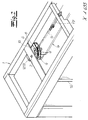
- a control flap device for a smoke protection differential pressure system with a housing 1, at least one about an axis of rotation 2 pivotally mounted in the housing control flap 3 and at least one on the one hand to the housing 1 and on the other hand connected via a connecting part 4 to the control valve 3 closing spring 5 shown.
- the control flap device in the embodiment as a multi-flap device with a plurality of juxtaposed control valves 3, 3 'is formed, wherein the control valves 3, 3' are connected via a connecting rod 6 together and open and close together, and wherein the plurality of control valves.
- 3 , 3 'a single common closing spring 5 acts with the interposition of a single common connection part 4.
- the closing spring 5 is designed as a tension spring and in the embodiment as a cylindrical coil spring.
- the control flap device illustrated in FIG. 1 separates a (rear) pressure chamber D, in which an overpressure is to be generated and maintained by a (front) outer space A in which, for example, atmospheric pressure prevails.
- the control flap device can be mounted at any point to the pressure chamber D in connection with the atmosphere A.
- the control valves are not visible in FIGS. 1 and 2. They are shown in Fig. 3 in which the pressure chamber D zugewanden (rear) portion of the housing 1 is arranged. Fig. 3 shows a control valve 3 in the closed position.
- the closing spring 5 generates with its spring force F a closing moment M F holding the control flap 3 in the closed position or in the closed position.
- an overpressure is built in the (rear) pressure chamber D, which keeps the pressure chamber of smoke.
- the control valve 3 pivots to form a flow opening by a predetermined opening angle ⁇ in the opening direction R as soon as an unilaterally acting on the control valve or control valves opening pressure or air pressure P generates a closing torque exceeding opening moment M L.
- the closing moment M F is the Closing spring 5 is set so that the opening torque M L in any case at an overpressure ⁇ P of 50.0 Pa exceeds the closing moment M F , so that the control valve 3 opens and consequently the pressure can be reduced by a predetermined amount.
- control flap 3 automatically closes again.
- the opening direction R is indicated in the figures. With the control flap 3 open and close the other control valves 3 'simultaneously.
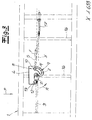
- the connecting part which connects the closing spring 5 to the control flap 3 is designed as a connecting lever 4 connected in an articulated manner to the control flap 3. Consequently, a separate connection joint component is provided in the context of the invention, which is connected on the one hand articulated to the closing spring 5 and on the other hand articulated to the control flap 3.
- the connection joint component 4 is consequently both pivotable with respect to the control flap and pivotable with respect to the closing spring.
- Fig. 3 shows that the connection lever 4 is not directly connected to the guide flap, but that the connection lever 4 is pivotally connected to a non-rotatable connected to the control flap 3 connecting arm 7. This connecting arm 7 is fixed at a fixed angle to the control flap 3.
- closing spring 5 on the one hand and control flap 3 (in the closed position) on the other hand are arranged substantially parallel to each other.
- the closing spring in the closed position at a different angle, for example vertically or approximately perpendicular to the control flap.
- the connecting arm is rotatably connected to the control flap.
- the connection lever 4 has at least one joint recess 12, in which a Joint pin 13 is rotatably mounted. The hinge pin 13 is connected to the control flap 3 or the connecting arm 7.
- the connecting lever 4 has a guide slot 8 and is thus formed as a curve with a curved elongated hole guide 9, wherein in this slot guide 9 is connected to the closing spring 5 end connected guide element in the form of a guide pin 10 hinged and slidably.
- the guide pin 10 is guided roller bearings in the slot guide 9. This is achieved, for example, by (shoulder) ball bearings mounted on both sides of the guide pin 10, which engage in the two elongated holes 9 '.
- the connection lever 4 is L-shaped in the side view and U-shaped in cross-section.
- the slot guide 9 with the two slots 9 ' is arranged. Due to the design of the connection lever 4 as a U-profile, it is expedient if in each case a joint recess 12 and a slot 9 'are provided in the two U-legs, which of course are aligned.
- the closing spring 5 is connected to the closing flap 3 via the connecting lever 4 such that the lever arm a acting on the flap 3 is greater than zero in all flap positions, so that the spring force produces a closing moment greater than zero in all flap positions.
- Lever a and length of the lever arm means in the invention, the vertical distance of the spring force action line 14 and the spring force vector of the pivot point and the axis of rotation. 2
- the spring force action line 14 and the control flap 3 and the connecting arm 7 connected thereto are merely indicated.
- the lever arm a is drawn in each case.
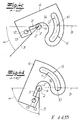
- the control flap pivots about the axis of rotation 2. Due to the articulated connection of the connection lever 4 on the one hand, the closing spring 5 and on the other hand the control valve 3, the control flap 3 pulls the connecting lever 4 initially in the direction of the axis of rotation 2, so that the connecting lever 4 comes into abutment against the rotary shaft 2 'at a predetermined critical angle (compare Fig. 4b).
- the lever arm a decreases sharply.
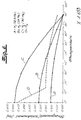
- Fig. 6 shows that the closing moment M F in a first angular range of a flap angle of 0 ° to a flap angle of about 15 ° drops sharply with a high slope and then in a second angle range to the fully open flap angle of 90 ° only slightly decreases with a slight slope. The waste in the second section is consequently (significantly) less than in the first section.
- the closing moment in the second section is constant at least in regions.
- the closing moment M F always has exactly two defined points of intersection with the opening moment M L at 25.0 Pa.
- the closing moment (curve D) cuts both the curve B and the curve C defined at high flap opening angles and exactly once. Starting from the full open position at 90 °, the closing moment M F always increases continuously, so that a perfect flap return is ensured.
- the mechanical flap return system or the closing spring can consequently be designed with a substantially constant spring preload, which avoids the additional frictional effects due to increasing spring forces, thereby enabling safe flap return.
- a guide surface 15 is arranged between the slot guide 9 and the joint recess 12, which is formed in the shape of a curve as it were formed and on which the joint 4 is guided in the course of opening on the rotary shaft 2 '.
- the L-shaped articulated guide lever 4 as it were concentrated around the axis 2, so that the described low moments of inertia occur.
- FIG. 1 shows that the housing 1 in the embodiment as a multi-valve device between the individual adjacently arranged control valves 3, 3 'each having a partition wall 16 to form separate flow areas.
- the slot guide 9 extends in an approximately circular arc over an arc length of ⁇ 4 , r to ⁇ 2 , r . where r is the mean radius.
- the biased closing spring 5 is pivotally hinged to the housing 1 and that to a fixed to the housing 1 spring holder 17 which is adjustably or adjustably attached to the housing 1.
Landscapes
- Engineering & Computer Science (AREA)
- Mechanical Engineering (AREA)
- General Engineering & Computer Science (AREA)
- Chemical & Material Sciences (AREA)
- Combustion & Propulsion (AREA)
- Public Health (AREA)
- Health & Medical Sciences (AREA)
- Business, Economics & Management (AREA)
- Emergency Management (AREA)
- Lift Valve (AREA)
- Barrages (AREA)
- Air-Flow Control Members (AREA)
- Mechanically-Actuated Valves (AREA)
Abstract
Description
- Die Erfindung betrifft eine Regelklappenvorrichtung, insbesondere für eine Rauchschutz-Differenzdruckanlage, mit einem Gehäuse oder dergleichen Halterung, zumindest einer um eine Drehachse schwenkbar in dem Gehäuse gelagerten Regelklappe und zumindest einer einerseits an das Gehäuse und andererseits über ein Anschlussteil an die Regelklappe angeschlossenen (vorgespannte) Schließfeder, wobei die Schließfeder mit ihrer Federkraft ein die Regelklappe in Schließstellung haltendes oder in Schließstellung überführendes Schließmoment erzeugt und wobei die Regelklappe unter Bildung einer Durchströmöffnung um einen vorgegebenen Öffnungswinkel schwenkt, sobald ein einseitig auf die Regelklappe wirkender Öffnungsdruck ein das Schließmoment übersteigendes Öffnungsmoment erzeugt.
- Rauchschutz-Differenzdruckanlagen dienen insbesondere der Rauchfreihaltung von Flucht- und Rettungswegen in beispielsweise Fluren und Treppenhäusern. Dazu werden diese von Rauch freizuhaltenden und folglich zu schützenden Räume mittels Ventilatoren mit einem Luftüberschuss beaufschlagt, so dass sich in den von Rauch freizuhaltenden bzw. zu schützenden Räumen ein vorgegebener Überdruck gegenüber dem Druck in zum Beispiel benachbarten Räumen oder Außenbereichen, zum Beispiel Atmosphärendruck, ergibt. Aus Sicherheitsgründen darf der für die Rauchfreiheit erforderliche Überdruck einen zulässigen Maximalwert (zum Beispiel 50 Pa) nicht überschreiten. Aus diesem Grunde sind in Rauchschutz-Differenzdruckanlagen mit Ventilatoren die eingangs beschriebenen Regelklappenvorrichtungen integriert, zum Beispiel in Wände oder Decken eingebaut. Derartige Regelklappenvorrichtungen dienen der selbsttätigen Luftabfuhr überschüssiger Luft, damit der zulässige Maximaldruck gegenüber Atmosphärendruck nicht überschritten wird. Die Regelklappen öffnen bei Erreichen des zulässigen Überdruckes unter Wirkung der skalaren Druckkräfte selbsttätig und die überschüssige Luft wird mit einem Durchströmdruckverlust, der gleich dem geforderten zulässigen Überdruck des Druckraums entspricht, an die Atmosphäre übergeben, so dass die Regelklappe dann selbsttätig wieder schließt. Dabei muss auf die geeignete Wahl bzw. Bemaßung der Abströmflächen geachtet werden. Werden in einem solchen Druckraum beispielsweise Türen oder Fenster geöffnet, so schließt die Regelklappe im Moment des Druckabfalls durch den Wegfall öffnender Druckkräfte selbsttätig durch das mechanische Rückholsystem und unterstützt den erneuten Druckaufbau der Ventilatoren im Druckraum bis der zulässige Überdruck erreicht ist, um dann wieder zu öffnen oder sie bleiben so lange geschlossen, bis der Druckabfall infolge der Durchströmung der Öffnungen von Türen oder Fenstern den zulässigen Überdruck nicht mehr übersteigt.
- Bei einer bekannten Regelklappenvorrichtung der eingangs beschriebenen Art sind in einem gemeinsamen Gehäuse sowohl der Zuluftventilator als auch die über Schließfedern selbsttätig wirkenden Regelklappen angeordnet. Diese Klappen öffnen selbsttätig, wenn der Überdruck den angestrebten Wert überschreitet und schaffen einen Bypass zur Saugseite des Ventilators. Als Anschlussteil zwischen Zugfeder einerseits und Regelklappe andererseits sind Führungskulissen vorgesehen, welche starr an die Regelklappe angeschlossen sind (vgl.
DE 102 51 149 A1 ). Nachteilig bei der insoweit bekannten Konstruktion ist, dass der effektive Hebelarm bei größeren Öffnungswinkeln nahezu null wird, so dass eine einwandfreie Klappenrückführung bei ebenfalls hohen Reibungsanteilen nicht immer gewährleistet ist oder jedenfalls hohe Federkräfte erfordert. Dabei muss gegebenenfalls mit sehr starken Federlängungen gearbeitet werden. In der Regel müssen zusätzliche Rückholfedern eingesetzt werden. - Der Erfindung liegt die Aufgabe zu Grunde, eine Regelklappenvorrichtung der eingangs beschriebenen Art zu schaffen, welche auf einfache Weise eine einwandfreie Funktion gewährleistet und bei sämtlichen Klappenöffnungswinkeln eine sichere Klappenrückführung ermöglicht. Außerdem sollen schnelle Öffnungs- und insbesondere Schließzeiten gewährleistet sein.
- Zur Lösung dieser Aufgabe lehrt die Erfindung bei einer gattungsgemäßen Regelklappenvorrichtung, dass das Anschlussteil als gelenkig an die Regelklappe angeschlossener Anschlusshebel ausgebildet ist. Das Anschlussteil ist folglich als Anschlusshebel bzw. Anschlussgelenk gegenüber der Regelklappe schwenkbar mit der Regelklappe verbunden. Vorzugsweise ist der Anschlusshebel gelenkig an einen drehfest mit der Regelklappe verbundenen Verbindungsarm oder Verbindungsansatz angeschlossen, wobei dieser Verbindungsarm unter einem vorgegebenen Winkel starr bzw. drehfest an der Regelklappe befestigt ist. Der Anschlusshebel selbst weist dabei eine Führungskulisse mit einer vorzugsweise kurvenförmigen Langlochführung auf, in welcher ein an die Schließfeder endseitig angeschlossenes Führungselement, zum Beispiel ein Führungszapfen, gelenkig verschiebbar geführt ist. Dieser Führungszapfen kann insbesondere wälzgelagert in der Langlochführung geführt sein. Insofern ist der Anschlusshebel vorzugsweise als gelenkig an die Schließklappe bzw. den Verbindungsarm angeschlossener Kurvenzug ausgebildet.
- Die Schließfeder ist über den Anschlusshebel vorzugsweise derart an die Schließklappe angeschlossen, dass der Hebelarm bzw. die Länge des auf die Klappe wirkenden Hebelarms in allen Klappenstellungen größer als Null ist, so dass die Federkraft in allen Klappenstellungen ein Schließmoment größer Null erzeugt. Hebelarm bzw. Länge des Hebelarms meint im Rahmen der Erfindung den senkrechten Abstand der Federkraftwirkungslinie bzw. des Federkraftvektors von dem Drehpunkt bzw. der Drehachse der Regelklappe.
- Die Erfindung geht dabei von der Erkenntnis aus, dass durch die gelenkige Anbindung eines separaten Anschlusshebels einerseits an die Schließfeder und andererseits an die Regelklappe eine einwandfreie und schnelle Rückführung der Regelklappe in die Schließstellung bei sämtlichen Regelklappenöffnungswinkeln gewährleistet ist. Denn die Anbindung der Schließfeder an die Schließklappe über das beidseitig gelenkig angeordnete Führungsgelenk bzw. Anschlusshebel als gleichsam frei bewegliches Zwischenbauteil ermöglicht es, dass bei sämtlichen Klappenöffnungswinkeln stets ein definierter Rest-Hebelarm und folglich eine Hebelarmlänge größer Null beibehalten wird, so dass stets ein einwandfreies rückführendes Schließmoment erzeugt wird. Denn das Schließmoment ergibt sich aus dem Produkt aus einerseits Federkraft und andererseits wirksamen Hebelarm.
- In besonders vorteilhafter Weiterbildung der Erfindung ist der zum Beispiel als Kurvenzug ausgebildete Anschlusshebel in Schließstellung von der Drehachse bzw. Drehwelle (zunächst) beabstandet, während es im Zuge des Öffnens ab einem bestimmten Grenzwinkel gegen die Drehachse bzw. die Drehwelle der Regelklappe anschlägt und sie folglich berührt und dann im Zuge des weiteren Öffnens weiter anliegt und folglich mit der Drehklappe dreht. Auf diese Weise lässt es sich einrichten, dass das von der Schließfeder erzeugte und vom Öffnungswinkel abhängige Schließmoment von der Schließstellung bis in die vollständige Offenstellung kontinuierlich abnimmt oder bereichsweise konstant ist. Jedenfalls sinkt das Schließmoment nicht auf Null und es steigt auch nicht wieder an. Unter Berücksichtigung der Tatsache, dass die Anlenkung der Feder einerseits über eine Langlochführung erfolgt und andererseits der Anschlusshebel im Zuge des Öffnens ab einem bestimmten Grenzwinkel gegen die Drehachse anliegt, lässt es sich im Rahmen der Erfindung einrichten, dass das Schließmoment in Abhängigkeit vom Öffnungswinkel von der Schließstellung im Zuge des Öffnens bis zu einem Grenzwinkel mit zunächst hoher Steigung bzw. sehr starkem Abfall abnimmt und anschließend mit geringer Steigung abnimmt oder im Wesentlichen konstant ist. Durch diesen winkelabhängigen Verlauf des Schließmomentes wird eine besonders sichere Klappenrückführung bei allen Öffnungswinkeln bei gleichzeitig hohen Offnungs- und Schließgeschwindigkeiten gewährleistet.
- Im Rahmen der Erfindung kann mit über den gesamten Öffnungsbereich im Wesentlichen konstanter Federkraft der vorgespannten Feder und mit verhältnismäßig geringen Federlängungen gearbeitet werden und dennoch wird bei definiertem Resthebelarm stets ein einwandfreies Rückholmoment erzeugt, welches unter Vermeidung von Hystereseerscheinungen stets ein sicheres Öffnen und Schließen der Regelklappe gewährleistet. Das von der vorgespannten Schließfeder erzeugte Schließmoment besitzt dabei stets einen Schnittpunkt in der Offenstellung mit den abnehmenden öffnenden Luftkraftmomenten, so dass bei weiter abnehmenden Luftkräften eine sichere Rückführung in die geschlossene Stellung gewährleistet ist. Zusätzliche Reibungseffekte durch zunehmende Federkräfte werden vermieden.
- Nach einem weiteren Vorschlag der Erfindung ist der Anschlusshebel in der Seitenansicht L-förmig oder auch C-förmig ausgebildet. Ferner ist es zweckmäßig, wenn der Anschlusshebel im Querschnitt U-förmig und folglich im Querschnitt als U-Profil ausgebildet ist. Grundsätzlich werden aber auch Ausführungsformen umfasst, bei welchem der Anschlusshebel als Flachprofil oder L-Profil ausgebildet ist.
- Es ist zweckmäßig, wenn in dem einen L-Schenkel (oder C-Schenkel) zumindest eine Gelenkausnehmung zur gelenkigen Anlenkung der Regelklappe bzw. des Verbindungsarms und in dem anderen L-Schenkel (bzw. C-Schenkel) eine weitere Gelenkausnehmung, zum Beispiel die Langlochführung für die gelenkige und verschiebbare Anlenkung der Schließfeder angeordnet ist. Unter Berücksichtigung der Tatsache, dass das Führungsgelenk bzw. der Anschlusshebel vorzugsweise im Querschnitt U-förmig ausgebildet ist, sind in jedem der U-Schenkel fluchtende Gelenkausnehmungen und fluchtende Langlöcher vorgesehen.
- Zwischen Langlochführung einerseits und Gelenkausnehmung andererseits ist vorzugsweise eine Führungsfläche angeordnet, an der der Anschlusshebel im Zuge des Öffnens an der Drehachse bzw. Drehwelle geführt ist. Diese Führungsfläche ist dabei vorzugsweise zumindest bereichsweise bogenförmig als gleichsam Ausnehmung ausgebildet. Diese Ausführungsform gewährleistet, dass der Gelenkhebel bzw. der Anschlusshebel gleichsam um die Drehachse konzentriert ist, so dass wegen geringer Radien lediglich geringe Massenträgheitsmomente erzeugt werden, was wiederum minimale Schließzeiten ermöglicht. Im Rahmen der Erfindung werden dabei Schließzeiten der Regelklappen von 0,1 sek. oder weniger erreicht.
- Der Anschlusshebel bzw. Kurvenzug ist vorzugsweise als einstückig gefertigtes Formteil ausgebildet. Dabei kann der Anschlusshebel aus Metall, zum Beispiel aus Stahl gefertigt sein. Es werden aber auch Ausführungsformen aus anderen Materialien, zum Beispiel aus Kunststoff, umfasst.
- Gegenstand der Erfindung ist auch eine Regelklappenvorrichtung in der Ausführungsform als Mehrklappenvorrichtung mit einer Mehrzahl nebeneinander und/oder übereinander bzw. untereinander in einem gemeinsamen Gehäuse angeordneter Regelklappen, wobei die Regelklappen über ein Gestänge miteinander verbunden sind und gemeinsam öffnen und schließen und wobei auf die Regelklappen zumindest eine gemeinsame Schließfeder wirkt. Im Rahmen einer solchen Mehrklappenvorrichtung lässt sich folglich mit einer einzigen Schließfeder oder auch einem einzigen Schließfederpaar unter Berücksichtigung des erfindungsgemäßen Anschlusshebels eine einwandfreie Steuerung bzw. Regelung einer Mehrzahl von Regelklappen erreichen. Das Massenträgheitsmoment eines in diesem Falle vorgesehenen verbindenden Gestänges ist auf das Klappenmassenträgheitsmoment abgestimmt und bedämpft. Das Gehäuse einer solchen Mehrklappenvorrichtung weist zwischen den einzelnen Regelklappen vorzugsweise Trennwände unter Bildung separater Strömungsbereiche auf. Diese Trennwände gewährleisten, dass jede einzelne Klappe im Zuge des Öffnens auch tatsächlich lediglich von einer Seite umströmt wird und folglich keine undefinierten und unkontrollierten Strömungsverhältnisse durch Wechselwirkung zwischen den einzelnen Regelklappen entstehen.
- Im Folgenden wird die Erfindung anhand einer lediglich ein Ausführungsbeispiel darstellenden Zeichnung näher erläutert. Es zeigen
- Fig. 1
- eine erfindungsgemäße Regelklappenvorrichtung als Mehrklappenvorrichtung in perspektivischer Ansicht,
- Fig. 2
- einen Ausschnitt aus dem Gegenstand nach Fig. 1,
- Fig. 3
- eine schematische Draufsicht auf den Gegenstand nach Fig. 2,
- Fig. 4a - d
- schematisch und ausschnittsweise den Gegenstand nach Fig. 3 in unterschiedlichen Funktionsstellungen,
- Fig. 5
- den Anschlusshebel einer erfindungsgemäßen Regelklappenvorrichtung in perspektivischer Ansicht und
- Fig. 6
- den Verlauf der öffnenden Momente und des schließenden Moments in Abhängigkeit vom Regelklappenwinkel.
- In den Figuren ist eine Regelklappenvorrichtung für eine Rauchschutz-Differenzdruckanlage mit einem Gehäuse 1, zumindest einer um eine Drehachse 2 schwenkbar in dem Gehäuse gelagerten Regelklappe 3 und zumindest einer einerseits an das Gehäuse 1 und andererseits über ein Anschlussteil 4 an die Regelklappe 3 angeschlossenen Schließfeder 5 dargestellt. Gemäß Fig. 1 ist die Regelklappenvorrichtung im Ausführungsbeispiel als Mehrklappenvorrichtung mit einer Mehrzahl nebeneinander angeordneter Regelklappen 3, 3' ausgebildet, wobei die Regelklappen 3, 3' über ein Verbindungsgestänge 6 miteinander verbunden sind und gemeinsam öffnen und schließen, und wobei auf die mehreren Regelklappen 3, 3' eine einzige gemeinsame Schließfeder 5 unter Zwischenschaltung eines einzigen gemeinsamen Anschlussteils 4 wirkt. Die Schließfeder 5 ist als Zugfeder und im Ausführungsbeispiel als zylindrische Schraubenfeder ausgebildet.
- Die in Fig. 1 dargestellte Regelklappenvorrichtung trennt im Rahmen einer Rauchschutz-Differenzdruckanlage einen (hinteren) Druckraum D, in welchem ein Überdruck erzeugt und aufrechterhalten werden soll von einem (vorderen) Außenraum A, in dem beispielsweise Atmosphärendruck herrscht. Die Regelklappenvorrichtung kann an beliebigen Punkten zum Druckraum D in Verbindung zur Atmosphäre A montiert werden. Die Regelklappen sind in Fig. 1 und 2 nicht erkennbar. Sie sind gemäß Fig. 3 in dem dem Druckraum D zugewanden (hinteren) Bereich des Gehäuses 1 angeordnet. Fig. 3 zeigt dabei eine Regelklappe 3 in Schließstellung. Die Schließfeder 5 erzeugt mit ihrer Federkraft F ein die Regelklappe 3 in Schließstellung haltendes bzw. in Schließstellung überführendes Schließmoment MF. Über einen nicht dargestellten Ventilator, welcher ebenfalls Bestandteil einer Differenzdruckanlage ist, wird in dem (hinteren) Druckraum D ein Überdruck aufgebaut, welcher den Druckraum von Rauch freihält. Die Regelklappe 3 schwenkt unter Bildung einer Durchströmöffnung um einen vorgegebenen Öffnungswinkel α in Öffnungsrichtung R, sobald ein einseitig auf die Regelklappe bzw. Regelklappen wirkender Öffnungsdruck bzw. Luftdruck P ein das Schließmoment übersteigendes Öffnungsmoment ML erzeugt. Im Ausführungsbeispiel ist das Schließmoment MF der Schließfeder 5 so eingestellt, dass das Öffnungsmoment ML jedenfalls bei einem Überdruck Δ P von 50,0 Pa das Schließmoment MF übersteigt, so dass die Regelklappe 3 öffnet und folglich der Überdruck um ein vorgegebenes Maß abgebaut werden kann. Sobald der Überdruck soweit abgesunken ist, dass das Schließmoment das Öffnungsmoment wieder übersteigt, schließt die Regelklappe 3 wieder selbsttätig. Die Öffnungsrichtung R ist in den Figuren angedeutet. Mit der Regelklappe 3 öffnen und schließen die übrigen Regelklappen 3' simultan.
- Erfindungsgemäß ist das Anschlussteil, welches die Schließfeder 5 mit der Regelklappe 3 verbindet, als gelenkig an die Regelklappe 3 angeschlossener Anschlusshebel 4 ausgebildet. Folglich wird im Rahmen der Erfindung ein separates Anschlussgelenkbauteil zur Verfügung gestellt, welches einerseits gelenkig an die Schließfeder 5 und andererseits gelenkig an die Regelklappe 3 angeschlossen ist. Das Anschlussgelenkbauteil 4 ist folglich sowohl schwenkbar gegenüber der Regelklappe als auch schwenkbar gegenüber der Schließfeder. Dabei zeigt Fig. 3, dass der Anschlusshebel 4 nicht unmittelbar an die Führungsklappe angeschlossen ist, sondern dass der Anschlusshebel 4 gelenkig an einen drehfesten mit der Regelklappe 3 verbundenen Verbindungsarm 7 angeschlossen ist. Dieser Verbindungsarm 7 ist unter einem festen Winkel an der Regelklappe 3 befestigt. Die Anordnung ist im Übrigen so getroffen, dass Schließfeder 5 einerseits und Regelklappe 3 (in Schließstellung) andererseits im Wesentlichen parallel zueinander angeordnet sind. Es besteht aber grundsätzlich auch die Möglichkeit, die Schließfeder in Schließstellung in anderem Winkel, zum Beispiel senkrecht bzw. in etwa senkrecht zur Regelklappe anzuordnen. Dann ist es lediglich erforderlich, den Verbindungsarm unter anderem Winkel an die Regelklappe anzuschließen. Stets ist der Verbindungsarm jedoch drehfest mit der Regelklappe verbunden. Jedenfalls weist der Anschlusshebel 4 zumindest eine Gelenkausnehmung 12 auf, in welcher ein Gelenkstift 13 drehbar gelagert ist. Der Gelenkstift 13 ist an die Regelklappe 3 oder den Verbindungsarm 7 angeschlossen.
- Der Anschlusshebel 4 weist eine Führungskulisse 8 auf und ist folglich als Kurvenzug mit einer kurvenförmigen Langlochführung 9 ausgebildet, wobei in dieser Langlochführung 9 ein an die Schließfeder 5 endseitig angeschlossenes Führungselement in Form eines Führungszapfens 10 gelenkig und verschiebbar geführt ist. Der Führungszapfen 10 ist dabei wälzgelagert in der Langlochführung 9 geführt. Dieses gelingt zum Beispiel durch beidseitig auf den Führungszapfen 10 aufgesetzte (Schulter-) Kugellager, welche in die beiden Langlöcher 9' eingreifen. Im Übrigen ist in den Figuren erkennbar, dass der Anschlusshebel 4 in der Seitenansicht L-förmig und im Querschnitt U-förmig ausgebildet ist. In der Seitenansicht ist in dem einem L-Schenkel 4a eine Gelenkausnehmung 12 zur gelenkigen Anlenkung des Verbindungsarms 7 und in dem anderen L-Schenkel 4b die Langlochführung 9 mit den beiden Langlöchern 9' angeordnet. Durch die Ausbildung des Anschlusshebels 4 als U-Profil ist es zweckmäßig, wenn in den beiden U-Schenkeln jeweils eine Gelenkausnehmung 12 und ein Langloch 9' vorgesehen sind, wobei diese selbstverständlich fluchten.
- Erfindungsgemäß ist die Schließfeder 5 über den Anschlusshebel 4 derart an die Schließklappe 3 angeschlossen, dass der auf die Klappe 3 wirkenden Hebelarm a in allen Klappenstellungen größer Null ist, so dass die Federkraft in allen Klappenstellungen ein Schließmoment größer Null erzeugt. Hebelarm a bzw. Länge des Hebelarms meint im Rahmen der Erfindung den senkrechten Abstand der Federkraftwirkungslinie 14 bzw. des Federkraftvektors von dem Drehpunkt bzw. der Drehachse 2.
- Die Funktionsweise der erfindungsgemäßen Regelklappenvorrichtung wird im Folgenden anhand der Fig. 4a bis 4d unter gleichzeitiger Berücksichtigung der Momentenverläufe gemäß Fig. 6 erläutert. Fig. 4a bis 4d zeigen schematisch den Anschlusshebel 4 in unterschiedlichen Funktionsstellungen bei einem Öffnungswinkel von α = 0°, α = 15°, α = 45° sowie α = 90°. Die Federkraftwirkungslinie 14 sowie die Regelklappe 3 und der daran angeschlossene Verbindungsarm 7 sind lediglich angedeutet. Ferner ist jeweils der Hebelarm a eingezeichnet.
- Gemäß Fig. 4a ist der Anschlusshebel 4 in Schließstellung (α = 0°) der Regelklappe 3 zunächst von der Drehachse 2 bzw. Drehwelle 2' beabstandet und folglich berührungsfrei angeordnet. Im Zuge des Öffnens der Regelklappe 3 bei einem vorgegebenen Öffnungsdruck schwenkt die Regelklappe um die Drehachse 2. Durch die gelenkige Anbindung des Anschlusshebels 4 an einerseits die Schließfeder 5 und andererseits die Regelklappe 3 zieht die Regelklappe 3 den Anschlusshebel 4 zunächst in Richtung der Drehachse 2, so dass der Anschlusshebel 4 bei einem vorgegebenen Grenzwinkel gegen die Drehwelle 2' zur Anlage kommt (vgl. Fig. 4b). Der Hebelarm a nimmt stark ab. Sofern die Regelklappe 3 anschließend über diesen Grenzwinkel hinaus weiter geöffnet wird, bleibt der Anschlusshebel 4 in Anlage mit der Drehwelle 2', so dass der Anschlusshebel 4 reibungsfrei mit der Drehwelle 2' rotiert. Der gemäß Fig. 4a bei α = 0° in der oberen Endstellung angeordnete Führungszapfen 10 wandert in der Langlochführung 9 bis er bei vollständig geöffneter Regelklappe 3 in die gegenüberliegende untere Endstellung gelangt. Eine vergleichende Betrachtung der Fig. 4a bis 4d zeigt, dass selbst bei hohen Öffnungswinkeln stets ein definierter Resthebelarm a verbleibt.
- Dieses spiegelt sich in den Momentenverläufen gemäß Fig. 6 wieder. In Fig. 6 sind zunächst einmal als Kurven A, B, C die vom Klappenwinkel α abhängigen Öffnungsmomente ML für einen Überdruck Δ P von 12,5 Pa, 25 Pa sowie 50 Pa dargestellt. Ferner ist als Kurve D das von der Schließfeder 5 erzeugte Schließmoment MF ebenfalls in Abhängigkeit vom Klappenwinkel α aufgezeichnet. Es ist zunächst einmal erkennbar, dass das von der Schließfeder 5 erzeugte Schließmoment MF von der Schließstellung (α = 0°) bis in die vollständige Offenstellung (α = 90°) kontinuierlich abnimmt und stets größer Null ist. Durch die bereits erläuterte Resthebelarmlänge a größer Null bei sämtlichen Öffnungswinkeln α wird folglich gewährleistet, dass bei im Wesentlichen konstanter Federkraft stets ein ausreichendes Schließmoment und folglich Rückholmoment verbleibt. Dieses gelingt im Wesentlichen durch die gelenkige Anbindung der Regelklappe 3 unter Zwischenschaltung des gleichsam freibeweglichen Anschlussgelenkes 4 an die Schließfeder 5. So zeigt Fig. 6, dass das Schließmoment MF in einem ersten Winkelbereich von einem Klappenwinkel von 0° bis zu einem Klappenwinkel von etwa 15° mit hoher Steigung stark abfällt und dann in einem zweiten Winkelbereich bis zum vollständig geöffneten Klappenwinkel von 90° lediglich mit geringer Steigung schwach abnimmt. Der Abfall in dem zweiten Abschnitt ist folglich (deutlich) geringer als in dem ersten Abschnitt. Es werden im Übrigen auch Ausführungsformen umfasst, bei denen das Schließmoment in dem zweiten Abschnitt zumindest bereichsweise konstant ist. Stets soll jedoch gewährleistet sein, dass das Schließmoment bei steigendem Öffnungswinkel nicht wieder zunimmt. Dabei macht Fig. 6 deutlich, dass das Schließmoment MF stets exakt zwei definierte Schnittpunkte mit dem Öffnungsmoment ML bei 25,0 Pa aufweist. Dabei schneidet das Schließmoment (Kurve D) sowohl die Kurve B als auch die Kurve C bei hohen Klappenöffnungswinkeln definiert und exakt einmal. Ausgehend von der vollständigen Offenstellung bei 90° wächst das Schließmoment MF stets kontinuierlich an, so dass eine einwandfreie Klappenrückführung gewährleistet ist.
- Das mechanische Klappenrückführsystem bzw. die Schließfeder kann folglich mit im Wesentlichen konstanter Federvorspannung ausgelegt werden, welches die zusätzlichen Reibungseffekte durch zunehmende Federkräfte vermeidet und dadurch eine sichere Klappenrückführung ermöglicht.
- Im Ausführungsbeispiel ist zwischen Langlochführung 9 und Gelenkausnehmung 12 eine Führungsfläche 15 angeordnet, die kurvenförmig als gleichsam Einformung ausgebildet ist und an der das Gelenk 4 im Zuge des Öffnens an der Drehwelle 2' geführt ist. Insofern ist erkennbar, dass sich der L-förmige gelenkige Führungshebel 4 gleichsam um die Achse 2 konzentriert, so dass die beschriebenen geringen Massenträgheitsmomente auftreten.
- Im Übrigen zeigt Fig. 1, dass das Gehäuse 1 bei der Ausführungsform als Mehrklappenvorrichtung zwischen den einzelnen nebeneinander angeordneten Regelklappen 3, 3' jeweils eine Trennwand 16 unter Bildung separater Strömungsbereiche aufweist.
- Die Langlochführung 9 erstreckt sich in etwa kreisbogenförmig über eine Bogenlänge von


Claims (15)
- Regelklappenvorrichtung, insbesondere für eine Rauchschutz-Differenzdruckanlage, mit
einem Gehäuse (1),
zumindest einer um eine Drehachse (2) schwenkbar in dem Gehäuse (1) gelagerten Regelklappe (3),
und zumindest einer einerseits an das Gehäuse (1) und andererseits über zumindest ein Anschlussteil an die Regelklappe (3) angeschlossenen Schließfeder (5),
wobei die Schließfeder (5) mit ihrer Federkraft (F) ein die Regelklappe (3) in Schließstellung haltendes oder in Schließstellung überführendes Schließmoment (MF) erzeugt,
und wobei die Regelklappe (3) unter Bildung einer Durchströmöffnung um einen vorgegebenen Öffnungswinkel (α) schwenkt, sobald ein einseitig auf die Regelklappe (3) wirkender Öffnungsdruck (P) ein das Schließmoment (MF) übersteigendes Öffnungsmoment (ML) erzeugt, dadurch g e k e n n - z e i c h n e t ,
dass das Anschlussteil als gelenkig an die Regelklappe angeschlossener Anschlusshebel (4) ausgebildet ist. - Vorrichtung nach Anspruch 1, dadurch gekennzeichnet, dass der Anschlusshebel (4) gelenkig an einen drehfest mit der Regelklappe (3) verbundenen Verbindungsarm (7) oder Verbindungsansatz angeschlossen ist.
- Vorrichtung nach Anspruch 1 oder 2, dadurch gekennzeichnet, dass der Anschlusshebel (4) eine Führungskulisse (8) mit einer vorzugsweise kurvenförmigen Langlochführung (9) aufweist, in welcher ein an die Schließfeder (5) endseitig angeschlossenes Führungselement, zum Beispiel ein Führungszapfen (10), gelenkig verschiebbar geführt ist.
- Vorrichtung nach Anspruch 3, dadurch gekennzeichnet, dass der Führungszapfen (10) wälzgelagert in der Langlochführung (9) geführt ist.
- Vorrichtung nach einem der Ansprüche 1 bis 4, dadurch gekennzeichnet, dass die Schließfeder (5) über den Anschlusshebel (4) derart an die Schließklappe (3) angeschlossen ist, dass der auf die Klappe (3) wirkende Hebelarm (a) in allen Klappenstellungen größer als Null ist, so dass die Federkraft (F) in allen Klappenstellungen ein Schließmoment MF größer Null erzeugt.
- Vorrichtung nach einem der Ansprüche 1 bis 5, dadurch gekennzeichnet, dass der Anschlusshebel (4) in Schließstellung von der Drehachse (2) oder Drehwelle (2') beabstandet ist und im Zuge des Öffnens der Regelklappe (3) ab einem vorgegebenen Grenzwinkel gegen die Drehachse (2) bzw. die Drehwelle (2') anliegt.
- Vorrichtung nach Anspruch 6 oder 7, dadurch gekennzeichnet, dass das von der Schließfeder (5) erzeugte und von dem Öffnungswinkel (α) abhängige Schließmoment (MF) von der Schließstellung bis in die vollständige Offenstellung kontinuierlich abnimmt ist.
- Vorrichtung nach Anspruch 7, dadurch gekennzeichnet, dass das Schließmoment (MF) in Abhängigkeit vom Öffnungswinkel (α) von der Schließstellung im Zuge des Öffnens bis zu einem Grenzwinkel stark abnimmt und anschließend bei weiter steigendem Öffnungswinkel lediglich schwach abnimmt.
- Vorrichtung nach einem der Ansprüche 1 bis 8, dadurch gekennzeichnet, dass der Anschlusshebel (4) in der Seitenansicht L-förmig oder C-förmig ausgebildet ist.
- Vorrichtung nach einem der Ansprüche 1 bis 9, dadurch gekennzeichnet, dass der Anschlusshebel (4) im Querschnitt U-förmig ausgebildet ist.
- Vorrichtung nach Anspruch 9 oder 10, dadurch gekennzeichnet, dass in dem einen L-Schenkel (4a) zumindest eine Gelenkaufnahme (12) zur gelenkigen Anlenkung der Regelklappe (3) oder des Verbindungsarms (7) und in dem anderen L-Schenkel (4b) die Langlochführung (9) angeordnet ist.
- Vorrichtung nach einem der Ansprüche 9 bis 11, dadurch gekennzeichnet, dass zwischen Langlochführung (9) und Gelenkausnehmung (12) eine Führungsfläche (15) angeordnet ist, mit welcher der Anschlusshebel (4) im Zuge des Öffnens an der Drehachse (2) oder Drehwelle (2') geführt ist.
- Vorrichtung nach einem der Ansprüche 1 bis 12, dadurch gekennzeichnet, dass der Anschlusshebel (4) aus Metall, zum Beispiel aus Stahl, gefertigt ist.
- Regelklappenvorrichtung nach einem der Ansprüche 1 bis 13 in der Ausführungsform als Mehrklappenvorrichtung, mit einer Mehrzahl nebeneinander und/oder übereinander bzw. untereinander in einem gemeinsamen Gehäuse (1) angeordneter Regelklappen (3, 3'), wobei die Regelklappen (3, 3') über ein Gestänge (6) miteinander verbunden sind und gemeinsam öffnen und schließen und wobei auf die Regelklappen (3, 3') zumindest eine gemeinsame Schließfeder (5) wirkt.
- Vorrichtung nach Anspruch 14, dadurch gekennzeichnet, dass das Gehäuse (1) zwischen den einzelnen Regelklappen (3, 3') Trennwände (16) unter Bildung separater Strömungsbereiche aufweist.
Priority Applications (1)
| Application Number | Priority Date | Filing Date | Title |
|---|---|---|---|
| PL06000982T PL1701108T3 (pl) | 2005-03-11 | 2006-01-18 | Urządzenie z regulowanymi klapami |
Applications Claiming Priority (1)
| Application Number | Priority Date | Filing Date | Title |
|---|---|---|---|
| DE102005011791A DE102005011791A1 (de) | 2005-03-11 | 2005-03-11 | Regelklappenvorrichtung |
Publications (3)
| Publication Number | Publication Date |
|---|---|
| EP1701108A2 true EP1701108A2 (de) | 2006-09-13 |
| EP1701108A3 EP1701108A3 (de) | 2007-03-21 |
| EP1701108B1 EP1701108B1 (de) | 2014-07-23 |
Family
ID=36604205
Family Applications (1)
| Application Number | Title | Priority Date | Filing Date |
|---|---|---|---|
| EP06000982.6A Expired - Lifetime EP1701108B1 (de) | 2005-03-11 | 2006-01-18 | Regelklappenvorrichtung |
Country Status (4)
| Country | Link |
|---|---|
| EP (1) | EP1701108B1 (de) |
| DE (1) | DE102005011791A1 (de) |
| ES (1) | ES2507095T3 (de) |
| PL (1) | PL1701108T3 (de) |
Cited By (14)
| Publication number | Priority date | Publication date | Assignee | Title |
|---|---|---|---|---|
| WO2011010140A1 (en) | 2009-07-21 | 2011-01-27 | Apreco Limited | Venting device |
| DE202010013107U1 (de) | 2010-12-13 | 2011-02-17 | Gesellschaft für sicherheits- und brandschutztechnische Komponenten und Anlagen mbH | Regelklappenvorrichtung für eine Rauchschutz-Differenzdruckanlage |
| EP2463598A2 (de) | 2010-12-13 | 2012-06-13 | Gesellschaft für sicherheits- und brandschutz- | Regelklappenvorrichtung für eine Rauchschutz-Differenzdruckanlage sowie Verfahren zur Steuerung einer Regelklappenvorrichtung |
| CN103574874A (zh) * | 2013-10-31 | 2014-02-12 | 博耐尔汽车电气系统有限公司 | 一种用于汽车空调温度风门的驱动机构 |
| US9032993B2 (en) | 2012-06-14 | 2015-05-19 | Honeywell International Inc. | Handle mechanism for an HVAC damper actuator |
| US9623523B2 (en) | 2013-12-18 | 2017-04-18 | Honeywell International Inc. | HVAC actuator with taping flange |
| US9664409B2 (en) | 2012-06-14 | 2017-05-30 | Honeywell International Inc. | HVAC damper system |
| CN107014050A (zh) * | 2017-05-09 | 2017-08-04 | 珠海格力电器股份有限公司 | 导风装置及其控制方法及空调器 |
| US9732980B2 (en) | 2013-12-18 | 2017-08-15 | Honeywell International Inc. | HVAC actuator with range adjustment |
| US10119721B2 (en) | 2012-06-14 | 2018-11-06 | Honeywell International Inc. | Standoff for use with an insulated HVAC duct |
| US10302207B2 (en) | 2012-06-14 | 2019-05-28 | Honeywell International Inc. | Spring loaded HVAC damper |
| DE102018126010A1 (de) | 2018-10-19 | 2020-04-23 | Strulik Gmbh | Rauchschutzanlage |
| US10941960B2 (en) | 2013-12-18 | 2021-03-09 | Ademco Inc. | HVAC actuator with position indicator |
| CN115199793A (zh) * | 2021-04-07 | 2022-10-18 | Vg创新有限公司 | 爆炸减震器 |
Families Citing this family (5)
| Publication number | Priority date | Publication date | Assignee | Title |
|---|---|---|---|---|
| DE102011001261A1 (de) | 2011-03-14 | 2012-09-20 | Jürgen Eidmann | Rauchschutzdruckanlage und Verfahren zur Rauchfreihaltung eines Fluchtraumes |
| US8887655B2 (en) | 2012-01-25 | 2014-11-18 | Honeywell International Inc. | Valve actuator with position indicator extension |
| US9423143B2 (en) | 2013-12-18 | 2016-08-23 | Honeywell International Inc. | HVAC actuator with light indicator |
| US9568207B2 (en) | 2013-12-18 | 2017-02-14 | Honeywell International Inc. | HVAC actuator with removable wire blocking tab |
| USD728071S1 (en) | 2013-12-27 | 2015-04-28 | Honeywell International Inc. | HVAC actuator |
Citations (2)
| Publication number | Priority date | Publication date | Assignee | Title |
|---|---|---|---|---|
| DE1454651A1 (de) | 1962-08-22 | 1969-03-13 | Israel State | Gasstrom-Steuerjalousie |
| DE10251149A1 (de) | 2001-10-31 | 2003-05-15 | Alfred Eichelberger Gmbh & Co | Rauchschutz für Räume |
Family Cites Families (2)
| Publication number | Priority date | Publication date | Assignee | Title |
|---|---|---|---|---|
| GB2240621B (en) * | 1990-01-31 | 1993-10-20 | Toshiba Kk | Ventilating fan |
| US5249596A (en) * | 1992-03-06 | 1993-10-05 | Carrier Corporation | Residential heating and air conditioning barometric bypass damper |
-
2005
- 2005-03-11 DE DE102005011791A patent/DE102005011791A1/de not_active Withdrawn
-
2006
- 2006-01-18 EP EP06000982.6A patent/EP1701108B1/de not_active Expired - Lifetime
- 2006-01-18 ES ES06000982.6T patent/ES2507095T3/es not_active Expired - Lifetime
- 2006-01-18 PL PL06000982T patent/PL1701108T3/pl unknown
Patent Citations (2)
| Publication number | Priority date | Publication date | Assignee | Title |
|---|---|---|---|---|
| DE1454651A1 (de) | 1962-08-22 | 1969-03-13 | Israel State | Gasstrom-Steuerjalousie |
| DE10251149A1 (de) | 2001-10-31 | 2003-05-15 | Alfred Eichelberger Gmbh & Co | Rauchschutz für Räume |
Cited By (22)
| Publication number | Priority date | Publication date | Assignee | Title |
|---|---|---|---|---|
| WO2011010140A1 (en) | 2009-07-21 | 2011-01-27 | Apreco Limited | Venting device |
| US20120164934A1 (en) * | 2009-07-21 | 2012-06-28 | Apreco Limited | Venting Device |
| DE202010013107U1 (de) | 2010-12-13 | 2011-02-17 | Gesellschaft für sicherheits- und brandschutztechnische Komponenten und Anlagen mbH | Regelklappenvorrichtung für eine Rauchschutz-Differenzdruckanlage |
| EP2463598A2 (de) | 2010-12-13 | 2012-06-13 | Gesellschaft für sicherheits- und brandschutz- | Regelklappenvorrichtung für eine Rauchschutz-Differenzdruckanlage sowie Verfahren zur Steuerung einer Regelklappenvorrichtung |
| DE102010061187A1 (de) | 2010-12-13 | 2012-06-14 | Gesellschaft für sicherheits- und brandschutztechnische Komponenten und Anlagen mbH | Regelklappenvorrichtung für eine Rauchschutz-Differenzdruckanlage sowie Verfahren zur Steuerung einer Regelklappenvorrichtung |
| EP2463598A3 (de) * | 2010-12-13 | 2017-12-13 | Gesellschaft für sicherheits- und brandschutz- | Regelklappenvorrichtung für eine Rauchschutz-Differenzdruckanlage sowie Verfahren zur Steuerung einer Regelklappenvorrichtung |
| US9032993B2 (en) | 2012-06-14 | 2015-05-19 | Honeywell International Inc. | Handle mechanism for an HVAC damper actuator |
| US10760816B2 (en) | 2012-06-14 | 2020-09-01 | Ademco Inc. | HVAC damper system |
| US9664409B2 (en) | 2012-06-14 | 2017-05-30 | Honeywell International Inc. | HVAC damper system |
| US10697554B2 (en) | 2012-06-14 | 2020-06-30 | Ademco Inc. | Spring loaded HVAC damper |
| US10190799B2 (en) | 2012-06-14 | 2019-01-29 | Honeywell International Inc. | HVAC damper system |
| US10119721B2 (en) | 2012-06-14 | 2018-11-06 | Honeywell International Inc. | Standoff for use with an insulated HVAC duct |
| US10302207B2 (en) | 2012-06-14 | 2019-05-28 | Honeywell International Inc. | Spring loaded HVAC damper |
| CN103574874A (zh) * | 2013-10-31 | 2014-02-12 | 博耐尔汽车电气系统有限公司 | 一种用于汽车空调温度风门的驱动机构 |
| US9732980B2 (en) | 2013-12-18 | 2017-08-15 | Honeywell International Inc. | HVAC actuator with range adjustment |
| US10295215B2 (en) | 2013-12-18 | 2019-05-21 | Ademco Inc. | HVAC actuator with range adjustment |
| US10184681B2 (en) | 2013-12-18 | 2019-01-22 | Honeywell International Inc. | HVAC actuator |
| US9623523B2 (en) | 2013-12-18 | 2017-04-18 | Honeywell International Inc. | HVAC actuator with taping flange |
| US10941960B2 (en) | 2013-12-18 | 2021-03-09 | Ademco Inc. | HVAC actuator with position indicator |
| CN107014050A (zh) * | 2017-05-09 | 2017-08-04 | 珠海格力电器股份有限公司 | 导风装置及其控制方法及空调器 |
| DE102018126010A1 (de) | 2018-10-19 | 2020-04-23 | Strulik Gmbh | Rauchschutzanlage |
| CN115199793A (zh) * | 2021-04-07 | 2022-10-18 | Vg创新有限公司 | 爆炸减震器 |
Also Published As
| Publication number | Publication date |
|---|---|
| EP1701108A3 (de) | 2007-03-21 |
| EP1701108B1 (de) | 2014-07-23 |
| PL1701108T3 (pl) | 2015-01-30 |
| DE102005011791A1 (de) | 2006-09-21 |
| ES2507095T3 (es) | 2014-10-14 |
Similar Documents
| Publication | Publication Date | Title |
|---|---|---|
| EP1701108B1 (de) | Regelklappenvorrichtung | |
| EP3973122B1 (de) | Beschlaganordnung | |
| EP2347076B1 (de) | Stellantrieb für bewegbare möbelteile | |
| EP0356728B1 (de) | Vorrichtung zur Steuerung der Schliessfolge zweier Flügel | |
| EP0646690B1 (de) | Stütze zum Halten eines Verschlusselementes | |
| DE2635338C3 (de) | Luftmengenregler zum Konstanthalten des Luftdurchsatzes | |
| EP2147178B1 (de) | Scharnieranordnung | |
| AT524339B1 (de) | Möbelantrieb zum Bewegen einer Möbelfront | |
| EP2828460A1 (de) | Beschlag für einen parallel abstellbaren und in dieser parallelabstelllage horizontal verschiebbaren flügel von fenstern oder türen | |
| AT506436B1 (de) | Vorrichtung zur regelung der öffnungsfolge von zweiflügeligen schwenktüren | |
| DE102015000452A1 (de) | Vorrichtung zur Unterstützung und Erleichterung des Öffnens und Schließens für ein Fenster oder eine Tür | |
| EP1544394B1 (de) | Vorrichtung zum Feststellen eines Flügels, insbesondere einer Tür oder eines Fensters | |
| EP1911920A1 (de) | Vorrichtung zur Regelung der Öffnungsfolge von zweiflügeligen Schwenktüren | |
| EP2677104B1 (de) | Sicherheitsschrank | |
| WO2018145693A1 (de) | Kraftfahrzeugtürschloss | |
| EP3359763B1 (de) | Scharnier für eine faltklappe | |
| DE3609565A1 (de) | Schliessfolgeregelvorrichtung fuer eine zweifluegelige tuer | |
| EP0505350A1 (de) | Drehscheiben-Schliessfolge- und Verriegelungseinrichtung | |
| AT502965B1 (de) | Vorrichtung zur regelung der öffnungsfolge von zweiflügeligen schwenktüren | |
| AT377314B (de) | Schliessfolgeregler fuer zweifluegelige tueren | |
| DE102012108722A1 (de) | Kamin- oder Kachelofen oder Kamineinsatz | |
| DE10152676B4 (de) | Schließfolgeregler | |
| EP1496176B1 (de) | Kombiniertes Bowdenzug-/Hebelaggregat | |
| AT504334B1 (de) | Anordnung zur ver- und entriegelung von gedichteten schwenktüren | |
| DE19836049A1 (de) | Sicherheitseinrichtung für einen Flügel eines Fensters oder dergleichen |
Legal Events
| Date | Code | Title | Description |
|---|---|---|---|
| PUAI | Public reference made under article 153(3) epc to a published international application that has entered the european phase |
Free format text: ORIGINAL CODE: 0009012 |
|
| AK | Designated contracting states |
Kind code of ref document: A2 Designated state(s): AT BE BG CH CY CZ DE DK EE ES FI FR GB GR HU IE IS IT LI LT LU LV MC NL PL PT RO SE SI SK TR |
|
| AX | Request for extension of the european patent |
Extension state: AL BA HR MK YU |
|
| PUAL | Search report despatched |
Free format text: ORIGINAL CODE: 0009013 |
|
| AK | Designated contracting states |
Kind code of ref document: A3 Designated state(s): AT BE BG CH CY CZ DE DK EE ES FI FR GB GR HU IE IS IT LI LT LU LV MC NL PL PT RO SE SI SK TR |
|
| AX | Request for extension of the european patent |
Extension state: AL BA HR MK YU |
|
| 17P | Request for examination filed |
Effective date: 20070825 |
|
| AKX | Designation fees paid |
Designated state(s): AT BE BG CH CY CZ DE DK EE ES FI FR GB GR HU IE IS IT LI LT LU LV MC NL PL PT RO SE SI SK TR |
|
| 17Q | First examination report despatched |
Effective date: 20130417 |
|
| GRAP | Despatch of communication of intention to grant a patent |
Free format text: ORIGINAL CODE: EPIDOSNIGR1 |
|
| INTG | Intention to grant announced |
Effective date: 20131122 |
|
| GRAP | Despatch of communication of intention to grant a patent |
Free format text: ORIGINAL CODE: EPIDOSNIGR1 |
|
| INTG | Intention to grant announced |
Effective date: 20140218 |
|
| GRAS | Grant fee paid |
Free format text: ORIGINAL CODE: EPIDOSNIGR3 |
|
| GRAA | (expected) grant |
Free format text: ORIGINAL CODE: 0009210 |
|
| AK | Designated contracting states |
Kind code of ref document: B1 Designated state(s): AT BE BG CH CY CZ DE DK EE ES FI FR GB GR HU IE IS IT LI LT LU LV MC NL PL PT RO SE SI SK TR |
|
| REG | Reference to a national code |
Ref country code: GB Ref legal event code: FG4D Free format text: NOT ENGLISH |
|
| REG | Reference to a national code |
Ref country code: CH Ref legal event code: EP |
|
| REG | Reference to a national code |
Ref country code: IE Ref legal event code: FG4D Free format text: LANGUAGE OF EP DOCUMENT: GERMAN |
|
| REG | Reference to a national code |
Ref country code: AT Ref legal event code: REF Ref document number: 679095 Country of ref document: AT Kind code of ref document: T Effective date: 20140815 |
|
| REG | Reference to a national code |
Ref country code: CH Ref legal event code: NV Representative=s name: KELLER AND PARTNER PATENTANWAELTE AG, CH |
|
| REG | Reference to a national code |
Ref country code: DE Ref legal event code: R096 Ref document number: 502006013863 Country of ref document: DE Effective date: 20140904 |
|
| REG | Reference to a national code |
Ref country code: ES Ref legal event code: FG2A Ref document number: 2507095 Country of ref document: ES Kind code of ref document: T3 Effective date: 20141014 |
|
| REG | Reference to a national code |
Ref country code: NL Ref legal event code: VDEP Effective date: 20140723 |
|
| REG | Reference to a national code |
Ref country code: LT Ref legal event code: MG4D |
|
| PG25 | Lapsed in a contracting state [announced via postgrant information from national office to epo] |
Ref country code: FI Free format text: LAPSE BECAUSE OF FAILURE TO SUBMIT A TRANSLATION OF THE DESCRIPTION OR TO PAY THE FEE WITHIN THE PRESCRIBED TIME-LIMIT Effective date: 20140723 Ref country code: LT Free format text: LAPSE BECAUSE OF FAILURE TO SUBMIT A TRANSLATION OF THE DESCRIPTION OR TO PAY THE FEE WITHIN THE PRESCRIBED TIME-LIMIT Effective date: 20140723 Ref country code: BG Free format text: LAPSE BECAUSE OF FAILURE TO SUBMIT A TRANSLATION OF THE DESCRIPTION OR TO PAY THE FEE WITHIN THE PRESCRIBED TIME-LIMIT Effective date: 20141023 Ref country code: GR Free format text: LAPSE BECAUSE OF FAILURE TO SUBMIT A TRANSLATION OF THE DESCRIPTION OR TO PAY THE FEE WITHIN THE PRESCRIBED TIME-LIMIT Effective date: 20141024 Ref country code: PT Free format text: LAPSE BECAUSE OF FAILURE TO SUBMIT A TRANSLATION OF THE DESCRIPTION OR TO PAY THE FEE WITHIN THE PRESCRIBED TIME-LIMIT Effective date: 20141124 Ref country code: SE Free format text: LAPSE BECAUSE OF FAILURE TO SUBMIT A TRANSLATION OF THE DESCRIPTION OR TO PAY THE FEE WITHIN THE PRESCRIBED TIME-LIMIT Effective date: 20140723 |
|
| REG | Reference to a national code |
Ref country code: PL Ref legal event code: T3 |
|
| PG25 | Lapsed in a contracting state [announced via postgrant information from national office to epo] |
Ref country code: CY Free format text: LAPSE BECAUSE OF FAILURE TO SUBMIT A TRANSLATION OF THE DESCRIPTION OR TO PAY THE FEE WITHIN THE PRESCRIBED TIME-LIMIT Effective date: 20140723 Ref country code: LV Free format text: LAPSE BECAUSE OF FAILURE TO SUBMIT A TRANSLATION OF THE DESCRIPTION OR TO PAY THE FEE WITHIN THE PRESCRIBED TIME-LIMIT Effective date: 20140723 Ref country code: NL Free format text: LAPSE BECAUSE OF FAILURE TO SUBMIT A TRANSLATION OF THE DESCRIPTION OR TO PAY THE FEE WITHIN THE PRESCRIBED TIME-LIMIT Effective date: 20140723 Ref country code: IS Free format text: LAPSE BECAUSE OF FAILURE TO SUBMIT A TRANSLATION OF THE DESCRIPTION OR TO PAY THE FEE WITHIN THE PRESCRIBED TIME-LIMIT Effective date: 20141123 |
|
| REG | Reference to a national code |
Ref country code: CH Ref legal event code: PCAR Free format text: NEW ADDRESS: EIGERSTRASSE 2 POSTFACH, 3000 BERN 14 (CH) |
|
| REG | Reference to a national code |
Ref country code: DE Ref legal event code: R097 Ref document number: 502006013863 Country of ref document: DE |
|
| PG25 | Lapsed in a contracting state [announced via postgrant information from national office to epo] |
Ref country code: SK Free format text: LAPSE BECAUSE OF FAILURE TO SUBMIT A TRANSLATION OF THE DESCRIPTION OR TO PAY THE FEE WITHIN THE PRESCRIBED TIME-LIMIT Effective date: 20140723 Ref country code: DK Free format text: LAPSE BECAUSE OF FAILURE TO SUBMIT A TRANSLATION OF THE DESCRIPTION OR TO PAY THE FEE WITHIN THE PRESCRIBED TIME-LIMIT Effective date: 20140723 Ref country code: RO Free format text: LAPSE BECAUSE OF FAILURE TO SUBMIT A TRANSLATION OF THE DESCRIPTION OR TO PAY THE FEE WITHIN THE PRESCRIBED TIME-LIMIT Effective date: 20140723 Ref country code: CZ Free format text: LAPSE BECAUSE OF FAILURE TO SUBMIT A TRANSLATION OF THE DESCRIPTION OR TO PAY THE FEE WITHIN THE PRESCRIBED TIME-LIMIT Effective date: 20140723 Ref country code: IT Free format text: LAPSE BECAUSE OF FAILURE TO SUBMIT A TRANSLATION OF THE DESCRIPTION OR TO PAY THE FEE WITHIN THE PRESCRIBED TIME-LIMIT Effective date: 20140723 Ref country code: EE Free format text: LAPSE BECAUSE OF FAILURE TO SUBMIT A TRANSLATION OF THE DESCRIPTION OR TO PAY THE FEE WITHIN THE PRESCRIBED TIME-LIMIT Effective date: 20140723 |
|
| PLBE | No opposition filed within time limit |
Free format text: ORIGINAL CODE: 0009261 |
|
| STAA | Information on the status of an ep patent application or granted ep patent |
Free format text: STATUS: NO OPPOSITION FILED WITHIN TIME LIMIT |
|
| PG25 | Lapsed in a contracting state [announced via postgrant information from national office to epo] |
Ref country code: BE Free format text: LAPSE BECAUSE OF NON-PAYMENT OF DUE FEES Effective date: 20150131 |
|
| 26N | No opposition filed |
Effective date: 20150424 |
|
| REG | Reference to a national code |
Ref country code: HU Ref legal event code: AG4A Ref document number: E023805 Country of ref document: HU |
|
| PG25 | Lapsed in a contracting state [announced via postgrant information from national office to epo] |
Ref country code: LU Free format text: LAPSE BECAUSE OF FAILURE TO SUBMIT A TRANSLATION OF THE DESCRIPTION OR TO PAY THE FEE WITHIN THE PRESCRIBED TIME-LIMIT Effective date: 20150118 |
|
| PG25 | Lapsed in a contracting state [announced via postgrant information from national office to epo] |
Ref country code: MC Free format text: LAPSE BECAUSE OF FAILURE TO SUBMIT A TRANSLATION OF THE DESCRIPTION OR TO PAY THE FEE WITHIN THE PRESCRIBED TIME-LIMIT Effective date: 20140723 |
|
| REG | Reference to a national code |
Ref country code: IE Ref legal event code: MM4A |
|
| PG25 | Lapsed in a contracting state [announced via postgrant information from national office to epo] |
Ref country code: SI Free format text: LAPSE BECAUSE OF FAILURE TO SUBMIT A TRANSLATION OF THE DESCRIPTION OR TO PAY THE FEE WITHIN THE PRESCRIBED TIME-LIMIT Effective date: 20140723 |
|
| REG | Reference to a national code |
Ref country code: FR Ref legal event code: PLFP Year of fee payment: 11 |
|
| PG25 | Lapsed in a contracting state [announced via postgrant information from national office to epo] |
Ref country code: IE Free format text: LAPSE BECAUSE OF NON-PAYMENT OF DUE FEES Effective date: 20150118 |
|
| REG | Reference to a national code |
Ref country code: FR Ref legal event code: PLFP Year of fee payment: 12 |
|
| PGFP | Annual fee paid to national office [announced via postgrant information from national office to epo] |
Ref country code: PL Payment date: 20161223 Year of fee payment: 12 |
|
| PGFP | Annual fee paid to national office [announced via postgrant information from national office to epo] |
Ref country code: FR Payment date: 20170120 Year of fee payment: 12 Ref country code: CH Payment date: 20170119 Year of fee payment: 12 |
|
| PGFP | Annual fee paid to national office [announced via postgrant information from national office to epo] |
Ref country code: HU Payment date: 20170117 Year of fee payment: 12 Ref country code: GB Payment date: 20170119 Year of fee payment: 12 Ref country code: AT Payment date: 20170123 Year of fee payment: 12 |
|
| PGFP | Annual fee paid to national office [announced via postgrant information from national office to epo] |
Ref country code: ES Payment date: 20170113 Year of fee payment: 12 |
|
| PG25 | Lapsed in a contracting state [announced via postgrant information from national office to epo] |
Ref country code: TR Free format text: LAPSE BECAUSE OF FAILURE TO SUBMIT A TRANSLATION OF THE DESCRIPTION OR TO PAY THE FEE WITHIN THE PRESCRIBED TIME-LIMIT Effective date: 20140723 |
|
| REG | Reference to a national code |
Ref country code: CH Ref legal event code: PL |
|
| REG | Reference to a national code |
Ref country code: AT Ref legal event code: MM01 Ref document number: 679095 Country of ref document: AT Kind code of ref document: T Effective date: 20180118 |
|
| GBPC | Gb: european patent ceased through non-payment of renewal fee |
Effective date: 20180118 |
|
| PG25 | Lapsed in a contracting state [announced via postgrant information from national office to epo] |
Ref country code: FR Free format text: LAPSE BECAUSE OF NON-PAYMENT OF DUE FEES Effective date: 20180131 Ref country code: HU Free format text: LAPSE BECAUSE OF NON-PAYMENT OF DUE FEES Effective date: 20180119 |
|
| REG | Reference to a national code |
Ref country code: FR Ref legal event code: ST Effective date: 20180928 |
|
| PG25 | Lapsed in a contracting state [announced via postgrant information from national office to epo] |
Ref country code: AT Free format text: LAPSE BECAUSE OF NON-PAYMENT OF DUE FEES Effective date: 20180118 Ref country code: CH Free format text: LAPSE BECAUSE OF NON-PAYMENT OF DUE FEES Effective date: 20180131 Ref country code: LI Free format text: LAPSE BECAUSE OF NON-PAYMENT OF DUE FEES Effective date: 20180131 Ref country code: GB Free format text: LAPSE BECAUSE OF NON-PAYMENT OF DUE FEES Effective date: 20180118 |
|
| REG | Reference to a national code |
Ref country code: DE Ref legal event code: R082 Ref document number: 502006013863 Country of ref document: DE Representative=s name: ANDREJEWSKI HONKE PATENT- UND RECHTSANWAELTE P, DE Ref country code: DE Ref legal event code: R081 Ref document number: 502006013863 Country of ref document: DE Owner name: STRULIK GMBH, DE Free format text: FORMER OWNER: EIDMANN, JUERGEN, 61348 BAD HOMBURG, DE |
|
| PG25 | Lapsed in a contracting state [announced via postgrant information from national office to epo] |
Ref country code: PL Free format text: LAPSE BECAUSE OF NON-PAYMENT OF DUE FEES Effective date: 20180118 |
|
| REG | Reference to a national code |
Ref country code: ES Ref legal event code: FD2A Effective date: 20190731 |
|
| PG25 | Lapsed in a contracting state [announced via postgrant information from national office to epo] |
Ref country code: ES Free format text: LAPSE BECAUSE OF NON-PAYMENT OF DUE FEES Effective date: 20180119 |
|
| PGFP | Annual fee paid to national office [announced via postgrant information from national office to epo] |
Ref country code: DE Payment date: 20250120 Year of fee payment: 20 |
|
| REG | Reference to a national code |
Ref country code: DE Ref legal event code: R071 Ref document number: 502006013863 Country of ref document: DE |