EP1702701B1 - Verfahren zur herstellung von metallmikropulver mit gleichförmig gemachtem teilchendurchmesser - Google Patents
Verfahren zur herstellung von metallmikropulver mit gleichförmig gemachtem teilchendurchmesser Download PDFInfo
- Publication number
- EP1702701B1 EP1702701B1 EP04819831A EP04819831A EP1702701B1 EP 1702701 B1 EP1702701 B1 EP 1702701B1 EP 04819831 A EP04819831 A EP 04819831A EP 04819831 A EP04819831 A EP 04819831A EP 1702701 B1 EP1702701 B1 EP 1702701B1
- Authority
- EP
- European Patent Office
- Prior art keywords
- metal
- particles
- palladium
- micropowder
- solution
- Prior art date
- Legal status (The legal status is an assumption and is not a legal conclusion. Google has not performed a legal analysis and makes no representation as to the accuracy of the status listed.)
- Expired - Lifetime
Links
- 229910052751 metal Inorganic materials 0.000 title claims abstract description 140
- 239000002184 metal Substances 0.000 title claims abstract description 140
- 239000002245 particle Substances 0.000 title claims abstract description 97
- 238000000034 method Methods 0.000 title claims abstract description 33
- 229910052763 palladium Inorganic materials 0.000 claims abstract description 45
- 230000033116 oxidation-reduction process Effects 0.000 claims abstract description 41
- 229910052709 silver Inorganic materials 0.000 claims abstract description 41
- 150000003839 salts Chemical class 0.000 claims abstract description 31
- 229910052697 platinum Inorganic materials 0.000 claims abstract description 28
- 238000004519 manufacturing process Methods 0.000 claims abstract description 26
- 239000003638 chemical reducing agent Substances 0.000 claims abstract description 24
- 239000011859 microparticle Substances 0.000 claims abstract description 21
- 230000001376 precipitating effect Effects 0.000 claims abstract description 5
- 238000000151 deposition Methods 0.000 claims abstract description 4
- KDLHZDBZIXYQEI-UHFFFAOYSA-N Palladium Chemical compound [Pd] KDLHZDBZIXYQEI-UHFFFAOYSA-N 0.000 claims description 86
- 239000000243 solution Substances 0.000 claims description 62
- BASFCYQUMIYNBI-UHFFFAOYSA-N platinum Chemical compound [Pt] BASFCYQUMIYNBI-UHFFFAOYSA-N 0.000 claims description 61
- BQCADISMDOOEFD-UHFFFAOYSA-N Silver Chemical compound [Ag] BQCADISMDOOEFD-UHFFFAOYSA-N 0.000 claims description 41
- 239000004332 silver Substances 0.000 claims description 40
- PXHVJJICTQNCMI-UHFFFAOYSA-N Nickel Chemical compound [Ni] PXHVJJICTQNCMI-UHFFFAOYSA-N 0.000 claims description 22
- 230000001681 protective effect Effects 0.000 claims description 22
- 239000000084 colloidal system Substances 0.000 claims description 16
- 239000007864 aqueous solution Substances 0.000 claims description 13
- RYGMFSIKBFXOCR-UHFFFAOYSA-N Copper Chemical compound [Cu] RYGMFSIKBFXOCR-UHFFFAOYSA-N 0.000 claims description 12
- 229910052802 copper Inorganic materials 0.000 claims description 12
- 239000010949 copper Substances 0.000 claims description 12
- 229910052759 nickel Inorganic materials 0.000 claims description 11
- SWELZOZIOHGSPA-UHFFFAOYSA-N palladium silver Chemical compound [Pd].[Ag] SWELZOZIOHGSPA-UHFFFAOYSA-N 0.000 claims description 10
- 229910001316 Ag alloy Inorganic materials 0.000 claims description 7
- 150000002739 metals Chemical class 0.000 claims description 7
- ATJFFYVFTNAWJD-UHFFFAOYSA-N Tin Chemical compound [Sn] ATJFFYVFTNAWJD-UHFFFAOYSA-N 0.000 claims description 4
- 239000011135 tin Substances 0.000 claims description 4
- 229910052718 tin Inorganic materials 0.000 claims description 4
- 239000011259 mixed solution Substances 0.000 claims description 3
- 238000002156 mixing Methods 0.000 claims description 3
- 238000002360 preparation method Methods 0.000 abstract description 21
- 239000010970 precious metal Substances 0.000 abstract description 2
- 239000000203 mixture Substances 0.000 description 26
- XLYOFNOQVPJJNP-UHFFFAOYSA-N water Substances O XLYOFNOQVPJJNP-UHFFFAOYSA-N 0.000 description 24
- 239000012266 salt solution Substances 0.000 description 22
- 239000002344 surface layer Substances 0.000 description 21
- NWZSZGALRFJKBT-KNIFDHDWSA-N (2s)-2,6-diaminohexanoic acid;(2s)-2-hydroxybutanedioic acid Chemical compound OC(=O)[C@@H](O)CC(O)=O.NCCCC[C@H](N)C(O)=O NWZSZGALRFJKBT-KNIFDHDWSA-N 0.000 description 18
- IKDUDTNKRLTJSI-UHFFFAOYSA-N hydrazine monohydrate Substances O.NN IKDUDTNKRLTJSI-UHFFFAOYSA-N 0.000 description 18
- 239000006185 dispersion Substances 0.000 description 17
- 229920002134 Carboxymethyl cellulose Polymers 0.000 description 13
- SQGYOTSLMSWVJD-UHFFFAOYSA-N silver(1+) nitrate Chemical compound [Ag+].[O-]N(=O)=O SQGYOTSLMSWVJD-UHFFFAOYSA-N 0.000 description 13
- 239000002923 metal particle Substances 0.000 description 11
- VHUUQVKOLVNVRT-UHFFFAOYSA-N Ammonium hydroxide Chemical compound [NH4+].[OH-] VHUUQVKOLVNVRT-UHFFFAOYSA-N 0.000 description 10
- 239000001768 carboxy methyl cellulose Substances 0.000 description 10
- 235000010948 carboxy methyl cellulose Nutrition 0.000 description 10
- 239000008112 carboxymethyl-cellulose Substances 0.000 description 10
- 238000003756 stirring Methods 0.000 description 10
- QGZKDVFQNNGYKY-UHFFFAOYSA-N ammonia Natural products N QGZKDVFQNNGYKY-UHFFFAOYSA-N 0.000 description 9
- 235000011114 ammonium hydroxide Nutrition 0.000 description 9
- 238000009826 distribution Methods 0.000 description 9
- 150000002940 palladium Chemical class 0.000 description 9
- 239000010419 fine particle Substances 0.000 description 8
- 239000010410 layer Substances 0.000 description 7
- 238000001914 filtration Methods 0.000 description 5
- 239000010413 mother solution Substances 0.000 description 5
- 239000000843 powder Substances 0.000 description 5
- 239000011347 resin Substances 0.000 description 5
- 229920005989 resin Polymers 0.000 description 5
- 229910001961 silver nitrate Inorganic materials 0.000 description 5
- GGCZERPQGJTIQP-UHFFFAOYSA-N sodium;9,10-dioxoanthracene-2-sulfonic acid Chemical compound [Na+].C1=CC=C2C(=O)C3=CC(S(=O)(=O)O)=CC=C3C(=O)C2=C1 GGCZERPQGJTIQP-UHFFFAOYSA-N 0.000 description 5
- 150000002815 nickel Chemical class 0.000 description 4
- -1 organic acid salts Chemical class 0.000 description 4
- GPNDARIEYHPYAY-UHFFFAOYSA-N palladium(ii) nitrate Chemical compound [Pd+2].[O-][N+]([O-])=O.[O-][N+]([O-])=O GPNDARIEYHPYAY-UHFFFAOYSA-N 0.000 description 4
- 150000003057 platinum Chemical class 0.000 description 4
- 229910001111 Fine metal Inorganic materials 0.000 description 3
- 229910001252 Pd alloy Inorganic materials 0.000 description 3
- XTVVROIMIGLXTD-UHFFFAOYSA-N copper(II) nitrate Chemical compound [Cu+2].[O-][N+]([O-])=O.[O-][N+]([O-])=O XTVVROIMIGLXTD-UHFFFAOYSA-N 0.000 description 3
- 229910000008 nickel(II) carbonate Inorganic materials 0.000 description 3
- 238000005406 washing Methods 0.000 description 3
- NLXLAEXVIDQMFP-UHFFFAOYSA-N Ammonium chloride Substances [NH4+].[Cl-] NLXLAEXVIDQMFP-UHFFFAOYSA-N 0.000 description 2
- BVKZGUZCCUSVTD-UHFFFAOYSA-L Carbonate Chemical compound [O-]C([O-])=O BVKZGUZCCUSVTD-UHFFFAOYSA-L 0.000 description 2
- 239000001856 Ethyl cellulose Substances 0.000 description 2
- ZZSNKZQZMQGXPY-UHFFFAOYSA-N Ethyl cellulose Chemical compound CCOCC1OC(OC)C(OCC)C(OCC)C1OC1C(O)C(O)C(OC)C(CO)O1 ZZSNKZQZMQGXPY-UHFFFAOYSA-N 0.000 description 2
- VEXZGXHMUGYJMC-UHFFFAOYSA-N Hydrochloric acid Chemical compound Cl VEXZGXHMUGYJMC-UHFFFAOYSA-N 0.000 description 2
- 229910002651 NO3 Inorganic materials 0.000 description 2
- NHNBFGGVMKEFGY-UHFFFAOYSA-N Nitrate Chemical compound [O-][N+]([O-])=O NHNBFGGVMKEFGY-UHFFFAOYSA-N 0.000 description 2
- 229910021607 Silver chloride Inorganic materials 0.000 description 2
- QAOWNCQODCNURD-UHFFFAOYSA-L Sulfate Chemical compound [O-]S([O-])(=O)=O QAOWNCQODCNURD-UHFFFAOYSA-L 0.000 description 2
- WUOACPNHFRMFPN-UHFFFAOYSA-N alpha-terpineol Chemical compound CC1=CCC(C(C)(C)O)CC1 WUOACPNHFRMFPN-UHFFFAOYSA-N 0.000 description 2
- 230000001112 coagulating effect Effects 0.000 description 2
- 230000015271 coagulation Effects 0.000 description 2
- 238000005345 coagulation Methods 0.000 description 2
- 150000001879 copper Chemical class 0.000 description 2
- SQIFACVGCPWBQZ-UHFFFAOYSA-N delta-terpineol Natural products CC(C)(O)C1CCC(=C)CC1 SQIFACVGCPWBQZ-UHFFFAOYSA-N 0.000 description 2
- 238000007865 diluting Methods 0.000 description 2
- 229920001249 ethyl cellulose Polymers 0.000 description 2
- 235000019325 ethyl cellulose Nutrition 0.000 description 2
- 238000011156 evaluation Methods 0.000 description 2
- ZULUUIKRFGGGTL-UHFFFAOYSA-L nickel(ii) carbonate Chemical compound [Ni+2].[O-]C([O-])=O ZULUUIKRFGGGTL-UHFFFAOYSA-L 0.000 description 2
- 239000011541 reaction mixture Substances 0.000 description 2
- HKZLPVFGJNLROG-UHFFFAOYSA-M silver monochloride Chemical compound [Cl-].[Ag+] HKZLPVFGJNLROG-UHFFFAOYSA-M 0.000 description 2
- 239000007787 solid Substances 0.000 description 2
- 229940116411 terpineol Drugs 0.000 description 2
- 108010010803 Gelatin Proteins 0.000 description 1
- 229910002666 PdCl2 Inorganic materials 0.000 description 1
- 239000004372 Polyvinyl alcohol Substances 0.000 description 1
- 239000000853 adhesive Substances 0.000 description 1
- 230000001070 adhesive effect Effects 0.000 description 1
- 230000032683 aging Effects 0.000 description 1
- 229910052782 aluminium Inorganic materials 0.000 description 1
- XAGFODPZIPBFFR-UHFFFAOYSA-N aluminium Chemical compound [Al] XAGFODPZIPBFFR-UHFFFAOYSA-N 0.000 description 1
- PNEYBMLMFCGWSK-UHFFFAOYSA-N aluminium oxide Inorganic materials [O-2].[O-2].[O-2].[Al+3].[Al+3] PNEYBMLMFCGWSK-UHFFFAOYSA-N 0.000 description 1
- 239000011230 binding agent Substances 0.000 description 1
- 229920002678 cellulose Polymers 0.000 description 1
- 239000001913 cellulose Substances 0.000 description 1
- 239000000919 ceramic Substances 0.000 description 1
- 239000003795 chemical substances by application Substances 0.000 description 1
- 239000007771 core particle Substances 0.000 description 1
- 238000004090 dissolution Methods 0.000 description 1
- 230000000694 effects Effects 0.000 description 1
- 239000003792 electrolyte Substances 0.000 description 1
- 239000010946 fine silver Substances 0.000 description 1
- 239000011888 foil Substances 0.000 description 1
- 230000002431 foraging effect Effects 0.000 description 1
- 239000000446 fuel Substances 0.000 description 1
- 229920000159 gelatin Polymers 0.000 description 1
- 239000008273 gelatin Substances 0.000 description 1
- 235000019322 gelatine Nutrition 0.000 description 1
- 235000011852 gelatine desserts Nutrition 0.000 description 1
- 235000012054 meals Nutrition 0.000 description 1
- 239000007769 metal material Substances 0.000 description 1
- 229910000069 nitrogen hydride Inorganic materials 0.000 description 1
- 238000012856 packing Methods 0.000 description 1
- MUJIDPITZJWBSW-UHFFFAOYSA-N palladium(2+) Chemical compound [Pd+2] MUJIDPITZJWBSW-UHFFFAOYSA-N 0.000 description 1
- PIBWKRNGBLPSSY-UHFFFAOYSA-L palladium(II) chloride Chemical compound Cl[Pd]Cl PIBWKRNGBLPSSY-UHFFFAOYSA-L 0.000 description 1
- HRGDZIGMBDGFTC-UHFFFAOYSA-N platinum(2+) Chemical compound [Pt+2] HRGDZIGMBDGFTC-UHFFFAOYSA-N 0.000 description 1
- 229920002451 polyvinyl alcohol Polymers 0.000 description 1
- 108090000623 proteins and genes Proteins 0.000 description 1
- 102000004169 proteins and genes Human genes 0.000 description 1
- 238000007650 screen-printing Methods 0.000 description 1
- 238000003892 spreading Methods 0.000 description 1
- 239000012258 stirred mixture Substances 0.000 description 1
- 239000000758 substrate Substances 0.000 description 1
- 229920001059 synthetic polymer Polymers 0.000 description 1
Images


Classifications
-
- B—PERFORMING OPERATIONS; TRANSPORTING
- B22—CASTING; POWDER METALLURGY
- B22F—WORKING METALLIC POWDER; MANUFACTURE OF ARTICLES FROM METALLIC POWDER; MAKING METALLIC POWDER; APPARATUS OR DEVICES SPECIALLY ADAPTED FOR METALLIC POWDER
- B22F9/00—Making metallic powder or suspensions thereof
- B22F9/16—Making metallic powder or suspensions thereof using chemical processes
- B22F9/18—Making metallic powder or suspensions thereof using chemical processes with reduction of metal compounds
- B22F9/24—Making metallic powder or suspensions thereof using chemical processes with reduction of metal compounds starting from liquid metal compounds, e.g. solutions
-
- B—PERFORMING OPERATIONS; TRANSPORTING
- B22—CASTING; POWDER METALLURGY
- B22F—WORKING METALLIC POWDER; MANUFACTURE OF ARTICLES FROM METALLIC POWDER; MAKING METALLIC POWDER; APPARATUS OR DEVICES SPECIALLY ADAPTED FOR METALLIC POWDER
- B22F1/00—Metallic powder; Treatment of metallic powder, e.g. to facilitate working or to improve properties
- B22F1/05—Metallic powder characterised by the size or surface area of the particles
- B22F1/052—Metallic powder characterised by the size or surface area of the particles characterised by a mixture of particles of different sizes or by the particle size distribution
-
- B—PERFORMING OPERATIONS; TRANSPORTING
- B22—CASTING; POWDER METALLURGY
- B22F—WORKING METALLIC POWDER; MANUFACTURE OF ARTICLES FROM METALLIC POWDER; MAKING METALLIC POWDER; APPARATUS OR DEVICES SPECIALLY ADAPTED FOR METALLIC POWDER
- B22F1/00—Metallic powder; Treatment of metallic powder, e.g. to facilitate working or to improve properties
- B22F1/17—Metallic particles coated with metal
-
- B—PERFORMING OPERATIONS; TRANSPORTING
- B22—CASTING; POWDER METALLURGY
- B22F—WORKING METALLIC POWDER; MANUFACTURE OF ARTICLES FROM METALLIC POWDER; MAKING METALLIC POWDER; APPARATUS OR DEVICES SPECIALLY ADAPTED FOR METALLIC POWDER
- B22F2998/00—Supplementary information concerning processes or compositions relating to powder metallurgy
- B22F2998/10—Processes characterised by the sequence of their steps
Definitions
- the present invention relates to a method for producing a metal micropowder having a uniform particle diameter.
- the invention relates to a method for producing a metal micropowder having a metal coat of palladium, palladium-silver alloy, platinum, silver, or nickel and having a uniform particle diameter.
- a micropowder of palladium, palladium-silver alloy, platinum, or silver is a prerequisite metal material for manufacturing an electrode of condenser, an electrode of sensor, or an electrode of IC circuit.
- a nickel micropowder is of value as electroconductive adhesive for electrically combining electrodes and other constitutional members of a fuel cell of a solid electrode type or a steam electrolyte cell.
- the electrode having a smaller thickness naturally, should have a uniform thickness. Therefore, it is required to provide a metal micropowder having a uniform particle diameter.
- a metal micropowder having a uniform particle diameter there is a problem that it is not easy to produce a micropowder having a uniform particle diameter of a micron( ⁇ m) level and particularly a nanometer(nm) level.
- Japanese Patent Provisional Publication 5-334911 describes an invention for manufacture of an electrode of high performances, using a mixture of a globular platinum micropowder and an amorphous platinum powder having more fine size. Even in this method, it is desired to employ a platinum powder having the predetermined diameter level and further having a uniform particle diameter.
- JP-A-07 118868 discloses a method for producing palladium - coated spherical solver powder.
- the present invention has an object to provide a method for producing a metal micropowder having a uniform particle diameter, which is particularly of value for manufacturing precious metal electrodes.
- the present invention resides in a method for producing a metal micropowder having a uniform particle diameter which comprises the sequential steps of:
- the invention furthermore resides in the production of a metal micro-particle comprising a core particle of silver, copper or tin which is coated with a palladium layer, which is further coated with palladium, palladium-silver alloy, platinum, silver, or nickel.
- a metal micro-powder may comprise a plurality of laid metal micro-particles.
- the metal micropowder preferably has a mean diameter in the range of 0.1 to 0.9 ⁇ m, particularly, in the range of 0.2 to 0.8 ⁇ m.
- the metal micropowder preferably shows a normal diameter distribution ⁇ g is not more than 2.0, more preferably not more than 1.9, most preferably not more than 1.8.
- the metal micropowder can be mixed with a binder such as ethylcellulose and a spreading agent such as terpineol to prepare an electro-conductive paste which is of value for manufacturing electrodes
- the final step of the method of the invention for a metal micropowder in which a colloidal solution containing double layered particles comprising micro-particles of a metal of a relatively low oxidation-reduction potential coated with a metal of a relatively high oxidation-reduction potential into contact with a third metal salt and a reducing agent, can be preferably carried out by one of the following procedures:
- the metal having a relatively low oxidation-reduction potential is silver, copper, or tin
- the metal having a relatively high oxidation-reduction potential is palladium
- the third metal preferably is palladium, palladium-silver alloy, platinum, silver, or nickel.
- the method of the invention for producing a metal micropowder can produce easily a metal micropowder having a uniform particle diameter.
- the metal micropowder obtained by the invention can be utilized for preparing an electro-conductive paste favorably employable for manufacturing thin electrodes.
- the method of the invention for producing a metal micropowder comprises:
- an aqueous solution containing two salts of metals having different oxidation-reduction potential and a protective colloid is brought into contact with a reducing agent, so as to first reduce a salt of a metal having a relatively low oxidation-reduction potential, precipitating metal fine particles having a uniform particle diameter; then a metal of a relatively high oxidation-reduction potential is deposited on the previously precipitated metal fine particles, to prepare double layered metal particles having a uniform particle diameter, and finally a metal is deposited and coated over the surface of the double layered metal particles by reducing the metal salt.
- the colloidal solution serves to keep the deposited and formed metal fine particles from growing and coagulating, so as to produce a metal micropowder in which fine metal particles are well dispersed.
- an aqueous solution containing salts of metals having oxidation-reduction potentials differing from each other is prepared.
- the combinations of two metals having different oxidation-reduction potentials include a combination of silver, copper or tin (which has a relatively low oxidation-reduction potential) and palladium (which has a relatively high oxidation-reduction potential), and a combination of copper (which has a relatively low oxidation-reduction potential) and silver (which has a relatively high oxidation-reduction potential).
- the “high” and “low” in the combination of the two metal mean relative levels.
- the salts of the metals are water-soluble salts. However, the solubility in water is not necessarily high.
- water-soluble salts examples include sulfate, nitrate, hydrochloride, carbonate, organic acid salts, and various complexes.
- a ratio of a salt of metal having a relatively low oxidation-reduction potential and a salt of metal having a relatively high oxidation-reduction potential generally is in the range of 1:10 to 1: 100,000 (former:latter), preferably in the range of 1:100 to 1:10,000.
- a reducing agent is brought into contact with the above-mentioned aqueous metal salt solution in the presence of a protective colloid.
- a protective colloid There is no specific limitation with respect to the temperature in the contact procedure. However, a surrounding temperature of 10 to 40°C is preferred, and a temperature of 20 to 30°C is more preferred.
- the protective colloid serves to efficiently keep the deposited metal fine particles from coagulating, as is described hereinbefore.
- the protective colloids having such function include water-soluble cellulose derivatives such as carboxymethylcellulose (CMC), proteins such as gelatin, and synthetic polymers such as polyvinyl alcohol.
- a preferred reducing agent is an organic reducing agent such as hydrazine hydrate.
- the salt of metal having a low oxidation-reduction potential is reduced to precipitate fine metal particles having a uniform particle diameter, and a salt of metal having a high oxidation-reduction potential is then deposited around the previously precipitated fine metal particles.
- the growth of thus prepared double layered particles is controlled to produce double layered particles having a uniform particle diameter.
- a reducing agent and a salt of a third metal forming a surface layer are brought into contact with the colloidal solution containing the double layered metal particles so that the third metal is deposited and coated on the double layered metal particles.
- a surrounding temperature of 10 to 40°C is preferred, and a temperature of 20 to 30°C is more preferred.
- the third metals include palladium, palladium-silver alloy, platinum, silver, and nickel.
- the metal salts include sulfate, nitrate, hydrochloride, carbonate, organic acid salts, and various complexes.
- the reducing agent preferably is an organic reducing agent such as the aforementioned hydrazine hydrate.
- the procedure for bringing the double layered metal particles into contact with the salt of third metal and reducing agent in the presence of a protective colloid is preferably carried out by one of the following methods:
- the metal micropowder produced by the method of the invention comprises three layered particles which are composed of a fine particle nucleus (center layer) of a metal having a relatively low oxidation-reduction potential, an intermediate layer formed around the center layer which comprises a metal having a relatively high oxidation-reduction potential, and a surface layer formed around the intermediate layer.
- the first formed fine particle nucleus is produced by reduction of the metal salt. Growth and coagulation of the fine particle nuclei are inhibited in the presence of a protective colloid, so that there are produced fine particle nuclei having a uniform diameter in the aqueous solution. Further, coagulation of the produced double layered metal particles is also inhibited in the presence of a protective colloid. Accordingly, there are produced double layered metal particles having a uniform particle diameter. Furthermore, there are finally produced three layered metal particles (metal micropowder) having a uniform particle diameter due to the presence of the.protective colloid.
- CMC carboxymethylcellulose
- aqueous palladium nitrate (Pd(NO 3 ) 2 ) solution in an amount of 60 g (in terms of palladium metal amount) was added 500 mL of water, and the mixture was stirred.
- To the stirred mixture was further added slowly 240 mL of an aqueous ammonia under stirring.
- solid silver nitrate in an amount of 140 g (in terms of silver metal amount) was added, and the mixture was stirred until the mixture turned into a solution. After the dissolution of the silver nitrate was confirmed, 200 mL of an aqueous ammonia was added. The mixture was stirred until a clear solution containing palladium nitrate and silver nitrate was prepared. After stirring was complete, water was added to the solution containing palladium nitrate and silver nitrate to give 1.2 L of an aqueous solution.
- the aqueous solution containing silver salt and palladium salt (prepared in (5) above) was portionwise added to the temperature-controlled reaction mother solution for 60 minutes, while the temperature of the reaction mixture was kept at a level not higher than 40°C. After the addition was complete, the reaction mixture was stirred for 90 minutes for aging.
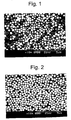
- Fig. 1 The microscopic photo of the obtained metal micropowder is shown in Fig. 1 .
- the mean particle diameter of the metal micropowder was 0.4 ⁇ m. As is apparent from Fig. 1 , the particle diameters were sufficiently uniform. It was further confirmed that the surface layer of the micro particle was made of silver-palladium alloy .
- Example 1 The procedures of Example 1 were repeated using the aqueous palladium salt solution, aqueous silver halide solution, and protective solution, to prepare a dispersion containing palladium/silver double layered particles.
- aqueous palladium nitrate (Pd(NO 3 ) 2 ) solution in an amount of 200 g (in terms of palladium metal amount) was added 1 L of water, and the mixture was stirred. While the stirring was continued, 1.2 L of aqueous ammonia was added slowly to prepare an aqueous palladium salt solution.
- reaction mother solution The resulting colloidal solution (reaction mother solution) was stirred.
- the stirred solution were simultaneously added the aqueous palladium salt solution obtained in (2) above and the aqueous hydrazine hydrate solution obtained in (3) above. After the addition was complete, the mixture was further stirred for 1.5 hours, while the temperature was kept in the range of 30 to 40°C.
- the microscopic photo of the obtained metal micropowder is shown in Fig. 2 .
- the mean particle diameter of the metal micropowder was 0.4 ⁇ m. As is apparent from Fig. 2 , the particle diameters were sufficiently uniform. It was further confirmed that the surface layer of the micro particle was made of palladium metal.
- Example 2 The procedures of Example 2 were repeated except that 100 mL of the dispersion of palladium/silver double layered particles was used in the preparation of a metal micropowder having palladium surface layer in Example 2-(4).
- the microscopic photo of the obtained metal micropowder is shown in Fig. 3 .
- the mean particle diameter of the metal micropowder was 0.8 ⁇ m. The particle diameters were sufficiently uniform.
- a beaker In a beaker was placed copper nitrate (Cu(NO 3 ) 2 ) in an amount of 5 g (in terms of copper amount), and further placed 400 mL of an aqueous ammonia solution (prepared by diluting 100 mL of a conc. aqueous ammonia with water). The mixture was stirred for one hour, while the beaker was sealed with a resin film. Subsequently, water was added to the mixture to make 500 mL of an aqueous mixture.
- Cu(NO 3 ) 2 copper nitrate
- an aqueous ammonia solution prepared by diluting 100 mL of a conc. aqueous ammonia with water.
- CMC carboxymethylcellulose
- NiCO 3 ⁇ 2Ni (OH) 2 ⁇ 4H 2 O nickel carbonate
- nickel metal amount 50 g (in terms of nickel metal amount) and 1.5 L of water.
- the mixture was stirred with a homogenizer at 80°C, so as to disperse and pulverize nickel carbonate.
- an aqueous nickel salt solution containing a pulverized nickel salt was prepared.
- reaction mother solution The resulting colloidal solution (reaction mother solution) was stirred.
- the stirred solution were simultaneously added the aqueous nickel salt solution obtained in (5) above and the aqueous hydrazine hydrate solution obtained in (3) above. After the addition was complete, the mixture was further stirred, while the temperature was kept in the range of 30 to 40°C.
- the microscopic photo of the obtained metal micropowder is shown in Fig. 4 .
- the mean particle diameter of the metal micropowder was 2 to 3 ⁇ m. As is apparent from Fig. 4 , the particle diameters were sufficiently uniform. It was further confirmed that the surface layer of the micro particle was made of nickel metal.
- Example 1 The procedures of Example 1 were repeated using the aqueous palladium salt solution, aqueous silver halide solution, and protective solution, to prepare a dispersion containing palladium/silver double layered particles.
- reaction mother solution The resulting colloidal solution (reaction mother solution) was stirred.
- the stirred solution were simultaneously added the aqueous platinum salt solution obtained in (2) above and the aqueous hydrazine hydrate solution obtained in (3) above. After the addition was complete, the mixture was further stirred for 1.5 hours, while the temperature was kept in the range of 30 to 40°C.
- the microscopic photo of the obtained metal micropowder is shown in Fig. 5 .
- the mean particle diameter of the metal micropowder was 0.4 ⁇ m. As is apparent from Fig. 5 , the particle diameters were sufficiently uniform. It was further confirmed that the surface layer of the micro particle was made of platinum metal.
- Example 5-(4) The procedures of Example 5-(4) were repeated using 100 mL of the dispersion of palladium/silver double layered particles, to produce a metal micropowder.
- the microscopic photo of the obtained metal micropowder is shown in Fig. 6 .
- the mean particle diameter of the metal micropowder was 0.54 ⁇ m. As is apparent from Fig. 6 , the particle diameters were sufficiently uniform. It was further confirmed that the surface layer of the micro particle was made of platinum metal.
- the diameter distribution of the metal micropowder is shown in Fig. 7 .
- the normal distribution 50% was 0.54 ⁇ m, and the normal distribution ⁇ g was 1.76.
- Example 5-(4) The procedures of Example 5-(4) were repeated using 50 mL of the dispersion of palladium/silver double layered particles, to produce a metal micropowder.
- the microscopic photo of the obtained metal micropowder is shown in Fig. 8 .
- the mean particle diameter of the metal micropowder was 0.8 ⁇ m. As is apparent from Fig. 8 , the particle diameters were sufficiently uniform. It was further confirmed that the surface layer of the micro particle was made of platinum metal.
- Example 5-(2) The aqueous platinum salt solution obtained in Example 5-(2) and the aqueous hydrazine hydrate solution obtained in Example 5-(3) were mixed. After the mixture was obtained, the mixture was further stirred for 1.5 hours, while the temperature was kept in the range of 30 to 40°C.
- the produced platinum micropowder was collected by filtration and dried.
- the microscopic photo and the diameter distribution of the obtained platinum micropowder are shown in Fig. 9 and Fig. 10 , respectively.
- the normal distribution 50% was 3.8 ⁇ m, and the normal distribution ⁇ g was 2.06.
- Each of the metal micropowders having platinum surface layer (platinum-coated metal micropowder) obtained in Examples 5 and 7 and Comparison Example 1 was processed to prepare an electro-conductive paste under the following conditions.
Landscapes
- Chemical & Material Sciences (AREA)
- Chemical Kinetics & Catalysis (AREA)
- General Chemical & Material Sciences (AREA)
- Manufacture Of Metal Powder And Suspensions Thereof (AREA)
- Powder Metallurgy (AREA)
- Manufacture Of Alloys Or Alloy Compounds (AREA)
Claims (5)
- Verfahren zur Herstellung eines Metallmikropulvers, das einen einheitlichen Partikeldurchmesser hat, das die folgenden sequentiellen Schritte umfasst:Herstellen einer wässrigen Lösung, die zwei Salze von Metallen enthält, die Oxidations-Reduktions-Potentiale haben, die sich voneinander unterscheiden;Inkontaktbringen eines Reduktionsmittels mit der wässrigen Lösung in Gegenwart eines Schutzkolloids, wodurch zuerst Mikropartikel eines Metalls, das ein relativ niedriges Oxidations-Reduktions-Potential hat, präzipitieren und sich danach ein Metall, das ein relativ hohes Oxidations-Reduktions-Potential hat, auf den Mikropartikeln abscheidet unter Herstellung doppelschichtiger Partikel, die die Mikropartikel eines Metalls eines relativ niedrigen Oxidations-Reduktions-Potentials beschichtet mit einem Metall eines relativ hohen Oxidations-Reduktions-Potentials umfassen; undInkontaktbringen der kolloidalen Lösung, die die doppelschichtigen Partikel enthält, mit einem dritten Metallsalz und einem Reduktionsmittel.
- Verfahren gemäß Anspruch 1, wobei die kolloidale Lösung, die die doppelschichtigen Partikel enthält, zuerst mit dem Reduktionsmittel vermischt wird und dann eine Lösung des dritten Metallsalzes zu der gemischten Lösung gegeben wird.
- Verfahren gemäß Anspruch 1, wobei das Reduktionsmittel und eine Lösung des dritten Metallsalzes gleichzeitig zu der kolloidalen Lösung, die die doppelschichtigen Partikel enthält, unter Mischen gegeben werden.
- Verfahren gemäß Anspruch 1, wobei das Metall, das ein relativ niedriges Oxidations-Reduktions-Potential hat, Silber, Kupfer oder Zinn ist, und das Metall, das ein relativ hohes Oxidations-Reduktions-Potential hat, Palladium ist.
- Verfahren gemäß Anspruch 1, wobei das dritte Metall Palladium, Palladium-Silber-Legierung, Platin, Silber oder Nickel ist.
Applications Claiming Priority (2)
| Application Number | Priority Date | Filing Date | Title |
|---|---|---|---|
| JP2003401521 | 2003-12-01 | ||
| PCT/JP2004/017791 WO2005053885A1 (ja) | 2003-12-01 | 2004-11-30 | 粒子径が揃った金属微粉末の製造方法 |
Publications (4)
| Publication Number | Publication Date |
|---|---|
| EP1702701A1 EP1702701A1 (de) | 2006-09-20 |
| EP1702701A8 EP1702701A8 (de) | 2007-02-21 |
| EP1702701A4 EP1702701A4 (de) | 2007-06-20 |
| EP1702701B1 true EP1702701B1 (de) | 2009-04-15 |
Family
ID=34649978
Family Applications (1)
| Application Number | Title | Priority Date | Filing Date |
|---|---|---|---|
| EP04819831A Expired - Lifetime EP1702701B1 (de) | 2003-12-01 | 2004-11-30 | Verfahren zur herstellung von metallmikropulver mit gleichförmig gemachtem teilchendurchmesser |
Country Status (8)
| Country | Link |
|---|---|
| US (1) | US20070114499A1 (de) |
| EP (1) | EP1702701B1 (de) |
| JP (1) | JP4861701B2 (de) |
| KR (1) | KR100999330B1 (de) |
| CN (1) | CN100563878C (de) |
| AT (1) | ATE428521T1 (de) |
| DE (1) | DE602004020673D1 (de) |
| WO (1) | WO2005053885A1 (de) |
Families Citing this family (13)
| Publication number | Priority date | Publication date | Assignee | Title |
|---|---|---|---|---|
| JP4957172B2 (ja) * | 2005-10-20 | 2012-06-20 | 住友金属鉱山株式会社 | ニッケル粉末およびその製造方法 |
| JP4833640B2 (ja) * | 2005-11-14 | 2011-12-07 | 眞六 川角 | 導電ペースト |
| JP5059317B2 (ja) * | 2005-11-18 | 2012-10-24 | 三菱マテリアル株式会社 | 銀粒子の製造方法 |
| DE102006029021A1 (de) * | 2006-06-14 | 2007-12-20 | Siemens Ag | Nanopartikel und Verfahren zu dessen Herstellung |
| JP2008138266A (ja) * | 2006-12-04 | 2008-06-19 | Mitsubishi Materials Corp | ハンダ粉末及び該粉末を用いたハンダ用ペースト |
| US7749300B2 (en) * | 2008-06-05 | 2010-07-06 | Xerox Corporation | Photochemical synthesis of bimetallic core-shell nanoparticles |
| JP5033078B2 (ja) * | 2008-08-06 | 2012-09-26 | 株式会社ジャパンディスプレイイースト | 表示装置 |
| JP5204714B2 (ja) * | 2009-04-07 | 2013-06-05 | 株式会社ノリタケカンパニーリミテド | 合金微粒子およびその製造と利用 |
| JP2013094836A (ja) * | 2011-11-02 | 2013-05-20 | Mitsubishi Materials Corp | プリコート用ハンダペースト及びその製造方法 |
| CN104985192A (zh) * | 2014-01-02 | 2015-10-21 | 天津大学 | Ni/Fe双金属面心立方晶体纳米颗粒的制备方法 |
| CN104001934A (zh) * | 2014-05-26 | 2014-08-27 | 沈阳化工大学 | 一种分散纳米铁颗粒制备方法 |
| JP6645337B2 (ja) * | 2016-04-20 | 2020-02-14 | 株式会社オートネットワーク技術研究所 | 接続端子および接続端子対 |
| CN114505793B (zh) * | 2022-01-06 | 2025-01-28 | 郑州市钻石精密制造有限公司 | 一种由不同粒度的金属粉末组成的珩磨条金属结合剂及其制作方法 |
Family Cites Families (24)
| Publication number | Priority date | Publication date | Assignee | Title |
|---|---|---|---|---|
| US3202488A (en) * | 1964-03-04 | 1965-08-24 | Chomerics Inc | Silver-plated copper powder |
| GB1558762A (en) * | 1975-07-04 | 1980-01-09 | Johnson Matthey Co Ltd | Metal or alloy coated powders |
| US4243728A (en) * | 1976-01-01 | 1981-01-06 | Nihon Kogyo Kabushiki Kaisha | Double-metal-coated metal sulfide powder and process of producing the same |
| JPS5553017A (en) * | 1978-10-16 | 1980-04-18 | Nippon Mining Co | Method of manufacturing multiple coating composite powder |
| JPS5554561A (en) * | 1978-10-18 | 1980-04-21 | Nippon Mining Co Ltd | Metal plating method for powdered body by substitution method |
| US4450188A (en) * | 1980-04-18 | 1984-05-22 | Shinroku Kawasumi | Process for the preparation of precious metal-coated particles |
| US4399096A (en) * | 1982-06-07 | 1983-08-16 | Williams Gold Refining Company Incorporated | High temperature brazing alloys |
| JPS61223110A (ja) * | 1985-03-28 | 1986-10-03 | Tanaka Kikinzoku Kogyo Kk | 銀超微粒子の製造方法 |
| JPS6277406A (ja) * | 1985-09-28 | 1987-04-09 | Tanaka Kikinzoku Kogyo Kk | 銅微粒子の製造方法 |
| JPS62280308A (ja) * | 1986-05-30 | 1987-12-05 | Mitsui Mining & Smelting Co Ltd | 銀−パラジウム合金微粉末の製造方法 |
| US4711814A (en) * | 1986-06-19 | 1987-12-08 | Teichmann Robert J | Nickel particle plating system |
| EP0499721A1 (de) * | 1991-02-21 | 1992-08-26 | Elephant Edelmetaal B.V. | Dentalmetallpulver, Verfahren zu seiner Herstellung, Verfahren zur Herstellung einer Unterkonstruktion für Zahnersatz und Verfahren zur Herstellung einer Zahnrestauration |
| US5292359A (en) * | 1993-07-16 | 1994-03-08 | Industrial Technology Research Institute | Process for preparing silver-palladium powders |
| JPH07118868A (ja) * | 1993-10-20 | 1995-05-09 | Sumitomo Metal Mining Co Ltd | パラジウム被覆球状銀粉の製造方法 |
| JPH07207185A (ja) * | 1994-01-21 | 1995-08-08 | Kawazumi Gijutsu Kenkyusho:Kk | 被覆パラジウム微粉末および導電性ペースト |
| US5514202A (en) * | 1994-12-20 | 1996-05-07 | National Science Council Of R.O.C. | Method for producing fine silver-palladium alloy powder |
| JPH08176605A (ja) * | 1994-12-27 | 1996-07-09 | Sumitomo Metal Mining Co Ltd | パラジウム被覆銀粉の製造方法 |
| FR2755612B1 (fr) * | 1996-11-13 | 1998-12-24 | Atochem Elf Sa | Composition superabsorbante pour articles d'hygiene ne developpant pas d'odeurs incommodantes |
| JPH10265812A (ja) * | 1997-03-24 | 1998-10-06 | Sumitomo Metal Mining Co Ltd | 銀超微粒子の製造方法 |
| JPH11241107A (ja) * | 1997-10-23 | 1999-09-07 | Shizuko Sato | 金属超微粒子及びその製法 |
| US6262129B1 (en) * | 1998-07-31 | 2001-07-17 | International Business Machines Corporation | Method for producing nanoparticles of transition metals |
| JP4903932B2 (ja) * | 2000-08-24 | 2012-03-28 | ケミプロ化成株式会社 | 二元金属粒子コロイド分散液の製造方法 |
| KR100438408B1 (ko) * | 2001-08-16 | 2004-07-02 | 한국과학기술원 | 금속간의 치환 반응을 이용한 코어-쉘 구조 및 혼합된합금 구조의 금속 나노 입자의 제조 방법과 그 응용 |
| JP3876811B2 (ja) * | 2001-11-02 | 2007-02-07 | 住友金属鉱山株式会社 | 透明導電層形成用塗液の製造方法 |
-
2004
- 2004-11-30 JP JP2005515931A patent/JP4861701B2/ja not_active Expired - Fee Related
- 2004-11-30 DE DE602004020673T patent/DE602004020673D1/de not_active Expired - Lifetime
- 2004-11-30 CN CNB2004800412294A patent/CN100563878C/zh not_active Expired - Fee Related
- 2004-11-30 WO PCT/JP2004/017791 patent/WO2005053885A1/ja not_active Ceased
- 2004-11-30 EP EP04819831A patent/EP1702701B1/de not_active Expired - Lifetime
- 2004-11-30 KR KR1020067013277A patent/KR100999330B1/ko not_active Expired - Fee Related
- 2004-11-30 AT AT04819831T patent/ATE428521T1/de not_active IP Right Cessation
- 2004-11-30 US US10/581,084 patent/US20070114499A1/en not_active Abandoned
Also Published As
| Publication number | Publication date |
|---|---|
| CN100563878C (zh) | 2009-12-02 |
| US20070114499A1 (en) | 2007-05-24 |
| DE602004020673D1 (de) | 2009-05-28 |
| KR100999330B1 (ko) | 2010-12-08 |
| JP4861701B2 (ja) | 2012-01-25 |
| KR20060123417A (ko) | 2006-12-01 |
| EP1702701A8 (de) | 2007-02-21 |
| EP1702701A4 (de) | 2007-06-20 |
| ATE428521T1 (de) | 2009-05-15 |
| CN1913995A (zh) | 2007-02-14 |
| EP1702701A1 (de) | 2006-09-20 |
| WO2005053885A1 (ja) | 2005-06-16 |
| JPWO2005053885A1 (ja) | 2007-06-28 |
Similar Documents
| Publication | Publication Date | Title |
|---|---|---|
| EP1702701B1 (de) | Verfahren zur herstellung von metallmikropulver mit gleichförmig gemachtem teilchendurchmesser | |
| EP1609547B1 (de) | Prozess zur Herstellung von kugelförmigems Silberpulver mit hoher Schwindung | |
| KR101945166B1 (ko) | 도전성 페이스트용 구리분 및 그 제조 방법 | |
| EP2026924B1 (de) | Verfahren zur herstellung hoch dispergierbarer kugelförmiger silberpulverpartikel und daraus geformte silberpartikel | |
| Wu | Preparation of fine copper powder using ascorbic acid as reducing agent and its application in MLCC | |
| US8394465B2 (en) | Preparation method of electroconductive copper patterning layer by laser irradiation | |
| US20050257643A1 (en) | Spherical silver powder and method for producing same | |
| JP5827341B2 (ja) | 銀粉末製造用反応器および連続製造法 | |
| EP2208559A1 (de) | Silbermikropartikelhaltige zusammensetzung, verfahren zur herstellung der zusammensetzung, verfahren zur herstellung der silbermikropartikel und paste mit den silbermikropartikeln | |
| KR101407197B1 (ko) | 니켈 분말과 그의 제조방법 | |
| US8834957B2 (en) | Preparation method for an electroconductive patterned copper layer | |
| JPH07118868A (ja) | パラジウム被覆球状銀粉の製造方法 | |
| EP1542239A1 (de) | Metallpaste und Verfahren zur Bildung von Beschichtungsfilmen unter Verwendung dieser Paste | |
| JP4100244B2 (ja) | ニッケル粉末とその製造方法 | |
| JP2008069457A (ja) | ドロップ状銅粉、ドロップ状銅粉の製造方法および導電性ペースト | |
| JP4853152B2 (ja) | ニッケル被覆銅微粒子とその製造方法、それを用いた分散液とその製造方法、及びそれを用いたペースト | |
| JP3973236B2 (ja) | 単分散性貴金属粉末の製造方法 | |
| JP2002334611A (ja) | 導電性粒子組成物 | |
| JP4490305B2 (ja) | 銅粉 | |
| JP3344508B2 (ja) | Ag−Pd粉末の製造方法 | |
| JP6031571B2 (ja) | 導電性ペースト用銅粉およびその製造方法 | |
| JPH0885807A (ja) | 単分散性銀−パラジウム複合粉末の製造方法及びその粉末 | |
| JP2000001707A (ja) | 銀粒子及びその製造方法ならびに銀粒子からなる導体ペースト | |
| JP6187822B2 (ja) | ニッケル粉末の製造方法 | |
| JPH07109505A (ja) | 銀−パラジウム複合粉末の製造方法及び銀−パラジウム複合粉末 |
Legal Events
| Date | Code | Title | Description |
|---|---|---|---|
| PUAI | Public reference made under article 153(3) epc to a published international application that has entered the european phase |
Free format text: ORIGINAL CODE: 0009012 |
|
| 17P | Request for examination filed |
Effective date: 20060630 |
|
| AK | Designated contracting states |
Kind code of ref document: A1 Designated state(s): AT BE BG CH CY CZ DE DK EE ES FI FR GB GR HU IE IS IT LI LU MC NL PL PT RO SE SI SK TR |
|
| AX | Request for extension of the european patent |
Extension state: AL HR LT LV MK YU |
|
| RAP1 | Party data changed (applicant data changed or rights of an application transferred) |
Owner name: KOJIMA CHEMICALS CO., LTD Owner name: KAWASUMI, SHINROKU |
|
| RIN1 | Information on inventor provided before grant (corrected) |
Inventor name: KAWASUMI, SHINICHIRO Inventor name: KAWASUMI, SHINROKU |
|
| RIC1 | Information provided on ipc code assigned before grant |
Ipc: B22F 1/02 20060101ALI20070222BHEP Ipc: B22F 9/24 20060101ALI20070222BHEP Ipc: B22F 1/00 20060101AFI20070222BHEP |
|
| A4 | Supplementary search report drawn up and despatched |
Effective date: 20070522 |
|
| 17Q | First examination report despatched |
Effective date: 20071012 |
|
| GRAP | Despatch of communication of intention to grant a patent |
Free format text: ORIGINAL CODE: EPIDOSNIGR1 |
|
| GRAS | Grant fee paid |
Free format text: ORIGINAL CODE: EPIDOSNIGR3 |
|
| GRAA | (expected) grant |
Free format text: ORIGINAL CODE: 0009210 |
|
| AK | Designated contracting states |
Kind code of ref document: B1 Designated state(s): AT BE BG CH CY CZ DE DK EE ES FI FR GB GR HU IE IS IT LI LU MC NL PL PT RO SE SI SK TR |
|
| AX | Request for extension of the european patent |
Extension state: AL HR LT LV MK YU |
|
| REG | Reference to a national code |
Ref country code: CH Ref legal event code: EP Ref country code: GB Ref legal event code: FG4D |
|
| REG | Reference to a national code |
Ref country code: IE Ref legal event code: FG4D |
|
| REF | Corresponds to: |
Ref document number: 602004020673 Country of ref document: DE Date of ref document: 20090528 Kind code of ref document: P |
|
| LTIE | Lt: invalidation of european patent or patent extension |
Effective date: 20090415 |
|
| NLV1 | Nl: lapsed or annulled due to failure to fulfill the requirements of art. 29p and 29m of the patents act | ||
| PG25 | Lapsed in a contracting state [announced via postgrant information from national office to epo] |
Ref country code: ES Free format text: LAPSE BECAUSE OF FAILURE TO SUBMIT A TRANSLATION OF THE DESCRIPTION OR TO PAY THE FEE WITHIN THE PRESCRIBED TIME-LIMIT Effective date: 20090726 Ref country code: PT Free format text: LAPSE BECAUSE OF FAILURE TO SUBMIT A TRANSLATION OF THE DESCRIPTION OR TO PAY THE FEE WITHIN THE PRESCRIBED TIME-LIMIT Effective date: 20090915 Ref country code: FI Free format text: LAPSE BECAUSE OF FAILURE TO SUBMIT A TRANSLATION OF THE DESCRIPTION OR TO PAY THE FEE WITHIN THE PRESCRIBED TIME-LIMIT Effective date: 20090415 Ref country code: AT Free format text: LAPSE BECAUSE OF FAILURE TO SUBMIT A TRANSLATION OF THE DESCRIPTION OR TO PAY THE FEE WITHIN THE PRESCRIBED TIME-LIMIT Effective date: 20090415 |
|
| PG25 | Lapsed in a contracting state [announced via postgrant information from national office to epo] |
Ref country code: SI Free format text: LAPSE BECAUSE OF FAILURE TO SUBMIT A TRANSLATION OF THE DESCRIPTION OR TO PAY THE FEE WITHIN THE PRESCRIBED TIME-LIMIT Effective date: 20090415 Ref country code: NL Free format text: LAPSE BECAUSE OF FAILURE TO SUBMIT A TRANSLATION OF THE DESCRIPTION OR TO PAY THE FEE WITHIN THE PRESCRIBED TIME-LIMIT Effective date: 20090415 Ref country code: PL Free format text: LAPSE BECAUSE OF FAILURE TO SUBMIT A TRANSLATION OF THE DESCRIPTION OR TO PAY THE FEE WITHIN THE PRESCRIBED TIME-LIMIT Effective date: 20090415 Ref country code: IS Free format text: LAPSE BECAUSE OF FAILURE TO SUBMIT A TRANSLATION OF THE DESCRIPTION OR TO PAY THE FEE WITHIN THE PRESCRIBED TIME-LIMIT Effective date: 20090815 Ref country code: SE Free format text: LAPSE BECAUSE OF FAILURE TO SUBMIT A TRANSLATION OF THE DESCRIPTION OR TO PAY THE FEE WITHIN THE PRESCRIBED TIME-LIMIT Effective date: 20090715 |
|
| PG25 | Lapsed in a contracting state [announced via postgrant information from national office to epo] |
Ref country code: CZ Free format text: LAPSE BECAUSE OF FAILURE TO SUBMIT A TRANSLATION OF THE DESCRIPTION OR TO PAY THE FEE WITHIN THE PRESCRIBED TIME-LIMIT Effective date: 20090415 Ref country code: DK Free format text: LAPSE BECAUSE OF FAILURE TO SUBMIT A TRANSLATION OF THE DESCRIPTION OR TO PAY THE FEE WITHIN THE PRESCRIBED TIME-LIMIT Effective date: 20090415 Ref country code: RO Free format text: LAPSE BECAUSE OF FAILURE TO SUBMIT A TRANSLATION OF THE DESCRIPTION OR TO PAY THE FEE WITHIN THE PRESCRIBED TIME-LIMIT Effective date: 20090415 Ref country code: EE Free format text: LAPSE BECAUSE OF FAILURE TO SUBMIT A TRANSLATION OF THE DESCRIPTION OR TO PAY THE FEE WITHIN THE PRESCRIBED TIME-LIMIT Effective date: 20090415 |
|
| PLBE | No opposition filed within time limit |
Free format text: ORIGINAL CODE: 0009261 |
|
| STAA | Information on the status of an ep patent application or granted ep patent |
Free format text: STATUS: NO OPPOSITION FILED WITHIN TIME LIMIT |
|
| PG25 | Lapsed in a contracting state [announced via postgrant information from national office to epo] |
Ref country code: SK Free format text: LAPSE BECAUSE OF FAILURE TO SUBMIT A TRANSLATION OF THE DESCRIPTION OR TO PAY THE FEE WITHIN THE PRESCRIBED TIME-LIMIT Effective date: 20090415 Ref country code: BE Free format text: LAPSE BECAUSE OF FAILURE TO SUBMIT A TRANSLATION OF THE DESCRIPTION OR TO PAY THE FEE WITHIN THE PRESCRIBED TIME-LIMIT Effective date: 20090415 |
|
| 26N | No opposition filed |
Effective date: 20100118 |
|
| PG25 | Lapsed in a contracting state [announced via postgrant information from national office to epo] |
Ref country code: BG Free format text: LAPSE BECAUSE OF FAILURE TO SUBMIT A TRANSLATION OF THE DESCRIPTION OR TO PAY THE FEE WITHIN THE PRESCRIBED TIME-LIMIT Effective date: 20090715 |
|
| PG25 | Lapsed in a contracting state [announced via postgrant information from national office to epo] |
Ref country code: MC Free format text: LAPSE BECAUSE OF NON-PAYMENT OF DUE FEES Effective date: 20091130 |
|
| REG | Reference to a national code |
Ref country code: IE Ref legal event code: MM4A |
|
| PG25 | Lapsed in a contracting state [announced via postgrant information from national office to epo] |
Ref country code: IE Free format text: LAPSE BECAUSE OF NON-PAYMENT OF DUE FEES Effective date: 20091130 Ref country code: GR Free format text: LAPSE BECAUSE OF FAILURE TO SUBMIT A TRANSLATION OF THE DESCRIPTION OR TO PAY THE FEE WITHIN THE PRESCRIBED TIME-LIMIT Effective date: 20090716 |
|
| PGFP | Annual fee paid to national office [announced via postgrant information from national office to epo] |
Ref country code: DE Payment date: 20101126 Year of fee payment: 7 |
|
| PG25 | Lapsed in a contracting state [announced via postgrant information from national office to epo] |
Ref country code: IT Free format text: LAPSE BECAUSE OF FAILURE TO SUBMIT A TRANSLATION OF THE DESCRIPTION OR TO PAY THE FEE WITHIN THE PRESCRIBED TIME-LIMIT Effective date: 20090415 |
|
| PGFP | Annual fee paid to national office [announced via postgrant information from national office to epo] |
Ref country code: GB Payment date: 20101124 Year of fee payment: 7 |
|
| PG25 | Lapsed in a contracting state [announced via postgrant information from national office to epo] |
Ref country code: LU Free format text: LAPSE BECAUSE OF NON-PAYMENT OF DUE FEES Effective date: 20091130 |
|
| PG25 | Lapsed in a contracting state [announced via postgrant information from national office to epo] |
Ref country code: HU Free format text: LAPSE BECAUSE OF FAILURE TO SUBMIT A TRANSLATION OF THE DESCRIPTION OR TO PAY THE FEE WITHIN THE PRESCRIBED TIME-LIMIT Effective date: 20091016 |
|
| PG25 | Lapsed in a contracting state [announced via postgrant information from national office to epo] |
Ref country code: TR Free format text: LAPSE BECAUSE OF FAILURE TO SUBMIT A TRANSLATION OF THE DESCRIPTION OR TO PAY THE FEE WITHIN THE PRESCRIBED TIME-LIMIT Effective date: 20090415 |
|
| PG25 | Lapsed in a contracting state [announced via postgrant information from national office to epo] |
Ref country code: CY Free format text: LAPSE BECAUSE OF FAILURE TO SUBMIT A TRANSLATION OF THE DESCRIPTION OR TO PAY THE FEE WITHIN THE PRESCRIBED TIME-LIMIT Effective date: 20090415 |
|
| PGFP | Annual fee paid to national office [announced via postgrant information from national office to epo] |
Ref country code: FR Payment date: 20111130 Year of fee payment: 8 Ref country code: CH Payment date: 20111123 Year of fee payment: 8 |
|
| REG | Reference to a national code |
Ref country code: CH Ref legal event code: PL |
|
| GBPC | Gb: european patent ceased through non-payment of renewal fee |
Effective date: 20121130 |
|
| PG25 | Lapsed in a contracting state [announced via postgrant information from national office to epo] |
Ref country code: LI Free format text: LAPSE BECAUSE OF NON-PAYMENT OF DUE FEES Effective date: 20121130 Ref country code: CH Free format text: LAPSE BECAUSE OF NON-PAYMENT OF DUE FEES Effective date: 20121130 |
|
| REG | Reference to a national code |
Ref country code: FR Ref legal event code: ST Effective date: 20130731 |
|
| REG | Reference to a national code |
Ref country code: DE Ref legal event code: R119 Ref document number: 602004020673 Country of ref document: DE Effective date: 20130601 |
|
| PG25 | Lapsed in a contracting state [announced via postgrant information from national office to epo] |
Ref country code: DE Free format text: LAPSE BECAUSE OF NON-PAYMENT OF DUE FEES Effective date: 20130601 |
|
| PG25 | Lapsed in a contracting state [announced via postgrant information from national office to epo] |
Ref country code: FR Free format text: LAPSE BECAUSE OF NON-PAYMENT OF DUE FEES Effective date: 20121130 Ref country code: GB Free format text: LAPSE BECAUSE OF NON-PAYMENT OF DUE FEES Effective date: 20121130 |