EP1703440A2 - Appareil d'authentification de visage, procédé et programme de commande, dispositif électronique correspondant et support d'enregistrement de programme - Google Patents
Appareil d'authentification de visage, procédé et programme de commande, dispositif électronique correspondant et support d'enregistrement de programme Download PDFInfo
- Publication number
- EP1703440A2 EP1703440A2 EP06111132A EP06111132A EP1703440A2 EP 1703440 A2 EP1703440 A2 EP 1703440A2 EP 06111132 A EP06111132 A EP 06111132A EP 06111132 A EP06111132 A EP 06111132A EP 1703440 A2 EP1703440 A2 EP 1703440A2
- Authority
- EP
- European Patent Office
- Prior art keywords
- face
- section
- distance
- authentication
- image
- Prior art date
- Legal status (The legal status is an assumption and is not a legal conclusion. Google has not performed a legal analysis and makes no representation as to the accuracy of the status listed.)
- Ceased
Links
Images


Classifications
-
- G—PHYSICS
- G06—COMPUTING OR CALCULATING; COUNTING
- G06V—IMAGE OR VIDEO RECOGNITION OR UNDERSTANDING
- G06V40/00—Recognition of biometric, human-related or animal-related patterns in image or video data
- G06V40/40—Spoof detection, e.g. liveness detection
-
- G—PHYSICS
- G06—COMPUTING OR CALCULATING; COUNTING
- G06V—IMAGE OR VIDEO RECOGNITION OR UNDERSTANDING
- G06V30/00—Character recognition; Recognising digital ink; Document-oriented image-based pattern recognition
- G06V30/10—Character recognition
- G06V30/14—Image acquisition
- G06V30/144—Image acquisition using a slot moved over the image; using discrete sensing elements at predetermined points; using automatic curve following means
-
- G—PHYSICS
- G06—COMPUTING OR CALCULATING; COUNTING
- G06V—IMAGE OR VIDEO RECOGNITION OR UNDERSTANDING
- G06V40/00—Recognition of biometric, human-related or animal-related patterns in image or video data
- G06V40/10—Human or animal bodies, e.g. vehicle occupants or pedestrians; Body parts, e.g. hands
- G06V40/16—Human faces, e.g. facial parts, sketches or expressions
Definitions
- the present invention relates to face authentication apparatuses, methods and programs of controlling the same, electronic devices having the apparatus, and recording media in which the programs are recorded.
- Known authentication techniques for authenticating personal identification includes a face authentication technique in which a picture of the face of a person being authenticated is taken, and the photographed face image and a registered face image of the person are compared to thereby authenticate personal identification.
- the face authentication technique needs to prevent socalled "spoofing-with-picture", or impersonating an authorized user using a facial picture of the authorized user.
- the facial picture of an authorized user may be either photographic paper on which a photographed image of the user is printed or a display on which a photographed image is displayed.
- Patent Document 1 JP-A- 2004-362079 (disclosed on Dec. 24, 2004 ) discloses a face autheritication technique in which pictures of a user are taken at multiple angles to form authenticating-time user images; three-dimensional information of the user to be used in authentication is stored in advance; authenticating-time three-dimensional information on the user is generated using the multiple authenticating-time user images and the photographic angles of the multiple user images; and the authenticating-time three-dimensional information on the user is compared with the three-dimensional information of the user himself, thereby allowing authentication of personal identification.
- Patent Document 2 JP-A-2000-30066 (disclosed on Jan. 28, 2000 )
- Patent Document 3 JP-A-2003-263639 (disclosed on Sep. 19, 2003 ) also disclose face authentication techniques.
- Patent Document 1 the three-dimensional information of a user's face needs to be stored in advance, thus increasing the amount of information to be stored. Also, picture-taking must be performed multiple times, consuming much time and labor.
- a face authentication apparatus includes: a face-image comparison section that compares the face image of an object to be authenticated with a registered face image; a distance acquisition section that measures the distance from a specified position to the object's face; and an object authentication section that authenticates the object's face on the basis of the distance measured by the distance acquisition section.
- Examples of the specified position include the position of a distance sensor that measures the distance and the position of a camera that takes a picture of an object's face.
- real faces have unevenness because they are three-dimensional, so that multiple measurement points on the faces are not present on the same plane.
- facial pictures are flat, so that multiple measurement points on the object's face are present on the same plane. Accordingly, if multiple measurement points on the object's face are present on the same plane, it can be determined to be spoofing-with-picture.
- Facial pictures are generally smaller than real faces. Accordingly, in order to make the dimension of the face image obtained by photographing a facial picture approximately equal to that of a face image of a real face, the facial picture need to be brought close to the photograph section. Accordingly, if the distance to the object's face is different from a distance registered in advance, it is determined to be spoofing-with-picture.
- the distances to an object's face can be measured before face images are compared, and the object's face can be authenticated on the basis of the measured distances and as such, spoofing-with-picture can easily be detected.
- the distance acquisition section may measure the distances from a plurality of positions to a plurality of measurement points on the object's face; and the object authentication section may determine whether the plurality of distances measured by the distance acquisition section are substantially the same, and when the distances are substantially the same, may determine that the object's face is false.
- the distances from multiple positions to multiple measurement points on the object's face are measured before face images are compared and as such, spoofing-with-picture can easily be detected.
- the multiple positions include the positions of multiple distance sensors.
- the distance acquisition section may measure the distances and angles from a plurality of positions to a plurality of measurement points on the object's face; and the object authentication section may specify the plurality of measurement points on the basis of the plurality of distances and angles measured by the distance acquisition section, may determine whether the specified plurality of points are present on the same plane, and when the points are present on the same plane, may determine that the object's face is false.
- the distances and angles from multiple positions to multiple measurement points on the object's face are measured before face images are compared and as such, spoofing-with-picture can easily be detected.
- the distances and angles from a specified position to multiple measurement points can be measured by repeating the measurement of the distance at different angles. This can decrease the number of necessary distance measurement sections. It is preferable that the measurement points be three or more to determine whether the measurement points are present on the same plane.
- the face image of the object to be authenticated and the distance from a specified position to the object's face may be registered in advance; and the object authentication section may determine whether the distance measured by the distance acquisition section and the registered distance are substantially the same, and when the distances are not substantially the same, may determine that the object's face is false.
- the distance from a specified position to an object's face is measured before face images are compared. Accordingly, spoofing-with-picture can easily be detected. Moreover, since it is enough to measure the distance only one time, spoofing-with-picture can be detected more easily than that with the above configuration.
- an electronic device includes: the face authentication apparatus according to one of Claims 1 to 4; a photograph section that takes a picture of an object to be authenticated, and forms a face image of the object; and a distance measurement section that measures the distance from a specified position to the object's face.
- the distance sensor senses the distance from a specified position to the object's face; the distance acquisition section acquires the distance; and the object authentication section can authenticate the object's face on the basis on the measured distance before the face-image comparison section compares the face image of the object photographed by the photograph section with a registered face image.
- the electronic device can offer the same advantages as those of the display device.
- a method of controlling a face authentication apparatus includes: performing face authentication using a face-image comparison section that compares the face image of an object to be authenticated with a registered face image; measuring the distance from a specified position to the object's face; and authenticating the object's face on the basis of the measured distance.
- the distance from a specified position to the object's face is measured and the object's face can be authenticated on the basis on the measured distance before the face images are compared.
- spoofing-with-picture can easily be detected.
- the components of the face authentication apparatus may be executed on a computer using a program for controlling the operation of the face authentication apparatus.
- the face-authentication-apparatus control program may be executed on any computers with computer-readable recording medium in which the face-authentication-apparatus control program is recorded.
- the face authentication apparatus measures the distance from a specified position to an object's face, authenticates the object's face on the basis on the measured distance before comparing the face images.
- spoofing-with-picture can easily be detected.
- FIG. 2 shows the appearance of a mobile phone according to the first embodiment.
- the mobile phone (electronic device) 10 includes an operating section 11 that receives the operation of a user, a display section 12 that displays various information, and a photograph section 13 that takes a picture of an object including a user on the main surface.
- the mobile phone 10 has multiple distance sensors (distance measurement sections) 14 for measuring the distances from an object at positions on the main surface.
- distance sensors 14a to 14c are disposed in the upper center, center, and lower center of the main surface of the mobile phone 10, respectively.
- Fig. 3 shows the schematic configuration of the mobile phone 10.
- the mobile phone 10 includes the operating section 11, the display section 12, the photograph section 13, the distance sensor 14, a control section 20, a memory section 21, a sound output section 22, a sound input section 23, and a communication section 24.
- the operating section 11 receives various inputs from the user, and includes input buttons, a keyboard, a ten-key pad, pointing devices such as a mouse, a touch panel, or another input device.
- the operating section 11 converts information input from the user to operation data, and sends the data to the control section 20.
- the display section 12 includes a display device such as a cold-cathode tube (CRT), a liquid crystal display (LCD), or a plasma display.
- the display section 12 displays various information such as characters and images on the basis of the display data received from the control section 20.
- the photograph section 13 includes a built-in digital camera including a lens group, a diaphragm, and an image-pickup device.
- Examples of the image-pickup device include a charge coupled device (CCD), and a complementary metal-oxide semiconductor (CMOS) image sensor.
- CCD charge coupled device
- CMOS complementary metal-oxide semiconductor
- the photograph section 13 takes a picture of an object to acquire a photographed image, converts the image to photographed-image data, and sends the data to the control section 20.
- the distance sensor 14 includes a sending section that sends out a kind of wave motion and a receiving section that receives the wave motion reflected by an object, and so can determine the distance to the object from the phase difference or time difference between the sent wave motion and the received wave motion.
- the distance sensor 14 sends the data on the sensed distance to the control section 20.
- Examples of the wave motion used by the distance sensor 14 include infrared light, radio waves, and ultrasound waves.
- the distance sensor 14 include a combination of an infrared-light emitting diode (LED) and a photo diode (PD) in view of miniaturization and infrared communication.
- LED infrared-light emitting diode
- PD photo diode
- the control section 20 controls the operations of the components of the mobile phone 10 in centralized manner.
- the control section 20 includes, for example, a personal computer (PC).
- the operation of the components is controlled by a computer that executes a control program.
- the program may be either of a form recorded in a removable medium such as a CD-ROM, or of a form installed in a hard disk. Alternatively, it may be of a form downloaded in a hard disk or the like via the communication section 24.
- the memory section 21 includes a nonvolatile memory including the above-described hard disk.
- Content stored in the memory section 21 includes the above-mentioned control program, an operating-system (OS) program, and other various programs, and operation settings for the photograph section 13, data on photographed images, and input character data.
- the operation settings for the photograph section 13 include the values for white balance set at factory shipment or maintenance, and other various parameters for image processing in adjusting the light and shade of photographed images.
- the sound output section 22 converts sound data from the control section 20 to sound waves, and outputs them to the exterior.
- the sound output section 22 includes a digital to analog converter, a speaker, and an earphone.
- the sound input section 23 converts external sound waves to sound data, and sends the data to the control section 20.
- the sound input section 23 includes a microphone, and an analog to digital converter.
- the communication section 24 communicates with the base station of a mobile phone system by radio. Specifically, the communication section 24 converts communication data from the control section 20 to a format suitable for radio communication, and sends radio waves to the base station. The communication section 24 also converts radio waves received from the base station to communication data, and sends the data to the control section 20.
- the control section 20 includes a face authentication section (face authentication unit) 30 for authenticating personal identification.
- Fig. 4 shows the schematic configuration of the face authentication section 30.
- the face authentication section 30 includes a face-image acquisition section 31, a distance determination section (distance acquisition section) 32, 3D-or-2D determination section (object authentication section) 33, a face-image comparison section 34, and an authentication-result output section 36.
- the memory section 21 stores one or multiple pieces of facial-feature data 35 including registered facial-feature information.
- the face-image acquisition section 31 instructs the photograph section 13 to capture a photographed image of an object, and acquires a face image for comparison from the captured photographed image.
- Known face authentication techniques such as detecting facial complexion regions, facial outlines, and facial features can be used to acquire the face image.
- the face-image acquisition section 31 notifies the distance determination section 32 of the fact that a face image has been acquired.
- the distance determination section 32 instructs the distance sensor 14 to sense the distance to the face of the object.
- the distance determination section 32 instructs the three distance sensors 14a to 14c to measure three distances to the object's face. The distance determination section 32 then gives the measurements to the 3D-or-2D determination section 33.
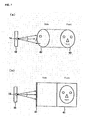
- Fig. 5A shows the distances from the distance sensors 14a to 14c of the mobile phone 10 to solid object 40.
- Fig. 5B shows the distances from the distance sensors 14a to 14c to flat object 41.
- Fig. 5A shows that when the distance sensors 14a to 14c measure the distances to the 3D object 40, the distances to the three points are different. Particularly, it shows that the distance from the central distance sensor 14b to the 3D object 40 is shorter than those from the other distance sensors 14a and 14c to the 3D object 40.
- Fig. 5B shows that when the distance sensors 14a to 14c measure the distances to the 2D object 41, the distances to the three points are substantially the same. Accordingly, it can be determined whether the object is solid or flat by determining whether the distances determined by the distance sensors 14a to 14c are substantially the same.
- the points of distance measurement be distinctive parts of a face, such as eyes, a nose, a mouth, and a facial outline.
- This embodiment uses eyes, a nose, and a mouth as the points of measurement.
- the 3D-or-2D determination section 33 determines whether the object is solid or flat from the measurements of the distance determination section 32. Specifically, in the case where the distances from the three distance sensors 14a to 14c to the object are substantially the same, the 3D-or-2D determination section 33 determines that the object is flat without unevenness. On the other hand, when the distances are different, the 3D-or-2D determination section 33 determines that the object is solid with unevenness. The 3D-or-2D determination section 33 then gives the determination result to the face-image comparison section 34 and the authentication-result output section 36.
- the face-image comparison section 34 extracts facial-feature information from the face image acquired by the face-image acquisition section 31 by a known face authentication technique, and compares the extracted feature information with the facial-feature data 35 stored in the memory section 21.
- the face-image comparison section 34 sends the comparison result to the authentication-result output section 36.
- the face authentication technique include an eigenface method, a local-feature analysis (LFA) method, a graph matching method, a neural network method, a constraint mutual subspace method, a perturbation space method, and a frequency analysis method.
- the authentication-result output section 36 instructs the display section 12 to display the authentication result on the basis of the determination result of the 3D-or-2D determination section 33 and the comparison result of the face-image comparison section 34. Specifically, when it is determined that the object is flat, or when it is determined that the feature information does not agree with the stored feature data, the authentication-result output section 36 instructs the display section 12 to display the authentication failure result. On the other hand, when the feature information agrees with the store feature data, the authentication-result output section 36 instructs the display section 12 to display the authentication-successful result.
- Fig. 1 shows the operation of face authentication of the mobile phone 10 with the above configuration.
- the face-image acquisition section 31 first instructs the photograph section 13 to capture a photographed image of an object, and then acquires a face image (object face image) to be compared from the photographed image (step S10, hereinafter, simply referred to as S10, the same also applies to other steps).
- the distance determination section 32 then instructs the three distance sensors 14a to 14c to measure the distances to three points of the object's face (S11). Then the 3D-or-2D determination section 33 determines whether there are significant differences among the three distances (S12). When there are no significant differences among the three distances, or when the three distances are substantially the same (No in S12), the 3D- or-2D determination section 33 determines that the object is flat, and then the display section 12 displays that authentication has failed by the instruction of the authentication-result output section 36 (S13).
- the 3D-or-2D determination section 33 determines that the object is solid, and then the face-image comparison section 34 compares the face image acquired by the face-image acquisition section 31 with the stored facial-feature data (S14) . Then the display section 12 displays the authentication result by the instruction of the authentication-result output section 36 (S15) . After the process of step S13 or S15, the operation of the face authentication ends.
- the distance sensors 14a to 14c and the distance determination section 32 measure the distances to multiple measurement points on the object's face before the face-image comparison section 34 checks face images and as such, spoofing-wath-picture can easily be detected.
- a second embodiment of the invention will be described hereinbelow with reference to Figs. 6 and 7.
- a mobile phone 10 of this embodiment is different from the mobile phone 10 shown in Figs. 1 to 5 in that it includes one scanning distance sensor 14, in place of the three distance sensors 14a to 14c, and in the method of distance measurement by the distance determination section 32 using the distance sensor 14 and in the method of determination whether an object is solid.
- the other components and operations are the same.
- the same components and operations as those of the first embodiment are given the same reference numerals and descriptions thereof will be omitted here.
- Figs. 7A and 7B show a method of measuring the distances from the distance sensor 14 of the mobile phone 10 to an object's face.
- Fig. 7A shows a case in which the object is solid.
- Fig. 7B shows a case in which the object is flat.
- the distance determination section 32 instructs the distance sensor 14 to measure the distance from the scanning distance sensor 14 to the object's face three times at different angles.
- Figs. 7A and 7B show that the positional relationship among the three measurement points can be grasped from the distances and the angles.
- Fig. 7A shows that, for the 3D object 40, the three measurement points are not present on the same plane.
- Fig. 7B shows that, for the 2D object 41, the three measurement points are present on the same plane. Accordingly, when three measurement points are present on the same plane, it can be determined that the object is flat; when three measurement points are not present on the same plane, it can be determined that the object is solid. Thus, when three measurement points are present on the same plane, it can be determined to be spoofing-with-picture.
- Fig. 6 shows the operation of face authentication of the mobile phone 10 with the above configuration.
- the face-image acquisition section 31 first instructs the photograph section 13 to acquire a photographed image of an object, and then acquires a face image to be compared from the photographed image (S10).
- the distance determination section 32 then instructs the distance sensor 14 to measure the distances to three points of the object's face at different angles (S21). Then the 3D-or-2D determination section 33 finds the positional relationship among the three measurement points on the basis of the distances and angles determined (measured) by the distance determination section 32 to determine whether the positional relationship indicates that the object is solid (S22). When it is not solid (No in S22), the 3D-or-2D determination section 33 determines that the object is flat, and then the display section 12 displays that authentication has failed by the instruction of the authentication-result output section 36 (S13).
- the 3D-or-2D determination section 33 determines that the object is solid, and then the face-image comparison section 34 compares the face image acquired by the face-image acquisition section 31 with the stored facial-feature data (S14). Then the display section 12 displays the authentication result by the instruction of the authentication-result output section 36 (S15). After the process of step S13 or S15, the operation of the face authentication ends.
- the distance sensor 14 and the distance determination section 32 measure the distances and angles to multiple measurement points on the face of an object before the face-image comparison section 34 compares face images and as such, spoofing-with-picture can easily be detected.
- the distances to multiple measurement points on an object's face are measured.
- facial pictures are generally smaller real faces. Accordingly, in order to make the dimension of a face image that is obtained by photographing a facial picture approximately equal to that of a face image of a real face, the facial picture need to be brought close to the photograph section 13.
- the distance to the face of an object to be authenticated is stored in the memory section 21 together with the facial-feature data 35; the distance determination section 32 measures the distance to the object's face; and if the measured distance is different from that stored in the memory section 21, then the 3D- or-2D determination section 33 can detect spoofing-with-picture, and so can determine that the object's face is false.
- the authentication-result output section 36 can output authentication failure.
- the distance sensor 14 and the distance determination section 32 measure the distance to an object's face before the face-image comparison section 34 compares face images and as such, spoofing-with-picture can easily be detected. Moreover, since it is enough to measure the distance only one time, spoofing-with-picture can be detected more easily than the foregoing embodiments.
- the blocks of the face authentication section 30 of the mobile phone 10 may either be configured by hardware logic or software using a CPU as follows.
- the face authentication section 30 includes a CPU that executes the instructions of control programs for various functions, and storage units (recording media) such as a ROM that stores the programs, a RAM that expands the programs, and memories that store the various programs and data.
- storage units such as a ROM that stores the programs, a RAM that expands the programs, and memories that store the various programs and data.
- the object of the invention can also be achieved in such a way that a computer-readable recording medium that stores program codes (an execute-form program, an intermediate code program, and a source program) of the control program for the face authentication section 30, which is software for achieving the foregoing functions) is provided to the face authentication section 30, and its computer (or a CPU or MPU) reads the program codes recorded in the recording medium and executes them.
- Examples of the recording medium include tape such as magnetic tape and cassette tape; disks including magnetic disks such as flexible disks and hard disks and optical disks such as CD-ROMs, MOs, MDs, DVDs, and CD-Rs; cards including IC cards (including memory cards) and optical cards; and semiconductor memories including mask ROMs, EPROMs, EEPROMs, and flash ROMs.
- tape such as magnetic tape and cassette tape
- disks including magnetic disks such as flexible disks and hard disks and optical disks such as CD-ROMs, MOs, MDs, DVDs, and CD-Rs
- cards including IC cards (including memory cards) and optical cards
- semiconductor memories including mask ROMs, EPROMs, EEPROMs, and flash ROMs.
- the face authentication section 30 may be connected to communication networks, through which the program codes may be provided.
- the communication networks are not particularly limited; for example, the Internet, intranets, extranets, LANs, ISDNs, VANs, CATV communication networks, virtual private networks, telephone line networks, mobile radio communication networks, and satellite communication networks are available.
- the transmission media for the communication networks are not particularly limited; for example, cable transmission including IEEE1394, USB, power-line carrier systems, cable TV lines, telephone lines, and ADSL lines; and radio transmission including infrared transmission such as IrDA and remote control, Bluetooth (registered trademark), 802.11 wireless transmission, HDR, mobile phone networks, satellite connections, and digital terrestrial networks are available.
- the invention can also be achieved by carrier waves or data signal strings in which the program codes are implemented through electronic transmission.
- the face authentication apparatus can easily detect spoofing-with-picture by measuring the distances to the face of an object to be authenticated, and determining whether the object's face is true or false from the measured distances, the face authentication apparatus can be applied not only to mobile phones but also to any electronic devices that need face authentication.
Landscapes
- Engineering & Computer Science (AREA)
- Physics & Mathematics (AREA)
- General Physics & Mathematics (AREA)
- Multimedia (AREA)
- Theoretical Computer Science (AREA)
- Human Computer Interaction (AREA)
- Health & Medical Sciences (AREA)
- General Health & Medical Sciences (AREA)
- Oral & Maxillofacial Surgery (AREA)
- Computer Vision & Pattern Recognition (AREA)
- Collating Specific Patterns (AREA)
- Image Analysis (AREA)
Applications Claiming Priority (1)
| Application Number | Priority Date | Filing Date | Title |
|---|---|---|---|
| JP2005074078A JP4734980B2 (ja) | 2005-03-15 | 2005-03-15 | 顔認証装置およびその制御方法、顔認証装置を備えた電子機器、顔認証装置制御プログラム、ならびに該プログラムを記録した記録媒体 |
Publications (2)
| Publication Number | Publication Date |
|---|---|
| EP1703440A2 true EP1703440A2 (fr) | 2006-09-20 |
| EP1703440A3 EP1703440A3 (fr) | 2007-03-21 |
Family
ID=36501933
Family Applications (1)
| Application Number | Title | Priority Date | Filing Date |
|---|---|---|---|
| EP06111132A Ceased EP1703440A3 (fr) | 2005-03-15 | 2006-03-14 | Appareil d'authentification de visage, procédé et programme de commande, dispositif électronique correspondant et support d'enregistrement de programme |
Country Status (5)
| Country | Link |
|---|---|
| US (1) | US20070253604A1 (fr) |
| EP (1) | EP1703440A3 (fr) |
| JP (1) | JP4734980B2 (fr) |
| KR (1) | KR100790223B1 (fr) |
| CN (1) | CN100476862C (fr) |
Cited By (11)
| Publication number | Priority date | Publication date | Assignee | Title |
|---|---|---|---|---|
| WO2011045123A1 (fr) * | 2009-10-13 | 2011-04-21 | Sony Ericsson Mobile Communications Ab | Dispositif électronique |
| WO2013030309A1 (fr) * | 2011-09-01 | 2013-03-07 | Morpho | Detection de fraude pour systeme de controle d'acces de type biometrique |
| EP2555159A4 (fr) * | 2010-03-30 | 2013-12-18 | Panasonic Corp | Dispositif de reconnaissance de visage et procédé de reconnaissance de visage |
| EP2685704A1 (fr) * | 2012-07-11 | 2014-01-15 | LG Electronics, Inc. | Déverrouillage d'un terminal mobile par reconnaissance de visage |
| CN105809049A (zh) * | 2014-12-30 | 2016-07-27 | 中兴通讯股份有限公司 | 加解密的方法、装置及移动终端 |
| US9563888B2 (en) | 2010-10-22 | 2017-02-07 | Vodafone Ip Licensing Limited | Mobile transactions |
| EP2658242A3 (fr) * | 2012-04-26 | 2017-05-17 | Samsung Electronics Co., Ltd | Appareil et procédé de reconnaissance d'images |
| CN107077608A (zh) * | 2014-11-13 | 2017-08-18 | 英特尔公司 | 图像生物特征识别中的面部活体检测 |
| US10198645B2 (en) | 2014-11-13 | 2019-02-05 | Intel Corporation | Preventing face-based authentication spoofing |
| EP3422698A4 (fr) * | 2016-02-26 | 2019-08-21 | Alibaba Group Holding Limited | Procédé, dispositif, terminal mobile, et appareil photo d'identification de sujet de photographie |
| GB2621390A (en) * | 2022-08-11 | 2024-02-14 | Openorigins Ltd | Methods and systems for scene verification |
Families Citing this family (70)
| Publication number | Priority date | Publication date | Assignee | Title |
|---|---|---|---|---|
| CN101027678B (zh) * | 2004-06-21 | 2011-09-21 | 谷歌公司 | 基于单个图像的多生物统计系统及方法 |
| JP4793179B2 (ja) * | 2005-11-14 | 2011-10-12 | オムロン株式会社 | 認証装置及び携帯端末 |
| JP4910627B2 (ja) * | 2006-10-24 | 2012-04-04 | オムロン株式会社 | なりすまし検知装置 |
| KR100851981B1 (ko) * | 2007-02-14 | 2008-08-12 | 삼성전자주식회사 | 비디오 영상에서 실 객체 판별 방법 및 장치 |
| KR101362597B1 (ko) * | 2007-03-19 | 2014-02-12 | 엘지전자 주식회사 | 사용자 인증기능을 갖는 이동통신단말기 및 그 사용자인증방법 |
| JP5168995B2 (ja) * | 2007-04-13 | 2013-03-27 | 日本電気株式会社 | 携帯端末装置、その認証方法及びプログラム |
| KR100883519B1 (ko) * | 2007-08-27 | 2009-02-13 | 한국전자통신연구원 | 영상인식 로봇의 얼굴인식 결과 분석 시스템 및 방법 |
| KR20250099420A (ko) | 2007-09-24 | 2025-07-01 | 애플 인크. | 전자 장치 내의 내장형 인증 시스템들 |
| US8600120B2 (en) | 2008-01-03 | 2013-12-03 | Apple Inc. | Personal computing device control using face detection and recognition |
| JP5147426B2 (ja) * | 2008-01-25 | 2013-02-20 | 日立オムロンターミナルソリューションズ株式会社 | 現金取引システム |
| JP5098973B2 (ja) | 2008-11-27 | 2012-12-12 | 富士通株式会社 | 生体認証装置、生体認証方法及び生体認証プログラム |
| KR20100073191A (ko) * | 2008-12-22 | 2010-07-01 | 한국전자통신연구원 | 거리 정보를 이용한 위조 얼굴 검출 방법 및 장치 |
| KR101108835B1 (ko) * | 2009-04-28 | 2012-02-06 | 삼성전기주식회사 | 얼굴 인증 시스템 및 그 인증 방법 |
| CN101877764B (zh) * | 2009-04-29 | 2012-05-30 | 鸿富锦精密工业(深圳)有限公司 | 拍摄系统及使用该拍摄系统进行辅助构图的方法 |
| KR20120006066A (ko) * | 2009-06-16 | 2012-01-17 | 인텔 코오퍼레이션 | 핸드헬드 디바이스의 카메라 응용 |
| KR20110026214A (ko) * | 2009-09-07 | 2011-03-15 | 삼성전자주식회사 | 얼굴 검출 장치 및 방법 |
| JP5631125B2 (ja) | 2010-09-01 | 2014-11-26 | キヤノン株式会社 | 画像処理装置、その制御方法及びプログラム |
| US8996879B2 (en) * | 2010-12-23 | 2015-03-31 | Intel Corporation | User identity attestation in mobile commerce |
| US8638385B2 (en) | 2011-06-05 | 2014-01-28 | Apple Inc. | Device, method, and graphical user interface for accessing an application in a locked device |
| WO2013039476A1 (fr) * | 2011-09-12 | 2013-03-21 | Intel Corporation | Procédé et dispositif pour partager des images en toute sécurité sur des voies non sécurisées |
| US9002322B2 (en) | 2011-09-29 | 2015-04-07 | Apple Inc. | Authentication with secondary approver |
| US8769624B2 (en) | 2011-09-29 | 2014-07-01 | Apple Inc. | Access control utilizing indirect authentication |
| TWI523476B (zh) * | 2011-10-19 | 2016-02-21 | 致伸科技股份有限公司 | 帳號建立及認證方法 |
| JP2013178702A (ja) * | 2012-02-29 | 2013-09-09 | Azbil Corp | 顔認証センサ |
| EP2850510A2 (fr) | 2012-05-18 | 2015-03-25 | Apple Inc. | Dispositif, procédé et interface d'utilisateur graphique pour manipuler des interfaces d'utilisateur reposant sur des entrées de capteur d'empreintes digitales |
| US8542879B1 (en) | 2012-06-26 | 2013-09-24 | Google Inc. | Facial recognition |
| US8457367B1 (en) | 2012-06-26 | 2013-06-04 | Google Inc. | Facial recognition |
| US20140007224A1 (en) * | 2012-06-29 | 2014-01-02 | Ning Lu | Real human detection and confirmation in personal credential verification |
| US8856541B1 (en) | 2013-01-10 | 2014-10-07 | Google Inc. | Liveness detection |
| KR102007842B1 (ko) * | 2013-01-22 | 2019-08-06 | 엘지전자 주식회사 | 디지털 기기 및 상기 디지털 기기에서 이미지 식별 방법 |
| US9660995B2 (en) | 2013-02-20 | 2017-05-23 | The University Of North Carolina At Chapel Hill | Methods, systems, and computer readable media for combating device theft with user notarization |
| US9898642B2 (en) | 2013-09-09 | 2018-02-20 | Apple Inc. | Device, method, and graphical user interface for manipulating user interfaces based on fingerprint sensor inputs |
| US9875393B2 (en) | 2014-02-12 | 2018-01-23 | Nec Corporation | Information processing apparatus, information processing method, and program |
| US9679212B2 (en) | 2014-05-09 | 2017-06-13 | Samsung Electronics Co., Ltd. | Liveness testing methods and apparatuses and image processing methods and apparatuses |
| US9324067B2 (en) | 2014-05-29 | 2016-04-26 | Apple Inc. | User interface for payments |
| CA2902093C (fr) * | 2014-08-28 | 2023-03-07 | Kevin Alan Tussy | Procede d'authentification de reconnaissance faciale comprenant des parametres de chemin |
| EP3208770B1 (fr) | 2014-10-15 | 2022-05-04 | Nec Corporation | Dispositif de détection d'usurpation d'identité, procédé de détection d'usurpation d'identité et support d'enregistrement |
| CN104935438B (zh) * | 2015-05-28 | 2018-09-07 | 北京旷视科技有限公司 | 用于身份验证的方法和装置 |
| US10037419B2 (en) | 2016-07-11 | 2018-07-31 | Richard James Hallock | System, method, and apparatus for personal identification |
| US11102648B2 (en) | 2015-08-18 | 2021-08-24 | Proteqsit Llc | System, method, and apparatus for enhanced personal identification |
| US10216914B2 (en) | 2015-08-18 | 2019-02-26 | Richard James Hallock | System, method, and apparatus for personal identification |
| JP2017084065A (ja) | 2015-10-27 | 2017-05-18 | 株式会社東芝 | なりすまし検出装置 |
| US9898674B2 (en) | 2015-12-10 | 2018-02-20 | International Business Machines Corporation | Spoof detection for facial recognition |
| AU2017218469A1 (en) * | 2016-02-10 | 2018-07-05 | Mefon Ventures Inc. | Authenticating or registering users of wearable devices using biometrics |
| DK179186B1 (en) | 2016-05-19 | 2018-01-15 | Apple Inc | REMOTE AUTHORIZATION TO CONTINUE WITH AN ACTION |
| DK179471B1 (en) | 2016-09-23 | 2018-11-26 | Apple Inc. | IMAGE DATA FOR ENHANCED USER INTERACTIONS |
| US10691923B2 (en) * | 2016-09-30 | 2020-06-23 | Intel Corporation | Face anti-spoofing using spatial and temporal convolutional neural network analysis |
| EP3534328B1 (fr) | 2016-10-31 | 2024-10-02 | Nec Corporation | Dispositif de traitement d'images, procédé de traitement d'images, système de reconnaissance faciale, programme, et support d'enregistrement |
| CN106998332B (zh) * | 2017-05-08 | 2020-06-30 | 深圳市牛鼎丰科技有限公司 | 安全登录方法、装置、存储介质和计算机设备 |
| SG11201811691RA (en) * | 2017-06-30 | 2019-01-30 | Beijing Didi Infinity Technology & Development Co Ltd | Systems and methods for verifying authenticity of id photo |
| KR102389678B1 (ko) | 2017-09-09 | 2022-04-21 | 애플 인크. | 생체측정 인증의 구현 |
| KR102185854B1 (ko) | 2017-09-09 | 2020-12-02 | 애플 인크. | 생체측정 인증의 구현 |
| IL282574B2 (en) * | 2017-09-18 | 2023-10-01 | Element Inc | Methods, systems, and media for detecting spoofing in mobile authentication |
| WO2019089432A1 (fr) * | 2017-10-30 | 2019-05-09 | The Research Foundation For The State University Of New York | Système et procédé associés à une authentification utilisateur basée sur une écho-signature à base acoustique |
| CN107992797B (zh) * | 2017-11-02 | 2022-02-08 | 中控智慧科技股份有限公司 | 人脸识别方法及相关装置 |
| ES2828358T3 (es) | 2018-03-16 | 2021-05-26 | Identy Inc | Procedimiento para identificar un objeto dentro de una imagen y dispositivo móvil para ejecutar el procedimiento |
| US11170085B2 (en) | 2018-06-03 | 2021-11-09 | Apple Inc. | Implementation of biometric authentication |
| CN108961098A (zh) * | 2018-08-02 | 2018-12-07 | 深圳市银雁金融服务有限公司 | 车辆监管方法、装置、系统及计算机可读存储介质 |
| US11100349B2 (en) | 2018-09-28 | 2021-08-24 | Apple Inc. | Audio assisted enrollment |
| US10860096B2 (en) | 2018-09-28 | 2020-12-08 | Apple Inc. | Device control using gaze information |
| KR102160137B1 (ko) * | 2018-12-27 | 2020-09-25 | 주식회사 유니온커뮤니티 | 특징점 변동을 이용한 위조 얼굴 판별장치 및 그 방법 |
| CN110020631A (zh) * | 2019-04-11 | 2019-07-16 | 乐清市风杰电子科技有限公司 | 一种基于脸部识别的登机口检验平台及方法 |
| WO2021015673A1 (fr) * | 2019-07-20 | 2021-01-28 | Zixxe Pte. Ltd. | Système et procédé de suivi de marchandises d'une chaîne de valeurs provenant d'un emplacement |
| WO2021112439A1 (fr) * | 2019-12-04 | 2021-06-10 | 삼성전자주식회사 | Dispositif électronique et son procédé de commande |
| JP7484277B2 (ja) * | 2020-03-19 | 2024-05-16 | 株式会社リコー | 撮影システム、撮影装置、及び、撮影方法 |
| JP7473965B2 (ja) * | 2020-09-25 | 2024-04-24 | 株式会社ユニバーサルエンターテインメント | 測距センサ、および、距離測定方法 |
| US20220198459A1 (en) * | 2020-12-18 | 2022-06-23 | Visionlabs B.V. | Payment terminal providing biometric authentication for certain credit card transactions |
| EP4264460B1 (fr) | 2021-01-25 | 2025-12-24 | Apple Inc. | Mise en oeuvre d'une authentification biométrique |
| US12210603B2 (en) | 2021-03-04 | 2025-01-28 | Apple Inc. | User interface for enrolling a biometric feature |
| US12216754B2 (en) | 2021-05-10 | 2025-02-04 | Apple Inc. | User interfaces for authenticating to perform secure operations |
Citations (4)
| Publication number | Priority date | Publication date | Assignee | Title |
|---|---|---|---|---|
| JP2000030066A (ja) | 1998-07-15 | 2000-01-28 | Matsushita Electric Ind Co Ltd | 顔画像照合方法及び顔画像照合装置 |
| JP2003263639A (ja) | 2002-03-08 | 2003-09-19 | Koji Fukami | 顔画像認識装置および方法 |
| WO2004072899A1 (fr) | 2003-02-13 | 2004-08-26 | Nec Corporation | Dispositif de detection d'une personne non autorisee, et procede de detection correspondant |
| JP2004362079A (ja) | 2003-06-02 | 2004-12-24 | Fuji Photo Film Co Ltd | 本人認証装置 |
Family Cites Families (9)
| Publication number | Priority date | Publication date | Assignee | Title |
|---|---|---|---|---|
| JP3688489B2 (ja) * | 1998-12-25 | 2005-08-31 | 株式会社東芝 | 画像認識方法および画像認識装置 |
| US6922494B1 (en) * | 1999-09-24 | 2005-07-26 | Eye Web, Inc. | Automated image scaling |
| US7660444B2 (en) * | 2000-02-24 | 2010-02-09 | Nokia Corporation | Method and apparatus for user recognition using CCD cameras |
| US7054468B2 (en) | 2001-12-03 | 2006-05-30 | Honda Motor Co., Ltd. | Face recognition using kernel fisherfaces |
| JP2003178306A (ja) * | 2001-12-12 | 2003-06-27 | Toshiba Corp | 個人認証装置および個人認証方法 |
| JP3829729B2 (ja) * | 2002-02-14 | 2006-10-04 | オムロン株式会社 | 個人認証装置 |
| JP2003308303A (ja) * | 2002-04-18 | 2003-10-31 | Toshiba Corp | 個人認証装置および通行制御装置 |
| US20040037450A1 (en) * | 2002-08-22 | 2004-02-26 | Bradski Gary R. | Method, apparatus and system for using computer vision to identify facial characteristics |
| JP2006040151A (ja) * | 2004-07-29 | 2006-02-09 | Toshiba Corp | 顔認証装置、顔認証方法および通行制御装置 |
-
2005
- 2005-03-15 JP JP2005074078A patent/JP4734980B2/ja not_active Expired - Fee Related
-
2006
- 2006-03-09 KR KR1020060022194A patent/KR100790223B1/ko not_active Expired - Fee Related
- 2006-03-10 US US11/373,321 patent/US20070253604A1/en not_active Abandoned
- 2006-03-14 EP EP06111132A patent/EP1703440A3/fr not_active Ceased
- 2006-03-14 CN CNB2006100591030A patent/CN100476862C/zh not_active Expired - Fee Related
Patent Citations (5)
| Publication number | Priority date | Publication date | Assignee | Title |
|---|---|---|---|---|
| JP2000030066A (ja) | 1998-07-15 | 2000-01-28 | Matsushita Electric Ind Co Ltd | 顔画像照合方法及び顔画像照合装置 |
| JP2003263639A (ja) | 2002-03-08 | 2003-09-19 | Koji Fukami | 顔画像認識装置および方法 |
| WO2004072899A1 (fr) | 2003-02-13 | 2004-08-26 | Nec Corporation | Dispositif de detection d'une personne non autorisee, et procede de detection correspondant |
| EP1594085A1 (fr) | 2003-02-13 | 2005-11-09 | NEC Corporation | Dispositif de detection d'une personne non autorisee, et procede de detection correspondant |
| JP2004362079A (ja) | 2003-06-02 | 2004-12-24 | Fuji Photo Film Co Ltd | 本人認証装置 |
Cited By (23)
| Publication number | Priority date | Publication date | Assignee | Title |
|---|---|---|---|---|
| WO2011045123A1 (fr) * | 2009-10-13 | 2011-04-21 | Sony Ericsson Mobile Communications Ab | Dispositif électronique |
| US9621779B2 (en) | 2010-03-30 | 2017-04-11 | Panasonic Intellectual Property Management Co., Ltd. | Face recognition device and method that update feature amounts at different frequencies based on estimated distance |
| EP2555159A4 (fr) * | 2010-03-30 | 2013-12-18 | Panasonic Corp | Dispositif de reconnaissance de visage et procédé de reconnaissance de visage |
| US9563888B2 (en) | 2010-10-22 | 2017-02-07 | Vodafone Ip Licensing Limited | Mobile transactions |
| WO2013030309A1 (fr) * | 2011-09-01 | 2013-03-07 | Morpho | Detection de fraude pour systeme de controle d'acces de type biometrique |
| FR2979728A1 (fr) * | 2011-09-01 | 2013-03-08 | Morpho | Detection de fraude pour systeme de controle d'acces de type biometrique |
| KR101436290B1 (ko) | 2011-09-01 | 2014-08-29 | 모르포 | 생체인식 유형의 접근제어시스템에 대한 부정 검출 |
| US8933783B2 (en) | 2011-09-01 | 2015-01-13 | Morpho | Detection of fraud for access control system of biometric type |
| US9684819B2 (en) | 2012-04-26 | 2017-06-20 | Samsung Electronics Co., Ltd. | Apparatus and method for distinguishing whether an image is of a live object or a copy of a photo or moving picture |
| EP2658242A3 (fr) * | 2012-04-26 | 2017-05-17 | Samsung Electronics Co., Ltd | Appareil et procédé de reconnaissance d'images |
| CN103546627A (zh) * | 2012-07-11 | 2014-01-29 | Lg电子株式会社 | 移动终端及其控制方法 |
| EP2685704A1 (fr) * | 2012-07-11 | 2014-01-15 | LG Electronics, Inc. | Déverrouillage d'un terminal mobile par reconnaissance de visage |
| US9703939B2 (en) | 2012-07-11 | 2017-07-11 | Lg Electronics Inc. | Mobile terminal and control method thereof |
| CN107077608A (zh) * | 2014-11-13 | 2017-08-18 | 英特尔公司 | 图像生物特征识别中的面部活体检测 |
| EP3218845A4 (fr) * | 2014-11-13 | 2018-07-11 | Intel Corporation | Détection d'activité du visage dans l'imagerie biométrique |
| US10198645B2 (en) | 2014-11-13 | 2019-02-05 | Intel Corporation | Preventing face-based authentication spoofing |
| US10360442B2 (en) | 2014-11-13 | 2019-07-23 | Intel Corporation | Spoofing detection in image biometrics |
| CN107077608B (zh) * | 2014-11-13 | 2021-06-29 | 英特尔公司 | 图像生物特征识别中的面部活体检测 |
| CN105809049A (zh) * | 2014-12-30 | 2016-07-27 | 中兴通讯股份有限公司 | 加解密的方法、装置及移动终端 |
| CN105809049B (zh) * | 2014-12-30 | 2019-11-05 | 中兴通讯股份有限公司 | 加解密的方法、装置及移动终端 |
| EP3422698A4 (fr) * | 2016-02-26 | 2019-08-21 | Alibaba Group Holding Limited | Procédé, dispositif, terminal mobile, et appareil photo d'identification de sujet de photographie |
| US11050920B2 (en) | 2016-02-26 | 2021-06-29 | Alibaba Group Holding Limited | Photographed object recognition method, apparatus, mobile terminal and camera |
| GB2621390A (en) * | 2022-08-11 | 2024-02-14 | Openorigins Ltd | Methods and systems for scene verification |
Also Published As
| Publication number | Publication date |
|---|---|
| EP1703440A3 (fr) | 2007-03-21 |
| CN100476862C (zh) | 2009-04-08 |
| JP4734980B2 (ja) | 2011-07-27 |
| JP2006259931A (ja) | 2006-09-28 |
| CN1834986A (zh) | 2006-09-20 |
| KR20060101255A (ko) | 2006-09-22 |
| KR100790223B1 (ko) | 2008-01-02 |
| US20070253604A1 (en) | 2007-11-01 |
Similar Documents
| Publication | Publication Date | Title |
|---|---|---|
| EP1703440A2 (fr) | Appareil d'authentification de visage, procédé et programme de commande, dispositif électronique correspondant et support d'enregistrement de programme | |
| JP5445460B2 (ja) | なりすまし検知システム、なりすまし検知方法及びなりすまし検知プログラム | |
| KR102495796B1 (ko) | 시계(field of view)가 다른 복수의 카메라를 이용하여 생체 인증을 수행하는 방법 및 이를 위한 전자 장치 | |
| US10915777B2 (en) | Communication terminal, communication system, and image processing method | |
| US20050104848A1 (en) | Image processing device and method | |
| CN108345845B (zh) | 图像传感器、镜头模组、移动终端、人脸识别方法及装置 | |
| US10708467B2 (en) | Information processing apparatus that performs authentication processing for approaching person, and control method thereof | |
| CN113012211B (zh) | 图像采集方法、装置、系统、计算机设备及存储介质 | |
| JP7582393B2 (ja) | 分散処理システム、通信システム、画像取得端末、及び分散処理方法 | |
| CN111670455A (zh) | 认证装置 | |
| KR20190085787A (ko) | 전자 장치 및 그의 영상 처리 방법 | |
| CN112115748B (zh) | 证件图像识别方法、装置、终端及存储介质 | |
| US12219079B2 (en) | Method for providing image and electronic device supporting the same | |
| US12052402B2 (en) | Image forming apparatus, method for controlling image forming apparatus, and storage medium storing computer program | |
| JP2007094535A (ja) | 認証システム及び認証方法 | |
| KR101227878B1 (ko) | 사용자 동작 기반 디스플레이 장치 및 디스플레이 방법 | |
| US20150009314A1 (en) | Electronic device and eye region detection method in electronic device | |
| US20250157260A1 (en) | Information processing apparatus, information processing system, information processing method, and program | |
| US10230860B2 (en) | Authentication apparatus for carrying out authentication based on captured image, authentication method and server | |
| JP7207506B2 (ja) | なりすまし検知装置、なりすまし検知方法、及びプログラム | |
| JP2019186914A (ja) | 通信端末、通信システム、通信方法、及びプログラム | |
| JP2002008034A (ja) | 個人認証装置及び方法並びに通信装置 | |
| CN111488898B (zh) | 对抗数据获取方法、装置、设备及存储介质 | |
| CN120260083A (zh) | 身份特征采集方法、装置、设备及存储介质 | |
| JP2007272757A (ja) | 使用者認証方法、使用者認証装置、及びコンピュータプログラム |
Legal Events
| Date | Code | Title | Description |
|---|---|---|---|
| PUAI | Public reference made under article 153(3) epc to a published international application that has entered the european phase |
Free format text: ORIGINAL CODE: 0009012 |
|
| AK | Designated contracting states |
Kind code of ref document: A2 Designated state(s): AT BE BG CH CY CZ DE DK EE ES FI FR GB GR HU IE IS IT LI LT LU LV MC NL PL PT RO SE SI SK TR |
|
| AX | Request for extension of the european patent |
Extension state: AL BA HR MK YU |
|
| PUAL | Search report despatched |
Free format text: ORIGINAL CODE: 0009013 |
|
| AK | Designated contracting states |
Kind code of ref document: A3 Designated state(s): AT BE BG CH CY CZ DE DK EE ES FI FR GB GR HU IE IS IT LI LT LU LV MC NL PL PT RO SE SI SK TR |
|
| AX | Request for extension of the european patent |
Extension state: AL BA HR MK YU |
|
| 17P | Request for examination filed |
Effective date: 20070920 |
|
| 17Q | First examination report despatched |
Effective date: 20071030 |
|
| AKX | Designation fees paid |
Designated state(s): DE FR GB IT |
|
| STAA | Information on the status of an ep patent application or granted ep patent |
Free format text: STATUS: THE APPLICATION HAS BEEN REFUSED |
|
| 18R | Application refused |
Effective date: 20091020 |