EP1705480A1 - Elément d'essai pour analyse de fluides organiques - Google Patents
Elément d'essai pour analyse de fluides organiques Download PDFInfo
- Publication number
- EP1705480A1 EP1705480A1 EP05102290A EP05102290A EP1705480A1 EP 1705480 A1 EP1705480 A1 EP 1705480A1 EP 05102290 A EP05102290 A EP 05102290A EP 05102290 A EP05102290 A EP 05102290A EP 1705480 A1 EP1705480 A1 EP 1705480A1
- Authority
- EP
- European Patent Office
- Prior art keywords
- test element
- body fluid
- adhesive substance
- analytical test
- detection area
- Prior art date
- Legal status (The legal status is an assumption and is not a legal conclusion. Google has not performed a legal analysis and makes no representation as to the accuracy of the status listed.)
- Granted
Links
Images

Classifications
-
- B—PERFORMING OPERATIONS; TRANSPORTING
- B01—PHYSICAL OR CHEMICAL PROCESSES OR APPARATUS IN GENERAL
- B01L—CHEMICAL OR PHYSICAL LABORATORY APPARATUS FOR GENERAL USE
- B01L3/00—Containers or dishes for laboratory use, e.g. laboratory glassware; Droppers
- B01L3/50—Containers for the purpose of retaining a material to be analysed, e.g. test tubes
- B01L3/502—Containers for the purpose of retaining a material to be analysed, e.g. test tubes with fluid transport, e.g. in multi-compartment structures
- B01L3/5023—Containers for the purpose of retaining a material to be analysed, e.g. test tubes with fluid transport, e.g. in multi-compartment structures with a sample being transported to, and subsequently stored in an absorbent for analysis
-
- B—PERFORMING OPERATIONS; TRANSPORTING
- B01—PHYSICAL OR CHEMICAL PROCESSES OR APPARATUS IN GENERAL
- B01L—CHEMICAL OR PHYSICAL LABORATORY APPARATUS FOR GENERAL USE
- B01L2200/00—Solutions for specific problems relating to chemical or physical laboratory apparatus
- B01L2200/14—Process control and prevention of errors
- B01L2200/141—Preventing contamination, tampering
-
- B—PERFORMING OPERATIONS; TRANSPORTING
- B01—PHYSICAL OR CHEMICAL PROCESSES OR APPARATUS IN GENERAL
- B01L—CHEMICAL OR PHYSICAL LABORATORY APPARATUS FOR GENERAL USE
- B01L2300/00—Additional constructional details
- B01L2300/08—Geometry, shape and general structure
- B01L2300/0809—Geometry, shape and general structure rectangular shaped
- B01L2300/0825—Test strips
-
- Y—GENERAL TAGGING OF NEW TECHNOLOGICAL DEVELOPMENTS; GENERAL TAGGING OF CROSS-SECTIONAL TECHNOLOGIES SPANNING OVER SEVERAL SECTIONS OF THE IPC; TECHNICAL SUBJECTS COVERED BY FORMER USPC CROSS-REFERENCE ART COLLECTIONS [XRACs] AND DIGESTS
- Y10—TECHNICAL SUBJECTS COVERED BY FORMER USPC
- Y10T—TECHNICAL SUBJECTS COVERED BY FORMER US CLASSIFICATION
- Y10T29/00—Metal working
- Y10T29/49—Method of mechanical manufacture
- Y10T29/4998—Combined manufacture including applying or shaping of fluent material
- Y10T29/49982—Coating
-
- Y—GENERAL TAGGING OF NEW TECHNOLOGICAL DEVELOPMENTS; GENERAL TAGGING OF CROSS-SECTIONAL TECHNOLOGIES SPANNING OVER SEVERAL SECTIONS OF THE IPC; TECHNICAL SUBJECTS COVERED BY FORMER USPC CROSS-REFERENCE ART COLLECTIONS [XRACs] AND DIGESTS
- Y10—TECHNICAL SUBJECTS COVERED BY FORMER USPC
- Y10T—TECHNICAL SUBJECTS COVERED BY FORMER US CLASSIFICATION
- Y10T436/00—Chemistry: analytical and immunological testing
- Y10T436/14—Heterocyclic carbon compound [i.e., O, S, N, Se, Te, as only ring hetero atom]
- Y10T436/142222—Hetero-O [e.g., ascorbic acid, etc.]
- Y10T436/143333—Saccharide [e.g., DNA, etc.]
- Y10T436/144444—Glucose
Definitions
- the present invention relates to analytical test elements for determining the concentration of a body fluid. Furthermore, the invention relates to methods for producing such analytical test elements.
- carrier-bound rapid tests have become established in the specialized laboratories, especially for use outside of fixed laboratories. Based on a specially developed dry chemistry such carrier-bound rapid tests are despite the often complex reactions involving sensitive reagents, simple and straightforward, even by laymen perform.
- carrier-bound rapid tests are test strips for the determination of the blood glucose content in diabetics.
- Carrier rapid test analytical test elements typically include a point of application on which the body fluid to be tested is applied and a detection area in which the analyte sought is detected. These are usually so-called on-top test strips or so-called capillary test strips.
- the application site is above the detection area, possibly separated from each other by a fleece or the like.
- the detection area is along the longitudinal axis of the Applied test strip offset to the application site.
- the test strip can remain in one position during the entire concentration determination and does not have to be moved to a measuring position after the sample has been applied.
- the sample material is capillary forces, the z. B. from a transport element such as a capillary, absorbent fabric or a nonwoven, which generates a capillary action, transported from the place of application to the detection area.
- test strips are stored sealed before use in the magazine to protect them from dirt and moisture, but after use, the individual storage chambers for the test strips are usually no longer closed, so superfluous applied Blood that sticks to the used test strips may crumble over time and through openings in the magazine may contaminate the instrument, in particular the evaluation optics or other device components.
- US 5,104,640 describes an adhesive for blood on glass slides.
- Polyvenylpyrrolidone (PVP) is used as an additive in alcohol fixation of blood smears.
- PVP polyvenylpyrrolidone
- the blood is applied to a glass slide, streaked and examined, ie place of application and detection area are in the same place.
- the sample is spread as thinly as possible, so that the blood adheres to the glass carrier substantially already without an adhesive by adhesion forces.
- the PVP only supports this effect and only needs to fix a thin layer of blood.
- the object of the present invention is to overcome the disadvantages of the prior art and the problems mentioned in the introduction. It is intended to provide a high-volume cost-effectively producible diagnostic test element in which the application location is spaced from the detection area. Once applied to the test element body fluid should adhere to the test element to avoid contamination of the environment. On the other hand, the spacing from the point of application to the detection area requires sample transport. To ensure this sample transport, a good wettability of the test element and transmission of body fluid is necessary. The object of the invention is therefore to develop a test element that meets these conflicting requirements. In particular, it is the object of the present invention to avoid the contamination of a measuring instrument containing a magazine in which test elements are remagazine after use.
- the invention describes analytical test elements that facilitate hygienic storage and disposal of used test elements.
- the invention relates to test elements which are stored after use in a reservoir, wherein on the test elements an adhesive substance is applied, which avoids a crumbling superfluous applied body fluid.
- the test elements are preferably fluid-conductively coated in the areas in which the body fluid can be applied, transported and detected, and in the areas which can be wetted with body fluid which is not used for the measurement, an adhesive substance can be applied. In this way it is ensured that body fluid can flow from the place of application to the detection area and an analyte concentration can be determined there. At the same time, excess applied body fluid may at least partially interact with the adhesive substance and adhere to the test element.
- An analytical test element for determining an analyte in a body fluid includes a detection area in which the analyte is detected, and an application site where the body fluid can be applied to the test element, the detection area being spaced from the application site, wherein at least a portion of one Body fluid applied to the place of application reaches the detection area from the place of application.
- the test element further includes a contamination area that borders at least a portion of the application site, wherein at least a portion of the contamination area, an adhesive substance is applied.
- the adhesive substance adheres to the contamination area of the test element and is furthermore able to interact with a body fluid superfluous on the test element in such a way that the body fluid adheres to the test element at least in part, so that superfluous applied body fluid remains on the test element.
- a stop of the constituents of the body fluid takes place, which are not volatile.
- the transportation route is designed to be easily wetted by the body fluid.
- a capillary acting transport element is used for this purpose, which is hydrophilic coated, for example.
- a diagnostic test element preferably has a plurality of capillary-acting regions, for example at the application site, to ensure that body fluid can be applied to the test element, to the transport element to transport body fluid from the application site to the detection area, and in the detection area where after wetting with the body fluid an analyte in the body fluid can be detected.
- hydrophilization methods are possible as they are, for. B. in the prior art WO 99/29435 are called.
- the wettability is usually sufficient if the liquid in the transport element has a concave meniscus, which is the case when the wetting angle is less than 90 °.
- test element Under a test element is any form of carrier-bound rapid tests for diagnosis to understand, especially rapid tests in strip form, so-called test strips, in particular for the determination of blood glucose content in diabetics such as in WO 2004/064636 and in EP 1 039 298 described.
- the test elements are usually constructed of a plurality of superimposed films, which are preferably joined together by lamination or gluing. These films are usually made of plastic, for example polyester.
- the base film forms, for example, a so-called carrier film on which a spacer film glued, which produces the capillary.
- the capillary channel can be covered by a so-called cover film.
- analyte is meant a constituent of the bodily fluid which reacts with detection chemistry in the detection area so that, starting from a certain amount of the analyte, the reaction can be measured in a measuring arrangement.
- blood is used as a sample liquid to detect blood glucose as an analyte in the detection area and to determine therefrom the concentration of blood sugar.
- interstitial fluid and other bodily fluids are also possible as body fluids. It is also possible, not just an analyte, z. As blood glucose, but also several analytes, eg. Glucose and HbAlc, and detect this from both a body fluid, e.g. As blood, as well as from a mixture of several body fluids, eg. As blood and interstitial fluid perform.
- the analyte can react with a detection chemistry and generate a measurement signal.
- the measurement signals can be detected, for example, by a detection unit in order to determine therefrom the concentration of the analyte in the body fluid. In the case of photo-optical test strips, this can be, for example, a color change; in electrochemical systems, for example, a current signal is generated.
- the place of application designates the point at which the body fluid is applied by the user to the test element. From there, the body fluid is forwarded, for example via capillary forces in the detection area.
- the place of application is spaced from the detection area.
- the analytical test element may include a transport element that transports body fluid from the point of application to the detection area.
- the adhesive substance is applied in an area which can be contaminated with body fluid, the so-called contamination area.
- the contamination area describes a region in which superfluously applied body fluid, for example blood, can pass, in particular during application to the test element.
- the area of contamination is at least partially adjacent to the place of application.
- the contamination area may include multiple non-contiguous portions, for example, multiple sides adjacent the point of application, such as on the underside of a carrier sheet and on top of a cover sheet. If a transport element is present, then the adhesive substance can also be located next to or along the transport element.
- An adhesive substance is not absolutely necessary at the cut edges since there is a danger of the crumbling of dried-on blood, especially if there is a larger amount of superfluous blood, and such a larger drop extends to the carrier or cover foil due to its spatial extent so as to ensure that the drop comes into contact with the adhesive substance.
- the transport element is a capillary, then, for example, the adhesive substance can be applied around the capillary.
- the transport element may have a capillary.
- the transport element includes a capillary channel or a capillary gap, but it can also be a kind of wick or a fleece are used.
- the transport element may be a separate component, for.
- the transport element may be coated with a special layer. For example, it may be hydrophilized to enhance the transport of body fluid. Additionally or alternatively, negative pressure can be used to assist the transport of the liquid into the detection area.
- the detection area can also be covered with a type of fleece that serves as a transport element and provides protection against contamination, as well as can serve to certain parts of the body fluid, eg. As erythrocytes, separate from the blood and / or to effect a uniform distribution of body fluid in the detection area by a so-called spreading of the liquid.
- the fleece can be located directly above the detection area and the place of application is on the upper side of the fleece, for example on top test strips. In such a test element, therefore, a sample transport takes place perpendicular to the longitudinal axis of the test strip.
- the fleece can also be laterally offset from the detection area or the place of application, in particular in the case of capillary test strips.
- the fleece can for example lie on the detection area, under the place of application, or between the two areas.
- adhesive substance is meant a substance which causes superfluous applied body fluid, in particular blood and interstitial fluid or the like. remains after drying of the body fluid on the analytical test element and in particular not, for. As in mechanical stress when handling the analytical test element, after use, for. B. during storage, especially in the Remgazin ist used test element in a magazine, or the disposal crumbles.
- the aqueous portions of the body fluid dissolve the adhesive substance, so that the adhesive substance and body fluid mix. This mixture dries by evaporation of the liquid, for example in a period of about 10 to 20 minutes, and the dried substance adheres to the attached body fluid to the analytical test element.
- the drying time is naturally dependent on the ambient climate, in particular the ambient temperature and the humidity, and can vary greatly according to these parameters.
- adhesive substances are conceivable which ensure adhesion of the sample to the test element immediately after contact with the sample liquid.
- the actual measuring process for the determination of the analyte in the body fluid is independent of this process, d. H.
- the drying time in no way influences the time required for a measuring cycle. Rather, the method is such that, for example, after a measurement, the analytical test element is transported back into a magazine and remagazineized there.
- the measuring cycle is usually much shorter than the above-mentioned drying time, ie. H. If the test strip is pushed back into the magazine, excess blood may not have dried yet. While the used test strip is stored in the magazine, the excess blood dries up on the test strip, preventing dried blood from crumbling and contaminating parts of the device, the optics or the environment.
- the adhesive substance is not applied to the application site and / or to the transport element, as this may lead to less sample liquid being available for the measurement, since a part of the sample can interact with the adhesive substance and does not reach the detection area.
- adhesive substance enters the detection area with the sample and adversely affects the measurement. If adhesive substance is present in the detection area, the application of the detection chemistry or the fixation and / or durability of the dry chemistry or the measurement itself may be impaired.
- the transport element and / or the detection area is the adhesive substance is preferably selected so that it does not adversely affect the measurement process.
- the analysis system is then tuned accordingly, e.g. B. so that an increased demand for required sample volume can be accepted.
- the described adhesive substance is a substance which can advantageously prevent detachment of dried excessively applied body fluid, in particular blood, without absorbing self-volume by producing an adhesive connection between body fluid and test element.
- the aqueous portions of the blood dissolve the adhesive substance, which leads to a solid contact of the body fluid with the carrier material after the body fluid has dried.
- the adhesive substance preferably does not create a capillary action that would compete with the capillary at the point of application for the sample fluid.
- the adhesive substance acts time-delayed with respect to the capillary at the point of application, so that first the detection area is filled with sample and only superfluously applied liquid is bound by the adhesive substance.
- the force that affects the adhesive substance on the sample at least immediately after the trial order significantly lower than the capillary force with which the sample is transported into the detection area, so that is ensured in this way that the detection area is first filled and only the superfluous applied body fluid with the adhesive substance adheres to the test element.
- an absorbent substance for example a type of sponge or a rough surface
- this substance would compete with it due to its capillary action and the necessary spatial proximity to the test strip capillary or the application site, which would increase it of the necessary sample volume, since at least a portion of the sample would be aspirated from the absorbent substance during the filling process of the detection area.
- the adhesive substance is preferably applied during the production of the test strip and in this case is mechanically so stably connected to the test element that the adhesion layer is not removed in the subsequent process steps and during handling and transport by mechanical stresses such as bending, torsion or abrasion.
- the dried superfluous body fluid that has bound to the adhesive should preferably, after it has dried, adhere to the test element so stably that it remains on the test element during handling by the user, disposal of the test strip, and especially during remagazine.
- the binding of the adhesive substance to the test element and the binding of the dried excess body fluid in interaction with the adhesive substance on the test element may be, for example, physical and / or chemical nature, for. For example, it may be covalent bonding, hydrogen bonding, and the like.
- the adhesive substance swells in contact with the liquid and, during the evaporation of the body fluid, forms a sticky mass which adheres to the test element.
- the adhesive substance includes components of water-soluble adhesives.
- Suitable adhesive substances include, for example, dextrin or rubber.
- Polyvinyl acetate (PVAc) has proven to be a particularly suitable constituent of the adhesive substance.
- PVAc polyvinyl acetate
- an aqueous dispersion of 35 weight percent PVAc having a thickness of about 60 microns is applied to the analytical test element. Subsequently, the dispersion is dried at about 70 ° for about 30 s and then gives an approximately 17 ⁇ m thick dry layer on the test element.
- PVAc is available, for example, from Wacker under the trade name Vinnapas®; typical molar masses are 1,000-100,000 g / mol.
- the adhesive may, for example, with a squeegee, by spraying, dipping, printing, z. As screen printing or pad printing, or casting are applied.
- Dextrin can also be used as an adhesive substance, but it must be ensured that the functional efficiency of dextrin decreases significantly in very dry conditions. This is important, for example, if the test strips are remagazine after use in the same chambers of the reservoir in which they were stored before use. Because usually the magazines contain desiccants to ensure a dry environment for the detection area before use, since the detection chemistry in the detection area is sensitive to moisture. When selecting the adhesive, this is advantageously taken into account.
- the application may be complete, that is, full-surface, on the entire surface of the film or only on parts thereof.
- the test strip consists of a carrier film and a cover film in which a capillary is formed therebetween, for example by a spacer film, or even without a spacer film
- the lower side of the carrier film and the upper side of the cover film are preferably coated with the adhesive substance
- the carrier film and the cover film be mounted so that the upper side of the carrier film facing the underside of the cover sheet and thus the forming between the two films capillary is not coated with the adhesive substance.
- the carrier film can be coated on the upper side and / or the cover film on the underside at least partially hydrophilic.
- the carrier or cover sheet may have a recess in the region of the application site, whereby the hydrophilic coating is accessible and lies open, so that the body fluid can be easily applied to the hydrophilic layer.
- the recess can z. B. by punching one of the two films before bonding the two films are produced together. This has the advantage, for example, that the adhesive substance can be applied over a large area on the upper side of the cover film and on the underside of the carrier film without having to shield the application site. The subsequent punching, for example, the cover sheet, exposes the hydrophilic layer of the application site.
- the films can be processed as usual to an analytical test element.
- the process of applying the adhesive substance to the analytical test element interrupts not the usual production process for producing an analytical test element, but is an upstream process step, which subjects the films, in particular the carrier and the cover sheet, to a pretreatment.
- the adhesive substance is mechanically stable so that the coated films can go through the usual manufacturing process.
- the adhesive substance is applied to the carrier top, either on the entire surface completely or on parts of the carrier film.
- the detection area can be applied, for example, to the adhesive substance, or it can be applied to areas of the carrier film on which there is no adhesive substance.
- the application of the reagent to the adhesive substance on the carrier film, or at least part of the detection area is not covered with adhesive substance.
- Another possible method for producing an analytical test element according to the invention may include the following steps: applying the detection area to a carrier film, preferably on the carrier top and usually only on a small area of the carrier film, applying the adhesive substance to the carrier film, wherein at least a part of the detection area is not covered with adhesive substance, and then drying of the adhesive substance on the carrier sheet of the analytical test element.
- a structured coating can, for example, be realized by a screen-printing method with a mask which shields at least part of the detection area, or by pad printing with a pressure stamp which has a corresponding recess.
- one or more analytical test elements are made available to the user in a storage container (magazine), adhesive substance being applied to the test elements, so that superfluously applied body fluid remains at the contamination area.
- a storage container magazine
- adhesive substance being applied to the test elements, so that superfluously applied body fluid remains at the contamination area.
- one or more test elements according to the invention, to which an adhesive substance has been applied are stored in a storage container, and the analytical test elements are stored after use in the same or in another magazine (remagazine).
- test strips are sealed before use and packaged tightly to protect them from environmental impact.
- the seal is broken and the test strips are in open chambers after use when remagazineized.
- the used test strips would also have to be tightly packed after Remagazinleiter in the same or in another magazine, which means a high technical effort.
- the application of an adhesive substance according to the invention to the analytical test elements offers a technically simple solution for this, since the adhesive substance adheres to the contamination region of the test element and is furthermore capable of interacting with a body fluid superfluous on the test element in such a way that the body fluid on the test element at least partially adheres, so that superfluous applied body fluid remains at the contamination area.
- the analytical test elements according to the invention are particularly suitable for use in systems in which the test strips are remagazine after use.
- adhesive substances are also used which ensure adhesion of the sample immediately after sample application. In this way, contamination of the device during transportation of a used test strip for Remagazinleiter can be prevented.
- a system for determining an analyte from a body fluid includes one or more analytical test elements and a reservoir (magazine) for these test elements, the test elements being stored in the reservoir after use.
- the system preferably includes a measuring instrument with an evaluation unit, in which the detection area can be evaluated and from this the concentration of the analyte can be determined.
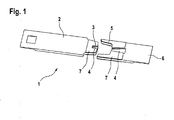
- FIG. 1 shows an example of an analytical test element 1 which includes a cover film 2 and a carrier film (not visible).
- the cover sheet 2 has a recess 3 at the point of application to which the body fluid is applied, which causes the hydrophilic intermediate layer 4 to be accessible in the recess 3.
- a strip 7 of, for example, 7 mm width which has been coated with an adhesive substance in a previous operation, on a tape with several contiguous test elements on top of the cover sheet 2 and optionally a second strip on the underside of the carrier film in the contamination laminated to the tip of the test elements.
- the test element band is separated into individual test elements.
- the edge trimming is punched out before or after singulation along a contour 5, leaving a single test strip with, for example, a 2.8 mm wide blood adhesion strip in the area of the blood application score 3.
- the remaining section 6 is discarded.
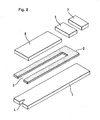
- Figure 2 shows an inventive analytical test element 1 with a recess 3, shown in an exploded view.
- a carrier film 10 in which the recess 3 has been introduced in the form of a V-shaped notch, which may serve, inter alia, the marking of the application, there is a spacer film 11, which the contour and the height (corresponding to the thickness of the spacer film 11) a capillary-active channel 12 determined.
- the spacer film 11 consists of a double-sided adhesive tape, for example, activated carbon was added to the adhesive composition.
- On this spacer sheet 11 are a cover sheet 2, a detection area 14, and a protective film 16 to lie.
- Recess 3 and detection area 14 are mounted so close to one another that the capillary-active zone 12 extends continuously from the free, lying over the recess 3 edge of the recess 3 to the opposite, free edge of the detection area 14.
- the recess in the spacer film 11, which determines the shape of the capillary-active channel 12 is held slightly longer than cover film 2 and detection area 14 together so that a generally only a few millimeters wide, uncovered gap remains, from which when filling the capillary-active zone 12th Air can escape with sample liquid. This gap remains uncovered by the protective film 16 so that its function remains ensured.
- the protective film 16 is intended to prevent exposed regions of the adhesive tape of the spacer film 11 from leading to undesired bonding of the test element to objects from the environment.
- an adhesive substance is applied at least in a part of this range.
- an adhesive substance on the entire top of the cover sheet 2 and on the entire underside of the carrier film 10 applied an adhesive substance, wherein the recess 3 ensures that the capillary channel 12 is accessible and free of adhesive substance.
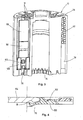
- FIGS. 3 to 6 describe an example of a storage container 20 in which analytical test elements 1 are stored (remagazineised) after use.
- the storage container is inserted into a measuring instrument (not shown).
- the test element 1, which contains a detection area 14 is pushed out of the reservoir 20 into an order position by the instrument and, if necessary, moved to a second measurement position after application of the body fluid in order to be analyzed there.
- the spent test element is withdrawn back into the reservoir.
- an adhesive substance is applied to the test strips 1 in the contamination area so that superfluous applied body fluid remains on the analytical test element and does not contaminate the interior of the device. Without the use of an adhesive substance z. B. dissolve dried blood from the test element and pass through the engagement opening 23 or the Ausschubö réelle 25 in the device interior.
- the storage container 20 is formed by a drum magazine 21 designed as a cylindrical plastic injection molded part.
- the guide chambers 22 are arranged distributed in the circumferential direction and extend axially continuously between an end-side engagement opening 23 for a drive unit 24 and an opposite Ausschubö réelle 25.
- the drum magazine 21 has a central bore 26 with edge teeth 27 for a not shown stepper for flush positioning of researcherschiebenden test element in The feed axis of the drive unit 24.
- Radially offset outward axial blind holes 28 for receiving a desiccant 29 are arranged.
- the guide chambers 22 are closed at the end by a (not shown) sealing film.
- test strips 1 are held for better guidance in a carriage 30 which is longitudinally displaceable in the respective guide chamber 22 like a drawer.
- the carriage 30 engages around an end portion of the test strip 1 and is connected thereto via a latching nose 31.
- a single holding claw 33 of the carriage 30 is provided as a driver.
- a test strip 1 can be positively connected to a single drive pestle in accordance with the previously described carriage 30 for a back and forth movement via a single retaining pawl 33.
- a spring clip 40 is provided as a drive plunger.
- the system is not limited to any specific embodiment of a magazine and / or a test element transport.
Landscapes
- Health & Medical Sciences (AREA)
- Chemical & Material Sciences (AREA)
- Analytical Chemistry (AREA)
- General Health & Medical Sciences (AREA)
- Hematology (AREA)
- Clinical Laboratory Science (AREA)
- Chemical Kinetics & Catalysis (AREA)
- Investigating Or Analysing Biological Materials (AREA)
- Measurement Of The Respiration, Hearing Ability, Form, And Blood Characteristics Of Living Organisms (AREA)
Priority Applications (11)
| Application Number | Priority Date | Filing Date | Title |
|---|---|---|---|
| ES05102290T ES2374541T3 (es) | 2005-03-22 | 2005-03-22 | Elemento de ensayo para el análisis de fluidos corporales. |
| PL05102290T PL1705480T3 (pl) | 2005-03-22 | 2005-03-22 | Element testowy do analizy płynów ustrojowych |
| EP05102290A EP1705480B1 (fr) | 2005-03-22 | 2005-03-22 | Elément d'essai pour analyse de fluides organiques |
| AT05102290T ATE527536T1 (de) | 2005-03-22 | 2005-03-22 | Testelement zur analyse von körperflüssigkeiten |
| PCT/EP2006/002643 WO2006100064A1 (fr) | 2005-03-22 | 2006-03-22 | Element d'essai pour analyser des liquides corporels |
| HK08110002.7A HK1118606B (en) | 2005-03-22 | 2006-03-22 | Test element for analysing bodily fluids |
| CA2598586A CA2598586C (fr) | 2005-03-22 | 2006-03-22 | Element d'essai pour analyser des liquides corporels |
| JP2008502322A JP4825263B2 (ja) | 2005-03-22 | 2006-03-22 | 体液の分析用の試験エレメント |
| CN2006800092030A CN101147057B (zh) | 2005-03-22 | 2006-03-22 | 用于分析体液的测试元件 |
| US11/859,757 US7763470B2 (en) | 2005-03-22 | 2007-09-22 | Test element and method of use for analyzing body fluids |
| US12/815,751 US8303906B2 (en) | 2005-03-22 | 2010-06-15 | Test element for analyzing body fluids |
Applications Claiming Priority (1)
| Application Number | Priority Date | Filing Date | Title |
|---|---|---|---|
| EP05102290A EP1705480B1 (fr) | 2005-03-22 | 2005-03-22 | Elément d'essai pour analyse de fluides organiques |
Publications (2)
| Publication Number | Publication Date |
|---|---|
| EP1705480A1 true EP1705480A1 (fr) | 2006-09-27 |
| EP1705480B1 EP1705480B1 (fr) | 2011-10-05 |
Family
ID=35432656
Family Applications (1)
| Application Number | Title | Priority Date | Filing Date |
|---|---|---|---|
| EP05102290A Expired - Lifetime EP1705480B1 (fr) | 2005-03-22 | 2005-03-22 | Elément d'essai pour analyse de fluides organiques |
Country Status (9)
| Country | Link |
|---|---|
| US (2) | US7763470B2 (fr) |
| EP (1) | EP1705480B1 (fr) |
| JP (1) | JP4825263B2 (fr) |
| CN (1) | CN101147057B (fr) |
| AT (1) | ATE527536T1 (fr) |
| CA (1) | CA2598586C (fr) |
| ES (1) | ES2374541T3 (fr) |
| PL (1) | PL1705480T3 (fr) |
| WO (1) | WO2006100064A1 (fr) |
Families Citing this family (59)
| Publication number | Priority date | Publication date | Assignee | Title |
|---|---|---|---|---|
| US6391005B1 (en) | 1998-03-30 | 2002-05-21 | Agilent Technologies, Inc. | Apparatus and method for penetration with shaft having a sensor for sensing penetration depth |
| US8641644B2 (en) | 2000-11-21 | 2014-02-04 | Sanofi-Aventis Deutschland Gmbh | Blood testing apparatus having a rotatable cartridge with multiple lancing elements and testing means |
| ATE485766T1 (de) | 2001-06-12 | 2010-11-15 | Pelikan Technologies Inc | Elektrisches betätigungselement für eine lanzette |
| US9795747B2 (en) | 2010-06-02 | 2017-10-24 | Sanofi-Aventis Deutschland Gmbh | Methods and apparatus for lancet actuation |
| US9427532B2 (en) | 2001-06-12 | 2016-08-30 | Sanofi-Aventis Deutschland Gmbh | Tissue penetration device |
| US7981056B2 (en) | 2002-04-19 | 2011-07-19 | Pelikan Technologies, Inc. | Methods and apparatus for lancet actuation |
| US7025774B2 (en) | 2001-06-12 | 2006-04-11 | Pelikan Technologies, Inc. | Tissue penetration device |
| JP4209767B2 (ja) | 2001-06-12 | 2009-01-14 | ペリカン テクノロジーズ インコーポレイテッド | 皮膚の性状の一時的変化に対する適応手段を備えた自動最適化形切開器具 |
| AU2002348683A1 (en) | 2001-06-12 | 2002-12-23 | Pelikan Technologies, Inc. | Method and apparatus for lancet launching device integrated onto a blood-sampling cartridge |
| US9226699B2 (en) | 2002-04-19 | 2016-01-05 | Sanofi-Aventis Deutschland Gmbh | Body fluid sampling module with a continuous compression tissue interface surface |
| US8337419B2 (en) | 2002-04-19 | 2012-12-25 | Sanofi-Aventis Deutschland Gmbh | Tissue penetration device |
| US7909778B2 (en) | 2002-04-19 | 2011-03-22 | Pelikan Technologies, Inc. | Method and apparatus for penetrating tissue |
| US8579831B2 (en) | 2002-04-19 | 2013-11-12 | Sanofi-Aventis Deutschland Gmbh | Method and apparatus for penetrating tissue |
| US7976476B2 (en) | 2002-04-19 | 2011-07-12 | Pelikan Technologies, Inc. | Device and method for variable speed lancet |
| US7674232B2 (en) | 2002-04-19 | 2010-03-09 | Pelikan Technologies, Inc. | Method and apparatus for penetrating tissue |
| US8372016B2 (en) | 2002-04-19 | 2013-02-12 | Sanofi-Aventis Deutschland Gmbh | Method and apparatus for body fluid sampling and analyte sensing |
| US9795334B2 (en) | 2002-04-19 | 2017-10-24 | Sanofi-Aventis Deutschland Gmbh | Method and apparatus for penetrating tissue |
| US7175642B2 (en) | 2002-04-19 | 2007-02-13 | Pelikan Technologies, Inc. | Methods and apparatus for lancet actuation |
| US8267870B2 (en) | 2002-04-19 | 2012-09-18 | Sanofi-Aventis Deutschland Gmbh | Method and apparatus for body fluid sampling with hybrid actuation |
| US8360992B2 (en) | 2002-04-19 | 2013-01-29 | Sanofi-Aventis Deutschland Gmbh | Method and apparatus for penetrating tissue |
| US9248267B2 (en) | 2002-04-19 | 2016-02-02 | Sanofi-Aventis Deustchland Gmbh | Tissue penetration device |
| US7491178B2 (en) | 2002-04-19 | 2009-02-17 | Pelikan Technologies, Inc. | Method and apparatus for penetrating tissue |
| US9314194B2 (en) | 2002-04-19 | 2016-04-19 | Sanofi-Aventis Deutschland Gmbh | Tissue penetration device |
| US7713214B2 (en) | 2002-04-19 | 2010-05-11 | Pelikan Technologies, Inc. | Method and apparatus for a multi-use body fluid sampling device with optical analyte sensing |
| US7232451B2 (en) | 2002-04-19 | 2007-06-19 | Pelikan Technologies, Inc. | Method and apparatus for penetrating tissue |
| US7901362B2 (en) | 2002-04-19 | 2011-03-08 | Pelikan Technologies, Inc. | Method and apparatus for penetrating tissue |
| US8221334B2 (en) | 2002-04-19 | 2012-07-17 | Sanofi-Aventis Deutschland Gmbh | Method and apparatus for penetrating tissue |
| US7547287B2 (en) | 2002-04-19 | 2009-06-16 | Pelikan Technologies, Inc. | Method and apparatus for penetrating tissue |
| US7297122B2 (en) | 2002-04-19 | 2007-11-20 | Pelikan Technologies, Inc. | Method and apparatus for penetrating tissue |
| US7892183B2 (en) | 2002-04-19 | 2011-02-22 | Pelikan Technologies, Inc. | Method and apparatus for body fluid sampling and analyte sensing |
| US8784335B2 (en) | 2002-04-19 | 2014-07-22 | Sanofi-Aventis Deutschland Gmbh | Body fluid sampling device with a capacitive sensor |
| US7229458B2 (en) | 2002-04-19 | 2007-06-12 | Pelikan Technologies, Inc. | Method and apparatus for penetrating tissue |
| US8702624B2 (en) | 2006-09-29 | 2014-04-22 | Sanofi-Aventis Deutschland Gmbh | Analyte measurement device with a single shot actuator |
| US7331931B2 (en) | 2002-04-19 | 2008-02-19 | Pelikan Technologies, Inc. | Method and apparatus for penetrating tissue |
| US8574895B2 (en) | 2002-12-30 | 2013-11-05 | Sanofi-Aventis Deutschland Gmbh | Method and apparatus using optical techniques to measure analyte levels |
| EP2238892A3 (fr) | 2003-05-30 | 2011-02-09 | Pelikan Technologies Inc. | Appareil pour prendre de fluide du corps |
| ES2490740T3 (es) | 2003-06-06 | 2014-09-04 | Sanofi-Aventis Deutschland Gmbh | Aparato para toma de muestras de fluido sanguíneo y detección de analitos |
| WO2006001797A1 (fr) | 2004-06-14 | 2006-01-05 | Pelikan Technologies, Inc. | Element penetrant peu douloureux |
| EP1671096A4 (fr) | 2003-09-29 | 2009-09-16 | Pelikan Technologies Inc | Procede et appareil permettant d'obtenir un dispositif de capture d'echantillons ameliore |
| WO2005037095A1 (fr) | 2003-10-14 | 2005-04-28 | Pelikan Technologies, Inc. | Procede et appareil fournissant une interface-utilisateur variable |
| US8668656B2 (en) | 2003-12-31 | 2014-03-11 | Sanofi-Aventis Deutschland Gmbh | Method and apparatus for improving fluidic flow and sample capture |
| US7822454B1 (en) | 2005-01-03 | 2010-10-26 | Pelikan Technologies, Inc. | Fluid sampling device with improved analyte detecting member configuration |
| US8828203B2 (en) | 2004-05-20 | 2014-09-09 | Sanofi-Aventis Deutschland Gmbh | Printable hydrogels for biosensors |
| US9820684B2 (en) | 2004-06-03 | 2017-11-21 | Sanofi-Aventis Deutschland Gmbh | Method and apparatus for a fluid sampling device |
| US9775553B2 (en) | 2004-06-03 | 2017-10-03 | Sanofi-Aventis Deutschland Gmbh | Method and apparatus for a fluid sampling device |
| US8652831B2 (en) | 2004-12-30 | 2014-02-18 | Sanofi-Aventis Deutschland Gmbh | Method and apparatus for analyte measurement test time |
| US9386944B2 (en) | 2008-04-11 | 2016-07-12 | Sanofi-Aventis Deutschland Gmbh | Method and apparatus for analyte detecting device |
| EP2166352A1 (fr) * | 2008-09-17 | 2010-03-24 | F.Hoffmann-La Roche Ag | Dispositif et procédé destinés à la détermination d'un analyte dans un échantillon de liquide |
| US9375169B2 (en) | 2009-01-30 | 2016-06-28 | Sanofi-Aventis Deutschland Gmbh | Cam drive for managing disposable penetrating member actions with a single motor and motor and control system |
| US8061004B2 (en) * | 2009-08-20 | 2011-11-22 | Roche Diagnostics Operations, Inc. | Method of manufacturing a test strip |
| US8965476B2 (en) | 2010-04-16 | 2015-02-24 | Sanofi-Aventis Deutschland Gmbh | Tissue penetration device |
| US20130116597A1 (en) | 2011-11-04 | 2013-05-09 | Phenomenex, Inc. | Method and apparatus for acquiring blood for testing |
| US9573128B1 (en) * | 2012-09-06 | 2017-02-21 | SciKon Innovation, Inc. | Fluidics device allowing fluid flow between a plurality of wells |
| JP6560197B2 (ja) | 2013-06-10 | 2019-08-14 | エフ.ホフマン−ラ ロシュ アーゲーF. Hoffmann−La Roche Aktiengesellschaft | 試験要素を産生するための方法およびデバイス |
| US10035145B2 (en) | 2014-12-02 | 2018-07-31 | SciKon Innovation, Inc. | Piston assembly and related systems for use with a fluidics device |
| CA3018696C (fr) | 2015-03-23 | 2019-10-15 | SciKon Innovation, Inc. | Procede et systemes associes pour utilisation avec un dispositif fluidique |
| KR101558323B1 (ko) * | 2015-03-27 | 2015-10-12 | 보스웰코리아(주) | 자동차 휠용 발광장치 |
| US10071381B2 (en) | 2015-04-17 | 2018-09-11 | Neoteryx, Llc. | Method and apparatus for handling blood for testing |
| GB201721385D0 (en) * | 2017-12-20 | 2018-01-31 | Diagnostics For The Real World Ltd | Device for sample analysis |
Citations (4)
| Publication number | Priority date | Publication date | Assignee | Title |
|---|---|---|---|---|
| DE19753847A1 (de) * | 1997-12-04 | 1999-06-10 | Roche Diagnostics Gmbh | Analytisches Testelement mit Kapillarkanal |
| EP1039298A2 (fr) * | 1999-03-19 | 2000-09-27 | Roche Diagnostics GmbH | Elément d'essai à plusieurs couches |
| DE10003507A1 (de) * | 2000-01-27 | 2001-08-09 | Meinhard Knoll | Vorrichtung und Verfahren zur Entnahme von Flüssigkeiten aus körpereigenem Gewebe und Bestimmung von Stoffkonzentrationen in dieser Flüssigkeit |
| EP1413880A1 (fr) * | 2001-07-27 | 2004-04-28 | Arkray, Inc. | Instrument d'analyse |
Family Cites Families (8)
| Publication number | Priority date | Publication date | Assignee | Title |
|---|---|---|---|---|
| US4774192A (en) * | 1987-01-28 | 1988-09-27 | Technimed Corporation | A dry reagent delivery system with membrane having porosity gradient |
| US5104640A (en) | 1989-03-17 | 1992-04-14 | Wescor, Inc. | Fixative composition for fixing blood smears to slides |
| US5344754A (en) * | 1993-01-13 | 1994-09-06 | Avocet Medical, Inc. | Assay timed by electrical resistance change and test strip |
| JPH10319018A (ja) * | 1997-05-16 | 1998-12-04 | Eiken Chem Co Ltd | 流路切断部位を有するクロマトグラフ装置 |
| DE19753848A1 (de) | 1997-12-04 | 1999-06-10 | Roche Diagnostics Gmbh | Modifikation von Oberflächen zur Steigerung der Oberflächenspannung |
| WO2003046210A1 (fr) * | 2001-11-29 | 2003-06-05 | Agresearch Limited | Technique de prelevement d'echantillons |
| DE10302501A1 (de) | 2003-01-23 | 2004-08-05 | Roche Diagnostics Gmbh | Vorrichtung und Verfahren zur Aufnahme einer Körperflüssigkeit für Analysezwecke |
| US20100291588A1 (en) * | 2005-06-24 | 2010-11-18 | The Board Of Regents Of The University Of Texas System | Systems and methods including self-contained cartridges with detection systems and fluid delivery systems |
-
2005
- 2005-03-22 AT AT05102290T patent/ATE527536T1/de active
- 2005-03-22 PL PL05102290T patent/PL1705480T3/pl unknown
- 2005-03-22 EP EP05102290A patent/EP1705480B1/fr not_active Expired - Lifetime
- 2005-03-22 ES ES05102290T patent/ES2374541T3/es not_active Expired - Lifetime
-
2006
- 2006-03-22 WO PCT/EP2006/002643 patent/WO2006100064A1/fr not_active Ceased
- 2006-03-22 JP JP2008502322A patent/JP4825263B2/ja not_active Expired - Fee Related
- 2006-03-22 CA CA2598586A patent/CA2598586C/fr not_active Expired - Fee Related
- 2006-03-22 CN CN2006800092030A patent/CN101147057B/zh not_active Expired - Fee Related
-
2007
- 2007-09-22 US US11/859,757 patent/US7763470B2/en active Active
-
2010
- 2010-06-15 US US12/815,751 patent/US8303906B2/en not_active Expired - Lifetime
Patent Citations (4)
| Publication number | Priority date | Publication date | Assignee | Title |
|---|---|---|---|---|
| DE19753847A1 (de) * | 1997-12-04 | 1999-06-10 | Roche Diagnostics Gmbh | Analytisches Testelement mit Kapillarkanal |
| EP1039298A2 (fr) * | 1999-03-19 | 2000-09-27 | Roche Diagnostics GmbH | Elément d'essai à plusieurs couches |
| DE10003507A1 (de) * | 2000-01-27 | 2001-08-09 | Meinhard Knoll | Vorrichtung und Verfahren zur Entnahme von Flüssigkeiten aus körpereigenem Gewebe und Bestimmung von Stoffkonzentrationen in dieser Flüssigkeit |
| EP1413880A1 (fr) * | 2001-07-27 | 2004-04-28 | Arkray, Inc. | Instrument d'analyse |
Also Published As
| Publication number | Publication date |
|---|---|
| JP2008534920A (ja) | 2008-08-28 |
| JP4825263B2 (ja) | 2011-11-30 |
| CN101147057A (zh) | 2008-03-19 |
| PL1705480T3 (pl) | 2012-03-30 |
| CN101147057B (zh) | 2011-12-21 |
| US8303906B2 (en) | 2012-11-06 |
| HK1118606A1 (en) | 2009-02-13 |
| US20100278693A1 (en) | 2010-11-04 |
| ES2374541T3 (es) | 2012-02-17 |
| CA2598586A1 (fr) | 2006-09-28 |
| US7763470B2 (en) | 2010-07-27 |
| WO2006100064A1 (fr) | 2006-09-28 |
| EP1705480B1 (fr) | 2011-10-05 |
| CA2598586C (fr) | 2013-09-03 |
| US20080060424A1 (en) | 2008-03-13 |
| ATE527536T1 (de) | 2011-10-15 |
Similar Documents
| Publication | Publication Date | Title |
|---|---|---|
| EP1705480B1 (fr) | Elément d'essai pour analyse de fluides organiques | |
| EP1789192B1 (fr) | Element de test analytique | |
| DE60306711T2 (de) | Verfahren und Vorrichtung zur Sammlung von physiologischen Proben | |
| EP0949002B1 (fr) | Méthode de fabrication d'élements d'analyse | |
| DE60302705T2 (de) | Vorratsbehältnis für Teststreifen | |
| EP1714614B1 (fr) | Moyen d'analyse | |
| DE60315373T2 (de) | Vorrichtung und Verfahren zur Bestimmung der Konzentration von Analyten | |
| DE60311176T2 (de) | Verfahren zur Herstellung von Vorrichtungen zur Entnahme von physiologischen Proben | |
| EP1287785B1 (fr) | Moyen d'analyse avec lancette et élément d'essai | |
| DE60303886T2 (de) | Vorrichtungen zur Bestimmung der Analytkonzentration und ihre Verwendung | |
| EP2654955B1 (fr) | Procédé de mélange d'au moins une solution d'échantillon avec des réactifs | |
| US20100113977A1 (en) | Integrated disposable for automatic or manual blood dosing | |
| EP1522343B1 (fr) | Dispositif de test analytique comprenant une matrice hydrophile pour former un canal capillaire, son utilisation et procédé pour déterminer un analyte dans un liquide. | |
| DE19826957A1 (de) | Vorrichtung zum Bestimmen eines Analyten in einem Körperfluid | |
| EP1039298A2 (fr) | Elément d'essai à plusieurs couches | |
| EP2464290B1 (fr) | Element test pour l'analyse d'un liquide corporel | |
| EP2059169B1 (fr) | Dispositif médical | |
| EP3361253A1 (fr) | Dispositif de contrôle ciblé et d'affichage de la présence ou de l'absence d'analytes dans un échantillon liquide | |
| HK1118606B (en) | Test element for analysing bodily fluids | |
| HK1105570A (en) | Integrated disposable for automatic or manual blood dosing |
Legal Events
| Date | Code | Title | Description |
|---|---|---|---|
| PUAI | Public reference made under article 153(3) epc to a published international application that has entered the european phase |
Free format text: ORIGINAL CODE: 0009012 |
|
| AK | Designated contracting states |
Kind code of ref document: A1 Designated state(s): AT BE BG CH CY CZ DE DK EE ES FI FR GB GR HU IE IS IT LI LT LU MC NL PL PT RO SE SI SK TR |
|
| AX | Request for extension of the european patent |
Extension state: AL BA HR LV MK YU |
|
| AKX | Designation fees paid | ||
| 17P | Request for examination filed |
Effective date: 20070530 |
|
| RBV | Designated contracting states (corrected) |
Designated state(s): AT BE BG CH CY CZ DE DK EE ES FI FR GB GR HU IE IS IT LI LT LU MC NL PL PT RO SE SI SK TR |
|
| 17Q | First examination report despatched |
Effective date: 20070820 |
|
| RAP1 | Party data changed (applicant data changed or rights of an application transferred) |
Owner name: F. HOFFMANN-LA ROCHE AG Owner name: ROCHE DIAGNOSTICS GMBH |
|
| GRAP | Despatch of communication of intention to grant a patent |
Free format text: ORIGINAL CODE: EPIDOSNIGR1 |
|
| GRAS | Grant fee paid |
Free format text: ORIGINAL CODE: EPIDOSNIGR3 |
|
| GRAA | (expected) grant |
Free format text: ORIGINAL CODE: 0009210 |
|
| AK | Designated contracting states |
Kind code of ref document: B1 Designated state(s): AT BE BG CH CY CZ DE DK EE ES FI FR GB GR HU IE IS IT LI LT LU MC NL PL PT RO SE SI SK TR |
|
| REG | Reference to a national code |
Ref country code: GB Ref legal event code: FG4D Free format text: NOT ENGLISH |
|
| REG | Reference to a national code |
Ref country code: DE Ref legal event code: R081 Ref document number: 502005011958 Country of ref document: DE Owner name: ROCHE DIABETES CARE GMBH, DE Free format text: FORMER OWNERS: ROCHE DIAGNOSTICS GMBH, 68305 MANNHEIM, DE; F. HOFFMANN-LA ROCHE AG, 4070 BASEL, CH |
|
| REG | Reference to a national code |
Ref country code: CH Ref legal event code: EP |
|
| REG | Reference to a national code |
Ref country code: IE Ref legal event code: FG4D |
|
| REG | Reference to a national code |
Ref country code: DE Ref legal event code: R096 Ref document number: 502005011958 Country of ref document: DE Effective date: 20111201 |
|
| REG | Reference to a national code |
Ref country code: NL Ref legal event code: T3 |
|
| REG | Reference to a national code |
Ref country code: ES Ref legal event code: FG2A Ref document number: 2374541 Country of ref document: ES Kind code of ref document: T3 Effective date: 20120217 |
|
| PG25 | Lapsed in a contracting state [announced via postgrant information from national office to epo] |
Ref country code: SI Free format text: LAPSE BECAUSE OF FAILURE TO SUBMIT A TRANSLATION OF THE DESCRIPTION OR TO PAY THE FEE WITHIN THE PRESCRIBED TIME-LIMIT Effective date: 20111005 |
|
| LTIE | Lt: invalidation of european patent or patent extension |
Effective date: 20111005 |
|
| REG | Reference to a national code |
Ref country code: PL Ref legal event code: T3 |
|
| PG25 | Lapsed in a contracting state [announced via postgrant information from national office to epo] |
Ref country code: LT Free format text: LAPSE BECAUSE OF FAILURE TO SUBMIT A TRANSLATION OF THE DESCRIPTION OR TO PAY THE FEE WITHIN THE PRESCRIBED TIME-LIMIT Effective date: 20111005 Ref country code: IS Free format text: LAPSE BECAUSE OF FAILURE TO SUBMIT A TRANSLATION OF THE DESCRIPTION OR TO PAY THE FEE WITHIN THE PRESCRIBED TIME-LIMIT Effective date: 20120205 |
|
| REG | Reference to a national code |
Ref country code: IE Ref legal event code: FD4D |
|
| PG25 | Lapsed in a contracting state [announced via postgrant information from national office to epo] |
Ref country code: GR Free format text: LAPSE BECAUSE OF FAILURE TO SUBMIT A TRANSLATION OF THE DESCRIPTION OR TO PAY THE FEE WITHIN THE PRESCRIBED TIME-LIMIT Effective date: 20120106 Ref country code: SE Free format text: LAPSE BECAUSE OF FAILURE TO SUBMIT A TRANSLATION OF THE DESCRIPTION OR TO PAY THE FEE WITHIN THE PRESCRIBED TIME-LIMIT Effective date: 20111005 Ref country code: PT Free format text: LAPSE BECAUSE OF FAILURE TO SUBMIT A TRANSLATION OF THE DESCRIPTION OR TO PAY THE FEE WITHIN THE PRESCRIBED TIME-LIMIT Effective date: 20120206 |
|
| PG25 | Lapsed in a contracting state [announced via postgrant information from national office to epo] |
Ref country code: CY Free format text: LAPSE BECAUSE OF FAILURE TO SUBMIT A TRANSLATION OF THE DESCRIPTION OR TO PAY THE FEE WITHIN THE PRESCRIBED TIME-LIMIT Effective date: 20111005 |
|
| PG25 | Lapsed in a contracting state [announced via postgrant information from national office to epo] |
Ref country code: DK Free format text: LAPSE BECAUSE OF FAILURE TO SUBMIT A TRANSLATION OF THE DESCRIPTION OR TO PAY THE FEE WITHIN THE PRESCRIBED TIME-LIMIT Effective date: 20111005 Ref country code: CZ Free format text: LAPSE BECAUSE OF FAILURE TO SUBMIT A TRANSLATION OF THE DESCRIPTION OR TO PAY THE FEE WITHIN THE PRESCRIBED TIME-LIMIT Effective date: 20111005 Ref country code: EE Free format text: LAPSE BECAUSE OF FAILURE TO SUBMIT A TRANSLATION OF THE DESCRIPTION OR TO PAY THE FEE WITHIN THE PRESCRIBED TIME-LIMIT Effective date: 20111005 Ref country code: BG Free format text: LAPSE BECAUSE OF FAILURE TO SUBMIT A TRANSLATION OF THE DESCRIPTION OR TO PAY THE FEE WITHIN THE PRESCRIBED TIME-LIMIT Effective date: 20120105 Ref country code: SK Free format text: LAPSE BECAUSE OF FAILURE TO SUBMIT A TRANSLATION OF THE DESCRIPTION OR TO PAY THE FEE WITHIN THE PRESCRIBED TIME-LIMIT Effective date: 20111005 Ref country code: IE Free format text: LAPSE BECAUSE OF FAILURE TO SUBMIT A TRANSLATION OF THE DESCRIPTION OR TO PAY THE FEE WITHIN THE PRESCRIBED TIME-LIMIT Effective date: 20111005 |
|
| PLBE | No opposition filed within time limit |
Free format text: ORIGINAL CODE: 0009261 |
|
| STAA | Information on the status of an ep patent application or granted ep patent |
Free format text: STATUS: NO OPPOSITION FILED WITHIN TIME LIMIT |
|
| PG25 | Lapsed in a contracting state [announced via postgrant information from national office to epo] |
Ref country code: RO Free format text: LAPSE BECAUSE OF FAILURE TO SUBMIT A TRANSLATION OF THE DESCRIPTION OR TO PAY THE FEE WITHIN THE PRESCRIBED TIME-LIMIT Effective date: 20111005 |
|
| 26N | No opposition filed |
Effective date: 20120706 |
|
| BERE | Be: lapsed |
Owner name: ROCHE DIAGNOSTICS G.M.B.H. Effective date: 20120331 Owner name: F. HOFFMANN-LA ROCHE A.G. Effective date: 20120331 |
|
| PG25 | Lapsed in a contracting state [announced via postgrant information from national office to epo] |
Ref country code: MC Free format text: LAPSE BECAUSE OF NON-PAYMENT OF DUE FEES Effective date: 20120331 |
|
| REG | Reference to a national code |
Ref country code: DE Ref legal event code: R097 Ref document number: 502005011958 Country of ref document: DE Effective date: 20120706 Ref country code: CH Ref legal event code: PL |
|
| PG25 | Lapsed in a contracting state [announced via postgrant information from national office to epo] |
Ref country code: CH Free format text: LAPSE BECAUSE OF NON-PAYMENT OF DUE FEES Effective date: 20120331 Ref country code: LI Free format text: LAPSE BECAUSE OF NON-PAYMENT OF DUE FEES Effective date: 20120331 Ref country code: BE Free format text: LAPSE BECAUSE OF NON-PAYMENT OF DUE FEES Effective date: 20120331 |
|
| REG | Reference to a national code |
Ref country code: AT Ref legal event code: MM01 Ref document number: 527536 Country of ref document: AT Kind code of ref document: T Effective date: 20120322 |
|
| PG25 | Lapsed in a contracting state [announced via postgrant information from national office to epo] |
Ref country code: FI Free format text: LAPSE BECAUSE OF FAILURE TO SUBMIT A TRANSLATION OF THE DESCRIPTION OR TO PAY THE FEE WITHIN THE PRESCRIBED TIME-LIMIT Effective date: 20111005 |
|
| PG25 | Lapsed in a contracting state [announced via postgrant information from national office to epo] |
Ref country code: AT Free format text: LAPSE BECAUSE OF NON-PAYMENT OF DUE FEES Effective date: 20120322 |
|
| PG25 | Lapsed in a contracting state [announced via postgrant information from national office to epo] |
Ref country code: TR Free format text: LAPSE BECAUSE OF FAILURE TO SUBMIT A TRANSLATION OF THE DESCRIPTION OR TO PAY THE FEE WITHIN THE PRESCRIBED TIME-LIMIT Effective date: 20111005 |
|
| PG25 | Lapsed in a contracting state [announced via postgrant information from national office to epo] |
Ref country code: LU Free format text: LAPSE BECAUSE OF NON-PAYMENT OF DUE FEES Effective date: 20120322 |
|
| PG25 | Lapsed in a contracting state [announced via postgrant information from national office to epo] |
Ref country code: HU Free format text: LAPSE BECAUSE OF FAILURE TO SUBMIT A TRANSLATION OF THE DESCRIPTION OR TO PAY THE FEE WITHIN THE PRESCRIBED TIME-LIMIT Effective date: 20050322 |
|
| REG | Reference to a national code |
Ref country code: FR Ref legal event code: PLFP Year of fee payment: 12 |
|
| REG | Reference to a national code |
Ref country code: DE Ref legal event code: R081 Ref document number: 502005011958 Country of ref document: DE Owner name: ROCHE DIABETES CARE GMBH, DE Free format text: FORMER OWNER: ROCHE DIAGNOSTICS GMBH, 68305 MANNHEIM, DE |
|
| REG | Reference to a national code |
Ref country code: FR Ref legal event code: PLFP Year of fee payment: 13 |
|
| PGFP | Annual fee paid to national office [announced via postgrant information from national office to epo] |
Ref country code: PL Payment date: 20161220 Year of fee payment: 13 |
|
| PGFP | Annual fee paid to national office [announced via postgrant information from national office to epo] |
Ref country code: NL Payment date: 20170309 Year of fee payment: 13 |
|
| PGFP | Annual fee paid to national office [announced via postgrant information from national office to epo] |
Ref country code: ES Payment date: 20170308 Year of fee payment: 13 |
|
| REG | Reference to a national code |
Ref country code: FR Ref legal event code: PLFP Year of fee payment: 14 |
|
| REG | Reference to a national code |
Ref country code: NL Ref legal event code: MM Effective date: 20180401 |
|
| PG25 | Lapsed in a contracting state [announced via postgrant information from national office to epo] |
Ref country code: NL Free format text: LAPSE BECAUSE OF NON-PAYMENT OF DUE FEES Effective date: 20180401 |
|
| PG25 | Lapsed in a contracting state [announced via postgrant information from national office to epo] |
Ref country code: PL Free format text: LAPSE BECAUSE OF NON-PAYMENT OF DUE FEES Effective date: 20180322 |
|
| REG | Reference to a national code |
Ref country code: ES Ref legal event code: FD2A Effective date: 20190911 |
|
| PG25 | Lapsed in a contracting state [announced via postgrant information from national office to epo] |
Ref country code: ES Free format text: LAPSE BECAUSE OF NON-PAYMENT OF DUE FEES Effective date: 20180323 |
|
| PGFP | Annual fee paid to national office [announced via postgrant information from national office to epo] |
Ref country code: DE Payment date: 20240220 Year of fee payment: 20 Ref country code: GB Payment date: 20240221 Year of fee payment: 20 |
|
| PGFP | Annual fee paid to national office [announced via postgrant information from national office to epo] |
Ref country code: IT Payment date: 20240220 Year of fee payment: 20 Ref country code: FR Payment date: 20240220 Year of fee payment: 20 |
|
| REG | Reference to a national code |
Ref country code: DE Ref legal event code: R071 Ref document number: 502005011958 Country of ref document: DE |
|
| REG | Reference to a national code |
Ref country code: GB Ref legal event code: PE20 Expiry date: 20250321 |
|
| PG25 | Lapsed in a contracting state [announced via postgrant information from national office to epo] |
Ref country code: GB Free format text: LAPSE BECAUSE OF EXPIRATION OF PROTECTION Effective date: 20250321 |