EP1705902A1 - Appareil de saisie d'image - Google Patents
Appareil de saisie d'image Download PDFInfo
- Publication number
- EP1705902A1 EP1705902A1 EP04807764A EP04807764A EP1705902A1 EP 1705902 A1 EP1705902 A1 EP 1705902A1 EP 04807764 A EP04807764 A EP 04807764A EP 04807764 A EP04807764 A EP 04807764A EP 1705902 A1 EP1705902 A1 EP 1705902A1
- Authority
- EP
- European Patent Office
- Prior art keywords
- read
- row
- frame
- pulse
- pixel
- Prior art date
- Legal status (The legal status is an assumption and is not a legal conclusion. Google has not performed a legal analysis and makes no representation as to the accuracy of the status listed.)
- Withdrawn
Links
Images




Classifications
-
- H—ELECTRICITY
- H04—ELECTRIC COMMUNICATION TECHNIQUE
- H04N—PICTORIAL COMMUNICATION, e.g. TELEVISION
- H04N25/00—Circuitry of solid-state image sensors [SSIS]; Control thereof
- H04N25/40—Extracting pixel data from image sensors by controlling scanning circuits, e.g. by modifying the number of pixels sampled or to be sampled
- H04N25/44—Extracting pixel data from image sensors by controlling scanning circuits, e.g. by modifying the number of pixels sampled or to be sampled by partially reading an SSIS array
- H04N25/445—Extracting pixel data from image sensors by controlling scanning circuits, e.g. by modifying the number of pixels sampled or to be sampled by partially reading an SSIS array by skipping some contiguous pixels within the read portion of the array
-
- H—ELECTRICITY
- H04—ELECTRIC COMMUNICATION TECHNIQUE
- H04N—PICTORIAL COMMUNICATION, e.g. TELEVISION
- H04N25/00—Circuitry of solid-state image sensors [SSIS]; Control thereof
- H04N25/40—Extracting pixel data from image sensors by controlling scanning circuits, e.g. by modifying the number of pixels sampled or to be sampled
- H04N25/44—Extracting pixel data from image sensors by controlling scanning circuits, e.g. by modifying the number of pixels sampled or to be sampled by partially reading an SSIS array
- H04N25/447—Extracting pixel data from image sensors by controlling scanning circuits, e.g. by modifying the number of pixels sampled or to be sampled by partially reading an SSIS array by preserving the colour pattern with or without loss of information
-
- H—ELECTRICITY
- H04—ELECTRIC COMMUNICATION TECHNIQUE
- H04N—PICTORIAL COMMUNICATION, e.g. TELEVISION
- H04N25/00—Circuitry of solid-state image sensors [SSIS]; Control thereof
- H04N25/40—Extracting pixel data from image sensors by controlling scanning circuits, e.g. by modifying the number of pixels sampled or to be sampled
- H04N25/46—Extracting pixel data from image sensors by controlling scanning circuits, e.g. by modifying the number of pixels sampled or to be sampled by combining or binning pixels
-
- H—ELECTRICITY
- H04—ELECTRIC COMMUNICATION TECHNIQUE
- H04N—PICTORIAL COMMUNICATION, e.g. TELEVISION
- H04N25/00—Circuitry of solid-state image sensors [SSIS]; Control thereof
- H04N25/70—SSIS architectures; Circuits associated therewith
- H04N25/76—Addressed sensors, e.g. MOS or CMOS sensors
- H04N25/779—Circuitry for scanning or addressing the pixel array
-
- H—ELECTRICITY
- H04—ELECTRIC COMMUNICATION TECHNIQUE
- H04N—PICTORIAL COMMUNICATION, e.g. TELEVISION
- H04N25/00—Circuitry of solid-state image sensors [SSIS]; Control thereof
- H04N25/70—SSIS architectures; Circuits associated therewith
- H04N25/76—Addressed sensors, e.g. MOS or CMOS sensors
- H04N25/7795—Circuitry for generating timing or clock signals
Definitions
- the present invention relates to an imaging apparatus that contains an imaging device for photo-electrically converting an optical image of every pixel and scanning it using an X-Y address to acquire an image signal.
- JPN. PAT. APPLN. KOKAI Publication No. 2002-314868 discloses the following imaging apparatus.
- the foregoing disclosed imaging apparatus can achieve wide range zooming at a high resolution.
- the foregoing Publication No. 2002-314868 discloses the following technique. According to the technique, thinning is changed in order to transform a magnification by scanning an imaging device.
- the thinning ratio is indicative of reading out one image from the imaging device every m x n pixels (m, n: natural number). Several cut angles of view are changed, and thereby, at least non-continuous zooming is possible.
- the foregoing publication has no disclosure relevant to a pattern change of thinning read when continuous images are imaged (shot). When photo-electrically converted information stored in the imaging device is read, read is carried out at a single thinning read pattern to simultaneously reset the contents. In this case, there is no problem in particular.
- the method of using both read and reset is employed if the thinning read pattern is changed every frame for the purpose of achieving both magnification transformation and anti-aliasing.
- the foregoing method has the following disadvantages. Specifically, read - non-read line changes in a continuous frame, or two time reads are carried out at a continuous frame in one line while only one-time read is carried out in another line. In brief, if various read patterns (see FIG. 9) are generated, storage time of photo-electrically converted information is different every line.
- An object of the present invention is to provide an imaging apparatus that can utilize at least stepwise optional magnification transformation and optional electronic shutter stroke via optional pattern thinning read of an imaging device, and can generate a read pulse and reset pulse of the imaging device with a simple configuration.
- Another object of the present invention is to provide an imaging apparatus that can generate an effective read pulse and reset pulse when an inter-frame operation is performed.
- an imaging apparatus having an imaging device photo-electrically converting an optical image of every pixel, and scanning the image using an X-Y address to acquire an image signal, comprising:
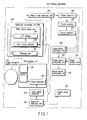
- FIG. 1 is a circuit diagram showing the configuration of an imaging apparatus according to a first embodiment of the present invention.
- An imaging apparatus 200 includes an image formation optical system 110 and an imaging unit 220.
- the imaging optical system 110 forms an optical image of a subject.
- the imaging unit 220 outputs an image signal of a predetermined area of the optical image formed by the image formation optical system 110.
- the imaging unit 220 has an aliasing MOS imaging device 222 and a read controller 224.
- the MOS imaging device 222 photo-electrically converts the optical image formed by the image formation optical system 110 to acquire a digital image signal (a set of pixel data).
- the read controller 224 is used as read means, that is, reads out the image signal acquired via the imaging device 222 in a state of thinning out pixels as the need arises.
- the read controller 224 reads out the image signal by a thinning-out operation on the imaging device 222. More specifically, an area setup unit 132 used as acquisition area setup means sets which area of the imaging device 222 should be outputted as an image signal. In this case, a read rule selecting unit 234 used as a read pattern change means selects a read rule suitable for changing a read pattern for achieving thinning read in accordance with the set area. Then, the read controller 224 reads out an image signal via pixel thinning according to the read rule thus selected. The operation of a read phase controller 230 will be described later. Incidentally, the variable power of the image signal may be set in place of setting the image signal area.
- a distortion correcting unit 140 performs predetermined distortion corrections with respect to the read image signal.
- the distortion correcting unit 140 used as distortion correction means includes a filtering unit 142 and a filter factor setup unit 144.
- the filter factor setup unit 144 has an LUT storage 146 and filter factor selector 148.
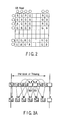
- FIG. 2 is a view to explain an example of achieving read in a state of thinning out two pixels from eight pixels in both horizontal and vertical directions. If read is carried out using the foregoing method, an image has a step, and as a result, is distorted. For this reason, the following concept is given. Specifically, as shown in the upper stage of FIG. 3A, skipped pixels (500, 501 in FIG. 3A) data are interpolated via linear interpolation using its peripheral pixels to acquire 8-pixel data. Then, the 8-pixel data is converted into 6 pixels (as shown in the lower stage of FIG. 3A).
- Thinning read is realized using the configuration of a pipeline shown in FIG. 4.
- a shift register 162 shifts a holding image signal by one in the right direction every one-time operation according to clock.
- a selector 164 selects either of the first data (C1) or the third data (C3) of neighboring five pixel data C1 to C5 held in the shift register 162 according to the state of a control signal s1.
- a selector 166 selects either of the third data (C3) or the fifth data (C5) of neighboring five pixel data C1 to C5 held in the shift register 162 according to the state of a control signal s2.
- a multiplier 174 multiplies an output d1 of the selector 164 by a weight addition coefficient k1.
- a multiplier 176 multiplies an output d2 of the selector 166 by a weight addition coefficient k2.
- An adder 178 adds the output of the multiplier 174 and the output of the multiplier 176.
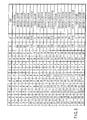
- FIG. 5 is a table to explain the pipeline processing operation (state transition) performed by a filtering unit 142 shown in FIG. 1.
- a pixel data sequence (i0, i1, i2, ...) supplied to the shift register 162 is shifted to the right direction every one-time operation according to clock.
- the coefficient k1 is read from the LUT storage 146 included in the filter factor setup unit 144 in synchrony with the clock, and thereafter, supplied to the multiplier 174.
- the coefficient k2 is read, and thereafter, supplied to the multiplier 176. Therefore, the adder 178 outputs a value of k1 ⁇ d1 + k2 ⁇ d2 as an output OUT.
- the following operations are synchronously performed, as seen from FIG. 5. Specifically, the operations are as follows. Shift of pixel data (i0, i1, i2, 7)
- pipeline processing including pixel phase operation (changeover of selector) is carried out.
- the imaging apparatus of this embodiment is based on using a dynamic image as an inputted image signal.
- Mutually lacking pixel data are interpolated between continuous two frames so that interlaced scanning interpolates lacking pixel data between two fields.
- the read phase controller 230 of FIG. 1 shifts a reference position of a pixel data range read via the read controller 224 so that images signals of continuous several frames do not lack pixel data.
- the foregoing shift is preferably in a range from 2 to 8 pixels.
- FIG. 6 and FIG. 7 are schematic views showing a state that a reference position of a read range is shifted in a 6/8 thinning read.
- [x, y] denotes a pixel position of the pixel array of the imaging device 222
- (x, y) denotes a pixel data array of a read range.
- the imaging device 222 has a pixel size of k pixels in the horizontal direction ⁇ 1 pixels in the vertical direction.
- the upper left pixel position of the imaging device 222 is expressed as [0, 0]
- the lower right pixel position is expressed as [k, 1].
- a pixel size of one frame read range is m pixels in the horizontal direction ⁇ n pixels in the vertical direction.
- the upper left read start position is expressed as (0, 0)
- the lower right read end position is expressed as (m, n).
- the frame read range of FIG. 7 is shifted by +2 pixels in the horizontal direction and by +2 pixels in the vertical direction with respect to the frame read range of FIG. 6.
- the upper left read start position (0, 0) corresponds to the upper left pixel position [0, 0] of the imaging device 222.
- ( 0 , 0 ) [ 0 , 0 ]
- the read controller 224 reads out an image signal based on a read rule that differs between several frames. Then, the filtering unit 142 carries out distortion correction filtering with respect to the image signal. Thereafter, the image signal is supplied to the image range selecting unit 240, and then, image position misalignment between frames is corrected under the control of the read phase controller 230.
- the image range selecting unit 240 selects a range common to the frame of FIG. 6 and the frame of FIG. 7. Specifically, the unit 240 selects a rectangular range using (2, 2) and (m, n) as the diagonal vertex with respect to the frame of FIG. 6.
- the unit 240 selects a rectangular range using (0, 0) to (m - 2, n - 2) as the diagonal vertex with respect to the frame of FIG. 7.
- the range selected via the image range selecting unit 240 always has (m - 2) ⁇ (n - 2) pixel data.
- the image range selecting unit 240 changes the cropping range based on the read start position information.
- Frame memories 252, 254 and 256 each comprise a FIFO (First In First Out) memory.
- the inter-frame operating unit 260 generates an image signal to be outputted using the same positioned pixel in first frame data and a second frame different from the first frame of these frame memories 252, 254 and 256.
- An image signal of a predetermined frame is stored in frame memories 252, 254 and 256 placed the image range selecting unit 240.
- the inter-frame operating unit 260 performs an inter-frame operation, and thereafter, outputs the image signal to post-stage processing systems, that is, image processing unit 152, image display unit 154 and image recording unit 156. Interpolation is made between frames, and thereby, a high quality image is obtained via a low-pass filtering effect and distortion correction effect.
- thinning read is carried out in both horizontal and vertical directions, and distortion corrections are made in both horizontal and vertical directions using pipeline processing.
- an imaging device such as a CCD performing a horizontal transfer operation from vertical transfer cannot achieve thinning read in the horizontal direction, in principle.
- all pixels are read using the foregoing expression (1), and thereby, size change must be made via one-dimensional interpolation.
- thinning read is carried out using the foregoing expression (1), and then, distortion corrections are made as above.
- the read controller 224 shifts a thinning pattern phase between continuous frames.
- reset scanning for specifying the exposure time must be made before a read.
- readout pulse and reset pulse scanning are performed.
- the scanning time is prevented from being different for every line in the frame.
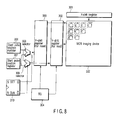
- FIG. 8 is a circuit diagram showing one configuration of a read controller 224 for performing a read operation.
- the read controller 224 includes X-shift register 301, Y-shift register 302, Y-shift register 303, timing generator (TG) 304, start pulse position registers 306, 307, selectors 308 and 309.
- the X-shift register 301 scans X-direction for reading in accordance with the X-Y address coordinate.
- the Y-shift register 302 scans lines for reading.
- the Y-shift register 303 resets lines.
- the timing generator (TG) 304 generates a signal (timing pattern) for specifying the timing of three shift registers 301 to 303.
- the start pulse position registers 306 and 307 specify a read start position.
- the selectors 308 and 309 select either of the output of the start pulse position register 306 or the output of the register 307.
- FIG. 9 shows an example of achieving thinning read, which skips two of six lines.
- FIG. 10 is a timing chart showing alternately different read patterns between frames A and B. Specifically, read and reset are repeated between frames A and B.
- Frame A Line- 1, 2, 5, 6, 7, 8, 11, 12: Read Line- 1, 2, 3, 4, 7, 8, 9, 10: Reset
- Frame B Line- 1, 2, 3, 4, 7, 8, 9, 10: Read Line- 1, 2, 5, 6, 7, 8, 11, 12: Reset
- approximately one-frame storage signal is obtained in all lines. Moreover, a timing of supplying a reset pulse is shifted (made different), and thereby, the exposure time may be varied.
- the total number of read pulses is equal to the total number of reset pulses prior to read in each frame.
- a read operation is made only for lines 5, 6, 11 and 12 of the frame A.
- frame B the read operation is reset; therefore, when a read operation is made for the next frame A, a storage signal of nearly one frame is obtained.
- lines 1, 2, 7 and 8 read and reset are made.
- the reset signal of frame A is equal to the read signal of the frame B.
- an FF circuit 310 is set up so that the contents of start pulse position registers 306 and 307 specifying a read start position is exclusively selected.
- the selecting operation of selectors 308 and 309 is controlled so that the Y-shift register 303 refers to the content of the start pulse position register 307.
- Read and reset pulses are generated at each position according to a thinning pattern generated in the TG 304 from the start position of the start pulse position registers 306 and 307.
Landscapes
- Engineering & Computer Science (AREA)
- Multimedia (AREA)
- Signal Processing (AREA)
- Transforming Light Signals Into Electric Signals (AREA)
- Studio Devices (AREA)
Applications Claiming Priority (2)
| Application Number | Priority Date | Filing Date | Title |
|---|---|---|---|
| JP2003434843 | 2003-12-26 | ||
| PCT/JP2004/019408 WO2005064925A1 (fr) | 2003-12-26 | 2004-12-24 | Appareil de saisie d'image |
Publications (2)
| Publication Number | Publication Date |
|---|---|
| EP1705902A1 true EP1705902A1 (fr) | 2006-09-27 |
| EP1705902A4 EP1705902A4 (fr) | 2008-12-17 |
Family
ID=34736572
Family Applications (1)
| Application Number | Title | Priority Date | Filing Date |
|---|---|---|---|
| EP04807764A Withdrawn EP1705902A4 (fr) | 2003-12-26 | 2004-12-24 | Appareil de saisie d'image |
Country Status (4)
| Country | Link |
|---|---|
| US (1) | US20060237630A1 (fr) |
| EP (1) | EP1705902A4 (fr) |
| JP (1) | JPWO2005064925A1 (fr) |
| WO (1) | WO2005064925A1 (fr) |
Families Citing this family (4)
| Publication number | Priority date | Publication date | Assignee | Title |
|---|---|---|---|---|
| US8040385B2 (en) | 2002-12-02 | 2011-10-18 | Olympus Corporation | Image pickup apparatus |
| DE112004002998A5 (de) * | 2004-11-10 | 2007-09-20 | Daimlerchrysler Ag | Verfahren für ein präventiv wirkendes Schutzsystem in einem Kraftfahrzeug |
| WO2008053791A1 (fr) * | 2006-10-31 | 2008-05-08 | Sanyo Electric Co., Ltd. | Dispositif d'imagerie et procédé de génération de signal vidéo utilisé dans le dispositif d'imagerie |
| JP5101946B2 (ja) * | 2007-08-03 | 2012-12-19 | キヤノン株式会社 | 撮像装置及び撮像システム |
Family Cites Families (27)
| Publication number | Priority date | Publication date | Assignee | Title |
|---|---|---|---|---|
| JPS62219754A (ja) * | 1986-03-19 | 1987-09-28 | Canon Inc | 画像読取り装置 |
| US4831451A (en) * | 1987-04-02 | 1989-05-16 | Texas Instruments Incorporated | Horizontal scanner for image sensor arrays |
| JP3352288B2 (ja) * | 1995-07-24 | 2002-12-03 | キヤノン株式会社 | 撮像ユニットおよび撮像信号処理装置 |
| JP3771954B2 (ja) * | 1995-08-04 | 2006-05-10 | ソニー株式会社 | 画像表示制御装置および方法 |
| EP0809395A3 (fr) * | 1996-05-22 | 1998-03-18 | Eastman Kodak Company | APS CMOS à adressage matriciel avec une périodicité de pixels compacte |
| JP4229481B2 (ja) * | 1996-07-31 | 2009-02-25 | オリンパス株式会社 | 撮像表示システム |
| JP3787927B2 (ja) * | 1996-11-18 | 2006-06-21 | ソニー株式会社 | 撮像装置及びカラー画像信号の処理方法 |
| JP4161384B2 (ja) * | 1997-04-30 | 2008-10-08 | ソニー株式会社 | 固体撮像装置、これを用いたカメラおよび固体撮像装置の駆動方法 |
| JP2000041186A (ja) * | 1998-07-22 | 2000-02-08 | Minolta Co Ltd | デジタルカメラおよびその制御方法 |
| JP3398081B2 (ja) * | 1999-03-01 | 2003-04-21 | 三洋電機株式会社 | ディジタルカメラ |
| JP2001157106A (ja) * | 1999-11-25 | 2001-06-08 | Toshiba Corp | 固体撮像装置 |
| US20020135683A1 (en) * | 1999-12-20 | 2002-09-26 | Hideo Tamama | Digital still camera system and method |
| JP4518616B2 (ja) * | 2000-04-13 | 2010-08-04 | ソニー株式会社 | 固体撮像装置およびその駆動方法並びにカメラシステム |
| JP4390967B2 (ja) * | 2000-04-21 | 2009-12-24 | 富士フイルム株式会社 | 電子カメラ |
| JP4427701B2 (ja) * | 2000-09-29 | 2010-03-10 | ソニー株式会社 | カメラ装置及びカメラ機能調整方法 |
| JP4192428B2 (ja) * | 2001-01-09 | 2008-12-10 | ソニー株式会社 | 固体撮像装置及び画像入力装置 |
| JP3636304B2 (ja) * | 2001-02-09 | 2005-04-06 | 松下電器産業株式会社 | 電子ズーム装置 |
| JP2002314868A (ja) * | 2001-04-13 | 2002-10-25 | Olympus Optical Co Ltd | 撮像装置 |
| JP4503878B2 (ja) * | 2001-04-27 | 2010-07-14 | オリンパス株式会社 | 撮像装置及び撮像方法 |
| JP2002369083A (ja) * | 2001-06-07 | 2002-12-20 | Olympus Optical Co Ltd | 撮像装置 |
| JP4658401B2 (ja) * | 2001-07-27 | 2011-03-23 | オリンパス株式会社 | 撮像装置 |
| US7088392B2 (en) * | 2001-08-27 | 2006-08-08 | Ramakrishna Kakarala | Digital image system and method for implementing an adaptive demosaicing method |
| JP4717294B2 (ja) * | 2001-09-20 | 2011-07-06 | キヤノン株式会社 | 画像処理方法、撮像装置およびプログラム |
| JP4142340B2 (ja) * | 2002-05-22 | 2008-09-03 | オリンパス株式会社 | 撮像装置 |
| US8040385B2 (en) * | 2002-12-02 | 2011-10-18 | Olympus Corporation | Image pickup apparatus |
| WO2004068852A1 (fr) * | 2003-01-29 | 2004-08-12 | Olympus Corporation | Systeme d'imagerie |
| US7170529B2 (en) * | 2003-10-24 | 2007-01-30 | Sigmatel, Inc. | Image processing |
-
2004
- 2004-12-24 EP EP04807764A patent/EP1705902A4/fr not_active Withdrawn
- 2004-12-24 WO PCT/JP2004/019408 patent/WO2005064925A1/fr not_active Ceased
- 2004-12-24 JP JP2005516660A patent/JPWO2005064925A1/ja active Pending
-
2006
- 2006-06-23 US US11/474,700 patent/US20060237630A1/en not_active Abandoned
Also Published As
| Publication number | Publication date |
|---|---|
| US20060237630A1 (en) | 2006-10-26 |
| WO2005064925A1 (fr) | 2005-07-14 |
| JPWO2005064925A1 (ja) | 2007-12-20 |
| EP1705902A4 (fr) | 2008-12-17 |
Similar Documents
| Publication | Publication Date | Title |
|---|---|---|
| US4672463A (en) | Method for emphasizing sharpness in picture scanning recording time in a picture reproducing machine | |
| US20070206207A1 (en) | Imaging apparatus | |
| EP1592236A1 (fr) | Appareil transformateur d'image | |
| EP0337424B1 (fr) | Appareil de prise de vues | |
| JPH06197284A (ja) | イメージの収差及びレジストレーションを修正するための信号処理システム | |
| US20090128643A1 (en) | Image Pickup Apparatus, Method for Capturing Image, and Method for Designing Image Pickup Apparatus | |
| CN100571326C (zh) | 匹配于数据提供速度调整图像大小的图像处理装置和方法 | |
| EP0427436A2 (fr) | Circuit et méthode de correction de contour et de coincidence pour caméra à l'état solide | |
| US8040385B2 (en) | Image pickup apparatus | |
| KR100873880B1 (ko) | 화상 처리 장치 및 화상 처리 방법 | |
| EP1705902A1 (fr) | Appareil de saisie d'image | |
| JP3690002B2 (ja) | 画像読取方法及び画像読取装置及び画像読取プログラムを記録した媒体 | |
| JP3222687B2 (ja) | 固体撮像装置 | |
| JP2004023384A (ja) | 単板カラーカメラの市松配列緑色信号等インタリーブの関係にある画素信号の補間方法 | |
| JPH042262A (ja) | 画像読取装置 | |
| US6567189B1 (en) | Image reading apparatus | |
| JP2552742B2 (ja) | 適応型輪郭補正回路 | |
| JP2003092764A (ja) | 画像信号処理装置 | |
| JP2002290838A (ja) | 映像信号処理方式及び撮像装置 | |
| JPH03151784A (ja) | レジストレーション補正回路 | |
| JP4424097B2 (ja) | 電子ズーム装置 | |
| JP2002330283A (ja) | 解像度変換方法および解像度変換装置 | |
| JP2002135797A (ja) | 撮像装置 | |
| JP3632861B2 (ja) | 画像合成方法及び画像合成装置 | |
| JPH06225195A (ja) | 撮像装置 |
Legal Events
| Date | Code | Title | Description |
|---|---|---|---|
| PUAI | Public reference made under article 153(3) epc to a published international application that has entered the european phase |
Free format text: ORIGINAL CODE: 0009012 |
|
| 17P | Request for examination filed |
Effective date: 20060717 |
|
| AK | Designated contracting states |
Kind code of ref document: A1 Designated state(s): DE FR GB |
|
| DAX | Request for extension of the european patent (deleted) | ||
| RBV | Designated contracting states (corrected) |
Designated state(s): DE FR GB |
|
| A4 | Supplementary search report drawn up and despatched |
Effective date: 20081113 |
|
| RIC1 | Information provided on ipc code assigned before grant |
Ipc: H04N 5/335 20060101ALI20081107BHEP Ipc: H04N 9/07 20060101ALI20081107BHEP Ipc: H04N 5/232 20060101AFI20081107BHEP |
|
| STAA | Information on the status of an ep patent application or granted ep patent |
Free format text: STATUS: THE APPLICATION HAS BEEN WITHDRAWN |
|
| 18W | Application withdrawn |
Effective date: 20091007 |