EP1706442B1 - Protonenleitende membran und deren verwendung - Google Patents
Protonenleitende membran und deren verwendung Download PDFInfo
- Publication number
- EP1706442B1 EP1706442B1 EP04804416A EP04804416A EP1706442B1 EP 1706442 B1 EP1706442 B1 EP 1706442B1 EP 04804416 A EP04804416 A EP 04804416A EP 04804416 A EP04804416 A EP 04804416A EP 1706442 B1 EP1706442 B1 EP 1706442B1
- Authority
- EP
- European Patent Office
- Prior art keywords
- acid
- aromatic
- membrane
- group
- acids
- Prior art date
- Legal status (The legal status is an assumption and is not a legal conclusion. Google has not performed a legal analysis and makes no representation as to the accuracy of the status listed.)
- Expired - Lifetime
Links
- 239000012528 membrane Substances 0.000 title claims abstract description 81
- 239000000446 fuel Substances 0.000 claims abstract description 17
- 239000002322 conducting polymer Substances 0.000 claims abstract description 6
- 229920001940 conductive polymer Polymers 0.000 claims abstract description 6
- -1 aromatic carboxylic acids Chemical class 0.000 claims description 112
- 125000003118 aryl group Chemical group 0.000 claims description 62
- 229920000642 polymer Polymers 0.000 claims description 50
- 239000002253 acid Substances 0.000 claims description 38
- NBIIXXVUZAFLBC-UHFFFAOYSA-N Phosphoric acid Chemical compound OP(O)(O)=O NBIIXXVUZAFLBC-UHFFFAOYSA-N 0.000 claims description 29
- 125000001072 heteroaryl group Chemical group 0.000 claims description 28
- 150000008064 anhydrides Chemical class 0.000 claims description 24
- 239000000203 mixture Substances 0.000 claims description 23
- 229910052799 carbon Inorganic materials 0.000 claims description 15
- 229910000147 aluminium phosphate Inorganic materials 0.000 claims description 13
- 230000015572 biosynthetic process Effects 0.000 claims description 13
- 125000000217 alkyl group Chemical group 0.000 claims description 12
- 238000000034 method Methods 0.000 claims description 12
- 229920000137 polyphosphoric acid Polymers 0.000 claims description 12
- 230000007062 hydrolysis Effects 0.000 claims description 11
- 238000006460 hydrolysis reaction Methods 0.000 claims description 11
- 150000003009 phosphonic acids Chemical class 0.000 claims description 11
- QQVIHTHCMHWDBS-UHFFFAOYSA-N isophthalic acid Chemical compound OC(=O)C1=CC=CC(C(O)=O)=C1 QQVIHTHCMHWDBS-UHFFFAOYSA-N 0.000 claims description 10
- 239000000178 monomer Substances 0.000 claims description 10
- 229910052760 oxygen Inorganic materials 0.000 claims description 10
- XLYOFNOQVPJJNP-UHFFFAOYSA-N water Substances O XLYOFNOQVPJJNP-UHFFFAOYSA-N 0.000 claims description 10
- ABLZXFCXXLZCGV-UHFFFAOYSA-N Phosphorous acid Chemical compound OP(O)=O ABLZXFCXXLZCGV-UHFFFAOYSA-N 0.000 claims description 9
- 150000001805 chlorine compounds Chemical class 0.000 claims description 9
- WJJMNDUMQPNECX-UHFFFAOYSA-N dipicolinic acid Chemical compound OC(=O)C1=CC=CC(C(O)=O)=N1 WJJMNDUMQPNECX-UHFFFAOYSA-N 0.000 claims description 9
- 238000002156 mixing Methods 0.000 claims description 9
- 239000001301 oxygen Substances 0.000 claims description 9
- KKEYFWRCBNTPAC-UHFFFAOYSA-N Terephthalic acid Chemical compound OC(=O)C1=CC=C(C(O)=O)C=C1 KKEYFWRCBNTPAC-UHFFFAOYSA-N 0.000 claims description 8
- 150000008065 acid anhydrides Chemical class 0.000 claims description 8
- 239000006185 dispersion Substances 0.000 claims description 8
- 150000002148 esters Chemical class 0.000 claims description 8
- 125000004435 hydrogen atom Chemical group [H]* 0.000 claims description 8
- 229920002480 polybenzimidazole Polymers 0.000 claims description 8
- 150000000000 tetracarboxylic acids Chemical class 0.000 claims description 8
- ARCGXLSVLAOJQL-UHFFFAOYSA-N trimellitic acid Chemical compound OC(=O)C1=CC=C(C(O)=O)C(C(O)=O)=C1 ARCGXLSVLAOJQL-UHFFFAOYSA-N 0.000 claims description 8
- OYFRNYNHAZOYNF-UHFFFAOYSA-N 2,5-dihydroxyterephthalic acid Chemical compound OC(=O)C1=CC(O)=C(C(O)=O)C=C1O OYFRNYNHAZOYNF-UHFFFAOYSA-N 0.000 claims description 7
- OKTJSMMVPCPJKN-UHFFFAOYSA-N Carbon Chemical compound [C] OKTJSMMVPCPJKN-UHFFFAOYSA-N 0.000 claims description 7
- QVGXLLKOCUKJST-UHFFFAOYSA-N atomic oxygen Chemical compound [O] QVGXLLKOCUKJST-UHFFFAOYSA-N 0.000 claims description 7
- 239000000463 material Substances 0.000 claims description 7
- 150000003628 tricarboxylic acids Chemical class 0.000 claims description 7
- 125000003837 (C1-C20) alkyl group Chemical group 0.000 claims description 6
- KLSJWNVTNUYHDU-UHFFFAOYSA-N Amitrole Chemical group NC1=NC=NN1 KLSJWNVTNUYHDU-UHFFFAOYSA-N 0.000 claims description 6
- IJGRMHOSHXDMSA-UHFFFAOYSA-N Atomic nitrogen Chemical compound N#N IJGRMHOSHXDMSA-UHFFFAOYSA-N 0.000 claims description 6
- 150000007513 acids Chemical class 0.000 claims description 6
- 125000004432 carbon atom Chemical group C* 0.000 claims description 6
- 150000001875 compounds Chemical class 0.000 claims description 6
- 239000011261 inert gas Substances 0.000 claims description 6
- XNGIFLGASWRNHJ-UHFFFAOYSA-N phthalic acid Chemical compound OC(=O)C1=CC=CC=C1C(O)=O XNGIFLGASWRNHJ-UHFFFAOYSA-N 0.000 claims description 6
- 238000007711 solidification Methods 0.000 claims description 6
- 230000008023 solidification Effects 0.000 claims description 6
- NINIDFKCEFEMDL-UHFFFAOYSA-N Sulfur Chemical compound [S] NINIDFKCEFEMDL-UHFFFAOYSA-N 0.000 claims description 5
- 229910052739 hydrogen Inorganic materials 0.000 claims description 5
- 229910052757 nitrogen Inorganic materials 0.000 claims description 5
- 230000008569 process Effects 0.000 claims description 5
- YDMVPJZBYSWOOP-UHFFFAOYSA-N 1h-pyrazole-3,5-dicarboxylic acid Chemical compound OC(=O)C=1C=C(C(O)=O)NN=1 YDMVPJZBYSWOOP-UHFFFAOYSA-N 0.000 claims description 4
- CDOWNLMZVKJRSC-UHFFFAOYSA-N 2-hydroxyterephthalic acid Chemical compound OC(=O)C1=CC=C(C(O)=O)C(O)=C1 CDOWNLMZVKJRSC-UHFFFAOYSA-N 0.000 claims description 4
- WAJQSFFBBJKSBB-UHFFFAOYSA-N 4,5-dihydroxynaphthalene-2,7-dicarboxylic acid Chemical compound OC1=CC(C(O)=O)=CC2=CC(C(=O)O)=CC(O)=C21 WAJQSFFBBJKSBB-UHFFFAOYSA-N 0.000 claims description 4
- LFEWXDOYPCWFHR-UHFFFAOYSA-N 4-(4-carboxybenzoyl)benzoic acid Chemical compound C1=CC(C(=O)O)=CC=C1C(=O)C1=CC=C(C(O)=O)C=C1 LFEWXDOYPCWFHR-UHFFFAOYSA-N 0.000 claims description 4
- WVDRSXGPQWNUBN-UHFFFAOYSA-N 4-(4-carboxyphenoxy)benzoic acid Chemical compound C1=CC(C(=O)O)=CC=C1OC1=CC=C(C(O)=O)C=C1 WVDRSXGPQWNUBN-UHFFFAOYSA-N 0.000 claims description 4
- NEQFBGHQPUXOFH-UHFFFAOYSA-N 4-(4-carboxyphenyl)benzoic acid Chemical compound C1=CC(C(=O)O)=CC=C1C1=CC=C(C(O)=O)C=C1 NEQFBGHQPUXOFH-UHFFFAOYSA-N 0.000 claims description 4
- VNLYHYHJIXGBFX-UHFFFAOYSA-N 4-(trifluoromethyl)phthalic acid Chemical compound OC(=O)C1=CC=C(C(F)(F)F)C=C1C(O)=O VNLYHYHJIXGBFX-UHFFFAOYSA-N 0.000 claims description 4
- BCEQKAQCUWUNML-UHFFFAOYSA-N 4-hydroxybenzene-1,3-dicarboxylic acid Chemical compound OC(=O)C1=CC=C(O)C(C(O)=O)=C1 BCEQKAQCUWUNML-UHFFFAOYSA-N 0.000 claims description 4
- XFFZVIRSYFJKEX-UHFFFAOYSA-N 4-phenylpyridine-2,5-dicarboxylic acid Chemical compound C1=NC(C(=O)O)=CC(C=2C=CC=CC=2)=C1C(O)=O XFFZVIRSYFJKEX-UHFFFAOYSA-N 0.000 claims description 4
- QNVNLUSHGRBCLO-UHFFFAOYSA-N 5-hydroxybenzene-1,3-dicarboxylic acid Chemical compound OC(=O)C1=CC(O)=CC(C(O)=O)=C1 QNVNLUSHGRBCLO-UHFFFAOYSA-N 0.000 claims description 4
- SCKXCAADGDQQCS-UHFFFAOYSA-N Performic acid Chemical compound OOC=O SCKXCAADGDQQCS-UHFFFAOYSA-N 0.000 claims description 4
- 125000003277 amino group Chemical group 0.000 claims description 4
- 239000011248 coating agent Substances 0.000 claims description 4
- 238000000576 coating method Methods 0.000 claims description 4
- MPFLRYZEEAQMLQ-UHFFFAOYSA-N dinicotinic acid Chemical compound OC(=O)C1=CN=CC(C(O)=O)=C1 MPFLRYZEEAQMLQ-UHFFFAOYSA-N 0.000 claims description 4
- GWZCCUDJHOGOSO-UHFFFAOYSA-N diphenic acid Chemical compound OC(=O)C1=CC=CC=C1C1=CC=CC=C1C(O)=O GWZCCUDJHOGOSO-UHFFFAOYSA-N 0.000 claims description 4
- 238000010438 heat treatment Methods 0.000 claims description 4
- 239000001257 hydrogen Substances 0.000 claims description 4
- LVPMIMZXDYBCDF-UHFFFAOYSA-N isocinchomeronic acid Chemical compound OC(=O)C1=CC=C(C(O)=O)N=C1 LVPMIMZXDYBCDF-UHFFFAOYSA-N 0.000 claims description 4
- MJIVRKPEXXHNJT-UHFFFAOYSA-N lutidinic acid Chemical compound OC(=O)C1=CC=NC(C(O)=O)=C1 MJIVRKPEXXHNJT-UHFFFAOYSA-N 0.000 claims description 4
- GMIOYJQLNFNGPR-UHFFFAOYSA-N pyrazine-2,5-dicarboxylic acid Chemical compound OC(=O)C1=CN=C(C(O)=O)C=N1 GMIOYJQLNFNGPR-UHFFFAOYSA-N 0.000 claims description 4
- FOMVFKTYQSZBMJ-UHFFFAOYSA-N 1,5-dihydroxycyclohexa-3,5-diene-1,2-dicarboxylic acid Chemical compound OC(=O)C1C=CC(O)=CC1(O)C(O)=O FOMVFKTYQSZBMJ-UHFFFAOYSA-N 0.000 claims description 3
- HSTOKWSFWGCZMH-UHFFFAOYSA-N 3,3'-diaminobenzidine Chemical group C1=C(N)C(N)=CC=C1C1=CC=C(N)C(N)=C1 HSTOKWSFWGCZMH-UHFFFAOYSA-N 0.000 claims description 3
- QXGJCWSBOZXWOV-UHFFFAOYSA-N 3,4-dihydroxyphthalic acid Chemical compound OC(=O)C1=CC=C(O)C(O)=C1C(O)=O QXGJCWSBOZXWOV-UHFFFAOYSA-N 0.000 claims description 3
- 239000004693 Polybenzimidazole Substances 0.000 claims description 3
- ABMFBCRYHDZLRD-UHFFFAOYSA-N naphthalene-1,4-dicarboxylic acid Chemical compound C1=CC=C2C(C(=O)O)=CC=C(C(O)=O)C2=C1 ABMFBCRYHDZLRD-UHFFFAOYSA-N 0.000 claims description 3
- DFFZOPXDTCDZDP-UHFFFAOYSA-N naphthalene-1,5-dicarboxylic acid Chemical compound C1=CC=C2C(C(=O)O)=CC=CC2=C1C(O)=O DFFZOPXDTCDZDP-UHFFFAOYSA-N 0.000 claims description 3
- RXOHFPCZGPKIRD-UHFFFAOYSA-N naphthalene-2,6-dicarboxylic acid Chemical compound C1=C(C(O)=O)C=CC2=CC(C(=O)O)=CC=C21 RXOHFPCZGPKIRD-UHFFFAOYSA-N 0.000 claims description 3
- WPUMVKJOWWJPRK-UHFFFAOYSA-N naphthalene-2,7-dicarboxylic acid Chemical compound C1=CC(C(O)=O)=CC2=CC(C(=O)O)=CC=C21 WPUMVKJOWWJPRK-UHFFFAOYSA-N 0.000 claims description 3
- CHGYKYXGIWNSCD-UHFFFAOYSA-N pyridine-2,4,6-tricarboxylic acid Chemical compound OC(=O)C1=CC(C(O)=O)=NC(C(O)=O)=C1 CHGYKYXGIWNSCD-UHFFFAOYSA-N 0.000 claims description 3
- HLRLQGYRJSKVNX-UHFFFAOYSA-N pyrimidine-2,4-dicarboxylic acid Chemical compound OC(=O)C1=CC=NC(C(O)=O)=N1 HLRLQGYRJSKVNX-UHFFFAOYSA-N 0.000 claims description 3
- CYIDZMCFTVVTJO-UHFFFAOYSA-N pyromellitic acid Chemical class OC(=O)C1=CC(C(O)=O)=C(C(O)=O)C=C1C(O)=O CYIDZMCFTVVTJO-UHFFFAOYSA-N 0.000 claims description 3
- PIPQOFRJDBZPFR-UHFFFAOYSA-N 1h-benzimidazole-5,6-dicarboxylic acid Chemical compound C1=C(C(O)=O)C(C(=O)O)=CC2=C1NC=N2 PIPQOFRJDBZPFR-UHFFFAOYSA-N 0.000 claims description 2
- WFNRNCNCXRGUKN-UHFFFAOYSA-N 2,3,5,6-tetrafluoroterephthalic acid Chemical compound OC(=O)C1=C(F)C(F)=C(C(O)=O)C(F)=C1F WFNRNCNCXRGUKN-UHFFFAOYSA-N 0.000 claims description 2
- PGRIMKUYGUHAKH-UHFFFAOYSA-N 2,4,5,6-tetrafluorobenzene-1,3-dicarboxylic acid Chemical compound OC(=O)C1=C(F)C(F)=C(F)C(C(O)=O)=C1F PGRIMKUYGUHAKH-UHFFFAOYSA-N 0.000 claims description 2
- YJLVXRPNNDKMMO-UHFFFAOYSA-N 3,4,5,6-tetrafluorophthalic acid Chemical compound OC(=O)C1=C(F)C(F)=C(F)C(F)=C1C(O)=O YJLVXRPNNDKMMO-UHFFFAOYSA-N 0.000 claims description 2
- GWHLJVMSZRKEAQ-UHFFFAOYSA-N 3-(2,3-dicarboxyphenyl)phthalic acid Chemical compound OC(=O)C1=CC=CC(C=2C(=C(C(O)=O)C=CC=2)C(O)=O)=C1C(O)=O GWHLJVMSZRKEAQ-UHFFFAOYSA-N 0.000 claims description 2
- BBCQSMSCEJBIRD-UHFFFAOYSA-N 3-fluorophthalic acid Chemical compound OC(=O)C1=CC=CC(F)=C1C(O)=O BBCQSMSCEJBIRD-UHFFFAOYSA-N 0.000 claims description 2
- RQBIGPMJQUKYAH-UHFFFAOYSA-N 4-(3,4-diaminophenoxy)benzene-1,2-diamine Chemical compound C1=C(N)C(N)=CC=C1OC1=CC=C(N)C(N)=C1 RQBIGPMJQUKYAH-UHFFFAOYSA-N 0.000 claims description 2
- UITKHKNFVCYWNG-UHFFFAOYSA-N 4-(3,4-dicarboxybenzoyl)phthalic acid Chemical compound C1=C(C(O)=O)C(C(=O)O)=CC=C1C(=O)C1=CC=C(C(O)=O)C(C(O)=O)=C1 UITKHKNFVCYWNG-UHFFFAOYSA-N 0.000 claims description 2
- LFBALUPVVFCEPA-UHFFFAOYSA-N 4-(3,4-dicarboxyphenyl)phthalic acid Chemical compound C1=C(C(O)=O)C(C(=O)O)=CC=C1C1=CC=C(C(O)=O)C(C(O)=O)=C1 LFBALUPVVFCEPA-UHFFFAOYSA-N 0.000 claims description 2
- ILPWTQGYOZFLBN-UHFFFAOYSA-N 4-[(3,4-diaminophenyl)methyl]benzene-1,2-diamine Chemical compound C1=C(N)C(N)=CC=C1CC1=CC=C(N)C(N)=C1 ILPWTQGYOZFLBN-UHFFFAOYSA-N 0.000 claims description 2
- SBBQDUFLZGOASY-OWOJBTEDSA-N 4-[(e)-2-(4-carboxyphenyl)ethenyl]benzoic acid Chemical compound C1=CC(C(=O)O)=CC=C1\C=C\C1=CC=C(C(O)=O)C=C1 SBBQDUFLZGOASY-OWOJBTEDSA-N 0.000 claims description 2
- HAEJSGLKJYIYTB-ZZXKWVIFSA-N 4-carboxycinnamic acid Chemical compound OC(=O)\C=C\C1=CC=C(C(O)=O)C=C1 HAEJSGLKJYIYTB-ZZXKWVIFSA-N 0.000 claims description 2
- QURGMSIQFRADOZ-UHFFFAOYSA-N 5-(3,5-dicarboxyphenyl)benzene-1,3-dicarboxylic acid Chemical compound OC(=O)C1=CC(C(O)=O)=CC(C=2C=C(C=C(C=2)C(O)=O)C(O)=O)=C1 QURGMSIQFRADOZ-UHFFFAOYSA-N 0.000 claims description 2
- LQEZHWGJSWHXPJ-UHFFFAOYSA-N 5-(4-carboxyphenyl)benzene-1,3-dicarboxylic acid Chemical compound C1=CC(C(=O)O)=CC=C1C1=CC(C(O)=O)=CC(C(O)=O)=C1 LQEZHWGJSWHXPJ-UHFFFAOYSA-N 0.000 claims description 2
- KBZFDRWPMZESDI-UHFFFAOYSA-N 5-aminobenzene-1,3-dicarboxylic acid Chemical compound NC1=CC(C(O)=O)=CC(C(O)=O)=C1 KBZFDRWPMZESDI-UHFFFAOYSA-N 0.000 claims description 2
- AUIOTTUHAZONIC-UHFFFAOYSA-N 5-fluorobenzene-1,3-dicarboxylic acid Chemical compound OC(=O)C1=CC(F)=CC(C(O)=O)=C1 AUIOTTUHAZONIC-UHFFFAOYSA-N 0.000 claims description 2
- OFOBLEOULBTSOW-UHFFFAOYSA-N Malonic acid Chemical compound OC(=O)CC(O)=O OFOBLEOULBTSOW-UHFFFAOYSA-N 0.000 claims description 2
- 125000003545 alkoxy group Chemical group 0.000 claims description 2
- ANUAIBBBDSEVKN-UHFFFAOYSA-N benzene-1,2,4,5-tetramine Chemical compound NC1=CC(N)=C(N)C=C1N ANUAIBBBDSEVKN-UHFFFAOYSA-N 0.000 claims description 2
- ZOQOMVWXXWHKGT-UHFFFAOYSA-N benzene-1,3,5-tricarboxylic acid Chemical compound OC(=O)C1=CC(C(O)=O)=CC(C(O)=O)=C1.OC(=O)C1=CC(C(O)=O)=CC(C(O)=O)=C1 ZOQOMVWXXWHKGT-UHFFFAOYSA-N 0.000 claims description 2
- 125000003785 benzimidazolyl group Chemical group N1=C(NC2=C1C=CC=C2)* 0.000 claims description 2
- NLNRQJQXCQVDQJ-UHFFFAOYSA-N bis(3,4-diaminophenyl)methanone Chemical compound C1=C(N)C(N)=CC=C1C(=O)C1=CC=C(N)C(N)=C1 NLNRQJQXCQVDQJ-UHFFFAOYSA-N 0.000 claims description 2
- NEQVFHFOWYYPBS-UHFFFAOYSA-M dimethyl(3-triphenylphosphaniumylpropyl)azanium;dibromide Chemical compound Br.[Br-].C=1C=CC=CC=1[P+](C=1C=CC=CC=1)(CCCN(C)C)C1=CC=CC=C1 NEQVFHFOWYYPBS-UHFFFAOYSA-M 0.000 claims description 2
- OBKARQMATMRWQZ-UHFFFAOYSA-N naphthalene-1,2,5,6-tetracarboxylic acid Chemical compound OC(=O)C1=C(C(O)=O)C=CC2=C(C(O)=O)C(C(=O)O)=CC=C21 OBKARQMATMRWQZ-UHFFFAOYSA-N 0.000 claims description 2
- 125000004437 phosphorous atom Chemical group 0.000 claims description 2
- 229910052698 phosphorus Inorganic materials 0.000 claims description 2
- 229920002577 polybenzoxazole Polymers 0.000 claims description 2
- IAYUQKZZQKUOFL-UHFFFAOYSA-N pyridine-2,3,5,6-tetramine Chemical compound NC1=CC(N)=C(N)N=C1N IAYUQKZZQKUOFL-UHFFFAOYSA-N 0.000 claims description 2
- 239000000725 suspension Substances 0.000 claims description 2
- 239000005864 Sulphur Substances 0.000 claims 2
- WPYMKLBDIGXBTP-UHFFFAOYSA-N benzoic acid Chemical compound OC(=O)C1=CC=CC=C1 WPYMKLBDIGXBTP-UHFFFAOYSA-N 0.000 claims 2
- OLAPPGSPBNVTRF-UHFFFAOYSA-N naphthalene-1,4,5,8-tetracarboxylic acid Chemical class C1=CC(C(O)=O)=C2C(C(=O)O)=CC=C(C(O)=O)C2=C1C(O)=O OLAPPGSPBNVTRF-UHFFFAOYSA-N 0.000 claims 2
- UKGMFBZPIQCNPM-UHFFFAOYSA-N 1,6-dihydroxycyclohexa-3,5-diene-1,2-dicarboxylic acid Chemical compound OC(=O)C1C=CC=C(O)C1(O)C(O)=O UKGMFBZPIQCNPM-UHFFFAOYSA-N 0.000 claims 1
- GOEWOMATKBPGDT-UHFFFAOYSA-N 2,5-dihydroxybenzene-1,3-dicarboxylic acid Chemical compound OC(=O)C1=CC(O)=CC(C(O)=O)=C1O GOEWOMATKBPGDT-UHFFFAOYSA-N 0.000 claims 1
- YUWKPDBHJFNMAD-UHFFFAOYSA-N 2-fluoroterephthalic acid Chemical compound OC(=O)C1=CC=C(C(O)=O)C(F)=C1 YUWKPDBHJFNMAD-UHFFFAOYSA-N 0.000 claims 1
- PHQYMDAUTAXXFZ-UHFFFAOYSA-N 4-[2-(4-carboxyphenyl)-1,1,1,3,3,3-hexafluoropropan-2-yl]benzoic acid Chemical compound C1=CC(C(=O)O)=CC=C1C(C(F)(F)F)(C(F)(F)F)C1=CC=C(C(O)=O)C=C1 PHQYMDAUTAXXFZ-UHFFFAOYSA-N 0.000 claims 1
- MMHLSHSAOIJBHI-UHFFFAOYSA-N 5-(3-carboxyphenyl)benzene-1,3-dicarboxylic acid Chemical compound OC(=O)C1=CC=CC(C=2C=C(C=C(C=2)C(O)=O)C(O)=O)=C1 MMHLSHSAOIJBHI-UHFFFAOYSA-N 0.000 claims 1
- 238000001632 acidimetric titration Methods 0.000 claims 1
- 239000005518 polymer electrolyte Substances 0.000 abstract description 5
- 238000004519 manufacturing process Methods 0.000 abstract description 3
- 239000000126 substance Substances 0.000 abstract description 2
- 210000004379 membrane Anatomy 0.000 description 40
- 0 CCN=CCCc1nncc1* Chemical compound CCN=CCCc1nncc1* 0.000 description 21
- 229920005597 polymer membrane Polymers 0.000 description 16
- 125000000542 sulfonic acid group Chemical group 0.000 description 14
- UHOVQNZJYSORNB-UHFFFAOYSA-N Benzene Chemical compound C1=CC=CC=C1 UHOVQNZJYSORNB-UHFFFAOYSA-N 0.000 description 12
- ZUOUZKKEUPVFJK-UHFFFAOYSA-N diphenyl Chemical compound C1=CC=CC=C1C1=CC=CC=C1 ZUOUZKKEUPVFJK-UHFFFAOYSA-N 0.000 description 12
- XSCHRSMBECNVNS-UHFFFAOYSA-N quinoxaline Chemical compound N1=CC=NC2=CC=CC=C21 XSCHRSMBECNVNS-UHFFFAOYSA-N 0.000 description 10
- 150000003254 radicals Chemical class 0.000 description 10
- HEMHJVSKTPXQMS-UHFFFAOYSA-M Sodium hydroxide Chemical compound [OH-].[Na+] HEMHJVSKTPXQMS-UHFFFAOYSA-M 0.000 description 9
- UJOBWOGCFQCDNV-UHFFFAOYSA-N 9H-carbazole Chemical compound C1=CC=C2C3=CC=CC=C3NC2=C1 UJOBWOGCFQCDNV-UHFFFAOYSA-N 0.000 description 8
- SIKJAQJRHWYJAI-UHFFFAOYSA-N Indole Chemical compound C1=CC=C2NC=CC2=C1 SIKJAQJRHWYJAI-UHFFFAOYSA-N 0.000 description 8
- SMWDFEZZVXVKRB-UHFFFAOYSA-N Quinoline Chemical compound N1=CC=CC2=CC=CC=C21 SMWDFEZZVXVKRB-UHFFFAOYSA-N 0.000 description 8
- 239000000654 additive Substances 0.000 description 8
- USIUVYZYUHIAEV-UHFFFAOYSA-N diphenyl ether Chemical compound C=1C=CC=CC=1OC1=CC=CC=C1 USIUVYZYUHIAEV-UHFFFAOYSA-N 0.000 description 8
- 239000007789 gas Substances 0.000 description 8
- 125000002496 methyl group Chemical group [H]C([H])([H])* 0.000 description 8
- GBXQPDCOMJJCMJ-UHFFFAOYSA-M trimethyl-[6-(trimethylazaniumyl)hexyl]azanium;bromide Chemical compound [Br-].C[N+](C)(C)CCCCCC[N+](C)(C)C GBXQPDCOMJJCMJ-UHFFFAOYSA-M 0.000 description 8
- 239000000243 solution Substances 0.000 description 7
- 239000004305 biphenyl Substances 0.000 description 6
- 235000010290 biphenyl Nutrition 0.000 description 6
- 229920001577 copolymer Polymers 0.000 description 6
- 229910052731 fluorine Inorganic materials 0.000 description 6
- RAXXELZNTBOGNW-UHFFFAOYSA-N imidazole Natural products C1=CNC=N1 RAXXELZNTBOGNW-UHFFFAOYSA-N 0.000 description 6
- 238000005342 ion exchange Methods 0.000 description 6
- 125000001624 naphthyl group Chemical group 0.000 description 6
- 125000001997 phenyl group Chemical group [H]C1=C([H])C([H])=C(*)C([H])=C1[H] 0.000 description 6
- KDCGOANMDULRCW-UHFFFAOYSA-N 7H-purine Chemical compound N1=CNC2=NC=NC2=C1 KDCGOANMDULRCW-UHFFFAOYSA-N 0.000 description 5
- FXHOOIRPVKKKFG-UHFFFAOYSA-N N,N-Dimethylacetamide Chemical compound CN(C)C(C)=O FXHOOIRPVKKKFG-UHFFFAOYSA-N 0.000 description 5
- PCNDJXKNXGMECE-UHFFFAOYSA-N Phenazine Natural products C1=CC=CC2=NC3=CC=CC=C3N=C21 PCNDJXKNXGMECE-UHFFFAOYSA-N 0.000 description 5
- 230000009471 action Effects 0.000 description 5
- 125000001495 ethyl group Chemical group [H]C([H])([H])C([H])([H])* 0.000 description 5
- UFWIBTONFRDIAS-UHFFFAOYSA-N naphthalene-acid Natural products C1=CC=CC2=CC=CC=C21 UFWIBTONFRDIAS-UHFFFAOYSA-N 0.000 description 5
- 229920002492 poly(sulfone) Polymers 0.000 description 5
- 238000006277 sulfonation reaction Methods 0.000 description 5
- VMLKTERJLVWEJJ-UHFFFAOYSA-N 1,5-naphthyridine Chemical compound C1=CC=NC2=CC=CN=C21 VMLKTERJLVWEJJ-UHFFFAOYSA-N 0.000 description 4
- IANQTJSKSUMEQM-UHFFFAOYSA-N 1-benzofuran Chemical compound C1=CC=C2OC=CC2=C1 IANQTJSKSUMEQM-UHFFFAOYSA-N 0.000 description 4
- FCEHBMOGCRZNNI-UHFFFAOYSA-N 1-benzothiophene Chemical compound C1=CC=C2SC=CC2=C1 FCEHBMOGCRZNNI-UHFFFAOYSA-N 0.000 description 4
- NSPMIYGKQJPBQR-UHFFFAOYSA-N 4H-1,2,4-triazole Chemical compound C=1N=CNN=1 NSPMIYGKQJPBQR-UHFFFAOYSA-N 0.000 description 4
- GDRVFDDBLLKWRI-UHFFFAOYSA-N 4H-quinolizine Chemical compound C1=CC=CN2CC=CC=C21 GDRVFDDBLLKWRI-UHFFFAOYSA-N 0.000 description 4
- YLQBMQCUIZJEEH-UHFFFAOYSA-N Furan Chemical compound C=1C=COC=1 YLQBMQCUIZJEEH-UHFFFAOYSA-N 0.000 description 4
- KYQCOXFCLRTKLS-UHFFFAOYSA-N Pyrazine Chemical compound C1=CN=CC=N1 KYQCOXFCLRTKLS-UHFFFAOYSA-N 0.000 description 4
- WTKZEGDFNFYCGP-UHFFFAOYSA-N Pyrazole Chemical compound C=1C=NNC=1 WTKZEGDFNFYCGP-UHFFFAOYSA-N 0.000 description 4
- JUJWROOIHBZHMG-UHFFFAOYSA-N Pyridine Chemical compound C1=CC=NC=C1 JUJWROOIHBZHMG-UHFFFAOYSA-N 0.000 description 4
- KAESVJOAVNADME-UHFFFAOYSA-N Pyrrole Chemical compound C=1C=CNC=1 KAESVJOAVNADME-UHFFFAOYSA-N 0.000 description 4
- YTPLMLYBLZKORZ-UHFFFAOYSA-N Thiophene Chemical compound C=1C=CSC=1 YTPLMLYBLZKORZ-UHFFFAOYSA-N 0.000 description 4
- MWPLVEDNUUSJAV-UHFFFAOYSA-N anthracene Chemical compound C1=CC=CC2=CC3=CC=CC=C3C=C21 MWPLVEDNUUSJAV-UHFFFAOYSA-N 0.000 description 4
- 125000002178 anthracenyl group Chemical group C1(=CC=CC2=CC3=CC=CC=C3C=C12)* 0.000 description 4
- WZJYKHNJTSNBHV-UHFFFAOYSA-N benzo[h]quinoline Chemical compound C1=CN=C2C3=CC=CC=C3C=CC2=C1 WZJYKHNJTSNBHV-UHFFFAOYSA-N 0.000 description 4
- IOJUPLGTWVMSFF-UHFFFAOYSA-N benzothiazole Chemical compound C1=CC=C2SC=NC2=C1 IOJUPLGTWVMSFF-UHFFFAOYSA-N 0.000 description 4
- TXCDCPKCNAJMEE-UHFFFAOYSA-N dibenzofuran Chemical compound C1=CC=C2C3=CC=CC=C3OC2=C1 TXCDCPKCNAJMEE-UHFFFAOYSA-N 0.000 description 4
- IYYZUPMFVPLQIF-UHFFFAOYSA-N dibenzothiophene Chemical compound C1=CC=C2C3=CC=CC=C3SC2=C1 IYYZUPMFVPLQIF-UHFFFAOYSA-N 0.000 description 4
- KZTYYGOKRVBIMI-UHFFFAOYSA-N diphenyl sulfone Chemical compound C=1C=CC=CC=1S(=O)(=O)C1=CC=CC=C1 KZTYYGOKRVBIMI-UHFFFAOYSA-N 0.000 description 4
- 125000001449 isopropyl group Chemical group [H]C([H])([H])C([H])(*)C([H])([H])[H] 0.000 description 4
- AWJUIBRHMBBTKR-UHFFFAOYSA-N isoquinoline Chemical compound C1=NC=CC2=CC=CC=C21 AWJUIBRHMBBTKR-UHFFFAOYSA-N 0.000 description 4
- 125000004123 n-propyl group Chemical group [H]C([H])([H])C([H])([H])C([H])([H])* 0.000 description 4
- YNPNZTXNASCQKK-UHFFFAOYSA-N phenanthrene Chemical compound C1=CC=C2C3=CC=CC=C3C=CC2=C1 YNPNZTXNASCQKK-UHFFFAOYSA-N 0.000 description 4
- BASFCYQUMIYNBI-UHFFFAOYSA-N platinum Chemical compound [Pt] BASFCYQUMIYNBI-UHFFFAOYSA-N 0.000 description 4
- 229920006393 polyether sulfone Polymers 0.000 description 4
- CPNGPNLZQNNVQM-UHFFFAOYSA-N pteridine Chemical compound N1=CN=CC2=NC=CN=C21 CPNGPNLZQNNVQM-UHFFFAOYSA-N 0.000 description 4
- JWVCLYRUEFBMGU-UHFFFAOYSA-N quinazoline Chemical compound N1=CN=CC2=CC=CC=C21 JWVCLYRUEFBMGU-UHFFFAOYSA-N 0.000 description 4
- 125000000999 tert-butyl group Chemical group [H]C([H])([H])C(*)(C([H])([H])[H])C([H])([H])[H] 0.000 description 4
- HYZJCKYKOHLVJF-UHFFFAOYSA-N 1H-benzimidazole Chemical compound C1=CC=C2NC=NC2=C1 HYZJCKYKOHLVJF-UHFFFAOYSA-N 0.000 description 3
- YWJNJZBDYHRABW-UHFFFAOYSA-N 2,4-dihydroxybenzene-1,3-dicarboxylic acid Chemical compound OC(=O)C1=CC=C(O)C(C(O)=O)=C1O YWJNJZBDYHRABW-UHFFFAOYSA-N 0.000 description 3
- MZGVIIXFGJCRDR-UHFFFAOYSA-N 4,6-dihydroxybenzene-1,3-dicarboxylic acid Chemical compound OC(=O)C1=CC(C(O)=O)=C(O)C=C1O MZGVIIXFGJCRDR-UHFFFAOYSA-N 0.000 description 3
- IAZDPXIOMUYVGZ-UHFFFAOYSA-N Dimethylsulphoxide Chemical compound CS(C)=O IAZDPXIOMUYVGZ-UHFFFAOYSA-N 0.000 description 3
- 150000001412 amines Chemical class 0.000 description 3
- 230000000712 assembly Effects 0.000 description 3
- 238000000429 assembly Methods 0.000 description 3
- 239000003054 catalyst Substances 0.000 description 3
- 238000002360 preparation method Methods 0.000 description 3
- 150000003460 sulfonic acids Chemical class 0.000 description 3
- 229920002554 vinyl polymer Polymers 0.000 description 3
- 229910003209 (NH4)3H(SeO4)2 Inorganic materials 0.000 description 2
- FIDRAVVQGKNYQK-UHFFFAOYSA-N 1,2,3,4-tetrahydrotriazine Chemical compound C1NNNC=C1 FIDRAVVQGKNYQK-UHFFFAOYSA-N 0.000 description 2
- FNQJDLTXOVEEFB-UHFFFAOYSA-N 1,2,3-benzothiadiazole Chemical compound C1=CC=C2SN=NC2=C1 FNQJDLTXOVEEFB-UHFFFAOYSA-N 0.000 description 2
- OWQPOVKKUWUEKE-UHFFFAOYSA-N 1,2,3-benzotriazine Chemical compound N1=NN=CC2=CC=CC=C21 OWQPOVKKUWUEKE-UHFFFAOYSA-N 0.000 description 2
- SLLFVLKNXABYGI-UHFFFAOYSA-N 1,2,3-benzoxadiazole Chemical compound C1=CC=C2ON=NC2=C1 SLLFVLKNXABYGI-UHFFFAOYSA-N 0.000 description 2
- BBVIDBNAYOIXOE-UHFFFAOYSA-N 1,2,4-oxadiazole Chemical compound C=1N=CON=1 BBVIDBNAYOIXOE-UHFFFAOYSA-N 0.000 description 2
- YGTAZGSLCXNBQL-UHFFFAOYSA-N 1,2,4-thiadiazole Chemical compound C=1N=CSN=1 YGTAZGSLCXNBQL-UHFFFAOYSA-N 0.000 description 2
- FYADHXFMURLYQI-UHFFFAOYSA-N 1,2,4-triazine Chemical compound C1=CN=NC=N1 FYADHXFMURLYQI-UHFFFAOYSA-N 0.000 description 2
- CSNIZNHTOVFARY-UHFFFAOYSA-N 1,2-benzothiazole Chemical compound C1=CC=C2C=NSC2=C1 CSNIZNHTOVFARY-UHFFFAOYSA-N 0.000 description 2
- KTZQTRPPVKQPFO-UHFFFAOYSA-N 1,2-benzoxazole Chemical compound C1=CC=C2C=NOC2=C1 KTZQTRPPVKQPFO-UHFFFAOYSA-N 0.000 description 2
- FKASFBLJDCHBNZ-UHFFFAOYSA-N 1,3,4-oxadiazole Chemical compound C1=NN=CO1 FKASFBLJDCHBNZ-UHFFFAOYSA-N 0.000 description 2
- MBIZXFATKUQOOA-UHFFFAOYSA-N 1,3,4-thiadiazole Chemical compound C1=NN=CS1 MBIZXFATKUQOOA-UHFFFAOYSA-N 0.000 description 2
- JIHQDMXYYFUGFV-UHFFFAOYSA-N 1,3,5-triazine Chemical compound C1=NC=NC=N1 JIHQDMXYYFUGFV-UHFFFAOYSA-N 0.000 description 2
- XTFIVUDBNACUBN-UHFFFAOYSA-N 1,3,5-trinitro-1,3,5-triazinane Chemical compound [O-][N+](=O)N1CN([N+]([O-])=O)CN([N+]([O-])=O)C1 XTFIVUDBNACUBN-UHFFFAOYSA-N 0.000 description 2
- BCMCBBGGLRIHSE-UHFFFAOYSA-N 1,3-benzoxazole Chemical compound C1=CC=C2OC=NC2=C1 BCMCBBGGLRIHSE-UHFFFAOYSA-N 0.000 description 2
- VSOSXKMEQPYESP-UHFFFAOYSA-N 1,6-naphthyridine Chemical compound C1=CN=CC2=CC=CN=C21 VSOSXKMEQPYESP-UHFFFAOYSA-N 0.000 description 2
- MXBVNILGVJVVMH-UHFFFAOYSA-N 1,7-naphthyridine Chemical compound C1=NC=CC2=CC=CN=C21 MXBVNILGVJVVMH-UHFFFAOYSA-N 0.000 description 2
- FLBAYUMRQUHISI-UHFFFAOYSA-N 1,8-naphthyridine Chemical compound N1=CC=CC2=CC=CN=C21 FLBAYUMRQUHISI-UHFFFAOYSA-N 0.000 description 2
- WJFKNYWRSNBZNX-UHFFFAOYSA-N 10H-phenothiazine Chemical compound C1=CC=C2NC3=CC=CC=C3SC2=C1 WJFKNYWRSNBZNX-UHFFFAOYSA-N 0.000 description 2
- TZMSYXZUNZXBOL-UHFFFAOYSA-N 10H-phenoxazine Chemical compound C1=CC=C2NC3=CC=CC=C3OC2=C1 TZMSYXZUNZXBOL-UHFFFAOYSA-N 0.000 description 2
- QWENRTYMTSOGBR-UHFFFAOYSA-N 1H-1,2,3-Triazole Chemical compound C=1C=NNN=1 QWENRTYMTSOGBR-UHFFFAOYSA-N 0.000 description 2
- BAXOFTOLAUCFNW-UHFFFAOYSA-N 1H-indazole Chemical compound C1=CC=C2C=NNC2=C1 BAXOFTOLAUCFNW-UHFFFAOYSA-N 0.000 description 2
- KJUGUADJHNHALS-UHFFFAOYSA-N 1H-tetrazole Chemical compound C=1N=NNN=1 KJUGUADJHNHALS-UHFFFAOYSA-N 0.000 description 2
- 125000004206 2,2,2-trifluoroethyl group Chemical group [H]C([H])(*)C(F)(F)F 0.000 description 2
- VEPOHXYIFQMVHW-XOZOLZJESA-N 2,3-dihydroxybutanedioic acid (2S,3S)-3,4-dimethyl-2-phenylmorpholine Chemical compound OC(C(O)C(O)=O)C(O)=O.C[C@H]1[C@@H](OCCN1C)c1ccccc1 VEPOHXYIFQMVHW-XOZOLZJESA-N 0.000 description 2
- DCJKUXYSYJBBRD-UHFFFAOYSA-N 2,5-diphenyl-1,3,4-oxadiazole Chemical compound C1=CC=CC=C1C1=NN=C(C=2C=CC=CC=2)O1 DCJKUXYSYJBBRD-UHFFFAOYSA-N 0.000 description 2
- UXGVMFHEKMGWMA-UHFFFAOYSA-N 2-benzofuran Chemical compound C1=CC=CC2=COC=C21 UXGVMFHEKMGWMA-UHFFFAOYSA-N 0.000 description 2
- MILSYCKGLDDVLM-UHFFFAOYSA-N 2-phenylpropan-2-ylbenzene Chemical compound C=1C=CC=CC=1C(C)(C)C1=CC=CC=C1 MILSYCKGLDDVLM-UHFFFAOYSA-N 0.000 description 2
- 125000004105 2-pyridyl group Chemical group N1=C([*])C([H])=C([H])C([H])=C1[H] 0.000 description 2
- 125000004485 2-pyrrolidinyl group Chemical group [H]N1C([H])([H])C([H])([H])C([H])([H])C1([H])* 0.000 description 2
- VHMICKWLTGFITH-UHFFFAOYSA-N 2H-isoindole Chemical compound C1=CC=CC2=CNC=C21 VHMICKWLTGFITH-UHFFFAOYSA-N 0.000 description 2
- LLTSIOOHJBUDCP-UHFFFAOYSA-N 3,4,5-triphenyl-1,2,4-triazole Chemical compound C1=CC=CC=C1C(N1C=2C=CC=CC=2)=NN=C1C1=CC=CC=C1 LLTSIOOHJBUDCP-UHFFFAOYSA-N 0.000 description 2
- KPKQWXGFEKRQQA-UHFFFAOYSA-N 3,5-diphenyl-1h-1,2,4-triazole Chemical compound C1=CC=CC=C1C1=NNC(C=2C=CC=CC=2)=N1 KPKQWXGFEKRQQA-UHFFFAOYSA-N 0.000 description 2
- 125000003349 3-pyridyl group Chemical group N1=C([H])C([*])=C([H])C([H])=C1[H] 0.000 description 2
- 125000000339 4-pyridyl group Chemical group N1=C([H])C([H])=C([*])C([H])=C1[H] 0.000 description 2
- 239000005964 Acibenzolar-S-methyl Substances 0.000 description 2
- ROFVEXUMMXZLPA-UHFFFAOYSA-N Bipyridyl Chemical compound N1=CC=CC=C1C1=CC=CC=N1 ROFVEXUMMXZLPA-UHFFFAOYSA-N 0.000 description 2
- LSNNMFCWUKXFEE-UHFFFAOYSA-M Bisulfite Chemical compound OS([O-])=O LSNNMFCWUKXFEE-UHFFFAOYSA-M 0.000 description 2
- KAKZBPTYRLMSJV-UHFFFAOYSA-N Butadiene Chemical compound C=CC=C KAKZBPTYRLMSJV-UHFFFAOYSA-N 0.000 description 2
- 125000003860 C1-C20 alkoxy group Chemical group 0.000 description 2
- CURLTUGMZLYLDI-UHFFFAOYSA-N Carbon dioxide Chemical compound O=C=O CURLTUGMZLYLDI-UHFFFAOYSA-N 0.000 description 2
- MYMOFIZGZYHOMD-UHFFFAOYSA-N Dioxygen Chemical compound O=O MYMOFIZGZYHOMD-UHFFFAOYSA-N 0.000 description 2
- PXGOKWXKJXAPGV-UHFFFAOYSA-N Fluorine Chemical compound FF PXGOKWXKJXAPGV-UHFFFAOYSA-N 0.000 description 2
- UFHFLCQGNIYNRP-UHFFFAOYSA-N Hydrogen Chemical compound [H][H] UFHFLCQGNIYNRP-UHFFFAOYSA-N 0.000 description 2
- AVXURJPOCDRRFD-UHFFFAOYSA-N Hydroxylamine Chemical compound ON AVXURJPOCDRRFD-UHFFFAOYSA-N 0.000 description 2
- 229920000557 Nafion® Polymers 0.000 description 2
- ZCQWOFVYLHDMMC-UHFFFAOYSA-N Oxazole Chemical compound C1=COC=N1 ZCQWOFVYLHDMMC-UHFFFAOYSA-N 0.000 description 2
- 229910019142 PO4 Inorganic materials 0.000 description 2
- 239000004721 Polyphenylene oxide Substances 0.000 description 2
- 239000004734 Polyphenylene sulfide Substances 0.000 description 2
- 239000004793 Polystyrene Substances 0.000 description 2
- CZPWVGJYEJSRLH-UHFFFAOYSA-N Pyrimidine Chemical compound C1=CN=CN=C1 CZPWVGJYEJSRLH-UHFFFAOYSA-N 0.000 description 2
- PPBRXRYQALVLMV-UHFFFAOYSA-N Styrene Chemical compound C=CC1=CC=CC=C1 PPBRXRYQALVLMV-UHFFFAOYSA-N 0.000 description 2
- QAOWNCQODCNURD-UHFFFAOYSA-N Sulfuric acid Chemical compound OS(O)(=O)=O QAOWNCQODCNURD-UHFFFAOYSA-N 0.000 description 2
- DPOPAJRDYZGTIR-UHFFFAOYSA-N Tetrazine Chemical compound C1=CN=NN=N1 DPOPAJRDYZGTIR-UHFFFAOYSA-N 0.000 description 2
- FZWLAAWBMGSTSO-UHFFFAOYSA-N Thiazole Chemical compound C1=CSC=N1 FZWLAAWBMGSTSO-UHFFFAOYSA-N 0.000 description 2
- QYKIQEUNHZKYBP-UHFFFAOYSA-N Vinyl ether Chemical compound C=COC=C QYKIQEUNHZKYBP-UHFFFAOYSA-N 0.000 description 2
- DGEZNRSVGBDHLK-UHFFFAOYSA-N [1,10]phenanthroline Chemical compound C1=CN=C2C3=NC=CC=C3C=CC2=C1 DGEZNRSVGBDHLK-UHFFFAOYSA-N 0.000 description 2
- 125000003668 acetyloxy group Chemical group [H]C([H])([H])C(=O)O[*] 0.000 description 2
- 125000000641 acridinyl group Chemical group C1(=CC=CC2=NC3=CC=CC=C3C=C12)* 0.000 description 2
- 239000003570 air Substances 0.000 description 2
- 150000001338 aliphatic hydrocarbons Chemical class 0.000 description 2
- 150000003973 alkyl amines Chemical class 0.000 description 2
- HSFWRNGVRCDJHI-UHFFFAOYSA-N alpha-acetylene Natural products C#C HSFWRNGVRCDJHI-UHFFFAOYSA-N 0.000 description 2
- 239000003963 antioxidant agent Substances 0.000 description 2
- 125000003710 aryl alkyl group Chemical group 0.000 description 2
- BTZVACANDIHKJX-UHFFFAOYSA-N benzo[g]pteridine Chemical compound N1=CN=CC2=NC3=CC=CC=C3N=C21 BTZVACANDIHKJX-UHFFFAOYSA-N 0.000 description 2
- 125000004618 benzofuryl group Chemical group O1C(=CC2=C1C=CC=C2)* 0.000 description 2
- RWCCWEUUXYIKHB-UHFFFAOYSA-N benzophenone Chemical compound C=1C=CC=CC=1C(=O)C1=CC=CC=C1 RWCCWEUUXYIKHB-UHFFFAOYSA-N 0.000 description 2
- QRUDEWIWKLJBPS-UHFFFAOYSA-N benzotriazole Chemical compound C1=CC=C2N[N][N]C2=C1 QRUDEWIWKLJBPS-UHFFFAOYSA-N 0.000 description 2
- 239000012964 benzotriazole Substances 0.000 description 2
- 125000003236 benzoyl group Chemical group [H]C1=C([H])C([H])=C(C([H])=C1[H])C(*)=O 0.000 description 2
- 125000001797 benzyl group Chemical group [H]C1=C([H])C([H])=C(C([H])=C1[H])C([H])([H])* 0.000 description 2
- ZDZHCHYQNPQSGG-UHFFFAOYSA-N binaphthyl group Chemical group C1(=CC=CC2=CC=CC=C12)C1=CC=CC2=CC=CC=C12 ZDZHCHYQNPQSGG-UHFFFAOYSA-N 0.000 description 2
- 125000002529 biphenylenyl group Chemical group C1(=CC=CC=2C3=CC=CC=C3C12)* 0.000 description 2
- 125000002915 carbonyl group Chemical group [*:2]C([*:1])=O 0.000 description 2
- 239000000969 carrier Substances 0.000 description 2
- WCZVZNOTHYJIEI-UHFFFAOYSA-N cinnoline Chemical compound N1=NC=CC2=CC=CC=C21 WCZVZNOTHYJIEI-UHFFFAOYSA-N 0.000 description 2
- IVMYJDGYRUAWML-UHFFFAOYSA-N cobalt(ii) oxide Chemical compound [Co]=O IVMYJDGYRUAWML-UHFFFAOYSA-N 0.000 description 2
- 239000011231 conductive filler Substances 0.000 description 2
- 238000004132 cross linking Methods 0.000 description 2
- 125000004122 cyclic group Chemical group 0.000 description 2
- 125000000113 cyclohexyl group Chemical group [H]C1([H])C([H])([H])C([H])([H])C([H])(*)C([H])([H])C1([H])[H] 0.000 description 2
- 125000000640 cyclooctyl group Chemical group [H]C1([H])C([H])([H])C([H])([H])C([H])([H])C([H])(*)C([H])([H])C([H])([H])C1([H])[H] 0.000 description 2
- 125000001511 cyclopentyl group Chemical group [H]C1([H])C([H])([H])C([H])([H])C([H])(*)C1([H])[H] 0.000 description 2
- UFULAYFCSOUIOV-UHFFFAOYSA-N cysteamine Chemical compound NCCS UFULAYFCSOUIOV-UHFFFAOYSA-N 0.000 description 2
- 238000009792 diffusion process Methods 0.000 description 2
- CZZYITDELCSZES-UHFFFAOYSA-N diphenylmethane Chemical compound C=1C=CC=CC=1CC1=CC=CC=C1 CZZYITDELCSZES-UHFFFAOYSA-N 0.000 description 2
- 125000005982 diphenylmethyl group Chemical group [H]C1=C([H])C([H])=C(C([H])=C1[H])C([H])(*)C1=C([H])C([H])=C([H])C([H])=C1[H] 0.000 description 2
- 230000002349 favourable effect Effects 0.000 description 2
- 239000000945 filler Substances 0.000 description 2
- 239000011737 fluorine Substances 0.000 description 2
- 125000004407 fluoroaryl group Chemical group 0.000 description 2
- 125000002541 furyl group Chemical group 0.000 description 2
- 125000005843 halogen group Chemical group 0.000 description 2
- 125000000592 heterocycloalkyl group Chemical group 0.000 description 2
- 125000002887 hydroxy group Chemical group [H]O* 0.000 description 2
- 150000002443 hydroxylamines Chemical class 0.000 description 2
- PZOUSPYUWWUPPK-UHFFFAOYSA-N indole Natural products CC1=CC=CC2=C1C=CN2 PZOUSPYUWWUPPK-UHFFFAOYSA-N 0.000 description 2
- RKJUIXBNRJVNHR-UHFFFAOYSA-N indolenine Natural products C1=CC=C2CC=NC2=C1 RKJUIXBNRJVNHR-UHFFFAOYSA-N 0.000 description 2
- HOBCFUWDNJPFHB-UHFFFAOYSA-N indolizine Chemical compound C1=CC=CN2C=CC=C21 HOBCFUWDNJPFHB-UHFFFAOYSA-N 0.000 description 2
- 125000000959 isobutyl group Chemical group [H]C([H])([H])C([H])(C([H])([H])[H])C([H])([H])* 0.000 description 2
- 125000002183 isoquinolinyl group Chemical group C1(=NC=CC2=CC=CC=C12)* 0.000 description 2
- ZLTPDFXIESTBQG-UHFFFAOYSA-N isothiazole Chemical compound C=1C=NSC=1 ZLTPDFXIESTBQG-UHFFFAOYSA-N 0.000 description 2
- CTAPFRYPJLPFDF-UHFFFAOYSA-N isoxazole Chemical compound C=1C=NOC=1 CTAPFRYPJLPFDF-UHFFFAOYSA-N 0.000 description 2
- 125000000040 m-tolyl group Chemical group [H]C1=C([H])C(*)=C([H])C(=C1[H])C([H])([H])[H] 0.000 description 2
- 239000000155 melt Substances 0.000 description 2
- 125000004108 n-butyl group Chemical group [H]C([H])([H])C([H])([H])C([H])([H])C([H])([H])* 0.000 description 2
- 125000001280 n-hexyl group Chemical group C(CCCCC)* 0.000 description 2
- 125000000740 n-pentyl group Chemical group [H]C([H])([H])C([H])([H])C([H])([H])C([H])([H])C([H])([H])* 0.000 description 2
- 229910000480 nickel oxide Inorganic materials 0.000 description 2
- 150000002825 nitriles Chemical class 0.000 description 2
- NLRKCXQQSUWLCH-UHFFFAOYSA-N nitrosobenzene Chemical compound O=NC1=CC=CC=C1 NLRKCXQQSUWLCH-UHFFFAOYSA-N 0.000 description 2
- 125000003261 o-tolyl group Chemical group [H]C1=C([H])C(*)=C(C([H])=C1[H])C([H])([H])[H] 0.000 description 2
- GNRSAWUEBMWBQH-UHFFFAOYSA-N oxonickel Chemical compound [Ni]=O GNRSAWUEBMWBQH-UHFFFAOYSA-N 0.000 description 2
- 125000001037 p-tolyl group Chemical group [H]C1=C([H])C(=C([H])C([H])=C1*)C([H])([H])[H] 0.000 description 2
- 125000006340 pentafluoro ethyl group Chemical group FC(F)(F)C(F)(F)* 0.000 description 2
- QZHDEAJFRJCDMF-UHFFFAOYSA-N perfluorohexanesulfonic acid Chemical compound OS(=O)(=O)C(F)(F)C(F)(F)C(F)(F)C(F)(F)C(F)(F)C(F)(F)F QZHDEAJFRJCDMF-UHFFFAOYSA-N 0.000 description 2
- 125000001792 phenanthrenyl group Chemical group C1(=CC=CC=2C3=CC=CC=C3C=CC12)* 0.000 description 2
- 229950000688 phenothiazine Drugs 0.000 description 2
- 125000000843 phenylene group Chemical group C1(=C(C=CC=C1)*)* 0.000 description 2
- 235000021317 phosphate Nutrition 0.000 description 2
- LFSXCDWNBUNEEM-UHFFFAOYSA-N phthalazine Chemical compound C1=NN=CC2=CC=CC=C21 LFSXCDWNBUNEEM-UHFFFAOYSA-N 0.000 description 2
- 229910052697 platinum Inorganic materials 0.000 description 2
- 229920001643 poly(ether ketone) Polymers 0.000 description 2
- 229920006254 polymer film Polymers 0.000 description 2
- 229920006324 polyoxymethylene Polymers 0.000 description 2
- 229920000069 polyphenylene sulfide Polymers 0.000 description 2
- 229920001296 polysiloxane Polymers 0.000 description 2
- 229920002223 polystyrene Polymers 0.000 description 2
- 229920001343 polytetrafluoroethylene Polymers 0.000 description 2
- 239000004810 polytetrafluoroethylene Substances 0.000 description 2
- PBMFSQRYOILNGV-UHFFFAOYSA-N pyridazine Chemical compound C1=CC=NN=C1 PBMFSQRYOILNGV-UHFFFAOYSA-N 0.000 description 2
- UMJSCPRVCHMLSP-UHFFFAOYSA-N pyridine Natural products COC1=CC=CN=C1 UMJSCPRVCHMLSP-UHFFFAOYSA-N 0.000 description 2
- BWESROVQGZSBRX-UHFFFAOYSA-N pyrido[3,2-d]pyrimidine Chemical compound C1=NC=NC2=CC=CN=C21 BWESROVQGZSBRX-UHFFFAOYSA-N 0.000 description 2
- 125000002943 quinolinyl group Chemical group N1=C(C=CC2=CC=CC=C12)* 0.000 description 2
- 230000009467 reduction Effects 0.000 description 2
- 150000003839 salts Chemical class 0.000 description 2
- 125000001424 substituent group Chemical group 0.000 description 2
- 238000006467 substitution reaction Methods 0.000 description 2
- 229910052717 sulfur Inorganic materials 0.000 description 2
- 239000011593 sulfur Substances 0.000 description 2
- 229930192474 thiophene Natural products 0.000 description 2
- 125000002023 trifluoromethyl group Chemical group FC(F)(F)* 0.000 description 2
- 125000003960 triphenylenyl group Chemical group C1(=CC=CC=2C3=CC=CC=C3C3=CC=CC=C3C12)* 0.000 description 2
- 125000002221 trityl group Chemical group [H]C1=C([H])C([H])=C([H])C([H])=C1C([*])(C1=C(C(=C(C(=C1[H])[H])[H])[H])[H])C1=C([H])C([H])=C([H])C([H])=C1[H] 0.000 description 2
- 125000000391 vinyl group Chemical group [H]C([*])=C([H])[H] 0.000 description 2
- 239000010457 zeolite Substances 0.000 description 2
- SUTQSIHGGHVXFK-UHFFFAOYSA-N 1,2,2-trifluoroethenylbenzene Chemical compound FC(F)=C(F)C1=CC=CC=C1 SUTQSIHGGHVXFK-UHFFFAOYSA-N 0.000 description 1
- BZPCMSSQHRAJCC-UHFFFAOYSA-N 1,2,3,3,4,4,5,5,5-nonafluoro-1-(1,2,3,3,4,4,5,5,5-nonafluoropent-1-enoxy)pent-1-ene Chemical compound FC(F)(F)C(F)(F)C(F)(F)C(F)=C(F)OC(F)=C(F)C(F)(F)C(F)(F)C(F)(F)F BZPCMSSQHRAJCC-UHFFFAOYSA-N 0.000 description 1
- KKTUQAYCCLMNOA-UHFFFAOYSA-N 2,3-diaminobenzoic acid Chemical compound NC1=CC=CC(C(O)=O)=C1N KKTUQAYCCLMNOA-UHFFFAOYSA-N 0.000 description 1
- CABMTIJINOIHOD-UHFFFAOYSA-N 2-[4-methyl-5-oxo-4-(propan-2-yl)-4,5-dihydro-1H-imidazol-2-yl]quinoline-3-carboxylic acid Chemical compound N1C(=O)C(C(C)C)(C)N=C1C1=NC2=CC=CC=C2C=C1C(O)=O CABMTIJINOIHOD-UHFFFAOYSA-N 0.000 description 1
- LYTMVABTDYMBQK-UHFFFAOYSA-N 2-benzothiophene Chemical compound C1=CC=CC2=CSC=C21 LYTMVABTDYMBQK-UHFFFAOYSA-N 0.000 description 1
- NDEOFSCLJFPNSR-UHFFFAOYSA-N 2-nitrosopropane Chemical compound CC(C)N=O NDEOFSCLJFPNSR-UHFFFAOYSA-N 0.000 description 1
- JKETWUADWJKEKN-UHFFFAOYSA-N 4-(3,4-diaminophenyl)sulfonylbenzene-1,2-diamine Chemical compound C1=C(N)C(N)=CC=C1S(=O)(=O)C1=CC=C(N)C(N)=C1 JKETWUADWJKEKN-UHFFFAOYSA-N 0.000 description 1
- 229910018072 Al 2 O 3 Inorganic materials 0.000 description 1
- UGFAIRIUMAVXCW-UHFFFAOYSA-N Carbon monoxide Chemical compound [O+]#[C-] UGFAIRIUMAVXCW-UHFFFAOYSA-N 0.000 description 1
- 239000002000 Electrolyte additive Substances 0.000 description 1
- 229920000106 Liquid crystal polymer Polymers 0.000 description 1
- 239000002033 PVDF binder Substances 0.000 description 1
- 229930040373 Paraformaldehyde Natural products 0.000 description 1
- 229920001774 Perfluoroether Polymers 0.000 description 1
- 229920001145 Poly(N-vinylacetamide) Polymers 0.000 description 1
- 229930182556 Polyacetal Natural products 0.000 description 1
- 239000004952 Polyamide Substances 0.000 description 1
- 239000004695 Polyether sulfone Substances 0.000 description 1
- 239000004642 Polyimide Substances 0.000 description 1
- 229920000265 Polyparaphenylene Polymers 0.000 description 1
- 229920002377 Polythiazyl Polymers 0.000 description 1
- 239000004372 Polyvinyl alcohol Substances 0.000 description 1
- 229920001328 Polyvinylidene chloride Polymers 0.000 description 1
- 229910018287 SbF 5 Inorganic materials 0.000 description 1
- 229910006404 SnO 2 Inorganic materials 0.000 description 1
- 230000000996 additive effect Effects 0.000 description 1
- 125000002877 alkyl aryl group Chemical group 0.000 description 1
- 239000012080 ambient air Substances 0.000 description 1
- 239000000010 aprotic solvent Substances 0.000 description 1
- 150000004982 aromatic amines Chemical class 0.000 description 1
- 125000005018 aryl alkenyl group Chemical group 0.000 description 1
- SQTGBVURPMTXBT-UHFFFAOYSA-N azanium;1,1,2,2,3,3,4,4,4-nonafluorobutane-1-sulfonate Chemical compound [NH4+].[O-]S(=O)(=O)C(F)(F)C(F)(F)C(F)(F)C(F)(F)F SQTGBVURPMTXBT-UHFFFAOYSA-N 0.000 description 1
- UGEFCGLPIFEPMQ-UHFFFAOYSA-N azanium;1,1,2,2,3,3,4,4,5,5,6,6,6-tridecafluorohexane-1-sulfonate Chemical compound N.OS(=O)(=O)C(F)(F)C(F)(F)C(F)(F)C(F)(F)C(F)(F)C(F)(F)F UGEFCGLPIFEPMQ-UHFFFAOYSA-N 0.000 description 1
- BMWDUGHMODRTLU-UHFFFAOYSA-N azanium;trifluoromethanesulfonate Chemical compound [NH4+].[O-]S(=O)(=O)C(F)(F)F BMWDUGHMODRTLU-UHFFFAOYSA-N 0.000 description 1
- SCJFJWNHJWAJSX-UHFFFAOYSA-N benzaldehyde N-(2,2-dimethylpropylidene)hydroxylamine Chemical compound CC(C)(C)C=NO.O=CC1=CC=CC=C1 SCJFJWNHJWAJSX-UHFFFAOYSA-N 0.000 description 1
- 125000005605 benzo group Chemical group 0.000 description 1
- 239000012965 benzophenone Substances 0.000 description 1
- 125000001231 benzoyloxy group Chemical group C(C1=CC=CC=C1)(=O)O* 0.000 description 1
- 229920001400 block copolymer Polymers 0.000 description 1
- 238000009835 boiling Methods 0.000 description 1
- 125000004369 butenyl group Chemical group C(=CCC)* 0.000 description 1
- 125000000484 butyl group Chemical group [H]C([*])([H])C([H])([H])C([H])([H])C([H])([H])[H] 0.000 description 1
- 125000000480 butynyl group Chemical group [*]C#CC([H])([H])C([H])([H])[H] 0.000 description 1
- 239000003990 capacitor Substances 0.000 description 1
- 229910002092 carbon dioxide Inorganic materials 0.000 description 1
- 239000001569 carbon dioxide Substances 0.000 description 1
- 229910002091 carbon monoxide Inorganic materials 0.000 description 1
- 238000005266 casting Methods 0.000 description 1
- VGNIIAPVRLMILS-UHFFFAOYSA-M cesium;1,1,2,2,3,3,4,4,4-nonafluorobutane-1-sulfonate Chemical compound [Cs+].[O-]S(=O)(=O)C(F)(F)C(F)(F)C(F)(F)C(F)(F)F VGNIIAPVRLMILS-UHFFFAOYSA-M 0.000 description 1
- 238000004140 cleaning Methods 0.000 description 1
- 229910000428 cobalt oxide Inorganic materials 0.000 description 1
- 239000004020 conductor Substances 0.000 description 1
- 238000010276 construction Methods 0.000 description 1
- 239000000356 contaminant Substances 0.000 description 1
- 238000011109 contamination Methods 0.000 description 1
- 238000007334 copolymerization reaction Methods 0.000 description 1
- 150000001923 cyclic compounds Chemical class 0.000 description 1
- 125000000596 cyclohexenyl group Chemical group C1(=CCCCC1)* 0.000 description 1
- 125000000522 cyclooctenyl group Chemical group C1(=CCCCCCC1)* 0.000 description 1
- 125000002433 cyclopentenyl group Chemical group C1(=CCCC1)* 0.000 description 1
- 150000001991 dicarboxylic acids Chemical class 0.000 description 1
- XQRLCLUYWUNEEH-UHFFFAOYSA-N diphosphonic acid Chemical compound OP(=O)OP(O)=O XQRLCLUYWUNEEH-UHFFFAOYSA-N 0.000 description 1
- 238000001035 drying Methods 0.000 description 1
- 230000000694 effects Effects 0.000 description 1
- 238000005868 electrolysis reaction Methods 0.000 description 1
- 150000002170 ethers Chemical class 0.000 description 1
- 125000004494 ethyl ester group Chemical group 0.000 description 1
- 125000002534 ethynyl group Chemical group [H]C#C* 0.000 description 1
- 239000000835 fiber Substances 0.000 description 1
- 239000011521 glass Substances 0.000 description 1
- 239000003365 glass fiber Substances 0.000 description 1
- 230000009477 glass transition Effects 0.000 description 1
- JEGUKCSWCFPDGT-UHFFFAOYSA-N h2o hydrate Chemical compound O.O JEGUKCSWCFPDGT-UHFFFAOYSA-N 0.000 description 1
- 150000004820 halides Chemical class 0.000 description 1
- 230000020169 heat generation Effects 0.000 description 1
- HCDGVLDPFQMKDK-UHFFFAOYSA-N hexafluoropropylene Chemical group FC(F)=C(F)C(F)(F)F HCDGVLDPFQMKDK-UHFFFAOYSA-N 0.000 description 1
- 125000006038 hexenyl group Chemical group 0.000 description 1
- 125000005980 hexynyl group Chemical group 0.000 description 1
- 229930195733 hydrocarbon Natural products 0.000 description 1
- 150000002430 hydrocarbons Chemical class 0.000 description 1
- XLSMFKSTNGKWQX-UHFFFAOYSA-N hydroxyacetone Chemical compound CC(=O)CO XLSMFKSTNGKWQX-UHFFFAOYSA-N 0.000 description 1
- QWPPOHNGKGFGJK-UHFFFAOYSA-N hypochlorous acid Chemical compound ClO QWPPOHNGKGFGJK-UHFFFAOYSA-N 0.000 description 1
- 150000005237 imidazopyrimidines Chemical class 0.000 description 1
- 238000001566 impedance spectroscopy Methods 0.000 description 1
- 230000006872 improvement Effects 0.000 description 1
- 229920000592 inorganic polymer Polymers 0.000 description 1
- 229910000464 lead oxide Inorganic materials 0.000 description 1
- FEDFHMISXKDOJI-UHFFFAOYSA-M lithium;1,1,2,2,3,3,4,4,4-nonafluorobutane-1-sulfonate Chemical compound [Li+].[O-]S(=O)(=O)C(F)(F)C(F)(F)C(F)(F)C(F)(F)F FEDFHMISXKDOJI-UHFFFAOYSA-M 0.000 description 1
- VAXNCPZUCRECEW-UHFFFAOYSA-M lithium;1,1,2,2,3,3,4,4,5,5,6,6,6-tridecafluorohexane-1-sulfonate Chemical compound [Li+].[O-]S(=O)(=O)C(F)(F)C(F)(F)C(F)(F)C(F)(F)C(F)(F)C(F)(F)F VAXNCPZUCRECEW-UHFFFAOYSA-M 0.000 description 1
- MCVFFRWZNYZUIJ-UHFFFAOYSA-M lithium;trifluoromethanesulfonate Chemical compound [Li+].[O-]S(=O)(=O)C(F)(F)F MCVFFRWZNYZUIJ-UHFFFAOYSA-M 0.000 description 1
- AMWRITDGCCNYAT-UHFFFAOYSA-L manganese oxide Inorganic materials [Mn].O[Mn]=O.O[Mn]=O AMWRITDGCCNYAT-UHFFFAOYSA-L 0.000 description 1
- PPNAOCWZXJOHFK-UHFFFAOYSA-N manganese(2+);oxygen(2-) Chemical class [O-2].[Mn+2] PPNAOCWZXJOHFK-UHFFFAOYSA-N 0.000 description 1
- 238000005259 measurement Methods 0.000 description 1
- 229960003151 mercaptamine Drugs 0.000 description 1
- 150000001247 metal acetylides Chemical class 0.000 description 1
- 229910052901 montmorillonite Inorganic materials 0.000 description 1
- 229910000510 noble metal Inorganic materials 0.000 description 1
- JFNLZVQOOSMTJK-KNVOCYPGSA-N norbornene Chemical compound C1[C@@H]2CC[C@H]1C=C2 JFNLZVQOOSMTJK-KNVOCYPGSA-N 0.000 description 1
- 125000004365 octenyl group Chemical group C(=CCCCCCC)* 0.000 description 1
- 125000005069 octynyl group Chemical group [H]C([H])([H])C([H])([H])C([H])([H])C([H])([H])C([H])([H])C([H])([H])C#C* 0.000 description 1
- 150000007524 organic acids Chemical class 0.000 description 1
- 125000002255 pentenyl group Chemical group C(=CCCC)* 0.000 description 1
- 125000005981 pentynyl group Chemical group 0.000 description 1
- 230000000737 periodic effect Effects 0.000 description 1
- NBIIXXVUZAFLBC-UHFFFAOYSA-K phosphate Chemical compound [O-]P([O-])([O-])=O NBIIXXVUZAFLBC-UHFFFAOYSA-K 0.000 description 1
- 239000010452 phosphate Substances 0.000 description 1
- AQSJGOWTSHOLKH-UHFFFAOYSA-N phosphite(3-) Chemical class [O-]P([O-])[O-] AQSJGOWTSHOLKH-UHFFFAOYSA-N 0.000 description 1
- 150000003013 phosphoric acid derivatives Chemical class 0.000 description 1
- 229910052615 phyllosilicate Inorganic materials 0.000 description 1
- 229920003023 plastic Polymers 0.000 description 1
- 239000004033 plastic Substances 0.000 description 1
- 229920003227 poly(N-vinyl carbazole) Polymers 0.000 description 1
- 229920002006 poly(N-vinylimidazole) polymer Polymers 0.000 description 1
- 229920001084 poly(chloroprene) Polymers 0.000 description 1
- 229920002493 poly(chlorotrifluoroethylene) Polymers 0.000 description 1
- 229920002755 poly(epichlorohydrin) Polymers 0.000 description 1
- 229920000052 poly(p-xylylene) Polymers 0.000 description 1
- 229920002627 poly(phosphazenes) Polymers 0.000 description 1
- 229920000548 poly(silane) polymer Polymers 0.000 description 1
- 229920001197 polyacetylene Polymers 0.000 description 1
- 229920002401 polyacrylamide Polymers 0.000 description 1
- 229920002239 polyacrylonitrile Polymers 0.000 description 1
- 229920002647 polyamide Polymers 0.000 description 1
- 229920000767 polyaniline Polymers 0.000 description 1
- 229920001707 polybutylene terephthalate Polymers 0.000 description 1
- 229920001610 polycaprolactone Polymers 0.000 description 1
- 239000004632 polycaprolactone Substances 0.000 description 1
- 239000004417 polycarbonate Substances 0.000 description 1
- 229920000515 polycarbonate Polymers 0.000 description 1
- 229920003257 polycarbosilane Polymers 0.000 description 1
- 239000005023 polychlorotrifluoroethylene (PCTFE) polymer Substances 0.000 description 1
- 229920002721 polycyanoacrylate Polymers 0.000 description 1
- 229920000728 polyester Polymers 0.000 description 1
- 229920000570 polyether Polymers 0.000 description 1
- 229920000139 polyethylene terephthalate Polymers 0.000 description 1
- 239000005020 polyethylene terephthalate Substances 0.000 description 1
- 229920001721 polyimide Polymers 0.000 description 1
- 229920000441 polyisocyanide Polymers 0.000 description 1
- 238000012667 polymer degradation Methods 0.000 description 1
- 229920005594 polymer fiber Polymers 0.000 description 1
- 238000006116 polymerization reaction Methods 0.000 description 1
- 229920000098 polyolefin Polymers 0.000 description 1
- 229920006380 polyphenylene oxide Polymers 0.000 description 1
- 229920001451 polypropylene glycol Polymers 0.000 description 1
- 229920001021 polysulfide Polymers 0.000 description 1
- 239000005077 polysulfide Substances 0.000 description 1
- 150000008117 polysulfides Polymers 0.000 description 1
- 229920000909 polytetrahydrofuran Polymers 0.000 description 1
- 229920002635 polyurethane Polymers 0.000 description 1
- 239000004814 polyurethane Substances 0.000 description 1
- 229920002689 polyvinyl acetate Polymers 0.000 description 1
- 239000011118 polyvinyl acetate Substances 0.000 description 1
- 229920002451 polyvinyl alcohol Polymers 0.000 description 1
- 239000004800 polyvinyl chloride Substances 0.000 description 1
- 229920000915 polyvinyl chloride Polymers 0.000 description 1
- 229920001289 polyvinyl ether Polymers 0.000 description 1
- 229920002620 polyvinyl fluoride Polymers 0.000 description 1
- 239000005033 polyvinylidene chloride Substances 0.000 description 1
- 229920002981 polyvinylidene fluoride Polymers 0.000 description 1
- 229920002717 polyvinylpyridine Polymers 0.000 description 1
- 229920000036 polyvinylpyrrolidone Polymers 0.000 description 1
- 239000001267 polyvinylpyrrolidone Substances 0.000 description 1
- 235000013855 polyvinylpyrrolidone Nutrition 0.000 description 1
- LVTHXRLARFLXNR-UHFFFAOYSA-M potassium;1,1,2,2,3,3,4,4,4-nonafluorobutane-1-sulfonate Chemical compound [K+].[O-]S(=O)(=O)C(F)(F)C(F)(F)C(F)(F)C(F)(F)F LVTHXRLARFLXNR-UHFFFAOYSA-M 0.000 description 1
- RSCGQEBKFSGWJT-UHFFFAOYSA-M potassium;1,1,2,2,3,3,4,4,5,5,6,6,6-tridecafluorohexane-1-sulfonate Chemical compound [K+].[O-]S(=O)(=O)C(F)(F)C(F)(F)C(F)(F)C(F)(F)C(F)(F)C(F)(F)F RSCGQEBKFSGWJT-UHFFFAOYSA-M 0.000 description 1
- GLGXXYFYZWQGEL-UHFFFAOYSA-M potassium;trifluoromethanesulfonate Chemical compound [K+].[O-]S(=O)(=O)C(F)(F)F GLGXXYFYZWQGEL-UHFFFAOYSA-M 0.000 description 1
- 239000000843 powder Substances 0.000 description 1
- 125000004368 propenyl group Chemical group C(=CC)* 0.000 description 1
- 125000002568 propynyl group Chemical group [*]C#CC([H])([H])[H] 0.000 description 1
- 238000000746 purification Methods 0.000 description 1
- 150000003222 pyridines Chemical class 0.000 description 1
- 150000003230 pyrimidines Chemical class 0.000 description 1
- 230000005855 radiation Effects 0.000 description 1
- 229920005604 random copolymer Polymers 0.000 description 1
- 125000002914 sec-butyl group Chemical group [H]C([H])([H])C([H])([H])C([H])(*)C([H])([H])[H] 0.000 description 1
- 150000003346 selenoethers Chemical class 0.000 description 1
- 150000004760 silicates Chemical class 0.000 description 1
- QBJDFZSOZNDVDE-UHFFFAOYSA-M sodium;1,1,2,2,3,3,4,4,4-nonafluorobutane-1-sulfonate Chemical compound [Na+].[O-]S(=O)(=O)C(F)(F)C(F)(F)C(F)(F)C(F)(F)F QBJDFZSOZNDVDE-UHFFFAOYSA-M 0.000 description 1
- WXNIEINRHBIHRE-UHFFFAOYSA-M sodium;1,1,2,2,3,3,4,4,5,5,6,6,6-tridecafluorohexane-1-sulfonate Chemical compound [Na+].[O-]S(=O)(=O)C(F)(F)C(F)(F)C(F)(F)C(F)(F)C(F)(F)C(F)(F)F WXNIEINRHBIHRE-UHFFFAOYSA-M 0.000 description 1
- XGPOMXSYOKFBHS-UHFFFAOYSA-M sodium;trifluoromethanesulfonate Chemical compound [Na+].[O-]S(=O)(=O)C(F)(F)F XGPOMXSYOKFBHS-UHFFFAOYSA-M 0.000 description 1
- 239000007787 solid Substances 0.000 description 1
- 238000001179 sorption measurement Methods 0.000 description 1
- 238000001228 spectrum Methods 0.000 description 1
- 238000005507 spraying Methods 0.000 description 1
- 230000006641 stabilisation Effects 0.000 description 1
- 238000011105 stabilization Methods 0.000 description 1
- 150000003467 sulfuric acid derivatives Chemical class 0.000 description 1
- OBTWBSRJZRCYQV-UHFFFAOYSA-N sulfuryl difluoride Chemical compound FS(F)(=O)=O OBTWBSRJZRCYQV-UHFFFAOYSA-N 0.000 description 1
- 229910052645 tectosilicate Inorganic materials 0.000 description 1
- 125000006158 tetracarboxylic acid group Chemical group 0.000 description 1
- 229920001169 thermoplastic Polymers 0.000 description 1
- 239000004416 thermosoftening plastic Substances 0.000 description 1
- 238000004448 titration Methods 0.000 description 1
- ZMANZCXQSJIPKH-UHFFFAOYSA-O triethylammonium ion Chemical compound CC[NH+](CC)CC ZMANZCXQSJIPKH-UHFFFAOYSA-O 0.000 description 1
- ITMCEJHCFYSIIV-UHFFFAOYSA-N triflic acid Chemical compound OS(=O)(=O)C(F)(F)F ITMCEJHCFYSIIV-UHFFFAOYSA-N 0.000 description 1
- PGOMVYSURVZIIW-UHFFFAOYSA-N trifluoro(nitroso)methane Chemical compound FC(F)(F)N=O PGOMVYSURVZIIW-UHFFFAOYSA-N 0.000 description 1
- 238000001291 vacuum drying Methods 0.000 description 1
- 238000005406 washing Methods 0.000 description 1
Classifications
-
- B—PERFORMING OPERATIONS; TRANSPORTING
- B01—PHYSICAL OR CHEMICAL PROCESSES OR APPARATUS IN GENERAL
- B01D—SEPARATION
- B01D71/00—Semi-permeable membranes for separation processes or apparatus characterised by the material; Manufacturing processes specially adapted therefor
- B01D71/06—Organic material
- B01D71/58—Other polymers having nitrogen in the main chain, with or without oxygen or carbon only
- B01D71/62—Polycondensates having nitrogen-containing heterocyclic rings in the main chain
-
- B—PERFORMING OPERATIONS; TRANSPORTING
- B01—PHYSICAL OR CHEMICAL PROCESSES OR APPARATUS IN GENERAL
- B01D—SEPARATION
- B01D67/00—Processes specially adapted for manufacturing semi-permeable membranes for separation processes or apparatus
- B01D67/0002—Organic membrane manufacture
- B01D67/0006—Organic membrane manufacture by chemical reactions
-
- B—PERFORMING OPERATIONS; TRANSPORTING
- B01—PHYSICAL OR CHEMICAL PROCESSES OR APPARATUS IN GENERAL
- B01D—SEPARATION
- B01D67/00—Processes specially adapted for manufacturing semi-permeable membranes for separation processes or apparatus
- B01D67/0002—Organic membrane manufacture
- B01D67/0009—Organic membrane manufacture by phase separation, sol-gel transition, evaporation or solvent quenching
- B01D67/0011—Casting solutions therefor
-
- B—PERFORMING OPERATIONS; TRANSPORTING
- B01—PHYSICAL OR CHEMICAL PROCESSES OR APPARATUS IN GENERAL
- B01D—SEPARATION
- B01D67/00—Processes specially adapted for manufacturing semi-permeable membranes for separation processes or apparatus
- B01D67/0002—Organic membrane manufacture
- B01D67/0009—Organic membrane manufacture by phase separation, sol-gel transition, evaporation or solvent quenching
- B01D67/0018—Thermally induced processes [TIPS]
-
- B—PERFORMING OPERATIONS; TRANSPORTING
- B01—PHYSICAL OR CHEMICAL PROCESSES OR APPARATUS IN GENERAL
- B01D—SEPARATION
- B01D67/00—Processes specially adapted for manufacturing semi-permeable membranes for separation processes or apparatus
- B01D67/0081—After-treatment of organic or inorganic membranes
- B01D67/0093—Chemical modification
-
- C—CHEMISTRY; METALLURGY
- C08—ORGANIC MACROMOLECULAR COMPOUNDS; THEIR PREPARATION OR CHEMICAL WORKING-UP; COMPOSITIONS BASED THEREON
- C08G—MACROMOLECULAR COMPOUNDS OBTAINED OTHERWISE THAN BY REACTIONS ONLY INVOLVING UNSATURATED CARBON-TO-CARBON BONDS
- C08G73/00—Macromolecular compounds obtained by reactions forming a linkage containing nitrogen with or without oxygen or carbon in the main chain of the macromolecule, not provided for in groups C08G12/00 - C08G71/00
- C08G73/06—Polycondensates having nitrogen-containing heterocyclic rings in the main chain of the macromolecule
- C08G73/18—Polybenzimidazoles
-
- C—CHEMISTRY; METALLURGY
- C08—ORGANIC MACROMOLECULAR COMPOUNDS; THEIR PREPARATION OR CHEMICAL WORKING-UP; COMPOSITIONS BASED THEREON
- C08J—WORKING-UP; GENERAL PROCESSES OF COMPOUNDING; AFTER-TREATMENT NOT COVERED BY SUBCLASSES C08B, C08C, C08F, C08G or C08H
- C08J5/00—Manufacture of articles or shaped materials containing macromolecular substances
- C08J5/20—Manufacture of shaped structures of ion-exchange resins
- C08J5/22—Films, membranes or diaphragms
- C08J5/2206—Films, membranes or diaphragms based on organic and/or inorganic macromolecular compounds
- C08J5/2218—Synthetic macromolecular compounds
- C08J5/2256—Synthetic macromolecular compounds based on macromolecular compounds obtained by reactions other than those involving carbon-to-carbon bonds, e.g. obtained by polycondensation
-
- H—ELECTRICITY
- H01—ELECTRIC ELEMENTS
- H01M—PROCESSES OR MEANS, e.g. BATTERIES, FOR THE DIRECT CONVERSION OF CHEMICAL ENERGY INTO ELECTRICAL ENERGY
- H01M8/00—Fuel cells; Manufacture thereof
- H01M8/10—Fuel cells with solid electrolytes
- H01M8/1004—Fuel cells with solid electrolytes characterised by membrane-electrode assemblies [MEA]
-
- H—ELECTRICITY
- H01—ELECTRIC ELEMENTS
- H01M—PROCESSES OR MEANS, e.g. BATTERIES, FOR THE DIRECT CONVERSION OF CHEMICAL ENERGY INTO ELECTRICAL ENERGY
- H01M8/00—Fuel cells; Manufacture thereof
- H01M8/10—Fuel cells with solid electrolytes
- H01M8/1016—Fuel cells with solid electrolytes characterised by the electrolyte material
- H01M8/1018—Polymeric electrolyte materials
- H01M8/102—Polymeric electrolyte materials characterised by the chemical structure of the main chain of the ion-conducting polymer
- H01M8/1023—Polymeric electrolyte materials characterised by the chemical structure of the main chain of the ion-conducting polymer having only carbon, e.g. polyarylenes, polystyrenes or polybutadiene-styrenes
-
- H—ELECTRICITY
- H01—ELECTRIC ELEMENTS
- H01M—PROCESSES OR MEANS, e.g. BATTERIES, FOR THE DIRECT CONVERSION OF CHEMICAL ENERGY INTO ELECTRICAL ENERGY
- H01M8/00—Fuel cells; Manufacture thereof
- H01M8/10—Fuel cells with solid electrolytes
- H01M8/1016—Fuel cells with solid electrolytes characterised by the electrolyte material
- H01M8/1018—Polymeric electrolyte materials
- H01M8/102—Polymeric electrolyte materials characterised by the chemical structure of the main chain of the ion-conducting polymer
- H01M8/1027—Polymeric electrolyte materials characterised by the chemical structure of the main chain of the ion-conducting polymer having carbon, oxygen and other atoms, e.g. sulfonated polyethersulfones [S-PES]
-
- H—ELECTRICITY
- H01—ELECTRIC ELEMENTS
- H01M—PROCESSES OR MEANS, e.g. BATTERIES, FOR THE DIRECT CONVERSION OF CHEMICAL ENERGY INTO ELECTRICAL ENERGY
- H01M8/00—Fuel cells; Manufacture thereof
- H01M8/10—Fuel cells with solid electrolytes
- H01M8/1016—Fuel cells with solid electrolytes characterised by the electrolyte material
- H01M8/1018—Polymeric electrolyte materials
- H01M8/102—Polymeric electrolyte materials characterised by the chemical structure of the main chain of the ion-conducting polymer
- H01M8/103—Polymeric electrolyte materials characterised by the chemical structure of the main chain of the ion-conducting polymer having nitrogen, e.g. sulfonated polybenzimidazoles [S-PBI], polybenzimidazoles with phosphoric acid, sulfonated polyamides [S-PA] or sulfonated polyphosphazenes [S-PPh]
-
- H—ELECTRICITY
- H01—ELECTRIC ELEMENTS
- H01M—PROCESSES OR MEANS, e.g. BATTERIES, FOR THE DIRECT CONVERSION OF CHEMICAL ENERGY INTO ELECTRICAL ENERGY
- H01M8/00—Fuel cells; Manufacture thereof
- H01M8/10—Fuel cells with solid electrolytes
- H01M8/1016—Fuel cells with solid electrolytes characterised by the electrolyte material
- H01M8/1018—Polymeric electrolyte materials
- H01M8/102—Polymeric electrolyte materials characterised by the chemical structure of the main chain of the ion-conducting polymer
- H01M8/1032—Polymeric electrolyte materials characterised by the chemical structure of the main chain of the ion-conducting polymer having sulfur, e.g. sulfonated-polyethersulfones [S-PES]
-
- H—ELECTRICITY
- H01—ELECTRIC ELEMENTS
- H01M—PROCESSES OR MEANS, e.g. BATTERIES, FOR THE DIRECT CONVERSION OF CHEMICAL ENERGY INTO ELECTRICAL ENERGY
- H01M8/00—Fuel cells; Manufacture thereof
- H01M8/10—Fuel cells with solid electrolytes
- H01M8/1016—Fuel cells with solid electrolytes characterised by the electrolyte material
- H01M8/1018—Polymeric electrolyte materials
- H01M8/1041—Polymer electrolyte composites, mixtures or blends
- H01M8/1044—Mixtures of polymers, of which at least one is ionically conductive
-
- H—ELECTRICITY
- H01—ELECTRIC ELEMENTS
- H01M—PROCESSES OR MEANS, e.g. BATTERIES, FOR THE DIRECT CONVERSION OF CHEMICAL ENERGY INTO ELECTRICAL ENERGY
- H01M8/00—Fuel cells; Manufacture thereof
- H01M8/10—Fuel cells with solid electrolytes
- H01M8/1016—Fuel cells with solid electrolytes characterised by the electrolyte material
- H01M8/1018—Polymeric electrolyte materials
- H01M8/1041—Polymer electrolyte composites, mixtures or blends
- H01M8/1046—Mixtures of at least one polymer and at least one additive
- H01M8/1048—Ion-conducting additives, e.g. ion-conducting particles, heteropolyacids, metal phosphate or polybenzimidazole with phosphoric acid
-
- H—ELECTRICITY
- H01—ELECTRIC ELEMENTS
- H01M—PROCESSES OR MEANS, e.g. BATTERIES, FOR THE DIRECT CONVERSION OF CHEMICAL ENERGY INTO ELECTRICAL ENERGY
- H01M8/00—Fuel cells; Manufacture thereof
- H01M8/10—Fuel cells with solid electrolytes
- H01M8/1016—Fuel cells with solid electrolytes characterised by the electrolyte material
- H01M8/1018—Polymeric electrolyte materials
- H01M8/1069—Polymeric electrolyte materials characterised by the manufacturing processes
- H01M8/1072—Polymeric electrolyte materials characterised by the manufacturing processes by chemical reactions, e.g. in situ polymerisation or in situ crosslinking
-
- H—ELECTRICITY
- H01—ELECTRIC ELEMENTS
- H01M—PROCESSES OR MEANS, e.g. BATTERIES, FOR THE DIRECT CONVERSION OF CHEMICAL ENERGY INTO ELECTRICAL ENERGY
- H01M8/00—Fuel cells; Manufacture thereof
- H01M8/10—Fuel cells with solid electrolytes
- H01M8/1016—Fuel cells with solid electrolytes characterised by the electrolyte material
- H01M8/1018—Polymeric electrolyte materials
- H01M8/1069—Polymeric electrolyte materials characterised by the manufacturing processes
- H01M8/1081—Polymeric electrolyte materials characterised by the manufacturing processes starting from solutions, dispersions or slurries exclusively of polymers
-
- H—ELECTRICITY
- H01—ELECTRIC ELEMENTS
- H01M—PROCESSES OR MEANS, e.g. BATTERIES, FOR THE DIRECT CONVERSION OF CHEMICAL ENERGY INTO ELECTRICAL ENERGY
- H01M8/00—Fuel cells; Manufacture thereof
- H01M8/10—Fuel cells with solid electrolytes
- H01M8/1016—Fuel cells with solid electrolytes characterised by the electrolyte material
- H01M8/1018—Polymeric electrolyte materials
- H01M8/1069—Polymeric electrolyte materials characterised by the manufacturing processes
- H01M8/1086—After-treatment of the membrane other than by polymerisation
- H01M8/109—After-treatment of the membrane other than by polymerisation thermal other than drying, e.g. sintering
-
- B—PERFORMING OPERATIONS; TRANSPORTING
- B01—PHYSICAL OR CHEMICAL PROCESSES OR APPARATUS IN GENERAL
- B01D—SEPARATION
- B01D2323/00—Details relating to membrane preparation
- B01D2323/30—Cross-linking
-
- B—PERFORMING OPERATIONS; TRANSPORTING
- B01—PHYSICAL OR CHEMICAL PROCESSES OR APPARATUS IN GENERAL
- B01D—SEPARATION
- B01D2325/00—Details relating to properties of membranes
- B01D2325/26—Electrical properties
-
- C—CHEMISTRY; METALLURGY
- C08—ORGANIC MACROMOLECULAR COMPOUNDS; THEIR PREPARATION OR CHEMICAL WORKING-UP; COMPOSITIONS BASED THEREON
- C08J—WORKING-UP; GENERAL PROCESSES OF COMPOUNDING; AFTER-TREATMENT NOT COVERED BY SUBCLASSES C08B, C08C, C08F, C08G or C08H
- C08J2379/00—Characterised by the use of macromolecular compounds obtained by reactions forming in the main chain of the macromolecule a linkage containing nitrogen with or without oxygen, or carbon only, not provided for in groups C08J2361/00 - C08J2377/00
- C08J2379/04—Polycondensates having nitrogen-containing heterocyclic rings in the main chain; Polyhydrazides; Polyamide acids or similar polyimide precursors
-
- H—ELECTRICITY
- H01—ELECTRIC ELEMENTS
- H01M—PROCESSES OR MEANS, e.g. BATTERIES, FOR THE DIRECT CONVERSION OF CHEMICAL ENERGY INTO ELECTRICAL ENERGY
- H01M2300/00—Electrolytes
- H01M2300/0017—Non-aqueous electrolytes
- H01M2300/0065—Solid electrolytes
- H01M2300/0082—Organic polymers
-
- Y—GENERAL TAGGING OF NEW TECHNOLOGICAL DEVELOPMENTS; GENERAL TAGGING OF CROSS-SECTIONAL TECHNOLOGIES SPANNING OVER SEVERAL SECTIONS OF THE IPC; TECHNICAL SUBJECTS COVERED BY FORMER USPC CROSS-REFERENCE ART COLLECTIONS [XRACs] AND DIGESTS
- Y02—TECHNOLOGIES OR APPLICATIONS FOR MITIGATION OR ADAPTATION AGAINST CLIMATE CHANGE
- Y02E—REDUCTION OF GREENHOUSE GAS [GHG] EMISSIONS, RELATED TO ENERGY GENERATION, TRANSMISSION OR DISTRIBUTION
- Y02E60/00—Enabling technologies; Technologies with a potential or indirect contribution to GHG emissions mitigation
- Y02E60/30—Hydrogen technology
- Y02E60/50—Fuel cells
-
- Y—GENERAL TAGGING OF NEW TECHNOLOGICAL DEVELOPMENTS; GENERAL TAGGING OF CROSS-SECTIONAL TECHNOLOGIES SPANNING OVER SEVERAL SECTIONS OF THE IPC; TECHNICAL SUBJECTS COVERED BY FORMER USPC CROSS-REFERENCE ART COLLECTIONS [XRACs] AND DIGESTS
- Y02—TECHNOLOGIES OR APPLICATIONS FOR MITIGATION OR ADAPTATION AGAINST CLIMATE CHANGE
- Y02P—CLIMATE CHANGE MITIGATION TECHNOLOGIES IN THE PRODUCTION OR PROCESSING OF GOODS
- Y02P70/00—Climate change mitigation technologies in the production process for final industrial or consumer products
- Y02P70/50—Manufacturing or production processes characterised by the final manufactured product
Definitions
- the present invention relates to a novel proton-conducting polymer membrane based on polyazoles, which can be used in many ways due to their excellent chemical and thermal properties and is particularly suitable as a polymer electrolyte membrane (PEM) in so-called PEM fuel cells.
- PEM polymer electrolyte membrane
- Polyazoles such as polybenzimidazoles (®Celazole) have long been known.
- the preparation of such polybenzimidazoles (PBI) is usually carried out by reacting 3,3 ', 4,4'-tetraaminobiphenyl with isophthalic acid or its esters in the melt.
- the resulting prepolymer solidifies in the reactor and is then mechanically comminuted.
- the powdery prepolymer is polymerized in a solid state polymerization at temperatures of up to 400 ° C and the desired Polybenzimidazole obtained.
- the PBI is in a further step in polar; aprotic solvents such as dimethylacetamide (DMAc) dissolved and produced a film by classical methods.
- DMAc dimethylacetamide
- Proton conducting, i. acid-doped polyazole membranes for use in PEM fuel cells are already known.
- the basic polyazole films are doped with concentrated phosphoric acid or sulfuric acid and then act as proton conductors and separators in so-called polymer electrolyte membrane fuel cells (PEM fuel cells).
- PEM fuel cells polymer electrolyte membrane fuel cells
- DE-A-10210500 are polymer membranes based on polyvinyl phosphonic acid and polyvinyl sulfonic acid, and a process for their preparation, known.
- Object of the present invention is to provide organic acid-containing polymer membranes based on polyazoles, on the one hand have the performance advantages of the polymer membrane based on polyazoles and on the other hand, an increased specific conductivity, especially at operating temperatures above 100 ° C, and have a significantly lower Have overvoltage, in particular at the cathode.
- aromatic and heteroaromatic tetra-amino compounds used according to the invention are preferably 3,3 ', 4,4'-tetraaminobiphenyl, 2,3,5,6-tetraaminopyridine, 1,2,4,5-tetraaminobenzene, 3,3 ', 4,4'-tetraaminodiphenylsulfone, 3,3', 4,4'-tetraaminodiphenyl ether, 3,3 ', 4,4'-tetraaminobenzophenone, 3,3', 4,4'-tetraaminodiphenylmethane and 3,3 ', 4,4'-tetraaminodiphenyldimethylmethane and their salts, in particular their mono-, di-, tri- and tetrahydrochloride derivatives.
- aromatic carboxylic acids used according to the invention are dicarboxylic acids and tricarboxylic acids and tetracarboxylic acids or their esters or their anhydrides or their acid chlorides.
- aromatic carboxylic acids equally includes heteroaromatic carboxylic acids.
- the aromatic dicarboxylic acids are isophthalic acid, terephthalic acid, phthalic acid, 5-hydroxyisophthalic acid, 4-hydroxyisophthalic acid, 2-hydroxyterephthalic acid, 5-aminoisophthalic acid, 5-N, N-dimethylaminoisophthalic acid, 5-N, N-diethylaminoisophthalic acid, 2.5 Dihydroxyterephthalic acid, 2,6-dihydroxyisophthalic acid, 4,6-dihydroxyisophthalic acid, 2,3-dihydroxyplitalic acid, 2,4-dihydroxyphthalic acid.
- aromatic tri-, tetracarboxylic acids or their C1-C20-alkyl esters or C5-C12-aryl esters or their acid anhydrides or their acid chlorides are preferably 1,3,5-benzenetricarboxylic acid (trimesic acid), 1,2,4-benzenetricarboxylic acid (trimellitic acid), (2-carboxyphenyl) iminodiacetic acid, 3,5,3'-bipyryltricarboxylic acid, 3,5,4'-biphenyltricarboxylic acid,
- aromatic tetracarboxylic acids or their C 1 -C 20 -alkyl esters or C 5 -C 12 -aryl esters or their acid anhydrides or their acid chlorides are preferably 3,5,3 ', 5'-biphenyltetracarboxylic acid, 1,2, 4,5-benzenetetracarboxylic acid, benzophenonetetracarboxylic acid, 3,3 ', 4,4'
- heteroaromatic carboxylic acids used according to the invention are heteroaromatic dicarboxylic acids and tri-carboxylic acids and tetracarboxylic acids or their esters or their anhydrides.
- Heteroaromatic carboxylic acids are aromatic systems which contain at least one nitrogen, oxygen, sulfur or phosphorus atom in the aromatic.
- pyridine-2,5-dicarboxylic acid pyridine-3,5-dicarboxylic acid, pyridine-2,6-dicarboxylic acid, pyridine-2,4-dicarboxylic acid, 4-phenyl-2,5-pyridinedicarboxylic acid, 3,5 Pyrazole dicarboxylic acid, 2,6-pyrimidinedicarboxylic acid, 2,5-pyrazinedicarboxylic acid, 2,4,6-pyridinetricarboxylic acid, benzimidazole-5,6-dicarboxylic acid.
- C1-C20-alkyl-esters or C5-C12-aryl-esters or their acid anhydrides or their acid chlorides.
- the content of tricarboxylic acid or tetracarboxylic acids is between 0 and 30 mol%, preferably 0.1 and 20 mol%, in particular 0.5 and 10 mol%.
- aromatic and heteroaromatic diaminocarboxylic acids used according to the invention are preferably diaminobenzoic acid and its mono and dihydrochloride derivatives.
- step A) it is preferred to use mixtures of at least 2 different aromatic carboxylic acids. Particular preference is given to using mixtures which, in addition to aromatic carboxylic acids, also contain heteroaromatic carboxylic acids.
- the mixing ratio of aromatic carboxylic acids to heteroaromatic carboxylic acids is between 1:99 and 99: 1, preferably 1:50 to 50: 1.
- mixtures are, in particular, mixtures of N-heteroaromatic dicarboxylic acids and aromatic dicarboxylic acids.
- Non-limiting examples thereof are isophthalic acid, terephthalic acid, phthalic acid, 2,5-dihydroxyterephthalic acid, 2,6-dihydroxyisophthalic acid, 4,6-dihydroxyisophthalic acid, 2,3-Dlhydroxyphthalic acid, 2,4-dihydroxyphthalic acid.
- the organic phosphonic anhydrides used in step A) are cyclic compounds of the formula or linear compounds of the formula or anhydrides of the multiple organic phosphonic acids, such as the formula of anhydrides of diphosphonic acid wherein the radical R and R 'is the same or different and is a C 1 - C 20 carbon-containing group.
- the radicals C 1 -C 20 -alkyl are preferably C 1 -C 20 -carbon-containing groups, s-butyl, t-butyl, n-pentyl, s-pentyl, cyclopentyl, n-hexyl, cyclohexyl, n-octyl or cyclooctyl, C 1 -C 20 -alkenyl, more preferably ethenyl, propenyl, butenyl, pentenyl, cyclopentenyl, Hexenyl, cyclohexenyl, octenyl or cyclooctenyl, C 1 -C 20 -alkynyl, particularly preferably ethynyl, propynyl, are preferably C 1 -C 20 -carbon-containing groups, s-butyl, t-butyl, n-pentyl, s-pentyl,
- one or more non-adjacent CH 2 - groups may be replaced by -O-, -S-, -NR 1 - or -CONR 2 - and one or more H- Atoms can be replaced by F.
- one or more non-adjacent CH groups may be replaced by -O-, -S-, -NR 1 - or -CONR 2 and one or more H atoms can be replaced by F.
- radicals R 1 and R 2 are identical or different at each occurrence H or an aliphatic or aromatic hydrocarbon radical having 1 to 20 C-atoms.
- organic Phosphohklareanhydride which are partially or perfluorinated.
- organic phosphonic anhydrides used in step A) are commercially available, for example the product ® T3P (propane-phosphonic anhydride) from Clariant.
- the organic phosphonic anhydrides used in step A) can also be used in combination with polyphosphoric acid and / or with P 2 O 5 .
- the polyphosphoric acid is commercially available polyphosphoric acids such as those available from Riedel-de Haen, for example.
- the polyphosphoric acids H n + 2 P n O 3n + 1 . (n> 1) usually have a content calculated as P 2 O 5 (acidimetric) of at least 83%.
- P 2 O 5 acidimetric
- the organic phosphonic anhydrides used in step A) can also be used in combination with simple and / or multiple organic phosphonic acids.
- the simple and / or multiple organic phosphonic acids are compounds of the formula R-PO 3 H 2 H 2 O 3 PR-PO 3 H 2 R ⁇ PO 3 H 2 ] n n> 2 wherein the radical R is the same or different and is a C 1 -C 20 carbon-containing group.
- a C 1 in the present invention -C 20 carbon-containing group is preferably the radicals C 1 -C 20 -alkyl, particularly preferably methyl, ethyl, n-propyl, i-propyl, n-butyl, i-butyl, s Butyl, t-butyl, n-pentyl, s-pentyl, cyclopentyl, n-hexyl, cyclohexyl, n-octyl or cyclooctyl, C 6 -C 20 -aryl, particularly preferably phenyl, biphenyl, naphthyl or anthracenyl, C 1 - C 20 -fluoroalkyl, particularly preferably trifluoromethyl, pentafluoroethyl or 2,2,2-trifluoroethyl, C 6 -C 20 -aryl, particularly preferably phenyl, biphenyl, naph,
- one or more non-adjacent CH 2 - groups may be replaced by -O-, -S-, -NR 1 - or -CONR 2 - and one or more H- Atoms can be replaced by F.
- one or more non-adjacent CH groups may be replaced by -O-, -S-, -NR 1 - or -CONR 2 and one or more H atoms can be replaced by F.
- radicals R 1 and R 2 are identical or different at each occurrence H or an aliphatic or aromatic hydrocarbon radical having 1 to 20 C-atoms.
- organic phosphonic acids which are partially or perfluorinated.
- organic phosphonic acids used in step A) are commercially available, for example the products of the company Clariant or Aldrich.
- organic phosphonic acids used in step A) do not comprise any vinyl-containing phosphonic acids such as these in German patent application no. 10213540.1 to be discribed.
- the mixture produced in step A) has a weight ratio of organic phosphonic anhydrides to the sum of all monomers of 1: 10,000 to 10,000: 1, preferably 1: 1000 to 1000: 1, in particular 1: 100 to 100: 1. Insofar as these phosphonic anhydrides are used in admixture with polyphosphoric acid or simple and / or multiple organic phosphonic acids, these have to be considered in the case of the phosphonic anhydrides.
- organophosphonic acids preferably perfluorinated organic phosphonic acids
- This addition can be done before and / or during step B). This allows the viscosity to be controlled.
- the layer formation according to step B) takes place by means of measures known per se (casting, spraying, doctoring) which are known from the prior art for polymer film production.
- Suitable carriers are all suitable carriers under the conditions as inert.
- the solution may optionally be treated with phosphoric acid (concentrated phosphoric acid, 85%). This allows the viscosity to be adjusted to the desired value and the formation of the membrane can be facilitated.
- the layer produced according to step B) has a thickness between 20 and 4000 ⁇ m, preferably between 30 and 3500 ⁇ m, in particular between 50 and 3000 ⁇ m.
- Preferred aromatic or heteroaromatic groups are derived from benzene, naphthalene, biphenyl, diphenyl ether, diphenylmethane, diphenyldimethylmethane, bisphenone, diphenylsulfone, thiophene, furan, pyrrole, thiazole, oxazole, imidazole, Isothiazole, isoxazole, pyrazole, 1,3,4-oxadiazole, 2,5-diphenyl-1,3,4-oxadiazole, 1,3,4-thiadiazole, 1,3,4-triazole, 2,5-diphenyl- 1,3,4-triazole, 1,2,5-triphenyl-1,3,4-triazole, 1,2,4-oxadiazole, 1,2,4-thiadiazole, 1,2,4-triazole, 1, 2,3-triazole, 1,2,3,4-tetrazole, benzo [b] thiophene, benzo
- the substitution pattern of Ar 1 , Ar 4 , Ar 6 , Ar 7 , Ar 8 , Ar 9 , Ar 10 , Ar 11 is arbitrary, in the case of phenylene, for example, Ar 1 , Ar 4 , Ar 6 , Ar 7 , Ar 8 , Ar 9 , Ar 10 , Ar 11 are ortho, meta and para-phenylene. Particularly preferred groups are derived from benzene and biphenylene, which may optionally also be substituted.
- Preferred alkyl groups are short chain alkyl groups of 1 to 4 carbon atoms, such as. For example, methyl, ethyl, n- or i-propyl and t-butyl groups.
- Preferred aromatic groups are phenyl or naphthyl groups.
- the alkyl groups and the aromatic groups may be substituted.
- Preferred substituents are halogen atoms such as. As fluorine, amino groups, hydroxy groups or short-chain alkyl groups such as. For example, methyl or ethyl groups.
- the polyazoles can also have different recurring units which differ, for example, in their radical X. Preferably, however, it has only the same X radicals in a repeating unit.
- polyazole polymers are polyimidazoles, polybenzothiazoles, polybenzoxazoles, polyoxadiazoles, polyquinoxalines, polythiadiazoles, poly (pyridines), poly (pyrimidines), and poly (tetrazapyrenes).
- the polymer containing recurring azole units is a copolymer or a blend containing at least two units of the formulas (I) to (XXII) which differ from each other.
- the polymers can be present as block copolymers (diblock, triblock), segmented copolymers, random copolymers, periodic copolymers and / or alternating polymers.
- the polymer containing recurring azole units is a polyazole which contains only units of the formula (I) and / or (II).
- the number of repeating azole units in the polymer is preferably an integer greater than or equal to 10.
- Particularly preferred polymers contain at least 100 recurring azole units.
- polymers containing recurring benzimidazole units are preferred.
- Some examples of the most useful polymers containing benzimidazole recurring units are represented by the following formulas: where n and m is an integer greater than or equal to 10, preferably greater than or equal to 100.
- the polyazoles obtainable by the method described, but in particular the polybenzimidazoles, are distinguished by a high molecular weight. Measured as intrinsic viscosity, this is at least 1.4 dl / g and thus is significantly higher than that of commercially available polybenzimidazole (IV ⁇ 1.1 dl / g). Insofar as the mixture according to step A) also contains tricarboxylic acids or tetracarboxylic, this results in a branching / crosslinking of the polymer formed. This contributes to the improvement of the mechanical property.
- aromatic dicarboxylic acids such as isophthalic acid, terephthalic acid, 2,5-dihydroxyterephthalic acid, 4,6-dihydroxyisophthalic acid, 2,6-dihydroxyisophthalic acid, diphenic acid, 1,8-dihydroxynaphthalene-3, 6-dicarboxylic acid, diphenyl ether-4,4'-dicarboxylic acid, benzophenone-4,4'-dicarboxylic acid, diphenylsulfone-4,4'-dicarboxylic acid, biphenyl-4,4'-dicarboxylic acid, 4-trifluoromethylphthalic acid, pyridine-2,5- dicarboxylic acid, pyridine-3,5-dicarboxylic acid, pyridine-2,6-dicarboxylic acid, pyridine-2,4-dicarboxylic acid, 4-phenyl-2,5-pyridinedicarboxylic acid,
- the treatment of the membrane in step D) is carried out at temperatures above 0 ° C and below 150 ° C, preferably at temperatures between 10 ° C and 120 ° C, in particular between room temperature (20 ° C) and 90 ° C, in the presence of moisture or water and / or water vapor and / or water-containing phosphoric acid of up to 85% and / or in a mixture of organic phosphonic acids and / or sulfonic acids containing mixture in water or phosphoric acid.
- the treatment is preferably carried out under normal pressure, but can also be effected under the action of pressure.
- Organo-phosphonic acids formed in the hydrolysis of the organic phosphonic anhydrides lead to an unexpected reduction of the overvoltage, in particular at the cathode in a membrane-electrode unit which is produced from the membrane according to the invention.
- step D) leads to a solidification of the membrane and a decrease in the layer thickness and formation of a membrane having a thickness between 15 and 3000 .mu.m, preferably between 20 and 2000 .mu.m, in particular between 20 and 1500 .mu.m, the is self-supporting.
- the upper temperature limit of the treatment according to step D) is usually 150 ° C. With extremely short exposure to moisture, for example from superheated steam, this steam may also be hotter than 150 ° C. Essential for the upper temperature limit is the duration of the treatment.
- the partial hydrolysis (step D) can also be carried out in climatic chambers in which the hydrolysis can be controlled in a controlled manner under defined action of moisture.
- the moisture can be specifically adjusted by the temperature or saturation of the contacting environment, for example gases such as air, nitrogen, carbon dioxide or other suitable gases, or water vapor.
- gases such as air, nitrogen, carbon dioxide or other suitable gases, or water vapor.
- the duration of treatment depends on the parameters selected above.
- the duration of treatment depends on the thickness of the membrane.
- the treatment time is between a few seconds to minutes, for example under the action of superheated steam, or up to full days, for example in air at room temperature and low relative humidity.
- the treatment time is preferably between 10 seconds and 300 hours, in particular 1 minute to 200 hours.
- the treatment duration is between 1 and 200 hours.
- the membrane obtained according to step D) can be made self-supporting, i. It can be detached from the carrier without damage and then optionally further processed directly.
- the concentration of phosphonic acid and thus the conductivity of the polymer membrane of the invention is adjustable.
- the concentration of protons is given as ion exchange capacity (IEClon exchange capacity).
- IEClon exchange capacity an IEC of at least 2 eq / g, preferably 5 eq / g, particularly preferably 10 eq / g.
- the membrane can still be crosslinked by the action of heat in the presence of atmospheric oxygen at the surface.
- This hardening of the membrane surface additionally improves the properties of the membrane.
- Another method is the irradiation with ß-rays.
- the radiation dose is between 5 and 200 kGy.
- the polymer membrane according to the invention has improved material properties compared to previously known doped polymer membranes.
- the membranes according to the invention may also contain other polymers as a blend material.
- the blend component essentially has the task of improving the mechanical properties and reducing the material costs.
- the additional blend material may be added during or after step A) or before step B).
- the blend material is polyethersulfones, in particular those described in German patent application no. 10052242.4 into account described polyethersulfones.
- Other polymers that can be used as a blend component include, but are not limited to, polyolefins such as poly (chloroprene), polyacetylene, polyphenylene, poly (p-xylylene), polyarylmethylene, polyarmethylene, polystyrene, polymethylstyrene, polyvinyl alcohol, polyvinyl acetate, polyvinyl ether, polyvinylamine, Poly (N-vinylacetamide), polyvinylimidazole, polyvinylcarbazole, polyvinylpyrrolidone, polyvinylpyridine, polyvinylchloride, polyvinylidene chloride, polytetrafluoroethylene, polyhexafluoropropylene, copolymers
- such blend polymers are preferred which have a glass transition temperature or Vicat softening temperature VST / A / 50 of at least 100 ° C, preferably at least 150 ° C and most preferably at least 180 ° C.
- polysulfones having a Vicat softening temperature VST / A / 50 of 180 ° C to 230 ° C are preferred.
- Preferred polymers include polysulfones, especially polysulfone having aromatics in the backbone.
- preferred polysulfones and polyether sulfones have a melt volume rate MVR 300 / 21.6 smaller or equal to 40 cm 3/10 min, in particular less than or equal to 30 cm 3/10 min and particularly preferably less than or equal to 20 cm 3/10 min measured according to ISO 1133.
- the polymer membrane may comprise at least one polymer having aromatic sulfonic acid groups and / or phosphonic acid groups.
- Aromatic sulfonic acid groups and / or phosphonic acid groups are groups in which the sulfonic acid group (-SO 3 H) and / or phosphonic acid groups (-PO 3 H 2 ) is covalently bonded to an aromatic or heteroaromatic group.
- the aromatic group may be part of the backbone of the polymer or part of a side group, with polymers having aromatic groups in the backbone being preferred.
- the sulfonic acid groups and / or phosphonic acid groups can also be used in many cases in the form of the salts.
- derivatives for example esters, in particular methyl or ethyl esters, or halides of the sulfonic acids, which are converted into the sulfonic acid during operation of the membrane.
- Preferred aromatic or heteroaromatic groups are derived from benzene, naphthalene, biphenyl, diphenyl ether, diphenylmethane, diphenyldimethylmethane, bisphenone, diphenylsulfone, thiophene, furan, pyrrole, thiazole, oxazole, imidazole, isothiazole, isoxazole, pyrazole, 1,3,4-oxadiazole, 2,5-diphenyl-1,3,4-oxadiazole, 1,3,4-thiadiazole, 1,3,4-triazole, 2,5-diphenyl-1,3,4-triazole, 1,2,5- Triphenyl-1,3,4-triazole, 1,2,4-oxadiazole, 1,2,4-thiadiazole, 1,2,4-triazole, 1,2,3-triazole, 1,2,3,4- Tetrazole, benzo [b] thiophene, benzo [b
- substitution pattern is arbitrary, in the case of phenylene, for example, ortho, meta and para-phenylene can be. Particularly preferred groups are derived from benzene and biphenylene, which may optionally also be substituted.
- Preferred alkyl groups are short chain alkyl groups of 1 to 4 carbon atoms, such as. For example, methyl, ethyl, n- or i-propyl and t-butyl groups.
- Preferred aromatic groups are phenyl or naphthyl groups.
- the alkyl groups and the aromatic groups may be substituted.
- the polymers modified with sulfonic acid groups preferably have a content of sulfonic acid groups in the range from 0.5 to 3 meq / g, preferably 0.5 to 2 meq / g. This value is determined by the so-called ion exchange capacity (IEC).
- IEC ion exchange capacity
- the sulfonic acid groups are converted into the free acid.
- the polymer is treated in a known manner with acid, wherein excess acid is removed by washing.
- the sulfonated polymer is first treated for 2 hours in boiling water. Subsequently, excess water is tapped off and the sample is dried for 15 hours at 160 ° C. in a vacuum drying cabinet at p ⁇ 1 mbar. Then the dry weight of the membrane is determined.
- the thus dried polymer is then dissolved in DMSO at 80 ° C for 1 h. The solution is then titrated with 0.1 M NaOH. From the consumption of the acid to the equivalent point and the dry weight, the ion exchange capacity (IEC) is then calculated.
- IEC ion exchange capacity
- Polymers having sulfonic acid groups covalently bonded to aromatic groups are known in the art.
- polymers containing aromatic sulfonic acid groups can be prepared by sulfonation of polymers. Methods for the sulfonation of polymers are in F. Kucera et al. Polymer Engineering and Science 1988, Vol. 38, No 5, 783-792 described.
- the sulfonation conditions can be chosen so that a lower. Degree of sulfonation arises ( DE-A-19959289 ).
- polystyrene derivatives With regard to polymers having aromatic sulfonic acid groups whose aromatic radicals are part of the side group, reference may be made in particular to polystyrene derivatives. This is how the document describes US-A-6110616 Copolymers of butadiene and styrene and their subsequent sulfonation for use in fuel cells.
- polymers can also be obtained by polyreactions of monomers comprising acid groups.
- perfluorinated polymers as in US-A-5422411 described by copolymerization of trifluorostyrene and sulfonyl-modified trifuorostyrene.
- high temperature stable thermoplastics which have sulfonic acid groups attached to aromatic groups.
- such polymers have aromatic groups in the main chain.
- sulfonated polyether ketones DE-A-4219077 . WO96 / 01177
- sulfonated polysulfones J. Membr. Sci. 83 (1993) p.211
- sulfonated polyphenylene sulfide DE-A-19527435
- polymers with sulfonic acid groups bound to aromatics described above can be used individually or as a mixture, particular preference being given to mixtures having polymers with aromatics in the main chain.
- the molecular weight of the polymers having sulfonic acid groups bonded to aromatics can be within wide ranges, depending on the nature of the polymer and its processability.
- the weight average molecular weight M w is in the range of 5,000 to 10,000,000, more preferably 10,000 to 1,000,000, most preferably 15,000 to 50,000.
- polymers having aromatic-bonded sulfonic acid groups having a low polydispersity index M w / M n is in the range 1 to 5, in particular 1 to 4.
- fillers in particular proton-conductive fillers, and additional acids.
- the addition may be either during or after step A), step B) or step C)
- Non-limiting examples of proton-conductive fillers are Sulfates like: CsHSO 4 ; Fe (SO 4 ) 2 , (NH 4 ) 3 H (SO 4 ) 2 , LiHSO 4 , NaHSO 4 , KHSO 4 , RbSO 4 , LiN 2 H 5 SO 4 , NH 4 HSO 4 , Phosphates like Zr 3 (PO 4 ) 4 , Zr (HPO 4 ) 2 , HZr 2 (PO 4 ) 3 , UO 2 PO 4 .3H 2 O, H 8 UO 2 PO 4 , Ce (HPO 4 ) 2 , Ti (HPO 4 ) 2 , KH 2 PO 4 , NaH 2 PO 4 , LiH 2 PO 4 , NH 4 H 2 PO 4 , CsH 2 PO 4 , CaHPO 4 , MgHPO 4 , HSbP 2 O 8 , HSb 3 P 2 O 14 , H 5 Sb 5 P 2 O 20 , Like polya
- the present invention also relates to a membrane-electrode assembly comprising at least one polymer membrane according to the invention.
- membrane-electrode assemblies refer to the specialized literature, in particular to the patents US Patent No. 4,191,618 . US Pat No. 4,212,714 and US-A-4,333,805 directed.
- the membrane formation can also take place directly on the electrode instead of on a support.
- the treatment according to step D) can be shortened accordingly, since the membrane does not have to be self-supporting.
- Such a membrane is also the subject of the present invention.
- the coating after step D) has a thickness between 2 and 3000 ⁇ m, preferably between 3 and 2000 ⁇ m, in particular between 5 and 1500 ⁇ m.
- Such a coated electrode may be incorporated in a membrane-electrode assembly optionally comprising at least one polymer membrane of the invention.
- the conductivity of the membrane depends strongly on the content of acid groups expressed by the so-called ion exchange capacity (IEC).
- IEC ion exchange capacity
- a sample with a diameter of 3 cm is punched out and placed in a beaker filled with 100 ml of water.
- the liberated acid is titrated with 0.1 M NaOH.
- the sample is then removed, excess water is dabbed and the sample is dried at 160 ° C. for 4 hours. Then the dry weight, m 0 , is determined gravimetrically with an accuracy of 0.1 mg.
- the specific conductivity is measured by means of impedance spectroscopy in a 4-pole arrangement in the potentiostatic mode and using platinum electrodes (wire, 0.25 mm diameter). The distance between the current-collecting electrodes is 2 cm.
- the spectrum obtained is evaluated with a simple model consisting of a parallel arrangement of a ohm's resistance and a capacitator.
- the sample cross-section of the phosphoric acid-doped membrane is measured immediately prior to sample assembly. To measure the temperature dependence, the measuring cell is brought to the desired temperature in an oven and controlled by a Pt-100 thermocouple placed in the immediate vicinity of the sample. After reaching the temperature, the sample is held at this temperature for 10 minutes before starting the measurement
Landscapes
- Chemical & Material Sciences (AREA)
- Engineering & Computer Science (AREA)
- Manufacturing & Machinery (AREA)
- Chemical Kinetics & Catalysis (AREA)
- General Chemical & Material Sciences (AREA)
- Electrochemistry (AREA)
- Life Sciences & Earth Sciences (AREA)
- Sustainable Development (AREA)
- Sustainable Energy (AREA)
- Crystallography & Structural Chemistry (AREA)
- Dispersion Chemistry (AREA)
- Inorganic Chemistry (AREA)
- Health & Medical Sciences (AREA)
- Medicinal Chemistry (AREA)
- Polymers & Plastics (AREA)
- Organic Chemistry (AREA)
- Composite Materials (AREA)
- Physics & Mathematics (AREA)
- Thermal Sciences (AREA)
- Materials Engineering (AREA)
- Macromolecular Compounds Obtained By Forming Nitrogen-Containing Linkages In General (AREA)
- Manufacture Of Macromolecular Shaped Articles (AREA)
- Fuel Cell (AREA)
- Conductive Materials (AREA)
- Laminated Bodies (AREA)
- Addition Polymer Or Copolymer, Post-Treatments, Or Chemical Modifications (AREA)
- Silicon Polymers (AREA)
Description
- Die vorliegende Erfindung betrifft eine neuartige protonenleitende Polymermembran auf Basis von Polyazolen, die aufgrund ihrer hervorragenden chemischen und thermischen Eigenschaften vielfältig eingesetzt werden kann und sich insbesondere als Polymer-Elektrolyt-Membran (PEM) in sogenannten PEM-Brennstoffzellen eignet.
- Polyazole wie beispielsweise Polybenzimidazole (®Celazole) sind seit langem bekannt. Die Herstellung derartiger Polybenzimidazole (PBI) erfolgt üblicherweise durch Umsetzung von 3,3',4,4'-Tetraaminobiphenyl mit Isophthalsäure bzw. deren Estern in der Schmelze. Das entstehende Präpolymer erstarrt im Reaktor und wird anschließend mechanisch zerkleinert. Anschließend wird das pulverförmige Präpolymer in einer Festphasen-Polymerisation bei Temperaturen von bis zu 400°C endpolymerisiert und das gewünschte Polybenzimidazole erhalten.
- Zur Herstellung von Polymerfolien wird das PBI in einem weiteren Schritt in polaren; aprotischen Lösemitteln wie beispielsweise Dimethylacetamid (DMAc) gelöst und eine Folie mittels klassischer Verfahren erzeugt.
- Protonenleitende, d.h. mit Säure dotierte Polyazol-Membranen für den Einsatz in PEM-Brennstoffzellen sind bereits bekannt. Die basischen Polyazol-Folien werden mit konzentrierter Phosphorsäure oder Schwefelsäure dotiert und wirken dann als Protonenleiter und Separatoren in sogenannten Polymerelektrolyt-Membran-Brennstoffzellen (PEM-Brennstoffzellen).
- Bedingt durch die hervorragenden Eigenschaften des Polyazol-Polymeren können derartige Polymerelektrolytmembranen - zu Membran-Elektroden-Einheiten (MEE) verarbeitet- bei Dauerbetriebstemperaturen oberhalb 100°C insbesondere oberhalb 120°C in Brennstoffzellen eingesetzt werden. Diese hohe Dauerbetriebstemperatur erlaubt es die Aktivität der in der Membran-Elektroden-Einheit (MEE) enthaltenen Katalysatoren auf Edelmetallbasis zu erhöhen. Insbesondere bei der Verwendung von sogenannten Reformaten aus Kohlenwasserstoffen sind im Reformergas deutliche Mengen an Kohlenmonoxid enthalten, die überlicherweise durch eine aufwendige Gasaufbereitung bzw. Gasreinigung entfernt werden müssen. Durch die Möglichkeit die Betriebstemperatur zu erhöhen, können deutlich höhere Konzentrationen an CO-Verunreinigungen dauerhaft toleriert werden.
- Durch Einsatz von Polymer-Elektrolyt-Membranen auf Basis von Polyazol-Polymeren kann zum einen auf die aufwendige Gasaufbereitung bzw. Gasreinigung teilweise verzichtet werden und andererseits die Katalysatorbeladung in der Membran-Elektroden-Einheit reduziert werden. Beides ist für einen Masseneinsatz von PEM-Brennstoffzellen unabdingbare Voraussetzung, da ansonsten die Kosten für ein PEM-Brennstoffzellen-System zu hoch sind.
- Die bislang bekannten mit Säure dotierten Polymermembrane auf Basis von Polyazolen zeigen bereits ein günstiges Eigenschaftsprofil. Aufgrund der für PEM-Brennstoffzellen angestrebten Anwendungen, insbesondere im Automobilbereich- und der dezentralen Strom- und Wärmeerzeugung (Stationärbereich), sind diese insgesamt jedoch noch zu verbessern. Darüber hinaus haben die bislang bekannten Polymermembranen einen hohen Gehalt an Dimethylacetamid (DMAc), der mittels bekannter Trocknungsmethoden nicht vollständig entfernt werden kann. In der deutschen Patentanmeldung Nr.
10109829.4 wird eine Polymermembran auf Basis von Polyazolen beschrieben, bei der die DMAc-Kontamination beseitigt wurde. - Aus
DE-A-10210500 sind Polymermembranen auf Basis von Polyvinylphosphonsäure und Polyvinylsulfonsäure, sowie ein Verfahren zu deren Herstellung, bekannt. - Aus den deutschen Patentanmeldung Nr.
10117686.4 ,10117687.2 und10144815.5 sind Polymermembranen auf Basis von Polyazolen bekannt, die aus Polyphosphorsäuren hergestellt werden. Diese Membranen zeigen eine ausgezeichnete Leistung, insbesondere bei Betriebstemperaturen oberhalb von 100°C. Nachteilig an diesen Membranen ist jedoch, daß sie eine relative hohe Überspannung, insbesondere an der Kathode aufweisen. - Aufgabe der vorliegenden Erfindung ist es organische Säure enthaltende Polymermembranen auf Basis von Polyazolen bereitzustellen, die einerseits die anwendungstechnischen Vorteile der Polymermembran auf Basis von Polyazolen aufweisen und andererseits eine gesteigerte spezifische Leitfähigkeit, insbesondere bei Betriebstemperaturen oberhalb von 100°C, aufweisen und zusätzliche eine deutlich niedrigere Überspannung, insbesondere an der Kathode aufweisen.
- Wir haben nun gefunden, daß eine protonenleitende Membran auf Basis von Polyazolen erhalten werden kann, wenn die zugrundeliegenden Monomeren in organischen Phosphonsäureanhydriden suspendiert bzw. gelöst, in eine dünne Form gerakelt und in den organischen Phosphonsäureanhydriden polymerisiert wird.
- Gegenstand der vorliegenden Erfindung ist eine protonenleitende Polymermembran' auf Basis von Polyazolen erhältlich durch ein Verfahren umfassend die Schritte
- A) Mischen von einem oder mehreren aromatischen Tetra-Amino-Verbindungen mit einer oder mehreren aromatischen Carbonsäuren bzw. deren Estern, die mindestens zwei Säuregruppen pro Carbonsäure-Monomer enthalten, oder Mischen von einer oder mehreren aromatischen und/oder heteroaromatischen Diaminocarbonsäuren, in organischen Phosphonsäureanhydriden unter Ausbildung einer Lösung und/oder Dispersion
- B) Aufbringen einer Schicht unter Verwendung der Mischung gemäß Schritt A) auf einem Träger oder auf einer Elektrode,
- C) Erwärmen des flächigen Gebildes/Schicht erhältlich gemäß Schritt B) unter Inertgas auf Temperaturen von bis zu 350°C, vorzugsweise bis zu 280°C unter Ausbildung des Polyazol-Polymeren.
- D) Behandlung der in Schritt C) gebildeten Membran in Gegenwart von ausreichender Feuchtigkeit, wodurch die anwesende organische Phosphonsäureanhydride durch partielle Hydrolyse unter Ausbildung von organo-Phosphonsäuren und/oder Phosphorsäure, insofern Polyphosphorsäure mit verwendet wurde, zur Verfestigung der Membran beiträgt, bis diese selbsttragend ist.
- Bei den erfindungsgemäß eingesetzten aromatischen und heteroaromatischen TetraAmino-Verbindungen handelt es sich vorzugsweise um 3,3',4,4'-Tetraaminobiphenyl, 2,3,5,6-Tetraaminopyridin, 1,2,4,5-Tetraaminobenzol, 3,3',4,4'-Tetraaminodiphenylsulfon, 3,3',4,4'-Tetraaminodiphenylether, 3,3',4,4'-Tetraaminobenzophenon, 3,3',4,4'-Tetraaminodiphenylmethan und 3,3',4,4'-Tetraaminodiphenyldimethylmethan
sowie deren Salze, insbesondere deren Mono-, Di-, Tri- und Tetrahydrochloridderivate. - Bei den erfindungsgemäß eingesetzten aromatischen Carbonsäuren handelt es sich um Di-carbonsäuren und Tri-carbonsäuren und Tetra-Carbonsäuren bzw. deren Estern oder deren Anhydride oder deren Säurechloride. Der Begriff aromatische Carbonsäuren umfasst gleichermaßen auch heteroaromatische Carbonsäuren. Vorzugsweise handelt es sich bei den aromatischen Dicarbonsäuren um Isophthalsäure, Terephthalsäure, Phthalsäure, 5-Hydroxyisophthalsäure, 4-Hydroxyisophthalsäure, 2-Hydroxyterephthalsäure, 5-Aminoisophthalsäure, 5-N,N-Dimethylaminoisophthalsäure, 5-N,N-Diethylaminoisophthalsäure, 2,5-Dihydroxyterephthalsäure, 2,6-Dihydroxyisophthalsäure, 4,6-Dihydroxyisophthalsäure, 2,3-Dihydroxyplithalsäure, 2,4-Dihydroxyphthalsäure. 3,4-Dihydroxyphthalsäure, 3-Fluorophthalsäure, 5-Fluoroisophthalsäure, 2-Fluoroterphthalsäure, Tetrafluorophthalsäure, Tetrafluoroisophthalsäure, Tetrafluoroterephthalsäure,1,4-Naphthalindicarbonäure, 1,5-Naphthalindicarbonsäure, 2,6-Naphthalindicarbonsäure, 2,7-Naphthalindicarbonsäure, Diphensäure, 1,8-dihydroxynaphthalin-3,6-dicarbonsäure, Diphenylether-4,4'-dicarbonsäure, Benzophenon-4,4'-dicarbonsäure, Diphenylsulfon-4,4'-dicarbonsäure, Biphenyl-4,4'-dicarbonsäure, 4-Trifluoromethylphthalsäure, 2,2-Bis(4-carboxyphenyl)hexafluoropröpan, 4,4'-Stilbendicarbonsäure, 4-Carboxyzimtsäure, bzw. deren C1-C20-Alkyl-Ester oder C5-C12-Aryl-Ester, oder deren Säureanhydride oder deren Säurechloride. Bei den aromatischen Tri-, tetracarbonsäuren bzw. deren C1-C20-Alkyl-Ester oder C5-C12-Aryl-Ester oder deren Säureanhydride oder deren Säurechloride handelt es sich bevorzugt um 1,3,5-Benzol-tricarbonsäure (Trimesic acid), 1,2,4-Benzol-tricarbonsäure (Trimellitic acid), (2-Carboxyphenyl)iminodiessigsäure, 3,5,3'-Bipheriyltricarbonsäure, 3,5,4'-Biphenyltricarbonsäure,
Bei den aromatischen Tetracarbonsäuren bzw. deren C1-C20-Alkyl-Ester oder C5-C12-Aryl-Ester oder deren Säureanhydride oder deren Säurechloride handelt es sich bevorzugt um 3,5,3',5'-biphenyltetracarboxylic acid, 1,2,4,5-Benzoltetracarbonsäure, Benzophenontetracarbonsäure, 3,3',4,4'-Biphenyltetracarbonsäure, 2,2',3,3'-Biphenyltetracarbonsäure, 1,2,5,6-Naphthalintetracarbonsäure, 1,4,5,8-Naphthalintetracarbonsäure. - Bei den erfindungsgemäß eingesetzten heteroaromatischen Carbonsäuren handelt es sich um heteroaromatischen Di-carbonsäuren und Tri-carbonsäuren und Tetra-Carbonsäuren bzw. deren Estern oder deren Anhydride. Als Heteroaromatische Carbonsäuren werden aromatische Systeme verstanden welche mindestens ein Stickstoff, Sauerstoff, Schwefel oder Phosphoratom im Aromaten enthalten. Vorzugsweise handelt es sich um Pyridin-2,5-dicarbonsäure, Pyridin-3,5-dicarbonsäure, Pyridin-2,6-dicarbonsäure, Pyridin-2,4-dicarbonsäure, 4-Phenyl-2,5-pyridindicarbonsäure, 3,5-Pyrazoldicarbonsäure, 2,6 -Pyrimidindicärbonäure, 2,5-Pyrazindicarbonsäure, 2,4,6-Pyridintricarbonsäure, Benzimidazol-5,6-dicarbonsäure. Sowie deren C1-C20-Alkyl-Ester oder C5-C12-Aryl-Ester, oder deren säureanhydride oder deren Säurechloride.
- Der Gehalt an Tri-carbonsäure bzw. Tetracarbonsäuren (bezogen auf eingesetzte Dicarbonsäure) beträgt zwischen 0 und 30 Mol-%, vorzugsweise 0,1 und 20 Mol %, insbesondere 0,5 und 10 Mol%.
- Bei den erfindungsgemäß eingesetzten aromatischen und heteroaromatischen Diaminocarbonsäuren handelt es sich bevorzugt um Diaminobenzoesäure und deren Mono und Dihydrochloridderivate.
- Bevorzugt werden in Schritt A) Mischungen von mindestens 2 verschiedenen aromatischen Carbonsäuren einzusetzen. Besonders bevorzugt werden Mischungen eingesetzt, die neben aromatischen Carbonsäuren auch heteroaromatische Carbonsäuren enthalten. Das Mischungsverhältnis von aromatischen Carbonsäuren zu heteroaromatischen Carbonsäuren beträgt zwischen 1:99 und 99:1, vorzugsweise 1:50 bis 50:1.
- Bei diesem Mischungen handelt es sich insbesondere um Mischungen von N-heteroaromatischen Di-carbonsäuren und aromatischen Dicarbonsäuren. Nicht limitierende Beispiele dafür sind Isophthalsäure, Terephthalsäure, Phthalsäure, 2,5-Dihydroxyterephthalsäure, 2,6-Dihydroxyisophthalsäure, 4,6-Dihydroxyisophthalsäure, 2,3-Dlhydroxyphthalsäure, 2,4-Dihydroxyphthalsäure. 3,4-Dihydroxyphthalsäure,1,4-Naphthalindicarbonsäure, 1,5-Naphthalindicarbonsäure, 2,6-Naphthalindicarbonsäure, 2,7-Naphthalindicarbonsäure, Diphensäure, 1,8-dihydroxynaphthalin-3,6-dicarbonsäüre; Diphenylether-4,4'-dicärbonsäure, Benzophenon-4,4'-dicarbonsäure, Diphenylsulfon-4,4'-dicarbonsäure, Biphenyl-4,4'-dicarbonsäure, 4-Trifluoromethylphthalsäure, Pyridin-2,5-dicarbonsäure, Pyridin-3,5-dicarbonsäure, Pyridin-2,6-dicarbonsäure; Pyridin-2,4-dicarbonsäure, 4-Phenyl-2,5-pyridindicarbonsäure, 3,5-Pyrazoldicarbonsäure, 2,6-Pynmidindicarbonsäure,2,5-Pyrazindicarbonsäure.
- Bei den in Schritt A) verwendeten organischen Phosphonsäureanhydriden handelt es sich um cyclischen Verbindungen der Formel


- Im Rahmen der vorliegenden Erfindung werden unter einer C1-C20-kohlenstoff haltigen Gruppe bevorzugt die Reste C1-C20-Alkyl, besonders bevorzugt Methyl, Ethyl, n-Propyl, i-Propyl, n-Butyl, i-Butyl, s-Butyl, t-Butyl, n-Pentyl, s-Pentyl, Cyclopentyl, n-Hexyl, Cyclohexyl, n-Octyl oder Cyclooctyl, C1-C20 - Alkenyl, besonders bevorzugt Ethenyl, Propenyl, Butenyl, Pentenyl, Cyclopentenyl, Hexenyl, Cyclohexenyl, Octenyl oder Cyclooctenyl, C1-C20- Alkinyl, besonders bevorzugt Ethinyl, Propinyl, Butinyl, Pentinyl, Hexinyl oder Octinyl, C6-C20-Aryl, besonders bevorzugt Phenyl, Biphenyl, Naphthyl öder Anthracenyl, C1-C20- Fluoralkyl, besonders bevorzugt Trifluormethyl, Pentafluorethyl oder 2,2,2-Trifluorethyl, C6-C20-Aryl, besonders bevorzugt Phenyl, Biphenyl, Naphthyl, Anthracenyl, Triphenylenyl, [1,1';3',1"]Terphenyl-2'-yl, Binaphthyl oder Phenanthrenyl, C6-C20-Fluoraryl, besonders bevorzugt Tetrafluorophenyl oder Heptafluoronaphthyl, C1-C20-Alkoxy, besonders bevorzugt Methoxy, Ethoxy, n-Propoxy, i-Propoxy, n-Butoxy, i-Butoxy, s-Butoxy oder t-Butoxy, C6-C20-Aryloxy, besonders bevorzugt Phenoxy, Naphthoxy, Biphenyloxy, Anthracenyloxy, Phenanthrenyloxy, C7-C20-Arylalkyl, besonders bevorzugt o-Tolyl, m-Tolyl, p-Tolyl, 2,6-Dimethylphenyl, 2,6-Diethylphenyl, 2,6-Di-i-propylphenyl, 2,6-Di-t-butylphenyl, o-t-Butylphenyl, m-t-Butylphenyl, p-t-Butylphenyl, C7-C20-Alkylaryl, besonders bevorzugt Benzyl, Ethylphenyl, Propylphenyl, Diphenylmethyl, Triphenylmethyl oder Naphthalinylmethyl, C7-C20-Aryloxyalkyl, besonders bevorzugt o-Methoxyphenyl, m-Phenoxymethyl, p-Phenoxymethyl, C12-C20-Aryloxyaryl, besonders bevorzugt p-Phenoxyphenyl, C5-C20-Heteroaryl, besonders bevorzugt 2-Pyridyl, 3-Pyridyl, 4-Pyridyl, Chinolinyl, Isochinolinyl, Acridinyl, Benzochinolinyl oder Benzoisochinolinyl, C4-C20-Heterocycloalkyl, besonders bevorzugt Furyl, Benzofuryl, 2-Pyrolidinyl, 2-Indolyl, 3-Indolyl, 2,3-Dihydroindolyl, C8-C20-Arylalkenyl, besonders bevorzugt o-Vinylphenyl, m-Vinylphenyl, p-Vinylphenyl, C8-C20-Arylalkinyl, besonders bevorzugt o-Ethinylphenyl, m-Ethinylphenyl oder p-Ethinylphenyl, C2 - C20 - heteroatomhaltige Gruppen, besonders bevorzugt Carbonyl, Benzoyl, Oxybenzoyl, Benzoyloxy, Acetyl, Acetoxy oder Nitril verstanden, wobei eine oder mehrere C1-C20-kohlenstoffhaltige Gruppen ein cyclisches System bilden können.
- Bei den vorstehend genannten C1-C20-kohlenstoff-haltigen Gruppen können ein oder mehrere nicht benachbarte CH2- Gruppen durch -O-, -S-, -NR1- oder -CONR2- ersetzt sein und ein oder mehrere H-Atome können durch F ersetzt sein.
- Bei den vorstehend genannten C1-C20-kohlenstoff-haltigen Gruppen die aromatische Systeme aufweisen können ein oder mehrere nicht benachbarte CH-Gruppen durch -O-, -S-, -NR1- oder -CONR2 ersetzt sein und ein oder mehrere H-Atome können durch F ersetzt sein.
- Die Reste R1 und R2 sind gleich oder verschieden bei jedem Auftreten H oder ein aliphatischer oder aromatischer Kohlenwasserstoffrest mit 1 bis 20 C-Atomen.
- Besonders bevorzugt sind organische Phosphohsäureanhydride die teil- oder perfluoriert sind.
- Die in Schritt A) verwendeten organischen Phosphonsäureanhydride sind kommerziell erhältlich, beispielsweise das Produkt ®T3P (Propan-Phosphonsäureanhydrid) der Firma Clariant.
- Die in Schritt A) verwendeten organischen Phosphonsäureanhydride können auch in Kombination mit Polyphosphorsäure und/oder mit P2O5 eingesetzt werden. Bei der Polyphosphorsäure handelt es sich um handelsübliche Polyphosphorsäuren wie diese beispielsweise von Riedel-de Haen erhältlich sind. Die Polyphosphorsäuren Hn+2PnO3n+1. (n>1) besitzen üblicherweise einen Gehalt berechnet als P2O5 (acidimetrisch) von mindestens 83%. Anstelle einer Lösung der Monomeren kann auch eine Dispersion/Suspension erzeugt werden.
- Die in Schritt A) verwendeten organischen Phosphonsäureanhydride können auch in Kombination mit einfachen und oder mehrfachen organischen Phösphonsäuren eingesetzt werden.
Bei den einfachen und oder mehrfachen organischen Phosphonsäuren handelt es sich um Verbindungen der Formel
R-PO3H2
H2O3P-R-PO3H2
R⁅PO3H2]n
n>2
worin der Rest R gleich oder verschieden ist und für eine C1-C20-kohlenstoffhaltigen Gruppe steht. - Im Rahmen der vorliegenden Erfindung werden unter einer C1-C20-kohlenstoffhaltigen Gruppe bevorzugt die Reste C1-C20-Alkyl, besonders bevorzugt Methyl, Ethyl, n-Propyl, i-Propyl, n-Butyl, i-Butyl, s-Butyl, t-Butyl, n-Pentyl, s-Pentyl, Cyclopentyl, n-Hexyl, Cyclohexyl, n-Octyl oder Cyclooctyl, C6-C20-Aryl, besonders bevorzugt Phenyl, Biphenyl, Naphthyl oder Anthracenyl, C1-C20- Fluoralkyl, besonders bevorzugt Trifluormethyl, Pentafluorethyl oder 2,2,2-Trifluorethyl, C6-C20-Aryl, besonders bevorzugt Phenyl, Biphenyl, Naphthyl, Anthracenyl, Triphenylenyl, [1,1';3',1"]Terphenyl-2'-yl, Binaphthyl oder Phenanthrenyl, C6-C20-Fluoraryl, besonders bevorzugt Tetrafluorophenyl oder Heptafluoronaphthyl, C1-C20-Alkoxy, besonders bevorzugt Methoxy, Ethoxy, n-Propoxy, i-Propoxy, n-Butoxy, i-Butoxy, s-Butoxy oder t-Butoxy, C6-C20-Aryloxy, besonders bevorzugt Phenoxy, Naphthoxy, Biphenyloxy, Anthracenyloxy, Phenanthrenyloxy, C7-C20-Arylalkyl, besonders bevorzugt o-Tolyl, m-Tolyl, p-Tolyl, 2,6-Dimethylphenyl, 2,6-Diethylphenyl, 2,6-Di-i-propylphenyl, 2,6-Di-t-butylphenyl, o-t-Butylphenyl, m-t-Butylphenyl, p-t-Butylphenyl, C7-C20-Alkylaryl, besonders bevorzugt Benzyl, Ethylphenyl, Propylphenyl, Diphenylmethyl, Triphenylmethyl oder Naphthalinytmethyl, C7-C20-Aryloxyalkyl, besonders bevorzugt o-Methoxyphenyl; m-Phenoxymethyl; p-Phenoxymethyl, C12-C20-Aryloxyaryl, besonders bevorzugt p-Phenoxyphenyl, C5-C20-Heteroaryl, besonders bevorzugt 2-Pyridyl, 3-Pyridyl, 4-Pyridyl, Chinolinyl, Isochinolinyl, Acridinyl, Benzochinolinyl oder Benzoisochinolinyl, C4-C20-Heterocycloalkyl, besonders bevorzugt Furyl, Benzofuryl, 2-Pyrolidinyl, 2-Indolyl, 3-indoxyl, 2,3-Dihydroindolyl, C2-C20- heteroatomhaltige Gruppe, besonders bevorzugt Carbonyl, Benzoyl, Oxybenzoyl, Benzoyloxy, Acetol, Acetoxy oder Nitril verstanden, wobei eine oder mehrere C1-C20-kohlenstoffhaltige Gruppen ein cyclisches System bilden können.
- Bei den vorstehend genannten C1-C20-kohlenstoff-haltigen Gruppen können ein oder mehrere nicht benachbarte CH2- Gruppen durch -O-, -S-, -NR1- oder -CONR2- ersetzt sein und ein oder mehrere H-Atome können durch F ersetzt sein.
- Bei den vorstehend genannten C1- C20-kohlenstoff-haltigen Gruppen die aromatische Systeme aufweisen können ein oder mehrere nicht benachbarte CH-Gruppen durch -O-, -S-, -NR1- oder -CONR2 ersetzt sein und ein oder mehrere H-Atome können durch F ersetzt sein.
- Die Reste R1 und R2 sind gleich oder verschieden bei jedem Auftreten H oder ein aliphatischer oder aromatischer Kohlenwasserstoffrest mit 1 bis 20 C-Atomen.
- Besonders bevorzugt sind organische Phosphonsäuren die teil- oder perfluoriert sind.
- Die in Schritt A) verwendeten organischen Phosphonsäuren sind kommerziell erhältlich, beispielsweise die Produkte der Firma Clariant oder Aldrich.
- Die In Schritt A) verwendeten organischen Phosphonsäuren umfassen keine vinylhaltigen Phosphonsäuren wie diese in der deutschen Patentanmeldung Nr.
10213540.1 beschrieben werden. - Die in Schritt A) erzeugte Mischung weist ein Gewichtsverhältnis organische Phosphonsäureanhydride zu Summe aller Monomeren von 1:10000 bis 10000:1, vorzugsweise 1:1000 bis 1000:1, insbesondere 1:100 bis 100:1, auf. Insofern diese Phosphonsäureanhydride im Gemisch mit Polyphosphorsäure oder einfachen und oder mehrfachen organischen Phosphonsäuren eingesetzt werden sind diese bei den Phosphonsäureanhydriden zu berücksichtigen.
- Des weiteren können der in Schritt A) erzeugten Mischung weitere organo-Phosphonsäuren, vorzugsweise perfluorierte organische Phosphonsäuren zugesetzt werden. Diese Zugabe kann vor und/oder während Schritt B) erfolgen. Hierdurch kann die Viskosität gesteuert werden.
- Die Schichtbildung gemäß Schritt B) erfolgt mittels an sich bekannter Maßnahmen (Gießen, Sprühen, Rakeln) die aus dem Stand der Technik zur Polymerfilm-Herstellung bekannt sind. Als Träger sind alle unter den Bedingungen als inert zu bezeichnenden Träger geeignet. Zur Einstellung der Viskosität kann die Lösung gegebenenfalls mit Phosphorsäure (konz. Phosphorsäure, 85%) versetzt werden. Hierdurch kann die Viskosität auf den gewünschten Wert eingestellt und die Bildung der Membran erleichtert werden.
- Die gemäß Schritt B) erzeugte Schicht hat eine Dicke zwischen 20 und 4000 µm, vorzugsweise zwischen 30 und 3500 µm, insbesondere zwischen 50 und 3000 µm.
- Das in Schritt C) gebildete Polymere auf Basis von Polyazol enthält wiederkehrende Azoleinheiten der allgemeinen Formel (I) und/oder (II) und/oder (III) und/oder (IV) und/oder (V) und/oder (VI) und/oder (VII) und/oder (VIII) und/oder (IX) und/oder (X) und/oder (XI) und/oder (XII) und/oder (XIII) und/oder (XIV) und/oder (XV) und/oder (XVI) und/oder (XVII) und/oder (XVIII) und/oder (XIX) und/oder (XX) und/oder (XXI) und/oder (XXII)


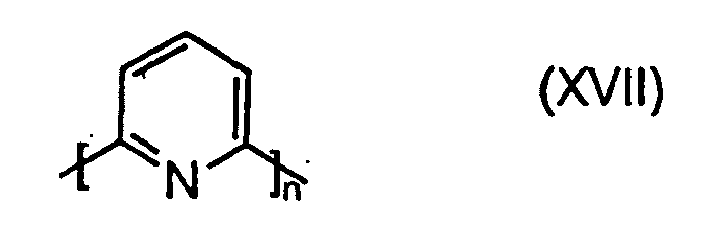

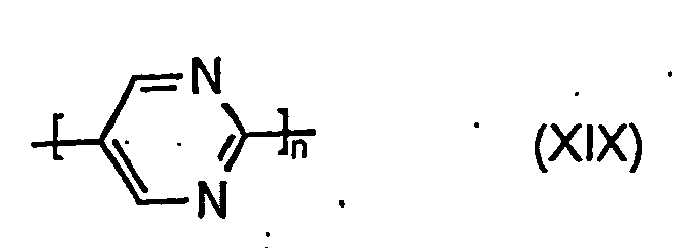


- Ar
- gleich oder verschieden sind und für eine vierbindige aromatische oder heteroaromatische Gruppe, die ein- oder mehrkernig sein kann,
- Ar1
- gleich oder verschieden sind und für eine zweibindige aromatische oder heteroaromatische Gruppe, die ein- oder mehrkernig sein kann,
- Ar2
- gleich oder verschieden sind und für eine zwei oder dreibindige aromatische oder heteroaromatische Gruppe, die ein- oder mehrkernig sein kann,
- Ar3
- gleich oder verschieden sind und für eine dreibindige aromatische oder heteroaromatische Gruppe, die ein- oder mehrkernig sein kann,
- Ar4
- gleich oder verschieden sind und für eine dreibindige aromatische oder heteroaromatische Gruppe, die ein- oder mehrkernig sein kann,
- Ar5
- gleich oder verschieden sind und für eine vierbindige aromatische oder heteroaromatische Gruppe, die ein- oder mehrkernig sein kann,
- Ar6
- gleich oder verschieden sind und für eine zweibindige aromatische oder heteroaromatische Gruppe, die ein- oder mehrkernig sein kann,
- Ar7
- gleich oder verschieden sind und für eine zweibindige aromatische oder heteroaromatische Gruppe, die ein- oder mehrkernig sein kann,
- Ar8
- gleich oder verschieden sind und für eine dreibindige aromatische oder heteroaromatische Gruppe, die ein- oder mehrkernig sein kann,
- Ar9
- gleich oder verschieden sind und für eine zwei- oder drei- oder vierbindige aromatische oder heteroaromatische Gruppe, die ein- oder mehrkernig sein kann,
- Ar10
- gleich oder verschieden sind und für eine zwei- oder dreibindige aromatische oder heteroaromatische Gruppe, die ein- oder mehrkernig sein kann,
- Ar11
- gleich oder verschieden sind und für eine zweibindige aromatische oder heteroaromatische Gruppe, die ein- oder mehrkernig sein kann,
- X
- gleich oder verschieden ist und für Sauerstoff, Schwefel oder eine Aminogruppe, die ein Wasserstoffatom, eine 1- 20 Kohlenstoffatome aufweisende Gruppe, vorzugsweise eine verzweigte oder nicht verzweigte Alkyl- oder Alkoxygruppe, oder eine Arylgruppe als weiteren Rest trägt
- R ,
- gleich oder verschieden für Wasserstoff, eine Alkylgruppe und eine aromatische Gruppe steht, mit der Maßgabe, das R in Formel (XX) nicht für Wasserstoff steht, und
- n, m
- eine ganze Zahl größer gleich 10, bevorzugt größer gleich 100 ist.
- Bevorzugte aromatische oder heteroaromatische Gruppen leiten sich von Benzol, Naphthalin, Biphenyl, Diphenylether, Diphenylmethan, Diphenyldimethylmethan, Bisphenon, Diphenylsulfon, Thiophen, Furan, Pyrrol, Thiazol, Oxazol, Imidazol, Isothiazol, Isoxazol, Pyrazol, 1,3,4-Oxadiazol, 2,5-Diphenyl-1,3,4-oxadiazol, 1,3,4-Thiadiazol, 1,3,4-Triazol, 2,5-Diphenyl-1,3,4-triazol, 1,2,5-Triphenyl-1,3,4-triazol, 1,2,4-Oxadiazol, 1,2,4-Thiadiazol, 1,2,4-Triazol, 1,2,3-Triazol, 1,2,3,4-Tetrazol, Benzo[b]thiophen, Benzo[b]furan, Indol, Benzo[c]thiophen, Benzo[c]furan, Isoindol, Benzoxazol, Benzothiazol, Benzimidazol, Benzisoxazol, Benzisothiazol, Benzopyrazol, Benzothiadiazol, Benzotriazol, Dibenzofuran, Dibenzothiophen, Carbazol, Pyridin, Bipyridin, Pyrazin, Pyrazol, Pyrimidin, Pyridazin, 1,3,5-Triazin, 1,2,4-Triazin, 1,2,4,5-Triazin, Tetrazin, Chinolin, Isochinolin, Chinoxalin, Chinazolin, Cinnolin, 1,8-Naphthyridin, 1,5-Naphthyridin, 1,6-Naphthyridin, 1,7-Naphthyridin, Phthalazin, Pyridopyrimidin, Purin, Pteridin oder Chinolizin, 4H-Chinolizin, Diphenylether, Anthracen, Benzopyrrol, Benzooxathiadiazol, Benzooxadiazol, Benzopyridin, Benzopyrazin, Benzopyrazidin, Benzopyrimidin, Benzotriazin, Indolizin, Pyridopyridin, Imidazopyrimidin, Pyrazinopyrimidin, Carbazol, Aciridin; Phenazin, Benzochinolin, Phenoxazin, Phenothiazin, Acridizin, Benzopteridin, Phenanthrolin und Phenanthren ab, die gegebenenfalls auch substituiert sein können.
- Dabei ist das Substitionsmuster von Ar1, Ar4, Ar6, Ar7, Ar8, Ar9, Ar10, Ar11 beliebig, im Falle vom Phenylen beispielsweise kann Ar1, Ar4, Ar6, Ar7, Ar8, Ar9, Ar10, Ar11 ortho-, meta- und para-Phenylen sein. Besonders bevorzugte Gruppen leiten sich von Benzol und Biphenylen, die gegebenenfalls auch substituiert sein können, ab.
- Bevorzugte Alkylgruppen sind kurzkettige Alkylgruppen mit 1 bis 4 Kohlenstoffatomen, wie z. B. Methyl-, Ethyl-, n- oder i-Propyl- und t-Butyl-Gruppen.
- Bevorzugte aromatische Gruppen sind Phenyl- oder Naphthyl-Gruppen. Die Alkylgruppen und die aromatischen Gruppen können substituiert sein.
- Bevorzugte Substituenten sind Halogenatome wie z. B. Fluor, Aminogruppen, Hydroxygruppen oder kurzkettige Alkylgruppen wie z. B. Methyl- oder Ethylgruppen.
- Bevorzugt sind Polyazole mit wiederkehrenden Einheiten der Formel (I) bei denen die Reste X innerhalb einer wiederkehrenden Einheit gleich sind.
- Die Polyazole können grundsätzlich auch unterschiedliche wiederkehrende Einheiten aufweisen, die sich beispielsweise in ihrem Rest X unterscheiden. Vorzugsweise jedoch weist es nur gleiche Reste X in einer wiederkehrenden Einheit auf.
- Weitere bevorzugte Polyazol-Polymere sind Polyimidazole, Polybenzthiazole, Polybenzoxazole, Polyoxadiazole, Polyquinoxalines, Polythiadiazole Poly(pyridine), Poly(pyrimidine), und Poly(tetrazapyrene).
- In einer weiteren Ausführungsform der vorliegenden Erfindung ist das Polymer enthaltend wiederkehrende Azoleinheiten ein Copolymer oder ein Blend, das mindestens zwei Einheiten der Formel (I) bis (XXII) enthält, die sich voneinander unterscheiden. Die Polymere können als Blockcopolymere (Diblock, Triblock), Segmentcopolymere, statistische Copolymere, periodische Copolymere und/oder alternierende Polymere vorliegen.
- In einer besonders bevorzugten Ausführungsform der vorliegenden Erfindung ist das Polymer enthaltend wiederkehrende Azoleinheiten ein Polyazol, das nur Einheiten der Formel (I) und/oder (II) enthält.
- Die Anzahl der wiederkehrende Azoleinheiten im Polymer ist vorzugsweise eine ganze Zahl größer gleich 10. Besonders bevorzugte Polymere enthalten mindestens 100 wiederkehrende Azoleinheiten.
- Im Rahmen der vorliegenden Erfindung sind Polymere enthaltend wiederkehrenden Benzimidazoleinheiten bevorzugt. Einige Beispiele der äußerst zweckmäßigen Polymere enthaltend wiederkehrende Benzimidazoleinheiten werden durch die nachfolgende Formeln wiedergegeben:


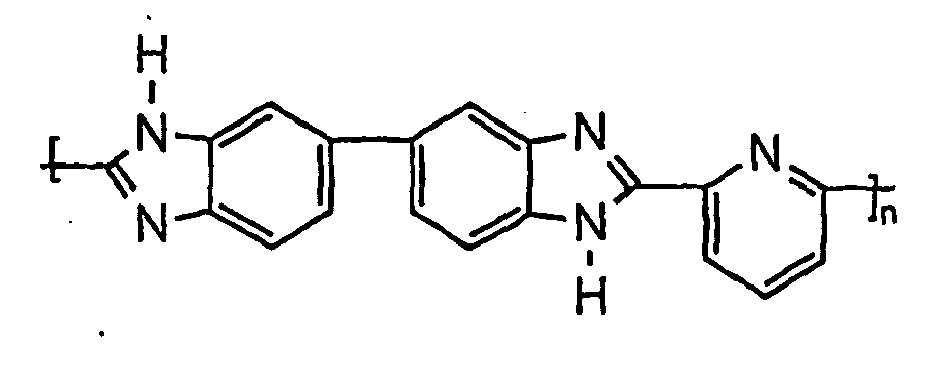




- Die mittel des beschriebenen Verfahrens erhältlichen Polyazole, insbesondere jedoch die Polybenzimidazole zeichnen sich durch ein hohes Molekulargewicht aus. Gemessen als Intrinsische Viskosität beträgt diese mindestens 1,4 dl/g und liegt somit deutlich über dem von handelsüblichem Polybenzimidazol (IV < 1,1 dl/g). Insofern die Mischung gemäß Schritt A) auch Tricarbonsäuren bzw. Tetracarbonsäre enthält wird hierdurch eine Verzweigung/ Vernetzung des gebildeten Polymeren erzielt. Diese trägt zur Verbesserung der mechanischen Eigenschaft bei.
Die Behandlung der gemäß Schritt C) erzeugten Polymerschicht in Gegenwart von Feuchtigkeit bei Temperaturen und für eine Dauer bis die Schicht eine ausreichende Festigkeit für den Einsatz in Brennstoffzellen besitzt. Die Behandlung kann soweit erfolgen, daß die Membran selbsttragend ist, so daß sie ohne Beschädigung vom Träger abgelöst werden kann. - Es hat sich weiterhin gezeigt, daß bei Verwendung von aromatischen Dicarbonsäuren (oder heteroaromatischen Dicarbonsäure) wie Isophthalsäure, Terephthalsäure, 2,5-Dihydroxyterephthalsäure, 4,6-Dihydroxyisophthalsäure, 2,6-Dihydroxyisophthalsäure, Diphensäure, 1,8-Dihydroxynaphthalin-3,6-Dicarbonsäure, Diphenylether-4,4'-Dicarbonsäure, Benzophenon-4,4'-dicarbonsäure, Diphenylsulfon-4,4'-dicarbonsäure, Biphenyl-4,4'-dicarbonsäure, 4-Trifluoromethylphthalsäure, Pyridin-2,5-dicarbonsäure, Pyridin-3,5-dicarbonsäure, Pyridin-2,6-dicarbonsäure, Pyridin-2,4-dicarbonsäure, 4-Phenyl-2,5-pyridindicarbonsäure, 3,5-Pyrazoldicarbonsäure, 2,6 -Pyrimidindicarbonsäure oder 2,5-Pyrazindicarbonsäure die Temperatur in Schritt D) - oder falls die Bildung von Oligomeren und/oder niedermolekularen Polymeren bereits in Schritt A) gewünscht wird - im Bereich von bis zu 300°C, vorzugsweise zwischen 100°C und 250°C, günstig ist.
- Die Behandlung der Membran in Schritt D) erfolgt bei Temperaturen oberhalb 0°C und kleiner 150°C, vorzugsweise bei Temperaturen zwischen 10°C und 120°C, insbesondere zwischen Raumtemperatur (20°C) und 90°C, in Gegenwart von Feuchtigkeit bzw. Wasser und/oder Wasserdampf bzw. und/oder wasserenthaltende Phosphorsäure von bis zu 85% bzw. und/oder in einer Mischung aus organischen Phosphonsäuren und/oder Sulfonsäuren enthaltenden Mischung in Wasser oder Phosphorsäure. Die Behandlung erfolgt vorzugsweise unter Normaldruck, kann aber auch unter Einwirkung von Druck erfolgen. Wesentlich ist, daß die Behandlung in Gegenwart von ausreichender Feuchtigkeit geschieht, wodurch die anwesende organischen Phosphonsäureanhydriden durch partielle Hydrolyse unter Ausbildung von organo-Phosphonsäuren und/oder Phosphorsäure (insofern Polyphosphorsäure mit verwendet wurde) zur Verfestigung der Membran beiträgt.
- Bei der Hydrolyse der organischen Phosphonsäureanhydriden gebildeten organo-Phosphonsäuren

- Die partielle Hydrolyse der organischen Phosphonsäureanhydride in Schritt D) führt zu einer Verfestigung der Membran und zu einer Abnahme der Schichtdicke und Ausbildung einer Membran mit einer Dicke zwischen 15 und 3000 µm, vorzugsweise zwischen 20 und 2000 µm, insbesondere zwischen 20 und 1500 µm, die selbsttragend ist.
- Die obere Temperaturgrenze der Behandlung gemäß Schritt D) beträgt in der Regel 150°C. Bei extrem kurzer Einwirkung von Feuchtigkeit, beispielsweise von überhitztem Dampf kann dieser Dampf auch heißer als 150°C sein. Wesentlich für die Temperaturobergrenze ist die Dauer der Behandlung.
- Die partielle Hydrolyse (Schritt D) kann auch in Klimakammern erfolgen bei der unter definierter Feuchtigkeitseinwirkung die Hydrolyse gezielt gesteuert werden kann. Hierbei kann die Feuchtigkeit durch die Temperatur bzw. Sättigung der kontaktierenden Umgebung beispielsweise Gase wie Luft, Stickstoff, Kohlendioxid oder andere geeignete Gase, oder Wasserdampf gezielt eingestellt werden. Die Behandlungsdauer ist abhängig von den vorstehend gewählten Parametern.
- Weiterhin ist die Behandlungsdauer von der Dicke der Membran abhängig.
- In der Regel beträgt die Behandlungsdauer zwischen wenigen Sekunden bis Minuten, beispielsweise unter Einwirkung von überhitztem Wasserdampf, oder bis hin zu ganzen Tagen, beispielsweise an der Luft bei Raumtemperatur und geringer relativer Luftfeuchtigkeit. Bevorzugt beträgt die Behandlungsdauer zwischen 10 Sekunden und 300 Stunden, insbesondere 1 Minute bis 200 Stunden.
- Wird die partielle Hydrolyse bei Raumtemperatur (20°C) mit Umgebungsluft einer relativen Luftfeuchtigkeit von 40-80% durchgeführt beträgt die Behandlungsdauer zwischen 1 und 200 Stunden.
- Die gemäß Schritt D) erhaltene Membran kann selbsttragend ausgebildet werden, d.h. sie kann vom Träger ohne Beschädigung gelöst und anschließend gegebenenfalls direkt weiterverarbeitet werden.
- Über den Grad der Hydrolyse, d.h. die Dauer, Temperatur und Umgebungsfeuchtigkeit, ist die Konzentration an Phosphonsäure und damit die Leitfähigkeit der erfindungsgemäßen Polymermembran einstellbar. Erfindungsgemäß wird die Konzentration der Protonen als lonenaustauschkapazität angegeben (IEClon exchange capacity). Im Rahmen der vorliegenden Erfindung ist eine IEC von mindestens 2 eq/g, bevorzugt 5 eq/g, besonders bevorzugt 10 eq/g.
- Im Anschluß an die Behandlung gemäß Schritt D) kann die Membran durch Einwirken von Hitze in Gegenwart von Luftsauerstoff an der Oberfläche noch vernetzt werden. Diese Härtung der Membranoberfläche verbessert die Eigenschaften der Membran zusätzlich.
Die Vernetzung kann auch durch Einwirken von IR bzw. NIR (IR = InfraRot, d. h. Licht mit einer Wellenlänge von mehr als 700 nm; NIR = Nahes IR, d. h. Licht mit einer Wellenlänge im Bereich von ca. 700 bis 2000 nm bzw. einer Energie im Bereich von ca. 0.6 bis 1.75 eV) erfolgen. Eine weitere Methode ist die Bestrahlung mit ß-Strahlen. Die Strahlungsdosis beträgt hierbei zwischen 5 und 200 kGy. Die erfindungsgemäße Polymermembran weist verbesserte Materialeigenschaften gegenüber den bisher bekannten dotierten Polymermembranen auf. Insbesondere zeigen sie im Vergleich mit bekannten dotierten Polymermembranen bessere Leistungen. Diese begründet sich insbesondere durch eine verbesserte Protonenleitfähigkeit. Diese beträgt bei Temperaturen von 120°C mindestens 0,1 S/cm, vorzugsweise mindestens 0,11 S/cm, insbesondere mindestens 0,12 S/cm. - Die erfindungsgemäßen Membranen können neben den Polymeren auf Basis von Polyazolen auch weitere Polymere als Blendmaterial beinhalten. Die Blendkomponente hat dabei im Wesentlichen die Aufgabe die mechanischen Eigenschaften zu verbessern und die Materialkosten zu verringern.
- Hierzu kann das zusätzliche Blendmaterial während oder nach Schritt A) oder vor Schritt B) zugegeben werden. Als Blendmaterial kommen Polyethersulfone, insbesondere die in der deutschen Patentanmeldung Nr.
10052242.4 beschriebenen Polyethersulfone, in Betracht. Zu den weiteren Polymeren, die als Blendkomponente eingesetzt werden können, gehören unter anderem Polyolefine, wie Poly(cloropren), Polyacetylen, Polyphenylen, Poly(p-xylylen), Polyarylmethylen, Polyarmethylen, Polystyrol, Polymethylstyrol, Polyvinylalkohol, Polyvinylacetat, Polyvinylether, Polyvinylamin, Poly(N-vinylacetamid), Polyvinylimidazol, Polyvinylcarbazol, Polyvinylpyrrolidon, Polyvinylpyridin, Polyvinylchlorid, Polyvinylidenchlorid, Polytetrafluorethylen, Polyhexafluorpropylen, Copolymere von PTFE mit Hexafluoropropylen, mit Perfluorpropylvinylether, mit Trifluoronitrosomethan, mit Sulfonylfluoridvinylether, mit Carbalkoxy-perfluoralkoxyvinylether, Polychlortrifluorethylen, Polyvinylfluorid, Polyvinylidenfluorid, Polyacrolein, Polyacrylamid, Polyacrylnitril, Polycyanacrylate, Polymethacrylimid, Cycloolefinische Copolymere, insbesondere aus Norbornen;
Polymere mit C-O-Bindungen in der Hauptkette, beispielsweise Polyacetal, Polyoxymethylen, Polyether, Polypropylenoxid, Polyepichlorhydrin, Polytetrahydrofuran, Polyphenylenoxid, Polyetherketon, Polyester, insbesondere Polyhydroxyessigsäure, Polyethylenterephthalat, Polybutylenterephthalat, Polyhydroxybenzoat, Polyhydroxypropionsäure, Polypivalolacton, Polycaprolacton, Polymalonsäure, Polycarbonat;
Polymere C-S-Bindungen in der Hauptkette, beispielsweise Polysulfidether, Polyphenylensulfid, Polyethersulfon;
Polymere C-N-Bindungen in der Hauptkette, beispielsweise Polyimine, Polyisocyanide,Polyetherimin, Polyanilin, Polyamide, Polyhydrazide, Polyurethane, Polyimide, Polyazole, Polyazine;
Flüssigkristalline Polymere, insbesondere Vectra sowie
Anorganische Polymere, beispielsweise Polysilane, Polycarbosilane, Polysiloxane, Polykieselsäure, Polysilikate, Silicone, Polyphosphazene und Polythiazyl. - Zur Anwendung in Brennstoffzellen mit einer Dauergebrauchstemperatur oberhalb 100°C werden solche Blend-Polymere bevorzugt, die eine Glasübergangstemperatur oder Vicat-Erweichungstemperatur VST/A/50 von mindestens 100°C, bevorzugt mindestens 150°C und ganz besonders bevorzugt mindestens 180°C haben. Hierbei sind Polysulfone mit einer Vicat-Erweichungstemperatur VST/A/50 von 180°C bis 230°C bevorzugt.
- Zu den bevorzugten Polymeren gehören Polysulfone, insbesondere Polysulfon mit Aromaten in der Hauptkette. Gemäß einem besonderen Aspekt der vorliegenden Erfindung weisen bevorzugte Polysulfone und Polyethersulfone eine Schmelzvolumenrate MVR 300/21,6 kleiner oder gleich 40 cm3/ 10 min, insbesondere kleiner oder gleich 30 cm3/ 10 min und besonders bevorzugt kleiner oder gleich 20 cm3/ 10 min gemessen nach ISO 1133 auf.
- Gemäß einem besonderen Aspekt kann die Polymermembran mindestens ein Polymer mit aromatischen Sulfonsäuregruppen und/oder Phosphonsäuregruppen umfassen. Aromatische Sulfonsäuregruppen und/oder Phosphonsäuregruppen sind Gruppen, bei denen die Sulfonsäuregruppe (-SO3H) und/oder Phosphonsäuregruppen (-PO3H2) kovalent an eine aromatischen oder heteroaromatischen Gruppe gebunden ist. Die aromatische Gruppe kann ein Teil der Hauptkette (back bone) des Polymeren oder ein Teil einer Seitengruppe sein, wobei Polymere mit aromatischen Gruppen in der Hauptkette bevorzugt sind. Die Sulfonsäuregruppen und/oder Phosphonsäuregruppen können vielfach auch in Form der Salze eingesetzt werden. Des weiteren können auch Derivate, beispielsweise Ester, insbesondere Methyl- oder Ethylester, oder Halogenide der Sulfonsäuren verwendet werden, die beim Betrieb der Membran in die Sulfonsäure umgesetzt werden.
- Bevorzugte aromatische oder heteroaromatische Gruppen leiten sich von Benzol, Naphthalin, Biphenyl, Diphenylether, Diphenylmethan, Diphenyldimethylmethan, Bisphenon, Diphenylsulfon, Thiophen, Furan, Pyrrol, Thiazol, Oxazol, Imidazol, Isothiazol, Isoxazol, Pyrazol, 1,3,4-Oxadiazol, 2,5-Diphenyl-1,3,4-oxadiazol, 1,3,4-Thiadiazol, 1,3,4-Triazol, 2,5-Diphenyl-1,3,4-triazol, 1,2,5-Triphenyl-1,3,4-triazol, 1,2,4-Oxadiazol, 1,2,4-Thiadiazol, 1,2,4-Triazol, 1,2,3-Triazol, 1,2,3,4-Tetrazol, Benzo[b]thiophen, Benzo[b]furan, Indol, Benzo[c]thioplien, Benzo[c]furan, Isoindol, Benzoxazol, Benzothiazol, Benzimidazol, Benzisoxazol, Benzisothiazol, Benzopyrazol, Benzothiadiazol, Benzotriazol, Dibenzofuran, Dibenzothiophen, Carbazol, Pyridin, Bipyridin, Pyrazin, Pyrazol, Pyrimidin, Pyridazin, 1,3,5-Triazin, 1,2,4-Triazin, 1,2,4,5-Triazin, Tetrazin, Chinolin, Isochinolin, Chinoxalin, Chinazolin, Cinnolin, 1,8-Naphthyridin, 1,5-Naphthyridin, 1,6-Naphthyridin, 1,7-Naphthyridin, Phthalazin, Pyridopyrimidin, Purin, Pteridin oder Chinolizin, 4H-Chinolizin, Diphenylether, Anthracen, Benzopyrrol, Benzooxathiadiazol, Benzooxadiazol, Benzopyridin, Benzopyrazin, Benzopyrazidin, Benzopyrimidin, Benzotriazin, Indolizin, Pyridopyridin, Imidazopyrimidin, Pyrazinopyrimidin, Carbazol, Aciridin, Phenazin, Benzochinolin, Phenoxazin, Phenothiazin, Acridizin, Benzopteridin, Phenanthrolin und Phenanthren ab, die gegebenenfalls auch substituiert sein können. Bevorzugte Substituenten sind Halogenatome wie z. B. Fluor, Aminogruppen, Hydroxygruppen oder Alkylgruppen.
- Dabei ist das Substitionsmuster beliebig, im Falle vom Phenylen beispielsweise kann ortho-, meta- und para-Phenylen sein. Besonders bevorzugte Gruppen leiten sich von Benzol und Biphenylen, die gegebenenfalls auch substituiert sein können, ab.
- Bevorzugte Alkylgruppen sind kurzkettige Alkylgruppen mit 1 bis 4 Kohlenstoffatomen, wie z. B. Methyl-, Ethyl-, n- oder i-Propyl- und t-Butyl-Gruppen.
- Bevorzugte aromatische Gruppen sind Phenyl- oder Naphthyl-Gruppen. Die Alkylgruppen und die aromatischen Gruppen können substituiert sein.
- Die mit Sulfonsäuregruppen modifizierten Polymere besitzen vorzugsweise einen Gehalt an Sulfonsäuregruppen im Bereich von 0,5 bis 3 meq/g, vorzugsweise 0,5 bis 2 meq/g. Dieser Wert wird über die sog. lonenaustauschkapazität (IEC) bestimmt.
- Zur Messung der IEC werden die Sulfonsäuregruppen in die freie Säure überführt. Hierzu wird das Polymere auf bekannte Weise mit Säure behandelt, wobei überschüssige Säure durch Waschen entfernt wird. So wird das sulfonierte Polymer zunächst 2 Stunden in siedendem Wasser behandelt. Anschliessend wird überschüssiges Wasser abgetupt und die Probe während 15 Stunden bei 160°C im Vakkumtrockenschrank bei p<1 mbar getrocknet. Dann wird das Trockengewicht der Membran bestimmt. Das so getrocknete Polymer wird dann in DMSO bei 80°C während 1 h gelöst. Die Lösung wird anschliessend mit 0,1 M NaOH titriert. Aus dem Verbrauch der Säure bis zum Equivalentpunkt und dem Trockengewicht wird dann die lonenaustauschkapazität (IEC) berechnet.
- Polymere mit an aromatische Gruppen kovalent gebundene Sulfonsäuregruppen sind in der Fachwelt bekannt. So können Polymer mit aromatischen Sulfonsäuregruppen beispielsweise durch Sulfonierung von Polymeren hergestellt werden. Verfahren zur Sulfonierung von Polymeren sind in F. Kucera et al. Polymer Engineering and Science 1988, Vol. 38, No 5, 783-792 beschrieben. Hierbei können die Sulfonierungsbedingungen so gewählt werden, dass ein niedriger. Sulfonierungsgrad entsteht (
DE-A-19959289 ). - Im Hinblick auf Polymere mit aromatischen Sulfonsäuregruppen, deren aromatische Reste Teil der Seitengruppe sind, sei insbesondere auf Polystyrolderivate verwiesen. So beschreibt die Druckschrift
US-A-6110616 Copolymere aus Butadien und Styrol und deren anschließende Sulfonierung zur Verwendung für Brennstoffzellen. - Des weiteren können derartige Polymere auch durch Polyreaktionen von Monomeren erhalten werden, die Säuregruppen umfassen. So können perfluorinierte Polymere wie in
US-A-5422411 beschrieben durch Copolymerisation aus Trifluorostyrol und sulfonylmodifiziertem Trifuorostyrol hergestellt werden. - Gemäß einem besonderen Aspekt der vorliegenden Erfindung werden hochtemperaturstabile Thermoplaste eingesetzt, die an aromatische Gruppen gebundene Sulfonsäuregruppen aufweisen. Im allgemeinen weisen derartige Polymere in der Hauptkette aromatische Gruppen auf. So sind sulfonierte Polyetherketone (
DE-A-4219077 ,WO96/01177 DE-A-19527435 ) bevorzugt. - Die zuvor dargelegten Polymere mit an Aromaten gebundenen Sulfonsäuregruppen können einzeln oder als Mischung eingesetzt werden, wobei insbesondere Mischungen bevorzugt sind, die Polymere mit Aromaten in der Hauptkette aufweisen.
- Das Molekulargewicht der Polymere mit an Aromaten gebundenen Sulfonsäuregruppen kann, je nach Art des Polymeren sowie dessen Verarbeitbarkeit in weiten Bereichen liegen. Vorzugsweise liegt das Gewichtsmittel des Molekulargewichts Mw im Bereich von 5000 bis 10 000 000, insbesondere 10000 bis 1000 000, besonders bevorzugt 15 000 bis 50 000. Gemäß einem besonderen Aspekt der vorliegenden Erfindung werden Polymere mit an Aromaten gebundenen Sulfonsäuregruppen, die einen geringen Polydispersitätsindex Mw/Mn aufweisen. Vorzugsweise.liegt der Polydispersitätsindex im Bereich 1 bis 5, insbesondere 1 bis 4.
- Zur weiteren Verbesserung der anwendungstechnischen Eigenschaften können der Membran zusätzlich noch Füllstoffe, insbesondere protonenleitende Füllstoffe, sowie zusätzliche Säuren zugesetzt werden. Die Zugabe kann entweder während oder nach Schritt A), Schritt B) oder Schritt C) erfolgen
- Nicht limitierende Beispiele für Protonenleitende Füllstoffe sind
Sulfate wie: CsHSO4; Fe(SO4)2, (NH4)3H(SO4)2, LiHSO4, NaHSO4, KHSO4, RbSO4, LiN2H5SO4, NH4HSO4, Phosphate wie Zr3(PO4)4, Zr(HPO4)2, HZr2(PO4)3, UO2PO4.3H2O, H8UO2PO4, Ce(HPO4)2, Ti(HPO4)2, KH2PO4, NaH2PO4, LiH2PO4, NH4H2PO4, CsH2PO4, CaHPO4, MgHPO4, HSbP2O8, HSb3P2O14, H5Sb5P2O20, Polysäure wie H3PW12O40.nH2O (n=21-29), H3SW12O40.nH2O (n=21-29), HxWO3, HSbWO6, H3PMo12O40, H2Sb4O11, HTaWO6, HNbO3, HTiNbO5, HTiTaO5, HSbTeO6, H5Ti4O9, HSbO3, H2MoO4 Selenide und Arsenide wie (NH4)3H(SeO4)2, UO2AsO4, (NH4)3H(SeO4)2, KH2AsO4, Cs3H(SeO4)2, Rb3H(Seo4)2, Phosphide wie ZrP, TiP, HfP Oxide wie Al2O3, Sb2O5, ThO2, SnO2, ZrO2, MoO3 Silikate wie Zeolithe, Zeolithe(NH4 +), Schichtsilikate, Gerüstsilikate, H-Natrolite, H-Mordenite, NH4-Analcine, NH4-Sodalite, NH4-Gallate, H-Montmorillonite Säuren wie HClO4, SbF5 Füllstoffe wie Carbide, insbesondere SiC, Si3N4, Fasern, insbesondere Glasfasern, Glaspulvern und/oder Polymerfasern, bevorzugt auf Basis von Polyazolen. - Als weiteres kann diese Membran auch perfluorierte Sulfonsäure Additive (0,1-20 wt%, bevorzugt 0,2-15 wt%, ganz bevorzugt 0,2-10 wt%) enthalten. Diese Additive führen zur Leistungsverbesserung, in der Nähe der Kathode zur Erhöhung der Sauerstofflöslichkeit und Sauerstoffdiffusion und zur Verringerung der Adsorbtion von Phosphorsäure und Phosphat zu Platin. (Electrolyte additives for phosphoric acid fuel cells. Gang, Xiao; Hjuler, H. A.; Olsen, C.; Berg, R. W.; Bjerrum, N. J.. Chem. Dep. A, Tech. Univ. Denmark, Lyngby, Den. J. Electrochem. Soc. (1993), 140(4), 896-902 und Perfluorosulfonimide as an additive in phosphoric acid fuel cell. Razaq, M.; Razaq, A.; Yeager, E.; DesMarteau, Darryl D.; Singh, S. Gase Cent. Electrochem. Sci., Case West. Reserve Univ., Cleveland, OH, USA. J. Electrochem. Soc. (1989), 136(2), 385-90.)
Nicht limitierende Beispiele für persulfonierte Additive sind: - Trifluomethansulfonsäure, Kaliumtrifluormethansulfonat,
- Natriumtrifluormethansulfonat, Lithiumtrifluormethansulfonat,
- Ammoniumtrifluormethansulfonat, Kaliumperfluorohexansulfonat,
- Natriumperfluorohexansulfonat, Lithiumperfluorohexansulfonat,
- Ammoniumperfluorohexansulfonat, Perfluorohexansulfonsäure,
- Kaliumnonafluorbutansulfonat, Natriumnonafluorbutansulfonat,
- Lithiumnonafluorbutansulfonat, Ammoniumnonafluorbutansulfonat,
- Cäsiumnonafluorbutansulfonat, Triethylammoniumperfluorohexasulfonat,
- Perflurosulfoimide und Nafion.
- Als weiteres kann die Membran auch als Additive enthalten, die die im Betrieb bei der Sauerstoffreduktion erzeugten Peroxidradikale abfangen (primäre Anitoxidanzien) oder zerstören (sekundäre Antioxidanzien) und dadurch wie in
JP2001118591 A2
Nicht limitierende Beispiele für solche Additive sind: - Bis(trifluormethyl)nitroxid, 2,2-Diphenyl-1-pikrinylhydrazyl, Pheriole, Alkylphenole,
- sterisch gehinderte Alkylphenole wie zum Beispiel Irganox, aromatische Amine,
- sterisch gehinderte Amine wie zum Beispiel Chimassorb; sterisch gehinderte
- Hydroxylamine, sterisch gehinderte Alkylamine, sterisch gehinderte Hydroxylamine,
- sterisch gehinderte Hydroxylaminether, Phosphite wie zum Beispiel Irgafos,
- Nitrosobenzol, Methyl.2-nitroso-propan, Benzophenon, Benzaldehyd-tert.-butylnitron,
- Cysteamin, Melanine, Bleioxide, Manganoxide, Nickeloxide, Cobaltoxide.
- Die vorliegende Erfindung betrifft auch eine Membran-Elektroden-Einheit, die mindestens eine erfindungsgemäße Polymermembran aufweist. Für weitere Informationen über Membran-Elektroden-Einheiten wird auf die Fachliteratur, insbesondere auf die Patente
US-A-4,191,618 ,US-A-4,212,714 undUS-A-4,333,805 verwiesen. Die in den vorstehend genannten Literaturstellen [US-A-4,191,618 ,US-A-4,212,714 undUS-A-4,333,805 ] enthaltene Offenbarung hinsichtlich des Aufbaues und der Herstellung von Membran-Elektroden-Einheiten, sowie der zu wählenden Elektroden, Gasdiffusionslagen und Katalysatoren ist auch Bestandteil der beschreibung. - In einer Variante der vorliegenden Erfindung kann die Membranbildung anstelle auf einem Träger auch direkt auf der Elektrode erfolgen. Die Behandlung gemäß Schritt D) kann hierdurch entsprechend verkürzt werden, da die Membran nicht mehr selbsttragend sein muß. Auch eine solche Membran ist Gegenstand der vorliegenden Erfindung.
- Ein weiterer Gegenstand der vorliegenden Erfindung ist eine Elektrode die mit einer protonenleitenden Polymerbeschichtung auf Basis von Polyazolen erhältlich durch ein Verfahren umfassend die Schritte
- A) Mischen von einem oder mehreren aromatischen Tetra-Amino-Verbindungen mit einer oder mehreren aromatischen Carbonsäuren bzw. deren Estern, die mindestens zwei Säuregruppen pro Carbonsäure-Monomer enthalten, oder Mischen von einer oder mehreren aromatischen und/oder heteroaromatischen Diaminocarbonsäuren, in organischen Phosphonsäureanhydriden unter Ausbildung einer Lösung und/oder Dispersion
- B) Aufbringen einer Schicht unter Verwendung der Mischung gemäß Schritt A) auf einer Elektrode,
- C) Erwärmen des flächigen Gebildes/Schicht erhältlich gemäß Schritt B) unter Inertgas auf Temperaturen von bis zu 350°C, vorzugsweise bis zu 280°C unter Ausbildung des Polyazol-Polymeren.
- D) Behandlung der in Schritt C) gebildeten Membran in Gegenwart von ausreichender Feuchtigkeit, wodurch die anwesende organische Phosphonsäureanhydride durch partielle Hydrolyse unter Ausbildung von organo-Phosphonsäuren und/oder Phosphorsäure, insofern Polyphosphorsäure mit verwendet wurde, zur Verfestigung der Membran beiträgt.
- Die vorstehend beschriebenen Varianten und bevorzugten Ausführungsformen sind auch für diesen Gegenstand gültig, so daß an dieser Stelle auf deren Wiederholung verzichtet wird.
- Die Beschichtung hat nach Schritt D) eine Dicke zwischen 2 und 3000 µm, vorzugsweise zwischen 3 und 2000 µm, insbesondere zwischen 5 und 1500 µm hat.
- Eine derartig beschichtete Elektrode kann in einer Membran-Elektroden-Einheit, die gegebenenfalls mindestens eine erfindungsgemäße Polymermembran aufweist, eingebaut werden.
- Die Leitfähigkeit der Membran hängt stark vom Gehalt an Säuregruppen ausgedrückt durch die sog. lonenaustauschkapazität (IEC) ab. Zur Messung der lonenaustauschkapazität wird eine Probe mit einem Durchmesser von 3 cm ausgestanzt und in ein mit 100 ml Wasser gefülltes Becherglas gegeben. Die freigesetzte Säure wird mit 0,1 M NaOH titriert. Anschliessend wird die Probe entnommen, überschüssiges Wasser abgetupft und die Probe bei 160°C während 4h getrocknet. Dann bestimmt man das Trockengewicht, m0, gravimetrisch mit einer Genauigkeit von 0,1 mg. Die lonenaustauschkapazität wird dann aus dem Verbrauch der 0,1 M NaOH bis zum ersten Titrationsendpunkt, V1 in ml, und dem Trockengewicht, m0 in mg, gemäss folgender Formel berechnet:

- Die spezifische Leitfähigkeit wird mittels Impedanzspektroskopie in einer 4-Pol-Anordnung im potentiostatischen Modus und unter Verwendung von Platinelektroden (Draht, 0,25 mm Durchmesser) gemessen. Der Abstand zwischen den stromabnehmenden Elektroden beträgt 2 cm. Das erhaltene Spektrum wird mit einem einfachen Modell bestehend aus einer parallelen Anordnung eines ohm schen Widerstandes und eines Kapazitators ausgewertet. Der Probenquerschnitt der phosphorsäuredotierten Membran wird unmittelbar vor der Probenmontage gemessen. Zur Messung der Temperaturabhängigkeit wird die Messzelle in einem Ofen auf die gewünschte Temperatur gebracht und über eine in unmittelbarer Probennähe positioniertes Pt-100 Thermoelement geregelt. Nach Erreichen der Temperatur wird die Probe vor dem Start der Messung 10 Minuten auf dieser Temperatur gehalten
Claims (27)
- Protonenleitende Polymermembran auf Basis von Polyazolen erhältlich durch ein Verfahren umfassend die SchritteA) Mischen von einem oder mehreren aromatischen Tetra-Amino-Verbindungen mit einer oder mehreren aromatischen Carbonsäuren bzw. deren Estern, die mindestens zwei Säuregruppen pro Carbonsäure-Monomer enthalten, oder Mischen von einer oder mehreren aromatischen und/oder heteroaromatischen Diaminocarbonsäuren, in organischen Phosphonsäureanhydriden unter Ausbildung einer Lösung und/oder DispersionB) Aufbringen einer Schicht unter Verwendung der Mischung gemäß Schritt A) auf einem Träger oder auf einer Elektrode,C) Erwärmen des flächigen Gebildes/Schicht erhältlich gemäß Schritt B) unter Inertgas auf Temperaturen von bis zu 350°C, vorzugsweise bis zu 280°C unter Ausbildung des Polyazol-Polymeren.D) Behandlung der in Schritt C) gebildeten Membran in Gegenwart von ausreichender Feuchtigkeit, wodurch die anwesende organische Phosphonsäureanhydride durch partielle Hydrolyse unter Ausbildung von organo-Phosphonsäuren und/oder Phosphorsäure, insofern Polyphosphorsäure mit verwendet wurde, zur Verfestigung der Membran beiträgt, bis diese selbsttragend ist.
- Membran gemäß Anspruch 1, dadurch gekennzeichnet, daß als aromatische Tetra-Amino-Verbindungen 3,3',4,4'-Tetraaminobiphenyl, 2,3,5,6-Tetraaminopyridin, 1,2,4,5-Tetraaminobenzol, 3,3',4,4'-Tetraaminodiphenylsulfon, 3,3',4,4'-Tetraaminodiphenylether, 3,3',4,4'-Tetraaminobenzophenon, 3,3',4,4'-Tetraaminodiphenylmethan und 3,3',4,4'-Tetraaminodiphenyldimethylmethan
- Membran gemäß Anspruch 1, dadurch gekennzeichnet, daß als aromatische Dicarbonsäuren Isophthalsäure, Terephthalsäure, Phthalsäure, 5-Hydroxyisophthalsäure, 4-Hydroxyisophthalsäure, 2-Hydroxyterephthalsäure, 5-Aminoisophthalsäure, 5-N,N-Dimethylaminoisophthalsäure, 5-N,N-Diethylaminoisophthalsäure, 2,5-Dihydroxyterephthalsäure, 2,5-Dihydroxyisophthalsäure, 2,3-Dihydroxyisophthalsäure, 2,3-Dihydroxyphthalsäure, 2,4-Dihydroxyphthalsäure. 3,4-Dihydroxyphthalsäure, 3-Fluorophthalsäure, 5-Fluoroisophthalsäure, 2-Fluoroterphthalsäure, Tetrafluorophthalsäure, Tetrafluoroisophthalsäure, Tetrafluoroterephthalsäure, 1,4-Naphthalindicarbonsäure, 1,5-Naphthalindicarbonsäure, 2,6-Naphthalindicarbonsäure, 2,7-Naphthalindicarbonsäure, Diphensäure, 1,8-dihydroxynaphthalin-3,6-dicarbonsäure, Diphenylether-4,4'-dicarbonsäure, Benzophenon-4,4'-dicarbonsäure, Diphenylsulfon-4,4'-dicarbonsäure, Biphenyl-4,4'-dicarbonsäure, 4-Trifluoromethylphthalsäure, 2,2-Bis(4-carboxyphenyl)hexafluoropropan, 4,4'-Stilbendicarbonsäure, 4-Carboxyzimtsäure, bzw. deren C1-C20-Alkyl-Ester oder C5-C12-Aryl-Ester, oder deren Säureanhydride oder deren Säurechloride eingesetzt werden.
- Membran gemäß Anspruch 1, dadurch gekennzeichnet, daß als aromatische Carbonsäure Tri-carbonsäuren, Tetracarbonsäuren bzw. deren C1-C20-Alkyl-Ester oder C5-C12-Aryl-Ester oder deren Säureanhydride oder deren Säurechloride, vorzugsweise 1,3,5-benzene-tricarboxylic acid (trimesic acid); 1,2,4-benzene-tricarboxylic acid (trimellitic acid); (2-Carboxyphenyl)iminodiessigsäure, 3,5,3'-biphenyltricarboxylic acid; 3,5,4'-biphenyltricarboxylic acid und/oder 2,4,6-pyridinetricarboxylic acid eingesetzt werden.
- Membran gemäß Anspruch 1, dadurch gekennzeichnet, daß als aromatische Carbonsäure Tetracarbonsäuren deren C1-C20-Alkyl-Ester oder C5-C12-Aryl-Ester oder deren Säureanhydride oder deren Säurechloride, vorzugsweise Benzol 1,2,4,5-tetracarbonsäuren; Naphthalin-1,4,5,8-tetracarbonsäuren 3,5,3',5'-biphenyltetracarboxylic acid; Benzophenontetracarbonsäure, 3,3',4,4'-Biphenyltetracarbonsäure, 2,2',3,3'-Biphenyltetracarbonsäure, 1,2,5,6-Naphthalintetracarbonsäure, 1,4,5,8-Naphthalintetracarbonsäure eingesetzt werden.
- Membran gemäß Anspruch 4, dadurch gekennzeichnet, daß der Gehalt an Tri-carbonsäure bzw. Tetracarbonsäuren (bezogen auf eingesetzte Dicarbonsäure) beträgt zwischen 0 und 30 Mol%, vorzugsweise 0,1 und 20 Mol %, insbesondere 0,5 und 10 Mol-%. beträgt.
- Membran gemäß Anspruch 1, dadurch gekennzeichnet, daß als heteroaromatische Carbonsäuren heteroaromatische Di-carbonsäuren und Tricarbonsäuren und Tetra-Carbonsäuren eingesetzt werden, welche mindestens ein Stickstoff, Sauerstoff, Schwefel oder Phosphoratom im Aromaten enthalten, vorzugsweise Pyridin-2,5-dicarbonsäure, Pyridin-3,5-dicarbonsäure, Pyridin-2,6-dicarbonsäure, Pyridin-2,4-dicarbonsäure, 4-Phenyl-2,5-pyridindicarbonsäure, 3,5-Pyrazoldicarbonsäure, 2,6 - Pyrimidindicarbonsäure,2,5-Pyrazindicarbonsäure, 2,4,6-Pyridintricarbonsäure, Benzimidazol-5,6-dicarbonsäure, sowie deren C1-C20-Alkyl-Ester oder C5-C12-Aryl-Ester, oder deren Säureanhydride oder deren Säurechloride.
- Membran gemäß Anspruch 1, dadurch gekennzeichnet, daß in Schritt A) organische Phosphonsäureanhydride der Formel


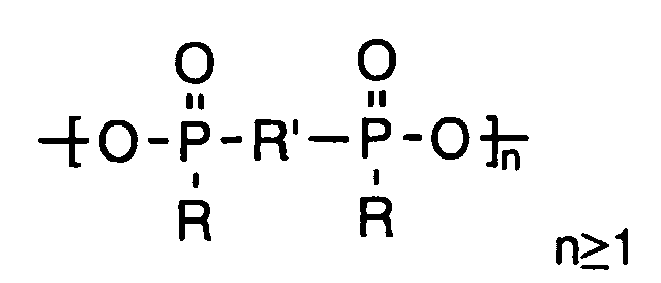
- Membran gemäß Anspruch 1, dadurch gekennzeichnet, daß in Schritt A) zusätzlich eine Polyphosphorsäure mit einem Gehalt berechnet als P2O5 (acidimetrisch) von mindestens 83% eingesetzt wird.
- Membran gemäß Anspruch 1 oder 9, dadurch gekennzeichnet, daß in Schritt A) zusätzlich P2O5 eingesetzt wird.
- Membran gemäß Anspruch 1, dadurch gekennzeichnet, daß in Schritt A) oder Schritt B) eine Lösung oder eine Dispersion/Suspension erzeugt wird.
- Membran gemäß Anspruch 1, dadurch gekennzeichnet, daß in Schritt C) ein Polymere auf Basis von Polyazol enthält wiederkehrende Azoleinheiten der allgemeinen Formel (I) und/oder (II) und/oder (III) und/oder (IV) und/oder (V) und/oder (VI) und/oder (VII) und/oder (VIII) und/oder (IX) und/oder (X) und/oder (XI) und/oder (XII) und/oder (XIII) und/oder (XIV) und/oder (XV) und/oder (XVI) und/oder (XVII) und/oder (XVIII) und/oder (XIX) und/oder (XX) und/oder (XXI) und/oder (XXII)
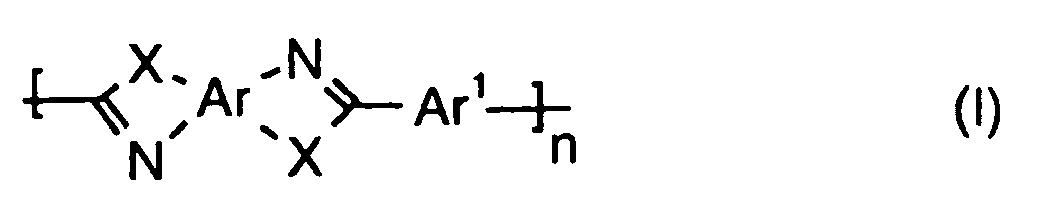


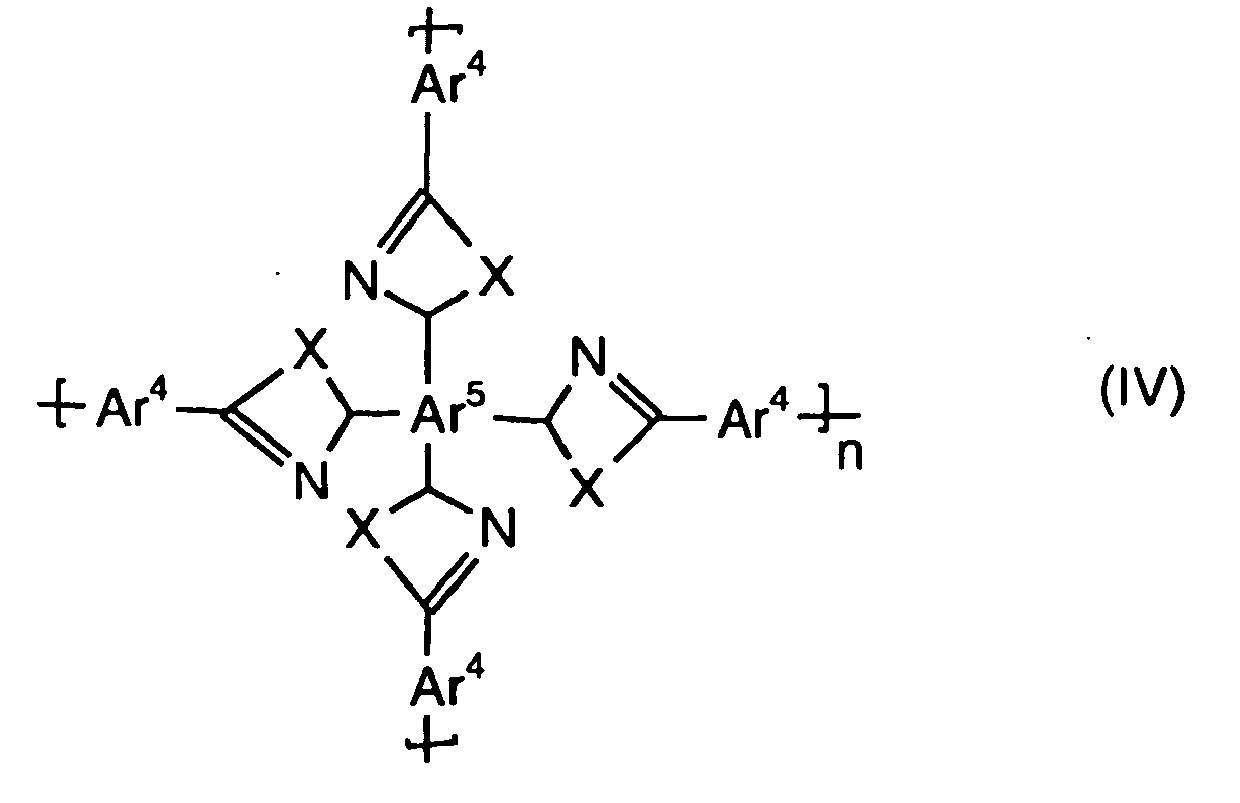


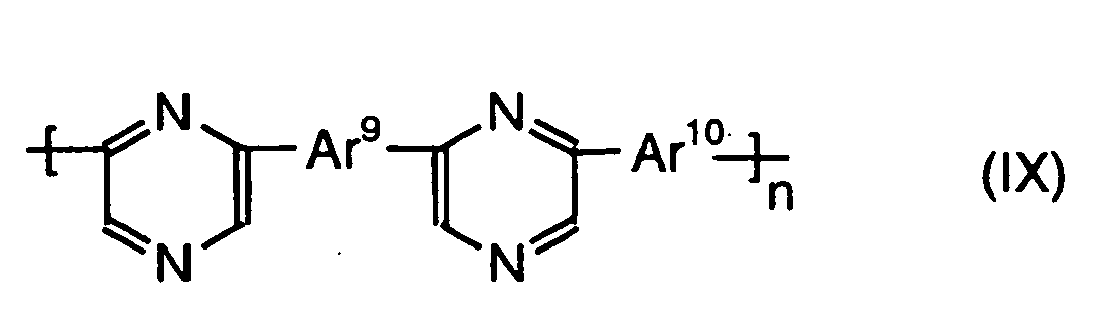


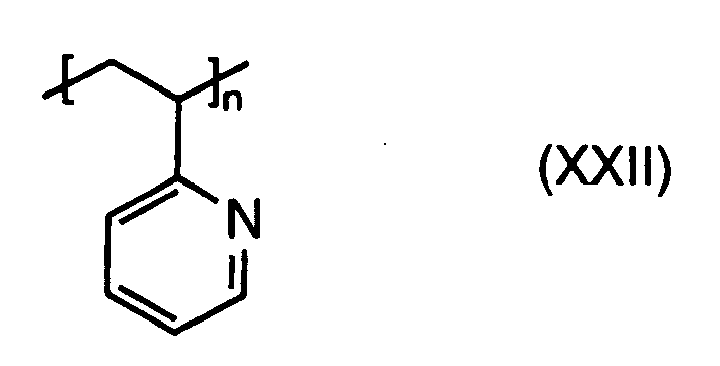 Ar gleich oder verschieden sind und für eine vierbindige aromatische oder hete- roaromatische Gruppe, die ein- oder mehrkernig sein kann,Ar1 gleich oder verschieden sind und für eine zweibindige aromatische oder he- teroaromatische Gruppe, die ein- oder mehrkernig sein kann,Ar2 gleich oder verschieden sind und für eine zwei oder dreibindige aromatische oder heteroaromatische Gruppe, die ein- oder mehrkernig sein kann,Ar3 gleich oder verschieden sind und für eine dreibindige aromatische oder hete- roaromatische Gruppe, die ein- oder mehrkernig sein kann,Ar4 gleich oder verschieden sind und für eine dreibindige aromatische oder hete- roaromatische Gruppe, die ein- oder mehrkernig sein kann,Ar5 gleich oder verschieden sind und für eine vierbindige aromatische oder hete- roaromatische Gruppe, die ein- oder mehrkernig sein kann,Ar6 gleich oder verschieden sind und für eine zweibindige aromatische oder he- teroaromatische Gruppe, die ein- oder mehrkernig sein kann,Ar7 gleich oder verschieden sind und für eine zweibindige aromatische oder he- teroaromatische Gruppe, die ein- oder mehrkernig sein kann,Ar8 gleich oder verschieden sind und für eine dreibindige aromatische oder hete- roaromatische Gruppe, die ein- oder mehrkernig sein kann,Ar9 gleich oder verschieden sind und für eine zwei- oder drei- oder vierbindige aromatische oder heteroaromatische Gruppe, die ein- oder mehrkernig sein kann,Ar10 gleich oder verschieden sind und für eine zwei- oder dreibindige aromatische oder heteroaromatische Gruppe, die ein- oder mehrkernig sein kann,Ar11 gleich oder verschieden sind und für eine zweibindige aromatische oder he- teroaromatische Gruppe, die ein- oder mehrkernig sein kann,X gleich oder verschieden ist und für Sauerstoff, Schwefel oder eine Ami- nogruppe, die ein Wasserstoffatom, eine 1- 20 Kohlenstoffatome aufweisen- de Gruppe, vorzugsweise eine verzweigte oder nicht verzweigte Alkyl- oder Alkoxygruppe, oder eine Arylgruppe als weiteren Rest trägtR gleich oder verschieden für Wasserstoff, eine Alkylgruppe und eine aromati- sche Gruppe steht, mit der Maßgabe das R ist Formel (XX) nicht für Wasser- stoff steht, undn, m eine ganze Zahl größer gleich 10, bevorzugt größer gleich 100 ist,gebildet wird.
 - Membran gemäß Anspruch 1, dadurch gekennzeichnet, daß in Schritt C) ein Polymer ausgewählt aus der Gruppe Polybenzimidazol, Poly(pyridine), Poly(pyrimidine), Polyimidazole, Polybenzthiazole, Polybenzoxazole, Polyoxadiazole, Polyquinoxalines, Polythiadiazole und Poly(tetrazapyrene) gebildet wird.
- Membran gemäß Anspruch 1, dadurch gekennzeichnet, daß in Schritt C) ein Polymer enthaltend wiederkehrende Benzimidazoleinheiten der Formel


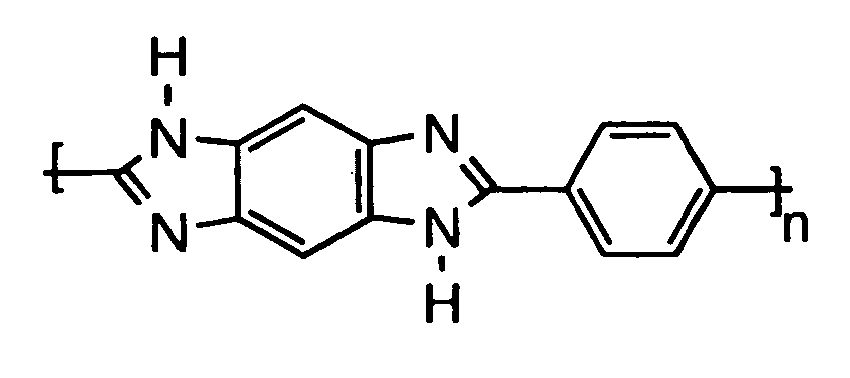




- Membran gemäß Anspruch 1, dadurch gekennzeichnet, daß während oder nach Schritt A) und/oder vor Schritt B) ein weiteres Polymer als Blendmaterial zugesetzt wird.
- Membran gemäß Anspruch 1, dadurch gekennzeichnet, daß nach Schritt C) und vor Schritt D) die Viskosität durch Zugabe von Phosphorsäure und/oder von organo-Phosphonsäuren eingestellt wird.
- Membran gemäß Anspruch 1, dadurch gekennzeichnet, daß die gemäß Schritt D) erzeugten Membran in Gegenwart von Feuchtigkeit bei Temperaturen und für eine Zeitdauer behandelt wird bis die Membran selbsttragend ist und ohne Beschädigung vom Träger abgelöst werden kann.
- Membran gemäß Anspruch 1, dadurch gekennzeichnet, daß die Behandlung der Membran in Schritt D) erfolgt bei Temperaturen oberhalb 0°C und 150°C, vorzugsweise bei Temperaturen zwischen 10°C und 120°C, insbesondere zwischen Raumtemperatur (20°C) und 90°C, in Gegenwart von Feuchtigkeit bzw. Wasser und/oder Wasserdampf erfolgt.
- Membran gemäß Anspruch 1, dadurch gekennzeichnet, daß die Behandlung der Membran in Schritt D) zwischen 10 Sekunden und 300 Stunden, vorzugsweise 1 Minute bis 200 Stunden, beträgt.
- Membran gemäß Anspruch 1, dadurch gekennzeichnet, daß in Schritt B) als Träger eine Elektrode gewählt wird und die Behandlung gemäß Schritt D) dergestalt ist, daß die gebildete Membran nicht mehr selbsttragend ist.
- Membran gemäß Anspruch 1, dadurch gekennzeichnet, daß in Schritt B) eine Schicht mit einer Dicke von 20 und 4000 µm, vorzugsweise zwischen 30 und 3500 µm, insbesondere zwischen 50 und 3000 µm erzeugt wird.
- Membran gemäß Anspruch 1, dadurch gekennzeichnet, daß die in Schritt D) gebildete Membran eine Dicke zwischen 15 und 3000 µm, vorzugsweise zwischen 20 und 2000 µm, insbesondere zwischen 20 und 1500 µm hat.
- Elektrode die mit einer protonenleitenden Polymerbeschichtung auf Basis von Polyazolen erhältlich durch ein Verfahren umfassend die SchritteA) Mischen von einem oder mehreren aromatischen Tetra-Amino-Verbindungen mit einer oder mehreren aromatischen Carbonsäuren bzw. deren Estern, die mindestens zwei Säuregruppen pro Carbonsäure-Monomer enthalten, oder Mischen von einer oder mehreren aromatischen und/oder heteroaromatischen Diaminocarbonsäuren, in organischen Phosphonsäureanhydriden unter Ausbildung einer Lösung und/oder DispersionB) Aufbringen einer Schicht unter Verwendung der Mischung gemäß Schritt A) auf einer Elektrode,C) Erwärmen des flächigen Gebildes/Schicht erhältlich gemäß Schritt B) unter Inertgas auf Temperaturen von bis zu 350°C, vorzugsweise bis zu 280°C unter Ausbildung des Polyazol-Polymeren.D) Behandlung der in Schritt C) gebildeten Membran in Gegenwart von ausreichender Feuchtigkeit, wodurch die anwesende organische Phosphonsäureanhydride durch partielle Hydrolyse unter Ausbildung von organo-Phosphonsäuren und/oder Phosphorsäure, insofern Polyphosphorsäure mit verwendet wurde, zur Verfestigung der Membran beiträgt.
- Elektrode gemäß Anspruch 23, wobei die Beschichtung eine Dicke zwischen 2 und 3000 µm, vorzugsweise zwischen 3 und 2000 µm, insbesondere zwischen 5 und 1500 µm hat.
- Membran-Elektroden-Einheit enthaltend mindestens eine Elektrode und mindestens eine Membran gemäß einem oder mehreren der Ansprüche 1 bis 22.
- Membran-Elektroden-Einheit enthaltend mindestens eine Elektrode gemäß Anspruch 23 oder 24 und mindestens eine Membran gemäß einem oder mehreren der Ansprüche 1 bis 22.
- Brennstoffzelle enthaltend eine oder mehrere Membran-Elektroden-Einheiten gemäß Anspruch 25 oder 26.
Applications Claiming Priority (2)
| Application Number | Priority Date | Filing Date | Title |
|---|---|---|---|
| DE10361833A DE10361833A1 (de) | 2003-12-30 | 2003-12-30 | Protonenleitende Membran und deren Verwendung |
| PCT/EP2004/014831 WO2005063852A1 (de) | 2003-12-30 | 2004-12-30 | Protonenleitende membran und deren verwendung |
Publications (2)
| Publication Number | Publication Date |
|---|---|
| EP1706442A1 EP1706442A1 (de) | 2006-10-04 |
| EP1706442B1 true EP1706442B1 (de) | 2010-05-26 |
Family
ID=34716276
Family Applications (1)
| Application Number | Title | Priority Date | Filing Date |
|---|---|---|---|
| EP04804416A Expired - Lifetime EP1706442B1 (de) | 2003-12-30 | 2004-12-30 | Protonenleitende membran und deren verwendung |
Country Status (8)
| Country | Link |
|---|---|
| US (1) | US8765905B2 (de) |
| EP (1) | EP1706442B1 (de) |
| JP (2) | JP5215562B2 (de) |
| CN (1) | CN101035836B (de) |
| AT (1) | ATE469184T1 (de) |
| DE (2) | DE10361833A1 (de) |
| ES (1) | ES2345554T3 (de) |
| WO (1) | WO2005063852A1 (de) |
Families Citing this family (27)
| Publication number | Priority date | Publication date | Assignee | Title |
|---|---|---|---|---|
| DE10361833A1 (de) | 2003-12-30 | 2005-08-04 | Celanese Ventures Gmbh | Protonenleitende Membran und deren Verwendung |
| DE10361932A1 (de) * | 2003-12-30 | 2005-07-28 | Celanese Ventures Gmbh | Protonenleitende Membran und deren Verwendung |
| DE10361832A1 (de) * | 2003-12-30 | 2005-07-28 | Celanese Ventures Gmbh | Protonenleitende Membran und deren Verwendung |
| JP4435745B2 (ja) | 2005-03-23 | 2010-03-24 | 三洋電機株式会社 | 燃料電池用電解質、膜電極接合体、および燃料電池用電解質の製造方法 |
| JP4435746B2 (ja) | 2005-03-23 | 2010-03-24 | 三洋電機株式会社 | 燃料電池用電解質、膜電極接合体、および燃料電池用電解質の製造方法 |
| US8945736B2 (en) | 2005-09-10 | 2015-02-03 | Basf Fuel Cell Gmbh | Method for conditioning membrane-electrode-units for fuel cells |
| DE102005043127A1 (de) * | 2005-09-10 | 2007-03-15 | Pemeas Gmbh | Verfahren zur Konditionierung von Membran-Elektroden-Einheiten für Brennstoffzellen |
| JP4435747B2 (ja) | 2006-02-24 | 2010-03-24 | 三洋電機株式会社 | 燃料電池用電解質、膜電極接合体、および燃料電池用電解質の製造方法 |
| DE102009001141A1 (de) * | 2008-10-29 | 2010-05-06 | Volkswagen Ag | Verfahren zur Herstellung einer Polymerelektrolytmembran |
| KR101124506B1 (ko) * | 2009-04-24 | 2012-03-16 | 서울대학교산학협력단 | 폴리아졸의 가교체, 그 제조방법, 이를 포함하는 연료전지용 전극, 연료전지용 전해질막, 그 제조방법 및 이를 포함하는 연료전지 |
| US9051433B2 (en) | 2010-02-04 | 2015-06-09 | Samsung Electronics Co., Ltd. | Polymer and cross-linked polymer composition, electrode and electrolyte membrane including cross-linked polymer, and fuel cell including electrode and electrolyte membrane |
| US9112232B2 (en) | 2010-02-05 | 2015-08-18 | Samsung Electronics Co., Ltd. | Composition, polymer thereof, electrode and electrolyte membrane for fuel cell, and fuel cell including the same |
| KR101670966B1 (ko) | 2010-02-09 | 2016-11-09 | 삼성전자주식회사 | 하이퍼브랜치 폴리머, 이를 포함한 연료전지용 전극과 전해질막 및 이를 채용한 연료전지 |
| JP5728252B2 (ja) | 2010-03-03 | 2015-06-03 | 三星電子株式会社Samsung Electronics Co.,Ltd. | 組成物並びにその製造方法、該組成物を利用した電極及び該電極を採用した燃料電池 |
| CN102299353B (zh) * | 2010-06-25 | 2013-10-23 | 大连融科储能技术发展有限公司 | 有机无机复合膜在酸性电解液液流储能电池中的应用 |
| CN102299351B (zh) * | 2010-06-25 | 2014-01-15 | 大连融科储能技术发展有限公司 | 聚苯并咪唑类聚合物离子交换膜及其制备和应用 |
| US9325025B2 (en) * | 2011-04-14 | 2016-04-26 | Basf Se | Membrane electrode assemblies and fuel cells with long lifetime |
| CN102623734B (zh) * | 2012-04-16 | 2014-10-15 | 上海锦众信息科技有限公司 | 一种燃料电池用高性能复合质子交换膜的制备方法 |
| EP2847253A4 (de) * | 2012-05-08 | 2016-01-13 | Basf Se | Verbesserte membranelektrodenanordnungen und brennstoffzellen mit langer lebensdauer |
| US9130208B2 (en) | 2012-05-08 | 2015-09-08 | Basf Se | Membrane electrode assemblies and fuel cells with long lifetime |
| CN103236557B (zh) * | 2013-04-15 | 2015-04-08 | 东华大学 | 一种质子交换膜及其制备方法 |
| CN106967217A (zh) * | 2016-01-14 | 2017-07-21 | 华南理工大学 | 聚咪唑类化合物及其原位制备方法和应用 |
| US9861977B2 (en) * | 2016-03-23 | 2018-01-09 | Nissan North America, Inc. | Multi-acid polymers and methods of making the same |
| US10468701B2 (en) | 2016-03-23 | 2019-11-05 | Nissan North America, Inc. | Multi-acid polymers from multifunctional amino acids and sulfonyl halide precursors and methods of making the same |
| US10153505B2 (en) * | 2016-03-23 | 2018-12-11 | Nissan North America, Inc. | Multi-acid polymers from multifunctional amino acids and sulfonyl halide precursors and methods of making the same |
| US9694357B1 (en) * | 2016-03-23 | 2017-07-04 | Nissan North America, Inc. | Multi-acid polymers and methods of making the same |
| CN112259769A (zh) * | 2020-09-18 | 2021-01-22 | 上海四羿科技有限公司 | 自具微孔聚苯并咪唑质子交换膜及制备方法和应用 |
Family Cites Families (18)
| Publication number | Priority date | Publication date | Assignee | Title |
|---|---|---|---|---|
| US3350478A (en) * | 1962-10-11 | 1967-10-31 | Hooker Chemical Corp | Monoesters of phosphonic acids |
| US6319497B1 (en) * | 1997-04-23 | 2001-11-20 | Virginia Tech Intellectual Properties, Inc. | Non-obligate predatory bacterium burkholderia casidaeand uses thereof |
| JP2000038472A (ja) * | 1998-05-20 | 2000-02-08 | Honda Motor Co Ltd | 高分子固体電解質 |
| JP2002146013A (ja) * | 2000-11-15 | 2002-05-22 | Toyobo Co Ltd | イオン伝導性ホスホン酸含有ポリアゾール |
| DE10117687A1 (de) * | 2001-04-09 | 2002-10-17 | Celanese Ventures Gmbh | Protonenleitende Membran und deren Verwendung |
| DE10117686A1 (de) * | 2001-04-09 | 2002-10-24 | Celanese Ventures Gmbh | Protonenleitende Membran und deren Verwendung |
| DE10144815A1 (de) * | 2001-09-12 | 2003-03-27 | Celanese Ventures Gmbh | Protonenleitende Membran und deren Verwendung |
| EP1483316B1 (de) * | 2002-03-06 | 2007-09-19 | Pemeas GmbH | PROTONENLEITENDE ELEKTROLYTMEMBRAN MIT GERINGER METHANOLDURCHLÄSSIGKEIT UND DEREN ANWENDUNG IN BRENNSTOFFZELLEN |
| DE10210500A1 (de) | 2002-03-11 | 2003-10-09 | Celanese Ventures Gmbh | Lösung aus Vinylphosphonsäure und Vinylsulfonsäure, Verfahren zur Herstellung einer Polymerelektrolytmembran aus Polyvinylphosphonsäure und Polyvinylsulfonsäure und deren Anwendung in Brennstoffzellen |
| JP4638220B2 (ja) | 2002-04-25 | 2011-02-23 | ビーエーエスエフ フューエル セル ゲゼルシャフト ミット ベシュレンクテル ハフツング | 多層電解質膜 |
| JP4549007B2 (ja) * | 2002-05-08 | 2010-09-22 | 東洋紡績株式会社 | 酸性基含有ポリベンズイミダゾール系化合物と酸性化合物を含有する組成物、イオン伝導膜、接着剤、複合体、燃料電池 |
| DE10220817A1 (de) | 2002-05-10 | 2003-11-27 | Celanese Ventures Gmbh | Verfahren zur Herstellung einer gepfropften Polymerelektrolytmembran und deren Anwendung in Brennstoffzellen |
| DE10235357A1 (de) | 2002-08-02 | 2004-02-12 | Celanese Ventures Gmbh | Protonenleitende Polymermembran umfassend Phosphonsäure- und Sulfonsäuregruppen enthaltende Polymere und deren Anwendung in Brennstoffzellen |
| DE10235358A1 (de) * | 2002-08-02 | 2004-02-12 | Celanese Ventures Gmbh | Protonenleitende Polymermembran umfassend Phosphonsäuregruppen enthaltende Polymere und deren Anwendung in Brennstoffzellen |
| DE10242708A1 (de) * | 2002-09-13 | 2004-05-19 | Celanese Ventures Gmbh | Protonenleitende Membranen und deren Verwendung |
| DE10361832A1 (de) * | 2003-12-30 | 2005-07-28 | Celanese Ventures Gmbh | Protonenleitende Membran und deren Verwendung |
| DE10361932A1 (de) | 2003-12-30 | 2005-07-28 | Celanese Ventures Gmbh | Protonenleitende Membran und deren Verwendung |
| DE10361833A1 (de) | 2003-12-30 | 2005-08-04 | Celanese Ventures Gmbh | Protonenleitende Membran und deren Verwendung |
-
2003
- 2003-12-30 DE DE10361833A patent/DE10361833A1/de not_active Withdrawn
-
2004
- 2004-12-30 EP EP04804416A patent/EP1706442B1/de not_active Expired - Lifetime
- 2004-12-30 JP JP2006546107A patent/JP5215562B2/ja not_active Expired - Fee Related
- 2004-12-30 CN CN200480042201.2A patent/CN101035836B/zh not_active Expired - Fee Related
- 2004-12-30 WO PCT/EP2004/014831 patent/WO2005063852A1/de not_active Ceased
- 2004-12-30 DE DE502004011221T patent/DE502004011221D1/de not_active Expired - Lifetime
- 2004-12-30 AT AT04804416T patent/ATE469184T1/de active
- 2004-12-30 US US10/584,957 patent/US8765905B2/en not_active Expired - Fee Related
- 2004-12-30 ES ES04804416T patent/ES2345554T3/es not_active Expired - Lifetime
-
2012
- 2012-12-11 JP JP2012270136A patent/JP5572203B2/ja not_active Expired - Fee Related
Also Published As
| Publication number | Publication date |
|---|---|
| CN101035836B (zh) | 2015-06-03 |
| DE502004011221D1 (de) | 2010-07-08 |
| ES2345554T3 (es) | 2010-09-27 |
| US8765905B2 (en) | 2014-07-01 |
| US20110318671A1 (en) | 2011-12-29 |
| CN101035836A (zh) | 2007-09-12 |
| JP5215562B2 (ja) | 2013-06-19 |
| EP1706442A1 (de) | 2006-10-04 |
| ATE469184T1 (de) | 2010-06-15 |
| WO2005063852A1 (de) | 2005-07-14 |
| JP5572203B2 (ja) | 2014-08-13 |
| DE10361833A1 (de) | 2005-08-04 |
| JP2013079388A (ja) | 2013-05-02 |
| JP2007519183A (ja) | 2007-07-12 |
Similar Documents
| Publication | Publication Date | Title |
|---|---|---|
| EP1559164B1 (de) | Protonenleitende polymermembran enthaltend polyazolblends und deren anwendung in brennstoffzellen | |
| EP1552574B1 (de) | Protonenleitende polymermembran umfassend sulfonsäuregruppen enthaltende polyazole und deren anwendung in brennstoffzellen | |
| EP1527494B1 (de) | Protonenleitende polymembran, welche sulfonsäuregruppen enthaltende polymere umfasst, und deren anwendung in brennstoffzellen | |
| EP1379572B1 (de) | Protonenleitende membran und deren verwendung | |
| EP2267059B1 (de) | Protonenleitende Membran und deren Verwendung | |
| JP5572203B2 (ja) | プロトン伝導性膜およびその使用 | |
| EP1527493B1 (de) | Protonenleitende polymermembran, welche phosphonsäuregruppen enthaltende polymere aufweist, und deren anwendung in brennstoffzellen | |
| EP1550174B1 (de) | Protonenleitende membran und deren verwendung | |
| EP1559162B1 (de) | Mit einer katalysatorschicht beschichtete protonenleitende polymermembran enthaltend polyazole und deren anwendung in brennstoffzellen | |
| DE10246459A1 (de) | Protonenleitende Polymermembran umfassend Phosphonsäuregruppen enthaltende Polyazole und deren Anwendung in Brennstoffzellen | |
| EP1701995B1 (de) | Protonenleitende membran und deren verwendung | |
| EP1537164A1 (de) | Verfahren zur herstellung von protonenleitenden polymermembranen, verbesserte polymermembranen und deren anwendung in brennstoffzellen | |
| EP1706441B1 (de) | Protonenleitende membran und deren verwendung | |
| DE10330461A1 (de) | Verfahren zur Herstellung von protonenleitenden Polymermembranen, verbesserte Polymermembranen und deren Anwendung in Brennstoffzellen |
Legal Events
| Date | Code | Title | Description |
|---|---|---|---|
| PUAI | Public reference made under article 153(3) epc to a published international application that has entered the european phase |
Free format text: ORIGINAL CODE: 0009012 |
|
| 17P | Request for examination filed |
Effective date: 20060731 |
|
| AK | Designated contracting states |
Kind code of ref document: A1 Designated state(s): AT BE BG CH CY CZ DE DK EE ES FI FR GB GR HU IE IS IT LI LT LU MC NL PL PT RO SE SI SK TR |
|
| RIN1 | Information on inventor provided before grant (corrected) |
Inventor name: SCHLEGEL, MELANIE Inventor name: LEISTER, URSULA Inventor name: UENSAL, OEMER |
|
| DAX | Request for extension of the european patent (deleted) | ||
| 17Q | First examination report despatched |
Effective date: 20070313 |
|
| RAP1 | Party data changed (applicant data changed or rights of an application transferred) |
Owner name: BASF FUEL CELL GMBH |
|
| GRAP | Despatch of communication of intention to grant a patent |
Free format text: ORIGINAL CODE: EPIDOSNIGR1 |
|
| GRAS | Grant fee paid |
Free format text: ORIGINAL CODE: EPIDOSNIGR3 |
|
| GRAA | (expected) grant |
Free format text: ORIGINAL CODE: 0009210 |
|
| AK | Designated contracting states |
Kind code of ref document: B1 Designated state(s): AT BE BG CH CY CZ DE DK EE ES FI FR GB GR HU IE IS IT LI LT LU MC NL PL PT RO SE SI SK TR |
|
| REG | Reference to a national code |
Ref country code: GB Ref legal event code: FG4D Free format text: NOT ENGLISH |
|
| REG | Reference to a national code |
Ref country code: CH Ref legal event code: EP |
|
| REG | Reference to a national code |
Ref country code: IE Ref legal event code: FG4D Free format text: LANGUAGE OF EP DOCUMENT: GERMAN |
|
| REF | Corresponds to: |
Ref document number: 502004011221 Country of ref document: DE Date of ref document: 20100708 Kind code of ref document: P |
|
| REG | Reference to a national code |
Ref country code: NL Ref legal event code: T3 |
|
| REG | Reference to a national code |
Ref country code: SE Ref legal event code: TRGR |
|
| REG | Reference to a national code |
Ref country code: ES Ref legal event code: FG2A Ref document number: 2345554 Country of ref document: ES Kind code of ref document: T3 |
|
| LTIE | Lt: invalidation of european patent or patent extension |
Effective date: 20100526 |
|
| PG25 | Lapsed in a contracting state [announced via postgrant information from national office to epo] |
Ref country code: LT Free format text: LAPSE BECAUSE OF FAILURE TO SUBMIT A TRANSLATION OF THE DESCRIPTION OR TO PAY THE FEE WITHIN THE PRESCRIBED TIME-LIMIT Effective date: 20100526 |
|
| PG25 | Lapsed in a contracting state [announced via postgrant information from national office to epo] |
Ref country code: FI Free format text: LAPSE BECAUSE OF FAILURE TO SUBMIT A TRANSLATION OF THE DESCRIPTION OR TO PAY THE FEE WITHIN THE PRESCRIBED TIME-LIMIT Effective date: 20100526 Ref country code: IS Free format text: LAPSE BECAUSE OF FAILURE TO SUBMIT A TRANSLATION OF THE DESCRIPTION OR TO PAY THE FEE WITHIN THE PRESCRIBED TIME-LIMIT Effective date: 20100926 Ref country code: SI Free format text: LAPSE BECAUSE OF FAILURE TO SUBMIT A TRANSLATION OF THE DESCRIPTION OR TO PAY THE FEE WITHIN THE PRESCRIBED TIME-LIMIT Effective date: 20100526 |
|
| PG25 | Lapsed in a contracting state [announced via postgrant information from national office to epo] |
Ref country code: PL Free format text: LAPSE BECAUSE OF FAILURE TO SUBMIT A TRANSLATION OF THE DESCRIPTION OR TO PAY THE FEE WITHIN THE PRESCRIBED TIME-LIMIT Effective date: 20100526 Ref country code: CY Free format text: LAPSE BECAUSE OF FAILURE TO SUBMIT A TRANSLATION OF THE DESCRIPTION OR TO PAY THE FEE WITHIN THE PRESCRIBED TIME-LIMIT Effective date: 20100526 Ref country code: GR Free format text: LAPSE BECAUSE OF FAILURE TO SUBMIT A TRANSLATION OF THE DESCRIPTION OR TO PAY THE FEE WITHIN THE PRESCRIBED TIME-LIMIT Effective date: 20100827 |
|
| REG | Reference to a national code |
Ref country code: IE Ref legal event code: FD4D |
|
| PG25 | Lapsed in a contracting state [announced via postgrant information from national office to epo] |
Ref country code: EE Free format text: LAPSE BECAUSE OF FAILURE TO SUBMIT A TRANSLATION OF THE DESCRIPTION OR TO PAY THE FEE WITHIN THE PRESCRIBED TIME-LIMIT Effective date: 20100526 Ref country code: DK Free format text: LAPSE BECAUSE OF FAILURE TO SUBMIT A TRANSLATION OF THE DESCRIPTION OR TO PAY THE FEE WITHIN THE PRESCRIBED TIME-LIMIT Effective date: 20100526 Ref country code: PT Free format text: LAPSE BECAUSE OF FAILURE TO SUBMIT A TRANSLATION OF THE DESCRIPTION OR TO PAY THE FEE WITHIN THE PRESCRIBED TIME-LIMIT Effective date: 20100927 Ref country code: IE Free format text: LAPSE BECAUSE OF FAILURE TO SUBMIT A TRANSLATION OF THE DESCRIPTION OR TO PAY THE FEE WITHIN THE PRESCRIBED TIME-LIMIT Effective date: 20100526 |
|
| PG25 | Lapsed in a contracting state [announced via postgrant information from national office to epo] |
Ref country code: CZ Free format text: LAPSE BECAUSE OF FAILURE TO SUBMIT A TRANSLATION OF THE DESCRIPTION OR TO PAY THE FEE WITHIN THE PRESCRIBED TIME-LIMIT Effective date: 20100526 Ref country code: SK Free format text: LAPSE BECAUSE OF FAILURE TO SUBMIT A TRANSLATION OF THE DESCRIPTION OR TO PAY THE FEE WITHIN THE PRESCRIBED TIME-LIMIT Effective date: 20100526 Ref country code: RO Free format text: LAPSE BECAUSE OF FAILURE TO SUBMIT A TRANSLATION OF THE DESCRIPTION OR TO PAY THE FEE WITHIN THE PRESCRIBED TIME-LIMIT Effective date: 20100526 |
|
| PLBE | No opposition filed within time limit |
Free format text: ORIGINAL CODE: 0009261 |
|
| STAA | Information on the status of an ep patent application or granted ep patent |
Free format text: STATUS: NO OPPOSITION FILED WITHIN TIME LIMIT |
|
| 26N | No opposition filed |
Effective date: 20110301 |
|
| PGFP | Annual fee paid to national office [announced via postgrant information from national office to epo] |
Ref country code: CH Payment date: 20110225 Year of fee payment: 7 Ref country code: AT Payment date: 20110223 Year of fee payment: 7 Ref country code: SE Payment date: 20110223 Year of fee payment: 7 Ref country code: IT Payment date: 20110222 Year of fee payment: 7 Ref country code: NL Payment date: 20110224 Year of fee payment: 7 |
|
| REG | Reference to a national code |
Ref country code: DE Ref legal event code: R097 Ref document number: 502004011221 Country of ref document: DE Effective date: 20110228 |
|
| PG25 | Lapsed in a contracting state [announced via postgrant information from national office to epo] |
Ref country code: MC Free format text: LAPSE BECAUSE OF NON-PAYMENT OF DUE FEES Effective date: 20101231 |
|
| PGFP | Annual fee paid to national office [announced via postgrant information from national office to epo] |
Ref country code: BE Payment date: 20110324 Year of fee payment: 7 Ref country code: ES Payment date: 20110322 Year of fee payment: 7 |
|
| BERE | Be: lapsed |
Owner name: BASF FUEL CELL G.M.B.H. Effective date: 20111231 |
|
| REG | Reference to a national code |
Ref country code: NL Ref legal event code: V1 Effective date: 20120701 |
|
| REG | Reference to a national code |
Ref country code: CH Ref legal event code: PL Ref country code: SE Ref legal event code: EUG |
|
| REG | Reference to a national code |
Ref country code: AT Ref legal event code: MM01 Ref document number: 469184 Country of ref document: AT Kind code of ref document: T Effective date: 20111230 |
|
| PG25 | Lapsed in a contracting state [announced via postgrant information from national office to epo] |
Ref country code: LU Free format text: LAPSE BECAUSE OF NON-PAYMENT OF DUE FEES Effective date: 20101230 Ref country code: HU Free format text: LAPSE BECAUSE OF FAILURE TO SUBMIT A TRANSLATION OF THE DESCRIPTION OR TO PAY THE FEE WITHIN THE PRESCRIBED TIME-LIMIT Effective date: 20101127 Ref country code: BG Free format text: LAPSE BECAUSE OF FAILURE TO SUBMIT A TRANSLATION OF THE DESCRIPTION OR TO PAY THE FEE WITHIN THE PRESCRIBED TIME-LIMIT Effective date: 20100526 |
|
| PG25 | Lapsed in a contracting state [announced via postgrant information from national office to epo] |
Ref country code: BE Free format text: LAPSE BECAUSE OF NON-PAYMENT OF DUE FEES Effective date: 20111231 Ref country code: LI Free format text: LAPSE BECAUSE OF NON-PAYMENT OF DUE FEES Effective date: 20111231 Ref country code: TR Free format text: LAPSE BECAUSE OF FAILURE TO SUBMIT A TRANSLATION OF THE DESCRIPTION OR TO PAY THE FEE WITHIN THE PRESCRIBED TIME-LIMIT Effective date: 20100526 Ref country code: CH Free format text: LAPSE BECAUSE OF NON-PAYMENT OF DUE FEES Effective date: 20111231 Ref country code: SE Free format text: LAPSE BECAUSE OF NON-PAYMENT OF DUE FEES Effective date: 20111231 |
|
| PG25 | Lapsed in a contracting state [announced via postgrant information from national office to epo] |
Ref country code: IT Free format text: LAPSE BECAUSE OF NON-PAYMENT OF DUE FEES Effective date: 20111230 |
|
| PG25 | Lapsed in a contracting state [announced via postgrant information from national office to epo] |
Ref country code: AT Free format text: LAPSE BECAUSE OF NON-PAYMENT OF DUE FEES Effective date: 20111230 Ref country code: NL Free format text: LAPSE BECAUSE OF NON-PAYMENT OF DUE FEES Effective date: 20120701 |
|
| PG25 | Lapsed in a contracting state [announced via postgrant information from national office to epo] |
Ref country code: BG Free format text: LAPSE BECAUSE OF FAILURE TO SUBMIT A TRANSLATION OF THE DESCRIPTION OR TO PAY THE FEE WITHIN THE PRESCRIBED TIME-LIMIT Effective date: 20100826 |
|
| REG | Reference to a national code |
Ref country code: ES Ref legal event code: FD2A Effective date: 20131029 |
|
| PG25 | Lapsed in a contracting state [announced via postgrant information from national office to epo] |
Ref country code: ES Free format text: LAPSE BECAUSE OF NON-PAYMENT OF DUE FEES Effective date: 20111231 |
|
| PGFP | Annual fee paid to national office [announced via postgrant information from national office to epo] |
Ref country code: GB Payment date: 20141230 Year of fee payment: 11 |
|
| PGFP | Annual fee paid to national office [announced via postgrant information from national office to epo] |
Ref country code: DE Payment date: 20150227 Year of fee payment: 11 |
|
| PGFP | Annual fee paid to national office [announced via postgrant information from national office to epo] |
Ref country code: FR Payment date: 20141230 Year of fee payment: 11 |
|
| REG | Reference to a national code |
Ref country code: DE Ref legal event code: R119 Ref document number: 502004011221 Country of ref document: DE |
|
| GBPC | Gb: european patent ceased through non-payment of renewal fee |
Effective date: 20151230 |
|
| REG | Reference to a national code |
Ref country code: FR Ref legal event code: ST Effective date: 20160831 |
|
| PG25 | Lapsed in a contracting state [announced via postgrant information from national office to epo] |
Ref country code: GB Free format text: LAPSE BECAUSE OF NON-PAYMENT OF DUE FEES Effective date: 20151230 Ref country code: DE Free format text: LAPSE BECAUSE OF NON-PAYMENT OF DUE FEES Effective date: 20160701 |
|
| PG25 | Lapsed in a contracting state [announced via postgrant information from national office to epo] |
Ref country code: FR Free format text: LAPSE BECAUSE OF NON-PAYMENT OF DUE FEES Effective date: 20151231 |