EP1708819B1 - Trennverfahren für kunststoffe unter anwendung einer dynamisch stabilisierten wässrigen suspension - Google Patents
Trennverfahren für kunststoffe unter anwendung einer dynamisch stabilisierten wässrigen suspension Download PDFInfo
- Publication number
- EP1708819B1 EP1708819B1 EP04805658.4A EP04805658A EP1708819B1 EP 1708819 B1 EP1708819 B1 EP 1708819B1 EP 04805658 A EP04805658 A EP 04805658A EP 1708819 B1 EP1708819 B1 EP 1708819B1
- Authority
- EP
- European Patent Office
- Prior art keywords
- density
- suspension
- separation
- fraction
- materials
- Prior art date
- Legal status (The legal status is an assumption and is not a legal conclusion. Google has not performed a legal analysis and makes no representation as to the accuracy of the status listed.)
- Expired - Lifetime
Links
Images

Classifications
-
- B—PERFORMING OPERATIONS; TRANSPORTING
- B29—WORKING OF PLASTICS; WORKING OF SUBSTANCES IN A PLASTIC STATE IN GENERAL
- B29B—PREPARATION OR PRETREATMENT OF THE MATERIAL TO BE SHAPED; MAKING GRANULES OR PREFORMS; RECOVERY OF PLASTICS OR OTHER CONSTITUENTS OF WASTE MATERIAL CONTAINING PLASTICS
- B29B17/00—Recovery of plastics or other constituents of waste material containing plastics
- B29B17/02—Separating plastics from other materials
-
- B—PERFORMING OPERATIONS; TRANSPORTING
- B03—SEPARATION OF SOLID MATERIALS USING LIQUIDS OR USING PNEUMATIC TABLES OR JIGS; MAGNETIC OR ELECTROSTATIC SEPARATION OF SOLID MATERIALS FROM SOLID MATERIALS OR FLUIDS; SEPARATION BY HIGH-VOLTAGE ELECTRIC FIELDS
- B03B—SEPARATING SOLID MATERIALS USING LIQUIDS OR USING PNEUMATIC TABLES OR JIGS
- B03B5/00—Washing granular, powdered or lumpy materials; Wet separating
- B03B5/28—Washing granular, powdered or lumpy materials; Wet separating by sink-float separation
- B03B5/30—Washing granular, powdered or lumpy materials; Wet separating by sink-float separation using heavy liquids or suspensions
-
- B—PERFORMING OPERATIONS; TRANSPORTING
- B03—SEPARATION OF SOLID MATERIALS USING LIQUIDS OR USING PNEUMATIC TABLES OR JIGS; MAGNETIC OR ELECTROSTATIC SEPARATION OF SOLID MATERIALS FROM SOLID MATERIALS OR FLUIDS; SEPARATION BY HIGH-VOLTAGE ELECTRIC FIELDS
- B03B—SEPARATING SOLID MATERIALS USING LIQUIDS OR USING PNEUMATIC TABLES OR JIGS
- B03B5/00—Washing granular, powdered or lumpy materials; Wet separating
- B03B5/28—Washing granular, powdered or lumpy materials; Wet separating by sink-float separation
- B03B5/30—Washing granular, powdered or lumpy materials; Wet separating by sink-float separation using heavy liquids or suspensions
- B03B5/44—Application of particular media therefor
- B03B5/442—Application of particular media therefor composition of heavy media
-
- B—PERFORMING OPERATIONS; TRANSPORTING
- B03—SEPARATION OF SOLID MATERIALS USING LIQUIDS OR USING PNEUMATIC TABLES OR JIGS; MAGNETIC OR ELECTROSTATIC SEPARATION OF SOLID MATERIALS FROM SOLID MATERIALS OR FLUIDS; SEPARATION BY HIGH-VOLTAGE ELECTRIC FIELDS
- B03B—SEPARATING SOLID MATERIALS USING LIQUIDS OR USING PNEUMATIC TABLES OR JIGS
- B03B9/00—General arrangement of separating plant, e.g. flow sheets
- B03B9/06—General arrangement of separating plant, e.g. flow sheets specially adapted for refuse
- B03B9/061—General arrangement of separating plant, e.g. flow sheets specially adapted for refuse the refuse being industrial
-
- B—PERFORMING OPERATIONS; TRANSPORTING
- B29—WORKING OF PLASTICS; WORKING OF SUBSTANCES IN A PLASTIC STATE IN GENERAL
- B29B—PREPARATION OR PRETREATMENT OF THE MATERIAL TO BE SHAPED; MAKING GRANULES OR PREFORMS; RECOVERY OF PLASTICS OR OTHER CONSTITUENTS OF WASTE MATERIAL CONTAINING PLASTICS
- B29B17/00—Recovery of plastics or other constituents of waste material containing plastics
- B29B17/04—Disintegrating plastics, e.g. by milling
- B29B17/0412—Disintegrating plastics, e.g. by milling to large particles, e.g. beads, granules, flakes, slices
-
- B—PERFORMING OPERATIONS; TRANSPORTING
- B29—WORKING OF PLASTICS; WORKING OF SUBSTANCES IN A PLASTIC STATE IN GENERAL
- B29B—PREPARATION OR PRETREATMENT OF THE MATERIAL TO BE SHAPED; MAKING GRANULES OR PREFORMS; RECOVERY OF PLASTICS OR OTHER CONSTITUENTS OF WASTE MATERIAL CONTAINING PLASTICS
- B29B17/00—Recovery of plastics or other constituents of waste material containing plastics
- B29B17/02—Separating plastics from other materials
- B29B2017/0203—Separating plastics from plastics
-
- B—PERFORMING OPERATIONS; TRANSPORTING
- B29—WORKING OF PLASTICS; WORKING OF SUBSTANCES IN A PLASTIC STATE IN GENERAL
- B29B—PREPARATION OR PRETREATMENT OF THE MATERIAL TO BE SHAPED; MAKING GRANULES OR PREFORMS; RECOVERY OF PLASTICS OR OTHER CONSTITUENTS OF WASTE MATERIAL CONTAINING PLASTICS
- B29B17/00—Recovery of plastics or other constituents of waste material containing plastics
- B29B17/02—Separating plastics from other materials
- B29B2017/0213—Specific separating techniques
- B29B2017/0217—Mechanical separating techniques; devices therefor
- B29B2017/0224—Screens, sieves
-
- B—PERFORMING OPERATIONS; TRANSPORTING
- B29—WORKING OF PLASTICS; WORKING OF SUBSTANCES IN A PLASTIC STATE IN GENERAL
- B29B—PREPARATION OR PRETREATMENT OF THE MATERIAL TO BE SHAPED; MAKING GRANULES OR PREFORMS; RECOVERY OF PLASTICS OR OTHER CONSTITUENTS OF WASTE MATERIAL CONTAINING PLASTICS
- B29B17/00—Recovery of plastics or other constituents of waste material containing plastics
- B29B17/02—Separating plastics from other materials
- B29B2017/0213—Specific separating techniques
- B29B2017/0217—Mechanical separating techniques; devices therefor
- B29B2017/0237—Mechanical separating techniques; devices therefor using density difference
- B29B2017/0241—Mechanical separating techniques; devices therefor using density difference in gas, e.g. air flow
-
- B—PERFORMING OPERATIONS; TRANSPORTING
- B29—WORKING OF PLASTICS; WORKING OF SUBSTANCES IN A PLASTIC STATE IN GENERAL
- B29B—PREPARATION OR PRETREATMENT OF THE MATERIAL TO BE SHAPED; MAKING GRANULES OR PREFORMS; RECOVERY OF PLASTICS OR OTHER CONSTITUENTS OF WASTE MATERIAL CONTAINING PLASTICS
- B29B17/00—Recovery of plastics or other constituents of waste material containing plastics
- B29B17/02—Separating plastics from other materials
- B29B2017/0213—Specific separating techniques
- B29B2017/0217—Mechanical separating techniques; devices therefor
- B29B2017/0237—Mechanical separating techniques; devices therefor using density difference
- B29B2017/0244—Mechanical separating techniques; devices therefor using density difference in liquids
-
- B—PERFORMING OPERATIONS; TRANSPORTING
- B29—WORKING OF PLASTICS; WORKING OF SUBSTANCES IN A PLASTIC STATE IN GENERAL
- B29K—INDEXING SCHEME ASSOCIATED WITH SUBCLASSES B29B, B29C OR B29D, RELATING TO MOULDING MATERIALS OR TO MATERIALS FOR MOULDS, REINFORCEMENTS, FILLERS OR PREFORMED PARTS, e.g. INSERTS
- B29K2021/00—Use of unspecified rubbers as moulding material
-
- B—PERFORMING OPERATIONS; TRANSPORTING
- B29—WORKING OF PLASTICS; WORKING OF SUBSTANCES IN A PLASTIC STATE IN GENERAL
- B29K—INDEXING SCHEME ASSOCIATED WITH SUBCLASSES B29B, B29C OR B29D, RELATING TO MOULDING MATERIALS OR TO MATERIALS FOR MOULDS, REINFORCEMENTS, FILLERS OR PREFORMED PARTS, e.g. INSERTS
- B29K2023/00—Use of polyalkenes or derivatives thereof as moulding material
- B29K2023/04—Polymers of ethylene
- B29K2023/06—PE, i.e. polyethylene
-
- B—PERFORMING OPERATIONS; TRANSPORTING
- B29—WORKING OF PLASTICS; WORKING OF SUBSTANCES IN A PLASTIC STATE IN GENERAL
- B29K—INDEXING SCHEME ASSOCIATED WITH SUBCLASSES B29B, B29C OR B29D, RELATING TO MOULDING MATERIALS OR TO MATERIALS FOR MOULDS, REINFORCEMENTS, FILLERS OR PREFORMED PARTS, e.g. INSERTS
- B29K2023/00—Use of polyalkenes or derivatives thereof as moulding material
- B29K2023/10—Polymers of propylene
- B29K2023/12—PP, i.e. polypropylene
-
- B—PERFORMING OPERATIONS; TRANSPORTING
- B29—WORKING OF PLASTICS; WORKING OF SUBSTANCES IN A PLASTIC STATE IN GENERAL
- B29K—INDEXING SCHEME ASSOCIATED WITH SUBCLASSES B29B, B29C OR B29D, RELATING TO MOULDING MATERIALS OR TO MATERIALS FOR MOULDS, REINFORCEMENTS, FILLERS OR PREFORMED PARTS, e.g. INSERTS
- B29K2025/00—Use of polymers of vinyl-aromatic compounds or derivatives thereof as moulding material
-
- B—PERFORMING OPERATIONS; TRANSPORTING
- B29—WORKING OF PLASTICS; WORKING OF SUBSTANCES IN A PLASTIC STATE IN GENERAL
- B29K—INDEXING SCHEME ASSOCIATED WITH SUBCLASSES B29B, B29C OR B29D, RELATING TO MOULDING MATERIALS OR TO MATERIALS FOR MOULDS, REINFORCEMENTS, FILLERS OR PREFORMED PARTS, e.g. INSERTS
- B29K2027/00—Use of polyvinylhalogenides or derivatives thereof as moulding material
- B29K2027/06—PVC, i.e. polyvinylchloride
-
- B—PERFORMING OPERATIONS; TRANSPORTING
- B29—WORKING OF PLASTICS; WORKING OF SUBSTANCES IN A PLASTIC STATE IN GENERAL
- B29K—INDEXING SCHEME ASSOCIATED WITH SUBCLASSES B29B, B29C OR B29D, RELATING TO MOULDING MATERIALS OR TO MATERIALS FOR MOULDS, REINFORCEMENTS, FILLERS OR PREFORMED PARTS, e.g. INSERTS
- B29K2033/00—Use of polymers of unsaturated acids or derivatives thereof as moulding material
- B29K2033/04—Polymers of esters
- B29K2033/12—Polymers of methacrylic acid esters, e.g. PMMA, i.e. polymethylmethacrylate
-
- B—PERFORMING OPERATIONS; TRANSPORTING
- B29—WORKING OF PLASTICS; WORKING OF SUBSTANCES IN A PLASTIC STATE IN GENERAL
- B29K—INDEXING SCHEME ASSOCIATED WITH SUBCLASSES B29B, B29C OR B29D, RELATING TO MOULDING MATERIALS OR TO MATERIALS FOR MOULDS, REINFORCEMENTS, FILLERS OR PREFORMED PARTS, e.g. INSERTS
- B29K2055/00—Use of specific polymers obtained by polymerisation reactions only involving carbon-to-carbon unsaturated bonds, not provided for in a single one of main groups B29K2023/00 - B29K2049/00, e.g. having a vinyl group, as moulding material
- B29K2055/02—ABS polymers, i.e. acrylonitrile-butadiene-styrene polymers
-
- B—PERFORMING OPERATIONS; TRANSPORTING
- B29—WORKING OF PLASTICS; WORKING OF SUBSTANCES IN A PLASTIC STATE IN GENERAL
- B29K—INDEXING SCHEME ASSOCIATED WITH SUBCLASSES B29B, B29C OR B29D, RELATING TO MOULDING MATERIALS OR TO MATERIALS FOR MOULDS, REINFORCEMENTS, FILLERS OR PREFORMED PARTS, e.g. INSERTS
- B29K2067/00—Use of polyesters or derivatives thereof, as moulding material
- B29K2067/06—Unsaturated polyesters
-
- B—PERFORMING OPERATIONS; TRANSPORTING
- B29—WORKING OF PLASTICS; WORKING OF SUBSTANCES IN A PLASTIC STATE IN GENERAL
- B29K—INDEXING SCHEME ASSOCIATED WITH SUBCLASSES B29B, B29C OR B29D, RELATING TO MOULDING MATERIALS OR TO MATERIALS FOR MOULDS, REINFORCEMENTS, FILLERS OR PREFORMED PARTS, e.g. INSERTS
- B29K2069/00—Use of PC, i.e. polycarbonates or derivatives thereof, as moulding material
-
- B—PERFORMING OPERATIONS; TRANSPORTING
- B29—WORKING OF PLASTICS; WORKING OF SUBSTANCES IN A PLASTIC STATE IN GENERAL
- B29K—INDEXING SCHEME ASSOCIATED WITH SUBCLASSES B29B, B29C OR B29D, RELATING TO MOULDING MATERIALS OR TO MATERIALS FOR MOULDS, REINFORCEMENTS, FILLERS OR PREFORMED PARTS, e.g. INSERTS
- B29K2075/00—Use of PU, i.e. polyureas or polyurethanes or derivatives thereof, as moulding material
-
- B—PERFORMING OPERATIONS; TRANSPORTING
- B29—WORKING OF PLASTICS; WORKING OF SUBSTANCES IN A PLASTIC STATE IN GENERAL
- B29K—INDEXING SCHEME ASSOCIATED WITH SUBCLASSES B29B, B29C OR B29D, RELATING TO MOULDING MATERIALS OR TO MATERIALS FOR MOULDS, REINFORCEMENTS, FILLERS OR PREFORMED PARTS, e.g. INSERTS
- B29K2077/00—Use of PA, i.e. polyamides, e.g. polyesteramides or derivatives thereof, as moulding material
-
- B—PERFORMING OPERATIONS; TRANSPORTING
- B29—WORKING OF PLASTICS; WORKING OF SUBSTANCES IN A PLASTIC STATE IN GENERAL
- B29K—INDEXING SCHEME ASSOCIATED WITH SUBCLASSES B29B, B29C OR B29D, RELATING TO MOULDING MATERIALS OR TO MATERIALS FOR MOULDS, REINFORCEMENTS, FILLERS OR PREFORMED PARTS, e.g. INSERTS
- B29K2105/00—Condition, form or state of moulded material or of the material to be shaped
- B29K2105/04—Condition, form or state of moulded material or of the material to be shaped cellular or porous
-
- B—PERFORMING OPERATIONS; TRANSPORTING
- B29—WORKING OF PLASTICS; WORKING OF SUBSTANCES IN A PLASTIC STATE IN GENERAL
- B29K—INDEXING SCHEME ASSOCIATED WITH SUBCLASSES B29B, B29C OR B29D, RELATING TO MOULDING MATERIALS OR TO MATERIALS FOR MOULDS, REINFORCEMENTS, FILLERS OR PREFORMED PARTS, e.g. INSERTS
- B29K2705/00—Use of metals, their alloys or their compounds, for preformed parts, e.g. for inserts
-
- B—PERFORMING OPERATIONS; TRANSPORTING
- B29—WORKING OF PLASTICS; WORKING OF SUBSTANCES IN A PLASTIC STATE IN GENERAL
- B29K—INDEXING SCHEME ASSOCIATED WITH SUBCLASSES B29B, B29C OR B29D, RELATING TO MOULDING MATERIALS OR TO MATERIALS FOR MOULDS, REINFORCEMENTS, FILLERS OR PREFORMED PARTS, e.g. INSERTS
- B29K2705/00—Use of metals, their alloys or their compounds, for preformed parts, e.g. for inserts
- B29K2705/02—Aluminium
-
- B—PERFORMING OPERATIONS; TRANSPORTING
- B29—WORKING OF PLASTICS; WORKING OF SUBSTANCES IN A PLASTIC STATE IN GENERAL
- B29K—INDEXING SCHEME ASSOCIATED WITH SUBCLASSES B29B, B29C OR B29D, RELATING TO MOULDING MATERIALS OR TO MATERIALS FOR MOULDS, REINFORCEMENTS, FILLERS OR PREFORMED PARTS, e.g. INSERTS
- B29K2705/00—Use of metals, their alloys or their compounds, for preformed parts, e.g. for inserts
- B29K2705/08—Transition metals
-
- B—PERFORMING OPERATIONS; TRANSPORTING
- B29—WORKING OF PLASTICS; WORKING OF SUBSTANCES IN A PLASTIC STATE IN GENERAL
- B29K—INDEXING SCHEME ASSOCIATED WITH SUBCLASSES B29B, B29C OR B29D, RELATING TO MOULDING MATERIALS OR TO MATERIALS FOR MOULDS, REINFORCEMENTS, FILLERS OR PREFORMED PARTS, e.g. INSERTS
- B29K2705/00—Use of metals, their alloys or their compounds, for preformed parts, e.g. for inserts
- B29K2705/08—Transition metals
- B29K2705/10—Copper
-
- B—PERFORMING OPERATIONS; TRANSPORTING
- B29—WORKING OF PLASTICS; WORKING OF SUBSTANCES IN A PLASTIC STATE IN GENERAL
- B29K—INDEXING SCHEME ASSOCIATED WITH SUBCLASSES B29B, B29C OR B29D, RELATING TO MOULDING MATERIALS OR TO MATERIALS FOR MOULDS, REINFORCEMENTS, FILLERS OR PREFORMED PARTS, e.g. INSERTS
- B29K2705/00—Use of metals, their alloys or their compounds, for preformed parts, e.g. for inserts
- B29K2705/08—Transition metals
- B29K2705/12—Iron
-
- B—PERFORMING OPERATIONS; TRANSPORTING
- B29—WORKING OF PLASTICS; WORKING OF SUBSTANCES IN A PLASTIC STATE IN GENERAL
- B29L—INDEXING SCHEME ASSOCIATED WITH SUBCLASS B29C, RELATING TO PARTICULAR ARTICLES
- B29L2031/00—Other particular articles
- B29L2031/30—Vehicles, e.g. ships or aircraft, or body parts thereof
- B29L2031/3055—Cars
-
- Y—GENERAL TAGGING OF NEW TECHNOLOGICAL DEVELOPMENTS; GENERAL TAGGING OF CROSS-SECTIONAL TECHNOLOGIES SPANNING OVER SEVERAL SECTIONS OF THE IPC; TECHNICAL SUBJECTS COVERED BY FORMER USPC CROSS-REFERENCE ART COLLECTIONS [XRACs] AND DIGESTS
- Y02—TECHNOLOGIES OR APPLICATIONS FOR MITIGATION OR ADAPTATION AGAINST CLIMATE CHANGE
- Y02W—CLIMATE CHANGE MITIGATION TECHNOLOGIES RELATED TO WASTEWATER TREATMENT OR WASTE MANAGEMENT
- Y02W30/00—Technologies for solid waste management
- Y02W30/50—Reuse, recycling or recovery technologies
- Y02W30/52—Mechanical processing of waste for the recovery of materials, e.g. crushing, shredding, separation or disassembly
-
- Y—GENERAL TAGGING OF NEW TECHNOLOGICAL DEVELOPMENTS; GENERAL TAGGING OF CROSS-SECTIONAL TECHNOLOGIES SPANNING OVER SEVERAL SECTIONS OF THE IPC; TECHNICAL SUBJECTS COVERED BY FORMER USPC CROSS-REFERENCE ART COLLECTIONS [XRACs] AND DIGESTS
- Y02—TECHNOLOGIES OR APPLICATIONS FOR MITIGATION OR ADAPTATION AGAINST CLIMATE CHANGE
- Y02W—CLIMATE CHANGE MITIGATION TECHNOLOGIES RELATED TO WASTEWATER TREATMENT OR WASTE MANAGEMENT
- Y02W30/00—Technologies for solid waste management
- Y02W30/50—Reuse, recycling or recovery technologies
- Y02W30/62—Plastics recycling; Rubber recycling
Definitions
- the invention relates to a process for the selective separation of synthetic organic materials in a mixture, such as polymers and / or copolymers which may or may not be loaded, flame retarded or not, whether or not added, which are waste to be recycled in order to upgrade them.
- synthetic organic materials may be derived from the destruction by grinding of automobiles and end-of-life consumer goods, said selective separation process acting by separating these materials at a chosen density threshold in a dense medium formed of fluid separative liquid suspensions composed of powdery particles dispersed in an aqueous phase, these suspensions being dynamically stabilized at the density threshold value chosen to cause the selective separation of a given fraction of the mixture of used materials to be separated.
- the used synthetic organic materials concerned generally come from automobile grinding residues and end-of-life durable consumer goods, in which a multiplicity of types of synthetic organic materials, such as polymers and / or copolymers loaded or no, flame retardant or not, adjuvanted or not, are to be considered as recoverable and in which a multiplicity of other materials are considered as troublesome contaminants such as metals, minerals and other various contaminants that must be eliminated beforehand.
- Other wastes such as mixed industrial wastes containing synthetic organic materials and packaging wastes such as polymers and / or copolymers from municipal collections and also containing mixed polymeric materials, can be considered as potentially recoverable.
- the separation of the various synthetic organic materials present in the mixture is made by density in hydraulic separators whose liquid separation medium is formed of water, surfactants, and inorganic compounds such as clays and in particular bentonite and optionally soluble compounds in water such as inorganic salts, compounds used to increase the density of the liquid phase and bring it to a density value allowing in principle a separation of the various materials organic synthesis in two distinct phases, one supernatant and the other decanting in the bottom of the separator, each phase forming a new stream in turn subjected to a new separation by density.
- the liquid separation media are not sufficiently stable to allow selective separations pointed by density, that is to say providing very homogeneous separations sorted material types, the flows from the separation may be mixtures of several materials whose respective densities are very close to each other.
- the density methods used consist in separating the ores from their gangue, after a mechanical action of grinding with the mesh of release, in an aqueous suspension of powdered dispersed clay, the clay acting as densifying agent, at the appropriate concentration to allow the separation of the components to be separated into two phases, one supernatant and the other decanting.
- the stability of said suspensions is quite relative because the clay concentrations may change over time, depending on the evolution of the composition of the gangue present to be eliminated, of which the density is not stable and varies according to the area of extraction as well as the density of the ore to be extracted.
- the density threshold chosen for the separation is relatively coarse and can not usually wait in separation sensitivity for the first digit after the decimal point, that is to say for example a densified separation medium whose apparent density will be between 1.4 and 1.5.
- used organic synthesis materials to be valued that are fragmented polymer materials to be separated from each other or to separate from their pollutants are practiced separation methods using dense liquid media, using the solubilization of inorganic salts in the aqueous phase or the dispersion of pulverulent clays in an amount adequate to establish the threshold density of the partition in the presence of surfactants.
- a first document discloses a technology for separating a heterogeneous mixture of fragmented polymer materials, according to their bulk density, in an aqueous saline solution constituting the dense liquid medium having a predetermined density, the separation being effected in a laminar flow requiring optimization of flow conditions of the aqueous saline solution and the mixture of polymer materials to be separated.
- EP 0918 606 B1 discloses a method of separating fragmented polymeric materials from grinding of motor vehicles and / or other end-of-life objects which practice on a flow of a mixture of polymers and / or copolymers charged or not, whose densities range from 1 to 1.6, the separation in a dense liquid medium using a suspension made of powdered clay dispersed in water, in order to obtain a separating medium by density at a chosen density threshold.
- Another document ( US 6,335,376 B1 ) describes a method for separating polymers present in a mixture of different polymers, containing no metals or pollutants to be removed such as glass, foam, wood or others.
- the claimed method consists in heating the mixture of these different polymers after a dimensional selection, to cause the bubbling of at least one of the polymers of said mixture to be separated and to separate it from said mixture by a change in the apparent density of said polymer. caused by heating.
- This modification of the apparent density causes a differentiation between at least one of the polymers of the heated mixture and the other polymers of the mixture and a selective separation in successive stages of alterations in the densities of each polymer.
- this method uses particular separation means using a thermal means which causes the beginning of a destructive destructuring of the polymer materials to be separated.
- products with a density greater than 1.5 such as metals, glass and sand, sediment and the mixture of PVC-H and PVC-P and probably some impurities of density between 1 , 2 and 1.5 supernatant and is recovered.
- the state of the art proposes various separation processes of materials to be separated, such as those resulting from the grinding of vehicles and / or durable end-of-life consumer goods such as household appliances, electronic equipment or others which, after the recovery of metals, are synthetic organic materials, using liquid dense media, with all the disadvantages mentioned above.
- the industrial problem that arises after the examination of the state of the art and which still appears insoluble through this state of the art is to achieve a method and a corresponding installation of fine separation by density difference by means of a dense liquid medium of complex mixtures of used organic synthesis materials of all types, to be separated type by type, each having a density of at least 1, with a view to recovering them by recycling, all these materials being polymers and / or thermoplastic or thermoset copolymers, whether or not charged, flame retarded or not, whether or not admixed.
- thermoplastics such as olefinic polyolefins and copolymers, PVC and derivatives, polystyrene and its copolymers, cellulose derivatives, polyamides, acrylic polymers and the like, but also thermosets such as unsaturated polyesters and polyurethanes.
- crosslinked, phenolic, aminoplast, epoxy and other resins and all special polymers such as polycarbonate, polyimides, linear polyurethanes, saturated polyesters, silicones, polymers fluorinated or other synthetic elastomers and others, these organic products may be used alone or in mixture, but may also be modified by mineral fillers, reinforcing fibers, flame retardants, impact additives, dyes, light or thermal stabilizers, lubricants, antistatic agents, blowing agents and others.
- a first object of the invention is to create a process and its corresponding industrial installation for performing a selective separation of synthetic organic materials in a mixture, such as polymers and / or copolymers charged or not, flame retarded or not, adjuvanted or not, of various types, which are used waste to be recycled for recovery, and result from the destruction by grinding of automobiles and end-of-life durable consumer goods, by density at a density threshold chosen "ds" to provoke their separation, the density being performed in a dense liquid medium formed of stable separative suspensions composed of powder particles dispersed in an aqueous phase.
- the process of selective separation by density of used organic synthesis materials and to recycle them for recovery, with a density of at least 1, resulting from the destruction by grinding of end-of-life durable goods, such as motor vehicles, household electrical equipment, electronic equipment, allows the elimination of the disadvantages detected in the state of the art and the contribution, simultaneously, substantial improvements over the means previously described.
- the process for selectively separating the mixture of used synthetic organic materials that applies to all the mixed and fragmented polymeric and / or copolymeric materials, whether loaded or not, that are to be upgraded, whether of thermoplastic origin and / or thermodur.
- the powdery particles used according to the invention may be of natural or synthetic origin.
- the powdery particles When the powdery particles are of natural origin, they may be chosen from the group of pulverulent inorganic materials consisting of clays, capable of forming a stable plastic suspension in contact with water, which may belong to the families consisting of the group of kaolinites, such as, for example, kaolinite, dickite, halloysite, disorganized kaolinites, serpentines; the micas group, such as for example muscovite, biotite and paragonite, pyrophyllite and talc, illites and glauconite; the montmorillonite group, such as, for example, beidelite, stevensite, saponite, and hectorite; the chlorite group; the group of vermiculites; the group of interstratified clays whose unit structure is a combination of the preceding groups; the group of fibrous clays, such as, for example, attapulgite (palygorskite), sepiolite; or the group formed by calcium
- powdery particles are of synthetic origin, they may be chosen from the group consisting of glass powders, precipitated calcium carbonate and metal powders.
- the presence of the finest powder particles, ie particle size less than 5 microns in suspension in the aqueous phase, are absolutely essential to the object of the invention because they balance and stabilize the particles of greater size of at most 30 microns, present in said suspension.
- the subject of the invention has pulverulent particles in suspension in the aqueous phase having a complete particle size distribution distribution, that is to say of a particle size ranging from 0 to 30 ⁇ m, which allows the particles to finer particle size cut of 0 to 5 microns, to be placed in the empty spaces left between the largest particles of grain size cut 5 to 30 microns and thus enhance the stability and balance of said suspension, and, in combination with the other means participating in the subject of the invention.
- the quantity by weight of the powdery particles dispersed in the aqueous phase is dependent on the density threshold "ds" chosen to achieve the fine separation of a type of used polymer materials of density generally greater than 1, from a mixture of used materials. container.
- the aqueous phase is chosen from waters whose conductivity is preferably at most 50 ms, more preferably chosen from waters having a conductivity of between 0.2 ms and 40 ms, it being understood that the unit of measurement for conductivity is the SIEMENS and the measurements of the water used are shown to be on the scale of 10 -3 Siemens, that is to say the millisiemens represented by ms.
- the aqueous medium used can be chosen from the group consisting of waters as diverse as spring water, drinking water, treated or untreated industrial water, turning in closed circuit or not, sea water, knowing that the stability of the suspension is acquired at the level of the threshold density "ds" chosen to carry out a fine separation when the two criteria which are the dimensioning of the powdery particles dispersed in the aqueous phase and the implementation of a dynamic means of stabilization of the suspension are brought together.
- This dynamic stabilization means is selected from the group consisting of stirring by means of a stirrer, by internal recirculation of the suspension by means of the stirrer, by external recirculation of the suspension by means of a pump by removing the suspension in the bottom of the container where it is and by reinjection into the upper part of said container, or by the combination of means for combining stirring by means of a stirring mobile and internal recirculation and or external suspension.
- the external re-circulation of the suspension by means of a pump which is homogenizing, and / or internal recirculation by means of a stirring mobile of the suspension stabilized therein, is such that it does not provoke no visible phenomena of agitation, the stable suspension of powdery particles dispersed in the aqueous phase having an apparently static appearance so as not to disturb the density separation of the floating flows and decanting fragmented polymeric materials being separated.
- the conditions of the dynamic stabilization of the separative suspension are such that the circulating flow rate of the suspension displaced by one and / or the other means for stabilizing the suspension may vary according to the amount of particles. powder dispersed in the aqueous phase. This flow rate is at most 40 m 3 / h, and generally between 10 and 30 m 3 / h, and preferably between 5 and 15 m 3 / h.
- control and control of the flow at a low value of at most 40 m 3 / h is essential, because beyond such a limit, the dense suspension can no longer play its role of separator, said suspension becoming a mechanical trainer of the polymer fragments to be separated.
- control and flow control at a low value of not more than 40 m 3 / h is required to maintain the density threshold "ds" at the chosen value and at an accuracy level of ⁇ 0.0005.
- the recirculation of the suspension can be carried out continuously or discontinuously, that is to say in a sequential manner: for example, circulation cycles of 20s and cycles of stopping 20s succeeding each other .
- the circulating flow rate of the separating suspension is set at a rate of hourly renewal of said suspension, which generally varies from 0.5 to 4 and preferably from 0.5 to 2.
- criteria fragmented organic synthesis materials, to be separated selectively by type For example, when the percentage by weight of dry matter of pulverulent particles of an aqueous suspension of the invention is between 7.60% and 26.56%, the homogenization pump flow at the origin of the stirring mechanical can be of the order of 2 m 3 / h.
- a water-soluble assisting agent by means of dynamic stabilization of the rheological characteristics and bulk density invariance "ds" at a precision level of ⁇ 0.0005 with respect to said density "ds" of the suspension of powdery solid particles, and reinforcing these characteristics, can be implemented in said suspensions of dispersed powder particles initially stabilized by dynamic stabilization means.
- the weight amount of the water-soluble stabilizing agent is expressed in% dry weight / dry weight of said agent relative to the weight amount of powder particles suspended. This weight amount of said agent is between 0.02% and 5%, and preferably between 0.1% and 2% dry / dry relative to the weight of the powder particles.
- the water-soluble stabilizing agent is a copolymer whose molecular mass is generally between 5000 and 100,000.
- the water-soluble stabilizing agent is in the form of an aqueous solution of the copolymer which may or may not be neutralized, partially or totally, by means of a neutralization agent chosen, for example, from the group consisting, for example by hydroxides of sodium, potassium, ammonium, calcium, magnesium, zinc, aluminum and primary, secondary or tertiary, aliphatic and / or cyclic amines, such as mono, di, tri ethanolamines; , mono and diethylamines, cyclohexylamine, methylcyclohexylamine.
- a neutralization agent chosen, for example, from the group consisting, for example by hydroxides of sodium, potassium, ammonium, calcium, magnesium, zinc, aluminum and primary, secondary or tertiary, aliphatic and / or cyclic amines, such as mono, di, tri ethanolamines; , mono and diethylamines, cyclohexylamine, methylcyclohexylamine.
- the stability of the separative suspension is acquired at the threshold density "ds" chosen to perform a fine separation when the three criteria for dimensioning the particles (a), the aqueous phase of conductivity at most equal to 15 ms (b), and the dynamic stabilization means (c) are combined.
- the preparation of stable suspensions of pulverulent particles dispersed in an adequate amount in an aqueous phase to create an accurate density level "ds" chosen as the separation threshold of the various fragmented used synthetic organic materials to be separated selectively, thanks to the accuracy of the density of the separation medium, is under agitation by the controlled introduction of the powder particles in a determined amount to achieve the desired density threshold.
- the method is implemented in an industrial installation comprising at least one hydraulic separator provided with at least one dynamic stabilizing means.
- the evolution of the density of the separative stable suspension, in an increasing or decreasing direction, is carried out under agitation by means of a stirring device and / or internal recirculation of the aqueous medium and / or a recirculation of the dense medium by sampling in the bottom of the hydraulic separator and reinjection at the top of said separator of the dense aqueous medium, being corrected and after correction.
- the various separators are placed one after the other, according to a cascade system operating with stable suspensions each having a density threshold "ds" accurate, in a sequence increasing or decreasing densities.
- the threshold density "ds" of the aqueous fine separation suspension is monitored in continuous by appropriate measuring means and subject to correction when a drift is perceived.
- each hydraulic separator is controlled as to the density of the dense medium that it contains by means of two solenoid valves each opening on two circuits connected to two tanks.
- One of the reservoirs contains a "mother" suspension concentrated to about 60% in powdery particles, maintained under stirring, and / or stabilized with a water-soluble stabilizing agent, to introduce a predetermined quantity of the mother suspension which corrects towards the high all drifts towards a lowering of density of dense medium of fine separation.
- the other tank contains water to introduce a fixed amount which corrects downward drift towards an increase in the density of the dense medium of fine separation.
- the measurement of the density of the dense medium of each hydraulic separator is done continuously by suitable measuring devices which trigger the opening of one or the other of the solenoid valves then the closure as soon as the threshold density level "ds " is reached.
- each hydraulic separator by one and / or the other of the stabilization means that are stirring at by means of a stirrer, by an internal recirculation of the suspension by means of a stirrer, by an external recirculation of the suspension by sampling said suspension at the bottom of said separator and reinjection in the upper part.
- Hydraulic separators have separation capacities of the order of 1 to 10 tonnes per hour and operate continuously. They However, they can operate by campaign, allowing to change the values of the cut-off densities and not necessarily need a cascade of more than 3 or 4 hydraulic separators. In this case, the dense medium is custom made for each separator in view of the separation campaign to be conducted.
- composition of the flow of materials entering the preconcentration phase is given in Table I below.
- Table I Materials Composition and granulometry Content in% by weight polymers PE, PP, PS, ABS, PP Talc, PVC, ... in fragmented form 73% by weight Rubber and / or elastomers All types of joints and / or insulating sheaths of electrical cables 19% by weight Metals Fragments of ferrous but especially non-ferrous metals: copper, aluminum ... 8% by weight
- the fraction d 3 a mixture of recoverable used synthetic polymers leaving step d) but of eminently variable densities in the range of 0.900 to 1.400 is subjected to a separation treatment by density in an aqueous medium, in the zone (J). ), at a density threshold of ds ⁇ 1.2 to make a first density selection.
- the flow flux (f 2 ) which represents 11,122 T [76.60% by weight of the fraction (e 1 )], formed of a mixture of crystal polystyrene and / or flame-retarded shock or not, without load, of a copolymer uncharged acrylonitrile-butadiene-styrene but for some fractions flame retarded and talc-laden polypropylene of 5% to 40% is the fraction of used polymeric materials, whose densities are in the range of 1,000 to 1,199, inclusive limits, and which are to be separated according to the invention.
- density chosen density threshold 1.100 in a dense medium consisting of an aqueous suspension of CaCO 3 powder dispersed in the aqueous phase and stabilized at the value ds 1.100 by means of a recirculation of the suspension by pump at a rate of 15 m 3 / h.
- the supernatant phase is recovered and analyzed, and the plunging phase is collected and then subjected to a higher density than the previous one, giving for each class a supernatant phase analyzed and a dip phase in turn subjected to a higher density.
- Amounts of CaCO 3 used in each density class are determined by the measurement of the density and can vary according to the purity of the CaCO 3 used.
- the supernatant phase is recovered and analyzed, and the plunging phase is collected and then subjected to a higher density than the preceding one, giving for each class a supernatant phase analyzed and a dip phase in turn subjected to a higher density.
- the other fraction g 2 with a density greater than 1.100 represents 0.38 tonnes of recoverable materials comprising a mixture of polycarbonate (PC), polypropylene (PP) loaded with talc, polyvinyl chloride (PVC), polymethyl methacrylate (PMMA) charged polyurethanes (PU) are treated, according to the same principle as the fraction g1, in the separation zones (Q) and (S), which are not described.
- PC polycarbonate
- PP polypropylene
- talc polyvinyl chloride
- PMMA polymethyl methacrylate
- PU polyurethanes
- composition of the flow of materials entering the preconcentration phase is given in Table IV below.
- Table IV ⁇ / u> Materials Composition and granulometry Content in% by weight polymers PE, PP, PS, ABS, PP Talc, PVC, ... in fragmented form 43% by weight Rubber and / or elastomers All types of joints and / or insulating sheaths for electrical, pneumatic, ... 48% by weight Metals Fragments of ferrous but especially non-ferrous metals: copper, aluminum ... 9% by weight
- the fraction d 3 a mixture of recoverable used synthetic polymers leaving step d) but of eminently variable densities in the range of 0.900 to 1.600 is subjected to a density separation treatment in an aqueous medium, in the zone (J). ), at a density threshold ds ⁇ 1,500 to make a first density selection.
- the flux (f 2 ) which represents 2,784 T is 55,87% by weight of the fraction (e 1 ), formed of a mixture of crystal polystyrene and / or flame-retarded impact or not, without load, of a copolymer of uncharged acrylonitrile-butadiene-styrene but for some flame-retarded fractions, uncharged polyvinyl chlorides, and talc-laden polypropylene of 5% to 40% constitutes the fraction of used polymeric materials, the densities of which are in the range 1,000 to 1,500, terminals included, and which are to separate according to the invention.
- density chosen density threshold 1.100 in a dense medium consisting of an aqueous suspension of C CO 3 powder dispersed in the aqueous phase and stabilized at the value ds 1.100 by means of the recirculation of said suspension according a flow rate of 15 m 3 / h (useful capacity of the hydraulic separator: 5 m 3 ).
- Synthetic blend was prepared having the following composition by weight, summarized in Table VI: ⁇ u> Table VI ⁇ / u>: Polymer Density measured Synthetic mixtures kilos introduced % in weight Ethylene-propylene Copolymer 0, 900 450 45 polystyrene 1,050 200 20 Ethylene-propylene copolymer loaded with 20% talc 1,060 150 15 Acrylonitrile-butadiene-styrene copolymer 1,070 100 10 Polyamide 6 1.13 40 4 Polyvinyl chloride 1.38 60 6 Total 1000 100%
- the selective separation of the various polymers present in the initial synthetic blend by increasing density class of an aqueous suspension of CaCO 3 is accurate and efficient, since each polymer present in the initial mixture is selectively extracted to each density threshold "ds" chosen to do this, without the entrainment of one or the other polymer in neighboring classes, each class of selective separation having worked with an excellent prediction and containing only the polymer selected.
- the loss of polymers during the selective separation according to the process of the invention is 8.5 kg, that is to say 0.99% by weight.
- composition of the flow of materials entering the preconcentration phase is given in Table VIII below.
- Table VIII Materials Composition ground at 25 mm grid Content in% by weight polymers PE, PP, PS, ABS, PP Talc, PVC, ... in fragmented form 65% by weight Rubber and / or elastomers All types of joints and / or insulating sheaths of electrical cables 29% by weight Metals Fragments of ferrous but especially non-ferrous metals: copper, aluminum ... 6% by weight
- This aeraulic separation zone (H) comprises not only a separation by gas flow but also a screening means, and is formed by a modular separation device such as for example marketed by WESTRUP.
- the fraction d 3 a mixture of recoverable used synthetic polymers leaving step d) but of eminently variable densities in the range of 0.900 to 1.400, is subjected to a density separation treatment in an aqueous medium in the zone ( J) at a density threshold ds ⁇ 1.2 to make a first density selection.
- the flux (f 2 ), which represents 76.50% by weight of the fraction (e 1 ), formed of a mixture of crystal polystyrene and / or flame-retarded shock or not, without load, of a copolymer of acrylonitrile butadiene-styrene but for some fractions flame retarded and talc-laden polypropylene of 5% to 40% is the fraction of used polymeric materials, whose densities are in the range 1,000 to 1,199, including terminals, and which are at to separate according to the invention.
- the supernatant phase is recovered and analyzed, and the plunging phase is collected and then subjected to a higher density than the preceding one, giving for each class a supernatant phase analyzed and a dip phase in turn subjected to a higher density.
- the kaolin amounts used in each density class are determined by density measurement and can vary depending on the purity of the kaolin used.
- the supernatant phase is recovered and analyzed, and the plunging phase is collected and then subjected to a higher density than the preceding one, giving for each class a phase supernatant analyzed and a diving phase subjected in turn to a higher density.
- polymeric materials of the same density but of different composition are present in the initial industrial mixture treated in this example so that other separation means must be used to separate in each fraction, polymers of identical density, each type of polymer present.
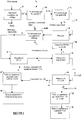
- Example 5 (in accordance with FIG. 1)
- Example 1 a flow of 21.88 tonnes of recoverable materials from the separation of the separation of most of the various metals to be recovered, formed from a mixture of used synthetic polymers to be upgraded and contaminating materials to eliminating is subjected to a preconcentration phase in order to select in this mixture of used polymer materials to be valued.
- composition of the flow of materials entering the preconcentration phase is in accordance with the data of Table I of Example 1 and reproduced below.
- Table XI Materials Composition and granulometry Content in% by weight polymers PE, PP, PS, ABS, PP Talc, PVC, ... in fragmented form 73% by weight Rubber and / or elastomers All types of joints and / or insulating sheaths of electrical cables 19% by weight Metals Fragments of ferrous but especially non-ferrous metals: copper, aluminum ... 8% by weight
- the fraction d 3 a mixture of recoverable used synthetic polymers leaving step d) but of eminently variable densities in the range of 0.900 to 1.400 is subjected to a separation treatment by density in an aqueous medium, in the zone (J). ), at a density threshold of ds ⁇ 1.2 to make a first density selection.
- the flux (f 2 ) which represents 11,153 T [76.60% by weight of the fraction (e 1 )], formed of a mixture of crystal polystyrene and / or flame-retarded shock or not, without load, of a copolymer uncharged acrylonitrile-butadiene-styrene but for some fractions flame retarded and polypropylene loaded with 5% to 40% talc constitutes the fraction of used polymer materials, whose densities are in the range of 1,000 to 1,199, inclusive limits, and which are to be separated according to the invention.
- the supernatant phase is recovered and analyzed, and the plunging phase is collected and then subjected to a higher density than the preceding one, giving for each class a supernatant phase analyzed and a dip phase in turn subjected to a higher density.
- polymeric materials of the same density but of different composition are present in the initial industrial mixture treated in this example so that other separation means must be used to separate in each fraction, polymers of identical density, each type of polymer present.
- the other fraction g 2 with a density greater than 1.100 represents 0.381 tonnes of recoverable materials comprising a mixture of polycarbonate (PC), polypropylene (PP) loaded with talc, polyvinyl chloride (PVC), polymethyl methacrylate (PMMA), polyurethanes (PU) charged, is treated, according to the same principle as the fraction g 1 , in the separation zones (Q) and (S), not described.
- PC polycarbonate
- PP polypropylene
- PVC polyvinyl chloride
- PMMA polymethyl methacrylate
- PU polyurethanes
Landscapes
- Engineering & Computer Science (AREA)
- Environmental & Geological Engineering (AREA)
- Mechanical Engineering (AREA)
- Separation Of Solids By Using Liquids Or Pneumatic Power (AREA)
- Separation, Recovery Or Treatment Of Waste Materials Containing Plastics (AREA)
- Processing And Handling Of Plastics And Other Materials For Molding In General (AREA)
- Addition Polymer Or Copolymer, Post-Treatments, Or Chemical Modifications (AREA)
Claims (35)
- Verfahren zur selektiven Trennung der in fragmentierter Form auftretenden Bestandteile einer Mischung aus organischen Kunststoffen, wie Polymere und/oder Copolymere, mit einer Dichte gleich 1, die insbesondere schon benutzt wurden und durch Recycling verwertet werden, welches darin besteht, deren Trennung durch Einführung der Mischung in ein dichtes flüssiges Medium, welches eine wässrige Suspension pulverförmiger Partikel ist, die in einer angemessenen Menge in einer wässrigen Phase dispergiert werden, zu erzielen, um ein Dichte "ds" zu erreichen, die als Trenngrenze für die selektiv nach Typ zu trennenden fragmentierten organischen Kunststoffe ausgewählt wird, dadurch gekennzeichnet, dass die separierende Suspension selektiv, stabil und in Bezug auf die Dichte unveränderlich gemacht wird auf einer Präzisionsstufe von ± 0,0005 im Verhältnis zu der für die selektive Trennung ausgewählten Dichtegrenze "ds":a) durch die Größenauswahl von pulverförmigen Partikeln, deren Korngrößenschnitt höchstens 30 µm beträgt, wobei diese so bemessenen festen pulverförmigen Partikel in einer wässrigen Phase in ausreichender Menge dispergiert und vorhanden sind, um die ausgewählte Dichtegrenze "ds" zu erreichen, undb) durch den Einsatz von mindestens einem dynamischen Stabilisierungsmittel, so dass die separative Suspension mit einem Förderstrom von mindestens 5 m3/h und höchstens 40 m3/h bewegt wird.
- Verfahren nach Anspruch 1, dadurch gekennzeichnet, dass die separative Suspension mit einer Präzision von ± 0,0005 in Bezug auf die zur selektiven Trennung ausgewählte Dichtegrenze "ds" selektiv, stabil und unveränderlich gemacht wird durch die Auswahl einer Größe für die festen pulverförmigen Partikel, deren Korngrößenschnitt vorzugsweise höchstens 20 µm, und vorzugsweise höchsten 5 µm beträgt, wobei die so bemessenen pulverförmigen Partikel in einer wässrigen Phase in ausreichender Menge dispergiert und vorhanden sind, um die ausgewählte Dichtegrenze "ds" zu erreichen.
- Verfahren nach Anspruch 1, dadurch gekennzeichnet, dass die pulverförmigen Partikel natürlicher Herkunft sind und aus der Gruppe pulverförmiger mineralischer Stoffe ausgewählt werden, die bestehen aus Tonarten von Familien, die durch die Gruppe der Kaolinite gebildet werden, und Kaolinit, Dickit, Halloysit, ungeordnete Kaolinite, Serpentine, die Gruppe der Mica, insbesondere Muskovit, Biotit und Paragonit, Pyrophillit und Talk, Illite und Glaukonit umfassen, und durch die Gruppe der Montmorillonite, insbesondere Beidellit, Stevensit, Saponit und Hektorit; durch die Gruppe der Chlorite; durch die Gruppe der Vermikulite; durch die Gruppe der interkalierten Tone, deren einheitliche Struktur eine Kombination aus den vorhergehenden Gruppen ist; durch die Gruppe der faserartigen Tone, insbesondere Attapukgite (Palygorskit) und Sepiolit; durch die Gruppe, die gebildet wird durch Calciumcarbonat (Calcit), Magnesiumcarbonat, Dolomit, Doppelcarbonat von Calcium und Magnesium), Kalziumsulfat-Dihydrat (Gips), Baryumsulfat, Talk, Aluminiumoxid, Silica, Titandioxid und Zirkon.
- Verfahren nach Anspruch 1, dadurch gekennzeichnet, dass die pulverförmigen Partikel synthetischen Ursprungs sind und aus der Gruppe ausgewählt werden, die durch Glaspulver, ausgefälltem Kalziumkarbonat und metallischem Pulver gebildet wird.
- Verfahren nach mindestens einem der Ansprüche 1 bis 4, dadurch gekennzeichnet, dass die pulverförmigen Partikel einen mittleren Durchmesser von höchsten 5 µm und vorzugsweise zwischen 1 µm und 0,005 µm haben.
- Verfahren nach mindestens einem der Ansprüche 1 bis 5, dadurch gekennzeichnet, dass das dynamische Stabilisierungsmittel ausgewählt wird aus der Gruppe, die gebildet wird durch Umrühren mittels eines Rührorgans, durch einen internen Umlauf der Suspension mittels des Rührorgans, durch einen externen Umlauf der Suspension mittels einer Pumpe durch Entnahme der Suspension im Grund des Behälters, wo sie sich befindet und durch Reinjektion in den oberen Teil des Behälters, oder durch die Kombination von Mitteln, die die Verbindung des Umrührens mittels eines Rührorgans mit dem internen und/oder externen Umlauf der Suspension ermöglichen.
- Verfahren nach mindesten einem der Ansprüche 1 bis 6, dadurch gekennzeichnet, dass das dynamische Stabilisierungsmittel ein kontinuierlicher oder diskontinuierlicher Umlauf der Suspension ist.
- Verfahren nach Anspruch 1, dadurch gekennzeichnet, dass der umlaufende Durchsatz der separativen Suspension zwischen 5 und 30 m3/h und vorzugsweise zwischen 5 und 15 m3/h liegt.
- Verfahren nach mindesten einem der Ansprüche 1 bis 8, dadurch gekennzeichnet, dass der Förderstrom der separativen Suspension auf eine stündliche Erneuerungsrate der Suspension von 0,5 bis 4 und vorzugsweise von 0,5 bis 2 eingestellt wird.
- Verfahren nach mindestens einem der Ansprüche 1 bis 9, dadurch gekennzeichnet, dass die wässrige Phase eine Leitfähigkeit von höchstens 50 ms und vorzugsweise von 0,2 ms bis 40 ms aufweist.
- Verfahren nach mindestens einem der Ansprüche 1 bis 10, dadurch gekennzeichnet, dass der Suspension ein wasserlösliches Mittel zur Stabilisierung der rheologischen Merkmale und der Invarianz der scheinbaren Dichte "ds" der Suspension der festen pulverförmigen Partikel zugeführt wird.
- Verfahren nach Anspruch 11, dadurch gekennzeichnet, dass das wasserlösliche Mittel zur Stabilisierung der rheologischen Eigenschaften und der Invarianz der scheinbaren Dichte "ds" der Suspension der festen, pulverförmigen Partikel aus einer Gruppe ausgewählt wird, die durch Phosphate und Polyphosphate, Alkyphosphatester, Alkyphospanate, Alkylsulfat, Alkylsulfonat, Lignin, Lignosulfonate in Form von Kalzium-, Natrium-, Eisen-, Chromsalz, Eisen und Chromsalz gebildet werden, wobei die Copolymere aus Maleinsäureanhydrid und Styrolsulfonsäure, die Copolymere von Methylacrylamid und substituierte (Meth)acrylsäure, die wasserlöslichen Polymere von Acrylsäure, die in saurer Form oder eventuell ganz oder teilweise durch alkalische und/oder erdalkalische Mittel und durch Amine neutralisiert werden, und/oder durch monovalente und/oder polyalente Ionen in Salzform, und/oder in Esterform eingesetzt werden, oder auch aus acrylischen wasserlöslichen Copolymeren ausgewählt werden, über phosphatierte, phosponierte, sulfatierte oder sulfonierte Funktionen verfügen.
- Verfahren nach einem der Ansprüche 11 und 12, dadurch gekennzeichnet, dass das wasserlösliche Stabilisierungsmittel vorzugsweise aus den wasserlöslichen acrylischen Copolymeren, welche folgender allgemeiner Formel entsprechen, ausgewählte wird:
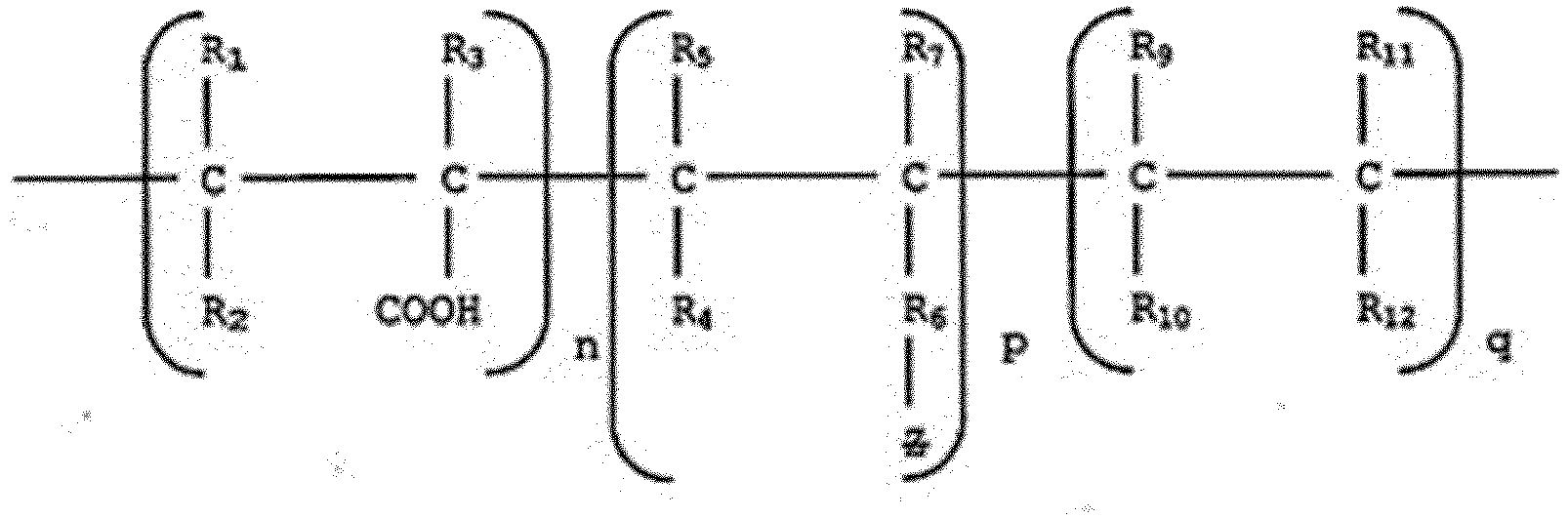 z ist eine Phophat-, Phosphonat-, Sulfat- oder Sulfonateinheit mit mindestens einer freien Säurefunktionsfunktion,n hat einen Wert zwischen 0 und 95,p hat einen Wert zwischen 95 und 5,q hat einen Wert zwischen 0 und 95,wobei die Kumulierung von n+p+q gleich 100 ist,R1 und R2 können gleichzeitig Wasserstoff sein oder ein Wasserstoff und der andere eine karboxylische veresterte Funktion eines C- bis C12-Alkohols sein kann,R3 ist ein Wasserstoff oder ein Alkylrest C1 bis C12,R4 und R5 sind gleichzeitig oder nicht Wasserstoff oder ein Alkylrest C1 bis C12, ein substituiertes Aryl oder nicht, eine karboxylische veresterte Funktion, die durch einen C1 bis C12-Alkohol verestert werden sein kann oder nicht,R6 ist ein Radikal, dass eine Verbindung zwischen der Einheit Z und der Polymerkette herstellt, wobei das Radikal R6 ein Alkylen mit der Formel (-CH2-) sein kann, in welcher r die Werte des Intervalls 1 bis 12 haben kann, ein Alkylenoxid- oder polyoxid mit der Formel (R8-O) sein kann, in welcher R8 ein C1 bis C4-Alkylen ist und s die Werte zwischen 1 und 30 haben kann, oder auch eine Kombination der beiden Formeln (CH2) und (R8-Os) sein kann.R7 ist Wasserstoff oder ein C1 bis C12-Alkylrest,R9 und R10 sind gleichzeitig Wasserstoff, oder während eines Wasserstoff ist, ist das andere eine Carboxylgruppe, ein C1 bis C12-Ester, ein C1 bis C12-Alkyl, ein C5- oder C6-Aryl oder ein Alkylaryl,R11 ist ein Wasserstoff, eine Carboxylgruppe, ein C1 bis C3-Alkyl oder ein Halogen,R12 ist ein C1 bis C12-Ester, ein substituiertes Amid oder nicht, ein C1 bis C12-Alkyl, ein C5- oder C6-Aryl, ein Alkylaril, ein Halogen, eine Carboxylgruppe oder eine Alkyl- oder Arylgruppe, die phosphatiert, phosphoriert, sulfatiert, oder sulfoniert ist.
 - Verfahren nach Anspruch 13, dadurch gekennzeichnet, dass in der Einheit Z die nicht freien Säurefunktionen durch ein Kation, eine Ammoniumgruppe, ein Amin, ein C1 bis C3-Alkyl, ein C3 bis C6-Aryl, substituiert oder nicht, ein Alkaryl, ein C1 bis C12-Ester und vorzugsweise C1 bis C3-Ester oder ein substituiertes Amid belegt ist.
- Verfahren nach Anspruch 13, dadurch gekennzeichnet, dass bei der Kumulierung n + p + q, n = 0 ist, wenn q > o, und q = 0 ist, wenn n > 0.
- Verfahren nach Anspruch 13, dadurch gekennzeichnet, dass in den Einheiten R1 und R2 der die Carboxyl-Funktion veresternde Alkohol vorzugsweise ein C1 bis C4-Alkohol ist.
- Verfahren nach Anspruch 13, dadurch gekennzeichnet, dass in der Einheit R3 der Alkylrest vorzugsweise ein C1 bis C4-Alkylrest ist.
- Verfahren nach Anspruch 13, dadurch gekennzeichnet, dass in den Einheiten R4 und R5 der Alkylrest vorzugsweise ein C1 bis C4-Alkylrest ist.
- Verfahren nach Anspruch 13, dadurch gekennzeichnet, dass in den Einheiten R4 und R5 der die Carboxyl-Funktion veresternde Alkohol vorzugsweise ein C1 bis C4-Alkohol ist.
- Verfahren nach Anspruch 13, dadurch gekennzeichnet, dass in der Einheit R7 der Alkylrest vorzugsweise ein C1 bis C4-Alkylrest ist.
- Verfahren nach Anspruch 13, dadurch gekennzeichnet, dass der Ester in den Einheiten R9 und R10 ein C1 bis C3-Ester ist.
- Verfahren nach Anspruch 13, dadurch gekennzeichnet, dass das Alkyl in den Einheiten R9 und R10 vorzugsweise ein C1 bis C3-Alkyl ist.
- Verfahren nach Anspruch 13, dadurch gekennzeichnet, dass der Ester in der Einheit R12 vorzugsweise ein C1 bis C5-Ester ist.
- Verfahren nach Anspruch 13, dadurch gekennzeichnet, dass das Alkyl in den Einheiten R12 vorzugsweise ein C1 bis C3-Alkyl ist.
- Verfahren nach Anspruch 13, dadurch gekennzeichnet, dass das Molekulargewicht der wasserlöslichen Akrylpoymere, die das Stabilisierungsmittel bilden, zwischen 5000 und 100 000 beträgt.
- Verfahren nach Anspruch 13, dadurch gekennzeichnet, dass die wasserlöslichen Acrylpolymere, welche das Stabilisierungsmittel bilden, mindestens teilweise mittels eines Neutralisierungsmittels neutralisiert werden, das aus der Gruppe ausgewählt wird, die durch Natrium-, Kalium-, Ammonium-, Kalzium-, Magnesiumhydroxiden und primären, sekundären und tertiären aliphatischen und/oder zyklischen Aminen, insbesondere Mono-, Di- Triethanolaminen, Mono- und Diethylaminen, Cyclohexylamin und Methylcyclohexylamin, ausgewählt wird.
- Verfahren nach einem der Ansprüche 10 bis 13, dadurch gekennzeichnet, dass die gewichtete Menge des wasserlöslichen Stabilisierungsmittels in % in Trocken-/Trockenmasse des besagten Mittels im Verhältnis zur gewichteten Menge der suspendierten pulverförmigen Partikel ausgedrückt wird zwischen 0,02% und 5% und vorzugsweise zwischen 0,1% und 2% liegt.
- Verfahren nach mindestens einem der Ansprüche 1 bis 27, dadurch gekennzeichnet, dass besagtes Verfahren in mindestens einem hydraulischen Abscheider ausgeführt wird, der mit mindestens einem dynamischen Stabilisierungsmittel versehen ist.
- Verfahren nach Anspruch 28, dadurch gekennzeichnet, dass, wenn besagtes Verfahren in einem einzigen hydraulischen Abscheider vollzogen wird, sich die ausgewählte Dichte "ds" verändert:- und zunimmt durch kontrolliertes Hinzufügen der definierten und ausgewählten pulverförmigen Partikel zu der in besagtem hydraulischem Abscheider vorhandenen Suspension, bis die neue Dichte "ds" des ausgewählten Grenzwerts erreicht ist,- und abnimmt durch Hinzufügen von Wasser, bis die neue Dichte "ds" des ausgewählten Grenzwertes erreicht ist.
- Verfahren nach Anspruch 29, dadurch gekennzeichnet, dass die Zunahme oder Abnahme der Dichte der separativen stabilen Suspension unter Umrühren mit einem Rührorgan und/oder einem internen Umlauf und/oder einem Umlauf durch Entnahme des gerade berichtigten dichten wässrigen Mediums im Grund des hydraulischen Abscheiders und durch Reinjektion im oberen Bereich des Abscheiders erfolgt.
- Verfahren nach Anspruch 28, dadurch gekennzeichnet, dass in dem Fall, wo besagtes Verfahren in mehreren hydraulischen Abscheidern ausgeführt wird, die diversen Abscheider hintereinander gestellt werden in einem Reihensystem, das mit den stabilen Suspensionen funktioniert, die jeweils eine präzise Dichtegrenze "ds" erreicht haben in einer Reihenfolge, in der die Dichten zu- oder abnehmen.
- Verfahren nach einem der Ansprüche 28 bis 31, dadurch gekennzeichnet, dass die Grenzdichte "ds" der wässrigen Suspension der Feinstabscheidung kontinuierlich durch geeignete Messmittel kontrolliert und einer Berichtigung unterzogen wird, wenn eine Abweichung festgestellt wird.
- Verfahren nach Anspruch 32, dadurch gekennzeichnet, dass jeder hydraulische Abscheider in Bezug auf die Dichte des dichten Mediums, das er enthält, mittels zweier Magnetventile gesteuert wird, die sich jeweils zu zwei mit zwei Behältern verbundenen Kreisen hin öffnen, wobei einer der Behälter eine "Muttersuspension" mit einer Konzentration von etwa 60% des Gewichts der pulverförmigen Partikel, die mit einem wasserlöslichen Stabilisierungsmittel stabilisiert ist, enthält, und das Einfügen einer bestimmten Menge der Muttersuspension ermöglicht, welche eine Abweichung in der Dichte des dichten Mediums der Feinstabscheidung nach unten nach oben hin berichtigt, wohingegen der andere Behälter Wasser enthält, was das Einfügen einer bestimmten Menge Wasser ermöglicht, welches eine Abweichung der Dichte des dichten Mediums der Feinstabscheidung nach oben nach unten hin berichtigt.
- Verfahren nach Anspruch 33, dadurch gekennzeichnet, das in jedem hydraulischen Abscheider die Messung der Dichte des dichten Mediums kontinuierlich durch geeignete Messgeräte erfolgt, die das Öffnen eines der Magnetventile und dann das Schließen auslösen, sobald die Grenzdichte "ds" erreicht ist.
- Benutzung des Verfahrens nach mindestens einem der Ansprüche 1 bis 34 zur selektiven Abscheidung von Polymerstoffen in einer Mischung, insbesondere gerauchter Materialien, die aus der Zerstörung von Fahrzeugen und/oder langlebigen Gebrauchsgüter stammen.
Applications Claiming Priority (2)
| Application Number | Priority Date | Filing Date | Title |
|---|---|---|---|
| FR0314472A FR2863509B1 (fr) | 2003-12-10 | 2003-12-10 | Procede de separation selective de materiaux polymeres fragmentes en particulier usages, au moyen de suspensions aqueuses denses dynamiquement stabilises |
| PCT/FR2004/003150 WO2005065830A2 (fr) | 2003-12-10 | 2004-12-08 | Separation selective de materiaux polymeres fragmentes, usages, par une suspension aqueuse dense dynamiquement stabilisee |
Publications (2)
| Publication Number | Publication Date |
|---|---|
| EP1708819A2 EP1708819A2 (de) | 2006-10-11 |
| EP1708819B1 true EP1708819B1 (de) | 2017-05-03 |
Family
ID=34610552
Family Applications (1)
| Application Number | Title | Priority Date | Filing Date |
|---|---|---|---|
| EP04805658.4A Expired - Lifetime EP1708819B1 (de) | 2003-12-10 | 2004-12-08 | Trennverfahren für kunststoffe unter anwendung einer dynamisch stabilisierten wässrigen suspension |
Country Status (8)
| Country | Link |
|---|---|
| US (1) | US7807727B2 (de) |
| EP (1) | EP1708819B1 (de) |
| BR (1) | BRPI0417464B1 (de) |
| CA (1) | CA2550125C (de) |
| ES (1) | ES2634501T3 (de) |
| FR (1) | FR2863509B1 (de) |
| PT (1) | PT1708819T (de) |
| WO (1) | WO2005065830A2 (de) |
Cited By (1)
| Publication number | Priority date | Publication date | Assignee | Title |
|---|---|---|---|---|
| WO2026017731A1 (fr) * | 2024-07-16 | 2026-01-22 | Galloo Plastics | Procédé de séparation sélective de constituants d'un mélange de matériaux organiques de synthèse fragmentés à l'aide d'une suspension aqueuse dense brassée de manière séquentielle |
Families Citing this family (12)
| Publication number | Priority date | Publication date | Assignee | Title |
|---|---|---|---|---|
| US20090065404A1 (en) * | 2004-02-06 | 2009-03-12 | Paspek Consulting Llc | Process for reclaiming multiple domain feedstocks |
| EP2076338B2 (de) * | 2006-09-25 | 2022-01-26 | Basf Se | Verfahren zum klassieren wasserabsorbierender polymerpartikel |
| CN102083601A (zh) | 2008-06-26 | 2011-06-01 | 凯斯勒废物系统公司 | 废弃物存储一体化的系统与方法 |
| FR2936432B1 (fr) * | 2008-09-30 | 2011-09-16 | Gallo Plastics | Procede de separation selective de materiaux organiques usages,fragmentes au moyen d'un milieu aqueux de densite choisie |
| DE102008056311A1 (de) * | 2008-11-07 | 2010-05-12 | Apk Aluminium Und Kunststoffe Ag | Verfahren zum Abtrennen einzelner Wertstoffe aus gemischtem, insbesondere zerkleinertem Kunststoffabfall |
| HRP20171259T1 (hr) | 2011-06-03 | 2017-10-20 | Accordant Energy, Llc | Postupak za proizvodnju modificiranog tehničkog goriva iz otpada |
| US8752779B2 (en) * | 2011-08-05 | 2014-06-17 | Forest Concepts, LLC | Woody biomass beneficiation system |
| WO2015173807A1 (en) * | 2014-05-11 | 2015-11-19 | Infimer Technologies Ltd. | Method of separating waste material |
| CN113544204B (zh) * | 2019-02-01 | 2024-07-19 | 索尔维特殊聚合物美国有限责任公司 | 用于分离固体的混合物的方法 |
| KR20230166126A (ko) * | 2021-04-06 | 2023-12-06 | 토마스 에이. 발레리오 | 폐기물 스트림으로부터 플라스틱을 분리하기 위한 방법 및 시스템 |
| CN117566742B (zh) * | 2024-01-17 | 2024-03-15 | 崇义章源钨业股份有限公司 | 一种热镶嵌钨废料的回收利用方法 |
| EP4678368A1 (de) | 2024-07-09 | 2026-01-14 | Vynova Holding S.A. | Verfahren zur wiederverwendung von pvc |
Family Cites Families (11)
| Publication number | Priority date | Publication date | Assignee | Title |
|---|---|---|---|---|
| US3857489A (en) | 1972-02-11 | 1974-12-31 | Control Michigan Technological | Stabilization of suspensions used in heavy-media separation processes |
| FR2483932B1 (fr) * | 1980-06-09 | 1985-08-02 | Rhone Poulenc Spec Chim | Nouvelles compositions polymere acrylique, procede pour leur obtention, et application notamment comme agents antitartres |
| DE59402670D1 (de) * | 1993-03-18 | 1997-06-12 | Pagenkopf Ingeborg Dr | Verfahren zur trennung von feststoffgemischen verschiedener dichte, trennflüssigkeit und vorrichtung zur durchführung des verfahrens |
| DE4334570A1 (de) * | 1993-10-11 | 1995-04-13 | Bayerische Motoren Werke Ag | Rohrverbindung mit einem Längenausgleich |
| US5653867A (en) * | 1996-03-19 | 1997-08-05 | The University Of Chicago | Method for the separation of high impact polystyrene (HIPS) and acrylonitrile butadiene styrene (ABS) plastics |
| FR2751262B1 (fr) | 1996-07-22 | 1998-09-11 | Gp Sarl | Procede et installation pour separer des materiaux polymeres, polystyrene et abs obtenus |
| FR2773736B1 (fr) * | 1998-01-22 | 2000-05-26 | Galloo Plastics | Procede et installation pour separer toutes categories de materiaux polymeres |
| EP1105217A4 (de) * | 1998-05-26 | 2001-08-16 | Mba Polymers Inc | Gerät und verfahren zur vrebesserung der trennung verschiedener polymermaterialien aus einer mischung durch differenzielle veränderung der dichte |
| DE19964175A1 (de) | 1999-03-04 | 2001-12-20 | Silke Behnsen | Anlage und Verfahren zur Trennung von Stoffgemischen unterschiedlicher Dichte |
| US6599950B2 (en) * | 2001-03-29 | 2003-07-29 | The University Of Chicago | Process for the recovery and separation of plastics |
| CN1688392B (zh) * | 2002-07-22 | 2010-06-23 | Mba聚合物公司 | 在浆化稠密介质分离中控制介质颗粒尺寸 |
-
2003
- 2003-12-10 FR FR0314472A patent/FR2863509B1/fr not_active Expired - Fee Related
-
2004
- 2004-12-08 EP EP04805658.4A patent/EP1708819B1/de not_active Expired - Lifetime
- 2004-12-08 US US10/582,545 patent/US7807727B2/en not_active Expired - Lifetime
- 2004-12-08 CA CA2550125A patent/CA2550125C/fr not_active Expired - Lifetime
- 2004-12-08 ES ES04805658.4T patent/ES2634501T3/es not_active Expired - Lifetime
- 2004-12-08 BR BRPI0417464-0A patent/BRPI0417464B1/pt not_active IP Right Cessation
- 2004-12-08 PT PT48056584T patent/PT1708819T/pt unknown
- 2004-12-08 WO PCT/FR2004/003150 patent/WO2005065830A2/fr not_active Ceased
Non-Patent Citations (1)
| Title |
|---|
| None * |
Cited By (2)
| Publication number | Priority date | Publication date | Assignee | Title |
|---|---|---|---|---|
| WO2026017731A1 (fr) * | 2024-07-16 | 2026-01-22 | Galloo Plastics | Procédé de séparation sélective de constituants d'un mélange de matériaux organiques de synthèse fragmentés à l'aide d'une suspension aqueuse dense brassée de manière séquentielle |
| FR3164637A1 (fr) * | 2024-07-16 | 2026-01-23 | Galloo Plastics | Procédé de séparation sélective de constituants d'un mélange de matériaux organiques de synthèse fragmentés à l’aide d’une suspension aqueuse dense brassée de manière séquentielle |
Also Published As
| Publication number | Publication date |
|---|---|
| US20070272597A1 (en) | 2007-11-29 |
| FR2863509A1 (fr) | 2005-06-17 |
| EP1708819A2 (de) | 2006-10-11 |
| PT1708819T (pt) | 2017-07-27 |
| WO2005065830A3 (fr) | 2005-09-09 |
| BRPI0417464A (pt) | 2007-03-13 |
| BRPI0417464B1 (pt) | 2015-08-11 |
| CA2550125A1 (fr) | 2005-07-21 |
| CA2550125C (fr) | 2014-07-29 |
| ES2634501T3 (es) | 2017-09-28 |
| US7807727B2 (en) | 2010-10-05 |
| FR2863509B1 (fr) | 2007-07-13 |
| WO2005065830A2 (fr) | 2005-07-21 |
Similar Documents
| Publication | Publication Date | Title |
|---|---|---|
| Gent et al. | Recycling of plastic waste by density separation: prospects for optimization | |
| CN102223954B (zh) | 通过具有选定密度的水性介质选择性分离废弃的碎片状有机材料同时提高其纯度的方法 | |
| CA2318364C (fr) | Procede et installation pour separer toutes categories de materiaux polymeres | |
| EP1694481B1 (de) | Verfahren zum gezielten trennen von verbrauchten zerkleinerten organischen materialien mittels dichter wässriger suspensionen | |
| CA2550125C (fr) | Separation selective de materiaux polymeres fragmentes, usages, par une suspension aqueuse dense dynamiquement stabilisee | |
| Pita et al. | Separation of plastics by froth flotation. The role of size, shape and density of the particles | |
| CA2805362C (fr) | Pre-concentration et preselection simultanee d'au moins un groupe de materiaux polymeres valorisables provenant de dechets de broyage de biens durables en fin de vie | |
| JPH04502123A (ja) | プラスチックの分離及び回収方法 | |
| CA2275944C (fr) | Procede et installation pour separer des materiaux polymeres | |
| FR2841799A1 (fr) | Procede de preconcentration de materiaux organiques de synthese en provenance de dechets de broyage de biens durables arrives en fin de vie | |
| EP4678368A1 (de) | Verfahren zur wiederverwendung von pvc | |
| KR20260003118A (ko) | 커버된 스크린 베드를 사용하여 플라스틱을 분리하는 방법 및 시스템 | |
| PL233539B1 (pl) | Sposób rozdziału PET od zanieczyszczeń | |
| SK278081B6 (en) | Method of separating of waste isolation material originating by mechanical treating of electrical conductors |
Legal Events
| Date | Code | Title | Description |
|---|---|---|---|
| PUAI | Public reference made under article 153(3) epc to a published international application that has entered the european phase |
Free format text: ORIGINAL CODE: 0009012 |
|
| 17P | Request for examination filed |
Effective date: 20060628 |
|
| AK | Designated contracting states |
Kind code of ref document: A2 Designated state(s): AT BE BG CH CY CZ DE DK EE ES FI FR GB GR HU IE IS IT LI LT LU MC NL PL PT RO SE SI SK TR |
|
| 111L | Licence recorded |
Free format text: 0100 ECR Effective date: 20061011 |
|
| DAX | Request for extension of the european patent (deleted) | ||
| 17Q | First examination report despatched |
Effective date: 20110823 |
|
| GRAP | Despatch of communication of intention to grant a patent |
Free format text: ORIGINAL CODE: EPIDOSNIGR1 |
|
| INTG | Intention to grant announced |
Effective date: 20170208 |
|
| GRAS | Grant fee paid |
Free format text: ORIGINAL CODE: EPIDOSNIGR3 |
|
| GRAA | (expected) grant |
Free format text: ORIGINAL CODE: 0009210 |
|
| 111L | Licence recorded |
Designated state(s): AT BE BG CH CY CZ DE DK EE ES FI FR GB GR HU IE IS IT LT LU MC NL PL PT RO SE SI SK TR Free format text: EXCLUSIVE LICENSE Name of requester: ECR, FR Effective date: 20061011 |
|
| AK | Designated contracting states |
Kind code of ref document: B1 Designated state(s): AT BE BG CH CY CZ DE DK EE ES FI FR GB GR HU IE IS IT LI LT LU MC NL PL PT RO SE SI SK TR |
|
| REG | Reference to a national code |
Ref country code: GB Ref legal event code: FG4D Free format text: NOT ENGLISH |
|
| REG | Reference to a national code |
Ref country code: AT Ref legal event code: REF Ref document number: 889376 Country of ref document: AT Kind code of ref document: T Effective date: 20170515 Ref country code: CH Ref legal event code: EP Ref country code: CH Ref legal event code: PK Free format text: COMPLEMENT D'ENREGISTREMENT DE LICENCE: LICENCE EXCLUSIVE |
|
| REG | Reference to a national code |
Ref country code: IE Ref legal event code: FG4D Free format text: LANGUAGE OF EP DOCUMENT: FRENCH |
|
| REG | Reference to a national code |
Ref country code: DE Ref legal event code: R096 Ref document number: 602004051210 Country of ref document: DE |
|
| REG | Reference to a national code |
Ref country code: PT Ref legal event code: SC4A Ref document number: 1708819 Country of ref document: PT Date of ref document: 20170727 Kind code of ref document: T Free format text: AVAILABILITY OF NATIONAL TRANSLATION Effective date: 20170721 |
|
| REG | Reference to a national code |
Ref country code: CH Ref legal event code: NV Representative=s name: ABREMA AGENCE BREVET ET MARQUES, GANGUILLET, CH |
|
| REG | Reference to a national code |
Ref country code: NL Ref legal event code: FP |
|
| REG | Reference to a national code |
Ref country code: SE Ref legal event code: TRGR |
|
| REG | Reference to a national code |
Ref country code: LT Ref legal event code: MG4D |
|
| REG | Reference to a national code |
Ref country code: ES Ref legal event code: FG2A Ref document number: 2634501 Country of ref document: ES Kind code of ref document: T3 Effective date: 20170928 |
|
| PG25 | Lapsed in a contracting state [announced via postgrant information from national office to epo] |
Ref country code: FI Free format text: LAPSE BECAUSE OF FAILURE TO SUBMIT A TRANSLATION OF THE DESCRIPTION OR TO PAY THE FEE WITHIN THE PRESCRIBED TIME-LIMIT Effective date: 20170503 Ref country code: GR Free format text: LAPSE BECAUSE OF FAILURE TO SUBMIT A TRANSLATION OF THE DESCRIPTION OR TO PAY THE FEE WITHIN THE PRESCRIBED TIME-LIMIT Effective date: 20170804 Ref country code: LT Free format text: LAPSE BECAUSE OF FAILURE TO SUBMIT A TRANSLATION OF THE DESCRIPTION OR TO PAY THE FEE WITHIN THE PRESCRIBED TIME-LIMIT Effective date: 20170503 |
|
| PG25 | Lapsed in a contracting state [announced via postgrant information from national office to epo] |
Ref country code: PL Free format text: LAPSE BECAUSE OF FAILURE TO SUBMIT A TRANSLATION OF THE DESCRIPTION OR TO PAY THE FEE WITHIN THE PRESCRIBED TIME-LIMIT Effective date: 20170503 Ref country code: IS Free format text: LAPSE BECAUSE OF FAILURE TO SUBMIT A TRANSLATION OF THE DESCRIPTION OR TO PAY THE FEE WITHIN THE PRESCRIBED TIME-LIMIT Effective date: 20170903 Ref country code: BG Free format text: LAPSE BECAUSE OF FAILURE TO SUBMIT A TRANSLATION OF THE DESCRIPTION OR TO PAY THE FEE WITHIN THE PRESCRIBED TIME-LIMIT Effective date: 20170803 |
|
| REG | Reference to a national code |
Ref country code: FR Ref legal event code: PLFP Year of fee payment: 14 |
|
| PG25 | Lapsed in a contracting state [announced via postgrant information from national office to epo] |
Ref country code: SK Free format text: LAPSE BECAUSE OF FAILURE TO SUBMIT A TRANSLATION OF THE DESCRIPTION OR TO PAY THE FEE WITHIN THE PRESCRIBED TIME-LIMIT Effective date: 20170503 Ref country code: DK Free format text: LAPSE BECAUSE OF FAILURE TO SUBMIT A TRANSLATION OF THE DESCRIPTION OR TO PAY THE FEE WITHIN THE PRESCRIBED TIME-LIMIT Effective date: 20170503 Ref country code: CZ Free format text: LAPSE BECAUSE OF FAILURE TO SUBMIT A TRANSLATION OF THE DESCRIPTION OR TO PAY THE FEE WITHIN THE PRESCRIBED TIME-LIMIT Effective date: 20170503 Ref country code: RO Free format text: LAPSE BECAUSE OF FAILURE TO SUBMIT A TRANSLATION OF THE DESCRIPTION OR TO PAY THE FEE WITHIN THE PRESCRIBED TIME-LIMIT Effective date: 20170503 Ref country code: EE Free format text: LAPSE BECAUSE OF FAILURE TO SUBMIT A TRANSLATION OF THE DESCRIPTION OR TO PAY THE FEE WITHIN THE PRESCRIBED TIME-LIMIT Effective date: 20170503 |
|
| REG | Reference to a national code |
Ref country code: DE Ref legal event code: R097 Ref document number: 602004051210 Country of ref document: DE |
|
| PLBE | No opposition filed within time limit |
Free format text: ORIGINAL CODE: 0009261 |
|
| STAA | Information on the status of an ep patent application or granted ep patent |
Free format text: STATUS: NO OPPOSITION FILED WITHIN TIME LIMIT |
|
| 26N | No opposition filed |
Effective date: 20180206 |
|
| PG25 | Lapsed in a contracting state [announced via postgrant information from national office to epo] |
Ref country code: SI Free format text: LAPSE BECAUSE OF FAILURE TO SUBMIT A TRANSLATION OF THE DESCRIPTION OR TO PAY THE FEE WITHIN THE PRESCRIBED TIME-LIMIT Effective date: 20170503 |
|
| REG | Reference to a national code |
Ref country code: IE Ref legal event code: MM4A |
|
| PG25 | Lapsed in a contracting state [announced via postgrant information from national office to epo] |
Ref country code: LU Free format text: LAPSE BECAUSE OF NON-PAYMENT OF DUE FEES Effective date: 20171208 |
|
| PG25 | Lapsed in a contracting state [announced via postgrant information from national office to epo] |
Ref country code: IE Free format text: LAPSE BECAUSE OF NON-PAYMENT OF DUE FEES Effective date: 20171208 |
|
| REG | Reference to a national code |
Ref country code: AT Ref legal event code: UEP Ref document number: 889376 Country of ref document: AT Kind code of ref document: T Effective date: 20170503 |
|
| PG25 | Lapsed in a contracting state [announced via postgrant information from national office to epo] |
Ref country code: MC Free format text: LAPSE BECAUSE OF FAILURE TO SUBMIT A TRANSLATION OF THE DESCRIPTION OR TO PAY THE FEE WITHIN THE PRESCRIBED TIME-LIMIT Effective date: 20170503 Ref country code: HU Free format text: LAPSE BECAUSE OF FAILURE TO SUBMIT A TRANSLATION OF THE DESCRIPTION OR TO PAY THE FEE WITHIN THE PRESCRIBED TIME-LIMIT; INVALID AB INITIO Effective date: 20041208 |
|
| PG25 | Lapsed in a contracting state [announced via postgrant information from national office to epo] |
Ref country code: CY Free format text: LAPSE BECAUSE OF NON-PAYMENT OF DUE FEES Effective date: 20170503 |
|
| REG | Reference to a national code |
Ref country code: CH Ref legal event code: PFUS Owner name: GALLOO PLASTICS (S.A.), FR Free format text: FORMER OWNER: GALLOO PLASTICS (S.A.), FR |
|
| PGFP | Annual fee paid to national office [announced via postgrant information from national office to epo] |
Ref country code: NL Payment date: 20231121 Year of fee payment: 20 |
|
| PGFP | Annual fee paid to national office [announced via postgrant information from national office to epo] |
Ref country code: GB Payment date: 20231124 Year of fee payment: 20 |
|
| PGFP | Annual fee paid to national office [announced via postgrant information from national office to epo] |
Ref country code: TR Payment date: 20231128 Year of fee payment: 20 Ref country code: SE Payment date: 20231121 Year of fee payment: 20 Ref country code: PT Payment date: 20231122 Year of fee payment: 20 Ref country code: FR Payment date: 20231122 Year of fee payment: 20 Ref country code: DE Payment date: 20231121 Year of fee payment: 20 Ref country code: AT Payment date: 20231123 Year of fee payment: 20 |
|
| PGFP | Annual fee paid to national office [announced via postgrant information from national office to epo] |
Ref country code: BE Payment date: 20231121 Year of fee payment: 20 |
|
| PGFP | Annual fee paid to national office [announced via postgrant information from national office to epo] |
Ref country code: ES Payment date: 20240102 Year of fee payment: 20 |
|
| PGFP | Annual fee paid to national office [announced via postgrant information from national office to epo] |
Ref country code: CH Payment date: 20240102 Year of fee payment: 20 |
|
| REG | Reference to a national code |
Ref country code: DE Ref legal event code: R071 Ref document number: 602004051210 Country of ref document: DE |
|
| REG | Reference to a national code |
Ref country code: NL Ref legal event code: MK Effective date: 20241207 |
|
| REG | Reference to a national code |
Ref country code: CH Ref legal event code: PL |
|
| REG | Reference to a national code |
Ref country code: BE Ref legal event code: MK Effective date: 20241208 |
|
| REG | Reference to a national code |
Ref country code: GB Ref legal event code: PE20 Expiry date: 20241207 |
|
| REG | Reference to a national code |
Ref country code: AT Ref legal event code: MK07 Ref document number: 889376 Country of ref document: AT Kind code of ref document: T Effective date: 20241208 |
|
| PG25 | Lapsed in a contracting state [announced via postgrant information from national office to epo] |
Ref country code: PT Free format text: LAPSE BECAUSE OF EXPIRATION OF PROTECTION Effective date: 20241218 |
|
| PG25 | Lapsed in a contracting state [announced via postgrant information from national office to epo] |
Ref country code: GB Free format text: LAPSE BECAUSE OF EXPIRATION OF PROTECTION Effective date: 20241207 |
|
| REG | Reference to a national code |
Ref country code: SE Ref legal event code: EUG |
|
| PG25 | Lapsed in a contracting state [announced via postgrant information from national office to epo] |
Ref country code: PT Free format text: LAPSE BECAUSE OF EXPIRATION OF PROTECTION Effective date: 20241218 Ref country code: GB Free format text: LAPSE BECAUSE OF EXPIRATION OF PROTECTION Effective date: 20241207 |
|
| REG | Reference to a national code |
Ref country code: ES Ref legal event code: FD2A Effective date: 20250131 |
|
| PG25 | Lapsed in a contracting state [announced via postgrant information from national office to epo] |
Ref country code: ES Free format text: LAPSE BECAUSE OF EXPIRATION OF PROTECTION Effective date: 20241209 |
|
| PGFP | Annual fee paid to national office [announced via postgrant information from national office to epo] |
Ref country code: IT Payment date: 20231121 Year of fee payment: 20 |