EP1712367A1 - Phasenänderungsinformationsaufzeichnungsmedium und verfahren zu dessen herstellung, sputtertarget, verfahren zur verwendung des phasenänderungsinformationsaufzeichnungsmediums und optische aufzeichnungsvorrichtung - Google Patents
Phasenänderungsinformationsaufzeichnungsmedium und verfahren zu dessen herstellung, sputtertarget, verfahren zur verwendung des phasenänderungsinformationsaufzeichnungsmediums und optische aufzeichnungsvorrichtung Download PDFInfo
- Publication number
- EP1712367A1 EP1712367A1 EP04771189A EP04771189A EP1712367A1 EP 1712367 A1 EP1712367 A1 EP 1712367A1 EP 04771189 A EP04771189 A EP 04771189A EP 04771189 A EP04771189 A EP 04771189A EP 1712367 A1 EP1712367 A1 EP 1712367A1
- Authority
- EP
- European Patent Office
- Prior art keywords
- phase
- recording medium
- information recording
- change information
- change
- Prior art date
- Legal status (The legal status is an assumption and is not a legal conclusion. Google has not performed a legal analysis and makes no representation as to the accuracy of the status listed.)
- Granted
Links
Images

Classifications
-
- G—PHYSICS
- G11—INFORMATION STORAGE
- G11B—INFORMATION STORAGE BASED ON RELATIVE MOVEMENT BETWEEN RECORD CARRIER AND TRANSDUCER
- G11B7/00—Recording or reproducing by optical means, e.g. recording using a thermal beam of optical radiation by modifying optical properties or the physical structure, reproducing using an optical beam at lower power by sensing optical properties; Record carriers therefor
- G11B7/24—Record carriers characterised by shape, structure or physical properties, or by the selection of the material
- G11B7/241—Record carriers characterised by shape, structure or physical properties, or by the selection of the material characterised by the selection of the material
-
- C—CHEMISTRY; METALLURGY
- C23—COATING METALLIC MATERIAL; COATING MATERIAL WITH METALLIC MATERIAL; CHEMICAL SURFACE TREATMENT; DIFFUSION TREATMENT OF METALLIC MATERIAL; COATING BY VACUUM EVAPORATION, BY SPUTTERING, BY ION IMPLANTATION OR BY CHEMICAL VAPOUR DEPOSITION, IN GENERAL; INHIBITING CORROSION OF METALLIC MATERIAL OR INCRUSTATION IN GENERAL
- C23C—COATING METALLIC MATERIAL; COATING MATERIAL WITH METALLIC MATERIAL; SURFACE TREATMENT OF METALLIC MATERIAL BY DIFFUSION INTO THE SURFACE, BY CHEMICAL CONVERSION OR SUBSTITUTION; COATING BY VACUUM EVAPORATION, BY SPUTTERING, BY ION IMPLANTATION OR BY CHEMICAL VAPOUR DEPOSITION, IN GENERAL
- C23C14/00—Coating by vacuum evaporation, by sputtering or by ion implantation of the coating forming material
- C23C14/22—Coating by vacuum evaporation, by sputtering or by ion implantation of the coating forming material characterised by the process of coating
- C23C14/34—Sputtering
- C23C14/3407—Cathode assembly for sputtering apparatus, e.g. Target
- C23C14/3414—Metallurgical or chemical aspects of target preparation, e.g. casting, powder metallurgy
-
- B—PERFORMING OPERATIONS; TRANSPORTING
- B41—PRINTING; LINING MACHINES; TYPEWRITERS; STAMPS
- B41M—PRINTING, DUPLICATING, MARKING, OR COPYING PROCESSES; COLOUR PRINTING
- B41M5/00—Duplicating or marking methods; Sheet materials for use therein
- B41M5/26—Thermography ; Marking by high energetic means, e.g. laser otherwise than by burning, and characterised by the material used
-
- C—CHEMISTRY; METALLURGY
- C22—METALLURGY; FERROUS OR NON-FERROUS ALLOYS; TREATMENT OF ALLOYS OR NON-FERROUS METALS
- C22C—ALLOYS
- C22C12/00—Alloys based on antimony or bismuth
-
- G—PHYSICS
- G11—INFORMATION STORAGE
- G11B—INFORMATION STORAGE BASED ON RELATIVE MOVEMENT BETWEEN RECORD CARRIER AND TRANSDUCER
- G11B7/00—Recording or reproducing by optical means, e.g. recording using a thermal beam of optical radiation by modifying optical properties or the physical structure, reproducing using an optical beam at lower power by sensing optical properties; Record carriers therefor
- G11B7/24—Record carriers characterised by shape, structure or physical properties, or by the selection of the material
- G11B7/241—Record carriers characterised by shape, structure or physical properties, or by the selection of the material characterised by the selection of the material
- G11B7/242—Record carriers characterised by shape, structure or physical properties, or by the selection of the material characterised by the selection of the material of recording layers
- G11B7/243—Record carriers characterised by shape, structure or physical properties, or by the selection of the material characterised by the selection of the material of recording layers comprising inorganic materials only, e.g. ablative layers
-
- G—PHYSICS
- G11—INFORMATION STORAGE
- G11B—INFORMATION STORAGE BASED ON RELATIVE MOVEMENT BETWEEN RECORD CARRIER AND TRANSDUCER
- G11B7/00—Recording or reproducing by optical means, e.g. recording using a thermal beam of optical radiation by modifying optical properties or the physical structure, reproducing using an optical beam at lower power by sensing optical properties; Record carriers therefor
- G11B7/24—Record carriers characterised by shape, structure or physical properties, or by the selection of the material
- G11B7/26—Apparatus or processes specially adapted for the manufacture of record carriers
- G11B7/266—Sputtering or spin-coating layers
-
- G—PHYSICS
- G11—INFORMATION STORAGE
- G11B—INFORMATION STORAGE BASED ON RELATIVE MOVEMENT BETWEEN RECORD CARRIER AND TRANSDUCER
- G11B7/00—Recording or reproducing by optical means, e.g. recording using a thermal beam of optical radiation by modifying optical properties or the physical structure, reproducing using an optical beam at lower power by sensing optical properties; Record carriers therefor
- G11B7/24—Record carriers characterised by shape, structure or physical properties, or by the selection of the material
- G11B7/26—Apparatus or processes specially adapted for the manufacture of record carriers
- G11B7/268—Post-production operations, e.g. initialising phase-change recording layers, checking for defects
-
- G—PHYSICS
- G11—INFORMATION STORAGE
- G11B—INFORMATION STORAGE BASED ON RELATIVE MOVEMENT BETWEEN RECORD CARRIER AND TRANSDUCER
- G11B7/00—Recording or reproducing by optical means, e.g. recording using a thermal beam of optical radiation by modifying optical properties or the physical structure, reproducing using an optical beam at lower power by sensing optical properties; Record carriers therefor
- G11B7/24—Record carriers characterised by shape, structure or physical properties, or by the selection of the material
- G11B7/241—Record carriers characterised by shape, structure or physical properties, or by the selection of the material characterised by the selection of the material
- G11B7/242—Record carriers characterised by shape, structure or physical properties, or by the selection of the material characterised by the selection of the material of recording layers
- G11B7/243—Record carriers characterised by shape, structure or physical properties, or by the selection of the material characterised by the selection of the material of recording layers comprising inorganic materials only, e.g. ablative layers
- G11B2007/24302—Metals or metalloids
- G11B2007/24308—Metals or metalloids transition metal elements of group 11 (Cu, Ag, Au)
-
- G—PHYSICS
- G11—INFORMATION STORAGE
- G11B—INFORMATION STORAGE BASED ON RELATIVE MOVEMENT BETWEEN RECORD CARRIER AND TRANSDUCER
- G11B7/00—Recording or reproducing by optical means, e.g. recording using a thermal beam of optical radiation by modifying optical properties or the physical structure, reproducing using an optical beam at lower power by sensing optical properties; Record carriers therefor
- G11B7/24—Record carriers characterised by shape, structure or physical properties, or by the selection of the material
- G11B7/241—Record carriers characterised by shape, structure or physical properties, or by the selection of the material characterised by the selection of the material
- G11B7/242—Record carriers characterised by shape, structure or physical properties, or by the selection of the material characterised by the selection of the material of recording layers
- G11B7/243—Record carriers characterised by shape, structure or physical properties, or by the selection of the material characterised by the selection of the material of recording layers comprising inorganic materials only, e.g. ablative layers
- G11B2007/24302—Metals or metalloids
- G11B2007/2431—Metals or metalloids group 13 elements (B, Al, Ga, In)
-
- G—PHYSICS
- G11—INFORMATION STORAGE
- G11B—INFORMATION STORAGE BASED ON RELATIVE MOVEMENT BETWEEN RECORD CARRIER AND TRANSDUCER
- G11B7/00—Recording or reproducing by optical means, e.g. recording using a thermal beam of optical radiation by modifying optical properties or the physical structure, reproducing using an optical beam at lower power by sensing optical properties; Record carriers therefor
- G11B7/24—Record carriers characterised by shape, structure or physical properties, or by the selection of the material
- G11B7/241—Record carriers characterised by shape, structure or physical properties, or by the selection of the material characterised by the selection of the material
- G11B7/242—Record carriers characterised by shape, structure or physical properties, or by the selection of the material characterised by the selection of the material of recording layers
- G11B7/243—Record carriers characterised by shape, structure or physical properties, or by the selection of the material characterised by the selection of the material of recording layers comprising inorganic materials only, e.g. ablative layers
- G11B2007/24302—Metals or metalloids
- G11B2007/24312—Metals or metalloids group 14 elements (e.g. Si, Ge, Sn)
-
- G—PHYSICS
- G11—INFORMATION STORAGE
- G11B—INFORMATION STORAGE BASED ON RELATIVE MOVEMENT BETWEEN RECORD CARRIER AND TRANSDUCER
- G11B7/00—Recording or reproducing by optical means, e.g. recording using a thermal beam of optical radiation by modifying optical properties or the physical structure, reproducing using an optical beam at lower power by sensing optical properties; Record carriers therefor
- G11B7/24—Record carriers characterised by shape, structure or physical properties, or by the selection of the material
- G11B7/241—Record carriers characterised by shape, structure or physical properties, or by the selection of the material characterised by the selection of the material
- G11B7/242—Record carriers characterised by shape, structure or physical properties, or by the selection of the material characterised by the selection of the material of recording layers
- G11B7/243—Record carriers characterised by shape, structure or physical properties, or by the selection of the material characterised by the selection of the material of recording layers comprising inorganic materials only, e.g. ablative layers
- G11B2007/24302—Metals or metalloids
- G11B2007/24314—Metals or metalloids group 15 elements (e.g. Sb, Bi)
-
- G—PHYSICS
- G11—INFORMATION STORAGE
- G11B—INFORMATION STORAGE BASED ON RELATIVE MOVEMENT BETWEEN RECORD CARRIER AND TRANSDUCER
- G11B7/00—Recording or reproducing by optical means, e.g. recording using a thermal beam of optical radiation by modifying optical properties or the physical structure, reproducing using an optical beam at lower power by sensing optical properties; Record carriers therefor
- G11B7/24—Record carriers characterised by shape, structure or physical properties, or by the selection of the material
- G11B7/241—Record carriers characterised by shape, structure or physical properties, or by the selection of the material characterised by the selection of the material
- G11B7/242—Record carriers characterised by shape, structure or physical properties, or by the selection of the material characterised by the selection of the material of recording layers
- G11B7/243—Record carriers characterised by shape, structure or physical properties, or by the selection of the material characterised by the selection of the material of recording layers comprising inorganic materials only, e.g. ablative layers
- G11B2007/24302—Metals or metalloids
- G11B2007/24316—Metals or metalloids group 16 elements (i.e. chalcogenides, Se, Te)
-
- G—PHYSICS
- G11—INFORMATION STORAGE
- G11B—INFORMATION STORAGE BASED ON RELATIVE MOVEMENT BETWEEN RECORD CARRIER AND TRANSDUCER
- G11B7/00—Recording or reproducing by optical means, e.g. recording using a thermal beam of optical radiation by modifying optical properties or the physical structure, reproducing using an optical beam at lower power by sensing optical properties; Record carriers therefor
- G11B7/24—Record carriers characterised by shape, structure or physical properties, or by the selection of the material
- G11B7/241—Record carriers characterised by shape, structure or physical properties, or by the selection of the material characterised by the selection of the material
- G11B7/252—Record carriers characterised by shape, structure or physical properties, or by the selection of the material characterised by the selection of the material of layers other than recording layers
- G11B7/258—Record carriers characterised by shape, structure or physical properties, or by the selection of the material characterised by the selection of the material of layers other than recording layers of reflective layers
- G11B7/259—Record carriers characterised by shape, structure or physical properties, or by the selection of the material characterised by the selection of the material of layers other than recording layers of reflective layers based on silver
Definitions
- phase-change information recording medium hereafter, may be referred to as "phase-change optical information recording medium”, “optical recording medium”, “optical information recording medium” or “information recording medium” which can perform at least one of recording, reproducing, erasing or rewriting of information by an optical change in the material forming a recording layer induced by laser beam irradiation, manufacturing method for the phase-change information recording medium, sputtering target, method for using the phase-change information recording medium and optical recording apparatus.
- phase-change recording layer used for DVD+RW Digital Versatile Disc-Rewritable
- a AgInSbTe material conventionally used for CD-RW which has been reformed to be capable of recording and erasing at high linear velocity. Since this AgInSbTe material corresponds to recording speed of high linear velocity region, a material in which the content of Sb is adjusted to be larger than that of recording material for CD-RW is being used.
- materials of high Sb composition ratio have a problem of lowering the crystallization temperature even though the crystallization speed increases. It is known that a decrease in crystallization temperature causes storage reliability deterioration.
- phase-change information recording medium has been controlled by increasing Ag in the recording material of phase-change recording layer or by adding a quintessence such as Ge to keep it in an acceptable level from a practical standpoint up to 4-double speed DVD medium.
- a quintessence such as Ge
- an increase in the content of Sb for achieving higher linear velocity recording causes rapid decrease in crystallization temperature resulting in an extreme deterioration of amorphous mark stability.
- the limit for making high-speed recording medium utilizing AgInSbTe material fit for practical use is as high as 4-double speed DVD.
- GaSb material for high-speed recording material of 4-double speed or more is being investigated.
- the GaSb material can perform a high-speed recording and at the same time, excels in storage reliability.
- GaSb material has low recording sensitivity because of high melting point of 600°C and has a drawback of requiring high power for high-speed recording.
- the crystallization speed must be accelerated by increasing the content of Sb in order to pursue a speeding up with GaSb material.
- Sb becomes phase-separated and cannot pursue a uniform initial crystallization. If a uniform initial crystallization cannot be completed, initial recording property from the first recording to about 10 repeated recordings is notably deteriorated and cannot be put to practical use.
- a phase-change optical information recording medium which is easy to perform initial crystallization, exhibits good recording sensitivity at a linear velocity as high as 10 double speeds or more with as much capacity as DVD-ROM, is capable of repeated recording and has excellent storage reliability, and its associated technologies have not yet been provided, and their soon provision is desired under current circumstances.
- Patent Literature 1 Japanese Patent Application Laid-Open ( JP-A) No. 2000-339751
- Patent Literature 2 JP-A No. 2002-225437
- Patent Literature 3 JP-A No. 2002-264515
- Patent Literature 4 JP-A No. 09-286174
- Patent Literature 5 JP-A No. 09-286175
- An object of the present invention is to provide a phase-change information recording medium which is easy to perform initial crystallization, exhibits good recording sensitivity at a linear velocity as high as 10 double speeds or more with as much capacity as DVD-ROM, is capable of repeated recording and has excellent storage reliability, and the sputtering target for manufacturing the phase-change information recording medium.
- phase-change information recording medium When an information is recorded in the phase-change information recording medium by CAV (Constant Angular Velocity) recording system, because recording linear velocity differs depending on the radius location, a phase-change information recording medium of excellent repeated recording property in a broad area of recording linear velocity is required. Therefore, it is an object of the present invention to provide the phase-change information recording medium of excellent repeated recording property in a broad area of recording linear velocity with as much capacity as DVD-ROM, the sputtering target for manufacturing the phase-change information recording medium, the method for using the phase-change information recording medium and the optical recording apparatus.
- CAV Constant Angular Velocity
- the present invention is based on the knowledge of the present inventor and the measures to solve above-mentioned problems are the following.
- phase-change information recording medium In the method for using the phase-change information recording medium, at least one of recording; reproducing, erasing and rewriting of information is performed by laser beam irradiation to the phase-change information recording medium. As a result, one of recording, reproducing, erasing and rewriting of information can be effectively performed safely with certainty.
- phase-change information recording medium In the optical recording apparatus according to the present invention wherein at least one of recording, reproducing, erasing and rewriting of information is performed by laser beam irradiation from a laser beam source to the phase-change information recording medium and above-mentioned phase-change information recording medium is the phase-change information recording medium according to the present invention.
- at least one of recording, reproducing, erasing and rewriting of information can be performed safely with certainty.
- the phase-change information recording medium of the invention comprises a substrate and at least a first protective layer, a phase-change recording layer, a second protective layer and a reflective layer disposed on the substrate in one of this sequence and reverse sequence and other layers as necessary.
- at least one of recording, reproducing, erasing and rewriting of information is performed by a laser beam irradiated from the first protective layer side of the phase-change information recording medium.
- the phase-change recording layer is required to have the composition expressed by Formula 1. [ Formula 1 ] S n ⁇ S b ⁇ G a ⁇ G e ⁇ T e ⁇ ⁇ X ⁇
- X represents at least one element selected from Ag, Zn, In and Cu.
- the phase-change recording layer comprising the composition expressed by Formula 2 is especially preferable.
- Sn 50 Sb 50 compound Because melting point of Sn 50 Sb 50 compound is as low as 425°C and the speed of crystallization is rapid, there is a potential in materializing a high-speed recording medium of good recording sensitivity. However, the speed of crystallization of Sn 50 Sb 50 compound is so rapid that it can be crystallized at a room temperature and there is no way to make it amorphous with current evaluation apparatus for DVD+RW, therefore Sn 50 Sb 50 compound alone cannot be used as a phase-change recording layer of DVD+RW. A material capable of repeated recording with excellent storage stability was searched by improving the composition having Sn 50 Sb 50 compound as a parent phase.
- an optical recording medium capable of repeated recording with excellent storage stability can be provided by simultaneously adding Ga by which Sn 50 Sb 50 compound can easily be crystallized and made amorphous, and Ge having advantageous effect over storage stability.
- Ga gallium
- Ge gallium
- a decrease in the reflectance ratio of crystal phase occurs after long-term storage and the shelf property (record reproduction property after being left unattended for extended time), one of the evaluation item for storage stability, is deteriorated.
- length of amorphous mark is fluctuated and jitter property is not improved.
- crystallization speed may be altered by controlling Ga + Ge atomic percent. For example, when Ga + Ge is 20 atomic percent or more, recording property at slow speed is especially favorable and at the same time, when Ga + Ge is 10 atomic percent to 15 atomic percent, high-speed recording property at 8 double speeds or more is especially favorable.
- the phase-change recording layer comprises the composition expressed by following Formula 1.
- Formula 1 S n ⁇ S b ⁇ G a ⁇ G e ⁇ T e ⁇ ⁇ X ⁇
- X represents at least one element selected from Ag, Zn, In and Cu.
- the phase-change recording layer in specific, is preferably of the composition expressed by following Formula 2. [ Formula 2 ] S n ⁇ S b ⁇ G a ⁇ G e ⁇
- the content of these elements is preferably 0 atomic percent to 10 atomic percent and more preferably 0 atomic percent to 7 atomic percent. When the content is more than 10 atomic percent, crystallization temperature becomes excessively high and initial crystallization may become difficult.
- Te is preferably 0 atomic percent to 10 atomic percent and more preferably 0 atomic percent to 7 atomic percent. This makes initial crystallization easy and a uniform crystal condition become easily obtainable and an increase of jitter from the first time to about 10th time of repeated recording can be lowered.
- the thickness of the first protective layer being t 1 (nm)
- the thickness of the phase-change recording layer being t 2 (nm)
- the thickness of the second protective layer being t 3 (nm)
- the thickness of the reflective layer being t 4 (nm)
- the wavelength of the laser beam being ⁇ (nm)
- it is preferable that the relations of the following formulas, 0.070 ⁇ t 1 / ⁇ ⁇ 0.160, 0.015 ⁇ t 2 / ⁇ ⁇ 0.032, 0.005 ⁇ t 3 / ⁇ ⁇ 0.040, and 0.100 ⁇ t 4 / ⁇ are satisfied.
- the reflectance ratio of optical recording medium of DVD system with a wavelength of 630nm to 680 nm should be 18% or more.
- the thickness of the phase-change recording layer and the first protective layer are mainly controlled while the thickness of the second protective layer and the reflective layer are adjusted to be within a range that satisfies above thickness condition. If the thickness of the phase-change recording layer is too thin, light absorbing power of the recording layer may be deteriorated. If the thickness is too thick, recording sensitivity may be deteriorated. Consequently, the thickness of the phase-change recording layer is preferably in a range of 0.015 ⁇ t 2 / ⁇ ⁇ 0.032.
- the second thickness range and the third thickness range having more thickness exist other than the first thickness range of 0.070 ⁇ t 1 / ⁇ ⁇ 0.160 as the thickness condition of the first protective layer satisfying above optical condition.
- the second and third thickness range is thicker than the first thickness range and takes more manufacturing time per film; the first thickness range is favorable in materializing a low-cost disc from the manufacturing view point of the phase-change information recording medium. Consequently, thickness of the first protective layer preferably satisfies the relation of the Formula 0.070 ⁇ t 1 / ⁇ ⁇ 0.160 when the wavelength of the laser beam being ⁇ .
- the second protective layer temporally reserves heat generated by thermal relaxation of light energy absorbed within the phase-change information recording medium (the main body of the absorption is the material of phase-change recording layer), propagates it to the reflective layer and releases. Therefore, it is preferable that the second protective layer is not too much thick, and is preferably within a range of 0.005 ⁇ t 3 / ⁇ ⁇ 0.040. If the thickness of the second protective layer is thicker than above-mentioned, a recording mark blurs due to gathered heat in the phase-change recording layer, and the recording properties, particularly jitter property is deteriorated. The jitter property is evaluated by a variation in mark edge expressed based on the channel cycle (Tw), ⁇ /Tw.
- the thickness of the second protective layer is thinner than above-mentioned, a problem arises in that satisfactory recording properties cannot be obtained, because absorbed light energy within the phase-change recording layer is released to the reflective layer before reaching the amount capable of exhibiting the principle of phase-change recording, in which light energy absorbed in the phase-change recording layer is accumulated to dissolve the phase-change recording layer, thereby making a record mark.
- phase-change information recording medium Next, an exemplary layer structure of the phase-change information recording medium according to the present invention will be described in detail based on the accompanying drawing.
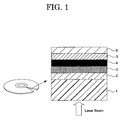
- Figure 1 is a cross-sectional schematic view showing an exemplary phase-change information recording medium according to the present invention, in which a substrate 1, a first protective layer 2, a phase-change recording layer 3, a second protective layer 4, a third protective layer 5 and a reflective layer 6 are laminated on a substrate 1 in the named order.
- a substrate 1 a first protective layer 2, a phase-change recording layer 3, a second protective layer 4, a third protective layer 5 and a reflective layer 6 are laminated on a substrate 1 in the named order.
- a protective layer made of ultraviolet curing resin on the reflective layer by spin coat and other substrates may be bonded on the protective layer as necessary for further reinforcement or protection of the phase-change information recording medium.
- glass, ceramics, resin, and the like are used for the material of the substrate 1 and the substrate made from resin is preferable in terms of formability and cost.
- resin include polycarbonate resin, acrylate resin, epoxy resin, polystyrene resin, acrylonitrile-styrene copolymer, polyethylene resin, polypropylene resin, silicone resin, fluorine resin, ABS resin, urethane resin, and the like.
- polycarbonate resin and acrylate resin are especially preferable in terms of formability, optical properties and cost.
- the thickness of substrate 1 is not particularly limited and the thickness is determined by wavelength of the laser or focusing property of the pickup lens generally used.
- the substrate having a thickness of 1.2mm is used for CD of 780nm wavelength and a substrate having a thickness of 0.6 mm is used for DVD of 650nm to 665nm wavelength.
- a substrate of polycarbonate resin having a race for tracking on its surface is in a form of a disc of 12cm diameter and 0.6mm thickness and having excellent workability and optical property is favorable, for example.
- the race for tracking is preferably a meandering race within a range of 0.74 ⁇ 0.03 ⁇ m pitch, 22nm to 40nm depth and 0.2 ⁇ m to 0.4 ⁇ m width. In particular, by making the race deep, reflectance ratio of the phase-change information recording medium decreases and the modulation depth becomes large.
- an adhesive layer for bonding the substrate 1 where information signal is written in and the bonding substrate is formed of double-sided adhesive sheet of which binder is coated on both sides of the base film, thermo-curing resin or ultraviolet curing resin.
- the thickness of the adhesive layer is generally about 50 ⁇ m.
- the bonding substrate (dummy substrate) is not necessary transparent when the adhesive layer is an adhesive sheet or thermo-curing resin, however, when the adhesive layer is an ultraviolet curing resin, it is favorable to use a transparent substrate through which ultraviolet ray is transmitted.
- the thickness of the bonding substrate is preferably 0.6mm, as same as the transparent substrate 1 in which information signal is written in.
- the first protective layer 2 is preferably having good adhesiveness with the substrate and the phase-change recording layer, is highly thermostable, and is also preferably having optical properties suitable for repeated recording at a high linear velocity because it also serves as an optical interference layer which makes an effective light absorption of the phase-change recording layer possible.
- Examples of the material for the first protective layer include metal oxides such as SiO, SiO 2 , ZnO, SnO 2 , Al 2 O 3 , TiO 2 , In 2 O 3 , MgO, ZrO 2 ; nitrides such as Si 3 N 4 , AlN, TiN, BN, ZrN; sulfides such as ZnS, In 2 S 3 , TaS 4 ; carbides such as SiC, TaC, B 4 C, WC, TiC, ZrC; diamond-like carbon or mixtures thereof. Of these, the mixture of ZnS and SiO 2 is preferable.
- the mixture molar ratio (ZnS:SiO 2 ) is preferably 50 to 90 : 50 to 10 and more preferably 60 to 90 : 40 to 10.
- Examples of the method for forming the first protective layer 2 include various vapor-phase growths such as vacuum evaporation method, sputtering method, plasma CVD method, optical CVD method, ion plating method and electron-beam deposition method.
- the sputtering method excels in mass productivity, layer quality, and the like.
- the following sputtering condition is favorable: Ar gas as a film-forming gas, electricity input of 3kW and Ar gas pressure of 2 ⁇ 10 -3 Torr (air pressure of film-forming chamber)
- the thickness of the first protective layer (t 1 ) is preferably 50nm to 90nm and satisfying the formula, 0.070 ⁇ t 1 / ⁇ ⁇ 0.160 when the wavelength of laser beam is regarded as ⁇ . When it is thinner than this range, it does not function as a heat-resistant protective layer and when it is thicker, interfacial peeling is likely to occur.
- the phase-change recording layer 3 is preferably having a composition expressed by Formulas 1 and 2 as stated above.
- the thickness of the phase-change recording layer (t 2 ) is preferably satisfying the formula, 0.015 ⁇ t 2 / ⁇ ⁇ 0.032 as mentioned above, when the wavelength of laser beam is regarded as ⁇ .
- the thickness of the phase-change recording layer is thinner than this range, light absorbing power decreases and it may not function as a phase-change recording layer and when it is thicker, recording sensitivity may be deteriorated.
- Examples of the method for forming the phase-change recording layer include various vapor-phase growths such as vacuum evaporation method, sputtering method, plasma CVD method, optical CVD method, ion plating method and electron-beam deposition method Among these, the sputtering method excels in mass productivity, layer quality, and the like.
- the following sputtering condition i favorable: Ar gas as a film-forming gas, electricity input of 1kW and Ar gas pressure of 2 ⁇ 10 -3 Torr (air pressure of film-forming chamber)
- the second protective layer 4 is preferably having good adhesiveness with the substrate and the phase-change recording layer, is highly thermostable and having optical properties suitable for repeated recording at a high linear velocity because it also serves as an optical interference layer which makes an effective light absorption of the phase-change recording layer possible.
- Examples of the material for the second protective layer include metal oxides such as SiO, SiO 2 , ZnO, SnO 2 , Al 2 O 3 , TiO 2 , In 2 O 3 , MgO, ZrO 2 ; nitrides such as Si 3 N 4 , AlN, TiN, BN, ZrN; sulfides such as ZnS, In 2 S 3 , TaS 4 ; carbides such as SiC, TaC, B 4 C, WC, TiC, ZrC; diamond-like carbon or mixtures thereof. Of these, the mixture of ZnS and SiO 2 is preferable.
- the mixture molar ratio (ZnS:SiO 2 ) is preferably 50 to 90 : 50 to 10 and more preferably 60 to 90 : 40 to 10.
- Examples of the method for forming the second protective layer include various vapor-phase growths such as vacuum evaporation method, sputtering method, plasma CVD method, optical CVD method, ion plating method and electron-beam deposition method.
- the sputtering method excels in mass productivity, layer quality, and the like.
- the following sputtering condition is favorable: Ar gas as a film-forming gas, electricity input of 3kW and Ar gas pressure of 2 ⁇ 10 -3 Torr (air pressure of film-forming chamber).
- the thickness of the second protective layer (t 3 ) is preferably 6nm to 20nm and satisfying the formula, 0.005 ⁇ t 3 / ⁇ ⁇ 0.040 when the wavelength of laser beam is regarded as ⁇ as mentioned above.
- the thickness of the second protective layer is thinner than this range, recording sensitivity may be deteriorated and when it is thicker, too much heat may be gathered inside.
- the reflective layer serves as an optical reflective layer while it also serves as a heat dissipation layer for dissipating heat added to the phase-change recording layer by irradiating laser beam at the time of recording.
- Choosing a reflective layer is quite important in a phase-change information recording medium corresponding to high linear velocity, because an amorphous mark forming is heavily affected by cooling rate through heat dissipation.
- a metallic material for example, Al, Au, Ag, Cu, Ta, and the like or metal alloys thereof can be used. Further, as an element to be added to these metallic materials, Cr, Ti, Si, Cu, Ag, Pd, Ta or the like can be used. Among these materials, it is preferred that one of Ag and Ag metal alloy is contained therein.
- a metal with high thermal conductivity and high reflectance is usually desirable for the reflective layer constituting the phase-change information recording medium in terms of thermal conductivity for modulating cooling rate against the heat generated at the time of recording and also in terms of an optical viewpoint of improving the contrast of reproduction signals by utilizing interference effect
- pure Ag or an Ag metal alloy respectively has extremely high thermal conductivity of 427W/m ⁇ K, and a quenching configuration suitable for forming an amorphous mark can be realized immediately after the phase-change recording layer reaches a high temperature at the time of recording.
- the range of the copper addition amount is preferably from about 0.1 atomic percent to about 10 atomic percent, and more preferably within the range of 0.5 atomic percent to 3 atomic percent. An excessive addition of copper may deteriorate high heat conductivity of Ag.
- Examples of the method for forming the reflective layer 6 include various vapor-phase growths such as vacuum evaporation method, sputtering method, plasma CVD method, optical CVD method, ion plating method and electron-beam deposition method.
- the sputtering method excels in mass productivity, layer quality, and the like.
- the following sputtering condition is favorable: Ar gas as a film-forming gas, electricity input of 5kW and Ar gas pressure of 2 ⁇ 10 -3 Torr (air pressure of film-forming chamber).
- the heat dissipation ability of the reflective layer is basically proportional to the thickness of the layer; however, excellent disc properties are available, if the thickness of the reflective layer is 60nm or more. In this case, there is no particular maximum limit value thereof, and a thickness within an allowable range from disc manufacturing cost perspective may be used, however, about 300nm or less is preferable and it is preferable that the thickness of the reflective layer (t 4 ), as described above, satisfies the formula, 0.100 ⁇ t 4 / ⁇ , when the wavelength of laser beam is regarded as ⁇ . When the thickness of the reflective layer is thinner than this range, heat dissipation effect may not be obtained.
- a resin protective layer may be disposed on the reflective layer 6 as necessary.
- This resin protective layer has an effect for protecting phase-change recording layer in the process flow when manufactured as a product and it is usually formed through the use of an ultraviolet-curing resin.
- the thickness of the resin protective layer is preferably within the range of 2 ⁇ m to 5 ⁇ m.
- the third protective layer 5 is disposed between the second protective layer 4 and the reflective layer 6.
- Examples of material for the third protective layer 5 include Si, SiC, SiN, SiO 2 , TiC, TiO 2 , TiC-TiO 2 , NbC, NbO 2 , NbV-NbO 2 , Ta 2 O 5 , Al 2 O 3 , ITO, GeN, ZrO 2 , and the like. Among them, TiC-TiO 2 , Si or SiC is particularly preferable in terms of high-barrier properties.
- a protective layer comprising sulfur such as a mixture of ZnS and SiO 2
- sulfur will diffuse toward Ag and causes a problem of disc defect (Ag reaction to sulfur).
- the third protective layer for preventing such reaction it is desirable to select a proper material from the following perspective:
- the thickness of the third protective layer is preferably 2nm to 20nm, and more preferably 2nm to 10nm. If the thickness is less than 2nm, the third protective layer may not function as a barrier layer, and if the thickness is more than 20nm, the modulation degree may be decreased.
- an interface layer is disposed between the first protective layer 2 and the phase-change recording layer 3.
- the interface layer is preferably containing SiO 2 and having thickness of 2nm to 10nm. This decreases damages of which the substrate receives when recording at high power and gives advantageous effect over repeated recording property at high power recording; therefore having a wide margin of recording power is possible. If the thickness of the interface layer is less than 2nm, forming a uniform SiO 2 film may be difficult, and if the thickness is more than 10nm, film separation may become more likely to occur.
- phase-change information recording medium has been described in detail; however, the present invention is not limited to the disclosed aspects and various modifications without departing from the scope of the present invention are acceptable.
- the present invention may be applied to a phase-change information recording medium in which the same or different types of two phase-change information recording media are bonded together through a resin protective layer instead of a bonding substrate as seen in DVD system.
- the sputtering target according to the present invention has a composition expressed by following Formula 1 and is used for manufacturing the phase-change recording layer.
- Formula 1 S n ⁇ S b ⁇ G a ⁇ G e ⁇ T e ⁇ ⁇ X ⁇
- X represents at least one element selected from Ag, Zn, In and Cu.
- the sputtering target is preferably having a composition expressed by following Formula 2 and is used for manufacturing the phase-change recording layer.
- Formula 2 S n ⁇ S b ⁇ G a ⁇ G e ⁇
- the manufacturing method for sputtering target is not particularly limited and may be selected accordingly and a certain prearranged amount is weighed and heat melted in a glass ampoule. And then it is crushed in a mill and obtained powder is heat sintered to manufacture a discoid sputtering target.
- phase-change information recording medium which is easy to perform initial crystallization, exhibits good recording sensitivity at a linear velocity as high as 10 double speeds or more with as much capacity as DVD-ROM, is capable of repeated recording and has good storage reliability, can be provided.
- phase-change information recording medium of good repeated recording property in a broad area of recording linear velocity with as much capacity as DVD-ROM and the sputtering target for manufacturing the phase-change information recording medium can be provided.
- the manufacturing method for the phase-change recording medium of the invention includes at least phase-change recording layer forming, initial crystallization and other steps as necessary.
- the phase-change recording layer forming is a step to form a phase-change recording layer by sputtering using the sputtering target of the invention.
- the sputtering is not particularly limited and may be selected from known sputtering accordingly, for example, the sputtering using Ar gas as a film-forming gas, electricity input of 1kW to 5kW and gas flow rate of 10sccm to 40sccm is favorable.
- the Ar gas pressure inside the chamber during sputtering is preferably 7.0 ⁇ 10 -3 mTorr (mbar) or less.
- the initial crystallization is a step to perform an initial crystallization at a power density of 15mW/ ⁇ m to 40mW/ ⁇ m while rotating the phase-change information recording medium at a certain velocity within a range of 10m/s to 21m/s.
- the initial crystallization is performed by irradiating the light for recording such as laser diode (with an emission wavelength of 600nm to 720nm, for example) from the substrate side via objective lens while rotating the phase-change information recording medium at a certain linear velocity or constant angular velocity.
- the temperature of the phase-change recording layer increases locally as it absorbs irradiated light and information is recorded by generating a pit and modifying its optical property, for example.
- the reproduction of above-mentioned recorded information can be done by irradiating a laser beam from the first protective layer side while rotating the phase-change information recording medium at a certain linear velocity and detecting the reflected light.
- phase-change information recording medium of the invention wherein at least one of recording, reproducing, erasing and rewriting of information is performed by laser beam irradiation from the first protective layer side of the phase-change information recording medium of the invention.
- the wavelength of laser beam is preferably 400nm to 780nm and more preferably 630nm to 680nm.
- the optical recording apparatus of the invention performs information recording in a phase-change information recording medium by irradiating laser beam from laser beam source to the phase-change information recording medium and the phase-change information recording medium is the phase-change information recording medium of the invention.
- the optical recording apparatus is not limited and may be selected accordingly and the example of such apparatus comprises a laser beam source of laser diode, and the like which emits laser beams; a focusing lens which focuses the laser beam emitted from the laser beam source to the optical recording medium mounted on a spindle; optical elements which guides laser beam emitted from the laser beam source to both of the focusing lens and a laser beam detector; the laser beam detector for detecting the reflected light of the laser beam, and other units as necessary.
- the optical recording apparatus guides laser beam emitted from the laser beam source to the focusing lens through optical elements to perform recording in a phase-change information recording medium by concentrating and irradiating the laser beam through focusing lens to the phase-change information recording medium.
- the optical recording apparatus guides the reflected beam of the laser beam to the laser beam detector to control the amount of beam of the laser beam source based on the amount of laser beam detected by the laser beam detector.
- the laser beam detector converts the detected amount of laser beam into power voltage or power current and outputs them as a signal of the detected amount.
- controlling unit examples include controlling unit.
- the controlling unit is not particularly limited as long as it is able to control movements of the individual units, and may be selected accordingly and examples of controlling unit include sequencer for irradiating and scanning intensely modulated laser beam; equipment such as computer devices, and the like.
- a phase-change information recording medium (disc) was prepared as follow. Sputtering was conducted using a sheet sputtering apparatus (Big Sprinter by Unaxis Incorporated) under Ar gas atmosphere with electricity input of 1kW to 5kW and Ar gas pressure of 2 ⁇ 10 -3 Torr.
- a polycarbonate resin substrate of 0.74 ⁇ m track pitch, 27nm groove depth, 12cm diameter and 0.6mm thickness was provided.
- a first protective layer of 80nm thickness was formed on the substrate by sputtering.
- phase-change recording layer of 20nm thickness was formed on the first protective layer by sputtering.
- a third protective layer of 4nm thickness was formed on the second protective layer by sputtering.
- a reflective layer of 180nm thickness was formed on the third protective layer by sputtering.
- an organic protective layer was formed by coating acrylic curing resin of 5 ⁇ m to 10 ⁇ m thickness on the reflective layer using a spinner and performing ultraviolet-curing afterward.
- the phase-change information recording medium of Example 2 was prepared similarly to Example 1, except for forming a phase-change recording layer by sputtering using a sputtering target of Sn 25 Sb 56 Ga 9 Ge 10 composition (atomic percent).
- the phase-change information recording medium of Example 3 was prepared similarly to Example 1, except for forming a phase-change recording layer by sputtering using a sputtering target of Sn 24 Sb 41 Ga 18 Ge 17 composition (atomic percent).
- the phase-change information recording medium of Example 4 was prepared similarly to Example 1, except for forming a phase-change recording layer by sputtering using a sputtering target of Sn 10 Sb 78 Ga 8 Ge 4 composition (atomic percent).
- the phase-change information recording medium of Example 5 was prepared similarly to Example 1, except for forming a phase-change recording layer by sputtering using a sputtering target of Sn 19 Sb 67 Ga 2 Ge 12 composition (atomic percent).
- the phase-change information recording medium of Example 6 was prepared similarly to Example 1, except for forming a phase-change recording layer by sputtering using a sputtering target of Sn 22 Sb 55 Ga 18 Ge 5 composition (atomic percent).
- the phase-change information recording medium of Example 7 was prepared similarly to Example 1, except for forming a phase-change recording layer by sputtering using a sputtering target of Sn 16 Sb 72 Ga 10 Ge 2 composition (atomic percent).
- the phase-change information recording medium of Example 8 was prepared similarly to Example 1, except for forming a phase-change recording layer by sputtering using a sputtering target of Sn 22 Sb 55 Ga 4 Ge 19 composition (atomic percent).
- the phase-change information recording medium of Comparative Example 1 was prepared similarly to Example 1, except for forming a phase-change recording layer by sputtering using a sputtering target of Sn 3 Sb 60 Ga 18 Ge 19 composition (atomic percent).
- the phase-change information recording medium of Comparative Example 2 was prepared similarly to Example 1, except for forming a phase-change recording layer by sputtering using a sputtering target of Sn 27 Sb 67 Ga 4 Ge 2 composition (atomic percent).
- the phase-change information recording medium of Comparative Example 3 was prepared similarly to Example 1, except for forming a phase-change recording layer by sputtering using a sputtering target of Sn 24 Sb 39 Ga 18 Ge 19 composition (atomic percent).
- the phase-change information recording medium of Comparative Example 4 was prepared similarly to Example 1, except for forming a phase-change recording layer by sputtering using a sputtering target of Sn 20 Sb 66 Ga 1 Ge 13 composition (atomic percent).
- the phase-change information recording medium of Comparative Example 5 was prepared similarly to Example 1, except for forming a phase-change recording layer by sputtering using a sputtering target of Sn 13 Sb 52 Ga 21 Ge 14 composition (atomic percent).
- the phase-change information recording medium of Comparative Example 6 was prepared similarly to Example 1, except for forming a phase-change recording layer by sputtering using a sputtering target of Sn 18 Sb 61 Ga 20 Ge 1 composition (atomic percent).
- the phase-change information recording medium of Comparative Example 7 was prepared similarly to Example 1, except for forming a phase-change recording layer by sputtering using a sputtering target of Sn 15 Sb 61 Ga 3 Ge 21 composition (atomic percent).
- Initial crystallization of each obtained phase-change information recording medium was performed using laser diode of 810nm wavelength.
- initial crystallization was performed by irradiating laser beam of 25mW/ ⁇ m 2 power density using a beam head of 75 ⁇ m beam width while rotating the phase-change information recording medium at a certain linear velocity of 20m/s and moving at 50 ⁇ m/r in radius direction.
- the evaluation of record reproduction was conducted using an optical disc evaluation apparatus (DDU-1000 by Pulstec Industrial Co., Ltd.) with pickup head of 660nm wavelength and NA0.65 numerical apertures.
- the recording linear velocity was set at 10.5m/s (equivalent of 3 double speeds of DVD) and 28m/s (equivalent of 8 double speeds of DVD) and recording power was altered corresponding to the linear velocity.
- Bias power was set at 0.2mW and erase power was set at 2mW to 15mW and each of them was optimized.
- a phase-change information recording medium (disc) was prepared as follow. Sputtering was conducted using a sheet sputtering apparatus (Big Sprinter by Unaxis Incorporated) under Ar gas atmosphere with electricity input of 1kW to 5kW and Ar gas pressure of 2 ⁇ 10 -3 Torr.
- a polycarbonate resin substrate of 0.74 ⁇ m track pitch, 27nm groove depth, 12cm diameter and 0.6mm thickness was provided.
- a first protective layer of 70nm thickness was formed on the substrate by sputtering.
- phase-change recording layer of 18nm thickness was formed on the first protective layer by sputtering.
- a third protective layer of 4nm thickness was formed on the second protective layer by sputtering.
- a reflective layer of 140nm thickness was formed on the third protective layer by sputtering.
- an organic protective layer was formed by coating acrylic curing resin of 5 ⁇ m to 10 ⁇ m thickness on the reflective layer using a spinner and performing ultraviolet-curing afterward.
- the phase-change information recording medium of Example 10 was prepared similarly to Example 9, except for forming a phase-change recording layer by sputtering using a sputtering target of Sn 19 Sb 50 Ga 14 Ge 17 composition (atomic percent).
- the phase-change information recording medium of Example 11 was prepared similarly to Example 9, except for forming a phase-change recording layer by sputtering using a sputtering target of Sn 17 Sb 59 Ga 12 Ge 12 composition (atomic percent).
- the phase-change information recording medium of Example 12 was prepared similarly to Example 9, except for forming a phase-change recording layer by sputtering using a sputtering target of Sn 16 Sb 50 Ga 16 Ge 13 Ag 5 composition (atomic percent).
- the phase-change information recording medium of Example 13 was prepared similarly to Example 9, except for forming a phase-change recording layer by sputtering using a sputtering target of Sn 10 Sb 62 Ga 10 Ge 13 In 5 composition (atomic percent).
- the phase-change information recording medium of Example 14 was prepared similarly to Example 9, except for forming a phase-change recording layer by sputtering using a sputtering target of Sn 15 Sb 70 Ga 5 Ge 8 Zn 2 composition (atomic percent).
- the phase-change information recording medium of Example 15 was prepared similarly to Example 9, except for forming a phase-change recording layer by sputtering using a sputtering target of Sn 15 Sb 70 Ga 3 Ge 8 Cu 4 composition (atomic percent).
- the phase-change information recording medium of Comparative Example 8 was prepared similarly to Example 9, except for forming a phase-change recording layer by sputtering using a sputtering target of Ag 3 In 4 Sb 75 Te 18 composition (atomic percent).
- the phase-change information recording medium of Comparative Example 9 was prepared similarly to Example 9, except for forming a phase-change recording layer by sputtering using a sputtering target of Ge 5 Ga 4 Sb 80 Te 11 composition (atomic percent).
- Initial crystallization of each obtained phase-change information recording medium was performed using laser diode of 810nm wavelength.
- initial crystallization was performed by irradiating laser beam of 25mW/ ⁇ m 2 power density with a beam head of 75 ⁇ m beam width while rotating the phase-change information recording medium at a certain linear velocity of 20m/s and moving at 50 ⁇ m/r in radius direction.
- the evaluation of record reproduction was conducted using an optical disc evaluation apparatus (DDU-1000 by Pulstec Industrial Co., Ltd.) with a pickup head of 660nm wavelength and NA0.65 numerical apertures.
- the recording linear velocity was set at 17.5m/s, 24.5m/s and 35.0m/s, and recording power was altered corresponding to linear velocity.
- Bias power was set at 0.2mW and erase power was set at 2mW to 15mW and each of them was optimized. Each recording strategy was also optimized. All reproduction was performed at 3.5m/s linear velocity and 0.7mW power.
- the jitter is a standardized value of data-to-clock jitter ⁇ using detection window width, Tw. Results of each evaluation are shown in Table 6.
- Reproduction beam stability was evaluated by following standards from the degree of jitter elevation after record mark was written in each sample and it was irradiated with a reproduction beam at 3.5m/s linear velocity and 1.0mW power for 10 minutes. Results are shown in Table 6.
- phase-change information recording medium of Comparative Example 8 required higher recording power than Examples 9 to 15.
- linear velocity was 35.0m/s
- jitter was as high as 13.4%
- modulation depth was as low as 50% with writing at 38mW which is the limit for used laser diode (LD).
- LD laser diode
- phase-change information recording medium of Comparative Example 9 when the recording linear velocity was 17.5m/s, although jitter was 10% or less until 100th time of overwrites, jitter was elevated to 15.3% at 1,000th time. In the storage stability test, jitter elevation was less than 3%. In addition, in terms of reflectance ratio, jitter was 23% before the storage test, however, it dropped to 16% after the test and there seems to be a problem in storage stability. Reproduction beam stability was appropriate. When the recording linear velocity was 35.0m/s, initial jitter was as high as 18.8% and this was assumed that the writing of amorphous mark was not satisfactory at this recording linear velocity because of slow speed of crystallization.
- a phase-change information recording medium (disc) was prepared as follow. Sputtering was conducted using a sheet sputtering apparatus (Big Sprinter by Unaxis Incorporated) under Ar gas atmosphere with electricity input of 1kW to 5kW and Ar gas pressure of 2 ⁇ 10 -3 Torr.
- a polycarbonate resin substrate of 0.74 ⁇ m track pitch, 27nm groove depth, 12cm diameter and 0.6mm thickness was provided.
- a first protective layer of 60nm thickness was formed on the substrate by sputtering.
- phase-change recording layer of 16nm thickness was formed on the first protective layer by sputtering.
- a third protective layer of 4nm thickness was formed on the second protective layer by sputtering.
- a reflective layer of 140nm thickness was formed on the third protective layer by sputtering.
- an organic protective layer was formed by coating acrylic curing resin of 5 ⁇ m to 10 ⁇ m thickness on the reflective layer using a spinner and performing ultraviolet-curing afterward.
- Initial crystallization was performed by irradiating a laser beam of 25mW/ ⁇ m 2 power density using a beam head of 75 ⁇ m beam width while rotating the phase-change information recording medium at a certain linear velocity of 20m/s and moving at 50 ⁇ m/r in radius direction.
- the evaluation of record reproduction was conducted using an optical disc evaluation apparatus (DDU-1000 by Pulstec Industrial Co., Ltd.) with a pickup head of 660nm wavelength and NA0.65 numerical apertures.
- the recording linear velocity was set at 10.5m/s (3 double speeds), 14m/s (4 double speeds), 21m/s (6 double speeds) and 28m/s (8 double speeds) and recording power was altered corresponding to linear velocity.
- Bias power was set at 0.2mW and erase power was set at 5mW to 10mW and each of them was optimized.
- the phase-change information recording medium (disc) of Example 17 was prepared similarly to Example 16, except for forming a phase-change recording layer by sputtering using a sputtering target of Ga 6 Sb 67 Sn 18 Ge 6 Te 3 composition (atomic percent).
- Initial crystallization was performed by irradiating a laser beam of 20mW/ ⁇ m 2 power density using a beam head of 75 ⁇ m beam width while rotating the phase-change information recording medium at a certain linear velocity of 15m/s and moving at 50pm/r in radius direction.
- the phase-change information recording medium (disc) of Example 18 was prepared similarly to Example 16, except for forming an interface layer of SiO 2 with a thickness of 2nm between the first protective layer and the phase-change recording layer.
- Initial crystallization was performed by irradiating a laser beam of 25mW/ ⁇ m 2 power density using a beam head of 75 ⁇ m beam width while rotating the phase-change information recording medium at a certain linear velocity of 20m/s and moving at 50 ⁇ m/r in radius direction.
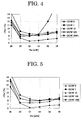
- the repeated recording properties at a recording linear velocity of 28m/s (8 double speeds) of obtained phase-change information recording medium were evaluated at each recording power of 28mW, 30mW, 32mW, 34mW, 36mW and 38mW.
- Example 16 The results of Example 16 are shown in Figure 4 and the results of Example 18 are shown in Figure 5.
- jitter was 9% or less for both Examples 16 and 18 at their most suitable powers.
- jitter of repeated recording at 1,000th time was 9% or less even at a power of as high as 36mW or more.
- the phase-change information recording medium according to the present invention is easy to perform initial crystallization, exhibits good recording sensitivity at a linear velocity as high as 10 double speeds or more with as much capacity as DVD-ROM, is capable of repeated recording and has excellent storage reliability. Therefore, it can be widely used in various phase-change information recording medium, in particular, optical recording medium of DVD system such as DVD-RAM, DVD-RW, DVD+RW, and the like.
Landscapes
- Chemical & Material Sciences (AREA)
- Engineering & Computer Science (AREA)
- Manufacturing & Machinery (AREA)
- Mechanical Engineering (AREA)
- Materials Engineering (AREA)
- Metallurgy (AREA)
- Organic Chemistry (AREA)
- Chemical Kinetics & Catalysis (AREA)
- Inorganic Chemistry (AREA)
- Physics & Mathematics (AREA)
- Optics & Photonics (AREA)
- Optical Record Carriers And Manufacture Thereof (AREA)
- Thermal Transfer Or Thermal Recording In General (AREA)
Applications Claiming Priority (2)
| Application Number | Priority Date | Filing Date | Title |
|---|---|---|---|
| JP2004029923A JP4271051B2 (ja) | 2003-02-06 | 2004-02-05 | 相変化型情報記録媒体及びスパッタリングターゲット |
| PCT/JP2004/011148 WO2005075212A1 (ja) | 2004-02-05 | 2004-08-04 | 相変化型情報記録媒体及びその製造方法、スパッタリングターゲット、並びに相変化型情報記録媒体の使用方法及び光記録装置 |
Publications (3)
| Publication Number | Publication Date |
|---|---|
| EP1712367A1 true EP1712367A1 (de) | 2006-10-18 |
| EP1712367A4 EP1712367A4 (de) | 2008-11-26 |
| EP1712367B1 EP1712367B1 (de) | 2011-03-09 |
Family
ID=34835972
Family Applications (1)
| Application Number | Title | Priority Date | Filing Date |
|---|---|---|---|
| EP04771189A Expired - Lifetime EP1712367B1 (de) | 2004-02-05 | 2004-08-04 | Phasenänderungsinformationsaufzeichnungsmedium, verfahren zu dessen herstellung und sputtertarget. |
Country Status (7)
| Country | Link |
|---|---|
| US (1) | US7438965B2 (de) |
| EP (1) | EP1712367B1 (de) |
| KR (1) | KR100730978B1 (de) |
| CN (1) | CN100513193C (de) |
| DE (1) | DE602004031775D1 (de) |
| TW (1) | TW200527421A (de) |
| WO (1) | WO2005075212A1 (de) |
Cited By (2)
| Publication number | Priority date | Publication date | Assignee | Title |
|---|---|---|---|---|
| WO2006028251A1 (en) | 2004-09-09 | 2006-03-16 | Ricoh Company, Ltd. | Optical recording medium |
| CN101400522B (zh) * | 2006-03-10 | 2011-12-14 | 株式会社理光 | 光学记录介质 |
Families Citing this family (9)
| Publication number | Priority date | Publication date | Assignee | Title |
|---|---|---|---|---|
| JP4248486B2 (ja) * | 2004-12-15 | 2009-04-02 | 株式会社リコー | 相変化型光記録媒体 |
| JP2007196523A (ja) * | 2006-01-26 | 2007-08-09 | Sony Corp | 光記録媒体およびその製造方法 |
| JP4550041B2 (ja) * | 2006-03-10 | 2010-09-22 | 株式会社リコー | 光記録媒体 |
| US8017208B2 (en) * | 2006-11-01 | 2011-09-13 | Panasonic Corporation | Information recording medium, target and method for manufacturing of information recording medium using the same |
| JP2008192281A (ja) * | 2007-01-12 | 2008-08-21 | Ricoh Co Ltd | パターン及びその形成方法 |
| JP5188328B2 (ja) | 2008-08-29 | 2013-04-24 | 株式会社日立製作所 | 半導体装置 |
| US20100297381A1 (en) * | 2009-05-22 | 2010-11-25 | Cmc Magnetics Corporation | Method of improving read stability of optical recording medium and optical recording medium manufactured using the method |
| WO2010150755A1 (ja) * | 2009-06-24 | 2010-12-29 | 三菱化学メディア株式会社 | 光記録媒体 |
| EP3002550B1 (de) | 2014-10-03 | 2017-08-30 | Ricoh Company, Ltd. | Informationsverarbeitungssystem und informationsverarbeitungsverfahren zur abstandsmessung |
Family Cites Families (28)
| Publication number | Priority date | Publication date | Assignee | Title |
|---|---|---|---|---|
| JPS60177446A (ja) | 1984-02-23 | 1985-09-11 | Nippon Telegr & Teleph Corp <Ntt> | 光デイスク記録媒体 |
| JPS61168145A (ja) * | 1985-01-19 | 1986-07-29 | Fujitsu Ltd | 光記録媒体 |
| CN1008845B (zh) | 1984-12-05 | 1990-07-18 | 富士通株式会社 | 光学信息记录介质及信息的记录与擦抹的方法 |
| JPS63155437A (ja) * | 1986-12-19 | 1988-06-28 | Toshiba Corp | 情報記録媒体 |
| EP0474311A1 (de) * | 1990-09-06 | 1992-03-11 | Hitachi Maxell Ltd. | Optischer Aufzeichnungsträger für Daten, Verfahren zum Schreiben und Lesen von Daten und Vorrichtung zum Aufzeichnen von Daten |
| JPH05169819A (ja) * | 1990-09-06 | 1993-07-09 | Hitachi Maxell Ltd | 光情報記録媒体及び情報の記録再生方法並びに情報記録装置 |
| US5254382A (en) * | 1990-11-29 | 1993-10-19 | Fuji Xerox Co., Ltd. | Optical recording medium |
| JPH05286249A (ja) * | 1992-02-10 | 1993-11-02 | Hitachi Ltd | 情報記録用媒体 |
| US5709978A (en) * | 1993-06-18 | 1998-01-20 | Hitachi, Ltd. | Supperresolution readout thin film and information recording medium |
| JPH09286174A (ja) | 1996-04-23 | 1997-11-04 | Mitsubishi Chem Corp | 光記録媒体 |
| JPH09286175A (ja) | 1996-04-23 | 1997-11-04 | Mitsubishi Chem Corp | 光記録媒体 |
| US6231945B1 (en) * | 1997-09-09 | 2001-05-15 | Hitachi, Ltd. | Information recording medium |
| JP2000339751A (ja) | 1999-06-01 | 2000-12-08 | Ricoh Co Ltd | 相変化形光記録媒体 |
| EP1193696B1 (de) | 2000-09-28 | 2007-01-03 | Ricoh Company, Ltd. | Optisches Aufzeichnungsmedium, Verfahren zu dessen Herstellung und Verfahren und Vorrichtung zum Aufzeichnen auf oder Lesen von diesem Medium |
| JP2002225437A (ja) * | 2000-12-01 | 2002-08-14 | Ricoh Co Ltd | 光記録媒体 |
| JP2002225433A (ja) * | 2001-02-01 | 2002-08-14 | Ricoh Co Ltd | 錫系光記録媒体 |
| JP2002264515A (ja) * | 2001-03-12 | 2002-09-18 | Ricoh Co Ltd | 光記録媒体および情報記録再生方法 |
| DE60309232T2 (de) | 2002-03-05 | 2007-09-06 | Mitsubishi Kagaku Media Co. Ltd. | Phasenwechselaufzeichnungsmaterial für ein Informationsaufzeichnungsmedium und ein Informationsaufzeichnungsmedium dieses verwendend |
| CN1290106C (zh) * | 2002-03-07 | 2006-12-13 | 株式会社理光 | 光记录媒体及其制造方法 |
| US7260053B2 (en) * | 2002-04-02 | 2007-08-21 | Ricoh Company, Ltd. | Optical recording medium, process for manufacturing the same, sputtering target for manufacturing the same, and optical recording process using the same |
| US7351516B2 (en) * | 2002-11-06 | 2008-04-01 | Ricoh Company, Ltd. | Optical information recording medium |
| TWI250515B (en) * | 2003-01-17 | 2006-03-01 | Ricoh Kk | Method of initializing phase change optical recording medium |
| JP2005063586A (ja) * | 2003-08-18 | 2005-03-10 | Ricoh Co Ltd | 光情報記録方法及び光情報記録装置 |
| WO2005031725A1 (ja) * | 2003-09-25 | 2005-04-07 | Ricoh Company, Ltd. | 光記録媒体 |
| JP2005153338A (ja) * | 2003-11-26 | 2005-06-16 | Ricoh Co Ltd | 光記録媒体 |
| TWI260015B (en) * | 2003-12-19 | 2006-08-11 | Tsung-Shune Chin | Ultra-high density phase-change recording media based on the Ga-Sb-Te system |
| JP2005251265A (ja) * | 2004-03-02 | 2005-09-15 | Ricoh Co Ltd | 相変化型光記録媒体 |
| TW200809845A (en) * | 2006-03-06 | 2008-02-16 | Ricoh Co Ltd | Optical recording medium, and method for initializing the optical recording medium |
-
2004
- 2004-08-04 DE DE602004031775T patent/DE602004031775D1/de not_active Expired - Lifetime
- 2004-08-04 KR KR1020057018955A patent/KR100730978B1/ko not_active Expired - Fee Related
- 2004-08-04 CN CNB2004800091946A patent/CN100513193C/zh not_active Expired - Fee Related
- 2004-08-04 EP EP04771189A patent/EP1712367B1/de not_active Expired - Lifetime
- 2004-08-04 WO PCT/JP2004/011148 patent/WO2005075212A1/ja not_active Ceased
- 2004-08-05 TW TW093123518A patent/TW200527421A/zh not_active IP Right Cessation
-
2005
- 2005-10-04 US US11/244,346 patent/US7438965B2/en not_active Expired - Fee Related
Cited By (4)
| Publication number | Priority date | Publication date | Assignee | Title |
|---|---|---|---|---|
| WO2006028251A1 (en) | 2004-09-09 | 2006-03-16 | Ricoh Company, Ltd. | Optical recording medium |
| EP1787293A4 (de) * | 2004-09-09 | 2008-09-24 | Ricoh Kk | Optisches aufzeichnungsmedium |
| US8124315B2 (en) | 2004-09-09 | 2012-02-28 | Ricoh Company, Ltd. | Optical recording medium |
| CN101400522B (zh) * | 2006-03-10 | 2011-12-14 | 株式会社理光 | 光学记录介质 |
Also Published As
| Publication number | Publication date |
|---|---|
| TWI304210B (de) | 2008-12-11 |
| CN100513193C (zh) | 2009-07-15 |
| US7438965B2 (en) | 2008-10-21 |
| US20060077884A1 (en) | 2006-04-13 |
| TW200527421A (en) | 2005-08-16 |
| DE602004031775D1 (de) | 2011-04-21 |
| KR100730978B1 (ko) | 2007-06-22 |
| KR20060063780A (ko) | 2006-06-12 |
| CN1767954A (zh) | 2006-05-03 |
| WO2005075212A1 (ja) | 2005-08-18 |
| EP1712367B1 (de) | 2011-03-09 |
| EP1712367A4 (de) | 2008-11-26 |
Similar Documents
| Publication | Publication Date | Title |
|---|---|---|
| EP1260973B1 (de) | Optisches Aufzeichungsmedium und Aufzeichnungsverfahren | |
| EP1691352A1 (de) | Optisches aufzeichnungsmedium und aufzeichnungs-/wiedergabeverfahren für ein optisches aufzeichnungsmedium und optische aufzeichnungs-/wiedergabeeinrichtung | |
| EP1406254B1 (de) | Optisches Aufzeichnungsmedium | |
| EP1712367B1 (de) | Phasenänderungsinformationsaufzeichnungsmedium, verfahren zu dessen herstellung und sputtertarget. | |
| EP1667137A1 (de) | Zweischicht-phasenänderungs-informationsaufzeichnungsmedium und verfahren zum aufzeichnen/wiedergeben dafür | |
| EP1566802B1 (de) | Optisches Aufzeichnungsverfahren | |
| US7291375B2 (en) | Phase-change optical recording medium | |
| US20040166440A1 (en) | Optical storage medium | |
| JPH04232779A (ja) | 情報記録媒体 | |
| JP2004322630A (ja) | 相変化型情報記録媒体及びスパッタリングターゲット | |
| EP1922728B1 (de) | Mehrschichtiges optisches aufzeichnungsmedium und optisches aufzeichnungsverfahren | |
| EP1710088A1 (de) | Optischer aufzeichnungs-datenträger und herstellungsverfahren dafür | |
| EP1685971A1 (de) | Optisches aufzeichnungsmedium mit phasenumwandlung, verfahren zur herstellung desselben, sputter-target, verfahren zur verwendung des optisches aufzeichnungsmediums und vorrichtung zur optipschen aufzeichnung | |
| EP2352151A1 (de) | Informationsaufzeichnungsmedium, aufzeichnungsvorrichtung, wiedergabevorrichtung und wiedergabeverfahren | |
| US20060233998A1 (en) | Optical recording medium, method for manufacturing the same, sputtering target, method for using optical recording medium, and optical recording apparatus | |
| EP1695839A1 (de) | Optisches aufzeichnungsmedium und herstellungsverfahren dafür, sputter-target, verwendung des optischen aufzeichnungsmediums und optische aufzeichnungs-/reproduktionsvorrichtung | |
| JP3664403B2 (ja) | 相変化型光記録媒体 | |
| US20050195729A1 (en) | Optical recording medium, method and apparatus for optical recording and reproducing using the same | |
| KR100910127B1 (ko) | 재기록가능한 광 저장매체와 이 매체의 용도 | |
| US20060165946A1 (en) | Optical storage medium | |
| JP3955007B2 (ja) | 相変化型光記録媒体 | |
| JP2954731B2 (ja) | 情報記録媒体及びそれを用いる情報記録方法 | |
| EP1690691A1 (de) | Optisches aufzeichnungsmedium, verfahren zur herstellung desselben, sputter-target, verfahren zur verwendung des optischen aufzeichnungsmediums und optische aufzeichnungsvorrichtung | |
| JP2002260274A (ja) | 相変化型光記録媒体 | |
| JP2000339748A (ja) | 光記録媒体 |
Legal Events
| Date | Code | Title | Description |
|---|---|---|---|
| PUAI | Public reference made under article 153(3) epc to a published international application that has entered the european phase |
Free format text: ORIGINAL CODE: 0009012 |
|
| 17P | Request for examination filed |
Effective date: 20051011 |
|
| AK | Designated contracting states |
Kind code of ref document: A1 Designated state(s): DE ES FR GB IT NL |
|
| DAX | Request for extension of the european patent (deleted) | ||
| RBV | Designated contracting states (corrected) |
Designated state(s): DE ES FR GB IT NL |
|
| A4 | Supplementary search report drawn up and despatched |
Effective date: 20081029 |
|
| 17Q | First examination report despatched |
Effective date: 20090319 |
|
| GRAP | Despatch of communication of intention to grant a patent |
Free format text: ORIGINAL CODE: EPIDOSNIGR1 |
|
| RTI1 | Title (correction) |
Free format text: PHASE-CHANGE INFORMATION RECORDING MEDIUM, PROCESS FOR PRODUCING THE SAME AND SPUTTERING TARGET. |
|
| GRAS | Grant fee paid |
Free format text: ORIGINAL CODE: EPIDOSNIGR3 |
|
| GRAA | (expected) grant |
Free format text: ORIGINAL CODE: 0009210 |
|
| AK | Designated contracting states |
Kind code of ref document: B1 Designated state(s): DE ES FR GB IT NL |
|
| REG | Reference to a national code |
Ref country code: GB Ref legal event code: FG4D |
|
| REF | Corresponds to: |
Ref document number: 602004031775 Country of ref document: DE Date of ref document: 20110421 Kind code of ref document: P |
|
| REG | Reference to a national code |
Ref country code: DE Ref legal event code: R096 Ref document number: 602004031775 Country of ref document: DE Effective date: 20110421 |
|
| REG | Reference to a national code |
Ref country code: NL Ref legal event code: VDEP Effective date: 20110309 |
|
| PG25 | Lapsed in a contracting state [announced via postgrant information from national office to epo] |
Ref country code: ES Free format text: LAPSE BECAUSE OF FAILURE TO SUBMIT A TRANSLATION OF THE DESCRIPTION OR TO PAY THE FEE WITHIN THE PRESCRIBED TIME-LIMIT Effective date: 20110620 |
|
| PG25 | Lapsed in a contracting state [announced via postgrant information from national office to epo] |
Ref country code: NL Free format text: LAPSE BECAUSE OF FAILURE TO SUBMIT A TRANSLATION OF THE DESCRIPTION OR TO PAY THE FEE WITHIN THE PRESCRIBED TIME-LIMIT Effective date: 20110309 |
|
| PLBE | No opposition filed within time limit |
Free format text: ORIGINAL CODE: 0009261 |
|
| STAA | Information on the status of an ep patent application or granted ep patent |
Free format text: STATUS: NO OPPOSITION FILED WITHIN TIME LIMIT |
|
| 26N | No opposition filed |
Effective date: 20111212 |
|
| REG | Reference to a national code |
Ref country code: DE Ref legal event code: R097 Ref document number: 602004031775 Country of ref document: DE Effective date: 20111212 |
|
| PG25 | Lapsed in a contracting state [announced via postgrant information from national office to epo] |
Ref country code: IT Free format text: LAPSE BECAUSE OF FAILURE TO SUBMIT A TRANSLATION OF THE DESCRIPTION OR TO PAY THE FEE WITHIN THE PRESCRIBED TIME-LIMIT Effective date: 20110309 |
|
| REG | Reference to a national code |
Ref country code: DE Ref legal event code: R082 Ref document number: 602004031775 Country of ref document: DE Representative=s name: MEISSNER, BOLTE & PARTNER GBR, DE Ref country code: DE Ref legal event code: R082 Ref document number: 602004031775 Country of ref document: DE Representative=s name: MEISSNER BOLTE PATENTANWAELTE RECHTSANWAELTE P, DE |
|
| REG | Reference to a national code |
Ref country code: DE Ref legal event code: R082 Ref document number: 602004031775 Country of ref document: DE Representative=s name: MEISSNER, BOLTE & PARTNER GBR, DE |
|
| REG | Reference to a national code |
Ref country code: FR Ref legal event code: PLFP Year of fee payment: 13 |
|
| REG | Reference to a national code |
Ref country code: FR Ref legal event code: PLFP Year of fee payment: 14 |
|
| REG | Reference to a national code |
Ref country code: FR Ref legal event code: PLFP Year of fee payment: 15 |
|
| PGFP | Annual fee paid to national office [announced via postgrant information from national office to epo] |
Ref country code: DE Payment date: 20190822 Year of fee payment: 16 Ref country code: FR Payment date: 20190822 Year of fee payment: 16 |
|
| PGFP | Annual fee paid to national office [announced via postgrant information from national office to epo] |
Ref country code: GB Payment date: 20190821 Year of fee payment: 16 |
|
| REG | Reference to a national code |
Ref country code: DE Ref legal event code: R119 Ref document number: 602004031775 Country of ref document: DE |
|
| GBPC | Gb: european patent ceased through non-payment of renewal fee |
Effective date: 20200804 |
|
| PG25 | Lapsed in a contracting state [announced via postgrant information from national office to epo] |
Ref country code: FR Free format text: LAPSE BECAUSE OF NON-PAYMENT OF DUE FEES Effective date: 20200831 Ref country code: DE Free format text: LAPSE BECAUSE OF NON-PAYMENT OF DUE FEES Effective date: 20210302 |
|
| PG25 | Lapsed in a contracting state [announced via postgrant information from national office to epo] |
Ref country code: GB Free format text: LAPSE BECAUSE OF NON-PAYMENT OF DUE FEES Effective date: 20200804 |