EP1717337A2 - Compositions améliorées d'alliage multi-composant contenant un oxide pour cible de pulvérisation - Google Patents
Compositions améliorées d'alliage multi-composant contenant un oxide pour cible de pulvérisation Download PDFInfo
- Publication number
- EP1717337A2 EP1717337A2 EP05255240A EP05255240A EP1717337A2 EP 1717337 A2 EP1717337 A2 EP 1717337A2 EP 05255240 A EP05255240 A EP 05255240A EP 05255240 A EP05255240 A EP 05255240A EP 1717337 A2 EP1717337 A2 EP 1717337A2
- Authority
- EP
- European Patent Office
- Prior art keywords
- sputter target
- component oxide
- less
- cobalt
- oxide
- Prior art date
- Legal status (The legal status is an assumption and is not a legal conclusion. Google has not performed a legal analysis and makes no representation as to the accuracy of the status listed.)
- Withdrawn
Links
- 229910045601 alloy Inorganic materials 0.000 title description 13
- 239000000956 alloy Substances 0.000 title description 13
- 239000000203 mixture Substances 0.000 title description 9
- 230000005291 magnetic effect Effects 0.000 claims abstract description 110
- BASFCYQUMIYNBI-UHFFFAOYSA-N platinum Chemical compound [Pt] BASFCYQUMIYNBI-UHFFFAOYSA-N 0.000 claims abstract description 87
- 239000011651 chromium Substances 0.000 claims abstract description 79
- 229910017052 cobalt Inorganic materials 0.000 claims abstract description 60
- 239000010941 cobalt Substances 0.000 claims abstract description 60
- GUTLYIVDDKVIGB-UHFFFAOYSA-N cobalt atom Chemical compound [Co] GUTLYIVDDKVIGB-UHFFFAOYSA-N 0.000 claims abstract description 60
- VYZAMTAEIAYCRO-UHFFFAOYSA-N Chromium Chemical compound [Cr] VYZAMTAEIAYCRO-UHFFFAOYSA-N 0.000 claims abstract description 40
- 229910052804 chromium Inorganic materials 0.000 claims abstract description 40
- 239000010409 thin film Substances 0.000 claims abstract description 39
- 150000001768 cations Chemical class 0.000 claims abstract description 31
- 230000009467 reduction Effects 0.000 claims abstract description 30
- 229910052697 platinum Inorganic materials 0.000 claims abstract description 29
- 230000035699 permeability Effects 0.000 claims abstract description 28
- 230000005292 diamagnetic effect Effects 0.000 claims abstract description 27
- 230000005298 paramagnetic effect Effects 0.000 claims abstract description 27
- 239000000758 substrate Substances 0.000 claims abstract description 24
- ZOXJGFHDIHLPTG-UHFFFAOYSA-N Boron Chemical compound [B] ZOXJGFHDIHLPTG-UHFFFAOYSA-N 0.000 claims abstract description 11
- 229910052796 boron Inorganic materials 0.000 claims abstract description 11
- PXHVJJICTQNCMI-UHFFFAOYSA-N Nickel Chemical compound [Ni] PXHVJJICTQNCMI-UHFFFAOYSA-N 0.000 claims description 88
- 239000010955 niobium Substances 0.000 claims description 60
- 239000010936 titanium Substances 0.000 claims description 60
- 239000011777 magnesium Substances 0.000 claims description 59
- 239000011572 manganese Substances 0.000 claims description 59
- 229910052751 metal Inorganic materials 0.000 claims description 35
- 239000002184 metal Substances 0.000 claims description 35
- 229910052782 aluminium Inorganic materials 0.000 claims description 30
- XAGFODPZIPBFFR-UHFFFAOYSA-N aluminium Chemical compound [Al] XAGFODPZIPBFFR-UHFFFAOYSA-N 0.000 claims description 30
- QVGXLLKOCUKJST-UHFFFAOYSA-N atomic oxygen Chemical compound [O] QVGXLLKOCUKJST-UHFFFAOYSA-N 0.000 claims description 30
- 239000001301 oxygen Substances 0.000 claims description 30
- 229910052760 oxygen Inorganic materials 0.000 claims description 30
- WFKWXMTUELFFGS-UHFFFAOYSA-N tungsten Chemical compound [W] WFKWXMTUELFFGS-UHFFFAOYSA-N 0.000 claims description 30
- 229910052684 Cerium Inorganic materials 0.000 claims description 29
- 229910052693 Europium Inorganic materials 0.000 claims description 29
- 229910052688 Gadolinium Inorganic materials 0.000 claims description 29
- FYYHWMGAXLPEAU-UHFFFAOYSA-N Magnesium Chemical compound [Mg] FYYHWMGAXLPEAU-UHFFFAOYSA-N 0.000 claims description 29
- PWHULOQIROXLJO-UHFFFAOYSA-N Manganese Chemical compound [Mn] PWHULOQIROXLJO-UHFFFAOYSA-N 0.000 claims description 29
- 229910052777 Praseodymium Inorganic materials 0.000 claims description 29
- 229910052772 Samarium Inorganic materials 0.000 claims description 29
- ATJFFYVFTNAWJD-UHFFFAOYSA-N Tin Chemical compound [Sn] ATJFFYVFTNAWJD-UHFFFAOYSA-N 0.000 claims description 29
- RTAQQCXQSZGOHL-UHFFFAOYSA-N Titanium Chemical compound [Ti] RTAQQCXQSZGOHL-UHFFFAOYSA-N 0.000 claims description 29
- GWXLDORMOJMVQZ-UHFFFAOYSA-N cerium Chemical compound [Ce] GWXLDORMOJMVQZ-UHFFFAOYSA-N 0.000 claims description 29
- OGPBJKLSAFTDLK-UHFFFAOYSA-N europium atom Chemical compound [Eu] OGPBJKLSAFTDLK-UHFFFAOYSA-N 0.000 claims description 29
- UIWYJDYFSGRHKR-UHFFFAOYSA-N gadolinium atom Chemical compound [Gd] UIWYJDYFSGRHKR-UHFFFAOYSA-N 0.000 claims description 29
- 229910052735 hafnium Inorganic materials 0.000 claims description 29
- VBJZVLUMGGDVMO-UHFFFAOYSA-N hafnium atom Chemical compound [Hf] VBJZVLUMGGDVMO-UHFFFAOYSA-N 0.000 claims description 29
- 229910052741 iridium Inorganic materials 0.000 claims description 29
- GKOZUEZYRPOHIO-UHFFFAOYSA-N iridium atom Chemical compound [Ir] GKOZUEZYRPOHIO-UHFFFAOYSA-N 0.000 claims description 29
- 229910052746 lanthanum Inorganic materials 0.000 claims description 29
- FZLIPJUXYLNCLC-UHFFFAOYSA-N lanthanum atom Chemical compound [La] FZLIPJUXYLNCLC-UHFFFAOYSA-N 0.000 claims description 29
- 229910052749 magnesium Inorganic materials 0.000 claims description 29
- 229910052748 manganese Inorganic materials 0.000 claims description 29
- 229910052759 nickel Inorganic materials 0.000 claims description 29
- 229910052758 niobium Inorganic materials 0.000 claims description 29
- GUCVJGMIXFAOAE-UHFFFAOYSA-N niobium atom Chemical compound [Nb] GUCVJGMIXFAOAE-UHFFFAOYSA-N 0.000 claims description 29
- PUDIUYLPXJFUGB-UHFFFAOYSA-N praseodymium atom Chemical compound [Pr] PUDIUYLPXJFUGB-UHFFFAOYSA-N 0.000 claims description 29
- 229910052702 rhenium Inorganic materials 0.000 claims description 29
- WUAPFZMCVAUBPE-UHFFFAOYSA-N rhenium atom Chemical compound [Re] WUAPFZMCVAUBPE-UHFFFAOYSA-N 0.000 claims description 29
- KZUNJOHGWZRPMI-UHFFFAOYSA-N samarium atom Chemical compound [Sm] KZUNJOHGWZRPMI-UHFFFAOYSA-N 0.000 claims description 29
- VSZWPYCFIRKVQL-UHFFFAOYSA-N selanylidenegallium;selenium Chemical compound [Se].[Se]=[Ga].[Se]=[Ga] VSZWPYCFIRKVQL-UHFFFAOYSA-N 0.000 claims description 29
- 229910052719 titanium Inorganic materials 0.000 claims description 29
- 229910052721 tungsten Inorganic materials 0.000 claims description 29
- 239000010937 tungsten Substances 0.000 claims description 29
- LEONUFNNVUYDNQ-UHFFFAOYSA-N vanadium atom Chemical compound [V] LEONUFNNVUYDNQ-UHFFFAOYSA-N 0.000 claims description 29
- 229910052727 yttrium Inorganic materials 0.000 claims description 29
- VWQVUPCCIRVNHF-UHFFFAOYSA-N yttrium atom Chemical compound [Y] VWQVUPCCIRVNHF-UHFFFAOYSA-N 0.000 claims description 29
- XUIMIQQOPSSXEZ-UHFFFAOYSA-N Silicon Chemical compound [Si] XUIMIQQOPSSXEZ-UHFFFAOYSA-N 0.000 claims description 19
- 229910052710 silicon Inorganic materials 0.000 claims description 19
- 239000010703 silicon Substances 0.000 claims description 19
- 229910052715 tantalum Inorganic materials 0.000 claims description 19
- GUVRBAGPIYLISA-UHFFFAOYSA-N tantalum atom Chemical compound [Ta] GUVRBAGPIYLISA-UHFFFAOYSA-N 0.000 claims description 19
- 238000000034 method Methods 0.000 claims description 16
- 238000004519 manufacturing process Methods 0.000 claims description 12
- 150000002739 metals Chemical class 0.000 claims description 12
- 238000004544 sputter deposition Methods 0.000 claims description 9
- 239000010410 layer Substances 0.000 description 34
- VYPSYNLAJGMNEJ-UHFFFAOYSA-N Silicium dioxide Chemical compound O=[Si]=O VYPSYNLAJGMNEJ-UHFFFAOYSA-N 0.000 description 13
- 239000011159 matrix material Substances 0.000 description 11
- 229910052681 coesite Inorganic materials 0.000 description 7
- 229910052906 cristobalite Inorganic materials 0.000 description 7
- 239000000377 silicon dioxide Substances 0.000 description 7
- 229910052682 stishovite Inorganic materials 0.000 description 7
- 229910052905 tridymite Inorganic materials 0.000 description 7
- PNEYBMLMFCGWSK-UHFFFAOYSA-N aluminium oxide Inorganic materials [O-2].[O-2].[O-2].[Al+3].[Al+3] PNEYBMLMFCGWSK-UHFFFAOYSA-N 0.000 description 6
- 229910052593 corundum Inorganic materials 0.000 description 6
- 229910044991 metal oxide Inorganic materials 0.000 description 6
- 150000004706 metal oxides Chemical class 0.000 description 6
- ZKATWMILCYLAPD-UHFFFAOYSA-N niobium pentoxide Chemical compound O=[Nb](=O)O[Nb](=O)=O ZKATWMILCYLAPD-UHFFFAOYSA-N 0.000 description 6
- 229910001845 yogo sapphire Inorganic materials 0.000 description 6
- 229910019222 CoCrPt Inorganic materials 0.000 description 5
- 229910018979 CoPt Inorganic materials 0.000 description 5
- 230000006399 behavior Effects 0.000 description 5
- 230000015572 biosynthetic process Effects 0.000 description 5
- 239000000463 material Substances 0.000 description 5
- 230000008569 process Effects 0.000 description 5
- 238000000926 separation method Methods 0.000 description 5
- GWEVSGVZZGPLCZ-UHFFFAOYSA-N Titan oxide Chemical compound O=[Ti]=O GWEVSGVZZGPLCZ-UHFFFAOYSA-N 0.000 description 4
- MCMNRKCIXSYSNV-UHFFFAOYSA-N Zirconium dioxide Chemical compound O=[Zr]=O MCMNRKCIXSYSNV-UHFFFAOYSA-N 0.000 description 4
- 238000013500 data storage Methods 0.000 description 4
- 239000010408 film Substances 0.000 description 4
- 239000011521 glass Substances 0.000 description 4
- 239000011229 interlayer Substances 0.000 description 4
- 238000002955 isolation Methods 0.000 description 4
- 230000003647 oxidation Effects 0.000 description 4
- 238000007254 oxidation reaction Methods 0.000 description 4
- 238000005546 reactive sputtering Methods 0.000 description 4
- PBCFLUZVCVVTBY-UHFFFAOYSA-N tantalum pentoxide Inorganic materials O=[Ta](=O)O[Ta](=O)=O PBCFLUZVCVVTBY-UHFFFAOYSA-N 0.000 description 4
- 238000013459 approach Methods 0.000 description 3
- 230000008901 benefit Effects 0.000 description 3
- 230000015556 catabolic process Effects 0.000 description 3
- 238000006731 degradation reaction Methods 0.000 description 3
- 238000009792 diffusion process Methods 0.000 description 3
- 230000005381 magnetic domain Effects 0.000 description 3
- OKTJSMMVPCPJKN-UHFFFAOYSA-N Carbon Chemical compound [C] OKTJSMMVPCPJKN-UHFFFAOYSA-N 0.000 description 2
- 229910052799 carbon Inorganic materials 0.000 description 2
- 150000001875 compounds Chemical class 0.000 description 2
- 238000000151 deposition Methods 0.000 description 2
- 230000008021 deposition Effects 0.000 description 2
- QDOXWKRWXJOMAK-UHFFFAOYSA-N dichromium trioxide Chemical compound O=[Cr]O[Cr]=O QDOXWKRWXJOMAK-UHFFFAOYSA-N 0.000 description 2
- SZVJSHCCFOBDDC-UHFFFAOYSA-N ferrosoferric oxide Chemical compound O=[Fe]O[Fe]O[Fe]=O SZVJSHCCFOBDDC-UHFFFAOYSA-N 0.000 description 2
- 239000007789 gas Substances 0.000 description 2
- YBMRDBCBODYGJE-UHFFFAOYSA-N germanium dioxide Chemical compound O=[Ge]=O YBMRDBCBODYGJE-UHFFFAOYSA-N 0.000 description 2
- CJNBYAVZURUTKZ-UHFFFAOYSA-N hafnium(IV) oxide Inorganic materials O=[Hf]=O CJNBYAVZURUTKZ-UHFFFAOYSA-N 0.000 description 2
- 230000006872 improvement Effects 0.000 description 2
- 239000000543 intermediate Substances 0.000 description 2
- 239000000314 lubricant Substances 0.000 description 2
- 238000001755 magnetron sputter deposition Methods 0.000 description 2
- NUJOXMJBOLGQSY-UHFFFAOYSA-N manganese dioxide Chemical compound O=[Mn]=O NUJOXMJBOLGQSY-UHFFFAOYSA-N 0.000 description 2
- UPWOEMHINGJHOB-UHFFFAOYSA-N oxo(oxocobaltiooxy)cobalt Chemical compound O=[Co]O[Co]=O UPWOEMHINGJHOB-UHFFFAOYSA-N 0.000 description 2
- DLYUQMMRRRQYAE-UHFFFAOYSA-N tetraphosphorus decaoxide Chemical compound O1P(O2)(=O)OP3(=O)OP1(=O)OP2(=O)O3 DLYUQMMRRRQYAE-UHFFFAOYSA-N 0.000 description 2
- XOLBLPGZBRYERU-UHFFFAOYSA-N tin dioxide Chemical compound O=[Sn]=O XOLBLPGZBRYERU-UHFFFAOYSA-N 0.000 description 2
- RUDFQVOCFDJEEF-UHFFFAOYSA-N yttrium(III) oxide Inorganic materials [O-2].[O-2].[O-2].[Y+3].[Y+3] RUDFQVOCFDJEEF-UHFFFAOYSA-N 0.000 description 2
- 229910001149 41xx steel Inorganic materials 0.000 description 1
- 229910000943 NiAl Inorganic materials 0.000 description 1
- NPXOKRUENSOPAO-UHFFFAOYSA-N Raney nickel Chemical compound [Al].[Ni] NPXOKRUENSOPAO-UHFFFAOYSA-N 0.000 description 1
- 230000002411 adverse Effects 0.000 description 1
- 238000013019 agitation Methods 0.000 description 1
- XKRFYHLGVUSROY-UHFFFAOYSA-N argon Substances [Ar] XKRFYHLGVUSROY-UHFFFAOYSA-N 0.000 description 1
- 229910052786 argon Inorganic materials 0.000 description 1
- -1 argon ion Chemical class 0.000 description 1
- 230000009286 beneficial effect Effects 0.000 description 1
- 239000006227 byproduct Substances 0.000 description 1
- CETPSERCERDGAM-UHFFFAOYSA-N ceric oxide Chemical compound O=[Ce]=O CETPSERCERDGAM-UHFFFAOYSA-N 0.000 description 1
- 229910000422 cerium(IV) oxide Inorganic materials 0.000 description 1
- 238000006243 chemical reaction Methods 0.000 description 1
- BERDEBHAJNAUOM-UHFFFAOYSA-N copper(I) oxide Inorganic materials [Cu]O[Cu] BERDEBHAJNAUOM-UHFFFAOYSA-N 0.000 description 1
- 238000002425 crystallisation Methods 0.000 description 1
- 230000008025 crystallization Effects 0.000 description 1
- KRFJLUBVMFXRPN-UHFFFAOYSA-N cuprous oxide Chemical compound [O-2].[Cu+].[Cu+] KRFJLUBVMFXRPN-UHFFFAOYSA-N 0.000 description 1
- 230000000694 effects Effects 0.000 description 1
- 238000005538 encapsulation Methods 0.000 description 1
- 238000005516 engineering process Methods 0.000 description 1
- RSEIMSPAXMNYFJ-UHFFFAOYSA-N europium(III) oxide Inorganic materials O=[Eu]O[Eu]=O RSEIMSPAXMNYFJ-UHFFFAOYSA-N 0.000 description 1
- CMIHHWBVHJVIGI-UHFFFAOYSA-N gadolinium(III) oxide Inorganic materials [O-2].[O-2].[O-2].[Gd+3].[Gd+3] CMIHHWBVHJVIGI-UHFFFAOYSA-N 0.000 description 1
- 238000007496 glass forming Methods 0.000 description 1
- 238000005324 grain boundary diffusion Methods 0.000 description 1
- 238000010348 incorporation Methods 0.000 description 1
- 230000003993 interaction Effects 0.000 description 1
- 230000002452 interceptive effect Effects 0.000 description 1
- 238000010406 interfacial reaction Methods 0.000 description 1
- 150000002500 ions Chemical class 0.000 description 1
- JEIPFZHSYJVQDO-UHFFFAOYSA-N iron(III) oxide Inorganic materials O=[Fe]O[Fe]=O JEIPFZHSYJVQDO-UHFFFAOYSA-N 0.000 description 1
- MRELNEQAGSRDBK-UHFFFAOYSA-N lanthanum oxide Inorganic materials [O-2].[O-2].[O-2].[La+3].[La+3] MRELNEQAGSRDBK-UHFFFAOYSA-N 0.000 description 1
- 229910001004 magnetic alloy Inorganic materials 0.000 description 1
- 230000014759 maintenance of location Effects 0.000 description 1
- 238000012986 modification Methods 0.000 description 1
- 230000004048 modification Effects 0.000 description 1
- 239000000075 oxide glass Substances 0.000 description 1
- KTUFCUMIWABKDW-UHFFFAOYSA-N oxo(oxolanthaniooxy)lanthanum Chemical compound O=[La]O[La]=O KTUFCUMIWABKDW-UHFFFAOYSA-N 0.000 description 1
- 230000003014 reinforcing effect Effects 0.000 description 1
- FKTOIHSPIPYAPE-UHFFFAOYSA-N samarium(III) oxide Inorganic materials [O-2].[O-2].[O-2].[Sm+3].[Sm+3] FKTOIHSPIPYAPE-UHFFFAOYSA-N 0.000 description 1
- 238000005204 segregation Methods 0.000 description 1
- 239000004065 semiconductor Substances 0.000 description 1
- 238000005549 size reduction Methods 0.000 description 1
- 239000007787 solid Substances 0.000 description 1
- 239000006104 solid solution Substances 0.000 description 1
- 238000005477 sputtering target Methods 0.000 description 1
- 239000000126 substance Substances 0.000 description 1
- 230000001629 suppression Effects 0.000 description 1
- 239000013077 target material Substances 0.000 description 1
- 230000003442 weekly effect Effects 0.000 description 1
Images


Classifications
-
- C—CHEMISTRY; METALLURGY
- C23—COATING METALLIC MATERIAL; COATING MATERIAL WITH METALLIC MATERIAL; CHEMICAL SURFACE TREATMENT; DIFFUSION TREATMENT OF METALLIC MATERIAL; COATING BY VACUUM EVAPORATION, BY SPUTTERING, BY ION IMPLANTATION OR BY CHEMICAL VAPOUR DEPOSITION, IN GENERAL; INHIBITING CORROSION OF METALLIC MATERIAL OR INCRUSTATION IN GENERAL
- C23C—COATING METALLIC MATERIAL; COATING MATERIAL WITH METALLIC MATERIAL; SURFACE TREATMENT OF METALLIC MATERIAL BY DIFFUSION INTO THE SURFACE, BY CHEMICAL CONVERSION OR SUBSTITUTION; COATING BY VACUUM EVAPORATION, BY SPUTTERING, BY ION IMPLANTATION OR BY CHEMICAL VAPOUR DEPOSITION, IN GENERAL
- C23C14/00—Coating by vacuum evaporation, by sputtering or by ion implantation of the coating forming material
- C23C14/22—Coating by vacuum evaporation, by sputtering or by ion implantation of the coating forming material characterised by the process of coating
- C23C14/34—Sputtering
- C23C14/3407—Cathode assembly for sputtering apparatus, e.g. Target
- C23C14/3414—Metallurgical or chemical aspects of target preparation, e.g. casting, powder metallurgy
-
- C—CHEMISTRY; METALLURGY
- C23—COATING METALLIC MATERIAL; COATING MATERIAL WITH METALLIC MATERIAL; CHEMICAL SURFACE TREATMENT; DIFFUSION TREATMENT OF METALLIC MATERIAL; COATING BY VACUUM EVAPORATION, BY SPUTTERING, BY ION IMPLANTATION OR BY CHEMICAL VAPOUR DEPOSITION, IN GENERAL; INHIBITING CORROSION OF METALLIC MATERIAL OR INCRUSTATION IN GENERAL
- C23C—COATING METALLIC MATERIAL; COATING MATERIAL WITH METALLIC MATERIAL; SURFACE TREATMENT OF METALLIC MATERIAL BY DIFFUSION INTO THE SURFACE, BY CHEMICAL CONVERSION OR SUBSTITUTION; COATING BY VACUUM EVAPORATION, BY SPUTTERING, BY ION IMPLANTATION OR BY CHEMICAL VAPOUR DEPOSITION, IN GENERAL
- C23C14/00—Coating by vacuum evaporation, by sputtering or by ion implantation of the coating forming material
- C23C14/06—Coating by vacuum evaporation, by sputtering or by ion implantation of the coating forming material characterised by the coating material
- C23C14/08—Oxides
-
- C—CHEMISTRY; METALLURGY
- C23—COATING METALLIC MATERIAL; COATING MATERIAL WITH METALLIC MATERIAL; CHEMICAL SURFACE TREATMENT; DIFFUSION TREATMENT OF METALLIC MATERIAL; COATING BY VACUUM EVAPORATION, BY SPUTTERING, BY ION IMPLANTATION OR BY CHEMICAL VAPOUR DEPOSITION, IN GENERAL; INHIBITING CORROSION OF METALLIC MATERIAL OR INCRUSTATION IN GENERAL
- C23C—COATING METALLIC MATERIAL; COATING MATERIAL WITH METALLIC MATERIAL; SURFACE TREATMENT OF METALLIC MATERIAL BY DIFFUSION INTO THE SURFACE, BY CHEMICAL CONVERSION OR SUBSTITUTION; COATING BY VACUUM EVAPORATION, BY SPUTTERING, BY ION IMPLANTATION OR BY CHEMICAL VAPOUR DEPOSITION, IN GENERAL
- C23C28/00—Coating for obtaining at least two superposed coatings either by methods not provided for in a single one of groups C23C2/00 - C23C26/00 or by combinations of methods provided for in subclasses C23C and C25C or C25D
- C23C28/04—Coating for obtaining at least two superposed coatings either by methods not provided for in a single one of groups C23C2/00 - C23C26/00 or by combinations of methods provided for in subclasses C23C and C25C or C25D only coatings of inorganic non-metallic material
- C23C28/042—Coating for obtaining at least two superposed coatings either by methods not provided for in a single one of groups C23C2/00 - C23C26/00 or by combinations of methods provided for in subclasses C23C and C25C or C25D only coatings of inorganic non-metallic material including a refractory ceramic layer, e.g. refractory metal oxides, ZrO2, rare earth oxides
-
- G—PHYSICS
- G11—INFORMATION STORAGE
- G11B—INFORMATION STORAGE BASED ON RELATIVE MOVEMENT BETWEEN RECORD CARRIER AND TRANSDUCER
- G11B5/00—Recording by magnetisation or demagnetisation of a record carrier; Reproducing by magnetic means; Record carriers therefor
- G11B5/62—Record carriers characterised by the selection of the material
- G11B5/64—Record carriers characterised by the selection of the material comprising only the magnetic material without bonding agent
- G11B5/65—Record carriers characterised by the selection of the material comprising only the magnetic material without bonding agent characterised by its composition
- G11B5/656—Record carriers characterised by the selection of the material comprising only the magnetic material without bonding agent characterised by its composition containing Co
-
- G—PHYSICS
- G11—INFORMATION STORAGE
- G11B—INFORMATION STORAGE BASED ON RELATIVE MOVEMENT BETWEEN RECORD CARRIER AND TRANSDUCER
- G11B5/00—Recording by magnetisation or demagnetisation of a record carrier; Reproducing by magnetic means; Record carriers therefor
- G11B5/62—Record carriers characterised by the selection of the material
- G11B5/64—Record carriers characterised by the selection of the material comprising only the magnetic material without bonding agent
- G11B5/65—Record carriers characterised by the selection of the material comprising only the magnetic material without bonding agent characterised by its composition
- G11B5/658—Record carriers characterised by the selection of the material comprising only the magnetic material without bonding agent characterised by its composition containing oxygen, e.g. molecular oxygen or magnetic oxide
-
- G—PHYSICS
- G11—INFORMATION STORAGE
- G11B—INFORMATION STORAGE BASED ON RELATIVE MOVEMENT BETWEEN RECORD CARRIER AND TRANSDUCER
- G11B5/00—Recording by magnetisation or demagnetisation of a record carrier; Reproducing by magnetic means; Record carriers therefor
- G11B5/84—Processes or apparatus specially adapted for manufacturing record carriers
- G11B5/851—Coating a support with a magnetic layer by sputtering
Definitions
- the present invention relates to sputter targets and, more particularly, relates to magnetic data-storing thin films sputtered from sputter targets which are comprised of multi-component oxide-containing alloy compositions with improved metallurgical characteristics.
- the process of DC magnetron sputtering is widely used in a variety of fields to provide thin film material deposition of a precisely controlled thickness and within narrow atomic fraction tolerances on a substrate, for example to coat semiconductors and/or to form films on surfaces of magnetic recording media.
- a racetrack-shaped magnetic field is applied to the sputter target by placing magnets on the backside surface of the target. Electrons are trapped near the sputtering target, improving argon ion production and increasing the sputtering rate. Ions within this plasma collide with a surface of the sputter target causing the sputter target to emit atoms from the sputter target surface.
- the voltage difference between the cathodic sputter target and an anodic substrate that is to be coated causes the emitted atoms to form the desired film on the surface of the substrate.
- the vacuum chamber partially filled with a chemically reactive gas atmosphere, and material which is sputtered off of the target chemically reacts with the reactive species in the gas mixture to form a chemical compound which forms the film.
- FIG. 1 illustrates a typical thin film stack for conventional magnetic recording media.
- non-magnetic substrate 101 which is typically aluminum or glass.
- Seed layer 102 the first deposited layer, forces the shape and orientation of the grain structure of higher layers, and is commonly comprised of NiP or NiAl.
- non-magnetic underlayer 104 which often includes one to three discrete layers, is deposited, where the underlayer is typically a chromium-based alloy, such as CrMo, or CrTi.
- Interlayer 105 which includes one or two separate layers, is formed above underlayer 104, where interlayer 105 is cobalt-based and lightly magnetic.
- Magnetic data-storing layer 106 which may include two or three separate layers, is deposited on top of interlayer 105, and carbon lubricant layer 108 is formed over magnetic layer 106.
- the amount of data that can be stored per unit area on a magnetic recording medium is directly related to the metallurgical characteristics and the composition of the data-storing layer and, correspondingly, to the sputter target material from which the data-storing layer is sputtered.
- PMR perpendicular magnetic recording
- LMR longitudinal magnetic recording
- the key to achieving low media noise performance and high thermal stability is to provide a well-isolated fine grain structure coupled with large perpendicular magnetic anisotropy, or K u .
- Oxygen containing CoCrPt or CoPt-based media not only provide a better grain-to-grain separation via an oxygen rich grain boundary phase, but they also suppress degradation of K u without interfering with the epitaxial growth of the media. Oxides having little solid solubility in metals often get precipitated into grain boundary regions.
- Microstructural, magnetic and electrical separation of grains are key parameters in realizing discrete magnetic domains with little cross-talk and a high signal-to-noise ratio ("SNR").
- the conventional approach to achieving these desired properties is to use single component oxide, such as SiO 2 , Y2O 3 , Al 2 O 3 , TiO 2 , Ta 2 O 5 , Nb 2 O 5 , for media applications.
- This approach has provided significant improvement in the realization of well-isolated grain structures, and large K u values in oxygen-containing magnetic media in forms of elements such as CoPtCrO, CoPtCr-SiO 2 , CoPtTa 2 O 5 .
- These oxides do not realize the best granular media performance with regard to SNR and thermal stability, within PMR media.
- the present invention relates to sputter targets and, more particularly, relates to magnetic data-storing thin films sputtered from sputter targets which are comprised of multi-component oxide-containing alloy compositions with improved metallurgical characteristics.
- the present invention is a sputter target, where the sputter target is comprised of cobalt (Co), platinum (Pt), and a multi-component oxide.
- the multi-component oxide has cations with a reduction potential of less than -0.03 electron volts, and atomic radii of less than 0.25 nanometers. Additionally, the multi-component oxide is diamagnetic, paramagnetic, or magnetic with a permeability of less than 10 -6 m 3 /kg.
- a multi-component oxide-containing alloy composition enhances the grain-to-grain microstructural magnetic and electrical isolation, through the modulation of oxide properties of the different constituting oxides in the magnetic media.
- Specific metal oxides are used for this purpose which, when used in conjunction with known oxides such as SiO 2 /Al 2 O 3 and others, form a multi-component insulating oxide matrix encapsulating the magnetic grains.
- the multi-component oxide has a dielectric constant greater than 5.0.
- the sputter target is further comprised of chromium (Cr) and/or boron (B).
- the multi-component oxide is further comprised of X 1 , X 2 , and oxygen (O), where X 1 and X 2 are elements selected from the group consisting of tantalum (Ta), aluminum (Al), niobium (Nb), hafnium (Hf), zirconium (Zr), titanium (Ti), tin (Sn), lanthanum (La), tungsten (W), cobalt (Co), yttrium (Y), chromium (Cr), cerium (Ce), europium (Eu), gadolinium (Gd), vanadium (V), samarium (Sm), praseodymium (Pr), magnesium (Mg), manganese (Mn), iridium (Ir), rhenium (Re), and nickel (Ni).
- X 1 and X 2 are elements selected from the group consisting of tantalum (Ta), aluminum (Al), niobium (Nb), hafnium (Hf), zi
- the multi-component oxide is further comprised of X 3 , where X 3 is an element selected from the group consisting of aluminum (Al), niobium (Nb), hafnium (Hf), zirconium (Zr), titanium (Ti), tin (Sn), lanthanum (La), tungsten (W), cobalt (Co), yttrium (Y), chromium (Cr), cerium (Ce), europium (Eu), gadolinium (Gd), vanadium (V), samarium (Sm), praseodymium (Pr), magnesium (Mg), manganese (Mn), iridium (Ir), rhenium (Re), and nickel (Ni).
- X 3 is an element selected from the group consisting of aluminum (Al), niobium (Nb), hafnium (Hf), zirconium (Zr), titanium (Ti), tin (Sn), lanthanum (La), tungsten (
- the multi-component oxide is further comprised of X 1 , X 2 , and oxygen (O), where X 1 and X 2 are elements selected from the group consisting of silicon (Si), aluminum (Al), niobium (Nb), hafnium (Hf), zirconium (Zr), titanium (Ti), tin (Sn), lanthanum (La), tungsten (W), cobalt (Co), yttrium (Y), chromium (Cr), cerium (Ce), europium (Eu), gadolinium (Gd), vanadium (V), samarium (Sm), praseodymium (Pr), magnesium (Mg), manganese (Mn), iridium (Ir), rhenium (Re), and nickel (Ni).
- X 1 and X 2 are elements selected from the group consisting of silicon (Si), aluminum (Al), niobium (Nb), hafnium (Hf), zirconium (
- the multi-component oxide is further comprised of X 3 , where X 3 is an element selected from the group consisting of aluminum (Al), niobium (Nb), hafnium (Hf), zirconium (Zr), titanium (Ti), tin (Sn), lanthanum (La), tungsten (W), cobalt (Co), yttrium (Y), chromium (Cr), cerium (Ce), europium (Eu), gadolinium (Gd), vanadium (V), samarium (Sm), praseodymium (Pr), magnesium (Mg), manganese (Mn), iridium (Ir), rhenium (Re), and nickel (Ni).
- X 3 is an element selected from the group consisting of aluminum (Al), niobium (Nb), hafnium (Hf), zirconium (Zr), titanium (Ti), tin (Sn), lanthanum (La), tungsten (
- the multi-component oxide is further comprised of X 1 , X 2 , and oxygen (O), where X 1 and X 2 are elements selected from the group consisting of silicon (Si), tantalum (Ta), aluminum (Al), niobium (Nb), hafnium (Hf), zirconium (Zr), titanium (Ti), tin (Sn), lanthanum (La), tungsten (W), cobalt (Co), yttrium (Y), chromium (Cr), cerium (Ce), europium (Eu), gadolinium (Gd), vanadium (V), samarium (Sm), praseodymium (Pr), magnesium (Mg), manganese (Mn), iridium (Ir), rhenium (Re), and nickel (Ni).
- X 1 and X 2 are elements selected from the group consisting of silicon (Si), tantalum (Ta), aluminum (Al), niobium (Nb
- the present invention is a magnetic recording medium, including a substrate, and a data-storing thin film layer formed over the substrate.
- the data-storing thin film layer is comprised of cobalt (Co), platinum (Pt), and a multi-component oxide.
- the multi-component oxide has cations with a reduction potential of less than -0.03 electron volts, and atomic radii of less than 0.25 nanometers. Additionally, the multi-component oxide is diamagnetic, paramagnetic, or magnetic with a permeability of less than 10 -6 m 3 /kg.
- the present invention is a method for manufacturing a magnetic recording medium, including the step of sputtering at least a first data-storing thin film layer over a substrate from a sputter target.
- the sputter target is comprised of cobalt (Co), platinum (Pt), and a multi-component oxide.
- the multi-component oxide has cations with a reduction potential of less than -0.03 electron volts, and atomic radii of less than 0.25 nanometers. Additionally, the multi-component oxide is diamagnetic, paramagnetic, or magnetic with a permeability of less than 10 -6 m 3 /kg.
- the present invention is a sputter target, where the sputter target is comprised of cobalt (Co), platinum (Pt), at least one oxide, and at least one metal.
- the at least one oxide and the at least one metal render a multi-component oxide, where the multi-component oxide has cations with a reduction potential of less than -0.03 electron volts, and atomic radii of less than 0.25 nanometers.
- the multi-component oxide is diamagnetic, paramagnetic, or magnetic with a permeability of less than 10 -6 m 3 /kg, and the multi-component oxide has a dielectric constant greater than 5.0.
- the present invention is a sputter target, where the sputter target is comprised of cobalt (Co), platinum (Pt), and at least first and second oxides.
- the first and second oxides render a multi-component oxide, where the multi-component oxide has cations with a reduction potential of less than -0.03 electron volts, and atomic radii of less than 0.25 nanometers.
- the multi-component oxide is diamagnetic, paramagnetic, or magnetic with a permeability of less than 10 -6 m 3 /kg, and the multi-component oxide has a dielectric constant greater than 5.0.
- the present invention is a sputter target, where the sputter target is comprised of cobalt (Co), platinum (Pt), and at least first and second metals.
- the first and second metals render a multi-component oxide, where the multi-component oxide has cations with a reduction potential of less than -0.03 electron volts, and atomic radii of less than 0.25 nanometers.
- the multi-component oxide is diamagnetic, paramagnetic, or magnetic with a permeability of less than 10 -6 m 3 /kg, and the multi-component oxide has a dielectric constant greater than 5.0.
- the present invention is a method for manufacturing a magnetic recording medium, including the step of sputtering at least a first data-storing thin film layer over a substrate from a sputter target.
- the sputter target is comprised of cobalt (Co), platinum (Pt), at least one oxide, and at least one metal, where the at least one oxide and the at least one metal render a multi-component oxide, where the multi-component oxide has cations with a reduction potential of less than -0.03 electron volts, and atomic radii of less than 0.25 nanometers, and where the multi-component oxide is diamagnetic, paramagnetic, or magnetic with a permeability of less than 10 -6 m 3 /kg.
- the present invention is a method for manufacturing a magnetic recording medium, including the step of sputtering at least a first data-storing thin film layer over a substrate from a sputter target.
- the sputter target is comprised of cobalt (Co), platinum (Pt), and at least a first and a second oxide, where the at least a first and second oxide render a multi-component oxide.
- the multi-component oxide has cations with a reduction potential of less than -0.03 electron volts, and atomic radii of less than 0.25 nanometers, and the multi-component oxide is diamagnetic, paramagnetic, or magnetic with a permeability of less than 10 -6 m 3 /kg.
- the present invention is a method for manufacturing a magnetic recording medium, including the step of reactively sputtering at least a first data-storing thin film layer over a substrate from a sputter target in the presence of oxygen (O).
- the sputter target is comprised of cobalt (Co), platinum (Pt), and at least a first and a second metal, where said at least a first and second metals render a multi-component oxide.
- the multi-component oxide has cations with a reduction potential of less than -0.03 electron volts, and atomic radii of less than 0.25 nanometers, and the multi-component oxide is diamagnetic, paramagnetic, or magnetic with a permeability of less than 10 -6 m 3 /kg.
- Figure 1 depicts a typical thin film stack for conventional magnetic recording media
- Figure 2 depicts a thin film stack in which the magnetic data-storing layer has been sputtered by a sputter target comprised of the enhanced multi-component oxide-containing sputter target alloy composition according to one embodiment of the present invention
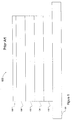
- Figure 3 is a flow chart depicting a method for manufacturing a magnetic recording medium, according to a second embodiment of the present invention.
- the present invention provides a magnetic recording medium with a dense grain structure at the magnetic data-storing layer, which improves the signal-to-noise ratio and increases potential data storage capabilities. Furthermore, the present invention provides multi-component oxide-containing alloys which can be used in sputter targets and sputtered into thin films.
- Figure 2 depicts a thin film stack in which the magnetic data-storing layer has been sputtered by a sputter target comprised of the enhanced multi-component oxide-containing sputter target alloy composition according to one embodiment of the present invention.
- the magnetic recording medium includes a substrate, and a data-storing thin film layer formed over the substrate.
- the data-storing thin film layer is comprised of cobalt (Co), platinum (Pt), and a multi-component oxide.
- the multi-component oxide has cations with a reduction potential of less than -0.03 electron volts, and atomic radii of less than 0.25 nanometers.
- the multi-component oxide is diamagnetic, paramagnetic, or magnetic with a permeability of less than 10 -6 m 3 /kg.
- magnetic recording medium 200 includes substrate 201, and data-storing thin film layer 206 formed over substrate 201.
- Data-storing thin film layer 206 is comprised of cobalt (Co), platinum (Pt), and a multi-component oxide.
- the multi-component oxide has cations with a reduction potential of less than -0.03 electron volts, and atomic radii of less than 0.25 nanometers. Additionally, the multi-component oxide is diamagnetic, paramagnetic, or magnetic with a permeability of less than 10 -6 m 3 /kg.
- magnetic recording media 200 can include other thin film layers, including seed layer 202, non-magnetic underlayer 204, interlayer 205, and carbon lubricant layer 208, although in alternate embodiments of the present invention some or all of these layers are omitted.
- a multi-component oxide-containing alloy composition enhances the grain-to-grain microstructural magnetic and electrical isolation, through the modulation of oxide properties of the different constituting oxides in the magnetic media.
- Specific metal oxides can be used for this purpose which can be used in conjunction with known oxides, such as SiO 2 /Al 2 O 3 and others, to form an multi-component insulating oxide matrix encapsulating the magnetic grains.
- the multi-component oxide has a dielectric constant greater than 5.0.
- the sputter target is further comprised of chromium (Cr) and/or boron (B).
- Cr chromium
- B boron
- the addition of elements such as boron has long been used to enhance the grain-to-grain separation in LMR media.
- the dielectric constant is greater than or less than 5.0, and/or chromium and/or boron are omitted.
- Data-storing thin film layer 206 is particularly well suited for PMR applications.
- the choice of elements used in the metal oxide is based upon several criteria, where the use of different oxides with compensating and reinforcing properties re alizes the best granular media performance with regard to SNR and thermal stability in the perpendicular magnetic media.
- the data-storing thin film layer must be comprised of a material with high thermal stability and low media noise performance.
- Granular magnetic media containing CoCrPt or CoPt-based alloys, with magnetic domains encapsulated in an insulating matrix are not only highly resistive to thermal agitation due to their large magnetocrystalline anisotropy, but they also provide an enhanced performance regarding SNR, due to the gain size reduction.
- SNR signal-to-grain separation
- an oxygen-containing grain boundary in granular media has been observed to render better magnetic properties, making the incorporation of oxygen through reactive sputtering and/or single oxide (such SiO 2 Al 2 O 3 , Ta 2 O 5 , or Nb 2 O 5 )-containing targets beneficial.
- the present invention further enhances the benefits of oxygen-rich grain boundary regions in magnetic media through the use of sputter targets containing multiple-component oxides.
- This objective is achieved through the modulation of different oxide properties related to oxidation propensity, glass formation tendency, and magnetic-dielectric behaviors in a multi-component oxide matrix incorporated in the magnetic media, using sputter targets containing multi-component oxides selected on the basis of specific criteria
- Oxides which rarely form a solid solution with metals have the inherent tendency to precipitate in the grain boundary regions in CoCrPt or CoPt-based granular media and thereby enhance microstructural segregation of the magnetic grains. These oxides do not interfere with the epitaxial growth of the oxygen containing CoCrPt or CoPt-based thin film media and therefore lead to the suppression of degradation in K u .
- Metal oxides are selected for use in sputter targets for granular magnetic media on the basis of the propensity towards oxidation and diffusive nature of the metal cations, and the oxide glass formation tendency and their magnetic, dielectric properties.
- the oxides have cations with oxidation potentials higher than that of cobalt (Co), which is the main magnetic component of the alloy, and thus the reduction potential should be less than -0.03 eV.
- the cations of the oxides have higher propensities towards oxidation than other metallic components in the alloy. Table 1, below, shows the reduction potential of different several cations.
- Table 1 Metal atom Atomic radius (nm) Metal atom Atomic radius (nm) Si 0.14 Zr 0.21 Al 0.16 Hf 0.21 Mg 0.17 Cr 0.18 Na 0.22 Co 0.16 K 0.27 Ni 0.16 Nb 0.2 Y 0.22 Ta 0.2 Mn 0.18 Ti 0.2 Ca 0.23 Zn 0.15 Sn 0.17
- the oxides have cations with atomic radii of sufficient size to allow facile diffusion to the grain boundaries in the magnetic alloy, and are less than 0.25 nm.
- Table 2 provides the atomic radii of several different metals: Table 2.
- Elements Standard reduction potential (eV) Elements Standard reduction potential(eV) Si+4 -0.86 Cr+4 -.74 Mg+2 -2.37 Cr+3 -.41 Al+3 -1.66 Fe+2 -.44 Ta+5 -0.81 Fe+3 -.04 Nb+5 -0.63 Cd+2 -.40 Hf+4 -1.70 Co+2 -0.2 Zn+2 -0.76 Ni+2 -0.25 Zr+4 -1.53 Sn+4 -0.14 Ca+2 -2.86 La+3 -2.37 Cu+1 3.39 W+6 -0.03 Ti+4 -1.63 Na+1 -2.714 Pb+2 -0.13 K+1 -2.925
- the oxides have minimal magnetic interference with the magnetic domains in the magnetic media, and are thus diamagnetic with negative permeabilities, paramagnetic, or very weekly magnetic with slightly positive permeabilities of less than 10 -6 m 3 /Kg in nature.
- Table 3 shows the magnetic behavior of different metal oxides: Table 3.
- the oxide matrix is highly insulating to prevent electrical conduction between the magnetic grains. Electrical leakage paths through non-insulating or weakly insulating grain boundaries lead to electrical conduction which, upon interaction with the applied magnetic field during magnetron sputtering, adversely affect the magnetic performance of the media as well as sputter performance of the targets. Thus the relative permittivities of the oxides are sufficiently high to make the encapsulating oxide matrix adequately insulating. Table 3, above, provides the dielectric behavior of different metal oxides.
- the oxides are used in certain proportions to obtain the highest overall permittivity.
- the oxide matrix is amorphous, such that inter-diffusion of the different elemental species between the magnetic grains is not facilitated through energetically-favored grain boundary diffusion in an otherwise crystalline matrix. This characteristic leads to better grain-to-grain microstructural and chemical encapsulation, by preventing intermediate reaction compounds formation and intermetallic formation as a byproduct of the inter-diffusion and interfacial reactions.
- Glass forming oxides such as SiO 2 , GeO 2 , P 2 O 5 , or similar oxides, while used in combination with intermediates or conditional glass formers, such as Al 2 O 3 , ZrO 2 , HfO 2 , Ta 2 O 5 or the like, form amorphous multi-component oxide phases with high crystallization temperature.
- An oxide or combination of oxides which are more amenable to glass formation are included in the magnetic media.
- multi-component oxide targets containing optimized proportions of different oxides selected on the basis of the proposed criteria realizes the respective merits of different oxides in the multi-component oxide matrix.
- the benefits of using multi-component oxides are realized in a variety of applications, including enhancement of dielectric constant, mechanical properties, and stability of amorphous or crystalline phases using two or more different oxides. Accordingly, use of sputter targets containing multi-component oxides to deposit thin film magnetic media provides a significant improvement of the magnetic behavior of the granular magnetic media for PMR.
- the multi-component oxide is further comprised of X 1 , X 2 , and oxygen (O), where X 1 and X 2 are elements selected from the group consisting of silicon (Si), tantalum (Ta), aluminum (Al), niobium (Nb), hafnium (Hf), zirconium (Zr), titanium (Ti), tin (Sn), lanthanum (La), tungsten (W), cobalt (Co), yttrium (Y), chromium (Cr), cerium (Ce), europium (Eu), gadolinium (Gd), vanadium (V), samarium (Sm), praseodymium (Pr), magnesium (Mg), manganese (Mn), iridium (Ir), rhenium (Re), and nickel (Ni).
- X 1 and X 2 are elements selected from the group consisting of silicon (Si), tantalum (Ta), aluminum (Al), niobium (Nb
- the multi-component oxide is further comprised of X 3 , where X 3 is an element selected from the group consisting of silicon (Si), aluminum (Al), tantalum (Ta), niobium (Nb), hafnium (Hf), zirconium (Zr), titanium (Ti), tin (Sn), lanthanum (La), tungsten (W), cobalt (Co), yttrium (Y), chromium (Cr), cerium (Ce), europium (Eu), gadolinium (Gd), vanadium (V), samarium (Sm), praseodymium (Pr), magnesium (Mg), manganese (Mn), iridium (Ir), rhenium (Re), and nickel (Ni).
- element X 3 is omitted.
- FIG. 3 is a flow chart depicting a method for manufacturing a magnetic recording medium, according to a second embodiment of the present invention.
- the process begins (step S300), at least a first data-storing thin film layer is sputtered over a substrate from a sputter target (step S301), and the process ends (step S302).
- the sputter target is comprised of cobalt (Co), platinum (Pt), and a multi-component oxide.
- the sputter target is comprised of cobalt (Co), platinum (Pt), at least one oxide, and at least one metal, where the at least one oxide and the at least one metal render the multi-component oxide.
- the sputter target is comprised of cobalt (Co), platinum (Pt), and at least a first and a second oxide, where the at least a first and second oxide render the multi-component oxide.
- the data-storing thin film layer is reactively sputtered, and the sputter target is comprised of cobalt (Co), platinum (Pt), and at least a first and a second metal, where said at least a first and second metals render the multi-component oxide.
- the multi-component oxide has cations with a reduction potential of less than -0.03 electron volts, and atomic radii of less than 0.25 nanometers. Additionally, the multi-component oxide is diamagnetic, paramagnetic, or magnetic with a permeability of less than 10 -6 m 3 /kg.
- the present invention can be used to process magnetic films using sputter targets containing multi-component oxides, particularly in PMR applications, where the requirements grain structure refinement and isolation are more stringent in order to minimize degradation in SNR and realize a larger K u .
- Commercial horizontal recording media can also benefit from the essential attributes of a multi-component oxide matrix for grain refinement and isolation to enhance the magnetic performance.
- the present invention is a sputter target, where the sputter target is comprised of cobalt (Co), platinum (Pt), and a multi-component oxide.
- the multi-component oxide has cations with a reduction potential of less than -0.03 electron volts, and atomic radii of less than 0.25 nanometers. Additionally, the multi-component oxide is diamagnetic, paramagnetic, or magnetic with a permeability of less than 10 -6 m 3 /kg.
- the multi-component oxide has a dielectric constant greater than 5.0.
- the sputter target is further comprised of chromium (Cr) and/or boron (B).
- the multi-component oxide is further comprised of X 1 , X 2 , and oxygen (O), where X 1 and X 2 are elements selected from the group consisting of tantalum (Ta), aluminum (Al), niobium (Nb), hafnium (Hf), zirconium (Zr), titanium (Ti), tin (Sn), lanthanum (La), tungsten (W), cobalt (Co), yttrium (Y), chromium (Cr), cerium (Ce), europium (Eu), gadolinium (Gd), vanadium (V), samarium (Sm), praseodymium (Pr), magnesium (Mg), manganese (Mn), iridium (Ir), rhenium (Re), and nickel (Ni).
- X 1 and X 2 are elements selected from the group consisting of tantalum (Ta), aluminum (Al), niobium (Nb), hafnium (Hf), zi
- the multi-component oxide is further comprised of X 3 , where X 3 is an element selected from the group consisting of aluminum (Al), niobium (Nb), hafnium (Hf), zirconium (Zr), titanium (Ti), tin (Sn), lanthanum (La), tungsten (W), cobalt (Co), yttrium (Y), chromium (Cr), cerium (Ce), europium (Eu), gadolinium (Gd), vanadium (V), samarium (Sm), praseodymium (Pr), magnesium (Mg), manganese (Mn), iridium (Ir), rhenium (Re), and nickel (Ni).
- X 3 is an element selected from the group consisting of aluminum (Al), niobium (Nb), hafnium (Hf), zirconium (Zr), titanium (Ti), tin (Sn), lanthanum (La), tungsten (
- the multi-component oxide is further comprised of X 1 , X 2 , and oxygen (O), where X 1 and X 2 are elements selected from the group consisting of silicon (Si), aluminum (Al), niobium (Nb), hafnium (Hf), zirconium (Zr), titanium (Ti), tin (Sn), lanthanum (La), tungsten (W), cobalt (Co), yttrium (Y), chromium (Cr), cerium (Ce), europium (Eu), gadolinium (Gd), vanadium (V), samarium (Sm), praseodymium (Pr), magnesium (Mg), manganese (Mn), iridium (Ir), rhenium (Re), and nickel (Ni).
- X 1 and X 2 are elements selected from the group consisting of silicon (Si), aluminum (Al), niobium (Nb), hafnium (Hf), zirconium (
- the multi-component oxide is further comprised of X 3 , where X 3 is an element selected from the group consisting of aluminum (Al), niobium (Nb), hafnium (Hf), zirconium (Zr), titanium (Ti), tin (Sn), lanthanum (La), tungsten (W), cobalt (Co), yttrium (Y), chromium (Cr), cerium (Ce), europium (Eu), gadolinium (Gd), vanadium (V), samarium (Sm), praseodymium (Pr), magnesium (Mg), manganese (Mn), iridium (Ir), rhenium (Re), and nickel (Ni).
- X 3 is an element selected from the group consisting of aluminum (Al), niobium (Nb), hafnium (Hf), zirconium (Zr), titanium (Ti), tin (Sn), lanthanum (La), tungsten (
- the multi-component oxide is further comprised of X 1 , X 2 , and oxygen (O), where X 1 and X 2 are elements selected from the group consisting of silicon (Si), tantalum (Ta), aluminum (Al), niobium (Nb), hafnium (Hf), zirconium (Zr), titanium (Ti), tin (Sn), lanthanum (La), tungsten (W), cobalt (Co), yttrium (Y), chromium (Cr), cerium (Ce), europium (Eu), gadolinium (Gd), vanadium (V), samarium (Sm), praseodymium (Pr), magnesium (Mg), manganese (Mn), iridium (Ir), rhenium (Re), and nickel (Ni).
- X 1 and X 2 are elements selected from the group consisting of silicon (Si), tantalum (Ta), aluminum (Al), niobium (Nb
- the present invention is a sputter target, where the sputter target is comprised of cobalt (Co), platinum (Pt), at least one oxide, and at least one metal.
- the at least one oxide and the at least one metal render a multi-component oxide, where the multi-component oxide has cations with a reduction potential of less than -0.03 electron volts, and atomic radii of less than 0.25 nanometers.
- the multi-component oxide is diamagnetic, paramagnetic, or magnetic with a permeability of less than 10 -6 m 3 /kg, and the multi-component oxide has a dielectric constant greater than 5.0.
- the present invention is a sputter target, where the sputter target is comprised of cobalt (Co), platinum (Pt), and at least first and second oxides.
- the first and second oxides render a multi-component oxide, where the multi-component oxide has cations with a reduction potential of less than -0.03 electron volts, and atomic radii of less than 0.25 nanometers.
- the multi-component oxide is diamagnetic, paramagnetic, or magnetic with a permeability of less than 10 -6 m 3 /kg, and the multi-component oxide has a dielectric constant greater than 5.0.
- the present invention is a sputter target, where the sputter target is comprised of cobalt (Co), platinum (Pt), and at least first and second metals.
- the first and second metals render a multi-component oxide, where the multi-component oxide has cations with a reduction potential of less than -0.03 electron volts, and atomic radii of less than 0.25 nanometers.
- the multi-component oxide is diamagnetic, paramagnetic, or magnetic with a permeability of less than 10 -6 m 3 /kg, and the multi-component oxide has a dielectric constant greater than 5.0.
Landscapes
- Chemical & Material Sciences (AREA)
- Engineering & Computer Science (AREA)
- Organic Chemistry (AREA)
- Materials Engineering (AREA)
- Mechanical Engineering (AREA)
- Metallurgy (AREA)
- Chemical Kinetics & Catalysis (AREA)
- Physics & Mathematics (AREA)
- Spectroscopy & Molecular Physics (AREA)
- Ceramic Engineering (AREA)
- Inorganic Chemistry (AREA)
- Manufacturing Of Magnetic Record Carriers (AREA)
- Magnetic Record Carriers (AREA)
- Physical Vapour Deposition (AREA)
Applications Claiming Priority (1)
| Application Number | Priority Date | Filing Date | Title |
|---|---|---|---|
| US11/110,105 US20060234091A1 (en) | 2005-04-19 | 2005-04-19 | Enhanced multi-component oxide-containing sputter target alloy compositions |
Publications (2)
| Publication Number | Publication Date |
|---|---|
| EP1717337A2 true EP1717337A2 (fr) | 2006-11-02 |
| EP1717337A3 EP1717337A3 (fr) | 2007-07-11 |
Family
ID=36675962
Family Applications (1)
| Application Number | Title | Priority Date | Filing Date |
|---|---|---|---|
| EP05255240A Withdrawn EP1717337A3 (fr) | 2005-04-19 | 2005-08-25 | Compositions améliorées d'alliage multi-composant contenant un oxide pour cible de pulvérisation |
Country Status (8)
| Country | Link |
|---|---|
| US (1) | US20060234091A1 (fr) |
| EP (1) | EP1717337A3 (fr) |
| JP (1) | JP2006299400A (fr) |
| KR (1) | KR20060110722A (fr) |
| CN (1) | CN1952207A (fr) |
| CZ (1) | CZ2005540A3 (fr) |
| SG (1) | SG126812A1 (fr) |
| TW (1) | TWI279785B (fr) |
Families Citing this family (16)
| Publication number | Priority date | Publication date | Assignee | Title |
|---|---|---|---|---|
| JP2008276859A (ja) * | 2007-04-27 | 2008-11-13 | Showa Denko Kk | 磁気記録媒体、その製造方法および磁気記録再生装置 |
| US7879470B2 (en) * | 2007-11-15 | 2011-02-01 | Hitachi Global Storage Technologies Netherlands B.V. | Apparatus, system, and method for the selection of perpendicular media segregant materials |
| WO2009119812A1 (fr) * | 2008-03-28 | 2009-10-01 | 日鉱金属株式会社 | Cible de pulvérisation à base d'un matériau du type dispersion d'un matériau non magnétique dans un matériau ferromagnétique |
| WO2010004862A1 (fr) * | 2008-07-07 | 2010-01-14 | 日鉱金属株式会社 | Objet fritté à base d'oxyde, cible de pulvérisation comprenant l'objet fritté, procédé pour produire l'objet fritté, et procédé pour produire une cible de pulvérisation comprenant l'objet fritté |
| US8722214B2 (en) | 2008-12-22 | 2014-05-13 | Seagate Technology Llc | Hybrid grain boundary additives in granular media |
| US8168309B2 (en) * | 2009-08-13 | 2012-05-01 | Hitachi Global Storage Technologies Netherlands B.V. | Perpendicular recording media with sublayers of oxide dopant magnetic materials |
| JP5536540B2 (ja) * | 2010-05-26 | 2014-07-02 | 昭和電工株式会社 | 磁気記録媒体および磁気記録再生装置 |
| US8507114B2 (en) * | 2011-06-30 | 2013-08-13 | Seagate Technology Llc | Recording layer for heat assisted magnetic recording |
| CN104126026B (zh) * | 2012-02-23 | 2016-03-23 | 吉坤日矿日石金属株式会社 | 含有铬氧化物的强磁性材料溅射靶 |
| CN104174851B (zh) * | 2014-08-12 | 2016-05-18 | 贵研铂业股份有限公司 | 一种Co-Cr-Pt-SiO2靶材的制备方法 |
| TWI658150B (zh) * | 2018-02-05 | 2019-05-01 | 光洋應用材料科技股份有限公司 | 含鈷鉻鉑硼錸濺鍍靶材、含鈷鉻鉑硼錸層及其製法 |
| JP6661000B2 (ja) * | 2018-06-07 | 2020-03-11 | 株式会社神戸製鋼所 | 記録層、光情報記録媒体及びスパッタリングターゲット |
| JP7125061B2 (ja) * | 2019-01-11 | 2022-08-24 | 田中貴金属工業株式会社 | 垂直磁気記録媒体 |
| CN113348510B (zh) * | 2019-02-01 | 2023-09-15 | 索尼集团公司 | 光记录介质、记录层以及记录层形成用溅射靶 |
| JP7336786B2 (ja) * | 2019-10-31 | 2023-09-01 | 株式会社レゾナック | アシスト磁気記録媒体及び磁気記憶装置 |
| CN118870829B (zh) * | 2024-09-26 | 2024-12-10 | 江西师范大学 | 一种基于中空结构纳米颗粒的浮栅存储器件及其制备方法 |
Family Cites Families (9)
| Publication number | Priority date | Publication date | Assignee | Title |
|---|---|---|---|---|
| US5736013A (en) * | 1994-04-06 | 1998-04-07 | Komag, Inc. | Method for forming an improved magnetic media including sputtering of selected oxides or nitrides in the magnetic layer, and apparatus for same |
| JP3522944B2 (ja) * | 1996-01-26 | 2004-04-26 | 株式会社東芝 | 磁気記録媒体 |
| JP2001351217A (ja) * | 2000-06-08 | 2001-12-21 | Fujitsu Ltd | 磁気記録媒体 |
| US20020106297A1 (en) * | 2000-12-01 | 2002-08-08 | Hitachi Metals, Ltd. | Co-base target and method of producing the same |
| JP2002342908A (ja) * | 2001-05-14 | 2002-11-29 | Sony Corp | 磁気記録媒体とその製造方法 |
| US7842409B2 (en) * | 2001-11-30 | 2010-11-30 | Seagate Technology Llc | Anti-ferromagnetically coupled perpendicular magnetic recording media with oxide |
| JP2004227717A (ja) * | 2003-01-24 | 2004-08-12 | Fuji Electric Device Technology Co Ltd | 磁気記録媒体およびその製造方法 |
| WO2004090874A1 (fr) * | 2003-04-07 | 2004-10-21 | Showa Denko K. K. | Support d'enregistrement magnetique, son procede de production, et appareil d'enregistrement et de reproduction magnetique |
| US7601445B2 (en) * | 2003-09-25 | 2009-10-13 | Showa Denko K.K. | Perpendicular magnetic recording medium and magnetic recording/reproducing apparatus |
-
2005
- 2005-04-19 US US11/110,105 patent/US20060234091A1/en not_active Abandoned
- 2005-08-25 EP EP05255240A patent/EP1717337A3/fr not_active Withdrawn
- 2005-08-26 CZ CZ20050540A patent/CZ2005540A3/cs unknown
- 2005-08-30 TW TW094129693A patent/TWI279785B/zh not_active IP Right Cessation
- 2005-09-26 SG SG200506159A patent/SG126812A1/en unknown
- 2005-10-07 KR KR1020050094568A patent/KR20060110722A/ko not_active Ceased
- 2005-10-18 CN CNA2005101140664A patent/CN1952207A/zh active Pending
- 2005-11-29 JP JP2005344728A patent/JP2006299400A/ja active Pending
Also Published As
| Publication number | Publication date |
|---|---|
| TW200638360A (en) | 2006-11-01 |
| EP1717337A3 (fr) | 2007-07-11 |
| JP2006299400A (ja) | 2006-11-02 |
| KR20060110722A (ko) | 2006-10-25 |
| CZ2005540A3 (cs) | 2006-12-13 |
| SG126812A1 (en) | 2006-11-29 |
| CN1952207A (zh) | 2007-04-25 |
| US20060234091A1 (en) | 2006-10-19 |
| TWI279785B (en) | 2007-04-21 |
Similar Documents
| Publication | Publication Date | Title |
|---|---|---|
| EP1736968B1 (fr) | Compensation améliorée de non-stoechiométrie d' oxygène pour pellicules minces | |
| EP1717337A2 (fr) | Compositions améliorées d'alliage multi-composant contenant un oxide pour cible de pulvérisation | |
| EP1930884A1 (fr) | Alliages NI-X, NI-Y, et NI-X-Y avec ou sans oxydes comme cibles de pulvérisation pour enregistrement magnétique perpendiculaire | |
| US20090120237A1 (en) | Enhanced formulation of cobalt alloy matrix compositions | |
| EP1895518A1 (fr) | Moyens magnétiques d'enregistrement et cibles de pulvérisation aux compositions d'alliages à anisotropie élévée et oxydes | |
| EP1637625A2 (fr) | Matériau de cible. | |
| EP1734513A1 (fr) | Compositions améliorées d'alliage contenant oxyde pour cible de pulvérisation | |
| EP1783748A1 (fr) | Dépôt de couche de substratage améliorée utilisant une cible de pulvérisation en alliage de tantale | |
| US9495990B2 (en) | Hard magnetic exchange-coupled composite structures and perpendicular magnetic recording media including the same | |
| HK1091236A (en) | Enhanced multi-component oxide-containing sputter target alloy compositions | |
| HK1094275A (en) | Enhanced oxide-containing sputter target alloy compositions | |
| HK1094833B (en) | Enhanced oxygen non-stoichiometry compensation for thin films | |
| HK1099902A (en) | Deposition of enhanced seed layer using tantalum alloy based sputter target | |
| HK1109818A (en) | Magnetic recording media and sputter targets with compositions of high anisotropy alloys and oxide compounds | |
| HK1082527A (en) | Target material | |
| HK1078375A (en) | Magnetic recording media | |
| HK1091235B (en) | Enhanced formulation of cobalt alloy matrix compositions | |
| KR20070017571A (ko) | 스퍼터 타겟 제조방법 |
Legal Events
| Date | Code | Title | Description |
|---|---|---|---|
| PUAI | Public reference made under article 153(3) epc to a published international application that has entered the european phase |
Free format text: ORIGINAL CODE: 0009012 |
|
| AK | Designated contracting states |
Kind code of ref document: A2 Designated state(s): AT BE BG CH CY CZ DE DK EE ES FI FR GB GR HU IE IS IT LI LT LU LV MC NL PL PT RO SE SI SK TR |
|
| AX | Request for extension of the european patent |
Extension state: AL BA HR MK YU |
|
| REG | Reference to a national code |
Ref country code: HK Ref legal event code: DE Ref document number: 1091236 Country of ref document: HK |
|
| PUAL | Search report despatched |
Free format text: ORIGINAL CODE: 0009013 |
|
| AK | Designated contracting states |
Kind code of ref document: A3 Designated state(s): AT BE BG CH CY CZ DE DK EE ES FI FR GB GR HU IE IS IT LI LT LU LV MC NL PL PT RO SE SI SK TR |
|
| AX | Request for extension of the european patent |
Extension state: AL BA HR MK YU |
|
| RIC1 | Information provided on ipc code assigned before grant |
Ipc: G11B 5/851 20060101ALI20070604BHEP Ipc: G11B 5/64 20060101ALI20070604BHEP Ipc: C23C 14/34 20060101AFI20060721BHEP |
|
| AKX | Designation fees paid | ||
| REG | Reference to a national code |
Ref country code: DE Ref legal event code: 8566 |
|
| STAA | Information on the status of an ep patent application or granted ep patent |
Free format text: STATUS: THE APPLICATION IS DEEMED TO BE WITHDRAWN |
|
| 18D | Application deemed to be withdrawn |
Effective date: 20080115 |
|
| REG | Reference to a national code |
Ref country code: HK Ref legal event code: WD Ref document number: 1091236 Country of ref document: HK |