EP1717889A1 - Sekundärbatterie und Kondensator mit Indol-Polymerverbindung - Google Patents
Sekundärbatterie und Kondensator mit Indol-Polymerverbindung Download PDFInfo
- Publication number
- EP1717889A1 EP1717889A1 EP06010188A EP06010188A EP1717889A1 EP 1717889 A1 EP1717889 A1 EP 1717889A1 EP 06010188 A EP06010188 A EP 06010188A EP 06010188 A EP06010188 A EP 06010188A EP 1717889 A1 EP1717889 A1 EP 1717889A1
- Authority
- EP
- European Patent Office
- Prior art keywords
- group
- polymeric compound
- discharge
- secondary battery
- reaction
- Prior art date
- Legal status (The legal status is an assumption and is not a legal conclusion. Google has not performed a legal analysis and makes no representation as to the accuracy of the status listed.)
- Withdrawn
Links
- SIKJAQJRHWYJAI-UHFFFAOYSA-N Indole Chemical compound C1=CC=C2NC=CC2=C1 SIKJAQJRHWYJAI-UHFFFAOYSA-N 0.000 title abstract description 50
- 229920000642 polymer Polymers 0.000 title abstract description 36
- 239000003990 capacitor Substances 0.000 title abstract description 30
- PZOUSPYUWWUPPK-UHFFFAOYSA-N indole Natural products CC1=CC=CC2=C1C=CN2 PZOUSPYUWWUPPK-UHFFFAOYSA-N 0.000 title abstract description 25
- RKJUIXBNRJVNHR-UHFFFAOYSA-N indolenine Natural products C1=CC=C2CC=NC2=C1 RKJUIXBNRJVNHR-UHFFFAOYSA-N 0.000 title abstract description 25
- QAOWNCQODCNURD-UHFFFAOYSA-N sulfuric acid group Chemical group S(O)(O)(=O)=O QAOWNCQODCNURD-UHFFFAOYSA-N 0.000 claims abstract description 48
- -1 poly(6-nitroindole) Polymers 0.000 claims description 44
- 239000008151 electrolyte solution Substances 0.000 claims description 23
- DTQVDTLACAAQTR-UHFFFAOYSA-N Trifluoroacetic acid Chemical compound OC(=O)C(F)(F)F DTQVDTLACAAQTR-UHFFFAOYSA-N 0.000 claims description 5
- 125000004122 cyclic group Chemical group 0.000 abstract description 28
- 238000007599 discharging Methods 0.000 abstract description 9
- 239000007772 electrode material Substances 0.000 abstract description 9
- 230000002378 acidificating effect Effects 0.000 abstract description 6
- 239000002800 charge carrier Substances 0.000 abstract description 4
- 125000004435 hydrogen atom Chemical group [H]* 0.000 abstract description 4
- 230000009257 reactivity Effects 0.000 abstract description 4
- 239000000470 constituent Substances 0.000 abstract description 3
- 125000003545 alkoxy group Chemical group 0.000 abstract description 2
- 125000000217 alkyl group Chemical group 0.000 abstract description 2
- 125000004414 alkyl thio group Chemical group 0.000 abstract description 2
- 125000003277 amino group Chemical group 0.000 abstract description 2
- 125000003118 aryl group Chemical group 0.000 abstract description 2
- 125000005110 aryl thio group Chemical group 0.000 abstract description 2
- 125000003178 carboxy group Chemical group [H]OC(*)=O 0.000 abstract description 2
- 125000004093 cyano group Chemical group *C#N 0.000 abstract description 2
- 125000005843 halogen group Chemical group 0.000 abstract description 2
- 125000002887 hydroxy group Chemical group [H]O* 0.000 abstract description 2
- 125000000449 nitro group Chemical group [O-][N+](*)=O 0.000 abstract description 2
- 125000001424 substituent group Chemical group 0.000 abstract description 2
- 238000006243 chemical reaction Methods 0.000 description 53
- 239000010405 anode material Substances 0.000 description 26
- 230000000052 comparative effect Effects 0.000 description 24
- 239000010406 cathode material Substances 0.000 description 20
- 239000007864 aqueous solution Substances 0.000 description 19
- 229920000767 polyaniline Polymers 0.000 description 16
- 238000010521 absorption reaction Methods 0.000 description 15
- 238000003795 desorption Methods 0.000 description 15
- 229910021607 Silver chloride Inorganic materials 0.000 description 11
- 238000000034 method Methods 0.000 description 11
- HKZLPVFGJNLROG-UHFFFAOYSA-M silver monochloride Chemical compound [Cl-].[Ag+] HKZLPVFGJNLROG-UHFFFAOYSA-M 0.000 description 11
- 238000006479 redox reaction Methods 0.000 description 9
- 150000002500 ions Chemical class 0.000 description 8
- 150000001450 anions Chemical class 0.000 description 7
- 239000000243 solution Substances 0.000 description 7
- 239000002019 doping agent Substances 0.000 description 6
- 239000000463 material Substances 0.000 description 5
- 239000000126 substance Substances 0.000 description 5
- 239000002253 acid Substances 0.000 description 4
- 150000003839 salts Chemical class 0.000 description 4
- OKTJSMMVPCPJKN-UHFFFAOYSA-N Carbon Chemical compound [C] OKTJSMMVPCPJKN-UHFFFAOYSA-N 0.000 description 3
- ZMXDDKWLCZADIW-UHFFFAOYSA-N N,N-Dimethylformamide Chemical compound CN(C)C=O ZMXDDKWLCZADIW-UHFFFAOYSA-N 0.000 description 3
- 229910052799 carbon Inorganic materials 0.000 description 3
- 239000002003 electrode paste Substances 0.000 description 3
- 238000006116 polymerization reaction Methods 0.000 description 3
- AZQWKYJCGOJGHM-UHFFFAOYSA-N 1,4-benzoquinone Chemical compound O=C1C=CC(=O)C=C1 AZQWKYJCGOJGHM-UHFFFAOYSA-N 0.000 description 2
- 239000013543 active substance Substances 0.000 description 2
- 239000011230 binding agent Substances 0.000 description 2
- 238000002156 mixing Methods 0.000 description 2
- 230000007935 neutral effect Effects 0.000 description 2
- VLTRZXGMWDSKGL-UHFFFAOYSA-M perchlorate Inorganic materials [O-]Cl(=O)(=O)=O VLTRZXGMWDSKGL-UHFFFAOYSA-M 0.000 description 2
- VLTRZXGMWDSKGL-UHFFFAOYSA-N perchloric acid Substances OCl(=O)(=O)=O VLTRZXGMWDSKGL-UHFFFAOYSA-N 0.000 description 2
- XSCHRSMBECNVNS-UHFFFAOYSA-N quinoxaline Chemical compound N1=CC=NC2=CC=CC=C21 XSCHRSMBECNVNS-UHFFFAOYSA-N 0.000 description 2
- YHYLDEVWYOFIJK-UHFFFAOYSA-N 1h-indole-5-carbonitrile Chemical compound N#CC1=CC=C2NC=CC2=C1 YHYLDEVWYOFIJK-UHFFFAOYSA-N 0.000 description 1
- BVKZGUZCCUSVTD-UHFFFAOYSA-L Carbonate Chemical compound [O-]C([O-])=O BVKZGUZCCUSVTD-UHFFFAOYSA-L 0.000 description 1
- 229910002651 NO3 Inorganic materials 0.000 description 1
- NHNBFGGVMKEFGY-UHFFFAOYSA-N Nitrate Chemical compound [O-][N+]([O-])=O NHNBFGGVMKEFGY-UHFFFAOYSA-N 0.000 description 1
- QAOWNCQODCNURD-UHFFFAOYSA-L Sulfate Chemical compound [O-]S([O-])(=O)=O QAOWNCQODCNURD-UHFFFAOYSA-L 0.000 description 1
- 229910003481 amorphous carbon Inorganic materials 0.000 description 1
- 230000015572 biosynthetic process Effects 0.000 description 1
- 239000006229 carbon black Substances 0.000 description 1
- 229910001914 chlorine tetroxide Inorganic materials 0.000 description 1
- 238000006482 condensation reaction Methods 0.000 description 1
- 229920001940 conductive polymer Polymers 0.000 description 1
- 230000003247 decreasing effect Effects 0.000 description 1
- 238000001035 drying Methods 0.000 description 1
- 230000000694 effects Effects 0.000 description 1
- 238000011156 evaluation Methods 0.000 description 1
- 239000011245 gel electrolyte Substances 0.000 description 1
- 125000001041 indolyl group Chemical group 0.000 description 1
- 239000003273 ketjen black Substances 0.000 description 1
- 238000004519 manufacturing process Methods 0.000 description 1
- 239000000203 mixture Substances 0.000 description 1
- 239000000178 monomer Substances 0.000 description 1
- 150000002894 organic compounds Chemical class 0.000 description 1
- QQONPFPTGQHPMA-UHFFFAOYSA-N propylene Natural products CC=C QQONPFPTGQHPMA-UHFFFAOYSA-N 0.000 description 1
- 125000004805 propylene group Chemical group [H]C([H])([H])C([H])([*:1])C([H])([H])[*:2] 0.000 description 1
- 239000007784 solid electrolyte Substances 0.000 description 1
- 238000006467 substitution reaction Methods 0.000 description 1
- BDHFUVZGWQCTTF-UHFFFAOYSA-M sulfonate Chemical compound [O-]S(=O)=O BDHFUVZGWQCTTF-UHFFFAOYSA-M 0.000 description 1
- 238000003786 synthesis reaction Methods 0.000 description 1
- 230000002194 synthesizing effect Effects 0.000 description 1
- NWONKYPBYAMBJT-UHFFFAOYSA-L zinc sulfate Chemical compound [Zn+2].[O-]S([O-])(=O)=O NWONKYPBYAMBJT-UHFFFAOYSA-L 0.000 description 1
- 229910000368 zinc sulfate Inorganic materials 0.000 description 1
- 239000011686 zinc sulphate Substances 0.000 description 1
Images


Classifications
-
- H—ELECTRICITY
- H01—ELECTRIC ELEMENTS
- H01M—PROCESSES OR MEANS, e.g. BATTERIES, FOR THE DIRECT CONVERSION OF CHEMICAL ENERGY INTO ELECTRICAL ENERGY
- H01M4/00—Electrodes
- H01M4/02—Electrodes composed of, or comprising, active material
- H01M4/36—Selection of substances as active materials, active masses, active liquids
- H01M4/60—Selection of substances as active materials, active masses, active liquids of organic compounds
-
- H—ELECTRICITY
- H01—ELECTRIC ELEMENTS
- H01G—CAPACITORS; CAPACITORS, RECTIFIERS, DETECTORS, SWITCHING DEVICES, LIGHT-SENSITIVE OR TEMPERATURE-SENSITIVE DEVICES OF THE ELECTROLYTIC TYPE
- H01G11/00—Hybrid capacitors, i.e. capacitors having different positive and negative electrodes; Electric double-layer [EDL] capacitors; Processes for the manufacture thereof or of parts thereof
- H01G11/02—Hybrid capacitors, i.e. capacitors having different positive and negative electrodes; Electric double-layer [EDL] capacitors; Processes for the manufacture thereof or of parts thereof using combined reduction-oxidation reactions, e.g. redox arrangement or solion
-
- H—ELECTRICITY
- H01—ELECTRIC ELEMENTS
- H01G—CAPACITORS; CAPACITORS, RECTIFIERS, DETECTORS, SWITCHING DEVICES, LIGHT-SENSITIVE OR TEMPERATURE-SENSITIVE DEVICES OF THE ELECTROLYTIC TYPE
- H01G11/00—Hybrid capacitors, i.e. capacitors having different positive and negative electrodes; Electric double-layer [EDL] capacitors; Processes for the manufacture thereof or of parts thereof
- H01G11/22—Electrodes
- H01G11/30—Electrodes characterised by their material
- H01G11/48—Conductive polymers
-
- H—ELECTRICITY
- H01—ELECTRIC ELEMENTS
- H01M—PROCESSES OR MEANS, e.g. BATTERIES, FOR THE DIRECT CONVERSION OF CHEMICAL ENERGY INTO ELECTRICAL ENERGY
- H01M10/00—Secondary cells; Manufacture thereof
- H01M10/05—Accumulators with non-aqueous electrolyte
-
- H—ELECTRICITY
- H01—ELECTRIC ELEMENTS
- H01M—PROCESSES OR MEANS, e.g. BATTERIES, FOR THE DIRECT CONVERSION OF CHEMICAL ENERGY INTO ELECTRICAL ENERGY
- H01M10/00—Secondary cells; Manufacture thereof
- H01M10/36—Accumulators not provided for in groups H01M10/05-H01M10/34
-
- H—ELECTRICITY
- H01—ELECTRIC ELEMENTS
- H01M—PROCESSES OR MEANS, e.g. BATTERIES, FOR THE DIRECT CONVERSION OF CHEMICAL ENERGY INTO ELECTRICAL ENERGY
- H01M4/00—Electrodes
- H01M4/02—Electrodes composed of, or comprising, active material
- H01M4/36—Selection of substances as active materials, active masses, active liquids
- H01M4/60—Selection of substances as active materials, active masses, active liquids of organic compounds
- H01M4/602—Polymers
- H01M4/606—Polymers containing aromatic main chain polymers
-
- H—ELECTRICITY
- H01—ELECTRIC ELEMENTS
- H01M—PROCESSES OR MEANS, e.g. BATTERIES, FOR THE DIRECT CONVERSION OF CHEMICAL ENERGY INTO ELECTRICAL ENERGY
- H01M2300/00—Electrolytes
- H01M2300/0002—Aqueous electrolytes
- H01M2300/0005—Acid electrolytes
- H01M2300/0011—Sulfuric acid-based
-
- H—ELECTRICITY
- H01—ELECTRIC ELEMENTS
- H01M—PROCESSES OR MEANS, e.g. BATTERIES, FOR THE DIRECT CONVERSION OF CHEMICAL ENERGY INTO ELECTRICAL ENERGY
- H01M4/00—Electrodes
- H01M4/02—Electrodes composed of, or comprising, active material
- H01M4/13—Electrodes for accumulators with non-aqueous electrolyte, e.g. for lithium-accumulators; Processes of manufacture thereof
- H01M4/137—Electrodes based on electro-active polymers
-
- Y—GENERAL TAGGING OF NEW TECHNOLOGICAL DEVELOPMENTS; GENERAL TAGGING OF CROSS-SECTIONAL TECHNOLOGIES SPANNING OVER SEVERAL SECTIONS OF THE IPC; TECHNICAL SUBJECTS COVERED BY FORMER USPC CROSS-REFERENCE ART COLLECTIONS [XRACs] AND DIGESTS
- Y02—TECHNOLOGIES OR APPLICATIONS FOR MITIGATION OR ADAPTATION AGAINST CLIMATE CHANGE
- Y02E—REDUCTION OF GREENHOUSE GAS [GHG] EMISSIONS, RELATED TO ENERGY GENERATION, TRANSMISSION OR DISTRIBUTION
- Y02E60/00—Enabling technologies; Technologies with a potential or indirect contribution to GHG emissions mitigation
- Y02E60/10—Energy storage using batteries
-
- Y—GENERAL TAGGING OF NEW TECHNOLOGICAL DEVELOPMENTS; GENERAL TAGGING OF CROSS-SECTIONAL TECHNOLOGIES SPANNING OVER SEVERAL SECTIONS OF THE IPC; TECHNICAL SUBJECTS COVERED BY FORMER USPC CROSS-REFERENCE ART COLLECTIONS [XRACs] AND DIGESTS
- Y02—TECHNOLOGIES OR APPLICATIONS FOR MITIGATION OR ADAPTATION AGAINST CLIMATE CHANGE
- Y02E—REDUCTION OF GREENHOUSE GAS [GHG] EMISSIONS, RELATED TO ENERGY GENERATION, TRANSMISSION OR DISTRIBUTION
- Y02E60/00—Enabling technologies; Technologies with a potential or indirect contribution to GHG emissions mitigation
- Y02E60/13—Energy storage using capacitors
Definitions
- the present invention relates to a secondary battery and capacitor, and more particularly to a secondary battery and capacitor in which an indole polymeric compound is used as an electrode active material and a proton is employed as a charge carrier thereof.
- JP 5-148320A discloses a method of chemical-oxidative polymerization of indole monomers to obtain polyindole, and a conductive device that contains polymers polymerized through the method.
- the indole is limited only to the polyindole and the use of the conductive device is only for conductive films and electrochromic devices.
- a paper on "Electrochemical synthesis of polyindole and its evaluation for rechargeable battery applications" describes a battery composed of Zn/ZnSO 4 /Polyindole.
- This battery employs a neutral electrolytic solution.
- the reaction of the battery in the neutral electrolytic solution is accompanied with doping and de-doping of dopant anions.
- dopant anions are large in size and low in mobility. Accordingly, this battery is disadvantageous to performances of fast charging and discharging.
- An object of the present invention is to provide a secondary battery and capacitor having a high electromotive force together with a high cyclic property and being capable of fast charging and discharging, using a polymeric compound having a high stability and high reactivity in an acidic ambient, as an electrode active material.
- a secondary battery and capacitor which include an indole polymeric compound as an electrode active material.
- the polymeric compound employs a proton as a charge carrier and has a constituent represented by general formula (1):
- each R denotes a hydrogen atom, a halogen atom, a hydroxyl group, a carboxyl group, a sulfonic group, a sulfuric acid group, a nitro group, a cyano group, an alkyl group, an aryl group, an alkoxyl group, an amino group, an alkylthio group and an arylthio group.
- R's may be the same or different from each other.
- At least one R has a substituent other than a hydrogen atom.
- At least two R's are employed for bonding to form a polymer. These bonds may be double bonds.
- Fig. 1 shows a structure of a secondary battery or capacitor of the present invention.
- This secondary battery or capacitor comprises an anode material 2 formed on a collector 1 and a cathode material 4 formed on a collector 1', respectively.
- the anode material 2 is an indole polymeric compound.
- the cathode material 4 comprises an n-doped polymeric compound that can store charges through the reaction accompanied with absorption and desorption of protons, such as a quinoxaline polymeric compound or another polymeric compound reacting through absorption and desorption of protons.
- These polymeric compound electrodes and electrodes that are active in the presence of protons are formed on collectors 1, 1' , respectively.
- the anode material 2 and the cathode material 4 are arranged opposing to each other, interposing therebetween a separator 3 that contains an electrolytic solution impregnated therein, or a gel electrolyte or solid electrolyte, in which the electrolytic solution contains protons.
- a separator 3 that contains an electrolytic solution impregnated therein, or a gel electrolyte or solid electrolyte, in which the electrolytic solution contains protons.
- Any cathode material is available so long as it is active in the presence of protons.
- the indole polymeric compound used for the anode material can be produced through an electrochemical or chemical method.
- the starting substance for synthesizing the indole polymeric compound of the anode material is an organic compound that can be used to form a polymeric compound having an indole skeleton through an electrical or chemical method such as electrolytic polymerization, chemical polymerization, condensation reaction and substitution reaction.
- the indole polymeric compound of the anode material can be doped through an electrochemical or chemical method.
- Each X in the following reaction formulae (1) and (2) represents a dopant ion.
- each X exemplifies a halide ion, perchloric acid ion, tetrafluoroboric acid ion, sulfuric acid ion, alkylsulfonic acid ion, alkylsulfuric acid ion, trifluoromethanesulfonic acid ion and trifluoroacetic acid ion but any of the ions is available so long as it can be doped into the indole polymeric compound.
- a conductive auxiliary may be added, if necessary, to ensure the conductivity of the indole polymeric compound electrode.
- the conductive auxiliary includes materials that can ensure the conductivity, for example, carbon black, crystalline carbon and amorphous carbon.
- An organic binder is also employed, if required, to secure these materials on the collector.
- the indole polymeric compound is in a range of 30-95% by weight; the conductive auxiliary, 0-50% by weight; and the organic binder, 0-20% by weight. More preferably, the indole polymeric compound is in a range of 60-90% by weight. If the indole polymeric compound is less than 30% by weight, the reaction efficiency per unit volume easily lowers. If it exceeds 95% by weight, it becomes undesirably difficult to ensure the conductivity of the electrode.
- the electrolytic solution is an aqueous or nonaqueous solution that contains protons preferably 10 -3 mol/l to 18 mol/l, and more preferably 10 -1 mol/l to 7 mol/l. If the content of protons is less than 10 -3 mol/l, the low proton concentration reduces the reactivity of the electrode material. If the content of protons is more than 18 mol/l, the strong acidity reduces the activity of the material or solves the material.
- An alkaline metallic salt, an alkaline earth metallic salt, an organic sulfonate, a sulfate, a nitrate and a perchlorate can be added, if necessary, to the proton-containing electrolytic solution. In the aqueous or nonaqueous solution, such salts that can ensure the ionic conductivity are preferred. These salts are not limited both in type and in concentration.
- the indole polymeric compound of the anode material has two reaction steps in the proton-containing electrolytic solution ⁇ the reaction formulae (1) and (2) ⁇ .
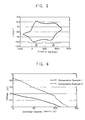
- Fig. 2 shows a typical cyclic voltamogram (hereinafter referred to as CV) in an acidic aqueous solution of the indole polymeric compound.
- the reaction of the reaction formula (1) accompanied with doping and de-doping dopants occurs within a region 1 (in the vicinity of nearly 0-800 mV vs. Ag/AgCl).
- the reaction of the reaction formula (2) accompanied with absorption and desorption of protons occurs within a region 2 (in the vicinity of nearly 800-1300 mV) . It has been found that the reaction of the indole polymeric compound of the reaction formula (2) has a high reactivity and an excellent cyclic property.
- the present invention provides a secondary battery and capacitor that has an excellent cyclic property and employs the reaction formula (2) in the proton-containing electrolytic solution (the reaction accompanied with absorption and desorption of protons) as the reaction of charge and discharge.
- Charge and discharge tests were performed to evaluate the characteristics of the secondary battery and capacitor of the present invention.
- the charge and discharge were performed at charge and discharge current densities of 1,10 and 100 mA/cm 2 per unit electrode-opposing area of each battery.
- a capacity from a discharge starting voltage (electromotive force) to 80% voltage thereof is defined as a discharge capacity, which is represented using a capacity per active substance of the anode material.
- a charge and discharge cycle test was performed at a charge and discharge current density of 10 mA/cm 2 , 60% discharge depth and 25 °C to compare characteristics of examples and comparative examples by their cycle number until the capacity reduces to 80% of the initial capacity.
- the indole polymeric compound has a higher redox potential compared to a typical conductive polymeric compound of proton-conductive type such as polyaniline and a polymeric compound of quinone type such as polydiaminoanthraquinone.
- a typical conductive polymeric compound of proton-conductive type such as polyaniline
- a polymeric compound of quinone type such as polydiaminoanthraquinone.
- polyaniline has a reaction accompanied with absorption and desorption of protons at 250 mV vs. Ag/AgCl
- polydiaminoanthraquinone has a reaction accompanied with absorption and desorption of protons at 650 mV vs. Ag/AgCl.
- the indole polymeric compound has a reaction accompanied with absorption and desorption of protons at 800-1300 mV vs. Ag/AgCl in the acidic aqueous solution. Therefore, it can increase its electromotive force by 1000 mV at most relative to the battery or capacitor that employs the polymeric compound such as polyaniline and polydiaminoanthraquinone. Accordingly, a battery and capacitor with a high electromotive force can be obtained.
- the indole polymeric compound has the reaction accompanied with doping and de-doping anions at the lower potential side ⁇ reaction formula (1) ⁇ along with the reaction by absorption and desorption of protons at the higher potential side ⁇ reaction formula (2) ⁇ .
- the present invention employs the reaction of reaction formula (2) at the higher potential side, excellent in cyclic property, as the reaction of the secondary battery and capacitor to obtain an excellent cyclic property, while maintaining a high electromotive force.
- the reaction is accompanied only with the movement of a proton having a small ionic size.
- the present invention employs the reaction that is accompanied with the movement of a proton having the smallest ionic size and a larger mobility. Therefore, it is possible to obtain a secondary battery and capacitor capable of rapid charging and discharging.
- a secondary battery was produced through the following procedures, using poly(6-nitroindole) represented by the following structural formula (2) as the anode material 2; polyphenylquinoxaline represented by the following structural formula (3) as the cathode material 4; and 40% sulfuric acid (5.3 mol/l) as the electrolytic solution.
- Poly(6-nitroindole) was mixed with crystalline carbon as the conductive auxiliary at a weight ratio of 75:25, followed by addition of dimethylformamide to solve poly(6-nitroindole), and drying at 120 °C. Then, the mixture was pulverized, followed by addition of the electrolytic solution of 40% sulfuric acid (5.3 mol/l) to produce an electrode paste. This paste was coated over a collector 1 with a 500 ⁇ m thick gasket 5 to obtain an electrode of the anode material 2.
- polyphenylquinoxaline was mixed with Ketjenblack as the conductive auxiliary at a weight ratio of 75:25, followed by addition of 40% sulfuric acid (5.3 mol/l) to produce an electrode paste.
- This paste was coated over a collector 1' with a gasket 5 similar to the anode.
- Each electrode was pressed at a pressure of 1370 kPa (14 kgf /cm 2 ) to remove extra sulfuric acid. Thereafter, a separator 3 , containing 40% sulfuric acid ( 5 . 3 mol/l) impregnated therein, was sandwiched between the anode material 2 and the cathode material 4 to produce a secondary battery as shown in Fig. 1 .
- Poly(6-nitroindole), used for the anode material of this example was in a state that sulfuric acid ions were doped into it in the aqueous solution of 40% sulfuric acid, and the redox reaction accompanied with absorption and desorption of protons, corresponding to the reaction formula (2), proceeded at about 900-1200 mV vs. Ag/AgCl.
- the redox reaction proceeded at about -100 to 100 mV vs. Ag/AgCl.
- constant current charge and discharge tests were performed at 1-100 mA/cm 2 with an electromotive force of 1.2 V.
- the results from the secondary battery are shown in Table 1, and the discharge curve is shown in Fig. 3.
- the secondary battery of Example 1 achieved 79-65 mAh/g at charge and discharge current densities of 1-100 mA/cm 2 .
- a discharge capacity at a charge and discharge current density of 100 mA/cm 2 maintains 82% of capacity relative to that at 1 mA/cm 2 . This indicates that this secondary battery is excellent in fast charge and discharge properties.
- Table 1 shows a cyclic property, at a charge and discharge current density of 10 mA/cm 2 , 25 °C and 60% discharge depth.
- the secondary battery had a cycle number of 24,000 from the initial capacity to 80% thereof, and exhibited a very excellent cyclic property.
- the secondary battery had an electromotive force of 1.2 V, which improved by 0.8 V compared to a secondary battery of Comparative Example 1, and also had an excellent cyclic property.
- the capacity reduction rate was 82%, which was very small, compared to that at 1 mA/cm 2 . This indicates that this secondary battery is excellent in fast charge and discharge properties.
- a secondary battery was produced, using poly(5-cyanoindole) as the anode material; polyphenylquinoxaline as the cathode material; and an aqueous solution of 40% sulfuric acid as the electrolytic solution, through the same procedures as those of Example 1.
- Poly(5-cyanoindole ) used for the anode material, was in a state that sulfuric acid ions were doped into it in the electrolytic solution, and the reaction accompanied with absorption and desorption of protons, corresponding to the reaction formula (2), proceeded about 1000-1300 mV vs. Ag/AgCl . Accordingly, for the secondary battery, constant current charge and discharge tests were performed at 1-100 mA/cm 2 with an electromotive force of 1.3 V.
- the discharge capacity achieved 85-77 mAh/g at charge and discharge current densities of 1-100 mA/cm 2 .
- the theoretical capacity of poly(5-cyanoindole) is 96 mAh/g, the capacity occurrence rate at a charge and discharge current density of 1 mA/cm 2 was 89%.
- Table 1 shows a cyclic property, at a charge and discharge current density of 10 mA/cm 2 , 25 °C and 60% discharge depth.
- the secondary battery had a cycle number of 15,000 from the initial capacity to 80% thereof.
- the secondary battery increased by 0.1 V in electromotive force, compared to that of Example 1, and also its capacity at 1 mA/cm 2 improved by 7.6%.
- the discharge capacity at a charge and discharge density of 100 mA/cm 2 the capacity reduction rate at 1 mA/cm 2 was 91%, which was very small, and the secondary battery exhibited vary excellent charge and discharge properties.
- a secondary battery was produced, using poly(6-nitroindole) as the anode material; polyphenylquinoxaline as the cathode material; and propylene, carbonate (hereinafter referred to as PC) containing 1 mol/l of tetraethylammonium tetrafluoroborate and 0.1 ml/1 of trifluoroacetic acid as the electrolytic solution.
- PC propylene, carbonate
- the PC solution was substituted for the aqueous solution of 40% sulfuric acid of Example 1 to produce the secondary battery through the same procedures as those of Example 1.
- Poly(6-nitroindole), used for the anode material was in a state that tetrafluoroboric acid ions were doped into it in the electrolytic solution, and the redox reaction accompanied with absorption and desorption of protons, corresponding to the reaction formula (2), proceeded at about 800 to 1200 mV vs. Ag/AgCl.
- the redox reaction proceeded at about -1100 to -900 mV vs. Ag/AgCl. Accordingly, for the secondary battery, constant current charge and discharge tests were performed at 1-100 mA/cm 2 with an electromotive force of 2.3 V.
- the discharge capacity achieved 67-52 mAh/g at charge and discharge current densities of 1-100 mA/cm 2 .
- Table 1 shows a cyclic property, at a charge and discharge current density of 10 mA/cm 2 , 25 °C and 60% discharge depth.
- the secondary battery had a cycle number of 12,000 from the initial capacity to 80% thereof.
- a nonaqueous solution is often used to greatly shift the redox potential of the electrode material.
- a nonaqueous solution was used to greatly shift the redox potential of the cathode material to the lower potential side, and then the electromotive force of the battery increased.
- a secondary battery was produced, using polyaniline as the anode material; polyphenylquinoxaline as the cathode material; and an aqueous solution of 40% sulfuric acid as the electrolytic solution, through the same procedures as those of Example 1.
- Fig. 5 shows a CV of polyaniline in the aqueous solution of 40% sulfuric acid.
- the reaction of polyaniline accompanied with absorption and desorption of protons, corresponds to a reaction at the lower potential side (region 3) and the reaction at the higher potential side is a reaction accompanied with doping and de-doping of anions (region 4) . Therefore, in order to realize a secondary battery with a high cyclic property, the electromotive force of the battery extremely lowers. In order to elevate the electromotive force, it is required to employ the second redox reaction, which reduces the cyclic property.
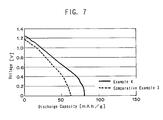
- Fig. 6 shows a discharge curve at 10 mA/cm 2 of Comparative Example 1.
- the discharge curve has no flat potential part and exhibits a behavior almost similar to a discharge curve of a capacitor. It was because the anode material had a reaction potential extremely close to that of the cathode material and potentials of both electrodes became the same before respective discharges finished. This inhibited to cause a flat part in the discharge curve.
- Comparative Example 1 the capacity (discharge capacity down to 80% of the electromotive force) was 16 mAh/g at 1 mA/cm 2 with an electromotive force, 0.4 V, of the battery. Table 1 shows a cyclic property, at a charge and discharge current density of 10 mA/cm 2 , 25 °C and 60% discharge depth. In Comparative Example 1, the cycle number until the capacity decreased to 80% of the initial capacity was 20,000.
- Fig. 6 shows a discharge curve at 10 mA/cm 2 of Comparative Example 2.
- a potentially dropped part occurred. It was because the cathode almost finished discharging when the anode finished the reaction of doping and de-doping of anions (the reaction at 4 in Fig. 5).
- Comparative Example 2 the capacity (discharge capacity down to 80% electromotive force) was 29 mAh/g at 1 mA/cm 2 with an electromotive force, 0.9 V, of the battery.
- Table 1 shows a cyclic property, at a charge and discharge current density of 10 mA/cm 2 , 25 °C and 60% discharge depth.
- the cycle number from the initial capacity to 80% thereof was 125, which was very small. It was because the reaction of polyaniline at the low cyclic property region (the reaction at 4 in Fig. 5) was employed.
- a capacitor was produced, using poly(6-nitroindole) as the anode material 2; polyaniline as the cathode material 4; and an aqueous solution of 40% sulfuric acid as the electrolytic solution.
- An electrode of the anode material 2 was produced through the same procedures as those of Example 1.
- An electrode of the cathode material 4 was produced by mixing polyaniline with crystalline carbon as the conductive auxiliary at a weight ratio of 75:25, followed by addition of 40% sulfuric acid (5.3 mol/l) to produce an electrode paste. This paste was coated over a collector 1' with a gasket 5 similar to the anode.
- Each electrode was pressed at a pressure of 1370 pKa (14 kgf/cm 2 ) to remove extra sulfuric acid. Thereafter, a separator 3, containing 40% sulfuric acid impregnated therein, was sandwiched between the anode material 2 and the cathode material 4 to produce a capacitor as shown in Fig. 1.
- Poly(6-nitroindole), used for the anode material was in a state that sulfuric acid ions were doped into it in the aqueous solution of 40% sulfuric acid, and the redox reaction accompanied with absorption and desorption of protons, corresponding to the reaction formula (2), proceeded at the region 2 (about 900-1200 mV vs. Ag/AgCl) in Fig. 2.
- the redox reaction accompanied with doping and de-doping protons proceeded at the region 3 (about -200 to 500 mV vs. Ag/AgCl) in Fig. 5. Accordingly, for the capacitor, constant current charge and discharge tests were performed at 100 mA/cm 2 with an electromotive force of 1.3 V.
- Table 4 shows a cyclic property, at a charge and discharge current density of 100 mA/cm 2 , 25 °C and 60% discharge depth. In Example 4, the cycle number from the initial capacity to 80% thereof was 32,000.
- the capacitor although with a high voltage of 1. 3 V, had an excellent cyclic property of 32,000 cycles.
- a capacitor was produced, using polyaniline as the anode material; polyaniline as the cathode material; and an aqueous solution of 40% sulfuric acid as the electrolytic solution.
- An electrode from the anode material and an electrode from the cathode material were produced through the same procedures as those of Examples 1 and 4.
- Table 4 shows a cyclic property, at a charge and discharge current density of 100 mA/cm 2 , 25 °C and 60% discharge depth. In Comparative Example 3, the cycle number from the initial capacity to 80% thereof was 85 cycles. The capacitor was very low in cyclic property.
- an indole polymeric compound as an electrode active substance and protons as charge carriers of the polymeric compound are used to provide a secondary battery and capacitor having a high electromotive force together with a high cycle property and being capable of fast charging and discharging.
Landscapes
- Engineering & Computer Science (AREA)
- Chemical & Material Sciences (AREA)
- Chemical Kinetics & Catalysis (AREA)
- General Chemical & Material Sciences (AREA)
- Electrochemistry (AREA)
- Power Engineering (AREA)
- Microelectronics & Electronic Packaging (AREA)
- Manufacturing & Machinery (AREA)
- Materials Engineering (AREA)
- Battery Electrode And Active Subsutance (AREA)
- Electric Double-Layer Capacitors Or The Like (AREA)
- Secondary Cells (AREA)
- Polyoxymethylene Polymers And Polymers With Carbon-To-Carbon Bonds (AREA)
- Macromolecular Compounds Obtained By Forming Nitrogen-Containing Linkages In General (AREA)
Applications Claiming Priority (2)
| Application Number | Priority Date | Filing Date | Title |
|---|---|---|---|
| JP20749999A JP3348405B2 (ja) | 1999-07-22 | 1999-07-22 | インドール系高分子を用いた二次電池及びキャパシタ |
| EP00114867A EP1071148B1 (de) | 1999-07-22 | 2000-07-11 | Sekundärbatterie und Kondensator mit Indol-Polymerverbindung |
Related Parent Applications (1)
| Application Number | Title | Priority Date | Filing Date |
|---|---|---|---|
| EP00114867A Division EP1071148B1 (de) | 1999-07-22 | 2000-07-11 | Sekundärbatterie und Kondensator mit Indol-Polymerverbindung |
Publications (1)
| Publication Number | Publication Date |
|---|---|
| EP1717889A1 true EP1717889A1 (de) | 2006-11-02 |
Family
ID=16540738
Family Applications (2)
| Application Number | Title | Priority Date | Filing Date |
|---|---|---|---|
| EP00114867A Expired - Lifetime EP1071148B1 (de) | 1999-07-22 | 2000-07-11 | Sekundärbatterie und Kondensator mit Indol-Polymerverbindung |
| EP06010188A Withdrawn EP1717889A1 (de) | 1999-07-22 | 2000-07-11 | Sekundärbatterie und Kondensator mit Indol-Polymerverbindung |
Family Applications Before (1)
| Application Number | Title | Priority Date | Filing Date |
|---|---|---|---|
| EP00114867A Expired - Lifetime EP1071148B1 (de) | 1999-07-22 | 2000-07-11 | Sekundärbatterie und Kondensator mit Indol-Polymerverbindung |
Country Status (5)
| Country | Link |
|---|---|
| US (2) | US6509116B1 (de) |
| EP (2) | EP1071148B1 (de) |
| JP (1) | JP3348405B2 (de) |
| KR (1) | KR100374679B1 (de) |
| DE (1) | DE60032417T2 (de) |
Cited By (1)
| Publication number | Priority date | Publication date | Assignee | Title |
|---|---|---|---|---|
| CN103646791A (zh) * | 2013-12-10 | 2014-03-19 | 江西科技师范大学 | 超级电容器的多孔纳米结构的聚(5-氰基吲哚)膜电极 |
Families Citing this family (41)
| Publication number | Priority date | Publication date | Assignee | Title |
|---|---|---|---|---|
| JP2001118570A (ja) * | 1999-10-19 | 2001-04-27 | Nec Corp | ポリマー二次電池用電極の製造方法 |
| JP3471304B2 (ja) * | 2000-09-18 | 2003-12-02 | Necトーキン株式会社 | インドール系化合物を用いた二次電池及びキャパシタ |
| JP3565777B2 (ja) * | 2000-10-25 | 2004-09-15 | Necトーキン株式会社 | ポリマー電池 |
| US6713214B2 (en) * | 2000-11-13 | 2004-03-30 | Sanyo Electric Co., Ltd. | Positive electrode active material for secondary battery and secondary battery |
| WO2002103825A1 (en) * | 2001-06-14 | 2002-12-27 | Showa Denko K.K. | Method for producing composite material for electrode comprising quinoxaline based polymer, such material, electrode and battery using the same |
| JP5261855B2 (ja) * | 2001-07-05 | 2013-08-14 | 日産化学工業株式会社 | エネルギー貯蔵媒体 |
| JP4004769B2 (ja) * | 2001-10-17 | 2007-11-07 | Necトーキン株式会社 | 電解液、並びにこれを用いた電気化学セル |
| JP3727264B2 (ja) * | 2001-11-02 | 2005-12-14 | Necトーキン株式会社 | インドール系化合物を用いた電気化学セル |
| JP3538185B2 (ja) | 2002-02-26 | 2004-06-14 | Necトーキン株式会社 | インドール系化合物を用いた二次電池及びキャパシタ |
| JP3723140B2 (ja) * | 2002-03-04 | 2005-12-07 | Necトーキン株式会社 | キノキサリン系化合物を用いた蓄電素子 |
| EP1388906A3 (de) | 2002-08-05 | 2006-10-11 | Nec Tokin Corporation | Zellen-Elektrode und damit hergestellte elektrochemische Zell |
| CA2499364A1 (en) | 2002-09-24 | 2004-04-08 | E. I. Du Pont De Nemours And Company | Water dispersible polyanilines made with polymeric acid colloids for electronics applications |
| US7117052B2 (en) * | 2003-02-18 | 2006-10-03 | Fisher-Rosemount Systems, Inc. | Version control for objects in a process plant configuration system |
| KR101118155B1 (ko) | 2003-06-17 | 2012-03-13 | 닛산 가가쿠 고교 가부시키 가이샤 | 퀴녹살린 단위를 갖는 디아민, 폴리이미드 전구체 및폴리이미드 및 그 이용 |
| JP2005050669A (ja) | 2003-07-28 | 2005-02-24 | Tdk Corp | 電極、及び、それを用いた電気化学素子 |
| EP2290737B1 (de) | 2003-09-18 | 2015-03-11 | Commonwealth Scientific and Industrial Research Organisation | Hochleistungsfähige energiespeichereinrichtungen |
| JP2005209576A (ja) * | 2004-01-26 | 2005-08-04 | Nec Tokin Corp | 共重合体化合物及びそれを用いた電気化学セル |
| US7351358B2 (en) | 2004-03-17 | 2008-04-01 | E.I. Du Pont De Nemours And Company | Water dispersible polypyrroles made with polymeric acid colloids for electronics applications |
| EP1897096A4 (de) | 2005-06-28 | 2009-08-12 | Du Pont | Transparente leiter mit hoher arbeitsfunktion |
| US8377586B2 (en) | 2005-10-05 | 2013-02-19 | California Institute Of Technology | Fluoride ion electrochemical cell |
| US20100221603A1 (en) * | 2006-03-03 | 2010-09-02 | Rachid Yazami | Lithium ion fluoride battery |
| WO2007052762A1 (ja) * | 2005-11-02 | 2007-05-10 | Kaneka Corporation | 新規なエネルギー貯蔵手段を有するエネルギー貯蔵デバイス |
| US7324329B2 (en) * | 2005-12-22 | 2008-01-29 | Giner, Inc. | Electrochemical-electrolytic capacitor and method of making the same |
| AR064292A1 (es) | 2006-12-12 | 2009-03-25 | Commw Scient Ind Res Org | Dispositivo mejorado para almacenamiento de energia |
| US20080191172A1 (en) | 2006-12-29 | 2008-08-14 | Che-Hsiung Hsu | High work-function and high conductivity compositions of electrically conducting polymers |
| AR067238A1 (es) | 2007-03-20 | 2009-10-07 | Commw Scient Ind Res Org | Dispositivos optimizados para el almacenamiento de energia |
| WO2008141200A1 (en) * | 2007-05-09 | 2008-11-20 | California Institute Of Technology | Lithium fluoropolymer and fluoro-organic batteries |
| JP4936069B2 (ja) * | 2007-10-31 | 2012-05-23 | 株式会社デンソー | モータ制御装置 |
| JP2010102866A (ja) * | 2008-10-22 | 2010-05-06 | Silver H-Plus Technology Co Ltd | プラスチック電極材料及びそれを用いた二次電池 |
| KR101534371B1 (ko) * | 2008-12-09 | 2015-07-06 | 이 아이 듀폰 디 네모아 앤드 캄파니 | 전기 전도성 중합체 조성물 |
| JP5628826B2 (ja) * | 2008-12-09 | 2014-11-19 | イー・アイ・デュポン・ドウ・ヌムール・アンド・カンパニーE.I.Du Pont De Nemours And Company | 導電性ポリマー組成物 |
| KR20120027260A (ko) | 2009-04-23 | 2012-03-21 | 후루카와 덴치 가부시키가이샤 | 납 축전지용 부극판의 제조법 및 납 축전지 |
| US9401508B2 (en) | 2009-08-27 | 2016-07-26 | Commonwealth Scientific And Industrial Research Organisation | Electrical storage device and electrode thereof |
| JP5797384B2 (ja) | 2009-08-27 | 2015-10-21 | 古河電池株式会社 | 鉛蓄電池用複合キャパシタ負極板及び鉛蓄電池 |
| JP5711483B2 (ja) | 2009-08-27 | 2015-04-30 | 古河電池株式会社 | 鉛蓄電池用複合キャパシタ負極板の製造法及び鉛蓄電池 |
| CN102034959A (zh) * | 2009-09-29 | 2011-04-27 | 银旺科技股份有限公司 | 复合电极材料与使用该材料的二次电池 |
| EP2309572A1 (de) * | 2009-10-06 | 2011-04-13 | Silver H-Plus Technology Co., Ltd. | Kunststoffelektrodenmaterial und Sekundärzelle damit |
| JP2012133959A (ja) | 2010-12-21 | 2012-07-12 | Furukawa Battery Co Ltd:The | 鉛蓄電池用複合キャパシタ負極板及び鉛蓄電池 |
| CN103547475B (zh) | 2011-03-16 | 2017-05-24 | 约翰逊控制技术公司 | 具有带不同电荷状态的装置的能源系统 |
| CN104103429A (zh) * | 2014-07-22 | 2014-10-15 | 江西科技师范大学 | 超级电容器纳米线结构的聚(羧基吲哚)膜电极及其制备方法 |
| CN116504543B (zh) * | 2023-05-10 | 2024-07-23 | 苏州大学 | 一种对称柔性超级电容器及其制备方法 |
Citations (3)
| Publication number | Priority date | Publication date | Assignee | Title |
|---|---|---|---|---|
| US4502934A (en) * | 1982-06-01 | 1985-03-05 | Thomson-Csf | Electrode comprising an electrochrome polymer film and a display device using such an electrode |
| US4543306A (en) * | 1982-06-01 | 1985-09-24 | Thomson-Csf | Electrochemical device which can be used for energy storage |
| WO1995024741A1 (en) * | 1994-03-08 | 1995-09-14 | Valence Technology, Inc. | Conductive-polymer-coated electrode particles |
Family Cites Families (8)
| Publication number | Priority date | Publication date | Assignee | Title |
|---|---|---|---|---|
| JPS63249323A (ja) * | 1987-04-06 | 1988-10-17 | 松下電器産業株式会社 | 固体電解コンデンサ |
| JP2653048B2 (ja) * | 1987-04-06 | 1997-09-10 | 松下電器産業株式会社 | 導電性高分子複合体およびその製造方法 |
| BE1004725A3 (fr) | 1991-04-16 | 1993-01-19 | Solvay | Procede pour la preparation de polyindoles, compositions et dispositifs electroconducteurs les contenant et utilisations des polyindoles. |
| US5512391A (en) | 1993-09-07 | 1996-04-30 | E.C.R. - Electro-Chemical Research Ltd. | Solid state electrochemical cell containing a proton-donating aromatic compound |
| JPH09204932A (ja) | 1996-01-25 | 1997-08-05 | Fujitsu Ltd | リチウム二次電池用電解液及びリチウム二次電池 |
| US5626729A (en) * | 1996-02-01 | 1997-05-06 | Motorola, Inc. | Modified polymer electrodes for energy storage devices and method of making same |
| JP2001110423A (ja) * | 1999-10-07 | 2001-04-20 | Showa Denko Kk | 二次電池及びその材料 |
| JP3407130B2 (ja) * | 1999-12-01 | 2003-05-19 | エヌイーシートーキン株式会社 | 電極、二次電池及びその製造方法 |
-
1999
- 1999-07-22 JP JP20749999A patent/JP3348405B2/ja not_active Expired - Fee Related
-
2000
- 2000-07-11 EP EP00114867A patent/EP1071148B1/de not_active Expired - Lifetime
- 2000-07-11 DE DE60032417T patent/DE60032417T2/de not_active Expired - Fee Related
- 2000-07-11 EP EP06010188A patent/EP1717889A1/de not_active Withdrawn
- 2000-07-19 US US09/619,708 patent/US6509116B1/en not_active Expired - Fee Related
- 2000-07-20 KR KR10-2000-0041549A patent/KR100374679B1/ko not_active Expired - Fee Related
-
2002
- 2002-01-15 US US10/044,985 patent/US7035084B2/en not_active Expired - Fee Related
Patent Citations (3)
| Publication number | Priority date | Publication date | Assignee | Title |
|---|---|---|---|---|
| US4502934A (en) * | 1982-06-01 | 1985-03-05 | Thomson-Csf | Electrode comprising an electrochrome polymer film and a display device using such an electrode |
| US4543306A (en) * | 1982-06-01 | 1985-09-24 | Thomson-Csf | Electrochemical device which can be used for energy storage |
| WO1995024741A1 (en) * | 1994-03-08 | 1995-09-14 | Valence Technology, Inc. | Conductive-polymer-coated electrode particles |
Non-Patent Citations (1)
| Title |
|---|
| H. TALBI, D. BILLAUD: "Oxidative electropolymerization of 5-nitroindole", SYNTHETIC METALS, vol. 97, no. 3, 30 September 1998 (1998-09-30), pages 239 - 244, XP001157504 * |
Cited By (1)
| Publication number | Priority date | Publication date | Assignee | Title |
|---|---|---|---|---|
| CN103646791A (zh) * | 2013-12-10 | 2014-03-19 | 江西科技师范大学 | 超级电容器的多孔纳米结构的聚(5-氰基吲哚)膜电极 |
Also Published As
| Publication number | Publication date |
|---|---|
| JP3348405B2 (ja) | 2002-11-20 |
| EP1071148A2 (de) | 2001-01-24 |
| KR20010015378A (ko) | 2001-02-26 |
| US7035084B2 (en) | 2006-04-25 |
| KR100374679B1 (ko) | 2003-03-04 |
| JP2001035494A (ja) | 2001-02-09 |
| US20020132164A1 (en) | 2002-09-19 |
| DE60032417T2 (de) | 2007-10-11 |
| EP1071148A3 (de) | 2003-12-03 |
| DE60032417D1 (de) | 2007-02-01 |
| US6509116B1 (en) | 2003-01-21 |
| EP1071148B1 (de) | 2006-12-20 |
Similar Documents
| Publication | Publication Date | Title |
|---|---|---|
| EP1071148B1 (de) | Sekundärbatterie und Kondensator mit Indol-Polymerverbindung | |
| KR100478554B1 (ko) | 전해액 및 이것을 사용한 전기화학 셀 | |
| JP2943792B1 (ja) | プロトン伝導型ポリマー電池およびその製造方法 | |
| JP3039484B2 (ja) | ポリマー電池 | |
| US8057937B2 (en) | Hybrid battery | |
| EP0987775B1 (de) | Polymerelektrode, diese enthaltende Sekundärbatterie, und Herstellungsverfahren | |
| US20020058185A1 (en) | Secondary battery and capacitor utilizing indole compounds | |
| JP2974012B1 (ja) | ポリマー二次電池およびその製造方法 | |
| JP3538185B2 (ja) | インドール系化合物を用いた二次電池及びキャパシタ | |
| JP2001118577A (ja) | インドール系高分子を含む電極の製造方法およびそれを用いた二次電池 | |
| US20040110062A1 (en) | Electrode using improved active material for battery and capacitor | |
| JP3723140B2 (ja) | キノキサリン系化合物を用いた蓄電素子 | |
| JP3727264B2 (ja) | インドール系化合物を用いた電気化学セル | |
| JP2008117648A (ja) | 電気化学セル | |
| JP4073025B2 (ja) | 電気化学セル | |
| US20230025107A1 (en) | Electrochemical device | |
| CN114026730A (zh) | 电化学器件 |
Legal Events
| Date | Code | Title | Description |
|---|---|---|---|
| PUAI | Public reference made under article 153(3) epc to a published international application that has entered the european phase |
Free format text: ORIGINAL CODE: 0009012 |
|
| AC | Divisional application: reference to earlier application |
Ref document number: 1071148 Country of ref document: EP Kind code of ref document: P |
|
| AK | Designated contracting states |
Kind code of ref document: A1 Designated state(s): DE FR GB |
|
| STAA | Information on the status of an ep patent application or granted ep patent |
Free format text: STATUS: THE APPLICATION HAS BEEN WITHDRAWN |
|
| AKX | Designation fees paid | ||
| 18W | Application withdrawn |
Effective date: 20070615 |
|
| REG | Reference to a national code |
Ref country code: DE Ref legal event code: 8566 |