EP1719971B1 - Méthode d'inspection optique de la structure empilée et appareil optique d'inspection de la structure empilée - Google Patents
Méthode d'inspection optique de la structure empilée et appareil optique d'inspection de la structure empilée Download PDFInfo
- Publication number
- EP1719971B1 EP1719971B1 EP06252430A EP06252430A EP1719971B1 EP 1719971 B1 EP1719971 B1 EP 1719971B1 EP 06252430 A EP06252430 A EP 06252430A EP 06252430 A EP06252430 A EP 06252430A EP 1719971 B1 EP1719971 B1 EP 1719971B1
- Authority
- EP
- European Patent Office
- Prior art keywords
- stacked structure
- light
- optical
- substrate
- layer
- Prior art date
- Legal status (The legal status is an assumption and is not a legal conclusion. Google has not performed a legal analysis and makes no representation as to the accuracy of the status listed.)
- Not-in-force
Links
- 230000003287 optical effect Effects 0.000 title claims description 112
- 238000000034 method Methods 0.000 title claims description 32
- 239000000758 substrate Substances 0.000 claims description 79
- 238000002310 reflectometry Methods 0.000 claims description 40
- 239000010409 thin film Substances 0.000 claims description 29
- 238000007689 inspection Methods 0.000 claims description 13
- 239000011368 organic material Substances 0.000 claims 16
- 230000001419 dependent effect Effects 0.000 claims 2
- 230000001678 irradiating effect Effects 0.000 claims 1
- 239000010410 layer Substances 0.000 description 126
- 239000000975 dye Substances 0.000 description 52
- 238000010586 diagram Methods 0.000 description 24
- 238000004544 sputter deposition Methods 0.000 description 16
- 238000001228 spectrum Methods 0.000 description 10
- VYPSYNLAJGMNEJ-UHFFFAOYSA-N Silicium dioxide Chemical compound O=[Si]=O VYPSYNLAJGMNEJ-UHFFFAOYSA-N 0.000 description 9
- 238000002835 absorbance Methods 0.000 description 8
- 238000005259 measurement Methods 0.000 description 7
- 239000000203 mixture Substances 0.000 description 7
- 239000011295 pitch Substances 0.000 description 7
- 238000010521 absorption reaction Methods 0.000 description 6
- 239000000463 material Substances 0.000 description 6
- 239000004417 polycarbonate Substances 0.000 description 5
- 229920000515 polycarbonate Polymers 0.000 description 5
- 229910052984 zinc sulfide Inorganic materials 0.000 description 5
- 239000000853 adhesive Substances 0.000 description 4
- 229910052681 coesite Inorganic materials 0.000 description 4
- 229910052906 cristobalite Inorganic materials 0.000 description 4
- 239000000377 silicon dioxide Substances 0.000 description 4
- 229910052682 stishovite Inorganic materials 0.000 description 4
- 229910052905 tridymite Inorganic materials 0.000 description 4
- 238000000862 absorption spectrum Methods 0.000 description 3
- 230000006866 deterioration Effects 0.000 description 3
- 229910052751 metal Inorganic materials 0.000 description 3
- 239000002184 metal Substances 0.000 description 3
- 239000011347 resin Substances 0.000 description 3
- 229920005989 resin Polymers 0.000 description 3
- 230000003595 spectral effect Effects 0.000 description 3
- XLOMVQKBTHCTTD-UHFFFAOYSA-N Zinc monoxide Chemical compound [Zn]=O XLOMVQKBTHCTTD-UHFFFAOYSA-N 0.000 description 2
- XJHCXCQVJFPJIK-UHFFFAOYSA-M caesium fluoride Chemical compound [F-].[Cs+] XJHCXCQVJFPJIK-UHFFFAOYSA-M 0.000 description 2
- 150000001875 compounds Chemical class 0.000 description 2
- 229910052737 gold Inorganic materials 0.000 description 2
- 238000004519 manufacturing process Methods 0.000 description 2
- 238000001552 radio frequency sputter deposition Methods 0.000 description 2
- 229910052709 silver Inorganic materials 0.000 description 2
- 229910052581 Si3N4 Inorganic materials 0.000 description 1
- GWEVSGVZZGPLCZ-UHFFFAOYSA-N Titan oxide Chemical compound O=[Ti]=O GWEVSGVZZGPLCZ-UHFFFAOYSA-N 0.000 description 1
- 239000005083 Zinc sulfide Substances 0.000 description 1
- 239000000956 alloy Substances 0.000 description 1
- 229910045601 alloy Inorganic materials 0.000 description 1
- 229910052782 aluminium Inorganic materials 0.000 description 1
- 238000000137 annealing Methods 0.000 description 1
- 239000000987 azo dye Substances 0.000 description 1
- OYLGJCQECKOTOL-UHFFFAOYSA-L barium fluoride Chemical compound [F-].[F-].[Ba+2] OYLGJCQECKOTOL-UHFFFAOYSA-L 0.000 description 1
- 229910001632 barium fluoride Inorganic materials 0.000 description 1
- 239000011248 coating agent Substances 0.000 description 1
- 238000000576 coating method Methods 0.000 description 1
- 229910052802 copper Inorganic materials 0.000 description 1
- PMHQVHHXPFUNSP-UHFFFAOYSA-M copper(1+);methylsulfanylmethane;bromide Chemical compound Br[Cu].CSC PMHQVHHXPFUNSP-UHFFFAOYSA-M 0.000 description 1
- 230000007423 decrease Effects 0.000 description 1
- 230000007547 defect Effects 0.000 description 1
- 230000002542 deteriorative effect Effects 0.000 description 1
- 239000003989 dielectric material Substances 0.000 description 1
- 238000010828 elution Methods 0.000 description 1
- 150000004673 fluoride salts Chemical class 0.000 description 1
- 229910052738 indium Inorganic materials 0.000 description 1
- -1 ion compounds Chemical class 0.000 description 1
- 229910052749 magnesium Inorganic materials 0.000 description 1
- 239000011777 magnesium Substances 0.000 description 1
- ORUIBWPALBXDOA-UHFFFAOYSA-L magnesium fluoride Chemical compound [F-].[F-].[Mg+2] ORUIBWPALBXDOA-UHFFFAOYSA-L 0.000 description 1
- 229910001635 magnesium fluoride Inorganic materials 0.000 description 1
- CWQXQMHSOZUFJS-UHFFFAOYSA-N molybdenum disulfide Chemical compound S=[Mo]=S CWQXQMHSOZUFJS-UHFFFAOYSA-N 0.000 description 1
- 150000004767 nitrides Chemical class 0.000 description 1
- 239000012044 organic layer Substances 0.000 description 1
- TWNQGVIAIRXVLR-UHFFFAOYSA-N oxo(oxoalumanyloxy)alumane Chemical compound O=[Al]O[Al]=O TWNQGVIAIRXVLR-UHFFFAOYSA-N 0.000 description 1
- 229910052763 palladium Inorganic materials 0.000 description 1
- 239000004033 plastic Substances 0.000 description 1
- 229910052697 platinum Inorganic materials 0.000 description 1
- HQVNEWCFYHHQES-UHFFFAOYSA-N silicon nitride Chemical compound N12[Si]34N5[Si]62N3[Si]51N64 HQVNEWCFYHHQES-UHFFFAOYSA-N 0.000 description 1
- 229910052814 silicon oxide Inorganic materials 0.000 description 1
- 238000004528 spin coating Methods 0.000 description 1
- VDNSGQQAZRMTCI-UHFFFAOYSA-N sulfanylidenegermanium Chemical compound [Ge]=S VDNSGQQAZRMTCI-UHFFFAOYSA-N 0.000 description 1
- 150000004763 sulfides Chemical class 0.000 description 1
- 229910052715 tantalum Inorganic materials 0.000 description 1
- 239000013077 target material Substances 0.000 description 1
- ANRHNWWPFJCPAZ-UHFFFAOYSA-M thionine Chemical compound [Cl-].C1=CC(N)=CC2=[S+]C3=CC(N)=CC=C3N=C21 ANRHNWWPFJCPAZ-UHFFFAOYSA-M 0.000 description 1
- 239000010936 titanium Substances 0.000 description 1
- 229910052719 titanium Inorganic materials 0.000 description 1
- OGIDPMRJRNCKJF-UHFFFAOYSA-N titanium oxide Inorganic materials [Ti]=O OGIDPMRJRNCKJF-UHFFFAOYSA-N 0.000 description 1
- 238000002834 transmittance Methods 0.000 description 1
- 229910052720 vanadium Inorganic materials 0.000 description 1
- 229910052725 zinc Inorganic materials 0.000 description 1
- 239000011701 zinc Substances 0.000 description 1
- 239000011787 zinc oxide Substances 0.000 description 1
- DRDVZXDWVBGGMH-UHFFFAOYSA-N zinc;sulfide Chemical compound [S-2].[Zn+2] DRDVZXDWVBGGMH-UHFFFAOYSA-N 0.000 description 1
Images




Classifications
-
- G—PHYSICS
- G01—MEASURING; TESTING
- G01N—INVESTIGATING OR ANALYSING MATERIALS BY DETERMINING THEIR CHEMICAL OR PHYSICAL PROPERTIES
- G01N21/00—Investigating or analysing materials by the use of optical means, i.e. using sub-millimetre waves, infrared, visible or ultraviolet light
- G01N21/84—Systems specially adapted for particular applications
- G01N21/88—Investigating the presence of flaws or contamination
- G01N21/95—Investigating the presence of flaws or contamination characterised by the material or shape of the object to be examined
- G01N21/9506—Optical discs
-
- G—PHYSICS
- G01—MEASURING; TESTING
- G01B—MEASURING LENGTH, THICKNESS OR SIMILAR LINEAR DIMENSIONS; MEASURING ANGLES; MEASURING AREAS; MEASURING IRREGULARITIES OF SURFACES OR CONTOURS
- G01B11/00—Measuring arrangements characterised by the use of optical techniques
- G01B11/02—Measuring arrangements characterised by the use of optical techniques for measuring length, width or thickness
- G01B11/06—Measuring arrangements characterised by the use of optical techniques for measuring length, width or thickness for measuring thickness ; e.g. of sheet material
- G01B11/0616—Measuring arrangements characterised by the use of optical techniques for measuring length, width or thickness for measuring thickness ; e.g. of sheet material of coating
- G01B11/0625—Measuring arrangements characterised by the use of optical techniques for measuring length, width or thickness for measuring thickness ; e.g. of sheet material of coating with measurement of absorption or reflection
Definitions
- the present invention generally relates to optical stacked structure inspecting methods and optical stacked structure inspecting apparatuses, and more particularly to an optical stacked structure inspecting method and an optical stacked structure inspecting apparatus for inspecting a dye layer thickness and/or a dielectric layer thickness of an optical stacked structure in which a reflection layer and an organic dye layer are successively stacked on a substrate or, a reflection layer, an organic dye layer and a dielectric layer are successively stacked on a substrate.
- the present invention also relates to a method and an apparatus for producing such an optical stacked structure.
- Such write-once type optical recording media to which information can be written once by a laser beam, include CD-R, DVD+R and DVD-R.
- Such write-once type optical recording media have a stacked structure made up of a transparent polycarbonate substrate formed with a tracking groove, a recording layer made of an organic dye spin-coated on the substrate, a light reflection layer made of Au or Ag sputtered on the recording layer, and a projection layer made of an ultraviolet curing resin that are stacked in this order.
- the DVD+R and the DVD-R have a structure in which two substrates having a thickness of 0.6 mm are bonded together, and have a large recording capacity.
- a Japanese Laid-Open Patent Application No.2002-510107 proposes a method of measuring the layer thickness based on transmitted or reflected light that is diffracted by the groove.
- a Japanese Laid-Open Patent Application No.2002-367244 proposes a method of measuring the thicknesses of a land part and a groove part based on diffracted light of different orders, and inspecting the dye layer thickness by measuring the transmittance and the diffracted light intensity in a state where the dye layer is formed on the substrate.
- a Japanese Laid-Open Patent Application No.11-66633 proposes an apparatus for inspecting defects from the reflected light using, as the inspection light, light having a characteristic absorption wavelength of the dye as a main component.
- a blacked structure inspection method is known from US 6 744 521 .
- the existing DVD-ROMs for read use include those having two information recording layers for the purpose of increasing the recording capacity.
- a first substrate and a second substrate are bonded via a transparent intermediate layer made of an ultraviolet curing resin.
- a first information recording layer L0 has a semi-transparent first layer formed on an inner surface of the first substrate formed with concavo-convex pits.
- a second information recording layer L1 has the transparent intermediate layer and a metal reflecting second layer formed on the first information recording layer L0.
- the semi-transparent first layer is formed by a dielectric layer or a thin metal layer.
- This type of optical recording medium is made up of a first substrate and a second substrate that are bonded via an adhesive agent.
- the first substrate includes a transparent substrate formed with a groove, a recording layer made of an organic dye formed on the substrate, a semi-transparent reflection layer formed on the recording layer, and an ultraviolet curing resin formed on the recording layer, that are stacked in this order.
- the second substrate includes a substrate formed with a groove, a total reflection layer formed on the substrate, a recording layer made of an organic dye formed on the substrate, and a transparent organic thin film formed on the recording layer, that are stacked in this order. Examples of this type of optical recording media are proposed in Japanese Laid-Open Patent Applications No.10-340483 and No.2000-311384 .
- Another and more specific object of the present invention is to provide an optical stacked structure inspecting methods, an optical stacked structure inspecting apparatus, an optical stacked structure producing method and an optical stacked structure producing apparatus, which enable simple inspection of the thickness of each layer of the optical stacked structure having a reflection layer and at least one light transmitting thin film stacked on a substrate.
- the object set forth is achieved by an optical by an optical blacked structure inspection method according to claim 1 and an inspection apparatus according to claim 11.
- the optical stacked structure inspecting apparatus of the present invention it is possible to enable simple inspection of the thickness of each layer of the optical stacked structure.
- FIG. 1 is a diagram generally showing a structure of the optical stacked structure inspecting apparatus in a first embodiment of the present invention, for explaining the optical stacked structure inspecting method and the optical stacked structure inspecting apparatus according to the present invention.
- the present invention is applied to the inspection process (or checking process) for a second substrate of the write-once type optical recording medium having the recording layer with the two-layer structure when producing this write-once type optical recording medium.
- a light source 1 is made of a light emitting diode and emits light in a direction indicated by an arrow.
- a condenser lens 2 forms the light from the light source 1 into parallel rays which pass a beam splitter 3, and light having an intensity of approximately 50% of that of the parallel rays reaches a second substrate within an optical stacked structure 4, that is, the write-once type optical recording medium having the recording layer with the two-layer structure.
- Remaining light split by the beam splitter 3 is monitored by an incident light photosensor 5 to measure the incident light intensity.
- the light reflected at the surface of the second substrate of the optical stacked structure 4 passes through the beam splitter 3 again and is received by a reflected light photosensor 6 to measure the reflected light intensity.
- a light separating means 7 may be provided at a stage preceding the incident light photosensor 5 with respect to the incoming light to the incident light photosensor 5 to separate a specific wavelength
- a light separating means 8 may be provided at a stage preceding the reflected light photosensor 6 with respect to the incoming light to the reflected light photosensor 6 to separate a specific wavelength
- the light separating means 7 may be formed by a prism or a diffraction grating.
- An inspecting part 9 compares the incident light intensity measured by the incident light photosensor 5 and the reflected light intensity measured by the reflected light photosensor 6, and obtains the reflectivity of the light emitting wavelength of the light emitting diode forming the light source 1.
- the optical stacked structure 4 that is, the write-once type optical recording medium having the recording layer with the two-layer structure, has a first substrate and the second substrate that are bonded using an adhesive agent.
- the first substrate has a tracking groove having a depth of 20 nm to 200 nm arranged at a pitch of 0.74 ⁇ m on a disk-shaped substrate surface.
- an organic dye layer having an absorption spectrum with a maximum absorption wavelength of 580 nm to 620 nm is coated on the total reflection layer.
- a dye compound that can easily obtain a desired optical characteristic in the laser beam wavelength for DVD of approximately 650 nm such as tetraazaporphyrazine dye, cyanine dye, azo dye and squarylium dye, may be used for the organic dye layer.
- the second substrate has a dye layer, a semi-transparent reflection layer, and a transparent dielectric layer that are stacked on the substrate surface. The transparent dielectric layer is provided to prevent elution of the dye coated on the first substrate when the first and second substrate are bonded using the adhesive agent.
- the transparent dielectric layer is desirably a compact thin layer that bonds satisfactorily with respect to the dye.
- the transparent dielectric layer may be made of oxides such as silicon oxide, aluminum oxide, zinc oxide and titanium oxide, nitrides such as silicon nitride and aluminum nitride, sulfides such as zinc sulfide, germanium sulfide and molybdenum sulfide, fluorides such as magnesium fluoride, cesium fluoride and barium fluoride, and suitable mixtures of such.
- the absorbance and reflectivity of the optical stacked structure 4 were obtained by measuring the spectral reflectivity using ETA-RT manufactured by STEAG ETA-Optik.
- the Ag total reflection layer had a reflectivity spectrum with a high reflectivity in a visible light region, a slightly lower reflectivity in a short wavelength region, and a higher reflectivity in a long wavelength region.
- this Ag reflection layer was formed on the optical stacked structure 4 having grooves formed at equal pitches on a plastic substrate, a deterioration in the reflectivity caused by the diffraction at the grooves was observed. This deterioration in the reflectivity became greater as the depth of the grooves became deeper, and as the pitch of the grooves became smaller, the wavelengths at which the reflectivity deteriorates shifted towards the short wavelengths approximately proportionally to the pitch.
- FIG. 2 is a diagram showing a relationship of the reflectivity and wavelength for a case where Ag was formed to a thickness of 140 nm on a polycarbonate substrate having the grooves having a depth of 33 nm and a width of 0.25 ⁇ m formed at a pitch of 0.74 ⁇ m.
- FIG. 2 shows the spectral reflection spectrum of the light that is perpendicularly incident to and reflects perpendicularly from the Ag total reflection layer. In this case, a phenomenon in which the reflectivity decreases by 5% to 6% due to scattering at the grooves was observed in a vicinity of the wavelength of 750 nm.
- FIG. 3 is a diagram showing a relationship of the reflectivity and wavelength for a case where a dielectric layer, having a composition ZnS (80 mol%) /SiO 2 (20 mol%), was formed to a thickness of 10 nm to 30 nm on the polycarbonate substrate formed with the Ag total reflection layer.
- FIG. 3 shows the spectral reflection spectrum of the light that is perpendicularly incident to and reflects perpendicularly from the surface formed with the dielectric layer.
- the wavelengths at which the minimum reflectivity is obtained shifted towards the long wavelengths in the reflectivity deteriorating portion where the wavelength is 700 nm to 850 nm, and in addition, the minimum reflectivity deteriorated.
- the recording layer was formed on the substrate formed with the Ag total reflection layer by spin-coating the squarylium dye.
- a spectrum shown in FIG. 4 was obtained.
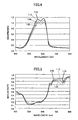
- FIG. 4 is a diagram showing a relationship of the absorbance and wavelength for the case where the dye recording layer thickness was varied using the maximum absorption wavelength ⁇ max of 606 nm as the parameter so that the absorbance becomes 1.02, 1.06, 1.12 and 1.16.
- FIG. 5 is a diagram showing the relationship of the reflectivity and wavelength for the case where the dye was coated on the substrate having the Ag total reflection layer under the same condition as in FIG. 4 and annealed at 90°C for 15 minutes so that the absorbance becomes 1.02, 1.06, 1.12 and 1.16.
- the wavelengths at which the reflectivity deteriorates shifted to the vicinity of the wavelength of 750 nm where the reflectivity deterioration was observed in FIG. 2.
- a transparent dielectric thin film was formed on the dye recording layer.
- the refractive index of the transparent dielectric thin film was approximately 1.6 or less, the reflection spectrum virtually did not change before and after the transparent dielectric thin film was formed.
- the refractive index of the transparent dielectric thin film was approximately 1.8 or greater, the reflection spectrum greatly changed before and after the transparent dielectric thin film was formed.
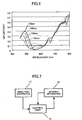
- FIG. 6 is a diagram showing the relationship of the reflectivity and wavelength for a case where the transparent dielectric thin film had the refractive index of approximately 2.1 on the dye recording layer and the thickness of the transparent dielectric thin film was varied. As may be seen from FIG. 6, it was possible to optically measure the thickness of the transparent dielectric thin film on the dye recording layer by measuring the reflectivity peak wavelength or the reflectivity in the vicinity of the wavelength of 490 nm or 660 nm.
- the methods of measuring the thicknesses of the dye recording layer and the transparent dielectric thin film of the optical stacked structure using the reflection spectrum are not limited to the measurements of the dye material and the dielectric material and are similarly applicable to materials in general, by appropriately selecting the optimum wavelength depending on the target material with respect to which the measurement is to be made.
- FIG. 7 is a diagram showing a control system of the first embodiment of the present invention in a simplified manner.
- the control part 13 is formed by a CPU or the like for adjusting the overshoot rotational speed or overshoot time. Bu using the optical stacked structure having the feedback structure shown in FIG. 7, it is possible to obtain a dye recording layer having an extremely small variation in the dye recording layer thickness.
- the results of the measurements obtained after sputtering the transparent dielectric thin film may be fed back to a sputtering apparatus (not shown) which forms the optical stacked structure producing apparatus.
- a sputtering apparatus not shown
- by using such dye recording layer and transparent dielectric thin film it is possible to produce an optical recording medium having an extremely stable quality before and after the information recording.
- the wavelengths mainly including the visible light wavelength such as that from a lamp.
- FIG. 8 is a diagram generally showing a structure of the optical stacked structure inspecting apparatus in a second embodiment of the present invention.
- those parts that are the same as those corresponding parts in FIG. 1 are designated by the same reference numerals, and a description thereof will be omitted.
- the measuring wavelengths and bandwidths are already determined.
- it is possible to considerably reduce the cost of the apparatus by using a bandpass filter 15 for passing a desired wavelength and using a light emitting diode as the light source 1.
- FIG. 9 is a diagram generally showing a structure of the optical stacked structure inspecting apparatus in a third embodiment of the present invention.
- those parts that are the same as those corresponding parts in FIG. 1 are designated by the same reference numerals, and a description thereof will be omitted.
- an inspection similar to that described above is made using a diffusing optical system and the light source 1 such as a light emitting diode that irradiates light obliquely with respect to the substrate surface of the optical stacked structure 4.
- the optical stacked structure inspecting method and the optical stacked structure inspecting apparatus for inspecting the optical stacked structure having the reflection layer and at least one light transmitting thin film sequentially stacked on the substrate, irradiate the inspection light on the optical stacked structure from a side provided with the light transmitting thin film, measure the light intensity of reflected light from each layer, that changes depending on the change in the optical path length to each layer, and inspect a thickness of the light transmitting thin film based on the light intensity of reflected light for a specific wavelength. Accordingly, it is possible to inspect the thickness of each layer of the optical stacked structure with a high accuracy. In addition, by controlling the thickness of each layer based on the measured thickness during the production of the optical stacked structure, it is possible to produce an optical stacked structure having a high quality.
- a concavo-convex pattern of guide grooves having a depth of approximately 30 nm and a groove width of approximately 0.25 ⁇ m were formed with a track pitch of 0.74 ⁇ m on a polycarbonate substrate having a diameter of 120 mm and a thickness of 0.60 mm.
- a material having a composition Ag (98 wt%)/Cu (2 wt%) was sputtered to a thickness of approximately 140 nm by a sputtering apparatus (model name Big Sprinter) manufactured by Unaxis using Ar as a sputtering gas at a sputtering pressure of 6.0 x 10 -3 Torr and a D.C. sputtering power of 3.5 kW, so as to form the reflection layer.
- a squarylium dye compound was spin-coated on the reflection layer to a layer thickness such that the absorbance at the maximum absorption wavelength ⁇ max becomes 1.02, 1.06, 1.12 and 1.16.
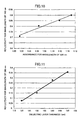
- FIG. 10 is a diagram showing the relationship of the reflectivity for the wavelength of 740 nm and the absorbance for the wavelength of 606 nm, and it may be seen that there is an extremely strong correlation between the two.
- a material having a composition ZnS (80 mol%)/SiO 2 (20 mol%) was sputtered to thicknesses of 120 nm, 130 nm, 140 nm and 150 nm on the substrate structure of the first embodiment sample described above by the sputtering apparatus (model name Big Sprinter) manufactured by Unaxis using Ar as the sputtering gas at the sputtering pressure of 4.0 x 10 -3 Torr and an RF sputtering power of 4.0 kW, so as to form the dielectric layer.
- the sputtering apparatus model name Big Sprinter manufactured by Unaxis using Ar as the sputtering gas at the sputtering pressure of 4.0 x 10 -3 Torr and an RF sputtering power of 4.0 kW, so as to form the dielectric layer.
- FIG. 11 is a diagram showing the relationship of the reflectivity for the wavelength of 500 nm and the dielectric layer thickness, and it may be seen that there is an extremely strong correlation between the two.
- a concavo-convex pattern of guide grooves having a depth of approximately 30 nm and a groove width of approximately 0.25 ⁇ m were formed with a track pitch of 0.74 ⁇ m on a polycarbonate substrate having a diameter of 120 mm and a thickness of 0.60 mm.
- a material having a composition Ag (98 wt%)/Cu (2 wt%) was sputtered to a thickness of approximately 120 nm by the sputtering apparatus (model name Big Sprinter) manufactured by Unaxis using Ar as the sputtering gas at the sputtering pressure of 6.0 x 10 -3 Torr and the D.C. sputtering power of 3.5 kW, so as to form the reflection layer.
- a material having a composition ZnS (80 mol%)/SiO 2 (20 mol%) was sputtered to thicknesses of 10 nm, 20 nm and 30 nm on the substrate structure by the sputtering apparatus (model name Big Sprinter) manufactured by Unaxis using Ar as the sputtering gas at the sputtering pressure of 4.0 x 10 -3 Torr and the RF sputtering power of 4.0 kW, so as to form the dielectric layer.
- the sputtering apparatus model name Big Sprinter
- FIG. 12 is a diagram showing the relationship of the reflectivity for the wavelength of 790 nm and the dielectric layer thickness, and it may be seen that there is an extremely strong correlation between the two.
- the present invention is applicable to the inspection of the layer thickness of the dye layer and/or the dielectric layer of the write-once type optical recording medium having the recording layer with the two-layer structure, such as the CD-R/RW, DVD-ROM, DVD+R/RW, DVD+R/RW, DVD-R/RW and DVD-RAM, in which the optical stacked structure has the reflection layer and the organic dye layer sequentially stacked on the substrate or, the optical stacked structure in which the reflection layer, the organic dye layer and the dielectric layer are sequentially stacked on the substrate.
- the optical stacked structure has the reflection layer and the organic dye layer sequentially stacked on the substrate or, the optical stacked structure in which the reflection layer, the organic dye layer and the dielectric layer are sequentially stacked on the substrate.
- the optical stacked structure may have any organic layer, such as ion compounds, as long as the absorption spectrum is obtainable.
Landscapes
- Physics & Mathematics (AREA)
- General Physics & Mathematics (AREA)
- Health & Medical Sciences (AREA)
- Life Sciences & Earth Sciences (AREA)
- Chemical & Material Sciences (AREA)
- Analytical Chemistry (AREA)
- Biochemistry (AREA)
- General Health & Medical Sciences (AREA)
- Immunology (AREA)
- Pathology (AREA)
- Length Measuring Devices By Optical Means (AREA)
- Manufacturing Optical Record Carriers (AREA)
Claims (20)
- Procédé d'inspection de structure optique empilée destiné à inspecter une structure optique empilée ayant une couche de réflexion et au moins une couche mince électroluminescente empilée de façon séquentielle sur un substrat, le substrat comprenant des rainures formées dessus de sorte que les rainures affectent la réflectivité de la couche de réflexion, ledit procédé d'inspection de structure optique empilée comprenant les étapes consistant à :(a) émettre une lumière d'inspection sur la structure optique empilée depuis un côté pourvu de la couche mince électroluminescente ;(b) mesurer une intensité de lumière de la lumière réfléchie depuis chaque couche,
caractérisé par l'étape consistant à sélectionner une longueur d'one à laquelle l'intensité de la lumière réfléchie dépend d'un changement de la longueur de chemin optique de chaque couche ; et(c) mesurer une épaisseur de la couche mince électroluminescente en fonction de l'intensité de lumière de la lumière réfléchie à la longueur d'onde spécifique sélectionnée. - Procédé d'inspection de structure optique empilée selon la revendication 1, caractérisé en ce que:le substrat de la structure optique empilée comprend des rainures de guidage formées dessus, et la couche de réflexion et une couche de matériau organique sont empilées de façon séquentielle sur le substrat ;ladite étape (b) mesure l'intensité de lumière de la lumière réfléchie en provenance de la couche de matériau organique ; etladite étape (c) inspecte l'épaisseur de la couche de matériau organique.
- Procédé d'inspection de structure optique empilée selon la revendication 1, caractérisé en ce que :le substrat de la structure optique empilée comprend des rainures de guidage formées dessus, et la couche de réflexion et une couche diélectrique sont empilées de façon séquentielle sur le substrat ;ladite étape (b) mesure l'intensité de lumière de la lumière réfléchie en provenance de la couche diélectrique ; etladite étape (c) inspecté l'épaisseur de la couche diélectrique.
- Procédé d'inspection de structure optique empilée selon la revendication 1, caractérisé en ce que :le substrat de la structure optique empilée comprend des rainures de guidage formées dessus, et la couche de réflexion, une couche de matériau organique et une couche diélectrique sont empilées de façon séquentielle sur le substrat ;ladite étape (b) mesure l'intensité de lumière de la lumière réfléchie en provenance de la couche diélectrique ; etladite étape (c) inspecte l'épaisseur de la couche diélectrique.
- Procédé d'inspection de structure optique empilée selon la revendication 1, caractérisé en ce que:le substrat de la structure optique empilée comprend des rainures de guidage formées dessus, et la couche de réflexion, la couche diélectrique et une couche de matériau organique sont empilées de façon séquentielle sur le substrat ;ladite étape (b) mesure l'intensité de lumière de la lumière réfléchie en .provenance de la couche de matériau organique etladite étape (c) inspecte l'épaisseur de la couche de matériau organique.
- Procédé d'inspection de structure optique empilée selon la revendication 1, caractérisé en ce que :le substrat de la structure optique empilée comprend des rainures de guidage formées dessus, et la couche de réflexion, une première couche diélectrique, une couche de matériau organique et une deuxième couche diélectrique sont empilées de façon séquentielle sur le substrat ;ladite étape (b) mesure l'intensité de lumière de la lumière réfléchie en provenance de la deuxième couche diélectrique ; etladite étape (c) inspecte l'épaisseur de la deuxième couche diélectrique.
- Procédé d'inspection de structure optique empilée selon la revendication 1, caractérisé en ce que ladite étape (a) utilise une diode électroluminescente pour émettre la lumière d'inspection ayant la longueur d'onde spécifique.
- Procédé d'inspection de structure optique empilée selon la revendication 1, caractérisé en ce que ladite étape (b) mesure l'intensité de lumière de la lumière réfléchie par la structure optique empilée et ayant la longueur d'onde spécifique qui est séparée par des moyens de séparation de lumière.
- Procédé d'inspection de structure optique empilée selon la revendication 8, caractérisé en ce qu'un prisme est utilisé en tant que moyens de séparation de lumière.
- Procédé d'inspection de structure empilée selon la revendication 8, caractérisé en ce qu'un réseau de diffraction est utilisé en tant que moyens de séparation de lumière.
- Dispositif d'inspection de structure optique empilée destiné à inspecter une structure optique empilée comprenant une couche de réflexion et au moins une couche mince électroluminescente empilées de façon séquentielle sur un substrat, le substrat comprenant des rainures formées dessus de sorte que les rainures affectent la réflectivité de la couche de réflexion, ledit dispositif d'inspection de structure optique empilée comprenant :une source de lumière configurée pour émettre une lumière d'inspection sur la structure optique empilée depuis un côté pourvu de la couche mince électroluminescente ; etune partie d'inspection configurée pour mesurer une intensité de lumière de la lumière réfléchie en provenance de chaque couche, caractérisé en ce que la partie d'inspection est réglée pour mesurer l'intensité de lumière de la lumière réfléchie à une longueur d'onde sélectionnée à laquelle l'intensité de la lumière réfléchie dépend sur une changement dans une longueur de chemin optique de chaque couche, et pour inspecter une épaisseur de la couche mince électroluminescente en fonction de l'intensité de lumière de la lumière réfléchie à la longueur d'onde spécifique sélectionnée.
- Dispositif d'inspection de structure optique empilée selon la revendication 11, caractérisé en ce que :le substrat de la structure optique empilée comprend des rainures de guidage formées dessus, et la couche de réflexion et une couche de matériau organique sont empilées de façon séquentielle sur le substrat ; etladite partie d'inspection mesure l' intensité de lumière de la lumière réfléchie en provenance de la couche de matériau organique, et inspecte l'épaisseur de la couche de matériau organique.
- Dispositif d'inspection de structure optique empilée selon la revendication 11, caractérisé en ce que:le substrat de la structure optique empilée comprend des rainures de guidage formées dessus, et la couche de réflexion et une couche diélectrique sont empilées de façon séquentielle sur le substrat ; etladite partie d'inspection mesure l'intensité de lumière de la lumière réfléchie en provenance de la couche diélectrique, et inspecte l'épaisseur de la couche diélectrique.
- Dispositif d'inspection de structure optique empilée selon la revendication 11, caractérisé en ce que :le substrat de la structure optique empilée comprend des rainures de guidage formées dessus, et la couche de réflexion, une couche de matériau organique et une couche diélectrique sont empilées de façon séquentielle sur le substrat ; etladite partie d'inspection mesure l'intensité de lumière de la lumière réfléchie en provenance de la couche diélectrique, et inspecte l'épaisseur de la couche diélectrique.
- Dispositif d'inspection de structure optique empilée selon la revendication 11, caractérisé en ce que :le substrat de la structure optique empilée comprend des rainures de guidage formées dessus, et la couche de réflexion, une couche diélectrique et une couche de matériau organique sont empilées de façon séquentielle sur le substrat ; etladite partie d'inspection mesure l'intensité de lumière de la lumière réfléchie provenant de la couche de matériau organique, et inspecte l'épaisseur de la couche de matériau organique.
- Dispositif d'inspection de structure optique empilée selon la revendication 11, caractérisé en ce que :le substrat de la structure optique empilée comprend des rainures de guidage formées dessus, et la couche de réflexion, une première couche diélectrique, une couche de matériau organique et une deuxième couche diélectrique sont empilées de façon séquentielle sur le substrat ; etladite partie d'inspection mesure l'intensité de lumière de la lumière réfléchie en provenance de la deuxième couche diélectrique, et inspecte l'épaisseur de la deuxième couche diélectrique.
- Dispositif d'inspection de structure optique empilée selon la revendication 11, caractérisé en ce que ladite source de lumière comprend une diode électroluminescente configurée pour émettre la lumière d'inspection ayant la longueur d'onde spécifique.
- Dispositif d'inspection de structure optique empilée selon la revendication 11, caractérisé en ce que ladite partie d'inspection mesure l'intensité de lumière de la lumière réfléchie par la structure optique empilée et ayant la longueur d'onde spécifique qui est séparée par des moyens de séparation de lumière.
- Dispositif d'inspection de structure optique empilée selon la revendication 18, caractérisé en ce que lesdits moyens de séparation de lumière comprennent un prisme.
- Dispositif d'inspection de structure optique empilée selon la revendication 18, caractérisé en ce que lesdits moyens dé séparation de lumière comprennent un réseau de diffraction.
Applications Claiming Priority (1)
| Application Number | Priority Date | Filing Date | Title |
|---|---|---|---|
| JP2005134949A JP2006313077A (ja) | 2005-05-06 | 2005-05-06 | 光学積層体検査方法,光学積層体製造方法および光学積層体検査装置ならびに光学積層体製造装置 |
Publications (2)
| Publication Number | Publication Date |
|---|---|
| EP1719971A1 EP1719971A1 (fr) | 2006-11-08 |
| EP1719971B1 true EP1719971B1 (fr) | 2007-12-26 |
Family
ID=36645617
Family Applications (1)
| Application Number | Title | Priority Date | Filing Date |
|---|---|---|---|
| EP06252430A Not-in-force EP1719971B1 (fr) | 2005-05-06 | 2006-05-08 | Méthode d'inspection optique de la structure empilée et appareil optique d'inspection de la structure empilée |
Country Status (5)
| Country | Link |
|---|---|
| US (1) | US7692801B2 (fr) |
| EP (1) | EP1719971B1 (fr) |
| JP (1) | JP2006313077A (fr) |
| DE (1) | DE602006000360T2 (fr) |
| ES (1) | ES2297812T3 (fr) |
Families Citing this family (2)
| Publication number | Priority date | Publication date | Assignee | Title |
|---|---|---|---|---|
| JP5444823B2 (ja) * | 2009-05-01 | 2014-03-19 | 信越半導体株式会社 | Soiウェーハの検査方法 |
| CN109154786B (zh) * | 2016-05-17 | 2020-12-04 | Asml荷兰有限公司 | 基于贯穿波长的相似性的度量强健性 |
Family Cites Families (35)
| Publication number | Priority date | Publication date | Assignee | Title |
|---|---|---|---|---|
| JPS589362B2 (ja) | 1978-03-10 | 1983-02-21 | 旭化成株式会社 | 赤外線多層フイルム膜厚測定方法及びその測定装置 |
| JPS58113804A (ja) * | 1981-12-28 | 1983-07-06 | Fujitsu Ltd | 膜厚制御方法 |
| JPH0215439A (ja) * | 1988-07-04 | 1990-01-19 | Matsushita Electric Ind Co Ltd | 光ディスク原盤用レジスト塗布装置 |
| JPH02142113A (ja) * | 1988-11-22 | 1990-05-31 | Kawasaki Steel Corp | レジスト塗布装置 |
| JPH03280232A (ja) | 1990-03-28 | 1991-12-11 | Sony Corp | 膜厚の測定方法及び膜厚の測定装置 |
| DE4228870C2 (de) | 1992-08-29 | 1997-01-09 | Inst Halbleiterphysik Gmbh | Verfahren zum Bestimmen geometrischer Abmessungen an dünnen, optisch transparenten Schichten |
| JPH06223418A (ja) * | 1993-01-28 | 1994-08-12 | Victor Co Of Japan Ltd | 回転塗布方法及びその装置 |
| JP2852190B2 (ja) * | 1994-09-02 | 1999-01-27 | 浜松ホトニクス株式会社 | 微小位置測定装置 |
| US5604581A (en) | 1994-10-07 | 1997-02-18 | On-Line Technologies, Inc. | Film thickness and free carrier concentration analysis method and apparatus |
| JPH10122826A (ja) | 1996-10-15 | 1998-05-15 | Sony Corp | 膜厚測定装置及び膜厚測定方法 |
| JPH10340483A (ja) * | 1997-06-07 | 1998-12-22 | Ricoh Co Ltd | 光情報記録媒体とその記録/再生方法 |
| US5974025A (en) | 1997-08-15 | 1999-10-26 | Ricoh Company, Ltd. | Optical recording medium and recording and reproducing method using the same |
| JPH1166633A (ja) * | 1997-08-19 | 1999-03-09 | Adomon Sci Kk | 追記型光ディスク検査装置 |
| DE19739794C2 (de) * | 1997-09-10 | 1999-11-18 | Steag Hama Tech Ag | Verfahren zur Regelung eines Beschichtungsvorgangs |
| JP3302919B2 (ja) | 1997-11-27 | 2002-07-15 | 株式会社リコー | 光記録媒体の初期化方法及び初期化装置 |
| US6069703A (en) * | 1998-05-28 | 2000-05-30 | Active Impulse Systems, Inc. | Method and device for simultaneously measuring the thickness of multiple thin metal films in a multilayer structure |
| JP4070887B2 (ja) * | 1998-07-08 | 2008-04-02 | 大日本スクリーン製造株式会社 | 膜厚測定装置 |
| DE19852323C2 (de) * | 1998-11-12 | 2001-08-16 | Steag Hamatech Ag | Verfahren zum Bestimmen der Dicke von auf einem Substrat vorgesehenen Schichten |
| JP2000195112A (ja) | 1998-12-24 | 2000-07-14 | Ricoh Co Ltd | 相変化型情報記録媒体の初期化方法 |
| JP2000311384A (ja) * | 1999-04-26 | 2000-11-07 | Fuji Photo Film Co Ltd | 光情報記録媒体 |
| JP2001004346A (ja) * | 1999-06-16 | 2001-01-12 | Sony Corp | 検査装置及び検査方法 |
| JP2001307328A (ja) | 2000-04-19 | 2001-11-02 | Sony Corp | データ書込みシステム、データ書込み方法及び光ディスク記録再生装置 |
| US7151609B2 (en) * | 2000-07-06 | 2006-12-19 | Filmetrics, Inc. | Determining wafer orientation in spectral imaging |
| JP3908472B2 (ja) | 2001-03-13 | 2007-04-25 | 株式会社東芝 | 膜厚測定方法及び段差測定方法 |
| JP2002367244A (ja) * | 2001-06-04 | 2002-12-20 | Fuji Photo Film Co Ltd | 色素薄膜検査方法 |
| US6784428B2 (en) * | 2001-10-01 | 2004-08-31 | Ud Technology Corporation | Apparatus and method for real time IR spectroscopy |
| JP3997296B2 (ja) | 2002-03-20 | 2007-10-24 | 日立マクセル株式会社 | 光記録媒体の製造方法、品質管理方法、膜厚測定方法 |
| DE10227376B4 (de) | 2002-06-20 | 2005-03-31 | Leica Microsystems Jena Gmbh | Verfahren zur Bestimmung von Schichtdickenbereichen |
| JP2004039136A (ja) * | 2002-07-04 | 2004-02-05 | Pioneer Electronic Corp | 光学多層記録媒体成形用透明スタンパおよび光学多層記録媒体の製造方法 |
| JP2004266890A (ja) | 2003-02-21 | 2004-09-24 | Matsushita Electric Ind Co Ltd | 電源装置 |
| JP4050993B2 (ja) | 2003-03-20 | 2008-02-20 | 三菱化学メディア株式会社 | 光記録媒体、光記録媒体の膜厚測定方法、膜厚制御方法及び製造方法 |
| KR100947228B1 (ko) | 2003-06-20 | 2010-03-11 | 엘지전자 주식회사 | 광디스크의 두께 측정 방법 |
| JP3811150B2 (ja) * | 2003-09-05 | 2006-08-16 | 株式会社東芝 | 膜厚測定方法、膜厚測定システム、半導体装置の製造方法及び膜厚測定システム制御プログラム |
| JP5005164B2 (ja) * | 2004-03-03 | 2012-08-22 | 株式会社ジャパンディスプレイイースト | 発光素子,発光型表示装置及び照明装置 |
| US20050221050A1 (en) | 2004-03-19 | 2005-10-06 | Michiaki Shinotsuka | Two-layered optical recording medium, method for manufacturing the same, and, method and apparatus for optical recording and reproducing using the same |
-
2005
- 2005-05-06 JP JP2005134949A patent/JP2006313077A/ja active Pending
-
2006
- 2006-05-02 US US11/415,293 patent/US7692801B2/en not_active Expired - Fee Related
- 2006-05-08 EP EP06252430A patent/EP1719971B1/fr not_active Not-in-force
- 2006-05-08 DE DE602006000360T patent/DE602006000360T2/de active Active
- 2006-05-08 ES ES06252430T patent/ES2297812T3/es active Active
Also Published As
| Publication number | Publication date |
|---|---|
| US7692801B2 (en) | 2010-04-06 |
| DE602006000360D1 (de) | 2008-02-07 |
| DE602006000360T2 (de) | 2008-12-11 |
| ES2297812T3 (es) | 2008-05-01 |
| JP2006313077A (ja) | 2006-11-16 |
| EP1719971A1 (fr) | 2006-11-08 |
| US20060285121A1 (en) | 2006-12-21 |
Similar Documents
| Publication | Publication Date | Title |
|---|---|---|
| US6822937B2 (en) | Optical information medium | |
| US6540397B2 (en) | Optical information storage medium | |
| US20010053118A1 (en) | Optical information medium and making method | |
| US7002887B2 (en) | Method of recording data in optical recording medium and an apparatus for recording data in optical recording medium | |
| US6603733B2 (en) | Optical information medium | |
| EP1973111B1 (fr) | Support d'enregistrement optique | |
| EP1626400A1 (fr) | Support d'enregistrement optique | |
| KR100731472B1 (ko) | 광기록재생방법과 광기록매체 | |
| EP1569208A1 (fr) | Procede d'enregistrement de donnees sur un support d'enregistrement optique, dispositif d'enregistrement de donnees et support d'enregistrement optique | |
| EP1719971B1 (fr) | Méthode d'inspection optique de la structure empilée et appareil optique d'inspection de la structure empilée | |
| KR20020045555A (ko) | 광 디스크 | |
| JP2004152392A (ja) | 光情報記録装置および光情報記録媒体 | |
| EP1513139A1 (fr) | Méthode pour déterminer le changement de la transmittance optique d'un support d'enregistrement optique | |
| KR20050035114A (ko) | 광학적 정보기록매체 및 이의 제조방법 | |
| KR101020906B1 (ko) | 광학적 정보 기록매체 및 그 제조방법 | |
| US20080151729A1 (en) | Optical recording medium and optical recording and reproducing apparatus | |
| JP2005276262A (ja) | 光学積層体検査方法,光学積層体製造方法および光学積層体検査装置ならびに光学積層体製造装置 | |
| KR20030094050A (ko) | 광기록재생방법과 광기록매체 | |
| JP2009026378A (ja) | 光記録媒体 | |
| WO2001078068A2 (fr) | Support d'information optique | |
| JPH10334507A (ja) | 光情報記録媒体 | |
| WO2006025162A1 (fr) | Support optique d'enregistrement d'informations et son procédé de fabrication | |
| CN100514452C (zh) | 光信息记录媒体和光信息记录/再现方法 | |
| JP2007141289A (ja) | 光情報記録再生装置及び光情報記録媒体 | |
| KR20040079829A (ko) | 광기록 재생 방법 및 광기록 매체 |
Legal Events
| Date | Code | Title | Description |
|---|---|---|---|
| PUAI | Public reference made under article 153(3) epc to a published international application that has entered the european phase |
Free format text: ORIGINAL CODE: 0009012 |
|
| 17P | Request for examination filed |
Effective date: 20060515 |
|
| AK | Designated contracting states |
Kind code of ref document: A1 Designated state(s): AT BE BG CH CY CZ DE DK EE ES FI FR GB GR HU IE IS IT LI LT LU LV MC NL PL PT RO SE SI SK TR |
|
| AX | Request for extension of the european patent |
Extension state: AL BA HR MK YU |
|
| 17Q | First examination report despatched |
Effective date: 20070103 |
|
| GRAP | Despatch of communication of intention to grant a patent |
Free format text: ORIGINAL CODE: EPIDOSNIGR1 |
|
| AKX | Designation fees paid |
Designated state(s): DE ES FR GB IT NL |
|
| GRAS | Grant fee paid |
Free format text: ORIGINAL CODE: EPIDOSNIGR3 |
|
| GRAA | (expected) grant |
Free format text: ORIGINAL CODE: 0009210 |
|
| AK | Designated contracting states |
Kind code of ref document: B1 Designated state(s): DE ES FR GB IT NL |
|
| REG | Reference to a national code |
Ref country code: GB Ref legal event code: FG4D |
|
| REF | Corresponds to: |
Ref document number: 602006000360 Country of ref document: DE Date of ref document: 20080207 Kind code of ref document: P |
|
| REG | Reference to a national code |
Ref country code: ES Ref legal event code: FG2A Ref document number: 2297812 Country of ref document: ES Kind code of ref document: T3 |
|
| PLBE | No opposition filed within time limit |
Free format text: ORIGINAL CODE: 0009261 |
|
| STAA | Information on the status of an ep patent application or granted ep patent |
Free format text: STATUS: NO OPPOSITION FILED WITHIN TIME LIMIT |
|
| 26N | No opposition filed |
Effective date: 20080929 |
|
| REG | Reference to a national code |
Ref country code: FR Ref legal event code: PLFP Year of fee payment: 11 |
|
| PGFP | Annual fee paid to national office [announced via postgrant information from national office to epo] |
Ref country code: NL Payment date: 20160519 Year of fee payment: 11 |
|
| PGFP | Annual fee paid to national office [announced via postgrant information from national office to epo] |
Ref country code: DE Payment date: 20160520 Year of fee payment: 11 Ref country code: GB Payment date: 20160520 Year of fee payment: 11 Ref country code: ES Payment date: 20160512 Year of fee payment: 11 |
|
| PGFP | Annual fee paid to national office [announced via postgrant information from national office to epo] |
Ref country code: FR Payment date: 20160520 Year of fee payment: 11 Ref country code: IT Payment date: 20160524 Year of fee payment: 11 |
|
| REG | Reference to a national code |
Ref country code: DE Ref legal event code: R119 Ref document number: 602006000360 Country of ref document: DE |
|
| REG | Reference to a national code |
Ref country code: NL Ref legal event code: MM Effective date: 20170601 |
|
| GBPC | Gb: european patent ceased through non-payment of renewal fee |
Effective date: 20170508 |
|
| REG | Reference to a national code |
Ref country code: FR Ref legal event code: ST Effective date: 20180131 |
|
| PG25 | Lapsed in a contracting state [announced via postgrant information from national office to epo] |
Ref country code: NL Free format text: LAPSE BECAUSE OF NON-PAYMENT OF DUE FEES Effective date: 20170601 |
|
| PG25 | Lapsed in a contracting state [announced via postgrant information from national office to epo] |
Ref country code: GB Free format text: LAPSE BECAUSE OF NON-PAYMENT OF DUE FEES Effective date: 20170508 Ref country code: DE Free format text: LAPSE BECAUSE OF NON-PAYMENT OF DUE FEES Effective date: 20171201 |
|
| PG25 | Lapsed in a contracting state [announced via postgrant information from national office to epo] |
Ref country code: IT Free format text: LAPSE BECAUSE OF NON-PAYMENT OF DUE FEES Effective date: 20170508 Ref country code: FR Free format text: LAPSE BECAUSE OF NON-PAYMENT OF DUE FEES Effective date: 20170531 |
|
| REG | Reference to a national code |
Ref country code: ES Ref legal event code: FD2A Effective date: 20180705 |
|
| PG25 | Lapsed in a contracting state [announced via postgrant information from national office to epo] |
Ref country code: ES Free format text: LAPSE BECAUSE OF NON-PAYMENT OF DUE FEES Effective date: 20170509 |