EP1721014B1 - Verfahren zum nachweis und zur quantifizierung seltener mutationen - Google Patents
Verfahren zum nachweis und zur quantifizierung seltener mutationen Download PDFInfo
- Publication number
- EP1721014B1 EP1721014B1 EP05807622.5A EP05807622A EP1721014B1 EP 1721014 B1 EP1721014 B1 EP 1721014B1 EP 05807622 A EP05807622 A EP 05807622A EP 1721014 B1 EP1721014 B1 EP 1721014B1
- Authority
- EP
- European Patent Office
- Prior art keywords
- nucleic acid
- primer
- rare
- detection
- mutation
- Prior art date
- Legal status (The legal status is an assumption and is not a legal conclusion. Google has not performed a legal analysis and makes no representation as to the accuracy of the status listed.)
- Expired - Lifetime
Links
- 230000035772 mutation Effects 0.000 title claims description 107
- 238000000034 method Methods 0.000 title claims description 84
- 102000054765 polymorphisms of proteins Human genes 0.000 title description 6
- 150000007523 nucleic acids Chemical class 0.000 claims description 153
- 108020004707 nucleic acids Proteins 0.000 claims description 150
- 102000039446 nucleic acids Human genes 0.000 claims description 150
- 238000001514 detection method Methods 0.000 claims description 78
- 238000006243 chemical reaction Methods 0.000 claims description 77
- 108020004414 DNA Proteins 0.000 claims description 37
- 238000001840 matrix-assisted laser desorption--ionisation time-of-flight mass spectrometry Methods 0.000 claims description 20
- 230000003321 amplification Effects 0.000 claims description 18
- 238000003199 nucleic acid amplification method Methods 0.000 claims description 18
- 239000000203 mixture Substances 0.000 claims description 14
- 239000002777 nucleoside Substances 0.000 claims description 12
- 150000003833 nucleoside derivatives Chemical class 0.000 claims description 12
- 108091081021 Sense strand Proteins 0.000 claims description 7
- 230000000692 anti-sense effect Effects 0.000 claims description 6
- 108091093088 Amplicon Proteins 0.000 claims description 3
- 238000012175 pyrosequencing Methods 0.000 claims 1
- 239000013615 primer Substances 0.000 description 105
- 108700028369 Alleles Proteins 0.000 description 55
- 239000000523 sample Substances 0.000 description 44
- 230000014509 gene expression Effects 0.000 description 43
- 238000003752 polymerase chain reaction Methods 0.000 description 39
- 239000000047 product Substances 0.000 description 34
- 108020004635 Complementary DNA Proteins 0.000 description 23
- 101150047523 lexA gene Proteins 0.000 description 19
- 238000010804 cDNA synthesis Methods 0.000 description 18
- 239000002299 complementary DNA Substances 0.000 description 18
- 238000010195 expression analysis Methods 0.000 description 18
- 108090000623 proteins and genes Proteins 0.000 description 17
- 238000011002 quantification Methods 0.000 description 16
- 239000002773 nucleotide Substances 0.000 description 15
- 125000003729 nucleotide group Chemical group 0.000 description 15
- 102000004190 Enzymes Human genes 0.000 description 14
- 108090000790 Enzymes Proteins 0.000 description 14
- 229940088598 enzyme Drugs 0.000 description 14
- 230000002860 competitive effect Effects 0.000 description 13
- 108091034117 Oligonucleotide Proteins 0.000 description 10
- 241000700605 Viruses Species 0.000 description 10
- 102000002260 Alkaline Phosphatase Human genes 0.000 description 9
- 108020004774 Alkaline Phosphatase Proteins 0.000 description 9
- 101000713083 Homo sapiens C-C motif chemokine 22 Proteins 0.000 description 9
- 108091032973 (ribonucleotides)n+m Proteins 0.000 description 8
- 238000003556 assay Methods 0.000 description 8
- 102100036845 C-C motif chemokine 22 Human genes 0.000 description 7
- 108090001005 Interleukin-6 Proteins 0.000 description 7
- ARLKCWCREKRROD-POYBYMJQSA-N [[(2s,5r)-5-(4-amino-2-oxopyrimidin-1-yl)oxolan-2-yl]methoxy-hydroxyphosphoryl] phosphono hydrogen phosphate Chemical compound O=C1N=C(N)C=CN1[C@@H]1O[C@H](COP(O)(=O)OP(O)(=O)OP(O)(O)=O)CC1 ARLKCWCREKRROD-POYBYMJQSA-N 0.000 description 7
- 239000012472 biological sample Substances 0.000 description 7
- 201000011510 cancer Diseases 0.000 description 7
- 241000894006 Bacteria Species 0.000 description 6
- 241000238557 Decapoda Species 0.000 description 6
- 101100235354 Pseudomonas putida (strain ATCC 47054 / DSM 6125 / CFBP 8728 / NCIMB 11950 / KT2440) lexA1 gene Proteins 0.000 description 6
- HDRRAMINWIWTNU-NTSWFWBYSA-N [[(2s,5r)-5-(2-amino-6-oxo-3h-purin-9-yl)oxolan-2-yl]methoxy-hydroxyphosphoryl] phosphono hydrogen phosphate Chemical compound C1=2NC(N)=NC(=O)C=2N=CN1[C@H]1CC[C@@H](COP(O)(=O)OP(O)(=O)OP(O)(O)=O)O1 HDRRAMINWIWTNU-NTSWFWBYSA-N 0.000 description 6
- 238000004458 analytical method Methods 0.000 description 6
- 210000004027 cell Anatomy 0.000 description 6
- URGJWIFLBWJRMF-JGVFFNPUSA-N ddTTP Chemical compound O=C1NC(=O)C(C)=CN1[C@@H]1O[C@H](COP(O)(=O)OP(O)(=O)OP(O)(O)=O)CC1 URGJWIFLBWJRMF-JGVFFNPUSA-N 0.000 description 6
- 230000006698 induction Effects 0.000 description 6
- 108010014303 DNA-directed DNA polymerase Proteins 0.000 description 5
- 102000016928 DNA-directed DNA polymerase Human genes 0.000 description 5
- 108060001084 Luciferase Proteins 0.000 description 5
- 206010028980 Neoplasm Diseases 0.000 description 5
- PYMYPHUHKUWMLA-WDCZJNDASA-N arabinose Chemical compound OC[C@@H](O)[C@@H](O)[C@H](O)C=O PYMYPHUHKUWMLA-WDCZJNDASA-N 0.000 description 5
- PYMYPHUHKUWMLA-UHFFFAOYSA-N arabinose Natural products OCC(O)C(O)C(O)C=O PYMYPHUHKUWMLA-UHFFFAOYSA-N 0.000 description 5
- SRBFZHDQGSBBOR-UHFFFAOYSA-N beta-D-Pyranose-Lyxose Natural products OC1COC(O)C(O)C1O SRBFZHDQGSBBOR-UHFFFAOYSA-N 0.000 description 5
- NHVNXKFIZYSCEB-XLPZGREQSA-N dTTP Chemical compound O=C1NC(=O)C(C)=CN1[C@@H]1O[C@H](COP(O)(=O)OP(O)(=O)OP(O)(O)=O)[C@@H](O)C1 NHVNXKFIZYSCEB-XLPZGREQSA-N 0.000 description 5
- 238000001502 gel electrophoresis Methods 0.000 description 5
- BRARRAHGNDUELT-UHFFFAOYSA-N 3-hydroxypicolinic acid Chemical compound OC(=O)C1=NC=CC=C1O BRARRAHGNDUELT-UHFFFAOYSA-N 0.000 description 4
- 102000004889 Interleukin-6 Human genes 0.000 description 4
- 239000005089 Luciferase Substances 0.000 description 4
- JLCPHMBAVCMARE-UHFFFAOYSA-N [3-[[3-[[3-[[3-[[3-[[3-[[3-[[3-[[3-[[3-[[3-[[5-(2-amino-6-oxo-1H-purin-9-yl)-3-[[3-[[3-[[3-[[3-[[3-[[5-(2-amino-6-oxo-1H-purin-9-yl)-3-[[5-(2-amino-6-oxo-1H-purin-9-yl)-3-hydroxyoxolan-2-yl]methoxy-hydroxyphosphoryl]oxyoxolan-2-yl]methoxy-hydroxyphosphoryl]oxy-5-(5-methyl-2,4-dioxopyrimidin-1-yl)oxolan-2-yl]methoxy-hydroxyphosphoryl]oxy-5-(6-aminopurin-9-yl)oxolan-2-yl]methoxy-hydroxyphosphoryl]oxy-5-(6-aminopurin-9-yl)oxolan-2-yl]methoxy-hydroxyphosphoryl]oxy-5-(6-aminopurin-9-yl)oxolan-2-yl]methoxy-hydroxyphosphoryl]oxy-5-(6-aminopurin-9-yl)oxolan-2-yl]methoxy-hydroxyphosphoryl]oxyoxolan-2-yl]methoxy-hydroxyphosphoryl]oxy-5-(5-methyl-2,4-dioxopyrimidin-1-yl)oxolan-2-yl]methoxy-hydroxyphosphoryl]oxy-5-(4-amino-2-oxopyrimidin-1-yl)oxolan-2-yl]methoxy-hydroxyphosphoryl]oxy-5-(5-methyl-2,4-dioxopyrimidin-1-yl)oxolan-2-yl]methoxy-hydroxyphosphoryl]oxy-5-(5-methyl-2,4-dioxopyrimidin-1-yl)oxolan-2-yl]methoxy-hydroxyphosphoryl]oxy-5-(6-aminopurin-9-yl)oxolan-2-yl]methoxy-hydroxyphosphoryl]oxy-5-(6-aminopurin-9-yl)oxolan-2-yl]methoxy-hydroxyphosphoryl]oxy-5-(4-amino-2-oxopyrimidin-1-yl)oxolan-2-yl]methoxy-hydroxyphosphoryl]oxy-5-(4-amino-2-oxopyrimidin-1-yl)oxolan-2-yl]methoxy-hydroxyphosphoryl]oxy-5-(4-amino-2-oxopyrimidin-1-yl)oxolan-2-yl]methoxy-hydroxyphosphoryl]oxy-5-(6-aminopurin-9-yl)oxolan-2-yl]methoxy-hydroxyphosphoryl]oxy-5-(4-amino-2-oxopyrimidin-1-yl)oxolan-2-yl]methyl [5-(6-aminopurin-9-yl)-2-(hydroxymethyl)oxolan-3-yl] hydrogen phosphate Polymers Cc1cn(C2CC(OP(O)(=O)OCC3OC(CC3OP(O)(=O)OCC3OC(CC3O)n3cnc4c3nc(N)[nH]c4=O)n3cnc4c3nc(N)[nH]c4=O)C(COP(O)(=O)OC3CC(OC3COP(O)(=O)OC3CC(OC3COP(O)(=O)OC3CC(OC3COP(O)(=O)OC3CC(OC3COP(O)(=O)OC3CC(OC3COP(O)(=O)OC3CC(OC3COP(O)(=O)OC3CC(OC3COP(O)(=O)OC3CC(OC3COP(O)(=O)OC3CC(OC3COP(O)(=O)OC3CC(OC3COP(O)(=O)OC3CC(OC3COP(O)(=O)OC3CC(OC3COP(O)(=O)OC3CC(OC3COP(O)(=O)OC3CC(OC3COP(O)(=O)OC3CC(OC3COP(O)(=O)OC3CC(OC3COP(O)(=O)OC3CC(OC3CO)n3cnc4c(N)ncnc34)n3ccc(N)nc3=O)n3cnc4c(N)ncnc34)n3ccc(N)nc3=O)n3ccc(N)nc3=O)n3ccc(N)nc3=O)n3cnc4c(N)ncnc34)n3cnc4c(N)ncnc34)n3cc(C)c(=O)[nH]c3=O)n3cc(C)c(=O)[nH]c3=O)n3ccc(N)nc3=O)n3cc(C)c(=O)[nH]c3=O)n3cnc4c3nc(N)[nH]c4=O)n3cnc4c(N)ncnc34)n3cnc4c(N)ncnc34)n3cnc4c(N)ncnc34)n3cnc4c(N)ncnc34)O2)c(=O)[nH]c1=O JLCPHMBAVCMARE-UHFFFAOYSA-N 0.000 description 4
- 230000008859 change Effects 0.000 description 4
- SUYVUBYJARFZHO-RRKCRQDMSA-N dATP Chemical compound C1=NC=2C(N)=NC=NC=2N1[C@H]1C[C@H](O)[C@@H](COP(O)(=O)OP(O)(=O)OP(O)(O)=O)O1 SUYVUBYJARFZHO-RRKCRQDMSA-N 0.000 description 4
- 238000005516 engineering process Methods 0.000 description 4
- 238000010348 incorporation Methods 0.000 description 4
- 229940100601 interleukin-6 Drugs 0.000 description 4
- 239000003550 marker Substances 0.000 description 4
- 238000012544 monitoring process Methods 0.000 description 4
- 230000008569 process Effects 0.000 description 4
- 230000035945 sensitivity Effects 0.000 description 4
- 239000000243 solution Substances 0.000 description 4
- 210000001519 tissue Anatomy 0.000 description 4
- OAKPWEUQDVLTCN-NKWVEPMBSA-N 2',3'-Dideoxyadenosine-5-triphosphate Chemical compound C1=NC=2C(N)=NC=NC=2N1[C@H]1CC[C@@H](CO[P@@](O)(=O)O[P@](O)(=O)OP(O)(O)=O)O1 OAKPWEUQDVLTCN-NKWVEPMBSA-N 0.000 description 3
- 201000011452 Adrenoleukodystrophy Diseases 0.000 description 3
- 108090001008 Avidin Proteins 0.000 description 3
- 230000004543 DNA replication Effects 0.000 description 3
- 241000588724 Escherichia coli Species 0.000 description 3
- 208000028782 Hereditary disease Diseases 0.000 description 3
- 108010090804 Streptavidin Proteins 0.000 description 3
- 208000036142 Viral infection Diseases 0.000 description 3
- 208000010796 X-linked adrenoleukodystrophy Diseases 0.000 description 3
- IRLPACMLTUPBCL-FCIPNVEPSA-N adenosine-5'-phosphosulfate Chemical compound C1=NC=2C(N)=NC=NC=2N1[C@@H]1O[C@@H](CO[P@](O)(=O)OS(O)(=O)=O)[C@H](O)[C@H]1O IRLPACMLTUPBCL-FCIPNVEPSA-N 0.000 description 3
- 238000013459 approach Methods 0.000 description 3
- 239000000969 carrier Substances 0.000 description 3
- 239000003795 chemical substances by application Substances 0.000 description 3
- 108010041758 cleavase Proteins 0.000 description 3
- 238000012217 deletion Methods 0.000 description 3
- 230000037430 deletion Effects 0.000 description 3
- 239000005546 dideoxynucleotide Substances 0.000 description 3
- 201000010099 disease Diseases 0.000 description 3
- 208000037265 diseases, disorders, signs and symptoms Diseases 0.000 description 3
- 230000019975 dosage compensation by inactivation of X chromosome Effects 0.000 description 3
- 239000012154 double-distilled water Substances 0.000 description 3
- 230000000694 effects Effects 0.000 description 3
- 238000003205 genotyping method Methods 0.000 description 3
- 238000003780 insertion Methods 0.000 description 3
- 230000037431 insertion Effects 0.000 description 3
- 230000003993 interaction Effects 0.000 description 3
- 238000004949 mass spectrometry Methods 0.000 description 3
- MYWUZJCMWCOHBA-VIFPVBQESA-N methamphetamine Chemical compound CN[C@@H](C)CC1=CC=CC=C1 MYWUZJCMWCOHBA-VIFPVBQESA-N 0.000 description 3
- 230000036457 multidrug resistance Effects 0.000 description 3
- 238000004393 prognosis Methods 0.000 description 3
- 238000003753 real-time PCR Methods 0.000 description 3
- 238000012340 reverse transcriptase PCR Methods 0.000 description 3
- 238000005096 rolling process Methods 0.000 description 3
- 238000012163 sequencing technique Methods 0.000 description 3
- 230000037432 silent mutation Effects 0.000 description 3
- 239000000758 substrate Substances 0.000 description 3
- 230000009385 viral infection Effects 0.000 description 3
- YBJHBAHKTGYVGT-ZKWXMUAHSA-N (+)-Biotin Chemical compound N1C(=O)N[C@@H]2[C@H](CCCCC(=O)O)SC[C@@H]21 YBJHBAHKTGYVGT-ZKWXMUAHSA-N 0.000 description 2
- 108010007730 Apyrase Proteins 0.000 description 2
- 102000007347 Apyrase Human genes 0.000 description 2
- 208000035143 Bacterial infection Diseases 0.000 description 2
- 108020004705 Codon Proteins 0.000 description 2
- IGXWBGJHJZYPQS-SSDOTTSWSA-N D-Luciferin Chemical compound OC(=O)[C@H]1CSC(C=2SC3=CC=C(O)C=C3N=2)=N1 IGXWBGJHJZYPQS-SSDOTTSWSA-N 0.000 description 2
- 239000003298 DNA probe Substances 0.000 description 2
- CYCGRDQQIOGCKX-UHFFFAOYSA-N Dehydro-luciferin Natural products OC(=O)C1=CSC(C=2SC3=CC(O)=CC=C3N=2)=N1 CYCGRDQQIOGCKX-UHFFFAOYSA-N 0.000 description 2
- BJGNCJDXODQBOB-UHFFFAOYSA-N Fivefly Luciferin Natural products OC(=O)C1CSC(C=2SC3=CC(O)=CC=C3N=2)=N1 BJGNCJDXODQBOB-UHFFFAOYSA-N 0.000 description 2
- 241000282414 Homo sapiens Species 0.000 description 2
- 108010001336 Horseradish Peroxidase Proteins 0.000 description 2
- DDWFXDSYGUXRAY-UHFFFAOYSA-N Luciferin Natural products CCc1c(C)c(CC2NC(=O)C(=C2C=C)C)[nH]c1Cc3[nH]c4C(=C5/NC(CC(=O)O)C(C)C5CC(=O)O)CC(=O)c4c3C DDWFXDSYGUXRAY-UHFFFAOYSA-N 0.000 description 2
- TWRXJAOTZQYOKJ-UHFFFAOYSA-L Magnesium chloride Chemical compound [Mg+2].[Cl-].[Cl-] TWRXJAOTZQYOKJ-UHFFFAOYSA-L 0.000 description 2
- 101710163270 Nuclease Proteins 0.000 description 2
- 108091028043 Nucleic acid sequence Proteins 0.000 description 2
- 238000012408 PCR amplification Methods 0.000 description 2
- 239000013614 RNA sample Substances 0.000 description 2
- 102000004523 Sulfate Adenylyltransferase Human genes 0.000 description 2
- 108010022348 Sulfate adenylyltransferase Proteins 0.000 description 2
- 238000002835 absorbance Methods 0.000 description 2
- OIRDTQYFTABQOQ-KQYNXXCUSA-N adenosine Chemical compound C1=NC=2C(N)=NC=NC=2N1[C@@H]1O[C@H](CO)[C@@H](O)[C@H]1O OIRDTQYFTABQOQ-KQYNXXCUSA-N 0.000 description 2
- 208000022362 bacterial infectious disease Diseases 0.000 description 2
- 108010058966 bacteriophage T7 induced DNA polymerase Proteins 0.000 description 2
- 230000037429 base substitution Effects 0.000 description 2
- 239000003124 biologic agent Substances 0.000 description 2
- 239000012620 biological material Substances 0.000 description 2
- 210000004369 blood Anatomy 0.000 description 2
- 239000008280 blood Substances 0.000 description 2
- 239000000872 buffer Substances 0.000 description 2
- 239000007795 chemical reaction product Substances 0.000 description 2
- 238000003776 cleavage reaction Methods 0.000 description 2
- HAAZLUGHYHWQIW-KVQBGUIXSA-N dGTP Chemical compound C1=NC=2C(=O)NC(N)=NC=2N1[C@H]1C[C@H](O)[C@@H](COP(O)(=O)OP(O)(=O)OP(O)(O)=O)O1 HAAZLUGHYHWQIW-KVQBGUIXSA-N 0.000 description 2
- 238000003745 diagnosis Methods 0.000 description 2
- 230000007613 environmental effect Effects 0.000 description 2
- 238000002474 experimental method Methods 0.000 description 2
- 238000009396 hybridization Methods 0.000 description 2
- 238000002955 isolation Methods 0.000 description 2
- 230000003211 malignant effect Effects 0.000 description 2
- 238000001819 mass spectrum Methods 0.000 description 2
- 239000000463 material Substances 0.000 description 2
- 238000005259 measurement Methods 0.000 description 2
- 101150079312 pgk1 gene Proteins 0.000 description 2
- 230000004481 post-translational protein modification Effects 0.000 description 2
- 102000004169 proteins and genes Human genes 0.000 description 2
- 230000009467 reduction Effects 0.000 description 2
- 238000011160 research Methods 0.000 description 2
- 239000011347 resin Substances 0.000 description 2
- 229920005989 resin Polymers 0.000 description 2
- 230000004044 response Effects 0.000 description 2
- 108091008146 restriction endonucleases Proteins 0.000 description 2
- 230000007017 scission Effects 0.000 description 2
- 208000024891 symptom Diseases 0.000 description 2
- 238000013519 translation Methods 0.000 description 2
- 230000005945 translocation Effects 0.000 description 2
- 230000032258 transport Effects 0.000 description 2
- 235000011178 triphosphate Nutrition 0.000 description 2
- 239000001226 triphosphate Substances 0.000 description 2
- 230000003612 virological effect Effects 0.000 description 2
- GEYOCULIXLDCMW-UHFFFAOYSA-N 1,2-phenylenediamine Chemical compound NC1=CC=CC=C1N GEYOCULIXLDCMW-UHFFFAOYSA-N 0.000 description 1
- XZKIHKMTEMTJQX-UHFFFAOYSA-N 4-Nitrophenyl Phosphate Chemical compound OP(O)(=O)OC1=CC=C([N+]([O-])=O)C=C1 XZKIHKMTEMTJQX-UHFFFAOYSA-N 0.000 description 1
- 241000143060 Americamysis bahia Species 0.000 description 1
- 208000023275 Autoimmune disease Diseases 0.000 description 1
- 102100026189 Beta-galactosidase Human genes 0.000 description 1
- 102000053602 DNA Human genes 0.000 description 1
- 108020003215 DNA Probes Proteins 0.000 description 1
- 230000004544 DNA amplification Effects 0.000 description 1
- 230000007067 DNA methylation Effects 0.000 description 1
- 239000003155 DNA primer Substances 0.000 description 1
- 238000013382 DNA quantification Methods 0.000 description 1
- 230000006820 DNA synthesis Effects 0.000 description 1
- SHIBSTMRCDJXLN-UHFFFAOYSA-N Digoxigenin Natural products C1CC(C2C(C3(C)CCC(O)CC3CC2)CC2O)(O)C2(C)C1C1=CC(=O)OC1 SHIBSTMRCDJXLN-UHFFFAOYSA-N 0.000 description 1
- 241000196324 Embryophyta Species 0.000 description 1
- 241000233866 Fungi Species 0.000 description 1
- 206010071602 Genetic polymorphism Diseases 0.000 description 1
- 108010015776 Glucose oxidase Proteins 0.000 description 1
- 239000004366 Glucose oxidase Substances 0.000 description 1
- 101000878457 Macrocallista nimbosa FMRFamide Proteins 0.000 description 1
- 241001465754 Metazoa Species 0.000 description 1
- 108091092878 Microsatellite Proteins 0.000 description 1
- 208000012902 Nervous system disease Diseases 0.000 description 1
- 208000025966 Neurological disease Diseases 0.000 description 1
- 238000000636 Northern blotting Methods 0.000 description 1
- 238000002123 RNA extraction Methods 0.000 description 1
- 230000006093 RNA methylation Effects 0.000 description 1
- 238000013381 RNA quantification Methods 0.000 description 1
- 108700008625 Reporter Genes Proteins 0.000 description 1
- 102000006382 Ribonucleases Human genes 0.000 description 1
- 108010083644 Ribonucleases Proteins 0.000 description 1
- 238000002105 Southern blotting Methods 0.000 description 1
- 108010006785 Taq Polymerase Proteins 0.000 description 1
- 210000001766 X chromosome Anatomy 0.000 description 1
- 230000002159 abnormal effect Effects 0.000 description 1
- 230000004075 alteration Effects 0.000 description 1
- 210000004381 amniotic fluid Anatomy 0.000 description 1
- 238000000137 annealing Methods 0.000 description 1
- 238000003491 array Methods 0.000 description 1
- 230000001580 bacterial effect Effects 0.000 description 1
- 230000008901 benefit Effects 0.000 description 1
- 108010005774 beta-Galactosidase Proteins 0.000 description 1
- 230000008238 biochemical pathway Effects 0.000 description 1
- 230000015572 biosynthetic process Effects 0.000 description 1
- 229960002685 biotin Drugs 0.000 description 1
- 235000020958 biotin Nutrition 0.000 description 1
- 239000011616 biotin Substances 0.000 description 1
- 230000015556 catabolic process Effects 0.000 description 1
- 238000006555 catalytic reaction Methods 0.000 description 1
- 238000004113 cell culture Methods 0.000 description 1
- 230000010261 cell growth Effects 0.000 description 1
- 238000005119 centrifugation Methods 0.000 description 1
- 125000003636 chemical group Chemical group 0.000 description 1
- 238000010367 cloning Methods 0.000 description 1
- 230000000295 complement effect Effects 0.000 description 1
- RGWHQCVHVJXOKC-SHYZEUOFSA-J dCTP(4-) Chemical compound O=C1N=C(N)C=CN1[C@@H]1O[C@H](COP([O-])(=O)OP([O-])(=O)OP([O-])([O-])=O)[C@@H](O)C1 RGWHQCVHVJXOKC-SHYZEUOFSA-J 0.000 description 1
- 230000007812 deficiency Effects 0.000 description 1
- 238000006731 degradation reaction Methods 0.000 description 1
- 230000000593 degrading effect Effects 0.000 description 1
- 238000000326 densiometry Methods 0.000 description 1
- 230000001419 dependent effect Effects 0.000 description 1
- 238000011161 development Methods 0.000 description 1
- 230000029087 digestion Effects 0.000 description 1
- QONQRTHLHBTMGP-UHFFFAOYSA-N digitoxigenin Natural products CC12CCC(C3(CCC(O)CC3CC3)C)C3C11OC1CC2C1=CC(=O)OC1 QONQRTHLHBTMGP-UHFFFAOYSA-N 0.000 description 1
- SHIBSTMRCDJXLN-KCZCNTNESA-N digoxigenin Chemical compound C1([C@@H]2[C@@]3([C@@](CC2)(O)[C@H]2[C@@H]([C@@]4(C)CC[C@H](O)C[C@H]4CC2)C[C@H]3O)C)=CC(=O)OC1 SHIBSTMRCDJXLN-KCZCNTNESA-N 0.000 description 1
- XPPKVPWEQAFLFU-UHFFFAOYSA-J diphosphate(4-) Chemical compound [O-]P([O-])(=O)OP([O-])([O-])=O XPPKVPWEQAFLFU-UHFFFAOYSA-J 0.000 description 1
- 235000011180 diphosphates Nutrition 0.000 description 1
- 230000003828 downregulation Effects 0.000 description 1
- 238000013399 early diagnosis Methods 0.000 description 1
- 239000013613 expression plasmid Substances 0.000 description 1
- 230000004720 fertilization Effects 0.000 description 1
- 210000003754 fetus Anatomy 0.000 description 1
- LIYGYAHYXQDGEP-UHFFFAOYSA-N firefly oxyluciferin Natural products Oc1csc(n1)-c1nc2ccc(O)cc2s1 LIYGYAHYXQDGEP-UHFFFAOYSA-N 0.000 description 1
- 239000012530 fluid Substances 0.000 description 1
- 239000007850 fluorescent dye Substances 0.000 description 1
- 229940116332 glucose oxidase Drugs 0.000 description 1
- 235000019420 glucose oxidase Nutrition 0.000 description 1
- 230000013595 glycosylation Effects 0.000 description 1
- 238000006206 glycosylation reaction Methods 0.000 description 1
- 210000003780 hair follicle Anatomy 0.000 description 1
- 208000019622 heart disease Diseases 0.000 description 1
- 230000007062 hydrolysis Effects 0.000 description 1
- 238000006460 hydrolysis reaction Methods 0.000 description 1
- 238000000338 in vitro Methods 0.000 description 1
- 238000001727 in vivo Methods 0.000 description 1
- 230000001939 inductive effect Effects 0.000 description 1
- 238000011835 investigation Methods 0.000 description 1
- 238000004189 ion pair high performance liquid chromatography Methods 0.000 description 1
- 238000002372 labelling Methods 0.000 description 1
- 238000012417 linear regression Methods 0.000 description 1
- 239000007788 liquid Substances 0.000 description 1
- 238000007403 mPCR Methods 0.000 description 1
- 229910001629 magnesium chloride Inorganic materials 0.000 description 1
- 230000036210 malignancy Effects 0.000 description 1
- 210000001161 mammalian embryo Anatomy 0.000 description 1
- 238000004519 manufacturing process Methods 0.000 description 1
- 239000011159 matrix material Substances 0.000 description 1
- 230000001404 mediated effect Effects 0.000 description 1
- KBOPZPXVLCULAV-UHFFFAOYSA-N mesalamine Chemical compound NC1=CC=C(O)C(C(O)=O)=C1 KBOPZPXVLCULAV-UHFFFAOYSA-N 0.000 description 1
- 229960004963 mesalazine Drugs 0.000 description 1
- 108020004999 messenger RNA Proteins 0.000 description 1
- 208000012268 mitochondrial disease Diseases 0.000 description 1
- 230000004048 modification Effects 0.000 description 1
- 238000012986 modification Methods 0.000 description 1
- 238000002703 mutagenesis Methods 0.000 description 1
- 231100000350 mutagenesis Toxicity 0.000 description 1
- 238000010606 normalization Methods 0.000 description 1
- 238000001668 nucleic acid synthesis Methods 0.000 description 1
- 238000002515 oligonucleotide synthesis Methods 0.000 description 1
- 210000003463 organelle Anatomy 0.000 description 1
- JJVOROULKOMTKG-UHFFFAOYSA-N oxidized Photinus luciferin Chemical compound S1C2=CC(O)=CC=C2N=C1C1=NC(=O)CS1 JJVOROULKOMTKG-UHFFFAOYSA-N 0.000 description 1
- 244000045947 parasite Species 0.000 description 1
- 230000001575 pathological effect Effects 0.000 description 1
- 150000004713 phosphodiesters Chemical class 0.000 description 1
- 150000008300 phosphoramidites Chemical class 0.000 description 1
- 230000037452 priming Effects 0.000 description 1
- 238000012545 processing Methods 0.000 description 1
- 230000009145 protein modification Effects 0.000 description 1
- 230000020978 protein processing Effects 0.000 description 1
- 238000012207 quantitative assay Methods 0.000 description 1
- 230000002285 radioactive effect Effects 0.000 description 1
- 239000011535 reaction buffer Substances 0.000 description 1
- 230000001105 regulatory effect Effects 0.000 description 1
- 102000037983 regulatory factors Human genes 0.000 description 1
- 108091008025 regulatory factors Proteins 0.000 description 1
- 238000007894 restriction fragment length polymorphism technique Methods 0.000 description 1
- 238000010839 reverse transcription Methods 0.000 description 1
- 210000003296 saliva Anatomy 0.000 description 1
- 150000003839 salts Chemical class 0.000 description 1
- 238000012216 screening Methods 0.000 description 1
- 210000000582 semen Anatomy 0.000 description 1
- 210000002966 serum Anatomy 0.000 description 1
- 238000007390 skin biopsy Methods 0.000 description 1
- 239000002689 soil Substances 0.000 description 1
- 239000007790 solid phase Substances 0.000 description 1
- 239000000126 substance Substances 0.000 description 1
- 238000003786 synthesis reaction Methods 0.000 description 1
- 238000012360 testing method Methods 0.000 description 1
- 230000001225 therapeutic effect Effects 0.000 description 1
- 238000013518 transcription Methods 0.000 description 1
- 230000035897 transcription Effects 0.000 description 1
- 230000014616 translation Effects 0.000 description 1
- 125000002264 triphosphate group Chemical class [H]OP(=O)(O[H])OP(=O)(O[H])OP(=O)(O[H])O* 0.000 description 1
- 210000002700 urine Anatomy 0.000 description 1
- XLYOFNOQVPJJNP-UHFFFAOYSA-N water Substances O XLYOFNOQVPJJNP-UHFFFAOYSA-N 0.000 description 1
Images

Classifications
-
- C—CHEMISTRY; METALLURGY
- C12—BIOCHEMISTRY; BEER; SPIRITS; WINE; VINEGAR; MICROBIOLOGY; ENZYMOLOGY; MUTATION OR GENETIC ENGINEERING
- C12Q—MEASURING OR TESTING PROCESSES INVOLVING ENZYMES, NUCLEIC ACIDS OR MICROORGANISMS; COMPOSITIONS OR TEST PAPERS THEREFOR; PROCESSES OF PREPARING SUCH COMPOSITIONS; CONDITION-RESPONSIVE CONTROL IN MICROBIOLOGICAL OR ENZYMOLOGICAL PROCESSES
- C12Q1/00—Measuring or testing processes involving enzymes, nucleic acids or microorganisms; Compositions therefor; Processes of preparing such compositions
- C12Q1/68—Measuring or testing processes involving enzymes, nucleic acids or microorganisms; Compositions therefor; Processes of preparing such compositions involving nucleic acids
- C12Q1/6813—Hybridisation assays
- C12Q1/6827—Hybridisation assays for detection of mutation or polymorphism
-
- C—CHEMISTRY; METALLURGY
- C12—BIOCHEMISTRY; BEER; SPIRITS; WINE; VINEGAR; MICROBIOLOGY; ENZYMOLOGY; MUTATION OR GENETIC ENGINEERING
- C12Q—MEASURING OR TESTING PROCESSES INVOLVING ENZYMES, NUCLEIC ACIDS OR MICROORGANISMS; COMPOSITIONS OR TEST PAPERS THEREFOR; PROCESSES OF PREPARING SUCH COMPOSITIONS; CONDITION-RESPONSIVE CONTROL IN MICROBIOLOGICAL OR ENZYMOLOGICAL PROCESSES
- C12Q2600/00—Oligonucleotides characterized by their use
- C12Q2600/156—Polymorphic or mutational markers
Definitions
- the present invention relates to methods of detecting and quantifying rare nucleic acids changes, mutations or polymorphisms in a nucleic acid sample; namely, the sample contains a much smaller percentage of the changed, mutated or polymorphic nucleic acid molecule compared to that of the wildtype or more common variants or control nucleic acid molecules.
- nucleic acid containing a rare polymorphism or mutation can be problematic. Such problems occur in numerous situations, for example, if a nucleic acid sample is suspected of containing a small population of mutant nucleic acids such as in diagnosis or prognosis of cancer, viral infections, variations in viral infections, such as various HIV strains in the same individual, and the like. In all these cases, it is important to know accurately whether the nucleic acid sample actually contains the rare mutant allele or not, and in many cases it would be helpful to know how much mutant allele containing nucleic acid is present in the sample, particularly in relation to the wildtype or the more common nucleic acid molecule.
- Methods for detection and quantification of nucleic acids that contain differences which are present in only low quantities or small percentages compared to a wildtype or control nucleic acid molecule in the sample can be important in many clinical applications.
- Non-limiting examples of applications wherein detection of rare nucleic acid changes would be useful include early benign or malignant tumor detection, prenatal diagnostics particularly when using a plasma or serum DNA sample from the mother, early viral or bacterial disease detection, environmental monitoring, monitoring of effects of pharmaceutical interventions such as early detection of multi drug resistance mutations in cancer treatment.
- a number of mutations causing inherited diseases result in reduction of the transcript levels. Therefore, improved methods allowing detection of the mutant transcript which is present at very low levels would allow a simplification of mutation detection, particularly at the RNA level, in cases wherein the mutant transcript levels are low.
- Detection of rare mutations could also provide tools for forensic nucleic acid sample analysis by providing a system to reliably detect presence or absence of specific nucleic acid polymorphisms to provide evidence to exonerate a crime suspect.
- Another problem requiring a satisfactory solution is a so called "allele dropout" -problem which happens when one allele is poorly amplified or detected and a heterozygotic allele is mis-called as a homozygote.
- the dropout allele is usually, but not always, the allele that produces a higher molecular weight base extension product.
- a method which would allow the detection of allele dropout, particularly in clinical diagnostic applications, would be extremely useful and improve the accuracy of distinguishing heterozygotes from homozygotes, which can be crucial for evaluating, for example, disease prognosis.
- the methods for mutation detection and nucleic acid molecule quantification have traditionally included Southern-blot and Northern-blot hybridization, ribonuclease protection assay, and polymerase chain reaction (PCR) and reverse transcriptase PCR (RT-PCR) based methods.
- PCR polymerase chain reaction
- RT-PCR reverse transcriptase PCR
- Absolute quantification of nucleic acid molecule copy numbers in a sample is a requirement if one wishes to monitor the number of mutant or polymorphic nucleic acids, for example, at different time points or as a response to a pharmaceutical intervention.
- quantification of nucleic acid copy numbers for rare mutations is difficult using PCR based methods because the common nucleic acid molecule is also amplified exponentially and the mixture of amplified sample almost always contains large amounts of the wildtype or "normal" nucleic acid variant relative to the rare nucleic acid variant.
- RNA quantification using PCR and complementary DNA (cDNA) arrays Shalon et al., Genome Research 6(7):639-45, 1996 ; Bernard et al., Nucleic Acids Research 24(8):1435-42, 1996
- solid-phase mini-sequencing technique which is based upon a primer extension reaction
- U.S. Patent No. 6,013,431 Suomalainen et al. Mol. Biotechnol. Jun; 15(2): 123-31, 2000
- ion-pair high-performance liquid chromatography Doris et al. J. Chromatogr.
- the method has steps which are prone to errors and make the quantification of small amounts of nucleic acids cumbersome.
- the present invention is directed to a method for detecting and quantifying rare mutations in a nucleic acid sample.
- the nucleic acid molecules under investigation can be either DNA or RNA.
- the rare mutation can be any type of functional or non-functional nucleic acid change or mutation, such as deletion, insertion, translocation, inversion, polymorphism and one or more base substitution. Therefore, the methods of the present invention are useful in detection of rare mutations in, for example, diagnostic, prognostic and follow-up applications, when the targets are rare known nucleic acid variants mixed in with the wildtype or the more common nucleic acid variant(s).
- the invention provides a method of detecting nucleic acids with a rare mutation comprising the steps of amplifying a nucleic acid molecule with at least two primers flanking the mutation site, designing a detection primer so that the 3' end of the detection primer is immediately adjacent to the first nucleic acid which differentiates the wildtype nucleic acid variant from the mutant nucleic acid variant molecule, removing the excess dNTPs after the amplification reaction, performing a primer extension reaction using the detection primer and at least one dNTP or ddNTP, which corresponds to a nucleoside adjacent to the detection primer in the rare mutant nucleic acid molecule, wherein the presence of a primer extension product in the reaction indicates the presence of the nucleic acid with a rare mutation.
- only one dNTP or ddNTP is used.
- more than one dNTP/ddNTP can be used in the primer extension reaction.
- the invention provides a method, wherein only one dNTP, which corresponds to the nucleotide adjacent to the detection primer in the rare mutant nucleic acid molecule is used together with the detection primer.
- the invention provides a method of detection of nucleic acid molecules with a rare mutation comprising amplifying the nucleic acid sample with two primers that are designed to allele-specifically amplify the rare mutation containing nucleic acid, removing the excess dNTPs from the reaction after the amplification reaction, performing the primer extension reaction with at least one dNTP or ddNTP, preferably dNTP, and a detection primer, which has been designed so that the 3' end is immediately adjacent to the mutation site, so that only the mutant nucleic acid will serve as a template to the primer extension reaction when the corresponding dNTP or ddNTP is used, and detecting the primer extension reaction product, wherein presence of the primer extension product after the primer extension reaction indicates the presence of a nucleic acid with a rare mutation.
- two reactions are performed using two different detection primers, wherein the first detection primer is designed to amplify the sense strand so that the 3' end of the primer anneals immediately adjacent to the mutation site in the sense strand and in the second reaction the detection primer is designed to amplify the antisense strand so that the 3' end of the primer anneals immediately adjacent to the mutation site in the antisense strand.
- the invention provides a method of quantifying nucleic acid molecules with rare mutations comprising the steps of amplifying a nucleic acid sample and a known amount of a control nucleic acid sample in the same reaction, wherein the control nucleic acid sample has been designed to have the same sequence as the rare mutation containing amplicon with the exception of at least one, 2, 3, 4, 5-10, preferably only one nucleic acid difference immediately adjacent to the mutation site.
- the amplification is performed with primers flanking the mutation site.
- the excess dNTPs are removed and a primer extension reaction is performed using at least one detection primer, which is designed so that the 3' end of the primer anneals immediately adjacent to the rare mutation site.
- the detection reaction is performed in the presence of dNTPs and/or ddNTPs.
- dNTP deoxynucleotide
- ddNTPs dideoxynucleotides
- the primer extension products are then detected, and because the amount of the control originally added to the amplification reaction is known, the ratio of the control and the rare mutant containing nucleic acid molecules is used to determine the exact quantity of the mutant nucleic acid molecules in the sample.
- Figures 1A-1E show quantification of rare mutations. In the absence ( Figure 1A ), 20 fold excess ( Figure 1C ) and 100 fold excess ( Figure 1D ) of wildtype DNA, the ratios of mutant DNA and the competitor DNA are very similar. In Figure 1B , only 500 fold excess wildtype DNA was present and neither mutant nor competitor DNA was present. In Figure 1E , 500 fold excess wildtype DNA, mutant DNA and competitor DNA were all present.
- the sequences of the nucleic acid molecules shown in the Figure 1 are described in the Example.
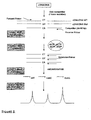
- Figure 2 shows a schematic view of quantitative and allele-specific expression analysis with real competitive PCR.
- a point mutation in the cDNA sequence is used as the marker for allele-specific gene expression analysis.
- the competitor is designed to have a synthetic mutation next to the natural mutation and is used for quantitative gene expression analysis.
- Three extension products from the two cDNA sequences and the competitor have different molecular weights, and are detected by MALDI-TOF MS. The peak area ratios of these products represent accurately the concentration ratios of the two cDNAs and the competitor. Since the absolute quantity of the competitor is known, the absolute quantities of the two cDNA sequences can be readily calculated.
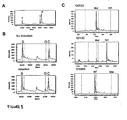
- Figure 3 shows a mass spectra for allele-specific expression analysis.
- A Interleukin 6 gene. Peaks are identified by C, T and S. C represents the allele where the polymorphic site has a C residue. T represents the allele where the polymorphic site has a T residue. S represents the competitor. The peak areas of C, T and S peaks are automatically computed by the RT software package (SEQUENOM). The peak area ratios represent the concentration ratios of the starting cDNA sequences and the competitor. The peak frequencies are 0.209, 0.263 and 0.528 for peak C, T and S, respectively.
- B lexA gene. Peak S, G and C represent the competitor, the exogenous and the endogenous lexA gene, respectively.
- the peak frequencies are 0.601, 0.004 and 0.395 for peak S, G and C, respectively. With induction, the peak frequencies are 0.509, 0.075 and 0.416 for peak S, G and C, respectively.
- C ABCD-1 gene. Mut and WT represent mutant and wildtype alleles, respectively. For Q672X, the peak frequencies are 0.984 and 0.016 for peak Mut and WT, respectively. For S213C, the peak frequencies are 0.187 and 0.813 for peak Mut and WT, respectively. For S108W, the peak frequencies are 0.995 and 0.005 for peak WT and Mut, respectively.
- the present invention is directed to a method for detecting and quantifying rare mutations in a biological sample.
- the sample nucleic acid molecules that can be used in the methods of the present invention include DNA, RNA and cDNA molecules.
- the present invention provides a method for robustly detecting whether such rare mutations occur in a biological sample.
- mutant as used throughout the specification is intended to encompass any and all types of functional and/or non-functional nucleic acid changes, including mutations and polymorphisms in the target nucleic acid molecule when compared to a wildtype variant of the same nucleic acid region or allele or the more common nucleic acid molecule present on the sample.
- Such changes include, but are not limited to deletions, insertions, translocations, inversions, and base substitutions of one or more nucleotides.
- polymorphism refers to a variation in the sequence of a gene in the genome amongst a population, such as allelic variations and other variations that arise or are observed.
- Genetic polymorphisms refers to the variant forms of gene sequences that can arise as a result of nucleotide base pair differences, alternative mRNA splicing or post- translational modifications, including, for example, glycosylation.
- a polymorphism refers to the occurrence of two or more genetically determined alternative sequences or alleles in a population.
- SNP single nucleotide polymorphism
- a polymorphic marker or site is the locus at which divergence occurs. Such site may be as small as one base pair (an SNP).
- Polymorphic markers include, but are not limited to, restriction fragment length polymorphisms, variable number of tandem repeats (VNTR's), hypervariable regions, minisatellites, dinucleotide repeats, trinucleotide repeats, tetranucleotide repeats and other repeating patterns, simple sequence repeats and insertional elements, such as Alu.
- Polymorphic forms also are manifested as different mendelian alleles for a gene. Polymorphisms may be observed by differences in proteins, protein modifications, RNA expression modification, DNA and RNA methylation, regulatory factors that alter gene expression and DNA replication, and any other manifestation of alterations in genomic nucleic acid or organelle nucleic acids.
- allelic form occurring most frequently in a selected population is sometimes referred to as the wildtype form.
- Diploid organisms may be homozygous or heterozygous for allelic forms.
- a diallelic or biallelic polymorphism has two forms.
- a triallelic polymorphism has three forms.
- rare mutation as used herein and throughout the specification is intended to describe a mutation in a nucleic acid molecule which is present in less than 40% of the nucleic acid molecules in the sample, preferably in less than 30%, 20%, 15%, 10%, 8%, 5%, 4%, 3%, 2%, 1%, 0.8%, 0.5%, 0.1%, 0.05%, 0.01, or less compared to one or more, more common nucleic acid variants, which are referred to throughout the specification as the "wildtype" nucleic acid variants.
- the rare nucleic acid is present in the sample in amount less than 10%, preferably less than 1%.
- the sample may include one or more rare mutations and there may also be one or more wildtype variants in the nucleic acid sample.
- the deoxynucleotides or dNTPs according to the present invention are dATP, dTTP, dCTP, or dGTP.
- the dideoxynucleotides or the terminator nucleoddes (ddNTPs) are ddATP, ddTTP, ddCTP, or ddGTP.
- the dNTPs and ddNTPs can also be labeled with, for example, different fluorescent dyes, or other labels, such as radioactive molecules, which do not interfere with the DNA polymerase function in the primer extension reaction. Differentially labeled dNTPs or ddNTPs can be used to differentiate the alleles after the primer extension reaction. Such labels and the methods of preparing labeled dNTPs and ddNTPs are well know to one skilled in the art.
- nucleic acid sample is intended to encompass nucleic acids isolated from any biological material, e.g., human, animal, plant, bacteria, fungi, protist, viruses, from tissues including blood, hair follicles, or other tissues, such as skin biopsies, cells or cell cultures, body excrements such as semen, saliva, stool, urine, amniotic fluid and so forth.
- the nucleic acids can also be isolated from foodstuff, drinks, clothes, soil and any other source, wherein detection of rare nucleic acids compared to a more common or wildtype variants of the same is needed.
- Nucleic acid molecules can be isolated from a particular biological sample using any of a number of procedures, which are well-known in the art, the particular isolation procedure chosen being appropriate for the particular biological sample.
- the invention provides a method of detecting one or more nucleic acids with a rare mutation comprising the steps of amplifying a nucleic acid molecule with two primers flanking or surrounding the mutation site, designing a detection primer so that the 3' end of the detection primer anneals immediately adjacent to a nucleic acid which is different in the mutant molecule compared to the more common wildtype variant of the same nucleic acid molecule, removing the excess dNTPs after the amplification reaction, performing a primer extension reaction using the detection primer and at least one dNTP or ddNTP, which corresponds to the nucleotide adjacent to the detection primer present in the rare mutant nucleic acid molecule and is not present in the background of the more common nucleic acid molecule(s) or variant(s), wherein the presence of a primer extension product in the reaction indicates the presence of the nucleic acid with a rare mutation.
- only one dNTP or ddNTP is used in the primer extension reaction.
- the invention provides a method, wherein only one dNTP, which corresponds to the nucleoside adjacent to the detection primer in the rare mutant nucleic acid molecule is used together with the detection primer.
- nucleic acid molecule contains the following sequence:
- [A/T] represents a base A to T mutation.
- T mutation occurs at low frequencies, for example, less than about 30%, 20%, 15%, 10%, 8%, 5%, 4%, 3%, 2%, 1%, 0.8%, 0.5%, 0.1%, 0.05%, 0.01% or less. Therefore, in a biological sample, most nucleic acid molecules for the region depicted above have the A base and only a very small percentage of the nucleic acid molecules present in the biological sample have the T base at the polymorphic site.
- nucleic acids are isolated from the source material, such as tissues/cells/fluids or other sources of interest, using any of the widely adopted methods well known to one skilled in the art.
- Two PCR primers flanking the mutation site are shown as underlined sequences in the above example, wherein only the sense strand is shown.
- the primers are designed to amplify the DNA region for both the wildtype and mutant DNAs.
- allele specific primers can be used to preferentially amplify the rare mutation containing nucleic acid molecule(s).
- the excess nucleotides in the amplification reaction are removed, for example, using a shrimp alkaline phosphatase or a spin column or any other method well known to one skilled in the art.
- a third primer, so called detection primer, which is shown in the above example in small letters, is used in a base extension reaction.
- the third primer can also be designed from the opposite direction and the two primers in two parallel reactions can be used to cross-validate the results.
- the detection primer is designed so that its 3' end anneals immediately before a nucleoside which is different in the rare mutant(s) compared to more common wildtype nucleic acid variant(s) because the methods of the present invention are based on the premise of preferentially detecting the rare nucleic acid molecules.
- ddTTP In the base extension reaction using the above presented example nucleic acid template, only ddTTP or alternatively, only dTTP is used so that only the mutant nucleic acid will be used as the template for the base extension reaction.
- the detection of the oligonucleotide resulting from the primer extension reaction, i.e., aggggcagatagcagtga-ddT [SEQ ID NO.: 2] indicates that the mutant allele is present.
- ddNTP and dNTP can also be used as far as the wildtype nucleic acid(s) cannot be used as the template for the base extension reaction.
- the methods of the present invention can additionally be used to detect more than one rare nucleic acid variant in the sample.
- a multiplex PCR and a subsequent multiplex primer extension reaction can be designed using the teachings of the present invention to detect at least 2, 3, 4, 5, 6, 7, 8, 9, 10-15 or even more than 15 mutations in the same reaction, as long as none of the wildtype, or more common variants of the respective nucleic acid targets can serve as a template for the detection primers in the primer extension reaction.
- the methods of the present invention are useful, for example, in detecting a small population of nucleic acids with a known mutation among a background of wildtype nucleic acid variants in, for example, early diagnosis or prognosis of cancer or malignant cell growth in an individual.
- the methods of the present invention are also useful in providing a means for early detection of malignant cells containing new or additional mutations which may be a result of treatment of the malignancies, such as appearance of multi drug resistance mutations in an individual with the proviso that these mutations are known or become known through screening of new mutations before designing the detection primers.
- the methods of the present invention also provide a useful tool to detect viral infections or emerging virus mutants in an individual infected with a virus, such as human immune deficiency virus (HIV), during the treatment of the disease thereby allowing early adjustment in treatment as a response to occurrence of new virus mutations.
- a virus such as human immune deficiency virus (HIV)
- the methods of the present invention provide an ideal tool to detect rare mutations in detection of the presence and quantification of the amount of the rare nucleic acid changes. Therefore, applications for the methods of the present invention include, for example, early benign or malignant tumor detection, prenatal diagnostics particularly when using a blood sample from the mother, early viral or bacterial disease detection or detection of emerging strains of treatment resistant strains of bacteria or viruses in a target sample, environmental monitoring, monitoring of effects of pharmaceutical interventions such as early detection of multi drug resistance mutations in cancer treatment.
- the methods of the present invention are also useful in detection of rare mutant nucleic acid populations in mosaic organisms or individuals or one of their tissues composed of cells of more than one genotype, for example, in diagnosis of mitochondrial diseases or inherited diseases, wherein the mutation occurred after fertilization during early development of the embryo or fetus resulting in a mosaic genotype and consequently a mosaic phenotype.
- the methods of the present invention are also useful in detection of rare mutations in inherited diseases which result in reduction of the transcript levels. It is sometimes easier to detect mutations from an RNA sample than from a genomic DNA sample. However, mutations causing significantly reduced transcript levels are often missed in these screens.
- the methods of the present invention can be used in detecting the known transcript reducing mutations which can be considered "rare mutations" because the mutant transcript population represents only a small percentage of the nucleic acids in the target sample.
- Detection of rare mutations using the methods of the present invention also provide tools for forensic nucleic acid sample analysis by providing a system to reliably detect presence or absence of specific known nucleic acid polymorphisms to provide evidence, for example, to include or exclude crime suspects.
- the methods of the present invention are useful in detection of rare extremely virulent or dangerous mutations in biological agents, such as bacteria and viruses, that can be used as a biological warfare agents. As the knowledge of dangerous mutations in viruses and/or bacteria increases, the present invention provides methods to detect small quantities of these abnormal mutants in a larger population of wildtype or less virulent agents.
- the present invention also provides that the method can be modified for genotyping assays that might have an allele dropout problem.
- An allele dropout occurs when one allele is poorly amplified or detected, and a heterozygotic allele is mis-called as a homozygote.
- the dropout allele is often, but not always, the allele that produces a higher molecular weight base extension product.
- the method according to the present invention provides that the use of ddTTP only, or ddTTP and much lower concentrations of other ddNTP/dNTP combinations, for the base extension reaction, will result in preferential extension of the 'dropped-out' allele, and therefore allele dropout is avoided.
- the detection methods for detecting the primer extension products produced by the present invention can be any detection method which is capable of detecting the primer extension product after the primer extension reaction. If the dNTP or ddNTP is labeled with a detectable marker or reporter such as a fluorescent or radioactively label or some other detectable chemical group, the detection method is based on detecting the incorporation of the label into the primer extension product.
- detection methods include gel electrophoresis with laser detection or gel electrophoresis with detection of radioactivity, or other methods well known to one skilled in the art.
- reporter molecule is a molecule which provides an analytically identifiable signal allowing detection of a hybridized probe. Detection may be either qualitative or quantitative. Commonly used reporter molecules include fluorophores, enzymes, biotin, chemiluminescent molecules, bioluminescent molecules, digoxigenin, avidin, streptavidin, or radioisotopes. Commonly used enzymes include horseradish peroxidase, alkaline phosphatase, glucose oxidase and beta-galactosidase, among others. Enzymes can be conjugated to avidin or streptavidin for use with a biotinylated probe.
- probes can be conjugated to avidin or streptavidin for use with a biotinylated enzyme.
- the substrates to be used with these enzymes are generally chosen for the production, upon hydrolysis by the corresponding enzyme, of a detectable color change.
- p-nitrophenyl phosphate is suitable for use with alkaline phosphatase reporter molecules; for horseradish peroxidase, 1,2-phenylenediamine, 5-aminosalicylic acid or tolidine are commonly used.
- Incorporation of a reporter molecule into a DNA probe can be by any method known to the skilled artisan, for example by nick translation, primer extension, random oligo priming, by 3' or 5' end labeling or by other means (see, for example, Sambrook et al. Molecular Biology: A laboratory Approach, Cold Spring Harbor, N.Y. 1989 ).
- the identified nucleic acids need not be labeled and can be used to quantitate allelic frequency using a mass spectrometry technique described in Ding C. and Cantor C.R., 2003, Proc. Natl. Acad. Sci. U.S.A. 100, 3059-64 .
- the preferred method for detecting the primer extension products comprising the rare mutant nucleic acid is MALDI-TOF MS, using e.g. MASSARRAY TM system (Sequenom Inc., San Diego, CA).
- the invention enables a method of detecting nucleic acid molecules with a rare mutation comprising amplifying the nucleic acid sample with two primers that are designed to allele-specifically amplify the rare mutation containing nucleic acid, removing the excess dNTPs from the reaction after the amplification reaction, performing the primer extension reaction with only one dNTP or ddNTP, preferably dNPT, and a detection primer, which has been designed so that the 3' end is immediately adjacent to the mutation site, so that only the mutant nucleic acid will serve as a template to the primer extension reaction when the corresponding dNTP or ddNTP is used, and detecting the primer extension reaction product, wherein presence of the primer extension product after the primer extension reaction indicates the presence of a nucleic acid with a rare mutation.
- two reactions are performed using two different detection primers, wherein the first detection primer is designed to amplify the sense strand so that the 3' end of the primer anneals immediately adjacent to the mutation site in the sense strand and in the second reaction the detection primer is designed to amplify the antisense strand so that the 3' end of the primer anneals immediately adjacent to the mutation site in the antisense strand.
- the invention provides a method of quantification of nucleic acid molecules with rare mutations comprising the steps of amplifying a nucleic acid sample and a known amount of a control nucleic acid sample in the same reaction, wherein the control nucleic acid sample has been designed to have the same sequence as the rare mutation containing amplicon with the exception of one nucleic acid difference immediately adjacent to the mutation site.
- the amplification is performed with primers flanking the mutation site.
- the excess of dNTPs are removed and a primer extension reaction is performed using a detection primer, which is designed so that the 3' end of the primer anneals immediately adjacent to the rare mutation site.
- the detection reaction is performed in the presence of one deoxynucleotide (dNTP) and two dideoxynucleotides (ddNTPs): the dNTP corresponds to the first nucleoside after the 3' end of the detection primer in the nucleic acid with the rare mutation, the first ddNTP corresponds to the nucleoside artificially created to the control which differs from the nucleoside present in the rare mutant allele, and the second ddNTP corresponds to the nucleoside present in the rare mutant allele, preferably immediately after the mutation site.
- the primer extension products are then detected, and because the amount of the control originally added to the amplification reaction is known, the ratio of the control and the rare mutant containing nucleic acid molecules is used to determine the exact quantity of the mutant nucleic acid molecules in the sample.
- the standard nucleic acid can be prepared using any method of nucleic acid synthesis know to one skilled in the art, including, for example, chemical oligonucleotide synthesis, by cloning and targeted mutagenesis, or by PCR with mutagenized primers.
- Oligonucleotide primers or standards may be synthesized using methods well known in the art, including, for example, the phosphotriester (see Narang, S.A., et al., 1979, Meth. Enzymol., 68:90 ; and U.S. Pat. No. 4,356,270 ), phosphodiester ( Brown, et al., 1979, Meth. Enzymol., 68:109 ), and phosphoramidite ( Beaucage, 1993, Meth. Mol. Biol., 20:33 ) approaches.
- the phosphotriester see Narang, S.A., et al., 1979, Meth. Enzymol., 68:90 ; and U.S. Pat. No. 4,356,270
- phosphodiester Brown, et al., 1979, Meth. Enzymol., 68:109
- phosphoramidite Beaucage, 1993, Meth. Mol. Biol., 20:33
- rolling circle amplification is an isothermal process for generating multiple copies of a sequence.
- a DNA polymerase extends a primer on a circular template ( Komberg, A. and Baker, T. A. DNA Replication, W. H. Freeman, New York, 1991 ).
- the product consists of tandemly linked copies of the complementary sequence of the template.
- RCA is a method that has been adapted for use in vitro for DNA amplification ( Fire, A. and Si-Qun Xu, Proc. Natl. Acad Sci. USA, 1995, 92:4641-4645 ; Lui, D., et al., J. Am. Chem.
- RCA techniques are well known in the art, including linear RCA (LRCA). Any such RCA technique can be used in the present invention.
- the methods of the present invention can be modified to utilize one or more control or competitor nucleic acids to quantify the amount of one or more rare mutant nucleic acid molecules in the same reaction.
- the amount of the primer extension products is consequently measured by any of a variety of means, preferably by Mass Spectrometry (MALDI-TOF, or Matrix Assisted Laser Desorption Ionization - Time of Flight).
- MALDI-TOF Mass Spectrometry
- the peak area ratio between the products from the standard and the nucleic acid of interest comprising the rare mutation represents the ratio of the standard and the gene of interest. Since the concentration of the standard is known, the concentration of the nucleic acids with the rare mutation can be calculated.
- Products of the primer extension reaction are detected and quantified using methods including, but not limited to, MALDI-TOF mass spectrometry, PYROSEQUENCINGTM, real time PCR, hybridization-based techniques, third wave invader assay, and fluorescence-based detection techniques.
- the detection of the primer extension products in the methods of the present invention is performed using the MALDI-TOF mass spectrometry, using, for example the MASSARRAY TM system according to the manufacturer's instructions (Sequenom Inc., San Diego, CA).
- an INVADER ® assay can be used (Third Wave Technologies, Inc (Madison, WI)). This assay is generally based upon a structure-specific nuclease activity of a variety of enzymes, which are used to cleave a target-dependent cleavage structure, thereby indicating the presence of specific nucleic acid sequences or specific variations thereof in a sample (see, e.g. U.S. Patent No. 6,458,535 ).
- an INVADER ® operating system provides a method for detecting and quantifying DNA and RNA. The INVADER ® OS is based on a "perfect match" enzyme-substrate reaction.
- the INVADER ® OS uses proprietary CLEAVASE ® enzymes (Third Wave Technologies, Inc (Madison, WI)), which recognize and cut only the specific structure formed during the INVADER ® process.
- the INVADER ® OS relies on linear amplification of the signal generated by the INVADER ® process, rather than on exponential amplification of the target. This allows quantification of target concentration.
- the primer extension products for the rare mutations are detected using PYROSEQUENCINGTM (Uppsala, Sweden), which is essentially sequencing by synthesis.
- a sequencing primer designed to anneal directly next to the nucleic acid differing between the rare and the common allele or the artificially produced quantification standard is first hybridized to a single stranded, PCR amplified, DNA template comprising both the target and the standard PCT product, and incubated with the enzymes, DNA polymerase, ATP sulfurylase, luciferase and apyrase, and the substrates, adenosine 5' phosphosulfate (APS) and luciferin.
- APS adenosine 5' phosphosulfate
- dNTP deoxynucleotide triphosphates
- DNA polymerase catalyzes the incorporation of the dNTP into the standard DNA strand.
- PPi pyrophosphate
- ATP sulfurylase quantitatively converts PPi to ATP in the presence of adenosine 5' phosphosulfate. This ATP drives the luciferase-mediated conversion of luciferin to oxyluciferin that generates visible light in amounts that are proportional to the amount of ATP.
- the light produced in the luciferase-catalyzed reaction is detected by a charge coupled device (CCD) camera and seen as a peak in a PYROGRAMTM.
- CCD charge coupled device
- Each light signal is proportional to the number of nucleotides incorporated and allows determination of the amount of the standard nucleic acid sequence.
- apyrase a nucleotide degrading enzyme, continuously degrades unincorporated ddNTPs and excess ATP.
- another dNTP is added which corresponds to the dNTP present in the target template the amount of which is to be determined.
- addition of dNTPs is performed one at a time.
- Deoxyadenosine alfa-thio triphosphate (dATPocS) is used as a substitute for the natural deoxyadenosine triphosphate (dATP) since it is efficiently used by the DNA polymerase, but not recognized by the luciferase. Because the amount of the standard added in the PCR is known, the amount of the target can be calculated from the ratio of the incorporated dNTPs. For detailed information about reaction conditions, see, e.g. U.S. Patent No. 6,210,891 .
- GCAAGGTGAACGTGGATGAAGTTGGTGGTGAGGCCCTGGGCAG GTTAGGGGCAGATAGCAGTGA TC AGAGCGAGAGCCATCTATTGCTTAC ATTTGCTTCTGACACAACTGTGTTCACTAGCAACCTCAAACAGACACCATG GTGCACC [SEQ ID NO.: 3] is used as the internal standard for competitive PCR, wherein the bolded, underlined T represents the same nucleoside as in the rare mutant nucleic acid and the C is created to provide a detectable difference between the rare mutant and the standard.
- the competitor carries the T base as the rare mutation at the natural polymorphic site.
- it also has a C base, instead of the G base, at the position next to the polymorphic site.
- PCR excess dNTP removal using, for example, shrimp alkaline phosphatase treatment, and consequently the base extension reaction are carried out.
- dTTP, ddGTP and ddCTP mixture is used.
- two extension products aggggcagatagcagtgaTddG [SEQ ID NO.: 4] and aggggcagatagcagtgaTddC [SEQ ID NO.: 5] are produced.
- the first product comes from the rare mutation and the second product comes from the internal standard, the initial concentration of which is known.
- the ratio of the two products can be quantified by, for example, MALDI-TOF mass spectrometry, or other techniques, such as fluorescence measurement when ddCTP and ddGTP are tagged with different fluorescent groups.
- the competitor was used as an internal standard for mut DNA quantification.
- Wt DNA is used as the background DNA which exist at a much higher concentration than mut DNA.
- the PCR primer sequences are: 5'ACGTTGGATGTGGCAGATCTCTTCATGGTC-3' [SEQ ID NO.: 9] and 5'ACGTTGGATGCCAAAGACGAAGTACCCATG-3' [SEQ ID NO.: 10].
- the extension primer sequence was 5'CGGTGGCTTCACCACCA-3' [SEQ ID NO.: 11].
- the extension ddNTP/dNTP mixture was dTTP/ddGTP/ddCTP.
- Matrix-assisted laser desorption ionization - time of flight mass spectrometry was adapted for quantitative gene expression analysis [1].
- This technique dubbed as real competitive PCR, combines competitive PCR, primer extension reaction and MALDI-TOF MS.
- cDNA is spiked with a synthetic oligonucleotide (the competitor) with an identical sequence except one single base roughly in the middle of the sequence to the cDNA of interest.
- the competitor and the cDNA of interest are co-amplified by PCR.
- Excess dNTPs are removed by shrimp alkaline phosphatase treatment after PCR.
- a base extension reaction is carried out with an extension primer, a combination of three different ddNTPs and one dNTP and a ThermoSequenase.
- the base extension primer hybridizes right next to the mutation site and either one or two bases are added for the competitor and the cDNA, yielding two oligonucleotide products with different molecular weights (typically around 300 Da difference).
- molecular weight window typically 4,000 to 9,000 Da
- MALDI-TOF MS can easily distinguish two oligonucleotides if they differ by more than 10 Da.
- the absolute concentration of each of the two cDNAs can be easily calculated.
- the competitor and the two cDNAs are virtually identical in sequence and are amplified with the same kinetics.
- the allele specificity is superior due to the high precision of MALDI-TOF MS in molecular weight determination.
- FIG. 3A One example of allele-specific expression analysis by real competitive PCR is shown in Figure 3A .
- a single nucleotide polymorphism (refSNP ID: rs2069849) located in exon 2 of the interleukin 6 gene is selected as the marker for allele-specific expression.
- Complementary DNA (0.025 ng) prepared from the IMR-90 cell line (ATCC) was co-amplified with 5 ⁇ 10 -22 Mol (301 copies) of the competitor.
- the oligonucleotide products from the base extension reaction were analyzed by MALDI-TOF MS. The peak area ratios represent accurately the concentration ratios of the two cDNAs and the competitor.
- luciferase a reporter gene expressed under identical conditions as the gene of interest
- this estimate is likely to be inaccurate since the expression level of the luciferase gene is likely to be different from the exogenous genes, even when they are under the control of the same promoter.
- a method to directly and separately quantify the expressions of the exogenous and the endogenous gene is needed to obtain significantly more accurate estimates of self-regulatory interactions in gene networks.
- an exogenous lexA was introduced into E. coli via the pBADX53 vector.
- the exogenous lexA gene is distinguishable from the endogenous lexA gene by a silent mutation (TCC to TCG silent mutation at codon 103).
- the exogenous lexA expression was induced with arabinose. Without arabinose, only endogenous lexA transcript was detected ( Figure 3B ). With an intermediate arabinose induction, exogenous lexA was expressed at about 20% level compared with the endogenous lexA ( Figure 3B ).
- Complementary DNA for interleukin 6 gene expression analysis was prepared from cell line IMR-90 (ATCC).
- the PCR primer sequences for the interleukin 6 gene expression analysis are:
- RNA samples for lexA gene expression analysis were provided by Dr. Timothy Gardner (Boston University).
- the exogenous lexA gene has a TCC to TCG silent mutation at codon 103 so that it can be distinguished from the endogenous lexA gene.
- the exogenous lexA gene was cloned in the vector pBADX53. Bacterial culture and RNA extraction were carried out as previously described [10].
- the PCR primer sequences for the lexA gene expression analysis are, 5'-ACGTTGGATGGCGCAACAGCATATTGAAGG-3'[SEQ ID NO: 17]and 5'-ACGTTGGATGACATCCCGCTGACGCGCAGC-3' [SEQ ID NO: 18].
- the extension primer sequence is 5'-ATCAGCATTCGGCTTGAATA-3'[SEQ ID NO: 19].
- the synthetic competitor sequence is 5'-ACATCCCGCTGACGCGCAGCAGGAAATCAGCATTCGGCTTGAATATGGAA GGATCGACCTGATAATGACCTTCAATATGCTGTTGCGC-3' [SEQ ID NO: 20].
- the synthetic competitor was PAGE purified by the vendor and absorbance at 260 nm was measured in our laboratory.
- the extension primers are: 5'-GGCGGGCCACATACACC-3'[SEQ ID NO: 27] for S108W, 5'-AGTGGCTTGGTCAGGTTG-3'[SEQ ID NO: 28] for S213C and 5'-AATACCACACACACTTGCTA-3' [SEQ ID NO: 29] for Q672X.
- Step 1 PCR amplification
- Each PCR reaction contains 1 ⁇ L diluted cDNA (0.025 ng/ ⁇ L), 0.5 ⁇ L 10 ⁇ HotStar Taq PCR buffer, 0.2 ⁇ L MgCl 2 (25 mM), 0.04 ⁇ l dNTP mix (25 mM each), 0.02 ⁇ L HotStar Taq Polymerase (50 U/ ⁇ L, Qiagen), 0.1 ⁇ L competitor oligonucleotide (5 ⁇ 10 -9 ⁇ M), 1 ⁇ L forward and reverse primer (1 ⁇ M each) and 2.14 ⁇ L ddH 2 O.
- the PCR condition was: 95°C for 15 min for hot start, followed by denaturing at 94°C for 20 sec, annealing at 56°C for 30 sec and extension at 72°C for 1 min for 45 cycles, and finally incubated at 72°C for 3 min.
- Step 2 Shrimp alkaline phosphatase treatment
- PCR products were treated with shrimp alkaline phosphatase to remove excess dNTPs.
- the reaction solutions (now 7 ⁇ L each) were incubated at 37°C for 20 min, followed by 85°C for 5 min to inactive the enzyme.
- ddNTPs/dNTP mixture SEQUENOM
- 0.108 ⁇ L of selected extension primer 0.108 ⁇ L of selected extension primer
- 0.018 ⁇ L of ThermoSequenase 32 U/ ⁇ L, SEQUENOM
- 1.674 ⁇ L ddH 2 O were added.
- the base extension condition was, 94°C for 2 min, followed by 94°C for 5 sec, 52°C for 5 sec and 72°C for 5 sec for 40 cycles.
- the ddNTPs/dNTP mixtures are: ddATP/ddCTP/ddGTP/dTTP for interleukin 6 and ABCD-1 Q672X, ddTTP/ddCTP/ddGTP/dATP for lexA, and ddATP/ddCTP/ddTTP/dGTP for ABCD-1 S108W and S213C.
- Step 4 Liquid dispensing and MALDI-TOF MS
- the final base extension products were treated with SpectroCLEAN (SEQUENOM) resin to remove salts in the reaction buffer.
- This step was carried out with a Multimek (Beckman) 96 channel auto-pipette and 16 ⁇ L resin/water solution was added into each base extension reaction, making the total volume 25 ⁇ L.
- a quick centrifugation 2,500 rpm, 3 min
- a Sorvall legend RT centrifuge approximately 10 nL of reaction solution was dispensed onto a 384 format SpectroCHIP (SEQUENOM) pre-spotted with a matrix of 3-hydroxypicolinic acid (3-HPA) by using a MassARRAY Nanodispenser (SEQUENOM).
- a modified Bruker Biflex MALDI-TOF mass spectrometer was used for data acquisitions from the SpectroCHIP. Mass spectrometric data were automatically imported into the SpectroTYPER (SEQUENOM) database for automatic analysis such as noise normalization and peak area analysis.
- SEQUENOM SpectroTYPER
Landscapes
- Chemical & Material Sciences (AREA)
- Organic Chemistry (AREA)
- Life Sciences & Earth Sciences (AREA)
- Zoology (AREA)
- Wood Science & Technology (AREA)
- Proteomics, Peptides & Aminoacids (AREA)
- Health & Medical Sciences (AREA)
- Engineering & Computer Science (AREA)
- Microbiology (AREA)
- Immunology (AREA)
- Physics & Mathematics (AREA)
- Molecular Biology (AREA)
- Biotechnology (AREA)
- Biophysics (AREA)
- Analytical Chemistry (AREA)
- Biochemistry (AREA)
- Bioinformatics & Cheminformatics (AREA)
- General Engineering & Computer Science (AREA)
- General Health & Medical Sciences (AREA)
- Genetics & Genomics (AREA)
- Measuring Or Testing Involving Enzymes Or Micro-Organisms (AREA)
Claims (7)
- Verfahren zum Quantifizieren von Nukleinsäuremolekülen mit einer seltenen Mutation in einer Probe, wobei die seltene Mutation geringer als 10% der Nukleinsäuremoleküle in der Probe darstellt, im Vergleich zu einer oder mehreren Wildtyp-Varianten der Nukleinsäure, umfassend die Schritte;(a) Bereitstellen einer Nukleinsäurenprobe, umfassend ein Gemisch aus Nukleinsäuren, wobei das Gemisch aus Nukleinsäuren geringer als 10% Nukleinsäuren mit der seltenen Mutation umfasst, oder im Verdacht steht, diese zu umfassen;(b) Zufügen zur Nukleinsäurenprobe einer bekannten Menge Kontroll-Nukleinsäure, wobei die Kontroll-Nukleinsäurenprobe die gleiche Sequenz hat, wie der die seltene Mutation aufweisende Amplicon, mit der Ausnahme von mindestens einem Nukleinsäurenunterschied direkt neben dem Mutationsort;(c) in einer Amplifikationsreaktion, Amplifizieren der Nukleinsäurenprobe mit Primern, welche die die seltene Mutation enthaltende Sequenz flankieren;(d) Entfernen von überschüssigen dNTPs nach der Amplifikationsreaktion;(e) Ausführen einer Primerextensionsreaktion mit einem oder mehreren Detektionsprimern, welche so ausgelegt sind, dass das 3'-Ende des Detektionsprimers direkt neben einer Nukleinsäure ist, durch welche sich der Wildtyp vom mutierten Nukleinsäuremolekül unterscheidet, und mit einem Gemisch aus dNTP(s)/ddNTP(s), welches einem Nucleosid neben dem Detektionsprimer in den Nukleinsäuren mit der seltenen Mutation entspricht, und wobei keine der dNTP(s)/ddNTP(s) auch für die Extension der Wildtyp-DNS verwendet werden kann, und das Extensionsprodukt aus dem seltenen Mutanten und die Kontroll-DNS unterschieden werden können; und(f) Quantifizieren der Anwesenheit des oder der Primerextensionsprodukt(e) nach der Primerextensionsreaktion und/oder Erfassen des Verbrauchs von dNTP/ddNTP;wobei die Anwesenheit eines Primerextensionsprodukts in der Reaktion oder der Verbrauch von dNTP/ddNTP die Anwesenheit der Nukleinsäure mit einer seltenen Mutation anzeigt.
- Verfahren gemäß Anspruch 1, wobei das Primerextensionsprodukt mit Hilfe von MALDI-TOF-Massenspektrometrie quantifiziert wird.
- Verfahren gemäß Anspruch 1, wobei der Verbrauch von dNTP mit Hilfe von Pyrosequenzierung quantifiziert wird
- Verfahren gemäß Anspruch 1, wobei das Gemisch aus Nukleinsäuren aus Schritt (a) im Verdacht steht, geringer als 1% Nukleinsäuren mit der seltenen Mutation zu umfassen.
- Verfahren gemäß Anspruch 1, wobei parallele Primerextensionsreaktionen mit zwei unterschiedlichen Detektionsprimern ausgeführt werden, wobei der erste Detektionsprimer ausgelegt ist zum Amplifizieren des Sense-Strangs, so dass das 3'-Ende des Primers direkt neben dem Mutationsort im Sense-Strang ankoppelt, und in der zweiten Reaktion der Detektionsprimer ausgelegt ist zum Amplifizieren des Antisense-Strangs, so dass das 3'-Ende des Primers direkt neben dem Mutationsort im Antisense-Strang ankoppelt.
- Verfahren gemäß Anspruch 1, wobei wobei ein dNTP und zwei ddNTPs in der Primerextensionsreaktion verwendet werden, wobei der dNTP einem Nukleosid neben dem Detektionsprimer in den Nukleinsäuren mit der seltenen Mutation entspricht.
- Verfahren gemäß Anspruch 1, wobei der Verbrauch von ddNTPs quantifiziert wird.
Applications Claiming Priority (2)
| Application Number | Priority Date | Filing Date | Title |
|---|---|---|---|
| US54538204P | 2004-02-18 | 2004-02-18 | |
| PCT/US2005/005255 WO2006019407A2 (en) | 2004-02-18 | 2005-02-18 | Method for detecting and quantifying rare mutations/polymorphisms |
Publications (3)
| Publication Number | Publication Date |
|---|---|
| EP1721014A2 EP1721014A2 (de) | 2006-11-15 |
| EP1721014A4 EP1721014A4 (de) | 2008-09-03 |
| EP1721014B1 true EP1721014B1 (de) | 2013-07-17 |
Family
ID=35907823
Family Applications (1)
| Application Number | Title | Priority Date | Filing Date |
|---|---|---|---|
| EP05807622.5A Expired - Lifetime EP1721014B1 (de) | 2004-02-18 | 2005-02-18 | Verfahren zum nachweis und zur quantifizierung seltener mutationen |
Country Status (4)
| Country | Link |
|---|---|
| US (3) | US7709262B2 (de) |
| EP (1) | EP1721014B1 (de) |
| CA (1) | CA2556981C (de) |
| WO (1) | WO2006019407A2 (de) |
Families Citing this family (60)
| Publication number | Priority date | Publication date | Assignee | Title |
|---|---|---|---|---|
| ATE513925T1 (de) * | 2004-04-09 | 2011-07-15 | Univ Boston | Verfahren zum de-novo-nachweis von sequenzen in nukleinsäuren: zielsequenzierung durch fragmentierung |
| WO2006128010A2 (en) * | 2005-05-26 | 2006-11-30 | The Trustees Of Boston University | Quantification of nucleic acids and proteins using oligonucleotide mass tags |
| ES2393318T3 (es) | 2005-06-23 | 2012-12-20 | Keygene N.V. | Estrategias para la identificación y detección de alto rendimiento de polimorfismos |
| US10316364B2 (en) | 2005-09-29 | 2019-06-11 | Keygene N.V. | Method for identifying the source of an amplicon |
| US20090170713A1 (en) | 2005-09-29 | 2009-07-02 | Keygene N.V. | High throughput screening of mutagenized populations |
| DK1966393T3 (da) | 2005-12-22 | 2012-10-08 | Keygene Nv | Fremgangsmåde til AFLP-baseret påvisning af polymorfisme med høj omsætning |
| DE102006003415A1 (de) * | 2006-01-24 | 2007-08-02 | Siemens Ag | Verfahren zur Analyse einer Probe |
| BRPI0709545A2 (pt) * | 2006-03-06 | 2011-07-19 | Univ Columbia | amplificação especìfica de seqüência de dna fetal de uma mistura de origem fetal-maternal |
| DK3239304T3 (da) | 2006-04-04 | 2020-10-26 | Keygene Nv | Højgennemløbsdetektering af molekylære markører baseret på AFLP og sekventering med højt gennemløb |
| CA2717320A1 (en) * | 2008-03-11 | 2009-09-17 | Sequenom, Inc. | Nucleic acid-based tests for prenatal gender determination |
| US8476013B2 (en) | 2008-09-16 | 2013-07-02 | Sequenom, Inc. | Processes and compositions for methylation-based acid enrichment of fetal nucleic acid from a maternal sample useful for non-invasive prenatal diagnoses |
| US8962247B2 (en) * | 2008-09-16 | 2015-02-24 | Sequenom, Inc. | Processes and compositions for methylation-based enrichment of fetal nucleic acid from a maternal sample useful for non invasive prenatal diagnoses |
| US8748103B2 (en) | 2008-11-07 | 2014-06-10 | Sequenta, Inc. | Monitoring health and disease status using clonotype profiles |
| US8628927B2 (en) | 2008-11-07 | 2014-01-14 | Sequenta, Inc. | Monitoring health and disease status using clonotype profiles |
| CN104195227B (zh) | 2008-11-07 | 2017-04-12 | 适应生物技术公司 | 通过序列分析监测状况的方法 |
| US9506119B2 (en) | 2008-11-07 | 2016-11-29 | Adaptive Biotechnologies Corp. | Method of sequence determination using sequence tags |
| US9528160B2 (en) | 2008-11-07 | 2016-12-27 | Adaptive Biotechnolgies Corp. | Rare clonotypes and uses thereof |
| US9365901B2 (en) | 2008-11-07 | 2016-06-14 | Adaptive Biotechnologies Corp. | Monitoring immunoglobulin heavy chain evolution in B-cell acute lymphoblastic leukemia |
| EP2387627B1 (de) | 2009-01-15 | 2016-03-30 | Adaptive Biotechnologies Corporation | Adaptive immunitätsprofilierung und verfahren zur erzeugung monoklonaler antikörper |
| CN102459643B (zh) | 2009-06-25 | 2016-06-01 | 弗雷德哈钦森癌症研究中心 | 检测获得性免疫的方法 |
| EP3088532B1 (de) | 2009-12-22 | 2019-10-30 | Sequenom, Inc. | Verfahren und kits zur identifizierung von aneuploidie |
| WO2012149339A2 (en) | 2011-04-29 | 2012-11-01 | Sequenom, Inc. | Quantification of a minority nucleic acid species |
| JP6040227B2 (ja) * | 2011-05-19 | 2016-12-07 | アジーナ バイオサイエンス, インコーポレイテッド | マルチプレックス核酸同定のための製品およびプロセス |
| US9824179B2 (en) | 2011-12-09 | 2017-11-21 | Adaptive Biotechnologies Corp. | Diagnosis of lymphoid malignancies and minimal residual disease detection |
| US9499865B2 (en) | 2011-12-13 | 2016-11-22 | Adaptive Biotechnologies Corp. | Detection and measurement of tissue-infiltrating lymphocytes |
| HK1206055A1 (en) | 2012-03-02 | 2015-12-31 | Sequenom, Inc. | Methods and processes for non-invasive assessment of genetic variations |
| DK2823060T3 (en) | 2012-03-05 | 2018-05-28 | Adaptive Biotechnologies Corp | Determination of associated immune receptor chains from frequency-matched subunits |
| BR112014025695B1 (pt) | 2012-04-16 | 2021-08-03 | Biological Dynamics, Inc | Preparação de amostra de ácido nucleico |
| US8932815B2 (en) | 2012-04-16 | 2015-01-13 | Biological Dynamics, Inc. | Nucleic acid sample preparation |
| WO2015196141A1 (en) * | 2014-06-20 | 2015-12-23 | Biological Dynamics, Inc. | Nucleic acid sample preparation |
| CA2872468C (en) | 2012-05-08 | 2020-10-27 | Adaptive Biotechnologies Corporation | Compositions and methods for measuring and calibrating amplification bias in multiplexed pcr reactions |
| US9920361B2 (en) | 2012-05-21 | 2018-03-20 | Sequenom, Inc. | Methods and compositions for analyzing nucleic acid |
| US10504613B2 (en) | 2012-12-20 | 2019-12-10 | Sequenom, Inc. | Methods and processes for non-invasive assessment of genetic variations |
| US20140093873A1 (en) | 2012-07-13 | 2014-04-03 | Sequenom, Inc. | Processes and compositions for methylation-based enrichment of fetal nucleic acid from a maternal sample useful for non-invasive prenatal diagnoses |
| WO2014026031A1 (en) * | 2012-08-10 | 2014-02-13 | Sequenta, Inc. | High sensitivity mutation detection using sequence tags |
| JP6449160B2 (ja) | 2012-10-01 | 2019-01-09 | アダプティブ バイオテクノロジーズ コーポレイション | 適応免疫受容体多様性およびクローン性特性決定による免疫能力評価関連出願の相互参照 |
| US10150996B2 (en) | 2012-10-19 | 2018-12-11 | Adaptive Biotechnologies Corp. | Quantification of adaptive immune cell genomes in a complex mixture of cells |
| HK1216655A1 (zh) | 2013-03-13 | 2016-11-25 | Sequenom, Inc. | 用於dna甲基化分析的引物 |
| WO2014152937A1 (en) | 2013-03-14 | 2014-09-25 | Ibis Biosciences, Inc. | Nucleic acid control panels |
| US9708657B2 (en) | 2013-07-01 | 2017-07-18 | Adaptive Biotechnologies Corp. | Method for generating clonotype profiles using sequence tags |
| WO2015134787A2 (en) | 2014-03-05 | 2015-09-11 | Adaptive Biotechnologies Corporation | Methods using randomer-containing synthetic molecules |
| US11365447B2 (en) | 2014-03-13 | 2022-06-21 | Sequenom, Inc. | Methods and processes for non-invasive assessment of genetic variations |
| US10066265B2 (en) | 2014-04-01 | 2018-09-04 | Adaptive Biotechnologies Corp. | Determining antigen-specific t-cells |
| CN106459966A (zh) | 2014-04-08 | 2017-02-22 | 生物动力学公司 | 用于生物材料的分离的改进的装置 |
| CA2966201A1 (en) | 2014-10-29 | 2016-05-06 | Adaptive Biotechnologies Corp. | Highly-multiplexed simultaneous detection of nucleic acids encoding paired adaptive immune receptor heterodimers from many samples |
| US10246701B2 (en) | 2014-11-14 | 2019-04-02 | Adaptive Biotechnologies Corp. | Multiplexed digital quantitation of rearranged lymphoid receptors in a complex mixture |
| WO2016086029A1 (en) | 2014-11-25 | 2016-06-02 | Adaptive Biotechnologies Corporation | Characterization of adaptive immune response to vaccination or infection using immune repertoire sequencing |
| CA2976580A1 (en) | 2015-02-24 | 2016-09-01 | Adaptive Biotechnologies Corp. | Methods for diagnosing infectious disease and determining hla status using immune repertoire sequencing |
| AU2016242967B2 (en) | 2015-04-01 | 2021-07-01 | Adaptive Biotechnologies Corp. | Method of identifying human compatible T cell receptors specific for an antigenic target |
| WO2016172571A1 (en) | 2015-04-24 | 2016-10-27 | Agena Bioscience, Inc. | Multiplexed method for the identification and quantitation of minor alleles and polymorphisms |
| US10640817B2 (en) | 2015-04-24 | 2020-05-05 | Agena Bioscience, Inc. | Multiplex methods for detection and quantification of minor variants |
| CN108026533B (zh) * | 2015-09-01 | 2021-08-17 | 中央研究院 | 拮抗性pdl1适体及其在癌症治疗中的应用 |
| US10232369B2 (en) | 2016-03-24 | 2019-03-19 | Biological Dynamics, Inc. | Disposable fluidic cartridge and components |
| US10428325B1 (en) | 2016-09-21 | 2019-10-01 | Adaptive Biotechnologies Corporation | Identification of antigen-specific B cell receptors |
| EP3622084A4 (de) | 2017-05-08 | 2021-02-17 | Biological Dynamics, Inc. | Verfahren und systeme zur verarbeitung von analytinformationen |
| US11254980B1 (en) | 2017-11-29 | 2022-02-22 | Adaptive Biotechnologies Corporation | Methods of profiling targeted polynucleotides while mitigating sequencing depth requirements |
| WO2019126388A1 (en) | 2017-12-19 | 2019-06-27 | Biological Dynamics, Inc. | Methods and devices for detection of multiple analytes from a biological sample |
| WO2019195196A1 (en) | 2018-04-02 | 2019-10-10 | Biological Dynamics, Inc. | Dielectric materials |
| CN111020023A (zh) * | 2019-09-11 | 2020-04-17 | 浙江中创生物医药有限公司 | 基因拷贝数定量分析 |
| CN119842921A (zh) * | 2025-02-10 | 2025-04-18 | 华中农业大学 | 一组与克氏原螯虾wssv耐受相关的snp分子标记及其应用 |
Family Cites Families (21)
| Publication number | Priority date | Publication date | Assignee | Title |
|---|---|---|---|---|
| US6013431A (en) | 1990-02-16 | 2000-01-11 | Molecular Tool, Inc. | Method for determining specific nucleotide variations by primer extension in the presence of mixture of labeled nucleotides and terminators |
| US5639606A (en) | 1993-04-06 | 1997-06-17 | The University Of Rochester | Method for quantitative measurement of gene expression using multiplex competitive reverse transcriptase-polymerase chain reaction |
| US5876978A (en) | 1993-04-06 | 1999-03-02 | Medical College Of Ohio | Method for quantitative measurement of gene expression using multiplex competitive reverse transcriptase-polymerase chain reaction |
| US5643765A (en) | 1993-04-06 | 1997-07-01 | University Of Rochester | Method for quantitative measurement of gene expression using multiplex competitive reverse transcriptase-polymerase chain reaction |
| US5714320A (en) | 1993-04-15 | 1998-02-03 | University Of Rochester | Rolling circle synthesis of oligonucleotides and amplification of select randomized circular oligonucleotides |
| WO1996030545A1 (en) * | 1995-03-24 | 1996-10-03 | Mitokor | Mutation detection by differential primer extension of mutant and wildtype target sequences |
| GB9626815D0 (en) * | 1996-12-23 | 1997-02-12 | Cemu Bioteknik Ab | Method of sequencing DNA |
| GB9714716D0 (en) | 1997-07-11 | 1997-09-17 | Brax Genomics Ltd | Characterising nucleic acids |
| US6410231B1 (en) | 1999-02-26 | 2002-06-25 | Incyte Genomics, Inc. | SNP detection |
| US6287778B1 (en) | 1999-10-19 | 2001-09-11 | Affymetrix, Inc. | Allele detection using primer extension with sequence-coded identity tags |
| GB9929381D0 (en) | 1999-12-10 | 2000-02-09 | Pyrosequencing Ab | A method of assessing the amount of nucleic acid in a sample |
| WO2001068913A2 (en) * | 2000-03-13 | 2001-09-20 | Genset | Nucleic acid detection method and system |
| WO2001090399A2 (en) | 2000-05-19 | 2001-11-29 | Dade Behring Inc. | Detection of mutations and polymorphisms in nucleic acids |
| AU2001268468A1 (en) | 2000-06-13 | 2001-12-24 | The Trustees Of Boston University | Use of nucleotide analogs in the analysis of oligonucleotide mixtures and in highly multiplexed nucleic acid sequencing |
| US7041447B2 (en) | 2001-04-09 | 2006-05-09 | St. Jude Children's Hospital, Inc. | Haplotyping method for multiple distal nucleotide polymorphisms |
| US20020187477A1 (en) * | 2001-06-06 | 2002-12-12 | Hong Xue | Method for detecting single nucleotide polymorphisms (SNPs) and point mutations |
| CN1703521B (zh) * | 2002-09-06 | 2011-11-16 | 波士顿大学信托人 | 基因表达的定量 |
| ES2329364T3 (es) | 2003-01-17 | 2009-11-25 | The Trustees Of Boston University | Analisis de haplotipos. |
| KR100987376B1 (ko) | 2003-08-27 | 2010-10-12 | 삼성에스디아이 주식회사 | 리튬전지용 결합제와 전극 및 이를 채용한 리튬전지 |
| EP2354253A3 (de) | 2003-09-05 | 2011-11-16 | Trustees of Boston University | Verfahren zur nichtinvasiven pränatalen diagnose |
| WO2005035725A2 (en) | 2003-10-08 | 2005-04-21 | The Trustees Of Boston University | Methods for prenatal diagnosis of chromosomal abnormalities |
-
2005
- 2005-02-18 CA CA2556981A patent/CA2556981C/en not_active Expired - Fee Related
- 2005-02-18 EP EP05807622.5A patent/EP1721014B1/de not_active Expired - Lifetime
- 2005-02-18 US US10/589,709 patent/US7709262B2/en not_active Expired - Fee Related
- 2005-02-18 WO PCT/US2005/005255 patent/WO2006019407A2/en not_active Ceased
-
2009
- 2009-07-01 US US12/496,390 patent/US8153377B2/en not_active Expired - Fee Related
-
2012
- 2012-03-06 US US13/412,984 patent/US9376714B2/en not_active Expired - Fee Related
Non-Patent Citations (1)
| Title |
|---|
| SINGER-SAM J ET AL: "A SENSITIVE, QUANTITATIVE ASSAY FOR MEASUREMENT OF ALLELE-SPECIFIC TRANSCRIPTS DIFFERING BY A SINGLE NUCLEOTIDE", PCR METHODS & APPLICATIONS, COLD SPRING HARBOR LABORATORY PRESS, US, vol. 1, no. 3, 1 February 1992 (1992-02-01), pages 160 - 163, XP009079249, ISSN: 1054-9803 * |
Also Published As
| Publication number | Publication date |
|---|---|
| HK1098789A1 (en) | 2007-07-27 |
| EP1721014A4 (de) | 2008-09-03 |
| US20080032287A1 (en) | 2008-02-07 |
| WO2006019407A2 (en) | 2006-02-23 |
| CA2556981A1 (en) | 2006-02-23 |
| US9376714B2 (en) | 2016-06-28 |
| EP1721014A2 (de) | 2006-11-15 |
| US8153377B2 (en) | 2012-04-10 |
| US20110097712A1 (en) | 2011-04-28 |
| US20120156685A1 (en) | 2012-06-21 |
| WO2006019407A3 (en) | 2006-07-06 |
| CA2556981C (en) | 2015-10-13 |
| US7709262B2 (en) | 2010-05-04 |
Similar Documents
| Publication | Publication Date | Title |
|---|---|---|
| EP1721014B1 (de) | Verfahren zum nachweis und zur quantifizierung seltener mutationen | |
| CN101855363B (zh) | 通过数字pcr对核酸的分析 | |
| JP5902843B2 (ja) | Igf2遺伝子の対立遺伝子特異的な発現を判定するための一塩基多型ならびに新規および公知の多型の組み合わせ | |
| CN102439167A (zh) | 通过竞争pcr测定dna拷贝数目的方法 | |
| WO2011062258A1 (ja) | Mthfr遺伝子増幅用プライマーセット、それを含むmthfr遺伝子増幅用試薬およびその用途 | |
| EP2396429B1 (de) | Kombinationen aus polymorphismen zur bestimmung von allelspezifischer igf2-expression | |
| US8624018B2 (en) | Probe, polymorphism detection method, method of evaluating drug efficacy or tolerance, and reagent kit | |
| HK1098789B (en) | Method for detecting and quantifying rare mutations/polymorphisms | |
| KR101663171B1 (ko) | 다운증후군 진단을 위한 바이오마커 및 그의 용도 | |
| US7674583B2 (en) | Alterations in the copy number of the SULT1A1 gene | |
| WO2006070666A1 (ja) | 遺伝子多型の同時検出方法 | |
| Ghebranious et al. | A single multiplexed allele-specific polymerase chain reaction for simultaneous detection of α1-antitrypsin S and Z mutations | |
| EP1903117A1 (de) | Verfahren zum Nachweis von Mutationen mittels aneinander hybridizierende Primern |
Legal Events
| Date | Code | Title | Description |
|---|---|---|---|
| PUAI | Public reference made under article 153(3) epc to a published international application that has entered the european phase |
Free format text: ORIGINAL CODE: 0009012 |
|
| 17P | Request for examination filed |
Effective date: 20060913 |
|
| AK | Designated contracting states |
Kind code of ref document: A2 Designated state(s): AT BE BG CH CY CZ DE DK EE ES FI FR GB GR HU IE IS IT LI LT LU MC NL PL PT RO SE SI SK TR |
|
| AX | Request for extension of the european patent |
Extension state: AL BA HR LV MK YU |
|
| RIN1 | Information on inventor provided before grant (corrected) |
Inventor name: DING, CHUNMING,CHINESE UNIVERSITY OF HONG KONG Inventor name: CANTOR, CHARLES, R. |
|
| DAX | Request for extension of the european patent (deleted) | ||
| REG | Reference to a national code |
Ref country code: HK Ref legal event code: DE Ref document number: 1098789 Country of ref document: HK |
|
| A4 | Supplementary search report drawn up and despatched |
Effective date: 20080806 |
|
| 17Q | First examination report despatched |
Effective date: 20090219 |
|
| RAP1 | Party data changed (applicant data changed or rights of an application transferred) |
Owner name: THE TRUSTEES OF BOSTON UNIVERSITY |
|
| GRAP | Despatch of communication of intention to grant a patent |
Free format text: ORIGINAL CODE: EPIDOSNIGR1 |
|
| GRAS | Grant fee paid |
Free format text: ORIGINAL CODE: EPIDOSNIGR3 |
|
| GRAA | (expected) grant |
Free format text: ORIGINAL CODE: 0009210 |
|
| AK | Designated contracting states |
Kind code of ref document: B1 Designated state(s): AT BE BG CH CY CZ DE DK EE ES FI FR GB GR HU IE IS IT LI LT LU MC NL PL PT RO SE SI SK TR |
|
| REG | Reference to a national code |
Ref country code: GB Ref legal event code: FG4D |
|
| REG | Reference to a national code |
Ref country code: CH Ref legal event code: EP |
|
| REG | Reference to a national code |
Ref country code: IE Ref legal event code: FG4D |
|
| REG | Reference to a national code |
Ref country code: AT Ref legal event code: REF Ref document number: 622280 Country of ref document: AT Kind code of ref document: T Effective date: 20130815 |
|
| REG | Reference to a national code |
Ref country code: DE Ref legal event code: R096 Ref document number: 602005040464 Country of ref document: DE Effective date: 20130912 |
|
| REG | Reference to a national code |
Ref country code: NL Ref legal event code: T3 |
|
| REG | Reference to a national code |
Ref country code: AT Ref legal event code: MK05 Ref document number: 622280 Country of ref document: AT Kind code of ref document: T Effective date: 20130717 |
|
| REG | Reference to a national code |
Ref country code: LT Ref legal event code: MG4D |
|
| REG | Reference to a national code |
Ref country code: HK Ref legal event code: GR Ref document number: 1098789 Country of ref document: HK |
|
| PG25 | Lapsed in a contracting state [announced via postgrant information from national office to epo] |
Ref country code: SE Free format text: LAPSE BECAUSE OF FAILURE TO SUBMIT A TRANSLATION OF THE DESCRIPTION OR TO PAY THE FEE WITHIN THE PRESCRIBED TIME-LIMIT Effective date: 20130717 Ref country code: IS Free format text: LAPSE BECAUSE OF FAILURE TO SUBMIT A TRANSLATION OF THE DESCRIPTION OR TO PAY THE FEE WITHIN THE PRESCRIBED TIME-LIMIT Effective date: 20131117 Ref country code: AT Free format text: LAPSE BECAUSE OF FAILURE TO SUBMIT A TRANSLATION OF THE DESCRIPTION OR TO PAY THE FEE WITHIN THE PRESCRIBED TIME-LIMIT Effective date: 20130717 Ref country code: CY Free format text: LAPSE BECAUSE OF FAILURE TO SUBMIT A TRANSLATION OF THE DESCRIPTION OR TO PAY THE FEE WITHIN THE PRESCRIBED TIME-LIMIT Effective date: 20130710 Ref country code: LT Free format text: LAPSE BECAUSE OF FAILURE TO SUBMIT A TRANSLATION OF THE DESCRIPTION OR TO PAY THE FEE WITHIN THE PRESCRIBED TIME-LIMIT Effective date: 20130717 Ref country code: PT Free format text: LAPSE BECAUSE OF FAILURE TO SUBMIT A TRANSLATION OF THE DESCRIPTION OR TO PAY THE FEE WITHIN THE PRESCRIBED TIME-LIMIT Effective date: 20131118 Ref country code: BE Free format text: LAPSE BECAUSE OF FAILURE TO SUBMIT A TRANSLATION OF THE DESCRIPTION OR TO PAY THE FEE WITHIN THE PRESCRIBED TIME-LIMIT Effective date: 20130717 |
|
| PG25 | Lapsed in a contracting state [announced via postgrant information from national office to epo] |
Ref country code: GR Free format text: LAPSE BECAUSE OF FAILURE TO SUBMIT A TRANSLATION OF THE DESCRIPTION OR TO PAY THE FEE WITHIN THE PRESCRIBED TIME-LIMIT Effective date: 20131018 Ref country code: ES Free format text: LAPSE BECAUSE OF FAILURE TO SUBMIT A TRANSLATION OF THE DESCRIPTION OR TO PAY THE FEE WITHIN THE PRESCRIBED TIME-LIMIT Effective date: 20131028 Ref country code: SI Free format text: LAPSE BECAUSE OF FAILURE TO SUBMIT A TRANSLATION OF THE DESCRIPTION OR TO PAY THE FEE WITHIN THE PRESCRIBED TIME-LIMIT Effective date: 20130717 Ref country code: PL Free format text: LAPSE BECAUSE OF FAILURE TO SUBMIT A TRANSLATION OF THE DESCRIPTION OR TO PAY THE FEE WITHIN THE PRESCRIBED TIME-LIMIT Effective date: 20130717 Ref country code: FI Free format text: LAPSE BECAUSE OF FAILURE TO SUBMIT A TRANSLATION OF THE DESCRIPTION OR TO PAY THE FEE WITHIN THE PRESCRIBED TIME-LIMIT Effective date: 20130717 |
|
| PG25 | Lapsed in a contracting state [announced via postgrant information from national office to epo] |
Ref country code: CY Free format text: LAPSE BECAUSE OF FAILURE TO SUBMIT A TRANSLATION OF THE DESCRIPTION OR TO PAY THE FEE WITHIN THE PRESCRIBED TIME-LIMIT Effective date: 20130717 |
|
| PG25 | Lapsed in a contracting state [announced via postgrant information from national office to epo] |
Ref country code: CZ Free format text: LAPSE BECAUSE OF FAILURE TO SUBMIT A TRANSLATION OF THE DESCRIPTION OR TO PAY THE FEE WITHIN THE PRESCRIBED TIME-LIMIT Effective date: 20130717 Ref country code: RO Free format text: LAPSE BECAUSE OF FAILURE TO SUBMIT A TRANSLATION OF THE DESCRIPTION OR TO PAY THE FEE WITHIN THE PRESCRIBED TIME-LIMIT Effective date: 20130717 Ref country code: SK Free format text: LAPSE BECAUSE OF FAILURE TO SUBMIT A TRANSLATION OF THE DESCRIPTION OR TO PAY THE FEE WITHIN THE PRESCRIBED TIME-LIMIT Effective date: 20130717 Ref country code: EE Free format text: LAPSE BECAUSE OF FAILURE TO SUBMIT A TRANSLATION OF THE DESCRIPTION OR TO PAY THE FEE WITHIN THE PRESCRIBED TIME-LIMIT Effective date: 20130717 Ref country code: DK Free format text: LAPSE BECAUSE OF FAILURE TO SUBMIT A TRANSLATION OF THE DESCRIPTION OR TO PAY THE FEE WITHIN THE PRESCRIBED TIME-LIMIT Effective date: 20130717 |
|
| PLBE | No opposition filed within time limit |
Free format text: ORIGINAL CODE: 0009261 |
|
| STAA | Information on the status of an ep patent application or granted ep patent |
Free format text: STATUS: NO OPPOSITION FILED WITHIN TIME LIMIT |
|
| PG25 | Lapsed in a contracting state [announced via postgrant information from national office to epo] |
Ref country code: IT Free format text: LAPSE BECAUSE OF FAILURE TO SUBMIT A TRANSLATION OF THE DESCRIPTION OR TO PAY THE FEE WITHIN THE PRESCRIBED TIME-LIMIT Effective date: 20130717 |
|
| 26N | No opposition filed |
Effective date: 20140422 |
|
| REG | Reference to a national code |
Ref country code: DE Ref legal event code: R097 Ref document number: 602005040464 Country of ref document: DE Effective date: 20140422 |
|
| PG25 | Lapsed in a contracting state [announced via postgrant information from national office to epo] |
Ref country code: MC Free format text: LAPSE BECAUSE OF FAILURE TO SUBMIT A TRANSLATION OF THE DESCRIPTION OR TO PAY THE FEE WITHIN THE PRESCRIBED TIME-LIMIT Effective date: 20130717 Ref country code: LU Free format text: LAPSE BECAUSE OF FAILURE TO SUBMIT A TRANSLATION OF THE DESCRIPTION OR TO PAY THE FEE WITHIN THE PRESCRIBED TIME-LIMIT Effective date: 20140218 |
|
| REG | Reference to a national code |
Ref country code: CH Ref legal event code: PL |
|
| PG25 | Lapsed in a contracting state [announced via postgrant information from national office to epo] |
Ref country code: LI Free format text: LAPSE BECAUSE OF NON-PAYMENT OF DUE FEES Effective date: 20140228 Ref country code: CH Free format text: LAPSE BECAUSE OF NON-PAYMENT OF DUE FEES Effective date: 20140228 |
|
| REG | Reference to a national code |
Ref country code: IE Ref legal event code: MM4A |
|
| PG25 | Lapsed in a contracting state [announced via postgrant information from national office to epo] |
Ref country code: IE Free format text: LAPSE BECAUSE OF NON-PAYMENT OF DUE FEES Effective date: 20140218 |
|
| REG | Reference to a national code |
Ref country code: FR Ref legal event code: PLFP Year of fee payment: 12 |
|
| PG25 | Lapsed in a contracting state [announced via postgrant information from national office to epo] |
Ref country code: BG Free format text: LAPSE BECAUSE OF FAILURE TO SUBMIT A TRANSLATION OF THE DESCRIPTION OR TO PAY THE FEE WITHIN THE PRESCRIBED TIME-LIMIT Effective date: 20130717 |
|
| PG25 | Lapsed in a contracting state [announced via postgrant information from national office to epo] |
Ref country code: HU Free format text: LAPSE BECAUSE OF FAILURE TO SUBMIT A TRANSLATION OF THE DESCRIPTION OR TO PAY THE FEE WITHIN THE PRESCRIBED TIME-LIMIT; INVALID AB INITIO Effective date: 20050218 Ref country code: TR Free format text: LAPSE BECAUSE OF FAILURE TO SUBMIT A TRANSLATION OF THE DESCRIPTION OR TO PAY THE FEE WITHIN THE PRESCRIBED TIME-LIMIT Effective date: 20130717 |
|
| REG | Reference to a national code |
Ref country code: FR Ref legal event code: PLFP Year of fee payment: 13 |
|
| REG | Reference to a national code |
Ref country code: FR Ref legal event code: PLFP Year of fee payment: 14 |
|
| REG | Reference to a national code |
Ref country code: DE Ref legal event code: R082 Ref document number: 602005040464 Country of ref document: DE Representative=s name: HL KEMPNER PATENTANWALT, RECHTSANWALT, SOLICIT, DE |
|
| PGFP | Annual fee paid to national office [announced via postgrant information from national office to epo] |
Ref country code: FR Payment date: 20210223 Year of fee payment: 17 Ref country code: NL Payment date: 20210224 Year of fee payment: 17 |
|
| PGFP | Annual fee paid to national office [announced via postgrant information from national office to epo] |
Ref country code: GB Payment date: 20210225 Year of fee payment: 17 Ref country code: DE Payment date: 20210225 Year of fee payment: 17 |
|
| REG | Reference to a national code |
Ref country code: DE Ref legal event code: R119 Ref document number: 602005040464 Country of ref document: DE |
|
| REG | Reference to a national code |
Ref country code: NL Ref legal event code: MM Effective date: 20220301 |
|
| GBPC | Gb: european patent ceased through non-payment of renewal fee |
Effective date: 20220218 |
|
| PG25 | Lapsed in a contracting state [announced via postgrant information from national office to epo] |
Ref country code: NL Free format text: LAPSE BECAUSE OF NON-PAYMENT OF DUE FEES Effective date: 20220301 Ref country code: FR Free format text: LAPSE BECAUSE OF NON-PAYMENT OF DUE FEES Effective date: 20220228 |
|
| PG25 | Lapsed in a contracting state [announced via postgrant information from national office to epo] |
Ref country code: GB Free format text: LAPSE BECAUSE OF NON-PAYMENT OF DUE FEES Effective date: 20220218 Ref country code: DE Free format text: LAPSE BECAUSE OF NON-PAYMENT OF DUE FEES Effective date: 20220901 |
|
| P01 | Opt-out of the competence of the unified patent court (upc) registered |
Effective date: 20230526 |