EP1722034A1 - Toile ou feutre comprenant des fibres qui peuvent se scinder - Google Patents
Toile ou feutre comprenant des fibres qui peuvent se scinder Download PDFInfo
- Publication number
- EP1722034A1 EP1722034A1 EP20060113046 EP06113046A EP1722034A1 EP 1722034 A1 EP1722034 A1 EP 1722034A1 EP 20060113046 EP20060113046 EP 20060113046 EP 06113046 A EP06113046 A EP 06113046A EP 1722034 A1 EP1722034 A1 EP 1722034A1
- Authority
- EP
- European Patent Office
- Prior art keywords
- fibers
- splittable
- fiber
- nonwoven layer
- fabric
- Prior art date
- Legal status (The legal status is an assumption and is not a legal conclusion. Google has not performed a legal analysis and makes no representation as to the accuracy of the status listed.)
- Granted
Links
- 239000000835 fiber Substances 0.000 title claims abstract description 262
- 239000000463 material Substances 0.000 claims abstract description 26
- 230000003750 conditioning effect Effects 0.000 claims abstract description 16
- 238000009960 carding Methods 0.000 claims abstract description 14
- 238000004519 manufacturing process Methods 0.000 claims abstract description 14
- 239000012530 fluid Substances 0.000 claims abstract description 12
- 239000004744 fabric Substances 0.000 claims description 56
- 238000000034 method Methods 0.000 claims description 28
- 239000002245 particle Substances 0.000 claims description 4
- 230000015572 biosynthetic process Effects 0.000 claims description 3
- 238000001311 chemical methods and process Methods 0.000 claims description 3
- 239000004696 Poly ether ether ketone Substances 0.000 claims description 2
- JUPQTSLXMOCDHR-UHFFFAOYSA-N benzene-1,4-diol;bis(4-fluorophenyl)methanone Chemical compound OC1=CC=C(O)C=C1.C1=CC(F)=CC=C1C(=O)C1=CC=C(F)C=C1 JUPQTSLXMOCDHR-UHFFFAOYSA-N 0.000 claims description 2
- 229920002530 polyetherether ketone Polymers 0.000 claims description 2
- 229920000642 polymer Polymers 0.000 claims description 2
- 230000003116 impacting effect Effects 0.000 abstract 1
- 239000000123 paper Substances 0.000 description 20
- 239000011148 porous material Substances 0.000 description 5
- 238000005299 abrasion Methods 0.000 description 3
- 230000035699 permeability Effects 0.000 description 3
- XLYOFNOQVPJJNP-UHFFFAOYSA-N water Substances O XLYOFNOQVPJJNP-UHFFFAOYSA-N 0.000 description 3
- 239000004698 Polyethylene Substances 0.000 description 2
- 230000018109 developmental process Effects 0.000 description 2
- 238000000635 electron micrograph Methods 0.000 description 2
- 238000005516 engineering process Methods 0.000 description 2
- 230000002209 hydrophobic effect Effects 0.000 description 2
- 239000005020 polyethylene terephthalate Substances 0.000 description 2
- 230000008929 regeneration Effects 0.000 description 2
- 238000011069 regeneration method Methods 0.000 description 2
- 239000007921 spray Substances 0.000 description 2
- 229920001410 Microfiber Polymers 0.000 description 1
- 239000004734 Polyphenylene sulfide Substances 0.000 description 1
- 239000004743 Polypropylene Substances 0.000 description 1
- 239000002253 acid Substances 0.000 description 1
- 239000000853 adhesive Substances 0.000 description 1
- 230000001070 adhesive effect Effects 0.000 description 1
- 230000002457 bidirectional effect Effects 0.000 description 1
- 206010061592 cardiac fibrillation Diseases 0.000 description 1
- 238000004140 cleaning Methods 0.000 description 1
- 239000011248 coating agent Substances 0.000 description 1
- 238000000576 coating method Methods 0.000 description 1
- 150000001875 compounds Chemical class 0.000 description 1
- 230000001143 conditioned effect Effects 0.000 description 1
- 230000000694 effects Effects 0.000 description 1
- 230000002600 fibrillogenic effect Effects 0.000 description 1
- 238000010297 mechanical methods and process Methods 0.000 description 1
- 239000003658 microfiber Substances 0.000 description 1
- 239000004745 nonwoven fabric Substances 0.000 description 1
- -1 polypropylene Polymers 0.000 description 1
- 229920001155 polypropylene Polymers 0.000 description 1
- 239000004814 polyurethane Substances 0.000 description 1
- 238000002360 preparation method Methods 0.000 description 1
- 239000002904 solvent Substances 0.000 description 1
- 239000000126 substance Substances 0.000 description 1
- 239000011800 void material Substances 0.000 description 1
Images


Classifications
-
- D—TEXTILES; PAPER
- D21—PAPER-MAKING; PRODUCTION OF CELLULOSE
- D21F—PAPER-MAKING MACHINES; METHODS OF PRODUCING PAPER THEREON
- D21F1/00—Wet end of machines for making continuous webs of paper
- D21F1/32—Washing wire-cloths or felts
-
- D—TEXTILES; PAPER
- D21—PAPER-MAKING; PRODUCTION OF CELLULOSE
- D21F—PAPER-MAKING MACHINES; METHODS OF PRODUCING PAPER THEREON
- D21F1/00—Wet end of machines for making continuous webs of paper
- D21F1/0027—Screen-cloths
- D21F1/0036—Multi-layer screen-cloths
-
- D—TEXTILES; PAPER
- D21—PAPER-MAKING; PRODUCTION OF CELLULOSE
- D21F—PAPER-MAKING MACHINES; METHODS OF PRODUCING PAPER THEREON
- D21F7/00—Other details of machines for making continuous webs of paper
- D21F7/08—Felts
- D21F7/083—Multi-layer felts
-
- Y—GENERAL TAGGING OF NEW TECHNOLOGICAL DEVELOPMENTS; GENERAL TAGGING OF CROSS-SECTIONAL TECHNOLOGIES SPANNING OVER SEVERAL SECTIONS OF THE IPC; TECHNICAL SUBJECTS COVERED BY FORMER USPC CROSS-REFERENCE ART COLLECTIONS [XRACs] AND DIGESTS
- Y10—TECHNICAL SUBJECTS COVERED BY FORMER USPC
- Y10T—TECHNICAL SUBJECTS COVERED BY FORMER US CLASSIFICATION
- Y10T442/00—Fabric [woven, knitted, or nonwoven textile or cloth, etc.]
- Y10T442/30—Woven fabric [i.e., woven strand or strip material]
- Y10T442/3707—Woven fabric including a nonwoven fabric layer other than paper
-
- Y—GENERAL TAGGING OF NEW TECHNOLOGICAL DEVELOPMENTS; GENERAL TAGGING OF CROSS-SECTIONAL TECHNOLOGIES SPANNING OVER SEVERAL SECTIONS OF THE IPC; TECHNICAL SUBJECTS COVERED BY FORMER USPC CROSS-REFERENCE ART COLLECTIONS [XRACs] AND DIGESTS
- Y10—TECHNICAL SUBJECTS COVERED BY FORMER USPC
- Y10T—TECHNICAL SUBJECTS COVERED BY FORMER US CLASSIFICATION
- Y10T442/00—Fabric [woven, knitted, or nonwoven textile or cloth, etc.]
- Y10T442/60—Nonwoven fabric [i.e., nonwoven strand or fiber material]
- Y10T442/608—Including strand or fiber material which is of specific structural definition
- Y10T442/614—Strand or fiber material specified as having microdimensions [i.e., microfiber]
-
- Y—GENERAL TAGGING OF NEW TECHNOLOGICAL DEVELOPMENTS; GENERAL TAGGING OF CROSS-SECTIONAL TECHNOLOGIES SPANNING OVER SEVERAL SECTIONS OF THE IPC; TECHNICAL SUBJECTS COVERED BY FORMER USPC CROSS-REFERENCE ART COLLECTIONS [XRACs] AND DIGESTS
- Y10—TECHNICAL SUBJECTS COVERED BY FORMER USPC
- Y10T—TECHNICAL SUBJECTS COVERED BY FORMER US CLASSIFICATION
- Y10T442/00—Fabric [woven, knitted, or nonwoven textile or cloth, etc.]
- Y10T442/60—Nonwoven fabric [i.e., nonwoven strand or fiber material]
- Y10T442/637—Including strand or fiber material which is a monofilament composed of two or more polymeric materials in physically distinct relationship [e.g., sheath-core, side-by-side, islands-in-sea, fibrils-in-matrix, etc.] or composed of physical blend of chemically different polymeric materials or a physical blend of a polymeric material and a filler material
-
- Y—GENERAL TAGGING OF NEW TECHNOLOGICAL DEVELOPMENTS; GENERAL TAGGING OF CROSS-SECTIONAL TECHNOLOGIES SPANNING OVER SEVERAL SECTIONS OF THE IPC; TECHNICAL SUBJECTS COVERED BY FORMER USPC CROSS-REFERENCE ART COLLECTIONS [XRACs] AND DIGESTS
- Y10—TECHNICAL SUBJECTS COVERED BY FORMER USPC
- Y10T—TECHNICAL SUBJECTS COVERED BY FORMER US CLASSIFICATION
- Y10T442/00—Fabric [woven, knitted, or nonwoven textile or cloth, etc.]
- Y10T442/60—Nonwoven fabric [i.e., nonwoven strand or fiber material]
- Y10T442/637—Including strand or fiber material which is a monofilament composed of two or more polymeric materials in physically distinct relationship [e.g., sheath-core, side-by-side, islands-in-sea, fibrils-in-matrix, etc.] or composed of physical blend of chemically different polymeric materials or a physical blend of a polymeric material and a filler material
- Y10T442/638—Side-by-side multicomponent strand or fiber material
-
- Y—GENERAL TAGGING OF NEW TECHNOLOGICAL DEVELOPMENTS; GENERAL TAGGING OF CROSS-SECTIONAL TECHNOLOGIES SPANNING OVER SEVERAL SECTIONS OF THE IPC; TECHNICAL SUBJECTS COVERED BY FORMER USPC CROSS-REFERENCE ART COLLECTIONS [XRACs] AND DIGESTS
- Y10—TECHNICAL SUBJECTS COVERED BY FORMER USPC
- Y10T—TECHNICAL SUBJECTS COVERED BY FORMER US CLASSIFICATION
- Y10T442/00—Fabric [woven, knitted, or nonwoven textile or cloth, etc.]
- Y10T442/60—Nonwoven fabric [i.e., nonwoven strand or fiber material]
- Y10T442/637—Including strand or fiber material which is a monofilament composed of two or more polymeric materials in physically distinct relationship [e.g., sheath-core, side-by-side, islands-in-sea, fibrils-in-matrix, etc.] or composed of physical blend of chemically different polymeric materials or a physical blend of a polymeric material and a filler material
- Y10T442/64—Islands-in-sea multicomponent strand or fiber material
-
- Y—GENERAL TAGGING OF NEW TECHNOLOGICAL DEVELOPMENTS; GENERAL TAGGING OF CROSS-SECTIONAL TECHNOLOGIES SPANNING OVER SEVERAL SECTIONS OF THE IPC; TECHNICAL SUBJECTS COVERED BY FORMER USPC CROSS-REFERENCE ART COLLECTIONS [XRACs] AND DIGESTS
- Y10—TECHNICAL SUBJECTS COVERED BY FORMER USPC
- Y10T—TECHNICAL SUBJECTS COVERED BY FORMER US CLASSIFICATION
- Y10T442/00—Fabric [woven, knitted, or nonwoven textile or cloth, etc.]
- Y10T442/60—Nonwoven fabric [i.e., nonwoven strand or fiber material]
- Y10T442/659—Including an additional nonwoven fabric
-
- Y—GENERAL TAGGING OF NEW TECHNOLOGICAL DEVELOPMENTS; GENERAL TAGGING OF CROSS-SECTIONAL TECHNOLOGIES SPANNING OVER SEVERAL SECTIONS OF THE IPC; TECHNICAL SUBJECTS COVERED BY FORMER USPC CROSS-REFERENCE ART COLLECTIONS [XRACs] AND DIGESTS
- Y10—TECHNICAL SUBJECTS COVERED BY FORMER USPC
- Y10T—TECHNICAL SUBJECTS COVERED BY FORMER US CLASSIFICATION
- Y10T442/00—Fabric [woven, knitted, or nonwoven textile or cloth, etc.]
- Y10T442/60—Nonwoven fabric [i.e., nonwoven strand or fiber material]
- Y10T442/659—Including an additional nonwoven fabric
- Y10T442/666—Mechanically interengaged by needling or impingement of fluid [e.g., gas or liquid stream, etc.]
-
- Y—GENERAL TAGGING OF NEW TECHNOLOGICAL DEVELOPMENTS; GENERAL TAGGING OF CROSS-SECTIONAL TECHNOLOGIES SPANNING OVER SEVERAL SECTIONS OF THE IPC; TECHNICAL SUBJECTS COVERED BY FORMER USPC CROSS-REFERENCE ART COLLECTIONS [XRACs] AND DIGESTS
- Y10—TECHNICAL SUBJECTS COVERED BY FORMER USPC
- Y10T—TECHNICAL SUBJECTS COVERED BY FORMER US CLASSIFICATION
- Y10T442/00—Fabric [woven, knitted, or nonwoven textile or cloth, etc.]
- Y10T442/60—Nonwoven fabric [i.e., nonwoven strand or fiber material]
- Y10T442/689—Hydroentangled nonwoven fabric
-
- Y—GENERAL TAGGING OF NEW TECHNOLOGICAL DEVELOPMENTS; GENERAL TAGGING OF CROSS-SECTIONAL TECHNOLOGIES SPANNING OVER SEVERAL SECTIONS OF THE IPC; TECHNICAL SUBJECTS COVERED BY FORMER USPC CROSS-REFERENCE ART COLLECTIONS [XRACs] AND DIGESTS
- Y10—TECHNICAL SUBJECTS COVERED BY FORMER USPC
- Y10T—TECHNICAL SUBJECTS COVERED BY FORMER US CLASSIFICATION
- Y10T442/00—Fabric [woven, knitted, or nonwoven textile or cloth, etc.]
- Y10T442/60—Nonwoven fabric [i.e., nonwoven strand or fiber material]
- Y10T442/697—Containing at least two chemically different strand or fiber materials
-
- Y—GENERAL TAGGING OF NEW TECHNOLOGICAL DEVELOPMENTS; GENERAL TAGGING OF CROSS-SECTIONAL TECHNOLOGIES SPANNING OVER SEVERAL SECTIONS OF THE IPC; TECHNICAL SUBJECTS COVERED BY FORMER USPC CROSS-REFERENCE ART COLLECTIONS [XRACs] AND DIGESTS
- Y10—TECHNICAL SUBJECTS COVERED BY FORMER USPC
- Y10T—TECHNICAL SUBJECTS COVERED BY FORMER US CLASSIFICATION
- Y10T442/00—Fabric [woven, knitted, or nonwoven textile or cloth, etc.]
- Y10T442/60—Nonwoven fabric [i.e., nonwoven strand or fiber material]
- Y10T442/699—Including particulate material other than strand or fiber material
Definitions
- the invention relates to a fabric for a machine for producing and / or further processing a material web, such as a fibrous and / or pulp web, but in particular not exclusively a papermachine fabric, according to the preamble of claim 1.
- the invention further relates to a method for Production of a fabric according to the invention as well as a method for conditioning a machine clothing located on a rotating belt.
- nonwoven layers which are better able to prevent rewetting of the paper web, for example in the press nip, with ever faster paper machines.
- Nonwoven layers with finer than previously possible pore structures are also necessary for this application in order to provide increased capillary pressures. Such can also be produced with increasingly fine fibers.
- a covering for a machine for the production and / or further processing of a material web, in particular a fibrous web, which has a carrier structure and a nonwoven layer wherein the nonwoven layer comprises fibers which, for the formation of elongated fiber segments, at least in sections substantially along their longitudinal extension are splittable and / or the formation of elongated fiber segments, at least in sections, are split substantially along its longitudinal extent.
- the splittable fibers according to the invention are splittable into a plurality of fiber segments, wherein the fiber segments extend into the original longitudinal extent of the splittable fiber.
- a splittable fiber in the sense of the invention forms in its longitudinal extent at first a section formed from the fiber segments and subsequently an as yet unsplit fiber part into which all fiber segments of the fiber merge.
- the fiber segments in a common section of the longitudinal extension of the fiber are no longer connected to one another and are still connected to one another in another common section of the fiber.
- one longitudinal end of one fiber segment is loosely connected and the other longitudinal end of one fiber segment is connected to the other longitudinal ends of the other fiber segments of that fiber.
- This property of the split fibers is unlike a fibrillated fiber which, after fibrillation, leaves a common fiber stem to which all fibrils are bonded, with a fibrillated fiber in Longitudinal extension of the fiber no common loose fibrils comprehensive section and an adjoining interconnected fibrils comprehensive section is formed.
- the split section of a splittable fiber according to the invention can therefore be formed, for example, from a plurality of fiber segments of the same size or the same size, for example the same cross-sectional area, whereas a fibrillated fiber forms a multiplicity of fibrils and a fiber trunk to which the fibrils are attached are. In the latter case, the fiber trunk is larger than the Fiblrillen.
- a nonwoven layer with fiber segments as thin as is not possible with the fibers known from the prior art was.
- Such a nonwoven layer is characterized by a fine and smooth surface with little marking tendency for the material web produced thereon. Furthermore, such a nonwoven layer has extremely fine pores and can therefore be used as an anti-rewet layer with increased functionality.
- a splittable fibers is formed by fiber segments which are connected to each other to form the un-split fiber before splitting along substantially its entire longitudinal extent, wherein the compound is releasable by external action.
- the fiber segments are then arranged loosely to one another along a common section extending in the longitudinal extent of the fiber in the split fiber and are still connected to one another along a further common section of the fiber adjoining in the longitudinal extent of the fiber.
- the fiber segments may, for example, have a cross-sectional area in the ⁇ m range or smaller.
- the splittable fibers can be split into both even and odd number of fiber segments.
- Preferred splittable fibers are splittable, for example, into at least 2 or 4 or 16 or 32 or 64 or more fiber segments, the fiber segments becoming ever thinner as the fiber segment number increases starting from the diameter of the starting fiber, as a result of which the nonwoven layers produced thereby become ever finer and have a smoother surface to have.
- the segmentability of the splittable fibers can also influence the permeability of the nonwoven layer.
- the splittable fiber is splittable into fiber segments of the same cross-sectional shape and / or area. But there are also applications conceivable in which it makes sense if the splittable fiber is split into fiber segments unequal cross-sectional shape and / or surface.
- the splittable fiber comprises fiber segments, which are formed from mutually different materials.
- the splittable fiber can thus be used to provide a multiplicity of functions and properties in the nonwoven layer in a simple manner.
- a fiber segment can contribute to the improved mechanical stability of the nonwoven layer by connecting at intersections with other fiber segments.
- Another fiber segment of the splittable fiber can, for example, influence the hydrophobic or hydrophilic properties of the nonwoven layer.
- another fiber segment has, for example, certain elastic properties which cause the nonwoven layer to quickly assume its initial shape after the end of a force.
- the material preferably comprises a polymeric material which, alone or in combination, may comprise PA, PE, PET, PPS, PEEK, PU or polypropylene.
- a preferred embodiment of the invention provides that adjoining fiber segments are connected to one another by means of adhesion forces.
- Other ways of connecting the fiber segments are adhesions with adhesives that may be solved later and do not necessarily respond to mechanical stress or old splices that split by mechanical stress.
- An at least partial encasing of the fiber is also conceivable, which can then be completely or partially dissolved in order to split the fiber into fiber segments. It is also conceivable that there are zones with different properties, with one area splitting more than another, in this case a bandwidth from completely splitable to not splittable is possible.
- the fibers can be split with different degrees of ease.
- a slight splittability for example, in fibers in a nonwoven layer inside the paper machine clothing is not necessary and desired, since there is no abrasion of the fibers.
- a preferred embodiment of the invention provides that splittable fibers are provided with different splittability. This is intended to encompass both splittable fibers that have different splittability in a single nonwoven layer and that different nonwoven layers can be produced using splittable fibers of different splittability.
- nonwoven layers are provided with splittable fibers, wherein one of these nonwoven layers is an outer nonwoven layer, then it makes sense if the splittable fibers of the outer nonwoven layer are more easily splittable than the splittable fibers of the middle nonwoven layer.
- the chippability of the fibers is adjustable as a function of the strength of the adhesion forces or can be set by the strength of the sheathing or solubility of the sheath.
- the splittbare Fiber in an unsplit state has a titer of 1.7dtex to 20detx, preferably from 2detx to 6.7 detx.
- the web can be simply carded by a few coarse fibers, which are subsequently split into fine fiber segments.
- the splittable fibers preferably comprise a range of 1 to 350 dtex.
- a splittable fiber which meets the requirements according to the invention is currently sold by the company Freudenberg AG under the brand name EVOLON TM.
- the nonwoven layer For individual adjustment of the nonwoven layer to its specific application, it makes sense if the nonwoven layer includes splittable fibers with different properties.
- the nonwoven layer in addition to the splittable fibers also includes unsplittbare fibers.
- Splittable fibers can be used, for example, to adjust the pore structure (void volume) and / or the permeability of the nonwoven.
- the unspittable fibers can be melt-bonded fibers which contribute to improving the stability of the nonwoven and / or to improving the bonding of nonwoven layers to one another.
- nonwoven layer with the splittable fibers it is also possible, for example, to introduce particles or pulverulent particles dissolved in a solvent in order to obtain an extremely fine surface with precisely adjustable permeability.
- a layer also has very good paper release properties (sheet release).
- a preferred embodiment of the invention therefore provides that the nonwoven layer with the splittable fibers comprises polymer particles.
- a plurality of nonwoven layers are provided with splittable fibers in the invention covering.
- the fabric has an outer layer which can be brought into contact with the material web and which is formed by one of the nonwoven layers with the splittable fibers.
- an anti-rewetting layer can be provided in the fabric, which is a middle nonwoven layer with splittable fibers arranged between the two outer layers.
- the splittable fibers of the outer nonwoven layer can be split into more fiber segments than the splittable fibers of the middle nonwoven layer.
- the different properties of different fleece layers with the splittbaren Fibers according to the different requirements can preferably be adjusted by providing splittable fibers in at least one of the plurality of nonwoven layers which have at least one different property compared to the splittable fibers of the other nonwoven layers.
- At least one nonwoven layer with unsplittable fibers can also be provided in the fabric according to the invention, depending on its intended use, for setting the desired property.
- all other known in the technology of paper machine clothing layers for building a fabric in the fabric of the invention can be used.
- the support structure of the fabric according to the invention may comprise alone or in combination: one or more fabrics, one or more unidirectional or multidirectional thread arrangements, a nonwoven planar structure which may, for example, be cast, a film.
- the fabric according to the invention is preferably a papermachine fabric, in particular a press felt, a forming fabric or a dryer fabric.
- the fabric of the invention can be used for the production of all known types of paper including cardboard or tissue.
- a forming fabric according to the invention with extremely little marking tendency and at the same time increased drainage behavior-less rewetting and increased retention-can be created compared with the prior art.
- an inventive dryer fabric can be created, which has an extremely smooth paper-side surface and thus a significantly improved web guide and lower air drag than that of the prior Kunststoff has known dry sieves.
- the fabric according to the invention can also be used as a filter belt filter in a plant for stock preparation, as it is sold, for example, under the trademark Variosplit TM from Voith.
- the fabric according to the invention can be used in a machine for the production of pulp.
- the inventive method is of course also in the further development of the carding process towards the processability of ever smaller fiber diameter, as they are not yet conceivable today, accordingly applicable.
- a particularly preferred embodiment of the inventive method provides that after carding the splittable fibers to the nonwoven layer and before splitting the fibers in the nonwoven layer, the nonwoven layer connected to the underlying layer of the fabric, in particular needled.
- the nonwoven layer is connected after splitting the fibers with the underlying layer of the fabric, in particular needled.
- a mechanical method such as by means of a pressurized fluid jet, and / or a chemical method may be used.
- an acid-sensitive bond between the fiber segments may be dissolved by a chemical process to effect the splitting.
- a method for conditioning a circulating in a machine for producing and / or further processing a material web Covering wherein the fabric has an outer layer, the surface of which is brought into contact with the material web and wherein the outer layer comprises a nonwoven layer with splittable fibers, wherein for conditioning the outer layer is acted upon with a pressurized fluid jet such that the splittable fibers are split at least in sections along their longitudinal extent to form elongated fiber segments.
- a method is proposed in which, for example, by abrasion during the manufacturing or further processing process of the web of material removed from the nonwoven layer split fiber parts are replaced by new split fiber parts.
- This is achieved by the fact that new split fiber segments are produced by splitting during regeneration of the surface of the fabric coming into contact with the material web, whereby the performance and service life of the fabric according to the invention is markedly increased in comparison to conditioning processes in known fabrics.
- fluid jet for splitting
- a simple and reliable technology can be used, which has proven itself for use in web-processing machines.
- fluid jet devices already installed in the machine such as, for example, spray tubes or fluid jet cleaning devices, can likewise be used for the conditioning according to the invention.
- the splittable fibers are split at least in the area of the surface of the nonwoven fabric layer.
- the application of the fluid jet takes place in such a way that essentially only the parts of the splittable fibers arranged in the region of the surface are divided into fiber segments be split.
- the conditioning method according to the invention is preferably carried out during the production process, whereby downtimes are reduced.
- the fluid is applied so that the fabric is cleaned simultaneously during the splitting of the fibers.
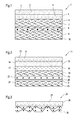
- FIG. 1 shows a first embodiment of a fabric according to the invention designed as press felt 1.
- the press felt 1 has an outer upper and can be brought into contact with the paper web nonwoven layer 2 with splittable fibers 3, which are already partially split and partially unsplit.
- splittable fibers 3 which are already partially split and partially unsplit.
- only the parts of the splittable fibers 3 which are arranged in the region of the surface of the nonwoven layer 2 which can be brought into contact with the paper web are essentially split into fiber segments.
- the fibers 3 of the nonwoven layer 2 have a circular cross-sectional shape in the unplated state and are designed such that they can be split into 32 fiber segments.
- fiber segments of the same cross-sectional shape this is pie slice shaped, and surface formed.
- the splittable fibers 3 comprise fiber segments which are formed from mutually different materials. In concrete terms, this means that the segments which adjoin one another flat in the unsplit state of the fiber 3 are formed alternately from PA and PE, so that they form an interface with one another.
- the adjoining fiber segments are joined together by means of adhesion forces.
- a high-pressure water jet is preferably used.
- the splittable fibers 3 used in the nonwoven layer 2 have a titer of about 2 dtex in an unsplit state, so that they could be processed into the nonwoven 2 with a carding process.
- a titer of about 2 dtex in an unsplit state so that they could be processed into the nonwoven 2 with a carding process.
- the press felt 1 further comprises a fine inner nonwoven layer 4, which is arranged below the nonwoven layer 2 in FIG.
- the nonwoven layer 4 is formed only of unspittable fibers 5 with a titre of 10-20 dtex.
- a coarse nonwoven layer 6 is arranged with also unsplittbaren fibers 7 with a titer of 50-300detx.
- a woven structure 8 is provided in the press felt 1, which is arranged between the coarse nonwoven layer 6 and a further coarse nonwoven layer 9 is.
- the coarse nonwoven layer 9 is an outer layer of the press felt 1 and comprises unscitable fibers 10 having a titer of 50-300 detx.
- FIG. 2 shows a second embodiment of a fabric according to the invention designed as press felt 11.
- the press felt 11 has an outer upper and can be brought into contact with the paper web nonwoven layer 12 with splittable fibers 13, which are already partially split sections and unsplit sections.
- the nonwoven layer 12 essentially corresponds to the nonwoven layer 2 from FIG. 1.
- the press felt 11 further comprises a fine inner nonwoven layer 14, which is arranged below the nonwoven layer 12 in FIG.
- the nonwoven layer 14 is formed only of unspittable fibers 15 having a denier of 10-20 dtex.
- the splittable fibers 17 used in the nonwoven layer 16 have a titer of about 2 dtex in the unplated state and can be split into 4 fiber segments with the same cross-sectional shape and area.
- the splittable fibers 17 were thus also processed by a carding process to the web 16. By splitting into four equal parts fiber segments are obtained with a titer of 0.5 dtex, whereby the nonwoven layer 16 receives a fine pore structure and can be used as an anti-rewet layer.
- the fibers 13 of the outer nonwoven layer 12 are more easily split than the fibers 17 of the inner nonwoven layer 16.
- the chippability can be adjusted, for example, by the strength of the adhesion forces prevailing between the unsplit fiber segments.
- the splittable fibers 13 of the nonwoven layer 12 have at least one fiber segment provided with a hydrophobic coating.
- a coarse nonwoven layer 18 analogous to the nonwoven layer 6 of FIG. 1 is disposed with unsplittable fibers 19 with a titre of 50-300 detx.
- a bidirectional scrim 20 is provided in the press felt 11, which is formed from a unidirectional thread assembly 21 and a further extending at right angles further unidirectional thread assembly 22.
- the carrier structure 20 is arranged between the coarse nonwoven layer 18 and a further coarse nonwoven layer 23.
- the coarse nonwoven layer 23 is an outer layer of the press felt 11 and comprises unscitable fibers 24 having a denier of 50-300 detx.
- FIG. 3 shows a fabric according to the invention formed as a forming fabric 25 with a nonwoven layer 26 with splittable fibers 27, which are split in each case into 32 fiber segments.
- the fibers 27 have an initial titer of 2 detx.
- the fibers 27 of the nonwoven layer 26 differ from the fibers of the nonwoven layers 2 and 12 in that they comprise fiber segments of PET instead of PA. Furthermore, the fiber segments of the fibers 27 of the nonwoven layer 26 have a cross-sectional shape without edges, whereas those of the nonwoven layers 2 and 12 are rather flat.
- the forming fabric 25 further comprises a woven support structure 28.
- the nonwoven layer 26 is further compressed more in the region of the elevations of the woven support structure 28 than in regions of the support structure 28 without elevations, whereby a flat paper-side surface of the forming fabric 25 is formed.
- FIG. 4 shows a section of a paper machine 29 in which the method according to the invention for conditioning a circulating covering 30 is carried out.
- the fabric 30 has an outer nonwoven layer 31, the surface of which can be brought into contact with a paper web 34.
- the conditioning is carried out, after which the paper web 34 has been separated from the clothing 30 and is continued on another clothing 35.
- the nonwoven layer 31 of the fabric to be conditioned comprises splittable fibers.
- the outer nonwoven layer 31 is subjected to a pressurized jet of water 32 formed from a spray tube 33 such that the splittable fibers are split at least in sections along their longitudinal extent to form elongated fiber segments.
- the method is preferably carried out such that essentially only the parts of the splittable fibers arranged in the region of the surface of the nonwoven layer 31 are split into fiber segments.
- the fibers of the nonwoven layer 31 whose split fiber segments have been removed by abrasion during the production or further processing of the material web can be regenerated by creating new split fiber segments.
- a regeneration of the surface of the clothing 30 coming into contact with the paper web 34 takes place, as a result of which the performance and service life of the clothing 30 according to the invention is markedly increased compared to conditioning processes in the case of known clothing.
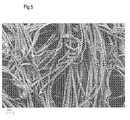
- FIG. 5 shows an electron micrograph of a plurality of split fibers, such as are used in a nonwoven layer of a fabric according to the invention.
- the fibers shown are those which can be split into 32 fiber segments.
- the individual segments have a width of about 5 microns, as can be seen from the scale below.
- the unsplit fibers have a circular cross-sectional shape. By splitting 32 Segments generated with the same pie-shaped cross-sections.
- FIG. 6 shows a splittable fiber according to the invention in the unsplit state (FIG. 6a) and in the split state (FIG. 6b).
- the splittable fiber 35 according to the invention shown in FIG. 6 is formed by a multiplicity of fiber segments 36a-36h, which are connected to one another in the un-split state over substantially the entire longitudinal extent thereof in order to form the splittable fiber 35.
- all the fiber segments 36a-36h are formed of the same material. Furthermore, the fiber segments 36a-36h have at least partially mutually different cross-sectional areas.
- the fiber segments 36a-36h are connected to each other by a sheath 37.
- the order hüllung 37 can be solved in sections, whereby the fiber 35 is converted into a "partially" split state, as shown in Fig. 6b state.
- the fiber segments 36a-36h are loosely arranged along a common section 38 extending along the length of the fiber 35 and are still connected to each other along the envelope 35 along a further common section 39 of the fiber 35 adjoining in the longitudinal direction of the fiber ,
Landscapes
- Nonwoven Fabrics (AREA)
- Paper (AREA)
- Multicomponent Fibers (AREA)
Applications Claiming Priority (2)
| Application Number | Priority Date | Filing Date | Title |
|---|---|---|---|
| DE200510021480 DE102005021480A1 (de) | 2005-05-10 | 2005-05-10 | PMC mit splittbaren Fasern |
| DE200510038534 DE102005038534A1 (de) | 2005-08-16 | 2005-08-16 | PMC mit splittbaren Fasern |
Publications (2)
| Publication Number | Publication Date |
|---|---|
| EP1722034A1 true EP1722034A1 (fr) | 2006-11-15 |
| EP1722034B1 EP1722034B1 (fr) | 2009-11-11 |
Family
ID=36809242
Family Applications (1)
| Application Number | Title | Priority Date | Filing Date |
|---|---|---|---|
| EP20060113046 Expired - Lifetime EP1722034B1 (fr) | 2005-05-10 | 2006-04-25 | Toile ou feutre comprenant des fibres qui peuvent se scinder |
Country Status (6)
| Country | Link |
|---|---|
| US (1) | US7523531B2 (fr) |
| EP (1) | EP1722034B1 (fr) |
| AT (1) | ATE448357T1 (fr) |
| DE (1) | DE502006005315D1 (fr) |
| ES (1) | ES2336694T3 (fr) |
| PT (1) | PT1722034E (fr) |
Cited By (1)
| Publication number | Priority date | Publication date | Assignee | Title |
|---|---|---|---|---|
| EP2160495B1 (fr) | 2007-06-15 | 2015-12-02 | Voith Patent GmbH | Feutre de presse |
Families Citing this family (14)
| Publication number | Priority date | Publication date | Assignee | Title |
|---|---|---|---|---|
| US8513147B2 (en) | 2003-06-19 | 2013-08-20 | Eastman Chemical Company | Nonwovens produced from multicomponent fibers |
| US20040260034A1 (en) | 2003-06-19 | 2004-12-23 | Haile William Alston | Water-dispersible fibers and fibrous articles |
| US7892993B2 (en) | 2003-06-19 | 2011-02-22 | Eastman Chemical Company | Water-dispersible and multicomponent fibers from sulfopolyesters |
| US8512519B2 (en) | 2009-04-24 | 2013-08-20 | Eastman Chemical Company | Sulfopolyesters for paper strength and process |
| US9273417B2 (en) | 2010-10-21 | 2016-03-01 | Eastman Chemical Company | Wet-Laid process to produce a bound nonwoven article |
| US20120098161A1 (en) * | 2010-10-25 | 2012-04-26 | Hans Peter Breuer | Felt for forming fiber cement articles with base fabric with parallel md yarns |
| US20130123409A1 (en) * | 2011-11-11 | 2013-05-16 | Eastman Chemical Company | Solvent-borne products containing short-cut microfibers |
| US8840757B2 (en) | 2012-01-31 | 2014-09-23 | Eastman Chemical Company | Processes to produce short cut microfibers |
| US9303357B2 (en) | 2013-04-19 | 2016-04-05 | Eastman Chemical Company | Paper and nonwoven articles comprising synthetic microfiber binders |
| US9598802B2 (en) | 2013-12-17 | 2017-03-21 | Eastman Chemical Company | Ultrafiltration process for producing a sulfopolyester concentrate |
| US9605126B2 (en) | 2013-12-17 | 2017-03-28 | Eastman Chemical Company | Ultrafiltration process for the recovery of concentrated sulfopolyester dispersion |
| DE102014002232B4 (de) * | 2014-02-21 | 2019-10-02 | Carl Freudenberg Kg | Mikrofaser-Verbundvliesstoff |
| DE102014002231B4 (de) * | 2014-02-21 | 2018-12-20 | Carl Freudenberg Kg | Reinigungstuch, Verfahren zur Herstellung eines Reinigungstuchs und dessen Verwendung |
| DE102023119892A1 (de) * | 2023-07-27 | 2025-01-30 | Voith Patent Gmbh | Verfahren und Filz |
Citations (6)
| Publication number | Priority date | Publication date | Assignee | Title |
|---|---|---|---|---|
| JPH0533218A (ja) * | 1991-07-30 | 1993-02-09 | Chisso Corp | ポリオレフイン系分割繊維 |
| WO1999032715A1 (fr) | 1997-12-18 | 1999-07-01 | Voith Fabrics Heidenheim Gmbh & Co. Kg | Toile de machine a papier |
| US6531418B1 (en) * | 1996-11-08 | 2003-03-11 | Voith Fabrics Heidenheim Gmbh & Co. Kg | Papermachine clothing |
| EP1293602A1 (fr) * | 2001-09-14 | 2003-03-19 | Ichikawa Co.,Ltd. | Feutre de presse pour papeterie |
| US20040033748A1 (en) * | 2000-10-18 | 2004-02-19 | Crook Robert L. | Papermachine clothing |
| US20040151871A1 (en) * | 2003-01-31 | 2004-08-05 | Dieter Telgmann | Paper machine clothing, especially press felt |
Family Cites Families (5)
| Publication number | Priority date | Publication date | Assignee | Title |
|---|---|---|---|---|
| JP3187942B2 (ja) * | 1992-05-23 | 2001-07-16 | 日本フエルト株式会社 | 抄紙用フエルト及びその製造方法 |
| US5620565A (en) * | 1994-06-29 | 1997-04-15 | Kimberly-Clark Corporation | Production of soft paper products from high and low coarseness fibers |
| US5853628A (en) * | 1996-09-12 | 1998-12-29 | Kimberly-Clark Worldwide, Inc. | Method of forming nonwoven fabric having a pore size gradient |
| US6444312B1 (en) * | 1999-12-08 | 2002-09-03 | Fiber Innovation Technology, Inc. | Splittable multicomponent fibers containing a polyacrylonitrile polymer component |
| US20030203695A1 (en) * | 2002-04-30 | 2003-10-30 | Polanco Braulio Arturo | Splittable multicomponent fiber and fabrics therefrom |
-
2006
- 2006-04-25 EP EP20060113046 patent/EP1722034B1/fr not_active Expired - Lifetime
- 2006-04-25 PT PT06113046T patent/PT1722034E/pt unknown
- 2006-04-25 AT AT06113046T patent/ATE448357T1/de active
- 2006-04-25 ES ES06113046T patent/ES2336694T3/es not_active Expired - Lifetime
- 2006-04-25 DE DE200650005315 patent/DE502006005315D1/de not_active Expired - Lifetime
- 2006-05-09 US US11/431,308 patent/US7523531B2/en not_active Expired - Fee Related
Patent Citations (6)
| Publication number | Priority date | Publication date | Assignee | Title |
|---|---|---|---|---|
| JPH0533218A (ja) * | 1991-07-30 | 1993-02-09 | Chisso Corp | ポリオレフイン系分割繊維 |
| US6531418B1 (en) * | 1996-11-08 | 2003-03-11 | Voith Fabrics Heidenheim Gmbh & Co. Kg | Papermachine clothing |
| WO1999032715A1 (fr) | 1997-12-18 | 1999-07-01 | Voith Fabrics Heidenheim Gmbh & Co. Kg | Toile de machine a papier |
| US20040033748A1 (en) * | 2000-10-18 | 2004-02-19 | Crook Robert L. | Papermachine clothing |
| EP1293602A1 (fr) * | 2001-09-14 | 2003-03-19 | Ichikawa Co.,Ltd. | Feutre de presse pour papeterie |
| US20040151871A1 (en) * | 2003-01-31 | 2004-08-05 | Dieter Telgmann | Paper machine clothing, especially press felt |
Non-Patent Citations (1)
| Title |
|---|
| PATENT ABSTRACTS OF JAPAN vol. 017, no. 333 (C - 1074) 24 June 1993 (1993-06-24) * |
Cited By (1)
| Publication number | Priority date | Publication date | Assignee | Title |
|---|---|---|---|---|
| EP2160495B1 (fr) | 2007-06-15 | 2015-12-02 | Voith Patent GmbH | Feutre de presse |
Also Published As
| Publication number | Publication date |
|---|---|
| US20060281383A1 (en) | 2006-12-14 |
| ES2336694T3 (es) | 2010-04-15 |
| EP1722034B1 (fr) | 2009-11-11 |
| US7523531B2 (en) | 2009-04-28 |
| DE502006005315D1 (de) | 2009-12-24 |
| ATE448357T1 (de) | 2009-11-15 |
| PT1722034E (pt) | 2010-02-09 |
Similar Documents
| Publication | Publication Date | Title |
|---|---|---|
| DE60107223T2 (de) | Herstellung von fasermatte aus gehackten strängen | |
| EP1722034B1 (fr) | Toile ou feutre comprenant des fibres qui peuvent se scinder | |
| DE3390079C2 (de) | Mehrlagiges Wischtuch | |
| DE60121015T2 (de) | Pressfilz für papiermaschine | |
| DE60217035T2 (de) | Pressfilz für die Papierherstellung | |
| EP4087967B1 (fr) | Procédé de fabrication d'une nappe de tissu non-tissé composite et dispositif pour la fabrication d'une nappe de tissu non-tissé composite | |
| DE3614949A1 (de) | Materialbahn, insbesondere fuer filterzwecke, verfahren zu deren herstellung sowie deren verwendung | |
| EP2678472B1 (fr) | Section de presse d'une machine à fabriquer une bande de matière fibreuse et procédé de fabrication d'une bande de matière fibreuse | |
| EP1397553A1 (fr) | Procede et machine permettant de produire des bandes de matiere fibreuse | |
| DE2749043A1 (de) | Papiermaschinenfilz | |
| WO2023110220A1 (fr) | Structure de base, vêtement et procédé de production | |
| DE60121810T2 (de) | Verfahren zur herstellung eines pressfilzes sowie pressfilz | |
| DE69902958T2 (de) | Mehrschichtiges poröses Gewebe | |
| DE102007028365A1 (de) | Pressfilz | |
| DE1919816B2 (de) | Filterkörper und dessen Anwendung | |
| EP1934039B1 (fr) | Stratifie de fibres stable et procede et systeme pour produire ce stratifie | |
| DE102018107075A1 (de) | Bespannung für eine Maschine zur Herstellung einer Faserstoffbahn und Verfahren zur Herstellung einer solchen Bespannung | |
| DE102005021480A1 (de) | PMC mit splittbaren Fasern | |
| DE602004003402T2 (de) | Pressfilz zur Papierherstellung | |
| DE102005038534A1 (de) | PMC mit splittbaren Fasern | |
| WO2005039736A1 (fr) | Materiau filtrant et procede de production correspondant | |
| EP0399301B1 (fr) | Feutre pour machine à papier | |
| DE102019111441A1 (de) | Bespannung und Verwendung in einer Tissuemaschine | |
| DE102024100755A1 (de) | Verfahren und Anlage zur Herstellung eines zweilagigen Vlieses | |
| DE102024127567A1 (de) | Verfahren und Maschine zur Herstellung einer trockengelegten Faserstoffbahn |
Legal Events
| Date | Code | Title | Description |
|---|---|---|---|
| PUAI | Public reference made under article 153(3) epc to a published international application that has entered the european phase |
Free format text: ORIGINAL CODE: 0009012 |
|
| AK | Designated contracting states |
Kind code of ref document: A1 Designated state(s): AT BE BG CH CY CZ DE DK EE ES FI FR GB GR HU IE IS IT LI LT LU LV MC NL PL PT RO SE SI SK TR |
|
| AX | Request for extension of the european patent |
Extension state: AL BA HR MK YU |
|
| AKX | Designation fees paid | ||
| 17P | Request for examination filed |
Effective date: 20070703 |
|
| RBV | Designated contracting states (corrected) |
Designated state(s): AT BE BG CH CY CZ DE DK EE ES FI FR GB GR HU IE IS IT LI LT LU LV MC NL PL PT RO SE SI SK TR |
|
| 17Q | First examination report despatched |
Effective date: 20070807 |
|
| GRAP | Despatch of communication of intention to grant a patent |
Free format text: ORIGINAL CODE: EPIDOSNIGR1 |
|
| GRAS | Grant fee paid |
Free format text: ORIGINAL CODE: EPIDOSNIGR3 |
|
| GRAA | (expected) grant |
Free format text: ORIGINAL CODE: 0009210 |
|
| AK | Designated contracting states |
Kind code of ref document: B1 Designated state(s): AT BE BG CH CY CZ DE DK EE ES FI FR GB GR HU IE IS IT LI LT LU LV MC NL PL PT RO SE SI SK TR |
|
| REG | Reference to a national code |
Ref country code: GB Ref legal event code: FG4D Free format text: NOT ENGLISH |
|
| REG | Reference to a national code |
Ref country code: CH Ref legal event code: EP |
|
| REG | Reference to a national code |
Ref country code: IE Ref legal event code: FG4D |
|
| REF | Corresponds to: |
Ref document number: 502006005315 Country of ref document: DE Date of ref document: 20091224 Kind code of ref document: P |
|
| REG | Reference to a national code |
Ref country code: PT Ref legal event code: SC4A Free format text: AVAILABILITY OF NATIONAL TRANSLATION Effective date: 20100202 |
|
| REG | Reference to a national code |
Ref country code: SE Ref legal event code: TRGR |
|
| REG | Reference to a national code |
Ref country code: ES Ref legal event code: FG2A Ref document number: 2336694 Country of ref document: ES Kind code of ref document: T3 |
|
| LTIE | Lt: invalidation of european patent or patent extension |
Effective date: 20091111 |
|
| PG25 | Lapsed in a contracting state [announced via postgrant information from national office to epo] |
Ref country code: LT Free format text: LAPSE BECAUSE OF FAILURE TO SUBMIT A TRANSLATION OF THE DESCRIPTION OR TO PAY THE FEE WITHIN THE PRESCRIBED TIME-LIMIT Effective date: 20091111 Ref country code: IS Free format text: LAPSE BECAUSE OF FAILURE TO SUBMIT A TRANSLATION OF THE DESCRIPTION OR TO PAY THE FEE WITHIN THE PRESCRIBED TIME-LIMIT Effective date: 20100311 |
|
| PG25 | Lapsed in a contracting state [announced via postgrant information from national office to epo] |
Ref country code: SI Free format text: LAPSE BECAUSE OF FAILURE TO SUBMIT A TRANSLATION OF THE DESCRIPTION OR TO PAY THE FEE WITHIN THE PRESCRIBED TIME-LIMIT Effective date: 20091111 Ref country code: PL Free format text: LAPSE BECAUSE OF FAILURE TO SUBMIT A TRANSLATION OF THE DESCRIPTION OR TO PAY THE FEE WITHIN THE PRESCRIBED TIME-LIMIT Effective date: 20091111 Ref country code: CY Free format text: LAPSE BECAUSE OF FAILURE TO SUBMIT A TRANSLATION OF THE DESCRIPTION OR TO PAY THE FEE WITHIN THE PRESCRIBED TIME-LIMIT Effective date: 20091111 Ref country code: LV Free format text: LAPSE BECAUSE OF FAILURE TO SUBMIT A TRANSLATION OF THE DESCRIPTION OR TO PAY THE FEE WITHIN THE PRESCRIBED TIME-LIMIT Effective date: 20091111 |
|
| REG | Reference to a national code |
Ref country code: IE Ref legal event code: FD4D |
|
| PG25 | Lapsed in a contracting state [announced via postgrant information from national office to epo] |
Ref country code: IE Free format text: LAPSE BECAUSE OF FAILURE TO SUBMIT A TRANSLATION OF THE DESCRIPTION OR TO PAY THE FEE WITHIN THE PRESCRIBED TIME-LIMIT Effective date: 20091111 Ref country code: EE Free format text: LAPSE BECAUSE OF FAILURE TO SUBMIT A TRANSLATION OF THE DESCRIPTION OR TO PAY THE FEE WITHIN THE PRESCRIBED TIME-LIMIT Effective date: 20091111 Ref country code: BG Free format text: LAPSE BECAUSE OF FAILURE TO SUBMIT A TRANSLATION OF THE DESCRIPTION OR TO PAY THE FEE WITHIN THE PRESCRIBED TIME-LIMIT Effective date: 20100211 Ref country code: DK Free format text: LAPSE BECAUSE OF FAILURE TO SUBMIT A TRANSLATION OF THE DESCRIPTION OR TO PAY THE FEE WITHIN THE PRESCRIBED TIME-LIMIT Effective date: 20091111 Ref country code: RO Free format text: LAPSE BECAUSE OF FAILURE TO SUBMIT A TRANSLATION OF THE DESCRIPTION OR TO PAY THE FEE WITHIN THE PRESCRIBED TIME-LIMIT Effective date: 20091111 |
|
| PG25 | Lapsed in a contracting state [announced via postgrant information from national office to epo] |
Ref country code: CZ Free format text: LAPSE BECAUSE OF FAILURE TO SUBMIT A TRANSLATION OF THE DESCRIPTION OR TO PAY THE FEE WITHIN THE PRESCRIBED TIME-LIMIT Effective date: 20091111 Ref country code: SK Free format text: LAPSE BECAUSE OF FAILURE TO SUBMIT A TRANSLATION OF THE DESCRIPTION OR TO PAY THE FEE WITHIN THE PRESCRIBED TIME-LIMIT Effective date: 20091111 |
|
| PLBE | No opposition filed within time limit |
Free format text: ORIGINAL CODE: 0009261 |
|
| STAA | Information on the status of an ep patent application or granted ep patent |
Free format text: STATUS: NO OPPOSITION FILED WITHIN TIME LIMIT |
|
| 26N | No opposition filed |
Effective date: 20100812 |
|
| PG25 | Lapsed in a contracting state [announced via postgrant information from national office to epo] |
Ref country code: GR Free format text: LAPSE BECAUSE OF FAILURE TO SUBMIT A TRANSLATION OF THE DESCRIPTION OR TO PAY THE FEE WITHIN THE PRESCRIBED TIME-LIMIT Effective date: 20100212 |
|
| PG25 | Lapsed in a contracting state [announced via postgrant information from national office to epo] |
Ref country code: MC Free format text: LAPSE BECAUSE OF NON-PAYMENT OF DUE FEES Effective date: 20100430 |
|
| REG | Reference to a national code |
Ref country code: CH Ref legal event code: PL |
|
| PG25 | Lapsed in a contracting state [announced via postgrant information from national office to epo] |
Ref country code: CH Free format text: LAPSE BECAUSE OF NON-PAYMENT OF DUE FEES Effective date: 20100430 Ref country code: LI Free format text: LAPSE BECAUSE OF NON-PAYMENT OF DUE FEES Effective date: 20100430 |
|
| PGFP | Annual fee paid to national office [announced via postgrant information from national office to epo] |
Ref country code: ES Payment date: 20110418 Year of fee payment: 6 Ref country code: DE Payment date: 20110421 Year of fee payment: 6 Ref country code: FR Payment date: 20110510 Year of fee payment: 6 Ref country code: SE Payment date: 20110414 Year of fee payment: 6 Ref country code: PT Payment date: 20110419 Year of fee payment: 6 |
|
| PGFP | Annual fee paid to national office [announced via postgrant information from national office to epo] |
Ref country code: NL Payment date: 20110426 Year of fee payment: 6 Ref country code: GB Payment date: 20110421 Year of fee payment: 6 Ref country code: AT Payment date: 20110414 Year of fee payment: 6 Ref country code: FI Payment date: 20110414 Year of fee payment: 6 Ref country code: BE Payment date: 20110414 Year of fee payment: 6 |
|
| PGFP | Annual fee paid to national office [announced via postgrant information from national office to epo] |
Ref country code: IT Payment date: 20110419 Year of fee payment: 6 |
|
| PG25 | Lapsed in a contracting state [announced via postgrant information from national office to epo] |
Ref country code: LU Free format text: LAPSE BECAUSE OF NON-PAYMENT OF DUE FEES Effective date: 20100425 Ref country code: HU Free format text: LAPSE BECAUSE OF FAILURE TO SUBMIT A TRANSLATION OF THE DESCRIPTION OR TO PAY THE FEE WITHIN THE PRESCRIBED TIME-LIMIT Effective date: 20100512 |
|
| BERE | Be: lapsed |
Owner name: VOITH PATENT G.M.B.H. Effective date: 20120430 |
|
| PG25 | Lapsed in a contracting state [announced via postgrant information from national office to epo] |
Ref country code: TR Free format text: LAPSE BECAUSE OF FAILURE TO SUBMIT A TRANSLATION OF THE DESCRIPTION OR TO PAY THE FEE WITHIN THE PRESCRIBED TIME-LIMIT Effective date: 20091111 |
|
| REG | Reference to a national code |
Ref country code: PT Ref legal event code: MM4A Free format text: LAPSE DUE TO NON-PAYMENT OF FEES Effective date: 20121025 |
|
| REG | Reference to a national code |
Ref country code: NL Ref legal event code: V1 Effective date: 20121101 |
|
| REG | Reference to a national code |
Ref country code: SE Ref legal event code: EUG |
|
| REG | Reference to a national code |
Ref country code: AT Ref legal event code: MM01 Ref document number: 448357 Country of ref document: AT Kind code of ref document: T Effective date: 20120425 |
|
| GBPC | Gb: european patent ceased through non-payment of renewal fee |
Effective date: 20120425 |
|
| REG | Reference to a national code |
Ref country code: FR Ref legal event code: ST Effective date: 20121228 |
|
| PG25 | Lapsed in a contracting state [announced via postgrant information from national office to epo] |
Ref country code: GB Free format text: LAPSE BECAUSE OF NON-PAYMENT OF DUE FEES Effective date: 20120425 Ref country code: AT Free format text: LAPSE BECAUSE OF NON-PAYMENT OF DUE FEES Effective date: 20120425 Ref country code: FI Free format text: LAPSE BECAUSE OF NON-PAYMENT OF DUE FEES Effective date: 20120425 Ref country code: BE Free format text: LAPSE BECAUSE OF NON-PAYMENT OF DUE FEES Effective date: 20120430 |
|
| REG | Reference to a national code |
Ref country code: DE Ref legal event code: R119 Ref document number: 502006005315 Country of ref document: DE Effective date: 20121101 |
|
| PG25 | Lapsed in a contracting state [announced via postgrant information from national office to epo] |
Ref country code: PT Free format text: LAPSE BECAUSE OF NON-PAYMENT OF DUE FEES Effective date: 20121025 Ref country code: SE Free format text: LAPSE BECAUSE OF NON-PAYMENT OF DUE FEES Effective date: 20120426 Ref country code: FR Free format text: LAPSE BECAUSE OF NON-PAYMENT OF DUE FEES Effective date: 20120430 Ref country code: IT Free format text: LAPSE BECAUSE OF NON-PAYMENT OF DUE FEES Effective date: 20120425 |
|
| PG25 | Lapsed in a contracting state [announced via postgrant information from national office to epo] |
Ref country code: NL Free format text: LAPSE BECAUSE OF NON-PAYMENT OF DUE FEES Effective date: 20121101 |
|
| REG | Reference to a national code |
Ref country code: ES Ref legal event code: FD2A Effective date: 20131022 |
|
| PG25 | Lapsed in a contracting state [announced via postgrant information from national office to epo] |
Ref country code: ES Free format text: LAPSE BECAUSE OF NON-PAYMENT OF DUE FEES Effective date: 20120426 |
|
| PG25 | Lapsed in a contracting state [announced via postgrant information from national office to epo] |
Ref country code: DE Free format text: LAPSE BECAUSE OF NON-PAYMENT OF DUE FEES Effective date: 20121101 |