EP1722428A1 - Cellule de pile secondaire au lithium et electrode pour utilisation dans ceux-ci - Google Patents
Cellule de pile secondaire au lithium et electrode pour utilisation dans ceux-ci Download PDFInfo
- Publication number
- EP1722428A1 EP1722428A1 EP05010498A EP05010498A EP1722428A1 EP 1722428 A1 EP1722428 A1 EP 1722428A1 EP 05010498 A EP05010498 A EP 05010498A EP 05010498 A EP05010498 A EP 05010498A EP 1722428 A1 EP1722428 A1 EP 1722428A1
- Authority
- EP
- European Patent Office
- Prior art keywords
- particles
- electrode
- carbon
- electrode according
- intensity
- Prior art date
- Legal status (The legal status is an assumption and is not a legal conclusion. Google has not performed a legal analysis and makes no representation as to the accuracy of the status listed.)
- Withdrawn
Links
- 229910052744 lithium Inorganic materials 0.000 title claims description 18
- WHXSMMKQMYFTQS-UHFFFAOYSA-N Lithium Chemical compound [Li] WHXSMMKQMYFTQS-UHFFFAOYSA-N 0.000 title claims description 15
- 239000002245 particle Substances 0.000 claims abstract description 72
- 238000002441 X-ray diffraction Methods 0.000 claims abstract description 14
- 238000000034 method Methods 0.000 claims abstract description 14
- 230000008569 process Effects 0.000 claims abstract description 13
- 229910001416 lithium ion Inorganic materials 0.000 claims abstract description 11
- 238000004519 manufacturing process Methods 0.000 claims abstract description 11
- HBBGRARXTFLTSG-UHFFFAOYSA-N Lithium ion Chemical compound [Li+] HBBGRARXTFLTSG-UHFFFAOYSA-N 0.000 claims abstract description 8
- 229910001305 LiMPO4 Inorganic materials 0.000 claims abstract description 7
- 229910052751 metal Inorganic materials 0.000 claims abstract description 6
- 239000002184 metal Substances 0.000 claims abstract description 6
- 150000001875 compounds Chemical class 0.000 claims abstract description 5
- 229910052742 iron Inorganic materials 0.000 claims abstract description 5
- 229910052748 manganese Inorganic materials 0.000 claims abstract description 5
- 229910052759 nickel Inorganic materials 0.000 claims abstract description 5
- 229910052719 titanium Inorganic materials 0.000 claims abstract description 4
- OKTJSMMVPCPJKN-UHFFFAOYSA-N Carbon Chemical compound [C] OKTJSMMVPCPJKN-UHFFFAOYSA-N 0.000 claims description 24
- 229910052799 carbon Inorganic materials 0.000 claims description 21
- 229910052493 LiFePO4 Inorganic materials 0.000 claims description 18
- 239000011248 coating agent Substances 0.000 claims description 14
- 238000000576 coating method Methods 0.000 claims description 14
- 239000011230 binding agent Substances 0.000 claims description 11
- 239000002002 slurry Substances 0.000 claims description 8
- 239000000758 substrate Substances 0.000 claims description 8
- FGUUSXIOTUKUDN-IBGZPJMESA-N C1(=CC=CC=C1)N1C2=C(NC([C@H](C1)NC=1OC(=NN=1)C1=CC=CC=C1)=O)C=CC=C2 Chemical compound C1(=CC=CC=C1)N1C2=C(NC([C@H](C1)NC=1OC(=NN=1)C1=CC=CC=C1)=O)C=CC=C2 FGUUSXIOTUKUDN-IBGZPJMESA-N 0.000 claims description 3
- 150000002500 ions Chemical group 0.000 claims description 3
- 238000002156 mixing Methods 0.000 claims description 3
- 238000001035 drying Methods 0.000 claims description 2
- 239000003792 electrolyte Substances 0.000 claims description 2
- 230000001788 irregular Effects 0.000 claims description 2
- 239000002904 solvent Substances 0.000 claims description 2
- 238000000280 densification Methods 0.000 description 20
- 230000000694 effects Effects 0.000 description 17
- 239000013078 crystal Substances 0.000 description 11
- 230000001965 increasing effect Effects 0.000 description 7
- 238000009792 diffusion process Methods 0.000 description 6
- 239000000463 material Substances 0.000 description 6
- 229910032387 LiCoO2 Inorganic materials 0.000 description 5
- -1 LiFe1-xM'yM"zM"'uPO4 Chemical class 0.000 description 5
- 239000011888 foil Substances 0.000 description 5
- 229910019142 PO4 Inorganic materials 0.000 description 4
- XEEYBQQBJWHFJM-UHFFFAOYSA-N iron Substances [Fe] XEEYBQQBJWHFJM-UHFFFAOYSA-N 0.000 description 4
- 238000005259 measurement Methods 0.000 description 4
- 239000010450 olivine Substances 0.000 description 4
- 229910052609 olivine Inorganic materials 0.000 description 4
- 238000012856 packing Methods 0.000 description 4
- 238000010586 diagram Methods 0.000 description 3
- 239000000203 mixture Substances 0.000 description 3
- 235000021317 phosphate Nutrition 0.000 description 3
- 238000012546 transfer Methods 0.000 description 3
- KMTRUDSVKNLOMY-UHFFFAOYSA-N Ethylene carbonate Chemical compound O=C1OCCO1 KMTRUDSVKNLOMY-UHFFFAOYSA-N 0.000 description 2
- 239000011149 active material Substances 0.000 description 2
- 239000004411 aluminium Substances 0.000 description 2
- 229910052782 aluminium Inorganic materials 0.000 description 2
- XAGFODPZIPBFFR-UHFFFAOYSA-N aluminium Chemical compound [Al] XAGFODPZIPBFFR-UHFFFAOYSA-N 0.000 description 2
- 230000008901 benefit Effects 0.000 description 2
- 239000003795 chemical substances by application Substances 0.000 description 2
- 230000001351 cycling effect Effects 0.000 description 2
- 239000010439 graphite Substances 0.000 description 2
- 229910002804 graphite Inorganic materials 0.000 description 2
- 229910044991 metal oxide Inorganic materials 0.000 description 2
- 150000004706 metal oxides Chemical class 0.000 description 2
- NBIIXXVUZAFLBC-UHFFFAOYSA-K phosphate Chemical compound [O-]P([O-])([O-])=O NBIIXXVUZAFLBC-UHFFFAOYSA-K 0.000 description 2
- 239000010452 phosphate Substances 0.000 description 2
- 125000002467 phosphate group Chemical group [H]OP(=O)(O[H])O[*] 0.000 description 2
- 229920001343 polytetrafluoroethylene Polymers 0.000 description 2
- 239000004810 polytetrafluoroethylene Substances 0.000 description 2
- 229920002981 polyvinylidene fluoride Polymers 0.000 description 2
- 239000000843 powder Substances 0.000 description 2
- 239000007787 solid Substances 0.000 description 2
- OIFBSDVPJOWBCH-UHFFFAOYSA-N Diethyl carbonate Chemical compound CCOC(=O)OCC OIFBSDVPJOWBCH-UHFFFAOYSA-N 0.000 description 1
- 229910000668 LiMnPO4 Inorganic materials 0.000 description 1
- 229910013084 LiNiPO4 Inorganic materials 0.000 description 1
- 229910001290 LiPF6 Inorganic materials 0.000 description 1
- 229910002097 Lithium manganese(III,IV) oxide Inorganic materials 0.000 description 1
- SECXISVLQFMRJM-UHFFFAOYSA-N N-Methylpyrrolidone Chemical compound CN1CCCC1=O SECXISVLQFMRJM-UHFFFAOYSA-N 0.000 description 1
- OAICVXFJPJFONN-UHFFFAOYSA-N Phosphorus Chemical compound [P] OAICVXFJPJFONN-UHFFFAOYSA-N 0.000 description 1
- 239000004698 Polyethylene Substances 0.000 description 1
- 239000006230 acetylene black Substances 0.000 description 1
- QVGXLLKOCUKJST-UHFFFAOYSA-N atomic oxygen Chemical compound [O] QVGXLLKOCUKJST-UHFFFAOYSA-N 0.000 description 1
- 230000009286 beneficial effect Effects 0.000 description 1
- 239000006229 carbon black Substances 0.000 description 1
- 239000010406 cathode material Substances 0.000 description 1
- 230000008859 change Effects 0.000 description 1
- 229920001577 copolymer Polymers 0.000 description 1
- 229910052802 copper Inorganic materials 0.000 description 1
- 238000002425 crystallisation Methods 0.000 description 1
- 230000007423 decrease Effects 0.000 description 1
- 230000003247 decreasing effect Effects 0.000 description 1
- 238000009826 distribution Methods 0.000 description 1
- 239000007772 electrode material Substances 0.000 description 1
- 230000008570 general process Effects 0.000 description 1
- 239000012535 impurity Substances 0.000 description 1
- 230000001939 inductive effect Effects 0.000 description 1
- 229910052500 inorganic mineral Inorganic materials 0.000 description 1
- 230000010220 ion permeability Effects 0.000 description 1
- GELKBWJHTRAYNV-UHFFFAOYSA-K lithium iron phosphate Chemical compound [Li+].[Fe+2].[O-]P([O-])([O-])=O GELKBWJHTRAYNV-UHFFFAOYSA-K 0.000 description 1
- 150000002739 metals Chemical class 0.000 description 1
- 239000011707 mineral Substances 0.000 description 1
- 239000001301 oxygen Substances 0.000 description 1
- 229910052760 oxygen Inorganic materials 0.000 description 1
- 150000003013 phosphoric acid derivatives Chemical class 0.000 description 1
- 229910052698 phosphorus Inorganic materials 0.000 description 1
- 239000011574 phosphorus Substances 0.000 description 1
- 229920005569 poly(vinylidene fluoride-co-hexafluoropropylene) Polymers 0.000 description 1
- 229920000573 polyethylene Polymers 0.000 description 1
- 229920000642 polymer Polymers 0.000 description 1
- 238000000634 powder X-ray diffraction Methods 0.000 description 1
- 238000002360 preparation method Methods 0.000 description 1
- 238000003825 pressing Methods 0.000 description 1
- 230000005855 radiation Effects 0.000 description 1
- 238000007789 sealing Methods 0.000 description 1
- 230000006641 stabilisation Effects 0.000 description 1
- 238000011105 stabilization Methods 0.000 description 1
- 238000000547 structure data Methods 0.000 description 1
- 238000006467 substitution reaction Methods 0.000 description 1
- 238000012360 testing method Methods 0.000 description 1
- 229910052723 transition metal Inorganic materials 0.000 description 1
- 229910000314 transition metal oxide Inorganic materials 0.000 description 1
- 150000003624 transition metals Chemical class 0.000 description 1
Images


Classifications
-
- H—ELECTRICITY
- H01—ELECTRIC ELEMENTS
- H01M—PROCESSES OR MEANS, e.g. BATTERIES, FOR THE DIRECT CONVERSION OF CHEMICAL ENERGY INTO ELECTRICAL ENERGY
- H01M4/00—Electrodes
- H01M4/02—Electrodes composed of, or comprising, active material
- H01M4/36—Selection of substances as active materials, active masses, active liquids
- H01M4/58—Selection of substances as active materials, active masses, active liquids of inorganic compounds other than oxides or hydroxides, e.g. sulfides, selenides, tellurides, halogenides or LiCoFy; of polyanionic structures, e.g. phosphates, silicates or borates
- H01M4/5825—Oxygenated metallic salts or polyanionic structures, e.g. borates, phosphates, silicates, olivines
-
- H—ELECTRICITY
- H01—ELECTRIC ELEMENTS
- H01M—PROCESSES OR MEANS, e.g. BATTERIES, FOR THE DIRECT CONVERSION OF CHEMICAL ENERGY INTO ELECTRICAL ENERGY
- H01M4/00—Electrodes
- H01M4/02—Electrodes composed of, or comprising, active material
- H01M4/13—Electrodes for accumulators with non-aqueous electrolyte, e.g. for lithium-accumulators; Processes of manufacture thereof
- H01M4/136—Electrodes based on inorganic compounds other than oxides or hydroxides, e.g. sulfides, selenides, tellurides, halogenides or LiCoFy
-
- H—ELECTRICITY
- H01—ELECTRIC ELEMENTS
- H01M—PROCESSES OR MEANS, e.g. BATTERIES, FOR THE DIRECT CONVERSION OF CHEMICAL ENERGY INTO ELECTRICAL ENERGY
- H01M4/00—Electrodes
- H01M4/02—Electrodes composed of, or comprising, active material
- H01M4/13—Electrodes for accumulators with non-aqueous electrolyte, e.g. for lithium-accumulators; Processes of manufacture thereof
- H01M4/139—Processes of manufacture
- H01M4/1397—Processes of manufacture of electrodes based on inorganic compounds other than oxides or hydroxides, e.g. sulfides, selenides, tellurides, halogenides or LiCoFy
-
- H—ELECTRICITY
- H01—ELECTRIC ELEMENTS
- H01M—PROCESSES OR MEANS, e.g. BATTERIES, FOR THE DIRECT CONVERSION OF CHEMICAL ENERGY INTO ELECTRICAL ENERGY
- H01M4/00—Electrodes
- H01M4/02—Electrodes composed of, or comprising, active material
- H01M4/36—Selection of substances as active materials, active masses, active liquids
- H01M4/362—Composites
- H01M4/366—Composites as layered products
-
- H—ELECTRICITY
- H01—ELECTRIC ELEMENTS
- H01M—PROCESSES OR MEANS, e.g. BATTERIES, FOR THE DIRECT CONVERSION OF CHEMICAL ENERGY INTO ELECTRICAL ENERGY
- H01M4/00—Electrodes
- H01M4/02—Electrodes composed of, or comprising, active material
- H01M4/62—Selection of inactive substances as ingredients for active masses, e.g. binders, fillers
- H01M4/624—Electric conductive fillers
- H01M4/625—Carbon or graphite
-
- H—ELECTRICITY
- H01—ELECTRIC ELEMENTS
- H01M—PROCESSES OR MEANS, e.g. BATTERIES, FOR THE DIRECT CONVERSION OF CHEMICAL ENERGY INTO ELECTRICAL ENERGY
- H01M10/00—Secondary cells; Manufacture thereof
- H01M10/05—Accumulators with non-aqueous electrolyte
- H01M10/052—Li-accumulators
- H01M10/0525—Rocking-chair batteries, i.e. batteries with lithium insertion or intercalation in both electrodes; Lithium-ion batteries
-
- H—ELECTRICITY
- H01—ELECTRIC ELEMENTS
- H01M—PROCESSES OR MEANS, e.g. BATTERIES, FOR THE DIRECT CONVERSION OF CHEMICAL ENERGY INTO ELECTRICAL ENERGY
- H01M4/00—Electrodes
- H01M4/02—Electrodes composed of, or comprising, active material
- H01M2004/021—Physical characteristics, e.g. porosity, surface area
-
- Y—GENERAL TAGGING OF NEW TECHNOLOGICAL DEVELOPMENTS; GENERAL TAGGING OF CROSS-SECTIONAL TECHNOLOGIES SPANNING OVER SEVERAL SECTIONS OF THE IPC; TECHNICAL SUBJECTS COVERED BY FORMER USPC CROSS-REFERENCE ART COLLECTIONS [XRACs] AND DIGESTS
- Y02—TECHNOLOGIES OR APPLICATIONS FOR MITIGATION OR ADAPTATION AGAINST CLIMATE CHANGE
- Y02E—REDUCTION OF GREENHOUSE GAS [GHG] EMISSIONS, RELATED TO ENERGY GENERATION, TRANSMISSION OR DISTRIBUTION
- Y02E60/00—Enabling technologies; Technologies with a potential or indirect contribution to GHG emissions mitigation
- Y02E60/10—Energy storage using batteries
-
- Y—GENERAL TAGGING OF NEW TECHNOLOGICAL DEVELOPMENTS; GENERAL TAGGING OF CROSS-SECTIONAL TECHNOLOGIES SPANNING OVER SEVERAL SECTIONS OF THE IPC; TECHNICAL SUBJECTS COVERED BY FORMER USPC CROSS-REFERENCE ART COLLECTIONS [XRACs] AND DIGESTS
- Y10—TECHNICAL SUBJECTS COVERED BY FORMER USPC
- Y10T—TECHNICAL SUBJECTS COVERED BY FORMER US CLASSIFICATION
- Y10T428/00—Stock material or miscellaneous articles
- Y10T428/29—Coated or structually defined flake, particle, cell, strand, strand portion, rod, filament, macroscopic fiber or mass thereof
- Y10T428/2982—Particulate matter [e.g., sphere, flake, etc.]
Definitions
- the present invention relates to the field of rechargeable lithium secondary batteries and a process for the manufacture of electrodes for use in such lithium secondary batteries.
- Rechargeable lithium batteries find an increasing field of use in recent years. The possibility to miniaturize these devices makes them particularly attractive for various applications especially in the field of portable devices etc. Additionally they are strongly discussed for future use, especially in emerging high power applications like portable mechanical tools, hybrid electric vehicles etc.
- the anode for example a graphitic material into which lithium is reversibly inserted, or even lithium metal.
- a layered or framework transition metal oxide like LiCoO 2 or LiMn 2 O 4 is commonly used ( Nishi et al. US 4,959,281 ).
- Goodenough et al. (US 5,910,382 , US 6,391,493 and US 6,514,640 ) disclosed LiFePO 4 as a new and highly efficient cathode material.
- the Fe ions form zig-zag chains of octahedra in alternate basal planes bridged by the tetrahedral phosphate groups.
- the lithium atoms occupy octahedral sites, located in the remaining basal planes.
- the strong covalent bonding between the oxygen and phosphorus in the phosphate units allows for greater stabilization of the structure compared to layered oxides like LiCoO 2 , where the oxide layers are more weakly bound. This strong covalency stabilizes the anti-bonding Fe 3+ /Fe 2+ state through a Fe-O-P inductive effect.
- LiFePO4 has an available capacity of 160 mAh/g (theoretical capacity: 170 mAh/g) compared to LiCoO 2 with 150 mAh/g (theoretical capacity: 274 mAh/g).
- LiFePO 4 electrodes show a large dependency of discharge capacity on current rate. The performance of the electrode is affected by both the electrical conductivity and lithium ion diffusion within the electrode.
- Narang et al. (US 6,682,849 and 6,337,156 ) proposed layered metal-oxide materials like LiCoO 2 and the use of such metal oxide particles with a longest dimension of about 50 ⁇ m and 20 ⁇ m respectively, in the form of flakes as electrode materials.
- This particular geometry should compensate for the disadvantages in the use of the layered materials.
- the available capacity of these electrodes could not be significantly improved.
- the lithium metal phosphate electrodes for lithium secondary batteries in the prior art often display poor rate behaviour, hence their capacity at high rates is far away from the nominal capacity.
- the problem underlying the invention is to provide novel positive electrodes, for use in lithium secondary batteries, which have a good high rate behaviour, so that the capacity of the positive electrode at a certain high rate is close to the nominal capacity.
- a positive electrode for a rechargeable lithium ion battery wherein the positive electrode is comprised of single particles containing a compound of the formula LiMPO 4 , whereby M is a metal selected from the group consisting of Co, Ni, Mn, Fe, Ti or combinations of one or more of these metals, and whereby in a X-Ray diffraction chart of the electrode, the intensity ratio I 1 : I 2 of two selected peaks 1 and 2 is larger than 9:1 and wherein I 1 represents essentially the intensity of peak 1 assigned to the (020) planes and I 2 represents the intensity of peak 2 assigned to the (301) planes. In an especially preferred embodiment of the invention, this intensity ratio is larger than 15:1, preferably larger than 20:1, still more preferred larger than 24:1.
- the preferred second set of crystal planes generating peak 2 which is assigned to the signal with the intensity ratio I 2 are perpendicular to the (020) planes and thus the peak 2 represents the (301) crystal planes.
- the texture effect in the electrode according to the invention decreases the diffusion length of Li-ions in [0k0] direction through the plurality of particles in the electrode by more than 10% compared to an electrode without such texture effect.
- the diffusion path is reduced by more than 25%, still more preferred by more than 50%.
- texture effect is an expression for the distribution of crystal planes in a collection of particles. This means that the majority of the crystal planes in a plurality of particles, preferably one single set of crystal planes, is present with an increased probability. A texture effect is therefore a colligative property of a plurality of particles. It is to be noted that an isolated particle does not display such a texture effect.
- particle as used herein comprises any finely dispersed regularly or irregularly formed single particle which may be for example present in ordered or disordered crystalline, i.e. monocrystalline or polycrystalline, or in amorphous form. Most preferred, the particles consist essentially of a regular geometric monocrystal. The form of said monocrystal is not restricted to specific geometries, as far as the geometry is a regular one. Flat forms like platelets etc are, however, most preferred.
- the advantage of using a platelet shape consists in that the particles can easily be aligned with additional pressure upon manufacture of the positive electrode. Applying a uniaxial force to the platelets forces the platelets to rearrange in such a manner that their faces are aligned in the direction of the applied force.
- Another advantage of the platelet shape is that it provides a large surface area for a particular lattice plane. It provides also a small height perpendicular to the plate. At the same time, a higher maximum packing density up to 2.5g/cm 3 is obtained using the platelet particles as compared with spherical, cylindrical or irregular-shaped particles. This corresponds to a larger energy density for the electrode comprising such particles.
- the platelet form forms upon pressure (see below) preferably closely packed regular or irregular stacks of platelet shaped particles, thus bringing the single particles in close contact to another.
- This arrangement forms a further, additional beneficial factor in decreasing the diffusion length, thereby increasing the capacity and conductivity of the electrode according to the invention.
- This alignment contributes to the observed texture effect compared to an electrode comprised of non-aligned particles.
- the electrode according to the invention displays an intensity ratio I1:I2 of the two selected peaks 1 and 2 which is at least 9 fold larger compared to the intensity ratio from a X-ray diffraction chart of an electrode comprised of randomly orientated particles.
- the intensity is 15 fold larger (see for example also Table 3).
- the alignment of the lattice planes of the particles is achieved by using the flat LiFePO 4 particles with the [010] lattice direction along the normal of one of the particle surfaces.
- the afore-mentioned observations are not limited to LiFePO 4 and/or its doped and mixed derivatives but can also be observed with other olivine structures such as LiMnPO 4 , Li-CoPO 4 , LiNiPO 4 , etc.
- crystal plane as used herein means a set of planes within the crystal lattice. Further definitions of crystallographic terms used herein can for example found in U. F. Kocks et al., "Texture and Anisotropy", Cambridge University Press 1998 .
- the particles are coated onto a substrate upon preparation of the electrode which is also electrically conductive which enables a more facile application and alignment of the single particles.
- the form of the particles depends on the conditions of crystallisation which is subject to routine experimentation of a person skilled in the art.
- the particles are in the form of platelets. The size and aspect ratio of these platelets is in a first embodiment of the invention not of utmost importance to obtain the desired intensity ratio. However as a general rule, the more flat the particles are, the better for the purposes of the present invention.
- the d50 particle size of the particles is in the range of from 10 to 0.02 ⁇ m, more preferred from 3 to 0.02 ⁇ m.
- a detailed description of the measurement of the d50 particle size is given in unpublished German Patent Application DE 103 53 266.8 .
- the particles have a coating which comprises carbon which is in intimate contact with the particle surface and increases the capacity and conductivity of the electrode.
- a coating which comprises carbon which is in intimate contact with the particle surface and increases the capacity and conductivity of the electrode.
- the effect of carbon coating is described for example in US 2004/0033360 .
- the positive electrode (cathode) according to the invention comprising said particles further comprises a conductive substrate, like metal foils etc. which are essentially known for such purposes in the art. Said particles are coated and aligned on the substrate, whereby the thickness of the coating of the substrate with the particles is preferably >30 ⁇ m.
- the coating further comprises carbon added during the manufacture process to further increase the conductivity of the electrode.
- the carbon content is preferably in the range of from 0.5 to 30 wt%, more preferred of from 1 to 10 wt% and most preferred from 2 to 5 wt% based on the total weight of the coating.
- the package density of the coating is >1.2 g/cm 3 , more preferred >1.7 g/cm 3 to safeguard an intimate contact between the particles, which enhances the lithium ion transfer capacity. Also package densities >1.2 g/cm 3 , more preferred >1.7 g/cm 3 , are preferred to obtain lithium secondary batteries which display high enough volumetric energy densities for the batteries.
- the densification is carried out by means of for example a platen press or a calender press or any other suitable pressing means is preferred since it ensures by the stronger alignment effect an increased physical contact of the particles compared to an electrode obtained in a process without densification. It is preferred that the pressure is a uniaxial pressure. This increases the electrical and ionic conductivity and capacity of the so-obtained electrode.
- the densification step is carried out with a line pressure applied to the coating in the range of from 3000 to 9000 N/cm, preferably 5000 to 7000 N/cm.
- the selected range for the line pressure applied provides the desired alignment of the particles in a preferred direction and generates thus the desired electrode structure.
- the particles are preferably present in the form of platelets.
- the densification step was repeated up to 4 times.
- the densification step f) is not carried out.
- An alignment of the particles and also the occurrence of a "texture effect" are also observed which can be ascribed to the inherently occurring densification during the manufacturing process, when the particles are aligned within the binder.
- the magnitude of the texture effect is, however, smaller than the magnitude observed with densification.
- the alignment and especially the densification thus increases the measured "texture effect" described in the foregoing in more detail.
- the amount of carbon added in step b) of the process according to the invention is preferably in the range of from 0.2 - 30 wt % based on the total amount of carbon and the particles. It has further been found that the amount of binder in step c) is preferably in the range of from 2 to 7 wt % based on the total amount of carbon and/or binder and the particles. This amount proved to be advantageous to achieve sufficient conductivity in the electrode and thus enables retrieving the capacity of the electrodes according to the invention.
- the intensity ratio of the two selected perpendicular peaks was determined upon selection of the signal assigned to the (020) crystal planes and the perpendicular crystal planes were the (301) planes.
- the (020) crystal planes were found to be always superimposed to the (211) planes which was therefore also taken into account upon calculating the intensity ratio of the (020) planes.
- X-Ray diffraction (XRD) measurements were carried out on a Philips X'pert PW 3050 instrument with CuK ⁇ radiation (30 kV, 30 mA) with a graphite monochromator and a variable slit.
- the foils Upon measurement of the electrode foils (substrate + particle coating), the foils are arranged tangential and flat with respect to the focussing circle according to the Bragg-Brentano condition.
- the binder used in the process for the manufacture of electrodes according to the invention is not specifically limited to certain classes of compounds. Any binder suitable for that purpose can be used.
- Representative but non-limiting examples of binders are polytetrafluoroethylene (PTFE), polyvinylidene difluoride (PVdF), polyvinylidene fluoride hexafluoropropylene copolymers, ethylene propylene diene ter-polymer (EPDM) and tetrafluoroethylene-hexafluoropropylene copolymers etc.
- the carbon added in the process for the manufacture of electrodes according to the invention is not limited to specific grades, carbon sources or manufacturers thereof.
- Representative but non-limiting examples of carbon are graphite, acetylene black and carbon black.
- Electrodes were prepared by mixing 90 parts per weight LiFePO 4 or carbon coated LiFePO 4 together with 5 parts of carbon. 5 parts of a binder were diluted in N-methyl-2-pyrrolidon solution and added to the mixture. The mixture was kneaded to give a slurry. The slurry was applied by a doctor blade to an aluminium collector foil serving as a collector. The film was dried at 60°C under reduced pressure of 500 mbar for 2 h.
- a calender press was used for densification. But any other press like for example a platen press is suitable as well.
- the applied line pressure was in the range of from 3000 to 9000 N/cm, preferably from 5000 to 7000 N/cm.
- the target value for the coating (active material) packing density was >1.2 g/cm 3 or higher, more preferably >1.7 g/cm 3 .
- the electrodes were dried for 2 more hours under vacuum, preferably at elevated temperatures of about 100°C.
- Cells were assembled as "coffee bag” cells (batteries), which consist of an aluminium coated polyethylene bag. Lithium metal was used as the counter electrode. 1M LiPF 6 was used as electrolyte in a 1:1 mixture of ethylenecarbonate (EC):diethylcarbonate (DEC).
- EC ethylenecarbonate
- DEC diethylcarbonate
- a microporous polypropylene-foil Celgard 2500; Celgard 2500 is a trademark
- the bags were sealed using a vacuum-sealing machine.
- Table 1 Characteristic Properties of LiFePO 4 particles Sample No d50 particle size ( ⁇ m) BET (m 2 /g) Surface C (%) 232 0.91 17 3.2 219 1.76 8 2.7
- All particle powders were characterized by X-Ray Powder Diffraction (XRD) and showed the same peak (signal) positions in the X-Ray diffraction chart diagram. 2 ⁇ values of all peaks and their relative intensities are identical. The XRD diagrams did not show signals originating from impurities or other lithium-iron-phosphate phases.
- Electrodes were prepared from each particle sample according to the general process as described in the foregoing.
- the film thickness obtained and the density of the active material calculated for the LiFePO 4 electrodes is given in table 2: Table 2: Cell characteristics Sample No Cell name Density (g/cc) Film thickness d( ⁇ m) 232 FB087 2.11 61 219 FB560 2.28 60
- the particles and the electrodes obtained from the different particle powders were characterized by XRD analysis.
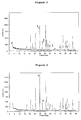
- Figure 3 shows an X-Ray diffraction chart of an electrode manufactured with conventional LiFePO 4 particles and without densification which shows no texture effect for the corresponding peaks 1 and 2. Peak 1 has an intensity I 1 and peak 2 has an intensity I 2 .
- electrodes made from sample No. 219 showed a marked difference in signal intensity before (figure 4) and after (figure 5) densification. All signals have the same 2 ⁇ values.
- Figure 4 shows an intensity ratio of the selected peaks 1 (020 + 211) and 2 (301) of 9:1.
- Figure 5, which was recorded after densification, showed an intensity ratio of these two peaks 1 and 2 of I 1 (020 + 211) to I 2 (301) of 23:1. This texture effect is responsible for the increased conductivity and capacity of the electrodes in a battery according to the invention.
- Table 3 indicates the difference in the intensity ratio before and after the densification step for various samples which confirms the aforementioned findings: Table 3: Change in intensity ratio with and without densification of the electrodes Sample No Intensity ratio I 1 (020 + 211)/I 2 (301) Intensity ratio I 1 (020 + 211)/I 2 (301) Electrode without further densification Electrode with densification 232 2.6 / 1 3.9 / 1 219 7.7 / 1 23 / 1
- the cells with the electrodes obtained from the particle samples were electrochemically characterized by measuring their respective capacities.
- the cell FB 560 (figure 2) according to the invention made from sample No 219 has highly superior capacities, especially at high rates, in comparison to the cell obtained with material from sample No 232 (figure 1).
Landscapes
- Chemical & Material Sciences (AREA)
- Chemical Kinetics & Catalysis (AREA)
- Electrochemistry (AREA)
- General Chemical & Material Sciences (AREA)
- Inorganic Chemistry (AREA)
- Engineering & Computer Science (AREA)
- Materials Engineering (AREA)
- Composite Materials (AREA)
- Manufacturing & Machinery (AREA)
- Crystallography & Structural Chemistry (AREA)
- Battery Electrode And Active Subsutance (AREA)
Priority Applications (8)
| Application Number | Priority Date | Filing Date | Title |
|---|---|---|---|
| EP05010498A EP1722428A1 (fr) | 2005-05-13 | 2005-05-13 | Cellule de pile secondaire au lithium et electrode pour utilisation dans ceux-ci |
| TW095114032A TWI338401B (en) | 2005-05-13 | 2006-04-20 | Lithium secondary battery and electrodes for use therein |
| JP2008510498A JP5419445B2 (ja) | 2005-05-13 | 2006-05-11 | リチウム二次電池及びそれに用いられる電極 |
| PCT/EP2006/004446 WO2006119995A1 (fr) | 2005-05-13 | 2006-05-11 | Accumulateur au lithium et électrodes à utiliser dans celui-ci |
| CA2617134A CA2617134C (fr) | 2005-05-13 | 2006-05-11 | Accumulateur au lithium et electrodes a utiliser dans celui-ci |
| CN2006800155699A CN101189747B (zh) | 2005-05-13 | 2006-05-11 | 锂二次电池及用于其中的电极 |
| US11/919,777 US20090286159A1 (en) | 2005-05-13 | 2006-05-11 | Lithium secondary battery and electrodes for use therein |
| EP06724799A EP1883984A1 (fr) | 2005-05-13 | 2006-05-11 | Accumulateur au lithium et électrodes à utiliser dans celui-ci |
Applications Claiming Priority (1)
| Application Number | Priority Date | Filing Date | Title |
|---|---|---|---|
| EP05010498A EP1722428A1 (fr) | 2005-05-13 | 2005-05-13 | Cellule de pile secondaire au lithium et electrode pour utilisation dans ceux-ci |
Publications (1)
| Publication Number | Publication Date |
|---|---|
| EP1722428A1 true EP1722428A1 (fr) | 2006-11-15 |
Family
ID=35197876
Family Applications (2)
| Application Number | Title | Priority Date | Filing Date |
|---|---|---|---|
| EP05010498A Withdrawn EP1722428A1 (fr) | 2005-05-13 | 2005-05-13 | Cellule de pile secondaire au lithium et electrode pour utilisation dans ceux-ci |
| EP06724799A Withdrawn EP1883984A1 (fr) | 2005-05-13 | 2006-05-11 | Accumulateur au lithium et électrodes à utiliser dans celui-ci |
Family Applications After (1)
| Application Number | Title | Priority Date | Filing Date |
|---|---|---|---|
| EP06724799A Withdrawn EP1883984A1 (fr) | 2005-05-13 | 2006-05-11 | Accumulateur au lithium et électrodes à utiliser dans celui-ci |
Country Status (7)
| Country | Link |
|---|---|
| US (1) | US20090286159A1 (fr) |
| EP (2) | EP1722428A1 (fr) |
| JP (1) | JP5419445B2 (fr) |
| CN (1) | CN101189747B (fr) |
| CA (1) | CA2617134C (fr) |
| TW (1) | TWI338401B (fr) |
| WO (1) | WO2006119995A1 (fr) |
Cited By (10)
| Publication number | Priority date | Publication date | Assignee | Title |
|---|---|---|---|---|
| WO2010051565A1 (fr) * | 2008-11-03 | 2010-05-06 | Imara Corporation | Batteries secondaires au lithium pourvues de compositions d'électrode positive et leurs procédés de fabrication |
| WO2010094987A1 (fr) * | 2009-02-20 | 2010-08-26 | Toyota Jidosha Kabushiki Kaisha | Matériau cristallin lithium-métal (ii) phosphate |
| WO2010130684A1 (fr) * | 2009-05-11 | 2010-11-18 | Süd-Chemie AG | Matériau composite comportant un mélange d'oxyde métallique au lithium |
| CN102881904A (zh) * | 2012-10-28 | 2013-01-16 | 桂林理工大学 | 双碳源包覆的LiFePO4/C复合正极材料的两步法烧结制备方法 |
| US8715525B2 (en) | 2010-06-30 | 2014-05-06 | Semiconductor Energy Laboratory Co., Ltd. | Manufacturing method of electrode material |
| US8808917B2 (en) | 2009-09-11 | 2014-08-19 | Semiconductor Energy Laboratory Co., Ltd. | Power storage device having olivine type positive electrode active material with oriented crystal structure |
| US9051184B2 (en) | 2006-12-22 | 2015-06-09 | Umicore | Synthesis of crystalline nanometric LiFeMPO4 |
| US9147879B2 (en) | 2009-06-25 | 2015-09-29 | Nagasaki University | Composite nano porous electrode material, process for production thereof, and lithium ion secondary battery |
| EP2562856A4 (fr) * | 2010-04-21 | 2016-10-12 | Lg Chemical Ltd | Matériau actif d'anode pour batterie secondaire et batterie secondaire au lithium comprenant le même |
| US9556536B2 (en) | 2011-09-09 | 2017-01-31 | Semiconductor Energy Laboratory Co., Ltd. | Positive electrode for lithium secondary battery, manufacturing method thereof, and lithium secondary battery |
Families Citing this family (13)
| Publication number | Priority date | Publication date | Assignee | Title |
|---|---|---|---|---|
| EP2130248B1 (fr) * | 2007-03-19 | 2011-06-15 | Umicore | Matière d'insertion/extraction de li à une seule phase à température ambiante pour une utilisation dans une batterie à base de li |
| US7662510B2 (en) * | 2007-09-20 | 2010-02-16 | Celgard Llc | X-ray sensitive battery separator and a method for detecting the position of a separator in a battery |
| JP5383217B2 (ja) * | 2008-01-28 | 2014-01-08 | 住友化学株式会社 | 正極活物質およびナトリウム二次電池、ならびにオリビン型リン酸塩の製造方法 |
| CN104167564B (zh) * | 2010-02-12 | 2017-04-12 | 三菱化学株式会社 | 非水电解液及非水电解质二次电池 |
| US9166228B2 (en) * | 2010-11-05 | 2015-10-20 | Purdue Research Foundation | Method of exploiting particle morphology to optimize granular structure and charge/discharge performance of lithium ion battery cathodes |
| KR101924989B1 (ko) * | 2011-01-07 | 2018-12-04 | 가부시키가이샤 한도오따이 에네루기 켄큐쇼 | 축전 장치의 제작 방법 |
| US20120212941A1 (en) * | 2011-02-22 | 2012-08-23 | Jomar Reschreiter | Cordless, portable, rechargeable food heating lamp |
| JP5998428B2 (ja) * | 2011-03-24 | 2016-09-28 | 凸版印刷株式会社 | 非水電解液二次電池用正極、非水電解液二次電池、非水電解液二次電池用正極インクの製造方法、非水電解液二次電池用正極インク、非水電解液二次電池用正極の製造方法 |
| JP6249388B2 (ja) * | 2011-07-28 | 2017-12-20 | 株式会社村田製作所 | リチウムイオン二次電池用正極、リチウムイオン二次電池、電池パック、電動車両、電力貯蔵システム、電動工具ならびに電子機器 |
| JP5807749B2 (ja) | 2011-12-08 | 2015-11-10 | ソニー株式会社 | 非水電解液二次電池用正極、非水電解液二次電池、電池パック、電動車両、電力貯蔵システム、電動工具および電子機器 |
| JP2015092510A (ja) * | 2015-01-14 | 2015-05-14 | シャープ株式会社 | 非水電解質二次電池 |
| US11634789B2 (en) | 2019-09-16 | 2023-04-25 | InCoR Lithium | Selective lithium extraction from brines |
| JP7786535B1 (ja) * | 2024-11-27 | 2025-12-16 | トヨタ自動車株式会社 | 正極活物質、電極および電池 |
Citations (4)
| Publication number | Priority date | Publication date | Assignee | Title |
|---|---|---|---|---|
| JPH0684515A (ja) * | 1992-09-03 | 1994-03-25 | Sanyo Electric Co Ltd | 非水電解液二次電池 |
| US5910382A (en) * | 1996-04-23 | 1999-06-08 | Board Of Regents, University Of Texas Systems | Cathode materials for secondary (rechargeable) lithium batteries |
| WO2002027823A1 (fr) * | 2000-09-26 | 2002-04-04 | HYDRO-QUéBEC | Procede de synthese de materiaux redox enrobes de carbone a taille controlee |
| JP2003292307A (ja) * | 2002-01-31 | 2003-10-15 | Nippon Chem Ind Co Ltd | リン酸第一鉄含水塩結晶、その製造方法及びリチウム鉄リン系複合酸化物の製造方法 |
Family Cites Families (16)
| Publication number | Priority date | Publication date | Assignee | Title |
|---|---|---|---|---|
| JP2674793B2 (ja) * | 1988-08-31 | 1997-11-12 | ソニー 株式会社 | 非水電解液電池 |
| US6514640B1 (en) * | 1996-04-23 | 2003-02-04 | Board Of Regents, The University Of Texas System | Cathode materials for secondary (rechargeable) lithium batteries |
| JPH1125983A (ja) * | 1997-07-04 | 1999-01-29 | Japan Storage Battery Co Ltd | リチウム電池用活物質 |
| US6337156B1 (en) * | 1997-12-23 | 2002-01-08 | Sri International | Ion battery using high aspect ratio electrodes |
| JP4103168B2 (ja) * | 1998-03-31 | 2008-06-18 | 宇部興産株式会社 | 非水二次電池およびその製造方法 |
| JP2001222994A (ja) * | 2000-02-08 | 2001-08-17 | Shin Kobe Electric Mach Co Ltd | 非水電解液二次電池 |
| JP3982165B2 (ja) * | 2000-10-05 | 2007-09-26 | ソニー株式会社 | 固体電解質電池 |
| JP4491949B2 (ja) * | 2000-10-06 | 2010-06-30 | ソニー株式会社 | 正極活物質の製造方法及び非水電解質電池の製造方法 |
| JP4075451B2 (ja) * | 2001-05-15 | 2008-04-16 | 株式会社豊田中央研究所 | リチウム二次電池 |
| JP4197237B2 (ja) * | 2002-03-01 | 2008-12-17 | パナソニック株式会社 | 正極活物質の製造方法 |
| US9391325B2 (en) * | 2002-03-01 | 2016-07-12 | Panasonic Corporation | Positive electrode active material, production method thereof and non-aqueous electrolyte secondary battery |
| JP4058680B2 (ja) * | 2002-08-13 | 2008-03-12 | ソニー株式会社 | 正極活物質の製造方法及び非水電解質二次電池の製造方法 |
| JP4190930B2 (ja) * | 2003-03-28 | 2008-12-03 | 住友大阪セメント株式会社 | リチウム金属リン酸塩化合物微粒子およびその製造方法 |
| JP2004335344A (ja) * | 2003-05-09 | 2004-11-25 | Sanyo Electric Co Ltd | リチウム二次電池用正極及びリチウム二次電池 |
| US7534408B2 (en) * | 2003-12-23 | 2009-05-19 | Universite De Montreal | Process for preparing electroactive insertion compounds and electrode materials obtained therefrom |
| US8323832B2 (en) * | 2005-08-08 | 2012-12-04 | A123 Systems, Inc. | Nanoscale ion storage materials |
-
2005
- 2005-05-13 EP EP05010498A patent/EP1722428A1/fr not_active Withdrawn
-
2006
- 2006-04-20 TW TW095114032A patent/TWI338401B/zh not_active IP Right Cessation
- 2006-05-11 EP EP06724799A patent/EP1883984A1/fr not_active Withdrawn
- 2006-05-11 CA CA2617134A patent/CA2617134C/fr not_active Expired - Fee Related
- 2006-05-11 WO PCT/EP2006/004446 patent/WO2006119995A1/fr not_active Ceased
- 2006-05-11 CN CN2006800155699A patent/CN101189747B/zh not_active Expired - Fee Related
- 2006-05-11 US US11/919,777 patent/US20090286159A1/en not_active Abandoned
- 2006-05-11 JP JP2008510498A patent/JP5419445B2/ja not_active Expired - Fee Related
Patent Citations (4)
| Publication number | Priority date | Publication date | Assignee | Title |
|---|---|---|---|---|
| JPH0684515A (ja) * | 1992-09-03 | 1994-03-25 | Sanyo Electric Co Ltd | 非水電解液二次電池 |
| US5910382A (en) * | 1996-04-23 | 1999-06-08 | Board Of Regents, University Of Texas Systems | Cathode materials for secondary (rechargeable) lithium batteries |
| WO2002027823A1 (fr) * | 2000-09-26 | 2002-04-04 | HYDRO-QUéBEC | Procede de synthese de materiaux redox enrobes de carbone a taille controlee |
| JP2003292307A (ja) * | 2002-01-31 | 2003-10-15 | Nippon Chem Ind Co Ltd | リン酸第一鉄含水塩結晶、その製造方法及びリチウム鉄リン系複合酸化物の製造方法 |
Non-Patent Citations (4)
| Title |
|---|
| ANDERSSON A S ET AL: "Lithium extraction/insertion in LiFePO4: an X-ray diffraction and Mss", SOLID STATE IONICS, NORTH HOLLAND PUB. COMPANY. AMSTERDAM, NL, vol. 130, no. 1,2, May 2000 (2000-05-01), pages 41 - 52, XP002169165, ISSN: 0167-2738 * |
| MORGAN,D. ETAL.: "Li Conductivity in LixMPO4 ( M = Mn,Fe,Co,Ni) Olivine Materials", ELECTROCHEMICAL AND SOLID-STATE LETTERSD, vol. 7, no. 2, 2004, pages A30 - A32, XP009056734 * |
| PATENT ABSTRACTS OF JAPAN vol. 018, no. 332 (E - 1567) 23 June 1994 (1994-06-23) * |
| PATENT ABSTRACTS OF JAPAN vol. 2003, no. 12 5 December 2003 (2003-12-05) * |
Cited By (12)
| Publication number | Priority date | Publication date | Assignee | Title |
|---|---|---|---|---|
| US9051184B2 (en) | 2006-12-22 | 2015-06-09 | Umicore | Synthesis of crystalline nanometric LiFeMPO4 |
| WO2010051565A1 (fr) * | 2008-11-03 | 2010-05-06 | Imara Corporation | Batteries secondaires au lithium pourvues de compositions d'électrode positive et leurs procédés de fabrication |
| US9099738B2 (en) | 2008-11-03 | 2015-08-04 | Basvah Llc | Lithium secondary batteries with positive electrode compositions and their methods of manufacturing |
| WO2010094987A1 (fr) * | 2009-02-20 | 2010-08-26 | Toyota Jidosha Kabushiki Kaisha | Matériau cristallin lithium-métal (ii) phosphate |
| WO2010130684A1 (fr) * | 2009-05-11 | 2010-11-18 | Süd-Chemie AG | Matériau composite comportant un mélange d'oxyde métallique au lithium |
| US9147879B2 (en) | 2009-06-25 | 2015-09-29 | Nagasaki University | Composite nano porous electrode material, process for production thereof, and lithium ion secondary battery |
| US8808917B2 (en) | 2009-09-11 | 2014-08-19 | Semiconductor Energy Laboratory Co., Ltd. | Power storage device having olivine type positive electrode active material with oriented crystal structure |
| EP2562856A4 (fr) * | 2010-04-21 | 2016-10-12 | Lg Chemical Ltd | Matériau actif d'anode pour batterie secondaire et batterie secondaire au lithium comprenant le même |
| US8715525B2 (en) | 2010-06-30 | 2014-05-06 | Semiconductor Energy Laboratory Co., Ltd. | Manufacturing method of electrode material |
| US9556536B2 (en) | 2011-09-09 | 2017-01-31 | Semiconductor Energy Laboratory Co., Ltd. | Positive electrode for lithium secondary battery, manufacturing method thereof, and lithium secondary battery |
| US9935313B2 (en) | 2011-09-09 | 2018-04-03 | Semiconductor Energy Laboratory Co., Ltd. | Positive electrode for lithium secondary battery, manufacturing method thereof, and lithium secondary battery |
| CN102881904A (zh) * | 2012-10-28 | 2013-01-16 | 桂林理工大学 | 双碳源包覆的LiFePO4/C复合正极材料的两步法烧结制备方法 |
Also Published As
| Publication number | Publication date |
|---|---|
| TWI338401B (en) | 2011-03-01 |
| CN101189747B (zh) | 2012-08-15 |
| CA2617134A1 (fr) | 2006-11-16 |
| EP1883984A1 (fr) | 2008-02-06 |
| US20090286159A1 (en) | 2009-11-19 |
| WO2006119995A1 (fr) | 2006-11-16 |
| JP5419445B2 (ja) | 2014-02-19 |
| JP2008541364A (ja) | 2008-11-20 |
| TW200703753A (en) | 2007-01-16 |
| CA2617134C (fr) | 2014-12-09 |
| CN101189747A (zh) | 2008-05-28 |
Similar Documents
| Publication | Publication Date | Title |
|---|---|---|
| EP1722428A1 (fr) | Cellule de pile secondaire au lithium et electrode pour utilisation dans ceux-ci | |
| US11362366B2 (en) | Secondary battery composite electrolyte, secondary battery, and battery pack | |
| EP1220349B1 (fr) | Particules de graphite et élément secondaire au lithium les utilisant en tant que matériau de l'électrode négative | |
| KR101510510B1 (ko) | 전극 활물질의 제조 방법 | |
| CN103460458B (zh) | 活性物质、电极、锂离子二次电池、以及活性物质的制造方法 | |
| EP4455080A1 (fr) | Matériau composite phosphore-carbone, méthode de production de matériau composite phosphore-carbone, matériau actif d'électrode négative, électrode négative pour batterie secondaire au lithium, et batterie secondaire au lithium | |
| US11329316B2 (en) | Secondary battery composite electrolyte, secondary battery, and battery pack | |
| EP1959513B1 (fr) | Matériau actif composite d'anode, son procédé de préparation, et anode et batterie au lithium le contenant | |
| EP3096380B1 (fr) | Matériau actif d'électrode, électrode et dispositif de stockage d'énergie le comprenant et procédé de préparation du matériau actif d'électrode | |
| KR20240128664A (ko) | 충전식 리튬이온전지용 음극재료, 이의 제조방법 및 사용방법 | |
| US12592454B2 (en) | All-solid-state rechargeable battery, stacked rechargeable all-solid-state battery, and manufacturing method thereof | |
| WO2024195744A1 (fr) | Batterie à électrolyte solide | |
| WO2025159115A1 (fr) | Électrode négative pour une batterie tout solide et batterie tout solide |
Legal Events
| Date | Code | Title | Description |
|---|---|---|---|
| PUAI | Public reference made under article 153(3) epc to a published international application that has entered the european phase |
Free format text: ORIGINAL CODE: 0009012 |
|
| AK | Designated contracting states |
Kind code of ref document: A1 Designated state(s): AT BE BG CH CY CZ DE DK EE ES FI FR GB GR HU IE IS IT LI LT LU MC NL PL PT RO SE SI SK TR |
|
| AX | Request for extension of the european patent |
Extension state: AL BA HR LV MK YU |
|
| 17P | Request for examination filed |
Effective date: 20070301 |
|
| AKX | Designation fees paid |
Designated state(s): AT BE BG CH CY CZ DE DK EE ES FI FR GB GR HU IE IS IT LI LT LU MC NL PL PT RO SE SI SK TR |
|
| RAP1 | Party data changed (applicant data changed or rights of an application transferred) |
Owner name: SANYO COMPONENT EUROPE GMBH Owner name: SANYO ELECTRIC CO., LTD. Owner name: CLARIANT PRODUKTE (DEUTSCHLAND) GMBH |
|
| 17Q | First examination report despatched |
Effective date: 20130916 |
|
| RAP1 | Party data changed (applicant data changed or rights of an application transferred) |
Owner name: CLARIANT PRODUKTE (DEUTSCHLAND) GMBH |
|
| STAA | Information on the status of an ep patent application or granted ep patent |
Free format text: STATUS: THE APPLICATION IS DEEMED TO BE WITHDRAWN |
|
| 18D | Application deemed to be withdrawn |
Effective date: 20160621 |