EP1722540A2 - Casque sans-fil, système de communication mobile, serveur de gestion, et procédé pour établir une communication avec un casque sans-fil - Google Patents
Casque sans-fil, système de communication mobile, serveur de gestion, et procédé pour établir une communication avec un casque sans-fil Download PDFInfo
- Publication number
- EP1722540A2 EP1722540A2 EP06018213A EP06018213A EP1722540A2 EP 1722540 A2 EP1722540 A2 EP 1722540A2 EP 06018213 A EP06018213 A EP 06018213A EP 06018213 A EP06018213 A EP 06018213A EP 1722540 A2 EP1722540 A2 EP 1722540A2
- Authority
- EP
- European Patent Office
- Prior art keywords
- headset
- communication
- access point
- fixed network
- portable communication
- Prior art date
- Legal status (The legal status is an assumption and is not a legal conclusion. Google has not performed a legal analysis and makes no representation as to the accuracy of the status listed.)
- Withdrawn
Links
Images









Classifications
-
- H—ELECTRICITY
- H04—ELECTRIC COMMUNICATION TECHNIQUE
- H04M—TELEPHONIC COMMUNICATION
- H04M1/00—Substation equipment, e.g. for use by subscribers
- H04M1/60—Substation equipment, e.g. for use by subscribers including speech amplifiers
- H04M1/6033—Substation equipment, e.g. for use by subscribers including speech amplifiers for providing handsfree use or a loudspeaker mode in telephone sets
-
- H—ELECTRICITY
- H04—ELECTRIC COMMUNICATION TECHNIQUE
- H04M—TELEPHONIC COMMUNICATION
- H04M1/00—Substation equipment, e.g. for use by subscribers
- H04M1/60—Substation equipment, e.g. for use by subscribers including speech amplifiers
- H04M1/6033—Substation equipment, e.g. for use by subscribers including speech amplifiers for providing handsfree use or a loudspeaker mode in telephone sets
- H04M1/6041—Portable telephones adapted for handsfree use
- H04M1/6058—Portable telephones adapted for handsfree use involving the use of a headset accessory device connected to the portable telephone
- H04M1/6066—Portable telephones adapted for handsfree use involving the use of a headset accessory device connected to the portable telephone including a wireless connection
-
- H—ELECTRICITY
- H04—ELECTRIC COMMUNICATION TECHNIQUE
- H04M—TELEPHONIC COMMUNICATION
- H04M1/00—Substation equipment, e.g. for use by subscribers
- H04M1/72—Mobile telephones; Cordless telephones, i.e. devices for establishing wireless links to base stations without route selection
- H04M1/725—Cordless telephones
- H04M1/72502—Cordless telephones with one base station connected to a single line
-
- H—ELECTRICITY
- H04—ELECTRIC COMMUNICATION TECHNIQUE
- H04W—WIRELESS COMMUNICATION NETWORKS
- H04W84/00—Network topologies
- H04W84/02—Hierarchically pre-organised networks, e.g. paging networks, cellular networks, WLAN [Wireless Local Area Network] or WLL [Wireless Local Loop]
- H04W84/10—Small scale networks; Flat hierarchical networks
-
- H—ELECTRICITY
- H04—ELECTRIC COMMUNICATION TECHNIQUE
- H04M—TELEPHONIC COMMUNICATION
- H04M2203/00—Aspects of automatic or semi-automatic exchanges
- H04M2203/10—Aspects of automatic or semi-automatic exchanges related to the purpose or context of the telephonic communication
- H04M2203/1091—Fixed mobile conversion
-
- H—ELECTRICITY
- H04—ELECTRIC COMMUNICATION TECHNIQUE
- H04M—TELEPHONIC COMMUNICATION
- H04M2250/00—Details of telephonic subscriber devices
- H04M2250/02—Details of telephonic subscriber devices including a Bluetooth® interface
-
- H—ELECTRICITY
- H04—ELECTRIC COMMUNICATION TECHNIQUE
- H04W—WIRELESS COMMUNICATION NETWORKS
- H04W88/00—Devices specially adapted for wireless communication networks, e.g. terminals, base stations or access point devices
- H04W88/02—Terminal devices
- H04W88/04—Terminal devices adapted for relaying to or from another terminal or user
Definitions
- the present invention relates to a portable communication system using a headset for calling to which a headphone and a microphone are attached, and a headset calling method.
- the present invention relates to a headset, a portable communication system using the headset, and a headset calling method suitable for hands-free calling using a portable communication terminal.
- a caller When making a call using a portable communication terminal, for example, a portable phone, a PHS (Personal Handy-phone System), etc., normally a caller holds a terminal in hand near his/her head.
- a headset and a portable terminal are used in combination in some cases. That is, a caller is able to make a hands-free call by attaching a headset to his/her head and connecting the headset and a portable communication terminal with a cable.
- Bluetooth has made its debut.
- the Bluetooth has, in comparison to infrared communication, advantages that power consumption is small and that communication is not blocked by obstacles when the distance between devices is about 10 m or less.
- FIG.14 shows a case where a portable communication terminal operates as an audio gateway as an example.
- a portable communication terminal 101 and a headset 103 incorporate therein chipsets 102 and 103 for the Bluetooth, respectively.
- the portable communication terminal 101 is connected to a mobile network 105 such as W-CDMA and GSM and able to receive necessary music data from a music distribution server in addition to performing telephone communication.
- a mobile network 105 such as W-CDMA and GSM
- a Bluetooth communication channel 106 it is possible for a user to listen to the music data stored in the portable communication terminal 101 through the headset 103 by directing replay or stop of the music from the headset 103.
- the portable communication terminal 101 by connecting the portable communication terminal 101 to an audio device of a vehicle including a speaker, it is possible to realize a hands-free voice response. Furthermore, applications of the Bluetooth are researched in order to realize file transfer between the portable communication terminal 101 and a personal computer or a communication device such as a PDA (Personal Digital Assistant) and synchronization of operations between these devices.
- a PDA Personal Digital Assistant
- the portable communication terminal 101 is constituted so as to be connected only to the mobile network 105.
- the W-CDMA Wideband Code Division Multiple Access
- GSM Global System for Mobile
- a portable communication terminal capable of selecting not only the mobile network 105 but also a fixed network.
- Japanese Patent Application Laid-Open No. HEI 07-143553 (Document 1) has proposed such a portable communication terminal.
- the portable communication terminal described in the Document 1 comprises a radio channel control circuit for performing communication with a radio base station in a mobile network, a cable control circuit for performing communication with a terminal station in a fixed network, a channel switching circuit for selecting one of the two control circuits, and a charged capacity monitor unit for monitoring the charged capacity of its battery.
- the portable communication terminal is connected to the fixed network with a cable.
- the channel switching circuit switches the channels from a radio side to a cable side, thereby it is possible for the portable communication terminal to continue communication through cable communication.
- a subscriber of a portable communication terminal can receive a merit that it is possible to receive services of high quality while reducing communication costs.
- income from communication costs decreases by those corresponding to the costs by a fixed network.
- First exemplary feature of the present invention provides a headset capable of a switching control between a fixed network and a mobile network, while taking into consideration a spatial arrangement of the headset, a portable communication terminal, and the fixed network.
- a headset which includes a radio communication unit and control unit.
- the radio communication unit has 2 communication modes.
- the first communication mode is used for communication with an access point connected to a fixed network.
- the second communication mode is used for communication with a specific portable communication terminal.
- the communication control unit judges whether the headset can communicate with the access point.
- the communication control unit selects either one of the first and second communication mode based on the judgment result. If the first communication mode is selected, the communication control unit connects the headset to the fixed network with the telephone number of the specific portable communication terminal as a telephone number of the call originating party.
- the headset according to the first exemplary aspect of the invention performs communication with a fixed network in a first communication mode when it is possible to connect to the fixed network via an access point. Otherwise, the headset performs communication with the fixed network via a specific portable communication terminal and mobile network using a second communication mode.
- the headset according to the first exemplary aspect of the invention is capable of performing radio communication with an access point at which a headset is connected to the fixed network. Accordingly, if the headset exists in an area where communication is possible with the access point, it is possible to make a call via the fixed network using the telephone number of the specific portable communication terminal and to ensure economic communication using the fixed network and high quality communication.
- FIG.1 shows the outline of a headset used in a portable communication system in an embodiment of the present invention.
- a headset 201 comprises a bow-shaped part 202.
- a microphone attaching arm 204 is attached, one end of which is held rotatably about an axis, not shown, and to the other end of which, a microphone 203 is attached.
- the upper end of the bow-shaped part 202 and the upper end of a disc-shaped headset main body 205 covering the auricles are attached so as to be able to open and close freely by a hinge mechanism, not shown.
- the bow-shaped part 202 and the headset main body 205 are closed toward each other so as to sandwich the auricles by a spring, not shown, thereby it is fixed to the head.
- a speaker 206 is arranged almost at the center of the headset main body 205. Further, inside the headset main body 205, a Bluetooth module 207, and a power source and other circuits, not shown, are arranged.
- the Bluetooth module 207 is equipped with a communication circuit necessary for performing communication with the Bluetooth.
- a call/call end button 208 to direct the start and end of a call is attached. Furthermore, in the vicinity of the end on the opposite side to the bow-shaped part 202 side at which the call/call end button 208 of the bow-shaped part 202 is attached, a call origination dial button 209 is attached.
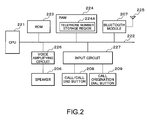
- FIG.2 shows the outline of a circuit part of the headset.
- the headset 201 comprises a CPU (Central Processing Unit) 221.
- the CPU 221 is connected to each part inside the device via a bus 222 such as data bus.
- a read only memory (ROM) 223 stores a control program controlling each part of the headset 201.
- a random access memory (RAM) 224 serves a role as a working memory for temporarily storing data used on the occasion of various controls.
- the RAM 224 is provided with a telephone number storage region 224A for storing the telephone number of the other party to which a call has been made previously, and this memory area is constituted of a nonvolatile memory.
- an antenna 225 is attached to the Bluetooth module 207.
- a voice amplifying circuit 226 is a circuit for amplifying voice data as well as converting it into a voice. To the output side of the voice amplifying circuit 226, the speaker 206 is connected. The call/call end button 8 and the call origination dial button 209 are connected to an input circuit 227 and the result of the input operations is sent out to the bus 222.
- the headset 201 has a transmission power of about 1 mW and a communication distance of about 10 m. However, by increasing the transmission power of the Bluetooth module 207 to, for example, 100 mW, it is possible to increase the transmission distance until about 100 m.
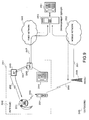
- FIG.3 shows a case where a user is in the interior in a portable communication system in the present embodiment.
- the internal area surrounded by a chain line 241 shows the interior 242.
- the interior 242 is fitted with an access point (AP) 243 for radio communication and an access gateway (GW) 245 for connecting the AP 243 and a fixed telephone 244.
- AP access point
- GW access gateway
- a management server 253 managing the entire system is connected.
- the mobile network 252 may be a 2G (The 2nd Generation) system such as GSM or a 3G system such as W-CDMA.
- 2G The 2nd Generation
- a user (not shown) is in the interior 242 and puts a portable phone 254 as a portable communication terminal on a desk (not shown).
- the user attaches the headset 201 shown in FIG.1 to his/her head.
- the portable phone 254 is in radio communication with the node 249.
- the headset 201 is in communication with the portable phone 254 and the access point 243 through the Bluetooth 255 and 256.
- the access point 243 is in communication with the access gateway 245 via a predetermined communication channel 257.
- the telephone number of the fixed telephone 244 differs from the telephone number of the portable phone 254.
- the headset 201 may establish communication via the fixed network 248 as shown by a channel 258.
- the telephone number of the headset 201 may be the same as that of the portable phone 254.
- the headset 201 performs transmission of the identification number, which is different' from the telephone numbers of the phones 244 and 245, periodically.
- the access point 243 detects this identification number, the access point 243 notifies the management server 253 via the channel 258 and the fixed network 248 in FIG. 3 that the headset 201 is connected. Due to this, the management server 253 can receive headset position information including "information as to whether the headset 201 is connected to the access point 243".
- portable phone position information position information of the portable phone 254 itself
- FIG.4 shows the communication channel of the portable communication system when the user is in the outdoors, differing from FIG.3. If the user goes out in the outdoors 246 with the headset 201 attached to his/her head, the access point 243 cannot receive the identification number output from the headset 201. Accordingly, the management server 253 can receive the portable phone position information of the portable phone 254 via the mobile network through the channel 259 but cannot receive the headset position information of the headset 201. Due to this, it is possible for the management server 253 to grasp that the user can use only portable phone 254 to make a call in the state shown in FIG.4.
- FIG.5 shows the flow of transmission processing of the headset position information by the headset.
- the headset 201 transmits the identification number at time intervals t1.
- the headset 201 transmits its own identification number (step S302) and waits for the response to this from the access point 243 (step S303). If no response is received from the access point even a time t2 elapses after the transmission of the identification number (step S303: N, S304: Y), the operation of the headset returns to step S301 (RETURN) and the headset repeats the identification number transmission processing at the t1 intervals.
- step S304 N, step S303: Y
- the headset 201 transmits the headset position information to the management server 253 via the access point 243 and the fixed network 248 (step S305). That is, when the headset 201 exists in the interior 242 where the access point 243 is installed, the management server 253 recognizes the fact by the reception of the headset position information.
- the management server 253 cannot receive the headset position information. Due to the fact that the management server cannot receive the headset position information, it is possible to recognize that the headset does not exist in an area in which communication with the access point 243 is possible.
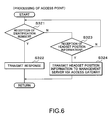
- FIG. 6 shows processing of the access point when receiving an identification number and headset position information.
- the access point 243 transmits a response against the reception of the identification number to the headset 201 (step S322).
- the access point transmits the headset position information to the management server 253 via the access gateway 243 (step S324).
- FIG.7 is a flow chart showing call origination/reception processing by the headset.
- the headset 201 waits for either the call origination dial button 209 or the call/call end button 208 shown in FIG.1 to be pressed (step S341, S342).
- the headset reads the destination telephone number from the telephone number storage region 224A shown in FIG.2 (step S343). If the telephone number is not stored in the telephone number storage region 224A (step S344: Y), the headset outputs an error sound from the speaker 206 (step S345) and ends the processing (END). Instead of an error sound, a voice message "the telephone number is not registered" may be output. In this case, the user is forced to perform the normal call originating operation using the portable phone 254.
- the CPU 221 in FIG. 2 checks whether directions for fixed network communication is issued from the management server 253 (step S346). Then, when directions to use fixed network communication is issued (Y), the headset performs call origination to the other party via the access point 243, the access gateway 245, and the fixed network 248 (step S347). In this way, it becomes possible to realize economic communication utilizing the fixed network 248.
- FIG.8 is a flow chart showing processing of a communication channel directions, such as directions for fixed network, performed by the management server.
- the management server 253 comprises a CPU, a storage medium storing a predetermined control program, a communication unit for performing communication with the fixed network 248 and the mobile network 252, etc., and has the same constitution as that of a personal computer.
- the management server 253 waits for the reception of the headset position information intermittently sent out from the headset 201 shown in FIG.1 and the portable phone position information similarly intermittently sent out from the portable phone 254 (steps S361, S362), in addition thereto, the management server 253 monitors whether the specified time for processing of communication channel directions have come (step S363).
- the management server stores the headset position information along with the reception time in a reception buffer region prepared for the telephone number of the portable phone 254 corresponding to the identification number of the headset (step S364).
- the reception buffer region prepared for each telephone number is a memory region prepared for writing a plurality of pieces of data from the data relating to the most recent time, and the most recent data overwrites the oldest data.
- the management server stores the portable telephone position information along with the reception time in a reception buffer region prepared for the telephone number of the corresponding portable phone 254 (step S365). In this way, in the reception buffer region prepared for each telephone number, the most recent to the fourth or fifth most recent pieces of the headset position information and the portable phone position information are always stored in this order.
- step S363 each time the specified time for directions of communication channel arrives at predetermined time intervals (step S363: Y), the management server 253 acquires the position information between the current time and the time t3 corresponding to the telephone number from the corresponding reception buffer region (step S366).
- the time t3 is, for example, the sum of the time t1 and the time t2, however, the time t3 may be set to another value.
- the CPU of the management server checks whether both of the headset position information and the portable phone position information are included therein (step S367). If both are included (Y), it means that the headset position information is sent to the management server 253 from the headset 201 at a time comparatively near to that time. This means that communication by the headset 201 using the channel 258 (FIG.3) is possible. As a result, the management server 253 transmits the communication directions using the fixed network 248 to the headset 201 through the channel 258 from the standpoint of economy (step S368).
- step S367: N, S369: Y the CPU judges that communication by the headset 201 through the channel 258 (FIG.3) cannot be established, then transmits the communication directions by the mobile network 252 using the channel 259 (FIG.3) to the headset 201 via the portable phone 254 (step S370).
- the headset 201 receives and overwrites the communication directions by the fixed network 248 or the communication directions by the mobile network 252, thereby prepares for the judgment in step S346 in FIG.7.
- step S369 in FIG. 8 shows the case where the portable phone cannot communicate with the node 249 for some reasons (for example, fading etc.) of the portable phone.
- step S346 if no connection directions to the fixed network 248 is issued (N), the headset performs call origination to the other party using the mobile network 252 (step S348).
- step S342 Y
- the CPU of the headset judges whether the current state is a voice communication state (step S349). If it is in a communication state (Y), the CPU of the headset disconnects the call (step S350). In contrast, if an incoming call arrives, not in a voice communication state (step S349: N), the call is connected (step S351). Then, the telephone number of the other party is overwritten in the telephone number storage region 224A (step S352). The telephone number that has overwritten is used for the next call origination (step S341: Y, S343).
- the management server has judged that the headset 201 is in an area in which communication with the access point 243 and the portable phone 253 is possible. Further, the management server 253 has judged that the portable phone 254 also is in the communication area of the mobile network 252. Accordingly, when transmitting or receiving, it is possible to make a call to, for example, another fixed telephone 261 using the headset 201 via the fixed network 248 and at the same time, it is possible to make a call by the portable phone 254 using the mobile network 252. Further, when using the portable phone 254, it is also possible to make a call by the headset 201 using Bluetooth.
- the management server 253 directs a call via the fixed network 248 to the headset in order to utilize the resource of the fixed network 248 as well as reducing the load of the communication fee of the user (FIG.8, step S368).
- the headset uses the telephone number of the portable phone 254. For this reason, when making a call using the headset 201, the user cannot use the portable phone 254.
- the headset 201 is in a communication area with the access point 243, the portable phone 254 is in the outdoors 246. Accordingly, it is not possible for the portable phone to communicate with the handset by using the Bluetooth. From the above-mentioned judgment result, it is possible for the user to make a call by the headset 201 using the fixed network 248 when transmitting and receiving. In such a situation, the management server 253, as a result, directs a call using the headset via the fixed network 248 from the standpoint that it is possible to reduce the communication fee of the user and to utilize the resource of the fixed network 248 (FIG.8, step S368).
- the portable phone 254 since the portable phone 254 is in the communication area of the mobile network 252, the user also can make a call by the portable phone 254 using the mobile network 252. However, when using the portable phone 254, the user cannot use the headset 201.
- the headset 201 can perform communication using the portable phone 254 and Bluetooth. However, the headset is outside the communication area with the access point 243.
- the portable phone 254 is in the communication area of the mobile network 252. From the above-mentioned judgment result, the management server 253 issues directions for a call via the mobile network 252 using the portable phone 254 (FIG.8, step S370). Of course, when using the portable phone 254, the user can use the headset 201 as an alternative.
- the headset 201 exists in the outdoors 246 and is outside the communication area with the access point 243.
- the portable phone 254 also exists in the outdoors 246 and it is possible to communicate with the headset 201 using Bluetooth.
- the portable phone can communicate with the mobile network via the node 249.
- the user at the time of call origination and reception, it is possible for the user to make a call to, for example, the fixed telephone 261 via the mobile network 252 using the portable phone 254.
- the portable phone 254 the user can use the headset 201 as an alternative.
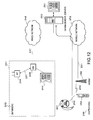
- FIG.13 shows a portable communication system constitution in a modification example of the present invention.
- the same parts as those in FIG. 10 have the same symbols and we will omit explanation of these parts at our own discretion.
- a headset 201A utilizes radio communication by a wireless LAN (Local Area Network), while the headset 201 in the previous embodiment uses Bluetooth. Accordingly, the access point 243A corresponds to the wireless LAN. Similarly, a portable phone 254A corresponds to the wireless LAN.
- a wireless LAN Local Area Network
- a Digital Subscriber Line Access Multiplexer (DSLAM) 271 is disposed between the access gateway 245 and the fixed network 248.
- the fixed network 248 is not limited to a normal line exchange system but may be an xDSL (x Digital Subscriber Line) system.
- xDSL x Digital Subscriber Line
- the management server 253 performs the control to make a call using either the fixed network 248 or the mobile network 252, however, it may also be possible to perform control to make a call using the fixed network 248, provided that the conditions of judgment are that the headset 201 can perform radio communication with the access point 243. That is, it will be sufficient for the headset to interpret the reception of the response signal to the identification number which the access point has transmitted in step S332 in FIG. 6 as directions to use the fixed network and make judgment in step S346 in FIG. 7. In this case, the management server 253 is not necessary.
- the headset 201 has a normal microphone
- an osteoconductive microphone instead of a normal microphone, an osteoconductive microphone may be used.
- the headset 201 includes various structures and it is apparent that each of these can be applied in the present invention.
- a headphone type that is mounted on both ears can be used in the present invention.
Landscapes
- Engineering & Computer Science (AREA)
- Signal Processing (AREA)
- Computer Networks & Wireless Communication (AREA)
- Telephone Function (AREA)
- Mobile Radio Communication Systems (AREA)
Applications Claiming Priority (2)
| Application Number | Priority Date | Filing Date | Title |
|---|---|---|---|
| JP2004355794A JP4649971B2 (ja) | 2004-12-08 | 2004-12-08 | ヘッドセットおよび携帯通信システム |
| EP05026754A EP1670222A3 (fr) | 2004-12-08 | 2005-12-07 | Casque sans-fil, système de communication mobile, serveur de gestion, et procédé pour établir une communication avec un casque sans-fil |
Related Parent Applications (1)
| Application Number | Title | Priority Date | Filing Date |
|---|---|---|---|
| EP05026754A Division EP1670222A3 (fr) | 2004-12-08 | 2005-12-07 | Casque sans-fil, système de communication mobile, serveur de gestion, et procédé pour établir une communication avec un casque sans-fil |
Publications (2)
| Publication Number | Publication Date |
|---|---|
| EP1722540A2 true EP1722540A2 (fr) | 2006-11-15 |
| EP1722540A3 EP1722540A3 (fr) | 2008-12-03 |
Family
ID=35929681
Family Applications (2)
| Application Number | Title | Priority Date | Filing Date |
|---|---|---|---|
| EP05026754A Withdrawn EP1670222A3 (fr) | 2004-12-08 | 2005-12-07 | Casque sans-fil, système de communication mobile, serveur de gestion, et procédé pour établir une communication avec un casque sans-fil |
| EP06018213A Withdrawn EP1722540A3 (fr) | 2004-12-08 | 2005-12-07 | Casque sans-fil, système de communication mobile, serveur de gestion, et procédé pour établir une communication avec un casque sans-fil |
Family Applications Before (1)
| Application Number | Title | Priority Date | Filing Date |
|---|---|---|---|
| EP05026754A Withdrawn EP1670222A3 (fr) | 2004-12-08 | 2005-12-07 | Casque sans-fil, système de communication mobile, serveur de gestion, et procédé pour établir une communication avec un casque sans-fil |
Country Status (4)
| Country | Link |
|---|---|
| US (1) | US7844220B2 (fr) |
| EP (2) | EP1670222A3 (fr) |
| JP (1) | JP4649971B2 (fr) |
| CN (3) | CN1787566A (fr) |
Cited By (3)
| Publication number | Priority date | Publication date | Assignee | Title |
|---|---|---|---|---|
| US9668290B1 (en) | 2016-05-24 | 2017-05-30 | Ronald Snagg | Wireless communication headset system |
| US10348878B2 (en) | 2017-12-12 | 2019-07-09 | Ronald Snagg | Wireless communication headset system |
| US11013050B2 (en) | 2019-10-01 | 2021-05-18 | Ronald Snagg | Wireless communication headset system |
Families Citing this family (21)
| Publication number | Priority date | Publication date | Assignee | Title |
|---|---|---|---|---|
| US7680490B2 (en) * | 2006-06-30 | 2010-03-16 | Sony Ericsson Mobile Communications Ab | System and method for multimedia networking with mobile telephone and headset |
| JP4707623B2 (ja) | 2006-07-21 | 2011-06-22 | 富士通東芝モバイルコミュニケーションズ株式会社 | 情報処理装置 |
| KR100801876B1 (ko) | 2006-07-28 | 2008-02-11 | 지씨티 세미컨덕터 인코포레이티드 | 무선랜 및 블루투스를 이용한 음성 데이터 전송 방법 및시스템 |
| KR101478173B1 (ko) * | 2007-08-29 | 2014-12-31 | 삼성전자주식회사 | 외부기기 연결 방법 및 이를 적용한 멀티미디어 재생장치 |
| JP2009060508A (ja) * | 2007-09-03 | 2009-03-19 | Nec Infrontia Corp | 携帯型電話システム、携帯型電話システムにおける電力消費の低減方法及び外部音声入出力装置 |
| KR101394283B1 (ko) * | 2007-09-27 | 2014-05-13 | 삼성전자주식회사 | 블루투스 모듈을 구비한 휴대 단말기 및 그의 블루투스통신 방법 |
| CN104717590B (zh) | 2010-12-27 | 2020-09-15 | 株式会社精好 | 移动电话系统 |
| US9313306B2 (en) | 2010-12-27 | 2016-04-12 | Rohm Co., Ltd. | Mobile telephone cartilage conduction unit for making contact with the ear cartilage |
| JP5783352B2 (ja) | 2011-02-25 | 2015-09-24 | 株式会社ファインウェル | 会話システム、会話システム用指輪、携帯電話用指輪、指輪型携帯電話、及び、音声聴取方法 |
| TWI666910B (zh) | 2012-01-20 | 2019-07-21 | 日商精良股份有限公司 | mobile phone |
| CN108833639B (zh) | 2012-06-29 | 2020-11-24 | 株式会社精好 | 耳机和立体声耳机 |
| EP3694191A1 (fr) | 2013-08-23 | 2020-08-12 | FINEWELL Co., Ltd. | Téléphone mobile |
| KR102079893B1 (ko) | 2013-10-24 | 2020-02-20 | 파인웰 씨오., 엘티디 | 팔찌형 송수화 장치, 팔찌형 통지 장치 |
| EP3108713A4 (fr) * | 2014-02-17 | 2017-10-25 | Nokia Technologies OY | Procédé et appareil permettant de faire fonctionner un dispositif auxiliaire |
| US20150341763A1 (en) * | 2014-05-22 | 2015-11-26 | Lenovo (Singapore) Pte. Ltd. | On hold detection |
| JP6551919B2 (ja) | 2014-08-20 | 2019-07-31 | 株式会社ファインウェル | 見守りシステム、見守り検知装置および見守り通報装置 |
| EP3236669A4 (fr) | 2014-12-18 | 2018-10-03 | Rohm Co., Ltd. | Dispositif auditif à conduction par cartilage à l'aide d'unité de vibrations de type électromagnétique, et unité de vibration de type électromagnétique |
| CN107848125B (zh) | 2015-07-15 | 2021-04-27 | 株式会社精好 | 机器人和机器人系统 |
| JP6551929B2 (ja) | 2015-09-16 | 2019-07-31 | 株式会社ファインウェル | 受話機能を有する腕時計 |
| CN108496345B (zh) | 2016-01-19 | 2021-02-26 | 株式会社精好 | 笔型呼入呼出通话装置 |
| JP2020053948A (ja) | 2018-09-28 | 2020-04-02 | 株式会社ファインウェル | 聴取装置 |
Family Cites Families (25)
| Publication number | Priority date | Publication date | Assignee | Title |
|---|---|---|---|---|
| JPH05244078A (ja) * | 1992-02-27 | 1993-09-21 | Matsushita Electric Ind Co Ltd | 無線電話装置 |
| JPH06141308A (ja) * | 1992-10-23 | 1994-05-20 | Hitachi Ltd | 携帯形テレビ電話機 |
| JPH0725646A (ja) | 1992-10-23 | 1995-01-27 | Asahi Glass Co Ltd | 紫外線吸収膜形成用塗布液 |
| JPH0774804A (ja) * | 1993-08-31 | 1995-03-17 | Michiko Takahashi | 電話機能付きヘッドホンステレオ |
| JPH0725646U (ja) * | 1993-10-04 | 1995-05-12 | 平治 仲西 | ヘッドホン式電話機 |
| JPH07143553A (ja) | 1993-11-15 | 1995-06-02 | Hitachi Ltd | 移動電話機及びこれを用いた通信システム |
| CA2154751A1 (fr) * | 1994-02-24 | 1995-08-31 | So Ishida | Procede de communication utilisant communement un poste d'abonne mobile et systeme de controleur de communications utilise a cet effet |
| US6223029B1 (en) * | 1996-03-14 | 2001-04-24 | Telefonaktiebolaget Lm Ericsson (Publ) | Combined mobile telephone and remote control terminal |
| US5913163A (en) * | 1996-03-14 | 1999-06-15 | Telefonaktiebolaget Lm Ericsson | Integrated local communication system |
| US6253088B1 (en) * | 1997-11-24 | 2001-06-26 | Uniden America Corporation | Personal base station for integrated cellular and cordless communication system |
| FI110296B (fi) * | 2000-05-26 | 2002-12-31 | Nokia Corp | Kädet vapaana -toiminto |
| JP2002084361A (ja) * | 2000-06-22 | 2002-03-22 | Iwao Kashiwamura | ワイヤレス型送受話器セット |
| US20020013784A1 (en) * | 2000-07-31 | 2002-01-31 | Swanson Raymond H. | Audio data transmission system and method of operation thereof |
| JP2003061146A (ja) * | 2001-08-13 | 2003-02-28 | Hitachi Ltd | 携帯電話機およびネットワークシステム |
| US7233808B2 (en) * | 2001-09-05 | 2007-06-19 | Agere Systems Inc. | Smart BLUETOOTH interface gateway to mate a non-BLUETOOTH wireless device with a BLUETOOTH headset |
| JP2003134224A (ja) * | 2001-10-30 | 2003-05-09 | Nec Corp | 分離型携帯電話機 |
| JP2003283693A (ja) * | 2002-03-26 | 2003-10-03 | Nec Commun Syst Ltd | 携帯通信端末のリモート制御方法及びシステム |
| US7242765B2 (en) * | 2002-06-28 | 2007-07-10 | Tommy Lee Hairston | Headset cellular telephones |
| WO2004019566A2 (fr) | 2002-08-23 | 2004-03-04 | Matsushita Electric Industrial Co., Ltd. | Systeme de communication sans fil |
| BRPI0315512B1 (pt) * | 2002-10-22 | 2017-03-21 | Sony Ericsson Mobile Communications Ab | sistema de fone auricular e dispositivo portador de fone auricular |
| JP3944106B2 (ja) * | 2003-03-27 | 2007-07-11 | 株式会社東芝 | 移動通信システム、この移動通信システムで使用される無線端末装置および情報提供装置、プログラムならびに移動通信端末管理方法 |
| FR2853798B1 (fr) * | 2003-04-08 | 2005-07-01 | Inventel Systemes | Procede et systeme de telecommunication |
| US7107010B2 (en) * | 2003-04-16 | 2006-09-12 | Nokia Corporation | Short-range radio terminal adapted for data streaming and real time services |
| KR100501189B1 (ko) | 2003-05-15 | 2005-07-18 | 삼성전기주식회사 | 블루투스 헤드셋 및 그 착신 알림 방법 |
| JP2005323265A (ja) * | 2004-05-11 | 2005-11-17 | Hitachi Maxell Ltd | 無線通信機能付ヘッドセット及び無線通信装置及び無線通信システム |
-
2004
- 2004-12-08 JP JP2004355794A patent/JP4649971B2/ja not_active Expired - Fee Related
-
2005
- 2005-12-07 EP EP05026754A patent/EP1670222A3/fr not_active Withdrawn
- 2005-12-07 EP EP06018213A patent/EP1722540A3/fr not_active Withdrawn
- 2005-12-08 CN CN200510134547.1A patent/CN1787566A/zh active Pending
- 2005-12-08 CN CN200810131269.8A patent/CN101360140B/zh not_active Expired - Fee Related
- 2005-12-08 CN CN2012100584916A patent/CN102685320A/zh active Pending
- 2005-12-08 US US11/297,570 patent/US7844220B2/en active Active
Cited By (3)
| Publication number | Priority date | Publication date | Assignee | Title |
|---|---|---|---|---|
| US9668290B1 (en) | 2016-05-24 | 2017-05-30 | Ronald Snagg | Wireless communication headset system |
| US10348878B2 (en) | 2017-12-12 | 2019-07-09 | Ronald Snagg | Wireless communication headset system |
| US11013050B2 (en) | 2019-10-01 | 2021-05-18 | Ronald Snagg | Wireless communication headset system |
Also Published As
| Publication number | Publication date |
|---|---|
| CN101360140B (zh) | 2014-04-02 |
| JP4649971B2 (ja) | 2011-03-16 |
| EP1670222A2 (fr) | 2006-06-14 |
| US7844220B2 (en) | 2010-11-30 |
| EP1670222A3 (fr) | 2006-07-12 |
| JP2006166128A (ja) | 2006-06-22 |
| EP1722540A3 (fr) | 2008-12-03 |
| CN102685320A (zh) | 2012-09-19 |
| US20060121960A1 (en) | 2006-06-08 |
| CN1787566A (zh) | 2006-06-14 |
| CN101360140A (zh) | 2009-02-04 |
Similar Documents
| Publication | Publication Date | Title |
|---|---|---|
| US7844220B2 (en) | Headset, portable communication system, and headset calling method | |
| US7333829B2 (en) | Multi-mode wireless bridge system and method using a single-radio transceiver | |
| EP1308052B1 (fr) | Telephone cellulaire a communication simultanee radio et cellulaire | |
| US8433315B2 (en) | Wired cellular telephone system | |
| WO2004095235A2 (fr) | Systeme de pont multimodal sans fil reposant sur l'utilisation d'un seul emetteur-recepteur radio | |
| CN100454942C (zh) | 一种使移动终端实现多模通信的系统和方法 | |
| AU633190B2 (en) | Method and system for establishing link with wireless telephone | |
| WO2007129230A2 (fr) | Procédé et dispositif de routage d'un contenu destiné à un téléphone mobile par l'intermédaire d'un réseau sans fil différent | |
| PL194666B1 (pl) | Sposób eksploatacji telekomunikacyjnego urządzenia końcowego i telekomunikacyjne urządzenie końcowe | |
| JPH11205219A (ja) | パケット通信カード | |
| JP2010028416A (ja) | 携帯通信端末及びそれを備えた無線通信システム | |
| US20040223479A1 (en) | Method of interference control and radio terminal equipment arrangement | |
| JP2006279586A (ja) | 携帯通信機器およびその携帯通信機器を含む通信システム | |
| JP3054893B2 (ja) | 携帯電話装着型通信装置 | |
| KR100448267B1 (ko) | 고속 데이터 전송속도 서비스가 가능한 접이형 이동통신단말기에서의 동작 제어방법 | |
| KR100996084B1 (ko) | 전류 소비를 최소화하기 위한 블루투스모듈을 구비한휴대용 단말기와 블루투스 액세스 포인트 간의 통신 연결방법 | |
| JPH11355444A (ja) | 通話内容記憶方式 | |
| JP2007266927A (ja) | 携帯端末自動転送システム | |
| KR100430594B1 (ko) | 고속 데이터 전송속도 서비스가 가능한 이동통신단말기에서의 동작 제어방법 | |
| KR200319630Y1 (ko) | 이동 통신망 및 유선 전화망을 이용한 고정용 이동단말기 및 복합 단말기 | |
| JP2000101506A (ja) | 外部有線インタフェースおよび赤外線インタフェース付き移動通信端末 | |
| JP2956622B2 (ja) | 無線電話装置及び無線電話システム | |
| JPH05183624A (ja) | 無線電話装置 | |
| KR20040092499A (ko) | 이동 통신망 및 유선 전화망을 이용한 고정용 이동 단말기및 복합 단말기 | |
| JPH05219154A (ja) | コードレス電話システムの通話圏外通知回路 |
Legal Events
| Date | Code | Title | Description |
|---|---|---|---|
| PUAI | Public reference made under article 153(3) epc to a published international application that has entered the european phase |
Free format text: ORIGINAL CODE: 0009012 |
|
| AC | Divisional application: reference to earlier application |
Ref document number: 1670222 Country of ref document: EP Kind code of ref document: P |
|
| AK | Designated contracting states |
Kind code of ref document: A2 Designated state(s): AT BE BG CH CY CZ DE DK EE ES FI FR GB GR HU IE IS IT LI LT LU LV MC NL PL PT RO SE SI SK TR |
|
| AX | Request for extension of the european patent |
Extension state: AL BA HR MK YU |
|
| PUAL | Search report despatched |
Free format text: ORIGINAL CODE: 0009013 |
|
| AK | Designated contracting states |
Kind code of ref document: A3 Designated state(s): AT BE BG CH CY CZ DE DK EE ES FI FR GB GR HU IE IS IT LI LT LU LV MC NL PL PT RO SE SI SK TR |
|
| AX | Request for extension of the european patent |
Extension state: AL BA HR MK RS |
|
| 17P | Request for examination filed |
Effective date: 20090424 |
|
| 17Q | First examination report despatched |
Effective date: 20090608 |
|
| AKX | Designation fees paid |
Designated state(s): DE FR GB IT |
|
| STAA | Information on the status of an ep patent application or granted ep patent |
Free format text: STATUS: THE APPLICATION HAS BEEN WITHDRAWN |
|
| 18W | Application withdrawn |
Effective date: 20110524 |