EP1724831A2 - Dispositif à semiconducteur exempte de plomb - Google Patents
Dispositif à semiconducteur exempte de plomb Download PDFInfo
- Publication number
- EP1724831A2 EP1724831A2 EP06009981A EP06009981A EP1724831A2 EP 1724831 A2 EP1724831 A2 EP 1724831A2 EP 06009981 A EP06009981 A EP 06009981A EP 06009981 A EP06009981 A EP 06009981A EP 1724831 A2 EP1724831 A2 EP 1724831A2
- Authority
- EP
- European Patent Office
- Prior art keywords
- film
- lead frame
- semiconductor device
- lead
- plating
- Prior art date
- Legal status (The legal status is an assumption and is not a legal conclusion. Google has not performed a legal analysis and makes no representation as to the accuracy of the status listed.)
- Withdrawn
Links
Images

Classifications
-
- H—ELECTRICITY
- H10—SEMICONDUCTOR DEVICES; ELECTRIC SOLID-STATE DEVICES NOT OTHERWISE PROVIDED FOR
- H10W—GENERIC PACKAGES, INTERCONNECTIONS, CONNECTORS OR OTHER CONSTRUCTIONAL DETAILS OF DEVICES COVERED BY CLASS H10
- H10W70/00—Package substrates; Interposers; Redistribution layers [RDL]
- H10W70/40—Leadframes
- H10W70/456—Materials
- H10W70/457—Materials of metallic layers on leadframes
-
- H—ELECTRICITY
- H05—ELECTRIC TECHNIQUES NOT OTHERWISE PROVIDED FOR
- H05K—PRINTED CIRCUITS; CASINGS OR CONSTRUCTIONAL DETAILS OF ELECTRIC APPARATUS; MANUFACTURE OF ASSEMBLAGES OF ELECTRICAL COMPONENTS
- H05K3/00—Apparatus or processes for manufacturing printed circuits
- H05K3/30—Assembling printed circuits with electric components, e.g. with resistors
- H05K3/32—Assembling printed circuits with electric components, e.g. with resistors electrically connecting electric components or wires to printed circuits
- H05K3/34—Assembling printed circuits with electric components, e.g. with resistors electrically connecting electric components or wires to printed circuits by soldering
- H05K3/341—Surface mounted components
- H05K3/3421—Leaded components
- H05K3/3426—Leaded components characterised by the leads
-
- H—ELECTRICITY
- H10—SEMICONDUCTOR DEVICES; ELECTRIC SOLID-STATE DEVICES NOT OTHERWISE PROVIDED FOR
- H10W—GENERIC PACKAGES, INTERCONNECTIONS, CONNECTORS OR OTHER CONSTRUCTIONAL DETAILS OF DEVICES COVERED BY CLASS H10
- H10W70/00—Package substrates; Interposers; Redistribution layers [RDL]
- H10W70/40—Leadframes
- H10W70/411—Chip-supporting parts, e.g. die pads
-
- H—ELECTRICITY
- H05—ELECTRIC TECHNIQUES NOT OTHERWISE PROVIDED FOR
- H05K—PRINTED CIRCUITS; CASINGS OR CONSTRUCTIONAL DETAILS OF ELECTRIC APPARATUS; MANUFACTURE OF ASSEMBLAGES OF ELECTRICAL COMPONENTS
- H05K2201/00—Indexing scheme relating to printed circuits covered by H05K1/00
- H05K2201/10—Details of components or other objects attached to or integrated in a printed circuit board
- H05K2201/10613—Details of electrical connections of non-printed components, e.g. special leads
- H05K2201/10742—Details of leads
- H05K2201/10886—Other details
- H05K2201/10909—Materials of terminal, e.g. of leads or electrodes of components
-
- H—ELECTRICITY
- H05—ELECTRIC TECHNIQUES NOT OTHERWISE PROVIDED FOR
- H05K—PRINTED CIRCUITS; CASINGS OR CONSTRUCTIONAL DETAILS OF ELECTRIC APPARATUS; MANUFACTURE OF ASSEMBLAGES OF ELECTRICAL COMPONENTS
- H05K3/00—Apparatus or processes for manufacturing printed circuits
- H05K3/22—Secondary treatment of printed circuits
- H05K3/24—Reinforcing of the conductive pattern
- H05K3/244—Finish plating of conductors, especially of copper conductors, e.g. for pads or lands
-
- H—ELECTRICITY
- H05—ELECTRIC TECHNIQUES NOT OTHERWISE PROVIDED FOR
- H05K—PRINTED CIRCUITS; CASINGS OR CONSTRUCTIONAL DETAILS OF ELECTRIC APPARATUS; MANUFACTURE OF ASSEMBLAGES OF ELECTRICAL COMPONENTS
- H05K3/00—Apparatus or processes for manufacturing printed circuits
- H05K3/30—Assembling printed circuits with electric components, e.g. with resistors
- H05K3/32—Assembling printed circuits with electric components, e.g. with resistors electrically connecting electric components or wires to printed circuits
- H05K3/34—Assembling printed circuits with electric components, e.g. with resistors electrically connecting electric components or wires to printed circuits by soldering
- H05K3/341—Surface mounted components
-
- H—ELECTRICITY
- H05—ELECTRIC TECHNIQUES NOT OTHERWISE PROVIDED FOR
- H05K—PRINTED CIRCUITS; CASINGS OR CONSTRUCTIONAL DETAILS OF ELECTRIC APPARATUS; MANUFACTURE OF ASSEMBLAGES OF ELECTRICAL COMPONENTS
- H05K3/00—Apparatus or processes for manufacturing printed circuits
- H05K3/30—Assembling printed circuits with electric components, e.g. with resistors
- H05K3/32—Assembling printed circuits with electric components, e.g. with resistors electrically connecting electric components or wires to printed circuits
- H05K3/34—Assembling printed circuits with electric components, e.g. with resistors electrically connecting electric components or wires to printed circuits by soldering
- H05K3/346—Solder materials or compositions specially adapted therefor
-
- H—ELECTRICITY
- H10—SEMICONDUCTOR DEVICES; ELECTRIC SOLID-STATE DEVICES NOT OTHERWISE PROVIDED FOR
- H10W—GENERIC PACKAGES, INTERCONNECTIONS, CONNECTORS OR OTHER CONSTRUCTIONAL DETAILS OF DEVICES COVERED BY CLASS H10
- H10W70/00—Package substrates; Interposers; Redistribution layers [RDL]
- H10W70/40—Leadframes
- H10W70/456—Materials
-
- H—ELECTRICITY
- H10—SEMICONDUCTOR DEVICES; ELECTRIC SOLID-STATE DEVICES NOT OTHERWISE PROVIDED FOR
- H10W—GENERIC PACKAGES, INTERCONNECTIONS, CONNECTORS OR OTHER CONSTRUCTIONAL DETAILS OF DEVICES COVERED BY CLASS H10
- H10W72/00—Interconnections or connectors in packages
- H10W72/50—Bond wires
- H10W72/551—Materials of bond wires
- H10W72/552—Materials of bond wires comprising metals or metalloids, e.g. silver
- H10W72/5522—Materials of bond wires comprising metals or metalloids, e.g. silver comprising gold [Au]
-
- H—ELECTRICITY
- H10—SEMICONDUCTOR DEVICES; ELECTRIC SOLID-STATE DEVICES NOT OTHERWISE PROVIDED FOR
- H10W—GENERIC PACKAGES, INTERCONNECTIONS, CONNECTORS OR OTHER CONSTRUCTIONAL DETAILS OF DEVICES COVERED BY CLASS H10
- H10W74/00—Encapsulations, e.g. protective coatings
-
- H—ELECTRICITY
- H10—SEMICONDUCTOR DEVICES; ELECTRIC SOLID-STATE DEVICES NOT OTHERWISE PROVIDED FOR
- H10W—GENERIC PACKAGES, INTERCONNECTIONS, CONNECTORS OR OTHER CONSTRUCTIONAL DETAILS OF DEVICES COVERED BY CLASS H10
- H10W74/00—Encapsulations, e.g. protective coatings
- H10W74/10—Encapsulations, e.g. protective coatings characterised by their shape or disposition
- H10W74/111—Encapsulations, e.g. protective coatings characterised by their shape or disposition the semiconductor body being completely enclosed
-
- H—ELECTRICITY
- H10—SEMICONDUCTOR DEVICES; ELECTRIC SOLID-STATE DEVICES NOT OTHERWISE PROVIDED FOR
- H10W—GENERIC PACKAGES, INTERCONNECTIONS, CONNECTORS OR OTHER CONSTRUCTIONAL DETAILS OF DEVICES COVERED BY CLASS H10
- H10W90/00—Package configurations
- H10W90/701—Package configurations characterised by the relative positions of pads or connectors relative to package parts
- H10W90/751—Package configurations characterised by the relative positions of pads or connectors relative to package parts of bond wires
- H10W90/756—Package configurations characterised by the relative positions of pads or connectors relative to package parts of bond wires between a chip and a stacked lead frame, conducting package substrate or heat sink
-
- Y—GENERAL TAGGING OF NEW TECHNOLOGICAL DEVELOPMENTS; GENERAL TAGGING OF CROSS-SECTIONAL TECHNOLOGIES SPANNING OVER SEVERAL SECTIONS OF THE IPC; TECHNICAL SUBJECTS COVERED BY FORMER USPC CROSS-REFERENCE ART COLLECTIONS [XRACs] AND DIGESTS
- Y02—TECHNOLOGIES OR APPLICATIONS FOR MITIGATION OR ADAPTATION AGAINST CLIMATE CHANGE
- Y02P—CLIMATE CHANGE MITIGATION TECHNOLOGIES IN THE PRODUCTION OR PROCESSING OF GOODS
- Y02P70/00—Climate change mitigation technologies in the production process for final industrial or consumer products
- Y02P70/50—Manufacturing or production processes characterised by the final manufactured product
Definitions
- the present invention relates to a semiconductor device and a method of manufacturing the same, under consideration of lead free.
- Electronic parts are jointed on a printed circuit board by solder of an alloy of Sn (tin) and Pb (lead).
- the printed circuit board is formed to have multi-function, and reduced in size, decreased in cost, and finally highly integrated. As a result, it is difficult to recycle the printed circuit board.
- Some printed circuit boards are recovered, but most printed circuit boards are crushed and buried as special industrial waste.
- the printed circuit boards thus buried include solder material applied thereto, and the solder material contains lead (Pb), which is turned into a water-soluble lead compound by acid rain.
- the lead compound contaminates groundwater, and there is a possibility that the contaminated groundwater enter in the human body as drinking water. It has been known for many years that lead is harmful to the human body.
- a semiconductor device is disclosed in Japanese Laid Open Patent Publication ( JP-A-Heisei 11-354705 ).
- the semiconductor device has outer leads which extend outside from the package for sealing the semiconductor chip and which are connected with the semiconductor chip inside the package.
- the tip of the outer lead is partially coated with a material that can improve soldering characteristics.
- a lower plating film made of a material selected from the group consisting of Ni, Co, Au, Ag, Pt, Pd and Rh is formed as a lower base film and a Sn plating film or a solder plating film is formed on the outer lead.
- the lower plating film can prevent Cu from diffusing into the Sn plating film even in a high temperature range of 400 to 500 °C for 2 seconds in a bonding process between the semiconductor chip and an inner lead.
- the lower plating film improves the soldering characteristics between the outer lead and an external conductive circuit.
- JP-A-Heisei 3-237735 discloses a TAB tape.
- a connection circuit pattern is made of copper or copper alloy, and a tin plating film or a solder plating film is formed on inner and outer leads.
- a lower base film for a tin plating film or a solder plating film is formed as a first plating film and a second plating film. The first plating film is formed on the outer leads, and the second plating film is formed on the first plating film.
- the first plating film is made of a material selected from the group consisting of nickel, cobalt, tin-nickel alloy, tin-cobalt alloy, nickel-cobalt alloy, and tin-nickel-cobalt alloy.
- the second plating film is made of a metal selected from the group consisting of gold, silver, platinum, palladium, and rhodium.
- the Sn whisker In case of using the Sn plating film and a lower base plating film (Ni, Co, Au, Ag, Pt, Pd or Rh), the Sn whisker generates during the manufacturing process or under the customer environment.
- the Sn whisker is easily generated in an environment test such as temperature cycles especially when the lower base plating film is made of a material such as Ni or Co which is hard and is small in thermal expansion coefficient. This is due to the difference in thermal expansion coefficient between the material and Sn. Therefore, there is a problem in quality on formation of the Sn plating film in case of use of the lower base plating film of this type.
- the Sn-whisker problem can be avoided because the solder plating film contains Pb (lead).
- the semiconductor device is not an environment friendly product due to the presence of Pb.
- An object of the present invention is to provide a semiconductor device and a method of manufacturing the same, under the lead-free environment.
- a semiconductor device in an aspect of the present invention, includes a lead frame having a lower base structure of oxygen free copper or copper-based alloy and having terminals; a semiconductor chip connected with the terminals of the lead frame; and a mold resin configured to cover the semiconductor chip.
- the lead frame has an exposed portion from the mold resin, and the exposed portion includes a diffusion prevention film formed on or above the lower base structure of the lead frame; and a Sn-Bi (tin-bismuth) film formed on the diffusion prevention film.
- the diffusion prevention film may be formed of Ni (nickel), and may have the thickness of 0.8 ⁇ m or more.
- the Sn-Bi film may contain Bi of 1% or more.
- the Sn-Bi film may contain Bi in a range of 1% to 4%.
- a circuit assembly includes a printed circuit board having circuit patterns; and a semiconductor device described above, provided on the printed circuit board and connected to the circuit patterns through the terminals by solder.
- the solder is lead-free solder.
- each of the circuit patterns may include a first pattern made of oxygen free copper or copper-based alloy and having terminals; and a second pattern formed of Ni on the first pattern.
- the circuit pattern may further include a third pattern formed of Sn-Bi on the second pattern.
- a method of manufacturing a semiconductor device is achieved by installing a semiconductor chip on a lead frame; by bonding the semiconductor chip to terminals of the lead frame by conductive wires; and by molding the semiconductor chip, the conductive wires and a part of the lead frame.
- the lead frame includes a lower base structure of oxygen free copper or copper-based alloy; a Ni film formed on or above the lower base structure of the lead frame; and a Sn-Bi (tin-bismuth) film formed on the Ni film.
- the method may further include plating the Ni film on or above the lower base structure of the lead frame; and plating the Sn-Bi film formed on the Ni film.
- the plating the Ni film and the plating the Sn-Bi film may be carried out before the installing, or after the molding.
- the diffusion prevention film may have a thickness of 0.8 ⁇ m or more.
- the Sn-Bi film may contain Bi of 1% or more. When each of the terminals is a lead which is bent, the Sn-Bi film may contain Bi in a range of 1% to 4%.
- solder peeling is caused between the semiconductor device and the printed circuit board.
- a solder mounting interface is heated to 150 °C or higher due to the heat from the ambient temperature and the heat generated through the operation of the semiconductor device when this semiconductor device is a high-output device.
- solid-phase diffusion of Sn contained in the solder and Cu in the lead frame is caused in a solder junction interface.
- the precipitation of brittle Sn-Cu intermetallic compounds (Cu 3 Sn and Cu 6 Sn 5 ) is produced.
- the diffusion rate is large enough to form Karkendal voids at the high temperature close to a melting point of the solder, thereby causing solder peeling at the solder junction interface in a shorter time.
- the Karkendal voids may grow into cracks to damage solder junction, thereby causing a failure of the semiconductor device.
- Figs. 1A to 1D show cross sections of the semiconductor device according to the first embodiment of the present invention, and the assembly of the semiconductor device on the printed circuit board.
- a semiconductor chip 2 is mounted on an island of a lead frame 1 made of oxygen-free copper or copper-based alloy, and then is bonded to leads of the lead frame 1 by gold wires. Subsequently, the semiconductor chip 2, the lead frame 1 with the leads, and the wires are molded by a mold resin 3 for sealing. At this time, a part of each lead and a lower surface of the lead frame 1 are exposed.
- a Ni (nickel) plating film having the thickness of 0.8 ⁇ m or more is applied to a lower base of the lead frame.
- Sn-Bi (tin-bismuth) plating is carried out to the lead frame after the Ni plating film to form a surface film and to contain Bi (bismuth) of 1% to 4 wt%.
- Bi (bismuth) of 1% to 4 wt%.
- Fig. 1C the semiconductor device thus manufactured is secondarily mounted on a printed circuit board 7 using lead-free solder 6 of Sn-Ag-Cu (tin-silver-copper) in a semiconductor maker or in a customer site.
- Fig. 1D is an expanded view of the solder - board interface.
- the Pb prevents the diffusion of Sn into Cu. Therefore, there is no problem of the solder separation or solder peeling.
- the lead-free solder is used in the secondary mounting, thermal diffusion of Sn into Cu is caused more easily. Therefore, when the assembly of the semiconductor device which is secondarily mounted on the printed circuit board by suing the lead-free solder is located under a high temperature ambience at about 150 °C for a long period, the solid-phase diffusion gradually advances between Sn in the solder and Cu in the lead frame even if the temperature is below the melting point.
- the precipitation of the brittle Sn-Cu intermetallic compounds (Cu 3 Sn or Cu 6 Sn 5 ) is produced so that solder separation is caused.
- the diffusion rate is large enough to form Karkendal voids at the high temperatures close to the melting point of the solder, thereby to cause the solder separation at the solder interface in a shorter time.
- the Ni plating film 4 prevents the solid-phase diffusion between Sn in the solder and Cu in the lead frame, and finally prevents the solder separation.
- the experiment results of exposure at the high-temperature of about 150°C for the long period of 1000 hours indicate that the Ni plating has the effect of prevention of Sn diffusion when the Ni plating film has the thickness of 0.8 ⁇ m or more.
- Bi has an effect of retardation of Sn whisker growth.
- the outer plating of the lead frame 1 preferably has a Sn-Bi plating surface layer to prevent the Sn whisker growth in the environmental test such as the temperature cycle.
- the Bi containing percentage is 4% or less so as not to cause cracks in the Sn-Bi plating film during the bending process of the lead frame.
- the semiconductor device is characterized in that the lead frame 1 has the Ni plating film 4 having the thickness of 0.8 ⁇ m or more on a base structure, and the Sn-Bi plating film 5 containing Bi of 1 wt% or more on the Ni plating film 4 as the surface layer.
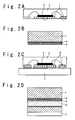
- Figs. 2A to 2D show the semiconductor device according to the second embodiment of the present invention, and an assembly of the semiconductor device secondarily mounted on the printed circuit board.
- a semiconductor chip 2 is mounted on an island of a lead frame 1 of oxygen-free copper or copper-based alloy, and is bonded to leads of the lead frame 1 by gold wires.
- the mold resin 3 for sealing is applied to the semiconductor chip 2, and lead frame 1.
- the molded semiconductor device is subjected to a plating process.
- the Ni plating film of 0.8 ⁇ m or more in thick is applied to the base structure of the lead frame 1, and then the Sn-Bi plating film 5 containing Bi of 1% or more is formed on the Ni plating film as the surface layer.
- the lower surfaces of the leads and island of the lead frame 1 are exposed. This situation is shown in Fig. 2B.
- the semiconductor device thus structured is secondarily mounted on the printed circuit board 7 with a copper pattern by using the lead-free solder 6 of Sn-Ag-Cu, in a semiconductor maker or a customer site.
- the lead-free solder 6 of Sn-Ag-Cu As shown in Figs. 2C and 2D, there is no diffusion of Sn and Cu or the interfacial separation at the mounting interface even when the printed circuit board with the semiconductor device is exposed to high temperature ambience of 150 °C or more for the long period of 1000 hours after the semiconductor device is secondarily mounted on the printed circuit board 7 by using the lead-free solder 6.
- the surface layer of an Sn-Bi plating film 5 containing Bi of 1% or more can prevent the Sn whisker growth.
- the Sn-Bi plating film may have a larger Bi containing percentage than in the first embodiment because the lead frame is not subjected to the lead bending process after the plating so that the Sn-Bi plating does not suffer cracks. Therefore, the second embodiment is advantageous for Sn whisker reduction, when the customer usage environment is severe or the semiconductor device is under large stress due to the structure of the package.
- a temperature cycle test of 1000 cycles between -45 to 125 °C was carried out to the printed circuit boards with semiconductor devices which use lead frames made of oxygen-free copper or copper-based alloy, having Sn-Bi plating films of the thicknesses of 5 ⁇ m, 8 ⁇ m and 20 ⁇ m, and contain Bi of 1%, 3% and 5%.
- the semiconductor device samples were observed with SEM (Scanning Electron Microscope). When the Bi containing percentage was 1 wt%, the Sn whisker grew was observed regardless of any Sn-Bi plating film thickness. However, the samples did not indicate the Sn whisker growth when the Bi containing percentage was 3% or 5%. Therefore, it is necessary that the Bi content is 1% or more, to prevent the generation of the Sn whisker in the above temperature environment.
- the bonding carried out after the semiconductor chip 2 is mounted on the lead frame 1 may be wire bonding or wireless bonding.
- the wireless bonding is employed.
- a copper thin film or a copper plating film applied on an electrode pad of the semiconductor chip 2 corresponds to the lead frame 1
- bumps such as lead-free solder balls correspond to the lead-free solder 6.
- the bumps are made of the lead-free material.
- the plating may be applied to the copper patterns on the printed circuit board 7 to form an outer plating film on the copper patterns.
- the Ni plating film 4 is formed on the copper pattern and the Sn-Bi plating film 5 is formed on the Ni plating film 4 as the surface layer.
- the semiconductor device may be provided as a high-output semiconductor device used in a transmission stage of each communication system.
- the semiconductor device is made of the lead-free material in consideration of the environment and has a stable quality at the high temperature of 150 °C or more caused by the operation of the semiconductor device and the ambient environment.
- the outer plating process may be carried out when the lead frame 1 is produced, not after the molding process.
- the semiconductor device of the present invention is manufactured by mounting and bonding the semiconductor chip onto the lead frame made of the oxygen-free copper or the copper-based alloy; applying the mold resin sealing; and then applying the outer plating.
- a Ni plating film of 0.8 ⁇ m or more in thick is formed on a base structure, and then the Sn-Bi plating film containing Bi of 1% or more is formed on the Ni plating film as the surface layer.
- the semiconductor device thus structured and used at the temperatures of 150 °C or more is mounted on the printed circuit board by using the lead-free solder.
- the semiconductor device of the present invention can also be used as the high-output semiconductor device used as the transmission stage of each of communication systems such as mobile phone base stations, mobile phone terminals and cable TV relay facilities.
Landscapes
- Engineering & Computer Science (AREA)
- Manufacturing & Machinery (AREA)
- Microelectronics & Electronic Packaging (AREA)
- Lead Frames For Integrated Circuits (AREA)
- Electroplating Methods And Accessories (AREA)
Applications Claiming Priority (1)
| Application Number | Priority Date | Filing Date | Title |
|---|---|---|---|
| JP2005143276A JP2006319288A (ja) | 2005-05-16 | 2005-05-16 | 半導体装置 |
Publications (1)
| Publication Number | Publication Date |
|---|---|
| EP1724831A2 true EP1724831A2 (fr) | 2006-11-22 |
Family
ID=36940065
Family Applications (1)
| Application Number | Title | Priority Date | Filing Date |
|---|---|---|---|
| EP06009981A Withdrawn EP1724831A2 (fr) | 2005-05-16 | 2006-05-15 | Dispositif à semiconducteur exempte de plomb |
Country Status (3)
| Country | Link |
|---|---|
| US (1) | US20060255437A1 (fr) |
| EP (1) | EP1724831A2 (fr) |
| JP (1) | JP2006319288A (fr) |
Families Citing this family (4)
| Publication number | Priority date | Publication date | Assignee | Title |
|---|---|---|---|---|
| JP2009038075A (ja) * | 2007-07-31 | 2009-02-19 | Toyota Motor Corp | 電子部品 |
| JP5034913B2 (ja) * | 2007-12-07 | 2012-09-26 | 住友金属鉱山株式会社 | 半導体装置製造用基板とその製造方法 |
| JP2010245217A (ja) * | 2009-04-03 | 2010-10-28 | Kenichi Fuse | 半導体icの装填方法 |
| JP6238121B2 (ja) * | 2013-10-01 | 2017-11-29 | ローム株式会社 | 半導体装置 |
Family Cites Families (3)
| Publication number | Priority date | Publication date | Assignee | Title |
|---|---|---|---|---|
| US6110608A (en) * | 1996-12-10 | 2000-08-29 | The Furukawa Electric Co., Ltd. | Lead material for electronic part, lead and semiconductor device using the same |
| KR100359304B1 (ko) * | 2000-08-25 | 2002-10-31 | 삼성전자 주식회사 | 주변 링 패드를 갖는 리드 프레임 및 이를 포함하는반도체 칩 패키지 |
| US20030025182A1 (en) * | 2001-06-22 | 2003-02-06 | Abys Joseph A. | Metal article coated with tin or tin alloy under tensile stress to inhibit whisker growth |
-
2005
- 2005-05-16 JP JP2005143276A patent/JP2006319288A/ja not_active Withdrawn
-
2006
- 2006-05-15 EP EP06009981A patent/EP1724831A2/fr not_active Withdrawn
- 2006-05-15 US US11/433,400 patent/US20060255437A1/en not_active Abandoned
Also Published As
| Publication number | Publication date |
|---|---|
| US20060255437A1 (en) | 2006-11-16 |
| JP2006319288A (ja) | 2006-11-24 |
Similar Documents
| Publication | Publication Date | Title |
|---|---|---|
| KR100381302B1 (ko) | 반도체 장치 및 그 제조방법 | |
| EP1889684B1 (fr) | Alliage de brasage sans plomb | |
| US7224066B2 (en) | Bonding material and circuit device using the same | |
| JP3827322B2 (ja) | 鉛フリーはんだ合金 | |
| TW200832658A (en) | Semiconductor device and manufacturing method of the same | |
| KR20160148726A (ko) | 면 실장 부품의 솔더링 방법 및 면 실장 부품 | |
| JP5403011B2 (ja) | ダイボンディング接合された電子部品 | |
| JP2001284792A (ja) | 半田材料及びそれを用いた半導体装置の製造方法 | |
| JP3878978B2 (ja) | 鉛非含有はんだ、および鉛非含有の継手 | |
| KR100740642B1 (ko) | 도체간의 접속구조 및 접속방법 | |
| EP1724831A2 (fr) | Dispositif à semiconducteur exempte de plomb | |
| JP2005052869A (ja) | 高温はんだ付用ろう材とそれを用いた半導体装置 | |
| JP2003290974A (ja) | 電子回路装置の接合構造及びそれに用いる電子部品 | |
| JPH1093004A (ja) | 電子部品およびその製造方法 | |
| KR100702956B1 (ko) | 반도체 팩키지용 리드프레임 및 그 제조 방법 | |
| KR20220163956A (ko) | 반도체 장치용 Ag 합금 본딩 와이어 및 반도체 장치 | |
| JPH11251503A (ja) | 電子部品およびその製造方法 | |
| JP3540249B2 (ja) | 半導体デバイスパッケージの外部リードを外部電極に接続する方法 | |
| KR101092616B1 (ko) | 전자 부품용 금속 프레임 | |
| KR100898896B1 (ko) | 납땜 방법, 다이 본딩용 땜납 펠릿, 다이 본딩 땜납 펠릿의제조 방법 및 전자 부품 | |
| JP2002368175A (ja) | 電子部品の製造方法 | |
| Kisiel | An overview of materials and technologies for green electronics products | |
| JP2002319655A (ja) | 電子部品の製造方法 | |
| JPH05283579A (ja) | 半導体装置及びその製造方法 | |
| JPH09331015A (ja) | 半導体パッケージ及びその製造方法 |
Legal Events
| Date | Code | Title | Description |
|---|---|---|---|
| PUAI | Public reference made under article 153(3) epc to a published international application that has entered the european phase |
Free format text: ORIGINAL CODE: 0009012 |
|
| AK | Designated contracting states |
Kind code of ref document: A2 Designated state(s): AT BE BG CH CY CZ DE DK EE ES FI FR GB GR HU IE IS IT LI LT LU LV MC NL PL PT RO SE SI SK TR |
|
| AX | Request for extension of the european patent |
Extension state: AL BA HR MK YU |
|
| STAA | Information on the status of an ep patent application or granted ep patent |
Free format text: STATUS: THE APPLICATION HAS BEEN WITHDRAWN |
|
| 18W | Application withdrawn |
Effective date: 20070614 |