EP1724950A2 - Verfahren zur Synchronisation von Feststationen - Google Patents
Verfahren zur Synchronisation von Feststationen Download PDFInfo
- Publication number
- EP1724950A2 EP1724950A2 EP06018182A EP06018182A EP1724950A2 EP 1724950 A2 EP1724950 A2 EP 1724950A2 EP 06018182 A EP06018182 A EP 06018182A EP 06018182 A EP06018182 A EP 06018182A EP 1724950 A2 EP1724950 A2 EP 1724950A2
- Authority
- EP
- European Patent Office
- Prior art keywords
- golay code
- sequence
- sequences
- golay
- synchronization
- Prior art date
- Legal status (The legal status is an assumption and is not a legal conclusion. Google has not performed a legal analysis and makes no representation as to the accuracy of the status listed.)
- Withdrawn
Links
Images


Classifications
-
- H—ELECTRICITY
- H04—ELECTRIC COMMUNICATION TECHNIQUE
- H04B—TRANSMISSION
- H04B1/00—Details of transmission systems, not covered by a single one of groups H04B3/00 - H04B13/00; Details of transmission systems not characterised by the medium used for transmission
- H04B1/69—Spread spectrum techniques
- H04B1/707—Spread spectrum techniques using direct sequence modulation
- H04B1/7073—Synchronisation aspects
- H04B1/7075—Synchronisation aspects with code phase acquisition
- H04B1/708—Parallel implementation
-
- H—ELECTRICITY
- H04—ELECTRIC COMMUNICATION TECHNIQUE
- H04B—TRANSMISSION
- H04B1/00—Details of transmission systems, not covered by a single one of groups H04B3/00 - H04B13/00; Details of transmission systems not characterised by the medium used for transmission
- H04B1/69—Spread spectrum techniques
- H04B1/707—Spread spectrum techniques using direct sequence modulation
- H04B1/7073—Synchronisation aspects
- H04B1/7075—Synchronisation aspects with code phase acquisition
- H04B1/7077—Multi-step acquisition, e.g. multi-dwell, coarse-fine or validation
-
- H—ELECTRICITY
- H04—ELECTRIC COMMUNICATION TECHNIQUE
- H04B—TRANSMISSION
- H04B7/00—Radio transmission systems, i.e. using radiation field
- H04B7/24—Radio transmission systems, i.e. using radiation field for communication between two or more posts
- H04B7/26—Radio transmission systems, i.e. using radiation field for communication between two or more posts at least one of which is mobile
- H04B7/2662—Arrangements for Wireless System Synchronisation
- H04B7/2668—Arrangements for Wireless Code-Division Multiple Access [CDMA] System Synchronisation
-
- H—ELECTRICITY
- H04—ELECTRIC COMMUNICATION TECHNIQUE
- H04B—TRANSMISSION
- H04B7/00—Radio transmission systems, i.e. using radiation field
- H04B7/24—Radio transmission systems, i.e. using radiation field for communication between two or more posts
- H04B7/26—Radio transmission systems, i.e. using radiation field for communication between two or more posts at least one of which is mobile
- H04B7/2662—Arrangements for Wireless System Synchronisation
- H04B7/2671—Arrangements for Wireless Time-Division Multiple Access [TDMA] System Synchronisation
- H04B7/2678—Time synchronisation
- H04B7/2687—Inter base stations synchronisation
-
- H—ELECTRICITY
- H04—ELECTRIC COMMUNICATION TECHNIQUE
- H04J—MULTIPLEX COMMUNICATION
- H04J13/00—Code division multiplex systems
- H04J13/0007—Code type
- H04J13/0011—Complementary
- H04J13/0014—Golay
-
- H—ELECTRICITY
- H04—ELECTRIC COMMUNICATION TECHNIQUE
- H04J—MULTIPLEX COMMUNICATION
- H04J13/00—Code division multiplex systems
- H04J13/10—Code generation
- H04J13/102—Combining codes
-
- H—ELECTRICITY
- H04—ELECTRIC COMMUNICATION TECHNIQUE
- H04L—TRANSMISSION OF DIGITAL INFORMATION, e.g. TELEGRAPHIC COMMUNICATION
- H04L7/00—Arrangements for synchronising receiver with transmitter
- H04L7/04—Speed or phase control by synchronisation signals
- H04L7/041—Speed or phase control by synchronisation signals using special codes as synchronising signal
- H04L7/042—Detectors therefor, e.g. correlators, state machines
-
- H—ELECTRICITY
- H04—ELECTRIC COMMUNICATION TECHNIQUE
- H04B—TRANSMISSION
- H04B1/00—Details of transmission systems, not covered by a single one of groups H04B3/00 - H04B13/00; Details of transmission systems not characterised by the medium used for transmission
- H04B1/69—Spread spectrum techniques
- H04B1/707—Spread spectrum techniques using direct sequence modulation
- H04B1/7073—Synchronisation aspects
- H04B1/7075—Synchronisation aspects with code phase acquisition
- H04B1/70754—Setting of search window, i.e. range of code offsets to be searched
-
- H—ELECTRICITY
- H04—ELECTRIC COMMUNICATION TECHNIQUE
- H04B—TRANSMISSION
- H04B2201/00—Indexing scheme relating to details of transmission systems not covered by a single group of H04B3/00 - H04B13/00
- H04B2201/69—Orthogonal indexing scheme relating to spread spectrum techniques in general
- H04B2201/707—Orthogonal indexing scheme relating to spread spectrum techniques in general relating to direct sequence modulation
- H04B2201/70701—Orthogonal indexing scheme relating to spread spectrum techniques in general relating to direct sequence modulation featuring pilot assisted reception
-
- H—ELECTRICITY
- H04—ELECTRIC COMMUNICATION TECHNIQUE
- H04B—TRANSMISSION
- H04B7/00—Radio transmission systems, i.e. using radiation field
- H04B7/24—Radio transmission systems, i.e. using radiation field for communication between two or more posts
- H04B7/26—Radio transmission systems, i.e. using radiation field for communication between two or more posts at least one of which is mobile
- H04B7/2662—Arrangements for Wireless System Synchronisation
- H04B7/2671—Arrangements for Wireless Time-Division Multiple Access [TDMA] System Synchronisation
- H04B7/2678—Time synchronisation
- H04B7/2687—Inter base stations synchronisation
- H04B7/2693—Centralised synchronisation, i.e. using external universal time reference, e.g. by using a global positioning system [GPS] or by distributing time reference over the wireline network
-
- H—ELECTRICITY
- H04—ELECTRIC COMMUNICATION TECHNIQUE
- H04J—MULTIPLEX COMMUNICATION
- H04J13/00—Code division multiplex systems
- H04J13/10—Code generation
- H04J13/102—Combining codes
- H04J13/107—Combining codes by concatenation
Definitions
- the present invention relates to a method of synchronization of base stations in a radiomobile telecommunication system. More particularly, the present invention relates to a method of synchronizing base stations for a time division duplex (TDD) type telecommunication system.
- TDD time division duplex
- Said telecommunication system is for example the system being standardized, commonly called 3GPP W-CDMA TDD.
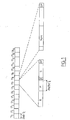
- FIG. 1 a radio frame of such a telecommunication system. It consists of fifteen time slots, some of which, for example, the IT 0 , IT 1 , IT 2 , IT 5 , IT 6 and IT 8 slots, are intended for data transport (in the broad sense of the term) in the downward direction (base station to mobile terminal) while others, IT 3 , IT 4 , IT 7 , IT 9 , IT 10 , IT 11 , IT 12 , IT 13 and IT 14 , are intended for uplink data transport (mobile station to base station).
- the data (D) is transmitted as a sequence of symbols.
- the interval also includes a midamble (M) including pilot symbols for estimating the channel, a power control word (TPC), and a guard interval (GP ').
- M midamble
- TPC power control word
- GP ' guard interval
- CDMA code division multiplexing
- the synchronization constraint between neighboring base stations is of the order of a few microseconds (approximately 5) in the W-CDMA TDD system.
- the synchronization is obtained through GPS receivers equipping the base stations.
- an initial phase for example when setting up the network or a new base station, is performed at a coarse synchronization (of the order of a few tens of ms, that is to say, a few tens of thousands of "chips").
- This initial coarse synchronization is provided by the network, more precisely by the radio access controller (RNC) controlling several neighboring base stations (also called "B nodes”).
- RNC radio access controller
- Fine synchronization is then performed regularly by the radio interface between neighboring base stations.
- a transmission interval dedicated to synchronization essentially comprises a synchronization sequence (Sync) and a guard period (GP).
- Sync synchronization sequence
- GP guard period
- the synchronization is obtained, in a manner known per se, by correlating the received sequence with a replica sequence of that transmitted. The correlation is performed on a time window of length given by the accuracy margin of the coarse synchronization.
- the synchronization sequence generally used is long (several thousand "chips") in order to obtain a good correlation accuracy for an acceptable power per symbol.
- the guard period must be greater than the delay of a base station at a neighboring station so as to avoid, at the reception, an encroachment of the synchronization sequence on a neighboring time slot. Since the distance between two base stations is greater than the radius of a cell, the guard period (GP) is chosen larger than the normal guard period (GP '). The guard period (GP) must also take into account the drift of the frame clocks.
- the synchronization sequence is chosen to have good auto-correlation properties, namely a very pronounced auto-correlation peak.
- the Gold sequences have good properties of periodic autocorrelation (the correlation of a sequence constituted by the repetition of a Gold sequence with a replica of the sequence of the latter does not show any significant secondary peaks). On the other hand, these sequences unfortunately do not exhibit such good aperiodic autocorrelation properties (correlation of an isolated Gold sequence with a replica). Moreover, the generally used correlator operates in the time domain in the form of a conventional FIR matched filter having a complexity of O (L) which can be very high. In addition, the choice of the lengths of such sequences is reduced, since they can only take, as we have seen, 2 N - 1 values and truncation would lead to a significant loss of autocorrelation properties.
- An object of the present invention is to provide a method of synchronization of neighboring base stations by transmitting a synchronization sequence having very good correlation properties.
- a secondary object of the invention is to offer a large choice of possible lengths of synchronization sequences, and this, for a low degree of complexity of the correlator.
- the present invention is defined by a method of synchronizing base stations in a mobile telecommunication system, wherein a first base station transmits a synchronization sequence comprising a first sequence followed by a second sequence, said first and second sequences forming a pair of complementary sequences and in that at least one second base station performs the correlation of said synchronization sequence with a replica of the first sequence and a replica of the second sequence, the correlation results then being summed for giving a correlation signal providing synchronization information.
- the first sequence is separated from the second sequence by a predetermined length separation interval (2GP, 2E), so that the correlation signal has an isolated correlation peak in a time window.
- the first and second sequences are complementary sequences of Golay.
- said separation interval is obtained by providing guard intervals around the first and second sequences.
- said separation interval is obtained by providing a periodic extension of the first sequence followed by a periodic extension of the second sequence.
- the first sequence is generated by means of a first Golay sequence and a first auxiliary sequence by successively multiplying said first Golay sequence by the bits of the first auxiliary sequence.
- the second sequence can be generated by means of a second Golay sequence, complementary to said first Golay sequence, and a second auxiliary sequence by successively multiplying said second Golay sequence by the bits of the first second sequence auxiliary.
- the first auxiliary sequence and the second auxiliary sequence are Golay complementary sequences.
- the correlation is performed by trellis filtering.
- the general idea underlying the invention is to use, for the synchronization of neighboring base stations, a pair of complementary codes, for example complementary polyphase codes, more particularly a pair of complementary Golay codes.
- the complementary codes known as such, have the remarkable property that the sum of their aperiodic autocorrelation functions is a function of Dirac.
- ⁇ AA ( m ) + ⁇ BB ( m ) ⁇ ( m ) where m is the time index, ⁇ the Kronecker symbol and ⁇ the aperiodic autocorrelation function.
- the correlator can be realized thanks to a lattice filter having a complexity in O (logL) and not in O (L) as in a conventional FIR matched filter.
- This lattice filter is also called EGC filter for Efficient Golay Correlator.
- An exemplary embodiment of EGC filter is given the article of BM Popovic entitled “Efficient Golay Correlator", published in IEEE Electronics Letters, Vol. 35, No. 17, January 1999 .
- Golay sequences For a given allowable length, there are several possible Golay sequences. Indeed, since the Golay sequences are generated by generating codes, it can be shown that two separate generator codes of the same length generate Golay sequences that are equally distinct and of the same length. These sequences have good inter-correlation properties (i.e., low inter-correlation values), allowing for example groups of base stations to use separate codes or perform synchronization of the base stations at different times of their sequencing.
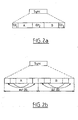
- a synchronization sequence consists of two Golay A and B complementary sequences multiplexed in time, each sequence being preceded and followed by a guard interval, as described in the application French patent FR-A-9916851 filed on 30.12.1999 in the name of the plaintiff.
- This sequence is transmitted by a base station and is received by a neighboring base station.
- the synchronization sequence On reception, the synchronization sequence is correlated with a replica of the sequence A and a replica of the sequence B, the result of correlation with the sequence A is delayed so as to be temporally aligned with the result of correlation with the sequence B before they are summed, the Dirac peak being obtained when the replicas of A and B are aligned with the corresponding sequences.
- the presence of the guard interval GP 2 ensures that, during the correlation, the sequences A and B do not overlap the corresponding complementary replicas, namely B and A respectively, in a time window centered on the temporal alignment position. .
- secondary correlation peaks that may result from the intercorrelation between complementary sequences and replicas are rejected outside this window.
- the sum of the two correlation results has an isolated Dirac peak in a window of width 2.GP around the temporal alignment position. .
- the correlations are advantageously effected by EGC correlators, as mentioned above.
- FIG. 2B A second embodiment of the invention is illustrated in FIG. 2B.
- a synchronization sequence consists of two Golay complementary sequences multiplexed in time, each sequence being preceded and followed by a periodic extension, as explained in the French application entitled "Canal estimation sequence and method transmission channel estimation using such a sequence "filed in the name of the applicant.
- the periodic extension of a given sequence is a truncation of the periodic sequence obtained by repetition of said sequence. To do this, it suffices to concatenate the sequence to extend a prefix corresponding to the end and a suffix corresponding to the beginning of said sequence.
- FIG. 2B schematically indicates the concatenation of prefixes and suffixes for two complementary sequences of Golay, A and B.
- the synchronization sequence itself consists of the two sequences thus extended ext (A) and ext (B). .
- the periodic extensions produce the same advantage as the guard interval GP 2 , namely the absence of secondary correlation peaks around the Dirac peak in a certain time window. More precisely, if the suffixes and prefixes are of identical size and equal to E, the sum correlation results will exhibit an isolated Dirac peak in a window of width 2.E around the time alignment position. This is easily understood if one considers the hypothesis where the synchronization sequence comprises completely periodized A and B sequences. The correlation with replicas of A and B then produces a series of Dirac peaks of period L.
- a periodic extension of magnitude E amounts to truncating this series by a window of width 2.E around the time alignment peak.
- the advantage of this embodiment over the previous one is not to cause sudden variations in signal power between the sequences A and B, at the transmitter amplifier. These sudden variations can generate high frequencies, intersymbol interference and consequently degrade, on reception, the correlation results.
- FIG. 2C A third embodiment of the invention is illustrated in FIG. 2C.
- a composite sequence is generated from a Golay sequence A or B and an auxiliary sequence X, according to the method of construction of the hierarchical sequences. More precisely, the first bit of the auxiliary sequence X is successively multiplied by all the bits of the sequence A, then the second bit of the second sequence by all the bits of the sequence A, and so on and the sequences are concatenated. obtained.
- a * X such a composite sequence, A being the basic sequence and X the generator auxiliary sequence.
- the complementary Golay sequences A and B can thus be multiplied by auxiliary sequences X, Y, which are identical or distinct, the latter being able to be themselves Golay sequences.
- a * X and B * X be composite sequences obtained from a pair A, B of Golay complementary sequences, of length L, extended by prefixes and suffixes of size E.
- a * X and B * X are multiplexed in time and separated by an interval W.
- the received signal is correlated with the sequence A on the one hand and with the sequence B on the other hand.
- the result of the first correlation is delayed by (L + 2E) + W and is summed with the result of the second correlation.
- the filtered R sequence has a Dirac peak of height 2.K.L in the middle of a zero window width 2.E which makes it easy to detect.
- the total sequence consisting of the time-multiplexed A * X and B * X sequences is of total length 2. (L + 2.E) .K + W, which offers a wide choice of allowed sequence lengths.
- four composite sequences A * X, A * Y, B * X, B * Y are generated where A, B form a first pair of extended or non-extended Golay sequences and X, Y form a second pair of complementary sequences of Golay serving as generating auxiliary sequences.
- the composite sequences are multiplexed in time and separated by intervals that we will assume to be equal and of width W.
- the length of the total sequence is therefore 4 (L + 2E) K + 3W, which offers a wide choice of allowed sequence lengths.
- a "hierarchical" correlator is used, the first stage of the modified EGC function correlator as shown in FIG. 3.
- the first correlation stage correlates with the pair of X, Y sequences, but differs from a conventional EGC correlator in that the delays have been multiplied by a factor L 'to account for the dispersion of the samples.
- the two correlation results are summed after time alignment by a delay D XY , the delay D XY separating the sequences A * X and A * Y, on the one hand, and the sequences B * X and B * Y, on the other hand.
- the second stage of the correlator performs the correlation with the pair of sequences A, B and is conventional in itself.
- the correlation results are time-aligned by a delay D AB and summed, the delay D AB corresponding to the time difference between the sequences A * X and B * X, on the one hand, and the sequences A * Y and B * Y, on the other hand.
- the correlator thus formed operates firstly a rough correlation with a pitch L 'and then a fine correlation at the sampling step. Its complexity is low since the number of operations performed is in O (log (K) + log (L)).
Landscapes
- Engineering & Computer Science (AREA)
- Computer Networks & Wireless Communication (AREA)
- Signal Processing (AREA)
- Synchronisation In Digital Transmission Systems (AREA)
- Mobile Radio Communication Systems (AREA)
Applications Claiming Priority (3)
| Application Number | Priority Date | Filing Date | Title |
|---|---|---|---|
| FR0012765A FR2814885B1 (fr) | 2000-10-03 | 2000-10-03 | Methode de synchronisation de stations de base |
| EP01402553A EP1195924B1 (de) | 2000-10-03 | 2001-10-03 | Verfahren zur Synchronisation von Basisstationen |
| EP03076165A EP1333601B1 (de) | 2000-10-03 | 2001-10-03 | Signal zur Synchronisation von Feststationen |
Related Parent Applications (3)
| Application Number | Title | Priority Date | Filing Date |
|---|---|---|---|
| EP03076165A Division EP1333601B1 (de) | 2000-10-03 | 2001-10-03 | Signal zur Synchronisation von Feststationen |
| EP01402553.0 Division | 2001-10-03 | ||
| EP03076165.4 Division | 2003-04-18 |
Publications (2)
| Publication Number | Publication Date |
|---|---|
| EP1724950A2 true EP1724950A2 (de) | 2006-11-22 |
| EP1724950A3 EP1724950A3 (de) | 2011-04-13 |
Family
ID=8855058
Family Applications (4)
| Application Number | Title | Priority Date | Filing Date |
|---|---|---|---|
| EP02077753A Expired - Lifetime EP1263152B1 (de) | 2000-10-03 | 2001-10-03 | Signal zur Synchronisation von Feststationen |
| EP06018182A Withdrawn EP1724950A3 (de) | 2000-10-03 | 2001-10-03 | Verfahren zur Synchronisation von Feststationen |
| EP01402553A Expired - Lifetime EP1195924B1 (de) | 2000-10-03 | 2001-10-03 | Verfahren zur Synchronisation von Basisstationen |
| EP03076165A Expired - Lifetime EP1333601B1 (de) | 2000-10-03 | 2001-10-03 | Signal zur Synchronisation von Feststationen |
Family Applications Before (1)
| Application Number | Title | Priority Date | Filing Date |
|---|---|---|---|
| EP02077753A Expired - Lifetime EP1263152B1 (de) | 2000-10-03 | 2001-10-03 | Signal zur Synchronisation von Feststationen |
Family Applications After (2)
| Application Number | Title | Priority Date | Filing Date |
|---|---|---|---|
| EP01402553A Expired - Lifetime EP1195924B1 (de) | 2000-10-03 | 2001-10-03 | Verfahren zur Synchronisation von Basisstationen |
| EP03076165A Expired - Lifetime EP1333601B1 (de) | 2000-10-03 | 2001-10-03 | Signal zur Synchronisation von Feststationen |
Country Status (9)
| Country | Link |
|---|---|
| US (4) | US6922406B2 (de) |
| EP (4) | EP1263152B1 (de) |
| JP (1) | JP4650867B2 (de) |
| CN (3) | CN1897493B (de) |
| AT (3) | ATE242941T1 (de) |
| DE (3) | DE60125058T2 (de) |
| ES (3) | ES2201046T3 (de) |
| FR (1) | FR2814885B1 (de) |
| PT (1) | PT1333601E (de) |
Families Citing this family (50)
| Publication number | Priority date | Publication date | Assignee | Title |
|---|---|---|---|---|
| FR2814877B1 (fr) * | 2000-10-02 | 2003-01-03 | Mitsubishi Electric Inf Tech | Sequence d'estimation de canal et procede d'estimation d'un canal de transmission qui utilise une telle sequence d'estimation de canal |
| FR2814885B1 (fr) * | 2000-10-03 | 2003-05-30 | Mitsubishi Electric Inf Tech | Methode de synchronisation de stations de base |
| GB0024530D0 (en) * | 2000-10-06 | 2000-11-22 | Roke Manor Research | Use of multiple offsets with concatenated periodically extended complementary sequences |
| JP4529281B2 (ja) | 2000-12-08 | 2010-08-25 | ソニー株式会社 | 送信装置、受信装置、および通信システム |
| FR2840756B1 (fr) * | 2002-06-06 | 2004-12-17 | Cit Alcatel | Procede de synchronisation de stations de base de type dect interconnectees via un reseau lan d'architecture de type ip |
| KR100905572B1 (ko) * | 2002-12-03 | 2009-07-02 | 삼성전자주식회사 | 직교 주파수 분할 다중 방식을 사용하는 통신시스템에서 프리앰블 시퀀스 생성 장치 및 방법 |
| US20100111217A1 (en) * | 2002-12-30 | 2010-05-06 | Fuente Vicente D | Method and system for reducing phase difference and doppler effects in detection and communication systems |
| KR100770912B1 (ko) * | 2003-06-16 | 2007-10-26 | 삼성전자주식회사 | 직교 주파수 분할 다중 방식을 사용하는 통신 시스템에서프리앰블 시퀀스 생성 장치 및 방법 |
| ES2244304B1 (es) * | 2003-12-17 | 2007-07-01 | Vicente Diaz Fuente | Dispositivo y metodo para la sincronizacion de un sistema de comunicacion de datos mediante secuencias complementarias. |
| US20050169389A1 (en) * | 2004-02-04 | 2005-08-04 | Fischer Gerald R. | Increased user capacity ultra wideband (UWB) signal formatting scheme |
| DE112005003895B4 (de) * | 2004-04-07 | 2024-08-22 | Symeo Gmbh | Verfahren zur Synchronisation von Takteinrichtungen |
| JP4417765B2 (ja) * | 2004-04-14 | 2010-02-17 | 株式会社エヌ・ティ・ティ・ドコモ | 無線伝送システム、無線中継システム、及び通信装置 |
| US8135088B2 (en) | 2005-03-07 | 2012-03-13 | Q1UALCOMM Incorporated | Pilot transmission and channel estimation for a communication system utilizing frequency division multiplexing |
| US7821913B2 (en) * | 2005-03-29 | 2010-10-26 | Qualcomm Incorporated | Method and apparatus for data and pilot structures supporting equalization |
| GB0507160D0 (en) * | 2005-04-08 | 2005-05-18 | Ibm | Data storage system with shared cache address space |
| DE102005035203B4 (de) * | 2005-07-27 | 2008-04-10 | Siemens Ag | Verfahren zum Schätzen einer Kanalimpulsantwort eines Funkkanals sowie Funkstation |
| US8418040B2 (en) * | 2005-11-16 | 2013-04-09 | Qualcomm Incorporated | Method and apparatus for single carrier and OFDM sub-block transmission |
| US8910027B2 (en) * | 2005-11-16 | 2014-12-09 | Qualcomm Incorporated | Golay-code generation |
| CN1968029A (zh) * | 2005-11-16 | 2007-05-23 | 弥亚微电子(上海)有限公司 | 一种采用特殊扩频序列的扩频调制解调方法及装置 |
| US8583995B2 (en) * | 2005-11-16 | 2013-11-12 | Qualcomm Incorporated | Multi-mode processor |
| US8429502B2 (en) * | 2005-11-16 | 2013-04-23 | Qualcomm Incorporated | Frame format for millimeter-wave systems |
| US8005153B2 (en) * | 2006-01-25 | 2011-08-23 | Texas Instruments Incorporated | Method and apparatus for increasing the number of orthogonal signals using block spreading |
| ATE475233T1 (de) * | 2006-04-04 | 2010-08-15 | Mitsubishi Elec R&D Ct Europe | Verfahren zur synchronisierung eines signalrahmens in einem telekommunikationssystem |
| US8234552B2 (en) * | 2007-11-06 | 2012-07-31 | Qualcomm Incorporated | Method and apparatus for preamble creation and communication in a wireless communication network |
| US8332732B2 (en) * | 2006-11-30 | 2012-12-11 | Qualcomm Incorporated | Common air interface supporting single carrier and OFDM |
| KR100922970B1 (ko) * | 2007-02-08 | 2009-10-22 | 삼성전자주식회사 | 통신 시스템에서의 훈련 시퀀스 코드의 생성/변조 방법 및 이를 이용한 데이터 송신 장치 |
| US8111731B2 (en) * | 2007-04-04 | 2012-02-07 | Texas Instruments Incorported | Block scrambling for orthogonal frequency division multiple access |
| DE102008009180A1 (de) * | 2007-07-10 | 2009-01-22 | Sick Ag | Optoelektronischer Sensor |
| US7738491B2 (en) * | 2007-07-16 | 2010-06-15 | Infineon Technologies Ag | Frame structure, method for organizing data and method for transmitting data |
| JP5035892B2 (ja) * | 2007-08-13 | 2012-09-26 | 独立行政法人情報通信研究機構 | 無線端末、データ送信方法 |
| JP5071788B2 (ja) * | 2007-08-13 | 2012-11-14 | 独立行政法人情報通信研究機構 | 無線端末、データ送信方法 |
| US8472497B2 (en) * | 2007-10-10 | 2013-06-25 | Qualcomm Incorporated | Millimeter wave beaconing with directional antennas |
| US8634496B2 (en) * | 2007-10-31 | 2014-01-21 | Imec | Method for determining and compensating transceiver non-idealities |
| US9001815B2 (en) * | 2007-10-31 | 2015-04-07 | Qualcomm, Incorporated | Method and apparatus for signaling transmission characteristics in a wireless communication network |
| US9008066B2 (en) * | 2007-10-31 | 2015-04-14 | Qualcomm, Incorporated | Method and apparatus for signaling transmission characteristics in a wireless communication network |
| CN101447962B (zh) * | 2007-11-27 | 2011-06-08 | 华为技术有限公司 | 同步信息的发送与接收方法及装置、同步系统 |
| CN102007742A (zh) * | 2007-12-13 | 2011-04-06 | Sidsa(半导体设计和研究公司) | 使用基于互补序列的导频的信令方法和装置 |
| EP2223436B1 (de) | 2007-12-21 | 2017-11-22 | Telefonaktiebolaget LM Ericsson (publ) | Erzeugung von mbsfn-dob synchronisationskodes |
| JP5610233B2 (ja) * | 2008-05-15 | 2014-10-22 | マーベル ワールド トレード リミテッド | データユニットのプリアンブルを、生成または処理するための方法 |
| US8774084B2 (en) | 2008-08-22 | 2014-07-08 | Qualcomm Incorporated | Base station synchronization |
| US8537878B2 (en) * | 2009-04-26 | 2013-09-17 | Adeptence, Llc | Spread-spectrum codes generation |
| JP5300073B2 (ja) * | 2009-08-28 | 2013-09-25 | 国立大学法人山口大学 | 近似同期cdma通信方式 |
| EP2339761B1 (de) * | 2009-12-22 | 2012-07-11 | Mitsubishi Electric R&D Centre Europe B.V. | Verfahren zur Synchronisation von Knoten |
| JP5488380B2 (ja) * | 2010-09-30 | 2014-05-14 | セイコーエプソン株式会社 | 衛星信号捕捉方法及び衛星信号受信装置 |
| KR101994325B1 (ko) * | 2013-05-31 | 2019-09-30 | 삼성전자주식회사 | 통신 시스템에서 어레이 안테나 장치 및 그 제어 방법 |
| JP2015023554A (ja) * | 2013-07-23 | 2015-02-02 | 三星電子株式会社Samsung Electronics Co.,Ltd. | 通信装置、および通信システム |
| US10075224B2 (en) * | 2016-05-04 | 2018-09-11 | Intel IP Corporation | Golay sequences for wireless networks |
| CN108075996A (zh) | 2016-11-11 | 2018-05-25 | 索尼公司 | 控制装置、设备及方法、信号处理装置和方法及移动终端 |
| CN106814352B (zh) * | 2017-01-19 | 2019-07-23 | 中国人民解放军国防科学技术大学 | 一种基于格雷互补波形的多目标检测方法 |
| CN112422218B (zh) * | 2019-08-21 | 2022-09-09 | 华为技术有限公司 | 同步信号传输方法及通信装置 |
Family Cites Families (12)
| Publication number | Priority date | Publication date | Assignee | Title |
|---|---|---|---|---|
| FR2698226B1 (fr) * | 1992-11-18 | 1995-01-13 | Alcatel Radiotelephone | Séquence d'apprentissage pour l'estimation d'un canal de transmission et dispositif d'estimation correspondant. |
| FR2700086B1 (fr) * | 1992-12-30 | 1995-04-28 | Alcatel Radiotelephone | Procédé de transmission d'informations à débit élevé par allocation multiple de blocs, procédé de réception associé et dispositif de réception pour sa mise en Óoeuvre. |
| US6205132B1 (en) * | 1996-02-22 | 2001-03-20 | Korea Mobile Telecommunications Corp. | Method for accessing a cell using two pilot channels in a CDMA communication system of an asynchronous or quasi-synchronous mode |
| SE518132C2 (sv) * | 1996-06-07 | 2002-08-27 | Ericsson Telefon Ab L M | Metod och anordning för synkronisering av kombinerade mottagare och sändare i ett cellulärt system |
| US6141373A (en) * | 1996-11-15 | 2000-10-31 | Omnipoint Corporation | Preamble code structure and detection method and apparatus |
| IT1293447B1 (it) | 1997-07-14 | 1999-03-01 | Cselt Centro Studi Lab Telecom | Procedimento e sistema per la ricezione di segnali digitali |
| CN1047047C (zh) * | 1997-10-05 | 1999-12-01 | 北京信威通信技术有限公司 | 同步码分多址通信链路的建立和保持方法 |
| BR9913505B1 (pt) * | 1998-09-08 | 2013-04-02 | processo para a sincronizaÇço de uma estaÇço rÁdio base com uma estaÇço màvel, estaÇço rÁdio base, estaÇço màvel, e sequÊncia de sinais. | |
| US6567482B1 (en) * | 1999-03-05 | 2003-05-20 | Telefonaktiebolaget Lm Ericsson (Publ) | Method and apparatus for efficient synchronization in spread spectrum communications |
| CN1121760C (zh) * | 2000-03-22 | 2003-09-17 | 信息产业部电信传输研究所 | 无干扰准同步码分多址通信系统扩频序列码组生成方法 |
| FR2814877B1 (fr) * | 2000-10-02 | 2003-01-03 | Mitsubishi Electric Inf Tech | Sequence d'estimation de canal et procede d'estimation d'un canal de transmission qui utilise une telle sequence d'estimation de canal |
| FR2814885B1 (fr) * | 2000-10-03 | 2003-05-30 | Mitsubishi Electric Inf Tech | Methode de synchronisation de stations de base |
-
2000
- 2000-10-03 FR FR0012765A patent/FR2814885B1/fr not_active Expired - Fee Related
-
2001
- 2001-09-21 JP JP2001289936A patent/JP4650867B2/ja not_active Expired - Lifetime
- 2001-09-26 US US09/962,271 patent/US6922406B2/en not_active Expired - Lifetime
- 2001-09-30 CN CN2006100996709A patent/CN1897493B/zh not_active Expired - Lifetime
- 2001-09-30 CN CNB011353546A patent/CN1193629C/zh not_active Expired - Lifetime
- 2001-09-30 CN CNB2005100045520A patent/CN100365958C/zh not_active Expired - Lifetime
- 2001-10-03 AT AT02077753T patent/ATE242941T1/de not_active IP Right Cessation
- 2001-10-03 EP EP02077753A patent/EP1263152B1/de not_active Expired - Lifetime
- 2001-10-03 EP EP06018182A patent/EP1724950A3/de not_active Withdrawn
- 2001-10-03 EP EP01402553A patent/EP1195924B1/de not_active Expired - Lifetime
- 2001-10-03 ES ES02077753T patent/ES2201046T3/es not_active Expired - Lifetime
- 2001-10-03 AT AT03076165T patent/ATE347758T1/de not_active IP Right Cessation
- 2001-10-03 ES ES01402553T patent/ES2198388T3/es not_active Expired - Lifetime
- 2001-10-03 ES ES03076165T patent/ES2277022T3/es not_active Expired - Lifetime
- 2001-10-03 DE DE60125058T patent/DE60125058T2/de not_active Expired - Lifetime
- 2001-10-03 PT PT03076165T patent/PT1333601E/pt unknown
- 2001-10-03 DE DE60100331T patent/DE60100331T2/de not_active Expired - Lifetime
- 2001-10-03 EP EP03076165A patent/EP1333601B1/de not_active Expired - Lifetime
- 2001-10-03 AT AT01402553T patent/ATE242567T1/de not_active IP Right Cessation
- 2001-10-03 DE DE60100361T patent/DE60100361T2/de not_active Expired - Lifetime
-
2002
- 2002-07-11 US US10/192,639 patent/US6930996B2/en not_active Expired - Lifetime
-
2005
- 2005-07-20 US US11/184,917 patent/US7616622B2/en not_active Expired - Lifetime
-
2007
- 2007-10-31 US US11/931,560 patent/US7551598B2/en not_active Expired - Lifetime
Also Published As
Similar Documents
| Publication | Publication Date | Title |
|---|---|---|
| EP1333601B1 (de) | Signal zur Synchronisation von Feststationen | |
| FR2712444A1 (fr) | Procédé de construction d'un code d'étalement associé à un utilisateur d'un système de transmission numérique à accès multiple par répartition par codes et à séquence directe, et procédé correspondant de génération d'un tableau. | |
| US12574068B2 (en) | Generating a composite signal with code division multiplexing (CDM) and time division multiplexing (TDM) pilots | |
| EP1035699A2 (de) | Verfahren zur Abtrennung eines Frequenzblockes aus einem blockformattierten Signal | |
| EP3931991B1 (de) | Verfahren und vorrichtung zur modulierung mit zadoff-chu-sequenzen | |
| EP2639967A1 (de) | Verfahren zur Blindschätzung von einem verschlüsselungscode eines CDMA2000 Aufwärtskanals | |
| EP2161847A1 (de) | Datenübertragungsverfahren mit sich wiederholenden Spreizsequenzsätzen und entsprechender Sender und Empfänger | |
| FR2803468A1 (fr) | Methode d'estimation d'un canal de transmission ou de telecommunications | |
| EP0994580B1 (de) | Übertragungsverfahren in einem Funkkommunikationssystem mit Vielfachzugriff | |
| FR3056863A1 (fr) | Procede permettant une discrimination de communications montantes ou descendantes | |
| EP1084535B1 (de) | Empfänger für cdma-system | |
| FR2800951A1 (fr) | Estimation de l'instant d'echantillonnage optimal dans un systeme de transmissions par paquets tdma | |
| EP2146457A1 (de) | Zeitliches Synchronisierungsverfahren eines digitalen Signals, sowie entsprechende Vorrichtung und entsprechendes Computerprogrammprodukt. | |
| FR2782215A1 (fr) | Intervalle de temps comprenant des symboles de reference utilise dans un reseau de transmission de type cdma | |
| EP1783939A1 (de) | Vorrichtung zur Erzeugung von Spreizfolgen für eine Übertragungseinrichtung eines CDMA Kommunikationsnetzes | |
| FR2865603A1 (fr) | Procede de rejection des interferences intracellulaires |
Legal Events
| Date | Code | Title | Description |
|---|---|---|---|
| PUAI | Public reference made under article 153(3) epc to a published international application that has entered the european phase |
Free format text: ORIGINAL CODE: 0009012 |
|
| AC | Divisional application: reference to earlier application |
Ref document number: 1195924 Country of ref document: EP Kind code of ref document: P Ref document number: 1333601 Country of ref document: EP Kind code of ref document: P |
|
| AK | Designated contracting states |
Kind code of ref document: A2 Designated state(s): AT BE CH CY DE DK ES FI FR GB GR IE IT LI LU MC NL PT SE TR |
|
| AX | Request for extension of the european patent |
Extension state: AL LT LV MK RO SI |
|
| RAP1 | Party data changed (applicant data changed or rights of an application transferred) |
Owner name: MITSUBISHI ELECTRIC R&D CENTRE EUROPE B.V. |
|
| PUAL | Search report despatched |
Free format text: ORIGINAL CODE: 0009013 |
|
| AK | Designated contracting states |
Kind code of ref document: A3 Designated state(s): AT BE CH CY DE DK ES FI FR GB GR IE IT LI LU MC NL PT SE TR |
|
| AX | Request for extension of the european patent |
Extension state: AL LT LV MK RO SI |
|
| 17P | Request for examination filed |
Effective date: 20111007 |
|
| AKX | Designation fees paid |
Designated state(s): AT BE CH CY DE DK ES FI FR GB GR IE IT LI LU MC NL PT SE TR |
|
| GRAP | Despatch of communication of intention to grant a patent |
Free format text: ORIGINAL CODE: EPIDOSNIGR1 |
|
| STAA | Information on the status of an ep patent application or granted ep patent |
Free format text: STATUS: THE APPLICATION IS DEEMED TO BE WITHDRAWN |
|
| 18D | Application deemed to be withdrawn |
Effective date: 20120712 |