EP1729360B1 - Alkalischer offener Akkumulator umfassend eine mikroporöse Membrane - Google Patents
Alkalischer offener Akkumulator umfassend eine mikroporöse Membrane Download PDFInfo
- Publication number
- EP1729360B1 EP1729360B1 EP06290869A EP06290869A EP1729360B1 EP 1729360 B1 EP1729360 B1 EP 1729360B1 EP 06290869 A EP06290869 A EP 06290869A EP 06290869 A EP06290869 A EP 06290869A EP 1729360 B1 EP1729360 B1 EP 1729360B1
- Authority
- EP
- European Patent Office
- Prior art keywords
- polyolefin
- membrane
- grafted
- separator
- accumulator
- Prior art date
- Legal status (The legal status is an assumption and is not a legal conclusion. Google has not performed a legal analysis and makes no representation as to the accuracy of the status listed.)
- Ceased
Links
- 239000012982 microporous membrane Substances 0.000 title claims description 11
- 229920000098 polyolefin Polymers 0.000 claims description 42
- 239000012528 membrane Substances 0.000 claims description 29
- -1 nickel metal hydride Chemical class 0.000 claims description 25
- 239000000178 monomer Substances 0.000 claims description 20
- 239000011148 porous material Substances 0.000 claims description 17
- 239000003792 electrolyte Substances 0.000 claims description 16
- NIXOWILDQLNWCW-UHFFFAOYSA-N 2-Propenoic acid Natural products OC(=O)C=C NIXOWILDQLNWCW-UHFFFAOYSA-N 0.000 claims description 14
- 230000004888 barrier function Effects 0.000 claims description 14
- PXHVJJICTQNCMI-UHFFFAOYSA-N nickel Substances [Ni] PXHVJJICTQNCMI-UHFFFAOYSA-N 0.000 claims description 14
- SMZOUWXMTYCWNB-UHFFFAOYSA-N 2-(2-methoxy-5-methylphenyl)ethanamine Chemical compound COC1=CC=C(C)C=C1CCN SMZOUWXMTYCWNB-UHFFFAOYSA-N 0.000 claims description 12
- OJIJEKBXJYRIBZ-UHFFFAOYSA-N cadmium nickel Chemical compound [Ni].[Cd] OJIJEKBXJYRIBZ-UHFFFAOYSA-N 0.000 claims description 11
- 230000005855 radiation Effects 0.000 claims description 11
- 239000004698 Polyethylene Substances 0.000 claims description 9
- 239000004743 Polypropylene Substances 0.000 claims description 9
- 229910052987 metal hydride Inorganic materials 0.000 claims description 9
- 229910052759 nickel Inorganic materials 0.000 claims description 9
- 229920000573 polyethylene Polymers 0.000 claims description 9
- 229920001155 polypropylene Polymers 0.000 claims description 9
- 150000001735 carboxylic acids Chemical group 0.000 claims description 3
- MYMOFIZGZYHOMD-UHFFFAOYSA-N Dioxygen Chemical compound O=O MYMOFIZGZYHOMD-UHFFFAOYSA-N 0.000 claims description 2
- 229910001882 dioxygen Inorganic materials 0.000 claims description 2
- QVGXLLKOCUKJST-UHFFFAOYSA-N atomic oxygen Chemical compound [O] QVGXLLKOCUKJST-UHFFFAOYSA-N 0.000 description 22
- 239000001301 oxygen Substances 0.000 description 22
- 229910052760 oxygen Inorganic materials 0.000 description 22
- 238000007600 charging Methods 0.000 description 16
- 238000000034 method Methods 0.000 description 11
- HEMHJVSKTPXQMS-UHFFFAOYSA-M Sodium hydroxide Chemical compound [OH-].[Na+] HEMHJVSKTPXQMS-UHFFFAOYSA-M 0.000 description 9
- 239000000243 solution Substances 0.000 description 8
- 239000004745 nonwoven fabric Substances 0.000 description 7
- KWYUFKZDYYNOTN-UHFFFAOYSA-M potassium hydroxide Substances [OH-].[K+] KWYUFKZDYYNOTN-UHFFFAOYSA-M 0.000 description 7
- WMFOQBRAJBCJND-UHFFFAOYSA-M Lithium hydroxide Chemical compound [Li+].[OH-] WMFOQBRAJBCJND-UHFFFAOYSA-M 0.000 description 6
- 230000004913 activation Effects 0.000 description 6
- 239000002253 acid Substances 0.000 description 5
- 230000000694 effects Effects 0.000 description 5
- 239000000835 fiber Substances 0.000 description 5
- 239000000203 mixture Substances 0.000 description 5
- 229920000642 polymer Polymers 0.000 description 5
- 229910052793 cadmium Inorganic materials 0.000 description 4
- NDVLTYZPCACLMA-UHFFFAOYSA-N silver oxide Chemical compound [O-2].[Ag+].[Ag+] NDVLTYZPCACLMA-UHFFFAOYSA-N 0.000 description 4
- CERQOIWHTDAKMF-UHFFFAOYSA-N Methacrylic acid Chemical compound CC(=C)C(O)=O CERQOIWHTDAKMF-UHFFFAOYSA-N 0.000 description 3
- HCHKCACWOHOZIP-UHFFFAOYSA-N Zinc Chemical compound [Zn] HCHKCACWOHOZIP-UHFFFAOYSA-N 0.000 description 3
- 230000008901 benefit Effects 0.000 description 3
- BDOSMKKIYDKNTQ-UHFFFAOYSA-N cadmium atom Chemical compound [Cd] BDOSMKKIYDKNTQ-UHFFFAOYSA-N 0.000 description 3
- 229910017052 cobalt Inorganic materials 0.000 description 3
- 239000010941 cobalt Substances 0.000 description 3
- GUTLYIVDDKVIGB-UHFFFAOYSA-N cobalt atom Chemical compound [Co] GUTLYIVDDKVIGB-UHFFFAOYSA-N 0.000 description 3
- 229920000578 graft copolymer Polymers 0.000 description 3
- 229910052725 zinc Inorganic materials 0.000 description 3
- 239000011701 zinc Substances 0.000 description 3
- BAPJBEWLBFYGME-UHFFFAOYSA-N Methyl acrylate Chemical compound COC(=O)C=C BAPJBEWLBFYGME-UHFFFAOYSA-N 0.000 description 2
- VVQNEPGJFQJSBK-UHFFFAOYSA-N Methyl methacrylate Chemical compound COC(=O)C(C)=C VVQNEPGJFQJSBK-UHFFFAOYSA-N 0.000 description 2
- 239000004677 Nylon Substances 0.000 description 2
- 239000004952 Polyamide Substances 0.000 description 2
- 229920000297 Rayon Polymers 0.000 description 2
- 229920002978 Vinylon Polymers 0.000 description 2
- 239000013543 active substance Substances 0.000 description 2
- 239000012670 alkaline solution Substances 0.000 description 2
- 230000015556 catabolic process Effects 0.000 description 2
- 238000010280 constant potential charging Methods 0.000 description 2
- 238000006731 degradation reaction Methods 0.000 description 2
- 239000011262 electrochemically active material Substances 0.000 description 2
- 150000002148 esters Chemical group 0.000 description 2
- XLYOFNOQVPJJNP-UHFFFAOYSA-M hydroxide Chemical compound [OH-] XLYOFNOQVPJJNP-UHFFFAOYSA-M 0.000 description 2
- 239000003112 inhibitor Substances 0.000 description 2
- 230000005865 ionizing radiation Effects 0.000 description 2
- 238000004519 manufacturing process Methods 0.000 description 2
- 239000000463 material Substances 0.000 description 2
- 230000007246 mechanism Effects 0.000 description 2
- 230000028161 membrane depolarization Effects 0.000 description 2
- 239000002184 metal Substances 0.000 description 2
- 229910052751 metal Inorganic materials 0.000 description 2
- BFDHFSHZJLFAMC-UHFFFAOYSA-L nickel(ii) hydroxide Chemical compound [OH-].[OH-].[Ni+2] BFDHFSHZJLFAMC-UHFFFAOYSA-L 0.000 description 2
- 229920001778 nylon Polymers 0.000 description 2
- 229920002647 polyamide Polymers 0.000 description 2
- 238000006116 polymerization reaction Methods 0.000 description 2
- 229920002451 polyvinyl alcohol Polymers 0.000 description 2
- 239000002964 rayon Substances 0.000 description 2
- 230000009467 reduction Effects 0.000 description 2
- 229910001923 silver oxide Inorganic materials 0.000 description 2
- 239000002904 solvent Substances 0.000 description 2
- 238000003860 storage Methods 0.000 description 2
- 229920001567 vinyl ester resin Polymers 0.000 description 2
- 125000000391 vinyl group Chemical group [H]C([*])=C([H])[H] 0.000 description 2
- 229920002554 vinyl polymer Polymers 0.000 description 2
- XLYOFNOQVPJJNP-UHFFFAOYSA-N water Substances O XLYOFNOQVPJJNP-UHFFFAOYSA-N 0.000 description 2
- BQCIDUSAKPWEOX-UHFFFAOYSA-N 1,1-Difluoroethene Chemical compound FC(F)=C BQCIDUSAKPWEOX-UHFFFAOYSA-N 0.000 description 1
- OEPOKWHJYJXUGD-UHFFFAOYSA-N 2-(3-phenylmethoxyphenyl)-1,3-thiazole-4-carbaldehyde Chemical compound O=CC1=CSC(C=2C=C(OCC=3C=CC=CC=3)C=CC=2)=N1 OEPOKWHJYJXUGD-UHFFFAOYSA-N 0.000 description 1
- AGBXYHCHUYARJY-UHFFFAOYSA-N 2-phenylethenesulfonic acid Chemical compound OS(=O)(=O)C=CC1=CC=CC=C1 AGBXYHCHUYARJY-UHFFFAOYSA-N 0.000 description 1
- KGIGUEBEKRSTEW-UHFFFAOYSA-N 2-vinylpyridine Chemical compound C=CC1=CC=CC=N1 KGIGUEBEKRSTEW-UHFFFAOYSA-N 0.000 description 1
- HRPVXLWXLXDGHG-UHFFFAOYSA-N Acrylamide Chemical compound NC(=O)C=C HRPVXLWXLXDGHG-UHFFFAOYSA-N 0.000 description 1
- QGZKDVFQNNGYKY-UHFFFAOYSA-N Ammonia Chemical class N QGZKDVFQNNGYKY-UHFFFAOYSA-N 0.000 description 1
- 229920000298 Cellophane Polymers 0.000 description 1
- 229920003043 Cellulose fiber Polymers 0.000 description 1
- JPVYNHNXODAKFH-UHFFFAOYSA-N Cu2+ Chemical class [Cu+2] JPVYNHNXODAKFH-UHFFFAOYSA-N 0.000 description 1
- IMROMDMJAWUWLK-UHFFFAOYSA-N Ethenol Chemical group OC=C IMROMDMJAWUWLK-UHFFFAOYSA-N 0.000 description 1
- CWYNVVGOOAEACU-UHFFFAOYSA-N Fe2+ Chemical class [Fe+2] CWYNVVGOOAEACU-UHFFFAOYSA-N 0.000 description 1
- YCKRFDGAMUMZLT-UHFFFAOYSA-N Fluorine atom Chemical compound [F] YCKRFDGAMUMZLT-UHFFFAOYSA-N 0.000 description 1
- WHNWPMSKXPGLAX-UHFFFAOYSA-N N-Vinyl-2-pyrrolidone Chemical compound C=CN1CCCC1=O WHNWPMSKXPGLAX-UHFFFAOYSA-N 0.000 description 1
- 241001080024 Telles Species 0.000 description 1
- BZHJMEDXRYGGRV-UHFFFAOYSA-N Vinyl chloride Chemical compound ClC=C BZHJMEDXRYGGRV-UHFFFAOYSA-N 0.000 description 1
- 238000010521 absorption reaction Methods 0.000 description 1
- 230000003213 activating effect Effects 0.000 description 1
- 239000004480 active ingredient Substances 0.000 description 1
- 230000032683 aging Effects 0.000 description 1
- 229910052782 aluminium Inorganic materials 0.000 description 1
- 230000015572 biosynthetic process Effects 0.000 description 1
- 229910052791 calcium Inorganic materials 0.000 description 1
- 150000001732 carboxylic acid derivatives Chemical class 0.000 description 1
- 125000002843 carboxylic acid group Chemical group 0.000 description 1
- 239000003153 chemical reaction reagent Substances 0.000 description 1
- 150000001875 compounds Chemical class 0.000 description 1
- 229920001577 copolymer Polymers 0.000 description 1
- 230000006378 damage Effects 0.000 description 1
- 230000003247 decreasing effect Effects 0.000 description 1
- 230000000593 degrading effect Effects 0.000 description 1
- 239000008367 deionised water Substances 0.000 description 1
- 229910021641 deionized water Inorganic materials 0.000 description 1
- 238000000151 deposition Methods 0.000 description 1
- 230000006866 deterioration Effects 0.000 description 1
- 238000009826 distribution Methods 0.000 description 1
- 239000004744 fabric Substances 0.000 description 1
- 239000011737 fluorine Substances 0.000 description 1
- 229910052731 fluorine Inorganic materials 0.000 description 1
- 239000007789 gas Substances 0.000 description 1
- 150000004679 hydroxides Chemical class 0.000 description 1
- 229910000765 intermetallic Inorganic materials 0.000 description 1
- 150000002500 ions Chemical class 0.000 description 1
- 230000001678 irradiating effect Effects 0.000 description 1
- 229910052749 magnesium Inorganic materials 0.000 description 1
- 229910052748 manganese Inorganic materials 0.000 description 1
- 150000004681 metal hydrides Chemical class 0.000 description 1
- 230000005012 migration Effects 0.000 description 1
- 238000013508 migration Methods 0.000 description 1
- 239000007773 negative electrode material Substances 0.000 description 1
- 229910021508 nickel(II) hydroxide Inorganic materials 0.000 description 1
- QJGQUHMNIGDVPM-UHFFFAOYSA-N nitrogen group Chemical group [N] QJGQUHMNIGDVPM-UHFFFAOYSA-N 0.000 description 1
- 239000000615 nonconductor Substances 0.000 description 1
- 229920003023 plastic Polymers 0.000 description 1
- 239000004033 plastic Substances 0.000 description 1
- 239000002861 polymer material Substances 0.000 description 1
- 229920001290 polyvinyl ester Polymers 0.000 description 1
- 239000007774 positive electrode material Substances 0.000 description 1
- 230000008569 process Effects 0.000 description 1
- 230000002035 prolonged effect Effects 0.000 description 1
- 239000007870 radical polymerization initiator Substances 0.000 description 1
- 230000002285 radioactive effect Effects 0.000 description 1
- 238000005215 recombination Methods 0.000 description 1
- 230000006798 recombination Effects 0.000 description 1
- 238000005096 rolling process Methods 0.000 description 1
- 229910000108 silver(I,III) oxide Inorganic materials 0.000 description 1
- 239000004094 surface-active agent Substances 0.000 description 1
- 238000009736 wetting Methods 0.000 description 1
- 239000002759 woven fabric Substances 0.000 description 1
Images

Classifications
-
- H—ELECTRICITY
- H01—ELECTRIC ELEMENTS
- H01M—PROCESSES OR MEANS, e.g. BATTERIES, FOR THE DIRECT CONVERSION OF CHEMICAL ENERGY INTO ELECTRICAL ENERGY
- H01M10/00—Secondary cells; Manufacture thereof
- H01M10/34—Gastight accumulators
- H01M10/345—Gastight metal hydride accumulators
-
- D—TEXTILES; PAPER
- D06—TREATMENT OF TEXTILES OR THE LIKE; LAUNDERING; FLEXIBLE MATERIALS NOT OTHERWISE PROVIDED FOR
- D06M—TREATMENT, NOT PROVIDED FOR ELSEWHERE IN CLASS D06, OF FIBRES, THREADS, YARNS, FABRICS, FEATHERS OR FIBROUS GOODS MADE FROM SUCH MATERIALS
- D06M14/00—Graft polymerisation of monomers containing carbon-to-carbon unsaturated bonds on to fibres, threads, yarns, fabrics, or fibrous goods made from such materials
- D06M14/18—Graft polymerisation of monomers containing carbon-to-carbon unsaturated bonds on to fibres, threads, yarns, fabrics, or fibrous goods made from such materials using wave energy or particle radiation
- D06M14/26—Graft polymerisation of monomers containing carbon-to-carbon unsaturated bonds on to fibres, threads, yarns, fabrics, or fibrous goods made from such materials using wave energy or particle radiation on to materials of synthetic origin
- D06M14/28—Graft polymerisation of monomers containing carbon-to-carbon unsaturated bonds on to fibres, threads, yarns, fabrics, or fibrous goods made from such materials using wave energy or particle radiation on to materials of synthetic origin of macromolecular compounds obtained by reactions only involving carbon-to-carbon unsaturated bonds
-
- H—ELECTRICITY
- H01—ELECTRIC ELEMENTS
- H01M—PROCESSES OR MEANS, e.g. BATTERIES, FOR THE DIRECT CONVERSION OF CHEMICAL ENERGY INTO ELECTRICAL ENERGY
- H01M10/00—Secondary cells; Manufacture thereof
- H01M10/24—Alkaline accumulators
- H01M10/30—Nickel accumulators
-
- H—ELECTRICITY
- H01—ELECTRIC ELEMENTS
- H01M—PROCESSES OR MEANS, e.g. BATTERIES, FOR THE DIRECT CONVERSION OF CHEMICAL ENERGY INTO ELECTRICAL ENERGY
- H01M10/00—Secondary cells; Manufacture thereof
- H01M10/42—Methods or arrangements for servicing or maintenance of secondary cells or secondary half-cells
- H01M10/44—Methods for charging or discharging
-
- H—ELECTRICITY
- H01—ELECTRIC ELEMENTS
- H01M—PROCESSES OR MEANS, e.g. BATTERIES, FOR THE DIRECT CONVERSION OF CHEMICAL ENERGY INTO ELECTRICAL ENERGY
- H01M50/00—Constructional details or processes of manufacture of the non-active parts of electrochemical cells other than fuel cells, e.g. hybrid cells
- H01M50/40—Separators; Membranes; Diaphragms; Spacing elements inside cells
- H01M50/409—Separators, membranes or diaphragms characterised by the material
- H01M50/411—Organic material
- H01M50/414—Synthetic resins, e.g. thermoplastics or thermosetting resins
- H01M50/417—Polyolefins
-
- H—ELECTRICITY
- H01—ELECTRIC ELEMENTS
- H01M—PROCESSES OR MEANS, e.g. BATTERIES, FOR THE DIRECT CONVERSION OF CHEMICAL ENERGY INTO ELECTRICAL ENERGY
- H01M50/00—Constructional details or processes of manufacture of the non-active parts of electrochemical cells other than fuel cells, e.g. hybrid cells
- H01M50/40—Separators; Membranes; Diaphragms; Spacing elements inside cells
- H01M50/409—Separators, membranes or diaphragms characterised by the material
- H01M50/44—Fibrous material
-
- H—ELECTRICITY
- H01—ELECTRIC ELEMENTS
- H01M—PROCESSES OR MEANS, e.g. BATTERIES, FOR THE DIRECT CONVERSION OF CHEMICAL ENERGY INTO ELECTRICAL ENERGY
- H01M50/00—Constructional details or processes of manufacture of the non-active parts of electrochemical cells other than fuel cells, e.g. hybrid cells
- H01M50/40—Separators; Membranes; Diaphragms; Spacing elements inside cells
- H01M50/409—Separators, membranes or diaphragms characterised by the material
- H01M50/449—Separators, membranes or diaphragms characterised by the material having a layered structure
- H01M50/454—Separators, membranes or diaphragms characterised by the material having a layered structure comprising a non-fibrous layer and a fibrous layer superimposed on one another
-
- H—ELECTRICITY
- H01—ELECTRIC ELEMENTS
- H01M—PROCESSES OR MEANS, e.g. BATTERIES, FOR THE DIRECT CONVERSION OF CHEMICAL ENERGY INTO ELECTRICAL ENERGY
- H01M50/00—Constructional details or processes of manufacture of the non-active parts of electrochemical cells other than fuel cells, e.g. hybrid cells
- H01M50/40—Separators; Membranes; Diaphragms; Spacing elements inside cells
- H01M50/409—Separators, membranes or diaphragms characterised by the material
- H01M50/449—Separators, membranes or diaphragms characterised by the material having a layered structure
- H01M50/457—Separators, membranes or diaphragms characterised by the material having a layered structure comprising three or more layers
-
- H—ELECTRICITY
- H01—ELECTRIC ELEMENTS
- H01M—PROCESSES OR MEANS, e.g. BATTERIES, FOR THE DIRECT CONVERSION OF CHEMICAL ENERGY INTO ELECTRICAL ENERGY
- H01M50/00—Constructional details or processes of manufacture of the non-active parts of electrochemical cells other than fuel cells, e.g. hybrid cells
- H01M50/40—Separators; Membranes; Diaphragms; Spacing elements inside cells
- H01M50/489—Separators, membranes, diaphragms or spacing elements inside the cells, characterised by their physical properties, e.g. swelling degree, hydrophilicity or shut down properties
-
- H—ELECTRICITY
- H01—ELECTRIC ELEMENTS
- H01M—PROCESSES OR MEANS, e.g. BATTERIES, FOR THE DIRECT CONVERSION OF CHEMICAL ENERGY INTO ELECTRICAL ENERGY
- H01M50/00—Constructional details or processes of manufacture of the non-active parts of electrochemical cells other than fuel cells, e.g. hybrid cells
- H01M50/40—Separators; Membranes; Diaphragms; Spacing elements inside cells
- H01M50/489—Separators, membranes, diaphragms or spacing elements inside the cells, characterised by their physical properties, e.g. swelling degree, hydrophilicity or shut down properties
- H01M50/491—Porosity
-
- H—ELECTRICITY
- H01—ELECTRIC ELEMENTS
- H01M—PROCESSES OR MEANS, e.g. BATTERIES, FOR THE DIRECT CONVERSION OF CHEMICAL ENERGY INTO ELECTRICAL ENERGY
- H01M4/00—Electrodes
- H01M4/02—Electrodes composed of, or comprising, active material
- H01M4/36—Selection of substances as active materials, active masses, active liquids
- H01M4/38—Selection of substances as active materials, active masses, active liquids of elements or alloys
- H01M4/383—Hydrogen absorbing alloys
-
- Y—GENERAL TAGGING OF NEW TECHNOLOGICAL DEVELOPMENTS; GENERAL TAGGING OF CROSS-SECTIONAL TECHNOLOGIES SPANNING OVER SEVERAL SECTIONS OF THE IPC; TECHNICAL SUBJECTS COVERED BY FORMER USPC CROSS-REFERENCE ART COLLECTIONS [XRACs] AND DIGESTS
- Y02—TECHNOLOGIES OR APPLICATIONS FOR MITIGATION OR ADAPTATION AGAINST CLIMATE CHANGE
- Y02E—REDUCTION OF GREENHOUSE GAS [GHG] EMISSIONS, RELATED TO ENERGY GENERATION, TRANSMISSION OR DISTRIBUTION
- Y02E60/00—Enabling technologies; Technologies with a potential or indirect contribution to GHG emissions mitigation
- Y02E60/10—Energy storage using batteries
-
- Y—GENERAL TAGGING OF NEW TECHNOLOGICAL DEVELOPMENTS; GENERAL TAGGING OF CROSS-SECTIONAL TECHNOLOGIES SPANNING OVER SEVERAL SECTIONS OF THE IPC; TECHNICAL SUBJECTS COVERED BY FORMER USPC CROSS-REFERENCE ART COLLECTIONS [XRACs] AND DIGESTS
- Y02—TECHNOLOGIES OR APPLICATIONS FOR MITIGATION OR ADAPTATION AGAINST CLIMATE CHANGE
- Y02P—CLIMATE CHANGE MITIGATION TECHNOLOGIES IN THE PRODUCTION OR PROCESSING OF GOODS
- Y02P70/00—Climate change mitigation technologies in the production process for final industrial or consumer products
- Y02P70/50—Manufacturing or production processes characterised by the final manufactured product
Definitions
- the present invention relates to an open alkaline accumulator providing increased safety when used under load at a constant voltage and having a longer service life.
- the separator is an electrical insulator; it prevents the electrical contact between a positive electrode and a negative electrode. It has a certain porosity (microporosity) to allow the ions of the electrolyte to pass through it.
- the accumulator is said to be "open" when the battery case is not sealed and the pressure of the gases in the accumulator is equal to the atmospheric pressure, as opposed to a so-called “sealed” accumulator.
- the negative electrode In a “sealed” alkaline battery, the negative electrode is overcapacitive. When the positive electrode is fully charged, the overload current causes the formation of oxygen. The oxygen thus formed can not escape freely from the accumulator. It diffuses by gaseous way towards the negative plate where it is reduced. The negative electrode being over-capacitive, it is possible to overload the sealed accumulator provided that its internal pressure remains sufficiently low.
- the constant-voltage charge of an open alkaline battery, without a charging current limiting device at the end of charging, is not recommended. Indeed, the constant voltage charging mode can lead to a thermal runaway of the battery and its destruction. Without wishing to be bound by the theory, the plaintiff thinks that the mechanism leading to this runaway is the following. As the battery nears the end of the charge and the positive and negative active ingredients are substantially fully charged, a fraction of the Charging current is used to form oxygen at the positive electrode. The oxygen produced at the positive electrode dissolves in the electrolyte and migrates through the separator to the negative electrode where it is reduced. The current produced by the reduction of oxygen causes a rise in temperature of the accumulator.
- the separator In order to ensure proper operation of the open alkaline battery, under constant voltage charging, the separator should be a barrier to gaseous oxygen.
- the separators used until now are woven or non-woven, microporous or dense type films and may be nylon (polyamide), cellophane, polypropylene or polyethylene. Some of these films, generally very fine compared to others used, may have an oxygen barrier property in the initial state. They are then called membranes. These membranes may have the disadvantage of degrading over time and gradually losing their oxygen barrier effect. Degradation of the separator is an important factor in the aging of the alkaline accumulator. This degradation is even faster than the battery is used at relatively high temperatures, for example above 40 ° C.
- An open alkaline accumulator is thus sought whose separator retains its oxygen barrier property, for an operating temperature greater than 40 ° C.
- the document DE-B-10 2004 045 095 discloses a lead acid battery comprising alternating anodes and cathodes separated by a microporous polyethylene separator. This separator has on each of its surfaces a fibrous layer.
- the document JP 59-224051 discloses a laminated separator for alkaline accumulator, consisting of a film of polyethylene or polypropylene grafted with acrylic acid and a woven or non-woven fabric consisting of cellulose fibers, vinylon® fibers or a mixture of these fibers.
- the document JP 57-007061 discloses a silver-type sealed accumulator comprising a silver oxide-based positive electrode, an amalgamated zinc-based negative electrode, separated by a laminated separator comprising at least two polyolefin films grafted with (meth) -acid acrylic, on which is superimposed a mixed paper of vinylon®-rayon® or a rayon non-woven fabric®.
- the document JP 56-160762 discloses an alkaline sealed accumulator comprising a silver oxide-based positive electrode, a zinc powder-based negative electrode, separated by a separator formed by rolling a polyethylene film grafted with (meth) acid acrylic with a nonwoven fabric mainly containing nylon, polypropylene, vinyl chloride or vinylidene chloride.
- the document JP 56-159056 discloses an alkaline sealed accumulator comprising a silver peroxide positive electrode, a negative electrode comprising amalgamated zinc, separated by a combined separator made of a porous film such as polyethylene grafted with (meth) acrylic acid, and a non-woven polypropylene fabric.
- the document WO 03/026037 describes a separator for lead-acid accumulator, comprising at least one microporous polyolefin layer and on either side of this layer, at least one layer of fibrous structure.
- WO 01/34388 discloses a nickel metal hydride-type accumulator comprising a separator consisting of a nonwoven fabric of polyolefin fibers grafted with acrylic acid. It is said that this separator has an increased capacity of absorption of the ammonia compounds responsible for self-discharge of the accumulator.
- the document JP 10-125300 discloses an alkaline accumulator separator consisting of a nonwoven fabric of polyolefin fibers grafted with acrylic acid by ultraviolet irradiation technique.
- the document FR-A-2,399,134 discloses a method for preparing an alkaline storage separator comprising the step of contacting a polyethylene film with a solution comprising acrylic acid and then irradiating ionizing radiation.
- the document WO 2004/078808 discloses a process for preparing an olefinic polymer graft polyvinyl alcohol polymer, wherein an olefinic polymer is initially treated with a radical polymerization initiator, a peroxidized olefinic polymer material, or an ionizing radiation, and then grafted with a vinyl ester monomer to form an olefinic polymer-grafted polyvinyl ester polymer, and finally the vinyl ester moieties in the graft polymer obtained are converted to vinyl alcohol moieties.
- the olefinic polymer graft polyvinyl alcohol polymer is described as having improved oxygen barrier properties.
- the document WO 01/09209 discloses a process for preparing a fluorine-containing graft copolymer consisting of a backbone of a polyolefin material to which is grafted by polymerization a) at least one gaseous fluorinated monomer such as vinylidene fluoride, b) at least one acid or a fluorinated acrylic ester, c) a mixture of a) and b) or d) a mixture of a) and / or b) and a non-fluorinated monomer such as methyl methacrylate.
- the copolymers obtained are described as having, among others, improved oxygen barrier properties.
- the invention proposes an open accumulator of nickel cadmium or nickel metal hydride type comprising at least one positive electrode, at least one negative electrode and at least one separator, said separator comprising a microporous membrane of polyolefin, grafted with a monomer. with ethylenic unsaturation, and on both sides of said membrane, at least one polyolefin layer of fibrous structure.
- the accumulator according to the invention has a reduced risk of thermal runaway and a longer life.
- the invention lies in the discovery that the use of a microporous polyolefin membrane, grafted with an ethylenically unsaturated monomer, and on either side of said membrane, at least one layer of polyolefin of fibrous structure in a open accumulator with aqueous electrolyte nickel cadmium type or metal hydride, makes it possible to barrier the gaseous oxygen.
- a method for charging a nickel cadmium or nickel metal hydride open-cell accumulator comprising at least one positive electrode, at least one negative electrode and at least one separator comprising a microporous membrane of polyolefin grafted with an ethylenically unsaturated monomer, and on either side of said membrane, at least one layer of polyolefin of fibrous structure.
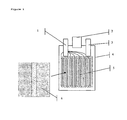
- the figure 1 represents a cross-sectional view of an open alkaline accumulator according to the invention.
- the figure 2 represents the charge current of open alkaline accumulators as a function of the duration of the charge at constant voltage expressed in number of days of charge.
- Curve A corresponds to an open alkaline accumulator of the prior art, the separator of which consists of a non-grafted microporous membrane placed between two layers of polyolefin of fibrous structure.
- Curve B corresponds to an open alkaline accumulator according to the invention, the separator of which comprises a microporous membrane grafted by means of activation by UV radiation and placed between two layers of polyolefin of fibrous structure.
- Curve C corresponds to an open alkaline accumulator not forming part of the invention and whose separator comprises a dense membrane, grafted by activation by cobalt irradiation, and arranged between two layers of polyolefin of fibrous structure.
- the positive electrode of the accumulator comprises an electrochemically active material which is generally mainly a nickel hydroxide Ni (OH) 2 , and optionally one or more hydroxides of other compounds such as Zn, Co, Ca, Cd, Mg, Mn, Al, etc. which are syncrystallized with nickel hydroxide.
- an electrochemically active material which is generally mainly a nickel hydroxide Ni (OH) 2 , and optionally one or more hydroxides of other compounds such as Zn, Co, Ca, Cd, Mg, Mn, Al, etc. which are syncrystallized with nickel hydroxide.
- the negative electrode of the accumulator comprises an electrochemically active material which may be metallic cadmium for a nickel cadmium accumulator or a hydridable intermetallic compound of type AB 5 , type AB 2 or type AB t with 3,2 tt ⁇ 3.5 or any conventional material in the art.
- the electrolyte is a concentrated aqueous alkaline solution comprising at least one hydroxide (KOH, NaOH, LiOH) in a concentration generally several times molar.
- the microporous membrane is made of polyolefin, for example polyethylene or polypropylene, preferably polypropylene. Its total thickness is included preferably between 10 microns and 50 microns. It comprises pores with a diameter of preferably between 0.1 ⁇ m and 1 ⁇ m.
- An ethylenically unsaturated monomer is grafted onto said polyolefin.
- the grafting can be activated either by irradiation with a radioactive cobalt bomb emitting ⁇ -rays, or by ultraviolet (UV) radiation.
- UV radiation method is preferred to the irradiation method because, on the one hand, the irradiation process is complex to implement and, on the other hand, the UV-activated radiation-grafted polymer membranes exhibit satisfactory performance at very low levels. temperatures (below -30 ° C).
- documents may be referred to US 3,427,206 , FR-A-2,489,598 , FR-A-2,267,330 , FR-A-2,200,305 and FR-A-2,399,134 and Journal of Applied Polymer Science, vol. 30, 1023-1033 (1985) for further details on the experimental conditions for carrying out the irradiation activation method.
- the ethylenically unsaturated monomers may be carboxylic acids and their esters such as acrylic acid, methacrylic acid, methyl acrylate and methyl methacrylate. Acrylic acid is preferred.
- Other vinyl monomers may also be used such as acrylamide, vinyl pyridine, vinylpyrrolidone and styrene sulfonic acid.
- the solvent of the monomer solution is chosen so as not to evaporate significantly during step b) of the UV radiation emission.
- the solvent may be, for example, water.
- the monomer solution may optionally contain a homopolymerization inhibitor to prevent homopolymerization of the ethylenically unsaturated monomer.
- a polymerization inhibitor may be, for example, a copper (II) salt or an iron (II) salt.
- the monomer solution may also contain a surfactant so as to improve the wetting properties of the monomer solution.
- the membrane After exposure of the membrane to UV radiation, it is washed with deionized water to remove unreacted reagents and homopolymerized acrylic acid that may have formed. The grafted membrane is then dried.
- the grafted membrane is placed between at least two layers of polyolefin of fibrous structure to form a separator, preferably between two layers of polyolefin of fibrous structure. It is placed out of contact with the positive and negative electrodes.
- the polyolefin layers placed on either side of the grafted membrane may be made of polyamide or polyolefin.
- the accumulator according to the invention is therefore well adapted to operate during step b) of the charging method.
- positive and negative electrodes are made by depositing positive and negative active materials on flat current collectors. At least one negative electrode, a separator and a positive electrode are superimposed to form the electrochemical bundle (5). This beam is introduced into a plastic case of parallelepipedal or (prismatic) format (4). The positive and negative electrodes are electrically connected to the positive (1) and negative (3) current output terminals respectively.
- the housing is filled with electrolyte and then closed by a cover in a non-sealed manner. This cover may have a safety cap (2).
- the figure 1 is a schematic cross-sectional view of an open alkaline accumulator according to the invention.
- the accumulator contains an excess of electrolyte, i.e. the electrochemical beam is completely immersed in the electrolyte.
- the housing is filled with electrolyte so that the level of the electrolyte protrudes from the top of the electrodes and separators.
- the invention does not relate to a sealed (or closed) battery with an electrolyte fault.
- part of the pores of the separator does not contain electrolyte.
- the presence of pores not filled with electrolyte allows the passage of oxygen through the separator and the reduction of oxygen on the negative electrode (or recombination). This is precisely what the invention seeks to prevent.
- the polyolefin layer of fibrous structure facing the positive electrode is chosen so that its pores have a diameter greater than the pore diameter of the grafted membrane.
- the pore diameter of the polyolefin layer of fibrous structure facing the positive electrode is greater than 10 ⁇ m, for example between 10 and 20 ⁇ m, and the pore diameter of the grafted membrane is less than micron, for example between 0.1 and 0.5 microns.
- the grafted membrane so that its pores have a diameter greater than the pore diameter of the polyolefin layer of fibrous structure facing the negative electrode.
- the pore size distribution in the three separator layers follows a decreasing order from the positive electrode to the negative electrode.
- the separator and the presence of an excess electrolyte have the effect of barrier to the passage of oxygen through the separator. This prevents the migration of dissolved oxygen, produced by the positive electrode during charging, to the negative electrode.
- An advantage directly related to the oxygen barrier effect is to prevent depolarization of the negative electrode.
- the depolarization of the negative electrode results in an incomplete charge of the accumulator.
- a second advantage related to the oxygen barrier effect is to reduce the risk of thermal runaway of the accumulator. The mechanism has been explained previously.
- the structure of the separator of the accumulator according to the invention makes it possible to avoid the transfer of oxygen through the separator to prevent thermal runaway. This structure also allows the separator to stably retain its barrier property to the transfer of oxygen gas to prevent thermal runaway.
- the accumulator according to the invention is particularly well suited as a source of energy for preferably aeronautical applications. , industrial applications or in telecommunications.
- the accumulator A of the prior art comprises a separator consisting of a non-grafted microporous membrane disposed between two layers of polyolefin of fibrous structure.
- Accumulator B comprises a microporous membrane of polypropylene, grafted by activation by UV radiation, and disposed between two layers of polyolefin fibrous structure.
- the grafted membrane is made by UV acrylic acid grafting from commercially available film 2400 from Celgard Corporation.
- the accumulator C not forming part of the invention, comprises a dense membrane of polyethylene, grafted with acrylic acid by activation by cobalt irradiation, and disposed between two layers of polyolefin of fibrous structure.
- Accumulators A, B and C first underwent 400 charge-discharge cycles at a temperature of 40 ° C and were then charged at a constant voltage of 1.40 V at a temperature of 50 ° C. They were maintained in the overloaded state at 1.40 V for several days at 50 ° C. The variation of the charging current was measured as a function of the number of charging days. This variation is represented figure 2 .
- the charging current of the storage battery A is about 0.25 A to the 6th day of load, then increases from the 6th day to 2.5 A in the 13th day. Increasing the charge current on the 6th day was due to a deterioration of the property of the separator to oxygen barrier. The battery charge A has to be stopped in the 13 th day to avoid the onset of thermal runaway.
- the accumulator dissipates a heat output of 3.5 W. Knowing that the mass of a test battery is about 1 kg and that its heat capacity is 1.25 J / g / ° C, it is deduced that the temperature rise of the accumulator is about 10 ° C / h. Under such conditions, the charge must be interrupted or the battery will be destroyed.
- the charge current of the accumulators B and C remains constant at about 0.25 A after 15 days of charging at constant voltage.
- Accumulators B and C can therefore operate under load at constant voltage for an extended period.
- the separator of accumulators B and C is a barrier to gaseous oxygen.
Landscapes
- Chemical & Material Sciences (AREA)
- Chemical Kinetics & Catalysis (AREA)
- Electrochemistry (AREA)
- General Chemical & Material Sciences (AREA)
- Engineering & Computer Science (AREA)
- Manufacturing & Machinery (AREA)
- Health & Medical Sciences (AREA)
- Toxicology (AREA)
- Textile Engineering (AREA)
- Cell Separators (AREA)
- Secondary Cells (AREA)
- Battery Electrode And Active Subsutance (AREA)
Claims (13)
- Offener Akkumulator vom Typ Nickel-Cadmium oder Nickel-Metallhydrid, umfassend einen Elektrolyten, mindestens eine positive Elektrode, mindestens eine negative Elektrode und mindestens einen Separator, wobei der Separator eine mikroporöse Polyolefinmembran umfasst, die mit einem ethylenisch ungesättigten Monomer gepfropft ist, sowie mindestens eine Polyolefinschicht fasriger Struktur zu beiden Seiten der Membran.
- Offener Akkumulator nach Anspruch 1, wobei der Elektrolyt im Überschuss ist.
- Offener Akkumulator nach einem der vorangegangenen Ansprüche, wobei die mikroporöse Polyolefinmembran zwischen zwei Polyolefinschichten fasriger Struktur angeordnet ist.
- Offener Akkumulator nach Anspruch 3, wobei der Durchmesser der Poren der Polyolefinschicht fasriger Struktur, die der positiven Elektrode gegenüberliegt, größer als der Durchmesser der Poren der gepfropften Membran ist.
- Offener Akkumulator nach Anspruch 4, wobei der Durchmesser der Poren der Polyolefinschicht fasriger Struktur, die der positiven Elektrode gegenüberliegt, größer als 10 µm ist und der Durchmesser der Poren der gepfropften Membran kleiner als ein Mikron ist.
- Offener Akkumulator nach Anspruch 5, wobei der Durchmesser der Poren der gepfropften Membran zwischen 0,1 µm und 1 µm beträgt.
- Offener Akkumulator nach einem der Ansprüche 3 bis 6, wobei die Poren der gepfropften Membran einen Durchmesser aufweisen, der größer ist als der Durchmesser der Poren der Polyolefinschicht fasriger Struktur, die der negativen Elektrode gegenüberliegt.
- Offener Akkumulator nach einem der vorangegangenen Ansprüche, wobei das ethylenisch ungesättigte Monomer eine Carbonsäure ist.
- Offener Akkumulator nach Anspruch 8, wobei die Carbonsäure Acrylsäure ist.
- Offener Akkumulator nach einem der vorangegangenen Ansprüche, wobei das Polyolefin Polyethylen oder Polypropylen, vorzugsweise Polypropylen, ist.
- Offener Akkumulator nach einem der vorangegangenen Ansprüche, wobei die Dicke der Membran zwischen 10 µm und 50 µm beträgt.
- Offener Akkumulator nach einem der vorangegangenen Ansprüche, wobei das Pfropfen des Polyolefins durch UV-Strahlung aktiviert wurde.
- Verwendung einer mikroporösen Polyolefinmembran, die mit einem ethylenisch ungesättigten Monomer gepfropft ist, sowie mindestens einer Polyolefinschicht fasriger Struktur zu beiden Seiten der Membran in einem offenen Akkumulator vom Typ Nickel-Cadmium oder Nickel-Metallhydrid, um eine Sperre für gasförmigen Sauerstoff bereitzustellen.
Applications Claiming Priority (1)
| Application Number | Priority Date | Filing Date | Title |
|---|---|---|---|
| FR0505586A FR2886767B1 (fr) | 2005-06-02 | 2005-06-02 | Accumulateur alcalin ouvert comportant une membrane microporeuse. |
Publications (2)
| Publication Number | Publication Date |
|---|---|
| EP1729360A1 EP1729360A1 (de) | 2006-12-06 |
| EP1729360B1 true EP1729360B1 (de) | 2009-07-29 |
Family
ID=35840355
Family Applications (1)
| Application Number | Title | Priority Date | Filing Date |
|---|---|---|---|
| EP06290869A Ceased EP1729360B1 (de) | 2005-06-02 | 2006-05-30 | Alkalischer offener Akkumulator umfassend eine mikroporöse Membrane |
Country Status (4)
| Country | Link |
|---|---|
| US (1) | US20060281003A1 (de) |
| EP (1) | EP1729360B1 (de) |
| DE (1) | DE602006008066D1 (de) |
| FR (1) | FR2886767B1 (de) |
Families Citing this family (1)
| Publication number | Priority date | Publication date | Assignee | Title |
|---|---|---|---|---|
| DE102010046647A1 (de) * | 2010-09-27 | 2012-03-29 | Hoppecke Batterie Systeme Gmbh | Nickel-Metallhydrid-Akkumulator |
Family Cites Families (14)
| Publication number | Priority date | Publication date | Assignee | Title |
|---|---|---|---|---|
| JPS5425432A (en) * | 1977-07-26 | 1979-02-26 | Japan Atomic Energy Res Inst | Method of making cell diaphragm |
| JPS56159056A (en) * | 1980-05-10 | 1981-12-08 | Yuasa Battery Co Ltd | Silver peroxide battery |
| JPS56160762A (en) * | 1980-05-16 | 1981-12-10 | Toshiba Battery Co Ltd | Alkaline battery |
| JPS577061A (en) * | 1980-06-16 | 1982-01-14 | Hitachi Maxell Ltd | Silver battery |
| JPS59224051A (ja) * | 1983-06-03 | 1984-12-15 | Sanyo Electric Co Ltd | アルカリ蓄電池 |
| DE69222421T3 (de) * | 1991-07-09 | 2006-04-20 | Scimat Ltd. | Polymer-Folie und Verfahren zu deren Herstellung |
| FR2754394B1 (fr) * | 1996-10-03 | 1998-11-13 | Accumulateurs Fixes | Separateur pour accumulateur nickel-metal hydrurable |
| JPH10125300A (ja) * | 1996-10-24 | 1998-05-15 | Japan Storage Battery Co Ltd | アルカリ二次電池用セパレ−タ |
| US6337373B1 (en) | 1999-07-30 | 2002-01-08 | Montell Technology Company Bv | Polyolefin graft copolymers made with fluorinated monomers |
| US6384100B1 (en) * | 1999-10-29 | 2002-05-07 | Hollingsworth + Vose Company | Graft polymerization, separators, and batteries including the separators |
| US6703161B2 (en) * | 2001-09-20 | 2004-03-09 | Daramic, Inc. | Multilayer separator for lead-acid batteries |
| EP1599517A2 (de) | 2003-03-04 | 2005-11-30 | Basell Poliolefine Italia S.r.l. | Polyolefin gepfropft mit polyvinylalkohol und herstellung davon. |
| JP2004323827A (ja) * | 2003-04-09 | 2004-11-18 | Nitto Denko Corp | 電池用セパレータのための接着剤担持多孔質フィルムとその利用 |
| DE102004045095B3 (de) * | 2004-09-17 | 2005-11-24 | Vb Autobatterie Gmbh & Co. Kgaa | Elektrochemischer Bleiakkumulator |
-
2005
- 2005-06-02 FR FR0505586A patent/FR2886767B1/fr not_active Expired - Fee Related
-
2006
- 2006-05-30 DE DE602006008066T patent/DE602006008066D1/de active Active
- 2006-05-30 EP EP06290869A patent/EP1729360B1/de not_active Ceased
- 2006-05-31 US US11/421,221 patent/US20060281003A1/en not_active Abandoned
Also Published As
| Publication number | Publication date |
|---|---|
| EP1729360A1 (de) | 2006-12-06 |
| FR2886767B1 (fr) | 2007-07-27 |
| DE602006008066D1 (de) | 2009-09-10 |
| FR2886767A1 (fr) | 2006-12-08 |
| US20060281003A1 (en) | 2006-12-14 |
Similar Documents
| Publication | Publication Date | Title |
|---|---|---|
| JP5337768B2 (ja) | ゲル電解質電池の分離器 | |
| US7153607B2 (en) | Alkaline zinc secondary cell and method for preparation thereof | |
| WO2004068610A2 (fr) | Generateur electrochimique rechargeable | |
| JP2002117899A (ja) | リチウムポリマー電池およびその製造法 | |
| WO2003079465A2 (fr) | Séparateur pour accumulateurs électriques secondaires à recombinaison des gaz | |
| EP0666608B1 (de) | Wartungsfreier aufladbarer elektrochemischer Generator mit wässrigem Elektrolyten | |
| CA2191019C (fr) | Anode de lithium rechargeable pour accumulateur a electrolyte polymere | |
| EP0834942B1 (de) | Sekundärbatterie mit alkalischem Elektrolyten | |
| US20020160256A1 (en) | Non-aqueous electrolyte secondary battery | |
| JP2014139880A (ja) | アルカリ電解液二次電池用セパレータ、アルカリ電解液二次電池及びアルカリ電解液二次電池の製造方法 | |
| JP3216592B2 (ja) | アルカリ蓄電池 | |
| EP0907216B1 (de) | Offener wartungsfreier industrieller Akkumulator | |
| EP1729360B1 (de) | Alkalischer offener Akkumulator umfassend eine mikroporöse Membrane | |
| FR2652950A1 (fr) | Batterie secondaire alcaline etanche. | |
| FR2945892A1 (fr) | Electrode plastifiee pour accumulateur alcalin | |
| CN1211877C (zh) | 镍氢蓄电池及其制造方法 | |
| EP2070139B1 (de) | Plastifizierte elektrode für eine alkali-batterie | |
| EP4562691A1 (de) | Elektrochemisches lithiumelement mit einer positiven elektrode auf basis eines lithium-mangan-eisenphosphats | |
| JP3045265B2 (ja) | ニッケル−水素電池 | |
| JP2013122862A (ja) | 円筒型アルカリ蓄電池 | |
| CA2514783C (fr) | Generateur electrochimique rechargeable | |
| EP3676894B1 (de) | Elektrode mit mehrfachanordnung zur stromabnahme | |
| FR2815474A1 (fr) | Generateur electrochimique etanche a dispositif de recombinaison amiliore | |
| EP2811553B1 (de) | Kunststoffelektrode für alkalischen Akkumulator | |
| CH720372A2 (fr) | Élément de batterie comprenant un électrolyte à l'état solide |
Legal Events
| Date | Code | Title | Description |
|---|---|---|---|
| PUAI | Public reference made under article 153(3) epc to a published international application that has entered the european phase |
Free format text: ORIGINAL CODE: 0009012 |
|
| AK | Designated contracting states |
Kind code of ref document: A1 Designated state(s): AT BE BG CH CY CZ DE DK EE ES FI FR GB GR HU IE IS IT LI LT LU LV MC NL PL PT RO SE SI SK TR |
|
| AX | Request for extension of the european patent |
Extension state: AL BA HR MK YU |
|
| 17P | Request for examination filed |
Effective date: 20070606 |
|
| AKX | Designation fees paid |
Designated state(s): DE FR GB |
|
| 17Q | First examination report despatched |
Effective date: 20071026 |
|
| GRAP | Despatch of communication of intention to grant a patent |
Free format text: ORIGINAL CODE: EPIDOSNIGR1 |
|
| RAP1 | Party data changed (applicant data changed or rights of an application transferred) |
Owner name: SAFT GROUPE SA |
|
| GRAS | Grant fee paid |
Free format text: ORIGINAL CODE: EPIDOSNIGR3 |
|
| GRAA | (expected) grant |
Free format text: ORIGINAL CODE: 0009210 |
|
| AK | Designated contracting states |
Kind code of ref document: B1 Designated state(s): DE FR GB |
|
| REG | Reference to a national code |
Ref country code: GB Ref legal event code: FG4D Free format text: NOT ENGLISH |
|
| REF | Corresponds to: |
Ref document number: 602006008066 Country of ref document: DE Date of ref document: 20090910 Kind code of ref document: P |
|
| PLBE | No opposition filed within time limit |
Free format text: ORIGINAL CODE: 0009261 |
|
| STAA | Information on the status of an ep patent application or granted ep patent |
Free format text: STATUS: NO OPPOSITION FILED WITHIN TIME LIMIT |
|
| 26N | No opposition filed |
Effective date: 20100503 |
|
| REG | Reference to a national code |
Ref country code: FR Ref legal event code: PLFP Year of fee payment: 11 |
|
| REG | Reference to a national code |
Ref country code: FR Ref legal event code: PLFP Year of fee payment: 12 |
|
| REG | Reference to a national code |
Ref country code: FR Ref legal event code: PLFP Year of fee payment: 13 |
|
| PGFP | Annual fee paid to national office [announced via postgrant information from national office to epo] |
Ref country code: GB Payment date: 20180531 Year of fee payment: 13 |
|
| GBPC | Gb: european patent ceased through non-payment of renewal fee |
Effective date: 20190530 |
|
| PG25 | Lapsed in a contracting state [announced via postgrant information from national office to epo] |
Ref country code: GB Free format text: LAPSE BECAUSE OF NON-PAYMENT OF DUE FEES Effective date: 20190530 |
|
| PGFP | Annual fee paid to national office [announced via postgrant information from national office to epo] |
Ref country code: DE Payment date: 20200525 Year of fee payment: 15 |
|
| REG | Reference to a national code |
Ref country code: DE Ref legal event code: R079 Ref document number: 602006008066 Country of ref document: DE Free format text: PREVIOUS MAIN CLASS: H01M0002160000 Ipc: H01M0050409000 |
|
| PGFP | Annual fee paid to national office [announced via postgrant information from national office to epo] |
Ref country code: FR Payment date: 20210510 Year of fee payment: 16 |
|
| REG | Reference to a national code |
Ref country code: DE Ref legal event code: R119 Ref document number: 602006008066 Country of ref document: DE |
|
| PG25 | Lapsed in a contracting state [announced via postgrant information from national office to epo] |
Ref country code: DE Free format text: LAPSE BECAUSE OF NON-PAYMENT OF DUE FEES Effective date: 20211201 |
|
| PG25 | Lapsed in a contracting state [announced via postgrant information from national office to epo] |
Ref country code: FR Free format text: LAPSE BECAUSE OF NON-PAYMENT OF DUE FEES Effective date: 20220531 |