EP1732040A1 - Processeur d'images, procédé de traitement des images et support d'enregistrement des informations - Google Patents
Processeur d'images, procédé de traitement des images et support d'enregistrement des informations Download PDFInfo
- Publication number
- EP1732040A1 EP1732040A1 EP05709419A EP05709419A EP1732040A1 EP 1732040 A1 EP1732040 A1 EP 1732040A1 EP 05709419 A EP05709419 A EP 05709419A EP 05709419 A EP05709419 A EP 05709419A EP 1732040 A1 EP1732040 A1 EP 1732040A1
- Authority
- EP
- European Patent Office
- Prior art keywords
- moving
- distance
- virtual
- viewpoint
- dimensional space
- Prior art date
- Legal status (The legal status is an assumption and is not a legal conclusion. Google has not performed a legal analysis and makes no representation as to the accuracy of the status listed.)
- Withdrawn
Links
Images



Classifications
-
- G—PHYSICS
- G06—COMPUTING OR CALCULATING; COUNTING
- G06T—IMAGE DATA PROCESSING OR GENERATION, IN GENERAL
- G06T17/00—Three-dimensional [3D] modelling for computer graphics
-
- G—PHYSICS
- G06—COMPUTING OR CALCULATING; COUNTING
- G06T—IMAGE DATA PROCESSING OR GENERATION, IN GENERAL
- G06T13/00—Animation
- G06T13/20—Three-dimensional [3D] animation
-
- G—PHYSICS
- G06—COMPUTING OR CALCULATING; COUNTING
- G06T—IMAGE DATA PROCESSING OR GENERATION, IN GENERAL
- G06T15/00—Three-dimensional [3D] image rendering
- G06T15/10—Geometric effects
Definitions
- the present invention relates to an image processor, an image processing method, and an information storage medium.
- Three-dimensional computer graphics are known in which a virtual three-dimensional space where the object and the viewpoint are defined is constructed in a computer memory and a picture of the object viewed from the viewpoint is displayed on a monitor. Use of three-dimensional computer graphics enables preferable realization of the virtual reality.
- Japanese Patent Laid-open Publication No. 2002-163684 Japanese Patent Laid-open Publication No. 2002-163684
- the shape data of the respective objects placed in the virtual three-dimensional space are prepared in advance and the sizes of the respective objects placed in the virtual three-dimensional space remain unchanged.
- the present invention has been conceived in view of the above, and the object of the present invention is to provide an image processor capable of improving visibility of the object when a picture of the virtual three-dimensional space is displayed, an image processing method, and an information storage medium.
- an image processor for displaying an image representative of a picture of an object viewed from a viewpoint in a virtual three-dimensional space where the object and the viewpoint are placed, comprising: distance data calculation means for calculating distance data concerning the object and the viewpoint; moving state determination means for determining at least one of a moving distance and a moving speed of the object in the virtual three-dimensional space, based on the distance data; object moving means for moving the object in the virtual three-dimensional space based on at least one of the moving distance and the moving speed of the object, which is determined by the moving state determination means; and image displaying means for displaying an image representative of a picture of the object moving in the virtual three-dimensional space viewed from the viewpoint.
- an image processing method for displaying an image representative of a picture of an object viewed from a viewpoint in a virtual three-dimensional space where the object and the viewpoint are placed comprising: a distance data calculating step of calculating distance data concerning the object and the viewpoint; a moving state determining step of determining at least one of a moving distance and a moving speed of the object in the virtual three-dimensional space, based on the distance data; an object moving step of moving the object in the virtual three-dimensional space based on at least one of the moving distance and the moving speed of the object, which is determined by the moving state determination means; and an image displaying step of displaying an image representative of a picture of the object moving in the virtual three-dimensional space viewed from the viewpoint.
- a computer readable data storage medium for having a computer, such as a home-use game device, a commercial game device, a portable game device, a portable phone, a personal computer, a server computer, and so forth, to function as distance data calculation means for calculating distance data concerning an object and a viewpoint both placed in a virtual three-dimensional space; moving state determination means for determining at least one of a moving distance and a moving speed of the object in the virtual three-dimensional space, based on the distance data; object moving means for moving the object in the virtual three-dimensional space based on at least one of the moving distance and the moving speed of the object, which is determined by the moving state determination means; and image displaying means for displaying an image representative of a picture of the object moving in the virtual three-dimensional space viewed from the viewpoint.
- a computer such as a home-use game device, a commercial game device, a portable game device, a portable phone, a personal computer, a server computer, and so forth, to function as distance data calculation means for calculating distance
- the program may be stored in a computer readable information storage medium, for example, a CD-ROM, a DVD-ROM, a ROM cartridge, and so forth.
- At least one of the moving distance and speed of the object in the virtual three-dimensional space may be determined based on the distance data concerning the object and viewpoint both placed in the virtual three-dimensional space.
- the object may move in the virtual three-dimensional space based on the moving distance or speed.
- the image processor may further comprise size information determination means for determining size information indicative of a size of the object placed in the virtual three-dimensional space, based on the distance data; and object enlargement and reduction means for enlarging or reducing the object according to the size information determined by the size information determination means.
- the image displaying means may display an image representative of a picture of the object enlarged or reduced viewed from the viewpoint in the virtual three-dimensional space.
- the size information indicative of the size of the object may be determined based on the distance data concerning the object and viewpoint both placed in the virtual three-dimensional space.
- the object may be reduced or enlarged according to the size information.
- the distance data may be data indicative of a distance between a position associated with the object and a position of the viewpoint.
- the position associated with an object may be, for example, a position of a representative position or the like of the object or a position of a representative position or the like of another object corresponding to the object.
- the size information determination means may determine a rate by which the object is enlarged or reduced as the size information of the object based on the distance data, and the object enlargement and reduction means may enlarge or reduce the object having a predetermined size by the rate.
- Fig.1 is a diagram showing a structure of a game device according to one embodiment of the present invention.
- the game device 10 shown in Fig. 1 concerns one formation of an image processor according to the present invention, which is formed by attaching a DVD-ROM 25, which serves as a computer readable data storage medium, to a home-use game machine (a computer game system) 11, which is connected to a monitor 18 and a speaker 22.
- a DVD-ROM 25 which serves as a computer readable data storage medium
- a home-use game machine a computer game system
- a game program or game data stored in the DVD-ROM 25 is read out and supplied to the home-use game machine 11.
- any other information storage medium such as a CD-ROM, a ROM cartridge, or the like, may be similarly employed.
- a game program and/or game data may be supplied to the home-use game machine 11 from a remote place via a data communication network such as the Internet.
- a microprocessor 14, an image processing section 16, a main memory 26, and an input output processing section 30 are connected to one another via a bus 12 so as to attain mutual data communication. Further, a controller 32, a sound processing section 20, and a DVD-ROM reproduction section 24 are connected to the input output processing section 30.
- the structural elements other than the controller 32 of the home-use game machine 11 are incorporated in a housing.
- a household television receiver, for example, may be used as the monitor 18, and a household television built-in speaker, for example, may be used as the speaker 22.
- the microprocessor 14 controls the respective sections of the home-use game machine 11 based on an operating system stored in the ROM (not shown) or a game program read from the DVD-ROM 25.
- Use of the bus 12 enables exchange of address and data among the respective sections of the home-use game machine 11.
- the main memory 26 is formed so as to include a RAM, to which a game program and game data read from the DVD-ROM 25 are written as required.
- the RAM is used also as a workspace for the microprocessor 14.
- the image processing section 16 is formed so as to include a VRAM, and renders a game screen image in the VRAM based on the image data received from the microprocessor 14. Also, the image processing section 16 converts the content of the rendered game screen image into a video signal, and then outputs to the monitor 18 at predetermined timing.
- the image processing section 16 receives from the microprocessor 14 the vertex coordinates (X, Y, Z), vertex color information (R, G, B), texture coordinates (VX, VY), alpha value, and so on of each polygon in the viewpoint coordinate system. Then, while using the received information, the image processing section 16 writes the color information, Z value (depth information), alpha ( ⁇ ) value, or the like of each of the pixels which constitute the display screen image, into the VRAM. The resultant display image is output to the monitor 18 at predetermined timing.
- each of pixel tests can be desirably carried out.
- a pixel test an alpha test, a destination alpha test, and a depth test are available.
- a desired pixel test is carried out according to an instruction sent from the microprocessor 14.
- the alpha value of a writing pixel is compared to a predetermined reference alpha value. When a designated condition is not satisfied, writing of the pixel is restricted.
- the alpha value (a destination alpha value) of a pixel at the writing destination pixel (the pixel which is already written at the writing destination address in the VRAM) is compared to a predetermined value (0 x 80).
- a predetermined value (0 x 80).
- the Z value of the writing pixel is compared to the Z value of the Z buffer (formed in the VRAM). When a designated condition is not satisfied, the writing of the pixel is restricted.
- masking is applicable so that a writing operation of the color information, Z value, and alpha value of each pixel can be preferably prohibited.
- the input output processing section 30 serves as an interface for relaying data communication between the microprocessor 14 and the controller 32, sound processing section 20, and DVD-ROM reproduction section 24, respectively.
- the controller 32 serves as an input means via which a player can operate a game.
- the input output processing section 30 scans the operating condition of the various buttons of the controller 32 in a constant period (for example, every 1/60 seconds), and forwards an operating signal indicative of the scanning result to the microprocessor 14 via the bus 12.
- the microprocessor 14 makes judgment on the game operation carried out by the player based on the operating signal.
- the sound processing section 20 is formed so as to include a sound buffer, and reproduces data such as music, game sound effects, and so forth, which is read from the DVD-ROM 25 and stored in the sound buffer or the like, for output via the speaker 22.
- the DVD-ROM reproduction section 24 reads out a game program and game data recorded in the DVD-ROM 25 in accordance with an instruction sent from the microprocessor 14.
- Figs. 2 and 3 are diagrams showing an example of a game screen displayed on the monitor 18.
- a puddle object 44 and a game character object 40 are placed on a plate-like game stage object 46, and a water droplet object (an exaggerated object) 42 is displayed above the puddle object 44, more particularly, on the left leg side of the game character object 40. That is, on the game screen shown in Fig. 2, the left leg of the game character object 40 is located above the puddle object 44, and a state in which a water droplet object 42 is caused to be splashed from the puddle object 44 by the left leg of the game character object 40 is displayed.
- the game screen shown in Fig. 3 shows a scene which results when the same situation created in the virtual three-dimensional space is viewed from a viewpoint which is located farther from the water droplet object 42 or the like, compared to the game screen shown in Fig. 2.
- the water droplet object 42 on the game screen of Fig. 2 has a size (dimension) corresponding to the distance between the foot and thigh
- the water droplet object 42 on the game screen of Fig. 3 has a size corresponding to the distance between the foot and hips of the game character object 40. That is, in this embodiment, the size of the water droplet object 42 in the virtual three-dimensional space is made accordingly larger as the viewpoint used in creation of the game screen becomes farther from the water droplet object 42, whereby the water droplet object 42 is displayed in an exaggerated manner.
- the display size (that is, the displayed area in the game screen) of the water droplet object 42 on the game screen generally becomes smaller when the viewpoint is defined farther from the water droplet object 42, and the water droplet objects 42 accordingly becomes unclear and difficult to identify
- the water droplet object 42 is displayed in a larger displayed size than that in normal display, and the above described deficiency can be resolved.
- a distance by which the water droplet object 42 moves (a moving distance) and a speed at which the water droplet object 42 moves (a moving speed) are varied according to the distance between the viewpoint and the water droplet object 42.
- the water droplet object 42 is arranged so as to move on a larger trajectory in the virtual three-dimensional space, compared to a case where a picture of the water droplet object 42 is viewed from a closer viewpoint is displayed on the game screen.
- Fig. 4 is a perspective view showing the picture of the virtual three-dimensional space.
- the virtual three-dimensional space 50 shown in Fig. 4 is constructed in the main memory 26 of the game device 10. Specifically, a puddle object 44 and a game character object 40 are placed on a plate-like game stage object 46.
- the puddle object 44 is a static object which does not change in position and posture as time passes.
- the game character obj ect 40 is a dynamic object which changes in position and/or posture in the virtual three-dimensional space 50 according to a program or an operation carried out using the controller 32. Above the puddle object 44, the water droplet object 42 is shown splashed.
- the trajectory (the movement path) of the water droplet object 42 is calculated every time based on the motion data stored in the DVD-ROM 25 or using a predetermined operational expression.
- the water droplet object 42 is also a dynamic object. Each object is formed using one or more polygons, and each polygon has a texture mapped thereon.
- a viewpoint 54 which is necessary to create a game screen is also defined.
- a picture of the game character object 40, the puddle obj ect 44, and the water droplet obj ect 42 viewed from the viewpoint 54 is displayed as a game screen image on the monitor 18.
- a representative point 56 is defined on the game character object 40, and the distance L between the representative point 56 and the viewpoint 54 is calculated. Then, the water droplet object 42 and the trajectory of the water droplet object 42 are enlarged according to the distance L.
- Fig. 5 is a diagram showing a water droplet object 42
- Fig. 6 is a diagram showing a texture mapped on the water droplet object 42.
- the water droplet object 42 is formed using a rectangle polygon and has four vertices V1 through V4.
- the length of the side connecting the vertices V1 and V3 and the length of the side connecting the vertices V2 and V4 are respectively defined as "a"
- the length of the side connecting the vertices V1 and V2 and the length of the side connecting the vertices V3 and V4 are respectively defined as "b".
- a magnification rate ⁇ is determined according to the distance L between the viewpoint 54 and the representative point 56 defined on the game character object 40. Then, the magnification rate ⁇ is multiplied to the lengths "a" and "b" of the respective sides of the water droplet object 42, so that the size of the water droplet object 42 is changed accordingly.
- Fig. 7 is a diagram showing the relationship between the magnification rate ⁇ and the distance L between the viewpoint 54 and the representative point 56 defined on the game character object 40.
- the magnification rate ⁇ is defined as one.
- the magnification rate ⁇ is defined as two (0 ⁇ L1 ⁇ L2).
- the magnification rate ⁇ gradually increases beginning with one as the distance L increases until the magnification rate ⁇ becomes two when the distance L becomes equal to the predetermined distance L2.
- the size of the water droplet object 42 in the virtual three-dimensional space 50 remains at a prescript value until the distance L becomes equal to the predetermined distance L1. Thereafter, the size becomes larger until the distance L reaches the predetermined distance L2.
- the water droplet object 42 reaches four times (twice for each side) in size. Thereafter, the four times as large size remains relative to the distance L equal to or larger than the predetermined distance L2.
- various moving distances such as the height of the trajectory (the distance from the game stage object 46) and the horizontal distance from the position at which the water droplet is generated to the point to which the water droplet object 42 drops (a dropped position), and so forth are changed or the moving speed of the water droplet object 42 is changed according to the distance L.
- the motion data may be corrected according to the magnification rate ⁇ or a parameter (a trajectory change rate ⁇ to be described later) which is determined according to the distance L between the representative point 56 and the viewpoint 54 other than the magnification rate ⁇ .
- a parameter included in an operational expression for calculating the trajectory may be corrected according to the magnification rate ⁇ or the trajectory change rate ⁇ .
- the trajectory of the water droplet object 42 forms a parabola
- the trajectory can be calculated using the operational expression indicative of a parabola described below.
- x represents vector quantity and indicates the distance from the generation position of the water droplet object 42.
- y represents scalar quantity and indicates the height from the generation position of the water droplet object 42.
- t represents a period of time elapsed from the moment at which the water droplet object 42 is generated.
- vx represents a horizontal component (vector quantity) of the initial speed of the water droplet object 42.
- vy represents a vertical component of the initial speed of the water droplet object 42.
- g represents gravity acceleration.
- Fig. 8 shows the parabolic trajectory 41 of the water droplet object 42.
- the height h from the game stage object 46 and the horizontal distance d between the generation position 41s and the dropped position 41e are determined according to the distance L between the representative point 56 and the viewpoint 54.
- the moving distance of the water droplet object 42 can be changed according to the distance L using these expressions as follows.
- the height h is calculated, for example, using the following expression (5) and a trajectory change rate ⁇ which takes the larger value which is equal to or larger than one as the distance L takes the larger value. Then, the height h is substituted into the above expressions (3) and (4) to thereby obtain the horizontal component vy and gravity acceleration g of the initial speed. Thereafter, the obtained horizontal component vy and gravity acceleration g of the initial speed are substituted into the expressions (1) and (2) to thereby calculate the trajectory 41 of the water droplet object 42.
- the rising time period T is calculated using the trajectory change rate ⁇ and the following expression (6), for example.
- the obtained rising time period T is substituted into the above mentioned expressions (3) and (4) to thereby obtain the horizontal component vy and gravity acceleration g of the initial speed.
- the obtained horizontal component vy and gravity acceleration g of the initial speed are substituted into the above mentioned expressions (1) and (2) to thereby calculate the trajectory 41 of the water droplet object 42.
- the height h and the rising time period T may both be obtained using the above mentioned expressions (5) and (6), and the obtained height h and rising time period T may be substituted into the expressions (1) through (4) to thereby calculate the trajectory 41 of the water droplet object 42.
- the water droplet object 42 is splashed to the higher point, and the moving distance of the water droplet object 42 becomes accordingly longer. Moreover, the moving speed of the water droplet object 42 becomes slower, and the emerging time period becomes accordingly longer.
- the horizontal distance d may be changed according to the distance L. Specifically, while supposing that the reference horizontal distance is defined as d0, the horizontal distance d is obtained using the following expression (7). The obtained horizontal distance d may be substituted into the following expression (8), to thereby obtain the magnitude
- the trajectory change rate ⁇ used in the above described processing may be determined according to the table shown in Fig. 9.
- the table shown in Fig. 9 defines the trajectory change rate ⁇ as one with respect to the distance L being equal to or shorter than the predetermined distance L2. Also, with respect to the distance L equal to or longer than the predetermined distance L3, the trajectory change rate ⁇ is defined as two (0 ⁇ L1 ⁇ L2 ⁇ L3). Further, while the distance L remains between the predetermined distance L2 and the predetermined distance L3, the trajectory change rate ⁇ gradually increases beginning with one as the distance L increases until the trajectory change rate ⁇ becomes two when the distance L becomes equal to the predetermined distance L3.
- the moving distance and/or speed of the water droplet object 42 moving in virtual three-dimensional space 50 remain normal while the distance L is equal to or shorter than the predetermined distance L2. While the distance L remains between the predetermined distance L2 and the predetermined distance L3, the moving distance and/or speed become/becomes gradually longer and/or faster, respectively, until the moving distance and/or speed become/becomes double when the distance L becomes equal to the predetermined distance L3. Thereafter, the moving distance and/or speed remain/remains double when the distance L becomes equal to or longer than the predetermined distance L3.
- the moving distance and/or speed of the water droplet object 42 are/is changed when the distance L is equal to or larger than the predetermined distance L2, that is, when size enlargement of the water droplet object 42 according to the table shown in Fig. 7 is not applied.
- the table shown in Fig. 10 defines the trajectory change rate ⁇ as one with respect to the distance L being equal to or shorter than the predetermined distance L1. Also, with respect to the distance L equal to or longer than the predetermined distance L3, the trajectory change rate ⁇ is defined as two (0 ⁇ L1 ⁇ L2 ⁇ L3). Further, while the distance L remains between the predetermined distance L1 and the predetermined distance L3, the trajectory change rate ⁇ gradually increases beginning with one as the distance L increases until the trajectory change rate becomes two when the distance L becomes equal to the predetermined distance L3.
- the moving distance and/or speed of the water droplet object 42 moving in virtual three-dimensional space 50 remain/remains normal while the distance L remains equal to or shorter than the predetermined distance L1. While the distance L remains between the predetermined distance L1 and the predetermined distance L3, the moving distance and/or speed become/becomes gradually longer and/or faster, respectively, until the moving distance and/or speed become/becomes double when the distance L becomes equal to the predetermined distance L3. Thereafter, the moving distance and/or speed remain/remains double when the distance L becomes equal to or longer than the predetermined distance L3.
- the moving distance and/or speed of the water droplet object 42 begins to change when the size enlargement of the water droplet object 42 according to the table shown in Fig. 7 begins.
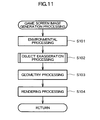
- Fig. 11 is a flowchart showing game screen image creation processing to be carried out by the game device 10. This processing is carried out by the game device 10 based on the program stored in the DVD-ROM 25 for every predetermined period of time (for example, 1/60 second).
- the microprocessor 14 initially carries out game environment processing based on the game program and game data read from the DVD-ROM 25 (S101). In the game environment processing, the positions and postures of all static and dynamic objects located in the virtual three-dimensional space 50 are calculated.
- an exaggerated object an object to be subjected to size reduction and moving distance and speed changing
- a water droplet object 42 among the dynamic objects
- the position and posture of the exaggerated object are determined using an trajectory change rate ⁇ which is determined at the time when each exaggerated object is generated (emerged) in the object exaggeration processing, to be described later (S102).
- a viewpoint and the field of view range are calculated. Then, an object which moves out of the field of view range is exempted from the subsequent game processing.
- an exaggerated object an object to be enlarged
- object exaggeration processing is applied to the exaggerated object (S102).
- the object exaggeration processing will be described later in detail.
- the microprocessor 14 carries out geometry processing (S103).
- geometry processing specifically, coordinate conversion from the world coordinate system to the viewpoint coordinate system is carried out. Also, the color information concerning the vertices of each of the polygons constituting an object is corrected based on the light source information (the color and position of the light source). Further, clipping processing is additionally carried out.
- the microprocessor 14 carries out rendering processing (S104).
- the microprocessor 14 sends the vertex coordinates, vertex color information, texture coordinates, and alpha value of each of the polygons belonging to the field of view range to the image processing section 16.
- the image processing section 16 in turn forms a display image in the VRAM based on the information.
- the game image formed in the VRAM of the image processing section 16 is read out at predetermined timing and displayed on the monitor 18.
- Fig. 12 is a flowchart showing in detail the object exaggeration processing (S102) in the game screen image generation processing shown in Fig. 11.
- an exaggerated object such as a water droplet object 42 or the like is generated (emerged) in the virtual three-dimensional space 50 is initially determined (S201).
- a water droplet object 42 is designed to be generated in the virtual three-dimensional space 50 when the leg of the game character object 40 touches the puddle object 44. Therefore, it is determined here as to whether or not the leg of the game character object 40 touches the puddle object 44. Then, when it is determined that no exaggerated object is generated, the object exaggeration processing is terminated.
- the distance L between the exaggerated object and the viewpoint is calculated (S202). For example, in the above-described example, the distance L between the viewpoint 54 and the representative point 56 defined on the game character object 40, which is a position associated with the water droplet object 42, or the exaggerated object, is calculated.
- a magnification rate ⁇ is calculated based on the calculated distance L (S203). Specifically, when the relationship shown in Fig. 7 is held in a table, the magnification rate ⁇ corresponding to the distance L is read from the table. Also, when the relationship shown in Fig. 7 is expressed by an operational expression, the distance L is substituted into the operational expression to thereby calculate the magnification rate ⁇ .
- the exaggerated object such as the water droplet object 42 is enlarged according to the magnification rate ⁇ (S205). Specifically, in the case of the water droplet object 42, the lengths a, b of the respective sides are changed to a ⁇ and b ⁇ , respectively. Then, geometry processing (S103) and rendering processing (S104) are applied to the exaggerated object having been subjected to the above described size changing.
- a trajectory change rate ⁇ is determined using the distance L calculated at S202 (S206). Specifically, when the relationship shown in Fig. 9 or 10 is held in a table, a trajectory change rate ⁇ corresponding to the distance L is read from the table.
- the distance L is substituted into the operational expression to thereby calculate the trajectory change rate ⁇ .
- the position and posture of an exaggerated object which is already generated in the virtual three-dimensional space 50 are calculated using this trajectory change rate ⁇ .
- the size of the exaggerated object placed in the virtual three-dimensional space 50 is enlarged as the distance becomes longer, whereby the size in which the exaggerated object is displayed on the game screen is enlarged.
- This arrangement allows a user to readily identify the exaggerated object even with respect to the viewpoint defined farther from the exaggerated object. That is, the visibility of an exaggerated object can be improved.
- the distance between the viewpoint 54 and a representative point 56 of the game character object 40 which generates the water droplet object 42 is defined as the distance L in the above description
- the distance between the viewpoint 54 and any point defined on the water droplet object 42, such as the vertices V1 through V4, or the like, of the water droplet object 42 may be defined as the distance L.
- the size of a water droplet object 42 having a predetermined size is enlarged when the distance L becomes larger than the predetermined distance L1 in the above example, the size of the water droplet object 42 having a predetermined size may be reduced when the distance L is smaller than the predetermined distance L1.
- Application of the present invention is not limited to image processing relevant to a game, and the present invention may be applied to any three-dimensional image processing.
- the present invention is applicable to three-dimensional CG animation, flight simulator, driving simulator, and so forth.
Landscapes
- Physics & Mathematics (AREA)
- Engineering & Computer Science (AREA)
- General Physics & Mathematics (AREA)
- Theoretical Computer Science (AREA)
- Geometry (AREA)
- Computer Graphics (AREA)
- Software Systems (AREA)
- Processing Or Creating Images (AREA)
Applications Claiming Priority (3)
| Application Number | Priority Date | Filing Date | Title |
|---|---|---|---|
| JP2004107999 | 2004-03-31 | ||
| JP2005001795A JP4039676B2 (ja) | 2004-03-31 | 2005-01-06 | 画像処理装置、画像処理方法及びプログラム |
| PCT/JP2005/001145 WO2005101319A1 (fr) | 2004-03-31 | 2005-01-27 | Processeur d’images, procédé de traitement des images et support d'enregistrement des informations |
Publications (2)
| Publication Number | Publication Date |
|---|---|
| EP1732040A1 true EP1732040A1 (fr) | 2006-12-13 |
| EP1732040A4 EP1732040A4 (fr) | 2008-04-16 |
Family
ID=35150204
Family Applications (1)
| Application Number | Title | Priority Date | Filing Date |
|---|---|---|---|
| EP05709419A Withdrawn EP1732040A4 (fr) | 2004-03-31 | 2005-01-27 | Processeur d'images, procédé de traitement des images et support d'enregistrement des informations |
Country Status (6)
| Country | Link |
|---|---|
| US (1) | US20070257914A1 (fr) |
| EP (1) | EP1732040A4 (fr) |
| JP (1) | JP4039676B2 (fr) |
| KR (1) | KR100825704B1 (fr) |
| CN (1) | CN1957375B (fr) |
| WO (1) | WO2005101319A1 (fr) |
Families Citing this family (12)
| Publication number | Priority date | Publication date | Assignee | Title |
|---|---|---|---|---|
| JP5063930B2 (ja) * | 2006-05-09 | 2012-10-31 | 任天堂株式会社 | ゲームプログラム、ゲーム装置、ゲームシステムおよびゲーム制御方法 |
| US9329743B2 (en) * | 2006-10-04 | 2016-05-03 | Brian Mark Shuster | Computer simulation method with user-defined transportation and layout |
| JP5055214B2 (ja) * | 2007-10-19 | 2012-10-24 | キヤノン株式会社 | 画像処理装置、画像処理方法 |
| JP2011159163A (ja) * | 2010-02-02 | 2011-08-18 | Sony Corp | 画像処理装置、画像処理方法及びプログラム |
| CN102566752A (zh) * | 2010-11-06 | 2012-07-11 | 吴小平 | 一种模拟无穷远点像的仿真方法 |
| US20120327114A1 (en) * | 2011-06-21 | 2012-12-27 | Dassault Systemes | Device and associated methodology for producing augmented images |
| CN103714567B (zh) * | 2013-12-27 | 2016-12-07 | 北京像素软件科技股份有限公司 | 溅射效果的模拟方法 |
| JP2017035214A (ja) * | 2015-08-07 | 2017-02-16 | 株式会社あかつき | 情報処理装置、情報処理システム、及びキャラクタ移動制御プログラム |
| JP7086522B2 (ja) * | 2017-02-28 | 2022-06-20 | キヤノン株式会社 | 画像処理装置、情報処理方法及びプログラム |
| JP7026325B2 (ja) * | 2018-06-21 | 2022-02-28 | パナソニックIpマネジメント株式会社 | 映像表示システム、映像表示方法、プログラム、及び移動体 |
| JP7008220B2 (ja) * | 2018-06-21 | 2022-01-25 | パナソニックIpマネジメント株式会社 | 映像表示システム、映像表示方法、プログラム、及び移動体 |
| CN111399639B (zh) * | 2020-03-05 | 2022-07-12 | 腾讯科技(深圳)有限公司 | 虚拟环境中运动状态的控制方法、装置、设备及可读介质 |
Family Cites Families (13)
| Publication number | Priority date | Publication date | Assignee | Title |
|---|---|---|---|---|
| US5359703A (en) * | 1990-08-02 | 1994-10-25 | Xerox Corporation | Moving an object in a three-dimensional workspace |
| US5455902A (en) * | 1990-12-21 | 1995-10-03 | Eastman Kodak Company | Method and apparatus for performing real-time computer animation |
| US5261041A (en) * | 1990-12-28 | 1993-11-09 | Apple Computer, Inc. | Computer controlled animation system based on definitional animated objects and methods of manipulating same |
| EP0542248B1 (fr) * | 1991-11-14 | 1999-02-03 | Canon Kabushiki Kaisha | Appareil de lecture d'images |
| US5880743A (en) * | 1995-01-24 | 1999-03-09 | Xerox Corporation | Apparatus and method for implementing visual animation illustrating results of interactive editing operations |
| JP3635729B2 (ja) * | 1995-08-31 | 2005-04-06 | 株式会社セガ | 画像処理方法、画像処理装置および疑似体験装置 |
| US5880733A (en) * | 1996-04-30 | 1999-03-09 | Microsoft Corporation | Display system and method for displaying windows of an operating system to provide a three-dimensional workspace for a computer system |
| US5977974A (en) * | 1996-09-17 | 1999-11-02 | Canon Kabushiki Kaisha | Information processing apparatus and method |
| JP3764823B2 (ja) * | 1998-12-15 | 2006-04-12 | 株式会社タイトー | ゲーム装置 |
| US7278115B1 (en) * | 1999-06-18 | 2007-10-02 | Microsoft Corporation | Methods, apparatus and data structures for providing a user interface to objects, the user interface exploiting spatial memory and visually indicating at least one object parameter |
| JP3991583B2 (ja) * | 2000-11-24 | 2007-10-17 | 株式会社セガ | 画像表示方法、コンピュータゲーム処理方法及び記録媒体 |
| EP1363246A4 (fr) * | 2001-02-23 | 2006-11-08 | Fujitsu Ltd | Dispositif de commande d'affichage, dispositif terminal d'information equipe de ce dispositif de commande d'affichage, et dispositif de commande de position de point de vue |
| US6791549B2 (en) * | 2001-12-21 | 2004-09-14 | Vrcontext S.A. | Systems and methods for simulating frames of complex virtual environments |
-
2005
- 2005-01-06 JP JP2005001795A patent/JP4039676B2/ja not_active Expired - Fee Related
- 2005-01-27 US US10/594,503 patent/US20070257914A1/en not_active Abandoned
- 2005-01-27 KR KR1020067020260A patent/KR100825704B1/ko not_active Expired - Lifetime
- 2005-01-27 EP EP05709419A patent/EP1732040A4/fr not_active Withdrawn
- 2005-01-27 WO PCT/JP2005/001145 patent/WO2005101319A1/fr not_active Ceased
- 2005-01-27 CN CN2005800104940A patent/CN1957375B/zh not_active Expired - Fee Related
Also Published As
| Publication number | Publication date |
|---|---|
| JP4039676B2 (ja) | 2008-01-30 |
| US20070257914A1 (en) | 2007-11-08 |
| EP1732040A4 (fr) | 2008-04-16 |
| CN1957375A (zh) | 2007-05-02 |
| JP2005316948A (ja) | 2005-11-10 |
| KR100825704B1 (ko) | 2008-04-29 |
| CN1957375B (zh) | 2010-05-05 |
| WO2005101319A1 (fr) | 2005-10-27 |
| KR20060129074A (ko) | 2006-12-14 |
Similar Documents
| Publication | Publication Date | Title |
|---|---|---|
| JP4177381B2 (ja) | 画像生成方法、画像生成装置、および画像生成プログラム | |
| US20080246760A1 (en) | Method and apparatus for mapping texture onto 3-dimensional object model | |
| JP2009237680A (ja) | プログラム、情報記憶媒体および画像生成システム | |
| JP4180065B2 (ja) | 画像生成方法、画像生成装置、および画像生成プログラム | |
| EP1732040A1 (fr) | Processeur d'images, procédé de traitement des images et support d'enregistrement des informations | |
| JP2002366965A (ja) | オブジェクト表示プログラムおよびオブジェクト表示装置 | |
| EP1505546A2 (fr) | Procédé de représenter une image tridimensionelle par modélisation d'un deuxième objet relié à un premier objet | |
| US6402615B1 (en) | Object display method, computer readable program product and program for displaying an object and game system | |
| US8054309B2 (en) | Game machine, game machine control method, and information storage medium for shadow rendering | |
| EP2065853A1 (fr) | Dispositif de traitement d'image, son procédé de commande, et support d'enregistrement d'information | |
| JP2002170131A (ja) | 画像処理装置、画像処理方法及び情報記憶媒体 | |
| EP2065854A1 (fr) | Dispositif de traitement d'image, son procédé de commande, et support d'enregistrement d'information | |
| EP1977801B1 (fr) | Machine de jeu, technique de commande de cette machine et support de stockage d'informations | |
| JP4513423B2 (ja) | 仮想三次元座標ポリゴンによるオブジェクト画像の表示制御方法及びこれを用いた画像表示装置 | |
| CN101203888A (zh) | 图像处理装置、图像处理方法及信息存储介质 | |
| JP2008165584A (ja) | 画像処理装置、画像処理装置の制御方法及びプログラム | |
| JP4408681B2 (ja) | プログラム、情報記憶媒体、及び画像生成システム | |
| JP4749198B2 (ja) | プログラム、情報記憶媒体及び画像生成システム | |
| HK1093590A (en) | Image processor, image processing method and information storage medium | |
| EP2048623A1 (fr) | Dispositif de traitement d'image, procédé de traitement d'image et support de stockage d'informations | |
| JP4754384B2 (ja) | プログラム、情報記録媒体および画像生成システム | |
| JP5063022B2 (ja) | プログラム、情報記憶媒体及び画像生成システム | |
| JP2000149052A (ja) | 画像処理装置及び記憶媒体 | |
| EP1249791A2 (fr) | Méthode et dispositif de traitement d'images de jeu 3-D pour designer des lignes de contour | |
| JP2009211243A (ja) | プログラム、情報記憶媒体、及び画像生成システム |
Legal Events
| Date | Code | Title | Description |
|---|---|---|---|
| PUAI | Public reference made under article 153(3) epc to a published international application that has entered the european phase |
Free format text: ORIGINAL CODE: 0009012 |
|
| 17P | Request for examination filed |
Effective date: 20060929 |
|
| AK | Designated contracting states |
Kind code of ref document: A1 Designated state(s): DE FR GB |
|
| REG | Reference to a national code |
Ref country code: HK Ref legal event code: DE Ref document number: 1093590 Country of ref document: HK |
|
| DAX | Request for extension of the european patent (deleted) | ||
| RBV | Designated contracting states (corrected) |
Designated state(s): DE FR GB |
|
| RAP1 | Party data changed (applicant data changed or rights of an application transferred) |
Owner name: KONAMI DIGITAL ENTERTAINMENT CO., LTD. |
|
| A4 | Supplementary search report drawn up and despatched |
Effective date: 20080314 |
|
| RIC1 | Information provided on ipc code assigned before grant |
Ipc: G06T 15/10 20060101AFI20080310BHEP Ipc: G06T 15/70 20060101ALI20080310BHEP |
|
| REG | Reference to a national code |
Ref country code: HK Ref legal event code: WD Ref document number: 1093590 Country of ref document: HK |
|
| STAA | Information on the status of an ep patent application or granted ep patent |
Free format text: STATUS: THE APPLICATION IS DEEMED TO BE WITHDRAWN |
|
| 18D | Application deemed to be withdrawn |
Effective date: 20140801 |