EP1736263A1 - Klemmstruktur für wegwerfspitze - Google Patents
Klemmstruktur für wegwerfspitze Download PDFInfo
- Publication number
- EP1736263A1 EP1736263A1 EP05726992A EP05726992A EP1736263A1 EP 1736263 A1 EP1736263 A1 EP 1736263A1 EP 05726992 A EP05726992 A EP 05726992A EP 05726992 A EP05726992 A EP 05726992A EP 1736263 A1 EP1736263 A1 EP 1736263A1
- Authority
- EP
- European Patent Office
- Prior art keywords
- tip
- clamp member
- clamp
- fitting
- fitting hole
- Prior art date
- Legal status (The legal status is an assumption and is not a legal conclusion. Google has not performed a legal analysis and makes no representation as to the accuracy of the status listed.)
- Granted
Links
Images







Classifications
-
- B—PERFORMING OPERATIONS; TRANSPORTING
- B23—MACHINE TOOLS; METAL-WORKING NOT OTHERWISE PROVIDED FOR
- B23C—MILLING
- B23C5/00—Milling-cutters
- B23C5/16—Milling-cutters characterised by physical features other than shape
- B23C5/20—Milling-cutters characterised by physical features other than shape with removable cutter bits or teeth or cutting inserts
- B23C5/22—Securing arrangements for bits or teeth or cutting inserts
- B23C5/2204—Securing arrangements for bits or teeth or cutting inserts with cutting inserts clamped against the walls of the recess in the cutter body by a clamping member acting upon the wall of a hole in the insert
- B23C5/2208—Securing arrangements for bits or teeth or cutting inserts with cutting inserts clamped against the walls of the recess in the cutter body by a clamping member acting upon the wall of a hole in the insert for plate-like cutting inserts
- B23C5/2213—Securing arrangements for bits or teeth or cutting inserts with cutting inserts clamped against the walls of the recess in the cutter body by a clamping member acting upon the wall of a hole in the insert for plate-like cutting inserts having a special shape
-
- B—PERFORMING OPERATIONS; TRANSPORTING
- B23—MACHINE TOOLS; METAL-WORKING NOT OTHERWISE PROVIDED FOR
- B23B—TURNING; BORING
- B23B27/00—Tools for turning or boring machines; Tools of a similar kind in general; Accessories therefor
- B23B27/04—Cutting-off tools
-
- B—PERFORMING OPERATIONS; TRANSPORTING
- B23—MACHINE TOOLS; METAL-WORKING NOT OTHERWISE PROVIDED FOR
- B23B—TURNING; BORING
- B23B27/00—Tools for turning or boring machines; Tools of a similar kind in general; Accessories therefor
- B23B27/14—Cutting tools of which the bits or tips or cutting inserts are of special material
- B23B27/16—Cutting tools of which the bits or tips or cutting inserts are of special material with exchangeable cutting bits or cutting inserts, e.g. able to be clamped
- B23B27/1614—Cutting tools of which the bits or tips or cutting inserts are of special material with exchangeable cutting bits or cutting inserts, e.g. able to be clamped with plate-like cutting inserts of special shape clamped against the walls of the recess in the shank by a clamping member acting upon the wall of a hole in the insert
-
- B—PERFORMING OPERATIONS; TRANSPORTING
- B23—MACHINE TOOLS; METAL-WORKING NOT OTHERWISE PROVIDED FOR
- B23B—TURNING; BORING
- B23B29/00—Holders for non-rotary cutting tools; Boring bars or boring heads; Accessories for tool holders
- B23B29/04—Tool holders for a single cutting tool
- B23B29/043—Tool holders for a single cutting tool with cutting-off, grooving or profile cutting tools, i.e. blade- or disc-like main cutting parts
-
- B—PERFORMING OPERATIONS; TRANSPORTING
- B23—MACHINE TOOLS; METAL-WORKING NOT OTHERWISE PROVIDED FOR
- B23B—TURNING; BORING
- B23B2200/00—Details of cutting inserts
- B23B2200/36—Other features of cutting inserts not covered by B23B2200/04 - B23B2200/32
- B23B2200/3618—Fixation holes
-
- B—PERFORMING OPERATIONS; TRANSPORTING
- B23—MACHINE TOOLS; METAL-WORKING NOT OTHERWISE PROVIDED FOR
- B23B—TURNING; BORING
- B23B2205/00—Fixation of cutting inserts in holders
- B23B2205/10—Fixation of cutting inserts in holders using two or more fixation screws
-
- B—PERFORMING OPERATIONS; TRANSPORTING
- B23—MACHINE TOOLS; METAL-WORKING NOT OTHERWISE PROVIDED FOR
- B23B—TURNING; BORING
- B23B2260/00—Details of constructional elements
- B23B2260/124—Screws
-
- Y—GENERAL TAGGING OF NEW TECHNOLOGICAL DEVELOPMENTS; GENERAL TAGGING OF CROSS-SECTIONAL TECHNOLOGIES SPANNING OVER SEVERAL SECTIONS OF THE IPC; TECHNICAL SUBJECTS COVERED BY FORMER USPC CROSS-REFERENCE ART COLLECTIONS [XRACs] AND DIGESTS
- Y10—TECHNICAL SUBJECTS COVERED BY FORMER USPC
- Y10T—TECHNICAL SUBJECTS COVERED BY FORMER US CLASSIFICATION
- Y10T407/00—Cutters, for shaping
- Y10T407/22—Cutters, for shaping including holder having seat for inserted tool
- Y10T407/2272—Cutters, for shaping including holder having seat for inserted tool with separate means to fasten tool to holder
- Y10T407/2274—Apertured tool
- Y10T407/2276—Apertured tool with means projecting through aperture to force tool laterally against reaction surface
-
- Y—GENERAL TAGGING OF NEW TECHNOLOGICAL DEVELOPMENTS; GENERAL TAGGING OF CROSS-SECTIONAL TECHNOLOGIES SPANNING OVER SEVERAL SECTIONS OF THE IPC; TECHNICAL SUBJECTS COVERED BY FORMER USPC CROSS-REFERENCE ART COLLECTIONS [XRACs] AND DIGESTS
- Y10—TECHNICAL SUBJECTS COVERED BY FORMER USPC
- Y10T—TECHNICAL SUBJECTS COVERED BY FORMER US CLASSIFICATION
- Y10T407/00—Cutters, for shaping
- Y10T407/22—Cutters, for shaping including holder having seat for inserted tool
- Y10T407/2272—Cutters, for shaping including holder having seat for inserted tool with separate means to fasten tool to holder
- Y10T407/2282—Cutters, for shaping including holder having seat for inserted tool with separate means to fasten tool to holder including tool holding clamp and clamp actuator
-
- Y—GENERAL TAGGING OF NEW TECHNOLOGICAL DEVELOPMENTS; GENERAL TAGGING OF CROSS-SECTIONAL TECHNOLOGIES SPANNING OVER SEVERAL SECTIONS OF THE IPC; TECHNICAL SUBJECTS COVERED BY FORMER USPC CROSS-REFERENCE ART COLLECTIONS [XRACs] AND DIGESTS
- Y10—TECHNICAL SUBJECTS COVERED BY FORMER USPC
- Y10T—TECHNICAL SUBJECTS COVERED BY FORMER US CLASSIFICATION
- Y10T82/00—Turning
- Y10T82/16—Severing or cut-off
- Y10T82/16426—Infeed means
- Y10T82/16951—Tool adjustment and/or stop
Definitions
- the present invention relates to a clamp mechanism of a tip for detachably fitting a throwaway tip (hereinafter, simply referred to as a tip), in which a fitting hole is formed through a tip body, into a tip fitting seat formed in a tool body by the use of a clamp member, and more particularly, to a clamp mechanism of a tip in which the tip can be attached to or detached from a tool body without completely separating a clamp member from the tool body.
- Patent Documents 1 to 3 there have been suggested clamp mechanisms in which a head portion of a clamp member disposed in a tool body to advance and retreat has a section with a non-circular cross section which has a protrusion protruded from the outer circumference of a shaft portion, such as a petal shape, a triangular shape or a cross shape, not a circular shape and in which a concave portion through which the protrusion can pass and a convex portion which engages with the protrusion are alternately formed in the circumferential direction on the inner circumference of an opening of a fitting hole.
- a protrusion protruded from the outer circumference of a shaft portion such as a petal shape, a triangular shape or a cross shape, not a circular shape and in which a concave portion through which the protrusion can pass and a convex portion which engages with the protrusion are alternately formed in the circumferential direction on the inner circumference of an opening of a fitting hole.
- the clamp member is protruded, and the tip is pulled out by rotating a tip body or a clamp member so as to position the protrusion and the concave portion with respect to each other.
- the head portion is allowed to pass through the fitting hole in a state where the protrusion and the concave portion are positioned with respect to each other, the tip body or the clamp member is rotated so as to position the protrusion and the convex portion with respect to each other, and then the convex portion is pressed and clamped by the protrusion by inserting the clamp member so as to advance the clamp member toward a tip fitting seat.
- Patent Document 4 there has been suggested a clamp mechanism in which a clamp hole portion through which a shaft portion of a clamp member having a screw portion can pass but a head portion cannot pass is formed in a tip body, a passing hole through which the head portion can pass is formed on at least one side of an opening of the clamp hole, the shaft portion can pass between the clamp hole and the passing hole, the tip body is fitted to the tip fitting seat by allowing the head portion to pass through the passing hole at the time of fitting a tip in a state where a clamp member inserted into the tip fitting seat is not completely detached therefrom but is loosened, the tip body is brought into contact with the wall surface of the tip fitting seat so as to position the tip body and to allow the shaft portion to pass through the clamp hole by allowing the tip body to slide, and then the opening of the clamp hole is pressed with the head portion to clamp the tip by inserting the clamp member in a screw manner.
- a simple clamp member such as a clamp screw in which a screw portion is formed on the end of the shaft portion opposite to the head portion cannot be used, since the clamp member rotates and moves toward the tip fitting seat as a whole at the time of fitting the tip and thus it is difficult to position the protrusion and the convex portion with respect to each other.
- the structure for allowing the clamp member to advance and retreat at the time of fitting the tip is complicated, it is not possible to avoid increase in cost.
- the clamp hole through which the shaft portion can pass communicates with the fitting hole of the tip body so as to be adjacent to the passing hole with a large diameter through which the head portion of the clamp member can pass, the portion of the tip body cut off to form the fitting hole is enlarged to deteriorate the strength of the tip, thereby causing destruction of the tip body in some cases.
- the present invention is contrived in view of the above-mentioned problems. It is an object of the invention to provide a clamp mechanism of a tip in which the shape of the head portion of the clamp member or the shape of the fitting hole of the tip body is not complicated and the tip body is prevented from being greatly cut off by the fitting hole, thereby securing the strength of the tip. It is another object of the invention to provide a clamp mechanism in which the structure for advancing the clamp member toward the tip fitting seat at the time of detaching or attaching the tip or clamping the tip can be simplified and in which the tip can be strongly and satisfactorily supported in the direction against the wall surface of the tip fitting seat when the tip body is brought into contact with the wall surface and is positioned.
- a clamp mechanism of a tip for pressing the tip in which a fitting hole is formed through a tip body, by the use of a head portion of a clamp member having a shaft portion inserted into the fitting hole and the head portion with an outer diameter larger than that of the shaft portion and thus clamping the tip to a tip fitting seat by allowing the clamp member to advance toward the tip fitting seat of a tool body in the central axis direction of the shaft portion.
- a section, which is perpendicular to the central axis direction, of the back surface of the head portion has a circle shape centered at the central axis line.
- the head portion of the clamp member can pass through the fitting hole, and a contact portion with which a part of the back surface of the head portion comes in contact when the clamp member is allowed to advance is formed in an opening of the fitting hole.
- the tip body is mounted on the tip fitting seat by allowing the head portion to pass through the fitting hole of the tip body while the clamp member is fitted to the tool body in the state where the clamp member is allowed to slightly retreat from the tip fitting seat at the time of clamping the tip, the clamp member is then allowed to advance so as to bring a part of a back surface of the head portion into contact with the contact portion of the opening of the fitting hole and press the contact portion.
- the fitting hole of the tip body may have a minimum circular section through which the head portion can pass.
- the contact portion of the tip body may have a crescent shape which is convex from the inner circumference of the fitting hole toward the outer circumference as seen in the direction along the center line of the fitting hole, thereby reducing the cut-off portion of the tip body.
- the structure for allowing the clamp member to advance and retreat without varying the rotational position of the clamp member around the central axis line of the shaft portion can be employed.
- the clamp member of the above-mentioned clamp mechanism presses and clamps the tip body by bringing a part of the head portion having a circular section into contact with the contact portion on the opening of the fitting hole and can clamp the tip body regardless of the rotational position of the clamp member around the axial line.
- a screw portion inserted into the tool body is disposed as the clamp member at the end of the shaft portion opposite to the head portion, it is possible to use the clamp member which advances toward the tip fitting seat while rotating over the whole circumference of the central axis line, that is, a simple clamping screw corresponding to the back shape of the head portion.
- a simple clamping screw corresponding to the back shape of the head portion.
- the central axis line of the clamp member may be tilted with respect to the center line of the fitting hole. That is, by tilting the central axis line in the direction in which the central axis line is spaced apart from the center line of the fitting hole toward the tip fitting seat to ward which the clamp member is allowed to advance at the time of clamping, the tip body is pressed toward the wall surface by the back surface of the head portion of the clamp member, thereby preventing the tip body from departing and moving toward the opposite side of the wall surface.
- the tip body since the large-diameter portion having an outer diameter larger than that of the fitting hole is provided at the end of the shaft portion opposite to the head portion, the tip body can be floated from the tip fitting seat by the use of the large-diameter portion by retreating the clamp member from the tip fitting seat at the time of detaching the tip. Accordingly, the detachment work can be more easily performed.
- a portion, which is located in a plane including the central axis line of the clamp member and the center line of the fitting hole, of the contact portion may be more convex in the direction along the central axis line than other portions.
- the back surface of the head portion of the clamp member comes in contact with the contact portion to press the tip body at a portion, on the plane which is most convex along the central axis line, of the contact portion as the clamp member advances toward the tip fitting seat along the central axis line. Accordingly, the pressing force from the clamp member can be efficiently delivered without being distributed, thereby clamping the tip.
- the clamp member is the above-mentioned clamp screw, it is possible to prevent the partial abrasion.
- a plurality of fitting holes having the center lines parallel to each other may be formed in the tip body, a plurality of clamp members corresponding to the fitting holes may be provided in the tool body, and the tilted central axis lines of the clamp members may extend in a parallel direction or in a direction intersecting each other at an intersection angle of 5° or less as seen in the direction along the center lines.
- the pressing directions of the plurality of clamp members of which the central axis lines are tilted can be arranged in a constant direction to bring the tip body into contact with the wall surface or position the tip body, thereby improving the accurate repeated positioning of the edge of the tip.
- a mark indicating an order of allowing the clamp members to advance (inserting the clamp screw in a screw manner) toward the tip fitting seat may be provided in the tip body. In this case, it is possible to more surely guide the tip body in the constant direction and to position the tip body, thereby further improving the accurate repeated positioning of the edges.
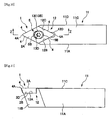
- Figs. 1 to 4 illustrate a throwaway grooving bite to which a clamp mechanism according to a first embodiment of the present invention is applied
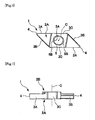
- Figs. 5 to 7 illustrate a tip which is fitted to the clamp mechanism according to the first embodiment.
- a tip body 1 of the tip is formed in a parallelogram panel shape out of a hard material such as cemented carbide, and has a pair of side surfaces 2A and 2B forming a parallelogram and pairs of circumferential surfaces 3A and 3B which are alternately arranged on the circumference thereof in the circumferential direction.
- the circumferential surfaces are rotationally symmetrical by 180° about a center line C which passes through the intersections between diagonal lines of both parallelogram side surfaces 2A and 2B and extends in the thickness direction (in the vertical direction in Fig. 7) of the panel-shaped tip body 1.
- a cutting edge 4 is formed in each intersection ridgeline of the circumferential surfaces 3A and 3B which intersect each other in a pair of acute ends of the side surfaces 2A and 2B, and two cutting edges 4 of one tip body 1 can be utilized.
- one of the circumferential surfaces 3A and 3B (the longitudinal circumferential surface 3A in the present embodiment) serves as a rake face of the cutting edge 4, and the other (the short circumferential surface 3B in the present embodiment) serves as a clearance surface.
- Both side surfaces 2A and 2B have an inclined surface in which portions close to the acute ends on which the cutting edges 4 gradually retreat in the thickness direction of the tip body 1 as it goes to the center of the side surfaces 2A and 2B from the acute ends, thereby giving clearance to the cutting edge 4.
- a portion extending to the cutting edge 4 and a portion intersecting the circumferential surface 3B at an obtuse angle form a flat plane located in the same plane parallel in the thickness direction, and a concave portion 3C slightly retreating from the flat plane is formed between the portions.
- the section other than a portion close to the cutting edge 4 has a mountain shape of a substantial triangle.
- the center portions of the side surfaces 2A and 2B of the tip body 1 form a flat plane perpendicular to the thickness direction, the center portion of the side surface 2B on the inner side of the tip body 1 is protruded by a step, and a fitting hole 5 is formed between the center portions of the side surfaces 2A and 2B so as to pass through the tip body 1 in the thickness direction.
- the substantial center portion in the thickness direction of the tip body including the portion protruded by a step on the side surface 2B becomes a circular minimum-diameter portion 5A centered about the center line C and an opening of the fitting hole 5 directed to the outer side of the tip body along the center line C from the minimum-diameter portion 5A has an inner diameter, along the diagonal line connecting the acute ends of the parallelogram of the side surface 2A, which increases toward the side surface 2A.
- the inner diameter in the direction perpendicular to the diagonal line is substantially equal to that of the minimum-diameter portion 5A.
- the section of the opening of the fitting hole 5 along the diagonal line connecting the acute ends form a convex quarter circle shape toward the side surfaces 2A and 2B of the tip body 1 from the minimum-diameter portion 5A as shown in Figs. 3 and 4, that is, a bell shape in which the inner diameter in the diagonal direction increases and the inner diameter increases in a straight line shape having a constant slope, thereby forming a concave portion indented from the side surfaces 2A and 2B.
- the width with which the inner diameter increases from the inner circumference of the minimum-diameter portion 5A which is the inner circumference of the fitting hole 5 in the diagonal line is the maximum, as shown in Fig.
- the opening edges toward the side surfaces 2A and 2B form an elliptical shape having a major axis along the diagonal line as seen along the center line C and form a crescent shape as seen from the center line C on the side surface 2A.
- a pair of which the section has the convex circle shape serves as the contact portion 5B in the present embodiment.
- the fitting hole 5 is symmetrical about a plane perpendicular to the center line C at the center in the thickness direction of the tip body 1 including the portion of the side surface 2B protruded by a step.
- the tool body 11 of the throwaway bite detachably fitted with the tip has a rectangular pillar as shown in Figs. 1 and 2 in the present embodiment, and the upper portion of a longitudinal end (left in Figs. 1 and 2) of a side surface 11A thereof is indented to serve as a tip fitting seat 12.
- the tip fitting seat 12 includes a fitting seat bottom 12A indented parallel to the side surface 11A, a fitting seat wall 12B which is raised vertically from the bottom 12A and which is perpendicular to the side surface 11A and the end surface 11B of the tool body 11 and parallel to the upper surface 11C of the tool body 11, and a fitting seat wall 12C which is raised to intersect the fitting seat bottom 12A at an acute angle and to be oblique toward the end as it goes to the side surface 11A as shown in Figs. 2 to 4 and which extends oblique in the direction intersecting the wall 12B at an acute angle and reaches the upper surface 11C as shown in Fig. 1.
- intersection angles of the fitting seat walls 12B and 12C as seen from the side surface 11A are equal to the intersection angle which is formed at the acute ends of the side surfaces 2A and 2B by the circumferential surfaces 3A and 3B of the tip body 1.
- the intersection angle formed by the wall 12C and the bottom 12A is equal to the angle between the slope portion, close to the side surface 2A, of the mountain-shaped section of the circumferential surface 3B serving as the clearance surface of the tip body 1 and the center of the plane shape of the side surface 2B.
- the tip body 1 is seated on the tip fitting seat 12 by opposing the side surface 2B to the bottom 12A, bringing the portion protruded by a step into close contact with the bottom, bringing one circumferential surface 3A into contact with the fitting seat wall 12B, bringing the slope portion of the circumferential surface 3B, intersecting the circumferential surface 3A at the cutting edge 4, into contact with the fitting seat wall 12C, and protruding a cutting edge 4 opposite to the cutting edge 4 from the end of the tool body 11. Therefore, the flat plane protruded by a step at the center of the side surface 2B becomes a seating surface onto the fitting seat bottom 12A.
- a clearance portion 12D for avoiding interference with the cutting edge 4 is formed so as to extend along the wall 12C tilted about the wall 12B, as shown in Fig. 1 in the embodiment.
- a clamp member 13 having a shaft portion 13A which is inserted into the fitting hole 5 of the tip body 1 and a head portion 13B with an outer diameter larger than that of the shaft portion 13A is fitted to the tool body 11.
- the clamp member 13 can advance and retreat in the direction along the central axis line O of the shaft portion 13A.
- the back surface 13C of the head portion 1B comes in contact with the contact portion 5B of the opening of the fitting hole 5, thereby clamping the tip body 1.
- the back surface 13C of the head portion 13B of the clamp member 13 is formed to have a circular section perpendicular to the central axis line O, and the head portion 13B of the clamp member 13 can pass through the fitting hole 5 of the tip body 1.
- the shaft portion 13A of the clamp member 13 is formed in a cylinder shape centered on the axis line O.
- the head portion 13B is formed integrally with the shaft portion 13A at one end of the clamp member 13 (left-lower side in Figs. 3 and 4) and is formed in a disk shape which is flat in the direction along the axial line O around the axis line O.
- the back surface 13C has a circular cone shape in which the outer diameter decreases toward the other end of the clamp member 13 (toward the shaft portion 13A, that is, toward the upper-right side in Figs. 3 and 4), so that the section perpendicular to the axis line O has a circle shape as described above.
- the inner diameter of the minimum-diameter portion 5A is smaller than the outer diameter of the head portion 13B having a disk shape of the clamp member 13.
- the angle of the back surface 13C having the circular cone shape about the axis line O is 45° or more in the embodiment.
- the circumferential portion of the end surface of the head portion 13B forms a semi-circular shape in the section taken along the axis line O, the center portion is a flat plane perpendicular to the axis line O, and an inserting hole into which a working tool such as a wrench is inserted so as to revolve the clamp member 13 around the axis line O is formed in the center portion.
- a cylindrical large-diameter portion 13E which is centered on the axis line O and has an outer diameter larger than the inner diameter of the minimum-diameter portion 5A is formed integrally with the shaft portion 13A. Accordingly, the large-diameter portion 13E has an outer diameter larger than that of the shaft portion 13A or the head portion 13B, and is a portion having the largest diameter of the clamp member 13.
- a male screw 13F is formed on the outer circumference of the large-diameter portion 13E, and an inserting hole 13D into which the working tool such as wrench is inserted so as to revolve the clamp member 13 around the axis line O is formed in the other end surface of the large-diameter portion 13E.
- a screw hole 12E penetrating from the fitting seat bottom 12A of the tip fitting seat 12 to the side surface 11D of the tool body 11 opposite to the side surface 11A is formed in the tool body 11 so as to be open correspondingly to the opening, close to the side surface 2B, of fitting hole 5 of the tip body 1 seated as described above. Accordingly, the clamp member 13 is fitted to the tool body 11 by inserting the male screw portion 13F on the outer circumference of the large-diameter portion 13E into the screw hole 12E so as to protrude the shaft portion 13A and the head portion 13B from the fitting seat bottom 12A.
- the clamp member 13 advances toward the tip fitting seat 12 so that the large-diameter portion 13E is indented from the fitting seat bottom 12A as shown in Fig. 3.
- the clamp member 13 retreats from the tip fitting seat 12 so that the large-diameter portion 13E is protruded from the fitting seat bottom 12A.
- the screw hole 12E is tilted with respect to the fitting seat bottom 12A of the tip fitting seat 12.
- the central axis line O of the clamp member 13 in which the male screw portion 13F is inserted into the screw hole 12E is tilted with respect to the fitting seat bottom 12A. Accordingly, the screw hole 12E is tilted with respect to the center line C of the tip body 1 seated on the tip fitting seat 12. Therefore, the direction in which the axis line O is tilted toward the advancement direction (inserting direction) of the clamp member 13 at the time of clamping from the fitting seat bottom 12A is a direction directed to the intersection between the fitting seat walls 12B and 12C along the section indicated by a reference numeral ZZ in Fig.
- An angle ⁇ of the tilted central axis line O of the clamp member 13 about the direction perpendicular to the fitting seat bottom 12A, that is, the direction along the center line C of the tip body 1 seated on the tip fitting seat 12, is in the range of 5° to 40° in the embodiment.
- the back surface 13C of the head portion 13B having a circular section comes in contact with the contact portion 5B close to the opposite side (the side toward the axis line O is tilted about the center line C) of the cutting edge 4 protruded from the end of the tool body 11 for use in cutting among a pair of contact portions 5B of the fitting hole 5 and presses the tip body 1 toward the fitting seat bottom 12A, thereby clamping the tip body 1 to the tip fitting seat 12.
- the clamp mechanism having the above-mentioned structure, since it is not necessary to detach the clamp member 13 from the tool body 11 at the time of detaching the tip, it is possible to easily perform the detachment and attachment work and thus there is not possibility of losing the detached clamp member 13.
- the back surface 13C of the head portion 13B of the clamp member 13 pressing the tip body 1 can have a disk shape of which the section is circular and the fitting hole 5 of the tip body 1 can have the minimum-diameter portion 5A of which the section transmitting the head portion 13B is circular, it is possible to simplify the shape of the clamp member 13 or the tip body 1, thereby reducing the cost for the clamp mechanism.
- the fitting hole 5 has the circular minimum-diameter portion 5A and the contact portions 5B are formed in the opening thereof, it is possible to reduce the portion of the tip body 1 cutting out by the fitting hole 5. Accordingly, it is possible to secure the strength of the tip body 1 and to prevent the destruction thereof due to a load at the time of cutting, thereby elongating the lift time of the tip and promoting the smooth cutting work.
- the contact portions 5B are formed in the opening of the fitting hole 5
- the contact portions 5B are formed as concave portions indented from the side surface 2A so as to form the crescent shape which is convex from the inner diameter of the minimum-diameter portion 5A as the inner circumference of the fitting hole 5 toward the outer circumference as seen in the direction along the center line C of the fitting hole 5.
- the contact portions 5B coming in contact with the back surface 13c can be formed by the size, corresponding to the back surface 13C coming in contact with the contact portions 5B, in the opening of the fitting hole 5 in which the disk-shaped head portion 13B having the back surface 13C with a circular section passes through the minimum-diameter portion 5A, it is possible to further suppress the portion of the tip body 1 cut out by the fitting hole 5 including the contact portions 5B, thereby more surely preventing the destruction of the tip body 1.
- the contact portions 5B are formed in a bell shape which is indented in the section taken along the center line C of the fitting hole 5 of the tip body 1 so as to form a quarter convex circle shape, but may be formed in, for example, a countersink shape with a concave circular-cone shape which is directed to the side surface 2B serving as the seating surface on the fitting seat bottom 12A of the tip fitting seat 12 as it goes to the inner circumference with the same slope as the slope of the back surface 13C of the head portion of the clamp member 13 which comes in contact with the contact portions 5B.
- the crescent shape formed toward the center line C by the contact portions 5B may be a longitudinal circular shape obtained by deviating the inner circumference of the minimum-diameter portion 5A, in addition to the elliptical shape like in the embodiment.
- the head portion 13B has a flat elliptical shape having a minor axis in the direction in which the central axis line O is tilted (in the major axis direction of the ellipse formed by the contact portions 5B in the embodiment) as seen in the direction along the center line C.
- the minimum-diameter portion 5A of the fitting hole 5 transmitting the head portion 13B can be formed in an elliptical shape having a minor axis in the direction in which the central axis line O is tilted as seen in the direction along the center line C, and thus the portion of the tip body 1 cut out by the fitting hole 5 can be further reduced. As a result, it is possible to improve the destruction preventing effect result from the further increase in strength of the tip.
- the contact portions 5B and the back surface 13C of the head portion 13B of the clamp member 13 may come in contact with each other over the whole circumference of the respective contact portions 5B, may come in contact with each other only at one position of the place in which the width from the inner circumference of the minimum-diameter portion 5A of each crescent contact portion 5B (the place in the major axis of the contact portions 5B forming an elliptical shape), or may come in contact with each other at both positions in the circumferential direction of the fitting hole 5 with the place having the largest width therebetween.
- a slight gap exists between the place in which the contact portions 5B have the larges width in the section (Z-Z section) taken along the major axis direction of the ellipse and the back surface 13C of the head portion 13B.
- the tip body 1 is clamped regardless of the rotational position around the central axis line O of the clamp member 13 by bringing the back surface 13C of the head portion 13B of the clamp member 13 with a circular section into contact with the contact portions 5B, it is possible to employ the structure in which the clamp member 13 advances and retreats while rotating over the entire circumference of the central axis line O, that is, the structure in which the clamp member 13 advances and retreats by means of the screw coupling between the male screw portion 13F and the screw hole 12E like in the embodiment.
- the central axis line O of the clamp member 13 is tilted with respect to the center line C of the fitting hole 5 of the tip body 1. Accordingly, when the back surface 13C of the head portion 13B is brought into contact with the contact portions 5B to press the tip body 1 by advancing the clamp member 13 toward the tip fitting seat 12 in the direction along the axis direction O, the tip body 1 is pressed toward the fitting seat bottom 12A of the tip fitting seat 12 in the direction along, and is also pressed in the direction in which the axis line O goes apart from the center line C toward the tip fitting seat 12 the central axis line C in the direction perpendicular to the center line C.
- the tilt angle ⁇ of the central axis line O of the tilted clamp member 13 about the center line C of the fitting hole 5 of the tip body 1 is preferably in the range of 5° to 40° like in the embodiment.
- the clearance portion for avoiding the interference of the tilted clamp member 13 with the shaft portion 13A is formed in the opening of the fitting hole 5 close to the side surface 2B serving as the seating surface on the tip fitting seat 12, for example, so that the fitting hole 5 is symmetrical inside and outside like in the embodiment, and is formed preferably in the shape of an ellipse elongated in the direction in which the clamp member 13 is tilted.
- the large-diameter portion 13E having a diameter larger than that of the fitting hole 5 of the tip body 1 and larger than that of the shaft portion 13A or the head portion 13B is formed on the end (the other end) of the clamp member 13 opposite to the head portion 13B at one end of the shaft portion 13A, and the male screw portion 13R is formed on the outer circumference of the large-diameter portion 13E.
- the large-diameter portion 13E can be protruded from the fitting seat bottom 12A to push up the center of the side surface 2B serving as the seating surface of the tip body 1 as shown in Fig. 4, thereby floating the tip body 1 from the tip fitting seat 12.
- the male screw portion 13F is formed to have a diameter larger than that of the fitting hole 5, that is, to be the large-diameter portion 13E of the clamp member 13 having a diameter larger than that of the shaft portion 13A.
- the male screw portion 13F may have a diameter equal to or smaller than that of the shaft portion 13A only in order to clamp the tip body 1, that is, the large-diameter portion 13E may not be formed in the clamp member 13.
- the large-diameter portion 13E may have a diameter smaller than that of the fitting hole 5, if only it comes in contact with side surface 2B or the inside of the fitting hole 5 so as to push up the tip body 1 when the male screw portion 13F is loosened.
- the tip in which the cutting edge 4 is formed on the intersection ridgelines at the acute ends of the parallelogram side surfaces 2A and 2B among the intersection ridgelines between four circumferential surfaces 3A and 3B of the tip body 1 substantially having a parallelogram panel shape has been described as the clamped tip.
- the clamp mechanism according to the embodiment is not limited to the above-mentioned tip.
- Figs. 8 and 9 illustrate a grooving tip according to a second embodiment which can be fitted to the tool body according to the first embodiment.
- like elements common to the first embodiment are denoted by like reference numerals and description thereof will be simplified or omitted.
- an axis-shaped cutting edge portion 6 is protrude from one short circumferential surface 3B of the tip body 1 having a parallelogram shape along the long circumferential surface 3A intersecting each other at an acute end of the side surfaces 2A and 2B, a cut portion 6A is formed on the circumferential surface 3A at the end of the cutting edge portion 6, the upper surface of the cut portion 6A opposed to the circumferential surface 3A serves as a rake face, and the cutting edge 4 is formed on the protruded end.
- both side surfaces 2A and 2B are not a slope surface, a portion protruded by a step is not formed at the center of the side surface 2B, both side surfaces 2A and 2B are flat planes perpendicular to the thickness direction of the tip body 1 (the direction along the center line C of the fitting hole 5), and the tip body 1 is not symmetrical about the center line C.
- the invention is applied to a throwaway turning bite.
- the tip body 1 has a rhombus panel shape, one of a pair of rhombus side surfaces 2A and 2B (side surface 2A in the figures) serves as a rake face, the cutting edge 4 having a corner portion 4A at the acute end of the rhombus shape is formed at four ridges, the circumferential surfaces 3D of the tip body 1 extending to the cutting edge 4 serve as the clearance surfaces, and the circumferential surfaces 3D serving as the clearance surfaces are gradually retreated toward the side surface 2B, thereby forming a positive tip a clearance angle.
- the side surface 2B serving as a seating surface inside the tip body 1 has a rhombus shape slightly smaller than the side surface 2A serving as the rake face.
- the fitting hole 5 is not symmetrical about a plane perpendicular to the center line C at the center in the thickness direction of the tip body 1, and the inner circumference of the opening closer to the side surface 2B than to the minimum-diameter portion 5A has a counterbore hole shape having an inner diameter larger than that of the contact portion 5B.
- the tool body 11 by which the tip is clamped has a rectangular pillar shape like the first embodiment, but the end surface 11B has a triangular gable shape corresponding to the acute corner of the rhombus of the tip body 1.
- the tool body is gradually retreated as it goes apart from the upper surface 11C to correspond to the clearance angle given to the circumferential surfaces 3D serving as the clearance surface of the positive tip body 1, and the tip fitting seat 12 is opened toward the end surface 11B at the end of the upper surface 11C.
- the tip fitting seat 12 includes a fitting seat bottom 12A having a rhombus shape equal to but smaller than the side surface 2B serving as the seating surface of the tip body 1 and a pair of fitting seat walls 12B and 12C which are raised from the ridge on the end side of the tool body 11 in the rhombus of the fitting seat bottom 12A toward the upper surface 11C and in which a portion close to the upper surface 11C is tilted to correspond to the clearance angle given to the circumferential surface 3D.
- the portion close to the fitting seat bottom 12A is formed in a shaft portion 12F having a diameter slightly larger than a female screw portion.
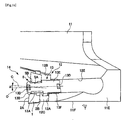
- the clamp mechanism according to the invention can be applied as a tip clamp mechanism of a throwaway turning tool such as a front milling tool like the fourth embodiment shown in Figs. 13 to 15, in addition to the throwaway cutting tool like the first to third embodiments.
- the tool body 11 of the front milling tool has substantially a disk shape centered on the axis line Z and rotates in the rotation direction T at the time of cutting.
- a tip pocket 14 is formed in a concave shape on the outer circumference
- a tip fitting seat 12 is formed in the wall of the tip pocket 14 directed to the rotation direction T so as to be open to the outer circumferential surface 11E and the lower surface 11F of the tool body 11, and the tip body 1 is clamped and fitted by the use of the clamp mechanism according to the fourth embodiment.
- a plurality of tip pockets 14, a plurality of tip fitting seats 12, a plurality of tip bodies 1, and a plurality of tip clamp mechanisms are installed with a gap in the circumferential direction of the tool body 11, but only one is shown in the embodiment and others are omitted.
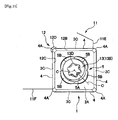
- the tip body 1 has substantially a square panel shape as shown in Fig. 15, the cutting edges 4 having a corner R portion 4A at the edges of the side surface 2A are formed at four ridges of the square side surface 2A serving as the rake face, and a positive tip is formed in which a clearance angle is given to four circumferential surfaces 3D thereof like the third embodiment. Accordingly, by sequentially revolving the tip body 1 around the center line C and fitting again the tip body so as to locate the corner R portion 4A on the outer circumference of the lower surface 11F of the tool body 11, the cutting edges 4 can be used four times in one tip body 1.
- Figs. 16 to 20 illustrate the fifth embodiment of the invention.
- the tip according to the fifth embodiment has a structure that the axial cutting edge portion 6 is protruded along the longitudinal circumferential surface 3A from the short circumferential surface 3B of the tip body 1 having substantially parallelogram panel shape and the cutting edge 4 is formed at the end thereof and is used to perform the inner-diameter machining process to a lower opening formed in a workpiece.
- a plurality of fitting holes 5 (two in the embodiment) is formed in the tip body 1, and a plurality of clamp members 13 (two in the embodiment) are provided in the tip fitting seat 12 of the tool body 11 to correspond to the fitting holes 5.
- the fitting holes 5 are formed in parallel to each other in the direction in which the circumferential surface 3A extends (in the horizontal direction in Fig. 16) as shown in Fig. 16 so that the fitting holes 5 extend in the thickness direction of the tip body 1 in the state where the center lines C thereof are parallel to each other as shown in Fig. 19, and the contact portions 5B having a substantially crescent shape as seen from the side surface 2A of the tip body 1 are formed in the fitting holes 5, respectively.
- the openings of the fitting holes 5 have an elliptical shape as seen in the direction along the center lines C, but in the contact portions 5B according to the embodiment, the section taken along the center line C does not form a convex quarter circular shape, unlike the first to fourth embodiments.
- the contact portion 5B is formed substantially in a straight line shape directed to the side surface 2B with a constant slope as it goes toward the inner circumference of the fitting hole 5 from the side surface 2A of the tip body in which the corresponding contact portion is formed as shown in Fig. 19.
- the slope of a straight line formed by the contact portion 5B in the section containing the center line C is slowest in the plane P containing the center line C and the major axis of the ellipse and is continuously faster as it goes toward the minor axis around the center line C along the ellipse.
- the position of the straight line in direction along the center line C is gradually retreated toward the side surface 3B from the side surface 2A as it goes toward the minor axis around the center line C from the plane P containing the center line C and the major axis.
- the contact portion 5 is most convex in the direction along the center line C in the plane P (in the major axis).
- the fitting hole 5 is symmetrical about the plane perpendicular to the center line C at the center in the thickness direction of the tip body 1, similarly to the first embodiment. Accordingly, in the minimum-diameter portion 5A of the fitting hole 5 inside the contact portion 5B, the width in the direction along the center line C is decreased as it goes from the major axis of the ellipse toward the minor axis around the center line C, as shown in Fig. 19.
- Two fitting holes 5 formed in the tip body 1 have the same shape and size and as shown in Fig. 16, the major axes of the ellipses are parallel to each other, that is, the planes P are parallel to each other, as seen from the side surface 2A.
- the major axis of the fitting hole 5 formed at one acute end opposite to the end provided with the cutting edge portion 6 among the acute ends of the parallelogram of the side surface 2A extends toward the intersection between the circumferential surfaces 3A and 3B at one acute end, and the major axis of the fitting hole 5 formed at the other acute end provided with the cutting edge portion 6 extends toward the intersection between the circumferential surfaces 3A and 3B at the other acute end.
- the intersection at one acute end is chamfered in a circular arc shape smoothly tangential to the circumferential surfaces 3A and 3B.
- marks 15 indicating the clamping order at the time of clamping the tip by advancing the clamp members 13 provided corresponding to the fitting holes 5 are provided in the vicinity of the (two) fitting holes 5.
- the marks 15 are provided as numerals "1" and "2" by inscribing in the side surface 2A the order of clamping the clamp members 13 passing through the adjacent fitting holes 5 by means of a laser marking process.
- numeral "1" is marked at one acute end among the acute ends of the parallelogram of the side surface 2A and numeral "2" is marked at the other acute end.
- screw holes 12E are formed at positions corresponding to the fitting holes 5 in the state where the tip bodies 1 are fitted.
- the screw holes 12E are formed so that the central axis lines O of the clamp members 13 inserted into the screw holes 12E are parallel to each other in the plane P containing the center lines C of the fitting holes 5 and the major axes thereof in the fitting state and extend to be apart from the center lines C and to be tilted about the center lines C in the direction directed to one acute end of the tip body 1 as it goes in the advancement direction (the inserting direction of the clamp members 13) of the clamp members 13 toward the tip fitting seat 12.
- the portions 5C positioned in the plane P containing the center lines C and the central axis lines 0, that is, the portions positioned in the major axis, are slowest in slope about the plane perpendicular to the center line C as described above and are most convex in the direction along the center line C. Accordingly, the portions 5C positioned in the plane P containing the central axis lines O and the center lines C are most convex in the direction along the central axis lines O.
- the back surfaces 13C of the head portions 13B of the clamp members 13 come in contact with the portions 5C positioned in the plane P among the contact portions 5B, as the clamp members 13 are inserted in the direction along the central axis lines O to advance toward the tip fitting seat 12.
- the back surface 13C of the head portion 13B comes in contact with the portion 5C positioned in the plane P in the circumferential direction among the contact portions 5B of the fitting hole 5 of the tip body 1 and presses the tip body 1. Accordingly, for example, in comparison with the case that the back surface 13C of the head portion 13B comes in contact with two positions in the circumferential direction of the contact portions 5B in the first embodiment, it is possible to satisfactorily and stably clamp the tip by efficiently delivering the pressing force without distributing the pressing force of the clamp member 13 (the inserting force resulting from the male screw 13F in the embodiment).
- the clamp member 13 is a clamp screw for advancing toward the tip fitting seat 12 and clamping the tip body 1 by inserting the male screw portion 13F into the screw hole 12E, it is possible to prevent the partial wear due to the contact of the back surface 13C with the contact portion 5B at a plurality of positions.
- the central axis lines O tilted about the center lines C of the clamp members 13 are parallel to each other as seen in the direction along the center line C, but may extend in the direction intersecting each other as seen in the direction along the center line C if only the intersection angle is 5° or less.
- the central axis lines O of the clamp members 13 are disposed preferably to intersect each other at one acute end even if the central axis lines extend in the directions intersecting each other as seen in the direction along the center lines C as described above.
- a plurality of fitting holes 5 are formed in the tip body 1, a plurality of clamp members 13 corresponding to the fitting holes are disposed in the tool body 11, and the marks 15 indicating the order of advancing (inserting in the embodiment) the clamp members 13 toward the tip fitting seat 12 are formed in the tip body 1.
- a mark 15 indicated by numeral "1" is formed in the vicinity of the fitting hole 5 close to one acute end of the tip body 1 and located at the intersection between the walls 12B and 12C of the tip fitting seat 12, and a mark 15 indicated by numeral "2" is formed in the vicinity of the fitting hole 5 close to the other acute end opposite thereto.
- the tip body 1 is first fitted to the tip fitting seat 12, the clamp member 13 of which the shaft portion 13A passes through the fitting hole 5 close to one acute end in the vicinity of the mark 15 indicated by numeral "1" is further inserted thereto, and then the clamp member 13 is inserted into the fitting hole 5 close to the other acute end in the vicinity of the mark 15 indicated by numeral "2", thereby clamping a tip.
- the tip body 1 is strongly pressed in the direction in which the central axis line O is tilted in the extending direction of the plane P, that is, toward the acute end in which the walls 12B and 12C of the tip fitting seat 12 intersect each other by advancing the clamp member 13 of one acute end toward the tip fitting seat 12. Thereafter, the circumferential surfaces 3A and 3B intersecting each other at one acute end come in contact with the walls 12B and 12C as a whole, and then is pressed by the clamp member 13 at the other acute end, thereby strongly fitting the tip body, as described above.
- the tip is positioned in the state where the circumferential surface 3A of the tip body 1 and the wall 12B of the tip fitting seat 12 or the circumferential surface 3B and the wall 12C do not come in contact with each other as a whole by first inserting the clamp member 13 passing through the fitting hole at the other acute end, the clamp member 13 at one acute end is then inserted and the clamp member 13 is clamped in this state, the edge position of the cutting edge 6 is not positioned with high accuracy, and the machining accuracy is damaged or the tip becomes unstable, thereby causing a rattle or a detachment in the course of performing the cutting process.
- the marks 15 are formed by inscribing numerals "1" and "2" in the side surface 2A of the tip body 1 by the use of the laser marking.
- the marks may be formed by forming the numerals in the tip body 1 in a concave manner or a convex manner, or by forming the number of protrusions or grooves other than the numerals in the vicinity of the fitting holes 5 to correspond to the numerals.
Landscapes
- Engineering & Computer Science (AREA)
- Mechanical Engineering (AREA)
- Cutting Tools, Boring Holders, And Turrets (AREA)
Applications Claiming Priority (3)
| Application Number | Priority Date | Filing Date | Title |
|---|---|---|---|
| JP2004090710 | 2004-03-26 | ||
| JP2005063641A JP4639862B2 (ja) | 2004-03-26 | 2005-03-08 | スローアウェイチップのクランプ機構 |
| PCT/JP2005/005422 WO2005092545A1 (ja) | 2004-03-26 | 2005-03-24 | スローアウェイチップのクランプ機構 |
Publications (3)
| Publication Number | Publication Date |
|---|---|
| EP1736263A1 true EP1736263A1 (de) | 2006-12-27 |
| EP1736263A4 EP1736263A4 (de) | 2012-02-01 |
| EP1736263B1 EP1736263B1 (de) | 2019-09-04 |
Family
ID=35056045
Family Applications (1)
| Application Number | Title | Priority Date | Filing Date |
|---|---|---|---|
| EP05726992.0A Expired - Lifetime EP1736263B1 (de) | 2004-03-26 | 2005-03-24 | Klemmstruktur für wegwerfspitze |
Country Status (4)
| Country | Link |
|---|---|
| US (1) | US7726218B2 (de) |
| EP (1) | EP1736263B1 (de) |
| JP (1) | JP4639862B2 (de) |
| WO (1) | WO2005092545A1 (de) |
Cited By (9)
| Publication number | Priority date | Publication date | Assignee | Title |
|---|---|---|---|---|
| WO2010046892A1 (en) * | 2008-10-26 | 2010-04-29 | Iscar Ltd. | Cutting tool and cutting insert therefor |
| WO2010067369A3 (en) * | 2008-12-10 | 2010-08-05 | No Screw Ltd. | A cutting tool holder and a cutting insert therefor |
| EP1629914B1 (de) * | 2004-08-25 | 2011-07-13 | Seco Tools AB | Wendeschneidplatte |
| EP2383062A1 (de) * | 2010-04-30 | 2011-11-02 | Seco Tools AB | Fräswerkzeug mit einer an ihrem Ende einen Aussengriff aufweisende Spannschraube |
| EP2428296A1 (de) * | 2007-08-05 | 2012-03-14 | Iscar Ltd. | Schneideeinsatz |
| WO2013042127A1 (en) * | 2011-09-19 | 2013-03-28 | Iscar Ltd. | Cutting insert, cutting body and clamping mechanism of a cutting tool assembly for chip removal |
| CN103857486A (zh) * | 2012-10-10 | 2014-06-11 | 伊斯卡有限公司 | 用于切削去除的切削工具组件的切削刀具、切削本体及夹持机构 |
| US8870499B2 (en) | 2007-06-06 | 2014-10-28 | No Screw Ltd. | Cutting tool holder and a cutting insert therefor |
| EP3674021A4 (de) * | 2017-09-30 | 2021-05-26 | Zhuzhou Cemented Carbide Cutting Tools Co., Ltd. | Polygonale schneidklinge mit kreisbogenförmiger nut im loch und schneidwerkzeug |
Families Citing this family (14)
| Publication number | Priority date | Publication date | Assignee | Title |
|---|---|---|---|---|
| JP4639881B2 (ja) * | 2005-03-24 | 2011-02-23 | 株式会社タンガロイ | スローアウェイ式切削工具 |
| IL198376A (en) * | 2009-04-26 | 2013-04-30 | Iscar Ltd | Put cutting and assembling the task |
| BR112012022792A2 (pt) * | 2010-03-10 | 2018-05-22 | Tungaloy Corp | elemento auxiliar de fixação, e, ferramenta de corte |
| JP2014147977A (ja) * | 2011-05-23 | 2014-08-21 | Tungaloy Corp | 切削インサートおよびその切削インサートを用いた切削工具 |
| IL214781A0 (en) * | 2011-08-22 | 2011-10-31 | Iscar Ltd | Cutting tool and cutting insert therefor |
| CN102601439A (zh) * | 2011-12-19 | 2012-07-25 | 株洲钻石切削刀具股份有限公司 | 一种铣削刀具 |
| SE536646C2 (sv) * | 2012-09-07 | 2014-04-29 | Sandvik Intellectual Property | Fräsverktyg samt skärkit för fräsverktyg |
| US20160121406A1 (en) | 2014-10-29 | 2016-05-05 | Illinois Tool Works Inc. | Interchangeable cutting inserts and methods associated with the same |
| US20170341150A1 (en) * | 2014-10-29 | 2017-11-30 | Illinois Tool Works Inc. | Interchangeable cutting inserts and methods associated with the same |
| DE102016103565A1 (de) * | 2016-02-29 | 2017-08-31 | Hartmetall-Werkzeugfabrik Paul Horn Gmbh | Schneidplatte, Werkzeughalter und Werkzeug zur spanenden Bearbeitung eines Werkstücks |
| US10239123B2 (en) * | 2017-03-29 | 2019-03-26 | Iscar, Ltd. | Cutting insert having two peripheral abutment ridges and cutting tool |
| CN109570629B (zh) * | 2017-09-28 | 2020-09-25 | 株式会社泰珂洛 | 切削工具 |
| US11565435B2 (en) | 2018-01-14 | 2023-01-31 | Craftstech, Inc. | Modular cutter blade assembly and machines containing the same |
| JP2020116708A (ja) * | 2019-01-25 | 2020-08-06 | 三菱マテリアル株式会社 | 切削インサートのクランプ機構 |
Family Cites Families (19)
| Publication number | Priority date | Publication date | Assignee | Title |
|---|---|---|---|---|
| GB976597A (en) * | 1962-10-10 | 1964-12-02 | Wickman Wimet Ltd | Tool holders for use with detachable inserts |
| US3341920A (en) * | 1965-02-16 | 1967-09-19 | Gen Electric | Cutting tool |
| JPS4812675B1 (de) | 1969-07-03 | 1973-04-21 | ||
| JPS55157418A (en) * | 1979-05-18 | 1980-12-08 | Daijietsuto Kogyo Kk | Spherical end mill |
| US4398853A (en) * | 1980-11-10 | 1983-08-16 | Kennametal Inc. | Insert holder and method of holding |
| DE3118467A1 (de) * | 1981-05-09 | 1982-11-25 | Fried. Krupp Gmbh, 4300 Essen | "anordnung zur befestigung von auswechselbaren schneidplatten auf einem werkzeughalter" |
| SE9003705L (sv) * | 1990-11-21 | 1992-05-22 | Seco Tools Ab | Skaerverktyg |
| JP2833283B2 (ja) * | 1991-09-05 | 1998-12-09 | 三菱マテリアル株式会社 | スローアウェイチップ |
| JPH07164213A (ja) * | 1993-12-13 | 1995-06-27 | Ngk Spark Plug Co Ltd | スローアウェイ式工具 |
| IL111370A (en) | 1994-10-23 | 1998-08-16 | Iscar Ltd | Cutting tool assembly having an exchangeable adaptor |
| SE509594C2 (sv) * | 1996-01-26 | 1999-02-15 | Sandvik Ab | Indexering av vändskär |
| SE511567C2 (sv) | 1997-04-18 | 1999-10-18 | Sandvik Ab | Skär för skivfräsar, samt skivfräs innefattande sådana skär |
| JPH1119808A (ja) | 1997-06-30 | 1999-01-26 | Ngk Spark Plug Co Ltd | 切削用チップおよびこれを用いた切削工具 |
| JP2000233326A (ja) * | 1999-02-16 | 2000-08-29 | Funai Electric Co Ltd | ギヤの組立構造及び複数のシャフトを有するギヤボックスへの複数ギヤの挿入方法 |
| WO2001000360A1 (fr) * | 1999-06-23 | 2001-01-04 | Applitec Moutier S.A. | Outil de coupe a plaquette rapportee |
| US6409435B1 (en) * | 2000-07-03 | 2002-06-25 | Valenite Inc. | Cutting tool and method of locating cutting insert |
| IL148475A (en) | 2002-03-04 | 2007-09-20 | Gil Hecht | Cutting Tools |
| JP3775321B2 (ja) * | 2002-03-20 | 2006-05-17 | 三菱マテリアル株式会社 | スローアウェイチップおよびスローアウェイ式切削工具 |
| IL153796A0 (en) * | 2003-01-05 | 2003-07-31 | Iscar Ltd | Cutting insert holder |
-
2005
- 2005-03-08 JP JP2005063641A patent/JP4639862B2/ja not_active Expired - Lifetime
- 2005-03-24 EP EP05726992.0A patent/EP1736263B1/de not_active Expired - Lifetime
- 2005-03-24 US US10/599,319 patent/US7726218B2/en active Active
- 2005-03-24 WO PCT/JP2005/005422 patent/WO2005092545A1/ja not_active Ceased
Cited By (16)
| Publication number | Priority date | Publication date | Assignee | Title |
|---|---|---|---|---|
| EP1629914B1 (de) * | 2004-08-25 | 2011-07-13 | Seco Tools AB | Wendeschneidplatte |
| US8870499B2 (en) | 2007-06-06 | 2014-10-28 | No Screw Ltd. | Cutting tool holder and a cutting insert therefor |
| EP2428296A1 (de) * | 2007-08-05 | 2012-03-14 | Iscar Ltd. | Schneideeinsatz |
| EP2502690A1 (de) * | 2007-08-05 | 2012-09-26 | Iscar Ltd. | Schneideeinsatz |
| US8356960B2 (en) | 2008-10-26 | 2013-01-22 | Iscar, Ltd. | Cutting tool and cutting insert therefor |
| KR20110082144A (ko) * | 2008-10-26 | 2011-07-18 | 이스카 엘티디. | 절삭 공구 및 절삭 공구용 절삭 인서트 |
| WO2010046892A1 (en) * | 2008-10-26 | 2010-04-29 | Iscar Ltd. | Cutting tool and cutting insert therefor |
| CN102196875B (zh) * | 2008-10-26 | 2013-03-13 | 伊斯卡有限公司 | 切削工具及用于切削工具的切削刀件 |
| WO2010067369A3 (en) * | 2008-12-10 | 2010-08-05 | No Screw Ltd. | A cutting tool holder and a cutting insert therefor |
| WO2011134774A1 (en) * | 2010-04-30 | 2011-11-03 | Seco Tools Ab | Milling tool and clamping screw having male grip at end thereof |
| EP2383062A1 (de) * | 2010-04-30 | 2011-11-02 | Seco Tools AB | Fräswerkzeug mit einer an ihrem Ende einen Aussengriff aufweisende Spannschraube |
| WO2013042127A1 (en) * | 2011-09-19 | 2013-03-28 | Iscar Ltd. | Cutting insert, cutting body and clamping mechanism of a cutting tool assembly for chip removal |
| RU2599060C2 (ru) * | 2011-09-19 | 2016-10-10 | Искар Лтд. | Режущая пластина, корпус режущего инструмента и зажимной механизм сборного режущего инструмента для удаления стружки |
| CN103857486A (zh) * | 2012-10-10 | 2014-06-11 | 伊斯卡有限公司 | 用于切削去除的切削工具组件的切削刀具、切削本体及夹持机构 |
| CN103857486B (zh) * | 2012-10-10 | 2016-04-27 | 伊斯卡有限公司 | 用于切削去除的切削工具组件的切削刀具、切削本体及夹持机构 |
| EP3674021A4 (de) * | 2017-09-30 | 2021-05-26 | Zhuzhou Cemented Carbide Cutting Tools Co., Ltd. | Polygonale schneidklinge mit kreisbogenförmiger nut im loch und schneidwerkzeug |
Also Published As
| Publication number | Publication date |
|---|---|
| JP4639862B2 (ja) | 2011-02-23 |
| EP1736263B1 (de) | 2019-09-04 |
| JP2005305635A (ja) | 2005-11-04 |
| US20080240873A1 (en) | 2008-10-02 |
| US7726218B2 (en) | 2010-06-01 |
| EP1736263A4 (de) | 2012-02-01 |
| WO2005092545A1 (ja) | 2005-10-06 |
Similar Documents
| Publication | Publication Date | Title |
|---|---|---|
| EP1736263B1 (de) | Klemmstruktur für wegwerfspitze | |
| US9511427B2 (en) | Cutting insert and indexable insert-type cutting tool | |
| US6530728B2 (en) | Rotatable tool having a replaceable tip at the chip removing free end of the tool | |
| JP2546443Y2 (ja) | 金属切削インサート | |
| EP1813371B1 (de) | Werkzeug mit Schneideinsatz, Schneideinsatz dafür und Verfahren zur Befestigung des Schneideinsatzes am Werkzeugkörper | |
| EP1485221B1 (de) | Werkzeug zur spanabhebenden bearbeitung und drehbarer schneideinsatz für solch ein werkzeug | |
| US6071045A (en) | Cutting insert and tool | |
| WO2009148135A1 (ja) | チップの仮止め機構およびこれを備えたスローアウェイ式切削工具 | |
| EP3512656B1 (de) | Schneidwerkzeug mit einer wendeschneidplatte | |
| US3938231A (en) | Center cutting end mill | |
| KR20120112578A (ko) | 칼날 교환식 홈형성 공구 및 단면 홈형성 가공 방법 | |
| JP2014083667A (ja) | 切削インサートおよび刃先交換式切削工具 | |
| JP4857958B2 (ja) | 丸駒インサート着脱式切削工具および丸駒インサート | |
| CN100509225C (zh) | 不重磨刀片的夹紧机构 | |
| JP5564958B2 (ja) | 刃先交換式溝入れ工具及び端面溝入れ加工方法 | |
| US4712949A (en) | On-edge end-milling insert | |
| JP2020163524A (ja) | 刃先交換式切削工具、切削インサート、および工具本体 | |
| EP0638385A1 (de) | Schneidwerkzeug | |
| JPS6339709A (ja) | ドリル | |
| WO1999028073A1 (en) | Cutting insert and cutting insert holder therefor | |
| JPH0737769Y2 (ja) | スローアウェイ式ドリル | |
| KR950006969Y1 (ko) | 드로우 어웨이식 정면밀링 커버 | |
| JPH10296516A (ja) | スローアウェイチップ | |
| JP5471538B2 (ja) | 刃先交換式溝入れ工具及び端面溝入れ加工方法 | |
| JP4816041B2 (ja) | インサート式ドリル及びインサート |
Legal Events
| Date | Code | Title | Description |
|---|---|---|---|
| PUAI | Public reference made under article 153(3) epc to a published international application that has entered the european phase |
Free format text: ORIGINAL CODE: 0009012 |
|
| 17P | Request for examination filed |
Effective date: 20061023 |
|
| AK | Designated contracting states |
Kind code of ref document: A1 Designated state(s): AT BE BG CH CY CZ DE DK EE ES FI FR GB GR HU IE IS IT LI LT LU MC NL PL PT RO SE SI SK TR |
|
| DAX | Request for extension of the european patent (deleted) | ||
| A4 | Supplementary search report drawn up and despatched |
Effective date: 20111230 |
|
| RIC1 | Information provided on ipc code assigned before grant |
Ipc: B23B 27/16 20060101AFI20111223BHEP Ipc: B23C 5/06 20060101ALI20111223BHEP |
|
| TPAC | Observations filed by third parties |
Free format text: ORIGINAL CODE: EPIDOSNTIPA |
|
| GRAP | Despatch of communication of intention to grant a patent |
Free format text: ORIGINAL CODE: EPIDOSNIGR1 |
|
| STAA | Information on the status of an ep patent application or granted ep patent |
Free format text: STATUS: GRANT OF PATENT IS INTENDED |
|
| INTG | Intention to grant announced |
Effective date: 20190329 |
|
| GRAJ | Information related to disapproval of communication of intention to grant by the applicant or resumption of examination proceedings by the epo deleted |
Free format text: ORIGINAL CODE: EPIDOSDIGR1 |
|
| STAA | Information on the status of an ep patent application or granted ep patent |
Free format text: STATUS: REQUEST FOR EXAMINATION WAS MADE |
|
| RAP1 | Party data changed (applicant data changed or rights of an application transferred) |
Owner name: MITSUBISHI MATERIALS CORPORATION |
|
| GRAR | Information related to intention to grant a patent recorded |
Free format text: ORIGINAL CODE: EPIDOSNIGR71 |
|
| GRAS | Grant fee paid |
Free format text: ORIGINAL CODE: EPIDOSNIGR3 |
|
| STAA | Information on the status of an ep patent application or granted ep patent |
Free format text: STATUS: GRANT OF PATENT IS INTENDED |
|
| GRAA | (expected) grant |
Free format text: ORIGINAL CODE: 0009210 |
|
| STAA | Information on the status of an ep patent application or granted ep patent |
Free format text: STATUS: THE PATENT HAS BEEN GRANTED |
|
| INTC | Intention to grant announced (deleted) | ||
| INTG | Intention to grant announced |
Effective date: 20190724 |
|
| AK | Designated contracting states |
Kind code of ref document: B1 Designated state(s): AT BE BG CH CY CZ DE DK EE ES FI FR GB GR HU IE IS IT LI LT LU MC NL PL PT RO SE SI SK TR |
|
| REG | Reference to a national code |
Ref country code: GB Ref legal event code: FG4D |
|
| REG | Reference to a national code |
Ref country code: CH Ref legal event code: EP |
|
| REG | Reference to a national code |
Ref country code: AT Ref legal event code: REF Ref document number: 1174660 Country of ref document: AT Kind code of ref document: T Effective date: 20190915 |
|
| REG | Reference to a national code |
Ref country code: DE Ref legal event code: R096 Ref document number: 602005056213 Country of ref document: DE |
|
| REG | Reference to a national code |
Ref country code: IE Ref legal event code: FG4D |
|
| REG | Reference to a national code |
Ref country code: NL Ref legal event code: MP Effective date: 20190904 |
|
| REG | Reference to a national code |
Ref country code: LT Ref legal event code: MG4D |
|
| PG25 | Lapsed in a contracting state [announced via postgrant information from national office to epo] |
Ref country code: FI Free format text: LAPSE BECAUSE OF FAILURE TO SUBMIT A TRANSLATION OF THE DESCRIPTION OR TO PAY THE FEE WITHIN THE PRESCRIBED TIME-LIMIT Effective date: 20190904 Ref country code: SE Free format text: LAPSE BECAUSE OF FAILURE TO SUBMIT A TRANSLATION OF THE DESCRIPTION OR TO PAY THE FEE WITHIN THE PRESCRIBED TIME-LIMIT Effective date: 20190904 Ref country code: BG Free format text: LAPSE BECAUSE OF FAILURE TO SUBMIT A TRANSLATION OF THE DESCRIPTION OR TO PAY THE FEE WITHIN THE PRESCRIBED TIME-LIMIT Effective date: 20191204 Ref country code: LT Free format text: LAPSE BECAUSE OF FAILURE TO SUBMIT A TRANSLATION OF THE DESCRIPTION OR TO PAY THE FEE WITHIN THE PRESCRIBED TIME-LIMIT Effective date: 20190904 |
|
| PG25 | Lapsed in a contracting state [announced via postgrant information from national office to epo] |
Ref country code: GR Free format text: LAPSE BECAUSE OF FAILURE TO SUBMIT A TRANSLATION OF THE DESCRIPTION OR TO PAY THE FEE WITHIN THE PRESCRIBED TIME-LIMIT Effective date: 20191205 Ref country code: ES Free format text: LAPSE BECAUSE OF FAILURE TO SUBMIT A TRANSLATION OF THE DESCRIPTION OR TO PAY THE FEE WITHIN THE PRESCRIBED TIME-LIMIT Effective date: 20190904 |
|
| REG | Reference to a national code |
Ref country code: AT Ref legal event code: MK05 Ref document number: 1174660 Country of ref document: AT Kind code of ref document: T Effective date: 20190904 |
|
| PG25 | Lapsed in a contracting state [announced via postgrant information from national office to epo] |
Ref country code: PL Free format text: LAPSE BECAUSE OF FAILURE TO SUBMIT A TRANSLATION OF THE DESCRIPTION OR TO PAY THE FEE WITHIN THE PRESCRIBED TIME-LIMIT Effective date: 20190904 Ref country code: PT Free format text: LAPSE BECAUSE OF FAILURE TO SUBMIT A TRANSLATION OF THE DESCRIPTION OR TO PAY THE FEE WITHIN THE PRESCRIBED TIME-LIMIT Effective date: 20200106 Ref country code: AT Free format text: LAPSE BECAUSE OF FAILURE TO SUBMIT A TRANSLATION OF THE DESCRIPTION OR TO PAY THE FEE WITHIN THE PRESCRIBED TIME-LIMIT Effective date: 20190904 Ref country code: NL Free format text: LAPSE BECAUSE OF FAILURE TO SUBMIT A TRANSLATION OF THE DESCRIPTION OR TO PAY THE FEE WITHIN THE PRESCRIBED TIME-LIMIT Effective date: 20190904 Ref country code: RO Free format text: LAPSE BECAUSE OF FAILURE TO SUBMIT A TRANSLATION OF THE DESCRIPTION OR TO PAY THE FEE WITHIN THE PRESCRIBED TIME-LIMIT Effective date: 20190904 Ref country code: IT Free format text: LAPSE BECAUSE OF FAILURE TO SUBMIT A TRANSLATION OF THE DESCRIPTION OR TO PAY THE FEE WITHIN THE PRESCRIBED TIME-LIMIT Effective date: 20190904 Ref country code: EE Free format text: LAPSE BECAUSE OF FAILURE TO SUBMIT A TRANSLATION OF THE DESCRIPTION OR TO PAY THE FEE WITHIN THE PRESCRIBED TIME-LIMIT Effective date: 20190904 |
|
| PG25 | Lapsed in a contracting state [announced via postgrant information from national office to epo] |
Ref country code: CZ Free format text: LAPSE BECAUSE OF FAILURE TO SUBMIT A TRANSLATION OF THE DESCRIPTION OR TO PAY THE FEE WITHIN THE PRESCRIBED TIME-LIMIT Effective date: 20190904 Ref country code: IS Free format text: LAPSE BECAUSE OF FAILURE TO SUBMIT A TRANSLATION OF THE DESCRIPTION OR TO PAY THE FEE WITHIN THE PRESCRIBED TIME-LIMIT Effective date: 20200224 Ref country code: SK Free format text: LAPSE BECAUSE OF FAILURE TO SUBMIT A TRANSLATION OF THE DESCRIPTION OR TO PAY THE FEE WITHIN THE PRESCRIBED TIME-LIMIT Effective date: 20190904 |
|
| REG | Reference to a national code |
Ref country code: DE Ref legal event code: R097 Ref document number: 602005056213 Country of ref document: DE |
|
| PLBE | No opposition filed within time limit |
Free format text: ORIGINAL CODE: 0009261 |
|
| STAA | Information on the status of an ep patent application or granted ep patent |
Free format text: STATUS: NO OPPOSITION FILED WITHIN TIME LIMIT |
|
| PG2D | Information on lapse in contracting state deleted |
Ref country code: IS |
|
| PG25 | Lapsed in a contracting state [announced via postgrant information from national office to epo] |
Ref country code: DK Free format text: LAPSE BECAUSE OF FAILURE TO SUBMIT A TRANSLATION OF THE DESCRIPTION OR TO PAY THE FEE WITHIN THE PRESCRIBED TIME-LIMIT Effective date: 20190904 Ref country code: IS Free format text: LAPSE BECAUSE OF FAILURE TO SUBMIT A TRANSLATION OF THE DESCRIPTION OR TO PAY THE FEE WITHIN THE PRESCRIBED TIME-LIMIT Effective date: 20200105 |
|
| 26N | No opposition filed |
Effective date: 20200605 |
|
| PG25 | Lapsed in a contracting state [announced via postgrant information from national office to epo] |
Ref country code: SI Free format text: LAPSE BECAUSE OF FAILURE TO SUBMIT A TRANSLATION OF THE DESCRIPTION OR TO PAY THE FEE WITHIN THE PRESCRIBED TIME-LIMIT Effective date: 20190904 |
|
| PG25 | Lapsed in a contracting state [announced via postgrant information from national office to epo] |
Ref country code: MC Free format text: LAPSE BECAUSE OF FAILURE TO SUBMIT A TRANSLATION OF THE DESCRIPTION OR TO PAY THE FEE WITHIN THE PRESCRIBED TIME-LIMIT Effective date: 20190904 |
|
| REG | Reference to a national code |
Ref country code: CH Ref legal event code: PL |
|
| REG | Reference to a national code |
Ref country code: BE Ref legal event code: MM Effective date: 20200331 |
|
| PG25 | Lapsed in a contracting state [announced via postgrant information from national office to epo] |
Ref country code: LU Free format text: LAPSE BECAUSE OF NON-PAYMENT OF DUE FEES Effective date: 20200324 |
|
| PG25 | Lapsed in a contracting state [announced via postgrant information from national office to epo] |
Ref country code: LI Free format text: LAPSE BECAUSE OF NON-PAYMENT OF DUE FEES Effective date: 20200331 Ref country code: CH Free format text: LAPSE BECAUSE OF NON-PAYMENT OF DUE FEES Effective date: 20200331 Ref country code: IE Free format text: LAPSE BECAUSE OF NON-PAYMENT OF DUE FEES Effective date: 20200324 Ref country code: FR Free format text: LAPSE BECAUSE OF NON-PAYMENT OF DUE FEES Effective date: 20200331 |
|
| PG25 | Lapsed in a contracting state [announced via postgrant information from national office to epo] |
Ref country code: BE Free format text: LAPSE BECAUSE OF NON-PAYMENT OF DUE FEES Effective date: 20200331 |
|
| GBPC | Gb: european patent ceased through non-payment of renewal fee |
Effective date: 20200324 |
|
| PG25 | Lapsed in a contracting state [announced via postgrant information from national office to epo] |
Ref country code: GB Free format text: LAPSE BECAUSE OF NON-PAYMENT OF DUE FEES Effective date: 20200324 |
|
| PG25 | Lapsed in a contracting state [announced via postgrant information from national office to epo] |
Ref country code: TR Free format text: LAPSE BECAUSE OF FAILURE TO SUBMIT A TRANSLATION OF THE DESCRIPTION OR TO PAY THE FEE WITHIN THE PRESCRIBED TIME-LIMIT Effective date: 20190904 Ref country code: CY Free format text: LAPSE BECAUSE OF FAILURE TO SUBMIT A TRANSLATION OF THE DESCRIPTION OR TO PAY THE FEE WITHIN THE PRESCRIBED TIME-LIMIT Effective date: 20190904 |
|
| PGFP | Annual fee paid to national office [announced via postgrant information from national office to epo] |
Ref country code: DE Payment date: 20240320 Year of fee payment: 20 |
|
| REG | Reference to a national code |
Ref country code: DE Ref legal event code: R071 Ref document number: 602005056213 Country of ref document: DE |