EP1736437A2 - Verfahren zur autothermen Herstellung von Wasserstoff - Google Patents
Verfahren zur autothermen Herstellung von Wasserstoff Download PDFInfo
- Publication number
- EP1736437A2 EP1736437A2 EP06012612A EP06012612A EP1736437A2 EP 1736437 A2 EP1736437 A2 EP 1736437A2 EP 06012612 A EP06012612 A EP 06012612A EP 06012612 A EP06012612 A EP 06012612A EP 1736437 A2 EP1736437 A2 EP 1736437A2
- Authority
- EP
- European Patent Office
- Prior art keywords
- steam
- hydrogen
- metal oxide
- reactor
- gas
- Prior art date
- Legal status (The legal status is an assumption and is not a legal conclusion. Google has not performed a legal analysis and makes no representation as to the accuracy of the status listed.)
- Granted
Links
Images


Classifications
-
- C—CHEMISTRY; METALLURGY
- C01—INORGANIC CHEMISTRY
- C01B—NON-METALLIC ELEMENTS; COMPOUNDS THEREOF; METALLOIDS OR COMPOUNDS THEREOF NOT COVERED BY SUBCLASS C01C
- C01B3/00—Hydrogen; Gaseous mixtures containing hydrogen; Separation of hydrogen from mixtures containing it; Purification of hydrogen; Reversible storage of hydrogen
- C01B3/50—Separation of hydrogen or hydrogen-containing gases from gaseous mixtures, e.g. purification
- C01B3/56—Separation of hydrogen or hydrogen-containing gases from gaseous mixtures, e.g. purification by contacting with solids; Regeneration of used solids
-
- C—CHEMISTRY; METALLURGY
- C01—INORGANIC CHEMISTRY
- C01B—NON-METALLIC ELEMENTS; COMPOUNDS THEREOF; METALLOIDS OR COMPOUNDS THEREOF NOT COVERED BY SUBCLASS C01C
- C01B3/00—Hydrogen; Gaseous mixtures containing hydrogen; Separation of hydrogen from mixtures containing it; Purification of hydrogen; Reversible storage of hydrogen
- C01B3/02—Production of hydrogen; Production of gaseous mixtures containing hydrogen
- C01B3/32—Production of hydrogen; Production of gaseous mixtures containing hydrogen by reaction of gaseous or liquid organic compounds with gasifying agents, e.g. water, carbon dioxide or air
- C01B3/34—Production of hydrogen; Production of gaseous mixtures containing hydrogen by reaction of gaseous or liquid organic compounds with gasifying agents, e.g. water, carbon dioxide or air by reaction of hydrocarbons with gasifying agents
- C01B3/38—Production of hydrogen; Production of gaseous mixtures containing hydrogen by reaction of gaseous or liquid organic compounds with gasifying agents, e.g. water, carbon dioxide or air by reaction of hydrocarbons with gasifying agents using catalysts
-
- C—CHEMISTRY; METALLURGY
- C01—INORGANIC CHEMISTRY
- C01B—NON-METALLIC ELEMENTS; COMPOUNDS THEREOF; METALLOIDS OR COMPOUNDS THEREOF NOT COVERED BY SUBCLASS C01C
- C01B2203/00—Integrated processes for the production of hydrogen or synthesis gas
- C01B2203/02—Processes for making hydrogen or synthesis gas
- C01B2203/0205—Processes for making hydrogen or synthesis gas containing a reforming step
- C01B2203/0227—Processes for making hydrogen or synthesis gas containing a reforming step containing a catalytic reforming step
- C01B2203/0244—Processes for making hydrogen or synthesis gas containing a reforming step containing a catalytic reforming step the reforming step being an autothermal reforming step, e.g. secondary reforming processes
-
- C—CHEMISTRY; METALLURGY
- C01—INORGANIC CHEMISTRY
- C01B—NON-METALLIC ELEMENTS; COMPOUNDS THEREOF; METALLOIDS OR COMPOUNDS THEREOF NOT COVERED BY SUBCLASS C01C
- C01B2203/00—Integrated processes for the production of hydrogen or synthesis gas
- C01B2203/04—Integrated processes for the production of hydrogen or synthesis gas containing a purification step for the hydrogen or the synthesis gas
- C01B2203/042—Purification by adsorption on solids
- C01B2203/0425—In-situ adsorption process during hydrogen production
-
- C—CHEMISTRY; METALLURGY
- C01—INORGANIC CHEMISTRY
- C01B—NON-METALLIC ELEMENTS; COMPOUNDS THEREOF; METALLOIDS OR COMPOUNDS THEREOF NOT COVERED BY SUBCLASS C01C
- C01B2203/00—Integrated processes for the production of hydrogen or synthesis gas
- C01B2203/04—Integrated processes for the production of hydrogen or synthesis gas containing a purification step for the hydrogen or the synthesis gas
- C01B2203/0465—Composition of the impurity
- C01B2203/047—Composition of the impurity the impurity being carbon monoxide
-
- C—CHEMISTRY; METALLURGY
- C01—INORGANIC CHEMISTRY
- C01B—NON-METALLIC ELEMENTS; COMPOUNDS THEREOF; METALLOIDS OR COMPOUNDS THEREOF NOT COVERED BY SUBCLASS C01C
- C01B2203/00—Integrated processes for the production of hydrogen or synthesis gas
- C01B2203/04—Integrated processes for the production of hydrogen or synthesis gas containing a purification step for the hydrogen or the synthesis gas
- C01B2203/0465—Composition of the impurity
- C01B2203/0475—Composition of the impurity the impurity being carbon dioxide
-
- C—CHEMISTRY; METALLURGY
- C01—INORGANIC CHEMISTRY
- C01B—NON-METALLIC ELEMENTS; COMPOUNDS THEREOF; METALLOIDS OR COMPOUNDS THEREOF NOT COVERED BY SUBCLASS C01C
- C01B2203/00—Integrated processes for the production of hydrogen or synthesis gas
- C01B2203/04—Integrated processes for the production of hydrogen or synthesis gas containing a purification step for the hydrogen or the synthesis gas
- C01B2203/0465—Composition of the impurity
- C01B2203/048—Composition of the impurity the impurity being an organic compound
-
- C—CHEMISTRY; METALLURGY
- C01—INORGANIC CHEMISTRY
- C01B—NON-METALLIC ELEMENTS; COMPOUNDS THEREOF; METALLOIDS OR COMPOUNDS THEREOF NOT COVERED BY SUBCLASS C01C
- C01B2203/00—Integrated processes for the production of hydrogen or synthesis gas
- C01B2203/04—Integrated processes for the production of hydrogen or synthesis gas containing a purification step for the hydrogen or the synthesis gas
- C01B2203/0465—Composition of the impurity
- C01B2203/0495—Composition of the impurity the impurity being water
-
- C—CHEMISTRY; METALLURGY
- C01—INORGANIC CHEMISTRY
- C01B—NON-METALLIC ELEMENTS; COMPOUNDS THEREOF; METALLOIDS OR COMPOUNDS THEREOF NOT COVERED BY SUBCLASS C01C
- C01B2203/00—Integrated processes for the production of hydrogen or synthesis gas
- C01B2203/80—Aspect of integrated processes for the production of hydrogen or synthesis gas not covered by groups C01B2203/02 - C01B2203/1695
- C01B2203/86—Carbon dioxide sequestration
-
- Y—GENERAL TAGGING OF NEW TECHNOLOGICAL DEVELOPMENTS; GENERAL TAGGING OF CROSS-SECTIONAL TECHNOLOGIES SPANNING OVER SEVERAL SECTIONS OF THE IPC; TECHNICAL SUBJECTS COVERED BY FORMER USPC CROSS-REFERENCE ART COLLECTIONS [XRACs] AND DIGESTS
- Y02—TECHNOLOGIES OR APPLICATIONS FOR MITIGATION OR ADAPTATION AGAINST CLIMATE CHANGE
- Y02P—CLIMATE CHANGE MITIGATION TECHNOLOGIES IN THE PRODUCTION OR PROCESSING OF GOODS
- Y02P20/00—Technologies relating to chemical industry
- Y02P20/50—Improvements relating to the production of bulk chemicals
- Y02P20/52—Improvements relating to the production of bulk chemicals using catalysts, e.g. selective catalysts
-
- Y—GENERAL TAGGING OF NEW TECHNOLOGICAL DEVELOPMENTS; GENERAL TAGGING OF CROSS-SECTIONAL TECHNOLOGIES SPANNING OVER SEVERAL SECTIONS OF THE IPC; TECHNICAL SUBJECTS COVERED BY FORMER USPC CROSS-REFERENCE ART COLLECTIONS [XRACs] AND DIGESTS
- Y02—TECHNOLOGIES OR APPLICATIONS FOR MITIGATION OR ADAPTATION AGAINST CLIMATE CHANGE
- Y02P—CLIMATE CHANGE MITIGATION TECHNOLOGIES IN THE PRODUCTION OR PROCESSING OF GOODS
- Y02P20/00—Technologies relating to chemical industry
- Y02P20/50—Improvements relating to the production of bulk chemicals
- Y02P20/584—Recycling of catalysts
-
- Y—GENERAL TAGGING OF NEW TECHNOLOGICAL DEVELOPMENTS; GENERAL TAGGING OF CROSS-SECTIONAL TECHNOLOGIES SPANNING OVER SEVERAL SECTIONS OF THE IPC; TECHNICAL SUBJECTS COVERED BY FORMER USPC CROSS-REFERENCE ART COLLECTIONS [XRACs] AND DIGESTS
- Y02—TECHNOLOGIES OR APPLICATIONS FOR MITIGATION OR ADAPTATION AGAINST CLIMATE CHANGE
- Y02P—CLIMATE CHANGE MITIGATION TECHNOLOGIES IN THE PRODUCTION OR PROCESSING OF GOODS
- Y02P30/00—Technologies relating to oil refining and petrochemical industry
Definitions
- the production of industrial-scale volumes of hydrogen is typically accomplished by application of the steam-methane reforming process, which entails the catalytic reforming of natural gas with steam at elevated temperatures (800-900°C).
- This process yields a crude synthesis gas, which is a mixture of hydrogen, carbon monoxide, and carbon dioxide, and the crude synthesis gas is further reacted in a catalytic water-gas shift conversion step to convert carbon monoxide and water to additional hydrogen and carbon dioxide.
- the shifted synthesis gas is purified to yield a final hydrogen product containing greater than 99 vol% hydrogen.
- the natural gas reforming reaction is highly endothermic, requiring about 45 kcal/mole of methane, and the productivity of the steam-methane reforming process is limited by the rate of heat transfer from the external heat source to the catalyst.
- the catalyst typically is contained in long metal alloy tubes, and the alloy is selected to withstand the elevated temperatures and pressures required by the process.
- a significant part of the capital cost of the steam-methane reforming process equipment is related to the need for significant heat transfer at the high operating temperatures and pressures.
- United States Patent No. 5,827,496 discloses a process for carrying out an endothermic reaction, such as the reforming petroleum hydrocarbons, within a packed bed reactor using an unmixed combustion catalytic material and a heat receiver.
- the catalytic materials are referred to as "mass-transfer catalysts," and include metal/metal oxide combinations such as nickel/nickel oxide, silver/silver oxide, copper/copper oxide, cobalt/cobalt oxide, tungsten/tungsten oxide, manganese/manganese oxide, molybdenum/molybdenum oxide, strontium sulfide/strontium sulfate, barium sulfide/barium sulfate, and mixtures thereof.
- the heat receiver may also include a CO 2 sorbent material, which is essentially limited to calcium oxide or a source thereof.
- This patent in the context of its disclosed general process for heat transfer by "unmixed combustion,” describes a process for reforming petroleum hydrocarbons with steam.
- United States Patent No. 6,007,699 also discloses an "unmixed combustion" method that utilizes a combination of physical mixtures of metal oxides, a heat receiver and a catalyst comprising one or more metal/metal oxide combinations. Calcium oxide is used to remove carbon dioxide and drive the equilibrium reaction towards the production of hydrogen.
- United States Patent No. 6,682,838 discloses a method for converting hydrocarbon fuel to hydrogen-rich gas by reacting the hydrocarbon feed with steam in the presence of a reforming catalyst and a carbon dioxide fixing material, removing carbon monoxide from the hydrogen gas product by methanation or selective oxidation, and regenerating the carbon dioxide fixing material by heating it to at least 600°C.
- Suitable disclosed carbon dioxide fixing materials include calcium oxide, calcium hydroxide, strontium oxide, strontium hydroxide, and other mineral compounds containing Group II elements.
- An embodiment of the invention relates to a process for producing hydrogen comprising reacting at least one hydrocarbon and steam in the presence of a complex metal oxide and a steam-hydrocarbon reforming catalyst in a production step under reaction conditions sufficient to form hydrogen gas and a spent complex metal oxide, wherein the complex metal oxide is represented by the formula A x B y O n wherein A represents at least one metallic element having an oxidation state ranging from +1 to +3, inclusive, wherein the metallic element is capable of forming a metal carbonate; x is a number from 1 to 10, inclusive; B represents at least one metallic element having an oxidation state ranging from +1 to +7, inclusive; y is a number from 1 to 10, inclusive; and n represents a value such that the complex metal oxide is rendered electrically neutral.
- This embodiment may further comprise reacting the spent mixed metal oxide and an oxygen source gas in a regeneration step under reaction conditions sufficient to regenerate the complex mixed metal oxide.
- a in the complex metal oxide may represent at least one metallic element selected from the group consisting of elements of Groups 1, 2, and 3, and the Lanthanide elements of the IUPAC Periodic Table of the Elements; and B represents at least one metallic element selected from the group consisting of elements of Groups 4 to 15 of the IUPAC Periodic Table of the Elements.
- B in the complex metal oxide may be selected from the group consisting of vanadium, chromium manganese, iron, cobalt, copper, nickel, and mixtures thereof.
- the production step may be characterized by a production temperature in the range of 350°C to 900°C and a production pressure ranging from 1 to 100 atmospheres.
- the molar ratio of steam to the at least one hydrocarbon may range from 1:1 to 20:1.
- the molar ratio of steam to the at least one hydrocarbon in the feed gas during the production step may be less than 150% of the theoretical amount.
- the oxygen source may be selected from the group consisting of air, oxygen, oxygen-depleted air and mixtures thereof.
- the production step may be characterized by a production temperature and the regeneration step may be characterized by a regeneration temperature, wherein the regeneration temperature may be greater than the production temperature and wherein the difference between the regeneration temperature and the production temperature may be 100°C or less.
- the steam-hydrocarbon reforming catalyst may contain one or more components selected from the group consisting of nickel, cobalt, ruthenium, osmium, rhodium, palladium, platinum, iridium, oxides of the foregoing metals, and a catalyst support.
- the at least one hydrocarbon may be selected from aliphatic hydrocarbons having from 1 to 20 carbon atoms.
- the at least one hydrocarbon may be methane obtained as a component of natural gas.
- the molar ratio of steam to methane may range from 1.3:1 to 4:1, inclusive.
- the at least one hydrocarbon may be provided by pre-reformed natural gas.
- the yield of hydrogen produced per mole of the at least one hydrocarbon consumed may be within ⁇ 10% of the maximum yield of hydrogen that can be realized at thermoneutral conditions.
- the pressurizing gas may be obtained from the group consisting of hot reactor feed, hot reactor effluent, steam, feed to a pressure swing adsorption system, and product gas.
- the process may further comprise, prior to purging the reactor in (c), depressurizing the reactor by withdrawing a depressurization gas therefrom.
- the feed gas may contain up to 25 vol% hydrogen.
- the feed gas may be pre-reformed natural gas.
- the process may further comprise cooling the product gas and removing non-hydrogen components therefrom in a pressure swing adsorption process to yield a high-purity hydrogen product comprising at least 99 vol% hydrogen.
- the process may further comprise providing at least one additional reactor containing the complex metal oxide and the steam-hydrocarbon reforming catalyst, and operating the at least one additional reactor by carrying out steps (b) through (f) such that each of the reactors proceeds through the production step (b) during a different time period.
- a portion of the product gas from the production step may be retained and introduced into the reactor with the feed gas in a succeeding production step.
- the purge gas may be selected from the group consisting of steam, nitrogen, or a mixture thereof. Elemental carbon may be deposited during the production step and may be oxidized and removed from the reactor in the regeneration step.
- the feed gas may comprise methane and the yield of hydrogen produced per mole of methane consumed may be within ⁇ 10% of the maximum yield of hydrogen that can be realized at thermoneutral conditions.
- the yield of hydrogen produced per mole of methane consumed may be within ⁇ 5% of the maximum yield of hydrogen that can be realized at thermoneutral conditions.
- Fig. 3 is a plot of gas production and methane consumption vs. run time for Example 2.
- Fig. 4 is a plot of gas production, methane consumption, and reactor temperature vs. run time for Example 8.
- Embodiments of the present invention relate to a process for generating hydrogen by the reaction of one or more gaseous hydrocarbons with gaseous water, i.e., steam.
- a process for generating hydrogen gas comprises the steps of (a) reacting one or more hydrocarbons with water in the presence of a complex metal oxide and a steam-hydrocarbon reforming catalyst to form hydrogen and a spent complex metal oxide; and (b) regenerating the spent complex metal oxide by reacting the spent complex metal oxide with air.
- the hydrocarbon may be methane and the steam-hydrocarbon reforming catalyst may be a steam-methane reforming catalyst.
- complex metal oxide is defined herein as a chemical compound comprising oxygen and two or more elements that are regarded as metals in their pure unoxidized state at normal ambient conditions.
- Complex metal oxides may include, for example, ternary or quarternary metal oxides comprising two and three metallic elements, respectively, in combination with oxygen.
- a simple metal oxide is a combination of only one element and oxygen and is usually referred to as a binary oxide. This distinction between complex and simple oxides is further explained with specific illustrations in Comprehensive Inorganic Chemistry, Vol.2, pp. 729-735, Pergamon Press (1975 ).
- an autothermal process is used for producing hydrogen directly in a single reaction zone or reactor bed by the reaction of one or more hydrocarbons with steam.
- the one or more hydrocarbons may comprise methane.
- autothermal process is used herein to describe a process comprising a plurality of chemical reactions, at least one of which is exothermic and at least one of which is endothermic, wherein some or all of the energy requirements of the endothermic reaction or reactions are supplied by the exothermic reaction or reactions.
- the endothermic heat required for the catalytic reaction of one or more hydrocarbons with water is provided by the exothermic heat of partial oxidation of the one or more hydrocarbons with oxygen being derived from the complex metal oxide and by the usually exothermic reaction of carbon dioxide with the complex metal oxide.
- the regeneration of the complex metal oxide is effected by the reaction of oxygen with the spent complex metal oxide and the liberation of carbon dioxide taken up by the complex metal oxide in the first step, and this regeneration step also is an autothermal process.
- indefinite articles “a” and “an” as used herein mean one or more when applied to any feature in embodiments of the present invention described in the specification and claims.
- the use of “a” and “an” does not limit the meaning to a single feature unless such a limit is specifically stated.
- the definite article “the” preceding singular or plural nouns or noun phrases denotes a particular specified feature or particular specified features and may have a singular or plural connotation depending upon the context in which it is used.
- the adjective “any” means one, some, or all indiscriminately of whatever quantity.
- the endothermic reaction of one or more hydrocarbons with steam is balanced by the exothermic partial oxidation of the one or more hydrocarbons and the usually exothermic reaction of carbon dioxide with the mixed metal oxide.
- the desirable autothermal process does not require that heat energy be supplied to the reactors to sustain the reaction after startup.
- an initial quantity of imported heat energy may be required for the generation of steam for the reaction.
- This heat energy may be supplied by any suitable method such as, for example, the use of a reaction exotherm or combustion of a fuel material.
- the autothermal, and desirably slightly exothermic, process provides for a highly efficient generation of hydrogen from hydrocarbons and steam.
- the process described herein reduces the need for high heat transfer surface area and special alloys that are required in conventional steam-hydrocarbon reforming reactor systems, and thus may lead to simpler and less costly reformer reactors.
- the embodiments of the present invention utilize a cyclic two-step reaction.
- step (a) defined equivalently as the reaction, synthesis, or production step, water and one or more hydrocarbons are introduced into a reactor.
- Suitable reactors may be packed bed catalytic reactors, fluidized bed reactors, or any other reactor configuration. Any hydrocarbons may be used which are capable of catalyzed reaction with steam to form hydrogen.
- the hydrocarbons may be selected from aliphatic hydrocarbons having from 1 to about 20 carbon atoms, and advantageously are selected from aliphatic hydrocarbons having from 1 to about 6 carbon atoms.
- the hydrocarbon feed may be selected from methane, natural gas, propane, or a mixture of predominantly C 1 to C 4 aliphatic hydrocarbons.
- the process is effected by passing a gaseous feed mixture containing steam and one or more hydrocarbons through a reaction bed which comprises a complex metal oxide material and a conventional steam-hydrocarbon reforming process catalyst, the reaction bed being maintained at an elevated temperature.
- a desirable gaseous feed mixture comprises steam and methane.
- the methane in the steam/methane gaseous mixture may be obtained from any suitable source, and may be, for example, natural gas from which sulfur compounds have been removed. It is advantageous to include a low level of hydrogen, e.g. - 3 mole % as a product recycle to the feed stream in order to assist in the reduction/activation of the catalyst and possibly to reduce the likelihood of carbon deposition, particularly where unreformed natural gas or C 2 and higher hydrocarbons are present in the feed.
- the molar ratio of steam to hydrocarbon typically ranges from about 1:1 to about 20:1
- the minimum or theoretical steam to hydrocarbon ratio depends on the composition of the hydrocarbon and can be estimated by the method described in the following section.
- the hydrocarbon is propane, and the molar ratio of steam to propane may be from about 4:1 to about 10:1.
- the hydrocarbon is methane; the molar ratio of steam to methane may be between about 1.3:1 and about 4:1, and more specifically this ratio may be between about 1.3:1 and about 2:1.
- the gaseous feed mixture may be a mixture of adiabatically pre-reformed natural gas and steam.
- the adiabatic pre-reforming process is effected by heating natural gas to a temperature of about 500°C and passing the heated gas through an adiabatic nickel catalyst bed.
- Natural gas typically contains about 5% of heavy hydrocarbon fractions, wherein the term "heavy” is understood to mean fractions containing two or more carbon atoms.
- the heavy fractions are typically more reactive than methane, and catalytically reform to yield carbon dioxide and hydrogen.
- the resulting gas mixture therefore contains a mixture of methane, carbon dioxide, steam, and hydrogen.
- the pre-reforming reactions typically are endothermic, and because the reaction usually proceeds adiabatically, the temperature of the resulting gas mixture decreases. Typically, the temperature of the gas mixture is reduced to about 450°C after pre-reforming.
- pre-reformed natural gas instead of untreated natural gas has associated advantages.
- the pre-reforming process generates some hydrogen, which is useful for chemically reducing to an active state the catalyst of the subsequent steam-methane reforming reaction.
- the removal of the heavy hydrocarbon fractions reduces the potential for carbon deposition on the steam-methane reforming catalyst.
- the use of pre-reforming extends the life of the catalyst, since carbon deposition ultimately leads to the deactivation of the catalyst.
- the complex metal oxide material and a conventional steam-hydrocarbon reforming process catalyst may be combined prior to loading in the reaction bed.
- Combining the complex metal oxide and the steam-hydrocarbon reforming catalyst may be effected in any suitable manner, for example, by mixing the steam-hydrocarbon reforming catalyst with the complex metal oxide material or impregnating the complex metal oxide material with the steam-hydrocarbon reforming catalyst.
- the complex metal oxide itself may promote steam-hydrocarbon reforming when component B (see below) of the oxide is reduced to its metallic or zero oxidation state during the hydrogen synthesis reaction.
- Suitable complex metal oxide materials for use in the embodiments of the present invention include oxides comprising two or more metallic elements with the general formula A x B y O n wherein A is at least one metallic element having an oxidation state ranging from +1 to +3, inclusive, wherein the metallic element is capable of forming a metal carbonate; x is a number from 1 to 10, inclusive; B is at least one metallic element having an oxidation state ranging from +1 to +7 inclusive, wherein B can be the same element in at least two different oxidation states; y is a number from 1 to 10 inclusive; and n represents a value such that the complex metal oxide is rendered electrically neutral.
- the carbonate of the metallic element A may be formed by reaction of an oxide of the element with carbon dioxide wherein the oxide of the element may be formed by reaction of the element with oxygen of water.
- the metallic element may be selected from the group consisting of vanadium, manganese, iron, cobalt, nickel, and copper.
- at least one of the metallic species of component B may be reduced to the metallic zero valence state.
- Metallic species of component B which may be reduced to the metallic state during the hydrogen production step include, but are not limited to, iron, cobalt, nickel, and copper
- the gaseous reactants i.e., steam and one or more hydrocarbons
- a reaction bed which comprises a complex metal oxide material and a conventional steam-hydrocarbon reforming process catalyst, the reaction vessel bed being maintained at an elevated temperature.
- a product of relatively pure hydrogen i.e., greater than about 90% pure, is obtained until the complex metal oxide material becomes depleted.
- the complex metal oxide in this steam-methane reforming reaction system provides both a source of oxygen, as described in Equation 2, and a means of capturing the carbon dioxide produced as a by-product of the steam-methane reforming reaction, as described in Equation 3.
- the complex metal oxide may be represented as A x B y O n , wherein both x and y are 1 and A and B each represent a single element, and this form is used in Equations 2 to 7 below to illustrate the underlying chemistry of the process.
- ABO n ABO n-x + x/2 O 2 (2)
- ABO n-x + CO 2 ACO 3 + BO n-x-1 (3)
- reaction 3 the reaction of the reduced (partially oxygen depleted) complex metal oxide with CO 2 (reaction 3) may be viewed as occurring by a dissociation of the complex metal oxide, described in Equation 4a, followed by reaction of the AO binary oxide with CO 2 described in Equation 4b.
- ABO n-x AO + BO n-x-1 (4a)
- ABO n + CO 2 ACO 3 + BO n-x-1 + x / 2 O 2 (4)
- Equation 2 proceeds generally as an endothermic process.
- any oxygen or equivalent oxidant produced will react with methane in an exothermic reaction.
- Equation 6 An ideal, thermoneutral reaction for the preparation of hydrogen from the reaction of methane with steam and oxygen at 700°C can be generated by combining Equations 1 and 5, each equation is scaled by its respective enthalpy change.
- the oxygen used in the reaction is generated by the dissociation of the complex metal oxide, as described in Equation 2, while the capture of carbon dioxide by-product is described by Equation 3.
- Equation 2 the oxygen used in the reaction is generated by the dissociation of the complex metal oxide, as described in Equation 2, while the capture of carbon dioxide by-product is described by Equation 3.
- component B of the complex metal oxide comprises one or more metallic elements, each of which can form oxides having at least two possible oxidation states.
- at least one of the metallic species of component B may be reduced to the metallic zero oxidation state.
- the subscript (n - 0.77 - 1) is equal to zero, and therefore n is equal to 1.77.
- the theoretical amount of hydrogen produced per mole of methane is defined as 3.23 according to Equation 7, and this equation therefore defines the term "thermoneutral" as used herein when methane is the hydrocarbon reactant.
- Equations analogous to Equation 7 may be obtained for any suitable hydrocarbon by balancing the enthalpy change of the reaction of the hydrocarbon with steam to give hydrogen and carbon dioxide and the enthalpy change of the reaction of the hydrocarbon with oxygen to yield carbon dioxide and water. Equations analogous to Equation 7 then would define the term "thermoneutral" for those reactants.
- Equation 7 describes the process for an embodiment of the present invention for the production of hydrogen gas from a steam and methane feed.
- the by-product carbon dioxide is totally retained as the ACO 3 metal carbonate.
- Equation 7 describes that at 700°C the maximum theoretical yield of hydrogen gas will be 3.23 moles of hydrogen per mole of methane used in the reaction.
- the total enthalpy change of the hydrogen production process chemistry of Equation 7 can be calculated from the enthalpy changes of its component processes when these are known (Equations 1 to 6). While the enthalpy changes for the hydrocarbon-steam reforming and hydrocarbon oxidation reactions Equations 1 and 5 are available from literature sources for a range of temperatures, those for Equations 2 and 3 will be a function of the chosen complex metal oxide, as illustrated in Example 7.
- Equation 7 the easily measurable ratio of moles of hydrogen produced per mole of methane consumed provides via Equation 7 an indication of the approach of the H 2 generating process towards thermoneutrality. From Equation 6, which considers only the methane consumed in the process and the hydrogen generated in the process, this ratio is 3.23:1; this is the maximum theoretical yield of hydrogen that is possible at thermoneutral conditions. This ratio also is the yield of hydrogen as given by Equation 7 when ABO n is the ideal metal oxide composition, i.e., the composition that permits the process of Equation 7 to be thermoneutral. If the mixed metal oxide provides more oxygen than is required for thermoneutrality, there will be a greater component of exothermic oxidation in Equation 1 and thus a lower yield of hydrogen. On the other hand, if the complex metal oxide provides insufficient oxygen for thermoneutrality, the yield of hydrogen may be greater than 3.23:1, and may even range up to 4:1, if there is sufficient steam available in the feed and sufficient heat stored in the bed.
- the hydrogen yield may vary from 0 to 4 moles of hydrogen per mole of methane.
- These lower and higher yields correspond to the exothermic (-191.4 kcal/mole) and endothermic (+45.6 kcal/mole) reactions of Equations 5 and 1, respectively.
- the maximum possible yield of hydrogen at thermoneutral conditions can be estimated in an analogous manner for most other hydrocarbons using published thermodynamic data. For example, propane will produce up to 7.95 moles of hydrogen per mole of propane consumed at a 500°C reaction temperature (see Example 9).
- thermoneutrality A comparison of the actual hydrogen yield with the theoretical yield then provides a measure of the extent to which the hydrogen synthesis reaction deviates from thermoneutrality.
- the actual measured ratio of moles of hydrogen produced per mole of hydrocarbon feed provides a convenient indication of the approach of the hydrogen generating process to thermoneutrality. It is desirable that the yield of hydrogen be within ⁇ 10% of the maximum yield of hydrogen that can be realized at thermoneutral conditions. More desirably, the yield of hydrogen in the process may be within ⁇ 5% and most desirably may be within ⁇ 2% of this maximum yield.
- the theoretical yield of hydrogen according to Equations 1 and 5 is 3.23 moles per mole of methane. Variations of ⁇ 10% from this theoretical yield will result in an endotherm of about 19 kcal/mole or an exotherm of -19 kcal/mole for the process. A ⁇ 5% variation in the theoretical yield will lead to a corresponding endotherm and exotherm of 9.5 kcal/mole and -9.6 kcal/mole, respectively. A ⁇ 2% variation in the theoretical yield will lead to a corresponding endotherm and exotherm of about 3.8 and -3.8 kcal/mole, respectively.
- Equation 7 further describes that the theoretical amount of steam required is 1.23 moles per mole of methane used.
- An embodiment of the present invention utilizes a process wherein less steam is required than in conventional steam-methane reforming, and therefore significant energy savings can be realized.
- methane and steam are first converted to CO, H 2 and CO 2 , which are subsequently converted in a separate shift reactor to a mixture of H 2 and CO 2 .
- Excess steam is needed to maintain the catalyst activity in this shift conversion reactor. Because the methane-steam mixture is converted directly into H 2 and CO 2 in the present process without the need for a subsequent shift conversion step, excess steam is not required.
- the amount of steam used in the reaction is less than 150 percent of the theoretical amount required.
- the amount of steam used in the reaction may be about 110 percent of the theoretical amount required.
- the particular complex metal oxide to be used in the production of hydrogen gas may be selected to provide an autothermal and approximately thermoneutral process i.e., one where the yield of hydrogen is within 10% of the theoretical yield when the process is thermoneutral and possibly within 2% of this theoretical yield.
- the process of the present invention provides thermodynamic flexibility in the use of a selected complex metal oxide by providing for control of the balance of the enthalpy of reaction at selected reaction temperatures. Equation (4a), which describes the dissociation of the reduced complex metal oxide into two binary oxides, AO and BO n-x-1 , will generally be an endothermic reaction, while at about 700°C the capture of carbon dioxide to form a metal carbonate as described in Equation 4b will generally be exothermic.
- the complex oxide dissociation thermochemistry provides for a greater flexibility in designing an autothermal and approximately thermoneutral hydrogen synthesis reaction step than would be possible with a binary oxide (e.g., AO) or a physical mixture of binary oxides.
- the reactor is prepared for the present process by preparing a physical mixture of complex metal oxide and steam-hydrocarbon reforming catalyst and loading the mixture as a packed bed in the reactor.
- a source of steam is mixed in the desired proportion with methane, the mixture is fed into the reactor, and the product gases are removed from the reactor.
- the composition of the outlet gases in this synthesis step may be monitored by standard techniques such as in-line IR spectroscopy.
- the complex metal oxide is regenerated with air and the synthesis step is repeated.
- These two process steps can be integrated into a continuous cyclic process for generating hydrogen.
- Completion of the synthesis step is indicated by an increase in the level of carbon dioxide or methane in the reactor effluent.
- the regeneration of the complex metal oxide is initiated by terminating the flow of hydrocarbon while continuing the flow of steam for a period of time sufficient to purge the reactor and reduce the concentration of combustible gases remaining in the reactor vessel to a safe level for the subsequent addition of air.
- the purge gas may be any inert gas such as steam, nitrogen, or mixtures thereof.
- the reactor is depressurized to a pressure below the reaction pressure, down to and including about atmospheric pressure, in a blowdown step.
- Air is introduced into the purged reactor vessel to effect the regeneration of the complex metal oxide.
- the air may be externally preheated by passing through a heat exchanger or heated by direct firing from a fixed heater to the regeneration temperature.
- the regeneration of the complex metal oxide may take place spontaneously with a minimal input or loss of heat, and may occur at about the same temperature as the synthesis step, i.e., at a temperature in the range of about 450°C to about 900°C. More specifically, the temperature may be in the range of about 600°C to about 800°C.
- the regeneration of the complex metal oxide may be effected at a temperature up to about 150°C above the temperature of the hydrogen production step.
- the regeneration step may be effected at a temperature up to about 100°C above the temperature of the hydrogen production step, and possibly at a temperature up to about 50°C above the temperature of the hydrogen production step.
- the close correlation between the temperatures of the regeneration step and the production step that is possible in this process leads to improved catalyst stability and also reduces or eliminates the need for providing external heating during the reaction and regeneration steps.
- the reaction of methane and steam in the presence of a mixture of nickel oxide and calcium oxide yields hydrogen gas, calcium carbonate, and nickel metal.
- the thermal dissociation of calcium carbonate to form calcium oxide and carbon dioxide is a highly endothermic process.
- This highly endothermic process is rendered more favorable, at least in part, by the exothermic oxidation of nickel to nickel oxide.
- the nickel oxidation reaction is likely to proceed more rapidly than the decomposition of calcium carbonate, resulting in a rise in the temperature of the reaction bed and thus a greater degree of decomposition of calcium carbonate, since the decomposition reaction is equilibrium controlled.
- the temperature rise and accompanying elevated carbon dioxide production rate will necessarily be temporary, and will be followed by a decline in the rate of evolution of carbon dioxide. Sustained higher temperatures are therefore necessary for a complete conversion of calcium carbonate to calcium oxide. These results are discussed in United States Patents No. 6,007,699 .
- the elevated temperatures in the reaction vessel can create problems, such as, for example, the deactivation of the conventional steam-hydrocarbon reforming catalyst by sintering, and also requires an additional energy input.
- the decomposition of the carbonate ACO 3 by-product that is formed in the first step (Equation 7) is additionally driven by the formation of the ternary or higher complex metal oxide, from a spontaneous combination of binary or lower oxides (Equation 10) a step which is usually also exothermic (see, for example, L.A. Reznitskii, Russian Journal of Physical Chemistry 69 (8), p 1197 (1990 ) and L. A. Reznitskii, Inorganic Materials 32, No. 4, 1996, p 397-402 ).
- the exothermic reaction in part overcomes the thermally unfavorable endothermic decomposition of the metal carbonate, ACO 3 .
- step (b) wherein the complex metal oxide is regenerated, the metal carbonate ACO 3 which may be, for example, calcium carbonate, decomposes to yield carbon dioxide along with the formation of the generalized complex metal oxide ABO n and does not form a mixture of binary oxides.
- ACO 3 + BO n-x-1 + x/2 O 2 CO 2 + ABO n (8)
- the hydrogen synthesis step comprises the reduction to the metallic state of at least one of the species of component B
- a first step in the regeneration of the generalized complex metal oxide ABO n is the formation of the oxide, described as BO n-x-1 above by reaction of the metallic element B with oxygen.
- the regeneration step then proceeds as described in Equation 8.
- Equation 9 leads to the production of a physical mixture of oxides, not the single component, complex metal oxide.
- Equation 8 the reaction should liberate carbon dioxide at a lower temperature, and/or at a higher carbon dioxide dissociation pressure than would be associated with the process of Equation 9.
- the release of carbon dioxide with a regeneration of the complex metal oxide in embodiments of the present invention (Equation 8) can be effected at conditions which more closely approach thermoneutrality and also at lower temperatures than conventional systems.
- Equation 4b The requirement that metallic element A be capable of forming a metal carbonate is implied by Equation 4b.
- the metal carbonate is formed in the hydrogen-generating reaction of Equation 7 and reacts with air during the complex metal oxide regeneration step by the reverse of Equation 4, namely, ACO 3 + BO n-x-1 + x / 2 O 2 ⁇ ABO n + CO 2 (8) thus liberating carbon dioxide.
- ACO 3 + BO n-x-1 + x / 2 O 2 ⁇ ABO n + CO 2 (8) thus liberating carbon dioxide.
- reaction 4b an initial consideration for choosing the metallic element A is the reversibility of reaction 4b, which may be expressed without being bound by this particular condition as the temperature at which the equilibrium carbon dioxide pressure P(CO 2 ) is 1 atmosphere over the metal carbonate and metal oxide alone.
- the temperature and the reaction enthalpy ( ⁇ H) are provided in Table 1 for metal carbonates of some representative "A" elements from Groups 1 and 2.
- La 2 O 3 can react with carbon dioxide to form intermediate lanthanum oxide-carbonates eg. La 2 O (1.8-2.4) (CO 3 ) 1.2-0.6 which according to V. D. Savin et al (Russ. Journal of Physical Chem. 62 (5) 598, 1988 ) is stable between 430°C to 760°C.
- Equation 7 The choice of an optimum A element, i.e., one that in terms of CO 2 reversibility and reaction enthalpy fulfills the requirement of both the reaction and regeneration steps of the process, i.e., Equation 7 and the reverse of Equation 4, additionally depends on the enthalpy and the reversibility (related to the Gibbs free energy change, ⁇ G) of the formation of the complex metal oxide from its binary oxide precursors (Equation 10).
- An exothermic ( ⁇ H of ⁇ 0) and favorable ( ⁇ G of ⁇ 0) formation of the complex oxide will therefore tend to facilitate the release of carbon dioxide from the ACO 3 metal carbonate via Equation 8 enabling it to take place at lower temperatures, i.e., closer to the temperature of the synthesis step. L.
- the regenerated complex metal oxide typically has very similar activity to the original complex metal oxide. With repeated cycling, however, the regenerated complex metal oxide may present slightly different physical characteristics from the original complex metal oxide. For example, the regenerated complex metal oxide may have a slightly lower particle size distribution. Nevertheless, the regenerated complex metal oxide is sufficient for use in the process and can be repeatedly recycled.
- each of the two steps of the process i.e., hydrogen production and regeneration
- each of the two steps of the process should approach thermoneutrality as indicated by the yield of hydrogen in the first step of the process as discussed above.
- This "thermal control" can be achieved by varying the composition of the complex metal oxide and the quantity of any added nickel oxide in systems in which it forms a separate phase from the complex oxide.
- the process may involve a plurality of steps.
- a plurality of parallel reaction vessels containing reaction beds of complex metal oxide and steam-hydrocarbon reforming catalyst may be utilized, and the reaction vessels may be operated in a cyclic manner.
- one or more reaction vessels may be operated in the hydrogen production step while simultaneously one or more other reaction vessels are operated in the regeneration step or are undergoing purging in preparation for the hydrogen production step.
- Each reactor vessel may operate in the following exemplary sequence of steps.
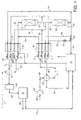
- a hydrocarbon-containing feed gas for example, methane provided by natural gas, optionally mixed with 1-15 mole% hydrogen, flows via line 1 at a pressure in the range of 100 to 600 psia to preheat exchanger 3 and is heated therein to a typical temperature in the range of about 200°C to about 400°C by heat exchange with a hot process stream (later defined) supplied via line 5.
- the feed may be desulfurized using metal promoted carbon (not shown) prior to line 1, or using ZnO after preheating prior to line 7 (not shown).
- the heated feed flows via line 7 and open valve 9 and is mixed with process steam provided via line 11 to form a hydrocarbon-steam feed mixture.
- steam may be added prior to valve 9 if desired (not shown).
- the molar ratio of steam to hydrocarbon may be from about 1:1 to about 4:1, and typically may be about 1.3:1 to about 2:1.
- the molar steam to hydrocarbon ratio may be higher, and may range up to about 20:1 for heavier hydrocarbons.
- the steam-hydrocarbon mixture is introduced into heat exchange zone 13 and is further heated therein by heat exchange with a hot process stream (later defined).
- the heat exchange zone described here can be a recuperative or a conventional heat exchanger. Heat exchange can take place against any of the hot streams exiting the reactor.
- the steam-hydrocarbon mixture may be heated to a temperature in the range of about 350°C to about 900°C, and typically may be in the range of about 600°C to about 750°C.
- the heated mixture then is introduced via line 16 into reactor 17, which has a bed packed with a mixture of complex metal oxide material and a steam-hydrocarbon reforming catalyst.
- the heat exchange zone can be a portion of the reactor itself, at either or both of its ends, and lines may not be necessary.
- the reactor 17 itself is substantially adiabatic, and is insulated, preferably by an internal lining of refractory material(s).
- the feed mixture reacts in the bed to form primarily hydrogen and carbon dioxide, and, in much smaller amounts, carbon monoxide.
- the carbon dioxide is substantially retained by reaction with the complex metal oxide in the bed.
- the inventory of chemically bound oxygen available for reaction i.e., the oxygen associated with the complex metal oxide and steam reactants, may be adjusted in the reactor design so that the reaction product effluent stream leaves reactor 17 via line 19 at a time-averaged temperature between about 400°C and about 750°C.
- the reaction product effluent stream flows via heat exchange zone 13, where it is cooled to a temperature in the range of about 250°C to about 500°C by heat exchange with incoming reactants as earlier described, or regenerant as described below.
- the cooled reaction product effluent stream exits heat exchange zone 13 via open valve 21 and is further cooled in heat exchange zone 3 and optionally boiler 23 to yield a further cooled reaction product effluent stream in line 25 at a typical temperature of 40°C. Any condensate is knocked out at this point (not shown).
- the cooled reaction product stream is introduced into pressure swing adsorption (PSA) system 27 and is separated therein to yield a high-purity hydrogen product containing at least 99 vol% hydrogen that is withdrawn via line 29.
- PSA pressure swing adsorption
- Components removed from the hydrogen by the PSA system typically include carbon dioxide, water, methane and carbon monoxide, and these are withdrawn in a waste gas via line 31 during the blowdown and purge steps typically used in PSA process cycles. Any PSA cycle and system known in the art may be used in the process described in this and other embodiments of the invention.
- the waste gas in line 31 typically contains combustible components and may be used as fuel in a fired boiler, 33, or in a direct fired heater to preheat regenerant air (not shown).
- the mixture of complex metal oxide material and steam-hydrocarbon reforming catalyst in reactor 17 has a finite inventory of chemically bound oxygen and a finite reaction capacity for carbon dioxide. Once either of these is exhausted, the purity and yield of hydrogen in the reaction product effluent stream leaving reactor 17 via line 19 will begin to decrease. The time at which this occurs can be determined by real-time analysis of the stream by any known analytical means, such as, for example, in-line IR spectroscopy.
- reactor 17 is switched to regeneration mode by closing valve 9 and depressurizing the reactor via lines 19, line 33, open valve 37, and line 39, wherein the hydrocarbon-containing blowdown gas is introduced into boiler 33 or a direct fired air heater (not shown). At this point, valve 41 remains closed.
- the blowdown can be cocurrent or countercurrent.
- Valve 37 is then closed, Valve 41 is then opened and reactor 17 is purged with a suitable purge gas such as steam or nitrogen to remove residual hydrocarbons from the reactor void volume.
- a suitable purge gas such as steam or nitrogen to remove residual hydrocarbons from the reactor void volume.
- steam for purge is provided via line 11 and flows through heat exchanger 13 and line 16 into the reactor.
- Purge effluent gas leaves the reactor via lines 19 and 33, flows through heat exchanger 43, valve 41, line 45, heat exchanger 47, and line 49 into boiler 33.
- the purge can be cocurrent or countercurrent.
- a particular feature of this embodiment is that the switching valves such as valve 9 or 51 are on the cooler side of the heat exchange zones 13 or 43. While this requires each reactor to be associated with its individual heat exchange zone, it does ease the mechanical requirements and operating life of the switching valves. It is possible to fuse heat exchange zones 13 and 43 into a single heat exchanger (not shown here), but that would require the valves to be repositioned to the hotter side of the heat exchange zone.
- Fig. 1 shows the heat exchange zones to be of the conventional type where heat exchange between streams is contemporaneous.
- the heat exchange zones could also be recuperative in nature (not shown), where heat from a cooling stream is stored in the heat capacitance of the zone, and released to a warming stream in a subsequent step.
- the zones would comprise of inert solids such as ceramic pellets or firebrick. They could be located in a separate vessel, or form a portion of the reactor vessel itself at either or both ends, adjacent to the reaction zone which is the active zone filled with mixed metal oxide and reforming catalyst.
- Regeneration of reactor 17 then is initiated by opening previously-closed valve 51.
- Air is provided via intake line 55 to compressor 57 and is compressed therein to about 15 to 100 psia and the compressed air inline 59 is preheated in heat exchanger 47 to about 250°C to about 500°C, and introduced via line 61 and valve 51 into the heat exchange zone 43.
- the air is further heated in heat exchange zone 43 against hot exhaust gas from line 33 (later described), or hot reactor effluent as described earlier, to a temperature between about 500°C and about 900°C, typically from about 700°C to about 800°C.
- the heated air flows via lines 53 and 16 into reactor 17, and the oxygen in the air regenerates the complex metal oxide material by oxidizing the reduced (spent) metal oxide and releasing the carbon dioxide previously reacted with the complex metal oxide material.
- the carbon dioxide-rich, oxygen-depleted regeneration offgas leaves the reactor via line 33 at a temperature in the range of about 600°C to about 900°C and typically from about 650°C to about 750°C.
- the hot regeneration offgas in line 33 is introduced into heat exchange zone 43 (this may be integrated with heat exchange zone 13) to heat the air entering via valve 51 as earlier described, or to heat the hydrocarbon-steam feed mixture as earlier described, whereby the offgas is cooled to a temperature in the range of about 350°C to about 600°C.
- the cooled regeneration offgas flows via valve 41 and is further cooled to a temperature in the range of about 200°C to about 300°C in heat exchanger 47, thereby heating compressed air stream 59 as earlier described.
- the cooled regeneration offgas stream in line 49 still contains some residual oxygen, and may be introduces into boiler 33 for additional heat recovery.
- the reactor may be purged with an inert gas and repressurized with steam, feed gas, or product gas. Following repressurization, the reactor proceeds to the reaction step and the cycle is repeated as described earlier.
- Reactor 63 is operated through the same cycle steps described above for reactor 17, but the cycle of reactor 63 is staggered so that it operates in the regeneration mode when reactor 17 operates in the reaction or hydrogen production mode.
- Hydrocarbon-containing feed gas flows via valve 65, steam is added via line 67, the feed-steam mixture is heated in heat exchanger 13, and the heated feed flows via lines 69 and 71 to reactor 63.
- Reaction product gas leaves the reactor via lines 71 and 73, is cooled in heat exchanger 13, and flows via valve 75, line 5, heat exchanger 3, boiler 23, and line 25 to PSA system 27.
- Regeneration air is provided to reactor 63 via valve 77, heat exchanger 43, and line 71, and blowdown or depressurization gas exits via line 81, valve 83, and line 39 into boiler 33.
- Regeneration offgas leaves reactor 63 via line 85, heat exchanger 43, and valve 87, and then flows via line 45, heat exchanger 47, and line 49 to boiler 33.
- Reactors 17 and 63 thus are operated in a staggered sequence between the hydrogen production and regeneration modes by the proper operation of switch valves 9, 21, 37, 41, 51, 65, 75, 77, 83, and 87 as described above. Operation with two parallel reactors with constant hydrogen product flow is possible when the elapsed time of the hydrogen production mode is equal to or greater than that of the regeneration mode. However, any suitable number of reactors in parallel may be used in staggered operation to achieve continuous hydrogen production. In practice, the duration of the hydrogen production step using a particular complex metal oxide may be different than the duration of the regeneration step. For example, if the regeneration step is twice as long as the production step, a configuration employing three parallel beds may be advantageously used wherein two beds are being regenerated while the third bed is used for hydrogen production.
- a commercially available steam-methane reforming catalyst consisting of about 50 wt.% nickel oxide on alumina was used in conjunction with Sr 2 Ni 2 O 5 .
- the nickel oxide/alumina catalyst was reduced to metallic nickel before use.
- a physical mixture of Sr 2 Ni 2 O 5 and 9.90 wt % nickel oxide/alumina catalyst was heated to 700°C and exposed to a dilute hydrogen flow (10 sccm hydrogen and 160 sccm argon) for about 5 minutes. The exposure time was calculated to yield a 60% reduction of nickel oxide to nickel, and presumed that reduction of Sr 2 Ni 2 O 5 does not occur.
- the internal temperature of the reactor increased rapidly upon exposure to steam/methane followed by a rapid return to a steady state value lower than that prior to methane/steam exposure.
- the above observations are consistent with (1) an initial period in which methane oxidation, steam-methane reforming, and carbon dioxide capture occur simultaneously followed by (2) a steady-state period in which mostly steam-methane reforming occurs.
- the ternary oxide LaNiO 3 was heated to 700°C and was exposed to a feed consisting of methane/steam in argon.
- the reactant feed was generated by blending 80 sccm methane, 240 sccm steam, and 80 sccm argon.
- hydrogen was the predominant product along with relatively minor amounts of carbon dioxide and carbon monoxide (the carbon monoxide production was so low that it is not shown in Fig. 3).
- 315 mmol of hydrogen were produced. If all of this hydrogen arose from steam-methane reforming, the calculated carbon dioxide production would be 79 mmol. However, only 9.88 mmol of carbon dioxide was observed.
- the complex metal oxide SrCo 0.4 Fe 0.4 Cu 0.2 O 3.8 was exposed to a feed of 80 sccm methane, 125 sccm steam and 80 sccm argon as an optional diluent at 700°C.
- Equation 8 the thermodynamics of various steps in the reaction of a mixture of iron(II) oxide, calcium carbonate, and oxygen to form the complex metal oxide Ca 2 Fe 2 O 5 (for which the requisite thermodynamic data is available) and carbon dioxide were calculated. The results are given in Table 2. Table 2 Reaction Thermodynamics for Example 4 Eqn. No.
- Example 4 The calculation of Example 4 was repeated for the reaction of the same reactants to yield CaFe 2 O 4 and the results are given in Table 3..
- Table 3 Reaction Thermodynamics for Example 5 Eqn. No. Reaction ⁇ H at 700°C (Kcal/mole) ⁇ G at 700°C (Kcal/mole) 15
- CaO + Fe 2 O 3 CaFe 2 O 4 -8.06 -8.33 12
- 2FeO + 1 ⁇ 2 O 2 Fe 2 O 3 -66.68 -39.54
- CaCO 3 CaO+CO 2 40.74 6.64 Net 17
- CaCO 3 +2FeO+1 ⁇ 2 O 2 CaFe 2 O 4 +CO 2 -34.00 -41.22
- Equation 26 The total synthesis reaction (Equation 26) though endothermic and thus requiring an input for heat for sustained operation is still spontaneous ( ⁇ G ⁇ 0) and with an effective steam-methane reforming catalyst it should proceed to completion, with a total conversion of methane.
- This analysis is useful for designing a thermoneutral system which here clearly requires a CaBO n complex metal oxide where B is an element, or a combination of two or more elements, potentially in various oxidation states for which the binary oxide, BO n-1 is more easily reduced, i.e., where ⁇ H for the equivalent of Equation 23 is lower (ideally here by 26.9 kcal/mole CH 4 .)
- FIG. 4 plots the rate of gas production (mmol/min) on the left vertical axis and internal reactor temperature as a function of run time on the right side vertical axis.
- the Figure can be divided into four regions A through D (increasing reaction times) corresponding to more or less distinct reaction regimes. In Region A, a large temperature increase occurs due to total combustion of methane.
- Region B Neither hydrogen nor carbon dioxide was observed, with the carbon dioxide resulting from combustion being absorbed by the oxide.
- Region B almost no temperature change was observed and relatively pure hydrogen was produced.
- This region corresponds to the autothermal or thermoneutral production of hydrogen with only low levels of CO and gas phase CO 2 by-products (see Table 6, below).
- region C increasing concentrations of carbon dioxide and carbon monoxide were observed along with a steady state concentration of hydrogen and a decreasing reactor temperature.
- Region C corresponds to a shift from autothermal production of hydrogen to conventional steam-methane reforming.
- region D production of hydrogen occurs by conventional steam-methane reforming alone. As expected for endothermic steam-methane reforming, the temperature of the reactor was lower than that prior to introduction of the methane/steam feed.
- Equation 31 describes that at 500°C, the maximum theoretical yield of hydrogen gas will be 7.95 moles of hydrogen per mole of propane used in the reaction; the minimum steam/hydrocarbon molar ratio here will be - 4:1.
Landscapes
- Chemical & Material Sciences (AREA)
- Organic Chemistry (AREA)
- Chemical Kinetics & Catalysis (AREA)
- Engineering & Computer Science (AREA)
- Combustion & Propulsion (AREA)
- Inorganic Chemistry (AREA)
- Health & Medical Sciences (AREA)
- General Health & Medical Sciences (AREA)
- Hydrogen, Water And Hydrids (AREA)
- Catalysts (AREA)
- Low-Molecular Organic Synthesis Reactions Using Catalysts (AREA)
Applications Claiming Priority (1)
| Application Number | Priority Date | Filing Date | Title |
|---|---|---|---|
| US11/165,731 US7429373B2 (en) | 2005-06-24 | 2005-06-24 | Process for autothermal generation of hydrogen |
Publications (3)
| Publication Number | Publication Date |
|---|---|
| EP1736437A2 true EP1736437A2 (de) | 2006-12-27 |
| EP1736437A3 EP1736437A3 (de) | 2008-02-20 |
| EP1736437B1 EP1736437B1 (de) | 2009-08-19 |
Family
ID=37026975
Family Applications (1)
| Application Number | Title | Priority Date | Filing Date |
|---|---|---|---|
| EP06012612A Not-in-force EP1736437B1 (de) | 2005-06-24 | 2006-06-20 | Verfahren zur autothermen Herstellung von Wasserstoff |
Country Status (7)
| Country | Link |
|---|---|
| US (1) | US7429373B2 (de) |
| EP (1) | EP1736437B1 (de) |
| CN (1) | CN100471789C (de) |
| AT (1) | ATE440071T1 (de) |
| CA (1) | CA2550639C (de) |
| DE (1) | DE602006008533D1 (de) |
| ES (1) | ES2330462T3 (de) |
Cited By (6)
| Publication number | Priority date | Publication date | Assignee | Title |
|---|---|---|---|---|
| EP1829822A3 (de) * | 2006-01-25 | 2008-02-27 | Air Products and Chemicals, Inc. | Verfahren zur Wasserstoffherstellung mit Regenerationsmittel-Recycling |
| EP1736438A3 (de) * | 2005-06-24 | 2008-02-27 | University Of South Carolina | Verwendung von komplexen Metalloxiden bei der autothermen Herstellung von Wasserstoff |
| EP2002877A1 (de) * | 2007-06-15 | 2008-12-17 | Linde Aktiengesellschaft | Verfahren und Vorrichtung zur Wasserstoffabtretung aus Gasströmen mittels Druckwechseladsorpiotionsverfahren |
| EP2092978A1 (de) * | 2008-02-05 | 2009-08-26 | Air Products and Chemicals, Inc. | Wasserstoffproduktion unter Verwendung von komplexen Metalloxiden enthaltenden Pellets |
| JP2010530067A (ja) * | 2007-06-15 | 2010-09-02 | ビーピー ケミカルズ リミテッド | 気相プロセス流のオンライン分析方法 |
| CN112456440A (zh) * | 2020-11-30 | 2021-03-09 | 北京航天试验技术研究所 | 一种氢气纯化系统 |
Families Citing this family (20)
| Publication number | Priority date | Publication date | Assignee | Title |
|---|---|---|---|---|
| US7507570B2 (en) * | 2004-03-10 | 2009-03-24 | Massachusetts Institute Of Technology | Recombinant chondroitinase ABC I and uses thereof |
| DE102006019699A1 (de) * | 2006-04-27 | 2007-10-31 | Linde Ag | Dampferzeugung in Dampfreformierungsprozessen |
| US7905259B2 (en) * | 2006-11-15 | 2011-03-15 | Honeywell International Inc. | Advanced carbon dioxide fuel tank inerting system |
| US7897128B2 (en) * | 2007-04-20 | 2011-03-01 | Air Products And Chemicals, Inc. | Preparation of complex metal oxides |
| FI122786B (fi) * | 2007-07-20 | 2012-06-29 | Upm Kymmene Oyj | Synteettisten hiilivetyketjujen valmistuksessa syntyvän hiilidioksidin käyttö |
| US20100196259A1 (en) * | 2009-02-05 | 2010-08-05 | Air Products And Chemicals, Inc. | CO2-Sorptive Pellets and Uses Thereof |
| US20100327231A1 (en) * | 2009-06-26 | 2010-12-30 | Noah Whitmore | Method of producing synthesis gas |
| WO2011016030A1 (en) * | 2009-08-03 | 2011-02-10 | Technion Research & Development Foundation Ltd. | Hydrogen production by an autothermal heat exchanger packed-bed membrane gas reformer |
| EP2994227A2 (de) | 2013-05-09 | 2016-03-16 | SABIC Global Technologies B.V. | Tonmineralgeträgerte katalysatoren |
| DE102013104893A1 (de) * | 2013-05-13 | 2014-11-13 | L'Air Liquide, Société Anonyme pour l'Etude et l'Exploitation des Procédés Georges Claude | Verfahren zur Inbetriebnahme einer Vorreformierungsstufe |
| US10294102B2 (en) | 2016-12-15 | 2019-05-21 | Praxair Technology, Inc. | Method of catalyst reduction in a hydrogen plant |
| US10155661B2 (en) * | 2017-01-27 | 2018-12-18 | L'air Liquide Societe Anonyme Pour L'etude Et L'exploitation Des Procedes Georges Claude | System and methods for improving natural gas usage in steam methane reformers |
| AU2020340961A1 (en) * | 2019-09-03 | 2022-03-24 | Ohio State Innovation Foundation | Redox reaction facilitated carbon dioxide capture from flue gas and conversion to carbon monoxide |
| US11987497B2 (en) * | 2019-12-06 | 2024-05-21 | Palo Alto Research Center Incorporated | Liquid metal condensate catalyzed hydrocarbon pyrolysis |
| WO2022006112A1 (en) | 2020-06-29 | 2022-01-06 | Ohio State Innovation Foundation | Systems and methods for high reactant conversion through multiple reactant flow ratio staging |
| CN112871176A (zh) * | 2021-01-14 | 2021-06-01 | 广东醇氢新能源研究院有限公司 | 一种汽油水蒸气重整制氢催化剂及其制备方法 |
| CN113834341A (zh) * | 2021-09-28 | 2021-12-24 | 中国华能集团清洁能源技术研究院有限公司 | 用于水泥厂烟气的低温脱硫脱硝方法和系统 |
| US12006213B2 (en) | 2022-05-26 | 2024-06-11 | Surendra Saxena | Chemically modified steam-methane reformation process |
| WO2024155694A2 (en) * | 2023-01-17 | 2024-07-25 | Texas Tech University System | Sonochemical synthesis methods and related applications |
| CN116374953A (zh) * | 2023-04-04 | 2023-07-04 | 上海天阳钢管有限公司 | 一种氢燃料的制备方法 |
Family Cites Families (23)
| Publication number | Priority date | Publication date | Assignee | Title |
|---|---|---|---|---|
| ZA849756B (en) | 1983-12-15 | 1986-06-25 | Bergwerksverband Gmbh | Process for isolating and recovering gases which are relatively strongly adsorbable on adsorbents from gas mixtures which otherwise essentially contain only less strongly adsorbable gases |
| EP0411506A2 (de) | 1989-08-02 | 1991-02-06 | Air Products And Chemicals, Inc. | Herstellung von Wasserstoff, Kohlenoxyd und ihren Mischungen |
| US5055441A (en) | 1990-02-01 | 1991-10-08 | E. I. Du Pont De Nemours And Company | Process for preparation of metal oxides of molybdenum or mlybdenum and tungsten |
| US5827496A (en) | 1992-12-11 | 1998-10-27 | Energy And Environmental Research Corp. | Methods and systems for heat transfer by unmixed combustion |
| US6303092B1 (en) | 1995-04-10 | 2001-10-16 | Air Products And Chemicals, Inc. | Process for operating equilibrium controlled reactions |
| US6007699A (en) | 1996-08-21 | 1999-12-28 | Energy And Environmental Research Corporation | Autothermal methods and systems for fuels conversion |
| US6238816B1 (en) * | 1996-12-30 | 2001-05-29 | Technology Management, Inc. | Method for steam reforming hydrocarbons using a sulfur-tolerant catalyst |
| US6025403A (en) | 1997-07-07 | 2000-02-15 | Mobil Oil Corporation | Process for heat integration of an autothermal reformer and cogeneration power plant |
| US6379586B1 (en) | 1998-10-20 | 2002-04-30 | The Boc Group, Inc. | Hydrocarbon partial oxidation process |
| DE19903616A1 (de) | 1999-01-29 | 2000-08-03 | Basf Ag | Verfahren zur Herstellung von Stickoxiden mit niedrigem Oxidationsgrad |
| CA2340822C (en) | 2000-03-17 | 2010-08-03 | Snamprogetti S.P.A. | Process for the production of hydrogen |
| AU2001274504A1 (en) * | 2000-06-16 | 2001-12-24 | Kiyoshi Otsuka | Method and apparatus for supplying hydrogen and portable cassette for supplying hydrogen |
| JP2004508261A (ja) | 2000-09-05 | 2004-03-18 | アルテア ナノマテリアルズ インコーポレイテッド | 混合した金属酸化物及び金属酸化物のコンパウンドの製造方法 |
| US6506510B1 (en) | 2000-12-15 | 2003-01-14 | Uop Llc | Hydrogen generation via methane cracking for integrated heat and electricity production using a fuel cell |
| CA2689689C (en) | 2001-04-18 | 2012-07-03 | Texaco Development Corporation | Integrated fuel processor, fuel cell stack and tail gas oxidizer with carbon dioxide removal |
| US20020179887A1 (en) * | 2001-05-01 | 2002-12-05 | Yongxian Zeng | Supported perovskite-type oxides and methods for preparation thereof |
| US6667022B2 (en) | 2001-08-14 | 2003-12-23 | General Electric Co. | Process for separating synthesis gas into fuel cell quality hydrogen and sequestration ready carbon dioxide |
| US6767530B2 (en) | 2001-12-14 | 2004-07-27 | Praxair Technology, Inc. | Method for producing hydrogen |
| JP3930331B2 (ja) | 2002-01-25 | 2007-06-13 | 東芝三菱電機産業システム株式会社 | 燃料改質方法およびそのシステム |
| US6972301B2 (en) | 2002-06-06 | 2005-12-06 | Sasol North America Inc. | Process for producing organically modified metal oxides and products thereof |
| US7914764B2 (en) | 2003-02-28 | 2011-03-29 | Exxonmobil Research And Engineering Company | Hydrogen manufacture using pressure swing reforming |
| US7267811B2 (en) | 2003-11-26 | 2007-09-11 | Cabot Corporation | Fuel reformer catalyst and absorbent materials |
| US7438889B2 (en) | 2005-06-24 | 2008-10-21 | University Of South Carolina | Use of complex metal oxides in the autothermal generation of hydrogen |
-
2005
- 2005-06-24 US US11/165,731 patent/US7429373B2/en not_active Expired - Fee Related
-
2006
- 2006-06-19 CA CA2550639A patent/CA2550639C/en not_active Expired - Fee Related
- 2006-06-20 DE DE602006008533T patent/DE602006008533D1/de active Active
- 2006-06-20 AT AT06012612T patent/ATE440071T1/de not_active IP Right Cessation
- 2006-06-20 EP EP06012612A patent/EP1736437B1/de not_active Not-in-force
- 2006-06-20 ES ES06012612T patent/ES2330462T3/es active Active
- 2006-06-26 CN CNB2006100908144A patent/CN100471789C/zh not_active Expired - Fee Related
Cited By (11)
| Publication number | Priority date | Publication date | Assignee | Title |
|---|---|---|---|---|
| EP1736438A3 (de) * | 2005-06-24 | 2008-02-27 | University Of South Carolina | Verwendung von komplexen Metalloxiden bei der autothermen Herstellung von Wasserstoff |
| EP1829822A3 (de) * | 2006-01-25 | 2008-02-27 | Air Products and Chemicals, Inc. | Verfahren zur Wasserstoffherstellung mit Regenerationsmittel-Recycling |
| US7591992B2 (en) | 2006-01-25 | 2009-09-22 | Air Products And Chemicals, Inc. | Hydrogen production process with regenerant recycle |
| EP2002877A1 (de) * | 2007-06-15 | 2008-12-17 | Linde Aktiengesellschaft | Verfahren und Vorrichtung zur Wasserstoffabtretung aus Gasströmen mittels Druckwechseladsorpiotionsverfahren |
| JP2008308403A (ja) * | 2007-06-15 | 2008-12-25 | Linde Ag | 圧力スイング吸着法によるガス流からの水素分離方法及び装置 |
| US7785550B2 (en) | 2007-06-15 | 2010-08-31 | Linde Aktiengesellschaft | Process and device for separating hydrogen from gas flows by a pressure swing adsorption process |
| JP2010530067A (ja) * | 2007-06-15 | 2010-09-02 | ビーピー ケミカルズ リミテッド | 気相プロセス流のオンライン分析方法 |
| RU2471537C2 (ru) * | 2007-06-15 | 2013-01-10 | Линде Акциенгезельшафт | Способ и устройство для отделения водорода от газовых потоков путем короткоцикловой адсорбции |
| EP2092978A1 (de) * | 2008-02-05 | 2009-08-26 | Air Products and Chemicals, Inc. | Wasserstoffproduktion unter Verwendung von komplexen Metalloxiden enthaltenden Pellets |
| US8038981B2 (en) | 2008-02-05 | 2011-10-18 | Air Products And Chemicals, Inc. | Hydrogen production using complex metal oxide pellets |
| CN112456440A (zh) * | 2020-11-30 | 2021-03-09 | 北京航天试验技术研究所 | 一种氢气纯化系统 |
Also Published As
| Publication number | Publication date |
|---|---|
| DE602006008533D1 (de) | 2009-10-01 |
| US20060292069A1 (en) | 2006-12-28 |
| EP1736437A3 (de) | 2008-02-20 |
| ATE440071T1 (de) | 2009-09-15 |
| CA2550639C (en) | 2010-08-10 |
| US7429373B2 (en) | 2008-09-30 |
| CN1884044A (zh) | 2006-12-27 |
| EP1736437B1 (de) | 2009-08-19 |
| CN100471789C (zh) | 2009-03-25 |
| CA2550639A1 (en) | 2006-12-24 |
| ES2330462T3 (es) | 2009-12-10 |
Similar Documents
| Publication | Publication Date | Title |
|---|---|---|
| EP1736437B1 (de) | Verfahren zur autothermen Herstellung von Wasserstoff | |
| EP1829822B1 (de) | Verfahren zur Wasserstoffherstellung mit Regenerationsmittel-Recycling | |
| EP1736438B1 (de) | Verwendung von komplexen Metalloxiden bei der autothermen Herstellung von Wasserstoff | |
| KR102596272B1 (ko) | 합성 가스의 제조 방법 | |
| EP1816102B1 (de) | Regenerierung komplexer Metalloxide für die Herstellung von Wasserstoff | |
| AU2007325180B2 (en) | Systems and processes for producing hydrogen and carbon dioxide | |
| EP2384308B1 (de) | Wasserstoffverfahren | |
| US7927574B2 (en) | Method for regenerating a solid reactant | |
| CN107021450B (zh) | 用于制备氨和尿素的方法 | |
| US8038981B2 (en) | Hydrogen production using complex metal oxide pellets | |
| EP0737647B1 (de) | Integriertes Verfahren zur Methandampfreformierung zur Herstellung von Kohlenmonoxid | |
| US8974699B2 (en) | Method for producing synthesis gases |
Legal Events
| Date | Code | Title | Description |
|---|---|---|---|
| PUAI | Public reference made under article 153(3) epc to a published international application that has entered the european phase |
Free format text: ORIGINAL CODE: 0009012 |
|
| AK | Designated contracting states |
Kind code of ref document: A2 Designated state(s): AT BE BG CH CY CZ DE DK EE ES FI FR GB GR HU IE IS IT LI LT LU LV MC NL PL PT RO SE SI SK TR |
|
| AX | Request for extension of the european patent |
Extension state: AL BA HR MK YU |
|
| PUAL | Search report despatched |
Free format text: ORIGINAL CODE: 0009013 |
|
| AK | Designated contracting states |
Kind code of ref document: A3 Designated state(s): AT BE BG CH CY CZ DE DK EE ES FI FR GB GR HU IE IS IT LI LT LU LV MC NL PL PT RO SE SI SK TR |
|
| AX | Request for extension of the european patent |
Extension state: AL BA HR MK YU |
|
| 17P | Request for examination filed |
Effective date: 20080326 |
|
| AKX | Designation fees paid |
Designated state(s): AT BE BG CH CY CZ DE DK EE ES FI FR GB GR HU IE IS IT LI LT LU LV MC NL PL PT RO SE SI SK TR |
|
| GRAP | Despatch of communication of intention to grant a patent |
Free format text: ORIGINAL CODE: EPIDOSNIGR1 |
|
| GRAS | Grant fee paid |
Free format text: ORIGINAL CODE: EPIDOSNIGR3 |
|
| GRAA | (expected) grant |
Free format text: ORIGINAL CODE: 0009210 |
|
| AK | Designated contracting states |
Kind code of ref document: B1 Designated state(s): AT BE BG CH CY CZ DE DK EE ES FI FR GB GR HU IE IS IT LI LT LU LV MC NL PL PT RO SE SI SK TR |
|
| REG | Reference to a national code |
Ref country code: GB Ref legal event code: FG4D |
|
| REG | Reference to a national code |
Ref country code: CH Ref legal event code: EP |
|
| REG | Reference to a national code |
Ref country code: IE Ref legal event code: FG4D |
|
| REF | Corresponds to: |
Ref document number: 602006008533 Country of ref document: DE Date of ref document: 20091001 Kind code of ref document: P |
|
| REG | Reference to a national code |
Ref country code: ES Ref legal event code: FG2A Ref document number: 2330462 Country of ref document: ES Kind code of ref document: T3 |
|
| LTIE | Lt: invalidation of european patent or patent extension |
Effective date: 20090819 |
|
| PG25 | Lapsed in a contracting state [announced via postgrant information from national office to epo] |
Ref country code: IS Free format text: LAPSE BECAUSE OF FAILURE TO SUBMIT A TRANSLATION OF THE DESCRIPTION OR TO PAY THE FEE WITHIN THE PRESCRIBED TIME-LIMIT Effective date: 20091219 Ref country code: FI Free format text: LAPSE BECAUSE OF FAILURE TO SUBMIT A TRANSLATION OF THE DESCRIPTION OR TO PAY THE FEE WITHIN THE PRESCRIBED TIME-LIMIT Effective date: 20090819 Ref country code: AT Free format text: LAPSE BECAUSE OF FAILURE TO SUBMIT A TRANSLATION OF THE DESCRIPTION OR TO PAY THE FEE WITHIN THE PRESCRIBED TIME-LIMIT Effective date: 20090819 Ref country code: LT Free format text: LAPSE BECAUSE OF FAILURE TO SUBMIT A TRANSLATION OF THE DESCRIPTION OR TO PAY THE FEE WITHIN THE PRESCRIBED TIME-LIMIT Effective date: 20090819 Ref country code: SE Free format text: LAPSE BECAUSE OF FAILURE TO SUBMIT A TRANSLATION OF THE DESCRIPTION OR TO PAY THE FEE WITHIN THE PRESCRIBED TIME-LIMIT Effective date: 20090819 |
|
| PG25 | Lapsed in a contracting state [announced via postgrant information from national office to epo] |
Ref country code: PL Free format text: LAPSE BECAUSE OF FAILURE TO SUBMIT A TRANSLATION OF THE DESCRIPTION OR TO PAY THE FEE WITHIN THE PRESCRIBED TIME-LIMIT Effective date: 20090819 Ref country code: LV Free format text: LAPSE BECAUSE OF FAILURE TO SUBMIT A TRANSLATION OF THE DESCRIPTION OR TO PAY THE FEE WITHIN THE PRESCRIBED TIME-LIMIT Effective date: 20090819 Ref country code: SI Free format text: LAPSE BECAUSE OF FAILURE TO SUBMIT A TRANSLATION OF THE DESCRIPTION OR TO PAY THE FEE WITHIN THE PRESCRIBED TIME-LIMIT Effective date: 20090819 |
|
| PG25 | Lapsed in a contracting state [announced via postgrant information from national office to epo] |
Ref country code: PT Free format text: LAPSE BECAUSE OF FAILURE TO SUBMIT A TRANSLATION OF THE DESCRIPTION OR TO PAY THE FEE WITHIN THE PRESCRIBED TIME-LIMIT Effective date: 20091221 Ref country code: BG Free format text: LAPSE BECAUSE OF FAILURE TO SUBMIT A TRANSLATION OF THE DESCRIPTION OR TO PAY THE FEE WITHIN THE PRESCRIBED TIME-LIMIT Effective date: 20091119 Ref country code: CY Free format text: LAPSE BECAUSE OF FAILURE TO SUBMIT A TRANSLATION OF THE DESCRIPTION OR TO PAY THE FEE WITHIN THE PRESCRIBED TIME-LIMIT Effective date: 20090819 |
|
| PG25 | Lapsed in a contracting state [announced via postgrant information from national office to epo] |
Ref country code: EE Free format text: LAPSE BECAUSE OF FAILURE TO SUBMIT A TRANSLATION OF THE DESCRIPTION OR TO PAY THE FEE WITHIN THE PRESCRIBED TIME-LIMIT Effective date: 20090819 Ref country code: CZ Free format text: LAPSE BECAUSE OF FAILURE TO SUBMIT A TRANSLATION OF THE DESCRIPTION OR TO PAY THE FEE WITHIN THE PRESCRIBED TIME-LIMIT Effective date: 20090819 Ref country code: DK Free format text: LAPSE BECAUSE OF FAILURE TO SUBMIT A TRANSLATION OF THE DESCRIPTION OR TO PAY THE FEE WITHIN THE PRESCRIBED TIME-LIMIT Effective date: 20090819 Ref country code: RO Free format text: LAPSE BECAUSE OF FAILURE TO SUBMIT A TRANSLATION OF THE DESCRIPTION OR TO PAY THE FEE WITHIN THE PRESCRIBED TIME-LIMIT Effective date: 20090819 |
|
| PG25 | Lapsed in a contracting state [announced via postgrant information from national office to epo] |
Ref country code: SK Free format text: LAPSE BECAUSE OF FAILURE TO SUBMIT A TRANSLATION OF THE DESCRIPTION OR TO PAY THE FEE WITHIN THE PRESCRIBED TIME-LIMIT Effective date: 20090819 |
|
| PLBE | No opposition filed within time limit |
Free format text: ORIGINAL CODE: 0009261 |
|
| STAA | Information on the status of an ep patent application or granted ep patent |
Free format text: STATUS: NO OPPOSITION FILED WITHIN TIME LIMIT |
|
| PG25 | Lapsed in a contracting state [announced via postgrant information from national office to epo] |
Ref country code: BE Free format text: LAPSE BECAUSE OF FAILURE TO SUBMIT A TRANSLATION OF THE DESCRIPTION OR TO PAY THE FEE WITHIN THE PRESCRIBED TIME-LIMIT Effective date: 20090819 |
|
| 26N | No opposition filed |
Effective date: 20100520 |
|
| PG25 | Lapsed in a contracting state [announced via postgrant information from national office to epo] |
Ref country code: GR Free format text: LAPSE BECAUSE OF FAILURE TO SUBMIT A TRANSLATION OF THE DESCRIPTION OR TO PAY THE FEE WITHIN THE PRESCRIBED TIME-LIMIT Effective date: 20091120 |
|
| PG25 | Lapsed in a contracting state [announced via postgrant information from national office to epo] |
Ref country code: MC Free format text: LAPSE BECAUSE OF NON-PAYMENT OF DUE FEES Effective date: 20100630 |
|
| REG | Reference to a national code |
Ref country code: CH Ref legal event code: PL |
|
| PG25 | Lapsed in a contracting state [announced via postgrant information from national office to epo] |
Ref country code: IE Free format text: LAPSE BECAUSE OF NON-PAYMENT OF DUE FEES Effective date: 20100620 Ref country code: LI Free format text: LAPSE BECAUSE OF NON-PAYMENT OF DUE FEES Effective date: 20100630 Ref country code: CH Free format text: LAPSE BECAUSE OF NON-PAYMENT OF DUE FEES Effective date: 20100630 |
|
| PG25 | Lapsed in a contracting state [announced via postgrant information from national office to epo] |
Ref country code: HU Free format text: LAPSE BECAUSE OF FAILURE TO SUBMIT A TRANSLATION OF THE DESCRIPTION OR TO PAY THE FEE WITHIN THE PRESCRIBED TIME-LIMIT Effective date: 20100220 Ref country code: LU Free format text: LAPSE BECAUSE OF NON-PAYMENT OF DUE FEES Effective date: 20100620 |
|
| PG25 | Lapsed in a contracting state [announced via postgrant information from national office to epo] |
Ref country code: TR Free format text: LAPSE BECAUSE OF FAILURE TO SUBMIT A TRANSLATION OF THE DESCRIPTION OR TO PAY THE FEE WITHIN THE PRESCRIBED TIME-LIMIT Effective date: 20090819 |
|
| REG | Reference to a national code |
Ref country code: FR Ref legal event code: PLFP Year of fee payment: 10 |
|
| REG | Reference to a national code |
Ref country code: FR Ref legal event code: PLFP Year of fee payment: 11 |
|
| PGFP | Annual fee paid to national office [announced via postgrant information from national office to epo] |
Ref country code: GB Payment date: 20160525 Year of fee payment: 11 Ref country code: ES Payment date: 20160606 Year of fee payment: 11 |
|
| PGFP | Annual fee paid to national office [announced via postgrant information from national office to epo] |
Ref country code: FR Payment date: 20160531 Year of fee payment: 11 Ref country code: IT Payment date: 20160613 Year of fee payment: 11 Ref country code: NL Payment date: 20160607 Year of fee payment: 11 |
|
| PGFP | Annual fee paid to national office [announced via postgrant information from national office to epo] |
Ref country code: DE Payment date: 20160629 Year of fee payment: 11 |
|
| REG | Reference to a national code |
Ref country code: DE Ref legal event code: R119 Ref document number: 602006008533 Country of ref document: DE |
|
| REG | Reference to a national code |
Ref country code: NL Ref legal event code: MM Effective date: 20170701 |
|
| GBPC | Gb: european patent ceased through non-payment of renewal fee |
Effective date: 20170620 |
|
| PG25 | Lapsed in a contracting state [announced via postgrant information from national office to epo] |
Ref country code: NL Free format text: LAPSE BECAUSE OF NON-PAYMENT OF DUE FEES Effective date: 20170701 |
|
| REG | Reference to a national code |
Ref country code: FR Ref legal event code: ST Effective date: 20180228 |
|
| PG25 | Lapsed in a contracting state [announced via postgrant information from national office to epo] |
Ref country code: DE Free format text: LAPSE BECAUSE OF NON-PAYMENT OF DUE FEES Effective date: 20180103 Ref country code: GB Free format text: LAPSE BECAUSE OF NON-PAYMENT OF DUE FEES Effective date: 20170620 |
|
| PG25 | Lapsed in a contracting state [announced via postgrant information from national office to epo] |
Ref country code: FR Free format text: LAPSE BECAUSE OF NON-PAYMENT OF DUE FEES Effective date: 20170630 Ref country code: IT Free format text: LAPSE BECAUSE OF NON-PAYMENT OF DUE FEES Effective date: 20170620 |
|
| REG | Reference to a national code |
Ref country code: ES Ref legal event code: FD2A Effective date: 20181113 |
|
| PG25 | Lapsed in a contracting state [announced via postgrant information from national office to epo] |
Ref country code: ES Free format text: LAPSE BECAUSE OF NON-PAYMENT OF DUE FEES Effective date: 20170621 |