EP1737270B2 - Hörhilfegerät mit Mitteln zur Rückkopplungskompensation - Google Patents
Hörhilfegerät mit Mitteln zur Rückkopplungskompensation Download PDFInfo
- Publication number
- EP1737270B2 EP1737270B2 EP06114883A EP06114883A EP1737270B2 EP 1737270 B2 EP1737270 B2 EP 1737270B2 EP 06114883 A EP06114883 A EP 06114883A EP 06114883 A EP06114883 A EP 06114883A EP 1737270 B2 EP1737270 B2 EP 1737270B2
- Authority
- EP
- European Patent Office
- Prior art keywords
- signal
- hearing aid
- feedback
- aid device
- input
- Prior art date
- Legal status (The legal status is an assumption and is not a legal conclusion. Google has not performed a legal analysis and makes no representation as to the accuracy of the status listed.)
- Not-in-force
Links
Images
Classifications
-
- H—ELECTRICITY
- H04—ELECTRIC COMMUNICATION TECHNIQUE
- H04R—LOUDSPEAKERS, MICROPHONES, GRAMOPHONE PICK-UPS OR LIKE ACOUSTIC ELECTROMECHANICAL TRANSDUCERS; ELECTRIC HEARING AIDS; PUBLIC ADDRESS SYSTEMS
- H04R25/00—Electric hearing aids
- H04R25/45—Prevention of acoustic reaction, i.e. acoustic oscillatory feedback
- H04R25/453—Prevention of acoustic reaction, i.e. acoustic oscillatory feedback electronically
Definitions
- the present invention relates to a hearing aid having an input transducer for receiving an input signal and converting to an electrical signal, a signal processing unit for processing the electrical signal, an output transducer for converting the processed electrical signal into an output signal perceivable by a user as an acoustic signal, a feedback reduction means for adjustable reduction or attenuation of a feedback signal contained in the input signal, a signal source for outputting a test signal not directly originating from the input signal by the output transducer, measuring means for detecting a response signal originating from the output test signal from the input signal and an evaluation and control means for setting of parameters of the feedback reduction means based on the response signal.
- Another approach to reducing feedback is to use an adaptive filter.
- the feedback path is analyzed continuously or at certain intervals.
- the output of the adaptive filter is adjusted to neutralize the feedback component in the input signal of the hearing aid.
- a head-worn hearing aid with an electrical signal path between a microphone and a handset is known in which at least one signal processing in the signal path related parameter is adjustable. If the parameter is changed manually or automatically, a signal output device emits a signal perceptible by the user, which is characteristic of the set parameter.
- An arrangement for converting an electrical signal into an acoustic signal comprising an equalizer having a first and a second input and an output for correcting the frequency response of an electrical signal applied to its first input under the control of a control signal applied to its second input ,
- the signal equalization by the equalizer can also take place during the operation of the arrangement, for example if a piece of music enters as an input signal into the second input.
- a hearing aid with a feedback reduction device in which two different modes of operation are distinguished.
- an input signal containing a feedback component is picked up by a microphone, amplified in an amplifier and output via a receiver.
- a second operating mode of the known hearing aid from time to time, the signal path between the microphone and the handset is interrupted.
- a test signal is generated and output via the handset, so that it is recorded after passing through the feedback path as a response signal from the microphone.
- the parameters of the feedback reduction device are readjusted and maintained until the hearing aid device switches again into the second operating mode.
- test signals generated in connection with the feedback compensation which either cover only a portion of the frequency range that can be transmitted by the hearing aid or else also comprise signal components perceptible by the user and are thus perceived as disturbing.
- the object of the present invention is therefore to achieve the best possible measurement of the feedback path, without having to give the user as annoying felt test signals from the hearing aid.
- the hearing aid according to the invention is, for example, a hearing aid worn behind the ear, a hearing aid worn in the ear, an implantable hearing aid or a pocket hearing aid.
- the hearing aid according to the invention may also be part of a plurality of devices for supplying a hearing-aid system comprising a hearing-impaired person, e.g. Part of a hearing aid device system with two worn on the head hearing aids for binaural care, part of a hearing aid device with a head-worn hearing aid and a portable body external processor unit, part of a fully or partially implantable hearing aid system with multiple components, part of a hearing aid system with external additional components such as remote control unit or external microphone unit, etc.
- a hearing aid includes an input transducer for receiving an input signal.
- the input transducer is usually designed as a microphone that receives an acoustic signal and converts it into an electrical signal.
- a hearing aid usually includes a signal processing unit for processing and frequency-dependent amplification of the electrical signal.
- a preferably digital signal processor (DSP) is used, whose operation can be influenced by means of programs or parameters which can be transmitted to the hearing aid.
- the mode of operation of the signal processing unit can be adapted both to the individual hearing loss of a hearing aid wearer and to the current hearing situation in which the hearing aid is currently being operated.
- the thus changed electrical signal is finally fed to an output transducer.
- This is usually designed as a handset, which converts the electrical output signal into an acoustic signal.
- other embodiments are also possible here, e.g. an implantable output transducer that connects directly to an auditory ossicle and causes it to vibrate.
- the starting point of the invention is a hearing aid device in which test signals can be generated in the hearing aid device and output via the earpiece. After passing through the feedback path, the test signals are recorded by the microphone of the hearing aid and then evaluated. From a comparison of this response signal with the output test signal conclusions about the feedback path can be obtained. Suitable measures for feedback suppression can then be carried out. For example, parameters of an adaptive feedback compensation filter can be adjusted so that a compensation of feedback signal components takes place in the input signal of the microphone.
- test signals such signals which are generated anyway in the hearing aid and output via the output transducer. These signals are used, for example, to inform the user about current settings of the hearing aid. Such settings may relate, for example, to the volume setting or the setting of the current hearing program.
- the emitted and user-perceivable signals used as test signals to estimate the feedback path may be used to inform the user of certain system conditions of the hearing aid. Such system states are e.g. the state of charge of the voltage source used.
- the hearing aid according to the invention preferably provides a plurality of further signals that can be generated in the hearing aid and can be recognized by the user, as described e.g. are also known in mobile phones.
- the output signals can be used to inform the user (announcements, word messages, name, address, etc.) or can be submitted for the user's entertainment. It may therefore also be such signals that are not generated when needed by means of a signal generator in the hearing aid, but also to those signals that are stored in a memory of the hearing aid and are read only when needed.
- the signals used may also originate in an external device, e.g. a remote control for the hearing aid, and from there e.g. initially transmitted as an electromagnetic signal to the hearing aid and converted by this into an acoustically perceptible signal and output.
- an external device e.g. a remote control for the hearing aid
- the indication signals which can be emitted by the hearing aid device are preferably designed such that they cover the widest possible range of the frequency spectrum that can be transmitted by the hearing aid device. This ensures that the evaluation of the feedback path also takes place in a wide frequency range.
- the invention offers the advantage that the delivery of the warning signals is desired by the user and is therefore not perceived as disturbing.
- the alert signals can be delivered at a volume that is well above the level of permanent, subthreshold test signals. This greatly improves the measurement of the feedback path.
- the measurement of the feedback path can take place in relatively short time intervals without this being perceived as disturbing by the user.
- An analysis of the response signal picked up by the input transducer reveals which frequencies or frequency ranges are particularly strongly fed back.
- An embodiment of the invention provides that in the signal path of the hearing aid between the input transducer and the output transducer existing filters are set so that certain frequencies or frequency ranges, which are particularly strongly fed back, are filtered. For example, Notch filters can be used to deliberately suppress certain frequencies.
- Another embodiment of the invention provides an adaptive filter for which filter parameters are generated based on the response signal resulting from the emitted indication signal such that the expected feedback signal is subtracted from the microphone input signal.
- This embodiment has the advantage that as a rule no restriction is required in the frequency spectrum which can be transmitted in principle by the hearing aid device.
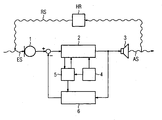
- the figure shows the much simplified block diagram of a hearing aid with a microphone 1 for receiving an acoustic input signal and conversion into an electrical signal.
- the electrical signal is supplied to a signal processing unit 2 for the frequency-dependent amplification of the input signal and to compensate for the individual hearing loss of a user.
- the processed signal is finally converted by a receiver 3 into an acoustic output signal AS and delivered to the auditory canal of a user.
- part of the output signal AS output by the receiver 3 passes via the feedback path to the microphone 1.
- the feedback signal RS thus forms part of the input signal ES in the microphone 1.
- HR the transfer function for the feedback signal RS with HR. In this constellation, if the phase and gain conditions for the feedback signal RS required for the occurrence of feedback are met, typical unwanted feedback whistling occurs.
- the hearing aid device comprises a signal source 4, by means of which information signals generated or stored in the hearing aid device can be output via the earpiece 3.
- the indication signals serve, for example, to inform the user about certain settings of the hearing aid device, for example the set hearing program or the set volume.
- the user can be made aware of certain system states of the hearing aid by means of the indication signals, such as the state of charge of the voltage source (not shown).
- a variety of other warning signals is possible, by means of which the user is automatically made aware of certain events or supplied on demand with certain information. Examples include a time announcement or the retrieval of certain previously stored in a memory information such as names, addresses, telephone numbers, etc., which are available as voice signals.
- the hint or information signals used are specially adapted to the particular use as test signals for estimating the feedback path.
- the information signals cover the widest possible range of the frequency spectrum that can be transmitted by the hearing aid, so that the feedback behavior can be tested for precisely this frequency range.
- the information signals are preferably not individual tones, but tone sequences, melodies, noises, etc.
- the normal signal path through the hearing aid is advantageously interrupted or at least greatly attenuated by the microphone 1 via the signal processing unit 2 to the handset 3, so that the output signal AS contains at least substantially no further signal components in addition to the information signal during the delivery of an information signal , This simplifies the measurement of the transmission behavior for the feedback path.
- the received as a result of the information signal output at the microphone 1 feedback signal RS is supplied in the hearing aid to a measuring, evaluation and control device 5, in which a comparison of the received signal with the output via the signal source 4 signal. From the comparison, conclusions can be drawn about the feedback path and in particular the transfer function HR. From the data thus obtained countermeasures in the hearing aid can be initiated, so that an unwanted feedback whistling is prevented even during normal operation of the hearing aid.
- filter parameters in the signal processing unit 2 can be set so that individual frequencies or frequency ranges, which are particularly strongly affected by feedback, are damped by adjustable filters in the signal processing unit 2.
- the hearing aid according to the embodiment comprises an adaptive filter 6, by which the expected feedback signal is reproduced and subtracted from the microphone signal to cancel the recorded from the microphone 1 feedback signal RS.
- corresponding filter parameters are generated in the measuring, evaluation and control device 5 and set in the adaptive filter 6.
- the invention offers the advantage that it can be delivered by the hearing aid through the use of information signals which are given on many occasions can and are desired by the user and are therefore not perceived as disturbing, a good adaptation of the adaptive filter 6 is ensured.
Landscapes
- Health & Medical Sciences (AREA)
- General Health & Medical Sciences (AREA)
- Neurosurgery (AREA)
- Otolaryngology (AREA)
- Physics & Mathematics (AREA)
- Engineering & Computer Science (AREA)
- Acoustics & Sound (AREA)
- Signal Processing (AREA)
- Circuit For Audible Band Transducer (AREA)
- Amplifiers (AREA)
- Measurement And Recording Of Electrical Phenomena And Electrical Characteristics Of The Living Body (AREA)
- Measuring Pulse, Heart Rate, Blood Pressure Or Blood Flow (AREA)
- Control Of Amplification And Gain Control (AREA)
Description
- Die vorliegende Erfindung betrifft ein Hörhilfegerät mit einem Eingangswandler zur Aufnahme eines Eingangssignals und Wandlung in ein elektrisches Signal, einer Signalverarbeitungseinheit zur Verarbeitung des elektrischen Signals, einem Ausgangswandler zum Wandeln des verarbeiteten, elektrischen Signals in ein von einem Benutzer als akustisches Signal wahrnehmbares Ausgangssignal, einer Rückkopplungsverminderungseinrichtung zur einstellbaren Reduktion oder Dämpfung eines in dem Eingangssignal enthaltenen Rückkopplungssignals, einer Signalquelle zur Abgabe eines nicht unmittelbar aus dem Eingangssignal herrührenden Testsignals durch den Ausgangswandler, einer Messeinrichtung zum Erfassen eines von dem abgegebenen Testsignal herrührenden Antwortsignals aus dem Eingangssignal und einer Auswerte- und Steuereinrichtung zum Einstellen von Parametern der Rückkopplungsverminderungseinrichtung anhand des Antwortsignals.
- Bei Hörhilfegeräten findet häufig eine ungewünschte Rückkopplung (Feedback) des vom Hörer abgestrahlten Audiosignals zu dem Mikrofon des Hörhilfegeräts statt. Rückkopplungen erfolgen über unterschiedliche Rückkopplungspfade (Feedback-Pfade). Ein derartiger Pfad ist z.B. die Schallübertragung in Luft, wenn das Ohrpassstück eines Hinter-dem-Ohr-Hörhilfegerätes oder aber das Gehäuse eines In-dem-Ohr-Hörhilfegerätes den Gehörgang nicht ausreichend nach außen abdichtet. Ein weiterer Rückkopplungspfad besteht unter Umständen über die Knochen des Hörhilfegeräteträgers zurück zum Hörhilfegerät. Wenn die Hörhilfegeräteverstärkung größer als die Feedback-Dämpfung ist, macht sich die Rückkopplung durch ein Pfeifen des Hörhilfegerätes bemerkbar, das für den Hörhilfegeräteträger sehr unangenehm ist. Bei stabilen Systemen, bei denen die Hörhilfegeräteverstärkung kleiner als die Feedback-Dämpfung ist, ist eine Feedbackkompensation nicht zwingend notwendig, eine dennoch durchgeführte Feedbackkompensation könnte unter Umständen zu Artefakten führen.
- Feedback kann in einigen Fällen dadurch vermieden werden, dass die Verstärkung bestimmter Frequenzen oder Frequenzbereiche reduziert wird. Dieser Ansatz führt gelegentlich jedoch zu einer Verschlechterung der Sprachverständlichkeit bei der Benutzung eines betreffenden Hörhilfegerätes.
- Ein anderer Ansatz zur Feedbackreduktion ist die Verwendung eines adaptiven Filters. Dabei wird der Feedbackpfad kontinuierlich oder in bestimmten Zeitabständen analysiert. Das Ausgangssignal des adaptiven Filters wird so eingestellt, dass es den Feedbackanteil im Eingangssignal des Hörhilfegerätes neutralisiert.
- Aus der
EP 0557847 A1 ist ein am Kopf tragbares Hörgerät mit einem elektrischen Signalpfad zwischen einem Mikrofon und einem Hörer bekannt, bei dem wenigstens ein die Signalverarbeitung in dem Signalweg betreffender Parameter einstellbar ist. Wird der Parameter manuell oder automatisch verändert, so gibt eine Signalabgabeeinrichtung ein von dem Benutzer wahrnehmbares Signal ab, welches für den eingestellten Parameter charakteristisch ist. - Aus der
US 4,628,530 ist eine Anordnung zum Umsetzen eines elektrischen Signals in ein akustisches Signal bekannt, die einen Equalizer mit einem ersten und einem zweiten Eingang und einem Ausgang zum Korrigieren des Frequenzgangs eines an seinen ersten Eingang gelegten elektrischen Signals unter der Steuerung eines an seinen zweiten Eingang gelegten Steuersignals umfasst. Dabei kann die Signalangleichung durch den Equalizer auch während des Betriebs der Anordnung erfolgen, wenn beispielsweise ein Musikstück als Eingangssignal in den zweiten Eingang eingeht. - Aus der
US 5,259,033 ist die Verwendung eines adaptiven Filters zur Feedbackkompensation bei einem Hörhilfegerät bekannt. Zur Schätzung des Rückkopplungspfades wird köntinuierlich ein Rauschsignal erzeugt und über den Hörer des Hörhilfegerätes abgegeben, so dass eine Auswertung eines als Reaktion auf dieses Rauschen von dem Mikrofon des Hörhilfegerätes aufgenommenen Antwortsignals erfolgen kann. Es werden dann Filterparameter derart eingestellt, dass eine Unterdrückung des rückgekoppelten Signals erfolgt. - Aus der
US 5,402,496 ist ein Hörhilfegerät mit einer Rückkopplungsverminderungseinrichtung bekannt, bei dem zwei unterschiedliche Betriebsarten unterschieden werden. In der normalen Betriebsart des Hörhilfegerätes wird ein Eingangssignal, das einen Rückkopplungsanteil enthält, von einem Mikrofon aufgenommen, in einem Verstärker verstärkt und über einen Hörer abgegeben. Es erfolgt eine Rückkopplungsunterdrückung mit fest eingestellten Filterparametern. Bei einer von Zeit zu Zeit stattfindenden zweiten Betriebsart des bekannten Hörhilfegerätes ist der Signalpfad zwischen dem Mikrofon und dem Hörer unterbrochen. Im Hörhilfegerät wird ein Testsignal generiert und über den Hörer ausgegeben, so dass es nach Durchlaufen des Feedbackpfades als Antwortsignal vom Mikrofon aufgenommen wird. Nach einer Auswertung des Antwortsignals werden die Parameter der Rückkopplungsverminderungseinrichtung neu eingestellt und so lange beibehalten, bis das Hörhilfegerät erneut in die zweite Betriebsart schaltet. - Nachteilig bei den bekannten Hörhilfegeräten sind die im Zusammenhang mit der Rückkopplungskompensation erzeugten Testsignale, die entweder nur einen Ausschnitt des von dem Hörhilfegerät übertragbaren Frequenzbereiches abdecken oder aber auch von dem Benutzer wahrnehmbare Signalanteile umfassen und somit als störend wahrgenommen werden.
- Aufgabe der vorliegenden Erfindung ist es daher, eine möglichst gute Messung des Rückkopplungspfades zu erreichen, ohne dabei vom Benutzer als störend empfundene Testsignale von dem Hörhilfegerät abgeben zu müssen.
- Diese Aufgabe wird durch ein Hörhilfegerät mit den Merkmalen gemäß Anspruch 1 gelöst.
- Bei dem Hörhilfegerät gemäß der Erfindung handelt es sich beispielsweise um ein hinter dem Ohr tragbares Hörhilfegerät, ein in dem Ohr tragbares Hörhilfegerät, ein implantierbares Hörhilfegerät oder ein Taschenhörhilfegerät. Weiterhin kann das Hörhilfegerät gemäß der Erfindung auch Teil eines mehrere Geräte zur Versorgung eines Schwerhörigen umfassenden Hörhilfegerätesystems sein, z.B. Teil eines Hörhilfegerätesystems mit zwei am Kopf getragenen Hörhilfegeräten zur binauralen Versorgung, Teil eines Hörhilfegerätesystems mit einem am Kopf tragbaren Hörhilfegerät und einer am Körper tragbaren externen Prozessoreinheit, Teil eines ganz oder teilweise implantierbaren Hörhilfegerätesystems mit mehreren Komponenten, Teil eines Hörhilfegerätesystems mit externen Zusatzkomponenten wie Fernsteuereinheit oder externer Mikrofoneinheit, usw.
- Ein Hörhilfegerät umfasst einen Eingangswandler zur Aufnahme eines Eingangssignals. Der Eingangswandler ist in der Regel als Mikrofon ausgebildet, das ein akustisches Signal aufnimmt und in ein elektrisches Signal wandelt. Als Eingangswandler kommen jedoch auch Einheiten in Betracht, die eine Spule oder eine Antenne aufweisen und die ein elektromagnetisches Signal aufnehmen und in ein elektrisches Signal wandeln. Ferner umfasst ein Hörhilfegerät üblicherweise eine Signalverarbeitungseinheit zur Verarbeitung und frequenzabhängigen Verstärkung des elektrischen Signals. Zur Signalverarbeitung im Hörhilfegerät dient ein vorzugsweise digitaler Signalprozessor (DSP), dessen Arbeitsweise mittels auf das Hörhilfegerät übertragbarer Programme oder Parameter beeinflussbar ist. Dadurch lässt sich die Arbeitsweise der Signalverarbeitungseinheit sowohl an den individuellen Hörverlust eines Hörhilfegeräteträgers als auch an die aktuelle Hörsituation anpassen, in der das Hörhilfegerät gerade betrieben wird. Das so veränderte elektrische Signal ist schließlich einem Ausgangswandler zugeführt. Dieser ist in der Regel als Hörer ausgebildet, der das elektrische Ausgangssignal in ein akustisches Signal wandelt. Jedoch sind auch hier andere Ausführungsformen möglich, z.B. ein implantierbarer Ausgangswandler, der direkt mit einem Gehörknöchelchen verbunden ist und dieses zu Schwingungen anregt.
- Ausgangspunkt der Erfindung ist ein Hörhilfegerät, bei dem Testsignale im Hörhilfegerät generiert und über den Hörer ausgegeben werden können. Nach Durchlaufen des Rückkopplungspfades werden die Testsignale von dem Mikrofon des Hörhilfegerätes aufgenommen und anschließend ausgewertet. Aus einem Vergleich dieses Antwortsignals mit dem ausgegebenen Testsignal lassen sich Rückschlüsse über den Rückkopplungspfad gewinnen. Es können dann geeignete Maßnahmen zur Rückkopplungsunterdrückung durchgeführt werden. Beispielsweise lassen sich Parameter eines adaptiven Rückkopplungskompensationsfilters so einstellen, dass eine Kompensation rückgekoppelter Signalanteile in dem Eingangssignal des Mikrofons erfolgt.
- Die Grundidee der Erfindung besteht nun darin, als Testsignale solche Signale zu verwenden, die ohnehin im Hörhilfegerät erzeugt und über den Ausgangswandler ausgegeben werden. Diese Signale dienen beispielsweise zur Information des Benutzers über aktuelle Einstellungen des Hörhilfegerätes. Derartige Einstellungen können beispielsweise die Lautstärkeeinstellung oder die Einstellung des aktuellen Hörprogramms betreffen. Weiterhin können die abgegebenen und von dem Benutzer wahrnehmbaren Signale, die als Testsignale zur Abschätzung des Feedbackpfades verwendet werden, zur Information des Benutzers über bestimmte Systemzustände des Hörhilfegerätes dienen. Derartige Systemzustände sind z.B. der Ladezustand der verwendeten Spannungsquelle. Darüber hinaus bietet das Hörhilfegerät gemäß der Erfindung vorzugsweise eine Vielzahl weiterer im Hörhilfegerät generierbarer und von dem Benutzer wahrnehmbarer Signale, wie sie z.B. auch bei Mobiltelefonen bekannt sind. So kann es sich beispielsweise um Hinweise auf bestimmte Uhrzeiten, Termine usw. handeln. Die ausgegebenen Signale können zur Information des Benutzers dienen (Ansagen, Wort-Mitteilungen, Namen, Adresse usw.) oder auch zur Unterhaltung des Benutzers abgegeben werden. Es kann sich also auch um solche Signale handeln, die nicht bei Bedarf mittels eines Signalgenerators im Hörhilfegerät erzeugt werden, sondern auch um solche Signale, die in einem Speicher des Hörhilfegerätes abgelegt sind und lediglich bei Bedarf ausgelesen werden.
- Darüber hinaus können die verwendeten Signale ihren Ursprung auch in einem externen Gerät haben, z.B. einer Fernbedienung für das Hörhilfegerät, und von dort z.B. zunächst als elektromagnetisches Signal zu dem Hörhilfegerät übertragen und von diesem in ein akustisch wahrnehmbares Signal gewandelt und ausgegeben werden.
- Die von dem Hörhilfegerät abgebbaren Hinweissignale sind vorzugsweise so ausgeführt, dass sie einen möglichst breiten Bereich des von dem Hörhilfegerät übertragbaren Frequenzspektrums abdecken. Dadurch wird gewährleistet, dass die Auswertung des Rückkopplungspfades ebenfalls in einem breiten Frequenzbereich erfolgt.
- Die Erfindung bietet den Vorteil, dass die Abgabe der Hinweissignale vom Benutzer gewünscht ist und daher nicht als störend empfunden wird. Die Hinweissignale können in einer Lautstärke abgegeben werden, die weit oberhalb der Lautstärke permanenter, unterschwelliger Testsignale liegt. Dies verbessert die Messung des Rückkopplungspfades erheblich.
- Aufgrund der Vielzahl möglicher Situationen, in denen Hinweissignale sinnvoll abgegeben werden können, kann die Messung des Rückkopplungspfades in verhältnismäßig kurzen Zeitabständen erfolgen, ohne dass dies vom Benutzer als störend empfunden wird.
- Eine Analyse des von dem Eingangswandler aufgenommenen Antwortsignals lässt erkennen, welche Frequenzen oder Frequenzbereiche besonders stark rückgekoppelt werden. Eine Ausführungsform der Erfindung sieht vor, dass in dem Signalpfad des Hörhilfegerätes zwischen dem Eingangswandler und dem Ausgangswandler vorhandene Filter so eingestellt werden, dass bestimmte Frequenzen oder Frequenzbereiche, die besonders stark rückgekoppelt werden, gefiltert werden. Z.B. können Notch-Filter verwendet werden, um gezielt bestimmte Frequenzen zu unterdrücken.
- Eine andere Ausführungsform der Erfindung sieht ein adaptives Filter vor, für das anhand des aus dem abgegebenem Hinweissignal resultierenden Antwortsignals Filterparameter generiert werden, derart, dass das erwartete Rückkopplungssignal von dem Mikrofoneingangssignal subtrahiert wird. Diese Ausführungsform hat den Vorteil, dass in der Regel keine Einschränkung bei dem durch das Hörhilfegerät prinzipiell übertragbaren Frequenzspektrum erforderlich ist.
- Die Erfindung wird nachfolgend anhand eines Ausführungsbeispiels näher erläutert. Dabei zeigt die Figur das stark vereinfachte Blockschaltbild eines Hörhilfegerätes mit einem Mikrofon 1 zur Aufnahme eines akustischen Eingangssignals und Wandlung in ein elektrisches Signal. Das elektrische Signal ist einer Signalverarbeitungseinheit 2 zugeführt zur frequenzabhängigen Verstärkung des Eingangssignals und zum Ausgleich des individuellen Hörverlustes eines Benutzers. Das verarbeitete Signal wird schließlich von einem Hörer 3 in ein akustisches Ausgangssignal AS gewandelt und in den Gehörgang eines Benutzers abgegeben.
- Wie der Figur zu entnehmen ist, gelangt ein Teil des von dem Hörer 3 abgegebenen Ausgangssignals AS über den Rückkopplungspfad zu dem Mikrofon 1. Das Rückkopplungssignal RS bildet somit einen Teil des Eingangssignals ES in das Mikrofon 1. Im Blockschaltbild ist dabei die Übertragungsfunktion für das Rückkopplungssignal RS mit HR bezeichnet. Sind bei dieser Konstellation die für das Auftreten von Rückkopplungen erforderlichen Bedingungen hinsichtlich der Phase und der Verstärkung für das Rückkopplungssignal RS erfüllt, so kommt es zum typischen, unerwünschten Rückkopplungspfeifen.
- Das Hörhilfegerät gemäß dem Ausführungsbeispiel umfasst eine Signalquelle 4, mittels derer im Hörhilfegerät generierte oder gespeicherte Hinweissignale über den Hörer 3 abgebbar sind. Die Hinweissignale dienen beispielsweise zur Information des Benutzers über bestimmte Einstellungen des Hörhilfegerätes, etwa das eingestellte Hörprogramm oder die eingestellte Lautstärke. Weiterhin kann der Benutzer mittels der Hinweissignale auf bestimmte Systemzustände des Hörhilfegerätes aufmerksam gemacht werden, etwa den Ladezustand der Spannungsquelle (nicht dargestellt). Darüber hinaus ist eine Vielzahl weiterer Hinweissignale möglich, mittels derer der Benutzer selbsttätig auf bestimmte Ereignisse aufmerksam gemacht oder auf Abruf mit bestimmten Informationen versorgt wird. Beispiele hierfür sind eine Zeitansage oder der Abruf bestimmter, zuvor in einem Speicher hinterlegter Informationen wie Namen, Adressen, Telefonnummern usw., die als Sprachsignale abrufbar sind.
- Vorzugsweise sind die verwendeten Hinweis- oder Informationssignale eigens an die spezielle Verwendung als Testsignale zur Abschätzung des Feedbackpfads angepasst. Insbesondere decken die Informationssignale einen möglichst breiten Bereich des von dem Hörhilfegerät übertragbaren Frequenzspektrums ab, so dass das Rückkopplungsverhalten für eben diesen Frequenzbereich getestet werden kann. Es handelt sich demnach bei den Informationssignalen bevorzugt nicht um einzelne Töne, sondern um Tonfolgen, Melodien, Geräusche usw.
- Während der Abgabe eines Informationssignals ist der normale Signalpfad durch das Hörhilfegerät von dem Mikrofon 1 über die Signalverarbeitungseinheit 2 zum Hörer 3 vorteilhaft unterbrochen oder zumindest stark gedämpft, so dass das Ausgangssignal AS während der Abgabe eines Informationssignals zumindest im Wesentlichen keine weiteren Signalanteile neben dem Informationssignal enthält. Dies vereinfacht die Messung des Übertragungsverhaltens für den Rückkopplungspfad.
- Das in Folge des abgegebenen Informationssignals am Mikrofon 1 empfangene Rückkopplungssignal RS wird im Hörhilfegerät einer Mess-, Auswerte- und Steuereinrichtung 5 zugeführt, in der ein Vergleich des empfangenen Signals mit dem über die Signalquelle 4 abgegebenem Signal erfolgt. Aus dem Vergleich lassen sich Rückschlüsse über den Rückkopplungspfad und insbesondere die Übertragungsfunktion HR gewinnen. Aus den so gewonnen Daten können dann Gegenmaßnahmen im Hörhilfegerät eingeleitet werden, so dass ein unerwünschtes Rückkopplungspfeifen auch beim normalen Betrieb des Hörhilfegerätes verhindert wird. Dazu können einerseits Filterparameter in der Signalverarbeitungseinheit 2 so eingestellt werden, dass einzelne Frequenzen oder Frequenzbereiche, die besonders stark von Rückkopplungen betroffen sind, durch einstellbare Filter in der Signalverarbeitungseinheit 2 gedämpft werden. Andererseits umfasst das Hörhilfegerät gemäß dem Ausführungsbeispiel ein adaptives Filter 6, durch welches das erwartete Rückkopplungssignal nachgebildet und von dem Mikrofonsignal subtrahiert wird zur Auslöschung des von dem Mikrofon 1 aufgenommenen Rückkopplungssignal RS. Um dies zu leisten, werden in der Mess-, Auswerte- und Steuereinrichtung 5 entsprechende Filterparameter generiert und bei dem adaptiven Filter 6 eingestellt.
- Die Erfindung bietet den Vorteil, dass durch die Verwendung von Informationssignalen, die bei vielen Gelegenheiten durch das Hörhilfegerät abgegeben werden können und vom Benutzer gewünscht sind und daher nicht als störend empfunden werden, eine gute Adaption des adaptiven Filters 6 gewährleistet wird.
Claims (5)
- Hörhilfegerät umfassend- einen Eingangswandler (1) zur Aufnahme eines Eingangssignals (ES) und Wandlung in ein elektrisches Signal,- eine Signalverarbeitungseinheit (2) zur Verarbeitung des elektrischen Signals,- einen Ausgangswandler (3) zum Wandeln des verarbeiteten, elektrischen Signals in ein von einem Benutzer als akustisches Signal wahrnehmbares Ausgangssignal (AS),- eine Rückkopplungsverminderungseinrichtung (5, 6) zur einstellbarer Reduktion oder Dämpfung eines in dem Eingangssignal (ES) enthaltenen Rückkopplungssignals (RS),- eine Signalquelle (4) zur Abgabe eines nicht unmittelbar aus dem Eingangssignal (ES) herrührenden Testsignals durch den Ausgangswandler (AS),- eine Messeinrichtung zum Erfassen eines von dem abgegebenen Testsignal herrührenden Antwortsignals aus dem Eingangssignal (ES),- eine Auswerte- und Steuereinrichtung zum Einstellen von Parametern der Rückkopplungsverminderungseinrichtung (6) in Abhängigkeit des Antwortsignals,dadurch gekennzeichnet, dass von dem Hörhilfegerät von dem Benutzer wahrnehmbare, vorbestimmte Informationssignale ohnehin im Hörhilfegerät erzeugt und von der Signalquelle (4) über den Ausgangswandler (3) abgegeben werden, und als Testsignale verwendet werden.
- Hörhilfegerät nach Anspruch 1, wobei Filterparameter von Filtern zur Rückkopplungsverminderung einstellbar sind.
- Hörhilfegerät nach Anspruch 2, wobei die Filter zum Dämpfen bestimmter Frequenzen oder Frequenzbereiche geeignet sind.
- Hörhilfegerät nach Anspruch 3, wobei ein adaptives Filter (6) zur Rückkopplungsunterdrückung vorhanden ist und Filterparameter des adaptiven Filters (6) einstellbar sind.
- Verfahren zur Rückkopplungsunterdrückung bei einem Hörhilfegerät mit folgenden Schritten:- Aufnahme eines Eingangssignals (ES) und Wandlung in ein elektrisches Signal,- Verarbeitung des elektrischen Signals,- Wandlung des verarbeiteten elektrischen Signals in ein von einem Benutzer als akustisches Signal wahrnehmbares Ausgangssignal (AS),- Reduktion oder Dämpfung eines in dem Eingangssignal (ES) enthaltenen Rückkopplungssignals (RS),- Abgabe eines nicht unmittelbar aus dem Eingangssignal (ES) herrührenden Testsignals durch den Ausgangswandler (3),- Erfassen eines von dem abgegebenen Testsignal herrührenden Antwortsignals aus dem Eingangssignal (ES),- Auswerten des Antwortsignals sowie Bestimmen und Einstellen von Parametern einer Rückkopplungsverminderungseinrichtung anhand des Antwortsignals,dadurch gekennzeichnet, dass von dem Hörhilfegerät von dem Benutzer wahrnehmbare, vorbestimmte ohnehin im Hörhilfegerät erzeugt und über den Ausgangwandler (3) Informationssignale abgegeben werden, wobei die Informationssignale als Testsignale verwendet werden.
Applications Claiming Priority (1)
| Application Number | Priority Date | Filing Date | Title |
|---|---|---|---|
| DE102005028742A DE102005028742B3 (de) | 2005-06-21 | 2005-06-21 | Hörhilfegerät mit Mitteln zur Rückkopplungskompensation und Verfahren zur Rückkopplungsunterdrückung |
Publications (3)
| Publication Number | Publication Date |
|---|---|
| EP1737270A1 EP1737270A1 (de) | 2006-12-27 |
| EP1737270B1 EP1737270B1 (de) | 2008-05-07 |
| EP1737270B2 true EP1737270B2 (de) | 2012-05-02 |
Family
ID=36649416
Family Applications (1)
| Application Number | Title | Priority Date | Filing Date |
|---|---|---|---|
| EP06114883A Not-in-force EP1737270B2 (de) | 2005-06-21 | 2006-06-02 | Hörhilfegerät mit Mitteln zur Rückkopplungskompensation |
Country Status (5)
| Country | Link |
|---|---|
| US (1) | US7801318B2 (de) |
| EP (1) | EP1737270B2 (de) |
| AT (1) | ATE394899T1 (de) |
| DE (2) | DE102005028742B3 (de) |
| DK (1) | DK1737270T4 (de) |
Families Citing this family (22)
| Publication number | Priority date | Publication date | Assignee | Title |
|---|---|---|---|---|
| US7627129B2 (en) * | 2002-11-21 | 2009-12-01 | Fraunhofer-Gesellschaft Zur Foerderung Der Angewandten Forschung E.V. | Apparatus and method for suppressing feedback |
| US8917894B2 (en) | 2007-01-22 | 2014-12-23 | Personics Holdings, LLC. | Method and device for acute sound detection and reproduction |
| WO2008095167A2 (en) | 2007-02-01 | 2008-08-07 | Personics Holdings Inc. | Method and device for audio recording |
| US11317202B2 (en) | 2007-04-13 | 2022-04-26 | Staton Techiya, Llc | Method and device for voice operated control |
| US11217237B2 (en) | 2008-04-14 | 2022-01-04 | Staton Techiya, Llc | Method and device for voice operated control |
| US11856375B2 (en) | 2007-05-04 | 2023-12-26 | Staton Techiya Llc | Method and device for in-ear echo suppression |
| US11683643B2 (en) | 2007-05-04 | 2023-06-20 | Staton Techiya Llc | Method and device for in ear canal echo suppression |
| DK2003928T3 (en) * | 2007-06-12 | 2019-01-28 | Oticon As | Online anti-feedback system for a hearing aid |
| US11291456B2 (en) | 2007-07-12 | 2022-04-05 | Staton Techiya, Llc | Expandable sealing devices and methods |
| US8600067B2 (en) * | 2008-09-19 | 2013-12-03 | Personics Holdings Inc. | Acoustic sealing analysis system |
| US9129291B2 (en) | 2008-09-22 | 2015-09-08 | Personics Holdings, Llc | Personalized sound management and method |
| CN102227920A (zh) * | 2008-11-28 | 2011-10-26 | 松下电器产业株式会社 | 助听器 |
| DE102009007079A1 (de) * | 2009-02-02 | 2010-08-12 | Siemens Medical Instruments Pte. Ltd. | Verfahren zur Ermittlung des akustischen Rückkopplungsverhaltens eines Hörgeräts anhand von geometrischen Daten eines Ohrs |
| US9138353B2 (en) | 2009-02-13 | 2015-09-22 | Personics Holdings, Llc | Earplug and pumping systems |
| EP2523471B1 (de) | 2011-05-09 | 2014-06-18 | Bernafon AG | Testsystem zur Beurteilung der Feedbackleistung einer Hörvorrichtung |
| US9060237B2 (en) * | 2011-06-29 | 2015-06-16 | Harman International Industries, Incorporated | Musical measurement stimuli |
| DE102011106634B4 (de) * | 2011-07-04 | 2015-02-19 | Eberhard-Karls-Universität Tübingen Universitätsklinikum | Hörgerät und Verfahren zum Eliminieren akustischer Rückkopplungen bei Verstärkung akustischer Signale |
| EP2661103A1 (de) * | 2012-05-02 | 2013-11-06 | Oticon A/s | Verfahren zum Anpassen eines Hörgeräts |
| US10163453B2 (en) | 2014-10-24 | 2018-12-25 | Staton Techiya, Llc | Robust voice activity detector system for use with an earphone |
| EP3016407B1 (de) * | 2014-10-28 | 2019-12-11 | Oticon A/s | Hörsystem zur Schätzung eines Rückkopplungspfads eines Hörgeräts |
| US12621598B2 (en) | 2017-10-23 | 2026-05-05 | St Famtech, Llc | Automatic keyword pass-through system |
| US20250184674A1 (en) * | 2023-11-30 | 2025-06-05 | Starkey Laboratories, Inc. | In-use feedback path characterization for hearing device |
Citations (3)
| Publication number | Priority date | Publication date | Assignee | Title |
|---|---|---|---|---|
| EP0581261A1 (de) † | 1992-07-29 | 1994-02-02 | Minnesota Mining And Manufacturing Company | Hörgerät mit benutzergesteuerter Schallrückkopplung |
| US20030161492A1 (en) † | 2002-02-26 | 2003-08-28 | Miller Douglas Alan | Frequency response equalization system for hearing aid microphones |
| EP1439736A1 (de) † | 1998-05-19 | 2004-07-21 | GN ReSound as | Anordnung zur Rückkoppelungsunterdrückung |
Family Cites Families (12)
| Publication number | Priority date | Publication date | Assignee | Title |
|---|---|---|---|---|
| DE3205686A1 (de) * | 1982-02-17 | 1983-08-25 | Robert Bosch Gmbh, 7000 Stuttgart | Hoergeraet |
| NL8300671A (nl) * | 1983-02-23 | 1984-09-17 | Philips Nv | Automatisch egalisatiesysteem met dtf of fft. |
| US5259033A (en) * | 1989-08-30 | 1993-11-02 | Gn Danavox As | Hearing aid having compensation for acoustic feedback |
| GB8919591D0 (en) * | 1989-08-30 | 1989-10-11 | Gn Davavox As | Hearing aid having compensation for acoustic feedback |
| DK0557847T3 (da) * | 1992-02-27 | 1996-05-20 | Siemens Audiologische Technik | På hovedet bærbart høreapparat |
| US5402496A (en) * | 1992-07-13 | 1995-03-28 | Minnesota Mining And Manufacturing Company | Auditory prosthesis, noise suppression apparatus and feedback suppression apparatus having focused adaptive filtering |
| EP1157069B1 (de) * | 1999-03-05 | 2003-05-07 | Cabot Corporation | Verfahren zur herstellung von farbpigmenten |
| US7058182B2 (en) * | 1999-10-06 | 2006-06-06 | Gn Resound A/S | Apparatus and methods for hearing aid performance measurement, fitting, and initialization |
| DE10048354A1 (de) * | 2000-09-29 | 2002-05-08 | Siemens Audiologische Technik | Verfahren zum Betrieb eines Hörgerätesystems sowie Hörgerätesystem |
| DE10254407B4 (de) | 2002-11-21 | 2006-01-26 | Fraunhofer-Gesellschaft zur Förderung der angewandten Forschung e.V. | Vorrichtung und Verfahren zum Unterdrücken einer Rückkopplung |
| US7627129B2 (en) * | 2002-11-21 | 2009-12-01 | Fraunhofer-Gesellschaft Zur Foerderung Der Angewandten Forschung E.V. | Apparatus and method for suppressing feedback |
| US7519193B2 (en) * | 2003-09-03 | 2009-04-14 | Resistance Technology, Inc. | Hearing aid circuit reducing feedback |
-
2005
- 2005-06-21 DE DE102005028742A patent/DE102005028742B3/de not_active Expired - Fee Related
-
2006
- 2006-05-25 US US11/440,817 patent/US7801318B2/en active Active
- 2006-06-02 DE DE502006000732T patent/DE502006000732D1/de active Active
- 2006-06-02 AT AT06114883T patent/ATE394899T1/de not_active IP Right Cessation
- 2006-06-02 EP EP06114883A patent/EP1737270B2/de not_active Not-in-force
- 2006-06-02 DK DK06114883.9T patent/DK1737270T4/da active
Patent Citations (3)
| Publication number | Priority date | Publication date | Assignee | Title |
|---|---|---|---|---|
| EP0581261A1 (de) † | 1992-07-29 | 1994-02-02 | Minnesota Mining And Manufacturing Company | Hörgerät mit benutzergesteuerter Schallrückkopplung |
| EP1439736A1 (de) † | 1998-05-19 | 2004-07-21 | GN ReSound as | Anordnung zur Rückkoppelungsunterdrückung |
| US20030161492A1 (en) † | 2002-02-26 | 2003-08-28 | Miller Douglas Alan | Frequency response equalization system for hearing aid microphones |
Also Published As
| Publication number | Publication date |
|---|---|
| ATE394899T1 (de) | 2008-05-15 |
| DE502006000732D1 (de) | 2008-06-19 |
| DE102005028742B3 (de) | 2006-09-21 |
| DK1737270T3 (da) | 2008-09-29 |
| EP1737270A1 (de) | 2006-12-27 |
| US7801318B2 (en) | 2010-09-21 |
| DK1737270T4 (da) | 2012-08-13 |
| US20060285709A1 (en) | 2006-12-21 |
| EP1737270B1 (de) | 2008-05-07 |
Similar Documents
| Publication | Publication Date | Title |
|---|---|---|
| EP1737270B1 (de) | Hörhilfegerät mit Mitteln zur Rückkopplungskompensation | |
| DE10228632B3 (de) | Richtungshören bei binauraler Hörgeräteversorgung | |
| DE102007046437B4 (de) | Vollautomatisches Ein-/Ausschalten bei Hörhilfegeräten | |
| EP2172063B1 (de) | Hörgerät mit Initialisierungsmodul und Benutzeranpassung | |
| EP1489885A2 (de) | Verfahren zum Betrieb eines Hörhilfegerätes sowie Hörhilfegerät mit einem Mikrofonsystem, bei dem unterschiedliche Richtcharakteristiken einstellbar sind | |
| EP2229010B1 (de) | Hörgerät und Verfahren zur Störschallkompensation bei einem Hörgerät | |
| EP3104627B1 (de) | Verfahren zur verbesserung eines aufnahmesignals in einem hörsystem | |
| DE10131964A1 (de) | Verfahren zum Betrieb eines digitalen programmierbaren Hörgerätes sowie digitales programmierbares Hörgerät | |
| EP2114089A1 (de) | Verfahren und Vorrichtung zur Bestimmung eines Verschlussgrads bei Hörgeräten | |
| EP4134002B1 (de) | Verfahren und hörsystem zum erstellen eines audiogramms einer testperson mittels eines hörinstruments | |
| DE102011006129B4 (de) | Hörvorrichtung mit Rückkopplungsunterdrückungseinrichtung und Verfahren zum Betreiben der Hörvorrichtung | |
| EP1931172B1 (de) | Hörgerät mit Störschallunterdrückung und entsprechendes Verfahren | |
| DE102011086728A1 (de) | Hörvorrichtung mit einer Einrichtung zum Verringern eines Mikrofonrauschens und Verfahren zum Verringern eines Mikrofonrauschens | |
| EP2822300B1 (de) | Erkennen von Hörsituationen mit unterschiedlichen Signalquellen | |
| EP1753264B1 (de) | Hörvorrichtung und Verfahren zum Bestimmen einer Raumakustik | |
| DE102012203253B3 (de) | Verstärken eines Sprachsignals in Abhängigkeit vom Eingangspegel | |
| EP3913618A1 (de) | Verfahren zum betrieb eines hörgeräts und hörgerät | |
| EP2648424B1 (de) | Verfahren zur Ausgangspegelbegrenzung bei Hörvorrichtungen | |
| DE102009014053A1 (de) | Verfahren zum Einstellen einer Richtcharakteristik und Hörvorrichtung | |
| DE102006015497A1 (de) | Audiosystem und Verfahren sowie Computerprogramm und Datenträger der das Computerprogramm enthält zur Anpassung der Übertragungsfunktion eines Audiosystems mittels Sprachsteuerung | |
| EP0723381B2 (de) | Vorrichtung zur Hörunterstützung | |
| DE102007030067B4 (de) | Hörgerät mit passiver, eingangspegelabhängiger Geräuschreduktion und Verfahren | |
| EP1624723A2 (de) | Stabilisierung des Systemtaktes bei einem Hörhilfegerät | |
| EP4243448A1 (de) | Verfahren zum betrieb eines hörgeräts | |
| CN118400668A (zh) | 用于运行听力设备的方法 |
Legal Events
| Date | Code | Title | Description |
|---|---|---|---|
| PUAI | Public reference made under article 153(3) epc to a published international application that has entered the european phase |
Free format text: ORIGINAL CODE: 0009012 |
|
| AK | Designated contracting states |
Kind code of ref document: A1 Designated state(s): AT BE BG CH CY CZ DE DK EE ES FI FR GB GR HU IE IS IT LI LT LU LV MC NL PL PT RO SE SI SK TR |
|
| AX | Request for extension of the european patent |
Extension state: AL BA HR MK YU |
|
| AKX | Designation fees paid | ||
| 17P | Request for examination filed |
Effective date: 20070905 |
|
| RBV | Designated contracting states (corrected) |
Designated state(s): AT BE BG CH CY CZ DE DK EE ES FI FR GB GR HU IE IS IT LI LT LU LV MC NL PL PT RO SE SI SK TR |
|
| RBV | Designated contracting states (corrected) |
Designated state(s): AT BE BG CH CY CZ DE DK EE ES FI FR GB GR HU IE IS IT LI LT LU LV MC NL PL PT RO SE SI SK TR |
|
| 17Q | First examination report despatched |
Effective date: 20071009 |
|
| GRAP | Despatch of communication of intention to grant a patent |
Free format text: ORIGINAL CODE: EPIDOSNIGR1 |
|
| GRAS | Grant fee paid |
Free format text: ORIGINAL CODE: EPIDOSNIGR3 |
|
| GRAA | (expected) grant |
Free format text: ORIGINAL CODE: 0009210 |
|
| AK | Designated contracting states |
Kind code of ref document: B1 Designated state(s): AT BE BG CH CY CZ DE DK EE ES FI FR GB GR HU IE IS IT LI LT LU LV MC NL PL PT RO SE SI SK TR |
|
| REG | Reference to a national code |
Ref country code: GB Ref legal event code: FG4D Free format text: NOT ENGLISH |
|
| REG | Reference to a national code |
Ref country code: CH Ref legal event code: EP |
|
| REG | Reference to a national code |
Ref country code: IE Ref legal event code: FG4D Free format text: LANGUAGE OF EP DOCUMENT: GERMAN |
|
| REF | Corresponds to: |
Ref document number: 502006000732 Country of ref document: DE Date of ref document: 20080619 Kind code of ref document: P |
|
| REG | Reference to a national code |
Ref country code: CH Ref legal event code: NV Representative=s name: SIEMENS SCHWEIZ AG |
|
| REG | Reference to a national code |
Ref country code: DK Ref legal event code: T3 |
|
| PG25 | Lapsed in a contracting state [announced via postgrant information from national office to epo] |
Ref country code: SI Free format text: LAPSE BECAUSE OF FAILURE TO SUBMIT A TRANSLATION OF THE DESCRIPTION OR TO PAY THE FEE WITHIN THE PRESCRIBED TIME-LIMIT Effective date: 20080507 |
|
| PG25 | Lapsed in a contracting state [announced via postgrant information from national office to epo] |
Ref country code: NL Free format text: LAPSE BECAUSE OF FAILURE TO SUBMIT A TRANSLATION OF THE DESCRIPTION OR TO PAY THE FEE WITHIN THE PRESCRIBED TIME-LIMIT Effective date: 20080507 Ref country code: FI Free format text: LAPSE BECAUSE OF FAILURE TO SUBMIT A TRANSLATION OF THE DESCRIPTION OR TO PAY THE FEE WITHIN THE PRESCRIBED TIME-LIMIT Effective date: 20080507 Ref country code: ES Free format text: LAPSE BECAUSE OF FAILURE TO SUBMIT A TRANSLATION OF THE DESCRIPTION OR TO PAY THE FEE WITHIN THE PRESCRIBED TIME-LIMIT Effective date: 20080818 |
|
| NLV1 | Nl: lapsed or annulled due to failure to fulfill the requirements of art. 29p and 29m of the patents act | ||
| PG25 | Lapsed in a contracting state [announced via postgrant information from national office to epo] |
Ref country code: PL Free format text: LAPSE BECAUSE OF FAILURE TO SUBMIT A TRANSLATION OF THE DESCRIPTION OR TO PAY THE FEE WITHIN THE PRESCRIBED TIME-LIMIT Effective date: 20080507 Ref country code: LV Free format text: LAPSE BECAUSE OF FAILURE TO SUBMIT A TRANSLATION OF THE DESCRIPTION OR TO PAY THE FEE WITHIN THE PRESCRIBED TIME-LIMIT Effective date: 20080507 |
|
| REG | Reference to a national code |
Ref country code: IE Ref legal event code: FD4D |
|
| BERE | Be: lapsed |
Owner name: SIEMENS AUDIOLOGISCHE TECHNIK G.M.B.H. Effective date: 20080630 |
|
| PG25 | Lapsed in a contracting state [announced via postgrant information from national office to epo] |
Ref country code: IS Free format text: LAPSE BECAUSE OF FAILURE TO SUBMIT A TRANSLATION OF THE DESCRIPTION OR TO PAY THE FEE WITHIN THE PRESCRIBED TIME-LIMIT Effective date: 20080907 |
|
| PG25 | Lapsed in a contracting state [announced via postgrant information from national office to epo] |
Ref country code: LT Free format text: LAPSE BECAUSE OF FAILURE TO SUBMIT A TRANSLATION OF THE DESCRIPTION OR TO PAY THE FEE WITHIN THE PRESCRIBED TIME-LIMIT Effective date: 20080507 Ref country code: SE Free format text: LAPSE BECAUSE OF FAILURE TO SUBMIT A TRANSLATION OF THE DESCRIPTION OR TO PAY THE FEE WITHIN THE PRESCRIBED TIME-LIMIT Effective date: 20080807 Ref country code: CZ Free format text: LAPSE BECAUSE OF FAILURE TO SUBMIT A TRANSLATION OF THE DESCRIPTION OR TO PAY THE FEE WITHIN THE PRESCRIBED TIME-LIMIT Effective date: 20080507 Ref country code: IE Free format text: LAPSE BECAUSE OF FAILURE TO SUBMIT A TRANSLATION OF THE DESCRIPTION OR TO PAY THE FEE WITHIN THE PRESCRIBED TIME-LIMIT Effective date: 20080507 Ref country code: MC Free format text: LAPSE BECAUSE OF NON-PAYMENT OF DUE FEES Effective date: 20080630 |
|
| PLBI | Opposition filed |
Free format text: ORIGINAL CODE: 0009260 |
|
| PG25 | Lapsed in a contracting state [announced via postgrant information from national office to epo] |
Ref country code: PT Free format text: LAPSE BECAUSE OF FAILURE TO SUBMIT A TRANSLATION OF THE DESCRIPTION OR TO PAY THE FEE WITHIN THE PRESCRIBED TIME-LIMIT Effective date: 20081007 Ref country code: SK Free format text: LAPSE BECAUSE OF FAILURE TO SUBMIT A TRANSLATION OF THE DESCRIPTION OR TO PAY THE FEE WITHIN THE PRESCRIBED TIME-LIMIT Effective date: 20080507 Ref country code: RO Free format text: LAPSE BECAUSE OF FAILURE TO SUBMIT A TRANSLATION OF THE DESCRIPTION OR TO PAY THE FEE WITHIN THE PRESCRIBED TIME-LIMIT Effective date: 20080507 |
|
| PLAX | Notice of opposition and request to file observation + time limit sent |
Free format text: ORIGINAL CODE: EPIDOSNOBS2 |
|
| 26 | Opposition filed |
Opponent name: GN RESOUND A/S/ WIDEX A/S/ PHONAK AG/ OTICON A/S Effective date: 20090209 |
|
| PG25 | Lapsed in a contracting state [announced via postgrant information from national office to epo] |
Ref country code: BE Free format text: LAPSE BECAUSE OF NON-PAYMENT OF DUE FEES Effective date: 20080630 |
|
| REG | Reference to a national code |
Ref country code: CH Ref legal event code: PCAR Free format text: SIEMENS SCHWEIZ AG;INTELLECTUAL PROPERTY FREILAGERSTRASSE 40;8047 ZUERICH (CH) |
|
| PG25 | Lapsed in a contracting state [announced via postgrant information from national office to epo] |
Ref country code: EE Free format text: LAPSE BECAUSE OF FAILURE TO SUBMIT A TRANSLATION OF THE DESCRIPTION OR TO PAY THE FEE WITHIN THE PRESCRIBED TIME-LIMIT Effective date: 20080507 Ref country code: BG Free format text: LAPSE BECAUSE OF FAILURE TO SUBMIT A TRANSLATION OF THE DESCRIPTION OR TO PAY THE FEE WITHIN THE PRESCRIBED TIME-LIMIT Effective date: 20080807 |
|
| PLAF | Information modified related to communication of a notice of opposition and request to file observations + time limit |
Free format text: ORIGINAL CODE: EPIDOSCOBS2 |
|
| PG25 | Lapsed in a contracting state [announced via postgrant information from national office to epo] |
Ref country code: AT Free format text: LAPSE BECAUSE OF NON-PAYMENT OF DUE FEES Effective date: 20080602 |
|
| PLBB | Reply of patent proprietor to notice(s) of opposition received |
Free format text: ORIGINAL CODE: EPIDOSNOBS3 |
|
| PGFP | Annual fee paid to national office [announced via postgrant information from national office to epo] |
Ref country code: IT Payment date: 20090630 Year of fee payment: 4 |
|
| PG25 | Lapsed in a contracting state [announced via postgrant information from national office to epo] |
Ref country code: CY Free format text: LAPSE BECAUSE OF FAILURE TO SUBMIT A TRANSLATION OF THE DESCRIPTION OR TO PAY THE FEE WITHIN THE PRESCRIBED TIME-LIMIT Effective date: 20080507 Ref country code: LU Free format text: LAPSE BECAUSE OF NON-PAYMENT OF DUE FEES Effective date: 20080602 Ref country code: HU Free format text: LAPSE BECAUSE OF FAILURE TO SUBMIT A TRANSLATION OF THE DESCRIPTION OR TO PAY THE FEE WITHIN THE PRESCRIBED TIME-LIMIT Effective date: 20081108 |
|
| PG25 | Lapsed in a contracting state [announced via postgrant information from national office to epo] |
Ref country code: TR Free format text: LAPSE BECAUSE OF FAILURE TO SUBMIT A TRANSLATION OF THE DESCRIPTION OR TO PAY THE FEE WITHIN THE PRESCRIBED TIME-LIMIT Effective date: 20080507 |
|
| PG25 | Lapsed in a contracting state [announced via postgrant information from national office to epo] |
Ref country code: GR Free format text: LAPSE BECAUSE OF FAILURE TO SUBMIT A TRANSLATION OF THE DESCRIPTION OR TO PAY THE FEE WITHIN THE PRESCRIBED TIME-LIMIT Effective date: 20080808 |
|
| PLAB | Opposition data, opponent's data or that of the opponent's representative modified |
Free format text: ORIGINAL CODE: 0009299OPPO |
|
| R26 | Opposition filed (corrected) |
Opponent name: GN RESOUND A/S/ WIDEX A/S/ PHONAK AG/ OTICON A/S Effective date: 20090209 |
|
| PG25 | Lapsed in a contracting state [announced via postgrant information from national office to epo] |
Ref country code: IT Free format text: LAPSE BECAUSE OF NON-PAYMENT OF DUE FEES Effective date: 20100602 |
|
| APBM | Appeal reference recorded |
Free format text: ORIGINAL CODE: EPIDOSNREFNO |
|
| APBP | Date of receipt of notice of appeal recorded |
Free format text: ORIGINAL CODE: EPIDOSNNOA2O |
|
| APAH | Appeal reference modified |
Free format text: ORIGINAL CODE: EPIDOSCREFNO |
|
| APBU | Appeal procedure closed |
Free format text: ORIGINAL CODE: EPIDOSNNOA9O |
|
| PUAH | Patent maintained in amended form |
Free format text: ORIGINAL CODE: 0009272 |
|
| STAA | Information on the status of an ep patent application or granted ep patent |
Free format text: STATUS: PATENT MAINTAINED AS AMENDED |
|
| 27A | Patent maintained in amended form |
Effective date: 20120502 |
|
| AK | Designated contracting states |
Kind code of ref document: B2 Designated state(s): AT BE BG CH CY CZ DE DK EE ES FI FR GB GR HU IE IS IT LI LT LU LV MC NL PL PT RO SE SI SK TR |
|
| REG | Reference to a national code |
Ref country code: CH Ref legal event code: AEN Free format text: AUFRECHTERHALTUNG DES PATENTES IN GEAENDERTER FORM |
|
| REG | Reference to a national code |
Ref country code: DE Ref legal event code: R102 Ref document number: 502006000732 Country of ref document: DE Effective date: 20120502 |
|
| REG | Reference to a national code |
Ref country code: DK Ref legal event code: T4 |
|
| PG25 | Lapsed in a contracting state [announced via postgrant information from national office to epo] |
Ref country code: LV Free format text: LAPSE BECAUSE OF FAILURE TO SUBMIT A TRANSLATION OF THE DESCRIPTION OR TO PAY THE FEE WITHIN THE PRESCRIBED TIME-LIMIT Effective date: 20120502 |
|
| REG | Reference to a national code |
Ref country code: DE Ref legal event code: R082 Ref document number: 502006000732 Country of ref document: DE Representative=s name: FDST PATENTANWAELTE FREIER DOERR STAMMLER TSCH, DE |
|
| REG | Reference to a national code |
Ref country code: DE Ref legal event code: R082 Ref document number: 502006000732 Country of ref document: DE Representative=s name: FDST PATENTANWAELTE FREIER DOERR STAMMLER TSCH, DE Ref country code: DE Ref legal event code: R081 Ref document number: 502006000732 Country of ref document: DE Owner name: SIVANTOS GMBH, DE Free format text: FORMER OWNER: SIEMENS AUDIOLOGISCHE TECHNIK GMBH, 91058 ERLANGEN, DE |
|
| REG | Reference to a national code |
Ref country code: FR Ref legal event code: PLFP Year of fee payment: 11 |
|
| REG | Reference to a national code |
Ref country code: FR Ref legal event code: PLFP Year of fee payment: 12 |
|
| REG | Reference to a national code |
Ref country code: FR Ref legal event code: PLFP Year of fee payment: 13 |
|
| PGFP | Annual fee paid to national office [announced via postgrant information from national office to epo] |
Ref country code: DK Payment date: 20190624 Year of fee payment: 14 |
|
| PGFP | Annual fee paid to national office [announced via postgrant information from national office to epo] |
Ref country code: FR Payment date: 20190626 Year of fee payment: 14 |
|
| PGFP | Annual fee paid to national office [announced via postgrant information from national office to epo] |
Ref country code: CH Payment date: 20190624 Year of fee payment: 14 |
|
| PGFP | Annual fee paid to national office [announced via postgrant information from national office to epo] |
Ref country code: DE Payment date: 20190624 Year of fee payment: 14 Ref country code: GB Payment date: 20190624 Year of fee payment: 14 |
|
| REG | Reference to a national code |
Ref country code: DE Ref legal event code: R119 Ref document number: 502006000732 Country of ref document: DE |
|
| REG | Reference to a national code |
Ref country code: DK Ref legal event code: EBP Effective date: 20200630 |
|
| REG | Reference to a national code |
Ref country code: CH Ref legal event code: PL |
|
| GBPC | Gb: european patent ceased through non-payment of renewal fee |
Effective date: 20200602 |
|
| PG25 | Lapsed in a contracting state [announced via postgrant information from national office to epo] |
Ref country code: FR Free format text: LAPSE BECAUSE OF NON-PAYMENT OF DUE FEES Effective date: 20200630 Ref country code: GB Free format text: LAPSE BECAUSE OF NON-PAYMENT OF DUE FEES Effective date: 20200602 Ref country code: LI Free format text: LAPSE BECAUSE OF NON-PAYMENT OF DUE FEES Effective date: 20200630 Ref country code: CH Free format text: LAPSE BECAUSE OF NON-PAYMENT OF DUE FEES Effective date: 20200630 |
|
| PG25 | Lapsed in a contracting state [announced via postgrant information from national office to epo] |
Ref country code: DE Free format text: LAPSE BECAUSE OF NON-PAYMENT OF DUE FEES Effective date: 20210101 |
|
| PG25 | Lapsed in a contracting state [announced via postgrant information from national office to epo] |
Ref country code: DK Free format text: LAPSE BECAUSE OF NON-PAYMENT OF DUE FEES Effective date: 20200630 |