EP1741545A2 - Procédé pour l' impression tridimensionnelle et modèle obtenu - Google Patents
Procédé pour l' impression tridimensionnelle et modèle obtenu Download PDFInfo
- Publication number
- EP1741545A2 EP1741545A2 EP06121497A EP06121497A EP1741545A2 EP 1741545 A2 EP1741545 A2 EP 1741545A2 EP 06121497 A EP06121497 A EP 06121497A EP 06121497 A EP06121497 A EP 06121497A EP 1741545 A2 EP1741545 A2 EP 1741545A2
- Authority
- EP
- European Patent Office
- Prior art keywords
- interface material
- reactive component
- composition according
- substituents
- component
- Prior art date
- Legal status (The legal status is an assumption and is not a legal conclusion. Google has not performed a legal analysis and makes no representation as to the accuracy of the status listed.)
- Granted
Links
Images

Classifications
-
- B—PERFORMING OPERATIONS; TRANSPORTING
- B41—PRINTING; LINING MACHINES; TYPEWRITERS; STAMPS
- B41M—PRINTING, DUPLICATING, MARKING, OR COPYING PROCESSES; COLOUR PRINTING
- B41M3/00—Printing processes to produce particular kinds of printed work, e.g. patterns
- B41M3/006—Patterns of chemical products used for a specific purpose, e.g. pesticides, perfumes, adhesive patterns; use of microencapsulated material; Printing on smoking articles
-
- B—PERFORMING OPERATIONS; TRANSPORTING
- B29—WORKING OF PLASTICS; WORKING OF SUBSTANCES IN A PLASTIC STATE IN GENERAL
- B29C—SHAPING OR JOINING OF PLASTICS; SHAPING OF MATERIAL IN A PLASTIC STATE, NOT OTHERWISE PROVIDED FOR; AFTER-TREATMENT OF THE SHAPED PRODUCTS, e.g. REPAIRING
- B29C64/00—Additive manufacturing, i.e. manufacturing of three-dimensional [3D] objects by additive deposition, additive agglomeration or additive layering, e.g. by 3D printing, stereolithography or selective laser sintering
- B29C64/40—Structures for supporting 3D objects during manufacture and intended to be sacrificed after completion thereof
-
- B—PERFORMING OPERATIONS; TRANSPORTING
- B33—ADDITIVE MANUFACTURING TECHNOLOGY
- B33Y—ADDITIVE MANUFACTURING, i.e. MANUFACTURING OF THREE-DIMENSIONAL [3D] OBJECTS BY ADDITIVE DEPOSITION, ADDITIVE AGGLOMERATION OR ADDITIVE LAYERING, e.g. BY 3D PRINTING, STEREOLITHOGRAPHY OR SELECTIVE LASER SINTERING
- B33Y30/00—Apparatus for additive manufacturing; Details thereof or accessories therefor
-
- B—PERFORMING OPERATIONS; TRANSPORTING
- B33—ADDITIVE MANUFACTURING TECHNOLOGY
- B33Y—ADDITIVE MANUFACTURING, i.e. MANUFACTURING OF THREE-DIMENSIONAL [3D] OBJECTS BY ADDITIVE DEPOSITION, ADDITIVE AGGLOMERATION OR ADDITIVE LAYERING, e.g. BY 3D PRINTING, STEREOLITHOGRAPHY OR SELECTIVE LASER SINTERING
- B33Y70/00—Materials specially adapted for additive manufacturing
-
- G—PHYSICS
- G03—PHOTOGRAPHY; CINEMATOGRAPHY; ANALOGOUS TECHNIQUES USING WAVES OTHER THAN OPTICAL WAVES; ELECTROGRAPHY; HOLOGRAPHY
- G03F—PHOTOMECHANICAL PRODUCTION OF TEXTURED OR PATTERNED SURFACES, e.g. FOR PRINTING, FOR PROCESSING OF SEMICONDUCTOR DEVICES; MATERIALS THEREFOR; ORIGINALS THEREFOR; APPARATUS SPECIALLY ADAPTED THEREFOR
- G03F7/00—Photomechanical, e.g. photolithographic, production of textured or patterned surfaces, e.g. printing surfaces; Materials therefor, e.g. comprising photoresists; Apparatus specially adapted therefor
- G03F7/0037—Production of three-dimensional images
-
- G—PHYSICS
- G03—PHOTOGRAPHY; CINEMATOGRAPHY; ANALOGOUS TECHNIQUES USING WAVES OTHER THAN OPTICAL WAVES; ELECTROGRAPHY; HOLOGRAPHY
- G03F—PHOTOMECHANICAL PRODUCTION OF TEXTURED OR PATTERNED SURFACES, e.g. FOR PRINTING, FOR PROCESSING OF SEMICONDUCTOR DEVICES; MATERIALS THEREFOR; ORIGINALS THEREFOR; APPARATUS SPECIALLY ADAPTED THEREFOR
- G03F7/00—Photomechanical, e.g. photolithographic, production of textured or patterned surfaces, e.g. printing surfaces; Materials therefor, e.g. comprising photoresists; Apparatus specially adapted therefor
- G03F7/004—Photosensitive materials
- G03F7/027—Non-macromolecular photopolymerisable compounds having carbon-to-carbon double bonds, e.g. ethylenic compounds
-
- G—PHYSICS
- G03—PHOTOGRAPHY; CINEMATOGRAPHY; ANALOGOUS TECHNIQUES USING WAVES OTHER THAN OPTICAL WAVES; ELECTROGRAPHY; HOLOGRAPHY
- G03F—PHOTOMECHANICAL PRODUCTION OF TEXTURED OR PATTERNED SURFACES, e.g. FOR PRINTING, FOR PROCESSING OF SEMICONDUCTOR DEVICES; MATERIALS THEREFOR; ORIGINALS THEREFOR; APPARATUS SPECIALLY ADAPTED THEREFOR
- G03F7/00—Photomechanical, e.g. photolithographic, production of textured or patterned surfaces, e.g. printing surfaces; Materials therefor, e.g. comprising photoresists; Apparatus specially adapted therefor
- G03F7/004—Photosensitive materials
- G03F7/038—Macromolecular compounds which are rendered insoluble or differentially wettable
Definitions
- the present invention relates to three-dimensional (3-D) modeling in general and to methods and compositions for use in 3-D printing of complex structures in particular.
- 3-D printing which works by building parts in layers, is a process used for the building up of 3-D models.
- 3-D printing is relatively speedy and flexible, allowing for the production of prototype parts and tooling directly from a CAD model, for example.
- 3-D printing enables the manufacturer to obtain a full 3-D model of any proposed product before tooling, thereby possibly substantially reducing the cost of tooling and leading to a better synchronization between design and manufacturing. A lower product cost and improved product quality can also be obtained.
- U.S. Patent Nos. 4,303,924 , 5,889,084 , and 5,270,368 discloses radiation curable compositions for jet-drop printing containing multifunctional ethylenically unsaturated material, monofunctional ethylenically unsaturated material, a reactive synergist, a dye colorant and an oil soluble salt.
- U.S. Patent No. 5,889,084 discloses a radiation curable ink composition for ink-jet printing which comprises a cationically photoreactive epoxy or vinyl ether monomer or oligomer, a cationic photo-initiator and a coloring agent.
- U.S. Patent No. 5,270,368 discloses a UV curable ink composition for ink-jet printing comprising a resin formulation having at least two acrylate components, a photo-initiator and an organic carrier.
- compositions disclosed in these references are formulated for use in ink-jet printing
- Compositions for ink-jet printing are formulated differently from compositions for building 3-D models, and thus have different properties.
- high viscosity at room temperature is a desirable property for 3-D objects, and thus compositions for building 3-D models are designed to have a high viscosity at room temperature.
- compositions for ink-jet printing are designed to have low viscosity at room temperature in order to function well in the printing process. None of the above-mentioned references disclose compositions that are especially formulated for 3-D printing.
- U.S. Patent No. 5,705,316 discloses compounds having at least one vinyl ether group, which also contain in the molecule at least one other functional group such as an epoxy or an acrylate group; compositions comprising these compounds; and methods of producing 3-D objects using these compositions.
- the compounds of U.S. 5,705,316 are complex molecules that are not readily available and thus need to be especially synthesized, which incurs additional time and costs.
- the present invention relates to compositions for use in the manufacture of 3-D objects.
- the present invention further relates to compositions for use as a support and/or release material in the manufacture of said 3-D objects.
- the present invention further relates to method for the preparation of a 3-D object by 3-D printing, and to a 3-D object obtained by said method.
- compositions for use in the manufacture of 3-D objects by a method of selective dispensing comprising at least one reactive component; at least one photo-initiator; at least one surface-active agent; and at least one stabilizer.
- the composition has a first viscosity above 50 cps at room temperature, and a second viscosity compatible with ink-jet printers at a second temperature, wherein said second temperature is higher than room temperature.
- the reactive component is an acrylic component, a molecule having one or more epoxy substituents, a molecule having one or more vinyl ether substituents, vinylcaprolactam, vinylpyrolidone, or any combination thereof.
- the reactive component is an acrylic component.
- the acrylic component is an acrylic monomer, an acrylic oligomer, an acrylic crosslinker, or any combination thereof.
- the reactive component comprises an acrylic component and in addition a molecule having one or more epoxy substitutents, a molecule having one or more vinyl ether substituents, vinylcaprolactam" vinylpyrolidone, or any combination thereof.
- the reactive component comprises an acrylic component and vinylcaprolactam.
- the reactive component comprises a molecule having one or more vinyl ether substitutents.
- the reactive component comprises a molecule having one or more epoxy substituents.
- the reactive component comprises a molecule having one or more vinyl ether substituents, and a molecule having one or more epoxy substitutents,
- the photo-initiator is a free radical photo-initiator, a cationic photo-initiator, or any combination thereof.
- the composition further comprises at least one pigment and at least one dispersant,
- the pigment is a white pigment , an organic pigment, an inorganic pigment, a metal pigment or a combination thereof.
- the composition further comprises a dye.
- the first viscosity of the composition is greater than 80 cps. In one embodiment, the first viscosity is between 80 and 300 cps. In another embodiment, the first viscosity is around 300 cps.
- the second viscosity of the composition is lower than 20 cps at a second temperature, which is greater than 60C.
- the second viscosity is between 8 and 15 cps at the second temperature, which is greater than 60C.
- the second viscosity is about 11 cps at a temperature around 85C.
- compositions for use as a support and/or release material in the manufacture of 3-D objects by a method of selective dispensing comprises at least one non-reactive and low toxicity compound at least one surface-active agent; and at least one stabilizer.
- the composition has a first viscosity above 50 cps at room temperature, and a second viscosity compatible with ink-jet printers at a second temperature, wherein said second temperature is higher than room temperature.
- the composition further comprises at least one reactive component and at least one photo-initiator.
- the reactive component is at least one of an acrylic component, a molecule having one or more vinyl ether substituents, or the reactive component is a water miscible component that is, after curing, capable of swelling upon exposure to water or to an alkaline or acidic water solution.
- the reactive component is an acrylic component.
- the acrylic component is an acrylic oligomer, an acrylic monomer, or a combination thereof.
- the reactive component comprises at least one water miscible component that is, after curing, capable of swelling upon exposure to water or to an alkaline or acidic water solution.
- the water miscible component is preferably an acrylated urethane oligomer derivative of polyethylene glycol, a partially acrylated polyol oligomer, an acrylated oligomer having hydrophillic substituents, or any combination thereof.
- the hydrophilic substituents are preferably acidic substituents, amino substituents, hydroxy substituents, or any combination thereof.
- the reactive component comprises a molecule having one or more vinyl ether substituents.
- the non-reactive component is polyethylene glycol, methoxy polyethylene glycol, glycerol, ethoxylated polyol, or propylene glycol,
- the photo-initiator is a free radical photo-initiator, a cationic photo-initiator, or a combination thereof.
- the first viscosity of the composition is greater than 80 cps. In one embodiment, the first viscosity is between 80 and 300 cps. In another embodiment, the first viscosity is around 200 cps.
- the second viscosity of the composition is lower than 20 cps at a second temperature, which is greater than 60C.
- the second viscosity is between 8 and 15 cps at the second temperature, which is greater than 60C.
- the second viscosity is about 11 cps at a temperature around 85C.
- a method for preparation of a 3-D object by 3-D printing comprises dispensing a first interface material from a printing head, the first interface material comprising at least one reactive component; at least one photo-initiator; at least one surface-active agent; and at least one stabilizer; dispensing a second interface material from said printing head, the second interface material comprising at least one non-reactive and low toxicity compound; at least one surface-active agent; and at least one stabilizer; combining the first interface material and the second interface material in pre-determined proportions to produce construction layers for forming the 3-D object.
- the reactive component of the first interface material is an acrylic component, a molecule having one or more epoxy substituents, a molecule having one or more vinyl ether substituents, vinylpyrolidone, vinylcaprolactam, or any combination thereof.
- the reactive component of the first interface material comprises an acrylic component.
- the acrylic component is an acrylic monomer, an acrylic oligomer, an acrylic crosslinker, or any combination thereof.
- the reactive component of the first interface material comprises an acrylic component and in addition a molecule having one or more epoxy substituents, a molecule having one or more vinyl ether substituents, vinylcaprolactam, vinylpyrolidone, or any combination thereof.
- the reactive component of the first interface material comprises an acrylic component and vinylcaprolactam.
- the reactive component of the first interface material is a molecule having one or more vinyl ether substituents.
- the reactive component of the first interface material is a molecule having one or more epoxy substituents.
- the reactive component of the first interface material comprises a molecule having one or more epoxy substituents, and a molecule having one or more vinyl ether substituents.
- the first interface material further comprises at least one pigment and at least one dispersant.
- the pigment is a white pigment, an organic pigment, an inorganic pigment, a metal pigment or a combination thereof.
- the first interface material further comprises a dye.
- the method further comprises the step of curing said first interface material.
- the second interface material further comprises at least one reactive component and at least one photo-initiator.
- the reactive component is at least one of an acrylic component, a molecule having one or more vinyl ether substituents, or the reactive component is a water miscible component that is, after curing, capable of swelling upon exposure to water or to an alkaline or acidic water solution.
- the reactive component is an acrylic component.
- the acrylic component is an acrylic oligomer, an acrylic monomer, or a combination thereof.
- the reactive component comprises at least one water miscible component that is, after curing, capable of swelling upon exposure to water or to an alkaline or acidic water solution.
- the water miscible component is preferably an acrylated urethane oligomer derivative of polyethylene glycol, a partially acrylated polyol oligomer, an acrylated oligomer having hydrophillic substituents, or any combination thereof.
- the hydrophilic substituents are preferably acidic substituents, amino substituents, hydroxy substituents, or any combination thereof.
- the reactive component of the second interface material comprises a molecule having one or more vinyl ether substituents.
- the non-reactive component is polyethylene glycol, methoxy polyethylene glycol, glycerol, ethoxylated polyol, or propylene glycol.
- the photo-initiator of the first interface material and optionally of the second interface material is a free radical photo-initiator, a cationic photo-initiator or any combination thereof.
- the method further comprises the step of curing the second interface material.
- the first interface material and the second interface material have a different modulus of elasticity and a different strength.
- the first interface material has a higher modulus of elasticity and a higher strength than the second interface material.
- the method further comprises the step of forming a multiplicity of support layers for supporting the object.
- the support layers are formed by combining the first interface material and the second interface material in pre-determined proportions.
- the support layers have the same modulus of elasticity and the same strength as the construction layers.
- the support layers have a lower modulus of elasticity and a lower strength than the construction layers.
- the method further comprises the step of combining the first interface material and the second interface material in pre-determined proportions to form a multiplicity of release layers for releasing the support layers from the object.
- the release layers have a lower modulus of elasticity and a lower strength than the construction layers and the support layers.
- the first interface material and said second interface material each have a first viscosity at room temperature, and a second viscosity compatible with ink-jet printers at a second temperature, which may be the same or different, wherein said second temperature is higher than room temperature.
- a 3-D object comprised of a core consisting of a multiplicity of construction layers.
- the construction layers are prepared by combining pre-determined proportions of the first interface material and the second interface material, described hereinabove.
- the object further comprises a multiplicity of support layers for supporting the core.
- the support layers are prepared by combining pre-determined proportions of the first interface material and a second interface material.
- the support layers have the same modulus of elasticity and the same strength as the construction layers.
- the support layers have a lower modulus of elasticity and a lower strength than the construction layers.
- the object further comprises a multiplicity of release layers for releasing the support layers from the core.
- the release layers are positioned between the support layers and the construction layers.
- the release layers are prepared by combining pre-determined proportions of the first interface material and a second interface material.
- the release layers have a lower modulus of elasticity and a lower strength than the construction layers and the support layers.
- the present invention relates to compositions for use in the manufacture of 3-D objects, and to compositions for use as a support and/release material in the manufacture of 3-D objects.
- the present invention further relates to a method for the preparation of a 3-D object by 3-D printing, using the above-mentioned compositions, and to a 3-D object obtained by said method.
- composition for use in the manufacture of the 3-D objects comprises at least one reactive component, at least one photo-initiator, at least one surface-active agent and at least one stabilizer.
- the composition is formulated so as to be compatible for use with ink-jet printers and to have a viscosity at room temperature above 50 cps.
- the composition for use as a support and/or second interface material in the manufacture of the 3-D objects comprises at least one non-reactive and low-toxicity component, at least one surface-active agent and at least one stabilizer.
- the composition may further contain at least one reactive component and at least one photo-initiator.
- the composition is formulated so as to be compatible for use with ink-jet printers and to have a viscosity at room temperature above 50 cps.
- compositions will be described in further detail below.
- Fig 1 is an illustration of a 3-D printing system, generally designated 10, which includes one or more printing heads, referenced 12, and at least two dispensers generally referenced 14 and individually referenced 14a and 14b, containing interface material, generally referenced 16 and individually referenced 16a and 16b, respectively.
- Printing head 12 has a plurality of ink-jet type nozzles 18, through which interface materials 16a and 16b are jetted.
- first dispenser 14a is connected to a first set of nozzles, referenced 18a
- second dispenser 14b is connected to a second set of nozzles, referenced 18b.
- first interface material 16a is jetted through nozzles 18a
- second interface material 16b is jetted through nozzles 18b.
- the 3-D printing system may comprise at least two printing heads. The first printing head is connected to first dispenser 14a and is used to jet first interface material 16a; and the second printing head is connected to second dispenser 14b is used to jet second interface material 16b.
- the 3-D printing system 10 further includes a controller 20, a Computer Aided Design (CAD) system 22, curing unit 24, and optionally a positioning apparatus 26.
- the controller 20 is coupled to the CAD system 22, curing unit 24, positioning apparatus 26, printing head 12 and each of the dispensers 14.
- CAD Computer Aided Design
- the 3-D object being produced (28) is built in layers, the depth of each layer being controllable by selectively adjusting the output from each of the ink-jet nozzles 18.
- each dispenser contains interface material having a different hardness
- the interface material being output from each of the dispensers different parts of the 3-D object having a different modulus of elasticity and a different strength can be produced.
- the term “strength” is used as a relative term to indicate the difference in modulus of elasticity among interface materials.
- the strength of a material may be described by reference to its modulus of elasticity, which may be defined as: "the ratio of stress to its corresponding strain under given conditions of load, for materials that deform elastically, according to Hooke's law".
- the first dispenser 14a contains a first interface material 16a, referred to hereinafter as the "first interface material”, and the second dispenser 14b contains a second interface material 16b, referred to hereinafter as the "second interface material”.
- the first interface material has a different (harder) modulus of elasticity and a greater strength than the second interface material.
- combining the first interface material and the second interface material forms a multiplicity of construction layers, which are defined as the layers constituting the 3-D object.
- Multiplicity refers to a number which is one or greater.
- first interface material and the second interface material forms a multiplicity of support layers, which are defined as the layers supporting the 3-D object, and not constituting the 3-D object.
- first interface material and the second interface material forms a multiplicity of release layers, which are defined as the layers (not constituting the 3-D object) for separating the 3-D object layer from layers such as the support layers.
- the release layers have a lower modulus of elasticity and a lower strength than the construction layers and the support layers.
- the support layers are designed exactly as the construction layers, and thus have the same modulus of elasticity and the same strength as the construction layers.
- the construction layers form a core, and the support layers look like the negative printing of the core.
- the release layers are positioned between the construction layers and the support layers, and are used to separate the construction layers from the support layers.
- the support layers have a lower modulus of elasticity and a lower strength than the construction layers.
- the support layers may be separated from the construction layers by taking advantage of their weaker properties, as will be explained in detail below.
- the support layers may be separated from the construction layers by positioning release layers between the construction layers and the support layers.
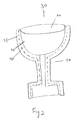
- Fig 2 is a 3-D model of a wineglass, generally referenced 30.
- This 3-D model is printed using the ink-jet type printing system of Fig 1.
- Combining the first interface material and the second interface material form a multiplicity of construction layers 32 which make up wine glass 30.
- the construction layers 32 of wineglass 30 need to be supported externally, such as in the area referenced 34. Furthermore, an internal void, referenced 36, needs to be formed during printing. Thus a multiplicity of support layers 38, formed by combining the first interface material and the second interface material, are printed.
- release layers 40 are positioned between construction layers 32 and support layers 38.
- release layers 40 have a different (lower) modulus of elasticity than support layers 38 and construction layers 32.
- release layers 40 can be used to separate support layers 38 from construction layers 32.
- compositions suitable for use as the first interface and as the second interface material are provided.
- the first interface material and second interface material of the present invention are especially designed and formulated for building a 3-D object using 3-D printing. Accordingly, the first and the second interface material are designed to have increased viscosity at room temperature, which is defined as about 20-30C. Preferably, the first and second interface material have a viscosity greater than 50 cps at room temperature, more preferably between 80 and 300 cps. In a preferred embodiment, the first and the second interface material have a viscosity of around 300 cps at room temperature,
- first interface material and the second interface material have a second viscosity compatible with ink-jet printing, at a second temperature which is higher than room temperature.
- a composition compatible with ink-jet printing has low viscosity, preferably below 20 cps at the printing temperature, in order to function properly in the printing process.
- the first interface material and the second interface material upon heating, have a viscosity preferably below 20 cps, enabling the construction of the 3-D object under heat.
- the temperature typically used to build the 3-D model of the present invention is higher than 60C, preferably about 85C.
- the first and second interface materials have a viscosity of 8-15 cps at a temperature greater than 60C.
- the first and second interface materials have a viscosity of 11 cps at a temperature of about 85C.
- the first and second interface material are distinguished from prior art formulations designed for ink-jet printing, which have low viscosity at room temperature, the temperature at which the printing is conducted.
- High viscosity at room temperature is a desirable property for 3-D objects, a feature that is lacking in the prior art formulations.
- the first interface material is formulated to give, after curing, a solid material with mechanical properties that permit the building and handling of 3-D models.
- the first interface material of the present invention comprises:
- the reactive component is an acrylic component, a molecule having one or more epoxy substituents, a molecule having one or more vinyl ether substituents, vinylpyrolidone, vinylcaprolactam, or any combination thereof.
- the acrylic component is an acrylic monomer, an acrylic oligomer, an acrylic crosslinker, or any combination thereof.
- An acrylic monomer is a monofunctional acrylated molecule which can be, for example, esters of acrylic acid and methacrylic acid.
- An example of an acrylic monomer for the present invention is phenoxyethyl acrylate, marketed by Sartomer under the trade name SR-339.
- Another example of an acrylic monomer is marketed by Sartomer under trade name SR-9003.
- An acrylic oligomer is a polyfunctional acrylated molecule which can be for example polyesters of acrylic acid and methacrylic acid and a polyhydric alcohol, such as polyacrylates and polymethacrylates of trimethylolpropane, pentaerythritol, ethylene glycol, propylene glycol and the like.
- acrylic oligomers are the classes of urethane acrylates and urethane methacrylates.
- Urethane-acrylates are manufactured from aliphatic or cycloaliphatic diisocyanates or polyisocyanates and hydroxyl-containing acrylic acid esters.
- An example is a urethane-acrylate oligomer marketed by Cognis under the trade name Photomer-6010.
- An acrylic crosslinker is a molecule which provides enhanced crosslinking.
- examples of such resins are 1,4-butanediol diacrylate, 1,4-butanediol dimethacrylate, 1,6-hexamethylene glycol diacrylate, neopentyl glycol dimethacrylate, trimethylol propane trimethacrylate, pentaerythritol triacrylate, penta-erythritol trimethacrylate triethylene glycol triacrylate, triethylene glycol trimethacrylate, and the like.
- An example of an acrylic crosslinker for the present invention is trimethylol propane triacrylate, marketed by Sartomer under the trade name SR-351.
- Another example of a crosslinker is UVM-45, marketed by CRODA.
- the reactive component in the first interface material can also be a molecule having one or more vinyl ether substituents.
- Conventional vinyl ether monomers and oligomers which have at least vinyl ether group are suitable.
- vinyl ethers are ethyl vinyl ether, propyl vinyl ether, isobutyl vinyl ether, cyclohexyl vinyl ether, 2-ethylhexyl vinyl ether, butyl vinyl ether, ethyleneglocol monovinyl ether, diethyleneglycol divinyl ether, butane diol divinyl ether, hexane diol divinyl ether, cyclohexane dimethanol monovinyl ether and the like.
- An example of a vinyl ether for the present invention is 1,4 cyclohexane dimethanol divinyl ether, marketed by ISP under the trade name CHVE.
- the reactive component in the first interface material can also be a molecule having one or more epoxy substituents.
- Conventional epoxy monomers and oligomers which have at least one oxirane moiety are preferred.
- Suitable epoxy containing molecules are displayed in Table 1 below: Table 1: Examples of epoxy-contatning reactive component Trade Name Type of Material Supplier ERL-4299 or UVR-6128 Bis-(3,4 cyclohexylmethyl) adipate Union Carbide UVR-6105 and UVR-6110 3,4-epoxy cyclohexylmethyl-3,4-epoxycyclohexyl carboxylate Union Carbide D.E.R 732 Aliphatic epoxy, Polyglycol diglycidyl ether Dow chemicals Vinylcyclohexene Monoxide 1,2 epoxy-4-vinylcyclohexane Union Carbide D.E.N.
- the reactive component of the first interface material can comprise any combination of an acrylic component as defined hereinabove, a molecule having one or more epoxy substituents as defined hereinabove, a molecule having one or more vinyl ether substituents as defined hereinabove, vinylcaprolactam and vinylpyrolidone.
- the reactive component of the first interface material comprises an acrylic monomer, an acrylic oligomer, an acrylic crosslinker and vinylcaprolactam. In another embodiment, the reactive component comprises an acrylic component as defined hereinabove and a molecule having one or more epoxy substituents as defined hereinabove. In another embodiment, the reactive component of the first interface material comprises an acrylic component as defined hereinabove and a molecule having one or more vinyl ether substituents as defined hereinabove. In another embodiment, the reactive component in the first interface material comprises a molecule having one or more vinyl ether substituents as defined hereinabove, and a molecule having one or more epoxy substituents as defined hereinabove.
- the photo-initiator of the first interface material and of the second interface material may be the same or different, and is a free radical photo-initiator, a cationic photo-initiator, or any combination thereof.
- the free radical photo-initiator can be any compound that produces a free radical on exposure to radiation such as ultraviolet or visible radiation and thereby initiates a polymerization reaction.
- suitable photo-initiators include benzophenones (aromatic ketones) such as benzophenone, methyl benzophenone, Michler's ketone and xanthones; acylphosphine oxide type photo-initiators such as 2,4,6-trimethylbenzolydiphenyl phosphine oxide (TMPO), 2,4,6-trimethylbenzoylethoxyphenyl phosphine oxide (TEPO), and bisacylphosphine oxides (BAPO's); benzoins and bezoin alkyl ethers such as benzoin, benzoin methyl ether and benzoin isopropyl ether and the like.
- photo-initiators examples include alpha-amino ketone, marketed by Ciba Specialties Chemicals Inc. (Ciba) under the trade name lrgacure 907, and bisacylphosphine oxide (BAPO's), marketed by Ciba under the trade name I-819.
- the free-radical photo-initiator can be used alone or in combination with a co-initiator.
- Co-initiators are used with initiators that need a second molecule to produce a radical that is active in the UV-systems.
- Benzophenone is an example of a photoinitiator that requires a second molecule, such as an amine, to produce a reactive radical. After absorbing radiation, benzophenone reacts with a ternary amine by hydrogen abstraction, to generate an alpha-amino radical which initiates polymerization of acrylates.
- An example of a class of co-initiators are alkanolamines such as triethylamine, methyldiethanolamine and triethanolamine.
- Suitable cationic photo-initiators for the present invention include compounds which form aprotic acids or Bronstead acids upon exposure to ultraviolet and/or visible light sufficient to initiate polymerization.
- the photo-initiator used may be a single compound, a mixture of two or more active compounds, or a combination of two or more different compounds, i.e. co-initiators.
- suitable cationic photo-initiators are aryldiazonium salts, diaryliodonium salts, triarylsulphonium salts, triarylselenonium salts and the like.
- a preferred cationic photo-initiator for the present invention is a mixture of triarylsolfonium hexafluoroantimonate salts marketed by Union Carbide as UVI-6974.
- a surface-active agent is used to reduce the surface tension of the formulation to the value required for jetting, which is typically around 30 dyne/cm.
- An example of a surface-active agent for the present invention is silicone surface additive, marketed by Byk Chemie under the trade name Byk 307.
- Inhibitors are employed in the formulations of the first interface material and the second interface material to permit the use of the formulation at high temperature, preferably around 85C, without causing thermal polymerization.
- the first interface material further comprises at least one pigment and at least one dispersant.
- the pigment is a white pigment, an organic pigment, an inorganic pigment, a metal pigment or a combination thereof.
- a white pigment for the present invention is organic treated titanium dioxide, marketed by Kemira Pigments under the trade name UV TITAN M160 VEG.
- An example of an organic pigment for the present invention is an organic pigment marketed by Elementis Specialties under the trade name Tint Aid PC 9703.
- dispersants for the present invention are dispersants comprising a copolymer with acidic groups marketed by Byk Chemie under the trade name Disperbyk 110, and a dispersant comprising a high molecular weight block copolymer with pigment affinic groups, marketed by Byk Chemie under the trade name Disperbyk 163.
- the first interface material further comprises a dye.
- the dye is chosen so as not to interfere with the curing efficiency of the formulation of the first interface material.
- the dye may be any of a broad class of solvent soluble dyes. Some examples are azo dyes which are yellow, orange, brown and red; anthraquinone and triarylmethane dyes which are green and blue; and azine dye which is black.
- An example of a dye for the present invention is Solvent Red 127, marketed by Spectra Colors Corp. under the trade name Spectrasol RED BLG.
- the first interface material comprises the following components: 50% acrylic oligomer(s), 30% acrylic monomer(s), 15% acrylic crosslinker, 2% photoinitiator, surface active agent, pigments, dispersants; and stabilizers.
- Tables 2 and 3 illustrate examples of possible formulations of the first interface material.
- Table 4 illustrates examples of colored formulations, which comprise pigments, dispersants and dyes, as defined hereinabove. To any of the examples in Tables 2 and 3 may be added the combination of the colorants of Table 4.
- Table 2 Examples of Characteristic Formulation Components of First Interface Material # Trade Name Chemical Type Function in the formulation Supplier A Photomer-6010 Urethane Aerate Oligomer Oligomer Cognis B SR-339 Phenoxy ethyl Acrylate monomer Sartomer C SR-351 Trimethylol propane triacrylate Cross-linker Sartomer D Irgacure 907 alpha-Amino Ketone Free radical photo-initiator Ciba Specialties Chemical Inc.
- the first interface material comprises an acrylic oligomer, which can be any acrylic oligomer as defined hereinabove, and which is preferably a urethane acrylate oligomer, an acrylic monomer, which can be any acrylic monomer as defined hereinabove, and which is preferably phenoxy ethyl acrylate; an acrylic crosslinker, which can be any acrylic crosslinker as defined hereinabove, and which is preferably trimethylol propane triacrylate; a radical photo-initiator, which can be any radical photo-initiator as defined hereinabove, and which is preferably alpha-amino ketone; a surface agent, which is preferably a silicone surface additive:
- the second interface material is formulated to form a release layer to permit a manual easy cleaning of the 3-D model from its support.
- the second interface material may be one of two different principle kinds: 1) a liquid material lacking any curable groups that remains liquid even after curing. In one embodiment, the liquid is water miscible and is easily washed out by water; and 2) a solid material that is formulated as a very weak curable material that, when cured, is capable of swelling in water or in alkaline or acidic water. Thus, when cured, the second interface material swells and almost breaks upon exposure to water, with minimum manual work required. In both cases the second interface material is formulated so as to permit fast, easy and efficient removal of the second interface material and cleaning of the 3-D model from its support.
- the second interface material of the present invention comprises:
- the non-reactive component of the second interface material is a non-reactive and low toxicity compound, preferably a water miscible one.
- the non-reactive component is chosen to enhance the water-swelling rate, and to reduce the mechanical strength of the second interface material. High water diffusion rate is desirable in order to minimize the time needed for the water cleaning process of the 3-D model.
- non-reactive components for the present invention are polyethylene glycol marketed by Aldrich under the trade name PEG 400, methoxypolyethylene glycol marketed by Aldrich under the trade name methoxycarbowax 500 and 1000, and propylene glycol.
- Other examples are ethoxylated polyols and glycerol.
- the second interface material is formulated as a liquid.
- the liquid formulation is a non-curable composition that remains liquid even after radiation exposure.
- the liquid formulation comprises only non-reactive components and does not comprise reactive components that are capable upon solidifying upon curing.
- the material is water miscible, and can be easily washed out with water.
- the second interface material is not limited to a liquid formulation.
- the second interface material further comprises at least one reactive component and at least one photo-initiator.
- the second interface material is formulated as a curable composition that is capable of solidifying upon curing.
- the reactive components may be similar to those used in the first interface material, but are chosen specifically to give a hydrophillic cured resin, with very weak mechanical properties. Thus, upon curing, a solid composition is formed that is very weak and can be easily pulverized by hand or using water.
- the reactive component is at least one of an acrylic component, a molecule having one or more vinyl ether substituents, or a water miscible component that is, after curing, capable of sweating upon exposure to water or to an alkaline or acidic water solution.
- the acrylic component is an acrylic monomer or an acrylic oligomer, and may be any one of the examples defined hereinabove.
- acrylic components for use in the second interface material of the present invention are polyethylene glycol monoacrylate, marketed by Laporte under the trade name Bisomer PEA6, and polyethylene glycol diacrylate, marketed by Sartomer under the trade name SR-610, methoxypolyethyleneglycole 550 monomethacrylate, and the like.
- the reactive component of the second interface material can also be a water miscible component that is, after curing, capable of swelling upon exposure to water or to an alkaline or acidic water solution.
- water miscible components for the present invention are an acrylated urethane oligomer derivative of polyethylene glycol - polyethylene glycol urethane diacrylate, a partially acrylated polyol oligomer, an acrylated oligomer having hydrophillic substituents, or any combination thereof.
- the hydrophilic substituents are acidic substituents, amino substituents, hydroxy substituents, or any combination thereof.
- An example of an acrylated monomer with hydrophillic substituents is betha-carboxyethyl acrylate, which contains acidic substituents.
- the reactive component of the second interface material can also be a molecule having one or more vinyl ether substituents, which may be any of the compounds as defined hereinabove.
- An example of vinyl ether for the second interface material is 1,4-cyclohexane dimethanol divinyl ether, marketed by ISP under the trade name CHVE.
- the reactive component of the second interface material is an acrylic oligomer. In another embodiment, the reactive component of the second interface material is a combination of an acrylic component as defined hereinabove and a water miscible component as defined hereinabove. In another embodiment, the reactive component of the present invention is a combination of an acrylic component as defined hereinabove and a molecule having one or more vinyl ether substituents, as defined hereinabove. In another embodiment, the reactive component of the present invention is a combination of a water miscible component as defined hereinabove, and a molecule having one or more vinyl ether substituents, as defined hereinabove.
- the second interface material comprises a reactive material
- the second interface material further comprises a photo-initiator.
- the photo-initiator can be any photo-initiator, as defined above.
- Another characteristic of the solid support upon exposure to water or to an alkaline or acidic water solution may be the ability to break down during exposure to water or to an alkaline or acidic water solution. Because the second interface material is made of hydrophillic components, during the swelling process, internal forces appear and cause fractures and breakdown of the cured second interface material.
- the second interface material may be at least partially water-soluble. At least part of the second interface material is completely water soluble/miscible. During the removal of the support and/or release layers, the water soluble/miscible components are extracted out with water.
- the second interface material liberates bubbles upon exposure to water or to an alkaline water or acidic water solution.
- the bubbles are intended to help in the process of removal of the support and/or release layers from the construction layers.
- the bubbles may be liberated by a bubble releasing substance (BRS) that is present in the water solution that is used to clean out the 3-D object.
- a substance may be a carbonate or bicarbonate, for example sodium bicarbonate (SBC).
- SBC sodium bicarbonate
- the trigger for the production of CO2 may be the reaction of the SBC with an acid functionality present in the second interface material.
- acid functionality may be introduced as part of the second interface material formulation or introduced later, after curing, using an acid water solution.
- the first step may be to put the 3-D object with its support in a water solution containing a SBC, then to place the same object in an acidic solution. The acid will start to decompose the SBC and product gas (bubbles),
- the substance that liberates gas is already present in the formulation of the second interface material.
- the second interface material may contain calcium carbonate as a solid pigment.
- the trigger is the introduction of the second interface material in a water or acidic solution.
- a BRS is not limited to a sodium bicarbonate or calcium carbonate and an acidic water solution. Other chemical reagents and reactions may be used to achieve the same result - the production of bubbles inside the matrix of the second interface material.
- the SBC may be any alkaline metal or alkaline earth metal carbonate or bicarbonate.
- Tables 5 and 6 display various formulations that are suitable for use as the second interface material.
- Table 5 Examples of Characteristic Formulation Components of Second Interface Material # Trade Name Chemical Type Function in the formulation Supplier A SR-610 Polyethylene Glycole (600) Diacrylate Oligomer Sartomer B Bisomer PEA6 Polyethylene Glycole monoacrylate Water swelling/ sensitive Oligomer Laport C PEG 400 Polyethylene Glycole 400 Polymer (hydrophilic and palsticizer) Aldrich D Irgacure 907 alpha-Amino Ketone Free radical photo-initiator Type I Ciba Specialties Chemical Inc.
- the second interface material comprises;
- the second interface material comprises:
- the first interface material and the second interface material are suitable for use in the method for 3-D printing which is described in U.S. Patent Application 09/412,618 , assigned to the Assignees of the present application and is incorporated herein by reference.
- the method comprises:
- the method further comprises the step of curing the first interface material.
- the method may further comprise the step of curing the second interface material.
- Curing may be carried out as described in U.S. Patent Application 09/412,618 .
- the curing method is by radiation, such as Ultraviolet (UV) and/or Visible (Vis) and/or Infra Red (IR) and/or UV-Vis radiation.
- UV-Vis radiation is UV-Vis radiation.
- the first interface material and the second interface material are combined in pre-determined proportions. For example, in order to obtain layers having a higher modulus of elasticity and a higher strength such as the construction layers, a suitable combination that contains mostly the first interface material is used. Further, in order to obtain layers having a lower modulus of elasticity and a lower strength such as the release layers, a suitable combination that includes mostly the second interface material is used.
- a combination that includes 90-100% of the first interface material and 0-10% of the second interface material is used.
- a combination that includes 0-10% of the first interface material and 90-100% of the second interface material is used.
- a combination that includes 30-70% of the first interface material and 70-30% of the second interface material is used.
- a 3-D object which is comprised of a core consisting of a multiplicity of construction layers.
- the construction layers are formed by combining predetermined proportions of the first interface material and the second interface material.
- the 3-D object further comprises a multiplicity of support layers for supporting the core.
- the support layers are prepared by combining pre-determined proportions of the first interface material and the second interface material.
- the support layers may be designed exactly like to construction layers, or may be designed to be weaker (lower modulus of elasticity) than the construction layers,
- the 3-D object further comprises a multiplicity of release layers for releasing the support layers from the construction layers.
- the release layers are positioned between the support layers and the construction layers.
- the release layers are prepared by combining pre-determined proportions of the first interface material and the second interface material.
Landscapes
- Chemical & Material Sciences (AREA)
- Engineering & Computer Science (AREA)
- Manufacturing & Machinery (AREA)
- Materials Engineering (AREA)
- Life Sciences & Earth Sciences (AREA)
- Chemical Kinetics & Catalysis (AREA)
- General Chemical & Material Sciences (AREA)
- Pest Control & Pesticides (AREA)
- Physics & Mathematics (AREA)
- Mechanical Engineering (AREA)
- Optics & Photonics (AREA)
- General Physics & Mathematics (AREA)
Priority Applications (3)
| Application Number | Priority Date | Filing Date | Title |
|---|---|---|---|
| DK10181371.5T DK2277686T3 (da) | 2000-03-13 | 2001-03-13 | Sammensætninger og fremgangsmåder til anvendelse i tredimensionelt modeltryk |
| EP10181371.5A EP2277686B1 (fr) | 2000-03-13 | 2001-03-13 | Compositions et procédé pour l' impression tridimensionnelle de modèles |
| EP10181366.5A EP2298540B1 (fr) | 2000-03-13 | 2001-03-13 | Compositions pour une utilisation dans l'impression de modèles tridimensionnels |
Applications Claiming Priority (4)
| Application Number | Priority Date | Filing Date | Title |
|---|---|---|---|
| US18869800P | 2000-03-13 | 2000-03-13 | |
| US19532100P | 2000-04-10 | 2000-04-10 | |
| US09/803,108 US6569373B2 (en) | 2000-03-13 | 2001-03-12 | Compositions and methods for use in three dimensional model printing |
| EP01912099A EP1274551B1 (fr) | 2000-03-13 | 2001-03-13 | Procédé pour l'impression tridimensionnelle et modèle obtenu |
Related Parent Applications (2)
| Application Number | Title | Priority Date | Filing Date |
|---|---|---|---|
| EP01912099A Division EP1274551B1 (fr) | 2000-03-13 | 2001-03-13 | Procédé pour l'impression tridimensionnelle et modèle obtenu |
| EP01912099.7 Division | 2001-03-13 |
Related Child Applications (2)
| Application Number | Title | Priority Date | Filing Date |
|---|---|---|---|
| EP10181366.5 Division-Into | 2010-09-28 | ||
| EP10181371.5 Division-Into | 2010-09-28 |
Publications (3)
| Publication Number | Publication Date |
|---|---|
| EP1741545A2 true EP1741545A2 (fr) | 2007-01-10 |
| EP1741545A3 EP1741545A3 (fr) | 2010-09-29 |
| EP1741545B1 EP1741545B1 (fr) | 2013-07-17 |
Family
ID=37487943
Family Applications (1)
| Application Number | Title | Priority Date | Filing Date |
|---|---|---|---|
| EP06121497.9A Expired - Lifetime EP1741545B1 (fr) | 2000-03-13 | 2001-03-13 | Compositions pour l' impression tridimensionnelle d'un modèle |
Country Status (1)
| Country | Link |
|---|---|
| EP (1) | EP1741545B1 (fr) |
Cited By (9)
| Publication number | Priority date | Publication date | Assignee | Title |
|---|---|---|---|---|
| WO2012060204A1 (fr) | 2010-11-01 | 2012-05-10 | 株式会社キーエンス | Matériau de modélisation pour former un article photoformé par un procédé de photoformage par jet d'encre, matériau de support pour le soutien de forme pendant la formation d'article photoformé par le procédé de photoformage, et procédé pour produire un article photoformé par le procédé de photoformage |
| US8801418B2 (en) | 2011-01-31 | 2014-08-12 | Global Filtration Systems | Method and apparatus for making three-dimensional objects from multiple solidifiable materials |
| US20140265033A1 (en) * | 2013-03-15 | 2014-09-18 | Michelin Recherche Et Technique S.A. | Method for improved tire mold manufacturing |
| EP2960718A1 (fr) | 2014-06-20 | 2015-12-30 | Keyence Corporation | Matériau de modelage de formation de modèle de photofabrication dans la stéréo lithographie à jet d'encre et procédé de production d'un tel modèle |
| EP3296369A1 (fr) * | 2016-09-15 | 2018-03-21 | Xerox Corporation | Matériau de support coloré pour une fabrication d'additifs médiée par jet d'encre |
| US9975296B2 (en) | 2014-02-10 | 2018-05-22 | Global Filtration Systems | Apparatus and method for forming three-dimensional objects from solidifiable paste |
| WO2019129560A1 (fr) * | 2017-12-29 | 2019-07-04 | Basf Se | Composition pour produire des sous-structures de support pour éjection de photopolymère 3d |
| EP3402644A4 (fr) * | 2016-01-15 | 2019-08-14 | Stratasys Ltd. | Formulations friables au contact de l'eau et procédés de fabrication d'additif utilisant celles-ci |
| US20220063187A1 (en) * | 2020-08-27 | 2022-03-03 | Xerox Corporation | Polymer filaments comprising a gas-forming compound and additive manufacturing therewith |
Families Citing this family (2)
| Publication number | Priority date | Publication date | Assignee | Title |
|---|---|---|---|---|
| US10245822B2 (en) | 2015-12-11 | 2019-04-02 | Global Filtration Systems | Method and apparatus for concurrently making multiple three-dimensional objects from multiple solidifiable materials |
| JP6672874B2 (ja) * | 2016-02-22 | 2020-03-25 | 富士ゼロックス株式会社 | 三次元造形用支持材、三次元造形用支持材カートリッジ、三次元造形用組成物セット、三次元造形装置、及び三次元造形物の製造方法 |
Family Cites Families (2)
| Publication number | Priority date | Publication date | Assignee | Title |
|---|---|---|---|---|
| US5128235A (en) * | 1989-04-21 | 1992-07-07 | E. I. Du Pont De Nemours And Company | Method of forming a three-dimensional object comprising additives imparting reduction of shrinkage to photohardenable compositions |
| US6476122B1 (en) * | 1998-08-20 | 2002-11-05 | Vantico Inc. | Selective deposition modeling material |
-
2001
- 2001-03-13 EP EP06121497.9A patent/EP1741545B1/fr not_active Expired - Lifetime
Non-Patent Citations (1)
| Title |
|---|
| None |
Cited By (20)
| Publication number | Priority date | Publication date | Assignee | Title |
|---|---|---|---|---|
| US9790382B2 (en) | 2010-11-01 | 2017-10-17 | Keyence Corporation | Modeling material for forming photofabrication model in ink-jet three dimensional printing, supporting material for supporting the shape of photofabrication model on photofabrication and production method of photofabrication model |
| KR20130141561A (ko) | 2010-11-01 | 2013-12-26 | 가부시키가이샤 키엔스 | 잉크젯 광조형법에서의, 광조형품 형성용 모델재, 광조형품의 광조형시의 형상 지지용 서포트재 및 광조형품의 제조 방법 |
| WO2012060204A1 (fr) | 2010-11-01 | 2012-05-10 | 株式会社キーエンス | Matériau de modélisation pour former un article photoformé par un procédé de photoformage par jet d'encre, matériau de support pour le soutien de forme pendant la formation d'article photoformé par le procédé de photoformage, et procédé pour produire un article photoformé par le procédé de photoformage |
| US9796863B2 (en) | 2010-11-01 | 2017-10-24 | Keyence Corporation | Modeling material for forming photofabrication model in ink-jet three dimensional printing, supporting material for supporting the shape of photofabrication model on photofabrication and production method of photofabrication model |
| US9556346B2 (en) | 2010-11-01 | 2017-01-31 | Keyence Corporation | Modeling material for forming photofabrication model in ink-jet three dimensional printing, supporting material for supporting the shape of photofabrication model on photofabrication and production method of photofabrication model |
| US8801418B2 (en) | 2011-01-31 | 2014-08-12 | Global Filtration Systems | Method and apparatus for making three-dimensional objects from multiple solidifiable materials |
| US20140265033A1 (en) * | 2013-03-15 | 2014-09-18 | Michelin Recherche Et Technique S.A. | Method for improved tire mold manufacturing |
| US9975296B2 (en) | 2014-02-10 | 2018-05-22 | Global Filtration Systems | Apparatus and method for forming three-dimensional objects from solidifiable paste |
| EP2960718A1 (fr) | 2014-06-20 | 2015-12-30 | Keyence Corporation | Matériau de modelage de formation de modèle de photofabrication dans la stéréo lithographie à jet d'encre et procédé de production d'un tel modèle |
| US11780172B2 (en) | 2016-01-15 | 2023-10-10 | Stratasys Ltd. | Water-breakable formulations and additive manufacturing processes employing same |
| EP3402644A4 (fr) * | 2016-01-15 | 2019-08-14 | Stratasys Ltd. | Formulations friables au contact de l'eau et procédés de fabrication d'additif utilisant celles-ci |
| IL260605B2 (en) * | 2016-01-15 | 2024-07-01 | Stratasys Ltd | A formulation to create a material that breaks in the presence of water and additive manufacturing processes that make use of this formulation |
| US11028205B2 (en) | 2016-01-15 | 2021-06-08 | Stratasys Ltd. | Water-breakable formulations and additive manufacturing processes employing same |
| IL260605B1 (en) * | 2016-01-15 | 2024-03-01 | Stratasys Ltd | A formulation to create a material that breaks down in the presence of water and additive manufacturing processes that make use of this formulation |
| EP3296369A1 (fr) * | 2016-09-15 | 2018-03-21 | Xerox Corporation | Matériau de support coloré pour une fabrication d'additifs médiée par jet d'encre |
| WO2019129560A1 (fr) * | 2017-12-29 | 2019-07-04 | Basf Se | Composition pour produire des sous-structures de support pour éjection de photopolymère 3d |
| CN111542570B (zh) * | 2017-12-29 | 2023-02-17 | 巴斯夫欧洲公司 | 用于产生用于3d光聚合物喷射的载体子结构的组合物 |
| US11325315B2 (en) | 2017-12-29 | 2022-05-10 | Basf Se | Composition to produce support sub-structures for 3D photopolymer jetting |
| CN111542570A (zh) * | 2017-12-29 | 2020-08-14 | 巴斯夫欧洲公司 | 用于产生用于3d光聚合物喷射的载体子结构的组合物 |
| US20220063187A1 (en) * | 2020-08-27 | 2022-03-03 | Xerox Corporation | Polymer filaments comprising a gas-forming compound and additive manufacturing therewith |
Also Published As
| Publication number | Publication date |
|---|---|
| EP1741545B1 (fr) | 2013-07-17 |
| EP1741545A3 (fr) | 2010-09-29 |
Similar Documents
| Publication | Publication Date | Title |
|---|---|---|
| EP1274551B1 (fr) | Procédé pour l'impression tridimensionnelle et modèle obtenu | |
| US7183335B2 (en) | Compositions and methods for use in three dimensional model printing | |
| US9334402B2 (en) | Compositions and methods for use in three dimensional model printing | |
| US20020016386A1 (en) | Compositions and methods for use in three dimensional model printing | |
| US10335994B2 (en) | Methods for three-dimensional model printing | |
| EP1741545B1 (fr) | Compositions pour l' impression tridimensionnelle d'un modèle | |
| HK1153431B (en) | Compositions and methods for use in three dimensional model printing | |
| HK1155695B (en) | Compositions for use in three dimensional model printing | |
| HK1173417A (en) | Compositions and methods for use in three dimensional model printing | |
| HK1168332A (en) | Method for use in three dimensional model printing |
Legal Events
| Date | Code | Title | Description |
|---|---|---|---|
| PUAI | Public reference made under article 153(3) epc to a published international application that has entered the european phase |
Free format text: ORIGINAL CODE: 0009012 |
|
| AC | Divisional application: reference to earlier application |
Ref document number: 1274551 Country of ref document: EP Kind code of ref document: P |
|
| AK | Designated contracting states |
Kind code of ref document: A2 Designated state(s): AT BE CH CY DE DK ES FI FR GB GR IE IT LI LU MC NL PT SE TR |
|
| RIN1 | Information on inventor provided before grant (corrected) |
Inventor name: NAPADENSKY, EDUARDO Inventor name: GOTHAIT, HANAN |
|
| RIN1 | Information on inventor provided before grant (corrected) |
Inventor name: GOTHAIT, HANAN Inventor name: NAPADENSKY, EDUARDO |
|
| PUAL | Search report despatched |
Free format text: ORIGINAL CODE: 0009013 |
|
| AK | Designated contracting states |
Kind code of ref document: A3 Designated state(s): AT BE CH CY DE DK ES FI FR GB GR IE IT LI LU MC NL PT SE TR |
|
| RIC1 | Information provided on ipc code assigned before grant |
Ipc: B29C 67/00 20060101AFI20061204BHEP Ipc: G03F 7/028 20060101ALI20100824BHEP |
|
| 17P | Request for examination filed |
Effective date: 20110316 |
|
| AKX | Designation fees paid |
Designated state(s): AT BE CH CY DE DK ES FI FR GB GR IE IT LI LU MC NL PT SE TR |
|
| 17Q | First examination report despatched |
Effective date: 20120613 |
|
| GRAP | Despatch of communication of intention to grant a patent |
Free format text: ORIGINAL CODE: EPIDOSNIGR1 |
|
| RAP1 | Party data changed (applicant data changed or rights of an application transferred) |
Owner name: STRATASYS LTD. |
|
| GRAJ | Information related to disapproval of communication of intention to grant by the applicant or resumption of examination proceedings by the epo deleted |
Free format text: ORIGINAL CODE: EPIDOSDIGR1 |
|
| GRAP | Despatch of communication of intention to grant a patent |
Free format text: ORIGINAL CODE: EPIDOSNIGR1 |
|
| INTG | Intention to grant announced |
Effective date: 20130506 |
|
| GRAS | Grant fee paid |
Free format text: ORIGINAL CODE: EPIDOSNIGR3 |
|
| GRAA | (expected) grant |
Free format text: ORIGINAL CODE: 0009210 |
|
| AC | Divisional application: reference to earlier application |
Ref document number: 1274551 Country of ref document: EP Kind code of ref document: P |
|
| AK | Designated contracting states |
Kind code of ref document: B1 Designated state(s): AT BE CH CY DE DK ES FI FR GB GR IE IT LI LU MC NL PT SE TR |
|
| REG | Reference to a national code |
Ref country code: GB Ref legal event code: FG4D |
|
| REG | Reference to a national code |
Ref country code: CH Ref legal event code: EP |
|
| REG | Reference to a national code |
Ref country code: IE Ref legal event code: FG4D |
|
| REG | Reference to a national code |
Ref country code: AT Ref legal event code: REF Ref document number: 621894 Country of ref document: AT Kind code of ref document: T Effective date: 20130815 |
|
| REG | Reference to a national code |
Ref country code: DE Ref legal event code: R096 Ref document number: 60148161 Country of ref document: DE Effective date: 20130905 |
|
| REG | Reference to a national code |
Ref country code: DK Ref legal event code: T3 |
|
| REG | Reference to a national code |
Ref country code: SE Ref legal event code: TRGR |
|
| REG | Reference to a national code |
Ref country code: NL Ref legal event code: T3 |
|
| REG | Reference to a national code |
Ref country code: ES Ref legal event code: FG2A Ref document number: 2431319 Country of ref document: ES Kind code of ref document: T3 Effective date: 20131126 |
|
| REG | Reference to a national code |
Ref country code: GR Ref legal event code: EP Ref document number: 20130402145 Country of ref document: GR Effective date: 20131118 |
|
| PG25 | Lapsed in a contracting state [announced via postgrant information from national office to epo] |
Ref country code: CY Free format text: LAPSE BECAUSE OF FAILURE TO SUBMIT A TRANSLATION OF THE DESCRIPTION OR TO PAY THE FEE WITHIN THE PRESCRIBED TIME-LIMIT Effective date: 20130717 Ref country code: PT Free format text: LAPSE BECAUSE OF FAILURE TO SUBMIT A TRANSLATION OF THE DESCRIPTION OR TO PAY THE FEE WITHIN THE PRESCRIBED TIME-LIMIT Effective date: 20131118 |
|
| PLBE | No opposition filed within time limit |
Free format text: ORIGINAL CODE: 0009261 |
|
| STAA | Information on the status of an ep patent application or granted ep patent |
Free format text: STATUS: NO OPPOSITION FILED WITHIN TIME LIMIT |
|
| 26N | No opposition filed |
Effective date: 20140422 |
|
| REG | Reference to a national code |
Ref country code: DE Ref legal event code: R097 Ref document number: 60148161 Country of ref document: DE Effective date: 20140422 |
|
| REG | Reference to a national code |
Ref country code: FR Ref legal event code: PLFP Year of fee payment: 16 |
|
| PG25 | Lapsed in a contracting state [announced via postgrant information from national office to epo] |
Ref country code: TR Free format text: LAPSE BECAUSE OF FAILURE TO SUBMIT A TRANSLATION OF THE DESCRIPTION OR TO PAY THE FEE WITHIN THE PRESCRIBED TIME-LIMIT Effective date: 20130717 |
|
| REG | Reference to a national code |
Ref country code: DE Ref legal event code: R079 Ref document number: 60148161 Country of ref document: DE Free format text: PREVIOUS MAIN CLASS: B29C0067000000 Ipc: B29C0064106000 |
|
| REG | Reference to a national code |
Ref country code: FR Ref legal event code: PLFP Year of fee payment: 17 |
|
| REG | Reference to a national code |
Ref country code: FR Ref legal event code: PLFP Year of fee payment: 18 |
|
| PGFP | Annual fee paid to national office [announced via postgrant information from national office to epo] |
Ref country code: AT Payment date: 20200227 Year of fee payment: 20 Ref country code: GR Payment date: 20200227 Year of fee payment: 20 Ref country code: NL Payment date: 20200302 Year of fee payment: 20 Ref country code: GB Payment date: 20200221 Year of fee payment: 20 Ref country code: MC Payment date: 20200228 Year of fee payment: 20 Ref country code: DE Payment date: 20200218 Year of fee payment: 20 Ref country code: SE Payment date: 20200227 Year of fee payment: 20 Ref country code: FI Payment date: 20200227 Year of fee payment: 20 Ref country code: IE Payment date: 20200227 Year of fee payment: 20 Ref country code: IT Payment date: 20200218 Year of fee payment: 20 Ref country code: DK Payment date: 20200225 Year of fee payment: 20 |
|
| PGFP | Annual fee paid to national office [announced via postgrant information from national office to epo] |
Ref country code: LU Payment date: 20200228 Year of fee payment: 20 Ref country code: BE Payment date: 20200228 Year of fee payment: 20 Ref country code: CH Payment date: 20200221 Year of fee payment: 20 |
|
| PGFP | Annual fee paid to national office [announced via postgrant information from national office to epo] |
Ref country code: FR Payment date: 20200220 Year of fee payment: 20 |
|
| PGFP | Annual fee paid to national office [announced via postgrant information from national office to epo] |
Ref country code: ES Payment date: 20200401 Year of fee payment: 20 |
|
| REG | Reference to a national code |
Ref country code: DE Ref legal event code: R071 Ref document number: 60148161 Country of ref document: DE |
|
| REG | Reference to a national code |
Ref country code: CH Ref legal event code: PL Ref country code: DK Ref legal event code: EUP Expiry date: 20210313 |
|
| REG | Reference to a national code |
Ref country code: NL Ref legal event code: MK Effective date: 20210312 |
|
| REG | Reference to a national code |
Ref country code: GB Ref legal event code: PE20 Expiry date: 20210312 |
|
| REG | Reference to a national code |
Ref country code: FI Ref legal event code: MAE |
|
| REG | Reference to a national code |
Ref country code: IE Ref legal event code: MK9A |
|
| PG25 | Lapsed in a contracting state [announced via postgrant information from national office to epo] |
Ref country code: GB Free format text: LAPSE BECAUSE OF EXPIRATION OF PROTECTION Effective date: 20210312 |
|
| REG | Reference to a national code |
Ref country code: BE Ref legal event code: MK Effective date: 20210313 |
|
| REG | Reference to a national code |
Ref country code: AT Ref legal event code: MK07 Ref document number: 621894 Country of ref document: AT Kind code of ref document: T Effective date: 20210313 |
|
| PG25 | Lapsed in a contracting state [announced via postgrant information from national office to epo] |
Ref country code: IE Free format text: LAPSE BECAUSE OF EXPIRATION OF PROTECTION Effective date: 20210313 |
|
| REG | Reference to a national code |
Ref country code: SE Ref legal event code: EUG |
|
| REG | Reference to a national code |
Ref country code: ES Ref legal event code: FD2A Effective date: 20211105 |
|
| PG25 | Lapsed in a contracting state [announced via postgrant information from national office to epo] |
Ref country code: ES Free format text: LAPSE BECAUSE OF EXPIRATION OF PROTECTION Effective date: 20210314 |
|
| P01 | Opt-out of the competence of the unified patent court (upc) registered |
Effective date: 20231109 |