EP1742676B1 - Zusammmensetzung für injizierbaren zement als knochenersatz - Google Patents
Zusammmensetzung für injizierbaren zement als knochenersatz Download PDFInfo
- Publication number
- EP1742676B1 EP1742676B1 EP05763676A EP05763676A EP1742676B1 EP 1742676 B1 EP1742676 B1 EP 1742676B1 EP 05763676 A EP05763676 A EP 05763676A EP 05763676 A EP05763676 A EP 05763676A EP 1742676 B1 EP1742676 B1 EP 1742676B1
- Authority
- EP
- European Patent Office
- Prior art keywords
- composition
- polymer
- cement
- mixture
- injectable cement
- Prior art date
- Legal status (The legal status is an assumption and is not a legal conclusion. Google has not performed a legal analysis and makes no representation as to the accuracy of the status listed.)
- Expired - Lifetime
Links
Images


Classifications
-
- A—HUMAN NECESSITIES
- A61—MEDICAL OR VETERINARY SCIENCE; HYGIENE
- A61L—METHODS OR APPARATUS FOR STERILISING MATERIALS OR OBJECTS IN GENERAL; DISINFECTION, STERILISATION OR DEODORISATION OF AIR; CHEMICAL ASPECTS OF BANDAGES, DRESSINGS, ABSORBENT PADS OR SURGICAL ARTICLES; MATERIALS FOR BANDAGES, DRESSINGS, ABSORBENT PADS OR SURGICAL ARTICLES
- A61L24/00—Surgical adhesives or cements; Adhesives for colostomy devices
- A61L24/0047—Composite materials, i.e. containing one material dispersed in a matrix of the same or different material
- A61L24/0052—Composite materials, i.e. containing one material dispersed in a matrix of the same or different material with an inorganic matrix
- A61L24/0063—Phosphorus containing materials, e.g. apatite
-
- A—HUMAN NECESSITIES
- A61—MEDICAL OR VETERINARY SCIENCE; HYGIENE
- A61L—METHODS OR APPARATUS FOR STERILISING MATERIALS OR OBJECTS IN GENERAL; DISINFECTION, STERILISATION OR DEODORISATION OF AIR; CHEMICAL ASPECTS OF BANDAGES, DRESSINGS, ABSORBENT PADS OR SURGICAL ARTICLES; MATERIALS FOR BANDAGES, DRESSINGS, ABSORBENT PADS OR SURGICAL ARTICLES
- A61L27/00—Materials for grafts or prostheses or for coating grafts or prostheses
- A61L27/40—Composite materials, i.e. containing one material dispersed in a matrix of the same or different material
- A61L27/42—Composite materials, i.e. containing one material dispersed in a matrix of the same or different material having an inorganic matrix
- A61L27/425—Composite materials, i.e. containing one material dispersed in a matrix of the same or different material having an inorganic matrix of phosphorus containing material, e.g. apatite
-
- A—HUMAN NECESSITIES
- A61—MEDICAL OR VETERINARY SCIENCE; HYGIENE
- A61L—METHODS OR APPARATUS FOR STERILISING MATERIALS OR OBJECTS IN GENERAL; DISINFECTION, STERILISATION OR DEODORISATION OF AIR; CHEMICAL ASPECTS OF BANDAGES, DRESSINGS, ABSORBENT PADS OR SURGICAL ARTICLES; MATERIALS FOR BANDAGES, DRESSINGS, ABSORBENT PADS OR SURGICAL ARTICLES
- A61L2400/00—Materials characterised by their function or physical properties
- A61L2400/06—Flowable or injectable implant compositions
-
- A—HUMAN NECESSITIES
- A61—MEDICAL OR VETERINARY SCIENCE; HYGIENE
- A61L—METHODS OR APPARATUS FOR STERILISING MATERIALS OR OBJECTS IN GENERAL; DISINFECTION, STERILISATION OR DEODORISATION OF AIR; CHEMICAL ASPECTS OF BANDAGES, DRESSINGS, ABSORBENT PADS OR SURGICAL ARTICLES; MATERIALS FOR BANDAGES, DRESSINGS, ABSORBENT PADS OR SURGICAL ARTICLES
- A61L2430/00—Materials or treatment for tissue regeneration
- A61L2430/02—Materials or treatment for tissue regeneration for reconstruction of bones; weight-bearing implants
Definitions
- the present invention relates to an injectable cement composition useful as a bone substitute.
- Phosphocalcic hydraulic cements are useful as bone substitutes. Cements injectable with a syringe are particularly sought, as they allow to perform the filling of a bone defect, by minimally invasive surgery. In addition, the strengthening and stabilization of osteoporotic bone tissue can be performed only by injection, without removal or destruction of the residual bone matrix.
- GB-943 678 discloses phosphocalcic hydraulic cements obtained from a powder consisting of a mixture of anhydrous M (H 2 PO 4 ) 2 and an oxide of a metal M '(M and M' may independently represent one of the another Zn, Mg, Ba, Ca, Al, Cd or Sr) in approximately equal weight proportion, said powder being mixed with water in a water / powder ratio of 0.15 ml / g.
- the only compositions illustrated are Ca (H 2 PO 4 ) 2 + ZnO on the one hand, Zn (H 2 PO 4 ) 2 + ZnO on the other hand.
- the cements obtained from these powders have a compressive strength greater than 100 MPa and curing times of 8-10 min.
- the inventors of this The invention tested with a mixture of anhydrous calcium bis-dihydrogenphosphate (Ca (H 2 PO 4 ) 2 and CaO with an L / P ratio of 1 ml / g, to obtain a paste that can be worked under the conditions described in GB-943 678 and the results obtained show that the compressive strength after 24 hours is less than 1 MPa.
- the general teaching of this document does not therefore make it possible to obtain a cement having the required properties (good compressive strength, high setting speed) for any combination M, M '.
- Leroux, et al. discloses a cement containing up to 4.3% by weight of Sr, corresponding to a final cement composition Ca 9.75 , Sr 0.25 (PO 4 ) 6 (OH) 2 .
- This composition can be obtained by adding strontium nitrate Sr (NO 3 ) 2 to the liquid phase of the above-mentioned cement Cementek®, the solid phase of which consists of a mixture of ⁇ -Ca 3 (PO 4 ) 2 (or ⁇ - TCP), tetracalcium phosphate (or TTCP) and glycerophosphate.
- strontium precursor does not make it possible to obtain an average porosity.
- Another solution envisaged for improving the resorption rate of the bone substitute is based on the principle that the presence of interconnected macropores in the phosphocalcic material promotes passive resorption by dissolving the implant, allowing its percolation by biological fluids, and active resorption. by osteoclasts allowing their penetration into macropores which have a sufficient size, that is to say greater than 100 microns.
- US 6547866 describes porous phosphocalcic materials obtained by adding to the composition of the compounds releasing a gas during the setting of the cement (carbonate + citric acid which release CO 2 , hydrogen peroxide which releases O 2 ). However, the pores obtained have a relatively small average size and the mechanical strength is decreased.
- composition before it is taken of a water-soluble compound of the NaHCO 3 type, Na 2 HPO 4 sucrose or mannitol ( Markovic, et al., Bioceramics, Trans Tech Publications, Switzerland, 2001, 773-775 ; Takagi and Chow, J. Mater. Sci. Mater. Mad. 2001; 13: 135-139; ).
- the dissolution of these sugars hinders the setting of the cement, which greatly reduces the resistance to crushing.
- WO-03/103734 describes a cement composition useful especially for bone filling.
- Said composition contains a mixture of powders containing a calcium precursor [in particular Ca 3 (PO 4 ) 2 ], a strontium precursor (in particular SrHPO 4 and / or Sr 3 (PO 4 ) 2 and optionally SrCO 3 ], and orthophosphate, in an aqueous solution of an alkali metal or ammonium salt of orthophosphoric acid.
- a calcium precursor in particular Ca 3 (PO 4 ) 2
- a strontium precursor in particular SrHPO 4 and / or Sr 3 (PO 4 ) 2 and optionally SrCO 3
- orthophosphate in an aqueous solution of an alkali metal or ammonium salt of orthophosphoric acid.
- US 6593394 discloses a cement composition useful as a bone substitute.
- Said composition comprises a powder containing strontium phosphate and calcium phosphate, and a liquid component containing a bisphenol A dimethacrylate resin and diglycidyl ether, the amounts of phosphates being such that the Sr / (Sr + Ca) molar ratio is at least 10%.
- the object of the present invention is to provide an injectable cement that can be used as a bone substitute, which has an injection time and a setting time that are compatible with injection techniques, and good compressive strength. after injection and a high resorption rate after injection.
- the subject of the present invention is a biocompatible and biodegradable injectable cement composition, a process for preparing an injectable cement from said composition, the injectable cement obtained, as well as its use by injection into a bone material, especially for the treatment of osteoporosis, for vertebrotherapy, for bone filling after fracture or excision.
- the L / P ratio is preferably 0.4 ml / g to 0.7 ml / g in the absence of polymer microparticles (more preferably 0.5 to 0.6 ml / g).
- the L / P ratio is at least 0.6 ml / g in the presence of polymer microparticles.
- the mixture of MCPM and CaO is a precursor of DCPD.
- the two constituents of the mixture react with precipitation of DCPD within 3 minutes after the solid phase is brought into contact with the liquid phase.
- compositions in which at least a portion of the CP constituent represents DCPD are preferred. Particularly preferred are compositions in which CP consists solely of DCPD.
- the injectable cement composition further contains microparticles of a biocompatible and biodegradable polymer.
- a biocompatible and biodegradable polymer By way of example, mention may be made of an intrinsically amorphous PLAGA polymer consisting of L-lactic units, D-lactic units and glycol units. There may also be mentioned a PLA polymer consisting solely of L-lactic units.
- Other polymers, degradable by hydrolysis or biodegradable by action of living cells, can be used, for example copolymers of lactic acid, glycolic acid and gluconic acid which are described in particular in FR-2765228 and which degrade more rapidly than PLAGA under identical conditions.
- the mass ratio of the polymer component to the mineral solid phase is between 20 and 60%, preferably of the order of 40%.
- the composition comprises a third phase constituted by said microparticles.
- the solid mineral phase also contains said microparticles.
- microparticles are preferably microspheres. They may optionally contain a chemical or biological compound, which will be released during the degradation of the polymer after the in vivo implantation of the injectable cement.
- the diameter of the microspheres may be between 50 and 500 ⁇ m, preferably between 125 and 250 ⁇ m.
- the injectable cement composition contains polymer microparticles
- the L / P ratio is in this case at least equal to 0.6 ml / g.
- the purpose of increasing the proportion of liquid phase is to compensate for the absorption of a certain amount of liquid by the polymer, and to maintain sufficient liquid phase in the mineral solid phase to remain injectable.
- the process for preparing the injectable cement from the composition according to the invention consists in bringing into contact the solid phase (which optionally contains polymer microparticles) and the liquid phase of the injectable cement composition, at the time of use. injectable cement, under the aseptic conditions required for the injection of bone substitutes.
- the process can be carried out using any conventional device for the preparation of a cement.
- the mixing device described in US 5549380 which makes it possible to introduce the liquid phase into the solid phase by suction at the moment when the mixing is to be carried out.
- the injectable cement composition comprises polymer microparticles in the form of a 3 rd phase
- this 3 rd phase is added to the paste obtained immediately after the contacting of the liquid phase and the solid mineral phase.
- CP contains CaHPO 4 , 2H 2 O
- CP consists solely of CaHPO 4 , 2H 2 O.
- the injectable paste thus obtained has an injection time and a setting time compatible with use as a bone substitute by injection.
- injection time means the time during which a composition remains totally injectable, after mixing of the liquid phase and the solid phase.
- Curing time is the time required for the composition, after mixing the two phases, to become solid (ASTM Standard C191).
- the setting time of the cement is shorter if using a NaP or NH4P buffer solution.
- the injection time is longer with a NaGP buffer solution.
- the injectable cement according to the invention gives, after injection, a material consisting mainly of modified hydroxylapatite Ca 10 -xSr x (PO 4 ) 6 (OH) 2 , which also contains a small amount of octacalcic phosphate and possibly traces unreacted SrCO 3 . It presents a porosity characterized by pores having an average size of about 20 to 50 microns mainly from the decomposition of SrCO 3 during the setting of the cement. This average porosity allows a better penetration of the fluids inside the cement, an increase in the specific surface of exchange which facilitates the diffusion of the ions coming from the dissolution of the components of the cement, and which thus causes a better passive resorption.
- the injectable cement composition further contains microparticles of biodegradable bioabsorbable polymer
- the material obtained after injection contains the same constituents as above, as well as microparticles of polymers, the weight ratio polymer / solid mineral phase being between 20 and 60 % (preferably of the order of 40%) and the initial L / P ratio being at least equal to 0.6 ml / g. It is further found that the aforementioned average porosity exists to a greater extent around the polymer microparticles that generate acidic compounds during hydrolytic degradation, which is an advantage for in vivo degradation. After the time necessary for the resorption of the polymer, it also has a network of interconnected macropores having a mean dimension greater than 100 microns.
- the spherical microparticles of PLAGA can be obtained by adding a solution of PLAGA in dichloromethane to an aqueous solution of polyvinyl alcohol (PVA), and keeping the mixture stirring for a certain period of time, then by recovering the particles by filtration.
- PVA polyvinyl alcohol
- Non-spherical particles of PLAGA can be obtained by cryomilling.
- a cement according to the invention continuously releases strontium ions and can therefore act as a controlled release and prolonged release of strontium ions that activate bone reconstruction by stimulation of osteoblasts.
- the cement contains microspheres of a polymer
- said polymer first degrades slowly, then much more quickly from 3 weeks.
- This degradation of the polymer can be exploited by charging it with an active ingredient (for example an antibiotic) or a protein (for example a growth factor) to also obtain a controlled release of this active ingredient.
- an active ingredient for example an antibiotic
- a protein for example a growth factor
- particles of PLAGA or other degradable polymers can be advantageously combined with antitumor agents, especially in the case of post-tumor bone excrescence filling.
- An injectable cement according to the invention which does not contain polymer particles is advantageously used for the stabilization and / or reinforcement of osteoporotic bone by injection into the residual bone matrix, for example for vertebroplasty, the presence of Sr 2 + promoting osteogenesis.
- An injectable cement containing polymer microparticles can be used to fill bone defects resulting from excision or fracture.
- the release of Sr 2+ and the macroporosity created by the degradation of the polymer in vivo stimulates bone regrowth.
- the inactive strontium carbonate can be completely or partially replaced by radioactive strontium carbonate 89, for filling afterwards. exeresis of a bone tumor with possibly an antimitotic substance loaded into the biodegradable polymer.
- a powder mixture having the following molar composition was prepared: DCPD, 2.5 CaO, 1.5 SrCO 3 .
- the 1 H NMR spectra give an overall composition PLA 36.8 GA 26.4 .
- Example 1 The procedure of Example 1 corresponding to samples 1A and 1C was reproduced, but replacing part of the mineral solid phase "6 DCPD, 2.5 CaO, 1.5 SrCO 3 " with a polymer in the form of microspheres. S2 of Example 2. In each case, three attempts were made by varying the amount of polymer. It has been found that a polymer mass / mineral phase ratio of 40% is sufficient for the microspheres to be in contact, that is to say to obtain interconnected macroporosities after degradation of the polymer.
- the microspheres were incorporated into the phosphate powder, and then the mixture was incorporated into the liquid phase.
- the compressive strength was determined for the compositions obtained respectively with NaP and with NaGP and 40% of S2 polymer microspheres, and compared to that of the equivalent composition without microspheres. The results are given in Table 2 below. In all cases, the compressions were determined after 24 h at 37 ° C and 100% relative humidity.
- the Figures 1, 2a and 2b represent images obtained by observation by scanning electron microscopy (SEM).
- the Fig. 1 represents the surface of the sample 3A 1 day after the mixing of the liquid phase and the solid phase.
- the polymer microspheres are not yet degraded and are perfectly visible, embedded in the mineral matrix.
- the Figures 2a and 2b represent the core of the sample 3A after 33 days and before complete resorption of the microspheres.
- the figure 2a shows a microsphere after rupture of the sample; the numerous vacuoles present on the microsphere indicate the advanced hydrolytic degradation of the polymer after 33 days, which occurs even within composite cement samples and not only at the surface.
- the figure 2b shows a portion of 3 microspheres (upper left corner, lower left corner and upper right corner) surrounding an alveolar mineral zone having a medium porosity (pore diameter of 5 to 100 ⁇ m) important; this average porosity is also seen around the microsphere of the figure 2a .
- Example 1 The procedure of Example 1 was repeated for each of samples 1A to 1D, but replacing part of the inorganic solid phase for a polymer in the form of microspheres S2, to have a polymer weight / mineral phase ratio of 40. %.
- the microspheres were incorporated in the same manner as in Example 3.
- Various properties of the four samples obtained were compared and the result is given in Table 3 below.
- the compressions were determined after 24 h at 37 ° C and 100% relative humidity.
- cement a cement without microbeads 1A
- composite a cement with microbeads 3A
- the release of phosphate ions into the water from cement and composite is significant only in the first days. It is very weak the following days (about 0.5 ppm / day).
- the phosphate ions liberated in large quantities on the first days come from the buffer used as the liquid phase, as was shown for the cement only composed of DCPD and CaO ( S. Munier, et al., Bioceramics 16 , Key Engineering Materials, Vol 254-259, 2004, p. 615-618, Trans Tech Publications, Switzerland ).
- the release of strontium ions from cement and composite is much greater than that of calcium ions, both in water and in phosphate buffer. It is continuous and stabilizes around 5 ppm in phosphate buffer, and 10 ppm in water. This release is not statistically different from the composite or cement.
- the curves of the figure 4 represent the evolution of the concentration of Sr 2+ ions in a dip bath changed daily.
- the time t (in days), is given in abscissa, the concentration of ions Sr 2+ [Sr] in ppm / day, is given in ordinate.
- the immersion bath is either pyrogen-free pure water or a phosphate buffer constituted by a solution at 0.05 mol / l of a mixture of NaH 2 PO 4 and Na 2 HPO 4 , 12H 2 O of pH 7.
- the presence of the oligomers (G, L, G 2 , L / G, G / L, L 2 ), which indicates a degradation of the PLAGA polymer at the monomer or soluble dimer stage, is actually only revealed from the twenty fourth day, which corresponds to the beginning of decrease of pH solutions in the presence of composite, although observation ESEM shows a clear evolution of the surface of the microspheres from the 11th day (cut long chains chains more short).
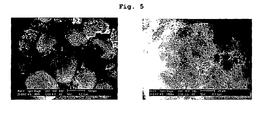
- the figure 5 represents the appearance of the composite cement showing the state of the spheres after a degradation of 11 days (left picture) and 18 days (right picture).
- the comparison with the figure 1 shows well the evolution of the microspheres which are very sharp after 1 day, which have irregularities after 11 days and a sponge appearance after 18 days.
- the presence of oligomers and monomers and the drop in pH after 24 days indicate accelerated degradation of the polymer from the 24 th day: the polymer swells, which resulted in the bursting of the pads after 45 days.
Landscapes
- Health & Medical Sciences (AREA)
- Chemical & Material Sciences (AREA)
- General Health & Medical Sciences (AREA)
- Public Health (AREA)
- Materials Engineering (AREA)
- Engineering & Computer Science (AREA)
- Veterinary Medicine (AREA)
- Epidemiology (AREA)
- Life Sciences & Earth Sciences (AREA)
- Animal Behavior & Ethology (AREA)
- Inorganic Chemistry (AREA)
- Composite Materials (AREA)
- Surgery (AREA)
- Dermatology (AREA)
- Medicinal Chemistry (AREA)
- Oral & Maxillofacial Surgery (AREA)
- Transplantation (AREA)
- Materials For Medical Uses (AREA)
- Prostheses (AREA)
- Curing Cements, Concrete, And Artificial Stone (AREA)
- Pharmaceuticals Containing Other Organic And Inorganic Compounds (AREA)
Claims (21)
- Zusammensetzung für injizierbaren Zement, dadurch gekennzeichnet, dass sie eine mineralische feste Phase und eine getrennte flüssige Phase umfasst und eventuell Mikropartikel eines biologisch verträglichen und biologisch abbaubaren Polymers,- wobei die mineralische feste Phase von einem Pulvergemisch mit der molaren Zusammensetzung (CP)6 (CaO)y (SrCO3)z gebildet wird, wobei CP Calciumhydrogenphosphatdihydrat CaHPO4, 2H2O (DCPD), wasserfreies Calciumhydrogenphosphat CaHPO4 (DCPA), wasserfreies Calcium- und Strontiumhydrogenphosphatgemisch (Ca1-xSrx) HPO4, ein äquimolares Gemisch aus Calcium-bis-dihydrogenphosphat Monohydrat Ca (H2PO4)2, H2O (MCPM) und Calciumoxid CaO, oder ein Gemisch von zwei oder drei dieser Verbindungen, und y+z = 4±1 darstellt,- die flüssige Phase aus pyrogenfreiem reinem Wasser oder einer wässrigen Salzlösung mit einem pH von 4 bis 9 besteht,wobei das Verhältnis L/P [Volumen der flüssigen Phase / Masse der mineralischen festen Phase] mindestens gleich 0,4 ml/g ist.
- Zusammensetzung nach Anspruch 1, dadurch gekennzeichnet, dass CP CaHPO4, 2H2O darstellt.
- Zusammensetzung nach Anspruch 1, dadurch gekennzeichnet, dass CP ein Gemisch ist, das CaHPO4, 2H2O umfasst.
- Zusammensetzung für injizierbaren Zement nach Anspruch 1, dadurch gekennzeichnet, dass die flüssige Phase eine Lösung ist, die 0,4 bis 1 mol/l eines Gemischs aus NaH2PO4 und Na2HPO4, 12H2O enthält.
- Zusammensetzung für Zement nach Anspruch 1, dadurch gekennzeichnet, dass die flüssige Phase eine Lösung ist, die 0,4 bis 1 mol/l eines Gemischs aus NaH2PO4 und Natriumglycerophosphat-Hexahyrat Na2PO4C3H7O2, 6H2O enthält.
- Zusammensetzung für injizierbaren Zement nach Anspruch 1, dadurch gekennzeichnet, dass die flüssige Phase eine wässrige Lösung ist, die 0,4 bis 1,5 mol/l eines Gemischs aus NH4H2PO4 und (NH4)2HPO4 enthält.
- Zusammensetzung für injizierbaren Zement nach Anspruch 1, dadurch gekennzeichnet, das die mineralische feste Phase Mikropartikel eines biologisch verträglichen und biologisch abbaubaren Polymers enthält.
- Zusammensetzung für injizierbaren Zement nach Anspruch 1, dadurch gekennzeichnet, dass sie eine dritte Phase umfasst, die von Mikropartikeln eines biologisch verträglichen und biologisch abbaubaren Polymers gebildet wird.
- Zusammensetzung für injizierbaren Zement nach einem der Ansprüche 7 und 8, dadurch gekennzeichnet, dass das Polymer ein immanent amorphes PLAGA-Polymer ist, das von L-Milchsäureeinheiten, D-Milchsäureeinheiten und Glycoleinheiten gebildet wird, oder ein PLA-Polymer, das ausschließlich von L-Milchsäureeinheiten gebildet wird, oder ein Copolymer aus Milchsäure, Glycolsäure und Gluconsäure.
- Zusammensetzung für injizierbaren Zement nach einem der Ansprüche 7 und 8, dadurch gekennzeichnet, dass das Massenverhältnis des Polymers in der mineralischen festen Phase zwischen 20 und 60 % inklusive ist.
- Zusammensetzung für injizierbaren Zement nach Anspruch 1, dadurch gekennzeichnet, dass mindestens ein Teil des Strontiumscarbonats radioaktives Strontium-89-Carbonat ist.
- Zusammensetzung für injizierbaren Zement nach Anspruch 1, die keine Polymer-Mikropartikel enthält, dadurch gekennzeichnet, dass das Verhältnis L/P 0,4 ml/g bis 0,7 ml/g ist.
- Zusammensetzung für injizierbaren Zement nach Anspruch 1, die Polymer-Mikropartikel enthält, dadurch gekennzeichnet, dass das Verhältnis L/P größer oder gleich 0,6 ml/g ist.
- Verfahren zur Zubereitung eines injizierbaren Zements aus einer Zusammensetzung nach Anspruch 1, dadurch gekennzeichnet, dass es darin besteht, die feste Phase und die flüssige Phase der Zusammensetzung für injizierbaren Zement im Moment der Verwendung des injizierbaren Zements unter den für die Injektion von Knochenersatz erforderlichen aseptischen Bedingungen in Kontakt zu bringen.
- Verfahren nach Anspruch 14, dadurch gekennzeichnet, dass eine Zusammensetzung nach Anspruch 7 verwendet wird, wobei die feste Phase Polymer-Mikropartikel enthält.
- Verfahren nach Anspruch 14, dadurch gekennzeichnet, dass eine Zusammensetzung nach Anspruch 8 verwendet wird, die eine dritte Phase umfasst, die von Polymer-Mikropartikeln gebildet wird, wobei die dritte Phase hinzugefügt wird, nachdem die mineralische feste Phase und die flüssige Phase in Kontakt gebracht wurden.
- Injizierbarer Zement, der durch ein Verfahren nach Anspruch 14 hergestellt wird, dadurch gekennzeichnet, dass er aus (CP), (CaO) (SrCO3), [wobei CP Calciumhydrogenphosphatdihydrat CaHPO4, 2H2O (DCPD), wasserfreies Calciumhydrogenphosphat CaHPO4 (DCPA), wasserfreies Calcium- und Strontiumhydrogenphosphatgemisch (Ca1-xSrx) HPO4 darstellt], einem äquimolaren Gemisch aus Calcium-bis-dihydrogenphosphat Monohydrat Ca (H2PO4)2, H2O (MCPM) und Calciumoxid CaO oder einem Gemisch dieser Bestandteile), Wasser und eventuell in der flüssigen Phase enthaltenen Salzen besteht, wobei die entsprechenden Mengen derart sind, dass:- das molare Verhältnis (CP) / (CaO) / (SrC03) 6/y/z mit y+z = 4+1 beträgt,- das Verhältnis Flüssigkeit (Volumen) / Feststoff (Masse) 0,4 bis 0,7 ml/g, insbesondere 0,5 bis 0,6 ml/g beträgt.
- Injizierbarer Zement nach Anspruch 17, dadurch gekennzeichnet, dass CP CaHPO4, 2H2O darstellt.
- Injizierbarer Zement, der durch das Verfahren nach Anspruch 15 oder 16 hergestellt wird, dadurch gekennzeichnet, dass er aus (CP), (CaO) (SrCO3) [wobei CP Calciumhydrogenphosphatdihydrat CaHPO4, 2H2O (DCPD), wasserfreies Calciumhydrogenphosphat CaHPO4 (DCPA), wasserfreies Calcium- und Strontiumhydrogenphosphatgemisch (Ca1-xSrx) HPO4 darstellt], einem äquimolaren Gemisch aus Calcium-bis-dihydrogenphosphat Monohydrat Ca (H2PO4)2, H2O (MCPM) und Calciumoxid CaO, oder einem Gemisch dieser Bestandteile), Polymer-Mikropartikeln, Wasser und eventuell in der flüssigen Phase enthaltenen Salzen besteht, wobei die entsprechenden Mengen derart sind, dass:- das molare Verhältnis (CP) / (CaO) / (SrC03) 6/y/z mit y+z = 4+1 beträgt,- das ursprüngliche Verhältnis L/P größer oder gleich 0,6 ml/g ist,- das Massenverhältnis Polymer/mineralische feste Phase zwischen 20 und 60 % ist.
- Injizierbarer Zement nach Anspruch 17 oder 19 zur Behandlung der Osteoporose oder für die Vertebroplastik.
- Injizierbarer Zement nach Anspruch 17 oder 19 für den Knochenaufbau nach einer Fraktur oder einer Exzision.
Applications Claiming Priority (2)
| Application Number | Priority Date | Filing Date | Title |
|---|---|---|---|
| FR0404714A FR2869544B1 (fr) | 2004-05-03 | 2004-05-03 | Composition pour ciment injectable, utile comme substitut osseux |
| PCT/FR2005/001078 WO2005115488A2 (fr) | 2004-05-03 | 2005-04-29 | Composition pour ciment injectable, utile comme substitut osseux |
Publications (2)
| Publication Number | Publication Date |
|---|---|
| EP1742676A2 EP1742676A2 (de) | 2007-01-17 |
| EP1742676B1 true EP1742676B1 (de) | 2011-04-13 |
Family
ID=34946284
Family Applications (1)
| Application Number | Title | Priority Date | Filing Date |
|---|---|---|---|
| EP05763676A Expired - Lifetime EP1742676B1 (de) | 2004-05-03 | 2005-04-29 | Zusammmensetzung für injizierbaren zement als knochenersatz |
Country Status (7)
| Country | Link |
|---|---|
| US (1) | US8440737B2 (de) |
| EP (1) | EP1742676B1 (de) |
| JP (1) | JP5039542B2 (de) |
| AT (1) | ATE505215T1 (de) |
| DE (1) | DE602005027451D1 (de) |
| FR (1) | FR2869544B1 (de) |
| WO (1) | WO2005115488A2 (de) |
Families Citing this family (19)
| Publication number | Priority date | Publication date | Assignee | Title |
|---|---|---|---|---|
| US8663225B2 (en) | 2004-11-12 | 2014-03-04 | Medtronic, Inc. | Hydrogel bone void filler |
| WO2007056872A1 (en) | 2005-11-15 | 2007-05-24 | Dr.H.C. Robert Mathys Stiftung | Bone repair material |
| FR2903684B1 (fr) * | 2006-07-12 | 2008-10-17 | Centre Nat Rech Scient | Nouveau compose phospho-calco-strontique et ses utilisations dans des ciments endodontiques. |
| EP2142224B1 (de) * | 2007-04-23 | 2016-03-23 | Baxter International Inc. | Fibrinzusammensetzungen mit strontiumverbindungen |
| US20080317807A1 (en) * | 2007-06-22 | 2008-12-25 | The University Of Hong Kong | Strontium fortified calcium nano-and microparticle compositions and methods of making and using thereof |
| US8709149B2 (en) | 2008-11-12 | 2014-04-29 | Ossdsign Ab | Hydraulic cements, methods and products |
| WO2011112145A1 (en) | 2010-03-10 | 2011-09-15 | Engqvist Haakan | Implants and methods for correcting tissue defects |
| WO2011137292A2 (en) * | 2010-04-30 | 2011-11-03 | University Of Maryland, Baltimore | Injectable, load-bearing cell/microbead/calcium phosphate bone paste for bone tissue engineering |
| US8486080B2 (en) | 2010-07-23 | 2013-07-16 | Warsaw Orthopedic, Inc. | Bone replacement material delivery devices and methods of monitoring bone replacement material |
| US9463046B2 (en) | 2011-08-22 | 2016-10-11 | Ossdsign Ab | Implants and methods for using such implants to fill holes in bone tissue |
| US20130066327A1 (en) | 2011-09-09 | 2013-03-14 | Håkan Engqvist | Hydraulic cement compositions with low ph methods, articles and kits |
| US8591645B2 (en) | 2011-09-09 | 2013-11-26 | Ossdsign Ab | Hydraulic cements with optimized grain size distribution, methods, articles and kits |
| EP2931325B1 (de) | 2012-12-14 | 2020-02-19 | OssDsign AB | Zementformende zusammensetzungen, monetitzemente, implantate und verfahren zur korrektur von knochendefekten |
| CN105120802B (zh) | 2013-02-12 | 2018-01-12 | 奥斯设计公司 | 镶嵌型植入物、试剂盒和用于矫正骨缺损的方法 |
| BR112017002863A2 (pt) | 2014-08-14 | 2018-01-30 | Ossdsign Ab | implantes ósseos para correção de defeitos ósseos |
| US20170232151A1 (en) * | 2016-02-13 | 2017-08-17 | National Taiwan University | Bioresorbable synthetic bone graft |
| KR20210119950A (ko) | 2018-10-16 | 2021-10-06 | 오에스에스디자인 아베 | 뼈의 천공 구멍을 채우기 위한 임플란트 및 뼈의 천공 구멍을 채우기 위한 방법 (implants for filling bore holes in bone and methods for filling bore holes in bone) |
| FR3116713B1 (fr) * | 2020-12-02 | 2023-02-10 | Produits Dentaires Pierre Rolland | Produit dentaire pour la formation d’un ciment endodontique |
| CN115382012A (zh) * | 2022-09-21 | 2022-11-25 | 苏州大学 | 一种透钙磷石骨水泥及其制备方法和应用 |
Family Cites Families (10)
| Publication number | Priority date | Publication date | Assignee | Title |
|---|---|---|---|---|
| ES2040626B1 (es) * | 1991-11-22 | 1994-05-16 | Boltong Maria G | Procedimiento para la obtencion de cementos de fosfatos de calcio y su empleo como biomteriales. |
| US5525148A (en) * | 1993-09-24 | 1996-06-11 | American Dental Association Health Foundation | Self-setting calcium phosphate cements and methods for preparing and using them |
| EP1123081B1 (de) * | 1998-10-19 | 2002-12-11 | SYNTHES AG Chur | Aushärtbarer keramischer hydraulischer zement |
| ATE243049T1 (de) * | 1999-12-09 | 2003-07-15 | Biosyntech Canada Inc | Mineral-polymer hybrid-zusammensetzung |
| US6593394B1 (en) * | 2000-01-03 | 2003-07-15 | Prosperous Kingdom Limited | Bioactive and osteoporotic bone cement |
| US6456680B1 (en) * | 2000-03-29 | 2002-09-24 | Tci Incorporated | Method of strontium-89 radioisotope production |
| DE10032220A1 (de) * | 2000-07-03 | 2002-01-24 | Sanatis Gmbh | Magnesium-ammonium-phosphat-Zemente, deren Herstellung und Verwendung |
| AU2002327007B2 (en) * | 2001-09-21 | 2005-10-20 | Stryker Corporation | Pore-forming agents for orthopedic cements |
| DE10225420A1 (de) * | 2002-06-07 | 2003-12-24 | Sanatis Gmbh | Strontium-Apatit-Zement-Zubereitungen, die daraus gebildeten Zemente und die Verwendung davon |
| US7273523B2 (en) * | 2002-06-07 | 2007-09-25 | Kyphon Inc. | Strontium-apatite-cement-preparations, cements formed therefrom, and uses thereof |
-
2004
- 2004-05-03 FR FR0404714A patent/FR2869544B1/fr not_active Expired - Fee Related
-
2005
- 2005-04-29 JP JP2007512254A patent/JP5039542B2/ja not_active Expired - Fee Related
- 2005-04-29 US US11/579,535 patent/US8440737B2/en not_active Expired - Fee Related
- 2005-04-29 WO PCT/FR2005/001078 patent/WO2005115488A2/fr not_active Ceased
- 2005-04-29 EP EP05763676A patent/EP1742676B1/de not_active Expired - Lifetime
- 2005-04-29 DE DE602005027451T patent/DE602005027451D1/de not_active Expired - Lifetime
- 2005-04-29 AT AT05763676T patent/ATE505215T1/de not_active IP Right Cessation
Also Published As
| Publication number | Publication date |
|---|---|
| WO2005115488A2 (fr) | 2005-12-08 |
| JP5039542B2 (ja) | 2012-10-03 |
| US20080027455A1 (en) | 2008-01-31 |
| FR2869544B1 (fr) | 2006-07-21 |
| US8440737B2 (en) | 2013-05-14 |
| EP1742676A2 (de) | 2007-01-17 |
| FR2869544A1 (fr) | 2005-11-04 |
| DE602005027451D1 (de) | 2011-05-26 |
| ATE505215T1 (de) | 2011-04-15 |
| WO2005115488A3 (fr) | 2006-05-26 |
| JP2007536044A (ja) | 2007-12-13 |
Similar Documents
| Publication | Publication Date | Title |
|---|---|---|
| EP1742676B1 (de) | Zusammmensetzung für injizierbaren zement als knochenersatz | |
| EP0881920B1 (de) | Verfahren zur herstellung eines implantierbaren verbundwerkstoffs, so hergestellte werkstoffe, und kit zur durchführung des verfahrens | |
| Xu et al. | Fast‐setting calcium phosphate scaffolds with tailored macropore formation rates for bone regeneration | |
| Ooms et al. | Trabecular bone response to injectable calcium phosphate (Ca‐P) cement | |
| Maquet et al. | Preparation, characterization, and in vitro degradation of bioresorbable and bioactive composites based on Bioglass®‐filled polylactide foams | |
| US6652887B1 (en) | Bone graft substitute composition | |
| EP2365994B1 (de) | Organophosphorzusammensetzungen auf tetra-calciumphosphat-basis und entsprechende verfahren | |
| Sarda et al. | Influence of surfactant molecules as air‐entraining agent for bone cement macroporosity | |
| JP2007527753A (ja) | 外科用のリン酸カルシウムをベースとする水硬セメント | |
| WO2022088634A1 (zh) | 一种注射型镁基碳纳米管复合微球活化磷酸钙生物骨粘合剂及其制备方法和应用 | |
| WO2012039592A1 (fr) | Procede d'elaboration d'un ciment biphasé macroporeux a base de bioverre d'une apatite, bioactif, bioresorbable a usage biomedical | |
| EP2970000A1 (de) | Calciumphosphatzementzusammensetzungen für abbindung in hochfeste poröse strukturen | |
| FR2688139A1 (fr) | Nouveau revetement pour systeme prothetique. | |
| KR100957543B1 (ko) | 비정질 칼슘 포스페이트를 함유하는 골대체용 조성물 | |
| EP3515513B1 (de) | Extrazelluläres matrixmaterial | |
| EP2307064B1 (de) | Calciumphosphathaltige biomaterialien | |
| EP2331151B1 (de) | Poröses bioglas und calciumsulfat enthaltender knochenersatz | |
| Im et al. | Growth factor releasing porous poly (ɛ-caprolactone)-chitosan matrices for enhanced bone regenerative rherapy | |
| WO2017198970A1 (fr) | Produit et procede pour la preparation d'une composition injectable, a base de chitosane et de bioverres, destinee a la regeneration du tissu osseux | |
| EP2200670B1 (de) | Knochenersatz mit kontrastmittel, verfahren zu seiner herstellung und verwendung | |
| KR102473250B1 (ko) | 베타-삼칼슘인산, 및 폴리카프로락톤을 포함하는 인장강도가 개선된 다공성 치주조직 재생용 지지체 및 이의 제조방법 | |
| CN1390607A (zh) | 一种改性羟基磷灰石代骨材料及其制备方法和应用 | |
| Grosfeld et al. | Compositional variations in calcium phosphate cement and poly (lactic‐co‐glycolic‐acid) porogens do not affect the orthotopic performance of calcium phosphate cement/poly (lactic‐co‐glycolic‐acid) cements | |
| JP2020069216A (ja) | 骨再生材料キット、ペースト状骨再生材料、骨再生材料及び骨接合材 | |
| FR2937872A1 (fr) | Comblement osseux a forte resistance mecanique. |
Legal Events
| Date | Code | Title | Description |
|---|---|---|---|
| PUAI | Public reference made under article 153(3) epc to a published international application that has entered the european phase |
Free format text: ORIGINAL CODE: 0009012 |
|
| 17P | Request for examination filed |
Effective date: 20061031 |
|
| AK | Designated contracting states |
Kind code of ref document: A2 Designated state(s): AT BE BG CH CY CZ DE DK EE ES FI FR GB GR HU IE IS IT LI LT LU MC NL PL PT RO SE SI SK TR |
|
| DAX | Request for extension of the european patent (deleted) | ||
| 17Q | First examination report despatched |
Effective date: 20070515 |
|
| GRAP | Despatch of communication of intention to grant a patent |
Free format text: ORIGINAL CODE: EPIDOSNIGR1 |
|
| GRAS | Grant fee paid |
Free format text: ORIGINAL CODE: EPIDOSNIGR3 |
|
| GRAA | (expected) grant |
Free format text: ORIGINAL CODE: 0009210 |
|
| AK | Designated contracting states |
Kind code of ref document: B1 Designated state(s): AT BE BG CH CY CZ DE DK EE ES FI FR GB GR HU IE IS IT LI LT LU MC NL PL PT RO SE SI SK TR |
|
| REG | Reference to a national code |
Ref country code: GB Ref legal event code: FG4D Free format text: NOT ENGLISH |
|
| REG | Reference to a national code |
Ref country code: CH Ref legal event code: EP |
|
| REG | Reference to a national code |
Ref country code: IE Ref legal event code: FG4D Free format text: LANGUAGE OF EP DOCUMENT: FRENCH |
|
| REF | Corresponds to: |
Ref document number: 602005027451 Country of ref document: DE Date of ref document: 20110526 Kind code of ref document: P |
|
| REG | Reference to a national code |
Ref country code: DE Ref legal event code: R096 Ref document number: 602005027451 Country of ref document: DE Effective date: 20110526 |
|
| REG | Reference to a national code |
Ref country code: NL Ref legal event code: VDEP Effective date: 20110413 |
|
| LTIE | Lt: invalidation of european patent or patent extension |
Effective date: 20110413 |
|
| PG25 | Lapsed in a contracting state [announced via postgrant information from national office to epo] |
Ref country code: PT Free format text: LAPSE BECAUSE OF FAILURE TO SUBMIT A TRANSLATION OF THE DESCRIPTION OR TO PAY THE FEE WITHIN THE PRESCRIBED TIME-LIMIT Effective date: 20110816 Ref country code: SE Free format text: LAPSE BECAUSE OF FAILURE TO SUBMIT A TRANSLATION OF THE DESCRIPTION OR TO PAY THE FEE WITHIN THE PRESCRIBED TIME-LIMIT Effective date: 20110413 Ref country code: LT Free format text: LAPSE BECAUSE OF FAILURE TO SUBMIT A TRANSLATION OF THE DESCRIPTION OR TO PAY THE FEE WITHIN THE PRESCRIBED TIME-LIMIT Effective date: 20110413 |
|
| REG | Reference to a national code |
Ref country code: IE Ref legal event code: FD4D |
|
| PG25 | Lapsed in a contracting state [announced via postgrant information from national office to epo] |
Ref country code: GR Free format text: LAPSE BECAUSE OF FAILURE TO SUBMIT A TRANSLATION OF THE DESCRIPTION OR TO PAY THE FEE WITHIN THE PRESCRIBED TIME-LIMIT Effective date: 20110714 Ref country code: FI Free format text: LAPSE BECAUSE OF FAILURE TO SUBMIT A TRANSLATION OF THE DESCRIPTION OR TO PAY THE FEE WITHIN THE PRESCRIBED TIME-LIMIT Effective date: 20110413 Ref country code: AT Free format text: LAPSE BECAUSE OF FAILURE TO SUBMIT A TRANSLATION OF THE DESCRIPTION OR TO PAY THE FEE WITHIN THE PRESCRIBED TIME-LIMIT Effective date: 20110413 Ref country code: SI Free format text: LAPSE BECAUSE OF FAILURE TO SUBMIT A TRANSLATION OF THE DESCRIPTION OR TO PAY THE FEE WITHIN THE PRESCRIBED TIME-LIMIT Effective date: 20110413 Ref country code: CY Free format text: LAPSE BECAUSE OF FAILURE TO SUBMIT A TRANSLATION OF THE DESCRIPTION OR TO PAY THE FEE WITHIN THE PRESCRIBED TIME-LIMIT Effective date: 20110413 Ref country code: ES Free format text: LAPSE BECAUSE OF FAILURE TO SUBMIT A TRANSLATION OF THE DESCRIPTION OR TO PAY THE FEE WITHIN THE PRESCRIBED TIME-LIMIT Effective date: 20110724 Ref country code: IS Free format text: LAPSE BECAUSE OF FAILURE TO SUBMIT A TRANSLATION OF THE DESCRIPTION OR TO PAY THE FEE WITHIN THE PRESCRIBED TIME-LIMIT Effective date: 20110813 Ref country code: MC Free format text: LAPSE BECAUSE OF NON-PAYMENT OF DUE FEES Effective date: 20110430 |
|
| REG | Reference to a national code |
Ref country code: CH Ref legal event code: PL |
|
| PG25 | Lapsed in a contracting state [announced via postgrant information from national office to epo] |
Ref country code: NL Free format text: LAPSE BECAUSE OF FAILURE TO SUBMIT A TRANSLATION OF THE DESCRIPTION OR TO PAY THE FEE WITHIN THE PRESCRIBED TIME-LIMIT Effective date: 20110413 |
|
| PG25 | Lapsed in a contracting state [announced via postgrant information from national office to epo] |
Ref country code: LI Free format text: LAPSE BECAUSE OF NON-PAYMENT OF DUE FEES Effective date: 20110430 Ref country code: CH Free format text: LAPSE BECAUSE OF NON-PAYMENT OF DUE FEES Effective date: 20110430 Ref country code: IE Free format text: LAPSE BECAUSE OF FAILURE TO SUBMIT A TRANSLATION OF THE DESCRIPTION OR TO PAY THE FEE WITHIN THE PRESCRIBED TIME-LIMIT Effective date: 20110413 Ref country code: CZ Free format text: LAPSE BECAUSE OF FAILURE TO SUBMIT A TRANSLATION OF THE DESCRIPTION OR TO PAY THE FEE WITHIN THE PRESCRIBED TIME-LIMIT Effective date: 20110413 Ref country code: EE Free format text: LAPSE BECAUSE OF FAILURE TO SUBMIT A TRANSLATION OF THE DESCRIPTION OR TO PAY THE FEE WITHIN THE PRESCRIBED TIME-LIMIT Effective date: 20110413 |
|
| PLBE | No opposition filed within time limit |
Free format text: ORIGINAL CODE: 0009261 |
|
| STAA | Information on the status of an ep patent application or granted ep patent |
Free format text: STATUS: NO OPPOSITION FILED WITHIN TIME LIMIT |
|
| PG25 | Lapsed in a contracting state [announced via postgrant information from national office to epo] |
Ref country code: DK Free format text: LAPSE BECAUSE OF FAILURE TO SUBMIT A TRANSLATION OF THE DESCRIPTION OR TO PAY THE FEE WITHIN THE PRESCRIBED TIME-LIMIT Effective date: 20110413 Ref country code: PL Free format text: LAPSE BECAUSE OF FAILURE TO SUBMIT A TRANSLATION OF THE DESCRIPTION OR TO PAY THE FEE WITHIN THE PRESCRIBED TIME-LIMIT Effective date: 20110413 Ref country code: SK Free format text: LAPSE BECAUSE OF FAILURE TO SUBMIT A TRANSLATION OF THE DESCRIPTION OR TO PAY THE FEE WITHIN THE PRESCRIBED TIME-LIMIT Effective date: 20110413 Ref country code: RO Free format text: LAPSE BECAUSE OF FAILURE TO SUBMIT A TRANSLATION OF THE DESCRIPTION OR TO PAY THE FEE WITHIN THE PRESCRIBED TIME-LIMIT Effective date: 20110413 |
|
| 26N | No opposition filed |
Effective date: 20120116 |
|
| REG | Reference to a national code |
Ref country code: DE Ref legal event code: R097 Ref document number: 602005027451 Country of ref document: DE Effective date: 20120116 |
|
| PG25 | Lapsed in a contracting state [announced via postgrant information from national office to epo] |
Ref country code: IT Free format text: LAPSE BECAUSE OF FAILURE TO SUBMIT A TRANSLATION OF THE DESCRIPTION OR TO PAY THE FEE WITHIN THE PRESCRIBED TIME-LIMIT Effective date: 20110413 |
|
| PG25 | Lapsed in a contracting state [announced via postgrant information from national office to epo] |
Ref country code: LU Free format text: LAPSE BECAUSE OF NON-PAYMENT OF DUE FEES Effective date: 20110429 |
|
| PG25 | Lapsed in a contracting state [announced via postgrant information from national office to epo] |
Ref country code: BG Free format text: LAPSE BECAUSE OF FAILURE TO SUBMIT A TRANSLATION OF THE DESCRIPTION OR TO PAY THE FEE WITHIN THE PRESCRIBED TIME-LIMIT Effective date: 20110713 |
|
| PG25 | Lapsed in a contracting state [announced via postgrant information from national office to epo] |
Ref country code: TR Free format text: LAPSE BECAUSE OF FAILURE TO SUBMIT A TRANSLATION OF THE DESCRIPTION OR TO PAY THE FEE WITHIN THE PRESCRIBED TIME-LIMIT Effective date: 20110413 |
|
| PG25 | Lapsed in a contracting state [announced via postgrant information from national office to epo] |
Ref country code: HU Free format text: LAPSE BECAUSE OF FAILURE TO SUBMIT A TRANSLATION OF THE DESCRIPTION OR TO PAY THE FEE WITHIN THE PRESCRIBED TIME-LIMIT Effective date: 20110413 |
|
| REG | Reference to a national code |
Ref country code: FR Ref legal event code: PLFP Year of fee payment: 12 |
|
| REG | Reference to a national code |
Ref country code: FR Ref legal event code: PLFP Year of fee payment: 13 |
|
| REG | Reference to a national code |
Ref country code: FR Ref legal event code: PLFP Year of fee payment: 14 |
|
| REG | Reference to a national code |
Ref country code: GB Ref legal event code: 732E Free format text: REGISTERED BETWEEN 20181206 AND 20181212 |
|
| REG | Reference to a national code |
Ref country code: DE Ref legal event code: R081 Ref document number: 602005027451 Country of ref document: DE Owner name: CENTRE NATIONAL DE LA RECHERCHE SCIENTIFIQUE, FR Free format text: FORMER OWNERS: CENTRE NATIONAL DE LA RECHERCHE SCIENTIFIQUE, PARIS, FR; UNIVERSITE DE MONTPELLIER I, MONTPELLIER, FR Ref country code: DE Ref legal event code: R081 Ref document number: 602005027451 Country of ref document: DE Owner name: UNIVERSITE DE MONTPELLIER, FR Free format text: FORMER OWNERS: CENTRE NATIONAL DE LA RECHERCHE SCIENTIFIQUE, PARIS, FR; UNIVERSITE DE MONTPELLIER I, MONTPELLIER, FR |
|
| REG | Reference to a national code |
Ref country code: BE Ref legal event code: PD Owner name: UNIVERSITE DE MONTPELLIER; FR Free format text: DETAILS ASSIGNMENT: CHANGE OF OWNER(S), FUSION; FORMER OWNER NAME: UNIVERSITE DE MONTPELLIER I Effective date: 20190125 |
|
| PGFP | Annual fee paid to national office [announced via postgrant information from national office to epo] |
Ref country code: FR Payment date: 20200430 Year of fee payment: 16 Ref country code: DE Payment date: 20200408 Year of fee payment: 16 |
|
| PGFP | Annual fee paid to national office [announced via postgrant information from national office to epo] |
Ref country code: GB Payment date: 20200427 Year of fee payment: 16 Ref country code: BE Payment date: 20200415 Year of fee payment: 16 |
|
| REG | Reference to a national code |
Ref country code: DE Ref legal event code: R119 Ref document number: 602005027451 Country of ref document: DE |
|
| GBPC | Gb: european patent ceased through non-payment of renewal fee |
Effective date: 20210429 |
|
| REG | Reference to a national code |
Ref country code: BE Ref legal event code: MM Effective date: 20210430 |
|
| PG25 | Lapsed in a contracting state [announced via postgrant information from national office to epo] |
Ref country code: GB Free format text: LAPSE BECAUSE OF NON-PAYMENT OF DUE FEES Effective date: 20210429 Ref country code: FR Free format text: LAPSE BECAUSE OF NON-PAYMENT OF DUE FEES Effective date: 20210430 Ref country code: DE Free format text: LAPSE BECAUSE OF NON-PAYMENT OF DUE FEES Effective date: 20211103 |
|
| PG25 | Lapsed in a contracting state [announced via postgrant information from national office to epo] |
Ref country code: BE Free format text: LAPSE BECAUSE OF NON-PAYMENT OF DUE FEES Effective date: 20210430 |