EP1746324A1 - Procede de fabrication de tubes de protection - Google Patents
Procede de fabrication de tubes de protection Download PDFInfo
- Publication number
- EP1746324A1 EP1746324A1 EP05748801A EP05748801A EP1746324A1 EP 1746324 A1 EP1746324 A1 EP 1746324A1 EP 05748801 A EP05748801 A EP 05748801A EP 05748801 A EP05748801 A EP 05748801A EP 1746324 A1 EP1746324 A1 EP 1746324A1
- Authority
- EP
- European Patent Office
- Prior art keywords
- bands
- shaping
- flat
- procedure according
- polyester
- Prior art date
- Legal status (The legal status is an assumption and is not a legal conclusion. Google has not performed a legal analysis and makes no representation as to the accuracy of the status listed.)
- Withdrawn
Links
Images


Classifications
-
- F—MECHANICAL ENGINEERING; LIGHTING; HEATING; WEAPONS; BLASTING
- F16—ENGINEERING ELEMENTS AND UNITS; GENERAL MEASURES FOR PRODUCING AND MAINTAINING EFFECTIVE FUNCTIONING OF MACHINES OR INSTALLATIONS; THERMAL INSULATION IN GENERAL
- F16L—PIPES; JOINTS OR FITTINGS FOR PIPES; SUPPORTS FOR PIPES, CABLES OR PROTECTIVE TUBING; MEANS FOR THERMAL INSULATION IN GENERAL
- F16L57/00—Protection of pipes or objects of similar shape against external or internal damage or wear
- F16L57/06—Protection of pipes or objects of similar shape against external or internal damage or wear against wear
-
- B—PERFORMING OPERATIONS; TRANSPORTING
- B29—WORKING OF PLASTICS; WORKING OF SUBSTANCES IN A PLASTIC STATE IN GENERAL
- B29C—SHAPING OR JOINING OF PLASTICS; SHAPING OF MATERIAL IN A PLASTIC STATE, NOT OTHERWISE PROVIDED FOR; AFTER-TREATMENT OF THE SHAPED PRODUCTS, e.g. REPAIRING
- B29C53/00—Shaping by bending, folding, twisting, straightening or flattening; Apparatus therefor
- B29C53/02—Bending or folding
-
- D—TEXTILES; PAPER
- D04—BRAIDING; LACE-MAKING; KNITTING; TRIMMINGS; NON-WOVEN FABRICS
- D04B—KNITTING
- D04B21/00—Warp knitting processes for the production of fabrics or articles not dependent on the use of particular machines; Fabrics or articles defined by such processes
- D04B21/20—Warp knitting processes for the production of fabrics or articles not dependent on the use of particular machines; Fabrics or articles defined by such processes specially adapted for knitting articles of particular configuration
-
- H—ELECTRICITY
- H02—GENERATION; CONVERSION OR DISTRIBUTION OF ELECTRIC POWER
- H02G—INSTALLATION OF ELECTRIC CABLES OR LINES, OR OF COMBINED OPTICAL AND ELECTRIC CABLES OR LINES
- H02G3/00—Installations of electric cables or lines or protective tubing therefor in or on buildings, equivalent structures or vehicles
- H02G3/02—Details
- H02G3/04—Protective tubing or conduits, e.g. cable ladders or cable troughs
- H02G3/0406—Details thereof
-
- H—ELECTRICITY
- H02—GENERATION; CONVERSION OR DISTRIBUTION OF ELECTRIC POWER
- H02G—INSTALLATION OF ELECTRIC CABLES OR LINES, OR OF COMBINED OPTICAL AND ELECTRIC CABLES OR LINES
- H02G3/00—Installations of electric cables or lines or protective tubing therefor in or on buildings, equivalent structures or vehicles
- H02G3/02—Details
- H02G3/04—Protective tubing or conduits, e.g. cable ladders or cable troughs
- H02G3/0462—Tubings, i.e. having a closed section
- H02G3/0481—Tubings, i.e. having a closed section with a circular cross-section
-
- B—PERFORMING OPERATIONS; TRANSPORTING
- B29—WORKING OF PLASTICS; WORKING OF SUBSTANCES IN A PLASTIC STATE IN GENERAL
- B29K—INDEXING SCHEME ASSOCIATED WITH SUBCLASSES B29B, B29C OR B29D, RELATING TO MOULDING MATERIALS OR TO MATERIALS FOR MOULDS, REINFORCEMENTS, FILLERS OR PREFORMED PARTS, e.g. INSERTS
- B29K2313/00—Use of textile products or fabrics as reinforcement
-
- D—TEXTILES; PAPER
- D10—INDEXING SCHEME ASSOCIATED WITH SUBLASSES OF SECTION D, RELATING TO TEXTILES
- D10B—INDEXING SCHEME ASSOCIATED WITH SUBLASSES OF SECTION D, RELATING TO TEXTILES
- D10B2101/00—Inorganic fibres
- D10B2101/02—Inorganic fibres based on oxides or oxide ceramics, e.g. silicates
- D10B2101/06—Glass
-
- D—TEXTILES; PAPER
- D10—INDEXING SCHEME ASSOCIATED WITH SUBLASSES OF SECTION D, RELATING TO TEXTILES
- D10B—INDEXING SCHEME ASSOCIATED WITH SUBLASSES OF SECTION D, RELATING TO TEXTILES
- D10B2331/00—Fibres made from polymers obtained otherwise than by reactions only involving carbon-to-carbon unsaturated bonds, e.g. polycondensation products
- D10B2331/04—Fibres made from polymers obtained otherwise than by reactions only involving carbon-to-carbon unsaturated bonds, e.g. polycondensation products polyesters, e.g. polyethylene terephthalate [PET]
-
- D—TEXTILES; PAPER
- D10—INDEXING SCHEME ASSOCIATED WITH SUBLASSES OF SECTION D, RELATING TO TEXTILES
- D10B—INDEXING SCHEME ASSOCIATED WITH SUBLASSES OF SECTION D, RELATING TO TEXTILES
- D10B2401/00—Physical properties
- D10B2401/04—Heat-responsive characteristics
- D10B2401/041—Heat-responsive characteristics thermoplastic; thermosetting
-
- D—TEXTILES; PAPER
- D10—INDEXING SCHEME ASSOCIATED WITH SUBLASSES OF SECTION D, RELATING TO TEXTILES
- D10B—INDEXING SCHEME ASSOCIATED WITH SUBLASSES OF SECTION D, RELATING TO TEXTILES
- D10B2403/00—Details of fabric structure established in the fabric forming process
- D10B2403/01—Surface features
- D10B2403/011—Dissimilar front and back faces
- D10B2403/0112—One smooth surface, e.g. laminated or coated
-
- D—TEXTILES; PAPER
- D10—INDEXING SCHEME ASSOCIATED WITH SUBLASSES OF SECTION D, RELATING TO TEXTILES
- D10B—INDEXING SCHEME ASSOCIATED WITH SUBLASSES OF SECTION D, RELATING TO TEXTILES
- D10B2403/00—Details of fabric structure established in the fabric forming process
- D10B2403/03—Shape features
- D10B2403/031—Narrow fabric of constant width
- D10B2403/0311—Small thickness fabric, e.g. ribbons, tapes or straps
-
- D—TEXTILES; PAPER
- D10—INDEXING SCHEME ASSOCIATED WITH SUBLASSES OF SECTION D, RELATING TO TEXTILES
- D10B—INDEXING SCHEME ASSOCIATED WITH SUBLASSES OF SECTION D, RELATING TO TEXTILES
- D10B2505/00—Industrial
- D10B2505/12—Vehicles
-
- Y—GENERAL TAGGING OF NEW TECHNOLOGICAL DEVELOPMENTS; GENERAL TAGGING OF CROSS-SECTIONAL TECHNOLOGIES SPANNING OVER SEVERAL SECTIONS OF THE IPC; TECHNICAL SUBJECTS COVERED BY FORMER USPC CROSS-REFERENCE ART COLLECTIONS [XRACs] AND DIGESTS
- Y10—TECHNICAL SUBJECTS COVERED BY FORMER USPC
- Y10T—TECHNICAL SUBJECTS COVERED BY FORMER US CLASSIFICATION
- Y10T156/00—Adhesive bonding and miscellaneous chemical manufacture
- Y10T156/10—Methods of surface bonding and/or assembly therefor
- Y10T156/1002—Methods of surface bonding and/or assembly therefor with permanent bending or reshaping or surface deformation of self sustaining lamina
- Y10T156/1007—Running or continuous length work
- Y10T156/1008—Longitudinal bending
-
- Y—GENERAL TAGGING OF NEW TECHNOLOGICAL DEVELOPMENTS; GENERAL TAGGING OF CROSS-SECTIONAL TECHNOLOGIES SPANNING OVER SEVERAL SECTIONS OF THE IPC; TECHNICAL SUBJECTS COVERED BY FORMER USPC CROSS-REFERENCE ART COLLECTIONS [XRACs] AND DIGESTS
- Y10—TECHNICAL SUBJECTS COVERED BY FORMER USPC
- Y10T—TECHNICAL SUBJECTS COVERED BY FORMER US CLASSIFICATION
- Y10T156/00—Adhesive bonding and miscellaneous chemical manufacture
- Y10T156/10—Methods of surface bonding and/or assembly therefor
- Y10T156/1002—Methods of surface bonding and/or assembly therefor with permanent bending or reshaping or surface deformation of self sustaining lamina
- Y10T156/1007—Running or continuous length work
- Y10T156/1008—Longitudinal bending
- Y10T156/1013—Longitudinal bending and edge-joining of one piece blank to form tube
Definitions
- the invention refers to a method for the manufacture of protective tubes, said tubes being formed by a plurality of threads linked to each other.
- Cars on being subject to vibration, produce noises that disturb the occupants of the vehicle. Some of these noises are produced by the cables on knocking against the vehicle bodywork as a result of said vibrations. The vibrations also cause wear to the cables and, consequently, of the protective tube.
- These protective tubes are made from braided threads of plastic materials, which have the advantage of being very elastic and of adapting to different cable diameters. In order to provide the protective tube with the characteristics necessary to absorb the noise, these tubes also include threads of a texturised material.
- the warp knitting machines such as the Raschel type knitting machines have been known for some time, but their field of application is usually a long way from the car industry.
- patent US-4.784.886 describes a knitted fabric made on a flat bed machine with laying of the yarn. However, in said document, no procedure is described for the manufacture of said fabric.
- Patents US-5.413.149 , US-5.556.495 and WO97/32067 describe flat or open fretwork fabrics, and also make reference to a shaping process. However, at no time do they describe the use of a Raschel loom.
- Patent EP-A-xxx (belonging to the same owner of this present application) describes the use of a Raschel type loom for the manufacture of these types of protective tube. However, in said document the shaping procedure is not described to go from a flat band to a tube.
- a textile structure is described formed from a band, which, by means of the invention procedure, forms a structure with its longitudinal ends overlapped, this means, it defines a normally closed structure that can be opened longitudinally.
- the procedure for the manufacture of protective tubes of the present invention has the following stages:
- said shaping is carried out making each one of the flat bands pass over some elements whose transversal section is gradually reduced.
- said arrangement is carried out at a temperature of between 150°C and 400°C and said flat bands advancing in said shaping stage at a speed of between 5 and 15 metres/minute.
- each band is by preference made in a proportion of between 25% and 75% of the total band width.
- said shaping stage can be include the impregnation of the flat bands with a shaping product, that is carried out prior to the application of the heat to said bands.
- said shaping product is silicone or resin.
- the procedure can also include the adhesion stage of a sheet to said flat bands prior to said shaping.
- said sheet is made from aluminium and polyester.
- the protective tube manufacture via the procedure of the present invention has a resistance to abrasion of a minimum of 300,000 cycles, a minimum temperature resistance of 2,400 hours at 175°C, a thickness of between 0.5 and 3 mm, and a minimum internal diameter of 20 mm and a virtually limitless maximum diameter.
- the tube manufacture via the present invention procedure has the following advantages:
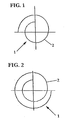
- protective tube is understood as the structure where the transversal section is represented in Figures 1 and 2. This meaning, protective tube (shown by means of the numerical reference 1) described here that is formed from a flat band and it is deformed in a way so that the longitudinal ends of same are overlapped, defining a closed structure that can be opened longitudinally.
- the bands are likely to be subjected to a shaping stage, as the PET threads disposed in P-3 carrying out a linking of the mesh on four needles can give a tubular shape to the band in a subsequent process.
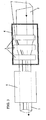
- the bands are subjected to a shaping stage (the station being represented in Figure 2) making them pass over some rings (3) lined up on the longitudinal axis of the band (2) and which have decreasing diameters as the band (2) advances on the inside.
- These rings (3) make the bands (2) fold in such a way that the two longitudinal ends converge one towards the other until first they meet and then overlap forming a tubular structure with a section that by preference is circular, although it could also have other sections such as square, triangular, oval, etc., in line with the internal section of the rings.
- the internal diameter of the tubular (1) fabric structure is determined. This overlapped area is made by the difference between the width of the band (2) and the perimeter of the internal space of the last ring (3).
- This stage is carried out in an oven (4) at a temperature of some 350°C and a speed of band passage of some 6 metres per minute.
- the shaped tube (1) is passed through a low temperature (5) area in order to cause its rapid cooling. This achieves the polyester thread exceeding the softening temperature and then the polyester re-crystallises in such a way that it is fixed in the position in which it was when it was subjected to the rapid cooling.
- This shaping stage is particularly effective thanks to the P-1 and P-2 comb linking structure in which the polyester threads are disposed.
- the shaping phase that is subsequently carried out with the bands obtained in the weaving is the same as that described in the first preferred embodiment.
- bands are obtained that, different to those obtained in the first and second preferred embodiments are characterised by their high resistance to temperature in such a way that said bands can support temperatures of 600°C for 90 hours have a loss of their mechanical properties not in excess of 50%.
- the impregnation of the bands is carried out with a silicone or resin compound, such as Acrylic PR Resin from the Repsol Company.
- a silicone or resin compound such as Acrylic PR Resin from the Repsol Company.
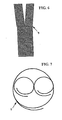
- This impregnation is carried out by the immersion of the bands in a bath (6) shown in figure 4 that contains the silicone or resin and the subsequent removal of the excess product on passing the bands (2) over some rollers that act as a grid.
- the bands (2) pass through the shaping stage as described in Embodiment 1 with which the silicone or resin polymerises at the point when the bands acquire the tubular shape, thus this shape being fixed.
- the structure obtained in the third preferred embodiment is especially preferable for the protection of conduits that are in high temperatures and at the same time act as thermal insulation being able to be used in areas where the protective tubes obtained by other processes or other materials are unusable after a few hours subjected to working temperatures.
- the tubular structure obtained in this embodiment is especially suitable in the cases in which combined high thermal resistance and abrasion have to be obtained.
- the shaping phase that is subsequently carried out with the bands obtained in the weaving is the same as that described in the first preferred embodiment.
- tubular structures are obtained that, in addition to having the tube properties described in the first embodiment, have the following improvements:
- a sheet of an aluminium-polyester compound (7) is applied subsequent to the weaving of the bands which is adhered to them by means of welds ( Figure 5), although other means can be used for this adhesion such as gluing.
- the shaping stage that is subsequently carried out, with the band compound of the fabric-aluminium sheet (8) obtained, is the same as that described in the first preferred embodiment.
- the structure of the band, with the stud chain and weft links in P-1 and P-2 respectively, likewise the exclusive use of monofilament thread, is optimal to achieve a an aluminium sheet support fabric which has maximum mechanical resistance with minimum cost.
- the resulting tubular structure, after the shaping stage, with the aluminium sheet on the inside or the outside of the tube to achieve a high screening effect is particularly suitable to protect and screen electrical cables likely to be affected by electromagnetic radiation (EMI).
- EMI electromagnetic radiation
- the shaping phase that is subsequently carried out with the bands obtained in the weaving is the same as that described in the first preferred embodiment.
Landscapes
- Engineering & Computer Science (AREA)
- Architecture (AREA)
- Civil Engineering (AREA)
- Structural Engineering (AREA)
- General Engineering & Computer Science (AREA)
- Mechanical Engineering (AREA)
- Textile Engineering (AREA)
- Woven Fabrics (AREA)
- Braiding, Manufacturing Of Bobbin-Net Or Lace, And Manufacturing Of Nets By Knotting (AREA)
- Knitting Of Fabric (AREA)
- Details Of Indoor Wiring (AREA)
- Moulding By Coating Moulds (AREA)
Applications Claiming Priority (2)
| Application Number | Priority Date | Filing Date | Title |
|---|---|---|---|
| ES200401135A ES2243133B1 (es) | 2004-05-12 | 2004-05-12 | Procedimiento para la fabricacion de tubos de proteccion. |
| PCT/ES2005/000256 WO2005108845A1 (fr) | 2004-05-12 | 2005-05-12 | Procede de fabrication de tubes de protection |
Publications (1)
| Publication Number | Publication Date |
|---|---|
| EP1746324A1 true EP1746324A1 (fr) | 2007-01-24 |
Family
ID=35320298
Family Applications (1)
| Application Number | Title | Priority Date | Filing Date |
|---|---|---|---|
| EP05748801A Withdrawn EP1746324A1 (fr) | 2004-05-12 | 2005-05-12 | Procede de fabrication de tubes de protection |
Country Status (6)
| Country | Link |
|---|---|
| US (1) | US8557073B2 (fr) |
| EP (1) | EP1746324A1 (fr) |
| CN (1) | CN100520141C (fr) |
| ES (1) | ES2243133B1 (fr) |
| MX (1) | MXPA06007644A (fr) |
| WO (1) | WO2005108845A1 (fr) |
Cited By (6)
| Publication number | Priority date | Publication date | Assignee | Title |
|---|---|---|---|---|
| EP2331745A4 (fr) * | 2008-09-05 | 2014-04-16 | Federal Mogul Powertrain Inc | Manchon textile à enroulement automatique à revêtement protecteur et son procédé de construction |
| WO2014140207A1 (fr) * | 2013-03-15 | 2014-09-18 | Delfingen Fr-Anteuil | Manchon allongé à fermeture automatique destiné à protéger des éléments allongés |
| WO2014159807A1 (fr) * | 2013-03-13 | 2014-10-02 | Federal-Mogul Powertrain, Inc. | Manchon enroulable tricoté en chaîne avec fils extensibles électro-fonctionnels et son procédé de construction |
| DE102014119751A1 (de) | 2014-12-31 | 2016-06-30 | Michael Lindner | Verfahren zur Herstellung einer Schutzvorrichtung |
| EP2486572A4 (fr) * | 2009-10-07 | 2017-04-26 | Federal-Mogul Powertrain, Inc. | Manchon textile souple doté d'un revêtement protecteur résistant à l'effilochage d'extrémité et son procédé de fabrication |
| EP4008820A1 (fr) * | 2020-12-01 | 2022-06-08 | Relats, S.A. | Manchon de protection permettant de protéger électriquement et thermiquement une barre omnibus électriquement conductrice et procédé d'obtention d'un manchon de protection |
Families Citing this family (6)
| Publication number | Priority date | Publication date | Assignee | Title |
|---|---|---|---|---|
| US7395680B2 (en) * | 2004-07-20 | 2008-07-08 | Federal Mogul Worldwide, Inc. | Self-curling knitted sleeve and method of fabrication |
| WO2009010599A1 (fr) * | 2007-07-17 | 2009-01-22 | Relats, S.A. | Gaine de protection souple et procédé de fabrication |
| ES2439818B1 (es) * | 2012-07-23 | 2014-12-29 | Relats, S.A. | Funda de protección tubular |
| KR101359465B1 (ko) | 2013-11-11 | 2014-02-07 | 한미케이블 주식회사 | 말림 직물 제조 장치 |
| DE102014209826A1 (de) * | 2014-05-23 | 2015-11-26 | Contitech Ag | Isolierelement bzw. Isoliersystem zur Ummantelung eines Körpers |
| US10711378B2 (en) * | 2016-07-13 | 2020-07-14 | Federal-Mogul Powertrain Llc | Knit textile sleeve with self-sustaining expanded and contracted states and method of construction thereof |
Citations (2)
| Publication number | Priority date | Publication date | Assignee | Title |
|---|---|---|---|---|
| US4570789A (en) * | 1983-04-22 | 1986-02-18 | Polygress Plastic Gmbh | Bale of straw or hay |
| EP0425099A2 (fr) * | 1989-09-28 | 1991-05-02 | Milliken Europe N.V. | Draps stabilisés |
Family Cites Families (11)
| Publication number | Priority date | Publication date | Assignee | Title |
|---|---|---|---|---|
| US4477693A (en) * | 1982-12-09 | 1984-10-16 | Cooper Industries, Inc. | Multiply shielded coaxial cable with very low transfer impedance |
| US4631098A (en) * | 1983-01-06 | 1986-12-23 | Raychem Limited | Heat-recoverable article |
| BG41756A1 (en) * | 1985-01-22 | 1987-08-14 | Ribarev | Round knittings with warp- knitted structure and method for their manufacture |
| ES2007818A6 (es) * | 1988-04-08 | 1989-07-01 | Tejidos Telats S A | Tubo aislante, en especial para proteccion termica y electrica. |
| US4929478A (en) * | 1988-06-17 | 1990-05-29 | The Bentley-Harris Manufacturing Company | Protective fabric sleeves |
| US5413149A (en) * | 1991-11-05 | 1995-05-09 | The Bentley-Harris Manufacturing Company | Shaped fabric products and methods of making same |
| DE19804221A1 (de) * | 1998-02-04 | 1999-08-05 | Natec Reich Summer Gmbh Co Kg | Verfahren und Vorrichtung zur Herstellung eines kontinuierlichen Folienschlauchs aus einer ebenen Folienbahn |
| ES2156049B1 (es) * | 1998-04-01 | 2002-02-01 | Relats Sa | Procedimiento para el tratamiento de tubos de proteccion. |
| US6649828B2 (en) * | 2000-05-02 | 2003-11-18 | Custom Coated Components, Inc | Self-sealing reflective sleeve |
| ES2190725B1 (es) * | 2001-03-02 | 2004-05-01 | Relats, S.A. | Utilizacion de una maquina de genero de punto por urdido para la fabricacion de un tubo de proteccion abierto o cerrado de cables, conductosy similares, y tubo de proteccion fabricado con dicha maquina. |
| US20050124249A1 (en) * | 2003-12-09 | 2005-06-09 | Uribarri Peter V. | Abrasion-resistant sleeve for wiring and the like |
-
2004
- 2004-05-12 ES ES200401135A patent/ES2243133B1/es not_active Expired - Fee Related
-
2005
- 2005-05-12 US US10/589,485 patent/US8557073B2/en not_active Expired - Fee Related
- 2005-05-12 CN CNB2005800151570A patent/CN100520141C/zh not_active Expired - Lifetime
- 2005-05-12 EP EP05748801A patent/EP1746324A1/fr not_active Withdrawn
- 2005-05-12 WO PCT/ES2005/000256 patent/WO2005108845A1/fr not_active Ceased
- 2005-05-12 MX MXPA06007644A patent/MXPA06007644A/es active IP Right Grant
Patent Citations (3)
| Publication number | Priority date | Publication date | Assignee | Title |
|---|---|---|---|---|
| US4570789A (en) * | 1983-04-22 | 1986-02-18 | Polygress Plastic Gmbh | Bale of straw or hay |
| EP0425099A2 (fr) * | 1989-09-28 | 1991-05-02 | Milliken Europe N.V. | Draps stabilisés |
| US5229056A (en) * | 1989-09-28 | 1993-07-20 | Willy De Meyer | Producing fabric reinforced hose |
Non-Patent Citations (1)
| Title |
|---|
| See also references of WO2005108845A1 * |
Cited By (11)
| Publication number | Priority date | Publication date | Assignee | Title |
|---|---|---|---|---|
| EP2331745A4 (fr) * | 2008-09-05 | 2014-04-16 | Federal Mogul Powertrain Inc | Manchon textile à enroulement automatique à revêtement protecteur et son procédé de construction |
| US9336924B2 (en) | 2008-09-05 | 2016-05-10 | Federal-Mogul Powertrain, Inc. | Self-wrapping textile sleeve with protective coating and method of construction thereof |
| EP2486572A4 (fr) * | 2009-10-07 | 2017-04-26 | Federal-Mogul Powertrain, Inc. | Manchon textile souple doté d'un revêtement protecteur résistant à l'effilochage d'extrémité et son procédé de fabrication |
| WO2014159807A1 (fr) * | 2013-03-13 | 2014-10-02 | Federal-Mogul Powertrain, Inc. | Manchon enroulable tricoté en chaîne avec fils extensibles électro-fonctionnels et son procédé de construction |
| JP2016519221A (ja) * | 2013-03-13 | 2016-06-30 | フェデラル−モーグル パワートレイン インコーポレイテッドFederal−Mogul Powertrain, Inc. | 延在可能な電気的機能の糸を伴う経編の巻付け可能なスリーブおよびその構築方法 |
| US9745679B2 (en) | 2013-03-13 | 2017-08-29 | Federal-Mogul Powertrain | Warp knit wrappable sleeve with extendable electro-functional yarns and method of construction thereof |
| WO2014140207A1 (fr) * | 2013-03-15 | 2014-09-18 | Delfingen Fr-Anteuil | Manchon allongé à fermeture automatique destiné à protéger des éléments allongés |
| US9657417B2 (en) | 2013-03-15 | 2017-05-23 | Delfingen Fr-Anteuil | Elongate self-closing sleeve for protecting elongate members having improved sound dampening quality |
| DE102014119751A1 (de) | 2014-12-31 | 2016-06-30 | Michael Lindner | Verfahren zur Herstellung einer Schutzvorrichtung |
| DE102014119751B4 (de) | 2014-12-31 | 2017-03-02 | Michael Lindner | Verfahren zur Herstellung einer Schutzvorrichtung |
| EP4008820A1 (fr) * | 2020-12-01 | 2022-06-08 | Relats, S.A. | Manchon de protection permettant de protéger électriquement et thermiquement une barre omnibus électriquement conductrice et procédé d'obtention d'un manchon de protection |
Also Published As
| Publication number | Publication date |
|---|---|
| ES2243133A1 (es) | 2005-11-16 |
| CN1961172A (zh) | 2007-05-09 |
| US20070169876A1 (en) | 2007-07-26 |
| MXPA06007644A (es) | 2006-09-01 |
| CN100520141C (zh) | 2009-07-29 |
| ES2243133B1 (es) | 2006-07-01 |
| WO2005108845A1 (fr) | 2005-11-17 |
| WO2005108845A8 (fr) | 2005-12-15 |
| US8557073B2 (en) | 2013-10-15 |
Similar Documents
| Publication | Publication Date | Title |
|---|---|---|
| US8557073B2 (en) | Method of producing protective tubes | |
| US11053615B2 (en) | Metal alloy knit fabric for high temperature insulating materials | |
| EP2971307B1 (fr) | Manchon enroulable tricoté en chaîne avec fils extensibles électro-fonctionnels et son procédé de construction | |
| EP3346033B1 (fr) | Tricot à base de céramique à couche unique pour joints boudins à haute température | |
| KR20090086264A (ko) | 지지 부재를 가진 보호 슬리브 조립체 및 이 보호 슬리브 조립체의 제조방법 | |
| EP2743386A1 (fr) | Tissu conducteur et procédé et appareil de fabrication | |
| CN107109730B (zh) | 具有自保持的延伸及收缩状态的编织纺织套筒及其构建方法 | |
| MXPA05000198A (es) | Manguito aislante de capas multiples. | |
| KR102567646B1 (ko) | 스스로 지탱하면서 팽창된 상태와 수축된 상태를 가지는 셀프 랩핑 브레이드 직물 슬리브 및 그 제조 방법 | |
| CN100533890C (zh) | 柔性防护波纹管 | |
| US6854298B2 (en) | Methods and systems for providing a protecting tube | |
| CN102334256B (zh) | 保护管及其制造方法 | |
| CN102869625B (zh) | 用于骤冷环的非均相织物 | |
| JP7019666B2 (ja) | 自立的拡張状態および収縮状態を有する編成テキスタイルスリーブならびにその構築方法 | |
| CN218352052U (zh) | 一种可伸缩耐磨护套及包塑管 |
Legal Events
| Date | Code | Title | Description |
|---|---|---|---|
| PUAI | Public reference made under article 153(3) epc to a published international application that has entered the european phase |
Free format text: ORIGINAL CODE: 0009012 |
|
| 17P | Request for examination filed |
Effective date: 20060629 |
|
| AK | Designated contracting states |
Kind code of ref document: A1 Designated state(s): AT BE BG CH CY CZ DE DK EE ES FI FR GB GR HU IE IS IT LI LT LU MC NL PL PT RO SE SI SK TR |
|
| DAX | Request for extension of the european patent (deleted) | ||
| 17Q | First examination report despatched |
Effective date: 20071213 |
|
| GRAP | Despatch of communication of intention to grant a patent |
Free format text: ORIGINAL CODE: EPIDOSNIGR1 |
|
| STAA | Information on the status of an ep patent application or granted ep patent |
Free format text: STATUS: THE APPLICATION IS DEEMED TO BE WITHDRAWN |
|
| 18D | Application deemed to be withdrawn |
Effective date: 20090428 |