EP1746765A2 - Informationsaustauschsystem und Verfahren zur Verringerung der Netzbelastung - Google Patents
Informationsaustauschsystem und Verfahren zur Verringerung der Netzbelastung Download PDFInfo
- Publication number
- EP1746765A2 EP1746765A2 EP06076421A EP06076421A EP1746765A2 EP 1746765 A2 EP1746765 A2 EP 1746765A2 EP 06076421 A EP06076421 A EP 06076421A EP 06076421 A EP06076421 A EP 06076421A EP 1746765 A2 EP1746765 A2 EP 1746765A2
- Authority
- EP
- European Patent Office
- Prior art keywords
- status
- management server
- monitored
- terminal unit
- information
- Prior art date
- Legal status (The legal status is an assumption and is not a legal conclusion. Google has not performed a legal analysis and makes no representation as to the accuracy of the status listed.)
- Withdrawn
Links
- 238000000034 method Methods 0.000 title claims description 88
- 230000005540 biological transmission Effects 0.000 claims description 51
- 238000012545 processing Methods 0.000 claims description 35
- 238000012544 monitoring process Methods 0.000 claims description 20
- 230000006870 function Effects 0.000 description 10
- 230000004044 response Effects 0.000 description 8
- 238000010586 diagram Methods 0.000 description 6
- 238000004891 communication Methods 0.000 description 3
- 238000001914 filtration Methods 0.000 description 3
- 230000000977 initiatory effect Effects 0.000 description 3
- 230000006399 behavior Effects 0.000 description 1
- 230000000694 effects Effects 0.000 description 1
Images




Classifications
-
- H—ELECTRICITY
- H04—ELECTRIC COMMUNICATION TECHNIQUE
- H04L—TRANSMISSION OF DIGITAL INFORMATION, e.g. TELEGRAPHIC COMMUNICATION
- H04L43/00—Arrangements for monitoring or testing data switching networks
- H04L43/08—Monitoring or testing based on specific metrics, e.g. QoS, energy consumption or environmental parameters
- H04L43/0805—Monitoring or testing based on specific metrics, e.g. QoS, energy consumption or environmental parameters by checking availability
- H04L43/0817—Monitoring or testing based on specific metrics, e.g. QoS, energy consumption or environmental parameters by checking availability by checking functioning
-
- H—ELECTRICITY
- H04—ELECTRIC COMMUNICATION TECHNIQUE
- H04L—TRANSMISSION OF DIGITAL INFORMATION, e.g. TELEGRAPHIC COMMUNICATION
- H04L65/00—Network arrangements, protocols or services for supporting real-time applications in data packet communication
- H04L65/1066—Session management
- H04L65/1101—Session protocols
-
- H—ELECTRICITY
- H04—ELECTRIC COMMUNICATION TECHNIQUE
- H04L—TRANSMISSION OF DIGITAL INFORMATION, e.g. TELEGRAPHIC COMMUNICATION
- H04L65/00—Network arrangements, protocols or services for supporting real-time applications in data packet communication
- H04L65/1066—Session management
- H04L65/1101—Session protocols
- H04L65/1104—Session initiation protocol [SIP]
-
- H—ELECTRICITY
- H04—ELECTRIC COMMUNICATION TECHNIQUE
- H04L—TRANSMISSION OF DIGITAL INFORMATION, e.g. TELEGRAPHIC COMMUNICATION
- H04L41/00—Arrangements for maintenance, administration or management of data switching networks, e.g. of packet switching networks
- H04L41/02—Standardisation; Integration
- H04L41/0233—Object-oriented techniques, for representation of network management data, e.g. common object request broker architecture [CORBA]
-
- H—ELECTRICITY
- H04—ELECTRIC COMMUNICATION TECHNIQUE
- H04L—TRANSMISSION OF DIGITAL INFORMATION, e.g. TELEGRAPHIC COMMUNICATION
- H04L41/00—Arrangements for maintenance, administration or management of data switching networks, e.g. of packet switching networks
- H04L41/06—Management of faults, events, alarms or notifications
- H04L41/0631—Management of faults, events, alarms or notifications using root cause analysis; using analysis of correlation between notifications, alarms or events based on decision criteria, e.g. hierarchy, tree or time analysis
Definitions
- the present invention relates to information exchange systems and management servers, terminal units, and methods for reducing network load that are used in the information exchange systems, and in particular, relates to a method for reducing network load between subscribers and notifiers.
- a framework between a subscriber and a notifier is disclosed in " Session Initiation Protocol (SIP)-Specific Event Notification: 3. Node Behavior” [RFC (Request for Comments) 3265, June 2002 ] (Document 1).
- the subscriber monitors the status of resources for a predetermined period of time, and the notifier sends notifications of the status of resources to the subscriber.
- this framework is applied to presence services [for example, see “ A Presence Event Package for the Session Initiation Protocol (SIP): Status of this Memo” (RFC 3856, August 2004 )] (Document 2).
- Presence services represent general systems that manage the status of individual resources.
- the basic architecture of presence services is disclosed in " A Model for Presence and Instant Messaging” (RFC 2778, February 2000 ) (Document 3). In this case, resources represent objects the status of which are monitored by the subscriber.
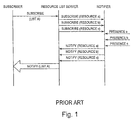
- the aforementioned subscriber may not monitor only one resource.
- SUBSCRIBE registration and subscription
- requests need to be sent to the notifier for individual resources to manage subscriptions (contract and subscription).
- the subscriptions include information, such as the link between the subscriber and the notifier and event packages to be used.
- the differences in requests for, e.g. the valid period of subscriptions and the frequency of transmission of NOTIFY between a subscriber and a notifier for resources can be adjusted by the resource list server.
- network load temporarily increases, and load of interpretation of the content of the received NOTIFY on the subscriber also increases.
- an information exchange system comprises a first terminal unit, a second terminal unit, and a management server.
- the first terminal unit includes a monitoring section that monitors the status of at least one object to be monitored and a notification section that sends the management server a notification of the status of the at least one object to be monitored.
- the second terminal unit includes a status notification request sending section that sends the management server a status notification request that includes information for specifying a group of objects to be monitored.
- the group includes the at least one object to be monitored.
- the management server includes a monitored-object status retaining section that receives the status of the at least one object to be monitored from the first terminal unit and retains the received status and a first transmission processing section that sends the second terminal unit a notification signal for each of the at least one object to be monitored.
- the notification signal includes the status of each of the at least one object to be monitored.
- the management server may include a second transmission processing section instead of the first transmission processing section. In this case, the second transmission processing section sends the second terminal unit a plurality of notification signals that include the status of the at least one object to be monitored.
- an information exchange system comprises a notifier, a subscriber, and a management server.
- the notifier includes a monitoring section that monitors the status of at least one resource and a notification section that sends the management server a notification of the status of the at least one resource with a first NOTIFY message.
- the subscriber includes a SUBSCRIBE request sending section that sends the management server a SUBSCRIBE request that includes information for specifying a group of resources.
- the group includes the at least one resource.
- the management server includes a resource status retaining section that receives the status of the at least one resource sent from the notifier with the first NOTIFY message and retains the received status and a first transmission processing section that sends the subscriber a second NOTIFY message for each of the at least one resource.
- the second NOTIFY message includes the status of each of the at least one resource.
- the management server may include a second transmission processing section instead of the first transmission processing section. In this case, the second transmission processing section sends the subscriber a plurality of NOTIFY messages, as the second NOTIFY message, that include the status of the at least one resource.
- an information exchange system includes a subscriber that monitors the status of resources for a predetermined period of time, a notifier that sends notifications of the status of the resources to the subscriber, and a resource list server that manages resource lists.
- a SUBSCRIBE registration and subscription
- a NOTIFY notification
- SUBSCRIBE requests for a plurality of resources can be put together into one request. Accordingly, the network load can be reduced when SUBSCRIBE requests are sent to start or update subscriptions.
- the network load can be reduced by sending a plurality of NOTIFY messages that include small content instead of sending one NOTIFY that includes large content.
- load of interpretation of the content of one NOTIFY on the subscriber can be reduced by reducing the content of the NOTIFY
- the network load can be reduced by sending NOTIFY messages at different points of time.
- a management server is for an information exchange system including a notifier and a subscriber.
- the notifier includes a monitoring section that monitors the status of at least one resource and a notification section that sends a notification of the status of the at least one resource with a first NOTIFY message.
- the subscriber includes a SUBSCRIBE request sending section that sends a SUBSCRIBE request that includes information for specifying a group of resources.
- the group includes the at least one resource.
- a terminal unit constitutes, together with a management server and a different terminal unit, an information exchange system.
- the different terminal unit includes a monitoring section that monitors the status of at least one object to be monitored and a notification section that sends the management server a notification of the status of the at least one object to be monitored.
- the terminal unit comprises a status notification request sending section that sends the management server a status notification request that includes information for specifying a group of objects to be monitored.
- the group includes the at least one object to be monitored.
- the terminal unit further comprises a first determining section that determines whether a notification signal represents a status notification requested with the status notification request when the notification signal is sent from the management server for each of the at least one object to be monitored.
- the notification signal includes the status of each of the at least one object to be monitored.
- the terminal unit still further comprises an information interpreting section that interprets the notification signal when it is determined that the notification signal represents the status notification requested with the status notification request.
- the terminal unit may include a second determining section instead of the first determining section. In this case, the second determining section determines whether a plurality of notification signals represent status notifications requested with the status notification request when the notification signals are sent from the management server.
- the notification signals includes the status of the at least one object to be monitored.
- a terminal unit constitutes, together with a management server and a different terminal unit, an information exchange system.
- the different terminal unit includes a monitoring section that monitors the status of at least one resource and a notification section that sends the management server a notification of the status of the at least one resource.
- the terminal unit comprises a SUBSCRIBE request sending section that sends the management server a SUBSCRIBE request that includes information for specifying a group of resources.
- the group includes the at least one resource.
- the terminal unit further comprises a first determining section that determines whether a NOTIFY message represents a status notification requested with the SUBSCRIBE request when the NOTIFY message is sent from the management server for each of the at least one resource.
- a method for reducing network load is provided.
- the method is applied to an information exchange system that includes a first terminal unit, a second terminal unit, and a management server.
- the first terminal unit includes a monitoring section that monitors the status of at least one object to be monitored and a notification section that sends a notification of the status of the at least one object to be monitored.
- the second terminal unit includes a status notification request sending section that sends a status notification request that includes information for specifying a group of objects to be monitored.
- the group includes the at least one object to be monitored.
- the method comprises a step in the management server of receiving the status of the at least one object to be monitored from the first terminal unit and retaining the received status in a monitored-object status retaining section and a first transmitting step in the management server of sending the second terminal unit a notification signal for each of the at least one object to be monitored.
- the notification signal includes the status of each of the at least one object to be monitored.
- the method may include a second transmitting step in the management server instead of the first transmitting step, and, in the second transmitting step, a plurality of notification signals that include the status of the at least one object to be monitored are sent to the second terminal unit.
- the method is applied to an information exchange system that includes a notifier, a subscriber, and a management server.
- the notifier includes a monitoring section that monitors the status of at least one resource and a notification section that sends a notification of the status of the at least one resource with a first NOTIFY message.
- the subscriber includes a SUBSCRIBE request sending section that sends a SUBSCRIBE request that includes information for specifying a group of resources.
- the group includes the at least one resource.
- the method comprises a step in the management server of receiving the status of the at least one resource sent from the notifier with the first NOTIFY message and retaining the received status in a resource status retaining section and a first transmitting step in the management server of sending the subscriber a second NOTIFY message for each of the at least one resource.
- the second NOTIFY message includes the status of each of the at least one resource.
- the method may include a second transmitting step in the management server instead of the first transmitting step, and, in the second transmitting step, a plurality of NOTIFY messages that include the status of the at least one resource are sent to the subscriber.
- Fig. 2 is a block diagram showing the structure of an information exchange system according to a first embodiment of the present invention.
- the information exchange system includes a subscriber (a terminal unit or a second terminal unit) 1, a resource list server 2, and a notifier (a different terminal unit or a first terminal unit) 3.
- the subscriber 1 monitors the status of resources (objects to be monitored by the subscriber 1) for a predetermined period of time, and the notifier 3 sends notifications of the status of the resources to the subscriber 1.
- the resource list server 2 manages lists of resources. The information of the status of these resources is exchanged between the subscriber 1 and the notifier 3.
- the resource list server 2 includes a SUBSCRIBE (registration and subscription) request receiving unit 21, a NOTIFY (notification) sending unit 22, a list management unit 23, a subscription (contract and subscription) control unit 24, a SUBSCRIBE request sending unit 25, and a NOTIFY receiving unit 26.
- Fig. 2 shows only components that are required to describe the operation in the first embodiment.
- the list management unit 23 manages the identifiers of resources included in individual resource lists.
- the SUBSCRIBE request receiving unit 21 and the NOTIFY sending unit 22 provide interfaces to the subscriber 1.
- the SUBSCRIBE request receiving unit 21 has received a SUBSCRIBE or UNSUBSCRIBE request for a resource list managed by the list management unit 23 from the subscriber 1
- the SUBSCRIBE request receiving unit 21 transfers the request to the subscription management unit 241.
- the NOTIFY sending unit 22 sends the information of the status of resources to the subscriber 1 that subscribes for a list that includes the resources.
- the information of the status of the resources is included in a NOTIFY message.
- the notifier 3 for resources may be dedicated to each resource or, like a presence server, may handle the status of a plurality of resources.
- the presence server is a physical entity (function) and functions as a presence agent or a proxy server for SUBSCRIBE requests.
- the presence server functions as a presence agent, the presence server has the presence information of the presentity (the presence or status of everything, for example, status such as "attended” or "out”).
- SUBSCRIBE requests are transferred to another entity that functions as a presence agent.
- the subscription control unit 24 generates back-end subscriptions on the basis of a SUBSCRIBE request from the subscriber 1 for a list.
- the back-end subscriptions represent subscriptions from the resource list server 2 for resources.
- the subscriptions include information, such as the link between the subscriber 1 and the notifier 3 and event packages to be used.
- the subscription management unit 241 manages a subscription for a list from the subscriber 1 and back-end subscriptions.
- the subscription management unit 241 generates, updates, or stops a subscription upon receiving a SUBSCRIBE or UNSUBSCRIBE request from the subscriber 1.
- the list-and-subscriber link management unit 242 retains groups of subscribers for individual lists. When the subscriber 1 is associated with a list, the list-and-subscriber link management unit 242 requests the back-end-subscription-and-list link management unit 243 to add the list. Moreover, when the subscriber 1 associated with a list has disappeared, the list-and-subscriber link management unit 242 requests the back-end-subscription-and-list link management unit 243 to delete the list.
- Each back-end subscription is valid during a period in which at least one list is associated with the back-end subscription.
- Each back-end subscription disappears when lists associated with the back-end subscription have disappeared. Then, an UNSUBSCRIBE request is sent from the SUBSCRIBE request sending unit 25, and the status of resources managed by the resource status management unit 244 is set invalid.
- the resource list server 2 and the notifier 3 are separately shown.
- the notifier 3 is a presence server
- the resource list server 2 and the notifier 3 can be packaged in a single server.
- the network load can be reduced by sending a plurality of NOTIFY messages that include small content instead of sending one NOTIFY that includes large content.
- load of interpretation of the content of one NOTIFY on the subscriber 1 can be reduced by reducing the content of the NOTIFY.
- the network load can be reduced by sending NOTIFY messages at different points of time.
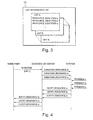
- the list management unit 23 includes list tables corresponding to lists A to N, and resource identifiers are registered in the individual list tables corresponding to the lists A to N. For example, resource identifiers a to c are registered in the list table corresponding to the list A.
- Fig. 4 is a sequence chart showing the operation of the information exchange system according the first embodiment.
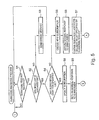
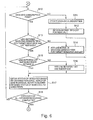
- Figs. 5 to 7 are flowcharts showing the process of receiving a SUBSCRIBE according to the first embodiment.
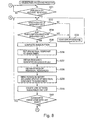
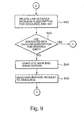
- Figs. 8 and 9 are flowcharts showing the process of receiving an UNSUBSCRIBE according to the first embodiment.
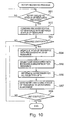
- Fig. 10 is a flowchart showing the process of receiving a NOTIFY according to the first embodiment.
- the operation of the information exchange system according to the first embodiment will now be described with reference to Figs. 2 to 10.
- the process in the resource list server 2 shown in Fig. 2 can be performed by a computer (not shown) executing programs, and the process shown in Figs. 5 to 10 can be also performed by this computer executing programs.
- step S1 in Fig. 5 it is determined whether the SUBSCRIBE request receiving unit 21 has received a SUBSCRIBE request from the subscriber 1.
- the process proceeds to step S2.
- step S2 the SUBSCRIBE request receiving unit 21 determines whether a specified list is managed by the list management unit 23.
- the SUBSCRIBE request receiving unit 21 determines that the specified list is not managed by the list management unit 23.
- step S3 an error message is sent to the subscriber 1.
- the SUBSCRIBE request receiving unit 21 transfers the SUBSCRIBE request to the subscription management unit 241, and the process proceeds to step S4.
- step S10 in Fig. 6 it is determined whether any back-end subscription exists.
- the back-end-subscription-and-list link management unit 243 creates back-end subscriptions in step S11, and a SUBSCRIBE request for each resource is sent from the SUBSCRIBE request sending unit 25 to the notifier 3 in step S12. Then, the process proceeds to step S17.
- step S10 when it is determined in step S10 that back-end subscriptions exist, the process proceeds to step S13.
- step S13 it is determined whether the back-end-subscription-and-list link management unit 243 retains information on the links between the back-end subscriptions for target resources and the list.
- the back-end-subscription-and-list link management unit 243 adds information on the links between the back-end subscriptions for the target resources and the list in step S14, and the process proceeds to step S17.
- step S15 it is determined whether the list-and-subscriber link management unit 242 retains information on the link between the list and the subscriber 1.
- the list-and-subscriber link management unit 242 adds information on the link between the list and the subscriber 1 in step S16, and the process proceeds to step S17.
- the process directly proceeds to step S17.
- step S17 the subscription control unit 24 obtains information on the status of the resources through the resource status management unit 244 on the basis of the resource identifiers obtained from the list management unit 23. Then, the subscription control unit 24 individually sends a NOTIFY message that includes the obtained information to the subscriber 1 through the NOTIFY sending unit 22.
- step S18 it is determined whether the aforementioned process (steps S10 to S17) has been performed on all of the resources corresponding to the obtained resource identifiers.
- the resource list server 2 repeats the aforementioned process until the process has been performed on all of the resources corresponding to the obtained resource identifiers.
- step S19 the subscription control unit 24 obtains the resource identifiers included in the list from the list management unit 23. Then, in step S20, it is determined whether a NOTIFY that is sent when the status of a resource has changed has been delivered. When it is determined that a NOTIFY that is sent when the status of a resource has changed has been delivered, in step S21, the subscription control unit 24 individually sends a NOTIFY (vacant NOTIFY) that includes no content for a resource corresponding to the obtained resource identifier to the subscriber 1 through the NOTIFY sending unit 22.
- a NOTIFY vacuum NOTIFY
- step S22 the subscription control unit 24 individually sends a NOTIFY that includes information on the status of the resource corresponding to the obtained resource identifier to the subscriber 1 through the NOTIFY sending unit 22.
- step S31 in Fig. 8 it is determined whether the SUBSCRIBE request receiving unit 21 has received an UNSUBSCRIBE request from the subscriber 1.
- the process proceeds to step S32.
- step S32 the SUBSCRIBE request receiving unit 21 determines whether a specified list is managed by the list management unit 23.
- the process proceeds to step S33 where an error message is sent to the subscriber 1.
- the SUBSCRIBE request receiving unit 21 determines that the specified list is managed by the list management unit 23
- the SUBSCRIBE request receiving unit 21 transfers the UNSUBSCRIBE request to the subscription management unit 241, and the process proceeds to step S34.
- step S34 the subscription management unit 241 determines upon receiving the UNSUBSCRIBE request whether any subscription exists for the specified list.
- the subscription management unit 241 stops the subscription in step S35 and returns a normal response to the subscriber 1 in step S36. Then, the process proceeds to step S37.
- the subscription management unit 241 sends an error message to the subscriber 1.
- step S41 it is determined whether any subscriber is associated with the list.
- the subscription control unit 24 performs the following process on back-end subscriptions for the individual resources.
- the back-end subscriptions are managed by the back-end-subscription-and-list link management unit 243.
- step S42 in Fig. 9 the subscription control unit 24 deletes the links between the back-end subscriptions for the resources and the list. Then, in step S43, it is determined whether any list is associated with the back-end subscriptions. When it is determined that no list is associated with the back-end subscriptions, the subscription control unit 24 stops the back-end subscriptions in step S44. Then, in step S45, the subscription control unit 24 sends UNSUBSCRIBE requests to the resources through the SUBSCRIBE request sending unit 25.
- step S51 in Fig. 10 it is determined whether the NOTIFY receiving unit 26 has received a NOTIFY that includes information on the status of a resource from the notifier 3 (for example, a presence server) for the resource.
- the NOTIFY receiving unit 26 transfers the NOTIFY to the subscription management unit 241, and the process proceeds to step S52.
- the subscription management unit 241 compares the status of the resource, which has been received, with the status of the resource managed by the resource status management unit 244.
- step S53 the subscription management unit 241 determines whether these pieces of status information are different from each other.
- the following process steps S54 to S57
- the subscription management unit 241 determines that these pieces of status information agree with each other, the process of receiving a NOTIFY is completed.
- step S54 the subscription management unit 241 updates the status of the resource managed by the resource status management unit 244 with the status of the resource, which has been received. Then, in step S55, the subscription management unit 241 obtains lists associated with the back-end subscription for the resource from the back-end-subscription-and-list link management unit 243.
- the subscription management unit 241 determines subscribers that are managed by the list-and-subscriber link management unit 242 for all of the obtained lists in step S56 and sends a NOTIFY that includes the status of the resource to each subscriber 1, which has been determined, through the NOTIFY sending unit 22 in step S57. Then, in step S58, it is determined whether the aforementioned process (steps S54 to S57) has been performed on all resources included in the list. The process (steps S54 to S57) is repeated until the process has been performed on all resources included in the list.
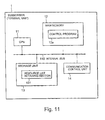
- Fig. 11 is a block diagram showing the structure of the subscriber 1 in the information exchange system according to the first embodiment.
- Fig. 12 is a flowchart showing typical operation of the subscriber 1 according to the first embodiment. The operation of the subscriber 1 will now be described with reference to Figs. 11 and 12. The process shown in Fig. 12 is performed by the CPU 11 executing the control program 12a.
- step S64 it is determined whether the subscriber 1 has received a NOTIFY in response to the SUBSCRIBE request from the resource list server 2.
- step S65 the subscriber 1 compares the NOTIFY messages with the resource list stored in the resource list retaining section 131.
- step S66 the subscriber 1 determines whether each of the received NOTIFY messages is a NOTIFY message that needs to be received.
- the subscriber 1 interprets the content of each NOTIFY message in step S67, and the process proceeds to step S69.
- step S69 it is determined whether the subscriber 1 has received NOTIFY messages that need to be received for all resources included in the list specified in the aforementioned SUBSCRIBE request. The subscriber 1 repeats the aforementioned process until the subscriber 1 has received NOTIFY messages that need to be received for all resources included in the list.
- SUBSCRIBE requests for a plurality of resources can be put together into one request, as described above.
- the network load can be reduced when SUBSCRIBE requests are sent to start or update subscriptions.
- the network load can be reduced by sending a plurality of NOTIFY messages that include small content instead of sending one NOTIFY that includes large content.
- load of interpretation of the content of one NOTIFY on the subscriber 1 can be reduced by reducing the content of the NOTIFY.
- Fig. 13 is a block diagram showing the structure of an information exchange system according to a second embodiment of the present invention.
- the structure of the information exchange system according to the second embodiment is the same as that of the information exchange system according to the first embodiment shown in Fig. 2 except that a network-load balancing unit 411 is provided in a NOTIFY sending unit 41 in a resource list server 4 in the information exchange system according to the second embodiment.
- a network-load balancing unit 411 is provided in a NOTIFY sending unit 41 in a resource list server 4 in the information exchange system according to the second embodiment.
- the same reference numerals as in Fig. 2 are assigned to the corresponding components.
- the operations of the corresponding components in the second embodiment are the same as those in the first embodiment.
- the network-load balancing unit 411 can reduce the network load by staggering the transmission timings of NOTIFY messages directed to the subscriber 1. Moreover, in the second embodiment, load of processing on the subscriber 1 can be reduced.
- the network-load balancing unit 411 may have the following functions:
- the network-load balancing unit 411 is provided in the NOTIFY sending unit 41 in the resource list server 4 to stagger the transmission timings of NOTIFY messages, as described above.
- the network load can be reduced.
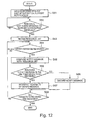
- Fig. 14 is a flowchart showing the process of receiving a SUBSCRIBE (updating) according to a third embodiment of the present invention.
- the structure of an information exchange system according to the third embodiment is the same as that of the information exchange system according to the first embodiment shown in Fig. 2.
- the third embodiment is different from the first embodiment in that a NOTIFY message that includes no content is sent for a list instead of each resources when a subscription is updated.
- the NOTIFY message is sent from the NOTIFY sending unit 22.
- step S1 in Fig. 14 it is determined whether the SUBSCRIBE request receiving unit 21 has received a SUBSCRIBE request from the subscriber 1.
- the process proceeds to step S2.
- step S2 the SUBSCRIBE request receiving unit 21 determines whether a specified list is managed by the list management unit 23.
- the SUBSCRIBE request receiving unit 21 determines that the specified list is not managed by the list management unit 23.
- step S3 an error message is sent to the subscriber 1.
- the SUBSCRIBE request receiving unit 21 transfers the SUBSCRIBE request to the subscription management unit 241, and the process proceeds to step S4.
- NOTIFY messages that include no content and are sent to the subscriber 1 when a subscription is updated can be put together into one message, as described above.
- the network load can be reduced.
- network load due to NOTIFY messages that are sent from the notifier 3 for resources to the subscriber 1 can be reduced.
- the present invention can be applied to not only the Internet but also presence services for sending a notification of the presence or status of everything (for example, status such as "attended” or "out"), in particular, presence services in a mobile environment.
Landscapes
- Engineering & Computer Science (AREA)
- Computer Networks & Wireless Communication (AREA)
- Signal Processing (AREA)
- Business, Economics & Management (AREA)
- General Business, Economics & Management (AREA)
- Multimedia (AREA)
- Environmental & Geological Engineering (AREA)
- Data Exchanges In Wide-Area Networks (AREA)
- Mobile Radio Communication Systems (AREA)
- Computer And Data Communications (AREA)
Applications Claiming Priority (1)
| Application Number | Priority Date | Filing Date | Title |
|---|---|---|---|
| JP2005206274A JP2007028117A (ja) | 2005-07-15 | 2005-07-15 | 情報交換システム、管理サーバ、端末装置及びそれらに用いるネットワーク負荷軽減方法 |
Publications (2)
| Publication Number | Publication Date |
|---|---|
| EP1746765A2 true EP1746765A2 (de) | 2007-01-24 |
| EP1746765A3 EP1746765A3 (de) | 2007-08-22 |
Family
ID=37214367
Family Applications (1)
| Application Number | Title | Priority Date | Filing Date |
|---|---|---|---|
| EP06076421A Withdrawn EP1746765A3 (de) | 2005-07-15 | 2006-07-14 | Informationsaustauschsystem und Verfahren zur Verringerung der Netzbelastung |
Country Status (6)
| Country | Link |
|---|---|
| US (1) | US20070016673A1 (de) |
| EP (1) | EP1746765A3 (de) |
| JP (1) | JP2007028117A (de) |
| KR (1) | KR100825349B1 (de) |
| CN (1) | CN1901517B (de) |
| AU (1) | AU2006203017A1 (de) |
Cited By (3)
| Publication number | Priority date | Publication date | Assignee | Title |
|---|---|---|---|---|
| WO2008115100A1 (en) * | 2007-03-19 | 2008-09-25 | Telefonaktiebolaget Lm Ericsson (Publ) | A method and apparatus for notifying clients in a communication network. |
| EP2106065A3 (de) * | 2008-03-26 | 2012-06-20 | Avaya Inc. | Failover-/Failback-Auslöser unter Verwendung einer SIP-Nachricht in einer SIP-überlebensfähigen Netzwerkkonfiguration |
| WO2016109146A1 (en) * | 2014-12-31 | 2016-07-07 | Motorola Solutions, Inc. | Method and apparatus for managing subscriptions for a subscription-notification service |
Families Citing this family (10)
| Publication number | Priority date | Publication date | Assignee | Title |
|---|---|---|---|---|
| US7941515B2 (en) * | 2006-01-13 | 2011-05-10 | Cisco Technology, Inc. | Applying a filter set to information provided to a subscribing client |
| US8671146B2 (en) * | 2007-02-28 | 2014-03-11 | Microsoft Corporation | Presence aware notification for information technology management |
| KR100906109B1 (ko) * | 2007-06-20 | 2009-07-07 | 엔에이치엔(주) | 3a 기반의 다양한 어플리케이션 상태를 제공하는유비쿼터스 프리젠스 서비스 방법 및 시스템 |
| CN101742475B (zh) * | 2008-11-12 | 2012-01-11 | 华为技术有限公司 | 订阅和通知的方法、装置和系统 |
| US8332516B2 (en) * | 2009-12-08 | 2012-12-11 | International Business Machines Corporation | Optimized cooperation between resource list servers and presence servers |
| US9307038B2 (en) * | 2009-12-29 | 2016-04-05 | Motorola Solutions, Inc. | Method for presence notification based on a sequence of events |
| US8447819B2 (en) * | 2010-07-09 | 2013-05-21 | Robert Paul Morris | Methods, systems, and computer program products for processing a request for a resource in a communication |
| CN103795689A (zh) * | 2012-10-29 | 2014-05-14 | 中兴通讯股份有限公司 | 资源订阅方法及装置 |
| CN107463562A (zh) * | 2016-06-02 | 2017-12-12 | 中国移动通信有限公司研究院 | 一种信息处理方法、系统及服务器 |
| KR102137914B1 (ko) * | 2019-11-20 | 2020-07-24 | 전자부품연구원 | IoT/M2M 플랫폼에서 그룹 통지 취합 방법 |
Citations (3)
| Publication number | Priority date | Publication date | Assignee | Title |
|---|---|---|---|---|
| WO2004008178A2 (en) | 2002-07-16 | 2004-01-22 | Nokia Corporation | System and method for providing partial presence notifications |
| US20040122896A1 (en) | 2002-12-24 | 2004-06-24 | Christophe Gourraud | Transmission of application information and commands using presence technology |
| US20040205142A1 (en) | 2003-01-02 | 2004-10-14 | Intel Corporation | Notification filtering apparatus, systems, and methods |
Family Cites Families (26)
| Publication number | Priority date | Publication date | Assignee | Title |
|---|---|---|---|---|
| JPH08137811A (ja) * | 1994-11-10 | 1996-05-31 | Nippon Telegr & Teleph Corp <Ntt> | ネットワーク資源割当変更方法 |
| US5826239A (en) * | 1996-12-17 | 1998-10-20 | Hewlett-Packard Company | Distributed workflow resource management system and method |
| US6366926B1 (en) * | 1998-12-31 | 2002-04-02 | Computer Associates Think, Inc. | Method and apparatus for the dynamic filtering and routing of events |
| US6484200B1 (en) * | 1999-06-11 | 2002-11-19 | Sun Microsystems, Inc. | Distinguished name scoping system for event filtering |
| EP1130845A3 (de) * | 2000-02-18 | 2001-09-12 | Agilent Technologies Inc. a Delaware Corporation | Publish/Subscribe-System |
| US20020152305A1 (en) * | 2000-03-03 | 2002-10-17 | Jackson Gregory J. | Systems and methods for resource utilization analysis in information management environments |
| US20020065828A1 (en) * | 2000-07-14 | 2002-05-30 | Goodspeed John D. | Network communication using telephone number URI/URL identification handle |
| US6822945B2 (en) * | 2000-11-08 | 2004-11-23 | Genesys Telecommunications Laboratories, Inc. | Method and apparatus for anticipating and planning communication-center resources based on evaluation of events waiting in a communication center master queue |
| US7197561B1 (en) * | 2001-03-28 | 2007-03-27 | Shoregroup, Inc. | Method and apparatus for maintaining the status of objects in computer networks using virtual state machines |
| US7263535B2 (en) * | 2002-05-21 | 2007-08-28 | Bellsouth Intellectual Property Corporation | Resource list management system |
| TWI318831B (en) * | 2002-09-27 | 2009-12-21 | Panasonic Corp | Resource management system |
| JP2004173166A (ja) * | 2002-11-22 | 2004-06-17 | Matsushita Electric Ind Co Ltd | 通信端末装置およびデータ送信方法 |
| US20040116141A1 (en) | 2002-12-11 | 2004-06-17 | Erick Loven | Resource management on a personal area network |
| CN1281076C (zh) * | 2002-12-30 | 2006-10-18 | 中兴通讯股份有限公司 | 在移动虚拟网络中提供智能业务的方法 |
| US7711810B2 (en) * | 2003-01-03 | 2010-05-04 | Nortel Networks Limited | Distributed services based on presence technology |
| US8046476B2 (en) * | 2003-01-29 | 2011-10-25 | Nokia Corporation | Access right control using access control alerts |
| GB0306864D0 (en) * | 2003-03-25 | 2003-04-30 | Nokia Corp | Service provisioning in a communication system |
| US7984128B2 (en) * | 2003-05-23 | 2011-07-19 | Hewlett-Packard Development Company, L.P. | System and method for discovering managed information technology resources |
| JP2004362416A (ja) * | 2003-06-06 | 2004-12-24 | Canon Inc | 遠隔監視システム |
| SE528357C2 (sv) * | 2004-03-12 | 2006-10-24 | Ericsson Telefon Ab L M | En metod och arrangemang för att tillhandahålla användarinformation till en telekommunikationsklient |
| GB0409949D0 (en) * | 2004-05-04 | 2004-06-09 | Nokia Corp | A communciation system for handling subscriber requests |
| US20060048135A1 (en) * | 2004-08-31 | 2006-03-02 | Jeff Hodson | Method of monitoring and controlling applications in an ACD |
| US20060093125A1 (en) * | 2004-11-02 | 2006-05-04 | Dezonno Anthony J | Messaging presence for non-messaging devices |
| US20060149814A1 (en) * | 2004-12-30 | 2006-07-06 | Utstarcom, Inc. | Method and apparatus for presence status facilitation by an access gateway in a mobile communications system |
| US8260743B2 (en) * | 2005-05-24 | 2012-09-04 | Nokia Corporation | Method for the delivery of area related messages in a mobile communication system |
| US20060274701A1 (en) * | 2005-06-03 | 2006-12-07 | Telefonaktiebolaget Lm Ericsson (Publ) | Means and method for notification |
-
2005
- 2005-07-15 JP JP2005206274A patent/JP2007028117A/ja active Pending
-
2006
- 2006-07-14 KR KR1020060066464A patent/KR100825349B1/ko not_active Expired - Fee Related
- 2006-07-14 US US11/486,045 patent/US20070016673A1/en not_active Abandoned
- 2006-07-14 EP EP06076421A patent/EP1746765A3/de not_active Withdrawn
- 2006-07-14 AU AU2006203017A patent/AU2006203017A1/en not_active Abandoned
- 2006-07-17 CN CN2006101019778A patent/CN1901517B/zh not_active Expired - Fee Related
Patent Citations (3)
| Publication number | Priority date | Publication date | Assignee | Title |
|---|---|---|---|---|
| WO2004008178A2 (en) | 2002-07-16 | 2004-01-22 | Nokia Corporation | System and method for providing partial presence notifications |
| US20040122896A1 (en) | 2002-12-24 | 2004-06-24 | Christophe Gourraud | Transmission of application information and commands using presence technology |
| US20040205142A1 (en) | 2003-01-02 | 2004-10-14 | Intel Corporation | Notification filtering apparatus, systems, and methods |
Non-Patent Citations (1)
| Title |
|---|
| "Session Initiation Protocol (SIP)-Specific Event Notification: 3. Node Behavior", RFC (REQUEST FOR COMMENTS, June 2002 (2002-06-01), pages 3265 |
Cited By (4)
| Publication number | Priority date | Publication date | Assignee | Title |
|---|---|---|---|---|
| WO2008115100A1 (en) * | 2007-03-19 | 2008-09-25 | Telefonaktiebolaget Lm Ericsson (Publ) | A method and apparatus for notifying clients in a communication network. |
| EP2106065A3 (de) * | 2008-03-26 | 2012-06-20 | Avaya Inc. | Failover-/Failback-Auslöser unter Verwendung einer SIP-Nachricht in einer SIP-überlebensfähigen Netzwerkkonfiguration |
| WO2016109146A1 (en) * | 2014-12-31 | 2016-07-07 | Motorola Solutions, Inc. | Method and apparatus for managing subscriptions for a subscription-notification service |
| US9806961B2 (en) | 2014-12-31 | 2017-10-31 | Motorola Solutions, Inc. | Method and apparatus for managing subscriptions for a subscription-notification service |
Also Published As
| Publication number | Publication date |
|---|---|
| CN1901517B (zh) | 2010-09-01 |
| JP2007028117A (ja) | 2007-02-01 |
| US20070016673A1 (en) | 2007-01-18 |
| KR20070009476A (ko) | 2007-01-18 |
| CN1901517A (zh) | 2007-01-24 |
| EP1746765A3 (de) | 2007-08-22 |
| AU2006203017A1 (en) | 2007-02-01 |
| KR100825349B1 (ko) | 2008-04-28 |
Similar Documents
| Publication | Publication Date | Title |
|---|---|---|
| EP1744519B1 (de) | System zum Austausch von Informationen, Verwaltungsserver, und Verfahren zur Verringerung der Netzwerksbelastung | |
| EP1542409B1 (de) | Protokoll für Multi-Hop Ad-Hoc-Netzwerke | |
| US8078191B2 (en) | System and method of updating presence information | |
| EP1746765A2 (de) | Informationsaustauschsystem und Verfahren zur Verringerung der Netzbelastung | |
| CN103051551B (zh) | 一种分布式系统及其自动维护方法 | |
| EP2448210B1 (de) | Verfahren zur interaktion von mitteilungen basierend auf einem einzelnen netzwerkverwaltungsprotokoll | |
| US20040225717A1 (en) | Network architecture for message based policy distribution | |
| CN102118735B (zh) | 基于轻量级目录访问协议实现数据订阅通知的方法 | |
| EP2297900B1 (de) | Übermitteln von konfigurationsinformationen in einem kommunikationsnetz | |
| CN110380967B (zh) | 一种基于sse技术的服务器推送消息方法 | |
| WO2007112636A1 (fr) | Procédé destiné à rapporter le profil d'agent utilisateur et serveur et terminal utilisateur associés | |
| EP4222597B1 (de) | Aufgabenverantwortungskoordination | |
| EP4214937A1 (de) | Verfahren und vorrichtungen zur durchführung von dienstabonnements | |
| EP2555478A1 (de) | Verfahren, system, ressourcenlistenserver und präsenzserver zur abonnierung von präsenzinformationen | |
| CN115632943A (zh) | 一种车云网络通道数据配置方法及系统 | |
| EP3949271A1 (de) | Verfahren zur verwaltung von paketflussbeschreibungen | |
| JP4305364B2 (ja) | Webサービス要求中継システム、Webサービス要求中継方法、中継サーバ、及びそのプログラム | |
| CN113727138A (zh) | 一种hls内网回源方法 | |
| CN115658164B (zh) | 一种分布式串行编排服务执行方法及系统 | |
| JP4283595B2 (ja) | 情報処理装置、オブジェクト管理方法、オブジェクト管理プログラム及び記録媒体 | |
| CN114567611B (zh) | 一种数据处理方法和装置 | |
| JPWO2006043411A1 (ja) | 通信装置および端末存在確認方法 | |
| CN118573712A (zh) | 车辆远程数据交互方法、装置、设备及介质 | |
| CN120567934A (zh) | 一种Java微服务优雅下线的方法 | |
| JPH0480852A (ja) | 電子計算機ネットワークシステム |
Legal Events
| Date | Code | Title | Description |
|---|---|---|---|
| PUAI | Public reference made under article 153(3) epc to a published international application that has entered the european phase |
Free format text: ORIGINAL CODE: 0009012 |
|
| AK | Designated contracting states |
Kind code of ref document: A2 Designated state(s): AT BE BG CH CY CZ DE DK EE ES FI FR GB GR HU IE IS IT LI LT LU LV MC NL PL PT RO SE SI SK TR |
|
| AX | Request for extension of the european patent |
Extension state: AL BA HR MK YU |
|
| PUAL | Search report despatched |
Free format text: ORIGINAL CODE: 0009013 |
|
| AK | Designated contracting states |
Kind code of ref document: A3 Designated state(s): AT BE BG CH CY CZ DE DK EE ES FI FR GB GR HU IE IS IT LI LT LU LV MC NL PL PT RO SE SI SK TR |
|
| AX | Request for extension of the european patent |
Extension state: AL BA HR MK YU |
|
| RIC1 | Information provided on ipc code assigned before grant |
Ipc: H04L 12/24 20060101ALI20070717BHEP Ipc: H04L 29/06 20060101ALI20070717BHEP Ipc: H04L 12/26 20060101AFI20070717BHEP |
|
| 17P | Request for examination filed |
Effective date: 20080123 |
|
| AKX | Designation fees paid |
Designated state(s): DE FR GB IT |
|
| STAA | Information on the status of an ep patent application or granted ep patent |
Free format text: STATUS: THE APPLICATION HAS BEEN WITHDRAWN |
|
| 18W | Application withdrawn |
Effective date: 20140319 |