EP1747023B2 - Verfahren und zusammensetzungen zur verringerung von hcv virusgenommengen in einer zielzelle - Google Patents
Verfahren und zusammensetzungen zur verringerung von hcv virusgenommengen in einer zielzelle Download PDFInfo
- Publication number
- EP1747023B2 EP1747023B2 EP05749437.9A EP05749437A EP1747023B2 EP 1747023 B2 EP1747023 B2 EP 1747023B2 EP 05749437 A EP05749437 A EP 05749437A EP 1747023 B2 EP1747023 B2 EP 1747023B2
- Authority
- EP
- European Patent Office
- Prior art keywords
- rna
- mir
- hcv
- target cell
- viral
- Prior art date
- Legal status (The legal status is an assumption and is not a legal conclusion. Google has not performed a legal analysis and makes no representation as to the accuracy of the status listed.)
- Expired - Lifetime
Links
Images



Classifications
-
- C—CHEMISTRY; METALLURGY
- C12—BIOCHEMISTRY; BEER; SPIRITS; WINE; VINEGAR; MICROBIOLOGY; ENZYMOLOGY; MUTATION OR GENETIC ENGINEERING
- C12N—MICROORGANISMS OR ENZYMES; COMPOSITIONS THEREOF; PROPAGATING, PRESERVING, OR MAINTAINING MICROORGANISMS; MUTATION OR GENETIC ENGINEERING; CULTURE MEDIA
- C12N15/00—Mutation or genetic engineering; DNA or RNA concerning genetic engineering, vectors, e.g. plasmids, or their isolation, preparation or purification; Use of hosts therefor
- C12N15/09—Recombinant DNA-technology
- C12N15/11—DNA or RNA fragments; Modified forms thereof; Non-coding nucleic acids having a biological activity
- C12N15/113—Non-coding nucleic acids modulating the expression of genes, e.g. antisense oligonucleotides; Antisense DNA or RNA; Triplex- forming oligonucleotides; Catalytic nucleic acids, e.g. ribozymes; Nucleic acids used in co-suppression or gene silencing
- C12N15/1131—Non-coding nucleic acids modulating the expression of genes, e.g. antisense oligonucleotides; Antisense DNA or RNA; Triplex- forming oligonucleotides; Catalytic nucleic acids, e.g. ribozymes; Nucleic acids used in co-suppression or gene silencing against viruses
-
- A—HUMAN NECESSITIES
- A61—MEDICAL OR VETERINARY SCIENCE; HYGIENE
- A61K—PREPARATIONS FOR MEDICAL, DENTAL OR TOILETRY PURPOSES
- A61K31/00—Medicinal preparations containing organic active ingredients
- A61K31/70—Carbohydrates; Sugars; Derivatives thereof
- A61K31/7088—Compounds having three or more nucleosides or nucleotides
-
- A—HUMAN NECESSITIES
- A61—MEDICAL OR VETERINARY SCIENCE; HYGIENE
- A61K—PREPARATIONS FOR MEDICAL, DENTAL OR TOILETRY PURPOSES
- A61K45/00—Medicinal preparations containing active ingredients not provided for in groups A61K31/00 - A61K41/00
- A61K45/06—Mixtures of active ingredients without chemical characterisation, e.g. antiphlogistics and cardiaca
-
- A—HUMAN NECESSITIES
- A61—MEDICAL OR VETERINARY SCIENCE; HYGIENE
- A61K—PREPARATIONS FOR MEDICAL, DENTAL OR TOILETRY PURPOSES
- A61K9/00—Medicinal preparations characterised by special physical form
- A61K9/0012—Galenical forms characterised by the site of application
- A61K9/0019—Injectable compositions; Intramuscular, intravenous, arterial, subcutaneous administration; Compositions to be administered through the skin in an invasive manner
-
- A—HUMAN NECESSITIES
- A61—MEDICAL OR VETERINARY SCIENCE; HYGIENE
- A61P—SPECIFIC THERAPEUTIC ACTIVITY OF CHEMICAL COMPOUNDS OR MEDICINAL PREPARATIONS
- A61P1/00—Drugs for disorders of the alimentary tract or the digestive system
- A61P1/16—Drugs for disorders of the alimentary tract or the digestive system for liver or gallbladder disorders, e.g. hepatoprotective agents, cholagogues, litholytics
-
- A—HUMAN NECESSITIES
- A61—MEDICAL OR VETERINARY SCIENCE; HYGIENE
- A61P—SPECIFIC THERAPEUTIC ACTIVITY OF CHEMICAL COMPOUNDS OR MEDICINAL PREPARATIONS
- A61P31/00—Antiinfectives, i.e. antibiotics, antiseptics, chemotherapeutics
-
- A—HUMAN NECESSITIES
- A61—MEDICAL OR VETERINARY SCIENCE; HYGIENE
- A61P—SPECIFIC THERAPEUTIC ACTIVITY OF CHEMICAL COMPOUNDS OR MEDICINAL PREPARATIONS
- A61P31/00—Antiinfectives, i.e. antibiotics, antiseptics, chemotherapeutics
- A61P31/12—Antivirals
-
- A—HUMAN NECESSITIES
- A61—MEDICAL OR VETERINARY SCIENCE; HYGIENE
- A61P—SPECIFIC THERAPEUTIC ACTIVITY OF CHEMICAL COMPOUNDS OR MEDICINAL PREPARATIONS
- A61P31/00—Antiinfectives, i.e. antibiotics, antiseptics, chemotherapeutics
- A61P31/12—Antivirals
- A61P31/14—Antivirals for RNA viruses
-
- A—HUMAN NECESSITIES
- A61—MEDICAL OR VETERINARY SCIENCE; HYGIENE
- A61P—SPECIFIC THERAPEUTIC ACTIVITY OF CHEMICAL COMPOUNDS OR MEDICINAL PREPARATIONS
- A61P31/00—Antiinfectives, i.e. antibiotics, antiseptics, chemotherapeutics
- A61P31/12—Antivirals
- A61P31/20—Antivirals for DNA viruses
-
- A—HUMAN NECESSITIES
- A61—MEDICAL OR VETERINARY SCIENCE; HYGIENE
- A61P—SPECIFIC THERAPEUTIC ACTIVITY OF CHEMICAL COMPOUNDS OR MEDICINAL PREPARATIONS
- A61P43/00—Drugs for specific purposes, not provided for in groups A61P1/00-A61P41/00
-
- C—CHEMISTRY; METALLURGY
- C12—BIOCHEMISTRY; BEER; SPIRITS; WINE; VINEGAR; MICROBIOLOGY; ENZYMOLOGY; MUTATION OR GENETIC ENGINEERING
- C12N—MICROORGANISMS OR ENZYMES; COMPOSITIONS THEREOF; PROPAGATING, PRESERVING, OR MAINTAINING MICROORGANISMS; MUTATION OR GENETIC ENGINEERING; CULTURE MEDIA
- C12N15/00—Mutation or genetic engineering; DNA or RNA concerning genetic engineering, vectors, e.g. plasmids, or their isolation, preparation or purification; Use of hosts therefor
- C12N15/09—Recombinant DNA-technology
- C12N15/11—DNA or RNA fragments; Modified forms thereof; Non-coding nucleic acids having a biological activity
- C12N15/111—General methods applicable to biologically active non-coding nucleic acids
-
- C—CHEMISTRY; METALLURGY
- C12—BIOCHEMISTRY; BEER; SPIRITS; WINE; VINEGAR; MICROBIOLOGY; ENZYMOLOGY; MUTATION OR GENETIC ENGINEERING
- C12N—MICROORGANISMS OR ENZYMES; COMPOSITIONS THEREOF; PROPAGATING, PRESERVING, OR MAINTAINING MICROORGANISMS; MUTATION OR GENETIC ENGINEERING; CULTURE MEDIA
- C12N2310/00—Structure or type of the nucleic acid
- C12N2310/10—Type of nucleic acid
- C12N2310/11—Antisense
- C12N2310/113—Antisense targeting other non-coding nucleic acids, e.g. antagomirs
-
- C—CHEMISTRY; METALLURGY
- C12—BIOCHEMISTRY; BEER; SPIRITS; WINE; VINEGAR; MICROBIOLOGY; ENZYMOLOGY; MUTATION OR GENETIC ENGINEERING
- C12N—MICROORGANISMS OR ENZYMES; COMPOSITIONS THEREOF; PROPAGATING, PRESERVING, OR MAINTAINING MICROORGANISMS; MUTATION OR GENETIC ENGINEERING; CULTURE MEDIA
- C12N2310/00—Structure or type of the nucleic acid
- C12N2310/10—Type of nucleic acid
- C12N2310/14—Type of nucleic acid interfering nucleic acids [NA]
-
- C—CHEMISTRY; METALLURGY
- C12—BIOCHEMISTRY; BEER; SPIRITS; WINE; VINEGAR; MICROBIOLOGY; ENZYMOLOGY; MUTATION OR GENETIC ENGINEERING
- C12N—MICROORGANISMS OR ENZYMES; COMPOSITIONS THEREOF; PROPAGATING, PRESERVING, OR MAINTAINING MICROORGANISMS; MUTATION OR GENETIC ENGINEERING; CULTURE MEDIA
- C12N2310/00—Structure or type of the nucleic acid
- C12N2310/10—Type of nucleic acid
- C12N2310/14—Type of nucleic acid interfering nucleic acids [NA]
- C12N2310/141—MicroRNAs, miRNAs
-
- C—CHEMISTRY; METALLURGY
- C12—BIOCHEMISTRY; BEER; SPIRITS; WINE; VINEGAR; MICROBIOLOGY; ENZYMOLOGY; MUTATION OR GENETIC ENGINEERING
- C12N—MICROORGANISMS OR ENZYMES; COMPOSITIONS THEREOF; PROPAGATING, PRESERVING, OR MAINTAINING MICROORGANISMS; MUTATION OR GENETIC ENGINEERING; CULTURE MEDIA
- C12N2310/00—Structure or type of the nucleic acid
- C12N2310/30—Chemical structure
- C12N2310/32—Chemical structure of the sugar
- C12N2310/321—2'-O-R Modification
-
- C—CHEMISTRY; METALLURGY
- C12—BIOCHEMISTRY; BEER; SPIRITS; WINE; VINEGAR; MICROBIOLOGY; ENZYMOLOGY; MUTATION OR GENETIC ENGINEERING
- C12N—MICROORGANISMS OR ENZYMES; COMPOSITIONS THEREOF; PROPAGATING, PRESERVING, OR MAINTAINING MICROORGANISMS; MUTATION OR GENETIC ENGINEERING; CULTURE MEDIA
- C12N2320/00—Applications; Uses
- C12N2320/30—Special therapeutic applications
- C12N2320/31—Combination therapy
-
- C—CHEMISTRY; METALLURGY
- C12—BIOCHEMISTRY; BEER; SPIRITS; WINE; VINEGAR; MICROBIOLOGY; ENZYMOLOGY; MUTATION OR GENETIC ENGINEERING
- C12N—MICROORGANISMS OR ENZYMES; COMPOSITIONS THEREOF; PROPAGATING, PRESERVING, OR MAINTAINING MICROORGANISMS; MUTATION OR GENETIC ENGINEERING; CULTURE MEDIA
- C12N2320/00—Applications; Uses
- C12N2320/50—Methods for regulating/modulating their activity
-
- C—CHEMISTRY; METALLURGY
- C12—BIOCHEMISTRY; BEER; SPIRITS; WINE; VINEGAR; MICROBIOLOGY; ENZYMOLOGY; MUTATION OR GENETIC ENGINEERING
- C12N—MICROORGANISMS OR ENZYMES; COMPOSITIONS THEREOF; PROPAGATING, PRESERVING, OR MAINTAINING MICROORGANISMS; MUTATION OR GENETIC ENGINEERING; CULTURE MEDIA
- C12N2330/00—Production
- C12N2330/10—Production naturally occurring
-
- C—CHEMISTRY; METALLURGY
- C12—BIOCHEMISTRY; BEER; SPIRITS; WINE; VINEGAR; MICROBIOLOGY; ENZYMOLOGY; MUTATION OR GENETIC ENGINEERING
- C12N—MICROORGANISMS OR ENZYMES; COMPOSITIONS THEREOF; PROPAGATING, PRESERVING, OR MAINTAINING MICROORGANISMS; MUTATION OR GENETIC ENGINEERING; CULTURE MEDIA
- C12N2770/00—MICROORGANISMS OR ENZYMES; COMPOSITIONS THEREOF; PROPAGATING, PRESERVING, OR MAINTAINING MICROORGANISMS; MUTATION OR GENETIC ENGINEERING; CULTURE MEDIA ssRNA viruses positive-sense
- C12N2770/00011—Details
- C12N2770/24011—Flaviviridae
- C12N2770/24211—Hepacivirus, e.g. hepatitis C virus, hepatitis G virus
Definitions
- Viral infections are a continuing medical problem because, like any rapidly-dividing infectious agent, there are continuing mutations that help some subpopulations of viruses continue to be resistant to current treatment regimens. Many virally-based diseases do not have effective anti-viral treatments, because such treatments address the symptoms of the viral disease and not the root cause of the disease. There is a need in the art to discover and develop new anti-viral therapies.
- MicroRNAs are a class of small RNA molecules, approximately 21-22nts in length, that have been detected in many plant and animal species. Even certain animal viral RNA genomes have been found to encode miRNAs. Cloning efforts and computational predictions have indicated that there are likely to be over 200 miRNA-encoding genes in humans, which can regulate approximately 1000-2000 mRNAs. Certain miRNAs are expressed ubiquitously, whereas others are expressed in a highly tissue-specific manner. For example, miR-122 was noted to be specifically expressed in the liver, where it constitutes 70% of the total miRNA population.
- WHO 02/081494 relates to antisense nucleic acid molecules which modulate the synthesis, expression and/or stability of HCV or HBV. McCaffrey, A. et al., Nature, 418 (6893), pages 38-39 , relates to the targeting of a sequence from hepatitis C virus by RNA interference in mice.
- the invention provides miR122 inhibitory agents for use in treating a host suffering from an HCV mediated disease condition, wherein said agent is an antisense oligonucleotide that binds to miR122.
- said agent is an antisense oligonucleotide that binds to miR122.
- compositions for reducing viral genome amounts in a target cell are disclosed herein.
- the activity of a miRNA is inhibited in a manner sufficient to reduce the amount of viral genome in the target cell, e.g., by introducing a miRNA inhibitory agent in the target cell.
- pharmaceutical compositions, kits and systems for use in practicing the subject methods are also disclosed. The subject disclosure finds use in a variety of applications, including the treatment of subjects suffering from a viral mediated disease condition, e.g., an HCV mediated disease condition.
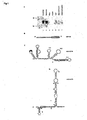
- FIGS 1A-1C miR-122 is expressed in Huh7 cells and has two predicted binding sites in the HCV genome.
- A Northern blot analysis of miR-122 expression in total RNA extracted from mouse and human liver, and HeLa, HepG2 and na ⁇ ve, cured and replicon Huh7 cells.
- B Sequence of miR-122 with the seed sequences surrounded by a box.
- C Secondary structure of the 3' and 5' noncoding regions of the HCV genotype 1 a strain H77c, with predicted miR-122 binding sites indicated. The seed matches are enclosed in boxes.
- FIGS 2A-C Sequestration of miR-122 reduces HCV RNA and protein abundance in replicon cells.
- A Northern blot analysis of replicon, eGFP and actin RNA in the NNeo/C-5B replicon cell line. The organization of the replicon is indicated.
- the eGFP sensor plasmids and 2'-O-methyl oligonucleotides were introduced into cells by lipofectamine 2000-mediated transfection, and total RNA was extracted 48 hours later.
- eGFP-124 and eGFP-122 are eGFP expression vectors with complementary sites for miR-124 and miR-122, respectively, in the 3'UTR.
- 122-2'OMe is a 31 mer 2'-O-methylated oligomer complementary to miR-122, Rand-2'OMe is a randomized version of this sequence, and let7-2'OMe is a similar oligomer complementary to let-7a.
- B Western blot showing levels of HCV core protein, eGFP and actin 48 hours post transfection with the indicated eGFP sensor plasmids and 2'-O-methylated oligomers.
- C Northern analysis of replicon, eGFP and actin RNA in Huh7 cells containing the genome-length genotype 1a replicon H77c and transfected with eGFP-122 and 122-2'OMe.
- FIGS. 3A-3C The predicted miR-122 binding site in the 5'noncoding region of HCV is required for viral RNA maintenance due to a direct interaction with miR-122
- A Position of the mutations introduced into the H77c full-length RNA. A 4nt substitution mutation was introduced into the seed match in the 3' noncoding region (m3') and 4nt, 2nt or 1 nt substitution mutations into the 5' noncoding region seed match (m5'A, B and C respectively). The mutated nucleotides are enclosed in boxes.
- B RNA was synthesized by in vitro transcription and introduced into Huh7 cells by electroporation, and replicon RNA levels were determined by Northern blotting 5 days later.
- Huh7 cells were transfected with synthetic duplexes corresponding to wild-type miR-122 (122wt) or miR-122 with a 1 nt mutation in the seed complementary to the m5'C seed match mutation (122mC), with the opposite strand of the duplex based on the miR-122 precursor hairpin.
- the duplexes were introduced into Huh7 cells one day prior to electroporation with wildtype H77c RNAs or mutant m5'C RNAs, and again at 1 and 3 days post electroporation. Total RNA was harvested 5 days post electroporation and replicon and actin RNA levels determined by Northem blotting.
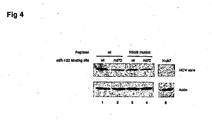
- Figure 4 Mutation of the miR-122 binding site does not affect HCV mRNA translation.
- the m5'C mutation was introduced into a replication-deficient mutant of H77c, AAG-H77, containing amino acids changes GDD to AAG at positions 2737 to 2739 in the viral polymerase NS5B (23). Lysates were harvested 20 hours after transfection of the replicon RNA, and HCV core protein and actin expression determined by Western blotting.
- Figure S3A and B-Addition of synthetic miR-122 duplex to NNeo/C-5B replicon cells results in an increase in replicon RNA abundance.
- the indicated eGFP sensor plasmids and wild-type (122wt) or mutant (122mC) miR-122 duplexes were introduced into cells by transfection using lipofectamine 2000.
- compositions for reducing viral genome amounts in a target cell are disclosed.
- the activity of a miRNA is inhibited in a manner sufficient to reduce the amount of viral genome in the target cell, e.g., by introducing a miRNA inhibitory agent in the target cell.
- pharmaceutical compositions, kits and systems for use in practicing the subject methods are provided.
- the subject invention finds use in a variety of applications, including the treatment of subjects suffering from a viral mediated disease condition, e.g., an HCV mediated disease condition.
- compositions reducing the amount of a target viral genome in a target cell are disclosed.
- the subject methods are described first in greater detail, followed by a review of various representative applications in which the subject invention finds use as well as kits that find use in practicing the subject invention.
- reducing the amount of a target viral genome in a target cell where the target cell may be present in vitro or in vivo.
- reducing the amount of is meant that the level or quantity of the target viral genome in the target cell is reduced by at least about 2-fold, usually by at least about 5-fold, e.g., 10-fold, 15-fold, 20-fold, 50-fold, 100-fold or more, as compared to a control, i.e., an identical target cell not treated according to the subject methods.
- a miRNA (microRNA) inhibitory agent is introduced into the target cell, where any convenient protocol for introducing the agent into the target cell may be employed:
- the miRNA inhibitory agent is an agent that inhibits the activity of a target miRNA in the target cell.
- the target miRNA is a miRNA whose presence is associated with viral genome replication and abundance in the target cell.
- miRNAs are single stranded RNA molecules that range in length from about 20 to about 25 nt, such as from about 21 to about 24 nt, e.g., 22 or 23 nt.
- the target miRNAs may or may not be completely complementary to a region of the same length as the miRNA in the target viral genome.
- the miRNA and its corresponding target viral genome are at least substantially complementary, such that the amount of mismatches present over the length of the miRNA, (ranging from about 20 to about 25 nt) will not exceed about 8 nt, and will in certain embodiments not exceed about 6 or 5 nt, e.g., 4 nt.
- miRNA inhibitory agent an agent that inhibits the activity of the target miRNA.
- the inhibitory agent may inhibit the activity of the target miRNA by a variety of different mechanisms.
- the inhibitory agent used in the invention is one that binds to the target miRNA and, in doing so, inhibits its activity.
- the miRNA inhibitory agents used in the invention are antisense oligonucleotides, such as the specific antisense oligonucleotides reported in the experimental section below, and the like.
- Other agents of interest include, but are not limited to: Naturally occurring or synthetic small molecule compounds of interest include numerous chemical classes, though typically they are organic molecules, preferably small organic compounds having a molecular weight of more than 50 and less than about 2,500 daltons.
- Candidate agents comprise functional groups necessary for structural interaction with proteins, particularly hydrogen bonding, and typically include at least an amine, carbonyl, hydroxyl or carboxyl group, preferably at least two of the functional chemical groups.
- the candidate agents often comprise cyclical carbon or heterocyclic structures and/or aromatic or polyaromatic structures substituted with one or more of the above functional groups.
- Candidate agents are also found among biomolecules including peptides, saccharides, fatty acids, steroids, purines, pyrimidines, derivatives, structural analogs or combinations thereof. Such molecules may be identified, among other ways, by employing appropriate screening protocols.
- RNAi agents may target the precursor molecule of the microRNA, known as pre-microRNA molecule.
- RNAi agent is meant an agent that modulates expression of microRNA by a RNA interference mechanism.
- the RNAi agents may be small ribonucleic acid molecules (also referred to herein as interfering ribonucleic acids), i.e., oligoribonucleotides, that are present in duplex structures, e.g., two distinct oligoribonucleotides hybridized to each other or a single ribooligonucleotide that assumes a small hairpin formation to produce a duplex structure.
- oligoribonucleotide is meant a ribonucleic acid that does not exceed about 100 nt in length, and typically does not exceed about 75 nt length, where the length may be less than about 70 nt.
- RNA agent is a duplex structure of two distinct ribonucleic acids hybridized to each other, e.g., an siRNA (such as d-siRNA as described in copending application serial no.
- the length of the duplex structure typically ranges from about 15 to 30 bp, usually from about 15 to 29 bp, where lengths between about 20 and 29 bps, e.g., 21 bp, 22 bp, are of particular interest.
- the RNA agent is a duplex structure of a single ribonucleic acid that is present in a hairpin formation, i.e., a shRNA
- the length of the hybridized portion of the hairpin is typically the same as that provided above for the siRNA type of agent or longer by 4-8 nucleotides.
- the weight of RNAi agents typically ranges from about 5,000 daltons to about 35,000 daltons, or at least about 10,000 daltons and less than about 27,500 daltons, often less than about 25,000 daltons.
- the RNAi agent may encode an interfering ribonucleic acid, e.g., an shRNA, as described above.
- the RNAi agent may be a transcriptional template of the interfering ribonucleic acid.
- the transcriptional template is typically a DNA that encodes the interfering ribonucleic acid.
- the DNA may be present in a vector, where a variety of different vectors are known in the art, e.g., a plasmid vector, a viral vector, etc.
- the miRNA inhibitory agent can be introduced into the target cell(s) using any convenient protocol, where the protocol will vary depending on whether the target cells are in vitro or in vivo.
- the miRNA agent can be administered to the host using any convenient protocol.
- the protocol employed is typically a nucleic acid administration protocol, where a number of different such protocols are known in the art. The following discussion provides a review of representative nucleic acid administration protocols that may be employed.
- the nucleic acids may be introduced into tissues or host cells by any number of routes, including viral infection, microinjection, or fusion of vesicles. Jet injection may also be used for intra-muscular administration, as described by Furth et al. (1992), Anal Biochem 205:365-368 .
- the nucleic acids may be coated onto gold microparticles, and delivered intradermally by a particle bombardment device, or "gene gun” as described in the literature (see, for example, Tang et al. (1992), Nature 356:152-154 ), where gold microprojectiles are coated with the DNA, then bombarded into skin cells.
- Expression vectors may be used to introduce the nucleic acids into a cell. Such vectors generally have convenient restriction sites located near the promoter sequence to provide for the insertion of nucleic acid sequences.
- Transcription cassettes may be prepared comprising a transcription initiation region, the target gene or fragment thereof, and a transcriptional termination region. The transcription cassettes may be introduced into a variety of vectors, e.g.
- plasmid e.g. lentivirus; adenovirus; and the like, where the vectors are able to transiently or stably be maintained in the cells, usually for a period of at least about one day, more usually for a period of at least about several days to several weeks.
- the inhibitory agent can be fed directly to, injected into, the host organism containing the target gene.
- the agent may be directly introduced into the cell (i.e., intracellularly); or introduced extracellularly into a cavity, interstitial space, into the circulation of an organism, introduced orally, etc.
- Methods for oral introduction include direct mixing of RNA with food of the organism.
- Physical methods of introducing nucleic acids include injection directly into the cell or extracellular injection into the organism of an RNA solution.
- the agent may be introduced in an amount which allows delivery of at least one copy per cell. Higher doses (e.g., at least 5, 10, 100, 500 or 1000 copies per cell) of the agent may yield more effective inhibition; lower doses may also be useful for specific applications.
- a hydrodynamic nucleic acid administration protocol is employed.
- the agent is a ribonucleic acid
- the hydrodynamic ribonucleic acid administration protocol described in detail below is of particular interest.
- the agent is a deoxyribonucleic acid
- Additional nucleic acid delivery protocols of interest include, but are not limited to: those described in U.S. Patents of interest include 5,985,847 and 5,922,687 ; WO/11092 ;. Acsadi et al., New Biol. (1991) 3:71-81 ; Hickman et al., Hum. Gen. Ther. (1994) 5:1477-1483 ; and Wolff et al., Science (1990) 247: 1465-1468 ; etc.
- the active agent(s) may be administered to the host using any convenient means capable of resulting in the desired reduction of target viral genome amount or load in the target cell.
- the agent can be incorporated into a variety of formulations for therapeutic administration.
- the agents of the present invention can be formulated into pharmaceutical compositions by combination with appropriate, pharmaceutically acceptable carriers or diluents, and may be formulated into preparations in solid, semi-solid, liquid or gaseous forms, such as tablets, capsules, powders, granules, ointments, solutions, suppositories, injections, inhalants and aerosols.
- administration of the agents can be achieved in various ways, including oral, buccal, rectal, parenteral, intraperitoneal, intradermal, transdermal, intracheal, etc., administration.
- the agents may be administered alone or in appropriate association, as well as in combination, with other pharmaceutically active compounds.
- the following methods and excipients are merely exemplary and are in no way limiting.
- the agents can be used alone or in combination with appropriate additives to make tablets, powders, granules or capsules, for example, with conventional additives, such as lactose, mannitol, com starch or potato starch; with binders, such as crystalline cellulose, cellulose derivatives, acacia, com starch or gelatins; with disintegrators, such as corn starch, potato starch or sodium carboxymethylcellulose; with lubricants, such as talc or magnesium stearate; and if desired, with diluents, buffering agents, moistening agents, preservatives and flavoring agents.
- conventional additives such as lactose, mannitol, com starch or potato starch
- binders such as crystalline cellulose, cellulose derivatives, acacia, com starch or gelatins
- disintegrators such as corn starch, potato starch or sodium carboxymethylcellulose
- lubricants such as talc or magnesium stearate
- the agents can be formulated into preparations for injection by dissolving, suspending or emulsifying them in an aqueous or nonaqueous solvent, such as vegetable or other similar oils, synthetic aliphatic acid glycerides, esters of higher aliphatic acids or propylene glycol; and if desired, with conventional additives such as solubilizers, isotonic agents, suspending agents, emulsifying agents, stabilizers and preservatives.
- an aqueous or nonaqueous solvent such as vegetable or other similar oils, synthetic aliphatic acid glycerides, esters of higher aliphatic acids or propylene glycol
- solubilizers isotonic agents
- suspending agents emulsifying agents, stabilizers and preservatives.
- the agents can be utilized in aerosol formulation to be administered via inhalation.
- the compounds of the present invention can be formulated into pressurized acceptable propellants such as dichlorodifluoromethane, propane, nitrogen and the like.
- the agents can be made into suppositories by mixing with a variety of bases such as emulsifying bases or water-soluble bases.
- bases such as emulsifying bases or water-soluble bases.
- the compounds of the present invention can be administered rectally via a suppository.
- the suppository can include vehicles such as cocoa butter, carbowaxes and polyethylene glycols, which melt at body temperature, yet are solidified at room temperature.
- Unit dosage forms for oral or rectal administration such as syrups, elixirs, and suspensions may be provided wherein each dosage unit, for example, teaspoonful, tablespoonful, tablet or suppository, contains a predetermined amount of the composition containing one or more inhibitors.
- unit dosage forms for injection or intravenous administration may comprise the inhibitor(s) in a composition as a solution in sterile water, normal saline or another pharmaceutically acceptable carrier.
- unit dosage form refers to physically discrete units suitable as unitary dosages for human and animal subjects, each unit containing a predetermined quantity of compounds of the present invention calculated in an amount sufficient to produce the desired effect in association with a pharmaceutically acceptable diluent, carrier or vehicle.
- the specifications for the novel unit dosage forms of the present invention depend on the particular compound employed and the effect to be achieved, and the pharmacodynamics associated with each compound in the host.
- the pharmaceutically acceptable excipients such as vehicles, adjuvants, carriers or diluents, are readily available to the public.
- pharmaceutically acceptable auxiliary substances such as pH adjusting and buffering agents, tonicity adjusting agents, stabilizers, wetting agents and the like, are readily available to the public.
- dose levels can vary as a function of the specific compound, the nature of the delivery vehicle, and the like. Preferred dosages for a given compound are readily determinable by those of skill in the art by a variety of means.
- RNAi agent a mammalian cell as described above results in a modulation of target gene(s) expression, e.g., a reduction of target gene(s) expression, as described above.
- mammal cells of interest include, but are not limited to cells of: ungulates or hooved animals, e.g., cattle, goats, pigs, sheep, etc.; rodents, e.g., hamsters, mice, rats, etc.; lagomorphs, e.g., rabbits; primates, e.g., monkeys, baboons, humans, etc.; and the like.
- compositions may be advantageously combined and/or used in combination and/or alternation with other antiviral agents which are either therapeutic or prophylactic agents, and different from the subject compounds.
- the compositions may also be advantageously combined and/or used in combination with agents that treat conditions often associated with the viral infections that are sensitive to the present compounds, such as anti-HCV agents or immunosuppressive agents.
- administration in conjunction with the subject compositions enhances the efficacy of such agents.
- the present compounds, when combined or administered in combination with other antiviral agents can be used in certain embodiments in dosages which are less than the expected amounts when used alone, or less than the calculated amounts for combination therapy.
- Exemplary treatment options for hepatitis C include interferons, e.g., interferon alfa-2b, interferon alfa-2a, and interferon aifacon-1. Less frequent interferon dosing can be achieved using pegylated interferon (interferon attached to a polyethylene glycol moiety which significantly improves its pharmacokinetic profile). Combination therapy with interferon alfa-2b (pegylated and unpegylated) and ribavarin has also been shown to be efficacious for some patient populations.
- interferon alfa-2b pegylated and unpegylated
- ribavarin has also been shown to be efficacious for some patient populations.
- RNA replication inhibitors e.g., ViroPharma's VP50406 series
- antisense agents e.g., antisense agents, therapeutic vaccines, protease inhibitors, helicase inhibitors and antibody therapy (monoclonal and polyclonal).
- the compounds and compositions of the present invention may also be used with agents that enhance the body's immune system, including low-dose cyclophosphamide, thymostimulin, vitamins and nutritional supplements (e.g., antioxidants, including vitamins A, C, E, beta-carotene, zinc, selenium, glutathione, coenzyme Q-10 and echinacea), and vaccines, e.g., the immunostimulating complex (ISCOM), which comprises a vaccine formulation that combines a multimeric presentation of antigen and an adjuvant.
- agents that enhance the body's immune system including low-dose cyclophosphamide, thymostimulin, vitamins and nutritional supplements (e.g., antioxidants, including vitamins A, C, E, beta-carotene, zinc, selenium, glutathione, coenzyme Q-10 and echinacea), and vaccines, e.g., the immunostimulating complex (ISCOM), which comprises a vaccine formulation that combines
- the subject methods find use in the treatment of a variety of different conditions in which the reduction of a target viral genome amount in a target cell or host comprising the same is desired.
- the subject methods find use in the treatment of a host suffering from a viral mediated disease condition.
- treatment is meant that at least an amelioration of the symptoms associated with the condition afflicting the host is achieved, where amelioration is used in a broad sense to refer to at least a reduction in the magnitude of a parameter, e.g. symptom, associated with the condition being treated.
- treatment also includes situations where the pathological condition, or at least symptoms associated therewith, are completely inhibited, e.g. prevented from happening, or stopped, e.g. terminated, such that the host no longer suffers from the condition, or at least the symptoms that characterize the condition.
- hosts are treatable according to the subject methods.
- Such hosts are "mammals” or “mammalian where these terms are used broadly to describe organisms which are within the class mammalia, including the orders carnivore ( e.g., dogs and cats), rodentia (e.g., mice, guinea pigs, and rats), and primates ( e.g., humans, chimpanzees, and monkeys).
- the hosts will be humans.
- the methods may be employed for any viral genome whose abundance in a target cell correlates with a miRNA in that cell.
- the viral genome is a genome of virus having an RNA genome, where the virus may be from the family Flaviviridae, e.g., a hepacivirus, such as a hepatitis C.
- Hepatitis C virus e.g., Hepatitis C virus (isolate 1), Hepatitis C virus (isolate BK), Hepatitis C virus (isolate EC1), Hepatitis C virus (isolate EC10), Hepatitis C virus (isolate HC-J2), Hepatitis C virus (isolate HC-J5), Hepatitis C virus (isolate HC-J6), Hepatitis C virus (isolate HC-J7), Hepatitis C virus (isolate HC-J8), Hepatitis C virus (isolate HC-JT), Hepatitis C virus (isolate HCT18), Hepatitis C virus (isolate HCT27), Hepatitis C virus (isolate HCV-476), Hepatitis C virus (isolate HCV-KF), Hepatitis C virus (isolate Hunan), Hepatitis C virus (isolate Japanese), Hepatitis C virus (i
- the subject invention is employed in methods of treating a host suffering from an HCV mediated disease condition, e.g., non A, non-B hepatitis (NANBH).
- an effective amount of a miR122 inhibitory agent such as an antisense oligo as exemplified below, is administered to the host such that the amount of HCV genome present in the host cells, particularly liver cells, is reduced, as described above.
- compositions containing the miRNA inhibitory compounds employed in the subject methods are also provided.
- the compounds e.g., in the form of a pharmaceutically acceptable salt, can be formulated for oral or parenteral administration for use in the subject methods, as described above.
- the compounds can be admixed with conventional pharmaceutical carriers and excipients (i.e., vehicles) and used in the form of aqueous solutions, tablets, capsules, elixirs, suspensions, syrups, wafers, and the like.
- Such pharmaceutical compositions contain, in certain embodiments, from about 0.1 to about 90% by weight of the active compound, and more generally from about 1 to about 30% by weight of the active compound.
- the pharmaceutical compositions may contain common carriers and excipients, such as com starch or gelatin, lactose, dextrose, sucrose, microcrystalline cellulose, kaolin, mannitol, dicalcium phosphate, sodium chloride, and alginic acid.
- Disintegrators commonly used in the formulations of this invention include croscarmellose, microcrystalline cellulose, com starch, sodium starch glycolate and alginic acid.
- a liquid composition will generally consist of a suspension or solution of the compound or pharmaceutically acceptable salt in a suitable liquid carrier(s), for example, ethanol, glycerine, sorbitol, non-aqueous solvent such as polyethylene glycol, oils or water, with a suspending agent, preservative, surfactant, wetting agent, flavoring or coloring agent.
- a suitable liquid carrier for example, ethanol, glycerine, sorbitol, non-aqueous solvent such as polyethylene glycol, oils or water, with a suspending agent, preservative, surfactant, wetting agent, flavoring or coloring agent.
- a liquid formulation can be prepared from a reconstitutable powder.
- a powder containing active compound, suspending agent, sucrose and a sweetener can be reconstituted with water to form a suspension; and a syrup can be prepared from a powder containing active ingredient, sucrose and a sweetener.
- a composition in the form of a tablet can be prepared using any suitable pharmaceutical carriers) routinely used for preparing solid compositions.
- suitable pharmaceutical carriers include magnesium stearate, starch, lactose, sucrose, microcrystalline cellulose and binders, for example, polyvinylpyrrolidone.
- the tablet can also be provided with a color film coating, or color included as part of the carrier(s).
- active compound can be formulated in a controlled release dosage form as a tablet comprising a hydrophilic or hydrophobic matrix.
- a composition in the form of a capsule can be prepared using routine encapsulation procedures, for example, by incorporation of active compound and excipients into a hard gelatin capsule.
- a semi-solid matrix of active compound and high molecular weight polyethylene glycol can be prepared and filled into a hard gelatin capsule; or a solution of active compound in polyethylene glycol or a suspension in edible oil, for example, liquid paraffin or fractionated coconut oil can be prepared and.filled into a soft gelatin capsule.
- Tablet binders that can be included are acacia, methylcellulose, sodium carboxymethylcellulose, poly-vinylpyrrolidone (Rovidone), hydroxypropyl methylcellulose, sucrose, starch and ethylcellulose.
- Lubricants that can be used include magnesium stearate or other metallic stearates, stearic acid, silicone fluid, talc, waxes, oils and colloidal silica.
- Flavoring agents such as peppermint, oil of wintergreen, cherry flavoring or the like can also be used. Additionally, it may be desirable to add a coloring agent to make the dosage form more attractive in appearance or to help identify the product.
- the compounds of the invention and their pharmaceutically acceptable salts that are active when given parenterally can be formulated for intramuscular, intrathecal, or intravenous administration.
- a typical composition for intramuscular or intrathecal administration will be of a suspension or solution of active ingredient in an oil, for example, arachis oil or sesame oil.
- a typical composition for intravenous or intrathecal administration will be a sterile isotonic aqueous solution containing, for example, active ingredient and dextrose or sodium chloride, or a mixture of dextrose and sodium chloride.
- Other examples are lactated Ringer's injection, lactated Ringer's plus dextrose injection, Normosol-M and dextrose, Isolyte E, acylated Ringer's injection, and the like.
- a co-solvent for example, polyethylene glycol
- a chelating agent for example, ethylenediamine tetraacetic acid
- an anti-oxidant for example, sodium metabisulphite
- the solution can be freeze dried and then reconstituted with a suitable solvent just prior to administration.
- the compounds of the invention and their pharmaceutically acceptable salts which are active on rectal administration can be formulated as suppositories.
- a typical suppository formulation will generally consist of active ingredient with a binding and/or lubricating agent such as a gelatin or cocoa butter or other low melting vegetable or synthetic wax or fat.
- transdermal compositions or transdermal delivery devices
- Such compositions include, for example, a backing, active compound reservoir, a control membrane, liner and contact adhesive.
- transdermal patches may be used to provide continuous or discontinuous infusion of the compounds of the present invention in controlled amounts.
- the construction and use of transdermal patches for the delivery of pharmaceutical agents is well known in the art. See, e.g., U.S. Pat. No. 5,023,252, issued Jun. 11, 1991 , herein incorporated by reference in its entirety.
- patches may be constructed for continuous, pulsatile, or on demand delivery of pharmaceutical agents.
- the pharmaceutical composition may contain other pharmaceutically acceptable components, such a buffers, surfactants, antioxidants, viscosity modifying agents, preservatives and the like.
- a buffers such as sodium bicarbonate, sodium bicarbonate, sodium bicarbonate, sodium bicarbonate, sodium bicarbonate, sodium bicarbonate, sodium bicarbonate, sodium bicarbonate, sodium bicarbonate, sodium bicarbonate, sodium bicarbonate, sodium bicarbonate, sodium bicarbonate, sodium bicarbonate, sodium bicarbonate, sodium bicarbonate, sodium bicarbonate, sodium bicarbonate, sodium bicarbonate, sodium bicarbonate, sodium bicarbonate, sodium bicarbonate, sodium bicarbonate, sodium bicarbonate, sodium bicarbonate, sodium bicarbonate, sodium bicarbonate, sodium bicarbonate, sodium bicarbonate, sodium bicarbonate, sodium bicarbonate, sodium bicarbonate, sodium bicarbonate, sodium bicarbonate, sodium bicarbonate, sodium bicarbonate, sodium bicarbonate, sodium bicarbonate, sodium bicarbonate, sodium bicarbonate, sodium bicarbonate, sodium
- the aqueous cyclodextrin solution further comprise dextrose, e.g., about 5% dextrose.
- kits thereof for practicing one or more of the above-described methods.
- the subject reagents and kits thereof may vary greatly.
- the kits at least include a miRNA inhibitory agent as described above.
- the kits may also include a pharmaceutically acceptable delivery vehicle, which may be combined with or separate from the miRNA inhibitory agent in the kit, e.g., where the two components may be in the same or separate containers in the kit.
- the subject kits will further include instructions for practicing the subject methods. These instructions may be present in the subject kits in a variety of forms, one or more of which may be present in the kit.
- One form in which these instructions may be present is as printed information on a suitable medium or substrate, e.g., a piece or pieces of paper on which the information is printed, in the packaging of the kit, in a package insert, etc.
- Yet another means would be a computer readable medium, e.g., diskette, CD, etc., on which the information has been recorded.
- Yet another means that may be present is a website address which may be used via the internet to access the information at a removed site. Any convenient means may be present in the kits.
- systems for practicing the subject methods may include one or more pharmaceutical formulations, which include the miRNA inhibitory agent.
- system refers to a collection of components, e.g., active agent, delivery vehicle, etc, present in a single composition or as disparate compositions, that are brought together for the purpose of practicing the subject methods.
- active agent and delivery vehicle brought together and coadministered to a subject, according to the present invention are a system according to the present invention.
- FIG. 1A shows that miR-122 could be detected in mouse and human liver, and in cultured human liver Huh7 cells, but not in human cervical carcinoma-derived HeLa cells, or even in human liver-derived HepG2 cells ( Fig. 1A ) .
- HCV hepatitis C virus
- variable region One was located in the variable region of the viral 3' noncoding region of the type 1 a genotype ( Fig. 1 C) . Although this sequence was in the nominally. "variable region", inspection of all six HCV genotypes revealed that the seed match sequence itself was highly conserved (Table 1).
- the second miR-122 binding site was predicted to reside in the 5' noncoding region, only 21 nucleotides from the 5' end of the viral genome ( Fig. 1 C) .
- the putative seed match sequence was flanked by an adenosine residue. This leads to further base pairing with nucleotide 1 in the miRNA, which is in most cases a uridine residue, resulting in increased specificity of microRNA-target interactions.
- the putative seed match sequence for miR-122 is highly conserved among all viral genotypes with the exception of the seed match sequence in genotype 2 which lacks the anchoring adenosine (Table 1).
- Table 1 Genotype SEQ ID NO: 5'UTR 3'UTR 1a(01&02) UGAUGGGGGCG ACACUCCA C UGAAGGUUGGGGU AACACU CCGGCC 1b (03 & 04) AUUGGGGGCG ACACUCCA CC UGAACGGGGAGCUAA ACACUCCA GG 2 (05 & 06) AAUAGGGGCG ACACUCC GCC UAGAGCGGCACACACUAGGU ACACUCCA 3 (07 & 08) UACGAGGCGAC ACUCCA CCA UGAGCUGGUAAGAUA ACACUCCA UU 4 (09&10) UAUGAGAGC AACACUCCA CC UAGGCAGCUUA ACACU CCGACCUUA 5 (11&12) UAUUG
- the predicted miR-122 binding sites in HCV are conserved in all genotypes.
- the sequence of the 5'UTR from nucleotides 10-30 in the genome, and of the 3'UTR from the stop codon to the end of the predicted binding site, is shown for each genotype.
- the seed matches are indicated in bold type.
- NNeo/C-5B cells were transfected with a 2'-O-methylated RNA oligonucleotide (122-2'OMe), 31 nucleotides in length, with exact complementarity to miR-122; 2'O-methylated complementary RNA nucleotides have been shown to sequester miRNAs( Hutvagner, et al., PLoS Biol. 2, E98 (2004 ); Meister, et al., RNA 10, 544 (2004 )).
- eGFP-122 eGFP sensor mRNAs that contained sequences complementary to miR-122 in their 3' noncoding regions. Due to its complete complementarity, miR-122 should function as an siRNA on these target molecules and lead to their nucleolytic degradation. Indeed, little full-length eGFP-122 RNA was visible in cells transfected with plasmids encoding eGFP-122 ( Fig. 2A , lane 3), although a similar RNA that contained sites complementary to the brain-specific miR-124 was expressed at high levels ( Fig. 2A , lane 2).
- eGFP-122 RNA Upon transfection with 122-2'OMe, the amount of eGFP-122 RNA dramatically increased ( Fig. 2A , lane 4), whereas a randomized version of this oligomer (Rand-2'OMe, lane 5) or an oligomer complementary to the miRNA let-7a (let7-2'OMe) had no effect ( Fig. 2A , lane 6).
- a 23mer oligomer complementary to miR-122 had the same effect as the 31 mer.
- HCV viral replicon RNA was specifically and dramatically reduced when miR-122 was inactivated ( Fig. 2A , lanes 4 and 7).
- Reduced viral mRNA abundance resulted in a decrease in HCV protein expression in cells transfected with the 122-2'OMe oligomer, while the level of eGFP sensor protein increased under this experimental condition ( Fig. 2B , lane 3).
- the 122-2'OMe oligomers affected replicon RNA and protein levels by interacting with the negative strand of HCV, which has considerable complementarity to the oligomer sequence in the region surrounding the predicted miR-122 binding sites.
- RNA transcripts were synthesized from a cDNA that encodes a full-length genotype 1 a strain H77c genome with five adaptive mutations ( FIG. 2C , top diagram) that allow high levels of RNA replication in Huh7 cells ( Yi & Lemon, J. Virol. 78, 7904 (2004 )).
- Introduction of these RNA molecules into Huh7 cells led to accumulation of viral RNA in the presence of endogenous miR-122 ( Fig. 2C , lanes 1 and 2); in contrast, viral RNA failed to accumulate when miR-122 was sequestered by 122-2'OMe oligomers ( Fig. 2C , lane 3).
- miR-122 is required to maintain HCV RNA abundance of both genotypes 1 a and 1b, in stably expressing cell lines and upon direct transfection.
- ectopic expression of miR-122 RNAs that contained a mutation at the third nucleotide from the 5' end (mC) should restore the formation of miR-122(mC)-m5'C RNA complexes ( Lewis, et al., Cell 120, 15 (2005 )).
- Ectopic expression of wildtype miR-122 RNAs did not rescue m5'C-containing mutated viral RNAs ( Fig. 3C , lane 3), but enhanced the abundance of wildtype viral RNAs ( Fig. 3C , lane 1) and replicon RNAs (Fig.
- mutated m5'C-containing viral RNAs by mutated mC-miR-122s must be due to a direct HCV RNA-miR-122 interaction, rather than an indirect effect via another, probably cellular, miR-122 target.
- Figure 4 shows that similar amounts of core protein accumulated in cells transfected with wildtype (lane 1) or m5'C-mutant RNAs (lane 2) at twenty hours after transfection, a time point at which little RNA replication should have taken place.
- lane 1 wildtype
- m5'C-mutant RNAs lane 2
- results showed that wildtype ( Fig. 4 , lane 3) and m5'C-mutant (lane 4) input RNAs were translated with similar efficiencies, indicating that miR-122 regulates HCV RNA abundance at a step subsequent to translation, most likely at the RNA replication step.
- RNA oligonucleotides and 2'-O-methylated oligonucleotides were synthesized by Dharmacon Inc. (Lafayette, CO). The sequences were: 122-2'OMe, 5'AGACACAAACACCAUUGUCACACUCCACAGC (SEQ ID NO:15); Rand-2'OMe, 5'CACGUUAAAACCAUACGCACUACGAAACCCC (SEQ ID NO:16); let7-2'OMe, 5'CUAAAACUAUACAACCUACUACCUCAUCCCA (SEQ ID NO:17); 122-2'OMe23, 5'ACAAACACCAUUGUCACACUCCA (SEQ ID NO:18); HCVbs-2'OMe, 5'UGAACGGGGAGCUAAACACUCCA ((SEQ ID NO:19); miR-122wt, 5'UGGAGUGUGACAAUGGUGUUUGU ((SEQ ID NO:20); miR-122mC, 5'UGCAGUGUGACAAUGGUGUU
- the miR-122 sensor plasmid eGFP-122 was constructed by PCR-mediated insertion of the sequence 5'ACAAACACCAUUGUCACACUCCA (SEQ ID NO:23), which has exact complementarity to miR-122, at the Not I restriction site in the 3'noncoding region of plasmid pd2eGFP-N1 (Clontech).
- the sequence 5'TTAAGGCACGCGGTGAATGCCA SEQ ID NO:24
- Substitution mutations were introduced into the 3' and 5'noncoding regions of the H77c replicon vector ( Yi & Lemon, J Virol 78, 7904 (Aug, 2004 ))by overlap PCR using mutagenic primers, and subsequent ligation of the PCR products into the parent vector.
- the Huh7, HeLa and HepG2 cell lines were cultured in DMEM supplemented with 10% FBS and 1% non-essential amino acids (Gibco).
- the Huh7 cell line containing the dicistronic replicon NNeo/C-5B has been described previously ( Ikeda, et al., J Virol 76, 2997 (Mar, 2002 )) and was maintained in the presence of 1 mg/ml G418.
- In vitro transcribed H77c genomic RNA was introduced into Huh7 cells by electroporation as described in Yi & Lemon, supra, and RNA was prepared and processed 5 days later.
- RNA constructs and oligonucleotides were introduced into cells using lipofectamine 2000 (Invitrogen), according to the manufacturer's instructions.
- the 2'-O-methylated oligonucleotides and the miR-122 RNA duplexes were delivered at a concentration of 50nM into cells in 6-well plates. Transfected cells were cultured for 48 hours before harvesting.
- RNA from the NNeo/C-5B replicon cells was separated in 1% agarose gels containing 1 x MOPS buffer and 2.2M formaldehyde, and transferred to Zeta-probe membrane (Bio-Rad).
- the membranes were hybridized in ExpressHyb (Clontech) to random-primed 32 P-labelled DNA probes corresponding to nucleotides 84-374 of HCV, 40-814 of eGFP, and 685-1171 of ⁇ -actin as indicated.
- Protein samples were obtained by scraping cells into RIPA containing a complete protease inhibitor cocktail (Roche). 10 ⁇ g of protein was separated by 12% SDS-PAGE and transferred to Immobilon-P membrane (Millipore). Membranes were probed with antibody 6G7 directed against the HCV core protein (a kind gift of Harry Greenberg, Stanford University), or antibodies dirceted against eGFP (Roche) or actin (Sigma). For metabolic labelling, cells were incubated in methionine-free medium for 1 hour before incubation with 35 S-methionine for 1 hour and extraction of protein. 25 ⁇ g of protein was precipitated using trichloroacetic acid and 35 S-methionine incorporation was quantitated by filter binding.
- H77c GenBank accession no. AF011751; HCV-N (1 b), AF139594; JFH-1 (2a), AB047639; NZL1 1 (3a), D17763; HEMA51 (4a), D45193 and D45194; FR741 (5a), D50466 and D50467; TH271 (6f), D37848 and D37858.
Landscapes
- Health & Medical Sciences (AREA)
- Life Sciences & Earth Sciences (AREA)
- Engineering & Computer Science (AREA)
- Chemical & Material Sciences (AREA)
- Genetics & Genomics (AREA)
- Biomedical Technology (AREA)
- Organic Chemistry (AREA)
- General Health & Medical Sciences (AREA)
- Molecular Biology (AREA)
- Bioinformatics & Cheminformatics (AREA)
- Biotechnology (AREA)
- Medicinal Chemistry (AREA)
- Animal Behavior & Ethology (AREA)
- Public Health (AREA)
- Veterinary Medicine (AREA)
- Pharmacology & Pharmacy (AREA)
- Zoology (AREA)
- Wood Science & Technology (AREA)
- General Engineering & Computer Science (AREA)
- Virology (AREA)
- Chemical Kinetics & Catalysis (AREA)
- General Chemical & Material Sciences (AREA)
- Nuclear Medicine, Radiotherapy & Molecular Imaging (AREA)
- Biophysics (AREA)
- Microbiology (AREA)
- Biochemistry (AREA)
- Physics & Mathematics (AREA)
- Plant Pathology (AREA)
- Communicable Diseases (AREA)
- Oncology (AREA)
- Epidemiology (AREA)
- Dermatology (AREA)
- Gastroenterology & Hepatology (AREA)
- Pharmaceuticals Containing Other Organic And Inorganic Compounds (AREA)
- Medicines That Contain Protein Lipid Enzymes And Other Medicines (AREA)
- Medicines Containing Material From Animals Or Micro-Organisms (AREA)
- Micro-Organisms Or Cultivation Processes Thereof (AREA)
- Medicines Containing Antibodies Or Antigens For Use As Internal Diagnostic Agents (AREA)
- Peptides Or Proteins (AREA)
Claims (4)
- miR122 inhibitorisches Mittel zur Verwendung beim Behandeln eines Wirts, der an einem HCV-vermittelten Krankheitszustand leidet, wobei das Mittel ein Antisense-Oligonukleotid ist und wobei das Mittel an miR122 bindet.
- Mittel nach Anspruch 1 zur Verwendung beim Behandeln eines Wirts, der an einem HCV-vermittelten Krankheitszustand leidet, wobei der Wirt ein Mensch ist.
- Verwendung eines miR122 inhibitorischen Mittels, wie in Anspruch 1 oder Anspruch 2 definiert, bei der Zubereitung eines Medikaments zum Behandeln eines Wirts, der an einem HCV-vermittelten Krankheitszustand leidet.
- In-vitro-Verfahren zum Modulieren einer Genommenge eines Hepatitis C-Virus in einer Zielzelle, wobei das Verfahren ein Hemmen der Aktivität von miR122 in der Zielzelle durch Einführen eines miR122 inhibitorischen Mittels, wie in einem der Ansprüche 1-2 definiert, in die Zielzelle umfasst.
Priority Applications (6)
| Application Number | Priority Date | Filing Date | Title |
|---|---|---|---|
| EP10196635.6A EP2338996A3 (de) | 2004-05-04 | 2005-05-03 | Verfahren und Zusammensetzungen zum Verringern der viralen Genommengen in einer Target-Zelle |
| SI200531259A SI1747023T2 (sl) | 2004-05-04 | 2005-05-03 | Postopki in sestavki za zmanjšanje količine virusnega genoma hcv v tarčni celici |
| EP12163232.7A EP2500431A3 (de) | 2004-05-04 | 2005-05-03 | Verfahren und Zusammensetzungen zum Verringern der viralen Genommengen in einer Target-Zelle |
| SI200531259T SI1747023T1 (sl) | 2004-05-04 | 2005-05-03 | Postopki in sestavki za zmanjĺ anje koliäśine genoma hcv v taräśni celici |
| PL05749437T PL1747023T5 (pl) | 2004-05-04 | 2005-05-03 | Sposób i kompozycje do zmniejszania ilości genomu wirusowego HCV w komórkach docelowych |
| CY20111100346T CY1111755T1 (el) | 2004-05-04 | 2011-04-04 | Μεθοδοι και συνθεσεις για μειωση ποσοτητων ιικου γονιδιωματος hcv σε ενα κυτταρο στοχο |
Applications Claiming Priority (2)
| Application Number | Priority Date | Filing Date | Title |
|---|---|---|---|
| US56835804P | 2004-05-04 | 2004-05-04 | |
| PCT/US2005/015264 WO2005107816A2 (en) | 2004-05-04 | 2005-05-03 | Methods and compositions for reducing viral genome amounts in a target cell |
Related Child Applications (4)
| Application Number | Title | Priority Date | Filing Date |
|---|---|---|---|
| EP10196635.6A Division-Into EP2338996A3 (de) | 2004-05-04 | 2005-05-03 | Verfahren und Zusammensetzungen zum Verringern der viralen Genommengen in einer Target-Zelle |
| EP12163232.7A Division-Into EP2500431A3 (de) | 2004-05-04 | 2005-05-03 | Verfahren und Zusammensetzungen zum Verringern der viralen Genommengen in einer Target-Zelle |
| EP12163232.7A Division EP2500431A3 (de) | 2004-05-04 | 2005-05-03 | Verfahren und Zusammensetzungen zum Verringern der viralen Genommengen in einer Target-Zelle |
| EP12163229 Division-Into | 2012-04-04 |
Publications (4)
| Publication Number | Publication Date |
|---|---|
| EP1747023A2 EP1747023A2 (de) | 2007-01-31 |
| EP1747023A4 EP1747023A4 (de) | 2010-03-03 |
| EP1747023B1 EP1747023B1 (de) | 2011-01-05 |
| EP1747023B2 true EP1747023B2 (de) | 2016-03-09 |
Family
ID=35320743
Family Applications (3)
| Application Number | Title | Priority Date | Filing Date |
|---|---|---|---|
| EP12163232.7A Withdrawn EP2500431A3 (de) | 2004-05-04 | 2005-05-03 | Verfahren und Zusammensetzungen zum Verringern der viralen Genommengen in einer Target-Zelle |
| EP10196635.6A Withdrawn EP2338996A3 (de) | 2004-05-04 | 2005-05-03 | Verfahren und Zusammensetzungen zum Verringern der viralen Genommengen in einer Target-Zelle |
| EP05749437.9A Expired - Lifetime EP1747023B2 (de) | 2004-05-04 | 2005-05-03 | Verfahren und zusammensetzungen zur verringerung von hcv virusgenommengen in einer zielzelle |
Family Applications Before (2)
| Application Number | Title | Priority Date | Filing Date |
|---|---|---|---|
| EP12163232.7A Withdrawn EP2500431A3 (de) | 2004-05-04 | 2005-05-03 | Verfahren und Zusammensetzungen zum Verringern der viralen Genommengen in einer Target-Zelle |
| EP10196635.6A Withdrawn EP2338996A3 (de) | 2004-05-04 | 2005-05-03 | Verfahren und Zusammensetzungen zum Verringern der viralen Genommengen in einer Target-Zelle |
Country Status (15)
| Country | Link |
|---|---|
| US (6) | US7307067B2 (de) |
| EP (3) | EP2500431A3 (de) |
| JP (2) | JP4943322B2 (de) |
| AT (1) | ATE494373T2 (de) |
| AU (1) | AU2005240118C1 (de) |
| CA (2) | CA2912903A1 (de) |
| CY (1) | CY1111755T1 (de) |
| DE (1) | DE602005025751D1 (de) |
| DK (1) | DK1747023T4 (de) |
| ES (1) | ES2361458T5 (de) |
| IL (1) | IL178679B (de) |
| PL (1) | PL1747023T5 (de) |
| PT (1) | PT1747023E (de) |
| SI (1) | SI1747023T1 (de) |
| WO (1) | WO2005107816A2 (de) |
Families Citing this family (43)
| Publication number | Priority date | Publication date | Assignee | Title |
|---|---|---|---|---|
| EP2530157B1 (de) | 2003-07-31 | 2016-09-28 | Regulus Therapeutics Inc. | Oligomerverbindungen und Zusammensetzungen zur Verwendung bei der Modulation von miRNAs |
| EP1793674B1 (de) * | 2003-11-26 | 2018-05-30 | University of Massachusetts | Sequenzspezifische hemmung der funktion von kleiner rna |
| PT1747023E (pt) * | 2004-05-04 | 2011-04-11 | Univ Leland Stanford Junior | Métodos e composições para reduzir quantidades de genoma viral numa célula alvo |
| EP2290073A3 (de) | 2004-05-28 | 2011-08-31 | Asuragen, Inc. | Verfahren und Zusammensetzungen mit MicroRNA |
| CA2857878A1 (en) | 2004-11-12 | 2006-12-28 | Asuragen, Inc. | Methods and compositions involving mirna and mirna inhibitor molecules |
| WO2006113431A2 (en) * | 2005-04-13 | 2006-10-26 | University Of Massachusetts | Dual functional oligonucleotides for use as anti-viral agents |
| US20070213292A1 (en) | 2005-08-10 | 2007-09-13 | The Rockefeller University | Chemically modified oligonucleotides for use in modulating micro RNA and uses thereof |
| EP1919512B1 (de) * | 2005-08-10 | 2014-11-12 | Alnylam Pharmaceuticals Inc. | Chemisch modifizierte oligonukleotide zur verwendung bei der modulierung von mikro-rna und ihre verwendungen |
| WO2007027775A2 (en) | 2005-08-29 | 2007-03-08 | Isis Pharmaceuticals, Inc. | Methods for use in modulating mir-122a |
| US7516342B2 (en) | 2005-12-30 | 2009-04-07 | Intel Corporation | Method, apparatus and system to dynamically choose an optimum power state |
| DK2666859T3 (en) | 2006-04-03 | 2019-04-08 | Roche Innovation Ct Copenhagen As | PHARMACEUTICAL COMPOSITION CONTAINING ANTI-miRNA ANTISENSE OLIGONUCLEOTIDES |
| EP2261333B1 (de) * | 2006-04-03 | 2016-03-30 | Roche Innovation Center Copenhagen A/S | Pharmazeutische Zusammensetzung mit Anti-miRNA-Antisense-Oligonukleotiden |
| CA2663878A1 (en) * | 2006-09-19 | 2008-03-27 | Asuragen, Inc. | Mir-200 regulated genes and pathways as targets for therapeutic intervention |
| AU2008228243B2 (en) | 2007-03-22 | 2014-05-15 | Santaris Pharma A/S | RNA antagonist compounds for the inhibition of Apo-B100 expression |
| DK2149605T3 (da) | 2007-03-22 | 2013-09-30 | Santaris Pharma As | Korte RNA antagonist forbindelser til modulering af det ønskede mRNA |
| JP5149528B2 (ja) * | 2007-03-30 | 2013-02-20 | 学校法人東京医科大学 | C型肝炎ウイルスの複製を制御するマイクロrna |
| WO2009029681A2 (en) * | 2007-08-27 | 2009-03-05 | The Regents Of The University Of California | Micrornas for inhibiting viral replication |
| EP2198050A1 (de) | 2007-09-14 | 2010-06-23 | Asuragen, INC. | Mikrornas mit unterschiedlicher expression bei zervikalkarzinom und verwendungen davon |
| ES2463665T3 (es) | 2007-10-04 | 2014-05-28 | Stella Aps | Tratamiento de combinación para el tratamiento de infección por virus de la hepatitis C |
| WO2009070805A2 (en) | 2007-12-01 | 2009-06-04 | Asuragen, Inc. | Mir-124 regulated genes and pathways as targets for therapeutic intervention |
| EP2268811A1 (de) | 2008-03-07 | 2011-01-05 | Santaris Pharma A/S | Pharmazeutische zusammensetzungen zur behandlung von krankheiten in verbindung mit microrna |
| US8258111B2 (en) | 2008-05-08 | 2012-09-04 | The Johns Hopkins University | Compositions and methods related to miRNA modulation of neovascularization or angiogenesis |
| US8492357B2 (en) | 2008-08-01 | 2013-07-23 | Santaris Pharma A/S | Micro-RNA mediated modulation of colony stimulating factors |
| EP3067359A1 (de) | 2008-09-23 | 2016-09-14 | Scott G. Petersen | Selbstfreisetzende biolabile phosphatgeschützte pro-oligos für therapeutika auf oligonukleotidbasis und vermittlung von rna-interferenz |
| EP2191834A1 (de) * | 2008-11-26 | 2010-06-02 | Centre National De La Recherche Scientifique (Cnrs) | Zusammensetzungen und Verfahren zur Behandlung von Retrovireninfektionen |
| JP5773535B2 (ja) * | 2009-04-24 | 2015-09-02 | ロシュ・イノベーション・センター・コペンハーゲン・アクティーゼルスカブRoche Innovation Center Copenhagen A/S | インターフェロンに非応答性のhcv患者の治療のための医薬組成物 |
| US8563528B2 (en) | 2009-07-21 | 2013-10-22 | Santaris Pharma A/S | Antisense oligomers targeting PCSK9 |
| EP2558578B1 (de) | 2010-04-13 | 2015-10-28 | Life Technologies Corporation | Zusammensetzungen und verfahren zur hemmung der funktion von nukleinsäuren |
| DK2561078T3 (en) | 2010-04-23 | 2019-01-14 | Cold Spring Harbor Laboratory | NEW STRUCTURALLY DESIGNED SHRNAs |
| EP2663323B1 (de) | 2011-01-14 | 2017-08-16 | The General Hospital Corporation | Verfahren zur anzielung von mir-128 zur regelung des cholesterin-/fettstoffwechsels |
| WO2013040251A2 (en) | 2011-09-13 | 2013-03-21 | Asurgen, Inc. | Methods and compositions involving mir-135b for distinguishing pancreatic cancer from benign pancreatic disease |
| CN104023726A (zh) | 2011-10-21 | 2014-09-03 | 艾伯维公司 | 用于治疗hcv的一种或多种daa的联合治疗(例如,与abt-072或abt-333) |
| US8466159B2 (en) | 2011-10-21 | 2013-06-18 | Abbvie Inc. | Methods for treating HCV |
| CA2811203C (en) | 2011-10-21 | 2015-05-05 | Abbvie Inc. | Methods for treating hcv |
| US8492386B2 (en) | 2011-10-21 | 2013-07-23 | Abbvie Inc. | Methods for treating HCV |
| EP2992095B1 (de) | 2013-05-01 | 2019-01-09 | Regulus Therapeutics Inc. | Microrna-verbindungen und verfahren zur modulation von mir-122 |
| AU2014300981B2 (en) | 2013-06-27 | 2017-08-10 | Ricc A/S | Antisense oligomers and conjugates targeting PCSK9 |
| EP3198012B1 (de) | 2014-09-26 | 2019-09-04 | University of Massachusetts | Rna-modulierende stoffe |
| EP3218485A1 (de) | 2014-11-10 | 2017-09-20 | Glaxosmithkline Intellectual Property (No. 2) Limited | Lang wirkende pharmazeutische zusammensetzungen für hepatitis c |
| SG11201703646SA (en) | 2014-11-10 | 2017-06-29 | Glaxosmithkline Intellectual Property (No 2) Ltd | Combination long acting compositions and methods for hepatitis c |
| JP7129703B2 (ja) | 2016-04-28 | 2022-09-02 | エモリー ユニバーシティー | アルキン含有ヌクレオチド及びヌクレオシド治療組成物並びにそれらに関連した使用 |
| EP3790972A1 (de) | 2018-05-08 | 2021-03-17 | Regulus Therapeutics Inc. | Galnac-konjugiertes modifiziertes oligonucleotid als mir-122-inhibitor mit hcv-antiviraler aktivität mit reduzierter hyperbilirubinämischer nebenwirkung |
| CN111904973B (zh) * | 2020-07-27 | 2021-12-03 | 中国农业科学院兰州兽医研究所 | ssc-miR-122在制备调节猪繁殖与呼吸综合征病毒复制的药物中的应用 |
Citations (3)
| Publication number | Priority date | Publication date | Assignee | Title |
|---|---|---|---|---|
| WO1995030746A1 (en) † | 1994-05-10 | 1995-11-16 | The General Hospital Corporation | Antisense inhibition of hepatitis c virus |
| EP0699751A1 (de) † | 1992-08-25 | 1996-03-06 | Mitsubishi Chemical Corporation | Dem HCV-genom komplementäre Antisense |
| US6423489B1 (en) † | 1992-09-10 | 2002-07-23 | Isis Pharmaceuticals, Inc. | Compositions and methods for treatment of Hepatitis C virus-associated diseases |
Family Cites Families (24)
| Publication number | Priority date | Publication date | Assignee | Title |
|---|---|---|---|---|
| US5023252A (en) | 1985-12-04 | 1991-06-11 | Conrex Pharmaceutical Corporation | Transdermal and trans-membrane delivery of drugs |
| EP0737750B1 (de) | 1989-03-21 | 2003-05-14 | Vical, Inc. | Expression von exogenen Polynukleotidsequenzen in Wirbeltieren |
| US5610050A (en) * | 1990-04-20 | 1997-03-11 | The General Hospital Corporation | Methods of preventing viral replication |
| US5985847A (en) | 1993-08-26 | 1999-11-16 | The Regents Of The University Of California | Devices for administration of naked polynucleotides which encode biologically active peptides |
| US5922687A (en) | 1995-05-04 | 1999-07-13 | Board Of Trustees Of The Leland Stanford Junior University | Intracellular delivery of nucleic acids using pressure |
| EP0877600B1 (de) | 1996-08-09 | 2003-10-22 | Alcon Manufacturing Ltd. | Konservierungssysteme fur cyclodextrine enthaltende arzneimittel |
| US6824768B2 (en) * | 1998-12-18 | 2004-11-30 | Schering Corporation | Ribavirin-pegylated interferon alfa induction HCV combination therapy |
| EP1383782A1 (de) * | 2001-03-26 | 2004-01-28 | Sirna Therpeutics, Inc. | Oligonukleotidvermittelte inhibierung der replikation des hepatitis--b-virus und des hepatitis-c-virus |
| FR2830254B1 (fr) * | 2001-09-28 | 2004-09-17 | Synkem | Nouvelles diphosphines, leurs complexes avec des metaux de transition et leur utilisation en synthese asymetrique |
| CA2462144C (en) * | 2001-09-28 | 2016-09-20 | Max-Planck-Gesellschaft Zur Forderung Der Wissenschaften E.V. | Micro-rna molecules |
| GB2397062B (en) | 2002-02-20 | 2005-06-15 | Sirna Therapeutics Inc | RNA interference mediated inhibition of hepatitis c virus (HCV) gene expression using short interfering nucleic acid (siNA) |
| US20040175732A1 (en) * | 2002-11-15 | 2004-09-09 | Rana Tariq M. | Identification of micrornas and their targets |
| CN1768139A (zh) * | 2003-02-10 | 2006-05-03 | 独立行政法人产业技术总合研究所 | 通过dna干扰调控基因的表达 |
| MXPA05008106A (es) * | 2003-02-18 | 2005-09-21 | Pfizer | Inhibidores del virus de la hepatitis c, composiciones y tratamientos que los emplean. |
| EP2530157B1 (de) | 2003-07-31 | 2016-09-28 | Regulus Therapeutics Inc. | Oligomerverbindungen und Zusammensetzungen zur Verwendung bei der Modulation von miRNAs |
| US20070270361A1 (en) | 2003-08-04 | 2007-11-22 | Shan Lu | Sars Nucleic Acids, Proteins, Vaccines, and Uses Thereof |
| WO2005013905A2 (en) | 2003-08-07 | 2005-02-17 | Avi Biopharma, Inc. | SENSE ANTIVIRAL COMPOUND AND METHOD FOR TREATING ssRNA VIRAL INFECTION |
| EP1793674B1 (de) * | 2003-11-26 | 2018-05-30 | University of Massachusetts | Sequenzspezifische hemmung der funktion von kleiner rna |
| PT1747023E (pt) * | 2004-05-04 | 2011-04-11 | Univ Leland Stanford Junior | Métodos e composições para reduzir quantidades de genoma viral numa célula alvo |
| US20070213292A1 (en) | 2005-08-10 | 2007-09-13 | The Rockefeller University | Chemically modified oligonucleotides for use in modulating micro RNA and uses thereof |
| DK1931780T3 (en) | 2005-08-29 | 2016-01-25 | Regulus Therapeutics Inc | Antisense-forbindelser med forøget anti-microrna-aktivitet |
| DK2666859T3 (en) | 2006-04-03 | 2019-04-08 | Roche Innovation Ct Copenhagen As | PHARMACEUTICAL COMPOSITION CONTAINING ANTI-miRNA ANTISENSE OLIGONUCLEOTIDES |
| ES2463665T3 (es) | 2007-10-04 | 2014-05-28 | Stella Aps | Tratamiento de combinación para el tratamiento de infección por virus de la hepatitis C |
| WO2011000092A1 (en) | 2009-06-29 | 2011-01-06 | Matthew Hunsberger | A disc brake for a tape measure |
-
2005
- 2005-05-03 PT PT05749437T patent/PT1747023E/pt unknown
- 2005-05-03 EP EP12163232.7A patent/EP2500431A3/de not_active Withdrawn
- 2005-05-03 AT AT05749437T patent/ATE494373T2/de active
- 2005-05-03 US US11/122,328 patent/US7307067B2/en not_active Expired - Fee Related
- 2005-05-03 AU AU2005240118A patent/AU2005240118C1/en not_active Ceased
- 2005-05-03 EP EP10196635.6A patent/EP2338996A3/de not_active Withdrawn
- 2005-05-03 ES ES05749437.9T patent/ES2361458T5/es not_active Expired - Lifetime
- 2005-05-03 DK DK05749437.9T patent/DK1747023T4/en active
- 2005-05-03 PL PL05749437T patent/PL1747023T5/pl unknown
- 2005-05-03 CA CA2912903A patent/CA2912903A1/en not_active Abandoned
- 2005-05-03 SI SI200531259T patent/SI1747023T1/sl unknown
- 2005-05-03 EP EP05749437.9A patent/EP1747023B2/de not_active Expired - Lifetime
- 2005-05-03 WO PCT/US2005/015264 patent/WO2005107816A2/en not_active Ceased
- 2005-05-03 JP JP2007511489A patent/JP4943322B2/ja not_active Expired - Fee Related
- 2005-05-03 CA CA2564503A patent/CA2564503C/en not_active Expired - Fee Related
- 2005-05-03 DE DE602005025751T patent/DE602005025751D1/de not_active Expired - Lifetime
-
2006
- 2006-10-17 IL IL178679A patent/IL178679B/en not_active IP Right Cessation
-
2007
- 2007-12-10 US US11/953,705 patent/US7838504B2/en not_active Expired - Fee Related
-
2010
- 2010-11-19 US US12/950,672 patent/US8217020B2/en not_active Expired - Fee Related
-
2011
- 2011-04-04 CY CY20111100346T patent/CY1111755T1/el unknown
- 2011-12-26 JP JP2011282593A patent/JP5602123B2/ja not_active Expired - Fee Related
-
2012
- 2012-06-21 US US13/529,694 patent/US8759312B2/en not_active Expired - Fee Related
-
2014
- 2014-05-16 US US14/280,156 patent/US9416362B2/en not_active Expired - Fee Related
-
2016
- 2016-08-12 US US15/235,946 patent/US20160348116A1/en not_active Abandoned
Patent Citations (3)
| Publication number | Priority date | Publication date | Assignee | Title |
|---|---|---|---|---|
| EP0699751A1 (de) † | 1992-08-25 | 1996-03-06 | Mitsubishi Chemical Corporation | Dem HCV-genom komplementäre Antisense |
| US6423489B1 (en) † | 1992-09-10 | 2002-07-23 | Isis Pharmaceuticals, Inc. | Compositions and methods for treatment of Hepatitis C virus-associated diseases |
| WO1995030746A1 (en) † | 1994-05-10 | 1995-11-16 | The General Hospital Corporation | Antisense inhibition of hepatitis c virus |
Also Published As
Similar Documents
| Publication | Publication Date | Title |
|---|---|---|
| EP1747023B1 (de) | Verfahren und zusammensetzungen zur verringerung von hcv virusgenommengen in einer zielzelle | |
| JP2010029212A (ja) | C型肝炎ウイルスの働きを阻害するオリゴリボヌクレオチドまたはペプチド核酸 | |
| US8415323B2 (en) | MicroRNAs for inhibiting viral replication | |
| AU2015201136B2 (en) | Methods and compositions for reducing viral genome amounts in a target cell | |
| US8957199B2 (en) | Oligoribonucleotide or peptide nucleic acid capable of inhibiting activity of hepatitis C virus | |
| KR100733186B1 (ko) | Hcv 유전자에 특이적인 작은 간섭 rna 및 그를유효성분으로 포함하는 c형 간염 치료제 | |
| JP4505566B2 (ja) | 肺癌治療剤 | |
| JP2013223426A (ja) | Rrm2のアンタゴニストを有効成分として含有するc型肝炎治療剤 |
Legal Events
| Date | Code | Title | Description |
|---|---|---|---|
| PUAI | Public reference made under article 153(3) epc to a published international application that has entered the european phase |
Free format text: ORIGINAL CODE: 0009012 |
|
| 17P | Request for examination filed |
Effective date: 20061025 |
|
| AK | Designated contracting states |
Kind code of ref document: A2 Designated state(s): AT BE BG CH CY CZ DE DK EE ES FI FR GB GR HU IE IS IT LI LT LU MC NL PL PT RO SE SI SK TR |
|
| RIN1 | Information on inventor provided before grant (corrected) |
Inventor name: LANCASTER, ALISSA, M. Inventor name: SARNOW, PETER Inventor name: JOPLING, CATHERINE, L. |
|
| DAX | Request for extension of the european patent (deleted) | ||
| A4 | Supplementary search report drawn up and despatched |
Effective date: 20100128 |
|
| 17Q | First examination report despatched |
Effective date: 20100325 |
|
| GRAP | Despatch of communication of intention to grant a patent |
Free format text: ORIGINAL CODE: EPIDOSNIGR1 |
|
| RIC1 | Information provided on ipc code assigned before grant |
Ipc: C12N 15/113 20100101AFI20100820BHEP Ipc: A61P 31/14 20060101ALN20100820BHEP Ipc: A61K 31/712 20060101ALI20100820BHEP |
|
| RTI1 | Title (correction) |
Free format text: METHODS AND COMPOSITIONS FOR REDUCING HCV VIRAL GENOME AMOUNTS IN A TARGET CELL |
|
| TPAC | Observations filed by third parties |
Free format text: ORIGINAL CODE: EPIDOSNTIPA |
|
| GRAS | Grant fee paid |
Free format text: ORIGINAL CODE: EPIDOSNIGR3 |
|
| GRAA | (expected) grant |
Free format text: ORIGINAL CODE: 0009210 |
|
| AK | Designated contracting states |
Kind code of ref document: B1 Designated state(s): AT BE BG CH CY CZ DE DK EE ES FI FR GB GR HU IE IS IT LI LT LU MC NL PL PT RO SE SI SK TR |
|
| REG | Reference to a national code |
Ref country code: GB Ref legal event code: FG4D |
|
| REG | Reference to a national code |
Ref country code: CH Ref legal event code: EP |
|
| REG | Reference to a national code |
Ref country code: IE Ref legal event code: FG4D |
|
| REF | Corresponds to: |
Ref document number: 602005025751 Country of ref document: DE Date of ref document: 20110217 Kind code of ref document: P |
|
| REG | Reference to a national code |
Ref country code: DE Ref legal event code: R096 Ref document number: 602005025751 Country of ref document: DE Effective date: 20110217 |
|
| REG | Reference to a national code |
Ref country code: CH Ref legal event code: NV Representative=s name: E. BLUM & CO. AG PATENT- UND MARKENANWAELTE VSP |
|
| REG | Reference to a national code |
Ref country code: RO Ref legal event code: EPE |
|
| REG | Reference to a national code |
Ref country code: PT Ref legal event code: SC4A Free format text: AVAILABILITY OF NATIONAL TRANSLATION Effective date: 20110404 |
|
| REG | Reference to a national code |
Ref country code: DK Ref legal event code: T3 |
|
| REG | Reference to a national code |
Ref country code: NL Ref legal event code: T3 |
|
| REG | Reference to a national code |
Ref country code: SE Ref legal event code: TRGR |
|
| REG | Reference to a national code |
Ref country code: GR Ref legal event code: EP Ref document number: 20110400742 Country of ref document: GR Effective date: 20110412 |
|
| REG | Reference to a national code |
Ref country code: ES Ref legal event code: FG2A Ref document number: 2361458 Country of ref document: ES Kind code of ref document: T3 Effective date: 20110617 |
|
| REG | Reference to a national code |
Ref country code: SK Ref legal event code: T3 Ref document number: E 9259 Country of ref document: SK |
|
| REG | Reference to a national code |
Ref country code: HU Ref legal event code: AG4A Ref document number: E010791 Country of ref document: HU |
|
| REG | Reference to a national code |
Ref country code: PL Ref legal event code: T3 |
|
| PLBI | Opposition filed |
Free format text: ORIGINAL CODE: 0009260 |
|
| PLAX | Notice of opposition and request to file observation + time limit sent |
Free format text: ORIGINAL CODE: EPIDOSNOBS2 |
|
| 26 | Opposition filed |
Opponent name: SANTARIS PHARMA A/S Effective date: 20111004 |
|
| REG | Reference to a national code |
Ref country code: DE Ref legal event code: R026 Ref document number: 602005025751 Country of ref document: DE Effective date: 20111004 |
|
| PLAF | Information modified related to communication of a notice of opposition and request to file observations + time limit |
Free format text: ORIGINAL CODE: EPIDOSCOBS2 |
|
| PLAF | Information modified related to communication of a notice of opposition and request to file observations + time limit |
Free format text: ORIGINAL CODE: EPIDOSCOBS2 |
|
| PLBB | Reply of patent proprietor to notice(s) of opposition received |
Free format text: ORIGINAL CODE: EPIDOSNOBS3 |
|
| PLAB | Opposition data, opponent's data or that of the opponent's representative modified |
Free format text: ORIGINAL CODE: 0009299OPPO |
|
| R26 | Opposition filed (corrected) |
Opponent name: ROCHE INNOVATION CENTER COPENHAGEN A/S Effective date: 20111004 |
|
| APBM | Appeal reference recorded |
Free format text: ORIGINAL CODE: EPIDOSNREFNO |
|
| APBP | Date of receipt of notice of appeal recorded |
Free format text: ORIGINAL CODE: EPIDOSNNOA2O |
|
| APAH | Appeal reference modified |
Free format text: ORIGINAL CODE: EPIDOSCREFNO |
|
| APBU | Appeal procedure closed |
Free format text: ORIGINAL CODE: EPIDOSNNOA9O |
|
| REG | Reference to a national code |
Ref country code: FR Ref legal event code: PLFP Year of fee payment: 11 |
|
| PLAB | Opposition data, opponent's data or that of the opponent's representative modified |
Free format text: ORIGINAL CODE: 0009299OPPO |
|
| R26 | Opposition filed (corrected) |
Opponent name: ROCHE INNOVATION CENTER COPENHAGEN A/S Effective date: 20111004 |
|
| PUAH | Patent maintained in amended form |
Free format text: ORIGINAL CODE: 0009272 |
|
| STAA | Information on the status of an ep patent application or granted ep patent |
Free format text: STATUS: PATENT MAINTAINED AS AMENDED |
|
| 27A | Patent maintained in amended form |
Effective date: 20160309 |
|
| AK | Designated contracting states |
Kind code of ref document: B2 Designated state(s): AT BE BG CH CY CZ DE DK EE ES FI FR GB GR HU IE IS IT LI LT LU MC NL PL PT RO SE SI SK TR |
|
| REG | Reference to a national code |
Ref country code: DE Ref legal event code: R102 Ref document number: 602005025751 Country of ref document: DE |
|
| REG | Reference to a national code |
Ref country code: CH Ref legal event code: AELC |
|
| REG | Reference to a national code |
Ref country code: ES Ref legal event code: DC2A Ref document number: 2361458 Country of ref document: ES Kind code of ref document: T5 Effective date: 20160420 |
|
| REG | Reference to a national code |
Ref country code: DK Ref legal event code: T4 Effective date: 20160427 |
|
| REG | Reference to a national code |
Ref country code: NL Ref legal event code: FP |
|
| REG | Reference to a national code |
Ref country code: FR Ref legal event code: PLFP Year of fee payment: 12 |
|
| REG | Reference to a national code |
Ref country code: EE Ref legal event code: LD4A Ref document number: E005548 Country of ref document: EE |
|
| REG | Reference to a national code |
Ref country code: SE Ref legal event code: RPEO |
|
| REG | Reference to a national code |
Ref country code: SK Ref legal event code: T5 Ref document number: E 9259 Country of ref document: SK |
|
| REG | Reference to a national code |
Ref country code: GR Ref legal event code: EP Ref document number: 20160401144 Country of ref document: GR Effective date: 20160729 |
|
| REG | Reference to a national code |
Ref country code: FR Ref legal event code: PLFP Year of fee payment: 13 |
|
| REG | Reference to a national code |
Ref country code: FR Ref legal event code: PLFP Year of fee payment: 14 |
|
| PGFP | Annual fee paid to national office [announced via postgrant information from national office to epo] |
Ref country code: GB Payment date: 20180328 Year of fee payment: 14 |
|
| PGFP | Annual fee paid to national office [announced via postgrant information from national office to epo] |
Ref country code: PL Payment date: 20180321 Year of fee payment: 14 |
|
| PGFP | Annual fee paid to national office [announced via postgrant information from national office to epo] |
Ref country code: LU Payment date: 20180509 Year of fee payment: 14 Ref country code: NL Payment date: 20180430 Year of fee payment: 14 |
|
| PGFP | Annual fee paid to national office [announced via postgrant information from national office to epo] |
Ref country code: EE Payment date: 20180507 Year of fee payment: 14 Ref country code: DE Payment date: 20180507 Year of fee payment: 14 Ref country code: SK Payment date: 20180426 Year of fee payment: 14 Ref country code: DK Payment date: 20180424 Year of fee payment: 14 Ref country code: MC Payment date: 20180426 Year of fee payment: 14 Ref country code: CH Payment date: 20180425 Year of fee payment: 14 Ref country code: FI Payment date: 20180425 Year of fee payment: 14 Ref country code: ES Payment date: 20180604 Year of fee payment: 14 Ref country code: LT Payment date: 20180424 Year of fee payment: 14 Ref country code: PT Payment date: 20180426 Year of fee payment: 14 Ref country code: CZ Payment date: 20180426 Year of fee payment: 14 Ref country code: IE Payment date: 20180425 Year of fee payment: 14 |
|
| PGFP | Annual fee paid to national office [announced via postgrant information from national office to epo] |
Ref country code: FR Payment date: 20180416 Year of fee payment: 14 Ref country code: BG Payment date: 20180327 Year of fee payment: 14 Ref country code: RO Payment date: 20180425 Year of fee payment: 14 Ref country code: TR Payment date: 20180418 Year of fee payment: 14 Ref country code: BE Payment date: 20180514 Year of fee payment: 14 Ref country code: AT Payment date: 20180425 Year of fee payment: 14 Ref country code: SI Payment date: 20180424 Year of fee payment: 14 Ref country code: IT Payment date: 20180522 Year of fee payment: 14 Ref country code: IS Payment date: 20180412 Year of fee payment: 14 Ref country code: GR Payment date: 20180426 Year of fee payment: 14 |
|
| PGFP | Annual fee paid to national office [announced via postgrant information from national office to epo] |
Ref country code: SE Payment date: 20180507 Year of fee payment: 14 Ref country code: HU Payment date: 20180423 Year of fee payment: 14 |
|
| PGFP | Annual fee paid to national office [announced via postgrant information from national office to epo] |
Ref country code: CY Payment date: 20180420 Year of fee payment: 14 |
|
| REG | Reference to a national code |
Ref country code: AT Ref legal event code: UEP Ref document number: 494373 Country of ref document: AT Kind code of ref document: T Effective date: 20160309 |
|
| REG | Reference to a national code |
Ref country code: LT Ref legal event code: MM4D Effective date: 20190503 |
|
| REG | Reference to a national code |
Ref country code: DE Ref legal event code: R119 Ref document number: 602005025751 Country of ref document: DE |
|
| REG | Reference to a national code |
Ref country code: EE Ref legal event code: MM4A Ref document number: E005548 Country of ref document: EE Effective date: 20190531 |
|
| REG | Reference to a national code |
Ref country code: CH Ref legal event code: PL |
|
| REG | Reference to a national code |
Ref country code: DK Ref legal event code: EBP Effective date: 20190531 |
|
| REG | Reference to a national code |
Ref country code: NL Ref legal event code: MM Effective date: 20190601 |
|
| REG | Reference to a national code |
Ref country code: AT Ref legal event code: MM01 Ref document number: 494373 Country of ref document: AT Kind code of ref document: T Effective date: 20190503 |
|
| GBPC | Gb: european patent ceased through non-payment of renewal fee |
Effective date: 20190503 |
|
| PG25 | Lapsed in a contracting state [announced via postgrant information from national office to epo] |
Ref country code: SK Free format text: LAPSE BECAUSE OF NON-PAYMENT OF DUE FEES Effective date: 20190503 Ref country code: CH Free format text: LAPSE BECAUSE OF NON-PAYMENT OF DUE FEES Effective date: 20190531 Ref country code: LI Free format text: LAPSE BECAUSE OF NON-PAYMENT OF DUE FEES Effective date: 20190531 Ref country code: AT Free format text: LAPSE BECAUSE OF NON-PAYMENT OF DUE FEES Effective date: 20190503 Ref country code: CZ Free format text: LAPSE BECAUSE OF NON-PAYMENT OF DUE FEES Effective date: 20190503 Ref country code: BG Free format text: LAPSE BECAUSE OF NON-PAYMENT OF DUE FEES Effective date: 20191130 Ref country code: EE Free format text: LAPSE BECAUSE OF NON-PAYMENT OF DUE FEES Effective date: 20190531 Ref country code: LT Free format text: LAPSE BECAUSE OF NON-PAYMENT OF DUE FEES Effective date: 20190503 Ref country code: SE Free format text: LAPSE BECAUSE OF NON-PAYMENT OF DUE FEES Effective date: 20190504 Ref country code: RO Free format text: LAPSE BECAUSE OF NON-PAYMENT OF DUE FEES Effective date: 20190503 Ref country code: MC Free format text: LAPSE BECAUSE OF NON-PAYMENT OF DUE FEES Effective date: 20190531 Ref country code: PT Free format text: LAPSE BECAUSE OF NON-PAYMENT OF DUE FEES Effective date: 20191104 Ref country code: CY Free format text: LAPSE BECAUSE OF NON-PAYMENT OF DUE FEES Effective date: 20190503 Ref country code: HU Free format text: LAPSE BECAUSE OF NON-PAYMENT OF DUE FEES Effective date: 20190504 Ref country code: FI Free format text: LAPSE BECAUSE OF NON-PAYMENT OF DUE FEES Effective date: 20190503 |
|
| REG | Reference to a national code |
Ref country code: SK Ref legal event code: MM4A Ref document number: E 9259 Country of ref document: SK Effective date: 20190503 |
|
| REG | Reference to a national code |
Ref country code: BE Ref legal event code: MM Effective date: 20190531 |
|
| PG25 | Lapsed in a contracting state [announced via postgrant information from national office to epo] |
Ref country code: LU Free format text: LAPSE BECAUSE OF NON-PAYMENT OF DUE FEES Effective date: 20190503 Ref country code: IS Free format text: LAPSE BECAUSE OF FAILURE TO SUBMIT A TRANSLATION OF THE DESCRIPTION OR TO PAY THE FEE WITHIN THE PRESCRIBED TIME-LIMIT Effective date: 20191201 Ref country code: SI Free format text: LAPSE BECAUSE OF NON-PAYMENT OF DUE FEES Effective date: 20190504 Ref country code: GR Free format text: LAPSE BECAUSE OF NON-PAYMENT OF DUE FEES Effective date: 20191205 |
|
| PG25 | Lapsed in a contracting state [announced via postgrant information from national office to epo] |
Ref country code: NL Free format text: LAPSE BECAUSE OF NON-PAYMENT OF DUE FEES Effective date: 20190601 Ref country code: IE Free format text: LAPSE BECAUSE OF NON-PAYMENT OF DUE FEES Effective date: 20190503 Ref country code: GB Free format text: LAPSE BECAUSE OF NON-PAYMENT OF DUE FEES Effective date: 20190503 Ref country code: DK Free format text: LAPSE BECAUSE OF NON-PAYMENT OF DUE FEES Effective date: 20190531 Ref country code: IT Free format text: LAPSE BECAUSE OF NON-PAYMENT OF DUE FEES Effective date: 20190503 Ref country code: DE Free format text: LAPSE BECAUSE OF NON-PAYMENT OF DUE FEES Effective date: 20191203 |
|
| REG | Reference to a national code |
Ref country code: SE Ref legal event code: EUG |
|
| PG25 | Lapsed in a contracting state [announced via postgrant information from national office to epo] |
Ref country code: BE Free format text: LAPSE BECAUSE OF NON-PAYMENT OF DUE FEES Effective date: 20190531 |
|
| PG25 | Lapsed in a contracting state [announced via postgrant information from national office to epo] |
Ref country code: FR Free format text: LAPSE BECAUSE OF NON-PAYMENT OF DUE FEES Effective date: 20190531 |
|
| REG | Reference to a national code |
Ref country code: ES Ref legal event code: FD2A Effective date: 20200925 |
|
| PG25 | Lapsed in a contracting state [announced via postgrant information from national office to epo] |
Ref country code: ES Free format text: LAPSE BECAUSE OF NON-PAYMENT OF DUE FEES Effective date: 20190504 |
|
| PG25 | Lapsed in a contracting state [announced via postgrant information from national office to epo] |
Ref country code: PL Free format text: LAPSE BECAUSE OF NON-PAYMENT OF DUE FEES Effective date: 20190503 |
|
| PG25 | Lapsed in a contracting state [announced via postgrant information from national office to epo] |
Ref country code: TR Free format text: LAPSE BECAUSE OF NON-PAYMENT OF DUE FEES Effective date: 20190503 |