EP1753775B1 - Verfahren zur herstellung von acyclischen hcv-protease-inhibitoren - Google Patents
Verfahren zur herstellung von acyclischen hcv-protease-inhibitoren Download PDFInfo
- Publication number
- EP1753775B1 EP1753775B1 EP05756274A EP05756274A EP1753775B1 EP 1753775 B1 EP1753775 B1 EP 1753775B1 EP 05756274 A EP05756274 A EP 05756274A EP 05756274 A EP05756274 A EP 05756274A EP 1753775 B1 EP1753775 B1 EP 1753775B1
- Authority
- EP
- European Patent Office
- Prior art keywords
- alkyl
- formula
- cycloalkyl
- compound
- substituted
- Prior art date
- Legal status (The legal status is an assumption and is not a legal conclusion. Google has not performed a legal analysis and makes no representation as to the accuracy of the status listed.)
- Expired - Lifetime
Links
- 0 Bc(c1nc([C@@](C)*)c2)c(*)ccc1c2O[C@]1CNC(*)C1 Chemical compound Bc(c1nc([C@@](C)*)c2)c(*)ccc1c2O[C@]1CNC(*)C1 0.000 description 8
- KYKDOARTYFGHPC-UHFFFAOYSA-N CCC(NC(C)C)=O Chemical compound CCC(NC(C)C)=O KYKDOARTYFGHPC-UHFFFAOYSA-N 0.000 description 2
- MVUUAIHDSOOJLK-UHFFFAOYSA-N CC(C)NC(OC(C)C)=O Chemical compound CC(C)NC(OC(C)C)=O MVUUAIHDSOOJLK-UHFFFAOYSA-N 0.000 description 1
- SJRJJKPEHAURKC-UHFFFAOYSA-N CN1CCOCC1 Chemical compound CN1CCOCC1 SJRJJKPEHAURKC-UHFFFAOYSA-N 0.000 description 1
Classifications
-
- C—CHEMISTRY; METALLURGY
- C07—ORGANIC CHEMISTRY
- C07K—PEPTIDES
- C07K5/00—Peptides containing up to four amino acids in a fully defined sequence; Derivatives thereof
- C07K5/04—Peptides containing up to four amino acids in a fully defined sequence; Derivatives thereof containing only normal peptide links
- C07K5/08—Tripeptides
- C07K5/0802—Tripeptides with the first amino acid being neutral
- C07K5/0804—Tripeptides with the first amino acid being neutral and aliphatic
- C07K5/0808—Tripeptides with the first amino acid being neutral and aliphatic the side chain containing 2 to 4 carbon atoms, e.g. Val, Ile, Leu
-
- A—HUMAN NECESSITIES
- A61—MEDICAL OR VETERINARY SCIENCE; HYGIENE
- A61P—SPECIFIC THERAPEUTIC ACTIVITY OF CHEMICAL COMPOUNDS OR MEDICINAL PREPARATIONS
- A61P1/00—Drugs for disorders of the alimentary tract or the digestive system
- A61P1/16—Drugs for disorders of the alimentary tract or the digestive system for liver or gallbladder disorders, e.g. hepatoprotective agents, cholagogues, litholytics
-
- A—HUMAN NECESSITIES
- A61—MEDICAL OR VETERINARY SCIENCE; HYGIENE
- A61P—SPECIFIC THERAPEUTIC ACTIVITY OF CHEMICAL COMPOUNDS OR MEDICINAL PREPARATIONS
- A61P31/00—Antiinfectives, i.e. antibiotics, antiseptics, chemotherapeutics
- A61P31/12—Antivirals
- A61P31/14—Antivirals for RNA viruses
-
- C—CHEMISTRY; METALLURGY
- C07—ORGANIC CHEMISTRY
- C07C—ACYCLIC OR CARBOCYCLIC COMPOUNDS
- C07C225/00—Compounds containing amino groups and doubly—bound oxygen atoms bound to the same carbon skeleton, at least one of the doubly—bound oxygen atoms not being part of a —CHO group, e.g. amino ketones
- C07C225/22—Compounds containing amino groups and doubly—bound oxygen atoms bound to the same carbon skeleton, at least one of the doubly—bound oxygen atoms not being part of a —CHO group, e.g. amino ketones having amino groups bound to carbon atoms of six-membered aromatic rings of the carbon skeleton
-
- C—CHEMISTRY; METALLURGY
- C07—ORGANIC CHEMISTRY
- C07D—HETEROCYCLIC COMPOUNDS
- C07D417/00—Heterocyclic compounds containing two or more hetero rings, at least one ring having nitrogen and sulfur atoms as the only ring hetero atoms, not provided for by group C07D415/00
- C07D417/14—Heterocyclic compounds containing two or more hetero rings, at least one ring having nitrogen and sulfur atoms as the only ring hetero atoms, not provided for by group C07D415/00 containing three or more hetero rings
Definitions
- the invention relates to an improved process for the preparation of acyclic compounds useful as agents for the treatment of hepatitis C viral (HCV) ⁇ infections.
- HCV hepatitis C viral
- the compounds of formula (I) are disclosed in the above-mentioned patent documents as being active agents for the treatment of hepatitis C virus (HCV) infections.
- HCV hepatitis C virus
- the methods disclosed for the preparation of these compounds included many synthetic steps and were extremely linear, in that groups were built up sequentially in small increments, rather than synthesizing large fragments and bringing them together (convergency).
- the problem addressed by the present invention is to provide highly convergent processes which allow for the manufacture of these compounds with a minimum number of steps and with sufficient overall yield.
- the processes of the present invention also provide for the preparation of certain intermediates in crystalline form. This crystallinity imparts numerous large scale handling and storage advantages over an amorphous solid or an oil.
- the present invention therefore allows for a multi-step synthetic process for preparing compounds of formula (I) using particular individual intermediates used in this multi-step process.
- (C 1-8 )alkyl means an alkyl group or radical having 1 to 8 carbon atoms and (C 3-7 )cycloalkyl means a cycloalkyl group having from 3 to 7 carbon atoms in the ring.
- the last named group is the radical attachment point, for example, "cycloalkylalkyl” means a monovalent radical of the formula cycloalkyl-alkyl- and phenylalkyl means a monovalent radical of the formula phenyl-alkyl-.
- conventional definitions of terms control and conventional stable atom valences are presumed and achieved in all formulas and groups.
- alkyl as used herein, either alone or in combination with another substituent, means acyclic, straight or branched chain alkyl substituents containing the specified number of carbon atoms.
- alkoxy as used herein, either alone or in combination with another substituent, means an alkyl group as defined above linked as a substituent through an oxygen atom: alkyl-O-.
- C 6 or C 10 aryl as used herein, either alone or in combination with another substituent, means either an aromatic monocyclic system containing 6 carbon atoms or an aromatic bicyclic system containing 10 carbon atoms.
- aryl includes a phenyl or a naphthyl ring system.
- Het as used herein, either alone or in combination with another substituent, means a monovalent substituent derived by removal of a hydrogen from a five-, six-, or seven-membered saturated or unsaturated (including aromatic) heterocycle containing carbon atoms and from one to four ring heteroatoms selected from nitrogen, oxygen and sulfur.
- suitable heterocycles include: tetrahydrofuran, thiophene, diazepine, isoxazole, piperidine, dioxane, morpholine, pyrimidine or
- Het also includes a heterocycle as defined above fused to one or more other cycle be it a heterocycle or a carbocycle, each of which may be saturated or unsaturated.
- a heterocycle as defined above fused to one or more other cycle be it a heterocycle or a carbocycle, each of which may be saturated or unsaturated.
- One such example includes thiazolo[4,5-b] pyridine.
- Het the term “heteroaryl” as used herein precisely defines an unsaturated heterocycle for which the double bonds form an aromatic system. Suitable example of heteroaromatic system include: quinoline, indole, pyridine,
- phannaceutically acceptable salt includes those derived from pharmaceutically acceptable bases.
- suitable bases include choline, ethanolamine and ethylenediamine.
- Na + , K + , and Ca ++ salts are also contemplated to be within the scope of the invention (also see Pharmaceutical Salts, Birge, S.M. et al., J. Pharm. Sci., (1977), 66, 1-19 ).
- esters of the compound of formula I in which any of the carboxyl functions of the molecule, but preferably the carboxy terminus, is replaced by an alkoxycarbonyl function: in which the R moiety of the ester is selected from alkyl (e.g. methyl, ethyl, n-propyl, t-butyl, n-butyl); alkoxyalkyl (e.g. methoxymethyl); alkoxyacyl (e.g. acetoxymethyl); aralkyl (e.g. benzyl); aryloxyalkyl (e.g.
- any alkyl moiety present advantageously contains 1 to 16 carbon atoms, particularly 1 to 6 carbon atoms.
- Any aryl moiety present in such esters advantageously comprises a phenyl group.
- esters may be a C 1-16 alkyl ester, an unsubstituted benzyl ester or a benzyl ester substituted with at least one halogen, C 1-6 alkyl, C 1-6 alkoxy, nitro or trifluommethyl.
- reaction conditions and reaction times may vary depending on the particular reactants used. Unless otherwise specified, solvents, temperatures, pressures, and other reaction conditions may be readily selected by one of ordinary skill in the art. Specific procedures are provided in the Synthetic Examples section. Typically, reaction progress may be monitored by High Pressure Liquid Chromatography (HPLC), if desired, and intermediates and products may be purified by chromatography on silica gel and/or by recrystallization.
- HPLC High Pressure Liquid Chromatography
- the present invention is directed to the following general multi-step synthetic methods for preparing the intermediate compounds of formula QUIN, as well as the individual steps and intermediates set forth therein.
- Those compounds of formula QUIN wherein X is a halogen are herein designated as formula QUIN-1 and those compounds of formula QUIN wherein X is an SO 2 R group, where R is as defined previously, are herein designated as formula QUIN-2.
- each Alk is independently a C 1 -C 6 alkyl group
- X is a halogen atom
- Z is tert -butyl or t-butyl-oxy
- R 1 and Het in this and subsequent schemes are as defined for Formula I.
- a compound of formula 1 is treated with a base and a brominating agent to obtain compound 2 .
- the general requirements for this step are the use of a base of strength sufficient to form the desired dianion.
- This could be any alkyllithium, a metalloamide such as Lithium diisopropylamide (LDA), Lithium tetramethylpiperidide, a metallohexamethyldisilazide such as KHMDS, an organozincate, a metal alkoxide in a cation-solvating solvent such as DMSO, and the like.
- LDA Lithium diisopropylamide
- KHMDS metallohexamethyldisilazide
- an organozincate a metal alkoxide in a cation-solvating solvent
- DMSO cation-solvating solvent
- Any organic solvent that does not interfere with the dianion formation could be used, such as THF, alkyl-THF's, dioxane, alkanes, cycloalkanes, dialkylethers such as MTBE, cyclopentylmethylether, dibutylether, and the like.
- the preferred solvents would be THF, alkyl-THF's and alkanes.
- the temperature for the dianion formation could be between -100°C and 25°C, with the preferred range between - 30°C and 25°C.
- the brominating reagent could be any compound which contains a labile bromine atom such as Br 2 , NBS, bromohydantoins, N-bromophthalimides, bromohaloalkanes such as 1,2-dibromotetrachloroethane and perfluoroalkylbromides, and the like.
- the preferred brominating reagents would be the bromohaloalkanes.
- the brominating reagent could be added neat or in solution, or alternatively the dianion could be added to the brominating reagent either neat or in solution.
- the preferred mode would be to add the dianion slowly to the brominating reagent in solution.
- the temperature for the bromination could be between - 100°C and 25°C, with the preferred range between -30°C and 25°C.
- compound 2 is hydrolyzed by treatment with an aqueous acid mixture to obtain 3 .
- aqueous acid mixture could be used such as water with [trifluoroacetic acid, a chloroacetic acid such as trichloroacetic acid, a sulfonic acid such as methanesulfonic acid, hydrochloric acid, sulfuric acid, nitric acid, phosphoric acid, a strong acid resin such as DOWEX 50], and the like.
- the preferred acids would be hydrochloric acid and sulfuric acid in 2-12 M concentration, preferably at least 6M.
- Cosolvents that are miscible with water could also be used, such as alcohols like ethanol, isopropanol, or ethers such as DME, diglyme, and the like.
- the hydrolysis could be carried out between 0°C and 200°C, with the preferred temperature between 0°C and 100°C.
- compound 3 is treated with an alkylated nitrile (Alk-CN) and a Lewis acid to obtain compound 4.
- Alk-CN alkylated nitrile
- Lewis acids by themselves or in combination, could be used, such as AlCl 3 , BCl 3 , GaCl 3 , FeCl 3 and mixtures thereof, and the like.
- the preferred method would be to use BCl 3 with AlCl 3 .
- Any solvent which will not be easily acylated could be used such as halocarbons, halobenzenes, alkylbenzenes such as toluene, and alkylnitriles such as acetonitrile, with the preferred solvents being 1,2-dichloroethane, fluorobenzene, chlorobenzene and toluene.
- the reaction temperature could be between 0°C and 150°C, preferably between 25°C and 75°C.
- compound 4 is acylated with compound 5 to obtain compound 6.
- acylation could be achieved by either first converting carboxylic acid 5 to an activated form such as an acid chloride or by using standard peptide coupling protocols.
- the preferred method would be to create the acid chloride of compound 5 using oxalyl chloride or thionyl chloride.
- This activated species would then be coupled with aniline 4 in any organic solvent or in water, with or without an added base.
- the preferred solvents would be NMP and THF and the preferred base (if used) is triethylamine.
- the reaction temperature could be between -30°C and 150°C, preferably between -20°C and 50°C.
- compound 6 is cyclized in the presence of a base to obtain compound 7.
- Compound 6 can be isolated and purified, or alternatively, crude 6 in an organic solvent such as NMP can simply be subjected to the cyclization conditions to furnish quinolone 7 directly, preforming two steps in a one-pot process.
- any base capable of forming the enolate could be used, such as t-BuOK, KDMO, LDA, and the like, with t-BuOK and KDMO being preferred.
- Any organic solvent which does not react with the enolate could be used, such as THF's, dioxane, DMSO, NMP, DME, and the like, with NMP, DME and DMSO being preferred.
- the cyclization could be performed at any temperature between 25°C and 150°C, with 50°C to 100°C being preferred.
- hydroxoquinoline compound 7 is treated with a halogenating agent to obtain the compound QUIN.
- a halogenating agent such as methanesulfonyl chloride, SOCl 2 , POCl 3 , PCl 3 , PCl 5 , POBr 3 , HF, and the like, with POCl 3 and SOCl 2 being preferred.
- the halogenation could be performed neat in the halogenating reagent, or in any organic solvent which does not react with the halogenating reagent, such as DME, diglyme, THF's, halocarbons and the like, with DME and THF's being preferred.
- the reaction temperature could be between -20°C and 150°C with 25°C to 100°C being preferred.
- the hydroxyl-susbtituted quinolines 7 can first be converted to the halogen substituted quinolines QUIN-1 according the final step of Scheme IA above.
- the compound of formula QUIN-1 is then converted to the target sulfonequinoline QUIN-2 by reaction with a sulfinate salt RSO 2 M wherein R is as defined previously and M is an alkali metal, such as PhSO 2 Na, PhSO 2 K or PhSO 2 Cs.
- compound 7 can be converted to the sulfonequinoline QUIN-2 in a one-pot procedure by first generating an intermediate sulfonate by reaction with an arene sulfonylchloride compound R A SO 2 Cl wherein R A is an electron rich arene group, such as benzenesulfonyl chloride or tosyl chloride, in the presence of a suitable base in a sutiable solvent.
- Suitable bases for this step include tertiary amine bases such as N-methylpyrrolidine and diisopropylethylamine, and suitable solvents include aprotic solvents such as acetonitrile, THF, toluene and DMF, preferably acetonitrile.
- the resulting species is then reacted in situ, under acidic conditions (for example in the presence of acetic, trifluoroacetic, hydrochloric acid or the like, preferably acetic acid), with a sulfinate salt RSO 2 M wherein M is an alkali metal" such as PhSO 2 Na, PhSO 2 K or PhSO 2 C at a suitable reaction temperature, for example in the range of 0 to 100 °C, preferably 25 to 50 °C.
- M is an alkali metal
- the sulfonequinoline product can be isolated from the reaction mixture using conventional techniques well know to those skilled in the art.
- the sulfonequinoline can be crystallized out by cooling the solution to room temperature and adding water. The crystallized product can then be filtered, rinsed and washed using conventional techniques.
- quinoline intermediates 7, QUIN-1 and QUIN-2 set forth above, as represented by the general formula QUIN' below: wherein Het is a five-, six- or seven-membered saturated or unsaturated heterocycle containing from one to four heteroatoms selected from nitrogen, oxygen and sulfur; said heterocycle being substituted with R 1 at any available position on the heterocycle;
- R 1 is R 20 , -N R 22 CO R 20 , -N R 22 COO R 20 -N R 22 R 21 and -N R 22 CON R 21 R 23 , therein R 20 is selected from (C 1-8 )alkyl, (C 3-7 )cycloalkyl and (C 3-7 )cycloalkyl(C 1-4 )alkyl-, wherein said cycloalkyl or cycloalkylalkyl may be mono-, di- or tri-substituted with (C 1-3 )alkyl; R 21 is H or has one of the meanings of R 20 as defined above, R 22 and R 23 are independently selected from H and methyl, Alk is a C 1 - C 6 alkyl group; and X' is a hydroxyl group, a halogen atom or an SO 2 R group, wherein R is C 1-6 alkyl, C 6 or C 1 aryl or heteroaryl.
- the present invention is directed to the synthetic methods for preparing of the mono- and di-peptide QUIN compounds P2-QUIN, P3-P2-QUIN and P2-QUIN-P1, as outlined in Schemes II through VI, as well as the individual steps and intermediates in these methods.
- the S N Ar reaction between QUIN and P2-PG, wherein PG is an amino-protecting group could be performed in any organic solvent, or organic solvent mixture, that will not react with the base used, such as DMSO, DMF, DMA, THF, NMP, DMPU, DME, and the like, or mixtures thereof, with DMSO, DMF, and the combination of DMF and THF being preferred.
- the reaction could be performed at a temperature between -20°C and 150°C with 0°C to 25°C being preferred.
- Any base capable of forming the alkoxide could be used such as t-BuOK, LDA, KHMDS, KDMO, LiTMP, Cs-t-amylate and the like, with t-BuOK, Cs-t-amylate, and KDMO being preferred, and KDMO being most preferred.
- the preferred amount of base used is 3 to 6 equivalents.
- Cosolvents such as alkanes and cycloalkanes could also be used, with heptane being a preferred co-solvent.
- the compound P2-QUIN-PG is deprotected to obtain P2-QUIN under suitable deprotection conditions.
- PG FMOC
- organic amine could be used such as Et 2 NH, morpholine, piperidine, and the like, with morpholine and piperidine being preferred.
- the product P2-QUIN may be isolated by precipitation from aqueous acid or by standard extractive isolation once the free carboxylic acid has been generated.
- the S N Ar reaction could be performed in any organic solvent, or organic solvent mixture, that will not react with the base used, such as DMSO, DMF, DMA, THF, NMP, DMPU, DME, and the like, or mixtures thereof, with DMSO, DMF, and the combination of DMF and THF being preferred.
- the reaction could be performed at a temperature between -20°C and 150°C with 0°C to 25°C being preferred.
- Any base capable of forming the alkoxide could be used such as t-BuOK, LDA, KHMDS, KDMO, LiTMP, Cs-t-amylate and the like, with t-BuOK, Cs-t-amylate and KDMO being preferred, and KDMO being most preferred.
- the preferred amount of base used is 3-6 equivalents.
- Cosolvents such as alkanes and cycloalkanes could also be used, with heptane being a preferred co-solvent.
- the S N Ar reaction between QUIN and P2-P1-PG could be performed in any organic solvent, or organic solvent mixture, that will not react with the base used, such as DMSO, DMF, DMA, THF, NMP, DMPU, DME, and the like, or mixtures thereof, with DMSO, DMF and the combination of DMF and THF being preferred.
- the reaction could be performed at a temperature between -20°C and 150°C with 0°C to 25°C being preferred.
- Any base capable of forming the alkoxide could be used such as t-BuOK, LDA, KHMDS, KDMO, LiTMP, Cs-t-amylate and the like, with t-BuOK, Cs-t-amylate and KDMO being preferred, and KDMO being most preferred.
- the preferred amount of base used is 3-6 equivalents.
- Cosolvents such as alkanes and cycloalkanes could also be used, with heptane being a preferred co-solvent.
- the peptide coupling between P2-QUIN-Me (obtainable via Scheme II but using the methyl-ester of P2-PG as starting material)_and P3 to give P3-P2-QUIN-Me in Scheme V could be performed using any of the conventional peptide coupling reagents and protocols know in the art.
- suitable peptide coupling reagents include, but would not be limited to, DCC, EDC, TBTU, HATU, PYBOP, mixed anhydrides, and acidhalides.
- the preferred reagent would be EDC or mixed anhydrides formed with chloroformates such as isobutylchloroformate or sulfonyl chlorides such as tosylchloride and a tertiary amine such as N-methylpyrrolidine or N-methylmorpholine.
- the coupling can be performed in any suitable non-reactive organic solvent such as, for example, acetonitrile, THF, CH 2 Cl 2 , 1,2-dichloroethane, DMA, NMP, DMPU or dioxane.
- the reaction temperature could be between -78°C and 100°C, with -30°C to 25°C being preferred.
- the subsequent hydrolysis to give P3-P2-QUIN in Scheme V could be performed with an aqueous basic solution, optionally containing a co-solvent that is miscible with H 2 O such as THF, dioxane, alcohols, or DME or combinations of these co-solvents.
- the preferred solvent mixture would be aqueous base containing THF as a co-solvent. Any water soluble base could be used such as LiOH, NaOH, KOH, Na 2 CO 3 , K 2 CO 3 , and the like.
- the preferred base would be LiOH.
- the amount of base could vary from 1 to 100 equivalents with 1-10 equivalents being preferred.
- the concentration of base could range from 0.25 M to 12 M, with 1-4 M being preferred.
- the reaction temperature could vary from -40°C to 100°C, with -20°C to 50°C being preferred.
- the peptide coupling between P2-QUIN-PG, wherein PG is an amino-protecting group, and P1 to give P2-QUIN-P1-PG in Scheme VI could be performed using any of the conventional peptide coupling reagents and protocols known in the art. Examples of suitable reagents and conditions are outlined above with respect to peptide coupling step of Scheme V.
- the present invention is directed to the synthetic methods for preparing of the compounds of Formula I, as outlined in Schemes VI through VIII, as well as the individual steps and intermediates in these methods. and when R C is a C 1 -C 6 alkoxy group, optionally subjecting the compound of formula (I) to de-protection conditions to obtain a compound of formula (I) wherein R C is a hydroxyl group; and when R C is a hydroxyl group in the resulting compound of formula (I), optionally coupling this compound with a sulfonamide of formula R S SO 2 NH 2 in the presence of a suitable coupling agent, such as carbodiimide reagents, TBTU or HATU, to obtain a compound of formula (I) wherein R C is NHSO 2 R S .
- a suitable coupling agent such as carbodiimide reagents, TBTU or HATU
- the peptide coupling to give compound I in Scheme VII could be performed using any of the conventional peptide coupling reagents and protocols known in the art.
- suitable reagents and conditions are outlined above with respect to peptide coupling step of Scheme V. and when R C is a C 1 -C 6 alkoxy group, optionally subjecting the compound of formula (I) to de-protection conditions to obtain a compound of formula (I) wherein R C is a hydroxyl group; and when R C is a hydroxyl group in the resulting compound of formula (I), optionally coupling this compound with a sulfonamide of formula R S SO 2 NH 2 in the presence of a suitable coupling agent, such as carbodiimide reagents, TBTU or HATU, to obtain a compound of formula (I) wherein R C is NHSO 2 R S .
- a suitable coupling agent such as carbodiimide reagents, TBTU or HATU
- the peptide coupling to give compound I in Scheme VIII could be performed using any of the conventional peptide coupling reagents and protocols known in the art.
- suitable reagents and conditions are outlined above with respect to peptide coupling step of Scheme V. and when R C is a C 1 -C 6 alkoxy group, optionally subjecting the compound of formula (I) to de-protection conditions to obtain a compound of formula (I) wherein R C is a hydroxyl group; and when R C is a hydroxyl group in the resulting compound of formula (I), optionally coupling this compound with a sulfonamide of formula R S SO 2 NH 2 in the presence of a suitable coupling agent, such as carbodiimide reagents, TBTU or HATU, to obtain a compound of formula (I) wherein R C is NHSO 2 R S .
- a suitable coupling agent such as carbodiimide reagents, TBTU or HATU
- the S N Ar reaction could be performed in any organic solvent, or organic solvent mixture, that will not react with the base used, such as DMSO, DMF, DMA, THF, NMP, DMPU, DME, and the like, or mixtures thereof, with DMSO, DMF and the combination of DMF and THF being preferred.
- the reaction could be performed at a temperature between -20°C and 150°C with 0°C to 25°C being preferred.
- Any base capable of forming the alkoxide could be used such as t-BuOK, LDA, KHMDS, KDMO, LiTMP, Cs-t-amylate and the like, with t-BuOK, Cs-t-amylate and KDMO being preferred, and KDMO being most preferred.
- the preferred amount of base used is 3-6 equivalents.
- Cosolvents such as alkanes and cycloalkanes could also be used, with heptane being a preferred co-solvent.
- Another aspect of the present invention are the S N Ar processes depicted in Schemes II, III, IV and IX, and depicted generally as a process for preparing a compound of formula II: wherein Het, R 1 and Alk are as defined for formula I above;
- R A is PG wherein PG is an amino-protecting group, or R A is a moiety of the formula:
- R B is CO 2 H or a moiety of the formula: and wherein A, B and R 2 , R 3 and R C are as defined for formula I above;
- said process comprising reacting a compound of formula QUIN, wherein X is a halogen atom or SO 2 R group, wherein R is C 1-6 alkyl, C 6 or C 10 aryl or heteroaryl, with a compound of formula P2 to obtain a compound of formula II: wherein Alk, Het, R 1 , R A and R B in formulas QUIN and P2 are the same as defined above for formula II.
- P2-QUIN and substituted P2-QUIN compounds prepared by the S N Ar processes depicted in Schemes II, III, IV and IX, and as depicted generally by formula II below: wherein Het, R 1 and Alk are as defined for formula I above;
- R A is H or PG wherein PG is an amino-protecting group, or R A is a moiety of the formula: R B is CO 2 H and wherein A, B and R 2 are as defined for formula I above;
- the mono-. di- and tripeptidic starting materials employed in the above schemes may be synthesized from known materials using the procedures as outlines in the Schemes X to XIII below.
- the peptide coupling to give P3-P2-Me in Scheme X could be performed using any of the conventional peptide coupling reagents and protocols known in the art. Examples of suitable reagents and conditions are outlined above with respect to peptide coupling step of Scheme V.
- the peptide coupling step to give P3-P2-Me in Scheme X is preferably performed in the presence of tosyl chloride and N-methylmorpholine in acetonitrile.
- the subsequent hydrolysis to give P3-P2 in Scheme X could be performed without isolation of the P3-P2-Me intermediate using an aqueous basic solution, optionally containing a co-solvent that is miscible with H 2 O such as THF, dioxane, alcohols, MeCN, DME or combinations of these co-solvents.
- the preferred solvent mixture would be aqueous base containing THF as a co-solvent. Any water soluble base could be used such as LiOH, NaOH, KOH, Na 2 CO 3 , K 2 CO 3 , and the like.
- the preferred base would be LiOH.
- the amount of base could vary from 1 to 100 equivalents with 1-10 equivalents being preferred.
- the concentration of base could range from 0.25 M to 12 M, with 1-4 M being preferred.
- the reaction temperature could vary from -40°C to 100°C, with -20°C to 50°C being preferred.
- the peptide couplings to give P3-P2-P1 in Scheme XIII could be performed using any of the conventional peptide coupling reagents and protocols known in the art. Examples of suitable reagents and conditions are outlined above with respect to peptide coupling step of Scheme V.
- the resulting tripeptide compound P3-P2-P1 wherein R C is an alkoxy group may then be subjected to standard hydrolysis conditions to obtain the corresponding tripeptide comound wherein R C is hydroxyl.
- suitable hydrolysis conditions are as outlined above with respect to the hydrolysis step of Scheme X.
- Additional embodiments of the invention are directed to the individual steps of the multistep general synthetic method described above and the individual intermediates used in these steps. These individual steps and intermediates of the present invention are described in detail below. All substituent groups are as defined in the general multi-step method above.
- the compounds that may be prepared making use of the processes of the present invention are compounds of the formula (I) as previously set forth, i.e. compound of the following formula: wherein Het is a five-, six- or seven-membered saturated or unsaturated heterocycle containing from one to four heteroatoms selected from nitrogen, oxygen and sulfur; said heterocycle being substituted with R 1 at any available position on the heterocycle; R 1 is R 20 , -N R 22 CO R 20 , -N R 22 COO R 20 -N R 22 R 21 and -N R 22 CON R 21 R 23 , wherein R 20 is selected from (C 1-8 )alkyl, (C 3-7 )cycloalkyl and (C 3-7 )cycloalkyl(C 1-4 )alkyl-, wherein said cycloalkyl or cycloalkylalkyl may be mono-, di- or tri-substituted with (C 1-3 )alkyl; R 21 is H or has one of the meanings of R
- Het is selected from the following groups, wherein the arrow desigantes the position of the bond to the quinoline group of formula (I), said heterocycle being substituted with the R 1 group at any available position on the heterocycle:
- R 1 is R 20 , -NHCO R 20 , -NHCOO R 20 , -NH R 21 and NHCON R 21 R 22 , wherein R 20 is selected from (C 1-8 )alkyl, (C 3-7 )cycloalkyl, (C 1-3 )alkyl-(C 3-7 )cycloalkyl, wherein said cycloalkyl, alkyl-cycloalkyl may be mono-, di- or tri-substituted with (C 1-3 )alkyl; and R 21 is H or has one of the meanings of R 20 as defined above; and R 22 is H or methyl;
- Het is selected from the following groups, wherein the arrow desigantes the position of the bond to the quinoline group of formula (I), said heterocycle being substituted with the R 1 group at any available position on the heterocycle:
- R 1 is -NHCOR 20 , -NHCOO R 20 or -NH R 21 , wherein R 20 and R 21 are independently selected from: methyl, ethyl, n -propyl, i -propyl and 2,2-dimethylpropyl;
- Alk is a C 1-3 alkyl group;
- A is O or NH;
- B is selected from: ethyl, n -propel, cyclopentyl, or
- R 2 is selected from 1,1-dimethylethyl, cyclopentyl, cyclohexyl and 1-methylcyclohexyl;
- R 3 is vinyl; and
- R C is hydroxy, NHSO 2 -methyl, NHSO 2 -cyclopropyl
- Het-R 1 is a group of the formula wherein the arrow desigantes the position of the bond to the quinoline group of formula (I);
- R 1 is -NHCO R 20 , wherein R 20 is selected from: methyl, ethyl, n-propyl, i-propyl and 2,2-dimethylpropyl;
- Alk is a C 1-3 alkyl group;
- A is O;
- B is selected from: ethyl, n -propyl, 2-fluoroethyl, and cyclopentyl;
- R 1 is selected from 1,1-dimethylethyl and cyclohexyl;
- R 3 is vinyl; and
- R C is hydroxy.
Landscapes
- Chemical & Material Sciences (AREA)
- Organic Chemistry (AREA)
- Health & Medical Sciences (AREA)
- Life Sciences & Earth Sciences (AREA)
- Medicinal Chemistry (AREA)
- General Health & Medical Sciences (AREA)
- Molecular Biology (AREA)
- Pharmacology & Pharmacy (AREA)
- Proteomics, Peptides & Aminoacids (AREA)
- Chemical Kinetics & Catalysis (AREA)
- Nuclear Medicine, Radiotherapy & Molecular Imaging (AREA)
- General Chemical & Material Sciences (AREA)
- Genetics & Genomics (AREA)
- Animal Behavior & Ethology (AREA)
- Virology (AREA)
- Public Health (AREA)
- Veterinary Medicine (AREA)
- Biochemistry (AREA)
- Biophysics (AREA)
- Communicable Diseases (AREA)
- Oncology (AREA)
- Gastroenterology & Hepatology (AREA)
- Engineering & Computer Science (AREA)
- Bioinformatics & Cheminformatics (AREA)
- Pharmaceuticals Containing Other Organic And Inorganic Compounds (AREA)
- Peptides Or Proteins (AREA)
- Nitrogen Condensed Heterocyclic Rings (AREA)
Claims (14)
- Verfahren zur Herstellung einer Verbindung der Formel II:
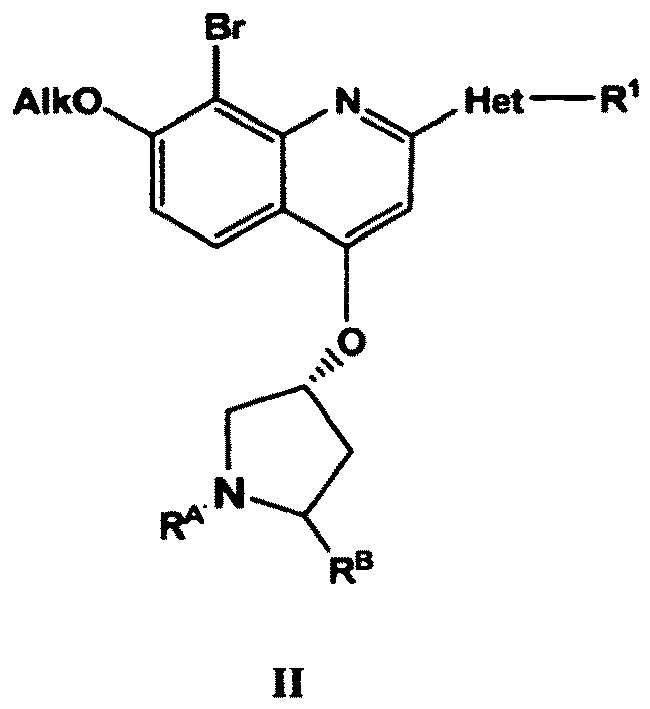
R 1 ist R20 , -NR22 COR20 , -NR22 COOR20 -NR22R21 und -NR22 CONR21R23 , worin
R20 ausgewählt ist aus (C1-8)Alkyl, (C3-7)Cycloalkyl und (C3-7)Cycloalkyl(C1-4)alkyl-, wobei das Cycloalkyl oder Cycloalkylalkyl mit (C1-3)Alkyl mono-, di- oder trisubstituiert sein kann;
R21 ist H oder hat eine der Bedeutungen von R20 wie oben definiert,
R22 und R23 sind unabhängig ausgewählt aus H und Methyl,
Alk ist eine C1 - C6-Alkylgruppe;
RA ist PG, wobei PG eine Aminoschutzgruppe darstellt, oder RA ist ein Rest der Formel:
A O oder NH darstellt;
B ist (C1-10)Alkyl, (C3-7)Cycloalkyl, (C3-7)Cycloalkyl(C1-4)alkyl,a) wobei das Cycloalkyl, Cycloalkylalkyl mono-, di- oder trisubstituiert sein kann mit (C1-3)Alkyl; undb) wobei das Alkyl, Cycloalkyl, Cycloalkylalkyl mono- oder disubstituiert sein kann mit Substituenten, ausgewählt aus Hydroxy und (C1-4)Alkoxy; undc) wobei alle Alkylgruppen mit Halogen mono-, di- oder trisubstituiert sein können; undd) wobei in den Cycloalkylgruppen, die 4-, 5-, 6- oder 7-gliedrig sind, gegebenenfalls eine (für die 4-, 5-, 6- oder 7-gliedrigen) oder zwei (für die 5-, 6- oder 7-gliedrigen) nicht direkt miteinander verknüpfte -CH2-Gruppen ersetzt sind durch -O-, so dass das O-Atom mit der Gruppe A über mindestens zwei C-Atome verknüpft ist; undR2 ist (C1-8)Alkyl, (C3-7)Cycloalkyl oder (C3-7)Cycloalkyl(C1-3)alkyl, wobei die Cycloalkylgruppen mit (C1-4)Alkyl mono-, di- oder trisubstituiert sein können;
RB ist CO2H oder ein Rest der Formel:
R3 Ethyl oder Vinyl darstellt; und
Rc ist Hydroxyl, C1-C6-Alkoxy oder NHSO2 Rs , wobei Rs (C1-6)Alkyl, (C3-7)Cycloalkyl, (C3-7)Cycloalkyl(C1-6)alkyl, Phenyl, Naphthyl, Pyridinyl, Phenyl(C1-4)alkyl, Naphthyl(C1-4)alkyl, oder Pyridinyl(C1-4)alkyl darstellt; die alle gegebenenfalls mono-, di- oder trisubstituiert sind mit Substituenten, ausgewählt aus Halogen, Hydroxy, Cyano, (C1-4)Alkyl, (C1-6)Alkoxy, -CO-NH2, -CO-NH(C1-4-Alkyl), -CO-NH(C1-4-Alkyl)2, -NH2, -NH(C1-4-Alkyl) und -N(C1-4-Alkyl)2; und die alle gegebenenfalls monosubstituiert sind mit Nitro;
oder Rs kann weiterhin ausgewählt sein aus: -NH(C1-6-Alkyl), -N(C1-6-Alkyl)2, -Het,
das Verfahren das Umsetzen einer Verbindung der Formel QUIN, worin X ein Halogenatom oder eine SO2R-Gruppe darstellt, wobei R C1-6-Alkyl, C6- oder C10-Aryl oder Heteroaryl darstellt, mit einer Verbindung der Formel P2 umfasst, um eine Verbindung der Formel II zu erhalten: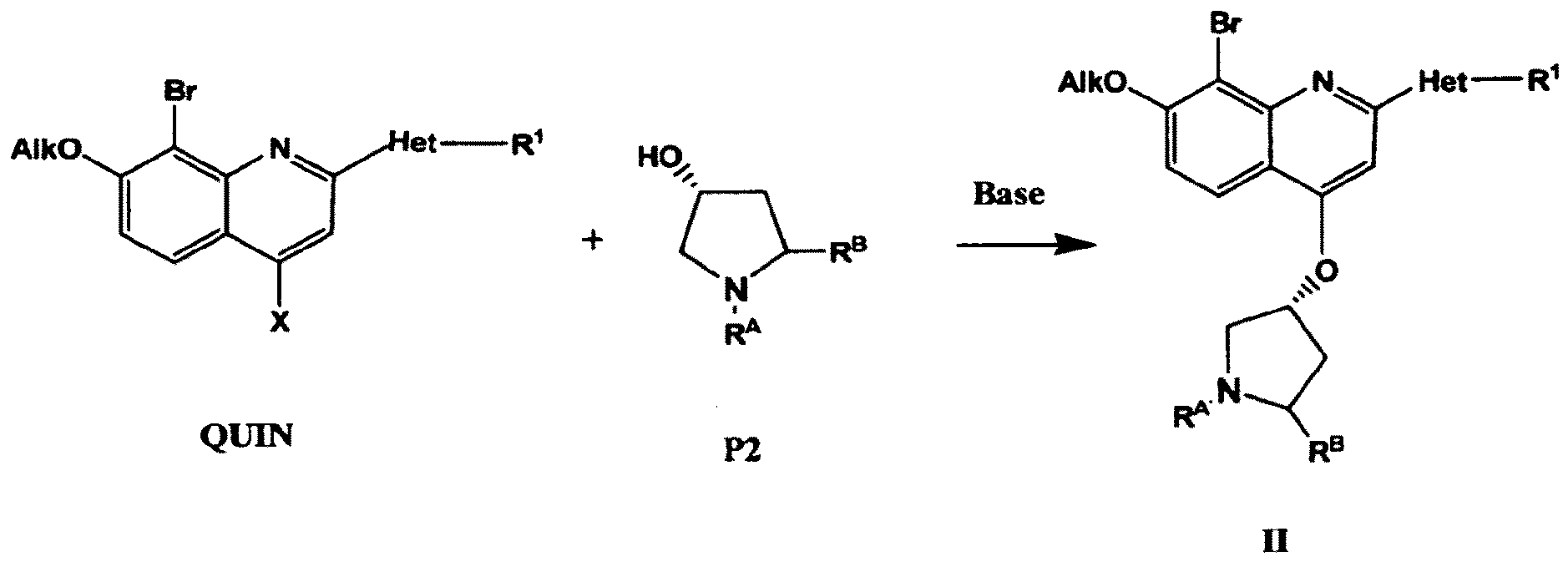
- Verfahren nach Anspruch 1, wobei RA PG darstellt und RB CO2H darstellt.
- Verfahren nach Anspruch 1, wobei RA einen Rest der Formel

- Verfahren nach Anspruch 1, wobei RA PG darstellt und RB ein Rest der Formel
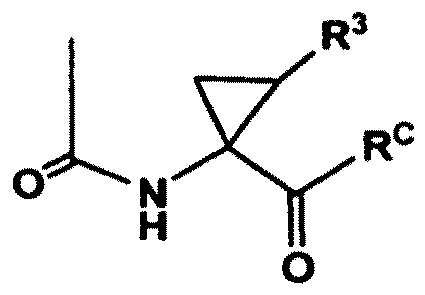
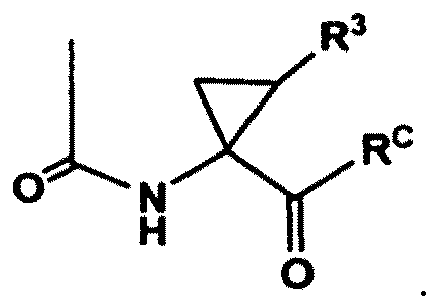
- Verfahren nach Anspruch 1, wobei RA einen Rest der Formel:

- Verbindung der Formel II:

R 1 ist R20, -NR22 COR20 , -NR22 COOR20 -NR22R21 und -NR22 CONR21R23, worin
R20 ausgewählt ist aus (C1-8)Alkyl, (C3-7)Cycloalkyl und (C3-7)Cycloalkyl(C1-4)alkyl-, wobei das Cycloalkyl oder Cycloalkylalkyl mit (C1-3)Alkyl mono-, di- oder trisubstituiert sein kann;
R21 ist H oder hat eine der Bedeutungen von R20 wie oben definiert,
R22 und R23 sind unabhängig ausgewählt aus H und Methyl,
Alk ist eine C1 - C6-Alkylgruppe;
RA ist H oder PG, wobei PG eine Aminoschutzgruppe darstellt, oder RA ist ein Rest der Formel:
A O oder NH darstellt;
B ist (C1-10)Alkyl, (C3-7)Cycloalkyl, (C3-7)Cycloalkyl(C1-4)alkyl,a) wobei das Cycloalkyl, Cycloalkylalkyl mit (C1-3)Alkyl mono-, di- oder trisubstituiert sein kann; undb) wobei das Alkyl, Cycloalkyl, Cycloalkylalkyl mono- oder disubstituiert sein kann mit Substituenten, ausgewählt aus Hydroxy und (C1-4)Alkoxy; undc) wobei alle Alkylgruppen mit Halogen mono-, di- oder trisubstituiert sein können; undd) wobei in den Cycloalkylgruppen, die 4-, 5-, 6- oder 7-gliedrig sind, gegebenenfalls eine (für die 4-, 5-, 6- oder 7-gliedrigen) oder zwei (für die 5-, 6- oder 7-gliedrigen) nicht direkt miteinander verknüpfte -CH2-Gruppen ersetzt sind durch -O-, so dass das O-Atom mit der Gruppe A über mindestens zwei C-Atome verknüpft ist; undR2 ist (C1-8)Alkyl, (C3-7)Cycloalkyl und (C3-7)Cycloalkyl(C1-3)alkyl, wobei die Cycloalkylgruppen mit (C1-4)Alkyl mono-, di- oder trisubstituiert sein können; und
RB ist CO2H. - Verbindung der Formel II nach Anspruch 6, wobei RA H oder PG darstellt.
- Verbindung der Formel II nach Anspruch 6, wobei RA einen Rest der Formel:
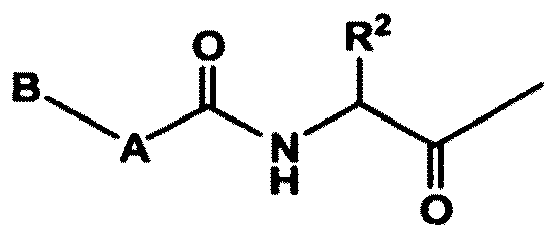
- Verbindung der Formel QUIN':

R 1 ist R20, -NR22 COR20 , -NR22 COOR20 -NR22R21 und -NR22CONR 21R23, worin
R20 ausgewählt ist aus (C1-8)Alkyl, (C3-7)Cycloalkyl und (C3-7)Cycloalkyl(C1-4)alkyl-, wobei das Cycloalkyl oder Cycloalkylalkyl mit (C1-3)Alkyl mono-, di- oder trisubstituiert sein kann;
R21 ist H oder hat eine der Bedeutungen von R20 wie oben definiert,
R22 und R23 sind unabhängig ausgewählt aus H und Methyl,
Alk ist eine C1 - C6-Alkylgruppe;
und X' ist eine Hydroxylgruppe, ein Halogenatom oder eine SO2R-Gruppe, wobei R C1-6-Alkyl, C6- or C10-Aryl oder -Heteroaryl darstellt. - Verbindung der Formel QUIN' nach Anspruch 9, wobei X' eine Hydroxylgruppe darstellt.
- Verbindung der Formel QUIN' nach Anspruch 9, wobei X' ein Halogenatom darstellt.
- Verbindung der Formel QUIN' nach Anspruch 9, wobei X' eine SO2R-Gruppe darstellt, wobei R C1-6-Alkyl, C6- or C10-Aryl oder -Heteroaryl darstellt.
- Verfahren zur Herstellung einer Verbindung der Formel QUIN' nach Anspruch 9, wobei das Verfahren umfasst:(a) wenn X' eine Hydroxylgruppe darstellt, Zyklisieren einer Verbindung der Formel 6 in Gegenwart einer geeigneten Base in einem geeigneten Lösungsmittel, um eine Verbindung der Formel 7 zu erhalten:
 (b) wenn X' ein Halogenatom darstellt, Behandeln einer Verbindung der Formel 7 mit einem Halogenierungsmittel, um eine Verbindung der Formel QUIN-1 zu erhalten:
 (c) wenn X' eine SO2R-Gruppe darstellt, wobei R C1-6-Alkyl, C6- or C10-Aryl oder -Heteroaryl darstellt, entweder: (1) Behandeln einer Verbindung der Formel 7 mit einem Halogenierungsmittel, um eine Verbindung der Formel QUIN- 1 zu erhalten, und dann Umsetzen der Verbindung QUIN-1 mit einem Sulfonatsalz RSO2M, wobei R wie zuvor definiert ist und M ein Alkalimetall darstellt, um eine Verbindung der Formel QUIN-2 zu erhalten; oder (2) Umsetzen einer Verbindung der Formel 7 mit einer Verbindung RASO2Cl, wobei die Verbindung Benzolsulfonylchlorid oder Tosylchlorid darstellt, in Gegenwart einer geeigneten Base, und dann Umsetzen der resultierenden Verbindung in situ unter sauren Bedingungen mit einem Sulfinatsalt RSO2M, wobei R wie zuvor definiert ist, wobei M ein Alkalimetal darstellt, um eine Verbindung der Formel QUIN-2 zu erhalten:
- Verbindung der Formel 4 oder Formel 6:

R 1 ist R20 , -NR22 COR20 , -NR22 COOR20 -NR22R21 und -NR22 CONR21R23. worin
R20 ausgewählt ist aus (C1-8)Alkyl, (C3-7)Cycloalkyl und (C3-7)Cycloalkyl(C1-4)alkyl-, wobei das Cycloalkyl oder Cycloalkylalkyl mit (C1-3)Alkyl mono-, di- oder trisubstituiert sein kann;
R21 ist H oder hat eine der Bedeutungen von R20 wie oben definiert,
R22 und R23 sind unabhängig ausgewählt aus H und Methyl,
Alk ist eine C1 - C6-Alkylgruppe;
und X ist eine Hydroxylgruppe, ein Halogenatom oder eine SO2R-Gruppe, wobei R C1-6-Alkyl, C6- or C10-Aryl oder -Heteroaryl darstellt.
Applications Claiming Priority (4)
| Application Number | Priority Date | Filing Date | Title |
|---|---|---|---|
| US57418204P | 2004-05-25 | 2004-05-25 | |
| US65201805P | 2005-02-11 | 2005-02-11 | |
| US66074505P | 2005-03-11 | 2005-03-11 | |
| PCT/US2005/018177 WO2005116054A1 (en) | 2004-05-25 | 2005-05-23 | Process for preparing acyclic hcv protease inhibitors |
Publications (2)
| Publication Number | Publication Date |
|---|---|
| EP1753775A1 EP1753775A1 (de) | 2007-02-21 |
| EP1753775B1 true EP1753775B1 (de) | 2012-12-26 |
Family
ID=35134797
Family Applications (1)
| Application Number | Title | Priority Date | Filing Date |
|---|---|---|---|
| EP05756274A Expired - Lifetime EP1753775B1 (de) | 2004-05-25 | 2005-05-23 | Verfahren zur herstellung von acyclischen hcv-protease-inhibitoren |
Country Status (5)
| Country | Link |
|---|---|
| US (3) | US7514557B2 (de) |
| EP (1) | EP1753775B1 (de) |
| JP (1) | JP5156374B2 (de) |
| CA (1) | CA2568008C (de) |
| WO (1) | WO2005116054A1 (de) |
Families Citing this family (76)
| Publication number | Priority date | Publication date | Assignee | Title |
|---|---|---|---|---|
| JP2003007697A (ja) * | 2001-06-21 | 2003-01-10 | Hitachi Kokusai Electric Inc | 半導体装置の製造方法、基板処理方法および基板処理装置 |
| MY140680A (en) | 2002-05-20 | 2010-01-15 | Bristol Myers Squibb Co | Hepatitis c virus inhibitors |
| US7176208B2 (en) * | 2003-04-18 | 2007-02-13 | Enanta Pharmaceuticals, Inc. | Quinoxalinyl macrocyclic hepatitis C serine protease inhibitors |
| AU2004240704B9 (en) * | 2003-05-21 | 2009-10-22 | Boehringer Ingelheim International Gmbh | Hepatitis C inhibitor compounds |
| US7491794B2 (en) * | 2003-10-14 | 2009-02-17 | Intermune, Inc. | Macrocyclic compounds as inhibitors of viral replication |
| WO2005090383A2 (en) | 2004-03-15 | 2005-09-29 | Boehringer Ingelheim International, Gmbh | Process for preparing macrocyclic dipeptides which are suitable for the treatment of hepatitis c viral infections |
| EP1753775B1 (de) * | 2004-05-25 | 2012-12-26 | Boehringer Ingelheim International GmbH | Verfahren zur herstellung von acyclischen hcv-protease-inhibitoren |
| US7323447B2 (en) | 2005-02-08 | 2008-01-29 | Bristol-Myers Squibb Company | Hepatitis C virus inhibitors |
| AU2006220708B9 (en) * | 2005-03-08 | 2013-01-17 | Boehringer Ingelheim International Gmbh | Process for preparing macrocyclic compounds |
| US7592336B2 (en) | 2005-05-10 | 2009-09-22 | Bristol-Myers Squibb Company | Hepatitis C virus inhibitors |
| US7601686B2 (en) | 2005-07-11 | 2009-10-13 | Bristol-Myers Squibb Company | Hepatitis C virus inhibitors |
| AU2006276246B2 (en) * | 2005-07-25 | 2012-09-27 | Intermune, Inc. | Novel macrocyclic inhibitors of hepatitis C virus replication |
| ES2356776T3 (es) | 2005-10-11 | 2011-04-13 | Intermune, Inc. | Compuestos y métodos para inhibir la replicación del virus de la hepatitis. |
| US7772183B2 (en) | 2005-10-12 | 2010-08-10 | Bristol-Myers Squibb Company | Hepatitis C virus inhibitors |
| US7741281B2 (en) | 2005-11-03 | 2010-06-22 | Bristol-Myers Squibb Company | Hepatitis C virus inhibitors |
| RU2008152171A (ru) | 2006-07-05 | 2010-08-10 | Интермьюн, Инк. (Us) | Новые ингибиторы вирусной репликации гепатита с |
| US7935670B2 (en) | 2006-07-11 | 2011-05-03 | Bristol-Myers Squibb Company | Hepatitis C virus inhibitors |
| US8343477B2 (en) | 2006-11-01 | 2013-01-01 | Bristol-Myers Squibb Company | Inhibitors of hepatitis C virus |
| US7772180B2 (en) | 2006-11-09 | 2010-08-10 | Bristol-Myers Squibb Company | Hepatitis C virus inhibitors |
| US7888464B2 (en) | 2006-11-16 | 2011-02-15 | Bristol-Myers Squibb Company | Hepatitis C virus inhibitors |
| US8003604B2 (en) | 2006-11-16 | 2011-08-23 | Bristol-Myers Squibb Company | Hepatitis C virus inhibitors |
| US7763584B2 (en) | 2006-11-16 | 2010-07-27 | Bristol-Myers Squibb Company | Hepatitis C virus inhibitors |
| JP2010526834A (ja) | 2007-05-10 | 2010-08-05 | インターミューン・インコーポレーテッド | C型肝炎ウイルス複製の新規ペプチド阻害剤 |
| RU2515318C2 (ru) | 2007-12-21 | 2014-05-10 | Авила Терапьютикс, Инк. | Ингибиторы протеазы вируса гепатита с и их применение |
| US8202996B2 (en) | 2007-12-21 | 2012-06-19 | Bristol-Myers Squibb Company | Crystalline forms of N-(tert-butoxycarbonyl)-3-methyl-L-valyl-(4R)-4-((7-chloro-4-methoxy-1-isoquinolinyl)oxy)-N- ((1R,2S)-1-((cyclopropylsulfonyl)carbamoyl)-2-vinylcyclopropyl)-L-prolinamide |
| US8309685B2 (en) | 2007-12-21 | 2012-11-13 | Celgene Avilomics Research, Inc. | HCV protease inhibitors and uses thereof |
| US8293705B2 (en) | 2007-12-21 | 2012-10-23 | Avila Therapeutics, Inc. | HCV protease inhibitors and uses thereof |
| TWI487522B (zh) | 2007-12-21 | 2015-06-11 | 賽基艾維洛米斯研究股份有限公司 | Hcv蛋白酶抑制劑及其用途(一) |
| ES2437147T3 (es) | 2008-02-04 | 2014-01-09 | Idenix Pharmaceuticals, Inc. | Inhibidores de serina proteasa macrocíclicos |
| WO2009142842A2 (en) | 2008-04-15 | 2009-11-26 | Intermune, Inc. | Novel macrocyclic inhibitors of hepatitis c virus replication |
| US8163921B2 (en) | 2008-04-16 | 2012-04-24 | Bristol-Myers Squibb Company | Hepatitis C virus inhibitors |
| US7964560B2 (en) | 2008-05-29 | 2011-06-21 | Bristol-Myers Squibb Company | Hepatitis C virus inhibitors |
| EP2300491B1 (de) | 2008-05-29 | 2016-01-06 | Bristol-Myers Squibb Company | Inhibitoren des hepatitis-c-virus |
| US8207341B2 (en) | 2008-09-04 | 2012-06-26 | Bristol-Myers Squibb Company | Process or synthesizing substituted isoquinolines |
| UY32099A (es) | 2008-09-11 | 2010-04-30 | Enanta Pharm Inc | Inhibidores macrocíclicos de serina proteasas de hepatitis c |
| PL2331538T3 (pl) * | 2008-09-16 | 2014-09-30 | Boehringer Ingelheim Int | Krystaliczne postacie 2-tiazolylo-4chinolinyl-oksy-pochodnej, silnego inhibitora HCV |
| PE20110343A1 (es) * | 2008-09-17 | 2011-06-25 | Boehringer Ingelheim Int | Combinacion de inhibidor de la proteasa ns3 de hcv con interferon y ribavirina |
| JP2012502925A (ja) * | 2008-09-23 | 2012-02-02 | ベーリンガー インゲルハイム インターナショナル ゲゼルシャフト ミット ベシュレンクテル ハフツング | C型肝炎阻害化合物 |
| US8563505B2 (en) | 2008-09-29 | 2013-10-22 | Bristol-Myers Squibb Company | Hepatitis C virus inhibitors |
| US8044087B2 (en) | 2008-09-29 | 2011-10-25 | Bristol-Myers Squibb Company | Hepatitis C virus inhibitors |
| CN102223875A (zh) * | 2008-11-21 | 2011-10-19 | 贝林格尔.英格海姆国际有限公司 | 口服给药的强效hcv抑制剂的药物组合物 |
| US8283310B2 (en) | 2008-12-15 | 2012-10-09 | Bristol-Myers Squibb Company | Hepatitis C virus inhibitors |
| AR075584A1 (es) | 2009-02-27 | 2011-04-20 | Intermune Inc | COMPOSICIONES TERAPEUTICAS QUE COMPRENDEN beta-D-2'-DESOXI-2'-FLUORO-2'-C-METILCITIDINA Y UN DERIVADO DE ACIDO ISOINDOL CARBOXILICO Y SUS USOS. COMPUESTO. |
| JP2012520891A (ja) * | 2009-03-19 | 2012-09-10 | ベーリンガー インゲルハイム インターナショナル ゲゼルシャフト ミット ベシュレンクテル ハフツング | スルホニルキノリンの製造方法 |
| TW201040181A (en) | 2009-04-08 | 2010-11-16 | Idenix Pharmaceuticals Inc | Macrocyclic serine protease inhibitors |
| JP5647673B2 (ja) * | 2009-05-05 | 2015-01-07 | ベーリンガー インゲルハイム インターナショナル ゲゼルシャフト ミット ベシュレンクテル ハフツング | ブロモ置換キノリンの調製方法 |
| US8232246B2 (en) | 2009-06-30 | 2012-07-31 | Abbott Laboratories | Anti-viral compounds |
| JP5607736B2 (ja) * | 2009-07-07 | 2014-10-15 | ベーリンガー インゲルハイム インターナショナル ゲゼルシャフト ミット ベシュレンクテル ハフツング | C型肝炎ウイルスプロテアーゼ阻害剤のための医薬組成物 |
| EP2461811B1 (de) | 2009-08-05 | 2016-04-20 | Idenix Pharmaceuticals LLC. | Makrocyclische serinproteasehemmer gegen virale infektionen, im besonderen hvc |
| EA201200650A1 (ru) | 2009-10-30 | 2012-12-28 | Бёрингер Ингельхайм Интернациональ Гмбх | Курсы комбинированного лечения вируса гепатита с, включающие bi201335, интерферон-альфа и рибавирин |
| US8530497B2 (en) * | 2010-03-11 | 2013-09-10 | Boehringer Ingelheim International Gmbh | Crystalline salts of a potent HCV inhibitor |
| MA34547B1 (fr) * | 2010-09-30 | 2013-09-02 | Boehringer Ingelheim Int | Traitement d'association pour traiter une infection par le vhc |
| EP2658859A4 (de) | 2010-12-30 | 2014-07-30 | Enanta Pharm Inc | Makrocyclische hepatitis-c-serinprotease-hemmer |
| KR20140003521A (ko) | 2010-12-30 | 2014-01-09 | 이난타 파마슈티칼스, 인코포레이티드 | 페난트리딘 매크로사이클릭 c형 간염 세린 프로테아제 억제제 |
| AR085352A1 (es) | 2011-02-10 | 2013-09-25 | Idenix Pharmaceuticals Inc | Inhibidores macrociclicos de serina proteasa, sus composiciones farmaceuticas y su uso para tratar infecciones por hcv |
| US8957203B2 (en) | 2011-05-05 | 2015-02-17 | Bristol-Myers Squibb Company | Hepatitis C virus inhibitors |
| US10201584B1 (en) | 2011-05-17 | 2019-02-12 | Abbvie Inc. | Compositions and methods for treating HCV |
| US8691757B2 (en) | 2011-06-15 | 2014-04-08 | Bristol-Myers Squibb Company | Hepatitis C virus inhibitors |
| SE1450131A1 (sv) | 2011-10-21 | 2014-05-07 | Abbvie Inc | DAA-kombinationsbehandling (t.ex. med ABT-072 eller ABT-333)för användning vid behandling av HCV |
| US8466159B2 (en) | 2011-10-21 | 2013-06-18 | Abbvie Inc. | Methods for treating HCV |
| DE112012002748T5 (de) | 2011-10-21 | 2014-07-31 | Abbvie Inc. | Verfahren zur Behandlung von HCV umfassend mindestens zwei direkt wirkende antivirale Wirkstoffe, Ribavirin aber nicht Interferon |
| US8492386B2 (en) | 2011-10-21 | 2013-07-23 | Abbvie Inc. | Methods for treating HCV |
| AU2013208024A1 (en) | 2012-01-12 | 2014-07-10 | Boehringer Ingelheim International Gmbh | Stabilized pharmaceutical formulations of a potent HCV inhibitor |
| WO2013137869A1 (en) | 2012-03-14 | 2013-09-19 | Boehringer Ingelheim International Gmbh | Combination therapy for treating hcv infection in an hcv-hiv coinfected patient population |
| WO2013147750A1 (en) | 2012-03-27 | 2013-10-03 | Boehringer Ingelheim International Gmbh | Oral combination therapy for treating hcv infection in specific patient sub-population |
| WO2013147749A1 (en) | 2012-03-27 | 2013-10-03 | Boehringer Ingelheim International Gmbh | Oral combination therapy for treating hcv infection in specific patient subgenotype populations |
| WO2013143581A1 (en) | 2012-03-28 | 2013-10-03 | Boehringer Ingelheim International Gmbh | Combination therapy for treating hcv infection in specific patient subgenotype sub-population |
| EA025560B1 (ru) | 2012-10-19 | 2017-01-30 | Бристол-Майерс Сквибб Компани | Ингибиторы вируса гепатита с |
| US9643999B2 (en) | 2012-11-02 | 2017-05-09 | Bristol-Myers Squibb Company | Hepatitis C virus inhibitors |
| WO2014071007A1 (en) | 2012-11-02 | 2014-05-08 | Bristol-Myers Squibb Company | Hepatitis c virus inhibitors |
| WO2014070964A1 (en) | 2012-11-02 | 2014-05-08 | Bristol-Myers Squibb Company | Hepatitis c virus inhibitors |
| EP2914614B1 (de) | 2012-11-05 | 2017-08-16 | Bristol-Myers Squibb Company | Inhibitoren des hepatitis-c-virus |
| WO2014137869A1 (en) | 2013-03-07 | 2014-09-12 | Bristol-Myers Squibb Company | Hepatitis c virus inhibitors |
| WO2014138374A1 (en) | 2013-03-08 | 2014-09-12 | Boehringer Ingelheim International Gmbh | Oral combination therapy for treating hcv infection in specific patient sub-population |
| EP3089757A1 (de) | 2014-01-03 | 2016-11-09 | AbbVie Inc. | Feste antivirale darreichungsformen |
| EA201892448A1 (ru) | 2016-04-28 | 2019-06-28 | Эмори Юниверсити | Алкинсодержащие нуклеотидные и нуклеозидные терапевтические композиции и связанные с ними способы применения |
Family Cites Families (15)
| Publication number | Priority date | Publication date | Assignee | Title |
|---|---|---|---|---|
| AR022061A1 (es) | 1998-08-10 | 2002-09-04 | Boehringer Ingelheim Ca Ltd | Peptidos inhibidores de la hepatitis c, una composicion farmaceutica que los contiene, el uso de los mismos para preparar una composicion farmaceutica, el uso de un producto intermedio para la preparacion de estos peptidos y un procedimiento para la preparacion de un peptido analogo de los mismos. |
| US6323180B1 (en) | 1998-08-10 | 2001-11-27 | Boehringer Ingelheim (Canada) Ltd | Hepatitis C inhibitor tri-peptides |
| US6608027B1 (en) | 1999-04-06 | 2003-08-19 | Boehringer Ingelheim (Canada) Ltd | Macrocyclic peptides active against the hepatitis C virus |
| US6867185B2 (en) | 2001-12-20 | 2005-03-15 | Bristol-Myers Squibb Company | Inhibitors of hepatitis C virus |
| US7119072B2 (en) | 2002-01-30 | 2006-10-10 | Boehringer Ingelheim (Canada) Ltd. | Macrocyclic peptides active against the hepatitis C virus |
| MY140680A (en) | 2002-05-20 | 2010-01-15 | Bristol Myers Squibb Co | Hepatitis c virus inhibitors |
| DE60324552D1 (en) | 2002-05-20 | 2008-12-18 | Bristol Myers Squibb Co | Substituierte cycloalkyl p1' hepatitis c virus inhibitoren |
| US20050075279A1 (en) | 2002-10-25 | 2005-04-07 | Boehringer Ingelheim International Gmbh | Macrocyclic peptides active against the hepatitis C virus |
| CA2521835A1 (en) | 2003-04-10 | 2004-10-21 | Boehringer Ingelheim International Gmbh | Process for the preparation of macrocyclic compounds by ruthenium complex catalysed metathesis reaction |
| JP4231524B2 (ja) | 2003-04-10 | 2009-03-04 | ベーリンガー インゲルハイム インターナショナル ゲゼルシャフト ミット ベシュレンクテル ハフツング | 大環状化合物の製造方法 |
| AU2004240704B9 (en) * | 2003-05-21 | 2009-10-22 | Boehringer Ingelheim International Gmbh | Hepatitis C inhibitor compounds |
| RS20060197A (sr) * | 2003-09-22 | 2008-09-29 | Boehringer Ingelheim International Gmbh., | Makrociklični peptidi koji su aktivni protiv hepatitisa c virusa |
| WO2005090383A2 (en) | 2004-03-15 | 2005-09-29 | Boehringer Ingelheim International, Gmbh | Process for preparing macrocyclic dipeptides which are suitable for the treatment of hepatitis c viral infections |
| EP1753775B1 (de) * | 2004-05-25 | 2012-12-26 | Boehringer Ingelheim International GmbH | Verfahren zur herstellung von acyclischen hcv-protease-inhibitoren |
| AU2006220708B9 (en) | 2005-03-08 | 2013-01-17 | Boehringer Ingelheim International Gmbh | Process for preparing macrocyclic compounds |
-
2005
- 2005-05-23 EP EP05756274A patent/EP1753775B1/de not_active Expired - Lifetime
- 2005-05-23 CA CA2568008A patent/CA2568008C/en not_active Expired - Fee Related
- 2005-05-23 JP JP2007515258A patent/JP5156374B2/ja not_active Expired - Fee Related
- 2005-05-23 US US11/135,533 patent/US7514557B2/en active Active
- 2005-05-23 WO PCT/US2005/018177 patent/WO2005116054A1/en not_active Ceased
-
2009
- 2009-01-16 US US12/355,157 patent/US8017771B2/en active Active
- 2009-01-16 US US12/355,150 patent/US8101765B2/en active Active
Also Published As
| Publication number | Publication date |
|---|---|
| US20050267151A1 (en) | 2005-12-01 |
| US7514557B2 (en) | 2009-04-07 |
| JP2008505061A (ja) | 2008-02-21 |
| CA2568008A1 (en) | 2005-12-05 |
| US20090124808A1 (en) | 2009-05-14 |
| US8017771B2 (en) | 2011-09-13 |
| EP1753775A1 (de) | 2007-02-21 |
| JP5156374B2 (ja) | 2013-03-06 |
| WO2005116054A1 (en) | 2005-12-08 |
| US8101765B2 (en) | 2012-01-24 |
| US20090124809A1 (en) | 2009-05-14 |
| CA2568008C (en) | 2014-01-28 |
Similar Documents
| Publication | Publication Date | Title |
|---|---|---|
| EP1753775B1 (de) | Verfahren zur herstellung von acyclischen hcv-protease-inhibitoren | |
| US7375218B2 (en) | Process for preparing macrocyclic HCV protease inhibitors | |
| CN101160317B (zh) | 制备大环化合物的方法 | |
| EP1730166B1 (de) | Verfahren zur herstellung makrocyclischer dipeptide, die sich für die behandlung von hepatitis-c-virusinfektionen eignen | |
| US7148347B2 (en) | Process for preparing macrocyclic compounds | |
| KR101217036B1 (ko) | Hcv ns-3 세린 프로테아제 저해제 | |
| AU2012232960A1 (en) | Process for preparing macrocyclic compounds |
Legal Events
| Date | Code | Title | Description |
|---|---|---|---|
| PUAI | Public reference made under article 153(3) epc to a published international application that has entered the european phase |
Free format text: ORIGINAL CODE: 0009012 |
|
| 17P | Request for examination filed |
Effective date: 20061227 |
|
| AK | Designated contracting states |
Kind code of ref document: A1 Designated state(s): AT BE BG CH CY CZ DE DK EE ES FI FR GB GR HU IE IS IT LI LT LU MC NL PL PT RO SE SI SK TR |
|
| AX | Request for extension of the european patent |
Extension state: AL BA HR LV MK YU |
|
| 17Q | First examination report despatched |
Effective date: 20090904 |
|
| APBK | Appeal reference recorded |
Free format text: ORIGINAL CODE: EPIDOSNREFNE |
|
| APBN | Date of receipt of notice of appeal recorded |
Free format text: ORIGINAL CODE: EPIDOSNNOA2E |
|
| APBR | Date of receipt of statement of grounds of appeal recorded |
Free format text: ORIGINAL CODE: EPIDOSNNOA3E |
|
| APBV | Interlocutory revision of appeal recorded |
Free format text: ORIGINAL CODE: EPIDOSNIRAPE |
|
| APAF | Appeal reference modified |
Free format text: ORIGINAL CODE: EPIDOSCREFNE |
|
| GRAP | Despatch of communication of intention to grant a patent |
Free format text: ORIGINAL CODE: EPIDOSNIGR1 |
|
| APBT | Appeal procedure closed |
Free format text: ORIGINAL CODE: EPIDOSNNOA9E |
|
| GRAS | Grant fee paid |
Free format text: ORIGINAL CODE: EPIDOSNIGR3 |
|
| GRAA | (expected) grant |
Free format text: ORIGINAL CODE: 0009210 |
|
| AK | Designated contracting states |
Kind code of ref document: B1 Designated state(s): AT BE BG CH CY CZ DE DK EE ES FI FR GB GR HU IE IS IT LI LT LU MC NL PL PT RO SE SI SK TR |
|
| AX | Request for extension of the european patent |
Extension state: AL BA HR LV MK YU |
|
| REG | Reference to a national code |
Ref country code: GB Ref legal event code: FG4D |
|
| REG | Reference to a national code |
Ref country code: CH Ref legal event code: EP |
|
| REG | Reference to a national code |
Ref country code: AT Ref legal event code: REF Ref document number: 590416 Country of ref document: AT Kind code of ref document: T Effective date: 20130115 |
|
| REG | Reference to a national code |
Ref country code: DE Ref legal event code: R096 Ref document number: 602005037605 Country of ref document: DE Effective date: 20130228 |
|
| PG25 | Lapsed in a contracting state [announced via postgrant information from national office to epo] |
Ref country code: SE Free format text: LAPSE BECAUSE OF FAILURE TO SUBMIT A TRANSLATION OF THE DESCRIPTION OR TO PAY THE FEE WITHIN THE PRESCRIBED TIME-LIMIT Effective date: 20121226 Ref country code: LT Free format text: LAPSE BECAUSE OF FAILURE TO SUBMIT A TRANSLATION OF THE DESCRIPTION OR TO PAY THE FEE WITHIN THE PRESCRIBED TIME-LIMIT Effective date: 20121226 Ref country code: FI Free format text: LAPSE BECAUSE OF FAILURE TO SUBMIT A TRANSLATION OF THE DESCRIPTION OR TO PAY THE FEE WITHIN THE PRESCRIBED TIME-LIMIT Effective date: 20121226 |
|
| REG | Reference to a national code |
Ref country code: AT Ref legal event code: MK05 Ref document number: 590416 Country of ref document: AT Kind code of ref document: T Effective date: 20121226 |
|
| REG | Reference to a national code |
Ref country code: LT Ref legal event code: MG4D |
|
| REG | Reference to a national code |
Ref country code: NL Ref legal event code: VDEP Effective date: 20121226 |
|
| PG25 | Lapsed in a contracting state [announced via postgrant information from national office to epo] |
Ref country code: SI Free format text: LAPSE BECAUSE OF FAILURE TO SUBMIT A TRANSLATION OF THE DESCRIPTION OR TO PAY THE FEE WITHIN THE PRESCRIBED TIME-LIMIT Effective date: 20121226 Ref country code: GR Free format text: LAPSE BECAUSE OF FAILURE TO SUBMIT A TRANSLATION OF THE DESCRIPTION OR TO PAY THE FEE WITHIN THE PRESCRIBED TIME-LIMIT Effective date: 20130327 |
|
| PG25 | Lapsed in a contracting state [announced via postgrant information from national office to epo] |
Ref country code: ES Free format text: LAPSE BECAUSE OF FAILURE TO SUBMIT A TRANSLATION OF THE DESCRIPTION OR TO PAY THE FEE WITHIN THE PRESCRIBED TIME-LIMIT Effective date: 20130406 Ref country code: IS Free format text: LAPSE BECAUSE OF FAILURE TO SUBMIT A TRANSLATION OF THE DESCRIPTION OR TO PAY THE FEE WITHIN THE PRESCRIBED TIME-LIMIT Effective date: 20130426 Ref country code: AT Free format text: LAPSE BECAUSE OF FAILURE TO SUBMIT A TRANSLATION OF THE DESCRIPTION OR TO PAY THE FEE WITHIN THE PRESCRIBED TIME-LIMIT Effective date: 20121226 Ref country code: SK Free format text: LAPSE BECAUSE OF FAILURE TO SUBMIT A TRANSLATION OF THE DESCRIPTION OR TO PAY THE FEE WITHIN THE PRESCRIBED TIME-LIMIT Effective date: 20121226 Ref country code: EE Free format text: LAPSE BECAUSE OF FAILURE TO SUBMIT A TRANSLATION OF THE DESCRIPTION OR TO PAY THE FEE WITHIN THE PRESCRIBED TIME-LIMIT Effective date: 20121226 Ref country code: CZ Free format text: LAPSE BECAUSE OF FAILURE TO SUBMIT A TRANSLATION OF THE DESCRIPTION OR TO PAY THE FEE WITHIN THE PRESCRIBED TIME-LIMIT Effective date: 20121226 Ref country code: BG Free format text: LAPSE BECAUSE OF FAILURE TO SUBMIT A TRANSLATION OF THE DESCRIPTION OR TO PAY THE FEE WITHIN THE PRESCRIBED TIME-LIMIT Effective date: 20130326 Ref country code: BE Free format text: LAPSE BECAUSE OF FAILURE TO SUBMIT A TRANSLATION OF THE DESCRIPTION OR TO PAY THE FEE WITHIN THE PRESCRIBED TIME-LIMIT Effective date: 20121226 |
|
| PG25 | Lapsed in a contracting state [announced via postgrant information from national office to epo] |
Ref country code: RO Free format text: LAPSE BECAUSE OF FAILURE TO SUBMIT A TRANSLATION OF THE DESCRIPTION OR TO PAY THE FEE WITHIN THE PRESCRIBED TIME-LIMIT Effective date: 20121226 Ref country code: PL Free format text: LAPSE BECAUSE OF FAILURE TO SUBMIT A TRANSLATION OF THE DESCRIPTION OR TO PAY THE FEE WITHIN THE PRESCRIBED TIME-LIMIT Effective date: 20121226 Ref country code: NL Free format text: LAPSE BECAUSE OF FAILURE TO SUBMIT A TRANSLATION OF THE DESCRIPTION OR TO PAY THE FEE WITHIN THE PRESCRIBED TIME-LIMIT Effective date: 20121226 Ref country code: PT Free format text: LAPSE BECAUSE OF FAILURE TO SUBMIT A TRANSLATION OF THE DESCRIPTION OR TO PAY THE FEE WITHIN THE PRESCRIBED TIME-LIMIT Effective date: 20130426 |
|
| PG25 | Lapsed in a contracting state [announced via postgrant information from national office to epo] |
Ref country code: DK Free format text: LAPSE BECAUSE OF FAILURE TO SUBMIT A TRANSLATION OF THE DESCRIPTION OR TO PAY THE FEE WITHIN THE PRESCRIBED TIME-LIMIT Effective date: 20121226 |
|
| PLBE | No opposition filed within time limit |
Free format text: ORIGINAL CODE: 0009261 |
|
| STAA | Information on the status of an ep patent application or granted ep patent |
Free format text: STATUS: NO OPPOSITION FILED WITHIN TIME LIMIT |
|
| PG25 | Lapsed in a contracting state [announced via postgrant information from national office to epo] |
Ref country code: CY Free format text: LAPSE BECAUSE OF FAILURE TO SUBMIT A TRANSLATION OF THE DESCRIPTION OR TO PAY THE FEE WITHIN THE PRESCRIBED TIME-LIMIT Effective date: 20121226 |
|
| 26N | No opposition filed |
Effective date: 20130927 |
|
| PG25 | Lapsed in a contracting state [announced via postgrant information from national office to epo] |
Ref country code: IT Free format text: LAPSE BECAUSE OF FAILURE TO SUBMIT A TRANSLATION OF THE DESCRIPTION OR TO PAY THE FEE WITHIN THE PRESCRIBED TIME-LIMIT Effective date: 20121226 Ref country code: MC Free format text: LAPSE BECAUSE OF FAILURE TO SUBMIT A TRANSLATION OF THE DESCRIPTION OR TO PAY THE FEE WITHIN THE PRESCRIBED TIME-LIMIT Effective date: 20121226 |
|
| REG | Reference to a national code |
Ref country code: CH Ref legal event code: PL |
|
| REG | Reference to a national code |
Ref country code: DE Ref legal event code: R097 Ref document number: 602005037605 Country of ref document: DE Effective date: 20130927 |
|
| PG25 | Lapsed in a contracting state [announced via postgrant information from national office to epo] |
Ref country code: CH Free format text: LAPSE BECAUSE OF NON-PAYMENT OF DUE FEES Effective date: 20130531 Ref country code: LI Free format text: LAPSE BECAUSE OF NON-PAYMENT OF DUE FEES Effective date: 20130531 |
|
| REG | Reference to a national code |
Ref country code: IE Ref legal event code: MM4A |
|
| PG25 | Lapsed in a contracting state [announced via postgrant information from national office to epo] |
Ref country code: IE Free format text: LAPSE BECAUSE OF NON-PAYMENT OF DUE FEES Effective date: 20130523 |
|
| PG25 | Lapsed in a contracting state [announced via postgrant information from national office to epo] |
Ref country code: TR Free format text: LAPSE BECAUSE OF FAILURE TO SUBMIT A TRANSLATION OF THE DESCRIPTION OR TO PAY THE FEE WITHIN THE PRESCRIBED TIME-LIMIT Effective date: 20121226 |
|
| PG25 | Lapsed in a contracting state [announced via postgrant information from national office to epo] |
Ref country code: LU Free format text: LAPSE BECAUSE OF NON-PAYMENT OF DUE FEES Effective date: 20130523 Ref country code: HU Free format text: LAPSE BECAUSE OF FAILURE TO SUBMIT A TRANSLATION OF THE DESCRIPTION OR TO PAY THE FEE WITHIN THE PRESCRIBED TIME-LIMIT; INVALID AB INITIO Effective date: 20050523 |
|
| REG | Reference to a national code |
Ref country code: FR Ref legal event code: PLFP Year of fee payment: 12 |
|
| REG | Reference to a national code |
Ref country code: FR Ref legal event code: PLFP Year of fee payment: 13 |
|
| REG | Reference to a national code |
Ref country code: FR Ref legal event code: PLFP Year of fee payment: 14 |
|
| PGFP | Annual fee paid to national office [announced via postgrant information from national office to epo] |
Ref country code: FR Payment date: 20200522 Year of fee payment: 16 Ref country code: DE Payment date: 20200520 Year of fee payment: 16 |
|
| PGFP | Annual fee paid to national office [announced via postgrant information from national office to epo] |
Ref country code: GB Payment date: 20200527 Year of fee payment: 16 |
|
| REG | Reference to a national code |
Ref country code: DE Ref legal event code: R119 Ref document number: 602005037605 Country of ref document: DE |
|
| GBPC | Gb: european patent ceased through non-payment of renewal fee |
Effective date: 20210523 |
|
| PG25 | Lapsed in a contracting state [announced via postgrant information from national office to epo] |
Ref country code: GB Free format text: LAPSE BECAUSE OF NON-PAYMENT OF DUE FEES Effective date: 20210523 Ref country code: DE Free format text: LAPSE BECAUSE OF NON-PAYMENT OF DUE FEES Effective date: 20211201 |
|
| PG25 | Lapsed in a contracting state [announced via postgrant information from national office to epo] |
Ref country code: FR Free format text: LAPSE BECAUSE OF NON-PAYMENT OF DUE FEES Effective date: 20210531 |