EP1755563B1 - Tablettes pharmaceutiques comprenant au moins deux segments unitaires - Google Patents
Tablettes pharmaceutiques comprenant au moins deux segments unitaires Download PDFInfo
- Publication number
- EP1755563B1 EP1755563B1 EP05753917A EP05753917A EP1755563B1 EP 1755563 B1 EP1755563 B1 EP 1755563B1 EP 05753917 A EP05753917 A EP 05753917A EP 05753917 A EP05753917 A EP 05753917A EP 1755563 B1 EP1755563 B1 EP 1755563B1
- Authority
- EP
- European Patent Office
- Prior art keywords
- segment
- tablet
- unitary
- segments
- compressed pharmaceutical
- Prior art date
- Legal status (The legal status is an assumption and is not a legal conclusion. Google has not performed a legal analysis and makes no representation as to the accuracy of the status listed.)
- Expired - Lifetime
Links
Images


Classifications
-
- A—HUMAN NECESSITIES
- A61—MEDICAL OR VETERINARY SCIENCE; HYGIENE
- A61K—PREPARATIONS FOR MEDICAL, DENTAL OR TOILETRY PURPOSES
- A61K9/00—Medicinal preparations characterised by special physical form
- A61K9/20—Pills, tablets, discs, rods
- A61K9/2072—Pills, tablets, discs, rods characterised by shape, structure or size; Tablets with holes, special break lines or identification marks; Partially coated tablets; Disintegrating flat shaped forms
- A61K9/2086—Layered tablets, e.g. bilayer tablets; Tablets of the type inert core-active coat
- A61K9/209—Layered tablets, e.g. bilayer tablets; Tablets of the type inert core-active coat containing drug in at least two layers or in the core and in at least one outer layer
-
- A—HUMAN NECESSITIES
- A61—MEDICAL OR VETERINARY SCIENCE; HYGIENE
- A61K—PREPARATIONS FOR MEDICAL, DENTAL OR TOILETRY PURPOSES
- A61K9/00—Medicinal preparations characterised by special physical form
- A61K9/20—Pills, tablets, discs, rods
- A61K9/2072—Pills, tablets, discs, rods characterised by shape, structure or size; Tablets with holes, special break lines or identification marks; Partially coated tablets; Disintegrating flat shaped forms
-
- A—HUMAN NECESSITIES
- A61—MEDICAL OR VETERINARY SCIENCE; HYGIENE
- A61P—SPECIFIC THERAPEUTIC ACTIVITY OF CHEMICAL COMPOUNDS OR MEDICINAL PREPARATIONS
- A61P25/00—Drugs for disorders of the nervous system
-
- A—HUMAN NECESSITIES
- A61—MEDICAL OR VETERINARY SCIENCE; HYGIENE
- A61P—SPECIFIC THERAPEUTIC ACTIVITY OF CHEMICAL COMPOUNDS OR MEDICINAL PREPARATIONS
- A61P25/00—Drugs for disorders of the nervous system
- A61P25/04—Centrally acting analgesics, e.g. opioids
-
- A—HUMAN NECESSITIES
- A61—MEDICAL OR VETERINARY SCIENCE; HYGIENE
- A61P—SPECIFIC THERAPEUTIC ACTIVITY OF CHEMICAL COMPOUNDS OR MEDICINAL PREPARATIONS
- A61P29/00—Non-central analgesic, antipyretic or antiinflammatory agents, e.g. antirheumatic agents; Non-steroidal antiinflammatory drugs [NSAID]
-
- A—HUMAN NECESSITIES
- A61—MEDICAL OR VETERINARY SCIENCE; HYGIENE
- A61P—SPECIFIC THERAPEUTIC ACTIVITY OF CHEMICAL COMPOUNDS OR MEDICINAL PREPARATIONS
- A61P3/00—Drugs for disorders of the metabolism
- A61P3/08—Drugs for disorders of the metabolism for glucose homeostasis
- A61P3/10—Drugs for disorders of the metabolism for glucose homeostasis for hyperglycaemia, e.g. antidiabetics
-
- A—HUMAN NECESSITIES
- A61—MEDICAL OR VETERINARY SCIENCE; HYGIENE
- A61P—SPECIFIC THERAPEUTIC ACTIVITY OF CHEMICAL COMPOUNDS OR MEDICINAL PREPARATIONS
- A61P31/00—Antiinfectives, i.e. antibiotics, antiseptics, chemotherapeutics
- A61P31/04—Antibacterial agents
-
- A—HUMAN NECESSITIES
- A61—MEDICAL OR VETERINARY SCIENCE; HYGIENE
- A61P—SPECIFIC THERAPEUTIC ACTIVITY OF CHEMICAL COMPOUNDS OR MEDICINAL PREPARATIONS
- A61P5/00—Drugs for disorders of the endocrine system
- A61P5/14—Drugs for disorders of the endocrine system of the thyroid hormones, e.g. T3, T4
-
- A—HUMAN NECESSITIES
- A61—MEDICAL OR VETERINARY SCIENCE; HYGIENE
- A61P—SPECIFIC THERAPEUTIC ACTIVITY OF CHEMICAL COMPOUNDS OR MEDICINAL PREPARATIONS
- A61P7/00—Drugs for disorders of the blood or the extracellular fluid
- A61P7/02—Antithrombotic agents; Anticoagulants; Platelet aggregation inhibitors
-
- A—HUMAN NECESSITIES
- A61—MEDICAL OR VETERINARY SCIENCE; HYGIENE
- A61P—SPECIFIC THERAPEUTIC ACTIVITY OF CHEMICAL COMPOUNDS OR MEDICINAL PREPARATIONS
- A61P9/00—Drugs for disorders of the cardiovascular system
Definitions
- the invention is concerned with a pharmaceutical tablet containing at least three segments, two of which are compositionally identical and are formed from the same layer or layers.
- the invention addresses imprecise breaking of pharmaceutical tablets.
- CH 648 754 discloses compressed pharmaceutical tablets having a score and methods for producing such tablets.
- Stimpel Stimpel et al.
- Stimpel described the relative accuracy of breaking of various tablets for treatment of cardiovascular problems. M. Stimpel et al., "Breaking Tablets in Half.” The Lancet (1984):1299 .
- breaking was performed by a sophisticated, dexterous person, Stimpel found that breaking was not accurate, and opined that real world use by patients would provide yet more unsatisfactory results.
- Stimpel called upon the pharmaceutical industry to improve the accuracy of splitting tablets: "Clearly any assumption that halving a tablet will not lead to inaccurate doses is invalid.
- Rodenhuis et al. (2004) noted that: “Improving the functioning of score lines may be a more practical approach than banning this dosage form .” (emphasis added). N. Rodenhuis et al., "The rationale of scored tablets as dosage form.” European J. of Pharmaceutical Sciences 21 (2004):305-308 (hereafter “Rodenhuis”). Rodenhuis observed that European regulatory authorities started a policy to discourage scoring of tablets in 1998.
- Biron et al. (1999), demonstrated that warfarin 10 mg also often split to less than 4.25 or greater than 5.75 mg.
- Biron, C. Liczner, P., Hansel, S., Schved, J.F., "Oral Anticoagulant Drugs: Do Not Cut Tablets in Quarters.” Thromb Haemost 1201 (1999 ).
- Rosenberg et al. (2002), studied pharmacist-dispensed split tablets. Rosenberg, J.M., Nathan, J.P., Plakogiannis, F. "Weight Variability of Pharmacist-Dispensed Split Tablets.” Journal of American Pharmaceutical Association 42 No.2 (2002):200-205 . They found that “tablet splitting resulted in an unacceptably high incidence of weight variation.” They recommended that "standards should be developed to ensure uniformity of split tablets.”
- the present invention provides a method for preparing a compressed pharmaceutical tablet as defined by claim 1. Moreover, the present invention provides a compressed pharmaceutical tablet as defined by claim 2.
- the invention provides novel pharmaceutical tablets having compositionally substantially identical first and second "unitary segments" that each adjoin the same face (surface) of a compositionally distinct first non-unitary segment.
- Said pharmaceutical tablets comprise two or more compositionally identical unitary segments including a first unitary segment and a second unitary segment, said first unitary segment and said second unitary segment containing a drug or drugs, said first and second unitary segment having been formed from the same layer or layers that was or were divided; said first segment having a score on its surface positioned between said first and said second unitary segments; said tablet optionally having additional unitary segments; and said tablet having at least one segment that is not a unitary segment.
- the pharmaceutical tablet as defined herein may have one or more additional unitary segments in addition to said first and second unitary segments that are optionally present and that are derived from the same layer or layers as said first and second unitary segments.
- the invention involves pharmaceutical tablets that are produced as compressed tablets.
- a preferred machine with which to produce said tablets is a bi-layer, tri-layer, or five-layer tablet press (or, tabletting machine).
- the method of the invention utilizes a protuberance known as an embossing that rises from the lower punch of a tablet die in a tabletting machine.
- a granulation containing a therapeutic amount of an active pharmaceutical ingredient enters the die, forms a layer above the highest point of said embossing, and is tamped by the upper punch.
- a second granulation that is different from said first granulation enters said die on top of said first granulation, preferably is tamped by the upper punch, and then the tablet is compressed by the upper punch so that said compression pushes said first granulation below the highest points of said embossing.
- said embossing occupies a position on the lower punch that may bisect or quadrisect said lower punch, so that said compression causes said first layer to be divided into two or more non-contiguous segments.
- Said first layer formed from said first granulation is herein referred to as a divided layer; said segments formed from a divided layer are herein referred to as unitary segments.
- the invention therefore allows precise division of said tablet, when desired, by allowing breaking to occur only through the second layer that was formed by said second granulation so that maximal accuracy of dosing with a tablet fragment arising from intentional tablet breaking may occur.
- Said second granulation lacks an active drug (i.e., it is an inactive granulation).
- tablette When tablets of the invention are broken, the term "tablette" is utilized herein to denote the major fragments arising from said breaking. Breaking a tablet as in Fig. 1 through a bisecting score creates two tablettes, each containing very similar quantities of active ingredients if the tablet is broken through a largely inactive segment. Small chips and crumbs that typically are formed when a tablet is broken are not considered tablettes.
- the invention preferably utilizes the term "segments" in describing the structure of a tablet.
- the discrete, non-contiguous parts of a divided layer are considered to be segments.
- Less preferred but possible is a situation in which two substantially identical layers enter the die first and second, are followed by a third, different layer, and then compression pushes both of the first two granulations (which are the first two layers) below the highest point of the embossing arising from the lower punch, forming unitary segments. In this case, it is not one but two layers that are part of the structure of each unitary segment.
- the invention also utilizes the above-described structure as a core structure that is part of a tablet with segments arising from undivided layers and/or additional unitary segments.
- every tablet may not include unitary segments. However, it is also within the scope of the invention to produce tablets lacking unitary segments, but having a score which penetrates so deeply within a first segment containing a drug towards a second segment that a pharmaceutical tablet with a first segment containing a drug or drugs in which a score that penetrates 95-99% or more of the distance between the origin of said score and the interface between said first and second segments is a part of the present invention. Stated another way, if less than 5% of the mass of a first segment lies between the length of a score that traverses said first segment and the interface between said first and a second segment, then said tablet is also within the scope of the present invention.
- this invention is directed to pharmaceutical tablets, namely those pharmaceutical tablets which are made by compression such as by compression applied in a die in an automated tabletting machine, and preferably those pharmaceutical tablets that are uncoated. Tablets of the invention are not formed using a cement, glue, adhesive, or the like. If desired, conventional film coatings may be applied to enhance the appearance of the tablets and to facilitate the handling of the tablets. It is also to be understood that in describing and claiming the present invention, the following definitions have been utilized:
- a compressed layer that is not adjacent to a layer formed from a substantially identical granulation that formed said first-mentioned layer is a "simple segment.”
- Tablets of the invention comprise two or more segments, and each segment may be formed from two or more layers.
- unitary segment means a physically separated, non-contiguous part of a divided layer or layers of a tablet and which may be made using a bottom embossed die that causes granulate to be divided as it enters the tablet die or after compression by an upper punch in the die; or, by a post-tabletting scoring that removes a part of a segment to a depth that exposes an underlying segment.
- a layer is produced by introducing an amount of an individual granulation into a tablet die to fill at least a part of the die.
- a layer is considered to exist whether it is in the form of an un-tamped, tamped or fully compressed granulation. Because some migration of granulation may take place in the tabletting machine, some amount (preferably of no therapeutic importance) of a granulation that forms one layer may be transferred to another layer.
- active agent drug
- active pharmaceutical agent active pharmaceutical agent
- pharmacologically active agent include, without limitation, prescription and non-prescription pharmaceutical compounds, as well as pharmacologically effective doses of vitamins, cofactors, and the like.
- drug not considered a “drug” herein are such substances as foodstuffs or vitamins in "recommended daily allowance” quantities.
- interface refers to that part of the tablet representing the region at which two layers adjoin one another.
- the term “undetectable amount” means that using conventional analytical techniques such as high performance liquid chromatography (HPLC), nuclear magnetic resonance (NMR) and the like, the presence of an active compound can not be detected.
- HPLC high performance liquid chromatography
- NMR nuclear magnetic resonance
- pharmacologically ineffective amount means an amount that has no pharmacological effect. It is understood that due to the conditions under which high speed automated tabletting equipment are operated, some unintentional mixing of different granulations may occur which may cause amounts, preferably trace, of one granulation to appear in a segment where it was not intended to be placed.
- the terms “horizontal,” “transverse,” and “vertical” when used in relation to a tablet, are based on the spatial orientation of the tablet as, and after, it is produced in a die, but before removal or ejection from the die.
- the first granulation into a tablet die produces the bottom layer.
- said first layer becomes a divided layer after tamping or final compression, a divided layer from which a plurality of unitary segments are created. Said first granulation, divided layer, and unitary segments occupy the bottom of said tablet. If said tablet is composed of said unitary segments and a second, undivided layer that forms another segment that is not a unitary segment, then said non-unitary segment represents the top of said tablet.
- the parts of the tablet that are in contact with the internal, usually vertically-oriented faces of said tablet die are the sides of said tablet.
- the width is the greatest transverse dimension representing the perimeter of the transverse cross-section tablet, such as the longer side of a rectangular (non-square) perimeter.
- the invention is created with a bottom embossing that separates the bottom layer to become a divided layer. Said embossing also penetrates into the immediately superior segment to cause said superior segment to have a score.
- a layer is thus formed when a granulation has completely entered a tablet die.
- a layer is considered to be present after said granulation has fully entered said die, after any tamping has occurred, and after final compression to form a compressed tablet.
- Tablets of the current invention require two compositionally non-identical ("different") granulations and therefore are formed from a plurality of layers.
- Functional units of the compressed tablets of the invention are generally referred to as segments, not layers, because of the following considerations. If two identical granulations were poured sequentially into the die at two consecutive filling stations, then the compressed tablet containing both layers formed from said granulations would not be in practical terms distinguishable from each other; they would function as one segment (a "compound segment” herein, as such a segment is formed from a plurality of contiguous layers). A segment formed from one layer is a simple segment.
- the novel segments of the invention generally derive from one layer. The divided layer gives rise to two or more "unitary segments.” In the less preferred case that two consecutive substantially identical granulations enter the die consecutively and both become divided and then a compressed tablet is formed, then unitary segments that are also compound segments will have been formed.
- the invention requires a layer to be divided.
- Each non-contiguous part of the tablet formed from the parts of a layer may be considered a segment.
- tablets of the invention are formed from one divided layer that gives rise to two or more segments. Segments formed from a divided layer are called "unitary segments" herein. In certain cases, however, two compositionally substantially identical granulations may enter the die and both give rise to divided layers. The contiguous parts of the divided layers would then comprise unitary segments that have the feature described above of being "compound.”
- the basic invention will tend to have one "supporting" or “backing” layer that is also denoted as a segment.
- a segment formed from one layer not contiguous with a compositionally substantially identical layer is a simple segment.
- a unitary segment is formed from one layer and is therefore also a simple segment.
- tablets of the invention produced in such a manner comprise one or more top (outer) segments, one or more bottom (outer) segments, and optionally one or more inner segments.
- a segment that is not a top or bottom (i.e., outer) segment is considered to be an inner segment.
- Inner segments have sides that are external and that may play an important role, as they may come to be scored, broken through, etc., if the tablet contains unitary segments adjoining a first segment not formed from a divided layer, and said first segment on its face opposite that adjoining said unitary segment adjoins another segment. Neither the number of inner segments, nor the number of unitary segments that adjoin an inner segment, is limited to one.
- a compositionally substantially identical granulation to that forming said bottom divided layer may comprise the upper segment of the tablet.
- the tablet may comprise three layers and four segments: two bottom unitary segments formed from one layer; an inner segment formed from an inactive granulation that has adequate height to be broken substantially through said segment only; and, a top segment containing substantially the same granulation in the same quantity that formed the bottom divided layer.
- a tablet would thereby allow breaking through the inner segment into two parts ("tablettes") each of which contain the same quantity of drug (i.e., half the dose present in the whole tablet). Then, the tablet containing the unitary segments could further be divided to give two quarter doses.
- an upper segment may comprise a different drug than does a bottom unitary segment.
- the advantage over current practice remains.
- Tablets of the invention are not limited in dimensions or number of segments. Two or more unitary segments may be formed from a divided layer. A practical limit to the number of unitary segments formed from one layer in a tablet suitable as a whole tablet for human oral ingestion is eight. In addition, while less preferred, a tablet may have two different types of unitary segments, caused by the formation of two divided layers each formed from different granulations.
- a tablet may be formed from an inner undivided layer which has unitary segments on opposite faces.
- unitary segments from a layer that leaves the die as an undivided layer, such as by taking a file or abrasive or cutting instrument and removing sufficient material from one segment to cause it to become a plurality of non-contiguous segments.
- Such a technique could allow an upper segment of the tablet described in the paragraph immediately above to be created.
- such a technique could also allow a two-layer tablet to exist in which each layer gives rise to a unitary segment. This could be done, for example, by taking the tablet of Figure 1 and creating a notch, in a location other than directly over the score in the lower aspect of said upper segment, in a manner such as via a file, which extends into one of the unitary segments.
- Such an embodiment is a less preferred embodiment.
- the novel dosage forms may contain a divided layer (or layers) and a plurality of unitary segments arising from said divided layer (or layers).
- Tablets of the invention with the structure as depicted in Fig. 1 , Fig. 3 , and Fig. 4 are intended to be broken, if it is desired to create accurate smaller doses of active drug than are present in the whole tablet, through the undivided, upper segment, such as by locating the space between two or more unitary segments and applying force to the undivided segment so that substantially all tablet breaking takes place in said undivided segment, that preferably contains a minimal amount of drug, or in some cases, contains a drug for which accurate breaking is of diminished importance.
- a tablet as in Figs. 1 , 3 , and 4a-b may be broken by grasping the tablet at its ends and applying force so that, as the potentially weakest region, breaking occurs centrally through the region of the non-unitary segments by the space between said unitary segments and gives the intended break.
- the tablets of the invention may be broken in standard ways, according to the invention such as either by applying force such as a cutting edge directly to the desired breaking region as described above or by gripping the ends of the tablet and applying force so that the tablet breaks substantially completely through the undivided segment.
- Figures 1-7 depict cross-sectional views of tablets and tablettes of the invention, except for Fig. 4a , which is an external view.
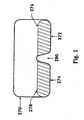
- the drawings depict vertical cross-sectional views of tablets and tablettes of the invention. Tablets are depicted as if they were in the die, so that the top of the tablet as it is oriented on the page corresponds with the top of the tablet in the die. In other words, the top segment of the tablet as viewed contains the last granulation to enter the die. Tablettes are depicted as they would have been in the die before they were separated from the intact tablet.
- FIG. 1 depict vertical cross-sectional views of tablets and tablettes of the invention. Tablets are depicted as if they were in the die, so that the top of the tablet as it is oriented on the page corresponds with the top of the tablet in the die. In other words, the top segment of the tablet as viewed contains the last granulation to enter the die. Tablettes are depicted as they would have been in the die before they were separated from the intact tablet.
- Front views refer to a cross-sectional view of a tablet that has a theoretical geometric plane passed through the tablet relative to a side which is arbitrarily designated as the front.
- Figures labeled as “side view,” which also have a corresponding “front view” are taken as a cross-section through the whole tablet from the right side of a front view i.e., a side view is a cross-section that is taken by passing a plane through the vertical axis of the whole tablet at a 90° angle to the cross-sectional front view.
- Each front view represents a schematic cross-section that passes through the midpoint of the horizontal cross-section as measured from the front of the tablet to the back of the tablet or tablette.
- the front view is also parallel to the major axis of the tablet (e.g., for a tablet with a rectangular (but not square) transverse cross-section, the longer side of the perimeter is parallel with the plane that depicts the cross-sectional, front view. That plane is located half-way between the front and back surfaces of said tablet.
- Cross-sections of segments are shown crosshatched if they contain a drug and if they lack a pharmacologically effective quantity of drug, they are shown plain (clear, without crosshatching or stippling).
- the upper part of each figure corresponds to the upper part of a tablet, all of which are depicted as they are situated within a die after final compression and before ejection from the die.
- tablettes are depicted in the same orientation as the tablets from which they are formed, although tablettes are created after tablet ejection from a die.
- Tablettes are depicted with broken surfaces as indicated by a fine saw-tooth pattern. Such saw-tooth depiction is schematic and not intended to represent the actual pattern of breaking of a tablet or tablette.
- Tablets of the invention have the core structure A'A" /X where A'A" represents the substantially identical unitary segments formed from a (completely) divided layer most preferably containing a drug; X represents a segment generally representing an undivided layer and one face (surface) of X adjoins both A' and A"; X is preferably scored on the surface to which A' and A" adjoin, to aid tablet breaking. (X may optionally be scored on another surface, as well.)
- the number of unitary segments formed from a layer is not limited to two; a bottom embossing pattern involving three parallel scores or two crossing scores may allow four compositionally substantially identical unitary segments to be produced.
- Tablets of the invention may be manufactured by the above technique and related techniques.
- a first and second feed of substantially identical granulations may enter the die onto an embossed lower punch with one bisecting score, followed by a third, non-identical feed. If final compression pushes said first and said second granulation below the uppermost part of said embossing, then the first two granulations will have formed two divided layers of a three-layer tablet, but collectively the two divided layers will have formed two and not four unitary segments; each segment will consist of approximately half of each divided layer.
- Fig. 1 depicts a tablet containing unitary segments 272 and 274 in vertical cross-section, front view. Both of said unitary segments adjoin the same face (surface) of segment 270, which is formed from a single granulation and due to mixing of granulations, contains a minimal amount of the drug that is present in segments 272 and 274. Interfaces 276 and 278 represent the regions at which segment 270 adjoins segments 272 and 274, respectively. Score 280 indents segment 270 and also represents the space between segments 272 and 274.
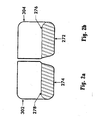
- Figs. 2a and 2b depict the two tablettes created by breaking the tablet of Fig. 1 through segment 270.
- segment 302 represents that part of segment 270 that adjoins intact segment 274.
- Interface 278 represents the region at which segments 302 and 274 meet.
- interface 276 represents the region at which segments 304 and 272 meet.
- Score 280 and segment 270 of Fig. 1 are not considered to exist once the tablettes are formed.
- Each tablette of Figs. 2a and 2b contains substantially equivalent mass assuming the score 280 of Fig. 1 is a bisecting score relative to the layer that became divided in the creation of segments 272 and 274.
- Tablets of the nature of that of Fig. 1 may contain in the unitary segments a mixture of drugs or, as in Fig. 1 , one drug.
- the granulation that forms segment 270 of Fig. 1 may be provided with a drug that is the same as, or different than, that of the divided layer. In this case, it would be likely that said drug provided in the upper layer would have a therapeutic effect and side effect profile that was not very sensitive to accuracy of subdivision of a dose.
- Fig. 3 depicts a tablet similar to that depicted in Fig. 1 , but the tablet of Fig. 3 has a score 300 that extends more deeply into the non-unitary segment 290 than does score 280 of Fig. 1 .
- One way of producing score 300 is to use the embossing and manufacturing technique used for the tablet of Fig. 1 and then remove, such as with a file, material from segment 290. Alternatively, embossing of the appropriate size and shape may be able to be utilized to create score 300 directly.
- the tablet of Fig. 3 contains unitary segments 292 and 294. Interfaces 296 and 298 are present between segments 292 and 290, and 294 and 290, respectively.
- Fig. 4a depicts an external view of a tablet containing unitary segments 604 and 606 that are at the bottom of the tablet.
- score 610 penetrates into clear, upper, non-unitary segment 608.
- Interface 602 represents the region at which segment 608 meets segment 604.
- Interface 612 represents the region at which segment 606 meets segment 608.
- Fig. 4b depicts the same tablet depicted in Fig. 4a .
- This vertical cross-section is taken perpendicularly through score 610, which occupies the diameter of the circular transverse cross-section of the tablet.
- Fig. 5 depicts a tablet containing four segments. Unitary segments 6 and 8, as with all unitary segments, are not contiguous with each other. Score 10 penetrates into segment 4. Segment 4 is a compound segment formed from substantially compositionally identical inactive granulations added sequentially. Top segment 2 contains a therapeutic quantity of a drug that differs from the drug that is present in a therapeutic quantity in segments 6 and 8. Dotted line 12 reflects a surface score that runs transversely across segment 4. A preferred horizontal dimension for the tablet of Fig. 5 is 12-18 mm, but said dimension is not limited. Interface 14 depicts where segments 2 and 4 are contiguous. Interfaces 15 and 16 depict where segments 6 and 8, respectively, adjoin segment 4. Segment 4 contains therapeutically insignificant quantities of the drugs found in segments 6 and 2.
- the tablet of Fig. 5 may be broken usefully in two ways.
- One way is vertically through score 10 in the direction of segment 2; such breaking would not utilize the score reflected by dotted line 12, but would give a dose of half of the drug found in segments 6 and 8, though likely would not give a precise halving of the drug found in segment 2, due to difficulties with breaking scored tablets as was documented in the Background of the Invention, above.
- the result of another way of breaking said tablet is depicted in Figs. 6a and 6b .
- Fig 6a shows a tablette formed from breaking the tablet of Fig. 5 through the horizontal score reflected by dotted line 12.
- tablettes depicted herein it is not assumed that breaking is even, but the tablettes are depicted so that breaking is contained substantially within segment 12, that is a segment interposed between upper segment 2 and lower segments 6 and 8 in the tablet of Fig. 5 .
- the tablette of Fig. 6a demonstrates that segment 2 is intact, as is interface 14.
- Segment 3 is formed by the part of therapeutically inactive segment 4 of the tablet of Fig. 5 that remains contiguous with segment 2.
- the tablette of Fig. 6b depicts segments 6 and 8, and interfaces 15 and 16, as unchanged from the tablet of Fig. 5 .
- Segment 7 is the part of segment 4 of Fig. 5 that becomes part of the tablette of Fig. 6b .
- Figs. 7a and 7b depicts the result of a second breaking, that of the tablette of Fig. 6b .
- Fig. 7a depicts segment 8 that now adjoins new segment 11, formed from segment 7 of the tablette of Fig. 6b .
- Interface 16 and segment 8 are unchanged from that of the whole tablet of Fig. 5 .
- Fig. 7b depicts segment 9, formed from segment 7 of Fig. 6b , and segment 6 and interface 15, which are unchanged from the whole tablet of Fig. 5 .
- Figs. 7a and 7b in association with Figs. 5 , 6a, and 6b , demonstrate a means by which a combination tablet can be divided not only to separate therapeutic quantities of one active drug from another, but also then precisely give a partial dose of one of said active drugs.
- a method of administering one or more drugs via the dosage forms such as tablets and tablettes of the invention to a patient, mammal, or other animal in need of pharmaceuticals for the prevention or treatment of an illness, maintenance of good health, retarding of aging, or other purpose is also disclosed. Included are methods of treating a patient with only one drug from a combination product, such as with a novel tablette of the invention, enabling downward dose adjustment for a variety of reasons; or a patient may be treated with one whole tablet containing a plurality of active drugs and in addition receive only one drug from a similar tablet, thus enabling upward dose adjustment.
- Combination products that can benefit from the invention include those containing the following pairs of drugs: amlodipine and either benazepril, chlorthalidone, or atorvastatin; benazepril and hydrochlorothiazide; olmesartan and hydrochlorothiazide; and many others, including the majority of the currently-produced combination products. Also included is the method of treating a patient with a precise partial dose of medication from a whole tablet, which may be a half or quarter of the whole dose, but may usefully be a different fraction. Warfarin especially may usefully be produced and dosed according to the invention with separable segments of the tablet that may but need not be as halves, quarters, etc. L-thyroxine and digoxin are other examples that could so benefit, along with warfarin.
- tablets of the invention which may be used in any suitable combination of drugs.
- one outer active segment of a tablet according to the invention could contain levodopa and carbidopa, and the other outer active segment could contain entacapone, a tablet product containing all three drugs in a homogeneous fashion that is currently marketed in the United States as Stalevo ® .
- a tablet per the invention could involve five layered segments, with, for example, amlodipine in one outer segment, an inactive segment adjoining it, a middle segment containing chlorthalidone or HCTZ, and a second inactive Segment adjoining both it and the other outer segment that contains benazepril (see Fig. 8). If both inactive segments were of adequate dimensions to be conveniently breakable without damaging any of the three active segments, thus providing significant clinical advantages due to the adoption of flexible dosing of the different active segments.
- the following list of possible combinations of a plurality of drugs is exemplary and not limiting.
- the combinations referred to may include two or more members of the classes listed.
- Drugs listed below, and herein, may for convenience exclude mention of any salt of a drug; e.g., "atorvastatin” is listed even though its marketed form is atorvastatin calcium.
- useful combinations may include a plurality of drugs from within the following six drug classes.
- tablets of the invention may be created containing only one of a drug from the following list.
- two methods of use may apply to the invention. One of these methods is to place an individual drug in a granulation and a different individual drug (or combination of drugs) in a different granulation, potentially with an inactive granulation interposed between them; another method is to place a plurality of drugs in one or more segments.
- Lipid-lowering agents include:
- drugs that may undergo dosage adjustment will be preferred if they may be divided in an optimally precise manner.
- drugs that will especially benefit from the advances of the invention in this manner include narrow therapeutic index drugs such as warfarin, digoxin, L-thyroxine; vasoactive drugs such as amlodipine; hypoglycemic agents such as rosiglitazone and glipizide; and anxiolytics drugs such as alprazolam. These are however but a small fraction of the great mass of drugs that will benefit from the various embodiments and procedures of the invention.
- a further benefit of the invention may relate to pediatric or geriatric doses, which may not be produced in appropriate dose strengths.
- a 1.25 mg daily dose may be useful in either small children with hypertension, or in frail elderly patients with angina or hypertension, who may have hepatic dysfunction.
- FDA United States Food and Drug Administration
- precise divisibility of the approved 2.5 mg dose would allow a 1.25 mg daily dose.
- precise divisibility of the approved 2.5 mg dose will allow accurate dosing of 3.75 mg.
- Another use of the invention is to enable a method of cost savings for insurers and patients.
- the invention allows this because many drugs, such as Norvasc and Coumadin, have pricing that differs little (if at all) between different doses.
- tablet splitting is imprecise for most scored tablets, the practice of mandatory splitting has been met with disapproval by most physician and pharmacist organizations.
- the invention enables tablet splitting because it provides accurate dosing when a tablet (or some tablettes, as in Fig. 1b ) of the invention are broken as described herein. Substantial benefits are foreseen from this innovation.
- the ability to separate one active drug from another in a combination product has cost saving advantages, as well.
- a tablet having two unitary segments containing equal amounts of amlodpine adjoining a first upper segment having no drug. is made as follows: A Stokes 27-station tri-layer rotary tablet press is used. All formulations are directly compressible powder blends. The blending of the amlodipine formulation is performed in a Patterson-Kelly "V" blender. The first segment consists of Nu-Tab ® and requires no blending. The tablets are compressed using tablet punches to a hardness of 35 kilopounds. The amlodipine formulation is introduced first into a die having a wedge shaped embossed bottom section die sized to provide a total of 5mg of amlodipine besylate in each dose.
- Bottom Segment Mg. Dibasic calcium phosphate anhydrous 51.13 Amlodipine besylate 7.15 Sodium starch glycolate (Explotab ® ) 2.48 Magnesium stearate 0.93 FD&C Blue #1 Aluminum Lake 0.31 Total 62.00
Landscapes
- Health & Medical Sciences (AREA)
- Veterinary Medicine (AREA)
- Medicinal Chemistry (AREA)
- Public Health (AREA)
- Pharmacology & Pharmacy (AREA)
- Chemical & Material Sciences (AREA)
- General Health & Medical Sciences (AREA)
- Animal Behavior & Ethology (AREA)
- Life Sciences & Earth Sciences (AREA)
- Bioinformatics & Cheminformatics (AREA)
- Engineering & Computer Science (AREA)
- Nuclear Medicine, Radiotherapy & Molecular Imaging (AREA)
- Organic Chemistry (AREA)
- General Chemical & Material Sciences (AREA)
- Chemical Kinetics & Catalysis (AREA)
- Diabetes (AREA)
- Epidemiology (AREA)
- Endocrinology (AREA)
- Biomedical Technology (AREA)
- Pain & Pain Management (AREA)
- Hematology (AREA)
- Neurosurgery (AREA)
- Neurology (AREA)
- Communicable Diseases (AREA)
- Oncology (AREA)
- Emergency Medicine (AREA)
- Obesity (AREA)
- Cardiology (AREA)
- Heart & Thoracic Surgery (AREA)
- Rheumatology (AREA)
- Medicinal Preparation (AREA)
- Acyclic And Carbocyclic Compounds In Medicinal Compositions (AREA)
- Pharmaceuticals Containing Other Organic And Inorganic Compounds (AREA)
- Medical Preparation Storing Or Oral Administration Devices (AREA)
- Glanulating (AREA)
Claims (14)
- Procédé pour préparer un comprimé pharmaceutique comprenant un premier segment dérivé d'une granulation qui ne contient pas un médicament, une face du premier segment étant contiguë à deux ou plus de deux segments unitaires de composition identique comprenant un premier segment unitaire et un second segment unitaire, ledit premier segment unitaire et ledit second segment unitaire contenant chacun un médicament ou des médicaments, ledit premier segment unitaire et ledit second segment unitaire étant dérivés de la même couche divisée ou des mêmes couches divisées ; ledit premier segment présentant une rainure sur sa surface positionnée entre lesdits premier et second segments unitaires ; ledit comprimé présentant facultativement des segments unitaires supplémentaires,
le procédé comprenant :(i) le lancement d'une granulation contenant une quantité thérapeutique d'un ingrédient pharmaceutique actif dans une matrice de compression d'une machine à fabriquer des comprimés, laquelle présente un bossage qui s'élève à partir du poinçon inférieur de la matrice de compression, en formant ainsi une couche au-dessus du point le plus haut dudit bossage, et le damage par un poinçon supérieur ;(ii) le lancement d'une seconde granulation qui est différente de ladite première granulation dans la matrice au-dessus de ladite première granulation, ladite seconde granulation étant dépourvue de médicament actif ; et(iii) la compression du comprimé par le poinçon supérieur de telle sorte que ladite compression pousse ladite première granulation sous les points les plus hauts dudit bossage. - Comprimé pharmaceutique qui peut être obtenu par le procédé de la revendication 1.
- Comprimé pharmaceutique tel que défini dans la revendication 2, dans lequel, dans le comprimé pharmaceutique, un ou plusieurs segments unitaires supplémentaires, en plus desdits premier et second segments unitaires, sont facultativement présents et sont dérivés de la même couche ou des mêmes couches que ledit premier segment unitaire.
- Comprimé pharmaceutique tel que défini dans la revendication 2, dans lequel des segments unitaires supplémentaires sont contenus dans ledit comprimé, lesquels présentent une composition différente de la composition dudit premier segment unitaire et dudit second segment unitaire et sont dérivés d'une granulation contenant un médicament.
- Comprimé pharmaceutique tel que défini dans la revendication 2, dans lequel, dans le comprimé pharmaceutique, ledit premier segment unitaire et ledit second segment unitaire sont des segments extérieurs.
- Comprimé pharmaceutique tel que défini dans la revendication 2, dans lequel, dans le comprimé pharmaceutique, ledit premier segment unitaire et ledit second segment unitaire jouxtent d'autres segments unitaires qui sont des segments extérieurs.
- Comprimé pharmaceutique tel que défini dans la revendication 5, dans lequel, dans le comprimé pharmaceutique, sont intercalés des segments unitaires entre ledit premier segment unitaire et ledit premier segment.
- Comprimé pharmaceutique tel que défini dans la revendication 2, dans lequel, dans le comprimé pharmaceutique, il existe une rainure sensiblement verticale dans ledit premier segment, ladite rainure étant verticalement alignée avec le centre de l'espace entre ledit premier segment unitaire et ledit second segment unitaire.
- Comprimé pharmaceutique tel que défini dans la revendication 2, dans lequel, dans le comprimé pharmaceutique, en plus dudit premier segment unitaire et dudit second segment unitaire, il existe deux segments unitaires supplémentaires qui présentent une composition identique.
- Comprimé pharmaceutique tel que défini dans la revendication 2, dans lequel, dans le comprimé pharmaceutique, ledit médicament ou lesdits médicaments est ou sont pharmacologiquement efficaces dans le traitement d'états cardio-vasculaires, d'états psychiatriques, de diabètes, de troubles de la thyroïde, de douleurs ou de troubles thrombotiques.
- Comprimé pharmaceutique tel que défini dans la revendication 2, dans lequel, dans le comprimé pharmaceutique, ledit premier segment jouxte une pluralité de segments unitaires sur le côté dudit premier segment qui est opposé à la surface jouxtant lesdits premier et second segments unitaires.
- Comprimé pharmaceutique tel que défini dans la revendication 2, dans lequel, dans le comprimé pharmaceutique, un second segment qui contient un médicament jouxte ledit premier segment sur le côté opposé au côté où lesdits premier et second segments unitaires sont situés.
- Procédé pour casser un comprimé pharmaceutique tel que défini dans la revendication 2, dans lequel ledit comprimé est cassé en appliquant une force auxdits premier et second segments unitaires pour amener le comprimé à se casser sensiblement à travers ledit premier segment et pratiquement pas à travers un quelconque segment unitaire.
- Procédé pour casser un comprimé tel que défini dans la revendication 12 qui comprend le fait de casser d'abord ledit comprimé à travers ledit premier segment pour obtenir un comprimé qui contient une partie dudit premier segment plus des segments unitaires, et ensuite casser ledit comprimé entre lesdits premier et second segments unitaires de telle sorte que le comprimé se casse pratiquement entièrement à l'intérieur dudit premier segment.
Applications Claiming Priority (3)
| Application Number | Priority Date | Filing Date | Title |
|---|---|---|---|
| US57304204P | 2004-05-21 | 2004-05-21 | |
| US57313404P | 2004-05-21 | 2004-05-21 | |
| PCT/US2005/018631 WO2005112900A1 (fr) | 2004-05-21 | 2005-05-23 | Tablettes pharmaceutiques comprenant au moins deux segments unitaires |
Publications (3)
| Publication Number | Publication Date |
|---|---|
| EP1755563A1 EP1755563A1 (fr) | 2007-02-28 |
| EP1755563A4 EP1755563A4 (fr) | 2007-07-04 |
| EP1755563B1 true EP1755563B1 (fr) | 2012-01-25 |
Family
ID=35456178
Family Applications (5)
| Application Number | Title | Priority Date | Filing Date |
|---|---|---|---|
| EP05753917A Expired - Lifetime EP1755563B1 (fr) | 2004-05-21 | 2005-05-23 | Tablettes pharmaceutiques comprenant au moins deux segments unitaires |
| EP05754113.8A Expired - Lifetime EP1750647B1 (fr) | 2004-05-21 | 2005-05-23 | Comprimes pharmaceutiques comportant sur une face une marque de separation |
| EP05754171A Expired - Lifetime EP1755560B1 (fr) | 2004-05-21 | 2005-05-23 | Comprimes pharmaceutiques possedant un segment relativement inactif |
| EP05754425.6A Expired - Lifetime EP1755564B1 (fr) | 2004-05-21 | 2005-05-23 | Tablettes pharmaceutiques a liberation immediate plus hautes que larges |
| EP05825029.1A Expired - Lifetime EP1746979B1 (fr) | 2004-05-21 | 2005-05-23 | Comprimes pharmaceutiques rainures, comprenant une pluralite de segments |
Family Applications After (4)
| Application Number | Title | Priority Date | Filing Date |
|---|---|---|---|
| EP05754113.8A Expired - Lifetime EP1750647B1 (fr) | 2004-05-21 | 2005-05-23 | Comprimes pharmaceutiques comportant sur une face une marque de separation |
| EP05754171A Expired - Lifetime EP1755560B1 (fr) | 2004-05-21 | 2005-05-23 | Comprimes pharmaceutiques possedant un segment relativement inactif |
| EP05754425.6A Expired - Lifetime EP1755564B1 (fr) | 2004-05-21 | 2005-05-23 | Tablettes pharmaceutiques a liberation immediate plus hautes que larges |
| EP05825029.1A Expired - Lifetime EP1746979B1 (fr) | 2004-05-21 | 2005-05-23 | Comprimes pharmaceutiques rainures, comprenant une pluralite de segments |
Country Status (9)
| Country | Link |
|---|---|
| US (6) | US7879352B2 (fr) |
| EP (5) | EP1755563B1 (fr) |
| JP (5) | JP5395355B2 (fr) |
| AT (2) | ATE552827T1 (fr) |
| AU (5) | AU2005292670B2 (fr) |
| CA (5) | CA2564961C (fr) |
| ES (4) | ES2385832T3 (fr) |
| IL (5) | IL179433A0 (fr) |
| WO (5) | WO2006038916A2 (fr) |
Families Citing this family (33)
| Publication number | Priority date | Publication date | Assignee | Title |
|---|---|---|---|---|
| US7201920B2 (en) | 2003-11-26 | 2007-04-10 | Acura Pharmaceuticals, Inc. | Methods and compositions for deterring abuse of opioid containing dosage forms |
| US20120201883A1 (en) * | 2004-05-21 | 2012-08-09 | Accu-Break Technologies, Inc | Antiviral compositons |
| ES2385832T3 (es) * | 2004-05-21 | 2012-08-01 | Accu-Break Technologies, Inc. | Comprimidos farmacéuticos que presentan un segmento relativamente inactivo |
| US20080152595A1 (en) * | 2004-11-24 | 2008-06-26 | Acura Pharmaceuticals, Inc. | Methods and compositions for deterring abuse of orally administered pharmaceutical products |
| WO2007021032A1 (fr) * | 2005-08-18 | 2007-02-22 | Teijin Pharma Limited | Préparation avec fonction de division en doses précises |
| JP5046501B2 (ja) * | 2005-08-18 | 2012-10-10 | 帝人ファーマ株式会社 | 複数の薬物を分離して保持する錠剤 |
| JP5123471B2 (ja) * | 2005-08-18 | 2013-01-23 | 帝人ファーマ株式会社 | 用量調整が容易な製剤 |
| CA2619745A1 (fr) * | 2005-08-18 | 2007-02-22 | Teijin Pharma Limited | Comprime avec des sections contenant de multiples medicaments |
| US8158146B2 (en) | 2005-09-28 | 2012-04-17 | Teva Pharmaceutical Industries Ltd. | Stable combinations of amlodipine besylate and benazepril hydrochloride |
| PT1944029E (pt) * | 2005-10-31 | 2012-02-09 | Nissan Chemical Ind Ltd | Preparação farmacêutica com excelente fotoestabilidade |
| AU2006322656B2 (en) * | 2005-12-09 | 2012-03-08 | Vectus Biosystems Limited | VIP fragments and methods of use |
| BRPI0520830A2 (pt) * | 2005-12-30 | 2009-05-19 | Accu Break Technologies Inc | forma de dosagem farmacêutica sólida, método de subdividir uma forma de dosagem farmacêutica sólida, método de administração de uma parte de uma subunidade ativa de uma forma de dosagem farmacêutica sólida, método de administração de um ingrediente farmacêutico ativo que está presente dentro de uma subunidade ativa de uma forma de dosagem farmacêutica sólida e método de produção de uma forma de dosagem farmacêutica sólida |
| WO2007098446A2 (fr) * | 2006-02-21 | 2007-08-30 | Accu-Break Pharmaceuticals, Inc. | Méthode pour minimiser la variation dans des formes de dosage |
| US20070237815A1 (en) * | 2006-04-06 | 2007-10-11 | Lawrence Solomon | Dosage forms and methods comprising amlodipine and chlorthalidone |
| US20080075772A1 (en) * | 2006-04-13 | 2008-03-27 | Lawrence Solomon | Pharmaceutical compositions having novel scoring patterns and methods of using those compositions |
| MX2008016349A (es) * | 2006-06-19 | 2009-01-28 | Accu Break Technologies Inc | Formas segmentadas de dosificacion farmaceutica. |
| PE20080991A1 (es) | 2006-06-27 | 2008-09-05 | Novartis Ag | Formas de dosificacion solidas de valsartan, amlodipina e hidroclorotiazida y metodo para elaborarlas |
| WO2008021875A2 (fr) * | 2006-08-08 | 2008-02-21 | Accu-Break Technologies, Inc. | Comprimé pharmaceutique contenant une pluralité de segments actifs |
| US8741342B2 (en) * | 2006-10-30 | 2014-06-03 | Wockhardt Research Centre | Pharmaceutical compositions comprising entacapone, levodopa, and carbidopa |
| WO2008067485A1 (fr) * | 2006-11-30 | 2008-06-05 | Accu-Break Technologies, Inc. | Formes de dosage osmotique divisibles et leur procédé d'utilisation |
| USD631537S1 (en) | 2009-09-15 | 2011-01-25 | Mcneil-Ppc, Inc. | Oral dosage form |
| EP3064064A1 (fr) | 2009-09-30 | 2016-09-07 | Acura Pharmaceuticals, Inc. | Procédés et compositions de dissuasion d'abus |
| US20110280936A1 (en) * | 2010-05-17 | 2011-11-17 | Aptapharma, Inc. | Self Breaking Tablets |
| EP2682110B1 (fr) | 2011-03-03 | 2019-12-04 | Takeda Pharmaceutical Company Limited | Comprimé stratifié et son procédé de fabrication |
| MX366159B (es) | 2012-11-30 | 2019-07-01 | Acura Pharmaceuticals Inc | Liberacion autorregulada de ingrediente farmaceutico activo. |
| AU2015237721B2 (en) | 2014-03-26 | 2018-04-26 | Sun Pharma Advanced Research Company Ltd. | Abuse deterrent immediate release coated reservoir solid dosage form |
| US9839212B2 (en) | 2015-04-16 | 2017-12-12 | Bio-Lab, Inc. | Multicomponent and multilayer compacted tablets |
| WO2017040607A1 (fr) | 2015-08-31 | 2017-03-09 | Acura Pharmaceuticals, Inc. | Procédés et compositions pour la libération auto-régulée d'un ingrédient pharmaceutique actif |
| JP6745670B2 (ja) * | 2016-07-29 | 2020-08-26 | 芝浦メカトロニクス株式会社 | 錠剤印刷装置、錠剤及び錠剤製造方法 |
| US20190060243A1 (en) * | 2017-08-25 | 2019-02-28 | MD Medical Research | Article and method for a pharmaceutical agent |
| EP3773532A4 (fr) | 2018-03-29 | 2022-11-02 | Avion Pharmaceuticals, LLC | Composition de dose fractionnée de lévodopa et utilisation |
| CN111407734A (zh) * | 2019-01-05 | 2020-07-14 | 厦门赛诺邦格生物科技股份有限公司 | 一种阳痿早泄治疗药物的固体制剂 |
| CN112917981A (zh) * | 2020-12-28 | 2021-06-08 | 陕西兴盛新材料股份有限公司 | 一种采用力的转向增压的电极压制工艺 |
Family Cites Families (58)
| Publication number | Priority date | Publication date | Assignee | Title |
|---|---|---|---|---|
| US3128226A (en) * | 1962-08-22 | 1964-04-07 | Hoffmann La Roche | Composition for relieving pain |
| US3336200A (en) * | 1963-05-28 | 1967-08-15 | Warner Lambert Pharmaceutical | Tablet structure |
| USD201497S (en) * | 1964-09-28 | 1965-06-29 | Warner Lambert Co | Tablet |
| US3450252A (en) * | 1968-04-17 | 1969-06-17 | Richardson Merrell Inc | Dispensing container |
| US3696091A (en) * | 1970-06-03 | 1972-10-03 | Boehringer Sohn Ingelheim | Novel cardiac-active principles of the cardenolide glycoside class |
| US3723614A (en) * | 1971-01-06 | 1973-03-27 | Ciba Geigy Ag | Maltese-cross scored tablet |
| US3927194A (en) * | 1972-12-06 | 1975-12-16 | Ives Lab Inc | Tablet formulation |
| US4258027A (en) * | 1979-03-26 | 1981-03-24 | Mead Johnson & Company | Multi-fractionable tablet structure |
| US4215104A (en) * | 1979-03-26 | 1980-07-29 | Mead Johnson & Company | Multi-fractionable tablet structure |
| US4353887A (en) * | 1979-08-16 | 1982-10-12 | Ciba-Geigy Corporation | Divisible tablet having controlled and delayed release of the active substance |
| CH648754A5 (en) * | 1979-08-16 | 1985-04-15 | Ciba Geigy Ag | Pharmaceutical slow release tablet |
| US4473192A (en) * | 1982-01-22 | 1984-09-25 | Hoefchst-Roussel Pharmaceuticals Incorporated | Tablet breaking device |
| DE3221425A1 (de) * | 1982-06-07 | 1983-12-08 | Boehringer Ingelheim KG, 6507 Ingelheim | Hydrolyseempfindlichen wirkstoff enthaltende, lagerstabile tablette |
| US4503031A (en) * | 1982-12-17 | 1985-03-05 | Glassman Jacob A | Super-fast-starting-sustained release tablet |
| JPH069375B2 (ja) | 1984-04-27 | 1994-02-02 | 株式会社東芝 | 中間調画情報の符号化伝送方式 |
| US4824677A (en) * | 1986-12-18 | 1989-04-25 | The Unjohn Company | Grooved tablet for fractional dosing of sustained release medication |
| US4905589A (en) * | 1987-02-06 | 1990-03-06 | Ackley E Michael | Ink-jet system for marking pellet-shaped articles |
| EP0391959B1 (fr) * | 1987-12-17 | 1993-01-27 | The Upjohn Company | Comprime pharmaceutique a trois encoches |
| US4999226A (en) * | 1988-06-01 | 1991-03-12 | Merrell Dow Pharmaceuticals Inc. | Pharmaceutical compositions for piperidinoalkanol-ibuprofen combination |
| US5041430A (en) * | 1989-09-18 | 1991-08-20 | Du Pont Mereck Pharmaceutical Company | Oral anticoagulant/platelet inhibitor low dose formulation |
| US5089270A (en) * | 1990-05-15 | 1992-02-18 | L. Perrigo Company | Capsule-shaped tablet |
| US5061494A (en) * | 1990-06-14 | 1991-10-29 | The Upjohn Comany | Tri-scored drug tablet |
| GB9107378D0 (en) | 1991-04-08 | 1991-05-22 | Ici Plc | Olefin polymerisation |
| US5158728A (en) | 1991-04-12 | 1992-10-27 | Elizabeth-Hata International, Inc. | Multi-layer medicinal tablet forming machine and method for using the same |
| US5118021A (en) * | 1991-05-10 | 1992-06-02 | American Medical Industries | Pill splitter |
| JPH069375A (ja) * | 1992-04-10 | 1994-01-18 | Takeda Chem Ind Ltd | 分割可能な連結錠剤 |
| IT1255522B (it) | 1992-09-24 | 1995-11-09 | Ubaldo Conte | Compressa per impiego terapeutico atta a cedere una o piu' sostanze attive con differenti velocita' |
| CA2110313C (fr) * | 1992-12-01 | 2004-10-26 | Edward John Roche | Compositions pharmaceutiques contenant un compose de guanidothiazole et antiacides |
| US6183778B1 (en) * | 1993-09-21 | 2001-02-06 | Jagotec Ag | Pharmaceutical tablet capable of liberating one or more drugs at different release rates |
| JP3168582B2 (ja) * | 1993-12-10 | 2001-05-21 | 藤沢薬品工業株式会社 | 解熱鎮痛配合剤 |
| GB9401894D0 (en) | 1994-02-01 | 1994-03-30 | Rhone Poulenc Rorer Ltd | New compositions of matter |
| TW483763B (en) * | 1994-09-02 | 2002-04-21 | Astra Ab | Pharmaceutical composition comprising of ramipril and dihydropyridine compound |
| US5756124A (en) * | 1995-08-07 | 1998-05-26 | Invamed, Inc. | Multi-scored pharmaceutical tablets |
| IT1282576B1 (it) * | 1996-02-06 | 1998-03-31 | Jagotec Ag | Compressa farmaceutica atta a cedere la sostanza attiva in tempi successivi e predeterminabili |
| US6919373B1 (en) | 1996-11-12 | 2005-07-19 | Alza Corporation | Methods and devices for providing prolonged drug therapy |
| GB9624563D0 (en) | 1996-11-27 | 1997-01-15 | Smithkline Beecham Plc | Product |
| PT1083879E (pt) * | 1998-06-03 | 2005-01-31 | Alza Corp | Metodos e dispositivos para proporcionar uma terapia de drogas prolongada |
| US6602521B1 (en) * | 1998-09-29 | 2003-08-05 | Impax Pharmaceuticals, Inc. | Multiplex drug delivery system suitable for oral administration |
| US8293277B2 (en) * | 1998-10-01 | 2012-10-23 | Alkermes Pharma Ireland Limited | Controlled-release nanoparticulate compositions |
| DE19927688A1 (de) * | 1999-06-17 | 2000-12-21 | Gruenenthal Gmbh | Mehrschichttablette zur Verabreichung einer fixen Kombination von Tramadol und Diclofenac |
| US6375956B1 (en) * | 1999-07-22 | 2002-04-23 | Drugtech Corporation | Strip pack |
| JP2001187749A (ja) * | 1999-10-18 | 2001-07-10 | Tanabe Seiyaku Co Ltd | 長期徐放性圧縮成型製剤およびその製造法 |
| US7674480B2 (en) * | 2000-06-23 | 2010-03-09 | Teva Pharmaceutical Industries Ltd. | Rapidly expanding composition for gastric retention and controlled release of therapeutic agents, and dosage forms including the composition |
| AU2001292185A1 (en) | 2000-10-12 | 2002-04-22 | Beecham Pharmaceuticals (Pte) Limited | Formulation containing amoxicillin |
| US6555581B1 (en) * | 2001-02-15 | 2003-04-29 | Jones Pharma, Inc. | Levothyroxine compositions and methods |
| JP4417110B2 (ja) * | 2001-12-19 | 2010-02-17 | 株式会社三和化学研究所 | 放出制御型成型品 |
| PL212123B1 (pl) * | 2002-01-15 | 2012-08-31 | Ucb Farchim Sa | Doustna kompozycja farmaceutyczna |
| US6946156B2 (en) * | 2002-05-15 | 2005-09-20 | Mcneil-Ppc, Inc. | Process for enrobing a core |
| EP1589930A2 (fr) * | 2003-01-08 | 2005-11-02 | Flacco-Nesselroad Family Trust | Therapie combinee anticoagulante |
| TW200510002A (en) * | 2003-06-06 | 2005-03-16 | Takeda Chemical Industries Ltd | Solid pharmaceutical preparation |
| US20050013863A1 (en) | 2003-07-18 | 2005-01-20 | Depomed, Inc., A Corporation Of The State Of California | Dual drug dosage forms with improved separation of drugs |
| TWI366110B (en) * | 2004-02-26 | 2012-06-11 | Ibm | Providing a portion of an electronic mail message based upon a transfer rate, a message size, and a file format |
| US7622137B2 (en) * | 2004-05-21 | 2009-11-24 | Accu-Break Technologies, Inc. | Dosage forms contained within a capsule or sachet |
| US7329418B2 (en) * | 2004-05-21 | 2008-02-12 | Accu Break Technologies, Inc. | Pharmaceutical tablets having height greater than width |
| US7713547B2 (en) * | 2004-05-21 | 2010-05-11 | Accu-Break Pharmaceuticals, Inc. | Method of administering a partial dose of a segmented pharmaceutical tablet |
| US7318935B2 (en) * | 2004-05-21 | 2008-01-15 | Accu-Break Technologies, Inc. | Pharmaceutical tablets with active and inactive segments |
| ES2385832T3 (es) * | 2004-05-21 | 2012-08-01 | Accu-Break Technologies, Inc. | Comprimidos farmacéuticos que presentan un segmento relativamente inactivo |
| US7838031B2 (en) * | 2004-05-21 | 2010-11-23 | Lawrence Solomon | Method of administering a partial dose using a segmented pharmaceutical tablet |
-
2005
- 2005-05-23 ES ES05754171T patent/ES2385832T3/es not_active Expired - Lifetime
- 2005-05-23 EP EP05753917A patent/EP1755563B1/fr not_active Expired - Lifetime
- 2005-05-23 WO PCT/US2005/018632 patent/WO2006038916A2/fr not_active Ceased
- 2005-05-23 JP JP2007527574A patent/JP5395355B2/ja not_active Expired - Fee Related
- 2005-05-23 AU AU2005292670A patent/AU2005292670B2/en not_active Ceased
- 2005-05-23 CA CA2564961A patent/CA2564961C/fr not_active Expired - Lifetime
- 2005-05-23 JP JP2007527577A patent/JP2008500403A/ja not_active Withdrawn
- 2005-05-23 WO PCT/US2005/018639 patent/WO2005112898A1/fr not_active Ceased
- 2005-05-23 EP EP05754113.8A patent/EP1750647B1/fr not_active Expired - Lifetime
- 2005-05-23 EP EP05754171A patent/EP1755560B1/fr not_active Expired - Lifetime
- 2005-05-23 CA CA2565029A patent/CA2565029C/fr not_active Expired - Lifetime
- 2005-05-23 US US10/598,344 patent/US7879352B2/en not_active Expired - Lifetime
- 2005-05-23 CA CA2564962A patent/CA2564962C/fr not_active Expired - Lifetime
- 2005-05-23 ES ES05754425.6T patent/ES2439572T3/es not_active Expired - Lifetime
- 2005-05-23 US US10/598,315 patent/US8158148B2/en not_active Expired - Fee Related
- 2005-05-23 EP EP05754425.6A patent/EP1755564B1/fr not_active Expired - Lifetime
- 2005-05-23 WO PCT/US2005/018633 patent/WO2005112897A2/fr not_active Ceased
- 2005-05-23 JP JP2007527575A patent/JP2008500401A/ja active Pending
- 2005-05-23 ES ES05825029T patent/ES2429540T3/es not_active Expired - Lifetime
- 2005-05-23 AU AU2005245028A patent/AU2005245028B2/en not_active Ceased
- 2005-05-23 CA CA002564960A patent/CA2564960A1/fr not_active Abandoned
- 2005-05-23 AU AU2005245026A patent/AU2005245026B2/en not_active Ceased
- 2005-05-23 JP JP2007527578A patent/JP5008565B2/ja not_active Expired - Fee Related
- 2005-05-23 AU AU2005245027A patent/AU2005245027B2/en not_active Ceased
- 2005-05-23 US US10/598,267 patent/US20080241239A1/en not_active Abandoned
- 2005-05-23 ES ES05753917T patent/ES2379967T3/es not_active Expired - Lifetime
- 2005-05-23 AT AT05754171T patent/ATE552827T1/de active
- 2005-05-23 US US11/569,343 patent/US8034380B2/en not_active Expired - Fee Related
- 2005-05-23 US US10/598,306 patent/US20090130207A1/en not_active Abandoned
- 2005-05-23 AU AU2005245025A patent/AU2005245025B2/en not_active Ceased
- 2005-05-23 WO PCT/US2005/018638 patent/WO2005112870A1/fr not_active Ceased
- 2005-05-23 EP EP05825029.1A patent/EP1746979B1/fr not_active Expired - Lifetime
- 2005-05-23 WO PCT/US2005/018631 patent/WO2005112900A1/fr not_active Ceased
- 2005-05-23 JP JP2007527576A patent/JP2008500402A/ja active Pending
- 2005-05-23 CA CA2566310A patent/CA2566310C/fr not_active Expired - Lifetime
- 2005-05-23 AT AT05753917T patent/ATE542523T1/de active
-
2006
- 2006-11-20 IL IL179433A patent/IL179433A0/en unknown
- 2006-11-20 IL IL179429A patent/IL179429A0/en unknown
- 2006-11-20 IL IL179430A patent/IL179430A0/en unknown
- 2006-11-20 IL IL179431A patent/IL179431A0/en unknown
- 2006-11-20 IL IL179432A patent/IL179432A0/en unknown
- 2006-11-21 US US11/561,968 patent/US7988996B2/en not_active Expired - Fee Related
Non-Patent Citations (1)
| Title |
|---|
| VOIGT: "Lehrbuch der pharmazeutischen Technologie", 1 January 1984, pages: 224 - 225 * |
Also Published As
Similar Documents
| Publication | Publication Date | Title |
|---|---|---|
| EP1755563B1 (fr) | Tablettes pharmaceutiques comprenant au moins deux segments unitaires | |
| US7318935B2 (en) | Pharmaceutical tablets with active and inactive segments | |
| US7329418B2 (en) | Pharmaceutical tablets having height greater than width | |
| EP1948138A1 (fr) | Formes galeniques pharmaceutiques segmentées | |
| ZA200610681B (en) | Pharmaceutical tablets comprising two or more unitary segments | |
| US8506999B2 (en) | Pharmaceutical tablets comprising a plurality of segments |
Legal Events
| Date | Code | Title | Description |
|---|---|---|---|
| PUAI | Public reference made under article 153(3) epc to a published international application that has entered the european phase |
Free format text: ORIGINAL CODE: 0009012 |
|
| 17P | Request for examination filed |
Effective date: 20061117 |
|
| AK | Designated contracting states |
Kind code of ref document: A1 Designated state(s): AT BE BG CH CY CZ DE DK EE ES FI FR GB GR HU IE IS IT LI LT LU MC NL PL PT RO SE SI SK TR |
|
| AX | Request for extension of the european patent |
Extension state: BA HR MK YU |
|
| A4 | Supplementary search report drawn up and despatched |
Effective date: 20070605 |
|
| RIC1 | Information provided on ipc code assigned before grant |
Ipc: A61K 9/20 20060101AFI20070530BHEP |
|
| RAX | Requested extension states of the european patent have changed |
Extension state: HR Payment date: 20061117 Extension state: BA Payment date: 20061117 Extension state: MK Payment date: 20061117 Extension state: YU Payment date: 20061117 |
|
| 17Q | First examination report despatched |
Effective date: 20100401 |
|
| GRAP | Despatch of communication of intention to grant a patent |
Free format text: ORIGINAL CODE: EPIDOSNIGR1 |
|
| GRAS | Grant fee paid |
Free format text: ORIGINAL CODE: EPIDOSNIGR3 |
|
| GRAA | (expected) grant |
Free format text: ORIGINAL CODE: 0009210 |
|
| RAP1 | Party data changed (applicant data changed or rights of an application transferred) |
Owner name: ACCU-BREAK TECHNOLOGIES, INC. |
|
| AK | Designated contracting states |
Kind code of ref document: B1 Designated state(s): AT BE BG CH CY CZ DE DK EE ES FI FR GB GR HU IE IS IT LI LT LU MC NL PL PT RO SE SI SK TR |
|
| AX | Request for extension of the european patent |
Extension state: BA HR MK YU |
|
| REG | Reference to a national code |
Ref country code: GB Ref legal event code: FG4D |
|
| REG | Reference to a national code |
Ref country code: CH Ref legal event code: EP |
|
| REG | Reference to a national code |
Ref country code: AT Ref legal event code: REF Ref document number: 542523 Country of ref document: AT Kind code of ref document: T Effective date: 20120215 |
|
| REG | Reference to a national code |
Ref country code: IE Ref legal event code: FG4D |
|
| REG | Reference to a national code |
Ref country code: DE Ref legal event code: R096 Ref document number: 602005032399 Country of ref document: DE Effective date: 20120322 |
|
| REG | Reference to a national code |
Ref country code: ES Ref legal event code: FG2A Ref document number: 2379967 Country of ref document: ES Kind code of ref document: T3 Effective date: 20120507 |
|
| REG | Reference to a national code |
Ref country code: NL Ref legal event code: VDEP Effective date: 20120125 |
|
| LTIE | Lt: invalidation of european patent or patent extension |
Effective date: 20120125 |
|
| PG25 | Lapsed in a contracting state [announced via postgrant information from national office to epo] |
Ref country code: LT Free format text: LAPSE BECAUSE OF FAILURE TO SUBMIT A TRANSLATION OF THE DESCRIPTION OR TO PAY THE FEE WITHIN THE PRESCRIBED TIME-LIMIT Effective date: 20120125 Ref country code: IS Free format text: LAPSE BECAUSE OF FAILURE TO SUBMIT A TRANSLATION OF THE DESCRIPTION OR TO PAY THE FEE WITHIN THE PRESCRIBED TIME-LIMIT Effective date: 20120525 Ref country code: BG Free format text: LAPSE BECAUSE OF FAILURE TO SUBMIT A TRANSLATION OF THE DESCRIPTION OR TO PAY THE FEE WITHIN THE PRESCRIBED TIME-LIMIT Effective date: 20120425 Ref country code: BE Free format text: LAPSE BECAUSE OF FAILURE TO SUBMIT A TRANSLATION OF THE DESCRIPTION OR TO PAY THE FEE WITHIN THE PRESCRIBED TIME-LIMIT Effective date: 20120125 Ref country code: NL Free format text: LAPSE BECAUSE OF FAILURE TO SUBMIT A TRANSLATION OF THE DESCRIPTION OR TO PAY THE FEE WITHIN THE PRESCRIBED TIME-LIMIT Effective date: 20120125 |
|
| PG25 | Lapsed in a contracting state [announced via postgrant information from national office to epo] |
Ref country code: PT Free format text: LAPSE BECAUSE OF FAILURE TO SUBMIT A TRANSLATION OF THE DESCRIPTION OR TO PAY THE FEE WITHIN THE PRESCRIBED TIME-LIMIT Effective date: 20120525 Ref country code: FI Free format text: LAPSE BECAUSE OF FAILURE TO SUBMIT A TRANSLATION OF THE DESCRIPTION OR TO PAY THE FEE WITHIN THE PRESCRIBED TIME-LIMIT Effective date: 20120125 Ref country code: GR Free format text: LAPSE BECAUSE OF FAILURE TO SUBMIT A TRANSLATION OF THE DESCRIPTION OR TO PAY THE FEE WITHIN THE PRESCRIBED TIME-LIMIT Effective date: 20120426 Ref country code: PL Free format text: LAPSE BECAUSE OF FAILURE TO SUBMIT A TRANSLATION OF THE DESCRIPTION OR TO PAY THE FEE WITHIN THE PRESCRIBED TIME-LIMIT Effective date: 20120125 |
|
| REG | Reference to a national code |
Ref country code: AT Ref legal event code: MK05 Ref document number: 542523 Country of ref document: AT Kind code of ref document: T Effective date: 20120125 |
|
| PG25 | Lapsed in a contracting state [announced via postgrant information from national office to epo] |
Ref country code: CY Free format text: LAPSE BECAUSE OF FAILURE TO SUBMIT A TRANSLATION OF THE DESCRIPTION OR TO PAY THE FEE WITHIN THE PRESCRIBED TIME-LIMIT Effective date: 20120125 |
|
| PG25 | Lapsed in a contracting state [announced via postgrant information from national office to epo] |
Ref country code: RO Free format text: LAPSE BECAUSE OF FAILURE TO SUBMIT A TRANSLATION OF THE DESCRIPTION OR TO PAY THE FEE WITHIN THE PRESCRIBED TIME-LIMIT Effective date: 20120125 Ref country code: SI Free format text: LAPSE BECAUSE OF FAILURE TO SUBMIT A TRANSLATION OF THE DESCRIPTION OR TO PAY THE FEE WITHIN THE PRESCRIBED TIME-LIMIT Effective date: 20120125 Ref country code: CZ Free format text: LAPSE BECAUSE OF FAILURE TO SUBMIT A TRANSLATION OF THE DESCRIPTION OR TO PAY THE FEE WITHIN THE PRESCRIBED TIME-LIMIT Effective date: 20120125 Ref country code: EE Free format text: LAPSE BECAUSE OF FAILURE TO SUBMIT A TRANSLATION OF THE DESCRIPTION OR TO PAY THE FEE WITHIN THE PRESCRIBED TIME-LIMIT Effective date: 20120125 Ref country code: DK Free format text: LAPSE BECAUSE OF FAILURE TO SUBMIT A TRANSLATION OF THE DESCRIPTION OR TO PAY THE FEE WITHIN THE PRESCRIBED TIME-LIMIT Effective date: 20120125 Ref country code: SE Free format text: LAPSE BECAUSE OF FAILURE TO SUBMIT A TRANSLATION OF THE DESCRIPTION OR TO PAY THE FEE WITHIN THE PRESCRIBED TIME-LIMIT Effective date: 20120125 |
|
| PG25 | Lapsed in a contracting state [announced via postgrant information from national office to epo] |
Ref country code: SK Free format text: LAPSE BECAUSE OF FAILURE TO SUBMIT A TRANSLATION OF THE DESCRIPTION OR TO PAY THE FEE WITHIN THE PRESCRIBED TIME-LIMIT Effective date: 20120125 |
|
| PLBE | No opposition filed within time limit |
Free format text: ORIGINAL CODE: 0009261 |
|
| STAA | Information on the status of an ep patent application or granted ep patent |
Free format text: STATUS: NO OPPOSITION FILED WITHIN TIME LIMIT |
|
| PG25 | Lapsed in a contracting state [announced via postgrant information from national office to epo] |
Ref country code: MC Free format text: LAPSE BECAUSE OF NON-PAYMENT OF DUE FEES Effective date: 20120531 |
|
| REG | Reference to a national code |
Ref country code: CH Ref legal event code: PL |
|
| 26N | No opposition filed |
Effective date: 20121026 |
|
| PG25 | Lapsed in a contracting state [announced via postgrant information from national office to epo] |
Ref country code: CH Free format text: LAPSE BECAUSE OF NON-PAYMENT OF DUE FEES Effective date: 20120531 Ref country code: LI Free format text: LAPSE BECAUSE OF NON-PAYMENT OF DUE FEES Effective date: 20120531 Ref country code: AT Free format text: LAPSE BECAUSE OF FAILURE TO SUBMIT A TRANSLATION OF THE DESCRIPTION OR TO PAY THE FEE WITHIN THE PRESCRIBED TIME-LIMIT Effective date: 20120125 |
|
| REG | Reference to a national code |
Ref country code: DE Ref legal event code: R097 Ref document number: 602005032399 Country of ref document: DE Effective date: 20121026 |
|
| PG25 | Lapsed in a contracting state [announced via postgrant information from national office to epo] |
Ref country code: TR Free format text: LAPSE BECAUSE OF FAILURE TO SUBMIT A TRANSLATION OF THE DESCRIPTION OR TO PAY THE FEE WITHIN THE PRESCRIBED TIME-LIMIT Effective date: 20120125 |
|
| PG25 | Lapsed in a contracting state [announced via postgrant information from national office to epo] |
Ref country code: LU Free format text: LAPSE BECAUSE OF NON-PAYMENT OF DUE FEES Effective date: 20120523 |
|
| PG25 | Lapsed in a contracting state [announced via postgrant information from national office to epo] |
Ref country code: HU Free format text: LAPSE BECAUSE OF FAILURE TO SUBMIT A TRANSLATION OF THE DESCRIPTION OR TO PAY THE FEE WITHIN THE PRESCRIBED TIME-LIMIT Effective date: 20050523 |
|
| PGFP | Annual fee paid to national office [announced via postgrant information from national office to epo] |
Ref country code: ES Payment date: 20150518 Year of fee payment: 11 |
|
| PGFP | Annual fee paid to national office [announced via postgrant information from national office to epo] |
Ref country code: IE Payment date: 20151006 Year of fee payment: 11 |
|
| REG | Reference to a national code |
Ref country code: FR Ref legal event code: PLFP Year of fee payment: 12 |
|
| REG | Reference to a national code |
Ref country code: IE Ref legal event code: MM4A |
|
| REG | Reference to a national code |
Ref country code: FR Ref legal event code: PLFP Year of fee payment: 13 |
|
| PG25 | Lapsed in a contracting state [announced via postgrant information from national office to epo] |
Ref country code: IE Free format text: LAPSE BECAUSE OF NON-PAYMENT OF DUE FEES Effective date: 20160523 |
|
| REG | Reference to a national code |
Ref country code: FR Ref legal event code: PLFP Year of fee payment: 14 |
|
| PG25 | Lapsed in a contracting state [announced via postgrant information from national office to epo] |
Ref country code: ES Free format text: LAPSE BECAUSE OF NON-PAYMENT OF DUE FEES Effective date: 20160524 |
|
| REG | Reference to a national code |
Ref country code: ES Ref legal event code: FD2A Effective date: 20181204 |
|
| REG | Reference to a national code |
Ref country code: DE Ref legal event code: R082 Ref document number: 602005032399 Country of ref document: DE Representative=s name: KILBURN & STRODE LLP, NL |
|
| PGFP | Annual fee paid to national office [announced via postgrant information from national office to epo] |
Ref country code: FR Payment date: 20230529 Year of fee payment: 19 Ref country code: DE Payment date: 20230531 Year of fee payment: 19 |
|
| PGFP | Annual fee paid to national office [announced via postgrant information from national office to epo] |
Ref country code: GB Payment date: 20230524 Year of fee payment: 19 |
|
| PGFP | Annual fee paid to national office [announced via postgrant information from national office to epo] |
Ref country code: IT Payment date: 20240529 Year of fee payment: 20 |
|
| REG | Reference to a national code |
Ref country code: DE Ref legal event code: R119 Ref document number: 602005032399 Country of ref document: DE |
|
| GBPC | Gb: european patent ceased through non-payment of renewal fee |
Effective date: 20240523 |
|
| PG25 | Lapsed in a contracting state [announced via postgrant information from national office to epo] |
Ref country code: DE Free format text: LAPSE BECAUSE OF NON-PAYMENT OF DUE FEES Effective date: 20241203 |
|
| PG25 | Lapsed in a contracting state [announced via postgrant information from national office to epo] |
Ref country code: FR Free format text: LAPSE BECAUSE OF NON-PAYMENT OF DUE FEES Effective date: 20240531 |
|
| PG25 | Lapsed in a contracting state [announced via postgrant information from national office to epo] |
Ref country code: GB Free format text: LAPSE BECAUSE OF NON-PAYMENT OF DUE FEES Effective date: 20240523 |