EP1757596B1 - Derives de tyrosine remplaces par du n-phenylacryloyle utilises en tant qu'agonistes de hppar alpha et de hppar gama - Google Patents
Derives de tyrosine remplaces par du n-phenylacryloyle utilises en tant qu'agonistes de hppar alpha et de hppar gama Download PDFInfo
- Publication number
- EP1757596B1 EP1757596B1 EP05714787A EP05714787A EP1757596B1 EP 1757596 B1 EP1757596 B1 EP 1757596B1 EP 05714787 A EP05714787 A EP 05714787A EP 05714787 A EP05714787 A EP 05714787A EP 1757596 B1 EP1757596 B1 EP 1757596B1
- Authority
- EP
- European Patent Office
- Prior art keywords
- phenyl
- compound
- formula
- methyl
- oxazol
- Prior art date
- Legal status (The legal status is an assumption and is not a legal conclusion. Google has not performed a legal analysis and makes no representation as to the accuracy of the status listed.)
- Expired - Lifetime
Links
- 0 CCC(*)C(NC(Cc(cc1)ccc1OCCc1c(C)[o]c(-c2ccccc2)n1)C(O*)=O)=O Chemical compound CCC(*)C(NC(Cc(cc1)ccc1OCCc1c(C)[o]c(-c2ccccc2)n1)C(O*)=O)=O 0.000 description 2
- JYWHQBLLIBQGCU-UHFFFAOYSA-N Cc1c(CCO)nc(-c2ccccc2)[o]1 Chemical compound Cc1c(CCO)nc(-c2ccccc2)[o]1 JYWHQBLLIBQGCU-UHFFFAOYSA-N 0.000 description 1
Classifications
-
- C—CHEMISTRY; METALLURGY
- C07—ORGANIC CHEMISTRY
- C07D—HETEROCYCLIC COMPOUNDS
- C07D263/00—Heterocyclic compounds containing 1,3-oxazole or hydrogenated 1,3-oxazole rings
- C07D263/02—Heterocyclic compounds containing 1,3-oxazole or hydrogenated 1,3-oxazole rings not condensed with other rings
- C07D263/30—Heterocyclic compounds containing 1,3-oxazole or hydrogenated 1,3-oxazole rings not condensed with other rings having two or three double bonds between ring members or between ring members and non-ring members
- C07D263/32—Heterocyclic compounds containing 1,3-oxazole or hydrogenated 1,3-oxazole rings not condensed with other rings having two or three double bonds between ring members or between ring members and non-ring members with only hydrogen atoms, hydrocarbon or substituted hydrocarbon radicals, directly attached to ring carbon atoms
-
- A—HUMAN NECESSITIES
- A61—MEDICAL OR VETERINARY SCIENCE; HYGIENE
- A61P—SPECIFIC THERAPEUTIC ACTIVITY OF CHEMICAL COMPOUNDS OR MEDICINAL PREPARATIONS
- A61P3/00—Drugs for disorders of the metabolism
- A61P3/06—Antihyperlipidemics
-
- A—HUMAN NECESSITIES
- A61—MEDICAL OR VETERINARY SCIENCE; HYGIENE
- A61P—SPECIFIC THERAPEUTIC ACTIVITY OF CHEMICAL COMPOUNDS OR MEDICINAL PREPARATIONS
- A61P3/00—Drugs for disorders of the metabolism
- A61P3/08—Drugs for disorders of the metabolism for glucose homeostasis
- A61P3/10—Drugs for disorders of the metabolism for glucose homeostasis for hyperglycaemia, e.g. antidiabetics
-
- A—HUMAN NECESSITIES
- A61—MEDICAL OR VETERINARY SCIENCE; HYGIENE
- A61P—SPECIFIC THERAPEUTIC ACTIVITY OF CHEMICAL COMPOUNDS OR MEDICINAL PREPARATIONS
- A61P9/00—Drugs for disorders of the cardiovascular system
-
- C—CHEMISTRY; METALLURGY
- C07—ORGANIC CHEMISTRY
- C07D—HETEROCYCLIC COMPOUNDS
- C07D413/00—Heterocyclic compounds containing two or more hetero rings, at least one ring having nitrogen and oxygen atoms as the only ring hetero atoms
- C07D413/02—Heterocyclic compounds containing two or more hetero rings, at least one ring having nitrogen and oxygen atoms as the only ring hetero atoms containing two hetero rings
- C07D413/12—Heterocyclic compounds containing two or more hetero rings, at least one ring having nitrogen and oxygen atoms as the only ring hetero atoms containing two hetero rings linked by a chain containing hetero atoms as chain links
Definitions
- the present invention relates to substituted tyrosine derivatives substituted by N-arylacryloyl or pharmaceutically acceptable salts or solvates thereof, processes for preparing them, pharmaceutical composition comprising them, and their use, as agonists of peroxisome proliferator-activated receptor (abbreviated as PPAR), in particular as double agonists of PPAR ⁇ and PPAR ⁇ , for the prevention and/or treatment of metabolic diseases such as diabetes and hyperlipidemia.
- PPAR peroxisome proliferator-activated receptor
- WO 00/08002A1 and WO 02/100403A1 relate to methods for treating diabetes and cardiovascular disease using a PPAR ⁇ agonist in combination with a PPAR ⁇ agonist, or a compound that activates both PPAR ⁇ and PPAR ⁇ , in which some compounds containing 3-phenyl propanoic acid substituted by 2-(3-oxo-3-phenylprop-l-enylamino) and 2-alkyl/alkoxy are disclosed.
- Peroxisome Proliferator Activated Receptors alike glucocorticoid receptors, tretinoin receptors and thyroid receptors, are ligand-dependent transcription factors pertaining to intranuclear receptor superfamily.
- PPAR can be subdivided into three subtypes: PPAR ⁇ , PPAR ⁇ and PPAR ⁇ (also known as PPAR ⁇ and NUC1), which are encoded by different genes.
- PPAR ⁇ also have two isoforms, i.e., PPAR ⁇ 1 and PPAR ⁇ 2 .
- PPAR ⁇ is mainly expressed in the tissues, such as brown adipose tissue and liver, having high catabolic capacity for lipids, followed by kidney, heart and skeletal muscle ( Endocnnology, 1995, 137, 354 ). It can positively or negatively control the expression of genes related to the metabolism and the intracellular transport of fatty acid (e.g. acyl CoA synthetase, fatty acid-binding protein and lipoprotein lipase) and of apolipoprotein (AI, All, CIII) genes related to the metabolisms of cholesterol and neutral lipids.
- fatty acid e.g. acyl CoA synthetase, fatty acid-binding protein and lipoprotein lipase
- AI, All, CIII apolipoprotein
- PPAR ⁇ 2 was specifically expressed predominantly in adipose tissue.
- PPAR ⁇ 1 had a broad tissue expression, and was expressed at the highest levels in kidney, intestines and heart.
- PPAR ⁇ serves as a key regulator for adipocyte differentiation and expression of insulin-sensitive genes ( J. Lipid Res., 1996, 37, 907 ).
- PPAR ⁇ is expressed ubiquitously in the tissues of organisms with nerve cells as the center. At present, the physiological significance of PPAR ⁇ is still unclear.
- Thiazolidinedione drugs for example troglitazone and rosiglitazone, were clinically shown to be capable of enhancing insulin-action and reducing serum glucose in patients with Type 2 diabetes. It has been reported that thiazolidinediones are potent and selective activators of PPAR ⁇ and bind directly to the PPAR ⁇ receptor ( J. M. Lehmann, et. al., J. Blol. Chem. 2953-12956, 270 (1995 )).
- Fibrates were widely used as a class of drugs for treating hyperlipidemia, which might lower serum triglycerides by 20-50%, lower LDLc by 10-15%, and increase HDLc by 10-15%.
- PPAR ⁇ Activation of PPAR ⁇ resulted in transcription of enzymes that increased fatty acid catabolism and decreased fatty acid re-synthesis in the liver (leading to decrease of triglyceride synthesis and VLDL production/secretion).
- activation of PPAR ⁇ decreased production of apoC-III.
- the reduction in production of apoC-III an inhibitor of LPL activity
- increased clearance of VLDL J. Auwerx, et al., Atherosclerosis, J59-S37, 124 (Suppl), (1996 )).
- the object of the present invention is to search and develop a small molecular compound as agonist of PPAR ⁇ and PPAR ⁇ , which compound is effective for treating PPAR ⁇ and/or PPAR ⁇ mediated diseases, risk factors or disorders.
- the present inventor discovers that the compound having the following general formula I is an agonist of PPAR ⁇ and PPAR ⁇ , and therefore is effective for preventing and/or treating diseases or symptoms, e.g., diabetes or hyperglycemia, associated with PPAR ⁇ and PPAR ⁇ .
- the inventor further discovers that the compound of formula I also has an excellent lipid-reducing effect.
- the present invention relates to compounds of the general formula I, racemates, optically active isomers, or pharmaceutically acceptable salts or solvates thereof, wherein
- the present invention relates to a pharmaceutical composition
- a pharmaceutical composition comprising at least one compound of formula I, or racemate, optically active isomer or pharmaceutically acceptable salt or solvate thereof, and one or more pharmaceutically acceptable carriers or excipients.
- the present invention provides a process for preparing the compounds of Formula I or pharmaceutically acceptable salts or solvates thereof.
- the present invention relates to use of the compound of formula I in the manufacture of a medicament for the treatment or prevention of PPAR ⁇ and/or PPAR ⁇ mediated diseases, risk factors or conditions.
- the hPPAR ⁇ and/or hPPAR ⁇ mediated diseases, risk factors, or conditions include hyperglycemia, dyslipidemia, type II diabetes mellitus including associated diabetic dyslipidemia, type I diabetes, hypertriglyceridemia, syndrome X, insulin resistance, heart failure, hyperlipidemia, hypercholesteremia, hypertension, cardiovascular disease including atherosclerosis, regulation of appetite and food intake in subjects suffering from conditions such as obesity, anorexia, bulimia, and anorexia nervosa.
- the present invention relates to compounds of the general formula I, racemates, optically active isomers, or pharmaceutically acceptable salts or solvates thereof, wherein
- the compounds of formula I are S-configuration isomers of formula II, or pharmaceutically acceptable salts or solvates thereof, wherein:
- Preferred compounds of the present invention are selected from:
- the compounds of formula I, or pharmaceutically acceptable salts or solvates thereof, wherein R 1 , R 2 , R 3 , Ar, Y and n are the same as defined above for formula I, may be synthesized by reacting a compound of formula III wherein Y, n and R 1 are the same as defined above for formula I, and Ph is phenyl; with a compound of formula X, wherein Ar, R 2 and R 3 are the same as defined above for formula I.
- the compound of formula III as one of raw materials may be prepared by the following method:
- a compound of formula I can be converted to another compound of formula I in a different form.
- a compound of formula I, wherein R 1 represents hydrogen may be obtained by reacting, a compound of formula I wherein R 1 represents C 1 -C 4 straight or branched alkyl, with an alkali metal hydroxide.
- a compound of formula IV reacts with benzamide (purchased from Beijing Chemical Reagent Co.) for 6-30 h under the condition of reflux in toluene, followed by concentration and purification with silica gel column chromatography (using n-hexane/EtOAc as an eluent), to obtain a compound of formula V as brown oil.
- the compound of formula V reacts with LiAlH 4 (purchased from Huanwei Fine Chemicals Co., Tianjin) in Et 2 O at room temperature for 1 - 24 h, to which water, NaOH aqueous solution and anhydrous MgSO 4 are carefully dropped in turn, followed by stirring for 0.1-1 h.
- a compound of formula VII (wherein, preferably, Y is hydrogen or n is 1 and Y is Br in the ortho position of hydroxy group) is refluxed for 1 to 10 h with R 1 OH (wherein, R 1 is preferably CH 3 ) and SOCl 2 , followed by concentration.
- R 1 OH wherein, R 1 is preferably CH 3
- SOCl 2 SOCl 2
- the obtained residue reacts with BOC 2 O for 1 to 8 h at room temperature in anhydrous CH 3 CN under the catalysis of triethylamine, before concentration.
- the obtained product is dissolved with dichloromethane, washed with NaHSO 4 aqueous solution, saturated sodium carbonate aqueous solution and saturated brine in turn, and then dried.
- a compound of formula VIII is obtained as a white solid.
- the compound of formula VIII wherein n is 1 and Y is Br in the ortho position of hydroxy group may be prepared from the reaction of tyrosine and bromine in glacial acetic acid at -20-110°C for 0.5 to 48 h.
- a compound of formula VI reacts, according to Mitsunobu-type method, with a compound of formula VIII in the presence of triphenylphosphine (PPh 3 ) and azodicarboxylic acid ester such as azodicarboxylic diethyl ether in an organic solvent such as THF at -20-150°C (e.g., 20°C) for 1 to 40 h, followed by concentration and purification with silica gel column chromatography (using n-hexane/EtOAc as an eluent), to obtain a compound of formula IX.
- the compound of formula IX reacts with trifluoroacetic acid in an organic solvent such as CH 2 Cl 2 at -20-40°C for 1 to 40 h.
- the reaction mixture is neutralized with NaOH aqueous solution.
- the organic layer is dried, concentrated, and then purified with silica gel column chromatography (using CHCl 3 /MeOH as an eluent) to give the compound of
- R 1 , R 2 , R 3 , Ar, Y and n are the same as defined above for formula I.
- a compound of formula X reacts with thionyl chloride (SOCl 2 ) at 0-80°C for 0.5 to 10 h, followed by evaporating thionyl chloride. The resulting residue is dissolved in anhydrous dichloromethane, which is then dropped at -20 - 40°C to an anhydrous dichloromethane solution containing a compound of formula III and triethylamine, before stirring at room temperature for 0.1-20 h. The reaction solution is concentrated and purified with silica gel column chromatography (using n-hexane/EtOAc as an eluent) to give the compound of formula I.
- a compound of formula I can be converted to another compound of formula I in a different form.
- the compound of formula I where R 1 represents hydrogen is prepared by reacting the compound of formula I wherein R 1 represents C 1 -C 4 straight or branched alkyl in the presence of an alkali metal hydroxide at room temperature or under the condition of reflux for 0.1 to 40 h, before treating.
- the compound of formula I has a stereocenter.
- a compound of formula I is desired as a single enantiomer, it is prepared by using reactants in their single enantiomeric form in the process wherever possible or by conducting the reaction in the presence of reagents or catalysts in their single enantiomer form or by resolving the mixture of stereoisomers by conventional methods.
- Some of the preferred methods include use of microbial resolution, for resolving the diastereomeric salts formed with chiral acids such as mandelic acid, camphorsulfonic acid, tartaric acid, lactic acid, and the like wherever applicable or with chiral bases such as brucine, cinchona alkaloids and their derivatives and the like.
- the compound of formula I may be converted to a 1:1 mixture of diastereomeric amides by treating with chiral amines, amino acids, or amino alcohols derived from amino acids; an acid may be converted into an amide by using conventional reaction conditions; diastereomers may be separated either by fractional crystallization or chromatography, and stereoisomers of the compound of formula I may be prepared by hydrolysing pure diastereomeric amides.
- the compound of formula I can be used for the treatment or prevention of hPPAR ⁇ and/or hPPAR ⁇ mediated diseases, risk factors or conditions.
- the hPPAR ⁇ and/or hPPAR ⁇ mediated diseases, risk factors, or conditions include hyperglycemia, dyslipidemia, type II diabetes mellitus including associated diabetic dyslipidemia, type I diabetes, hypertriglyceridemia, syndrome X, insulin resistance, heart failure, hyperlipidemia, hypercholesteremia, hypertension, cardiovascular disease including atherosclerosis, regulation of appetite and food intake in subjects suffering from conditions such as obesity, anorexia, bulimia, and anorexia nervosa.
- the compound of the present invention is useful in the treatment or prevention of hyperglycaemia, dyslipidemia, and type II diabetes mellitus including associated diabetic dyslipidemia.
- the compounds of the present invention may be utilized by themselves, or in the form of pharmaceutically acceptable salts or solvates thereof.
- physiologically acceptable salts of the compound of formula I include conventional salts formed from pharmaceutically acceptable inorganic or organic acids or bases as well as quaternary ammonium acid addition salts.
- suitable acid addition salts include hydrochloric, hydrobromic, sulfuric, phosphoric, nitric, perchloric, fumaric, acetic, propionic, succinic, glycolic, formic, lactic, malefic, tartaric, citric, pamoic, malonic, hydroxymaleic, phenylacetic, glutamic, benzoic, salicylic, fumaric, toluenesulfonic, methanesulfonic, naphthalene-2-sulfonic, benzenesulfonic hydroxynaphthoic, hydroiodic, malic, steroic, tannic and the like.
- acids such as oxalic, while not in themselves pharmaceutically acceptable, may be used to prepare salts useful as intermediates for obtaining the compounds of the invention and their pharmaceutically acceptable salts.
- suitable basic salts include sodium, lithium, potassium, magnesium, aluminum, calcium, zinc, N,N'-dibenzylethylenediamine, chloroprocaine, choline, diethanolamine, ethylenediamine, N-methylglucamine and procaine salts.
- References to a compound according to the invention include both compounds of formula I and their pharmaceutically acceptable salts or solvates.
- the present compounds can be utilized alone or in the form of pharmaceutical composition.
- the pharmaceutical composition comprises an effective amount of a compound of formula I, a racemate, an optically active isomer, or a pharmaceutically acceptable salt or solvate thereof, and one or more suitable pharmaceutically acceptable carriers.
- the pharmaceutically acceptable carrier is selected from, but is not limited to, ion exchanger, aluminum oxide, aluminum stearate, lecithin, serum protein (e.g. human serum protein), buffer substance (e.g. phosphate), glycerol, sorbic acid, potassium sorbate, mixture of partial glycerides of saturated vegetable fatty acids, water, salt or electrolyte (e.g.
- protamine sulfate disodium hydrogen phosphate, potassium hydrogen phosphate, sodium chloride, zinc salt
- colloidal silicon oxide magnesium trisilicate
- polyvinylpyrrolidone polyvinylpyrrolidone
- cellulose polyethylene glycol
- carboxymethycellulose sodium polyacrylate
- beeswax and lanolin.
- composition comprising the compound according to the invention may be administered orally, by inhalation spray, rectally, nasally, buccally, topically, parenterally (such as, subcutaneous, intravenous, intramuscular, intraperitoneal, intrachecal, intraventricular, intrasteral, and intracranial injection or infusion), or via an implanted reservoir, preferably orally, intraperitoneally, or intravenously.
- parenterally such as, subcutaneous, intravenous, intramuscular, intraperitoneal, intrachecal, intraventricular, intrasteral, and intracranial injection or infusion
- an implanted reservoir preferably orally, intraperitoneally, or intravenously.
- the compound of the invention When administered orally, the compound of the invention may be produced in any orally acceptable formulation forms comprising, but being not limited to, tablets, capsules, aqueous solutions or aqueous suspensions.
- the carriers used for tablets include lactose and corn starch.
- lubricating agents such as magnesium stearate may also be added.
- diluents used for capsules include lactose and dried corn starch.
- Aqueous suspension formulations generally include mixture of suitable emulsifying and suspending agents with the active ingredient.
- the oral formulation forms may further comprise sweetening agents, flavoring agents or coloring agents.
- the compounds of the invention When administered topically, especially when the conditions addressed for treatment involve areas or organs readily accessible by topical application, including neurological conditions of eye, skin, or lower intestinal tract, the compounds of the invention may be prepared into different topical administration formulations in accordance with the areas or organs.
- the compounds of the invention can be formulated as micronized suspensions or solutions in isotonic, pH adjusted sterile saline, either with or without a preservative such as benzylalkonium chloride.
- the compounds may also be formulated in an ointment such as petrolatum.
- the compounds can be formulated in a suitable ointment, lotion or cream, wherein the active ingredient suspends or dissolves in one or more carriers.
- the carriers suitable for ointment include, but are not limited to, mineral oil, liquid petrolatum, white petrolatum, propylene glycol, polyoxyethylene, polyoxypropylene, emulsifying wax and water; and the carriers suitable for lotion or cream include, but are not limited to, mineral oil, sorbitan monostearate, Tween 60, cetyl ester wax, cetearyl alcohol, 2-octyldodecanol, benzyl alcohol and water.
- the compounds of the present invention may be administered in the form of sterile injection preparations, for example, as sterile injection aqueous or oleaginous suspensions or sterile injection solutions.
- the acceptable carriers and solvents include water, Ringer's solution and isotonic sodium chloride solution.
- sterile, fixed oils such as mono- or di-glycerides, can be also employed as solvents or suspending mediums.
- the dosage level and usage method of the present compound depend upon a variety of factors including, the age, body weight, gender, natural health condition, and nutritional status of the subject, the activity of the specific compound employed, the time of administration, the rate of metabolism, the severity of the particular disease being treated, and the subjective judgment of the doctor for diagnosis.
- the dosage levels on the order of about 0.01 mg to about 100 mg of the active ingredient/kg body weight/day are preferred, while the optimal dosage levels are 5 mg to 10 mg of the active ingredient/kg body weight/day.
- Methyl 4-bromo-3-pentanoate (23.2 g, 0.11 mol) and benzamide (20.1 g, 0.17 mol) were dissolved in 160 mL of toluene, and heated to reflux for 20 h. After concentration, the crude product obtained was purified with silica gel column chromatography (using n-hexane/EtOAc (6/1) as an eluent) to give 5.6 g of (5-methyl-2-phenyl-1,3-oxazol-4-yl)-acetic acid methyl ester as light brown oil with a yield of 22%.
- thionyl chloride 8 mL, 0.11 mmol was added dropwise to a solution of methanol (100 mL) containing L-tyrosine (17.9 g, 0.1 mmol), before refluxing for 3 h.
- the resulting solution was concentrated, to which triethylamine (15 mL) and acetonitrile (150 mL) were added, followed by dropping of di-tert-butyl dicarbonate (BOC 2 O) (23.3 mL, 0.11 mmol). Thereafter, the mixture was stirred for 1.5 h at room temperature.
- intermediate 2B was used in place of intermediate 2A to give (2S)-2-Amino-3- ⁇ 3-bromo-4-[2-(5-methyl-2-phenyl-1,3-oxazol-4-yl)-ethoxy] -phenyl ⁇ -propionic acid methyl ester.
- Cinnamic acid (0.44 g, 3.0 mmol, purchased from Beijing Chemical Reagent Co.) and thionyl chloride (2 mL) was heated to reflux for 3 h, followed by evaporating thionyl chloride. The resulting residue was dissolved with 3 mL of anhydrous dichloromethane.
- Intermediate 3A (1.20 g, 3.1 mmol, self-made) and triethylamine (0.30 g, 3 mmol) were dissolved with dichloromethane (5 mL), to which the above solution was added dropwise at 0°C.
- the compounds were screened with respect to their functional effect of instantaneous transfection in 293-T cells, so that their capabilities of activating PPAR subtypes were determined.
- a chimetic receptor system as established in advance was used to compare the influence of receptor subtypes on the transcription activity of same target gene, with Rluc as an internal control to reduce the endogenous influence.
- Human PPAR ⁇ and PPAR ⁇ ligand-binding domains were fused respectively with yeast transcription factor GAL4 DNA-binding domains, and then linked to expression vector pM of mammal, to thereby construct two plasmids pM-hPPAR ⁇ /GAL4 and pM-PPAR ⁇ /GAL4.
- GAL4 DNA-binding area was linked to pB4-tk-luc, to thereby construct pB4-RES-tk-luc (a firefly luciferase reporter gene comprising GAL4 DNA-binding site).
- pRL-CMV-Rluc was used as an internal control to normalize transfection efficiency and endogenous influence.
- 293-T cells were incubated in a 48-well plate at a cell density of 2-4 x 10 4 /well, using a phenol red-free and antibiotic-free 1640 medium containing 10% defatted fetal calf serum (FCS). After culturing for 48 h, the medium was replaced with a phenol red-free and antibiotic-free 1640 medium containing 5% defatted FCS, and then three plasmids pM-hPPAR/GAL4, pB4-RES-tk-luc and pRL-CMV-Rluc pertaining to two subtypes were respectively co-transfected into the 293-T cells.
- FCS fetal calf serum
Landscapes
- Chemical & Material Sciences (AREA)
- Organic Chemistry (AREA)
- Health & Medical Sciences (AREA)
- Diabetes (AREA)
- Medicinal Chemistry (AREA)
- Life Sciences & Earth Sciences (AREA)
- Engineering & Computer Science (AREA)
- Bioinformatics & Cheminformatics (AREA)
- Veterinary Medicine (AREA)
- Public Health (AREA)
- Chemical Kinetics & Catalysis (AREA)
- General Chemical & Material Sciences (AREA)
- General Health & Medical Sciences (AREA)
- Nuclear Medicine, Radiotherapy & Molecular Imaging (AREA)
- Pharmacology & Pharmacy (AREA)
- Animal Behavior & Ethology (AREA)
- Obesity (AREA)
- Hematology (AREA)
- Endocrinology (AREA)
- Emergency Medicine (AREA)
- Cardiology (AREA)
- Heart & Thoracic Surgery (AREA)
- Pharmaceuticals Containing Other Organic And Inorganic Compounds (AREA)
- Acyclic And Carbocyclic Compounds In Medicinal Compositions (AREA)
- Heterocyclic Carbon Compounds Containing A Hetero Ring Having Nitrogen And Oxygen As The Only Ring Hetero Atoms (AREA)
- Organic Low-Molecular-Weight Compounds And Preparation Thereof (AREA)
Claims (8)
- Composé de formule I, racémate, isomère optiquement actif, ou sel ou solvate pharmaceutiquement acceptable de ceux-ci,
 R1 est choisi parmi un hydrogène, un groupe alkyle droit ou ramifié en C1-C4 ;R2 et R3 sont choisis indépendamment parmi un hydrogène, un halogène, un groupe alkyle droit ou ramifié en C1-C4 ;Ar est choisi parmi un anneau carbocyclique aromatique mono-, di-, ou tricyclique ou un anneau hétérocyclique contenant 1 à 4 hétéroatomes choisis dans un groupe constitué par 0, S et N, dans lequel chaque anneau simple est un anneau à 5 ou 6 chaînons, et ledit anneau peut être non substitué ou substitué par 1 à 5 des groupes suivants : halogène, nitro, hydroxy, hydroxyméthyle, trifluorométhyle, trifluorométhoxy, alkyle droit ou ramifié en C1-C6, alcényle droit ou ramifié en C2-C6, alcoxy en C1-C4, alcénoxy en C2-C4, phénoxy, benzyloxy, carboxyle ou amino ;Y est un hydrogène ou un halogène ;n est un entier de 1 à 4.
 - Composé selon la revendication 1, qui est un isomère dans la configuration S de formule II,
 un atome de carbone lié à COOR1 est dans la configuration S ;R1 est choisi parmi un hydrogène, un groupe alkyle droit ou ramifié en C1-C4 ;R2 et R3 sont choisis indépendamment parmi un hydrogène, un halogène, un groupe alkyle droit ou ramifié en C1-C4 ;Ar est choisi parmi un anneau carbocyclique aromatique mono-, di-, ou tricyclique ou un anneau hétérocyclique contenant 1 à 4 hétéroatomes choisis dans un groupe constitué par O, S et N, dans lequel chaque anneau simple est un anneau à 5 ou 6 chaînons, et ledit anneau peut être non substitué ou substitué par 1 à 5 des groupes suivants : halogène, nitro, hydroxy, hydroxyméthyle, trifluorométhyle, trifluorométhoxy, alkyle droit ou ramifié en C1-C6, alcényle droit ou ramifié en C2-C6, alcoxy en C1-C4, alcénoxy en C2-C4, phénoxy, benzyloxy, carboxyle ou amino ;Y est un hydrogène ou un bromo ;ou un sel ou solvate pharmaceutiquement acceptable de ceux-ci.
 - Composé selon la revendication 1 ou 2 choisi dans le groupe constitué par :acide (2S)-3-{4-[2-(5-méthyl-2-phényl-1,3-oxazol-4-yl)-éthoxy]-phényl}-2-(3-phényl-acryloylamino)-propionique ;acide (2S)-2-(2-fluoro-3-phényl-acryloylamino)-3-{4-[2-(5-méthyl-2-phényl-1,3-oxazol-4-yl)-éthoxy]-phényl}-propionique ;acide (2S)-2-[3-(4-fluorophényl)acryloylamino]-3-{4-(2-(5-méthyl-2-phényl-1,3-oxazol-4-yl)éthoxy)-phényl}-propanoïque ;acide (2S)-3-{4-[2-(5-méthyl-2-phényl-1,3-oxazol-4-yl)-éthoxy]-phényl)-2-(3-(2-(trifluorométhyl)phényl)acryloylamino)-propanoïque ;acide (2S)-2-[3-(3-chlorophényl)acryloylamino]-3-{4-[2-(5-méthyl-2-phényl-1,3-oxazol-4-yl)-éthoxy]-phényl}-propanoïque ;acide (2S)-3-{4-[2-(5-méthyl-2-phényl-1,3-oxazol-4-yl)-éthoxy]-phényl}-2-[3-(3-(trifluorométhyl)-phényl)-acryloylamino]-propanoïque ;acide (2S)-2-[3-(3,4-difluorophényl)-acryloylamino]-3-{4-[2-(5-méthyl-2-phényl-1,3-oxazol-4-yl)-éthoxy]-phényl}-propanoïque ;acide (2S)-2-[3-(2,4-difluorophényl)-acryloylamino]-3-{4-[2-(5-méthyl-2-phényl-1,3-oxazol-4-yl)-éthoxy]-phényl}-propanoïque ;acide (2S)-2-(3-(furan-2-yl)acryloylamino)-3-{4-[2-(5-méthyl-2-phényl-1,3-oxazol-4-yl)-éthoxy]-phényl}-propanoïque ;acide (2S)-3-{3-bromo-4-[2-(5-méthyl-2-phényl-1,3-oxazol-4-yl)-éthoxy]-phényl}-2-(3-p-tolylacryloylamino)-propanoïque ;acide (2S)-3-{3-bromo-4-[2-(5-méthyl-2-phényl-l,3-oxazol-4-yl)-éthoxy]-phényl}-2-(2-fluoro-3-phényl-acryloylamino)-propionique ;acide (2S)-3-{3-bromo-4-[2-(5-méthyl-2-phényl-1,3-oxazol-4-yl)-éthoxy]-phényl}-2-[3-(2,4-difluorophényl)acryloylamino]-propanoïque ; etacide (2S)-3-{3-bromo-4-[2-(5-méthyl-2-phényl-1,3-oxazol-4-yl)-éthoxy]-phényl}-2-(2-fluoro-3-phényl-acryloylamino)-propionique ;ou des sels et solvates pharmaceutiquement acceptables de ceux-ci.
- Composition pharmaceutique comprenant un composé selon la revendication 1, un racémate, un isomère optiquement actif ou un sel ou solvate pharmaceutiquement acceptable de ceux-ci, et au moins un support pharmaceutiquement acceptable.
- Procédé de préparation d'un composé selon la revendication 1, comprenant :1) faire réagir un composé de formule III,

avec un composé de formule X,
pour obtenir le composé de formule I,
- Procédé selon la revendication 5, dans lequel le composé de formule III peut être préparé par les étapes suivantes :1) soumettre un composé de formule IV et un benzamide à une réaction de cyclisation pour obtenir ainsi un composé de formule V ; réduire le composé de formule V avec de l'hydrure de lithium aluminium (LiAlH4) pour obtenir un composé de formule VI ;
 2) faire réagir le composé de formule VII, dans laquelle Y et n sont tels que définis ci-dessus dans la revendication 1 avec du R1OH, dans lequel R1 est tel que défini ci-dessus dans la revendication 1 et du SOCl2, opération suivie par une mise en réaction avec du BOC2O, pour obtenir un composé de formule VIII dans laquelle Y, n et R1 sont tels que définis ci-dessus dans la revendication 1 ;
 3) faire réagir le composé de formule VI obtenu dans l'étape 1) avec le composé de formule VIII obtenu dans l'étape 2) pour obtenir un composé de formule IX, dans laquelle Y, n et R1 sont tels que définis ci-dessus dans la revendication 1,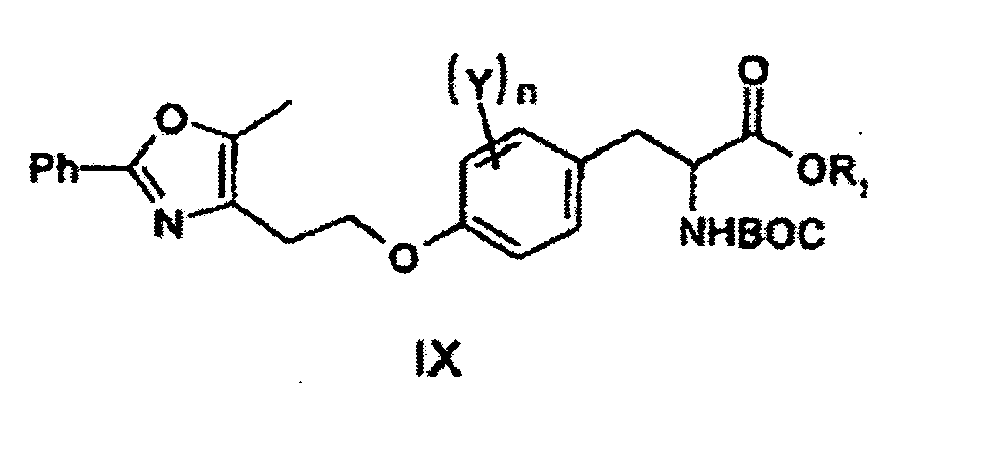

- Procédé selon la revendication 5, comprenant en outre :faire réagir un composé de formule I, dans laquelle R1 représente un groupe alkyle droit ou ramifié en C1-C4 avec un hydroxyde de métal alcalin pour donner un composé de formule I, dans laquelle R1 représente un hydrogène.
- Utilisation d'un composé selon la revendication 1 dans la préparation d'un médicament pour le traitement de maladies médiées par hPPARγ et hPPARα, de facteurs de risque ou d'états choisis parmi l'hyperglycémie, la dyslipidémie, le diabète sucré de type II, y compris la dyslipidémie diabétique associée, le diabète de type I, l'hypertriglycéridémie, le syndrome X, la résistance à l'insuline, un trouble cardiaque, l'hyperlipidémie, l'hypercholestérémie, l'hypertension, une maladie cardiovasculaire incluant l'athérosclérose, la régulation de l'appétit et de l'absorption d'aliments chez des sujets souffrant d'états choisis parmi l'obésité, l'anorexie, la boulimie et l'anorexie mentale.
Applications Claiming Priority (2)
| Application Number | Priority Date | Filing Date | Title |
|---|---|---|---|
| CNB2004100425741A CN100344618C (zh) | 2004-05-24 | 2004-05-24 | 作为hPPARα和hPPARγ激动剂的N-芳丙烯酰基取代的酪氨酸衍生物 |
| PCT/CN2005/000256 WO2005115999A1 (fr) | 2004-05-24 | 2005-03-02 | Derives de tyrosine remplaces par du n-phenylacryloyle utilises en tant qu'agonistes de hppar alpha et de hppar gama |
Publications (3)
| Publication Number | Publication Date |
|---|---|
| EP1757596A1 EP1757596A1 (fr) | 2007-02-28 |
| EP1757596A4 EP1757596A4 (fr) | 2009-01-21 |
| EP1757596B1 true EP1757596B1 (fr) | 2010-09-29 |
Family
ID=35450817
Family Applications (1)
| Application Number | Title | Priority Date | Filing Date |
|---|---|---|---|
| EP05714787A Expired - Lifetime EP1757596B1 (fr) | 2004-05-24 | 2005-03-02 | Derives de tyrosine remplaces par du n-phenylacryloyle utilises en tant qu'agonistes de hppar alpha et de hppar gama |
Country Status (7)
| Country | Link |
|---|---|
| US (1) | US7781468B2 (fr) |
| EP (1) | EP1757596B1 (fr) |
| CN (1) | CN100344618C (fr) |
| AT (1) | ATE482937T1 (fr) |
| DE (1) | DE602005023865D1 (fr) |
| ES (1) | ES2352071T3 (fr) |
| WO (1) | WO2005115999A1 (fr) |
Family Cites Families (7)
| Publication number | Priority date | Publication date | Assignee | Title |
|---|---|---|---|---|
| US5478852C1 (en) | 1993-09-15 | 2001-03-13 | Sankyo Co | Use of thiazolidinedione derivatives and related antihyperglycemic agents in the treatment of impaired glucose tolerance in order to prevent or delay the onset of noninsulin-dependent diabetes mellitus |
| US5478582A (en) * | 1994-02-08 | 1995-12-26 | The Quaker Oats Company | Dry mixture used for preparing a color-stable liquid composition |
| GB9817118D0 (en) | 1998-08-07 | 1998-10-07 | Glaxo Group Ltd | Pharmaceutical compounds |
| DK1206457T3 (da) | 1999-08-27 | 2004-02-16 | Lilly Co Eli | Biaryl-oxa(thia)zolderivater og deres anvendelse som modulatorer PPAP'ER |
| SK4132003A3 (en) * | 2000-10-05 | 2004-02-03 | Bayer Ag | Propionic acid derivatives, the process for their preparation, pharmaceutical composition comprising them, use thereof and intermediates for producing them |
| ME01310B (fr) * | 2001-05-15 | 2011-10-10 | Hoffmann La Roche | Derives d'oxazole substitues par de l'acide carboxylique utiles en tant qu'activateurs ppar-alpha et gamma dans le traitement du diabete |
| EA200400011A1 (ru) * | 2001-06-07 | 2004-06-24 | Эли Лилли Энд Компани | Модуляторы рецепторов, активируемых пролифераторами пероксисом (prar) |
-
2004
- 2004-05-24 CN CNB2004100425741A patent/CN100344618C/zh not_active Expired - Fee Related
-
2005
- 2005-03-02 US US11/597,656 patent/US7781468B2/en active Active
- 2005-03-02 EP EP05714787A patent/EP1757596B1/fr not_active Expired - Lifetime
- 2005-03-02 WO PCT/CN2005/000256 patent/WO2005115999A1/fr not_active Ceased
- 2005-03-02 ES ES05714787T patent/ES2352071T3/es not_active Expired - Lifetime
- 2005-03-02 DE DE602005023865T patent/DE602005023865D1/de not_active Expired - Lifetime
- 2005-03-02 AT AT05714787T patent/ATE482937T1/de not_active IP Right Cessation
Also Published As
| Publication number | Publication date |
|---|---|
| CN1702070A (zh) | 2005-11-30 |
| EP1757596A4 (fr) | 2009-01-21 |
| US7781468B2 (en) | 2010-08-24 |
| ES2352071T3 (es) | 2011-02-15 |
| ATE482937T1 (de) | 2010-10-15 |
| EP1757596A1 (fr) | 2007-02-28 |
| WO2005115999A1 (fr) | 2005-12-08 |
| DE602005023865D1 (de) | 2010-11-11 |
| CN100344618C (zh) | 2007-10-24 |
| US20080300286A1 (en) | 2008-12-04 |
Similar Documents
| Publication | Publication Date | Title |
|---|---|---|
| DE60216094T2 (de) | Modulatoren der peroxisom-proliferator-aktivierten rezeptoren (ppar) | |
| US5089514A (en) | 3-coxazolyl [phenyl, chromanyl or benzofuranyl]-2-hydroxypropionic acid derivatives and analogs as hypoglycemic agents | |
| CA2385081C (fr) | Derives d'acide carboxylique et medicaments les contenant | |
| US6825222B2 (en) | Modulators of peroxisome proliferator activated receptors | |
| US20090047687A1 (en) | Indane Acetic Acid Derivatives and Their Use as Pharmaceutical Agents, Intermediates, and Method of Preparation | |
| JP2004509084A (ja) | オキサゾリル−アリールオキシ酢酸誘導体およびそのpparアゴニストとしての使用 | |
| JP5291708B2 (ja) | アリールピリミジン誘導体、その製造方法、及び、その使用 | |
| JPWO2002046176A1 (ja) | ペルオキシソーム増殖剤応答性受容体の活性化剤 | |
| CA2339773A1 (fr) | Oxazoles substitues et derives de thiazoles comme activateurs de alpha hppar et de gamma hppar | |
| CN101007804B (zh) | 1,3-苯并间二氧杂环戊烯-2,2-二羧酸衍生物、其制备方法和医疗用途 | |
| KR20040081107A (ko) | 페닐(알킬)카르복시산 유도체 및 디이온성페닐알킬헤테로사이클릭 유도체, 및 혈청 글루코스및/또는 혈청 지질 강하 활성을 갖는 약제로서의 그의 용도 | |
| KR20030027054A (ko) | 옥사졸릴-아릴프로피온산 유도체 및 ppar효능제로서의 그의 용도 | |
| WO2004011446A1 (fr) | Derives d'acide carboxylique d'indane, de dihydrobenzofurane et de tetrahydronaphthalene et leurs utilisations comme antidiabetiques | |
| US7476742B2 (en) | Indane acetic acid derivatives and their use as pharmaceutical agents | |
| US7781468B2 (en) | Tyrosine derivatives substituted by N-arylacryloyl as agonists of hPPAR alpha and/or hPPAR gamma | |
| US7544687B2 (en) | Substituted α-piperazinyl phenylpropionic acid derivatives as hPPAR α and/or hPPAR γ agonists | |
| CN100436430C (zh) | 作为hPPARα和hPPARγ激动剂的烷酰基取代的酪氨酸衍生物 | |
| EP1697306B1 (fr) | Modulateurs selectifs de recepteurs actives par les proliferateurs de peroxysome | |
| CN101007790B (zh) | 草氨酸衍生物、其制备方法和医药用途 | |
| WO2002044129A1 (fr) | Dérivés d'acide carboxylique substitués | |
| FR2880887A1 (fr) | Derives d'hydroxyphenols, procedes pour leur preparation, compositions pharmaceutiques les contenant et applications en therapeutique | |
| FR2880886A1 (fr) | Derives de l'acide 6-phenylhex-5-enoique, procedes pour leur preparation, compositions pharmaceutiques les contenant et applications en therapeutique |
Legal Events
| Date | Code | Title | Description |
|---|---|---|---|
| PUAI | Public reference made under article 153(3) epc to a published international application that has entered the european phase |
Free format text: ORIGINAL CODE: 0009012 |
|
| 17P | Request for examination filed |
Effective date: 20061130 |
|
| AK | Designated contracting states |
Kind code of ref document: A1 Designated state(s): AT BE BG CH CY CZ DE DK EE ES FI FR GB GR HU IE IS IT LI LT LU MC NL PL PT RO SE SI SK TR |
|
| DAX | Request for extension of the european patent (deleted) | ||
| A4 | Supplementary search report drawn up and despatched |
Effective date: 20081218 |
|
| RIC1 | Information provided on ipc code assigned before grant |
Ipc: C07D 413/12 20060101ALI20081212BHEP Ipc: A61P 9/00 20060101ALI20081212BHEP Ipc: A61K 31/421 20060101ALI20081212BHEP Ipc: A61P 3/10 20060101ALI20081212BHEP Ipc: C07D 263/32 20060101AFI20051214BHEP |
|
| 17Q | First examination report despatched |
Effective date: 20090922 |
|
| GRAP | Despatch of communication of intention to grant a patent |
Free format text: ORIGINAL CODE: EPIDOSNIGR1 |
|
| GRAS | Grant fee paid |
Free format text: ORIGINAL CODE: EPIDOSNIGR3 |
|
| GRAA | (expected) grant |
Free format text: ORIGINAL CODE: 0009210 |
|
| AK | Designated contracting states |
Kind code of ref document: B1 Designated state(s): AT BE BG CH CY CZ DE DK EE ES FI FR GB GR HU IE IS IT LI LT LU MC NL PL PT RO SE SI SK TR |
|
| REG | Reference to a national code |
Ref country code: GB Ref legal event code: FG4D |
|
| REG | Reference to a national code |
Ref country code: CH Ref legal event code: EP |
|
| REG | Reference to a national code |
Ref country code: CH Ref legal event code: NV Representative=s name: BUGNION S.A. |
|
| REG | Reference to a national code |
Ref country code: IE Ref legal event code: FG4D |
|
| REF | Corresponds to: |
Ref document number: 602005023865 Country of ref document: DE Date of ref document: 20101111 Kind code of ref document: P |
|
| PG25 | Lapsed in a contracting state [announced via postgrant information from national office to epo] |
Ref country code: LT Free format text: LAPSE BECAUSE OF FAILURE TO SUBMIT A TRANSLATION OF THE DESCRIPTION OR TO PAY THE FEE WITHIN THE PRESCRIBED TIME-LIMIT Effective date: 20100929 Ref country code: AT Free format text: LAPSE BECAUSE OF FAILURE TO SUBMIT A TRANSLATION OF THE DESCRIPTION OR TO PAY THE FEE WITHIN THE PRESCRIBED TIME-LIMIT Effective date: 20100929 Ref country code: FI Free format text: LAPSE BECAUSE OF FAILURE TO SUBMIT A TRANSLATION OF THE DESCRIPTION OR TO PAY THE FEE WITHIN THE PRESCRIBED TIME-LIMIT Effective date: 20100929 |
|
| REG | Reference to a national code |
Ref country code: NL Ref legal event code: VDEP Effective date: 20100929 |
|
| REG | Reference to a national code |
Ref country code: ES Ref legal event code: FG2A Effective date: 20110203 |
|
| LTIE | Lt: invalidation of european patent or patent extension |
Effective date: 20100929 |
|
| PG25 | Lapsed in a contracting state [announced via postgrant information from national office to epo] |
Ref country code: SI Free format text: LAPSE BECAUSE OF FAILURE TO SUBMIT A TRANSLATION OF THE DESCRIPTION OR TO PAY THE FEE WITHIN THE PRESCRIBED TIME-LIMIT Effective date: 20100929 |
|
| PG25 | Lapsed in a contracting state [announced via postgrant information from national office to epo] |
Ref country code: GR Free format text: LAPSE BECAUSE OF FAILURE TO SUBMIT A TRANSLATION OF THE DESCRIPTION OR TO PAY THE FEE WITHIN THE PRESCRIBED TIME-LIMIT Effective date: 20101230 Ref country code: SE Free format text: LAPSE BECAUSE OF FAILURE TO SUBMIT A TRANSLATION OF THE DESCRIPTION OR TO PAY THE FEE WITHIN THE PRESCRIBED TIME-LIMIT Effective date: 20100929 |
|
| PG25 | Lapsed in a contracting state [announced via postgrant information from national office to epo] |
Ref country code: SK Free format text: LAPSE BECAUSE OF FAILURE TO SUBMIT A TRANSLATION OF THE DESCRIPTION OR TO PAY THE FEE WITHIN THE PRESCRIBED TIME-LIMIT Effective date: 20100929 Ref country code: CZ Free format text: LAPSE BECAUSE OF FAILURE TO SUBMIT A TRANSLATION OF THE DESCRIPTION OR TO PAY THE FEE WITHIN THE PRESCRIBED TIME-LIMIT Effective date: 20100929 Ref country code: RO Free format text: LAPSE BECAUSE OF FAILURE TO SUBMIT A TRANSLATION OF THE DESCRIPTION OR TO PAY THE FEE WITHIN THE PRESCRIBED TIME-LIMIT Effective date: 20100929 Ref country code: NL Free format text: LAPSE BECAUSE OF FAILURE TO SUBMIT A TRANSLATION OF THE DESCRIPTION OR TO PAY THE FEE WITHIN THE PRESCRIBED TIME-LIMIT Effective date: 20100929 Ref country code: PT Free format text: LAPSE BECAUSE OF FAILURE TO SUBMIT A TRANSLATION OF THE DESCRIPTION OR TO PAY THE FEE WITHIN THE PRESCRIBED TIME-LIMIT Effective date: 20110131 Ref country code: IS Free format text: LAPSE BECAUSE OF FAILURE TO SUBMIT A TRANSLATION OF THE DESCRIPTION OR TO PAY THE FEE WITHIN THE PRESCRIBED TIME-LIMIT Effective date: 20110129 Ref country code: EE Free format text: LAPSE BECAUSE OF FAILURE TO SUBMIT A TRANSLATION OF THE DESCRIPTION OR TO PAY THE FEE WITHIN THE PRESCRIBED TIME-LIMIT Effective date: 20100929 |
|
| PG25 | Lapsed in a contracting state [announced via postgrant information from national office to epo] |
Ref country code: BE Free format text: LAPSE BECAUSE OF FAILURE TO SUBMIT A TRANSLATION OF THE DESCRIPTION OR TO PAY THE FEE WITHIN THE PRESCRIBED TIME-LIMIT Effective date: 20100929 |
|
| PLBE | No opposition filed within time limit |
Free format text: ORIGINAL CODE: 0009261 |
|
| STAA | Information on the status of an ep patent application or granted ep patent |
Free format text: STATUS: NO OPPOSITION FILED WITHIN TIME LIMIT |
|
| PG25 | Lapsed in a contracting state [announced via postgrant information from national office to epo] |
Ref country code: DK Free format text: LAPSE BECAUSE OF FAILURE TO SUBMIT A TRANSLATION OF THE DESCRIPTION OR TO PAY THE FEE WITHIN THE PRESCRIBED TIME-LIMIT Effective date: 20100929 Ref country code: PL Free format text: LAPSE BECAUSE OF FAILURE TO SUBMIT A TRANSLATION OF THE DESCRIPTION OR TO PAY THE FEE WITHIN THE PRESCRIBED TIME-LIMIT Effective date: 20100929 |
|
| REG | Reference to a national code |
Ref country code: DE Ref legal event code: R097 Ref document number: 602005023865 Country of ref document: DE Effective date: 20110630 |
|
| PG25 | Lapsed in a contracting state [announced via postgrant information from national office to epo] |
Ref country code: MC Free format text: LAPSE BECAUSE OF NON-PAYMENT OF DUE FEES Effective date: 20110331 |
|
| REG | Reference to a national code |
Ref country code: IE Ref legal event code: MM4A |
|
| PG25 | Lapsed in a contracting state [announced via postgrant information from national office to epo] |
Ref country code: IE Free format text: LAPSE BECAUSE OF NON-PAYMENT OF DUE FEES Effective date: 20110302 |
|
| PG25 | Lapsed in a contracting state [announced via postgrant information from national office to epo] |
Ref country code: LU Free format text: LAPSE BECAUSE OF NON-PAYMENT OF DUE FEES Effective date: 20110302 Ref country code: CY Free format text: LAPSE BECAUSE OF FAILURE TO SUBMIT A TRANSLATION OF THE DESCRIPTION OR TO PAY THE FEE WITHIN THE PRESCRIBED TIME-LIMIT Effective date: 20100929 |
|
| PG25 | Lapsed in a contracting state [announced via postgrant information from national office to epo] |
Ref country code: TR Free format text: LAPSE BECAUSE OF FAILURE TO SUBMIT A TRANSLATION OF THE DESCRIPTION OR TO PAY THE FEE WITHIN THE PRESCRIBED TIME-LIMIT Effective date: 20100929 Ref country code: BG Free format text: LAPSE BECAUSE OF FAILURE TO SUBMIT A TRANSLATION OF THE DESCRIPTION OR TO PAY THE FEE WITHIN THE PRESCRIBED TIME-LIMIT Effective date: 20101229 |
|
| PG25 | Lapsed in a contracting state [announced via postgrant information from national office to epo] |
Ref country code: HU Free format text: LAPSE BECAUSE OF FAILURE TO SUBMIT A TRANSLATION OF THE DESCRIPTION OR TO PAY THE FEE WITHIN THE PRESCRIBED TIME-LIMIT Effective date: 20100929 |
|
| REG | Reference to a national code |
Ref country code: FR Ref legal event code: PLFP Year of fee payment: 12 |
|
| REG | Reference to a national code |
Ref country code: FR Ref legal event code: PLFP Year of fee payment: 13 |
|
| REG | Reference to a national code |
Ref country code: FR Ref legal event code: PLFP Year of fee payment: 14 |
|
| PGFP | Annual fee paid to national office [announced via postgrant information from national office to epo] |
Ref country code: GB Payment date: 20220217 Year of fee payment: 18 Ref country code: DE Payment date: 20220223 Year of fee payment: 18 Ref country code: CH Payment date: 20220301 Year of fee payment: 18 |
|
| PGFP | Annual fee paid to national office [announced via postgrant information from national office to epo] |
Ref country code: IT Payment date: 20220225 Year of fee payment: 18 Ref country code: FR Payment date: 20220325 Year of fee payment: 18 |
|
| PGFP | Annual fee paid to national office [announced via postgrant information from national office to epo] |
Ref country code: ES Payment date: 20220405 Year of fee payment: 18 |
|
| REG | Reference to a national code |
Ref country code: DE Ref legal event code: R119 Ref document number: 602005023865 Country of ref document: DE |
|
| REG | Reference to a national code |
Ref country code: CH Ref legal event code: PL |
|
| GBPC | Gb: european patent ceased through non-payment of renewal fee |
Effective date: 20230302 |
|
| PG25 | Lapsed in a contracting state [announced via postgrant information from national office to epo] |
Ref country code: GB Free format text: LAPSE BECAUSE OF NON-PAYMENT OF DUE FEES Effective date: 20230302 |
|
| PG25 | Lapsed in a contracting state [announced via postgrant information from national office to epo] |
Ref country code: LI Free format text: LAPSE BECAUSE OF NON-PAYMENT OF DUE FEES Effective date: 20230331 Ref country code: GB Free format text: LAPSE BECAUSE OF NON-PAYMENT OF DUE FEES Effective date: 20230302 Ref country code: FR Free format text: LAPSE BECAUSE OF NON-PAYMENT OF DUE FEES Effective date: 20230331 Ref country code: DE Free format text: LAPSE BECAUSE OF NON-PAYMENT OF DUE FEES Effective date: 20231003 Ref country code: CH Free format text: LAPSE BECAUSE OF NON-PAYMENT OF DUE FEES Effective date: 20230331 |
|
| PG25 | Lapsed in a contracting state [announced via postgrant information from national office to epo] |
Ref country code: ES Free format text: LAPSE BECAUSE OF NON-PAYMENT OF DUE FEES Effective date: 20230303 |
|
| REG | Reference to a national code |
Ref country code: ES Ref legal event code: FD2A Effective date: 20240426 |
|
| PG25 | Lapsed in a contracting state [announced via postgrant information from national office to epo] |
Ref country code: IT Free format text: LAPSE BECAUSE OF NON-PAYMENT OF DUE FEES Effective date: 20230302 Ref country code: ES Free format text: LAPSE BECAUSE OF NON-PAYMENT OF DUE FEES Effective date: 20230303 |