EP1758883B1 - 2-Quinolyl-oxazoles substitués utiles en tant qu'inhibiteurs de PDE4 - Google Patents
2-Quinolyl-oxazoles substitués utiles en tant qu'inhibiteurs de PDE4 Download PDFInfo
- Publication number
- EP1758883B1 EP1758883B1 EP05750076A EP05750076A EP1758883B1 EP 1758883 B1 EP1758883 B1 EP 1758883B1 EP 05750076 A EP05750076 A EP 05750076A EP 05750076 A EP05750076 A EP 05750076A EP 1758883 B1 EP1758883 B1 EP 1758883B1
- Authority
- EP
- European Patent Office
- Prior art keywords
- alkyl
- phenyl
- heteroaryl
- compound
- mmol
- Prior art date
- Legal status (The legal status is an assumption and is not a legal conclusion. Google has not performed a legal analysis and makes no representation as to the accuracy of the status listed.)
- Expired - Lifetime
Links
- 0 NC*1C2C=CC=CC2CCC1 Chemical compound NC*1C2C=CC=CC2CCC1 0.000 description 67
- DTPGXATYDMNYTH-BPCQOVAHSA-N C(C(C1)C2CN[C@@H]1C2)c1ccccc1 Chemical compound C(C(C1)C2CN[C@@H]1C2)c1ccccc1 DTPGXATYDMNYTH-BPCQOVAHSA-N 0.000 description 1
- JPBBZPSUFPWRMG-MQWKRIRWSA-N C(C1)C1(C1)[C@@H]2C1CCC2 Chemical compound C(C1)C1(C1)[C@@H]2C1CCC2 JPBBZPSUFPWRMG-MQWKRIRWSA-N 0.000 description 1
- RPKIQFBVZFCHRB-WDBMFTKYSA-N C/C(/C(C)=N)=C(\NC(c1c(C(N)=P)[o]c(-c(c2c3nc(C(F)(F)F)cc2)ccc3OC)n1)=O)/O Chemical compound C/C(/C(C)=N)=C(\NC(c1c(C(N)=P)[o]c(-c(c2c3nc(C(F)(F)F)cc2)ccc3OC)n1)=O)/O RPKIQFBVZFCHRB-WDBMFTKYSA-N 0.000 description 1
- MDAYRRAYKWEORT-UHFFFAOYSA-N C/[O](/CCC[O-2]c1ccc(-c2nc(C(NC3)=O)c(CN)[o]2)c2c1nc(C(F)(F)F)cc2)=C3\c1ccccc1O Chemical compound C/[O](/CCC[O-2]c1ccc(-c2nc(C(NC3)=O)c(CN)[o]2)c2c1nc(C(F)(F)F)cc2)=C3\c1ccccc1O MDAYRRAYKWEORT-UHFFFAOYSA-N 0.000 description 1
- SMUJFYHIZDURDR-SGEDCAFJSA-N CC(/C(/N)=C(\CN)/OC(C)c(c1c2nc(C(F)(F)F)cc1)ccc2OC)NCc(cc1)ccc1N1CC2(CC2)CC1 Chemical compound CC(/C(/N)=C(\CN)/OC(C)c(c1c2nc(C(F)(F)F)cc1)ccc2OC)NCc(cc1)ccc1N1CC2(CC2)CC1 SMUJFYHIZDURDR-SGEDCAFJSA-N 0.000 description 1
- NTWSNODEJCYOPH-UHFFFAOYSA-N CC(C)(C(N(CC1)CC1NC(c1c(C(C=C)N)[o]c(C2C=CC(OC)=C3N=C(C(F)(F)F)C=CC23)n1)=O)=O)F Chemical compound CC(C)(C(N(CC1)CC1NC(c1c(C(C=C)N)[o]c(C2C=CC(OC)=C3N=C(C(F)(F)F)C=CC23)n1)=O)=O)F NTWSNODEJCYOPH-UHFFFAOYSA-N 0.000 description 1
- KSGQASVQNITCSJ-UHFFFAOYSA-N CC(C)(C(N(CC1)CCN1C(c1c(CN)[o]c(-c(c2c3nc(C(F)(F)F)cc2)ccc3OC)n1)=O)=O)c(cc1)ccc1[ClH]C Chemical compound CC(C)(C(N(CC1)CCN1C(c1c(CN)[o]c(-c(c2c3nc(C(F)(F)F)cc2)ccc3OC)n1)=O)=O)c(cc1)ccc1[ClH]C KSGQASVQNITCSJ-UHFFFAOYSA-N 0.000 description 1
- RDLNTNDVQMPEAP-UHFFFAOYSA-N CC(C)(C(N1C2CN(C)CC1)=O)OC2=O Chemical compound CC(C)(C(N1C2CN(C)CC1)=O)OC2=O RDLNTNDVQMPEAP-UHFFFAOYSA-N 0.000 description 1
- XRORSJSCKMVXKL-UHFFFAOYSA-N CC(C)(C)CNC(c1c(CN)[o]c(-c(c2c3nc(C(F)(F)F)cc2)ccc3OC)n1)=O Chemical compound CC(C)(C)CNC(c1c(CN)[o]c(-c(c2c3nc(C(F)(F)F)cc2)ccc3OC)n1)=O XRORSJSCKMVXKL-UHFFFAOYSA-N 0.000 description 1
- JFTCELKLEAOCFX-MLCCFXAWSA-N CC(C)C(N(CCC1)CC1NC(c1c([C@H](C)N)[o]c(-c(c2c3nc(C(F)(F)F)cc2)ccc3OC)n1)=O)=O Chemical compound CC(C)C(N(CCC1)CC1NC(c1c([C@H](C)N)[o]c(-c(c2c3nc(C(F)(F)F)cc2)ccc3OC)n1)=O)=O JFTCELKLEAOCFX-MLCCFXAWSA-N 0.000 description 1
- FIQCVBOVTKXESC-LYGNXSNRSA-N CC(C)OC(C1N=C(C(F)(F)F)C=CC11)=CC=C1c1nc(C(N(CC2)CCN2S(N2CCCC2)(=O)=O)=O)c([C@H](C)N)[o]1 Chemical compound CC(C)OC(C1N=C(C(F)(F)F)C=CC11)=CC=C1c1nc(C(N(CC2)CCN2S(N2CCCC2)(=O)=O)=O)c([C@H](C)N)[o]1 FIQCVBOVTKXESC-LYGNXSNRSA-N 0.000 description 1
- PKQPUSKGMYWPQT-UHFFFAOYSA-N CC(C)OC(C=C1)=C2N=C(C(F)(F)F)C=CC2C1c1nc(C(N(C2)CC2NC(C2CC2)=O)=O)c(C2(C#C2)N)[o]1 Chemical compound CC(C)OC(C=C1)=C2N=C(C(F)(F)F)C=CC2C1c1nc(C(N(C2)CC2NC(C2CC2)=O)=O)c(C2(C#C2)N)[o]1 PKQPUSKGMYWPQT-UHFFFAOYSA-N 0.000 description 1
- APAOFLRMRWNSFU-UHFFFAOYSA-N CC(C)Oc1ccc(-c2nc(C(NC3(CC3)c3cc4ccccc4cc3)O)c(CN)[o]2)c2c1nc(C(F)(F)F)cc2 Chemical compound CC(C)Oc1ccc(-c2nc(C(NC3(CC3)c3cc4ccccc4cc3)O)c(CN)[o]2)c2c1nc(C(F)(F)F)cc2 APAOFLRMRWNSFU-UHFFFAOYSA-N 0.000 description 1
- PZLBUIBMHSQTKG-UHFFFAOYSA-N CC(C)Oc1ccc(-c2nc(C(NCCCCl)=O)c(CN)[o]2)c2c1nc(C(F)(F)F)cc2 Chemical compound CC(C)Oc1ccc(-c2nc(C(NCCCCl)=O)c(CN)[o]2)c2c1nc(C(F)(F)F)cc2 PZLBUIBMHSQTKG-UHFFFAOYSA-N 0.000 description 1
- SPHCQRIYPUKTDM-UHFFFAOYSA-N CC(C)Oc1ccc(-c2nc(C(NCCCl)=O)c(CN)[o]2)c2c1nc(C(F)(F)F)cc2 Chemical compound CC(C)Oc1ccc(-c2nc(C(NCCCl)=O)c(CN)[o]2)c2c1nc(C(F)(F)F)cc2 SPHCQRIYPUKTDM-UHFFFAOYSA-N 0.000 description 1
- WWRCMNKATXZARA-UHFFFAOYSA-N CC(C)c1c(C)cccc1 Chemical compound CC(C)c1c(C)cccc1 WWRCMNKATXZARA-UHFFFAOYSA-N 0.000 description 1
- BXLGZSWVTMRGFT-UHFFFAOYSA-N CC(C1C)C1c1c(CNC(c2c(CN)[o]c(-c(c3c4nc(C(F)(F)F)cc3)ccc4OC)n2)=O)c(Cl)ccc1 Chemical compound CC(C1C)C1c1c(CNC(c2c(CN)[o]c(-c(c3c4nc(C(F)(F)F)cc3)ccc4OC)n2)=O)c(Cl)ccc1 BXLGZSWVTMRGFT-UHFFFAOYSA-N 0.000 description 1
- HAKUSBIDWNIZJH-UHFFFAOYSA-N CC(C1C)[N]1(C(CC1)CCC1O)c1cccc(CN)c1 Chemical compound CC(C1C)[N]1(C(CC1)CCC1O)c1cccc(CN)c1 HAKUSBIDWNIZJH-UHFFFAOYSA-N 0.000 description 1
- RICQKZUFEZHITC-UHFFFAOYSA-O CC([NH3+])=CC(C(N(CC1)CC(C(OC)=O)N1C(c1c(CN)[o]c(-c(c2c3nc(C(F)(F)F)cc2)ccc3OC)n1)=O)=O)=N Chemical compound CC([NH3+])=CC(C(N(CC1)CC(C(OC)=O)N1C(c1c(CN)[o]c(-c(c2c3nc(C(F)(F)F)cc2)ccc3OC)n1)=O)=O)=N RICQKZUFEZHITC-UHFFFAOYSA-O 0.000 description 1
- CJGIBYGVYBMACU-OEMAIJDKSA-N CC(c1c(C(N(CCO)[C@H](C)c2ccccc2)=O)nc(-c(c2c3nc(C(F)(F)F)cc2)ccc3OC)[o]1)N Chemical compound CC(c1c(C(N(CCO)[C@H](C)c2ccccc2)=O)nc(-c(c2c3nc(C(F)(F)F)cc2)ccc3OC)[o]1)N CJGIBYGVYBMACU-OEMAIJDKSA-N 0.000 description 1
- DLWXXZDCQAJGFG-DRKXBUQZSA-N CC(c1c(C(N(C[C@@H](C2)O)[C@@H]2C(NC)=O)=O)nc(-c(c2c3nc(C(F)(F)F)cc2)ccc3OC)[o]1)N Chemical compound CC(c1c(C(N(C[C@@H](C2)O)[C@@H]2C(NC)=O)=O)nc(-c(c2c3nc(C(F)(F)F)cc2)ccc3OC)[o]1)N DLWXXZDCQAJGFG-DRKXBUQZSA-N 0.000 description 1
- MIMWOAVNUHJQFR-UHFFFAOYSA-N CC(c1c(C(OC)=O)[s]c(-c(cc2)c(ccc(C(F)(F)F)n3)c3c2OC)n1)Br Chemical compound CC(c1c(C(OC)=O)[s]c(-c(cc2)c(ccc(C(F)(F)F)n3)c3c2OC)n1)Br MIMWOAVNUHJQFR-UHFFFAOYSA-N 0.000 description 1
- JPLWCBHGWADDLX-OEIUOCRHSA-N CC/[O](/C)=C(\CNC(c1c([C@H](C)N)[o]c(-c(c2c3nc(C([F-])(F)F)cc2)ccc3OC)n1)=O)/NC(N)O Chemical compound CC/[O](/C)=C(\CNC(c1c([C@H](C)N)[o]c(-c(c2c3nc(C([F-])(F)F)cc2)ccc3OC)n1)=O)/NC(N)O JPLWCBHGWADDLX-OEIUOCRHSA-N 0.000 description 1
- RAGSPDOJMNCXEY-UHFFFAOYSA-N CC/[O]=C(\c1c(C(C)N)[o]c(-c(c2c3nc(C(F)(F)F)cc2)ccc3OC)n1)/N(CC1)CCC1(c1ccccc1)O Chemical compound CC/[O]=C(\c1c(C(C)N)[o]c(-c(c2c3nc(C(F)(F)F)cc2)ccc3OC)n1)/N(CC1)CCC1(c1ccccc1)O RAGSPDOJMNCXEY-UHFFFAOYSA-N 0.000 description 1
- TZLXQYYNLYAAMJ-UHFFFAOYSA-N CC1(C)C2C=C(CC(CC3)CCN3C(c3c(C4(C=C4)N)[o]c(-c(c4c5nc(C(F)(F)F)cc4)ccc5OC)n3)=O)N=CC=CC12 Chemical compound CC1(C)C2C=C(CC(CC3)CCN3C(c3c(C4(C=C4)N)[o]c(-c(c4c5nc(C(F)(F)F)cc4)ccc5OC)n3)=O)N=CC=CC12 TZLXQYYNLYAAMJ-UHFFFAOYSA-N 0.000 description 1
- HGHMIWQIYMQCOI-DOUUACBVSA-N CC1(CC2)OC2C(C2)[C@H]1CN2C(c1c(C=N)[o]c(C(C2C#CC(C(F)(F)F)=NC22)=CC=C2OC)n1)=O Chemical compound CC1(CC2)OC2C(C2)[C@H]1CN2C(c1c(C=N)[o]c(C(C2C#CC(C(F)(F)F)=NC22)=CC=C2OC)n1)=O HGHMIWQIYMQCOI-DOUUACBVSA-N 0.000 description 1
- JJRUSDZDOFVZLX-UHFFFAOYSA-N CC1(CNC(C2N=C(c(c3c4nc(C(F)(F)F)cc3)ccc4OC)OC2(C)C(C#[O]=C)N)=O)CC2(CC2)C1 Chemical compound CC1(CNC(C2N=C(c(c3c4nc(C(F)(F)F)cc3)ccc4OC)OC2(C)C(C#[O]=C)N)=O)CC2(CC2)C1 JJRUSDZDOFVZLX-UHFFFAOYSA-N 0.000 description 1
- FKPNPIIHSKDAEC-PQZSNICESA-N CC1C=CC(C(C(CC2)CCN2C(c2c(CN)[o]c(C(C3C=CC(C(F)(F)F)=NC33)=CC=C3OC)n2)=O)O)=N[C@H]1C Chemical compound CC1C=CC(C(C(CC2)CCN2C(c2c(CN)[o]c(C(C3C=CC(C(F)(F)F)=NC33)=CC=C3OC)n2)=O)O)=N[C@H]1C FKPNPIIHSKDAEC-PQZSNICESA-N 0.000 description 1
- HWBBVYNOWQGTGV-UHFFFAOYSA-N CCC#CC(Oc(cccc1)c1N(CCN(C1)C(c2c(CCN)[o]c(-c(cc3)c(ccc(C(F)(F)F)n4)c4c3O)n2)=O)C1=O)F Chemical compound CCC#CC(Oc(cccc1)c1N(CCN(C1)C(c2c(CCN)[o]c(-c(cc3)c(ccc(C(F)(F)F)n4)c4c3O)n2)=O)C1=O)F HWBBVYNOWQGTGV-UHFFFAOYSA-N 0.000 description 1
- DIHNJJCSLXSMSW-PWCWKSDKSA-N CCC(C)Oc1ccc(-c2nc(C(N(C3)[C@H](COC)C(C4)C34C(C)C)=O)c([C@H](C)N)[o]2)c2c1nc(C(F)(F)F)cc2 Chemical compound CCC(C)Oc1ccc(-c2nc(C(N(C3)[C@H](COC)C(C4)C34C(C)C)=O)c([C@H](C)N)[o]2)c2c1nc(C(F)(F)F)cc2 DIHNJJCSLXSMSW-PWCWKSDKSA-N 0.000 description 1
- DZHCHIDAGXKDDL-BNTAREINSA-N CCC(C)Oc1ccc(-c2nc(C(N(CC(C)(C3)O)[C@@H]3C(OCC)=O)=O)c([C@@H](N)P=C)[o]2)c2c1nc(C(F)(F)F)cc2 Chemical compound CCC(C)Oc1ccc(-c2nc(C(N(CC(C)(C3)O)[C@@H]3C(OCC)=O)=O)c([C@@H](N)P=C)[o]2)c2c1nc(C(F)(F)F)cc2 DZHCHIDAGXKDDL-BNTAREINSA-N 0.000 description 1
- GFPBYBGZXDMXJI-ADKAHSJRSA-N CCC(C)Oc1ccc(-c2nc(CNCC(CC)NC(C(C)C)=O)c([C@H](C)N)[o]2)c2c1nc(C(F)(F)F)cc2 Chemical compound CCC(C)Oc1ccc(-c2nc(CNCC(CC)NC(C(C)C)=O)c([C@H](C)N)[o]2)c2c1nc(C(F)(F)F)cc2 GFPBYBGZXDMXJI-ADKAHSJRSA-N 0.000 description 1
- ZJJIGZSWNQSAPS-UHFFFAOYSA-N CCC1Oc2ccccc2OC1 Chemical compound CCC1Oc2ccccc2OC1 ZJJIGZSWNQSAPS-UHFFFAOYSA-N 0.000 description 1
- CCCJLEUPBZJAQM-TZQQIIETSA-N CCCC(C)Oc1ccc(-c2nc(C(NC3c4cncnc4CCC3)=O)c([C@H](C)N)[o]2)c2c1nc(C(F)(F)F)cc2 Chemical compound CCCC(C)Oc1ccc(-c2nc(C(NC3c4cncnc4CCC3)=O)c([C@H](C)N)[o]2)c2c1nc(C(F)(F)F)cc2 CCCJLEUPBZJAQM-TZQQIIETSA-N 0.000 description 1
- ONACFDOIWWNFQD-UHFFFAOYSA-N CCCC(CC(C)=C)C(N(CC1)CCN1C(c1c(CCN)[o]c(-c(c2c3nc(C(F)(F)F)cc2)ccc3OC)n1)=O)=O Chemical compound CCCC(CC(C)=C)C(N(CC1)CCN1C(c1c(CCN)[o]c(-c(c2c3nc(C(F)(F)F)cc2)ccc3OC)n1)=O)=O ONACFDOIWWNFQD-UHFFFAOYSA-N 0.000 description 1
- RUSZYOSUNSZKNI-GBESFXJTSA-N CCCC[C@H](C)[O-2]c(cc1)c2nc(C(F)(F)F)ccc2c1-c1nc(C(N[C@H](C)C(Nc(cc2)ccc2OC)=O)=O)c([C@H](C)N)[o]1 Chemical compound CCCC[C@H](C)[O-2]c(cc1)c2nc(C(F)(F)F)ccc2c1-c1nc(C(N[C@H](C)C(Nc(cc2)ccc2OC)=O)=O)c([C@H](C)N)[o]1 RUSZYOSUNSZKNI-GBESFXJTSA-N 0.000 description 1
- WEJQQKZHYOORRT-AWEZNQCLSA-N CCCC[F]C(c(cc1)nc2c1c(-c1nc(C(NCCN(C=N)C(N)=O)=O)c([C@H](C)N)[o]1)ccc2OC)(F)F Chemical compound CCCC[F]C(c(cc1)nc2c1c(-c1nc(C(NCCN(C=N)C(N)=O)=O)c([C@H](C)N)[o]1)ccc2OC)(F)F WEJQQKZHYOORRT-AWEZNQCLSA-N 0.000 description 1
- SMBYUOXUISCLCF-UHFFFAOYSA-N CCCN(C)CC Chemical compound CCCN(C)CC SMBYUOXUISCLCF-UHFFFAOYSA-N 0.000 description 1
- KBJXDTIYSSQJAI-UHFFFAOYSA-N CCCNC(O)=O Chemical compound CCCNC(O)=O KBJXDTIYSSQJAI-UHFFFAOYSA-N 0.000 description 1
- WKUCUWVHYDUBHF-UHFFFAOYSA-N CCCOC(C1N=C(C(F)(F)F)C=CC11)=CC=C1c1nc(C(N(CC)CC)=O)c(C(C#C)N)[o]1 Chemical compound CCCOC(C1N=C(C(F)(F)F)C=CC11)=CC=C1c1nc(C(N(CC)CC)=O)c(C(C#C)N)[o]1 WKUCUWVHYDUBHF-UHFFFAOYSA-N 0.000 description 1
- MJBWGYAXOVASFB-INIZCTEOSA-N CCC[C@H](C)Oc1ccc(-c2nc(C(NCC(Nc(cc3)ccc3OC)=O)=O)c(CN)[o]2)c2c1nc(C(F)(F)F)cc2 Chemical compound CCC[C@H](C)Oc1ccc(-c2nc(C(NCC(Nc(cc3)ccc3OC)=O)=O)c(CN)[o]2)c2c1nc(C(F)(F)F)cc2 MJBWGYAXOVASFB-INIZCTEOSA-N 0.000 description 1
- UVCKXDSTSCRKOD-DOMZBBRYSA-N CCOC([C@H](C[C@H](C1)OC)N1C(c1c(CN)[o]c(-c(c2c3nc(C(F)(F)F)cc2)ccc3OC)n1)=O)=O Chemical compound CCOC([C@H](C[C@H](C1)OC)N1C(c1c(CN)[o]c(-c(c2c3nc(C(F)(F)F)cc2)ccc3OC)n1)=O)=O UVCKXDSTSCRKOD-DOMZBBRYSA-N 0.000 description 1
- JSXOFUPBOJLSNW-UHFFFAOYSA-N CCOc1ccc(-c2nc(C(N(CC(C3)=O)C33[O](C)C3=O)=O)c(CN)[o]2)c2c1nc(C(F)(F)F)cc2 Chemical compound CCOc1ccc(-c2nc(C(N(CC(C3)=O)C33[O](C)C3=O)=O)c(CN)[o]2)c2c1nc(C(F)(F)F)cc2 JSXOFUPBOJLSNW-UHFFFAOYSA-N 0.000 description 1
- KEWFZFXYTLQNRT-UHFFFAOYSA-N CCOc1ccc(-c2nc(C(N(CC3)CC3NC(C)=O)=O)c(C(C)N)[o]2)c2c1nc(C(F)(F)F)cc2 Chemical compound CCOc1ccc(-c2nc(C(N(CC3)CC3NC(C)=O)=O)c(C(C)N)[o]2)c2c1nc(C(F)(F)F)cc2 KEWFZFXYTLQNRT-UHFFFAOYSA-N 0.000 description 1
- CFBKEYXFEUIXBU-UHFFFAOYSA-N CCOc1ccc(-c2nc(C(N(CC3)CCN3C(c3c[nH]cc3)=O)=O)c(CN)[o]2)c2c1nc(C(F)(F)F)cc2 Chemical compound CCOc1ccc(-c2nc(C(N(CC3)CCN3C(c3c[nH]cc3)=O)=O)c(CN)[o]2)c2c1nc(C(F)(F)F)cc2 CFBKEYXFEUIXBU-UHFFFAOYSA-N 0.000 description 1
- LRZPRUXSOPQJBX-SLEUVZQESA-N CC[C@H](C)[C@@H](CO)NC(c1c([C@H](C)N)[o]c(-c(c2c3nc(C(F)(F)F)cc2)ccc3OC)n1)=O Chemical compound CC[C@H](C)[C@@H](CO)NC(c1c([C@H](C)N)[o]c(-c(c2c3nc(C(F)(F)F)cc2)ccc3OC)n1)=O LRZPRUXSOPQJBX-SLEUVZQESA-N 0.000 description 1
- QAEGOQKPOMZZRB-UHFFFAOYSA-N CCc1c(C(OC)=O)[s]c(-c(cc2)c(ccc(C(F)(F)F)n3)c3c2OC)n1 Chemical compound CCc1c(C(OC)=O)[s]c(-c(cc2)c(ccc(C(F)(F)F)n3)c3c2OC)n1 QAEGOQKPOMZZRB-UHFFFAOYSA-N 0.000 description 1
- MPQPLTCJCCJJLT-ZDUSSCGKSA-N CCc1cnc(NCCNC(c2c([C@H](C)N)[o]c(-c(c3c4nc(C(F)(F)F)cc3)ccc4OC)n2)=O)nc1 Chemical compound CCc1cnc(NCCNC(c2c([C@H](C)N)[o]c(-c(c3c4nc(C(F)(F)F)cc3)ccc4OC)n2)=O)nc1 MPQPLTCJCCJJLT-ZDUSSCGKSA-N 0.000 description 1
- LGUWNDCFPITYFB-UHFFFAOYSA-N CN(C1)Cc2c1cn[n]2C Chemical compound CN(C1)Cc2c1cn[n]2C LGUWNDCFPITYFB-UHFFFAOYSA-N 0.000 description 1
- LGSSAFKZHGWNMJ-UHFFFAOYSA-N CN(C1)Cc2c1cncn2 Chemical compound CN(C1)Cc2c1cncn2 LGSSAFKZHGWNMJ-UHFFFAOYSA-N 0.000 description 1
- IHDXZTFCGLVYNG-UHFFFAOYSA-N CN(CCOC)O Chemical compound CN(CCOC)O IHDXZTFCGLVYNG-UHFFFAOYSA-N 0.000 description 1
- DBXCIDMJJODDQR-UHFFFAOYSA-N CN1Cc2cccnc2CC1 Chemical compound CN1Cc2cccnc2CC1 DBXCIDMJJODDQR-UHFFFAOYSA-N 0.000 description 1
- HYMSRFJJDZEUKU-UHFFFAOYSA-N CNC(c1c(CN)[o]c(-c(c2c3nc(C(F)(F)F)cc2)ccc3OC)n1)=O Chemical compound CNC(c1c(CN)[o]c(-c(c2c3nc(C(F)(F)F)cc2)ccc3OC)n1)=O HYMSRFJJDZEUKU-UHFFFAOYSA-N 0.000 description 1
- GPKJGXJJUIKIDJ-UHFFFAOYSA-N COc(cc1)c2nc(C(F)(F)F)ccc2c1-c1nc(C(NC(C(N)=O)c(ccc(Cl)c2)c2Cl)=O)c(CN)[o]1 Chemical compound COc(cc1)c2nc(C(F)(F)F)ccc2c1-c1nc(C(NC(C(N)=O)c(ccc(Cl)c2)c2Cl)=O)c(CN)[o]1 GPKJGXJJUIKIDJ-UHFFFAOYSA-N 0.000 description 1
- BCLPMXAQSIPUSN-UHFFFAOYSA-N COc(cc1)c2nc(C(F)(F)F)ccc2c1-c1nc(C(NC(C2)CC2=N)=O)c(CN)[o]1 Chemical compound COc(cc1)c2nc(C(F)(F)F)ccc2c1-c1nc(C(NC(C2)CC2=N)=O)c(CN)[o]1 BCLPMXAQSIPUSN-UHFFFAOYSA-N 0.000 description 1
- NFAPWSOYWOHGQG-UHFFFAOYSA-N COc(cc1)c2nc(C(F)(F)F)ccc2c1-c1nc(C(NCc(ccc(Cl)c2)c2F)=O)c(CN)[o]1 Chemical compound COc(cc1)c2nc(C(F)(F)F)ccc2c1-c1nc(C(NCc(ccc(Cl)c2)c2F)=O)c(CN)[o]1 NFAPWSOYWOHGQG-UHFFFAOYSA-N 0.000 description 1
- FFLQIMPOOPTYPX-UHFFFAOYSA-N COc1cc(CNC(c2c(CN)[o]c(-c(c3c4nc(C(F)(F)F)cc3)ccc4OC)n2)=O)ccc1 Chemical compound COc1cc(CNC(c2c(CN)[o]c(-c(c3c4nc(C(F)(F)F)cc3)ccc4OC)n2)=O)ccc1 FFLQIMPOOPTYPX-UHFFFAOYSA-N 0.000 description 1
- PNQCAZSFFPYWNC-UHFFFAOYSA-N COc1ccc(-c2nc(/C(/N(CCO3)C3=O)=[O]\C)c(CN)[o]2)c2c1nc(C(F)(F)F)cc2 Chemical compound COc1ccc(-c2nc(/C(/N(CCO3)C3=O)=[O]\C)c(CN)[o]2)c2c1nc(C(F)(F)F)cc2 PNQCAZSFFPYWNC-UHFFFAOYSA-N 0.000 description 1
- DUXUBHIKPZKVEN-UHFFFAOYSA-N COc1ccc(-c2nc(C(N(CC3)CCN3C(Nc(cc3Cl)ccc3Cl)=O)=O)c(CN)[o]2)c2c1nc(C(F)(F)F)cc2 Chemical compound COc1ccc(-c2nc(C(N(CC3)CCN3C(Nc(cc3Cl)ccc3Cl)=O)=O)c(CN)[o]2)c2c1nc(C(F)(F)F)cc2 DUXUBHIKPZKVEN-UHFFFAOYSA-N 0.000 description 1
- SNBSRFPWDCZIOW-UHFFFAOYSA-N COc1ccc(-c2nc(C(N(CC3)CCN3C(c(cccc3)c3N)=O)=O)c(CN)[o]2)c2c1nc(C(F)(F)F)cc2 Chemical compound COc1ccc(-c2nc(C(N(CC3)CCN3C(c(cccc3)c3N)=O)=O)c(CN)[o]2)c2c1nc(C(F)(F)F)cc2 SNBSRFPWDCZIOW-UHFFFAOYSA-N 0.000 description 1
- BGCHWNIVGPABJF-UHFFFAOYSA-N COc1ccc(-c2nc(C(N(CC3)CCN3C(c3ccccn3)=O)=O)c(CN)[o]2)c2c1nc(C(F)(F)F)cc2 Chemical compound COc1ccc(-c2nc(C(N(CC3)CCN3C(c3ccccn3)=O)=O)c(CN)[o]2)c2c1nc(C(F)(F)F)cc2 BGCHWNIVGPABJF-UHFFFAOYSA-N 0.000 description 1
- SQTCMYYVIDFSSV-RTWAWAEBSA-N COc1ccc(-c2nc(C(N(C[C@@H]3c4ccccc4C[C@@H]3O)C3CC3)=O)c(CN)[o]2)c2c1nc(C(F)(F)F)cc2 Chemical compound COc1ccc(-c2nc(C(N(C[C@@H]3c4ccccc4C[C@@H]3O)C3CC3)=O)c(CN)[o]2)c2c1nc(C(F)(F)F)cc2 SQTCMYYVIDFSSV-RTWAWAEBSA-N 0.000 description 1
- PFPMXCLRSRHPJO-UHFFFAOYSA-N COc1ccc(-c2nc(C(N)=O)c(CN)[o]2)c2c1nc(C(F)(F)F)cc2 Chemical compound COc1ccc(-c2nc(C(N)=O)c(CN)[o]2)c2c1nc(C(F)(F)F)cc2 PFPMXCLRSRHPJO-UHFFFAOYSA-N 0.000 description 1
- OQSPJSXNIOWFAB-UHFFFAOYSA-N COc1ccc(-c2nc(C(N3CCC(Cc4ccccn4)CC3)=O)c(CN)[o]2)c2c1nc(C(F)(F)F)cc2 Chemical compound COc1ccc(-c2nc(C(N3CCC(Cc4ccccn4)CC3)=O)c(CN)[o]2)c2c1nc(C(F)(F)F)cc2 OQSPJSXNIOWFAB-UHFFFAOYSA-N 0.000 description 1
- ROGRMMKWINLPFR-UHFFFAOYSA-N COc1ccc(-c2nc(C(N3CCN(CC(c(cc4)ccc4Cl)O)CC3)=O)c(CN)[o]2)c2c1nc(C(F)(F)F)cc2 Chemical compound COc1ccc(-c2nc(C(N3CCN(CC(c(cc4)ccc4Cl)O)CC3)=O)c(CN)[o]2)c2c1nc(C(F)(F)F)cc2 ROGRMMKWINLPFR-UHFFFAOYSA-N 0.000 description 1
- ZOOXCGCLWHAZDD-UHFFFAOYSA-N COc1ccc(-c2nc(C(NC(CN)c(ccc(F)c3)c3F)=O)c(CN)[o]2)c2c1nc(C(F)(F)F)cc2 Chemical compound COc1ccc(-c2nc(C(NC(CN)c(ccc(F)c3)c3F)=O)c(CN)[o]2)c2c1nc(C(F)(F)F)cc2 ZOOXCGCLWHAZDD-UHFFFAOYSA-N 0.000 description 1
- WSWTXSQWDHFUOD-UHFFFAOYSA-N COc1ccc(-c2nc(C(NC3(CCC3)C(N3CCCCC3)=O)=O)c(CN)[o]2)c2c1nc(C(F)(F)F)cc2 Chemical compound COc1ccc(-c2nc(C(NC3(CCC3)C(N3CCCCC3)=O)=O)c(CN)[o]2)c2c1nc(C(F)(F)F)cc2 WSWTXSQWDHFUOD-UHFFFAOYSA-N 0.000 description 1
- QCNSAAYNNCHSML-UHFFFAOYSA-N COc1ccc(-c2nc(C(NC3CCN(Cc4ccccc4)CC3)=O)c(CN)[o]2)c2c1nc(C(F)(F)F)cc2 Chemical compound COc1ccc(-c2nc(C(NC3CCN(Cc4ccccc4)CC3)=O)c(CN)[o]2)c2c1nc(C(F)(F)F)cc2 QCNSAAYNNCHSML-UHFFFAOYSA-N 0.000 description 1
- FNXATCUKKYETDO-UHFFFAOYSA-N COc1ccc(-c2nc(C(NCC(N3CCCCC3)=O)=O)c(CN)[o]2)c2c1nc(C(F)(F)F)cc2 Chemical compound COc1ccc(-c2nc(C(NCC(N3CCCCC3)=O)=O)c(CN)[o]2)c2c1nc(C(F)(F)F)cc2 FNXATCUKKYETDO-UHFFFAOYSA-N 0.000 description 1
- JMRJPAUFFZUSIL-UHFFFAOYSA-N COc1ccc(-c2nc(C(NCCNc3nc(OC)ccn3)=O)c(CN)[o]2)c2c1nc(C(F)(F)F)cc2 Chemical compound COc1ccc(-c2nc(C(NCCNc3nc(OC)ccn3)=O)c(CN)[o]2)c2c1nc(C(F)(F)F)cc2 JMRJPAUFFZUSIL-UHFFFAOYSA-N 0.000 description 1
- MPBFOYMTHQPTEV-UHFFFAOYSA-N COc1ccc(-c2nc(C(NCc(cc3)ccc3C(N(C3)CC3N)=O)=O)c(CN)[o]2)c2c1nc(C(F)(F)F)cc2 Chemical compound COc1ccc(-c2nc(C(NCc(cc3)ccc3C(N(C3)CC3N)=O)=O)c(CN)[o]2)c2c1nc(C(F)(F)F)cc2 MPBFOYMTHQPTEV-UHFFFAOYSA-N 0.000 description 1
- IHBUUFYMRVOIJH-UHFFFAOYSA-N COc1ccc(-c2nc(C(NCc3c(C(F)(F)F)cccc3)=O)c(CN)[o]2)c2c1nc(C([F-])(F)F)cc2 Chemical compound COc1ccc(-c2nc(C(NCc3c(C(F)(F)F)cccc3)=O)c(CN)[o]2)c2c1nc(C([F-])(F)F)cc2 IHBUUFYMRVOIJH-UHFFFAOYSA-N 0.000 description 1
- LBNOUKUYWZHAKL-UHFFFAOYSA-N COc1ccc(-c2nc(C(NCc3c4OCCOc4ccc3)=O)c(CN)[o]2)c2c1nc(C(F)(F)F)cc2 Chemical compound COc1ccc(-c2nc(C(NCc3c4OCCOc4ccc3)=O)c(CN)[o]2)c2c1nc(C(F)(F)F)cc2 LBNOUKUYWZHAKL-UHFFFAOYSA-N 0.000 description 1
- DGONUYJQIVYTSR-UHFFFAOYSA-N COc1ccc(-c2nc(C(NCc3cc(-[n]4cccc4)ccc3)=O)c(CN)[o]2)c2c1nc(C(F)(F)F)cc2 Chemical compound COc1ccc(-c2nc(C(NCc3cc(-[n]4cccc4)ccc3)=O)c(CN)[o]2)c2c1nc(C(F)(F)F)cc2 DGONUYJQIVYTSR-UHFFFAOYSA-N 0.000 description 1
- AQGWWMVNCIWILW-UHFFFAOYSA-N COc1ccc(-c2nc(C(NCc3ccccc3)=O)c(CN)[o]2)c2c1nc(C(F)(F)F)cc2 Chemical compound COc1ccc(-c2nc(C(NCc3ccccc3)=O)c(CN)[o]2)c2c1nc(C(F)(F)F)cc2 AQGWWMVNCIWILW-UHFFFAOYSA-N 0.000 description 1
- ZBGCHUFKDLZGNY-OTOKDRCRSA-N COc1ccc(-c2nc(C(N[C@@H](C(C3)O)c4c3cccc4)=O)c(CN)[o]2)c2c1nc(C(F)(F)F)cc2 Chemical compound COc1ccc(-c2nc(C(N[C@@H](C(C3)O)c4c3cccc4)=O)c(CN)[o]2)c2c1nc(C(F)(F)F)cc2 ZBGCHUFKDLZGNY-OTOKDRCRSA-N 0.000 description 1
- KCHAGYMSSAIYCG-UHFFFAOYSA-N COc1ccc(C2=NCC(CC(N)=O)(CN)O2)c2c1nc(C(F)(F)F)cc2 Chemical compound COc1ccc(C2=NCC(CC(N)=O)(CN)O2)c2c1nc(C(F)(F)F)cc2 KCHAGYMSSAIYCG-UHFFFAOYSA-N 0.000 description 1
- MHVPINZIFUGHPD-UHFFFAOYSA-N CSCc1n[o]c2c1CCCC2 Chemical compound CSCc1n[o]c2c1CCCC2 MHVPINZIFUGHPD-UHFFFAOYSA-N 0.000 description 1
- BSLONUKAAYRMNE-NSHDSACASA-N C[C@@H](C1)NCCN1C(c1c(CN)[o]c(-c(c2c3nc(C(F)(F)F)cc2)ccc3OC)n1)=O Chemical compound C[C@@H](C1)NCCN1C(c1c(CN)[o]c(-c(c2c3nc(C(F)(F)F)cc2)ccc3OC)n1)=O BSLONUKAAYRMNE-NSHDSACASA-N 0.000 description 1
- BVKBQVQOOGPBHP-JTQLQIEISA-N C[C@@H](CNC(c1c(CN)[o]c(-c(c2c3nc(C(F)(F)F)cc2)ccc3O)n1)=O)C(N(C)C)=O Chemical compound C[C@@H](CNC(c1c(CN)[o]c(-c(c2c3nc(C(F)(F)F)cc2)ccc3O)n1)=O)C(N(C)C)=O BVKBQVQOOGPBHP-JTQLQIEISA-N 0.000 description 1
- OLXNPKKEXSBXLA-HNNXBMFYSA-N C[C@@H](c1c(C(N(CC2)CCC2(c2ncccn2)OC)=O)nc(-c(c2c3nc(C(F)(F)F)cc2)ccc3OC)[o]1)N Chemical compound C[C@@H](c1c(C(N(CC2)CCC2(c2ncccn2)OC)=O)nc(-c(c2c3nc(C(F)(F)F)cc2)ccc3OC)[o]1)N OLXNPKKEXSBXLA-HNNXBMFYSA-N 0.000 description 1
- FOOSCNOBLSUQLO-MLCCFXAWSA-N C[C@@H](c1c(C(N(CCC2)CC2NC(C(C)(C)C)=O)=O)nc(-c(c2c3nc(C(F)(F)F)cc2)ccc3OC)[o]1)N Chemical compound C[C@@H](c1c(C(N(CCC2)CC2NC(C(C)(C)C)=O)=O)nc(-c(c2c3nc(C(F)(F)F)cc2)ccc3OC)[o]1)N FOOSCNOBLSUQLO-MLCCFXAWSA-N 0.000 description 1
- PTPQWTBSGIEKHW-NSHDSACASA-N C[C@@H](c1c(C(N2CCNCC2)=O)nc(-c(cc2)c(ccc(C(F)(F)F)n3)c3c2OC)[o]1)N Chemical compound C[C@@H](c1c(C(N2CCNCC2)=O)nc(-c(cc2)c(ccc(C(F)(F)F)n3)c3c2OC)[o]1)N PTPQWTBSGIEKHW-NSHDSACASA-N 0.000 description 1
- KJCNFROCZDXZIB-XPSMFNQNSA-N C[C@@H](c1c(C(NCC(/C=C\N=C)=C)=O)nc(-c(c2c3nc(C(F)(F)F)cc2)ccc3OC)[o]1)N Chemical compound C[C@@H](c1c(C(NCC(/C=C\N=C)=C)=O)nc(-c(c2c3nc(C(F)(F)F)cc2)ccc3OC)[o]1)N KJCNFROCZDXZIB-XPSMFNQNSA-N 0.000 description 1
- YEZABEVHTKJKEK-BZEUWDEWSA-N C[C@@H](c1c(C(NCC(C)(C(N2)=O)NC2=O)=O)nc(-c(c2c3nc(C(F)(F)F)cc2)ccc3OC)[o]1)N Chemical compound C[C@@H](c1c(C(NCC(C)(C(N2)=O)NC2=O)=O)nc(-c(c2c3nc(C(F)(F)F)cc2)ccc3OC)[o]1)N YEZABEVHTKJKEK-BZEUWDEWSA-N 0.000 description 1
- BDJXLHVVZINMCL-YJBOKZPZSA-N C[C@@H](c1c(C(NCc(cc2)ccc2N(CC2)C[C@H]2O)=O)nc(-c(cc2)c(ccc(C(F)(F)F)n3)c3c2OC)[o]1)N Chemical compound C[C@@H](c1c(C(NCc(cc2)ccc2N(CC2)C[C@H]2O)=O)nc(-c(cc2)c(ccc(C(F)(F)F)n3)c3c2OC)[o]1)N BDJXLHVVZINMCL-YJBOKZPZSA-N 0.000 description 1
- QTBISUCKJNHSEV-LBPRGKRZSA-N C[C@@H](c1c(C(NCc(ccc(F)c2)c2[F]C)=O)nc(-c(c2c3nc(C(F)(F)F)cc2)ccc3OC)[o]1)N Chemical compound C[C@@H](c1c(C(NCc(ccc(F)c2)c2[F]C)=O)nc(-c(c2c3nc(C(F)(F)F)cc2)ccc3OC)[o]1)N QTBISUCKJNHSEV-LBPRGKRZSA-N 0.000 description 1
- YWTDYYYUKDRJRO-HNNXBMFYSA-N C[C@@H](c1c(C(NCc2[o](C)(C)[o]c(-c(cc3)ccc3OC)n2)=O)nc(-c(c2c3nc(C(F)(F)F)cc2)ccc3OC)[o]1)N Chemical compound C[C@@H](c1c(C(NCc2[o](C)(C)[o]c(-c(cc3)ccc3OC)n2)=O)nc(-c(c2c3nc(C(F)(F)F)cc2)ccc3OC)[o]1)N YWTDYYYUKDRJRO-HNNXBMFYSA-N 0.000 description 1
- KCTNCTVEXNNNRI-LBPRGKRZSA-N C[C@@H](c1c(C(NCc2ccc(C)[o]2)=O)nc(-c(c2c3nc(C(F)(F)F)cc2)ccc3OC)[o]1)N Chemical compound C[C@@H](c1c(C(NCc2ccc(C)[o]2)=O)nc(-c(c2c3nc(C(F)(F)F)cc2)ccc3OC)[o]1)N KCTNCTVEXNNNRI-LBPRGKRZSA-N 0.000 description 1
- SEIYWNGLGGENJO-LBPRGKRZSA-N C[C@@H](c1c(C(NCc2cnccc2)=O)nc(-c(c2c3nc(C(F)(F)F)cc2)ccc3OC)[o]1)N Chemical compound C[C@@H](c1c(C(NCc2cnccc2)=O)nc(-c(c2c3nc(C(F)(F)F)cc2)ccc3OC)[o]1)N SEIYWNGLGGENJO-LBPRGKRZSA-N 0.000 description 1
- CSRHBOSHJUKGAS-SUMWQHHRSA-N C[C@@H](c1c(C(N[C@H](CO)c2ccccc2)=O)nc(-c(c2c3nc(C(F)(F)F)cc2)ccc3OC)[o]1)N Chemical compound C[C@@H](c1c(C(N[C@H](CO)c2ccccc2)=O)nc(-c(c2c3nc(C(F)(F)F)cc2)ccc3OC)[o]1)N CSRHBOSHJUKGAS-SUMWQHHRSA-N 0.000 description 1
- OXZUHSZKOFUBFW-PSASIEDQSA-N C[C@H](C1)[C@@H]1c1ccccc1 Chemical compound C[C@H](C1)[C@@H]1c1ccccc1 OXZUHSZKOFUBFW-PSASIEDQSA-N 0.000 description 1
- IMXCARMLNGJJMZ-CYBMUJFWSA-N C[C@H](CN(CC1)C(c(nc(-c(c2c3nc(C(F)(F)F)cc2)ccc3OC)[o]2)c2PN)=O)N1c1ncccn1 Chemical compound C[C@H](CN(CC1)C(c(nc(-c(c2c3nc(C(F)(F)F)cc2)ccc3OC)[o]2)c2PN)=O)N1c1ncccn1 IMXCARMLNGJJMZ-CYBMUJFWSA-N 0.000 description 1
- NPHJSCWSGCVKBZ-UHFFFAOYSA-N C[N](C)(CC1)CCC1Oc1cnccn1 Chemical compound C[N](C)(CC1)CCC1Oc1cnccn1 NPHJSCWSGCVKBZ-UHFFFAOYSA-N 0.000 description 1
- DRUUIHJDBUPIJB-UHFFFAOYSA-N C[O-]c1ccc(-c2nc(C(NC3(CCC3)C(N3CCCC3)O)=O)c(CN)[o]2)c2c1nc(C(F)(F)F)cc2 Chemical compound C[O-]c1ccc(-c2nc(C(NC3(CCC3)C(N3CCCC3)O)=O)c(CN)[o]2)c2c1nc(C(F)(F)F)cc2 DRUUIHJDBUPIJB-UHFFFAOYSA-N 0.000 description 1
- CEACPBOIYRBJSD-UHFFFAOYSA-N C[o]1(CCCOc2ccc(-c3nc(C(N(CC4)CCC4C4O)=O)c(CN)[o]3)c3c2nc(C(F)(F)F)cc3)ccc4c(F)c1 Chemical compound C[o]1(CCCOc2ccc(-c3nc(C(N(CC4)CCC4C4O)=O)c(CN)[o]3)c3c2nc(C(F)(F)F)cc3)ccc4c(F)c1 CEACPBOIYRBJSD-UHFFFAOYSA-N 0.000 description 1
- ZRLDBDZSLLGDOX-UHFFFAOYSA-N Cc1c(C)[o]c(C)n1 Chemical compound Cc1c(C)[o]c(C)n1 ZRLDBDZSLLGDOX-UHFFFAOYSA-N 0.000 description 1
- GVAUOWHCYJOTBR-UHFFFAOYSA-N Cc1cccc(C2)c1CN2C(c1c(C(C#C)N)[o]c(-c(c2c3nc(C(F)(F)F)cc2)ccc3OC)n1)=O Chemical compound Cc1cccc(C2)c1CN2C(c1c(C(C#C)N)[o]c(-c(c2c3nc(C(F)(F)F)cc2)ccc3OC)n1)=O GVAUOWHCYJOTBR-UHFFFAOYSA-N 0.000 description 1
- RBNXCLIBNDLKTK-UHFFFAOYSA-N Cc1nc(CN(C)C2)c2[s]1 Chemical compound Cc1nc(CN(C)C2)c2[s]1 RBNXCLIBNDLKTK-UHFFFAOYSA-N 0.000 description 1
- XYHJVLXLZOTUKL-UHFFFAOYSA-N Clc1c(CNC2)c2ccc1 Chemical compound Clc1c(CNC2)c2ccc1 XYHJVLXLZOTUKL-UHFFFAOYSA-N 0.000 description 1
- UDBMWFNXDSVYBR-UHFFFAOYSA-N Fc1c(CNC2)c2ccc1 Chemical compound Fc1c(CNC2)c2ccc1 UDBMWFNXDSVYBR-UHFFFAOYSA-N 0.000 description 1
- QBNYVGOKHZBVMH-UHFFFAOYSA-N NC(C(N)=O)c(c(Cl)c1)ccc1Cl Chemical compound NC(C(N)=O)c(c(Cl)c1)ccc1Cl QBNYVGOKHZBVMH-UHFFFAOYSA-N 0.000 description 1
- YUHMUFYMXADDHU-UHFFFAOYSA-N NC(c(c(Cl)c1)ccc1Cl)C#N Chemical compound NC(c(c(Cl)c1)ccc1Cl)C#N YUHMUFYMXADDHU-UHFFFAOYSA-N 0.000 description 1
- HAJDABUADJGUAA-LLVKDONJSA-N NCc(cc1)ccc1N(CC1)C[C@@H]1O Chemical compound NCc(cc1)ccc1N(CC1)C[C@@H]1O HAJDABUADJGUAA-LLVKDONJSA-N 0.000 description 1
- JKYPXTAKSVLCGX-UHFFFAOYSA-N NCc1c[s]c(cc2)c1cc2F Chemical compound NCc1c[s]c(cc2)c1cc2F JKYPXTAKSVLCGX-UHFFFAOYSA-N 0.000 description 1
- YSFBEAASFUWWHU-UHFFFAOYSA-N O=Cc(c(Cl)c1)ccc1Cl Chemical compound O=Cc(c(Cl)c1)ccc1Cl YSFBEAASFUWWHU-UHFFFAOYSA-N 0.000 description 1
- JHHZLHWJQPUNKB-BYPYZUCNSA-N O[C@@H]1CNCC1 Chemical compound O[C@@H]1CNCC1 JHHZLHWJQPUNKB-BYPYZUCNSA-N 0.000 description 1
Classifications
-
- C—CHEMISTRY; METALLURGY
- C07—ORGANIC CHEMISTRY
- C07D—HETEROCYCLIC COMPOUNDS
- C07D405/00—Heterocyclic compounds containing both one or more hetero rings having oxygen atoms as the only ring hetero atoms, and one or more rings having nitrogen as the only ring hetero atom
- C07D405/14—Heterocyclic compounds containing both one or more hetero rings having oxygen atoms as the only ring hetero atoms, and one or more rings having nitrogen as the only ring hetero atom containing three or more hetero rings
-
- A—HUMAN NECESSITIES
- A61—MEDICAL OR VETERINARY SCIENCE; HYGIENE
- A61K—PREPARATIONS FOR MEDICAL, DENTAL OR TOILETRY PURPOSES
- A61K31/00—Medicinal preparations containing organic active ingredients
- A61K31/33—Heterocyclic compounds
- A61K31/395—Heterocyclic compounds having nitrogen as a ring hetero atom, e.g. guanethidine or rifamycins
- A61K31/435—Heterocyclic compounds having nitrogen as a ring hetero atom, e.g. guanethidine or rifamycins having six-membered rings with one nitrogen as the only ring hetero atom
- A61K31/47—Quinolines; Isoquinolines
- A61K31/4709—Non-condensed quinolines and containing further heterocyclic rings
-
- A—HUMAN NECESSITIES
- A61—MEDICAL OR VETERINARY SCIENCE; HYGIENE
- A61P—SPECIFIC THERAPEUTIC ACTIVITY OF CHEMICAL COMPOUNDS OR MEDICINAL PREPARATIONS
- A61P1/00—Drugs for disorders of the alimentary tract or the digestive system
- A61P1/04—Drugs for disorders of the alimentary tract or the digestive system for ulcers, gastritis or reflux esophagitis, e.g. antacids, inhibitors of acid secretion, mucosal protectants
-
- A—HUMAN NECESSITIES
- A61—MEDICAL OR VETERINARY SCIENCE; HYGIENE
- A61P—SPECIFIC THERAPEUTIC ACTIVITY OF CHEMICAL COMPOUNDS OR MEDICINAL PREPARATIONS
- A61P11/00—Drugs for disorders of the respiratory system
-
- A—HUMAN NECESSITIES
- A61—MEDICAL OR VETERINARY SCIENCE; HYGIENE
- A61P—SPECIFIC THERAPEUTIC ACTIVITY OF CHEMICAL COMPOUNDS OR MEDICINAL PREPARATIONS
- A61P11/00—Drugs for disorders of the respiratory system
- A61P11/06—Antiasthmatics
-
- A—HUMAN NECESSITIES
- A61—MEDICAL OR VETERINARY SCIENCE; HYGIENE
- A61P—SPECIFIC THERAPEUTIC ACTIVITY OF CHEMICAL COMPOUNDS OR MEDICINAL PREPARATIONS
- A61P17/00—Drugs for dermatological disorders
- A61P17/02—Drugs for dermatological disorders for treating wounds, ulcers, burns, scars, keloids, or the like
-
- A—HUMAN NECESSITIES
- A61—MEDICAL OR VETERINARY SCIENCE; HYGIENE
- A61P—SPECIFIC THERAPEUTIC ACTIVITY OF CHEMICAL COMPOUNDS OR MEDICINAL PREPARATIONS
- A61P19/00—Drugs for skeletal disorders
- A61P19/02—Drugs for skeletal disorders for joint disorders, e.g. arthritis, arthrosis
-
- A—HUMAN NECESSITIES
- A61—MEDICAL OR VETERINARY SCIENCE; HYGIENE
- A61P—SPECIFIC THERAPEUTIC ACTIVITY OF CHEMICAL COMPOUNDS OR MEDICINAL PREPARATIONS
- A61P25/00—Drugs for disorders of the nervous system
-
- A—HUMAN NECESSITIES
- A61—MEDICAL OR VETERINARY SCIENCE; HYGIENE
- A61P—SPECIFIC THERAPEUTIC ACTIVITY OF CHEMICAL COMPOUNDS OR MEDICINAL PREPARATIONS
- A61P25/00—Drugs for disorders of the nervous system
- A61P25/14—Drugs for disorders of the nervous system for treating abnormal movements, e.g. chorea, dyskinesia
- A61P25/16—Anti-Parkinson drugs
-
- A—HUMAN NECESSITIES
- A61—MEDICAL OR VETERINARY SCIENCE; HYGIENE
- A61P—SPECIFIC THERAPEUTIC ACTIVITY OF CHEMICAL COMPOUNDS OR MEDICINAL PREPARATIONS
- A61P25/00—Drugs for disorders of the nervous system
- A61P25/22—Anxiolytics
-
- A—HUMAN NECESSITIES
- A61—MEDICAL OR VETERINARY SCIENCE; HYGIENE
- A61P—SPECIFIC THERAPEUTIC ACTIVITY OF CHEMICAL COMPOUNDS OR MEDICINAL PREPARATIONS
- A61P25/00—Drugs for disorders of the nervous system
- A61P25/24—Antidepressants
-
- A—HUMAN NECESSITIES
- A61—MEDICAL OR VETERINARY SCIENCE; HYGIENE
- A61P—SPECIFIC THERAPEUTIC ACTIVITY OF CHEMICAL COMPOUNDS OR MEDICINAL PREPARATIONS
- A61P25/00—Drugs for disorders of the nervous system
- A61P25/28—Drugs for disorders of the nervous system for treating neurodegenerative disorders of the central nervous system, e.g. nootropic agents, cognition enhancers, drugs for treating Alzheimer's disease or other forms of dementia
-
- A—HUMAN NECESSITIES
- A61—MEDICAL OR VETERINARY SCIENCE; HYGIENE
- A61P—SPECIFIC THERAPEUTIC ACTIVITY OF CHEMICAL COMPOUNDS OR MEDICINAL PREPARATIONS
- A61P27/00—Drugs for disorders of the senses
- A61P27/02—Ophthalmic agents
- A61P27/14—Decongestants or antiallergics
-
- A—HUMAN NECESSITIES
- A61—MEDICAL OR VETERINARY SCIENCE; HYGIENE
- A61P—SPECIFIC THERAPEUTIC ACTIVITY OF CHEMICAL COMPOUNDS OR MEDICINAL PREPARATIONS
- A61P29/00—Non-central analgesic, antipyretic or antiinflammatory agents, e.g. antirheumatic agents; Non-steroidal antiinflammatory drugs [NSAID]
-
- A—HUMAN NECESSITIES
- A61—MEDICAL OR VETERINARY SCIENCE; HYGIENE
- A61P—SPECIFIC THERAPEUTIC ACTIVITY OF CHEMICAL COMPOUNDS OR MEDICINAL PREPARATIONS
- A61P3/00—Drugs for disorders of the metabolism
- A61P3/08—Drugs for disorders of the metabolism for glucose homeostasis
- A61P3/10—Drugs for disorders of the metabolism for glucose homeostasis for hyperglycaemia, e.g. antidiabetics
-
- A—HUMAN NECESSITIES
- A61—MEDICAL OR VETERINARY SCIENCE; HYGIENE
- A61P—SPECIFIC THERAPEUTIC ACTIVITY OF CHEMICAL COMPOUNDS OR MEDICINAL PREPARATIONS
- A61P37/00—Drugs for immunological or allergic disorders
-
- A—HUMAN NECESSITIES
- A61—MEDICAL OR VETERINARY SCIENCE; HYGIENE
- A61P—SPECIFIC THERAPEUTIC ACTIVITY OF CHEMICAL COMPOUNDS OR MEDICINAL PREPARATIONS
- A61P37/00—Drugs for immunological or allergic disorders
- A61P37/08—Antiallergic agents
-
- A—HUMAN NECESSITIES
- A61—MEDICAL OR VETERINARY SCIENCE; HYGIENE
- A61P—SPECIFIC THERAPEUTIC ACTIVITY OF CHEMICAL COMPOUNDS OR MEDICINAL PREPARATIONS
- A61P43/00—Drugs for specific purposes, not provided for in groups A61P1/00-A61P41/00
-
- A—HUMAN NECESSITIES
- A61—MEDICAL OR VETERINARY SCIENCE; HYGIENE
- A61P—SPECIFIC THERAPEUTIC ACTIVITY OF CHEMICAL COMPOUNDS OR MEDICINAL PREPARATIONS
- A61P5/00—Drugs for disorders of the endocrine system
- A61P5/48—Drugs for disorders of the endocrine system of the pancreatic hormones
- A61P5/50—Drugs for disorders of the endocrine system of the pancreatic hormones for increasing or potentiating the activity of insulin
-
- C—CHEMISTRY; METALLURGY
- C07—ORGANIC CHEMISTRY
- C07D—HETEROCYCLIC COMPOUNDS
- C07D401/00—Heterocyclic compounds containing two or more hetero rings, having nitrogen atoms as the only ring hetero atoms, at least one ring being a six-membered ring with only one nitrogen atom
- C07D401/02—Heterocyclic compounds containing two or more hetero rings, having nitrogen atoms as the only ring hetero atoms, at least one ring being a six-membered ring with only one nitrogen atom containing two hetero rings
- C07D401/04—Heterocyclic compounds containing two or more hetero rings, having nitrogen atoms as the only ring hetero atoms, at least one ring being a six-membered ring with only one nitrogen atom containing two hetero rings directly linked by a ring-member-to-ring-member bond
-
- C—CHEMISTRY; METALLURGY
- C07—ORGANIC CHEMISTRY
- C07D—HETEROCYCLIC COMPOUNDS
- C07D405/00—Heterocyclic compounds containing both one or more hetero rings having oxygen atoms as the only ring hetero atoms, and one or more rings having nitrogen as the only ring hetero atom
- C07D405/02—Heterocyclic compounds containing both one or more hetero rings having oxygen atoms as the only ring hetero atoms, and one or more rings having nitrogen as the only ring hetero atom containing two hetero rings
- C07D405/04—Heterocyclic compounds containing both one or more hetero rings having oxygen atoms as the only ring hetero atoms, and one or more rings having nitrogen as the only ring hetero atom containing two hetero rings directly linked by a ring-member-to-ring-member bond
-
- C—CHEMISTRY; METALLURGY
- C07—ORGANIC CHEMISTRY
- C07D—HETEROCYCLIC COMPOUNDS
- C07D409/00—Heterocyclic compounds containing two or more hetero rings, at least one ring having sulfur atoms as the only ring hetero atoms
- C07D409/14—Heterocyclic compounds containing two or more hetero rings, at least one ring having sulfur atoms as the only ring hetero atoms containing three or more hetero rings
-
- C—CHEMISTRY; METALLURGY
- C07—ORGANIC CHEMISTRY
- C07D—HETEROCYCLIC COMPOUNDS
- C07D413/00—Heterocyclic compounds containing two or more hetero rings, at least one ring having nitrogen and oxygen atoms as the only ring hetero atoms
- C07D413/02—Heterocyclic compounds containing two or more hetero rings, at least one ring having nitrogen and oxygen atoms as the only ring hetero atoms containing two hetero rings
- C07D413/04—Heterocyclic compounds containing two or more hetero rings, at least one ring having nitrogen and oxygen atoms as the only ring hetero atoms containing two hetero rings directly linked by a ring-member-to-ring-member bond
-
- C—CHEMISTRY; METALLURGY
- C07—ORGANIC CHEMISTRY
- C07D—HETEROCYCLIC COMPOUNDS
- C07D413/00—Heterocyclic compounds containing two or more hetero rings, at least one ring having nitrogen and oxygen atoms as the only ring hetero atoms
- C07D413/14—Heterocyclic compounds containing two or more hetero rings, at least one ring having nitrogen and oxygen atoms as the only ring hetero atoms containing three or more hetero rings
-
- C—CHEMISTRY; METALLURGY
- C07—ORGANIC CHEMISTRY
- C07D—HETEROCYCLIC COMPOUNDS
- C07D417/00—Heterocyclic compounds containing two or more hetero rings, at least one ring having nitrogen and sulfur atoms as the only ring hetero atoms, not provided for by group C07D415/00
- C07D417/02—Heterocyclic compounds containing two or more hetero rings, at least one ring having nitrogen and sulfur atoms as the only ring hetero atoms, not provided for by group C07D415/00 containing two hetero rings
- C07D417/04—Heterocyclic compounds containing two or more hetero rings, at least one ring having nitrogen and sulfur atoms as the only ring hetero atoms, not provided for by group C07D415/00 containing two hetero rings directly linked by a ring-member-to-ring-member bond
-
- C—CHEMISTRY; METALLURGY
- C07—ORGANIC CHEMISTRY
- C07D—HETEROCYCLIC COMPOUNDS
- C07D417/00—Heterocyclic compounds containing two or more hetero rings, at least one ring having nitrogen and sulfur atoms as the only ring hetero atoms, not provided for by group C07D415/00
- C07D417/14—Heterocyclic compounds containing two or more hetero rings, at least one ring having nitrogen and sulfur atoms as the only ring hetero atoms, not provided for by group C07D415/00 containing three or more hetero rings
Definitions
- the present invention relates to substituted 2-quinolyl-oxazoles, thiazoles, imidazoles and pyrazoles, pharmaceutical compositions comprising them, and their use as PDE4 inhibitors for treating a variety of diseases such as allergic and inflammatory diseases, CNS diseases and diabetes. Combinations with other agents useful in the treatment of several diseases are also claimed.
- Phosphodiesterases are known to regulate cyclic AMP, and phosphodiesterase 4 (PDE4) has been shown to be the predominant regulator of cyclic AMP in respiratory smooth muscle and inflammatory cells. Inhibitors of PDE4 are useful in treating a variety of diseases, including allergic and inflammatory diseases, diabetes, central nervous system diseases, pain, and viruses that produce TNF.
- Amino-substituted quinolyl PDE4 inhibitors are disclosed in US 5,804,588 ; sulfonamide-substituted quinolyl PDE4 inhibitors are disclosed in US 5,834,485 ; and (benzo-fused)heteroaryl-substituted PDE4 inhibitors are disclosed in US 6,069,151 .
- the present invention relates to a compound having the structural formula I or a pharmaceutically acceptable salt or solvate thereof, wherein R is H or alkyl; X is O or S; R 1 is H, alkyl, cycloalkyl, cycloalkyl(C 1 -C 4 )alkyl-, -CH 2 F, -CHF 2 , -CF 3 , -C(O)alkyl or -C(O)NR 18 R 19 ; R 3 and R 4 are independently selected from the group consisting of H, alkyl, hydroxyalkyl and -C(O)Oalkyl; R 5 and R 6 are independently selected from the group consisting of H, alkyl, hydroxyalkyl, alkoxyalkyl, mercaptoalkyl, -CH 2 F, -CHF 2 , -CF 3 , -C(O)OH, -C(O)Oalkyl and -C(O)NR 43 R 44 ; t is 1 or
- the compounds of formula I may be used in a method of treating diseases mediated by PDE 4, including allergic and inflammatory diseases, CNS diseases, and diabetes comprising administering an effective amount of at least one compound of formula I to a patient in need of such treatment.
- diseases mediated by PDE 4 including allergic and inflammatory diseases, CNS diseases, and diabetes comprising administering an effective amount of at least one compound of formula I to a patient in need of such treatment.
- the compounds of formula I may be used in a method of treating a PDE4 mediated disease or condition selected from the group consisting of: pain (e.g., acute pain, acute inflammatory pain, chronic inflammatory pain, and neuropathic pain), acute inflammation, chronic inflammation, rheumatoid arthritis, psoriasis, atopic dermatitis, asthma, COPD, adult respiratory disease, arthritis, inflammatory bowel disease, Crohn's disease, ulcerative colitis, septic shock, endotoxic shock, gram negative sepsis, toxic shock syndrome, stroke, ischemia reperfusion injury, renal reperfusion injury, glomerulonephritis, Parkinson's disease, Alzheimer's disease, mild cognitive impairment (MCI), depression, anxiety, graft vs.
- pain e.g., acute pain, acute inflammatory pain, chronic inflammatory pain, and neuropathic pain
- acute inflammation chronic inflammation
- rheumatoid arthritis psoriasis
- host reaction i.e., graft vs. host disease
- allograft rejections e.g., acute allograft rejection, and chronic allograft rejection
- acute respiratory distress syndrome delayed type hypersensitivity reaction
- atherosclerosis cerebral ischemia, osteoarthritis, multiple sclerosis, angiogenesis, osteoporosis, gingivitis, respiratory viruses, herpes viruses, hepatitis viruses, HIV, Kaposi's sarcoma associated virus (i.e., Kaposi's sarcoma), meningitis, cystic fibrosis, pre-term labor, cough, pruritis, multi-organ dysfunction, psoriatic arthritis, herpes, encephalitis, traumatic brain injury, CNS tumors, interstitial pneumonitis, hypersensitivity, crystal induced arthritis, acute pancreatitis, chronic pancreatitis, acute alcoholic hepatitis, necrotizing enterocolitis, chronic sinusitis, ocular inflammation, corneal neo
- Compounds of formula I are preferably useful in treating pain (e.g., acute pain, acute inflammatory pain, chronic inflammatory pain, and neuropathic pain), acute inflammation, chronic inflammation, rheumatoid arthritis, psoriasis, atopic dermatitis, asthma, COPD, arthritis, inflammatory bowel disease, Crohn's disease, ulcerative colitis, septic shock, endotoxic shock, gram negative sepsis, toxic shock syndrome, stroke, ischemia reperfusion injury, glomerulonephritis, Parkinson's disease, Alzheimer's disease, mild cognitive impairment, depression, anxiety, graft vs. host reaction (i.e., graft vs.
- allograft rejections e.g., acute allograft rejection, and chronic allograft rejection
- delayed type hypersensitivity reaction osteoarthritis, multiple sclerosis, angiogenesis, osteoporosis, HIV, cough, psoriatic arthritis, CNS tumors, necrotizing enterocolitis, airflow obstruction, airway hyperresponsiveness (i.e., airway hyperreactivity), bronchiolitis, chronic bronchitis, emphysema, pulmonary fibrosis, pulmonary hypertension, small airway disease, wheeze, lupus, cancer, transplant reperfusion injury, early transplantation rejection (e.g., acute allograft rejection), airway hyperreactivity, allergic contact dermatitis, allergic rhinitis, diabetes, juvenile arthritis, reactive arthritis, ankylosing spondylitis, reperfusion injury, and systemic lupus erythematosus.
- allograft rejections e.g., acute allograft rejection, and chronic allo
- compounds of formula I are useful for treating COPD, asthma, IBD, dermatitis, MS, arthritis, Parkinson's disease, Alzheimer's disease, mild cognitive impairment, depression and anxiety.
- Preferred veterinary uses for compounds of formula I include the treatment of dermatitis in dogs and the treatment of recurrent airway disease in horses.
- the compounds of formula I may also be used in a method of treating a PDE4 mediated disease or condition in a patient in need of such treatment comprising administering to said patient at least one compound of formula I, or a pharmaceutically acceptable salt or solvate thereof, in combination with at least one other medicament (e.g., a drug, agent or therapeutic) selected from the group consisting of:
- the compounds of formula I may also be used in a method of treating a pulmonary disease (e.g., COPD, asthma or cystic fibrosis) in a patient in need of such treatment comprising administering to said patient a therapeutically effective amount of at least one compound of formula I, or a pharmaceutically acceptable salt or solvate thereof, In combination with at least one compound selected from the group consisting of: glucocorticoids, 5-lipoxygenase inhibitors, ⁇ -2 adrenoceptor agonists, muscarinic M1 antagonists, muscarinic M3 antagonists, muscarinic M2 agonists, NK3 antagonists, LTB4 antagonists, cysteinyl leukotriene antagonists, bronchodilators, PDE4 inhibitors, PDE inhibitors, elastase inhibitors, MMP inhibitors, phospholipase A2 inhibitors, phospholipase D inhibitors, histamine H1 antagonists, histamine H3 antagonists, dop
- the compounds of formula I may also be used in a method of treating multiple sclerosis in a patient In need of such treatment comprising administering to said patient, a therapeutically effective amount of at least one compound of formula I, or a pharmaceutically acceptable salt or solvate thereof, in combination with at least one compound selected from the group consisting of glatiramer acetate, glucocorticolds, methotrexate, azothioprine, mitoxantrone, chemokine inhibitors, and CB2-selective agents.
- the compounds of formula I may also be used in a method of treating multiple sclerosis in a patient in need of such treatment comprising administering to said patient a therapeutically effective amount of at least one compound of formula I, or a pharmaceutically acceptable salt or solvate thereof, in combination with at least one compound selected from the group consisting of: methotrexate, cyclosporin, leflunimide, sulfasalazine, ⁇ -methasone, ⁇ -interferon, glatiramer acetate, and prednisone.
- the compounds of formula I may also be used in a method of treating rheumatoid arthritis in a patient in need of such treatment comprising administering to said patient a therapeutically effective amount of at least one compound of formula I, or a pharmaceutically acceptable salt or solvate thereof, in combination with at least one compound selected from the group consisting of COX-2 Inhibitors, COX inhibitors, immunosuppressives (e.g., methotrexate, cyclosporin, leflunimide and sulfasalazine), steroids (e.g., betamethasone, cortisone and dexamethasone), anti-TNF- ⁇ compounds, MMP inhibitors, glucocorticoids, chemokine inhibitors, CB2-selective inhibitors, and other classes of compounds indicated for the treatment of rheumatoid arthritis.
- COX-2 Inhibitors e.g., COX inhibitors, immunosuppressives (e.g., methotrexate, cyclo
- the compounds of formula I may also be used in a method of treating stroke and ischemia reperfusion injury in a patient in need of such treatment comprising administering to said patient a therapeutically effective amount of at least one compound of formula I, or a pharmaceutically acceptable salt or solvate thereof, in combination with at least one compound selected from the group consisting of thrombolitics (e.g., tenecteplase, TPA,reteplase), antiplatelet agents (e.g., gpIIb/IIIa), antagonists (e.g., abclximab and eftiifbatide), anticoagulants (e.g., heparin), and other compounds indicated for the treatment of rheumatoid arthritis.
- thrombolitics e.g., tenecteplase, TPA, alteplase
- antiplatelet agents e.g., gpIIb/IIIa
- antagonists e.g., abclxim
- the compounds of formula I may also be used in a method of treating stroke and ischemia reperfusion injury in a patient in need of such treatment comprising administering to said patient a therapeutically effective amount of at least one compound of formula I, or a pharmaceutically acceptable salt or solvate thereof, in combination with at least one compound selected from the group consisting of tenecteplase, TPA,reteplase, abciximab, eftiifbatide, and heparin.
- the compounds of formula I may also be used in a method of treating psoriasis in a patient in need of such treatment comprising administering to said patient a therapeutically effective amount of at least one compound of formula I, or a pharmaceutically acceptable salt or solvate thereof, in combination with at least one compound selected from the group consisting of immunosuppressives (e.g., methotrexate, cyclosporin, leflunimide and sulfasalazine), steroids (e.g., ⁇ -methasone) and anti-TNF- ⁇ compounds (e.g., etonercept and infliximab).
- immunosuppressives e.g., methotrexate, cyclosporin, leflunimide and sulfasalazine
- steroids e.g., ⁇ -methasone
- anti-TNF- ⁇ compounds e.g., etonercept and infliximab.
- the compounds of formula I may also be used in a method of treating COPD in a patient in need of such treatment comprising administering to said patient a therapeutically effective amount of at least one compound of formula I, or a pharmaceutically acceptable salt or solvate thereof.
- the compounds of formula I may also used in a method of treating arthritis in a patient in need of such treatment comprising administering to said patient a therapeutically effective amount of at least one compound of formula I, or a pharmaceutically acceptable salt or solvate thereof.
- the compounds of formula I may also be used in a method of treating osteoarthritis in a patient in need of such treatment comprising administering to said patient a therapeutically effective amount of at least one compound of formula I, or a pharmaceutically acceptable salt or solvate thereof.
- the compounds of formula I may also be used in a method of treating acute pain, acute inflammatory pain, chronic inflammatory pain, or neuropathic pain in a patient In need of such treatment comprising administering to said patient a therapeutically effective amount of at least one compound of formula I, or a pharmaceutically acceptable salt or solvate thereof.
- the compounds of formula I may also be used in a method of treating pain in a patient in need of such treatment comprising administering to said patient a therapeutically effective amount of at least one compound of formula I, or a pharmaceutically acceptable salt or solvate thereof, and administering a therapeutically effective amount of at least one medicament selected from the group consisting of: NSAIDs, COXIB inhibitors, antidepressants, and anti-convulsants.
- a further aspect of the invention thus provides the use of a compound of formula I, or a pharmaceutically acceptable salt or solvate thereof, for the preparation of a medicament for treating asthma, COPD, airflow obstruction, airway hyperresponsiveness (i.e. airway hyperreactivity), bronchiolitis, chronic bronchitis, emphysema, pulmonary fibrosis, pulmonary hypertension, small airway disease, and wheeze.
- This invention also provides a pharmaceutical composition
- a pharmaceutical composition comprising at least one (e.g., 1-3, usually 1) compound of formula I, or a pharmaceutically acceptable salt or solvate thereof, and a pharmaceutically acceptable carrier.
- Preferred are oral dosage forms and dosage forms suitable for inhalation.
- This invention also provides a pharmaceutical composition
- a pharmaceutical composition comprising at least one (e.g., 1-3, usually 1) compound of formula I, or a pharmaceutically acceptable salt or solvate thereof, and at least one (e.g., 1-3, usually 1) other agent, medicament, antibody and/or inhibitor disclosed above, and a pharmaceutically acceptable carrier.
- Preferred compounds of formula I are those wherein the quinolyl portion has the structure
- R 10 , R 11 and R 13 are each H.
- R 1 is H, alkyl, cycloalkyl or CF 3 ; more preferably, R 1 is alkyl, especially methyl.
- R 9 is H, alkyl or -CF 3 , more preferably -CF 3 .
- X is preferably O.
- X is preferably oxazolyl, more preferably
- R 3 is preferably H, alkyl, hydroxalkyl or -C(O)Oalkyl, and R 4 is H or alkyl. More preferably, R 3 and R 4 are each independently H or alkyl.
- R 5 is preferably H, and R 6 is preferably H, alkyl or hydroxyalkyl.
- R 6 is alkyl, it is preferably methyl, ethyl or isopropyl, more preferably methyl; when it is hydroxyalkyl, it is preferably hydroxymethyl or hydroxyethyl (i.e., -(CH 2 ) 2 OH or -CH(OH)CH 3 ).
- R 5 is H and R 6 is H, methyl or hydroxymethyl.
- t is 1.
- t is 2 preferably both R 5 substituents and one R 6 substituent are H and one R 6 substituent is H or methyl.
- R 5 and R 6 have the following stereochemistry (i.e., R 6 is "S"):
- R 7 and R 8 do not form a ring, the following definitions are preferred.
- R 7 is preferably H, alkyl, cycloalkyl, hydroxyalkyl or alkoxyalkyl. More preferably, R 7 is H, alkyl, hydroxyalkyl, especially wherein alkyl is methyl or ethyl, and hydroxyalkyl is hydroxyethyl. Especially preferred are compounds wherein R 7 is H or alkyl, especially H, methyl or ethyl, with H being most preferred.
- R 8 is preferably R 12 -cycloalkyl, (R 12 -cycloalkyl)alkyl, R 45 -hydroxyalkyl, R 17 -phenyl, (R 17 -phenyl)alkyl, R 23 -heteroaryl, (R 23 -heteroaryl)alkyl, -alkyl-N(R 30 -C(O)-NR 18 R 19 , -alkyl-N(R 30 )-C(O)alkyl, -alkyl-N(R 30 )-C(O)-(R 17 -phenyl), -alkyl-N(R 30 )-C(O)-(R 23 -heteroaryl), -alkyl-N(R 30 )-(R 23 -heteroaryl), More preferably, R 8 is R 12 -cycloalkyl, R 45 -hydroxyalkyl, (R 17 -phenyl)alkyl, R 23 -heter
- R 8 is R 12 -cycloalkyl, R 45 -hydroxyalkyl, (R 17 -phenyl)alkyl, (R 23 -heteroaryl)alkyl, -alkyl-N(R 30 )-C(O)-alkyl, -alkyl-N(R 30 )-(R 23 -heteroaryl) or
- R 12 is preferably OH, -(CH 2 ) n -N(R 30 )-C(O)-cycloalkyl or -(CH 2 ) n -N(R 30 )-(R 23 -heteroaryl), especially OH.
- R 8 is n is preferably 0 and R 29 is preferably heteroaryl, -C(O)alkyl or -C(O)cycloalkyl.
- R 8 is R 45 -hydroxyalkyl, R 45 is preferably R 17 -phenyl.
- R 30 is preferably H.
- Preferred heteroaryl groups include pyrimidyl, benzothienyl, benzofuranyl, indolyl, pyridyl and pyrazinyl.
- R 7 is H and R 8 is (R 17 -phenyl)alkyl, (R 23 -heteroaryl)alkyl, R 45 -hydroxyalkyl, -alkyl-N(R 30 )-(R 23 -heteroaryl)
- R 17 is preferably 1-3 substituents selected from the group consisting of halogen, OH, alkoxy and alkyl
- R 23 is preferably 1 or 2 substituents independently selected from the group consisting of H, alkyl, alkoxy and halogen
- R 45 is preferably R 17 -phenyl, wherein R 17 is 1-3 substituents selected from the group consisting of halogen, OH, alkoxy and alkyl
- heteroaryl is pyrimidyl, benzothienyl, benzofuranyl, indolyl, pyridyl or pyrazinyl
- R 30 is H.
- R 14 is preferably selected from H, OH, alkoxy, -(CH 2 ) n -N(R 30 )(R 23 -heteroaryl), R 23 -heteroaryl or (R 23 -heteroaryl)-alkyl.
- one R 14 is OH and the other R 14 is R 23 -heteroaryl; in another embodiment, one R 14 is H and the other is (R 23 -heteroaryl)-alkyl or -(CH 2 ) n -N(R 30 )(R 23 -heteroaryl) (especially wherein n is 1).
- R 7 and R 8 form q is preferably 1.
- R 27 is preferably 1-3 substituents independently selected from the group consisting of H, OH, alkyl, alkoxy, alkoxyalkyl, R 17 -phenyl, -C(O)OH, -C(O)Oalkyl, R 23 -heteroaryl, (R 23 -heteroaryl)amino and -(CH 2 ) n -N(R 30 )-C(O)(cycloalkyl), wherein n is 0.
- R 7 and R 8 form R 15 is preferably alkyl, R 17 -phenyl, R 23 -heteroaryl, -C(O)alkyl, -C(O)(fluoroalkyl), -C(O)-(R 23 -heteroaryl), -C(O)-alkoxyalkyl, -C(O)-(R 38 -cycloalkyl), -SO 2 -alkyl, -SO 2 -NR 18 R 19 or R 16 is preferably H, alkyl, or two R 16 groups and the carbon to which they are attached form -C(O)-.
- R 34 is hydrogen
- R 35 is 1 or 2 substituents independently selected from H, OH, halo and alkyl.
- ring B is a pyrazolyl or thiazolyl ring
- R 35 is 1 or 2 substituents independently selected from H and alkyl.
- Alkyl means an aliphatic hydrocarbon group which may be straight or branched and comprising about 1 to about 6 carbon atoms in the chain. Branched means that one or more lower alkyl groups such as methyl, ethyl or propyl, are attached to a linear alkyl chain.
- suitable alkyl groups include methyl, ethyl, n-propyl, isopropyl, n-butyl, t-butyl and n-pentyl.
- Alkenyl means an aliphatic hydrocarbon group containing at least one carbon-carbon double bond and which may be straight or branched and comprising about 2 to about 6 carbon atoms in the chain. Branched means that one or more lower alkyl groups such as methyl, ethyl or propyl, are attached to a linear alkenyl chain.
- suitable alkenyl groups include ethenyl, propenyl, n-butenyl, 3-methylbut-2-enyl and n-pentenyl.
- Alkylene means a difunctional group obtained by removal of a hydrogen atom from an alkyl group that is defined above.
- alkylene include methylene (i.e., -CH 2 -), ethylene (i.e., -CH 2 -CH 2 -) and branched chains such as -CH(CH 3 )-CH 2 -.
- Heteroaryl means a single ring, bicyclic or benzofused heteroaromatic group of 5 to 10 atoms comprised of 2 to 9 carbon atoms and 1 to 4 heteroatoms independently selected from the group consisting of N, O and S, provided that the rings do not include adjacent oxygen and/or sulfur atoms. N-oxides of the ring nitrogens are also included.
- heteroaryl groups examples include pyridyl, oxazolyl, isoxazolyl, oxadiazolyl, furanyl, pyrrolyl, thienyl, imidazolyl, pyrazolyl, tetrazolyl, thiazolyl, isothiazolyl, thiadiazolyl, pyrazinyl, pyrimidyl, pyridazinyl and triazolyl.
- bicyclic heteroaryl groups are naphthyridyl (e.g., 1,5 or 1,7), imidazopyridyl, pyridopyrimidinyl and 7-azaindolyl.
- benzofused heteroaryl groups are indolyl, quinolyl, isoquinolyl, phthalazinyl, benzothienyl (i.e., thianaphthenyl), benzimidazolyl, benzofuranyl, benzoxazolyl, benzisoxazolyl, benzothiazolyl and benzofurazanyl. All positional isomers are contemplated, e.g., 2-pyridyl, 3-pyridyl and 4-pyridyl.
- R 23 -heteroaryl refers to such groups wherein substitutable ring carbon atoms have a substituent as defined above.
- the substituents can be attached to either or both the phenyl ring portion and the heteroaromatic ring portion, and the heteroaryl group can be attached to the rest of the molecule either through the phenyl ring portion or the heteroaromatic ring portion.
- Cycloalkyl means a non-aromatic mono- or multicyclic ring system comprising about 3 to about 10 carbon atoms, preferably about 3 to about 6 carbon atoms.
- suitable monocyclic cycloalkyls include cyclopropyl, cyclopentyl, cyclohexyl, cycloheptyl and the like.
- suitable multicyclic cycloalkyls include 1-decalin, norbornyl, adamantyl and the like. Monocyclic rings are preferred.
- Halo means fluoro, chloro, bromo, or iodo groups. Preferred are fluoro, chloro or bromo, and more preferred are fluoro and chloro.
- Haloalkyl means an alkyl as defined above wherein one or more hydrogen atoms on the alkyl is replaced by a halo group defined above; in particular, fluoroalkyl refers to an alkyl chain substituted by one or more fluoro atoms.
- Aminoalkyl means an alkyl as defined above wherein a hydrogen atom on the alkyl is replaced by an amino (i.e., -NH 2 ) group.
- Heterocycloalkyl means a non-aromatic saturated monocyclic or multicyclic ring system comprising about 3 to about 10 ring atoms, preferably about 5 to about 10 ring atoms, in which one or more, preferably 1, 2, 3 or 4, of the atoms in the ring system is independently selected from an element other than carbon, for example nitrogen, oxygen or sulfur, alone or in combination. There are no adjacent oxygen and/or sulfur atoms present in the ring system.
- Preferred heterocycloalkyls contain 5 to 6 ring atoms.
- the prefix aza, oxa or thia before the heterocycloalkyl root name means that at least a nitrogen, oxygen or sulfur atom respectively is present as a ring atom.
- the nitrogen or sulfur atom of the heterocyclyl can be optionally oxidized to the corresponding N-oxide, S-oxide or S-dioxide.
- suitable monocyclic heterocyclyl rings include piperidyl, pyrrolidinyl, piperazinyl, morpholinyl, thiomorpholinyl, thiazolidinyl, 1,3-dioxolanyl, 1,4-dioxanyl, tetrahydrofuranyl, tetrahydrothiophenyl, tetrahydrothiopyranyl, and the like.
- the heterocycloalkyl group can be attached to the parent moiety through a ring carbon or a ring nitrogen.
- (Heterocycloalkyl)alkyl means a heterocycloalkyl-alkyl group in which the heterocycloalkyl and alkyl groups are as defined above. The bond to the parent is through the alkyl.
- heteroarylalkyl means a heteroaryl-alkyl- group in which the heteroaryl and alkyl are as previously described.
- suitable heteroarylalkyl groups include pyridylmethyl, 2-(furan-3-yl)ethyl and quinolin-3-ylmethyl. The bond to the parent moiety is through the alkyl.
- (Phenyl)alkyl and “(naphthyl)alkyl similarly mean phenyl-alkyl and naphthylalkyl groups wherein the bond to the parent moiety is through the alkyl.
- Hydroxyalkyl means a HO-alkyl- group in which alkyl is as previously defined.
- suitable hydroxyalkyl groups include hydroxymethyl and 2-hydroxyethyl.
- dihydroxyalkyl refers to a straight or branched alkyl chain substituted by two hydroxy groups.
- Alkoxy means an alkyl-O- group in which the alkyl group is as previously described.
- suitable alkoxy groups include methoxy, ethoxy, n-propoxy, isopropoxy and n-butoxy.
- the bond to the parent moiety is through the ether oxygen.
- Alkylthio means an alkyl-S- group in which the alkyl group is as previously described.
- suitable alkylthio groups include methylthio, ethylthio and isopropylthio.
- the bond to the parent moiety is through the sulfur.
- Heteroarylamino means an heteroaryl-NH- group in which the heteroaryl group is as previously described.
- suitable heteroarylamino groups include pyrimidinyl-amino and pyrazinyl-amino. The bond to the parent moiety is through the amino nitrogen.
- Heteroaryloxy means an heteroaryl-O- group in which the heteroaryl group is as previously described.
- suitable heteroaryloxy groups include pyrimidinyl-O- and pyrazinyl-O-.
- the bond to the parent moiety is through the ether oxygen.
- hydroxyalkyl substituted by CO 2 alkyl means an alkyl chain substituted by a hydroxy group and a CO 2 alkyl group.
- terms such as “hydroxyalkyl substituted by R 17 -phenyl” means an alkyl chain substituted by a hydroxy group and a R 17 -phenyl group;
- hydroxyalkyl substituted by R 17 -phenyl and alkoxy means an alkyl group substituted by a hydroxy group, a R 17 -phenyl, and an alkoxy group.
- the alkyl chains can be branched.
- moieties formed when two adjacent R 17 groups form a ring with the carbons on the phenyl ring to which they are attached are:
- R 7 and R 8 together form the dotted line indicates an optional double bond as defined above.
- the double bond is absent, i.e., when a single bond is present, the one or two R 14 substituents can be attached to the same or different ring carbons.
- the double bond is present, only one R 14 substituent can be attached to a carbon that is part of the double bond.
- R 7 and R 8 together form the dotted line indicates an optional double bond as defined above.
- R 24 can be H, OH or alkoxy and R 25 can be H or R 35 -phenyl, but when the double bond is present, R 24 forms the double bond with the adjacent carbon and R 25 is H or R 35 -phenyl. That is, the moiety has the structural formula
- R 7 and R 8 together form it means that an optionally substituted fused bicyclic ring is formed, wherein the portion comprises an R 35 -substituted 5 or 6-membered heteroaryl group fused to the piperidinyl ring. Examples are:
- composition is intended to encompass a product comprising the specified ingredients in the specified amounts, as well as any product which results, directly or indirectly, from combination of the specified ingredients in the specified amounts.
- the wavy line as a bond generally indicates a mixture of, or either of, the possible isomers, e.g., containing (R)- and (S)- stereochemistry.
- the possible isomers e.g., containing (R)- and (S)- stereochemistry.
- Lines drawn into the ring systems such as, for example: indicate that the indicated line (bond) may be attached to any of the substitutable ring carbon atoms.
- Prodrugs and solvates of the compounds of the invention are also contemplated herein.
- the term "prodrug”, as employed herein, denotes a compound that is a drug precursor which, upon administration to a subject, undergoes chemical conversion by metabolic or chemical processes to yield a compound of formula I or a salt and/or solvate thereof.
- a discussion of prodrugs is provided in T. Higuchi and V. Stella, Pro-drugs as Novel Delivery Systems (1987) Volume 14 of the A.C.S. Symposium Series , and in Bioreversible Carriers in Drug Design, (1987) Edward B. Roche, ed., American Pharmaceutical Association and Pergamon Press , both of which are incorporated herein by reference thereto.
- Solvate means a physical association of a compound of this invention with one or more solvent molecules. This physical association involves varying degrees of ionic and covalent bonding, including hydrogen bonding. In certain instances the solvate will be capable of isolation, for example when one or more solvent molecules are incorporated in the crystal lattice of the crystalline solid.
- Solvate encompasses both solution-phase and isolatable solvates. Non-limiting examples of suitable solvates include ethanolates, methanolates, and the like.
- “Hydrate” is a solvate wherein the solvent molecule is H 2 O.
- Effective amount or “therapeutically effective amount” is meant to describe an amount of compound or a composition of the present invention effective in inhibiting PDE 4 and thus producing the desired therapeutic effect in a suitable patient.
- salts form salts which are also within the scope of this invention.
- Reference to a compound of formula I herein is understood to include reference to salts thereof, unless otherwise indicated.
- a compound of formula I contains both a basic moiety, such as, but not limited to a pyridine or imidazole, and an acidic moiety, such as, but not limited to a carboxylic acid, zwitterions ("inner salts”) may be formed and are included within the term "salt(s)" as used herein.
- Salts of the compounds of the formula I may be formed, for example, by reacting a compound of formula I with an amount of acid or base, such as an equivalent amount, in a medium such as one in which the salt precipitates or in an aqueous medium followed by lyophilization.
- Acids (and bases) which are generally considered suitable for the formation of pharmaceutically useful salts from basic (or acidic) pharmaceutical compounds are discussed, for example, by S. Berge et al, Journal of Pharmaceutical Sciences (1977) 66(1) 1-19 ; P. Gould, International J.
- Exemplary acid addition salts include acetates, adipates, alginates, ascorbates, aspartates, benzoates, benzenesulfonates, bisulfates, borates, butyrates, citrates, camphorates, camphorsulfonates, cyclopentanepropionates, digluconates, dodecylsulfates, ethanesulfonates, fumarates, glucoheptanoates, glycerophosphates, hemisulfates, heptanoates, hexanoates, hydrochlorides, hydrobromides, hydroiodides, 2-hydroxyethanesulfonates, lactates, maleates, methanesulfonates, methyl sulfates, 2-naphthalenesulfonates, nicotinates, nitrates, oxalates, pamoates, pectinates, persulfates, 3-
- Exemplary basic salts include ammonium salts, alkali metal salts such as sodium, lithium, and potassium salts, alkaline earth metal salts such as calcium and magnesium salts, aluminum salts, zinc salts, salts with organic bases (for example, organic amines) such as benzathines, diethylamine, dicyclohexylamines, hydrabamines (formed with N,N-bis(dehydroabietyl)ethylenediamine), N-methyl-D-glucamines, N-methyl-D-glucamides, t-butyl amines, piperazine, phenylcyclohexylamine, choline, tromethamine, and salts with amino acids such as arginine, lysine and the like.
- organic bases for example, organic amines
- organic bases for example, organic amines
- Basic nitrogen-containing groups may be quarternized with agents such as lower alkyl halides (e.g. methyl, ethyl, propyl, and butyl chlorides, bromides and iodides), dialkyl sulfates (e.g. dimethyl, diethyl, dibutyl, and diamyl sulfates), long chain halides (e.g. decyl, lauryl, myristyl and stearyl chlorides, bromides and iodides), aralkyl halides (e.g. benzyl and phenethyl bromides), and others.
- lower alkyl halides e.g. methyl, ethyl, propyl, and butyl chlorides, bromides and iodides
- dialkyl sulfates e.g. dimethyl, diethyl, dibutyl, and diamyl sulfates
- long chain halides
- All stereoisomers (for example, geometric isomers, optical isomers and the like) of the present compounds including those of the salts, solvates and prodrugs of the compounds as well as the salts and solvates of the prodrugs), such as those which may exist due to asymmetric carbons on various substituents, including enantiomeric forms (which may exist even in the absence of asymmetric carbons), rotameric forms, atropisomers, and diastereomeric forms, are contemplated within the scope of this invention.
- Individual stereoisomers of the compounds of the invention may, for example, be substantially free of other isomers, or may be admixed, for example, as racemates or with all other, or other selected, stereoisomers.
- the chiral centers of the present invention can have the S or R configuration as defined by the IUPAC 1974 Recommendations .
- the use of the terms “salt”, “solvate” “prodrug” and the like, is intended to equally apply to the salt, solvate and prodrug of enantiomers, stereoisomers, rotamers, tautomers, racemates or prodrugs of the inventive compounds.
- This invention also includes the compounds of this invention in isolated and pure form.
- the quinolyl portion is shown as the preferred structure, but those skilled in the art will recognize that other substitutions on the quinolyl portion can be made by these procedures. Also, one skilled in the art will recognize that the schemes show the significant steps of the procedures, and that the synthesis of compounds of formula I may require the need for the protection of certain functional groups during the preparation of the compounds; the synthesis of compounds also may require the reduction of a reducible functional group or the oxidation of an oxidizable functional group.
- Formation of the oxazole ring can be accomplished by a number of methods including, but not limited to the following.
- both the amine and ester functional groups can be incorporated when the oxazole ring is synthesized.
- ester moiety COOR 2 can be accomplished stepwise by reaction with phosphorous oxychloride and subsequent oxidation of the intermediate aldehyde to the carboxylic acid and further esterification. Alternatively, reaction at this position can proceed with a Lewis acid such as zinc triflate and an acid chloride.
- R moiety can be accomplished by deprotonation with a strong base such as n-butyl lithium, sec-butyl lithium, lithium diisopropylamine or lithium hexamethyldisilazide, followed by addition of an aldehyde or alkyl halide.
- a strong base such as n-butyl lithium, sec-butyl lithium, lithium diisopropylamine or lithium hexamethyldisilazide
- This reaction can use a variety of solvents including diethyl ether, THF, dioxane, hexane, toluene, HMPA, DMPU and TMEDA.
- R moiety in (3) can be accomplished by several different methods. If R is an alkyl moiety, halogenation, for example with bromine or N-bromosuccinimide and an initiator such as benzoyl peroxide, AIBN or light in carbon tetrachloride as the solvent provides (5) as a halide. If R incorporates an ester or alcohol functional group, through appropriate oxidation or reduction reactions, the aldehyde or ketone functional group can be obtained for further reaction in Step e through a reductive amination reaction.
- R is an alkyl moiety, halogenation, for example with bromine or N-bromosuccinimide and an initiator such as benzoyl peroxide, AIBN or light in carbon tetrachloride as the solvent provides (5) as a halide.
- R incorporates an ester or alcohol functional group, through appropriate oxidation or reduction reactions, the aldehyde or ketone functional group can be obtained for further reaction in Step e through a
- R incorporates an ester, ketone, or aldehyde functional group
- appropriate reduction reaction with a hydride such as NaBH 4 , LiBH 4 , LiAlH 4 , or diisobutylaluminum hydride will provide the alcohol moiety.
- This alcohol can be activated by conversion, for example, to the corresponding mesylate, tosylate, chloride, bromide or iodide.
- Introduction of the amine moiety in (6) can be accomplished by an alkylation reaction on (5) if X is a leaving group such as chloride, bromide, mesylate or tosylate.
- This reaction can use a variety of bases including TEA, DIPEA, N-methyl morpholine, pyridine, dimethylaminopyridine, imidazole, K 2 CO 3 , Cs 2 CO 3 , potassium t-butoxide, and NaOH, and can be done in a variety of solvents including DMF, dimethylacetamide, THF, dioxane, CH 3 CN, toluene, CH 2 Cl 2 and dichloroethane.
- the amine moiety can be introduced through a reductive amination reaction.
- Suitable reducing reagents for this reaction include NaBH 3 CN, sodium triacetoxyborohydride in a mixture of solvents including THF, dioxane, CH 3 CN, toluene, CH 2 Cl 2 , dichloroethane, methanol, ethanol, trifluoroethanol.
- the reductive amination reaction may require the addition of a drying agent such as sieves or MgSO 4 , or azeotropic removal of water or the addition of a Lewis acid such as titanium isopropoxide.
- a drying agent such as sieves or MgSO 4
- azeotropic removal of water or the addition of a Lewis acid such as titanium isopropoxide.
- the ketone or aldehyde moiety can be converted into an oxime with hydroxylamine and a variety of bases such as pyridine, TEA, sodium acetate, and Na 2 CO 3 .
- the oxime can be reduced to an amine.
- Hydrolysis of ester (6) to acid (7) can be accomplished with a suitable base such as NaOH, LiOH, sodium methoxide, sodium ethoxide, K 2 CO 3 , Cs 2 CO 3 , BCl 3 , potassium t-butoxide, TEA, DBU and DIPEA in a mixture of solvents including water, methanol, ethanol, isopropanol, CH 2 Cl 2 , THF, diethyl ether and dioxane.
- a suitable base such as NaOH, LiOH, sodium methoxide, sodium ethoxide, K 2 CO 3 , Cs 2 CO 3 , BCl 3 , potassium t-butoxide, TEA, DBU and DIPEA in a mixture of solvents including water, methanol, ethanol, isopropanol, CH 2 Cl 2 , THF, diethyl ether and dioxane.
- Amide bond formation to obtain (8) can be accomplished by formation of the acid chloride, a mixed anhydride, or activated ester and addition of the appropriate amine.
- a variety of suitable amide bond coupling reagents such as HATU, CDI, EDC, DCC, PyBOP, polymer supported CDI, polymer supported EDC and the like, with or without HOBt, can be used.
- These coupling reagents can be used with a suitable base such as TEA, DIPEA, N-methyl morpholine, pyridine, dimethylaminopyridine, DBU, imidazole and the like in a mixture of solvents including DMF, dimethylacetamide, THF, dioxane, CH 3 CN , N-methylpyrrolidine, CH 2 Cl 2 , and dichloroethane.
- a suitable base such as TEA, DIPEA, N-methyl morpholine, pyridine, dimethylaminopyridine, DBU, imidazole and the like in a mixture of solvents including DMF, dimethylacetamide, THF, dioxane, CH 3 CN , N-methylpyrrolidine, CH 2 Cl 2 , and dichloroethane.
- Step 1 SOCl 2 (26.7 ml, 367 mmol) was added to a mixture of compound 1 (40 g, 147 mmol) in dry toluene (300 ml) and DMF (0.4 ml). The mixture was heated at 70 °C for 2 h, then the excess of SOCl 2 and solvents were evaporated to dryness to obtain compound 2 as an off white solid (41 g).
- Step 2 A solution of compound 2 (41 g,141 mmol) in CH 2 Cl 2 (200 ml) was added slowly to a solution of L-threonine methyl ester HCl salt (29 g, 170 mmol) in CH 2 Cl 2 (200 ml) and DIPEA (38 g, 296 mmol) at 0 °C. The solution was stirred at 0 °C, then warmed to RT over 3 h. After 3 h at RT, the mixture was washed with aqueous NH 4 Cl solution, then the solid was precipitated in the organic layer and filtered off to give compound 3 (54 g) as a white solid. MS: C 17 H 17 F 3 N 2 O 5 [M+1] + 387.1.
- Step 3 SOCl 2 (76.8 ml, 645 mmol) was added through a syringe to a suspension of compound 3 (50 g, 129 mmol) in dry CH 2 Cl 2 (500 ml) cooled to -45 0 °C. The mixture was stirred at -45 °C for 1 h, then warmed up to RT slowly. After the reaction was complete, solvent and excess SOCl 2 were evaporated. The residue was dissolved in CH 2 Cl 2 (800 ml) and washed with saturated NaHCO 3 solution (3 x 600 ml), dried (Na 2 SO 4 ), filtered and concentrated to give compound 4 as a beige solid (43 g, 120 mmol, 93 %). MS: C 17 H 15 F 3 N 2 O 4 [M+1] + 369.1.
- Step 4 DBU (13.9 ml, 93 mmol) was added via a syringe to a solution of compound 4 (31g, 84 mmol) in dry CH 2 Cl 2 (300 ml) at 0 °C, followed by the addition of BrCCl 3 (9.1 ml, 93 mmol). The mixture was stirred at 0 °C for 2 h, then at RT overnight. The reaction was quenched with 0.15 N HCl (400 ml) and extracted with CH 2 Cl 2 (2 x 100 ml). The organic layer was dried with Na 2 SO 4 , filtered and concentrated to give crude title compound 5 (35 g). The crude material was triturated with MeOH (200 ml) and 23.5 g of compound 5 was collected as a pale yellow solid. MS: C 17 H 13 F 3 N 2 O 4 [M+1] + 367.1.
- Step 1 NBS (23.5 g, 132 mmol) and benzoyl peroxide (1.4 g, 5.75 mmol) were added to a mixture of co'mpound 5 (42 g, 115 mmol) in dry CCl 4 (550 ml). The mixture was refluxed for 3 h, then concentrated by evaporating off most of the solvent. Saturated NH 4 Cl solution was added and the product was extracted from the aqueous layer with CH 2 Cl 2 (2 x 300 ml). The organic fractions were combined, dried (Na 2 SO 4 ), filtered and evaporated. The crude material was triturated with MeOH to give compound 6 as a white solid (49.5 g, 110 mmol, 96 %). MS : C 17 H 12 F 3 BrN 2 O 4 [M+1] + Br 79,81 445.1, 447.1.
- Step 2 Potassium phthalimide (20.6 g, 111 mmol) was added to a solution of compound 6 (49.5 g, 111 mmol) in dry DMF (650 ml) at RT. After stirring at RT for 2 h, the reaction mixture was poured into an ice water bath (1.5 L). The resultant yellow precipitate was collected, washed with water, and dried at 45 °C under vacuum to give compound 7 as a yellow solid (56 g,110 mmol). MS : C 25 H 16 F 3 N 3 O 6 [M+1] + 512.0.
- Step 3 BCl 3 (1 M in CH 2 Cl 2 , 78 ml, 78 mmol) solution was added to a solution of compound 7 (10 g, 19.57 mmol) in dry CH 2 Cl 2 (400 ml) at -15 °C. After the addition of BCl 3 , the mixture turned yellow and precipitate started to form. The reaction was warmed to 0 °C. After the reaction was complete (checked by TLC), the mixture was poured into ice-water (600 ml). The yellow precipitate was filtered, washed with water, and dried (Na 2 SO 4 ) to give the title compound 8 as a yellow solid (8.5 g, 17.1 mmol, 87 %). MS : C 24 H 14 F 3 N 3 O 6 [M+1] + 498.1.
- Step 1 To a suspension of compound 8 (0.35 g, 0.7 mmol) in dry DMF (16 ml), compound 9 (3-aminomethyl benzothiophene) (0.11 g, 0.7 mmol), DIPEA (0.18 g, 1.4 mmol) and HATU (0.53 g, 1.4 mmol) were added at RT. After 30 min, the reaction mixture was poured into cold water (30 ml). The precipitate was filtered, washed with water and dried under vacuum to give crude compound 10 (0.45 g, 0.7 mmol) as a yellow solid.
- Step 2 The crude material of compound 10 (0.45 g, 0.7 mmol) was treated with absolute EtOH (15 ml) and 98 % hydrazine (0.22 g, 7 mmol) at RT overnight. The reaction mixture was evaporated and purified on a Biotage (40 M) system, eluting with 3 % NH 4 OH:CH 3 OH (1:9)/97 % CH 2 Cl 2 . Compound 11 was obtained as a pure yellow solid (0.22 g, 0.43 mmol, 61 % yield) which was converted to its HCl salt by treatment with 1.2 equivalent of 4 N HCl/dioxane in CH 2 Cl 2 . Compound 12 was obtained by evaporating off solvents and excess acid. MS (M+1): m/e 513.
- a series of aromatic or heteroaromatic amide analogs (compound 13 ) was made by methods analogous to those described for compound 12 in Example 3 or via an alternative coupling method by treatment of compound 8 (0.2 mmol) either with aromatic or heteroaromatic amine reagent (0.2 mmol), DEC (0.24 mmol), HOBT (0.24 mmol), and TEA (0.24 mmol) in DMF (2.5 ml) at RT overnight. Water (3 ml) was added to the reaction and precipitate was collected, rinsed with water, and vacuum dried at 40 °C.
- the phthalamido protecting group of the coupled product was removed with 98 % hydrazine in EtOH (as in step 2 of Example 3) and purified by silica gel chromatography [5% NH 4 OH-CH 3 OH (1:9) in 95 % CH 2 Cl 2 ] or by preparative Gilson Prep column (XTerra RP C 18 , 5 ⁇ m) chromatography, gradient eluted with 0.5 % TFA in (9:1) (H 2 O-CH 3 CN) to 0.5% TFA in CH 3 CN:H 2 O (8:2).
- Compound 13 was obtained as free form or as a TFA salt, depending on the method of purification.
- Step 1 Glycine ethyl ester hydrochloride (14 g, 100 mmol) was mixed with TEA (29 ml, 200 mmol) in dry CH 2 Cl 2 and cooled in an ice-water bath. Compound 2 (80 mmol) (see Example 1) in dry CH 2 Cl 2 (150 ml) was transferred by cannulation into the above cooled solution. The resulting mixture was allowed to warm to RT slowly. After 2 h, reaction was complete and water (300 ml) was added to dissolve the TEA salt. The organic layer was separated, washed with 5 % HCl solution, then water, dried (Na 2 SO 4 ), filtered and concentrated to give a crude solid, Compound 14 , which was used in the next step without further purification.
- Step 2 Compound 14 (7.2 g, 20 mmol) was mixed with Lawesson's reagent (5.5 g, 13.6 mmol) in anhydrous THF (100 ml) and heated to 78 °C for 40 min. After cooling to RT, THF was removed and product was purified by silica chromatography, eluting with 100 % CH 2 Cl 2 to 5% EtOAc in CH 2 Cl 2 , to give compound 15 as a yellow product.
- Step 3 Compound 15 (3.9 g, 10 mmol) was dissolved in dry CH 2 Cl 2 (40 ml) and cooled to -78 °C.
- Trimethyloxonium tetrafluoroborate (1.6 g, 11 mmol) was added in one portion. The resulting mixture was then stirred in an ice-water bath for 2 h. NaHCO 3 solution was added to quench the reaction. The organic layer was separated, washed with H 2 O, dried (Na 2 SO 4 ), and evaporated to give compound 16 as a crude solid which was used in the next reaction without purification.
- Step 5 Compound 18 (2.87 g, 15 mmol) was added to a solution of compound 16 (5.0 g, 12.5 mmol) in dry THF (60 ml). The reaction mixture was cooled to -78 °C and KHMDS (0.5 M in toluene) (52.5 ml, 26.25 mmol) was added dropwise over 40 min. During the addition of the first equivalent of base, the reaction mixture turned a deep blue color, which disappeared immediately.
- Step 5b By a method analogous to that described in Example 5, Step 5, using compound 18b in place of compound 18 , compound 19 was prepared.
- Step 6 At 0 °C, LiOH solution (150 mg, 6 mmol, in 15 ml of H 2 O) was added to a solution of compound 19 (1.02 g, 2 mmol) in THF (37 ml). After 1 h at 0 °C, the reaction was gradually warmed to RT and stirred at RT overnight. After the reaction was complete, EtOAc (50 ml) and H 2 O (5 ml) were added, followed by the addition of 1 N HCl to acidify the mixture. The organic phase was separated, dried (Na 2 SO 4 ), filtered and concentrated to give the title compound 20 as a white solid (0.94g, 1.95 mmol, 98 % yield). MS : C 22 H 22 F 3 N 3 O 6 [M+1] + 482.1.
- Step 1 A mixture of 4-chlorobenzaldehyde ( 21 ) (0.79 g, 5.45 mmol), 2-hydroxyethyl amine ( 22 ) (0.34 ml, 5.45 mmol) and Na 2 SO 4 (1.44 g, 10.9 mmol) in dichloroethane (40 ml) was stirred at RT for 40 min. To this mixture, NaBH(OAc) 3 (3.12 g, 14.72 mmol) and AcOH (0.82 ml, 13.67 mmol) were added. After stirring at RT overnight, the reaction was quenched with saturated NaHCO 3 solution.
- Step 2 A mixture of compound 20 (0.241 g, 0.5 mmol), compound 2 3 (92.8 mg, 0.5 mmol), HATU (285 mg, 6.75 mmol) and DIPEA (0.131 ml, 0.75 mmol) in dry DMF (3.0 ml) was stirred at RT for 4 h. After the reaction was complete, water (3 ml) was added to quench the reaction and the mixture was stirred for 10 min. Solid was collected, rinsed with water, and redissolved in CH 2 Cl 2 (10 ml), dried (Na 2 SO 4 ), filtered and evaporated.
- the protecting groups on compound 36 were removed by treatment with HCl-dioxane /CH 2 Cl 2 or CF 3 COOH.
- the title compound 37 was obtained directly as a HCl salt or as a TFA salt depending on the acid treatment.
- the TFA salt was neutralized with NH 4 OH and converted to HCl salt with 1.0 equivalent of HCl.
- Step 1 DBU (1.7g, 11 mmol) was added to a mixture of 4-chromanol (59) (1.5 g, 10 mmol) and diphenyl-phosphoryl azide (DPPA) (3.0 g, 11 mmol) in CH 2 Cl 2 (10 ml) at RT. The mixture immediately turned brown (a water bath was used to cool the reaction temperature). The solution was stirred at RT overnight. After completion of the reaction, the reaction mixture was diluted with ether/EtOAc (1:1) (100 ml) and washed with saturated NaHCO 3 , 5 % HCl and brine.
- DPPA diphenyl-phosphoryl azide
- Step 2 4 N HCl/dioxane (2 ml) and 10 % Pd/C (0.5g) were added to a solution of compound 60 (1.3 g, 7.4 mmol) in MeOH (50 ml). The mixture was stirred under a H 2 balloon at RT for 46 h. After the reaction was complete, the solid was filtered off. The filtrate was concentrated and to obtain the desired amine (61) as a light yellow HCl salt. LCMS C 9 H 11 NO. HCl [M+1] + 149.0.
- N,N-dimethylbarbituric acid (0.65 g, 4.14 mmol) and tetrakis-(triphenylphosphine)palladium (16 mg, 0.0138 mmol) were added to a solution of compound 75 (0.3 g, 1.38 mmol) in CH 2 Cl 2 (30 ml). The mixture was stirred at 40 °C for 2 h, then at RT overnight. After completion of the reaction, the mixture was diluted with CH 2 Cl 2 and washed with saturated Na 2 CO 3 solution. The organic layer was separated and the aqueous layer was re-extracted with CH 2 Cl 2 . The organic fractions were combined and concentrated. The crude material was purified by silica gel chromatography to give the title compound 76 as an oil.
- Step 1 MgO (0.4 g, 10 mmol) and 10% Pd/C (0.5 g) were added to a solution of compound 77 (1.0 g, 5.4 mmol) in EtOH:MeOH (1:1) (100 ml). The mixture was stirred at RT overnight. After completion of the reaction, MgO and Pd/C were filtered off and the filtrate was concentrated to dryness. The residue was dissolved in EtOAc and washed with water, dried (Na 2 SO 4 ), filtered and evaporated to give a solid compound 78 .
- Step 2 Using the procedure described in Example 2, Step 1, the bromo derivative 79 was obtained. The crude material was used in the next reaction without purification.
- Step 3 Sodium azide was mixed with DMSO and stirred at RT until all solid was dissolved. Compound 78 was added at RT, and after stirring at RT for 1 h, ice-water was added. The product was extracted with EtOAc:ether (1:1). The combined organic layers were washed with water, dried (Na 2 SO 4 ), filtered and evaporated to obtain the azido derivative 80 , as an oil.
- Step 4 By employing methods analogous to Example 20, Step 2, the azido derivative 80 was converted to the title compound 81 as a hydrochloride salt.
- Step 1 Znl 2 (0.64 g, 2 mmol) was added in one portion at RT under N 2 to a mixture of 2,4-dichlorobenzaldehyde (82) (3.5 g, 20 mmol) and TMSCN (2.6 g, 26 mmol). After 15 min, 7 N NH 3 solution in MeOH (20 ml) was added and the mixture was stirred at 40 °C for 2 h. Solvents were evaporated and the residue was re-dissolved in Et 2 O, washed with water, dried (MgSO 4 ) and filtered. HCl gas was bubbled through the filtrate to give an off-white solid of compound 83 (3.5 g, 74%).
- Step 2 A stream of HCl gas was bubbled through a solution of compound 83 (3.5 g, 14.8 mmol) in MeOH (85 ml) for 4 h. Water (2 ml) was added and the reaction mixture was concentrated to provide an off-white solid of compound 84 (3.4 g, 90 %) as a HCl salt. MS: C 8 H 8 N 2 OCl 2 , [M+1] + 219.
- Step 1 Compound 85 (2.4 g, 14.4 mmol) was suspended in phosphorus oxychloride (30 ml) and heated to reflux for 15 h. The reaction mixture was cooled to RT, and saturated (aq) NaHCO 3 (250 ml) was added carefully with vigorous stirring at 0°C, followed by the addition of Et 2 O (150 ml). The aqueous layer was separated and extracted with Et 2 O. The organic layers were combined, washed with brine, filtered and concentrated to give compound 86 as a yellow oil (2.14 g, 81 %).
- Step 2 Compound 87 was obtained as a white solid (93 % yield) according to the procedure described for the Example 25, Step 1. MS: C 7 H 6 N 2 S [M+1] + 151.
- Step 3 Compound 88 [MS : C 7 H 5 BrN 2 S [M+1] + Br 79 229, Br 81 231] was synthesized from compound 88 according to the method described in Example 2, Step1.
- the bromo derivative 88 was converted to its azido derivative 89 [MS: C 7 H 5 N 5 S [M+1] + 192] according to the procedure described for Example 25, Step 3.
- the title compound 90 was obtained as a HCl salt by hydrogenation of compound 89 according to the procedure described for Example 20.
- Step 1 Compound 91 (1.47 g, 7.99 mmol) was treated with a solution of 0.5 M NaOMe in MeOH (32 ml) under N 2 . The suspension was stirred at RT overnight. The solvent was removed and the resultant residue partitioned between EtOAc (75 ml) and water (75 ml). The aqueous layer was separated and extracted with EtOAc. The organic extracts were combined, dried (MgSO 4 ), filtered and concentrated in vacuo to give 1.41 g (98%) of white solid, compound 92 . MS: C 8 H 8 N 2 OS [M+1] + 181.
- Step 2 The title compound 93 was obtained from compound 92 using methods similar to those described for Example 27, Step 3. MS: C 8 H 9 N 3 SO [M+1] + 196.
- Step 1 To a solution of compound 97 (280 mg, 0.462 mmol) dissolved in THF (10 ml) was added Lawesson reagent (467 mg, 1.15 mmol). The reaction mixture was heated at reflux for 24 h then cooled to RT. The solvent was evaporated. Purification by silica gel chromatography (eluant: 1% - 3% EtOAc - CH 2 Cl 2 ) gave 166 mg (0.267 mmol, 58%) of the product 98 as a yellow foam. MS (M+1): m/e 623.
- Step 2 To a solution of compound 98 (273 mg, 0.438 mmol) dissolved in CH 2 Cl 2 (4 ml) was added TFA (1 ml). The reaction mixture was stirred at RT for 4 h. The solvent was evaporated, and the crude product was dissolved in 10 ml of 1:1 CH 2 Cl 2 : MeOH and diethylaminomethylpolystyrene resin (0.50 g, from Fluka) was added. The resulting mixture was stirred for 15 min, filtered, and the resin was washed with MeOH. The filtrate was evaporated.
- Step 3 To a solution of trans-4-benzoyl-cyclohexylamine (2.06 g, 9.4 mmol) dissolved in dry CH 2 Cl 2 (50 ml) was added 3A sieves (3 g), Et 3 N (2.38 g, 3.3 ml, 23.5 mmol), [4-(N-BOC-aminomethyl)phenyl]boronic acid 100A (3.00 g, 11.9 mmol), and copper acetate (2.16 g, 11.9 mmol). The reaction mixture was stirred at RT for 24 h.
- Step 2 To a solution of compound 101A (0.72 g, 1.70 mmol) dissolved in THF (6 ml) MeOH (6ml), and water (3 ml) was added LiOH (0.36 g, 8.48 mmol). The reaction mixture was stirred at RT for 4 h. The solvent was evaporated, saturated NH 4 Cl (25 ml) was added, and the aqueous solution was extracted with CH 2 Cl 2 . The combined organic extract was dried (MgSO 4 ), filtered, and concentrated. Purification by silica gel chromatography (eluant: 3% - 5% MeOH - CH 2 Cl 2 ) gave 0.48 g (1.50 mmol, 89%) of the product 102A as a white foam. MS (M+1): m/e 321.
- Step 3 To a solution of compound 102A (475 mg, 1.48 mmol) dissolved in 1:1 CH 2 Cl 2 :MeOH (10 ml) was added 4 N HCl in dioxane (3.0 ml, 11.9 mmol). The reaction mixture was stirred at RT for 3 h. The solvent was evaporated to give 429 mg (1.46 mmol, 99%) of the product 103A as a white solid. MS (M+1): m/e 221.
- Step 1 To a solution of methyl 4-(BOC-aminomethyl)-benzoate 104A (4.15 g, 15.6 mmol) dissolved in THF (20 ml), MeOH (20 ml), and water (10 ml) was added LiOH (0.72 g, 17.2 mmol). The reaction mixture was stirred at RT for 24 h. The solvent was evaporated to give 4.02 g (15.6 mmol, 100%) of the product 105A as a white solid. MS (M+2-tBu for acid COOH): m/e 196.
- Step 2 To a solution of 4-hydroxypiperidine (0.41 g, 4.08 mmol) dissolved in dry DMF (20 ml) was added 3A sieves (1.0 g) and the mixture was stirred at RT for 15 min. HOBT (0.55 g, 4.08 mmol), EDCI (0.78 g, 4.08 mmol), compound 105A (0.70 g, 2.72 mmol), and Et 3 N (0.55 g, 0.76 ml, 5.44 mmol) were then added. The reaction mixture was stirred at RT for 20 h. The solvent was evaporated, 0.2 N NaOH (40 ml) was added, and the aqueous solution was extracted with CH 2 Cl 2 .
- Step 3 Using the procedure of step 3 from Example 31, the following intermediates were synthesized: Number Compound MS (M+1) 107A 235 107B 207 107C 221 107D 221 107E 235 107F 207 107G 221 107H 221 107I 166 107J 208 107K 206 107L 222
- Step 4 To a solution of compound 104A (2.47 g, 9.31 mmol) dissolved in Et 2 O (50 ml) was added LiBH 4 (0.81 g, 37.2 mmol) then MeOH (1.19 g, 1.5 ml, 37.2 mmol). The reaction mixture was heated at reflux for 5 h and then cooled to RT. The solvent was evaporated. Water (50 ml) was added, and the aqueous solution was extracted with CH 2 Cl 2 . The combined organic extract was dried (MgSO 4 ), filtered, and concentrated.
- Step 5 To a solution of oxalyl chloride (1.43 g, 0.98 ml, 11.3 mmol) dissolved in dry CH 2 Cl 2 (20 ml) and cooled to -78°C under a N 2 atmosphere was added DMSO (1.76 g, 1.6 ml, 22.5 mmol) dissolved in CH 2 Cl 2 (5 ml) dropwise via addition funnel. The reaction mixture was stirred at -78 °C for 15 min then compound 108A (2.14 g, 9.02 mmol) dissolved in CH 2 Cl 2 (25 ml) was added dropwise via addition funnel.
- Step 6 To a solution of compound 109A (0.50 g, 2.12 mmol) dissolved in 10% water by volume in EtOH (20 ml) was added sodium acetate (1.05 g, 12.7 mmol) and hydroxylamine hydrochloride (0.59 g, 8.50 mmol). The reaction mixture was heated at reflux for 4 h and then cooled to RT. The solvent was evaporated. Water (30 ml) was added, and the aqueous solution was extracted with CH 2 Cl 2 . The combined organic extract was dried (MgSO 4 ), filtered, and concentrated to give 0.53 g (2.12 mmol, 100%) of the product 110A as a white solid. MS (M+1): m/e 251.
- Step 7 Using the procedure of step 3 from Example 31, the following intermediates were synthesized: Number Compound MS (M+1) 111A 151 111B 151
- Step 1 3-Methylphthalic anhydride 112A (5.00 g, 30.8 mmol) and urea (1.85 g, 30.8 mmol) were combined and heated at 320-350 °C with stirring for 5 min, then cooled to RT. The brown solid was triturated with water and filtered. The solid was washed with water and dried to give 4.80 g (29.8 mmol, 97%) of the product 113A as a pink solid. MS (M+1): m/e 162.
- Step 2 To compound 113A (4.80 g, 29.8 mmol) was added 1 M borane in THF (104 ml, 0.104 mol) under a N 2 atmosphere. The reaction mixture was heated at reflux for 16 h and then cooled to 0 °C. EtOH (80 ml) and K 2 CO 3 (9.20 g, 66 mmol) were added carefully. The resulting mixture was heated at reflux for 16 h and then cooled to RT. (tBOC) 2 O (10.00 g, 45.8 mmol) was added, and the reaction mixture was stirred at RT for 3 h. The solvent was evaporated. Water (200 ml) was added, and the aqueous solution was extracted with CH 2 Cl 2 .
- Step 3 Using the procedure of step 3 from Example 31, the following intermediates were synthesized: Number Compound MS (M+1) 115A 134 115B 176 115C 136 115D 138 115E 138 115F 154 115G 156 115H 188 115I 135 115J 135
- Step 1 Using the procedure of step 6 from Example 32, the following intermediates were synthesized: Number Compound MS (M+1) 117A 178 117B 192
- Step 2 To a solution of compound 117A (1.08 g, 6.09 mmol) dissolved in EtOH (20 ml) was added 10% palladium on carbon catalyst (0.25 g) and 1.73 M HCl in EtOH (10.6 ml, 18.3 mmol). The reaction mixture was shaken on a Parr shaker under 50 psi of hydrogen pressure for 16 h. The catalyst was removed by filtration through celite and washed with EtOH. The filtrate was concentrated to give 1.14 g (5.71 mmol, 93%) of the product 118A as a beige solid. MS (M-NH 2 ): m/e 147.
- Step 1 To a solution of compound 119 (3.00 g, 14.9 mmol) dissolved in dry DMF (60 ml) under a N 2 atmosphere was added NaH (60 wt% in oil, 1.19 g, 29.8 mmol). The reaction mixture was stirred at RT for 30 min, then 2-chloropyrimidine (3.41 g, 29.8 mmol) was added. The reaction mixture was heated at 80°C for 16 h and then cooled to RT. The solvent was evaporated. Water (75 ml) was added and the aqueous solution was extracted with CH 2 Cl 2 . The combined organic extract was dried (MgSO 4 ), filtered, and concentrated.
- Step 2 Using the procedure of step 3 from Example 31, the following intermediates were synthesized: Number Compound MS (M+1) 121A 180 121B 180 121C 210
- Step 1 Trans-4-hydroxy-L-proline 122A (10.48 g, 80 mmol) was refluxed in a 5-6 M solution of HCl in 2-propanol (200 ml) for 2 h. The solvent was evaporated to give 16.33 g of the product 123A as a white solid (97% yield). MS (M+1) 174.
- Step 2 123A (16.33 g, 78.1 mmol) was suspended in dichloromethane (460 ml). Et 3 N (30 ml) and di-tert-butyl dicarbonate (20.33 g) were added, and the mixture was stirred for 20 h at RT. The reaction mixture was washed twice with equivolume 1 N HCl, once with saturated NaHCO 3 , and once with saturated NaCl. The organic solution was dried (anhydrous Na 2 SO 4 ), filtered, and concentrated to give the product 124A as an amber oil (19.7 g, 92% yield ). MS (M+1): m/e 274.
- Step 3 Using the procedure of step 5 from Example 32, compound 125A was synthesized. MS (M+1): m/e 272.
- Step 4 A 5-gram vial of CeCl 3 from Aldrich was cracked open and quickly added to a flame-dried, 125-ml, round-bottomed flask under an Ar atmosphere. Anhydrous THF was added, and the mixture was sonicated for 1 h and stirred an additional 1 h. The ketone 125A was dissolved in dry THF (5 ml) and added to the CeCl 3 /THF mixture and stirred at RT for 1 h. In a separate round bottom flask, 2-pyrimidyl tri-n-butylstannane was dissolved in dry THF (18 ml) under an Ar atmosphere and cooled to -78 °C.
- Step 5 Using the procedure of step 3 from Example 31, the following intermediates were synthesized: Number Compound MS (M+1) 127A 252 127B 251 127C 180
- 2,4,6-Trifluorobenzylamine 128 was prepared according to the literature procedure of A. Marfat et al, WO 9845268 .
- Step 1 Compound 129 (0.24 g, 0.5 mmol) was mixed with Et 3 N (0.1 ml, 0.7 mmol) in dry THF (4 ml) and cooled to -78 °C. Trimethylacetyl chloride (0.08 ml, 0.6 mmol) was added, and the resulting mixture was stirred at 0 °C for 20 min, then cooled to -78 °C again. In a separate flask; oxazolidinone (0.07 g, 0.8 mmol) was dissolved in dry THF (2 ml), cooled to -78 °C, and 1.6 ml of a 1.6 M n-BuLi solution in hexane was added. After stirring at -78 °C for 15 min, the mixture was cannulated into the above mixed anhydride solution. The resulting solution was then slowly warmed up to RT.
- Step 1 Compound 131 (1.15 g, 6 mmol) was mixed with Et 3 N (0.9 ml, 6.4 mmol) in dry THF (20 ml), and cooled to -30 °C. Trimethylacetyl chloride (0.75 ml, 6 mmol) was added, and the resulting mixture was stirred at -10 °C for 20 min. Pyrrolidine (0.85 ml, 10 mmol) was added, and the resulting mixture was stirred at 0 °C for 30 min. The reaction mixture was diluted with EtOAc (150 ml) and washed with 1 N HCl solution, saturated NaHCO 3 solution, and brine. The organic solution was dried (MgSO 4 ), filtered, and concentrated to give the product 132 .
- Step 2 Using the procedure of step 3 from Example 31, intermediate 133 was synthesized.
- Step 3 To a solution of compound 129 (0.48 g, 1 mmol) dissolved in DMF (4 ml) and CH 2 Cl 2 (10 ml) at RT was added DIPEA (1 ml) and HATU (0.6 g). After 5 min, compound 133 (HCl salt, 0.23 g, 1.3 mmol) was added. The reaction mixture was stirred at RT for 30 min, then the mixture was diluted with EtOAc (75 ml) and washed with 1N HCl (50 ml), saturated NaHCO 3 (50 ml), and brine. The organic solution was dried (Na 2 SO 4 ), filtered, and concentrated. Purification by silica gel chromatography gave the product 134.
- Step 4 Using the procedure of step 3 from Example 31, compound 135 was synthesized. MS (M+1): m/e 506.
- Step 1 Using the procedure for step 3 from Example 39, compound 136 was synthesized.
- Step 2 To a solution of compound 136 (0.2 g, 0.35 mmol) dissolved in dry CH 2 Cl 2 (6 ml) was added DAST (0.1 ml, 0.7 mmol). The reaction mixture was stirred at RT for 2 days, then quenched with saturated NaHCO 3 (2 ml). The mixture was diluted with CH 2 Cl 2 (75 ml) and washed with water then 1N HCl solution. The organic solution was dried (MgSO 4 ), filtered, and concentrated. Purification by silica gel chromatography gave the product 137 .
- Step 3 Using the procedure of step 3 from Example 31, compound 138 was synthesized. MS (M+1): m/e 467
- Step 1 Using the procedure of step 2 from Example 32, intermediate 140 was synthesized. MS (M+1): m/e 281.
- Step 2 Using the procedure of step 3 from Example 31, intermediate 141 was synthesized. MS (M+1): m/e 181.
- Step 3 To a solution of compound 141 (1.9 g, 8.2 mmol, a TFA salt) and Et 3 N (2.5 g, 24.6 mmol) in CH 2 Cl 2 (32 ml) at 0 °C was added a solution of 2-nitrophenylsulphonyl chloride (1.99 g, 9 mmol) in CH 2 Cl 2 (8 ml) over a period of 5 min. The reaction mixture was stirred at 0 °C for 2 h, and then saturated NaHCO 3 solution was added. The product was extracted with CH 2 Cl 2 , washed with brine (1 x 70 ml), dried over Na 2 SO 4 , filtered, and concentrated to give an oily residue.
- Step 4 The combined reaction mixture of compound 142 (730 mg, 2 mmol), K 2 CO 3 (2.76 g, 20 mmol) and 1,2-dibromoethane (3.74 g, 20 mmol) in DMF (6 ml) was heated at 60 °C for 17 h, and then quenched with water. The product was extracted with EtOAc (3 x 30 ml), and the combined extract was washed with brine (3 x 60 ml), dried over Na 2 SO 4 , filtered, and concentrated to give an oily residue. Purification by preparative silica gel chromatography (eluant: EtOAc) gave 640 mg (1.64 mmol, 82%) of the product 143 as an oil. MS (M+1): m/e 392.
- Step 5 To a solution of compound 143 (640 mg, 1.64 mmol) in CH 3 CN (13 ml) was added Cs 2 CO 3 (1.6 g, 4.92 mmol) and PhSH (216 mg, 1.97 mmol). The reaction mixture was stirred at RT for 1 h, filtered, and the solid was washed with CH 2 Cl 2 . The filtrate was concentrated to give a yellow oil. Purification by silica gel chromatography (Biotage System, eluant: 20:1 CH 2 Cl 2 :MeOH (with 4% NH 3 ) gave 210 mg (1 mmol, 61 %) of the product 144A as a colorless oil. MS (M+1): m/e 207.
- Step 1 To a solution of amine 145 (400 mg, 2 mmol) and Et 3 N (202 mg, 2 mmol) in EtOH (10 ml) was added 1-bromo-2-fluoroethane (1.27 g, 10 mmol). The reaction mixture, charged in a pressurized tube, was heated at 70 °C for 3 days. Mass spectroscopy was used to monitor the reaction. The reaction mixture was concentrated, and then water was added. The product was extracted with CH 2 Cl 2 (3 x 40 ml), washed with brine (3 x 50 ml), dried over Na 2 SO 4 , filtered, and concentrated to give of the product 146 (1.75 mmol, 87%) as an oil, which was used without further purification. MS (M+1): m/e 247.
- Step 2 Using the procedure of step 3 from Example 31, the following compounds were synthesized:
- Step 1 To a solution of amide 148 (1.4 g, 7 mmol) in DMF (28 ml) was added NaH (554 mg, 23.1 mmol, 60% in oil) in portions over a period of 8 min. The reaction mixture was stirred at RT for 50 min, then Etl (3.28 g, 21 mmol) was added over a period of 2 min. The reaction mixture was stirred at RT for 15 h and then quenched with ice-water. The product was extracted with EtOAc/CH 2 Cl 2 , washed with brine (3 x 30 ml), dried over Na 2 SO 4 , filtered, and concentrated to give an oily residue.
- Step 2 Using the procedure of step 3 from Example 31, the following compounds were synthesized: Number Compound MS 150A 129 150B 115 150C 143 150D 157 150E 191 150F 143 150G 155 150H 159 150I 247
- Step 1 Using the procedure of step 1 from Example 2, intermediate 152 was synthesized.
- Step 2 Using the procedure of step 2 from Example 2, intermediate 153 was synthesized.
- Step 3 Using the procedure of step 2 from Example 3, intermediate 154 was synthesized. MS (M+1): m/e 174 .
- Step 1 3,5-Dichloro-4-pyridinecarboxaldehyde ( 155 , 0.44 g, 2.5 mmol) was mixed with allylamine (0.56 ml, 7.5 mmol), NaB(OAc) 3 H (1.1 g, 5 mmol) and HOAc (0.15 ml) in 1,2-dichloroethane (10 ml). The reaction mixture was stirred at RT for 20 h and then poured into saturated NaHCO 3 solution (10 ml). The resulting mixture was stirred at RT for 30 min, and the product was extracted with ether (3 X 40 ml). The combined organic extract was dried (Na 2 SO 4 ), filtered, concentrated, and then purified by silica gel chromatography to give 0.46 g of the product 156 as an oil. MS (M+1): m/e 217.
- Step 2 Compound 156 (0.32 g, 1.47 mmol) was mixed with tetrakis (triphenylphosphine) palladium (0) (20 mg) and N, N-dimethylbarbituric acid (0.73 g, 4.4 mmol) in CH 2 Cl 2 (35 ml). The reaction mixture was heated at reflux for 15 h. CH 2 Cl 2 (35 ml) was added, and the organic solution was washed with saturated NaHCO 3 solution, dried (MgSO 4 ), filtered, and concentrated. Purification by silica gel chromatography gave 0.25 g of the product 157 as an oil. MS (M+1): m/e 177.
- Step 1 To a solution of N-Boc-L-hydroxyproline ethyl ester 158 (7.0 g, 27 mmol) dissolved in CH 2 Cl 2 (20 ml) was added 15% Dess-Martin reagent in CH 2 Cl 2 solution (112 g). The reaction mixture was stirred at RT for 15 h. CH 2 Cl 2 (100 ml) was added, and the organic solution was washed with 6% NaHCO 3 solution, dried, filtered, and concentrated. Purification by silica gel chromatography gave 6.5 g of the product 159 as an oil. MS (M+1): m/e 258.
- Step 2 To a solution of compound 159 (1.1 g, 4.28 mmol) dissolved in dry THF (25 ml) and cooled to -78 °C was added CH 3 MgBr solution (3.7 ml, 1.7 M in toluene/THF) dropwise. The reaction mixture was stirred at -78 °C for 1 h , then slowly warmed up to -25 °C. The reaction was quenched by the addition of 5% HCl solution and then warmed up to RT. The resulting mixture was extracted with EtOAc (2 X 40 ml). The combined organic extract was dried (Na 2 SO 4 ), filtered, and concentrated. Purification by silica gel chromatography gave 0.30 g of the product 160 as an oil. MS (M+1): m/e 274.
- Step 3 Using the procedure of step 3 from Example 31, compound 161 was synthesized. MS (M+1): m/e 174.
- Step 1 Compound 164 was synthesized according to the procedure of Cowden, Organic Letters (2003), 5(23), 4497-4499 .
- Step 2 Using the procedure of step 3 from Example 31, compound 166 was synthesized. MS (M+1): m/e 178.
- Step 1 To a suspension of compound 164 (9.95 g, 107 mmol) in H 2 O (100 ml) and EtOH (10 ml) was added KOH (28 g, 500 mmol). The resulting mixture was heated at reflux for 3.5 h and then cooled to 0 °C. Concentrated HCl (50 ml) was added with caution. The resulting mixture was concentrated, and the remaining aqueous layer was extracted with Et 2 O. The combined organic extract was washed with brine, dried (MgSO 4 ), filtered, and concentrated to give the product 165 (12.6 g, 88%) as a yellow liquid.
- Step 2 To a solution of compound 165 (10.2 g, 89.2 mmol) dissolved in t-BuOH (150 ml) was added Et 3 N (14 ml, 100.6 mmol) and diphenylphosphoryl azide (21 ml, 97.4 mmol). The reaction mixture was heated at reflux overnight and then cooled to RT. The resulting mixture was concentrated, diluted with EtOAc, washed with 1 N HCl (150 ml), satd. NaHCO 3 (50 ml) and brine, dried (MgSO 4 ) filtered, and concentrated. Purification by silica gel chromatography (eluant: 1:6 EtOAc:hexane) gave the product 166 (4.05 g, 25%) as a white solid.
- Step 3 To a solution of compound 166 (3.0 g, 16.4 mmol) dissolved in MeOH (200 ml), and cooled to -78 °C was bubbled ozone until the light blue color persisted. Triphenyl phosphine (9.3 g, 35.5 mmol) was added, and the reaction mixture was stirred at RT overnight. The resulting mixture was concentrated. Purification by silica gel chromatography (eluant: 1:3 EtOAc:hexane) gave the product 167 (2.95 g, 97%) as a white solid. MS (M+1): m/e 186.
- Step 4 To a solution of compound 167 (3.4 g, 18.4 mmol) dissolved in THF (70 ml), and cooled to -78 °C was added L-selectride (1.0 M in THF, 22.4 ml, 22.4 mmol) dropwise. The reaction mixture was stirred at -78 °C for 2 h. Water was added, and the resulting mixture was warmed up to RT. The solution was concentrated, and water was added. The aqueous solution was extracted with EtOAc. The combined organic extract was washed with brine, dried (MgSO 4 ), filtered, and concentrated. Purification by silica gel chromatography (eluant: 1:1 EtOAc :hexane) gave the product 168 (2.74 g, 80%) as a white foam. MS (M+1): m/e 188.
- Step 5 To a solution of compound 168 (1.0 g, 5.35 mmol) and p-nitrobenzoic acid (0.98 g, 5.88 mmol) dissolved in THF (25 ml) was added triphenylphosphine (2.1 g, 8.0 mmol) and DEAD (1.27 ml, 8.0 mmol) sequentially. The reaction mixture was stirred at RT overnight. The resulting solution was concentrated. Purification by silica gel chromatography (eluant: 1:5 EtOAc:hexane) gave the product 169 (1.53 g, 85%) as a white solid. MS (M+1): m/e 237.
- Step 6 To a solution of compound 169 (1.53 g, 4.55 mmol) dissolved in MeOH (30 ml) at 0 °C was added K 2 CO 3 (0.24 g, 1.8 mmol). The resulting suspension was stirred at 0 °C for 2 h and then concentrated. Purification by silica gel chromatography (eluant: 1:5 EtOAc:hexane) gave the product 170 (0.71 g, 83%) as a white solid. MS (M+Na + ): m/e 210.
- Step 7 To a solution of compound 170 (0.85 g, 4.5 mmol) dissolved in CH 2 Cl 2 (40 ml) at 0 °C was added Et 3 N (0.94 ml g, 6.7 mmol) and mesyl chloride (0.45 ml, 5.8 mmol). The resulting solution was stirred at 0 °C for 2 h. Water was added, and the resulting mixture warmed up to RT. The aqueous layer was extracted with CH 2 Cl 2 . The combined organic extract was washed with brine, dried (MgSO 4 ), filtered, and concentrated to give the product 171 (1.0 g, 83%) as a white solid. MS (M+Na + ): m/e 288.
- Step 8 To a solution of compound 171 (1.0 g, 3.8 mmol) dissolved in DMF (4 ml) was added NaN 3 (378 mg, 5.8 mmol). The reaction mixture was heated at 85 °C overnight. The resulting solution was cooled to RT, concentrated, and water was added. The aqueous layer was extracted with EtOAc. The combined organic extract was washed with brine, dried (MgSO 4 ), filtered, and concentrated to give the product 172 (0.78 g, 98%) as a white solid. MS (M+H + ): m/e 213.
- Step 9 To a solution of compound 172 (0.78 g, 3.8 mmol) dissolved in THF (30 ml) and H 2 O (3 ml) was added triphenylphosphine (3.86 g, 14.7 mmol). The resulting solution was heated at reflux for 2 h, cooled to RT, and then concentrated. Purification by silica gel chromatography (eluant: 1:10 4% NH 3 -MeOH:CH 2 Cl 2 then 1:2 4% NH 3 -MeOH:CH 2 Cl 2 ) gave the product 173 (0.68 g, 100%) as a white foam. MS (M+1): m/e 187.
- Step 1 To compound 166 (1.0 g, 5.46 mmol was added 9-BBN (0.5 N in THF, 16.4 ml, 8.2 mmol) dropwise. The reaction mixture was stirred at RT overnight. The resulting mixture was cooled to 0 °C, and 2-bromopyrimidine (1.3 g, 9.2 mmol), Pd(dppf) 2 Cl 2 (446 mg, 0.55 mmol), K 2 CO 3 (1.13 g, 8.19 mmol), DMF (6 ml), and water (0.44 ml) were added. The reaction mixture was stirred at RT overnight.
- Step 2 Using the procedure of step 3 from Example 31, compounds 175A and 175B were synthesized.
- Step 1 To a solution of compound 168 (374 mg, 2.0 mmol) dissolved in DMF (5 ml) was added NaH (60% dispersion in mineral oil, 0.2 g, 5 mmol). The reaction mixture was stirred at RT for 30 min. 2-Bromopyrimidine (350 g, 2.2 mmol) was added, and the resulting solution was stirred at RT for 4 h. The reaction mixture was concentrated, and EtOAc and satd. NaHCO 3 (aq) were added. The aqueous layer was separated and extracted with EtOAc. The combined organic extract was washed with brine, dried (MgSO 4 ), filtered, and concentrated. Purification by silica gel chromatography (eluant: 1:1 EtOAc:hexane) gave the product 176 (0.25 g, 47%) as a white solid. MS (M+1): m/e 266.
- Step 2 Using the procedure of step 3 from Example 31, compound 177 was synthesized.
- Step 1 To a solution of compound 168 (374 mg, 2.0 mmol) dissolved in CH 3 CN (8 ml) was added N , N -disuccinimidyl carbonate (769 mg, 3.0 mmol) and Et 3 N (0.84 ml, 6.0 mmol). The reaction mixture was heated at 85 °C for 1 h. The resulting solution was concentrated, and EtOAc and satd. NaHCO 3 (aq) were added. The aqueous layer was separated and extracted with EtOAc. The combined organic extract was washed with brine, dried (MgSO 4 ), filtered, and concentrated to give the product 178 (0.25 g, 47%) as a white solid. MS (M+Na + ): m/e 288.
- Step 2 To a solution of compound 178 (164 mg, 0.5 mmol) dissolved in CH 3 CN (8 ml) was added methylamine hydrochloride salt (68 mg, 1.0 mmol), Et 3 N (0.45 ml, 3.3 mmol), and DMAP (2 mg). The reaction mixture was stirred at RT overnight. EtOAc and satd. NaHCO 3 (aq) were added. The aqueous layer was separated and extracted with EtOAc. The combined organic extract was washed with brine, dried (MgSO 4 ), filtered, and concentrated. Purification by silica gel chromatography (eluant: 1:50 MeOH:CH 2 Cl 2 ) gave the product 179 (60 mg, 49%) as a white solid. MS(M+H + -100): m/e 145.
- Step 3 Using the procedure of step 3 from Example 31, compound 177 was synthesized.
- Step 1 To a suspension of compound 165 (6.22 g, 55.5 mmol) in DMF (60 ml) was added Etl (26.0 g, 166 mmol) and Cs 2 CO 3 (36 g, 111 mmol). The reaction mixture was stirred at RT overnight, then diluted with Et 2 O (200 ml) and washed with water (60 ml x 3). The aqueous layer was extracted with Et 2 O. The combined organic extract was washed with brine, dried (MgSO 4 ), filtered, and concentrated to give the product 181 (7.2 g, 93%) as a light yellow oil.
- Step 2 Using the procedure for step 3 from Example 49, intermediate 182 was synthesized.
- Step 3 Using the procedure for step 1 from Example 45, intermediate 183 was synthesized. Purification of 183 by silica gel chromatography (eluant: 1:20 EtOAc:hexane) gave the product 183A , cis-isomer (2.07 g, 29%) as a colorless liquid; a mixture of cis and trans isomer ( 183A and 183B ) (2.54 g, 35%) as a colorless liquid. MS (M+1): m/e 233.
- Step 4 To a solution of compound 183A (2.0 g, 6.5 mmol) dissolved in EtOH (25 ml) was added 4 N HCl in dioxane (0.25 ml) and Pd(OH) 2 catalyst (1.1 g). The reaction mixture was placed on a Parr shaker under 50 psi of hydrogen pressure overnight. The resulting mixture was filtered through celite. The filtrate was concentrated to give the amine HCl salt (2.3 g). The amine HCl salt (1.04 g) was suspended in CH 2 Cl 2 (20 ml), and Et 3 N (3.2 ml, 23.2 mmol) and Boc 2 O (0.76 g, 3.48 mmol) were added.
- Step 5 To a solution of compound 184A (0.15 g, 0.64 mmol) dissolved in CH 2 Cl 2 (6 ml), and cooled to -78 °C was added a solution of DIBAL (1.0 M in CH 2 Cl 2 , 1.6 ml, 1.6 mmol) dropwise. The reaction mixture was stirred at -78 °C to -40 °C for 2 h. The resulting solution was warmed to RT, 10% potassium sodium tartrate solution (4 ml) was added, and stirred for 30 min. The mixture was filtered, and the filter cake was washed with CH 2 Cl 2 . The filtrate was washed with brine, dried (MgSO 4 ), filtered, and concentrated.
- DIBAL 1.0 M in CH 2 Cl 2 , 1.6 ml, 1.6 mmol
- Step 7 To a solution of compound 186A dissolved in THF (2 ml) was added 1 M LAH (0.3 ml, 0.3 mmol) dropwise under a N 2 atmosphere. The reaction mixture was stirred at RT overnight. The resulting solution was cooled to 0 °C, and H 2 O (50 ⁇ l), 15% NaOH (aq) (30 ⁇ l), and H 2 O (0.5 ml) were added. The resulting slurry was stirred at RT for 30 min and filtered through a pad of celite. The filtrate was diluted with CH 2 Cl 2 and washed with brine, dried (MgSO 4 ), filtered, and concentrated to give the product 187A (34 mg, 97%) as a white solid. MS (M+1): m/e 201.
- Step 1 Compound 188 (8.80 g, 32 mmol) and ethyl 2-chloroacetoacetate (27.2 g, 23 ml, 160 mmol) were mixed together and heated at 180 °C for 7 h. Excess ethyl 2-chloroacetoacetate was removed by vacuum distillation. The residue was suspended in MeOH (200 ml) and stirred at 60 °C for 40 min, then at RT overnight. The solid was collected by vacuum filtration, washed with MeOH, and dried under vacuum to give 8.5 g (74%) of the product 189 as a beige solid. MS (M+1): m/e 381.
- Step 2 Using the procedure for step 1 from Example 2, intermediate 190 was synthesized. MS (M+1): m/e 459.
- Step 3 Compound 190 (0.20 g, 0.44 mmol) was suspended in 7 M NH 3 in MeOH (10 ml) and heated at 55 °C for 16 h. The reaction mixture was cooled to RT and concentrated. Purification by reverse phase chromatography gave 35 mg (22%) of the title compound 191 . MS (M+1): m/e 367.
- Step 1 Using the procedure for step 1 from Example 50, intermediate 192 was synthesized. MS (M+1): m/e 381.
- Step 2 Using the procedure for step 1 from Example 2, intermediate 193 was synthesized.
- Step 3 To a solution of compound 193 (2.0 g, 4 mmol) dissolved in DMSO (20 ml) was added NaN 3 (0.29 g, 4.4 mmol). The reaction mixture was stirred at RT for 24 h. Water was added and a precipitate formed. The solid was collected by vacuum filtration, washed with water, and dried under vacuum to give 1.7 g (92%) of the product 194 . MS (M+1): m/e 422.
- Step 4 To a solution of compound 194 (1.7 g, 4 mmol) dissolved in toluene (30 ml) was added trimethylphosphine (1 M in toluene, 4.4 ml, 4.4 mmol). The reaction mixture was stirred at RT for 1 h and then cooled to -20 °C. 2-(tert-butoxycarbonyloxyimino)-2-phnylacetonitrile (BOC-ON) (1.18 g, 4.8 mmol) was added. The reaction mixture was warmed to RT and stirred for 16 h. CH 2 Cl 2 was added and the organic solution was washed with water. The organic solution was dried (MgSO 4 ), filtered, and concentrated. Purification by silica gel chromatography gave 1.26 g (64%) of the product 195 . MS (M+1): m/e 496.
- Step 5 Using the procedure for step 1 from Example 32, intermediate 196 was synthesized. MS (M+1): m/e 482.
- Step 6 and Step 7 Using the procedure for step 2 from Example 32 and then step 3 from Example 31, the following compounds were synthesized. Number Compound MS (M+1) 197A 541 197B 575
- Step 1 Using the procedure for step 1 from Example 30, the compound 198 was synthesized.
- Step 2 To compound 198 (1.6 g, 5.6 mmol) dissolved in EtOH (50 ml) was added ethyl 2-chloroacetoacetate (2.7 g, 2.3 ml, 16.8 mmol). The reaction mixture was heated at 65 °C for 16 h and then cooled to RT. The solid was collected by vacuum filtration and washed with MeOH. Purification by silica gel chromatography gave the product 199 .
- Step 3 Using the procedure for step 1 from Example 2, intermediate 200 was synthesized. MS (M+1): m/e 477.
- Step 4 Using the procedure for step 3 from Example 54, title compound 201 was synthesized. MS (M+1): m/e 383.
- Step 1 Using the procedure for step 1 from Example 54, compound 202 was synthesized.
- Step 2 Using the procedure for step 1 from Example 2, compound 203 was synthesized.
- Step 3 Using the procedure for step 3 from Example 55, compound 204 was synthesized.
- Step 4 Using the procedure for step 4 from Example 55, compound 205 was synthesized.
- Step 5 Using the procedure for step 1 from Example 32, intermediate 206 was synthesized.
- Step 6 and Step 7 Using the procedure for step 2 from Example 32 and then step 3 from Example 31, the following compounds were synthesized. Number Compound MS (M+1) 207A 557 207B 591 207C 611 207D 397
- Step 1 To a suspension of threonine-OMe-HCl (10.2 g, 0.06 mol) in CH 2 Cl 2 (200 ml) was added Hunig's base (14.1 g, 19 ml, 0.11 mol) and the mixture cooled to 0 °C. Compound 2 (15.0 g, 0.05 mol) dissolved in CH 2 Cl 2 (150 ml) was added dropwise via addition funnel. The reaction mixture was stirred at 0 °C for 15 min, then at RT for 60 min. The solvent was evaporated and dilute HCI solution was added. The solid was collected by vacuum filtration and washed with MeOH. A second crop was collected by vacuum filtration of the filtrate. The combined solid was dried under vacuum to give 19.3 g (100%) of the product 208.
- Step 2 To a solution of compound 208 (7.7 g, 20 mmol) dissolved in DMSO (50 ml) and toluene (50 ml) and cooled to 0 °C was added EDCI (9.6 g, 50 mmol) and dichloroacetic acid (3.3 g, 2.1 ml, 25 mmol). The reaction mixture was stirred at 0 °C for 5 min, then at RT for 45 min. Na 2 S 2 O 3 (7 g) dissolved in water (600 ml) and hexane (300 ml) was added. The reaction mixture was stirred at RT for 15 min.
- Step 3 Using the procedure for step 1 from Example 30, the compound 210 was synthesized.
- Step 4 Using the procedure for step 1 from Example 2, the compound 211 was synthesized.
- Step 5 Using the procedure for step 2 from Example 2, the compound 212 was synthesized.
- Step 6 Using the procedure for step 3 from Example 2, the compound 213 was synthesized.
- Step 7 and Step 8 Using the procedures for step 1 and step 2 from Example 3, the following compounds were synthesized. Number Compound MS (M+1) 214A 543 214B 577 214C 383
- Step 1 To a solution of compound 215 (1.89 g, 10 mmol) in anhydrous CH 2 Cl 2 (25 ml) at - 20 °C was added pyridine (790 mg, 10 mmol), followed by the addition of cyanuric fluoride (3.6 ml, 40 mmol) over a period of 5 min. After 2 h at - 20 °C, the reaction mixture was quenched with ice-water and extracted with CH 2 Cl 2 . The combined extract was washed with brine, dried over Na 2 SO 4 , filtered, and concentrated to give 1.15 g (6 mmol, 60%) of the product 216 as a colorless liquid.
- Step 2 To a solution of compound 217 (1.54 g, 3.98 mmol) and 216 (920 mg, 4.81 mmol) in anhydrous THF (16 ml) at - 78 °C was added KN(TMS) 2 (20 ml, 20 mmol) over a period of 5 min. After 1 h at - 78 °C, the cold bath was removed and the reaction mixture was stirred for another 30 min, quenched with water, and extracted with EtOAc. The combined extract was washed with brine, dried over Na 2 SO 4 , filtered, and concentrated to give an oily residue.
- KN(TMS) 2 20 ml, 20 mmol
- Step 3 Using the procedure for step 1 from Example 32, intermediate 219 was synthesized. MS (M+1): m/e 482.
- Step 4 and Step 5 Using the procedure for step 2 from Example 32 and then step 3 from Example 31, the following compounds were synthesized: Number Compound MS 220A 507 220B 558 220C 605 220D 572 220E 537
- Step 1 To a solution of compound 221 (6.01 g, 42.9 mmol) dissolved in DMF (50 ml) was added N-iodosuccinimide (10.27 g, 45.6 mmol). The solution was heated at 40 °C overnight. The reaction was followed by taking 1 H NMR of small amounts of the reaction mixture. Additional N-iodosuccinimide (1.34 g, 5.96 mmol) was added, and the resulting solution was stirred at RT for 2 days. The solution was diluted with EtOAc (150 ml) and washed with 0.5 N Na 2 S 2 O 3 (50 ml x 2). The combined aqueous wash was extracted with EtOAc (100 ml x 2).
- Step 2 and Step 3 To a solution of compound 222 (8.33 g, 31.3 mmol) dissolved in CCl 4 (100 ml) was added NBS (11.1 g, 62.3 mmol) and benzoylperoxide (1.3 g, 5.36 mmol). The reaction mixture was heated at reflux for 16 h and then cooled to RT. CH 2 Cl 2 was added (400 ml) and the organic solution was washed with 0.5 N Na 2 S 2 O 3 (150 ml x 2). The aqueous washes were combined and extracted with CH 2 Cl 2 (100 ml x 3). The combined organic extract was washed with brine, dried (MgSO 4 ), filtered, and concentrated.
- Step 4 To a solution of compound 224 (4.57 g, 16.2 mmol) dissolved in CH 2 Cl 2 (100 ml) was added Dess-Martin reagent (14 g, 33 mmol). The reaction mixture was stirred at RT overnight. The resulting solution was washed with 1 N NaOH (150 ml). The aqueous layer was separated and extracted with CH 2 Cl 2 . The combined organic extract was washed with brine, dried (MgSO 4 ), filtered, and concentrated. The residue was purified by silica gel chromatography (eluant: 1:5 EtOAc:hexane) to give the product 225 (5.25 g, 60%) as a white solid. MS (M+1): m/e 281.
- Step 5 To a solution of compound 226 (14 g, 51.7 mmol) dissolved in quinoline (100 ml) was added copper (17 g, 268 mmol). The reaction mixture was heated at 180 °C for 6 h and then cooled to RT. The resulting mixture was filtered through a pad of celite and the filter cake was washed with EtOAc. The filtrate was washed with 4 N HCl (800 ml). The aqueous layer was separated and extracted with EtOAc. The combined organic extract was washed with brine, dried (MgSO 4 ), filtered, and concentrated.
- Step 6 To a solution of compound 227 (9.1 g, 40.0 mmol) dissolved in MeOH (200 ml) was added bromine (2.1 ml, 41.0 mmol). The reaction mixture was heated at 40 °C for 2 h and then cooled to RT and concentrated. The residue was purified by silica gel chromatography (eluant: 1:6 EtOAc:hexane) to give the product 228 (12.1 g, 99%) as a white solid. MS (M+1): m/e 306.
- Step 7 Pd 2 (dba) 3 (1.69 g, 1.85 mmol) and 1.0 M PCy 3 in THF (3.87 ml, 3.87 mmol) were added to a 500 ml three-neck reaction flask (evacuated and backfilled with N 2 ). Dioxane (200 ml) was added and the mixture was evacuated and refilled with N 2 again. The resulting mixture was stirred at RT for 30 min. Bromide 228 (5.91 g, 19.4 mmol), bis(pinocolo)diboron (6.88 g, 27.1 mmol), and KOAc (6.89 g, 70.0 mmol) were added sequentially.
- Step 8 Boronic ester 229 (5.35 g, 15.15 mmol), 2-iodofuran 225 (4.27 g, 15.25 mmol), palladium acetate (172 mg, 0.77 mmol), S-Phos (682 mg, 1.65 mmol), and K 3 PO 4 (12.5 g, 54.3 mmol) were combined in a 100 ml round bottom flask. The mixture was suspended in THF (100 ml), degassed, and refilled with N 2 . Water (0.55 ml, 30 mmol) was added. The resulting mixture was stirred at RT under a N 2 atmosphere overnight. The reaction mixture was filtered through celite and the filter cake was washed with EtOAc.
- Step 9 To a solution of compound 230 (1.1 g, 2.90 mmol) dissolved in CH 3 CN (60 ml) and CH 2 Cl 2 (15 ml) was added BocNH 2 (1.02 g, 8.71 mmol), Et 3 SiH (1.4 ml, 8.76 mmol), and TFA (0.43 ml, 5.79 mmol) sequentially. The reaction mixture was stirred at RT overnight. The resulting solution was diluted with CH 2 Cl 2 and washed with 1 N NaOH (40 ml). The aqueous layer was separated and extracted with CH 2 Cl 2 . The combined organic extract was washed with brine, dried (MgSO 4 ), filtered, and concentrated.
- Step 10 Using the procedure for step 1 from Example 32, compound 232 was synthesized. MS (M+1): m/e 467 .
- Step 11 and Step 12 Using the procedure for step 2 from Example 32 and for step 3 from Example 31, the following compounds were synthesized: Number Compound MS 233A 492 233B 525 233C 496 233D 512 233E 506 233F 508 233G 520 233H 482
- Step 1 Starting aldehyde 230 (1.21 g, 2.79 mmol), t -(R)-butanesulfinylamide (400 mg, 3.30 mmol), and titanium ethoxide (5.6 ml, 27 mmol) were mixed in dry THF (40 ml), degassed, and refluxed under a N 2 atmosphere overnight. The reaction mixture was cooled to RT and poured into brine (40 ml) with vigorous stirring. The resulting mixture was filtered through celite. The filtrate was extracted with EtOAc. The combined organic extract was washed with brine, dried (MgSO 4 ), filtered, and concentrated.
- Step 2 To a solution of compound 234 (0.60 g, 1.2 mmol) dissolved in dry THF (40 ml) under a N 2 atmosphere and cooled to -40 °C was added a solution of MeMgBr (3 M in Et 2 O, 0.5 ml, 1.5 mmol) dropwise. The reaction mixture was stirred at -40 °C for 5 h and warmed up overnight. The mixture was diluted with EtOAc, poured into saturated NH 4 Cl (aq) and filtered through celite. The aqueous layer was separated and extracted with CH 2 Cl 2 . The combined organic extract was washed with brine, dried (MgSO 4 ), filtered, and concentrated.
- MeMgBr 3 M in Et 2 O, 0.5 ml, 1.5 mmol
- Step 3 Using the procedure of step 1 from Example 32, the isomers 236A (from 235A) and 236B (from 235B ) were synthesized. MS (M+1): m/e 485.
- Step 4 and Step 5 Using the procedure of step 2 from Example 32 and then step 3 from Example 31, the compounds 237A (from 236A) and 237B (from 236B) were synthesized. MS (M+1): m/e 472.
- Step 1 Solid t-BuOK (2.20 g, 20 mmol) was dissolved in dry THF (50 ml) and cooled to -78 °C.
- Compound 239 (5.34 g, 20 mmol) dissolved in dry THF (20 ml) was added while the reaction mixture was maintained at -78 °C. After stirring at -78 °C for 30 min, the solution was cannulated into a vigorously stirred solution of compound 238 (20 mmol) dissolved in dry THF (50 ml) and also cooled to -78 °C.
- Step 2 To a solution of compound 241 (10 mmol) dissolved in dry THF (60 ml) and cooled to -78 °C was added compound 240 (4.3 g, 10 mmol) dissolved in dry DMF (30 ml) and then Et 3 N (2.7 ml, 20 mmol). The reaction mixture was stirred at RT for 3 days. The resulting mixture was concentrated and the residue was dissolved in EtOAc/Et 2 O. The organic solution was washed with 1 N HCl, 10% NaHCO 3 , and brine, dried (Na 2 SO 4 ), filtered, and concentrated. Purification by silica gel chromatography gave 242 (4.2 g, 65%) as pale solid. MS (M+1): m/e 650.
- Step 3 Compound 242 (2.0 g, 3 mmol) was dissolved in dry p-xylene (60 ml) and 7 N NH 3 /MeOH (2 ml) and TFA (2.2 ml) was added. The reaction mixture was heated at 150 °C for 2 h and then 0.5 N NH 2 /dioxane (15 ml) and AcOH (2 ml) were added. The resulting mixture was heated at 160 °C with azeotropic removal of water overnight, cooled to RT, and concentrated. Purification by silica gel chromatography (20% EtOAc in CH 2 Cl 2 ) gave the product 243 (0.51 g, 27%) as a light-yellow solid. MS (M+1): m/e 631.
- Step 4 Compound 243 (0.46 g, 0.73 mmol) was dissolved in AcOH (20 ml) and concentrated HCl (10 ml) and was heated to reflux for 24 h. The resulting mixture was concentrated and water (50 ml) was added. The precipitate was collected by filtration, washed with water, and dried in a vacuum oven at 50 °C overnight, to give the product 244 (0.41 g, 93%). MS (M+1): m/e 603.
- Step 5 To a solution of compound 244 (0.12 g, 0.2 mmol) dissolved in dry DMF (0.5 ml) and CH 2 Cl 2 (3 ml) was added 2,4-difluorobenzylamine (0.05 ml, 0.4 mmol), DIPEA (0.07 ml, 0.4 mmol), and HATU (0.114 g, 0.3 mmol). The resulting mixture was stirred at RT overnight and then concentrated. The residue was dissolved in DMF (2 ml) and purified by Gilson reverse phase prep HPLC to give the product 245 (0.081 g, 56%). MS (M+1): m/e 728.
- Step 6 Compound 245 (0.080 g, 0.11 mmol) was dissolved in Et 2 NH (2 ml) and CH 3 CN (2 ml) and stirred at RT for 30 min. The resulting mixture was concentrated, and the residue was purified by Gilson reverse phase prep HPLC. The product was treated with HCl in ether, then dried in a vacuum oven at 50 °C overnight to give the product 246 (0.052 g, 94%) as a di-HCl salt. MS (M+1): m/e 506.
- Step 1 To a solution of compound 247 (38 g, 0.19 mol) dissolved in CH 2 Cl 2 (450 ml) and cooled to 0 °C was added Et 3 N (35 ml, 0.25 mol) and t-Boc anhydride (54 g, 0.25 mol). The reaction mixture was stirred at RT overnight. The resulting mixture was diluted with CH 2 Cl 2 , washed with 1 N HCl solution, dried (Na 2 SO 4 ), filtered, and concentrated. Purification by silica gel chromatography gave the product 248 (47 g, 96%). MS (M+1): m/e 260.
- Step 2 To a solution of compound 248 (1.55 g, 6 mmol) dissolved in dry THF (60 ml) and cooled to 0 °C was added triphenylphosphine (2.0 g, 7.8 mmol), diethyl azodicarboxylate (1.3 ml, 7.8 mmol) dropwise, and then diphenylphosphoryl azide (1.7 ml, 7.8 mmol). The reaction mixture was stirred at RT overnight, then diluted with ether. The organic solution was washed with saturated NaHCO 3 and brine, dried (Na 2 SO 4 ), filtered, and concentrated. Purification by silica gel chromatography (eluant: 15-20% EtOAc in hexane) gave compound 249 (1.7 g, 100%). MS (M+1): m/e 285.
- Step 3 To a solution of compound 249 (0.5 g, 1.76 mmol) dissolved in THF (40 ml) was added 10% Pd/C catalyst (0.25 g). The reaction mixture was stirred under H 2 (1 atm) at RT overnight. The resulting mixture was filtered, and the filtrate was concentrated to give the product 250 (0.45 g, 100%). MS (M+1): m/e 259.
- Step 4 and 5 To a solution of compound 250 (0.13 g, 0.5 mmol) dissolved in CH 2 Cl 2 (1 ml) was added DIPEA (0.2 ml) and cyclopropanecarbonyl chloride (0.053 ml, 0.5 mmol). The reaction mixture was stirred at RT for 2 h. The resulting mixture was diluted with EtOAc. The organic solution was washed with 1 N HCl, saturated NaHCO 3 , and brine, dried, filtered, and concentrated. Purification by silica gel chromatography gave the product 251 . Compound 251 was treated with 4 N HCl in dioxane at RT for 4 h. The resulting mixture was concentrated, and the residue was dried under vacuum for 2 days to give the product 252 as the HCl salt (0.1 g, 76%). MS (M+1): m/e 227.
- Step 6 To a solution of compound 248 (3.1 g, 12 mmol) dissolved in dry THF (100 ml) and cooled to 0 °C was added triphenylphosphine (4.0 g, 15 mmol), DEAD (2.5 ml, 15 mmol) dropwise, and LiBr (5 g, 57 mmol). Within 2 min, all the LiBr dissolved. The resulting clear yellow solution was stirred at RT overnight. The reaction mixture was diluted with EtOAc, washed with water, dried (Na 2 SO 4 ), filtered, and concentrated. Purification by silica gel chromatography gave the product 253 (2.15 g, 56%). MS (M+1): m/e 323.
- Step 7 To a solution of compound 253 (2.1 g, 6.5 mmol) dissolved in DMSO (15 ml) was added NaN 3 (0.46 g, 7 mmol). The resulting mixture was stirred at RT for 2 days. Water was added to the mixture and product was extracted with ether (3 X 40 ml). The combined organic layer was washed with brine, dried (Na 2 SO 4 ), filtered, and concentrated to give the product 254 .
- Step 8 Using the procedure of step 3, compound 255 was synthesized. MS (M+1): m/e 259.
- Step 9 To a solution of compound 255 (0.26 g, 1 mmol) dissolved in DMF (2 ml) was added Et 3 N (0.28 ml, 2 mmol) and 2-bromopyrimidine (0.16 g, 1 mmol). The reaction mixture was heated at 100 °C overnight then cooled to RT. The resulting mixture was diluted with DMSO (3 ml) and purification by reverse phase Gilson prep HPLC gave the product 256 (0.18 g, 54%). MS (M+1): m/e 337.
- Step 10 Using the procedure of step 5, compound 257 was synthesized. MS (M+1): m/e 237.
- Step 1 Compound 258 (4.14 g, 13.6 mmol), Cul (288 mg, 0.37 mmol), Nal (4.32 g, 28.8 mmol), and sym-dimethylethylenediamine (0.38 ml, 0.72 mmol) were suspended in toluene (12 ml). The reaction mixture was heated in a sealed tube at 125 °C for 48 h. The resulting mixture was cooled to RT and filtered through celite. The filtrate was concentrated, and the residue was purified by silica gel chromatography (eluant: 1:10 EtOAc:hexane) to give the product 259 (4.06 g, 85%) as a beige liquid. MS (M+1): m/e 354.
- Step 2 Compound 259 (3.55 g, 10.0 mmol), pyrazole 260 (2.31 g, 15 mmol), trans-1,2-di(methylamine)cyclohexane (450 mg, 3.17 mmol), Cul (190 mg, 1.0 mmol), and K 2 CO 3 (4.14 g, 30 mmol) were suspended in toluene (40 ml). The reaction mixture was heated in a sealed tube at 125 °C for 10 days. The resulting mixture was cooled to RT and filtered through celite.
- Steps 3, 4, and 5 Using procedures similar to that of step 1 from Example 2, step 3 from Example 55, and step 4 from Example 55, intermediate 262 was synthesized. MS (M+1): m/e 495.
- Step 6 Using a procedure similar to that of step 1 from Example 32, compound 263 was synthesized. MS (M+1): m/e 467.
- Steps 7 and 8 Using procedures similar to that of step 2 from Example 32 and step 3 from Example 31, the following compounds were synthesized. Number Compound MS 264A 492 264B 506
- the pharmacological activity of the compounds of the invention was measured by the following assays.
- the neutrophils were isolated from human blood using a standard procedure, then homogenized with a glass-glass homogenizer in a buffer containing 20 mM Tris/HCl (pH 8.0), protease inhibitor cocktail tablet (Cat. No.1836145/Boehringer Mannheim), 2 mM EDTA, 1% Triton X-100 and 0.5% deoxycholate. After stirring for 2 h at 4 °C, the samples were centrifuged at 100,000 g for 1 h. The supernatants were collected, filtered and applied to Mono Q column chromatography. The fractions containing the activity of hydrolyzing cAMP were determined and pooled as the enzymatic source of the PDE4 screening assay.
- the PDE4 assays were performed using Phosphodiesterase [ 3 H]cAMP SPA enzyme assay kits and its procedures (Cat. No. TRKQ 7090, Amersham). The assay procedures are described briefly as follows. The diluted PDE4 enzyme, 10 x assay buffer and water were mixed at a ratio of 1:1:6 (10 ⁇ l/10 ⁇ l/60 ⁇ l). 80 ⁇ l aliquots of this mixture were added into the test wells of a 96-well Microlite plate (Cat. No. 7416, ThermoLabsystems). Enzyme dilution buffer, instead of the diluted enzyme, and water were added into the wells of negative control (background).
- Yttrium SPA Beads 500 mg of beads was reconstituted with 28 ml of water, stored at 4 °C.
- PDE10 human recombinant PDE10A2, expressed in Sf9 insect cells by the baculovirus expression technique
- PDE11 human recombinant PDE11A3, expressed in Sf9 insect cells by the baculovirus expression technique
- PDE11 was assayed using [ 3 H]cAMP PDE SPA Assay kit (Amersham) at a final concentration of cAMP of 0.0125 ⁇ M.
- Compounds were evaluated at 0.1-10,000 nM in 2% DMSO and 0.1 % BSA from a stock solution of 4 mM in 100% DMSO. All assays were performed in duplicate, and each set of experiments was performed at least twice. Analysis of dose-response data and calculation of IC 50 values were performed using GraphPad Prism.
- PBMC peripheral blood mononuclear cell
- mice C57Bl/6 mice were injected with 25 ug of LPS (LPS O55-B5, Sigma: L2880) by the intraperitoneal route.
- LPS LPS O55-B5, Sigma: L2880
- mice were treated orally with the PDE4 compounds at the selected doses.
- the mice were euthanized, and blood was collected through a heparinized syringe tip into Capijet T-MGA tubes. The blood was centrifuged for 10 min in a microcentrifuge at maximum speed ( ⁇ 13,000 rpm), and the serum was collected and analyzed for TNF ⁇ protein using an R&D ELISA kit.
- LPS Lipopolysaccharide
- mice Male Sprague/Dawley rats (200-250 g) were purchased from Charles River Laboratories. Prior to use, the animals were permitted unrestricted access to food and water. Test compounds were delivered by gavage 5 hours prior to LPS-challenge. Compounds were suspended in a 0.4% methylcellulose vehicle with the same vehicle being given to control animals.
- LPS-treatment Animals were anethesized by inhalation of isoflurane, supplemented with oxygen (flow rate 1.0 ml/min). Once anesthetized, animals were placed supine and the trachea visualized using a small laryngoscope. Animals then received either 0.1 ml of saline or 0.1 ml of a 100 ⁇ /ml lipopolysaccharide solution (LPS; E. coli) in saline by use of a Penn-Century Microspray needle (Penn-Century, Philadelphia, PA). Animals were allowed to recover on a heat pad, returned to housing and permitted access to food and water ad libitium.
- LPS lipopolysaccharide solution
- mice Sixteen hours after LPS-challenge, animals were anesthetized with an intra-peritoneal injection of the combination of ketamine/xylazine (10:1, 200 mg/kg ketamine, 20 mg/kg xylazine). After reaching anesthesia, animals were surgically prepared for bronchial lavage by inserting a tracheal cannula. Animals were lavaged with 2 x 2 ml of phosphate buffered saline, pH 7.2 (PBS). Routine recovery of BAL fluids did not significantly differ between animals with >80% of instilled volume recovered. Afterwards, animals were euthanized by surgically opening the thoracic cavity and cutting the diaphragm to assure lung collapse. Bronchial lavage (BAL) fluid was analyzed for cellular contents as described below.
- BAL Bronchial lavage
- BAL samples Bronchial lavage (BAL) fluid was spun at 350 x g for 10 min at 4 °C. One ml of supernatant was removed and stored at -20 °C until analyzed for cytokine levels. Remaining fluid was aspirated and the cell pellet lysed for residual erythrocytes and resuspended in PBS, pH 7.2 containing 10 ug/ml of DNase I. Afterwards, the cell suspension was centrifuged at 350 x g for 10 mins at 4°C, the supernatant aspirated and the cell pellet resuspended in 1 ml of PBS with 10 ug/ml DNase I and 5% heat inactivated fetal bovine serum.
- Cytospin slide preparations were made and stained with Hema3 TM staining system (Fisher Scientific, Springfield NJ). Differential cell counts were performed using standard histological parameters and at least 200 cells were enumerated. Total cell counts were performed using a Neubauer chamber.
- Ten intradermal injections are given (five rows of two injections)-two injections are of phosphate buffered saline (PBS), and the remaining eight injections are of rabbit IgG antibody to dog IgE. Each injection is 0.05 ml. The total dose of anti-IgE per injection is 7 ⁇ g, as previously determined to be optimal. After injection, sites are observed and sampled. After injection and between all future samples, all dogs wear a protective garment (Quick Cover incision cover, Four Flags over Aspen) to prevent disturbance of the injection and/or biopsy sites.
- PBS phosphate buffered saline
- test compounds are compounds of formula I; the negative control is phosphate buffered saline (PBS); the positive control is commercially available prednisone tablets. Tablets are given orally by placement in the back of the mouth. Liquids are given by syringe to place the test article toward the back of the mouth. The dog's mouth may be held closed to ensure that all of the test article is swallowed.
- PBS phosphate buffered saline
- prednisone tablets Tablets are given orally by placement in the back of the mouth. Liquids are given by syringe to place the test article toward the back of the mouth. The dog's mouth may be held closed to ensure that all of the test article is swallowed.
- Plasma samples are analyzed for the concentration of test compound from the dogs treated with the active compounds. Samples from the negative control and prednisone treated dogs need not be analyzed.
- Anti-IgE Site Observations Sites of anti-IgE injection are examined and evaluated for erythema and wheal formation. At the 20 min observation time, the two PBS sites and the two 6 hr. biopsy sites are measured. At the other post-injection times, the two PBS sites and the corresponding biopsy sites are measured. If the size of the reaction is not consistent across sites in the same dog, then all sites that have not been previously biopsied will be measured. Wheals will be measured by calipers in two orthogonal dimensions as well as measured for thickness.
- CD 1 a +c the extent of infiltration by the following specific leukocytes is quantitated: CD 1 a +c, IgE, CD3, 4 + 8, TCR alpha/beta and gamma/delta, TNF alpha, and TSLP.
- Cytokine analysis is to determine the presence of the following: TNF alpha, IL4, IL13, IL2, IFN gamma, and Thymic stromal lymphopoietin.
- Inbred male BN rats weighing 150 to 200 g were obtained from Charles River Laboratory (Wilmington, MA). Prior to use, the animals were allowed food and water ad libitum. The test compounds were administered 5h prior to antigen challenge either by oral or inhalational route, as detailed in the "delivery of test compounds" section.
- the animals were divided into two main groups viz. an alum group and an antigen group.
- an antigen group animals were sensitized by an intra-peritoneal (i.p.) injection of 1 ml alum-precipitated antigen containing 20 ⁇ g of ovalbumin (OVA, grade III; Sigma chemical Co., St Louis, MO) and 8 mg of Al(OH) 3 suspended in 0.9% saline vehicle.
- OVA ovalbumin
- a booster injection of this alum-OVA mixture was given again 7 days later. Animals belonging to the alum group received injections containing alum only.
- Aerosolized antigen bronchoprovocation Seven days after the second injection, animals were exposed to aerosolized antigen bronchoprovocation which was performed by placing the rats in an enclosed plexiglass chamber (21 liters) and exposing the rats to aerosolized OVA (1%) for 30 min.
- the Aerosolized OVA was produced by an ultrasonic nebulizer (DeVilbiss, Somerset, PA, USA; Model Ultra-Neb 99) at a flow rate of approximately 8 liters/min.
- Twenty four hours after aerosolized OVA challenge the animals were euthanized with an overdose of pentobarbital sodium. The trachea was exteriorized and intubated, and the lungs were lavaged with two aliquots of 3 ml of physiological saline.
- the bronchoalveolar lavage fluid (BALF) thus collected was subjected to cell enumeration.
- Ten microliter of the BALF was utilized to manually enumerate the total white cells using a hemocytometer.
- One hundred microliter of BALF was used to prepare cytocentrifuge which was stained with Hema3 TM staining system (Fisher Scientific, Springfield, NJ) to identify and enumerate differential white blood cells such as eosinophils, neutrophils, mononuclear cells and epithelial cells.
- a total of 200 cells were enumerated from each cytocentrifuge. The ability of the compound to inhibit recruitment of inflammatory cells into the airways is reported.
- Oral administration the compounds were dissolved in 0.4% methylcellulose and delivered to animals orally @ 3 ml/kg. An equivalent volume of 0.4% methylcellulose was given to both negative (alum group) and positive (antigen) control groups.
- Intra-tracheal administration the appropriate dose of the compound was mixed with lactose powder to achieve a final amount of 3 mg, which was delivered intra-tracheally to anesthetized animals. Animals were held in an upright position for 3-4 min and were allowed to recover from anesthesia before returning to their cages.
- compounds of formula I were found to have IC 50 values for PDE4 in a range of 0.01 to 500 nM, with preferred compounds having a range of 0.01 to 100 nM, more preferably 0.01 to 10 nM, and most preferably 0.01 to 3 nM.
- Compounds of formula I are preferably selective PDE4 inhibitors compared to PDE10 and PDE11: preferably the IC 50 values for PDE10 and PDE 11 are 100 to 300 times the values for PDE4.
- IC 50 values for PDE4 Compound No. IC 50 (nM) 13-106 0.14 26-42 0.07 26-92 0.01 26-177 3 26-241 0.2 26-293 0.5 26-417 1.4 26-444 0.03 38-3 1.8
- inert, pharmaceutically acceptable carriers can be either solid or liquid.
- Solid form preparations include powders, tablets, dispersible granules, capsules, cachets and suppositories.
- the powders and tablets may be comprised of from about 5 to about 70 percent active ingredient.
- Suitable solid carriers are known in the art, e.g. magnesium carbonate, magnesium stearate, talc, sugar, lactose. Tablets, powders, cachets and capsules can be used as solid dosage forms suitable for oral administration.
- a low melting wax such as a mixture of fatty acid glycerides or cocoa butter is first melted, and the active ingredient is dispersed homogeneously therein as by stirring. The molten homogeneous mixture is then poured into convenient sized molds, allowed to cool and thereby solidify.
- Liquid form preparations include solutions, suspensions and emulsions. As an example may be mentioned water or water-propylene glycol solutions for parenteral injection.
- Liquid form preparations may also include solutions for intranasal administration.
- Aerosol preparations suitable for inhalation may include solutions and solids in powder form, which may be in combination with a pharmaceutically acceptable carrier, such as an inert compressed gas.
- a pharmaceutically acceptable carrier such as an inert compressed gas.
- solid form preparations which are intended to be converted, shortly before use, to liquid form preparations for either oral or parenteral administration.
- liquid forms include solutions, suspensions and emulsions.
- the compounds of the invention may also be deliverable transdermally.
- the transdermal compositions can take the form of creams, lotions, aerosols and/or emulsions and can be included in a transdermal patch of the matrix or reservoir type as are conventional in the art for this purpose.
- the compound is administered orally or via inhalation.
- the pharmaceutical preparation is in unit dosage form.
- the preparation is subdivided into unit doses containing appropriate quantities of the active component, e.g., an effective amount to achieve the desired purpose.
- the quantity of active compound of formula I in a unit dose of preparation may be varied or adjusted from about 0.1 mg to 1000 mg, more preferably from about 1 mg to 300 mg, according to the particular application.
- the actual dosage employed may be varied depending upon the requirements of the patient and the severity of the condition being treated. Determination of the proper dosage for a particular situation is within the skill of the art. Generally, treatment is Initiated with smaller dosages which are less than the optimum dose of the compound. Thereafter, the dosage is increased by small increments until the optimum effect under the circumstances is reached. For convenience, the total daily dosage may be divided and administered in portions during the day if desired.
- a typical recommended dosage regimen for compounds of formula I is oral administration of from 10 mg to 2000 mg/day preferably 10 to 1000 mg/day, in two to four divided doses to provide relief from allergic and inflammatory diseases or the other disease or conditions listed above.
- the doses and dosage regimen of the additional agents administered in the combinations of the invention will be determined by the attending clinician in view of the approved doses and dosage regimen in the literature, e.g., the package insert, taking into consideration the age, sex and condition of the patient and the severity of the disease.
Landscapes
- Chemical & Material Sciences (AREA)
- Organic Chemistry (AREA)
- Health & Medical Sciences (AREA)
- General Health & Medical Sciences (AREA)
- Bioinformatics & Cheminformatics (AREA)
- Veterinary Medicine (AREA)
- Engineering & Computer Science (AREA)
- Medicinal Chemistry (AREA)
- Public Health (AREA)
- Pharmacology & Pharmacy (AREA)
- Life Sciences & Earth Sciences (AREA)
- Animal Behavior & Ethology (AREA)
- General Chemical & Material Sciences (AREA)
- Nuclear Medicine, Radiotherapy & Molecular Imaging (AREA)
- Chemical Kinetics & Catalysis (AREA)
- Neurosurgery (AREA)
- Neurology (AREA)
- Biomedical Technology (AREA)
- Diabetes (AREA)
- Pulmonology (AREA)
- Immunology (AREA)
- Endocrinology (AREA)
- Rheumatology (AREA)
- Pain & Pain Management (AREA)
- Psychiatry (AREA)
- Orthopedic Medicine & Surgery (AREA)
- Epidemiology (AREA)
- Hospice & Palliative Care (AREA)
- Hematology (AREA)
- Ophthalmology & Optometry (AREA)
- Psychology (AREA)
- Obesity (AREA)
- Physical Education & Sports Medicine (AREA)
- Dermatology (AREA)
- Emergency Medicine (AREA)
- Pharmaceuticals Containing Other Organic And Inorganic Compounds (AREA)
- Plural Heterocyclic Compounds (AREA)
- Nitrogen Condensed Heterocyclic Rings (AREA)
- Heterocyclic Carbon Compounds Containing A Hetero Ring Having Oxygen Or Sulfur (AREA)
- Nitrogen And Oxygen Or Sulfur-Condensed Heterocyclic Ring Systems (AREA)
Abstract
Claims (28)
- Composé représenté par la formule développée


X est O ou S;
R1 est H, alkyle, cycloalkyle, cycloalkylalkyle(C1-C4)-, -CH2F, -CHF2, -CF3,-C(O)alkyle ou -C(O)NR18R19;
R3 et R4 sont sélectionnés indépendamment parmi le groupe consistant en H, alkyle, hydroxyalkyle et -C(O)Oalkyle;
R5 et R6 sont sélectionnés indépendamment parmi le groupe consistant en H, alkyle, hydroxyalkyle, alcoxyalkyle, mercaptoalkyle, -CH2F, CHF2, -CF3, -C(O)OH,-C(O)Oalkyle et -C(O)NR43R44;
t est 1 ou 2;
R7 est H, alkyle, alcényle, hydroxyalkyle, cycloalkyle, alcoxyalkyle, aminoalkyle, (R17-phényl)alkyle ou -CH2-C(O)-O-alkyle;
R8 est H, alkyle, alcényle, alcoxy, alcoxyalkyle, hydroxyalkyle, dihydroxyalkyle, alkyl-NR18R19, cyanoalkyle, haloalkyle, R23-hétéroaryle, R23-hétéroarylalkyle, R36-hétérocycloalkyle, (R36-hétérocycloalkyl)alkyle, R17-phényle, (R17-phényl)alkyle, R17-naphtyle, (R17-naphtyl)alkyle, R17-benzyloxy, -alkyl-C(O)-NR18R19, -alkyl-C(O)-N(R30)-(R23-hétéroaryle), -alkyl-C(O)-(R17-phényle), alkyl-C(O)-(R36-hétérocycloalkyle); alkyl-N(R30)-C(O)Oalkyle, -alkyl-N(R30)-C(O)-NR18R19, -alkyl-N(R30)-C(O)alkyle, -alkyl-N(R30)-C(O)-(fluoroalkyle), -alkyl-N(R30)-C(O)-(R39-cycloalkyle), -alkyl-N(R30)-C(O)-(R17-phényle), -alkyl-N(R30)-C(O)-(R23-hétéroaryle), -alkyl-N(R30)-C(O)-alkylène-(R23-hétéroaryle), alkyl-NH-SO2-NR18R19, -alkyl-N(R30)-(R17-phényle), -alkyl-N(R30)-(R23-hétéroaryle), -alkyl-O-(R17-phényle), -alkyl-O-(R23-hétéroaryle), -alkyl-N(R30)-SO2-alkyle, alkylthioalkyle-, alkyl-SO2-alkyle-, (R35-phénylalkyl)-S-alkyle-, (hydroxyalkyl)-S-alkyle, (alcoxyalkyl)-S-alkyle-, -alkyl-CO2-alkyle, R45-hydroxyalkyle, dihydroxyalkyle substitué par R17-benzyloxy, dihydroxyalkyle substitué par R17-phényle, alcoxyalkyle substitué par R17-phényle, (R17-phényl)alkyle substitué par -CO2alkyle, (R17-phényl)alkyle substitué par -C(O)N(R30)2, alkyle substitué par (R23-hétéroaryle) et-C(O)NR37R38, haloalkyle substitué par CO2alkyle, R12-cycloalkyle, (R12-cycloalkyl)alkyle,



p est 0 ou 1;
q est 0 ou 1;
la ligne en pointillés représente une double liaison optionnelle;
R9 est H, halo, alkyle, cycloalkyle, -CH2F, CHF2 ou CF3;
R10, R11 et R13 sont sélectionnés indépendamment parmi le groupe consistant en H et halo;
R12 est 1-3 substituants sélectionnés indépendamment parmi le groupe consistant en H, alkyle, hydroxy, alcoxy, hydroxyalkyle, alcoxyalkyle, -C(O)Oalkyle, -(CH2)n-N(R30)-C(O)-cycloalkyle, -(CH2)n-N(R30)-C(O)alkyle, -(CH2)n-N(R30)-C(O)Oalkyle,-(CH2)n-N(R30)-(R23hétéroaryle), -(CH2)n-N(R30)-C(O)-NR18R19, -(CH2)nC(O)-NR18R19, R17-phényle, R35-hétéroarylalkyle, R35-hétéroaryloxy, -C(O)-hétérocycloalkyle, -O-C(O)-hétérocycloalkyle, -O-C(O)-NR18R19, -NH-SO2-alkyle, -NH-C(=NH)NH2 et
bien deux substituants R12 sur le même atome de carbone forment =O, =NOR30 ou =CH2; R14 est 1 ou 2 substituants sélectionnés indépendamment parmi le groupe consistant en H, OH, halo, alkyle, alcoxy, hydroxyalkyle, alcoxyalkyle, -CF3, CN, R17-phényle, (R17-phényl)alkyle, -NR18R19, alkyl-NR18R19, -(CH2)n-C(O)OH, -(CH2)n-C(O)Oalkyle, -(CH2)n-C(O)alkyle, -(CH2)n-C(O)(R35-phényle), -(CH2)n-C(O)(R23-hétéroaryle), -(CH2)n-C(O)NR18R19, -(CH2)n-C(O)N(R30)-(CH2)n-(R23-hétéroaryle),-(CH2)n-N(R30)-C(O)alkyle, -(CH2)n-N(R30)-C(O)-(fluoroalkyle), -(CH2)n-N(R30)-C(O)-(cycloalkyle), -(CH2)n-N(R30)-C(O)(R35-phényle), -(CH2)n-N(R30)-C(O)(R23-hétéroaryle), -(CH2)n-N(R30)-C(O)NR18R19, -(CH2)n-N(R30)-C(O)Oalkyle, -(CH2)n-N(R30)cycloalkyle,-(CH2)n-N(R30)(R17-phényle), -(CH2)n-N(R30)(R23-hétéroaryle), -(CH2)n-N(R18)SO2alkyle, -(CH2)n-N1(R20)SO2-(R17-phényle), -(CH2)n-N(R30)SO2-CF3, -CH2S(O)0-2(R35-phényle),-(CH2)n-OC(O)N(R30)alkyle, R23-hétéroaryle, (R23-hétéroaryle)alkyle, (R23-hétéroaryl)oxy, (R23-hétéroaryl)amino, -CH(OH)-(R17-phényle), -CH(OH)-(R23-hétéroaryle), - C(=NOR30)-(R17-phényle), -C(=NOR30)-(R23-hétéroaryle), morpholinyle, thiomorpholinyle,

ou bien deux substituants R14 et l'atome de carbone auquel ils sont attachés tous les deux forment -C(=NOR30)- ou -C(O)-;
chaque n est indépendamment 0, 1, 2 ou 3;
R15 est H, alkyle, cycloalkyle, (cycloalkyl)alkyle, hydroxyalkyle, alcoxyalkyle, haloalkyle, -C(O)Oalkyle, -C(O)O(R30-cycloalkyle), -alkyl-C(O)O-alkyle, -C(O)O-alkylène-(R35-phényle), R17-phényle, (R17-phényl)alkyle, -CH-(R17-phényle)2, R23-hétéroaryle, -(CH2)n-C(O)NR18R19, -SO2-alkyle, -SO2-cycloalkyle, -SO2-CF3, -SO2-(R35-phényle), -SO2-NR18R19, -C(O)alkyle, -C(O)-(fluoroalkyle), -C(O)-C(CH3)(CF3)2, -C(O)-(R17-phényle), -C(O)-(R23-hétéroaryle), -C(O)-hydroxyalkyle, -C(O)-alcoxyalkyle, -C(O)-(R39-cycloalkyle), -C(O)-alkylène-(R17-phényle), -C(O)-alkylène-(R23-hétéroaryle), - C(O)-alkylène-S-C(O)alkyle, -C(=S)-(R17-phényle), hydroxyalkyle substitué par R17-phényle, hydroxyalkyle substitué par R23-hétéroaryle, alcoxyalkyle substitué par R17-phényle, alcoxyalkyle substitué par R23-hétéroaryle,
R16 est 1 à 4 substituants sélectionnés indépendamment parmi le groupe consistant en H, alkyle, R17-phényle, (R17-phényl)alkyle, (R23-hétéroaryl)alkyle, hydroxyalkyle, alcoxyalkyle et -C(O)Oalkyle, ou bien deux groupes R16 et l'atome de carbone auquel ils sont attachés tous les deux forment -C(O)-;
R17 est 1 à 3 substituants sélectionnés indépendamment parmi le groupe consistant en H, halo, alkyle, cycloalkyle, -OH, hydroxyalkyle, alcoxy, alcoxyalkyle, -CN, -CF3, - OCF3, -OCHF2, -OCH2F, -C(O)OH, -C(O)Oalkyle, -C(O)O-(R35-phényle), -C(O)alkyle, - C(O)-(R35-phényle), -SOalkyle, -SO2alkyle, -SO2-CF3, alkylthio, -NR43R44, -alkyl-NR43R44, R35-phényle R35-phénoxy, R35-hétéroale R35-hétéroaloxy R36-hétérocycloalkyle, -C(O)-(R36-hétérocycloalkyle), hydroxyalkyl-NH-, -C(O)N(R30)2,-N(R43)-(R35-cycloalkyle) et -C(=NOR30); ou bien deux substituants R17 sur des atomes de carbone adjacents forment ensemble -O-CH2-O-, -O-(CH2)2-O-, -(CH2)2-O- ou -O-CH2-O-CH2-;
R18 et R19 sont sélectionnés indépendamment parmi le groupe consistant en H,
alkyle, hydroxyalkyle, alcoxyalkyle, haloalkyle, R17-phényle, (R17-phényl)alkyle, naphtyle et cycloalkyle,
R20 est H, alkyle ou cycloalkyle,
R22 est 1 à 4 substituants sélectionnés indépendamment parmi le groupe consistant en H, alkyle, hydroxy, alcoxy, halo, -CF3, -NH2 et R35-phényle;
R23 est 1 à 4 substituants sélectionnés indépendamment parmi le groupe consistant en H, alkyle, hydroxy, alcoxy, halo, -CF3, -NR18R19, -CN, -C(O)Oalkyle, -SO2-alkyle,-NHSO2-alkyle, R35-phényle, R35-hétéroaryle, morpholinyle et -(CH2)n-C(O)-N(R30)2;
R24 est H, OH ou alcoxy; ou bien lorsque la double liaison optionnelle est présente, R24 et l'atome de carbone adjacent forment la double liaison;
R25 est H ou R35-phényle;
R27 est 1 à 3 substituants sélectionnés indépendamment parmi le groupe consistant en H, halo, OH, alkyle, alcoxy, hydroxyalkyle, alcoxyalkyle, haloalkyle, -CN, -C(O)OH,-C(O)Oalkyle, -C(O)N(R30)(R18), -C(O)-(R36-hétérocycloalkyle), R17-phényle, (R17-phényle)-alkyle, R23-hétéroaryle, (R23-hétéroaryl)alkyle, (R23-hétéroaryl)oxy, (R23-hétéroaryl)amino, NR18R19, NR18R19-alkyle, -(CH2)n-N(R30)-C(O)alkyle, -(CH2)n-N(R30)-C(O)-(fluoroalkyle), -(CH2)n-N(R30)-C(O)alcoxyalkyle, -(CH2)n-N(R30)-C(O)(cycloalkyle), -(CH2)n-N(R30)-(R23-hétéroaryle), -(CH2)n-N(R30)-C(O)-(R23-hétéroaryle), -(CH2)n-N(R30)-C(O)O-alkyle, -(CH2)n-N(R30)-C(O)O-(CF3-alkyle),-(CH2)n-N(R30)-C(O)O-(R39-cycloalkyle), -(CH2)n-N(R30)-C(O)O-alkylène-cycloalkyle,-(CH2)n-N(R30)-C(O)-N(R30)(R20), -(CH2)n-N(R30)-SO2-alkyle, -(CH2)n-N(R30)-SO2-CF3,-(CH2)n-N(R30)-SO2-N(R30)2 et
R28 est H, alkyle, R35-benzyle ou -alkyl-C(O)O-alkyle;
R29 est alkyle, haloalkyle, -C(O)Oalkyle, -C(O)alkyle, -C(O)CF3, -C(O)-(R12-cycloalkyle), -C(O)-(R17-phényle), -C(O)-(R23-hétéroaryle), -C(O)-(R36-hétérocycloalkyle), -SO2-alkyle, -SO2-(R35-phényle), -C(O)NR18R19, R35-phényle, (R35-phényl)alkyle ou R23-hétéroaryle;
R30 est sélectionné indépendamment parmi le groupe consistant en H, alkyle, R35-benzyle et R35-phényle;
R31 est H, alkyle, R35-benzyle ou phénoxyalkyle;
R33 est H, OH ou alcoxy;
R34 est H, alkyle, hydroxyalkyle, alcoxyalkyle ou -C(O)Oalkyle;
R35 est 1 à 3 substituants sélectionnés indépendamment parmi le groupe consistant en H, halo, alkyle, OH, -CF3, alcoxy, -CO2alkyle et -N(R43)(R44);
R36 est 1 ou 2 substituants sélectionnés indépendamment parmi le groupe consistant en H, alkyle, R17-phényle, -OH, hydroxyalkyle, alcoxyalkyle, -C(O)Oalkyle et -NR18R19; ou bien deux groupes R36 et l'atome de carbone auquel ils sont attachés tous les deux forment -C(=NOR30)- ou -C(O)-;
R37 et R38 sont sélectionnés indépendamment parmi le groupe consistant en H et alkyle, ou bien R37 et R38 sont ensemble -(CH2)3- ou -(CH2)4- et ensemble avec l'atome d'azote auquel ils sont attachés forment un cycle;
R39 est H, OH, alkyle, alcoxy ou CF3;
R40 est -OR30 ou -NHC(O)alkyle;
R41 est H ou -SO2alkyle;
R42 est -(CH2)n-(R35-phényle), -(CH2)n-(R23-hétéroaryle), -C(O)Oalkyle ou - C(O)alkyle;
R43 et R44 sont sélectionnés indépendamment parmi le groupe consistant en H et alkyle; et
R45 est 1 à 2 substituants sélectionnés indépendamment parmi le groupe consistant en halo, alcoxyalkyle, -CO2alkyle, R17-phényle, R23-hétéroaryle et cycloalkyle;
où:"alkyle" signifie un groupe hydrocarbure aliphatique qui peut être droit ou ramifié et comprenant 1 à 6 atomes de carbone dans la chaîne;"alcényle" signifie un groupe hydrocarbure aliphatique contenant au moins une double liaison carbone-carbone et qui peut être droit ou ramifié et comprenant 2 à 6 atomes de carbone dans la chaîne;"alkylène" signifie un groupe difonctionnel obtenu par l'enlèvement d'un atome d'hydrogène d'un groupe alkyle qui est défini ci-dessus;"hétéroaryle" signifie un groupe hétéroaromatique à simple cycle, bicyclique ou benzofusionné de 5 à 10 atomes constitués de 2 à 9 atomes de carbone et de 1 à 4 hétéroatomes sélectionnés indépendamment parmi le groupe consistant en N, O et S, à condition que les cycles ne comprennent pas des atomes d'oxygène et/ou de soufre adjacents;"cycloalkyle" signifie un système de cycle monocyclique ou multicyclique non aromatique comprenant 3 à 10 atomes de carbone;"hétérocycloalkyle" signifie un système de cycle monocyclique ou multicyclique, saturé, non aromatique comprenant 3 à 10 atomes cycliques, dans lequel un ou plusieurs des atomes dans le système cyclique sont sélectionnés indépendamment parmi azote, oxygène ou soufre, seuls ou en combinaison et où il n'y a pas d'atomes d'oxygène et/ou de soufre adjacents dans le système cyclique; et"alcoxy" signifie un groupe alkyl-O- dans lequel le groupe alkyle est tel que décrit précédemment. - Composé selon la revendication 1, dans lequel X est O.
- Composé selon la revendication 2, dans lequel

- Composé selon la revendication 3, dans lequel R10, R11 et R13 sont chacun H; R14 est H, alkyle, cycloalkyle ou -CF3 et R9 est H, alkyle ou -CF3.
- Composé selon la revendication 4, dans lequel R10, R11 et R13 sont chacun H, R1 est alkyle et R9 est -CF3.
- Composé selon la revendication 5, dans lequel t est 1, R5 est H, R6 est H, alkyle ou hydroxyalkyle et R3 et R4 sont chacun H ou alkyle.
- Composé selon la revendication 6, dans lequel R7 est H, alkyle, cycloalkyle, hydroxyalkyle ou alcoxyalkyle et R8 est R12-cycloalkyle, (R12-cycloalkyl)alkyle, R45-hydroxyalkyle, R17-phényle, (R17-phényle)-alkyle, R23-hétéroaryle, (R23-héréroaryl)alkyle, -alkyl-N(R30)-C(O)-NR18R19, -alkyl-N(R30)-C(O)alkyle, -alkyl-N(R30)-C(O)-(R17-phényle), -alkyl-N(R30)-C(O)-(R23-hétéroaryle), -alkyl-N(R30)-(R23-hétéroaryle),

- Composé selon la revendication 7, dans lequel R8 est R12-cycloalkyle, R45-hydroxyalkyle, (R17-phényl)alkyle, R23-hétéroaryle, (R23-hétéroaryl)alkyle, -alkyl-N(R30)-C(O)alkyl
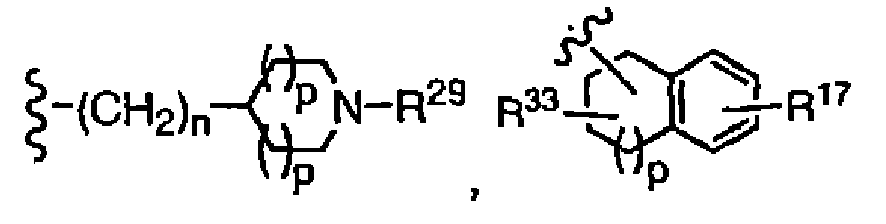

- Composé selon la revendication 8, dans lequel R12 est OH, -(CH2)n-N(R30)-C(O)-cycloalkyle ou -(CH2)n-N(R30)-(R23-hétéroaryle), R45 est R17-phényle ou R29 est hétéroaryle, -C(O)alkyle ou -C(O)cycloalkyle.
- Composé selon la revendication 6, dans lequel R7 et R8 et l'atome d'azote auquel ils sont attachés forment


- Composé selon la revendication 10, dans lequel R7 et R8 forment

où R7 et R8 forment

- Composé selon la revendication 10, dans lequel R7 et R8 forment

- Composé selon la revendication 10, dans lequel R7 et R8 forment

- Composé selon la revendication 10, dans lequel R7 et R8 forment

- Composé selon la revendication 7, dans lequel R7 est H ou alkyle et R8 est (R17-phényl)alkyle, R45-hydroxyalkyle ou -alkyl-N(R30)-(R23-hétéroaryle), où R45 est R17-phényle; hétéroaryle est pyridinyle, pyrimidinyle, pyrazinyle, indolyle, benzothiényle ou benzofuranyle; R17 est 1 à 3 substituants sélectionnés indépendamment parmi le groupe consistant en halogène, OH, alcoxy et alkyle et R23 est 1 ou 2 substituants sélectionnés indépendamment parmi le groupe consistant en H, alkyle, alcoxy et halogène.
- Composé selon la revendication 1, sélectionné parmi le groupe consistant en


- Composé selon la revendication 1, ayant la formule

- Composé selon la revendication 1, ayant la formule

- Composé selon la revendication 1, ayant la formule

- Composé selon la revendication 1, ayant la formule

- Composé selon la revendication 1, ayant la formule

- Composé selon la revendication 1, ayant la formule

- Composé selon la revendication 1, ayant la formule
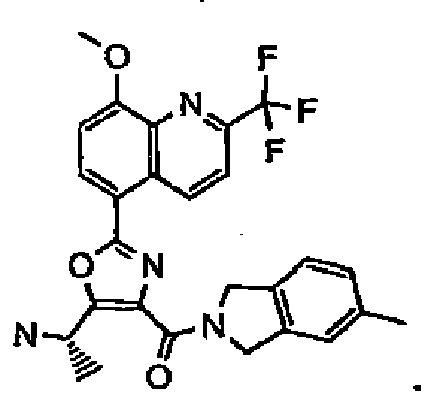
- Composé selon la revendication 1, ayant la formule

- Composé selon la revendication 1, ayant la formule

- Composition pharmaceutique comprenant une quantité efficace d'un composé selon la revendication 1 et un véhicule pharmaceutiquement acceptable.
- Utilisation d'un composé selon la revendication 1, dans la préparation d'un médicament pour le traitement de l'asthme, MPOC, obstruction de l'écoulement de l'air, hypersensibilité des voies aériennes (c.-à-d. hyperréactivité des voies aériennes), bronchiolite, bronchite chronique, emphysème, fibrose pulmonaire, hypertension pulmonaire, maladie des petites voies aériennes et respiration sifflante.
- Utilisation selon la revendication 27, où le médicament comprend en outre au moins un autre médicament sélectionné parmi le groupe consistant en médicaments antirhumatismaux modificateurs de maladie, médicaments anti-inflammatoires non stéroïdiens, inhibiteurs sélectifs de COX-2, inhibiteurs de COX-1, immunosuppresseurs, stéroïdes, modificateurs de réponse biologique et autres agents anti-inflammatoires.
Applications Claiming Priority (2)
| Application Number | Priority Date | Filing Date | Title |
|---|---|---|---|
| US57226604P | 2004-05-18 | 2004-05-18 | |
| PCT/US2005/017134 WO2005116009A1 (fr) | 2004-05-18 | 2005-05-16 | 2-quinolyle-oxazoles substitués utiles comme inhibiteurs du pde4 |
Publications (2)
| Publication Number | Publication Date |
|---|---|
| EP1758883A1 EP1758883A1 (fr) | 2007-03-07 |
| EP1758883B1 true EP1758883B1 (fr) | 2011-11-02 |
Family
ID=35106691
Family Applications (1)
| Application Number | Title | Priority Date | Filing Date |
|---|---|---|---|
| EP05750076A Expired - Lifetime EP1758883B1 (fr) | 2004-05-18 | 2005-05-16 | 2-Quinolyl-oxazoles substitués utiles en tant qu'inhibiteurs de PDE4 |
Country Status (20)
| Country | Link |
|---|---|
| US (1) | US7511062B2 (fr) |
| EP (1) | EP1758883B1 (fr) |
| JP (1) | JP4584990B2 (fr) |
| KR (1) | KR100907354B1 (fr) |
| CN (1) | CN1984901B (fr) |
| AR (1) | AR055192A1 (fr) |
| AT (1) | ATE531705T1 (fr) |
| AU (1) | AU2005247906B2 (fr) |
| BR (1) | BRPI0511295A (fr) |
| CA (1) | CA2565599C (fr) |
| EC (1) | ECSP067013A (fr) |
| IL (1) | IL179280A (fr) |
| MX (1) | MXPA06013414A (fr) |
| NO (1) | NO20065830L (fr) |
| NZ (1) | NZ551017A (fr) |
| PE (1) | PE20060241A1 (fr) |
| RU (1) | RU2417993C9 (fr) |
| TW (1) | TWI286475B (fr) |
| WO (1) | WO2005116009A1 (fr) |
| ZA (1) | ZA200609277B (fr) |
Families Citing this family (66)
| Publication number | Priority date | Publication date | Assignee | Title |
|---|---|---|---|---|
| US8682279B2 (en) | 2004-05-07 | 2014-03-25 | Interdigital Technology Corporation | Supporting emergency calls on a wireless local area network |
| US8145182B2 (en) * | 2004-05-07 | 2012-03-27 | Interdigital Technology Corporation | Supporting emergency calls on a wireless local area network |
| KR101122359B1 (ko) | 2004-05-07 | 2012-03-23 | 인터디지탈 테크날러지 코포레이션 | 무선 근거리 통신망의 긴급 호 지원 |
| EP2484382A1 (fr) * | 2005-03-30 | 2012-08-08 | Schering Corporation | Médicament à base d'un inhibiteur de la phosphodiestérase IV sous une forme adaptée à l'inhalation |
| UA96283C2 (uk) * | 2005-12-23 | 2011-10-25 | Зіланд Фарма А/С | Модифіковані міметики лізину |
| BRPI0707091B8 (pt) * | 2006-03-10 | 2018-02-14 | Nissan Chemical Ind Ltd | composto de isoxalina e benzaldoxima substituído ou um sal do mesmo; pesticida, agroquímico, endo- ou ecto-parasiticidapara mamíferos ou pássaros, inseticida e acaricida contendo como um ou mais ingredientes ativos selecionados a partir do composto de isoxalina substituído e o sal do mesmo |
| EP2258700A1 (fr) * | 2006-05-09 | 2010-12-08 | Pfizer Products Inc. | Dérivés d'acides aminés cycloalkyles et compositions pharmaceutiques les contenant |
| RU2008152776A (ru) * | 2006-06-06 | 2010-07-20 | Эвиджен Инк. (Us) | СОЕДИНЕНИЯ ЗАМЕЩЕННОГО ПИРАЗОЛО[1,5-a]ПИРИДИНА И СПОСОБЫ ИХ ПРИМЕНЕНИЯ |
| CA2657093A1 (fr) * | 2006-07-07 | 2008-01-10 | Steven P. Govek | Inhibiteurs de pde4 a base de composes d'heteroaryle bicyclique |
| US8138205B2 (en) * | 2006-07-07 | 2012-03-20 | Kalypsys, Inc. | Heteroarylalkoxy-substituted quinolone inhibitors of PDE4 |
| CA2657902A1 (fr) * | 2006-07-11 | 2008-01-17 | Schering Corporation | Sel de xinafoate d'un compose de 5-oxazol-2-yl-quinoline substitue |
| ITMI20061581A1 (it) * | 2006-08-04 | 2008-02-05 | Univ Bari | Ligandi del recettore beta-3 adrenergico e loro uso in terapia |
| BRPI0715051A2 (pt) | 2006-08-14 | 2015-05-19 | Schering Corp | Processo e intermediários para a síntese de derivados de 2-(quinolin-5il)-4,5 dissubstituído-azol |
| CA2660703A1 (fr) * | 2006-08-14 | 2008-02-21 | Schering Corporation | Sels de maleate, de tosylate, de fumarate et d'oxalate du 5-(1(s)-amino-2-hydroxyethyl)-n-[(2,4-difluorophenyl)-methyl]-2-[8-methoxy-2-(trifluoromethyl)-5-quinoline]-4-oxazolecarboxamide et leur procede d'obtention |
| CA2663500A1 (fr) | 2006-09-15 | 2008-03-20 | Schering Corporation | Derives d'azetidine spiro-condenses convenant pour le traitement de la douleur, du diabete et des troubles du metabolisme des lipides |
| CN101541805A (zh) | 2006-09-15 | 2009-09-23 | 先灵公司 | 用于治疗疼痛和脂代射紊乱的氮杂环丁烷和氮杂环丁酮衍生物 |
| MX2009002920A (es) * | 2006-09-15 | 2009-04-01 | Schering Corp | Tratamiento del dolor, diabetes y trastornos del metabolismo de los lipidos. |
| AR063275A1 (es) * | 2006-10-12 | 2009-01-14 | Epix Delaware Inc | Compuestos de carboxamida, una composicion farmaceutica que los comprende y su uso en la preparacion de un medicamento para el tratamiento de enfermedades mediadas por la activacion de ccr2. |
| JP2008260691A (ja) * | 2007-04-10 | 2008-10-30 | Bayer Cropscience Ag | 殺虫性アリールイソオキサゾリン誘導体 |
| JP4986927B2 (ja) * | 2007-05-14 | 2012-07-25 | 大塚製薬株式会社 | 医薬 |
| US20110171195A1 (en) * | 2007-06-15 | 2011-07-14 | Duke University | Methods and compositions for treating urinary tract infections using agents that mimic or elevate cyclic amp |
| US20110003780A1 (en) * | 2007-07-10 | 2011-01-06 | Schering Corporation | Hydrogen chloride salt of a substituted 5-oxazol-2-yl-quinoline compound and a process for the production thereof |
| WO2009009003A1 (fr) * | 2007-07-10 | 2009-01-15 | Schering Corporation | Procédé de production de 5-quinolyl-oxazoles substitués et sels pharmaceutiquement acceptables de ceux-ci |
| GB2451629A (en) * | 2007-08-06 | 2009-02-11 | Univ Sheffield | 1-(Azolylcarbonyl)-2-(hydroxymethyl)pyrrolidine derivatives for use as catalysts for asymmetric reduction of imines & reductive amination of ketones |
| BRPI0820701A2 (pt) | 2007-12-11 | 2015-06-16 | Cytopathfinder Inc | Composto de carboxamida e seu uso como agonistas do receptor de quimiocina |
| EP2098526B1 (fr) * | 2008-02-22 | 2014-01-15 | Neurotune AG | Composés bicycliques contenant de l'azote actif pour des conditions de douleurs chroniques |
| TWI396689B (zh) * | 2008-11-14 | 2013-05-21 | Amgen Inc | 作為磷酸二酯酶10抑制劑之吡衍生物 |
| AR074318A1 (es) | 2008-11-14 | 2011-01-05 | Nycomed Gmbh | Derivados heterociclicos de pirazolona, composiciones farmaceuticas que los contienen y uso de los mismos para el tratamiento de enfermedades de las vias respiratorias. |
| JP5476895B2 (ja) | 2008-12-17 | 2014-04-23 | セントラル硝子株式会社 | ヒドロキシル基置換生成物の製造方法 |
| EP2375899B1 (fr) * | 2009-01-12 | 2015-02-25 | Array Biopharma Inc. | Composés contenant de la pipéridine et leur utilisation dans le traitement du diabète |
| US8796297B2 (en) | 2009-06-30 | 2014-08-05 | Abbvie Inc. | 4-substituted-2-amino-pyrimidine derivatives |
| SG178986A1 (en) * | 2009-09-08 | 2012-04-27 | Hoffmann La Roche | 4-substituted pyridin-3-yl-carboxamide compounds and methods of use |
| KR101483215B1 (ko) * | 2010-01-29 | 2015-01-16 | 한미약품 주식회사 | 단백질 키나아제 저해활성을 갖는 비시클릭 헤테로아릴 유도체 |
| WO2011143365A1 (fr) | 2010-05-13 | 2011-11-17 | Amgen Inc. | Composés azotés hétérocycliques convenant comme inhibiteurs de la pde10 |
| JP5709101B2 (ja) * | 2010-09-01 | 2015-04-30 | 東レ・ファインケミカル株式会社 | ヒドロキシプロリン誘導体の製造法 |
| GB2497476B (en) | 2010-09-06 | 2018-01-10 | Guangzhou Inst Biomed & Health | Amide Compounds |
| WO2012072512A1 (fr) | 2010-11-29 | 2012-06-07 | Glaxo Group Limited | Carboxamides de n-cyclo-butylimidazopyridine ou de n-cyclo-pyrazolopyridine comme antagonistes de trpv1 |
| CN102408433B (zh) * | 2011-10-20 | 2014-04-09 | 天津药物研究院 | 含嘧啶的肟类化合物、其制备方法和用途 |
| US8530461B2 (en) * | 2011-12-29 | 2013-09-10 | Boehringer Ingelheim International Gmbh | Azetidine derivatives |
| CA2871237A1 (fr) * | 2012-04-24 | 2013-10-31 | Chugai Seiyaku Kabushiki Kaisha | Derive de benzamide |
| AR090835A1 (es) | 2012-04-24 | 2014-12-10 | Chugai Pharmaceutical Co Ltd | Derivados de quinazolindiona |
| US8865723B2 (en) | 2012-10-25 | 2014-10-21 | Tetra Discovery Partners Llc | Selective PDE4 B inhibition and improvement in cognition in subjects with brain injury |
| ES2753386T3 (es) | 2013-03-13 | 2020-04-08 | Forma Therapeutics Inc | Derivados de 2-hidroxi-1-{4-[(4-fenil)fenil]carbonil}piperazin-1-il}etano-1-ona y compuestos relacionados como inhibidores de sintasa de ácido graso (FASN) para el tratamiento del cáncer |
| US9944644B2 (en) | 2013-03-14 | 2018-04-17 | The Trustees Of Columbia University In The City Of New York | Octahydropyrrolopyrroles their preparation and use |
| US9938291B2 (en) | 2013-03-14 | 2018-04-10 | The Trustess Of Columbia University In The City Of New York | N-alkyl-2-phenoxyethanamines, their preparation and use |
| WO2014152018A1 (fr) | 2013-03-14 | 2014-09-25 | The Trustees Of Columbia University In The City Of New York | Octahydrocyclopentapyrroles, leur préparation et leur utilisation |
| EP3495357B1 (fr) * | 2013-03-14 | 2021-05-05 | The Trustees of Columbia University in the City of New York | 4-phénylpipéridines, leur préparation et leur utilisation |
| US10005739B2 (en) | 2013-10-23 | 2018-06-26 | Chugai Seiyaku Kabushiki Kaisha | Quinazolinone and isoquinolinone derivative |
| CN105085428B (zh) * | 2014-04-25 | 2019-03-22 | 广东东阳光药业有限公司 | 芳杂环类衍生物及其在药物上的应用 |
| SG11201608943VA (en) | 2014-04-30 | 2016-11-29 | Univ Columbia | Substituted 4-phenylpiperidines, their preparaiton and use |
| GB201415569D0 (en) * | 2014-09-03 | 2014-10-15 | C4X Discovery Ltd | Therapeutic Compounds |
| JP2018016544A (ja) * | 2014-12-03 | 2018-02-01 | 持田製薬株式会社 | 新規ジアザビシクロ[2.2.2]オクタン誘導体 |
| CN104829492A (zh) * | 2015-05-06 | 2015-08-12 | 河北工业大学 | 一种反式N-Boc-1,3-环丁二胺的制备方法 |
| CN106279138B (zh) * | 2015-12-29 | 2019-03-01 | 广东东阳光药业有限公司 | 芳杂环类衍生物及其在药物中的应用 |
| GB201601703D0 (en) | 2016-01-29 | 2016-03-16 | C4X Discovery Ltd | Therapeutic compounds |
| EP3720436A4 (fr) | 2017-12-06 | 2021-06-02 | Lin Bioscience, Pty Ltd. | Inhibiteurs de tubuline |
| AU2019215799B2 (en) * | 2018-02-01 | 2022-04-14 | The University Of Sydney | Anti-cancer compounds |
| KR102682705B1 (ko) * | 2018-07-04 | 2024-07-05 | 고려대학교 세종산학협력단 | 옥사졸로퀴놀리논 유도체를 유효성분으로 포함하는 우울증 및 스트레스 관련 질환의 예방 또는 치료용 약학 조성물 |
| CA3106385A1 (fr) * | 2018-09-13 | 2020-03-19 | Kissei Pharmaceutical Co., Ltd. | Compose d'imidazopyridinone |
| TWI767148B (zh) | 2018-10-10 | 2022-06-11 | 美商弗瑪治療公司 | 抑制脂肪酸合成酶(fasn) |
| US10793554B2 (en) | 2018-10-29 | 2020-10-06 | Forma Therapeutics, Inc. | Solid forms of 4-(2-fluoro-4-(1-methyl-1H-benzo[d]imidazol-5-yl)benzoyl)piperazin-1-yl)(1-hydroxycyclopropyl)methanone |
| CN112079791A (zh) * | 2020-08-21 | 2020-12-15 | 宁夏农林科学院农业资源与环境研究所(宁夏土壤与植物营养重点实验室) | 单环β-内酰胺类抗生素侧链酸及其酯、其制备方法和应用 |
| WO2022156727A1 (fr) | 2021-01-21 | 2022-07-28 | 浙江养生堂天然药物研究所有限公司 | Composition et procédé de traitement de tumeurs |
| CN119053602A (zh) * | 2022-01-28 | 2024-11-29 | 柏奥艾奇实验室公司 | Nlrp3炎性体的n-氧化物抑制剂 |
| TWI907890B (zh) * | 2022-12-14 | 2025-12-11 | 國立成功大學 | 化合物及其合成方法與應用 |
| US12509459B2 (en) | 2024-03-26 | 2025-12-30 | BioAge Labs, Inc. | Inhibitors of NLRP3 inflammasome |
Family Cites Families (12)
| Publication number | Priority date | Publication date | Assignee | Title |
|---|---|---|---|---|
| AU722662B2 (en) * | 1996-05-20 | 2000-08-10 | Darwin Discovery Limited | Quinoline sulfonamides as TNF inhibitors and as PDE-IV inhibitors |
| CZ296163B6 (cs) * | 1996-05-20 | 2006-01-11 | Karboxyamidy chinolinu jako inhibitory TNF a inhibitory PDE-IV | |
| DE69723863T2 (de) * | 1996-11-06 | 2004-04-15 | Darwin Discovery Ltd., Slough | Chinoline und deren therapeutische verwendung |
| US6069151A (en) * | 1996-11-06 | 2000-05-30 | Darwin Discovery, Ltd. | Quinolines and their therapeutic use |
| PL341364A1 (en) * | 1997-12-22 | 2001-04-09 | Upjohn Co | 4-hydroxyqinoline-3-carboxamides and hydrazides as antiviral agents |
| AU4038000A (en) * | 1999-03-29 | 2000-10-16 | Neurogen Corporation | 4-substituted quinoline derivatives as gaba receptor ligands |
| US6569885B1 (en) * | 1999-12-23 | 2003-05-27 | Icos Corporation | Cyclic AMP-specific phosphodiesterase inhibitors |
| GB0003254D0 (en) * | 2000-02-11 | 2000-04-05 | Darwin Discovery Ltd | Heterocyclic compounds and their therapeutic use |
| EP1310494B1 (fr) * | 2000-08-11 | 2012-01-25 | Nippon Chemiphar Co., Ltd. | ACTIVATEURS DE PPAR (delta) |
| US7078422B2 (en) * | 2001-03-23 | 2006-07-18 | Nippon Chemiphar Co., Ltd. | Activator for peroxisome proliferator-activated receptor |
| DE10227269A1 (de) | 2002-06-19 | 2004-01-08 | Merck Patent Gmbh | Thiazolderivate |
| CA2657902A1 (fr) * | 2006-07-11 | 2008-01-17 | Schering Corporation | Sel de xinafoate d'un compose de 5-oxazol-2-yl-quinoline substitue |
-
2005
- 2005-05-16 CA CA2565599A patent/CA2565599C/fr not_active Expired - Fee Related
- 2005-05-16 AT AT05750076T patent/ATE531705T1/de active
- 2005-05-16 MX MXPA06013414A patent/MXPA06013414A/es active IP Right Grant
- 2005-05-16 JP JP2007513471A patent/JP4584990B2/ja not_active Expired - Fee Related
- 2005-05-16 NZ NZ551017A patent/NZ551017A/en unknown
- 2005-05-16 KR KR1020067024186A patent/KR100907354B1/ko not_active Expired - Fee Related
- 2005-05-16 US US11/130,359 patent/US7511062B2/en not_active Expired - Fee Related
- 2005-05-16 RU RU2006144709/04A patent/RU2417993C9/ru not_active IP Right Cessation
- 2005-05-16 CN CN2005800236668A patent/CN1984901B/zh not_active Expired - Fee Related
- 2005-05-16 WO PCT/US2005/017134 patent/WO2005116009A1/fr not_active Ceased
- 2005-05-16 AU AU2005247906A patent/AU2005247906B2/en not_active Ceased
- 2005-05-16 PE PE2005000540A patent/PE20060241A1/es not_active Application Discontinuation
- 2005-05-16 EP EP05750076A patent/EP1758883B1/fr not_active Expired - Lifetime
- 2005-05-16 BR BRPI0511295-8A patent/BRPI0511295A/pt not_active IP Right Cessation
- 2005-05-17 AR ARP050102012A patent/AR055192A1/es not_active Application Discontinuation
- 2005-05-17 TW TW094115924A patent/TWI286475B/zh not_active IP Right Cessation
-
2006
- 2006-11-07 ZA ZA200609277A patent/ZA200609277B/en unknown
- 2006-11-14 IL IL179280A patent/IL179280A/en not_active IP Right Cessation
- 2006-11-17 EC EC2006007013A patent/ECSP067013A/es unknown
- 2006-12-15 NO NO20065830A patent/NO20065830L/no not_active Application Discontinuation
Also Published As
| Publication number | Publication date |
|---|---|
| JP2007537300A (ja) | 2007-12-20 |
| RU2006144709A (ru) | 2008-06-27 |
| CN1984901A (zh) | 2007-06-20 |
| TW200602056A (en) | 2006-01-16 |
| CA2565599C (fr) | 2012-07-31 |
| RU2417993C9 (ru) | 2011-10-10 |
| WO2005116009B1 (fr) | 2006-01-26 |
| ECSP067013A (es) | 2006-12-29 |
| IL179280A0 (en) | 2007-03-08 |
| ZA200609277B (en) | 2008-06-25 |
| NZ551017A (en) | 2010-11-26 |
| AU2005247906B2 (en) | 2011-08-25 |
| WO2005116009A1 (fr) | 2005-12-08 |
| US7511062B2 (en) | 2009-03-31 |
| NO20065830L (no) | 2007-02-16 |
| ATE531705T1 (de) | 2011-11-15 |
| AU2005247906A1 (en) | 2005-12-08 |
| EP1758883A1 (fr) | 2007-03-07 |
| CA2565599A1 (fr) | 2005-12-08 |
| IL179280A (en) | 2011-07-31 |
| MXPA06013414A (es) | 2007-01-23 |
| CN1984901B (zh) | 2011-02-09 |
| US20060106062A1 (en) | 2006-05-18 |
| KR20070013306A (ko) | 2007-01-30 |
| AR055192A1 (es) | 2007-08-08 |
| BRPI0511295A (pt) | 2007-12-04 |
| TWI286475B (en) | 2007-09-11 |
| KR100907354B1 (ko) | 2009-07-10 |
| JP4584990B2 (ja) | 2010-11-24 |
| PE20060241A1 (es) | 2006-04-01 |
| RU2417993C2 (ru) | 2011-05-10 |
Similar Documents
| Publication | Publication Date | Title |
|---|---|---|
| EP1758883B1 (fr) | 2-Quinolyl-oxazoles substitués utiles en tant qu'inhibiteurs de PDE4 | |
| US12503468B2 (en) | Heterocyclic compound, intermediate, preparation method therefor and application thereof | |
| JP5829644B2 (ja) | Syk阻害剤としてのアミノピリミジン類 | |
| EP1501803B1 (fr) | Modulateurs de l'activite des recepteurs des chimiokines a base de tetrahydropyranyl cyclopentyl tetrahydroisoquinoline | |
| AU2003284984B2 (en) | Gamma-aminoamide modulators of chemokine receptor activity | |
| US8501786B2 (en) | Hydroxymethyl pyrrolidines as beta 3 adrenergic receptor agonists | |
| EP1615699B1 (fr) | Modulateurs benzoxazinyl-amidocyclopentyl-heterocycliques des recepteurs de chimiokines | |
| US9783511B2 (en) | Carbamate benzoxazine propionic acids and acid derivatives for modulation of RORgamma activity and the treatment of disease | |
| US9193736B2 (en) | PDE 10a inhibitors for the treatment of type II diabetes | |
| JP6412102B2 (ja) | ヤヌスキナーゼ阻害剤としてのシクロアルキルニトリルピラゾロピリドン | |
| US20180044343A1 (en) | Bicyclic imidazolo derivative | |
| CA2729259A1 (fr) | Composes heterocycliques a substitution en 1,2 | |
| JP2002541103A (ja) | ピロリジン系ケモカイン受容体活性調節剤 | |
| TW202346289A (zh) | 作為glp—1r促效劑的化合物 | |
| JP2008505107A (ja) | Nk1アンタゴニストとしてのピペリジン誘導体 | |
| US20140221332A1 (en) | Metabotrophic glutamate receptor 5 modulators and methods of use thereof | |
| JP2016537324A (ja) | シクロペンチルベンズアミド誘導体及びそれらの精神障害及び認知障害の治療への使用 | |
| JP2016514709A (ja) | ヤヌスキナーゼ阻害剤としてのジェミナル置換シアノエチルピラゾロピリドン | |
| WO2010106988A1 (fr) | Dérivé d'amide | |
| US20070149529A1 (en) | Amino heterocyclic modulators of chemokine receptor activity | |
| US20070238723A1 (en) | Benzoxazinyl-amidocyclopentyl-heterocyclic modulators of chemokine receptors | |
| TW202116755A (zh) | 可用為幾丁質酶抑制劑的經取代的胺基三唑 |
Legal Events
| Date | Code | Title | Description |
|---|---|---|---|
| PUAI | Public reference made under article 153(3) epc to a published international application that has entered the european phase |
Free format text: ORIGINAL CODE: 0009012 |
|
| 17P | Request for examination filed |
Effective date: 20061215 |
|
| AK | Designated contracting states |
Kind code of ref document: A1 Designated state(s): AT BE BG CH CY CZ DE DK EE ES FI FR GB GR HU IE IS IT LI LT LU MC NL PL PT RO SE SI SK TR |
|
| AX | Request for extension of the european patent |
Extension state: AL BA HR LV MK YU |
|
| 17Q | First examination report despatched |
Effective date: 20070316 |
|
| REG | Reference to a national code |
Ref country code: HK Ref legal event code: DE Ref document number: 1097545 Country of ref document: HK |
|
| GRAP | Despatch of communication of intention to grant a patent |
Free format text: ORIGINAL CODE: EPIDOSNIGR1 |
|
| RTI1 | Title (correction) |
Free format text: SUBSTITUTED 2-QUINOLYL-OXAZOLES USEFUL AS PDE4 INHIBITORS |
|
| GRAS | Grant fee paid |
Free format text: ORIGINAL CODE: EPIDOSNIGR3 |
|
| GRAA | (expected) grant |
Free format text: ORIGINAL CODE: 0009210 |
|
| AK | Designated contracting states |
Kind code of ref document: B1 Designated state(s): AT BE BG CH CY CZ DE DK EE ES FI FR GB GR HU IE IS IT LI LT LU MC NL PL PT RO SE SI SK TR |
|
| AX | Request for extension of the european patent |
Extension state: AL BA HR LV MK YU |
|
| REG | Reference to a national code |
Ref country code: GB Ref legal event code: FG4D |
|
| REG | Reference to a national code |
Ref country code: CH Ref legal event code: EP |
|
| REG | Reference to a national code |
Ref country code: IE Ref legal event code: FG4D |
|
| REG | Reference to a national code |
Ref country code: DE Ref legal event code: R096 Ref document number: 602005030974 Country of ref document: DE Effective date: 20120112 |
|
| REG | Reference to a national code |
Ref country code: CH Ref legal event code: NV Representative=s name: SERVOPATENT GMBH |
|
| REG | Reference to a national code |
Ref country code: NL Ref legal event code: T3 |
|
| LTIE | Lt: invalidation of european patent or patent extension |
Effective date: 20111102 |
|
| PG25 | Lapsed in a contracting state [announced via postgrant information from national office to epo] |
Ref country code: LT Free format text: LAPSE BECAUSE OF FAILURE TO SUBMIT A TRANSLATION OF THE DESCRIPTION OR TO PAY THE FEE WITHIN THE PRESCRIBED TIME-LIMIT Effective date: 20111102 Ref country code: IS Free format text: LAPSE BECAUSE OF FAILURE TO SUBMIT A TRANSLATION OF THE DESCRIPTION OR TO PAY THE FEE WITHIN THE PRESCRIBED TIME-LIMIT Effective date: 20120302 |
|
| PG25 | Lapsed in a contracting state [announced via postgrant information from national office to epo] |
Ref country code: GR Free format text: LAPSE BECAUSE OF FAILURE TO SUBMIT A TRANSLATION OF THE DESCRIPTION OR TO PAY THE FEE WITHIN THE PRESCRIBED TIME-LIMIT Effective date: 20120203 Ref country code: SI Free format text: LAPSE BECAUSE OF FAILURE TO SUBMIT A TRANSLATION OF THE DESCRIPTION OR TO PAY THE FEE WITHIN THE PRESCRIBED TIME-LIMIT Effective date: 20111102 Ref country code: BE Free format text: LAPSE BECAUSE OF FAILURE TO SUBMIT A TRANSLATION OF THE DESCRIPTION OR TO PAY THE FEE WITHIN THE PRESCRIBED TIME-LIMIT Effective date: 20111102 Ref country code: SE Free format text: LAPSE BECAUSE OF FAILURE TO SUBMIT A TRANSLATION OF THE DESCRIPTION OR TO PAY THE FEE WITHIN THE PRESCRIBED TIME-LIMIT Effective date: 20111102 Ref country code: PL Free format text: LAPSE BECAUSE OF FAILURE TO SUBMIT A TRANSLATION OF THE DESCRIPTION OR TO PAY THE FEE WITHIN THE PRESCRIBED TIME-LIMIT Effective date: 20111102 Ref country code: PT Free format text: LAPSE BECAUSE OF FAILURE TO SUBMIT A TRANSLATION OF THE DESCRIPTION OR TO PAY THE FEE WITHIN THE PRESCRIBED TIME-LIMIT Effective date: 20120302 |
|
| PG25 | Lapsed in a contracting state [announced via postgrant information from national office to epo] |
Ref country code: CY Free format text: LAPSE BECAUSE OF FAILURE TO SUBMIT A TRANSLATION OF THE DESCRIPTION OR TO PAY THE FEE WITHIN THE PRESCRIBED TIME-LIMIT Effective date: 20111102 |
|
| REG | Reference to a national code |
Ref country code: CH Ref legal event code: PFA Owner name: MERCK SHARP & DOHME CORP. Free format text: SCHERING CORPORATION#2000 GALLOPING HILL ROAD#KENILWORTH, NJ 07033-0530 (US) -TRANSFER TO- MERCK SHARP & DOHME CORP.#126 EAST LINCOLN AVENUE#RAHWAY, NEW JERSEY 07065 (US) |
|
| PG25 | Lapsed in a contracting state [announced via postgrant information from national office to epo] |
Ref country code: SK Free format text: LAPSE BECAUSE OF FAILURE TO SUBMIT A TRANSLATION OF THE DESCRIPTION OR TO PAY THE FEE WITHIN THE PRESCRIBED TIME-LIMIT Effective date: 20111102 Ref country code: CZ Free format text: LAPSE BECAUSE OF FAILURE TO SUBMIT A TRANSLATION OF THE DESCRIPTION OR TO PAY THE FEE WITHIN THE PRESCRIBED TIME-LIMIT Effective date: 20111102 Ref country code: EE Free format text: LAPSE BECAUSE OF FAILURE TO SUBMIT A TRANSLATION OF THE DESCRIPTION OR TO PAY THE FEE WITHIN THE PRESCRIBED TIME-LIMIT Effective date: 20111102 Ref country code: DK Free format text: LAPSE BECAUSE OF FAILURE TO SUBMIT A TRANSLATION OF THE DESCRIPTION OR TO PAY THE FEE WITHIN THE PRESCRIBED TIME-LIMIT Effective date: 20111102 Ref country code: BG Free format text: LAPSE BECAUSE OF FAILURE TO SUBMIT A TRANSLATION OF THE DESCRIPTION OR TO PAY THE FEE WITHIN THE PRESCRIBED TIME-LIMIT Effective date: 20120202 |
|
| RAP2 | Party data changed (patent owner data changed or rights of a patent transferred) |
Owner name: MERCK SHARP & DOHME CORP. |
|
| PG25 | Lapsed in a contracting state [announced via postgrant information from national office to epo] |
Ref country code: RO Free format text: LAPSE BECAUSE OF FAILURE TO SUBMIT A TRANSLATION OF THE DESCRIPTION OR TO PAY THE FEE WITHIN THE PRESCRIBED TIME-LIMIT Effective date: 20111102 Ref country code: IT Free format text: LAPSE BECAUSE OF FAILURE TO SUBMIT A TRANSLATION OF THE DESCRIPTION OR TO PAY THE FEE WITHIN THE PRESCRIBED TIME-LIMIT Effective date: 20111102 |
|
| PLBE | No opposition filed within time limit |
Free format text: ORIGINAL CODE: 0009261 |
|
| STAA | Information on the status of an ep patent application or granted ep patent |
Free format text: STATUS: NO OPPOSITION FILED WITHIN TIME LIMIT |
|
| REG | Reference to a national code |
Ref country code: AT Ref legal event code: MK05 Ref document number: 531705 Country of ref document: AT Kind code of ref document: T Effective date: 20111102 |
|
| REG | Reference to a national code |
Ref country code: NL Ref legal event code: TD Effective date: 20120924 |
|
| 26N | No opposition filed |
Effective date: 20120803 |
|
| REG | Reference to a national code |
Ref country code: DE Ref legal event code: R097 Ref document number: 602005030974 Country of ref document: DE Effective date: 20120803 |
|
| PG25 | Lapsed in a contracting state [announced via postgrant information from national office to epo] |
Ref country code: MC Free format text: LAPSE BECAUSE OF NON-PAYMENT OF DUE FEES Effective date: 20120531 |
|
| PG25 | Lapsed in a contracting state [announced via postgrant information from national office to epo] |
Ref country code: AT Free format text: LAPSE BECAUSE OF FAILURE TO SUBMIT A TRANSLATION OF THE DESCRIPTION OR TO PAY THE FEE WITHIN THE PRESCRIBED TIME-LIMIT Effective date: 20111102 |
|
| REG | Reference to a national code |
Ref country code: IE Ref legal event code: MM4A |
|
| REG | Reference to a national code |
Ref country code: FR Ref legal event code: CD Owner name: SCHERING CORPORATION, US Effective date: 20130319 |
|
| PG25 | Lapsed in a contracting state [announced via postgrant information from national office to epo] |
Ref country code: ES Free format text: LAPSE BECAUSE OF FAILURE TO SUBMIT A TRANSLATION OF THE DESCRIPTION OR TO PAY THE FEE WITHIN THE PRESCRIBED TIME-LIMIT Effective date: 20120213 Ref country code: IE Free format text: LAPSE BECAUSE OF NON-PAYMENT OF DUE FEES Effective date: 20120516 |
|
| PG25 | Lapsed in a contracting state [announced via postgrant information from national office to epo] |
Ref country code: FI Free format text: LAPSE BECAUSE OF FAILURE TO SUBMIT A TRANSLATION OF THE DESCRIPTION OR TO PAY THE FEE WITHIN THE PRESCRIBED TIME-LIMIT Effective date: 20111102 |
|
| REG | Reference to a national code |
Ref country code: DE Ref legal event code: R081 Ref document number: 602005030974 Country of ref document: DE Owner name: MERCK SHARP & DOHME CORP., US Free format text: FORMER OWNER: SCHERING CORP., 07033-0530 KENILWORTH, US Effective date: 20111117 Ref country code: DE Ref legal event code: R082 Ref document number: 602005030974 Country of ref document: DE Representative=s name: ABITZ & PARTNER, DE Effective date: 20130516 Ref country code: DE Ref legal event code: R081 Ref document number: 602005030974 Country of ref document: DE Owner name: MERCK SHARP & DOHME CORP., US Free format text: FORMER OWNER: SCHERING CORPORATION, KENILWORTH, US Effective date: 20130516 Ref country code: DE Ref legal event code: R081 Ref document number: 602005030974 Country of ref document: DE Owner name: MERCK SHARP & DOHME CORP., RAHWAY, US Free format text: FORMER OWNER: SCHERING CORPORATION, KENILWORTH, N.J., US Effective date: 20130516 Ref country code: DE Ref legal event code: R081 Ref document number: 602005030974 Country of ref document: DE Owner name: MERCK SHARP & DOHME CORP., RAHWAY, US Free format text: FORMER OWNER: SCHERING CORP., 07033-0530 KENILWORTH, NEW JERSEY, US Effective date: 20111117 |
|
| PGFP | Annual fee paid to national office [announced via postgrant information from national office to epo] |
Ref country code: GB Payment date: 20130425 Year of fee payment: 9 Ref country code: CH Payment date: 20130426 Year of fee payment: 9 Ref country code: DE Payment date: 20130531 Year of fee payment: 9 |
|
| PGFP | Annual fee paid to national office [announced via postgrant information from national office to epo] |
Ref country code: NL Payment date: 20130514 Year of fee payment: 9 Ref country code: FR Payment date: 20130531 Year of fee payment: 9 |
|
| REG | Reference to a national code |
Ref country code: HK Ref legal event code: WD Ref document number: 1097545 Country of ref document: HK |
|
| PG25 | Lapsed in a contracting state [announced via postgrant information from national office to epo] |
Ref country code: TR Free format text: LAPSE BECAUSE OF FAILURE TO SUBMIT A TRANSLATION OF THE DESCRIPTION OR TO PAY THE FEE WITHIN THE PRESCRIBED TIME-LIMIT Effective date: 20111102 |
|
| PG25 | Lapsed in a contracting state [announced via postgrant information from national office to epo] |
Ref country code: LU Free format text: LAPSE BECAUSE OF NON-PAYMENT OF DUE FEES Effective date: 20120516 |
|
| PG25 | Lapsed in a contracting state [announced via postgrant information from national office to epo] |
Ref country code: HU Free format text: LAPSE BECAUSE OF FAILURE TO SUBMIT A TRANSLATION OF THE DESCRIPTION OR TO PAY THE FEE WITHIN THE PRESCRIBED TIME-LIMIT Effective date: 20050516 |
|
| REG | Reference to a national code |
Ref country code: DE Ref legal event code: R119 Ref document number: 602005030974 Country of ref document: DE |
|
| REG | Reference to a national code |
Ref country code: NL Ref legal event code: V1 Effective date: 20141201 |
|
| REG | Reference to a national code |
Ref country code: CH Ref legal event code: PL |
|
| GBPC | Gb: european patent ceased through non-payment of renewal fee |
Effective date: 20140516 |
|
| PG25 | Lapsed in a contracting state [announced via postgrant information from national office to epo] |
Ref country code: CH Free format text: LAPSE BECAUSE OF NON-PAYMENT OF DUE FEES Effective date: 20140531 Ref country code: LI Free format text: LAPSE BECAUSE OF NON-PAYMENT OF DUE FEES Effective date: 20140531 |
|
| REG | Reference to a national code |
Ref country code: DE Ref legal event code: R119 Ref document number: 602005030974 Country of ref document: DE Effective date: 20141202 |
|
| PG25 | Lapsed in a contracting state [announced via postgrant information from national office to epo] |
Ref country code: NL Free format text: LAPSE BECAUSE OF NON-PAYMENT OF DUE FEES Effective date: 20141201 |
|
| REG | Reference to a national code |
Ref country code: FR Ref legal event code: ST Effective date: 20150130 |
|
| PG25 | Lapsed in a contracting state [announced via postgrant information from national office to epo] |
Ref country code: DE Free format text: LAPSE BECAUSE OF NON-PAYMENT OF DUE FEES Effective date: 20141202 |
|
| PG25 | Lapsed in a contracting state [announced via postgrant information from national office to epo] |
Ref country code: GB Free format text: LAPSE BECAUSE OF NON-PAYMENT OF DUE FEES Effective date: 20140516 Ref country code: FR Free format text: LAPSE BECAUSE OF NON-PAYMENT OF DUE FEES Effective date: 20140602 |