EP1762305A2 - Procédé et dispositif pour l'usinage par vibrations à deux axes indépendants - Google Patents
Procédé et dispositif pour l'usinage par vibrations à deux axes indépendants Download PDFInfo
- Publication number
- EP1762305A2 EP1762305A2 EP06119431A EP06119431A EP1762305A2 EP 1762305 A2 EP1762305 A2 EP 1762305A2 EP 06119431 A EP06119431 A EP 06119431A EP 06119431 A EP06119431 A EP 06119431A EP 1762305 A2 EP1762305 A2 EP 1762305A2
- Authority
- EP
- European Patent Office
- Prior art keywords
- vibrating unit
- vibration
- workpiece
- cutting tool
- vibrating
- Prior art date
- Legal status (The legal status is an assumption and is not a legal conclusion. Google has not performed a legal analysis and makes no representation as to the accuracy of the status listed.)
- Withdrawn
Links
Images



Classifications
-
- B—PERFORMING OPERATIONS; TRANSPORTING
- B23—MACHINE TOOLS; METAL-WORKING NOT OTHERWISE PROVIDED FOR
- B23P—METAL-WORKING NOT OTHERWISE PROVIDED FOR; COMBINED OPERATIONS; UNIVERSAL MACHINE TOOLS
- B23P25/00—Auxiliary treatment of workpieces, before or during machining operations, to facilitate the action of the tool or the attainment of a desired final condition of the work, e.g. relief of internal stress
-
- B—PERFORMING OPERATIONS; TRANSPORTING
- B23—MACHINE TOOLS; METAL-WORKING NOT OTHERWISE PROVIDED FOR
- B23B—TURNING; BORING
- B23B29/00—Holders for non-rotary cutting tools; Boring bars or boring heads; Accessories for tool holders
- B23B29/04—Tool holders for a single cutting tool
- B23B29/12—Special arrangements on tool holders
- B23B29/125—Vibratory toolholders
-
- B—PERFORMING OPERATIONS; TRANSPORTING
- B23—MACHINE TOOLS; METAL-WORKING NOT OTHERWISE PROVIDED FOR
- B23D—PLANING; SLOTTING; SHEARING; BROACHING; SAWING; FILING; SCRAPING; LIKE OPERATIONS FOR WORKING METAL BY REMOVING MATERIAL, NOT OTHERWISE PROVIDED FOR
- B23D5/00—Planing or slotting machines cutting otherwise than by relative movement of the tool and workpiece in a straight line
-
- B—PERFORMING OPERATIONS; TRANSPORTING
- B24—GRINDING; POLISHING
- B24B—MACHINES, DEVICES, OR PROCESSES FOR GRINDING OR POLISHING; DRESSING OR CONDITIONING OF ABRADING SURFACES; FEEDING OF GRINDING, POLISHING, OR LAPPING AGENTS
- B24B1/00—Processes of grinding or polishing; Use of auxiliary equipment in connection with such processes
- B24B1/04—Processes of grinding or polishing; Use of auxiliary equipment in connection with such processes subjecting the grinding or polishing tools, the abrading or polishing medium or work to vibration, e.g. grinding with ultrasonic frequency
-
- B—PERFORMING OPERATIONS; TRANSPORTING
- B24—GRINDING; POLISHING
- B24B—MACHINES, DEVICES, OR PROCESSES FOR GRINDING OR POLISHING; DRESSING OR CONDITIONING OF ABRADING SURFACES; FEEDING OF GRINDING, POLISHING, OR LAPPING AGENTS
- B24B13/00—Machines or devices designed for grinding or polishing optical surfaces on lenses or surfaces of similar shape on other work; Accessories therefor
- B24B13/04—Machines or devices designed for grinding or polishing optical surfaces on lenses or surfaces of similar shape on other work; Accessories therefor grinding of lenses involving grinding wheels controlled by gearing
- B24B13/046—Machines or devices designed for grinding or polishing optical surfaces on lenses or surfaces of similar shape on other work; Accessories therefor grinding of lenses involving grinding wheels controlled by gearing using a pointed tool or scraper-like tool
-
- B—PERFORMING OPERATIONS; TRANSPORTING
- B23—MACHINE TOOLS; METAL-WORKING NOT OTHERWISE PROVIDED FOR
- B23B—TURNING; BORING
- B23B2226/00—Materials of tools or workpieces not comprising a metal
- B23B2226/31—Diamond
-
- B—PERFORMING OPERATIONS; TRANSPORTING
- B23—MACHINE TOOLS; METAL-WORKING NOT OTHERWISE PROVIDED FOR
- B23B—TURNING; BORING
- B23B2260/00—Details of constructional elements
- B23B2260/108—Piezoelectric elements
Definitions
- the invention relates to vibration machining, and, more particularly, to a method and apparatus for machining a work piece using two independently coupled vibrating units.
- Vibration assisted machining has recently been developed. This machining method enables machining of material, such as for example, silicon carbide that previously could not be single point diamond turned due to excessive heating of the diamond tip.
- VAM systems such as the Ultramill system developed at North Carolina State University, use two piezoelectric (PZT) actuators mounted sided by side to drive a diamond tool in an elliptic trajectory. The minor and major axes of the ellipse trajectory are determined by a T-shaped linkage geometry of the PZT actuators to the diamond used for machining. However, this linkage geometry does not allow for reduced tool lead-in and lead-out zones (i.e., transition zones) when entering or exiting a workpiece.
- the present invention provides an improved vibration milling apparatus and method for machining hard material to produce high quality surface finishes and may provide for reduced tool lead-in and lead-out zones.
- a vibration machining apparatus configured for use in machining a surface of a workpiece.
- the vibration machining apparatus includes: a cutting tool to machine at least a portion of the workpiece; a motion stage coupled to either the cutting tool or the workpiece; and two vibrating units, each coupled to either the cutting tool or the workpiece.
- the motion stage moves the cutting tool relative to the workpiece such that the cutting tool follows a machining path on the surface of the workpiece.
- the tangent of the machining path and the normal to the surface of the workpiece define a vibration plane.
- the first vibrating unit vibrates the one of the cutting tool or the workpiece it is coupled to along a first vibrational direction. This first vibrational direction is aligned substantially in the vibration plane.
- the second vibrating unit vibrates the one of the cutting tool or the workpiece it is coupled to along a second vibrational direction, which is also substantially aligned in the vibration plane, but is different from the first vibrational direction.
- the present invention is further embodied in a method of machining a workpiece using the vibration machining apparatus.
- the cutting tool is moved relative to the workpiece such that the cutting tool follows a machining path on a surface of the workpiece.
- the tangent of the machining path and the normal to the surface of the workpiece define a vibration plane. Whichever one of the cutting tool or the workpiece is coupled to a first vibrating unit, is vibrated along a first vibrational direction, which is substantially in the vibration plane, and whichever one of the cutting tool or the workpiece is coupled to a second vibrating unit is vibrated along a second vibrational direction, which is also substantially in the vibration plane, but is different from the first vibrational direction.
- An exemplary embodiment of the present invention is a vibration machining apparatus with two independently coupled vibrating units.
- an elliptical motion of a cutting tool relative to the workpiece may be realized by the use of two independent vibrating units.
- a number of different configurations of the two independent vibrating units may be possible because only relative elliptical motion is desired. That is, for example, the cutting tool may be vibrated along one axis, while the workpiece may be vibrated along a second, orthogonal or substantially orthogonal axis.
- the motion along each axis may be decoupled, the motion along each axis may be varied independently, allowing easily controlled variation of the elliptical motion.
- non-elliptical trajectories may also be realized. It may be advantageous to realize these non-elliptical trajectories for machining, for example, lead-in and lead-out areas of the workpiece to produce reduced transition zones. Such reduced lead-in and lead-out transition zones may be used in producing, for example, improved optical gray scale gratings, micro-machined devices, micro electrical mechanical systems (MEMS), and other optical or non-optical devices with high quality surface finish tolerances. Surface finish tolerances, for example, in the range of about 5 nm to 100 nm, i.e. about 10 times as smooth as conventional diamond milling techniques, may be produce using exemplary vibration machining apparatus of the present invention.
- MEMS micro electrical mechanical systems
- the vibration machining apparatus may be used to machine a number of other structures.
- the vibration machining apparatus in accordance with exemplary embodiments of the present invention, may machine larger structures such as pistons and other metal and plastic structures, molds for injection molding, optical devices such as microlens arrays, optical fiber coupling components, deflective/reflective/spiral lenses, mirror arrays, wave-beam guides, hybrid lens, elliptical or cylindrical mirrors, MEMS, and bio-sensors, among others, as well as molds and mold inserts.
- the area of a workpiece to be machined by the vibration machining apparatus is not limited by the VAM process, but may be limited by the maximum travel length of the motion table.
- the vibration machining apparatus may be used to machine hard materials such as silicone carbide, tungsten, tungsten carbide and sapphire, etc. This is because, in various embodiments of the present invention, the cutting tool trajectory may be precisely controlled to control the duty cycle and heating of the cutting tool. Additionally, materials, such as steel, that are difficult to machine using diamond turning may be machined using various embodiments of the present invention.
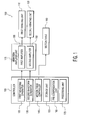
- FIG. 1 is a functional block diagram illustrating an exemplary vibration machining apparatus that may be usable with any one of the exemplary embodiments of the present invention, and generally refers to the various embodiments disclosed herein.
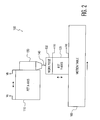
- FIG. 2 is a schematic diagram illustrating a vibration machine apparatus according an exemplary embodiment of the present invention.
- vibration machining apparatus 100 may be configured to machine a workpiece 130 using a cutting tool 140 and may include a controller 105, a vibration amplifier unit 115, a first vibrating unit 110, a second vibrating unit 120, a cutter holding unit 150 and a motion table 160.
- Controller 105 may control the operation of vibration machining apparatus 100 by providing control signals, control waveforms and/or control data to various other components of vibration machining apparatus 100.
- vibration amplifier unit 115 may be omitted if the drive signals generated by controller 105 are sufficient to drive vibrating units 110 and 120. Additionally, it is noted that the amplifiers of vibration amplifier unit 115 may be integrally packaged with the vibrating units, rather than separated from the vibrating units as shown in FIG. 1.
- Controller 105 may include a general purpose computer programmed to perform the desired functions, special purpose circuitry, a digital signal processor, and/or one or more application specific integrated circuits (ASIC's). Controller 105 may be designed to include a number of functional units, as shown in FIG. 1. These functional units may include: (1) a first waveform generator 125 to provide control signals for vibration by first vibrating unit 110; (2) a second waveform generator 135 to provide control signals for vibration by second vibrating unit 120; and (3) a motion table controller 145 to control movement of motion table 160 via a motor drive (not shown) such as a stepper motor or a linear induction motor.
- a motor drive not shown
- Controller 105 may include further functional units, such as a storage unit 155 to store information to machine a workpiece according to predetermined machining criteria (e.g., data representing machining parameters for machining at least one portion of workpiece 130), a pre-compensation unit 165 to pre-compensate input waveforms of first vibrating unit 110 and second vibrating unit 120 to reduce or substantially eliminate hysteresis effects in cutting tool 140 due to, for example, non-linearity of the vibrating units 110 and 120 and a processing unit 175 to control first and second waveform generators 125 and 135 and motion table controller 145 according to the predetermined machining criteria stored in storage unit 155.
- predetermined machining criteria e.g., data representing machining parameters for machining at least one portion of workpiece 130
- pre-compensation unit 165 to pre-compensate input waveforms of first vibrating unit 110 and second vibrating unit 120 to reduce or substantially eliminate hysteresis effects in cutting tool 140 due to, for example, non-linear
- first and second vibrating units 110 and 120 By providing separate input waveforms to first and second vibrating units 110 and 120 which compensate for hysteresis and other non-linear effects of the vibration actuators in these vibrating units, the quality of surfaces produced using vibration machining apparatus 100 may be improved.
- an error function corresponding to hysteresis effects of the vibration actuators in vibrating units 110 and 120 may be provided as a feedback signal to first and second waveform generators 125 and 135, which may use this feedback signal to constantly adjust the input waveforms of first and second vibrating units 110 and 120 to reduce the effects of the hysteresis.
- Vibration amplifier unit 115 may desirably include a first amplifier 185 to amplify the power (i.e., by increasing the voltage and/or current) of the output waveform from first waveform generator 125.
- the amplified first waveform may be used to drive first vibrating unit 110.
- Vibration amplifier unit 115 may also include a second amplifier 195 to amplify the power of the output waveform from second waveform generator 135 and the amplified second waveform may be used to second vibrating unit 120.
- First and second vibrating units 110 and 120 may produce vibration in respective vibration actuators (not shown) of first and second vibrating units 110 and 120 to vibrate structures coupled to these vibration actuators.
- Vibrating unit 110 may include terminals Va and Vb configured to couple an input voltage signal across vibrating unit 110.
- Vibrating unit 120 may include terminals Vc and Vd to couple an input voltage signal across vibrating unit 120.
- the vibration actuators of vibrating units 110 and 120 may desirably be a piezoelectric vibrating unit (i.e., may include a piezoelectric stack), and may vibrate in accordance with the input signal across their respective terminals, That is, the frequency of the vibration of each vibration actuator is desirably equal to the frequency of the voltage signal across the terminals of the corresponding vibrating unit and the amplitude of the vibration is desirably proportional to the amplitude of the voltage signal across the corresponding terminals.
- Vibrating unit 110 may be controlled (i.e., independent of vibrating unit 120) by controller 105 via first waveform generator 125 (and first amplifier 185, if included) and vibrating unit 120 also may be independently controlled by controller 105 via second waveform generator 135 (and second amplifier 195, if included).
- First and second waveform generators 125 and 135 may be configured to adjust: (1) amplitudes of input waveforms to vibrating units 110 and 120; (2) a relative phase of the input waveforms of vibrating units 110 and 120; and/or (3) the input waveform shapes of vibrating unit 110 and 120, respectively.
- cutter holding unit 150 may be coupled to vibrating unit 110 such that cutting tool 140 may be vibrated by vibrating unit 110 in directions substantially parallel to a plane of motion table 160 (i.e., along a first vibrational axis) and, desirably, may be tangent to a machining path produced by the motion of motion table 160.
- Vibrating unit 120 may be coupled to motion table 160 at one end of vibrating unit 120.
- Workpiece 130 may be releasably coupled to vibrating unit 120 at an opposite end of vibrating unit 120 to allow workpiece 130 to be vibrated relative to cutting tool 140 during a machining process.
- vibrating unit 110 and vibrating unit 120 are not coupled together.
- Motion table 160 may be moved in a direction shown by the adjacent arrow. Although motion table 160 is shown as having only one degree of movement, it is contemplated that any motion stage (i.e., table) may be used including one which has up to six degrees of motion, namely: (1) motion along the X axis; (2) motion along the Y axis; (3) motion along the Z axis; (4) rotation in the X-Y plane; (5) rotation in the X-Z plane; and (6) rotation in the Y-Z plane.
- any motion stage i.e., table
- Vibrating unit 110 is vibrated by the vibration actuator in directions indicated by the arrows in FIG. 2 adjacent to vibrating unit 110 (e.g., in a direction substantially tangent to the motion of motion table 160), moving cutting tool 140 in a substantially horizontal direction.
- Workpiece 130 is vibrated by the vibration actuator of vibrating unit 120 in a direction shown by arrows adjacent to vibrating unit 120 (e.g., in a direction substantially orthogonal to the motion of motion table 160), moving work piece 130 in a substantially vertical direction.
- the relative motion between cutting tool 140 and workpiece 130 may form an elliptical or other shaped cutting path.
- the cutting path formed by the composite vibration resulting from vibrating unit 110 and vibrating unit 120 may have an elliptical shape or another shape for motion of the cutting tool 140 relative to workpiece 130.
- this cutting path shape may desirably be a closed loop trajectory.
- the trajectory of the cutting tool 140 relative to workpiece 130 may still loop, but also moves along the surface of the workpiece. This is because, for example, during one duty cycle motion table 160 may be moved at least some portion of the length of the major axis or minor axis of the cutting trajectory.
- vibrating unit 110 may produce vibration along any direction (i.e., a first direction) which is substantially in a vibration plane.
- the vibration plane is defined by the tangent to the machine path and a normal to the surface of workpiece 130.
- vibrating unit 120 may produce vibration along any direction, different from the first direction that is substantially in the vibration plane.
- Substantially in the vibration plane refers to directions which may form a small angle of, for example, several degrees with the vibration plane.
- first vibrational direction and second vibration direction may desirably be substantially orthogonal to each other, it is contemplated that the first vibrational direction and second vibration direction may be set such that these directions are not a common direction. Either of these exemplary configurations may produce an elliptical trajectory of cutting tool 140 relative to workpiece 130 when sinusoidal drive signals are used. As described below, other relative motions of cutting tool 140 and workpiece 130 may produce other desired cutting trajectories of cutting tool 140 relative to workpiece 130.
- Vibrating unit 110 and/or vibrating unit 120 may be voice coils, linear displacement transducers or piezoelectric vibrating units.
- Such piezoelectric vibrating units may desirably include a plurality of piezo layers to produce a piezoelectric stack. In such an arrangement, expansion and contraction of the piezoelectric stack is proportional to both the voltage applied across the piezoelectric stack and a number/thickness of layers of the piezoelectric stack.
- Each of the piezoelectric stacks of vibrating unit 110 and vibrating unit 120 may be cooled by a coolant (not shown), preferably a liquid coolant, however in some applications air cooling using heat fins and/or a fan may be adequate.
- Cutting tool 140 includes a cutting edge which may be formed of any number of different materials typically used for machining of surfaces (e.g., diamond, tungsten, tungsten carbide, ceramic, ruby, silicone carbide and sapphire, among others).
- materials typically used for machining of surfaces e.g., diamond, tungsten, tungsten carbide, ceramic, ruby, silicone carbide and sapphire, among others.
- Vibrating units 110 and 120 may have a vibration stroke in a range of about 1 ⁇ m to about 100 ⁇ m for applications such as machining optical structures or micro-machine structures.
- the stroke may be in the range of 1 ⁇ m to about 100 ⁇ m, an area of a workpiece to be machined need not be limited to such ranges and that the area is determined by the range of motion table 160.
- a range of motion of vibration machining apparatus 100 along the minor axis of vibration may be in the range of about 1 ⁇ m to 20 ⁇ m. Further, a range of motion of vibration machining apparatus 100 along the major axis of vibration may be in the range of about 1 ⁇ m to 100 ⁇ m to produce a desired elliptical motion. That is, the ratio of these motions along the major and minor axes of vibration may be in the range of about 1:1 to 100:1.
- the maximum input power for each stack may be in the range of about 250 watts to the damage threshold (e.g., maximum power threshold) of the piezoelectric stack using a sinusoidal waveform having a peak voltage in the range of about 500-1000 volts.
- the input power for each piezoelectric stack may be individually controlled via first and second amplifiers 185 and 195 of vibration amplifier unit 115.
- phase angle of 90° it is contemplated that other phase angles are possible, although phase angles of 0° and 180° may undesirably produce linear vibrating motions.
- the waveforms of the driving signals of vibrating units 110 and 120 may be desirable for the waveforms of the driving signals of vibrating units 110 and 120 to have respective directions of vibration which are in or substantially in a vibration plane defined by the tangent to the machining path and the normal to the surface of workpiece 130.
- other directions are possible as long as the respective vibration directions are not the same direction.
- the vibration direction of the vibrating unit 110 may be in the same or substantially the same direction as the tangent to the machining path.
- the operating frequency of the vibrating unit 110 and vibrating unit 120 may be in a range of about 100 Hz to 50 KHz for the various exemplary embodiments.
- the operating frequency of the vibrating units may be limited by the resonance frequency based on the respective masses being moved and the elasticities of the components coupled to these moving masses. Different orientations may be desirable based on the relative masses of the various components because higher operating frequencies may be achievable with a particular orientation. It is noted that, by lowering the amount of mass moved by any one vibrating unit 110 or 120, a higher operating frequency may be realized.
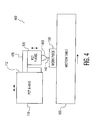
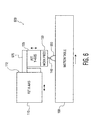
- FIGS. 3-7 are schematic diagrams illustrating alternative exemplary vibration machining apparatus 300, 400, 500, 600 and 700 according to exemplary embodiments of the present invention.
- FIGS. 3-7 the structure and operation of vibrating units 110 and 120, cutting tool 140 and motion table 160 may be only briefly described, since they are substantially identical to those of FIG. 2.
- Exemplary vibration machining apparatus 300, 400, 500, 600 and 700, illustrated in FIGS. 3-7 vary from exemplary vibration machining apparatus 100, illustrated in FIGS. 1 and 2, by the various orientations of the components.
- vibration machining apparatus 300 illustrates a different orientation of components than that illustrated in FIG. 2.
- cutter holding unit 350 may be coupled to vibrating unit 120 and cutting tool 140 may be releasably coupled to cutter holding unit 350 while vibrating unit 120 vibrates cutter holding unit 350 and cutting tool 140 in a direction substantially orthogonal to the plane of motion table 160.
- Work piece 130 may be releasably coupled via coupling member 370 at one end 112 of vibrating unit 110, and may be vibrated by vibrating unit 110 in a direction substantially parallel to the plane of motion table 160 during the machining process.
- exemplary vibration machining apparatus 400 may be used to machine workpiece 130 using cutting tool 140.
- Vibration machining apparatus 400 may include a controller (not shown), vibrating unit 110, vibrating unit 120, a cutter holding unit 450, a coupling member 470 and motion table 160.
- vibrating unit 120 is coupled to one end 112 of vibrating unit 110 via coupling member 470.
- Cutter holding unit 450 is coupled to vibrating unit 120 such that cutting tool 140, which is releasably coupled to cutter holding unit 450, may be vibrated, independently, by vibrating unit 120 in a direction substantially orthogonal to a plane of motion table 160 or by vibrating unit 110 in a direction substantially parallel to the plane of motion table 160, or in combination by vibrating units 110 and 120 in a substantially closed loop motion according to the selection of periodic input waveforms input to vibrating units 110 and 120. That is, vibrating unit 110 and vibrating unit 120 may be coupled to cutting tool 140 to allow vibrational machining of workpiece 130, which is releasably coupled to motion table 160.
- the operating frequency of the vibration machining apparatus may be limited by the resonance frequency of vibrating unit 110.
- This configuration may be desirable, for example, when the mass of workpiece 130 is relatively larger than the masses of the vibration actuator of vibrating unit 110, coupling member 470, vibrating unit 120, cutter holding unit 450 and cutting tool 140 so that the operation frequency may be increased.
- exemplary vibration machining apparatus 500 used to machine workpiece 130 may include a controller (not shown), vibrating unit 110, vibrating unit 120, a cutter holding unit 550, a coupling member 570 and motion table 160.
- Vibrating unit 110 may be coupled to one end of vibrating unit 120 via coupling member 570.
- Exemplary vibration machining apparatus 500 is similar to exemplary vibration machining apparatus 400, except that the order of vibrating units 110 and 120 has been reversed.
- exemplary vibration machining apparatus 600 used to machine workpiece 130 may include a controller (not shown), vibrating unit 110, vibrating unit 120, a cutter holding unit 650, a coupling member 670 and motion table 160.
- Exemplary vibration machining apparatus 600 is similar to exemplary vibration machining apparatus 400, except that the positions of workpiece 130 and cutting tool 140 have been reversed.
- workpiece 130 is vibrated instead of cutting tool 140.
- Cutter holding unit 650 in which cutting tool 140 is held, is coupled to motion table 160 to be drawn across the surface of workpiece 130 during the machining process.
- exemplary vibration machining apparatus 700 is very similar to exemplary vibration machining apparatus 600, except that in exemplary vibration machining apparatus 700 vibrating unit 110 is coupled to the motion stage and cutter holding unit 750 is fixed.
- workpiece 130 both vibrates and moves with the motion table, while cutting tool 140 remains substantially stationary.
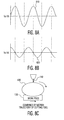
- FIGS. 8A and 8B are exemplary timing diagrams illustrating sinusoidal input waveforms 810 and 820 that may used by any one of the apparatus of FIGS. 2-7 to machine the workpiece.
- FIG. 8C is a schematic diagram illustrating the resulting motion of the cutting tool of an exemplary vibration machining apparatus of the present invention vibrated using exemplary input waveforms 810 and 820 of FIGS. 8A and 8B.
- an input waveform 810 that may desirably be used to drive vibrating unit 110 and input waveform 820 that may desirably be used to drive vibrating unit 120 are illustrated.
- phase angle i.e., relative phase
- phase angle between these two input waveforms 810 and 820 may be any phase angle. It is noted that 0° and 180° may be undesirable as they lead to substantially linear vibrational motions.
- Each of the input waveforms 810 and 820 are sinusoids with a common frequency.
- the vibration amplitude produced by vibrating unit 110 may be proportional to the peak amplitude of input voltage 810, which is the potential across input terminals Va and Vb.
- the vibration amplitude produced by vibrating unit 120 may be proportional to the peak amplitude of input waveform 120, which is the potential across input terminals Vc and Vd of vibrating unit 120.
- FIG. 8C illustrates the resulting motion of cutting tool 140 with vibrating units 110 and 120 being driven by input waveforms 810 and 820, respectively.
- sinusoidal waveforms 810 and 820 having a 90° phase angle relative to each other substantially elliptical cutting trajectory 830 with its major axis substantially parallel to the surface of workpiece 130 may be realized by cutting tool 140.
- the depth (minor axis) of substantially elliptical cutting trajectory 830 is based on the peak amplitude of input waveform 820 and a length (major axis) of closed loop cutting trajectory 830 is based on the peak amplitude of input waveform 810.
- the duty cycle (i,e., the ratio of the portion of cutting trajectory 830 during which cutting tool 140 is in contact with the surface of workpiece 130 to the portion of cutting trajectory 830 during which cutting tool 140 is not in contact with the workpiece 130) may be in the range of between about 10% to 50%.
- the duty cycle may desirably be in the range between about 10% and 30%, depending on a number of machining parameters, including: the material of workpiece 130; the material of cutting tool 140; the speed of the motion table; the vibrational frequency of the vibrating units; the depth of the cut; and the desired smoothness of the machined surface.
- Motion table 160 may be provided with a direction of motion (i.e., a machining path) which extends along the major axis of cutting tool trajectory 830.
- a direction of motion i.e., a machining path
- the groove which has a width substantially equal to the width of cutting tool 140, follows the machining path based on movement of the motion of motion table 160
- Each pair of periodic waveforms produces a unique closed loop trajectory for cutting tool 140.
- Two examples of such unique input waveforms and the resulting cutting tool trajectory are shown in FIGS. 9A-9C and FIGS. 10A-10C.
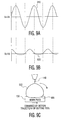
- FIGS. 9A and 9B are timing diagrams illustrating another exemplary set of input waveforms that may be used by any one of the exemplary vibration machining apparatus of FIGS. 2-7 to machine the workpiece.
- FIG. 9C is a schematic diagram illustrating the resulting motion of the cutting tool of an exemplary vibration machining apparatus of the present invention driven by the exemplary input waveforms of FIGS. 9A and 9B.
- input waveforms 910 and 920 may be used to drive vibrating units 110 and 120, respectively.
- input waveform 910 is a sinusoidal waveform
- input waveform 920 is a truncated sinusoidal waveform. That is, portions of truncated sinusoidal waveform 920 are flattened each period.
- Each of input waveforms 910 and 920 has a common frequency and their relative phase angle is illustrated as 90° It is contemplated, however, that the phase angle between input waveform 910 and input waveform 920 may be any phase angle.
- a resulting motions of cutting tool 140 and workpiece 130 produce substantially closed loop cutting tool trajectory 930 which is in the shape of a flatten teardrop
- Flatten teardrop shaped trajectory 930 may have certain advantages over elliptical shaped trajectory 830. For example, an improved surface smoothness of workpiece 130 and a reduced duty cycle of cutting tool 140, which reduces heating of cutting tool 140, compared to those of elliptical shaped trajectory 830 may be achieved.
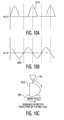
- FIGS. 10A and 10B are timing diagrams illustrating yet another exemplary set of input waveforms that may be used by any one of the apparatus of FIGS. 2-7 to machine the workpiece.
- FIG. 10C is a schematic diagram illustrating the resulting motion of the cutting tool of an exemplary vibration machining apparatus of the present invention driven by the exemplary input waveforms of FIGS. 10A and 10B.
- input waveforms 1010 and 1020 may be used to drive vibrating units 110 and 120, respectively.
- input waveform 1010 is a truncated sinusoidal waveform (i.e., having flat portions which are periodic), for example, a half-wave rectified waveform and input waveform 1020 is a sinusoidal waveform.
- phase angle between input waveform 1010 and input waveform 1020 is illustrated as 90°. It is contemplated, however, that the phase angle between truncated sinusoidal waveform 1010 and sinusoidal waveform 1020 may be any phase angle. Also, input waveforms 1010 and 1020 may have a common frequency.
- a resulting motion of cutting tool 140 based on input waveforms 1010 and 1020 produces a substantially closed cutting tool trajectory 1030 in the shape of a truncated ellipse.
- Truncated ellipse shaped cutting tool trajectory 1030 may provide an advantage in that a lead-out zone may be minimized for workpiece 130. That is, by lifting cutting tool 140 steeply out of the deepening groove formed as cutting tool 140 follows the substantially closed loop cutting trajectory 1030, the lead-out zone of workpiece 130 may have a steep transition and minimum zone width.
- a complementary truncated sinusoidal waveform may be used to drive vibrating unit 110 to realize a complimentary truncated ellipse which may be used to produce a similar lead-out zone having a steep transition and minimum zone width.
- sinusoidal waveforms and truncated sinusoidal waveforms may be used as input waveform to vibrating units 110 and 120 in various combinations, it is contemplated that other waveforms (e.g. triangular waveforms, sawtooth waveforms, stepped waveforms, and truncated non-sinusoidal waveforms such as truncated triangular waveforms) or any combination of sinusoid and non-sinusoid based waveforms may be used as long as the waveforms are periodic.
- waveforms e.g. triangular waveforms, sawtooth waveforms, stepped waveforms, and truncated non-sinusoidal waveforms such as truncated triangular waveforms
- any combination of sinusoid and non-sinusoid based waveforms may be used as long as the waveforms are periodic.
- the input waveform used to drive vibrating unit 110 may be provided as one of a truncated sinusoidal waveform or a sinusoidal waveform to generate vibration along the first vibrational direction and the input waveform used to drive vibrating unit 120 may be provided as one of a truncated sinusoidal waveform or a sinusoidal waveform to generate vibration along the second vibrational direction.
- the input waveform used to drive vibrating unit 110 may be provided as one of a truncated non-sinusoidal waveform or a non-sinusoidal waveform to generate vibration along the first vibrational direction and the input waveform used to drive vibrating unit 120 may be provided as one of a truncated non-sinusoidal waveform or a non-sinusoidal waveform to generate vibration along the second vibrational direction.
- the input waveform used to drive one of vibrating unit 110 or vibrating unit 120 may be a truncated sinusoidal waveform or a sinusoidal waveform and the input waveforms used to drive the other one of vibrating unit 110 and vibrating unit 120 may be a truncated non-sinusoidal waveform or a non-sinusoidal waveform.
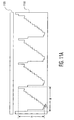
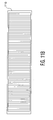
- FIG. 11A is a cross-sectional view illustrating an exemplary mold used to produce a gray scale optical grating which may be machined using any one of the exemplary apparatus of FIGS. 2-7.
- FIG. 11B is a top plan view illustrating a first mold part in FIG. 11A,
- a vibration machine apparatus 200, 300, 400, 500 600 or 700 may be used to, for example, either directly machine an optical grayscale diffraction grating (not shown) or a mold including a first mold part 1110 and a second mold part 1120 for producing a grayscale optical diffraction grating.
- a mold 1110:1120 for producing a grayscale optical diffraction grating may be generated.
- the minimum width S for each grayscale step may be based on a width of the cutting tool 140 and may be in the range between about .1 ⁇ m to 1 ⁇ m. Further, a grayscale diffraction period W may repeat periodically and may be in the range of about 1 ⁇ m to 10 ⁇ m. Moreover, a total height H of the grayscale steps may be in the range of about 0.1 ⁇ m to 0.5 ⁇ m.
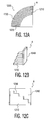
- FIGS. 12A is a top plan view illustrating an exemplary structure that may be produced by any one of the exemplary apparatus of FIGS. 2-7, and illustrates steep lead-in and lead-out zones and curved grooves that may be formed using an exemplary of the present invention.
- FIG, 12B is a perspective view illustrating area A of in FIG. 12A.
- FIG. 12C is a cross-sectional view of area A in FIG, 12A.
- vibration machining unit 200, 300, 400, 500, 600 or 700 may generate lead-in and lead-out zone with minimum transitions such as that illustrated in FIG. 12A. That is, for example, by providing input waveforms 1010 and 1020 as shown in FIGS. 10A and 10B to drive vibrating units 110 and 120, respectively, a very steep transition zone is realizable.
- a workpiece 1200 may be machined having, for example, lead in or lead out zones 1240 with a portion of its surface 1210 having radial grooves or steps 1230. That is, first and second vibrating units 110 and 120 may be configured to produce a machined workpiece having at least portions that include radial grooves with steep transition zones.
- This may be accomplished by using coordinated X and Y motion of motion table 160 to follow a curved machining path, or desirably by using a motion table that includes a rotational motion stage to rotate either the workpiece or the cutting tool in the XY plane.
- a lead-in angle and/or a lead-out angle may be reduced or substantially eliminated.
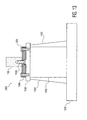
- FIG. 13 is a partial cross-sectional view of a vibration machining apparatus illustrating an exemplary workpiece mount according to yet another exemplary embodiment of the present invention.
- exemplary vibration machining apparatus 1300 includes vibrating unit 1310 to vibrate workpiece 130 in a first direction.
- Vibrating unit 1310 may be a piezoelectric device having a piezo stack.
- This piezo stack may be preloaded by a plurality of preloading devices 1320 which may maintain the vibrating unit 1310 in compression.
- the preloading may be accomplished by providing pre-tensioned wires, as preloading devices 1320, that are under tension between a top plate 1330 of vibrating unit 1310 and a base plate 1370.
- pre-tensioned wires are illustrated, it is noted that other preloading devices are possible.
- spring tensioners, hydraulic tensioners, or other tensioning means may be used in exemplary embodiments of the present invention.
- Top plate 1330 may be directly bonded to, for example, the piezo stack of vibrating unit 1310 and may be formed from a thin plate of steel, aluminum, alumina, or another hard material.
- the thickness of top plate 1330 may be in the range of 1-20 mm.
- Exemplary vibration machining apparatus 1300 also includes an exemplary coupling assembly, including mounting plate 1340, mounting screws 1355, and anchor screw(s) 1350 to couple workpiece 130 to vibrating unit 1310. It is noted that this exemplary coupling assembly may include one or more anchor screws 1350 to couple workpiece 130 to mounting plate 1340. Each anchor screw may be threaded at an end to couple to workpiece 130. The exemplary coupling assembly may further include mounting screws 1355 to couple mounting plate 1340 to top plate 1330 of the vibrating unit. Each mounting screw 1355 may be threaded at an end to couple to top plate 1330 of vibrating unit 1310.
- Mounting plate 1340 may include recessed through holes for coupling of mounting screws 1355 and anchor screw(s) 1350 within the exemplary coupling assembly and may be formed from stainless steel, aluminum, alumina, or another hard material.
- the thickness of mounting plate 1340 may be in the range of 1-20 mm.
- exemplary vibration machining apparatus 1300 By providing this exemplary coupling assembly, the mass vibrated by exemplary vibration machining apparatus 1300 may be minimized, thus, allowing exemplary vibration machining apparatus 1300 to operate at higher frequencies without damaging vibrating unit 1310. It is contemplated that exemplary vibration machining apparatus 1300 may operate at frequencies in the range of 100 Hz to 50 KHz.
- exemplary vibrating machining apparatus 100, 300, 400, 500, 600, 700 and 1300 may be limited by the resonance frequency relative to masses being vibrated.
- the various exemplary vibration machining apparatus 100, 300, 400, 500, 600 and 700, 1300 may have different maximum operating frequencies due to the various orientations of the components, which may provide different vibrational masses.
- vibrating machining apparatus 400 and 500 may be desirable when the mass of workpiece 130 is relatively large because workpiece 130 is not vibrated by any vibrating units in these exemplary orientations, and the resulting maximum operation frequency may be higher.
- vibrating machining apparatus 600 and 700 may be desirable when the masses of the cutter holding unit 650 or 750 and cutting tool 140 are relatively large because cutting tool 140 is not vibrated by any vibrating units 110 and 120 in these exemplary orientations, and the resulting maximum operation frequency may be higher.
Landscapes
- Engineering & Computer Science (AREA)
- Mechanical Engineering (AREA)
- Turning (AREA)
- Milling Processes (AREA)
Applications Claiming Priority (1)
| Application Number | Priority Date | Filing Date | Title |
|---|---|---|---|
| US11/221,041 US7508116B2 (en) | 2005-09-07 | 2005-09-07 | Method and apparatus for vibration machining with two independent axes |
Publications (2)
| Publication Number | Publication Date |
|---|---|
| EP1762305A2 true EP1762305A2 (fr) | 2007-03-14 |
| EP1762305A3 EP1762305A3 (fr) | 2008-02-27 |
Family
ID=37547487
Family Applications (1)
| Application Number | Title | Priority Date | Filing Date |
|---|---|---|---|
| EP06119431A Withdrawn EP1762305A3 (fr) | 2005-09-07 | 2006-08-24 | Procédé et dispositif pour l'usinage par vibrations à deux axes indépendants |
Country Status (3)
| Country | Link |
|---|---|
| US (1) | US7508116B2 (fr) |
| EP (1) | EP1762305A3 (fr) |
| JP (1) | JP2007069344A (fr) |
Cited By (14)
| Publication number | Priority date | Publication date | Assignee | Title |
|---|---|---|---|---|
| WO2008118479A1 (fr) | 2007-03-27 | 2008-10-02 | Panasonic Corporation | Systèmes d'usinage assisté par vibrations avec des actionneurs superposés |
| WO2012007583A1 (fr) * | 2010-07-16 | 2012-01-19 | Sauer Ultrasonic Gmbh | Machine-outil et procédé d'usinage d'une pièce |
| DE102010048636A1 (de) * | 2010-10-15 | 2012-04-19 | Sauer Ultrasonic Gmbh | Werkzeugmaschine, Werkstückbearbeitungsverfahren |
| DE102010055288A1 (de) * | 2010-12-21 | 2012-06-21 | Ev Group Gmbh | Vorrichtung zum spanenden Bearbeiten eines Werkstücks |
| DE102012219232A1 (de) * | 2012-10-22 | 2014-04-24 | Sauer Ultrasonic Gmbh | Vibrierendes Werkzeug, Verfahren zur Werkzeugkonstruktion |
| DE102012219254A1 (de) | 2012-10-22 | 2014-04-24 | Sauer Ultrasonic Gmbh | Verfahren zur Werkstückbearbeitung, Versorgungsschaltung, Versorgungssystem, Werkzeugaktor, Werkzeugaufbau |
| EP2724800A4 (fr) * | 2011-11-10 | 2015-03-11 | Citizen Machinery Miyano Co | Machine-outil |
| EP2957972A4 (fr) * | 2014-04-23 | 2017-03-08 | Mitsubishi Electric Corporation | Appareil de commande numérique |
| EP3292946A1 (fr) * | 2016-09-09 | 2018-03-14 | Sauer GmbH | Procédé de traitement d'une pièce à usiner en métal dur pour la fabrication d'un corps de base d'outil par une machine-outil à commande numérique pourvue de broche de perçage servant de porte-outil |
| EP3225355A4 (fr) * | 2014-11-26 | 2018-09-12 | Mitsubishi Electric Corporation | Appareil de commande numérique |
| US10864580B2 (en) | 2018-01-23 | 2020-12-15 | Quantum Impact, LLC | Method and apparatus for machining a workpiece |
| US11298740B2 (en) * | 2015-07-28 | 2022-04-12 | Ford Global Technologies, Llc | Vibration assisted free form fabrication |
| IT202200016371A1 (it) * | 2022-08-02 | 2024-02-02 | Cms Spa | Metodo e dispositivo di lavorazione ad alta frequenza |
| EP4520465A1 (fr) * | 2023-08-31 | 2025-03-12 | Avantec Zerspantechnik GmbH | Procédé et dispositif d'usinage par fraisage d'une pièce |
Families Citing this family (26)
| Publication number | Priority date | Publication date | Assignee | Title |
|---|---|---|---|---|
| US7788998B2 (en) * | 2006-03-13 | 2010-09-07 | Panasonic Corporation | Precision machining system and methods |
| TWM411311U (en) * | 2011-04-07 | 2011-09-11 | Chuan Liang Ind Co Ltd | Operating table ultrasonic device for tooling machine |
| AT511551B1 (de) * | 2011-05-18 | 2013-10-15 | Univ Wien Tech | Vorrichtung und verfahren zur mechanischen bearbeitung eines werkstücks |
| CN103042435A (zh) * | 2012-11-09 | 2013-04-17 | 浙江工业大学 | 拼接淬硬模具钢高频微幅振动铣削测试方法 |
| CN103878636B (zh) * | 2012-12-19 | 2018-05-04 | 鸿准精密模具(昆山)有限公司 | 机床控制系统 |
| CN103878635B (zh) * | 2012-12-19 | 2018-05-04 | 鸿准精密模具(昆山)有限公司 | 机床控制系统 |
| US9314854B2 (en) | 2013-01-30 | 2016-04-19 | Lam Research Corporation | Ductile mode drilling methods for brittle components of plasma processing apparatuses |
| JP5599523B1 (ja) * | 2013-02-12 | 2014-10-01 | 三菱電機株式会社 | 数値制御装置 |
| US8893702B2 (en) | 2013-02-20 | 2014-11-25 | Lam Research Corporation | Ductile mode machining methods for hard and brittle components of plasma processing apparatuses |
| DE102013110728B4 (de) * | 2013-09-27 | 2021-08-19 | Ev Group E. Thallner Gmbh | System und Verfahren zum spanenden Bearbeiten eines Werkstücks |
| JP6127153B2 (ja) * | 2013-11-15 | 2017-05-10 | 株式会社日立製作所 | 周波数特性測定方法及び位置決め制御装置 |
| JP2015174180A (ja) * | 2014-03-14 | 2015-10-05 | 株式会社東京精密 | 超音波面取り機 |
| CN103955587B (zh) * | 2014-05-13 | 2017-07-07 | 重庆大学 | 一种压电复合材料层合壳压电弹性分析方法 |
| JP5902753B2 (ja) * | 2014-05-28 | 2016-04-13 | ファナック株式会社 | 切上げ・切込み運動または円運動挿入機能を有する数値制御装置 |
| KR102183278B1 (ko) * | 2014-09-22 | 2020-11-26 | 시티즌 도케이 가부시키가이샤 | 공작기계 및 이 공작기계의 제어장치 |
| US10589367B2 (en) * | 2014-10-08 | 2020-03-17 | Citizen Watch Co., Ltd. | Machine tool and control device of the machine tool |
| JP6470085B2 (ja) * | 2015-03-26 | 2019-02-13 | シチズン時計株式会社 | 工作機械及びこの工作機械の制御装置 |
| WO2017043499A1 (fr) * | 2015-09-10 | 2017-03-16 | シチズン時計株式会社 | Dispositif de commande pour machine-outil et machine-outil |
| TWI697380B (zh) * | 2015-09-24 | 2020-07-01 | 日商西鐵城時計股份有限公司 | 工具機的控制裝置以及具備該控制裝置的工具機 |
| JP6783238B2 (ja) * | 2015-09-24 | 2020-11-11 | シチズン時計株式会社 | 工作機械の制御装置及びこの制御装置を備えた工作機械 |
| WO2018181447A1 (fr) * | 2017-03-29 | 2018-10-04 | シチズン時計株式会社 | Dispositif de commande pour machine-outil et machine-outil |
| US20190388977A1 (en) * | 2018-06-25 | 2019-12-26 | Hamilton Sundstrand Corporation | Hard turning systems and methods |
| DE112018008087B4 (de) * | 2018-11-29 | 2022-09-08 | Mitsubishi Electric Corporation | Numerisches Steuerungsgerät und numerisches Steuerungsverfahren |
| CN109940341B (zh) * | 2019-04-11 | 2020-09-15 | 北京理工大学 | 一种低频振动辅助飞切加工结构色图案的方法 |
| CN111659959A (zh) * | 2020-06-23 | 2020-09-15 | 中国工程物理研究院激光聚变研究中心 | 一种面向硬脆材料的高低频复合振动加工装置及方法 |
| WO2026052158A1 (fr) * | 2024-09-06 | 2026-03-12 | 深圳市大族数控科技股份有限公司 | Dispositif de traitement de pcb, système de traitement de pcb et procédé de traitement de pcb |
Citations (2)
| Publication number | Priority date | Publication date | Assignee | Title |
|---|---|---|---|---|
| US5165205A (en) | 1987-06-24 | 1992-11-24 | Research Development Corporation Of Japan | Device for vibrating materials to be ground |
| EP0979700A2 (fr) | 1998-08-12 | 2000-02-16 | Towa Corporation | Méthode de coupe à vibration ellipique et appareil de coupe à vibration ellipique |
Family Cites Families (11)
| Publication number | Priority date | Publication date | Assignee | Title |
|---|---|---|---|---|
| JPS60255301A (ja) * | 1984-05-30 | 1985-12-17 | Taga Denki Kk | 角板形正方共振体共振装置 |
| JPH04333108A (ja) * | 1991-05-09 | 1992-11-20 | Hitachi Ltd | 試料台駆動装置 |
| JP3500434B2 (ja) * | 1993-09-01 | 2004-02-23 | 財団法人新産業創造研究機構 | 振動切削加工方法および振動切削加工装置 |
| US6637303B2 (en) | 1998-08-12 | 2003-10-28 | Toshimichi Moriwaki | Elliptical vibration cutting method and elliptical vibration cutting apparatus |
| US20020104963A1 (en) * | 1998-09-26 | 2002-08-08 | Vladimir Mancevski | Multidimensional sensing system for atomic force microscopy |
| JP3806603B2 (ja) * | 2001-02-23 | 2006-08-09 | Towa株式会社 | 楕円振動装置及び楕円振動装置の制御方法 |
| DE10160228A1 (de) * | 2001-12-07 | 2003-06-18 | Hesse & Knipps Gmbh | Kreuztransducer |
| US6932682B2 (en) | 2002-10-17 | 2005-08-23 | General Electric Company | Method and apparatus for ultrasonic machining |
| US6715336B1 (en) * | 2003-02-24 | 2004-04-06 | Npoint, Inc. | Piezoelectric force motion scanner |
| EP1493530A1 (fr) * | 2003-07-04 | 2005-01-05 | HESS, Peter | Tête d'usinage utilisant des actionneurs piézoélectriques |
| DE102004037454A1 (de) * | 2004-08-02 | 2006-02-23 | Carl Zeiss Ag | Verfahren zur Bearbeitung von Oberflächen von Werkstücken |
-
2005
- 2005-09-07 US US11/221,041 patent/US7508116B2/en not_active Expired - Fee Related
-
2006
- 2006-08-24 EP EP06119431A patent/EP1762305A3/fr not_active Withdrawn
- 2006-09-07 JP JP2006242529A patent/JP2007069344A/ja active Pending
Patent Citations (2)
| Publication number | Priority date | Publication date | Assignee | Title |
|---|---|---|---|---|
| US5165205A (en) | 1987-06-24 | 1992-11-24 | Research Development Corporation Of Japan | Device for vibrating materials to be ground |
| EP0979700A2 (fr) | 1998-08-12 | 2000-02-16 | Towa Corporation | Méthode de coupe à vibration ellipique et appareil de coupe à vibration ellipique |
Non-Patent Citations (1)
| Title |
|---|
| KUMABE J: "PRECISION ENGINEERING", vol. 11, 1989, ELSEVIER, article "Ultrasonic superposition vibration cutting of ceramics", pages: 71 - 77 |
Cited By (35)
| Publication number | Priority date | Publication date | Assignee | Title |
|---|---|---|---|---|
| CN101641182B (zh) * | 2007-03-27 | 2013-06-05 | 松下电器产业株式会社 | 振动辅助机械加工(vam)系统 |
| WO2008118158A1 (fr) * | 2007-03-27 | 2008-10-02 | Panasonic Corporation | Système d'usinage assisté par vibrations à actionneurs empilés |
| US7687975B2 (en) | 2007-03-27 | 2010-03-30 | Panasonic Corporation | Vibration assisted machining system with stacked actuators |
| WO2008118479A1 (fr) | 2007-03-27 | 2008-10-02 | Panasonic Corporation | Systèmes d'usinage assisté par vibrations avec des actionneurs superposés |
| WO2012007583A1 (fr) * | 2010-07-16 | 2012-01-19 | Sauer Ultrasonic Gmbh | Machine-outil et procédé d'usinage d'une pièce |
| DE102010048638A1 (de) * | 2010-07-16 | 2012-01-19 | Sauer Ultrasonic Gmbh | Werkzeugmaschine, Werkstückbearbeitungsverfahren |
| CN103052457B (zh) * | 2010-07-16 | 2016-11-09 | 邵尔超声波有限责任公司 | 机床及工件加工方法 |
| DE102010048638B4 (de) * | 2010-07-16 | 2017-10-05 | Sauer Ultrasonic Gmbh | Werkzeugmaschine, Werkstückbearbeitungsverfahren |
| CN103052457A (zh) * | 2010-07-16 | 2013-04-17 | 邵尔超声波有限责任公司 | 机床及工件加工方法 |
| DE102010048636B4 (de) * | 2010-10-15 | 2017-11-16 | Sauer Ultrasonic Gmbh | Werkzeugmaschine und Verfahren zur Bearbeitung eines Werkstücks mit einem Werkzeug |
| WO2012049216A3 (fr) * | 2010-10-15 | 2013-05-10 | Sauer Ultrasonic Gmbh | Machine-outil, procédé d'usinage de pièces |
| DE102010048636A1 (de) * | 2010-10-15 | 2012-04-19 | Sauer Ultrasonic Gmbh | Werkzeugmaschine, Werkstückbearbeitungsverfahren |
| CN103313821A (zh) * | 2010-10-15 | 2013-09-18 | 邵尔超声波有限责任公司 | 带有工件台振动单元的机床及工件加工方法 |
| KR101487637B1 (ko) * | 2010-12-21 | 2015-01-29 | 에베 그룹 게엠베하 | 공작물을 가공하기 위해 두 개의 진동 요소를 가지는 시스템 |
| CN103260819A (zh) * | 2010-12-21 | 2013-08-21 | Ev集团有限责任公司 | 用于切削加工工件的带有两个振动部件的装置 |
| DE102010055288A1 (de) * | 2010-12-21 | 2012-06-21 | Ev Group Gmbh | Vorrichtung zum spanenden Bearbeiten eines Werkstücks |
| WO2012084779A1 (fr) | 2010-12-21 | 2012-06-28 | Ev Group Gmbh | Dispositif à deux composantes d'oscillation pour l'usinage par enlèvement de copeaux d'une pièce |
| US9061388B2 (en) | 2010-12-21 | 2015-06-23 | Ev Group Gmbh | System having two oscillation components for machining a workpiece |
| EP2724800A4 (fr) * | 2011-11-10 | 2015-03-11 | Citizen Machinery Miyano Co | Machine-outil |
| US9908209B2 (en) | 2012-10-22 | 2018-03-06 | Sauer Ultrasonic Gmbh | Method for machining a workpiece, supply circuit, supply system, tool actuator, tool setup |
| DE102012219232A1 (de) * | 2012-10-22 | 2014-04-24 | Sauer Ultrasonic Gmbh | Vibrierendes Werkzeug, Verfahren zur Werkzeugkonstruktion |
| DE102012219254B4 (de) * | 2012-10-22 | 2015-01-29 | Sauer Ultrasonic Gmbh | Versorgungsschaltung, Versorgungssystem, Werkzeugaktor, Werkzeug |
| DE102012219254A1 (de) | 2012-10-22 | 2014-04-24 | Sauer Ultrasonic Gmbh | Verfahren zur Werkstückbearbeitung, Versorgungsschaltung, Versorgungssystem, Werkzeugaktor, Werkzeugaufbau |
| EP2957972A4 (fr) * | 2014-04-23 | 2017-03-08 | Mitsubishi Electric Corporation | Appareil de commande numérique |
| EP3225355A4 (fr) * | 2014-11-26 | 2018-09-12 | Mitsubishi Electric Corporation | Appareil de commande numérique |
| US10671046B2 (en) | 2014-11-26 | 2020-06-02 | Mitsubishi Electric Corporation | Method and apparatus for applying vibration and machining an object |
| US11298740B2 (en) * | 2015-07-28 | 2022-04-12 | Ford Global Technologies, Llc | Vibration assisted free form fabrication |
| EP3292946A1 (fr) * | 2016-09-09 | 2018-03-14 | Sauer GmbH | Procédé de traitement d'une pièce à usiner en métal dur pour la fabrication d'un corps de base d'outil par une machine-outil à commande numérique pourvue de broche de perçage servant de porte-outil |
| DE102016217251A1 (de) | 2016-09-09 | 2018-03-15 | Sauer Gmbh | Verfahren zum Bearbeiten eines Werkstücks aus Hartmetall für die Herstellung eines Werkzeuggrundkörpers an einer numerisch gesteuerten Werkzeugmaschine mit werkzeugtragender Arbeitsspindel |
| US20180071890A1 (en) * | 2016-09-09 | 2018-03-15 | Sauer Gmbh | Method for processing a workpiece made of hard metal for producing a tool main body on a numerically controlled machine tool with tool-carrying work spindle |
| US10864580B2 (en) | 2018-01-23 | 2020-12-15 | Quantum Impact, LLC | Method and apparatus for machining a workpiece |
| US11660684B2 (en) | 2018-01-23 | 2023-05-30 | Quantum Impact, LLC | Method and apparatus for machining a workpiece |
| IT202200016371A1 (it) * | 2022-08-02 | 2024-02-02 | Cms Spa | Metodo e dispositivo di lavorazione ad alta frequenza |
| EP4316709A1 (fr) * | 2022-08-02 | 2024-02-07 | C.M.S. S.p.A. | Procédé et dispositif d'usinage à haute fréquence |
| EP4520465A1 (fr) * | 2023-08-31 | 2025-03-12 | Avantec Zerspantechnik GmbH | Procédé et dispositif d'usinage par fraisage d'une pièce |
Also Published As
| Publication number | Publication date |
|---|---|
| JP2007069344A (ja) | 2007-03-22 |
| US20070052326A1 (en) | 2007-03-08 |
| US7508116B2 (en) | 2009-03-24 |
| EP1762305A3 (fr) | 2008-02-27 |
Similar Documents
| Publication | Publication Date | Title |
|---|---|---|
| US7508116B2 (en) | Method and apparatus for vibration machining with two independent axes | |
| US7187104B2 (en) | Vibration-type driving device, control apparatus for controlling the driving of the vibration-type driving device, and electronic equipment having the vibration-type driving device and the control apparatus | |
| JP4261964B2 (ja) | 振動型駆動装置および制御システム | |
| JP5054814B2 (ja) | 振動機械加工システム | |
| EP2103376B1 (fr) | Dispositif de coupe par vibrations | |
| JP3234872B2 (ja) | アクチュエータおよびその駆動方法、および、その駆動方法をコンピュータに実行させるためのプログラムを記録したコンピュータ読み取り可能な記録媒体、並びに、そのアクチュエータを用いた小型工作機械 | |
| JP2011188739A (ja) | ウォーキングアクチュエータ | |
| JP4268246B2 (ja) | 楕円振動切削装置 | |
| JPH10118811A (ja) | 加工装置 | |
| JP2002036001A (ja) | 切削加工方法及び切削加工装置及び工具保持装置及び光学素子及び光学素子の成形用金型 | |
| Kim et al. | Nano positioning of a high power ultrasonic linear motor | |
| US6307299B1 (en) | Method of correcting a resonance frequency of a small rotary actuator | |
| JPH11160599A (ja) | レンズ駆動装置 | |
| JP4088061B2 (ja) | 振動切削方法および振動切削装置 | |
| CN113523435B (zh) | 一种硬脆复杂结构无主轴多极伺服研抛装置及研抛方法 | |
| US20040155558A1 (en) | Tunable vibratory actuator | |
| JP2005001042A (ja) | 切削加工方法および切削加工装置 | |
| JP2002301601A (ja) | 加工装置および加工方法 | |
| JP2574577B2 (ja) | リニア型アクチュエータ | |
| JP4578799B2 (ja) | 圧電アクチュエータ及びそれを用いた電子機器 | |
| WO2006022236A1 (fr) | Dispositif vibrant | |
| JP2971971B2 (ja) | 超音波アクチュエータ | |
| Yun et al. | A high power ultrasonic linear motor with a longitudinal-bending hybrid transducer for high-speed and precise drive of a heavy stage | |
| JP2021027621A (ja) | 振動型モータの制御装置及びそれを用いた撮像装置 | |
| Devos et al. | A piezoelectric drive combining a resonant and a stepping positioning mode |
Legal Events
| Date | Code | Title | Description |
|---|---|---|---|
| PUAI | Public reference made under article 153(3) epc to a published international application that has entered the european phase |
Free format text: ORIGINAL CODE: 0009012 |
|
| AK | Designated contracting states |
Kind code of ref document: A2 Designated state(s): AT BE BG CH CY CZ DE DK EE ES FI FR GB GR HU IE IS IT LI LT LU LV MC NL PL PT RO SE SI SK TR |
|
| AX | Request for extension of the european patent |
Extension state: AL BA HR MK YU |
|
| PUAL | Search report despatched |
Free format text: ORIGINAL CODE: 0009013 |
|
| AK | Designated contracting states |
Kind code of ref document: A3 Designated state(s): AT BE BG CH CY CZ DE DK EE ES FI FR GB GR HU IE IS IT LI LT LU LV MC NL PL PT RO SE SI SK TR |
|
| AX | Request for extension of the european patent |
Extension state: AL BA HR MK YU |
|
| RIC1 | Information provided on ipc code assigned before grant |
Ipc: B23Q 1/34 20060101ALI20080121BHEP Ipc: B23B 29/12 20060101ALI20080121BHEP Ipc: B23P 25/00 20060101AFI20080121BHEP |
|
| 17P | Request for examination filed |
Effective date: 20080619 |
|
| 17Q | First examination report despatched |
Effective date: 20080901 |
|
| AKX | Designation fees paid |
Designated state(s): DE FR GB |
|
| RAP1 | Party data changed (applicant data changed or rights of an application transferred) |
Owner name: PANASONIC CORPORATION |
|
| GRAP | Despatch of communication of intention to grant a patent |
Free format text: ORIGINAL CODE: EPIDOSNIGR1 |
|
| RIC1 | Information provided on ipc code assigned before grant |
Ipc: B24B 13/04 20060101ALN20111004BHEP Ipc: B24B 1/04 20060101ALN20111004BHEP Ipc: B23D 5/00 20060101ALN20111004BHEP Ipc: B23Q 1/34 20060101ALI20111004BHEP Ipc: B23B 29/12 20060101ALI20111004BHEP Ipc: B23P 25/00 20060101AFI20111004BHEP |
|
| RIC1 | Information provided on ipc code assigned before grant |
Ipc: B24B 13/04 20060101ALN20111012BHEP Ipc: B24B 1/04 20060101ALN20111012BHEP Ipc: B23D 5/00 20060101ALN20111012BHEP Ipc: B23Q 1/34 20060101ALI20111012BHEP Ipc: B23B 29/12 20060101ALI20111012BHEP Ipc: B23P 25/00 20060101AFI20111012BHEP |
|
| STAA | Information on the status of an ep patent application or granted ep patent |
Free format text: STATUS: THE APPLICATION IS DEEMED TO BE WITHDRAWN |
|
| 18D | Application deemed to be withdrawn |
Effective date: 20120313 |