EP1763522B1 - Pyridin-2-onverbindungen und deren verwendung als modulatoren des dopamin d3 rezeptors - Google Patents
Pyridin-2-onverbindungen und deren verwendung als modulatoren des dopamin d3 rezeptors Download PDFInfo
- Publication number
- EP1763522B1 EP1763522B1 EP05761787A EP05761787A EP1763522B1 EP 1763522 B1 EP1763522 B1 EP 1763522B1 EP 05761787 A EP05761787 A EP 05761787A EP 05761787 A EP05761787 A EP 05761787A EP 1763522 B1 EP1763522 B1 EP 1763522B1
- Authority
- EP
- European Patent Office
- Prior art keywords
- alkyl
- halogen
- alkoxy
- cycloc
- phenyl
- Prior art date
- Legal status (The legal status is an assumption and is not a legal conclusion. Google has not performed a legal analysis and makes no representation as to the accuracy of the status listed.)
- Expired - Lifetime
Links
Classifications
-
- C—CHEMISTRY; METALLURGY
- C07—ORGANIC CHEMISTRY
- C07D—HETEROCYCLIC COMPOUNDS
- C07D401/00—Heterocyclic compounds containing two or more hetero rings, having nitrogen atoms as the only ring hetero atoms, at least one ring being a six-membered ring with only one nitrogen atom
- C07D401/02—Heterocyclic compounds containing two or more hetero rings, having nitrogen atoms as the only ring hetero atoms, at least one ring being a six-membered ring with only one nitrogen atom containing two hetero rings
- C07D401/12—Heterocyclic compounds containing two or more hetero rings, having nitrogen atoms as the only ring hetero atoms, at least one ring being a six-membered ring with only one nitrogen atom containing two hetero rings linked by a chain containing hetero atoms as chain links
-
- A—HUMAN NECESSITIES
- A61—MEDICAL OR VETERINARY SCIENCE; HYGIENE
- A61P—SPECIFIC THERAPEUTIC ACTIVITY OF CHEMICAL COMPOUNDS OR MEDICINAL PREPARATIONS
- A61P1/00—Drugs for disorders of the alimentary tract or the digestive system
- A61P1/08—Drugs for disorders of the alimentary tract or the digestive system for nausea, cinetosis or vertigo; Antiemetics
-
- A—HUMAN NECESSITIES
- A61—MEDICAL OR VETERINARY SCIENCE; HYGIENE
- A61P—SPECIFIC THERAPEUTIC ACTIVITY OF CHEMICAL COMPOUNDS OR MEDICINAL PREPARATIONS
- A61P1/00—Drugs for disorders of the alimentary tract or the digestive system
- A61P1/14—Prodigestives, e.g. acids, enzymes, appetite stimulants, antidyspeptics, tonics, antiflatulents
-
- A—HUMAN NECESSITIES
- A61—MEDICAL OR VETERINARY SCIENCE; HYGIENE
- A61P—SPECIFIC THERAPEUTIC ACTIVITY OF CHEMICAL COMPOUNDS OR MEDICINAL PREPARATIONS
- A61P13/00—Drugs for disorders of the urinary system
- A61P13/12—Drugs for disorders of the urinary system of the kidneys
-
- A—HUMAN NECESSITIES
- A61—MEDICAL OR VETERINARY SCIENCE; HYGIENE
- A61P—SPECIFIC THERAPEUTIC ACTIVITY OF CHEMICAL COMPOUNDS OR MEDICINAL PREPARATIONS
- A61P15/00—Drugs for genital or sexual disorders; Contraceptives
- A61P15/10—Drugs for genital or sexual disorders; Contraceptives for impotence
-
- A—HUMAN NECESSITIES
- A61—MEDICAL OR VETERINARY SCIENCE; HYGIENE
- A61P—SPECIFIC THERAPEUTIC ACTIVITY OF CHEMICAL COMPOUNDS OR MEDICINAL PREPARATIONS
- A61P25/00—Drugs for disorders of the nervous system
-
- A—HUMAN NECESSITIES
- A61—MEDICAL OR VETERINARY SCIENCE; HYGIENE
- A61P—SPECIFIC THERAPEUTIC ACTIVITY OF CHEMICAL COMPOUNDS OR MEDICINAL PREPARATIONS
- A61P25/00—Drugs for disorders of the nervous system
- A61P25/08—Antiepileptics; Anticonvulsants
-
- A—HUMAN NECESSITIES
- A61—MEDICAL OR VETERINARY SCIENCE; HYGIENE
- A61P—SPECIFIC THERAPEUTIC ACTIVITY OF CHEMICAL COMPOUNDS OR MEDICINAL PREPARATIONS
- A61P25/00—Drugs for disorders of the nervous system
- A61P25/14—Drugs for disorders of the nervous system for treating abnormal movements, e.g. chorea, dyskinesia
-
- A—HUMAN NECESSITIES
- A61—MEDICAL OR VETERINARY SCIENCE; HYGIENE
- A61P—SPECIFIC THERAPEUTIC ACTIVITY OF CHEMICAL COMPOUNDS OR MEDICINAL PREPARATIONS
- A61P25/00—Drugs for disorders of the nervous system
- A61P25/14—Drugs for disorders of the nervous system for treating abnormal movements, e.g. chorea, dyskinesia
- A61P25/16—Anti-Parkinson drugs
-
- A—HUMAN NECESSITIES
- A61—MEDICAL OR VETERINARY SCIENCE; HYGIENE
- A61P—SPECIFIC THERAPEUTIC ACTIVITY OF CHEMICAL COMPOUNDS OR MEDICINAL PREPARATIONS
- A61P25/00—Drugs for disorders of the nervous system
- A61P25/18—Antipsychotics, i.e. neuroleptics; Drugs for mania or schizophrenia
-
- A—HUMAN NECESSITIES
- A61—MEDICAL OR VETERINARY SCIENCE; HYGIENE
- A61P—SPECIFIC THERAPEUTIC ACTIVITY OF CHEMICAL COMPOUNDS OR MEDICINAL PREPARATIONS
- A61P25/00—Drugs for disorders of the nervous system
- A61P25/20—Hypnotics; Sedatives
-
- A—HUMAN NECESSITIES
- A61—MEDICAL OR VETERINARY SCIENCE; HYGIENE
- A61P—SPECIFIC THERAPEUTIC ACTIVITY OF CHEMICAL COMPOUNDS OR MEDICINAL PREPARATIONS
- A61P25/00—Drugs for disorders of the nervous system
- A61P25/22—Anxiolytics
-
- A—HUMAN NECESSITIES
- A61—MEDICAL OR VETERINARY SCIENCE; HYGIENE
- A61P—SPECIFIC THERAPEUTIC ACTIVITY OF CHEMICAL COMPOUNDS OR MEDICINAL PREPARATIONS
- A61P25/00—Drugs for disorders of the nervous system
- A61P25/24—Antidepressants
-
- A—HUMAN NECESSITIES
- A61—MEDICAL OR VETERINARY SCIENCE; HYGIENE
- A61P—SPECIFIC THERAPEUTIC ACTIVITY OF CHEMICAL COMPOUNDS OR MEDICINAL PREPARATIONS
- A61P25/00—Drugs for disorders of the nervous system
- A61P25/26—Psychostimulants, e.g. nicotine, cocaine
-
- A—HUMAN NECESSITIES
- A61—MEDICAL OR VETERINARY SCIENCE; HYGIENE
- A61P—SPECIFIC THERAPEUTIC ACTIVITY OF CHEMICAL COMPOUNDS OR MEDICINAL PREPARATIONS
- A61P25/00—Drugs for disorders of the nervous system
- A61P25/28—Drugs for disorders of the nervous system for treating neurodegenerative disorders of the central nervous system, e.g. nootropic agents, cognition enhancers, drugs for treating Alzheimer's disease or other forms of dementia
-
- A—HUMAN NECESSITIES
- A61—MEDICAL OR VETERINARY SCIENCE; HYGIENE
- A61P—SPECIFIC THERAPEUTIC ACTIVITY OF CHEMICAL COMPOUNDS OR MEDICINAL PREPARATIONS
- A61P25/00—Drugs for disorders of the nervous system
- A61P25/30—Drugs for disorders of the nervous system for treating abuse or dependence
- A61P25/32—Alcohol-abuse
-
- A—HUMAN NECESSITIES
- A61—MEDICAL OR VETERINARY SCIENCE; HYGIENE
- A61P—SPECIFIC THERAPEUTIC ACTIVITY OF CHEMICAL COMPOUNDS OR MEDICINAL PREPARATIONS
- A61P25/00—Drugs for disorders of the nervous system
- A61P25/30—Drugs for disorders of the nervous system for treating abuse or dependence
- A61P25/34—Tobacco-abuse
-
- A—HUMAN NECESSITIES
- A61—MEDICAL OR VETERINARY SCIENCE; HYGIENE
- A61P—SPECIFIC THERAPEUTIC ACTIVITY OF CHEMICAL COMPOUNDS OR MEDICINAL PREPARATIONS
- A61P25/00—Drugs for disorders of the nervous system
- A61P25/30—Drugs for disorders of the nervous system for treating abuse or dependence
- A61P25/36—Opioid-abuse
-
- A—HUMAN NECESSITIES
- A61—MEDICAL OR VETERINARY SCIENCE; HYGIENE
- A61P—SPECIFIC THERAPEUTIC ACTIVITY OF CHEMICAL COMPOUNDS OR MEDICINAL PREPARATIONS
- A61P3/00—Drugs for disorders of the metabolism
- A61P3/04—Anorexiants; Antiobesity agents
-
- A—HUMAN NECESSITIES
- A61—MEDICAL OR VETERINARY SCIENCE; HYGIENE
- A61P—SPECIFIC THERAPEUTIC ACTIVITY OF CHEMICAL COMPOUNDS OR MEDICINAL PREPARATIONS
- A61P43/00—Drugs for specific purposes, not provided for in groups A61P1/00-A61P41/00
Definitions
- the present invention relates to novel pyridin-2-one compounds of general formula I. These compounds have valuable therapeutic properties and are particularly suitable for the treatment of diseases that respond to the modulation of the dopamine D 3 receptor.
- Neurons get their information among other things via G protein-coupled receptors. There are numerous substances that exert their effect on these receptors. One of them is dopamine. There is reliable knowledge about the presence of dopamine and its physiological function as a neurotransmitter. Disturbances in the dopaminergic transmitter system result in diseases of the central nervous system, to which z. Schizophrenia, depression or Parkinson's disease. These and other diseases are treated with drugs that interact with the dopamine receptors.
- D 1 and D 2 receptors two subtypes of dopamine receptors were clearly pharmacologically defined, namely the D 1 and D 2 receptors. More recently, a third subtype has been found, the D 3 receptor, which appears to mediate some effects of the antipsychotic and antiparkinsonian drugs ( JC Schwartz et al., The Dopamine D3 Receptor as a Target for Antipsychotics, in Novel Antipsychotic Drugs, HY Meltzer, Ed. Raven Press, New York 1992, pp. 135-144 ; M. Dooley et al., Drugs and Aging 1998, 12, 495-514 . JN Joyce, Pharmacology and Therapeutics 2001, 90, pp. 231-59 "The Dopamine D3 Receptor as a Therapeutic Target for Antipsychotic and Antiparkinsonian Drugs ").
- D 2 group consisting of D 2 -, D 3 - and D 4 receptors
- D 1 group consisting of D 1 - and D 5 receptors
- D 3 receptors appear to be expressed regioselectively.
- these receptors are preferably found in the limbic system, the projection areas of the mesolimbic dopamine system, especially in the nucleus accumbens, but also in other areas, such as the amygdala.
- D 3 receptors are considered to have a low side-effect target, and it is assumed that a selective D 3 ligand should have the properties of known antipsychotics but not their dopamine D 2 receptor-mediated neurological side effects ( P. Sokoloff et al., Localization and Function of the D3 Dopamine Receptor, Arzneistoff. Forsch./Drug Res. 42 (1), 224 (1992 ); P. Sokoloff et al. Molecular Cloning and Characterization of a Novel Dopamine Receptor (D3) as a Target for Neuroleptics, Nature, 347, 146 (1990 )).
- Pyridinone compounds with dopamine D 3 receptor affinity are known from WO 96/02246 known. These compounds have good affinities for the D 3 receptor. They are therefore proposed for the treatment of diseases of the central nervous system. However, the selectivity with respect to other receptors is unsatisfactory
- the present invention therefore relates to the compounds of the general formula I, their tautomers and the physiologically tolerated salts of the compounds I and the physiologically acceptable salts of the tautomers of I.
- the present invention also provides the use of compounds of the general formula I and of the tautomers and the use of the physiologically acceptable salts of the compounds I and the tautomers for the preparation of a pharmaceutical agent for the treatment of diseases which are influenced by dopamine D 3 Receptor antagonists or agonists.
- the disorders that respond to the influence of dopamine D 3 receptor antagonists or agonists include, in particular, disorders and diseases of the central nervous system, in particular affective disorders, neurotic disorders, stress and somatoform disorders and psychoses, especially schizophrenia and depression and Furthermore, kidney dysfunction, especially kidney dysfunction caused by diabetes mellitus (see WO 00/67847 ).
- At least one compound of the general formula I, a tautomer of I, a physiologically acceptable salt of a compound I or a salt of a tautomer of I is used for the treatment of the abovementioned indications.
- the compounds of the formula I have one or more centers of asymmetry also enantiomer mixtures, in particular racemates, diastereomer mixtures, tautomeric mixtures, but preferably the respective substantially pure enantiomers, diastereomers and tautomers are used.
- Particularly suitable tautomers are compounds of the formula I in which one or both radicals R 1 or R 2 is OH or NHR 6 , in which R 6 has the abovementioned meanings.
- physiologically acceptable salts of the compounds of formula I and of the tautomers of I especially acid addition salts with physiologically acceptable acids.
- suitable physiologically acceptable organic and inorganic acids are, for example, hydrochloric acid, hydrobromic acid, phosphoric acid, sulfuric acid, C 1 -C 4 -alkylsulfonic acids such as methanesulfonic acid, aromatic sulfonic acids such as benzenesulfonic acid and toluenesulfonic acid, oxalic acid, maleic acid, fumaric acid, lactic acid, tartaric acid, adipic acid and benzoic acid.
- Other useful acids are in Advances in drug research, Volume 10, pages 224 et seq., Birkhäuser Verlag, Basel and Stuttgart, 1966 , described.
- Halogen here and below means fluorine, chlorine, bromine or iodine.
- C n -C m alkyl (also in radicals such as alkoxy, alkoxyalkyl, alkylthio, alkylamino, dialkylamino, alkylcarbonyl, etc.) means a straight-chain or branched alkyl group having n to m carbon atoms, for example 1 to 6 and in particular 1 to 4 carbon atoms.
- Examples of an alkyl group are methyl, ethyl, n-propyl, iso-propyl, n-butyl, 2-butyl, iso-butyl, tert-butyl, n-pentyl, 2-pentyl, neo-pentyl, n-hexyl and the like.
- the alkyl group may have one or more substituents independently selected from OH, C 1 -C 4 alkoxy, halogen or phenyl.
- the alkyl group may in particular comprise 1, 2, 3 or 4 halogen atoms, which may be located on one or more C atoms, preferably in the ⁇ or ⁇ position.
- Such groups are also referred to below as haloalkyl.
- Preferred haloalkyl is C 1 -C 2 -fluoroalkyl or C 1 -C 2 -fluorochloroalkyl, in particular CF 3 , CHF 2 , CF 2 Cl, CH 2 F, CH 2 CF 3 .
- the alkyl group particularly has a hydroxy group such as e.g. Hydroxymethyl, 2-hydroxyeth-1-yl, 2-hydroxyprop-1-yl, 3-hydroxyprop-1-yl, 1-hydroxyprop-2-yl, 2-hydroxybut-1-yl, 3-hydroxybut-1 yl, 4-hydroxybut-1-yl, 1-hydroxybut-2-yl, 1-hydroxybut-3-yl, 2-hydroxybut-3-yl, 1-hydroxy-2-methylprop-3-yl, 2-hydroxy 2-methylprop-3-yl or 2-hydroxymethylprop-2-yl, especially 2-hydroxyethyl.
- a hydroxy group such as e.g. Hydroxymethyl, 2-hydroxyeth-1-yl, 2-hydroxyprop-1-yl, 3-hydroxyprop-1-yl, 1-hydroxyprop-2-yl, 2-hydroxybut-1-yl, 3-hydroxybut-1 yl, 4-hydroxybut-1-yl, 1-hydroxybut-2-yl, 1-hydroxybut-3-yl, 2-hydroxybut-3-yl, 1-hydroxy-2-methylprop-3-yl, 2-hydroxy
- alkoxy-substituted alkyl the alkyl group in particular has an alkoxy substituent.
- these radicals are also termed C n -C m -alkoxy-C n -C m -alkyl and are, for example, methoxymethyl, ethoxymethyl, 2-methoxyethyl, 1-methoxyethyl, 2-ethoxyethyl, 1- Ethoxyethyl, n-propoxymethyl, isopropoxymethyl, n-butoxymethyl, (1-methylpropoxy) methyl, (2-methylpropoxy) methyl, CH 2 -OC (CH 3 ) 3 , 2- (methoxy) ethyl, 2- (ethoxy) ethyl, 2- (n-propoxy) ethyl, 2- (1-methylethoxy) ethyl, 2- (n-butoxy) ethyl, 2- (1-methylpropoxy) ethyl, 2- (n-butoxy) eth
- Cycloalkyl is in particular C 3 -C 6 -cycloalkyl, such as cyclopropyl, cyclobutyl, cyclopentyl and cyclohexyl.
- Bicycloalkyl represents a bicyclic hydrocarbon radical having 4 to 10 C atoms, such as bicyclo [2.1.0] pentyl, bicyclo [2.2.0] hexyl, bicyclo [3.1.0] hexyl, bicyclo [3.2.0] heptyl, bicyclo [2.2. 1] heptyl, bicyclo [2.2.2] octyl, bicyclo [3.2.1] octyl and the like.
- Tricycloalkyl represents a tricycloaliphatic radical having 6 to 10 carbon atoms, for example, adamantyl.
- alkylene basically comprises straight-chain or branched radicals preferably having 3 to 10 and particularly preferably 3 to 8 carbon atoms, such as prop-1,2-ylene, prop-1,3-ylene, but-1,2-ylene, but -1,3-ylene, but-1,4-ylene, 2-methylprop-1,3-ylene, pent-1,2-ylene, pent-1,3-ylene, pent-1,4-ylene, pent -1,5-ylene, pent-2,3-ylene, pent-2,4-ylene, 1-methylbut-1,4-ylene, 2-methylbut-1,4-ylene, hex-1,3-ylene , Hex-2,4-ylene, hex-1,4-ylene, hex-1,5-ylene, hex-1,6-ylene and the like.
- C 0 alkylene is a single bond, C 1 alkylene for methylene and C 2 alkylene for 1,1-ethylene or 1,2-ethylene.
- C 2 -C 6 alkenyl is a monounsaturated linear or branched hydrocarbon radical having 2, 3, 4, 5 or 6 C atoms, for example vinyl, allyl (2-propen-1-yl), 1-propene-1 -yl, 2-propen-2-yl, methallyl (2-methylprop-2-en-1-yl) and the like.
- C 3 -C 4 alkenyl is in particular allyl, 1-methylprop-2-en-1-yl, 2-buten-1-yl, 3-buten-1-yl or methallyl.
- C 2 -C 6 -haloalkenyl is an alkenyl group as defined above, in which all or part, for example 1, 2, 3, 4 or 5 of the hydrogen atoms are replaced by halogen atoms, in particular by chlorine or fluorine.
- C 2 -C 6 -alkynyl represents a hydrocarbon radical having 2, 3, 4, 5 or 6 C atoms, which has a triple bond, for example, propargyl (2-propyn-1-yl), 1-methylprop-2-yn 1-yl, 2-butyn-1-yl, 3-butyn-1-yl, 2-pentyne-1-yl, 1-pentyne-3-yl, etc.
- 5- or 6-membered heterocyclyl comprises both aromatic heterocyclyl (hetaryl or heteroaryl) and fully saturated or partially unsaturated heterocyclic radicals.
- Heterocyclyl has 1, 2 or 3 heteroatoms selected from O, S and N, e.g. B. 1, 2 or 3 nitrogen atoms, 1 or 2 oxygen atoms, or 1 oxygen atom and 1 or 2 nitrogen atoms or 1 sulfur atom and 1 or 2 nitrogen atoms.
- Heterocyclyl may be unsubstituted or have 1, 2 or 3 substituents which are generally C 1 -C 4 -alkyl, C 1 -C 4 -alkoxy, OH, CN, NR 6 R 7 , C 1 -C 2 -fluoroalkyl and halogen are selected.
- saturated heterocyclyl examples include pyrrolidinyl, piperidinyl, piperazinyl, morpholinyl, oxolanyl, 1,3-dioxolanyl, 1,3- and 1,4-dioxanyl, 1,3-oxothiolanyl, oxazolidinyl and the like.
- Examples of "5- or 6-membered aromatic heterocyclic radicals" which have 1, 2 or 3 heteroatoms which are selected from O, S and N are, in particular, pyridinyl, pyrimidinyl, pyrazinyl, triazinyl, imidazolyl, pyrrolyl, pyrazolyl, Thienyl, furanyl, oxazolyl, thiazolyl, isoxazolyl, tetrazolyl, thiadiazolyl and triazolyl. These may have at the nitrogen atoms and at the carbon atoms 1, 2 or 3 of the aforementioned substituents. If one of the substituents is hydroxy, the radicals can also be present in a tautomeric form with a carbonyl group.
- the two binding sites are preferably in the 1,4-position, 1,5-position or 1,6-position.
- the 2-pyridone moiety is preferably separated from the piperazine moiety by a chain of 4, 5 or 6 atoms.
- 1 or 2 carbon atoms in the chain A may be replaced by oxygen, sulfur or a carbonyl group. If one or two carbon atoms are replaced by oxygen or sulfur, these heteroatoms are preferably not at the ends of the group A and in particular are not adjacent to one another.
- A may also have a double or triple bond and / or 1 or 2 methyl groups and is preferably saturated.
- R 1 , R 2 and R 4 have the meanings mentioned above and in particular those mentioned as preferred, wherein R 1 is preferably arranged in the 3-, 4- or 5-position of the pyridinone ring.
- Examples of compounds I which are preferred according to the invention are the compounds of the general formula Ia in which R 1 , R 2 and R 4 have the meanings given in each case in a row of Table 1.
- Table 1 R 1 , R 2 R 4 1.
- Third 5-OH CF 3 4th 3-CH 3 CF 3 5th 4-CH 3 CF 3 6th 5-CH 3 CF 3 7th 3-OCH 3 CF 3 8th.
- L 1 and L 2 stand for nucleophilically displaceable leaving groups.
- suitable nucleophilically displaceable leaving groups are halogen, in particular chlorine, bromine or iodine, alkyl and aryl sulfonate such as mesylate, tosylate.
- L 1 and L 2 are preferably different from each other and have a different reactivity.
- L 1 is bromine or iodine and L 2 is chlorine.
- the reaction conditions required for the reaction correspond to the usual reaction conditions for nucleophilic substitutions.
- pyridinone compounds of the formula II are known and partially commercially available or can be prepared by known methods for Pyridinonsynthese such. B. described in J. Med. Chem. 16 (5), 1973, pp. 524-528 . J. Org. Chem., 67, 2002, pp. 4304-4308 . Bioorg., Med. Chem. Lett. 12, 2002, pp. 3537-3541 ,
- Methods for this include the conversion of SH in SR 8 via alkylation, the oxidation of SR 8 to the corresponding groups SOR 8 and SO 2 R 6 , the oxidative degradation of SH to OH, with optional subsequent alkylation or esterification to the groups OR 5 , OC (O) NR 6 R 7 or OC (O) R 10 .
- the halogen atom in a transition metal-catalyzed reaction for example in the presence of elemental Pd or Pd compounds, for example in the sense of a Suzuki reaction , a Stille coupling, or a Heck reaction by a C-bonded organic radical R 1 .
- This modified Suzuki cross-coupling between a halopyridone I or II and the borate is usually carried out in aqueous solvents in the presence of a phosphine-free Pd catalyst such as palladium (II) chloride and in the presence of a base.
- Suitable bases are, for example, alkali metal hydroxides such as sodium hydroxide.
- the halogenopyridones II and borates are known from the literature.
- ethers such as diethyl ether, diisopropyl ether, methyl tert-butyl ether or tetrahydrofuran, dimethylformamide, dimethyl sulfoxide, dimethoxyethane, toluene, xylene, acetonitrile, ketones, such as acetone or methyl ethyl ketone, or alcohols, such as methanol, ethanol or butanol.
- ethers such as diethyl ether, diisopropyl ether, methyl tert-butyl ether or tetrahydrofuran
- dimethylformamide dimethyl sulfoxide
- dimethoxyethane dimethoxyethane
- toluene toluene
- xylene acetonitrile
- ketones such as acetone or methyl ethyl ketone
- alcohols such as methanol, ethanol or butanol.
- the activation energy required for the reaction can be introduced into the reaction mixture by means of microwaves (for Implementation using microwaves, see Tetrahedron 2001, 57, p 9199 ff, p 9225 ff and generally " Microwaves in Organic Synthesis ", André Loupy (ed.), Wiley-VCH 2002 ).
- Suitable bases include inorganic bases such as sodium or potassium carbonate, sodium or potassium bicarbonate, furthermore alcoholates such as sodium methylate, sodium ethylate, alkali metal hydrides such as sodium hydride, organometallic compounds such as butyllithium or alkylmagnesium compounds, or organic nitrogen bases such as triethylamine or pyridine. The latter can simultaneously serve as a solvent.
- the isolation of the crude product is carried out in the usual manner, for example by filtration, distilling off the solvent or extraction from the reaction mixture, etc.
- the purification of the compounds obtained can be carried out in a conventional manner, for example by recrystallization from a solvent, chromatography or by conversion into an acid addition salt.
- the acid addition salts are prepared in a conventional manner by mixing the free base with the appropriate acid, optionally in solution in an organic solvent, for example a low molecular weight alcohol such as methanol, ethanol or propanol, an ether such as methyl tert-butyl ether, diisopropyl ether, a ketone such as acetone or methyl ethyl ketone or an ester such as ethyl acetate.
- an organic solvent for example a low molecular weight alcohol such as methanol, ethanol or propanol, an ether such as methyl tert-butyl ether, diisopropyl ether, a ketone such as acetone or methyl ethyl ketone or an ester such as ethyl acetate.
- the compounds of the formula I according to the invention are generally highly selective dopamine D 3 receptor ligands which, owing to their low affinity towards other receptors such as D 1 receptors, D 4 receptors, ⁇ 1- and / or ⁇ 2 adrenergic receptors, muscarinic receptors, histamine receptors, opiate receptors, and especially dopamine D 2 receptors, are less side-effect than the classic neuroleptics that are D 2 receptor antagonists.
- the high affinity of the compounds according to the invention for D 3 receptors is frequently reflected in very low in vitro K i values of generally less than 100 nM (nmol / l) less than 50 nM and especially less than 10 nM again.
- binding affinities to D 3 receptors in receptor binding studies can be determined by displacement of [ 125 I] -iodosulpiride.
- the compounds are useful because of their binding profile for the treatment of diseases that respond to dopamine D 3 ligands, ie they are effective for the treatment of disorders or disorders in which an interference (modulation) of the dopamine D 3 receptors to Improving the clinical picture or healing the disease.
- diseases are z. B. disorders or diseases of the central nervous system.
- Disturbances or diseases of the central nervous system are disorders that affect the spinal cord and especially the brain.
- disorder in the sense of the invention refers to anomalies that are usually regarded as pathological states or functions, and can be identified in the form of certain signs, symptoms and / or malfunctions.
- the treatment according to the invention can be applied to individual disorders, i. H. Anomalies or pathological states may be directed, but it can also be several, possibly causally related anomalies to patterns, i. Syndromes summarized that can be treated according to the invention.
- disorders which can be treated according to the invention include above all psychiatric and neurological disorders. These include in particular organic disorders, including symptomatic disorders, such as psychoses of the acute exogenous reaction type or accompanying psychoses of organic or exogenous cause, eg.
- endogenous psychoses such as schizophrenia and schizotypal and delusional disorders
- mood disorders such as depression, mania or manic-depressive states; as well as mixed forms of the previously described disorders
- neurotic and somatoform disorders as well as disorders under stress
- dissociative disorders eg disorders of consciousness, failures, opacities and splits and personality disorders
- Disturbances of attention and wakefulness / sleep behavior such as behavioral disorders and emotional disorders, which begin in childhood and adolescence, eg hyperactivity in children, intellectual deficits, especially attention deficit disorders, memory and cognitive disorders, eg, learning and memory impairment (impaired cognitive function), dementia, narcolepsy and sleep disorders, eg restless legs syndrome
- Developmental disorders Anxiety; Delirium; Disorders of sexual life, eg male impotence; Eating disorder, eg anorexia or bulimia; addiction; and other unspecified psychiatric disorders.
- disorders which can be treated according to the invention also include Parkinson's and epilepsy, and in particular the affective disorders associated therewith.
- Addiction disorders include mental disorders and behavioral disorders caused by the abuse of psychotropic substances such as drugs or drugs, as well as other addictions such as gambling addiction and Impulse Control Disorders not elsewhere classified.
- Addictive substances include: opioids (eg, morphine, heroin, codeine); Cocaine; Nicotine; Alcohol; Substances that interact with the GABA chloride-channel complex, sedatives, hypnotics or tranquilizers, for example, benzodiazepines; LSD; cannabinoids; psychomotor stimulants, such as 3,4-methylenedioxy-N-methylamphetamine (ecstasy); Amphetamine and amphetamine-type substances such as methylphenidate or other stimulants including caffeine.
- Particularly suitable addictive substances are opioids, cocaine, amphetamine or amphetamine-type substances, nicotine and alcohol.
- the compounds according to the invention are suitable for the treatment of disorders whose causes are at least partly due to an abnormal activity of dopamine D 3 receptors.
- the treatment is aimed primarily at those disorders which can be influenced by a binding of preferably exogenously added binding partners (ligands) to dopamine D 3 receptors in the sense of a suitable medical treatment.
- ligands preferably exogenously added binding partners
- the diseases which can be treated with the compounds according to the invention are frequently characterized by a progressive development, ie the states described above change over time, as a rule the degree of severity increases and, if appropriate, states can merge into one another or further states can be added to already existing states.
- the compounds of the present invention are capable of treating a variety of signs, symptoms and / or dysfunctions associated with central nervous system disorders and, in particular, the aforementioned conditions. These include, for example, a disturbed relationship to reality, lack of insight and ability to meet common social norms or life requirements, changes in nature, changes in individual drives, such as hunger, sleep, thirst, etc., and mood, disorders of ability to combine and combine, personality changes, in particular affect lability, hallucinations, ego disorders, disability, ambivalence, autism, depersonalization or hallucinations, delusions, chanting language, lack of fellowship, pacing, flexion of torso and limbs, tremor, facial expressions, monotonous speech, depression, apathy, difficult spontaneity and determination, impoverished associative ability, anxiety, nervous restlessness, stuttering, social phobia, panic disorder, dependency syndrome, maniform syndrome, states of excitement and confusion, dysphoria, dyskinetic syndromes and tic disorders, eg Huntington's chorea,
- a treatment in the sense according to the invention comprises not only the treatment of acute or chronic signs, symptoms and / or dysfunctions but also a preventive treatment (prophylaxis), in particular as a recurrence or phase prophylaxis.
- the treatment may be symptomatic, for example as symptom suppression. It may be short-term, medium-term, or long-term, for example in the context of maintenance therapy.
- the compounds according to the invention are preferably suitable for the treatment of disorders of the central nervous system, in particular for the treatment of affective disorders; neurotic, stress and somatoform disorders and psychosis and specifically for the treatment of schizophrenia and depression. Because of their high selectivity with respect to the D 3 receptor, the compounds I according to the invention are also for the treatment of renal dysfunction, in particular of renal dysfunction caused by diabetes mellitus (see WO 00/67847 ).
- the use according to the invention of the compounds described includes a process as part of the treatment.
- the individual to be treated preferably a mammal, in particular a human, domestic or domestic animal, an effective amount of one or more compounds, usually formulated according to the pharmaceutical and veterinary practice, administered.
- an effective amount of one or more compounds usually formulated according to the pharmaceutical and veterinary practice, administered.
- Whether such treatment is indicated and in what form it is to take depends on the individual case and is subject to a medical assessment (diagnosis), the existing signs, symptoms and / or malfunction, risks, develop certain signs, symptoms and / or dysfunctions, and include other factors.
- the treatment is usually carried out by single or repeated daily administration, optionally together or in alternation with other active ingredients or active substance-containing preparations, so that an individual to be treated a daily dose of preferably about 0.1 to 1000 mg / kg body weight given orally or from about 0.1 to 100 mg / kg of body weight when administered parenterally.
- the invention also relates to the preparation of pharmaceutical agents for the treatment of an individual, preferably a mammal, in particular a human, animal or pet.
- the ligands are usually administered in the form of pharmaceutical compositions comprising a pharmaceutically acceptable excipient with at least one ligand of the invention and optionally other active agents.
- These compositions may be administered by, for example, oral, rectal, transdermal, subcutaneous, intravenous, intramuscular or intranasal routes.
- suitable pharmaceutical formulations are solid dosage forms such as powders, powders, granules, tablets, in particular film-coated tablets, lozenges, sachets, cachets, dragees, capsules such as hard and soft gelatin capsules, suppositories or vaginal dosage forms, semisolid dosage forms such as ointments, creams, hydrogels, Pastes or patches, and liquid dosage forms, such as solutions, emulsions, in particular oil-in-water emulsions, suspensions, for example lotions, injection and infusion preparations, eye and ear drops. Implanted delivery devices may also be used to administer compounds of the invention. Furthermore, liposomes or microspheres may also be used.
- compositions In preparing the compositions, compounds of the invention are usually mixed or diluted with an excipient.
- Excipients may be solid, semi-solid or liquid materials which serve as a vehicle, carrier or medium for the active ingredient.
- the formulations may include pharmaceutically acceptable carriers or conventional adjuvants, such as lubricants; Wetting agents; emulsifying and suspending agents; conserving agents; antioxidants; Antiirritatives; chelating agents; coating aids; Emulsion stabilizers; film formers; gelling agents; Odor masking agents; masking flavors; resins; Hydrocolloids; Solvents; Solubilizing agents; Neutralizing agents; permeation; pigments; quaternary ammonium compounds; Refatting and superfatting agents; Ointment, cream or oil bases; Silicone derivatives; spreading aids; stabilizers; Sterilanzien; suppository bases; Tablet excipients such as binders, fillers, lubricants, disintegrants or coatings; Propellant; Desiccant; Opacifiers; Thickener; waxes; plasticizers; Include white oils.
- lubricants such as binders, fillers, lubricants, disintegrants or coatings; Propellant
- a related embodiment is based on expert knowledge, such as in Fiedler, HP, Lexicon of Excipients for Pharmacy, Cosmetics and Adjacent Areas, 4th edition, Aulendorf: ECV Editio-Kantor-Verlag, 1996 , is shown.
- the magnetic nuclear magnetic resonance (NMR) properties refer to chemical shifts ( ⁇ ) expressed in parts per million (ppm).
- the relative area for the shifts in the 1 H-NMR spectrum corresponds to the number of hydrogen atoms for a particular functional type in the molecule.
- the nature of the shift in terms of multiplicity is given as singlet (s), broad singlet (see br.), Doublet (d), broad doublet (d br.), Triplet (t), broad triplet (t br.), quartet (q), quintet (quint.), Multiplet (m).
- Example 1 1- (4- ⁇ 4- [2- tert -butyl-6- (trifluoromethyl) pyrimidin-4-yl] piperazin-1-yl ⁇ butyl) -4-methylpyridin-2 (1H) -one
- the organic phase was extracted three times with a saturated aqueous saline solution and then three times with a 5% aqueous citric acid solution.
- the aqueous phase was then made alkaline and extracted three times with tert- butyl methyl ether.
- the combined organic phases were dried over Na 2 SO 4 , the desiccant was filtered off and concentrated.
- the resulting oily residue (1.99 g) was purified by chromatography on silica gel (eluent: CH 2 Cl 2 / CH 3 OH: 96.5: 3.5) to obtain 1.29 g of the title compound.
- Example 2 1- (4- ⁇ 4- [2- tert -butyl-6- (trifluoromethyl) pyrimidin-4-yl] piperazin-1-yl ⁇ butyl) -5- (trifluoromethyl) pyridin-2 (1 H) -one
- Example 1.2 Analogously to Example 1.2 there was obtained by reaction of 1- (4-chlorobutyl) -5- (trifluoromethyl) pyridin-2 (1H) -one (0.65 g, 2.56 mmol) from Example 2.1 0.39 g the title link.
- Example 1.2 Analogously to Example 1.2 there was obtained by reacting 1- (4-chlorobutyl) -4-methylpyridin-2 (1 H) -one (2.50 mmol, 0.50 g) from Example 1.1 tert-butyl-4 with 2- -piperazin-1-yl-6-propylpyrimidine (0.62 g, 2.38 mmol, prepared as in DE 19735410 described) 0.74 g of the title compound.
- Example 1.2 Analogously to Example 1.2 there was obtained by reacting 1- (4-chlorobutyl) -4-methylpyridin-2 (1 H) -one (1.25 mmol, 0.25 g) from Example 1.1 with tert-butyl-4 2- -piperazin-1-yl-6-isopropylpyrimidine (0.31 g, 1.19 mmol, prepared as in DE 19735410 described) 0.38 g of the title compound.
- N-dimethylformamide 100 ml was added dropwise at 10 ° C within 10 minutes 3-methoxy-1H-pyridin-2-one ( 20 mmol, 2.00 g) in 100 ml of N, N-dimethylformamide and then stirred for 1 hour at room temperature. Subsequently, 1-bromo-4-chlorobutane (20 mmol, 3.19 g) in 40 ml of N, N-dimethylformamide was added dropwise. The reaction mixture was then stirred at 95 ° C after. After concentration of the reaction mixture, the remaining oil was suspended in diethyl ether.
- Example 7 1- ⁇ 4- [4- (2- tert- Butyl-6-propyl-pyrimidin-4-yl) -piperazin-1-yl] -butyl ⁇ -3-methyl-1H-pyridin-2-one
- Example 8 4- (2- tert- Butyl-6-propyl-pyrimidin-4-yl) -1- [4- (4-chloro-2-oxo-2H-pyridin-1-yl) -butyl] -piperazine as the hydrochloride
- Example 10 1- ⁇ 4- [4- (2- tert- Butyl-6-propyl-pyrimidin-4-yl) -piperazin-1-yl] -butyl ⁇ -4-hydroxy-1H-pyridin-2-one
- Example 5.2 Analogously to Example 5.2 was obtained by reacting 1- (4-chlorobutyl) -4-hydroxy-1H-pyridin-2-one (2.48 mmol, 0.50 g) from Example 10.1 with 2- tert- butyl-4 -piperazin-1-yl-6-propylpyrimidine (2.48 mmol, 0.65 g, prepared as in DE 19735410 described) 0.40 g of the title compound.
- Example 11 1- ⁇ 4- [4- (2- tert- Butyl-6-trifluoromethyl-pyrimidin-4-yl) -piperazin-1-yl] -butyl ⁇ -3-methyl-1H-pyridin-2-one
- Example 5.2 Analogously to Example 5.2, the reaction of 1- (4-chlorobutyl) -3-methyl-1H-pyridin-2-one (1.50 mmol, 0.30 g) from Example 7.1 with 2- tert- butyl-4 was obtained -piperazin-1-yl-6- (trifluoromethyl) pyrimidine (1.53 mmol, 0.44 g, prepared as in DE 19735410 described) 0.34 g of the title compound.
- Example 12 1- ⁇ 4- [4- (2- tert- Butyl-6-trifluoromethyl-pyrimidin-4-yl) -piperazin-1-yl] -butyl ⁇ -4-hydroxy-1H-pyridin-2-one
- Example 5.2 Analogously to Example 5.2 was obtained by reacting 1- (4-chlorobutyl) -4-hydroxy-1H-pyridin-2-one (1.24 mmol, 0.25 g) from Example 10.1 with 2-tert-butyl-4 -piperazin-1-yl-6- (trifluoromethyl) pyrimidine (1.24 mmol, 0.36 g, prepared as in DE 19735410 described) 0.30 g of the title compound.
- Example 13 1- ⁇ 4- [4- (2- tert- Butyl-6-trifluoromethyl-pyrimidin-4-yl) -piperazin-1-yl] -butyl ⁇ -3-trifluoromethyl-1H-pyridin-2-one
- Example 14 1- ⁇ 4- [4- (2- tert- Butyl-6-propyl-pyrimidin-4-yl) -piperazin-1-yl] -butyl ⁇ -3-trifluoromethyl-1H-pyridin-2-one
- Example 5.2 Analogously to Example 5.2, the reaction of 1- (4-chlorobutyl) -3-trifluoromethyl-1H-pyridin-2-one (0.59 mmol, 0.15 g) from Example 13.1 with 2- tert- butyl-4 was obtained -piperazin-1-yl-6-propylpyrimidine (0.59 mmol, 0.16 g, prepared as in DE 19735410 described) 0.15 g of the title compound.
- Example 16 4- (2-tert-Butyl-6-trifluoromethylpyrimidin-4-yl) -1- [4- (2-oxo-4-trifluoromethyl-2H-pyridin-1-yl) -butyl] -piperazine as a fumarate
- Example 17 4- (2-tert-Butyl-6-propyl-pyrimidin-4-yl) -1- [4- (5-chloro-2-oxo-2H-pyridin-1-yl) -butyl] -piperazine as fumarate
- Example 18 4- (2-tert-butyl-6-trifluoromethyl-pyrimidin-4-yl) -1- [4- (5-chloro-2-oxo-2H-pyridin-1-yl) -butyl] -piperazine as a fumarate
- Example 19 1- ⁇ 4- [4- (2-tert-Butyl-6-trifluoromethyl-pyrimidin-4-yl) -piperazin-1-yl] -butyl ⁇ -4-phenyl-1H-pyridin-2-one
- Example 1.1 Analogously to Example 1.1 was obtained by reacting 4-phenyl-1H-pyridin-2-one (0.41 mmol, 71.0 mg, prepared according to Tetrahedron 1997, 53, p.14437-50 , from 4-chloro-1H-pyridin-2-one) with 1-bromo-4-chlorobutane 34 mg of the title compound.
- Example 20 4- (2-tert-Butyl-6-propylpyrimidin-4-yl) -1- [4- (6-methyl-2-oxo-2H-pyridin-1-yl) -butyl] -piperazine as a fumarate
- Example 1.2 Analogously to the procedure of Example 1.2, by reacting 1- (4-chlorobutyl) -6-methyl-1H-pyridin-2-one 0.75 mmol, 0.15 mg) with 2-tert-butyl-4-piperazine -1-yl-6-trifluoromethyl-pyrimidine (0.68 mmol, 0.19 g, prepared according to DE 19735410 ) the title compound in a yield of 0.24 g.
- the core mass consists of 9 parts corn starch, 3 parts milk sugar and 1 part vinyl pyrrolidone-vinyl acetate copolymer 60:40.
- the saccharification mass consists of 5 parts cane sugar, 2 parts cornstarch, 2 parts calcium carbonate and 1 part talc. The dragees produced in this way are then provided with an enteric coating.
- the substance to be tested was dissolved either in methanol / Chremophor® (BASF AG) or in dimethyl sulfoxide and then diluted with water to the desired concentration.
- the batch (0.250 ml) consisted of membranes of ⁇ 10 6 HEK-293 cells with stably expressed human dopamine D 3 receptors, 0.1 nM [ 125 I] -odosulpiride and incubation buffer (total binding) or additional test substance ( Inhibition curve) or 1 ⁇ M spiperone (non-specific binding). Triple approaches were performed.
- the incubation buffer contained 50mM Tris, 120mM NaCl, 5mM KCl, 2mM CaCl 2 , 2mM MgCl 2 and 0.1% bovine serum albumin, 10 ⁇ M Quinolone, 0.1% ascorbic acid (made fresh daily).
- the buffer was adjusted to pH 7.4 with HCl.
- the batch (1 ml) was composed of membranes from - 10 6 HEK-293 cells stably expressed with human dopamine D 2L receptors (long isoform) and 0.01 nM [ 125 I] -iodospiperone and incubation buffer (total binding) or additional test substance (inhibition curve) or 1 ⁇ M haloperidol (non-specific binding). Triple approaches were performed.
- the incubation buffer contained 50 mM Tris, 120 mM NaCl, 5 mM KCl, 2 mM CaCl 2 , 2 mM MgCl 2 and 0.1% bovine serum albumin.
- the buffer was adjusted to pH 7.4 with HCl.
- the batches were filtered through a Whatman GF / B glass fiber filter under vacuum using a cell collection device.
- the filters were transferred to scintillation jars with a filter transfer system.
- 4 ml Ultima Gold® Packard
- the samples were shaken for one hour and then the radioactivity was counted in the beta counter (Packard, Tricarb 2000 or 2200CA).
- the cp values were converted to dpm using a standard quench series using the device's own program.
- the compounds of the invention show in these tests very good affinities at the D 3 receptor ( ⁇ 100 nM, often ⁇ 50 nM, in particular> 10 nM) and bind selectively to the D 3 receptor.
Landscapes
- Health & Medical Sciences (AREA)
- Chemical & Material Sciences (AREA)
- Organic Chemistry (AREA)
- Engineering & Computer Science (AREA)
- Bioinformatics & Cheminformatics (AREA)
- Veterinary Medicine (AREA)
- Animal Behavior & Ethology (AREA)
- Public Health (AREA)
- Chemical Kinetics & Catalysis (AREA)
- General Chemical & Material Sciences (AREA)
- Medicinal Chemistry (AREA)
- Nuclear Medicine, Radiotherapy & Molecular Imaging (AREA)
- General Health & Medical Sciences (AREA)
- Pharmacology & Pharmacy (AREA)
- Life Sciences & Earth Sciences (AREA)
- Neurology (AREA)
- Biomedical Technology (AREA)
- Neurosurgery (AREA)
- Psychiatry (AREA)
- Addiction (AREA)
- Pain & Pain Management (AREA)
- Hospice & Palliative Care (AREA)
- Psychology (AREA)
- Gynecology & Obstetrics (AREA)
- Hematology (AREA)
- Anesthesiology (AREA)
- Diabetes (AREA)
- Child & Adolescent Psychology (AREA)
- Obesity (AREA)
- Endocrinology (AREA)
- Reproductive Health (AREA)
- Urology & Nephrology (AREA)
- Otolaryngology (AREA)
- Nutrition Science (AREA)
- Pharmaceuticals Containing Other Organic And Inorganic Compounds (AREA)
- Plural Heterocyclic Compounds (AREA)
Description
- Die vorliegende Erfindung betrifft neue Pyridin-2-onverbindungen der allgemeinen Formel I. Diese Verbindungen besitzen wertvolle therapeutische Eigenschaften und sind insbesondere zur Behandlung von Erkrankungen geeignet, die auf die Modulation des Dopamin-D3-Rezeptors ansprechen.
- Neuronen erhalten ihre Informationen unter anderem über G-Protein-gekoppelte Rezeptoren. Es gibt zahlreiche Substanzen, welche ihre Wirkung über diese Rezeptoren ausüben. Eine davon ist Dopamin. Es liegen gesicherte Erkenntnisse über die Anwesenheit von Dopamin und dessen physiologische Funktion als Neurotransmitter vor. Störungen im dopaminergen Transmittersystem resultieren in Erkrankungen des zentralen Nervensystems, zu denen z. B. Schizophrenie, Depression oder Parkinson-Krankheit zählen. Die Behandlung dieser und anderer Erkrankungen erfolgt mit Arzneimitteln, die mit den Dopaminrezeptoren in Wechselwirkung treten.
- Bis 1990 waren zwei Subtypen von Dopaminrezeptoren pharmakologisch klar definiert, nämlich die D1- und D2-Rezeptoren. In jüngerer Zeit wurde ein dritter Subtyp gefunden, nämlich der D3-Rezeptor, der einige Effekte der Antipsychotika und Anti-Parkinsonmittel zu vermitteln scheint (J.C. Schwartz et al., The Dopamine D3 Receptor as a Target for Antipsychotics, in Novel Antipsychotic Drugs, H.Y. Meltzer, Ed. Raven Press, New York 1992, Seiten 135-144; M. Dooley et al., Drugs and Aging 1998, 12, 495-514, J.N. Joyce, Pharmacology and Therapeutics 2001, 90, S. 231-59 "The Dopamine D3 Receptor as a Therapeutic Target for Antipsychotic and Antiparkinsonian Drugs").
- Mittlerweile teilt man die Dopamin-Rezeptoren in zwei Familien ein. Einerseits die D2-Gruppe bestehend aus D2-, D3- und D4-Rezeptoren, andererseits die D1-Gruppe bestehend aus D1- und D5-Rezeptoren. Während D1- und D2-Rezeptoren weit verbreitet sind, scheinen D3-Rezeptoren hingegen regioselektiv exprimiert zu werden. So findet man diese Rezeptoren vorzugsweise im limbischen System, den Projektionsbereichen des mesolimbischen Dopaminsystems, vor allem im Nucleus accumbens, aber auch in anderen Bereichen, wie der Amygdala. Wegen dieser vergleichsweise regioselektiven Expression gelten D3-Rezeptoren als nebenwirkungsarmes Target, und es wird angenommen, dass ein selektiver D3-Ligand wohl die Eigenschaften bekannter Antipsychotika, nicht aber ihre Dopamin-D2-Rezeptor-vermittelten neurologischen Nebenwirkungen haben sollte (P. Sokoloff et al., Localization and Function of the D3 Dopamine Receptor, Arzneim. Forsch./Drug Res. 42(1), 224 (1992); P. Sokoloff et al. Molecular Cloning and Characterization of a Novel Dopamine Receptor (D3) as a Target for Neuroleptics, Nature, 347, 146 (1990)).
- Pyridinonverbindungen mit Dopamin-D3-Rezeptoraffinität sind aus der
WO 96/02246 - Der Erfindung liegt daher die Aufgabe zu Grunde, Verbindungen zur Verfügung zu stellen, die als selektive Dopamin-D3-Rezeptor-Liganden wirken. Diese Aufgabe wird gelöst durch Pyridin-2-onverbindungen der allgemeinen Formel I

- A
- für eine 4- bis 6-gliedrige Kohlenwasserstoffkette steht, die 1 oder 2 Methylgruppen als Substituenten aufweisen kann, worin 1 oder 2 Kohlenstoffatome durch Sauerstoff, eine Carbonylgruppe oder Schwefel ersetzt sein können, und worin die Kohlenwasserstoffkette eine Doppelbindung oder eine Dreifachbindung aufweisen kann;
- R1, R2
- unabhängig voneinander für Wasserstoff, CN, NO2, Halogen, OR5, NR6R7, C(O)NR6R7, O-C(O)NR6R7, SR8, SOR8, SO2R8, SO2NR6R7, COOR9, O-C(O)R10, COR10, C1-C6-Alkyl, C1-C6-Halogenalkyl, C2-C6-Alkenyl, C2-C6-Alkinyl, C2-C6-Halogenalkenyl, C3-C6-Cycloalkyl, 4- bis 6-gliedriges Heterocyclyl mit 1, 2 oder 3 Heteroatomen, ausgewählt unter O, S und N, das 1, 2 oder 3 Substituenten aufweisen kann, die unabhängig voneinander ausgewählt sind unter C1-C4-Alkyl, C1-C4-Alkoxy, NR6R7, CN, OH, C1-C2-Fluoralkyl oder Halogen, Phenyl, das 1, 2 oder 3 Substituenten aufweisen kann, die unabhängig voneinander ausgewählt sind unter C1-C4-Alkyl, C1-C4-Alkoxy, NR6R7, OH, CN, C1-C2-Fluoralkyl oder Halogen, C1-C6-Alkyl, das einen Substituenten aufweist, der ausgewählt ist unter OR5, NR6R7, C(O)NR6R7, O-C(O)NR6R7, SR8, SOR8, SO2R8, SO2NR6R7, COOR9, O-C(O)R10, COR10, C3-C6-Cycloalkyl, 5- oder 6-gliedrigem Heterocyclyl mit 1, 2 oder 3 Heteroatomen, ausgewählt unter O, S und N, und Phenyl, wobei Phenyl und Heterocyclyl 1, 2 oder 3 Substituenten aufweisen können, die unabhängig voneinander ausgewählt sind unter C1-C4-Alkyl, C1-C4-Alkoxy, NR6R7, CN, OH, C1-C2-Fluoralkyl oder Halogen, C2-C6-Alkenyl, das einen Substituenten, ausgewählt unter OR5, NR6R7, C(O)NR6R7, O-C(O)NR6R7, SR8, SOR8, SO2R8, SO2NR6R7, COOR9, O-C(O)R10, COR10, C3-C6-Cycloalkyl, 5- oder 6-gliedriges Heterocyclyl mit 1, 2 oder 3 Heteroatomen, ausgewählt unter O, S und N, und Phenyl aufweist, wobei Phenyl und Heterocyclyl ihrerseits 1, 2 oder 3 Substituenten aufweisen können, die unabhängig voneinander ausgewählt sind unter C1-C4-Alkyl, C1-C4-Alkoxy, NR6R7, OH, CN, C1-C2-Fluoralkyl oder Halogen, stehen;
- R3, R4
- unabhängig voneinander für OR5, NR6R7, CN, C1-C6-Alkyl, das gegebenenfalls durch OH, C1-C4-Alkoxy, Halogen oder Phenyl ein- oder mehrfach substituiert ist, das seinerseits 1, 2 oder 3 Substituenten, ausgewählt unter C1-C4-Alkyl, C1-C4-Alkoxy, NR6R7, OH, CN, C1-C2-Fluoralkyl oder Halogen, tragen kann, C2-C6-Alkenyl, C2-C6-Alkinyl, C3-C6-Cycloalkyl, C4-C10-Bicycloalkyl, C6-C10-Tricycloalkyl, wobei die 5 letztgenannten Gruppen gegebenenfalls ein- oder mehrfach mit Halogen oder C1-C4-Alkyl substituiert sein können, Halogen, CN, C1-C4-Alkoxy, 5- oder 6-gliedriges Heterocyclyl mit 1, 2 oder 3 Heteroatomen, ausgewählt unter O, S und N, und Phenyl, wobei Phenyl und Heterocyclyl gegebenenfalls 1, 2 oder 3 Substituenten tragen, die unabhängig voneinander ausgewählt sind unter C1-C4-Alkyl, C1-C4-Alkoxy, NR6R7, CN, C1-C2-Fluoralkyl und Halogen, stehen;
- R5, R6, R7 R8, R9 und R10
- unabhängig voneinander für H, C1-C6-Alkyl, das gegebenenfalls durch OH, C1-C4-Alkoxy oder Phenyl substituiert ist, das seinerseits 1, 2 oder 3 Substituenten, ausgewählt unter C1-C4-Alkyl, C1-C4-Alkoxy, NR6R7, OH, CN, C1-C2-Fluoralkyl oder Halogen, tragen kann, C1-C6-Halogenalkyl oder Phenyl, das seinerseits 1, 2 oder 3 Substituenten, ausgewählt unter C1-C4-Alkyl, C1-C4-Alkoxy, NR6R7, OH, CN, C1-C2-Fluoralkyl oder Halogen, tragen kann, stehen, wobei
- R7
- auch eine Gruppe COR11 bedeuten kann, und wobei
- R6 mit R7
- auch gemeinsam mit dem Stickstoffatom, an das sie gebunden sind, einen 4-, 5- oder 6-gliedrigen, gesättigten oder ungesättigten Heterocyclus bilden können, der ein weiteres Heteroatom, ausgewählt unter O, S und NR12 als Ringglied aufweisen kann, wobei R12 für Wasserstoff oder C1-C4-Alkyl steht, und der durch 1, 2, 3 oder 4 Alkylgruppen substituiert sein kann; und
- R11
- für Wasserstoff, C1-C4-Alkyl oder Phenyl, das gegebenenfalls durch 1, 2 oder 3 Reste substituiert ist, die unabhängig voneinander ausgewählt sind unter C1-C4-Alkyl, C1-C4-Alkoxy, NR6R7, CN, C1-C2-Fluoralkyl oder Halogen, steht;
- sowie die Tautomere der Verbindungen I, die physiologisch akzeptablen Salze der Verbindungen I und die physiologisch akzeptablen Salze der Tautomere der Verbindungen I.
- Gegenstand der vorliegenden Erfindung sind daher die Verbindungen der allgemeinen Formel I, ihre Tautomere sowie die physiologisch verträglichen Salze der Verbindungen I und die physiologisch akzeptablen Salze der Tautomere von I.
- Gegenstand der vorliegenden Erfindung ist auch die Verwendung von Verbindungen der allgemeinen Formel I und von den Tautomeren sowie die Verwendung der physiologisch akzeptablen Salze der Verbindungen I und der Tautomere zur Herstellung eines pharmazeutischen Mittels zur Behandlung von Erkrankungen, die auf die Beeinflussung durch Dopamin-D3-Rezeptorantagonisten bzw. -agonisten ansprechen.
- Zu den Erkrankungen, die auf die Beeinflussung durch Dopamin-D3-Rezeptorantagonisten bzw. -agonisten ansprechen, zählen insbesondere Störungen und Erkrankungen des zentralen Nervensystems, insbesondere affektive Störungen, neurotische Störungen, Belastungs- und somatoformen Störungen und Psychosen, speziell Schizophrenie und Depression und weiterhin Nierenfunktionsstörungen, insbesondere Nierenfunktionsstörungen, die durch Diabetes mellitus hervorgerufen werden (siehe
WO 00/67847 - Erfindungsgemäß verwendet man zur Behandlung der vorstehend genannten Indikationen wenigstens eine Verbindung der allgemeinen Formel I, ein Tautomer von I, ein physiologisch akzeptables Salz einer Verbindung I oder ein Salz eines Tautomers von I. Sofern die Verbindungen der Formel I ein oder mehrere Asymmetriezentren aufweisen, können auch Enantiomerengemische, insbesondere Racemate, Diastereomerengemische, Tautomerengemische, vorzugsweise jedoch die jeweiligen im Wesentlichen reinen Enantiomere, Diastereomere und Tautomere eingesetzt werden.
- Als Tautomere können insbesondere Verbindungen der Formel I vorliegen, worin einer oder beide Reste R1 oder R2 für OH oder NHR6 stehen, worin R6 die zuvor genannten Bedeutungen aufweist.
- Ebenfalls brauchbar sind physiologisch akzeptablen Salze der Verbindungen der Formel I und von den Tautomeren von I, vor allem Säureadditionssalze mit physiologisch verträglichen Säuren. Als physiologisch verträgliche organische und anorganische Säuren kommen beispielsweise Chlorwasserstoffsäure, Bromwasserstoffsäure, Phosphorsäure, Schwefelsäure, C1-C4-Alkylsulfonsäuren wie Methansulfonsäure, aromatische Sulfonsäuren wie Benzolsulfonsäure und Toluolsulfonsäure, Oxalsäure, Maleinsäure, Fumarsäure, Milchsäure, Weinsäure, Adipinsäure und Benzoesäure in Betracht. Weitere brauchbare Säuren sind in Fortschritte der Arzneimittelforschung, Band 10, Seiten 224 ff., Birkhäuser Verlag, Basel und Stuttgart, 1966, beschrieben.
- Halogen steht hier und im Folgenden für Fluor, Chlor, Brom oder Iod.
- Cn-Cm-Alkyl (auch in Resten wie Alkoxy, Alkoxyalkyl, Alkylthio, Alkylamino, Dialkylamino, Alkylcarbonyl etc.) bedeutet eine geradkettige oder verzweigte Alkylgruppe mit n bis m Kohlenstoffatomen, z.B. 1 bis 6 und insbesondere 1 bis 4 Kohlenstoffatomen. Beispiele für eine Alkylgruppe sind Methyl, Ethyl, n-Propyl, iso-Propyl, n-Butyl, 2-Butyl, iso-Butyl, tert-Butyl, n-Pentyl, 2-Pentyl, Neopentyl, n-Hexyl und dergleichen.
- Die Alkylgruppe kann, sofern nichts Gegenteiliges angegeben ist, einen oder mehrere Substituenten aufweisen, die unabhängig voneinander ausgewählt sind unter OH, C1-C4-Alkoxy, Halogen oder Phenyl. Im Falle eines Halogensubstituenten kann die Alkylgruppe insbesondere 1, 2, 3 oder 4 Halogenatome umfassen, die sich an einem oder mehreren C-Atomen befinden können, vorzugsweise in α- oder ω-Position. Derartige Gruppen werden im Folgenden auch als Halogenalkyl bezeichnet. Bevorzugtes Halogenalkyl ist C1-C2-Fluoralkyl oder C1-C2-Fluorchloralkyl insbesondere CF3, CHF2, CF2Cl, CH2F, CH2CF3.
- Im Falle von Hydroxy substituiertem Alkyl weist die Alkylgruppe insbesondere eine HydroxyGruppe auf wie z.B. Hydroxymethyl, 2-Hydroxyeth-1-yl, 2-Hydroxyprop-1-yl, 3-Hydroxy-prop-1-yl, 1-Hydroxyprop-2-yl, 2-Hydroxybut-1-yl, 3-Hydroxybut-1-yl, 4-Hydroxybut-1-yl, 1-Hydroxybut-2-yl, 1-Hydroxybut-3-yl, 2-Hydroxybut-3-yl, 1-Hydroxy-2-methylprop-3-yl, 2-Hydroxy-2-methylprop-3-yl oder 2-Hydroxymethylprop-2-yl, insbesondere 2-Hydroxyethyl.
- Im Falle von Alkoxy-substituiertem Alkyl weist die Alkylgruppe insbesondere einen Alkoxysubstituenten auf. Diese Reste werden, abhängig von der Anzahl der Kohlenstoffatome auch als Cn-Cm-Alkoxy-Cn-Cm-alkyl bezeichnet und stehen z.B. für Methoxymethyl, Ethoxymethyl, 2-Methoxyethyl, 1-Methoxyethyl, 2-Ethoxyethyl, 1-Ethoxyethyl, n-Propoxymethyl, Isopropoxymethyl, n-Butoxymethyl, (1-Methylpropoxy)methyl, (2-Methylpropoxy)methyl, CH2-OC(CH3)3, 2-(Methoxy)ethyl, 2-(Ethoxy)ethyl, 2-(n-Propoxy)ethyl, 2-(1-Methylethoxy)ethyl, 2-(n-Butoxy)ethyl, 2-(1-Methylpropoxy)ethyl, 2-(2-Methylpropoxy)ethyl, 2-(1,1-Dimethylethoxy)ethyl, 2-(Methoxy)propyl, 2-(Ethoxy)propyl, 2-(n-Propoxy)propyl, 2-(1-Methylethoxy)propyl, 2-(n-Butoxy)propyl, 2-(1-Methylpropoxy)propyl, 2-(2-Methylpropoxy)propyl, 2-(1,1-Dimethylethoxy)propyl, 3-(Methoxy)propyl, 3-(Ethoxy)propyl, 3-(n-Propoxy)propyl, 3-(1-Methylethoxy)propyl, 3-(n-Butoxy)propyl, 3-(1-Methylpropoxy)propyl, 3-(2-Methylpropoxy)propyl, 3-(1,1-Dimethylethoxy)propyl, 2-(Methoxy)butyl, 2-(Ethoxy)butyl, 2-(n-Propoxy)butyl, 2-(1-Methylethoxy)butyl, 2-(n-Butoxy)butyl, 2-(1-Methylpropoxy)butyl, 2-(2-Methylpropoxy)butyl, 2-(1,1-Dimethylethoxy)butyl, 3-(Methoxy)butyl, 3-(Ethoxy)butyl, 3-(n-Propoxy)butyl, 3-(1-Methylethoxy)butyl, 3-(n-Butoxy)butyl, 3-(1-Methylpropoxy)butyl, 3-(2-Methylpropoxy)butyl, 3-(1,1-Dimethylethoxy)butyl, 4-(Methoxy)butyl, 4-(Ethoxy)butyl, 4-(n-Propoxy)butyl, 4-(1-Methylethoxy)butyl, 4-(n-Butoxy)butyl, 4-(1-Methylpropoxy)butyl, 4-(2-Methylpropoxy)butyl oder 4-(1,1-Dimethylethoxy)butyl, vorzugsweise Methoxymethyl, Ethoxymethyl, 2-Methoxyethyl, 2-Ethoxyethyl, 2-(Methoxy)propyl, 2-(Ethoxy)propyl oder 3-(Methoxy)propyl, 3-(Ethoxy)propyl. Cycloalkyl steht insbesondere für C3-C6-Cycloalkyl, wie Cyclopropyl, Cyclobutyl, Cyclopentyl und Cyclohexyl. Bicycloalkyl steht für einen bicyclischen Kohlenwasserstoffrest mit 4 bis 10 C-Atomen wie Bicyclo[2.1.0]pentyl, Bicyclo[2.2.0]hexyl, Bicyclo[3.1.0]hexyl, Bicyclo[3.2.0]heptyl, Bicyclo[2.2.1]heptyl, Bicyclo[2.2.2]octyl, Bicyclo[3.2.1]octyl und dergleichen. Tricycloalkyl steht für einen tricycloaliphatischen Rest mit 6 bis 10 Kohlenstoffatomen, beispielsweise für Adamantyl.
- Der Begriff "Alkylen" umfasst grundsätzlich geradkettige oder verzweigte Reste mit vorzugsweise mit 3 bis 10 und besonders bevorzugt 3 bis 8 Kohlenstoffatomen wie Prop-1,2-ylen, Prop-1,3-ylen, But-1,2-ylen, But-1,3-ylen, But-1,4-ylen, 2-Methylprop-1,3-ylen, Pent-1,2-ylen, Pent-1,3-ylen, Pent-1,4-ylen, Pent-1,5-ylen, Pent-2,3-ylen, Pent-2,4-ylen, 1-Methylbut-1,4-ylen, 2-Methylbut-1,4-ylen, Hex-1,3-ylen, Hex-2,4-ylen, Hex-1,4-ylen, Hex-1,5-ylen, Hex-1,6-ylen und dergleichen. C0-Alkylen steht für eine Einfachbindung, C1-Alkylen für Methylen und C2-Alkylen für 1,1-Ethylen oder 1,2-Ethylen.
- C2-C6-Alkenyl steht für einen einfach ungesättigten linearen oder verzweigten Kohlenwasserstoffrest mit 2, 3, 4, 5 oder 6 C-Atomen, z.B. für Vinyl, Allyl (2-Propen-1-yl), 1-Propen-1-yl, 2-Propen-2-yl, Methallyl (2-Methylprop-2-en-1-yl) und dergleichen. C3-C4-Alkenyl steht insbesondere für Allyl, 1-Methylprop-2-en-1-yl, 2-Buten-1-yl, 3-Buten-1-yl oder Methallyl.
- C2-C6-Halogenalkenyl steht für eine Alkenylgruppe wie oben definiert, in der alle oder ein Teil, z.B. 1, 2, 3, 4 oder 5 der Wasserstoffatome durch Halogenatome, insbesondere durch Chlor oder Fluor ersetzt sind.
- C2-C6-Alkinyl steht für einen Kohlenwasserstoffrest mit 2, 3, 4, 5 oder 6 C-Atomen, der eine Dreifachbindung aufweist, z.B. für Propargyl (2-Propin-1-yl), 1-Methylprop-2-in-1-yl, 2-Butin-1-yl, 3-Butin-1-yl, 2-Pentin-1-yl, 1-Pentin-3-yl etc.
- 5- oder 6-gliedriges Heterocyclyl umfasst sowohl aromatisches Heterocyclyl (Hetaryl bzw. Heteroaryl) als auch vollständig gesättigte oder teilweise ungesättigte heterocyclische Reste. Heterocyclyl weist 1, 2 oder 3 Heteroatome, ausgewählt unter O, S und N auf, z. B. 1, 2 oder 3 Stickstoffatome, 1 oder 2 Sauerstoffatome, oder 1 Sauerstoffatom und 1 oder 2 Stickstoffatome oder 1 Schwefelatom und 1 oder 2 Stickstoffatome.
- Heterocyclyl kann unsubstituiert sein oder 1, 2 oder 3 Substituenten aufweisen, die in der Regel unter C1-C4-Alkyl, C1-C4-Alkoxy, OH, CN, NR6R7, C1-C2-Fluoralkyl und Halogen ausgewählt sind.
- Beispiele für gesättigtes Heterocyclyl sind Pyrrolidinyl, Piperidinyl, Piperazinyl, Morpholinyl, Oxolanyl, 1,3-Dioxolanyl, 1,3- und 1,4-Dioxanyl, 1,3-Oxothiolanyl, Oxazolidinyl und dergleichen. Beispiele für "5- oder 6-gliedrige aromatische heterocyclische Reste", die 1, 2 oder 3 Heteroatome aufweisen, die ausgewählt sind unter O, S und N, sind vor allem Pyridinyl, Pyrimidinyl, Pyrazinyl, Triazinyl, Imidazolyl, Pyrrolyl, Pyrazolyl, Thienyl, Furanyl, Oxazolyl, Thiazolyl, Isoxazolyl, Tetrazolyl, Thiadiazolyl und Triazolyl. Diese können an den Stickstoffatomen sowie an den Kohlenstoffatomen 1, 2 oder 3 der vorgenannten Substituenten aufweisen. Sofern einer der Substituenten Hydroxy ist, können die Reste auch in einer tautomeren Form mit Carbonylgruppe vorliegen.
- In der Gruppe A befinden sich die beiden Bindungsstellen vorzugsweise in 1,4-Position, 1,5-Position oder 1,6-Position. Somit ist in den Verbindungen I der 2-Pyridonrest vom Piperazin-Rest vorzugsweise durch eine Kette von 4, 5 oder 6 Atomen getrennt. 1 oder 2 Kohlenstoffatome in der Kette A können durch Sauerstoff, Schwefel oder eine Carbonylgruppe ersetzt sein. Sofern ein oder zwei Kohlenstoffatome durch Sauerstoff oder Schwefel ersetzt sind, befinden sich diese Heteroatome vorzugsweise nicht an den Enden der Gruppe A und sind insbesondere nicht zueinander benachbart. A kann auch eine Doppel- oder Dreifachbindung und/oder 1 oder 2 Methylgruppen aufweisen und ist vorzugsweise gesättigt. Beispiele für Reste A sind CH2-CH2-CH2-CH2, CH2-CH=CH-CH2, CH2-C=C-CH2, CH2-CH(CH3)-CH2-CH2, etc.
- Im Hinblick auf die Verwendung der erfindungsgemäßen Verbindungen als Dopamin-D3-Rezeptor-Liganden weisen die Variablen A, R1, R2, R3 und R4 unabhängig voneinander vorzugsweise die nachstehend angegebenen Bedeutungen auf:
- R1
- Halogen, OR5, NR6R7, C1-C4-Alkyl, das gegebenenfalls durch OH, C1-C4-Alkoxy oder Halogen substituiert ist, aromatisches, 5- oder 6-gliedriges Heterocyclyl mit 1, 2 oder 3 Heteroatomen, ausgewählt unter O, S und N, das 1, 2 oder 3 Substituenten aufweisen kann, die unabhängig voneinander ausgewählt sind unter C1-C4-Alkyl, C1-C4-Alkoxy, NR6R7, CN, OH, C1-C2-Fluoralkyl oder Halogen, und Phenyl, das 1, 2 oder 3 Substituenten aufweisen kann, die unabhängig voneinander ausgewählt sind unter C1-C4-Alkyl, C1-C4-Alkoxy, NR6R7, OH, CN, C1-C2-Fluoralkyl oder Halogen. Insbesondere ist R1 ausgewählt unter gegebenenfalls substituiertem Phenyl, Halogen, OH, NR6R7, C1-C4-Alkoxy und C1-C4-Alkyl, das gegebenenfalls durch OH, C1-C4-Alkoxy oder Halogen substituiert ist, besonders bevorzugt unter Phenyl, OH, Halogen, C1-C2-Alkoxy, C1-C2-Alkyl, C1-C2-Fluoralkyl, und speziell unter Phenyl, OH, Methyl, Methoxy und Trifluormethyl;
- R2
- Wasserstoff, Halogen, CN, OR5, NR6R7, SR8, und C1-C4-Alkyl, das gegebenenfalls durch OH, C1-C4-Alkoxy oder Halogen substituiert ist, und speziell Wasserstoff; Hierunter sind solche Verbindungen I bevorzugt, worin wenigstens einer der Reste R1 oder R2 von Wasserstoff verschieden ist. Insbesondere weisen die Verbindungen I einen von Wasserstoff verschiedenen Substituenten R1 in der 3-, 4- oder 6-Position des Pyridonrings auf.
- R3
- C1-C6-Alkyl, insbesondere verzweigtes Alkyl mit 3 bis 6 C-Atomen, oder C3-C6-Cycloalkyl, besonders bevorzugt tertiär gebundenes Alkyl mit 3 bis 6 C-Atomen und speziell tert.-Butyl.
- R4
- C1-C6-Alkyl, C3-C6-Cycloalkyl, das gegebenenfalls 1 oder 2 Substituenten, ausgewählt unter Chlor und Methyl aufweist, und C1-C2-Fluoralkyl. In einer ersten besonders bevorzugten Ausführungsform steht R4 für C1-C2-Fluoralkyl oder C2-C6-Alkyl, speziell für Trifluormethyl oder C3-C4-Alkyl wie n-Propyl, n-Butyl, iso-Propyl oder tert.-Butyl. Ganz besonders bevorzugt steht R4 für n-Propyl oder Trifluormethyl. In einer anderen besonders bevorzugten Ausführungsform steht R4 für C3-C6-Cycloalkyl, das gegebenenfalls 1 oder 2 Substituenten, ausgewählt unter Chlor und Methyl, aufweist und insbesondere für Cyclopropyl, Cyclobutyl, Cyclopentyl oder 1-Methylcyclopropyl.
- A
- eine viergliedrige Kohlenwasserstoffkette, die 1 oder 2 Methylgruppen als Substituenten und/oder eine Doppelbindung aufweisen kann, insbesondere Butan-1,4-diyl, 2-Methylbutan-1,4-diyl, (R)-2-Methylbutan-1,4-diyl, (S)-2-Methylbutan-1,4-diyl, 2-Methylbut-2-en-1,4-diyl, 3-Methylbut-2-en-1,4-diyl und 3-Methylbutan-1,4-diyl, (R)-3-Methylbutan-1,4-diyl, (S)-3-Methylbutan-1,4-diyl, besonders bevorzugt Butan-1,4-diyl.
- Im Übrigen weisen die Gruppen R5, R6, R7, R8, R9, R10, R11 und R12 vorzugsweise die nachfolgend angegebenen Bedeutungen auf:
- R5
- H, C1-C4-Alkyl, CF3, CHF2 oder Phenyl. Insbesondere bevorzugt steht OR5 für C1-C4-Alkoxy, speziell Methoxy oder Ethoxy, Trifluormethoxy oder Phenoxy.
- R6
- Wasserstoff oder Alkyl.
- R7
- Wasserstoff, C1-C4-Alkyl, Phenyl, Benzyl oder eine Gruppe C(O)R11. In Substituenten CONR6R7 steht R6 vorzugsweise für H oder C1-C4-Alkyl und R7 vorzugsweise für H, C1-C4-Alkyl oder COR11. Insbesondere bevorzugt steht CONR6R7 für CONH2, CONHCH3, CON(CH3)2 oder C(O)NHC(O)CH3. In Substituenten NR6R7 steht R6 vorzugsweise für H, C1-C4-Alkyl oder phenylsubstituiertes C1-C4-Alkyl und R7 für H, C1-C4-Alkyl oder COR11. Insbesondere bevorzugt steht NR6R7 für NH2, NHCH3, N(CH3)2, NH-Benzyl oder NHCOCH3. In Substituenten SO2NR6R7 steht R6 vorzugsweise für H oder C1-C4-Alkyl und R7 vorzugsweise für H, C1-C4-Alkyl oder COR11. Insbesondere bevorzugt steht SO2NR6R7 für Sulfamoyl. In den vorgenannten Gruppen können R6 und R7 auch gemeinsam mit dem Stickstoffatom, an das sie gebunden sind, einen gesättigten 5- oder 6-gliedrigen, vorzugsweise gesättigten Stickstoffheterocyclus bilden, der ein weiteres Heteroatom wie N, S oder O aufweisen kann und der durch 1, 2, 3 oder 4 Alkylgruppen substituiert sein kann. Beispiele für derartige Heterocyclen sind Piperidinyl, Morpholinyl, Pyrrolidinyl, 4-Methylpiperazinyl und 4-Methylpiperidinyl.
- R8
- H, C1-C4-Alkyl, Phenyl oder Benzyl. In Substituenten SR8 steht R8 vorzugsweise für H, C1-C4-Alkyl, Phenyl oder Benzyl. In Substituenten SOR8 steht R8 vorzugsweise Phenyl oder C1-C4-Alkyl. In Substituenten SO2R8 steht R8 vorzugsweise für H oder C1-C4-Alkyl. Insbesondere bevorzugt steht SO2R8 für Methylsulfonyl;
- R9
- H oder C1-C4-Alkyl. Insbesondere bevorzugt steht COOR9 für C1-C4-Alkoxycarbonyl, wie Methoxycarbonyl, Ethoxycarbonyl, n-Propoxycarbonyl, i-Propoxycarbonyl, n-Butoxycarbonyl oder t-Butoxycarbonyl;
- R10
- H, C1-C4-Alkyl oder Phenyl. Insbesondere bevorzugt steht COR10 für Formyl, Acetyl, Propionyl oder Benzoyl;
- R11
- H, C1-C4-Alkyl oder Phenyl. Insbesondere bevorzugt steht COR11 für Formel, Acetyl, Propionyl oder Benzoyl;
- R12
- H oder C1-C4-Alkyl.
- Insbesondere bevorzugt sind die Verbindungen der im Folgenden angegebenen Formel la

Tabelle 1 R1, R2 R4 1. 3-OH CF3 2. 4-OH CF3 3. 5-OH CF3 4. 3-CH3 CF3 5. 4-CH3 CF3 6. 5-CH3 CF3 7. 3-OCH3 CF3 8. 4-OCH3 CF3 9. 5-OCH3 CF3 10. 3-N(CH3)2 CF3 11. 4-N(CH3)2 CF3 12. 5-N(CH3)2 CF3 13. 3-Cl CF3 14. 4-Cl CF3 15. 5-Cl CF3 16. 3-CF3 CF3 17. 4-CF3 CF3 18. 5-CF3 CF3 19. 3-CN CF3 20. 4-CN CF3 21. 5-CN CF3 22. 3-H3C-O-CH2 CF3 23. 4-H3C-O-CH2 CF3 24. 5-H3C-O-CH2 CF3 25. 6-CH3 CF3 26. 4-tert.-Butyl CF3 27. 4-Azetidin-1-yl CF3 28. 4-Pyrrolidin-1-yl CF3 29. 4-Piperidin-1-yl CF3 30. 4-Phenyl CF3 31. 4-(1-Methylpyrrol-2-yl) CF3 32. 4-(3-Pyridyl) CF3 33. 4-(3-Thienyl) CF3 34. 4-(4-Fluorphenyl) CF3 35. 4-(4-Pyridyl) CF3 36. 4-(3-Furyl) CF3 37. 4-(2-Furyl) CF3 38. 4-(2-Pyrrolyl) CF3 39. 4-(2-Thienyl) CF3 40. 4-(Pyridazin-2-yl) CF3 41. 4-(4-Methylthiazol-5-yl) CF3 42. 4-(2-Methyloxazol-4-yl) CF3 43. 4-(Cyclopropyl) CF3 44. 4-(Cyclobutyl) CF3 45. 4-(Cyclopentyl) CF3 46. 4-(Cyclohexyl) CF3 47. 4-(Oxan-4-yl) CF3 48. 4-(1-Methylpiperidin-4-yl) CF3 49. 4-OH, 5-CF3 CF3 50. 4-OH, 5-CH3 CF3 51. 4-OH, 5-C2H5 CF3 52. 4-OH, 5-CN CF3 53. 4-OH, 5-F CF3 54. 4-OH, 5-Cl CF3 55. 4-OH, 6-CH3 CF3 56. 3-OH CHF2 57. 4-OH CHF2 58. 5-OH CHF2 59. 3-CH3 CHF2 60. 4-CH3 CHF2 61. 5-CH3 CHF2 62. 3-OCH3 CHF2 63. 4-OCH3 CHF2 64. 5-OCH3 CHF2 65. 3-N(CH3)2 CHF2 66. 4-N(CH3)2 CHF2 67. 5-N(CH3)2 CHF2 68. 3-Cl CHF2 69. 4-Cl CHF2 70. 5-Cl CHF2 71. 3-CF3 CHF2 72. 4-CF3 CHF2 73. 5-CF3 CHF2 74. 3-CN CHF2 75. 4-CN CHF2 76. 5-CN CHF2 77. 3-H3C-O-CH2 CHF2 78. 4-H3C-O-CH2 CHF2 79. 5-H3C-O-CH2 CHF2 80. 6-CH3 CHF2 81. 4-tert.-Butyl CHF2 82. 4-Azetidin-1-yl CHF2 83. 4-Pyrrolidin-1-yl CHF2 84. 4-Piperidin-1-yl CHF2 85. 4-Phenyl CHF2 86. 4-(1-Methylpyrrol-2-yl) CHF2 87. 4-(3-Pyridyl) CHF2 88. 4-(3-Thienyl) CHF2 89. 4-(4-Fluorphenyl) CHF2 90. 4-(4-Pyridyl) CHF2 91. 4-(3-Furyl) CHF2 92. 4-(2-Furyl) CHF2 93. 4-(2-Pyrrolyl) CHF2 94. 4-(2-Thienyl) CHF2 95. 4-(Pyridazin-2-yl) CHF2 96. 4-(4-Methylthiazol-5-yl) CHF2 97. 4-(2-Methyloxazol-4-yl) CHF2 98. 4-(Cyclopropyl) CHF2 99. 4-(Cyclobutyl) CHF2 100. 4-(Cyclopentyl) CHF2 101. 4-(Cyclohexyl) CHF2 102. 4-(Oxan-4-yl) CHF2 103. 4-(1-Methylpiperidin-4-yl) CHF2 104. 4-OH, 5-CF3 CHF2 105. 4-OH, 5-CH3 CHF2 106. 4-OH, 5-C2H5 CHF2 107. 4-OH, 5-CN CHF2 108. 4-OH, 5-F CHF2 109. 4-OH, 5-Cl CHF2 110. 4-OH, 6-CH3 CHF2 111. 3-OH C(CH3)3 112. 4-OH C(CH3)3 113. 5-OH C(CH3)3 114. 3-CH3 C(CH3)3 115. 4-CH3 C(CH3)3 116. 5-CH3 C(CH3)3 117. 3-OCH3 C(CH3)3 118. 4-OCH3 C(CH3)3 119. 5-OCH3 C(CH3)3 120. 3-N(CH3)2 C(CH3)3 121. 4-N(CH3)2 C(CH3)3 122. 5-N(CH3)2 C(CH3)3 123. 3-Cl C(CH3)3 124. 4-Cl C(CH3)3 125. 5-Cl C(CH3)3 126. 3-CF3 C(CH3)3 127. 4-CF3 C(CH3)3 128. 5-CF3 C(CH3)3 129. 3-CN C(CH3)3 130. 4-CN C(CH3)3 131. 5-CN C(CH3)3 132. 3-H3C-O-CH2 C(CH3)3 133. 4-H3C-O-CH2 C(CH3)3 134. 5-H3C-O-CH2 C(CH3)3 135. 6-CH3 C(CH3)3 136. 4-tert.-Butyl C(CH3)3 137. 4-Azetidin-1-yl C(CH3)3 138. 4-Pyrrolidin-1-yl C(CH3)3 139. 4-Piperidin-1-yl C(CH3)3 140. 4-Phenyl C(CH3)3 141. 4-(1-Methylpyrrol-2-yl) C(CH3)3 142. 4-(3-Pyridyl) C(CH3)3 143. 4-(3-Thienyl) C(CH3)3 144. 4-(4-Fluorphenyl) C(CH3)3 145. 4-(4-Pyridyl) C(CH3)3 146. 4-(3-Furyl) C(CH3)3 147. 4-(2-Furyl) C(CH3)3 148. 4-(2-Pyrrolyl) C(CH3)3 149. 4-(2-Thienyl) C(CH3)3 150. 4-(Pyridazin-2-yl) C(CH3)3 151. 4-(4-Methylthiazol-5-yl) C(CH3)3 152. 4-(2-Methyloxazol-4-yl) C(CH3)3 153. 4-(Cyclopropyl) C(CH3)3 154. 4-(Cyclobutyl) C(CH3)3 155. 4-(Cyclopentyl) C(CH3)3 156. 4-(Cyclohexyl) C(CH3)3 157. 4-(Oxan-4-yl) C(CH3)3 158. 4-(1-Methylpiperidin-4-yl) C(CH3)3 159. 4-OH, 5-CF3 C(CH3)3 160. 4-OH, 5-CH3 C(CH3)3 161. 4-OH, 5-C2H5 C(CH3)3 162. 4-OH, 5-CN C(CH3)3 163. 4-OH, 5-F C(CH3)3 164. 4-OH, 5-Cl C(CH3)3 165. 4-OH, 6-CH3 C(CH3)3 166. 3-OH cyclo-C3H5 167. 4-OH cyclo-C3H5 168. 5-OH cyclo-C3H5 169. 3-CH3 cyclo-C3H5 170. 4-CH3 cyclo-C3H5 171. 5-CH3 cyclo-C3H5 172. 3-OCH3 cyclo-C3H5 173. 4-OCH3 cyclo-C3H5 174. 5-OCH3 cyclo-C3H5 175. 3-N(CH3)2 cyclo-C3H5 176. 4-N(CH3)2 cyclo-C3H5 177. 5-N(CH3)2 cyclo-C4H7 178. 3-Cl cyclo-C3H5 179. 4-Cl cyclo-C3H5 180. 5-Cl cyclo-C3H5 181. 3-CF3 cyclo-C3H5 182. 4-CF3 cyclo-C3H5 183. 5-CF3 cyclo-C3H5 184. 3-CN cyclo-C3H5 185. 4-CN cyclo-C3H5 186. 5-CN cyclo-C3H5 187. 3-H3C-O-CH2 cyclo-C3H5 188. 4-H3C-O-CH2 cyclo-C3H5 189. 5-H3C-O-CH2 cyclo-C3H5 190. 6-CH3 cyclo-C3H5 191. 4-tert.-Butyl cyclo-C3H5 192. 4-Azetidin-1-yl cyclo-C3H5 193. 4-Pyrrolidin-1-yl cyclo-C3H5 194. 4-Piperidin-1-yl cyclo-C3H5 195. 4-Phenyl cyclo-C3H5 196. 4-(1-Methylpyrrol-2-yl) cyclo-C3H5 197. 4-(3-Pyridyl) cyclo-C3H5 198. 4-(3-Thienyl) cyclo-C3H5 199. 4-(4-Fluorphenyl) cyclo-C3H5 200. 4-(4-Pyridyl) cyclo-C3H5 201. 4-(3-Furyl) cyclo-C3H5 202. 4-(2-Furyl) cyclo-C3H5 203. 4-(2-Pyrrolyl) cyclo-C3H5 204. 4-(2-Thienyl) cyclo-C3H5 205. 4-(Pyridazin-2-yl) cyclo-C3H5 206. 4-(4-Methylthiazol-5-yl) cyclo-C3H5 207. 4-(2-Methyloxazol-4-yl) cyclo-C3H5 208. 4-(Cyclopropyl) cyclo-C3H5 209. 4-(Cyclobutyl) cyclo-C3H5 210. 4-(Cyclopentyl) cyclo-C3H5 211. 4-(Cyclohexyl) cyclo-C3H5 212. 4-(Oxan-4-yl) cyclo-C3H5 213. 4-(1-Methylpiperidin-4-yl) cyclo-C3H5 214. 4-OH, 5-CF3 cyclo-C3H5 215. 4-OH, 5-CH3 cyclo-C3H5 216. 4-OH, 5-C2H5 cyclo-C3H5 217. 4-OH, 5-CN cyclo-C3H5 218. 4-OH, 5-F cyclo-C3H5 219. 4-OH, 5-Cl cyclo-C3H5 220. 4-OH, 6-CH3 cyclo-C3H5 221. 3-OH cyclo-C4H7 222. 4-OH cyclo-C4H7 223. 5-OH cyclo-C4H7 224. 3-CH3 cyclo-C4H7 225. 4-CH3 cyclo-C4H7 226. 5-CH3 cyclo-C4H7 227. 3-OCH3 cyclo-C4H7 228. 4-OCH3 cyclo-C4H7 229. 5-OCH3 cyclo-C4H7 230. 3-N(CH3)2 cyclo-C4H7 231. 4-N(CH3)2 cyclo-C4H7 232. 5-N(CH3)2 cyclo-C4H7 233. 3-CI cyclo-C4H7 234. 4-Cl cyclo-C4H7 235. 5-Cl cyclo-C4H7 236. 3-CF3 cyclo-C4H7 237. 4-CF3 cyclo-C4H7 238. 5-CF3 cyclo-C4H7 239. 3-CN cyclo-C4H7 240. 4-CN cyclo-C4H7 241. 5-CN cyclo-C4H7 242. 3-H3C-O-CH2 cyclo-C4H7 243. 4-H3C-O-CH2 cyclo-C4H7 244. 5-H3C-O-CH2 cyclo-C4H7 245. 6-CH3 cyclo-C4H7 246. 4-tert.-Butyl cyclo-C4H7 247. 4-Azetidin-1-yl cyclo-C4H7 248. 4-Pyrrolidin-1-yl cyclo-C4H7 249. 4-Piperidin-1-yl cyclo-C4H7 250. 4-Phenyl cyclo-C4H7 251. 4-(1-Methylpyrrol-2-yl) cyclo-C4H7 252. 4-(3-Pyridyl) cyclo-C4H7 253. 4-(3-Thienyl) cyclo-C4H7 254. 4-(4-Fluorphenyl) cyclo-C4H7 255. 4-(4-Pyridyl) cyclo-C4H7 256. 4-(3-Furyl) cyclo-C4H7 257. 4-(2-Furyl) cyclo-C4H7 258. 4-(2-Pyrrolyl) cyclo-C4H7 259. 4-(2-Thienyl) cyclo-C4H7 260. 4-(Pyridazin-2-yl) cyclo-C4H7 261. 4-(4-Methylthiazol-5-yl) cyclo-C4H7 262. 4-(2-Methyloxazol-4-yl) cyclo-C4H7 263. 4-(Cyclopropyl) cyclo-C4H7 264. 4-(Cyclobutyl) cyclo-C4H7 265. 4-(Cyclopentyl) cyclo-C4H7 266. 4-(Cyclohexyl) cyclo-C4H7 267. 4-(Oxan-4-yl) cyclo-C4H7 268. 4-(1-Methylpiperidin-4-yl) cyclo-C4H7 269. 4-OH, 5-CF3 cyclo-C4H7 270. 4-OH, 5-CH3 cyclo-C4H7 271. 4-OH, 5-C2H5 cyclo-C4H7 272. 4-OH, 5-CN cyclo-C4H7 273. 4-OH, 5-F cyclo-C4H7 274. 4-OH, 5-Cl cyclo-C4H7 275. 4-OH, 6-CH3 cyclo-C4H7 276. 3-OH cyclo-C5H9 277. 4-OH cyclo-C5H9 278. 5-OH cyclo-C5H9 279. 3-CH3 cyclo-C5H9 280. 4-CH3 cyclo-C5H9 281. 5-CH3 cyclo-C5H9 282. 3-OCH3 cyclo-C5H9 283. 4-OCH3 cyclo-C5H9 284. 5-OCH3 cyclo-C5H9 285. 3-N(CH3)2 cyclo-C5H9 286. 4-N(CH3)2 cyclo-C5H9 287. 5-N(CH3)2 cyclo-C5H9 288. 3-CI cyclo-C5H9 289. 4-Cl cyclo-C5H9 290. 5-Cl cyclo-C5H9 291. 3-CF3 cyclo-C5H9 292. 4-CF3 cyclo-C5H9 293. 5-CF3 cyclo-C5H9 294. 3-CN cyclo-C5H9 295. 4-CN cyclo-C5H9 296. 5-CN cyclo-C5H9 297. 3-H3C-O-CH2 cyclo-C5H9 298. 4-H3C-O-CH2 cyclo-C5H9 299. 5-H3C-O-CH2 cyclo-C5H9 300. 6-CH3 cyclo-C5H9 301. 4-tert.-Butyl cyclo-C5H9 302. 4-Azetidin-1-yl cyclo-C5H9 303. 4-Pyrrolidin-1-yl cyclo-C5H9 304. 4-Piperidin-1-yl cyclo-C5H9 305. 4-Phenyl cyclo-C5H9 306. 4-(1-Methylpyrrol-2-yl) cyclo-C5H9 307. 4-(3-Pyridyl) cyclo-C5H9 308. 4-(3-Thienyl) cyclo-C5H9 309. 4-(4-Fluorphenyl) cyclo-C5H9 310. 4-(4-Pyridyl) cyclo-C5H9 311. 4-(3-Furyl) cyclo-C5H9 312. 4-(2-Fu ryl) cyclo-C5H9 313. 4-(2-pyrrolyl) cyclo-C5H9 314. 4-(2-Thienyl) cyclo-C5H9 315. 4-(Pyridazin-2-yl) cyclo-C5H9 316. 4-(4-Methylthiazol-5-yl) cyclo-C5H9 317. 4-(2-Methyloxazol-4-yl) cyclo-C5H9 318. 4-(Cyclopropyl) cyclo-C5H9 319. 4-(Cyclobutyl) cyclo-C5H9 320. 4-(Cyclopentyl) cyclo-C5H9 321. 4-(Cyclohexyl) cyclo-C5H9 322. 4-(Oxan-4-yl) cyclo-C5H9 323. 4-(1-Methylpiperidin-4-yl) cyclo-C5H9 324. 4-OH, 5-CF3 cyclo-C5H9 325. 4-OH, 5-CH3 cyclo-C5H9 326. 4-OH, 5-C2H5 cyclo-C5H9 327. 4-OH, 5-CN cyclo-C5H9 328. 4-OH, 5-F cyclo-C5H9 329. 4-OH, 5-Cl cyclo-C5H9 330. 4-OH, 6-CH3 cyclo-C5H9 331. 3-OH CH3 332. 4-OH CH3 333. 5-OH CH3 334. 3-CH3 CH3 335. 4-CH3 CH3 336. 5-CH3 CH3 337. 3-OCH3 CH3 338. 4-OCH3 CH3 339. 5-OCH3 CH3 340. 3-N(CH3)2 CH3 341. 4-N(CH3)2 CH3 342. 5-N(CH3)2 CH3 343. 3-Cl CH3 344. 4-Cl CH3 345. 5-Cl CH3 346. 3-CF3 CH3 347. 4-CF3 CH3 348. 5-CF3 CH3 349. 3-CN CH3 350. 4-CN CH3 351. 5-CN CH3 352. 3-H3C-O-CH2 CH3 353. 4-H3C-O-CH2 CH3 354. 5-H3C-O-CH2 CH3 355. 6-CH3 CH3 356. 4-tert.-Butyl CH3 357. 4-Azetidin-1-yl CH3 358. 4-Pyrrolidin-1-yl CH3 359. 4-Piperidin-1-yl CH3 360. 4-Phenyl CH3 361. 4-(1-Methylpyrrol-2-yl) CH3 362. 4-(3-Pyridyl) CH3 363. 4-(3-Thienyl) CH3 364. 4-(4-Fluorphenyl) CH3 365. 4-(4-Pyridyl) CH3 366. 4-(3-Furyl) CH3 367. 4-(2-Furyl) CH3 368. 4-(2-Pyrrolyl) CH3 369. 4-(2-Thienyl) CH3 370. 4-(Pyridazin-2-yl) CH3 371. 4-(4-Methylthiazol-5-yl) CH3 372. 4-(2-Methyloxazol-4-yl) CH3 373. 4-(Cyclopropyl) CH3 374. 4-(Cyclobutyl) CH3 375. 4-(Cyclopentyl) CH3 376. 4-(Cyclohexyl) CH3 377. 4-(Oxan-4-yl) CH3 378. 4-(1-Methylpiperidin-4-yl) CH3 379. 4-OH, 5-CF3 CH3 380. 4-OH, 5-CH3 CH3 381. 4-OH, 5-C2H5 CH3 382. 4-OH, 5-CN CH3 383. 4-OH, 5-F CH3 384. 4-OH, 5-Cl CH3 385. 4-OH, 6-CH3 CH3 386. 3-OH CH(CH3)2 387. 4-OH CH(CH3)2 388. 5-OH CH(CH3)2 389. 3-CH3 CH(CH3)2 390. 4-CH3 CH(CH3)2 391. 5-CH3 CH(CH3)2 392. 3-OCH3 CH(CH3)2 393. 4-OCH3 CH(CH3)2 394. 5-OCH3 CH(CH3)2 395. 3-N(CH3)2 CH(CH3)2 396. 4-N(CH3)2 CH(CH3)2 397. 5-N(CH3)2 CH(CH3)2 398. 3-Cl CH(CH3)2 399. 4-Cl CH(CH3)2 400. 5-Cl CH(CH3)2 401. 3-CF3 CH(CH3)2 402. 4-CF3 CH(CH3)2 403. 5-CF3 CH(CH3)2 404. 3-CN CH(CH3)2 405. 4-CN CH(CH3)2 406. 5-CN CH(CH3)2 407. 3-H3C-O-CH2 CH(CH3)2 408. 4-H3C-O-CH2 CH(CH3)2 409. 5-H3C-O-CH2 CH(CH3)2 410. 6-CH3 CH(CH3)2 411. 4-tert.-Butyl CH(CH3)2 412. 4-Azetidin-1-yl CH(CH3)2 413. 4-Pyrrolidin-1-yl CH(CH3)2 414. 4-Piperidin-1-yl CH(CH3)2 415. 4-Phenyl CH(CH3)2 416. 4-(1-Methylpyrrol-2-yl) CH(CH3)2 417. 4-(3-Pyridyl) CH(CH3)2 418. 4-(3-Thienyl) CH(CH3)2 419. 4-(4-Fluorphenyl) CH(CH3)2 420. 4-(4-Pyridyl) CH(CH3)2 421. 4-(3-Furyl) CH(CH3)2 422. 4-(2-Furyl) CH(CH3)2 423. 4-(2-Pyrrolyl) CH(CH3)2 424. 4-(2-Thienyl) CH(CH3)2 425. 4-(Pyridazin-2-yl) CH(CH3)2 426. 4-(4-Methylthiazol-5-yl) CH(CH3)2 427. 4-(2-Methyloxazol-4-yl) CH(CH3)2 428. 4-(Cyclopropyl) CH(CH3)2 429. 4-(Cyclobutyl) CH(CH3)2 430. 4-(Cyclopentyl) CH(CH3)2 431. 4-(Cyclohexyl) CH(CH3)2 432. 4-(Oxan-4-yl) CH(CH3)2 433. 4-(1-Methylpiperidin-4-yl) CH(CH3)2 434. 4-OH, 5-CF3 CH(CH3)2 435. 4-OH, 5-CH3 CH(CH3)2 436. 4-OH, 5-C2H5 CH(CH3)2 437. 4-OH, 5-CN CH(CH3)2 438. 4-OH, 5-F CH(CH3)2 439. 4-OH, 5-Cl CH(CH3)2 440. 4-OH, 6-CH3 CH(CH3)2 441. 3-OH CH2CH2CH3 442. 4-OH CH2CH2CH3 443. 5-OH CH2CH2CH3 444. 3-CH3 CH2CH2CH3 445. 4-CH3 CH2CH2CH3 446. 5-CH3 CH2CH2CH3 447. 3-OCH3 CH2CH2CH3 448. 4-OCH3 CH2CH2CH3 449. 5-OCH3 CH2CH2CH3 450. 3-N(CH3)2 CH2CH2CH3 451. 4-N(CH3)2 CH2CH2CH3 452. 5-N(CH3)2 CH2CH2CH3 453. 3-Cl CH2CH2CH3 454. 4-Cl CH2CH2CH3 455. 5-Cl CH2CH2CH3 456. 3-CF3 CH2CH2CH3 457. 4-CF3 CH2CH2CH3 458. 5-CF3 CH2CH2CH3 459. 3-CN CH2CH2CH3 460. 4-CN CH2CH2CH3 461. 5-CN CH2CH2CH3 462. 3-H3C-O-CH2 CH2CH2CH3 463. 4-H3C-O-CH2 CH2CH2CH3 464. 5-H3C-O-CH2 CH2CH2CH3 465. 6-CH3 CH2CH2CH3 466. 4-tert.-Butyl CH2CH2CH3 467. 4-Azetidin-1-yl CH2CH2CH3 468. 4-Pyrrolidin-1-yl CH2CH2CH3 469. 4-Piperidin-1-yl CH2CH2CH3 470. 4-Phenyl CH2CH2CH3 471. 4-(1-Methylpyrrol-2-yl) CH2CH2CH3 472. 4-(3-Pyridyl) CH2CH2CH3 473. 4-(3-Thienyl) CH2CH2CH3 474. 4-(4-Fluorphenyl) CH2CH2CH3 475. 4-(4-Pyridyl) CH2CH2CH3 476. 4-(3-Furyl) CH2CH2CH3 477. 4-(2-Furyl) CH2CH2CH3 478. 4-(2-Pyrrolyl) CH2CH2CH3 479. 4-(2-Thienyl) CH2CH2CH3 480. 4-(Pyridazin-2-yl) CH2CH2CH3 481. 4-(4-Methylthiazol-5-yl) CH2CH2CH3 482. 4-(2-Methyloxazol-4-yl) CH2CH2CH3 483. 4-(Cyclopropyl) CH2CH2CH3 484. 4-(Cyclobutyl) CH2CH2CH3 485. 4-(Cyclopentyl) CH2CH2CH3 486. 4-(Cyclohexyl) CH2CH2CH3 487. 4-(Oxan-4-yl) CH2CH2CH3 488. 4-(1-Methylpiperidin-4-yl) CH2CH2CH3 489. 4-OH, 5-CF3 CH2CH2CH3 490. 4-OH, 5-CH3 CH2CH2CH3 491. 4-OH, 5-C2H5 CH2CH2CH3 492. 4-OH, 5-CN CH2CH2CH3 493. 4-OH, 5-F CH2CH2CH3 494. 4-OH, 5-Cl CH2CH2CH3 495. 4-OH, 6-CH3 CH2CH2CH3 - Insbesondere bevorzugt sind außerdem die Verbindungen der im Folgenden angegebenen Formeln Ib, Ic, Id und le,


- Die Herstellung der erfindungsgemäßen Verbindungen I erfolgt analog zu literaturbekannten Methoden. Ein wichtiger Zugang zu den erfindungsgemäßen Verbindungen ist in Schema 1 dargestellt.

- In Schema 1 haben R1, R2, R3, R und A die zuvor genannten Bedeutungen. L1 und L2 stehen für nucleophil verdrängbare Abgangsgruppen. Beispiele für geeignete nucleophil verdrängbare Abgangsgruppen sind Halogen, insbesondere Chlor, Brom oder Iod, Alkyl- und Arylsulfonat wie Mesylat, Tosylat. L1 und L2 sind vorzugsweise voneinander verschieden und weisen eine unterschiedliche Reaktivität auf. Beispielsweise steht L1 für Brom oder Iod und L2 für Chlor. Die für die Umsetzung erforderlichen Reaktionsbedingungen entsprechen den für nucleophile Substitutionen üblichen Reaktionsbedingungen.
- Verbindungen der allgemeinen Formel IV sind entweder literaturbekannt, z.B. aus
WO 96/02519 WO 97/25324 WO 99/02503 - Die Pyridinon-Verbindungen der Formeln II sind bekannt und teilweise kommerziell erhältlich oder können nach bekannten Verfahren zur Pyridinonsynthese hergestellt werden, wie z. B. beschrieben in J. Med. Chem. 16(5), 1973, S. 524-528, J. Org. Chem., 67, 2002, S. 4304-4308, Bioorg., Med. Chem. Lett, 12, 2002, S. 3537-3541.
- In den Verbindungen I mit R1 = SH kann die Thiolgruppe nach Standardverfahren der organischen Chemie in andere Reste R1 umgewandelt werden. Eine Übersicht gibt das Schema 2.
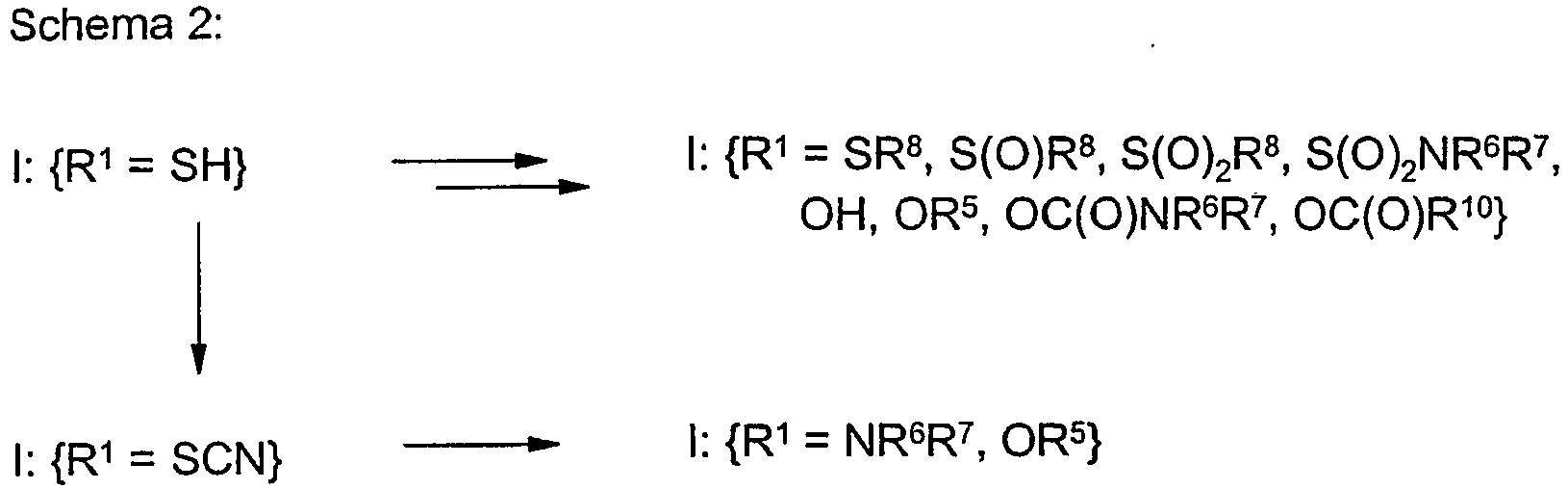
- Verfahren hierzu sind dem Fachmann bekannt und umfassen die Umwandlung von SH in SR8 via Alkylierung, die Oxidation von SR8 zu den korrespondierenden Gruppen SOR8 und SO2R6, den oxidativen Abbau von SH zu OH, mit gegebenenfalls sich anschließender Alkylierung oder Veresterung zu den Gruppen OR5, OC(O)NR6R7 oder OC(O)R10.
- In den Verbindungen I sowie in den Ausgangsmaterialien der Formel II, worin R1 für Cl, Br oder I steht, kann das Halogenatom in einer übergangsmetallkatalysierten Reaktion, z.B. in Gegenwart von elementarem Pd oder Pd-Verbindungen, z.B. in im Sinne einer Suzuki-Reaktion, einer Stille-Kupplung, oder einer Heck-Reaktion durch einen C-gebundenen organischen Rest R1 substituiert werden. Insbesondere kann man Verbindungen I sowie Pyridone II, worin R1 für einen gegebenenfalls substituierten Phenylring steht, durch Umsetzung der entsprechenden Halogenverbindung I bzw. II (R1 = Cl, Br oder I) mit einem Borat M[Aryl4B], worin M für ein Kation eines Alkalimetalls, z.B. für Na+ steht und Aryl gegebenenfalls substituiertes Phenyl bedeutet, unter Suzuki-Bedingungen (siehe Tetrahedron 1997, 53, 14437-50) herstellen. Diese modifizierte Suzuki-Kreuzkupplung zwischen einem Halogenpyridon I bzw. II und dem Borat erfolgt üblicherweise in wässrigen Lösungsmitteln in Gegenwart eines phosphinfreien Pd-Katalysators wie Palladium(II)-chlorid und in Gegenwart einer Base. Geeignete Basen sind beispielsweise Alkalimetallhydroxide wie Natriumhydroxid. Die Halogenpyridone II und Borate sind literaturbekannt.
- Sofern nichts anderes angegeben wird, erfolgen die oben beschriebenen Umsetzungen im allgemeinen in einem Lösungsmittel bei Temperaturen zwischen Raumtemperatur und der Siedetemperatur des verwendeten Lösungsmittels. Brauchbare Lösungsmittel sind beispielsweise Ether, wie Diethylether, Diisopropylether, Methyl-tert.-butylether oder Tetrahydrofuran, Dimethylformamid, Dimethylsulfoxid, Dimethoxyethan, Toluol, Xylol, Acetonitril, Ketone, wie Aceton oder Methylethylketon, oder Alkohole, wie Methanol, Ethanol oder Butanol.
- Die zur Umsetzung erforderliche Aktivierungsenergie kann mittels Mikrowellen in die Reaktionsmischung eingetragen werden (zur Umsetzung unter Einsatz von Mikrowellen, siehe Tetrahedron 2001, 57, S. 9199 ff, S. 9225 ff sowie allgemein "Microwaves in Organic Synthesis", André Loupy (Hrsg.), Wiley-VCH 2002).
- Gewünschtenfalls arbeitet man in Gegenwart einer Base zur Neutralisation von bei den Umsetzungen freiwerdenden Protonen. Geeignete Basen umfassen anorganische Basen, wie Natrium- oder Kaliumcarbonat, Natrium- oder Kaliumhydrogencarbonat, weiterhin Alkoholate wie Natriummethylat, Natriumethylat, Alkalimetallhydride wie Natriumhydrid, metallorganische Verbindungen, wie Butyllithium- oder Alkylmagnesium-Verbindungen, oder organische Stickstoffbasen, wie Triethylamin oder Pyridin. Letztere können gleichzeitig als Lösungsmittel dienen.
- Die Isolierung des Rohprodukts erfolgt in üblicher Weise, beispielsweise durch Filtration, Abdestillieren des Lösungsmittels oder Extraktion aus dem Reaktionsgemisch etc. Die Reinigung der erhaltenen Verbindungen kann in üblicher Weise erfolgen, beispielsweise durch Umkristallisieren aus einem Lösungsmittel, Chromatographie oder durch Überführen in eine Säureadditionssalz.
- Die Säureadditionssalze werden in üblicher Weise durch Mischen der freien Base mit der entsprechenden Säure, gegebenenfalls in Lösung in einem organischen Lösungsmittel, beispielsweise einem niedermolekularen Alkohol, wie Methanol, Ethanol oder Propanol, einem Ether, wie Methyl-tert-butylether, Diisopropylether, einem Keton, wie Aceton oder Methylethylketon oder einem Ester, wie Essigsäureethylester, hergestellt.
- Bei den erfindungsgemäßen Verbindungen der Formel I handelt es sich in der Regel um hochselektive Dopamin-D3-Rezeptor-Liganden, die auf Grund ihrer geringen Affinität gegenüber anderen Rezeptoren wie D1-Rezeptoren, D4-Rezeptoren, α1- und/oder α2-adrenergen-Rezeptoren, muskarinergen Rezeptoren, histaminischen Rezeptoren, Opiat-Rezeptoren und insbesondere gegenüber Dopamin-D2-Rezeptoren, nebenwirkungsärmer als die klassischen Neuroleptika sind, bei denen es sich um D2-Rezeptor-Antagonisten handelt.
- Die hohe Affinität der erfindungsgemäßen Verbindungen gegenüber D3-Rezeptoren spiegelt sich in sehr geringen in vitro Ki-Werte von in der Regel weniger als 100 nM (nmol/l), häufig weniger als 50 nM und vor allem von weniger als 10 nM wieder. Beispielsweise können Bindungsaffinitäten zu D3-Rezeptoren in Rezeptorbindungsstudien über die Verdrängung von [125I]-Iodosulpirid bestimmt werden.
- Erfindungsgemäß von besonderer Bedeutung sind Verbindungen deren Selektivität Ki(D2)/Ki(D3) in der Regel wenigstens 10, häufig wenigstens 30, vorteilhaft wenigstens 50 beträgt. Rezeptorbindungsstudien an D1-, D2- und D4-Rezeptoren können beispielsweise über die Verdrängung von [3H]SCH23390, [125I]Iodosulpirid bzw. [125I]Spiperon vorgenommen werden.
- Die Verbindungen sind aufgrund ihres Bindungsprofils zur Behandlung von Erkrankungen brauchbar, die auf Dopamin-D3-Liganden ansprechen, d. h. sie sind zur Behandlung von solchen Störungen bzw. Erkrankungen wirksam, bei denen eine Beeinflussung (Modulation) der Dopamin-D3-Rezeptoren zur Verbesserung des Krankheitsbilds oder zum Ausheilen der Krankheit führt. Derartige Erkrankungen sind z. B. Störungen oder Erkrankungen des zentralen Nervensystems.
- Unter Störungen bzw. Erkrankungen des zentralen Nervensystems versteht man Störungen, die das Rückenmark und vor allem das Gehirn betreffen. Der Begriff "Störung" im erfindungsgemäßen Sinne bezeichnet Anomalien, die in der Regel als krankhafte Zustände bzw. Funktionen angesehen werden, und sich in Form bestimmter Anzeichen, Symptome und/oder Fehlfunktionen zu erkennen geben können. Die erfindungsgemäße Behandlung kann auf einzelne Störungen, d. h. Anomalien bzw. krankhafte Zustände gerichtet sein, es können aber auch mehrere, gegebenenfalls ursächlich miteinander verbundene Anomalien zu Mustern, d.h. Syndromen, zusammengefasst sein, die erfindungsgemäß behandelt werden können.
- Zu den erfindungsgemäß behandelbaren Störungen gehören vor allem psychiatrische und neurologische Störungen. Hierzu zählen insbesondere organische Störungen, symptomatische Störungen eingeschlossen, wie Psychosen vom akuten exogenen Reaktionstyp oder Begleit-Psychosen organischer bzw. exogener Ursache, z. B. bei Stoffwechselstörungen, Infektionen und Endokrinopathien; endogene Psychosen, wie Schizophrenie sowie schizotype und wahnhafte Störungen; affektive Störungen, wie Depressionen, Manie bzw. manisch-depressive Zustände; sowie Mischformen der zuvor geschilderten Störungen; neurotische und somatoforme Störungen sowie Störungen bei Belastung; dissoziative Störungen, z.B. Bewusstseinsstörungen, -ausfälle, -eintrübungen und -spaltungen und Persönlichkeitsstörungen; Störungen von Aufmerksamkeit und Wach/Schlafverhalten, wie Verhaltensstörungen und emotionale Störungen, deren Beginn in der Kindheit und Jugend liegt, z.B. Hyperaktivität bei Kindern, intellektuelle Defizite, insbesondere Aufmerksamkeitsstörungen (attention deficit disorders), Gedächtnis- und kognitive Störungen, z.B. Lern- und Gedächtnisschwäche (impaired cognitive function), Demenz, Narkolepsie und Schlafstörungen, z.B. restless legs syndrome; Entwicklungsstörungen; Angstzustände; Delirium; Störungen des Sexuallebens, z.B. Impotenz des Mannes; Essstörungen, z.B. Anorexie oder Bulimie; Sucht; und weitere nicht näher bezeichnete psychiatrische Störungen.
- Zu den erfindungsgemäß behandelbaren Störungen gehören auch Parkinson und Epilepsie und insbesondere die damit in Zusammenhang stehenden affektiven Störungen.
- Zu Suchterkrankungen gehören die durch den Missbrauch von psychotropen Substanzen, wie Arzneimittel oder Drogen, verursachten psychischen Störungen und Verhaltensstörungen sowie andere Suchterkrankungen, wie beispielsweise die Spielsucht und die Impulsive-Kontrollstörung (Impulse Control Disorders not elsewhere classified). Suchterzeugende Substanzen sind beispielsweise: Opioide (z. B. Morphin, Heroin, Codein); Kokain; Nikotin; Alkohol; Substanzen, die mit dem GABA-Chlorid-Kanal-Komplex interagieren, Sedativa, Hypnotika oder Tranquilizer, beispielsweise Benzodiazepine; LSD; Cannabinoide; psychomotorische Stimulanzien, wie 3,4-Methylendioxy-N-methylamphetamin (Ecstasy); Amphetamin und amphetaminartigen Substanzen wie Methylphenidat oder sonstige Stimulanzien einschließlich Koffein. Als suchterzeugende Substanzen kommen insbesondere Opioide, Kokain, Amphetamin oder amphetaminartige Substanzen, Nikotin und Alkohol in Betracht.
- Im Hinblick auf die Behandlung von Suchterkrankungen sind unter den erfindungsgemäßen Verbindungen der Formel I solche besonders bevorzugt, die selbst keine psychotrope Wirkung besitzen. Dies kann im Test auch an Ratten beobachtet werden, die nach Verabreichung erfindungsgemäß brauchbarer Verbindungen die Selbstverabreichung von psychotropen Substanzen, beispielsweise Kokain, drosseln.
- Gemäß einem weiteren Aspekt der vorliegenden Erfindung sind die erfindungsgemäßen Verbindungen zur Behandlung von Störungen geeignet, deren Ursachen zumindest zum Teil auf eine anomale Aktivität von Dopamin-D3-Rezeptoren zurückzuführen sind.
- Gemäß einem anderen Aspekt der vorliegenden Erfindung richtet sich die Behandlung vor allem auf diejenigen Störungen, die sich über eine Bindung von vorzugsweise exogen zugesetzten Bindungspartnern (Liganden) an Dopamin-D3-Rezeptoren im Sinne einer zweckmäßigen medizinischen Behandlung beeinflussen lassen.
- Die mit den erfindungsgemäßen Verbindungen behandelbaren Erkrankungen sind häufig gekennzeichnet durch eine progressive Entwicklung, d.h. die vorstehend beschriebenen Zustände verändern sich im Laufe der Zeit, in der Regel nimmt der Schweregrad zu und gegebenenfalls können Zustände ineinander übergehen oder weitere Zustände zu bereits bestehenden Zuständen hinzutreten.
- Durch die erfindungsgemäßen Verbindungen lassen sich eine Vielzahl von Anzeichen, Symptomen und/oder Fehlfunktionen behandeln, die mit den Störungen des zentralen Nervensystems und insbesondere den vorstehend genannten Zuständen zusammenhängen. Hierzu gehören beispielsweise ein gestörter Realitätsbezug, mangelnde Einsicht und Fähigkeit, üblichen sozialen Normen bzw. Lebensanforderungen zu genügen, Wesensveränderungen, Veränderungen der Einzeltriebe, wie Hunger, Schlaf, Durst, etc., und der Stimmungslage, Störungen der Merk- und Kombinationsfähigkeit, Persönlichkeitsveränderungen, insbesondere Affektlabilität, Halluzinationen, Ich-Störungen, Zerfahrenheit, Ambivalenz, Autismus, Depersonalisation bzw. Sinnestäuschungen, Wahnideen, skandierende Sprache, fehlende Mitbewegung, kleinschrittiger Gang, Beugehaltung von Rumpf und Gliedern, Tremor, Mimikarmut, monotone Sprache, Depressionen, Apathie, erschwerte Spontanität und Entschlusskraft, verarmte Assoziationsfähigkeit, Angst, nervöse Unruhe, Stottern, soziale Phobie, Panikstörungen, Entzugssyndrome bei Abhängigkeit, maniforme Syndrome, Erregungs- und Verwirrtheitszustände, Dysphorie, dyskinetische Syndrome und Tic-Störungen, z.B. Chorea-Huntington, Gilles-de-la-Tourette-Syndrom, Schwindelsyndrome, z.B. peripherer Lage-, Dreh- und Schwankschwindel, Melancholie, Hysterie, Hypochondrie und ähnliches.
- Eine Behandlung im erfindungsgemäßen Sinne umfasst nicht nur die Behandlung akuter oder chronischer Anzeichen, Symptome und/oder Fehlfunktionen sondern auch eine vorbeugende Behandlung (Prophylaxe), insbesondere als Rezidiv- oder Phasen-Prophylaxe. Die Behandlung kann symptomatisch, beispielsweise als Symptomsuppression ausgerichtet sein. Sie kann kurzzeitig erfolgen, mittelfristig ausgerichtet sein, oder es kann sich auch um eine Langzeitbehandlung, beispielsweise im Rahmen einer Erhaltungstherapie, handeln.
- Vorzugsweise eignen sich die erfindungsgemäßen Verbindungen zur Behandlung von Erkrankungen des zentralen Nervensystems, insbesondere zur Behandlung von affektiven Störungen; neurotischen, Belastungs- und somatoformen Störungen und Psychosen und speziell zur Behandlung der Schizophrenie und der Depression. Aufgrund ihrer hohen Selektivität bezüglich des D3-Rezeptors sind die erfindungsgemäßen Verbindungen I auch zur Behandlung von Nierenfunktionsstörungen, insbesondere von Nierenfunktionsstörungen, die durch Diabetes mellitus hervorgerufen wird (siehe
WO 00/67847 - Die erfindungsgemäße Verwendung der beschriebenen Verbindungen beinhaltet im Rahmen der Behandlung ein Verfahren. Dabei wird dem zu behandelnden Individuum, vorzugsweise einem Säuger, insbesondere einem Menschen, Nutz- oder Haustier, eine wirksame Menge eines oder mehrerer Verbindungen, in der Regel der pharmazeutischen und tierarzneilichen Praxis entsprechend formuliert, verabreicht. Ob eine solche Behandlung angezeigt ist und in welcher Form sie zu erfolgen hat, hängt vom Einzelfall ab und unterliegt einer medizinischen Beurteilung (Diagnose), die vorhandene Anzeichen, Symptome und/oder Fehlfunktionen, Risiken, bestimmte Anzeichen, Symptome und/oder Fehlfunktionen zu entwickeln, und weitere Faktoren miteinbezieht.
- Die Behandlung erfolgt in der Regel durch einmalige oder mehrmalige tägliche Verabreichung, gegebenenfalls zusammen oder im Wechsel mit anderen Wirkstoffen oder wirkstoffhaltigen Präparaten, so dass einem zu behandelnden Individuum eine Tagesdosis von vorzugsweise etwa 0,1 bis 1000 mg/kg Körpergewicht bei oraler Gabe bzw. von etwa 0,1 bis 100 mg/kg Körpergewicht bei parenteraler Gabe zugeführt wird.
- Die Erfindung betrifft auch die Herstellung pharmazeutischer Mittel zur Behandlung eines Individuums, vorzugsweise eines Säugers, insbesondere eines Menschen, Nutz- oder Haustieres. So werden die Liganden gewöhnlich in Form von pharmazeutischen Zusammensetzungen verabreicht, die einen pharmazeutisch verträglichen Exzipienten mit wenigstens einem erfindungsgemäßen Liganden und gegebenenfalls weiteren Wirkstoffen umfassen. Diese Zusammensetzungen können beispielsweise auf oralem, rektalem, transdermalem, subkutanem, intravenösem, intramuskulärem oder intranasalem Weg verabreicht werden.
- Beispiele geeigneter pharmazeutischer Formulierungen sind feste Arzneiformen, wie Pulver, Puder, Granulate, Tabletten, insbesondere Filmtabletten, Pastillen, Sachets, Cachets, Dragees, Kapseln wie Hart- und Weichgelatinekapseln, Suppositorien oder vaginale Arzneiformen, halbfeste Arzneiformen, wie Salben, Cremes, Hydrogele, Pasten oder Pflaster, sowie flüssige Arzneiformen, wie Lösungen, Emulsionen, insbesondere Öl-in-Wasser-Emulsionen, Suspensionen, beispielsweise Lotionen, Injektions- und Infusionszubereitungen, Augen- und Ohrentropfen. Auch implantierte Abgabevorrichtungen können zur Verabreichung erfindungsgemäßer Verbindungen verwendet werden. Ferner können auch Liposomen oder Mikrosphären zur Anwendung kommen.
- Bei der Herstellung der Zusammensetzungen werden erfindungsgemäße Verbindungen gewöhnlich mit einem Exzipienten vermischt oder verdünnt. Exzipienten können feste, halbfeste oder flüssige Materialien sein, die als Vehikel, Träger oder Medium für den Wirkstoff dienen.
- Geeignete Exzipienten sind in den einschlägigen Arzneimonographien gelistet. Ferner können die Formulierungen pharmazeutisch akzeptable Träger oder übliche Hilfsstoffe, wie Gleitmittel; Netzmittel; emulgierende und suspendierende Mittel; konservierende Mittel; Antioxidantien; Antireizstoffe; Chelatbildner; Dragierhilfsmittel; Emulsionsstabilisatoren; Filmbildner; Gelbildner; Geruchsmaskierungsmittel; Geschmackskorrigentien; Harze; Hydrokolloide; Lösemittel; Lösungsvermittler; Neutralisierungsmittel; Permeationsbeschleuniger; Pigmente; quaternäre Ammoniumverbindungen; Rückfettungs- und Überfettungsmittel; Salben-, Creme- oder Öl-Grundstoffe; Silikon-Derivate; Spreithilfsmittel; Stabilisatoren; Sterilanzien; Suppositoriengrundlagen; Tabletten-Hilfsstoffe, wie Bindemittel, Füllstoffe, Gleitmittel, Sprengmittel oder Überzüge; Treibmittel; Trocknungsmittel; Trübungsmittel; Verdickungsmittel; Wachse; Weichmacher; Weißöle umfassen. Eine diesbezügliche Ausgestaltung beruht auf fachmännischem Wissen, wie beispielsweise in Fiedler, H.P., Lexikon der Hilfsstoffe für Pharmazie, Kosmetik und angrenzende Gebiete, 4. Auflage, Aulendorf: ECV-Editio-Kantor-Verlag, 1996, dargestellt ist.
- Die nachfolgenden Beispiele dienen zur Erläuterung der Erfindung ohne sie zu begrenzen.
- Die magnetischen Kernresonanzspektraleigenschaften (NMR) beziehen sich auf chemische Verschiebungen (δ), ausgedrückt in Teile pro Million (ppm). Die relative Fläche für die Verschiebungen in dem 1H-NMR-Spektrum entspricht der Anzahl der Wasserstoffatome für einen bestimmten funktionalen Typ in dem Molekül. Die Art der Verschiebung hinsichtlich der Multiplizität ist angegeben als Singulett (s), breites Singulett (s. br.), Dublett (d), breites Dublett (d br.), Triplett (t), breites Triplett (t br.), Quartett (q), Quintett (quint.), Multiplett (m).
- Man rührte ein Gemisch aus 2-Hydroxy-4-methylpyridin (1,50 g, 13,75 mmol) und Kaliumcarbonat (1,90 g, 13,75 mmol) in 13 ml Methanol 15 Minuten bei Raumtemperatur und gab danach 1-Brom-4-chlorbutan (3,54 g, 20,62 mmol) und eine Spatelspitze Kalimiodid zu. Das Reaktionsgemisch erhitzte man 6 Stunden am Rückfluss und rührte danach 12 Stunden bei Raumtemperatur nach. Anschließend versetzte man das Reaktionsgemisch mit Wasser und extrahierte das wässrige Gemisch mit Dichlormethan. Nach dem Trocknen der organischen Phase und Abfiltrieren des Trockenmittels engte man die organische Phase im Vakuum ein. Die Flash-Chromatographie des erhaltenen Rückstands an Kieselgel (Eluierungsmittel: CH2Cl2/CH3OH: 98:2) ergab 2,0 g 1-(4-Chlorbutyl)-4-methylpyridin-2(1H)-on.
- 1H-NMR (400 MHz, CDCl3) δ (ppm): 7,13 (1H, d), 6,37 (1H, s), 6,02 (1H, d), 3,95 (2H, t), 3,56 (2H, t), 2,17 (3H, s), 1,90 (2H, quint.), 1,83 (2H, quint.).
- 1-(4-Chlorbutyl)-4-methylpyridin-2(1H)-on (0,99 g, 4,96 mmol) aus Beispiel 1.1, 2-tert-Butyl-4-piperazin-1-yl-6-(trifluormethyl)pyrimidin (1,36 g, 4,71 mmol; hergestellt wie in
DE 19735410 beschrieben) und Triethylamin (1,51 g, 14,87 mmol) in 25 ml Dimethylsulfoxid wurden 5 Stunden bei 100 °C gerührt. Danach versetzte man das Reaktionsgemisch mit Wasser und extrahierte das wässrige Gemisch zweimal mit tert.-Butyl-methylether. Die organische Phase extrahierte man dreimal mit einer gesättigten wässrigen KochsalzLösung und danach dreimal mit einer 5%igen wässrigen Zitronensäure-Lösung. Anschließend stellte man die wässrige Phase alkalisch und extrahierte sie dreimal mit tert.-Butyl-methylether. Die vereinten organischen Phasen trocknete man über Na2SO4, filtrierte das Trockenmittel ab und engte ein. Den erhaltenen öligen Rückstand (1,99 g) reinigte man durch Chromatographie an Kieselgel (Eluierungsmittel: CH2Cl2/CH3OH: 96,5:3,5), wobei man 1,29 g der Titelverbindung erhielt. - 1H-NMR (500 MHz, CDCl3) δ (ppm): 7,15 (1H, d), 6,59 (1H, s), 6,34 (1H, s), 6,00 (1H, d), 3,92 (2H, t), 3,70 (4H, s br.), 2,50 (4H, t), 2,41 (2H, t), 2,18 (3H, s), 1,80 (2H, quint.), 1,57 (2H, quint.), 1,33 (9H, s).
- Analog zu Beispiel 1.1 erhielt man durch Umsetzung von 5-(Trifluormethyl)-2-pyridinol (1,63 g, 10 mmol) mit 1-Brom-4-chlorbutan 1,95 g der Titelverbindung.
- ESI-MS: [M+H+] = 254,1.
- Analog zu Beispiel 1.2 erhielt man aus durch Umsetzung von 1-(4-Chlorbutyl)-5-(trifluormethyl)pyridin-2(1H)-on (0,65 g, 2,56 mmol) aus Beispiel 2.1 0,39 g der Titelverbindung.
- 1H-NMR (500 MHz, CDCl3) δ (ppm): 7,66 (1H, s), 7,45 (1H, d), 6,63 (1H, d), 6,58 (1H, s), 4,00 (2H, t), 3,73 (4H, s br.), 2,51 (4H, t), 2,43 (2H, t), 1,83 (2H, quint.), 1,60 (2H, quint.), 1,32 (9H, s).
- Analog zu Beispiel 1.2 erhielt man durch Umsetzung von 1-(4-Chlorbutyl)-4-methylpyridin-2(1H)-on (2,50 mmol, 0,50 g) aus Beispiel 1.1 mit 2-tert-Butyl-4-piperazin-1-yl-6-propylpyrimidin (0,62 g, 2,38 mmol; hergestellt wie in
DE 19735410 beschrieben) 0,74 g der Titelverbindung. - ESI-MS: 427,5, [M+H+] = 426,5, 213,8.
- Analog zu Beispiel 1.2 erhielt man durch Umsetzung von 1-(4-Chlorbutyl)-4-methylpyridin-2(1H)-on (1,25 mmol, 0,25 g) aus Beispiel 1.1 mit 2-tert-Butyl-4-piperazin-1-yl-6-isopropylpyrimidin (0,31 g, 1,19 mmol; hergestellt wie in
DE 19735410 beschrieben) 0,38 g der Titelverbindung. - ESI-MS: 427,4, [M+H+] = 426,2, 213,8.
- Zu einer Suspension aus Natriumhydrid (20 mmol, 0,74 g, 60 %, entölt) in N,N-Dimethylformamid (100 ml) tropfte man bei 10 °C innerhalb 10 Minuten 3-Methoxy-1H-pyridin-2-on (20 mmol, 2,00 g) in 100 ml N,N-Dimethylformamid und rührte danach 1 Stunde bei Raumtemperatur nach. Anschließend tropfte man 1-Brom-4-chlorbutan (20 mmol, 3,19 g) in 40 ml N,N-Dimethylformamid zu. Das Reaktionsgemisch rührte man danach bei 95 °C nach. Nach dem Einengen des Reaktionsgemischs suspendierte man das verbliebene Öl in Diethylether. Die erhaltene Suspension wurde abfiltriert und das Filtrat dreimal mit Wasser und danach dreimal mit einer gesättigten wässrigen KochsalzLösung gewaschen. Nach dem Trocknen der organischen Phase über Natriumsulfat filtrierte man das Trockenmittel ab und engte ein. Der erhaltene Rückstand enthielt ein Gemisch aus O-alkylierter und N-alkylierter Verbindung. Die Chromatographie des Rückstandes an Kieselgel (Eluierungsmittel: CH2Cl2/CH3OH: 0-2%) ergab 1,75 g der Titelverbindung.
- 1H-NMR (400 MHz, CDCl3) δ (ppm): 6,88 (1H, d), 6,60 (1H, d), 6,12 (1H, t), 4,02 (2H, t), 3,81 (3H, s), 3,57 (1H, t), 3,44 (1H, t), 2,02-1,72 (4H, m).
- Man erhitzte ein Gemisch aus 1-(4-Chlorbutyl)-3-methoxy-1H-pyridin-2-on (0,93 mmol, 0,20 g) aus Beispiel 5.1, 2-tert-Butyl-4-piperazin-1-yl-6-propylpyrimidin (0,93 mmol, 0,24 g; hergestellt wie in
DE 19735410 beschrieben), Natriumbromid (4,64 mmol, 0,48 g), Ethyldiisopropylamin (9,09 mmol, 1,17 g) und N-Methylpyrrolidinon (0,5 ml) 6 Stunden auf 120°C. Die erhaltene Suspension saugte man ab und engte das Filtrat ein. Den auf diese Weise erhaltenen Rückstand nahm man in Ethylacetat/Wasser auf. Das wässrige Gemisch stellte man mit Natriumhydrogencarbonat auf pH 5,5 und extrahierte mehrmals das wässrige Gemisch mit Diethylether. Danach trocknete man die organische Phase, filtrierte das Trockenmittel ab und engte die organische Phase unter vermindertem Druck ein. Die Chromatographie des Rückstandes an Kieselgel (Eluierungsmittel: CH2Cl2/CH3OH (0-2%) ergab 0,24 g der Titelverbindung. - ESI-MS: [M+H+] = 442,4, 221,6.
- Analog zu Beispiel 5.2 erhielt man durch Umsetzung von 1-(4-Chlorbutyl)-3-methoxy-1H-pyridin-2-on (0,93 mmol, 0,20 g) aus Beispiel 5.1 mit 2-tert-Butyl-4-piperazin-1-yl-6-(trifluormethyl)pyrimidin (0,93 mmol, 0,27g; hergestellt wie in
DE 19735410 beschrieben) 0,25 g der Titelverbindung. - ESI-MS: [M+H+] = 468,2;
- 1H-NMR (400 MHz, DMSO-d6) δ (ppm): 7,27 (1H, d), 6,80 (1H, d), 6,15 (1H, t), 4,66 (2H, s br.), 3,90 (2H, t), 3,57-3,36 (4H, m), 3,17-2,95 (4H, m), 1,64 (4H, m sym.), 1,29 (9H, s).
- Analog zu Beispiel 1.1 erhielt man durch Umsetzung von 3-Methyl-1H-pyridin-2-on (17,96 mmol, 2,00 g) mit 1-Brom-4-chlorbutan 1,98 g der Titelverbindung.
- ESI-MS: [M+H+] = 200,05;
- 1H-NMR (400 MHz, CDCl3) δ (ppm): 7,19 (1H, d), 7,13 (1H, d), 6,10 (1H, t), 3,99 (2H, t), 3,58 (2H, t), 2,16 (3H, s), 2,05-1,75 (4H, m).
- Analog zu Beispiel 5.2 erhielt man durch Umsetzung von 1-(4-Chlorbutyl)-3-methyl-1H-pyridin-2-on (1,00 mmol, 0,20 g) aus Beispiel 7.1 mit 2-tert-Butyl-4-piperazin-1-yl-6-propylpyrimidin (1,00 mmol, 0,26 g; hergestellt wie in
DE 19735410 beschrieben) 0,19 g der Titelverbindung. - ESI-MS: [M+H+] = 426,4, 213,8.
- Analog zu Beispiel 1.1 erhielt man durch Umsetzung von 4-Chlorpyridin-2-ol (1,54 mmol, 0,20 g) mit 1-Brom-4-chlorbutan 0,20 g der Titelverbindung.
- 1H-NMR (400 MHz, CDCl3) δ (ppm): 7,20 (1H, d), 6,60 (1H, s), 6,20 (1H, d), 3,94 (2H, t), 3,58 (2H, t), 1,90 (2H, quint.), 1,81 (2H, quint.).
- Analog zu Beispiel 5.2 erhielt man durch Umsetzung von 4-Chlor-1-(4-chlorbutyl)-1H-pyridin-2-on (0,45 mmol, 0,10 g) aus Beispiel 8.1 mit 2-tert-Butyl-4-piperazin-1-yl-6-propylpyrimidin (0,43 mmol, 0,11g; hergestellt wie in
DE 19735410 beschrieben) 0,16 g der Titelverbindung. - ESI-MS: 448,2, 446,3, 224,6, 223,6;
- 1H-NMR (400 MHz, CDCl3) δ (ppm): 7,20 (1H, d), 6,60 (1H, s), 6,18 (1H, d), 6,12 (1H, s), 3,95 (2H, t), 3,60 (4H, s br.), 2,60-2,33 (8H, m einschließlich 2,53 (2H, t), 2,40 (2H, t)), 1,83-1,49 (6H, m), 1,33 (9H, s), 0,97 (3H, t).
- Analog zu Beispiel 5.2 erhielt man durch Umsetzung von 4-Chlor-1-(4-chlorbutyl)-1H-pyridin-2-on (0,45 mmol, 0,10 g) aus Beispiel 8.1 mit 2-tert-Butyl-4-piperazin-1-yl-6-(trifluormethyl)pyrimidin (0,43 mmol, 0,11 g; hergestellt wie in
DE 19735410 beschrieben) 0,12 g der Titelverbindung. - ESI-MS: 474,2, 472,2, 237,4, 236,6;
- 1H-NMR (400 MHz, CDCl3) δ (ppm): 7,20 (1H, d), 6,60 (1H, s), 6,58 (1H, s), 6,19 (1H, d), 3,94 (2H, t), 3,68 (4H, s br.), 2,47 (2H, t), 2,39 (2H, t), 1,77 (2H, quint.), 1,65 (2H+H2O, quint.), 1,33 (9H, s).
- Analog zu Beispiel 1.1 erhielt man durch Umsetzung von 4-Hydroxy-1H-pyridin-2-on (18,00 mmol, 2,00 g) mit 1-Brom-4-chlorbutan 1,30 g der Titelverbindung.
- Analog zu Beispiel 5.2 erhielt man durch Umsetzung von 1-(4-Chlorbutyl)-4-hydroxy-1H-pyridin-2-on (2,48 mmol, 0,50 g) aus Beispiel 10.1 mit 2-tert-Butyl-4-piperazin-1-yl-6-propylpyrimidin (2,48 mmol, 0,65 g; hergestellt wie in
DE 19735410 beschrieben) 0,40 g der Titelverbindung. - ESI-MS: [M+H+] = 428,4, 214,6;
- 1H-NMR (400 MHz, DMSO-d6) δ (ppm): 11,93 (1H, s br.), 7,17 (1H, d), 6,12 (1H, s), 5,95 (1H, d), 5,87 (1H, s), 3,97 (2H, t), 3,62 (4H, s br.), 2,63-2,36 (8H, m), 1,81 (2H, quint.), 1,66 (4H+H2O, quint.), 1,33 (9H, s), 0,96 (3H, t).
- Analog zu Beispiel 5.2 erhielt man durch Umsetzung von 1-(4-Chlorbutyl)-3-methyl-1H-pyridin-2-on (1,50 mmol, 0,30 g) aus Beispiel 7.1 mit 2-tert-Butyl-4-piperazin-1-yl-6-(trifluormethyl)pyrimidin (1,53 mmol, 0,44 g; hergestellt wie in
DE 19735410 beschrieben) 0,34 g der Titelverbindung. - ESI-MS: [M+H+] = 452,2, 226,6;
- 1H-NMR (400 MHz, DMSO-d6) δ (ppm): 7,50 (1H, d), 7,27 (1H, d), 7,03 (1H, s), 6,11 (1H, t), 3,87 (2H, t), 3,68 (4H, s br.), 2,57-2,35 (6H, m einschließlich 2,36 (2H, t)), 1,98 (3H, s), 1,62 (2H, quint.), 1,43 (2H, quint.), 1,25 (9H, s).
- Analog zu Beispiel 5.2 erhielt man durch Umsetzung von 1-(4-Chlorbutyl)-4-hydroxy-1H-pyridin-2-on (1,24 mmol, 0,25 g) aus Beispiel 10.1 mit 2-tert-Butyl-4-piperazin-1-yl-6-(trifluormethyl)pyrimidin (1,24 mmol, 0,36 g; hergestellt wie in
DE 19735410 beschrieben) 0,30 g der Titelverbindung. - ESI-MS: [M+H+] = 454,2, 227,6;
- 1H-NMR (400 MHz, DMSO-d6) δ (ppm): 12,04 (1H, s br.), 7,17 (1H, d), 6,58 (1H, s), 5,95 (1H, d), 5,86 (1H, s), 3,99 (2H, t), 3,71 (4H, s br.), 2,52 (4H, s br.), 2,43 (2H, t), 1,82 (2H, quint.), 1,77-1,51 (2H+H2O, m), 1,35 (9H, s).
- Analog zu Beispiel 1.1 erhielt man durch Umsetzung von 3-Trifluormethyl-1H-pyridin-2-on (6,13 mmol, 1,00 g) mit 1-Brom-4-chlorbutan 1,10 g der Titelverbindung.
- ESI-MS (N-Alk.): [M+H+] = 254,1;
- 1H-NMR (400 MHz, CDCl3) δ (ppm): 7,73 (1H, d), 7,47 (1H, d), 6,24 (1H, t), 4,03 (2H, t), 3,60 (2H, t), 1,95 (2H, q), 1,82 (2H, q).
- ESI-MS (O-Alk.): [M+Na+] = 276,1, 256,1, [M+H+] = 254,1.
- Analog zu Beispiel 5.2 erhielt man durch Umsetzung von 1-(4-Chlorbutyl)-3-trifluormethyl-1H-pyridin-2-on (0,59 mmol, 0,15 g) aus Beispiel 13.1 mit 2-tert-Butyl-4-piperazin-1-yl-6-(trifluormethyl)pyrimidin (0,59 mmol, 0,17 g; hergestellt wie in
DE 19735410 beschrieben) 0,17 g der Titelverbindung. - ESI-MS: [M+H+] = 506,2, 253,6;
- 1H-NMR (400 MHz, CDCl3) δ (ppm): 7,75 (1H, d), 7,50 (1H, d), 6,68 (1H, s), 6,22 (1H, t), 4,01 (2H, t), 3,68 (4H, s br.), 2,51 (4H, s br.), 2,43 (2H, t), 1,84 (2H, quint.), 1,72-1,46 (2H+H2O, s br.), 1,33 (9H, s).
- Analog zu Beispiel 5.2 erhielt man durch Umsetzung von 1-(4-Chlorbutyl)-3-trifluormethyl-1H-pyridin-2-on (0,59 mmol, 0,15 g) aus Beispiel 13.1 mit 2-tert-Butyl-4-piperazin-1-yl-6-propylpyrimidin (0,59 mmol, 0,16 g; hergestellt wie in
DE 19735410 beschrieben) 0,15 g der Titelverbindung. - ESI-MS: [M+H+] = 480,2, 240,6;
- 1H-NMR (400 MHz, DMSO-d6) δ (ppm): 8,04 (1H, d), 7,91 (1H, d), 6,43 (1H, s), 6,35 (1H, t), 3,97 (2H, t), 3,57 (4H, s br.), 2,56-2,27 (6H, m einschließlich 2,33 (2H, t)), 1,74-1,55 (4H, m), 1,45 (2H, quint.), 1,25 (9H, s), 0,90 (3H, t).
- Analog zur Herstellungsvorschrift aus Beispiel 1.1 erhielt man durch Umsetzung von 4-Trifluoromethyl-1H-pyridin-2-one (3,07 mmol, 0,50 g) mit 1-Brom-4-chlorbutan die Titelverbindung in einer Ausbeute von 0,45 g.
- Analog zur Herstellungsvorschrift aus Beispiel 5.2 erhielt man durch Umsetzung von 1-(4-Chlorbutyl)-4-trifluormethyl-1H-pyridin-2-on (0,63 mmol, 0,16g) mit 2-tert-Butyl-4-piperazin-1-yl-6-propylpyrimidin (0,60 mmol, 0,16g, Herstellung nach
DE 19735410 ) die Titleverbindung in einer Ausbeute von 0,24 g. - ESI-MS: [M+H+] = 480,25, 240,65;
- 1H-NMR (400 MHz, DMSO-d6) δ (ppm): 7,96 (1H, d), 6,76 (1H, s), 6,47 (1H, m), 6,44 (1H, s), 3,96 (2H, t), 3,56 (4H, s), 2,58-2,23 (8H, m), 1,74-1,38 (6H, m), 1,25 (9H, s), 0,89 (3H, t).
- Analog zu der Herstellungsvorschrift in Beispiel 1.2 erhielt man durch Umsetzung von 1-(4-Chlorbutyl)-4-trifluoromethyl-1H-pyridin-2-on (0,63 mmol, 0,16 g) mit 2-tert-Butyl-4-piperazin-1-yl-6-trifluormethylpyrimidin (0,60 mmol, 0,17 g, Herstellung nach
DE 19735410 ) die Titelverbindung in einer Ausbeute von 0,12 g. - ESI-MS: [M+Na+] = 528,2, 507,2, [M+H+] = 506,1, 253,6;
- Analog zu Beispiel 1.1 erhielt man durch Umsetzung von 5-Chlor-1H-pyridin-2-on (15,44 mmol, 2,00 g) mit 1-Brom-4-chlorbutan 1,63 g der Titelverbindung.
- ESI-MS: [M+H+] = 221,9, 220,9, 219,9;
- Analog zur Vorschrift aus Beispiel 1.2 erhielt man durch Umsetzung von 5-Chlor-1-(4-chlor-butyl)-1H-pyridin-2-on (0,91 mmol, 0,20 g) mit 2-tert-Butyl-4-piperazin-1-yl-6-propylpyrimidin (0,82 mmol, 0,21 g, Herstellung nach
DE 19735410 ) in einer Ausbeute von 0,35g. - ESI-MS: 448,2, [M+H+] = 446,3, 244,4, 223,6;
- 1H-NMR (400 MHz, DMSO-d6) δ (ppm): 7,96 (1H, d), 7,46 (1H, dd), 6,46-6,35 (2H, m), 3,86 (2H, t), 3,58 (4H, s br.), 2,45 (6H, s br.), 1,63 (4H, sext.), 1,43 (2H, quint.), 1,24 (9H, s), 0,90 (3H, t).
- Analog zur Vorschrift aus Beispiel 1.2 erhielt man durch Umsetzung von 5-Chlor-1-(4-chlor-butyl)-1H-pyridin-2-on (0,91 mmol, 0,20 g) und 2-tert-Butyl-4-piperazin-1-yl-6-trifluormethyl-pyrimidin (0,82 mmol, 0,24 g, Herstellung nach
DE 19735410 die Titelverbindung in einer Ausbeute von 0,23 g. - ESI-MS: 474,1, [M+H+] = 472,1, 237,4, 236,6;
- 1H-NMR (500 MHz, DMSO-d6) δ (ppm): 7,97 (1H, s), 7,44 (1H, d), 7,04 (1H, s), 6,41 (1H, d), 3,86 (2H, t), 3,70 (4H, s br.), 2,44 (4H, m sym.), 2,34 (2H, t), 1,65 (2H, quint.), 1,44 (2H, quint.), 1,28 (9H, s).
- Analog zu Beispiel 1.1 erhielt man durch Umsetzung von 4-Phenyl-1H-pyridin-2-on (0,41 mmol, 71,0 mg, hergestellt nach Tetrahedron 1997, 53, S.14437-50, aus 4-Chlor-1H-pyridin-2-on) mit 1-Brom-4-chlorbutan 34 mg der Titelverbindung.
- ESI-MS: 202,1,[M+H+] = 200,1;
- Analog zur Vorschrift aus Beispiel 1.2 erhält man durch Umsetzung von 1-(4-Chlorbutyl)-4-phenyl-1H-pyridin-2-on (0,13 mmol, 34,0 mg) mit 2-tert-Butyl-4-piperazin-1-yl-trifluormethylpyrimidine (0,13 mmol, 37,5 mg, Herstellung nach
DE 19735410 ) die Titelverbindung in einer Ausbeute von 12 mg. - ESI-MS: [M+Na+] = 536,2, 515,2,[M+H+] = 514,2, 257,6;
- 1H-NMR (400 MHz, DMSO-d6) δ (ppm): 7,77 (1H, d), 7,72 (2H, d), 7,53-7,41 (3H, m), 7,03 (1H, s br.), 6,66 (1H, s), 6,58 (1H, d), 3,93 (2H, t), 3,70 (4H, s br.), 2,41 (4H, s br.), 2,33 (2H, m), 1,68 (2H, quint.), 1,48 (2H, m), 1,27 (9H, s).
- Analog zu Beispiel 1.1 erhielt man durch Umsetzung von 6-Methyl-1H-pyridin-2-on (18,33 mmol, 2,00 g) mit 1-Brom-4-chlorbutan 0,40 g der Titelverbindung.
- ESI-MS: 202,1,[M+H+] = 200,1;
- Analog zur Vorschrift aus Beispiel 1.2 erhält man durch Umsetzung von 1-(4-Chlorbutyl)-6-methyl-1H-pyridin-2-on (0,75 mmol, 0,15 mg) mit 2-tert-Butyl-4-piperazin-1-yl-6-propylpyrimidin (0,67 mmol, 0,18 g, Herstellung nach
DE 19735410 ) die Titelverbindung in einer Ausbeute von 0,18 g. - ESI-MS: 427,4,[M+H+] = 426,4, 213,6;
- 1H-NMR (500 MHz, DMSO-d6) δ (ppm): 7,24 (1H, m sym.), 6,43 (1H, s), 6,21 (1H, d), 6,06 (1H, d), 3,96 (2H, t), 3,59 (4H, s br.), 2,47 (8H, m), 2,37 (3H, s), 1,66-1,49 (6H, m), 1,27 (9H, s), 0,90 (3H, t).
- Analog zur Vorschrift aus Beispiel 1.2 erhält man durch Umsetzung von 1-(4-Chlorobutyl)-6-methyl-1H-pyridin-2-on 0,75 mmol, 0,15 mg) mit 2-tert-Butyl-4-piperazin-1-yl-6-trifluoromethyl-pyrimidin (0,68 mmol, 0,19 g, Herstellung nach
DE 19735410 ) die Titelverbindung in einer Ausbeute von 0,24 g. - ESI-MS: [M+H+] = 452,2, 226,6;
- 1H-NMR (500 MHz, DMSO-d6) δ (ppm): 7,23 (1H, m sym.), 7,03 (1H, s), 6,21 (1H, d), 6,08 (1H, d), 3,96 (2H, t), 3,72 (4H, s br.), 2,46 (4H, m), 2,41-2,34 (5H, m), 1,59 (2H, quint.), 1,52 (2H, quint.), 1,28 (9H, s).
- Auf einer Tablettenpresse werden in üblicher Weise Tabletten folgender Zusammensetzung gepresst:
- 40 mg Substanz des Beispiels 2
- 120 mg Maisstärke
- 13,5 mg Gelatine
- 45 mg Milchzucker
- 2,25 mg Aerosil® (chemisch reine Kieselsäure in submikroskopisch feiner Verteilung)
- 6,75 mg Kartoffelstärke (als 6%iger Kleister)
-
- 20 mg Substanz des Beispiels 2
- 60 mg Kernmasse
- 70 mg Verzuckerungsmasse
- Die Kernmasse besteht aus 9 Teilen Maisstärke, 3 Teilen Milchzucker und 1 Teil Vinylpyrrolidon-Vinylacetat-Mischpolymerisat 60:40. Die Verzuckerungsmasse besteht aus 5 Teilen Rohrzucker, 2 Teilen Maisstärke, 2 Teilen Calciumcarbonat und 1 Teil Talk. Die so hergestellten Dragees werden anschließend mit einem magensaftresistenten Überzug versehen.
- Die zu testende Substanz wurde entweder in Methanol/Chremophor® (BASF-AG) oder in Dimethylsulfoxid gelöst und anschließend mit Wasser auf die gewünschte Konzentration verdünnt.
- Der Ansatz (0,250 ml) setzte sich zusammen aus Membranen von ∼ 106 HEK-293 Zellen mit stabil exprimierten humanen Dopamin-D3-Rezeptoren, 0,1 nM [125I]-Jodosulpirid und Inkubationspuffer (totale Bindung) oder zusätzlich Testsubstanz (Hemmkurve) oder 1µM Spiperon (unspezifische Bindung). Dreifach-Ansätze wurden durchgeführt.
- Der Inkubationspuffer enthielt 50 mM Tris, 120 mM NaCl, 5 mM KCI, 2 mM CaCl2, 2 mM MgCl2 und 0,1% Rinderserumalbumin, 10 µM Quinolone, 0.1 % Ascorbinsäure (täglich frisch hergestellt). Der Puffer wurde mit HCl auf pH 7,4 eingestellt.
- Der Ansatz (1 ml) setzte sich zusammen aus Membranen von - 106 HEK-293 Zellen mit stabil exprimierten humanen Dopamin-D2L Rezeptoren (lange Isoform) sowie 0,01 nM [125I]-Jodospiperon und Inkubationspuffer (totale Bindung) oder zusätzlich Testsubstanz (Hemmkurve) oder 1µM Haloperidol (unspezifische Bindung). Dreifach-Ansätze wurden durchgeführt.
- Der Inkubationspuffer enthielt 50 mM Tris, 120 mM NaCl, 5 mM KCI, 2 mM CaCl2, 2 mM MgCl2 und 0, 1 % Rinderserumalbumin. Der Puffer wurde mit HCl auf pH 7,4 eingestellt.
- Nach Inkubation für 60 Minuten bei 25 °C wurden die Ansätze mit einem Zellsammelgerät über Whatman GF/B Glasfaserfilter unter Vakuum filtriert. Die Filter wurden mit einem Filter-Transfer-System in Szintillationsgläser überführt. Nach Zugabe von 4 ml Ultima Gold® (Packard) wurden die Proben eine Stunde geschüttelt und anschließend die Radioaktivität im Beta-Counter (Packard, Tricarb 2000 oder 2200CA) gezählt. Die cp-Werte wurden anhand einer Standard-Quenchreihe mit Hilfe des geräteeigenen Programms in dpm umgerechnet.
- Die Auswertung der Hemmkurven erfolgte durch iterative nichtlineare Regressionsanalyse mit dem Statistical Analysis System (SAS), ähnlich dem von Munson und Rodbard beschreibenen Programm "LIGAND".
- Die erfindungsgemäßen Verbindungen zeigen in diesen Tests sehr gute Affinitäten am D3-Rezeptor (< 100 nM, häufig < 50 nM, insbesondere > 10 nM) und binden selektiv an den D3-Rezeptor.
- Die Ergebnisse der Bindungstests sind in Tabelle 2 angegeben.
Tabelle 2: Beispiel Ki (D3) [nM] Selektivität vs. D2L 1 0,76 82 3 0,84 137 5 1,20 51 6 2,20 74 7 1,25 129 11 2,31 74 19 7,89 63 * Ki(D2L)/Ki(D3)
Claims (14)
- Pyridin-2-onverbindungen der allgemeinen Formel I
 A für eine 4- bis 6-gliedrige Kohlenwasserstoffkette steht, die 1 oder 2 Methylgruppen als Substituenten aufweisen kann, worin 1 oder 2 Kohlenstoffatome durch Sauerstoff, eine Carbonylgruppe oder Schwefel ersetzt sein können, und worin die Kohlenwasserstoffkette eine Doppelbindung oder eine Dreifachbindung aufweisen kann;R1, R2 unabhängig voneinander für Wasserstoff, CN, NO2, Halogen OR5, NR6R7, C(O)NR6R7, O-C(O)NR6R7, SR8, SOR8, SO2R8, SO2NR6R7, COOR9, O-C(O)R10, COR10, C1-C6-Alkyl, C1-C6-Halogenalkyl, C2-C6-Alkenyl, C2-C6-Alkinyl, C2-C6-Halogenalkenyl, C3-C6-Cycloalkyl, 4- bis 6-gliedriges Heterocyclyl mit 1, 2 oder 3 Heteroatomen, ausgewählt unter O, S und N, das 1, 2 oder 3 Substituenten aufweisen kann, die unabhängig voneinander ausgewählt sind unter C1-C4-Alkyl, C1-C4-Alkoxy, NR6R7, CN, OH, C1-C2-Fluoralkyl oder Halogen, Phenyl, das 1, 2 oder 3 Substituenten aufweisen kann, die unabhängig voneinander ausgewählt sind unter C1-C4-Alkyl, C1-C4-Alkoxy, NR6R7, OH, CN, C1-C2-Fluoralkyl oder Halogen, C1-C6-Alkyl, das einen Substituenten aufweist, der ausgewählt ist unter OR5, NR6R7, C(O)NR6R7, O-C(O)NR6R7, SR8, SOR8, SO2R8, SO2NR6R7, COOR9, O-C(O)R10, COR10, C3-C6-Cycloalkyl, 5- oder 6-gliedrigem Heterocyclyl mit 1, 2 oder 3 Heteroatomen, ausgewählt unter O, S und N, und Phenyl, wobei Phenyl und Heterocyclyl 1, 2 oder 3 Substituenten aufweisen können, die unabhängig voneinander ausgewählt sind unter C1-C4-Alkyl, C1-C4-Alkoxy, NR6R7, CN, OH, C1-C2-Fluoralkyl oder Halogen, C2-C6-Alkenyl, das einen Substituenten, ausgewählt unter OR5, NR6R7, C(O)NR6R7, O-C(O)NR6R7, SR8, SOR8, SO2R8, SO2NR6R7, COOR9, O-C(O)R10, COR10, C3-C6-Cycloalkyl, 5- oder 6-gliedriges Heterocyclyl mit 1, 2 oder 3 Heteroatomen, ausgewählt unter O, S und N, und Phenyl aufweist, wobei Phenyl und Heterocyclyl ihrerseits 1, 2 oder 3 Substituenten aufweisen können, die unabhängig voneinander ausgewählt sind unter C1-C4-Alkyl, C1-C4-Alkoxy, NR6R7, OH, CN, C1-C2-Fluoralkyl oder Halogen, stehen;R3, R4 unabhängig voneinander für OR5, NR6R7, CN, C1-C6-Alkyl, das gegebenenfalls durch OH, C1-C4-Alkoxy, Halogen oder Phenyl ein- oder mehrfach substituiert ist, das seinerseits 1, 2 oder 3 Substituenten, ausgewählt unter C1-C4-Alkyl, C1-C4-Alkoxy, NR6R7, OH, CN, C1-C2-Fluoralkyl oder Halogen, tragen kann, C2-C6-Alkenyl, C2-C6-Alkinyl, C3-C6-Cycloalkyl, C4-C10-Bicycloalkyl, C6-C10-Tricycloalkyl, wobei die 5 letztgenannten Gruppen gegebenenfalls ein- oder mehrfach mit Halogen oder C1-C4-Alkyl substituiert sein können, Halogen, CN, C1-C4-Alkoxy, 5- oder 6-gliedriges Heterocyclyl mit 1, 2 oder 3 Heteroatomen, ausgewählt unter O, S und N, und Phenyl, wobei Phenyl und Heterocyclyl gegebenenfalls 1, 2 oder 3 Substituenten tragen, die unabhängig voneinander ausgewählt sind unter C1-C4-Alkyl, C1-C4-Alkoxy, NR6R7, CN, C1-C2-Fluoralkyl und Halogen, stehen;R5, R6, R7 R8, R9 und R10 unabhängig voneinander für H, C1-C6-Alkyl, das gegebenenfalls durch OH, C1-C4-Alkoxy oder Phenyl substituiert ist, das seinerseits 1, 2 oder 3 Substituenten, ausgewählt unter C1-C4-Alkyl, C1-C4-Alkoxy, NR6R7, OH, CN, C1-C2- , Fluoralkyl oder Halogen, tragen kann, C1-C6-Halogenalkyl oder Phenyl, das seinerseits 1, 2 oder 3 Substituenten, ausgewählt unter C1-C4-Alkyl, C1-C4-Alkoxy, NR6R7, OH, CN, C1-C2-Fluoralkyl oder Halogen, tragen kann, stehen, wobeiR7 auch eine Gruppe COR11 bedeuten kann, und wobeiR6 mit R7 auch gemeinsam mit dem Stickstoffatom, an das sie gebunden sind, einen 4-, 5- oder 6-gliedrigen, gesättigten oder ungesättigten Heterocyclus bilden können, der ein weiteres Heteroatom, ausgewählt unter O, S und NR12 als Ringglied aufweisen kann, wobei R12 für Wasserstoff oder C1-C4-Alkyl steht, und der durch 1, 2, 3 oder 4 Alkylgruppen substituiert sein kann; undR11 für Wasserstoff, C1-C4-Alkyl oder Phenyl, das gegebenenfalls durch 1, 2 oder 3 Reste substituiert ist, die unabhängig voneinander ausgewählt sind unter C1-C4-Alkyl, C1-C4-Alkoxy, NR6R7, CN, C1-C2-Fluoralkyl oder Halogen, steht;sowie die Tautomere der Verbindungen I, die physiologisch akzeptablen Salze der Verbindungen I und die physiologisch akzeptablen Salze der Tautomere der Verbindungen I.
 - Pyridin-2-onverbindungen nach Anspruch 1, worin R3 für C1-C6-Alkyl steht und R4 ausgewählt ist unter C1-C6-Alkyl, C3-C6-Cycloalkyl, das gegebenenfalls 1 oder 2 Substituenten, ausgewählt unter Chlor und Methyl aufweist, und C1-C2-Fluoralkyl.
- Pyridin-2-onverbindungen nach Anspruch 2, worin R3 für verzweigtes Alkyl mit 3, 4 oder 5 C-Atomen oder für C3-C6-Cycloalkyl steht.
- Pyridin-2-onverbindungen nach Anspruch 2 oder 3, worin R4 für Trifluormethyl oder C3-C4-Alkyl steht.
- Pyridin-2-onverbindungen nach Anspruch 2 oder 3, worin R4 für Cyclopropyl, Cyclobutyl, Cyclopentyl oder 1-Methylcyclopropyl steht.
- Pyridin-2-onverbindungen nach einem der vorhergehenden Ansprüche, worin wenigstens einer der Reste R1 oder R2 von Wasserstoff verschieden ist.
- Pyridin-2-onverbindungen nach Anspruch 6, worin R1 ausgewählt ist unter Halogen, OR5, NR6R7, C1-C4-Alkyl, das gegebenenfalls durch OH, C1-C4-Alkoxy oder Halogen substituiert ist, aromatischem, 5- oder 6-gliedriges Heterocyclyl mit 1, 2 oder 3 Heteroatomen, ausgewählt unter O, S und N, das 1, 2 oder 3 Substituenten aufweisen kann, die unabhängig voneinander ausgewählt sind unter C1-C4-Alkyl, C1-C4-Alkoxy, NR6R7, CN, OH, C1-C2-Fluoralkyl oder Halogen, und Phenyl, das 1, 2 oder 3 Substituenten aufweisen kann, die unabhängig voneinander ausgewählt sind unter C1-C4-Alkyl, C1-C4-Alkoxy, NR6R7, OH, CN, C1-C2-Fluoralkyl oder Halogen.
- Pyridin-2-onverbindungen nach Anspruch 7, worin R1 ausgewählt ist unter Phenyl, OH, Chlor, Methyl, Methoxy und Trifluormethyl.
- Pyridin-2-onverbindungen nach einem der vorhergehenden Ansprüche, worin R2 Wasserstoff bedeutet.
- Pyridin-2-onverbindungen nach einem der vorhergehenden Ansprüche, worin A für Butan-1,4-diyl steht.
- Pharmazeutisches Mittel, enthaltend wenigstens eine Verbindung nach einem der Ansprüche 1 bis 10 und/oder deren Salz, gegebenenfalls zusammen mit physiologisch akzeptablen Trägern und/oder Hilfsstoffen.
- Verwendung von Verbindungen nach einem der Ansprüche 1 bis 10 und von deren pharmakologisch akzeptablen Salzen zur Herstellung eines pharmazeutischen Mittels zur Behandlung von Erkrankungen, die auf die Beeinflussung durch Dopamin-D3-Rezeptorliganden ansprechen.
- Verwendung von Verbindungen nach einem der Ansprüche 1 bis 10 und von deren pharmakologisch akzeptablen Salzen zur Herstellung eines pharmazeutischen Mittels zur Behandlung von Erkrankungen des zentralen Nervensystems.
- Verwendung nach Anspruch 13 zur Behandlung von Schizophrenie und/oder Depression.
Applications Claiming Priority (2)
| Application Number | Priority Date | Filing Date | Title |
|---|---|---|---|
| DE102004027359A DE102004027359A1 (de) | 2004-06-04 | 2004-06-04 | Pyridin-2-onverbindungen und deren Verwendung |
| PCT/EP2005/006001 WO2005118571A1 (de) | 2004-06-04 | 2005-06-03 | Pyridin-2-onverbindungen und deren verwendung als modulatoren des dopamin d3 rezeptors |
Publications (2)
| Publication Number | Publication Date |
|---|---|
| EP1763522A1 EP1763522A1 (de) | 2007-03-21 |
| EP1763522B1 true EP1763522B1 (de) | 2013-03-20 |
Family
ID=35094359
Family Applications (1)
| Application Number | Title | Priority Date | Filing Date |
|---|---|---|---|
| EP05761787A Expired - Lifetime EP1763522B1 (de) | 2004-06-04 | 2005-06-03 | Pyridin-2-onverbindungen und deren verwendung als modulatoren des dopamin d3 rezeptors |
Country Status (8)
| Country | Link |
|---|---|
| US (2) | US7960386B2 (de) |
| EP (1) | EP1763522B1 (de) |
| JP (1) | JP5127448B2 (de) |
| CA (1) | CA2567489C (de) |
| DE (1) | DE102004027359A1 (de) |
| ES (1) | ES2415667T3 (de) |
| MX (1) | MXPA06013815A (de) |
| WO (1) | WO2005118571A1 (de) |
Families Citing this family (14)
| Publication number | Priority date | Publication date | Assignee | Title |
|---|---|---|---|---|
| JP2603139B2 (ja) | 1989-08-24 | 1997-04-23 | 東海カーボン株式会社 | 多孔質セラミックス構造体の製造方法 |
| DE102004027359A1 (de) * | 2004-06-04 | 2005-12-29 | Abbott Gmbh & Co. Kg | Pyridin-2-onverbindungen und deren Verwendung |
| DE102004061593A1 (de) | 2004-12-21 | 2006-06-22 | Abbott Gmbh & Co. Kg | Substituierte N-heterocyclische Verbindungen und ihre therapeutische Verwendung |
| GB0703387D0 (en) * | 2007-02-21 | 2007-03-28 | Glaxo Group Ltd | Novel compounds |
| EP2007751B1 (de) * | 2006-04-03 | 2013-08-21 | Glaxo Group Limited | Azabicyclo[3.1.0]hexylderivate als modulatoren von dopamin-d3-rezeptoren |
| EA200870404A1 (ru) * | 2006-04-03 | 2009-04-28 | Глэксо Груп Лимитед | Производные азабицикло[3.1.0.]гексила в качестве модуляторов рецепторов допамина d3 |
| PA8802101A1 (es) * | 2007-11-02 | 2009-08-26 | Abbott Gmbh & Co Kg | Compuestos de 1,2,4-3,5-diona adecuados para el tratamiento de trastornos que responden a la modulación del receptor de dopamina d3 |
| KR101478133B1 (ko) | 2009-05-25 | 2014-12-31 | 센트럴 사우스 유니버시티 | 1-(치환된 벤질기)-5-트리플루오로메틸-2-(1h)피리돈 화합물 및 그 염의 제조방법 및 용도 |
| WO2010135972A1 (zh) | 2009-05-25 | 2010-12-02 | 中南大学 | 1-(取代芳基)-5-三氟甲基-2-(1h)吡啶酮化合物及其盐的制备方法及其用途 |
| US9376396B2 (en) | 2012-10-22 | 2016-06-28 | AbbVie Deutschland GmbH & Co. KG | Acylaminocycloalkyl compounds suitable for treating disorders that respond to modulation of dopamine D3 receptor |
| UY35420A (es) | 2013-03-15 | 2014-10-31 | Abbvie Inc | Compuestos de acilaminocicloalquilo apropiados para tratar trastornos que responden a la modulación del receptor de dopamina d3 |
| AR095264A1 (es) | 2013-03-15 | 2015-09-30 | Abbvie Deutschland | Compuestos de acilaminocicloalquilo apropiados para tratar trastornos que responden a la modulación del receptor de dopamina d3 |
| WO2020221894A1 (en) * | 2019-04-30 | 2020-11-05 | Universität Wien | Antiviral compounds |
| US11878958B2 (en) | 2022-05-25 | 2024-01-23 | Ikena Oncology, Inc. | MEK inhibitors and uses thereof |
Family Cites Families (8)
| Publication number | Priority date | Publication date | Assignee | Title |
|---|---|---|---|---|
| DE4425145A1 (de) * | 1994-07-15 | 1996-01-18 | Basf Ag | Verwendung von Thiazol- und Thiadiazolverbindungen |
| DE4425146A1 (de) * | 1994-07-15 | 1996-01-18 | Basf Ag | Verwendung heterocyclischer Verbindungen |
| DE4425143A1 (de) * | 1994-07-15 | 1996-01-18 | Basf Ag | Substituierte Pyrimidinverbindungen und deren Verwendung |
| DE19728996A1 (de) * | 1997-07-07 | 1999-01-14 | Basf Ag | Triazolverbindungen und deren Verwendung |
| DE10131543A1 (de) * | 2001-06-29 | 2003-01-16 | Abbott Lab | Pyrimidinoxyalkylpiperazine und ihre therapeutische Verwendung |
| DE10311065A1 (de) | 2003-03-13 | 2004-09-23 | Abbott Gmbh & Co. Kg | Pyrimidin-2-on-Verbindungen und ihre therapeutische Verwendung |
| US6919342B2 (en) * | 2003-06-05 | 2005-07-19 | Abbott Gmbh & Co. Kg | Triazole compounds suitable for treating disorders that respond to modulation of the dopamine D3 receptor |
| DE102004027359A1 (de) * | 2004-06-04 | 2005-12-29 | Abbott Gmbh & Co. Kg | Pyridin-2-onverbindungen und deren Verwendung |
-
2004
- 2004-06-04 DE DE102004027359A patent/DE102004027359A1/de not_active Withdrawn
-
2005
- 2005-06-03 US US11/628,633 patent/US7960386B2/en not_active Expired - Fee Related
- 2005-06-03 WO PCT/EP2005/006001 patent/WO2005118571A1/de not_active Ceased
- 2005-06-03 EP EP05761787A patent/EP1763522B1/de not_active Expired - Lifetime
- 2005-06-03 CA CA2567489A patent/CA2567489C/en not_active Expired - Fee Related
- 2005-06-03 MX MXPA06013815A patent/MXPA06013815A/es active IP Right Grant
- 2005-06-03 JP JP2007513871A patent/JP5127448B2/ja not_active Expired - Fee Related
- 2005-06-03 ES ES05761787T patent/ES2415667T3/es not_active Expired - Lifetime
-
2011
- 2011-05-09 US US13/103,734 patent/US8334289B2/en not_active Expired - Fee Related
Also Published As
| Publication number | Publication date |
|---|---|
| US8334289B2 (en) | 2012-12-18 |
| EP1763522A1 (de) | 2007-03-21 |
| US20110245266A1 (en) | 2011-10-06 |
| DE102004027359A1 (de) | 2005-12-29 |
| MXPA06013815A (es) | 2007-03-01 |
| ES2415667T3 (es) | 2013-07-26 |
| WO2005118571A1 (de) | 2005-12-15 |
| CA2567489C (en) | 2013-04-02 |
| CA2567489A1 (en) | 2005-12-15 |
| US20080261992A1 (en) | 2008-10-23 |
| US7960386B2 (en) | 2011-06-14 |
| JP5127448B2 (ja) | 2013-01-23 |
| JP2008501663A (ja) | 2008-01-24 |
Similar Documents
| Publication | Publication Date | Title |
|---|---|---|
| EP1601659B1 (de) | Pyrimidin-2-on-verbindungen und ihre verwendung als dopamin-d3-rezeptorliganden | |
| US8334289B2 (en) | Pyridin-2-one compounds and their use as modulators of the dopamine D3 receptor | |
| EP1828146B1 (de) | Substituierte n-heterocyclische verbindungen und ihre verwendung als dopamin d3 rezeptorliganden | |
| DE602004012400T2 (de) | N-[Piperazinyl)hetaryl]arylsulfonamid-Derivate mit Affinität zum Dopamin-D3-Rezeptor | |
| CN116354945A (zh) | 一种稠合咪唑羧酸类化合物及其制备方法和应用 | |
| US8492540B2 (en) | 1,2,4,-triazin-3,5-dione compounds suitable for treating disorders that respond to modulation of the dopamine D3 receptor | |
| DE602004000158T2 (de) | Triazole für die Behandlung von auf die Modulation des Dopamin D3 Rezeptors ansprechende Krankheiten | |
| EP1751116B1 (de) | Pyrimidinverbindungen und ihre Verwendung zur Behandlung von Erkrankungen des zentralen Nervensystems | |
| EP2203426B1 (de) | Benzensulfonamid-verbindungen zur behandlung von erkrankungen, die auf dopamin-d3-rezeptormodulation ansprechen | |
| HK1146628B (en) | 1,2,4,-triazin-3,5-dione compounds for treating disorders that respond to modulation of the dopamine d3 receptor |
Legal Events
| Date | Code | Title | Description |
|---|---|---|---|
| PUAI | Public reference made under article 153(3) epc to a published international application that has entered the european phase |
Free format text: ORIGINAL CODE: 0009012 |
|
| 17P | Request for examination filed |
Effective date: 20061201 |
|
| AK | Designated contracting states |
Kind code of ref document: A1 Designated state(s): AT BE BG CH CY CZ DE DK EE ES FI FR GB GR HU IE IS IT LI LT LU MC NL PL PT RO SE SI SK TR |
|
| AX | Request for extension of the european patent |
Extension state: HR |
|
| RAX | Requested extension states of the european patent have changed |
Extension state: HR Payment date: 20061201 |
|
| 17Q | First examination report despatched |
Effective date: 20091223 |
|
| GRAP | Despatch of communication of intention to grant a patent |
Free format text: ORIGINAL CODE: EPIDOSNIGR1 |
|
| GRAS | Grant fee paid |
Free format text: ORIGINAL CODE: EPIDOSNIGR3 |
|
| GRAA | (expected) grant |
Free format text: ORIGINAL CODE: 0009210 |
|
| AK | Designated contracting states |
Kind code of ref document: B1 Designated state(s): AT BE BG CH CY CZ DE DK EE ES FI FR GB GR HU IE IS IT LI LT LU MC NL PL PT RO SE SI SK TR |
|
| AX | Request for extension of the european patent |
Extension state: HR |
|
| REG | Reference to a national code |
Ref country code: GB Ref legal event code: FG4D Free format text: NOT ENGLISH |
|
| REG | Reference to a national code |
Ref country code: CH Ref legal event code: EP |
|
| REG | Reference to a national code |
Ref country code: IE Ref legal event code: FG4D Free format text: LANGUAGE OF EP DOCUMENT: GERMAN |
|
| REG | Reference to a national code |
Ref country code: AT Ref legal event code: REF Ref document number: 602023 Country of ref document: AT Kind code of ref document: T Effective date: 20130415 |
|
| REG | Reference to a national code |
Ref country code: DE Ref legal event code: R096 Ref document number: 502005013566 Country of ref document: DE Effective date: 20130516 |
|
| REG | Reference to a national code |
Ref country code: ES Ref legal event code: FG2A Ref document number: 2415667 Country of ref document: ES Kind code of ref document: T3 Effective date: 20130726 |
|
| PG25 | Lapsed in a contracting state [announced via postgrant information from national office to epo] |
Ref country code: BG Free format text: LAPSE BECAUSE OF FAILURE TO SUBMIT A TRANSLATION OF THE DESCRIPTION OR TO PAY THE FEE WITHIN THE PRESCRIBED TIME-LIMIT Effective date: 20130620 Ref country code: SE Free format text: LAPSE BECAUSE OF FAILURE TO SUBMIT A TRANSLATION OF THE DESCRIPTION OR TO PAY THE FEE WITHIN THE PRESCRIBED TIME-LIMIT Effective date: 20130320 Ref country code: LT Free format text: LAPSE BECAUSE OF FAILURE TO SUBMIT A TRANSLATION OF THE DESCRIPTION OR TO PAY THE FEE WITHIN THE PRESCRIBED TIME-LIMIT Effective date: 20130320 |
|
| REG | Reference to a national code |
Ref country code: LT Ref legal event code: MG4D |
|
| PG25 | Lapsed in a contracting state [announced via postgrant information from national office to epo] |
Ref country code: GR Free format text: LAPSE BECAUSE OF FAILURE TO SUBMIT A TRANSLATION OF THE DESCRIPTION OR TO PAY THE FEE WITHIN THE PRESCRIBED TIME-LIMIT Effective date: 20130621 Ref country code: FI Free format text: LAPSE BECAUSE OF FAILURE TO SUBMIT A TRANSLATION OF THE DESCRIPTION OR TO PAY THE FEE WITHIN THE PRESCRIBED TIME-LIMIT Effective date: 20130320 Ref country code: SI Free format text: LAPSE BECAUSE OF FAILURE TO SUBMIT A TRANSLATION OF THE DESCRIPTION OR TO PAY THE FEE WITHIN THE PRESCRIBED TIME-LIMIT Effective date: 20130320 |
|
| REG | Reference to a national code |
Ref country code: NL Ref legal event code: VDEP Effective date: 20130320 |
|
| RAP2 | Party data changed (patent owner data changed or rights of a patent transferred) |
Owner name: ABBVIE DEUTSCHLAND GMBH & CO KG |
|
| PG25 | Lapsed in a contracting state [announced via postgrant information from national office to epo] |
Ref country code: SK Free format text: LAPSE BECAUSE OF FAILURE TO SUBMIT A TRANSLATION OF THE DESCRIPTION OR TO PAY THE FEE WITHIN THE PRESCRIBED TIME-LIMIT Effective date: 20130320 Ref country code: NL Free format text: LAPSE BECAUSE OF FAILURE TO SUBMIT A TRANSLATION OF THE DESCRIPTION OR TO PAY THE FEE WITHIN THE PRESCRIBED TIME-LIMIT Effective date: 20130320 Ref country code: PT Free format text: LAPSE BECAUSE OF FAILURE TO SUBMIT A TRANSLATION OF THE DESCRIPTION OR TO PAY THE FEE WITHIN THE PRESCRIBED TIME-LIMIT Effective date: 20130722 Ref country code: EE Free format text: LAPSE BECAUSE OF FAILURE TO SUBMIT A TRANSLATION OF THE DESCRIPTION OR TO PAY THE FEE WITHIN THE PRESCRIBED TIME-LIMIT Effective date: 20130320 Ref country code: IS Free format text: LAPSE BECAUSE OF FAILURE TO SUBMIT A TRANSLATION OF THE DESCRIPTION OR TO PAY THE FEE WITHIN THE PRESCRIBED TIME-LIMIT Effective date: 20130720 Ref country code: RO Free format text: LAPSE BECAUSE OF FAILURE TO SUBMIT A TRANSLATION OF THE DESCRIPTION OR TO PAY THE FEE WITHIN THE PRESCRIBED TIME-LIMIT Effective date: 20130320 Ref country code: CZ Free format text: LAPSE BECAUSE OF FAILURE TO SUBMIT A TRANSLATION OF THE DESCRIPTION OR TO PAY THE FEE WITHIN THE PRESCRIBED TIME-LIMIT Effective date: 20130320 |
|
| PG25 | Lapsed in a contracting state [announced via postgrant information from national office to epo] |
Ref country code: PL Free format text: LAPSE BECAUSE OF FAILURE TO SUBMIT A TRANSLATION OF THE DESCRIPTION OR TO PAY THE FEE WITHIN THE PRESCRIBED TIME-LIMIT Effective date: 20130320 Ref country code: CY Free format text: LAPSE BECAUSE OF FAILURE TO SUBMIT A TRANSLATION OF THE DESCRIPTION OR TO PAY THE FEE WITHIN THE PRESCRIBED TIME-LIMIT Effective date: 20130320 |
|
| BERE | Be: lapsed |
Owner name: ABBOTT G.M.B.H. & CO. KG Effective date: 20130630 |
|
| PLBE | No opposition filed within time limit |
Free format text: ORIGINAL CODE: 0009261 |
|
| STAA | Information on the status of an ep patent application or granted ep patent |
Free format text: STATUS: NO OPPOSITION FILED WITHIN TIME LIMIT |
|
| PG25 | Lapsed in a contracting state [announced via postgrant information from national office to epo] |
Ref country code: MC Free format text: LAPSE BECAUSE OF FAILURE TO SUBMIT A TRANSLATION OF THE DESCRIPTION OR TO PAY THE FEE WITHIN THE PRESCRIBED TIME-LIMIT Effective date: 20130320 Ref country code: DK Free format text: LAPSE BECAUSE OF FAILURE TO SUBMIT A TRANSLATION OF THE DESCRIPTION OR TO PAY THE FEE WITHIN THE PRESCRIBED TIME-LIMIT Effective date: 20130320 |
|
| REG | Reference to a national code |
Ref country code: CH Ref legal event code: PL |
|
| 26N | No opposition filed |
Effective date: 20140102 |
|
| REG | Reference to a national code |
Ref country code: IE Ref legal event code: MM4A |
|
| PG25 | Lapsed in a contracting state [announced via postgrant information from national office to epo] |
Ref country code: BE Free format text: LAPSE BECAUSE OF NON-PAYMENT OF DUE FEES Effective date: 20130630 |
|
| REG | Reference to a national code |
Ref country code: DE Ref legal event code: R097 Ref document number: 502005013566 Country of ref document: DE Effective date: 20140102 |
|
| PG25 | Lapsed in a contracting state [announced via postgrant information from national office to epo] |
Ref country code: CH Free format text: LAPSE BECAUSE OF NON-PAYMENT OF DUE FEES Effective date: 20130630 Ref country code: IE Free format text: LAPSE BECAUSE OF NON-PAYMENT OF DUE FEES Effective date: 20130603 Ref country code: LI Free format text: LAPSE BECAUSE OF NON-PAYMENT OF DUE FEES Effective date: 20130630 |
|
| PGFP | Annual fee paid to national office [announced via postgrant information from national office to epo] |
Ref country code: GB Payment date: 20140527 Year of fee payment: 10 |
|
| REG | Reference to a national code |
Ref country code: AT Ref legal event code: MM01 Ref document number: 602023 Country of ref document: AT Kind code of ref document: T Effective date: 20130603 |
|
| PGFP | Annual fee paid to national office [announced via postgrant information from national office to epo] |
Ref country code: FR Payment date: 20140527 Year of fee payment: 10 Ref country code: ES Payment date: 20140609 Year of fee payment: 10 |
|
| PGFP | Annual fee paid to national office [announced via postgrant information from national office to epo] |
Ref country code: DE Payment date: 20140630 Year of fee payment: 10 |
|
| PG25 | Lapsed in a contracting state [announced via postgrant information from national office to epo] |
Ref country code: AT Free format text: LAPSE BECAUSE OF NON-PAYMENT OF DUE FEES Effective date: 20130603 |
|
| PGFP | Annual fee paid to national office [announced via postgrant information from national office to epo] |
Ref country code: IT Payment date: 20140627 Year of fee payment: 10 |
|
| PG25 | Lapsed in a contracting state [announced via postgrant information from national office to epo] |
Ref country code: TR Free format text: LAPSE BECAUSE OF FAILURE TO SUBMIT A TRANSLATION OF THE DESCRIPTION OR TO PAY THE FEE WITHIN THE PRESCRIBED TIME-LIMIT Effective date: 20130320 |
|
| PG25 | Lapsed in a contracting state [announced via postgrant information from national office to epo] |
Ref country code: HU Free format text: LAPSE BECAUSE OF FAILURE TO SUBMIT A TRANSLATION OF THE DESCRIPTION OR TO PAY THE FEE WITHIN THE PRESCRIBED TIME-LIMIT; INVALID AB INITIO Effective date: 20050603 Ref country code: LU Free format text: LAPSE BECAUSE OF NON-PAYMENT OF DUE FEES Effective date: 20130603 |
|
| REG | Reference to a national code |
Ref country code: DE Ref legal event code: R119 Ref document number: 502005013566 Country of ref document: DE |
|
| PG25 | Lapsed in a contracting state [announced via postgrant information from national office to epo] |
Ref country code: IT Free format text: LAPSE BECAUSE OF NON-PAYMENT OF DUE FEES Effective date: 20150603 |
|
| GBPC | Gb: european patent ceased through non-payment of renewal fee |
Effective date: 20150603 |
|
| REG | Reference to a national code |
Ref country code: FR Ref legal event code: ST Effective date: 20160229 |
|
| PG25 | Lapsed in a contracting state [announced via postgrant information from national office to epo] |
Ref country code: GB Free format text: LAPSE BECAUSE OF NON-PAYMENT OF DUE FEES Effective date: 20150603 Ref country code: DE Free format text: LAPSE BECAUSE OF NON-PAYMENT OF DUE FEES Effective date: 20160101 |
|
| PG25 | Lapsed in a contracting state [announced via postgrant information from national office to epo] |
Ref country code: FR Free format text: LAPSE BECAUSE OF NON-PAYMENT OF DUE FEES Effective date: 20150630 |
|
| REG | Reference to a national code |
Ref country code: ES Ref legal event code: FD2A Effective date: 20160727 |
|
| PG25 | Lapsed in a contracting state [announced via postgrant information from national office to epo] |
Ref country code: ES Free format text: LAPSE BECAUSE OF NON-PAYMENT OF DUE FEES Effective date: 20150604 |